|
32 Commercial Quay
  and 1-2 Commercial Quay and 1-2 Commercial Quay
adjoining the Pent

Snargate Street
  
Union Street

Dover
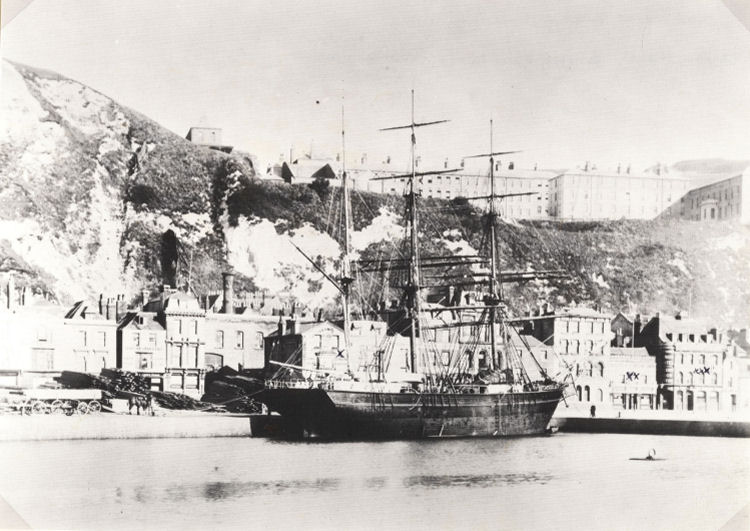
Union Hotel indicated by XXX on right of picture. |
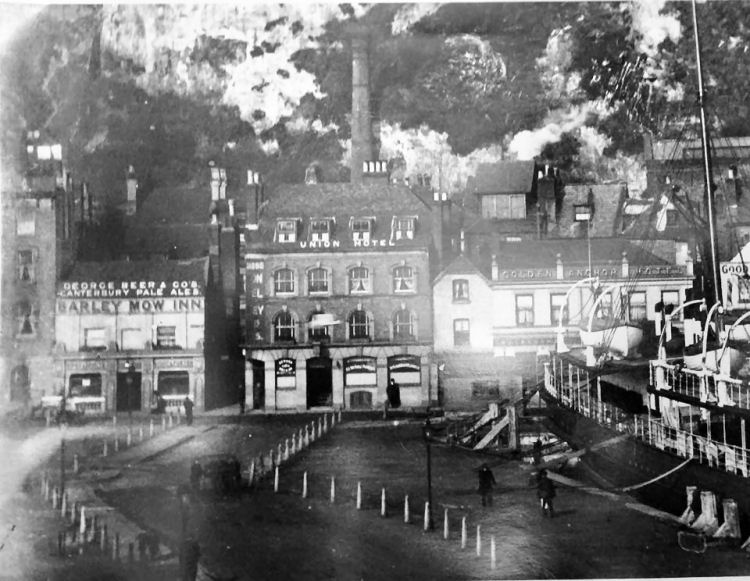 Above photo from the John Gilham collection, circa 1920.
Showing also the "Barley Mow" to its left
and the "Golden Anchor" to its right. |
The original tavern was said "to be near the drawbridge" with its front
facing the harbour. The terrace and many of the rooms had a good view of the
sea and the castle.
That establishment, on the corner of Union Street, was removed in 1878 by
the Harbour Board but a new licence was provided in 1879 for new premises to
open on the opposite side of the road, at numbers 1 and 2. An advert in the
Sinnock Directory of 1875 (p.291) gave the address as Union Street, Dover
opposite new dock.
Both were Leney outlets. The first, well established in 1823, was
expected to finish when the Tidal Harbour was enlarged in 1844 but managed
to survive that upheaval.
Supplied by Alfred Leney Co Ltd, who bought out Thomas Walker's Phoenix
Brewery in 1859 and registered as such in 1896, until bought out by Fremlin
Brothers brewery of Maidstone in 1926, brewing at the Dover brewery ceased
in 1927, which later passed to Whitbread.
In 1823, coaches ran from the "York", "Union", "Castle" and "Antwerp"
hotels, and from the "Flying Horse Inn" every morning at six and ten, and
every evening at six to the "White Bear", Piccadilly; "The Old Bell Inn",
Holborn and "Blossom's Inn". Lawrence Lane, Cheapside, London. Later in
1836, Union Safety Coaches ran to London from the "Union", "Antwerp" and
"Gun" hotels and the "Packet Boat Inn".
Five a.m. opening was permitted from 1881 and the concession continued
after 1900. I am puzzled by the new licence granted to Galanti in 1854. It
was in respect of the United Services Club, the late "Union Hotel". By 1856
however, John Minet Laurie, by his then name of Fector, was on duty at the
"Union Hotel Tap". That stood next door to the "Barley Mow" and it prospered
up to 1929 when it was removed with the other Quay properties.
Alfred Leney was compensated with £1,694 and £400 went to the licensee,
Pearce. He moved to manage the "Pavilion Tavern".
|
Kent Herald, 9 June 1825.
Dover Sessions.
A General Sessions of the Peace and Gaol Delivery for the Town and Port of
Dover, and the Limbs and Precincts of the same, was holding on Tuesday in the
Guildhall, before Sir Thomas Mantle, Kent, Mayor and a Bench of Magistrates.
To be sold by auction, by W. Horsnaill, on Wednesday, the 15th of June next, at
two o'clock, at the "Union Hotel" Dover, all that desirable and long established
Inn and hotel, called the "Union Hotel," the resort for many years of great
numbers of persons of every distinction and class, and in a desirable situation,
contiguous to the Harbour, comprising a coffee room, 6 sitting rooms, 13
bedrooms, a good kitchen, coach office and yard, - every way qualified for the
reception and accommodation of visitors of rank and respectability, and
embracing every advantage; now occupied by Mr. John Jell.
Held under the usual Lease from the Honourable Wardens and Assistance of Dover
Harbour, for an unexpired term of 49 years from Lady last, subject to an annual
rent of £7 17s. 6d.
Part of the purchase money may remain, secured on mortgage.
|
|
From the Kent Herald, 24 April 1828.
DEATH.
April the 20th, at Dover, after a very severe illness in the 36th year of her
age, Anne, wife of Mr. John Jell, of the "Union Hotel," leaving a husband and
six small children.
|
|
From the Dover Telegraph, 4th January 1834.
John Pain, porter at the
Union Hotel, has been committed to goal, charged with having stolen a
silver snuff box from a gentleman who was stopping there in September
last.
|
|
From the Dover Telegraph, 8th February 1834.
TO BE SOLD BY AUCTION
On Monday, the 24th day of February, 1834, at Two
o'clock in the Afternoon.
BY Mr T. BIRCH,
At the Union Hotel, in Dover
The well known FAST SAILING CUTTER, BLACK DWARF, built at Poole, now
lying in Dover Harbour, of the Burthan of sixty-two, 61-94 Tons,
elegantly fitted up as a Yacht, with her excellent Materials and Stores,
with which she is abundantly provided.
To be viewed, and for Investories and further Particulars, apply to
the Auctioneer; Mr Thomas Pain, Solicitors, Dovor; or, to Mr Friswell,
Solicitor, 93, Wimpole Street, London.
|
|
From an email received from Alec Hasenson 18 February 2008.
The Kentish Gazette of Tuesday, April 29, 1834 states:
“Married, Mr. John Jell, proprietor of the Union Hotel, to Mrs. Thompson,
Housekeeper of this establishment.”
|
|
From the Kentish Gazette, 2 May 1837.
DOVOR. KENT.
VALUABLE HOTEL FOR SALE.
TO BE SOLD BY AUCTION,
By order of the Assignees of the Estate of John Jell, with the content
of the other Proprietors, and of the Mortgagee, By Mr. CHARLES LAMB,
ON the premises, on Saturday, the 27th day of this instant May, at One
o’clock in the afternoon, in one lot, subject to the conditions then and
there to be produced, all that most excellent well accustomed, long
established, and highly respectable HOTEL, called the UNION HOTEL,
situate in Union-street, at that delightful and highly fashionable
watering-place, DOVOR, with the coach office adjoining thereto, as the
same are now in the occupation of Mr. Jell.
The Hotel is fitted up in a superior style, is in excellent condition,
and possesses every requisite for the luxury, comfort, and convenience
of travellers. Its situation is in one of the main thoroughfares of the
town, with a short and easy approach to the Harbour, Custom-house, and
Bay.
Coaches to and from London, as well as Margate, Ramsgate, and Hastings,
stop at the Hotel daily.
The advertisers call particular attention to this sale, as offering
advantages but rarely given forth to public competition.
The whole Estate is held under the usual lease from the Warden and
Assistants of Dovor Harbour, for a term of 61 years from the 6th day of
April, 1813, at an annual ground rent of £7 17s. 6d.
Possession of the estate may be had immediately, an the furniture,
plate, linen, china, stock of wines, spirit, &c. may be taken by the
purchaser, at his option, by valuation on the usual terms.
For further particulars, apply (if by letter, post free) to Mr. Pain, or
Mr. George Thomas Thompson, solicitors, Dovor; or to the Auctioneer.
N.B.— The premises can be viewed daily, upon application at the bar of
the Hotel.
|
|
From the Kentish Gazette, 30 May 1837.
DEATHS.
At Dover, Mr. Claringbould, landlord of the "Union Tap."
|
|
From the Dover Telegraph and Cinque Ports General
Advertiser, Saturday 16 June, 1837. Price 7d.
SUICIDE PREVENTED
On Wednesday afternoon, a man named Simon Dallas, formerly of the
Artillery, threw himself into the basin of the harbour from the quay
behind the clock-house, and would, in all probability, have been
drowned, but for the activity of a young man named Lacy, belonging to
the schooner 'Robert Garden,' by whose promptness he was prevented from
sinking, and with other assistance, conveyed on shore in the schooner's
jolly-boat to the tap of the "Union Hotel." The unfortunate man was
convicted of an offence at the Sessions in April, and sentenced to two
month's imprisonment, from which he has recently been released. He was
seen in the morning much excited and not being able to regain possession
of some furniture he said belonged to him; and it is supposed he was
intoxicated at the time he threw himself into the water.
|
|
From the Kentish Gazette, 29 August 1837.
UNION HOTEL, DOVER.
Extensive Sale of excellent Funniture. Plate and Plated Goods, Linen,
China, Glass, &c on Wednesday, Sept. 6th and following
days.
Mr. LAMB will sell by auction.
ON the Premises, at the "Union Hotel," in Dover, on WEDNESDAY, the 6th
day of September, 1837, and following days, by order
of the trustees to the Estate of Mr. J. JELL, for the benefit of the
Creditors the whole of the excellent FURNITURE, Plate, Linen,
China, Glass, and numerous other effects.—
Comprising an extensive assortment of excellent mahogany four-post
bedsteads, with tent and French ditto, and dimity furniture's
for the same; about thirty excellent goose-feather beds, the greater
part in bordered ticks, with the like proportion of horse-hair
and wool mattresses and paillasses, also the usual quantity of blankets,
and counterpanes for the same.
In The Chambers:— Numerous painted and mahogany basin stands, dressing
tables, large dressing glasses, double and single
chests of drawers, night commoles, bidets, foot baths, easy chairs,
Brussels and other carpeting, fenders, fire irons, window
curtains, &c.
In the Sitting Rooms:— Excellent mahogany chairs and tables, large
chimney and pier glasses in gilt frames, mahogany
sideboards, dining and Pembroke tables, Brussels and other carpets and
hearth rugs, window curtains, fenders and fire irons, fire
screens, cellarets, bell pulls, card tables, &c. several mahogany framed
tables for coffee rooms, two excellent eight-day dial clocks,
japanned tea urns and tea trays, copper coal shoots, knives and forks,
butler’s trays and tray stands, &c. &c. &c.
All the kitchen, scullery, and wash-house utensils.
About 300 ounces of plate, with numerous articles of plated goods.
About 40 pair of linen and other sheets, table and breakfast cloths,
towels, napkins, toilet covers, pillow cases, &c. &c. &c.
Dinner, with tea and breakfast sets of china.
General assortment of glass, consisting of decanters, water bottles,
rummers, tumblers, wine glasses, ale glasses, coolers, finger
glasses, salts, cruets, &c. &c. together with numerous other articles,
the whole of which will be particularized in Catalogues, to be
had at the place of Sale; of Mr. Thos. Pain, and Mr. George Thompson,
Solicitors; and of the Auctioneer, Dover, at 6d. each, to be
returned to Purchasers.
The whole may be viewed on TUESDAY preceding the Sale; and from the
immense number of Lots, the Sale will commence each
day precisely at Eleven o’clock.
Mr. Lamb begs to state that the above property is extremely clean and in
good condition, and will be found worth the attention of
Innkeepers, Brokers, and the Public in general, especially as it must be
sold without the least reserve.
|
|
From the Kentish Gazette, 29 August 1837.
DOVOR. To be Let, with Immediate Possession,
THE UNION HOTEL and PREMISES, situate at the bottom of the Commercial
Quay, in Dovor, as the same are now in the
occupation of Mr. John Jell.
For particulars, apply to G. H. Loud, Esq., Buckland; or to Messrs.
Simpdem and Ledger, Solicitors, Dovor.
|
|
From the Kentish Gazette, 4 July 1843.
DEATH.
July 1, at the "Union Hotel," Dover John Toke, eldest son of the late
John and Elizabeth Usmar, aged 44.
|
|
Kentish Gazette, 14 January 1851.
Sudden Death.
On Tuesday evening, Mr. Stephen Usmar, brother to Miss Usmar, of the
"Union Hotel," suddenly expired at the above house.
The deceased had been under medical treatment, but on that evening was
particularly cheerful, having been to the Railway
Terminus to attend the trains, and on his return on going into the bar,
he uttered an exclamation, and a person advancing to
see what was the reason, he fell into her arms a corpse.
|
|
South Eastern Gazette, 8 November 1853.
UNION HOTEL, DOVER.
Notice of extensive and unreserved Auction Sale of the Household
Furniture, Plate, Linen, Plated Goods, China, Glass, Fixtures, Trade
Implements and Effects of Jane Usmar, included in the entire suites
of 17 Chambers, 2 Dressing-rooms, 5 Sitting-rooms, Coffee-room, Bar,
Bar Parlor. Hall, Stairs, Landings, 2 Store-rooms, Kitchen,
Scullery, and other Offices, which, under the instructions received,
will, On Monday, Tuesday, and Wednesday, November 14, 15, and 16,
1853, be SUBMITTED FOR PUBLIC COMPETITION, By Mr. J. B. TERSON, On
the premises, known as the "Union Hotel," Union-street, Dover.
THE excellent, modern, and useful FURNITURE, &c. &c. &c., embraces
in the Chambers and Dressing-rooms:- 23 mahogany carved and turned
4-post, new-style birch 4-post, painted half-tester, French and tent
bedsteads, with dimity and chintz furniture's, 19 superior
goose-feather beds in bordered and other ticks, with bolsters and
pillows, 3 flock beds, &c., 22 bordered wool and other mattresses,
Witney and other blankets, counterpanes, quilts, chests of mahogany
double and single circular and straight-fronted drawers, basin
stands, chamber services, mahogany and painted dressing tables, box,
tray, and other glasses, cane and rush-seat chairs, mahogany framed
bedsteps, commodes, bidets, Kidderminster carpeting, chamber horses,
foot-baths, &c.
Sitting-rooms, Bar, Coffee-room, and Parlour:- Mahogany centre,
dining, occasional, Pembroke, and card tables, mahogany framed
sofas, and couches with squabs and bolsters, covered with hair
cloth, sets of mahogany framed chairs en suite, chimney, consol, and
pier glasses, in gilt frames, fire furniture, mantel ornaments, 2
8-day dials, by Miller, Dover, in mahogany cases, 8-day clock, by
Elliott, Lenham, in wainscot case, 6 Spanish mahogany coffee-room
tables, Kidderminster carpets, hearth rugs, mahogany sideboards,
knee-hole drawers and cellaret, engravings, fire-screens, cane-seat
chairs, window curtains, china, tea and coffee services, china
bowls, cut-glass decanters, wine and punch glasses, rummers,
tumblers, ale glasses, tea glasses, finger glasses, pickle jars, and
covers, sugar basins, jelly glasses, water bottles, liquor glasses,
&c. &c.
Hall, Stairs, Kitchen, and other Offices:. —Stairs carpeting, brass
rods, umbrella stand, bronze tea urns, metal coffee and tea pots,
butlers’ mahogany trays and stands, scales and weights, floor-cloth,
knives and forks, mats, Windsor chairs, fir kitchen table, dinner,
crockery and delph wares, kitchen requisites in brass, copper, iron,
and tin wares, culinary implements, wheelbarrow, copper and pewter
measures, bottle baskets, ladder, patent and other corkscrews, &c.
The 100 ounces of Plate includes silver teapot, cream ewer, table,
gravy, dessert, salt, and tea spoons (fiddle pattern), table and
dessert forks, sugar tongs.
The Plated Goods consist of table forks, fish knife, table
candlesticks, snuffers and trays, cruet frames, egg stands and cups,
salt cups, toast racks, nut-crackers.
The Linen comprises linen and cotton sheets, pillow and bolster
cases, toilet covers, damask table, tray, and other cloths, table
napkins, doilies, roller and muslin blinds, window curtains, chamber
towels.
In the House and Trade Fixtures and Fittings may be enumerated
register, elliptic, and other stoves, coppers, ranges, smoke jack
with spits and racks, dressers with drawers and shelves, panel
partition, bell and gas fittings, plate racks, hanging tables, front
door lamp, sign boards, &c.
May be viewed on Saturday, the 12th inst., from Nine till Five
o’clock.
Sale to commence each day at Eleven o’clock precisely. The whole of
the above property will be fully particularized in catalogues, (at
6d. each returnable to purchasers,) which may be obtained on the
premises, and at the office of Auctioneer, No. 44, Castle-street,
Dover.
|
|
From the Dover Telegraph, 24 January 1863.
DEATH BY DROWNING.
On Monday evening a respectable Jury assembled at Epps's "Union tavern," Palmerston Bridge (before H. Payn, Esq., Coroner for the Borough and Liberties;
to investigate the circumstances attending the death of a labourer named William
Adams. The jury, having been sworn, proceeded to the dead-house, to which the
body had been conveyed by Sergeant Geddes and p.c. Connor, upon its recovery
from the Pent water, on Saturday evening.
Having returned to the inquest-room, the first witness called was:— Charles
White, a labourer, working at the "reservoir" for Messrs. Fry and Pepper, who,
being sworn, said:- I first knew deceased last Christmas twelve month, by
working with him at East Tilbury, Eseex; he always went by the name of "Jack"
and worked as a labourer. He worked upon the Heights, but I do not know who for.
I believe his age wad about 18.
Sergeant Back stated that Messrs. Lee’s foreman (Russell) had identified the
body as that of Wm. Adams, from the circumstance of his having lost three
fingers of the left hand.
Evidence resumed:- Deceased called for me about seven o’clock on Saturday
evening, and we went to a clothier's shop to purchase a smock. We then came on
to the skittle alley at the back of the "Tradesman's Arms," to meet some of his
mates. Passing from Snargate Street through Barley-mow Lane, we crossed to the
door of the house, but not being able to get in deceased said "Lets go round the
back way:" he turned to the left, and I followed him. I had not been to the
house before, and did not know the way. After he passed round the corner, I
followed about three yards behind him. and I saw him step over the quay.
By the Coroner:- Did you have to get under any chain?
No, the chain was down.
Evidence resumed:- I called for help to the shipwrights who were working a
little way off, and they came round as soon as they could, but before anyone
came he was drowned. As he went over he cried out "Oh dear! I did not hear him
again after the splash.
By the Coroner:- It was not so dark but deceased could be seen, I have been to
the place since, and lave seen the hook in the wall, but the chain was hanging
down.
By a juror:- We were both perfectly sober, and had only been into the clothier’s
shop.
Evidence resumed:- The shipwrights came in a boat, and were the first on the
spot; they got grapnels as soon as they could. I remained on the spot till they
found the body; it was nearly an hour from the time he fell in.
By the Coroner:- Did any one on shore try to get any grapnels?
Yes, a man ran to a passage where they used to hang, but they were not there.
Did you hear the man say they were kept there?
Yes, sir.
If he had found them would the grapnels have been there before the shipwrights?
I believe they would.
Thomas Ovenden, mariner:- On Saturday night about eight o’clock, a lad who was
at work on the outside of the "Annabel," said there was a man over just by Mr.
Mowll’s store. I immediately jumped into the boat, and skulled away to the spot,
Wm. Gillespie, who was aboard with me, went to get the drags, and a woman who
lived in the passage said she had a hook and gave it to him. A boat-hook was
sent me from the "Lucy," and with this I caught deceased by his jacket. It was
about three-quarters of an hour after I first tried.
By the Coroner:- The drags have always been kept in that passage for years.
By the Foreman:- I do not know who has the charge of the drags — whether it is
the Harbour authorities or the police. In the north of England it is the Harbour
authorities.
Sergeant Back:- The Humane Society used to pay a man to look after them.
By the Coroner:- Was the man quite dead when you got him up?
Well. I thought he was warm, and so did Gillespie; but three quarters of an hour
had elapsed.
Do you believe you would have recovered him sooner if you had got the hooks?
Yes — probably; but I do not think the hooks are strong enough to be good for
anything. It was the boat-hook that we recovered him with; the first time we got
up a sack containing about l00cwt. of coals. I helped carry deceased to the
dead-house.
By the Coroner:- It is my belief the present hooks are of very little use; they
want renewing, and want longer ropes to them.
P.c. Corrie took from the pockets of deceased two purses containing 2s. 8d., a
tobacco-box, a pipe, and two oranges.
The Coroner, in summing up, remarked upon the chain not being fastened alter the
labours of the day at the coal wharf were over; but assuming that the deceased
imagined that was the wav he thought he knew, he would probably have lifted the
chain. It seemed, however, under any circumstances, a very dreadful thing that a
young and strong man like the deceased should lose his life in the way he had
done in the carefully-guarded town of Dover. With reference to the drags he
should be happy to forward any communication the jury might think fit to the
proper officers.
A juror (to Ovenden):- Those drags have been accustomed to hang in York passage
a great many years, have they not? I can remember them six or seven and twenty
years.
By the Coroner:- We could have got those drags in about two minutes, had they
been in their place.
Verdict:- "Accidental Death," and a request that the Coroner would communicate
with the Harbour officials, &c.
|
|
From the Dover Express and East Kent Intelligencer, 24
September, 1864.
PUBLIC HOUSE PROSECUTION
Leonard Epps, landlord of the "Union Inn," was charged with having
his house open for the sale of beer on Sunday morning last. The
defendant pleaded that the person s who were found in the house came
under the denomination of "travellers," being the crew of the Submarine
Telegraph Company's steamboat, which had just entered the harbour, and
to whom he supplied some bread and cheese and beer. It appeared,
however, from the evidence of Police-constable Joyce that one of the men
belonged to a yacht; but the bench in consideration of the good
character of the house, dismissed the summons, though cautioning the
defendant that although the crew of the Telegraph Company's boat might
be considered as travellers, such a description could not apply to the
yachtsman.
|
|
From the Kentish Gazette, 24 January 1865.
Coroner’s Inquest.
On Saturday afternoon the Borough Coroner, W. H. Payn, Esq., held un
inquest at the "Union Tavern," on the body of Stephen Tuff, a
gardener, belonging to Canterbury, whose body had been picked up in
the fairway of the channel on the previous morning. From the
evidence of the unfortunate deceased’s widow, who said she lived in
Rosemary-lane, Canterbury, and recognised the body as that of her
late husband, it appeared that he left Canterbury a few days before
Christmas, — on Tuesday, Dec. 20, to spend a day or two with a
friend living at Dover, Mr. R. Head, the landlord of the "Burlington
Inn." He then had with him a silver watch and guard and 10s., or a
little more, in money. He reached the "Burlington" the same day, and
remained, chatting with Mr. Head, till about eight in the evening,
when he left the house, without saying where he was going. He was
sober, and Mr. Head fully expected him to return, sitting up for him
till after midnight. From that time, however, all trace of him was
lost till the previous day, when his body was found floating as
described. Neither watch nor money was to be found upon him; but a
pair of spectacles, which be had with him, was in his pocket. The
body bore no marks of violence, although there were some abrasions
of the skin on either side of the head, apparently caused by the
body chafing in the water. The opinions of the witnesses differed as
to the length of time the deceased had been in the sea, but the
policeman who had examined it considered that it must have been in
the water for least three weeks. The watch had not been traced. The
latter fact, coupled with the mark on the temples, inclined the
foreman of the jury to further investigation; but the coroner
observed that if an open verdict was returned the inquiry might, if
necessary, be opened, should the police find trace of the watch, and
connect it with any circumstances calculated to cause a suspicion of
foul play, and the jury then returned a verdict to the following
effect that the deceased was found floating in the water, but by
what means he came to his death there is no evidence to show."
|
|
From the Kentish Gazette, 12 December 1865.
Man Drowned in the Harbour.
Between nine and ten last Thursday night a sailor named Robert Smith
accidentally fell into the harbour near the Palmerston Bridge. Some
delay ensued in the recovery of the body; but on its being got out
of the water, it was taken to the "Three Kings tavern," where Mr. Colbeck, surgeon, was immediately in attendance, and under his
directions every effort was made to restore animation, but without
avail, as life was doubtless extinct before the body was recovered.
A coroner’s inquest was held on Friday night at the "Union Tavern,"
and an open verdict returned.
|
|
Kentish Chronicle, Saturday 16 December 1865.
A man drowned in Dover Harbour.
W. H. Payn, Esq., the borough coroner, held an inquest at the "Union
Tavern" on Friday night, on the body of Robert Smith, a fisherman, who
was drowned in the harbour, near the Palmerston bridge, on the preceding
night. The evidence did not disclose how the deceased came into the
water; but it is presumed that he fell overboard. His cries for help
were heard, but before assistance came he sank. The body was dragged
for, and on being discovered was taken to the nearest public house,
where under the direction of Dr. Colbeck, the usual means of restoring
animation were resorted to, but without avail.
The jury found an open verdict.
|
|
From the Southeastern Gazette, 15 May 1866.
Melancholy Cash of Drowning.
The borough coroner (W. H. Payn, Esq.), held an inquest at the “Union
Tavern” last Saturday afternoon, on the body of James Chidrick, mariner,
whose lifeless body was picked up in the harbour the same morning.
Deceased, who was a very steady and industrious lad, was one of the crew
of a collier, belonging to Mr. Mowll. The vessel was in harbour
unloading, and a night or two previously the lad, after having paid a
visit to his mother, was returning to the vessel, when it is presumed on
stepping from the quay to the vessel he went overboard. No one seeing
the occurrence, the poor fellow was drowned. On being missed, suspicions
arose as to his fate, and the harbour was dragged, when the body was
recovered. The jury returned an open verdict of “Found drowned.”
|
|
From the Dover Express and East Kent News, Friday
3 May, 1867.
CORONER'S INQUEST
An inquest was held on Tuesday evening last at the "Union Tavern,"
before W. H. Payne, Esq., coroner, touching the death of Richard Gritlen.
Esther Gritlen deposed: I live in Round Tower Street. The deceased is
my third son, and is twenty four years of age. He has not resided with
me personally since the death of my husband. He has been to sea, but has
not been fully occupied. He has been afflicted ever since his birth with
water on the chest. He had only earned about eighteen pence during the
winter. He was not fit for work. I had no means of keeping him. He said
he would sooner die in the streets then go to the union. About six weeks
ago he showed me his leg, and I poulticed it. I could see the water
would rise and kill him. He said he had been living aboard different
vessels for some weeks. The last time I saw him was last Wednesday. He
asked me for some halfpence to get some tobacco, and said he would go to
the union. He had a brother who was subject to fits. He had not been
attended by any medical men since Dr. Heritage died. He said he was
asthmatic, and that he would probably be consumptive. Deceased never
complained of palpitation of the heart. He took to drinking. I think he
died from water in the chest, and not from starvation.
John Spain deposed: I am a Surveyor in the Customs. On Monday I saw
the deceased sitting on the step, about one in the afternoon, and a few
minutes afterwards he was laying on the steps vomiting, with some people
around him. I asked him if he was ill, and he said yes, but did not say
what was the matter with him. I asked him if I should get him anything,
but he made no reply, and I left him to attend to my duty. I saw no more
of him. I heard some woman say she would go and tell his mother.
By the Jury: He appeared to be sober.
Mary Ann Wilson said: My husband William Wilson, is a labourer
on the Admiralty Pier. On Monday morning I saw Richard Griften lying on
the steps, foaming at the mouth and black in the face He appeared to be
quite dead. I left him in charge of the first person passing, and went
to his mother. He formerly lodged with me. His mother said she could not
take him in. She asked me to have him taken to the union, as she had no
means of keeping him. She is a cripple, and on the parish. A policeman
came and took him to the dead house. He was short of breath and troubled
with his chest, and listless and feeble. I never saw him the worse for
drink while he lived with me as a lodger. I do not know that he was
subject to fits.
Thomas William Colbeck deposed: Yesterday about half-past one my
assistant was called to the deceased. I was not in, but went this
morning and saw the body. I found the deceased thin, emaciated, and
patches of eruption about the legs and body. The chest was narrow and
badly formed. There were no external marks of violence about the body
except a slight graze above the left knee, which I believe was two or
three days old. Judging from the evidence, I should think he died from
fainting, caused by a weakened heart, the result of asthma together with
exposure to the night air and want of proper nourishment.
The Jury immediately returned a verdict of death from natural causes,
accelerated by exposure and want of sufficient nourishment.
|
|
From the Dover Express and East Kent News, Friday
12 February, 1869.
CORONER'S INQUEST - THIS DAY
An inquest was held this day by the borough coroner, at the "Union
Tavern," Union Street, on the body of Thomas Cook, a seaman belonging to
the True Blue, a collier owned by Mr. E. P. Robinson, who had met his
death by falling overboard early on the previous morning while the
vessel was lying moored at the Northampton Quay.
It appeared from the evidence that the unfortunate deceased in
passing between the shore and vessel missed his footing and fell into
the water. Notwithstanding that a rope was thrown by a man who heard his
cries and hastened to the spot, the deceased was not recovered. Drags
were used till about noon, when the body was took from the water. Life
had then of course been long extinct.
The Jury returned a verdict of "Found Drowned."
|
|
From the Dover Express and East Kent News, Friday
2 April, 1869.
SUDDEN DEATH OF SHIP'S CAPTAIN
On Tuesday last an inquest was held on the body of William Shaker,
captain of the ship Catherine, by the borough coroner, W. H. Payn, Esq.,
at Epps's "Union Tavern." Mr. Green was chosen foreman of the jury.
John Orwin said: I am mate on board the brig Catherine, of
Sunderland, and the deceased was master of the same ship. The ship is on
a voyage from Churrant to Plymouth and Yarmouth. We have passed through
the Downs and were off the Long Sands Buoy, near the Kentish Knock. At
about twenty minutes past five in the evening the deceased took the
wheel in order to stay the vessel and to keep her off the sand. The wind
was blowing very strong from the east when she missed stay. I gave
orders, and after having taken in slack of the main-sheet, I spoke to
the master and told him he had better let me have the wheel because I
knew I could put the ship round. He asked me if I thought he was not in
a fit state to put her round, and I told him that he was not. He then
said it was I that was not in a fit state, and not he. I told him that
if I was not in a fit state I would go and get my pipe and sail no more
with him. I went forward to the middle of the ship when one of the men
turned round and said, "The captain is down again." All hands then ran
aft and found blood streaming from his mouth. He was insensible and
never moved afterwards. I left two of the crew with him on deck, and
took two boys and one man and put the ship round. Finding that he was
quite dead I put him on one side and covered the body with a new
tarpaulin and made it fast so that it would not roll with the ship. I
brought him to Deal first in the ship and then to Dover, the sea being
so rough that we could not land him at Deal. I commenced sailing with
the captain about three months and a half ago. The first part of the
voyage he was not subject to drinking spirits; but during the latter
time he was frequently drunk. The ship was partly laden with brandy. the
captain had a considerable allowance for himself. he has had fits
recently, the first was on Saturday. I should say the fits were caused
through excessive drinking. The second fit was on Sunday morning at
about half-past ten, and the one at the wheel was the third, under which
he died. We were twelve days at Plymouth, and the captain was not sober
all that time. he hardly came on deck from the day we left Plymouth. he
had the key and helped himself to the spirits. I have frequently urged
him not to drink, and on one occasion he struck at me and told me to
mind my own business. On the ship's arrival at Dover I reported the
matter to Mr. Latham, the shipping agent, and they sent a stretcher and
took him ashore. he was about sixty years of age.
By the Foreman: I believe he was not intoxicated at the time he was
at the wheel. I had tried to keep him from the spirits for the last two
days.
Argus Smidt said: I am able seaman on board the brig Catherine. The
captain was taken in a fit at about half-past five on Sunday afternoon.
He was at the wheel when we were off the Long Sand Bay. I was at the
wheel first, when the mate came and took the wheel out of my hands, and
the captain shortly afterwards took it from him. Some altercation took
place between the captain and the mate, the mate charging the captain
with not being fit to take care of the vessel. The mate afterwards went
to the middle of the ship. I saw the captain shortly after fall down on
to the deck, apparently in a fit. All the crew went to the captain; but
in about ten minutes afterwards he died. We wanted to land him at Deal,
but the weather being so rough we were compelled to bring him to Dover.
The captain was always drunk during the latter part of the voyage; but
was sober the two days previous to his death. I should think he died in
a fit.
By the Jury: I don't think the captain had strength enough to use the
wheel. There was no fighting between the mate and captain. The mate is a
sober man and good seaman. I have been on board the ship about three
months and a half. I shipped at Sunderland.
The Jury returned a verdict that the deceased died in a fit produced
by excitement.
|
|
From the Dover Express and East Kent News, Friday
21 May, 1869.
DEATH BY DROWNING
An inquest was held at Epps's "Union Tavern," Union Street, on Monday
last, before W. H. Payn, Esq., the borough coroner, on the body of John
Foley, a soldier belonging to the 1st battalion of the King's Own Royal
Regiment, stationed in the garrison, which had been found in Dover
harbour on the previous Sunday morning.
David Sach, a sergeant in the 1st Battalion of the 4th King's own
Regiment, stationed at Castle Hill Fort, said: I have known the deceased
for the last eleven months. He was a private in the regiment to which I
belong. The last time I saw him alive was on Saturday evening, between
five and six. he was then in barracks , and was quite sober. I heard on
Sunday morning, at a quarter to eleven, that he had been drowned. He was
absent from barracks without leave. his age is twenty-eight. Deceased
was very much addicted to drinking.
Charles Walker said: I am a sapper in the Royal Engineers, stationed
at Castle Hill Fort. I knew the deceased, having seen him frequently in
the cook-house. I was in his company on Saturday evening, about 9
o'clock, at the "Phoenix" public-house, in the Market Square. he was
then rather the worse for liquor. I saw him go out of the door and
recommended him to go home. he replied that he would go directly.
Deceased was alone. I did not see any of his comrades present.
Assistant-surgeon William John Page, of the 94th Regiment, said: I
was called to see the body of the deceased. I saw no marks of violence
upon him. From the general appearance of the body I have no reason to
doubt but the death was occasioned by drowning.
James Albert Harmer said: I am an officer of Customs at Dover. I was
on duty on Sunday morning, at twenty minutes past seven, on board the
Louise Marie, a Belgian Government steamboat, lying at the Clock House
Quay, when I saw something red in the harbour, at the corner of the
Esplanade Quay. I sent a man round to look, and he called out that it
was a soldier. I and another officer then got into a boat and went to
pick up the body. We dragged the body to the steps near the Wellington
Bridge and took it on shore. I saw no marks of violence on the deceased,
though there were some marks made by crabs upon his face. During the
time I was on board I heard no splash in the water. After we had got the
body ashore I went to the shaft guard and the sergeant sent a man
to the police-station. I should say deceased had been in the water three
or four hours.
Police0sergeant Stevens stated that on searching the deceased he
found a purse which contained 4½d.
From a statement made by the captain of the
deceased's company, it appeared that deceased had had £8 in the Post
Office Savings bank; but he had drawn some out on the evening he met his
death.
The Jury returned a verdict of "Found Drowned."
|
|
From the Dover Express and East Kent News, Friday
16 July, 1869.
CORONER'S INQUEST
An inquest was held yesterday afternoon at Epps's "Union Tavern," Union Street, on Monday
last, before the borough coroner W. H. Payn, Esq., on the body of James
Bingham, who was accidentally drowned by the upsetting of a boat off
Dover rather more than a fortnight ago.
Mr. William Henry Styles was chosen foreman of the jury; and the body
having been viewed, the following evidence was taken:-
James Dickson Lilly, a mariner living at Kingsdown said: I have known
deceased for many years. he was a mariner living at Kingsdown, and his
age, I believe, was 29 years. I last saw him alive a fortnight ago
to-day in a galley punt named the Staunch, belonging to Kingsdown, and I
was one of the occupants. We cruised off Dover for the purpose of
attending vessels requiring assistance. We afterwards entered Dover
Harbour, and after we had been on shore a short time we again put to
sea. We were out about a mile from the Admiralty Pier. The boat
contained three hands, the deceased, myself, and a seaman named Henry
Webb. We hoisted a lug-sail. At the time of the accident there was
a heavy sea running from the effects of the tide near the Admiralty
Pier. The sea struck the forepart of the boat, and she immediately sank.
I saw Webb, who was holding on with me to a spar which had floated out
of the boat. I looked about, but could see nothing of the deceased, and
I believe he sank and was drowned. Deceased was wearing at the time a
guernsey shirt and a blue pair of trousers. I know that he could not
swim. The sea was not rough, except just in the tide-way of the
Admiralty Pier.
By the Jury: I was picked up by a Scotch schooner. I remained on the
mast with Webb for about a quarter of a hour. We drifted down by the
schooner which was lying at anchor in the bay, and they sent a
boat to our assistance.
Thomas Edward Bingham, brother of the deceased, said: I am a mariner
living at Kingsdown. The deceased was my younger brother. he lived at
Kingsdown and was also a mariner. I have seen the body which the Jury
viewed, and recognise it as that of my brother. I last saw him alive a
fortnight ago to-day, when he put off in a galley punt from Kingsdown to
go to sea. He was a temperate man, and was a good sailor. He was
married, and has left a wife and three children. His age was 29. I know
nothing of the circumstances attending his death, but I have no doubt
that he was drowned.
Robert Turner said: I am a mariner living at Dover. I was at sea in a
smack off Dover and found the body of the deceased about seven miles off
Dover on Wednesday last, about 7 p.m. It was floating to the westward.
We tied a rope round it and hoisted it into the vessel, and brought it
to Dover. I immediately gave information to the police and helped
to take the body to the dead house. I did not observe any marks of
violence upon the body, and it had the appearance of a person who had
been drowned. The body was floating face downwards.
The Jury returned a verdict of "Accidentally drowned."
The following letter has been addressed to the editor of the Kentish
Gazette:-
Sir,
Will you allow me through your column to enlist my sympathy of your
readers in a very sad case which occurred last week to two Kingsdown
boatmen. Two men and a boy from this village were returning home in a
lugger punt from Dover harbour early on Thursday morning last (where
they had been to land a pilot from a Dutch vessel), when in an instant,
from a cross sea breaking over the bows of the vessel, she filled and
went down, carrying one of the men with her, who was never seen again.
The two others managed to cling to a spare floating mast; but before
help could arrive, the second man lost his hold and was also drowned,
the boy being rescued. These two hard working men were residents in
Kingsdown, and have both left widows, one with three young children, and
another expected, and the other with four young children and another
very shortly to arrive, who are all wholly unprovided for, except so far
as parochial relief gives aid. Kingsdown itself is a very small village;
and from failure in the late mackerel fishing, and hard times, is pretty
good just now, therefore can afford but little substantial relief in
this case; but if any of your readers, sympathise with the distressed
widow and orphans, would either in money or clothes help us in our
existences, it would be a real act of charity. Relief in any shape will
be most thankfully received and most carefully distributed by me. -
Believe me to be, yours very truly,
THOMAS SYDENHAM CLARKE,
J.P. for Kent &c.
Kingsdown House, near Dover
July 3, 1869.
|
|
From the Dover Express and East Kent
News, Friday 10 September, 1869.
SHOCKING DEATH OF A COMEDIAN
An inquest was held at Epps's "Union Tavern" Union Street, on
Saturday afternoon last, before the Deputy Coroner, Sydenham Payn, Esq.,
and a respectable Jury, on the body of Arthur Clifton, a comedian
belonging to the Dover Theatre, who had been found drowned in Dover
Harbour.
Mr. John Smith was chosen the foreman of the Jury, and the body
having been viewed, the following evidence was taken:-
Jamed Montagur, said: I am a comedian, at present residing in Dover,
and fulfilling an engagement at the Dover Theatre. I have seen the body
of the deceased, and recognise it as Arthur Clifton. the deceased acted
as prompter in the Theatre. Deceased's age I believe was 45 years. the
deceased has been in Dover for about a month this season, and has filled
a similar engagement here every season for some few years past. I last
saw him alive about twenty minutes past eleven on Thursday night
in front of the bar at the Theatre, and I left him there. He was then
slightly intoxicated and I had had occasion as stage manager to caution
him during the evening. When intoxicated he was always a little inclined
to be quarrelsome. Before leaving the theatre the deceased applied to
Mr. Walter Browning for some slight advance in money, but was
refused, and to the best of my belief he had no money upon him.
Thomas Grey Holmes said: I am a pianoforte-tuner residing in Dover. I
know the deceased. the last time I saw him alive was at the "Grand
Sultan Inn," Snargate Street, where I was engaged. he came there on
Thursday night, about a quarter-past twelve. he was then intoxicated. He
was quite alone. I advised him to go home. he said he was out of
spirits, and I asked him to have a glass of ale with me, which he did.
He then said he should go down into the room, and sing a song. he went
into the room and tried to sing, but broke down. he left the house
shortly afterwards, and I believe he went in the direction of his house.
Daniel Hall said: I am a mariner living at Dover. I heard that a man
was missing a little after seven this morning, and I dragged the Pent
with the grappling irons belonging to the Royal Humane Society. I
dragged near the sluice, where the body was supposed to be. The mate of
the True Blue told me that the deceased's dog , which always accompanied
him, had been barking there. On the second cast of the grapnel, I
recovered the body of the deceased, and it was taken on the stretcher to
the dead-house. There was a slight scratch over one eye and blood was
oozing from that mark.
Police-sergeant Johnstone: I received information this morning about
eight o'clock , that a body had been recovered from the Pent. I was
present when the body was landed in a boat, and I had it conveyed to the
dead house. I examined the body, and found a mark above the right eye;
but I noticed no other injury. In the right hand trousers pocket I found
a white handled knife, and in the left pocket a key and an old purse,
which was empty. In the watch pocket I found a brewer's cheque, with
some pencil whiting upon it, but the memoranda were not of importance.
the Jury returned a verdict to the effect that the deceased was
found drowned; but that there was no evidence to show how he had come
into the water.
|
|
From the Dover Express and East Kent
News, Friday 1 October, 1869.
MYSTERIOUS AND FATAL ACCIDENT
On Saturday afternoon last, the Borough Coroner, W. H. Payn, Esq.,
and a respectable Jury, held an inquest at the "Union Tavern" Union
Street on the body of James Saunds, an ordinary seaman on board the
collier Premier, belonging to Dover, who had been found drowned in Dover
Harbour.
Mr. David Houlden was chosen foreman of the Jury, and the body having
been viewed, the following evidence was adduced:-
Benjamin Morris said: I am a master of the collier premier, belonging
to this port, and I reside in Dover. I knew the deceased , James Saunds,
who was an ordinary seaman on board the premier. he had belonged to the
ship since January last. He was very steady and temperate. His age was
nineteen years, and his parents resided in Dover. I last saw him alive
about ten o'clock this morning, when he was on board the premier. He was
then working out the coal with some others of the crew. I heard that he
was missing about twenty minutes past eleven in the morning. I ascertain
that he had been in the boat for the purpose of cleaning the outside of
the vessel. I saw the crew get the grapnels. I and another man used them
and succeeded in recovering the body, after half-an-hour had elapsed. I
suspected that he had fallen into the water, as he had been missing for
so long a time. The ship was lying alongside the Northampton Quay and he
was picked up near the spot. I could see no marks of violence upon the
body when it was picked up. I sent a man to the police-station, and then
had the body conveyed to the dead-house. there had been no quarrelling
among the crew. Deceased was not a quarrelsome youth; but was very
quiet. I should think he probably fell into the water by attempting to
get from the boat to the vessel.
By the Jury: The mate gave him orders to clean the outside of the
vessel.
Charles King said: I am a mariner on board the premier and was at
work with the deceased , this morning cleaning the vessel. We began to
clean the outside of the vessel at half-past ten and continued working
till a quarter to eleven, when I quitted the boat to go on board to work
the coals out, leaving the deceased in the boat. I told him when leaving
the boat that a cart had come down and that we must go to work again on
deck and get the coals out. The deceased said, "Very well," Finding he
was not in the boat when we looked for him shortly afterwards, we
thought he had gone on shore. We loaded two carts after that, and
finding that the deceased had not come on deck we became alarmed and
thought that he must have fallen overboard. We procured the grapnels and
pulled the body up out of the water. Information was afterwards given to
the police. I did not see any marks of violence upon the body.
Mr. Edward Duke said: I am a surgeon residing and practising in
Dover. This morning shortly after twelve o'clock I was called to see the
body of a man which had been taken out of the water. I went to the
vessel, and saw the body lying on the deck of a collier. I examined it
externally; but did not see any marks of violence upon it. he had the
appearance of a drowned man. I should think he had been drinking about
half-an-hour. There was nothing to indicate that he had been drinking.
By the Jury: the body was quite cold.
The Jury returned a verdict that the deceased was "Accidentally
drowned."
|
|
From the Dover Express and East Kent News, Friday
11 February, 1870.
SUDDEN DEATH IN DOVER
On Wednesday afternoon last an enquiry was held at Epps's "Union
Tavern" by the borough coroner, W. H. Payn., Esq., on the body of
William Hagar a journeyman tailor, who had suddenly dropped down dead on
the preceding day, while he was on his way to his daily employment at
the shop of Mr. Meling, tailor, Commercial Quay.
Mr. James Greenfield having been appointed foreman of the jury, and
the body, which was lying at the dead-house, having been viewed, the
following witnesses were examined.
Frederick Finn: I am a shoemaker, and live at 23, Adrian Street,
Dover. The deceased lodged at my house. He was a tailor, and was in the
employ of Mr. Meling. He had been living at my house for about four
months. He was not a very steady man, I believe he was addicted to
drink. He did not enjoy very good health, and was in the habit of
complaining of his heart. Since Christmas he has complained more than
usual. I last saw him alive yesterday, about twenty minutes before
twelve, I passed by the shop where he was employed, and, seeing me from
the window, he nodded at me. He had left his house to go to his work,
about a quarter past nine the same morning. He complained before he had
his breakfast, and asked me to put my hand to his heart. I did so, and
felt that it beat very heavily. His age was forty five years. He is a
native of Greenwich, and I believe he had no relations in Dover. I knew
the deceased had been treated for heart disease, as he told me that he
had been in a London hospital on that account. He also complained of
rheumatism in the hips. The deceased was living with a woman who passed
as his wife shortly before his coming to live with me, and she was
coming back to him on Saturday. There was a child living with him, about
eight years of age, and he always spoke of her as his daughter.
Isaac Foredike: I am a labourer living in Dover. Yesterday, between
twelve and one o'clock, while walking along the Commercial Quay, I saw
the deceased in front of me. He was walking along the Quay, when he
suddenly tumbled down on the pavement. He remained quite still after
falling. I ran to him and picked him up, and found that he was sensible.
He said he was all right, and I left him, and turned up a passage into
Snargate Street. I shortly afterwards returned from Snargate Street,
through another opening, to the Commercial Quay, and I then found the
deceased lying on the pavement in front of the tailor's shop where he
had been employed. The deceased was quite alone when I saw him fall, and
he was going in the direction of Mr. Meling's shop. I assisted to carry
the deceased into the shop and lay him by the counter, when a doctor was
sent for. The doctor quickly arrived in a cab, and pronounced the man to
be dead.
Dr. Allen Duke: Yesterday morning I was sent for to see the deceased.
I attended immediately, and examined him with the stethoscope. I found
he was quite dead; and from what I have heard and what I saw at the time
I have not the least doubt that the deceased died from disease of heart.
The Jury at once returned a verdict of "Death from natural Causes."
|
|
Whitstable Times and Herne Bay Herald, 7 April 1870.
PICKED UP ON THE SEA SHORE.
An inquest was held at Epps’s "Union Tavern," Strond Street, on Tuesday
se’nnight, before the Borough Coroner, W. H. Payn, Esq., on the body of
a retired butler, named Thomas Crowhurst, about 60 years old, who was
found dead on Mondav morning week on the beach at East Cliff. Alfred
Newbury a baker, living and carrying on business at Hastings, deposed:— I
have seen the body of the deceased, and recognised it as that of Thomas Crowhurst. I believe he has been a butler in a gentleman’s family and is
retired. I saw him alive a fortnight ago last Friday at the Hastings
Railway Station. I spoke to him, and he told me he was going to Dover
for the benefit of his health. I know he has been affected in head
through some cause arising from the spine for some time past, as I have
known him about three years. He frequently complained to me of the state
of his health. He was a very respectable man, and generally temperate.
Mr. John Marshall, a surgeon practising in Dover, deposed:— On Monday
morning, about five o’clock, I was sent for to see the deceased at the
dead-house. I examined the body, and found he was quite dead. I had the
body undressed, but discovered no marks of violence upon it. I believe
the deceased was drowned, but it was quite possible that he might have
had a fit and fallen into the water. The general appearance of the body
would indicate that he was a man likely to have apoplectic seizure. The
jury returned an open verdict of "Found Dead."
|
|
Whitstable Times and Herne Bay Herald, 19 February 1870.
CORONER'S INQUEST.
The borough coroner held an inquest on Wednesday afternoon, at the
"Union Tavern" on the body of a tailor named William Hagar, aged 23, who
had lived in Adrian-street, and had been in the employ of Mr. Meleng, of
Snargate-street. Deceased it appeared, was upon the Commercial-quay the
previous day, not far from his masters workshop, when he suddenly fell
to the ground. Assistance was promptly rendered, and Dr. Duke sent for;
but that gentleman on his arrival pronounced life to be extinct. The
jury returned a verdict of "Death from natural causes."
|
|
From the Dover Express and East Kent News, Friday 21 April, 1870. Price 1d.
MYSTERIOUS DEATH AT DOVER
An inquest was held at the “Union Tavern,” Strond Street, on Tuesday
afternoon, before the Borough Coroner, W. H. Payn, Esq., on the body of
a retired butler, named Thomas Crowhurst, about 60 years of age, who was
found dead on the previous morning, on the beach at East Cliff.
Alfred Newbury, a baker, living and carrying on business at Hastings: I
have seen the body of the deceased, and recognise it as that of Thomas
Crowhurst. I believe he had been a butler in a gentleman's family, and
had retired. I saw him alive a fortnight ago last Friday, at the
Hastings Railway Station. I spoke to him, and he told me he was going to
Dover for the benefit of his health. I know he has been effected in the
head, through some cause arising from the spine, for some years past. I
have known him about three years. He frequently complained to me of the
state of his health. He was a widower, and had two daughters. I know
nothing of the circumstances of his death. He was a very respectable
man, and generally temperate. I was at Folkestone on business this
morning, when I met a friend who had gone down in the train from
Hastings as far as Folkestone with the deceased, and he told me
Crowhurst was dead, and, knowing there was nobody in Dover who knew him,
I came down here. He was not a likely man to commit suicide. Or do
anything of that sort.
Emma Archer, the wife of John Archer, landlord of the “Salutation Inn,” Biggin Street: I have seen the body of the deceased, and recognize it as
that of a gentleman who has frequented my house for the last fortnight.
He was rather lame, and generally came in for rest and refreshment. I
last saw him alive on Saturday, when he told me he was subject to
rheumatism and that if it attacked him in the chest he was liable to
fall down. He quitted our house a little after one o'clock in the day
time, and appeared to be quite well. He borrowed 2s. 6d. of me, and left
the empty purse produced with me, and I have not seen him since. I
believe he had brought out a wrong purse with him. He was quite sober
when he quitted our house. He told me he had come to Dover for a change
of air, and that he felt much better.
Mary Hobday Ainslie, wife of George Robert Ainslie, landlord of the
“Terminus Inn,” Beach Street: I have seen the body of the deceased, and
recognise it as that of Thomas Crowhurst, who has been staying at our
house for the last fortnight. He was very regular in his living, and the
last time I saw him alive was on Good Friday. He went out about nine
o'clock, and complained of feeling unwell. I did not see him after that.
He did not pay for his lodgings, and owes about 35s.
Dr. John Marshall, a surgeon practising in Dover, deposed: On Monday
morning, about five o'clock, I was sent for, to see the deceased, at the
dead-house. I examined the body, and found he was quite dead. I had the
body undressed, but discovered no marks of violence upon it. I believe
the deceased was drowned, but it is quite possible that he may have had
a fit and fallen into the water. The general appearance of the body
would indicate that he was a man likely to have an apoplectic seizure.
He appeared to have been dead two or three hours, but I cannot speak
positively as to that.
Henry Norris, a boatman in the Coastguard Service stationed at the
Casemates, East Cliff: Yesterday morning, about a quarter-past three , I
was on duty near the boat-house at East Cliff. About fifty yards from
the stone groyne I saw what appeared to be the body of a man lying under
the falloff the beach. I went up to it and found the deceased, whom I
afterwards ascertained to be Thomas Crowhurst. I saw he was quite dead.
I acquainted the chief boatman of the circumstances and left him in
charge, while I went and gave information to the Police. The deceased
could not have fallen off the top or the groyne, or else he would have
been carried out to sea. He must have fallen just close to the edge of
the water while it was at full tide. The body was conveyed to the
dead-house. I saw no marks of violence on it. I did not examine the
pockets. The body lay about high water mark.
Stephen Henry Williams, a Police-constable: I saw the body of the
deceased, Thomas Crowhurst, conveyed from East Cliff to the dead-house.
I examined the pockets of the deceased on the beach, and found in them a
pair of eye glasses and case, a snuff box, a pen knife, a scarf pin,
three pocket handkerchiefs, several religious tracts, and a card of the
“Terminus Inn,” with some writing upon it. There were no marks of
violence on the body.
The Jury returned an open verdict of “Found Dead.”
|
|
From the Dover Express and East Kent Intelligencer, 28
April, 1870.
SUDDEN DEATH AT DOVER
Yesterday afternoon the Borough Coroner, W. H. Payn, Esq., held an
inquest at the "Union Tavern," on the body of a young woman, twenty two
years of age, named Mary Fordham, who had been living as a domestic
servant in the house of Mr. William Cessford, 18, Esplanade, up to the
time of her death, which occurred under the circumstances detailed in
the following evidence.
Mr. R. Elgar was chosen foreman of Jury, and after the body of the
deceased had been viewed, the witnesses deposed as follows:-
Eliza, wife of Mr. William Cessford, lodging house keeper 18.
Esplanade, Dover: The deceased Mary Fordham, was living with me as
housemaid. She had been in my service about 13 or 14 months. She came
from Yalding, near Maidstone. Her health was generally good; but she
complained occasionally of short breathing, especially when she caught
cold. On Sunday morning she complained of having a slight sore throat,
and I gave her some embrocation to rub it with. She went about her work
as usual. Towards tea time she got a little worse; but it did not
prevent her going out. Tuesday was her customary evening for going out,
and she went out as usual after tea. I recommended her to go to a
chemist's and get something for her throat before she returned. I
suggested that the chemist had better see her throat before prescribing.
She returned soon after nine, and told me she had been advised to put on
a mustard poultice and to have get feet in mustard and warm water. These
remedies were furnished to her at once, and she got up the next morning,
about half-past eight, saying she felt a little better. She remained up
about an hour and a half, but she did not seem well, and I recommended
her to go to bed again and keep herself warm and quiet. She did so; and
I sent her up some bread and milk about noon, and she took a small
portion of it. About two o'clock, my little nursemaid came to me and
told me that the deceased was lying in my bedroom. I concluded that she
had probably felt herself getting worse, and had got to my room, knowing
that there was a bell there, so that she would be able to summon
assistance. I went up to my room immediately, and found the deceased
lying on the floor, between a box and a chest of drawers. I raised her
up directly and got brandy, with which I wetted her mouth, and I also
rubbed her arms and hands with eau de Cologne. I at first thought she
had fainted; but I have no doubt that life was then extinct, for, on
further assistance coming, we found it impossible to restore her to
consciousness. Medical aid was sent for immediately, and Dr. Duke
attended in a few minutes. He at once pronounced her to be dead. In
addition to using the other remedies, she had taken some pills on the
previous evening. I am not at all aware of the cause of death; but her
mother, who is here, states that she has suffered from heart disease.
She was twenty-two years of age.
By the foreman: The deceased was of a very happy cheerful
disposition, and I have not the slightest reason to suppose that she
died by her own design.
In reply to question put by the doctor, Mrs. Cessford said that the
deceased had had fainting fits twice or three times while she had been
in her service.
Mary, wife of John Burr, said she was the mother of the deceased, who
was her daughter by a previous husband. Her husband was a labourer
living at Yalding, near Maidstone. The deceased, who was her eldest
daughter, had complained a good deal at various times of her heart; and
thought her general health was pretty good, she was frequently troubled
with her chest. When she first went to service she was laid up for a
month with an affliction of the throat and chest. That was at Maidstone.
She never complained of anything that would make her unhappy. She
seemed very comfortable in her place, and she wrote witness a cheerful
letter last week.
In reply to the doctor, the witness said the deceased had often to
stop in going upstairs. She coughed a good deal of times. When laid up
at Maidstone the doctor said that her heart was afflicted on account of
the narrowness of the chest.
Sr. Allen Duke, said he was a surgeon and physician, residing and
practising in Dover. He was called on the previous afternoon to No. 18,
Esplanade, to see the deceased. He found her upon a bed in the room in
which the previous witness had found her lying on the floor. He examined
her, and found that she was quite dead. From her appearance and from the
evidence they had heard he should think she must have died from spasm of
the heart.
These were the whole of the witnesses examined. In the course of the
enquiry the nursemaid, who last seen the deceased alive, was called; but
she could give no evidence of value. Mr. Peake, the chemist who had
supplied the deceased with a gargle and a couple of pills, was also in
attendance. He stated, in reply to the coroner, that the gargle was a
simple acid gargle and the pills were anti-bilious pills.
The Jury returned a verdict of "Death from Natural Causes."
|
|
From the Dover Express and East Kent Intelligencer,
6 January, 1871. Price 1d.
MELANCHOLY SUICIDE AT DOVER
On Wednesday afternoon last the borough coroner, W. H. Payn, Esq.,
held an inquest at the "Union Tavern" on the body of Mr. Samuel Septimus
Usherwood, a lodging-house keeper, of 19, Waterloo Crescent, who had
committed suicide by hanging himself in his bedroom the previous
afternoon. Mr. Richard Edgar was chosen foreman of the Jury, and the
following evidence was adduced:
Ann Palfrey: I have been living in the house of the deceased for the
past three weeks, Mrs. Usherwood being my sister-in-law. Since
Christmas Day the deceased has not been so well as usual; but he has not
complained about anything in particular. I last saw him alive at one
o'clock yesterday. He was then in bed. I asked him if he was coming down
to dinner. I had previously sent him up some breakfast, but he had not
taken it. In reply to my question, he said he did not want any dinner,
but that if he was not down stairs by three o'clock I might call him. I
went upstairs at three o'clock but I received no reply. I knocked
loudly, but failing to make him hear I pushed the door partly open, when
I saw a line over the door and heard the fall of a heavy body. I put my
head into the doorway and found the deceased lying on the floor,
apparently dead. I ran and summonsed assistance immediately, and a
doctor was at once sent for. Mr. Ottaway arrived very shortly afterwards
and found that life was quite extinct. My belief is that the deceased
was not always in his right mind. He was certainly in the habit of
talking as if he was not in his right senses. He was 48 years of age.
James Cuthbert Ottaway: I am surgeon residing and practising in
Dover, I was called to attend the deceased shortly after three o'clock
yesterday afternoon. I went directly, and on going up to the deceased
bedroom followed by the police constable I found the door blocked. With
the help of the constable I pushed the door open, and on entering the
room I found the deceased behind the door in a corner of the room, in a
sitting posture, with his head almost doubled under him. The constable
followed me. On feeling his pulse and his heart I found he was quite
dead, and I noticed the rope produced by the police constable, with a
noose, very, very tight, round his neck. I judged that life had been
extinct fully an hour. From the appearance of the rope one end seemed to
have been placed over the top of the door, while there was a running
noose in the other. The deceased had died from strangulation
undoubtedly; and the probability is that he suspended himself from the
door and remained there till the door was opened. The deceased suffered
from dyspepsia, and I considered this to have been produced in great
measures by intemperate habits.
The Jury returned a verdict of "Suicide while in a state of temporary
insanity."
|
|
From the Dover Express and East Kent News, Friday, 16 June, 1871. Price 1d.
DEATH AT SEA – CORONER'S INQUEST
On Tuesday morning last the borough coroner, W. H. Payn, Esq., held an
inquest at the “Union Inn,” Union Street, on the body of George Anton
Ronning, captain of the Norwegian brig, Foreldrene Christie, who had
died at sea on the previous Sunday morning, while on a voyage from
Christionsund, Norway, to Oporto, Portugal. Mr. George Wilson was chosen
foreman of the Jury, and the body, which lay at the dead-house, having
been viewed, the following evidence was adduced:-
Magnus Lind, the chief mate of the brig, having been sworn, said: I am
the chief mate of the brig Foreldrene Christie, of Christiansund,
Norway. The deceased, George Anton Ronning, was the captain. I am not
quite sure when the brig sailed from Christainsund; but I think it was
on the 3rd of June. She is laden with fish and is bound to Oporto. The
deceased appeared to be in good health when we first started; but after
he had proceeded on the voyage for about four or five days he became
sick. He did not spit any blood; but he spat phlegm. He continued ill
for about five days. The deceased died at two o'clock on Sunday morning
last. He was lying on the top of his cabin when he died; and he was
perfectly sensible during the whole time. He said that he had a very bad
cough, and rheumatism in the legs. The deceased also told me that he had
had a bad chest for a long time. I gave him some of Hoffman's drops and
some camphor drops as medicine. I gave him some of the medicine on
Saturday night about ten o'clock. he took the medicine twice during his
illness. He was so weak that the mate and crew had to carry him about on
deck; but he was not weak at the commencement of the voyage. The
deceased did not complain of anyone having injured him, neither did he
complain of any pain when he was being carried about on deck. He was
thirty-five years of age, and I have known him ever since he was a boy.
As a boy he had always complained of a pain in the chest. He consulted a
doctor in Norway about a year ago on account of the same pain. I have
never known him to spit blood; and neither, to my knowledge, has he had
rheumatism before.
By the foreman: It was the deceased's wish to be placed on top of the
cabin, in order that he might get some fresh air. He was a married man.
We have a medicine book on board.
By a Juryman: the deceased took ten of Hopffman's drops.
Halvar Witzo, a seaman on board the brig Foreldrene Christie, said: I am
a seaman on board the brig in question. I have been on board for about
eleven days. The deceased appeared to be in good health when the Brig
started from Christiansund. We started on Saturday, the 3rd of June, and
on the following Tuesday the deceased was first taken ill. He complained
of a pain in the chest, and of rheumatism in the legs. He remained ill
from Tuesday morning till Sunday morning, when he died. I heard the
deceased asking for some of Hoffman's drops and some camphor drops; but
I did not see him take any. Someone always attended to him; the mate and
some of the crew taking it in turn. I think death was caused by his
having a bad chest. He had considerable difficulty to breathe; but he
did not spit any blood. He also coughed a great deal during the last day
of his illness. The deceased had great trouble to get his breath about a
quarter of an hour or twenty minutes before he died. He remained quite
sensible during the whole time.
By a Juryman: he did not complain of much pain.
Thomas William Colbeck, a surgeon residing and practising in Dover,
having been sworn, said: Yesterday morning I was called to examine the
body of the deceased, George Anton Ronning. I went to the dead-house and
examined the exterior of his body; but I did not find any marks of
violence on it. I could not tell from his appearance what had caused his
death. I found the body to be tolerably well nourished; so I should
hardly think that he died from consumption, though it is possible that
he might have done so. From the evidence I have heard I should think
that his illness and death were quite consistent of natural causes. I
did not find anything suspicious in the appearance of the deceased's
body. The cause of death was probably acute bronchitis or rheumatism
complicated with heart disease. I think the latter to be the most
probably cause. I should think the medicine given his was, as a simple
remedy, quite suitable.
The Coroner then briefly summed up, and the Jury returned a verdict of
“Death from Natural Causes.”
|
|
From the Dover Express and East Kent News, Friday, 30 June, 1871. Price 1d.
FOUND DROWNED
Yesterday morning the borough coroner W. H. Payn, Esq., held an inquest
at the “Union Tavern,” Union Street, on the body of a man unknown, which
had been picked up in the harbour near the Northampton Quay on the
previous day. Mr. White was chosen foreman of the Jury, and the body,
which had been taken to the dead-house, having been viewed, the Coroner
took the following deposition:-
William Mills, a harbour constable, having been sworn, said: I was on
duty on the Northampton Quay, yesterday morning, when my attention was
called by the captain of the schooner Cosmopolite to the body of a man
floating on the top of the water. I immediately procured a boat, and
with some assistance picked up the body. After having landed it, I took
it to the dead-house, and gave information to the police. I saw the
police search and examine the body. There were some marks of violence on
the face. They were bruises and not cuts. The body was not much
decomposed and I should think it had been in the water about six or
seven days. The deceased had been dressed as near as I could tell in a
blue jacket and waistcoat and a pair of fustian trousers. There were no
papers in his pockets; but there was a knife, three keys, 1½d. in French
money, and a pipe, which I produced. I did not see any marks on his
linen. I think he must have been a foreigner. I picked the body up about
two yards from the quay, near the middle crane. There are some posts
there; but no chains. There was a Dutch schooner lying in the outer
harbour about three weeks ago, and the captain of the tug told me that
she left several hands behind.
By a Juryman: The deceased's face was not discoloured when the body was
first taken out of the water.
Dr. John Marshall, having been sworn said: I am a surgeon residing and
practising in Dover, I was requested this morning by the police to
attend at the dead-house, to examine the body of a man which had been
taken out of the harbour. I accordingly went, and found the body of a
strong, well-nourished man, in which decomposition had advanced to a
considerable extent. I have not discovered any marks of violence
sufficient to account for death. I do not attach much importance to the
bruises and discolouration of the face believing it to have been caused
by the body having drifted about in the water. I believe the cause of
death to have been from suffocation from drowning.
By a Juryman: From the appearance and condition of the body I should say
that it had been in the water for a couple of weeks, at the least.
The Coroner summed up, and the Jury then returned a verdict of “Found
Drowned.”
The deceased has since been identified as a seaman named Richard James
Potts, of Caroline Place, Dover, and late of the schooner Susan,
belonging to Mr. W. R. Mowll. The deceased has been missing from his
home about three weeks.
|
|
Maidstone Journal and Kentish Advertiser, Monday 15 April 1872.
Lot 16:- All those desirable and commodious business premises, lately
known as the "Union Hotel," and now called by the
name of the "Union Tavern," with shop and dwelling house, situated at
the corner of Union Street and Commercial Quay,
Dover.
Held under lease from the Warden and Assistance of Dover Harbour, for a
term of 61 years, from the 6th day of April, 1834,
at the annual ground rent of £11. 12s. 6d.
Lot 17:- A well situated public house, lately used as the tap to the
"Union Hotel," and known
as the "Tradesman's Arms," adjoining
Lot 16, situate commercial Quay, Dover.
Held under lease from the Warden and Assistants of Dover Harbour for
a term of 39 years, from the 6th day of April, 1859, at the annual
ground rent of £1 1s. 0d.
|
|
From the Dover Express and East Kent News, Friday 21 February, 1873.
FATAL ACCIDENT
A fatal accident occurred to an old labourer named William Ingleton, in
the employ of Mr. W. Bussey, on Wednesday morning last at East Cliff. It
seems that he was employed with some others in loading carts with
ballast at East Cliff; and having loaded one of the carts, Ingleton led
it out of the enclosure in which it had been filled, and handed the
reins to a boy named Husk who, it appeared, had been accustomed to
driving the horse for some few months. No sooner however, did the animal
find that the reins had changed hands than it started kicking violently.
The boy was obliged to leave go the reins, and Ingleton on running up to
endeavour to arrest the horse's progress, was knocked down by one of the
shafts of the cart, the wheel of which ran over him. Ingleton did not
speak after the accident. As one witness at the inquest expressed it,
“He didn't so much as groan.” Dr. Astley was sent for, and was on the
spot in a few minutes; but he pronounced life extinct immediately he
arrived. Ingleton was a married man; and had a family of seven children,
who fortunately are all grown up, and able to provide for themselves.
The Borough Coroner Mr. W. H. Payn, held an inquest on the body at the
“Union Tavern” yesterday afternoon.
Mr. G. T. Wilkins was chosen foreman. The body having been viewed, the
following depositions were taken:-
James Ingleton deposed: I am a bailiff in the employ of Mr. Bussey, coal
merchant and farmer, and I reside at Buckland. The deceased was my
eldest brother. He was 61 years of age, and was also in the employ of
Mr. Bussey, as a labourer. Yesterday morning the deceased was sent to
East Cliff to fill some carts with chalk for ballasting a vessel. The
deceased was a very sober, steady man. I never remember seeing him the
worse for liquor in his life. He had seven children, all grown up. I
know none of the circumstances attending deceased's death.
Henry Husk said: I am a driver in the employ of Mr. Bussey, and am
sixteen years of age. I was engaged in driving a cart to and from East
Cliff to a vessel in the harbour. A cart had been filled yesterday
morning, and was led out of the gates by the deceased. I had just taken
the reins from deceased when the horse began kicking. I hung on to the
reins as long as I could; but there being another cart in the road, I
was compelled to leave go. The deceased ran up to catch hold of the
horse's head, but one of the shafts of the cart struck him in the breast
and knocked him down. The wheel of the cart passed right over his body.
The horse went on, but was afterwards stopped by a coast-guardsman near
Guildford Battery. A man named Ratcliff picked up deceased , and he was
carried into the rocket-house at the coastguard station. He was dead
then. The horse that I had charge of is in the habit of kicking when in
a cart. I have driven the same horse many times before in a plough. I
have been in the habit of driving it for about three months, and have
never had an accident with it before, not any trouble whatever.
By the Foreman: The horse has never run away before.
By a Juror: The last thing the deceased said before he was knocked down
was “Don't let go.”
Henry Ratcliffe said: I am a labourer in the employ of Mr. Bussey. I was
engaged yesterday morning loading some carts with chalk for ballasting.
The deceased, William Ingleton, was engaged with me. I saw the deceased
lead a cart out of the yard into the road and give up the reins to the
last witness. The horse then started kicking. I came out of the yard to
see what was the matter. A green-grocer's cart was standing in the road.
The horse continued to kick, and the boy was obliged to let him go. The
horse started running away, and Ingleton ran after it and endeavoured to
stop it. The shaft of the cart struck him in the breast and knocked him
backwards. The deceased lingered about eight minutes and then died. Some
other men and myself picked him up and carried him to the rocket-house.
A doctor was immediately sent for, and Dr. Astley soon attended and
found life extinct. I think the man who was sent with the horse ought to
have remained with it.
By the Foreman: the man did not speak after he had fallen.
By a Juror: The horse had taken other loads the same morning.
Edward Ferrand Astley deposed: I am a member of the Royal College of
Surgeons, and reside and practise in Dover. Yesterday morning, at about
a quarter past ten, I was called to go to East Cliff, an accident having
taken place there to a man in charge of a cart. I went immediately and
found the deceased lying in the road on his back, the head supported by
the last witness. I saw from his appearance from an examination I made
that he was dead. After remaining a few moments, I suggested that he
should be removed, and this was done. I have no doubt that deceased's
death was caused by internal injuries, occasioned by the cart passing
over him.
The Coroner then summed up, and the Jury returned a verdict of
“Accidental Death.”
|
|
From the Dover Express and East Kent News, Friday 19 December, 1873.
SUSPECTED CHILD MURDER AT DOVER
On Thursday (Christmas Day) morning, about nine o'clock, Mr. John Love,
sexton of Copt-hill Cemetery, discovered the body of a newly born male
child, wrapped in a petticoat, lying in the channel, on the lane side
just above the cemetery. The infant had the appearance of having been
newly born and was in every respect fully developed. The garment in
which it was wrapped was an alpaca one, bound round with faded coloured
calico, and lined partly with lambs-wool much worn.
Mr. Love at once took the body to Mr. John Walter, surgeon to the police
force, who on examination found it to be fully developed, but from an
external examination only could not say positively whether it had
breathed or not. When found, the child's face was covered with a caul
which had the appearance of being pressed on the mouth. There appeared
to be no other sign of violence. At the time we write no clew to the
parentage of the child has been discovered; there are no houses where it
was found, the nearest being those at Charlton and Charlton Green.
The body was handed over to the police and placed in the dead-house to
await an inquest held at the “Union Tavern” at two o'clock this
afternoon.
|
|
From the Dover Express and East Kent Intelligencer,
2 January, 1874. Price 1d.
CHILD MURDER
An inquest was held before the Borough Coroner (W. H. Payne, Esq.),
on Friday afternoon, at the "Union Tavern," Strond Street, on the body
of a newly-born male child, found near St. Mary's Cemetery-gate, on
Christmas morning. The circumstances of the discovery are detailed
below:-
James Love deposed: I am Superintendent of St. Mary's cemetery. At
half-past eight yesterday morning I was going to the cemetery when I saw
a bundle of something wrapped up in an alpaca petticoat. It was near the
gate, close by the side of the road. I picket it up, and found it
contained the body of a newly-born child. I moved it inside the gate,
and called the attention of the police to it. It seemed a newly-born
child.
Police-constable Walker deposed the last witness came to him about
nine o'clock on the previous morning and called his attention to the
child. It was a male child. He examined it, and took it to Dr. Walter.
There were no marks of violence on the body, nor was there a chord round
its neck. There were no marks of identity upon the petticoat.
Dr. Walter said he made a post-mortem examination of the body about
three o'clock in the afternoon of Thursday, and found that the child was
born at the full time, and could only have been born a few hours. It
died from want of skilled attention during the birth. The cause of death
was suffocation in consequence. It was evidently born alive.
The jury considered that the child came by its death by the wilful
negligence of some person or persons unknown, at the time of its birth,
and therefore recorded a verdict of wilful murder.
|
|
Dover Express, Friday 1 October 1875.
Inquests. Drowned in the Harbour.
On Tuesday morning, the body of an artillery man named William Cullin,
who had been missing several days, was found drowned in the Wellington
Dock, near the Post Office. On the same day, at the "Union Tavern," the
coroner, W. H. Payne, Esq., held an inquest, where the following
evidence was taken.
Harry Dollemore said: I am a gunner in the 3rd Brigade Royal Artillery
stationed at the Castle. Deceased was a gunner in No. 3 battery. I last
saw him alive on Thursday evening at about 11:15 at the foot of the
Castle Hill. He was then quite sober. He said he should go to the "White
Horse." I replied that it was of no use to go, as the house was closed.
He went down by the "White Horse" towards the Marine Parade, and I saw
no more of him until today, when his body was recovered from the
Harbour. His age was about 27.
George Terry said:- I am a boatman living in Dover. This morning at
about 6 I was going on board the Bessie Waters lying at the Post Office
corner of the Wellington Dock, when I saw the arm and head of a man
above the water. I got into a boat and attached the rope to the body. I
towed it alongside the hoy, Bessie Waters, and sent the boy for the
police, under whose direction the body was taken to the dead house. It
appeared to have been in the water 4 or 5 days.
Dr. Marshall said:- This morning at about 7:30, I was called by the
police to attend at the dead-house to examine the body of deceased. The
face was swollen and the forehead bruised, but there were no marks of
violence on the body sufficient to cause death. I, therefore, believe
that death of arose from suffocation by drowning.
By the Jury:- I think the bruises were caused by his being washed
against vessels in the harbour.
Chief Constable Pilcher said:- This morning at a few minutes past six I
had just come off night duty when I was told that a soldier had been
picked up in the pent. I went there, and found Terry had got deceased
tied to the boat. I got into the boat, and had the body brought to the
shore and taken to the dead house. The clothes were unbuttoned. I found
in the pocket a pass dated September 23rd, and 3 1/2d in money. The pass
was up the 12 o'clock.
The Coroner summed up, and the Jury returned a verdict of "Found
Drowned."
|
|
From the Dover Express and East Kent News, Friday,
1 January, 1876. 1d
DROWNED IN THE HARBOUR
An inquest was held at the "Union Tavern," on Saturday, before the
Borough Coroner, (W. H. Payn., Esq.), on the body of Robert Penfold, who
was picked up in the Wellington Dock the previous day.
William Masters said: I am cordwainer living in Dover. The deceased
is my son-in-law. he was a mariner, but had no employment at the time of
his being missed. I last saw him alive last Tuesday 5 weeks. He then
came to my house in company with a young woman. he was quite sober at
the time. I have not seen the woman since.
John Hewson said: I am a mariner, I belong to the dredger lying in
the Wellington Dock. Yesterday morning about a quarter-past eleven, I
was on board the dredger, when I saw what I took to be the body of a man
floating alongside. I called a man named Ray, to assist me to get it on
shore. I went to the Police Station and gave information, and
afterwards helped to remove the body to the dead-house. I did not know
the deceased. The body was very much decomposed. I saw several marks
about the head.
Mary Jane Olifant said: I am the wife of Jeken Olifant, who keeps the
"Northampton Arms," Northampton Street. I knew the deceased. I last saw
him alive six weeks ago to-day in the afternoon. he was not sober. He
was in company with three other persons. One was a sailor on board the
Maid of Kent, one was a soldier, and the other a young woman. They all
went to the tap room together and they went out together at half-past
three in the afternoon. The deceased returned about a quarter of an hour
afterwards, and asked me if they had been back. I told him they had not,
and he went out again directly. In the tap-room the deceased wanted the
woman to go to Whitstable, and she wanted to go to Folkestone.
Police-constable Charles Hemmins said: Between eleven and twelve
yesterday morning Hewson brought information to the Police Station that
he had found a body in the Wellington Dock. I returned with him, and had
the body conveyed to the dead-house. I searched it, and found in the
trouser pocket two clay pipes and a box of matches, I called Dr.
Duke immediately. The body appeared to have been in the water some time.
Dr. Edward Duke said: Yesterday morning between eleven and twelve
o'clock, I was called by the last witness to the dead-house to examine
the body of a man, who was lying there. I attended at once, and after
making a careful examination, I found several contused and lacerated
wounds of the scalp and forehead. I could not detect any fractured or
depressed bone of the skull. I attributed the cause of death to
drowning.
The jury returned a verdict of "Found Drowned."
|
|
From the Dover Express and East Kent News, Friday 1 February, 1878
DRUNK AND DISORDERLY
Edward Smith, master mariner, was charged with being drunk and
disorderly and assaulting the Police while in the execution of their
duty, on Saturday night.
Sergeant Stevens said: About half-past eight on Saturday evening I was
on duty in the Pier, when I was called to the “Union Tavern.” I took
Police-constable Cadman with me, and when we got there the landlord
asked me to put the prisoner, who was in front of the bar, outside.
Prisoner was drunk and refused to go out when I asked him. He afterwards
walked away a short distance, but then came back and gave Cadman a sharp
blow in the face. We closed with the prisoner, who was very violent, and
after some trouble handcuffed him.
William Everson said: prisoner came to my house about half-past seven.
He called for half a pint of beer, which, when it was given him, he did
not drink, but began to interfere with the customers and to get
disorderly, so that I had to ask the people in the bar to put him out.
He returned in a few moments, and commences hitting right and left at
the people in the bar. I sent for a Constable, and gave him into
custody.
Police-constable Cadman corroborated the evidence of Sergeant Stevens.
The Bench inflicted a fine of 36s., including costs.
|
|
From the Thanet Advertiser, Saturday 18 May, 1878.
Determine suicide.
An enquiry was held on Wednesday week, at the "Union Tavern," before the
borough coroner (W. H. Payn, Esq.) into the circumstances attending the
death of Joseph Paramor, of 7, Marine Place, who committed suicide by
drowning himself upon the previous evening opposite Waterloo Crescent.
James Smith, a boy, deposed that on the previous evening, as he was
walking along the Waterloo Crescent, he saw a man (the deceased)
standing up to his waist in the water. He fell and then got up again. He
fell twice afterwards, and witness ran for assistance. Information was
at once given to the police. The jury returned a verdict of "Suicide
whilst in a state of temporary insanity."
|
|
From the Dover Express and East Kent News, Friday 6 September, 1878
DOVER ANNUAL LICENSING SESSIONS
The annual sitting of the Dover Magistrates Licensing Committee took
place on Monday at Dover, for the purpose of renewing public-house
licenses, and hearing applications for new ones. The Licensing Committee
consists of E. F. Astley, S. Finnis, R. Dickeson, T. E. Black, R. Rees,
W. R. Mowll, and C. Stein, Esqrs. They were all present except Mr.
Dickeson, who is in Cumberland.
THREATENED REPEAL OF THE UNION.
Mr. Wollaston Knocker appeared on behalf of Messrs. Alfred Leney and
Co., and Mr. W. Everson, to ask the Bench to transfer the license of the
“Union Tavern,” Union Street, of which Mr. Everson was the present
tenant, Nos. 1 and 2, Commercial Quay, which were about to be altered.
The application was made in consequence of the Harbour Board having
determined to pull down the present house, for the purpose of a public
improvement.
Mr. Henry Hayward produced the plans of the proposed alterations, and
Mr. Alfred Leney proved having received notice from the Harbour Board,
of their intention to pull the existing house down.
The Bench refused the application.
Mr. Knocker said the decision of the Bench had probably been given in
consequence of the insufficiency of evidence forthcoming; but that was
his misfortune. He might say that it was a matter of very great
importance not only to Mr. Leney but also to Mr. Everson. Who for the
second time had been turned out in consequence of improvements on the
other side of the street, and had now invested his all in the “Union
Tavern.” There was a section in the Act empowering parties to apply at
Special petty Sessions for the removal of licenses from one house to
another, but Mr. Everson had thought it the most straightforward course
to apply for a new license. Perhaps the Bench would allow him to apply
at Special Petty Sessions.
The Bench again retired, and on returning said their formal decision was
informal. The case would be adjourned to Broadstairs, and re-adjourned
again to the Special Licensing Sessions.
|
|
Shields Daily Gazette, Tuesday 29 April 1879.
The Death of Mr Swan, of Tynemouth.
Yesterday, an inquest was held at the "Union Tavern," Dover, on the body
of Mr Charles Sheridan Swan, who met his death on Saturday from crossing
from Calais to Dover on the steam packet France, under circumstances
recorded yesterday.
Mr. H. F. Swan deposed that he was a ship builder, residing at
Newcastle-on-Tyne. Deceased was the eldest brother, and resided at
Tynemouth. He was also a shipbuilder. On the 4th of April he went over
on business to St. Petersburg, where he has resided for years
previously. He was accompanied by his wife. His age was 48 years. He was
not in very good health when he went over. Mr. Joseph de Long, Second
Captain of the steam yacht France, and Captain Jutelet, who was in
command of the vessel, gave evidence, and Dr. Tomlin, examined the body,
said he found a long and deep wound over the right eye; both legs badly
broken below the knees; left arm much injured and evidently there were
some internal injuries. The injuries were sufficient to cause death
irrespective of immersion in the water, which was hardly long enough in
itself to have caused drowning.
The Coroner, in summing up, remarked that a memorandum had been left by
a Colonel, who expressed a belief that the deceased did not deliberately
commit the act, but was hanging over the bulwarks when he fell.
The jury, after about 5 minutes private deliberation, returned a verdict
that the deceased was found dead in the sea, having fallen from the side
of the steam packet France, but there was no evidence to show how he
came into the water.
|
|
From the Dover Express and East Kent Intelligencer,
9 May, 1879. Price 1d.
TRANSFERS
In the case of the "Union Tavern" an application was made by Mr.
Knocker, on behalf of W. Everson, for an order declaring the provisional
grant for the removal of the license to the new premises to be final.
The application was granted.
|
|
From the Dover Express and East Kent Intelligencer,
13 June, 1879. Price 1d.
NEW QUAY
The new quay where the "Union Tavern" stood is now levelled and made
smooth with shingle. On the side next Union Street the line of footway
is marked off by a line of posts, but the side next Commercial Quay is
yet undefined, but it appears to be the intention of the Harbour Board
to add several feet to the street, so as to make a fairly wide
thoroughfare.
|
|
From the Dover Express and East Kent Intelligencer, 20 February, 1880. Price 1d.
A SOLDIER DROWNED IN THE HARBOUR
An inquest was held on Tuesday afternoon at the “Union Hotel,”
Commercial Quay, before the Borough Coroner (W. H. Payn, Esq.) on the
body of John Bradley, private of the 49th Regiment.
Mr. Falconer was chosen foreman of the Jury, who, after viewing the
body, heard the following evidence:-
James Moran, private of the 49th Regiment, stationed at the Citadel
Barracks, Dover, said: The deceased, John Bradley, was also a private in
the same regiment, and a comrade of mine. We were out together on
Saturday night, and remained absent without leave. About a quarter past
11 we were close to the General Post-office when the deceased saw a
piquet, and said to out, “Look out; piquet; run!” We ran to the edge of
the Pent, and ran up Northampton Street, the deceased being about 20
yards in front of me, and when near a crane I saw him run up against
some projecting timber, and then fall overboard. I heard the splash and
knowing the deceased could not swim I jumped in after him, but I could
not get near him. I heard him shout “Plank!” twice, but as it was so
dark I could not see anything of him. I saw nothing further of him, so I
struggled for myself, and a rope was thrown me, and I was pulled up.
Robert Hosburgh, private in the 49th Regiment, said: I was on pass on
Saturday night about 20 minutes past 11 near the Post-office, and on my
way to the barracks, when I saw two soldiers run across the road
in-between the timbers, and then I heard a splash. I cried for help, and
ran to the spot at the said of the quay. I was just in time to see a
soldier jump into the water after the deceased. I stood there with
several others, and then I saw a civilian fall into the water, so I
jumped in after him as I can swim. The piquet threw some planks in the
water, and I pushed one under the civilian's arm, holding onto one
myself. I was soon after hauled up by a rope, and the civilian was
picked up by a boat. I saw the piquet run across after the two men.
By the Jury: Everything that seemed possible was done to get them out.
Police-constable Pilcher said: On Saturday night about 20 minutes past
11 when at the top of Snargate Street I heard a great noise neat the
School of Art. I went there, and saw two soldiers in the water, a piquet
and some others standing by. They were clinging onto some planks which
had been put into the water. I ran to the School of Art and got the
drags, and with the assistance of the piquet drew Moran out of the
water. We then lowered a rope to Hosburgh, and got him out. I saw
nothing of the deceased. I heard the corporal of the piquet say a
soldier had been drowned. I helped to drag with two sailors of the
schooner Louise for an hour after to try and recover the body, but
without success.
William Greggs, lance-corporal of the 86th Regiment, said: I was in
charge of a piquet near the Post-office on Saturday night, the 14th
instant, about 20 minutes past 11, when I was called by two garrison
military police to pursue two soldiers who had been seen, and were
absent without leave. The men ran in the timbers, and we followed. I saw
both of the soldiers go in the water. I ordered some planks to be
lowered, and sent two soldiers with a borough constable to fetch the
drag. We got Moran out, but the soldier, who is the deceased, went down.
I saw a civilian fall over, and another soldier go in after him. We got
the soldier out, and the civilian got into a boat.
James Horn, boatman, of Dover, said: On Monday morning last, about seven
o'clock, I dragged for the deceased about five minutes, and at once came
across the body. I pulled it on to the quay, and helped with the police
to take it to the dead-house. I saw no marks of violence, and it
appeared as if the man had been drowned.
Mr. Walter said: I was called by the police yesterday morning to see the
body of the deceased at the dead-house. I examined the body and found no
marks of violence. He appeared to have died by drowning.
The Jury returned a verdict of “Accidental Death,” and at the same time
requested the Coroner to write a letter to the Harbour Board suggesting
the fencing of the Wellington Dock. The Coroner promised to do so.
The men Moran and Hosburgh were then called in by the Jury, who
commended them on their courage shown by them in attempting to save
their fellow creatures, the latter more especially.
The deceased was buried with military honours on Wednesday afternoon.
|
|
From the Dover Express and East Kent Intelligencer, 27 February.
1880.1d.
THE RECENT CASE OF DROWNING
The following is the copy of the letter addressed to the Dover Harbour
Board on the subject of protection for the public round the docks:-
To the Right Honourable the earl of Granville, Lord Warden of the Cinque
Ports and Honourable Commissioner of Dover Harbour.
My Lord and Gentlemen, - I am directed by the Jury empanelled to enquire
into the death of a soldier of the 49th Regiment, named John Bradley,
stationed at Dover, who met his death while running away from the piquet
on Northampton Quay, on Satuday night last, to again call attention of
your Honourable Board and your officers to the unprotected state of
Northampton Quay, the poor soldier not finding any post and chains to
protect him from precipitating himself accidentally into the water in
the dock, and was drowned. A companion soldier named Moran plunged into
the water as well. A civilian also at the same time from want of like
protection fell in, but was rescued by the bravery of a young soldier
named Horsburgh, standing by. I am sorry to address your Lordship on
these local matters concerning the loss of lives of her Majesty's
subjects. But your Lordship and Commissioners well know that my duty as
Coroner on behalf of the Queen, compel me to trouble you on these
matters.
The Jury suggest that a post and chain should extend along the Quay to
protect persons at risk at night from going accidentally over it, and
serve as a caution to prevent future loss of life in accordance with the
wish of the Jury.
I have the honour,
My Lord and Gentlemen,
To be your very humble servant,
William H. Payne,
Coroner for Dover and Liberties.
19th February, 1880.
|
|
From the Dover Express and East Kent Intelligencer, 21 May, 1880. Price 1d.
DROWNED IN THE HARBOUR
On Sunday afternoon a boy named Newman fell into the harbour and was
drowned.
An inquest was held on the body on Tuesday afternoon at the “Union
Hotel,” Commercial Quay, before the Borough Coroner (W. H. Payne, Esq.),
then lying in the dead-house. Mr. C. Kirby was chosen foreman of the
Jury, who, after viewing the body, heard the following evidence:-
George Newman, a mariner, residing at No. 2, Prospect Cottages, said the
deceased was his step-son. His age was 14 years. He last saw the
deceased alive at half-past two on Saturday afternoon, when he left his
house saying he was going to St. James's Sunday School. Witness saw no
more of the deceased until about five o'clock when he went and saw him
dead at the Sailors' Home. There were no marks of violence.
Frederick Edward Savage, a lad employed by Mr. Foster, castle Street,
said that about four o'clock on Sunday afternoon he was on the Custom
House Quay with some more boys when he saw a boy get out of the boat
lying nearly opposite Mr. Bradley's corn stores on the iron ladder
running up the side of the harbour wall, and then the deceased jumped
into the boat alone. Witness was then walking away when some one cried
out that the deceased was overboard drowning, having fallen in on trying
to get from the boat back on to the ladder. The deceased struggled in
the water and shouted the name “Winter” four times, that being the name
of one of the boys near. There was a great cry for ropes, but none were
got. One boy named George Coulson went down the ladder and put out his
foot, but the deceased was too far out. He sank and did not rise once.
There were a good number of people, but no one went in the water after
him. Witness then ran home and told the parents of the deceased.
By the Foreman: The boat had previously been lent to him and his
companions. On their leaving the deceased got into it.
Harry Eversfield, in the employ of Mr. Taylor, clothier, Snargate
Street, said he was on the quay and saw the deceased try to get up the
steps, but slipping he fell in and shouted, but no assistance was given
except by a boy who tried to reach him with his leg.
By the Jury: there were about three or four men near but no sailors.
There were some planks but too far off.
James Bowles, employed by the Harbour Board and who was at work at the
Granville Dock gates about four o'clock on Sunday, said he heard a boy
had fallen overboard and had drowned. He therefore procured a boat and
grappled and went to the spot, and after three hauls pulled the deceased
up, it being great trouble through the mud at the bottom. Witness got
him in the boat and took him ton the steps near the Granville Dock
Bridge, and then on to the Sailors' Home, Dr. Colebeck had been sent for
and followed round to the Home.
By the Jury: Witness did not think it would have been better to pull the
body up the side. The deceased appeared quite dead. He had great trouble
in pulling the deceased from the mud. The dock gates were being closed,
and that would cause an under current he thought.
Dr. Colbeck said on Sunday afternoon shortly after four o'clock some one
came to his door to say a boy had fallen in the harbour and they were
getting him out. He and his assistant, Mr. Tomlin, at once prepared a
room for the deceased to be brought into, but another person came saying
they were taking him to the Sailors' Home. He at once followed and met
them crossing by the bridge and the deceased was apparently dead then.
Witness examined the body and found that such was the case, death being
through drowning. The deceased had been dead about ten minutes or a
quarter of an hour.
The Coroner addressed the Jury and said it seemed very singular that in
the middle of the day with so many people about not one could swim or
help the deceased from drowning, the boys instead of helping seemed to
be too frightened. He then left it in the hands of the Jury to return
their verdict, which, after a short consultation, they returned the
following verdict:- “That the deceased was accidentally drowned whilst
stepping from a boat to some upright steps in the Granville Docks.”
|
|
From the Dover Express and East Kent Intelligencer, 18 June, 1880. Price 1d.
FOUND DROWNED
An inquest was held on Tuesday, before the Borough Coroner (W. H. Payn,
Esq.), at the “Union Hotel,” Northampton Quay, on the body of one of the
crew, name unknown, belonging to the American barque, Bella Mudge, which
was lately lying in Dover Harbour.
Mr. Holt was chosen foreman of the Jury, and after viewing the body
heard the following evidence:- Mr. James Durden, deputy harbour master,
said he had seen the body and identified it as one of the crew belonging
to the Bella Mudge, an American barque which had been lying in the
Granville Dock. Witness didn't know the deceased's name, but he believed
he had been carpenter on board. He saw the deceased picked up in the
dock the previous day and taken to the dead house. The ship left he
believed about the 5th inst., but was not sure without his reference
book. His age would be about 50 years. The vessel had been in the
harbour about a month. She was laden with Indian corn.
Daniel Hall, mariner, who was at work on board the Rose-bud when the
body was first seen, said about ten minutes to two the previous day, by
order of a constable whose attention had been called to the floating
body, he got a boat and towed it across the harbour, as it was near Mr.
Bradley's corn stores in the Granville Docks, and helped with others and
the constable to take him to the dead house. Witness saw no marks of
violence, and thought the body looked a if it had been in the water
nearly a month.
Dr. Marshall. Physician and surgeon, residing at 13, Liverpool Street,
and practising in Dover, said he was called the previous day to the dead
house. He went accordingly and examined the deceased, finding the body
in a state of decomposition. There was no external evidence of any
injuries, and he believed the cause of death was suffocation by
drowning.
The Jury returned an open verdict of “Found Drowned.”
There were several of the crew who left this ship a short time ago,
three of whom were brought before the Magistrates and sent ton prison.
The captain must have supposed the deceased deserted with the others.
|
|
From the Dover Express and East Kent Intelligencer, 7January, 1881. Price 1d.
FOUND IN THE DOUR
An inquest was held on Wednesday at noon, at the “Union Hotel,” before
the Borough Coroner (W. H. Payne, Esq.), on the body of a newly born
male child lying in the dead-house.
Mr. Watts was chosen foreman of the Jury, and the body having been
viewed, the following evidence was taken:-
John Oates, engine driver at the Tan Yard, said: On Sunday morning last,
about 20 minutes to nine, my attention was called to something in the
river by Due Stone Lane. I went immediately and succeeded in picking up
the deceased male child, which had been stopped in the stream by some
small bushes. I went and fetched Police-sergeant Harman, who took the
body away in a bag. The child's face and body were covered in mud, and a
part of the stomach had been squeezed out.
By the Foreman: There was no clothes on the child. I should think it had
passed through one of the mills.
Mr. Walter said: On Sunday morning I was called by the police to see the
body of a newly born male child. On examination I found it had
apparently been in the water some days, as it was covered with mud and
vegetable matter. I am certain it had no proper attention at its birth.
Yesterday I made a post mortem examination, and I believe the child was
born alive, and that with proper attention and nourishment, would have
lived. I would not like to swear whether it died by drowning or before
it was placed in the water.
The Jury, after a short consideration, returned a verdict that the
deceased newly born male child was killed by reason of wilful neglect at
its birth, and through throwing the same into the river Dour.
|
|
From the Dover Express and East Kent Intelligencer, 7 January, 1881. Price 1d.
DROWNED IN THE HARBOUR
An inquest was held on Tuesday afternoon last at the “Union Hotel,”
before the Borough Coroner (W. H. Payne, Esq.), on the body of a body
found in the harbour.
Mr. B. A. Igglesden was chosen foreman of the jury, and after the body
had been viewed at the dead-house, the following was taken in evidence.
Francis Turner, a mariner, living at Rye, said: The deceased, William
Henry Tiltman, was my brother-in-law, he being also a mariner on board
the fishing smack Frolic, at Rye. The deceased was a steady man, and
aged about 29 years. I last saw him alive about a month ago.
A telegram was here handed in, in answer to police enquiries, which
stated that the vessel Frolic was at sea.
W. C. R. Jackson, landlord of the “Princess Maud” public-house, said: I
know the deceased well, and last saw him alive on Christmas Eve, when he
was in my bar drinking. The deceased left my house at about half-past
10, having been there about three-quarters of an hour. The deceased
seemed to have had an extra glass, and I made the remark to him, “Now
you be careful as to how you get aboard tonight,” and the deceased
answered that he didn't like me telling him of it. The next day two of
the crew of the Frolic, which was lying opposite the “Mariner's Arms” at
the Commercial Quay, came to my house, and from what they said search
was made for the deceased, but nothing was heard till the body was
picked up.
By the Jury: I didn't serve the deceased with any spirits to take away
with him. The small bottle of rum produced I know nothing about. The man
had had enough for me to tell him to be careful, but was not drunk.
Isaac Locker, a mariner, said: Yesterday (Monday), at about 20 minutes
to seven, while walking along the Crosswall Quay and looking down into
the outer harbour, opposite the “Paris Hotel,” I saw a body lying at the
bow of the Calais boat, and at once procured a boathook, and with
assistance took the deceased to the dead-house.
Police-constable Bailey gave evidence as to assisting in taking the body
to the dead-house, and searching the deceased, finding among other
articles a small bottle of rum.
Mr. Walter said: I was called yesterday morning to the dead-house, and
examined the deceased. There were no external wounds, and I believe the
deceased died by drowning. The body had been in the water about a
fortnight.
By the Jury: The marks on the face I should think were caused by the
fish.
The Jury returned an open verdict of “Found Drowned.”
|
|
From the Dover Express and East Kent News, Friday 22 May, 1885.
FOUND DROWNED
An inquest was held at the “Union Hotel,” Commercial Quay, on Thursday,
before the Borough Coroner, Sydenham Payn, Esq., on the body of John
Adams, a cabinet maker.
The Jury having viewed the body, the following evidence was taken:-
John Charles Adams, a traveller, living at Bromley, Kent, said: the body
the Jury have viewed is that of my father. He was a cabinet maker by
trade, and in the employ of Messrs. Hart and Co., Dover. He was 61 years
of age. His home was at Canterbury, where his wife was living. He was in
the habit of going home every Saturday. He left on Monday between nine
and ten o'clock to come to Dover. His health was very good.
Richard Pay, landlord of the “Half Moon,” Durham Hill, said: I saw
deceased on Tuesday morning last about eight o'clock. He had a glass of
porter, and wanted to know what time the train went to Canterbury. I
told him. He then left and went towards the Military Road. He said that
he wanted to sit down and rest. He appeared to be tired and unwell.
Horace Edward Marshall, a clothier, in the employ of Messrs. Hart and
Co., Snargate Street, said: The deceased was employed at the furniture
shop, Queen Street, where he had been about six weeks. I saw him last on
Saturday morning about nine o'clock. He has not been to the shop since
Saturday night. I have known him for some years. He seemed in his usual
good health.
Jessie King, a boatman, in the employ of the Dover harbour Board, said:
Yesterday morning, about three o'clock, I was on duty in a boat making
some ropes fast. I saw the body of deceased lying in the Granville Dock
opposite the “Swan.” He was lying face downwards.
The Jury returned an open verdict of “Found drowned.”
|
|
Whitstable Times and Herne Bay Herald, Saturday 5 August 1882.
A Soldier Found Drowned in the Harbour.
On Friday an inquest was held at the "Union Hotel," before the Borough
Coroner, W. H. Payn, Esq., touching the death of William Bennett, a
private in the 1st Battalion East Kent Begiment (Buffs), who was found
drowned in the Dover Harbour on Wednesday morning, near the Ordnance
Stores. The evidence went to show that the deceased was placed on guard
at the Ordnance Stores, at one a.m. on the 26th, and at that time he was
perfectly sober and fit for his duty. At three o’clock on the same
morning the Guard went to relieve the deceased, when they found the door
of the stores, which fastens inside, open and Bennett nowhere to be
seen. Subsequently his rifle and bayonet were found leaning against a
pillar, about ten yards off the edge of the Harbour. It was first
supposed the man had met his death by foul play, but as there was no
evidence to prove such was the case, the Jury returned an open verdict
of Found Drownd.
|
|
From the Dover Express and East Kent News, Friday 15 June, 1888. 1d.
THE SAD DOVER BOATING FATALITY
On Friday evening last an inquest was held by the Borough Coroner (Sydenham
Payn, Esq.) on the bodies of H. Finnis and G. Took, two young men,
members of the Dover Rowing Club, who lost their lives on Whit-Monday,
but whose bodies were not recovered until early on Friday morning last.
The inquest was held at the “Union Hotel,” Strond Street, and the
following gentlemen were on the Jury: Messrs. H. Toms, W. J. Cullen, J.
Burden, R. J. Adams, G. Stevens, C. J. Parish, J. Torr, C. Sherwood, W.
Worledge, C. Brown, T. Clancy, R. J. Pexton, J. Baker, and J. Lander.
Mr. W. J. Cullen was, on the proposition of Mr. Adams, chosen foreman of
the Jury.
Mr. E. Lukey and Mr. H. W. Thorpe were present on behalf of the Dover
Rowing Club, also Mr. Harby.
The Coroner, in opening the enquiry, said the Jury had been summoned to
enquire into the death of two young men belonging to Dover. It appeared
that on Whit-Monday they took one of the Rowing Club skiffs out for the
purpose of going to St. Margaret's. They arrived safely there, and were
seen safely off again, but were never heard of until they were picked
up. The boat was found bottom upwards on the following morning. He had
no doubt that the Jury would have no difficulty in coming to the
conclusion that it was a case of accident.
George Finnis said: I am a Trinity Pilot living at Dover. I have been to
the dead house and have seen the bodies, but am not able to identify
them, as I cannot recognise the clothing. The greatest difference
between the two was that my boy was much broader shouldered than the
other. My boy had a mole in the pit of the stomach by which I could
identify him if the body was stripped.
The Foreman said the Jury had examined the bodies, and the mark
described by the witness was on one of the bodies.
Mr. Finnis: I could not identify the bodies by the clothes, as they were
only dressed in a jersey, a pair of drawers and a cap. My son's name was
Henry Wilmot Finnis, and his age was 19 years and 7 months, and he was
an apprentice at Messrs. Flashman and Co., Market Square, Dover. I
cannot speak as to the identity of the other body, but have no doubt but
that one of the bodies is that of my son. I last saw him alive on
Whit-Monday about a quarter past six in the evening. He had come from
Deal, and I wanted him to go in the country along with me, but he said
he had promised his friend George, meaning George Took, to go for a spin
with him in a boat, and he left home. He had his tea at a Temperance
Hotel, and when he came home he only had a cup of tea. That was the last
I saw of him. He had walked from Dover to Deal that day, he rowed a boat
back that he had left there the previous Saturday, and he got home about
two o'clock. The weather on Whit-Monday was fine and there was no wind.
My son was a first class swimmer, and he and Took belonged to the Dover
Swimming Club. I can only recognise the body as that of my son from the
skull and head. My son had lost no teeth. I also saw the other body, but
I am not able to say for certain that the body is that of George Took.
They are both dressed alike, but to the best of my belief the other body
is that of George Took. Both pair of shoes are alike and were drab
colours, with India-rubber soles. The age of George Took was 19 years,
and he was an assistant at Mr. T. V. Brown's, leather cutter, Dover.
They were good scullers, and belonged to the Dover racing crew. My son
was asked to race in the senior crews at the forthcoming regattas.
Walter John Took said: I am a clerk at Mr. T. V. Brown's, Market Square.
I have been to the dead house, and have seen both the bodies there. The
body lying on the table is evidently that of me brother, but I cannot
tell from the clothing. My brother was wearing a white jersey and
drawers and white canvas shoes, with India-rubber soles. I have no doubt
that the body is that of my brother. His age was 19 years last birthday,
and he was also in the employ of Mr. T. V. Brown. I last saw him alive
about ten o'clock on Whit-Monday morning. He was a very good swimmer,
and I should think that he could swim half a mile comfortably. At five
o'clock the same day he said, at home, that he had had his tea at the
Gordon Hotel, and that he was going out for a row with Finnis. I believe
he said he was going to St. Margaret's. We heard nothing further of him,
and in the morning we found the accident had happened.
Edward Lukey said: I am a wine merchant living at Dover, and am Captain
of the Dover Rowing Club. George Took called upon me about ten o'clock
on Whit-Monday morning and complained of the conduct of the boatmen of
the Dover rowing Club in refusing him to take the racing pair-oared
skiff out, and I replied that the boatman was acting under instructions
and was quite right, as no member was allowed to use the racing boats
without permission. He replied that he thought it very hard, as Finnis
and himself wanted to have a practice. As I knew them to be two good
oarsmen, having rowed in the races last year, and having won one or two
prizes in the boat they wanted to use, and knowing them to be good
swimmers, I told Took there would be no objections for them to have the
boat for a practice. I thought they were getting off there and then. The
racing boats are only meant to be used for practice and racing, the
latter taking place in the bay. A novice could not use the boat, but
Took and Finnis could use it better than anybody, having used it last
year.
The Foreman said he thought there ought to be a rule, and a fine imposed
for taking the boat out of the bay.
By the Foreman: George Took came to me about ten o'clock, and I gave him
permission to take the boat out at that time. He never said they were
going to St. Margaret's, and I thought he was going off then. The boats
never go round to St. Margaret's for practice, but practice in the bay.
The Coroner said most of the deaths he enquired into were from the want
of a little common sense, and he supposed that case would come under the
head of it.
William Bailey said: I am boatman of the Dover Rowing Club. On
Whit-Monday the two young men, Finnis and Took, came down in the evening
about six o'clock, and I saw them go off in the skiff. They said they
had permission from Mr. Lukey to have that particular boat, which was
named the Louisa Norgrove. She is a pair-oared racing skiff. They did
not say where they were going, and I said nothing further of them. They
were dressed in white vests, white drawers, and rowing club caps. I do
not know what colour shoes they were wearing. When they put off they
pulled to the eastward and the weather was fine, but it came on to blow
in the evening but not hard, and was blowing from the north-east. The
closer they kept to the shore the smoother the water would be, but it
would be worse round the point near the lighthouse.
The Foreman: Did you raise any objection in the morning about them
taking the boat?
Witness: I did; and when Took said he would have the skiff, I told him
he could have her if he got permission. He afterwards brought me a
verbal message, and I was satisfied that they could take the boat. I was
not aware that they were going to St. Margaret's. there was sufficient
wind to make a popple in the bay, but it would be worse round the
lighthouse.
George Richard Newman, a bricklayer, living at St. Margaret's, said: On
Whit-Monday, in the evening, about 6.30 p.m., I was in the bay with my
family when I saw a skiff coming from the direction of Dover. I went
down and asked the two young men, who were in the skiff, if I should
assist them in landing; but they said they thought they could manage as
the water was very smooth. The water was smooth at the time, and the
tide, which had been high, was just going down. They landed and took the
boat up a little way on the beach. They went into the direction of the
“Green Man,” turning somersaults as they went, and I made the remark of
how quick they did it. They went in the “Green Man” and remained five or
ten minutes, but no longer. When they came out they turned somersaults
again. I sat laughing at them. I was told that they had had a warm by
the fire at the “Green Man,” as they said they were rather chilly. They
took the boat and put it in the water, stepped in, and pulled away
towards Dover. They were close in land, and I watched them till they got
round the point, and they were then pulling steadily. That was about
half-past seven o'clock. Before they landed at St. Margaret's they put a
little spurt on and shipped a little water. I remarked that if they
pulled far like that they would soon pull the boat under. There was no
wind when they landed, but it got up about half-an-hour after they left.
By the Foreman: They got round the point before dark. I went out in a
boat after they left, but did not see any of them.
The Foreman said he thought the likeliest way they lost their lives, was
through running foul of a lobster pot, as they had laid right in the
track of a boat.
The Coroner said he did not think it was necessary to take the evidence
of a man who picked the boat up.
Mr. Harby said there were no marks on the boat, and it was in good
order.
Mr. Lukey said he saw from the tide table that it was high tide on May
21st (Whit-Monday) at 7.13 p.m.
William Burville said: I am a boatman, and live at East Cliff. Whilst
rowing with others to go fishing off the Convict Prison at four o'clock
this (Friday) morning, I saw something floating in the water and we
rowed to it. We found it to be the body of a man, he was dressed in a
white jersey and rowing shoes. We put a rope round the body and towed it
to the harbour. I afterwards assisted in taking it to the dead house,
and placed it on the table. The body was very much decomposed. We found
the body about half a mile off the shore, and it was ebb tide.
James Makey, a boatman, living at 11, Russell Place, said: This (Friday)
morning, about five o'clock, I picked up the other body in the water off
the Cornhill Coast-guard Station, whilst drawing up my lobster pots. The
body was floating on the outside of our boat, about half a mile from the
high water mark on the cliff. I rowed to it, and secured a rope round
the body and towed it to the harbour. There was a white jersey on the
body, and shoes with black India-rubber soles, but no drawers. I gave
the body in charge of a police constable, and afterwards saw it conveyed
to the dead house, and it was placed on the floor.
In answer to the Foreman, witness said he had had his lobster pots down
for a month, and they were at low water time about fifty yards from the
shore, and were right in the track of rowing boats at high water, but
the buoys held them under the water. There were several other persons
with lobster pots down, and the pots reached from the Eastern Jetty to
the other side of St. Margaret's Bay. Some pots were further out from
the shore than those of witness's.
Clement Cuthbert Walters said: I am surgeon to the police, and was
called this (Friday) morning to go to the dead house. I went and saw the
two bodies; both of them were very much decomposed. It was impossible
for me to find any marks of violence if there had been any. I should
think the bodies had been in the water about three weeks, judging from
the appearance. I cannot give any opinion at all as to the cause of
death. There were no marks of violence as far as I could see.
The Coroner, in summing up the facts of the case, said both the deceased
had come to a very untimely end. The Club had very wisely made certain
rules as to the use of the racing boats; and he hoped these boats would
not be used again by the members for the purpose of pleasure. The
deceased had lost their lives, he thought, through the want of a little
discretion in taking the boat to St. Margaret's. He was sure they all
sympathised with the friends of the deceased. There was no one to blame
in the matter.
The Jury returned a verdict of “Accidental Death.”
THE FUNERAL
The internment of the bodies took place on Saturday afternoon in St.
Mary's cemetery, Copt Hill. The coffins, which were of polished oak with
handsome fittings, were covered with wreaths, and amongst those sent
were some from Sir E. Dickeson, E. Lukey, Esq., the Members of the Dover
Rowing Club, and the Members of the Dover Swimming Club, etc. There was
a short service held in the church, conducted by the Rev. A. Collett,
who also officiated at the graveside. Much sympathy was shown to the
friends of the deceased by all those present. The funeral arrangements
were conducted by Messrs. Flashman and Co. Amongst those present at the
funeral were W. Lukey, Esq., Captain of the Dover Rowing Club, Mr.
Councillor F. Clark, Mr. J. Scott, late Captain of the Swimming Club,
and others. A large number of the members of both the above mentioned
clubs, were also present.
|
|
From the Dover Express and East Kent News, Friday, 29 March, 1889. Price 1d.
DROWNED IN THE WELLINGTON DOCK
On Saturday afternoon an inquest was held before Sydenham Payn, Esq.,
Borough Coroner, at the “Union Hotel,” Commercial Quay, on the body of
Thomas Henry Lambert, a sailor, who was drowned on Thursday night in the
Wellington Dock under circumstances detailed in the following evidence:-
William Valentine Lambert said: I am a beet-maker living at 11, Denmark
Road, Ramsgate. The body at the dead-house is that of my brother, Thomas
Henry Lambert. He was a boot-maker by trade, but had gone in a smack.
His age was 41 years last November, and he was a married man. I have not
seen the deceased for the last four years.
George Saunders said: I am the landlord of the “Lord Wolseley Inn,” Snargate Street. There is a back entrance on Commercial Quay. The
deceased has been in the habit of using my house, and I last saw him
alive the night before last in the front bar, at ten minutes to eleven,
when he went through the back to Commercial Quay. I did not notice what
state he was in; he appeared sober and could walk all right. He went out
alone. His smack was lying not far from my house.
Henry Middleton said: I am mate of the smack Excel belonging to Dover.
The deceased was fourth head on board my vessel. I last saw him alive at
the “Lord Wolseley Inn” on Thursday evening about 7.15, when I left him
quite sober. My smack was lying outside the harbour tug and another
smack. I went on board when I left the public house, and remained there
until the next morning. I heard nothing during the night, but the next
morning I found that the deceased was missing.
Mary Ann Saunders said: My husband keeps the “Lord Wolseley Inn.” On
Thursday evening, just after teatime, the deceased came to our house and
remained about an hour, when he left, telling me he was going to the
“Clarence.” He returned about nine, and was in and out of the house
until nearly eleven, when he left the house by the back way. He appeared
all right, and not the worse for drink.
James Horn said: I am a mariner, living in Middle Row, Dover. Yesterday
afternoon about four o'clock I was informed that the deceased was
missing, so I took my drags up to the harbour tug lying in the
Wellington Dock. I tried by the sponson of the tug and hooked the body.
The Police were communicated with, and the body was taken to the
dead-house. I hooked the body at the sponson next to the smack; it was a
dangerous place.
Mr. Clement Cuthbert Walters said: I am surgeon to the Dover Police.
Last evening I was informed that the body of the deceased was about to
be brought ashore, and I went down to the dead-house, and finding the
body there I examined it. It was fully dressed, and there were no marks
of violence with the exception of a slight crack on the back of the
head, but that was of no importance. From the appearance of the body I
am of opinion that death was due to suffocation from drowning.
The Jury returned a verdict of “Accidentally drowned.”
|
|
From the Dover Express and East Kent News, Friday, 20 September, 1889. Price 1d.
MYSTERIOUS DISAPPEARANCE OF A GENTLEMAN
BODY DISCOVERED AT DOVER
On Wednesday morning about five o'clock a line Policeman was on the
South-Eastern Railway, named Gatehouse, found the body of a gentleman in
the surf opposite the entrance to the Dover end of Shakespeare's tunnel.
It appeared as though the body had been in the water about a month. The
clothing consisted of a shirt, light trousers and waistcoat, and Oxford
shoes. He had no coat, collar, or tie, and nothing was found by which he
could be identified. There were some business papers found in his hip
pocket, consisting of a list of customers in the North of England. The
discovery of the body having been announced in the daily papers on
Thursday morning, the London City Police telegraphed to Superintendent
Sanders at Dover for a fuller description, and the result was that the
Detective Sergeant Taylor and Herr A. Honrichs came down and attended
the inquest at the “Union Hotel” on Thursday afternoon. It appeared that
a gentleman, answering the description of the deceased, had been missing
from the “Manchester Hotel, Aldersgate Street, and that the following
bill had been issued:-
“£50 Reward
MISSING
Since 22nd August last, from the “Manchester Hotel, “Aldersgate Street
in this city, where he arrived that day from Plymouth.
SEIGMUND MAYER,
A German, aged 24, height 5 feet 6 or 7 inches, complexion fresh, hair
and moustache dark brown, aquiline nose, small but pronounced Jewish
features, a commercial traveller in the employ of Carl Bier, fancy
leather goods manufacturer, of Frankfurt; may have assumed the name of
Charles Beck. The above reward will be paid by Alexender Honricks, 39a,
Threadneeded Street, London. Information may be sent to Alexender
Honrichs or the Inspector of the Detective Department, City of London,
26, Old Jewry, London E. C.
12th September, 1889.”
The Jury, of which Mr. Pryer was the foreman, having viewed the body,
the following evidence was taken:-
Louis Gatehouse said: About half-past five yesterday morning, whilst
walking along the Viaduct, I saw the body which lies at the dead-house
floating on the surf. I went down and got it out. I then gave
information to the Dover Police who removed it.
Police-constable Baker said: Yesterday morning about half-past six I
went along the beach, and opposite Shakespeare's tunnel I found the body
of the deceased. I obtained assistance and removed it to the dead-house,
I afterwards searched the body and found in the hip pocket the papers
produced; on the fourth finger of his left hand a gold signet ring; and
on his shirt “S.M.” was marked.
A. Henrichs, barley merchant, said: I cannot identify the body as I have
never been acquainted with S. Mayer. I have been shown writing similar
to that on the papers found on the deceased in the possession of a
brother-in-law of S. Mayer whom we supposed the deceased to be. At the
beginning of the month some friends of mine in Frankfort telegraphed,
asking me to meet Mr. Popper at Holborn Viaduct Station and give him all
the assistance I could. He stayed at the “Royal Hotel,” Blackfriers. I
met him there, and he told me that he was Mr. Mayer's brother-in-law. He
said Mr. Mayer was an English traveller for a German firm, and was about
to leave their employ, but had not been heard of for some time. I went
to the City Police, and asked for the assistance of one of their
detective sergeants. From enquiries made, we found that on the 22nd
August the deceased came up from Plymouth and went to the “Manchester
Hotel.” He engaged a room and had his luggage taken upstairs. Having
changed his hat he went out, and was never seen afterwards. The bill
produced was printed and circulated all over the country. When he was
last heard of he had £20 in notes and two watches. He had a large sum of
money left to him some years ago, which he could have had at once on
simply making an application. I have in my possession a letter of
Mayer's sister, giving an exact description of his clothing, which
exactly tallies with that found on the deceased. On one of the papers
found on the body is a memorandum that he sold £18 worth of goods to a
man named Carlisle. I have telegraphed to him asking when he last saw
Mr. Mayer. I have a suspicion that he has met with foul play.
Mr. Walters said that he had examined the body but could not form any
opinion as to the cause of death. The body is so much decomposed that he
could not say whether there had been any marks of violence. He imagined
the body had been in the water five weeks. The body answers to the
description given of S. Mayers.
The Coroner said that Mr. Popper would start from Berlin that day for
Dover, and he thought that as something further might turn up the
enquiry should be adjourned till that day week.
The enquiry was accordingly adjourned and the Jury bound over to appear.
|
|
From the Dover Express and East Kent News, Friday, 27 September, 1889. Price 1d.
THE DOVER MYSTERY
The inquest on the body of S. Mayer, which was adjourned on Thursday
week was resumed yesterday at the “Union Hotel.”
Mr. H. Honricks again appeared for the friends of the deceased.
The Coroner briefly recapitulated the facts of the discovery of the body
and its identity by the articles found on it, as appeared in last week's
Express. He said every enquiry had been made by the detectives, but they
have not been able to trace him since he left the “Manchester Hotel”
till he was found dead on this coast. On Saturday the brother-in-law of
the deceased, Mr. Popper, arrived from Berlin. He identified the
clothing on the body as belonging to S. Mayer. He also produced a shirt
exactly similar to that found on the deceased. They had no further
evidence to offer, and the matter rests as it was last week. The Coroner
added: Mr. Honricks informs me that S. Mayer wrote to his mother on the
day before he disappeared from Bath. He said he was perfectly well and
there was nothing to show that he intended to commit any act which would
deprive him of life. Beyond that they could not conceive how he lost his
life. The enquiry is being continued by his relatives.
The Superintendent of Police said that on Saturday last Mr. Popper
arrived at Dover from Berlin, being the brother-in-law of the deceased.
He showed him the gold ring found on the body, and the remains of the
trousers, shirt, and socks, and they were identified by him as belonging
to S, Mayer. He also produced a shirt of the deceased's exactly similar
to that found on the body. His description of the man tallied with that
of the body so far as could be shown. The luggage left in London had
been examined, but nothing had been found which threw any light on the
affair.
The Coroner said that was the whole of the evidence which could be laid
before them. If anything turned up to show that he met with foul play
the matter would be taken up by the Police. He thought that an open
verdict was the only thing the Jury could bring in.
The man Gatehouse, who found the body, then came forward and asked the
Coroner if he would have the £50 reward.
The Coroner said that it was a matter which he could not deal with.
Mr. Honricks said he understood the reward would be given if the man was
found alive.
The Jury, after consultation, brought in an open verdict of Found Dead.
|
|
From the Dover Express and East Kent News, Friday 27 December, 1889.
DEATH FROM DRINKING
On Saturday morning, a man named James Martin was found dead in his bed
at his residence in Union Row. It appears that he had been drinking
since September, and this brought on apoplexy. An inquest was held at
the “Union Hotel” on Monday afternoon by the Borough Coroner (Sydenham
Payn, Esq.). Mr. W. Masters was chosen foreman of the Jury.
Margaret Martin said: I am the wife of the deceased, whose name is James
Martin. He was sixty years of age last August and was a labourer. He
lived at Union Terrace, and last night about ten we went to bed, he
going to his own room. He had been very poorly, and was just getting
over the effects of drink to which he has given way since last
September. He was unable to take any solid food, except sops. I heard
him cough about six o'clock but did not hear anything more. About
half-past eight I went into his room and spoke to him and getting no
answer I shook him and then found that he was dead. He was lying on his
side, the bed clothes were on and in order. The deceased had given way
to drink for the last thirty years.
Bernard Martin, son of deceased, said: I sleep in the same room as my
father. He seemed queer, and had a job to get to the top of the stairs.
On the following morning about six I heard my father walking about. He
said he was cold, and I said “you are out of bed,” he then said “I am
dreaming,” and got in bed again, and I soon afterwards left to go to
work.
Mr. A. G. Osborne said that he found the deceased lying on his right
side in bed, with his arm bent over his chest. He was dead, and was
stiff but warm. He thought death had taken place within two hours. He
believed that death was caused by apoplexy brought on by excessive
drinking.
The Jury returned a verdict in accordance with the medical evidence.
|
|
From the Dover Express and East Kent News, Friday, 17 February, 1890.
TWO MONTHS IN THE WATER
On Monday morning, a fisherman named Cole, who was in a boat near the
South Foreland, observed a body floating on the water. Attaching a rope
to it he towed it to Dover Harbour. The body was very much decomposed,
the face and hands being gone. It was afterwards identified as that of
John Fagg, a Foklkestone fisherman. It appeared that he went out on the
19th of December, about one in the morning, with two companions named
Richard and John Milton in a cod punt, the Blue Ribbon. They did not
return, and nothing more was heard of them, except that a mackerel boat
observed tubs and gear of a boat, floating about ij the channel the same
morning. An inquest was held at the “Union Hotel,” on Tuesday afternoon,
when a verdict of found drowned was returned.
|
|
From the Dover Express and East Kent News, Friday 9 June, 1893. 1d.
SUDDEN DEATH IN THE STREET
An inquest was held at the “Union Hotel” on the Tuesday afternoon by the
Borough Coroner on the body of a man named John Stone, who dies suddenly
in Clarence Place on the previous day. Mr. J. Simmonds was chosen
foreman of the Jury. The following is the evidence taken:-
Mrs. Rosanna Stone said the body at the mortuary was that of her
husband, John Richard Stone. He was a baker, and was 48 years of age.
Witness last saw him alive on the previous afternoon about half-past
three. He left home to carry a portmanteau to the South Eastern Station
from Church Place. He seemed in his usual health, having had a rather
bad cough for some time. He had not worked at his trade since Christmas.
He was then employed by Mr. Clark, Charlton. He had since done anything
he could. Deceased was not a strong man and suffered from asthma, and
had frequently bad attacks of coughing. Witness had seen her husband
fall to the floor from the violence of the cough. Deceased took a very
hearty dinner on Monday. He had at times spat blood. Deceased left a
family of five there being a baby of nine months old.
George Hunt, a porter at the South Eastern Railway Station, said he saw
deceased on the previous day about five minutes to four at the station
with a small deal trunk on his back and a brown Gladstone bag in his
hand. Deceased appeared to be hurrying to catch the four o'clock train,
and was apparently exhausted. He afterward went outside the station and
commenced to cough. He said he had a pain I his right side. He spat some
blood up. He then went on, and some ten minutes later witness saw him by
the “King's Head Hotel” being held up by a Custom House officer and a
porter.
Mrs. M. McKeen, wife of a boatman, living at Sever Star Street, said
about four on the previous afternoon she saw the deceased pass her house
and get as far as the “King's head Hotel.” He appeared to be very ill
and fell at the corner. A porter and Customs House officer, at witness'
request helped the deceased. Water was obtained, but he did not seem to
recover, and was placed in a cab to be taken to the Hospital.
William Copp, a Custom House Officer, said his attention was called to
the deceased by the last witness. Witness, on failing to restore the
deceased who was unconscious, had him put in a cab to take him to the
Hospital. In passing Mr. Hambrook's the chemist, witness saw Dr.
Colbeck's carriage outside, and Dr. Colbeck, who was there, found
deceased to be dead. Witness then had the cab driven to the Police
Station, and afterwards drove back to the dead-house with two
constables, where the body was left.
Dr. Colbeck said that from the evidence of the witnesses and the
appearance of the body the deceased died from suffocation by internal
haemorrhage, caused by the extra exertion.
The Jury returned a verdict in accordance with the medical evidence.
|
|
From the Dover Express and East Kent News, Friday 29 December, 1893. 1d.
INFANTICIDE AT DOVER
An Inquest was held at the “Union Hotel” on Wednesday afternoon, on the
body of a newly born male child found in the Dour on Saturday last.
Mr. Couch was chosen foreman of the Jury.
Frank Ellen, engine driver for Messrs. Chitty and Co. said that about
half-past two on Saturday he was to clear away weed on the grating in
front of the mill wheels when he found a bundle. He undid the outer
covering, a packing apron, and the inner one a white and a grey
flannelette petticoat and found the body of a male child. Witness
fetched the foreman of the Mills, who sent for the police. Witness was
the last person who cleared the grating – on Friday afternoon.
Mr. C. Walters said that he saw the body at the Police Station on
Saturday last. The child was newly born, a full born one. There were no
marks of violence, but the features had been flattened by force. Death
had apparently not taken place more than twelve hours before, but the
body had been in the water several hours. He made a post mortem
examination on Monday. He could not say whether the child had a separate
existence. Death ensued from suffocation before immersion and neglect at
birth. The child had breathed.
The verdict was “Wilful murder against some person or persons unknown.”
|
|
From the Dover Express and East Kent News, Friday 6 April, 1894. 1d.
DEATH FROM LOCKJAW
An Inquest was held at the Dover Union on Monday afternoon by the
Borough Coroner (Sydenham Payn, Esq.) on the body of Albert Johnstone,
who died in the Infirmary, fro lockjaw, on Friday March 30th.
Mr. F. Pennel was chosen foreman of the Jury, and after viewing the
body, which was lying in the mortuary, the following evidence was
taken:-
Mr. John Sandercook, Master of the Dover Union Workhouse, said that the
deceased Albert Johnstone was admitted on the 24th March at 1.30p.m. he
walked up with his wife. He appeared to be very weak and could not
speak. Mr. Fenn was at once sent for, and he came and ordered the
deceased's removal to Hospital. He died on the 30th inst., at 11.30 p.m.
By a Juryman: The deceased had an admittance order for himself and his
wife from Mr. Hicks, Relieving officer.
Emma Johnstone, an inmate of the house, said the body in the mortuary
was that of her husband. He was 73 years of age and was a carver. They
had previous to coming in the house, lodged at 48, Union Road. About
three weeks ago the deceased came home very late at night with his head
bleeding. There was a cut over the right eye and it was bleeding very
much. Witness asked how it had happened and he said that a stone had
been thrown at him on the Primrose Road turning. He was not quite sober.
Witness dressed the wound. He was very restless and witness called the
landlady up. The wound continued painful and he did not go to work
again. He went out several times and witness accompanied him to
Hospital. His face commenced to swell and get black, and he felt pains
at the back of his neck and was unable to speak. He lost his speech
about a week after the accident. His jaw seemed fixed and he could not
eat. An order for the House was obtained and they came in on the 24th.
By the Coroner: His jaw was fixed so that he could not eat or speak when
he was attending the Hospital. At first he could just speak but it got
worse and a piece of wood was put between his teeth so that he might be
able to swallow liquids.
Mrs. Emma Barwick, 48, Union Road, said that her husband was a
carpenter. The deceased and his wife had lodged with witness nearly two
years. On March 13th witness heard the deceased come in about 12
o'clock. She knew the deceased was a little the worse for drink by his
walking. Witness went to bed and was afterwards called up by the last
witness. The deceased was in bed and was bleeding very much from a wound
over the eye which was very deep. Witness bathed it but could not stop
it bleeding until she put some cobweb on it. Witness spoke to him but
could make nothing of him. The next morning he knew nothing about it. He
appeared very weak and remained in bed. He gradually got worse and on
the second day witness persuaded him to go to the Hospital. He went
there about three times. On the 23rd inst., the deceased became very bad
and Dr. Long was sent for and his assistant came. On his recommendation
the deceased was brought to the House. After the fourth day from the
accident his jaw began to stiffen and on the third day his neck had
became black.
By the Jury: Someone accompanied the deceased home on the night of the
accident, and witness heard him say “good night” to the deceased but
witness could not find out who it was.
Mr. Edward Parker, dispenser at the Dover Hospital, said the deceased
came to the Hospital so far as witness was aware, by himself on the
20th. In answer to witness he said he had a fall. Witness knew the
deceased and as he appeared to speak in his usual manner. The deceased
was attended to by the House Surgeon, and he came four days running and
was attended on each occasion by the House Surgeon.
Dr. Fenn, medical officer at the Workhouse said that he was sent for to
see the deceased on the 24th inst., on Saturday afternoon. He was in bed
in the Hospital. His jaw was fixed and a piece of wood put between the
teeth to prevent it quite closing. There was a deep wound over the right
eye which was partially healed. It was about an inch long and appeared
to have been cut by a stone or a rough instrument of that kind. He was
perfectly conscious and could understand what was said to him but could
not speak. He could not swallow and the attempt to do so brought on the
spasms. The deceased was kept alive by injections of beef tea and
brandy. He got gradually weaker and died on Friday night the 30th. The
actual cause of death was exhaustion from tetanus and lockjaw. This
arose from the wound which must have affected the nervous system.
The Coroner said that his opinion was that the man fell down in coming
home and received the injury.
A Juryman (Mr. Paramour) said he believed there was foul play, and that
the man had been knocked down by half a brick.
Twelve Jurymen were in favour of returning a verdict of accidental
death.
Jammed Fagg, an inmate, said that he met the deceased about a fortnight
ago in the street and he told witness that he had received a fall.
The Jury returned a verdict of “Accidental Death”, the injury being the
result of a fall.
|
|
From the Dover Express and East Kent News, Friday, 25 January, 1895.
DANISH SAILOR DROWNED IN THE HARBOUR
An inquest was held at the “Union Hotel” on Wednesday afternoon to
enquire into the death of a sailor lad, Hans Peter Hansen, who fell into
the Granville Dock on Monday night while crossing from the “Invicta” to
the “Druistik” where it was supposed he intended to see some friends
before he left port with his ship the next day. Mr. W. Jarry was chosen
foreman of the Jury and after viewing the body the following evidence
was taken:-
Filmer Chas. Baldwin, clerk at Messrs. Hammond's Shipping Agents, said
he was present at their office on Saturday when seven men were shipped
on board the barque Framnes, bound for Mandal, and to the best of his
belief deceased was one of these men. His name was Hans Peter Hansen;
his age was 17, and he came from Copenhagen. Witness saw the Captain of
the Framnes on Tuesday morning when he told him that Hansen was missing.
The Framnes sailed the same day.
Malmar Felt, a boy serving on board the Druistik said that on Monday
night about half-past eleven he was on watch on board their ship when he
heard a splash near the wheelhouse of the Invicta. Witness saw a person
in the water close to the ship and threw him a bucket which deceased
held on to for about a minute while witness gave the alarm, but before
they could help him he was gone. One man Brandheim, jumped overboard but
was unable to do anything.
Oct Lind, second mate on board the Druistik, said that on Tuesday
morning he got the drag out. They hooked the body at the first attempt
and handed it over to the Police.
Mr. C. Walters, Surgeon, gave evidence to the effect that death was due
to drowning.
P.C. Scutt said that about noon on Tuesday he went to the Granville
Dock, where, lying in the boat of the Druistik, was the body of the
deceased. Witness took it to the mortuary and on searching it found a
watch and chain, a knife, and a tin box.
A verdict of “Death my Misadventure” was returned.
|
|
From the Dover Express and East Kent News, Friday 1 March, 1895. Price 1d.
MURDER OF A CHILD
An inquest was held at the “Union Hotel” yesterday afternoon on the body
of a newly-born female child found at the back of the South Eastern
railway Station on Monday last. Mr. Mutton was foreman of the Jury.
Herbert H. Body, a boy about 13 years of age, living at 35, Seven Star
Street, said that on Monday last, about a quarter to four, he was
walking with a boy named Wilson on the beach opposite Archchiff Fort.
About four or five yards from the water's edge they saw a parcel tied up
in newspaper. It was very wet, and witness cut the string which was
round the parcel, and then saw an apron (produced). Wilson pulled this
aside, and they found the dead body of a child. The string was tied very
tightly, and the child jammed together all in a heap. They left it there
and told the hovellers by the Pilot Tower, and at their direction he
went for a policeman. The water was falling at the time, and had been
where the baby was found.
Mr. C. C. Walters, Police Surgeon, said that he had examined the body.
It was a female child, and had been dead two or three days. On Tuesday
morning witness made a post mortem examination. The child was much
compressed and had been wrapped up very tightly. The child was new-born
and had not been attended to at birth. Witness was of opinion that the
child was born alive, and witness thought that the cause of death was
from haemorrhage from want of proper attendance. Witness was of opinion
that the great pressure which had been used to compress the body of the
child had been made before death, and probably accelerated it.
The Superintendent said the Police were making every enquiry.
The Jury returned a verdict of “Wilful Murder” against some person or
persons unknown.
|
|
Dover Express, Friday 10 May 1895.
Fatal Accident To A Captain.
An inquest was held at the "Union Hotel" on Tuesday afternoon by
Sydenham Payne, Esq., Coroner for the Borough and Liberties., on the
body of Robert Jones, master of the Schooner "C. E. Spooner." The vessel
came into Dover Harbour the previous day with the body of the Captain
who had met with an accident of Jetland on the previous Thursday and
died.
Mr. W. Gillman was chosen foreman of the jury and after the body had
been viewed the following evidence was taken:-
David Jones, and master mariner of Portmandoo, said the body at the
mortuary was that of his cousin Robert Jones, master of the C. E.
Spooner, a three masted schooner of Carnarvon. He was 52 years of age,
was married, and left the large family.
John Roberts, mate of the C. E. Spooner, said that deceased was master
of that vessel which sailed from Stettin on 25th April with a cargo of
timber. On Thursday, May 2nd, when the accident occurred they were about
14 miles off the coast of Jetland and a heavy sea was running. He was
below, but receiving a call went on deck just as the crew were carrying
the Captain down. Witness saw he had an injury to the back of his head.
They took him to the cabin and rendered all the aid they could, but he
gradually sank, and died about 1 o'clock on Friday morning. He never
said a word, and only once was seen to move.
Mr. C. C. Walters, surgeon to the Police, said he had examined the body
at the mortuary and should say death of taken place about 3 or 4 days
previous, decomposition having set in. The only mark on the body was at
the back of the head where there was a small incised wound which went to
the bone, although witness could detect no fracture. This might have
been caused in the manner described. Witness was opinion that death was
due to concussion of the brain.
The Coroner having summed up, for Jury returned a verdict of accidental
death.
|
|
From the Dover Express and East Kent News, Friday, 15 November, 1895.
MAN FOUND IN THE HARBOUR
An inquest was held at the “Union Hotel” on Monday afternoon, on the
body of a man named William Watt, who was found in the Granville Dock,
on Friday afternoon. Mr. A. Wood was chosen foreman of the Jury, and the
following was the evidence taken:-
Ellen Richmond, 1, St. Michael Square, Folkestone, said that the body at
the dead house, was that of William Watts, with whom she had been
living. A fortnight ago, on October 26th, he left witness to join a ship
at Dover. He told her that he would get 10s. advanced, and send it to
her, but it never arrived. He was about 33 years of age.
Horace Fry, in the employ of the Gas Company, said he kept the accounts
in relation to the “Bristow.” He had seen the body and recognised it as
that of the man who shipped on the “Bristow” on Saturday, October 25th.
As soon as he signed the articles he had ten shillings advanced, with a
promise of 5s. more, if he sent it off to his wife. In the afternoon
whilst witness was on board, a complaint was made that the man would not
work. He was called down to the cabin, and was the worse for drink. The
captain read the articles he had signed, and he was then ordered to go
about his work. He wanted another advance, but it was refused. On Monday
it was reported that the man was missing and had not been seen since
Saturday, and did not sleep on board that night. The “Bristow” was lying
in the Granville Dock, opposite the “Harp Hotel.”
Thomas Henry Hodgman, a labourer, said that on Friday about a quarter
past one, his attention was called to something floating in the
Granville Dock, opposite Mr. Pickford's Stores, and he found that it was
a body. Witness got into a boat and towed it opposite the dead house,
where the Constable took it in charge. Blood was flowing from the eyes.
Mr. C. C. Walters said he had examined the body. It was not particularly
decomposed then, but it was beginning to set in. the forehead over both
eyes had been very much eaten, probably by fish. There was also a wound
on the back of the head, which might either be caused by a fall or blow,
or by fish. Death was probably due to drowning, as the blow on the back
of the head was not serious.
The “Bristow” is at present at Sunderland taking a cargo of coal, and it
was decided to adjourn the inquiry for a fortnight to obtain further
evidence.
|
|
From the Dover Express and East Kent News, Friday, 17 July, 1896.
BOY RUN OVER IN FOLKESTONE ROAD
Shortly after noon on Saturday, a horrible accident occurred in
Folkestone Road, near the Priory Station, whereby a ten-year-old boy,
William Gill, was run over, and sustained such injuries that he died
immediately.
An inquest was held before the Borough Coroner, Sydenham Payn, Esq., on
Monday, at the “Union Hotel.” The Jury was as follows:- Messrs. D.
Houlden (foreman), C. Rendall, J. G. Whorwell, G. W. Stanley, W. J.
Rigden, W. Spratt, G. Hartnell, J. Kennett, W. Ward. L. Edwards, G.
Ainsley, J. Morris, H. Williams, and J. Beazley.
After the body had been viewed at the mortuary, where it had been
removed, the following evidence was taken:-
John Gill, of 6, Colbran Street, Charlton, identified the body as that
of his son William, aged 10 years.
T. W. Gisby, a carter, said he was in the employ of Mr. Curling, and
lived at 4, Maxton Cottages. Deceased was with him on Saturday, since
the early morning, assisting him, for which witness was to give the boy
two-pence. Witness was driving his cart – a covered refuse one – down
the Folkestone Road on Saturday about twelve. The boy was resting on the
front board, and witness was sitting on the shafts and talking to a man
who was walking beside him. A shout attracted witness' attention, and
pulling up, he saw the boy had gone under the wheels, which had passed
over him. The cart was full and weighed about two tons. The boy was
picked up and attended to by a doctor who was passing.
E. C. May, a messenger boy on the Channel boats, deposed to seeing the
accident. The boy was sitting on the front board, when he over balanced
himself and fell, striking the shaft, and going under the front wheel,
which passed over him.
Chas Wood, M.R.C.S., of 4, Effingham Crescent, said he was passing the
spot about he time the accident occurred and examined the lad. The bones
of the right side of the head were crushed, and the boy was bleeding
profusely. Death was almost instantaneous.
The Coroner, in summing up, remarked that it was hard to say that anyone
was to blame; the place where the boy was sitting was not meant to ride
on.
The Jury returned a verdict of “Accidental Death.”
|
|
From the Dover Express and East Kent News, Friday, 18 June, 1915. Price 1d.
UNION HOTEL PROSECUTED
At the Dover Police Court this (Friday) morning, before Messrs. M.
Pepper (in the chair), H. Hobday, A. Clark, and Dr. Wood.
William Charles Arthur Dixon, landlord of the “Union Hotel,” was summons
for on June 8th, allowing a child, 13 years of age, to be in the bar.
Mr. Vosper prosecuted, and Mr. Mowll, who defended pleaded not guilty.
P.C. Roberts said that from information received on the 8th he went,
about 7.45 p.m. to the “Union Hotel” with Gunner Denton, R.N. He saw the
landlord and asked if the boy whom Mr. Denton had detained there had
been served with beer. He said, “I do not know.” He then called his
daughter who was serving and said she had served the boy with three
quart bottles of beer, pointing to the private bar. Witness told the
landlord that the boy was only thirteen last March and that he had been
sent there by some soldiers for the beer. Witness had seen the three
quart bottles of beer in the officers' quarters on board the ship. Two
were sealed but one apparently was broken by carrying it. He then took
the boy home.
Gunner Herbert Denton, R.N., belonging to one of H.M. torpedo boats,
said that on June 8th the boy was seen coming over the gangway with a
sack. The sack was opened and three bottles of beer were taken out.
Mr. Mowll said this had nothing to do with the case and was prejudicing
his client.
Witness said he went with the boy to the “Union Hotel” and asked the
defendant if the boy was served there. Defendant and a woman who was
there both said they did not know. The boy pointed out a young girl and
she admitted serving the boy.
Mr. Mowll said that there was in the Act, a provision that gave an
exception if the child was apparently over the age of fourteen years.
The boy had been in the house before and had said that he was over the
age of fourteen. If that was so there was an end of the case. A boy
could not carry his birth certificate round his neck. If the question
was asked, and care taken, there was an end of the case.
He called may Dixon, who said that she helped her father in the business
of the “Union Hotel.” The boy, George Smith, who was served with three
bottles of beer, had been in the house about a week or fortnight before.
He came into the private bar, and witness asked if he were fourteen
years of age. He said, “Yes.” She did that before supplying him with
anything. She afterward repeated the enquiry, and he said that he was
fourteen, and she believed that was true.
By the Magistrates: She was 16; and asked him two or three times.
The boy, Smith, was called into Court, and he denied that he ever told
the witness that he was fourteen. He did not know how many times he had
been in the house. He had been there for beer. Sailors sent him for the
beer.
The Magistrates said that they would give the defendant the benefit of
the doubt, but he must be careful.
|
|
From the Dover Express and East Kent News, Friday, 30 March, 1917.
CHARGE AGAINST THE LANDLORD OF THE UNION HOTEL
SCENE IN COURT
At the Dover Police Court on Monday, before Dr. C. Wood (in the chair)
and Mr. J. Scott.
Thomas Clarkson, J. M. Macdonald and J. Warren, seamen, belonging to one
of H.M. trawlers, were summoned for being found drunk at the “Union
Hotel,” Commercial Quay.
The men all pleaded guilty.
Before the case commenced, Mr. Mowll asked that the case against the
landlord should be taken first; but Mr. Vosper said that he must ask
that the case against the sailors should be taken first. Mr. Vosper said
that there was no special features he wished to draw attention to. The
men were found drunk at 2.30 p.m., which was an early hour of the day to
be found in that condition.
Police-constable Bond said that on Thursday , the 15th March, he went
into the “Union Hotel” as he heard sounds of quarrelling. He found the
three defendants in the private bar, which is entered from the lane.
Witness could see them from the public bar. They were all drunk,
standing up, and apparently making preparations for a fight. Mrs.
Williams, who was behind the bar, was telling them to go out. The
licensee was not there; only Mrs. Williams and a barmaid. Witness called
her attention to the men's condition, and she said, “I have not served
them; they have only just come in.” Macdonald said, “I have only had a
‘lemon.'” P.C. Morcroft then arrived, and witness called him in, and got
the men outside by means of persuasion and force. Outside they were very
disorderly, and witness sent P.C. Morecroft for the Naval patrol. The
patrol arrived, and the men were taken, with witness's and P.C.
Morecroft's assistance to the Grand Shaft. In consequence of a statement
the men made, witness went back to the “Union Hotel.” At the guardroom
Clarkson said that he went into the house at 2.20, and they all had “a
beer.” Witness went in at 2.35.
By Clarkson: We had no trouble with you to go outside. Macdonald did
give trouble; Warren was the most disorderly outside.
It was stated by an officer that the men had been punished by forfeiting
two days' and seven days' leave.
The Magistrates fined each of the men 5s.
Arthur Williams, the licensee of the “Union Hotel,” was then summoned
for permitting disturbances and for unlawfully selling intoxicating
liquors to Warren Clarkson and Macdonald on March 15th.
Mr. Vosper prosecuted.
Mr. Mowll, who defended, pleaded not guilty, and said he had a
preliminary objection as the prosecution had deliberately decided to
prosecute against the sailors first, and in the course of the conduct of
the case, and for the purpose of prejudicing the minds of the Bench in
the hearing of this case, the prosecutor submitted a question to the
Police-constable which had no reference whatever to the case that was
disposed of, and was only introduced for the purpose of prejudicing his
case. That was as to that statement these men made as to where they got
their drink. He submitted that it was highly improper and prejudicing
the Bench's minds. This case ought to start adjourned, so that it might
be brought before a tribunal whose mind was not prejudiced by the
methods that the prosecutor adopted in this case.
Mr. Vosper: I simply asked what conversation had taken place.
Mr. Mowll: The question was wholly immaterial, and only introduced for
the purpose of prejudicing the minds of the Bench in this case. He
submitted that it was distinctly improper, and this case ought to be
adjourned.
The Chairman said that the case must go on.
Mr. Mowll asked that a note should be taken of the objection, as he
might have to raise it hereafter.
Mr. Vosper said that he only asked the question to find out whether
there was any information in regard to the case that was not in the
information before him.
The Magistrates' Clerk then held a long consultation with the Bench and
its termination.
The Chairman said: After consultation with the Clerk, we have decided to
re-consider the point and to adjourn the case until next Monday.
|
|
From the Dover Express and East Kent News, Friday, 30 March, 1917.
THE UNION HOTEL CASE
A NOVEL LEGAL POINT
MAGISTRATES REFUSE TO ALLOW PROSECUTION TO CALL A WITNESS
At the Dover Police Court on Monday, before Messrs. J. W. Bussey (in the
chair), W. D. Atkins and Edward Chitty.
Arthur Williams, landlord of the “Union Hotel,” Commercial Quay, was
summoned for permitting drunkenness to take place on his licensed
premises on March 15th.
Mr. R. Mowll defended, and pleaded not guilty.
Mr. Vosper, who prosecuted, said that the defendant was charged under
the Licensing Act, 1910.
Police-constable Bond said that on Thursday, the 15th March, he went to
the “Union Hotel,” at 2.35 p.m. he heard a sound of quarrelling inside.
He opened the public bar door, and could see three men belonging to the
Royal Navy in the private bar. The door leading to the bar was open, and
two men were on the other side of the partition and one was just coming
into the public bar. They were drunk, and appeared to be making
preparations for a fight. The landlord was behind the bar, and was
telling the men to go out. There was also a young woman behind the bar.
Witness called Mrs. Williams' attention to the condition of the men, and
she said, “I have not served them. They have only just come in.”
Macdonald, one of the men, said, “I have only had a ‘lemon.'” P.C.
Morecroft arrived, and the men were got outside by the side door in the
lane. Outside the men's conduct was disorderly, and witness was obliged
to send for the Navy patrol, and the men were taken to the Grand Shaft
guard room with the assistance of himself and the other Constable. At
6.p.m. the same day witness saw the defendant in consequence of what had
been said. Witness had seen Mrs. Williams first, and then saw the
defendant. Mr. Williams was not warned. Witness told him what had taken
place, and said that he would have to report the matter. Defendant
replied, “All right; it is a great nuisance.”
Cross-examined: Witness did not see all the men go into the house. He
saw Warren going into the house at 2.20 p.m. He met the landlord between
2.30 and 2.35 p.m. about one hundred yards away from the house, going
from it.
Mr. Mowll said it was one of the houses that was open all day, although
the licensee did not serve intoxicating liquors.
Witness, continuing, said that he did not remember speaking to the
landlord. He was a stranger to witness, except that he had seen him in
the district. Witness did not go up the passage beside the house. The
public bar door in the passage, he believed, was open. He did not see
these men through the door before entering. He went straight to the
house. Mrs. Williams was trying to persuade Macdonald to go out.
Macdonald was resisting, and the others were trying to get him out, and
it looked like a fight. When witness went in Mrs. Williams was on the
public side of the counter. He went out to get P.C. Morecroft, and when
he came back with him Mrs. Williams was on the other side. Witness then
told the men to get out, and they did so after they had been edged out.
Witness spoke to Mrs. Williams about the condition of the men before
ordering them out. She said that they had only just come in, and he
replied, “I know they have been in some time. You know I am about; why
did you not send for me before allowing anything like this to take
place?” The patrol was in Snargate Street and sent for. The men were
then in the lavatory across the road. The men on coming out separated.
He and the patrol remained standing by the lavatory. He did not know
whether Macdonald and another man changed their caps. They went up a
passage and returned and stood about the Commercial Quay. This was not
at three o'clock but a good ten minutes before that. They did not notice
the time. The men were then arrested.
By Mr. Vosper: All three men were drunk but Macdonald was the worst.
Police-constable Morcroft said that on Thursday march 15th, he was
called to the “Union Hotel” just after 2.35 p.m. by P.C. Bond. He went
in and saw the three Naval men in the house, all drunk. They advised the
men to go outside; the landlady could not get them out. The men were
arguing with the landlady. P.C. Bond and witness put some “persuasion”
into the men and got them into the lane. They went onto the quayside and
started arguing. Two went up the lane and then went on to the quayside
and started fighting. Witness went up the lane by the side of the “Union
Hotel” and found the Navy patrol.
Cross-examined: None of them would go out when the landlady was trying
to get them out. Two might have been trying when P.C. Bond first went
in; but when witness went there none of them would go out.
Thomas Clarkson was then called; but Mr. Mowll at once protested to Mr.
Vosper that the man should not be called.
Mr. Vosper, addressing the Bench, said that the man, was one of those
concerned, and it was an important part as to the prosecution that he
should be called.
Mt. Mowll said that it was an entirely novel procedure, which he did not
think he could even recall in the course of the many years he had to
defend in these sort of cases. His client was charged with permitting
drunkenness on his premises, and the prosecution now called one of the
persons who was drunk to prove that the drunkenness was permitted. That,
Mr. Mowll, contended, was foreign to the administration of the Criminal
Law. They could not chop and change people about – one moment say the
person was drunk, and the next moment call the man as a witness to
testify to the facts. He presumed that that was the reason why such a
course was never adopted before. He suggested that it was going a little
beyond the proper course to be adopted by the prosecution. In the
administration of the Criminal Law one could not at the same time charge
a person with committing an offence and call that person to prove that
offence. It was mistaken zeal on the part of his friend to attempt to
call this man.
Mr. Vosper said that he did not want to call this witness if the
Magistrates were satisfied.
The Magistrates' Clerk: We have not heard the defence yet.
Mr. Vosper: As for Mr. Mowll's remarks and complaint. I may say that my
conscience is quite clear.
The man was then sworn, and Mr. Mowll asked: Do the Bench hold that his
evidence is admissible?
The Magistrates' Clerk: I do not know what the man is going to say.
Mr. Mowll: I must submit that this is not evidence, and not ought to be
put in this case.
The Magistrates' Clerk: You can object to the question when put.
Mr. Mowll: I make my objection now. I ask the Clerk of the Court whether
he can remember such a case before?
The Magistrates' Clerk: Certainly not.
Mr. Vosper said that the question that he was going to ask was “What was
the condition of this man when he entered the house?
Mr. Mowll: Is that the proper way?
The Magistrates' Clerk: What do you think he would say? The Magistrates
do not think that this evidence should be called.
Mr. Mowll, for the defence, said that in this case the defendant was
charged with permitting drunkenness on his premises. The evidence before
them was that these persons had not been in the house a very long time,
but the landlady was doing her best to get the men out. There was only
one man who was not willing to go out. The other two, according to the
evidence of P.C. Bond, were trying to get the other man to go out, and
the landlady was in front of the bar, also persuading him to go out.
Ultimately, all three of them left without the exercise of any force on
the “persuasion” (as P.C. Morecroft put it) of the Police, who were more
successful than the landlady. There was this point. The charge was that
of permitting drunkenness and that word “permitted” implied, as the
“cases” appeared to show, that a person having become drunk should not
be permitted to remain and the landlady in this case was personally
trying to get the men to leave, and, if so, was doing what she could to
get them out, short of calling in a Constable. If that was the
impression that the evidence gave the Bench then he asked them to
dismiss the case on the evidence of the prosecution. They would find
that it had been held in the “cases” that if the licensee was trying to
get a drunken person out of a house it could not be said that that was
permitting drunkenness. Also they would find it in the “cases” that if a
licensed person found someone upon the premises, who had got drunk it
was not necessary to call in a Policeman if they could, but the exercise
of reasonable persuasion, get rid of the person without a Constable
being called in. “The wisest course, said Lord Justice Barnes, was to
give reasonable time rather than to seize them by the scruff of the neck
and eject them.” On these facts he asked the Bench to say that no case
had been made out of permitting drunkenness.
The Magistrates, after a retirement, said that they had decided to hear
the evidence for the defence.
Mr. Mowll: I must tell you that it is for the prosecution to make out
their case and to prove that this is a case of permitting drunkenness. I
suggest to you that the evidence called proved nothing of the kind and
that it was obvious that the landlady was taking all reasonable steps to
get the persons out of the house. Under these circumstances, I feel such
confidence in the legal point I have taken that I must respectfully
decline to proceed any further with the case to offer you any evidence
in this case, because my point, I believe, is a perfectly good one –
that the prosecution have not disclosed a sufficient case to warrant a
conviction. I. therefore, must leave the matter in your hands. I can
simply tell you that I understand the defendant has an exemplary
character.
The Magistrates said that a fine of 20s, would be imposed.
The Magistrates' Clerk asked if, under the circumstances, the other
cases would be proceeded with?
Mr. Vosper said that the three other summonses for serving liquor would
be withdrawn.
Mr. Mowll: Do I understand that the other summonses have been withdrawn?
In regard to the summons effecting my client. I can not say what course
my client will take. There are two courses open to him. If he is
dissatisfied with the conviction, one is to appeal to the Quarter
Sessions, and the other would be to ask the Magistrates to state a
special case. In regard to the fist, I do not have to ask any permission
and only ask you to fix recognisance's; but in regard to the special
case I believe I have to ask you whether you would be willing to state a
special case, if asked to do so, for the consideration of the High
Court.
The Magistrates' Clerk said that they would adopt the usual procedure.
|
|
From the Dover Express and East Kent News, Friday, 20 April, 1917.
THE UNION HOTEL CASE
The appeal of the landlord of the “Union Hotel,” Mr. Williams, against
the conviction of the Magistrates on March 15th, was then heard.
Mr. Douglas Knocker appeared for the prosecution; and Mr. Traverse
Humphreys, instructed by Messrs. Mowll and Mowll, for the defence.
Mr. Knocker having briefly outlined the facts of the case.
Police-constable A. M. Bond said that on March 15th he was on the
Commercial Quay. He went to the “Union Hotel” at 2.35 p.m. he opened the
public bar door, and saw three sailors inside. Two of them were in a
private bar and the other in the public bar, the door between being
open. The men were drunk. They were quarrelling. There were two women in
the bar; one was in front trying to get these men out. She was the
landlady. Witness spoke to the landlady, and asked her if she saw the
condition of these men. She said, “I have not served them, they have
only just come in.” McDonald said, “I have only had a ‘lemon.'” Witness
got the men outside into the lane. Before he went into the public-house
he had seen Warren, one of the sailors, enter the house at 2.20 p.m. he
met the landlord outside, as he was approaching the house. Just before
six o'clock in the evening, witness saw a barmaid named Huntley and Mrs.
Williams. He said to Mrs. Williams, “You remember me coming in this
afternoon concerning those sailors, and you remember telling me you had
not served them?” and she replied, “Yes, I meant that I had not served
them after 2.30.” I had only just come downstairs.” Witness told her
that one of the men (Clarkson) had said to him that he had had “a beer.”
She said that they had been served by the husband before 2.30, but that
she did not know that when he was in the house the first time. Mrs.
Williams called the barmaid, Miss Huntley, and Miss Huntley told witness
that she served one with whisky and two with “small rums.” She said that
they did not appear to be drunk; they stood quite still. Witness asked
if he could see the landlord, and Mrs. Williams called her husband.
Witness told him what had taken place, and that he should report the
matter. He told him he was at the house at 2.35 p.m. during a row which
had taken place at the house, and of the statements that had been made
since by the barmaid. Mr. Williams said that it was a great nuisance,
and he also remembered to witness that he had passed him outside, and
witness said that he recognised him now.
Cross-examined. Witness saw Warren entering the house at 2.20 p.m.,
going in by the side door. He saw the landlord just before entering the
house. He saw no glasses on the counter when he entered. There were no
other customers in the house except the sailors. The landlady was then
trying to induce McDonald to go out, and the other two men were trying
to get him to go out. Two were in working dress. Witness did not hear
what McDonald said except “You must not upset McDonald!” Another Police
officer came, and they, with the three sailors, went out, and the
sailors went into the public lavatory. Witness did not intend to arrest
anyone at the time. It was the sailors' disorderly conduct that got them
arrested. A naval patrol was sent for from Snargate Street. The men came
out. Two went off down the Commercial Quay, and it was not intended to
arrest them then. Warren went into Snargate Street. Unless something
more had happened, nothing further would have been heard of the
incident. The two men went up the quay about one hundred yards. They
commenced to fight with some sairors and civilians who were up there.
The naval police arrested them; Warren was arrested before that. He came
back on the quay and acted in a disorderly manner, and was arrested. He
rolled and staggered about, and shouted and abused the petty officer who
told him to go to his ship. They acted in a disorderly manner all the
time, but were given plenty of chances to go away. Mrs. Williams, when
witness told her that one of the men had had “a beer,” asked the
barmaid, and she then said what she had done.
By the Recorder: It was the sound of the disturbance which caused him to
enter the house, and nothing about that appearance of Warren.
By Mr. Humphreys: The landlord must have left his wife with the three
sailors in the house.
Re-examined: There was no doubt as to the condition of the men when
witness saw them first. He did not notice their way of speaking. There
was a little difficulty in getting McDonald and Warren to go.
By the Recorder: Warren and Clarkson tried to get McDonald out when
witness first went in. They did go out, and he came outside and called
P.C. Morecroft, and they then were not trying to get McDonald out.
Clarkson went out when he was ordered, but the others refused to go.
McDonald, it seemed, recently having to go out. The landlady appeared to
be doing her best to get the men out.
By Mr. Knocker. Warren objected to being turned out by the Police.
Police-constable Morecroft said that he was called by P.C. Bond at 2.40
p.m. He went in and found three sailors in the “Union Hotel” all drunk.
P.C. Bond had told him that he had got some trouble. There was
difficulty in getting all three of the men out. A great deal of
persuasion had to take place before getting them out. The landlady
behind the bar told them to go out.
This was the case for the prosecution.
Mr. Traverse Humphreys said that it was upon the evidence that it was
submitted at the Police Court that there was no case to answer at all,
and, on the Magistrates ruling that there was, Mr. Mowll was so
satisfied with the strength of his position that no evidence was called
for the defence. He did not know if the Recorder thought that there was
no case to answer. There were the statements of the Police officers that
the men were drunk, but they were not in such a state as to warrant
arrest. Apart from that there was no evidence that the landlady took all
reasonable steps to eject the men.
The Recorder asked what Mr. Humphreys had to say as to the statement by
the barmaid at six o'clock that she had served the men? If they were
served, they were permitted to be there.
Mr. Travers Humphreys said that they were, undoubtedly, permitted to be
in on the premises. There was the difficulty of his position. There was
some evidence of the men being drunk on the premises, as the Constables
said so.
The Recorder said that there was, to against that, the statement that he
did not intend to arrest them.
Mr. Humphreys said that there was no evidence of drunkenness until the
landlady tried to get McDonald out of the house. He submitted that was
quite consistent with the evidence for the prosecution, and there was no
permitted drunkenness.
The Recorder: You say that what evidence there is of drunkenness only
refers to the time when the landlady was doing her best to get rid of
the men?
Mr. Humphreys said that that was so.
The Recorder asked what Mr. Humphreys had to say to the onus being on
the defence if a person was found drunk on licensed premises?
Mr. Humphreys said that where there was a charge of permitting
drunkenness an acknowledgment of the condition was necessary, but if
there was no evidence as to that, and the licensee was not permitting
the person to remain, the onus was not on the defendant.
Police-constable Bond, re-called by the Recorder, said that he did not
se the other two men when Warren entered at 2.20 p.m. the house was
quite quiet, and he heard nothing till he came back.
Mr. Knocker said that the man was seen to go into the public-house at
2.20, and about a quarter of an hour later a row was going on in the
public-house, caused by two drunken men trying to help a third out of
the house. They knew that the men were supplied with rum and whisky.
Thus, within ten minutes, Warren was a very drunken man, because, after
being given all the latitude they could, he returned and abused the
naval patrol, and was locked up. As regards the men not being arrested
by the Police, he pointed out that they extended the utmost latitude to
men of the Army and Navy. The other two men started a fight, and was it,
he asked, reasonable to imagine that these men were not in a pretty
drunk condition?
The Recorder asked what Mr. Knocker would say if the men behaved as if
they were sober until something arose?
Mr. Knocker asked if it was reasonable to suppose that?
The Recorder, after some further argument, said that he should like to
hear the evidence of the landlady and the barman. He should still bear
in mind the question if there was sufficient evidence for the
prosecution.
Mr. Humphreys said that the men were not turned out of the house because
they appeared to be drunk, but because the landlady thought that they
ought to be back on their ship at 2.30. The appeal by the licensee was
without any assistance from anyone. He had put the whole of his fortune,
£400, into the house, and the result of the conviction had been that he
had been literally ruined, because, as a result, the house had been put
“out of bounds” by the navy and Military Authorities.
Arthur Williams said that there he had held the license for fourteen
months, and had had considerable experience, seven years, in the trade.
He had £400 of his own money invested in the house. On March 15th he had
his wife and two barmaids in the house, one of who was Miss Huntley. At
2.20 he saw warren enter. Clarkson and McDonald came in afterwards. He
knew them before, and McDonald by name. He spoke to McDonald, and asked
him how he was, and he replied, “All right, boss.” There was nothing to
indicate that the men were the worse for drink. Witness stood there and
saw the barmaid serve them, and would have done so himself. At 2.25 he
called “Time,” and McDonald collected up the glasses which had contained
intoxicating liquors. There were a number of other customers, and they
left at closing time. Witness said, “Too-de-loo”
The Recorder: Why do you not talk English?
Mr. Humphreys: Well, you said ‘Good-bye' in French, we will say!
Witness, in reply to further questions, said that he had no idea that
the men were drunk or he should not have gone to the pictures and left
his wife to turn out the men. On his return his wife said that she had
had a little trouble with Norman (McDonald).
Cross-examined. He did not speak to the men except the remark he made to
McDonald.
Miss W. E. Huntley said that she had been a barmaid at the “Union Hotel”
since September. She saw the three men come in at 2.20. One she served
with a whisky, and the other two with a rum each. Her master stood
behind her. The men did not appear to be other than they always were.
They were not the worse for drink. McDonald said that they were going
away the next day, and wanted witness to kiss him, but she refused. It
was quite a natural thing for sailors to come in and say that – mostly
sailors. About that time Mr. Williams came back and called “Time.” They
asked him for a cigar. Just as he went out Mrs. Williams came down, and
said, “Come along, boys; and get back to your ship.” McDonald flew into
a temper over it, and asked why he should be ordered out. Mrs. Williams
walked round to the other side of the bar and told him “not to be so
silly.” He started arguing the point. Mrs. Williams thought that the
other two men, who were in working uniform, ought to be back at their
ship. The others said, “Come on,” to persuade McDonald to come. He was
still in a temper. The private door was open, and witness saw a
Policeman walk by and walk to the public bar door, with another
Policeman behind him. He might have touched one of the men on the elbow
and told them to go out. He said something to Mrs. Williams, and she
said, “You see I am trying to get them out.” Mrs. Williams had not seen
her serve the sailors. Witness afterwards saw the men outside the
lavatory talking to the naval patrol. One sailor went towards the
Harbour Station, and the others went into the passage that led into
Snargate Street. Later, at about three o'clock, she saw McDonald and the
other man in the road with his arms round each other's necks, having
exchanged caps, and the patrol went up to them. Witness did not see
anything more of Warren. After six o'clock the Constable returned, and,
after he had been talking to Mrs. Williams, witness was called forward,
and she told him what she had served them with. She did not think that
the men were drunk. It was only McDonald that flew into a temper.
Cross-examined. The men were not drunk whilst they were in their house.
They were quite sober. Witness knew that they were also arrested for
being drunk. She knew it was three o'clock when the men were arrested,
as she saw the Clock Tower.
Mrs. Williams said that she came into the bar at closing time. Only the
three sailors were in the house. She spoke to the three of them, and
said, “Come along, boys; get aboard.” Two were in working dress. She
made it a practice to get those in working clothes out of the house
before three o'clock. When she said it, McDonald flew into a temper, and
said, “The very idea of ordering me out of the house! I have been a
customer for two years, and I will not be ordered out.” She went round
the counter and tried to persuade him not to be so foolish. He was still
in a terrible rage, and the Police came in. Witness was doing her best
to get them to go out, but not because she thought they were drunk. Of
the other two men there was no case to complain. They showed no signs of
being drunk. They could stand perfectly well. She did not know what
happened outside. She did not know of the serving of the men till when
the Constable came in at six o'clock. She did not ask about it before
because she did not think it serious.
Cross-examined. Why did you want to get them out before three o'clock?
We have heard that they should be on board between two and three
o'clock. We have had no orders.
In reply to further questions, witness said that she did not tell
McDonald to go. She told him that he had better go because of the temper
he flew into. She had never known him to fly into a temper, but he had
argued a bit. In her opinion, there was absolutely nothing the matter
with the other two.
Did not P.C. Bond say to you, “Did you not see their condition? Why did
you not send for me?”?
He said that they had no business there. I am positive that he did not
use the word “condition.”
The Recorder: Do you mean that the Policeman did not refer to whichever
one it was that was noise and disorderly? What dio you think that he
came into the house for?
To help me out with them; one was making a row.
Do you say that he did not refer to that?
No.
Mr. Knocker: Did you not say, “I have not served them?”
I do not remember saying that.
Did McDonald only say, “I have only had a ‘lemon'”?
I did not hear that. He mumbled something to the Policeman.
You say that both the Constables, who have sworn that the men were
drunk, did not suggest it to you?
No.
Why should a Policeman turn them out if it was not because they were
drunk?
I thought it was because they were arguing.
I want to know why you think the Police should say that these men had no
business there?
Because he heard them arguing there.
Re-examined. She was there five minutes whilst the Policeman was there.
The Recorder asked if Mr. Knocker or Mr. Humphreys wished to address, as
he had to form his opinion quite independently on the evidence. He was
in the position to give a decision.
Mr. Knocker said that he wished to point out that the landlord did not
take very much notice of the men, nor observed anything.
The Recorder said that he thought that rather in favour of the appeal –
if the landlord did not notice anything.
The Recorder, in giving his decision, said that he was impressed by the
evidence of the landlord, who saw the men for six or seven minutes, and
then left the house and went away, and by his statement that he would
not have left his wife with three drunken men in the house. Was it
reasonable to suppose that people should suddenly become disorderly who
had hitherto been orderly? The evidence was that there was no disorder
till shortly before 2.35 p.m., when Mrs. Williams began to request the
men to leave. He was also impressed by the evidence of the barmaid, and
he had come to the conclusion that, with the evidence before him, which
was different to that before the Justices of the Court of Summary
Jurisdiction, that it was not safe to uphold this conviction. The
licensee and his wife did not give him the impression or people likely
to be negligent in their duties. It was often said that licensees just
now had to be particularly careful, but, at the same time, one must also
appreciate the great difficulties of the licensees, and reasonable
allowance must be made for them. In making the order that the conviction
be quashed, he would not make any orders as to costs, as when a case of
this character occurred, and sailors were found drunk, although they did
not get drunk in this house, he thought it only the duty of the Police
to bring the case before the Justices.
|
|
Dover Express 4th May 1917.
Dover Town Council.
Licensed premises “Union” Hotel, Commercial Quay.
The Town Clerk presented a report stating that the licensee of this
house appealed to the Quarter Sessions against his conviction referred
to in our report of the 3rd ultimo; that the appeal was allowed and the
conviction quashed, but the Recorder stated that it was a proper case to
have brought before the Magistrates, and, as they had convicted the
sailors for drunkenness, he would not make any order as to costs; also
stating that it was necessary to brief Counsel to appear on behalf of
the Chief Constable, who was in the position of respondent, and that
Counsel’s fee and expenses amounted to £11 7s 6d which had been paid. We
recommend that the payment be confirmed. |
|
From the Dover Express and East Kent News, Friday, 1
January, 1918.
DOVER LICENSING SESSIONS
On the 20th March, 1917, Arthur Williams, of the Union Hotel,
Commercial Quay, was summoned for permitting drunkenness on his licensed
premises, he was fined 20s. Notice of appeal was given, and at the
Quarter Sessions the appeal was allowed; and the house, which had been
placed 'out of bounds' by the Competent Military Authority, was placed
'in bounds' owing to the decision of the learned Recorder. Three men who
were found drunk on the premises pleaded guilty and were each fined 5s.
|
|
From the Dover Express, 29 November 1929.
Compensation to the Commercial Quay public houses.
The following shares in the compensation awards where agreed:-
"Union Tavern," Commercial Quay, Dover - £2,094, being £1,694 to Alfred
Leney and Co., Ltd, Dover; and £400 to Charles Stephen Pearce, licensee.
|
|
From an email received, 22 September 2019.
Hi.
You may be interested to know that Frederick Gabbe licensee of the Union
Hotel from 1911 to 1914, who was my husbands grandfather and did indeed
serve on the cross channel ferries, was in fact German.
He married a
woman from Dover and they lived in Ostend, his second wife whom he
married on the death of his first was her sister, also from Dover.
One
of their sons, Albert Gabbe is named on Dover War Memorial... he joined
the Canadian army and died in France.
Frederick was no longer in Dover
from 1914, at the start of WW1 although his wife Sarah still lived there for
some time and received the last letter from her son Albert at that address.
Regards,
Margaret Gabbe.
|
LICENSEE LIST
JELL John 1823-37

USMAR John 1836 ?
USMAR Mrs 1838 ?
USMAN John 1840
USMAR Jane 1847
GALANTI Ferdinand 1845-56

USMAR Horatio 1851+ (age 39 in 1851 ) )
USMAR Miss Jane 1845-53
LAURIE J M (FECTOR?) 1856
FECTOR John Minet 1856 (Union Hotel Tap)
 EPPS Leonard 1863-70+

EVERSON William 1871-82+ (age 56 in 1881)
    (Union Tavern) (Union Tavern)
WOOD Frederick 1888 (Union Tavern)
BATTERBEE Charles 1891-95+ (age 36 in 1891)
 
ANSLIE G to Nov/1900
MARTIN William Nov/1900-Mar/02
(age 42 in 1901)

WOODWARD Sylvan Mar/1902-Nov11 (age 33 in 1911)
  (Margate licensed victuallers' assistant)
GABBÉ Frederick Henry Nov/1911-14 end

WOOD Mr G 1914-Mar/15
DIXON Mr W Charles A Mar/1915+ end
WILLIAMS Arthur 1915-17
PARTRIDGE Henry Fred 1923
PEARCE George Stephen 1923-Feb/30
( Union Tavern) Union Tavern)

The Dover Express reported that Frederick Gabble had previously been
employed for 27 years as steward on the Ostend boat ferries.
From Batchellor's New Dover Guide 1828
From the Pigot's Directory 1828-29
From the Pigot's Directory 1832-33-34
From the Pigot's Directory 1839
From the Pigot's Directory 1840
From Bagshaw Directory 1847
From
the Post Office Directory 1874
From Sinnock Directory 1875
From the Post Office Directory 1878
From
the Post Office Directory 1882
From
the Post Office Directory 1891
From Pikes Dover Blue Book 1895
From the Post Office Directory 1901
From
the Post Office Directory 1903
From the Kelly's Directory 1903
From
the Post Office Directory 1913
From
the Post Office Directory 1918
From the Post Office Directory 1922
From Pikes Dover Blue Book 1923
From Pikes Dover Blue Book 1924
From the Dover Express
|

