|
10 Clarence Place (King's Head Street and Crane Street ) )
Clarence Place, South pier

Dover
 |
|
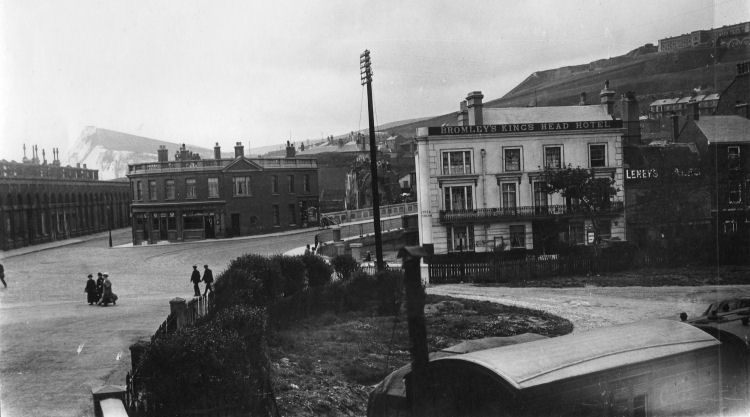
Above shows the King's Head Hotel September 1921. By kind permission
of Dover Library ILL/1531. Also showing the "Terminus"
just to the left of the telegraph pole. I am informed by Andy Chant that
as of 2015, the only part of the hotel that is still standing is the
right hand wall, the rest is now the entrance to the Freight Clearance
Centre staff car park.
|
 |
|
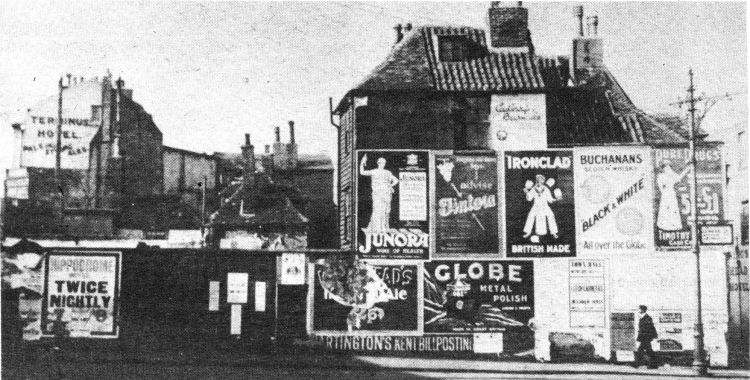
Partington's billposting of advertisements was a once
colourful feature of this corner of the Pier District between Beach
Street, to the left, and Seven Star Street. This Amos photograph, dating
from about 1912, also shows the flank-wall advertising of the old
Terminus Hotel, in Beach Street, one of the posts carrying the overhead
tramway powerlines and part of the ancient King's Head Hotel, in
Clarence Place, on the extreme right. |

Above a view from between the narrow lanes. |
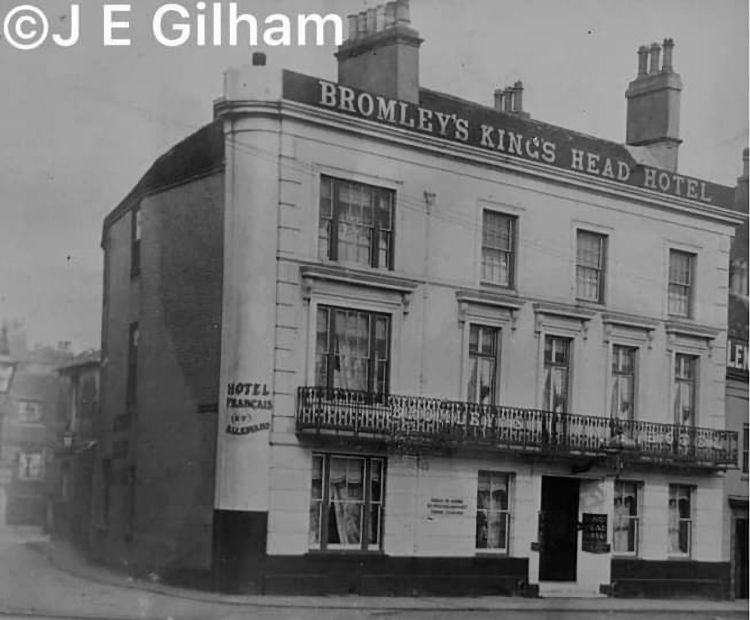
Above photo, date unknown. |
A free house, fully licensed, which stood on the corner
latterly with Lord Warden Square. Its origin lay early in the seventeenth
century. The owners show on maps of 1624 as William and Ann Bradshaw.
Only six stage coaches ran in England in 1672. The
terminus for the Dover run being the "White Hart", in the London borough of
Southwark. (That sign associated with the badge of Richard II but the
building itself taken down in 1889).
It can be said that coaches left this hotel in 1819, at
six and eleven a.m. and four thirty p.m. for the "Golden Cross" at Charing
Cross; the "Black Bear" in Piccadilly; the "Spread Eagle" in Gracechurch
Street and "Blossom's Inn", Lawrence Lane. London. All made the return
journey the same day.
This sold for £3,775 in 1876 and again in 1932 it was on
offer but did not reach the reserve price. By 1934 it belonged to Hays Wharf
and following extensive alterations it was renamed Ferry House, being then
the accommodation of the Continental Express Company who moved here from
Northumberland House in Strond Street.
For better or for worse, a new god called the juggernaut
appeared in the sixties and no person or building was allowed to stand in
its way or hinder the new religion. Continental Express were obliged to
leave the premises in July 1968, the only cafe in the area was
unceremoniously shut down and the demolition of the building commenced in
March 1970. The ground thus gained was then used for the parking of private
cars and the formation of a private road.

From the Dover Express, 6 March 1970
CRASH, down comes
another part of old Dover as demolition' men move in on Ferry House,
former headquarters or the R.A.C. in Dover on the corner of The Viaduct
and Clarence Place; Part of the block and the first section to come
down, was once The King's Head, said to have been built in the reign of
James I. In an upper room, there was once found a carved panel dated
1624 and bearing the initials of the original landlord and his wife,
William and Ann Bradshaw.
|
|
From the Kentish Post, May 8-11, 1765. Kindly sent from
Alec Hasenson.
George Hubbard, at the "King's Head Inn," Dover, has taken the "Silver
Lion Inn," opposite, where there is a pleasant prospect to the
water-side.
|
|
From the Kentish Gazette, or Canterbury Journal [one title]. April 26 to 29,
1769. Kindly sent from Alec Hasenson.
Advert for the sale by auction of a
Cutter, at the King's Head, in Dover, on May 2nd.
|
|
Kentish Gazette, 23 March, 1774.
To be sold.
A Large and convenient freehold house, with the Buildings, Yard,
Garden, and Ground thereto belonging; situate
in St. James's Street in Dover, in Kent; the back part whereof
commands a pleasant View of the Sea, French
Coast, Dover Castle and Harbour; late in the occupation of Mr.
William Eastes, and now untenanted.
Also, all that large and good accustomed inn, called the "King's
Head;" situate in Crane Street, in Dover
aforesaid, having every Convenience proper for the Accommodation of
Company, and being now in the
Occupation of Mr. John Harvey or his Assigns.
Also, a Messuage, with very convenient Outhouses and Gardens thereto
belonging; situate in Archliffe, Bulwark
Street, in Dover aforesaid, and late in the Occupation of Mrs.
Hammeden.
The two last mentioned Estates are Leasehold.
For Particulars enquire of Mr. Nethersole, Attorney at Dover.
|
|
Kentish Gazette, 10 December, 1774.
Extract of a letter from Dover, December 7th.
Yesterday in the afternoon, Emmanuel Faelix, a gentleman's servant,
was defrauded at the "Kings Head" in this town, of 8 guineas at
cutting the cards. And by applying to the Magistrate, he ordered a
constable to pursue the three sharpers who had cheated him, and
finding they had taken their horses and gone for Deal, the pursuit
was continued, and they were apprehended at Deal accordingly; and on
returning the money to the proprietor he let them go. There is a
strong suspicion these fellows have defrauded the public of
Canterbury, Hythe, and other places in Kent. They are described as
follows:
A likely young man, about 5ft 7in high, his hair clubbed, a light
cloth coat, and about twenty years of age. A short man, pock-marked,
about 5ft 4ins, has hair clubbed, a brown cloth coat and metal
buttons; about 25. A stout smooth face man, a Twi-curled wig, brown
coat, and about 25. They had three good horses, a black, chestnut,
and a small bay. They are supposed to be gone to Sandwich fair.
|
|
Kentish Gazette, 28 April, 1779.
Dover. John Wright.
Big leave to acquaint the Nobility, Gentry, and others, that he has
taken the "King's Head;" and having laid in a
fresh stock of wines, hopes for the continuance of the former
customers, and all others who please to honour
him with their company.
N.B. Neat Post-chaise, Coaches, and Saddle Horses, to any part of
England.
The Machine sets out every day for London.
|
|
Kentish Gazette, 12 May, 1781.
John Wright, at the "King's Head Inn," at Dovor.
Begs leave to acquaint the Nobility and Gentry, and others, that he
has taken a very commodious apartment opposite his house, which has
a fine prospect of the Sea, and Castle, from which the Neutral
Boats sail for Ostend every day.
A number of good stables for horses going abroad.
Post Chaise's and Saddle horses to any part of England.
Machines to and from London everyday.
|
|
From the Kentish Gazette, 11 August 1786.
King's Head Inn, Dover. JOHN KING,
Late Tapster at the "Bull-Inn," Rochester, Begs Leave to acquaint the Gentry, and Public in general, that he has
taker the above Inn, and fitted it up, in a most commodious Manner, for
the Reception and Entertainment of Company. A good Stock of excellent
Liquors, and a Larder supplied with Eatables of every kind in Season.
Coaches and Diligences to and from London every Day.
Genteel Post-chaises and able Horses, on the shortest Notice.
His Assiduity and Attention he hopes will merit the Favours of the
Public, of which he shall entertain a most grateful scene.
|
|
Kentish Gazette, May 15-19, 1770. Kindly sent from Alec Hasenson.
Sale of a cargo of Deals at the King's Head Inn in Dover, on May 24, 1770.
(The term Deals would refer to soft wood, usually Scots Pine, found
in Northern Europe, particularly Scandinavia and Scotland. It is a
commercially important timber used by builders and carpenters for indoor
and outdoor work and was widely used for telegraph poles and railway
sleepers, although obviously not at the time this advert was placed. In
the 16th and 17th centuries, it was a favoured wood for carving and,
until recently, for making boxes for domestic purposes. Paul Skelton).
|
|
From the Kentish Gazette, June 21-25, 1777. Article kindly sent from
Alec Hasenson.
Advert in the Gazette – James Fordred (from the King's Head, Dover) has
taken the "Red Lion" at Sittingborn.
|
|
Kentish Gazette, Friday 11 August 1786.
Kings Head Inn, Dover.
John King, late tapster at the "Bull Inn,"
Rochester, Begs to acquaint the Gentry, and public in general, that he
has taken the above inn, and fitted it up, in a most commodious manner,
for the reception and entertainment of company.
A good stock of
excellent liqueurs, and a larder supplied with eatables of every kind in
season.
Coaches and diligence too and from London every day.
Genteel post
chaifes and able horses, on the shortest notice.
His assiduity to
attention he hopes will merit the favours of the public, of which he
shall entertain and most grateful sense.
|
|
From the Maidstone Journal, 25 September 1792.
In consequence of an information received at the Public Office, Bow Street,
early on Friday morning, of the landing of John Bonus, at Hythe, about three
miles from Dover, on Thursday last, Thomas Carpmeal, one of the officers
appointed under the direction of Sir Sampson Wright, was immediately dispatched
to apprehended him; he being charged with having absconded, in July last, from
the house of Messrs. Payne and Co. by whom he was employed as a clerk, and which
having taken away with him notes and cash, their property; to the amount of
£1500.
Mr. Payne accompanied the officer to Dover, where they, at nine o'clock, on
Friday evening, took the prisoner into custody at the "King's Head Inn." They
searched him, and on his person found notes and cash to the amount of £800, all
of which were taken from him.
He was immediately carried to London, and at nine o'clock on Saturday morning he
was examined before the Sitting Magistrate. It appeared he on his quitting
Messrs Payne and Co's. residence he immediately fled to France, where he has
been remained ever since; but thinking the pursuit made after him was that an
end, and that the description given of his person, in the advertisement and
hand-bills published, was forgotten, he ventured to return to this country.
Mr. Payne appeared against him at the office, and identify this person; he was
consequently committed for re-examination. He is a young man of very genteel
address, and we understand of good connections.
|
|
In connection with the King's Head Inn, there is an advert for an
auction of a Messuage there, to be held on September 15, 1796.
From Wikipedia "In law, the term messuage equates to a
dwelling-house and includes outbuildings, orchard, curtilage or
court-yard and garden. At one time messuage supposedly had a more
extensive meaning than that comprised in the word house or site, but
such distinction, if it ever existed, no longer survives."
|
|
From the Kentish Gazette, May 1810.
TO BE SOLD BY PRIVATE CONTRACT.
All that wellknown and established Inn, called the "King's Head,"
with the stables and appurtenances thereunto belonging, held under the
Honourable Warden and Assistants of the Harbour of Dover, situate and
being in Crane Street, in the town and port of Dovor aforesaid, and now
in the occupation of the widow Potvine, under a lease which will expire
at Michaelmas next, at which time possession may be had. The above Inn
is very eligibly situated, and in full trade, near to the harbour.
For particulars please to apply to Jos. J. Barnes, Wine and brandy
Merchant, or H. Buckton, Attorney, Canterbury.
The Tenant will show the premises.
|
From the Kentish Gazette, 15 May 1810.
TO BE SOLD BV PRIVATE CONTRACT.
ALL that well known and established Inn, called The "KING'S HEAD,"
with the Stables and appurtenances thereunto belonging, held under
the Honorable Warden and Assistants of the Harbour of Dovor, situate
and being in Crane-street, in the town and port of Dovor aforesaid,
and now in the occupation of the Widow Potvine, under a Lease which
will expire at Michaelmas next, at which time possession may be had.
The above Inn is very eligibly situated, and in full trade, near to
the harbour.
For particulars please to apply to Jos. J. Barnes, Wine and Brandy
Merchant, or H. Buckton, Attorney, Canterbury.
The Tenant will shew the premises.
|
|
From the Kentish Gazette, 2 October 1810.
KING'S HEAD INN, DOVER.
WANTED IMMEDIATELY
A Respectful Person of good connexion, who is capable of undertaking
the above INN.
For further particulars enquire of J. NOAKES, jun. Great Mongeham
near Deal.
|
|
Kent Herald, 28 July 1825.
Death.
On Friday last, at Dover, aged 35, Mr. Victor Podevine, of the "King's Head
Inn."
|
|
From the Kent Herald, 26 January 1826.
On Monday last, a young man who gave his name Ashford, was apprehended at the
"King's Head," Dover, under the following circumstances:-
He had a few days previously called on two respectable dealers in horses, and
obtained two from each to show to his pretended customers. He did not, however,
return as he promised, and on further inquiry they found he had taken the road
to Dover.
They traced the horses from there across to Calais, where they found them
standing in the stable, as it afterwards appeared, on a count of the adventurer
being without money sufficient to proceed on a further journey. The horses were
given up to their rightful owners on their paying the expenses of the keep, &c.
In consequence of which arrangement, for some private reasons, the delinquent
was set at Liberty.
|
|
From the Kent Herald, 22 November 1827.
An inquest was held at the "King's Head Inn," before John Shipdem, Esq, Mayor
and Coroner for Dover, on view of the body of a person unknown, having the dress
of a Frenchman, who was found lying in the mud in the wet dock after the sluices
have been drawn off. He is supposed to have fallen over the Quay on Friday
nights in attempting to go on board a Boulogne fishing boat No. 29, and is
reported to have left a wife and four children.
|
|
From the Dover Telegraph and Cinque Ports General
Advertiser, Saturday 16 September, 1837.
NOTICE
If the Yellow Four-Wheel DOG CARRIAGE left at the "King's Head Hotel"
is not claimed within Fourteen Days from this time, the same will be
sold, to pay Expenses.
Dover, September 16th, 1837.
|
|
From the Kentish Gazette, 9 January 1838.
Kings Head Tap, Canterbury.
J. Roberts, late of the "Shakespeare Tavern," in Butchery Lane, begs to
return his grateful thanks to his friends, and the public
generally, for the kind and liberal support which he has received these
last 7 years, and begs respectfully to inform them that he is
taking the above house, and respectfully solicits a continuance of their
favours.
Wines and spirits of the best quality; genuine London Porter and fine
ale.
|
|
From the Dover Telegraph and Cinque Ports General
Advertiser, Saturday 5 January, 1839. Price 5d.
KING'S HEAD LIVERY STABLES
Clarence Place, South Pier, Dover.
GEORGE DOUSE, Licensed to Let Flies, Gigs, Post and Saddled Horses,
&c.
Horses Broke to Single and Double Harness.
Orders received at BOYCE'S "Victoria Hotel," Castle Street; at the
KING'S HEAD Hotel, Clarence Place, South Pier; and at DOUCE'S "Hope Inn,"
Great Street.
Horses and carriages let on Jobs by the week, Month, or Year.
|
|
From the Dover Telegraph, 8 August 1840.
Eliza Thomas appeared against
Charles Goodwin, waiter at the King's Head, for an assault.
Complainant acknowledged she first put her hand on defendant on his
refusing to hear her application as to her babe, of which he was the
father, but it was done merely to get his ear. The case was dismissed.
|
|
From the Kentish Gazette, 20 December 1842.
DOVER. Salvage.
The Commissioners of Salvage held a meeting on Monday last, at the
"King’s Head Hotel," to consider the services rendered by George
Blacklocks and Anthony Metcalfe, and their respective boats and crews,
to the galliott Soucce, of Westerwick, Johan Gustaf Hickman master, on a
voyage from Westerwick to Gibraltar, laden with deals, tar, and stores;
the said vessel was on the Roar Sand, near to Dungeness, and was got
therefrom. The Commissioners awarded to Blacklocks and his crew the sum
of £15 12s. 6d., and to Metcalfe and crew the sum of £12 The vessel was
assisted into Dover Harbour by Mr. Davidson, of that port, on Sunday
afternoon, having been riding in great danger off the Bull-rock several
hours.
|
|
From the Kentish Gazette, 6 May 1845.
Salvage.
The commissioners of salvage held a meeting at the "King's Head Hotel,"
on Saturday last, to consider the services rendered by Charles Hills,
of' the cutter Pandora, of Dover, and his crew, to the brig Wenskaper,
of Hesingfors, Johan Wickstedt, master. The brig was laden with wine and
almonds, on a voyage from Cette to Roterdam, and when fallen in with was
lying off Dungeness with loss of an anchor and a cable, and her sails
and rigging much damaged. She was brought into Dover harbour, and for the
services rendered, the sum of £70 was awarded.
|
|
From the Kentish Gazette, 6 January 1846.
Salvage.
At a meeting of the Commissioners, held on Saturday last at the "King's
Head," Dover, the services rendered by John Petts and Edward Price to
the schooner Rose, of Stettin, Volckman master, on a voyage from
Liverpool to Humburgh, laden with a general cargo, were considered, and
an award of £70 was made. The vessel was much disabled, having received
considerable damage, and was conducted into Dover harbour. An award of
£45 was also made for services rendered by Richard Collins and John
Vickers to the brig Sklad, of Trieste, Biclovncich master, on a voyage
from London to Rio Janeiro, with a general cargo. The vessel had
received considerable damage to her hull, and was brought into Dover
harbour.
|
|
From the Kentish Gazette, 25 January 1846.
Salvage.
At a meeting of the Commissioners of Salvage, held at the "King's Head
Hotel" on Monday last, the sum of
£50 was awarded to Mr. Jenkins and the crew of the Britannia steamer,
and £159 to Mr. Hatch, chief officer,
Mr. William Pollard, chief boatman, and their boat's crew, of the
Cornhill Coast Guard station, for services
rendered in floating and bringing into Dover harbour, the basque China,
of Liverpool, Thomas Pasco,
master, which vessel was on the third of the present month stranded the
rocks in Pan Bay under the South
Foreland lighthouse.
|
|
Kentish Gazette, 9 February 1847.
Salvage.
On Thursday the Commissioners of Salvage met at the "King's Head Hotel,"
Dover, to consider the services of Lient. Pearson, R.N.,
and his boat’s crew, of the Coastguard, rendered to the Russian schooner
Estaffette, of Revel, F. W. Dieckert, master, on a voyage
from Messina to Revel, with a cargo of oranges and lemons. It appears
the schooner ran on the rocks off the South Foreland, and
hoisted a signal for assistance, which was promptly responded to by
Lieut. Pearson, with his crew, who boarded and carried out a
bower anchor, when by great exertion she was got off. It was then found
that she had seven feet water in the hold, but by constant
pumping they were enabled to bring the vessel into Dover harbour. For
these services the Court awarded the sum of £172 to the
said Lieut. Pearson and his crew. The vessel has been condemned as not
sea-worthy.
|
|
Kentish Gazette, 6 April 1847.
Salvage.
At a meeting of the Commissioners of Salvage, held at the "King’s Head
Hotel," Dover, on Thursday, the sum of £70 was awarded to Mr. John Town,
of the Lydden spout station, and his boat s crew, for the great risk
they run in saving the lives of the crew of the Brig Henry and Sarah,
Morgan, of Swansea, stranded near Shakespeare’s Cliff, and for
protecting the parties employed in saving the cargo. Also the following
sums for damage to the luggers employed in saving the cargo, viz.,— the
Ann, £5; the Queen, £3 19s.; and the Fancy, £2; in addition to £1 10s.
per ton for the pig-iron brought into our harbour.
|
|
Kentish Gazette, 23 January 1849.
SALVAGE AWARDS.
At a meeting of the Commissioners of Salvage, held at the "King's Head
Hotel," on the 11 th of January, the following awards were made:—
To Wm. Middleton, Edward Clayson, and crew of the lugger England's
Glory, of Deal, the sum of £60, for services rendered to the schooner
Rapid, Lewis, of Bristol, laden with oats, on a voyage from Limerick to
London. The schooner had been ashore, and had lost an anchor; she was
also leaky, and her sails were much damaged, in which condition she was
brought into our harbour by the crew of the lugger.
To John Vickers and crew of the boat Sarah, of Dover, the sum of £2 15s.
for piloting into Dover harbour the schooner Miranda, Keys, of
Whitstable, on a voyage from London to Terceira.
At a meeting held on the 12th of January the following awards were
made:—
To John Ashenden, John Laming, and crew of a Kingsdown lugger, the sum
of £70, for services rendered to the schooner Hazard, Lee, of Bridport,
on a voyage from Sligo to London, with a cargo of provisions, &c. The
schooner brought up in the Downs during a heavy gale of wind, and
drifting towards a large vessel at anchor, hoisted a signal in the main
rigging for assistance, on which the lugger took off an anchor and
chain, by which the schooner securely rode out the gale.
To George Trott, Thomas Trott, and crew of the lugger Mope, of Deal, the
sum of £60, for services rendered to the brig Mary McWhinnie, Campbell,
of Prince Edward's Island, bound to London, the brig was in the Downs,
had lost an anchor and chain, and had lights hoisted for help, when the
assistance was proffered and accepted.
To Adam Lambert, William Lambert, and crew of the lugger Hope, of Deal,
the sum of £70, for services rendered to the brig George Clark, Henry
Wetherill, of Whitby, laden with coals, on a voyage from Swansea to
London. The brig had lost an anchor and chain in the Gull Stream, with
which it was supplied by the Hope.
To Richard Lambert, Henry Baker, and crew of the lugger Prince Of Wales,
of Deal, the sum of £40, for services rendered to the brig Edair,
George, of Cardigan, on a voyage from Limerick to London, laden with
oats. The brig was in the Gull Stream, with the loss of an anchor and
chain, and her windlass upset, when fallen in with by the bigger, by the
crew of which she was brought safely into Dover harbour.
At a meeting held on the 13th of January the following award was made:—
To George Offen, George Hogben, and crew of the lugger Phoebe, of Dover,
the sum of £70, for services rendered to the ship June Pirie, Booth, of
Aberdeen, on a voyage from Calcutta to London, laden with sugar. The
ship had lost an anchor and chain, and the lugger was employed to
procure others at Dover, which was done, and the supply shipped off the
port, in doing of which the lugger received damage.
At a meeting held on Monday, the 15th of January, the following
awards were made:—
To George Baker and crew of the lugger Prince of Wales, of Deal, the sum
of £45, for services rendered to the schooner Laura, Pauls, of London,
on a voyage from London to Bordeaux, in ballast. The schooner, during a
heavy gale of wind, had come athwart of another vessel in the Downs, but
was extricated by the lugger's crew, and brought into Dover harbour.
To Richard Atherden and crew of the lugger, Friends, of Dover, the sum
of £40, for services rendered to the schooner Lady Rebew, ot London,
George Norris, (late of Dover,) master. The schooner was on a voyage
from St. Michael's to London, laden with oranges and had been run aboard
of by a brig, and received considerable damage.
|
|
Kentish Gazette, 1 January 1850.
Cases of Salvage.
A meeting of the Commissioners of Salvage was held on Monday last, at
the "King's Head Hotel" to consider the services rendered by James Brown
and Edward Griggs, of the lugger Superb, of Deal, and their crew, to the
schooner Amelia, of Salcombe, Joseph Wood, master. The schooner was on a
voyage from Seville to London, laden with oranges, and was in the Downs,
drifting towards the shore in a heavy gale of wind, when assistance was
rendered, and the vessel brought safely into Dover harbour, for which
£20 was awarded.
At a meeting of the Commissioners, held at the same place, on
Wednesday,
the services of Robert Hogg and John Ellender, and crew of the lugger
James and John, of Dover, to the ship Joseph Bushby, of Maryport, Thomas
B. Sparks, master, were considered, and £250 awarded for the assistance
rendered. The ship was on a voyage from China to London, laden with tea,
&c., and had lost two anchors and chains when near Dungeness. Other
anchors were supplied by the above, and put on board in a heavy gale of
wind.
|
|
|
From the Dover Telegraph and Cinque Ports General Advertiser, Saturday, 29 February, 1850.
SWINDLING
A person of a shabby-genteel exterior, giving his name as Thomas Smith
Wells, was brought up charged with duping several hotel keepers of
Dover, by ordering and partaking of various viands at their hotels,
being destitute of the wherewithal to settle for the same. Mr. Podevine, of the “Kings Head Hotel,” (although having no charge in
the present instance,) identified the prisoner, who, he said, was
staying at his hotel in August last, and who decamped without paying his
account. He (the prisoner) came over from the continent yesterday, and
repaired to the “Dover Castle Hotel.” A waiter from the “Dover Castle” stated that the prisoner arrived at the
hotel the previous morning, and expressed his intention of staying there
till Tuesday. Being entirely without baggage, enquiry was made, when it
was ascertained he had been previously staying at the “King's Head,” and
his summary departure from thence, as above stated by Mr. Podevin, was
discovered. The prisoner expressed himself as totally without money when
payment was demanded. A like statement was given by one of the waiters at Usmar's “Union
Hotel,” where the prisoner obtained his tea, with the additional
stimulant in the way of brandy, under similar circumstances, expressing
himself at first as being without “change,” but finding the waiter
prepared with “silver to any amount,” ultimately confessed that he had
no resources. A note was here handed in, which had been written by the prisoner while
at the “Union Hotel,” addressed to the landlady, admitting his
inadequacy to meet the demand, and requesting her clemency till a
remittance should arrive. This epistle was written in the name of Marsden. The prisoner did not deny the charge, and after some equivocation said
he wrote the note. The Magistrates regretted that this abominable species of fraudulency
did not come under their supervision; and significantly advised the
prisoner to lose no time in quitting Dover, otherwise he might yet
appear before the Bench in a capacity in which they might be better able
to deal with him, and he might rest assured that should this be the case
he would have full justice done him. |
|
Kentish Gazette, 10 September 1850.
DEATH.
Podevin:- Lately, at Dover, Mrs. Ann Podevin, proprietress and keeper of
the "King's Head Hotel," aged 75.
|
|
Kentish Gazette, 4 April 1854.
Salvage Case.
At a meeting of the Commissioners of Salvage held on the 29th ult., at
the "King's Head Hotel," Dover, the sum of £100 was awarded to John
Marsh and Henry Kirkaldie, of Deal, boatmen, for services rendered by
themselves and crew of the lugger Eagle, to the schooner Agnat, Aslak
Aasuldsen, master, of and from Osterrusoer, with timber and deals, for
Fecamp.
|
|
From the Dover Express and East Kent Intelligencer, 20
November, 1858.
ALLEGED ASSAULT. Robert Snell v. Algernon Austen.
This was a case of assault, in which the complainant was a touter at
the "King's head Hotel," and the defendant one of the porters in the
Royal and Imperial Mail Packet Service. A quarrel out of which the
alleged assault arose had, it appeared, taken place between the parties
on the night of the 11th inst., just after the Calais packet had left
the Admiralty pier.
The complainant, whose right eye exhibited a sadly bruised and
discoloured appearance, said that he conducted a gentleman to the Calais
boat on the night in question, and that on the way the gentleman put a
question to him with reference to his baggage, which he answered. He
asked whether his baggage would be safe, and he (witness) replied that
it would. After the boat had left the pier, and he was returning home,
the defendant came up to him and asked him what he had to do with the
baggage, and telling him to mind his own business. Some few other
words passed, and the defendant then, without any provocation from him
(complainant), knocked him down with a violent blow in the eye, and
kicked him upon the hip. He was rendered completely blind at that eye by
the blow, and was obliged to have it lanced by Mr. Coleman before he
could see.
On being closely questioned by the Bench, the complainant admitted
that he was in the act of taking off his coat "to stand in his own
defence," when the defendant struck him the blow which left te ugly
appearance his face then exhibited.
The Mayor said he was unable to see that it was necessary to take off
one's coat in order to stand in self-defence, but the defendant appeared
to be decidedly of the opposite opinion, and his worship did not pursue
the objection.
The complainant, in reply to the Magistrates' Clerk, said he had no
witnesses but his bruises. (Laughter).
The defendant, who was then called upon to make his statement, gave
quite a different version of the affair. The complainant, he said,
endeavoured to exasperate him with his tongue; and finding that of no
avail, he tapped him (defendant) upon the nose two or three times,
calling him a "sweep" and a "thing," and by various other opprobrious
epithets. He then took off his coat and wanted to fight, but defendant
advised him to put it on again "as he might take cold." (Laughter).
Complainant, however, continued his annoyance in the way already stated,
and ultimately struck him (defendant) a blow upon the side of the face.
He then retaliated, and knocked the complainant down.
This statement was borne out by two witnesses; and the Bench, after
hearing their evidence, dismissed the case.
|
|
From the Dover Express and East Kent Intelligencer, 17
December, 1859.
An Old Offender.
James Buckley, a tall raw boned Irish vagrant, wearing a tight fitting
shooting jacket and an old foraging cap, and looking a very interesting
type of the “old soldier” was brought up for the third or fourth
time charged with begging and using obscene language at the Kings Head
Hotel, Clarence Place. The prisoner had previously been committed in the
name of Berkley.
Edward Killick, a waiter at the "King's head" said that the defendant entered the hotel
about 7 o'clock on Saturday evening demanding “nine-pence for a nights
lodging." Witness refused to entertain the application and told the defendant to
walk out of the house when he commenced using very obscene and abusive
language which he maintained for about ten minutes, during which he
remained in the hall of the hotel. At the expiration of that he was given
into custody.
The defendant in reply to the charge denied that he had
ever asked the waiter for anything. He went to the hotel because he had
met with a military gentlemen who had taken compassion on him as an old
and disabled soldier and had told him to come to him at the "King's Head"
for the price of a dinner and a bed and his fare to Folkestone, the
roads being bad at this time of the year as to make walking without
shoes very uncomfortable. Before he could tell the waiter what he wanted
however he was pushed away from the door and treated like a dog.
It appeared in reply to questions from the magistrates that the
defendant provided with a new pair of shoes on quitting the gaol, where
he had left behind his old ones. According to the defendant's own
account his old shoes had been "taken away from him" and a pair given to
him in which he could not walk (his feet coming on to swell after he
left the gaol) and so - he sold them.
The Mayor said the prisoner was
evidently an incorrigible vagabond. He had already been committed two or
three times for a short term of imprisonment; but as these punishments
appeared to have no effect on him he would now be kept to hard labour
for a month.
As the prisoner was leaving the dock Mr. Latham informed him that he
would doubtless find his old shoes still in the gaol, they appeared to
be better adapted for walking than the new ones, he hoped he would make
use of them and walk off as soon as they were given him. (Laughter).
|
|
From the Dover Express and East Kent News, Friday, 14 April, 1876. Price 1d.
A DRUNKEN WOMAN
Ellen Wells was charged with being drunk and breaking a pane of glass in
Seven Star Street.
Absolam Hicks said: I am living at the “King's Head” public house, Seven
Star Street. About one o'clock on Saturday the prisoner came round to my
house. I told her she was drunk and had better go away. She threw stones
two or three times at the window but she only broke one. The value of
the same is 6d.
Superintendent Saunders said: On Saturday morning I was at Clarence
Place, close to Seven Star Street. The complainant brought the prisoner
to me and charged her with wilfully breaking a pane of glass, and I took
her into custody. She told me she would break all the windows if she had
the chance. She was not sober when I took her into custody.
Prisoner in defence said she went to Mr. Hicks' for her husband and he
abused her and told her she was a drunken old sot, and she threw a stone
at him and hit the window.
The Magistrates fined her 2s. 6d. and 10s. costs, or in default seven
days' imprisonment.
Prisoner said she had the money and could pay the fine but would rather
go to prison and her husband would have to go too for not keeping his
children.
|
|
From the Dover Express and East Kent News, Friday 15 February, 1878
A CATCHPIT NUISENCE
Councillor iron called attention to a great stench arising from a
catchpit near a cottage at the back of the “King's Head Hotel,” and the
inspector promised to have the pit cleared out, and carbolic acid put in
it.
Councillor Iron asked if something of a permanent character could not be
done to prevent the stench arising.
The Inspector said that in stormy weather the traps were sometimes in
operation.
Councillor Stone said it was complained that Ladywell was not often
swept.
|
|
From the Dover Express and East Kent News, Friday, 14 August, 1896.
DETERMINED SUICIDE OF A GENTLEMAN
On Saturday morning, a gentlemen staying at the “King's Head Hotel,”
committed suicide in a determined manner, by shooting himself through
the body with a revolver. The gentleman passed under the name of Mr. G.
Kenlock Smyth, and is a relative of Sir John Kenlock, M.P. That
gentleman was present at the “Hotel de Paris” on Monday morning when the
inquest was held, and his name was down on the witness list, but he was
not called. Mr. J. R. Adams was foreman of the Jury. The following was
the evidence:-
Lewis Bilton, a lawyer, of Edinburgh, said: The body at the mortuary is
that of George Kenlock Smyth, an independent gentleman. He was 43 years
of age. He usually resided in Belgium, at Heyst Sur Mer. He is a married
man. I saw him three week's ago at his mother's in Scotland. He seemed
fairly well, but was occasionally depressed in spirits. He had a very
severe attack of influenza two or three years ago, and that told on him.
He also suffered from his heart, and had fainting fits. He had no
monitary or any other trouble so far as I am aware. The letter produced
is in the deceased's handwriting.
The letter was as follows:- MY DEAR MOTHER, I cannot help it; I feel I
am going mad and my suffering and melancholy are un-durable. Wednesday I
came here, the same night I went back to Ostend, and the same day I came
back here. I am equally miserable in all three places. Forgive and pray
for your unfortunate son George.
John Bromley, proprietor of the “King's Head Hotel,” said: the deceased
came to my house on Friday afternoon about 3.30. He was undecided
whether to sleep in the hotel or not. About five o'clock he engaged a
room. About nine o'clock he went to his room. A telegram came shortly
before from Ostend, addressed to me, asking how Mr. Kenlock was. I did
not know who he was then. I found him in the smoking room and talked to
him for a few minutes. About 9.30 the next day a telegram arrived, and
the porter took it up. From what he said, I went up and found the
deceased on the floor. There was a six-chambered revolver on the floor
and some blood. He was dead, but not cold.
George Inguine, porter at the “King's Head Hotel,” said: On Saturday
morning Mr. Bromley handed me a telegram for the deceased. I went to the
room deceased was occupying. The key was outside, as he did not answer,
I went in. I found the gentleman lying on the floor on his right side in
front of the window. He was in his nightshirt. I found he was nearly
cold. There was also a revolver there. I at once told Mr. Bromley.
Police-constable Danson said he was called on Saturday at ten o'clock.
The revolver (produced) on the floor loaded fully, with one chamber
exploded. The bullet was found on the floor. He also found the telegram
(produced) to various persons and the money for the same. £1 8s. 3½d.
was found on the deceased, and also three letters addressed for posting,
and a letter which had just been read in the coat pocket.
Mr. C. E. Murphy, Surgeon, said the deceased was quite dead when he
arrived, death having occurred at least three hours. There was a large
wound just above the heart. It was charred and smelt of gunpowder. The
bullet went through the body and came out the back. The bullet did not
touch the heart, but went through the liver. Death occurred from
internal haemorrhage and must have been nearly instantaneous. In his
opinion the wound was self-inflicted.
The Jury returned a verdict of “Suicide whilst suffering from temporary
insanity.”
|
|
From the Dover Express and East Kent News, Friday, 6 April, 1900. Price 1d.
SAM BAKER'S 61ST APPEARANCE
Samuel Baker was charged with being drunk and disorderly in Clarence Place.
Police Constable P. J. Prescott said: last night about a quarter past
nine I was on duty in Clarence Place, when I was called by Mrs. Bromley
of the “King's Head Hotel,” who told me that a man had gone into her
kitchen, and she could not get him out. I went there and found the
prisoner. He was being held down by a porter and a waiter. He was drunk,
and had thrown off his hat and coat, and had his braced down. When held
down he was like a madman – frothing at the mouth and biting at his
restrainers.
Mr. Smith: Did he go into the hotel kitchen by the back or front?
Witness: He forced his way through the front, I was told.
Did you know why he took his hat and coat off?
No.
Witness continuing said that finding prisoner would not leave his hotel
he put him out, and then he became very violent and disorderly, so
witness took him into custody, but to do this it was necessary first to
tie his legs and then strap him on the ambulance.
Baker said in defence that he was hungry and went in to get some food.
Captain Cay: But you got drink instead of the food.
Mr. Vidler: I don't suppose he got drink there. He had it first.
Prisoner in reply to Captain Cay, said his age was 50.
The Clerk stated that this was Baker's 61st appearance. It was no use
suggesting that he should go to a Home, however, as he had not been
arrested for over a twelvemonth. He had been at the Workhouse, but he
believed that he had given trouble there by running away once.
Baker said that he only left the Workhouse the previous day, and when he
did so they asked him to stay, saying, “You are just what we want, a
good wardsman.”
In reply to a suggestion that the C.E.T.S. might take the case up, it
was stated that they had paid £13 to send Baker to Canada, but he
returned, and it was not likely that they would do anything more.
Captain Cay told Baker he would have to go to Canterbury for 14 days.
|
|
From the Dover Express and East Kent News, Friday, 10 October, 1890. Price 5d.
WOOD v. BRICKS
The Surveyor reported that he was in favour of putting down a wood
crossing to the entrance of Mr. Gill's store in Peter Street. In Biggin
Street he thought that the entrance to Mr. Hadlow's store should have
the bricks put down like those at the entrance to Mr. King's. They wore
well and were cheaper than wood.
Councillor Thorps urged the desirability of the long promised crossing
being made from the “King's Head” to the “Lord Warden Hotel.”
It was ordered that a wood crossing should be put down at Mr. Hadlow's
entrance in Biggin Street.
|
|
From the Dover Express and East Kent News, Friday, 2
February, 1912.
WITHDRAWN
A summons was down for hearing against Charles Brownlow Fairbairns,
of Snaresbrook, charging him with obtaining credit by fraud at Mr.
Bromley's, "King's head Hotel," Dover.
Mr. Rutley Mowll said he was acting for Mr. Bromley and he had to ask
the Bench to allow the summons to be withdrawn. the defendant came down
to the hotel stating that he was going to India, and that the remainder
of his luggage would follow. He stayed for some days but his luggage did
not come, and when Mr. Bromley asked him for payment defendant said he
would telegraph his father to get the money. Instead of doing that he
took the train to London, and Mr. Bromley felt at the time that he had
been treated rather badly. he (Mr. Mowll) had no doubt this would be a
lesson to the defendant to be more careful in the future. Since the
issue of the summons the defendant had produced what he considered
somewhat important evidence in his favour, and that was a passport fro
the Foreign Office, dated September 2nd, authorising him when travelling
in Europe to pass freely without let or hindrance. The fact that the
date of his obtaining credit was later, viz. September 22nd, went to
show, Mr. Mowll thought, that the defendant had no intention to defraud
in saying that he was going to India, although now, owing to altered
circumstances, the visit to India had been postponed. After the issue of
the summons defendant approached him with a view to the account being
paid, but he (Mr. Mowll) said the summons could not be withdrawn without
the leave of the Court. As a matter of fact, defendant's father had now
settled the account.
The Magistrates allowed the withdrawal of the summons, the Chairman
expressing the hope that the defendant would take warning.
Mr. Chitty said he thought the matter of a passport could not be said
to help the case very much. It was a bad case.
|
|
Dover Express of 12th May 1916.
Mrs. Edith Bromley of the “King’s Head” Hotel was summoned for not
complying with the Lighting Order. The defendant pleaded guilty. PC Bond
said that at a quarter to one on Monday morning he saw an unobscured
light at the rear of the hotel. He found that the room was occupied by
the defendant. The blind was not drawn and an incandescent gas light,
half turned down, was burning. A fine of 10s was inflicted.
|
LICENSEE LIST
BRADSHAW William and Anne 1624 (King's Head)
Above names on carved panels from the Dover house, dated 1624.

(Carved panels are in Dover museum)
AUSTIN Henry 1713+
HUBBARD George  to 1765
HARVEY John 1774+
FORDRED James to June/1777
WRIGHT John 1779-81+
 KING John Aug/1786+
CROW William 1792-93+

STERIKER Mr R 1799

PODEVIN Ann 1805-65
     
CHAPLIN William 1828
ROBERTS James Jan/1838+ ("King's Head Tap")
PODEVIN Ann & Joseph 1840+ (Ann to Sept 50 age 75 dec'd)
PODEVIN Joseph John Joshua 1846-75 dec'd (widower age 63 in 1871 ) )

BROMLEY John 1876-June/1919 dec'd
(age 41 in 1881)
      
BROMLEY Mrs Evangelina E June/1919-Dec/33 dec'd
  
KNOTT Stephen John & RANKINE Andrew Dec/1933-34 end, (Executors of will)
Dover
and Deal Directory and Guide 1792
From the Pigot's Directory 1824
From Batchellor's New Dover Guide 1828
From the Pigot's Directory 1828-9
From the Pigot's Directory 1832-33-34
From the Pigot's Directory 1839
From the Pigot's Directory 1840
From Bagshaw Directory 1847
From Melville's Directory 1858
From the Post Office Directory 1874
From the Post Office Directory 1882
From Pikes Dover Blue Book 1889
From the Post Office Directory 1891
From Pikes Dover Blue Book 1895
From the Kelly's Directory 1899
From the Post Office Directory 1901
From Pikes Dover Blue Book 1923
From Pikes Dover Blue Book 1924
From Pikes Dover Blue Book 1932-33
Historical
Sketch of the Town of Dover 1799 by G Ledger
From the Dover Express
Census
|

