|
1C Middle Row
Dover
 |
|
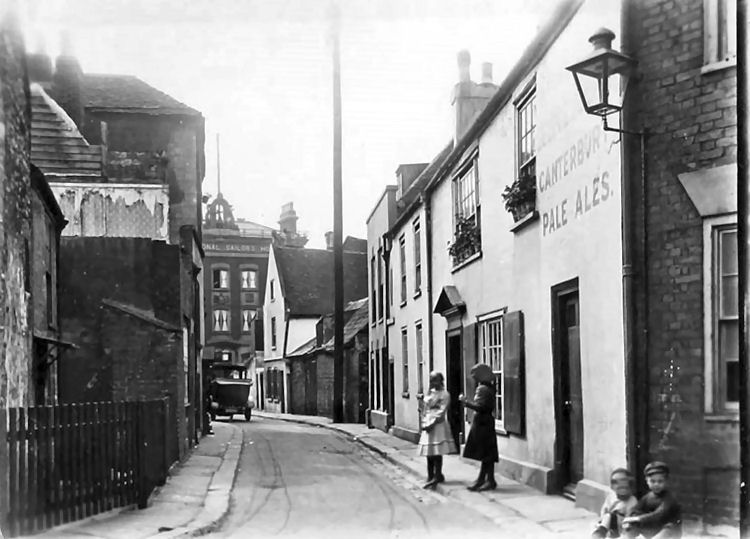
Middle Row, looking west from Seven Star Street towards the old National
Sailors Home and Blemheim Square. On the right is the Silver Lion public
house (licensee about that time being William Curling 1907-10.) In the
centre a seemingly enormous telegraph pole towers skywards. |
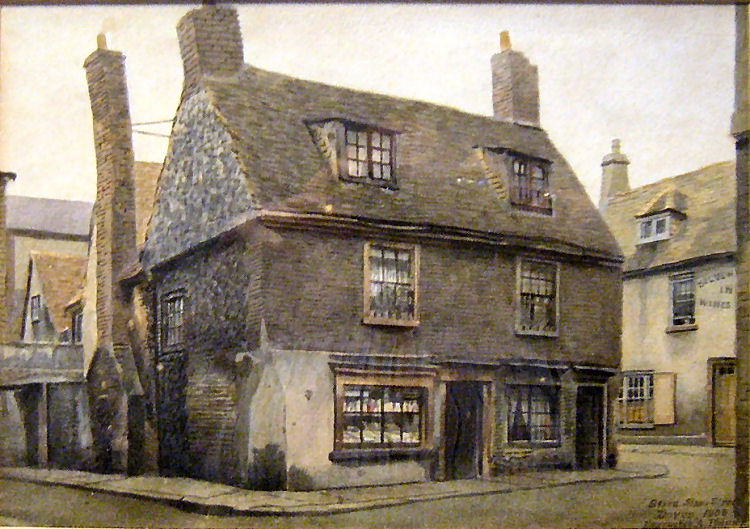
The above watercolour of Seven Star Street dated 1908 is by artist E. A.
Phipson. It just shows part of the "Silver Lion" on the right. |
In a cul-de-sac off Council House Street, it could be
approached by the narrow passage next to the "Rose and Crown"
in Clarence Place. Present in 1823, (H Atkins), and in 1851 it was described
as a lodging house also. The census of 1851 actually mentions that as well
as the licensee and his wife, it was also housing 13 Bavarian musicians. When sold in 1881 it was described as a freehold
pub, being used as a private dwelling and shop. Wilkins purchased on that
occasion and must have reopened as a pub because the following year, the
renewal was opposed by the Superintendent of Police who stated that it had
not been used for several years. Wilkins argued that he had spent a great
deal of money on renovation and the opposition melted.
|
Reproduced from the Dover Chronicles, 16 October, 1841.
1760 Notice.
The "Silver Lion" in Dover, is opened in a pleasant situation, and
genteelly fitted up for the reception of gentlemen and ladies, affords
every extensive and agreeable prospects of the sea and the harbour, which
renders it extremely commodious; have laid in a large assortment of all
kinds of wines, &c. Those gentlemen and ladies who honour me with their
custom, may depend on genteel treatment and civil usage, and the
obligations shall be gratefully acknowledged by their most obedient and
very humble servant.
John Morgan.
N.B.
The original machine set out from this house, and no other, every
morning to the "Bear" at Westminster Bridge to dinner; and set out every
morning from the "Bear" to Canterbury to dinner, and arrive early in the
evening at Dover. Neat post chaises to lett, and good stabling for
horses. -------- Such was the pompous and
grammatical card issued by the landlord of the "Silver Lion" by John
Morgan. Perhaps the "pleasant situation" of this house is not
generally known; and indeed, had it not been for the kindness of a
gentleman who possesses many old maps and drawings of Dover, in allowing
us to look into these matters, perhaps all recollection of this head
would have been buried in the old churchyard, like many other and
unrecorded tale of by-gone days. The "Silver Lion Inn," with it's
extensive and agreeable prospects of the sea, stood, some 90 years
since, in Crane Street, so called from having at is extremity, near the
present harbour, perhaps the only crane for commercial purpose in the
town. The then situation of the inn was nearly opposite the present
hotel called the "Kings Head," from which street was subsequently called
Kings Head Street; but now we read at the corner that more fashionable
and royal appellation of "Clarence Terrace." Under the wing of the
"Silver Lion" was a large arch-way that led to a sloping bank of mud and
beach, all the extremity of which was a herring hang. Down this gateway
the carts laden with dirt and filth would empty their contents, which on
the next flowing tide were swept away; for it must be remembered that at
this period to which we allude, the Wet dock was not yet constructed or
separated from the present harbour, so that the tides rose to the back
of the houses situated in Crane Street. This row of houses, where was
also the "Britannia," to which way should allude by and by, stood within
where the Wet-dock now is, about 20 or 30 feet from the present quay.
They were fully pulled down after the general peace to enlarge and
construct the present plan of the Harbour. Having that given in detail
the situation of a "Silver Lion," (and we have done so because every
brick and stone are swept away,) let us see what John Morgan promised.
Why, he tells you that the "machines" or coaches set out from his house,
and no other, every morning, and that those persons who travelled by
them might go to the "Bear" at Westminster Bridge to dinner. We have
always heard and read, that are chronicler tells us that some 90 years
since the coaches from Dover always two-days going to London; and that
frequently, owing to the numerous foot-pads and highwaymen about
Shooter's Hill, Gadshill, and other foreign places, travellers were
induced, before setting out on a long and perilous journey, to settle
their family affairs, and even make their wills. How comes it, then,
that John Morgan announces his "machines" to run with a rapidity equal
to those of our own days? Why, we will tell you. Innkeepers and their
dependants here and elsewhere, had in those days, as now, a happy knack
of misleading important travellers, particularly when it was to their
own interests so they do. We will give you an instant of this. A few
years since, before steam-boat's were in fashion, an old lady arriving
at Dover by the coach, and was immediately waited on at her inn by the
captain or mate, who was to proceed the following day for Calais. He
politely invited her to go by his vessel. "I am very sorry;" replied
that's good dame, "I cannot proceed in your packet, for I have already
promised to sail in the other one." "Upon this refusal, the mate with a
courtioussmile observed, "You have a great deal of courage to thus risk
your life; for the vessel by which you intend to go is quite a new one,
has never been at sea, and we do not know whether she will sink or
swim." This, and a long list of anecdotes of the same kind, may lead you
to suppose that John Morgan acted on a principle of self-interest, like
the mate of the vessel; and that when once comfortably seated in his
ponderous machine, the weary traveller might find himself, perhaps, the
next day only arriving at dinner at the "Bear Inn," near Westminster
Bridge. |
|
Kentish Gazette 18 June 1768.
CANTERBURY.
Extract of a letter from Ash, June 14.
"The man, who robbed Mr. Philip Harriotson a few days since near
Waldershare, was apprehended the next day at the "Silver Lion" at Dover;
he was seized suddenly by four persons, who pretended to drink and
converse with him, and two pistols and a poignard were found concealed
in his breast, under his shirt, with which he intended to have destroyed
some of his guards. The money, etc., that he had taken from Mr.
Harriotson was in his waistcoat pocket with three bank notes of £20
each, forty guineas in cash, and several trinkets; and in a pocket book
was found a letter directed to a person in London on some affair of
business.
"Being carried before a Justice of the Peace, he made a ready
confession of several robberies, which he had committed from the month
of December last, acknowledged his name to be Jomes Frederick Hellick, a
native of Frankfort in Germany, and appeared to be very penitent.
"The Justice committed him to the Castle, till an opportunity offered
of conveying him to Maidstone jail, and five Constables were dispatched
with him; he conversed with them very calmly and sensibly, as they
ascended the Castle-hill, remarked the immense height of the cliff, and
begged permission to examine the samphire-gatherers
a few moments; these men had left work, and their ropes remained firmly
fixed to posts at the top of the cliff, and reached the shore; on a
sudden he pretended to see a surprising appearance at the opposite side
of the hill, and while they turned to observe it, he grasped a rope and
descended, unperceived, to the shore.
He has not been seen since. Descriptions of his person, as before, are
affixed at Deal, Sandwich, etc. and a considerable reward is offered for
apprehending him.
"Mr. Harriotson is recovered from his injury, and is now at Sandwich."
|
|
Kentish Gazette, 27 April 1852.
Dover.
On Saturday evening, about; half-past seven, some alarm was created in
Middle Row, at the Pier, by a strong smell of fire, though no cause was
observable. After a short time, it was suspected to proceed from the
"Silver Lion," which had been closed for a few days.
A ladder was accordingly procured, and an entrance effected in one of
the upper rooms of the "Silver Lion," where a beam coming in contact
with the chimney was found burning, and but for the opportune discovery
a large amount of property might have been destroyed. The origin of the
fire is enveloped in mystery. As promptly as possible the smouldering
timber was extinguished, and all cause for apprehension of further
damage removed.
|
|
Kentish Gazette, 29 June 1852.
John Cleave, 25, Mariner, charged with stealing 7 socks and 2 stockings,
the property of Henry Tierlane (deceased) formerly landlord of the
"Silver Lion," at the Pier, Dover.
Since his committal, the prosecutor has died, and as no evidence of the
offence was forthcoming, the Recorder discharged the prisoner.
|
|
Southeastern Gazette, 26 July 1853.
Arson at Dover.
Thomas Clark, 65 was indicted for setting fire to a dwelling-house,
at St. Mary the Virgin, Dover. Another count in the indictment
charged prisoner with setting fire to the house with intent to
injure the owners. Mr. Clarkson prosecuted.
Elizabeth Davidson deposed that he lived in Middle-row, St. Mary's,
Dover, and knew the prisoner, who had lived in the same house. On
Friday, the 1st of July, she was in the yard of that house washing,
and at about half-past eleven o'clock she saw smoke issuing from the
house in which she lived and the garret window of an adjoining one.
She immediately called the prisoner's wife, who came, but I ran
upstairs immediately, and when she returned said the place was in
flames. The prisoner had then gone out of the yard. She (witness)
then observed the shadow of the flames on the garret stairs, and
immediately began to remove her goods. Saw the prisoner at ten
o'clock on that morning going up stairs into the room where the fire
was, to shut the window, as it rained. When he came down she spoke
to him, and he went out of the house. She saw him again about half
an hour afterwards, and observed to him that there was smoke coming
from the tiles. Prisoner said smoke would come through old tiles,
and also said "It's time the old place was down." He then went out
of the yard. Saw prisoner afterwards removing a chest from her room.
The prisoner’s wife and a little girl named Martin were the only
persons in the house. Had frequently, when the prisoner was in
liquor, heard him make observations respecting the house, saying he
would set fire to it if they did not get out. Had lived there three
years. Had on several occasions, when prisoner was sober, told him
of the expressions he had used, and he had expressed his regret.
By the Judge:- After he said smoke would come through the tiles, he
immediately went out of the yard. Called prisoner's wife
immediately.
William Brown deposed that he kept the "Silver Lion," Middle-row,
Dover. At about noon on the morning in question he was called to
assist in extinguishing the fire at the above house, which was
opposite to his. When he got there, in consequence of what passed
between him and the woman, he went into the garret. He found there a
closet on fire with the door closed. The fire was confined to the
closet and the rafters over. He ran back for water, with which he
returned, burst open the closet door, and threw the water on the
fire. Found no fire in any part of the house further than what
appeared to come from the closet.
Prisoner:- Did I not bring you the bucket of water?
Witness:— I took them from some one, but cannot say from whom.
By the Judge:— There were not many persons down stairs when he went
for the water. Had no opportunity of seeing what things were in the
closet.
Mary Ann Ellender, living at 10, Middle-row, deposed to hearing that
the house was on fire. Went there and saw Mr. Davidson, and on going
upstairs to assist her in removing her things she saw the fire
rushing down the garret stairs. As she went upstairs she met
prisoner on the first floor, and said to him "You wicked man how
could you endanger so many people's lives?" and he said, "Let the
old house burn down." Saw him afterwards going out of the back door
of the house with some papers under his arm. About half an hour
afterwards she saw prisoner remove a chest, which he took out of Mr.
Davidson's room.
Mary Ann Danes, of No. 2, Middle-row, remembered the house being on
fire, and went there. Saw the prisoner at the foot of the stairs.
Could not say whether he was sober or not. On the Saturday before
she saw the prisoner at the house very tipsy, when he said he would
burn the house down and all that were in it. Mrs. Davidson was
present at the time, and told her not to take any notice of what he
said, for he talked too much to do anything.
By the Judge:— Did not know of any quarrel having occurred. Saw him
at the foot of the stairs on the day of the fire, and he asked her
to get him a pail for the purpose of getting some water.
John Scuttle, police-officer, deposed to taking prisoner into
custody, soon after the fire was extinguished in the bark yard of
the house. Told him he had taken him on suspicion of setting fire to
the premises. He laughed and said "I know nothing about setting fire
to the place, but its time the old place was burnt down." Examined
the place where the fire had been, and to the best of his belief it
originated in the closet. Half of the closet had fallen down. Could
not exactly tell where the fire first caught in closet, but from
appearances he observed he thought it began first on the ground.
By the Judge:— There was a chimney but no fire-place in that room.
The chimney came from a fire-place in the room below. Examined the
chimney and found the bricks round it all sound. The closet was
between the window and the chimney. There was a bed in the room.
Found nothing of a combustible character, but what had fallen from
the roof in the closet. The fire had spread, and the sacking of the
bed was slightly burnt.
His Lordship, in summing up, observed that the offence was still a
capital one. The jury, after consulting, acquitted the prisoner.
|
|
From the Dover Express and East Kent News, Friday 2 September, 1881. 1d.
WEST CLIFF BREWERY SALE
A freehold public-house, now used as a dwelling house and shop, but
licensed as the “Silver Lion,” in Middle Row, Dover, near to the
Sailors' Home, was bought by Mr. G. Wilkins, for £310.
|
|
From the Dover Express and East Kent Intelligencer, 8 September, 1882. Price 1d.
THE SILVER LION
The Superintendent of the Police opposed the renewal of this licence on
the ground that it had not been used for several years, and there were
plenty of public-houses in the Pier District where it was situated.
Mr. Worsfold Mowll appeared for the owner, Mr. Wilkins, who said that
when Dover Harbour was improved, he should re-open the house. He had
spent a good deal of money on it.
The Bench decided to renew the licence.
|
|
Whitstable Times and Herne Bay Herald 30 April 1887.
CANTERBURY BANKRUPTCY COURT.
RE: ABSALOM HICKS, LICENSED VICTUALLER AND FISHERMAN, DOVER.
The debtor keeps the "Silver Lion," Dover. Three years ago he lost some
boats and nets. He owes about £100, and has virtually no assets. He was
allowed to pass. |
Later though, it proved to be an obstacle in the way of the new viaduct
and Dover Corporation even contemplated buying St. John's Church instead and
altering the axis of the bridge, that being less expensive.
|
From the Dover Express and East Kent News, Friday, 30 August, 1901. Price 1d.
ANNUAL LICENSING DAY
The landlord of the “Silver Lion” public house was then called forward,
and he stepped into the witness box.
The Chairman (addressing him): You were convicted on the 30th November
last and fined £1, and the Magistrates cautioned you to be careful in
the future. On this occasion we will renew your license.
The application withdrew.
|
The secrecy of the dealings at such times always leaves a
bitter taste but it can be said that they paid £6,800 in 1914 for three
licensed houses in Beach Street and Middle Row. It can also be said that
this house was in their possession that year.
|
From the Dover Express and East Kent News, 5 February, 1915.
ANNUAL LICENSING METING
The cases of the five houses which had been served with notice to
attend under the Compensation Act, were next considered.; The first
taken was of the "Silver Lion."
The Chief Constable said that this was a fully licensed house
situated in Middle Row, and the owners were the Dover Corporation. the
present tenant was Mrs. L. McKeen, and was transferred to her from her
former husband in 1903. After stating particulars as to the house he
said it was situated in a cul-de-sac and only approached by a narrow
passage by the "Rose and Crown" public house, Clarence Place. The house
next door was in a dilapidated condition and a closing order had been
made by the Corporation, so that the house was practically the only
house in Middle Row.
Inspector Lockwood stated that on Saturday, January 23rd, at 2.50
p.m., there were nine customers; on Monday, 28th, at 4.25 p.m., one
customer; and on the 28th, at 7.35 p.m., nine customers.
There was no appearance in opposition to the application and Mrs.
McKeen asked no questions.
The Magistrates decision was reserved till the conclusion of the
hearing.
THE MAGISTRATES DECISION
The Magistrates then retired to consider their
decision, and on returning the Chairman said that the Magistrates had
decided to give a licence to the "Town Hall" for both music and singing
on condition that free admission was given. The licence of the "Gothic"
and "White Lion" would be renewed. The "Silver Lion," the "Black Horse,"
and the "Grand Sultan" would have to go to Canterbury.
|
When it was referred that year the town were recompensed
with £886. Mrs. Louise McKeen - the former Mrs. Curling - received £123. It
would seem to be the only building left in the Row but the war brought a
reprieve. It was not authorised for demolition before March 1922.
|
From the Kentish Post, April 9-13, 1763. Kindly sent from
Alec Hasenson.
Notice:- The "Silver Lion Inn," Dover, is opened, in a pleasant
situation.
This may well be the very opening advert for
this house.
|
|
From the Kentish Post, May 8-11, 1765. Kindly sent from
Alec Hasenson.
George Hubbard, at the "King's Head
Inn," Dover, has taken the "Silver Lion Inn," opposite, where there
is a pleasant prospect to the water-side.
|
|
From the Dover Telegraph and Cinque Ports General
Advertiser, Saturday 31 December, 1842. Price 5d.
DOVER WINTER SESSIONS
John White, butcher, aged 65, and homas Gammon, labourer, aged25,
charged with receiving at Dover, 8 fowls, knowing them to have been
stolen, the property of John Bishop, of Gutteridge farm, Denton.
Prosecutor being called deposed, that on the 1st of December, he
missed 8 fowls, (1 cock and 7 hens.) The fowls roosted in an open lodge
in the yard. Saw some fowls at the Dover station house, on the following
Monday, which he believed to be his property, as the colour was similar
to those he had lost.
George Bishop, brother of the last witness, had no doubt the fowls
were those stolen, particularly the cock bird, and a Poland hen with a
black head. Observed foot-marks near the hen-roost, and on the bank some
red clay, which they had passed over, had left marks on the chalk.
Isaac Butler, driver of the Union Coach, deposed that about 7 o'clock
in the morning, a man stopped him on Ewell hill and asked him to take a
parcel to Dover. The man came from a stile leading towards Denton, and
gave him a parcel, which was a blue bag. A bag was then produced, which
witness identified as the one given to him. Judged the contents to be
dead fowls, as the bag was quite warm. believes the prisoner Gammon to
be the man who gave him the bag. He wore a waistcoat like the one
then produced in Court. The bad was addressed "To Mr. Gammon, Silver
Lion, Dover."
Thomas Houghton, book-keeper at the Union Coach Office, received the
parcel from Butler, which he took to the "Silver Lion," as
addressed.
Jane Eliza Pike, servant at the "Silver Lion," received the parcel
from the last witness, which she took to her master, who gave her 1s.
2d. to pay for the carriage. About a quarter of an hour afterwards, Mrs.
White, wife of the prisoner, came for the bag which was given her, and
for which she repaid the carriage fare.
William Gurney, landlord of the "Silver Lion," received the nag from
the last witness, and perceived that it contained fowls. When the girl
told him Mrs. White came for the bag he gave it to her, as he knew
Gammon lodged there. Was ill at the time and not able to make further
enquiries.
E. C. Correl, superintendent of police, deposed, that after making
enquiries for the bag at the "Silver Lion," he went to White's home,
where he saw both prisoners. Not finding anything in the cupboard, asked
Mrs. White if she had not received some fowls, and she answered, No.
Then went into a back room, with policeman Hills, who there found 7
fowls plucked; and one on a table in another room. White and his wife
both denied any knowledge of them. Saw Gammon upstairs, who
appeared in a dirty state, with fresh mud on his boots. White's boots
were more dirty than Gammon's.
The evidence was corroborated by police-constable Hills and Ridley
Friend, who further said that he saw blood on Gammon's trousers. Mrs.
White told him she brought one of the fowls of Mr. Rayner. The shop
appeared like a poulterer's, as there were turkeys in the window.
William Gurney recalled. The fowls were unplucked when taken away by
Mrs. White.
George Bishop being recalled, and shown the heads of the fowls,
identified them as those stolen from his brother.
Mr. Dickenson addressed the Jury on behalf of the prisoner,
contending that the evidence of Butler was not sufficient to identify
Gammon as the person who gave the parcel, and urged the impossibility of
the direction being written at that time of night.
The learned Recorder then summed up the evidence at great length, and
observed, that the number of fowl stolen corresponded in every
particular with those found at the prisoner White's house. During the
Address White fainted, and fell into the arms of the gaoler.
The jury after a short consultation returned a verdict of "Not
Guilty."
|
|
From the Dover Telegraph and Cinque Ports Advertiser,
22 March, 1845.
DOVER POLICE REPORT
FRIDAY. - Henry Redsull, charged with having in his possession a
quantity of contraband cigars. - Robert Bounding, coast-guard boatman,
deposed that he went to the "Silver Lion" public-house, when prisoner
asked him to buy some cigars. He gave information of this to his chief
boatman, James Rule, who, on crossing the Red Pump square, saw the
prisoners carrying a box, which, on examination, was found to contain
about 2000 cheroots. - Redsull, in his defence, stated that they were
given to him by a man at Deal to sell, but he did not know if they had
paid duty. Remanded till Monday.
|
|
From the Dover Telegraph and Cinque Ports Advertiser,
13 September, 1849.
CORONERS INQUEST
On Sunday afternoon last, at four o'clock, a jury was empanelled
before G. T. Thomas Esq., Coroner for the Borough, at the Silver Lion,
at the Pier, to investigate the circumstances attending the death of
James Goodman, an engineer's apprentice, of H.M. steam vessel Confiance.
The jury having been sworn, and Mr. R. C. Fuller appointed as
foreman, they proceeded to view the body, which was lying at a house
near, and on their return to the inquest room
The Coroner observed that he purposed, on this occasion to take only
the evidence of the Surgeon by whom deceased was attended, and then
adjourn the inquiry till the Commander of the Confiance was communicated
with, that the attendance of such of the crew as could furnish evidence
of the accident that resulted in the death of deceased might be secured.
Edward Jones Esq., surgeon of Dover, was then called and deposed as
follows:- Yesterday morning, about 4 o'clock, deceased was brought to my
house on a litter by several men, consequently by an other, who stated
that they were part of the crew of H.M. steam tug Confiance. I had him
removed to the house of a man named Perry, at the Pier, and there
attended him. The officer informed me that at about nine o'clock the
previous evening the deceased, while attending upon the engine, slipped
and fell among the machinery. On examining the deceased, I found a large
lacerated wound in the left leg, and a smaller deep one over the lower
part of the back-bone. These were the only external injuries, he was
perfectly sensible and continued so until about five minutes before his
death, which occurred about half-past nine o'clock yesterday morning.
The injuries I have stated were insufficient to account for his death,
they bore the appearance of being caused by the wheels and beams of
machinery. From the symptoms present I apprehended the deceased had
received some serious internal injury. He made a statement to me, but it
was not given in the belief that he was dying.
The inquiry was then adjourned to Wednesday afternoon, at half-past 2
o'clock - the Coroner in the interval to adopt the necessary measures
for obtaining the attendance of one of the crew who say the accident.
WEDNESDAY
On the re-assemble of the jury, the inquiry was proceeded with by the
examination of William Lowther, senior engineer of the Confiance, who
had attended from Woolwich, and stated - I knew the deceased, who was an
engineer's apprentice, on board the Confiance, and was 18 years of age.
On the 4th instant, at about half-past 9 in the evening, the Confiance
being off Beachy Head, the deceased, while oiling the cranks, was drawn
into the engine, but whether from his clothes catching or his foot
slipping I cannot say. He was alone, and on deck at the time: I was in
the engine room, and had eased the engines in order that he might oil
the crank. The first that I saw of the deceased was when he was falling
from the hatchway, down the foreside of the connecting rod, on to the
plate beneath the forked tail of the engine. I immediately stopped the
engine, but from the "way" the vessel had on I could not stop it
sufficiently quick to prevent the fork-tail from striking deceased. He
was struck with considerable violence across the stomach and lower part
of the body - so much so that the plate, which is five-eighths of an
inch thick, and of cast-iron, (but hollowed) was broken. He did not
receive more than one blow. When the engine was stopped he was instantly
taken out, and did not appear at the time to have suffered much, as he
said to the man who took him up "I am all right," and he was then taken
forward to his berth. As we had no medical man on board, we immediately
run for Dover. The deceased fell about half-past 9, and we arrived here
about 3 on the morning of the 5th. I did not see him landed. I noticed a
wound on his left leg, and one on his back. I think they occurred
previous to his falling on the plate, since he must have been carried
over by the crank .He was quite sober, there was a swell on, and a
light motion on the vessel, but not enough to disturb the deceased, who
was used to the sea. The deceased was sick on board after the accident,
and vomited some blood.
By the Foreman: We did not try whether deceased would stand or not.
By the Coroner: I was standing between the engines at the time of the
accident, expecting to hear deceased say, "All right." The engines were
of 50-horse power each, and were not effected by the fall of deceased.
At the close of this evidence the Coroner observed that the only
vacuum in the evidence was from the time of leaving the Confiance till
deceased was taken to the surgeon. If the jury were of the opinion that
it was at all material, he would write again to the Confiance for the
attendance of the crew who came ashore with deceased.
The jury expressed themselves satisfied that what had already been
stated, and returned the following verdict:- That the deceased, James
Goodman, died from injuries received by accidentally falling into the
engine room of Her Majesty's steam vessel Confiance.
|
LICENSEE LIST
MORGAN John 1760+
 HUBBARD George 1765+
ATKINS H 1823

NICHOLS John 1826-28+

BARNES John 1832-39+
 
LUMBARD Daniel 1840

GURNEY William 1842-43+
PAYNE George 1847

TIERLAN Henry 1851 (age 40 in 1851 ) )
TIERLAN Mrs 1851-52 end
HORTON Edmund or T 1852
BROWN William 1853
STIFF Charles 1854
HICKS Jabez H 1856-81
WILKINS G Mr 1881-82+
 (owner)
HICKS Absalom (brother of Jabez) 1881-87+ (age 64 in 1881)
JANES Geoffrey 1890
HOWLAND Alfred Aug/1890-99+ (also shipwright age 37 in 1891)
 
CHITTENDEN William 1901-03+ (age 40 in 1901)
 
CURLING William 1907-Jan/10 dec'd

CURLING Mrs Louisa Jane Jan/1910-11 (widow and administrator age 39 in
1911)
McKEEN Lewis 1913 end

McKEEN Mrs Louisa 1913-15
From the Pigot's Directory 1823
From the Pigot's Directory 1828-9
From the Pigot's Directory 1832-33-34
From the Pigot's Directory 1839
From the Pigot's Directory 1840
From Bagshaw Directory 1847
From Pikes Dover Blue Book 1895
From the Kelly's Directory 1899
From the Post Office Directory 1901
From the Kelly's Directory 1903
From Pikes Dover Blue Book 1909
From the Post Office Directory 1913
From the Dover Express
Census
|

