|
7 Blucher Row (or Street)
Military Road
Dover
|
Picture from the Dover Express and East Kent News, 16 August, 1939.
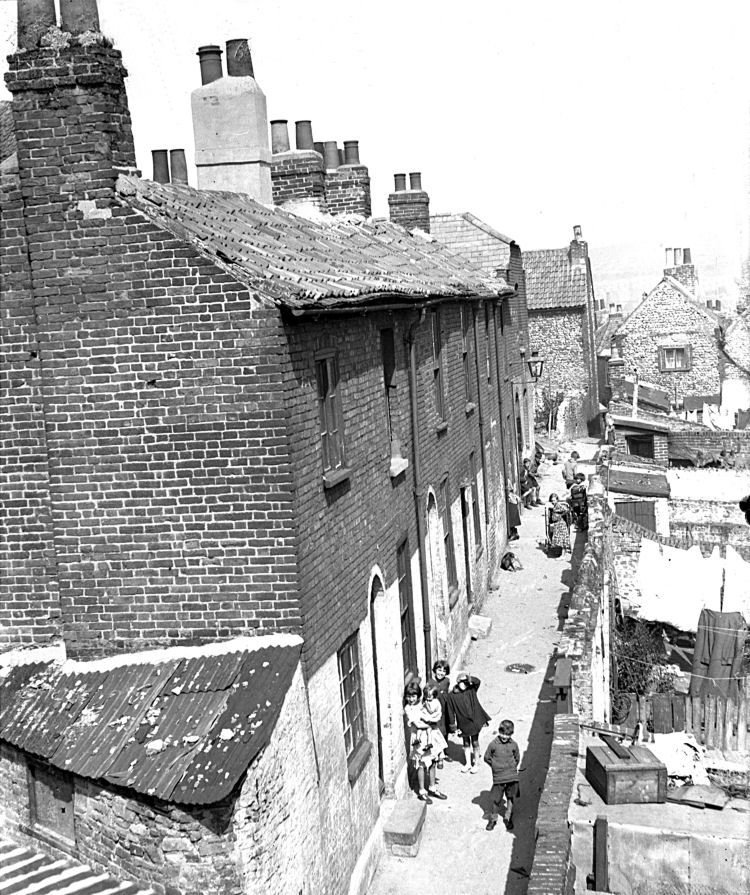
Blucher Row (17 August 1934), on Durham Hill, now the site of the
Corporation flats. The name dates the property to about 1815. It was
cleared under slum clearance in the mid-1930s. It is not known whether
the Half Moon is in this picture.
|
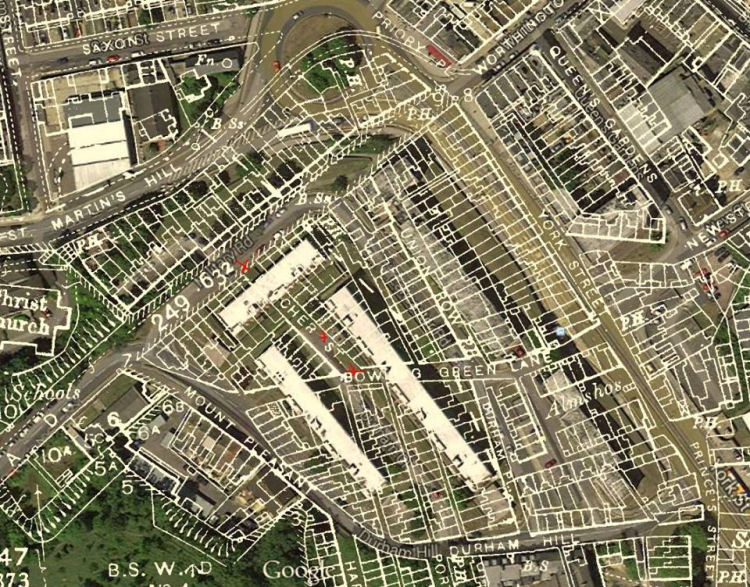
Overlay map showing maps today (2018) and 1909. Kindly supplied by Paul
Wells. |
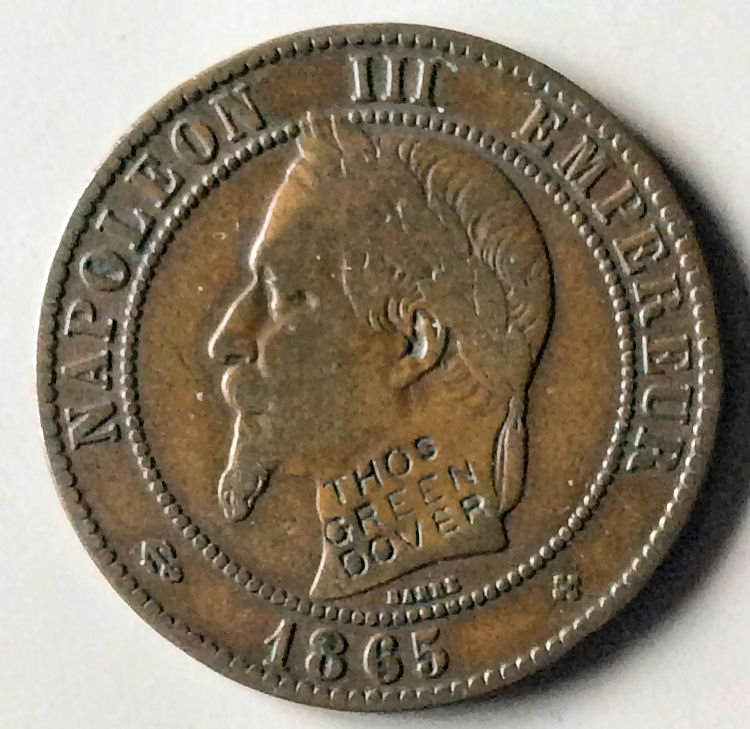
The above picture of a 10 Centimes Coin, kindly sent by Colin Walker,
shows some over-stamping by Thomas Green, who if it is indeed the
licensee, probably used this as payment from a Frenchman, and
subsequently as a token to be used for future tender at his house.
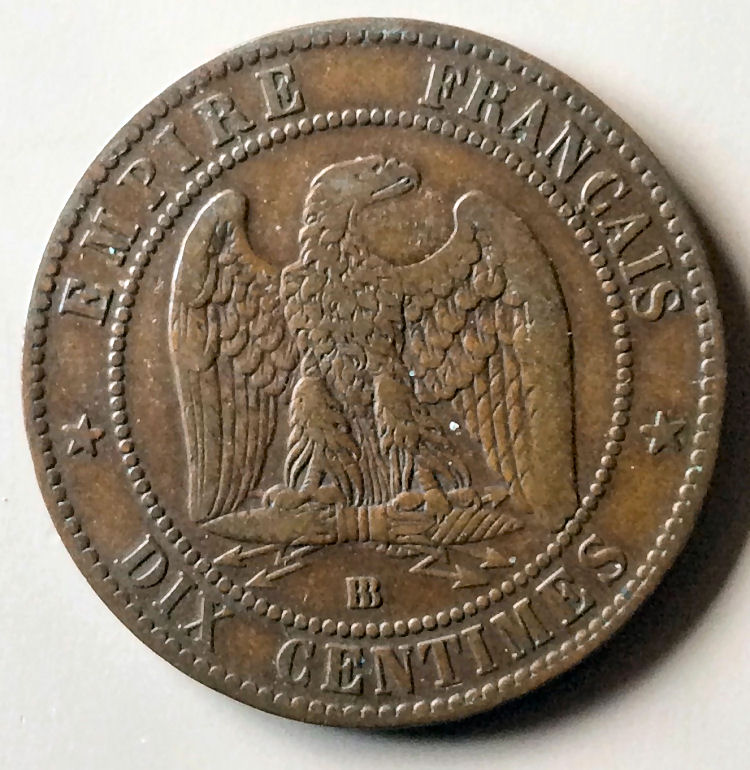
Above photo showing the reverse. |
|
From the Dover Telegraph, 14 Oct 1837.
Inquest at Half Moon, Mount Pleasant:
BLANCHARD, Isaac, 78 yrs (Military Pensioner, original American War):
Found dying; verdict: Natural death.
(Mount Pleasant was situated between Cowgate Hill and Military
Road.)
|
|
From the Dover Telegraph and Cinque Ports General
Advertiser, Saturday 20 February, 1841. Price 5d.
DEATH FROM SUFFOCATION
Yesterday afternoon, an inquest was held at the "Half Moon," public
house, before G. T. Thompson, Esq. coroner, and a jury of twelve persons
to enquire into the cause of death of Thomas James Ashcroft, aged 6
months.
Mary Bennett, widow, said, I liver at No. 5 Bowling-green-lane, and
the parents of the children occupy a front room on the first stair. I
left my home about 7 o'clock yesterday morning, and did not return till
the afternoon, when I was called by Miss Friend, who said that the house
was on fire. I immediately ran home and went into Ashcroft's room,
which, on opening the door, I perceived was full of smoke. I called the
children twice, well knowing that they were in the room, but obtained
no answer. I then ran to the well for some water, and on my return, fund
that two children had been brought out of the room. The baby was quite
dead, but the other child, who is about 5 years old, after a short time
recovered.
George Meredith deposed as follows: I am a labourer, residing at
Lowe-road, Mount Pleasant. Yesterday afternoon, about three o'clock, I
was going up the hill with a quantity of rubbish, some woman cried fire!
I ran to see where it was, and on getting to Mrs. Bennett's house, I saw
the flames of fire coming out of the top window. I then took a pail of
water and was going up stairs, when I saw a man engaged in throwing some
burnt chairs down stairs. The flooring was being consumed, but I
succeeded in putting out the fire by throwing water upon it. There was a
large quantity of linen in a heap burning near the window. The smoke was
so dense that I was almost suffocated. I then saw a child's foot
sticking out from under a bed quilt, and upon uncovering it, I perceived
that it was a child, about 5 years old, on its back. I immediately
picked it up, and carried it down stairs, and on being told that there
was another child in the room, I again went up, when I saw the child was
on its face on the floor, by the side of a cradle which had been upset.
The child lay about 18 inches from where the floor was burnt, and was
apparently quite dead. One arm was a little scorched, but none of its
clothes were burnt.
Thomas Hayward, carrier - Yesterday afternoon, on being called by
Mrs. Bennett, I ran up stairs and discovered that Ashcroft's room was on
fire. Near the window was a bundle of linen and a chair, on fire. The
window frame was also in flames. The room was full of smoke, and I could
see nothing but the flames. I went to the well to draw some water, and
on my return I observed that the children had been brought out of the
room. The grate in the room was cool, and there could have been no fire
in it for some time previously.
Mr. G. E. Rutley, surgeon, said - Yesterday about half past four I
was sent for to see two children, who, I was told, were very much burnt.
On my arrival, I found the younger quite dead; but I did not observe any
external marks of injury, excepting about the face. The child was put
into a warm bath, but it was of no service. The other child was
recovering rapidly at that time. I believe the cause of death arose from
suffocation by smoke.
Thomas Ashcroft, labourer, the father of the child, on being examined
said - I occupy a room in Mrs. Bennett's house. About half-past two
o'clock yesterday, I left the room my two children being in it. The
younger was asleep in the cradle, the other was sitting in a chair,
close by him. I did not return till about half-past four, when I found
that the room had caught fire. When I went out at about half-past two,
there was a very small fire in the grate, but it was nearly out. I had
not been smoking, and as the children are not in the habit of playing
with fire, I considered that every thing was safe. I am out and in
generally several times in the course of a day. My wife is generally out
all day, and yesterday left home early. I cannot account how or in what
manner the fire originated, unless it be that a spark had flown from the
grate to the clothes under the window.
Jane Friend deposed, that she lodged in the front room on the ground
floor, at Mrs. Bennett's. Yesterday afternoon, a little after three, she
went to the well to get some water, and on her return she observed two
pieces of rags, burning in the road, just under the window. She, at
first, thought her chimney was alight, and took a brush and knocked in a
cupboard adjoining the chimney, on which some smoke came out from under
the paper with which the wall was covered. She immediately ran to Mrs.
Bennett, who was at work at a house just below and informed her of the
circumstance. On returning to the house, she saw the flames issuing from
Ashcroft's window. She had not previously smelt fire, and did not hear
the children make any noise whatever. The rags which lay on the road
appeared as though they had been used to fill the holes where some panes
of glass had been broken out.
Susannah Bennett, on being sworn said - Yesterday afternoon, just
after Mr. Ashcroft went out of the house, I heard the children cry. I
went up and asked the elder what was the matter? and he said he could
not get his brother to sleep. I told him not to mind, but to rock the
cradle. There was a little fire indeed in the grate; scarcely reaching
above the first bar. Everything appeared quite safe; and I went down
stairs and left the house. I did not return till after the fire had
taken place.
Ashcroft on being re-called, said that two panes of glass were broken
in the window, but they were not stopped with anything when he went out,
but there was a cotton blind hanging on one side of it.
The Coroner then briefly summed up the evidence, when the jury
returned a verdict, "Thus the deceased came by his death from
suffocation by smoke, but how or in what manner the fire originated,
there was no sufficient evidence."
|
|
From the Dover Telegraph and Cinque Ports General
Advertiser, Saturday 8 March, 1845. Price 5d.
CORONERS INQUEST
On Monday afternoon, at 4 o'clock, a Coroner's inquest was held at
the "Half Moon," Mount Pleasant, before G. T. Thomson, Esq., Coroner for
the Borough, on the body of Thomas Rogers, a pensioner in the Rifle
Brigade, aged 57. - The jury being sworn, proceeded to view the body,
when the following evidence was adduced:-
Edward Jones, surgeon, deposed, on Saturday night, at 12 o'clock, I
was called upon to attend deceased, and found him suffering from rattles
in his throat, with pulse scarcely perceptible. He was partially
sensible. I asked him if he was in pain; but his answer was very
indistinct, and I understood him he wanted to sleep. He appeared gasping
for breath. I tried to get a little brandy down his throat, but I could
not succeed. I remained with him nearly an hour, endeavouring to rouse
the system, but not succeeding, went away, and sent him some medicine.
On going at 7 o'clock on the following morning, he was dead. - I
enquired if he had been ill, and I was told, (I think by one of his
daughters), he had been ailing more than a week, and had taken no solid
food during that period. He took only a little tea and coffee; some
gruel had been made for him, but he could not take it. He had had no
sleep since Monday, although he got up every day, and had been on the
Heights the day he died between 3 and 4 o'clock. I enquired why they had
not sent for a medical man; and they said they did not think there was
any occasion. I cannot tell the cause of death. The only symptom of
disease I could discover was the rattle in the throat, which might
probably proceed from an accumulation of blood or phlegm.
Ann Rogers, daughter of deceased, deposed - My father had complained
of a cold for about a week, but had been to the Heights every day to
light the lamps. On Saturday when he went up as usual; but Mr. Marshall
would not let him light the lamps, as he appeared too ill, and he sent
him home. He was obliged to sit down on the bank and was led home, he
did not complain of pain, and only coughed. He took nothing but a little
bit of toast and some tea. He said that he had had no sleep all week. My
mother wanted to send for a surgeon, on Wednesday and Thursday, but he
said he did not want one, and should get better. He died about half-past
7 o'clock on Sunday morning. He has left a widow and nine children. I
wished to send for the Rev. Mr. Bates, on Saturday, but he said there
was no occasion, as he was not going to die.
Margaret Rogers, widow of deceased, was next called, and, after
corroborating the above evidence, deposed - that the deceased had
suffered greatly from a cough and spitting during the week, but which
left him on Saturday morning. In the afternoon, he went to the Heights,
as usual, with two of his little boys, but Mr. Marshall said he was too
ill, and Mrs. Marshall made him some hot elder wine. He then returned
home, as far as the Mess-House, when he sat down on the bank, and said
to one of the boys to fetch his daughter to help him home. When he came
in, he complained of no pain, but said his legs were very weak. He went
to bed, and about 11 o'clock he was taken with the rattle in his throat,
and I sent for Mrs. Jones. He has always been a healthy man. He was
servant to Capt. Frampton, when in the Rifle Brigade.
Mr. Jones being re-called, said - if inflammation had existed - the
sudden ceasing of the cough might have caused death; and the Jury
returned a verdict of "Died from natural causes."
|
|
Kentish Gazette, 3 September 1850.
Coroner's Inquest.
An inquest was held on Saturday week, at the "Half Moon" public-house,
Blucher Row, before G. T. Thompson, Esq., coroner, on the body of Anne
Maria Poison, aged 26 years, who was found dead in her room on Friday
evening. By the evidence it appeared that deceased, who was about eight
months advanced in pregnancy of her fourth child, had been, as was
usually the case with her at such times, for a long period in ill
health. After dinner she retired to her room to lie down, during which
her child, four years old, saw her several times. At six o’clock her
mother called her to come to tea, but receiving no answer, went to her
room door to rouse her. On arriving there, she saw her lying upon her
face with her arms extended; she supposed her to have swooned, it being
of frequent occurrence with her when pregnant, and called assistance.
Mr. Hunt, surgeon, was immediately sent for, but upon his arrival he
pronounced her to have been dead for an hour. The jury requested that a
post mortem examination of the body should be made, for which purpose
the inquiry was adjourned to Monday, on which evening the jury
re-assembled to receive the evidence of the surgeon,
--- Hunt, Esq., who conducted the post mortem examination; and after
hearing the condition of the body minutely described by the medical
gentleman, they returned a verdict that "deceased died of disease of the
heart of long standing."
|
|
From the Dover Express and East Kent Intelligencer, 15
July, 1870. Price 1d.
INFRINGEMENT OF LICENSE
Richard Pay, the landlord of the "Half Moon," public-house, Blucher
Row, summoned for having his house open during prohibited hours on
Sunday last, was fined 20s., and costs 9s. 6d.
|
|
From the Dover Express and East Kent News, Friday, 16 September, 1904. Price 1d.
A BLACK LISTER
William Woodgate, who is on the Black List, and who had been sentenced
to fourteen days imprisonment a fortnight ago for drunkenness at the
“Half Moon” public house was now summoned for obtaining beer when he was
on the Black List. He did not appear, and it was believed that he had
left Dover.
|
Active, on the land above York Street in 1839 but proved surplus to
requirements in 1906 when Gardner's Ash Brewery received £631 in
compensation and Stephen Collard the licensee, £60. Most of the property in
the Row seems to be either empty or gone by 1910. Perhaps this escaped.
There is further evidence of demolition in 1934.
DOVER EXPRESS first week OCTOBER 1906 reported the following:- Canterbury
Sessions decided to close, under the Compensation Act, six Dover pubs
including the "William and Albert", "Three
Compasses", "Duke of York", The "Wellesley",
The "Old Commercial Quay" and the
"Half Moon".
It was described in 1913 as being boarded up because it was too large to
let as a dwelling. It was still there in 1924 when a closing order was made.
That year it was being used as a store with living accommodation over. Its
dangerous condition proved its downfall.
|
From the Dover Express and East Kent News, Friday, 16 February, 1906. Price 1d.
OBJECTION TO THE HALF MOON
The license of the “Half Moon,” Blucher Row, held by Stephen Collard,
was then objected to, the objection being that the license was
unnecessary in the interests of the public, whilst there was a further
objection that the said premises had been ill conducted.
Dr. Hardman appeared to represent the tenant.
Inspector Fox stated that the license was transferred to the present
tenant on the 27th January this year. There had been five tenants in the
last ten years. There had been two convictions recorded against the
house, in 1876 and 1896. There were five other licensed premises in the
vicinity, the nearest being the “Bowling Green Tavern,” which was within
26 yards of the rear, and the “Greyhound,” Union Row, the furthest away,
was 92 yards. On the whole of the hill bounded by Military Road, York
Street and Cowgate Hill, there were nine licensed houses.
Cross-examined by Dr. Hardman. Of the five tenants who held the house,
Fox had held it on two separate occasions, so that there were only four
persons who held the license within the last ten years. The last
conviction was for permitting drunkenness, and a fine of 40/- and 9/6
was inflicted. They looked upon that as a good conviction. Beyond these
two convictions there was nothing illegal against the house or the
present tenant. The present tenant had, in fact, conducted the house
very well indeed. The class of business done was with people who resided
on the hill, and no doubt the class of business done depended on the
class of people in the neighbourhood in which the house was situated.
You do not suggest that hawkers and dealers do not require refreshment
as well as other people?
I think they require as good lot. (Laughter.)
Witness (continuing) said that they did not subject the house to be
opposed himself, but he did not think it was required in that
neighbourhood, as there were more than sufficient houses there, but he
had no particular reason for saying that this should be the house to go.
He should say that the “Bowling Green
Tavern” was as well conducted as
the “Half Moon.” He could give no reason why this house should be
selected beyond the fact that they must take a start somewhere.
Dr. Hardman, in addressing the Magistrates, said that the last ground of
the objection that the house had been ill conducted, was the most
serious one, because it was a non-compensation ground. If the bench were
to come to that conclusion, and they were afterwards supported by
another authority, they would get no compensation at all. But the only
thing that was stated was that ten years ago the then tenant had been
convicted, and Inspector Fox, with bated breath, said that the man was
fined 40/-. Was that evidence against the present tenant that the house
had been ill-conducted?
The Chairman said that he did not think Dr. Hardman need address the
Bench on that point, as the opposition on that ground would be
withdrawn.
Dr. Hardman said he was not going to contend that there was not too many
houses in this district, but simply to say that there was no reason for
selecting this particular house for the one to go. It lay upon the
person objecting to make out his case, and asked the Bench to say that
Inspector Fox had made no case why that particular house should have its
license taken away. Its trade was a good one, and during the last ten
years it averaged 231 barrels of beer a year; whilst in the last seven
years its average was 187½ barrels a year, and for the last six years
the spirits returns averaged 95½ gallons a year. He was not going to
deceive the Bench in saying that the trade had been maintained during
the last year. Last year, it did show a considerable falling off, but he
did not think there was a single house in Dover, or anywhere about that
had increased its trade during the last year. But in that house they had
got a tenant who preferred to do a similar trade and keep the house
respectable, rather than a large trade at all risks. He did not think
that the house should be judged from its trade last year, and there was
no question that the trade had been a very good one in the past. It was
common knowledge that compensation means a loss to the owner and to the
tenant and he asked them to say that out of five this one should not be
the house selected for, report to Quarter Sessions.
THE MAGISTRATES DECISION
After a short consultation in private, the Magistrates turned to the
Bench. The Chairman said “The following houses will be referred to the
Kent Compensation Committee of the Quarter Sessions in due form: The
“William and Albert,” The “Three Compasses,” the “Wellesley Inn,” the
“Old Commercial Quay,” the “Duke of York,” and the “Half Moon.” The
licenses for these houses will run until the time when the compensation
is paid, and then the licences will cease. With respect to the
“Devonshire Arms” and the “Lord Roberts,” and the “Nottingham Castle,”
they will be withdrawn from the list.- These licences will be renewed in
the ordinary way.
|
|
From the Canterbury Journal and Farmers' Gazette, Saturday 6 October, 1906.
On Tuesday the Committee settled the compensation to be paid to the
owners and tenants of some of the houses, the licenses of which had been
taken away. The following figures were agreed upon:-
"Half Moon," Dover. £691.
To the owners (Messrs. Gardner, Ash). £631.
To the Tenant. (Stephen Collard). £60.
|
Another "Half Moon" was listed in "Annuals of Dover"
by John Bavington Jones (1916) as present in Biggin Street 1545.
|
From an email received 11 September 2026.
My great grandfather
Arthur Mott is the A Mott listed as the licensee of the Half Moon
pub from 1899 to 1901. The 1901 census shows him resident at 7
Blucher Row along with his wife Charlotte, and his children Emily
19, Beatrice 16, Arthur 9, Frances 6, and my grandfather George
Frederick Mott, 1. He had various occupations and addresses, having
been born in Hadleigh, Suffolk as the son of a butcher, later moving
to London where he was employed as an ink packer. In 1891 he was at
Upton Cum Chalvey in Bucks, as the publican and licenced victualler
of “The White Hart” However, by 1902 he had moved to Marine Terrace in Folkestone,
working as a fish salesman, where he sadly died on the 1st November
at the age of only 42, from, according to family history, falling
out of bed. He was a very obese man. I suspect he had either a
stroke or heart attack – he and his siblings mostly died “young” as
we would consider it these days. Regards, Sara Pass. |
LICENSEE LIST
REYNOLDS John 1840-51+ (age 45 in 1851 ) )
 
GREEN Thomas 1853-65 (age 40 in 1861)

PAY Richard 1865-99 (age 58 in 1891)
   
DILNOT Frederick 1891+ (age 38 in 1891)
 FOX Charles 1899

MOTT Arthur 1899-July/1901
  (Of Canterbury)
WHITE Edward July/1901-03+
 
FOX Caleb John 1904
COLLARD Stephen 1904-Dec/06
From the Pigot's Directory 1840
From Bagshaw Directory 1847
From Melville's Directory 1858
From the Post Office Directory 1874
From the Post Office Directory 1882
From the Post Office Directory 1891
From Pikes Dover Blue Book 1895
From the Kelly's Directory 1899
From the Post Office Directory 1901
From the Post Office Directory 1903
From the Kelly's Directory 1903
Census
|

