|
From the Dover Express and East Kent News, Friday 15 July, 1906.
THE HAND AT THE WINDOW - THE TECS ON THE HILL
At the Dover police Court this morning before Messrs. Thorpe in the
Chair, Messrs. Chitty, Wright, Scott, J. L. Bradley, and W. Bradley,
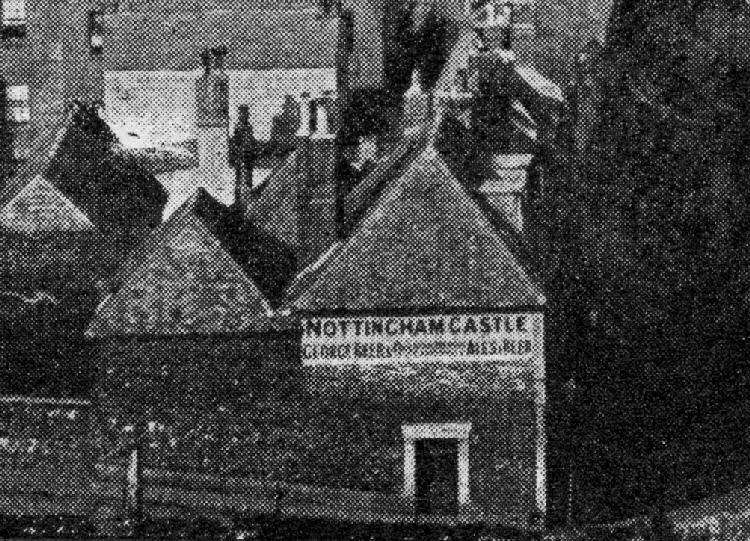
Albert Gasson, the landlord of the “Nottingham Castle,” Adrian Street,
was charged on the information of the Chief Constable, that being the
landlord of the “Nottingham Castle” on Sunday, Mat 20th, he did within
and during the period when such licensed premises were required to be
closed, viz. between the hours of 9 a.m. and 11 a.m. did open and keep
open such premises for the sale of intoxicating liquors to persons not
being bona fide travellers.
Mr. Rutlet Mowll appeared for the defence and pleaded not guilty.
Mr. Reginald Knocker appeared to prosecute, instructed by the Watch
Committee. On Sunday, 20th May, watch was kept on the house by the
Police and several men were observed to go to the “Nottingham Castle”
and tap at the window, and bottles were handed through the window to
them. One man paid four visits, and the person handing the bottles
through the window was seen to take money on more than one occasion. In
most cases the men took the bottles to the rear of the house, and there
drank the contents. In one case the bottle fell as it was handed to the
man and the Police visited the house, where they found a form underneath
the window through which the bottles had been handed. The landlord was
warned that the case would be reported. Mr. Knocker quoted legal
authorities showing that the offence in keeping open for the sale of
intoxicating liquors during prohibited hours included supplying liquor
to people outside the house.
Before evidence was taken, all witnesses were ordered out of Court.
Detective Police Constable Mount said: In company with Police Constable
Southey, I kept watch on the “Nottingham Castle” on Sunday, 20th May. I
commenced observation at 9 a.m. At 9.10 a man named Charles Jenkins went
to the window facing the allotments, tapped, and after waiting a minute
or two, the window was opened, and a bottle put through to Jenkins, who
put it in his pocket, going away to Cowgate Hill. It looked like an
ordinary beer bottle. At 10.15 James Brown and Frederick Dilnot came
along, brown went to the window, tapped, and received two bottles
through the window. He took them to a lane at the rear of the house, and
with Dilnot drank the contents. I could not see anyone in the house. The
men's hands went in from the outside. At 10.25 Police Constable Turner,
in uniform, passed the house, Dilnot was then close to the window. Just
before Turner reached him he turned round with the other man, and walked
away towards Albany Place. At 10.28, when the uniformed man had gone,
Dilnot again went to the window, passed something looking like a bottle
in, and then waited. He put his hand into his trousers pocket, and
selecting something from its contents passed it through the window, and
then received three bottles through the window. One he put in each coat
pocket, and one under his coat. He walked away as far as the lane at the
back of the house. He handed one bottle to James King, of 3, Adrian Row
and stood in the lane drinking another. King stood looking round at the
top of the lane. At 10.40, Dilnot again tapped the window, and then went
and looked down Adrian Street, at the corner, returning four minutes
later to the window, put his hand in the window, and then received three
more beer bottles, taking them one at a time, and putting them in his
pocket. He walked away, and handed one to Edward Blackman, 9, Durham
Hill, another to Thomas Spice, 7, Pleasant Row, and Dilnot stood outside
the public house in the middle of the road, drinking his own. All the
men remained standing about. At 10.45, a woman named Louisa Sharp, 36,
George Street whose mother lives near the house, went to the window and
tapped. She had a rather large cape over her head, which nearly covered
the window. She waited about two minutes at the window, but because of
the cape, I cannot swear that she received anything, but from her
actions she appeared to take something. She walked away and went down
the lane. The window is on a swivel and turns back into the house. The
bottom of the window is 5ft. from the ground outside, but inside it is
higher from the floor. At 10.55 Dilnot again went and tapped the window.
I then left Southey watching the window, and ran to the house. On the
bottom of the 64 steps a man named Royce spoke to me, trying to call my
attention to something else, but I went on, and when about half way
between the 64 steps and the Albany Flats, I saw a bottle passed out of
the window of the “Nottingham Castle,” and Dilnot apparently was in such
a hurry to get it that he dropped it, and it broke, all the liquor
running out. It contained beer. This is the bottle produced. Dilnot
picked it up and put it just round the post in an allotment garden. I
told him I wanted that bottle, and I went and got the pieces. Southey
had run up by this time. He went to the door of the “Nottingham Castle”
and called to the landlord, who came out in his shirt sleeves. Southey
pointed to the broken bottle and the beer spilt on the ground, and told
him, in the presence of myself, Dilnot, and others, that we had had his
house under observation for some considerable time, and had seen bottles
of beer passed out to men whose names he mentioned by name. he pointed
to the mess on the ground, and the broken glass, and asked how he
accounted for it. The defendant made no reply. I said to Southey, “You
will find a bottle or two on the allotment ground.” He went round, and
found two there against the top house of Adrian Street. I saw two of the
men place them there. One was full, and one empty. (Smelling the
bottles) I should say the full one contains beer. (Laughter.) I am
Police Constable Southey visited the house. Inside the window, which was
then closed, a form was placed. This window is in a space partitioned
from the bar. The window looks on to Adrian Row, facing the allotments
where there was previously a door. The landlord pulled the form away. I
tried to reach the window from the ground, but I could only just manage
to touch the bolt. I then told the landlord he would be reported. He
said, “Look over it and give me another chance,” but we said we were
sent there specially for such, and could not do otherwise if we wanted
to.
Cross-examined: You were in ambush.
Some people might call it so.
Where were you?
In a straight line 180 yards away, on the hill beyond the Sixty Four
Steps. You go up the steps, along a pass, cross a ditch, go along the
tunnel, and we were on top of this.
Did you notice a sentry at the magazine.
We were nearer than the sentry. We happed to know the sentry, and got to
the spot conveniently. From the spot we could see the whole of Adrian
Street and the neighbourhood.
Mr. Mowll: And the bay, I suppose?
Yes, up Snargate Street.
Between you and the house were allotment gardens?
Yes, but they were out of sight. We could see the “Nottingham Castle”
first.
Mr. Mowll: It seems a wonderful place.
You could see what was distant and not what was near. (Laughter.)
Had you a pair of opera glasses.
Yes.
What for?
To recognise the people as they went to the house.
Not to see what they did?
No, I could see that with the naked eye.
Did you see what Dilnot handed in at 10.28.
No, I could not see.
Did you not see him pass in some fish?
No.
Did you see some fish in the house?
On the public bar counter lay three crabs and some dirty glasses. The
crabs were boiled being red. I noticed no fish brought to the house. All
the transactions went on through the window.
In answer to several questions, witness said he did not notice a tablet
on the wall near the window. He did not keep observation on the house
for that purpose, and was too much interested on watching the bottles
and the men.
Mr. Mowll said they had been to the spot where the Constables were, and
he could not read the name plate of the street owing to the distance.
Could witness read it?
Witness: I never went there for that purpose. I might have noticed it if
I knew you wanted it.
Mr. Mowll: It is necessary to test what could be seen. Could you tell if
the bottle had a label?
No, but I would have seen a label if the bottle had not been passed so
quickly. I have not measured the distance we were from the house. It is
not far from the end of the allotment ground.
Mr. Mowll said he thought the distance was more.
Detective Southey gave evidence that he kept observation with Detective
Mount on Sunday, may 20th. He corroborated the evidence of Detective
Mount. They both went up to Dilnot and asked him to go with them to the
Police house to see the landlord but he would not go, so they called the
landlord out and asked what he had to say about the bottles being handed
out of the window. He put his hand to his breast and sounded dumfounded.
Cross-examined: The distance we were as the crow flies would be about
180 yards. We did not measure it because if you went round it would be
at least 300 yards to walk. They had field glasses to recognise the men.
He took no notes, but Mount did and they made a joint report at 12
o'clock that day. King looked after all the gardens. Spice also has
garden grounds. Both men garden on Sundays when the grounds are
generally full.
The following evidence was called for defence:-
Albert Gasson, licensee of the “Nottingham Castle”, said that previously
he had a license at Ashford, and before that was 12 years employed in
the Railway Works at Ashford.
From the inside of the premises can you see what is going on in the road
through the window described?
Not unless one puts his head right up to the window.
Witness continuing said: On Sunday, may 20th, I was scrubbing my place
out, when Mr. Jenkins came and tapped. I opened it and he passed me
through an empty bottle and said he thought he would leave it as he was
going up to the Heights. I supplied him with nothing. I need hardy say
it was very foolish of him to pass an empty bottle.
Who called next?
Mr. Brown who used to live at the back, but has moved near to the Town
hall recently. He came to the allotment gardens on that Sunday, and
handed me through the window two empty bottles, which he said he had
taken away with him when he moved. I think he had the bottles the day he
moved. Brown had nothing to drink from the house. Dilnot next came and
tapped the window and put his hand in and asked me how I was. He had
left me some fish, red gurnet, overnight. I said it was not clean, and I
asked him if he would clean it. He said he would, and I took it to him,
and he sat on the wall cleaning it. I saw him doing it when I came and
shook the mat. I afterwards locked the door.
The Clerk: The fish was not in a bottle; I suppose.
No. (Laughter.)
Witness continuing said: At the time no bottle whatever was handed to
Dilnot. I asked Dilnot if he had and “Heavers” as I call crabs. He often
leaves me fish, because I let him have money to buy the fish from week
to week, and he generally gives me a little fish when he returns the
money. He went to get some crabs, and returning, tapped the window and
handed me six crabs. This was about 10.40. He was there twice. When he
came the second time I asked if he could do with a drink. He said “Yes,”
and I handed him out two bottles of beer like those produced. I did not
expect to receive money, but I thought he was thirsty after being good
to me about the fish. The next thing I heard the arrival of the Police.
With the exception of these two bottles, I handed no bottle whatever out
of the house that Sunday morning. Dilnot did not pay, and I did not
intend him to. They were entirely a present to him. On Saturday night I
supplied Dilnot with three or four bottles of beer to take away on
Sunday.
Cross-examined: Do men usually call on Sunday with empty bottles?
No. It's curious they should have done so this day.
How long has that window been there?
About a week.
Was not there a door there before which was stopped up?
Yes.
The window is quite as convenient as the door?
To let the air in.
And for passing bottles?
I don't believe in passing bottles.
Mr. Knocker: And fish, and so on.
Why did you put your hand to your chest on that Sunday, had you
something on your chest?
No. I had an apron.
Charles Jenkins, baker and hawker, 34, Hartley Street, said that on
Sunday, May 20th, he went to the Heights with a basket of cress, etc. to
sell there. Defendant had ordered some greens from him. But witness
could not supply them, and went to tell the defendant so, and at the
same time took an empty bottle to the “Nottingham Castle.” He would
swear that he did not receive a bottle of beer or any other liquor from
Mr. Gasson that morning.
Cross-examined: he had the bottle on Friday night, and Mr. Gasson said
bring it back as it was worth more than the beer.
James Brown, 6, Biggin Court, general labourer, said that he moved from
6, Albany Row on May 12th, and on Sunday, May 20th, he went back to his
old house about 10.30 taking two empty ale bottles. He tapped at the
window of the “Nottingham Castle” and handed them through the window to
him saying, “Here are your empty bottles.” He then went back to his
house to get some flower pots up, but they were gone, so he went back to
Biggin Court. Heb received nothing from defendant, and was certain that
no bottle was passed out to him.
Cross-examined: He was not in the habit of taking bottles away from the
“Nottingham Castle.” He had these a fortnight earlier.
By the Magistrates: He drank no beer outside the house.
In reply to Mr. Knocker, witness said he was surprised when Mount and
Southey came later that Sunday and asked about ale, because he had had
none. He admitted saying, “Supposing even I had had some, what can you
do?” He was trying to pump them the same as Mr. Knocker was trying to
pump him.
Frederick Henry Dilnot, living at 34, Hartley Street, Deal, said: On
Sunday 20th May I went to the “Nottingham Castle.” I looked in the
fanlight window in the passage and asked him how he was. He said, “All
right.” He asked me to clean some fish. He passed it to me and I cleaned
it outside, and gave it back when he came to shake a mat. He asked me to
let him have some crabs, he used the word crabs, not anything else.
Witness had not had anything to drink at the “Nottingham Castle” then.
He went home and got some crabs, and also put these full bottles of ale
in his pocket, which he had bought overnight at the “Nottingham Castle.”
He took the bottles with him and gave Mr. Spice one, Mr. King one, and
Mr. Blackman one.
The Chairman: Very generous indeed.
The Clerk: Where did this take place?
In Adrian Row, about eight yards from the house.
Witness continuing said that he then went to the window of the
“Nottingham Castle” and handed the crabs to the landlord who gave him
two bottles saying, “There's a drop of porter for your wife, and a drop
of ale for yourself.”
He had the misfortune to drop one and break it. These were the only
bottles he received.
Cross-examined: The reason I was generous was because this man had been
generous to me when I was laid up 16 weeks, and funds were low, but on
Sunday I had a bit of luck and I thought I would return the compliment.
Mr. Knocker: The police say they saw you take something out of your
trouser pocket. Was that crabs?
Crabs, certainly not! You don't think I would carry crabs in my trousers
pockets?
Witness denied that he went to the house at 10.28, 10.40, 10.44, and
10.45. He only went twice. He never went to public houses on Sundays.
Mr. Knocker; What never?
Well, when I was fined 5s. for going top the “Commercial Quay Inn” but
that was many years ago, the landlord was fined £8.
Thomas William Spice, of 7, Pleasant Row, a painter, said that he saw
the last witness at the “Nottingham Castle” pay for and take away
several bottles of ale on Saturday evening almost 10.10 p.m. Witness had
a garden near the “Nottingham Castle,” and on Sunday, May 20th, as he
was getting into the garden, Dilnot came and gave him a bottle of beer,
which he took into the garden, and put behind a water butt. The Police
took it away before it was drunk.
Cross-examined. Witness know the “Nottingham Castle” well. He did not
know that his wife objected to the renewal at the Licensing Sessions in
February.
Do you always come home sober from there?
I don't know about “always” sober.
Mr. Mowll objected to this evidence.
In reply to the Bench, witness said that they took it in turns to
provide beer for the gardeners on Sunday morning, as it was hard work,
and there was no water laid on.
They made a regular meeting place of it on Sundays in the gardens, and
took it in turn to get beer.
Joseph James Clark King, 3, Adrian Row, a musician, said that Dilnot
took some bottles of ale away on Saturday night from the “Nottingham
Castle.” Dilnot met him in Adrian Row on Sunday morning and handed him a
bottle of ale, which he drank in his private house.
Cross-examined. He did not know where the ale came from.
What is your opinion?
Study your opinion. You know as much as I do.
Where did you think it came from?
Canterbury, I expect.
Louisa Sharp, 36 George Street, said she passed the “Nottingham Castle”
on Sunday, May 20th, and she looked in the window to see the time by the
clock. She received nothing at the “Nottingham Castle.”
Cross-examined. She had been to Cowgate Hill, and was going home.
Is that the shortest way home?
No, I always like to take the longest way home.
Mr. Knocker: Especially if it goes by the “Nottingham Castle.”
Witness: I drink no beer on a Sunday morning.
Mr. Knocker: A most irreproachable witness.
Mr. Mowll for the defence, said that the reason for the variation of the
evidence was the distance that the Police were away from the public
house. He suggested that the Bench should visit the spot in question. In
visiting the spot where the Police were himself, he could not read the
metal street name plate with glasses. The Police said that at that
distance they saw bottles handed out, whereas his witnesses who were on
the spot, said that they handed empty bottles in. It was a tall order to
say that his witnesses had come here and had deliberately perjured
themselves. He thought that it was more reasonable to say that the
Police were mistaken owing to the distance they were away. His witnessed
had been unshaken, and had not varied their statements from the first.
The only bottles handed out were a present to Dilnot from the landlord.
The Bench had two courses – the one that the two excellent Police
officers were mistaken, and the other that the host of witnesses on the
other side were perjurers. They had no right to take that view.
The Magistrates retired to consider their decision, and on returning
into Court Mr. Thorpe said. We have given your case great consideration,
and it is the unanimous opinion of the Bench that you are guilty. The
evidence of the Police is very strong against you, and we don't say that
your witnesses have perjured themselves, but we don't believe that some
of them are truthful. You will be convicted, and fined £5 and 16/6
costs.
|


 )
)


