|
26 Adrian Street
Dover
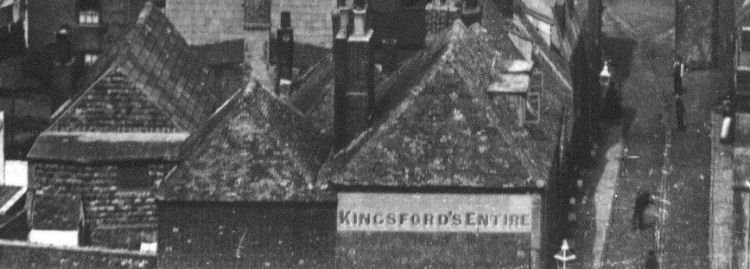
Above photo, kindly sent by Paul Wells, showing the "Great Gun" circa
1881-84. |
Previous to 1857 and I believe to 1854, the pub was called the "Rising
Sun."
On the top corner with Adrian Row and obliging thirsty
customers in 1857. The Kingsford brothers paid
Satchell or his executors
£570 for this in 1881. I think the "Cambridge Arms" would have stood on the
opposite corner at another time. It became the "Nottingham Castle" in 1884.
|
Dover Express, 16 October 1858.
Drainage of Adrian Street the compulsory clauses of the public Health
Act.
The inspector of nuisances reported that several houses in Adrian
Street, near the "Great Gun" public house formerly the "Rising Sun,"
were undrained, and that a great nuisance to the neighbourhood was there
by occasioned.
The Surveyor, in reply to a question from Mr. Dickeson, said he had
inspected the houses referred to by the inspector, and that they were
truly in a filthy and deplorable condition. He should recommend that
these premises be dealt with under the Nuisances Removal Act.
Mr. Duke complained of the inactivity displayed by the local board in
the application of the compulsory clauses of the Public Health Act. A
great number of orders for compulsory drainage had been made, it was
true, but few, he regretted to say, have been pressed to a satisfactory
issue. He could not conceive, after reference to the Local Management
Act, that there was any legal difficulty whatever in applying the
clauses in question.
The surveyor said that Mr. Duke was in error, and that there was great
difficulty in applying these clauses of the Act of Parliament, although
he did not deny that great additional powers were given to the Local
Board by the Local Management Act. The more direct method of reaching
the particular evils now in question, however, would be to recource to
the Nuisance Removal Act.
The Inspector having furnished the Town Clerk with the particulars of
the nuisance, and also with certain information as to an offensive drain
near to 16, Adrian Street.
The Town Clerk gave it as his opinion that for the purpose of obviating
the nuisances referred to, it would be better to resort to the Nuisances
Removal Act than to the compulsory clauses of the Public Health Act.
Mr. Duke, while he fully believes that there was no difficulty in
dealing with matters of this kind if the powers conferred upon the Local
Board by the compulsory clauses of the Public Health Act were exercised,
was content if the nuisance was got rid of, no matter how, and therefore
moved that proceedings be adopted under the Nuisances Removal Act, in
accordance with the Town Clerks recommendation.
Mr. Robinson asked whether, under any clause of the Public Health Act,
the local board had power to enter by its offices the dwelling-house of
any inhabitants?
The Town clerk said he had no doubt Mr. Duke could advise the Local
Board on this point better than he (the Town Clerk) (Laughter.)
Mr. Duke said the Town Clerk was quite correct. He could advise the
Board upon the subject better than the Clark, inasmuch as he had paid
more attention, he ventured to say, to these clauses of the Act of
Parliament. (Renewal laughter.)
Mr. Duke's motion, having been seconded, was carried unanimously.
|
|
From the Dover Express and East Kent Intelligencer, 16
May, 1863.
DOVER POLICE COURT
A Militiaman with a "Blank" Discharge - Charles Stiff, a young man
well known to the police, a bricklayer by trade, who said he had just
received his discharge from the Kent Militia Artillery, was brought up
by police constable Johnson and Corrie, who had found him, in company
with an artillery soldier, attempting to scale the garden wall of the
"Great Gun" public house, Adrian Street, shortly before one o'clock the
same morning. On ascertaining that they were pursued by the police both
the men endeavoured to make their escape, and the soldier succeeded in
getting away, but the prisoner was taken into custody in the adjoining
garden, when, he was charged with being on the premises for an unlawful
purpose.
Police-constable Johnson said he had watched the prisoner for some
time on the previous night, and that at about a quarter to one the same
morning he saw him run up Adrian Street in company with an artilleryman.
He followed them and saw them enter a passage near the "Great Gun"
public-house. When he got up to them they were climbing over the wall.
Still had previously changed coats with the soldier. Witness sent to the
police station for assistance, but the soldier managed to effect his
escape. The prisoner was subsequently found on some premises adjoining
the garden of the "Great Gun," and he was then taken into custody.
Captain Noble:- What do you expect was the object of the men scaling
the wall? - Constable: To commit a burglary perhaps.
Prisoner: Nonsense, I was going to get lodgings.
Constable: The prisoner told me he lodged at the "Great Gun," and was
going to get his lodgings by the back way; but the landlady of the
"Great Gun" is here, and she says the prisoner has not lodged at her
house.
Jane Hedgecock, wife of John Hedgecock, said he kept the "Great Gun"
public-house. She knew the prisoner by sight, but he had never lodged at
her house.
Captain Noble: Has he slept there lately? - Witness: No, I do not
think he has; I have never known him to sleep there.
Captain Noble: Had he any right to be on the premises? - Witness: No,
Sir, there is no thoroughfare through there, and he could have had no
business there.
In reply to the Magistrates, Still said he belonged to "nothing" now.
He had belonged to the Kent Artillery, but he had served his time, he
supposed, as he had received his discharge.
Captain Noble: Where is your discharge?
Prisoner supposed he had lost it.
The police said the fact was the prisoner had received a "blank"
discharge. He had another militiaman named Rowe, who was now in prison
for an assault on the police, had each received a blank discharge a day
or two since.
Captain Noble: You seem to be an incorrigible character. I find you
had a month's imprisonment but a very short time since; and I now give
you six weeks, with hard labour.
Prisoner: You are giving it me very wrongly this time.
|
|
From the Dover Express and East Kent News, Friday,
4 December, 1868.
SUDDEN DEATH OF A YOUNG WOMAN.
On Tuesday last the borough coroner, W. H. Payn, Esq., held an
inquest on the body of a young woman named Jane Wilson, who had been
found dead in her bed the previous day, at the "Great Gun" public-house,
Adrian Street. The inquest was held at the "Liberty,"
another public-house, situated on the corner of Five Post Lane.
Mr. R. Elgar having been chosen foreman of the jury, and the body
having been viewed, the following witnesses were examined.
John Wilson: I am a sergeant of militia, living at Canterbury, and
father of the deceased. When I last heard of her she was living in
services in Wincheap, Canterbury, at a public-house called the "Railway
Inn." I don't know when she left her services in Canterbury, but I heard
she had quitted Canterbury some three or four months ago, and I did not
hear whither she had gone. I never received any letter or message from
her, and did not know she was living in Dover until her death occurred.
The first I heard of the circumstance was from a servant connected with
the militia whose duties occasion him to visit Dover, and whom I saw
yesterday. When I last knew anything about my daughter she was in good
health. She was a girl of good constitution. She was seventeen years of
age. I know nothing whatever as to the cause or the circumstance of her
death. I have heard nothing to incline me to the belief that she came to
her end in any unfair manner.
By the Jury: Had I known of the circumstances under which she was
living here, I should have undoubtedly taken means for fetching her
home. I have always brought up my family strictly, and my belief is that
she was well conducted up to the time of her leaving Canterbury. She was
always on sociable terms with myself and the other members of my family
before leaving home.
The foreman of the Jury expressed his surprise that, if this was the
case, the girl should have gone away, and kept from her home so long
without corresponding with any of her friends, and in this remark some
other members of the jury concurred.
John Hedgecock: I am landlord of the "Great Gun" public-house at the
top of Adrian Street. The deceased, Jane Wilson, has been living in my
house for the past three weeks. She was engaged as a servant, and
received one shilling per week and her board. I am a married man, and
the father of twelve children, eight of whom are at home. The deceased
appeared very well in health during the time she was living in my house,
and I never heard her complain of anything. About five o'clock yesterday
morning I heard a call, and went to the upper part of the house, where
the girl Wilson slept, for the purpose of calling my son and daughter. I
passed by the door of the room in which the deceased was in the habit of
sleeping. I observed the door to be open, and knowing this to be unusual
I looked into the room and saw the deceased lying on the bed, with her
clothes still on. I at first thought she was asleep, but on trying to
wake her I could make nothing of her, and I thereupon raised an alarm.
My wife responded to my call, and I then had to leave the house, to go
to my work, I left the deceased in their hands. I never saw the deceased
the worse for liquor, and from what little I knew of her I should
conclude her to have been a steady girl. I never heard that she was on
bad terms with anybody.
By a Juror: I did not know that it was the deceased who called. My
son and daughter, and others sleep upon the same floor.
Jane Hedgecock, wife of the last witness: The deceased was living
with me for three weeks. She was a sober, temperate, and steady girl,
while with me. She had a bad cold and complained of her throat being
sore, but in other respects she was in good health immediately preceding
her death. She had had a cold for about a week. She took no medicine
that I am aware of .Yesterday morning, on being called by my husband,
I went into the bedroom. My husband told me that she was lying on the
bed and did not answer him when he had spoken to her, and as he thought
there was something the matter with her asked me to get her up. He said
he had thought he had heard her call before getting up; but instead of
the deceased calling, it was my little girl, who had called her father
to know if it was time to get up. On going into the room I went to the
bed and found that the deceased was dead. The body was quite cold. She
had her clothes on. I dressed immediately and at once sent for a doctor.
Mr. Walter attended in less than half an hour, and he pronounced her
dead, but did not state the cause of her death. I am not myself aware of
the cause.
By the foreman: I heard that she lived at the "Crispin" before coming
to live with me, and that she was keeping company with a corporal of the
27th. He was going to fetch her at Christmas, to marry her, and he had
given her a little money to get a piece or two of clothing. She had
recently received a letter from the corporal which the policeman will
produce. I had no character with her. She came home in good time on
Sunday night, and went to bed without making any complaint, except as to
her cough; but the cough was accompanied by retching. I do not think,
however, the retching was occasioned by anything but the cough. The
deceased, when I sent up to her, on my husband raising the alarm, was
lying in the bed composedly, with her hand up to her face.
Police-sergeant Stevens produced the letter in question. It was dated
Isle of Grain, 27th November, and expressed the writer's inability to
come to Dover at Christmas, but that he had received permission of the
captain of his company to come in January.
Mr. John Walter, surgeon, of Dover: Yesterday morning, soon after
half-past five, I was called to see a girl at the "Great Gun," the
people who called me not knowing whether she was alive or dead. I went
immediately and saw the deceased lying in bed as the last witness had
described. I had her clothes taken off and examined her, and found no
marks of violence upon her person, but I discovered that she was
suffering from a natural ailment that would render her very weak. I
observed nothing else remarkable, and I attributed her death to
apoplexy. The last witness's evidence does not tally with what I had
previously heard from her, for I had understood that the deceased was in
the habit of drinking to excess; and I think the apoplexy was
accelerated by drink. The ailment under which the deceased was suffering
would tempt her to drink, and her state would occasion the drink to have
more effect upon her than under ordinary circumstances.
The Jury found a verdict of "Death from natural causes."
|
|
From the Dover Express and East Kent Intelligencer, 31
August, 1877. Price 1d.
APPLICATIONS FOR NEW LICENSES
William John Collins applied for a licence to sell beer off the
premises at 26, Adrian Street. The applicant produced several
satisfactory testimonials, and the licence was granted.
|
|
From the Dover Express and East Kent News, Friday 8 August, 1878
PERMISSION TO DRAW
John Bayley was granted permission to draw at the “Great Gun,” vice John
Bacon.
Permission was also granted to John Thomas to draw at the “Lord Clyde,”
Limekiln Street.
|
|
From the Dover Express and East Kent News, Friday 2 September, 1881. 1d.
WEST CLIFF BREWERY SALE
The “Great Gun,” at the top of Adrian Street, Dover, let to Mr. John
Bailey at £18 per annum, was bought by Messrs. Kingsford Bros. for £570.
|
|
From the Dover Express and East Kent News, Friday 5 September, 1884. 1d.
DOVER BREWSTER SESSIONS
Mr. Coleman applied on behalf of the landlord of the “Great Gun,”
Adrian Street, for the name to be changed to the “Nottingham Castle,” as
the house had rather bad character, and he wished to get rid of the old
name. It was granted.
|
LICENSEE LIST
 HEDGECOCK John
W 1863-May/78 HEDGECOCK John
W 1863-May/78
 
IRVINE Francis May/1878+
COLLINS William John Aug/1877+
BAILEY John Aug/1878-82+

 (age 34 in 1881
 ) )
To the "Nottingham Castle"
From the Post Office Directory 1874
From the Post Office Directory 1882
From the Dover Express
Census
|

