|
8 Trevanion Lane
Woolcombers Street
Dover
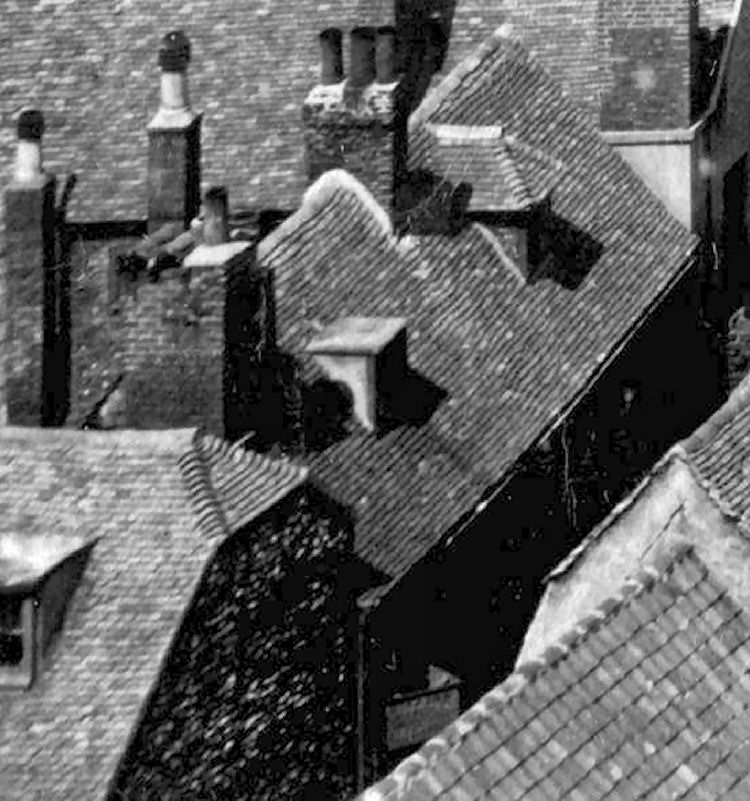
Above photo, date unknown, kindly sent by Paul Wells. |
Retailing in 1826, and later belonging to George Beer and Company.
Possibly on a corner, the address in the last century was often Woolcombers
Street.
|
From the Dover Telegraph and Cinque Ports General Advertiser, Saturday, 6 November, 1847. Price 5d.
CORONER'S INQUEST
An inquest was held on Wednesday, at the “Star,” in Trevanion Lane,
before G. T. Thompson, Esq., Coroner of the Borough, on the body of
Daniel Manser, labourer, aged 40, when the following evidence was
adduced:-
Benjamin Pilcher, grocer, deposed: On Monday night about half-past nine
o'clock, I saw a man at the top of Commercial Quay, going to the back of
Mr. Court's porter vaults. Shortly after I heard a heavy fall, and on
looking over the quay, saw a man lying on the mud. It was low water at
the time, and I went to the “True Briton” to call for assistance.
John Willis, labourer, deposed: I was at the “True Briton” on Monday
evening, and on hearing an alarm that a man had fallen over the quay, I
went with several others, and found deceased, who I recognised, lying on
the mud. We got him on his legs, and I asked if he was hurt, but he only
complained of his back. I saw blood running from behind his ear, and
told him he had got “a spat on the head,” but he said he did not feel
it. We then we got him on the quay, and he wanted to walk home alone,
but I would not let him, and walked with him to his house, where he
lodged. He had no difficulty in walking, and only complained of his
back. He gave no further account of the accident than that he went round
the corner, and slipped over. In my opinion he was not sober.
John Manser, brother of deceased, deposed: On Monday night about 10
o'clock, deceased who lodged in the same room with myself, came home and
laid himself down on the bed with his clothes on. He complained of his
back, saying he had had a fall. He did not disturb me during the night,
but when I got up at 5 o'clock, I left him believing him to be asleep. I
went to call him at 6 o'clock, and found he was dead, and his body quite
cold. This evidence was corroborated by Robert Stokes, shoemaker, who
slept in the same room.
Edward Jones, surgeon, deposed: I was called to see deceased about
half-past 6 o'clock, and found him lying outside the bed with his
clothes on. He was quite cold and had been dead some hours. I have
carefully examined the body, and find there is a small puncture wound
behind the left ear, but it is only skin deep. There is also a slight
graze on the left buttock, as if it had scraped against some rough
substance. There are no other marks on his person. The wounds I have
mentioned would not cause his death. I cannot state from what death has
arisen, nor form any conclusive opinion upon that head. As the wound on
the head is certainly the result of a blow, arising from a fall or other
violence, it is possible that death has arisen from extravagation of
blood upon the brain.
Fanny Goodfellow deposed: I lodge with my husband in the house. On
Monday night when deceased came home I lighted him to bed, and took off
his neck-cloth. He laid down in his clothes, and I covered him up with a
great coat. I went to bed in the next room to deceased about half-past
eleven o'clock, and hearing a loud snoring in deceased's room, I
requested my husband to go in. I was awake at 12 and 1 o'clock when all
was quiet in the room, the snoring having ceased.
John Goodfellow, ostler, deposed: I went into the room as requested by
my wife, when I heard a queer noise, as of a rattle in a person's
throat. I found the noise proceeded from deceased, and seeing that his
head had fallen off the pillow on to the mattress, I lifted it up. He
then ceased to make any noise, and began to breath quietly. I then left
the room and was not disturbed again during the night.
The Coroner then briefly addressed the Jury, who after a short
consultation, returned the following verdict:- “That deceased died in
consequence of injuries received by accidentally falling over the quay,
at the back of Mr. Court's porter store,” and the Jury desire to add to
their verdict, a strong expression of opinion, that the place where
deceased fell is not sufficiently protected, and that the Harbour
authorities he called upon (the above not being the first instance of
accident) to adopt a remedy so as to insure the perfect safety and
convenience of the public.
|
|
From the Dover Express and East Kent Intelligencer, 3 March, 1882. Price 1d.
INFRINGING THE LICENSING ACT
Otto Dannenburg, landlord of the “Star Inn,” Church Street,
(this is incorrectly addressed. Paul Skelton)
was summoned
for serving intoxicating liquors during prohibited hours, and Sergeant
William Smith, Trumpeter, John Smith, and Gunner Martin Reeves, of the
Royal Artillery, were summonsed for being upon the premises at the same
time.
The landlord pleaded “Not Guilty,” and the soldiers said that they were
guilty of being found on the premises, but were ignorant of the laws, as
they had only just arrived from India.
Police-constable Wickham said: On Tuesday the 21st instant, at a quarter
to twelve o'clock at night, I was on duty in the Market Square, when
from information I received I went with a sergeant of the Garrison
Military Police to the “Star Inn,” Church Street. I knocked at the door
and the landlord opened it I asked him whether he had any persons
inside, and he said, “No, only lodgers.” I then walked through into the
tap-room, and found the three defendants of the Royal Artillery sitting
down with a quart jug and two glasses in front of them, each containing
beer. I asked them whether they were lodgers, but they made no reply,
but drank up their beer and left the premises. Nothing further was said
about the defendants being lodgers. The three defendants belong to the
Royal Artillery, and are situated at Fort Burgoyne, their battery having
come in last Saturday week.
Witness, examined by the landlord, said: You did not tell me that they
said that they had come from Chatham.
Sergeant Gallaher, of the Royal Scots Fusiliers said: I am acting on
Garrison Military Police duty. At about half-past eleven o'clock on
Tuesday, the 21st instant, I saw three Artillerymen enter the “Star
Inn.” There being Artillerymen about I wished to examine their passes. I
got the last witness to obtain admittance to the inn. We went and
knocked at the door, and the landlord answered. The constable asked if
there were any persons inside the house, and the landlord said “only
lodgers.” We went into the tap-room, and found the three defendants
there. I examined their passes and found that they were on leave till
midnight. They belong to Fort Burgoyne. The landlord said that they were
lodgers in the presence of the men, but when I asked them if that were
true, they said “no.” When we first went to the house it was shut, and
the door fastened. The defendants left the house and went up Castle
Street. If they had stopped any longer I should have made them
prisoners.
By the Bench: The Artillerymen came to Fort Burgoyne about a fortnight
ago from India.
The defendant Dannenberg said that he would not have got himself into
that row for the sake of a pot of beer. He had taken the word of the
soldiers that they were going to be lodgers.
The Artillerymen said that they were ignorant of the laws, having just
returned from India, but seeing a light in the public-house, they had
knocked and obtained a little beer.
The Superintendent said that this was not the first offence against the
landlord. About nine months ago he found the house open late at night,
but some explanation was given to the Bench about its being with a
soldier's dinner that they had there that night. Only last Saturday
after the summons had been served on him, at twenty minutes to one
o'clock, there were three men found in the top part of the house, and
who belong to Dover.
The bench fined the landlord 40s. and 10s. 6d. costs, and the other
defendants were ordered to pay the costs, 7s. 6d. The money was paid.
The Clerk told the artillerymen that this case would not be reckoned as
a conviction against them.
|
|
From the Dover Express and East Kent Intelligencer, 10 March, 1882. Price 1d.
INFRINGING THE LICENSING ACT
Otto Dannenburg, landlord of the “Star Inn,” Church Street,
(this is incorrectly addressed. Paul Skelton)
was summoned
for serving intoxicating liquors during prohibited hours, and two men
were summonsed for being upon the premises at the same time.
Mr. Mowll appeared on behalf of the defendants, who, in answer to the
charge, pleaded guilty.
Police-constable Cook said: On Saturday, Feb. 25th, at 11.35, I was on
duty in Church Street, when I saw an artilleryman enter the “Star Inn,”
and five minutes afterwards a man named Samuel Baker went into the house
and remained for ten minutes, when someone forced him out of the house.
I reported what I had seen to Police-sergeant Harman.
Police-sergeant Harman said: On Saturday night the 25th February, my
attention was called to the “Star” public-house by Police-constable
Cook. I went with Police-constable Pilcher at twenty minutes to one
o'clock the same night to the house, and was let in by the landlord. The
house was shut up and in total darkness when I knocked at the door. We
walked through the passage into the kitchen, and found seven men sitting
at a table, but with no drink before them. I asked the landlord if the
seven men were lodgers, and he replied that they were. The men were
strangers to Police-constable Pilcher and myself. I then went upstairs,
and in the club room, over the bar, which was in total darkness, I found
the two defendants, the one behind the door and the other under a table.
I turned on my lantern and soon found the men. The landlord was present,
and said that one came in as lodger. I asked him how he accounted for
the other, and he replied, “Don't' say anything, as I am summoned to
appear at the Court on Monday already.” I told him that I could not help
his being already summoned, and that I was obliged to report the case.
Police-constable Cook, recalled, said: The man Samuel Baker was drunk
when he left the “Star Inn,” and I had to separate him from another man
whom he was fighting with, shortly after leaving the house.
Police-constable Harman, continuing, said: I took the defendant's names
and reported the case at the Police-station.
Mr. Mowll said that he appeared for the defendant, who had stated that
they were very sorry that that had committed the offence. This case
would be the cause of the landlord's ruin, and he would be obliged the
premises. He (Mr. Mowll) had received instructions to apply for the
transfer of the license of the house this morning.
The Clerk said that the defendant, the landlord, had been summoned to
appear at Court on Monday, 27th of February, and this offence took
place on Sunday, the 26th. He was on the Monday fined 40s. and costs.
The summons must have been in the house at the time when the defendant's
were found there.
The bench said that under the circumstances they felt compelled to fine
the landlord £10 and costs 9s. 6d., or in default one months'
imprisonment, and the two men found on the premises were fined 10s. each
and 9s. 6d. costs.
|
|
From the Dover Express and East Kent News, Friday 29 August, 1890.
DOVER BREWSTER SESSIONS
WRITTEN AUTHORITY ONLY
On the name of the landlord of the “Star,” Trevanion Lane, being called,
no one answered.
Mr. Worsfold Mowll said as he knew the parties he would take that
license.
Mr. Stilwell: Have you a written authority to make the application? If
so, you must produce it.
Mr. Mowll: I cannot do that.
The name was passed over.
THE WRITTEN AUTHORITY RULE
When the list had been exhausted, Mr. Worsfiold Mowll asked if the
new rule, requiring a written authority, was to apply to Solicitors. He
could understand that it might be a very good rule to apply to agents
who had no right of audience before the Magistrates, but he thought it
ought not apply to Solicitors. He was there to watch all the cases of
all the houses of Messrs. G. Beer & Co. This was one of their houses,
and Mr. Sandford, their Manager, was present, and he knew that the
landlord of the “Star” did not want his licence renewed.
Mr. Stillwell: You said yourself that you are here to represent the
landlord, and not the tenant.
Mr. Mowll said that Mr. Sandford knew that the tenant wanted the
license renewed.
Mr. Mowll again argued that the rule, as to written authority, ought
not to be applied to Solicitors who had the right of audience at the
Court.
Mr. T. V. Brown said he could not allow it to go forth that anyone
except Solicitors, had the right of audience in the court. There were
agent who introduced applicants, but they were never allowed to argue or
address the court.
|
The renewal was opposed by the Chief Constable in 1907. He thought the
design of the building was not compatible with its use. Sadly also, it had
changed hands six times in six years. I hasten to point out in view of that,
there had never been a conviction, accept the one above in 1882.
|
From the Dover Express and East Kent News, Friday 15 February, 1907. Price 1d.
DOVER LICENSING MEETING
The Annual Licensing Meeting of the Dover Magistrates was held at the
Police Court on Monday at noon. The Magistrates on the Bench were:- The
Mayor (G. P. Raggett, Esq.), Sir William Crundall, Messrs. J. L.
Bradley, M. Pepper, W. J. Barnes, W. J. Adcock, H. W. Thorpe, H. F.
Elwin, J. W. Bussey, F. G. Wright, E. Chitty, J. Scott, F. W. Prescott,
and T. A. Terson.
THE STAR
Mr. R. Mowll appeared for the brewers, Messrs. G. Beer and Co.
The tenant, Mr. L. Burrows, was informed that the Superintendent of the
Police objected to the renewal of the licence, and in addition to the
two usual grounds of objection, he also objected on the ground that the
premises were structurally unsuitable.
Chief Constable Knott said that the “Star” beer house was situated in
Trevanion Street. The present tenant, L. Burrows had the licence
transferred to him on October 5th, 1906. There had been six changed in
six years. The licenses in the immediate neighbourhood were the “Star
and Garter,” 53 yards, the “Mail Packet,” 65 yards, and the “White
Horse,” 163 yards, the “Guilford” and the “Providence” were within easy
distances. The rateable value was £19, and net £15 10s. The house was
situated bad because the back yards of Nos. 37 and 38 Trevanion Street
were in common with the back yard of the licensed premises. On December
8th, at 12.30, there were five customers, on Friday February 1st at 7.50
p.m., one customer, and on Tuesday, February 5th, at 11.25 a.m., one
customer.
Mr. Scott: The lighting is very bad, the customers cannot tell whether
they are drinking beer or porter. (Laughter.)
Mr. Mowll to the witness: Is it true that customers cannot see whether
they are drinking beer or porter?
Witness: The rooms are very dark.
Mr. Mowll: But of course, there are means of lighting them?
Witness: Yes.
In reply to Mr. Mowll witness said that there had never been a
conviction against the house. There had been seven transfers in 20
years.
Inspector Fox gave corroborating evidence and said that on January 3rd,
at 7.17 p.m., there were no customers.
After the luncheon adjournment:
The Magistrates' Clerk announced that all the five houses, i.e. those at
the “Star,” the “Volunteer,” the “Comet,” the “Nottingham Castle,” and
the “Ordnance Arms,” would be provisionally renewed so that they could
go before the Compensation Authority the Quarter Sessions at Canterbury
with a view to compensation.
|
|
From Dover Express 12 July 1907.
DOVER PUBLIC HOUSE REDUCTION.
The previous action of the Dover Magistrates in refusing the licences of
the "Nottingham Castle," Adrian Street, the
"Star," Trevanion Lane, the
"Comet," Priory Road, and the "Volunteer," London Road, was at the Licensing
Committee of the County Magistrates yesterday at Canterbury, confirmed,
the owners making no objection. |
Nine houses were referred that year but a lack of ready in the money box
meant that only five were closed and compensated. I never found the outcome
of those proceedings but I think there is little doubt the bells tolled for
this one. If the property survived to 1945 it would have disappeared then.
LICENSEE LIST
FRY Edward 1847
DUNN James 1861 (1 Trevanion Lane, only mentioned as mariner age 42 in
1861 ) )
CLARK 1865 end
DUNN James 1865-69 (St James)
LILLEY Richard Sept/1870-82
 (also mariner age 50 in 1881)(St James)
RUSSELL John 1878 (Trevanion Lane)
FAWCETT Joseph 1879
DANNENBURG Otto 1881-Mar/82

ATHERDEN Charles Matthew 1887-Apr/1901
 
DEALING Mr W Apr/1901+
 GATEHOUSE Mrs Amelia Caroline to Dec/1903
MARSH Mr Sidney James Dec/1903-June/05
PICKARD Fred June/1905-06 end (St James)
(Late of
the "Beaver", Ashford, cowkeeper)
BURROWS Mrs L Oct/5/1906-7 (St James)
WHITING Walter 1907 end
From
the Post Office Directory 1882
From the Kelly's Directory 1899
From the Post Office Directory 1901
From the Dover Express
|

