|
15 Strond Street
Dover
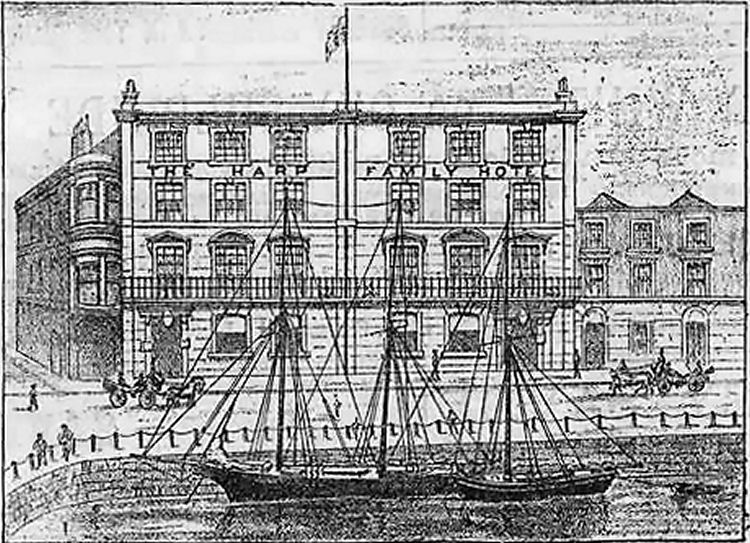
Above drawing, 1879. |
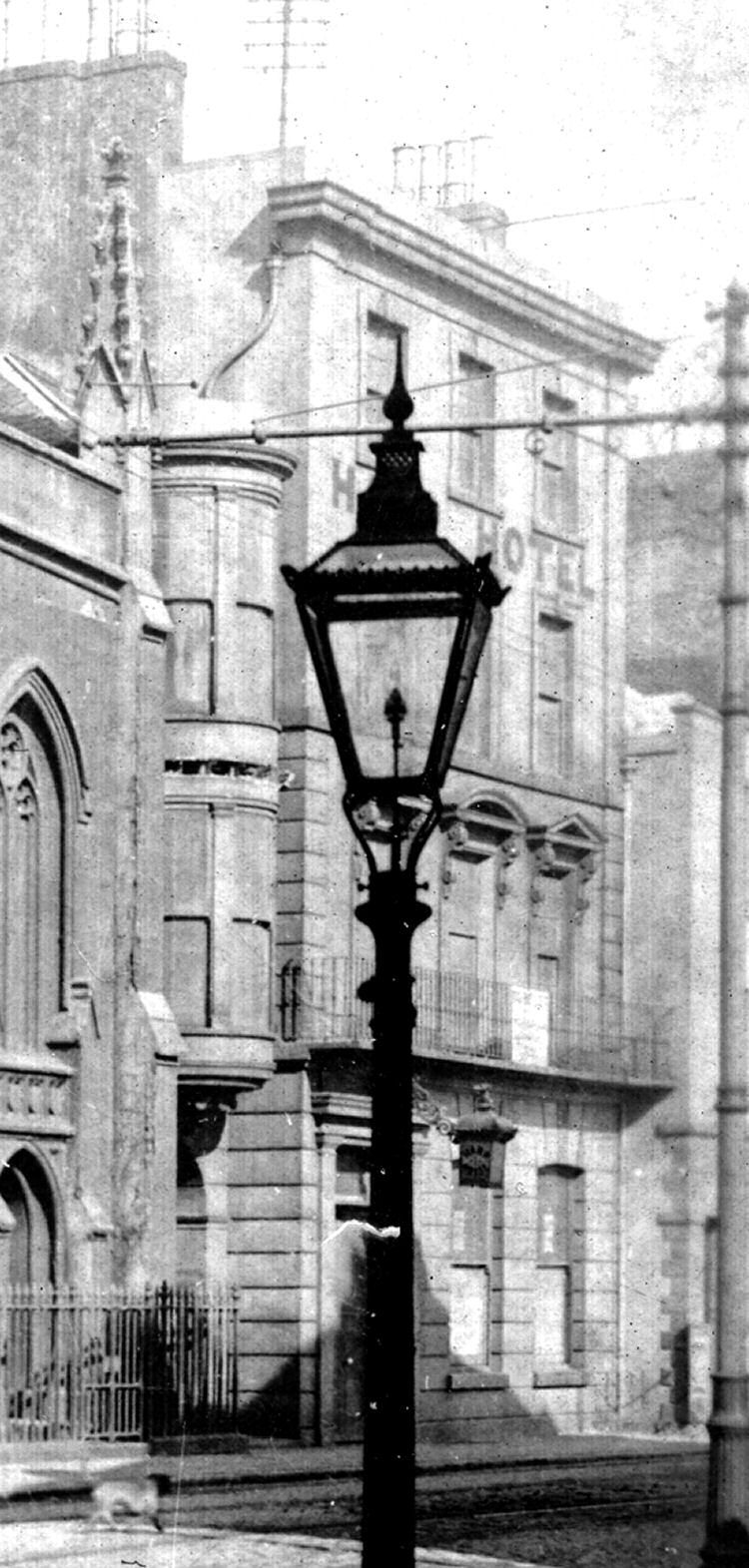
Above photo kindly supplied by Paul Wells. |
 |
|
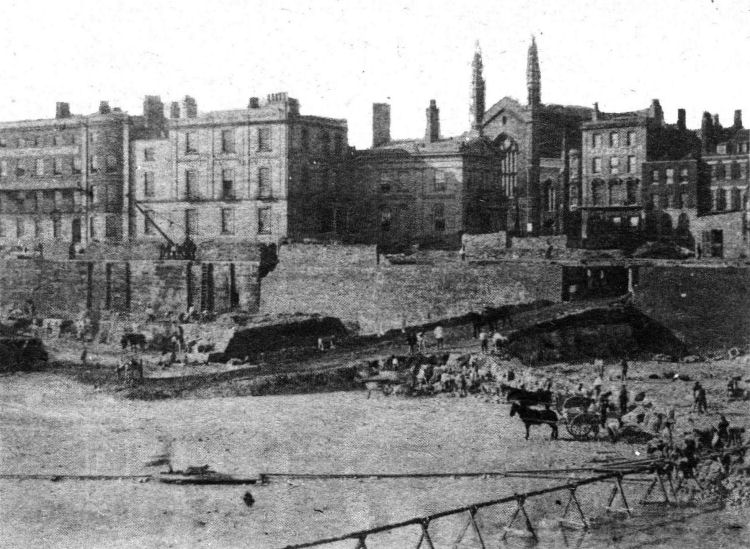
This picture is dated February 1871 and shows the dock being deepened
to accommodate bigger vessels. From the left the
buildings on the quayside are the old Ship Hotel, the Royal Mall Packet
Office, Northumberland House, Holy Trinity Church, the Harp Hotel and an
old convalescent home. |
 |
|
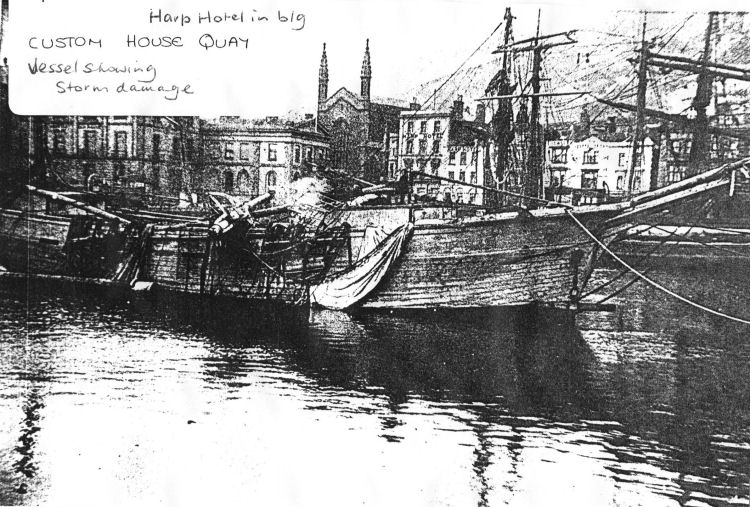
The above photo date unknown shows the Harp Hotel in the background and
a vessel showing storm damage in Custom House Quay. |
The original, well established by 1848, had to make way for the rail road
in 1859. That year, the Harbour and Priory Stations were connected. Charles
Spice got a new licence, packed his bag, and moved along the street to this
number, where the new "Harp Hotel" opened on the former site of a coach
factory. (Original info.)
I also have reference to a "Harp Tap" which may or may not be connected
to this hotel, but mention of a William Castle as landlord in 1862, the same
time as Charles Spice, brings me to believe they were being run separately
from each other. Unfortunately, to date the address of the "Harp Tap" is
unknown.
A "Harp Tap", kept by Castle in Limekiln Street in 1862 may be associated
and if so would denote entrances from two streets.
|
From the Kentish Chronicle 22, October 1859.
DOVER. STROND STREET.
This street now presents a most desolate appearance, - the London,
Chatham, and Dover Railway Company as a site for their terminus having
caused a complete exodus of tenants. From Trinity Church to Mr.
Olifant’s shop at the end of the street, and extending backwards to
Limekiln-street, the whole of the houses are to be pulled down. The
chief part of the tenants have left, the dull heavy looking shutters
superseding the hitherto light cheerful appearance of the shops. The
"Harp Hotel" and the "Packet Boat Inn" are still open, but we observe
that Mr. Spice, the proprietor of the former, has taken the extensive
premises lately occupied by Mr. Rouse, as a coach factory, which he is
having fitted up as a first-class hotel. The work of demolition of all
the houses, about 130 in number, will soon commence, and are to be sold
by auction by Mr. Robinson.
|
|
From the Kentish Gazette, 3 January 1865.
DOVER WINTER SESSIONS.
These Sessions were held on Friday, before W. H. Bodkin, Esq.,
Recorder, and a full Bench of Magistrates.
Threatening to Shoot.
In the case of Daniel Wilson Davidson, 36, charged with threatening
to shoot George Hawkes, at Dover, on the 10th November, no
prosecutor appeared, and it was understood that the prosecution
would not be pressed. The brief facts of the ease were as follows.
The prisoner and prosecutor wore in company at the "Harp Hotel," on
the evening of Tuesday, November 8. They then got into an
altercation in the course of which prosecutor called the prisoner a
swindler. A day or two afterwards the prosecutor heard that the
prisoner had declared his intention of shooting him at the first
opportunity, having publicly uttered this threat at the "Gun Hotel."
He in consequence obtained the assistance of two police-constables,
and, accompanied by the waiter of the "Gun," went in search of the
prisoner, who was found at the "London Hotel," Council-house Street.
The prisoner was then taken into custody and conveyed to the
station-house, where it turned out that he had gone to the "Gun,"
and after exhibiting a pistol, which he said he had bought the same
morning, described the prosecutor and mentioned his name, stating
that he intended to give him the contents of the pistol when he met
him, observing that if Mr. Hawkes was then in the room he would
shoot him. The prisoner’s manner, it transpired, was then so strange
that the waiter thought him the worse for liquor. The prisoner also
showed the pistol to the landlord of the "London Hotel," where he
was found, saying it was intended for prosecutor. The pistol was
then capped and loaded. The prisoner was then, according to the
landlord of the "London," quite sober. When the prisoner was
arrested, by police-constable Camps the pistol was in his possession
and was still loaded, and was found to contain a charge of powder
and a conical ball. It was farther shown that the pistol was
purchased by the prisoner of Mr. Smith, gunmaker, Cannon Street, who
at prisoner’s request loaded it for him. The prisoner, when he
purchased the pistol, did not seem at all excited, and on being
taken into custody by the police admitted that he intended to shoot
Mr. Hawkes, although when before the Magistrates he denied having
any such intention. He attributed what he had said to the effects of
drink, and accounted for his possession of the pistol by saying that
he carried it with him in self-defence.
The prisoner, in answer to the Recorder, said he had no intention of
shooting the prisoner in a cowardly manner, but that he should have
liked to have met him with pistols, giving him an equal chance with
himself, and that this was the reason he had purchased the pistol.
The Recorder said that if he had shot the prosecutor under such
circumstances the law would have recognised the act no less as
murder, and whatever chance might have been afforded the prosecutor,
he (the prisoner) would have stood a good chance of being hanged.
The prisoner was then allowed to go at large, after being duly
cautioned by the Recorder.
|
|
From the Dover Express and East Kent
News, Friday 1 October, 1869.
THREATENING TO MURDER AND COMMIT SUICIDE
George Duell, an hotel commissioner, belonging to Dover, was charged
with having threatened to murder his wife, Ann Duell, and also having
threatened to commit suicide.
Mr. Wollaston Knocker appeared in the place of Mr. Thomas Fox to
prosecute.
Miss Emma Martin, a lady staying at the Convalescent Home, Strond
Street, said she knew the prisoner from his living at the home with his
wife' who fulfilled the duties of cook. About eight o'clock on the
previous night the prisoner came into the dining room, and asked for his
wife. he had a pistol in his hand, and a stick under his arm. Fearing
that he had some desperate design, she endeavoured to divert his
attention; but prisoner still demanded that his wife might be found, and
on witness promising to go in search of her, he went back to his
room. She subsequently found Mrs. Duell upstairs , and told her what the
prisoner had said. The prisoner did not use any threatening language
towards the witness, nor in witness's presence towards Mrs. Duell.
Mrs. Ann Duell, the prisoner's wife, said she lived at the
Convalescent Home. Her husband, the prisoner, acted as commissioner at
the "Harp Hotel," Strond Street. Prisoner's conduct towards witness
during the last few days had been very bad. On Thursday night he got out
of bed and threatened to cut his throat with a clasp knife, which he had
in his hand; but witness took the knife away from him. The prisoner was
very restless during the remainder of the night. He was the worse for
liquor when he threatened to commit suicide that act. The prisoner was
very quiet when not in liquor. Witness had another occasion taken a
knife from him.
Charles Sims said he lived with his father at the "Shipwright's
Arms," near the Convalescent Home. he saw the prisoner at his
father's house on the previous evening, when he had a revolver in his
possession. In reply to a question put to him, he said he had purchased
it. Witness did not hear the prisoner use any threats towards any
person. Before prisoner left the house the witness asked him what
he was going to do with the revolver, when he told him to mind his own
business. Witness informed the prisoner that he should take the pistol
from him, if he did not put it away. Prisoner afterwards left the house.
The prisoner had then had too much to drink. From what witness
afterwards afterwards heard, he went into the Convalescent Home, and
entered the prisoner's private room, where he found him. The revolver
was lying on the table, with powder and caps near to it. Witness shook
hands with the prisoner, and asked him what was the matter. He then took
possession of the pistol and caps, and removed the prisoner out of the
room. This took place about half-past eight. He did not hear the
prisoner threaten to hurt any one. Witness also took a bullet from off
the table in the same room.
Mr. Richard Thomas said he was a chemist residing at the Cross Wall.
On arriving home on the previous night, at a quarter past eight, he
found the prisoner in the shop with witness's wife, and another person.
The prisoner and witness went into the sitting room. The prisoner was at
the time suffering from delirium tremens. Witness thought that prisoner
must have been drinking four or five days. While witness was in
the parlour, he said something about blowing his wife's brains out, and
also used similar threats towards Mr. Cox and Mr. Dyne, the two
station-masters at Dover. It was witness's desire to give the prisoner
some medicine, and send him to bed.
At this stage of the proceedings, Mr. Knocker and for a remand, and
the Magistrates remanded the prisoner till Friday (this day).
|
|
From the Dover Express and East Kent News, Friday, 25 November, 1870.
CHARGE OF TRESPASSING AT A RAILWAY STATION
John Kittel, a commissioner at the “Harp Hotel” was charged on the
information of Morris Davis, a constable in the employ of the
South-Eastern Railway Company, with trespassing at the station of the
Company, in Beach Street, and refusing to quit the same on being
requested to do so.
Mr. Lewis appeared for the defendant, who pleaded not guilty.
Morris Davis said he was a constable in the employ of the South-Eastern
Railway Company. On the afternoon of the 17th inst., at 2.15, his
attention was drawn to the defendant, who was loitering in the booking
office. In consequence of several complaints which had of late been made
against the defendant he felt compelled to take notice of his conduct.
He said, “Now, Kittell, what business have you here?” he said, producing
a piece of paper, that he had come after some registered baggage.
Witness told him that the booking office was not the place for
registered baggage; and that he had better go to the proper receptacle
for it. He thereupon rushed upon the platform, demanding to see Mr.
Dyne, the station superintendent. Witness told him that Mr. Dyne was
engaged, and could not see him; and he then, making use of an offensive
term, told the witness he should like to “have him outside.” Witness
again requested him to go, at the same time calling the head-porter's
attention to him. The defendant then threw himself in a defiant
attitude, and, “like a second Ajax,” (laughter) defied witness to
interfere with him. He then rushed off to the custom-house.
Magistrate: Was he sober?
Witness: To all appearance. After he had transacted his business at the
custom-house the defendant returned to the station, and again
endeavoured to come upon the platform. Witness told him he should not
allow him to come there, and he then raised his clenched fist in a
threatening manner, and, with a repetition of his foul language, said,
“I will do something for you before long.” Witness called the attention
of Castle, one of the town-porters, to the defendant's remark. The
witness, in conclusion, said that, from the evidence of the defendant's
remarks, he considered that he went in bodily peril, and he prayed the
Bench to bind the defendant over to keep the peace towards.
In reply to the Magistrates the witness said that the defendant did not
remain in the station more than two or three minutes altogether.
By Mr. Lewis: I do not remember that, when I first spoke to the
defendant, he told me that he was waiting there to look after some
luggage, which was in the waiting room, and that he had paid the porters
1s. 3d. for bringing it up. He might have said so. The piece of paper I
have referred to was a ticket issued by a French railway company in
correspondence with the South-Eastern Company.
Mr. Lewis; I believe that all the baggage deposited in the waiting room
is left there at the risk of the parties placing it there, and that a
notice to that effect is placed in the waiting-room?
Witness: Yes; and that is a reason why more vigilance is necessary in
excluding persons from the booking-office.
Cross-examination continued: I do not refer to the exclusion of the
servants or persons to who such luggage may belong, but to the exclusion
of people generally. I afterwards saw Kittell with a passenger who left
by the train; but I did not see him bring any luggage from the waiting
room, or give any luggage from the waiting room to the passenger. On the
Tuesday previous to the date in the information I had refused to allow
Kittell to go upon the platform. The reason was that he had no ticket to
certify that he was a passenger going by the train. He might have been
carrying some luggage. I am able to say that he was carrying some
luggage; and I knew that there was a commissioner at the “Harp.” Duting
the last fortnight I have issued a summons against Dewell, the
commissioner at the “Dover Castle Hotel;” but I am not aware that the
summons was withdrawn in consequence of its being found that he might be
considered as a servant of a passenger. It was withdrawn by order of my
superior. I know Gibbons and Witherden, two other commissioners. They
have never been excluded from the stations, because they have always
conducted themselves properly. When likening Kittel to “a second Ajax,”
I was thinking of the celebrated defiance of the lightning of course. (A
laugh.)
Mr. Lewis: Then, I suppose, the Court may like it if Kittel represented
Ajax, you represented the lightning? (Laughter.)
The witness could only repeat that the defendant was very defiant.
Corroborative evidence was given by Filmers Cruscur, the head-porter and
by William Castle, one of the town porters; but it was of so little
consequence that Mr. Lewis did no think it worth while to cross-examine
either of them.
Mr. Lewis then addressed the Magistrates on behalf of the defendant,
asking them to take note of the manner in which the complainant had
given his evidence. He thought it showed that there was a great deal of
ill-feeling underlying the complaint, and that the complainant, instead
of doing his duty as a public officer, and stating the facts fairly, was
endeavouring to put them before the Court in a manner calculated to
prejudice the defendant as much as possible. He asked the Bench whether
the officer of a public company was justified in describing an official
ticket like those which were constantly coming under notice as “a piece
of paper.” He had admitted on cross-examination that the piece of paper
with which Kittel was furnishing, and which formed a justification for
him being on the railway premises, was the ticket of a foreign railway
company with which the South-Eastern Company were in correspondence. The
feeling of the complainant against Kittel evidently arose from some
other circumstance, of which he knew nothing, and about which the Bench
could not enquire; and it was this which had led to the defendant's
expulsion from the station and not his conduct on the occasion in
question. It had transpired from his cross-examination of Davis, that he
was in the habit of showing great partiality towards certain persons
whose business called them to the railway station, to the prejudice of
others who had a equal right to be there. Indeed, he could not see the
pretence for ordering the defendant out of the station. No train was
arriving or departing, and it could not therefore be said that the
business of the station was being interfered with, or that there was any
annoyance likely to arise to the passengers from touting. Kittel was
simply in the booking-office, acting as the servant of a person to whom
some baggage belonged, and he was keeping his eye on it until the
arrival of the owner. He was simply doping his dutyin this respect, and
could not be said to have been “loitering” as the summons expressed it.
The question the Magistrates had to decide was, whether Kittel had any
right to be in the booking-office, or not. If he had a right, he was
perfectly justified, after the manner in which Davis had spoken to him,
to appeal to Davis's superior, the station-superintendent; and if he had
succeeded in doing so, he (Mr. Lewis) had no doubt that Mr. Dyne could
have discountenanced Davis's proceeding in the same way as he had
discountenanced it in another case, where a summons had been hastily
taken out and withdrawn. He contended that Kittel had a right to be
there, as he was acting as a servant of a person to whom some baggage
belonged which had been left in the waiting room, where a notice warned
the public that baggage so left must be looked after, or the owner must
take the responsibility. The South-Eastern Company were a monopoly, and
being so were subject to certain general rules for the conduct of their
business. He contended that they could not, by themselves or their
servants, refuse admission to their station to passengers or their
servants, provided they came there for lawful and proper purpose. One of
the purposes for which a servant might properly and lawfully come to the
station was to bring his master's baggage, and another was to look after
it while it remained there; and he contended that under either of these
regulations Kittel was justified in being in the booking-office on this
particular occasion, and that Davis was unjustified in ordering him
away. He cited a case, “Jones v. Taylor,” reported in vol. 1 Ellis and
Ellis, which, he thought was on all fours with the case now in question.
The defendant had been interdicted from coming to a certain railway
station; but he was ordered to go there to repair a carriage which could
not be removed till these repairs were done. He was ordered away by the
Company's servants; but he refused to go until he had completed the work
he was sent there to do; and he was ultimately summoned. The Magistrates
refused to convict, and on appeal their judgment was affirmed. He asked
the magistrates to consider the case as coming under the same category
and to say that the defendant was justified in being at the station, to
do the work for which he was sent there.
The Magistrates retired to consider their decision, and on their return
into Court they said they considered the case proved and fined the
defendant 5s. and the costs 16s. 6d., which he paid.
|
|
From the Dover Express and East Kent News, Friday, 16 November, 1877. Price 1d.
THE EFFECTS OF SODA AND B.
William Boyd, a gentleman, was charged with being drunk and incapable of
managing a horse in Biggin Street.
Police-constable Suters supported the charge.
The defendant said he felt it was a most awkward position to be in. The
horse he was driving he had never had before, and he had great trouble
with it. It bolted two or three times, and on the last occasion it went
into the shop door as described by the Constable. He assured the Bench
that he had only one glass of soda and brandy at the “Harp Hotel.”
The Bench said the defendant had put the public in danger, and must pay
a fine of 10s. and 6s. costs.
|
|
From the Dover Express, 1879.
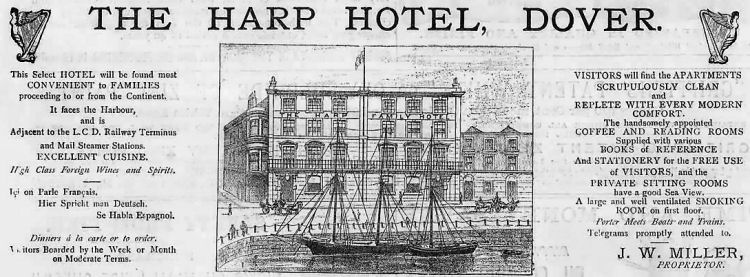
Above advert, 1879. |
|
From the Canterbury Journal, Kentish Times and Farmers' Gazette, 12 July 1884.
THE HOTEL SWINDLERS.
At the Police Court, on Friday Morgan Vaughan, whose escape from the
Police station and recapture on Wednesday caused so much excitement in
the town, was brought up on remand charged with obtaining food and
lodgings under false pretences from the "Harp," "Imperial," and "Priory"
Hotels. Mr. Mowll, who prosecuted, said Captain Millar, proprietor of the
"Harp," had been paid what was due to him by prisoner's friends, and
that the case therefore fell through. In In the other cases prisoner had
not brought himself within the law as there was no evidence of false
pretences. Mr. Stilwell to the magistrates:- After that I question whether you have
a right to adjudicate. Mr. Stein (to the prisoner); Under the
circumstances the case must be
dismissed. Mr. Mills haring accepted payment has left us no alternative
but to dismiss you. We very much regret it as we consider you deserve
severe punishment. Prisoner then left the Court; his dismissal evidently being unexpected
by the large number of persons assembled. |
Known as early as 1878
 and also 1901
 as the "Harp family and commercial hotel."
The Post Office Directory also gave the information that Thomas Fry was also
a wine and spirit merchant. as the "Harp family and commercial hotel."
The Post Office Directory also gave the information that Thomas Fry was also
a wine and spirit merchant.
The back of the hotel was damaged by fire on 26 April 1890 but repairs
must have proved possible because the hotel continued to 1904.
|
From the Dover Express and East Kent News, Friday, 2 May 1890.
FIRE AT THE HARP HOTEL.
A fire broke out on the premises of the "Harp Hotel," Strond Street on
Saturday evening about 9.30 and it assumed very alarming proportions at
first. It appears that about 9.30 the book-keeper heard a sound as of an
explosion and rushing out of her office found the top of the landing in
flames. She immediately raised the alarm and got a neighbour to
telephone to the Police Station. Police-constables Baker and Danson were
quickly on the spot. It was found that all communication with the top floors
was cut off and great fears were expressed for the safety of Miss
Miller, sister of the proprietors who was in one of the upper rooms.
Noting the danger Police-constable Baker at once ran off to fetch the
fire escape while Police-constable Crockford was soon at the burning building
with the hose reel from the drainage works. In the meantime Police
Constable Danson, who was left in charge, succeeded with assistance in
rescuing Miss. Miller and a visitor at the house both, of whom found
their retreat cut off, and had to jump out of one of the first floor
back windows into Limekiln Street.
The hose reel was sent from the Fire Station at Queen Street but in the
meantime Mr. Lanham, foreman of the Packet Yard, and Mr. Haydon resident
engineer at the Oil Mills, with commendable promptitude, fixed their
private stand-pipes at the Oil Mills and Packet Yard, and got to work
at the back of the hotel, and greatly assisted the Fire Brigade. But for
the timely aid rendered by these two gentlemen much valuable property,
might have been destroyed, as Mr. Lanham was the first to play water upon
the burning building. Valuable assistance was also rendered by Mr. J. B.
Cass, London Chatham and Dover Railway Superintendent, who, living
adjacent to the scene of the conflagration, was very quickly on the spot,
and was instrumental in saving the account books of the hotel, the cash
box, and till money. Mr. Cass also had the railway fire engine brought to
use, and instructed his men then on duty to render every assistance. He
also offered the hospitalities of his house to Mrs. Morely and others.
The fire was ultimately extinguished, soon after eleven o'clock. It is
supposed that it originated in the linen room, where a number of sheets
and other articles were being aired.
While Superintendent Sanders was directing the operations of his men
inside the house the staircase gave way beneath him, and he fell through,
but likely without sustaining hurt.
Five rooms on the first floor, consisting of the private office, linen,
sitting, smoking, and store rooms were entirely gutted and the contents
destroyed. The staircase leading to the second floor, and the various
passages and corridors, were very much charred, as were also the doors
and partitions of several other rooms. The furniture in the bedrooms was
considerably damaged by heat and water; while the bar parlour, kitchen,
coffee room, and other domestic offices, on the ground floor were also
damaged by water and
smoke.
Number 8, Strond Street, which, although a separate house, forms a portion
of the hotel, and is rented by Mrs. Morley, was slightly damaged by smoke
and steam. The buildings and contents were insured in the Guardian Fire
Office, of which Messrs Worsfold and Hayward are the local agents.
Notwithstanding the serious damage done, business will be carried on as
usual at the hotel.
|
|
From the Canterbury Journal and Farmers' Gazette,
Saturday 26 September, 1996..
Re Harriett Prickett, of the "Harp Hotel," Strond Street, Dover, Hotel
Proprietor.
Mr. E. Carder appeared for the deptor, whose unsecured liabilities are
returned at £1,687 1s. 11d.; gross liabilities, £3,502. 15s. 70.;
secured creditors, less value of securities, £950; preferential claims
£65 13s 8d; deficiency £1,850 15s 7d.
The Deputy Official Receiver stated that Mr. C. K. Worsfold had been
appointed trustee, and added that a few days before the meeting of the
creditors, at which nothing was done, wine to the value of about £230
was removed from the hotel by firm of wine merchants carrying on
business at Kreutanac in Germany, but having an office in London.
Under examination, the debtor stated that her husband died in 1887. They
were then carrying on the "Swan Hotel" at Bedford, and after her
husband's death she carried it on in partnership with her son and two
stepsons. It was the principal hotel in Bedford. Her son and stepsons
were interested with herself under her husband's will. In July, 1894,
she sold the business for about £10,000. There was a heavy mortgage upon
it and she received the balance, £800. She purchased the "Harp Hotel,"
Dover, in the same month, giving £2,100 for it. She purchased it all at.
She had no independent advice in the matter, but Mr. Bridges acted both
for herself and Mrs. Morley, from whom she purchased the hotel. Mr.
Bridges had got the house on his hands for sale. She took up money from
a Building Society on mortgage to purchase it; the mortgage was in
existence at the time and she took it over. She also borrowed £1,100
from her son. She gave a second mortgage on the lease on the premises to
her son. She borrowed £300 from Mrs. Arnold, her sister-in-law, in March
or February of this year. Nearly the whole of the other debts had been
incurred in carrying on the "Harp." Mr. bridges told her the profits
would be between £200 and £300 a year, but they had been nothing. She
owed £140 to Miss Veal, another relative; this she had about 9 years
ago. She had purchased jewellery from Mr. Darracott, but not spent a
considerable sum in that way. Ever since she had been at the Harp" she
had dealt with the firm of German wine merchants. They had been
supplying Mrs. Morley, and she (debtor) took wine on the same terms.
They put a certain quantity of wine in the cellar, and she was to pay
when she could. There was a very much greater quantity that was ever
required. When the agent called she did not pay him anything, because
she was not able to do so. She had only paid him £10 in all. She signed
a document in reference to the wine when she took the hotel. It was to
the effect that the firm were to take back what wine she did not require
at any time. The day before her composition meeting, Mr. Shipstone, the
agent in London, called on her and said he wanted to take away the wine
that was in the cellar. He said he should pack it up and take it away.
She objected, saying she did not think it was the correct thing to do,
but the traveller insisted on taking it. She had the key of the cellar,
which could only be entered through the hotel and from the outside. She
consulted Mr. Carder about the matter, and he told her not to let Mr.
Shipstone take the wine. She did not allow it to be taken in spite of
Mr. Carder's as advice. She told Mr. Shiopstone she could not allow him
to take it as Mr. Carder had told her she must not let it go. He said he
did not care about Mr. Carder or anyone else. He had Mr. Wollaston
Knocker, solicitor, with him and said he (Mr. Knocker) would support
him, as the agreement allows him to take the wine Mr. Knocker then gave
her the following note exonerating her:- "Harp Hotel," Dover, 24th July,
1896. We hereby acknowledge that Mrs. Prickett has protested against the
removal by Mr. Shipstone of 15 cases of wine belong to his firm. E. W.
and V. Knocker."
While she was talking to Mr. Knocker she heard a noise outside, and
found that a forcible entrance of the cellar had been effected, and the
greater portion of the wine was removed. That was the day before her
composition meeting; the remainder was removed the day after the
meeting.
The Registrar said he thought this was a matter that the trustee should
enquire into, and he should accordingly adjourn the examination until
the 16th October.
|
|
From the Dover Express and East Kent News, Friday, 8 June, 1900. Price 1d.
A MYSTERIOUS DEATH
WAS IT ICE CREAM?
An inquest was held at the “Harp Hotel,” on Tuesday, on the body of a
lad named William Coconi, in the employ of Messrs. R. Dickeson and
Company, who died very suddenly on Sunday morning after a rather strange
illness. Mr. G. Butcher was forman of the Jury.
Edward James Walton, a town porter, of 69, Limekiln Street, said the
deceased was his stepson. His name was William Ceconi, and was 16 years
of age last January. He worked for Messrs. R. Dickeson and Co., at their
Cannon Street shop. He had been strong and cheerful, and continued quite
well, working up to Friday evening at ten o'clock. He seemed, however,
to have pined a little since the death of a chum last March. On Saturday
morning, when about to go to work at half-past seven, he returned back
home unwell. He remained at home all day, and was sick and suffered from
diarrhoea. He took some liver pills and seemed better about noon. He lay
down during the afternoon; then got up and had a cup of tea and returned
to bed. He continued to be sick, and drank a lot of water – quite half a
gallon. Late in the evening he complained of pain in the stomach. About
one o'clock he went downstairs and afterwards returned. About 4.40 a.m.
they heard him groaning. He was in bed, and complained of a pain in his
side. He looked very bad, and some eau-de-Cologne was given him. A
poultice was also prepared, but as deceased got gradually worse, witness
went for a doctor. Dr. Cooper Fenn came, but when they got back the boy
was dead. Witness had since ascertained that on the Sunday before his
death, deceased had a fall from a bicycle, and another fall whilst
playing football on the Wednesday. He brought home a tin of preserved
greengages last week, but witness, so far as he could ascertain, thought
deceased had not eaten any. Deceased said he had had an ice cream on
Friday afternoon.
Mrs. Walton said deceased was her son. He first complained of having a
sore throat. He afterwards vomited, and a seidlitz powder was given him.
He continued to be sick all day. He did not appear to be in any pain
until about four o'clock on Sunday morning, when he complained of pain.
Her husband went for a doctor, and witness put a poultice on. He grew
quiet, and suddenly died.
Richard Walter, son of the last witness, said deceased was his half
brother. On Wednesday last they were playing football at Archliff Fort
meadow with some of the Clare Militia and some other boys. Witness, a
soldier, and deceased were knocked flying. He got up, but although he
said it hurt a bit he went on playing. On the previous Sunday deceased
went for a ride on witness' machine, and on going up Fort Hill he fell
flat on to his chest. He did not appear to be hurt.
Dr. A. Cooper Fenn said he was called about 5.30 on Sunday morning by
the father to 69, Limekiln Street. He went at once, and on arriving
found the boy was dead, death having recently taken place. On Monday
morning witness made a post-mortem examination. There were no external
marks of violence. The stomach was very much distended, and contained a
large quantity of bile-stained fluid, rather more than half a gallon.
There was no solid food. There were no signs of inflammation, butt he
walls were thin by distension. In the heart witness found two clots of
blood in the right ventricle, which had been there for some time - a
week at least. They had the effect of weakening the heart's action by
affecting the pulmonary circulation. These clots would be caused by some
injury or over-exertion. The distension of the stomach was very unusual.
It appeared as if he had had an acute bilious attack. Although there was
no appearance of poison, it seemed as if he had taken something that had
disagreed with him.
The father, in answering to a question by the doctor, said deceased had
been very thirsty for the last month. He had drunk as much as 4½ gallons
of lemonade mixture in a week.
The doctor, in reply to the Coroner, said the exact cause of death was
distension of the stomach acting on the heart, causing failure of that
organ. There were no traces of poison but the stomach had been upset.
A Juryman said that deceased had complained to him that he had eaten
some ice cream from an Italian barrow in the Market Square, and it had
made him very thirsty. They sold nearly three times as much as was sold
in a shop, and he thought it was time these Italians were stopped.
The doctor said it was quite possible that the illness arose from taking
a large quantity of ice cream.
The Coroner, in summing up, said that the ice creams alluded to must be
nasty, but ice creams at all times were dangerous, and likely to effect
the condition of the stomach which caused death. It was, however,
difficult to form an opinion whether it was so in this case, but
undoubtedly there was something very wrong with the boy's stomach.
A Juryman enquired if several poisons did not cause great thirst.
Dr. Fenn said that that was so.
A Juryman suggested that it was very desirable that the ice creams sold
in the street should be analysed.
The Coroner asked a Juryman who was in this line of what the cheap ice
creams were made, but the Juryman said he did not know, although he had
an idea.
The foreman afterwards said that the Jury were of opinion that death was
caused by failure of the heart's action by the distension of the
stomach, but there was no evidence to show how this was caused.
The Coroner remarked that the contents of the stomach had been preserved
for further examination if necessary.
The foreman suggested that it would be well for the Coroner to have the
cheap ice creams analysed.
The Coroner said that it was for the gentleman in silver buttons or the
Medical Officer of health to have done. He thought ice creams of any
description bad.
|
|
From the Dover Express and East Kent News, Friday, 14 September, 1900.
SHOCKING ACCIDENT ON THE ADMIRALTY PIER
A MAN'S HEAD CUT OFF
A terrible accident occurred on the Admiralty Pier last Friday at noon,
when the Ostend boat train was running on to the Admiralty Pier. A
carriage cleaner named Canham in the employ of the S.E.R. endeavoured to
jump on to the foot-board of the train as she was passing No. 2 platform
at a good rate of speed. He missed his hold and fell head first under
the wheels, meeting with instant death.
The shocking sight was witnessed by a great many people, spectators on
the top of the Pier and passengers about to go on to the boat, and
created the greatest horror.
The inquest was held on Saturday afternoon at the “Harp Hotel” by the
Borough Coroner, Sydenham Payn, Esq. Mr. J. Jarry was chosen foreman of
the Jury, which also included Messrs. George Hatton, Edward Woodward, R.
Knott, G. Hirten, J. Knight, B. Williams, M. Musk, J. Hogben, A. Watson,
G. Mondstone, E. Baynton, and Scott Wallace.
Mr. R. Mowll was present to watch the case on behalf of the Harbour
Board, and Capt. Iron, the Harbour Master, attended.
John William Canham, a signalman at Kearsney loop, said he lived at 30,
Longfield Road. The deceased Alfred Frank Canham was his son. He would
be 19 years of age on the 12th of this month, and was a carriage cleaner
in the employ of the South Eastern Railway Company. He last saw him
alive last Sunday night.
Thomas Rigden said: I am a marine baggage checker in the employ of the
South Eastern and Chatham Dover Railway Company. I was on the Admiralty
Pier at 12.55 on No. 2 platform. The Ostend South Eastern train came
down and the engine had just passed me. The train was travelling at its
usual pace. I turned round and saw the deceased nearly at the other end
of the platform trying to catch hold of the carriage handle. He missed
it and made a bit of a slew and the carriage caught his left shoulder. I
was close to him and then and tried to catch him, but just as he got to
me he fell down between the carriage and the platform. As the train
passed on the footboards of the next carriage caught his legs, his head
going right underneath the wheels. I was with two ladies, who saw the
occurrence, and I had to attend to them as they were overcome.
Afterwards I went to our lobby and got a blanket to put over him – I was
going to get a flag but they would not let me have it, so I took my
blanket. I saw that the young fellow's head was cut off.
The Coroner: Is it the usual thing for the men to have a ride down?
Witness: Not very often.
The Coroner: I thought they always did it. Are the carriage handles
fairly low down to catch hold of?
Witness: Yes.
The Coroner: Would he have to make a spring?
Witness: No, he was a tallish chap. He would not have to make a spring.
A Juryman asked if any attempt was made to stop the train?
The Coroner said he did not suppose the guard or driver would have seen
it.
Witness said it all happened in three or four seconds. He saw the
deceased on the Admiralty Pier when the French Mail arrived earlier in
the same morning.
George Neville, guard of the S.E., said: I was in charge of the Ostend
train yesterday morning. I was in my van at the rear of the train. The
first thing I saw was two ladies, one fainting and being held by the
other, and thinking that she had tried to commit suicide I watched her
so as to put the brake on at once if she made another move. The train
was proceeding at the rate of five or six miles per hour. The next thing
I saw was a man thrown out from under the second carriage from the end.
I could have stopped the train in two or three carriage lengths if I had
seen deceased before.
The Coroner: is it the usual practice for men to jump on the carriages?
Witness: I have been running to Dover for 17 years and have always found
the staff waiting on the platform.
The Coroner: You have never noticed this before?
Witness: No.
The Coroner: Where were all the other porters on this occasion?
Witness: Standing on No. 3 platform waiting for the train.
Witness said that the inspector had told him that the deceased had been
at the Station about four months.
A Juryman: You say you have been there 17 years and have never seen
anyone riding down?
Witness: No, I have never seen anyone jump on the train. I never looked
out for it.
The Juryman: I have had experience of the Admiralty Pier for some years
and I have seen it done repeatedly.
John Parker said: I am a marine porter in the S.E. and C.D.R. Companies'
employ. I was yesterday at 12.55 nearly at the further end of No. 2
platform. I was looking towards the end of the Pier, but as the train
passed by I saw a man clinging to one of the footboards. It seemed to me
as if he was struggling to get a footing on the platform of the Pier.
The train was going so fast that it was impossible for him to do so. He
seemed to get foul, and when about a yard away he fell. I tried to make
a grab for him but could not. The train dragged him along to the wedge
end of the platform and threw his legs out, and I pulled him out before
the last carriage passed by, but his head was smashed.
The Coroner: Was it part of his duty to attend the trains?
Witness: I do not know. The inspector would know.
The Coroner asked if the Railway Inspector were present?
Inspector Knott said he was not, but he could be sent for.
A Juryman said that he ought to be sent for. Someone should be present
to represent the Railway Companies.
Another Juryman said he also thought so.
A Juryman asked if one of the witnesses did not say that he saw deceased
trying to grasp the handle?
The Coroner said that a previous witness said that, the present witness
only saw the deceased afterwards when he was trying to catch hold of the
footboard. There was no doubt that deceased tried to jump off the
platform on to the train.
Witness in reply to Coroner, said that he did not think that the train
was going quicker than usual.
Dr. J. Ormsby said that he was called to the Mortuary about one o'clock
and there saw the body of the deceased. He had recently been killed. His
skull was cut in two, the top being off and the brai out. The left arm
was very severely lacerated. The injury to the head must have caused
instantaneous death.
The Coroner, in summing up, said that no doubt the man was a little late
and tried to jump on the train. Unfortunately, he missed his hold and he
eventually went under the wheels and sustained the frightful injuries
they had seen. What he did was his own act, and he ran the risk by which
he lost his life.
The Jury returned a verdict of “Accidental Death,” and added that he was
killed whilst in the execution of his duty.
|
|
From the Dover Express and East Kent News, Friday 11 January, 1901. 1d.
ROW IN THE SCOTCH HOUSE
Carle Fontani was charged with assaulting a soldier named Patrick
O'Brien in the top room of the “Harp Hotel.”
Frederick Carden, boots at the “Harp Hotel” said he was in the back bar
of the “Scotch House” ….
The Clerk: It is not recognised as the “Scotch House.”
Superintendent Sanders: It is the Hotel bar in Limekiln Street.
Witness, continuing, said he was in charge of the bar. The soldier came
there alone before seven o'clock. He was perfectly sober when witness
first saw him there. He stayed till the prisoner came in with two other
foreigners. They appeared to be sober till one of them called for drink,
and then the barmaid, seeing the condition they were in, refused to
serve them. They had already had enough. The prisoner and his companions
then became quarrelsome, and the soldier began flourishing his stick
about. The prisoner said something about his having been an old soldier,
and O'Brien said he did not want to have anything to say to him. The
prisoner then struck O'Brien in the eye, drawing blood. The prisoner and
the other two men left. Witness then gave information to a constable,
who followed them back into the “Harp” bar. O'Brien then charged the
prisoner with having struck him. O'Brien had had two pints of beer from
7 o'clock till 8.45. Witness did not know what he had had before, but he
could not have had much, for he had not been there long. He was sober,
but after he was struck he was giddy.
The prisoner said that the soldier struck him with his cane on his arm.
Captain Cay: All the soldiers seem to carry a cane.
The Superintendent of Police: They are not considered properly dressed
if they go out without a cane.
The Clery: And very dangerously they carry them – just tucked under
their arms, convenient to run into people's eyes.
Police Constable Blackman, who arrested the prisoner, said that when he
took him to the tap room he found O'Brien there bleeding, and he gave
the prisoner into custody. The bar was full of soldiers – there were
from 12 to 20 there, and a good deal of noise. He thought that O'Brien
was rather the worse for drink; it might have been through the blow.
While he was there O'Brien wanted to fight the prisoner.
Prisoner, who is a figure maker, at present living in Oxenden Street,
was remanded in custody until Monday.
MONDAY AGAIN ADJOURNED
Carlo Fontani, an Italian, was charged on remand with assaulting Patrick
O'Brien, 5th Inniskillings, at the “Harp Hotel.”
Superintendent Sanders said he had received an intimation from the
Military Hospital that O'Brien had a dangerous wound under the eye, and
would be unable to attend for a week.
The case was adjourned for a week, and a surety being found, prisoner
was admitted to bail.
|
|
From the Dover Express and East Kent News, Friday 18 January, 1901. 1d.
ITALIAN'S ASSAULT ON A SOLDIER
Carlo Fontani was again brought up on remand on the charge of assaulting
a soldier, O'Brien.
The military authorities wrote that O'Brien was still unable to attend.
The landlord of the “Harp” attended, having been directed by the Bench
at the first hearing to be called.
Mr. Bradley said that the Magistrates understood from the evidence at
the last hearing that defendant was only manager, but the license was
taken by him as a bona fide tenant.
The landlord said he was the bona fide tenant. The brewers owned the
property, and he was tenant. The man who had said he was only manager
made a mistake. He lived on the premises.
Mr. Bradley said that he thought the evidence went to show that witness
was away, and the Boots was managing.
Witness said that he put Boots to look after the top bar from 7 p.m.,
because it was rather a rough bar.
[The evidence did show that the Boots said he took over the bar at 7
p.m.]
Witness, continuing, said he was on the premises when the row took
place, and he was called to the top bar.
The case was again adjourned.
From the Dover Express and East Kent News, Friday 22 March, 1901. 1d.
THE RINGWOULD TRAGEDY
A BASELESS RUMOUR DENIED
We have received the following letter:
[To the editor, “Dover Express.”]
Sir,
Re Ernest Ovenden, deceased.
It has come to my knowledge that a rumour (which is totally unfounded)
is gaining currency in the town to the effect that I gave the deceased a
note telling him to take same to the Police Station, and that having
opened it he found it contained instructions to the Police to detain
him. I must emphatically deny that such a proceeding took place. The
suggestion in such a course is in itself perfectly ridiculous, and how
such a base rumour could have been circulated is beyond my
comprehension. The deceased was given no letter or message of any
description whatever. He was merely spoken to with reference to his
duties in the office. I need hardly say that to have such remarks passed
painfully to me in the extreme, and I trust that through the medium of
your paper you will allow me to contradict such baseless accusations.
Yours obediently,
William Edward Lovegrove.
Witness, D. Watson.
Rearsby Cottage,
2, Alfred Road, Dover
March 18th, 1901.
|
Although this licence did not lapse before 1924, when the hotel was
converted into flats, no liquor was served after 1904. During the
intervening years it was used for a wide variety of activities. The flats
themselves were closed by the health authorities ten years after being
opened.
In March 1938, the Harbour Board decided on demolition rather that
renovation and it disappeared that year. It would have been the neighbour of
Holy Trinity Church. I was never able to connect a brewer with this one.
LICENSEE LIST
SPICE Charles 1842-66+ (age 49 in 1861 ) )
  
CASTLE William 1862 (Harp Tap)
CHURCH Charles 1871+ (age 52 in 1871)
WORSFOLD Christopher K to July/1872
FRY Thomas Wickens July/1872-78

MILLER Joseph William 1881-Jan/88 dec'd (age 58 in 1881) 
MORLEY Maria Mrs Jan/1888-95 (age 37 in 1891)
  (Daughter of above)
PRICKETT Harriett Mrs 1895-96

BOSS Henry Le Butt 1897-99

IMPERIALI Madame 1897 end
GARTNER G to Nov/1900
SUFFIELD William Nov/1900-01+
(age 40 in 1901)
POTTS Frederick Charles 1902
From Bagshaw Directory 1847
From Melville's Directory 1858
From Sinnock Directory 1875
From the Post Office Directory 1878
From the Post Office Directory 1882
From Pikes Dover Blue Book 1889
From the Post Office Directory 1891
From Pikes Dover Blue Book 1895
From the Kelly's Directory 1899
From the Post Office Directory 1901
From the Dover Express
Census
|

