|
10 King Street
Dover
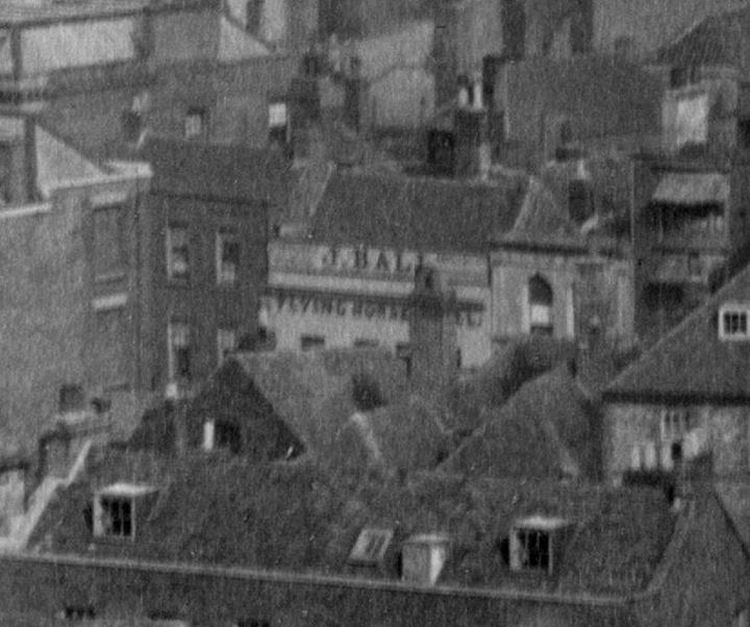
Above photo kindly sent by Paul Wells showing the licensee James Ball
(Sept 1871 - Jan 1889) on the building. |
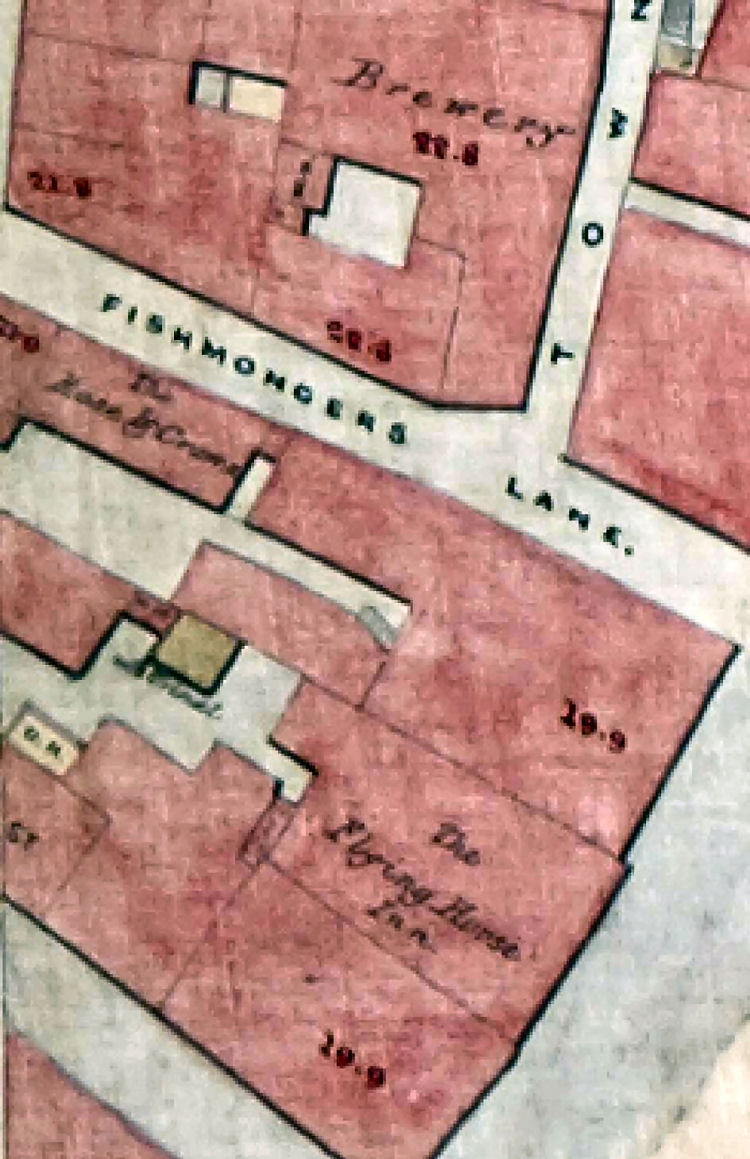
Above Public Health Map by Rowland Rees in 1851. |
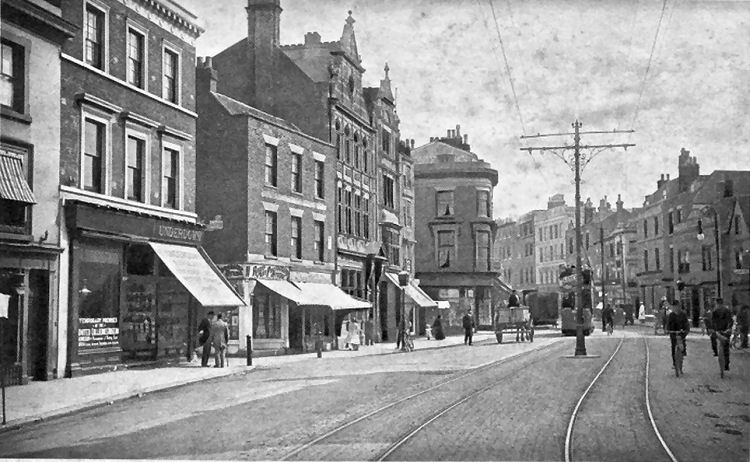
Above postcard, date unknown. |
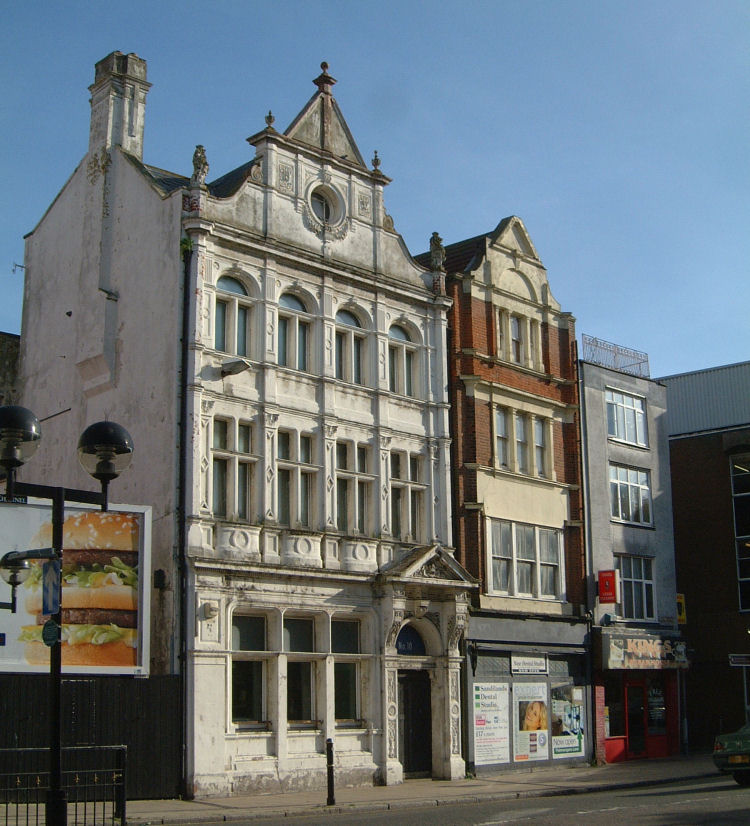
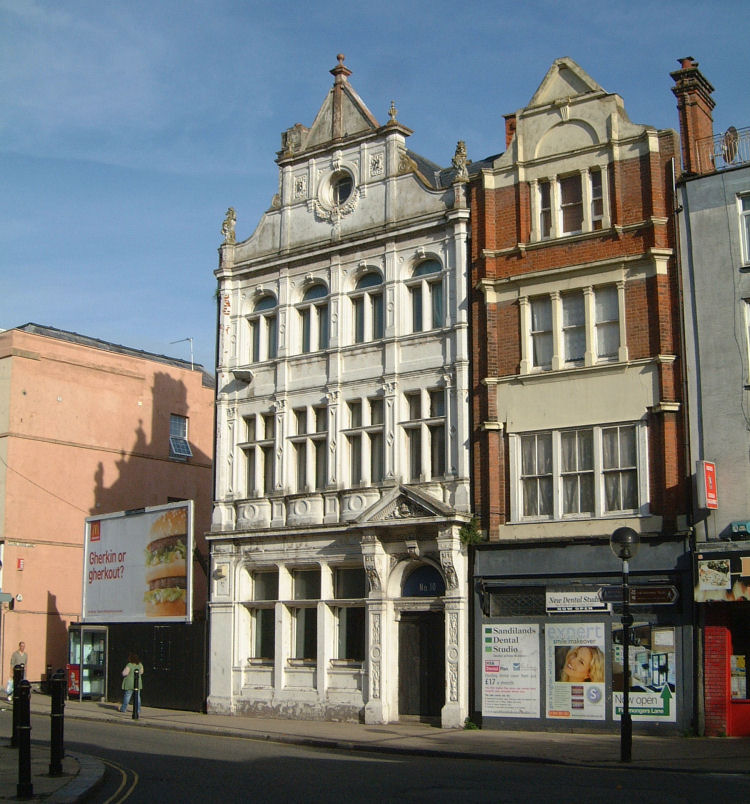
Above two photos taken by Paul Skelton, 28 October 2009, showing, not
the "Flying Horse" but the building that replaced it. Notice the horse
figurines on the top corners. This house, incidentally, was built
in 1892 so the date sign says and was then a post office.
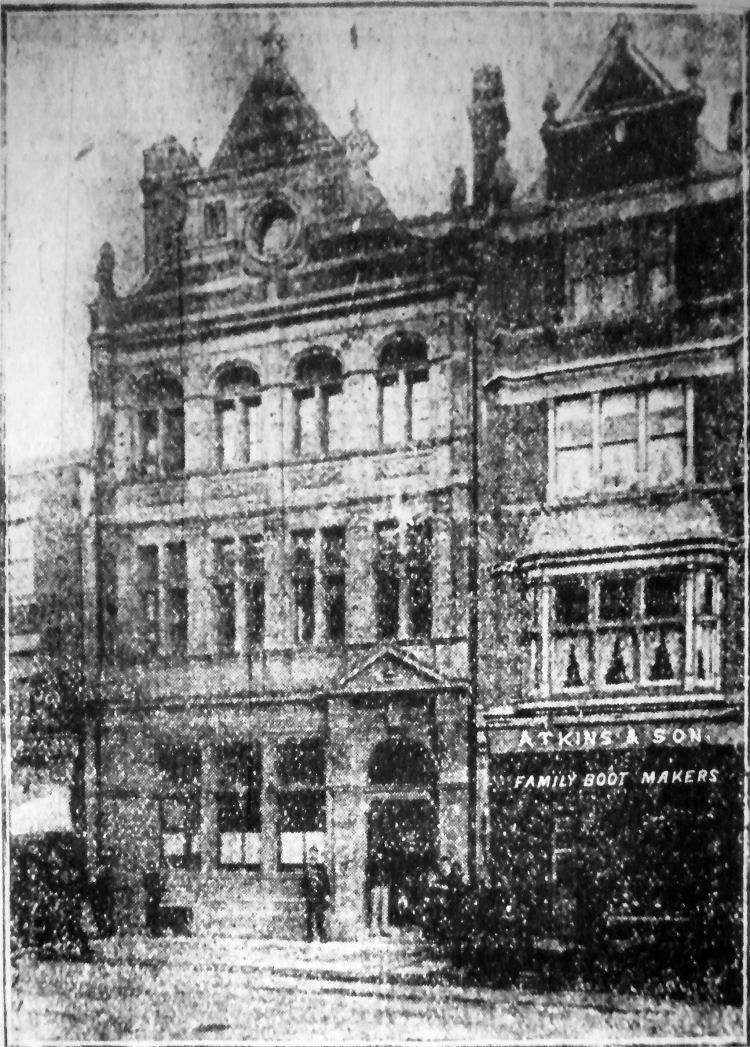
Photo taken 1901 showing Atkins & Son to the right of the former
"Flying Horse Tavern" premises when it was the Post Office.
July 2010.
Now I have a decent camera I can take better shots and looking at the
figurines, they look more like lions than horses.
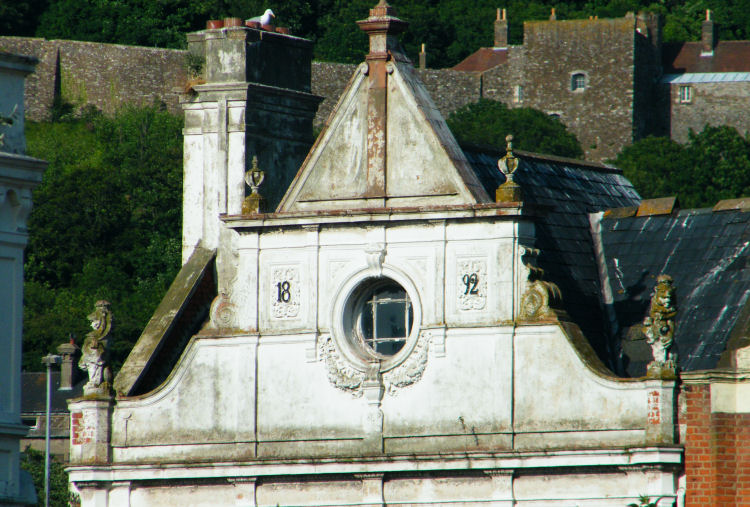
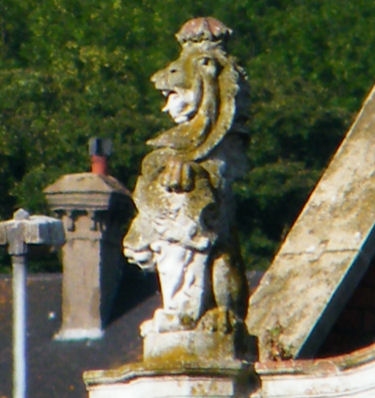 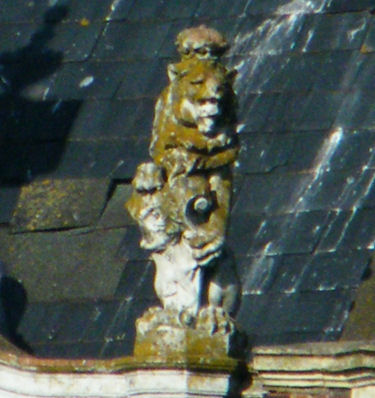
Above photos by Paul Skelton 9 July 2010 |
The foundations of a tavern which had borne this title were found in King
Street during a road widening early in the nineteenth century. One of the
plots of void land was let on a 99 years' term to Thomas Dawkes, yeoman, on
which probably he built the "Flying Horse" Inn. When first
built about 1558 it had been called "Fleur de Lis".
That was its name in the reign of Elizabeth, and the title deeds, bearing
date 1600, described it as the "Flower de Luce." The name was afterwards
changed to the "Flying Horse," to suit its character as a posting house.
Further research sent to me from Mark Frost has found this passage, which
suggests that there have been two pubs with this name, and that this one was
called the "Sun" previous to 1746.
|
Kentish Weekly Post, 12 March, 1746.
William Clark, removed from the "Old Flying Horse," to the house
known before by the sign of the "Sun," now the "Flying Horse," near
the Market Place in Dover; gives notice to all Gentlemen and Others,
that they will there find very good accommodation, having very good
stabling; and all endeavours will be used to oblige his kind
customers after the best manner. |
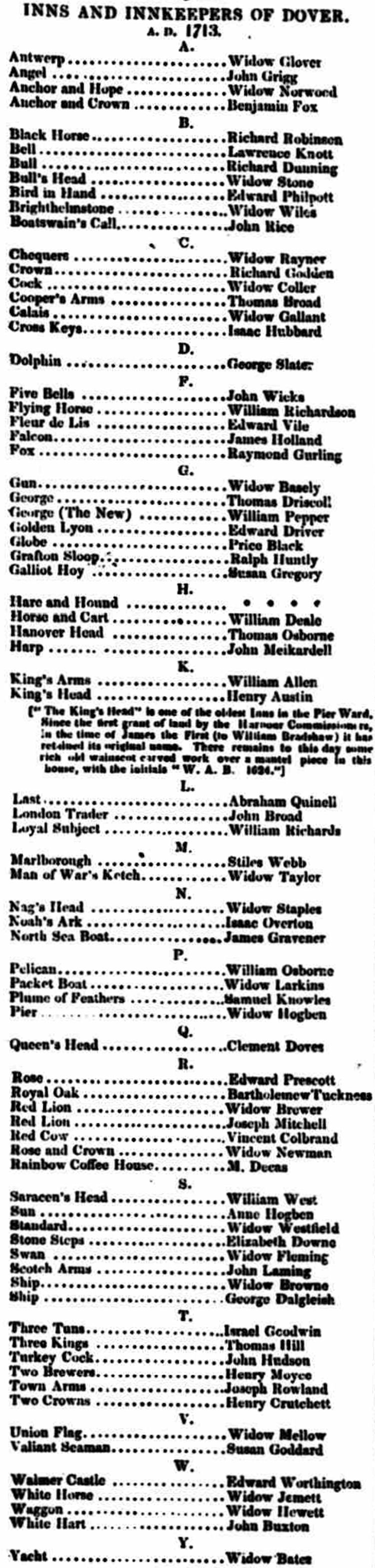
The Dover Chronicles on 7 May 1842, printed a list of "Inns & Innkeepers
of Dover A.D. 1713. Unfortunately no addresses were given.
|
From the Dover Chronicles, 7 May 1842.
 |
Thomas Dawkes, the yeoman, who leased this land and built the house, had
made himself a considerable position in Dover. He was one of the two
Commissioners appointed by deed to collect the subsidy, or benevolence, that
Queen Mary granted for the Harbour; he was at one time the holder of the
land attached to St. Martin's Church; later he is described as the Common
Clerk.
Richard Dawkes is thought to have kept an inn hereabouts also, in the mid
seventeenth century. That would have carried the "Flying Horse" sign. It
still traded in 1805. (Benskin). Richard Dawkes who, during the Civil War,
successfully conspired with others to seize Dover castle for the Parliament.
The plot to seize the castle has always been said to have been hatched at
the "Flying Horse." Taking with him 10 other men as daring as himself, they,
in August, 1642, formed a plan to seize the castle for the Parliament.
It may be presumed that owing to the direct violation of the "service"
clause of the lease, Richard Dawkes and the "Flying Horse" parted company.
By 1864, it was described as a commercial inn and tavern and in 1884 was
named the "Flying Horseman". It was later described as the "Flying Horse
Hotel", with stabling and lock up coach houses. Those coaches in fact ran to
here from Canterbury every Friday, returning the same day.
8th September 1864 saw this public house auctioned at the "Royal
Oak" as Lot 6 of 27 lots owned by the "Jeken,
Coleman & Rutley" Brewery of Custom House Quay. The advert stated:-
"That well-known and old-established Inn, the "FLYING HORSE," situated
in King Street, Market Place, Dover, with extensive and capacious stables,
yards, lofts &c., attached, now in the occupation of Mr. J Birch.
This lot has recently undergone considerable alterations and
improvements at a large outlay, and is now in full trade."
It was purchased by the government in 1891, subsequently being removed to
make room for a new general post office. That opened on 2 October 1893 but
it has been used for many varied activities since 1914 when the post office
operated from a more central site in Priory Street.
I would have expected to find some evidence of rebuilding here prior to
1893 but the gods are not always kind. At the time of demolition the "Flying
Horse Hotel" was said to be several centuries old.
|
From the Kentish Post or Canterbury News-Letter, October 26 to October
30, 1751.
This is to give Notice that William BADCOCK, Jun, late of Canterbury,
hath taken the Oldest Flying Horse in Dover, lately kept by Mr. William
Pitcher, deceased……."
|
|
From the Kentish Gazette or Canterbury Chronicle, Saturday, 1 October, to Wednesday, 5 October, 1768. Price 2d.
TO BE SOLD BY AUCTION
On Tuesday the 18th Day of October Instant at Six o'Clock in the
Evening, at Mrs. Pilcher's, at the “Flying Horse” in Dover.
A Toft of Ground, whereon a Messuage lately stood (Sometime called the
“Flying Horse Inn") with the Backside, large garden Ground, and
Appurtenances thereto belonging; situate at the lower End of St. James
Street in Dover, now in the Occupation of Mr. James Tolputt, and Mr.
John Robinson, Gardener.
For further Particulars, inquire of Mr. Latham, Merchant; or of Sampson
Farbrace, Attorney, at Dover.
|
|
From the Kentish Gazette, December 30 to January 2, 1770. Kindly sent from Alec Hasenson.
Meeting of a local political nature at the
Flying-Horse in Dover, on Friday next.
|
|
Kentish Gazette 04 July 1788.
TO BE SOLD BY AUCTION.
On Wednesday the 9th of July, 1788, at the
Dwelling-house of the late Captain Robert Wellard, in Dover.
All sorts of genteel Household Furniture; consisting of Goose
Feather-beds; Copper-plate and other Furniture; Mahogany Chests of
Drawers, Tables, Chairs, and a Quantity of Plate, Linen, and China; and
sundry Sorts of Kitchen Furniture.
The Sale to begin at Ten o'clock in the Forenoon, at Two in the
Afternoon, and continue till all are sold.
The Goods to be viewed on Tuesday preceding the Sale; and Catalogues to
be had at the King's Arms Printing-office, Canterbury; the "Three Kings,"
Deal; the "Bell" at Sandwich; the "Marquis of Granby," Folkestone; the
"White
Hart," at Hythe; at the Place of Sale; and at Edward Rutter's,
Auctioneer.
AND on Monday, July 14, 1788, will be sold by Auction, at Six O'clock in
the Evening, at the Sign of the "Flying Horse" in Dover,
All that Freehold Messuage or Tenement, situate in Snargate Street, in
Dover, and late in the Occupation of Captain Robert Wellard, deceased.
For Particulars enquire of Mess. Lane and Thompson, Attorneys at Law,
Dover.
|
|
Kentish Gazette, June 5 – 9, 1789. Kindly sent from
Alec Hasenson.
House Auction, June 10, at the Flying Horse in Dover. NOTE: the
Gazette goes on to speak of "Mr. Thomas Doorne's (note spelling), the
sign of the Flying Horse in Dover." It is always possible of course that
the paper misprinted the owner's name.
|
|
From the Kentish Gazette Apr 2 - 6 1790 p.1 col.2
Mr DOORNE of the
"Flying Horse" Dover - the venue for a Polyanthus Feast.
[Polyanthus and Auricula Feasts were a kind of flower show -(
plants originally brought by the Huguenots) - auriculas were especially
prized and shown, in wooden structures called 'theatres' by local
people, who celebrated with a feast or dinner at the same time]
|
|
From the Kentish Gazette, 20 October, 1797.
(Mr) Wm BENSKIN, master of the "Flying Horse Inn" married to Miss
Maria BLACKMAN on Sunday at the church of St Mary Dover.
|
|
From the Dover Ref Library Voters lists, kindly sent by Kathleen
Hollingsbee
Wm BENSKIN, Victualler (on Dover Electors 1802 hand
written book listing voters (ie freemen of Dover) in election for two
Dover MPs. Freemen at this time did not have to reside in Dover.
Wm BENSKIN, Victualler, on lists of electors for election of Dover
Mayor, 1808, 1810, 1811. 1812: “late victualler”
|
|
MARTIN MILL IN 1800
In an advertisement published in the "Kentish Gazette" of February,
1800, Martin Windmill was offered for sale by auction at the "Flying
Horse Inn," Dover, following the death of the late tenant, Mr.
Thomas Whitehead. The description stated that the mill had lately been
raised ten feet on substantial brickwork, comprised four floors,
was 23ft. in diameter, 30ft. length of sail, and drove two pairs of 4ft.
4in. stones. The advertisement stated that an extensive trade was done
by the mill.
|
|
From the Kentish Gazette, 23 February 1808.
TO BE LET BY AUCTION.
AT the "Flying Horse Inn," in the town and port of Dovor, in the county
of Kent, on Wednesday the 2nd day of March, 1808, at three o'clock in
the after-noon, for a term of 21 years from Michaelmas next.
All those two Pieces or Parcels of Arable Land, belonging to the pariah
of St. Mary the Virgin, in Dovor, containing by estimation seven acres
more or less; one Piece thereof containing by estimation five acres,
more or less, lying and being in the parish of Charlton, next Dovor
aforesaid, at or near a place called Windless Down; and the other Piece
or parcel thereof, containing by estimation, two acres, more or less,
lying and being in the parish of Hougham, otherwise Huffam, in the said
county of Kent, at or near a place called Gyles's Coombe, also within
the liberty of Dovor.
For particulars, apply at the Office of G. W. Gravenver, attorney and
solicitor to the parish of Saint Mary the the Virgin, in Dovor
aforesaid.
|
|
Kentish Gazette 16 June 1812.
FLYING-HORSE INN, DOVER.
John Minter, from the "Ship Inn," Dymchurch, begs leave to inform
Gentlemen, Farmers, and the Public, that he has taken the above
old-accustomed Inn: and he has laid in a very choice stock of Wines,
Liquors, Etc. hopes, by the most strict attention to their comfort and
convenience, to merit their patronage and support.
|
|
Post or Canterbury Journal 17 August 1819.
Kentish Gazette 17 August 1819
DIED.
August 10, dropped down suddenly and expired, Robert Webb, ostler of the
"Flying Horse Inn," Dover, aged 50 years.
|
|
Kentish Gazette, 31 March 1820.
DEATH.
Last week, at Dover, Mr. William Benskin, formerly landlord of the
"Flying Horse Inn."
|
|
From the Kentish Weekly Post or Canterbury Journal, 23 August, 1822.
A young man named Gilbert, formerly of Hythe, but late hostler at the
"Flying Horse Inn," Dover, went on Friday se'nnight to witness the
execution of Alex Spence. The shocking sight was too much for his
feelings,—he was taken ill, and is now in a deranged state in
consequence.
(Alex Spence was hung at Dover for the crime
of shooting at someone.)
|
|
From the Kent Herald, 29 April 1824.
Flying Horse Inn, Dover.
D. Chittenden. (Late of the "City of Antwerp Inn.")
Respectfully makes known to his friends and the public in general, that he has
taken the above Inn, and hopes by strict attention to merits their portion of
their favours.
Genuine wines, spirits, &c.
Dover. April 15, 1824.
|
|
From the Kent Herald, 4 January 1827.
DEATH.
Dec. 30, at Dover, Mr. Minter, landlord of the "Three Herrings," and formerly of
the "Flying Horse Inn," in that town.
|
|
From the Dover Telegraph and Cinque Ports General
Advertiser, Saturday 14 December, 1833. Price 7d.
The Dover Friendly Musical
Society, having suspended their meetings after a continuance of 49
years, several of the members have formed a club to be held every
Thursday evening, at the Flying Horse Inn. The first meeting was on
Thursday, when a very numerous and highly respectable company kept up
the evening with much harmony and good fellowship.
|
|
From the Dover Telegraph and Cinque Ports General
Advertiser, Saturday 15 February, 1834. Price 7d.
The Harmonic Meeting at
the Flying Horse Inn, was numerously attended last Thursday evening
last, and the conviviality of the company much enhanced by the vocal
abilities of several amateurs. The society is most deservedly rising to
that respectability which its modest pretensions so much deserve.
|
|
From the Dover Telegraph and Cinque Ports General
Advertiser, Saturday 20 May, 1837. Price 5d.
NOTICE
ALL Persons having any demand on the Estate of the late SARAH
CHITTENDEN, of the "Flying HorseInn," Dovor, are requested to send the
particulars thereof to my Office, on or before Tuesday next.
Dovor, 18th May, 1837.
MATTHEW KENNETT, Solicitor.
|
|
Dover Chronicles, 9 April, 1842.
William Hogben, age 14, labourer, was charged with having, on the
16th of February, obtaining by false pretences, the sum of two
shillings from Mr. Edward Charles Rayner, of the "Flying Horse Inn."
It appeared that prisoner went to Mr. Rayners house, and told him
that Mr. Whelch, a brickmaker, had sent him for the loan of 2
shillings to buy some medicine for a colt that was very ill. He said
Mr. Whelch should not come himself, as the colt was too ill to be
left. Mr. Whelch denied having ever employed the boy on any previous
occasions for any purpose whatsoever.
Guilty; sentenced to 6 months' hard labour.
|
|
From the Dover Telegraph, 23 May 1846.
Freeholds, Dover. To be peremptorily sold.
Pursuant to an order of the High Court of Chancery, made in the
Cause of Kenneth v. Smithett, with the approbation of Sir Griffin
Wilson, one of the Masters of the sake Court, at the "Flying Horse
Inn," Dover, in the County of Kent, on Monday, the first day of
June, 1846, at Two o'clock the Afternoon, in three lots.
Two freehold Messuages or Tenements, Public Houses and Premises, one
of them called or known by the sign of the "Burlington," situate in
Church Street, Dover; and the other called the "Old Fountain,"
situate in Caroline Place, Dover; also a stable and premises situate
in Caroline Place, Dover.
Particulars and Conditions of sale may be obtained (gratis) at the
said Masters Office, in Southampton Buildings, Chancery Lane,
London; of Messrs. Hawkins, Bloxam, Stoker, and Bloxam, New Boswell
Court, Lincoln's Inn; of Messrs. Scott and Tahourdin, Lincoln's Inn
Field's; of Messrs. Chester, Tourmin, and Chester Staple Inn; of
Messrs. Kennett and Son, and of Mr. G. W. Ledger Solicitors, Dover.
The premises may be viewed on application to the Tenants.
|
|
From the Dover Telegraph and Cinque Ports General Advertiser, Saturday, 12 January, 1850.
CORONERS INQUEST
On Monday evening at 7 o'clock, a jury were empanelled before G. T.
Thomas, Esq., Coroner for the Borough, at the “Flying Horse Inn,” to
investigate the circumstances attending the death of Thomas Frazer, aged
55 years, who died suddenly on the morning of the previous day. The Jury
being sworn (Mr. W. Thistleton, foreman,) they proceeded to view the
body, and on their return, the following evidence was elicited:-
Edward Carswell, labourer, residing in Townwall Lane:- Deceased was a
relative of mine, and lived with me; he was a fisherman. On Saturday
night, deceased and myself went home together from the “Good Intent;” I
slept upstairs, and he in the room below. On Sunday morning, shortly
before 7, I noticed that deceased was snoring very heavily and loudly. I
shook him, but he did not answer me; upon which I told my wife that I
thought something was the matter, and I left the house. On returning,
about ten minutes to 8; one of the children said that deceased was dead.
For the last three weeks, he has complained of the state of his bowels,
but seemed well on Saturday night; he was then quite sober, and had not
taken more than three pints of beer. I do not think he saw any medical
man touching what he complained of about his inside.
Ann Claw, residing in Townwall lane:- On Sunday morning, about 10
minutes to 7, I was called by one of Carswell's children, the child
asked me to come into their house, “for Uncle Tom was dead.” I soon went
in, and saw the deceased in bed, with his knees drawn up, and evidently
dying. I heard him breath hard, and then expired. Mrs. Carswell was
standing by the fire-place crying. I have seen deceased daily for some
time past, and have heard him complain of his bowels, but nothing else.
Elizabeth Carswell, wife of Edward Carswell:- My little boy called me on
Sunday morning, saying he could make nothing of his uncle, and that I
had better come down stairs and see what was the matter. I did so, and
on lifting deceased up he immediately fell forward. I at once sent for
Mr. Tapley, surgeon, and for my neighbour, Mrs. Claw. When Mr. Tapley
came, he opened a vein in deceased arm, but very little blood flowed.
The surgeon was almost sure he was dead, that he might have died in an
apoplectic fit; but Mr. Tapley was not positive as to the cause of
death.
This forming the whole of the evidence to be obtained, the question of
the necessity for a post-mortem examination was considered, which
resulted in the Jury expressing themselves a s satisfied with the
evidence already adduced; and the Coroner having summed up, a verdict of
Death from Natural Causes was returned.
|
|
Kentish Gazette, 15 January 1850.
On Monday evening at 7 o’clock, a jury was empanelled before G. T.
Thompson, Esq., Coroner for the Borough, at the "Flying Horse Inn," to
investigate the circumstances attending the death of Thomas Frazer, aged
55 years, who died suddenly on the morning of the previous day.
A verdict of Death from Natural causes was returned.
|
|
Kentish Gazette, 17 August 1852.
Coroner's Inquest.
Friday afternoon a jury was enpannelled before G. T. Thompson, Esq.,
Coroner of the Borough, at the "Flying Horse Inn," to investigate the
circumstance attending the death of Esther Betts, aged 18 years, whose
death was said to have resulted from improper treatment on the part of
her friends. Mr. G. Bennett was chosen foreman of the Jury. The body,
lying in Townwall-lane, was then viewed. Externally, the corpse
presented no other than appearances that could be satisfactorily
accounted for, and of on ordinary character. On returning to the inquest
room, the Coroner observed that he dad ordered the inquiry in
consequence of strong rumours that deceased had met with ill usage from
her family. He had not ordered the body to be opened, thinking it best
to take evidence of age, identity, &c. The examination was then
commenced.
Octavius Frederick Heritage, surgeon, residing and practising in Dover:—
I was first called in to attend deceased on Sunday evening last, at the
residence of her mother, Townwall-lane. She was in bed, and complained
of a pain in the chest, and difficulty of breathing. The symptoms were
those of inflammation of the lungs. I attended her from that time up to
her death yesterday. She made no complaint of any ill treatment from her
friends. I consider that her death resulted from inflammation of the
lungs. She was nursed by her mother, whose conduct was as kind as I
should expect from a woman of her character. Deceased told me she had
gone out and taken cold. As far an I observed the body previous to
death, no marks of violence were seen by me—no bruises to account for
the symptoms under which deceased suffered.
A discussion as to the necessity of any further investigation took
place, several of the jury expressing themselves as satisfied with the
conclusive evidence of the surgeon, and others thinking that a further
examination of witnesses was necessary to fully satisfy the public mind.
The latter course was decided on, and Jane Woodcock was called, who
deposed:— I reside with the mother of deceased, and have done so
since
January last. Deceased and two other daughters lived there also, one of
whom, Charlotte, aged 23 years, returned only a fortnight ago. Last
Tuesday week, at eight in the evening, I saw deceased beaten by her
mother on the back with her fist. She did not strike very hard, and I
did not see her give more than 5 or 6 blows. Deceased crouched against
the wall as if to avoid the blows; she cried out, but I did not know
what she said. The row lasted about 10 minutes, and was stopped in
consequence of a policeman coming. Deceased lay in bed the next day till
night, when she went out. On Thursday morning, the 5th, she took a
chair, and sat outside the door without shoes or stockings until it
rained. On Friday she took to her bed, and never got up again, I saw her
on Sunday last, and on Wednesday. She made no complaints to me of ill
usage. I have not seen deceased beaten or ill-used since the Tuesday I
have spoken of.
Ann Doughty:— I lived next door to Mrs. Betts, and have done so for two
years. On the 3rd instant, at 10 at night, I was alarmed by cries of
murder from deceased. I, my husband, and a lodger of ours got up, and on
going to the door saw deceased crying in the street, and her father with
her. The door of Betts's house was locked. Deceased was dressed with an
old gown only, and had no shoes or stockings on. A policeman came
shortly after, the door was open, and deceased and her father went in.
For two hours afterwards we heard her crying as if in pain. The next
morning she sat at the door, but was dressed, and in the evening went
out into the town—to the "play" I believe.
Jane Solly fully corroborated the evidence of Mrs. Doughty, with whom
she lodged. Deceased told witness on the 4th that her mother kicked her
in the side, and had beaten her about the head.
Police-sergeant Burridge:— On the night of the 3rd, at a quarter past
nine, from information received I proceeded to a crowd in Townwall Lane,
among whom I saw deceased; but before I reached the door she went in. On
getting to the house, I heard the cry of murder, and went in, where I
saw deceased, her parents, and a young woman said to be her sister. In
answer to my enquiry who had cried murder, the mother replied "It was my
daughter sitting there"—pointing to deceased; who said, "And I will
again, if you kick and knock me about as you have done." She had a
slight mark over the left eye, and complained that her sister had kicked
her in the back. The mother said it arose from deceased taking some
edging belonging to her sister. Deceased said her mother was always
beating her about, but her father never touched her. They promised to be
quiet, and I left them. Deceased pressed her side and cried, as if in
pain.
At this stage of the proceedings a post mortem examination was decided
on, and the inquiry adjourned to Monday afternoon.
|
|
Kentish Gazette, 24 August 1852.
Coroner's Inquest.
The enquiry touching the death of Esther Betts, was resumed on Friday,
before G. T. Thompson. Esq., coroner. On the jury
reassembling, the surgeon, Octavius Frederick Heritage, who attended
deceased, was recalled, when he deposed:— On
Saturday afternoon last assisted by Dr. Astley. I made a post-mortum
examination of the body of deceased. We found no
bruises externally, nor any marks of violence whatever. There was a
slight abrasion of the skin on the right side from the
application of a blister. On opening the chest we found the right lung
consolidated, and adheving to the right pleura. There
was a slight effusion it the cavity of the chest. The heart, liver,
kidneys, and other viscera were healthy; and the mucus was
unimpregnated. By the term consolidated, I mean a high state of
inflammatory action. The effusion was recent. I attribute the
whole appearances to exposure on the part of deceased to cold; and to
the best of my judgment I should think the cold had
been contracted about a week. At the close of the surgeon's examination,
the Coroner observed that if the jury required
further evidence the enquiry would be continued. The jury expressed
themselves as fully satisfied with the conclusive
character of the deposition made by Mr. Heritage, and after a brief
consultation returned the following verdict:—
That the deceased, Esther Betts, died from inflammation of the lungs,
caused by cold.
|
|
South Eastern Gazette 18 November 1856.
SUMMARY DISMISSAL OF A POLICEMAN.
At the Police Court, on Tuesday last, while a charge was being heard
against a young man named Adam Austen, for creating an obstruction on
the pavement near the "Flying Horse Inn," it transpired that he had
treated the policeman Collard, who took him into custody, with a glass
of rum. The magistrates enquired of Collard if this assertion was true,
when the constable positively denied it. The barmaid of the "Flying
Horse" was then sent for, and proved that she had served Collard with
the glass of rum alluded to at the defendant's expense; on which the
Bench instantly dismissed Collard from the police force.
|
|
From the Dover Express and East Kent Intelligencer, 20
November, 1858.
DOVER COUNTY COURT
DRUNK AND QUARRELSOME
John Crick, a coach driver, was placed at the bar by Sergeant Back,
who charged him with being drunk and disorderly, and resisting him in
the execution of his duty, on the preceding Saturday.
Back, on being sworn, said he was called to the "Flying Horse Inn" on
Saturday evening about five o'clock and there found the defendant, in a
state of intoxication, hanging about the premises, and very abusive in
his language. Witness tried to persuade him to go home, but he would not
take his councel, and he therefore took him into custody and conveyed
him to the station-house. On his way thither the defendant threatened to
"knock his eye out." He was informed that Crick had been abusive to the
landlord of the "Flying Horse."
Mr. Mee said he appeared on behalf of Mr. Ellenger, who was prevented
by physical infirmity from being present, to represent to their worships
the very great annoyance the man at the bar had occasioned to Mr.
Ellinger, and to request them to afford him what protection they could
from its repetition. From what he had been informed by Mr. Ellinger, it
appeared that Crick frequently, when under the influence of
intoxication, mad his appearance at the "Flying Horse" and indulged
himself in giving utterance to the foulest epithets, which were directed
towards Mr. Ellenger and the members of his family. In support of this
assertion he called:-
Robert Ellinger, the son of the proprietor of the "Flying Horse," who
said that Crick came to his father's house on Saturday afternoon about
five o'clock, in a state of intoxication. Defendant wanted to go into
the parlour, but witness told him he could not go there, as it was
always reserved on Saturdays for farmers. He prevented the defendant
from entering by standing against the doorway, but defendant
endeavoured to push him away. Crick remained near the entrance of the
house, making use of very foul and abusive language towards witness's
father, and it was at last found necessary to send for a policeman.
Defendant had acted in a similar manner on several previous occasions,
when under the influence of intoxication.
Crick, in defence, denied resisting the policeman, declaring that he
knew better.
The Magistrates fined him 5s. and the costs, and in default of
payment he was committed to prison for seven days.
Mr. Mee said he was instructed by Mr. Ellenger to prefer a charge of
assault against Crick, who had pushed the witness Robert Ellenger away
from the parlour-door, as stated in his evidence. Mr. Ellenger was not
influenced by any vindictive feeling towards the defendant, but felt
compelled to adopt the course he was now pursuing, to save himself from
a repetition of the annoyance occasioned him by the defendant.
The Bench said the proper way of proceeding in a case of assault was
by summons, and that if application was made in the usual way a summons
would be granted; unless indeed, the defendant liked to have the case
proceeded with at once.
The defendant said that he should object most decidedly to such a
course, " being unprepared with witnesses and everything;" and the
matter was therefore left to take the ordinary course.
|
|
From the Dover Express and East Kent Intelligencer, 20
November, 1858.
NIGHT DISTURBERS
Two men named Jones and Atherton were brought up by police-sergeant
Barton for drunken and riotous conduct on the streets early on Sunday
morning, but were each let off on paying the hearing fines.
INSANE
A tall respectably-dressed man named Pilcher was then charged with a
similar offence.
Police constable Campany stated that the defendant collected a crowd
outside the "Flying Horse Inn," by calling out that the landlord had
murdered two men and cut them up, and that he would give £100 to be
locked up, for he would then divulge the whole.
Mr. Birch, the proprietor of the "Flying Horse," attended to make a
complaint against the man for his repeated annoyances; but as his
complaint did not refer specifically to the present case, it was not
inquired into.
Defendant declared that he had done this because he had been treated
as an outcast. The fact was three men had been murdered - Rolfe,
Huntley-Spencer, and Godden, - and he saw on of them at the "Flying
Horse" shortly before it occurred.
The policemen remarked that from the man's manner since he had been
in custody, he believed he was of unsound mind.
The Magistrates discharged the defendant on his paying 2d. for the
hearing, informing him that he must not annoy Mr. Birch again.
|
|
DOVER TELEGRAPH AND CINQUE PORTS GENERAL ADVERTISER. Saturday,
October 24, 1863.
Joseph C Birch Returns his sincere thanks for the
very liberal patronage he has received during his Proprietorship of the
"Princess Alice Inn" Snargate Street, for the past 8-years, and begs
respectfully to inform his patrons and friends, that he has now taken
the "Flying Horse Inn," (Vice Ellinger-Retired), King Street, Market
Square, Dover.
Where he hopes, by strict attention, and well selected to fly first
class wines, spirits, etc, to insure a continuance of favours, and merit
support from the surrounding neighbourhood.
A commodious coffee room open from 5 a.m., for the convenience of
persons frequenting Dover Markets and others.
|
|
From the Dover Telegraph April 1864.
A FORTUNATE ESCAPE FROM FIRE.
A narrow escape from fire was
experienced at the "Flying Horse Inn," King Street, Dover, on Tuesday,
arising from the heat of the sun strengthened by glass. A table in one
of the rooms in that establishment was strewed with newspapers, and a
decanter which had been removed for some purpose was unwarily placed
upon one of the local newspapers. The sun was then shining through the
window on to the table; and its power being redoubled by the action of
the glass decanter, the newspaper took fire, a timely discovery,
however, fortunately preventing any great mischief from the flames.
|
|
From the Kentish Gazette, 16 May 1865.
A Man Suffocated in a Malt Bin.
On Saturday, at noon, the borough coroner, W. H. Payn, Esq., held
an inquest at the "Flying Horse Inn," on the body of Richard Taylor,
a man between 50 and 60 years of age, who had been in the employ of
Messrs. Leney and Evenden, the extensive brewers of this town, and
who had met with his death on the previous afternoon from
suffocation, having been found in the malt bin of the brewery, where
he had been placed to "tread" the malt about an hour previously. The
receptacle in which the deceased was found is called a "skry," the
malt passing from a bin above through a small aperture.
Simultaneously with the process a workman is employed to tread it
down in the skry, and it is feared that the deceased either lay down
to sleep or was seized with a fit, and was thus by a slow process
buried alive, although within reach of his fellow workmen, who were
pursuing their avocations unconscious of his fate. Mr. Fox,
solicitor, attended with Mr. Evenden, one of the principals of the
firm, and before the coroner opened the proceedings said that he did
so to state on behalf of Messrs. Leney and Evenden, that they were
desirous of affording every facility to the jury in making the
necessary enquiry. They were also anxious that the jury should view
the place of the accident, in order that they might be quite
satisfied that this untoward occurrence was not owing to any want of
precaution on the part of Messrs. Leney and Evenden. Mr. Iggulden
was appointed foreman of the jury, and after the body and the locus
in quo had been viewed, the following evidence was adduced:—
Thomas Chalkley deposed:- I am a maltster in the employ of
Messrs. Leney and Evenden, brewers, of this town. I knew the
deceased, Richard Taylor. He was storekeeper in the same employ as
myself. He was at times employed to assist in getting in the malt,
and in getting it ready. Yesterday morning deceased was engaged with
me in shifting coals. In the afternoon, about three o’clock, I went
up into the malt bin with him, to set him to work, to tread the malt
and trim it. I left him at work, and went down to set the skry
going. I remained at work below, and observed nothing to lead me to
suppose that the deceased was not working. About an hour and a half
after I had left deceased at work in the bin, I knocked for him to
come down. Finding he did not come nor answer, I went up and called
him. I obtained no reply, and I opened the kiln window and again
called. I then crossed the kiln, and opened a window that looks into
the bin, when I heard the deceased making a peculiar noise — a sort
of snore. I thought he was asleep; and on going into the bin I found
the deceased buried in the malt. Only one hand was visible. I
attempted to draw him out, but could not. I obtained assistance, and
we ultimately succeeded in extracting the deceased. I think about
twenty minutes elapsed from the time of my finding deceased until he
was got out. A surgeon was in attendance before we had rescued him.
Deceased had been in the employ of Messrs. Leney and Evenden three
or four years. He had been engaged upon the same work before, he was
perfectly' sober when I left him at three o’clock, and he had no
means of getting drunk afterwards. The work was in no way dangerous,
and deceased must have been asleep, or in a fit, or he would not
have been drawn down as he was.
By Mr. Fox:- I knew that deceased was ill about this time last
year, and was obliged to go into the hospital. I heard be was
suffering from delirium tremens. After discovering the deceased, I
found that some one had opened a slide below, which caused a taster
run of the malt, and rendered it more difficult to extricate
deceased. The hole from which the malt passes, from the bin into the
skry, is about three or four inches square, and at the rate the malt
was then going it took an hour and a half to run through sixteen
quarters.
Dr. Marshall, M.R.C.S., Castle-street, deposed:- Yesterday
afternoon, about a quarter past four, I was sent for to attend at
the malt-house of Messrs. Leney and Evenden, where, I was informed,
an accident had occurred. I was taken into the malt bin, and found a
number of men engaged with shovels in extricating deceased from the
malt, in which he was buried, his face alone being visible. I
suggested a rope being placed under his arms, as the malt was
sliding down as fast as it was shovelled out, and so again burying
the deceased. This was done, and deceased was then soon extricated.
I examined the body. It was pulseless, and I soon found that
deceased was quite dead. Efforts were made to restore animation, but
without success. The appearance of the face was that usually
presented by death from suffocation. A previous attack of delirium
tremens would predispose a man to fits.
This being the whole of the evidence, the coroner summed up,
observing that no blame appeared attributable to anyone, and the
jury then returned a verdict of "Accidental Death."
|
|
From the Dover Express and East Kent Intelligencer, 20
May, 1865.
INQUEST BY THE BOROUGH CORONER
A MAN SUFFOCATED IN A MALT BIN.
On Saturday, at noon, the borough coroner, W. H. Payne, Esq., held an
inquest at the "Flying Horse In," on the body of Richard Taylor, a man
between 50 and 60 years of age, who had been in the employ of Messrs.
Leney and Evenden, the extensive brewers of this town, and who had met
with his death on the previous afternoon from suffocation, having been
found in the malt bin of the brewery, where he had been placed to
"tread" the malt about an hour previously. The receptacle in which the
deceased was found is called a "skry," the malt passing from a bin above
through a small aperture. Simultaneously with the process a workmen is
employed to tread it down in the skry, and it is feared that the
deceased either lay down to sleep or was seized in a fit, and was thus
by a slow process buried alive, although within reach of his fellow
workmen, who were pursuing their vocation unconscious of his fate.
Mr. Fox, solicitor, attended with Mr. Evenden, one of the principles
of the firm, and before the coroner opened the proceedings said that he
did so to state on behalf of Messrs. Leney and Evenden, that they were
desirous of affording every facility to the jury in making the necessary
enquiry. They were also anxious that the jury should view the place of
the accident, in order that they might be quiet satisfied that this
untoward occurrence was not owing to any want of precaution on the part
of Messrs. Leney and Evenden.
Mr. Iggulden was appointed foreman of the jury, and after the body
and the locus in quo had been viewed, the following evidence was
adduced:-
Thomas Chalkley deposed: I am maltster in the employ of Messrs. Leney
and Evenden, brewers, of this town. I knew the deceased, Richard Taylor.
He was a horse-keeper in the same employ as myself. He was at times
employed to assist in getting in the malt, and in getting it ready.
Yesterday morning deceased was engaged with me in shifting coals. In the
afternoon, about three o'clock, I went up into the malt bin with him, to
set him to work, to tread the malt and trim it. I left him at work, and
went down to set the skry going. I remained at work below, and observed
nothing to lead me to suppose that the deceased was not working. About
an hour and a half after I had left the deceased at work in the bin, I
knocked for him to come down. Finding he did not come nor answer, I went
up and called him. I obtained no reply, and I opened the kiln window and
again called. I then crossed the kiln, and opened the window that looks
into the bin, when I heard the deceased making a noise - a sort of
snore. I thought he was asleep; and on going into the bin I found the
deceased buried in the malt. Only one hand was visible. I attempted to
draw him out, but could not. I obtained assistance, and we ultimately
succeeded in extracting the deceased. I think about twenty minutes
elapsed from the time of my finding deceased until he was got out. A
surgeon was in attendance before we had rescued him. Deceased had been
in the employ of Messrs. Leney and Evenden for three or four years. He
had been engaged upon the same work before. He was perfectly sober when
I left him at three o'clock, and he had no means of getting drunk
afterwards. The work was in no way dangerous, and deceased must have
been asleep, or in a fit, or he would not have been drawn down as he
was.
By Mr. Fox, I know that deceased was ill about this time last year,
and was obliged to go into the hospital. I heard he was suffering from
delirium tremens. After discovering the deceased I found that
some one had opened a slide below, which caused a faster run of malt,
and rendered it more difficult to extricate deceased. The hole from
which the malt passes, from the bin into the skry, is about three or
four inches square, and at the rate the malt was then going it took an
hour and a half to run through sixteen quarters.
Dr. Marshall, M.R.C.S. Castle Street, deposed: Yesterday afternoon,
about a quarter-past four, I was sent for to attend at the malt house of
Messrs. Leney and Evenden, where, I was informed, an accident had
occurred, I was taken into the malt bin, and found a number of men
engaged with shovels in extricating deceased from the malt, in which he
was buried, his face alone being visible. I suggested a rope being
placed under his arms, as the malt was sliding down as fast as it was
shovelled out, and so again burying the deceased. This was done, and
deceased was soon extricated. I examined the body. It was pulse-less,
and I soon found that deceased was quite dead. Efforts were made to
restore animation, but without success. The appearance of the face was
that usually presented by death from suffocation. A previous attack of
delirium tremens would predispose a man to fits.
This being the whole of the evidence, the coroner summed up,
observing that no blame appeared attributed to anyone, and the jury then
returned a verdict of "Accidental Death."
|
|
From the Southeastern Gazette, 24 July 1866.
The Alleged Refusal to Maintain a Mother.
With reference to a paragraph which has obtained publicity in the
Canterbury and Dover journals, to the effect that Mr. Burch, landlord of
the “Flying Horse Inn,” Dover, had had an order made upon him to
contribute towards the maintenance of his mother, it is due to Mr. Burch
to state the following facts, which were supported by testimony adduced
before the Dover bench of magistrates, on Friday. For a period extending
over many years, Mr. Burch, through Mr. Pilch, of the “Saracen's Head,”
Canterbury, has paid his mother a sum of 3s. weekly, besides
contributing in other ways towards her support. Lately, however, the
poor woman fall ill, and by some means the attention of the relieving
officer was directed to the case, and, on a medical certificate being
granted that she required more nourishment, this was supplied to her at
a cost to the guardians of 1s. 6d. per week. Mr. Burch complains, first,
that he should have been summoned without notice; and secondly, that he
was at the time performing a duty which it was alleged he had neglected.
|
|
From the Whitstable Times, 29 October, 1870.
CORONER’S INQUESTS.
Another inquest was held, on Wednesday afternoon, at the “Flying Horse,”
King-street, on the body of Alfred Wakely, tailor, aged 28 years.
Deceased had been in Dover for 16 months, during which period he worked
for Mr. W. P. Mummery. He was of intemperate habits. At half-past ten on
Tuesday night he (the worse for drink) and his wife went to bed. His
wife woke at half-past five and called deceased, who lay on the edge of
the bed, but received no reply. She touched his arm, and felt it was
cold. Dr. Gill quickly arrived at deceased’s residence, Chapel-lane, and
found he had been dead some time. The week previous Dr. Gill told
deceased’s wife that if he continued to drink excessively it would be
the cause of his death. The verdict was to the effect that death was
caused by sudden failure of the vital powers, produced by excessive
drinking.
|
|
(Taken from booklet: "The True History of the Life and Times of Charles
Norris Becker Town Crier for Dover (born Feb 27 1834) written and
published in January 1912 when he was aged 78, publ. by Dover Express. (some time after c.1870)....
"THE HUMOURS OF POLITICAL BILL POSTING"
“One night I left my cart out, in order to make an early start the next
morning with election bills in the County for Major Dickson. I found
some foolish persons had painted my cart all over with blue paint. it
took me three hours to get it off, for they had been very liberal with
their blue paint. On another occasion I hired the hoarding outside the
London and County Bank. I had posted it full of red bills in the night.
The posters for the other side covered it with blue bills. As I had sole
right to it, I covered their bills up again. Old Mr Rutley and two more
friends waited at the "Flying Horse" Hotel, and about twelve o'clock at
night the "Blue" men began to cover up my bills again. My friends went
across, got hold of their paste-can (about two gallons of paste) and
emptied it all over them! My word! There was a set out; but it put a
stop to them, for they hired the upper part on the scaffolding and made
a show on their own account.
On another occasion I had a country journey for the County Election. I
had got as far as Swingate, and made a good display, when a friend came
along and said, "Charlie, old friend; are you going to have a glass?" In
we went, and on my return to my work I found, to my dismay, the pony had
drank every drop of the paste! His mouth was all over froth. I suppose
the pony thought that as I was having refreshment, he would have some
too.
We came back, and made another start the next day, and in driving along
the road I overtook old Mr Faith the policeman. I said "Jump up." We had
not gone far on the road when down went the pony, and bundled us out. We
were not hurt, and having got the pony up, I said to Faith, "Jump up; we
will have another try!" "Not me" he said, I told him I thought a
policeman had more pluck. Then off he went, safe and sound.”
|
|
From the Dover Express and East Kent News, Friday 7
July, 1871.
NEW LICENSES
Mr. E. R. Mowll, one of the trustees in the bankruptcy of Mr. Birch,
applied for a new license for the "Flying Horse," King Street.
It was granted.
|
|
From the Dover Express and East Kent Intelligencer,
5 January, 1872. Price 1d.
DRUNKENNESS - FURIOUS DRIVING IN A PUBLIC
THOROUGHFARE
James William Parker, a mechanic, Harriet Parker, his wife, Thomas
Lads, a private in the 2nd Battalion of the Rifle Brigade, and stationed
at Shorncliffe, and Harriet Wale, a middle-aged woman, were charged with
drunkenness and disorderly conduct, and with driving in such a manner as
to endanger the lives of the public in Snargate Street and bench Street,
on the previous evening, between seven and eight o'clock.
Police-constable Corrie said that, on the previous evening, at about
twenty minutes to eight, he was on duty at the top of Snargate Street,
when he saw a pony and phaeton, coming up the street at full gallop. The
four defendants were seated inside. They were all drunk, and the
defendant William Parker was driving. He seemed to have sufficient
control over the horse; but the witness saw him whip it severely when he
turned into Beach Street. The phaeton almost ran over a lady opposite
Mr. Lester's shop. Parker pulled up at the "Flying Horse." One of the
woman and the rifleman were making a great disturbance. Witness did not
know Lade was a rifleman when he saw him in the phaeton, as he was
wearing a felt hat, and had a large rug wrapped round him, over his
uniform.
By Mr. Smith: The defendants were making an extraordinary noise.
About fifty or sixty boys followed the phaeton up Snargate Street, as
far as the Market Square. I unbuckled the reins at the "Flying Horse,"
and took the phaeton to the Police-station. The defendants had to be
dragged out of the trap into the station-house.
Parker, on being asked by Mr. Stilwell if he had any questions to put
to his witness, denied whipping the horse, and said he could not have
done so, as the whip was broken long before the phaeton reached Bench
Street.
Sergeant James Johnstone corroborated Corrie's evidence, and said
that, on arriving at the "Flying Horse," Corrie was holding the reins.
Parker was drunk, so also were the rest of the prisoners.
In answer to a question put my Mr. Smith, Johnstone said that neither
of the prisoners said anything at the police-station when the charge was
read over to them.
The defendant Parker, who acted as spokesman for the party, said it
was the first time they had been in such a disgraceful position, and he
would assure the Magistrates that it would be the last. It was Christmas
time; and on that account, he hoped the Magistrates would be inclined to
deal leniently with them.
Mr. Smith (addressing Parker): This is a most disgraceful offence on
the part of all of you. We will discharge your three companions; but
you, as the driver, and person responsible for the furious driving, will
be fined 10s., and the costs, 16s. in all, 26s.
Parker paid the fine.
|
|
From the Dover Express and East Kent Intelligencer,
2 March, 1877. Price 1d.
AN INTOXICATED HORSEMAN
James John Piggott, formerly clerk at the London and County Bank, was
charged with being drunk and incapable on horseback, thereby endangering
the safety of the public.
Police-constable Suters said: On Saturday afternoon, about five
o'clock, I was on duty at Snargate Street. I saw the defendant thetre on
horseback. he was drunk, riding from one side of the road to the other,
and everyone had to get out of his way. he trotted till he got as far as
Bench Street; he then drove the horse on the footway in front of the
"Flying Horse Inn." I went up to him and told him I was a police-officer
and that I did not consider he was capable of taking care of either the
horse or himself. A gentleman offered to take the horse from him if he
would get down, but he refused and I took him into custody. I believe
the horse belonged to Mr. Packham. My attention was called to the
defendant previous to my interfering by several persons.
The defendant said he was very sorry to think what had happened.
The Bench said now the defendant was sober, no doubt, he felt the
disgraceful position he was in; they should fine him 10s. and 6d. costs.
The money was paid.
|
|
From the Dover Express and East Kent Intelligencer, 23 January, 1880. Price 1d.
SUSPICIOUS CASE FOR STEALING
Thomas Thorne and Frederick Hill were charged with stealing a live fowl,
value of 2s. 6d., at Wetersend, the property of Mr. Stephen Dale, on the
19th inst.
Mr. Worsfold Mowll prosecuted, and Mr. Collard of Canterbury, defended.
Lewis pain said: I am boy in the employ of Mr. Dale, at Watersend Farm.
The day before yesterday I saw the two prisoners come to Mr. Dale's farm
in a cart. It was before dinner, and they left the horse and cart in
front of the granary. About one o'clock the horse and cart were still in
front. The men had all gone to work, and I was in the cow-house having
my dinner. I heard the fowls make a noise, and went and looked out of
the window. I saw two men go in to where the fowls were, in the
cart-lodge. The fowl all flew out and their horse started to run off.
Hill held it, and the other men stayed in the cart-lodge. He presently
came out with something in a dark cloth, and I heard the cry come from
it os a fowl. He put it in the cart under the straw, and then took the
horse and cart into a meadow where Mr. Bean, one of my master's men, was
minding some sheep. I told Mr. Bean what I had seen yesterday morning.
Cross-examined: I didn't like to tell anyone that day what I had seen
because I thought the men would say something to me. I don't know if the
prisoners had dinner with Mr. Dale. The cart lodge, the granary and cow
house are close together. The height of the window I looked out of was
nearly 5ft. I saw the prisoners go in the cart lodge with a sack cloth,
but I didn't see anything put in the cloth. I heard something which I am
certain was in the sack make a noise like a fowl.
By the prosecution: After the fowls made a noise and flew about, the
prisoner came out with the sack from the lodge.
Charles Hubbard, ostler at the “Flying Horse,” in Dover, said: On Monday
afternoon the prisoners both came into our place in a cart about 2
o'clock. The cart contained also 4 sheep, a whip, and a sack with a dead
speckled fowl in it. Hills asked me to take careof the sack with the
fowl in it till he went home. It was not picked and the feathers were
still on it. The other man saw and heard what took place. I took care of
it by putting it in the corn bin until they left at six o'clock, when I
handed it back to Hills. There was no other conversation about the fowl.
By the defence: The fowl was in the rug or sack when they arrived. I am
certain it was near two o'clock when they came in.
Mary Elizabeth Dale, wife of Stephen Dale, of Ewell said: On Monday
morning a little before 10, I saw the two prisoners come to the house in
a cart. They asked for Mr. Dale, who I told them was unwell. They said
they were sent for four sheep for Mr. Aggar, of Canterbury. They saw my
husband and tried to make a deal with him for a horse and two pigs, but
he refused. We have a very large quantity of fowls in the yard. After
the two prisoners had got the sheep in their cart they drove towards
Dover. The same night as when the prisoners came to the farm we also
missed two breeding cows, and one bushel and a half of oats. The two
pigs stolen were the same as the prisoners wanted to bargain for with my
husband.
By the defence: The two prisoners had some food in the kitchen about
half-past 12. The fowls generally get round near the cart lodge about
midday as they are fed at this time.
George Ross, Instructor-constable stationed at Alkham, said: From
information I received I went yesterday with two constables to Sturry to
the house of prisoner Thorner, who keeps a beer shop. I saw him and
whilst talking the other prisoner Hills, who is a lodger stopping there,
came into the room. I then charged Thorner with stealing a live tame
fowl, value of 2s. 6d., the property of Stephen Dale, on the 10th inst.,
and also charged Hills with assisting the prisoner Thorner. They both
said they knew nothing about it. I left them in custody of the other
constables and began at once to search the house. I found a quantity of
fowls' feathers in a basket in the kitchen. Those produced are the same.
I brought them to Dover.
By the defence: I received the information about one o'clock. They gave
me no trouble nor did they seem at all confused.
The bench adjourned the case to the Wingham Sessions on the 5th of
February to be holden at Wingham. Bail allowed from Friday.
|
|
From the Dover Express and East Kent Intelligencer, 11 March, 1881. Price 1d.
FATAL ACCIDENT WHILE HUNTING NEAR DOVER
An inquest was held on Saturday afternoon last, at the “Flying Horse
Inn,” King Street, before the Deputy Coroner (S. Payn, Esq.), on the
body of Mr. John Pankhurst, who died from injuries received, while
hunting by a fall from his horse.
The following were the Jury: Mr. Bacon (foreman), Messrs. Middleton,
Chapman, Welck, Lukey, Crosoer, Packham, Bridges, prior, Joyce, J.
Taylor, A. J. Smith, Philpott, and Mate. The body having been viewed at
the deceased's residence in Flying Horse Lane, the evidence as follows
was taken.
Henry Pankhurst, fly proprietor, said: The deceased John Pankhurst was
my father, and in the same business as myself. He was 71 years of age.
On Monday last I saw him alive and well when he was going hunting on one
of his own horses which was very quiet and a good hunter. I know nothing
of the circumstances attending his death except what I have heard.
Henry Mullin, horse dealer, living at 9, Mill Lane, said: I was riding
on Monday last with the East Kent Fox Hounds, having met at the kennels.
The deceased was also there, and we rode together for nearly an hour and
a half, the deceased's horse going very quietly and he appeared to be
all right. We arrived at a field near Knapchester, and were going at a
brisk canter, when the deceased branched off to go through a gateway by
the right and I turned to the left to pass by another corner. I was
about 500 yards off when I saw the deceased and his horse rolling in the
field. I should think the cause of the accident was that on the horse
going up the bank and getting on to soft ploughed ground had tried to
start off again, but had completely turned over through the forefeet
sinking in the ground. From what I could see at a distance the horse
appeared to fall completely on the deceased. There were several
gentleman near, one being, it saw said, a doctor. I then came on to
Dover for a fly as requested, but I did not return to the field again. I
have since heard that a carriage belonging to Mr. Packham, fly
proprietor, was near at hand.
In answer to the Superintendent of Police, witness further said: The
deceased spoke to me about two minutes before the accident, and that he
had enjoyed himself more that day than he had for some time, and also
remarked that the mare he was riding went beautifully.
Dr. Marshall, residing at 13, Liverpool Street, said: On Monday
afternoon I was sent for to see the deceased, who I was told had just
been brought home. I found he was suffering from great pain in the lower
part of the abdomen. He was perfectly conscious, and told me how the
accident occurred. I advised him to put to bed at once, and gave the
necessary treatment. He continued in great pain for two days after, when
bronchitis set in, and he eventually sank, and died on Tuesday evening.
The cause of death was internal haemorrhage caused by the fall from his
horse. The deceased told me the horse had fallen down, and rolled over
him. I didn't trouble him with any questions.
By the Jury: The injuries received by the fall were sufficient to cause
death. He lost a great deal of blood.
The Jury returned a verdict of “Accidental Death.”
|
|
From the Dover Express and East Kent News, Friday 22 August, 1884. 1d.
Mr. Ball, of the “Flying Horse Inn,” wishes to say it was not from his
yard the men who were fined last week took the load of manure, as he
always has his removed early in the morning.
|
|
From the Dover Express and East Kent News, Friday 22 June, 1886.
SAD DEATH BY A FALL
On Friday afternoon last an inquest was held by the Borough Coroner (Sydenham
Payn, Esq.), on the body of a child three years of age named Walter
Richard Linscott, at the “Flying Horse Hotel,” King Street. Mr. Hogben
was chosen foreman of the Jury. It appeared from the evidence that was
taken, that the deceased, who was the son of Mr. Linscott, waiter at the
“Royal Oak Hotel,” met with his death, through the effects of a fall
whilst, playing and trying to get on the back of another boy.
The Jury after hearing the whole of the evidence, returned the following
verdict, “That the deceased died from injuries to the head caused by a
fall.”
|
|
From the Dover Express and East Kent News, Friday 11
January, 1889.
PERMISSION TO DRAW
On Monday at the Police Court, before S. F. Pierce and G. R. Killock
Esqs., Mr. Spain applied on behalf of Mr. G. Tompkins, for permission to
draw at the "Flying Horse Inn," the out-going tenant being Mr. James
Ball. Mr. Tompkins, who has served 22 years in the army, has lately been
mess steward at the Offices' Quarters' Dover Castle.
The application was granted.
|
|
From the Dover Express and East Kent News, Friday, 11 January, 1889. Price 1d.
CHANGES AT THE FLYING HORSE
On Monday night an interesting ceremony took place at the “Flying Horse
Hotel,” Bench Street. This was the presentation of a handsome souvenir
to the assistant in the bar, Mrs. Flannan, on the occasion of her
relinquishing the host which she had held for the past nine years. The
gift which took the shape of a handsome diamond ring (supplied by Mr.
Igglesden, Snargate Street) was presented by Mr. R. H. Foster, who, in
doing so, made a few well chosen remarks. A pleasant hour was afterwards
spent by those present, songs and harmony being the order of the
evening. As the house has now changed hands, the healths of the outgoing
landlord (Mr. Ball) and the incoming one (Mr. Tomkins) were duly
honoured. The remarks made of the former were of a most flattering
nature, and regret was expressed that he was not present at the
gathering. The new tenant of the “Flying Horse” is Mr. Tomkins, for many
years caterer to the R.A. Mess, Dover castle.
|
|
From the Dover Express and East Kent News, Friday, 22 March, 1889. Price 1d.
FIRE IN KING STREET
Last evening about 9.30 a fire broke out in a one story building used as
a bedroom, opening on to the back yard of the “Flying Horse Inn.” The
Police, directed by Sergeant Barton, were quickly on the spot and
extinguished the fire, but not until the contents of the room had been
damaged or destroyed.
|
|
From Dover Express 26th July 1889.
Sudden Death of a Little Boy.
An inquest was held on Monday afternoon at the "Flying Horse Hotel" by the
Coroner (Sydenham Payn, Esq.) on the body of Thomas Edward Calver, a
little boy of about four and a half years, the son of Mr. Calver, who
died at his father’s residence in the Market-square suddenly, about five
o’clock on Sunday morning.
Mr. E. J. Dane was chosen foreman of the jury. Angela P. Calver, the
mother of the child, was the first witness called. She said that the
little boy when he came home from school on Saturday morning complained
of a headache. He lay down on his bed till about three o’clock when he
was very sick; he also had diarrhoea; after having a warm bath. After
that he slept to near five the next morning, during that time he was
watched by her servant. At that time witness was called, and he died
about five o’clock. Last Easter he had a fall, and hurt his head against
the fender; he has complained about the place being sore. She thought
that the smell of paint which was about the house during the past week
was the cause of him being taken ill.
Sarah Rye, the servant, was next called. She said she watched the
deceased all night. About four o’clock he woke up and she gave him a
drink of water. About five when she was getting into bed she heard him
making a noise, and on going to him found him in a fit. Mrs. Calver who
had also heard the noise came upstairs, and after a little time Mr.
Calver went for Dr. Fenn, but before he came the deceased was dead.
Dr. Fenn said he was called about five o’clock on Sunday morning to go
to Mr. Calver’s house. When he arrived the deceased was dead. It was of
his opinion that the death was due to a fit caused by a disordered
stomach. He thought that the smell of the new paint was very likely the
cause of the disorder.
A. L. Day said she was a teacher at Mr. Pay’s in Castle-street. The
little boy Calver was at school on Saturday morning. Just as the
children were leaving she noticed he was very pale, and asked him what
was the matter. He said he had a headache. He had not been hurt by any
of the children during the morning.
The jury returned a verdict of “Death frress and East Kent News, Friday, 13 December, 1889. Price 1d.
MR RUTLEY
On Monday, the adjourned charge against Edward Barton Rutley, with being
drunk and disorderly in Market Street, was heard. Mr. F. Hicks,
fly-proprietor, said: last Saturday week about half-past seven he was in
the smoking room of the “Flying Horse,” when Mr. Rutley came in drunk,
and got hold of Mr. Jones Ashley, and they commenced swearing so much,
that three or more persons left the room. The landlord asked Mr. Rutley
to go out, and Mr. Rutley then used bad language, and whilst the
landlord went for a Policeman, Mr. Rutley went. After some time he
returned to the bar, and witness heard him make use of bad language
because they would not serve him with a glass of ale. The landlord was
perfectly sober. Mr. A. H. Peake, gas and water fitter, living at Queen
Street, said he was in the “Flying Horse” bar about a quarter-past seven
on Saturday week, when he saw defendant come in. he was intoxicated, and
he went into the smoking room, and Mr. Tompkins ordered him out. Witness
did not hear what took place, but Mr. Tompkins was sober. When they came
out of the room Mr. Rutley asked for a glass of ale, he refused to serve
him. He did not see the defendant come in again. Mr. F. Dixon, living at
8, Saxon Street, tailor, corroborated the foregoing statements. The
defendant was fined 20s. and costs 18s.
|
|
From the Dover Express and East Kent News, Friday, 28 August, 1891. Price 1d.
DOVER LICENSING SESSIONS
THE FLOWN HORSE
On the name of the “Flying Horse,” King Street, being called, the
Magistrates' Clerk mentioned that the house had been purchased by the
Government for the site of a post office, hence there was no application
for the renewal of this license.
|
The premises again reopened as a licensed premises called the "Rhino and
Bull's" on 15 November 2019.
LICENSEE LIST
RICHARDSON William 1713+
CLARKE William 1746+
PITCHER/PILCHER William dec'd 1751
BADCOCK William jun. 1751+
PILCHER Mrs 1768+

DOORNE Thomas 1789-92+

BENSKIN William 1797-1805+

 MINTER John 1812-23


CHITTENDEN D 1824
CHITTENDEN Sarah 1828-20/May/37 dec'd
   ( ( out of date info)
ELLDEN William May?1837-40+ (Kent Directory 1837)
RAYNER Edward Charles 1842+
ELLENGER John 1847-Oct/63 (age 64 in 1861 ) )
  
BIRCH Joseph George
Oct/1863-71
(age 51 in 1871)
MOWLL E R July/1871
BALL James Sept/1871-Jan/89 (age 52 in 1881)
  
TOMKINS George Jan/1889-91+
(age 29 in 1891)

BAILEY C A 1880s?
Kentish Gazette
Dover and Deal Directory and Guide 1792
From the
Pigot's Directory 1823
From Batchellor's New Dover Guide 1828
From the
Pigot's Directory 1828-9
From the
Pigot's Directory 1832-33-34
From the
Pigot's Directory 1839
From the Pigot's Directory 1840
From Bagshaw Directory 1847
From Melville's Directory 1858
From the Post Office Directory 1874
From the Post Office Directory 1882
From Pikes Dover Blue Book 1889
From the Post Office Directory 1891
From the Dover Express
Historical
Sketch of the Town of Dover 1799 by G Ledger
Census
|
Information taken from John Bavington-Jones' book "A Perambulation of
the Town, Port and Fortress of Dover", 1906. (Reprint in The South Kent
Gazette, August 15th, 1979.)
Some traces of ancient buildings, which probably
belonged to the monastery, were found in King Street when it was widened
at the beginning of the last century. Under the houses on the western
side, which would be about the middle of the present street, was
discovered an ancient crypt, or undercroft. It extended from the
southern end of King Street about half way towards the Market Place, and
parts of it still remain under the road, and below the ruins of the
burnt-out Crypt Restaurant. Upon this foundation there remained standing
a part of a wall and two Gothic arches, rising 20ft. above the surface,
facing north. There was ample evidence that the "Flying Horse" Inn, that
formerly stood there (and on the site of which was built the Post
Office, now the Employment Exchange) had been to a great extent built
out of these ruins. A block of solid masonry, from 7 ft, to 8ft. thick,
had to be tunnelled through towards the end of the 19th century, in
making a connection with the main sewer from 15, King Street. This, too,
must have been an ancient building connected with St. Martin-le-Grand.
|
|

