|
Commercial House Street
39 Council House Street
Dover
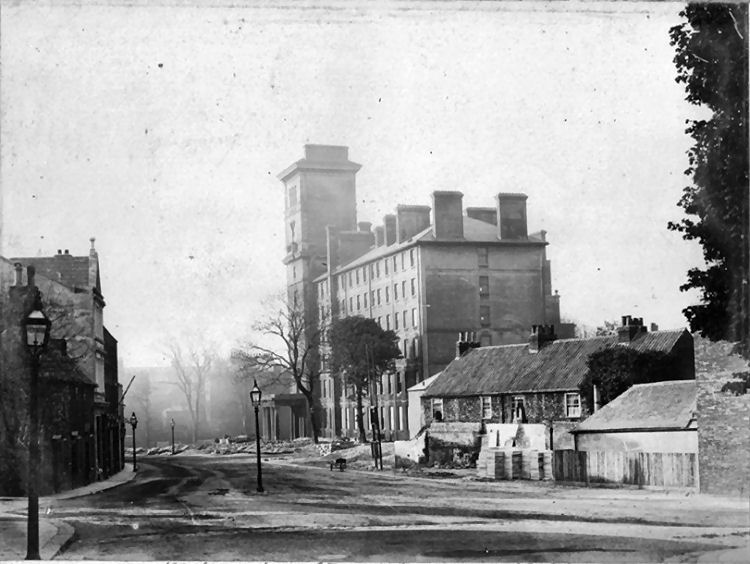
Above photo taken 1893 showing what is described as Woolcomber Street
improvements. At the time the Imperial Hotel would have been closed or
undertaking renovations to become the "Burlington Hotel" in 1897. |
Originally, this building was on the site of "Clarence House." After reopening in
1852 it was named the "Clarence Hotel" but changed name to the "Imperial Hotel"
on 6 April 1867 with a 61 year lease. Again the hotel was closed from 1871 to
1897, when it was restored and reopened as the "Burlington Hotel" by the
Frederick Hotel Company. Barry Smith has found a licensee call "Licence" in 1881 although I
haven't yet traced this source. I assume the gentleman held the license but
never served from the premises.
|
From the Dover Express and East Kent Intelligencer,
12 April, 1867.
DOVER POLICE COURT
Wednesday: (Before the Mayor, Sir Luke Smithern, Captain Crookes, and
J. G. Churchward, R. Dickeson, J. C. Ottaway, S. Finnis, T. E. Back, W.
R. Mowll, and S. M. Latham, Esqs.)
A temporary license was granted to Charles Tomkins, for the "Imperial
Hotel."
The Court was cleared to admit the Bench considering what course
should be adopted in reference to temporary licenses for the Easter
Review, and after some consultation it was decided that such licenses
should be granted, to extend from the Thursday before Good Friday to the
following Tuesday, the houses to be opened till eleven each night, with
the exception of Good Friday and Sunday, when the usual hours would be
observed, and Easter Monday, when publicans would be permitted to keep
open till two o'clock the following morning.
After this, the Mayor Messrs. Latham, Dickeson, and Mowll, and
Captain Crookes were the only magistrates remaining on the Bench.
|
|
From the Whitstable Times and Herne Bay Herald, 13 April, 1867. Price 1d.
THE IMPERIAL HOTEL.
The works at this hotel are being pushed forward with a view to its
opening for the reception of volunteers, at Easter, some idea of its
capacity may be judged front the fact that arrangements are in progress
for 1,000 beds being brought into use there on the forthcoming occasion.
|
|
From the Dover Express and East Kent Intelligencer,
20 September, 1867.
OPENING OF THE IMPERIAL HOTEL
The opening of a new hotel at such a cosmopolitan place as Dover is
an event that may be said in some degree to possess an interest to every
section of that large portion of the British public, who once a year
betake themselves and their families either to the seaside or to the
Continent. Dover is certainly not deficient in good hotels where
passengers en route may obtain excellent accommodation while
waiting for the packet boat or the mail train, but it is believed that
there is room in the town for a first-class family hotel, intended for
the use, principally of persons proposing to spend their holidays at
Dover. It is with this idea that the "Imperial Hotel" has been erected.
The building was commenced about three years ago by a company called the
"Clarence Hotel Company," but the necessary funds not being forthcoming
for the completion, it was leased to a new proprietor in the beginning
of the present year. The undertaking is now known as the "Imperial Hotel
Company," and under its superintendence the erection has been completed,
and the necessary furniture provided. This hotel promises to add
considerably to the popularity of Dover as a watering-place, for it
combines every requisite for a convenient family residence. It is
situated at the east end of the town, under the Castle-hill, away from
all the bustle of the harbour, and its numerous rooms are arranged in
suites to give every convenience for visitors. Although standing a
little back from the promenade, the front windows have and extensive
sea-view over the site of the square known as the Clarence-lawn. The
grounds are of about an acre in extent, and contain a number of fine
trees, which have been carefully preserved, so that the enclosure when
laid out as an ornamental ground will have the additional charm of being
well wooded. The building has been erected at a cost of about £70,000.
It is in the Italian style, from the designs of Mr. Whichcord. The
ground-floor, approached from a portico projecting from the tower, has a
suite of three large coffee-rooms facing the sea. The principle
one of these is a fine room 45 feet by 30 feet; another, 45 feet by 22
feet, is to be devoted to the use of ladies; and it is contemplated to
ass a conservatory to this in the rear to lead into the gardens.
branching away to the right from the vestibule is a long corridor, from
which various private saloons open, and at the end of which is situated
a large billiard-room, 42 feet by 25 feet. A stone staircase leads to
the upper part of the house, where there are some rooms well adapted for
receptions, meetings, balls, and other public purposes. The building
altogether is five storeys in height, and contains 240 rooms; at present
200 of these are open, of which 75 are bed and dressing-rooms. The
basement floor contains every requisite for the carrying on of a very
extensive business. The kitchens are fitted up with all the improvements
which are in use in similar buildings, most of the cooking being done by
steam, supplied by large boilers inside the structure, and lifts have
been provided for lessening the work connected with the establishment.
The inauguration dinner of this Hotel took place last Saturday. The
repast was a most excellent one. Upwards of one hundred sat down,
including Alfred Smee, Esq., F.R.S. (Chairman), Chairman of the
"Imperial Hotel Company"; the Mayor of Dover, Sir Luke Smithett, S.
Finnis Esq., Mr. W. Hawes, Chairman of the Society of Arts, W. C, Fooks,
Esq., Mr. and Mrs. Thornthwaite, E. W. Knocker, Esq., J. Stilwell, Esq.,
Mr. Ottaway, Dr. Drake, Dr. Parsons, Dr. Marshall, Mr. Walter, Joel
Ellis, Esq., Henry Graves, Esq., Mrs. Smee, Mr. and Mrs. G. F. Anderson,
F. J. Law, Esq., Mr. and Mrs. Bowley, of the "Crystal Palace" F.
Robinson, Esq., J. Whitecord, Esq., (the architect), Idehand Long, Esq.,
Mr. H. and the Misses Finch, Copeman, Esq., E. Cottam, Esq., Percy
Court, Esq., T. H. Devonshire, Esq., Dr. Astley, H. A. Linford, Esq.,
(Secretary).
Music was provided, the arrangements in this department being
under the direction of Mr. Fielding. With him were Miss Blanche Elliston
and Mr. Farquharson, and the glees and songs were very excellently
given.
Grace having been sung, and the toasts of the "Queen" and the "Royal
Family" having been drunk, the Chairman gave the Army, Navy, and
Volunteers, which were responded to by Sir Luke Smithert on behalf of
the Navy, and Captain Finch, of the London Royal Brigade, on behalf of
the Volunteers.
The Chairman, in proposing the principle toast of the evening, which
came next, "Success to the "Imperial Hotel Company," took occasion to
observe that it was one of the results of the Limited Liability Act, by
which a number of individuals, contributed small sums of money, were
able to bring about very considerable results. Notwithstanding that in
some instances the act had been taken advantage of for very improper
purposes he was convinced that it was one of the most valuable instances
of modern legislation. The present company had been formed to lease the
hotel from the "Clarence Hotel Company," who erected the building. It
was raised from freehold ground, and consisted of about 234 rooms, of
which 150 were destined to be bedrooms. It was estimated that the hotel
was capable of accommodating 200 visitors, and arrangements had been
made by providing handsome rooms for the accommodation of the
distinguished visitors who were frequently staying at Dover. The company
intended no opposition to the hotels already in Dover. The building has
been erected in what he might call the residential part of the town, in
order that it might suit the convenience of persons intending to reside
in the place for two or three weeks .It was a fact that there was no
sea-side place less known in London than Dover. but he believed that the
natural advantages of the town were so many and so great, and the
sources of interest and attractions so various, that proper
accommodation was the only thing wanted to make Dover one of the most
fashionable and frequented watering-places on the coast. £100,000 had
been spent on the hotel - £75,000 in the building, and £25,000 in
furnishing it. In respects of the profits on the undertaking; the
estimate was that if the hotel was always full all the year round the
receipts would be about £60,000 per annum, of which about £30,000 would
be profit, and after deducting £4,500 for rent and about £15,000 for
interest in capital, they would see that the most exorbitant interest
could be payable to the shareholders. Of course, there would be slack
times, when the hotel would not be full, but he believed that, after
making every reasonable deduction, the undertaking would assuredly prove
very remunerative. The toast was drunk with rounds of applause.
A number of other toasts followed, including "the Mayor and
Corporation of Dover," responded to by the Mayor (W. R. Mummery, Esq.),
"The Prosperity of Dover," responded to by Mr. S. Finnis, and "The
Ladies," responded to by Sir Luke Smithett - and everything passed off
in a satisfactory manner.
|
|
From the Dover Express. June 1868.
FIRE AT THE IMPERIAL HOTEL.
Yesterday morning a fire took place at the Imperial Hotel through the
overheating of the flues. The circumstances were discovered about 2
o'clock and on the alarm having been raised the fire brigade under the
direction of Superintendent Coram was soon on the spot. An abundant
supply of water was quickly obtained from the public mains and the
progress of the fire was arrested. Although the flames had then been
extended but a small distance the damage done was considerable and we
understand the claim upon the company in which the hotel is insured is a
heavy one. The mischief caused by the fire was so exaggerated by rumour
that the manager of the hotel thought it necessary to issue bills in the
course of yesterday informing the public that the business of the hotel
was being conducted as usual.
Information kindly supplied by Joyce Banks.
|
|
Whitstable Times and Herne Bay Herald, Saturday 16 January 1869.
The Imperial Hotel.
We are given to understand that the freehold of the "Imperial Hotel" in
Dover, which was put up by auction on Friday week, and was stated by a
contemporary as being still for sale for £45,000 (half its cost,) was
subsequently sold by private contract and will be carried on.
|
|
From the Dover Express and East Kent News, Friday 26
March, 1869.
CLARK v. BAKER
There was a claim for flowers and grapes, supplied at a banquet given
to the Duke of Cambridge at the "Imperial Hotel." The amount of the
claim was £2 6s. 5d. The defendant, for whom Mr. Lewis appeared,
is the manager of the Hotel, and the proprietor is well-known florist of
the Wellington Nursery, Dover. There was no question about the goods
having been supplied, but the defence of the "Imperial Hotel Company,
Limited" and not the defendant, was liable. The plaintiff was non
suited.
|
|
From the Dover Express and East Kent Intelligencer, 10
June, 1870. Price 1d.
TRANSFER OF LICENSE
The license of the "Imperial Hotel" was transferred to Mr. J. C.
O'Reilly, the Secretary to the "New Imperial Hotel Company."
|
|
Maidstone Journal and Kentish Advertiser, Monday 8 January 1872.
Grand Ball at the Imperial.
On Wednesday evening, a grand ball was given by Mrs. E. W. Barnett, at
the "Imperial Hotel." There were 140 guests, including the elite of the
town and neighbourhood, and the ball was pronounced be the most
successful ever held in Dover. The large coffee room had been prepared
for dancing, and was beautifully decorated, whilst the hall had been
tastefully arranged, and presented a charming appearance. Supper,
provided by Mr. Abbott, was laid in the ladies' drawing-room, and the
musical arrangements were under the control of Mr. Jarrett.
|
|
From the Dover Express and East Kent Intelligencer,
2 February, 1872. Price 1d.
THE IMPERIAL HOTEL
Mr. Abbott, the manager of the "Imperial Hotel," was summonsed for
£60, rates due to the Local Board; and an order was made for payment,
the Town Clerk promising to withhold the execution of a warrant till he
had satisfied himself whether the winding-up of the company, which was
now in process, was voluntarily, by order of the Court of Chancery. In
the latter case the Board would not be able to recover by distress,
though in the former they might.
The Bench said a warrant would be issued only upon the Local Board
giving the Bench an indemnity.
|
|
From the Deal, Walmer, and Sandwich Mercury,
3 May, 1873.
The "Imperial Hotel" is to again be offered for sale. This time the
upset price is to be £26,000. It cost nearly £90,000.
|
|
From the Dover Express and East Kent News, Friday 9 May, 1884. 1d.
Another idea is afloat of making some practical use of the “Imperial
Hotel,” the obstacle at present being a disagreement as to the price of
it.
|
|
From the Dover Express and East Kent News, Friday, 22 February, 1889. Price 1d.
THE IMPERIAL HOTEL
The work of repairs to the “Imperial Hotel,” Liverpool Street, for which
Mr. W. T. Dowel's tender has been accepted are as follows: For works in
division 1, £246; division 2, £503.
|
|
From the Maidstone Journal and Kentish Advertiser, Tuesday 14 October 1890.
Dover Propose New Headquarters.
It is stated that the war department are considering the advisability of
either taking the "Imperial Hotel" or Westmount, Folkestone Road, Dover,
for a brigade office, officers' quarters, and also offices for the
general staff. The "Imperial" has been favourably reported upon by the
surveyor to the department, and it is probable that upon giving up the
Guildford Battery the military headquarters will be at the "Imperial
Hotel." |
LICENSEE LIST
TOMKINS Charles Apr/1867+

BAILEY C A 1870

O'REILLY Mr J C June/1870
ABBOTT Joseph Feb/1871-July/72
FREEBARN John July/1872 (the liquidators agent.)
LICENCE 1881?
From the Dover Express
|

