|
9 Cannon Street

Dover
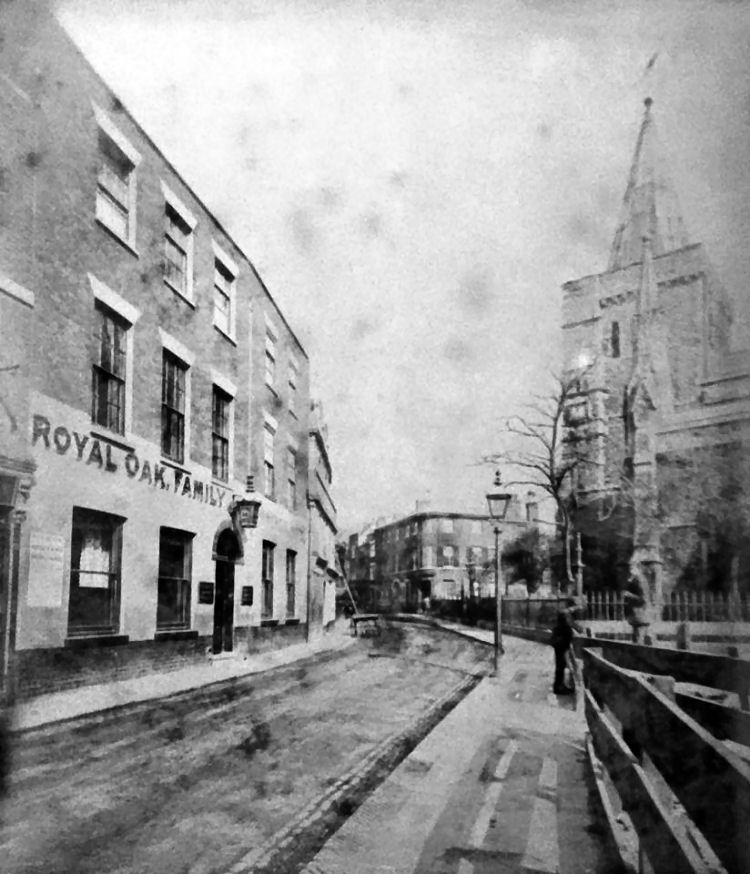
Above photo from the John Gilham collection, circa 1890s.
The picture also shows the "Wellington
Hotel" to the left of the church. |
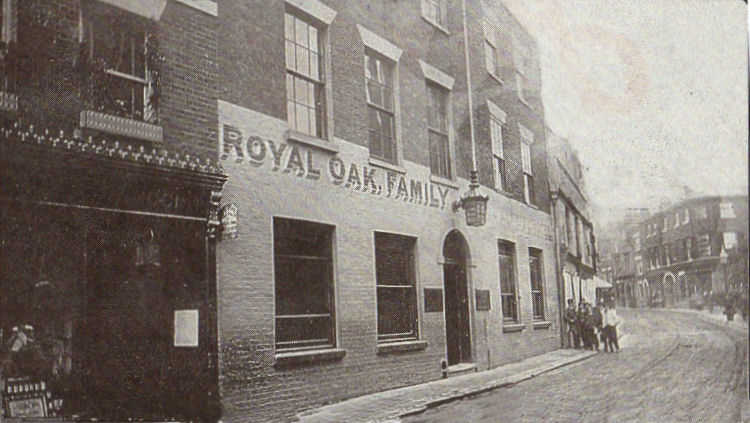
The Royal Oak public house was the main stage coach station in Dover in the early 1780's and was situated just opposite St. Mary's Church.
Coaches used to leave for London at 4am and 6 am. It was removed when the street was widened in 1890. |
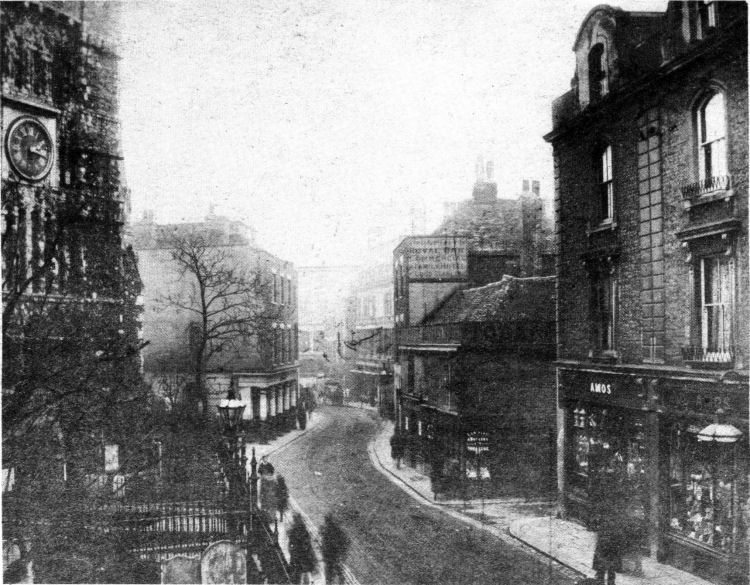
By kind permission of Dover Library. ILL/611.
|
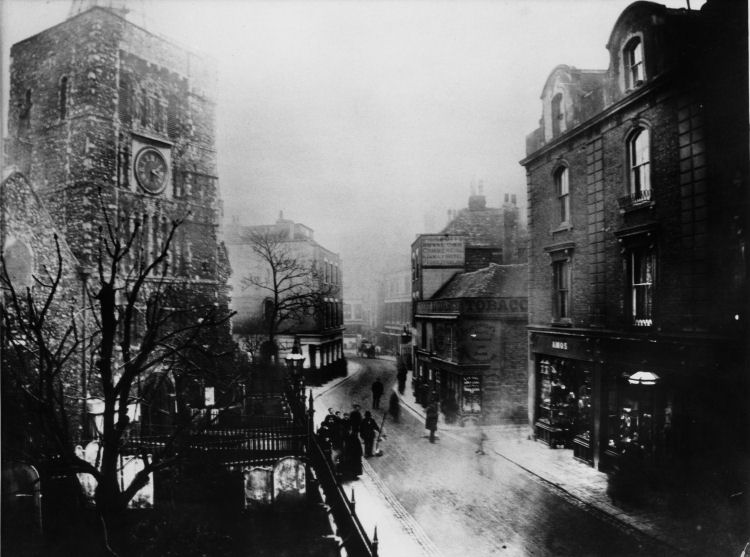
By kind permission of Dover Library. ILL/611.
|
|
A view of Cannon Street between 1875 and 1895 showing right to left
Amos, Ladies Outfitter and Ironmonger, Philpotts Royal Oak hotel and
stables opposite Standens Draper and Cabinet maker business, and
Colonnade prior to demolition: old Dover disappearing for widening
before the turn of the century.
It is believed that the "Royal Oak" had existed there since the Stuart
days, and that it was named after the oak in which Charles II hid
himself. These features disappeared in the widening of Cannon Street in
1893. Prior to that date the street was both crooked and narrow, and in
earlier days it had been narrower still, the footway on the east side
previous to the rebuilding of the church in 1843 having passed over a
part of the churchyard, and after the rebuilding that part was
permanently added to the street. The Royal Oak Rooms, at the back of the
"Royal Oak" Inn, Cannon Street, were used for many years for public
meetings, balls and banquets. The Dover Corn Market, also, was held
there, and the "Royal Oak" yard was the "putting-up" place of coaches,
omnibuses and carriers' vans - a rendezvous for country folk such as no
longer exists in Dover. The Deal coaches made the "Royal Oak" yard their
terminus until they ceased to run on the opening of the Dover and Deal
Railway in 1881.
Information taken from John Bavington Jones' book "A Perambulation of
the Town, Port and Fortress of Dover", 1906. (Reprint in The South Kent
Gazette, July 25th, 1979.) |
 |
|
Above photo, by kind permission of Dover Library, ILL/609.
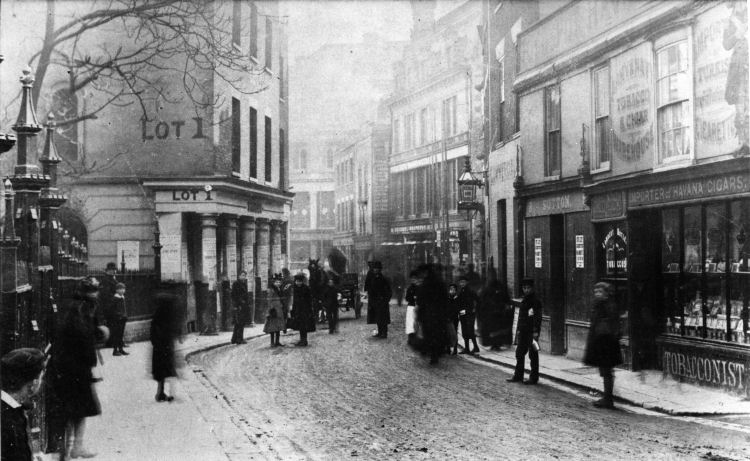
Cannon Street in the 1890's before widening showing Chidwicks, tobacconist,
Sutton's toy shop, Royal Oak Hotel, Wright Brothers, ironmongers, Harts,
outfitters and pawnbrokers - on the corner of Market street - and,
opposite Standen's, draper and cabinet maker, with colonnade labelled
Lot 1. |
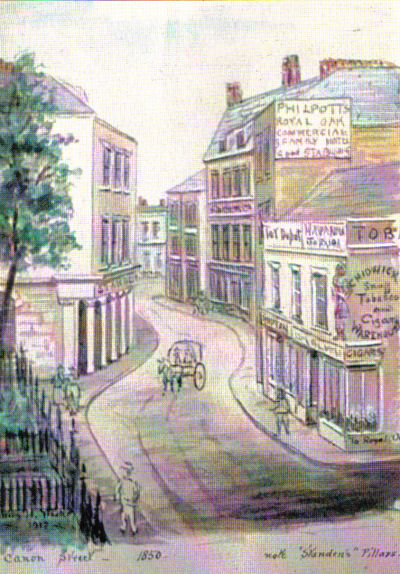
The picture to the left shows a watercolour by Tucker of Cannon
Street and the Royal Oak in about 1850.
Showing the Colonnade on the left, demolished in the 1890s for road
widening. Next to the Royal Oak is Chidwick's the tobacconist's shop.
|
I doubt if an oak stood on this site for Charles to hide in but its
origin was said to be in the time of the Stuarts. Alterations in January
1980 disclosed an old fourteenth century doorway which suggested a priest's
residence associated with the church opposite.
Its rooms were used for meetings and concerts as well as trade and its
extensive yard, with livery stables, was used by coaches and vans. The
populace of the surrounding villages congregated here and coaches from
Eythorne and Nonington ran every Monday, Wednesday and Friday, returning the
same day. Two operators ran coaches from Whitfield, both on Tuesdays,
Thursdays and Saturdays, making the round trip. Coaches from Folkestone
arrived here every day except Wednesday and Sunday, returning the same day.
Coaches for Deal left the inn every day and the London coaches left daily at
four a.m. and six p.m. stopping at Canterbury, Sittingbourne, Rochester and
Dartford.
We know of its presence in 1770 but its demise, like so many others, was
the result of a road widening. That had already been started in 1858, when
the frontages between New Street and the inn had been set back.
I believe the tap to this pub was situated in Market Street.
|
From the Kentish Post or Canterbury News-Letter,
April 18-21, 1753. Kindly sent from Alec Hasenson.
Advert: George Adams, late Master of the Dover Caravan,
has taken the Royal Oak near the Market Place in Dover.
|
|
Kentish Post 2 August 1760.
This is to give notice that on Monday the 4th of August instant
will be played a match of cricket at Dover; the Gentlemen of that
place against the Gentlemen of the West Kent Militia and Folkestone,
for a Guinea a man. The wickets to be pitched at one o'clock and the
match played out.
N.B. There will be a good ordinary on the table at twelve o'clock
at Mr. Hobbs's at the "Royal Oak."
And on Thursday the 7th inst. will be played the return match at
Folkestone. There will be a good ordinary on the table at twelve
o'clock at Mr. Franklin's at the "Rose."
|
|
From the Kentish Gazette, June 9-12, 1770. Kindly sent from Alec Hasenson.
Sale of Household furniture at the Royal Oak in Dover, June 18, 1770.
|
|
From the Kentish Gazette, 5 January 1774.
LOST,
On Tuesday Evening, the 4th of Instant, between Canterbury and Halfway
House to Dover.
A SACK,
Containing three Shirts, two Neckcloths, two Pair of Stockings, a Pair
of Boot Stockings, a Pair of Shoes, a Pair of Boot Shoes, a Pair of
Gloves, and two Books. Whoever has found the aforesaid Sack, and will bring the same to Mr.
Noyse, at the “Mermaid”, Canterbury, or to Mr. Palmer at the “White
Horse” in Bridge, or to Mrs, Gibson at the “Royal Oak” in Dover, shall
receive HALF A GUINEA Reward. |
|
Kentish Gazette, Tuesday 06 November 1787.
Royal Oak Inn, Dover.
Henry Mecrow returns his sincere thanks to his friends for their
generous support; and informs them and the public in general, that he is
now making a very considerable addition to his house, for the better
reception of those who shall please to honour him with their company; he
having determined that nothing, on his part, shall be wanting to render
his house and entertainment agreeable to Gentleman travellers; he having
for the purpose provided an additional number of good and clean beds,
with very good stabling for horses, and the best of corn and hay.
|
|
From the Kentish Gazette, November 6 – 10, 1789. Kindly sent
from Alec Hasenson.
Auction of a "Freehold Messuage", November 11, at
the sign of the Royal Oak in Dover.
|
|
Kentish Chronicles, 26 May, 1795.
Lost, out of a field near Dover.
A bright Bay Colt, rising 3 years old, a star on her face, switch
tail, white legs behind, and near 15 hands high.
Whoever finds the above Mare, and will convey her to the "Royal Oak"
in Dover, shall be satisfied for their trouble.
|
|
Kentish Gazette, 25 March 1803. Canterbury
Monday morning Mr. Hodges, of Dover, set out from the "Royal Oak
Inn," to run to the "Star Inn," in this city, in the space of 2
hours and a half, being the distance of sixteen miles; the first
eight miles (although the worst part of the road), he accomplished
in one hour and seven minutes, and performed the whole of this
extraordinary feat, within the limited time, by one minute,
notwithstanding he experienced a fall just before the termination of
his journey.
|
|
Kentish Gazette 1 June 1819.
Death.
May 24, at Dover, Mrs. Butler, daughter of Mr. H Macros, of the
"Royal Oak Inn," who has left a disconsolate husband and three young
children to lament the loss of an affectionate wife and tender
mother.
|
|
From the Kent Herald, 23 August 1827.
Extraordinary Case. Robbery of the Mail.
George Nightingale was indicted for stealing from the Dover Mail Coach, on the
28th of January last, a bag of letters from the Foreign Mail.
Mr. Sergeant Onslow, Mr. Nolan, and Mr. Bolland appeared for the Crown, and Mr.
Adolphus and Mr. Broderick for the prisoner.
Mr. Sergeant Onslow stated the outline of the case.
It was then shown by several French witnesses who were examined through the
medium of an interpreter, that, on the 26th January last, a mail was made up at
Paris, for transmission to England, through the usual course of communication,
and in the large leather bag contains the letters, divisions were made For the
separation of the letters of different countries, and among three smaller bags
was one containing the Italian letters. The whole were carefully secured and
placed on board the French packet Henry Quarti, for conveyance to Dover.
On the 28th of January, the bag was deposited in the office of Mr. Thomas
Mantell, at Dover, who was placed on the Dover Mail Coach. The most satisfactory
proof was given that at the time the bag was in perfect safety.
---- Williams, guard of the Dover Mail, assisted by Thomas Brailey, of the Dover
Packet Office, and a person named Bates, placed the bag on the coach, and
secured it to the rails by straps and a chair. The mail left the office about
eight o'clock in the evening. There were three outside passengers; two behind
the coachman, and one with him. The male arrived in Lombard Street, about a
quarter past six o'clock. The night was so dark, he could not be positive as to
the persons of the passengers.
Charles Badcock, spare guard, at the Post Office, Lombard Street, received the
Foreign bag, and put it up in the proper room.
John Kirby another spare guard corroborated his testimony.
Thomas Cowrl, a Messenger in the Foreign Office, receive the Mail and found the
outer and some of the Inner bags were split. All the Italian letters were
missing.
John Hollyer, bookkeeper to Mr. Charles Wright, coach-master, at Dover, on the
evening of the 28th, booked an outside passenger for Chatham. He believed
prisoner to be that man. He had previously noticed him passing the window of the
office. Witness asked where he wished to be taken up, and to replied it should
be at the "Oak," or on the look out.
Cross-examined:- Witness could not say whether he saw the man pass the Office
within 10 days or one day of his taking the place. Witness saw no luggage with
the man.
John Hogwood, driver of the mail, had won eight outside passenger, booked for
Chatham, and two for London. Witness have been ordered to take up a person at
the "Oak," who was booked for Chatham. Prisoners was like one of the passengers,
but witness could not positively say he was the man who got up at the "Oak." The
Chatham passenger went with witness to Canterbury, when witness left the coach,
but he saw the man go on by the mail. Two passengers got down at Canterbury; one
had a cloak, the other a short coat.
John Minter, proprietor of the London and Dover Mail, was waiting on the evening
of the 28th of January, Canterbury, and saw the coach come in. He saw two men
come from the direction of the coach. They conversed together and were joined by
a third man. One went from them, and the other two towards the Coach at the
office. He believes prisoner to be one of the men. One man had on a drab coat,
and another a cloak.
S. Wilkes drove the mail from Canterbury to Rochester; was at the "Fountain"
when the mail arrived. Two outside passages got down, and one said they would go
no further; the coachman said they were booked to London. He replied that was of
no consequence. Prisoner was very much like one of the men, but witness could
not swear to him.
John Colley, waiter at the "Rose Tavern," Canterbury, saw the mail come in, and
saw two gentlemen come into the Tavern, for the direction of the mail. They
wanted a chaise and pair as soon as possible. They went out from a minute and
returned. They then went into a private room and had a glass of brandy and
water. One of the men had a bag. Witness went suddenly into the room and when
the chaise was ready. He then saw the two men each feeling and holding letters
to the candle. There were 20 or 30 letters also on the table. When he entered
the room the men exclaimed "d--m" and crammed all the letters into their side
pockets. They paid 2s. for the brandy and water; one of the men took the bag,
and the other stood with his side face towards witness. He had no doubt that
prisoner was the man; he had on a drab coat; the tall man had a cloak, but he
could not swear positively.
Alice Newington, chambermaid of the "Rose", believed prisoner to be the same
man.
John Clements, landlord of the "Rose," heard the men say they came to from Dover
by the mail, but could go no further because there was no room. They had a
chaise and got into it in a very hurried manner, and the tall man ran his head
through the glass of the window. They would not wait for another chaise, but
went on with a broken window though the night was cold.
George Starr, landlord of the "Lion," at Ospringe, disposed that two men came to
his house from the "Rose," Canterbury, in a chaise. They went to Chatham. It was
then half past 12 o'clock at night.
James Bassage, waiter of the "Sun," deposed to two men coming there in a chaiseat at two o'clock in the morning. They stayed half an hour and took
refreshment.
John Baily, a school master, and John Penn, a boot maker, were at the "Sun," and
the two men sat down in their company. The last five witnesses all expressed
their belief that prisoner was the shorter of the two men, but would not swear
positively to his identity.
Prisoner in his defence put in a written paper in which he stated that he was
innocent, and would prove that he was 200 miles from the place at the time the
robbery was committed.
Benjamin Booth deposed that he was a proprietor of the "George Inn,"
Glastonbury, Somersetshire. Prison was at his house, on the 19th of Jan. stayed
till the 22nd; one gentleman was with him. They went away together, and returned
about half past four of the afternoon of the 25th January. Prisoner and his
friend slept at witnesses house, the two next nights.
The results was that on and intimation from the Court, the Council for the Crown
did not press for the case to go to the Jury, and prisoner was acquitted.
He has since been apprehended on a charge of being the man who robbed a
gentleman of £200 at Stockman's fight a year or two ago. The officers were in
waiting for him, and he ran swiftly towards the Bridge, but was finally
captured. He has said to be possessed of much property. This prosecution is
reported to have cost the post office nearly £10,000.
|
|
From the Dover Telegraph and Cinque Ports General
Advertiser, Saturday 30 November, 1833. Price 7d.
The meetings of the Friendly Musical Society at the "Royal Oak Inn"
being suspended this winter, the Anacicontle Society has been revived at
the "Fleece Tavern," under the presidency of
G. W. Gravener, Esq. An orchestra of amateurs has been formed, and no
doubt is entertained of the societies recovering the celebrity is
formerly acquired.
|
|
From the Dover Telegraph and Cinque Ports General
Advertiser, Saturday 8 February, 1834. Price 7d.
Valuable Freehold Mills, Capital, Messuage and Garden, Farm and
Lands, at Buckland, near Dovor.
TO BE SOLD BY AUCTION BY
MR. GEORGE HARRISSON,
At the Royal Oak Inn, Dovor, on Saturday, the 5th March, 1834,
between the hours of One and Three in the afternoon., (by order of the
Commissioners under a Fiat of Bankruptcy against Mr. William Kingsford.)
ALL THOSE FREEHOLD CORN AND PAPER MILLS, Capital Messuage, Garden,
Farm and Lands, situated in the Parish of Buckland, in the County of
Kent, and late in the occupation of the said Bankrupt.
Particulars will be given in future Advertisements, an information
may be obtained of Mr. Surrage, Solicitor, Sandwich; Messrs. Shipdem and
Ledger, Mr. Kennett, and Mr. E. Elwin, Solicitors, Dovor; and of the
Auctioneer, Barton Farm, near Dovor.
Dovor, February 6th, 1834.
|
|
From the Kentish Gazette, 24 April 1838.
It is expected that very nearly 200 persons will sit down to the
Conservative dinner this day, at the "Royal Oak Inn," Dover. Sir
John Rae Reid, Bart, the representative, Mr. Fector, M.P. for Maidstone,
and several other Members of Parliament, are expected to
be present. Sir John Reid arrived from London on Saturday night, at the
"Ship Hotel."
|
|
From the Kentish Gazette, 2 July 1839.
DEATH.
June 23, in London, Mr. William Mowll, of the "Royal Oak Inn," Dover, and
one of the Council of that Borough.
|
|
From the Dover Telegraph and Cinque Ports General
Advertiser, Saturday 26 September, 1840. Price 5d.
A Temperance Tea party
was held on Thursday afternoon at the Royal Oak Rooms, to which a
Teetotal meeting was appended, in the same place in the evening. Though
enlivened only by the circling teacup, the speakers exhibited a great
deal of spirit in their several addresses; and portrayed in
strong terms the ill effects of intoxicating drinks, and the beneficial
results of Teetotalism. Several signatures were added to the list of
members.
|
|
From the Dover Telegraph and Cinque Ports General
Advertiser, Saturday 26 December, 1840. Price 5d.
On Wednesday last a female
servant at the Royal Oak, while at work in the hall, fell down and broke
her arm. We understand another woman, one day this week, had her leg
broken in Snargate Street.
|
|
From the Kentish Gazette, 5 July 1842.
DEATH.
June 27, at Dover, the wife of Mr. T. Shilling, of the "Royal Oak Tap."
|
|
From the Dover Telegraph and Cinque
Ports General Advertiser, Saturday 31 August, 1844.
Henry Garlinge, William Bass, and William Frost, charged with being
found in the “Royal Oak Tap” for an unlawful purpose. Mr. Hudson the
landlord, stated that early on Sunday morning, his wife hearing a noise
in the house, he got up, and on going down stairs saw three men in the
tap-room, who immediately ran out. He called for assistance, and on
going into the yard saw two or three other persons, who were getting
over the wall. He could identify Garlinge and Bass, as being two of the
persons in the tap-room, but not Frost. On examining the door he found
that the lock had been forced back. He then fastened the door and went
to bed, and between one and two o'clock he was again awoke by hearing a
noise by breaking tiles. He called his son and went out of the front
door to find the police, and meeting with sergeant Laker, returned with
him and two of the police. On entering the house his son said that the
men had just run round the corner down York Street, on which the police
followed them. Sergeant Laker stated that on going down York Street, he
apprehended Bass and Frost on the Folkestone Road. Garlinge was
apprehended at his father's house about four o'clock in the morning.
The landlord on being recalled, stated that he missed nothing from the
tap-room, as there were only tables and chairs in the room. He could not
say what their intention was in entering the house. On examining the
roof of the out-house, the tiles were found to be broken where they had
forced an entrance. The bench decided, that there was not sufficient
evidence to prove a felonious intent, and the prisoners were discharged
on payment of 1s. each.
We almost regret this lenient decision of the Bench, as we understood on
the following morning (Tuesday) some person broke open the out-house of
the “Royal Oak Tap,” and three fowls were stolen therefrom.
|
|
Dover Chronicles 21 February 1846.
Death.
Feb 20, at Dover, Mrs. Mowll, the much respected landlady of the
"Royal Oak Hotel.
|
|
From the Dover Telegraph and Cinque Ports General
Advertiser, Saturday 21 February, 1846.
February 20th, at Dover, deeply regretted, Mrs. Mowll, of the "Royal
Oak Hotel," aged 49.
|
|
From the Dover Telegraph and Cinque Ports General Advertiser, Saturday, 6 February, 1847. Price 5d.
CORONER'S INQUEST
An inquest was held on Wednesday, at the “Royal Oak Tap,” before G. T.
Thompson, Esq., Coroner for the Borough, on the body of Elizabeth
Williams, a child aged three months.
The Coroner observed that the father of the deceased had very properly
called upon him, and stated that the child had died very suddenly; and
as she had not been attended by a medical gentleman, the father could
not obtain a medical certificate as to the cause of death, and he (the
Coroner) considered it his duty to hold the inquest, although it was but
justice to say that he had no suspicion hinted at against the parents. –
The following evidence was then taken:-
James Williams, stoker in H.M.P. service, residing in Youden's Court,
and father of the deceased, deposed: The child had been subject to
severe colds since her birth, but on Saturday she appeared recovered and
quite well. She was taken to bed on Saturday evening by her mother.
About half-past three o'clock my wife awoke me, saying the child
appeared dead. She had not cried during the night, nor were the clothes
over her face; nor she had been subject to fits or convulsions. I got up
and called my neighbour, Mrs. Burton.
Hannah Burton: On Sunday morning Mr. Williams called me up, saying his
child was dead. I went into his house, and saw Mrs. Williams sitting by
the fireplace, with the child in her arms. I took the child, who was
quite insensible; but she was warm, and I think breathed once. Mrs.
Williams told me that the child appeared much better when it went to bed
but that on waking in the morning she found the child lying on her
breast, and thought it was dead. About a fortnight since I thought there
was a boil or abscess forming on the child's back, and I wished Williams
to send for Mr. Jones, who advised a poultice, and that the child should
be put into a warm bath, which I did, and on taking her out the abscess
burst. I cannot account for the child's death, but thought her sickly
from the first, and that she would not live.
The Coroner and three of the Jury then proceeded to take the evidence of
Mrs. Williams, who was unable to leave her house; and on their return
the Coroner read her deposition, which confirmed the statements of her
husband and Mrs. Burton, and, in addition, that the child had been
afflicted with the thrush.
The Coroner said this was the whole of the evidence, and it was for the
Jury to say if they were satisfied it was sufficient to account for the
cause of death; if not, the only course would be to have a post-mortem
examination.
The Jury considered that the evidence was sufficient, and that there was
no grounds for suspicion against any parties; and after a short
consultation returned a verdict of “Death from natural causes.”
|
|
Dover Chronicles 6 March 1847.
Sunday.
On Wednesday last, an inquest was held before the Borough Coroner,
at the "Royal Oak Tap," Market Street, on view of the body of
Elizabeth Williams, a child 3 months old, (daughter of James
Williams, stoker of one of H.M.S. packets here, residing in Youden's
Court,) who died suddenly on the morning of Sunday last.
From the evidence adduced it appeared the child, who had lately been
suffering from a severe cold, had greatly recovered on Saturday
last, and during that night it took the breast freely; and that
about 3 o'clock on Sunday morning, when it's mother awoke, she found
it dead, though it's body was warm. It's head was not covered by the
bed clothes; it had not been noticed to struggle, or heard to cry as
if it were in pain; and it's mother could not account for its death.
It had been a sickly child from it's birth, and at times subject to
the thrush.
Verdict:- "Died from Natural Causes."
|
|
From the Dover Telegraph and Cinque Ports General
Advertiser, Saturday 19 February, 1848. Price 5d.
David Walsh, private 17th regiment, charged with stealing a quantity
of rope, and netting needles, from the "Royal Oak Tap." It appeared that
on the articles being missed, information was given that a soldier had
been seen coming from the back of the premises early in the morning, on
which application was made at the barracks; and on searching, the
missing property was found under Walsh's bed.
Sergeant Kelly stated that shortly after seven o'clock, Walsh came to
him in the barrack yard, saying he had found the articles on the hill;
and that he afterwards took them into the canteen, where he made no
attempt to conceal them. It was also proved that Walsh had been in
barracks the whole night, and the case was dismissed.
|
|
From the Dover Telegraph and Cinque Ports General
Advertiser, Saturday 18 March, 1848. Price 5d.
CORONER'S INQUEST
An inquest was held on Monday, at the "Royal Oak Tap," Dover, before
G. T. Thompsom, Esq., Coroner for the Borough, relative to the death of
Edward Alexander Horn, a child ages 3 months. The jury having been
sworn, and Mr. W. R. Mowll appointed foreman, the investigation was
commenced, when the following evidence was adduced:-
Mary Ann Horn, mother of deceased, stated: I live in Youden's Court;
the child from its birth was healthy, and never required medical advice.
About half-past five on Thursday morning I suckled deceased, and he
appeared quite well; I then placed him in the hollow of my arm, the bed
clothes come up to his chin and my shoulder; he was then quiet, and I
fell asleep. I woke up about a quarter past six, on my husband coming
home from duty. Shortly after, not finding the child breathe, I looked
at him, and he appeared dead. I awoke my husband, and he went for Dr.
Rutyley, who arrived within a quarter of an hour; but he said he could
do nothing for the child, neither could he tell the cause of death.
Thomas Alexander Horn, policeman, and father of deceased, deposed: On
Thursday morning I left my duty at six. I then went to bed, and slept
about half an hour, when I was awoke by my wife, who said something was
the matter with the child. I took him in my arms and his mouth and eyes
opened. I then ran for the doctor.
The jury then adjourned till this day, for the purpose of a post
mortem of the body,
|
|
From the Dover Telegraph and Cinque
Ports General Advertiser, Saturday 26 August, 1848. Price 5d.
DOVER PETTY SESSIONS
Jesse Thomas charged with an assault on Mary Ann Hills. Complainant
stated that she was at the "Royal Oak Tap" on Wednesday evening, when
defendant, without any provocation, struck her a violent blow in the
face.
Thomas, in his defence, said he was drinking with some soldiers, one
of whom was very flush with his money, and after treating with drink,
changed a £5 note. Complainant and others endeavoured to get him into
their company, and in preventing which, he pushed complainant away.
Fined 10s., including costs, and in default committed to prison for 14
days.
|
|
Kentish Gazette, 10 July 1849.
Manchester Unity of Odd Fellows.
On Tuesday evening last the Assembly Room at the "Royal Oak Hotel" was
the scene of one of the most interesting festal
celebrations, associated with the above Order, that have transpired
since its introduction into Dover.
|
|
Southeastern Gazette, 6 September 1853.
ROYAL OAK.
Family and Commercial Hotel, Cannon-street, DOVOR.
OSBORN LAMB, having lately taken the above old-established house,
begs to inform Commercial Gentlemen and Families that the rooms have
been entirely redecorated and modified, and will be found replete
with every convenience, combined with moderate charges.
Horses taken in at Livery. Lock-up Coach-houses.
The large ASSEMBLY ROOMS, having been newly decorated, are highly
eligible far concerts, balls, assemblies, and all public purposes.
All applications to be addressed to O. Lamb, "Royal Oak Hotel,"
Cannon-street, Dovor.
|
|
From the South Eastern Gazette, Tuesday 2 June, 1857.
HARRIERS' HUNT DINNER.
The wind-up of the last hunting season was celebrated by a substantial
dinner at the "Royal Oak Inn," Dover, on Friday last; the main object of
the gathering being to do honour to Mr. Michael Nethersole, proprietor
of the West Street Harriers. The chair on the occasion was occupied by
Mr. Gilbert Eastes, and the vice-chair by Mr. William Moxon. A large
company assembled on the occasion; the dinner and wines provided by Mr.
S. Philpott, were excellent; and the evening was altogether a pleasant
and congenial one.
|
|
Kentish Chronicle, 2 June 1860.
MARRIAGES. DOVER.
May 24, at St. Mary's Church, Thomas, son of Mr. Thomas Holttum, of
Upper Hardres, to Emma, eldest daughter of Mr. Stephen
Philpott, of the "Royal Oak Hotel," Dover.
|
|
Dover Telegraph and Cinque Ports General Advertiser, Saturday 22 December 1860.
Dover (1st Cinque Ports Artillery Volunteers.) Presentation.
The members of this Corps assembled in the large room belong to Mr.
Philpott, "Royal Oak Inn," (which has been placed at their disposal by
that gentleman,) for the purpose of presenting to the bandmaster of the
32nd (Lucknow) Regiment of gold mounted ivory baton, which had been
purchased by subscription, as a token of their appreciation of his kind
services and assistance in the formation of their excellent band. The
capt-commandant (E. Wollaston, Esq.,) occupied the chair, and was
supported by the officers of the Corps. The presentation made, Mr. J.
Miller expressed his gratification in accepting such a mark of their
satisfaction, adding that it was another link which bound the 32nd
regiment to the inhabitants of Dover, and that that both officers and
comrades would be equally as pleased when they saw the manner in which
his poor services have been requited that evening. A social hour ensude,
the song and toast being varied with performances by the band.
|
September 1864 saw the
property, then in the occupation of Mr. Stephen Philpott, put to auction by
"Jeken & Co's" Brewery Estate, with its extensive outbuildings, stables, corn
market room and the appurtenances belonging thereto. It was advertised with
the following:-
"There are peculiar advantages attached to this lot it
being the Office of Inland Revenue and also the Corn Market, which is held
there every Saturday; and having besides an extensive patronage bestowed on
it by Commercialists. The stabling and coach-house accommodation is very
extensive."
The
remaining properties on that side were removed for the road widening in 1893. On completion of
that widening the "Metropole Hotel" arrived, that building being commenced
in 1895.
Compensation and purchase price paid by Dover Corporation for the inn,
its store and yard, equalled £8,935.2s.6d.
A "Royal Oak Tap" was present from 1841 to 1847 but I do not know what
its association was, if at all, with other houses of like name. This was
situated in Market Street.
|
From the Whitstable Times and Herne Bay Herald, 13 April, 1867. Price 1d.
A meeting of the friends of the late Mr. E. T. Way, for twenty-three
years superintendent of the South Eastern Railway Terminus, was held at
the “Royal Oak Hotel” on Friday evening, when it was resolved, that as
the widow had been left in somewhat straitened circumstances, a
subscription should be set on foot to repay the funeral expenses, and
likewise to render as much assistance as possible to the bereaved one,
and for this purpose the Rev. W. Yate was appointed treasurer, and it
was resolved that Mr. Jacobs, not being present, should be requested to
undertake the duties of secretary.
|
|
From the Dover Express and East Kent News, Friday
21 June, 1867.
MARRIAGE
On Tuesday was celebrated at the parish church of St. Mary the
marriage of Miss Louisa Philpott, the third daughter of our worthy and
respected townswoman, Mr. S. Philpott, the proprietor of the "Royal Oak
Hotel." The happy bridegroom in this instance is Mr. Henry Godfrey, of
Oundle, Northamptonshire. The marriage was a grand one, the bridesmaids
numbering half-a-dozen, and the ceremony being witnessed by a
considerable number of spectators, who assembled in and outside the
church. The carriages were furnished by Mr. F. Packham and not allowed
to stand idle by the less interested partakers in the ceremony, who
enjoyed the pleasures of driving along the beautiful valley of the Dour,
during the afternoon, though the happy couple themselves left for town
by the 3.45 p.m. train.
|
|
From the Deal, Walmer, and Sandwich Mercury,
22 April, 1871. 1d.
THE WEST STREET HARRIERS
The complimentary dinner to Mr. M. Nethersole, of the West Street
Harriers, and Mr. Smith, the huntsman, took place at the "Royal Oak
Hotel" on Friday evening last, and was a great success. Captain Julles
presided, and was supported by Mr. J. G. Churchward, Captain Coleman,
Mr. Stephen Court, and other gentleman.
|
|
From the Dover Express and East Kent News, Friday, 26 May, 1871. Price 1d.
CAUSING AN OBSTRUCTION ON THE FOOTWAY
John Wood, a labouring man, was charged with causing an obstruction in
Cannon Street on the previous evening, and with assaulting
Police-sergeant Johnstone while in the execution of his duty.
Police-sergeant James Johnstone said that on the previous evening, about
half-past seven, his attention was called to an obstruction in Cannon
Street. On arriving there he found that a large crowd had congregated in
front of the “Royal Oak Hotel,” rendering it very difficult for any one
to get past. Some of the Mounted Rifles were throwing halfpence to a
number of children. He succeeded in getting several of them away, when
he saw Wood standing in front of the Hotel. He asked him several times
to go away, but he refused. He succeeded in getting him some four or
five yards up the street, when he (Wood) suddenly turned round and gave
him a push. He then said he should take him in custody, and on his
attempting to do so prisoner took hold of his shoulder and tripped him
up, throwing him down on the pavement, and thereby injuring his left
leg. Prisoner then laid down in the road and refused to get up.
Police-constable Hemmings finally came to witness's assistance, and with
the aid of one of the Mounted Rifles, who, on being charged, rendered
his assistance, they took him to the station-house.
Prisoner denied having tripped up the constable; and said that it was
the constable who had pushed him down.
The police-sergeant, in reply to the Bench, said he had not done so.
The Superintendent of Police, in answer to the Magistrates, said he knew
nothing of the prisoner, except that he had been before the bench on a
similar charge the previous October.
Johnstone, on being again questioned by the Bench, said he found a great
crowd in Cannon Street. His attention, he said, was first drawn to it by
Mr. Smith, the magistrate, who told him that the Mounted Rifles were
throwing coppers to some children, who were completely blocking up the
thoroughfare, and that he (Mr. Smith) had had the greatest difficulty in
effecting a passage through the crowd.
The Magistrates said that the constables had a very arduous duty to
perform, and that in the performance of it they must be protected. The
prisoner had made himself liable to three months' imprisonment; and he
might think himself fortunate, in the present instance, in being sent to
gaol for fourteen days only, with hard labour.
A person giving the name of Mrs. Rogers, and stating that she resided in
St. James's Street, here came forward and said that she was present on
the previous evening at the occurrence in question. She said that the
man who was really to blame had made his escape, while the defendant,
who was a mere on-looker, was taken into custody. She saw the Rifles
throwing money to the children, and they afterwards threw some water
from the hotel window. Some of the water happened to fall on a gentleman
standing beneath the window. The “gentleman,” who was very indignant,
offered to fight any of them if they would come down; but they refused
to come; and they told the man who had made his escape that they would
give him half-a-crown if he would take the skin off the gentleman's
nose. (A laugh.) This man offered to do; but when he saw the constable
coming he ran off, and the defendant, who happened to be standing close
by, was taken into custody.
The Magistrates, after some consideration, said that they heard nothing
to induce them to alter their decision.
|
|
From the Dover Express and East Kent Intelligencer,
1 January, 1875. Price 1d.
MAGIC v FELONY
Charles Mills was charged with stealing one leather bag, one coat,
one velvet coat, one waistcoat, a pair of black trousers, a pair of grey
ditto, 3 shirts, and £2, being altogether the value of £8, the property
of Stephen Solley, on the 10th of October at Dover.
Mr. Ormerod appeared for the prosecution.
Stephen Solley said: I live at the Military-road, Dover. I am a
professor of magic, and have travelled, but do not do so now. I was at Walmer of the 10th of October, and I sent my luggage to Dover by the
Deal Coach. It was supposed to be left at the "Royal Oak Hotel," at
Dover. The prisoner assisted me to put the luggage on the coach. He went
on with the coach and I came later. I appointed him to meet me in
Castle-street, Dover at eight o'clock. He did not keep the appointment.
I one of the boxes were two bags, and one bag is lost. The articles
mentioned in the indictment were in the box. There were also in the box
a bag of coins, being two sovereigns, and 21 counterfeit coins which I
used for my tricks. One of the boxes had been broken open, and all the
things I mentioned were gone. The articles now produced by the police I
identified as my property.
Cross-examined by Mr. Glyn: At the time of the robbery I was a
professor of magic. I travelled the country mesmerising ladies and
gentlemen. I do not mesmerise counterfeit coins into good ones. The
magic business was not so successful as it might be. I owed the prisoner
no money, but I stopped 5s. for a debt for board and lodgings while he
was away from me. He had 10s. a week. I paid him the full amount of his
wages; sometimes in instalments. He may have paid for beer, but I paid
it back. The prisoner did not demand £1 1s. 4d. from me on the day he
left. He only asked for his fare by the coach, which I paid, I paid Mr.
Makie, of the "Stag" at Walmer, on
the day I left. I always paid my debts. One night there was only £2 left
of the entertainment. I put that in the box. The prisoner used one of my
coats; there were no magic pockets in it.
Henry Couthard, porter at the "Royal Oak Hotel," Dover, said that on
the 10th of October he saw two boxes that came by the coach, and were
deposited at the "Royal Oak." He saw a young man uncord the boxes, but
it being dark he could not say who he was.
At this point the learned council for the prosecution was about to
repeat the question, but the council for the defendant objected,
whereupon the Recorder took the matter in hand, and asked if the witness
had any belief one way or the other as to who took the goods. The
witness was a long time in answering the question, and the Recorder
repeatedly asked if he understood it. "Yes," the witness replied, with
evident consternation, "It's about the belief, but I don't know what to
say as I cannot swear to prisoner." At length the witness answered "No,"
and he further stated that the prisoner took out of the box a little bag
containing coin and went away.
Mr. J. Long, of the firm Long and Bacon, said a person giving the
name of Charles Mills, brought a shirt and waistcoat and pawned it for
2s. 6d. He could not swear to the prisoner.
J. W. Moore, assistant to Mr. Hart, pawnbroker, said the prisoner
brought a coat and trousers to their shop and pawned them for 5s. He
asked £1 for them. He said his address was Charles Mills, East-cliff.
Mr. Solley afterwards came and saw the articles in question.
Cross-examined: I can identify the prisoner. I took particular notice
of him, and should know him anywhere.
Police-sergeant Barton said he apprehended the prisoner on warrant in
Middlesex. The prisoner was duly cautioned, and he replied, after he
heard the warrant read, "I did take the things mentioned in the
warrant." The coat and trousers I pawned at Hart's for 5s., and the
shirt and waistcoat I pawned at Long's for 2s. 6d." I had told him, of
the coins, and he said, "The coins you speak of are at my mother's at
Sheperton Green. I went there and received some collars. I did not get
the coins, but the mother made a statement.
Mr. Glyn objected to this statement being made.
The Recorder said the Sergeant was a special agent of the prisoner to
get the coins, and therefore he would take the evidence stated in the
prisoners' absence.
Mr. Glyn objected to this hearsay evidence. He said the person in
question might have said that the prisoner had committed a murder.
Surely that would not be admissible evidence.
The Recorder said that was not relevant to the charge. He would take
the evidence if the prosecutor pressed it.
Mr. Ormerod said he would not press the evidence.
Witness continued that the prisoner was wearing a pair of trousers
which he said were Mr. Solley's. He (witness) was not able to speak of
the prisoners' character.
The prisoners' statement, admitted the theft having been read.
Mr. Ormarod made a second speech to the jury, in which he rebutted
what he anticipated would be the defence.
Mr. Glyn for the defence urged that if the prosecutor owned the
prisoner money, the jury could not find the prisoner guilty of felonious
intent if he took some of the prisoner's goods to raise the money he was
alleged was owing to him. Of course he could not advise anyone to act in
that way but the prisoner having acted in that way was it felony? He
submitted that the jury would not think so and that the prisoner should
be acquitted.
The Recorder elaborately summed up, and in the course of the remarks
pointed out that the allegation of money being owing from the prosecutor
to the defendant on which the defence was based was pure fiction. If the
money were owing, the County Court was the place to recover it, and it
could not be permitted that the prisoner should break open a box and
help himself to the prosecutor's property. The charge of indictment was
felony, and if proved the jury would find a verdict of guilty.
A verdict of guilty was returned and letters were sent in from
various persons giving a good previous character to the prisoner and the
prosecutor said he had been a good servant and asked that he might be
dealt with leniently.
The prisoner aid he had been living with Lady Bacon at East-cliff,
Dover, and the sentence was deferred so that some of her ladyship's
house might come to speak as to his character.
John Mitchell, coachman, to Mrs. Bacon, of Honiton House, East-cliff,
said the prisoner was in Mrs. Bacon's service four months as helper in
the stables. I had a very good character with him. He left to go with
this person, the prosecutor.
The prisoner begged for mercy on the ground that he pledged these
goods to get home as he had not a penny left.
The prisoner was sentenced to three month's hard labour.
|
|
From the Whitstable Times and Herne Bay Herald, 2 January 1875.
ROBBING A MAGICIAN.
Charles Mills, 22, stableman, imperfect education, was indicted for
stealing one leather bag, one cloth coat, one velvet coat, one
waistcoat, one pair of black cloth trousers, one pair of grey trousers,
three shirts, and the sum of £2, together of the value of £8, the
property of Stephen Solly.
Mr. Ormerod prosecuted, and Mr. Lewis Glyn (instructed by Mr. Mowll)
defended.
Stephen Solly deposed:- I live at the Military Road, Dover. I am a
professor of magic, and have been travelling about the country. Prisoner
has been in my employ. I discharged him on the 10th of Oct at Walmer. On
that day I sent my luggage to Dover by the coach, directed "Professor de
Solly," and I said it must be taken to the "Royal Oak Hotel." Prisoner
went by the same coach, and I appointed to meet him in Castle Street,
Dover, at eight o’clock the same evening. He did not keep the
appointment. The luggage was contained in two large boxes. Besides the
clothes mentioned in the charge there were two sovereigns and 21
counterfeit coins that I used in my tricks. On the 13th of October I
sent for my boxes, and when they arrived I found they had been broken
open. I examined them, and found that the clothes and money were gone. I
gave information to the police immediately, giving Superintendent
Sanders a list of the articles missing. I identify the two coats, the
pair of trousers, the shirts, and collars produced as my property. I did
not give any of the articles to the prisoner.
Mr. Glyn raid the jury had heard persecutor admit borrowing one sum and,
according to prisoner, he owed him £1 1s. 4d. As tradesmen they knew
that if they performed work on any article they stuck to it till they
were paid. Prisoner had done the same and had sold some of his master’s
clothes.
Had he realised more then his debt?
No; nothing like it. He (Mr. Glyn) would not attempt to show the jury by
what process of reasoning they would arise at a verdict of not guilty,
but be submitted that they could not in justice return the prisoner
guilty.
The Recorder, in summing up, said that if prisoner had had any claim
against the prosecutor he could have obtained redress in the County
Court. It would be intolerable if when there was a dispute concerning
wages between a master and workman, the latter were justified in taking
goods to satisfy his claim.
The Jury, after consulting for a few moments, returned a verdict of
guilty.
Mr. Glyn put in testimonials from prisoner's former employers, and John
Mills, to Mrs.
Bacon, at East Cliff, gave him a good character.
The Recorder, in passing sentence, said there was one thing he disliked
in the ease, and that was prisoner’s having alleged in defence that the
prosecutor owed him money.
(Prisoner: That is quite true).
He did not believe it was. Taking into consideration that prisoner had
been already two months in gaol the sentence of the Court upon him would
be only three months' imprisonment, with hard labour.
|
|
From the Dover Express and East Kent Intelligencer, 24 March, 1882. Price 1d.
The annual meeting of the West Street Harriers will be held at the
“Royal Oak Hotel” on Saturday, the 1st of April, after which a
complimentary dinner to the Deputy Master, Morris Thompson, Esq., will
take place, the Mayor, J. L. Bradley, Esq., presiding.
|

Above advert 1883. |
|
From the Dover Express and East Kent News, Friday, 22 April, 1887. Price 1d.
REFUSING TO QUIT THE ROYAL OAK
Peter Roberts, a stranger to the town, was charged with being drunk and
disorderly at the “Royal Oak Hotel,” Cannon Street, and refusing to quit
those premises when requested by the proprietor.
Mr. R. Philpott. Proprietor of the “Royal Oak Hotel,” said: last night,
shortly before eleven o'clock, the defendant came into the passage. I
asked him what he wanted. He replied that he had come to see a friend of
his and intended staying until he had seen him. I requested that he go
out and he refused. He was not sober. I afterwards put him outside and
he made use of very abusive language. I followed him a short distance
down the street, and afterwards saw him being turned out of the “Antwerp
Hotel.” I then saw a Constable and gave defendant in charge.]
Police-constable Bass (D.28) said: last night, about a quarter to eleven
o'clock, I was on duty in the Market Square near to the “Antwerp Hotel.”
I saw several Volunteers go into the hotel, the defendant following
them. I heard one of them tell Mr. Fox that defendant had just been
turned out of the “Royal Oak Hotel.” Mr. Fox then requested the
defendant to leave, but he refused. Mr. Fox then put him out. He
attempted to go in again. Mr. Philpott then came up and gave him into
custody. The defendant was drunk, and made use of filthy language. I had
to obtain the assistance of a County Constable in bringing defendant to
the Police Station.
The Bench find the defendant 5s. and 7s. costs, or in default seven
days' imprisonment.
He paid the money.
|
|
From the Dover Express and East Kent News, Friday 3 February, 1888.
FELONY
James Charles Roberts was charged with stealing from the “Royal Oak
Hotel” a quantity of coal, to the value of 9d., the property of R.
Philpott.
Mr. R. W. Philpott said: I know the prisoner. He has been employed by
the “boots” to do odd jobs, and go out with the commercial gentleman. He
has been employed for some time. He has access to the cellar, but he had
no business there. I have had reason to believe that the coal has been
taken from my cellar for some time. From something I heard last Friday
morning I communicated with the police. I cannot swear to the coal
produced, the value of which is 9d. My place has been watched since
Friday by the police. I also have some wood similar to that produced; I
keep it in an outhouse.
Police-sergeant Suters said; According to the instructions I received I
kept observations on the “Royal Oak Yard.” About a quarter to eight a.m.
I saw the prisoner come out of the back of the hotel carrying the bag of
coal produced. He took it to the gate leading into Cannon Street, stood
it down and looked round the yard. He then put it on his back and ran
out of the gate up Biggin Street into York Street. I stopped him in York
Street and asked him what he had in the bag; he replied, “Some coals.” I
asked him where he got it from, and he said from the “Royal Oak Hotel.”
I asked him if he had any right to bring them away, and he said that one
of the servants gave them to him. I told him that he would have to come
to the Police Station, and he begged very hard not to be allowed to. He
then said the servant did not give them to him, and I took him to the
Police Station, where he was charged with stealing coals. I afterwards
went to the prisoner's house in Durham Hill, and saw there about 30 or
40 pieces of firewood like that produced in a cupboard.
George Carter, living at 2, Hartley Street, said: I am employed by the
“boots” at the “Royal Oak Hotel” as under boots. The prisoner had been
employed there since Easter. About a quarter to eight I went into the
yard and was going in the back door of the hotel, when I saw the
prisoner at the top of the cellar stairs, where the coal is kept, and he
had got a bag in his arms. He passed me and went out of the door, and I
saw him no more. I have previously seen him carrying away something from
the hotel.
Prisoner pleaded “Guilty” and wished the case to be dealt with
summarily.
Mr. Philpott said he did not wish to press the charge heavily against
the prisoner on account of his wife and children who were badly off.
From the prisoner's discharge it was seen that he was in possession of
three good conduct badges, and had been in the 56th Regiment 14 years
128 days.
The Magistrates sentenced the prisoner to seven days' hard labour.
|
|
From the Dover Express and East Kent News, Friday 4 May, 1888.
DOVER ROWING CLUB
The annual meeting of this club was held last night at the “Royal Oak
Hotel.” Sir Richard Dickeson was in the chair, and there was good
attendance of members and supporters. Mr. H. W. Thorpe, the Treasurer,
read the statement of accounts, showing that there were 120 subscribers,
and that the balance in hand was £3 12s. 5d., the total subscriptions
last year having been £165, being £16 in excess of the previous year.
Sir Richard Dickeson was re-elected president. The Deputy-Mayor, Mr. E.
Lukey, was re-elected Captain; and Mr. W. Bussey, Deptuty-Captain. Mr.
Thorpe was re-elected Treasurer; and Mr. C. Flashman, Secretary. The
Committee have ordered two new skiffs for the present season, and the
opening day is fixed for Wednesday, June 20th. The season has,
therefore, a promising prospect.
|
|
From the Dover Express and East Kent News, Friday, 20 September, 1889. Price 1d.
PROPERTY SALE
At the “Royal Oak Hotel” yesterday afternoon, Messrs. Bennett and
Goodman offered for sale, by auction, Hougham Lodge and the grounds
about an acre attached. The building reached £740, and at that point the
auctioneer withdrew the lot, the reserved price not having been reached.
The solicitor is Mr. Laurence, 210, Strand. The property is open for
sale by private treaty.
|
|
From the Dover Express and East Kent News, Friday, 10 January, 1890. Price 5d.
DISCOVERY AT THE ROYAL OAK
During the internal alterations to the premises of the “Royal Oak
Hotel,” there has been a discovered an ancient doorway of about the 14th
Century, indicating that the premises had once been a Priest's
residence, associated with the Church opposite.
|
|
Dover Express 27 May 1892.
Andrew Hoyster at "Royal Oak," Dover. Prosecuted for keeping his house
open during prohibited times on May 11th.
Fined 19s 6d including costs.
|
|
Dover Express, 10 June 1892.
Fatal accident at the Royal Oak.
On Whit-Monday, about half-past one, a sad accident happened to a man
named Thomas Garlinge a bricklayer's labourer, who was engaged in
repairing the roof of the "Royal Oak Hotel."
He was taking some water onto the roof, when he missed his footing, and
rolled down into the yard. He sustained frightful injuries, having an
arm broken, and a leg fractured at the thigh. He was immediately
conveyed to the Dover hospital, where he died on Tuesday night.
The inquest on the body of the unfortunate man was held at the Town
Hall, on Wednesday evening, before the Borough Coroner Sydenham Payne,
esq., and a jury of whom Mr. V. P. Kemp, was chosen Foreman.
After viewing the body, which was lying at the hospital, the following
witnesses were called:- P.C. Danson said that the body lying at the
hospital, was that of Thomas Garlinge. He was a bricklayer's labourer,
and lodged with his mother at 25, New Street. He was 64 years of age.
Henry Jarvis, a bricklayer in the employ of Mr. Thomas Chamberlain, said
that on Monday afternoon, he was at work at the "Royal Oak," along with
the deceased, repairing the roof. About 1 o'clock they raised a long
ladder, which they made fast to the chimney, and two more were made fast
over the roof. Witness went up first to see what was the matter, and
Garlinge came up twice to bring some mortar and tiles. Witness then went
over to another part of the roof, and found a crack in the valley
gutter, and then told deceased to go and fetch and empty pale to clear
the rubbish out. Deceased went and shortly after he heard a noise, he
was then called down, and he then saw Garlinge lying on the ground in
the yard, very much injured. He went up to him and deceased said "Pick
me up." Witness noticed a mark on the roof about half way up, also some
mortar. He went for a doctor, and when he got back the deceased had been
taken to the hospital.
William Ratcliffe, a bus driver, in the employ of Mr Philpott, said that
on Monday afternoon, about twenty minutes to one, he was in the yard,
when he heard a rattling on the tiles, and looking up, he saw the
deceased rolling on the tiles. He fell onto the roof of the lavatory,
and from there in to the yard. The height of the lavatory roof from the
ground was about 15 ft. The deceased fell very heavily, and a great
quantity of blood came from his mouth. He went up to him, and he asked
witness to let him get up. Witness asked him how he fell, and he said he
did not know.
Mr. A. E. Carruthers, house surgeon at the Dover Hospital, said that
deceased was brought into the Hospital on Monday afternoon. He examined
him, and found he was suffering from compound fracture of the left thigh
bone, and the left arm was broken, he was also bleeding at the nose, and
his face was very much bruised. He was at once put to bed and another
surgeon cent for, it was then decided to remove the leg, but the
deceased refused to undergo the operation. He was then put under
chloroform, and the leg was set. Deceased became very restless, and tore
the splints off his leg and arm. He died on Wednesday morning at
half-past twelve from exhaustion, following the injuries.
The jury returned a verdict of "Accidental Death."
|
|
From the Dover Express and East Kent News, Friday 12 May, 1893. 1d.
CANON STREET IMPROVEMENTS
The buildings on the West side of Cannon Street, comprising the “Royal
Oak Hotel,” Mr. Clark's, Mr. Sutton's and Mr. Chidwick's were sold by
auction on Tuesday to Mr. Hanson, of the “Royal Standard,” London Road,
for £60.
|
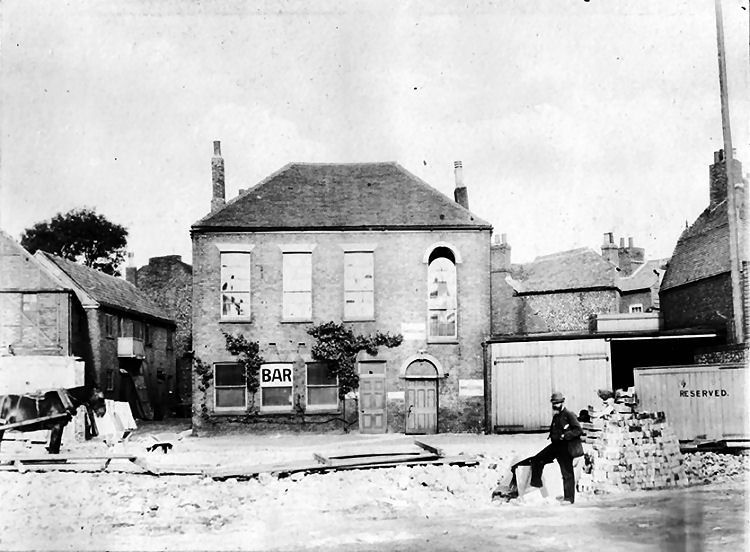
Above photo is titled Corn Market 1893. The building that says BAR on it
may well be the "Royal Oak Tap." |
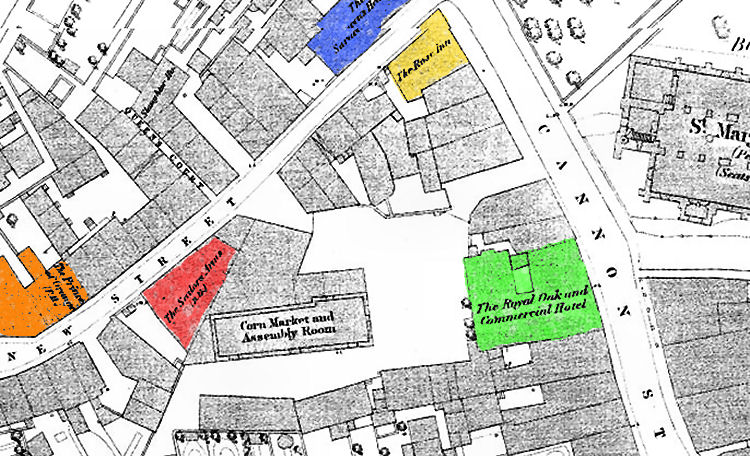
Above map 1871, showing the "Rose Inn,"
(yellow) the "Saracens Head"
(blue) the
"Prince of
Orange," (orange) the "Royal Oak,"
(green) and the "Sailors Arms,"
(red) |
LICENSEE LIST
TUCKNESS Bartholemew 1713+
ADAMS George
 1753+ 1753+
HOBBS Mr 1760+
 GIBSON Mary 1771-74+
MECROW Henry 1787-1823
   (Excise office keeper)
MOWLL William Rutley 1823-July/39 dec'd
    
SCHILLING or SHILLING Mrs 1841-42 (Royal Oak Tap)
GIBSON G 1842 (Royal Oak)
HUDSON Mr G 1844-47
 (Royal Oak Tap
Market Street) (Royal Oak Tap
Market Street)
MOWLL Mrs 1845
MOWLL William Rutley 1847-53 (age 31 in 1851 ) )
LAMB Osbourne Sept/1853+
PHILPOTT Richard William 1857-64
PHILPOTT Stephen 1864-72+
PHILPOTT Richard William 1874-88+
  (Also of the "Granville
Arms, St. Margaret's from Oct/1884
(Also of the "Granville
Arms, St. Margaret's from Oct/1884 ) )
HAXELL A 1885+
HOYSTER Andrew 1892+
ADAMS John Feb/1894-95 (Royal Oak Bar)
Dover
and Deal Directory and Guide 1792
From the Pigot's Directory 1823
 From the Pigot's Directory 1824 From the Pigot's Directory 1824
From Batchellor's New Dover Guide 1828
From the Pigot's Directory 1828-9
From the Pigot's Directory 1832-33-34
From the Pigot's Directory 1839
From the Pigot's Directory 1840
From Bagshaw Directory 1847
From the Post Office Directory 1874
From the Post Office Directory 1882
From the Dover Express
Historical
Sketch of the Town of Dover 1799 by G Ledger
Canterbury
Journal, Kentish Times and Farmers' Gazette
|

