|
10 Bench Street
Dover
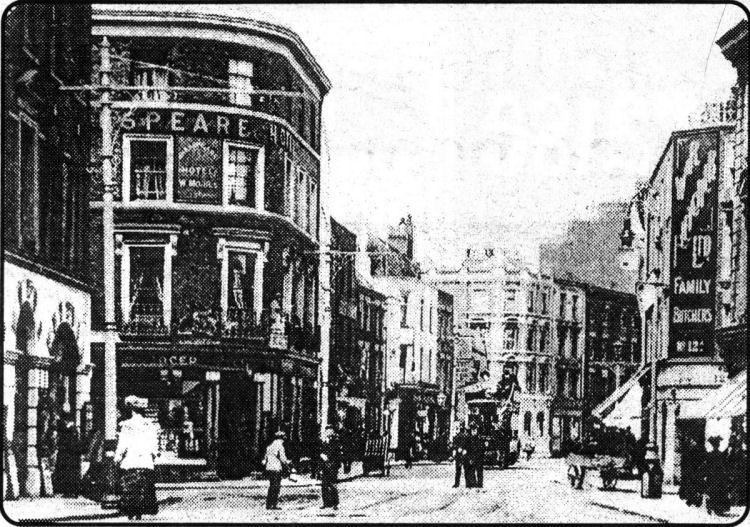
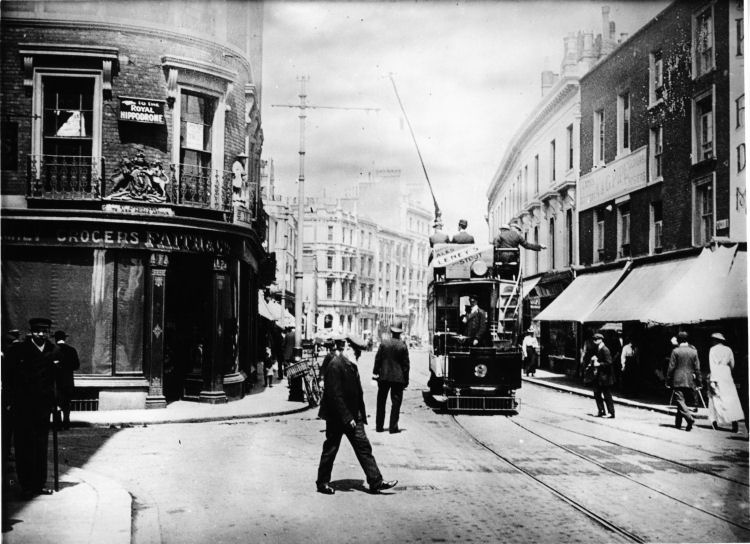
An early Dover tram in Bench Street, around 1900, as it nears New Bridge, in
the foreground. Note the old Shakespeare Hotel on the left above Page the
grocer. The hotel later extended over the Crypt Restaurant further down. I
wonder why two policemen are standing in the middle of the road in Mrs Goy's
postcard! |
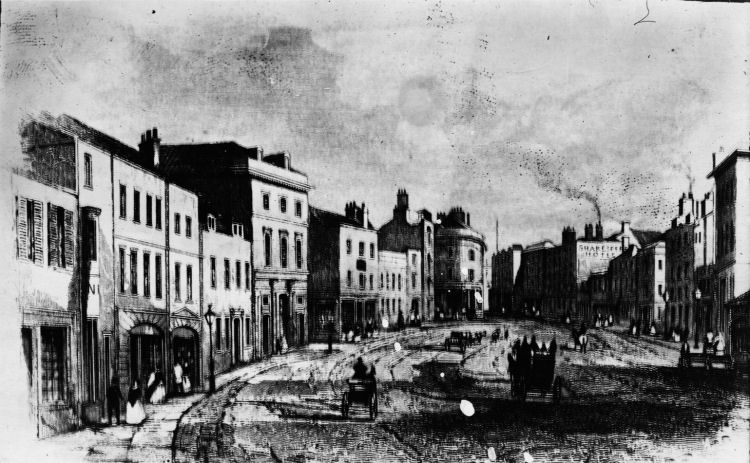
Above print, date unknown. |
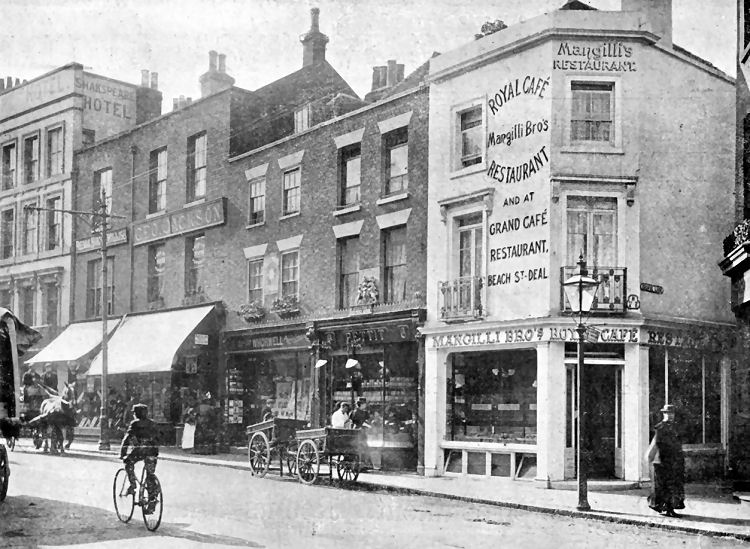
Above photo, date unknown, from Paul Wells. |
George Square once stood at the top of Snargate Street and
on the West side of the Square stood the "George Tavern". Presuming that to
be the same as the "George Inn", which was there in 1637 - being something
of an international trading centre - would tie up many loose ends. Token
coinage, a little later, carried the inscription "George Inn IEC 1652".
That house is acknowledged to be the one which later came
to be "The Vine", active around 1757 but later becoming the "Shakespeare
Inn".
The thoroughfare in front of the pub was eighteen feet
wide in 1836 and beneath it a crypt or cavern was discovered after a tower
above ground had been removed. Old concrete foundations were found in the
cellars of the hotel and much heavy masonry still lies beneath the road
to-day. The Flemish tiles which ornamented the front were all excavated from
the site itself.
Elvey kept it in 1823, being followed by Josiah Hollyer. The Dover
Telegraph of 25 June 1836 p.1 c.2 stated:- "Charles Elvey, Shakespeare
Hotel, Dover - notice of thanks to friends for 30 years' patronage.
|
From the Kentish Gazette, 8 June 1810.
SHAKESPEARE INN, DOVER.
Charles Elvey begs leave to return his sincere thanks to his
Friends, for their support at the "Bull Inn," and most respectfully
informs them, that he has removed to the above Inn, and has laid in
the very best assortment of Wines, Spirits, &c. and has provided
excellent Beds, and every suitable accommodation, and hopes by his
strict attention to merit a continuance of their favours.
|
|
Kent Herald, 31 March 1825.
Death.
March 21, after a long and lingering illness, Martha, the youngest daughter of
Mr. Charles Harvey, landlord of the "Shakespeare Hotel," Dover, age 23 years.
|
|
From the Dover Telegraph and Cinque Ports Advertiser,
25 June, 1836. p.1 col.2
Joshua Hollyer, "Shakespeare Hotel." notice of taking over above
hotel; formerly at the "George Inn," Rye.
|
|
From the Kentish Gazette, 12 February 1839.
DEATH.
Feb. 8, at Charlton, Rebecca, wife of Mr. Charles Elvey, late of the "Shakepeare
Hotel," Dover, aged 73.
|
|
From the Kentish Gazette, 9 July 1839.
DEATH.
July 2, at the "Shakepeare Hotel," Dover, Mr. Thomas Lavender, late
waiter of the "Star Inn," Canterbury, in his 31st year.
|
|
From the Kentish Gazette, 4 October 1842.
JOSEPH WEBB PILCHER’S BANKRUPTCY.
THE Commissioners in a Fiat in Bankruptcy awarded and issued against
JOSEPH WEBB PILCHER, of Crabble, in the Parish of RIVER, in the County
of Kent, Miller, dealer and chapman, intend to meet on the Twenty-fifth
day of OCTOBER inst., at One o’clock in the Afternoon, at the "Shakespears
Hotel," in DOVOR, in the said County in order to audit the Accounts of
the Assignees. Ann the said Commissioners also intend to meet at Two
o’clock in the Afternoon on the same day and at the same place, to make
a Final Dividend of the Estate and Effects of the said Bankrupt, when
and where the Creditors who have not already proved their Debts are to
come prepared to prove the same, or they will be excluded the benefit of
the said Dividend, and all claims not then proved will be disallowed.
JEFFERYS and BATHURST, Faversham, with MATTHEW KENNETT, Dovor,
Solicitors to the Assignees.
|
|
Kent Herald, 7 August 1845.
An accident, which might have been attended with serious consequences,
occurred to a youth name Cook, son of the landlord of the "Sandgate Castle," who
imprudently ventured too near to Mr. Hughes' elephants at the Shakespeare
Stables. The large elephant seized him with his trunk, and dashed him with great
force against the wall; had it not been for the timely arrival of the keeper,
the smaller one would have killed him, as he was in the act of treating him in a
similar way. Fortunately no bones were broken, although one of his arms and his
chest would bruised.
|
|
From the Dover Telegraph and Cinque Ports Advertiser,
18 April, 1846. p.1
Joshua Hollyer, Director of Dover & East Kent Building and Investment
Society.
|
|
From the List of Jurors c. 1841- 1875, Dover
Corporation Records.
Joshua Hollyer, Innkeeper, Bench Street, Dover. 13 April, 1847. Left
Dover.
|
|
From the St Mary Dover register.
Wm Josiah and Clara Margaret HOLLYER of St Mary Dover, Innkeeper:
Christened their son George Thomas 16.6.1843 (St Mary Dover)
Wm Josiah HOLLYER of New Steine Hotel, Brighton, aged 36 buried
7.1.1857
|
|
From the Dover Telegraph and Cinque Ports Advertiser,
13 January, 1849.
Louisa Marlen, wife of Mr. W. Marlen, was charged with stealing 5lbs.
weight of ham, the property of Mr. Joshua Hollyer, of the "Shakespeare
Hotel", on Saturday evening, the 11th November last. Mr. O'Grady
prosecuting, and Mr. Horne defended the prisoner.
Martha Clarke, niece of Mr. Hollyer, deposed:- On Saturday evening,
the 11th of November, prisoner came into the hotel; and as she was in
the passage I saw her go near the larder and heard the plates clatter,
and she then came to the bar for some ale. While serving her, I observed
her to have something in her possession, which she was apparently
endeavouring to cover with her shawl. Having suspicion that she had
taken something, I went to the larder, and found that a piece of ham was
gone which I had seen there two or three minutes previously, and I
immediately called her to stop, but she took no notice, although I am
certain she must have heard me. I then told the waiter what had taken
place, and he directly went after prisoner and brought her back. On my
charging her with stealing the ham, she denied it. The ham now produced
is the same I missed from the larder, and weighs about 5 lbs.
William Colyer, waiter at the "Shakespeare Hotel," deposed that on
Saturday night, the 11th of November, his attention was called by Miss
Clarke, who told him that part of a ham had been taken from the larder,
an that she believed Mrs. Marlen had stolen it, who had just left. On
this, witness went after prisoner, and brought her back immediately, but
when accused of the theft she denied it. He was certain as to the
identity of the ham, which he had seen in his master's larder a few
minutes previously.
John Birch, porter at the "Shakespeare Hotel," deposed that he went
to the station house to give information to the police, and on
returning, found the ham on the step of the house lately occupied by Mr.
Smith, poulterer, which was about four or five yards from where the
waiter stopped prisoner.
The learned recorder then summed up, and the Jury returned a verdict
of Guilty.
A previous conviction was then proved against the prisoner and the
Recorder, in passing sentence upon her, said that she had but recently
been subjected to a very severe imprisonment - 18 months - during which
time she had sufficient opportunity for reflection, which, however, had
not amended her conduct; and seeing this, he did not deem her fit to
remain in this country any longer. The sentence upon her was, that she
be transported for 7 years.
|
Lukey was given permission to draw in 1853 and he is also known to have used
the crypt for bottling purposes before continuing that process from nearby
premises after 1853. He rated himself so highly as a fly driver that he
issued a challenge to other drivers nationwide.
|
From the Dover Telegraph and Cinque
Ports General Advertiser, 6 February, 1858. Price 1d.
BOROUGH PETTY SESSIONS
Alexander Cruikshank Channer, a respectably attired individual, was
charged with obtaining money under false pretences of Mr. Lukey, the
landlord of the "Shakespeare Hotel." The examination was preliminary to
a remand.
William Lukey: On the 19th of December prisoner came to my house,
stopped two nights, paid his account, and then went to live at No. 5
Athol Terrace. He has been in the habit of coming in, and of sending
for wine, spirits, &c. When he called, he sometimes had a glass of
brandy-and-water, and sometimes a sandwich or dinner; but he never paid
anything after the two nights he slept there. On Saturday, 23rd Jan., he
brought a cheque into me, saying, "I have a cheque, Mr. Lukey, from my
partner in Leeds, but he has not signed it;" and he asked me to lend him
£2 until he had returned it, and received it back signed. I did not
examine the cheque, but thought it singular that he should not sign it
as well as his partner. On Monday, Feb. 1st, I reminded him of his
having borrowed the £2, and asked if he had forgotten it. He replied, "I
have the cheque here, which I will give you, and you can take the £2 and
your account from it, and give me the change." He handed me the cheque.
It was the one produced, and purports to be for £25. I looked at my
cashbox, and found I had not enough money, when he told me I could give
it him the next morning. I didn't know exactly what his account amounted
to. I only had £10 in the box, and I told him he could have that if he
liked. He took it. He said the cheque was signed by his partner. Mr.
Lambert, and that they were in an extensive way at Leeds as engineers.
He had a letter in his hand at the time, which he said was from his
partner, and he read it to me. Prisoner said he had £30,000 in his
business himself, but not at that time. The letter intimated the sending
of the cheque, and desired the receiver to stop a little longer at
Dover, as the air agreed with him. I said to prisoner, "This cheque is
on London." He replied, "Yes, it is a private account of Mr. Lambert's
who is related to one of the firms of Puget & Co., on whom it is drawn."
I gave him the £10 on the faith of the cheque being a good one, and also
from the representations of the prisoner, whom I took to be a gentleman.
I paid the cheque into the National Provincial Bank at Dover on the same
day, and it was returned to me on Wednesday, with "no account" marked on
it.
Prisoner: If the Magistrates will grant me a remand for six or either
days, I think I can satisfy both Mr. Lukey and the Bench.
Remanded till next Friday.
|
|
From the Dover Telegraph and Cinque Ports General
Advertiser,, 27 March, 1858. Price 1d.
BOROUGH PETTY SESSIONS
Tuesday: Before Dr. Astley and J. Coleman, Esq.
James O'Kay Durrant, a man of respectable exterior, was brought up on
a charge of uttering a forged bill of exchange for £22 16s. 6d. on the
14th of August, 1857, to Mr. Lukey, landlord of the "Shakespeare Hotel."
The prosecutor deposed: I know the prisoner. I first saw him on the
18th of March last, at the "Shakespeare Hotel," which I keep. He stopped
at the Hotel until the 28th of September in the same year, with the
exception of occasional absence of a few days, probably amounting in the
whole to a month. On the 2nd of April, he paid his bill due up to the
29th of March; it amounted to £4 9s. 3d. His next payment was on the
22nd of May, when he came to me, and asked me to cash an acceptance for
a bill of £18 10s. 6d., drawn by himself, and accepted by Thomas
Walters. The bill was due 23rd of June. I gave him cash for it, and
deducted nothing for discount. I cashed it because he told me that Mrs.
Lukey had been asking him for some payments, and he wished to settle
with her. He did on the same day pay £8 towards his Hotel account. I
paid the bill into the National Provincial Bank. Prisoner gave me cash
to take it up when it became due. On the 6th of August following, we
gave him his hotel bill, (amounting to £16 10s.,) as he was leaving for
London; and on the 8th he forwarded us £10 on account. He returned to
Dover on the 11th, and between that time and the 28th of September, when
he again left, he on several occasions received his account, which at
the last named date amounted to £29 18s. On the 7th of November he sent
me an acceptance at three months for the amount of his bill. The
acceptance was dishonoured. Some months previously - it was on the 15th
of June, 1857, prisoner asked me if I would discount a bill. I at first
said I could not do so, as I had had so many losses; but ultimately, on
his persuasion, and assuring me that all was all right and
straightforward, I consented to do so. Its amount was £22 5s., and it
was drawn by himself, and due on the 12th August, 1857, and accepted by
F. Nolan. I paid it into the National Provincial Bank, Dover. When it
became due it was returned dishonoured. I then gave a check to the Bank
for £22 6s. 6d., being 1s. 6d. for nothing, to take up the bill. I told
the prisoner of the dishonouring of the bill on the same day. He said he
was very surprised, and would write to Nolan about it. We had several
conversations subsequently, in the course of which he read letters
supporting to be from Nolan to him saying that the matter would be
arranged shortly. I did not notice the writing or the postmark of the
letters. About a fortnight after the bill became due, I told prisoner I
was pushed for money, and it was arranged that I should accept another
bill for the £22 6s. 6d., at three months, dating from the 9th of
August, with the addition of 10s. for interest. I should think he gave
me the bill two or three days after the arrangement to accept it. The
bill was drawn by James Durrant, and purported to be signed by Frederick
Nolan, of Abchurch Lane, London. I asked him who Mr. Nolan was after the
first bill was dishonoured, which bill I gave back to prisoner on
receiving the last mentioned bill from him. He said Mr. Nolan was a
broker, in Abchurch Lane, but did not give his number. I paid the bill
into my account at the National Provincial Bank, and it was returned to
me dishonoured, with the words "no account" written thereon,) on the
12th of November. Prisoner had left before the bill became due, and I
wrote to him at 37, Westbourne Road, about it. I could get no
satisfactory answer. He has never paid the bill, nor has any Mr. Nolan
or any other person paid. I have been to every house and office opened
in Abchurch Lane, except a banker's at the corner of Lombard Street, and
could find no such person as Mr. Nolan, nor hear anything of such a
person. I went a second time, to enquire, and a detective police officer
was with me then, but we did not go to every house, as the officer knew
sundry of the parties, which made it unnecessary to call.
By the prisoner: For the past three months I have been trying to
serve you with a writ. I have not succeeded in serving the writ on you.
I have not issued a writ against Mr. Nolan. I have not a letter of yours
in which you tell me where Mr. Nolan may be found. I never had a letter
from you stating that Mr. Nolan was gone to Liverpool; you told me he
had gone thither, to sell shares, I am willing to produce all the
letters that have passed between us. Mr. Nazer told me the bill was a
forgery. He said, on seeing it, "God bless me - I had a bill accepted in
the same handwriting in the name of Hawkins; and no person can have two
names." I cannot remember how long since it was, as I saw him about 9 or
10 times; but it was before proceedings were taken. I should fancy it
was about the 15th of February last, but cannot swear when. Mr. Nazer
spoke to me about a policy of assurance. He came down to me one evening,
and said, "Old fellow, I have heard from Durrant, who wishes to settle
your account." He then produced a policy for £499: 19, and said Durrant
wished me to take half for my claim, and he (Nazer) was to take the
other. I asked who was to keep up the policy; and Nazer replied, "Oh!
that remains for us to do." Then I said I should have nothing to do with
it. Mr. Nazer did not ask me to pay him over any money in the event of
my accepting the policy. I refused solely to accept it on account of
having to pay the premium. I took you for a gentleman, and treated you
as such; of your circumstances I knew nothing.
By the Court: I did not hear, on making enquiries at Abchurch lane,
that any such person as Nolan had ever lived there, or had an office
there. In offices visited, I asked the principles whether they had any
clerk of that name.
Prisoner at this stage was remanded until Friday.
Friday: Before Dr. Astley, Capt. Noble, and J. Worsfold Esquire.
James Durrant, remanded from Tuesday, was re-examined, and committed
to take his trial for forgery at the next Kent Assizes. Mr. E. Knocker
prosecuted, and two fresh witnesses were examined, to prove that
Frederick Nolan had not resided in Abchurch Lane during the last 12
months, nor had been known there; and that he had no account with
Messrs. Spooner, & Co., bankers.
|
|
From the Kentish Gazette, 17 January 1865.
SHAKSPEARE FAMILY AND COMMERCIAL HOTEL, DOVER.
THE PUBLIC are Respectfully informed that the above Old Established
Hotel, which has been completely Renovated, Newly Furnished, and
Befitted with every Convenience, will be fully opened for Business
on THURSDAY, the 19th instant.
The PROPRIETORS hope, by strict attention and punctuality, to insure
every required comfort and accommodation to those Families and
Gentlemen who may be pleased to honour them by their Patronage.
Shakespeare Hotel.
13th January, 1865.
|
|
From the Southeastern Gazette, 5 June 1866.
DOVER.
Notice of Auction Sale of desirable FREEHOLD and LEASEHOLD BUSINESS
PREMISES, old-established Free Public-houses, Cottage and Land, in the
borough of Dover, in the county of Kent,
Which, under the instructions received from the Proprietors, will, on
Thursday, June 7th, 1866, be SUBMITTED FOR PUBLIC COMPETITION, By
Messrs. JAMES B. TERSON & SON,
At the “Shakespeare Hotel,” Dover, at Two o’clock p.m. for Three
precisely.
THE following eligible FREEHOLD and LEASEHOLD PROPERTY, in four lots.
Lot 1:— All that old-established and commodious FREEHOLD SHOP,
DWELLING-HOUSE, and LAND, in the occupation of Mr. Carrier, China and
Glass Dealer, &c., at yearly tenant, situate No. 3, Adrian-street,
Dover, and commanding a frontage of 55ft., and 107ft fronting
Gravel-lane (leading from Adrian-street to Chapel-place), and 55 feet
frontage to Chapel-place. The situation of these valuable premises being
in one of the acknowledged principal business thoroughfares in the town
— the extensive range being a corner site — and possessing, in point of
fact, three frontages, offers to persons seeking commodious and spacious
premises in one of the most flourishing towns on the coast, as well as
to speculators, an opening rarely to be met with.
Lot 2:— A FREEHOLD COTTAGE and LAND, situate No. 3, Chapel-place, Dover,
with a frontage of 18 feet 6 inches, and about 70 feet deep at the one
end, together with the piece of land, extending a length of 100 feet, be
hind the adjoining houses, fronting Chapel-place, and a depth of 39 feet
at the extreme end, in the tenure of Mr. Claringbould as tenant from
year to year.
Lot 3:— All that old-established MESSUAGE of Tenement, with the TAP and
PREMISES belonging to the same, situate and being in Council
House-street, Dover, for many years used as a Licensed Inn, known as the
“Providence Inn,” let to Mr. G. S. Page, as yearly tenant. This
desirable property is held under the usual lease from the Warden and
Assistants of Dover Harbour for a term of 61 years, from the 6th April,
1834, at the small annual ground-rent of £3 10s., and from its
combination of eligible situations, viz., near the Termini of the two
lines of Railways, its immediate proximity to the Harbour, Admiralty
Pier, &c., commands the lucrative business which it has so long enjoyed,
offering to brewers, hotel keepers, and others, a safe and profitable
investment.
Lot 4:— All that well-situated FREEHOLD brick-built, with tile roof,
MESSUAGE or Tenement, with the appurtenances to the same belonging, used
as a licensed public, house, known by The name or sign of the “Mogul
Tavern,” Adrian-street, Dover, at present, in full trade, in the
occupation of Messrs. J. Poulter and Son, or their under, tenants, as
yearly tenants.
For further particulars and conditions of sale apply to Messrs. James B.
Terson and Son, Auctioneers and Estate and General Agents, No. 48,
Castle-street, Dover, or Messrs. Fielding and Greenhow, Solicitors,
Snargate-street, Dover.
|
|
From the Southeastern Gazette, 26 June 1866.
Capture of a Gang of Knocker Wrenchers.
There was a special sitting of the borough magistrates (the Mayor and W.
B. Mowll, Esq.) on Saturday afternoon last to hear a charge against four
“fast” young fellows of having unlawfully committed a public annoyance
by breaking off the knocker of a door in Town-wall-street on the morning
of the 23rd inst. This charge was preferred by P.C. W. Vaul against the
defendants, John M’Callum, Edward Hills, Alfred Birmingham, and another
named Dobbs. Mr. Claris, who appeared on behalf of the defendants, said
he was instructed to plead guilty in the ease of M’Callum, and not
guilty on the part of the others, M’Callum having admitted that the
others had nothing whatever to do with the matter, the police-constable
said between twelve and one that morning he saw the four defendants come
out of the “Shakespeare Hotel.” He himself stood up in a doorway close
by, and heard one of them say to the others “What do you say about some
knockers?” He followed them down Town-wall-street, saw them stop at the
door of Mr. Erith, and a moment afterwards he heard a knocker break off
and fall to the ground, the defendants all running away. He passed and
recognised them. The superintendent of police said as one had pleaded
guilty he had no desire to press the charge against the others. The
Mayor said the Bench must mark its sense of this improper proceeding by
inflicting on M’Callum a penalty of £1 and 18s. costs; and as these
depredations had been of frequent occurrence they should recommend the
constable who had brought the first offence to justice for a small
gratuity.
|
|
From the Dover Express and East Kent News, Friday,
24 December, 1869.
DISORDERLY CONDUCT
Joseph Evans was charged with begging, being drunk and disorderly,
and obstructing Mr. Lewis Adams, also using threatening language towards
him.
Mr. Fox prosecuted.
Mr. Lewis Adams, proprietor of the "Shakespeare Hotel," deposed: Last
night about nine o'clock I was at my house in Snargate Street when my
attention was called to the prisoner, and I went into the bar and told
him to go out. He said he would as soon as he liked and used very bad
language and was very abusive. He asked me for bread, and I refused to
give him any and he threatened me. I told him I should send for a
policeman, and he was very insolent, and said he should like to see the
gentleman and would open the door for him. On his doing so he (the
policeman) was there. he was given into custody.
He was sent to gaol for fourteen days' hard labour.
|
|
From the Dover Express and East Kent Intelligencer, 8 November, 1872. Price 1d.
NEW LICENSES
Mr. Greenhow applied for a new license on behalf of Mrs. Adams, for the
“Shakespeare Hotel,” in Bench Street, and the Restaurant in Snargate
Street. The Bench immediately granted the application.
|
|
From the Dover Express and East Kent Intelligencer,
23 October, 1874. Price 1d.
AN ELECTION REMNANT, ADAMS v MOWLL
This was an action brought by Messrs. Adams, of the "Shakespeare
Hotel" against Mr. E. R. Mowll, ex-Mayor of Dover, to recover £8 4s.
3d., for balance on account rendered for board, lodging and attendance
supplied, and goods sold and delivered by the plaintiff, to the
deputy-returning officers of the Dover Election, September, 1873, by
order of the defendant, as the Returning officer at the said election.
Mr. Carder appeared for the plaintiff, and Mr. Woolaston Knocker,
Town Clerk, appeared for the defendant.
Mr. Carder, when the case was called on, said this was such a case as
perhaps had never before occurred in a County Court. A Returning officer
was summoned for expenses occurred in carry out an election. The
defendant had occupied the highest position in this town, having been
Mayor in 1873, and in that year he was Returning officer at the borough
election, that took place in September. In carrying out that election,
he had to incur certain debts for which he would have been personally
responsible, if the candidate did not re-imburse him.
The Town Clerk at this stage interposed, with a view of shortening
the case. He said it was due to the plaintiff to admit that the debt was
incurred as above stated, and the defendant had brought the case into
court in order that it might be seen that he had not received the money
without handing it over to the plaintiff. It was brought to the court to
give the candidate an opportunity, prior to the case being called on to
put the defendant in a position to meet the liability. That
unfortunately is not the case, and I am instructed to admit the debt.
The Judge: Then there is nothing for me to do.
The order for the plaintiff was made with the usual costs.
|
|
From the Dover Express and East Kent Intelligencer,
19 January, 1877. Price 1d.
SAD SUICIDE
A suicide occurred at the "Shakespeare Hotel" on Saturday last, when
a young gentleman, scarcely 21 years of age, destroyed himself whilst in
his bedroom. An inquest on the body of the deceased was held on Monday,
before the Coroner (W. H. Payne Esq.), at the hotel, when the following
gentleman were sworn on the Jury:- Mr. E. P Robinson (Foreman), Mr.
Harris, Mr. Lemon, Mr. R. J. Adams, Mr. Greenfield, Mr. F. J. Norton,
Mr. Atkins, Mr. Hogben, Mr. Elgar, Mr. Carrier, Mr. W. Baker, Mr. Gandy,
Mr. Holden, and Mr. Stevens.
The Jury having viewed the body, the following evidence was given:-
Mrs. Eliza Martha Barton, wife of Mr. Francis Barton, M.D., said: I
knew the deceased, William Bradley Middleton. He was a student at
Oxford. He came to Dover last Saturday week. He had not been well for
some little. He seems to have had something wrong with his head at
Oxford. during the last term. When he was at school five or six years
ago he ran against a lamp-post and had concussion of the brain. He
was ill then for six weeks. Study seemed to effect his head. I last saw
him alive on Saturday between four and five o'clock in the afternoon. he
had a peculiar look about the eyes, but he spoke cheerfully when I went
into the room. I said "Oh, William, how is it you are here?" He was in
bed. He said "I am not very well." I asked him how long he had been
here, and he said "Since Saturday." I said "How is it you have not been
to see us?" He said "Oh, I have not been well; I have been very seedy
lately, feeling weak and out of sorts." He then told me of his being ill
at Oxford and he added, "They tell me I have had an attack of the head."
I said, "I hope you will try to get up and dress and stay with us for a
few days." At first he said he did not think he could stand for he was
so weak. I told him that with the assistance of the waiter he could
dress, and I hoped he would come to us. He hesitated for a time, and he
then said, "Oh, it is very kind; I will come." He then asked my what the
time was, saying, "Is it not between four and five?" I said "Yes." He
said "Then at half-past five I will get up ." I then went to fetch Dr.
Barton and returned in less than ten minutes with Dr. Barton, and Miss
Hards met me in the hall and said "Oh, something dreadful has happened."
Mr. Barton then went up stairs and I heard that the deceased had shot
himself. I afterwards went up to the bedroom and saw him breathing very
hard. He lived about five hours after that, but perfectly insensible.
When I came out of his room, when I first saw him in the afternoon, I
told Mr. Hards to send up the waiter to be in his room, not to leave him
alone, and he went up directly.
Miss Hards, proprietress of the "Shakespeare Hotel," said: The
deceased came to the hotel on Saturday week. He had no luggage. He said
that he had lost it at Waterloo Station. On WednesdayI came from London
when he told me his luggage had arrived. On Friday, on my making
enquiries, I found that his luggage had not arrived. On Saturday morning
we received a telegram from Mr. Williams, Oxford, saying it was supposed
that a gentleman named Millington had been staying at my hotel some days
ago. I immediately sent to the gentleman's room, having several letters
unclaimed, and asked if he would give me his name that I might see if
any belonged to him. he sent down the name Milligton. I immediately
telegraphed back, saying, "He was still staying there, what should I
do?" he telegraphed back saying they had every reason to believe
the gentleman was of unsound state of mind and we were to watch him
carefully. I immediately communicated with the Superintendent of Police,
Mr. Sanders, and he will tell you what occurred. After Mrs. Barton had
gone in the afternoon I sent the porter up and he found that he had shot
himself.
William Harris said: I am a porter at the "Shakespeare Hotel." The
deceased came to the hotel last Saturday week, between seven and ten in
the evening and engaged a bedroom. I saw him at the hotel all that time
until Saturday afternoon at four o'clock. Miss Hards had sent the
billiard-marker to call him and got no reply. Miss Hards sent me up. I
found the door fast. That was 4.20. I rattled the door and heard
him breathing very hard. I thought he was asleep. I knocked louder and
rattled the door. I then heard loud groans and I tried to force the
door. I was not able to do that, so i went for assistance. before any
assistance arrived I forced the door open. I entered the room with a
waiter. I saw the deceased lying on the floor. I rushed out immediately
for the doctor. Deceased lingered from half-past four till half-past
ten. I saw a wound in his head. During the time he was at the hotel
there was nothing in his manner to indicate suspicion.
Superintendent Sanders said: On Saturday last, about 1.15, I was sent
for to the "Shakespeare Hotel," and Miss Hards made a communication to
me about the deceased. In consequence of what she said I telegraphed to
a Mr. Horace Williams, Union Society, Oxford. The purport of my telegram
was that there was nothing to justify police interference at present,
but advised the friends to come. In reply to that, I had a telegram from
a Mr. Cozens, 11, Park Place, Oxford, informing me that they had
communicated with the deceased's father, and asking that every
precaution might be taken, if possible, without police interference. On
receipt of that telegram, I started to go to the "Shakespeare Hotel" to
show Miss Hards. On my way to the Hotel, I met the porter, telling me
that the gentleman had shot himself. I accompanied the porter to the
bedroom, in which the deceased is now lying, and I sent for a doctor
before I entered the room. I found the deceased lying on his back near
the window. he was groaning. He was not dressed, having nothing on but a
coat. Inside his left hand I found a pistol. The body was lifted on the
bed. Dr. Barton and three other medical gentlemen had then arrived. I
afterwards examined the pistol, and took from it four cartridges
unexploded, and a cartridge case that was empty. The room smelled very
strongly of gunpowder. I found on the mantlepiece, 28 cartridges, two
small keys, and a sixpence. I saw the deceased several times still alive
during the evening, and about twenty minutes to eleven o'clock, when he
was dead. I could find no linen or shirt collar in the room, and the
lining of his hat was torn out, and his pocket handkerchief had the
corner torn off, as if to destroy identification. I afterwards examined
the ashes in the grate, and amongst them I found the remains of linen or
woollen having been burnt.
Dr. Barton said: On Saturday last, Mrs. Barton came to me wishing me
to accompany her to the "Shakespeare Hotel," stating that William
Millington was staying there: On arriving at the Hotel, Miss Hards said
something dreadful had happened. I immediately ran up-stairs, and on
entering the deceased's bedroom, found him lying on his back, breathing
very heavily, but quite insensible. There was a small pool of blood, and
the pistol by his side. On raising him to the bed, I found a wound on
the right side of his head, just above the ear. I passed a probe through
the right temple bone at least two inches into the head. I at once knew
that the case was fatal. he continued slight convulsive efforts till he
died. I knew nothing of the state of his mind. I had heard that after
his accident, study affected his head. That was after the accident at
Marlborough College. The deceased was training for the Church, and would
soon have taken orders.
By the Foreman: We did not hear of the deceased being at the
"Shakespeare," until four o'clock on Saturday afternoon, when we had a
telegram from his father, saying; "Willie is at the Shakespeare; go to
him at once." Deceased was not quite 21 years of age.
The Jury, after a short consultation, said the deceased destroyed
himself whilst in an unsound state of mind.
|
|
From the Dover Express, 1879.
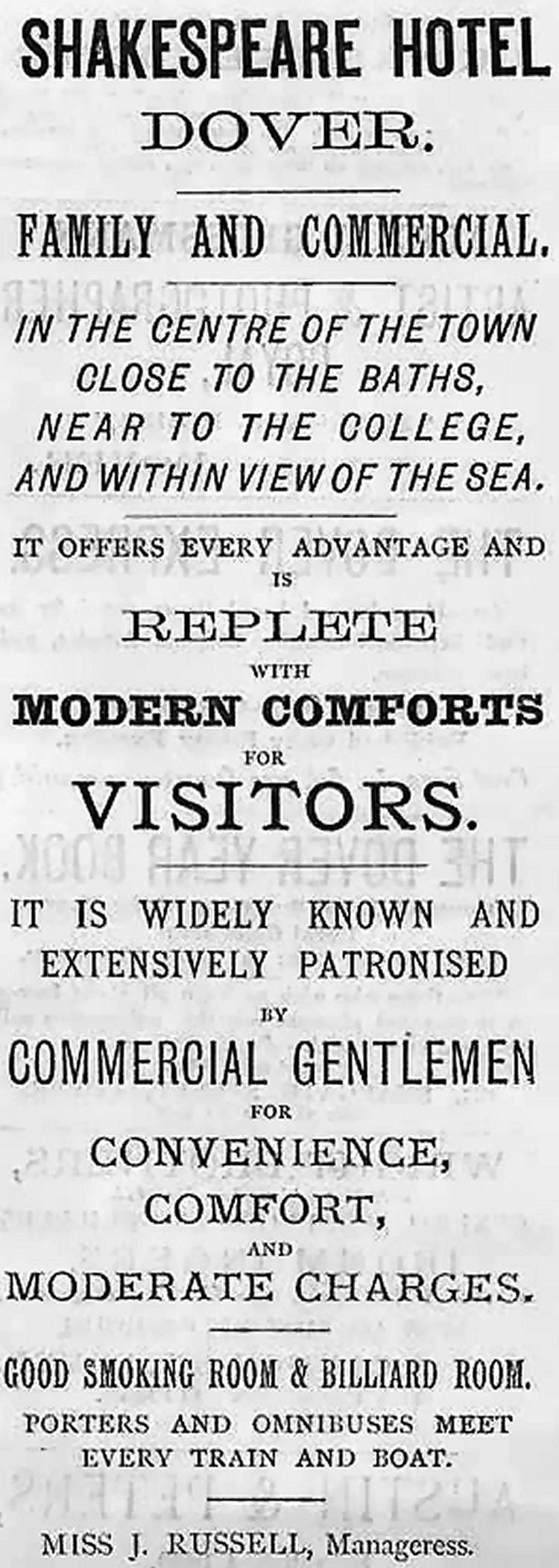
Above advert, 1879. |
|
From the Dover Express and East Kent Intelligencer,
2 January, 1880. Price 1d.
DRUNK
George Bradford, wood seller, of Canterbury, was charged with being
drunk and incapable in Bench Street.
Police-constable Prescott said: On Saturday evening, about six
o'clock, I saw the prisoner in Bench Street, near the "Shakespeare
Hotel," helplessly drunk. I was obliged to take him in charge.
In answer to the Bench, the Superintendent said the prisoner
had been in custody since Saturday and the prisoner's son took the horse
and cart back to Canterbury.
The Bench fined the prisoner 2s., the cost of the hearing.
|
|
From the Dover Express and East Kent News, Friday 9 May, 1884. 1d.
The “Shakespeare Hotel,” Dover, is said to have passed into the
possession of Mr. Hazell, of Colchester.
|
|
From the Dover Express and East Kent News, Friday 7 June, 1889.
A MARVELLOUS ESCAPE
On Saturday morning the painters were at work in front of the
“Shakespeare Hotel,” Bench Street, a horse in a light vehicle ran away
in the Market Place, knocking over a fruit barrow opposite the
photographer's and then went bang against a tall ladder which reached
the top of the hotel. Luckily the painter who was using it had just
stepped on the cornice. The ladder being knocked out in the foot fell,
but when half way to the ground caught in a rain pipe in front of Moore
Bros., which saved from injuring several persons who were on the
pavement below. Happily, in spite of the startling character of the
mishap, no one was injured.
|
|
From the Dover Express and East Kent News, Friday, 8 February, 1889. Price 1d.
ALLEGED FRAUDULENT ADVERTISEMENT CANVASSER
Charles Herbert Hook, a well dressed young man, was charged with having
on the 13th September, 1888, by certain false pretences, obtaining the
sum of £1 1s., from Mr. F. C. Swoffer, of Townwall Street, Dover, with
intent to defraud and cheat him.
Mr. Martin Mowll appeared for the prosecution, and Mr. E. carder
represented the prisoner, who pleaded “Not Guilty.”
Mr. Mowll said he appeared for Mr. Swoffer, who was the nominal
prosecutor in the case, because the fraud, technically, was upon him;
but he also appeared for Mr. Belton, an advertising agent residing in
Walton Road, West Kennington, upon whom the fraud had really been
perpetrated. Mr. Belton brings out what he called a Visitors' Book for
the hotels, and supplies the books to different hotels free of charge,
for the names of the visitors to be entered in, and gets a profit by
getting various tradesmen to advertise in the book. The book, which he
produced, was one that Mr. Belton supplied some two years ago to the
“Shakespeare Hotel,” Dover, and amongst the advertisements was Mr.
Swoffer's, which appeared on every page in the book. In 1887 Mr. Belton
called upon Mr. Swoffer and received his charges for the advertisements,
and the advertisements were continued in that book for the year 1888. In
the autumn of last year a man called at Mr. Swoffer's shop and brought
with him this book from the “Shakespeare Hotel,” which would be
identified by Mr. Swoffer, and asked him whether he intended to renew
his subscription, and after some conversation as to the price Mr.
Swoffer paid the person the sum of one guinea, and that person signed
the receipt, produced, and left the shop. Mr. Belton would be able to
tell the Bench that the signature of the receipt was that of the
prisoner's, as he used to do some printing for Mr. Belton, and he knew
his handwriting. There could not be the slightest doubt but that the
prisoner was the man who called upon Mr. Swoffer, and obtained that sum
of money for advertisements in the book with which he had no connection
at all. There was no doubt but that the book belonged to Mr. Belton. Mr.
Swoffer would say that he remembered seeing the advertisements of Mr.
Humphreys and Mr. Atkins on the same page when the man brought it to his
shop. This fraud had been perpetuated not only in Dover but in other
towns, and his client was obliged to institute these proceedings against
the prisoner in order that the frauds might be put a stop to.
William Belton said: I am an advertising agent and reside at 102, Walton
Road, West Kennington. My business address is 172, Fleet Street. I know
the prisoner Hook as he did printing work for me in 1886. In the course
of my business I bring out Visitor's Books for hotels, and the one
proceeded is a book which I brought out in Dover. There are
advertisements in the book by Mr. Swoffer, greengrocer, Mr. Humphrey,
tobacconist, Messrs. Atkins and Son, bootmakers, and Messrs. Jouhnson,
tailors. I came to Dover in August or September, 1887. I then collected
the subscriptions for the advertisements which appeared in this book. In
ordinary course I should have come again in August or September, 1885,
but I did not come until January of this year, when I called for
subscriptions, but could not obtain them. I called on Mr. Swoffer, but
could not obtain it; as he said he had already paid. I know the
prisoner's handwriting, and the signature on the receipt produced is in
the prisoner's handwriting. The receipt is signed by Charles H. Hook,
for £1 1s. for advertisement for one year in Visitors' Book. There is an
imprint at the bottom of every page in the book showing that it is
published by me. I have never authorised the prisoner to receive any
money on my behalf. The book produced is one I supplied to the
“Shakespeare Hotel” in August or September, 1887.
Cross-examined by Mr. Carder: I have not had business transaction with
the prisoner for two or three years. He printed a work for me in 1886.
It was a writing portfolio for hotels. I do not remember having a
conversation with Hook about the profit on this work, but I remember him
suggesting that he should bring out similar books for Westgate and
Margate, and he had brought out similar books during the last summer. I
do not recollect threatening to prosecute him for bringing out books of
a similar kind. I cannot swear that the handwriting in the body of the
receipt is the prisoner's.
Mr. Stillwell said the body of the receipt had evidently been written at
a different time to the signature, and the body of the receipt was not
blotted, but the receipt was.
The Chairman said he believed the whole of the receipt was not
written at the same time.
Witness continuing, said: I remember the prisoner printing a book of
that kind for the “Panton Hotel” in the Haymarket. In consequence of
prisoner having brought out books of a similar kind. I refuse to take
the book for the “Panton Hotel” from him, but cancelled the order.
Possibly I revised a proof of the work. I have never paid him for it.
Re-examined by Mr. Mowll, witness said the prisoner brought out similar
books to his at Margate and Westgate on Sea, and he had received
complaints from his subscribers there, similar to the complaints made by
Mr. Swoffer.
Frederick Charles Swoffer, greengrocer, carrying on business at Townwall
Street, Dover, said he arranged with Mr. Belton to put his advertisement
in the books. He remembered a man calling upon him last September with
reference to the advertisement. The man brought a book with him exactly
like the one produced, as he recognised it by his advertisement and two
others which were in the same page. He had seen Mr. Belton's book
before, as he believed Mr. Belton showed him one when they first came
out about two years ago. When the man called in September last he had a
conversation about the price. The man said he had called for the
subscription. Witness said he thought he paid £2 for it before, to which
the man replied “No, you paid 50s.” He said “No,” and the man said it
must have been two guineas. They had a long conversation, and ultimately
witness told him he would give him one guinea or nothing, and he agreed
to take it, and gave him the receipt produced, which was signed by
Charles H. Hook. He believed the prisoner was the man who called upon
him.
In answer to the Chairman witness said he could not remember whether the
man used Mr. Belton's name in the matter. He believed the body of the
receipt was filled in previously, for he only saw him sign his name. He
also thought the body of the receipt and the signature were in different
handwritings.
Further examined by Mr. Mowll he said the arrangement with Mr. Belton
was for an annual subscription, and he could renew it if he wished by
paying a further subscription. He believed he paid Mr. Belton,
personally, twice for the advertisements.
Miss Florence Ford, manageress of the “Shakespeare Hotel,” said the book
produced was the Visitors' Book at the hotel. She remembered a man
borrowing the book last Autumn, and he took it out with him a short
time. She was unable to say that the prisoner was the man.
Mr. Mowll asked for a remand to enable him to complete the case.
Mr. Carder said there had been no prima facie case made out against the
prisoner, and he did not think there was sufficient evidence to justify
a remand.
The Bench remanded the prisoner until Monday, the 11th inst., and
accepted bail in two sureties of £25 each, and the prisoner in £50.
|
|
From the Dover Express and East Kent Intelligencer,
16 August, 1895. Price 1d.
SHAKESPEARE HOTEL
An application was made by Mr. William Kirke, who had previously kept
the "Queen's Hotel," at Macclesfield, for temporary permission to draw
at the "Shakespeare Hotel," the outgoing tenant being Mr. Chapman; it
was granted by the Bench.
|
|
From the Whitstable Times, 15 June, 1901.
THE HOTEL METROPOLE.
In the High Court on Thursday, Mr. T. A. Terson was appointed Receiver
and Manager of the "Metropole Hotel," Dover, on the application of the
Debenture holders. On Friday an implication made on behalf of a body of
shareholders in the Metropole Company to restrain the transfer of the
hotel to Mr. Morris, of the "Shakespeare Hotel" was dismissed with
costs.
|
|
Dover Express 28th May 1909.
DOVER POLICE COURT - Monday.
A HOTEL ROBBERY.
Edward Thomas Ashman of 9 Portland Place was charged with stealing from
the kitchen of the "Shakespeare Hotel," 70lbs of coal, of the value of
1/-, the property of Mr. W. Morris, the proprietor.
Detective Southey said that that morning at 7.10 he met the prisoner
coming from the hotel with a sack which, he could see through a hole,
contained coal. Knowing the prisoner to be occasionally employed at the
hotel, he stopped him and asked where he got the coal and he said he
“borrowed” it from the hotel. When witness told him he had no right to
have taken it, he said “All right, I will put it back again”. He took
the prisoner to the hotel and Mr. Morris charged him and he made no
reply. The coal (produced) was weighed and found to be 70lbs. He had
been suspicious of the prisoner for a long time, as he had seen him
frequently carrying parcels from the hotel in the morning.
Mr. Morris said the prisoner was not in his employ. He pushed a barrow
for commercial travellers, and, according to custom, he lit the fires
for Boots, who, in return, gave him first turn with the barrows. The
prisoner would thus have access to the coals. The coal was witness’s
property and the prisoner had no rights to it.
The prisoner, who stated he was a married man with five children,
pleaded guilty and asked the Bench to deal leniently with him.
The Chairman said that, while the Bench had reason to believe this was
not Ashman’s first offence, he had not been charged before and he would
be bound over in the sum of £5 for six months and discharged.
|
|
From the Dover Express and East Kent News, Friday, 5 January, 1917.
WHERE DID THE WHISKY COME FROM?
NAVAL MAN FINED £4 FOR NOT TELLING.
At the Dover Police Court this (Friday) morning before Messrs W. J.
Barnes (in the chair), J. W. Bussey, H. Hobday, and Edward Chitty.
William Wood, a wireless petty officer, was summoned for, on December
9th, refusing to answer the question addressed to him by P.C. Hodges,
and with, on December 21st, refusing to answer a question addressed to
him by Police Inspector Mount, under the Defence of the Realm
Regulations.
Mr. R. Mowll appeared for the defendant, and pleaded not guilty.
Mr. Vosper, who prosecuted. Said that the defendant refused to answer a
question as to where he obtained several bottles of whisky. The Defence
of the Realm Regulations made it compulsory to answer any question that
is put to any person.
Mr. Morris, the proprietor of the “Shakespeare Hotel,” said that on
December 9th the defendant applied for a bed for himself and a friend at
11 p.m. The other man was the worse for liquor. They were given a
double-bedded room. A terrible row took place in the room, so bad that
everyone in the house was very much frightened, and witness sent for the
Police. When the Police came they found that one of the men was lying on
a bottle of whisky and another bottle had been opened. The defendant was
sober. He refused to give the Constable any information as to where he
obtained the whisky.
Police-constable Hodges said that he found a bottle full of whisky and
one three-parts full. The defendant said that the whisky was his, and he
refused to say how he came by it. He said that he did not know the other
man; he only fell in with him during the evening.
Cross-examined. Witness had obtained no order from the Competent Naval
or Military Authorities to ask these questions.
Mr. Vosper said that no such authority was required.
In reply to Mr. Mowll, witness said that the defendant came to the
Police Station after the whisky. He did not know that the defendant had
been in custody since December 13th.
Police Inspector Mount said: I saw the defendant on December 21st at the
Trawler Office. Captain Howard told me that, by instructions received
from the Vice-Admiral, the case was to be handed over to the Civil
Authorities. The defendant was present, and cautioned, and was asked if
he wished to make any statement as to the whisky. He replied, No sir; I
cannot say.” I said, “What do you mean?” He again replied, “I cannot
say.” I said, “Will you give me any information as to where you obtained
the whisky or came into possession of it?” he replied, “I have nothing
further to add.”
Mr. Mowll said that the thing was absurd. It was entirely contrary to
the administration of British law that any man should be compelled to
make any admission which would incriminate himself. He had a right under
our British constitution to refuse to answer the question. It might
involve him in charges for taking away this bottle of spirits. For that
he had been in custody since December 13th.
The Magistrates' Clerk: What sort of arrest?
Mr. Mowll; Open arrest; not allowed to come ashore. He added that there
was nothing in the charge, as the defendant was justified in refusing to
answer it.
The Magistrates fined the defendant £2 in each case, £4 altogether.
Mr. Mowll: The money will be paid under protest, as the defendant may
want to test your finding.
|
It was registered as a commercial hotel by 1882 and its
size was increased in November 1898 when four cottages in Chapel Lane were
annexed. The extra space was utilised to provide a taproom amongst other
things.
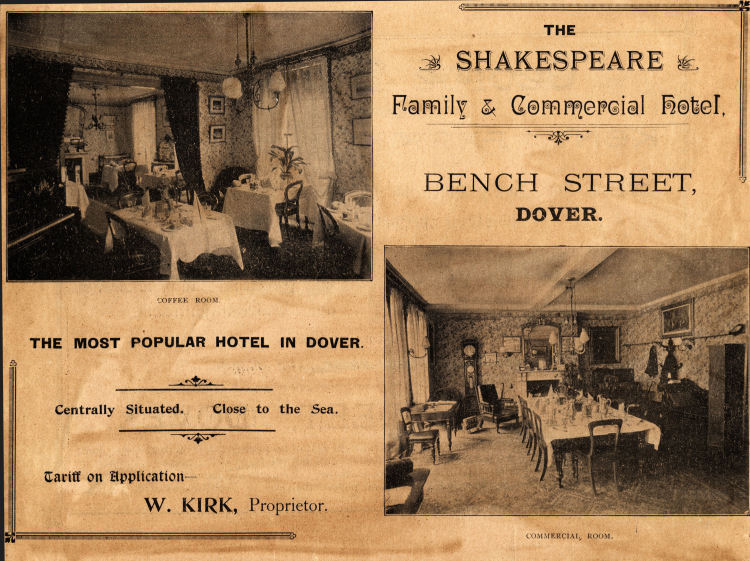
Above is shown a business card circa 1900, and below a blow up of the two pictures within the card. |
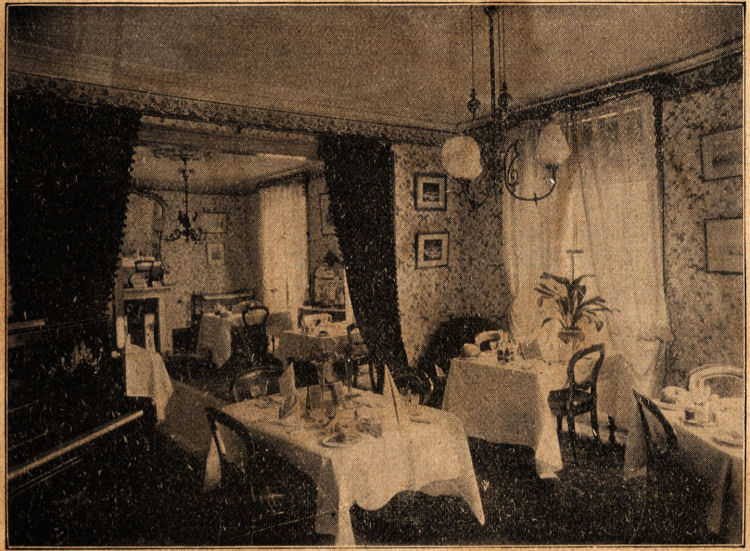
Coffee Room. Circa 1900. |
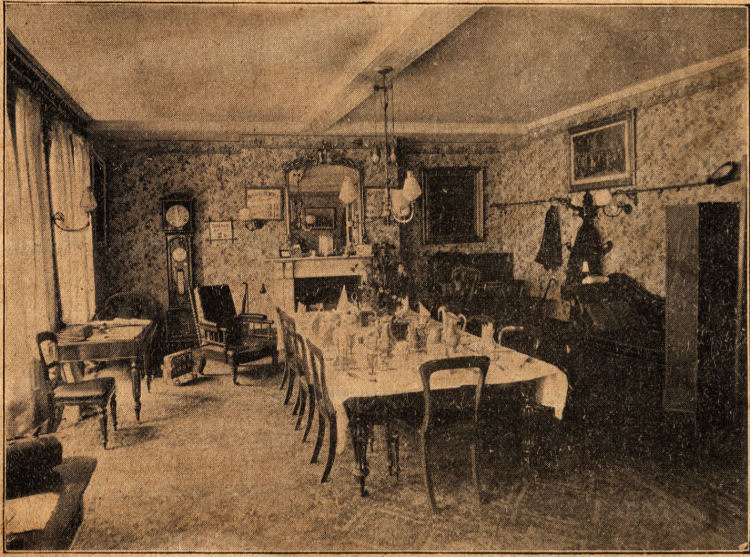
Commercial Room. Circa 1900. |
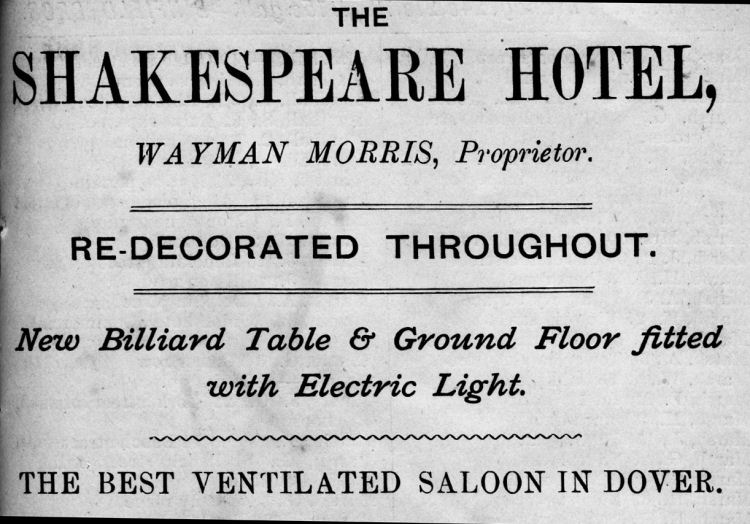
Above advert from the Post office Directory 1901

|
Further alterations in 1924 brought to light some twelfth
century ruins, thought to belong to St. Nicholas Church which was considered
to have once stood at the juncture of Snargate Street and Bench Street.
Indeed, still being reported present in 1486.
The stables prior to 1914 were in Townwall Street. 1922
saw the premises divided into a bar, restaurant and flats. People desiring a
drink with their meal then had to persuade the waiter to go along the
pavement to the bar next door. A communicating door later eliminated that
problem.
|
From the Dover Express and East Kent News, Friday, 3 March, 1922. Price 1½d.
SHAKESPEARE HOTEL, DOVER
The freehold of this well known commercial hotel having been sold,
Messrs. Worsfold and Hayward are disposing of the contents on March
15th, 16th and 17th. The 38 bedrooms contain an excellent lot of
furniture, suites and the like. There is some good plate, fine old
coppers and well made pieces in the coffee room, lounge and billiard
room. Scattered about the hotel are numerous coloured sporting prints.
Hogarth's engravings, and altogether about 1,000 lots will be offered.
|
|
From the Dover Express and East Kent News, Friday, 16
February, 1923. Price 1½d.
LICENSING
Plans were submitted by Mr. Eugene Carder on behalf of Messrs. J.
Lukey and Son, for alterations to the "Shakespeare Hotel," these being
explained to the Bench by Mr. H. E. Vernon Shone.
Mr. carder said that it was proposed to structurally divide the
premises, cutting off the bar. he thought it might be interesting to the
Bench to know that the grandfather of the present applicant was the
licensee of the premises seventy of eighty years ago, and his (Mr.
Carder's) grandfather presided at the opening dinner of the Hotel over
100 years ago.
The plans were approved.
|
|
From the Dover Express and East Kent News. 11 February, 1938. Price 1½d.
ALTERATION OF PREMISES
Application was also made for sanction to alterations to the
“Shakespeare Buffet.”
Mr. Vernon Shone stated that they were proposing to lengthen the bars by
about 7ft. and remove the office. It would avoid congestion.
The Chief Constable stated that he had no objection. It was quite a good
improvement and the removal of the office would give better supervision.
The alterations were approved.
|
|
From the Dover Express and East Kent News. 9 December, 1938. Price 1½d.
ALTERATION OF PREMISES
At the Dover Licensing Sessions on Friday the Magistrates approved
plans for alterations to the "Shakespeare," Bench Street, so that only
the part now used should be counted as licensed premises and not the
part adjoining.
|
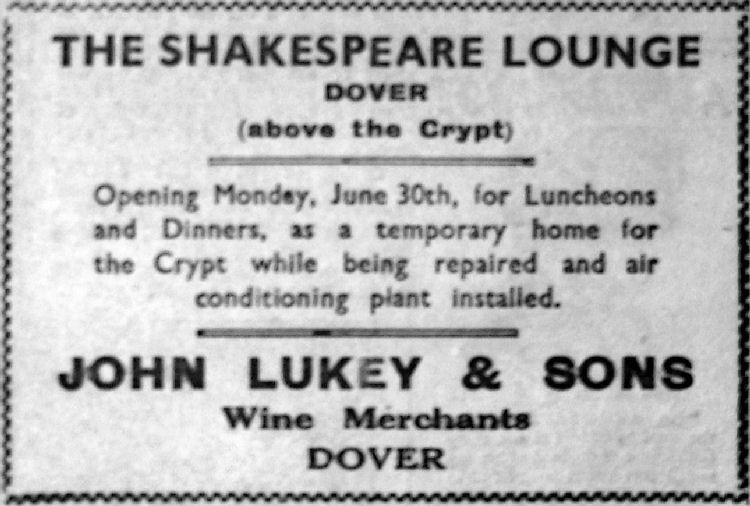
Shakespeare Buildings, Crypt Restaurant and "Shakespeare
Bars" with adjoining premises, amusement arcade, eight self contained flats
and a dance studio were sold to John Lukey in 1951. Shortly afterwards the
amusement arcade became the lounge and restaurant with cocktail bar. The
wooden floor of the dining room was that previously used in the skating rink
of the Granville Gardens.
|
From the Dover Express, 6 July 1951.
 |
This was a free house and in 1964 its name changed to
"Crypt Tavern", the new owners were Berni Inns.
The "Shakespeare" Hotel was a well known feature for many years. In 1923
it was transformed into flats, with a restaurant and shop to replace the old
hotel entrance. For many years after the 1939-45 war, until a tragic fire
gutted the premises in March 1977, killing seven people, it was known simply
as the Crypt. The hostelry, being ancient, may once upon a time have formed
the temporary sojourning place of some of Shakespeare's strolling players,
but the name of the hotel was originally "The George." It
then became "The Vine," and was changed to the "Shakespeare" about 1757,
which might have been intended to commemorate some circumstance then known
in the hostel's history.
 |
|
The Dover Express. Friday 20th September 1963.
Shakespeare Hotel 1912.
An age when one could cross Bench Street at one's
leisure... a handcart, a bicycle propped against a lamp-post, and a
tram rumbling on its journey to Buckland.
The properties on the
right-hand side of the street are among those which may come down to
make way for a new shopping centre.
When this picture was taken in 1912, the now
empty Hart's corner shop was occupied by Faith's grocery business. Other
properties on that side of the street were: The Shakespeare Hotel,
Freeman, Hardy and Willis, Fletcher's butcher's shop, George's
tobacconists, Whorwell the photographer, Pettit's greengrocery shop and
the Royal Cafe. On the Grocer's building on the left can be seen a sign
directing people to the Royal Hippodrome.
On the opposite side were A. and G. Pipe (milliners), Gieves (military tailors), Sydenham Payn (solicitor and coroner), Lamber;
Weston (photographer), Jeanne (blouses and robes), Caves Cafe, Falconer
(tailor), Greenstreet (bootmaker) and Williamson's toy shop.
Below, the same positioned photograph from 1965.
|
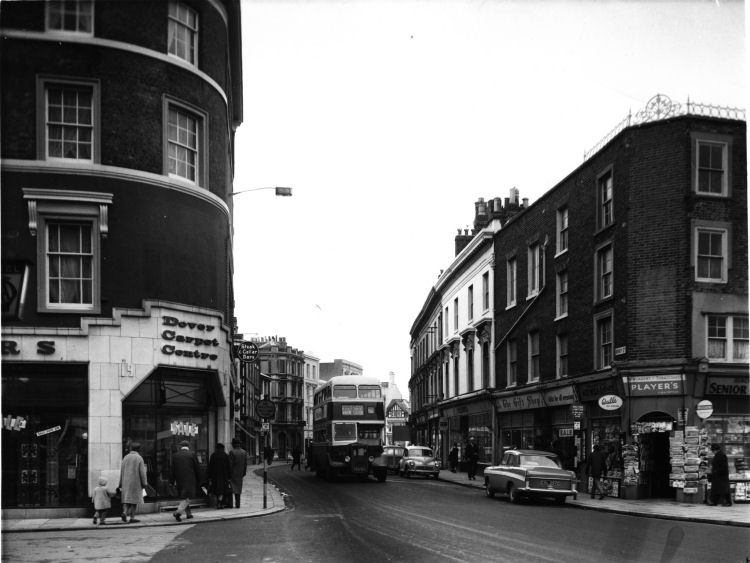
Above photo 1965. |
|
|
LICENSEE LIST
 ELVEY Charles 1810-39
  
HARVEY Charles 1825+
HOLLYER Josiah 1836-47 (age 40 in 1841 ) )
  
LUKEY John 1850-Mar/65

ADAMS Lewis & Co Mar/1865-74+


ADAMS Esther 1872 May/1876
(ADAMS Mrs H 1872-78
)
Not verified.
HARDS Miss Suzannah Kennard May/1876-78+
 (of Canterbury)
RUSSELL J Miss 1879-80
EYERS Mrs Kate 1882+

MUDFORD F 1884 end
HAZELL Mr A May/1884+
of Colchester
CROTCH Janes W Dec/1885-89+

HEMMINGS William 1891
GODDARD Miss 1892
CHAPMAN H E and COBB 1895 ( CHAPMAN) CHAPMAN)
KIRK Mr William Aug/1895-Apr/98
MORRIS Wayman Mr Apr/1898-Feb/23+ (Aug/1901)
(age 41 in 1901)
 (From Epping, Essex)
THOMAS Joseph George Feb/1923 only
(Former
ironmonger)
LUKEY John Edward Feb/1923-Jan/29
(Wine and
spirit merchant)
The premises also became part of the "Crypt"
in 1929.
BROWN Frank Edward senior Jan/1929-Dec/33 dec'd
(From the
"Bell" Saxmuntham, Suffolk.)
BROWN Frank Edward junior Dec/1933-34 end
(administrator of estate)
BELL Frederick Adison 1934
SELTH T J 1934 dec'd
SAUNDERS 1941 (Shakespeare Bars)
LUKEY John Edward 1942 dec'd (Shakespeare Bars)

Change of license also applied to off-licenses at 4, Bench Street and 9,
High Street.
LUKEY Percy Douglas 19 Jun 1942-62 end (Shakespeare Bars)
GRACE Norman Bible 1947-62

GRACE Nina 1947-62 end
No name given 1950-53 (Shakespeare Bars)


LEE Mrs S M 1954 (Shakespeare Crypt)
WATTS J F 1962 (Shakespeare Hotel and Crypt)
SLATTERY Julien P 1962-56+

PEARCE John 1969 (Shakespeare Crypt)
RABAIOTTI Guiseppe 1974 (Shakespeare Crypt Tavern)
TURNER Ronald or T R 1974 (Shakespeare Crypt
Tavern)
RABAIOTTI J P 1977 (Shakespeare Crypt Tavern)
Dover Blue Book 1938-39 referred to the premises as the "Shakespeare
Buffet."
From the Pigot's Directory 1828-9
From the Pigot's Directory 1832-33-34
From the Pigot's Directory 1839
From the Pigot's Directory 1840
From Bagshaw Directory 1847
From the Post Office Directory 1874
From the Post Office Directory 1878
From the Post Office Directory 1882
From Pikes Dover Blue Book 1889
From Pikes Dover Blue Book 1895
From the Kelly's Directory 1899
From the Post Office Directory 1901
From Pikes Dover Blue Book 1938-39
From the Kelly's Directory 1950
From the Kelly's Directory 1953
From the Kelly's Directory 1956
From the Kelly's Directory 1965
From the Dover Express
From the Dover Telegraph
Census
|

