|
Cannon Street / 10 Market Place
Dover
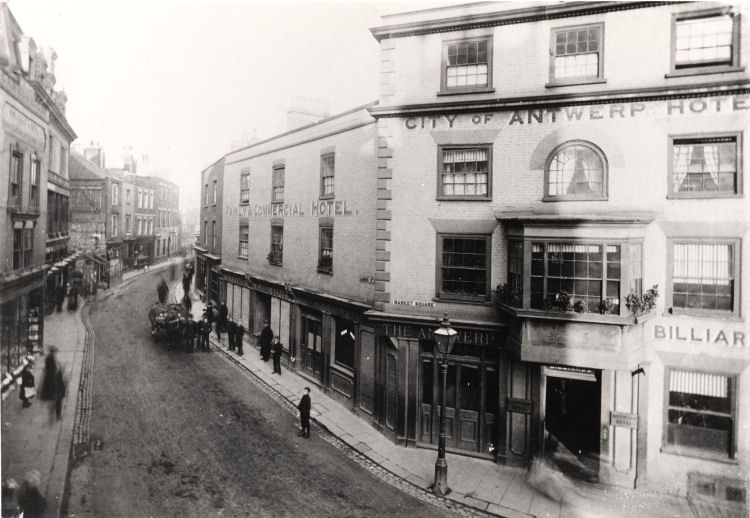
Photo showing the Antwerp Hotel and possibly Tap. Date unknown.
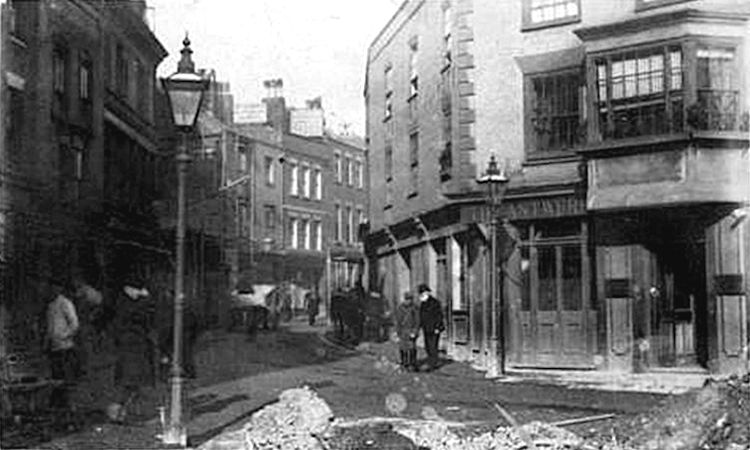
Antwerp Hotel, date unknown. |
I quickly learned to treat these 'Taps' with respect. They were not
always connected with the larger house of like name. This one functioned as
early as 1833 but disappeared during the street widening of 1893.
(I, believe that in this case the tap and hotel were connected and the
Tap is shown in the picture just behind the lamp-post. The census of 1871
clearly mark the Tap at number 2 and the Hotel at number 3, and William Tapsell and John Stokes as licensed victualler respectively.
Paul Skelton) The
remains of the "Antwerp" Stables stood until they were rebuilt in 1881 at
the Castle Street corner. Castle Street was mainly constructed between 1830
and 1835 and you may find it hard to believe that before 1830 there wasn't a
thoroughfare to Deal as there is today, not even a lane, the main road to
Deal being through St. James' Street.
During the road widening of Cannon Street of 1892 there were scarcely any
human remains found on the site of the "Antwerp Hotel," where had formerly
stood the west end of St. Peter's Church,
but, a little higher up, where the graveyard of St. Peter's had
been, a few human skulls and bones were unearthed.
The "Antwerp Hotel" is listed as
the "City of Antwerp Hotel" on my
site.
|
Kentish Gazette, Tuesday 3 December 1771.
Taken Away By Mistake.
From the "Antwerp Inn," Dover, on Saturday the 2nd of December instant.
A Claret coloured Great Coat, and an indifferent one left in its Room.
Whoever has got it and will bring it to the above inn, may have their
own coat returned with thanks.
By their humble servant, John White, "Antwerp Inn,"
Dec. 6. 1771.
|
|
Kentish Weekly Post or Canterbury Journal, Friday 7 April 1809.
ANTWERP INN, DOVER.
Household Furniture, Plate, Linen, China, Glass, Wines, Liquors, Ales,
&c. &c.
TO BE SOLD BY AUCTION, WITHOUT RESERVE, By C. LAMB.
On Tuesday next the 11th April, 1809, and following days, on the
premises of J. Luckett, at the "Antwerp Inn," Dover.
THE valuable HOUSEHOLD FURNITURE, Plate, Linen, China, Glass, Wines,
Liquors, Ales, &c. &c. Consisting of a large quantity of four-post and
tent bedsteads, with chintz and dimity furnitures to ditto; excellent
goose feather beds, mattresses, blankets counterpanes, and quilts;
mahogany and other chairs, tables, drawers, and bureaus; pier and
dressing glasses, Wilton, Venetian, and Kidderminster carpets; coppers
and tins of every description; good kitchen requisites; cut and plain
glass, china, &c. &c.
A large quantity of very good linen; about 100 ounces plate, and plated
goods; about 200 gallons of excellent liquors, a quantity of old wines,
ales, &c. &c.
Also, a large quantity of empty wine and porter bottles.
The goods are in very good condition, and the public may rely on their
being sold without reserve.
The sale will begin each day at ten o'clock in the forenoon.
Dover, April 3rd, 1809.
|
|
From the Kentish Gazette, 5 January, 1810.
ANTWERP INN, DOVER.
Daniel Chittenden, respectfully informs his friends, that the House
Warming Dinner is fixed for
Monday the 15th January instant.
Dinner on the table at half-past two o'clock.
Dover, 4th January, 1810.
|
|
Kentish Gazette 19 March 1819.
Tuesday, March 16th.
Edward Furley, charged with having on the 23rd February, stolen one
sheep, the property of Thomas Horn Esq., of Buckland.
Thomas Edward Hopper, shepherd to Mr. Horn, deposed that on the 23rd
February, he left in the field at 4 o'clock, 15 sheep; that on the
following morning he found four of the hurdles removed to another
part of the field, and one of the sheep had got out of the field; he
observed the footsteps of two persons, and on going a little way
from the hurdles he found some canvass and a bag, also the head and
and pluck of a sheep. He gave the canvass, which smelt of oil, to
Mr. Ellis, the foreman of the oil mill.
J. Ellis said, he received the bag and canvass from the last
witness, and on examination, found the piece of canvass to fit an
apron belonging to John Viles.
John Biles deposed, that on Tuesday evening Furley called on him to
assist in stealing a sheep from Mr. Horn; after a little hesitation
he went, being a little in liquor. They caught one, and after tying
its legs and carrying it a little way, the prisoner killed it; then
cut off its head, which they left with the entrails in the field,
then they carried it to the prisoners house, cut it in pieces, and
flayed it, after which they parted. The next day witness on
returning home from work, found a red box in his house which had
been brought by the prisoner, and was taken away again the same day.
------ Mate, constable of Dover, stated that on searching the
"Antwerp tap," he found a red box and took it, together with a
prisoner, into custody. The box contained two breasts and 5 or 6
pieces of Mutton.
Francis Coxen, landlord of the "Antwerp tap" stated, that the
prisoner brought a red box to his house, requesting him to take care
of it till next morning, as he should send it away by the coach. The
box remained with him till taken away by the constable.
Guilty - Death.
|
|
Kentish Chronicle, 25 August, 1829.
Died.
Aug. 16, at Dover, after a lingering illness, Miss Huntly, the
eldest daughter of Mr. Huntly, of the
"Antwerp Inn," Dover.
|
|
From the Dover Telegraph and Cinque Ports General
Advertiser, Saturday 16 November, 1833. Price 7d.
Mr. B. Worthington and Mr. H. N. Watson gave their inauguration
dinner, as members of the Dover corporation, at the "Antwerp Inn," on
Thursday evening, the arrangements for which, being in Mr. Huntley's
usual good taste, gave general satisfaction; and the conviviality of the
evening was enlivened by the melody and humorous efforts of Mr. Slomon.
|
|
From the Dover Telegraph and Cinque Ports General
Advertiser, Saturday 1 February, 1834. Price 7d.
VALUABLE BUILDING LAND, AT BUCKLAND, NEAR DOVER.
TO BE SOLD AT AUCTION, BY
MR. C. LAMB.
At the Antwerp Inn, in Dover, on Tuesday, the 25th day of February,
1834, at Three o'clock in the Afternoon precisely, by order of the
Commissioners, under a Fiat of Bankruptsy against Mr William Kingsford.
ALL THAT VALUABLE PLOT of LAND particularly adapted for the purposes
of Buildings, situate in the parish of Buckland, on the left-hand side
of the Turnpike Road from Dovor to Canterbury, and extending from the
present Houses in Bartholomew Close, to the Farm Buildings of the said
William Kingsford.
The Land will be sold in convenient Lots, as will be expressed in
future advertisements.
Particulars may be had of Mr. Surrage, Solicitor, Sandwich Messrs.
Shipden and Ledger, and Mr. Edward Elwin, Solicitors, Dovor; and of the
Auctioneer, Snargate Street, Dovor.
Dovor, January 30th, 1834.
|
|
Canterbury Weekly, 3 December, 1836.
Dover Dec 2.
On Wednesday last, a jury was empanelled at the Guildhall, Dover, to
assess the compensation to be paid to Mr. Williams Slaughter Huntly,
proprietor of the "Antwerp Inn," in consequence of the Commissioners
of Paving having giving notice to take his stables, coach houses,
and yard, for the purpose of effecting an entrance from Castle
Street (a private speculation) into the Market Place.
Last year, when the Commissioners were about to take the whole of
Bench Street down, they thought that the Dover jury would not do
impartial justice to their calls; and, therefore, issued to the
Sheriff of the County to summon a jury out of the Liberty of Dover;
but the results of their verdict was so far unsatisfactory, by the
high sums they gave the parties injured, that's the Commissioners
determined upon the present occasion to summon a jury from the
Borough. Twenty-four gentleman accordingly named, out of which 12
were drawn to serve.
Mr. Platt was Counsel for the claimant, and Mr. David Pollock for
the commissioners. Mr. Hill, late M.P. for Hull, acted as Assessor.
Mr. Platt, in a luminous speech, stated the chairman's case, which
surveyors and others were called to prove, amounting in the gross,
for the freehold and compensation, to nearly £4,000; the
commissioners had made an offer of £1,500. Mr. Pollock made an
ingenious defence; the case occupied from 10 o'clock in the morning
till 7 in the evening, when the jury retired to consider their
verdict - shortly after 8 o'clock the foreman returned into court
with a verdict of £3,026 11s 6d.
Surveyors for the Claimant - Mr John Whichcord, of Maidstone; Mr.
William Edmunds, of Margate; and Mr. William Huntley, of Dover.
Solicitors - Messrs. Shipdem and Ledger.
Surveyors for the Commissioners - Mr. John Smith, of Pentonville;
Mr. George Carter, of Maidstone; Mr. James Clark of Dover.
Solicitor - Mr. Edward Knocker.
|
|
From the Dover Telegraph and Cinque Ports General
Advertiser, Saturday 23 March, 1837.
The observation, that men acting in a body are frequently led to the
commission of acts when individually they would be ashamed of, was amply
verified by the Committee of Paving Commissioners, on Saturday last. The
darling object of the liberal(!) portion of the Board was attained on
Friday evening, by the purchase being completed of the land and premises
through the livery yard of the "Antwerp Hotel," required for an opening
into Castle-street. At an early hour next morning, without the slightest
intimation having been given to Mr. Huntly, of the Commissioners'
intention to take immediate possession, a number of workmen and
labourers took the yard, as it were by storm, and cutting through the
roofs, commenced the work of demolition. The horses, carriages, &c. were
quickly deprived of shelter, the fodder and provender exposed, and the
out-house thrown down with a violence that sent the live stock
domesticated in the yard, flying and scrambling in various directions.
We are aware that an Act of Parliament allows, in such cases, immediate
possession after the purchase is made good. "The law allows it," say the
Commissioners, but we know of no law that sanctions the wanton injury on
an individual, under any circumstances. Mr. Huntley, our readers need
not be told, had become obnoxious to the improvement partly by
steadfastly adhering to an Englishman's right, that of not giving up his
property on less advantageous terms than had been received by his
neighbours. And for this he has been visited by a paltry spirit of
revenge. By those acquainted with the meanness practised lately in Dover
under the sanction of the Pavement Board, it will scarcely be believed
that so wanton an attempt to injure an individual could ever have been
contemplated, much less carried into execution by his neighbours. Such,
however, was the fact, and to render the injury more complete the
market-day was selected for its application, as one when the
inconvenience would be most seriously experienced.
We are willing to hope that the body who authorised these disgraceful
proceedings were not unanimously so base-minded, so forgetful that the
Christian precept, "Do unto others as ye would they should do unto you."
Yet it never surely could have originated with such malice? It must,
therefore, be viewed as the work of the whole Committee, unless some,
who we have no doubt despise so un-English a proceeding, chose to rid
themselves of the stigma b denouncing those who have acted thus, in
accordance with the tyraunical principle that has so long marked the
proceedings of the soi-distant liberal Commissioners!
|
|
From the Kentish Gazette, 25 September 1838.
Sept. 17, at Dover, aged 66, Mr. William Slaughter Huntley, for many
years the highly respected landlord of the "Antwerp Hotel."
|
|
From the Kentish Gazette 25 September 1838.
COMMERCIAL INN, ANTWERP HOTEL AND POST HOUSE, MARKET PLACE, DOVOR.
T. HUNTLEY begs to return her grateful thanks for the favours shown
to her late husband for many years, and begs to assure those Friends
who may continue to give her their support, that the utmost exertion
will be used to promote their comfort.
Billiards, superior Stall Stabling or Boxes, and Lock-up Coach
Houses.
September 24th, 1838.
|
|
From the Kentish Gazette, 9 October 1838.
DOVER. OCT 8. Accidents.
On Tuesday night, as Thomas Turner, Esq., late managing director of the
Surrey, Kent, and Sussex Bank, was proceeding on horseback from the
"Antwerp Inn," Dover, to his residence at Tiimanstone, he was thrown
near Waldershare church. He was carried to his home in a state of
insensibility, in which he continued until ten o'clock on Saturday
night, when he expired, from the effects of a violent concussion of the
brain.
|
|
From the Dover Telegraph and Cinque Ports General
Advertiser, Saturday 30 March, 1839. Price 5d.
POLICE REPORT
A person of good address, but very disorderly appearance, who gave
his name John Young, a native of Shropshire, and said he was at Dover
for the benefit of his health, was charged before the Magistrates, on
Monday, with violent conduct in the "Antwerp Tap," on Saturday night. It
appeared in evidence, that he entered the house at eleven o'clock, in a
state of intoxication; and being refused admission to the parlour, used
some rude familiarity towards Mrs. Belsey, the landlady, who in
consequence slapped his face, on which he struck her hands with a
candlestick; and taking up another, he threw it at her husband, which,
missing him, broke a square of glass, a slate, and the glass on the bar
light. On the police being called, the prisoner ran out, and up Market
street, where his progress was arrested by a neighbour, who after a
desperate struggle, in which both parties sustained injury, detained him
until taken in charge by the police, when he continued the same violent
conduct. In defence, he said he could give good reference to his
respectability; but did not chose to do so in open court. He admitted
being intoxicated; but contended he could not have acted as described in
the public house unless exasperated by ill usage. As to kicking and
assaulting the gentleman who first seized him, and the officers
subsequently, he considered himself to be justified, for he was sure,
had gentlemanly language been used towards him, he would not have acted
improperly! he as ordered to pay 8s. 9d. for the damage done, and costs,
which he said he would do most willingly out of his money, 15s. in
charge of the police. This being done he was convicted of the assault
out of doors, and also on the officers in the execution of their duty,
for which he was fined 20s. or to be imprisoned for 14 days. The latter
was adopted; but whether or not for want of means to pay the former, did
not appear.
|
|
Kentish Gazette, 5 November 1844.
DOVOR.
Sale of a very valuable and extensive FREEHOLD ESTATE, in the
flourishing and improving Town of DOVOR, producing an Annual
Rental of upwards of £200.
TO BE SOLD BY AUCTION, BY MR. BIRCH,
AT the "Antwerp Hotel," in DOVOR, on MONDAY, the 11th day of NOVEMBER,
1844, at Two for Three o’clock in the Afternoon
precisely, in One Lot (unless previously disposed of by private
contract, of which notice will be given), the above valuable ESTATE:
Comprising a large MESSUAGE and elegant and extensive DRAPER'S SHOP,
leased to Mr. Skillman for seven years, from the 6th
January, 1843, determinable at the end of the first four years. Another
large MESSUAGE and SHOP, leased to Mr. Smith, hatter, for
twenty-one years, from the 11th of October, 1837, determinable at the
end of the first fourteen years. A FREE PUBLIC HOUSE, at the
back of the above, in the occupation of Mr. Spice, tenant at will; and a
MESSUAGE adjoining, in the occupation of Mr. Binfield,
grocer, also tenant at will.
The Premises in the occupation of Messrs. Skillman and Smith front the
upper part of Snargate Street (near to the new bridge which
leads to Waterloo Crescent, the Marine Parade, and Camden Crescent), and
is the great thoroughfare of the fashionable visitors; and
the Premises in the rear are in a very populous neighbourhood, and from
the increasing prosperity of the town, the Estate offers a
most eligible and improvable investment.
To treat for the purchase by private contract, and for printed
particulars and conditions of sale, apply to Mr. Pain, Solicitor, Dovor.
|
|
Kentish Gazette, 31 December 1844.
DEATH.
Dec 25, at the "Antwerp Tap, Dover, Mrs. Cole, aged 56.
|
|
Kent Herald, 13 November 1845.
Dover.
A Court for the relief of Insolvents was held on Friday, at the new Town Hall,
before Mr. Commissioner Law. Mr. George Cole, licensed victualler, had his
hearing, and was discharged.
Mr. William Gravely, late of Broughton, Brewer, was also discharged without
opposition.
|
|
Kentish Gazette, 17 September 1850.
Petty Sessions.
Monday week being the day for renewing the licences to public houses,
the court, in addition to that business, by request, transferred the
license of a house at Ringwould to Mr. Harris, late of the "Antwerp Tap," Dover.
|
|
From the Dover Express and East Kent Intelligencer, 14 August, 1858.
DOVER POLICE COURT
THREATENING TO ASSAULT
John Crick was summonsed by Thomas Dawson, the landlord of the
"Antwerp Tap," Church Street, for unlawfully threatening to assault him.
Complainant prayed that he might be bound over to keep the peace.
The Magistrates, after hearing the evidence, dismissed the case, and
the complainant, who was inclined to grumble at the decision, had to pay
the costs.
|
|
South Eastern Gazette, 6 March, 1860.
Charge of Robbery from the Person.
On Friday last, John Crick, who is tolerably well known both to the
police and magistrates, was charged at the police court with
stealing £12 from the person of Mr. John Prescott Dennis, carrier,
of Charlton.
It appeared that on Thursday afternoon Dennis had gone in Crick’s
company to the "Antwerp tap," having then in a bag in his pocket £39
in gold. While drinking some porter Crick took the bag from Dennis's
pocket, opened it, and took out the money to count, on which Dennis
asked to have it back, and prisoner, after some joking, returned it,
but when immediately afterwards the money was counted by the owner
£12 was missing. Crick denied taking any, though nobody but he and
prosecutor was present, and when Dennis insisted on having the sum
abstracted restored, Crick swore at him, called him a liar, and
walked with pretended indignation away. Information was subsequently
given to the police, who apprehended Crick at his house next
morning.
The Bench remanded the case till Monday, for the production of
further evidence.
|
|
South Eastern Gazette, 14 August, 1860.
ANTWERP HOTEL, DOVER.
MRS. HUNTLY, in relinquishing the above business, offers her most
respectful acknowledgments to those friends who have, during her
lengthened residence, continued their patronage; she has also the
satisfaction to assure them that her successor is in every way
disposed to offer such comfort and accommodation as may induce a
continuance of their favours. Carriages, Coach-houses, Stabling,
&c., are known to the public, and there will be no diminution of
attention and comfort to those who have hitherto expressed their
satisfaction in the arrangement of the hotel.
THOMAS HUNTLY,
IN introducing to his Friends and the Public Mr. J. STOKES as his
Successor in the Out-door Department of the above Establishment,
begs to return his grateful thanks for the favours conferred upon
him, and to solicit a continuance of the same on behalf of Mr.
Stokes.
JOHN STOKES, (Late of the "Ship Inn," Dymchurch),
HAVING succeeded to the above business, most respectfully solicits a
continuance of that patronage so liberally awarded to his
predecessors. Every attention and comfort will be offered, and every
exertion used to meet their approbation. Wines and Spirits of the
choicest quality. Flys in constant readiness, and Omnibuses to and
from the Trains.
EXCELLENT STABLING AND COACHHOUSES.
Dover, 3rd August, 1860.
|
|
From the Dover Express and East Kent Intelligencer, 24
September, 1864.
ASSAULT
Timothy Sheen, a private in the 2nd Brigade, Royal Artillery,
stationed at Dover, was charged with an unprovoked attack on Edward
Chaney, a porter at the Antwerp Inn, and was committed for 14 days' hard
labour, in default of paying a fine and costs.
|
|
From the Dover Express and East Kent Intelligencer,
13 April, 1866.
CHARGE OF FELONY
William Watts, a soldier of the 74th regiment, was charged with
stealing a pair of reins, the property of William Styles, landlord of
the "Antwerp Tap."
The prosecutor said he did not desire to press the charge.
It turned out that the prisoner and his comrades were customers of
the prosecutor; but this circumstance, the Magistrates observed, should
not influence him, as he had a duty to perform to the public.
The owner of the reins, however, persisted in his determination, and
the prisoner was dismissed on this charge. But it appeared that he had
assaulted police-constable Geddes on the way to the station-house, and
that his character was bad, - a sergeant of his regiment stating that he
had been punished by the commanding officer no less than three times
within the past week, - the Magistrates sent him to gaol for fourteen
days, in default of his paying a fine and costs.
|
|
From the Dover Express and East Kent Intelligencer,
5 October, 1866.
PUBLIC HOUSE ROBBERY
Thomas Knight was charged with stealing from the person of Charles
Corke, while in a state of drunkenness at the "Antwerp Tap," a leather
purse containing 20s. his property.
Stephen Cook, a labourer, said he lived nowhere at present, being "on
the roads." he was at the "Antwerp Tap" the same morning about half-past
nine o'clock. He saw the prisoner there, in the tap-room. He also
saw in the same room the prosecutor, who was tipsy. (Prosecutor was now
hardly restored to a state of sobriety.) The prisoner and the prosecutor
were drinking together. After a time the prosecutor went to sleep.
Several people were in the tap-room; but they all went out except Corke,
Knight, witness and a young woman, a servant of the house. As the
prosecutor was lying down he saw the prisoner put his hand into the
prisoner's coat pocket, and the prosecutor's purse drop to the ground.
That produced by the police was the same. The prisoner took it up, and
as the drunken man then woke up the prisoner gave it him. The prisoner
did not have it in his hand half a minute. Before that witness saw the
prosecutor counting some money. He seemed to have 15s. or 16s., which he
put in his purse. The purse was not long enough in the prisoner's hand
for him to have opened it.
By the Bench: The prosecutor counted the money about twenty minutes
before he went to sleep. He did not go out of the room.
Harriett Hayward: I am servant at the "Antwerp Tap." I saw the
prisoner in the tap-room this morning about half-past nine. The
prosecutor was with him. I saw the prosecutor counting the money. (The
prosecutor, who had been swaying too and fro apparently in a very
uncomfortable state for some time past, here requested to be let out, as
he felt indisposed - a condition of things he described in the tersest
Saxon. Of course way was instantly made for him.) I saw the prosecutor
put the money into his purse again, and place the purse in his coat
pocket. After the prosecutor went to sleep I saw the prisoner put his
hand into prosecutors pocket, and the purse immediately afterwards
dropped out of the pocket. This awoke the prosecutor.
Magistrates' Clerk: How long did prisoner keep his hand in
prosecutor's pocket?
Witness: Oh, a very little time.
Magistrates' Clerk: Did the purse, when it dropped, sound as if it
had much money in it?
Witness: Yes.
Magistrates' Clerk: Did the prisoner do anything with the purse
before giving it to prosecutor?
Witness: Not then.
Magistrates' Clerk: What afterwards occurred?
Witness: The prosecutor afterwards went to sleep with the purse in
his hand. The prisoner then took the purse out of the prosecutor's hand,
opened it, and took some money out, and gave me half-a-crown to say
nothing about it. the last witness had gone by that time. I then went to
my mistress and told her what had taken place and gave her the
half-crown the prisoner had given me to my mistresses son.
Police-constable Richard Chard said he was fetched to the
"Antwerp Tap" the same morning. He found the prisoner sitting on one
side of the table and the prosecutor on the other. The prosecutor told
him he had been robbed. He did not say of how much. After making
enquiries witness told the prisoner he should take him into custody.
Prisoner thereupon took 4s. 7d. from his waistcoat pocket and threw it
down on the table to the prosecutor saying, "Here's your money, Charley;
say nothing about it." I then took him to the police-station, and on
searching him found 2s. 7d. more. On bringing him to the court he said,
"You took 2s. 7d. from me, didn't you?" I replied "Yes," and he then
said, "That's all I had belonging to me; I dare say I shall get a month
for this."
The prisoner denied that he said anything of the sort.
It was thought desirable to have the evidence of the prosecutor, but
it was found that he was not sufficiently recovered to make a
re-appearance before the Magistrates; and a further hearing of the case
was adjourned till the following day, the prisoner being removed in
custody.
|
|
From the Dover Express and East Kent Intelligencer,
5 October, 1866.
REMANDED CHARGE
Thomas Knight, the man remanded from the previous day, on a charge of
robbing Charles Orton, at the "Antwerp Tap," was again placed at the
bar. The prosecutor was now sober, and his evidence having been taken,
together with further testimony which strengthened that of the girl
examined on Tuesday, the prisoner was sentenced to six weeks'
imprisonment, with hard labour.
|
|
From the Dover Express and East Kent News, Friday, 25 August, 1871. Price 1d.
MESSRS TERSON & SON.
Have the honour to announce that pursuant to instructions received they
will offer for Sale, by public Auction, at the “City of Antwerp Hotel,”
Dover. On Thursday, the 31st day of August, 1871, at two for three
o'clock precisely.
All the well-known long-established Commercial and family Hotel, “City
of Antwerp,” with the Tap adjoining, situate in the Market Square and
Cannon Street, Dover, and now in the occupation of Mr. John Stokes.
The Hotel contains on Basement – Capital Wine, Beer, and Coal Cellars.
On Ground Floor – Entrance Hall, Coffee Room, Sitting Room, Large Bar,
Luggage Room, Kitchen, Scullery, Knife House, Wash-house, with Servant's
Bedroom over the Yard, with W.C. On First Floor – Large Commercial Room
with bay window, Sitting Room, five Bedrooms, large Closet, and 2 W.C.'s.
On Second Floor – One Sitting and six Bedrooms, Closet, and large Store
Room. On Third Floor – Four Bedrooms and a large Closet. The Tap
contains – Bar, Taproom, Parlour, Sitting Room, Bedroom, Cellar, Yard,
and W.C.
The property has a frontage to Market Square of 28ft. 9in, and to Cannon
Street of 53 ft.
And all the substantial range of Buildings on the East side of, and
having a frontage of 128ft. 6in. to Castle Street, Dover, comprising a
convenient Office, with room adjoining, in the occupation of Mr. George
Flashman. A showy double-fronted Shop with modern plate-glass window, in
the occupation of Mr. Richard Harding. A large Coach-house, with two
excellent Rooms and W.C. over; a comfortable four-roomed Cottage with
W.C.; a fine well-ventilated Stable having 13 stalls, one Loose Box,
good Loft over; and a commodious Yard with Dung Pit, Pump, and W.C., in
the occupation of Mr. Francis-Packham. And the range of Buildings on the
West side of, and having a frontage of 78ft 6in. to Castle Street, and
extending back to Church Street, to which there is a frontage of 51ft.
comprising Stable with nine Stalls, and 3 Loose Boxes, large Loft over,
Office, Harness-room, Coach-house, and Dung Pit, also in the occupation
of Mr. Francis Packham.
The unusual advantages which this valuable Property offers to Investors
are too obvious to require comment. The prominent position of the Hotel
in the Market Square, commanding the entire traffic of the Canterbury,
Folkestone and Deal roads, and its proximity to the Priory Station of
the London, Chatham, and Dover Railway, admirably adapt it for business
which has been carried on there with great success for more than a
century; while the Stabling, &c., form, as they now stand, either a
valuable adjunct to the Hotel, or a profitable separate concern; or from
the extensive area affords an opportunity for building which exists in
no other central thoroughfare in Dover. The Property is all
substantially built, thoroughly drained, and well-supplied with water
and gas.
The whole of the Landlord's Fixtures will be embraced in the purchase.
It is intended to offer the Property as an entirety; and if not sold as
such, then in three Lots; the Hotel and the Tap being Lot 1; The
Buildings on the East side of the Castle Street, Lot 2; and those on the
West side, Lot 3.
May be viewed by permission on the Tenants, and Particulars and
Conditions of Sale obtained of the Auctioneers, Castle Street, Dover; or
of, Mr. Percy B. Claris, Solicitor, Dover.
|
|
From the Dover Express and East Kent News, Friday, 1 December, 1871. Price 1d.
RIVAL GLAZIERS
Moses Bennet. A glazier, of Adrian Street, was charged by Ezekiel
Simons, a glazier of St. James's Street, with unlawfully assaulting him.
Prosecutor: This took place this morning at half-past nine, but I had
been working since half-past seven at the “Antwerp Hotel.” The prisoner
came there and began to work at the same windows as I. I told him I did
not want his help, and he said, “I must work.” He took me round the
waist with one arm, and with the other he gave me two blows on the back
of my head with some instrument he had. I said I should give him into
custody, and he said he would give me into custody. Whatever I said he
said the same. I took him to the police-station and gave him into
custody, and after that went home, but I could not stop the blood, so I
went to a doctor.
Mr. Rees: Who employed you at the “Antwerp Hotel?”
Prosecutor: Mr. and Mrs. Stokes.
The Mayor: Do you know anything of the prisoner?
Prosecutor: No, sir.
The Mayor (to prisoner): Have you any questions to ask?
Prisoner: I do not know what you mean by questions; I do not speak such
nice English as Mr. Simons. (Laughter.)
After being made to understand what a question was, he said to the
prosecutor.
Did the landlady send for you?
Prosecutor: Yes.
Prisoner: Send for the lady from the Hotel, she knows everything. I told
the lady yesterday morning I would do the windows for 4d each. When I
went this morning Mr. Simons hit me three fights in the side.
(Laughter.) He had a knife, and he was going to strike me with it, but I
threw him back. He hit me yesterday.
The mayor (to prosecutor): Did you strike this man yesterday?
Prosecutor: Yes, sir; I pushed him.
The Mayor: We have heard quite enough of this case. It will be
dismissed.
|
|
From the Dover Express and East Kent News, Friday, 8 December, 1871. Price 1d.
THE ELECTION DISTURBANCES
Newman Cunningham, an elderly man, who distinguished himself during the
recent election by reading one of Mr. Barnett's processions of roughs,
red ochred and wearing parti-coloured garments, was placed at the bar
charged with breaking windows at the “Antwerp Hotel” on the evening of
Saturday, November 25th.
Mr. Chalkley, from the office of Messrs. Lewis and Lewis, said he
appeared to ask that the prisoner might be remanded until Monday, when
some other persons, already in custody, or who had been summoned to
appear, would be brought before the Magistrates charged with creating
disturbances on the night of the 25th. He should produce evidence which
would satisfy the Magistrates of the identity of the defendant, and
would then ask for a remand.
Harry William Kennett: I am an assistant to Mr. Masters, the
hair-dresser. I know the prisoner. I saw him in the Market Place on the
evening of the Election; he was throwing stones at the “Antwerp Hotel.”
Prisoner: Where did you see me?
Witness: I saw you in the Market Square between twenty and a quarter to
five.
Prisoner: That'll do. I can prove that I was at home at the time. Where
did you see me after that?
Witness: I did not see you again afterwards.
Prisoner: If a fellow swears a man's life away like that, he ought to be
hung.
Mr. Chalkley said that was all the evidence he had at present. He would
ask for a remand until Monday. He should want substantial bail for the
prisoner's appearance.
Bail was taken in two sureties of £35 each.
|
|
From the Dover Express and East Kent News, Friday, 16 November, 1877. Price 1d.
STEALING A COAT
Simon McSweney, and artilleryman, was charged with stealing a coat from
18, Cannon Street, value 16s., the property of Mr. Henry Hart.
George Walters, bombardier in the 9th Brigade Royal Artillery, said: I
was in charge of a piquet in Snargate Street about eight o'clock last
night. I saw the prisoner running with a coat upon his arm. I asked him
where he got the coat and he said he did not know. I then took him to
the main shaft guard.
Henry Walter, assistant to Mr. Hart, pawnbroker, identified the coat
produced as being the property of Mr. Hart. It was hanging on a nail at
the shop door about half-past seven the previous evening, and from what
he was told some little time after he looked and found it was gone. He
afterwards went to the shaft guard and the coat was handed over to him
and he charged the prisoner with stealing it.
Nilson Nash, porter at the “Antwerp Hotel,” said he was in the
luggage-room of the “Antwerp,” about eight o'clock the previous evening,
and saw the prisoner snatch the coat off a nail and walk away with it.
Witness then gave information to Mr. Hart's assistant.
The prisoner bore a bad character.
The Superintendent said the man was brought to that station fro stealing
half a pound of biscuits, last week, but the tradesman declined to
prosecute.
The Bench sentenced the prisoner to three months' imprisonment.
|
|
From the Dover Express and East Kent News, Friday 16 January, 1885.
MARSHALL v. STOKES
The defendant did not appear.
The plaintiff, Dr. Marshall, said defendant formerly kept the “Antwerp
Hotel,” in the Market Square, and he was now informed that he received
money at the transfer of that and was now keeping a lodging house in
Eastbourne.
The Judge said he would adjourn the case to have the defendant's means
to pay proved.
|
|
From the Dover Express and East Kent News, Friday, 26 February, 1886. Price 1d.
TELEPHONE LINE
The Telephone Company have run an overhead wire from their office in
Commercial Quay to a room at the “Antwerp Hotel,” market Place. We had a
communication with some one at the other end on Tuesday, and found the
mode of communication very easy. Should an exchange be opened here it
must prove to be a stimulus to business.
|
|
From the Dover Express and East Kent News, Friday 25
August, 1893. 1d.
DOVER BREWSTER SESSIONS
The “Antwerp Hotel” licence was taken by the Town Clerk.
|
|
From the Dover Express and East Kent News, Friday, 15 September, 1933. Price 1½d.
DOVER HOTEL KEEPER'S BANKRUPTCY
The public examination in the bankruptcy of Mrs. Charlotte Maude Brown,
of 13, Priory Road, formerly carrying on the business of an unlicensed
hotel and restaurant at the “Antwerp Hotel,” Cannon Street, Dover, was
held at Canterbury Bankruptcy Court on Tuesday. Her statement of affairs
disclosed liabilities as £196, and assets as £13, leaving a deficiency
of £183.
Under examination by the Official Receiver (Mr. F. H. Langmald), debtor
said that there was a deed of separation between herself and her
husband, and she received £2 3s. 4d., a month allowance. In addition to
the claims scheduled, she owed a certain amount to the Home and
Colonial, her landlords, for rent at £70 a year, and she owed a sum for
rates and electricity. From 1916 until 1925 she had a boarding house at
Kensington, which brought her in sufficient on which to live. From 1925
till 1930 she had a similar establishment at Fulham, and that she was
also successful. While at Fulham she became acquainted with Mr. and Mrs.
Walton, who carried on the “Antwerp Hotel” at Dover, and during 1930 she
spent a considerable time at the hotel, and nursed Mrs. Walton in an
eight weeks' illness. Eventually Mr. and Mrs. Walton decided that they
could no longer continue the hotel, and she agreed to take it over,
although she knew that the Walton's had not made it pay. She felt that
she could run it better.
That is why you left a paying business in London for a doubtful one in
Dover?
Yes.
Debtor explained that when she took over the business the furniture
there belonged to Mr. George Thomas, and on October 16th, 1930, she
entered into a hire purchase agreement to purchase all the furniture in
the hotel for £336, payable by £36 down and £9 a month. She did not have
the furniture valued, and the deposit she paid exhausted her capital.
The Official Receiver: How did you arrive at the figure?
Debtor: I thought I was dealing with an honest man, and took it at that
figure.
The Registrar (Mr. Frank M. Furley): Mr. Thomas was not acting for you,
was he?
Mr. Mowll: He was the vendor. I understand he took this woman to Mr. De
Wet, not the usual solicitor.
Was the whole of the furniture recently seized under the three distress
orders?
Yes.
Do you know how much it fetched?
I believe it fetched £60 odd.
According to my figures, the furniture seized for rent realised £43
14s., and for income tax about £10. Do you know how much the rating
authority got?
They did not get quite that amount.
Mr. Thomas: You told the Court I took you to Mr. De Wet.
Debtor: You did not take me, but you suggested I should go.
Then it was not true when you say I took you?
You suggested I should go.
Mr. Mowll: She did not say you took her. I said that.
Mr. Thomas: You put the words in her mouth, and she told the Court that
that was so. It was taken as a direct statement to the Court. (To
debtor): You admit now that I did not take you to Mr. De Wet?
Mr. Thomas asked debtor if it were correct that debtor asked him to take
the furniture away, and she replied that she did.
Mr. Thomas: Is it not a fact that you did not ask me to take it away
until three days before you actually left the “Antwerp?”
Debtor: No, I asked you a long time ago to take it away. I believe Mr.
Mowll wrote to you and asked you to take it away.
Mr. Thomas: I have had no letter from Mr. Mowll.
Mr. Thomas asked debtor if she did not gather any impression as to the
nature of the business during the time she stayed at the hotel prior to
taking over the business?
Mr. Mowll objected to the question, remarking: This man has come here to
persecute debtor, and I am going to protect her.
Debtor said that she had never paid any income tax on the “Antwerp
Hotel.” The income tax she paid was on her own money when employed by
the Co-operative Society.
When debtor told Mr. Thomas that she did not admit that the amount of
the furniture was worth the £336, he asked her why she signed the
agreement, and she replied that she wanted to make the place pay. She
thought that it would be a very good business as it was in the centre of
the town.
Mr. Thomas suggested that the case needed further investigation, as he
as far from satisfied with what the debtor had said that the furniture
at Priory Road did not belong to her.
When Mr. Thomas made the remark “There is no doubt that when the debtor
saw the red light and was making preparations for a flit from the
“Antwerp Hotel” -----" the Registrar stopped him, and said that he could
not allow this.
In reply to questions by Mr. Mowll, debtor said that she first told Mr.
Thomas he had better take his furniture when she saw him about five
weeks before she left the “Antwerp” on June 24th. That was before the
distress had been levied. Once Mr. Thomas met her in the street and told
her that he was issuing a writ and he would see her in gaol.
The examination was closed.
|
LICENSEE LIST ANTWERP TAP/HOTEL
GREEN Thomas
to June/1764 
WHITE John 1771+
TILLEY John to Jan/1807
LUCKETT J to Apr/1809
CHITTENDEN Daniel 1810+
COXEN Francis 1819+ (Tap)
HUNTLEY William Slaughter 1829-Sept/38 dec'd 
HUNTLEY T Mrs Sept/1838+
BELSEY Mrs 1839+
COLE George 1844-45+
SOUTH Mr 1848
HARRIS William to Sept/1850
HUNTLEY Susannah 1851+ (age 70 in 1851 ) )
HOLMAN 1851
HAMMOND William 1856
DAWSON Thomas 1857-58

GODWIN Stephen 1862
TAYLOR Thomas Robert Grant 1862-Sept/63
STILES William 1866+
TAPSELL William 1871-Apr/1883
(age 50 in 1881 Wife was Eliza.)
STOKES John 1881-Mar/84 (age 60 in 1881)
FOX William H Mar/1884+
LICENSEE LIST ANTWERP HOTEL 8 CANNON STREET
HUNTLEY Thomas to Aug/1860
 STOKES John Aug/1860-to Aug/1871
ADAMS John Rowe Feb/1894 (Antwerp Bar or Tap)
BROWN Mrs Charlotte Maud 1930-33 end
WALKDEN or Walton Mrs 1928
WALTON Mrs 1928-Oct/30
BROWN Charlotte Maud Oct/1930-Sept/33

From Pikes Dover Blue Book 1932-33
Kentish Gazette
From the Dover Express
|

