|
Dover Road
Ringwould
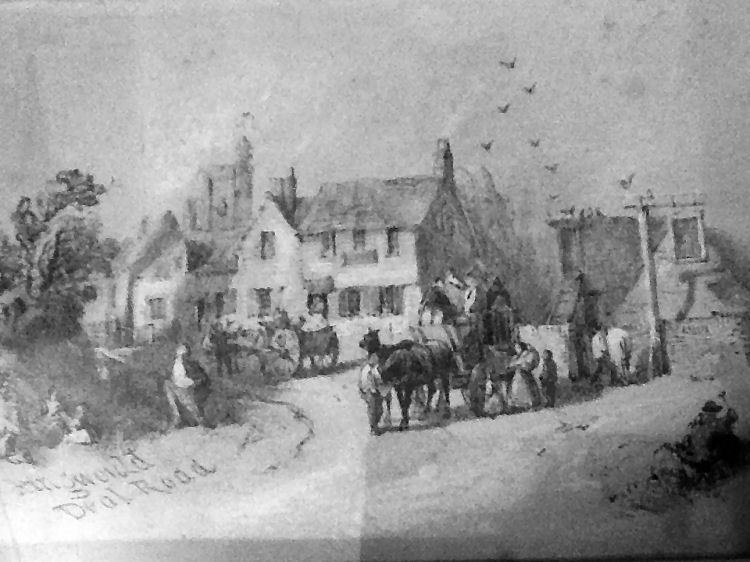
Above painting by William Burgess, circa 1840s, showing the "Five Bells"
centre picture and what I believe to be the sign of the "Lord Nelson"
and pub behind. Kindly sent by John Skelton. |
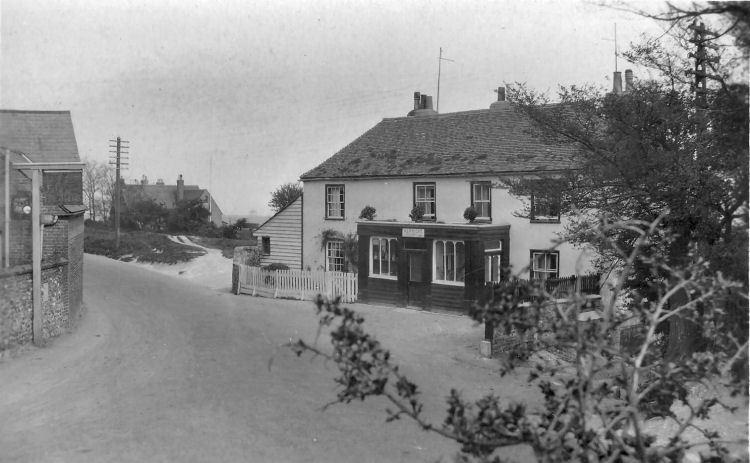
Above postcard kindly sent by Jean Winn showing the pub after it had
closed in 1918 and was converted into tea-rooms. |
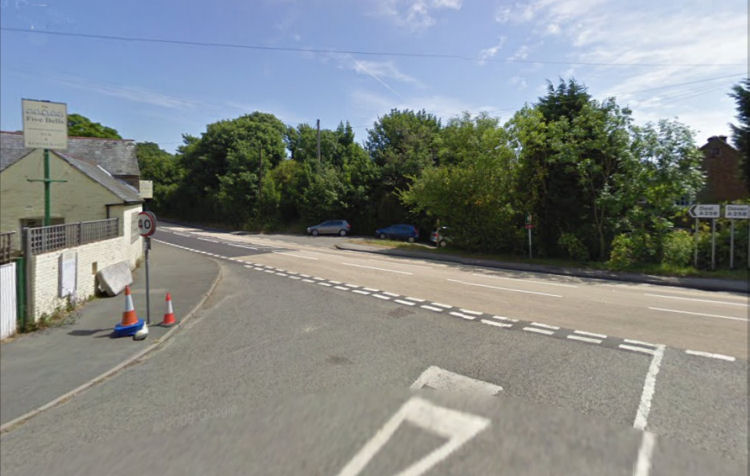
Photo above shows the same area as of 2010. Picture taken from Google
Maps. The "Five Bells" is shown
on the left. |
|
Kentish Gazette, 17 September 1850.
Petty Sessions.
Monday week being the day for renewing the licences to public houses,
the court, in addition to that business, by request, transferred the
license of a house at Ringwould to Mr. Harris, late of the "Antwerp Tap," Dover.
|
|
From the Deal, Walmer, and Sandwich Mercury,
10 July, 1869. 1d.
AN OLD OFFENDER
Maria Tringrove, who had repeatedly appeared before the County and
Borough Magistrates, was charged with sleeping in the open air, and with
wandering about not having any viable means of subsistence.
P.C. Stamford deposed: I am one of the K.C.C., stationed at Ringwould.
About half-past 12 o'clock this morning I was on duty at Ringwould, and
whilst I was standing in the street the prisoner and four or five men
were turned out of the "Lord Nelson" public-house. I watched them and
saw them all go into Mr. Bradley's stables. I shortly afterwards
followed them, but when I got to the stables the door was locked. I
demanded the door to be undone, and after a little time it was. On my
entering the stables I saw the prisoner lying down and one of the men
standing by her, and two other men were lying on a heap of hay,
pretending to be asleep. I asked them if their master allowed them to
have anyone in the stable, and they said he did. The prisoner told me
she wanted to go to Deal, and I let her go. She went as far as Mr.
Benson's, and about half-past one o'clock I again saw her asleep under a
stack belonging to Mr. Parker. I ordered her away, but she refused to
go, and became very impudent. I then got a truck and brought her to
Deal. No money was found upon her, and she is altogether without visible
means of subsistence.
In defence, prisoner entered into a long rigmarole as to where she
had come from and whither she was going, and said she was so weak in her
legs that she was obliged to rest herself.
The worthy Magistrate said it was pretty plain that the prisoner was
well acquainted with all the ins and outs of different places, and was a
regular old coaster. She would go to prison, but upon her undertaking to
get clear of the locality it would only be for a short time.
Prisoner: You don't mean to say you are going to send me to prison,
sir?
Dr. Davey: We shall take care of you for a little while. You will go
to prison for three days, if you'll promise to get away from these parts
as soon as you come out.
Prisoner: I'll leave the place this morning, sir, if you'll let me.
You really are not going to send me to prison, are you, sir, for
sleeping on the roadside?
Dr. Davey said that really was his intention, and prisoner was
subsequently removed.
|
|
From the Dover Express and East Kent News, Friday,
23 July, 1869.
MILLS v. BINGHAM
In this case, an action of ejectment to recover possession of the
"Lord Nelson" public-house, in the parish of Ringwould, Mr. Lanyon, a
barrister of the House Circuit, appeared fro the plaintiff, and Mr. T.
Fox, solicitor, of Dover, for the defendant.
Mr. Lanyon said it would be in his Honour's recollection, that a
similar action to the present was brought before him by the same parties
at the sitting of the Court held two months ago. The action was then
brought under the 19th and 20th Vie. and his Honour non-suited the
plaintiff on the ground that he had not shown that the usual
relationship of landlord and tenant existed by the payment of rent, and
that the case did not therefore come within his jurisdiction. In order
to cure this defect, the present action had been brought, under the 11th
section of the new Ac, which gave his Honour power to try all questions
of title which could arise between landlord and tenant. The facts were
no doubt fresh in his Honour's recollection; but he would venture to
remind him that the plaintiff, Mr. Hills, was a brewer residing at Deal,
and that the defendant, Bingham, was at present the occupier of the
public-house in question, at Ringwould, of which Mr. Hills was the
lessee. Mr. Hills wished to recover possession, but when, in the
ordinary course of events, in April, 1868, he gave Bingham notice to
quit, and also notice to give up possession of the premises when his
yearly tenancy should expire, he was met by vexatious opposition on the
part of Bingham, which opposition still continued. There was never any
real doubt that the tenancy was from April to April, or that the notice
to quit was a good one, and he was now in a position to prove this to
his Honour beyond dispute. he could not understand what defence could be
offered to the action; and he believed the fact was that the defendant
was simply retaining a vexatious possession of the premises. He might
state that Bingham had been desirous of obtaining a lease of the
premises, and the plaintiff had been willing to grant a lease, but the
negotiations had gone off through the fault of Bingham, and the
plaintiff now appeared before his Honour to ask that Bingham might be
got rid of as a tenant, after he should have proved that this was a
tenancy going from April to April. It appeared that a Mrs. Burkett came
into possession of the property on the death of Mr. Gilbee, her partner,
in 1861. She let the possession under an agreement, which was simply a
piece of waste paper, except that it clearly proved a yearly tenancy
from April, 1861, to April, 1868, a Mr. Weeks, and Mrs. Burkett, or Mr.
Elwin, the trustee under the will of the late Mr. Gilbee, received the
rent from Mr. Weeks up to his death. Mrs. Weeks remained the tenant, and
ultimately married Bingham, the defendant in the present action, who had
since paid rent either to Mrs. Burkett or to Mr. Elwin, the trustee
under the will of Mr. Gilbee, up to April, 1868. At that
time the lease to Mr. Hills was executed, and Mrs. Burkett would tell
the Court that she informed the defendant that she had parted with the
property, and that he must for the future regard Mr. Hills as his
landlord. He might mention that there was also an action for rent, the
defendant having paid nothing for his occupation of the premises since
April, 1868; but this would form the subject of another enquiry, and he
would now confine himself to the question of the lease.
Mr. Lanyon then called Mrs. Burkett, who said she remembered Mr. and
Mrs. Weeks going into possession of the "Lord Nelson," about six months
before the death of Mr. Gilbee, in January, 1861. In July, 1861, the
Weekes's paid her £4, one quarter's rent, commencing on the 6th April.
From time to time she received the rent, always quarterly. Mr. Weekes
died in 1863, and after his death witness received rent, as before, from
Mrs. Weekes, now Mrs. Bingham. Mr. Bingham ultimately, on marrying Mrs.
Weekes, went into possession of her public-house. Witness believed this
was in 1865. She received first from Mr. Bingham on October, 1865. She
remembered signing her interest in the house to Mr. Hills. She
afterwards saw the Binghams, and told them what she had done. She was
empowered to receive the rent till April, 1868, and she then gave the
Binghams to understand that they were thenceforward to pay their rent to
Mr. Hills.
Mr. E. Elwin, solicitor, of Dover, was called to prove that he was
trustee under Mr. Gilbee's will.
Mr. Fox submitted that the probate should be produced.
Mr. Lanyon, however, contended that this was unnecessary. he had
proved the yearly payment of the rent, and the transfer of the property
to Mr. Hills, and this was sufficient.
Mr. Fox thought the probate ought to be produced, in order to satisfy
the Court that the trustee under the will had power to lease.
Mr. Lanyon submitted that this was unnecessary; and an argument of
some length ensued.
Ultimately, the Judge thought the evidence of Mr. Hills's right to
possession had been sufficiently established, and gave judgement for the
plaintiff.
Mr. Fox said his client would appeal against the decision.
Mr. Lanyon applied that his Honour would give an order for immediate
possession, notwithstanding the notice of appeal; and this was
ultimately done.
The action for the recovery of a year's rent, from April, 1868, to
April 1869, was then proceeded with. The facts had already transpired in
the previous case, and his Honour, after the judgment he had
already delivered, had no hesitation in finding for the plaintiff in
this case also.
|
|
From the Dover Express and East Kent
News, Friday, 18 February, 1870
CRIMINAL PROCEEDINGS AGAINST A BANKRUPT
Henry George Bingham, whose bankruptcy has been before the County
Court on several occasions, appeared on a criminal information, charging
him with removing and concealing his goods, and Mr. Alfred Leney, the
trade assignee under the bankruptcy, was charged with aiding and
abetting him.
Mr. Minter appeared for the prosecution, and Mr. Lewis for Bingham,
Mr. Sergeant Sleigh, instructed by Mr. Fox, appearing for Mr. Leney.
The allegation was that goods to the amount of £30 had been removed
from the premises of Bingham, who kept a public house at Ringwould, by
Mr. Leney, just prior to the petition of the bankrupt being filed, and
for the purpose of defrauding the other creditors.
The speeches of counsel and the evidence of witnesses were
exceedingly protracted; and the Magistrates ultimately committed Bingham
for trial at the Assizes, but dismissed the information against Mr.
Leney, expressing at the same time their opinion that it never aught to
have been laid.
|
|
From the Dover Express and East Kent News, Friday 6 June, 1873.
APPLICATION UNDER THE LICENSING ACT
Application was made by the landlord of the “Lord Nelson,” at Ringwould,
for an extension of the hours of closing on the following night, on the
occasion of a ball which was to take place at his house.
In reply to the questions of the Magistrates, the applicant said that
the ball would not commence until ten o'clock, and he desired permission
to keep the house open until three. The ball would be patronised
principally by the servants and labouring classes of the neighbourhood.
The Magistrates observed that ten o'clock was rather a late hour to
begin the evening.
The applicant explained that the ball was a sort of wind-up of the
Whitsuntide holiday, and that many of those who would be present would
have spent the day at Dover, Canterbury, or some other town in the
neighbourhood.
The Magistrates considered that, under the circumstances, one o'clock
would be sufficiently late for the house to remain open, and granted an
extension till that hour.
|
|
From the Dover Express and East Kent News, Friday 6 September, 1878
DOVER ANNUAL LICENSING SESSIONS
The annual sitting of the Dover Magistrates Licensing Committee took
place on Monday at Dover, for the purpose of renewing public-house
licenses, and hearing applications for new ones. The Licensing Committee
consists of E. F. Astley, S. Finnis, R. Dickeson, T. E. Black, R. Rees,
W. R. Mowll, and C. Stein, Esqrs. They were all present except Mr.
Dickeson, who is in Cumberland.
LORD NELSON – THE RINGWOULD CLOCK AT FAULT
Charles Gibbs, the landlord, was called forward.
The Superintendent said his house was kept open during prohibited hours
on Sunday morning, July 6th, and the defendant was fined.
The applicant said his clock was wrong, and he opened the doors ten
minutes before time. The congregation were out of church, except those
who had stopped to the sacrament. His neighbour Cash, of the “Five
Bells” whose clock happened to be right, very good naturedly walked
across to a Policeman and reported the circumstance.
The Bench told the applicant to take care in future, and granted the
license.
Mr. Cash came forward and desired to explain.
Dr. Astley said that they did not want any explanation.
|
|
From the Dover Express, 20 May 1882.
ATTEMPTED SUICIDE
The Dover Borough Justices, acting as Cinque Ports Magistrates,
investigated a case on Saturday in which a respectable looking man named
Richard Gibbs was charged with attempting to take his life by cutting
his throat on the 17th April last. It appeared that on that day the man
seemed in a very unsettled state of mind, and kept asking to see his son
who is a master carpenter and keeps the “Lord Nelson” public-house, at
Ringwould. Subsequently a carpenter named Thomas Pellatt, working for
the prisoner's son, saw his pass his workshop with his hand to his
throat and blood oozing down his hand. P.C. William Pascall, K.C.C.,
256, stationed at Ringwould, said he asked the prisoner why he committed
the act, and he said “Poverty” and that he had cut his throat with a
table knife. Dr. Davey, of Deal, attended and sewed up prisoner's
throat, and he was taken to the Dover Union, where he has been up to the
present day. Prisoner's son said his father had been a great deal of
trouble, and lately he had to leave his (witness's) house in consequence
of some difference between his wife and prisoner. Prisoner was remanded
until Friday for a medical certificate to be procured.
|
|
From the Dover Express, 20 May 1882.
RINGWOULD ATTEMPTED SUICIDE.
The Dover Borough Justices, acting as Cinque Ports
Magistrates, investigated a case on Saturday in which a respectable
looking man named Richard Gibbs was charged with attempting to take his
life by cutting his throat on the 17th April last. It appeared that on
that day the man seemed in a very unsettled state of mind, and kept
asking to see his son who is a master carpenter and keeps the "Lord
Nelson" public-house, at Ringwould. Subsequently a carpenter named
Thomas Pellatt, working for the prisoner's son, saw him pass the
workshop with his hand to his throat and blood oozing down his hand.
P.C. William Pascall, K.C.C., 256, stationed at Ringwould, said he asked
the prisoner why he committed the act, and he said "Poverty” and that he
had cut his throat with a table knife. Dr. Davey, of Deal, attended and
sewed up prisoner's throat, and he was taken to the Dover Union, where
he has been up to the present time. Prisoner's son said his father had
been a great deal of trouble, and lately had had to leave his
(witness's) house in consequence of some difference between his wife and
prisoner. Prisoner was remanded until Friday for a medical certificate
to be procured. |
|
From the Dover Express 19 August 1882
RINGWOULD
Shocking Case of Suicide.—On Monday an inquest was held at the "Five
Bells," Ringwould, before W. H. Payn, Esq., coroner, touching the death
of James Gardener, an agricultural labourer, who committed suicide by
cutting his throat. The deceased was a man of very intemperate habits,
and of late seemed to be at times quite insane. On several occasions he
had threatened to destroy himself, and one day last week whilst in his
home alone he cut his throat in a shocking manner. A medical man was
called in, but in a short time after his having committed the rash deed
he expired.
|
|
From the Dover Express and East Kent Intelligencer, 8 September, 1882. Price 1d.
THE LORD NELSON, RINGWOULD
Mr. Gibbs, the owner of this house was called, there being a complaint
against him, but he did not appear.
|
|
From the Dover Express 19 January 1894
FATAL ACCIDENT TO A FARM LABOURER.
Mr. Sydenham Payn, the Borough and Liberties Coroner, held an Inquest on
Saturday afternoon at the "Lord Nelson," Ringwould, on the body of
William Mount, a farm labourer, who was found shot dead on that morning.
The following is the evidence taken:—
Harriet Mount said: I live at Abbott Cottage, Ringwould. The body the
jury have viewed was that of my husband, William Mount. His age was 74
years. He was a farm labourer, and in the employ of Mr. Broadley.
Between six and seven this morning he got up at his usual time, and went
into the next room. I got up about 8 o'clock and went into the front
room, and saw the deceased lying on the floor. After he left my room I
heard the report of a gun. When I went in o the room I saw him lying on
his side with a gun by his right side. My little walking stick was lying
by it.
John William Cash, landlord of the "Lord Nelson," Ringwould. said that
he was called between 8 and 8.30 by the last witness, and went to the
cottage, where he found the deceased lying on the floor. The deceased
was dressed. By him was lying a gun with the muzzle towards his face,
and a stick on the same side. There was a good deal of blood, and the
man was quite dead. Witness Last saw deceased alive on the previous
morning going to work with his gun.
Police Constable Arthur Adams, K.C.C., said he was stationed at
Ringwould. About 9.30 that morning he called to the deceased's cottage
and found him as described by the last witness. The stick (produced) was
clutched by his right hand. His left hand was black as if from powder.
There was a large wound on the right side of the mouth. The three boxes
now produced containing powder, caps, and shot, were found on the table.
Witness could find no marks of any discharged shots in the room, which
smelt strongly of discharged powder.
Mr. R. S. Davey, surgeon, of Walmer, who examined the body that day at
4.30, said that there was a large wound inside the mouth doing a great
deal of damage internally. The wounds were such as would be caused by
the discharge of a gun. The discharge he thought was just inside the
mouth. He noticed that the left hand was black with discharged powder.
He should think the discharge came from the left side. The inside of the
mouth was blackened, and the discharge must have been either inside the
mouth or very close to it, but in his opinion the discharge was inside
the month. The actual cause of death was injury to the tongue and base
of the brain, and loss of blood,
The jury returned a verdict of ''Accidental death."
|
|
From the Deal, Walmer, and Sandwich Mercury,
16 June, 1900.
DRUNK AND DISORDERLY
Robert Styles and Harry Rouse, tramping labourers, were charged with
being drunk and disorderly in Dover Road, Ringwould, on June 8th.
Prisoner pleaded guilty.
Police-Corporal Love deposed that he was called to the "Lord Nelson"
public-house at Ringwould respecting the prisoners. he found one of them
lying on the floor, and the other sitting on the seat in front of the
bar. They had been refused drink by Mr. Bushell, and refused to go out
of the house until served. Witness ejected them from the house, when
they began to use bad language. They then went into another
public-house, and he got them out from there. Rouse then laid down in
the road and used very bad language, and Styles threatened to knock his
(witness's) brains out if he touched Rouse. He closed with Styles, got
him off the ground, and with the assistance of Mr. Morris, postmaster,
of Ringwould, and A. Arnold, postman, handcuffed both, procured a
conveyance, and brought them to Deal Police-station, Arnold accompanied
him. They were very violent.
Albert John Arnold, postman, of Ringwould, corroborated. prisoners
were very violent all the way to the station, and their language was
very obscene.
prisoners were sentenced to 14 days' hard labour, without the option
of a fine, the Bench complimented Arnold on the way he had given his
evidence, and the assistance he had given the police.
|
|
From the Dover Express, 11 October 1904.
THEFT FROM THE NAVVY MISSION HALL. ARREST AT DEAL.
At the Dover Police Court on Friday. Henry James Sullivan was charged
with stealing from the Navvy Mission Hall, Snargate Street, on the 27th
September, nine bagatelle balls, value 20s. Thomas Cleverley, Navvy Missionary, living at the Wellington Hall,
Snargate Street, said:- I know the defendant by having seen him in our
Mission Hall. I first saw him a week ago last Sunday night. There is a
bagatelle board in the reading room. On Tuesday, the 27th ult. I missed
nine balls from the bagatelle board in the reading room, which is during
the winter time always kept open. The balls were there on the Tuesday
morning. There was a notice that it was open to employees of Messrs.
Pearson and Son. Anyone, however, could walk in. When I missed the balls
I gave information to the police. On Saturday I was asked by the police
to go to Deal to look at some balls at the Deal Police Station. I did so
and saw the nine balls produced, which I identify as the property of the
Navvy Mission Society. Their value is 20/. Chief Constable Knott said: Yesterday morning at 11 o'clock I was in the
Deal Police Court when the prisoner was brought before the Magistrates
on remand for having these nine bagatelle balls in his possession he
having been charged on suspicion of having stolen them. He was
afterwards dismissed, and I at once re-arrested him, and after having
cautioned him, told him that he would be charged with stealing these
nine balls from the Navvy Mission Hall, Dover, and that he would be
taken before the Magistrates at the Dover Police Court. He made no
reply, but on the way from Deal to Dover he said, "I was at the Walmer
Barracks, where I saw a discharged soldier, who had the balls and said
he had brought them home from Pretoria. He asked 10s. for them, and as I
had 11/8 in my pocket, I gave him what he asked.” The case was remanded till Saturday so that evidence could be obtained
from Deal. The case was heard again on Saturday, when additional evidence was given
by the landlord of the "Lord Nelson," Ringwould, where the prisoner
exhibited the balls on Thursday, and by P.C. Ratcliffe, of the K.C.C.,
who arrested the prisoner at Deal with the balls in his possession. The
prisoner, who reserved his defence, decided to go before a jury, telling
the chairman that he could see that he had made up his mind to send him
to prison, and he would go before a jury and have fair play. He was
accordingly committed for trial to the Quarter Sessions. |
|
From the Dover Express and East Kent News, Friday, 8
March, 1918.
ADJOURNED LICENSING SESSIONS
The adjourned licensing sessions were held at the Town Hall on Friday last
before Sir William Crundall ( in the Chair), Messrs. W. J. Barnes, H. F.
Edwin, C. J. Sellena, F. W. Prescott, H. Hobday, F. G. Wright, Edward
Chitty, C. E. Beaufoy, A. Clark, W. N. Atkins, W. J. Palmer and Dr. C. Wood.
Mr. Monings who objected to the renewal of the licence of the "Lord
Nelson." He stated that he served the notice on Mr. Taylor, who was in
charge of the home, and was the responsibility of Messrs. Thompson's, the
brewers. He objected on the grounds of redundancy.
Inspector Paramour said that the "Lord Nelson" was of the same rateable
value as the other house (King William).
The rateable value was £15 gross. The landlord was a saddler. There was a
small public bar, a tap room, a small sitting room, three small bedrooms and
a kitchen. There was nothing against the house.
Mr. Matthews said that, no doubt the circumstances at Ringwould had
changed. Some years ago there was probably ample room for the three houses,
and just before the war it was thought that there was the prospect of a
colliery coming to the neighbourhood. They did not, however, tie their
hands.
As there was no opposition, the licenses were referred to the
Compensation Authority.
The licence of the "Lord Nelson" was then transferred to Mr. Taylor, the
Secretary of the brewery.
|
|
From the Dover Express and East Kent News, Friday, 9 August 1918.
TWO RINGWOULD PUBLIC HOUSES TO CLOSE.
At a meeting of the East Kent Compensation Authority held last week at
Canterbury, Lord Harris presiding in the following cases, which had been
referred by the Dover Licensing Sessions. The owners and tenants agreed
to the houses being transferred for compensation: “Lord Nelson,” Ringwould, fully licensed, licensee James G. Taylor; owners Messrs.
Thompson of Walmer; and “King William,” Ringwould, fully licensed,
licensee George H. Ash of Rochester, registered owners, Messrs Alfred
Leney and Co. Ltd, of Phoenix Brewery, Dover.
|
|
From the Dover Express and East Kent News, Friday, 22
November, 1918.
EAST KENT COMPENSATION AUTHORITY
A supplemental meeting of the East Kent Compensation Authority to
apportion the compensation between owners and tenants of licensed houses
which are being closed, was held at the Sessions House, Canterbury, on
November 11th. Allocations were made as follows:- "Lord Nelson," Ringwould,
£484. The whole of the allocation went to the owners, Thompson and Sons
Ltd., Walmer, the house being under management; "King
William," Ringwould, £744- £650 to the owners, Alfred Leney and Co.,
Ltd., Castle Street, Dover, and £94 to the tenant, George Herbert Ash.
|
Patricia Streater tells me that:- A "Ringwould and Kingsdown History and Guide"
booklet is undated but one article has 1982 next to that writer's name. In an
article headed "Ringwould Village" is the following sentence:- "the Lord Nelson
was demolished to allow for road widening." There is no date as yet known to
when this took place. Further information from Jean Winn tells me the building
was unfortunately demolished in 1972.
At one time the address for the pub was listed as "Ringwould Street," today it
would be on the Dover Road. No information is yet known when the streets changed
names.
LICENSEE LIST
PRESCOTT William 1841-47+  
 HARRIS William Sept/1850-55+ (age 44 in 1851)
TAYLOR John 1858+
WEEKS Thomas Apr/1861-63 dec'd (age 25 in 1861)
WEEKS Mrs 1863-65
BINGHAM Henry George B 1865-Feb/70+

HARVEY Robert 1870+
TERRY Christopher May/1871-Mar/73 (age 21 in 1871)
TERRY William Mar/1873+
GIBBS Charles Jan/1874-82+(also carpenter age 31 in 1881)
 
CASH John William Jan/1885-95+ (age 51 in 1891)
BOOTY Miss Laura 1899+

BUSHELL Mr Samuel J 1900-Aug/01 (age 63 in 1901)
FOX Caleb John Aug/1901-03+

HARDEN Alfred Albert Apr/1903-11+ (age 40 in 1911) (brother of T C
Harden, "Rising Sun."
age 40 in 1911)
MAXTED George 1913-14+
 
COVENEY John 1915+
TAYLOR Mr (brewery secretary) Mar/1918
Closed in 1918.
https://pubwiki.co.uk/LordNelson.shtml
From the Post Office Directory 1874
From the Post Office Directory 1882
From the
Kelly's Directory 1899
From the Kelly's Directory 1903
From the Post Office Directory 1913
From the Post Office Directory 1914
From the Dover Express
Census
|

