|
Front Street
Ringwould
01304 364477
http://www.fivebellsringwould.co.uk/
https://www.facebook.com
https://whatpub.com/five-bells
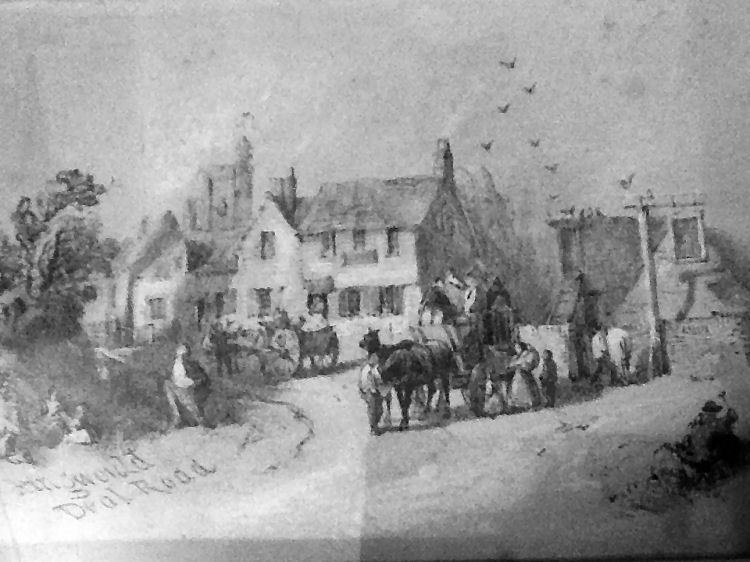
Above painting by William Burgess, circa 1840s, showing the "Five Bells"
centre picture and what I believe to be the sign of the "Lord Nelson"
and pub behind. Kindly sent by John Skelton. |
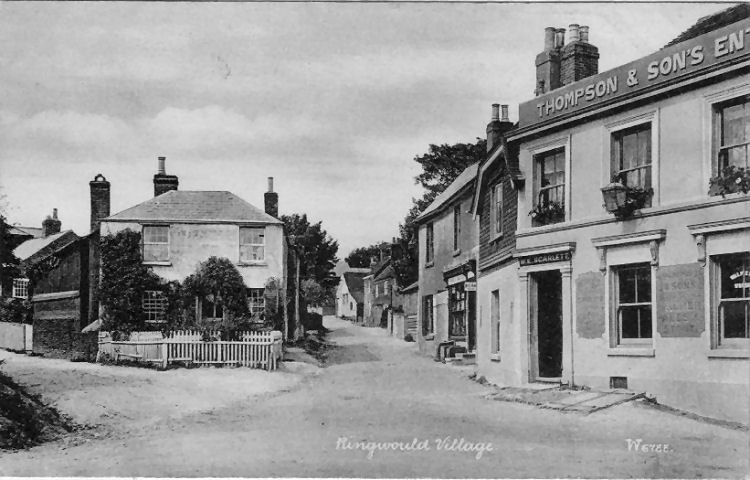
Above postcard, circa 1900, kindly sent by Graham Butterworth. |
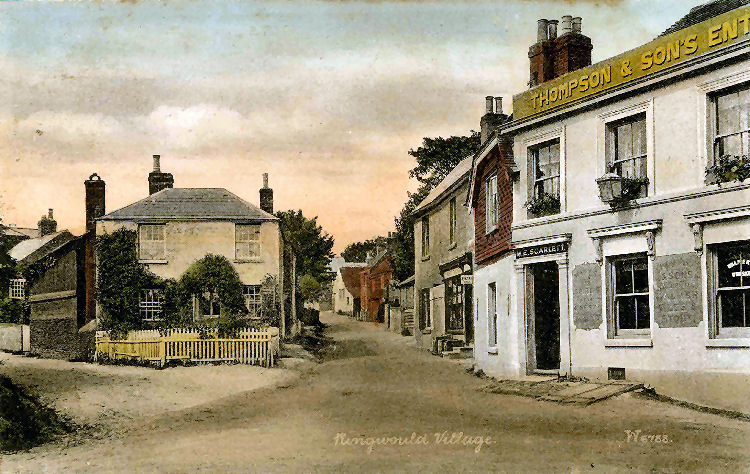
Above postcard circa 1900, kindly sent by Brian Hayward. |
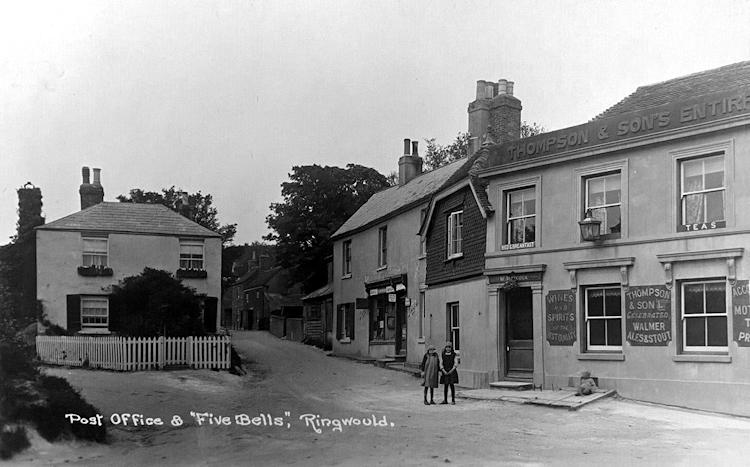
Above postcard circa 1927, kindly sent by Rory Kehoe. Showing the pub
in the livery of Thompson & Son's Walmer Brewery. |
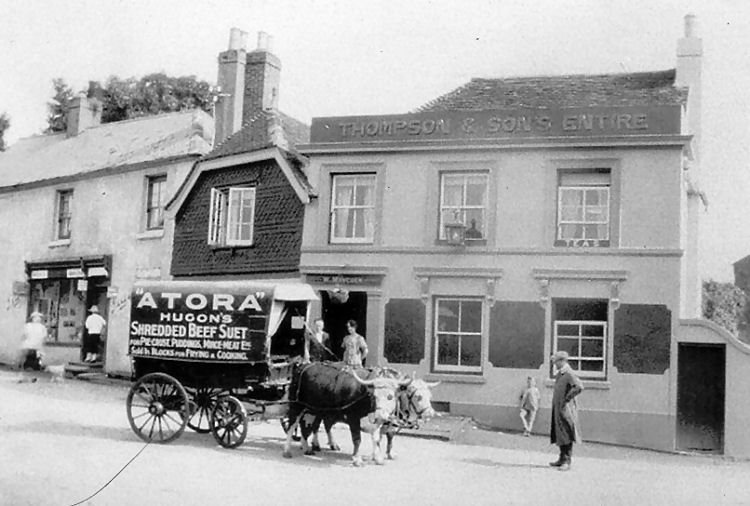
Above postcard kindly sent by Jean Winn showing the pub in 1927. |
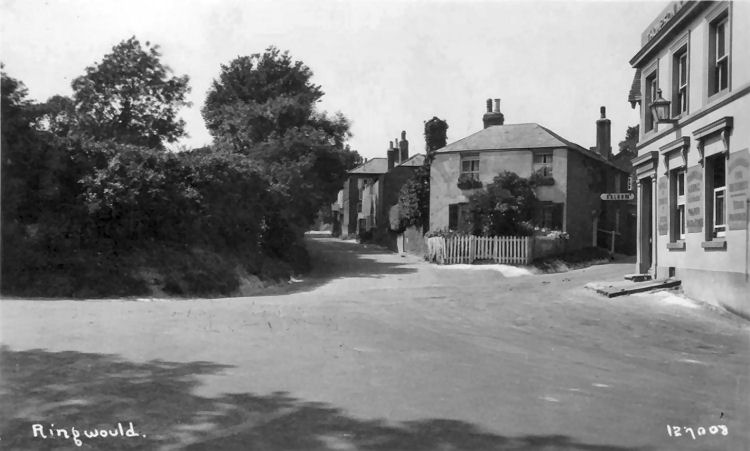
Above postcard, circa 1940s. |

Above photo, 21 November 1983, by Jim Ashby. |
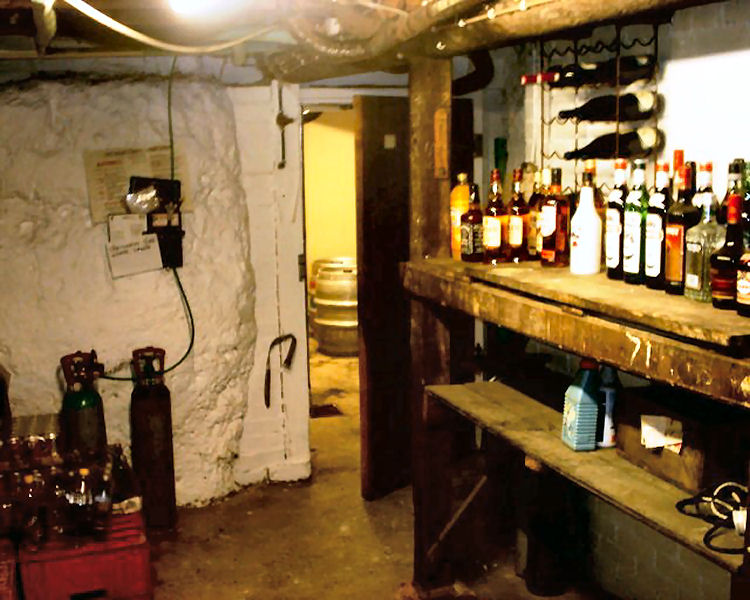
Above photo, showing the cellar in 2003, kindly sent by Tony Wilson,
who says to note that the cellar appears to have been cut out of the
chalk |
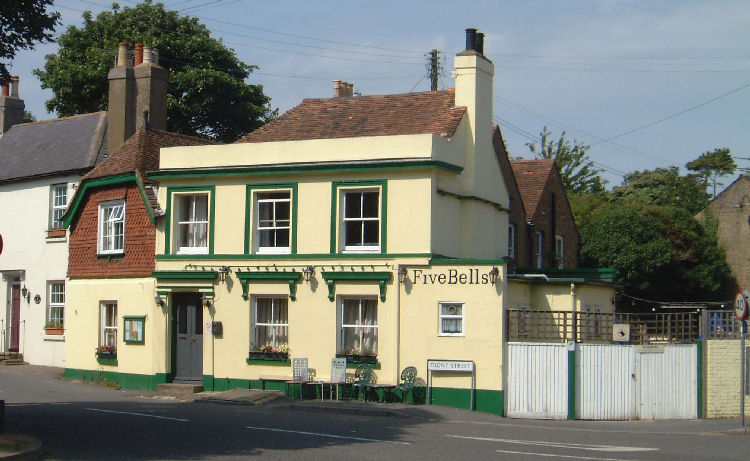
Above photograph by Paul Skelton, 26 July 2008. |
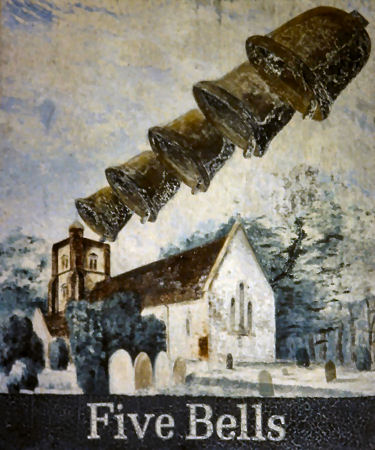 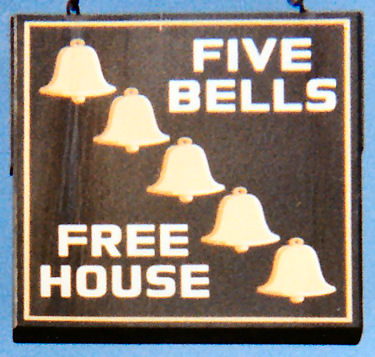 Above sign
left, 1980, sign right August 1990.
With thanks from Brian Curtis
www.innsignsociety.com. |
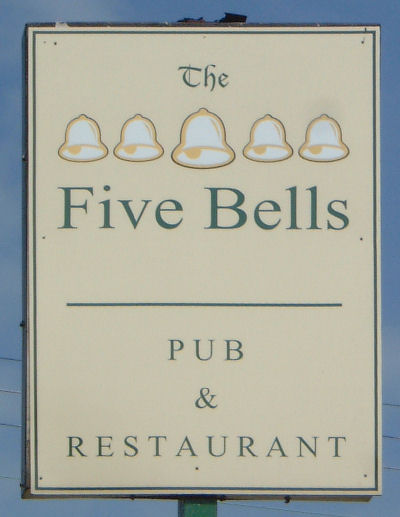 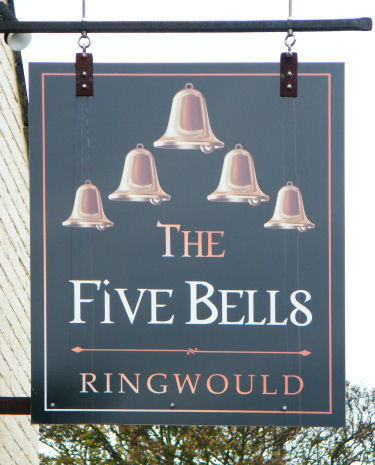
Sign left 2008, sign right August 1990 with thanks from Brian Curtis
www.innsignsociety.com, sign right by Paul Skelton, 29 September 2011.
|
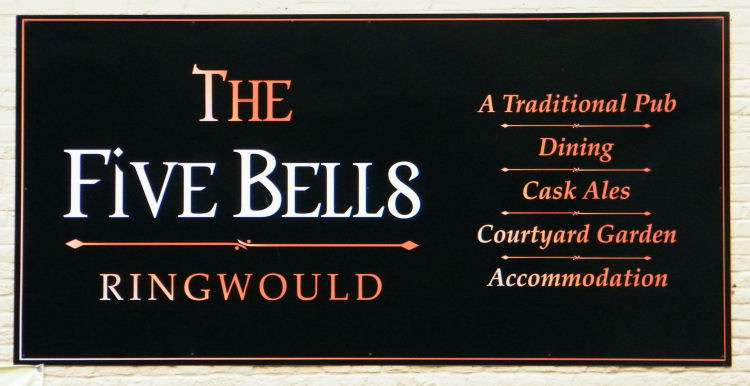
Above photograph by Paul Skelton, 29 September 2011. |
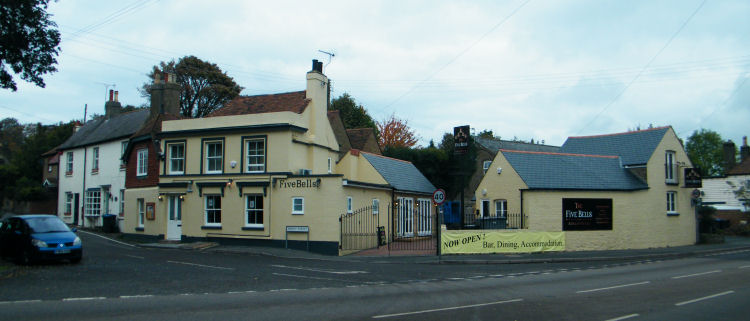
Above photograph by Paul Skelton, 29 September 2011. |
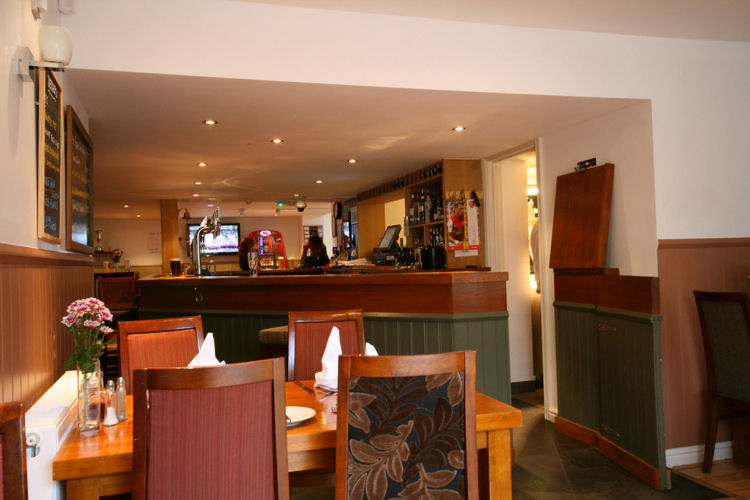
Photo taken 27 July 2012 from
http://www.flickr.com
by Jelltex. |
Built in 1729 as a farm, the farmer also made beer and cider but wasn't licensed
to sell ales and ciders. The pub was granted a full licence 1784, when the road
became a turnpike. The name changed to The Five Bells, because of the five
bells in the Church.
The address was at one time given as "Ringwould Street," it is now Front Street.
As yet unknown when the address changed.
Although I have found nothing documented to say such I have heard an account
from Tony Wilson who says the place is haunted. He says people have seen
sightings of the supposed ‘ghost’ of an unknown man said to haunt the place,
perhaps William Goozee who drowned himself in the courtyard in 1890! He goes on
to say he has heard several anecdotes doing the rounds of sightings of a male
figure, usually seen on the stairs to the cellar or in the toilets to the side
of the building which, before they were built, was once a side entrance to the
yard. He also meet a chap [sadly now passed away] who was most upset to bump
into ‘it’ in the gents one evening!
|
Kent Gazette Reports 18 June 1805.
DIED.
Last week, Mrs. Stringer, widow, of the "Five Bells" public-house at
Ringwould.
|
|
Kentish Chronicle, 29 September, 1829.
On Thursday morning, an inquest was taken at the "Five Bells" public
house, Ringwould, in the parish
of Kingsdown, before Matthew Kennett esq., Deputy Mayor and Coroner,
on the body of a man
unknown, supposed to be a foreigner. The deceased was found with his
head shattered to pieces in a
wood in Kingsdown, with a pistol near him, and supposed to have been
dead for several days.
A verdict of "Found Dead" was recorded.
|
|
From the Dover Express, 10 May, 1833.
Deaths.—May 3, at Ringwould, Mr. John Taylor, landlord of the Five
Bells, much respected, aged 27 years.
|
|
From the Dover Telegraph, Saturday March 1st 1834.
To Millers
Freehold Corn Windmill, Good Dwelling House, and about 3A. 28P. of
Arable Land.
TO BE SOLD BY AUCTION, BY
T. A. TERSON,
At the "Five Bells," at Ringwould, in Kent, on Wednesday, March 26th,
1834, at Two o'clock in the Afternoon.
LOT 1. All tat good and sustainable FREEHOLD CORN WINDMILL, called
"Ripple Mill," with the Fixtures, Going-Gear, and Machinery,
conveniently situated for trade, being about halfway between Ringwould
and Walmer; capable of working three pairs of stones; together with the
stone-built HOG-POUND adjoining, and also the newly-erected, slated,
brick-built STABLE near thereto, 27 feet, 6 inches front, by 12 feet, 6
inches depth, capable of being converted, at a small expense, into a
convenient Dwelling House.
And also a Piece of LAND, as stumped out, including the Site of the
Mill and Stable, measures 81 feet deep, by about 55 feet wide.
Therefore the Utensils and Furniture of the Mill, of which a schedule
will be produced at the Sale, are to be taken at a Valuation.
LOT 2. Adjoining Lot 1, a commodious brick-built DWELLING HOUSE, 30
feet 6 inches front, by 25 feet depth; and about Three Acres of good
Arable LAND, for use therewith.
The Mill is in the occupation of Mr. John Crofts, at a rent of £40
per annum. The rest of the property is occupied by Mr. John Claringbould,
the proprietor, who will show the premises.
Possession of the whole may be had on the 6th of April next.
Part of the Purchase-Money may remain on Mortgage, if required.
Further particulars may be known, on application to the Auctioneers,
Snargate-street; or to Mr. E. Elwin, Solicitor, Dover.
|
|
From the Dover Telegraph,12 September 1837.
MARTIN, BETWEEN DOVOR AND DEAL.
ELIGIBLE INVESTMENT. TO BE SOLD BY AUCTION.
By Messrs. COLEMAN and HARRISSON, ON TUESDAY, the 19th day of SEPTEMBER, 1837, at Three o'Clock in the
afternoon, at the sign of the Five Bells at Ringwould, by order of the
Poor Law Commissioners for England and Wales, and under the direction of
the Board of Guardians of the late Martin Union, subject to such
conditions as will he then and there produced.
Lot 1.—Part of the valuable Brick-built FREEHOLD MESSUAGE or TENEMENT,
situate in Martin-street, lately used as a Workhouse, with Meadow and
Garden belonging thereto; and adjoining the Road leading from Martin to
the Deal Turnpike-road; containing by a measurement, 2R. 2 1/4 P.
Lot 2.—The remaining part of the aforesaid PROPERTY, situate also in
Martin-street, with Garden belonging thereto, lately used as a
Workhouse, and adjoining the Estate of James Jekin, Esq., containing by
a measurement, 1R 24P.
Lot 3.—The growing crop of POTATOES in the Garden belonging to the
Workhouse.
The Property may be viewed any time previous to the Sale, and further
particulars known by applying to Mr. Wm. Garside, Maidensole, where a
Plan may be seen.
|
|
From the Reading Mercury, 16 December 1840.
THE SNOW IN KENT.
A very considerable quantity of snow has fallen in the
eastern part of Kent during the past week, and the high wind of Thursday
evening drifted it in many places to the height of several feet,
rendering the roads perfectly impassable. Many fearful occurrences have
happened, but fortunately hitherto without loss of life. The van from
Deal, on its return from Dover, was laid up about a quarter of a mile
from Ringwould, and the passengers, ten in number, including five
ladies, got with the greatest difficulty through the snow, knee deep, to
the "Five Bells" public house in that village, where they were obliged to
remain for the night. The attention of the worthy landlord and his wife
were praiseworthy in the highest degree, affording every comfort and
accommodation that lay in their power. The van was with assistance got
back to the inn, but did not reach Deal till twelve the following day
having to traverse through the fields to arrive at its destination. A
poor woman, of the name of Baker, who resides at St. Margaret's, had
been a considerable distance for some medicine for her sick husband,
when she lost herself, and had fallen in the snow, but was
providentially found by two men, and carried to the above inn, where all
possible humanity was shown her, and she was enabled to pursue her
journey on the following morning. A poor fellow was also found buried in
the snow near the windmills; he has been fortunately restored. On
Saturday several hundred hands were employed, and most of the roads are
now open for travelling. Both the Deal hoys were stranded on Thursday
evening, and are rendered totally unfit for service—all hands saved.
|
|
From the Western Times, 26 December 1840
Canterbury, Dec. 20.
A very considerable quantity of snow has fallen in
the eastern part of Kent during the past week and the high wind of
Thursday evening drifted it in many places to the height of several
feet, rendering the roads perfectly impassable. Many fearful occurrences
have happened, but fortunately hitherto without loss of life. The van
from Deal, on its return from Dover, was laid up about a quarter of a
mile from Ringwould, and the passengers, ten in number, including five
ladies, got with the greatest difficulty through the snow, knee deep, to
the "Five Bells" public-house in that village, where they were all obliged
to remain for the night. The attention of the worthy landlord and his
wife were praiseworthy in the highest degree, they affording every
comfort and accommodation that lay in their power. A poor woman of the
name or Baker, who resides at St. Margaret's, had been a considerable
distance for some medicine for her sick husband, when she lost herself,
and had fallen in the snow, but was providentially found by two men and
carried to the above Inn, when all possible humanity was shown her, and
she was enabled to pursue her journey in the morning.
|
|
From the Kentish Gazette, 29 March 1842
COMMUTATION OF TITHES. PARISH OF RINGWOULD.
THE MAP and COPY of the DRAFT APPORTIONMENT, together with the Bill of
Coats, are deposited at the sign of the "Five Bells," in the said parish,
where an Assistant Commissioner will hold a MEETING on THURSDAY, the 7th
day of APRIL next, to hear objections (if any) against the intended
Apportionment.
JOHN COLEMAN, Valuer.
Kearsney Farm, March 24, 1842.
|
|
Kentish Gazette, 16 December 1851.
DEATHS.
Basingham:— Dec. 12, at Ringwould, Mr. Robert Basingham, landlord of the
"Five Bells," aged 62.
|
|
South Eastern Gazette, 12 March, 1860.
DEATH.
On the 6th inst., at Ringwould, Mrs. Bassingham, aged 73, for many
years landlady of the "Five Bells."
|
|
Publication unknown. From 15 May 1860
TO BREWERS, VICTUALLERS. & OTHERS
FREE PUBLIC HOUSE, BLACKSMITH'S FORGE, AND PREMISES, AT RINGWOULD.
TO BE SOLD BY AUCTION, BY MR. M. LANGLEY,
ON the Premises, at the Five Bells, Inn, RINGWOULD, on TUESDAY, the 29th
May, 1860, between One and Two o'clock, the following desirable
FREEHOLD PROPERTY, in Two Lots. Lot 1.—A very eligible and desirable ROAD-SIDE INN, and FREE PUBLIC
HOUSE, at RINGWOULD, well known as the "Five Bells," comprising on the
ground floor a convenient bar and bar parlour, back parlour, and tap
room; on the next floor, a large sitting-room and four bed rooms; also
comprising an excellent wine and beer cellar, kitchen, dairy or store
cellar, pump house and rain water tank; a well of excellent spring
water, a good skittle ground. Also a small barn, stabling for seven
horses with loft over, stable yard, and other conveniences. The house is in good trade, and capable of improvement, and offers an
eligible opportunity either for investment or occupation as a Free
Public House. Lot 2.—A brick and slated BUILDING, erected for and lately used as a
BLACKSMITH'S FORGE, and easily convertible for any other purpose,
standing on a plot of ground adjoining RINGWOULD STREET, and at present
unoccupied. For further particulars, apply to the Auctioneer; or to Messrs. Mercer
and Edwards, or Mr. Rennolls, solicitors, Deal; or Mr. John Taylor,
solicitor, 110, Fenchurch-street, London. |
|
From the Kentish Gazette, 5 June 1860
PROPERTY SOLD.
Public House. Blacksmith's Shop. &c., Ringwoud.— On Tuesday Mr. M.
Langley, of Deal, offered by auction, at the "Five Bells Inn," Ringwould,
a freehold public-house and other property. Lot 1 consisted of the "Five
Bells" public-house, with skittle ground adjoining, a small barn stable.
&c., and sold for £550. Lot 2, a brick and slated building, erected for
and lately used as a blacksmith's shop, but at present unoccupied, sold
for £62.
|
|
From the Dover Express, 15 April 1865
ROBBERY AT RINGWOULD
William Horn, 26, labourer, was charged with stealing a guernsey frock
and a key, the property of Edward Erridge at Ringwould, on the 20th
January.
Mr. Ormerod appeared for the prosecution, and it transpired, in the
course of the case, that the prisoner was the brother-in-law of
prosecutor.
Edward Erridge: I keep the "Five Bells" public house, at Ringwould. I had
a guernesy frock in my possession previous to March. On the 18th of that
month I saw it on the prisoner and told him he had got my guernsey on.
He said it was not mine, and that he had bought it at Deal. That
produced is the same. It it darned on the shoulder. I have missed
several other things, including a key.
Louisa Burton, wile of William Burton, blacksmith, Ringwould: I do
washing for Mrs. Erridge, and about two months ago I washed a guernsey
resembling that produced.
Norwood Culworth, a Lad, said he saw a guernsey belonging to Mr. Erridge,
and resembling that produced, hanging behind the kitchen door about two
months ago. He subsequently saw prisoner wearing two guernseys. The
prisoner slept in a loft over some stables belonging to Mr. Erridge.
Joseph Gitney: Prisoner was given in my charge by Mr. Erridge on the
18th March. He was wearing two guernseys at the time. I charged him with
stealing one, and he said he bought it at Deal. I found a key upon him,
which Mr. Erridge also identified as his. Sarah Erridge, wife of
prosecutor, identified the guernsey produced as her husband's by a darn
on the shoulder.
The prisoner repeated the statement he had previously made—that the
guernsey belonged to him, and he had bought it at Deal.
The jury found him guilty, but recommended him to mercy.
The Recorder asked on what grounds.
The Forman: Because we think it a trampery case.
|
|
From the Dover Express, 23 September 1865.
A CHILD SCALDED TO DEATH AT RINGWOULD.
On Saturday last an inquest was held at the Five Bells Inn, Ringwould,
by W. H. Payn, Esq., coroner for Dover and its liberties, on the body of
Henry Kemp, aged two years and a half, the child of James Kemp,
labourer. It appeared that on the previous Wednesday, about four
o'clock, the mother was making elderberry wine, and having made about
four gallons and a half, she put the same into a tub or shawl to cool in
the back yard, placing it on a chair, the wine being scalding hot. While
her back was turned the little boy (deceased) went into the yard and by
some means climbed up the chair on which the shawl stood and pulled the
tub and wine completely over itself. The hot liquor so frightfully
scalded the child that after lingering until eleven o'clock next morning
it expired. Dr. Davey was sent for, and though he was not at home at the
time, a lotion was sent to bathe the scalds, and Dr. Stains Davey, son
of the above gentleman, attended, but found the child just breathing its
last. The injuries were such, over the head and chest, that no medical
skill could have saved the child. Evidence of the above facts was taken,
and the jury pronounced a verdict of "Accidental Death.”
|
|
From the Deal Mercury, 30 December 1865
CINQUE PORTS POLICE COURT
Wednesday-(Before T. S. Clark and G. Hughes Esq.)
WHAT DRINK DID FOR HENRY GOLDER.
A young man named Henry Golder' labourer, of Kingsdown, was charged
with being drunk and disorderly. The case was proved by P.C. Kitney, who
said that about half-past twelve o'clock the previous night, he saw the
defendant come out of the "Five Bells" public-house at Ringwould; he was
drunk and noisy, and used abusive language. Witness requested him to go
away quietly, but this he refused to do, saying he did not care a -----
for him or any other policeman. Witness again asked him to go home, and
not create a disturbance, upon which he exhibited a most pugnacious
disposition, and witness was obliged to take him into custody. This,
however, could only be effected with difficulty, so violent was the
resistance he offered, and witness found it necessary to have
assistance. Defendant also had a knife in his hand, and threatened to
"knife" the officer. - In answer to questions by Mr. Clark witness said
the defendant's conduct lately had been very bad, and only a few days
previously he had nearly got into trouble. - Mr. Clark said he was sorry
to see defendant in the position which he had placed himself, for he had
known him since he was a youth, and had hoped he would never be guilty
of offences of this description. He trusted defendant would not indulge
in drink in future, and that he would also keep out of bad company. -
Mr. Clark asked him if any money was due to him from his master; and he
replied in the negative, stating that he was in debt to his employer.
Defendant, being unable to pay a fine and the costs, was committed to
Dover Gaol for seven days.
|
|
From the Dover Express, 22 October 1875.
BABY FARMING AT RINGWOULD.
On Tuesday the Coronet for Dover and its Liberties, W. H. Payn, Esq.,
held in inquest at Ringwould on the body of an infant named William
Durham, who died on the previous Sunday while under the care of
Elizabeth Spicer, who had undertaken to nurse it for the remuneration of
6s. per week. It seems that the child went into a fit after eating a
hearty dinner on Sunday and shortly afterwards died. Mr. Davey, surgeon,
of Walmer, saw the body of the child on the following Tuesday and was
asked to give a certificate of death, but seeing a bruise on its head
that he thought might account for the child's death be declined to give
any certificate and referred the parties to the coroner. It transpired
afterwards that although the case was a very proper one enquiry that the
bruise on the head was caused several days previously by a fall and that
the child seemed none the worse for it. The inquest was held at the "Five
Bells," Ringwould, and the following evidence was taken:— Ann Banks, having been sworn, said: I am the wife of John Banks a
millers' labourer, living at Ringwould. I live next door to the deceased
infant, William Durham. Ha was an infant aged about two years and ten
months. He was a nurse child in the charge of Mrs. Spicer the wife of
David Spicer, a labourer living at Ringwould, next door to me. I was in
the habit of looking in and seeing the deceased. His health was good as
far as I could see until the time of his death, which took place on
Sunday last, about half past two in the afternoon. I do not know that
the child was subject to fits. I never saw it in a fit until the time of
his death. During the time I visited the child I think that he was well
taken care of, properly led, and attended to. I saw no medicine in the
house or any sleeping stuff. I was present at the death of the child. It
died in my arms. I do not know what it died of. I thought it was in a
fit, it was a very dull child. I should not think that the child was
quite right in the head, it did not seem to take notice of anything like
other children, it was a very pale child during the time that Mrs.
Spicer had the care of it. I do not think it was seen by any medical
man. I do not know its father. Mrs. Spicer had something for keeping it,
I do not know how much. I have never seen any friends until this week,
the money was regularly, at one time it was not. The child was well
treated, and not ill-used. There is a mark on its temple proceeding from
a fall. The child used to fall about a good deal. The child was ill when
I was called in, it fell on the carpet. The child was put in a bath, and
they gave it some brandy and water. Elizabeth Spicer having been sworn, and cautioned by the Coroner, said:
I am the wife of David Spicer, who is a waggoner in the employ of Mr.
Banks, at Oxney. The deceased was placed under my care 12 months ago
last May. I had the child from my cousin Elizabeth Knott. During the
time I had charge of the child it was healthy, excepting an occasional
cold. On Sunday afternoon he was taken ill with a rising in the throat,
and I thought he looked as if he were in a fit. He had eaten very
heartily of meat and potatoes. Rather more than half an hour after his
dinner he was taken ill. I went for my neighbour Mrs. Banks. We put the
child in a warm bath, and gave it some weak brandy and water. The child
died in Mrs. Banks' arms about a quarter after coming out of the bath. I
was not in the habit of giving the child anything to make it sleep. I
had 6s. a week for attending to the child, and it was paid regularly. I
did my duty by the child. The friends did not come very often to see the
child. Mr. S. J. Davey, surgeon, of Walmer, said on Sunday last I was sent for
to see the deceased infant. I was from home when the messenger arrived,
but my assistant went directly and found the child dead. I called on the
following Tuesday and on examining the child I found a large bruise over
the right temple, rather larger than a pigeon's egg, and I said I said I
not give a certificate, and that they must apply to the coroner. The
blow which caused the bruise might have caused the death of the child;
but if the blow were given on the Thursday the child would not have been
likely to have in that case lived till the Sunday, and to have died
suddenly then. The blow was recent. Elizabeth Spicer said: I live with my mother, the former witness. The
deceased child was in good health. About the middle of last week he fell
on his head on the floor. He got up himself, I saw the bruise on the
forehead. He seemed well after that. That was the same bruise that the
doctor saw. I am quite sure the child was not ill used. A verdict of death from natural causes was returned. |
|
From the Dover Express 19 August 1882
RINGWOULD
Shocking Case of Suicide:- On Monday an inquest was held at the "Five
Bells," Ringwould, before W. H. Payn, Esq., coroner, touching the death
of James Gardener, an agricultural labourer, who committed suicide by
cutting his throat. The deceased was a man of very intemperate habits,
and of late seemed to be at times quite insane. On several occasions he
had threatened to destroy himself, and one day last week whilst in his
home alone he cut his throat in a shocking manner, A medical man was
called in, but in a short time after his having committed the rash deed
he expired. |
|
From the Dover Express and East Kent Intelligencer, 11 October, 1882. Price 1d.
SUICIDE AT RINGWOULD
An inquest was held on Monday at the “Five Bells,” Ringwould, before W.
H. Payn, Esq., touching the death of James Gardner, an agricultural
labourer, who committed suicide by cutting his throat. The deceased was
a man of very intemperate habits, and of late seemed to be at time quite
insane. On several occasions he had threatened to destroy himself, and
one day last week whilst in his home alone he cut his throat in a
shocking manner. A medical man was called in, but in a short time after
his having committed the rash deed he expired. The following evidence
was taken:-
John Gardner said: I am a cab driver living at 11, Loudown mews, St.
John's Wood, London, N.W. The deceased James Gardner, was my father. He
was an agricultural labourer living at Ringwould. His age was fifty
three years, and his health was generally good. I saw my father about
four hours before his death. He was then in bed. He was not conscious,
and he seemed to be wandering. I saw that he had a wound in his throat.
He told me on the following day after the wound that he cut his throat,
and that when he found that he had cut his throat he drank some cold
water and found it running out of his throat. He was very intemperate in
his habits. He could not give any reason for it only that it might be
delirium tremens.
Rhoda Rogers said: I am a widow living at Ringwould. I have known the
deceased for some years. His health was good. He was very intemperate in
his habits. On Wednesday morning I looked in his window. He stood in the
room with his shirt all bloody. There was a paper put under his sitting
room door all over blood. It was a notice to quit his house on that day.
I had to give him the notice to quit from my mother. I think he took the
notice coolly. I had seen him in the evening before, but saw nothing
particular in his manner. I heard him walking about the room talking to
himself. On the next day I saw him sitting in his chair. He was then all
over blood. Dr. Davey was sent for; deceased lingered about three days.
Richard Stains Davey, said: I am a surgeon practising at Walmer. I was
sent for on Wednesday last to attend the deceased. I saw Gardner about
eleven o'clock. I found him lying on his bed with a deep cut in his
throat, dividing completely the windpipe and oesophagus and several
large vessels. He was insensible but scarcely able to speak. He lost a
great quantity of blood. He lingered about three days and six hours. He
was unable to swallow naturally anything. He said he had cut his own
throat. He assigned no reason. He was very intemperate in his habits. He
died from the injuries received.
The Jury returned a verdict that the deceased committed suicide in a
state of temporary insanity.
|
|
From the Dover Express 22 September 1883
RINGWOULD. BEER AFTER HOURS.
J. Goozee, the landlord of the "Five Bells" at Ringwould, was summoned
before the County Justices at Deal on Monday, at the instance of the
policeman stationed at that place, for serving beer after hours on the
5th September last, and W. Terry, a labourer of the same village, was
also summoned for being on the premises and receiving the beer. The
magistrates fined the landlord £1 and 8s. 6d. costs and the other
defendant 1s. 6d. and 8s. 6d cost. |
|
From the Dover Express and East Kent News, Friday 14 September, 1883. 1d.
AN APPLICATION
The landlord of the “Five Bells,” Ringwould, applied for permission to
open his premises at 5 o'clock in the morning.
In reply to the Bench the applicant said that there were a number of men
now employed on the farms near, hoppers and harvesters.
The Bench, after a short consultation, decided to refuse the
application.
|
|
Probate 1890.
Goozee William Ellinger.
28 May. Administration of the Personal Estate of William Ellinger Goozee
late of the "Five Bells," Ringwould in the County of Kent, Licenced
Victualler, who died 22nd April 1890 at the "Five Bells" was granted at
the Principal Registry to Flora Goozee of the "Five Bells," widow the
Relict. Person Estate £287 5s.
|
|
From the Dover Express and East Kent News, Friday 15 March, 1901. 1d.
MYSTERIOUS RAILWAY ACCIDENT
DOVER YOUTH KILLED.
An inquest was held yesterday at the “Five Bells,” Ringwould, by the
Coroner of the Borough and Liberties of Dover (Mr. Sydenham Payn) and a
Jury of which Mr. C. Lawrence was foreman, to enquire into the death of
a Dover lad, Ernest Henry Ovended, aged 15, who was run over by a train
near a level crossing at Ringwould early on the morning of Wednesday,
after having been missing since the previous afternoon, when he left the
office where he was employed and did not go home.
The evidence was as follows:-
John Simmons Ovenden, builder, living at 30, Alfred Road, Dover,
identified the body as that of his son, Ernest Henry Ovenden, aged 15
years and 4 months. He was a builder's junior clerk in the employ of Mr.
W£. J. Adcock. Witness last saw his son on Tuesday at dinner, just
before one o'clock. He was then all right, and as happy and well as
could be. His time for coming home was indefinite, as he sometimes went
out to Kearsney. He had, however, got a ticket for the Co-operative
entertainment at the Town Hall, which he had arranged to go to with his
sisters, who went there expecting to see him. Witness waited for about
twenty minutes after his daughters returned, and made enquiries of Mr.
Lovegrove, who, however, had not seen deceased since 3.30 p.m. Witness
also made enquiries of the Police, and on their suggestion he enquired
at Canterbury to see if had joined the yeomanry. Witness heard deceased
had been found killed on the line at Ringwould about 11 o'clock on
Wednesday, and he went over to identify the body. Deceased was a bright
lad and sensitive, though not likely to take anything to heart. The boy
was fond on the country. Witness did not know of anything having
happened which he would take to heart.
William Edward Lovegrove, chief clerk to Mr. Adcock, contractor, Dover,
said deceased had been there as a junior clerk about six weeks. Witness
saw him last about 3.30 p.m., when he was about his usual work. Then
deceased left the office.
The Coroner: Did you have any occasion to say anything to him before
that?
Witness: Not more than I should have said.
The Coroner: Did he leave in a tiff?
Witness: No. I had accession to speak to him about a little thing, but
not at all in a harsh manner.
The Coroner: Did he turn on his heel and walk out?
Witness: No, he went into the outer office. I happened to look out and I
saw he had gone.
The Coroner: Did he answer you?
Witness: No. He was always a civil lad and very good about his work. I
was very shocked to hear the news.
The Coroner: He did not return that afternoon?
Witness: No.
The Coroner: Were there any threats used? I knew what had happened.
Witness: No.
The Foreman: had you any idea that he was going off and not going home?
Witness: It never entered my mind. If I had had half a thought of such a
thing I should have taken him home. He usually told me when he left the
office.
Thomas Moat, plate layer of the Dover and Deal line, between Walmer and
Martin Mill, said that on Wednesday, at 6 a.m., near the crossing on the
road from Ringwould to Ripple, he found the body of deceased on the
line. It was on the up-line from Walmer to Dover. He was close to the
outer rail, his breast on the ballast, and his feet on the path. There
was a public crossing there (it was formerly a road). One had to get
over the fence, there being no style there. Just beyond the crossing
there is a cutting on the Deal side, and it is possibly that deceased
could not have seen the train in the cutting until it was on the line.
The up trains, however, made a great deal of noise usually. Deceased was
lying nearly parallel with the line, his head towards Dover, his face
knocked right into the ballast, and his arms under his breast. Witness
left his mate to guard the body and went to Police-corporal Love. The
last train to Dover on Tuesday left Walmer punctually at 10.50. There
were no marks on this train. It was quite possible, from the position of
the body, for an earlier train to have knocked him down, and the others
passed by. Witness added that he thought from the position of the body
that deceased was walking up the path at the side of the line. The
current of air caused by the train would draw anybody towards the train,
and the fact that his cap was found a yard off shows that that was blown
off. The body was stiff and cold when found.
Police Corporal Isaac Love, stationed at Ringwould, said he was called
by the last witness at 6.15 a.m., and on going to the crossing found the
body lying in the position stated by Moat. Witness searched the body,
and found among other things a pocket book containing deceased's name
and address. None of the drivers to whom the Superintendent had
telephoned had seen deceased. There were no marks found on any of the
trains. Witness telephoned to the Dover Police. From the way the body
lay it was witness's opinion that the deceased was walking up the line
towards Dover. Witness could not ascertain that deceased had been
noticed at Walmer or in the neighbourhood.
By the Jury: There were no signs of a struggle having taken place.
Dr. Llewelyn Davey, of Walmer, described the injuries to the body. The
whole of the back of the head seemed to be driven in, and there was
bruising on the head and forehead, which looked as if he had been
knocked down on his face violently on to the ballast, a stone being
driven into the skull over the nose. Death would have been
instantaneous. None of the limbs were broken, and there was no other
mark of violence. He noticed that the right coat sleeve was cut, though
the arm was not damaged. This looked as if the train which knocked
deceased down must have been followed by a later one, which had cut the
sleeve. Witness considered the injury was caused by a train, and not
that he was injured and then put on the line.
The Coroner, in summing up, said that there was no doubt that there was
some little matter in relation to the deceased's studies which he had
unduly taken to heart, and he seemed to have gone out of the office,
from which moment he was not seen till found on the line. It was a
matter of conjecture whether the boy wandered out into the country as
far as Ringwould not liking to go home, and then as evening came changed
his mind, and started to walk to Dover along the path of the railway. He
(the Coroner) had lived near there, and had used that path, and thought
that when the wind was blowing from all directions, as it seemed to do
there, that it would be possible not to have heard the train till it was
too late.
The Jury agreed to return a verdict of “Death by Misadventure.”
|
|
From the Dover Express, 27 January 1928.
RINGWOULD LICENSING PROSECUTSON.
At a sitting of the Cinque Ports Police Court, held at Walmer on Monday,
William Maycock, landlord of the “Five Bells" Ringwould, was summoned
for supplying intoxicating liquor to Robert Gibson, of Box Iron Corner,
Barham, during prohibited hours. P.C. Usher said that at 9.45 a.m. on the 12th January he saw Gibson
standing in front of the bar with a glass of beer in front of him.
Gibson said he had been out on the road all the morning and wanted some
refreshment. The landlord said he gave the man
the beer, and that he was no stranger to him. Mr. Hardman said that Gibson had spent the night at the house, and under
the Licensing Act a man who was a lodger could be served at any hour. Evidence was given by Mrs. Maycock that Gibson did spend the night at
the house, and paid 5s. The case was dismissed. |
|
Dover Express, Friday 30 October 1936.
FALLEN TREE CAUSES DEATH.
ENGINE DRIVER’S FATAL ACCIDENT.
An inquest was held at the "Five Bells," Ringwould, on Wednesday, on the
body of Lewis Henry Fowler (57)
an engine driver on the Southern Railway, living at 132, Mill Rd. Deal,
who was killed instantly early on
Tuesday, when his motor cycle in which he was riding to work came into
collision with a tree trunk that had
fallen across the road at Oxney Bottom.
Mr. E. T. Lambert (Coronef for Ringwould, one of the Liberties of
Dover,) conducted the inquest and sat
with a jury as follows:— Messrs. E. Castle (foreman). A. J. Arnold, F.
Kennett. P. Sayers. A Lawrence. A. S.
Popple and F. Lawrerce.
Frederick Lewis Fowler, 28, Cemetery Rd., Deal, an East Kent bus driver,
said that deceased was his father,
who would have been 58 years of age next month. Witness last saw him at
about 10 p.m. on Monday night
at his home in Mill Rd. Deceased was laughing and joking and was just
going to bed. Deceased was
physically fit and his eyesight was good. Deceased, on the morning of
the accident, was to have been on
duty at the Dover Marine at 5.15 a.m. He knew the road well as he had
been going to and fro for about 11
years. Witness added that he saw the tree a few hours after the accident
and found the root to be rotten.
Owners of property should not be allowed to leave trees in a dangerous
state.
Alfred Ernest Lane, 3, Tunstall Cottages, Sandown Rd., Deal, a fireman
on the Southern Railway, said that
he knew deceased well and last saw him alive on the day previous to the
accident. Witness was also in the
habit of cycling between Dover and Deal and was going to Dover about
4.45 a.m. on Tuesday. Fireman
Green was with him. Approaching Oxney Bottom he saw another light
approaching and then it disappeared.
Someone called "Stop’" and they applied their brakes. They saw another
cyclist who told them there was a
tree across the road and witness told him to tell deceased who would be
coming along shortly. They lifted
their cycles, over the tree and then saw deceased about 15 to 20 yards
beyond the tree. They called the
other cyclist and instructed him to 'phone the police. Witness and Green
thought the best thing to do was to
go on to Dover and stop a car. They stopped the mail van and the driver
said that he would telephone the
police from St. Margarets. They then came down to Dover and informed the
police there. He understood the
deceased should have been on duty at 4.15 a.m., so he must have been
lying there about 50 minutes.
P.C. Witherden, Ringwould, said that at 5.5 a.m. on Tuesday he received
a telephone message from Deal
Police Station and at once went to Oxney, and arrived at about 5.15 a.m.
He there saw a large decayed ash
tree lying diagonally across the road. The root was on the offside of
the road going towards Dover. About 20
yards on the Dover side was deceased's motor cycle in the middle of the
road with its front wheel towards
Ringwould. Deceased was lying on his stomach three feet from the motor
cycle. Blood was coming from the
mouth and nose. Witness moved the body to the side of the road. Sgt.
Cowland, East Langdon, came on the
scene. The road is 22 feet wide and the length of the tree 16 yards.
The circumference at the foot, was 36
inches and the distance from the foot of the tree to the side of the
road was 5 feet. The damage to the
motor cycle was that the headlamp had been bent down, front and rear
number plates damaged, both
wheels buckled and nearside foot rest broken off. In witness's opinion
deceased struck the tree, turned a
somersault and skidded 21 yards from the obstruction. Witness found £8
14s. 7d. and documents in
deceased’s clothing. There was a gale that night. The road was dry.
Witness tested the lamp of deceased's
machine and it was in order.
In reply to the deceased's son, witness said that the root had broken
off.
Dr. P. J. Simpkin Hall, Walmer, said that he received a message of the
accident at 6 a.m. and went to
Oxney Bottom, immediately and found deceased's body lying by the
roadside. There was a depressed
fracture of the right temple and the bones immediately above it. He
could find no other injuries. In witness’s
opinion, death was instantaneous from the blow.
The Coroner said that that was all the evidence available. The jury had
to find the cause of death and then
decide if anyone was responsible for it, criminally responsible or
otherwise. He did not think they could find
that in this case, and thought it was essentially a case of death by
accident. If the jury liked to review the
duties of a landowner as to trees that belonged to him adjoining the
highway, they were at liberty to do so,
but, if anyone had a claim for damages, it was a case for a civil court.
Deceased apparently was riding
along not suspecting anything unusual had occurred and evidently came
suddenly on the tree across the
road.
The jury returned a verdict of accidental death and expressed sympathy
with the relatives of deceased.
The Coroner said that he would also like to express his sympathy.
Deceased's son thanked them and said he thought the owners of trees
along the highway should see that
they were not in such a state that they might, easily fall down. It was
very dangerous.
The Coroner said he quite agreed.
|
|
From the Dover Express, 13 October 1939.
ROAD FATALITY AT RINGWOULD
A 15 year old girl, Kathleen Hassett daughter of Mr. and Mrs. D. P.
Hassett of Down's Cottage. Oxney, died at Deal Hospital at 11 o'clock on
Saturday morning as a result of having been run over two and a half
hours earlier at Ringwould by the wheel of a timber lorry. She was going
in to her employment at Messrs. Baldwin's, drapers, when she was knocked
down. At the inquest, held at Deal by the Borough Coroner, Mr. J. H. Robinson,
evidence was given by the driver of the lorry. A. C. Gordon, of
Cricklewood, that he was employed by a London firm. R. Davis (Haulage).
Ltd., and was driving a 4.5 ton lorry at an estimated speed of from 18
to 20 miles per hour when the accident occurred at 8.30 a.m. It appeared
that there was a pantechnicon belonging to Messrs. Redsull and Sons, of
Deal, outside the “ Five Bells ” Inn, Ringwould, removing the furniture,
and that as the lorry was coming from Walmer towards Dover the van moved
forward, and the lorry passed so close that the cords holding the timber
were cut by the front wing of the pantechnicon. The lorry driver
stopped, and then found that he had knocked down the girl, whom he had
seen come round a bend just as he approached the pantechnicon. It gave
him a great shock, as he had felt positive that he had avoided the girl,
and had stopped to reprimand the other driver for blocking the road. he
van driver. A. P. D. Newby, in his evidence, said that he was just going
to back into the inn yard when the lorry passed. The Coroner expressed
the view that there was no criminal negligence; and the jury returned a
verdict of accidental death, with an expression of sympathy to the
parents. |
|
From the Dover Express and East Kent News. 29 January, 1971.
MR. AND Mrs. EDDIE EMPTAGE
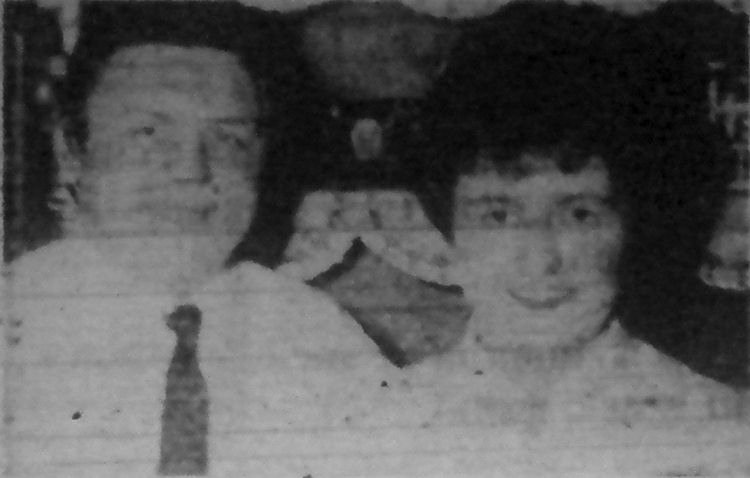
After ten years working among the holidaymakers at the now called St.
Margaret's Chalet hotel 31-year-old Mr. Eddie Emptage and his wife Margaret have gone into business themselves.
They have taken over the "Five Bells" public house on the Dover-Deal
Road at Ringwould.
When they moved in on Thursday last week one of their customers was
retiring licensee Mr. Peter Bardell, 67, who had held the license for 13
years.
It's nice to be on this side of the counter for a change he joked as
Mrs. Emptage pulled him a pint.
Mr. Emptage lived in Dover and worked for a Folkestone Road butcher
until he married. Then he moved to Kingsdown Road, St. Margaret's. As
Maddison's were about to open their holiday camp he decided to switch to
that business. For six years he worked as a bar steward and for the past
four years has been bar manager.
Although the move to Ringwould was not far, it was quite an occasion
for Mrs. Emptage. It was the first time she had lived outside St.
Margaret's.
Mr. Emptage said; "We hope to make some changes here but we are going
to wait until we have settled first."
Former licensee Mr. Bardell is retiring to Queen's rise at Ringwould
but says he hopes to find employment as a relief manager for the brewery
after he and his wife have had a long holiday.
|
|
From the BBC Domesday Reloaded written in 1986. The "Five Bells" is
situated in Ringwould, on the A258. The Landlord, Charles Rowney, is an
ex-fireman and has owned the pub for two years. His wife cooks the meals
which are served in the bar. Mr Rowney says that his regular customers
come from Mongeham, Deal and St. Margarets. Few villagers seem to use
the pub. There are neither children's facilities nor garden at present,
but these are planned for the near future. The Landlord says his most
popular drink is Bass, a premium bitter beer. The opening hours are from
10.30am to 2.30pm and from 6pm to 11pm on Mondays to Saturdays, and on
Sunday from 12pm to 2pm and 7pm to 10.30pm. Two occasional bar staff are
employed and there are public and saloon bars.
|
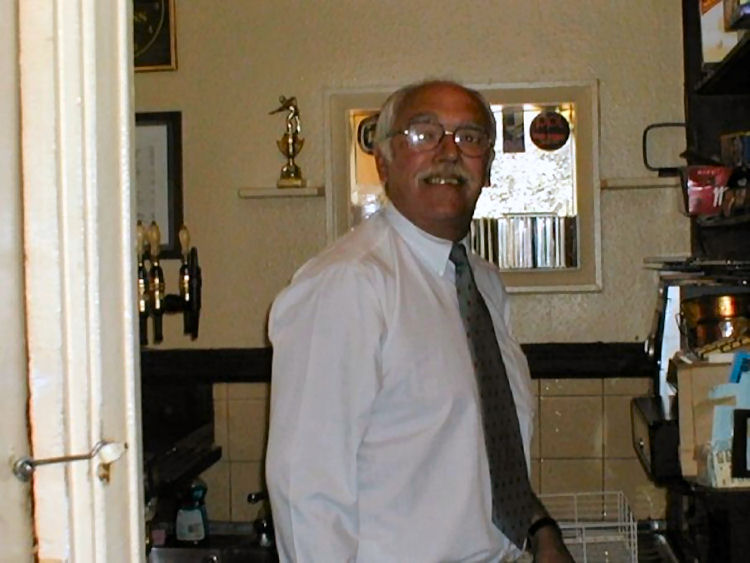
Above photo showing Bob Gasson, licensee 1886-2000. Kindly sent by Tony
Wilson. |
One time a tied house of Thompson and Sons, Walmer. I have also seen this
addressed as Kingsdown.
According to the Channel Draught issue 36 Summer 2008 this pub is up for sale.
May 2010 local CAMRA members reported that the pub was showing extensive
building work, but that it was still closed.
Glad to say the pub re-opened the latter half of 2011.
|
From the Dover Express, Thursday, 11
October, 2012. 65p. Report by Phil Hayes
REOPENED PUB AIMS TO BE HUB OF COMMUNITY
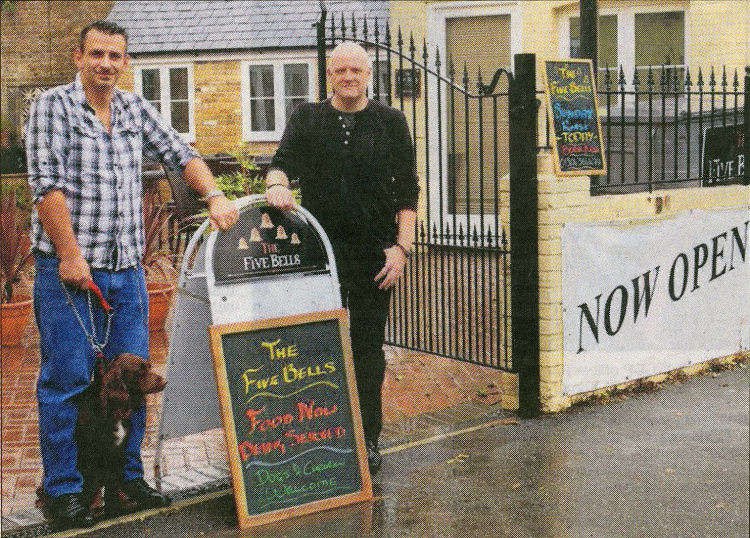
OPENING TIME: Tony Merrett and John Guy, along with pub dog Holly, at
the Five Bells
Two men and their dog offer warm welcome to all
TWO men and their dog have made it their mission to turn around the
fortunes of a Ring-would pub.
Former air steward, Tony Merrett, 39, and his friend John Guy, 41, have
vowed to bring the local community back into The "Five Bells," and
vice-versa.
Experienced Mr Merrett, who used to run a cabaret bar at a London
nightclub, said: “We want to keep a community spirit in the pub.
Everyone's welcome regardless of who they are or where they are from.”
Mr Merret and Mr Guy, who are both gay but not in a relationship, hope
families will start coming back into the pub to meet them and cocker
spaniel Holly, who has already been allocated her own sofa.
The two friends hope to alter
the perception that non-regulars were not made to feel particularly
welcome at the Front Street pub, under its previous management.
“It was a bit of a strange place,” Mr Merrett said.
But he and John, a qualified teacher who works in mental health, were
impressed by the togetherness of the village when they were renovating
The "Five Bells."
“People were really nice to us,” said Tony. “They are really community
based and offered help whenever we needed it.”
Hosting
The former Eastbourne residents have now fully moved in to the Ringwould
pub and are already hosting parties - an 18th and a 50th were held on
the same night last week.
“We'll be hosting parties of any description,” said Mr Merrett.
The "Five Bells" is open from 12pm to 11pm every day, offers en-suite bed
and breakfast, and now has a brand new menu.
|
|
From the Dover Mercury, 31 January, 2013. 80p.
FIVE BELLS INN HOSTING OPEN DAY
A SPECIAL open day at a 17th century village pub will show potential
customers what's on offer on Wednesday night.
The "Five Bells" at Ringwould wants to show off the inn as a unique venue
for functions, events, parties and conferences, or just for a quiet
drink.
The open day event takes place between 4pm and 7pm in the pub just off
the A258 Deal to Dover road.
|
|
From the
http://www.kentonline.co.uk By Eleanor Perkins, 6 March 2015.
The Five Bells is Ringwould has reopened after the tragic death of manager.
The Five Bells in Ringwould has reopened after its short closure
following the sudden death of one of the managers.
Tony Merrett, 41, died on Wednesday, February 25. The cause of death
is still unknown.
He leaves behind his partner of four-and-a-half years, John Guy, and
their two spaniels Holly and Ivy.
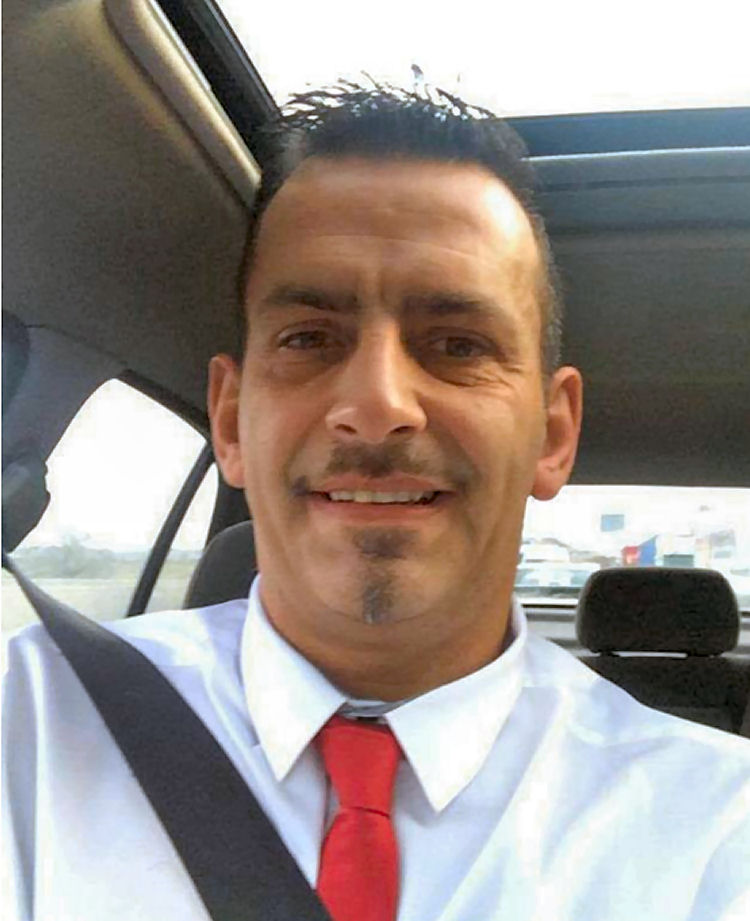
Tony Merrett died suddenly on Wednesday.
Before taking on the management of the pub in Front Street in 2012, he
worked as a health care assistant in Eastbourne, where he met Mr Guy, as
well as an air steward for airlines including British Airways and
Easyjet.
Mr Guy said: “That was his first love. He was going back in to it. He
loved being in the air.”
Mr Merrett had recently undergone a medical examination to show he was
fit for the job which he passed with flying colours. He was set to start
his new part time role with Norwegian Air this month.
Mr Guy said: “He was the sort of person you met once and you loved him.
“That’s the only way to describe him.”
The landlord also enjoyed playing the organ and treated his dogs like
his children.
“They were his everything.”
Keen to do his bit for charity, last year, he sponsored a children’s
Halloween party in aid of the Cancer Care Club at Kent and Canterbury
Hospital. He also insisted on having a drop box in the pub for the
homeless where people could donate food and clothes.
The news has shocked many who knew him, near and far. Friends, pub
guests and regulars have taken to Facebook to pay tribute.
John Sheridan posted: “R.I.P buddy, may your jokes and laughter never be
forgotten. From us all you will be sadly missed.”
Jason Gisby said: “R.I.P Tony – a true gent and nice guy.”
Craig Sheridan said: “Still shocked. My heartfelt condolences to
everyone.”
Mr Guy has thanked everyone for their kind wishes.
He said: “Everyone’s been so wonderful. People have said we weren’t
landlords, we’re family. They’ve all pulled together for me.”
The funeral plans are on hold until the cause of death has been
established.
Further information tells me he died of a
heart attack age 41.
|
|
From the
https://www.kentonline.co.uk By Eleanor Perkins, 10 October 2016.
The Five Bells in Ringwould to star in Channel 4’s Four in a Bed.
A bed and breakfast in Ringwould will this week feature in an episode of
Channel 4’s Four in a Bed.
Shelly Parnell, 36, of The Five Bells, and her mum Linda Yates, 65, will
appear alongside three other pairs of B&B owners in today’s show.
They take turns to stay at each other’s accommodation – and at the end
of their stay, pay what they think it was worth.
The winner is the establishment named best value for money.
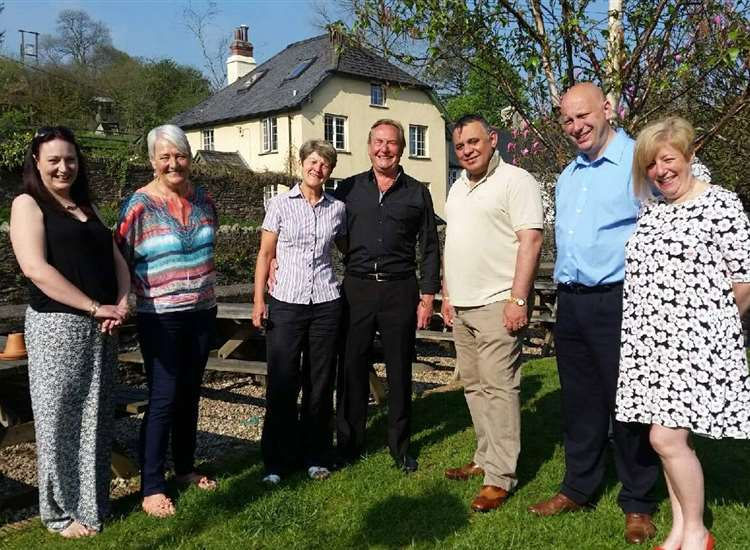
Shelly Parnell and her mum Linda Yates (both far left) with the other
couples set to feature in this Monday's episode of Four in a Bed.
Having run an online fishing tackle business for 10 years, Ms Parnell
took over the pub in April 2014. It has three double rooms, a twin room
and two self-catering apartments.
She first applied for the show in May 2015 but was unsuccessful.
She said: “It’s such a wonderful place and I just wanted people to see
how lovely it is.
“They contacted me in January this year to ask if I would like to
re-apply.
“I had applied with my ex-husband before, but this time I did it with my
mum.
“They came along and interviewed us at the B&B. We were told we had been
successful at the end of April and filming started at the beginning of
May.”
Ms Parnell, who is now the bookings manager there, said she thinks she
and her mum were chosen because they’re both very similar and ‘total
clean freaks’.
She said: “When I first took over the pub I spent months cleaning the
rooms. I really went over them with a fine toothcomb.”
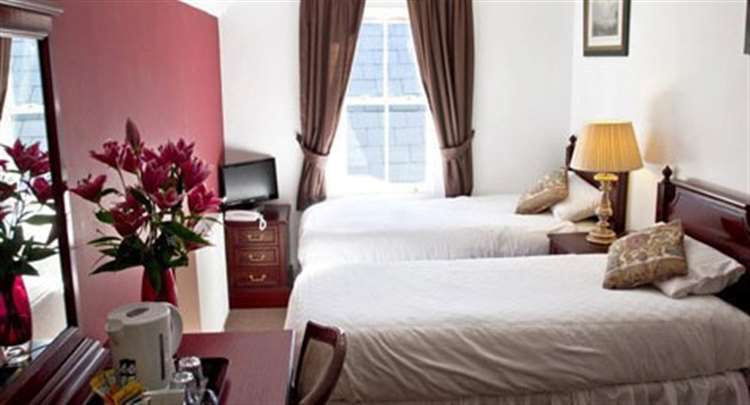
The twin room at The Five Bells in Ringwould.
Filming took place over 10 days with The Five Bells being the first
establishment to be reviewed by the other three couples.
Ms Parnell said: “We had to arrange an activity so we went paddle
boarding at Dover Sea Sports Centre and then on for dinner in the
evening at the "Blue Pigeons" in Worth.
“Our guests stayed the night, got up and had their breakfast and then
went back to their bedrooms to give their verdict.”
The pair were then given their results before they moved on to try out
the next B&B.
Ms Parnell said they had some very good feedback but are unable to
reveal how they fared in the competition.
She described the experience as great fun and has stayed in touch with
some of the other couples.
The episode will air at 4pm on Channel 4 today (Monday).
The pub will be putting on a free buffet for the screening. |
LICENSEE LIST
STRINGER Mr 1805+
TAYLOR John to 10/May/1833
BOSSINGHAM Robert 1841-12/Dec/52 dec'd (age 53 in 1851 ) )

BOSSINGHAM Mrs Ann 1855-6/Mar/60 dec'd (age 73 in 1860)
GOOZIE William L 1861+ (age 21 in 1861)
GOOZEE William Enger 1862+
ERRIDGE Edward 1866-71+ (also fly proprietor age 33 in 1871)
CASH John William  May/1871-81+ (age 41 in 1881)
 
JOY Edward 1882+

GOOZEE W E May/1883-90 dec'd
GOOZEE Mrs Flora 1890-Sept/92 dec'd (widow age 37 in 1891)
PITTOCK Edwin Sept/1892-95+
GREEN Edward C 1899-Nov/1900

SCARLETT William E Nov/1900-03+ (age 28 in 1901)

DAW Robert 1905-22
(age 47 in 1911)
 
MAYCOCK William 1922-Apr/30
 HATTON George William Apr/1930-Dec/39

JAMES William Lamprey Dec/1939+
BARDELL Peter (E W) 1958-71
EMPTAGE Edmund J 1971-74+
 Charrington & Co
ROWNEY Charles 1984-86
GASSON Robert 1986-2003+
PARNELL Shelly Apr-2014+
MERRETT Tony dec'd & GUY John Oct/2012-Mar 2015
GUY John Mar/2015+
https://pubwiki.co.uk/FiveBells.shtml
The Dover Express reported William Lamprey James, of Cliffsend, Ramsgate, late
licensed victualler.
From
Bagshaw Directory 1847
From the Post Office Directory 1874
From the Post Office Directory 1882
From the
Kelly's Directory 1899
From the Kelly's Directory 1903
From the Post Office Directory 1913
From the Post Office Directory 1914
From the
Kelly's Directory 1934
Library archives 1974
Census
From the Dover Express
|

