|
52 St. James' Street
 
46 St. James' Street
 
Dover
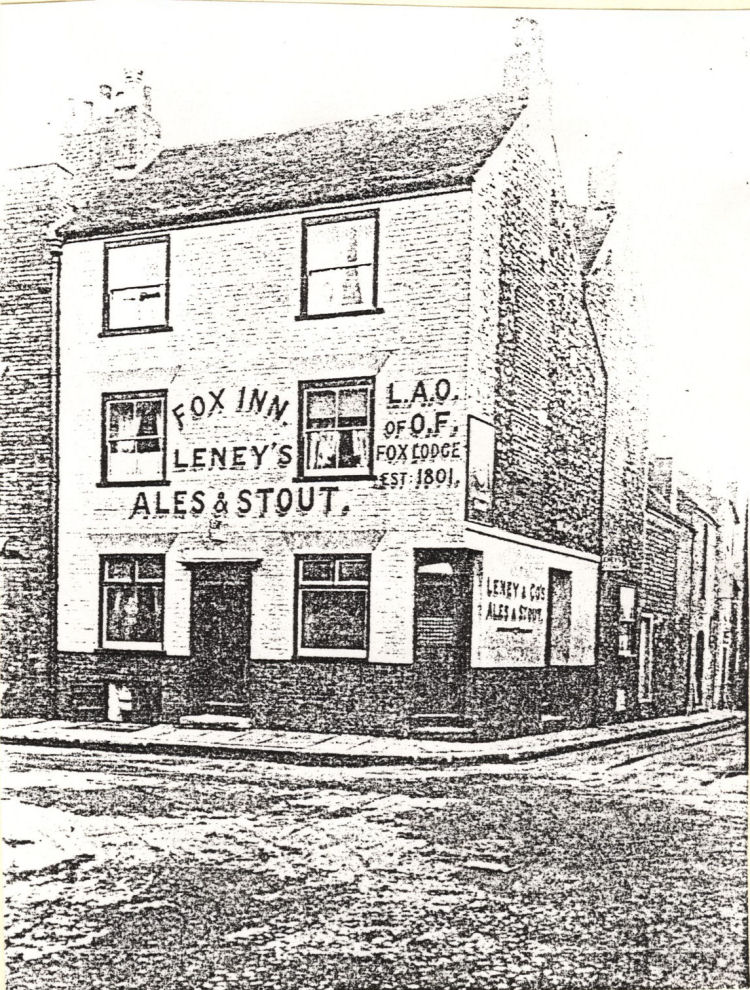
Above photo, date unknown. |
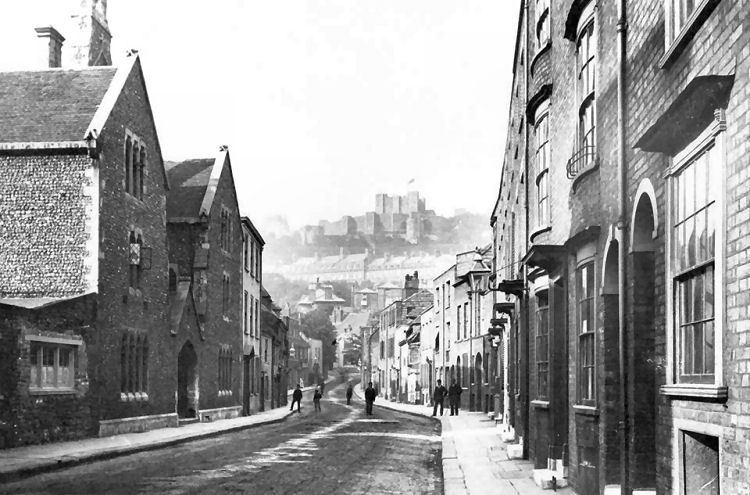
The Fox Inn, an old victualling house, was here and some of the houses in
the picture, (1880) with slightly bowed fronts, are of the style popular at the
time of George II. The St. James National School is the large building on the
left. |
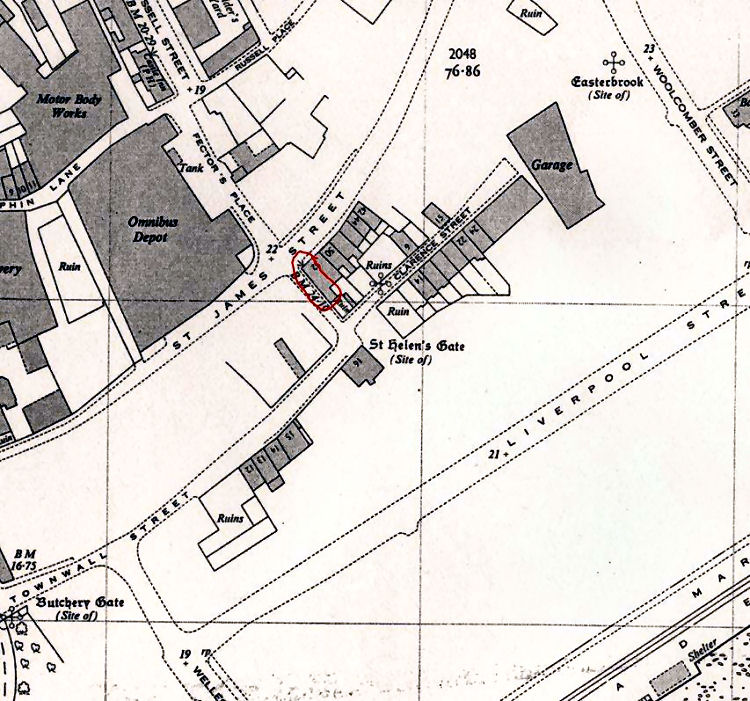
Above map post WW2. Fox is circled. |
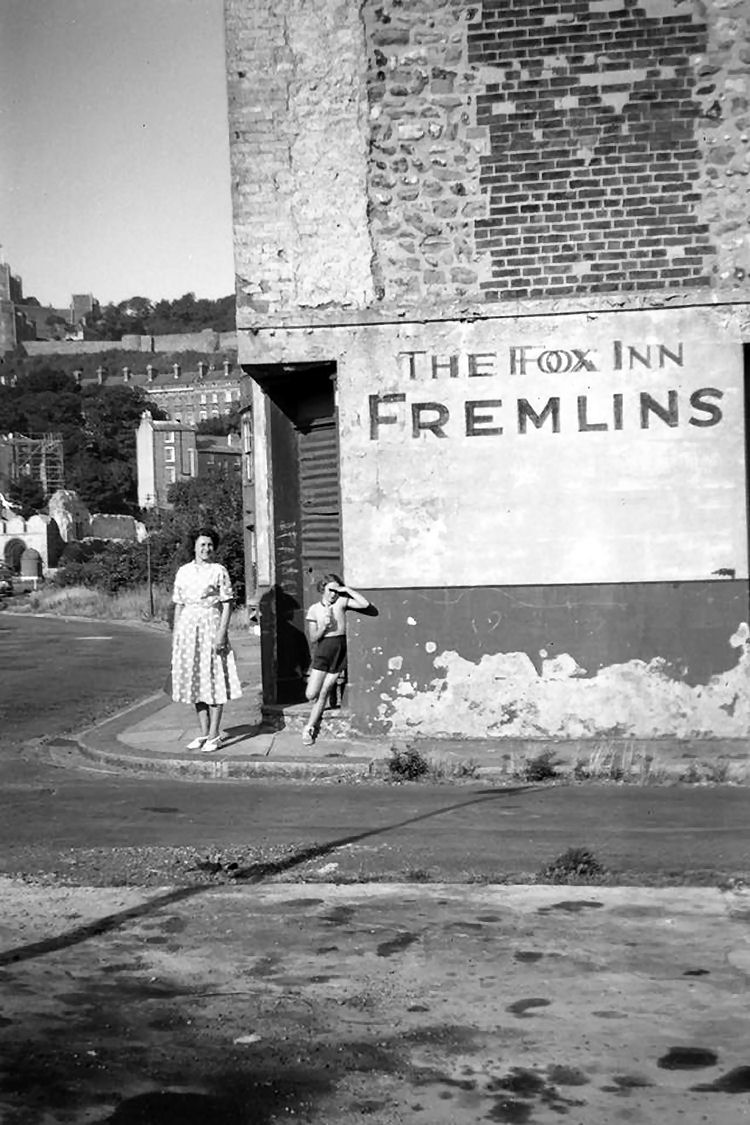
Above photo, date circa 1940. |
Two tenements were converted to provide this one, which stood on the
corner with Fox Passage. Certainly present in 1803 and stating established
1801, historians generally
agreeing that the passage was named after the pub. Be that as it may, the
reader is advised that it had previously traded as "The Turkey Cock".
Possibly 1776, my notes are disappointing. Reynolds certainly present in
1805.
Supplied by Alfred Leney Co Ltd, who bought out Thomas Walker's Phoenix
Brewery in 1859 and registered as such in 1896, until bought out by Fremlin
Brothers brewery of Maidstone in 1926, brewing at the Dover brewery ceased
in 1927, which later passed to Whitbread.
|
Kentish Gazette 14 May 1819.
On Monday, a Coroner's inquest was held at the sign of the "Fox," St
James's Street, Dover, on the body of Mary Young, alias Petty, who
had absconded from her friends at Elham, and by following vicious
practises had contracted a loathsome disease, and was advised by some
of her acquaintance to take a pernicious medicine by way of cure,
which it is supposed was the cause of her death.
|
|
From the Kent Herald, 24 July 1828.
DEATH.
July 15, at Dover, Mr. Ephraim Allman, aged 39, some years landlord of the "Fox
Inn," in that town.
|
|
From the Kent Herald, 21 November 1833
Dover. Shocking Accident.
On Friday and inquest was taken at the "Fox Inn," St. James's Street,
before W. J. Pilcher, Esq., Mayor and Coroner, on the body of Benjamin
Burvill, a poor man who with his wife and several children resided in a
cave beneath the Castle Cliff. The deceased, accompanied by an another
man, was returning from Deal, with a cart, on Thursday night, and had
taken up two soldiers of the Rifle Brigade. The party rode at the side
of the cart, and when near Broad Lee's Bottom the float on which the
deceased sat gave way, and he fell on his head with such violence as to
cause his death within a very short time after his removal from the spot
where the accident happened, to the auxiliary poor house of St. James's
parish.
Verdict "Accidental Death.
|
|
From the Dover Telegraph and Cinque Ports General
Advertiser, Saturday 16 November, 1833. Price 7d.
SHOCKING ACCIDENT.
Yesterday an inquest was taken at the Fox Inn, St. Jame's Street
before J W Pilcher, Esq, Mayor & Coroner, on the body of Benjamin
Burwell a poor man who with his wife and several children resided in a
cave beneath the Castle Cliff. The deceased accompanied by another man,
was returning from Deal with a cart on Thursday night, and had taken on
two soldiers of the Rifle brigade. The party rode at the side of the
cart and when near Broad Lees Bottom, the float on which the deceased sat
gave way, and he fell on his head with such violence as to cause his
death within a very short time after his removal from the spot where the
accident happened, to the auxiliary poor house of St. James parish.
Verdict. Accidental death.
|
|
From the Dover Telegraph and Cinque Ports General
Advertiser, Saturday 25 July, 1840. Price 7d.
LAMENTABLE CASE OF DESTITUTION
On Thursday, at half past 6 o'clock, an inquest was held before Mr.
Thompson, the borough coroner, at the "Fox," St. James's Street, on view
of the body of Elizabeth Hall, aged 78, who fell down at the corner of
Townwall Street, on the previous day, and almost instantly expired. -
Mr. Warren, Marine Library, deposed that he was passing Townwall Street
about half past two on Tuesday, when he saw the deceased fall down
on the pavement. He on the instant sent a person that was near for a
surgeon. Mt. Astley soon after arrived, but the poor woman was dead
before he came. - Dr. Astley deposed that the deceased was a corpse
before he saw her. He attributed her death to the rupture of a blood
vessel, but could not speak positively as to this, as he had not made a
post mortem examination of the body. There were no marks of
violence on the body. - Elizabeth Bass deposed that the deceased, who
was the widow of David Hall, of Dover, mariner, had lived with her as a
lodger for five weeks. Deceased had been poorly, though not confined to
bed, for a fortnight back; but said she was better yesterday, and went
out at half-past two for the purpose of getting some cherries. -
Examined by the foreman of the Jury-The deceased had often complained of
witness to want. She had only 2s from the parish to live on, and out of
this she paid 1s to witness for rent. Witness had known deceased to be
two days without a mouthful of food; and she told witness that she had
been necessitated to eat tea leaves as a substitute for bread. In short
the state of distressed deceased was in was quite shocking. She did not
complain of want to witness on the day she died; but she did the day
before.- Mary Wye, age 17, granddaughter of deceased, said it was her
practise to go and see her grandmother every morning. On day she died
witness had called and been told by deceased that she was better. Had
her her say that her grandmother had twice fallen down before; once when
coming from the Union, and on another occasion; but did not know of her
own knowledge know of the cause of these falls.- This being the
evidence, the Coroner, in reference to that part of the evidence which
represented deceased as suffering from want of food, very properly said,
that if the Jury had any doubts on their minds, he would order a post
mortum examination of the body. This, however, the Jury declined;
and after a few seconds of consultation brought in their verdict that
the deceased "Died by the visitation of God."
|
|
From the Dover Telegraph and Cinque Ports General
Advertiser, Saturday 25 July, 1840. Price 7d.
CORONER'S INQUEST
On Thursday last, and inquest was held at the "Fox Inn," before G. T.
Thompson, Esq., Coroner for the Borough, and a respectable jury, over
the body of Mrs. Elizabeth Hall, widow, aged 87 years, who dropped down
dead in Townwall Street, o Wednesday, the 22nd inst.
George Warren, librarian, deposed that about half past two on
Wednesday afternoon, as he was passing the corner in Townwall Street, he
saw the deceased lying on the pavement. There were two women with her at
the time. He immediately sent for a surgeon, and assisted in conveying
deceased into the garden of the Rev. Mr. Drake, where she lay till the
surgeon arrived.
Dr. Astley, surgeon, deposed, that he was called upon by a stranger.
to go and attend the deceased. He found her in the garden of the Rev.
Mr. Drake, quite dead. The cause of death, he thought, in all
probability was from the bursting of a blood vessel; but of that he
could not speak positively in the absence of a post mortem
examination of the body.
Mrs. Elizabeth Bass said the deceased lodged at her house. She was
the widow of D. Hall, fisherman, aged 78. Deceased had complained of
being poorly during the last fortnight, but on Wednesday morning she
stated that she was quite well; and about half-past two o'clock went
out, stating that her appetite failed her very much, and she would go
out to see if she could get some ripe cherries.
By the Jury: Deceased was in very low circumstances not having more
than two shillings a week from the parish, out of which sum she had to
pay her rent. I have known deceased to be without anything to eat for 2
days together; and have known her to eat leaves with fish, in lieu
of bread, she not having any money to purchase bread with. On the
morning of her decease, she had some meat and bread sent to her by a
neighbouring butcher's wife.
Mary Wise, grand-daughter to the deceased, deposed, that she had been
i the habit of visiting her grand-mother every day; she had been very
poorly of late, but was much better yesterday morning. She had heard her
say that deceased had dropped in two different fits.
The Jury then gave the verdict of "Died by the visitation of God."
|
|
From the Dover Telegraph and Cinque Ports General
Advertiser, Saturday 14 November, 1840.
POLICE REPORT
FRIDAY, NOV 5. - Richard Butler, charged by policeman Drenner, with
keeping his house, the "Fox," open during divine service on Sunday.
Fined 13s. including costs.
|
|
From the Dover Telegraph and Cinque Ports General
Advertiser, Saturday 6 March, 1841. Price 5d.
CORONER'S INQUEST
Yesterday afternoon, an inquest on the body of Mrs. Elizabeth Jones,
wife of the late Mr. Walter Jones, aged 68 years, was held at the "Fox
Inn," before G. T. Thompson, Esq. when the following particulars
connected with her death were brought before the jury.
Mrs. Margaret Jones, on being sworn, deposed that she had known the
deceased for some years past, having been in the habit of going to her
house to work. She saw the deceased on Tuesday last, the day on which
her husband died, when she seemed much troubled. Deceased took two or
three opium pills before she went to bed, as was her usual custom, she
believed, from her being troubled from a cough. Deceased had a small
bottle of brandy in the house, but she did not see her drink any; but on
the following day, when she visited the house, she perceived that about
half of it had been drunk. Witness visited the deceased at about
half-past seven on Wednesday morning, when she was fast asleep; and, on
looking at her, perceived that she did not look so well as usual. She
then went and called Mrs. Goodban, the nurse, and acquainted her of the
facts. They then sent for the daughter of the deceased, and subsequently
for a surgeon. The surgeon aroused the deceased, and gave them some
medicine to give her every four hours, with directions to keep her
awake. It was with difficulty, however, that they could keep the
deceased roused up; and at about half-past seven that evening she
gradually sunk and died.
James Cuthbert Ottaway, surgeon, deposed that he was sent for to
visit the deceased between one and two on Wednesday afternoon. On his
arrival at the house, he found her in bed, partly insensible, and
labouring under the effects of narcotic. Upon enquiry he found that she
had been in the habit of taking large quantities of opium for some
considerable time past; but he was unable to learn whether she had taken
more than her usual dose on the previous night. He questioned the
attendants whether she had taken any spirits, and found that she had
drank a small quantity of brandy. As he was satisfied by her state that
she was effected by the opium, he used the usual means to arouse her,
and succeeded pretty well. He remained with her about half an hour,
during which time she seemed in a peculiarly sleepy state. He ordered
that she should be kept roused, and prescribed stimulants for the same
purpose. At about half-past six o'clock, he was sent for again, and told
that she was suddenly worse. He went and found that she was dying. He
believed that a sudden effusion had taken place on the brain, produced
in all probability, or accelerated by the opium, which was the cause of
death. Under the circumstance of grief, occasioned by the loss of her
husband the day before, the same quantity of opium, or a little more
than she had been in the habit of taking, would be enough to produce the
effects which he witnessed. Four grains of opium in an adult, not
accustomed to it, had been known to produce death; but to a person
accustomed to use it regularly, from 5 to 7 grains might be taken with
impunity.
The size of pills which he understood the deceased took, would
contain about two grains and a half each.
Death from opium usually occurs about 7 or 8 hours after taking it;
but a small quantity of opium would delay the effect. The deceased was a
likely subject for an effusion on the brain, independently of her taking
narcotic.
Catherine Goodban said that she went to the house of Mrs. Jones, on
Tuesday morning, for the purpose of nursing her husband. She remained in
the house all day with Mrs. Jones who was exceedingly full of grief. She
saw her take some opium pills just before she went to bed; but did not
know how many; there might be 2 or 3 more. She also drank a little
brandy and water. Deceased was not at all restless during the night; but
when witness arose in the morning, she perceived that she did not look
so well as usual, but was fast asleep, and she continued to sleep till
the surgeon came in the afternoon. When the surgeon came, he roused her
up, and ordered them to continue to do so, but it was with the greatest
difficulty that they could keep her awake. She died about half-past
seven in the evening.
Verdict - "That death was caused by an effusion of the brain, caused
by excessive grief from the death of her husband."
|
|
Dover Telegraph and Cinque Ports General Advertiser, Saturday 2 March 1844.
MAIDSTONE INSOLVENT COURT—Feb. 22.
(BEFORE Mr. COMMISSIONER NICHOLS.)
Richard Butler, late of the "Fox Inn," Dover, victualler, and coach
proprietor, from Dover to Herne Bay, came up to be heard on his
petition.
Mr. Carless. from the office of Mr. Ross, Wine-office-court,
Fleet-street, London, attorney, appeared to oppose on behalf of F.
Perkins, Esq., late sheriff of Kent; Mr. Court, wine merchant; Mr.
Hills, coach maker; Mr. Davidson, corn merchant; and Mr. Lester,
saddler, all of Dover; and a Canterbury creditor.
Counsel for opposing creditors—Mr. T. B. Hughes. Mr. Philp appeared in
person. Attorney for Insolvent—Mr. Dally, Maidstone.
Counsel for Insolvent—Mr. Woodruffe.
Insolvent, examined by Mr. Hughes:- I was guard to the Dover mail. On
the 4th November, 1839, I took the "Fox Inn," Dover, of a
Mrs. Marsh; I paid her £105 odd. I borrowed £400 of my brother, William
Butler, who lived at Canterbury at the time of my taking
the "Fox inn." I gave him an I O U for it; the money was in notes and
gold. I cannot tell whether there was ten or one hundred
sovereigns. My brother, William Butler, lent me £200 on the 15th June,
1840; I gave him an I O U for it; both I O Us given at the
time of the advances. I have bought, since the valuation at the "Fox,"
furniture and stock to the amount of £250. I borrowed the
£200 to go into the coach business. I went into the coach business in
June or July, 1841. On the 19th October, 1941, deposited £100
at Latham's bank, at Dover. On the 20th September, 1842, I deposited
another £100 there. I had £50 at Fector’s bank. I was to pay
my brother four per cent. interest. I was to receive from the bankers 2
1/2 per cent. Interest. I drew the money out of both banks
on the 21st of September, 1843. I disposed of the furniture and stock at
the "Fox Inn," Dover, on the 2nd of September, 1843, by
valuation, to my brother, William Butler. Mr. Terson, of Dover, was the
only appraiser employed. After the valuation I gave my
brother money to pay the rent due on the 29th of September, 1843, I paid
for this year's licences; also the gas and taxes since the
valuation to my brother. My brother William is living at the "Fox Inn,"
Dover, as proprietor; he is not there perhaps a day in a week.
The Insolvent then underwent a long examination to shew that his wife
and family were now living at the "Fox Inn," Dover, and that
he was proprietor. I brought an action, by the advice of Mr. Philp,
against Capp. I got a verdict, but nothing else. An execution was
issued, but there was no goods. I paid Mr. Philp £40 and two tavern
bills. I brought an action against Mr. Perkins, the sheriff; it was
tried last assizes, and I lost the trial. An execution came into the
"Fox Inn" for costs. My brother William claimed the goods in
November last. I have heard him say there was to be a trial about it
with Mr. Perkins. I made over to my brother, William Butler, one
coach, one omnibus, one fly, and five horses. I gave I O Us for the £400
and £200 in the presence of Terson, a man named Lott and
Charles Butler, in the back parlour at the "Fox," at the times the money
was advanced.
Mr. McMillen, clerk to the Under-Sheriffs, Messrs. Palmer and France, of
Bedford-row, examined by Mr. Hughes:- I produce the
record in Butler v. Perkins, Esq., costs taxed at £95. fi. fa., issued
24th November, 1843, into the Cinque Ports, property seized at the
"Fox Inn." Dover, claimed by William Butler. On the 13th December, 1843,
Judge directed an issue to try the question, if goods the
property of the claimant. It is now pending.
Mr. Edward Hills, examined by Mr. Hughes: I did work for Insolvent to
the carriages, after the valuation to William Butler. It was at
the request of Insolvent. It was charged to Insolvent. I do not know
William Butler.
Insolvent, examined by Mr. Philp:- I have paid you £38 I saw you at
Dover, but did not blackguard you.Mr. Thomas A. Terson, examined by Mr. Woodruff:- I valued Insolvent into
the "Fox Inn." Dover, on the 4th of November, 1839;
valuation came to £105 19s. 0d. I saw William Butler advance £400 to
Insolvent on that day; it was very late, twelve o'clock at night.
We had to wait for William Butler. An I O U was given for the £400 I
drew up a memorandum about it in my book. (Book put in.) The
memorandum is for the money to be repaid back in the middle of
September, 1843. Lott and Charles Butler were there. I was
present when £200 was lent by William Butler to Insolvent, on the 15th
June, 1840. An I O U was given for it. I saw William Butler in
September, 1843 and he said he must have his money. I valued the goods
at the "Fox Inn," in September, 1843, from the
Insolvent to William Butler. The valuation came to £317 odd. Insolvent
paid William Butler, in September, 1843, £250 in notes and
gold; this was at the "Fox."
Cross-examined by Mr. J. B. Hughes:- This is my handwriting (book
produced); also this (another book); nearly all my books are in
pencil, these memorandums are in ink. I solemnly swear that these
memorandums were made on the 4th November, 1839, and
15th June, 1840. These are the I O U's. I swear these were written at
the time of the advance of the money. Mr. Lott was present.
(The witness here underwent a most searching examination by the Learned
Counsel, also Mr, Philip, and the Learned Commissioner
Nichols, as to the memorandums and I O U's being writ-en at the time,
and on the days they bore date.
William Lott, publican, at Swingfield, examined by Mr. Woodruffe, to
prove the advance of the £400 and £200, and that the
memorandums, were given, and the I O U's signed, as stated by Mr. Terson,
on the 4th November, 1839, and 15th June, 1840, and
that he was present as a witness.
This witness also underwent a strong examination by Mr. J. B. Hughes, as
to the advance of the money, the memorandums being
signed and the I O U's given on the days they bore date, which he swore
was the case; also on an examination by Mr. Philp, and
that the I O U's were given up by William Butler to the Insolvent on the
20th September, 1843.
Charles Butler, coffee-house-keeper, Old Kent road, London, examined by
Mr. Woodruffe, to prove the same facts and the same
examination on the part of the opposing creditors took place.
William Butler, examined by Mr. Woodruffe, to prove the lending of the
£400 and the £200, the signing of the memorandums, and
the giving of the I O U's on the days they bore date; the receiving of
the £250 on the 22nd September, 1843, and the valuation,
made on that day, of the goods at the "Fox Inn," Dover, from Insolvent
to witness, amounting to £317. 10s. 6d.
Examined by Mr. T. B. Hughes:- I was not in Dover at three o'clock on
the 4th November, 1839. An I O U was given for the £400.
Mr. Lott did not make any memorandum about it. Mr. Terson did not make
any memorandum about it. Nothing was assigned but
the I O U. My brother wrote it. I went to Dover in a gig. I was walking
up the New-road, Canterbury, and a man asked me to take
a ride. I did so. I went to Dover with him. I have not seen him since.
It was about half-past five o'clock. I was at the "Fox" before
Lott. Terson was there. Lott went down about ten o'clock. I am certain
nothing was signed but the I O U at the time.
On the 15th June, 1840, I lent my brother, the insolvent, two hundred
pounds more. Terson and Lott were present at the "Fox". An
I O U was given for that, but nothing else. That I swear. I have sold
the horses my brother had. I was, in 1840, served with a writ
by Mr. Austin, for £35, that I had received for him, but not paid. In
January 1839, I was summoned to the Canterbury Court of
Requests, for a small debt due to William Parsons; in April, 1839, by
Thomas Dean, for £1 10s.; in February, 1843, by Howard; in
March, 1843m by one White, for £1 15s.; and on the 13th April, 1843, for
£1 10s., doctor's bill due to mr. Hunt, nothing was signed
but the I O U's.
Examined by Mr. Philp:- These are the licences, all in my brother's
name. I do not intend to turn him out of the "Fox."
Examined by Commissioner Nichols:- I agreed to lend the Insolvent £200
for twelve months; interest at 4 per cent. At the end of the
twelve months I asked him for it; he put me off for three months; then I
asked him. I waited another mont. In February, 1843, I
asked him. I knew of the trial with the sheriff. There was no agreement
made for payment of the £200 in September, 1843. I never
told Terson to write a memorandum. The memorandums, as stated to have
been written on the 4th November, 1839, and 15th
June, 1840, were here handed, by the learned commissioner to witness.
The witness said this (the one dated 15th June, 1840) was
written by Terson at the "Fox" about three or four months ago; Lott,
Terson, and Insolvent were there. I was present; it was written
in the back parlour; I saw it signed. The other memorandum about the £400
was not written at the same time; I do not know when
that was written.
Mr. T. B. Hughes addressed the Court on the part of the opposing
creditors, as did Mr. Philp on his own behalf.
Mr. Woodruffe replied:- He disclaimed all the evidence given by Terson,
Lot, and Charles Butler, and would rely on the testimony of
William Butler as to the advance of the money and the giving of the I O
U's.
Mr. Commissioner Nichols said the case had lasted all day and now, seven
o'clock, he should adjourn until the following morning at
ten, when he would give judgment. He should take Terson's books, the I O
U's, and papers with him, to examine previous to giving
judgment.
Friday, Feb. 23.
On the opening of the court Mr. Hughes stated, that from what Mr.
Carless, the clerk to the attorney to the opposing creditors, had
heard since the breaking up of the court last evening, he, Mr. Carless,
had been engaged all night in obtaining evidence to prove
that the I O U's were concocted and written in Maidstone gaol the
beginning of January 1844, and that three witnesses could be
produced to prove the fact, and that Mr. Carless was but that moment
returned from Gravesend, to which place he had been in a
post-chaise to fetch the party who furnished the paper for the I O U's
to be written on. He had an affidavit of facts, and requested
the learned Commissioner to allow him to read the affidavit.
The Learned Commissioner consented to open the and let in fresh evidence
as to the I O U's.
Robert Frazer, examined by Mr. Hughes:- I am a bookseller at Gravesend.
I was a prisoner for debt in Maidstone Gaol. The Insolvent
was there. I was discharged yesterday. The Insolvent told me he had
borrowed £600 of his brother. I asked him if his brother had
any security? He said no; I gave him two pieces of paper to write I O
U's on; I did not see him write them. (The I O U's produced.)
These are the slips of paper I gave him. I wrote out I O U's for a copy
for him. This was in January last.
Examined by Mr. Philp:- There were three or four men with Insolvent
about a week ago. The receipt for interest was not on the back
at the time I gave him the paper. I do not know whose writing that is.
Examined by Mr. Commissioner Nichols:- I saw the I O U's afterwards in
the prison, in my room. The Insolvent had them. I wrote the
copy for the Insolvent to copy from.
Cross-examined by Mr. Woodruff:- Insolvent always stuck to owing his
brother £600. I proposed the I O U's and gave him the
paper. It was about the first week in January, before making out his
schedule. I was subpoenaed here this morning about half-past
six, as I was opening my shop. I did not split.
Mr. Commissioner Nichols shortly examined the Insolvent as to what the
money (£250) was, in either notes or gold, paid to William
Butler.
Mr. Woodruffe addressed the Court for insolvent, and still I repudiated
all evidence but William Butler's, and that not any fact had
been adduced to prove that the money had not been advanced, but he
stated that he believed all the documents to be fabricated.
Mr. Commissioner Nichols made some most severe remarks as to the conduct
of the insolvent and his witnesses, and that the
evidence adduced that morning fully bore out his opinion on the case,
that it was fraudulently concocted. Before giving the
judgment, he said, he should advise the insolvent to settle with his
creditors. The Sheriff must be paid, and Mr. Philp would no
doubt take something less than the full amount of his claim. If the
issue was tried with William Butler respecting his claim to the
goods, William Butler must lose it. According to the insolvent’s own
showing he could pay 20s. in the pound, but he did not believe
that the £600 was ever advanced by William Butler, who might have
advanced insolvent £100, perhaps or thereabout, but this he did
not say for certain. The insolvent was in prosperous circumstance, but
having once embarked in fraud he did not know where to
stop. As to the evidence, he could not attach much importance to that
either Lott, Terson, or Charles Butler. The Learned
Commissioner then pointed out and referred to the books to show that the
memorandums were not written at the time stated by the
witnesses. Respecting William Butler his statement was directly
contradicted by all the other witnesses as to the memorandums, but
confirmed them as to the I O U's, and those by the evidence produced
that morning were fully proved to have been written in
Maidstone gaol in January last. The learned commissioner then said he
trusted the parties would, for their own sakes, immediately
settle with all the creditors of insolvent, as they were liable to get
into serious difficulty if they did not do so. The judgment of the
Court was, that insolvent be imprisoned for 18 months for fraudulently
making away with property.
Mr. J. B. Hughes applied for the assigneship.
|
|
Kentish Gazette, 12 March 1844.
MAIDSTONE INSOLVENT COURT, Feb. 22, 1844.
The following affidavit has been forwarded to us from the solicitor of
the parties engaged in the petition of Richard Butler, late of the "Fox
Inn," Dover.
I, the undersigned William Butler, of Canterbury, being now in my
perfect slate of mind, do voluntarily and most solemnly declare that the
evidence I gave at this trial was given by me while labouring under a
severe attack of nervous excitement, and totally incorrect, and that the
following I declare to be the truth, so help me God:—
I lent my brother, Richard Butler, the sum of four hundred pounds, on
the 4th November, 1839, and on the 15th June, 1840, the further sum of
two hundred pounds, for both these sums I look I.O.U's at the time of
lending the money, and gave my brother to understand that the money as
aforesaid was to be paid back to me on or before the 20th
September,1843, that Mr. Charles Butler, Turson and Lott, were present
at my lending the said sum of four hundred pounds, and I firmly believe
that at the request of Richard Butler, a memorandum was made as to my
words, and signed by these parties at the time as aforesaid, as also as
to Mr. Lott and Terson being present at my lending the two hundred
pounds, and that a similar memorandum was made And that the goods at the
"Fox Inn," in Dover, were valued to me in September, 1843, &c., and that
a memorandum as to how the account between myself and brother stood was
signed by the parties, and in my presence in the Front Parlour of the
"Fox Inn," and not in the Back Parlour as previously stated by me, there
being no such room in the said house, and that the evidence given in
this trial by Mr Terson, Lott, Charles and Richard Butler, is strictly
the truth, so help my God. As witness my hand this eleventh day of
March, one thousand eight hundred and forty-four.
WILLIAM BUTLER.
Sworn before me, this 11th March. 1844.
Edward Wootton, Magistrate for Canterbury.
|
|
Kentish Gazette, 22 October 1844.
On Saturday last Mr. Joseph Ashmore, of the "Fox Inn," St.
James's-street, went to the bank to receive some money which was paid
in notes, and, as he thought, placed in his purse with some others,
amounting to upwards of £100 but, it seems that he had only
secured a part of them in his purse, for on going into the market,
having occasion to pay some silver to the toll collector, he drew
four to notes out of his pocket, which were blown under a butcher's
stall, the wind being very high. On his return home he
discovered his loss, and the crier was instantly sent out, offering a
reward of £5. Mr. Joseph Sacra, butcher, who has attended the
market for several years, having occasion to look under his stall about
eight o'clock in the evening, discovered the lost notes, and
returned them to the owner, without taking the reward, although
earnestly pressed to do so. Such conduct is deserving of the
highest praise, as the party finding the notes was in no way connected
with the loser, and there were in the market during the
evening some hundreds of persons, so that it was a case of honesty
almost unprecedented. We hope that this will prove a great
benefit to the young man, and that the public will appreciate one who
knows that "honesty is the best policy."
|
|
From the Dover Telegraph and Cinque Ports General
Advertiser, Saturday 4 January, 1845. Price 5d.
INDEPENDENT ORDER OF ODDFELLOWS
This ancient order is now in a flourishing condition in Dover. Since
the occupation of the "Fox Inn" by the present worthy host, the
attendance of the brethren has been very numerous, and fourteen
candidates have been initiated during the past quarter. On Monday
last a medal was voted to P. G. W. Tart, in token of the respect
entertained for him by the brethren.
|
|
From the Dover Telegraph and Cinque Ports General
Advertiser, Saturday 8 June, 1846. Price 5d.
CORONER'S INQUEST
An inquest was held on Saturday last, at the "Fox Inn, St.
James-street, before G. T. Thompson, Esq., Coroner to the Borough, on
the body of an unbaptized infant, aged 3 weeks, son of Caroline White,
spinster.
Caroline White being called deposed - The child slept with me and my
niece on Wednesday. About 2 or 3 o'clock the child awake, and appeared
in pain, but soon went off as if asleep. I laid it up on the pillow, and
fell asleep. A little before 6, my sister, Mrs. Butler, came to call me,
and soon after, as the child did not look as usual, I sent the girl for
my sister, who came and took the child into her room, and then sent for
a surgeon, who came about 7 o'clock, and said the child was dead. The
child never had any convulsions or fits, but appeared to suffer from a
heaving of the chest. I always laid the child on my pillow, for fear it
should get suffocated under the clothes.
James Cuthbert Ottaway, surgeon, deposed - On Thursday morning, about
7 o'clock, I was called to attend at the "Fox," where I found the child
dead. It appeared to have been dead 2 or 3 hours. There were no external
marks of violence, and I could come to no conclusion as to the cause of
death, I have since made a post mortem examination, and found the
brain, lungs, and all the viscera healthy, except the kidneys and
bladder, the former of which were much inflamed, and the latter were
enormously distended. These appearances were the result of disease, and
sufficient to cause death. The witness further stated that it was a most
extraordinary case, there being no obstruction whatsoever in the
urethra, but explained that it might have been spasmodic, which would
cease with death. In rely to a question from Mr. J. B. Adams, the
foreman of the jury, Mr. Ottaway said he was perfectly satisfied that no
unfair treatment had been practised on the child, and the jury returned
a unanimous verdict of "Natural Death."
|
|
From the Dover Telegraph and Cinque Ports General
Advertiser, Saturday 14 November, 1846. Price 5d.
DOVER POLICE COURT
Friday November 5th: Richard Butler, charged by policeman Drenner,
with keeping his house, the "Fox," open during divine service on Sunday.
Fined 13s. including costs.
|
|
Kentish Gazette, 4 April 1849.
On Wednesday morning, at half-past five, a person named Ann Dennis threw
herself from an attic window, at the "Fox Inn," into the yard. On being
picked up, Mr. Jones, Burgeon, was sent for, who attended her till
Friday afternoon, when she died from the injuries sustained by the fall.
Deceased was subject to aberrations of mind.
|
|
Maidstone Journal and Kentish Advertiser, Saturday 16 July 1859.
To let by tender.
The following public houses situate in and near Dover, Eastry, and
Folkestone, viz:-
1. The "Bull Inn," Eastry.
2. The "Halfway House" and land, on the Dover and Canterbury Road.
3. The "Chequers," at Folkestone.
4. The "Chequers" and land, at West Hougham.
5. The "Red Lion," at Charlton.
6. The "Fox," in St James's Street.
7. The "Ordnance Arms," in Queen Street.
8. The "Cause is Altered," in Queen Street.
9. The "True Briton," on Commercial Quay.
10. The "Three Kings," in Union Street.
11. The "Fleur-de-Lis," in Council House Street.
12. The "Cinque Port Arms," in Clarence Place.
13. The "Red Lion" in St James's Street.
14. The "Dolphin," in Dolphin Lane.
The above houses are to be let as free houses, in consequence of the
proprietors of the Dolphin Lane Brewery discontinuing that business.
The holdings of the present Tenants expire under notice to quit, as follows,
viz:- No. 2, on the 6th January next, No. 3, on the 6th July, 1860, No. 10,
at Lady Day next, No. 13, on the 23rd October next, No. 14, on the 6th April
next, and reminder on the 11th October next.
Tenders must be sent into the offices of Mr. Edward Knocker, Castle Hill,
Dover, on or before the 20th day of July next, marked on the cover "Tender."
Particular and Terms of hiring, with the forms of Tender, to be obtained on
application to Mr. knocker, or Mr. Thomas Robinson, Estate Agent, Bench
Street, Dover.
Tenders may be given for the whole together or separately. The Tenders will
be accepted subject to the houses being sold on or before the 20th day of
September next, and the proprietors do not bind themselves to accept the
lowest or any tender.
N.B. The proprietors are open to treat for letting the Brewery, Malthouse,
and Premises, in Dolphin Lane.
Edward Knocker. Castle Hill, Dover, June, 1859.
|
|
From the Dover Express and East Kent Intelligencer,
20 May, 1865.
INFRINGEMENT
OF LICENSE
Henry Foster, landlord of the "Fox Inn," summoned by Police-sergeant
Bayley for serving on a Sunday last during divine service, was fined 5s.
and costs.
Paid.
|
|
From the Dover Express and East Kent Intelligencer,
5 October, 1866.
CHARGE OF ROBBING A TILL
Stephen Eccles and John Helpin, soldiers of the 75th Regiment, were
charged with stealing three sixpences and two farthings from the till of
the "Fox Inn," St. James's Street, on the previous day.
It appeared that the prisoners went into the "Fox" between eleven and
twelve o'clock on the previous day. They came to the bar and asked for
some beer, with which the landlady (Mrs. Forster) supplied them. As they
were standing in front of the bar, Mrs. Forster had occasion to leave
the bar, to give some directions to her servant. While she was away she
heard a sound which she immediately recognised from its peculiarity as
the shutting of her till. On coming back she accused the prisoners of
the robbery, having found on looking into the till that three sixpences
and two farthings had been taken out of it during her absence. She
threatened that if they did not give up the money she would send for the
police. She accused Helpin of the robbery, but he declared he had not
got the money; but at the same time he let a sixpence and a farthing
drop upon the ground. The wife of a sergeant who was present said, "He
has got some more money in his hand," and he then delivered up two more
sixpences and a farthing. He put the money on the counter. The landlady
then sent for the police.
In cross-examining by Helpin Mrs. Forster said she would not swear
whether the till was opened or shut when she left the bar to speak to
her servant.
In answer to the Magistrates Mrs. Forster said the prisoner Helpie
sat sufficiently near to the till to reach it with his hand.
Police-constable George Raymond said that on the previous morning,
about half-past eleven, he received information as to a robbery at the
"Fox." He went to the house and saw the last witness, he pointed out to
him the prisoner Eccles, who was in a public house opposite. In
consequence of what she said to him he called Eccles across and asked
Mrs. Forster in his presence if he was the man who had robbed her. She
said he was not, and that the man who did it ran away. He asked Eccles
some questions as to the other man and on Eccles declining to give him
satisfactory answers he told him he must take him into custody. While he
was speaking police-constable Faith came in, and with faith's assistance
Eccles was taken to the station-house. In going out of the door Eccles
kicked witness severely in the back; but after that he went away very
quietly till he reached the bottom of Queen Street, when he resisted
very much tripping witness up. On getting to the station-house the
prisoner assaulted him again. In consequence if information given by
Eccles on arriving at the station-house Helpin was afterwards taken into
custody, being found by the witness and faith at the "White Horse"
public house. Mrs. Forster and her servant went with them, and pointed
out Helpin as the man who had robbed the till. On telling him that he
was taken into custody on a charge of robbing the till of the "Fox" he
pretended not to know where the public house was. When the charge was
read over to him at the station-house he said he should make no
statement there, but should tell all to the Magistrates.
Both prisoners desired that they might be dealt with summarily.
Helpin, on being asked to plead, said he was "not-guilty - of taking the
money out of the till," Eccles also said he was not-guilty.
On the prisoners being told that they might make any statement they
pleased, Helpin said that during the time he and Eccles were drinking
the beer, the landlady went to the till and took out some money which
she left on the counter while she went from the bar. He admitted taking
the money from the counter, but declared he gave it back to the landlady
as soon as she discovered her loss.
The Magistrates ordered the prisoners to be imprisoned for three
weeks, with hard labour. Eccles, for his assault on the
police-constable, was fined 5s.; in default, an additional week's
imprisonment.
|
|
From the Dover Express and East Kent Intelligencer,
19 April, 1867. Price 1d.
BUILDERS' NOTICE
Notice of intention to build a store at the rear of the "Fox Inn,"
St. James's Street, was received from Mr. T. W. Richardson. This was in
lieu of a notice to build a house on the same site, the place of which
were disapproved by the Board some weeks since on the ground that
sufficient air space had not been left. Mr. Richardson was aware of the
disapproval, but had persisted on building the house on the ground that
because he had left part of the old wall standing it would not be
considered a new building within the meaning of the act; but the Town
Clerk read an opinion of the counsel (Mr. F. M. White) from which it
appeared in this case the building must be regarded as a new building
and must come under the operation of the bye-laws. Notice had
consequently been given to Mr. Richardson; and hence the withdrawal of
the old and substitution of the new plans, which were referred to the
Surveyor in the usual way.
A notice from Mr. W. J. Adcock of his intention to alter the
premises, 51, High Street, by carrying out the front, was presented; but
the plans being in some way defective they were referred back to Mr.
Adcock for further details.
|
|
From the Dover Express and East Kent Intelligencer,
2 August, 1867.
LUXURY OF WIFE BEATING
Henry Forster, the landlord of the "Fox," an elderly individual of
burly appearance, was summoned on the complaint of his wife, Ann
Forster, who charged him with assaulting her and declared she went in
bodily fear in consequence of his threats.
The defendant pleaded provocation by return of Mrs. Forster's
fondness of liquor and her disinterest from to perform her domestic
duties. She was in the habit of going away from home and staying away
for days and nights altogether. Mr. Forster said, and when at home there
was "no doing anything with her" from the infirmity to which he had
referred.
Mrs. Forster, who appeared in a state of great nervous excitement, so
that she was unable to give the Court any clear amount of the particular
acts which had caused her to take the present proceedings, detailed in a
confused manner various enormities on the part of her husband, including
the emptying of water-jugs upon her as she lay in bed, the breaking of a
hand-basin about her head, and knocking her down like a bullock. She had
endured his ill-treatment eight and thirty years, and she thought it
time to complain.
The Magistrates told Mrs. Forster that she must confine herself to
particular acts, and she then, with much discursive reference to the
general conduct of "that monster," as she termed her husband, gave the
Bench to understand that on the previous Thursday the defendant had
struck her and had threatened to stab her. He had threatened her on
several other occasions. She concluded by stating that all she wanted
was " peace" and a "maintenance."
The Magistrates said they could not procure her a maintenance, as
that was a point about which they could not interfere, but they would
endeavour to preserve the peace. Did she, in consequence of these
threats, go in bodily fear?
The complainant said she wished to have nothing to do with him. All
she wished was a "maintenance."
Mr. Ottaway: Yes, yes; but do you go in bodily fear?
The complainant said, why of course she did. She had her eyes which
she could not see out of, owing to their being blacked and blued from
top to bottom.
Defendant: All false, your worships. (To complainant). Tell the
Magistrates how you're every night after night, drunk.
Mr. Ottaway (to defendant): The Magistrates are bound to take
recognizance of this complaint; but they find the justice of the case
will be met by your being bound over in your own recognizance of £20.
The defendant (producing his pocket book, and taking out some bank
notes): Certainly I will, like a little cock-bird. (Laughter.)
Magistrates: We don't want you to pay any money. The effect of your
being bound over to keep the peace is, find if you assault your wife, or
threaten her, within the next six months, you will have to pay the £20,
but not without.
Defendant: Then I don't agree to it. I'd rather pay the money now.
Mr. Ottaway: But we cannot take it. Wife beating is not a luxury that
can be purebased for £20, or any other sum. The question is, will you
keep the peace?
Defendant (after some hesitation): Under circumstance. (Laughter.)
Complainant (from the other end of the Court): Give me a
"maintenance."
Mr. Ottaway: Do sit down, my good woman, and let me deal with your
husband, if that be possible. (To the defendant.) Will you promise to
keep the peace, because if you do not, I shall have to send you to
prison.
Defendant: Will you bind her down to keep the peace too?
Mr. Ottaway: We cannot do that at present.
Defendant: Ah, that's where it is. I can't agree to it: I'd rather
pay the money.
The Magistrates informed Mr. Forster that the alternative would be
that he would have to go to prison, and he then reluctantly "promised to
hold to the Queen." &c, and having paid the costs, though he gravely
doubted whether he was "justified" in paying them, seeing that his wife
had gone to the law and not himself, he slowly left the Court, Mrs.
Forster following him, with the intention of doing what she could to
produce a maintenance.
|
|
From the Dover Express and East Kent Intelligencer,
6 September, 1867.
A LANDLORD AND HIS WIFE
Henry Robert Foster, the landlord of the "Fox Inn," St. James's
Street, was charged with causing an obstruction of the footway, while in
a state of drunkenness, yesterday afternoon.
Mr. T. Lewis appeared for the defendant.
It appeared from circumstances deposed to by police-constable Baker
that the defendant and his wife, who did not live together on the most
amicable terms, the Magistrates having more than once been appealed to
in the settlement of their grievances, were quarrelling on the previous
afternoon about three o'clock when the defendant came to the door and
made use of very obscene language. The constable told him he must be
quiet, when the defendant made use of dreadful epithets both towards
himself (witness) and Mrs. Foster.
Mr. H. J. Meadows was called as a witness. He deposed that Foster and
his wife were "having a fall out" on the previous afternoon about the
time stated, and came to the door in a state of great excitement. They
were throwing liquor at each other and made use of some other missiles.
In cross-examination the witness declared that there was no
ill-feeling existing in his mind in consequence of a dispute he had had
with the defendant as to the valuation of his effects, when he took the
"Fox."
Mr. Lewis having addressed the Bench on the defendant's behalf.
The Magistrates fined the defendant 10s. and 7s. costs, which he
paid.
Ann Foster, the wife of the defendant, was charged by
police-constable Corrie with drunkenness. The offence arose out of the
circumstances just deposed to, though it was not till twenty minutes to
one this morning that the woman was taken into custody. She was then
found sitting on a step in St. James's Street, in a state of
drunkenness, and was making a great noise, which disturbed the
neighbourhood. She had been endeavouring to gain admission to her
husband's house.
The bench fined her 2s. 6d. and costs 6s.; in default, four days'
imprisonment.
The defendant said she would send for the money.
|
|
From the Dover Express and East Kent Intelligencer,
16 January, 1874. Price 1d.
APPLICATION
Mr. A. Annett, of the "Fox Inn," St. James's street, applied for an
extension of time on Wednesday night, when the annual dinner of Dover
Odd Fellows was to take place. The house would be closed to the general
public at the usual hour.
The Bench said they had previously refused similar applications and
could not make an exception in this case.
|
|
From the Dover Express and East Kent News, Friday 11 January, 1884. 1d.
AN APPLICATION
Mr. W. Mowll applied on behalf of Mr. Beaton Bushell for permission to
draw at the “Fox Inn”, Townwall Street, and said that the applicant had
kept the “Admiral Owen Inn,” Sandwich, for five years, and also worked
for the firm of seed merchant Messrs. Bradley Bros., of Sandwich and
Dover. The number of hands during the past year had been lessened, and
Mr. Bushell was one that was discharged, and this effected him so much
that he took to drinking, and that was reported against him and the
license was renewed at the last annual renewals on the condition that
the owner of the house Mr. Webb promised to give the applicant notice to
leave by Christmas. He (Mr. Mowll) would now ask the Bench to give the
applicant another trial and grant permission to draw till the next
transfer day, the 6th of March, and if he sustained the good character
he had at Sandwich the license would be renewed, but if not he would
have to get out of the house. There was a letter from Mr. Hughes, the
Mayor of Sandwich, stating that the applicant's house had been a well
conducted one during the time he had kept it.
The Bench after a short consultation, said that they could not accede to
the application – it would not be kind or charitable to place the
applicant in such a position again – after he had been in some other
pursuit and showed that he was capable of keeping from drink, then
permission might be granted. At present it would be placing him in
temptation to put him in his old place again. The application would be
refused.
|
|
Canterbury Journal, Kentish Times and Farmers' Gazette, 22 January 1898.
A publican and his niece.
William Dobson, landlord of the "Fox Inn," Dover, was summoned to show
cause why he should not contribute towards the support of the
illegitimate male child of Louisa Frances Johnston, now living at 16,
St. Georges Lane, Canterbury, of which he was the alleged father.
Mr Rutley Mowll appeared for complainant, and Mr H Broughton
representing the defendant, who pleaded not guilty.
It appeared that at the time of the offence defendant, the uncle of
complainant, was landlord of the "Royal Mortar," Military Hill, and that
at Christmas, 1895, complainant, who was then nearly 18, became an
inmate of defendants house and assisted in the bar. She had no cause of
complaint to make against him for a considerable time, but on the 14th
July, 1896, defendant's wife went to Canterbury for a fortnight's
holiday, leaving her husband and complainant at home, and it was during
her absence that the offence was committed. Defendant, at the time,
requested her to say nothing about what took place, but that at any time
she wanted money he would be pleased to supply her with it. She left the
house in September, 1896, and defendant paid her her wages up to date,
beside giving her five shillings and a bottle of port wine. The Johnson's
spent Christmas that year with the Dobson's, and complainant's condition
was mentioned. In the beginning of January, complainant received a
letter from her Uncle as follows; "Are you going to correspond with me?
If you want any money right to T, "Fox Inn," St. James's Street, Dover.
On the 14th April, 1897, the child was born, and a fortnight afterwards
complainant told her that the defendant was the father of the child. A
letter was sent by complainant's father to defendant as follows:- "I
suppose you have heard of the disgraced sent home to me. Your niece has
had a child, and it is yours. Your wife wants to keep the matter from
being exposed, and unless something is paid towards the expense the
matter will be placed in the hands of a solicitor. It is one of the most
unmanly acts for an uncle to do."
Mr Mowll called upon defendant to give evidence, and he absolutely
denied ever having seduce the girl. He also said that never at any time
had he behaved with impropriety to her. He admitted giving her port wine
and five shillings extra, but said his wife paid her her wages. He
denied sending the girl a letter, and never told her that if she wanted
money she was to write to him. He never knew that he was mentioned as
the father until he received Johnson's letter. He showed it to his wife,
and he would not have done that has he been guilty. It was quite true
that he agreed to take the child and keep it, but he did that because
the affair happened at his house.
Mr Broughton submitted that the letter of correspondence was a
concoction on the girl's part, though he was grieved to have to say it.
He also submitted that Mrs Dobson was in the house on the 14th July, and
never left till the following day.
The bench ordered defendant to contribute 2s. 6d. a week until the child
attained the age of 15, and also to pay the costs.
|
|
From the Dover Express and East Kent News, Friday, 20 May, 1904. Price 1d.
LICENSING MATTERS
An occasional license was granted to Mr. Dobson, of the “Fox Inn,” for
the supply of refreshments at the Danes on Whit Monday, from 10 a.m. to
8.p.m.
|
|
From the Dover Express and East Kent News, Friday 4 January, 1907. Price 1d.
A LICENSED VICTUALLER'S FAILURE
Re. William Dobson, Licensed Victualler.
This debtor returned his liabilities at £155 18s. 6d. and estimated his
assets to produce £41 8s. 8d. leaving a deficiency of £117 14s. 2d.
Debtor stated that formerly he was a baker at Canterbury, and that about
fifteen years ago he took the “Bell Inn,” St. James's Street, Dover, the
ingoing valuation being between £150 and £160. He had about £20 of his
own, and borrowed the balance required to pay the amount of the
valuation from relatives. Subsequently he took the “Unity,” Palace
Street, Canterbury, and later the “Royal Morter,” Millitary Hill, Dover,
while ten years ago he took the “Fox Inn,” St. James's Street, Dover.
That house paid and he was able to repay the money he had borrowed.
About six years ago he took a contract in a conjunction with Edward Seinford Fry to supply the Dover Athletic Ground. No deed of partnership
was entered into, but they arranged to share the profits. As a matter of
fact there was a considerable loss on that contract, and Fry left him,
and all the creditors came on him (debtor) to pay. He paid them as well
as he could out of the profits at the “Fox Inn.” During the last two or
three years the trade of his house had not been so good, and he gave up
the “Fox Inn” about six months ago. The valuation he received on leaving
he paid to his creditors, each of whom received something on account.
Debtor then borrowed £25 from his wife and purchased a small drapery and
stationary business at 246, Folkestone Road, Dover. He agreed to the
purchase price at £52, and paid £25 on account. He soon found out that
the business was not paying him. The person from whom he purchased it
represented the takings at £7 a week, but he did not take £3 a week.
In reply to Mr. Rutley Mowll, who appeared on behalf of Mrs. Harrison,
the vendor of the drapery business, bankrupt admitted that he employed a
valuer and that the purchase price of £52 was fixed by him. He also
admitted that the £52 was for the stock, and that nothing was included
for goodwill.
The examination was closed.
|
|
From the Dover Express and East Kent News, Friday, 8
October, 1937.
THE "QUADS" DART TEAM
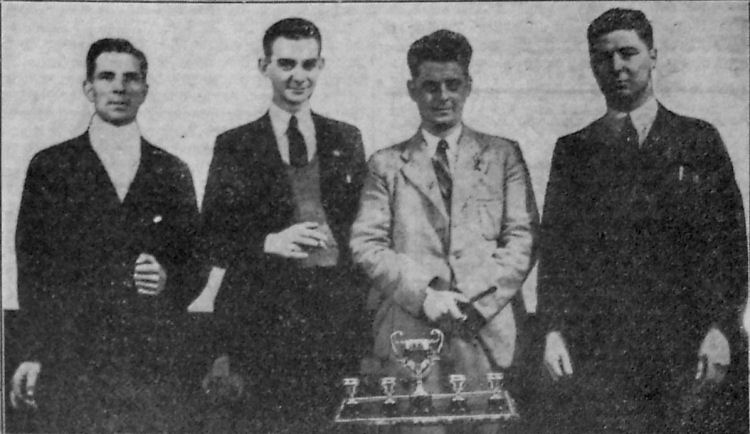
The "Fox" Inn team, of St. James' Street, Dover, winners of the
Shepherdswell "Quads" Darts Competition. This team has also been runners-up
in the Dover Darts League for the past two seasons. From left to right:- J.
Curtis, J. Whitnall, B. Whitnall and M. Booker.
|
|
Dover express 22 April 1938.
DOVER DARTS FINAL.
The final of the Dover licensed victuallers' darts knock-out competition
was played on Wednesday evening, when the “Fox Inn” defeated the “Dew
Drop Inn” by six games to five. The winning team was :- B. Whitnall
(captain), J. Whitnall, J. Curtis, M. Broker, F. Matcham, W. Murphy, A
Brookes, D. Shoesmith, G. Rogers and T. Swindells. At the conclusion,
the cup was presented to the winners by Mr. W. Drennan, chairman of the
association.
|
|
From the Dover Express and East Kent News, Friday, 29
April, 1938.
THE FOX INN DARTS TEAM
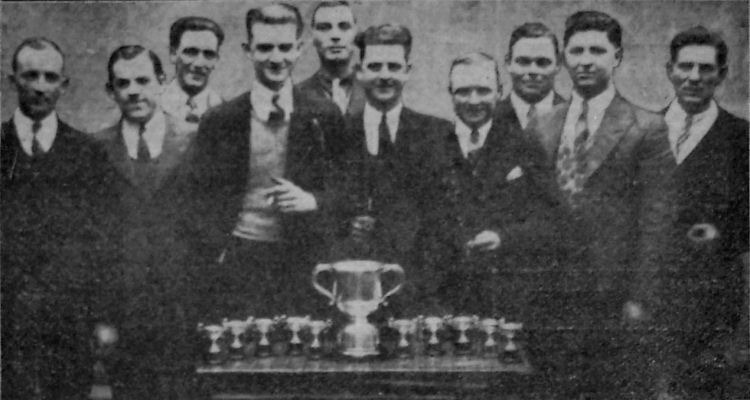
DOVER DARTS CHAMPIONS
Winners, for the second year in succession, of the Dover Licensed
Victuallers' Dart League. Reading from left to right:- G. Rogers, W.
Murphy, E. Shoesmith, J. Whitnall, A. Brookes, B. Whitnall, F. Matcham,
T. Swindells, M. Booker and J. Curtis.
|
It was closed following war damage in world war two and a compulsory
purchase order was made by the town in January 1954 and confirmed in May
1955 for the site and war damaged-building. A converted value payment was
made in 1957 for £2,400.
The property was demolished by August the same year.
LICENSEE LIST
REYNOLDS 1805
ALLMAN Ephraim 1823
 died 15/July/1828
MOORE Young 1826-28+

MARSH William 1832-39+
MARSH Jane Ellen 1840

BUTLER Richard 1840-41+ (age 30 in 1841 ) )
UPTON Harold 1847

BETTS Richard 1850-51 (age 49 in 1851)
 BRACKENBURY William Palmer 1850 end

WICKHAM William 1854-59
FORSTER Henry R 1864-68 end

WOOD G to Jan/1868
FORSTER H R Jan/1868+
ANNETT William Enos "Eric" Nov/1870-74
(also butler age 32 in 1871)
McEWEN Andrew 1874-Jan/75

STEVENS Alfred Jan/1875-76 (victualler, London)
FRIEND Thomas 1878
JOHNSON William to May/1878
TWIGGS John July/1878-1882 (age 33 in 1881)

HOGBEN John 1891-Jan/97

DOBSON William Jan/1897-Aug/1906
(age 33 in 1901)
   
BAKER Josiah bentley B Aug/1906-11 (age 57 in 1911)
NORRIS Albert George 1911-Sept/14

WATKINS Arthur James Sept/1914-30 end
   (Formerly a baker working for River and District CO-OP)
WHITNALL Richard Henry 1930-39 dec'd
 
WHITNALL Jack P 1939-Aug/40 (age 23 in 1939)
WHITNALL Effie (widow) Aug/1940+
From the Pigot's Directory 1823
From the Pigot's Directory 1828-9
From the Pigot's Directory 1832-33-34
From the Pigot's Directory 1839
From the Pigot's Directory 1840
From Bagshaw Directory 1847
From the Post Office Directory 1874
From the Post Office Directory 1882
From the Post Office Directory 1891
From the Kelly's Directory 1899
From the Post Office Directory 1901
From the Post Office Directory 1903
From the Kelly's Directory 1903
From the Post Office Directory 1913
From the Post Office Directory 1922
From Pikes Dover Blue Book 1923
From Pikes Dover Blue Book 1924
From the Post Office Directory 1930
From Pikes Dover Blue Book 1932-33
From the Post Office Directory 1938
From Pikes Dover Blue Book 1938-39
From the Dover Express
Census
|

