|
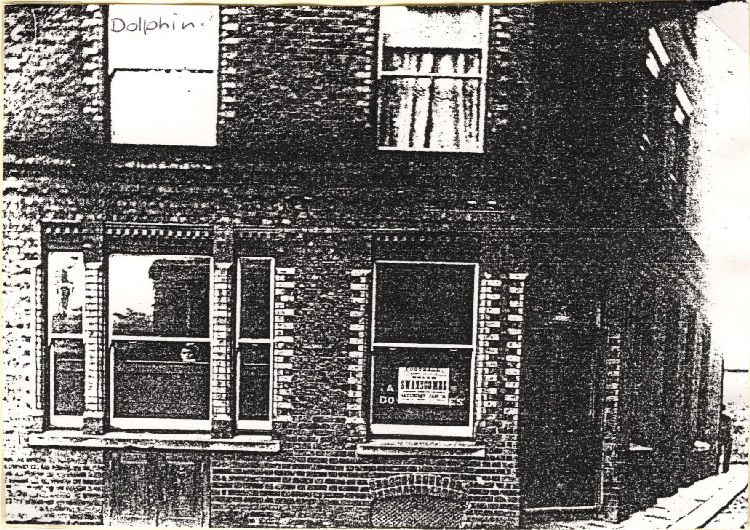
Dolphin Lane
Dover
Thomas Gilman kept the first house as long ago as 1787. Joint licensees
Minnie Alford and Mary elements saw that replaced with the new, a few yards
distant from the old site, in 1877. The licence was transferred the same
year and the ladies moved to the new, more commodious premises.
Supplied by Alfred Leney Co Ltd, who bought out Thomas Walker's Phoenix
Brewery in 1859 and registered as such in 1896, until bought out by Fremlin
Brothers brewery of Maidstone in 1926, brewing at the Dover brewery ceased
in 1927.
|
Kentish Gazette, Friday 09 March 1787.
Notice is hereby Given, That there is to be seen at Thomas Gillman's, at the
Sign of the "Dolphin," in Dover, A Surprisingly Large Fat Hog.
The above Hog will be killed on Wednesday, the 21st of March; those Persons
therefore, who wish to see it, are requested to apply before that Time. It
is lately very much improved.
|
|
From the Kent Herald, 24 June 1824.
Marriage.
June 3, at Harwich, Lieut. J. Elwin, to Miss Martha Osley, of the "Dolphin Inn,"
both of Dover.
|
|
Maidstone Journal and Kentish Advertiser, Saturday 16 July 1859.
To let by tender.
The following public houses situate in and near Dover, Eastry, and
Folkestone, viz:-
1. The "Bull Inn," Eastry.
2. The "Halfway House" and land, on the Dover and Canterbury Road.
3. The "Chequers," at Folkestone.
4. The "Chequers" and land, at West Hougham.
5. The "Red Lion," at Charlton.
6. The "Fox," in St James's Street.
7. The "Ordnance Arms," in Queen Street.
8. The "Cause is Altered," in Queen Street.
9. The "True Briton," on Commercial Quay.
10. The "Three Kings," in Union Street.
11. The "Fleur-de-Lis," in Council House Street.
12. The "Cinque Port Arms," in Clarence Place.
13. The "Red Lion" in St James's Street.
14. The "Dolphin," in Dolphin Lane.
The above houses are to be let as free houses, in consequence of the
proprietors of the Dolphin Lane Brewery discontinuing that business.
The holdings of the present Tenants expire under notice to quit, as follows,
viz:- No. 2, on the 6th January next, No. 3, on the 6th July, 1860, No. 10,
at Lady Day next, No. 13, on the 23rd October next, No. 14, on the 6th April
next, and reminder on the 11th October next.
Tenders must be sent into the offices of Mr. Edward Knocker, Castle Hill,
Dover, on or before the 20th day of July next, marked on the cover "Tender."
Particular and Terms of hiring, with the forms of Tender, to be obtained on
application to Mr. knocker, or Mr. Thomas Robinson, Estate Agent, Bench
Street, Dover.
Tenders may be given for the whole together or separately. The Tenders will
be accepted subject to the houses being sold on or before the 20th day of
September next, and the proprietors do not bind themselves to accept the
lowest or any tender.
N.B. The proprietors are open to treat for letting the Brewery, Malthouse,
and Premises, in Dolphin Lane.
Edward Knocker. Castle Hill, Dover, June, 1859.
|
|
From the Dover Express and East Kent News, Friday, 13 April, 1877. Price 1d.
DELIBERATE AND WILFUL DAMAGE
Edward Collins, artilleryman, was charged with wilfully breaking a pane
of glass at a house in Dolphin Lane, value 1s., the property of John
Taylor.
John Taylor said: I live at No. 5, Dolphin Lane. Last Saturday evening,
about a quarter to eleven, I was sitting in the kitchen. There is a pane
of glass over the door. Someone was hammering at the door and the glass
was smashed. I came out and saw two soldiers running away. I went after
a piquet but did not lose sight of the men. The prisoner is one of the
men. I gave them in charge of the piquet and they were taken to the
Police-station. I charged them with breaking a pane of glass. The value
of the glass is 1s.
By the Bench: The prisoner was the worse for liquor. I did not see
anyone outside the house but the two soldiers when the glass was broken.
By Mr. Vidlers: At the station the prisoner said he broke the window and
afterwards contradicted himself.
Police-constable Figg said he was on duty in Castle Street about 11
o'clock on Saturday night and from what he heard he took the prisoners
into custody. He charged them with breaking a pane of glass at Mr.
Taylor's, one at the “Dolphin” public-house, and one at Leney's brewery.
When at the station the prisoner owned up to breaking the lot, and the
other man was dismissed.
The prisoner received an indifferent character from the officer of the
regiment.
The Bench inflicted a fine of 12s., including costs, or seven days'
imprisonment.
Prisoner went below.
|
|
From the Dover Express and East Kent Intelligencer, 31
August, 1877. Price 1d.
APPLICATIONS FOR NEW LICENSES
Mr. Wollaston Knocker supported the application for the removal
of a provisional license of the "Dolphin" public-house to more
suitable premises in the course of construction within a few yards
of the old house. The plans of the structure had been before the Town
Council and had been approved.
The decision of the Bench was reserved till the termination of the
proceedings.
|
|
From the Dover Express and East Kent Intelligencer,
8 March, 1878. Price 1d.
THE DOLPHIN INN
The transfer of this license to larger premises now completed, was
ordered on the application of Mr. Knocker. Mr. Henry Hayward, of the
firm of Messrs. Worsford and Hayward, having found that the new house
had been completed in accordance with the plans submitted at the
Brewster Sessions.
|
A year later, it came close to being destroyed when a fire, extending
from Castle Street to Dolphin Lane threatened. The carriage works of Mr.
Hill were destroyed and the stables of Leney, three storeys high, were
completely gutted. The horses fortunately were led to safety. A library was
destroyed, some six thousand books, many dealing with Kent and local history
were lost. A chemist and a butcher had their premises damaged and the
rebuilt "Dolphin" owed its salvation to its soundly constructed party wall.
The town's water supply was said to be inefficient at the time and your
mind, like mine, probably wanders to the river nearby.
|
From the Dover Telegraph and Cinque Ports General
Advertiser, Saturday 25 May, 1839. Price 5d
POLICE REPORT
Richard Goodwin and Austen, were charged with smuggling tobacco.
Mr. Edds, the supervisor, said that having reasons to suspect
Goodwin, he on Sunday last, accosted him while driving through the
street in his cart, with Austen, the landlord of the "Dolphin." He (Edds)
then searched the cart, and found therein 11 lbs. of tobacco. In order
to acquit himself from his implication with Goodwin, Austen said that he
(Goodwin) had taken lodgings at the "Dolphin," and that at his
customer's request, he had mounted the cart to take a glass of something
to drink at the public-house, which Goodwin said he should stop at; and
he had no knowledge of the tobacco being in the cart. Austen was
discharged, and Goodwin was committed till Wednesday, when the
magistrates informed him that an answer had been received from the Board
of Excise, and sentenced him to a penalty of £100, besides the
confiscation of his horse and cart. In default of payment, six months'
imprisonment.
|
|
From the Dover Express. 1860.
Ill Treating a Wife.
Thomas Moat, an Ostler employed by Mr. G. T. Tyler, appeared in answer
to a summons issued at the instance of his wife and charging him with
ill-using her.
Mary Ann Moat the wife of the defendant, said that on Saturday night
she went to the Dolphin Public House to ask her husband for some money.
On her going into the room he told her he had got none for her and
struck her a blow on the head and kicked her in the side. He did not
come home again till that morning (Monday). He had often threatened to
strike her but had never done so before. Jemima Collins a little girl 12
years of age living in the house where the defendant and his wife lodged
said she went with Mrs. Moat to the Dolphin on Saturday night. Witness
went in and asked defendant to give her some money for Mrs. Moat and he
gave her 1s. 6d. Mrs. Moat afterwards went in and asked him for some
money and she (witness) saw him strike and kick her. Prisoner denied the
charge but admitted that he pushed his wife out of the room. He said she
was a very aggravating woman and that he had made this discovery no
later than a month after their marriage. The magistrates said it was
evident defendant had ill-treated his wife and that if he came before
them again he would be bound over to keep the peace. At present he would
be fined 1s and 12s. costs or in default be sent to prison for fourteen
days.
Information kindly supplied by Joyce Banks.
|
|
From the Dover Express and East Kent Intelligencer, 12
September, 1863.
ANNUAL LICENSES
G. T. Tyler of the "Dolphin," failed to answer his
name at the Dover Police Court Annual Licensing day and therefore had to
go to Broadstairs to get the license renewed.
It is unknown as present whether he did indeed renew the license
as the next licensee on my list I haven't seen mentioned till 1877,
although he may have remained at the house till then.
|
|
From the Dover Express and East Kent Intelligencer, 13 January, 1882. Price 1d.
DRUNK
Mary Jane Bailey was charged with being drunk and disorderly in Dolphin
Lane on Saturday.
Police-constable Brace said: Shortly after six o'clock on Saturday
morning last, my attention was called to the prisoner who was drunk and
disorderly outside the “Dolphin Inn” in Dolphin Lane. She had been
creating a disturbance there, and had broken one of the windows. I tried
to get her to leave the place, but she refused and I took her in charge.
In answer to the Bench the Superintendent said: The prisoner was too ill
to be brought into Court on Saturday morning as she was suffering from
delirium tremens. Her husband was employed on the cargo boats, and was
expected back that day. It was her first offence.
The prisoner said it should not occur again.
The Bench said that as she had been locked up since Saturday morning
they had decided to give her another chance, and would discharge her,
but if she appeared before them again they would severely punish her.
|
|
From the Dover Express and East Kent News, Friday, 4 March, 1887. Price 1d.
APPLICATION
On the application of Mr. Thomas Lewis, permission was given to Mrs.
Shelvey, widow, to draw at the “Dolphin Inn,” until the next transfer
day.
The application was granted.
|
|
From the Dover Express, 7 January, 1888
Terrible Fire in Castle Street.
Early on Tuesday morning Castle Street, Dover was the scene of one of
the most disastrous fires that have occurred in Dover for several years.
At the time of writing there is no distinct evidence as to how it broke
out but the centre of conflagration was the carriage manufactory of
Messrs Hills and Son. There the work of destruction has been complete
and the fire has also done much damage to the stables of Mr. Leney and
the back building of Mr. R. H. Forster, Chemist.
The alarm seems to have been given a few minutes before four and with
terrible rapidly the fire spread so that a few minutes after that time
the Carriage Factory which runs to Dolphin Lane was in a blaze. Mr. J.
Hill the occupier of Dolphin House that immediately joins the Carriage
Factory says he awoke at twenty minutes to four and then all was quiet.
Twenty-five minutes later a noise and a glare on the window aroused him.
He was at once aware that there was a great fire, he aroused the house
and very quickly got into the back of the premises and he found that the
whole structure of the factory that adjoins Dolphin Lane was like a
burning cage. Miss. Pepper one of the daughters of Mr. R. V. Pepper was
sleeping in a bedroom at the back on the third floor of their house in
Castle Street when about the same time she awoke and found a great fire
raging in the back but a short distance from her window.
By this time the whole neighbourhood was aroused and there being a great
many houses near it was a terrible awakening. In some cases the inmates
were so terrified that they could not dress and in the others the shock
to the system was so great that they were scarcely able to do anything
to help themselves. Police Constable Bass who discovered the outbreak
gave the alarm to the police promptly and Superintendent Sanders and his
Fire Brigade were soon on the scene. The police were on the spot at a
quarter to four o'clock and had hydrants fixed in about five minutes.
The water supply at first was not very effective-in fact it had no
effect on Castle Street until the hose was carried up the fire escape
ladder. It seems the hydrant's were defective and the water instead of
going into the hose came out of the bottom of the stand pipe, and in one
case opposite 29 Castle Street the pavement was washed up by the water.
A good supply was obtained at the back and an hour later when the fire
was in full career threatening the entire neighbourhood the military
arrived on the scene with three fire engines.
One was fixed in Castle Street taking water from the river by Brace's
Mill and the other two in Dolphin Lane pumping from the river by the
office of Messrs Leney's Brewery. It was generally admitted that the
force of water from the engines was more effective than that from the
water mains and there is no question but that great credit is due to the
soldiers both officers and men, for the plucky way in which they worked.
As soon as the Fire Brigade officer Mr. Graham the foreman started of to
inform Mr. Hills who resides in Park Avenue and in the meantime Mrs.
Graham seeing her furniture, which was not insured in danger at once
began carrying it downstairs. She made three journeys to Pay's on the
other side of the street and the last time she was nearly suffocated
with the smoke. Spectators speak of the scene of the fire at this time
as being most terrifying. Mr. Pay who lives nearly opposite was one of
the first to see the fire and he assisted the police in getting the
fourteen horses out of Mr. Leney's stables.
The fire seemed to have broken out in the corner of the Carriage
Manufactory near the stables and it very soon got hold of the latter. It
terrified the horses so that their noise was distressing. It was a very
difficult task to get them out. Another eyewitness tells us that he was
on the scene as soon as the alarm was given and that the fire appeared
to have started in the place described. It spread so rapidly that the
whole place was alight and the flames issuing from Castle Street windows
in less than half an hour. The police directed their first attack on the
opening near Mr. Leney's stables, as that was the seat of the fire. They
got ladders and tried to work down on it from above but the heat was too
fierce to allow it. After spreading to Castle Street the fire worked
round Dolphin Lane opposite the gasworks yard and in a very short time
the Carriage Factory was down, the large workshops being reduced to
blazing heaps of debris and the blackened outside walls threatening to
fall.
The excellent way that the block on the Castle Street frontage is built
was the only reason why it was saved. Mr. Pepper on the one side and Mr.
Forster on the other formed the two boundary walls of a fiercely heated
oven, and if the walls had not been thick and strong they could not have
escaped. As it was both the houses escaped with but slight damage from
fire. The water did a good deal of harm and a portion of the upper part
of Mr. Forster's house was caught by the flames and a good deal of
damage was done to his out buildings and a stable in the rear. The
occupants of the house at Dolphin Lane at the back of the carriage works
were in great danger and very hurriedly cleared out their furniture.
Between the factory and Dolphin House, occupied by Mr. Hill there was a
small carriage house with rooms over, which have not been recently used.
The fire got into this place and was threatening Dolphin House because
it was not possible to get into the closed rooms. At length Mr. Hill
knocked a hole in the roof and the fire was stopped at this spot the
hose being carried through the entrance lobby. Nothing at all seems to
have been saved out of the carriage factory where there were about forty
carriages in different stages of construction but three or four
carriages, which were in the showroom were taken out safely.
As far as we can learn there was no accident's at all during the morning
and there was plenty of time for all to escape. In fact the only
dwelling house actually burnt out was that of the foreman of the
factory, which was on the first floor overlooking Castle Street. We
believe all the property was insured except the household furniture and
the tools of the coachbuilders. The whole of the hands of the carriage
factory must of necessity be thrown out of employment. The destruction
of the Dover Proprietary Library is a calamity that will cause general
regret because it contained works of great value. After the fire had
transverse the workshops they made their first attack on the library
owing to its being situated on the second floor just in the sweep of the
flames. Very soon it was evident to onlookers that the interior was fast
becoming a wreck and the smoke and fire shortly debauched from the
windows over Castle Street. There was no check to the destruction until
the whole of the interior had been gutted. There may be some of the
works left in a damaged state but the greater portion is totally
destroyed.
We are indebted to Mr. J. Bolton for the loan of a copy of the catalogue
that is corrected down to March 1886. The collection consisted of
valuable works on - Antiquity and Topography - Biography - Memoirs and
Correspondence - Lexicography- History and Geography - Voyages and
travels - Poetry and Drama - Novels and Romance - Law and Parliamentary
Papers - Divinity and Ecclesiastical History - Natural History and
Science - Atlas's and Maps - Periodicals - Miscellaneous - and Foreign
Literature.
Many of the works on Antiquity were we believe very rare. Amongst these
was a valuable copy of the Antiquities Rutupinse date 1745, which was
given to the Library, also a complete set of the publications of the
Camden Society from the commencement of 1838 - Antiquities of Canterbury
- Doomsday Book of Kent - Darells Dover Castle - Puckles Castle and
Fortress - Worthington's Plan of Dover Harbour - Lyons History of Dover
- Histories of Deal - Faversham - Folkestone - Gravesend - Maidstone -
Rochester - Sandwich - Thanet - Tunbridge Wells - Weald of Kent - Surrey
- Ports and Forts of Kent - Kentish Genealogies - Lambard's
Perambulation of Kent - Hasteds Histories of Kent - Knockers Grand Court
of Shepway - Ruskins Seven Lamps of Architecture and many other works
which it would be difficult and in some cases impossible to replace.
The list of biographical works was a very full one including some rare
works and some of the best modern ones. The collection of Lexicography
included the dictionaries of Lowndes - Rose - Lempriere - Ure - Hadyn -
Murray - Bailey - Crabb- Collier - Johnson -Todd - Lower and Lewis. The
Catalogue of History runs over many pages forming a rare collection,
while many of them are the best modern writers. The histories of own
county include those of Rapin - Tindall - Froude - Macauley - Hume -
Smollett and others. The travels too are a very choice selection. A very
fine collection of British Poets is gone. The novels and romances are of
the old and curious sort, modern fiction not being very largely
represented but there were complete sets of Dicken's - Scott - and
Disraeli's novels.
Under the Head of Law reports are one on Harbours of Refuge and a
Charter relating to Cinque Ports dated 1668, and another dated 1662 -
also a parliamentary report on Dover Harbour dated 1819. In the natural
history section was Mantell's Geology of Sussex. Amongst the
miscellaneous collection is a poll book for Dover of 1841. This library
was established in 1844 and was the rallying point of the best informed
leading men of Dover of the generation that is now passing away. The
news that this valuable collection of books has come to this sad end
will be a source of regret to many old Doverites who are now located in
various parts of the world. The regret at the loss of this valuable
collection is keener on account of the fact that enterprise could have
saved the books had some one had the presence of mind to throw them into
the street as the fire was raging quite half an hour before they were
burnt. It is not possible to estimate the value of the books, but they
are insured for £1,000. They were the property of the proprietors of the
library who number about 50 gentlemen.
The President of the Library is the Rev. J. B. Bampton - the Vice
President Dr. Parsons - the Rev. F. A. Hammond is the Librarian - Mr.
Alexander Bottle the Treasurer - and Mr. J. Bolton, King Street, is the
Secretary. A special meeting of the committee of the library met on
Thursday afternoon at Mr. Lewis's office, Castle Street, to consider the
circumstances in which they are placed. The fire was practically
extinguished at ten o'clock but the police found it necessary to keep
the hose going all day to prevent outbreaks and during last night the
library again ignited but was soon got under, the police being on watch
all night. The damage done by the fire is roughly estimated at £25,000.
The fire. A concert is being arranged to take place on Friday 13th inst.
in aid of the employees of Mr. Hills, Coach Builders, Castle Street who
has lost their valuable tools by the fire which occurred on Thursday
morning last. The proceeds will be handed over to the Mayor for
distribution. It is also proposed to give another concert in recognition
of the valuable services of the military at the fire on the following
Friday January the 20th. (1888)
Information kindly supplied by Joyce Banks.
|
|
From the Dover Express and East Kent Intelligencer,
6 June, 1902. Price 1d.
DRUNK IN DOLPHIN LANE
John ???? was charged with being drunk and disorderly.
Police Constable Southey said that on Saturday, about 10.35 p.m.,
when in Castle Street, he was attracted to an altercation outside the
"Dolphin Inn." Defendant was there bleeding from the eye, and
apparently drunk. He complained of being tripped up by an Artilleryman.
Three Artillery men came out, and witness asked him to point out which
one it was, and he could not do so. the soldiers, who heard what he had
said, denied all defendant said. Defendant refused to go away, and
witness eventually took him into custody.
Defendant being a first offender, was discharged with a caution.
|
|
From the Dover Express and East Kent News, Friday, 21 November, 1902. Price 1d.
INADEQUATE ACCOMMODATION FOR INQUESTS
The inquest on Mr. J. Kingsland, who met his death early last Thursday
morning on returning home from the Mayor's Banquet, was held on Friday
afternoon at the “Dolphin Inn,” by the Borough Coroner, Sydenham Payn,
Esq. Amongst those present was the Mayor (Councillor G. F. Wright), in
whose employ the deceased had been. The foreman on the Jury was Mr. J.
Meenagh.
The Coroner, in opening the enquiry, apologised for the smallness of the
room. After the end of this year a new Act would come into force by
which inquests would not be allowed to be held on licensed premises, and
arrangements would have to be made whereby they would probably have a
Court of their own. He himself very much disliked holding inquests at
public houses, as it was not consistent with the dignity of the Court.
William Kingsland, 32, Widred Road, Tower Hamlets, said: I am a
carpenter, and the body lying dead at 12, Dolphin Lane is that of my
brother, James Kingsland. He was 51 years of age last March, and was a
whitesmith. He had been in the employ of Messrs. Wright for 35½ years.
The Mayor said that was so. He had been apprenticed to his father, and
was a man of most exemplary character, and a most trustworthy servant.
Alfred Bartholomew, 39, Military Road, said: On Thursday morning early,
at five minutes to one, I met the deceased in Cannon Street. He was on
his way home and I spoke to him. I said, “I am going home; I will go
down the street with you, Jim.” He was alone. I went with him as far as
the top of Dolphin Lane, and he said, “Do not come any further.” I said,
“I will come a little way down with you,” and I went down with him as
far as the bridge, and we then said Good-night. He then went on towards
his house. He fell down, and I went back and asked him if he had hurt
himself. He said, “Not much.” I tried to lift him up, but he seemed a
bit dazed. As I could not get him up, I went to the top of the lane and
saw a Policeman, and asked him to help a friend u-p who had fallen down.
He came, and we got him up. He seemed a little dazed, and could only
walk feebly. He very soon came too, however, and seemed quite himself. I
and the Policeman saw him home. He opened the door himself and we left
him in the passage.
In reply to a Juryman, witness said he did not notice whether the second
door on the right was open. There was no light and all the place was in
darkness.
Henry John Brenchley, landlord of the “Dolphin” public house, said: I
have known the deceased for a great number of years. About five minutes
past seven yesterday morning the deceased's father came in, and from
what he said I went to his house. At the bottom of the cellar stairs we
found the deceased in a crouched position. I pulled him over and laid
him on his back. I could see he was dead; his face and hands were cold,
but he was not stiff. We undid his collar and found his body warm. A
doctor and a constable were sent for. The deceased's feet were at the
bottom, and he lay on the steps three or four up. The only other person
in the house was the deceased's father who was infirm and deaf.
Dr. J. Duncan best said: I was called in at 7.15 to the deceased. I
found him lying on his back in the cellar. He was quiet dead and cold,
and rigor mortis was well marked. He had therefore been dead some few
hours. The face was much congested, and there was a scalp wound from
which a good deal of blood had come. I examined the deceased's neck, but
could not find without a post mortem any fracture of the neck. There was
no evidence of any fracture of the base of the skull. There was a small
contused wound above the right eye, and there were some bruises on the
right arm. I found three or four stairs up, at the corner of the stairs,
a good deal of blood, as if the head had rested there. I should consider
that he had concussion of the brain from the fall, and that he lay with
the head bent forward, and with no one to assist him he died from
syncope. He was a very heavy man, with a thick-set neck, which was very
tucked up, and the face showed that the breathing had been interfered
with. I knew the deceased very well. He was a trustee of the Cinque
Ports Warden Lodge of Oddfellows, and I always found him a very steady
man. There were two doors by each other, one leading down into the
cellar, and the other into the sitting room, whilst a third opening led
upstairs, and he might have easily mistaken one for the other.
The Coroner said it was not very difficult to imagine what happened in
the darkness, with the three openings so close to each other.
The Jury returned a verdict of “Accidental Death.”
|
|
From the Dover Express and East Kent Intelligencer,
21 January, 1927. Price 1½d.
LYDDEN LICENSEE REFUSED DOVER HOUSE
At the Dover Police Court on Friday, before Messrs. W. J. Barnes, J.
W. Bussey and W. Hollis.
An application was made for the transfer of the "Dolphin Inn,"
Dolphin Lane, from Frederick Thomas Brown to John Fox, of the "Bell
Inn," Lydden.
The Magistrates' Clerk said the County Police stated that there were
four convictions for licensing offences, otherwise he had conducted the
house well.
The Chairman asked how long the applicant had been in the house?
Mr. Fox: Nineteen and a half years.
The Chief Constable said, in view of the convictions, he was obliged
to oppose the granting of the licence.
The Magistrates Clerk mentioned that two of the convictions were in
respect of one case, in which there were, however, two charges.
The Chairman (to mr. Wood, the agent for Messrs. Leney and Co.): You
are willing to accept him?
Mr. Wood: Yes.
The Chief Constable: Why is he going out of the "Bell Inn?"
Mr. Wood: He wants a change of house. There is no doubt the County
Authorities had a little animus against him.
Mr. Wood added: I might mention that baron Fitzwalter wrote and said
he hoped the convictions would not go against this man at any time. I
have not the letter with me, but it is so.
The Court was cleared while the magistrates considered their
decision, the Court being in the Council Chambers, the Police Court
being occupied by the Dover County Court.
When the Court was opened again the Chairman said the Bench had
considered this carefully, and while they would like to see their way to
grant the licence, under the circumstances they did not think they
could. It would be creating a precedent.
Mr. Fox: Can't be done, sir?
The Chairman: No.
|
|
From the Dover Express and East Kent Intelligencer,
28 January, 1927. Price 1½d.
THE DOLPHIN TRANSFER
At the Dover Police Court on Friday, before Messrs. J.
W. Bussey and T. A. Terson.
The licence of the "Dolphin Inn," Dolphin Lane - the transfer of
which the Magistrates refused to grant on the previous week to Mr. J. W.
Fox - was transferred from Mr. F. T. Bent to Mr. George Ernest Parkes,
of Folkestone.
|
|
From the Dover Express and East Kent Intelligencer, 1 March, 1929. Price 1½d.
DOVER LADY'S SUDDEN DEATH
The sudden death on Monday evening of Mrs. Ann Coles, of 14, New Street,
has a sad coincidence, for a fortnight before her husband, who is a
steward on the pilot cutter “Pathfinder,” was injured during a gale and
at the time of her death was in hospital at Dovercourt. He has since
been brought to Dover Hospital. Mrs. Coles was in Dolphin lane about
8.35 p.m. on Monday when she was taken ill. Dr. Stevens was sent for
after she had been carried into the “Dolphin Inn” but Mrs. Coles had
died before his arrival. The Coroner was informed and a post mortem
subsequently held but this dispensed with an inquiry.
|
Herbert Barratt held this licence in 1940 when the renewal was opposed by
the Chief Constable on the grounds of necessity. It was proved surplus to
requirements as a result on June 7th 1940. Compensation was agreed on 19
July. If the details were ever published they escaped me.
Another business with this sign had once traded from the Market Square
and that later became the "Walmer Castle".
|
From the Dover Express and East Kent News. 17 February 1939.
"DOLPHIN" Inn, Dolphin Lane, Dover - Having taken over the above
mentioned premises, Mr. and Mrs. H. Barrett wish to state that they will
be pleased to see any of their old or new friends at any time during
licensed hours. All goods of the finest quality, Fremlin's ales and
stout; wines and spirit.
|
LICENSEE LIST
GILMAN Thomas 1791-92+

OSLEY Mrs Mary 1805-39+
  (OSTLEY
  ) )
CHESTER John 1837-38
AUSTEN Thomas 1839-47
 
TYLER George Townsend 1850-Sept/63 (named George G Tyler also smith age
42 in
1861 ) )
ALFORD Mrs Minnie 1877-82 ?
CLEMENTS Mrs Mary Ann 1871-82
  (age 34 in 1871)
SHELVEY John 1887 dec'd
SHELVEY Mrs Lydia Mar/1887-91+
  (widow age 54 in 1891)
LANCE George Mar/1894-95

BRENCHLEY Henry John 1896-Sept/1906 end
 (age 59 in 1891)
  
PARKER Alfred James Sept/1906-Aug/22
(age 42 in 1911)
  (Formerly 12 years ship's steward) (Leaving for Australia.)KINGSFORD Charles Edward W
Aug/1922-Aug/25
(Formerly 12 years ship's steward) (Leaving for Australia.)KINGSFORD Charles Edward W
Aug/1922-Aug/25
  (Late of Royal Engineers.)
BANT Frederick Thomas Aug/1925-Jan/27
(Late
Royal navy, Chatham)
PARKES George Ernest May Jan/1927-30+
 (Of Folkestone)
FOX G Mr to May/1931
 MONTAGUE George Edward May/1932+

EDMUNDS Llewellyn 1932-Dec/33
FREAKES Albert Bertram Dec/1933-36 end
(Of
Tottenham)
WOODHOUSE Ernest Edward 1933-36 end
MARSH Fred Thomas 1937-Apr/38
EMBLEM John Apr/38+
 
BARRETT Herbert Charles 1939
Dover and Deal Directory and Guide 1792
From the Pigot's Directory 1823
From the Pigot's Directory 1828-9
From the Pigot's Directory 1832-33-34
From the Pigot's Directory 1839
From the Pigot's Directory 1840
From Bagshaw Directory 1847
From the Post Office Directory 1874
From the Post Office Directory 1882
From the Post Office Directory 1891
From Pikes Dover Blue Book 1895
From the Kelly's Directory 1899
From the Post Office Directory 1903
From the Kelly's Directory 1903
From the Post Office Directory 1913
From the Post Office Directory 1922
From Pikes Dover Blue Book 1923
From Pikes Dover Blue Book 1924
From the Post Office Directory 1930
From Pikes Dover Blue Book 1932-33
From the Post Office Directory 1938
From Pikes Dover Blue Book 1938-39
From the Dover Express
Census
|
There was an inn in this thoroughfare called the
"Dolphin," and that, no doubt, was an old establishment, but it is not
probable that the lane took its name from that. There are several old
meanings to the word "dolphin." One is, a ring or a mooring post to
which to fasten boats or ships; and, seeing that in early times vessels
came up the river as far as this lane, it is reasonable to suppose that
there was a mooring post there, and the lane might have taken its name there from. Or, it might have been originally called Dauphin Lane owing
to the Dauphin of France landing his siege plant here when he besieged
the Castle in 1216.
Information taken from John Bavington Jones' book "A Perambulation of
the Town, Port and Fortress of Dover", 1906. (Reprint in The South Kent
Gazette, August 15th, 1979.) |
|