|
54 Charlton Green
Dover
07944 628613
https://www.facebook.com/The-red-lion
https://whatpub.com/red-lion
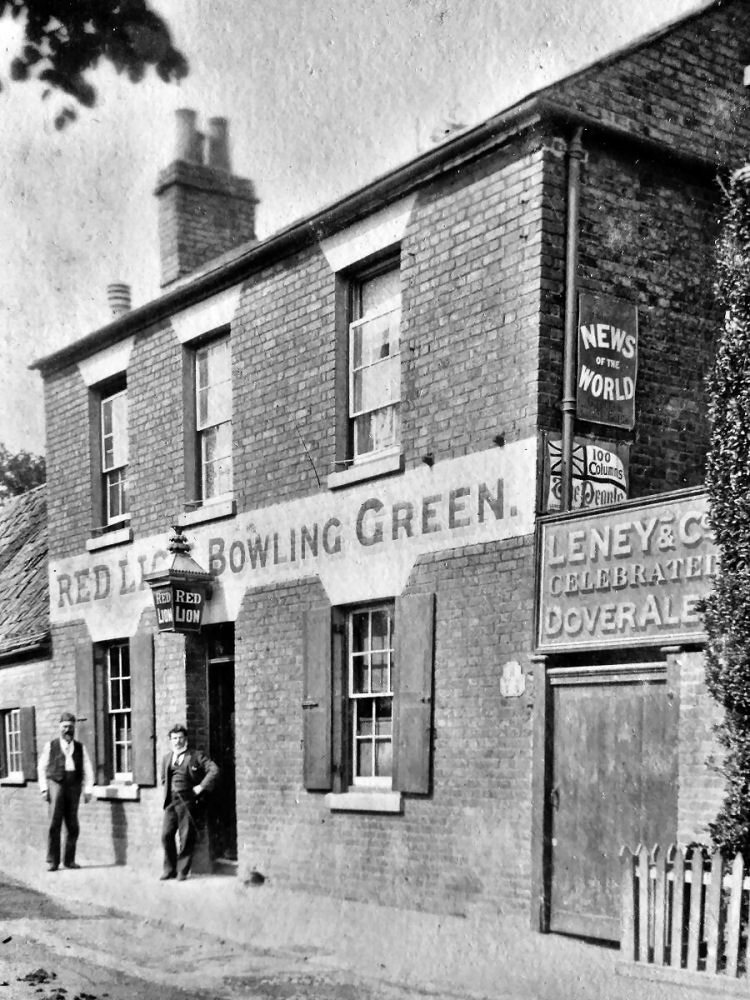
Above photo, circa 1900, showing licensee James Willis standing outside.
Kindly sent by Paul Willis. |
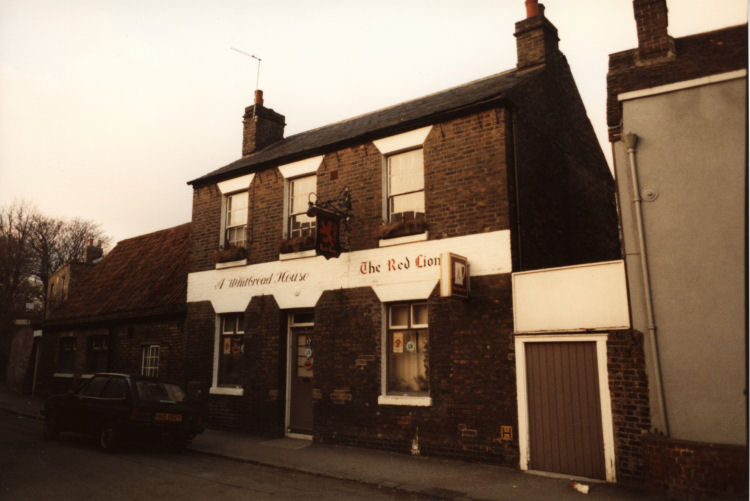
Red Lion 1976 (Photo by Paul Skelton) |
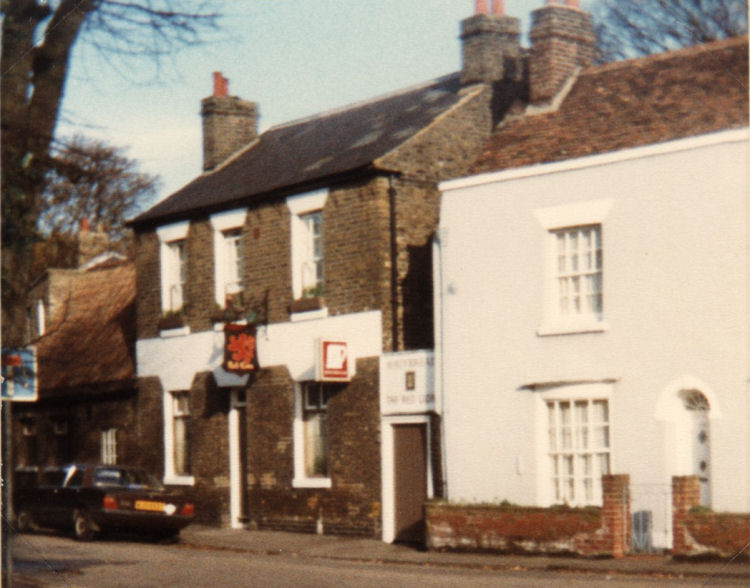
Above photo circa 1980 by Barry Smith. |
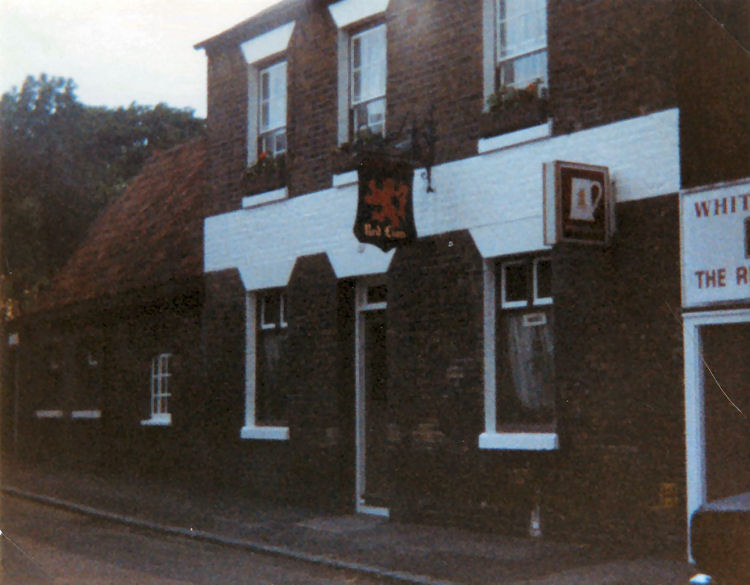
Above photo circa 1980 by Barry Smith. |
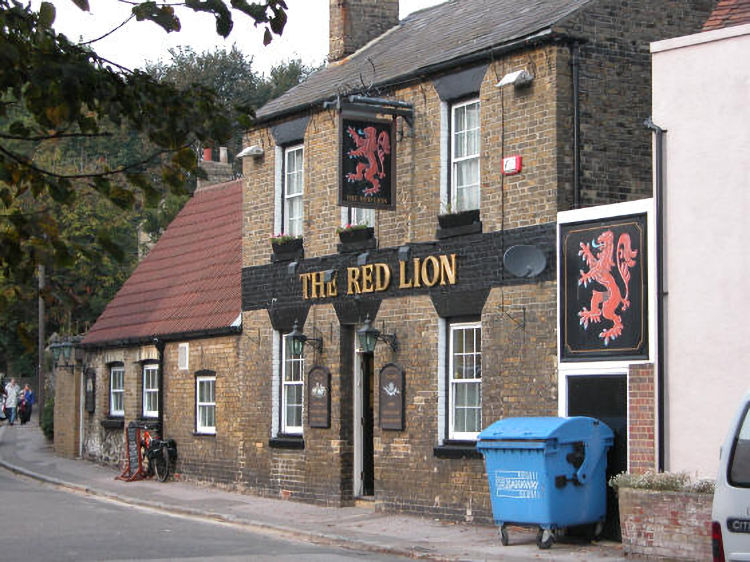
Above photo, 1983. Photo by Eddie Chard. |
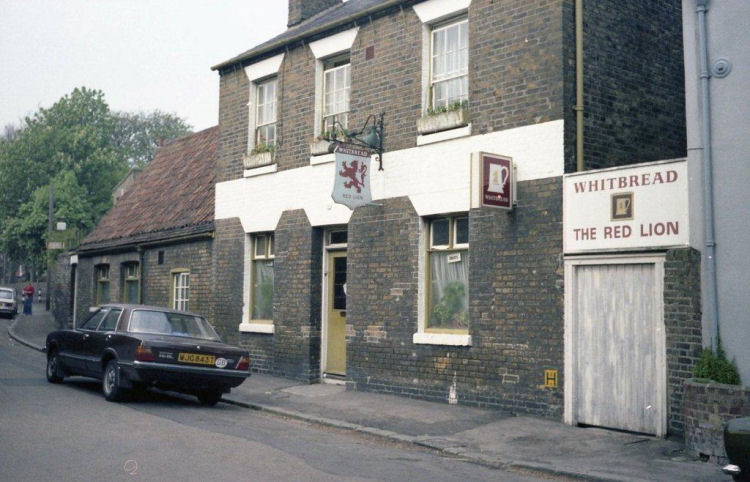
Above photo kindly sent and taken by John Fagg in the 1980s. |
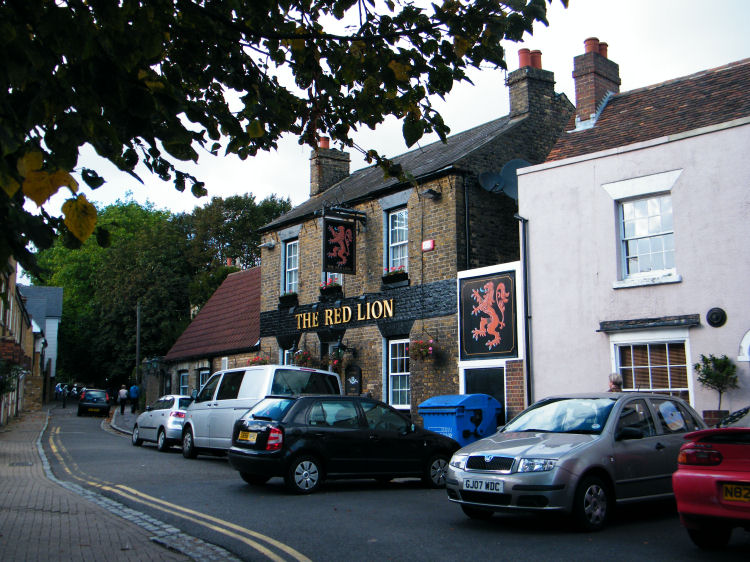
Above photo taken by Paul Skelton 25 September 2010. |
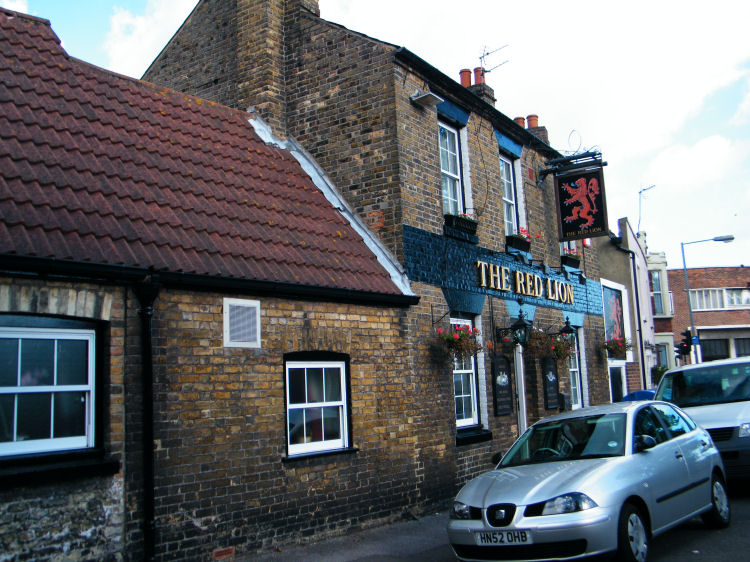
Above photo taken by Paul Skelton 25 September 2010. |
The following information has been taken from information displayed in a
picture frame at the actual house:-
"This Inn known by the name and sign of the "Red Lion" was built in
the 13th year of Victoria, in 1850, by Alfred Kingsford of the Buckland
Brewery on the site of and replace the original "Red Lion Inn" of
Charlton Green.
The original Inn was built in 1706 and was then the farm dwelling of
John Hubbard, who at the event of his death in 1711 bequeathed the property
to his son Clement at which it is described as "all that messuage or
tenement together with the barn, stable and other buildings close, garden,
orchard and 1 piece or parcel of land thereunto belonging.... 17a ....
situate and lying at the Green". Also included in the effects of the late
John Hubbard were several "dairy cows, poultry, farm implements and dead
stock."
By 1726, a forge had been added to the property and was included in a
sale catalogue along with the addition of a vanner gelding, when Clement
Hubbard sold the farm to Francis Ralph, yeoman for 240 pounds of legal money
of great Britain and Ireland. During the time that Ralph occupied the farm
eleven of his children were born there, three daughters and eight sons of
which only seven survived the perils of infancy one daughter and six sons.
in 1751 Ralph's wife Pachell died of a consumptive disease and three years
later Ralph himself died.
By the terms drawn up in his will all seven children were provided
for. To his eldest son James, he bequeathed the farm-house and ten acres of
land "to make of it what he so desired". James Ralph chose to keep livestock
on the land that his father had left him. By 1760 he was trading as a dairy
farmer and blacksmith, a description that he carried until his death in
1789. James Ralph left all that he owned to his wife Sarah, however she had
little benefit from her bequest since she died two weeks of her husband,
whereupon her estate passed to her daughter Ruth and Susan.
The two sisters operated the farm on a meagre basis, by the early
1800's they had sold off portions of the land belonging but continued to run
it as a dairy farm. In 1804, Ruth Ralph, spinster of the green, Charlton
died and in 1805 her sister Susan unable to continue to run the farm sold it
to Edward Kingsford a brewer of the Arch Cliff Fort Dover. After carrying
out alterations to the house Kingsford obtained an ale-house licence for it
and at the hearing registered the house as the "Red Lion ale-house," whilst
one Richard Petts gave two sureties of his good character to keep an orderly
house from which "he may suffer ales for the rightful tender, but may not
suffer those ales to be tippled during the time of divine service nor from
pots of illegal measure nor fro pots not bearing the district stamp and he
may not suffer ale impured by adulteration".
And so in 1805 ale was sold at the sign of the "Red Lion," Charlton
Green for the first time. Richard Betts was the first keeper to draw that
ale and did so until 1814 when he left to take over the "Royal
Standard" in London Road, Charlton. He was succeeded here by Robert
Moon, inn-keeper of the "Four Porters," in Four Porters Street, Dover. At a
hearing to transfer the license Moon applied for and was granted a wine and
spirits licence and the "Red Lion" became a registered Inn. Moon served here
till 1819 giving up the house in that year and returning to the "Four
Porters" where he remained for many years to follow.
Thomas Jenkins was the next keeper to take over the "Red Lion" and he
served here until 1833 when he was succeeded by James Whiting, a bricklayer
and carpenter of St. James Street, Dover, who kept the house till his death
in 1843 whereupon his daughter Mary took over the running of the house and
served until 1845. In that year she gave up her house to Joseph Hook. He
became the last keeper to hold a licence at the original "Red Lion Inn." In
1849 Alfred Kingsford brewer commissioned works to be carried out to the
house but during these was advised that the building was in a state of
disrepair and was considered unsafe. It was demolished in the same year to
make way for the present "Red Lion."
The house was completed and opened for business in June 1850. It was built on much the same lines as its predecessor, with stables and a coach
house but had the added attraction of tea-gardens. The first keeper to draw
ale in the present house was Thomas Thorn. He kept it until 1859 when in
that year the "Red Lion" was sold to Leney and Evenden brewers of the
Phoenix Brewery, Dolphin Lane, Dover. They tenanted the house to Parser
Middleton, a plumber of the Butchery, Dover, who ran the house until his
death in 1872 whereupon his widow took over. In 1873 whilst in her hands the
Phoenix Brewery came under the sole ownership of Alfred Leney.
The widow Middleton gave up the "Red Lion" in 1890 and was succeeded
by James Willis, a carpenter of the High Street, Charlton. He served here
until 1916 when he was succeeded by Thomas Datlen. In 1926 whilst still in
his hands Leneys was taken over by Fremlin brothers Pale Ale Brewery, of
Maidstone. In 1929 Datlen handed over to Frederick C. Young and he in 1933
to William G. Drennen. During world war II he was given permission to close
the "Red Lion" for the duration. He closed in October 1940 but re-opened in
June 1941, and went on to keep the house until 1948 when he was succeeded by
Leonard R. Latcham who served here until 1958 when he handed over to William
Frederick George Larkins. In 1967 Fremlins merged with the Whitbread Brewery
of London. Larkins left in 1968 and was succeeded by Albert Walter Terry. He
died shortly after taking over the house and was succeeded by his widow
Frankie who served here until 1982 when she was succeeded by Alfred and
Janet Bentley, the present keepers of the "Red Lion." (1992).
I could only find Tom Jenkins to connect with the original in 1826. At an
auction held in May 1859, the old established, freehold pub, recently
rebuilt and together with its tea gardens, outbuildings and large stable,
was on offer when Thomas Walker sold off the Phoenix brewery to Leney's.
Supplied by Alfred Leney Co Ltd, who bought out Thomas Walker's Phoenix
Brewery in 1859 and registered as such in 1896, until bought out by Fremlin
Brothers brewery of Maidstone in 1926, brewing at the Dover brewery ceased
in 1927, which later passed to Whitbread.
Few licensees hurried from here which probably says a lot. It did have
permission to close in world war two but did so for a few months only in
1941.
A Whitbread outlet.
This was the very first pub in the area to build an outdoor skittle
alley. This was the brain-child of Leonard Latcham in the mid 1950's and he
gained the idea after going on holiday and playing on an indoor alley (not
sure where, West Country perhaps). Only trouble was, the pub didn't have
enough room for an indoor alley, so he built one outside. The difference
being that this alley was cambered, so as to let the water drain off in wet
weather. The craze caught on many other pubs followed suit, and is still
played to this day. There is still a Latchem Trophy up for grabs for those
who still play the traditionally local game.
|
Kentish Weekly Post or Canterbury Journal, Friday 21 February 1812.
Died.
February 16, Mr. Baker, late landlord of the "Red Lion" public house
at Charlton, near Dover.
|
|
From the Kent Herald, 29 May 1828.
DEATH.
May 20, at Charlton, next Dover, aged 19 years, Henry, eldest son of Mr. Thomas
Jenkings, of the "Red Lion," of the above place.
|
|
Kent Herald, 16 January 1845.
Marriage.
Jan 6. at Dover, George, son of Mr. Thomas Jenkins, of the "Red Lion,"
Charlton, to Miss Rebecca Ann Edmonds, of Dover.
|
|
Kent Herald, 27 January 1825.
Death.
Jan 21, at Charlton, near Dover, the wife of Mr. Jenkins, landlord of the "Red
Lion" public-house, leaving a young family.
|
|
From the Dover Telegraph and Cinque Ports General
Advertiser, Saturday 23 November, 1833. Price 7d.
VALUABLE INVESTMENT
FREEHOLD AND LEASEHOLD ESTATE
IN DOVOR AND CHARLTON
TO BE SOLD BY AUCTION
At the Red Lion, in Charlton, on Friday 27th December, 1833, at Six
o'clock in the evening.
BY Mr GEORGE HARRISSON.
By order of the Trustees of Mr Richard Sandford, in Two Lots.
LOT 1
All the newly erected Freehold MESSUAGE or Tenement, comprising
a large shop, room, and kitchen, on the ground floor, and three bedrooms
over, with yard and out-office, situate in St. Peter's Street, Charlton
- Also all the newly erected Freehold MESSUAGE or Tenement, adjoining
the said least mentioned Messuage, comprising four rooms, yard and
out-offices, situate in St. Peter's Street aforesaid. Also all those
Five newly erected Freehold MESSUAGES or Tenements adjoining, each
comprising four rooms, yards, and out-offices, situate in Churchill
terrace, in Charlton, aforesaid - And also all that newly erected
Freehold MESSUAGE or Tenement, comprising three rooms, yard, and
out-offices, situate at the back of Churchill terrace aforesaid.
LOT 2
All that WORKSHOP or Tenement, comprising a storehouse and two lofts,
situate in Round Tower lane, and Paradise street, Dovor, now in the
occupation of Mr. John Pain, held under a Dovor Harbour Lease for a
term, whereof 63 years are unexpired, at the rent for 6s. 9d.
For further particulars apply to Mr. KENNETT, Solicitor, Dovor.
|
|
From the Kentish Gazette, 12 September 1848.
MARRIAGES. Ballard—Jenkins.
August 28, at Dover, Mr. Samuel Ballard, to Miss Frances Elizabeth
Jenkins, daughter of Mr. Jenkins, of the "Red Lion," Charlton.
|
|
Kentish Gazette, 6 August 1850.
Assault and Robbery.
Oliver Sullivan, 18, assaulting and robbing John Wilson of a silver
watch. The prosecutor was in the "Red Lion" public house at Charlton on
the 23rd July, in company with a prisoner and a man name Welch. He had
left, Welch took his watch from his pocket, which he regained, and the
second time Welch seized it, and prosecutor again took it from him, when
he was knocked down by Welch, and knelt upon him, and threw away the
watch, which prisoner took up and ran away.
10 years transportation.
|
|
Kentish Gazette, 5 April 1853.
The rebuilding of the "Red Lion," Charlton, needed a defect to be
remedied in the cesspool, to meet the requirements of the Act; and
an application for the extension of the area at 3, East Cliff, was
refused, as it was already extended to the full limits the laid by
law. The Board desired that the "Red Lion" might be built parallel
with the front of the adjoining house, as the Surveyor considered
the compensation, if any, must be very trifling, while the
alteration would much improve the approach to Charlton church.
|
|
Maidstone Journal and Kentish Advertiser, Saturday 16 July 1859.
To let by tender.
The following public houses situate in and near Dover, Eastry, and
Folkestone, viz:-
1. The "Bull Inn," Eastry.
2. The "Halfway House" and land, on the Dover and Canterbury Road.
3. The "Chequers," at Folkestone.
4. The "Chequers" and land, at West Hougham.
5. The "Red Lion," at Charlton.
6. The "Fox," in St James's Street.
7. The "Ordnance Arms," in Queen Street.
8. The "Cause is Altered," in Queen Street.
9. The "True Briton," on Commercial Quay.
10. The "Three Kings," in Union Street.
11. The "Fleur-de-Lis," in Council House Street.
12. The "Cinque Port Arms," in Clarence Place.
13. The "Red Lion" in St James's Street.
14. The "Dolphin," in Dolphin Lane.
The above houses are to be let as free houses, in consequence of the
proprietors of the Dolphin Lane Brewery discontinuing that business.
The holdings of the present Tenants expire under notice to quit, as follows,
viz:- No. 2, on the 6th January next, No. 3, on the 6th July, 1860, No. 10,
at Lady Day next, No. 13, on the 23rd October next, No. 14, on the 6th April
next, and reminder on the 11th October next.
Tenders must be sent into the offices of Mr. Edward Knocker, Castle Hill,
Dover, on or before the 20th day of July next, marked on the cover "Tender."
Particular and Terms of hiring, with the forms of Tender, to be obtained on
application to Mr. knocker, or Mr. Thomas Robinson, Estate Agent, Bench
Street, Dover.
Tenders may be given for the whole together or separately. The Tenders will
be accepted subject to the houses being sold on or before the 20th day of
September next, and the proprietors do not bind themselves to accept the
lowest or any tender.
N.B. The proprietors are open to treat for letting the Brewery, Malthouse,
and Premises, in Dolphin Lane.
Edward Knocker. Castle Hill, Dover, June, 1859.
|
|
From the Dover Express and East Kent News, Friday 24
September, 1859.
REMANDED CHARGE OF BURGLARY
Thomas Taylor, William Wren, Charles Cotter, and Richard Peel, the
privates of the 32nd regiment remanded from the preceding Saturday on
the double charge of breaking into the dwelling-house of Mr. Barton,
surgeon, of Hammond Place, and stealing therefrom several valuable
articles, including an ornamental time-piece and a plated inkstand; and
of stealing a watch, a pair of trousers, and a silk dress, from the "Red
Lion" public house, Charlton Green, the property of the landlord; were
again brought up.
The following evidence was now adduced:-
Police-sergeant Gedds, examined - The four prisoners were handed over
to my custody on Friday last, about 2 p.m., by the witness Bradford and
some other coast-guardsmen, on suspicion of being connected with
robbery. Bradford at the same time gave me the pieces of a clock and the
portion of silk dress produced. The pieces of clock were tied up in a
piece of the lining of a dress. The prisoners were brought to the
station-house by the coast-guardsman. The charge was taken down by the
superintendent and read over to the prisoners, who declined to say
nothing. On searching the prisoners I found in Cotter's pocket some
lucifer matches. Between three of four o'clock the same afternoon I went
to Mr. Barton's and saw the drawing-room. The room was in order then. I
examined the windows, particularly that near the front door, and the
balcony adjoining it. I noticed footmarks on the edge of the stone
flooring of the balcony outside the railing. Inside the balcony, on the
window-sill, found a half burnt lucifer-match, which I now produce
and which corresponds in character with some of the matches I found on
prisoner Cotter. The balcony is about ten feet from the ground and
overhangs the area. Over the front door is a coping, on which I also
observed footmarks. On one side of the door there is a wall which
divides the house from a garden, and it would be quite possible for a
man to get on this wall and from that to the top of the porch, whence he
might step to the balcony of the nearest window of the drawing-room.
Sergeant Back examined - In consequence of information I proceeded on
Wednesday last, about half-past eight in the morning, to Mr. Barton's,
No. 7, Hammond Place, and went upstairs into the drawing-room with the
two maid-servants (witness Smith and the cook). Sergeant Back then
described the appearance of the room, his description corresponding to
the statement already given by witness Smith. He then said - I also
noticed some lucifer matches amongst the flower-pots on the balcony.
Several of the flower-pots I likewise noticed were upset and lying on
their sides, and some of the paint appeared to have been recently rubbed
off the corner of the balcony nearest the front door. On the coping of
the door there also appeared marks as if from a shoe with nails in it.
Mr. Barton on the same morning gave me the clock case I now produce. I
have tried the pieces of the clock produced by Sergeant Geddes and I
find they fit it.
Police-constable Thomas S. Barton - I was on duty at the corner of
Cambridge Terrace on the morning of Wednesday last the 14th inst., and
at about half-past two o'clock I saw the four prisoners go past me from
Camden Crescent, as of coming from the direct of Hammond Place. They
went down Northampton Street. The prisoner Taylor was walking about two
yards in from of the other three men, who were together behind him. I
afterwards, in the afternoon of Friday last, went to the beach near the
South-Eastern Railway viaduct and there found the pieces of a clock I
now produce, which correspond with the other pieces already produced by
Sergeant Geddes.
The prisoner, having been cautioned, said they were going to bathe on
Wednesday last when they found the piece of silk dress which had been
produced. They all declared that they knew nothing about the time-piece.
They were then committed for trial on the first charge at the next
Maidstone assizes.
Additional evidence was afterwards taken with respect to the robbery
at the "Red Lion," including the following:-
Thomas Robbins, watchmaker, residing at Buckland, examined - On
Wednesday last, between the hours of three and five in the afternoon,
the prisoner Taylor brought to my shop a watch. It was an old watch and
I had seen many times and had frequently repaired for Mr. Thomas Horn,
of the "Red Lion" public house, Charlton Green. Taylor, who was alone,
asked me to buy the watch. Having looked at it I told him I would have
nothing to do with it. I asked him of whom he had got it, and he said he
had given twenty-five shillings for it, but that he had forgotten the
name of the man of whom he had bought it. I told him I would not buy it
at any price, and he then left the door. I took one of the papers out of
the back of the watch and saw Horn's name at the back of it. The value
of the watch is about 16s.
From the evidence of Mr. James Long, pawnbroker, it appeared there
was reason to suspect the prisoner had been concerned in an offer of the
trousers to pledge at his shop. They had been offered by a "navvy," who
had evidently been sent by the prisoners.
The apprehension of the prisoners on the second charge having been
proved, and each of them having denied any knowledge of the robbery.
They were committed for trial upon this charge at the next borough
quarter sessions.
|
|
From the Dover Express and East Kent Intelligencer, 24
September, 1859.
BURGLARY BY SOLDIERS
Thomas Taylor, William Wren, Charles Cotter, and Richard Peel, privates
belonging to the 32nd regiment, were charged with entering the
dwelling-house of Mr. Barton, surgeon, 7 Hammond Place, on the night of
Tuesday, and stealing therefrom sundry articles, including an ornamental
time-piece and a plated ink-stand. The same prisoners were also charged with
stealing a watch, a pair of trousers, and a silk dress, from the "Red Lion,"
Charlton Green, the property of the landlord, Thomas Horn, on he following
day.
In the first case the robbery had been committed under very daring
circumstances, the articles having been stolen from an upstairs-room
overlooking the street, and the thieves having managed to effect an entry by
climbing up the columns supporting the door-porch and so gaining a small
balcony with which the room connected. The window, it appears, was not
fastened, owing to some defect in the sash-line, but it was quite closed at
the bottom, and was open at the top only by a few inches, so that a forcible
entry must have been effected. The investigations of the depredators were
confined to the room in question, the door being fastened on the outside, an
their communication with the remainder of the house, except by risking more
noise than they felt prudent to make, being thus prevented. Everything
considered in the room in the shape of box or drawer was forced open, and
several articles of value, including those above mentioned, carried off.
In the second case, four soldiers, including the prisoner Taylor, went to
the house of the prosecutor and there sat drinking for about two hours, and
after their departure it was discovered that the articles mentioned in the
second charge were missing. The following evidence was addressed at this
examination:-
Uriah Bradford, a commissioned boatman in the coastguard service,
examined - Yesterday morning, about ten o'clock, I was on duty on the beach
near to the viaduct between the South-Eastern Railway terminus and
Shakespeare's Cliff, when I saw the four prisoners. They were sitting on the
beach, about one-third of the distance between Shakespeare's Cliff and the
railway terminus. I passed them in the course of my duty about ten yards
from the spot at which they were sitting. They appeared to be very busily
engaged, but I cannot say what they were doing. I returned again about forty
minutes past twelve o'clock and the prisoners were still there. As I passed
them I observed them fill something with beach and throw it into the water.
I was in a boat with some other boatmen; and on landing about forty yards
from them they came up and offered to help us haul the boat up. After doing
so I noticed part of a silk dress floating past the stern of our boat. One
of out boatmen got it out of the water with a boat-hook, and having called
to another boatman named Barton I took him to the spot where I had noticed
the soldiers sitting. We noticed that the beach had been recently disturbed
to a considerable extent, and that a quantity of thread and cotton was lying
about near to the spot. Barton and I then raked among the beach, and about a
foot beneath the surface we found some portions of a clock wrapped in the
lining of a dress. The four prisoners then came towards us, on observing
which I motioned them to stand still, and said I should take them as my
prisoners. They asked what for, and I told them they would learn by and bye,
and would have to make answer elsewhere. I then called for assistance. As
the prisoners were being secured one of them dropped from under his coat a
piece of silk which I now produce. I also produce the fragments of the
time-piece I an Barton found concealed in the beach.
By Taylor - I did not see you drop anything. I did not say you did. When
I first saw you you were busy with the rest.
Wren and Peel both asked the witness whether he saw them have anything in
their possession, to which he replied in he negative. Cotter said he had no
questions to ask.
Sarah Ann Horn, wife of Thomas Horn, the landlord of the "Red Lion"
public-house, Charlton Green - On Wednesday last, about two o'clock in the
afternoon, four soldiers came into my house. I recognised Taylor as one of
the four, but I cannot say whether the other prisoners were the three other
men. There were all "red coats," but I cannot recollect whether their
facings were alike or not. On entering, one of the men came to the bar and
asked for a pot of beer, with which I served him. Having paid for it he took
it to the rest, who were sitting in the tap-room. The same man came to the
bar a second time, in about an hour, and asked for another pot of beer.
offered to take the beer in, but he said he would take it himself. Between
the first and second pots, I had occasion to go into the tap-room to take
some beer to a couple of countrymen who had come in. The soldiers were
there, but I did not observe them sufficiently to identify them. I was not a
moment in the room, for I was a little timid in consequence of what I had
overheard one of them say, viz., that there was a fire-place in the room,
but no poker. They remained in the house about two hours, during the whole
of which, to the best of my belief, they kept in the tap-room. No persons
but the countrymen entered the room during the time they were there, and the
countrymen remained only for about five minutes. During the greater part of
the time the soldiers were there I was engaged in the back room and in the
wash-house, neither of which commands a view of the staircase. While I was
so engaged any person might have left the room in which the soldiers were
and have gone up stairs without my knowledge. About two hours after the
soldiers had left I went up stairs, when I missed my watch from a chair on
which I had left it hanging when last in the room. I also missed from a
drawer in the same room a pair of black cloth trousers belonging to my
husband. I had seen them in the drawer a fortnight before. I
subsequently discovered that a silk dress belonging to me was missing from
the same room. The pieces of silk produced by the witness Bradford formed
part of it, and the pieces of calico produced by the same witness is part of
the lining. On the four soldiers leaving the house Taylor and another said
"Good afternoon." I did not notice whether they had a bundle, but as they
were going out I saw one of them stoop.
Sarah Smith, servant to Mr. Barton, 7, Hammond Place - On Tuesday night
last, when we went to bed, Mr. and Mrs. Barton were out. The only persons in
the house were myself and the cook, Mary Ann Gibbs. The latch of the front
door was down, but the door was not otherwise fastened. The lower part of
the house was fastened securely. There are two windows in the drawing-room.
I shut and hasped one of them. The other, which is the nearest to the front
floor, would not close. The upper part of the sash would not go quite up to
the top owing to some defect in the sash-lines, but the lower sash was shut
down. I locked the drawing-room door on the outside. I heard no noise during
the night. I sleep in the back attic, and the drawing-room, which is on the
first floor, faces the street. In the morning, on coming down stairs about 8
o'clock, I went into the drawing-room as usual, when I found that the room
was in disorder. A papier-mâché
tea-caddy had been forced open. It had been left locked and standing on a
corner table, from which it had been removed. The drawer of the table was
also forced open. The tea-caddy appeared to have been opened with some
instruments, a large piece being broken out of the back. The floor was
strewn with tea and sugar, and some fragments of a newspaper were lying
about as if a newspaper had been torn up to wrap the tea in. I noticed upon
the floor the ashes of paper and the ends of lucifer matches. I also noticed
that a plated inkstand and a time-piece were missing from the room. I
identified some of the pieces as part of the time-piece. There was also
missing a flat case containing two brass compasses, and a photographic
likeness, also in a case. I then went to the window nearest the front door
and I found it open about three or four inches at the bottom and the blind
blowing out of it. I then went to inform Mr. Barton, who soon afterwards
came down, and a police-constable having been sent for Mr. Barton examined
the drawing-room with him (Sergeant Back). If I went into the drawing-room
in the interim I did not touch anything. Every box in the room had been
turned out and ransacked. There is a balcony in front of both drawing-room
windows.
By Taylor - I do not remember having seen you about the premises.
Cotter and Peel asked the same question, and received a similar reply.
Wren declined to question the witness.
Upon the application of Superintendent Coran, the prisoners were then
remanded until Tuesday on both charges.
|
|
South Eastern Gazette, 20 November, 1860.
Death From Drowning.
An inquest was held yesterday night week, at the "Red Lion Inn,"
Charlton, before W. H. Payn, Esq., borough coroner, on the body of a
young man named James Toms, found the previous night in the stream
near Charlton church. He appeared to have fallen into the water
shortly after nine o’clock, as the wash found in his pocket had
stopped at that time, and he had upon him £3 3s. 6d. in money, a
knife, comb, and other articles. He had been at the "Admiral Harvey"
public-house, with his brother and some other friends, with whom he
took some beer, as he was about to leave Dover, but he was quite
sober when he left to go home. It is supposed that he fell into the
river by accident in the darkness; there being no fence to protect
the public from slipping into the stream while walking along its
bank, which is therefore particularly dangerous in the dark. The
jury returned the following verdict:— "That the deceased was found
drowned, but how he came into the water there is no evidence to
show; and they requested the coroner to represent to the local
authorities the dangerous condition of the footpath in question,
with the view to some steps being taken for the greater security of
the public."
|
|
From the Kentish Chronicle, 24 November, 1860.
DEATH FROM DROWNING.
An inquest was held last week, at the "Red Lion Inn," Charlton, before W. H.
Payne, Esq., borough coroner, on the body of a young man named James Toms,
found the previous night in the stream near Charlton church.
He appeared to
have fallen into the water shortly after nine o'clock, as the watch found in
his pocket had stopped at that time, and he had upon him £3 3s. 6d. in
money, a knife, comb, and other articles. He had been at the "Admiral
Harvey" public-house, with his brother and some other friends, with whom he
took some beer, as he was about to leave Dover, but he was quite sober when
he left to go home.
It is supposed that he fell into the river by accident
in the darkness; there being no fence to protect the public from slipping
into the stream while walking along its bank, which is therefore
particularly dangerous in the dark.
The Jury returned the following verdict:—
"That the deceased was found drowned, but how he came into the water there
is no evidence to show": and they requested the coroner to represent to the
local authorities the dangerous condition of the footpath in question, with
the view to some steps being taken for the greater security of the public.
|
|
From the Dover Express and East Kent News, Friday, 24 December, 1869.
UNLAWFUL POSSESSION OF REGIMENTAL NECESSARIES
George Riley was brought up on remand, charged with having in his possession
one pair of regimental boots and one pair of regimental trousers without
being able to give a satisfactory account of the same.
Charles Stewart, colour-sergeant in the 1st Battallion of the 10th Regiment,
the depot of which is stationed at Shorncliff, said: A man named James Riley
has recently belonged to my regiment. He joined on the 9th inst., and
absented himself on the 14th. He is now returned as a deserter. The articles
produced are part of his regimental necessities. They have his regimental
number on them, and they also bear the regimental mark. I have seen the
prisoner in company with the man who has deserted. I saw him either ion the
10th or the 11th inst. at the Camp, and asked him who he was, thinking he
might be a recruit, when he told me he was the brother of James Riley. The
value of the articles is about 16s.
Police-constable Ash: On Wednesday evening last, in consequence of
information received, I went to the “Red Lion,” public-house, in St. James's
Street, where I found the prisoner. I asked him about a pair of boots he had
offered for sale. He said they were on his feet, and that I might look at
them. I did so, and found them to be regimental boots. I found that he also
had on a pair of regimental trousers. They were worn under his others. Those
produced are the same. I asked him how he had come into possession of the
articles, and he said he had found them in a field near Caple. He has since
admitted that his brother gave them to him. The account he gave not being
satisfactory, I took him into custody, and communicated with the military
authorities at Shorncliff.
The prisoner now said that the boots and trousers were given to him by his
brother; and, from a long story he told the Magistrates, he appeared to have
been privy to his brother's desertion. His brother, he said, did not give
him the things in his hand, but told him the place where they might be
found, in a field near Caple.
The Magistrates considered the case fully proved, and fined the prisoner
treble the value of the goods in addition to a penalty of 20s. and costs
10s. The penalty in the whole amounted to £3 18s. In default of payment, one
month's imprisonment.
The man went to prison.
The Bench ordered that the articles found in the prisoner's possession
should be given up to the sergeant.
|
|
From the Dover Express and East Kent News, Friday 12 August, 1881. 1d.
The Dover and Canterbury Bowling Clubs played at the “Red Lion Inn,”
Charlton, on Wednesday, 16 each side. There was fine weather and a good
company. Score: Dover 109, Canterbury 69, being a decided victory for the
home team.
|
|
From the Dover Express and East Kent News, Friday 20 July, 1883. 1d.
The return match of bowls between the old established Club of the "Red
Lion Inn," and a scratch team of gentlemen who frequent the "Wellington" Green, Biggin-street, was played at the latter place on Wednesday afternoon. The
green was in splendid condition, and the surrounding walls were covered with
flags and flowers. The game was a well contested one, and resulted as
follows:- The "Wellington" Green Team 112, and the
"Red Lion" Club 100. The two
teams then adjourned to the house and were provided with an excellent knife
and fork tea by the proprietor, Mr. Ralph.
|
|
From the Dover Express and East Kent News, Friday, 21 October, 1887. Price 1d.
SERIOUS CHARGE
Alfred Hollands, manager of the “Red Lion Inn,” Charlton Green, was charged
on the information of Robert Brisley with indecently assaulting Amelia
Brisley, a girl aged 12 years.
Mr. M. Mowll appeared for the prosecution, and Mr. Minter, of Folkestone,
for the defence.
Amelia Brisley said: I live at 26, Bartholomew Street with my father and
mother and was 12 years of age on June 12th, 1887. I know the defendant and
he has a little girl named Rose. She is three years of age. I have been in
the habit of going to fetch her for school. I know Harriett Scarff, and she
lives in the same house as I do with her mother and father. I recollect last
Wednesday week, October 5th, when I went for a row along with Mr. Hollands,
Harriett Scarff, Kate kemp, and Ross Hollands. We started from Mr. Kemp's
garden in his boat. I met Mr. Hollands at his house the “Red Lion,” Charlton
Green. We rowed down to the bridge near Charlton Church, and there the
defendant sent Harriett Scarff to his house. There was then left in the
boat, Ross Hollands, myself, Katie kemp, and the defendant. We rowed up the
river and then back again, and the defendant sent Harriett Scarff for some
matches and afterwards for a tin. When she was gone he made an indecent
remark to me. When she came back we rowed up to Mr. Kemp's garden and then
Harriett Scarff and Katie Kemp were sent to buy some almonds. Hollands,
after they were gone, rowed under the stone bridge at Cherry Tree Lane.
(Witness here described the assault). After the assault, Mr. Hollands rowed
down the river, and I said I wanted to get out, but he would not let me. He
let Harriett Scarff get in the boat and then he got out and over a wall.
When he came back we rowed to Mannering's Mill. Afterwards, when we got back
to Mr. Kemp's garden, I got out and defendant then told me to be sure and
tell no one what had taken place. He has since made indecent remarks to me.
I afterwards told Harriett Scarff and my mother.
The witness was cross-examined at some length by Mr. Minter, but she in
substance adhered to what she had previously said.
Other evidence having been called, the defendant was committed for trial at
the Dover Quarter Sessions, bail being accepted himself £100 and two
sureties £50 each.
Mrs. Brisley was then charged with assaulting Mr. Holland, and he having
been sworn stated that she kicked him on a truss that he was wearing, and
said that she would ruin him for life. She also drew a pair of long scissors
and threatened him.
She was convicted of the assault, and fined 5s. without costs.
|
|
From the Dover Express and East Kent News, Friday, 7 August, 1896.
FIRE AT CHARLTON GREEN
On Tuesday evening, about 6.30, it was discovered that a quantity of
woodwork in a workshop belonging to Messrs. Warren and Son, stonemasons and
builders, at Frith Road, Dover had caught alight, and also a wash-house at
the back of the “Red Lion Inn” was burning under the eves. The hose reel was
sent for, and Superintendent Sanders and Police Constable Spinner, Cadman,
and Coney were soon on the spot, and in a short time the fire was
extinguished, and a heavy shower of rain assisted in putting things out of
danger. It is supposed that the fire originated from a boy having gone into
the workshop to light a cigar, and having thrown the match away carelessly
among the shavings. A large quantity of window frames and woodwork for
building belonging to Mr. Warren was, we regret to say, entirely destroyed.
|
|
From the Dover Express and East Kent Intelligencer,
18 April, 1902. Price 1d.
BURGLARY
On Saturday night a burglary was committed at the "Red Lion," Charlton
Green. An entrance was effected through a window and the bar ransacked.
There was not much in the till, and the burglars had to content themselves
with some bottles of spirits and some tobacco. They also committed some
damage by wasting liquor in the bar.
|
|
From the Dover Express and East Kent
News, Friday
1 February, 1924. Price 1½d.
TRAGIC DEATH OF A DOVER WOMAN
A very sad tragedy was investigated by the East Kent Coroner (Mr. Rutley
Mowll), at the “Royal Oak Inn,”
Folkestone Road, on Tuesday afternoon, when he held an inquest on the body
of Mary Ann Philadelphia Datlen, wife of Thomas Stephen Datlen, of the “Red
Lion Inn,” Charlton Green, Dover, whose body was found lying in a ditch
about three quarters of the way down the cliff opposite the “Royal
Oak Inn” on Monday afternoon, her handbag, containing a note, “Don't
worry; by brain gave way,” being found at the top of the cliff. Throughout
Sunday night a fruitless search was made along the cliffs on both sides of
Dover.
Mr. Mann was chosen as foreman of the Jury.
Percival Thomas Datlen, 43, Clarendon Road, Dover, son of the deceased,
gave evidence of identification. His mother was 58 years of age. He last saw
her alive at about 10.45 on Saturday night, when she seemed worried, as she
had done for the last two or three months, because she was not recovering
her strength from an operation which she had some time ago as quickly as she
would have liked. He had ascertained that she was last seen alive by Edward
Igglesden, an engine driver, on Sunday afternoon about 4.40, when she was in
the Market Square. Witness identified the handbag and writing of the note.
Deceased left her home between 3 and 3.30 on Sunday and said she was going
for a walk. His father offered to go with her, but as he was so poorly the
deceased urged him to stop at home. She said she would call on her daughter
at 5, Park Street, but did not. He knew of no reason why she should come to
that way, and she was not in a very fit condition to walk. He had made
enquiries from all the ‘bus drivers, but had not been able to find out if
she took a ‘bus. Witness's father was too unwell to attend.
The Coroner said that he need hardly tell Mr. Datlen how sorry they were
for him and his family.
Albert William Bridges, of the “Martello
Hotel,” Dover Road, Folkestone, said that at about 4 o'clock on Monday
afternoon he was walking through the Warren with his dog shooting. When
coming up the footpath from the “Royal Oak
Inn” from the bottom, a movement of his dog called his attention to
something. He went across to his dog, and found the body lying in a dyke
under the cliff, about three quarters of the way down. He reported the
matter to the Police. He did not move the body at all.
P.C. Luckhurst, K.C.C., stationed at Seabrook, said that on Monday he was
sent with other officers to the spot and arrived about 5.45, and with the
last witness went down the cliff. He was shown where the body lay. He saw
the body and found that life was extinct. The body was fully clothed and was
still warm. Deceased was lying on her back in a ditch and had dragged
through a lot of brambles, which had evidently stopped her going further
down the cliff. He got her up the cliff, with the aid of others, on a
stretcher which they had brought with them. He searched the top of the
cliff, and found the handbag (produced) lying on the footpath which runs
along the top of the cliff, about 14ft. from the edge. The handbag was lying
directly above the position of the body below. There were also five small
footprints leading to the edge of the cliff from the footpath. He examined
the handbag, and found it contained money, a letter and an envelope
containing her husband's address. He also found on top a note. There was no
pencil on the body or in the purse. Witness said that they had been unable
to ascertain the nature of any of her movements after 4.30 on Sunday
afternoon.
Mr. Datlen said that he reported to the Police that his mother was
missing at about 7 o'clock on Sunday evening. They searched all Sunday
night, he going along the cliffs towards Kingsdown and his uncle taking the
‘bus to Hythe, which place Mrs. Datlen used to frequent in the summer, but
could find nothing of her. The piece of paper on which the note was written
was not the same as that in the writing pads she used at home. Deceased was
in the habit of carrying a pencil in her handbag.
The Coroner said that it seemed curious that the deceased could not be
traced, as she must have called in somewhere to write her note, as she had
no pencil with her. He suggested that she might have called at the “Royal
Oak”; but the landlord, on being called, said he had seen nothing of the
deceased.
P.C. Luckhurst said that when he found the body it was quite limp. It
seemed that she had not been dead long.
The Coroner said that he gathered from one of the private letters in the
bag that she had a sister at Hythe, or some relations there.
Mr. Datlen said that they had no relations there, and the letter (the
handwriting of which he did not recognise) did not seem to belong to her.
Dr. E. E. Elliot said that he had examined the body just previous to the
inquest. Deceased's neck was broken, and the left wrist and both legs were
broken. The neck having been broken, death must have been instantaneous, and
must have taken place within six hours of the finding of the body, as it was
warm. Deceased had been a patient of witness's for about thirty years, and
he last saw her alive about three weeks ago. She then seemed to think that
she should have got on better than she did after the operation, which took
place in September last at St. Thomas's Private Home, London. He pointed out
to her that, owing to the gravity of the operation, it would be a long time
before she recovered. She was really making a remarkably good recovery.
The Coroner said that it looked a clear case of suicide. Footprints were
found to the edge of the cliff, and her handbag was left at the spot above,
with her husband's address inside, so as to facilitate communication.
The Jury returned a verdict of suicide whilst of unsound mind.
|
|
Dover Express 2nd June 1944.
VALUE OF GOOD CHARACTER.
At the Dover Police Court on Friday before Messrs. G. Golding, W. G. Jeffery and
C. Byford and Mrs. Binge. William Blundell, a seaman on a motor minesweeper, was charged with stealing
a bicycle, value £3, the property of Robert Jeffries, from outside the “Red
Lion”, Charlton Green on 6th May. Defendant pleaded guilty. Supt. Saddleton said that, at 9.40 p.m. on 6th May, Mr. Jeffries left his
cycle outside the public house and returned about 20 minutes later. It was
missing and, the next day, he saw a 14 years old lad with it. The boy said
that his father bought it from a sailor for 10s. Enquiries were made and
defendant was seen on 20th May and said “I have a faint recollection about a
bicycle, but I was drunk at the time”. An officer said that defendant had an excellent service record and this was
his first offence either in the service or as a civilian. Fined £1, the Chairman said that the defendant was being dealt with
leniently in view of his good character. |
|
From the Dover Express and East Kent News, Friday, 6
June, 1952.
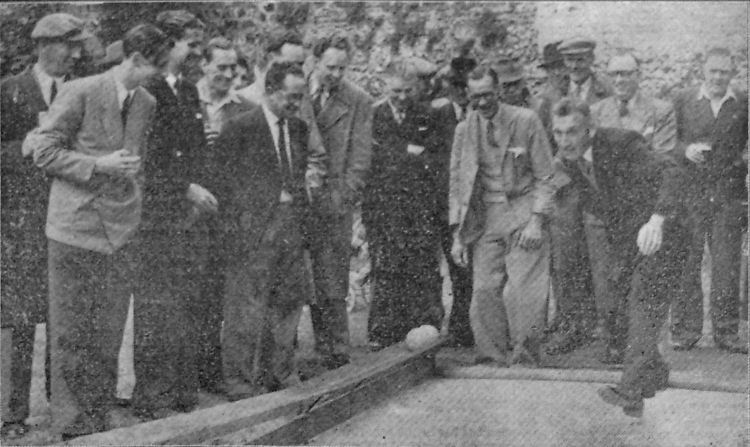
With his usual energy Mr. Durrant sends up the first
wood.
BEER & SKITTLES
Another Charlton Green Enterprise
Expected to be particularly popular with West Country People, a skittle
alley was opened on Whit-Monday by the towns uncrowned Soccer King, Fred
Durrant, in the grounds of the "Red Lion", Charlton Green.
Hoping to popularise the game in this area is the licensee, Mr. L. R.
Latcham who came froth Somerset some years ago. Before the war there
were three rinks for bowls behind the house, and since they were
destroyed during the war the regulars have been pleading for the return
of the game.
Realising that the cost of laying the green was prohibitive, Mr.
Latcham nostalgically remembered the skittle alleys back home, and had
one built where the old rinks were.
Introducing Mr. Fred Durrant, Dover F.C's. popular player-Manager, Mr.
Latcham recalled that the town had just seen a particularly good year
for sports, and said he could think of no one who was better qualified to
have a hand in the opening of the town's latest sporting venture.
Before cutting the tape stretched across the entry of the bowling alley,
Mr. Durrant thanked the crowd of spectators, who he said were typical of
those thousands of local people who, week after week gave their support
to the Town football club.
An impromptu challenge match with Mr. H. A. Carr, Chairman of Dover F.C.
Supporters' Association, Fred lost by 8 shots to 6.
The first game after the official opening was between four Somerset men,
now living at Elvington, and four local men--and much to the fifty odd
onlookers' surprise, it was the Dover men that won 71 to 54.
With the claim that it is the only alley this side of London, Mr.
Latcham says that he will keep it for the locals three nights a week,
while on the other nights he hopes to allow other clubs that might start
up to play there.
|
|
From the Dover Express and East Kent News, Friday, 10
September, 1954.
SKITTLES CHAMPIONS
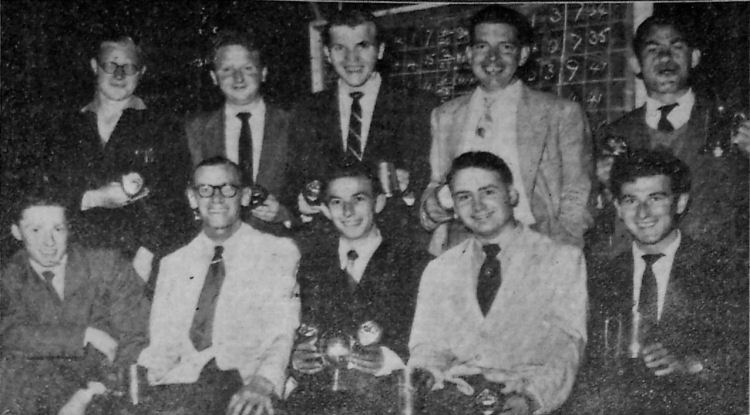
The Red Lion team, which after stern competition, have become first
winners of the Dover & District Skittles league. Standing: J. King, E.
Kelly, E. Clark, J. Bailey, and F. Lee. Sitting: D. Mackingtosh, L.
Latchem (licensee), G. Morris, N. Leech and G. Graham.
|
|
From the Dover Express 24 January 1992.
|
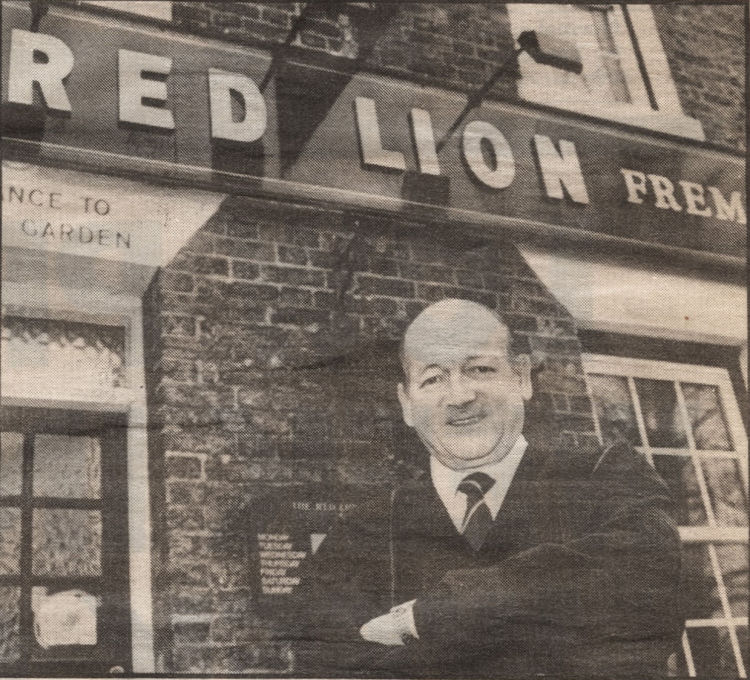
Publican Alf Bentley: "Leases are as ill-conceived as the poll tax."
|
|
Publicans are prepared to lose their jobs and homes
rather than sign new leases they say could double their rents.
Half the publicans in Dover being offered these contracts and
two-thirds in Shepway are rebelling, say the local branches of the
Licensed Victuallers' Association.
"It's like signing a suicide pact, and I won't do it," says Rick
Abbott, who runs the Cricketers in River.
He added: "I have a wife and three children and we would lose our
home, but we would be ruined if I signed."
Big breweries, with more than 2,000 pubs in the country, are selling
pubs or offering 20-year-leases because the Monopolies and Mergers
Commission is restricting how many they can have.
Alf Bentley, landlord at the Red Lion in Charlton Green, Dover
(above), said: "This is as ill-conceived as the poll tax. What use is a
20-year lease to me when I am 60? The breweries are also driving out
experienced landlords and replacing them with people who were probably
bakers before."
Lost customers.
Leslie Carpenter, of Carpenter's in The Stade, Folkestone, said: "My
own rent will only go up by a third but I couldn't even manage that. I
am prepared to lose my pub rather than accept.
"It's hard enough to survive with the recession. We've just lost more
customers through the Sealink redundancies."
The LVA says the increase would further damage pubs because landlords
would have to put up their prices to try to survive. They say the cost
of pint is now pushing £2.
Only last week Barry Musk walked out of the pub where he had been a
tennant for four years, the Red Cow on Foord Road, Folkestone. He now
manages a free house, the Impoerial, in Black Bull Road.
He said: "Signing would have meant my rent going up from £12,000 a
year to £20,000 which would have ruined me. I was lucky because I found
another pub without that kind of expence.
All four pubs are owned by Whitbread. A spokesman said the company
was willing to negotiate with landlords if they could not afford new
rents.
"The LVA claims that rents will double but I dispute that. Our own
survey sows that overall rents have increased by just 45%," he added.
Whitbread says the government legislation has put it and other
brewers in a dilemma. The new Landlord and Tennant Act gives publicans
security of tenure, yet monopolies commission says brewers must get rid
of pubs. |
|
From the Dover Mercury 12 December 2002.
Pub -regulars go nutty over glamorous visitor
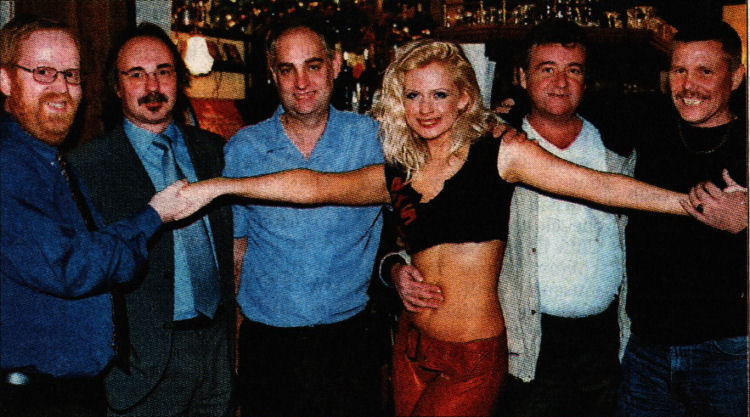
REGULARS at a Dover pub had to look twice when they saw a new face in
the bar. They knew she looked familiar, but where had they seen her
before?
The answer was close at hand. A quick look at the display of Big D nuts
revealed that she was, indeed the famous face used to advertise the
nuts.
Glamour model Ruth Higham put in a special guest appearance at the
Red Lion pub at Charlton Green on Thursday after landlord and landlady
Keith and Janet Thomas won a national competition which attracted
entries from all over the country, reinforcing Great Britain as a nutty
nation.
Ruth set hearts racing and raised the temperature on a chilly night as
she handed out goodies and signed posters for the nut-loving regulars
who had packed into their favourite local.
The evening got into full swing with a traditional pub quiz with a nutty
edge, resulting in Ruth presenting the winning team with their star
prize, a life-sized signed model of herself.
"We picked Ruth to be the new face of Big D because everybody loves
her," said Rob Woodall, head of Big D marketing. "I couldn't believe the
turn-out on the night, and the regulars at The Red Lion proved us right
in our choice."
|
|
From an Email sent on 6th February 2008.
My name is Paul Willis and I have been researching my family history and
discovered that an ancestor of mine, James Willis, was the licensee of
the Red Lion in Charlton Green in the late 19th/early 20th Centuries (he
was my great grandfather's nephew). According to the 1901 Census he was
the 'Licensed Victualler', and his parents - George and Mary - were also
living there.
Paul Willis.
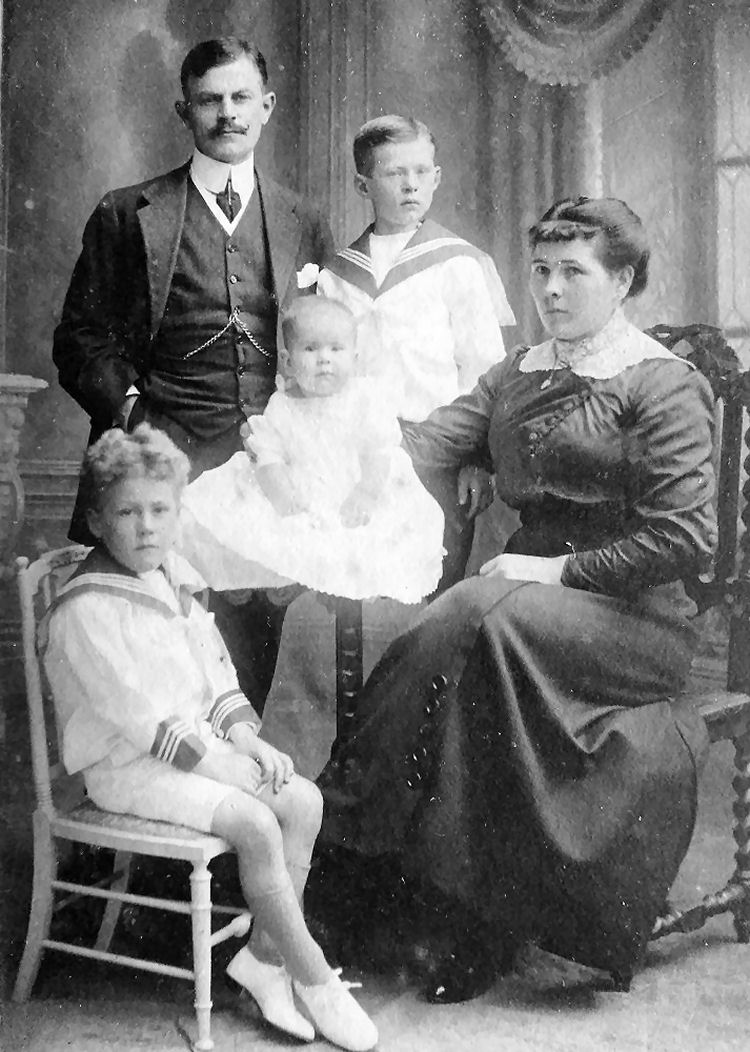
Above photo showing James Willis and family in 1910. Kindly sent by Paul Willis.
|
|
From the Dover Express, 15 May, 2014. By Phil Hayes.
Landlord dies just days after retiring.
‘Generous’ Keith Thomas ran the Red Lion for 12 years.

THE devastated wife of popular pub landlord Keith Thomas has paid tribute
to her husband, who died just days after retiring.
Jan Thomas told how they had been planning to go travelling together after
handing over the keys to the "Red Lion," which they ran for 12 years.
But just three days after quitting the Charlton Green pub on April 25, Mr
Thomas was taken to hospital complaining of a bad back.
He died, aged 55, a week later.
Mrs Thomas, of Granville Street, told the Express: “It was very sudden,
completely out of the blue. He hadn’t been ill at all. I couldn’t believe
it. We were due to go on holiday in a week and very much looking forward
to our retirement together.”
She described Mr Thomas - father of Gary, 34, from a previous marriage -
as “a friend to everyone”.
She said: “Keith was the best. He liked a laugh and a joke. He was very
witty. He would always come back with one-liners. He’ll be very much
missed. I’ll take each day as it comes.”
Generous.
One of Mr Thomas’s former regulars, Simon Spore, described him as “very
generous”.
Mr Spore, who now lives in Greece, said: “When we had our leaving do we
were going to fund food and things like that. But Keith said, ‘I’ll pay
for that’.
“He looked after his regulars.”
Another local, Stephen Davies, said the "Red Lion" was “like a village pub
in the town” under Mr Thomas’s ownership.
The funeral is to be held at Charlton Church, St Alphege Road, at 1pm
tomorrow (Friday).
Mr Davies added: “Keith was so well-liked. I can imagine his funeral will
be absolutely packed solid.” The wake is being held at Dover Rugby Club.
|
|
From the
https://www.kentonline.co.uk By Chantal Weller, 15 December 2022.
The Red Lion pub in Dover to reopen under new management.
A 19th century back-street boozer is to reopen under new management
tomorrow after two months shut.
The Red Lion in Dover has been taken on by Ben Bowman, who has worked in
pubs since he was 14.
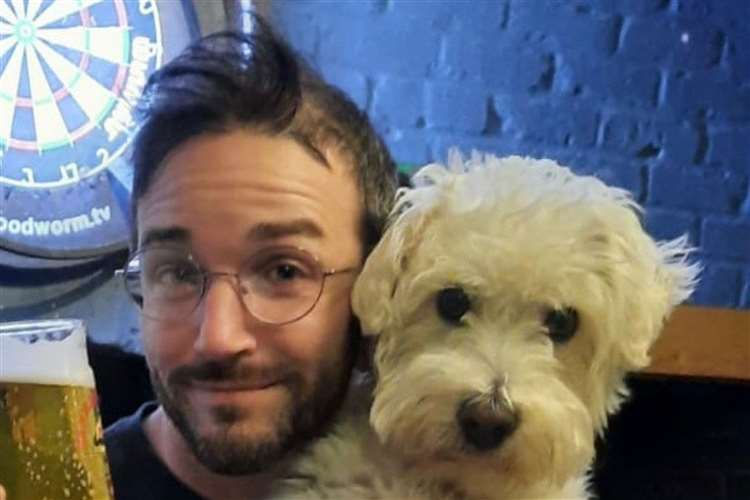
Ben Bowman has taken over the Red Lion pub in Dover. Picture: Ben Bowman.
The 36-year-old initially had reservations about the move, but says he
changed his mind as soon as he stepped inside the Charlton Green inn,
which was built in 1850.
"I walked into the place and fell in love with it," he said.
"It was one of those moments where I thought this could actually be a
really nice pub.
"People won't notice a massive change immediately but we have taken it
on on a long-term basis to upgrade the entire operation.
"We want to put on theme nights, quizzes, and live music events."
Mr Bowman - who will be a tenant at the brewery-owned pub - previously
saved another boozer in the district from closure.
"This will be my first pub that I have taken on on my own, in the sense
of being the tenant, but I have managed many pubs," he said.
"The last I was in - the "Bowling Green" in Deal - I actually saved from
itself.
"The brewery were about to close the doors and I jumped in and saved it,
and kept the doors open while they found a new tenant.
"It just felt like the natural next step was to take on The Red Lion pub
myself."
Mr Bowman says he will be putting a lot of effort into the food side of
the business.
"We want to get the restaurant thriving so the garden is busy in summer
- that's our main goal," he said.
"There's a lot of work to do out there to make it a really nice place to
come.
"We're going to try and make it a happening little place for where it
is, because it's a shame it hasn't had the chance to thrive in recent
years.
"This week we have been working on it, and a lot of people have popped
their heads in to ask if it is reopening. People are really enthusiastic
about it."
Mr Bowman says he is keen to offer a place for people to escape to amid
the cost-of-living crisis.
"I think escapism is important for a lot of people," he said.
"We will try to keep our prices reasonable. We're not running the Ritz -
at the end of the day it's a back-street pub in Dover.
"We want to keep the atmosphere friendly and give people a bit of
escapism, or even somewhere warm to go if they don't want to stick the
heating on - if it's cheaper for them to buy a couple of pints.
"We welcome everybody, young or old." |
LICENSEE LIST
JONES Griffith 1791?
BAKER Mr ???? died 16/Feb/1812
BETTS Richard 1805-1814

 MOON Robert 1814-19
JENKINS Thomas 1819-41 (age 55 in 1841 ) )
    
HOOK Joseph 1845-49
House demolished, new one built, opened June 1850
HORN Thomas 1850-59+

BOWMAN G 1862

MIDDLETON Palmer 1862-72 (age 50 in 1871)
MIDDLETON Elizabeth Mrs 1872-91 (widow age 72 in 1891)
 
HARDIMAN William Walter Kingsford 1895?
WILLIS James 1890-1916 dec'd
    
DATLEN Thomas Stephen 1916-29
 
YOUNG Frederick Charles 1929-30 end
 ? ?
DRENNAN William George 1929-48
   
HOOD Victor Reginald to Dec/1949

LATCHEM Leonard Redvers Dec/1949-58
  
LARKIN William Frederick George 1958-68
TERRY Albert Walter 1968-72 dec'd
TERRY Mrs Frances S 1972-82 end
 Whitbread Fremlins
BENTLEY Alfred 1982-92
TANSEY Madeleine 1993
THOMAS Keith 2002-May/2014+ dec'd
???? to Oct/2022
BOWMAN Ben Dec/2022+
From the Pigot's Directory 1823
From the Pigot's Directory 1828-9
From the Pigot's Directory 1832-33-34
From the Pigot's Directory 1839
From the Pigot's Directory 1840
From Melville's Directory 1858
From the Post Office Directory 1862
From the Post Office Directory 1874
From the Post Office Directory 1882
From Pikes Dover Blue Book 1895
From the Kelly's Directory 1899
From the Post Office Directory 1901
From the Kelly's Directory 1903
From the Post Office Directory 1913
From the Post Office Directory 1922
From Pikes Dover Blue Book 1924
From the Post Office Directory 1930
From Pikes Dover Blue Book 1932-33
From the Post Office Directory 1938
From Pikes Dover Blue Book 1938-39
From Pikes Dover Blue Book 1948-49
From the Kelly's Directory 1950
From the Kelly's Directory 1953
From the Kelly's Directory 1956
Library
archives 1974
Census
|

