|
209 Dover Road
Folkestone
|
From the Folkestone Herald, 11 February, 1978.
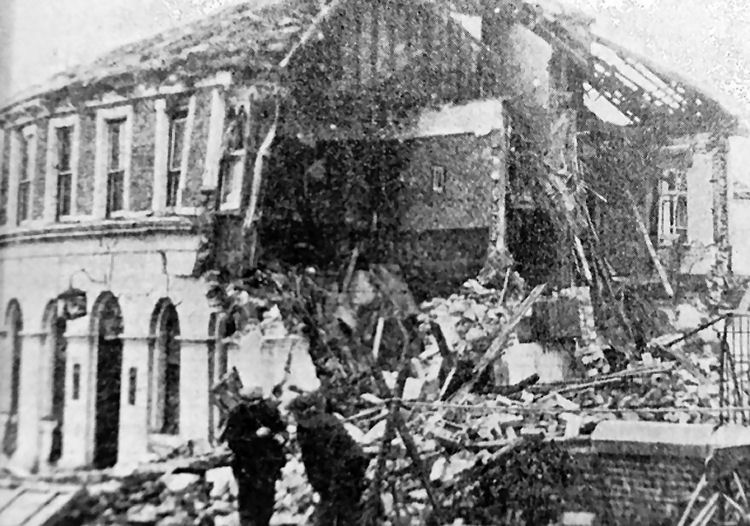
Above photo, 19 October, 1940. |
|
From the Folkestone Gazette, 18 October, 1961.
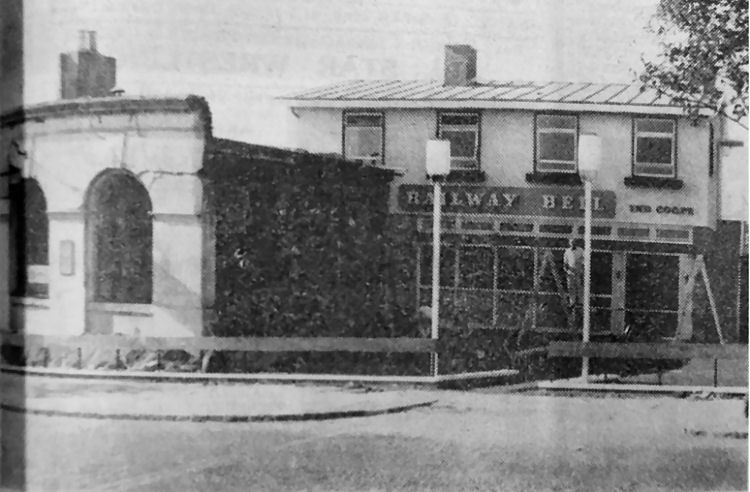
The reconstructed "Railway Bell," in Dover Road, near the Junction
Station, will be opened tomorrow. The premises were badly damaged during
an air raid in World War 2. The new building is in the latest
contemporary style. |
|
From the Folkestone Herald, 21 October 1961.
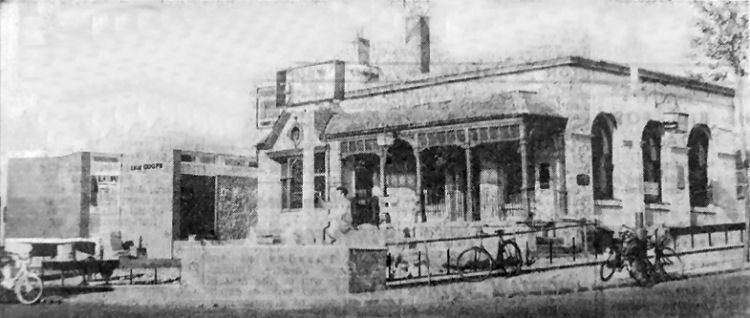
The new "Railway Bell," near the Folkestone Junction Station,
reconstructed from the old shell-damaged inn, was reopened on Thursday. |
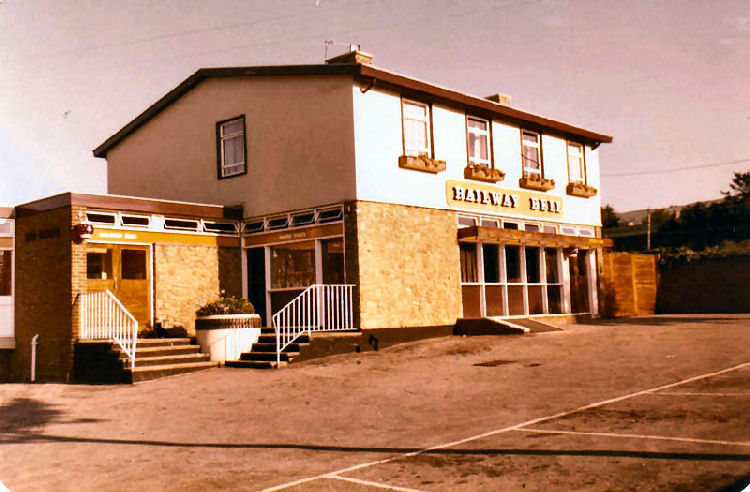
Above photograph kindly supplied by Jan Pedersen, 1978. |
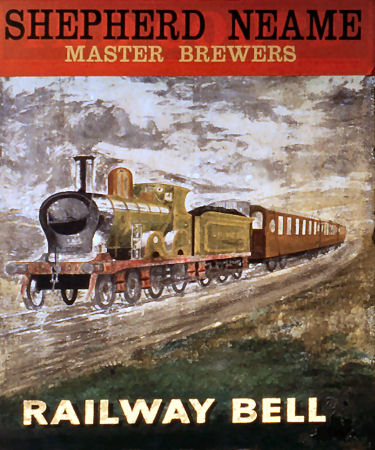
Above sign, March 1995.
With thanks from Brian Curtis
www.innsignsociety.com. |
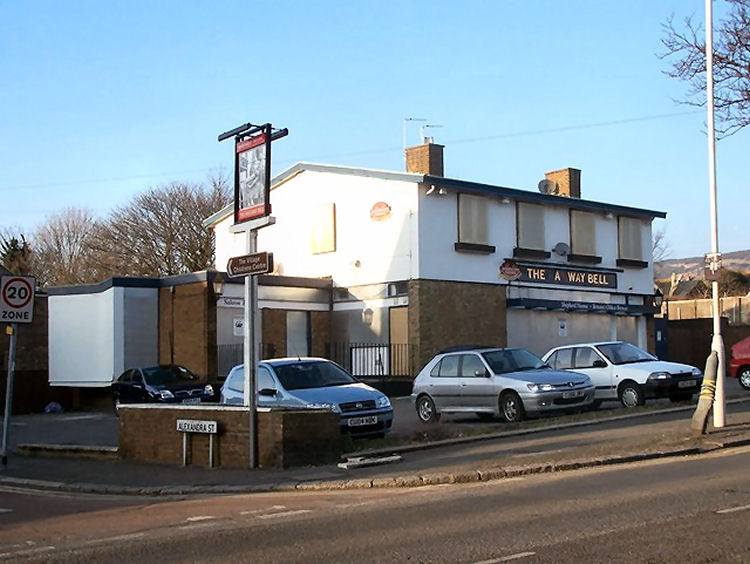
Above photo 2009 by David Anstiss
Creative Commons Licence. |
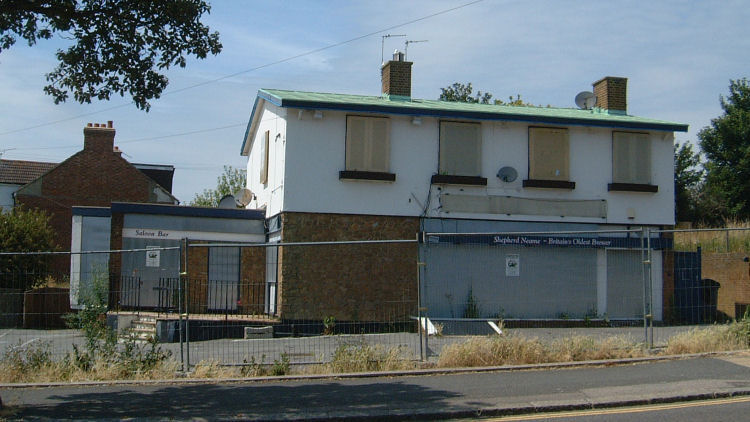
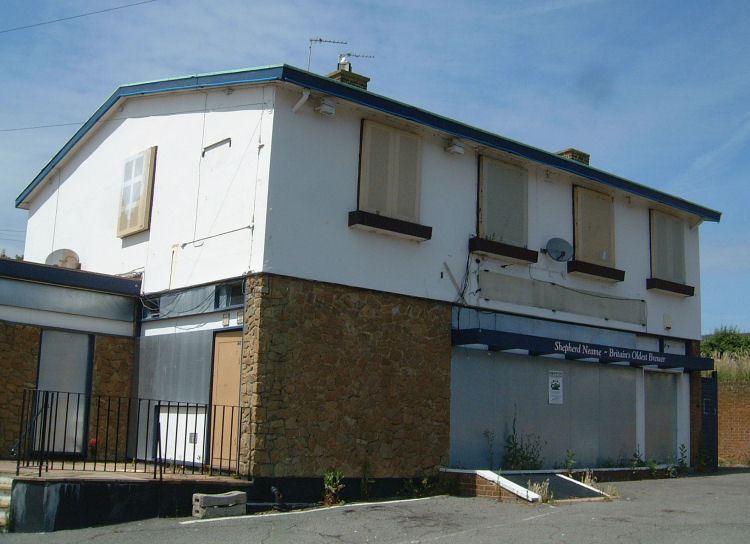
Above photographs of the former "Railway Bell". Taken on 6th July
2009 by Paul Skelton. |
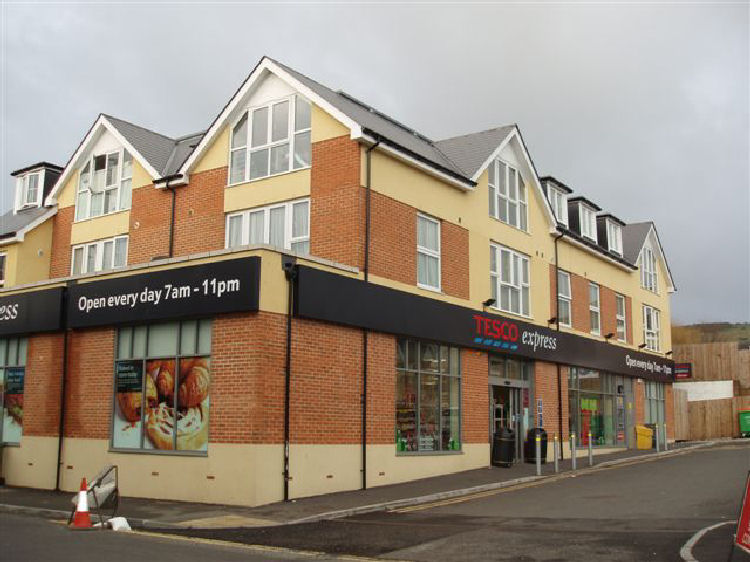
Above photo kindly sent by Phil Nicholson, 29 November, 2012. |
Rumour has it that there was a pub on this site as early as 1843, built
the same time as the railway line was being constructed and supplied beer to
the workers, however, no evidence has yet been found to confirm this rumour.
What is known is that brewers Nalder and Collyer from Croyden obtained a
lease of land from George Holledge at a rent of £74 per annum for 99
years (quite a huge sum at the time) on 29th September 1862, and architect
Joseph Gardner designed the premises that opened shortly after construction
in February 1863. The house at the time was being advertised as containing a
large bar and bar parlour, tap room, parlour and club room, six bedrooms,
commodious cellars and the usual conveniences besides a walled garden.
The high rental at first discouraged anyone from taking on the pub and
staff from the brewery were forced to run it till 2nd January 1865 when
Joseph Moret became its first proper licensee.
|
From the Folkestone Observer 10 January, 1863.
ROBBERY
Monday January 5th:- Before the Mayor and John Kingsnorth, Esq.
Thomas Groves and George Cockson, privates in the 96th Regiment,
stationed at the Camp, were placed in the dock, and the following
evidence was given:-
Thomas Brown, K.C.C., was on duty at Hougham on the 2nd of January,
and at ten a.m., at the "Royal Oak"
in that parish, saw the prisoners, who were drinking in the tap room,
and told him that they had passes, but they had lost them. He approached
them as deserters, they being in uniform, but Groves had no military cap
on. He saw the chisel produced sticking out of the pocket of Groves's
tunic, and charged Groves with having stolen property in his possession.
While talking, the chisel fell out of the pocket, and witness picked it
up. Groves said he bought the chisel at Dover. Witness then asked Groves
for the hammer in his possession, which he had been offering for sale.
He at first denied having a hammer, but after a few minutes he gave it
up. He took them in a conveyance to Seabrook station, and on the way
they found Groves's cap. The prisoners were committed from Hythe as
deserters, and after they had been conveyed to Shorncliffe Camp he
apprehended them on the present charge.
James Quested Petts, builder in Folkestone, was building a house near
the railway station. The workmen and himself left their tools in the
house at night. The chisel produced was his property, and was in the
house at five o'clock on the 1st of January. At half past 7 the
following morning he missed several tools, but having no occasion to use
the chisel he did not miss it till the afternoon. That morning he found
a ladder against the back kitchen window, the window open, and a piece
of candle in the yard.
There being no evidence against Cockson the charges against him were
dismissed, but Groves elected to be tried by a jury at the Quarter
Sessions.
Groves and Cockson were then charged with a second offence.
John Allen, labourer at Hougham, saw the prisoners between 9 and 10
on the morning of the 2nd of January come out of a meadow near Steady
Hole (sic) on the road to Dover – Groves being without his belt, and
Cockson without his cap. When he first saw them they were standing in a
corner of the field, and he thought they had left something there, so he
went to look, and found the painter's basket, tools, and two coats, now
produced, which he took home, but he did not open it until P.C. Swain
came to his lodgings for it.
George Haynes, painter, was at work on the 2nd of January at Mr.
Petts's house, near the railway station. The basket, and the dust brush,
chisel, two punches, scraper, screwdriver, and nail claw, now produced,
were his property, and were left in the building at half past four
o'clock on the 1st of January. The hammer was also his property, and was
left in the basket. The tools were worth about six shillings. There were
two other articles in the basket.
The prisoner Cockson said he left the barracks about half past three
o'clock on the 1st of January, with two men who slept in the same room.
He went to the "Three Horseshoes,"
but did not remember leaving there. He supposed he went out about tattoo
until next morning, when he found himself lying in the Dover Road. He
had lost his waist belt and the number of his forage cap, and looking
about to find these articles he saw Groves. They went together to a
public house, where they had a pint of beer. They left that house, and
went on to the "Royal Oak." The
policeman came in there and took them into custody as deserters. He saw
nothing but the chisel and the hammer in the house.
The prisoners were then committed for trial at the Sessions.
Note: The tools were stolen from the then-nearing-completion of
the "Railway Bell." Jan Pedersen.
|
|
Folkestone Chronicle 7 March 1863
Advertisement: To be let, with immediate possession, the Railway
Bell Inn, near the upper railway station, Folkestone. The house is
just completed, and contains large bar and bar parlour, tap room,
parlour and club room, 6 bedrooms, commodious cellars, and all the
usual conveniences, besides a large walled garden.
For particulars apply to G. Holledge Esq., White Post House, or Mr.
J. Gardner, architect, Folkestone.
|
|
Kentish Gazette 7 April 1863.
Advertisement: To be let, with immediate possession, the "Railway
Bell Inn," near the Upper Railway Station, Folkestone. The house is
just completed and contains large bar and bar parlour, tap room,
parlour, and club room, 6 bedrooms, commodious cellars and all the
usual conveniences, besides a large walled garden. For particulars
apply to G. Holledge Esq., White Post House, or Mr. J. Gardner,
Architect, Folkestone.
Quarter Sessions: The Quarter Sessions for the Borough were held
in the Town Hall on Thursday before J.J. Lonsdale Esq., Recorder.
Thomas Grotes and George Cookson, two soldiers of the 96th
Regiment, were charged with stealing, at the “Railway Bell” public
house, on the 1st January last, a basket of tools the property of
George Haynes, painter. The evidence was not clear and the jury
acquitted the prisoners.
|
|
Southeastern Gazette 7 April 1863
Advertisement: To be let, with immediate possession, the Railway
Bell Inn, near the upper railway station, Folkestone. The house is
just completed, and contains large bar and bar parlour, tap room,
parlour and club room, 6 bedrooms, commodious cellars, and all the
usual conveniences, besides a large walled garden.
For particulars apply to G. Holledge Esq., White Post House, or Mr.
J. Gardner, architect, Folkestone.
|
|
From the Folkestone Observer 14 March, 1863.
ADVERTISEMENT
To Be Let, with Immediate Possession, the "RAILWAY BELL INN," near
the Upper Railway Station, Folkestone. The house is just completed, and
contains large Bar and Bar Parlour, Tap Room, Parlour, and Club Room,
Six Bedrooms, commodious Cellars, and all the usual Conveniences,
besides a large Walled Garden.
For particulars apply to G. Holledge, Esq., White Post House, or Mr.
J. Gardner, Architect, Folkestone.
|
|
From the Folkestone Chronicle 4 April, 1863.
QUARTER SESSIONS
Thursday April 2nd:- Before J.J. Lonsdale, Recorder.
A true bill having been returned against Thomas Groves and George
Cockson, two soldiers of the 96th, for larceny, they were placed in the
dock, and the following witnesses were examined –
George Haynes, sworn: I am a painter, residing in Folkestone. I
recollect the 1st of January. I was at work at the "Railway Bell," near
the upper railway station. I had a basket of tools with me. I put them
in an upper front room. I left them safe at half past 4. I missed them
next morning at 7. The room was not locked. The outer doors of the house
were locked. I saw the men closing them. The door was open when I got
there. I saw a back room window open. I don't know if it had been
fastened overnight. I have not seen the prisoners before. I saw some of
the tools next in the possession of P.C. Swain, and some with the county
constable.
Thomas Brown, sworn – I am constable in the K.C.C. On 2nd January I
found the two prisoners drinking in the "Royal
Oak" public house, in the parish of Hougham, about half past 10. I
asked them if they were on “pass”. They said they were. I asked for
their passes, and they both said they had lost them. I said I should
apprehend them as deserters. They said they were not deserters. I said
they were liable, as they were more than one mile from the camp without
a pass. They had been drinking. While I was speaking, the chisel
produced fell from the back pocket of the tunic of the prisoner Groves.
I asked him where he got it. He said he bought it at Dover. I then asked
him for the hammer. He first denied having one. When I told him, from
information received, I knew he had been offering them both for sale, he
then took the hammer from his trousers pocket. I was half an hour trying
to apprehend them, and to put the handcuffs on. The landlord and another
man assisted me after a while. I took them into custody, and conveyed
them to Seabrook, and gave them in charge of Superintendent English.
John Allen: I am a labourer. I recollect the 2nd January. I was going
along the Dover Road between nine and ten in the morning with a load of
manure. I saw the two prisoners in a meadow near Steddy's Hole. Thinking
they had left something behind them I went to look. They were stooping
down in a corner near the road. They then went away over the further
field – away from me. Stephen Burvill was with me, but he went on with
the horses. I found a basket with a quantity of tools hid under some
gorse, and two painter's coats laid over them. I saw prisoners look
round when I went to the spot. I live at Stephen Burvill's, at a cottage
under the cliff. I took the basket and coats home with me. The basket
produced was identified by witness. Burvill then went on to the "Royal
Oak" to pay a bill, and found Petts and P.C. Swain enquiring about
the things. I gave them up to Swain the same day. Witness continued – I
had passed the house building by Petts, from whence these things were
stolen, earlier in the morning. I did not see the prisoners again. I was
about 30 rods off when I first saw them, but I will swear to the two
prisoners being the same men – Groves, the tallest, had his belt and no
cap, and Cockson had his cap and no belt.
In answer to the Recorder witness repeated this – although when
before the magistrates he had sworn just the opposite, and when
cross-examined by prisoner Groves, had said he was not certain.
P.C. Swain deposed: From information received, he went up the Dover
Road and saw Burvill and Petts. I had heard two soldiers had been taken
with some tools. Burvill told me the last witness (Allen) had found a
basket of tools, and they were at his house. He went down the cliff and
brought them up to me.
The learned Recorder summed up as favourably as he could for the
prisoners, who were undefended; adverting to the contradictory evidence
of the principal witness, Allen, and the credit due to his testimony.
The jury retired for a short time, and returned with a verdict of Not
Guilty.
The learned Recorder discharged the prisoners with a caution and
admonition on the narrow escape they had had.
Note: This was during the latter stages of the building of the
"Railway Bell." Jan Pedersen.
|
|
From the Folkestone Observer 4 April, 1863.
QUARTER SESSIONS
Thursday April 2nd:- Before J.J. Lonsdale, Esq.
Thomas Groves, 24, and George Cockson, 24, Privates in the 96th
Regiment, were indicted for stealing one hammer, one painter's basket,
one dust brush, one chisel, two punches, one scraper, one screwdriver,
and one nail claw, the property of George Haynes, at Folkestone, on the
1st of January last. Both prisoners pleaded Not Guilty, and a petty jury
being empanelled, Mr. Frederick George Francis being foreman, the
following evidence was called.
George Haynes, painter, was employed on the 1st of January last on a
house that was being built by Mr. Petts near the railway station. He
last saw the tools that had been stolen in that house on the 1st of
January, in an upper room, in a basket, where he put them at half past
four o'clock, and he missed them the next morning at seven o'clock. The
outside of the house was locked, but not the room. In the morning the
back room window was open. The articles were worth about 6s.
Thomas Brown, K.C.C., on the 2nd of January, found the two prisoners
at the "Royal Oak Inn," in the parish
of Hougham, at half past ten in the morning. The prisoners were drinking
in the tap room, and said they were on pass, but had lost their passes.
He then apprehended them as deserters. While talking with them a chisel
fell from the tunic pocket of Groves, who then said he had bought it at
Dover. Witness asked him for the hammer, saying that he had had
information of his trying to dispose of a hammer and chisel. At first he
denied having a hammer, but afterwards he produced it from his trousers
pocket. He then secured the prisoners, and conveyed them to Seabrook.
John Allen, labourer, saw the two prisoners in a meadow near Steddy
Hole, Dover Road, between nine and ten in the morning of the 2nd of
January. Suspecting something from their manner, when they went away he
went to see if anything was left behind, and he found a basket with a
quantity of tools and two old painters' coats. The coats were laid over
the basket, and the whole was under a piece of gorse. He took the basket
and coats in his hand to his lodgings at Steven Burvill's, where he put
them in the front room. Before he got to the place where the soldiers
were, he had passed by the house Mr. Petts was building. When the
prisoners were in the field they were about thirty rods from him, or six
times the length of that room, but he could swear to them. Groves had
his belt, but no cap; Cockson had his cap, but no belt. Burvill went to
the "Royal Oak," and between two and
three in the afternoon P.C. Swain came to his (witness's) lodgings, and
he delivered the things up to him.
P.C. Swain on the 2nd of January went to the "Royal
Oak" in company with Mr. Petts, where he saw Mr. Burvill, who said
that his lodger had got a basket of tools and two coats, and he went on
to Burvill's house under the cliff. Burvill went down to the house, and
returned with Allen and the basket and coats.
This was the case for the prosecution.
The prisoner Groves then said that he came into possession of the
hammer and chisel by picking them up in the Dover Road. He had been
drinking for two days, and when the policeman asked about the things he
was not in uniform, and it was on that account he told him he had bought
them.
The Recorder, in addressing the jury, threw some doubt on the
testimony of the witness Allen, who gave positive evidence before the
magistrates as to the identity of the prisoners; afterwards, on
cross-examination, said he was not positive, and now again had become
very positive, but gave a description of the dress of the men differing
from that he gave before the magistrates. It was for the jury to say if
this was due to the confusion of mind of an ignorant witness.
The jury retired for a short time, and on returning into court gave a
verdict for both prisoners of Not Guilty.
There was a second indictment against Groves for stealing, at the
same time and place, a chisel, the property of James Quested Petts; but
as the case was supported only by the same evidence as that upon which
he had just been acquitted, the prosecution was dropped, and both
prisoners were strongly admonished by the Recorder, and discharged.
Note: The theft was from the nearly-completed "Railway Bell." Jan
Pedersen.
|
|
Folkestone Chronicle 21 May 1864.
Petty Sessions, Friday, May 20th: Before James Kelcey and R.W.
Boarer Esqs.
Hugh McMath was brought up in custody, charged with one macintosh
pack, one piece blue pilot cloth, one piece blue cloth, one piece
lining, one pair blue cloth trousers, one black coat, one piece
black lining, one piece calico, one scarf shawl, one piece merino,
one piece flannel, one plaid shawl, and two pieces skirting, value
£11 14s. 8d., the property of Mr. Peter Thomson, 69, Castle Street,
Dover.
On the application of the prosecutor the depositions were taken,
and the case remanded, and sent to be heard before the bench of
magistrates at Dover.
|
|
Southeastern Gazette 24 May 1864.
Dover: On Saturday last, a respectably-dressed young man, named
Hugh McGarth, was taken before the sitting magistrate (C. Stein
Esq.), and charged with stealing a quantity of cloth, lining, &c.,
the property of his late employer, Mr. Peter Thomson, woollen
draper, of Snargate Street. It appears that on the previous Saturday
the prisoner was ordered to quit the premises of his employer, and
after he was gone several things were missed, suspicion attaching
itself to the prisoner. On Thursday, as Mr. Thomson was passing
through Folkestone, he met the prisoner with a pack belonging to
him. This led to the young man being taken into custody, and at his
lodging a number of articles, the property of Mr. Thomson, were
found. In reply to the magistrate the prosecutor stated that he had
not given the prisoner permission to take the articles from his
shop. Mr. Fox appeared to defend the prisoner, but as the police
were not prepared with the necessary evidence, the case was
remanded. The prisoner was again placed before the magistrates
yesterday (Monday). Mr. F. Strood, of Cheltenham, appeared for the
prosecutor, and Mr. Fox for the prisoner. Mr. Thomson identified the
articles found at the prisoner's lodgings at Folkestone as his
property. On Thursday evening, after the prisoner was in custody, he
went to the White Horse public house, St. James's Street, Dover, and
there found three large boxes which the prisoner took from his
house, containing three parasols, a pair of Scotch tweed trousers,
two pairs of stays, scarves, handkerchiefs, and a variety of other
articles which belonged to him (the prosecutor). The value of those
enumerated he estimated at £4. In answer to Mr. Fox, the prosecutor
said the prisoner was entrusted with the things he was charged with
having stolen to sell, and he ought to have given them up when he
was discharged. Mr. Fox submitted that a charge of felony could not
be substantiated. The prosecutor might seek his remedy by an action
of trover against the prisoner. The Bench, having elicited that the
boxes were taken from the prosecutor's house subsequently to the
prisoner's discharge, decided to hear the case. Mr. Thomson was then
subjected to a cross-examination by Mr. Fox, after which police
constable Charles Ovenden, of Folkestone, said he received the
prisoner into his custody on Thursday. In answer to the charge read
over to him at the station house, the prisoner said he had still
some things which he ought to have accounted for. Mr. John Friend,
landlord of the White Horse, said the prisoner brought the boxes
containing the articles stolen to his house on Monday, and he
afterwards handed them over to the police. The Bench committed the
prisoner to take his trial at the next Quarter Sessions.
|
|
Kentish Gazette 24 May 1864.
Dover: At the sitting of the Borough Police Court on Monday
(before J. Worsfold, E. Back and W. Mummery Esqs.), Hugh McMath, a
respectably dressed man was charged with stealing one mackintosh,
one leather strap, one piece of cloth, one piece of blue cloth, one
piece of lining, and a pair of Scotch tweed trousers, the property
of Mr. P. Thomson, draper, 9, Snargate Street, Dover. Mr. Strood, of
Cheltenham appeared for the prosecutor, and Mr. Fox, of Dover, for
the prisoner.
From the evidence of prosecutor it appeared that prisoner had
been in his employ since April 1st, 1863, and that it was arranged
that prisoner should remain in his service for years provided he
conducted himself properly. Prosecutor had suspected the prisoner's
honesty, and having various other complaints against him, he
dismissed him on the previous Saturday night. On the previous
Thursday prosecutor went to Folkestone, and there he saw the
prisoner with the pack cover and strap which prosecutor had provided
him with while in his employ. He exchanged some few words with
prisoner, and then gave him into custody. On getting to the station
house at Folkestone, the pack prisoner had with him was searched,
and several articles belonging to prosecutor were found in the pack.
Prosecutor returned to Dover, and immediately went to the White
Horse Inn, where prisoner's boxes had been removed to on his leaving
prosecutor's employ. Sergeant Baily, of the Dover force, went with
him, and the boxes were removed to the station house, where they
were searched, and a number of articles were found in them belonging
to the prosecutor. A number of the goods were then sworn to by the
prosecutor, which he estimated in round numbers at £4.
P.C. Ovenden, of the Folkestone force deposed to taking the
prisoner into custody, and sergeant Baily, of the Dover force having
corroborated the statement of prosecutor as to the articles found in
the boxes on their being searched at the station house, prisoner was
cautioned in the usual manner, and committed for trial at the next
quarter sessions for the Borough of Dover.
|
|
Kent Herald 26 May 1864
Petty Sessions, Friday: Before James Kelcey and R.W. Boarer Esqs.
Hugh McMath was brought up in custody, charged with a macintosh pack, one piece
blue pilot cloth, one piece blue cloth, one piece lining, one pair blue cloth
trousers, one black coat, one piece black lining, one piece calico, one scarf
shawl, one piece merino, one piece flannel, one plaid shawl, and two pieces
skirting, value £11 14s. 8d., the property of Mr. Peter Thomson, 69, Castle
Street, Dover.
On the application of the prosecutor the depositions were taken, and the case
remanded, and sent to be heard before the bench of magistrates at Dover.
Dover Police Court, Monday: Before J. Worsfold, E. Back and W. Mummery Esqs.
Hugh McMath, a respectably dressed man was charged with stealing one mackintosh,
one leather strap, one piece of cloth, one piece of blue cloth, one piece of
lining, and a pair of Scotch tweed trousers, the property of Mr. P. Thomson,
draper, 9, Snargate Street, Dover. Mr. Strood, of Cheltenham appeared for the
prosecutor, and Mr. Fox, of Dover, for the prisoner.
From the evidence of prosecutor it appeared that prisoner had been in his employ
since April 1st, 1863, and that it was arranged that prisoner should remain in
his service for years provided he conducted himself properly. Prosecutor had
suspected the prisoner’s honesty, and having various other complaints against
him, he dismissed him on the previous Saturday night. On the previous Thursday
prosecutor went to Folkestone, and there he saw the prisoner with the pack cover
and strap which prosecutor had provided him with while in his employ. He
exchanged some few words with prisoner, and then gave him into custody. On
getting to the station house at Folkestone, the pack prisoner had with him was
searched, and several articles belonging to prosecutor were found in the pack.
Prosecutor returned to Dover, and immediately went to the White Horse Inn, where
prisoner’s boxes had been removed to on his leaving prosecutor’s employ.
Sergeant Baily, of the Dover force, went with him, and the boxes were removed to
the station house, where they were searched, and a number of articles were found
in them belonging to the prosecutor. A number of the goods were then sworn to by
the prosecutor, which he estimated in round numbers at £4.
P.C. Ovenden, of the Folkestone force deposed to taking the prisoner into
custody, and sergeant Baily, of the Dover force having corroborated the
statement of prosecutor as to the articles found in the boxes on their being
searched at the station house, prisoner was cautioned in the usual manner, and
committed for trial at the next quarter sessions for the Borough of Dover.
|
|
Canterbury Weekly Journal 28 May 1864.
Dover: At the sitting of the Borough Police Court on Monday (before
J. Worsfold, E. Back and W. Mummery Esqs.), Hugh McMath, a
respectably dressed man was charged with stealing one mackintosh,
one leather strap, one piece of cloth, one piece of blue cloth, one
piece of linen, and a pair of Scotch tweed trousers, the property of
Mr. P. Thomson, draper, 9, Snargate Street, Dover. Mr. Strood, of
Cheltenham appeared for the prosecutor, and Mr. Fox, of Dover, for
the prisoner.
From the evidence of prosecutor it appeared that prisoner had been
in his employ since April 1st, 1863, and that it was arranged that
prisoner should remain in his service for years provided he
conducted himself properly. Prosecutor had suspected the prisoner's
honesty, and having various other complaints against him, he
dismissed him on the previous Saturday night. On the previous
Thursday prosecutor went to Folkestone, and there he saw the
prisoner with the pack cover and strap which prosecutor had provided
him with while in his employ. He exchanged some few words with
prisoner, and then gave him into custody. On getting to the station
house at Folkestone, the pack prisoner had with him was searched,
and several articles belonging to prosecutor were found in the pack.
Prosecutor returned to Dover, and immediately went to the "White
Horse Inn," where prisoner's boxes had been removed to on his leaving
prosecutor's employ. Sergeant Bailey, of the Dover force, went with
him, and the boxes were removed to the station house, where they
were searched, and a number of articles were found in them belonging
to the prosecutor. A number of the goods were then sworn to by the
prosecutor, which he estimated in round numbers at £4.
P.C. Ovenden, of the Folkestone force deposed to taking the prisoner
into custody, and sergeant Bailey, of the Dover force having
corroborated the statement of prosecutor as to the articles found in
the boxes on their being searched at the station house, prisoner was
cautioned in the usual manner, and committed for trial at the next
quarter sessions for the Borough of Dover.
|
|
From the Folkestone Observer 28 May, 1864.
EXTENSIVE ROBBERY
Hugh McMarth, a young man of very intelligent and respectable
appearance, who was recently in the employ of Mr. Peter Thomson, draper,
was charged on Monday with stealing a quantity of cloth and a variety of
articles, the property of Mr. Thomson. The prisoner had been apprehended
at Folkestone, and handed over to the Dover Police by the magistrates of
this borough. He was brought before C. Stein Esq. at Dover on Saturday,
and was remanded to complete the evidence for the prosecution.
Prosecutor deposed the prisoner was lately in his employ as
traveller. He gave him notice to quit on the 16th instant, and paid him
his wages at nine o'clock in the morning. He then asked the prisoner if
he had anything to be booked against him, and he replied “No”. He asked
the prisoner how many pairs of boots he had had from him since he had
been with him, and the reply was “Three”. He told the prisoner he had
only accounted for two pairs, and deducted for another pair from his
wages. He asked the prisoner if he had any goods to give up, and the
answer was “No”. The prisoner then went away. Between eleven and twelve
o'clock the same day he saw two of the boxes now produced taken from his
house and put into an omnibus. On the following Thursday he saw the
prisoner in Folkestone, carrying upon his back a packing box and leather
strap which belonged to him. They were in the prisoner's charge when in
his employ, but he had neither given him them or given him permission to
take them away. He stopped the prisoner and asked if he was going on
business for himself or if he was travelling for anyone, but he replied
“No”. He then took him to the "Railway Bell" public house, and after
they had had a glass of ale together he gave him into custody upon a
charge of stealing the packing cloth and strap. At the police station he
opened the pack, and found in it two pieces of calico, each six yards
long, two five yard lengths of skirting – the former bearing his private
mark and the latter matching with some in his possession. In the pack
were other things which he believed were his property. On Thursday
evening he went to the "White Horse"
public house, St. James's Street, and found three boxes, two of which he
knew belonged to the prisoner, and had been removed from his house the
previous Monday. The boxes were taken to the police station, and when
they were opened he found they contained a variety of things, some of
which he identified as his property – viz. – three sunshades or
parasols, a pair of Scotch tweed trousers, a flannel shirt, three pairs
of stays, a scarf &c. Those articles which he could swear to as
belonging to him he valued at £4, but he believed the whole of them were
his property.
Prosecutor, in cross-examination by Mr. Fox, said the prisoner
entered his service in April, 1863. The agreement between them was that
the prisoner was to travel for him for three years, if he conducted
himself properly, at £25 per year, and £30 if he suited him, and all
travelling expenses. There was nothing said about determining the
engagement by notice. He gave the prisoner a month's notice to leave
because he was not satisfied with him – because he rode about on
horseback and in flies, stayed out late at night, and because he
suspected his dishonesty, as he had lost things from his shop and could
not make out where they were gone. He did not verify his suspicions
until after he had discharged the prisoner, but he travelled a fortnight
endeavouring to detect his dishonesty. There were no other reasons for
his discharging the prisoner. He paid the prisoner his wages at the rate
of £25 a year. After deducting several items for clothes he paid him £8
19s 6d in cash as the balance due to him. The prisoner's duties were to
solicit orders and take goods for sale. The goods he took out he cut
from pieces in prosecutor's shop, and was supposed to enter them in a
book, but some of them he could swear the prisoner had not entered. To
the best of his belief the letters on the sunshades were in the
prisoner's handwriting, and the figures in his wife's handwriting, but
he could not swear to this. He identified the Scotch tweed trousers
because he was wearing a pair of the very same material. The prisoner,
when charged with stealing the packing cloth and strap, said they were
his property.
P.C. Ovenden, Folkestone, deposed that he had received the prisoner
into his custody at the "Railway Bell," Folkestone. Nothing was then
said by the prisoner, but at the police station he said “I know the
prosecutor has got an account against me for some things which I have
received and not accounted for”. The prisoner also asked him what he
could do in the matter, and he replied he could not tell him. The
prisoner said the things in his possession were all his own property.
Upon the prisoner he found a bunch of keys.
William Cheeseman, an omnibus driver, was called to prove that the
boxes found at the "White Horse" were
those he conveyed thither, from the house of the prosecutor to the
prisoner, but all the witness would say was that he took some boxes
there, but did not know how many there were, nor what they were like.
John Friend, landlord of the "White Horse,"
said the prisoner came in an omnibus with the three boxes produced, and
two of which had been identified by Mr. Thomson, to his house about noon
on the 16th inst., and left the boxes there. He afterwards showed them
to the prosecutor, who removed them to the police station.
Police sergeant Bailey said he received a bunch of keys from the
witness Ovenden, and with them he unlocked the boxes brought to the
police station by the prosecutor, and which contained the articles
enumerated.
Mr. Strood submitted that was the case for the prosecution.
Mr. Fox said the prisoner would reserve his defence.
The bench committed the prisoner to take his trial at the next
quarter sessions for the borough.
|
|
Thanet Advertiser 28 May 1864.
Dover: At the sitting of the Borough Police Court (before J.
Worsfold, E. Back and W. Mummery Esqs.), Hugh McMath, a respectably
dressed man was charged with stealing one mackintosh, one leather
strap, one piece of cloth, one piece of blue cloth, one piece of
lining, and one pair of Scotch tweed trousers, the property of Mr.
P. Thompson, draper, 9, Snargate Street, Dover. Mr. Strood, of
Cheltenham appeared for the prosecutor, and Mr. Fox, of Dover, for
the prisoner.
From the evidence of prosecutor it appeared that prisoner had
been in his employ since April 1st, 1863, and that it was arranged
that prisoner should remain in his service for years provided he
conducted himself properly. Prosecutor had suspected the prisoner's
honesty, and having various other complaints against him, he
dismissed him on the previous Saturday night. On the previous
Thursday prosecutor went to Folkestone, and there he saw the
prisoner with the pack cover and strap which prosecutor had provided
him with while in his employ. He exchanged some few words with
prisoner, and then gave him into custody. On getting to the station
house at Folkestone, the pack prisoner had with him was searched,
and several articles belonging to prosecutor were found in the pack.
Prosecutor returned to Dover, and immediately went to the White
Horse Inn, where prisoner's boxes had been removed to on his leaving
prosecutor's employ. Sergeant Baily, of the Dover force, went with
him, and the boxes were removed to the station house, where they
were searched, and a number of articles were found in them belonging
to the prosecutor, which he estimated in round numbers at £4.
P.C. Ovenden, of the Folkestone force deposed to taking the
prisoner into custody, and sergeant Baily, of the Dover force having
corroborated the statement of prosecutor as to the articles found in
the boxes on their being searched at the station house, prisoner was
cautioned in the usual manner, and committed for trial at the next
quarter sessions for the Borough of Dover.
|
|
Dover Chronicle 28 May 1864.
Dover Police Court, Monday: Before J. Worsfold, W.R. Mummery, and
T.E. Back Esqs.
Hugh McMarth, a bagman in the employ of Mr. Peter Thomson,
draper, of Castle Street, was charged with stealing a macintosh
cover, a leathern strap, a piece of pilot cloth, a piece of blue
ditto, piece of lining, pair of trousers, piece of black lining and
other goods, the property of his employer.
Mr. Frederick Stroud, of Cheltenham, appeared for the
prosecution, and Mr. Thos. Fox for the defence.
Mr. Peter Thomson: I carry on business as a draper at 69, Castle
Street. The prisoner was lately in my employ as traveller, but was
discharged by me on Monday, the 16th instant, and his wages paid up
to that time. When he left I asked him if he had anything booked
against him, and he said "No". I then said "How many pairs of boots
have you had repaired since you entered my service?" He replied
"Three." I said "You have only accounted for two;" and then I asked
him if he had anything to give up, to which he replied in the
negative. The last time I saw him in Dover was when he came to take
his boxes away. I next saw him at Folkestone on Thursday last, when
he had on his back a macintosh packing cloth with a strap round it
belonging to me. It was in his charge when he was in my service but
ought to have been given up when he left me. I asked him if he were
travelling for anyone, or whether he was in business for himself,
and he replied "No." We then walked up to the Bell and had a glass
of ale together, and I there took him into custody. I opened his
pack in the presence of a constable at the station, and found the
articles I now produce, some of which I can swear to as my property.
There are two pieces of calico, each containing six yards; and two
five yard lengths of skirting. The calico has my private mark, and I
have the piece in Court from which the skirting was cut. The pack
and strap I identify as my property by marks inside. On Thursday,
accompanied by a Dover policeman, I went to the White Horse, where
we found three boxes and three sunshades. Two of the boxes were the
same as those taken from my house by the prisoner on Monday. I
identify two of the sunshades by our private mark, but the ticket
has been taken from the third. I examined the boxes on Friday
afternoon at the Police Station. The articles I now produce – a pair
of Scotch tweed trousers, two pair of stays, and the scarf are mine,
and the prisoner ought to have given them up to me when I discharged
him.
Mr. Fox: On that remark of the prosecutor I would endeavour to
spare the time of the Court by observing that there are not the
necessary requisites to substantiate a case of felony.
Mr. Stroud said that was a very summary way of disposing of a
serious charge. He submitted that it came within the 4th section of
the fraudulent trustees act.
Mr. Worsfold: Were the articles entrusted to him for sale?
Prosecutor: They were, sir.
Mr. Fox: Then that only substantiates my remark.
Mr. Worsfold: Were those articles found at his residence after
his dismissal?
Prosecutor: They were, sir. He took the boxes away from my house
about twelve o'clock the same morning I had dismissed him.
By Mr. Fox: The prisoner was taken into my service on the 1st of
April, 1863. The agreement then made was that he was to travel for
three years, providing he behaved himself properly. The wages were
to be £25 a year or £30 if he suited me, and all his travelling
expenses. I gave him a month's notice, as I was not satisfied with
him, because he rode about on horseback and in flys. I also had a
bill sent from Hythe, but I have not it with me. On one occasion he
stopped out all night, and he always kept very late hours. No
particular hour was mentioned in the agreement. I had my suspicions
that the prisoner was dishonest as I missed several articles. When I
discharged him I had not verified my suspicions. There were no other
reasons that induced me to discharge him – I don't know how many
more you want. When the prisoner left me I paid him £8 19s. 6d in
cash, the balance due. It was the prisoner's duty to solicit orders
and take cash. When I was not present the prisoner was allowed to
cut the goods off himself and enter them. In fact it was competent
in him to take goods out of the stock itself. I have examined my
books with regard to some of the items mentioned, and I can swear
they are not entered. With regard to the first sunshade marked "L O"
I will swear it is my handwriting; and the one marked 2s. 6d. I
believe is in the handwriting of my wife, but the one marked 10s.,
to the best of my belief, is in the handwriting of the prisoner, but
I will not swear that it is. The pair of trousers have no marks upon
them, but they are the same quality and pattern as the pair I now
wear. When I charged the prisoner at Folkestone with stealing the
pack cloth and strap he said they were not mine.
Charles Ovenden, police constable of Folkestone: Last Thursday I
received the prisoner into custody from the prosecutor at the
Railway Bell. He did
not say anything until we got to the station, when he said "I know
the prosecutor has got an account against me of something which I
have not accounted for." He also asked me what the prosecutor could
do to him for having them and I told him I did not know. The
prisoner said all the things in the pack that he had with him were
his. I was present when the pack was opened this morning.
William Cheeseman, omnibus driver to Mr. Clements: Last Monday I
was employed by the prisoner to take his luggage from Mt. Thomson's
in Castle Street to the White Horse. I do not remember what it
consisted of, but I know there was a gun. (Laughter) Whatever there
were, I deposited them at the White Horse.
John Friend, landlord of the White Horse Inn: Last Monday morning
the prisoner came to my house, and said he should send something
there. About noon on the same day he returned with three boxes,
besides a parcel he had in his hand. I afterwards showed the boxes
to Mr. Thomson.
By Mr. Fox: I was in the bar of my house when the prisoner came
with the boxes.
P.C. Ovenden re-called: When I searched the prisoner I found on
him a bunch of keys, which I handed over to Sergeant Bayley.
Prosecutor re-called: The two large wooden boxes produced by
police sergeant Bayley are the same as those taken away from my home
on the 16th. I found the articles now produced in them at the police
station.
Police sergeant Bayley deposed: I produce a bunch of keys I
received from police constable Ovenden. The boxes produced were
brought to the station about twenty minutes past ten on Thursday
evening. I opened them in the presence of Mr. Thomson. The articles
enumerated, and which I now produce, are a part of the contents of
the boxes.
The prisoner, by the advice of his solicitor, reserved his
defence, and he was them committed for trial to the Sessions.
Mr. Fox made application that the money found in the possession
of the prisoner on his apprehension might be returned to him for the
purposes of his defence, which the Magistrates granted.
|
|
Dover Telegraph 28 May 1864.
Dover Police Court, Monday: Before J. Worsfold, W.R. Mummery, and
T.E. Back Esqs.
Hugh McMarth, a young man of very intelligent and respectable
appearance, who was recently in the employ of Mr. Peter Thomson,
draper, of 69, Castle Street, was charged with stealing a quantity
of cloth and a variety of articles, the property of Mr. Thomson.
The prisoner had been apprehended at Folkestone and handed over
to the Dover police by the magistrates of that borough. He was
brought before C. Stein Esq., at Dover, on Saturday, and was
remanded until Monday to complete the evidence for the prosecution.
Mr. Frederick Strood, of Cheltenham, appeared for the prosecutor,
and Mr. T. Fox for the defendant.
Prosecutor deposed that the prisoner was lately in his employ as
traveller. He gave him notice to quit on the 16th instant, and paid
him his wages at nine o'clock in the morning. He then asked the
prisoner if he had anything to be booked against him, and he replied
"No." He asked the prisoner how many pairs of boots he had had from
him since he had been with him, and the reply was "Three." He told
the prisoner he had only accounted for two pairs, and deducted for
another pair from his wages. He asked the prisoner if he had any
goods to give up, and the answer was "No." The prisoner then went
away. Between eleven and twelve o'clock the same day he saw two of
the boxes produced taken away from his house and put into an
omnibus. On the following Thursday he saw the prisoner in
Folkestone, carrying upon his back a packing cloth and leather strap
which belonged to him. They were in the prisoner's charge when in
his employ, but he had neither given them him nor given him
permission to take them away. He stopped the prisoner and asked if
he was going on business for himself, or if he was travelling for
anyone, but he replied "No." He then took him to the
Railway Bell
public house, and after they had had a glass of ale together, he
gave him into custody upon a charge of stealing the packing cloth
and strap. At the police station he opened the pack, and found in it
two pieces of calico, each six yards long, two five yard lengths of
skirting, the former bearing his private mark, and the latter
matching with some in his possession. In the pack were other things
which he believed belonged to him, and at the defendant's lodgings
at Folkestone were also found some blue pilot and other cloth, &c.,
which he believed was his property. On Thursday evening he went to
the White Horse public house, St. James's Street, and found three
boxes, two of which he knew belonged to the prisoner, and had been
removed from his house on the previous Monday. The boxes were taken
to the police station, and when they were opened he found they
contained a variety of things, some of which he identified as his
property, viz., three sunshades or parasols, a pair of Scotch tweed
trousers, a flannel shirt, three pairs of stays, a scarf &c. Those
articles which he could swear to as belonging to him he valued at
£4, but he believed the whole of them were his property.
Mr. Fox: How did the prisoner become possessed of these things?
Prosecutor: He had them in his charge, and he ought to have given
them up to me when I discharged him.
Mr. Fox: Then, in order to save the time of the Bench, I submit
that there are not the requisites necessary to substantiate a felony
against the prisoner. The prosecutor has distinctly stated that the
prisoner ought to have given up the things, and if that be the case,
he has his remedy against the prisoner in a civil court by bringing
an action for trover against him.
Mr. Strood: That is a summary way of getting rid of a serious
charge. I apprehend that if a person in the position of the prisoner
is found in the possession of articles belonging to his master, and
appropriating them to his own use, after he had been discharged, he
comes within the meaning of the 4th section of the Fraudulent
Trustees Act, of misappropriating goods, and therefore acts
feloniously. I submit there is a clear case of larceny.
The magistrates inquired whether the goods were properly
entrusted with the prisoner?
Mr. Fox said they were, but it could not be said he was
appropriating them for his own use.
Mr. Worsfold asked whether the boxes containing the stolen
articles were removed from the prosecutor's house after the
prisoner's dismissal?
Prosecutor: Yes.
The Bench then intimated their intention of going on with the
case, expressing their belief that the removal of the goods after
the prisoner's discharge would constitute a felony.
Prosecutor, in cross-examination by Mr. Fox, said the prisoner
entered his service in April, 1863. The agreement between them was
that the prisoner was to travel for him for three years, if he
conducted himself properly, at £25 per year, and £30 if he suited
him, and all travelling expenses. There was nothing said about
determining the engagement by notice. He gave the prisoner a month's
notice to leave because he was not satisfied with him – he rode
about on horseback and in flys, stayed out late at night, and
because he suspected his dishonesty, as he had lost things from his
shop and could not make out where they were gone. He did not verify
his suspicions until after he had discharged the prisoner, but he
travelled a fortnight endeavouring to detect his dishonesty. There
were no other reasons for his discharging the prisoner. He paid the
prisoner his wages at the rate of £25 a year. After deducting
several items for clothes, he paid him £8 19s. 6d. in cash as the
balance due to him. The prisoner's duties were to solicit orders and
take goods for sale. The goods he took out he cut off pieces in
prosecutor's shop, and he was supposed to enter them in a book, but
some of them he could swear the prisoner had not entered. To the
best of his belief the letters on the sunshades were in the
prisoner's handwriting, and the figures in his wife's handwriting,
but he could not swear to this. He identified the Scotch tweed
trousers because he was wearing a pair of the very same material.
The prisoner when charged with stealing the packing cloth and strap
said they were his property.
Charles Ovenden, police constable of Folkestone, deposed that he
received the prisoner into his custody at the Railway Bell,
Folkestone. Nothing was then said by the prisoner, but at the police
station he said "I know the prosecutor has got an account against me
for some things which I have received and not accounted for." The
prisoner also asked him what he thought he could do in the matter,
and he replied he could not tell him. The prisoner said the things
in his possession were all his own property.
William Cheeseman, an omnibus driver, was called to prove that
the boxes found at the White Horse were those he had conveyed
thither from the house of the prosecutor to the prisoner, but all
the witness would say was that he took some boxes there, but did not
know how many there were or what they were like.
Police sergeant Bailey said he received a bunch of keys from the
witness Ovenden, and with them he unlocked the boxes brought to the
police station by the prosecutor, and which contained the articles
enumerated.
Mr. Strood submitted that was the case for the prosecution.
Mr. Fox said the prisoner would reserve his defence.
The Bench committed the prisoner to take his trial at the next
quarter sessions for the borough.
|
|
Folkestone Chronicle 28 May 1864.
Dover Petty Sessions, Monday: Before J. Worsfold, T.E. Back and
W. Worsfold Esqs.
Hugh McMath, a respectably-dressed man, was charged with stealing
a quantity of goods, the property of Mr. P. Thomson, draper, 9.
Snargate Street, Dover. Mr. Strood, of Cheltenham appeared for the
prosecutor, and Mr. Fox, of Dover, for prisoner.
From the evidence of prosecutor it appeared that prisoner had
been in his employ since April 1st, 1863, and that it was arranged
that prisoner should remain in his service for years provided he
conducted himself properly. Prosecutor had suspected the prisoner's
honesty, and having various other complaints against him, he
dismissed him on the previous Saturday night. On the previous
Thursday prosecutor went to Folkestone, and there he saw the
prisoner with the pack cover and strap which prosecutor had provided
him with while in his employ. He exchanged some few words with
prisoner, and then gave him into custody. On getting to the station
house at Folkestone, the pack prisoner had with him was searched,
and several articles belonging to prosecutor were found in the pack.
Prosecutor returned to Dover, and immediately went to the White
Horse Inn, where prisoner's boxes had been removed to on his leaving
prosecutor's employ. Sergeant Bailey, of the Dover force, went with
him, and the boxes were removed to the station house, where they
were searched, and a number of articles were found in them belonging
to the prosecutor. A portion of the goods were then sworn to by the
prosecutor, which he estimated in round numbers at £4.
P.C. Ovenden, of the Folkestone force deposed to taking the
prisoner into custody, and sergeant Bailey, of the Dover force
having corroborated the statement of prosecutor as to the articles
found in the boxes on their being searched at the station house,
prisoner was cautioned in the usual manner, and committed for trial
at the next quarter sessions for the Borough of Dover.
|
|
Dover Express 28 May 1864.
Dover Police Court, Monday: Before J. Worsfold, E. Back, and W.R.
Mummery Esqs.
Hugh McMarth, remanded from the previous Saturday for
fraudulently detaining in his possession a quantity of drapery
goods, the property of Mr. P. Thomson, draper, Snargate Street and
Castle Street, Dover, was again placed at the bar.
Mr. Stroud, of Cheltenham, appeared for the prosecutor, and Mr.
Fox, of Dover, for the defence.
Mr. Peter Thomson, having been sworn, said: I am a draper
carrying on business in Castle Street and Snargate Street, Dover.
The prisoner was in my employ as traveller up till the 16th instant.
On the morning of the 16th, about 9 o'clock, I paid the prisoner his
wages. I asked him if he had anything booked against him. He said he
had not. I then asked him how many pairs of shoes he had had mended,
and he replied three. I remarked that he had only accounted for two
pairs. He said he had nothing to give up to me, and he then left me,
but returned between 11 and 12 o'clock and took three boxes away. I
can swear positively to two of the boxes. On the following Thursday
I went to Folkestone, and then I saw the prisoner with the macintosh
wrapper and leather strap produced. He had a quantity of articles
strapped up in the wrapper. Prisoner ought to have returned the
wrapper and strap on leaving me, as they were only supplied to him
for his use while he was in my employ. I asked him whether he had
started in business on his own account, or whether he was travelling
for anybody. He replied that he was doing neither. We then went to
the Railway Bell together, and I there had him taken into custody.
At the Folkestone station house I opened the pack prisoner had on
his back when I met him, and found two pieces of calico, each
containing six yards, and two five yard lengths of skirting. The
calico bears my private mark in my own handwriting, but the skirting
has no mark on it. I had twenty yards of skirting, and I find on
measuring the piece I have by me that ten yards are gone. The macintosh also has my mark upon it, and although the strap bears no
mark I can swear to it as my property, as I have used it myself for
the last fifteen years. I returned to Dover by the train on the same
evening, and went as soon as possible, with Sergeant Bailey, to the
White Horse Inn, where three boxes belonging to prisoner had been
left. The three boxes produced were taken to the station house, and
on searching them I found that they contained one pair of Scotch
tweed trousers, value 28s., two pairs of stays, one flannel shirt,
one scarf, and twelve yards of mohair check. All these things bear
my private marks. I value the whole of the goods I have positively
sworn to at £4. All of them should have been given up to me when
prisoner left me.
Mr. Fox: The last remark prosecutor has made, I contend, puts an
end to the case. Prisoner, by prosecutor's own showing, only
retained them in his possession, but not with a felonious intent,
and, therefore, prosecutor has his remedy in another Court.
Mr. Stroud: That would certainly be an easy way of getting rid of
a very grave charge. I apprehend that a felonious aspect has already
been given to the case.
Prosecutor said that the boxes were removed from his house after
he had paid prisoner his wages, and all the goods produced were
found in the boxes, except three sunshades, and the goods found upon
prisoner at Folkestone.
In cross-examination by Mr. Fox, prosecutor said: On 1st April,
1863, prisoner came into my employment. The terms of our agreement
were that he should travel for me for three years, provided he
conducted himself properly. Nothing was said about terminating the
agreement by notice. I agreed to give him £25 a year, and pay all
his travelling expenses. He was ultimately to have received £30 a
year if he suited me. I gave him one month's notice.
Mr. Fox: Why did you give prisoner notice to leave you?
Witness: Because I was not satisfied with him. He managed somehow
to ride about on horseback, and in flies, and on one occasion I had
a bill sent to me for traps he had engaged at Hythe, instead of
walking his rounds. He has also kept very late hours, and I have
lately had suspicion as to his honesty, having missed goods and been
unable to trace them anywhere.
Mr. Fox: Have you ever verified these suspicions?
Witness: Not till after I had discharged the prisoner. I could
not get sufficient proof, or he would have been here before now.
Mr. Fox: Were there no other reasons?
Witness: None that I know of.
Mr. Fox: How did you calculate the prisoner's wages when you
discharged him?
Witness: At the rate of £25 a year. I paid him £8 16s. 6d., the
amount due to him after deducting the cost price of some cloth he
had had of me and the cost of one pair of boots. Prisoner did not
always go out for the purpose of selling goods. On Tuesdays his
duties were to solicit orders and collect the accounts.
Mr. Fox: How were the prisoner's orders supplied to him?
Witness: Sometimes I supplied them, but occasionally he cut them
himself, and he was then supposed to enter all he took from the shop
in an account book, which I produce.
Mr. Fox: Have you examined your book with respect to the
particular items mentioned in this charge?
Witness: Some of them I can swear are not entered, and among
those are the parasols, or sunshades, and the skirting. The things
were found in his own clothes boxes. The strap and macintosh cover
had been in prisoner's possession ever since he first came into my
employ, and he should have given them up on leaving. One of the
parasols has "L.O." marked upon it. "L.O." is a private mark of
mine. The other is marked in my wife's handwriting, and the third
bears a mark in prisoner's handwriting.
Mr. Fox: Can you swear that is the prisoner's handwriting?
Witness: To the best of my belief it is.
Mr. Fox: Will you positively swear that the mark on this parasol
is in the prisoner's handwriting?
Witness: Well, I won't swear positively.
Mr. Fox: Well, now, how do you identify the trousers as your
property?
Witness: They correspond exactly with those I have on.
Mr. Fox: Do you mean to say that your private marks are different
from the private marks of any other tradesman in the same line of
business?
Witness: Well, I dare say they are. We never tell each other our
private marks, and if there were any like mine it is quite by
accident. But I will undertake to swear that there are no other
private marks like those I have pointed out to you, more especially
as those marks are in my handwriting. When I took prisoner into
custody I told him that I charged him with stealing these things,
and the wrapper and the strap.
Charles Ovenden, police constable of the borough of Folkestone
said he took the prisoner into custody at the Railway Bell Inn,
Folkestone. On arriving at the police station with prisoner, he said
"I know that Mr. Thomson has got an account against me for goods I
have received, and not accounted for." He asked witness what he
thought prosecutor could do to him for this offence. Prisoner also
asked whether the things in the pack he had on his back when taken
into custody would be shown to prosecutor. Witness identified part
of the things sworn to by the prosecutor as those found in the pack
at the Folkestone police station.
William Cheeseman, an omnibus driver, deposed to removing for
prisoner three large boxes from 69, Castle Street, to the White
Horse Inn, but he could not swear positively to the description of
the boxes.
John Friend, landlord of the White Horse Inn, said that on the
previous Monday morning the prisoner called at his house, and said
he had two or three large boxes he was going to bring there. About
noon on the same day, prisoner returned to his house in an omnibus,
and brought three large wooden boxes like those produced. They were
placed in the front parlour, and when Mr. Thomson came in the
evening with Sergeant Bailey the boxes were shown to them.
Sergeant Bailey said he received a bunch of keys from the
constable Ovenden on the previous Thursday. On the same evening
about 10 o'clock the boxes produced were brought from the White
Horse by his direction to the station house, and on the following
morning they were opened in the presence of Mr. Thomson. Witness
produced a list of the articles he found in the boxes, several of
which formed part of the present charge.
This was the whole of the evidence, and Mr. Fox having declined
to address the Bench on prisoner's behalf, the usual caution was
read to prisoner, and he was fully committed for trial at the next
quarter sessions.
Prisoner did not make application to be released on bail, and he
was therefore sent to prison.
|
|
Canterbury Weekly Journal 2 July 1864.
Dover Quarter Sessions, Monday last, before W.H. Bodkin Esq.
Hugh McMath, 23, draper, was indicted for stealing one packing
cloth, one strap, two pieces of calico, and other articles, the
property of Peter Thomson, at Dover, on the 16th of May, 1864.
Mr. Biron appeared for the prosecution, and Mr. Marsham defended the
prisoner. Prosecutor, a draper, of Castle Street, employed the prisoner as a
packman up to May 16th, when he was discharged. Subsequently he was
seen carrying a pack and a variety of articles at Folkestone,
belonging to the prosecutor. At the time the prisoner was discharged
he was asked whether he had anything to account for to the
prosecutor, and he replied in the negative. On examination of his
boxes which had been moved from the prosecutor's house, they
contained a number of articles, among which were a pair of trousers,
several pair of stays, scarf, sunshades and a quantity of cloth.
Mr. Marsham set up a defence that the prisoner intended to pay for
the articles when he sold them, and that the remedy of the
prosecutor was in the County Court.
Prisoner was sentenced to eighteen months' hard labour.
|
|
Southeastern Gazette 28 June 1864.
Dover Quarter Sessions, Monday: Before W.H. Bodkin Esq.
Hugh McMath, 23, draper, was indicted for stealing one packing
cloth, one strap, two pieces of calico, and other articles, the
property of Peter Thomson, at Dover, on the 16th of May, 1864.
Mr. Biron appeared for the prosecution, and Mr. Marsham defended
the prisoner.
Prosecutor, a draper, of Castle Street, employed the prisoner as
a packman up to May 16th, when he was discharged. Subsequently he
was seen carrying a pack and a variety of articles at Folkestone,
belonging to the prosecutor. At the time the prisoner was discharged
he was asked whether he had anything to account for to the
prosecutor, and he replied in the negative. On examination of his
boxes which had been moved from the prosecutor's house, they
contained a number of articles, among which were a pair of trousers,
several pair of stays, scarf, sunshades and a quantity of cloth.
Mr. Marsham set up a defence that the prisoner intended to pay
for the articles when he sold them, and that the remedy of the
prosecutor was in the County Court.
Prisoner was sentenced to eighteen months' hard labour.
|
|
Kentish Gazette 28 June 1864.
Dover Quarter Sessions, Monday: Before W.H. Bodkin Esq.
Hugh McMath, 23, a packman in the employ of Mr. P. Thomson,
draper, of Castle Street, Dover, pleaded "Not Guilty" to stealing a
packing cloth, a strap, ten pieces of calico, and other articles,
the property of his master. Mr. Biron, instructed by Mr. Minter, was
for the prosecution, and Mr. Marsham, instructed by Mr. I. Fox, was
for the defence.
Although only the articles above named were mentioned in the
indictment the defalcations of the prisoner related to a large
quantity of goods, which were found in his possession after he had
left the prosecutor's employ. It appeared that it was the prisoner's
duty to render up everything belonging to Mr. Thomson on leaving his
employ, and he had professed to have done so; notwithstanding, he
was found travelling with his old pack, and a great quantity of
goods identified by Mr. Thomson as his property.
Mr. Marsham, for the prisoner, urged that the prisoner had not
intended to commit felony, but had believed that if Mr. Thomson had
any claim against him for goods entrusted to him, he would bring his
claim in the County Court, which was in fact what he ought to have
done.
The learned Recorder having summed up, the jury returned a
verdict of Guilty, with a recommendation to mercy on the ground of
the little check exercised on prisoner by the prosecutor. In reply
to the Recorder the prosecutor said the cause of his discharging the
prisoner was his suspecting that he was robbing him. The goods
identified amounted to £42. There was also £42 in money unaccounted
for, together with 110 yards of silk, the price of which was from
2s. 6d. a yard upwards. At the expiration of three years prisoner
would have had the option of taking the business.
Mr. Biron: He would have been put into business by the
prosecutor, my Lord.
The Recorder: Is that so?
Prosecutor: It is.
The learned Recorder said it was one of the worst cases he had
ever heard of. He sentenced him to 18 months' hard labour, and it
was only the fact that this was his first appearance that saved him
from penal servitude.
|
|
Kent Herald 30 June 1864
Dover Quarter Sessions, Monday: Before W.H. Bodkin
Hugh McMath, 23, a packman in the employ of Mr. P. Thomson, draper, of Castle
Street, Dover, pleaded “Not Guilty” to stealing a packing cloth, a strap, ten
pieces of calico, and other articles, the property of his master.
Mr. Marsham, for the prisoner, urged that the prisoner had not intended to
commit felony, but had believed that if Mr. Thomson had any claim against him
for goods entrusted to him, he would bring his claim in the County Court, which
was in fact what he ought to have done.
The learned Recorder having summed up, the jury returned a verdict of Guilty,
with a recommendation to mercy on the ground of the little check exercised on
prisoner by the prosecutor. In reply to the Recorder the prosecutor said the
cause of his discharging the prisoner was his suspecting that he was robbing
him. The goods identified amounted to £42. There was also £42 in money
unaccounted for, together with 110 yards of silk, the price of which was from
2s. 6d. a yard upwards. At the expiration of three years prisoner would have had
the option of taking the business.
Mr. Barrow: He would have been put into business by the prosecutor, my Lord.
The Recorder: Is that so?
Prosecutor: It is.
The learned Recorder said it was one of the worst cases he had ever heard of.
He sentenced him to 18 months’ hard labour, and it was only the fact that this
was his first appearance that saved him from penal servitude.
|
|
Dover Express 2 July 1864.
Dover Quarter Sessions, Monday last; Before W.H. Bodkin Esq.
Hugh McMath, 23, a packman in the employ of Mr. P. Thomson,
draper, Castle Street, pleaded Not Guilty to stealing a packing
cloth, a strap, two pieces of cloth, and other articles, the
property of his master.
Mr. Biron, instructed by Mr. Minter, was for the prosecution, and
Mr. Channell, instructed by Mr. Fox, defended the prisoner.
Peter Thomson: I am a draper carrying on business in Castle
Street, Dover. The prisoner entered my employ in the spring of last
year. It was the duty of the prisoner to take out goods as a
packman. His wages were £25 a year, and he had his clothes at cost
price, besides other allowances. He left my service, after a month's
notice, on the 16th of last May. On the morning of that day I went
into an account with him of the clothes he had had. He accounted for
some things, and I paid him the balance of wages due to him, £8 19s.
6d., and he went away. The prisoner should have given up everything
belonging to me before he left my service. In the middle of the day
he came for his boxes, which he took on the following Thursday (the
19th). I went to Folkestone, and saw the prisoner there about five
o'clock. He had a pack with him. I asked him if he was in business
for himself. He said he was not, and also said that he was not
travelling for anyone. In the meantime I had sent for a Folkestone
police constable (Ovenden), and I subsequently saw the contents of
the pack at the Folkestone station house. The oil-skin cover and
strap in which the articles were wrapped are my property, and I
believe the contents to be all mine. I had just such materials in my
stock. I have measured the stock since then, and have found
deficiency in goods corresponding to those found in the pack, and
also in a great many more. The goods produced by Ovenden, calico and
skirting, I also identify as mine. I have the pieces in stock from
which they were cut. The articles produced by Sergeant Bailey,
consisting of a pair of tweed trousers, two pairs of stays, a scarf,
and other things, all have my private mark. These were found in the
boxes of the prisoner at the White Horse Inn. The boxes also
contained other goods which I believe to be mine. I missed the stuff
from which the trousers were made in January and asked the prisoner
if he had sold it to a customer or taken it himself, and he said he
had not done either.
By Mr. Channell: I have found none of the things I have sworn to
entered in the prisoner's book. The private marks are in my own
handwriting.
By the Court: I have been through the entry book and the day book
since the 1st January, and find no entry corresponding with any of
the things I have sworn to.
By Mr. Channell: Before the prisoner left my employ I asked him
if he had anything to give up, and he said no.
John Friend: I am landlord of the White Horse Inn. The prisoner
came to my house on the 16th May. He called first in the morning,
bringing nothing with him, but he came again in the middle of the
day in an omnibus and brought the three boxes with him. They
remained at my house till the Thursday following, when I gave them
up to the police.
Charles Ovenden: I am a police constable at Folkestone. I was
sent for on the 19th of May, to the
Railway Bell, at Folkestone,
where I found the prosecutor and prisoner. The prisoner was given
into my custody and I took him to the police station. On the charge
being told him there he said he knew the prosecutor had got
something against him which he had not accounted for, and asked what
prosecutor could do to him in consequence. I said I did not know. He
said the things in the pack were his own property. I was present
when the pack was opened. The calico and skirting produced today
were contained in it. On searching the prisoner I found on him some
keys, which I handed over to police sergeant Bailey.
John Bailey: I am a police sergeant in the Dover police force. I
produce a bunch of keys which I received from the last witness. They
fit the prisoner's boxes, which I found at the White Horse. I opened
the boxes and I found in one of them the trousers and other things I
have produced, and which have been identified by the prosecutor.
William Cheeseman: I am an omnibus driver, and was employed by
the prisoner on the 16th May to take three boxes from Mr. Thomson's
house to the White Horse. Prisoner rode with the boxes.
Robert Smith: I am a tailor, living at Military Road. I made the
trousers produced for the prisoner in the latter end of January. He
gave me the stuff to make them with. This was the case for the
prosecution, and Mr. Channell then addressed the jury on the
prisoner's behalf, accounting for the prisoner's possession of the
goods by the plea that he had regarded them as left in his hands by
the prosecutor as the subject of future arrangement between them. He
had regarded himself, indeed, as i9ndebted to the prosecutor in the
value of these goods. That prosecutor had a right to recover the
value of the goods there was no doubt, by County Court action or
some other process of that sort, but it was hard that the prisoner
should be charged with felony.
The learned Recorder having summed up, the jury returned a
verdict of Guilty, with a recommendation to mercy on the ground of
the little check exercised on the prisoner by prosecutor.
In reply to the Recorder, the prosecutor said the cause of his
discharging the prisoner was his suspecting that he was robbing him.
The goods identified amounted to £42. There was also £42 in money
unaccounted for, together with 110 yards of silk, the price of which
was from 2s. 6d. a yard upwards. The prisoner was recommended to him
by a brother packman. He had no other recommendation with him. Had
he suited, his wages would have been increased to £30 a year, and at
the expiration of three years prisoner would have had the option of
taking the business.
Mr. Biron: He would have been put into business by the
prosecutor, my Lord.
The Recorder: Is that so?
Prosecutor: It is.
The learned Recorder said it was one of the worst cases he had
ever heard of. He sentenced him to eighteen months' hard labour, and
it was only the fact that this was his first appearance that saved
him from penal servitude.
|
|
Dover Chronicle 2 July 1864.
Dover Quarter Sessions, Monday last; Before W.H. Bodkin Esq.
Hugh McMath, 23, draper, was indicted for stealing a packing
cloth, strap, two pieces of calico, and a quantity of other
articles, the property of Peter Thomson, at Dover, on the 16th of
May.
Mr. Biron appeared to prosecute; Mr. Channell conducted the
prisoner's defence.
In opening the case to the jury, the learned counsel said the
prosecutor was a draper, carrying on business in Castle Street, and
for rather more than a year previous to the 16th of last May the
prisoner was in his employ as a packman, in which capacity he used
to travel round to neighbouring towns and dispose of his master's
goods. Upon making up his book he ought to have inserted a list of
articles he was going to take away, so that his master might have an
opportunity of taking an account when he returned. For some reason
or another, the prosecutor gave the prisoner a month's notice to
leave, and on the 16th of May he left his employ. The prisoner's
wages were £30 a year, and he also had the privilege of taking at
cost price such articles of clothing as prosecutor kept in his shop;
and from time to time, as his wages were paid him, prosecutor
deducted any money which might be due on this account. On the 16th
of May, as the prisoner was leaving, they went into the accounts,
and prosecutor said "Have you got anything I am to charge against
you?" Prisoner said there were three pairs of boots which he had had
repaired, and this was deducted from his wages, with some other
trifling charges, and the balance, £8 19s. 6d., handed over to him
as his wages. Before he left prosecutor said "Have you taken
anything else?" Prisoner replied "I have now accounted for
everything I have had." This transaction took place about nine in
the morning, and in the middle of the day the prisoner came and
fetched his boxes away, which he had conveyed to the White Horse
public house, in St. James's Street. In the course of the day the
prosecutor went over to Folkestone, and there he found the prisoner
with a pack. The pack and oil-skin cover and staff all belonged to
the prosecutor, and ought to have been given up before the prisoner
left. On opening it, the prosecutor found it to contain two 6 yard
pieces of calico, two 5 yard pieces of skirting, among other
articles which he identified as belonging to him. The prisoner was
then charged with theft and given into the custody of the police at
Folkestone. He was afterwards brought over to Dover, and taken to
the White Horse, when his boxes were opened and in them was found a
large amount of property which had been taken from his employer.
When apprehended at Folkestone, prisoner said in reply to the charge
"I know that I have received the property, but I have only received
what I have accounted for."
Mr. Peter Thomson, the prosecutor, was then called and examined.
He said he was a draper carrying on business in Castle Street, and
that the prisoner entered his employ some time in the spring of last
year. He was what was called a packman, and it was his duty from
time to time to take out goods from the shop and sell them in the
neighbouring towns. Before taking them away, he had to put down in a
book what quantities he had, and what the goods were. The prisoner's
wages were to be £25 a year, and £30 if he suited. Such clothing as
he took out of the stock he was to have at cost price, and other
allowances, including travelling expenses, were granted him. He
(prosecutor) at length gave him a month's notice to leave his
service, and the prisoner did so on the 16th of last May. About nine
in the morning of that day he went into an account with the prisoner
to see what wages he was to pay. He questioned him as to whether
anything was to be deducted for clothes, and asked how many pairs of
boots he had had repaired. Prisoner said "Three," when he
(prosecutor) remarked "You have only accounted for two." He then
deducted 4s. 6d., and handed to him a balance of £8 19s. 6d. The
prisoner ought to have given up at that time everything which
belonged to him (prosecutor). About the middle of the day prisoner
came for his boxes and carried them away. The Thursday following,
the prosecutor went over to Folkestone, where he fell in with the
prisoner about five o'clock in the afternoon. He asked him if he was
in business for himself, and he said "No." He then asked "Who are
you travelling for?" Prisoner replied "No-one." He had a pack with
him. Prosecutor then sent for Ovenden, a police constable, and at
the police station he looked into the pack. The oil-skin cover and
strap were his property, and the former bore his private mark on the
inner side. They were entrusted by him to the prisoner whilst in his
service, and ought to have been given up when he quitted it. He
believed the clothes contained in the pack to be his property, but
there was no private mark upon them. He had such clothes in his
store, and he had measured his stock since and found deficiencies
corresponding with the goods in the wrapper. The prosecutor then
identified various articles taken from the prisoner's boxes,
including a pair of tweed trousers, respecting which he stated that
in the month of January he missed some stuff similar to that of
which the trousers were made. He consequently asked the prisoner if
he had sold any of this material to customers, or had taken it for
himself, and he answered "No." No entries were made in the book the
prisoner kept to say of these things.
Cross-examined: The prisoner had been in his employ about a year.
He had a character with him – not direct from his master, but from a
fellow traveller. The prisoner took what goods he liked in
prosecutor's absence, and the things were entered in a book. He had
that book with him. None of the things he had sworn to were entered.
John Friend: I am the landlord of the White Horse Inn. I remember
the prisoner coming to my house on the 16th of last May. He called
in the morning, and again in the middle of the day, when an omnibus
brought three boxes which he gave into my charge. He remained in my
front parlour till the following Thursday. On that day Mr. Thomson
and a police constable came, and I gave up the boxes ultimately to
the police.
Charles Ovenden: I am a police constable at Folkestone. I was
sent for on Thursday, the 19th of May, to the Railway Bell in that
town. I found there, at 5.30 p.m., the prosecutor and the prisoner,
who was given into my custody. I took him to the station house. I
had told him previously the charge, and he made no reply to it. He
said afterwards that he knew the prosecutor had got something
against him that he had not accounted for, and he asked me what he
could do in the matter. I told him I did not know. He also asked if
Mr. Thomson would look into the pack, and I told him I could not
tell. The things in the pack, he said, were his property. I was
present when the pack was opened. The calico and skirting, and other
things produced here today, were taken from the pack. I searched the
prisoner, and found upon him some keys, which I handed over to
police sergeant Bayley.
Police sergeant John Bayley produced the keys which he had
received from the last witness. They opened the boxes of the
prisoner which were brought from the White Horse. He found in them
trousers, scarves, handkerchiefs, and other articles mentioned. The
prisoner was not present.
William Cheeseman, an omnibus driver, proved being employed by
the prisoner on the 16th of last May to take three boxes for him
from Mr. Thomson's house to the White Horse. The prisoner was with
him and not on the box (a laugh).
A witness named Smith, a tailor, residing in Military Road, was
then called and deposed that the trousers produced were made by him
for McMath somewhere in the latter end of January.
Cross-examined: We call the stuff of which they are made 42nd
plaid.
This was the case for the prosecution.
Mr. Channell then spoke in the prisoner's defence. The jury, he
said, had now heard all the evidence in this case, and the defence
which he was going to put before them was exactly what the prisoner,
when charged with the crime, told the policeman – simply that the
prosecutor had an account against him which was not settled. Now,
this was a very serious charge to being against him. The prisoner
had been in the habit of doing a great deal of business for the
prosecutor by taking things round the country, and the prosecutor
had hitherto considered him a man to be trusted, but the jury were
now asked to believe he had taken all the things which had been
produced that day and appropriated them to his own use. It turned
out that some things he had taken with him when they were both
travelling together; and did the jury suppose it was necessary the
prisoner should enter all these things into a book, seeing that the
prosecutor knew perfectly well that he (prisoner) took them when
they were together? He would pass over that matter, then, because he
did not think it very important to the case. Then as to the account
of what prosecutor said to the prisoner at the time he settled with
him, that did not at all show that the prisoner might not have had
in his possession goods which he was going to sell for the benefit
of his employer. He was asked "Is there anything I have to charge
you with?", that is, any of the clothes he was entitled to take at
cost price, "that you have not accounted for?2 He said "No." Then he
was asked about the boots, and volunteered a statement which led to
another pair being charged for. He asked them to take that as a
proof that the prisoner was acting honestly throughout the
transaction and not with the intention of defrauding his master.
With regard to him carrying these things about to sell, he was not
in business on his own account, and he (the learned counsel) asked
the jury to take a charitable view, and to suppose that he was going
to sell them for the prosecutor, to whom he would in process of time
have rendered an account.
The Recorder, in his summing up, observed that the learned
counsel seemed to have forgotten that on the 16th of May the
prosecutor and the prisoner came to a final settlement.
The jury found the prisoner Guilty, but with a recommendation to
mercy.
The Recorder asked why this recommendation was coupled with their
verdict?
The foreman said because the jury did not consider the prosecutor
had looked after his business sufficiently.
The Recorder said there had been no evidence of any carelessness
on the part of the prosecutor, and he had paid the prisoner a good
salary to keep him honest.
Prosecutor was re-called, and in answer to questions put to him
by the Recorder stated that the value of the property stolen was
£42, in addition to 110 yards of silk at from 2s. 6d. to 3s. 10d a
yard, and £40 in money.
The Recorder then passed sentence upon the prisoner, observing
that the Court had a very grave doubt as to whether it was not his
duty to order that he be kept in penal servitude, for he hardly
remembered a worse case than this. This was not a case of a person
led into such temptation through distress, but of a man who was
receiving liberal wages, and yet systematically robbing his
employer, receiving £40 in goods and £40 in money which he had not
accounted for. He must therefore be treated with severity, and
stopping short of penal servitude, have the full extent of
punishment the law would allow. The prisoner was then ordered to be
imprisoned and kept to had labour for eighteen months.
|
|
From the Folkestone Observer 2 July, 1864.
EXTENSIVE ROBBERY BY A PACKMAN
The Dover Quarter Sessions were held on Monday, before the Recorder.
The case of chief interest was the following:-
Hugh McMath, 23, draper, was indicted for stealing a packing cloth,
strap, two pieces of calico, and a quantity of other articles, the
property of Peter Thomson, at Dover, on the 16th of May. Mr. Biron
(instructed by Mr. Minter) was for the prosecution; Mr. Channell
(instructed by Mr. Fox) conducted the prisoner's defence.
Mr. Biron, in opening the case, said the prosecutor was a draper
carrying on business in Castle Street, and for rather more than a year
previous to the 16th of last May the prisoner was in his employ as a
packman, in which capacity he used to travel round to neighbouring towns
and dispose of his master's goods. Upon making up his book, he ought to
have inserted a list of articles he was going to take away, so that his
master might have an opportunity of taking an account when he returned.
For some reason or another, the prosecutor gave the prisoner a month's
notice to leave, and on the 16th of May he left his employ. The
prisoner's wages were £30 a year, and he also had the privilege of
taking at cost price such articles of clothing as prosecutor kept in his
shop, and from time to time, as his wages were paid him, prosecutor
deducted any money which might be due on his account. On the 16th of
May, as the prisoner was leaving, they went into the accounts, and
prosecutor said “Have you got anything I am to charge against you?”.
Prisoner said there were three pairs of boots which he had had repaired,
and this was deducted from his wages with some other trifling charges,
and the balance, £8 19s 6d, handed over to him as his wages. But before
he left, prosecutor said “Have you taken anything else?”. Prisoner
replied “I have now accounted for everything I have had”. This
transaction took place about nine in the morning, and in the middle of
the day the prisoner came and fetched his boxes away, which he had
conveyed to the "White Horse" public
house in St. James's Street. In the course of the day the prosecutor
went over to Folkestone, and there he found the prisoner with a pack.
The oil-skin cover and strap belonged to the prosecutor, and ought to
have been given up before the prisoner left. On opening it, the
prosecutor found it to contain two 6 yard pieces of calico, two 5 yard
pieces of skirting, among other articles which he identified as
belonging to him. The prisoner was then charged with theft, and given
into the custody of the police at Folkestone. He was afterwards brought
over to Dover and taken to the "White Horse,"
when his boxes were opened, and in them was found a large amount of
property which had been taken from his employer. When apprehended at
Folkestone, prisoner said in reply to the charge “I know that I have
received property I have not accounted for”.
Prosecutor was then examined. He spoke to the facts as detailed by
the learned counsel, and added that when he met the prisoner at
Folkestone with the pack he asked him whether he was travelling for
anyone or in business for himself. The prisoner replied “Neither” but
added that he must get a living. He then requested the prisoner to let
him see the contents of the pack, and subsequently took him into custody
for stealing several articles which it contained. The calico, stays,
sunshades, scarves &c., he identified by his private mark upon them, and
said they had never been accounted for by the prisoner. He missed some
stuff like that of which the trousers produced were made in January
last, and he asked the prisoner whether he had sold or taken any of it,
but he replied he had not. The whole of the stock which the boxes and
pack contained he believed to be his property, although he could not
swear to them from any distinct mark.
Mr. Channell cross-examined the prosecutor in reference to the
several articles named in the indictment, and endeavoured to identify
them with entries of goods taken and accounted for by the prisoner in
the day-book, but the prosecutor distinctly swore that he had been
through the books carefully from January last and found that the
articles which the prisoner was charged with stealing were not entered
and had not been accounted for.
William Cheeseman, an omnibus driver, stated that he removed the
prisoner's boxes to the "White Horse" at
his request on the 16th of May, and John Friend, the landlord of the "White
Horse," spoke to receiving them in his care for the prisoner.
Charles Ovenden, of the Folkestone police, took the prisoner into
custody, and at the police station prisoner said he knew the prosecutor
had something against him which he had not accounted for, and asked him
what he could do in the matter. He told him he did not know. The
prisoner also said the things in the pack were the property of Mr.
Thomson.
Police sergeant Bailey said he received the prisoner into custody
from the last witness, who also handed him a bunch of keys found upon
the prisoner, with which the locks of the boxes were unfastened.
Robert Smith, tailor, of Military Road, stated that he made the
trousers produced from cloth brought to him by the prisoner in January
last.
Mr. Channell made a forcible address to the jury on behalf of the
prisoner, and said that the admission made by the prisoner to the
Folkestone policeman, that he had received some goods belonging to Mr.
Thomson and not accounted for them, far from operating against the
prisoner, was exactly the defence he was about to offer. There was no
doubt that the prisoner was in possession of these goods, but he would
ask the jury to take a charitable view of the case, and suppose the
prisoner had no intention to defraud the prosecutor, but that he was
selling them and would have paid the money over to Mr. Thomson as soon
as he had sold them. Assuming that this was the prisoner's intention,
the prosecutor's remedy would be in the County Court.
The Recorder, having summed up, and pointed out the fact of the
prisoner having retained the property of his master after all business
connection between them was at an end would constitute the offence a
larceny.
The jury consulted, and gave a verdict of Guilty, but recommended the
prisoner to mercy.
The Recorder: On what grounds do you recommend him to mercy?
A Juror: Because we think the prosecutor did not take sufficient care
with his books.
The Recorder (to prosecutor): Have you any doubt that all or any of
the things belong to you?
Prosecutor: Not the slightest.
The Recorder: What is their value?
Prosecutor: About £42.
Mr. Biron: I am told there is also about £40 the prisoner has
received in January, which he has not accounted for.
Prosecutor: There are also about 110 yards of silk missing which I
can find no account of.
The Recorder, in passing judgement, said he had great doubts whether
it was not necessary to send the prisoner to penal servitude. This man
was receiving liberal wages, and yet carrying on a system of robbery
against his employer. He must therefore be treated with severity, and
stopping short of penal servitude, he must have the full extent of
punishment the law would admit. The prisoner would therefore be
imprisoned and kept to hard labour for 18 months.
|
|
Thanet Advertiser 2 July 1864.
Dover Quarter Sessions, Monday last, before W.H. Bodkin Esq.
Hugh McMath, 23, draper, was indicted for having stolen one
packing cloth, one strap, two pieces of calico, and other articles,
the property of Peter Thomson, at Dover, on the 16th of May, 1864.
Mr. Biron prosecuted, and Mr. Channell defended the prisoner.
The prosecutor deposed that he is a draper, carrying on business
in Castle Street, Dover. The prisoner entered his employment in the
spring of last year, and he was what was called a packman. His duty
was from time to time to take out goods and sell them in the
neighbouring towns, and before going out he ought to have entered in
a book the quantities he had taken and what the goods were. His
wages were to have been £25 a year, and he was to have all his
clothes at cost price, his travelling expenses, and other
allowances. Prosecutor gave him a month's notice to leave, and he
left on the 16th of May. About nine o'clock on that day prosecutor
went into an account with him to see what amount of wages was due to
him. He asked him if there was anything to be deducted for clothes,
and he said "No." He asked him how many pairs of boots he had had,
and he said "Three." Prosecutor told him he had only accounted for
two pairs, and then entered another pair against him. He afterwards
paid him what was due, amounting to £8 9s. 6d., and the prisoner
left. About the middle of the day he returned and took away his
boxes. On the 19th of May he (prosecutor) went to Folkestone, and
saw the prisoner there carrying a pack. He asked him if he was in
business for himself, and on him saying he was not he asked him who
he was travelling for, and he replied "No one." Prosecutor thought
this was strange, and sent for a policeman. On one arriving, he had
the pack examined, and at once identified the oilskin covering and
the strap, and likewise the contents. The articles in question,
consisting of calico, dress lengths, cloths, flannel, sheeting, a
pair of stays, scarves, pair of trousers, &c., &c., some of which
were in the pack, and some in a box belonging to the prisoner found
at the White Horse, were all produced before the prosecutor, and he
identified them, mostly by his own private marks, as his property.
In January last he missed some stuff like the trousers, of which he
acquainted the prisoner, when he denied having sold it or taken it
for himself. There were no entries in the book for any of the things
produced.
Cross-examined by Mr. Channell: Prisoner had been in his
employment about a year; he had a character with him, but not direct
from his previous employer. He (prisoner) was allowed to take what
goods he liked for sale, but he ought to have entered those he did
take in a book. On discharging him he asked if he had any goods to
return, and he said he had not.
John Friend, landlord of the White Horse public house, proved
that the prisoner brought three boxes to his house on the 16th of
May and left them there, and that he (witness) subsequently gave
them up to the police.
P.C. Ovenden, Folkestone, deposed to receiving the prisoner into
custody on the 19th of May, at Folkestone. At the police station he
told him the charge, and he (prisoner) said he knew the prosecutor
had got something against him that he had not accounted for, and
asked witness what could be done to him in the matter. In answer to
that question witness said he did not know. Prisoner also asked if
the prosecutor would look into the pack, and said the things in it
were his (prisoner's) property.
Sergeant Bailey, Dover police, produced some keys, which he said
he received from the last witness, and which opened some boxes
belonging to the prisoner, that were found at the White Horse,
wherein were found the trousers, scarves, stays, &c.
Robert Smith, tailor, proved making the trousers produced for the
prisoner about the latter end of January last.
Mr. Channell then addressed the jury for the defence, urging that
the prisoner had no intention of stealing the things, but that he
intended to have accounted to the prosecutor for them, and that he
had them in his possession for his (prosecutor's) benefit.
The Recorder, in summing up, said it was all very well for the
learned counsel to say the prisoner intended to account for the
things, but the jury would bear in mind that the prisoner had been
actually discharged by the prosecutor three days before he was found
going about with the goods.
The jury found the prisoner Guilty, but recommended him to mercy.
The Recorder asked what reason the jury had for such a
recommendation.
The foreman replied that they thought the prosecutor had been
very lax in the way he conducted his business.
The prosecutor was re-called, and in answer to the Recorder, said
the value of the whole of the property was about £42.
Mr. Biron said he believed the prosecutor had also missed about
£40 in money.
The prosecutor said such was the case, the money being what the
prisoner had received and not accounted for; in addition to that
there was about 110 yards of silk missing.
The Recorder said that had the prisoner been before him
previously he should have sentenced him to penal servitude, because
he evidently carried on a systematic robbery for a long time. The
jury had recommended him to mercy, but for his (the Recorder's) part
he could not see any grounds for such a recommendation. However, he
would not send the prisoner for penal servitude, but the sentence of
the court was that he be imprisoned and kept to hard labour for
eighteen months.
|
|
Faversham Mercury 2 July 1864
Dover Quarter Sessions, Monday last; Before W.H. Bodkin Esq.
Hugh McMath, 23, draper, was indicted for stealing one packing
cloth, one strap, two pieces of calico, and other articles, the
property of Peter Thomson, at Dover, on the 16th May, 1864.
Mr. Biron appeared for the prosecution, and Mr. Marsham defended
the prisoner.
Prosecutor, a draper, of Castle Street, employed the prisoner as
a packman up to May 16th, when he was discharged. Subsequently he
was seen carrying a pack and a variety of articles at Folkestone,
belonging to the prosecutor. At the time the prisoner was discharged
he was asked whether he had anything to account for to the
prosecutor, and he replied in the negative. On examination of his
boxes which had been moved from the prosecutor's house, they
contained a number of articles, among which were a pair of trousers,
several pair of stays, scarf, sunshades and a quantity of cloth.
Mr. Marsham set up a defence that the prisoner intended to pay
for the articles when he sold them, and that the remedy of the
prosecutor was in the County Court.
Prisoner was sentenced to eighteen months' hard labour.
|
|
Kent Herald 8 December 1864
Inquests were held on Monday afternoon at the "Railway Bell," Folkestone, on the
bodies of Mary Anne Wade, 17 years of age, and Mary Rebecca Williams, 16 years
and six months. The deceased were daughters of coastguard-men, at the Coast Pelter station, between Folkestone and Dover, and in service at Folkestone, and
were returning to the town after a visit to their friends. There is a footpath
to the town over the sea cliff, and running by the side of the railway at an
open cutting between the two tunnels; but the girls appear to have got over the
fence on to the line. A third girl had just left them to return for a pair of
gloves, and it is supposed that the deceased were loitering for her. As the
driver of the Continental mail train from Dover came up to the open cutting at
4.15 p.m., his attention was drawn by the stoker to the two women on the line,
but seeing that they were on the down line he did not blow his whistle, lest he
should alarm them. The wind blowing strong down the line, the girls did not hear
the train until it was close upon them, when one of them looked back, and
immediately hurried with her companion across the line on which the train was
approaching. The driver promptly blew his whistle, but the train immediately
struck the girls, knocking out the brains, breaking the legs, and cutting off
the feet of one of them, and breaking the back and cutting off the leg of the
other. Death was instantaneous. Evidence to the above effect having been given
by persons who saw the accident from the top of the cutting, and the engine
driver, the jury returned verdicts of Accidental Death.
|
|
Dover Express 10 December 1864.
On Sunday afternoon an accident of the most painful nature took
place on the South Eastern Railway, in the long cutting between
Abbot's Cliff tunnel and the tunnel nearest to Folkestone. It
appears that two young women, named Wade and Williams, the daughters
of coastguard-men stationed at the Pelter Station, which is situate
midway between Dover and Folkestone at the base of the cliffs, had
been on a visit to their friends and were returning to Folkestone,
where they were living in service. For the purpose of saving time
they selected the railway line, instead of taking their way by the
cliffs. They had got near to the entrance of the Folkestone tunnel
when an up-train came along, and before they could get out of the
way they were struck down, the train passing over their bodies, and
leaving them quite lifeless, and sadly mutilated. It is believed
that a third young woman, the daughter of another coastguard, would
have been in their company, and in all probability shared their
fate, had she not left some article of clothing behind at her
parents, whither she had returned at the moment of the hapless
catastrophe. The bodies of the unfortunate young women were removed
to the Railway Bell, at Folkestone, where an inquest was held upon
their remains on the following day by J. Minter Esq., the coroner
for the borough of Folkestone. The jury, having been sworn, were
conveyed by special train in charge of the station master, Mr.
Willis, to the place of the accident, which was inspected and the
bodies viewed. On the return to the inquest room, the inquiry was
proceeded with the evidence in respect of the death of the female
Wade being first elicited.
Peter Mitchell deposed: I am a ticket collector in the employ of
the South Eastern Railway Company at the Folkestone Station. The
4.15 p.m. mail train yesterday from Dover stopped at Folkestone
Junction Station a few minutes late, and the driver told me that he
had knocked down two females dressed in black just beyond the first
tunnel. I said I would see to it, and the train went on. Having
obtained assistance, I went to the spot indicated by the engine
driver and there saw the deceased lying upon the ground. Wade lay
upon her back at the side of the rails – between the embankment and
the outer rail of the up line – with her feet towards the metals and
her head towards the embankment.
George Mercer said: I am a carpenter. In company with a young man
named George Elliott I was in the Warren yesterday afternoon, at the
top of the embankment at the side of the South Eastern Railway line.
On looking over into the cutting, I saw two females walking together
– one of them being in the 4 ft. up line, and the other in the 6
ft., which separates the two lines. At that moment I observed the
mail train approaching about thirty yards off. I shouted out
"Missus, here's the train close behind you," when they both rushed
across the up line to get out of the way. Before they cleared the
line, however, the buffer or some part of the engine struck them and
knocked both of them down. I immediately went down upon the line,
and saw the deceased Wade lying with her clothes over her head on
the up line. I lifted her up, and she appeared quite dead. Elliott,
at the same time, went to the deceased Williams, and found she was
also quite deal. Having laid the bodies upon the ground clear of the
lines, I went to the Coast Guard Station for assistance.
By the jury: I heard the whistle of the engine just before the
deceased was struck. The wind was blowing adverse to the direction
in which the train was going, and therefore the sound was carried
away from where the females were walking.
Dr. East deposed: Yesterday afternoon, about twenty minutes to
five, a message came to me that two females had been killed by a
mail train in the Warren, and the station master (Mr. Willis) was
taking measures for bringing the bodies to Folkestone. I hastened to
the Junction Station, and was taken in a trolley to the place in
question, about a mile and a half from Folkestone, and there saw the
bodies of the deceased. That of Wade I first examined, and found
that she had sustained a severe fracture of the skull, through which
a considerable portion of brains had exuded. Her left leg was also
torn off close to the knee; it only then hanging to the body by the
skin, and the foot was also almost cut off. From the injury to the
skull alone, death must have been instantaneous.
William Peplar said upon oath: I am an engine driver in the
employ of the South Eastern Railway Company, and live at 3, Cooper's
Road, Old Kent Road, London. Yesterday I drove the engine of the
4.15 p.m. mail train from Dover. We left Dover punctually at our
time. Just before reaching the Martello Tunnel I saw something dark
in front of the train upon the line. I could not distinguish what it
was because it was dusk. I went from the left to the right side of
the engine, and then saw two females attempting to cross the line
just in front of us. I blew the whistle, but the train was upon them
in a moment, and they were knocked down, although I applied the
brake and did all I could to stop the train. I stopped the train at
Folkestone and informed the ticket collector of what had occurred.
By the jury: The train was travelling at about 40 miles an hour
at the time of the accident. It is not my practice to blow the
whistle if I see persons upon the line, unless they are actually
upon the line which the train is travelling upon, as it sometimes
has a tendency to frighten people and place them in greater danger;
but I blew the whistle in this instance because I saw the imminent
peril in which the deceased were upon the line.
The Coroner observed that there was other evidence forthcoming if
the jury desired it, but he thought it would be principally
corroborative, but as the facts appeared conclusive that the
occurrence was purely accidental, he proposed not to adduce it,
unless it were the wish of the jury.
The jury expressed themselves satisfied with the facts elicited
and returned a verdict of "Accidental Death."
|
|
Kentish Chronicle 10 December 1864.
On Sunday last a shocking occurrence took place on the South
Eastern Railway between Dover and Folkestone by the mail express
train, which leaves the former place at 4.15 p.m. It seems that
three young women living at Folkestone had been spending Sunday with
their parents, who live at the Pelter coast guard station. On
returning in the afternoon they seemed to have been desirous of
taking the shortest way. Hence they ventured to trespass along the
South Eastern line instead of going by the road, which is about a
mile further. When they had proceeded some distance one of them, who
had left some article behind her, went back to fetch it, while the
others walked slowly along. The two girls thus passed along the line
of up-rails until they had reached midway between Abbot's Cliff and
Martello Tunnel, when the express train came on at full speed, and
ran over the poor girls. The engine driver blew his whistle
immediately on seeing their perilous position, but this was unheard
or unheeded until it was too late. The two unfortunate girls were
killed upon the spot, their bodies being horribly mutilated. The sad
news of the occurrence was soon made known, and when their mangled
bodies were conveyed back to the coast guard station the scene was a
most heartrending and painful one.
On Monday afternoon J. Minter Esq. opened a coroner's inquest at
the Railway Bell, Folkestone, on the bodies of the two young women.
George Mercer, carpenter, said: I was in the Warren on Sunday
afternoon a few minutes after four. I was at the top of the
embankment, on the sea side, walking towards Dover. I first saw two
females walking, one in the six feet between the rails, and the
other in the four feet up-line. At the same time saw the train
approaching, about 30 yards off. I halloed out to the women. They
both ran to get out of the way, and one of them was upon the rails
when the engine struck them and knocked them down. I immediately
went down and picked one of them up; they both appeared quite dead.
William Pepler, of 3, Cooper's Road, Old Kent Road, London: I am
an engine driver in the employ of the South Eastern Railway. On
Sunday I drove the engine of the 4.15 up-mail train from Dover. We
left Dover punctual, and just before reaching the Martello Tunnel,
it being rather dusk, I saw two females on the down road, and went
to the other side of the engine, when I saw them cross over in front
of the engine to the up side. I blew my whistle and put on the
brakes but could not stop the train, as we were going at about 40
miles an hour.
The jury returned a verdict of Accidental Death.
|
|
Kentish Express 10 December 1864.
Inquests were held on Monday afternoon at the Railway Bell,
Folkestone, on the bodies of Mary Anne Wade, 17 years of age, and
Mary Rebecca Williams, 16 years and six months. The deceased were
daughters of coastguard-men, at the Coast Pelter station, between
Folkestone and Dover, and in service at Folkestone, and were
returning to the town after a visit to their friends. There is a
footpath to the town over the sea cliff, and running by the side of
the railway at an open cutting between the two tunnels; but the
girls appear to have got over the fence on to the line. A third girl
had just left them to return for a pair of gloves, and it is
supposed that the deceased were loitering for her. As the driver of
the Continental mail train from Dover came up to the open cutting at
4.15 p.m., his attention was drawn by the stoker to the two women on
the line, but seeing that they were on the down line he did not blow
his whistle, lest he should alarm them. The wind blowing strong down
the line, the girls did not hear the train until it was close upon
them, when one of them looked back, and immediately hurried with her
companion across the line on which the train was approaching. The
driver promptly blew his whistle, but the train immediately struck
the girls, knocking out the brains, breaking the legs, and cutting
off the feet of one of them, and breaking the back and cutting off
the leg of the other. Death was instantaneous. Evidence to the above
effect having been given by persons who saw the accident from the
top of the cutting, and the engine driver, the jury returned
verdicts of Accidental Death.
|
|
Dover Telegraph 10 December 1864.
The line of rails of the South Eastern Company which crosses the
Warren between Abbot's Cliff and Martello tunnels was the scene of a
very shocking occurrence last Sunday afternoon. Three females living
at Folkestone, who had been on a Sunday's visit to their parents and
friends at the Pelter coastguard station, were returning in the
afternoon, and, it is supposed, being desirous of taking the
shortest route, instead of going by the road, passed along the
railway line. When they had proceeded some distance, one of them,
having occasion to return to the coastguard station, left her
companions to pursue their journey. The names of the two young women
who were thus wending their way to Folkestone were Mary Rebecca
Williams and Margaret Ann Wade. When they had reached the cutting,
about a mile and a half from Folkestone, they were walking, one upon
the other, near the up line of rails. The 4.15 p.m. mail express
train from Dover at this moment came along, and the girls, being
unaware of its approach until it was within a few yards of them,
were unable to get out of its way before the train dashed against
them and killed both of them upon the spot.
A coroner's inquisition was held upon the bodies (before J.
Minter Esq.) at the Railway Bell Inn, Folkestone, on Monday
afternoon. The jury, having been sworn, were conveyed by special
train in charge of the station master, Mr. Wills, to the place of
the accident, which was inspected and the bodies viewed. On the
return to the inquest room the inquiry was proceeded with, with
evidence in respect of the death of the female Wade being first
elicited.
Peter Mitchell deposed: I am a ticket collector in the employ of
the South Eastern Railway Company at the Folkestone Station. The
4.15 p.m. mail train yesterday from Dover stopped at Folkestone
Junction Station a few minutes late, and the driver told me that he
had knocked down two females dressed in black just beyond the first
tunnel. I said I would see to it, and the train went on. Having
obtained assistance, I went to the spot indicated by the engine
driver and there saw the deceased lying upon the ground. Wade lay
upon her back at the side of the rails – between the embankment and
the outer rail of the up line – with her feet towards the metals and
her head towards the embankment.
George Mercer said: I am a carpenter. In company with a young man
named George Elliott I was in the Warren yesterday afternoon, at the
top of the embankment at the side of the South Eastern Railway line.
On looking over into the cutting, I saw two females walking together
– one of them being in the 4 ft. up line, and the other in the 6
ft., which separates the two lines. At that moment I observed the
mail train approaching about thirty yards off. I shouted out
"Missus, here's the train close behind you," when they both rushed
across the up line to get out of the way. Before they cleared the
line, however, the buffer or some part of the engine struck them and
knocked both of them down. I immediately went down upon the line,
and saw the deceased Wade lying with her clothes over her head on
the up line. I lifted her up, and she appeared quite dead. Elliott,
at the same time, went to the deceased Williams, and found she was
also quite deal. Having laid the bodies upon the ground clear of the
lines, I went to the Coast Guard Station for assistance.
By the jury: I heard the whistle of the engine just before the
deceased was struck. The wind was blowing adverse to the direction
in which the train was going, and therefore the sound was carried
away from where the females were walking.
Dr. East deposed: Yesterday afternoon, about twenty minutes to
five, a message came to me that two females had been killed by a
mail train in the Warren, and the station master (Mr. Willis) was
taking measures for bringing the bodies to Folkestone. I hastened to
the Junction Station, and was taken in a trolley to the place in
question, about a mile and a half from Folkestone, and there saw the
bodies of the deceased. That of Wade I first examined, and found
that she had sustained a severe fracture of the skull, through which
a considerable portion of brains had exuded. Her left leg was also
torn off close to the knee as it only then hung to the body by the
skin, and the foot was also almost cut off. From the injury to the
skull alone, death must have been instantaneous.
William Pepler said upon oath: I am an engine driver in the
employ of the South Eastern Railway Company, and live at 3, Cooper's
Road, Old Kent Road, London. Yesterday I drove the engine of the
4.15 p.m. mail train from Dover. We left Dover punctually at our
time. Just before reaching the Martello Tunnel I saw something dark
in front of the train upon the line. I could not distinguish what it
was because it was dusk. I went from the left to the right side of
the engine, and then saw two females attempting to cross the line
just in front of us. I blew the whistle, but the train was upon them
in a moment, and they were knocked down, although I applied the
brake and did all I could to stop the train. I stopped the train at
Folkestone and informed the ticket collector of what had occurred.
By the jury: The train was travelling at about 40 miles an hour
at the time of the accident. It is not my practice to blow the
whistle if I see persons upon the line, unless they are actually
upon the line which the train is travelling upon, as it sometimes
has a tendency to frighten people and place them in greater danger;
but I blew the whistle in this instance because I saw the imminent
peril in which the deceased were upon the line.
The Coroner observed that there was other evidence forthcoming if
the jury desired it, but he thought it would be principally
corroborative, but as the facts appeared conclusive that the
occurrence was purely accidental, he proposed not to adduce it,
unless it were the wish of the jury.
The jury expressed themselves satisfied with the facts elicited
and returned a verdict of "Accidental Death."
The inquisition was then held upon the body of the deceased
Williams, but the evidence was nearly identical and the jury found a
verdict also in this instance of Accidental Death.
|
|
Canterbury Weekly Journal 10 December 1864.
On Sunday last a shocking occurrence took place on the South Eastern
Railway between Dover and Folkestone by the mail express train,
which leaves the former place at 4.15 p.m. It seems that three young
women living at Folkestone had been spending Sunday with their
parents, who live at the Pelter coast guard station. On returning in
the afternoon they seemed to have been desirous of taking the
shortest way. Hence they ventured to trespass along the South
Eastern line instead of going by the road, which is about a mile
further. When they had proceeded some distance one of them, who had
left some article behind her, went back to fetch it, while the
others walked slowly along. The two girls thus passed along the line
of up-rails until they had reached midway between Abbot's Cliff and
Martello Tunnel, when the express train came on at full speed, and
ran over the poor girls. The engine driver blew his whistle
immediately on seeing their perilous position, but this was unheard
or unheeded until it was too late. The two unfortunate girls were
killed upon the spot, their bodies being horribly mutilated. The sad
news of the occurrence was soon made known, and when their mangled
bodies were conveyed back to the coast guard station the scene was a
most heartrending and painful one.
On Monday afternoon J. Minter Esq. opened a coroner's inquest at the
Railway Bell, Folkestone, on the bodies of the two young women.
George Mercer, carpenter, said: I was in the Warren on Sunday
afternoon a few minutes after four. I was at the top of the
embankment, on the sea side, walking towards Dover. I first saw two
females walking, one in the six feet between the rails, and the
other in the four feet up-line. At the same time saw the train
approaching, about 30 yards off. I halloed out to the women. They
both ran to get out of the way, and one of them was upon the rails
when the engine struck them and knocked them down. I immediately
went down and picked one of them up; they both appeared quite dead.
William Pepler, of 3, Cooper's Road, Old Kent Road, London: I am an
engine driver in the employ of the South Eastern Railway. On Sunday
I drove the engine of the 4.15 up-mail train from Dover. We left
Dover punctual, and just before reaching the Martello Tunnel, it
being rather dusk, I saw two females on the down road, and went to
the other side of the engine, when I saw them cross over in front of
the engine to the up side. I blew my whistle and put on the brakes
but could not stop the train, as we were going at about 40 miles an
hour.
The jury returned a verdict of Accidental Death.
|
|
Faversham Mercury 10 December 1864.
On Sunday last a shocking occurrence took place on the South
Eastern Railway between Dover and Folkestone by the mail express
train, which leaves the former place at 4.15 p.m. It seems that
three young women living at Folkestone had been spending Sunday with
their parents, who live at the Pelter coast guard station. On
returning in the afternoon they seemed to have been desirous of
taking the shortest way. Hence they ventured to trespass along the
South Eastern line instead of going by the road, which is about a
mile further. When they had proceeded some distance one of them, who
had left some article behind her, went back to fetch it, while the
others walked slowly along. The two girls thus passed along the line
of up-rails until they had reached midway between Abbot's Cliff and
Martello Tunnel, when the express train came on at full speed, and
ran over the poor girls. The engine driver blew his whistle
immediately on seeing their perilous position, but this was unheard
or unheeded until it was too late. The two unfortunate girls were
killed upon the spot, their bodies being horribly mutilated. The sad
news of the occurrence was soon made known, and when their mangled
bodies were conveyed back to the coast guard station the scene was a
most heartrending and painful one.
On Monday afternoon J. Minter Esq. opened a coroner's inquest at
the Railway Bell, Folkestone, on the bodies of the two young women.
George Mercer, carpenter, said: I was in the Warren on Sunday
afternoon a few minutes after four. I was at the top of the
embankment, on the sea side, walking towards Dover. I first saw two
females walking, one in the six feet between the rails, and the
other in the four feet up-line. At the same time saw the train
approaching, about 30 yards off. I halloed out to the women. They
both ran to get out of the way, and one of them was upon the rails
when the engine struck them and knocked them down. I immediately
went down and picked one of them up; they both appeared quite dead.
William Pepler, of 3, Cooper's Road, Old Kent Road, London: I am
an engine driver in the employ of the South Eastern Railway. On
Sunday I drove the engine of the 4.15 up-mail train from Dover. We
left Dover punctual, and just before reaching the Martello Tunnel,
it being rather dusk, I saw two females on the down road, and went
to the other side of the engine, when I saw them cross over in front
of the engine to the up side. I blew my whistle and put on the
brakes but could not stop the train, as we were going at about 40
miles an hour.
The jury returned a verdict of Accidental Death.
|
|
Chatham News 10 December 1864.
Inquests were held on Monday afternoon at the Railway Bell,
Folkestone, on the bodies of Mary Anne Wade, 17 years of age, and
Mary Rebecca Williams, 16 years and six months. The deceased were
daughters of coastguard-men, at the Coast Pelter station, between
Folkestone and Dover, and in service at Folkestone, and were
returning to the town after a visit to their friends. There is a
footpath to the town over the sea cliff, and running by the side of
the railway at an open cutting between the two tunnels; but the
girls appear to have got over the fence on to the line. A third girl
had just left them to return for a pair of gloves, and it is
supposed that the deceased were loitering for her. As the driver of
the Continental mail train from Dover came up to the open cutting at
4.15 p.m., his attention was drawn by the stoker to the two women on
the line, but seeing that they were on the down line he did not blow
his whistle, lest he should alarm them. The wind blowing strong down
the line, the girls did not hear the train until it was close upon
them, when one of them looked back, and immediately hurried with her
companion across the line on which the train was approaching. The
driver promptly blew his whistle, but the train immediately struck
the girls, knocking out the brains, breaking the legs, and cutting
off the feet of one of them, and breaking the back and cutting off
the leg of the other. Death was instantaneous. Evidence to the above
effect having been given by persons who saw the accident from the
top of the cutting, and the engine driver, the jury returned
verdicts of Accidental Death.
|
|
Dover Chronicle 10 December 1864.
An appalling railway casualty has during the past seven days been
brought into frightful neighbourhood with our own locality. The
portion of the South Eastern Line between the Abbot's Cliff and
Martello tunnels was the scene of the catastrophe, Sunday afternoon
the time, and the victims were two young women of the ages
respectively of 17 and 19 years, and named Mary Rebekah Williams and
Margaret Ann Wade. Why the parties became exposed to the risk
invariably incurred by those whom expediency tempts to stray from
the legitimate pathways between Dover and Folkestone, or the cause
in any way of their presence in the vicinity of the iron road that
proved their terrible passage to the grave, did not transpire in the
evidence at the subsequent inquisition upon the bodies. From other
sources we learn that on the day in question the deceased and
another female (three), all living at Folkestone, had been on a
visit to their parents and friends at the block of buildings in the
Warren known as the Pelter Coastguard Station, and left on the
return journey shortly after four o'clock. No doubt wishing to reach
Folkestone by the shortest route they chose the rail instead of the
more circuitous road for the accomplishment of their purpose – a
course dangerous indeed, but by no means of rare adoption, as the
Company's servants have often to warn persons from the line who are
found there; and melancholy as may be the satisfaction, it is not
improbable that the fearful lesson of Sunday will now find many an
ear attentive that had too often been closed to prudential
suggestions. Shortly after leaving the Coast Guard Station, one of
the three females had occasion to return thither in reference to
some omission; but in the brief interval of her absence deathhad
severed her from her companions, and left her the solitary survivor
of the trio who, a few moments previously, were in all the vivacity
of youth, anticipating the pleasure of social intercourse in their
homeward journeying – illustrating the awful truth of the text that
"In the midst of life we are in death."
The enquiry before the coroner (J. Minter Esq.) took place on
Monday afternoon at the Railway Bell, Folkestone. After the jury had
been sworn, a special train in charge of Mr. Willes, station master
(who in every possible way facilitated the objects of the
investigation), conveyed them to the site of the accident, where
they inspected the mutilated bodies. On returning to the inquest
room witnesses were called (first in reference to the young woman
Wade and then as concerned Williams), whose examination elicited the
following:-
Peter Mitchell: I am a ticket collector in the employ of the
South Eastern Railway Company at the Folkestone Station. The 4.15
p.m. mail train on Sunday from Dover stopped at Folkestone Junction
Station a few minutes late, and the driver told me that he had
knocked down two females dressed in black just beyond the first
tunnel. I said I would see to it, and the train went on. Having
obtained assistance, I went to the spot indicated by the engine
driver and there saw the deceased lying upon the ground. Wade lay
upon her back at the side of the rails – between the embankment and
the outer rail of the up line – with her feet towards the metals and
her head towards the embankment.
George Mercer: I am a carpenter. In company with a young man
named George Elliott I was in the Warren on Sunday afternoon, at the
top of the embankment at the side of the South Eastern Railway line.
On looking over into the cutting, I saw two females walking together
– one of them being in the 4 ft. up line, and the other in the 6
ft., which separates the two lines. At that moment I observed the
mail train approaching about thirty yards off. I shouted out
"Missus, here's the train close behind you," when they both rushed
across the up line to get out of the way. Before they cleared the
line, however, the buffer or some part of the engine struck them and
knocked both of them down. I immediately went down upon the line,
and saw the deceased Wade lying with her clothes over her head on
the up line. I lifted her up, and she appeared quite dead. Elliott,
at the same time, went to the deceased Williams, and found she was
also quite deal. Having laid the bodies upon the ground clear of the
lines, I went to the Coast Guard Station for assistance.
By the jury: I heard the whistle of the engine just before the
deceased was struck. The wind was blowing adverse to the direction
in which the train was going, and therefore the sound was carried
away from where the females were walking.
Dr. East: On Sunday afternoon, about 4.40 p.m., a message came to
me that two females had been killed by a mail train in the Warren,
and the station master (Mr. Willes) was taking measures for bringing
the bodies to Folkestone. I hastened to the Junction Station, and
was taken in a trolley to the place in question, about a mile and a
half from Folkestone, and there saw the bodies of the deceased. That
of Wade I first examined, and found that she had sustained a severe
fracture of the skull, through which a considerable portion of
brains had exuded. Her left leg was also torn off close to the knee,
as it only then hung to the body by the skin, and the foot was also
almost cut off. From the injury to the skull alone, death must have
been instantaneous.
William Peplar: I am an engine driver in the employ of the South
Eastern Railway Company, and live at 3, Cooper's Road, Old Kent
Road, London. On Sunday I drove the engine of the 4.15 p.m. mail
train from Dover. We left Dover punctually at our time. Just before
reaching the Martello Tunnel I saw something dark in front of the
train upon the line. I could not distinguish what it was because it
was dusk. I went from the left to the right side of the engine, and
then saw two females attempting to cross the line just in front of
us. I blew the whistle, but the train was upon them in a moment, and
they were knocked down, although I applied the brake and did all I
could to stop the train. I stopped the train at Folkestone and
informed the ticket collector of what had occurred.
By the jury: The train was travelling at about 40 miles an hour
at the time of the accident. It is not my practice to blow the
whistle if I see persons upon the line, unless they are actually
upon the line which the train is travelling upon, as it sometimes
has a tendency to frighten people and place them in greater danger;
but I blew the whistle in this instance because I saw the imminent
peril in which the deceased were upon the line.
The Coroner said there was other evidence forthcoming if the jury
desired it, but he thought it would be principally corroborative, as
the facts appeared conclusive that the occurrence was purely
accidental.
The jury expressed themselves to be satisfied without the
production of further evidence and returned a verdict of "Accidental
Death."
|
|
From the Dover Express and East Kent Intelligencer, 10
December, 1864.
SHOCKING ACCIDENT TO TWO FEMALES
On Sunday afternoon an accident of the most painful nature took place
on the South-Eastern Railway, in the long cutting between Abbott's Cliff
tunnel and the tunnel nearest to Folkestone. It appears that two young
women named Warde and Williams, the daughters of coast-guardmen
stationed at the Pelter station, of which is situate midway between
Dover and Folkestone, at the base of the cliffs, had been on a visit to
their friends and were returning to Folkestone, where they were living
in service. For the purpose in saving time they selected the railway
line, instead of taking their way by the cliffs. They had got near to
the entrance of the Folkestone tunnel when an up-train came along, and
before they could get out of the way they were struck down, the train
passing over their bodies and leaving them quite lifeless, and sadly
mutilated. It is believed that a third young woman, the daughter of
another coastguard, would have been in their company, and in all
probability shared their fate, had she not left some article of clothing
behind her at the house of her parents, whither she had returned at the
moment of the hapless catastrophe. The bodies of the unfortunate young
woman were removed to the "Railway Bell," at Folkestone, where an
inquest was held upon their remains on the following day by J. Minter
Esq., the coroner of the borough of Folkestone. The jury having been
sworn, were conveyed by special train in charge of the station master,
Mr. Willis, to the place of the accident which was inspected and the
bodies viewed. On the return to the inquest room, the inquiry was
proceeded with, the evidence in respect of the death of the female Wade
being first elicited.
Peter Mitchell deposed: I am a ticket-collector in the employ of the
South-Eastern Railway Company at the Folkestone station. The 4.15 p.m.
mail train, yesterday from Dover stopped at Folkestone Junction station
a few minutes late, and the driver told me that he had knocked down two
females dressed in black just beyond the first tunnel. I said I would
see to it, and the train went on. Having obtained assistance, I went to
the spot indicated by the train-driver, and there saw the deceased lying
upon the ground. Wade lay on her back at the side of the rails - between
the embankment and the outer rail of the up line - with her feet towards
the metals and her head towards the embankment.
George Mercer said: I am a carpenter. In company with a young man
named George Elliott. I was in the Warren yesterday afternoon at the top
of the embankment at the side of the South-Eastern Railway line. On
looking over into the cutting, I saw two females walking together - one
of them being in the 4ft. up line and the other in the 6ft. which
separates the two lines. At that moment I observed the mail train
approaching about thirty yards off. I shouted out "Missus, here's the
train close behind you," when they both rushed across the up line to get
out of the way. Before they cleared the line, however, the buffer or
some part of the engine struck them and knocked both of them down. I
immediately went down upon the line, and saw the deceased. Wade lying
with her clothes over her head on the up line. I lifted her up, and she
appeared quite dead. Elliott at the same time went to the deceased
Williams, and found she was also quite dead. Having laid the bodies upon
the ground clear of the lines, I went to the coastguard station for
assistance.
By the Jury: I heard the whistle of the engine just before the
deceased was struck. The wind was blowing adverse to the direction in
which the train was going, and therefore the sound was carried away from
where the females were walking.
Dr. East deposed: Yesterday afternoon, about twenty minutes to five,
a message came to me that two females had been killed by a train in the
Warren, and that the station-master (Mr. Willis) was taking measures for
bringing the bodies to Folkestone. I hastened to the junction station,
and was taken in a trolley to the place in question, about a mile and a
half from Folkestone and there saw the bodies of the deceased. That of
Wade I first examined, and found that she had sustained a severe
fracture of the skull, through which considerable portions of the brains
had exuded. Her left leg was also torn off close to the knee, it only
then hanging to the body by the skin, and the foot was almost cut off.
From the injury to the skull alone, death must have been instantaneous.
William Peplar said upon oath: I am an engine driver in the service
of the South-Eastern Railway Company, and live at 3, Cooper's Road, Old
Kent Road, London. Yesterday I drove the engine of the 4.15 p.m. mail
train from Dover. We left Dover punctually at our time. Just before
reaching the Martello tunnel, I saw something dark in front of the train
upon the line. I could not distinguish what it was because it was dusk.
I went from the left to the right side of the engine, and then saw two
females attempting to cross the line just in front of us, I blew the
whistle; but the train was upon them in a moment, and they were knocked
down, although I applied the break and did all I could to stop the
train. I stopped the train at Folkestone and informed the ticket
collector of what had occurred.
By the Jury: The train was travelling at about 40 miles an hour at
the time of the accident. It is not my practise to blow the whistle if I
see persons upon the line, unless, they are actually upon the line which
the train is travelling upon, as it sometimes has a tendency to frighten
people and place them in greater danger; but I blew the whistle in this
instance because I saw the imminent peril in which the deceased were
upon the line.
The Coroner observed there was other evidence forthcoming, if the
jury desired it; but he thought it would be principally corroborative,
and as the facts appeared conclusive that the occurrence was purely
accidental, he proposed not to adduce it, unless it were the wish of the
jury.
The jury expressed themselves satisfied with the facts elicited and
returned a verdict of "Accidental Death."
The evidence was then taken in the case of the poor girl Williams.
The testimony did not materially differ from the above given, and the
jury, in this case also returned a verdict of "Accidental Death."
|
|
From the Folkestone Chronicle 10 December, 1864.
INQUEST
An inquest was opened on Monday last at the "Railway Bell Inn" by
John Minter Esq., coroner for the borough, on the bodies of Margaret Ann
Wade, aged 17 years, and Mary Rebecca Williams, aged 16 years and 6
months, who unfortunately lost their lives in the cutting of the railway
in the Warren on the previous day, as detailed in the evidence given
below.
The jury, having been sworn, proceeded in special carriage and train,
provided by the company, to the Coast Guard Station in the Warren, where
the bodies of the deceased lay, and on their return viewed the spot
where the accident occurred.
The first witness called was Peter Mitchell, ticket collector, South
Eastern Railway Company, upper railway station, sworn: At 20 past 4
yesterday afternoon the driver of the 4-15 p.m. mail from Dover stopped
the train at the Folkestone Junction, and said he had knocked two
females down just beyond the tunnel; they were dressed in black. Witness
immediately went down with assistance, and found the body of Margaret
Ann Wade, who was lying on her back on the up side of the line, between
the embankment and the outside rail,, her feet towards the metals and
her head towards the bank, about two hundred yards beyond the Martello
Tunnel; she was dead; identified the body as that which he found.
George Mercer, carpenter, Folkestone, sworn, deposed he was in the
Warren yesterday afternoon a few minutes after 4. Witness was just on
top of the batter on the up line side, walking towards the Coast Guard
buildings; George Elliott was with him; witness looked over the cutting
and saw two females walking, one was in the 6 foot and the other was in
the 4 foot, on the up line; witness at the same moment saw the train
coming on them; the train was not more than 30 yards off. Witness
halloed out “Missus, there is a train close behind you”. They both then
attempted to cross the line to the sea side, and witness believed they
both had their feet on the off metal when the engine struck them and
knocked them down. Witness then went down and found the body of Margaret
Ann Wade, who lay in the 4 foot of the up line, with her head towards
Folkestone and her clothes disordered. Witness then took her off the
rails and laid her on the bank; she was dead. The accident happened
about 200 yards beyond the Martello Tunnel. The wind was blowing towards
the train, and the whistle was blowing. The train struck deceased, but
witness could not hear the train coming.
Silvester Eastes, sworn, deposed he was a surgeon, practicing in
Folkestone. About 20 minutes to 5 yesterday afternoon a messenger came
to him from the station and told him that two women had been hurt by the
mail train in the Warren, and that Mr. Willes was sending down to bring
them to the station. Witness went down in the trolley to the Pelter
Coast Guard Station, and there saw the body of Margaret Ann Wade. On
examining it witness found she had received a most extensive fracture of
the upper part of the skull, through which a considerable portion of the
brain had exuded. The left leg was torn off close up to the knee, merely
hanging by the skin, and about half the right foot cut off. There was
also excessive haemorrhage. She was dead. He had no doubt that death was
instantaneous.
William Pepler, engine driver in the employ of the S.E.R. Company,
residing at No. 3, Cooper's Road, Old Kent Road, London, sworn, deposed:
Yesterday, the 4th December, he was driving the 4.15 mail train from
Dover; left Dover punctually; and just before going into Martello Tunnel
witness's attention was attracted to the front of the train, where he
saw someone in black. They were on the down line. Witness went to the
off side of the engine and saw the person or persons cross over in front
of the engine towards the sea side. Witness blew his whistle and put on
his brake. Witness could not tell whether he had struck anything or not.
The train was brought up on the station side of the Martello Tunnel.
Witness started the train again into the station, where he stopped and
gave information to the ticket collector. The train was going at 40
miles an hour. When witness first saw them, it was impossible to pull up
the train. Witness did not whistle when he first saw them, as they were
clear of him, and blowing the whistle he considered might have the
effect of frightening them.
Mr. Minter then read a rule, dated 8th July, 1862, by the commander
of the Coast Guards:- “Whereas the railway master, Mr. Willes, had made
complaint that the women and children at the station were continually on
the line it is ordered that no person shall continue such practice, and
this is to be made known to the men, their wives, and children. This
order is to be retained at the Pelter Station, in case of any accident
occurring by the disobedience of it. T. Davies”.
The inquest on the body of Mary Rebecca Williams then took place.
Peter Mitchell, being sworn, gave similar evidence to that in the
previous case, but found the body lying about 30 yards from that of the
other deceased, in a similar position.
George Elliott, labourer, residing at East Cliff, Folkestone, sworn,
deposed he was with the witness G. Mercer in the Warren yesterday
afternoon. They were standing near the fence on the top of the
embankment of the S.E.R.; saw steam from an engine coming from Dover.
Witness looked down on to the line and saw two females in the 4 foot of
the upper line. Witness made a remark to Mercer “There are two women on
the line” and Mercer called out to them. As soon as Mercer spoke
deceased looked round and the buffer struck her and she was knocked
clean off the rails; heard the whistle blow before the girls were
struck. As soon as the train passed witness thought they were clear, but
Mercer said “No, there lies one”. Witness went down and found deceased
lying clear of the rail, about 18 inches from it, and dead.
Silvester Eastes repeated his evidence as in the former case, and
added that Mary Rebecca Williams had a most extensive fracture of the
right temporal bone, which extended to the base of the skull, causing
immediate death; also a compound fracture of both bones of the right
leg, with great laceration of the muscles, and a fracture of the left
arm.
The Coroner remarked that from the evidence adduced the accident was
purely accidental, and the jury, having shortly consulted, returned a
verdict of “Accidental Death”.
|
|
Kentish Gazette 13 December 1864.
Inquests were hold yesterday afternoon week, at the "Railway Bell,"
Folkestone, on the bodies of Mary Ann Wade, 17 years of age, and
Mary Rebecca Williams, 16 years and six months. The deceased were
daughters of Coastguard-men, at the Coast Pelter Station, between
Folkestone and Dover, and in service at Folkestone and were
returning to the town after a visit to their friends.
There is a footpath to the town over the sea cliff, and running
by the side of the railway at an open cutting between the two
tunnels, but the girls appear to have got over the fence on to the
line. A third girl had just left them to return for a pair of
gloves, and it is supposed that the deceased were loitering for her.
As the driver of the Continental mail train from Dover came up the
open cutting at 4.15 p.m. his attention was drawn by the stoker to
the two women on the line, but seeing that they were on the down
line he did not blow his whistle, lest he should alarm them. The
wind blowing strong down the line, the girls did not hear the train
until it was close upon them, when one of them looked back, and
immediately hurried with her companion across the line on which the
train was approaching. The driver promptly blew his whistle, but the
train immediately struck the girls, knocking out the brains,
breaking the legs, and cutting of the feet of one of them, and
breaking the back and cutting the leg of the other. Death was
instantaneous.
Evidence to the above effect having been given by persons who saw
the accident from the top of the cutting, and by the engine-driver,
the Jury returned verdicts of Accidental Death.
|
|
Southeastern Gazette 13 December 1864.
Yesterday week an inquest was held on the two young women, Mary
Rebecca Williams, 17, and Margaret Ann Wade, 19, who, as we stated
in our last, were accidentally killed on the previous day on the
South Eastern Railway between the Abbot's Cliff and Martello
Tunnels, Folkestone, as they were crossing the line on their return
home from a visit to their parents and friends at the block
buildings in the Warren known as the Pelter coastguard station. The
jury returned a verdict of Accidentally Killed. On Thursday last the
funeral of the two unfortunate girls took place. An engine, second
class carriage, and a luggage truck were sent down the line as far
as the Pelter station, and the coffins and mourners and others were
brought up to the upper station, and from thence proceeded to the
village of Capel. The funeral was attended by the whole of the Coast
Guard off duty, stationed at the Folkestone and the Pelter station,
with Mr. Jarvis, the chief officer, in command. The bodies were
buried in one grave in the quiet little churchyard of Capel le
Ferne, being followed there by the parents of both the deceased and
a number of other friends in deep mourning.
|
|
From the Folkestone Observer 10 December, 1864.
TWO YOUNG WOMEN KILLED ON THE RAILWAY
A very dreadful mistake was made on Sunday by two young women,
daughters of coastguardsmen at the Pelter Station, and in the service of
Folkestone, by which they in an instant lost their lives. One of the
young women, Mary Ann Wade, would have been seventeen years of age on
Christmas Day next; the other young woman, Mary Rebecca Williams, was
but sixteen years and six months old, and was remarkably tall and well
formed. They had been on an afternoon visit to their friends, and were
returning to their places of service, having to be in by five o'clock.
As the girls were hurriedly getting ready, the father of one of them
advised them not to be in too much haste and get overheated. It was but
a quarter past four and there was ample time for them to get leisurely
into town. It was usually the case, we believe, that nearly all the
young folks in the coastguard colony accompanied the young women into
town on Monday afternoons, but on Sunday last Miss Williams entreated
them not to go with her – she would rather that they not go that
evening; and only one girl set out to accompany the two who were
returning. This young woman soon afterwards remembering that her own
sister, then at tea, had to go into Folkestone, and was afraid to go by
herself over The Warren, left her companions and returned home. There is
a footpath through The Warren (an old and extensive landslip from the
contiguous cliff) and running at first by the side of the railway, where
the railway is an embankment or open cutting. This path must have been
in good condition on Sunday, but the deceased appear to have intended to
take their way through the Martello Tunnel, for they got on to the line
soon after they had left the cottages, and after their companion left
them were proceeding along the down line, in quiet conversation, facing
any train that might be on that line, and so likely to receive an
intimation of any danger that might threaten. Very soon after they had
entered on the line the afternoon mail emerged from the eastern tunnel,
and came on with it's usual quiet rapidity through the gathering shades
of evening. The stoker of the train, observing some persons on the line,
drew the driver's attention to them and he looked out for them, keeping
them constantly in his eye, but refraining from sounding his whistle
lest he should alarm them, they being then safely on the down line. The
wind blowing strongly down the line, the young women did not hear the
approaching up train, but just as it neared them they were hailed from
the top of the cutting by a person who wished to put them on their
guard. That hail was unfortunate. One of the young women turned her
head, and rushed instantly, as all women do, into the peril which a
simple standing still would avoid. The fatal movement was seen by the
engine driver, and he quickly turned to his whistle and gave the alarm –
too late, alas! The shriek of the whistle was a shriek of the dead. Just
at the moment the whistle gave forth it's sound the buffer struck Miss
Williams on the back, sending her forward thirty yards – dead. Miss Wade
received her instantaneously fatal blow at the base of the skull, then
the wheels cut open the upper portion of her leg, smashed the bone and
flesh of the lower portion, and tore off half a foot. The men who had
hailed them from the top of the cutting rushed down to them, but found
them utterly dead. The unusual yell of the engine whistle alarmed the
coastguardsmen and they ran up to the rail, only to find dead beyond
recall those young friends who eight minutes before were in exuberant
health. The engine driver slowed his train to the Folkestone Junction
station, where ordinarily he does not stop, and reported the fatal
mishap; then a messenger was dispatched for surgical aid, and everything
prepared for service, should human service yet be of avail. But all was
useless. The bodies of the young women were borne sorrowfully to the
houses of their relatives, and every kindly attention paid to the
shattered remains to fit them as far as possible for the necessary
inspection by the coroner and his jury.
On Monday afternoon the borough coroner (J. Minter Esq.) held his
court at the "Railway Bell," and the jury having seen the bodies and the
locality of their death (the railway authority placing a train at the
service of the Coroner and jury), the following evidence was taken as to
the death of Mary Ann Wade:-
Peter Mitchell, ticket collector to the South Eastern Railway, said:
At twenty three minutes to four yesterday the driver of the 4.15 mail
train called me to him, and stopped the train, which does not ordinarily
stop at the Junction Station. He said he had knocked two females down
just beyond the Martello tunnel, who were dressed in black. I told him I
would see to it, and he proceeded with his train. I immediately got
assistance, and went down, and found the body of Margaret Ann Wade was
lying on her back on the up side of the line, between the embankment and
the outer rail, with her feet on the rail and her head towards the
embankment. The body was about 200 yards from the tunnel. Mary Ann Wade
was dead. I found the body of Williams about 30 feet from the body of
Wade, also between the embankment and the outer rail.
George Mercer, carpenter, Folkestone, said: I was in The Warren
yesterday afternoon, a few minutes after four, and saw the mail train
coming up. I was on the top of the cutting, on the sea side. I was
walking towards Dover in the company of George Elliott. I saw the
females before I saw the train. Elliott said to me “George, there are
two females on the line”. I looked over the cutting, and saw two females
walking, with the train coming. One was in the six foot and the other in
the four foot, the up line. There was no-one else with them. The train
was about thirty yards off when I saw them. I hallooed out “Mrs. There's
a train close behind you”. I could not see whether they were young women
or aged persons. Before the words were hardly out of my mouth the train
struck them. They both ran together, as if they were arm in arm. They
ran to get on the sea side. I believe they both had one foot on the
outside metal when the train struck them. The train knocked one of them
on towards Folkestone. Elliott said “I think they are clear”, and I said
“No, there one lies, there”. The buffer struck them. I first went to the
body of Mary Ann Wade. She lay on the metal, on the four foot, with her
head towards Folkestone – on the up rail, between the two rails, with
her clothes over her head. I pulled her clothes down over her legs and
picked her up. I held her a second or two in my arms, and found her head
drop on one side, and she had no use of her legs, and was dead, as I
thought, and I took and drew her on one side of the rails, and laid her
against the bank. The accident happened 200 yards the other side of the
first tunnel. The wind was dead against the train; I could not hear it
coming. The driver blew the engine, I suppose, as it was blowing just at
the moment the engine struck them, but the wind was blowing so hard I
could not hear it but then, and I could not hear the train. The young
women were in the act of crossing sideways before I spoke to them. They
were walking apparently close together, one with her foot against the
metal on one side and one with her foot against the metal on the other
side.
Silvester Eastes, surgeon, said: Yesterday afternoon about 20 minutes
to 5 a messenger came to me from the railway station and said two women
had been run over by the mail train down by the tunnel, and Mr. Wilkes
was sending down to bring them up to the station. I had a carriage
waiting for me at the door at the time to take me to a patient who had
sent an urgent message some time before, and I sent word that as soon as
I had seen my patient I would come. I went on to the station soon after,
and was taken down on a trolley to the Pelter Station. I saw the body of
Margaret Ann Wade, and found that she had received a most extensive
fracture of the upper part of her skull, through which some considerable
portion of the brain had exuded. The left leg was torn off close up to
the knee; the bone was fractured in many places, and it only held on by
a piece of the skin. About half the right foot was also torn away. She
must have died instantaneously.
William Pepler, residing at No. 3, Pepler's Road, Old Kent Road,
London, engine driver, in the employ of the South Eastern Railway, said:
Yesterday I drove the engine of the mail train from Dover, leaving Dover
at 4.15 punctually. Just before coming to the Martello Tunnel my
attention was attracted to the females on the up line. I took them to be
one female; my mate said there were two. It was very dark. I could
hardly tell who it was, man or woman. I could only see it was someone in
black. I passed over to the other side to see what it was, and no sooner
did I see them than they ran across to the other side. I stand on the
left of the engine, but no sooner did I go over to the right side than
they ran to the other side. They were first on the down side. I could
not tell whether it was one or more than one when they crossed. I blew
my whistle as hard as I could, and we both tried to pull up as quick as
we could. I never felt anything – whether we struck them or not. I did
not see anything afterwards. We could not stop till we came to the end
of the tunnel. Then we proceeded slowly to give information at the
station. My mate said to me “I believe there's two”. We were going about
40 miles an hour. I could not have pulled up the train when I first saw
them. They were standing clear, and I never like to blow the whistle
when I see persons standing clear. It alarms them.
The Coroner then pointed out to the jury the bearing of the evidence
towards an accidental death and read the following rule, that had been
constantly hanging in the public room at the Pelter Coastguard Station
to which all had access:- “Folkestone. 9th July 1862. Whereas the
Railway Station Master has spoken to me upon the subject of women and
children continually lying on the railway in the rear of the Pelter
buildings, it is my direction that they be not allowed to continue such
practice, and this is to be made known to the men, their wives, and
children. T. Davies T.C. This order is to be retained at the Pelter
Station in case of any accident occurring by the disobedience of it”.
The jury immediately returned a verdict of “Accidental Death”.
The inquest on the body of Mary Rebecca Williams was then proceeded
with, and Peter Mitchell, ticket collector, repeated the evidence given
in the former case.
George Elliott, labourer, living at East Cliff, said: I was at The
Warren with Mercer yesterday afternoon, standing against the fence at
the top of the cutting. I saw the steam from an engine coming from
Dover. I looked down on the line and saw two females in the four foot
between the rails of the up road that the train was running on. I should
think the train was from 20 to 30 yards off. I did not see the engine
till it struck the girls. I remarked to Mercer “There's two females on
the road”, and he said “Yes” and called out “Look out, Missus!”, and the
train struck them. When he called out I think one of the two females
looked round, and then ran. She appeared to me to have hold of the other
one's hand, and stepped from the rail with the left foot. The buffer
struck her, and knocked her out of the rails, clear of the embankment.
That was Miss Williams that I went to. I heard the driver sound his
whistle before the girls were struck. As soon as I saw them in the four
foot I heard the whistle blow. We got over the fence and I made a remark
to Mercer – “I think they are clear”. He said “No, they are not. There
lies one”. That was Miss Williams. Her feet were about 15 or 18 inches
from the rail. She was dead.
Mr. Eastes said: I saw the body of Mary Rebecca Williams. I found a
most extensive fracture of the right temporal bone of the skull, which
extended through the base of the skull, and which caused instant death;
also a fracture of both bones of the right leg, great laceration of the
muscles, and integuments, and fracture of the right arm.
The Coroner briefly left the case to the jury, who in this case also
returned a verdict of “Accidental Death”.
|
|
Folkestone Chronicle 11 March 1865.
Thursday March 9th:- Before Captain Kennicott, A.M. Leith, James Tolputt
and James Kelcey Esqs.
Permission was granted to Mr. Moret for a temporary authority to sell
excisable liquors at the "Railway Bell Inn" until the next transfer day.
|
|
Folkestone Observer 11 May 1866.
Fatal Accident In Abbot's Cliff Tunnel.
An inquest was held at the "Railway Bell Tavern," near the Folkestone
Junction Station on Tuesday, before J. Minter Esq., Coroner, on the body
of Matthew Hammond, aged nine years, who gad met his death under the
circumstances detailed in the evidence.
Matthew Hammond, second officer of the “Breeze” L.C.& D. steamboat, and
residing at Dover, identified the body of deceased as being that of his
son, who was nine years old last October, and was engaged by a woman
named Lacy to come to Folkestone and sell shrimps. He left home on
Monday morning at eight o'clock, and came to Folkestone by the eight
o'clock train for the purpose of selling shrimps.
Elizabeth Lacy, living at 8, Round Tower Street, Dover, said deceased
was in her employ selling shrimps. Came to Folkestone with her yesterday
morning by the eight o'clock train. Parted with him at about quarter
past eight at the station. He was to go down town to sell shrimps.
Witness went round to sell to the shops. They were to meet somewhere in
the town, and would return at two or five o'clock, according as they had
sold out. Witness had his return ticket in her pocket. He came away in
good spirits. He left his basket in the tea shop near the "Swan," where
witness usually had her tea. Did not know why he went back so soon. He
had not done so before. He was a very good boy. Where he had left the
basket he said witness had told him to go to the station, but she had
said nothing of the kind. Had had no words with him. Did not know why he
returned.
William Marsh, platelayer, in the employ of the South Eastern Railway
Company, was yesterday at work on the line between Dover and Folkestone,
about a mile and a quarter from the Folkestone station. Was sitting down
taking his breakfast at the side of the line about ten minutes before
nine, when this lad came along from Folkestone, walking in the six-foot
between the lines, and when he came up asked him where he was going. He
said he was going to Dover. Told him he must not go that way. He had
better go up the cliff onto the hard road. Said his father was coming
behind him. Told him he had better wait till his father came, and then
he should send them both off. Then he began crying, and said he did not
know the road up the cliff, and he turned back again. Told him he must
not walk up the line. He had better go on to the beach, for the water
was down, and he could go either to Dover or Folkestone. He had better
not be seen on the line again, or witness would lock him up. He went on
to the beach, and witness saw no more of him till he was picked up. He
did not seem at all confused, until when he told witness his father was
coming, and then he was confounded a little. He said his father was a
shipwright, living at Dover.
Charles Carter, inspector, in the employ of the South Eastern Railway
Company, stationed at Dover:- On arrival of the 9-30 mail train at
Dover, a child's hat fell from the engine previous to it's entering the
station. On examining the same, blood and brains were found inside. The
engine was then examined, and blood and brains were found on the ash pan
and also on the wheels. Reported this to the superintendent, and took an
engine to search the road from Dover to Folkestone. Mr. Colbeck,
surgeon, and others accompanied witness, and they came on the up line.
About a quarter of a mile before they came out of the Abbot's Cliff
Tunnel, on the Folkestone side, found the body of a little boy, on the
down-line rails, in the four-foot. The body was examined by the surgeon
and brought to Folkestone. The body was quite dead. The Parliamentary
train had passed over the body, but had not touched the body. The mail
train arrived in Dover at 9-23 and the Parliamentary at 10-22. Witness
left Dover at 10-28. Previous to leaving Dover telegraphed to
Folkestone, at 10-25, to say that an accident had occurred on the down
line of rails. The Parliamentary train had left Folkestone before an
accident was known to have occurred. Did not know of the accident till
witness came back from the pier where he had been with the mails. The
signalman near the Abbot's Cliff Tunnel had picked up the hat as soon as
the train had passed, but he would not be allowed to leave his signal
box until the train had returned from the pier, which would be at five
minutes to ten.
Thomas William Colbeck, surgeon, practicing at Dover, was called soon
after ten o'clock yesterday to go up the line in company with the last
witness. About a quarter of a mile before getting out of the tunnel on
this side a man, who was walking on the down line with a lantern, said
“Here it is, sir”, and on getting out of the carriage they saw the
greater part of the skull and one boot. About ten yards nearer
Folkestone they discovered the body. Both legs had been broken and
greater part of the skull carried away. Twenty yards nearer Folkestone
they found several masses of brain. Death must have been instantaneous.
Porters who were there took the body up, put it on a truck, and took it
to Folkestone. The Belgian, who accompanied witness, said as they
approached the spot “You will find it near about here”. He had felt the
shock, and at the same time exclaimed “What on earth is that?”. He
thought a box had fallen off.
The Coroner, on summing up, suggested that possibly the boy had got
tired of his occupation and wanted to throw it up, and went home the
nearest way he could to Dover.
The jury returned a verdict of Accidental Death.
Editorial.
Is Crowner's Law Law For The Crowner?
At the opening of the Coroner's Court at the "Railway Bell" on Tuesday the
following conversation took place.
Foreman (Mr. Hide, Dover Street): I am deputed, Mr. Coroner, to ask you
a question. How much a juryman would be fined in the event of his being
absent?
Coroner, scenting the game: But they are all here.
Foreman: But in the event of one being absent, what would be the fine?
It is 40s, I think. Now, you have kept us waiting –
Coroner: It is the first time I have been absent at the time fixed for
opening the court, and I thought this was called for six o'clock. I saw
Mr. Willes, the station master, last night, as to the trains, and I
found that I could be here in time for six o'clock. I am very sorry I
have detained you half an hour.
Foreman: It's an hour, Mr. Coroner. We had thought it was Mr. Morford's,
the summoning officer's fault, and we had intended fining him, but as
you have confessed we will let him off. (laughter)
Mr. Bolt: I hope Mr. Minter will charge you 6s 8d for advice. (laughter)
|
|
Dover Chronicle 12 May 1866
On Monday morning the mutilated body of a lad was found in the railway
tunnel between here and Dover. It has been identified as that of a boy
from Dover, who came to Folkestone to hawk shrimps. It is supposed that
he was walking along the line towards Dover when the train overtook him,
knocked him down and carried him into the tunnel, where he became
disengaged from the engine and was left. His cap was found in the fire
box under the engine. The driver and stoker knew nothing of the accident
until they found the cap. It appears that the lad was seen on the line
by some platelayers, who drove him off, but he must have again returned.
The body was taken to the Railway Bell, and an inquest took place on
Tuesday before J. Minter Esq., borough coroner.
On Monday morning when the half past nine mail train was passing the
signal box at the entrance to the Archcliff Tunnel on the Dover side,
the signalman on duty saw something fall from underneath the engine, and
on going to pick it up was terrified to find a boy's cap inside which
were a quantity of blood and brains. Being unable to leave his post at
the time, another down train, the Parliamentary, passed him before he
could report the circumstance to Mr. Way, the station master. An
examination of the engine attached to the mail train was then made, and
blood and brains scattered and splashed over the ashpan and wheels told
its own unmistakable tale that some unfortunate individual had been
knocked down and in all probability killed, as an iron bar seven-eighths
of an inch thick in front of the engine had been quite bent by coming
into violent contact with something on the journey, which neither
driver, guards, or passengers had noticed. Preparations were instantly
made for searching the line, a surgeon was sent for, and a telegram sent
to Folkestone telling the officials that an accident had happened, and
asking their assistance in searching a portion of the line. In a very
short time an engine, having on board it Inspector Carter, Mr. Colbeck,
surgeon, the Belgian mail-master, and others, left Dover. When they had
reached about halfway through the Abbott's Cliff tunnel the Belgian
mail-master observed “I think you'll find it about somewhere here, as I
felt a shock when we passed the spot, and I remarked to my men 'What on Earth's that?' thinking a box had fallen from the top.” His surmise
proved to be correct for immediately afterwards the upper part of a
skull, with the dark hair attached, was picked up, a little further on
the body was found, and further on “masses of blood and brains.” The
remains were taken up, placed on a truck, and conveyed to the Railway
Bell, at Folkestone, to await a coroner's inquest.
The jurymen assembled at the Railway Bell between half past four and
five o'clock on Tuesday afternoon. At half past five anxious enquiries
were made after the coroner, who did not arrive till six o'clock. Before
the jury were sworn, the foreman asked Mr. Minter how much a juryman was
fined who kept the coroner waiting. Mr. Minter said there was no
occasion to fine any of the jury as they had all answered to their
names. The foreman said he believed the fine was £40, and if that was
the case he should like to ask what fine should be inflicted on a
coroner who kept 12 jurymen waiting. Mr. Minter said he had ordered the
inquest to be held at six o'clock, and it then appeared that the mistake
was owing to Morford, the coroner's officer, mistaking the time – five
o'clock for six. Mr. Minter said it was the first time he had kept a
jury waiting and regretted having done so now, more especially as he
came to Junction station by the 5-30 train, since which time he had been
down to his house, thinking he had plenty of time, otherwise he could
have saved them half an hour.
The jury then proceeded to view the body which lay in an adjoining room.
The body presented a sickening spectacle, the upper part of the head
being dissevered from the face, the eyes gone, the left leg cut and
flattened, the bones and muscles exposed, whilst the right ankle showed
a frightful compound fracture beneath the skin. It is somewhat singular
in connection with this melancholy accident that the driver of the
engine of the mail train by which the poor lad was killed, was so
unfortunate as to be unintentionally the cause of two young women losing
their lives near the Junction station about two years ago, and it said
that he was driving a train which ran over a coastguardsman near here
some time before that.
The following evidence was taken. Matthew Hammond said: I am a mariner,
and the second officer of the Breeze mail packet. I live at Dover. I
identify the body as that of my son, Matthew Hammond. He was nine years
of age last Oct. He worked for a woman named Lacy to come to Folkestone
to sell shrimps. He left home yesterday morning for the purpose of
coming to Folkestone by the eight o'clock train with Mrs. Lacy to sell
shrimps.
Elizabeth Lacy said: I live in Round Tower Street, Dover. The deceased
was employed by me to sell shrimps. He came to Folkestone with me
yesterday morning by the eight o'clock train. I parted with him in the
Dover Road, Folkestone, about a quarter past eight o'clock. The deceased
was to have gone round the town selling shrimps while I went to serve
the shops. I was in the habit of meeting the deceased either in the town
or at the railway station. I had his return ticket in my pocket. He
never went home by himself. He left his shrimp basket at a little shop
where I generally gat a cup of tea. He had sold no shrimps. I cannot
tell why. He had his breakfast before he came. He was always “such a
good boy to sell.” I do not know the reason why he returned. Had no
words with him to cause him to return. Do not know whether deceased knew
his way home. He had never done so before.
William Marsh said: I am a platelayer in the employ of the South Eastern
Railway Company. Yesterday morning I was at work on the line between
Folkestone and Dover, and about a mile and a quarter from Dover. I was
sitting on an embankment by the side of the line and eating my breakfast
a little before nine o'clock yesterday morning, when I saw a lad walking
along the line in the “six foot” towards me from Folkestone. When he
came up to me I asked him where he was going, and he told me he was
going to Dover. I told him he must not go that way, and that he had
better climb up the cliff and get on to the turnpike road. He said his
father was coming behind him. I told him to wait till his father came
and then I must send them both off the line. The lad then began to cry
and said he did not know the road up the cliff. There was a steep
embankment on either side of the line. The lad then turned to walk back
in the direction of Folkestone, when I told him he must not walk along
the line, and that he had better go over on to the beach, that the water
was low, and that he could get to Dover or to Folkestone that way. I
told him not to let me catch him on the line again, for if I did I
should lock him up. The lad then went over to the beach, and I saw no
more of him till he was picked up. The lad was coming along boldly
enough when I saw him, and did not appear to know that he was doing
wrong, but when I told him he must not walk along the line he was
confused a little. He told me his father was a shipwright living at
Dover.
The lad's father here interposed and said it appeared to him that there
must have been something wrong about the lad for him to have made such a
statement, and to have been in such a position.
Mr. C.A. Carter said: I am an inspector in the employ of the South
Eastern Railway Company, stationed at Dover. On the arrival at Dover of
the mail train, due at 9.33 a.m., a child's hat was seen to fall from
the engine previous to its entering the station yard. It fell just
opposite the signal box, close to the Archcliff tunnel, and the
signalman picked it up. On examining the cap a quantity of blood and
brains were found in it. The train went down to the pier, and when it
returned the signalman was able to leave his box and report the
circumstance. The engine was then examined, and a quantity of blood and
brains were found about it, on the ash pan and on the wheels. I reported
the circumstance to Mr. Way, the station master, who gave me
instructions to take an engine and search the line between Folkestone
and Dover, and I did so. Mr. Colbeck, surgeon, and several others
accompanied me. We proceeded up the line of rails, and about a quarter
of a mile before we got out of Abbott's Cliff Tunnel, on the Folkestone
side, we found the body of the deceased on the down line of rails, and
lying on the four-foot, and quite dead. The body was examined by a
surgeon, and then taken to the Railway Bell, at Folkestone. The
Parliamentary train, due at Dover at 10.02, passed over the body before
they found it.
A juror asked whether it would not have been proper, as soon as it was
discovered that there had been an accident, to have telegraphed at once
from Dover to Folkestone to stop any other train from running.
Witness: The Parliamentary train followed the mail, and had left
Folkestone before we were aware than an accident had taken place.
Immediately on receiving information of the accident a telegraphic
message was sent to Folkestone, asking them to send an engine on the
down line, and telling them that we should search the up line. If the
lad had been lying down the mail train would not have touched him. There
was enough room in the siding for the deceased to have stood till the
train had passed. We left Dover with the engine at 10.28, and
telegraphed to Folkestone about 10.20 or 10.25. A trolley from
Folkestone came on the down line to the place where the body was found
about a minute after we had found it.
Thomas William Colbeck said: I am a surgeon practising at Dover. Soon
after ten o'clock yesterday morning Mr. Way sent for me to accompany a
party along the line. I accompanied the last witness to Abbott's Cliff
tunnel. About a quarter of a mile from the end of the tunnel a man who
was walking along with a lantern said “Here it is, sir,” and on getting
out of the carriage we discovered the greater portion of the upper part
of the skull, and one foot on the down line. About ten yards nearer
Folkestone we found the body, which was very much lacerated as the jury
have seen. Both legs were broken. About twenty yards further on we found
several masses of brains. The remains were placed on a truck and brought
to Folkestone. I need hardly state that the lad was quite dead, and he
must have died instantly. As we were approaching the spot where the body
was found the Belgian mail master remarked “You will find it somewhere
here, for as we were passing this spot I felt a shock, and remarked to
my men 'What on Earth's that?', thinking a box had fallen from the top.”
This was all the evidence, and after a few remarks from the coroner the
jury returned a verdict of “Accidental death.”
|
|
Kentish Express 12 May 1866
On Tuesday evening an inquest was held at the Railway Bell inn, before
John Minter Esq., borough coroner, and a respectable jury, on the body
of a lad between nine and ten years of age, named Matthew Hammond, the
son of a mariner living at Dover. The following evidence will show in
what manner the deceased came by his death.
Matthew Hammond said: I am a mariner, residing at Dover. I identify the
body as that of my son, Matthew Hammond. He was nine years of age last
October. He was engaged by a woman named Lacy to come to Folkestone to
sell shrimps. He left home yesterday morning for the purpose of coming
to Folkestone by the eight o'clock train.
Elizabeth Lacy said: I live in Round Tower Street, Dover. The deceased
was in my employ, selling shrimps. He came to Folkestone with me by the
eight o'clock train yesterday morning. I parted with him in the Dover
Road about a quarter past eight o'clock. The deceased was to have gone
round the town while I went to serve the shops. I was in the habit of
meeting the deceased either in town or at the railway station. I had his
return ticket in my pocket. He never went home by himself. I do not know
the reason why he returned by himself this time. He left his shrimp
basket at a coffee shop in the Dover Road, and had sold no shrimps. Had
no words with him.
William Marsh said: I am a platelayer in the employ of the South Eastern
Railway. Yesterday morning I was at work about a mile and a quarter
along the line between Folkestone and Dover. A little before nine
o'clock I was sitting by the side of the line eating my breakfast, when
I saw a lad walking along the line towards me from Folkestone. When he
got to me I asked him where he was going, and he said “To Dover.” I told
him he must not go that way, and that he had better go up the cliff on
to the hard road. He said his father was coming behind him, and I told
him to wait until his father came, and then I must send them both off.
He then began to cry, and said he did not know the road up the cliff. I
told him he must not walk on the line, but he had better go on to the
beach, and he could get to Dover or Folkestone by that way. I cautioned
him not to let me catch him on the line again, and if I did I should
lock him up. He then went over on to the beach, and I saw no more of him
till he was picked up. He did not seem at all confused, and said his
father was a shipwright, living at Dover.
Mr. C.A. Carter said: I am an inspector, in the employ of the South
Eastern Railway Company. On the arrival at Dover of the mail train, due
at half past nine o'clock in the morning, a child's hat fell from the
engine previous to its entering the station yard. I was picked up by the
signalman at the Archcliff Tunnel, and on examining it a small quantity
of blood and brains were found in it. The engine was then examined, and
a quantity of blood and brains were found about the ash-pan and the
wheels. I reported the circumstance to the station master, who ordered
me to take an engine and search the line between Folkestone and Dover.
We were accompanied by Mr. Colback, surgeon, and several others. We
proceeded on up the line of rails, and found the body lying in the “four
foot” about a quarter of a mile from the Folkestone end of the Abbot's
Cliff tunnel. The body was taken up, placed on a truck, and conveyed to
the Railway Bell inn, at Folkestone.
Thomas William Colback said: I am a surgeon, practising at Dover.
Yesterday morning I accompanied the last witness to Abbot's Cliff
tunnel, and was present when the body was found. The upper part of the
skull was torn off, both legs were broken, the left being much
lacerated, and twenty yards from the body we found several loots of
brains. The remains were placed on a truck and brought to Folkestone. As
we were approaching the spot where the body was found, the Belgian
mail-master who accompanied us remarked that we should find the body
somewhere about there, as he felt a shock when the train passed that
place in the morning.
The Coroner briefly summed up, and the jury returned a verdict of
“Accidental death.”
|
|
Folkestone Chronicle 12 May 1866.
Inquest.
An inquest was held at the "Railway Bell Inn" on Tuesday evening, on the
body of a lad named Matthew Hammond, who was killed on Monday morning
while walking through Abbot's Cliff Tunnel on his way to Dover. Owing to
a mistake between the Coroner and Morford, who “warns” the jury, the
latter were kept waiting for an hour and a half before Mr. Minter
arrived, when, in answer to a question from the foreman (Mr. Hale) as to
how much a Coroner ought to be fined who kept a jury waiting – a juryman
being liable to a fine of 40s, who kept a coroner waiting – the mistake
was explained. The jury, having viewed the body, which presented a
sickening spectacle, the following evidence was adduced.
Matthew Hammond, mariner, of Dover, said he identified the body as that
of his son, Matthew Hammond. He was nine years of age last October. He
was employed by a woman named Lacey to come with her to Folkestone to
sell shrimps, and left home yesterday morning for the purpose of coming
to Folkestone by the eight o'clock train.
Elizabeth Lacey said she lived at Dover. The deceased was employed by
her to sell shrimps, and came to Folkestone for that purpose with her by
the eight o'clock train on Monday morning. Parted with him about a
quarter past eight o'clock in the Dover Road. He was to have gone round
the town to sell shrimps whilst she went to serve the shops. When he had
done selling he either found her in the town or waited for her at the
station. She had his return ticket in her pocket. She had no words with
him. He left his basket of shrimps at a coffee shop near the station. He
was generally such a good boy to sell, and she did not know why he went
away. Could not say whether he could find his way home to Dover by the
road. He had never left her before.
William Marsh said he was a platelayer in the employ of the South
Eastern Railway Company. On Monday morning he was at work on the line
about a mile and a quarter from Folkestone. A few minutes before nine
o'clock he was sitting on the bank eating his breakfast, when he saw a
lad walking towards him from Folkestone in the six foot. Asked the lad
where he was going and he said “To Dover”. Told him he must not go that
way, but he had better go up the cliff and along the road, when the lad
began to cry, and said his father was coming behind him. Told him he had
better wait till his father came, when he must turn them both off. The
lad began to cry, said he did not know the road over the cliff, and
started to walk back towards Folkestone. Told him he must not be on the
line at all, and he could go down on the beach as the water was down,
and reach either Dover or Folkestone that way, and that if he caught him
on the line again he would lock him up. He went over on to the beach,
and witness saw no more of him till he was picked up dead. The lad did
not seem at all confused, but came along boldly as if he did not know he
was doing wrong, and said his father was a shipwright living at Dover.
Charles Carter, an inspector in the employ of the South Eastern railway
Company, said that previous to the 9-33 mail train entering the station
yard at Dover, the signalman at the Archcliff Tunnel saw a child's hat
drop from under the engine, and on picking it up found in it a quantity
of blood and brains. When the train came back from the pier, the
signalman reported the circumstance to the station master, and on
examining the engine blood and brains were found on the ash pan and the
wheels. Witness received instructions to take an engine to search the up
line between Dover and Folkestone, and a telegram was sent to Folkestone
asking the station master to search the down line. Witness was
accompanied by Mr. Colback, surgeon, and several others. About a quarter
of a mile before they got out of Abbot's Cliff Tunnel, on the Folkestone
side, they found the body of deceased on the down line of rails, lying
in the “four foot”. The body was examined by the surgeon and brought to
the Railway Bell, Folkestone, on a truck. In answer to a question by a
juryman, witness said that the Parliamentary train passed over the body
after the mail train: it had started from Folkestone before the accident
had been reported. He was of opinion that this train did not touch the
body, and that if deceased had been lying down the mail train would not
have touched him. There is plenty of room at the side of the tunnel to
stand as a train passes.
Thomas William Colback, a surgeon practicing at Dover, said that soon
after ten o'clock on Monday morning he was sent for by Mr. Way, the
superintendent at the Dover terminus, to accompany the last witness
along the line in search of the deceased. About a quarter of a mile from
the end of the Abbot's Cliff Tunnel, a man who was walking along the
down line with a lantern said “Here it is, sir”, and on getting out of
the carriage witness fount the greater portion of the upper part of a
skull, and a boot. About ten yards nearer Folkestone they found the body
of deceased, which was very much lacerated, and both legs broken. He
need hardly say that it was quite dead, and death must have been
instantaneous. About twenty yards further on they found masses of
brains. The Belgian Mail Master (who accompanied them in the search), on
approaching the spot where the body was found, remarked “You will find
it somewhere about here”, and said that when they passed that place in
the morning he felt a shock, and made a remark about it at the time to
one of his men.
After a few remarks from the Coroner the jury returned a verdict of
Accidental Death.
|
|
Maidstone Journal 14 May 1866
An inquest was held at the Railway Bell inn, on Tuesday, before John
Minter Esq., on the body of a boy about nine years of age, the son of a
mariner living at Dover. The deceased, it seemed, was employed by a
woman named Lacy to sell shrimps, and he left Folkestone to return home
alone, although the woman had the boy's return ticket in her pocket.
About nine o'clock in the morning a platelayer found the boy walking
along the line towards Dover, and he ordered him off, and showed him the
road. At half past nine the mail train arrived at Dover, and the poor
child's hat was found on the engine, and a quantity of blood and brains
were found on the ashpan and wheels. The inspector, Mr. Carter, took an
engine, and searched the line between Folkestone and Dover, accompanied
by Mr. Colback, surgeon, and several others. The body was found lying in
the “four foot,” about a quarter of a mile from the Folkestone end of
Abbot's Cliff tunnel. The upper part of the skull was torn off, both
legs were broken, the left being much lacerated, and twenty yards from
the body were found several lots of brains. The remains were placed on a
truck and brought to Folkestone. The jury returned a verdict of
“Accidental death.”
|
|
Kent Herald 17 May 1866
An inquest was held at the Railway Bell inn on Tuesday evening, on the body of a
lad named Matthew Hammond, who was killed on Monday morning while walking
through Abbott’s Cliff tunnel on his way to Dover. It appeared that deceased, a
little boy, aged only nine years, was employed in selling shrimps, and that he
started from Folkestone to walk to Dover on Monday morning. He took the line of
railway as the only route he knew; and although he was warned off by one of the
platelayers who saw him, he appears to have got on again, and was killed by the
mail train, which must have overtaken him in the tunnel. After a few remarks
from the coroner the jury returned a verdict of “Accidental death.”
|
|
Thanet Advertiser 19 May 1866
On Tuesday week a coroner's inquiry was held at Folkestone to inquire
into the death of a boy, twelve years of age, the son of a man named
Hammond, belonging to a mailboat. The boy was walking from Folkestone to
Dover alone on Monday, and for some reason or other he chose to walk
along the line of the South Eastern Railway. When in the middle of
Abbot's Cliff Tunnel, the down mail express train came along, and ran
over the little victim, who was torn almost to pieces by the wheels of
the carriages. Dr. Colbeck was in attendance from Dover, but of course
life was extinct, and the mangled remains were removed to Folkestone.
|
|
Dover Express 24 August 1866
One of the most daring and cool hotel robberies was perpetrated at
Folkestone on Monday. About four o'clock in the afternoon of that day a
fashionably-dressed man, carrying a large black-glazed leather bag,
entered the "Royal Railway Hotel," and ordered tea and a chop, with a bed
for the night, and breakfast next morning. He was ushered into the
reception room, and he presently requested to be shown to his bedroom,
to refresh himself with a wash. His desire was complied with, and he was
shown upstairs to a room on the first floor. This particular chamber, it
seems, opened into a corridor, at the end of which was a room containing
a large cabinet, in which the silver plate and other valuables of the
establishment were kept. In about half an hour the gentleman came down
refreshed, carrying the black leather bag with him, which he had taken
upstairs. As he passed the bar he mentioned that he was going out on
business for half an hour, and was very particular in requesting that
the tea and chop should be ready at the expiration of that time. So he
departed. Half an hour – an hour – two hours passed away without the
return of the traveller, when it just struck the landlady to go upstairs
to see whether all was safe. On going into the room where the plate had
been left, she found that the cabinet had been broken open, and the
whole of the plate, amounting in value to about £70 abstracted. In one
drawer in the cabinet there were two gold watches, several diamond
rings, and other articles of jewellery, altogether valued at about £400.
This drawer, however, fortunately escaped the notice of the “traveller”,
who, it need scarcely be remarked, did not come back for his tea and
chop. As soon as the fact of the robbery was ascertained information was
given to the police, but up to the present day nothing has been
ascertained as to the perpetrator of this daring theft.
|
|
East Kent Times and Mail 23 August 1866
One of the most daring and cool hotel robberies was perpetrated at
Folkestone on Monday. About four o'clock in the afternoon of that day a
fashionably-dressed man, carrying a large black-glazed leather bag,
entered the "Royal Railway Hotel," and ordered tea and a chop, with a bed
for the night, and breakfast next morning. He was ushered into the
reception room, and he presently requested to be shown to his bedroom,
to refresh himself with a wash. His desire was complied with, and he was
shown upstairs to a room on the first floor. This particular chamber, it
seems, opened into a corridor, at the end of which was a room containing
a large cabinet, in which the silver plate and other valuables of the
establishment were kept. In about half an hour the gentleman came down
refreshed, carrying the black leather bag with him, which he had taken
upstairs. As he passed the bar he mentioned that he was going out on
business for half an hour, and was very particular in requesting that
the tea and chop should be ready at the expiration of that time. So he
departed. Half an hour – an hour – two hours passed away without the
return of the traveller, when it just struck the landlady to go upstairs
to see whether all was safe. On going into the room where the plate had
been left, she found that the cabinet had been broken open, and the
whole of the plate, amounting in value to about £70 abstracted. In one
drawer in the cabinet there were two gold watches, several diamond
rings, and other articles of jewellery, altogether valued at about £400.
This drawer, however, fortunately escaped the notice of the “traveller”,
who, it need scarcely be remarked, did not come back for his tea and
chop. As soon as the fact of the robbery was ascertained information was
given to the police, but up to the present day nothing has been
ascertained as to the perpetrator of this daring theft.
|
|
Kentish Mercury 24 August 1866
On Monday afternoon a fashionably-dressed man, carrying a large
black-glazed leather bag, entered the "Royal Railway Hotel," Folkestone,
and ordered tea and a chop, with a bed for the night. He then requested
to be shown to his bedroom, to refresh himself with a wash. His desire
was complied with, and he was shown upstairs to a room on the first
floor. This chamber, it seems, opened into a corridor, at the end of
which was a room containing a large cabinet, in which the silver plate
and other valuables of the establishment were kept. In about half an
hour the gentleman came down, carrying the black leather bag with him,
which he had taken upstairs. As he passed the bar he mentioned that he
was going out on business for half an hour. Several hours passed away
without the return of the “traveller,” when it just struck the landlady
to go upstairs to see whether all was safe. On going into the room where
the plate had been left, she found that the chest had been broken open,
and the whole of the plate, amounting in value to about £70, abstracted.
In one drawer in the cabinet there were two gold watches, several
diamond rings, and other articles of jewellery, altogether valued at
about £400. This drawer, however, fortunately escaped the notice of the
traveller, who, it need scarcely be remarked, did not come back for his
tea and chop.
|
|
Dover Chronicle 25 August 1866
One of the most daring and cool hotel robberies was perpetrated at
Folkestone on Monday. About four o'clock in the afternoon of that day a
fashionably-dressed man, carrying a large black-glazed leather bag,
entered the Royal Railway Hotel, and ordered tea and a chop, with a bed
for the night, and breakfast next morning. He was ushered into the
reception room, and he presently requested to be shown to his bedroom,
to refresh himself with a wash. His desire was complied with, and he was
shown upstairs to a room on the first floor. This particular chamber, it
seems, opened into a corridor, at the end of which was a room containing
a large cabinet, in which the silver plate and other valuables of the
establishment was kept. In about half an hour the gentleman came down
refreshed, carrying the black leather bag with him, which he had taken
upstairs. As he passed the bar he mentioned that he was going out on
business for half an hour, and was very particular in requesting that
the tea and chop should be ready at the expiration of that time, and he
departed. Half an hour – an hour – two hours passed away without the
return of the traveller, when it just struck the landlady to go upstairs
to see whether all was safe. On going into the room where the plate had
been left, she found that the cabinet had been broken open, and the
whole of the plate, amounting in value to about £70 abstracted. In the
drawer in the cabinet there were two gold watches, several diamond
rings, and other articles of jewellery, altogether valued at about £400.
This drawer, however, fortunately escaped the notice of the “traveller”,
who, it need scarcely be remarked, did not come back for his tea and
chop. As soon as the fact of the robbery was ascertained information was
given to the police, but up to the present day nothing has been
ascertained as to the perpetrator of this daring theft. (The above
paragraph appeared in the Star on Wednesday, and like many other
contributions has been “lightly coloured.” The robbery did certainly
take place, about £15 worth of silver being carried off. The Railway
Bell is a respectable house enough, but was certainly never known as the
“Royal Railway Hotel.” And the “reception room” must sink into a coffee
or smoke room. The landlord, Mr. Moret, laughed heartiest of all who
read the account by which the Railway Bell was transformed in
imagination by some amateur newspaper correspondent into the “Royal
Railway Hotel.” – Folkestone correspondent to Dover Chronicle.
|
|
Thanet Advertiser 25 August 1866
Folkestone: One of the most daring and cool hotel robberies was
perpetrated at Folkestone on Monday. About four o'clock in the afternoon
of that day a fashionably-dressed man, carrying a large black-glazed
leather bag, entered the Royal Railway Hotel, and ordered tea and a
chop, with a bed for the night, and breakfast next morning. He was
ushered into the reception room, and he presently requested to be shown
to his bedroom, to refresh himself with a wash. His desire was complied
with, and he was shown upstairs to a room on the first floor. This
particular chamber, it seems, opened into a corridor, at the end of
which was a room containing a large cabinet, in which the silver plate
and other valuables of the establishment were kept. In about half an
hour the gentleman came down refreshed, carrying the black leather bag
with him, which he had taken upstairs. As he passed the bar he mentioned
that he was going out on business for half an hour, and was very
particular in requesting that the tea and chop should be ready at the
expiration of that time. So he departed. Half an hour – an hour – two
hours passed away without the return of the traveller, when it just
struck the landlady to go upstairs to see whether all was safe. On going
into the room where the plate had been left, she found that the cabinet
had been broken open, and the whole of the plate, amounting in value to
about £70 abstracted. In one drawer in the cabinet there were two gold
watches, several diamond rings, and other articles of jewellery,
altogether valued at about £400. This drawer, however, fortunately
escaped the notice of the “traveller”, who, it need scarcely be
remarked, did not come back for his tea and chop. As soon as the fact of
the robbery was ascertained information was given to the police, but up
to the present day nothing has been ascertained as to the perpetrator of
this daring theft.
|
|
Kentish Gazette 28 August 1866.
One of the most daring and cool hotel robberies was perpetrated
at Folkestone yesterday week. About four o’clock in the afternoon of
that day a fashionably-dressed man, carrying a large black-glazed
leather bag, entered the Royal Railway Hotel (sic), and ordered tea
and a chop, with a bed for the night, and breakfast next morning. He
was ushered into the reception room, and he presently requested to
be shown to his bedroom, to refresh himself with a wash. His desire
was complied with, and he was shown upstairs to a room on the first
floor This particular chamber, it seems, opened into a corridor, at
the end of which was a room containing a large cabinet, in which the
silver plate and other valuables of the establishment were kept. In
about half-an-hour the gentleman came down refreshed, carrying the
black leather bag with him, which he had taken upstairs. As he
passed the bar he mentioned that he was going out on business for
half an hour, but was very particular in requesting that the “tea
and chop” should be ready at the expiration of that time. So he
departed. Half an hour - an hour - two hours - passed away without
the return of the “traveller,” when it just struck the landlady to
go upstairs to see whether all was safe. On going into the room
where the plate had been left, she found that the cabinet had been
broken open, and the whole of the plate, amounting in value to about
£70, abstracted. In one drawer in the cabinet there were two gold
watches, several diamond rings, and other articles of jewellery,
altogether valued at about £100. This drawer, however, fortunately
escaped the notice of the “traveller,” who, it need scarcely be
remarked, did not come back for his “tea and chop.” As soon as the
fact of the robbery was ascertained information was given to the
police, but up to the present time nothing has been ascertained as
to the perpetrator of the daring theft.
|
|
Southeastern Gazette 28 August 1866.
Local News.
On Monday afternoon, a fashionably-dressed man, carrying a large black
glazed leather bag, entered the "Railway Bell Inn," and ordered tea and a
chop, with a bed for the night. He then requested to be shown to his
bedroom, to refresh himself with a wash. His desire was complied with,
and he was shown upstairs to a room on the first floor. This chamber, it
seems, opened into a corridor, at the end of which was a room containing
a large cabinet, in which the silver plate and other valuables of the
establishment were kept. In about half an hour the gentleman came down,
carrying the black leather bag with him, which he had taken upstairs. As
he passed the bar he mentioned that he was going out on business for
half an hour. Several hours passed away without the return of the
“traveller,” when it just struck the landlady to go upstairs to see
whether all was safe. On going into the room where the plate had been
left, she found that the chest had been broken open, and some forks and
spoons, amounting in value to about £15, abstracted. It need scarcely be
remarked, that the stranger did not come back for his “tea and chop.”
|
|
Kent Herald 30 August 1866
On Monday afternoon, a fashionably-dressed man, carrying a large black glazed
leather bag, entered the Railway Bell Inn, and ordered tea and a chop, with a
bed for the night. He then requested to be shown to his bedroom, to refresh
himself with a wash. His desire was complied with, and he was shown upstairs to
a room on the first floor. This chamber, it seems, opened into a corridor, at
the end of which was a room containing a large cabinet, in which the silver
plate and other valuables of the establishment were kept. In about half an hour
the gentleman came down, carrying the black leather bag with him, which he had
taken upstairs. As he passed the bar he mentioned that he was going out on
business for half an hour. Several hours passed away without the return of the
“traveller,” when it struck the landlady to go upstairs to see whether all was
safe. On going into the room where the plate had been left, she found that the
chest had been broken open, and some forks and spoons, amounting in value to
about £15, abstracted. It need scarcely be remarked, that the stranger did not
come back for his “tea and chop.”
|
|
Kentish Independent 1 September 1866
On Monday afternoon a fashionably-dressed man, carrying a large
black-glazed leather bag, entered the Railway Bell inn, and ordered tea
and a chop, with a bed for the night. He then requested to be shown to
his bedroom, to refresh himself with a wash. His desire was complied
with, and he was shown upstairs to a room on the first floor. This
chamber, it seems, opened into a corridor, at the end of which was a
room containing a large cabinet, in which the silver plate and other
valuables of the establishment were kept. In about half an hour the
gentleman came down, carrying the black bag with him, which he had taken
upstairs. As he passed the bar he mentioned that he was going out on
business for half an hour. Several hours passed away without the
“traveller's” return when it struck the landlady to go upstairs to see
whether all was safe. On going into the room where the plate had been
left, she found that the chest had been broken open, and some forks and
spoons, amounting in value to about £15, abstracted. It need scarcely be
remarked that the stranger did not come back for his tea and chop.
|
|
Faversham Mercury 1 September 1866
On Monday afternoon a fashionably-dressed man, carrying a large
black-glazed leather bag, entered the Railway Bell inn, and ordered tea
and a chop, with a bed for the night. He then requested to be shown to
his bedroom, to refresh himself with a wash. His desire was complied
with, and he was shown upstairs to a room on the first floor. This
chamber, it seems, opened into a corridor, at the end of which was a
room containing a large cabinet, in which the silver plate and other
valuables of the establishment were kept. In about half an hour the
gentleman came down, carrying the black leather bag with him, which he
had taken upstairs. As he passed the bar he mentioned that he was going
out on business for half an hour. Several hours passed away without the
return of the “traveller,” when it just struck the landlady to go
upstairs to see whether all was safe. On going into the room where the
plate had been left, she found that the chest had been broken open, and
some forks and spoons, amounting in value to about £15, abstracted. It
need scarcely be remarked that the stranger did not come back for his
tea and chop.
|
|
Thanet Advertiser 1 September 1866
On Monday afternoon a fashionably-dressed man, carrying a large
black-glazed leather bag, entered the Railway Bell inn, and ordered tea
and a chop, with a bed for the night. He then requested to be shown to
his bedroom, to refresh himself with a wash. His desire was complied
with, and he was shown upstairs to a room on the first floor. This
chamber, it seems, opened into a corridor, at the end of which was a
room containing a large cabinet, in which the silver plate and other
valuables of the establishment were kept. In about half an hour the
gentleman came down, carrying the black leather bag with him, which he
had taken upstairs. As he passed the bar he mentioned that he was going
out on business for half an hour. Several hours passed away without the
return of the “traveller,” when it just struck the landlady to go
upstairs to see whether all was safe. On going into the room where the
plate had been left, she found that the chest had been broken open, and
some forks and spoons, amounting in value to about £15, abstracted. It
need scarcely be remarked that the stranger did not come back for his
tea and chop.
|
|
Canterbury Weekly Journal 1 September 1866
On Monday afternoon a fashionably-dressed man, carrying a large
black-glazed leather bag, entered the Railway Bell inn, and ordered tea
and a chop, with a bed for the night. He then requested to be shown to
his bedroom, to refresh himself with a wash. His desire was complied
with, and he was shown upstairs to a room on the first floor. This
chamber, it seems, opened into a corridor, at the end of which was a
room containing a large cabinet, in which the silver plate and other
valuables of the establishment were kept. In about half an hour the
gentleman came down, carrying the black leather bag with him, which he
had taken upstairs. As he passed the bar he mentioned that he was going
out on business for half an hour. Several hours passed away without the
return of the “traveller,” when it just struck the landlady to go
upstairs to see whether all was safe. On going into the room where the
plate had been left, she found that the chest had been broken open, and
some forks and spoons, amounting in value to about £15, abstracted. It
need scarcely be remarked that the stranger did not come back for his
tea and chop.
|
|
Folkestone Chronicle 11 May 1867.
Coroner's Inquest.
The inquest on the body of the unfortunate man, Charles Wood, was held
at the "Railway Bell Hotel" on Thursday, before John Minter Esq., Borough
Coroner, and a jury.
William Mitchell, station master, identified the body, which presented a
frightful appearance, the head being all but separated from the body,
which was much mangled.
Thomas Mann, engine driver, of 9 Alfred Place, Bedford Place, Old Kent
Road, London, was in charge of the engine drawing the 9-05 a.m. down
train from Charing Cross, on the 8th inst., reaching Folkestone about
12-47. On nearing Folkestone Junction Station he was looking out, and
saw just at the end of the platform, the deceased step from behind a
truck on the siding by the goods shed, on the down line, so that he was
momentarily struck down by the left hand buffer of the engine. The train
was stopped at once.
Cyrus Southerden Offen, carriage inspector, in employ of South Eastern
Railway Company, at Folkestone Harbour and Upper Stations, whose duty it
is to attend the arrival of each train, witnessed that of the 9-05 a.m.
from Charing Cross on Wednesday. He was walking in the 6 ft. between the
turntable road and the down road, towards the down platform, and saw
deceased just in front come from behind a truck into the way of the
train: witness helloed to him twice, but he took no notice: he ran to
try to save him, but was too late: he saw him knocked down by the
engine, and turned away horrified: deceased was carried about 15 ft. by
the train. When the train had passed, witness went to deceased, who was
lying in the 4 ft: he gasped twice when he was found.
John Porter, goods porter at the South Eastern Railway Upper Station,
was close to the goods shed at the Dover end, and about a rod from
deceased when he was struck down by the engine as described by the last
witness.
Mr. Mitchell, re-examined: Deceased was well aware of the train.
Richards should be on the spot where the accident occurred, to warn
persons crossing the line. There was formerly a man specially appointed
to warn them, but not now. It was everyone's business.
The Coroner told P.C. Swain that he understood the door of the room had
been locked, and no-one allowed to see the poor man. It was not
necessary for the police to take charge of the body in a case like this,
where there was no suspicion of foul play. The body might have been
taken home.
Richards, the ticket collector, and Chester, the head porter, having
been examined, the jury returned a verdict of Accidental Death.
|
|
Kentish Express 11 May 1867
Police Court, Wednesday: Before the Mayor, Capt. Kennicott and J.
Tolputt Esq.
George William Spurrier, landlord of the Alexandra Hotel, was summoned
for an assault on Richard Hawkes, his late porter.
Prosecutor said he was discharged from the hotel on Saturday night, and
on Sunday morning went with a friend into the bar for a pint of beer.
Defendant refused to serve him, and made him take off his cap and
waistcoat, struck him seven times, used foul language to him, and
finally turned him out of the house.
Thomas Hart, mariner, who was with prosecutor, corroborated his
evidence, but the Bench, after hearing Mr. Minter for the defence, who
called no witnesses, dismissed the case.
On Wednesday, as the 9.5 down train from Charing Cross was coming slowly
into the upper station, one of the goods porters, Charles Wood, while
attending to his duties, crossed the line close in front of the engine.
He was struck down by the buffers, and the whole train went over him.
Death was of course instantaneous. An inquest was held at the Railway
Bell, on Thursday, before the borough coroner and a respectable jury,
when the above facts having been elicited, a verdict of “Accidental
death” was returned.
|
|
Folkestone Observer 11 May 1867.
Inquest.
An inquest was held at the "Railway Bell" on Thursday by Mr. Coroner
Minter, on the body of Charles Wood, a goods porter, who was knocked
down on Wednesday by the train leaving Charing Cross at 9-05 a.m. The
deceased was about 54 years of age, unmarried, and has been heard to say
that he had not communicated with his friends at Chipping Ongar for
thirty years.
Thomas Mann, living in Old Kent Road, London, said he was the driver of
the 9-05 a.m. mail train from Charing Cross on the South Eastern
Railway, on Wednesday. Stopped at Shorncliffe, and arrived at Folkestone
about 12-28. On approaching the Folkestone Station he was keeping a look
out, and the line was clear until he approached the station. Saw Wood
come out from behind a truck on a siding by a goods shed. He was only
three or four feet from the engine when he stepped out on to the four
feet of the down line, and witness shouted to him instantly. Had not
time to blow the whistle. The brake had been previously applied, and the
engine was slung out of gear, in accordance with the regulations for
entering the station. It was impossible to stop the engine before it
struck deceased, with the left hand buffer, on the side. He was
evidently going to pick up the goods train from Dover, and when shouted
to he still looked at the pick up. Did not think the engine was going
six miles an hour.
Cyrus Offen, who is carriage inspector at both Folkestone stations, said
it was his duty to attend on the arrival of each train to examine the
carriages. Was present on Wednesday on the arrival of the 9-05 train
from Charing Cross, and which arrived in Folkestone from about half past
twelve to one. Was walking in the six foot between a siding and the down
line, near the turntable on entering the station. Saw just in front of
him the deceased coming from behind a truck. Called out to him by his
name to warn him of the approaching down train. Was six or seven feet
from him. He took no notice of witness's calling to him. He was not
deaf. Deceased's attention was called to the pick-up coming in from
Dover, and the noise of the engines would drown witness's voice. Witness
ran towards him to save him, but was too late. Thought he heard witness
call, as he seemed partly to turn around after his foot was on the
metal. The buffer struck him, and witness saw the engine go over one of
his legs. He then turned away horrified, and did not see him again till
the train had passed. He was then about fifteen feet from where he was
knocked down. Witness went up to him, and he gasped twice. The engine
was going about six miles an hour. Cannot say whether any officer was on
either of the stations to warn people from crossing.
John Philpott, goods porter at the Upper Railway Station, was close to
the goods shed, Dover side, on the arrival of the 9-05 train from
Charing Cross on Wednesday. Saw deceased going from the goods shed to
the goods pick-up, to which he always attended. The truck from behind
which he stepped was between the turntable and the goods shed. Was about
a rod from deceased, and as soon as he stepped out he was knocked down
by the engine. Went up and looked at him, and he was quite dead.
Mr. Mitchell, station master, said the train had been running at this
time for many years, and had not been altered more than five minutes.
Deceased was quite aware of the time of arrival. They have the
timetables and book of rules in the goods shed, and also the warning
bell.
A juryman enquired whether Mitchell, the station master, was at his post
when the train came in. Mr. Mitchell said he was at the Harbour Station
at the time. His representative, Inspector Chester, was in charge at the
time.
Samuel Chester was called and said: I am head porter at Folkestone
Junction Station. In the station master's absence I take his place and
duties. Hills was at the signal post at the arrival of the train. The
ticket collector should have been at his.
Mr. Minter said the question asked as to the duties of the various
officers would have a good deal to do with the verdict, supposing the
person killed was a stranger, but the deceased was an official, and knew
the time at which the trains should arrive, and he (Mr. Minter) could
not help thinking, and had no doubt the jury would agree with him, that
habits of familiarity with danger caused the railway employees to take
risks on themselves which were wholly unnecessary, and he wondered there
were not more accidents. He did not know that anyone was really more to
blame than the unfortunate deceased himself. If he had not been so
intent on his duty, so anxious to give the way bills to the Dover
“pick-up”, he would not have, probably, met with his death. A question
had been asked as to the duties of the various officials, and according
to the answer he thought it was almost impossible that such an accident
should have happened to a stranger as there was a man stationed at the
signal post one side, who would warn passengers off, and there was the
ticket collector on the other. The ticket collector was not where he
should have been in this instance, but the probabilities were that if he
had been, in this instance, he would have taken no notice of deceased,
who was well acquainted with shunting trains and knew more of the danger
to be incurred than the witness.
The jury returned a verdict of Accidental Death.
|
|
Folkestone Chronicle 11 May 1867
On Wednesday, as the down train due here at 12.28 was entering the upper
station, a goods porter named Wood, who had been in the employ of the Company
for many years, was pursuing his duty with regards to a goods train, when he
stepped on to the down line close in front of the engine, and in consequence was
struck down and frightfully mutilated by the train. Death was almost
instantaneous.
|
|
Maidstone Journal 13 May 1867
On Wednesday the 9.5 a.m. down train from Charing Cross, in coming into
the upper station, struck Charles Wood, goods porter, with one of the
buffers, and the whole train went over him. An inquest was held before
the borough coroner on Thursday, when the jury returned a verdict of
“Accidental death.”
|
|
Southeastern Gazette 14 May 1867.
Inquest.
An inquest was held on Thursday last, at the "Railway Tavern" (sic),
before J. Minter, Esq., coroner, and a respectable jury, on the body of
Charles Woods, a goods porter in the employ of the South Eastern Railway
Company, who bad met with his death on the previous day, by being
knocked down by an engine.
It appeared from the evidence that on Wednesday, shortly after noon, the
pick-up goods train, from Dover, was standing on the up line of rails;
and Wood (who was standing on the space between the two lines of
railway) stepped back upon the down line of rails, not observing the
approach of the train which is due at Dover at 12.40, which was slowly
drawing into the station and then close upon him. The unfortunate man
was knocked down, the guard-iron striking him so as to nearly sever his
head from his body - the ash-pans completing the work of his destruction
by crushing him as they passed over. The spectacle to the passengers who
were waiting on the platform was of a very appalling description.
Deceased had been many years in the company’s service at Folkestone, and
was much and deservedly respected. He was an unmarried man. Mr. Minter,
in summing up the case, said, as far as the evidence went, it did not
appear that blame was attachable to anyone.
A verdict of “Accidental death” was returned.
|
|
Folkestone Observer 15 February 1868.
Wednesday, February 12th: Before The Mayor, R.W. Boarer and W. Bateman
Esqs.
John Williams applied for a transfer of the license granted to Joseph
Moret to sell excisable liquors at the "Railway Bell Hotel," Dover Road.
Application granted.
|
|
Southeastern Gazette 20 July 1868.
Inquest.
On Friday afternoon an Ashford man named Prebble dropped down dead at
his work under the circumstances narrated below. The inquest was held on
Saturday morning, at the "Railway Bell," Dover Road, before J. Minter,
Esq., borough coroner.
The body was identified by the postmaster of Ashford as that of his
cousin, William Prebble, an insurance agent and messenger to the post
office of Ashford. He had been sent to Folkestone to paint the huts and
apparatus belonging to the post-office. Deceased was 45 years of age,
and had formerly been in the 23rd Fusiliers, having served through the
Crimean war, where he was shot through the body at the last storming of
the Redan.
Mr. Silvester Eastes, surgeon, deposed to having been sent for to attend
deceased, at about a quarter to six o’clock on Friday. He found him
lying on the ballast on the north side of the down line, with his face
on the ground, slightly inclining to his right side, quite dead and
cold. Close to where his work was left unfinished were two or three
small pools of blood, as though he had been coughing, and witness
believed that some large vessel of the chest had been ruptured,
especially as he found an old wound about him; it was greatly
accelerated by the intense heat. There were no marks of violence on the
body. There was no doubt that death was occasioned by natural causes.
Other witnesses having been examined, the jury returned a verdict of
“Died by the visitation of God.”
|
|
Folkestone Chronicle 25 July 1868.
Coroner's Inquest.
An inquest was held at the "Railway Bell" on Saturday before J. Minter
Esq., coroner, and a jury, on the body of Wm. Prebble, whose sudden
death we reported in our last.
The jury having viewed the body the following evidence was taken.
John Edward Munn, postmaster, Ashford, identified the body as being that
of William Prebble, an insurance agent and messenger to the Post Office,
Ashford, and a cousin of his own. He was here engaged painting the huts
and apparatus belonging to the Post Office, and he came down from
Ashford on Thursday. His age was 45, and he had been a soldier in the
23rd Fusiliers, and went all through the Crimean War, being shot through
the body at the last action at the Redan.
S. Eastes Esq., surgeon, deposed: Yesterday about a quarter to 6 o'clock
I was sent for to attend deceased, who had been found laying on the
railway. He was lying about 4 feet from the north side of the rail and
parallel to it, on his face, quite dead, and getting cold. There was a
little blood mixed with phlegm on the ballast close to where his work
had been left unfinished. I believe some large vessel about the chest
had been ruptured, and as he had an old wound it is very probable it was
connected in some way with that. I think the death was greatly
accelerated by the intense heat. There were no marks of violence, and I
have no doubt death was occasioned from natural causes.
Wm. Hills, signalman, in the S.E.R. Company's employ, saw deceased at
ten minutes to five at his work, spoke to him, and received a reply that
it was very warm.
Robert Leonard, engine driver, at 5-26, was driving his train and saw
deceased lying with his face on the ground close to the mail apparatus,
between that and the down line. He appeared to be asleep and I reported
the circumstance at the station.
Eli Belcher, porter, S.E.R. said he was directed to go to the mail
apparatus about half past five, and there saw deceased lying down, with
his face to the ground, his head on his right arm. He appeared to be
asleep, but as I could not arouse him I touched his face and found it
was cold. I got assistance and helped to remove the body to this house.
Supt. Martin deposed: Last evening at a quarter to six the last witness
came to him and stated a man had been found dead on the line. He
searched the body and found a silver watch with steel chain, a purse
containing £2 10s. in gold, 11s. in silver, 1 1/2d. in copper, and a
knife.
The coroner then briefly summed up, and the jury returned a verdict of
“Died by the visitation of God”.
|
|
Kentish Gazette 28 July 1868.
An appalling instance of the dreadful uncertainty of human life
occurred on the South Eastern Railway, near the Folkestone Upper
Station, on Friday afternoon week, the particulars of which will be
gleaned from the following evidence adduced at the inquest held on
Saturday morning, at the Railway Bell, before J. Minter, Esq.,
Coroner.
John Edward Munn, postmaster, at Ashford, identified the body of
deceased as being that of William Prebble, aged 45 years, an agent
and messenger attached to the Post Office, and residing at 17,
Regent’s Place, Ashford. Deceased was his cousin, and engaged by
witness to paint the huts and apparatus belonging to the Post
Office, on the South Eastern Railway, and came down to Folkestone
for that purpose on Thursday. Deceased had been a soldier in the
23rd Fusiliers, and had been through the Crimean war, where he was
shot through the body at the storming of the Redan.
Wm. S. Eastes, surgeon, deposed that on the previous evening
about quarter before six o’clock, he was called to see the deceased.
He found him lying on the railway near the bridge, about three or
four feet from the up-rails. He was lying on his face, and quite
dead, and the limbs were getting cold. His attention was called to
some blood mixed with phlegm, on the ground close to deceased's
work, the body being about three or four yards away, and it appeared
as though the blood had been coughed up. From this he believed that
some large vessel had given way about the chest, and finding that he
had an old wound connected with the chest, he was further
strengthened in that belief, death being accelerated, perhaps, by
the great heat - of course he could not say positively such was the
case without a post mortem examination. There were no marks of
violence about the body, and he had no doubt death resulted from
internal causes.
William Hills, signalman, said he spoke to deceased about ten
minutes to five the previous evening, and saw him painting the mail
apparatus. Deceased then said it was very warm.
Robert Leonard, engine-driver, deposed that he was on the engine
of the 2.18 train from Charing Cross, and arrived at Folkestone
Junction about 5.26. On passing he saw a man lying near the bridge,
and gave information at the station. The man was lying quite clear
of the rails and appeared as though asleep.
Ely Belcher deposed that he went to the spot by the order of the
station-master, and found on his arrival that the man was dead. He
was lying on his right side with his cheek on the ground, and the
paint brush still in his hand.
Superintendent Martin also deposed to going to the spot and
seeing the deceased. He ordered the body to be conveyed to the
Railway Bell.
The jury at once returned a verdict of Death from Natural Causes.
|
|
Folkestone Observer 9 January 1869.
Wednesday, January 4th: Before The Mayor and R. W. Boarer Esq.
Robert Flux applied for a temporary authority to sell excisable liquors
at the "Railway Bell Hotel" under the license granted to John Willows.
Application granted.
|
|
Folkestone Express 9 January 1869.
Wednesday, January 6th: Before The Mayor and R. W. Boarer Esq.
The "Railway Bell," Dover Road:- This was an application by Mr. Robert Flux
for temporary power to sell under the license of Mr. John Willows.
Application granted.
|
|
Kentish Gazette 12 January 1869.
On Wednesday the following licenses were transferred: The "Dolphin
Inn," from Mr. Packham to Mr. Ayliffe; the "Hope Inn," from Mr. Arthur Ayliffe to Mr. John French. An application was granted for temporary
power to sell to Mr. Robert Flux, of the "Railway Bell," he not having
had time to make the ordinary application for a transfer of the
license from Mr. J. Willows.
|
|
Folkestone Chronicle 30 January 1869.
Inquest.
On Monday afternoon an inquest was held at the "Railway Bell" before J.
Minter Esq., coroner, and a jury, on the body of a man named Edward
Jones, well known to all the residents and visitors of the town as a
crossing-sweeper at the bottom of Mill Lane, as a shoe-black near the
"Pavilion Hotel," and as a vendor of nuts and oranges, who was found dead
at the lime kiln, Dover Road, on Saturday morning, under the
circumstances detailed below.
The court having been opened and the jury sworn, the proceeded to view
the body, which was lying on some straw in the stable, and was
identified by James Burvill. On their return, a juror asked if Mr.
Thomas Newman, the proprietor of the kiln, should be on the jury. The
Coroner replied, that having been sworn, it was not in his power to
discharge him, but had he known the circumstances he should not have
allowed him to be on the jury. The enquiry then proceeded.
James Burvill, lime burner in the employ of Mr. Thomas Newman,
Folkestone Hill Lime Works, said: On Saturday morning last, at twenty
minutes past six, I found deceased lying on his right side, arms partly
folded, on the wall of the kiln, and his feet in the kiln, on the lime.
The kiln was alight, but not burned through. I put a thatched wattle on
Friday to keep the wind from the kiln, and deceased was in it's shelter.
He was quite dead, but not cold. I took his feet off the kiln, and laid
him straight. I sent for the police. I have often seen deceased there
before, and have cautioned him of danger. There is nothing to prevent
anyone from falling in if the kiln is empty, but it is never left empty,
and 'tis not on any road. There is no right of way to it.
William Bateman, surgeon, said: On Saturday morning I was called to see
deceased, who was lying at the lime kiln in the position described by
last witness. He appeared to be asleep. I examined the body – there is
no appearance of violence, and I have no doubt he was poisoned by the
carbonic acid gas from the fumes of the lime, which first produces
torpor, next insensibility, and soon death. The wind may have shifted,
for there was an eddy of smoke over his face. It is a very dangerous
position for him to be in. I know nothing of deceased except by hearsay.
P.C. Hills said: From information received, I went to the Folkestone
Hill Lime Works on Saturday morning about eight o'clock, where I found
deceased. I informed Dr. Bateman of the occurrence. I assisted to remove
the body to the stable, where it now lies. I searched it, and found 2d.
in coppers, two knives, one purse, a Book Of Common Prayer, his shoe
brushes, a chain, and a necktie. He obtained a livelihood as a
crossing-sweeper and a shoeblack.
A verdict of “Poisoned by carbonic acid gas” was returned.
It was stated that deceased had a brother, a silk mercer, in Fenchurch
Street, but no-one had written to inform him of the occurrence. The
parish officers would have to apply to him for the funeral expenses.
|
|
Folkestone Observer 30 january 1869.
Inquest.
An inquest was held at the "Railway Bell Hotel," before the Coroner, J.
Minter Esq., on Monday afternoon last, on the body of Edward Jones,
about 35 years of age, a shoeblack and crossing sweeper, who usually
took up his quarters near the Harbour.
After the swearing of the jury and seeing the body, a juror asked if Mr.
Newman, who was proprietor of the lime kiln, should be allowed to sit on
the jury.
The Coroner said it was not proper that Mr. Newman should be on the
jury, but as he was sworn he could not discharge him.
The following evidence was then taken:
James Burvill said he was a lime burner and lived in Denmark Road, in
the employ of Mr. Thomas Newman, proprietor of the Folkestone Hill Lime
Kilns. On Saturday morning last, about 20 minutes past six, he found
deceased lying by the side of the lime kiln. He identified the body as
that of Edward Jones. Deceased was lying on his right side, with his arm
partly folded on the wall of the kiln. His feet were lying over the wall
into the top of the lime. The kiln was lit, but the flames had not
reached the top. He was lying behind a wattle, which had been put there
to keep the wind from the kiln. Deceased was quite dead but not cold.
Took his feet from the kiln, and laid him straight. There was no-one
with witness until ten minutes after, when he sent the boy for a
policeman.
By the jury: There was no protection for passers by, but it was not a
public thoroughfare. The Dover Road was 100 yards, and the Crete Road
but 20 yards from the kiln. Never left the kiln empty at night; it was
his duty to fill it.
William Bateman, surgeon, practicing at Folkestone, said he was called
about eight o'clock by a policeman and proceeded to the Folkestone Hill
Lime Kiln. Found the deceased in the position described by the last
witness. He was lying as if asleep.
Burvill, re-called, said deceased had been there before, and witness had
cautioned him as to the danger of sleeping there. Deceased said he
thought there was no harm, as he only came to have a warm. Did not see
him there on Saturday night. They had what they called “Fired up” when
he left. The smoke from the kiln was very suffocating.
Mr. Bateman then continued his evidence. The last witness told him he
had only moved his legs. Examined the deceased and found no appearance
of violence. Had no doubt he had died from the carbonic gas from the
kilns. When witness saw him the wind took the smoke right across his
face. The lew of the wattle would make the eddy dangerous. The body did
not show any outward appearance. In some cases the carbonic gas
discoloured the face. If an animal had been in the same position he had
no doubt it would be dead in a few minutes. Had seen deceased about the
town very often, but did not know much about him. Had heard that
deceased had a brother well off at Fenchurch Street, London, a silk
merchant, he believed.
P.C. Hills said on Saturday morning about seven o'clock he received
information that a man was lying dead at the lime kilns. He gave
information to Mr. Bateman, and then proceeded to the lime kilns where
he saw deceased lying as described by the first witness, Burvill. He
then, with the assistance of Burvill, removed him to the stable where he
now lay. On searching him, he found twopence, two pocket knives, a money
purse, a common prayer book, one neck tie, and half a dozen shoe
brushes, the whole of which he now produced. Deceased was a shoeblack.
He earned his livelihood by sweeping crossings and by shoe cleaning.
The jury returned a verdict to the effect that deceased was poisoned by
inhaling carbonic acid gas.
|
|
Folkestone Express 30 January 1869.
Inquest.
An inquest was held at the "Railway Bell" on Monday, before the Coroner,
J. Minter Esq., on the body of a man who was discovered on Saturday
morning, quite dead, lying on the lime kilns, adjacent to the Dover
Road. It is supposed that he went there for the purpose of sleeping, and
was suffocated by the poisonous vapour arising from the lime. The
deceased was identified as Edward Jones, a man who is better known as
the shoe-black, generally stationed near the Pavilion Hotel, and was
considered rather an eccentric individual, his following that employment
being apparently voluntary, as some of his friends were in good
circumstances, and from what we can hear used their endeavours to
influence him to follow a more respectable vocation.
The jury was sworn, but an exception was taken to the name of Mr.
Newman, but the Coroner said as he had been sworn he must remain.
The first witness examined was James Burvell, who said: I am a lime
burner in the employ of Mr. Thomas Newman, who is the proprietor of the
Lime Kilns, Folkestone Hill, where the body was found, and I live in
Denmark Road. (The jury then proceeded to view the body, and the witness
identified it). On Saturday morning last, the 23rd instant, at twenty
minutes past six, I found the deceased lying on the lime kiln. He was on
his right side, and his arms partly folded. His body was on the wall of
the kiln, and his feet on the lime. The kiln was alight, but the fire
did not rise to the top. He was lying between the thatched wattle which
I had placed there the previous evening to prevent the wind getting to
the lime. He was quite dead, but not cold. I took his feet off the kiln
and laid him straight. There was no-one else there at the time, but ten
minutes after a boy came, and I sent him for Mr. Hills. The deceased's
clothes was all in order.
By the jury: There is no protection to the kiln, but it is generally
full, and always when I leave of a night. There is no pathway to the
kiln, but to go there you must trespass.
By the Coroner: The kiln is about 100 yards from the road. The one in
the Crete Road is only twenty yards.
Dr. Bateman, sworn, said: I am a surgeon, practicing at Folkestone. I
was called at eight o'clock on Saturday by a policeman and proceeded to
the lime kilns, and there found the deceased lying in the position the
previous witness described, looking as if he was asleep. Burvell told me
he had only moved his feet.
J. Burvell, re-called: I have seen the deceased there before several
times to sleep of a night, and I have cautioned him and told him of his
danger of suffocation. He said he thought it no harm; he came to get
warm. I did not see him there that night; the fumes are suffocating; if
there is a deal of smoke, it is very strong; the lime was fired up.
Dr. Bateman: I examined the body. There was no appearance of violence,
and I have no doubt he died poisoned by carbonic acid gas, which
produces sleepiness and stupor. When I saw him, the wind took the smoke
and gas close to his face. I should think it a very dangerous position
at any time. The lew of the wattle would make the smoke come to him.
There was no outward appearance but that he died by suffocation. An
animal would have died in such a position in a few minutes. In the
position he lay he had the whole of the smoke. Carbonic acid is a very
poisonous gas, and ten percent of it in the atmosphere would poison any
person. I can't tell if he was the worse for drink at the time. I have
seen him often, and heard that he has a brother very well off; he is in
business in Fenchurch Street as a silk mercer. The deceased was
frequently very badly off, and when he had money he spent it in a very
foolish manner.
P.C. Hills, sworn, said: On Saturday morning I saw a man lying dead at
the lime kilns, and I gave information to Mr. Bateman; deceased was
lying on the brickwork; we then removed him to where he now lies. I
searched him and found 2d. in money, two knives, one purse, a Common
Prayer Book, and a neckerchief, a half dozen shoe brushes, and a little
chain. He was a shoeblack and crossing sweeper.
The jury at once returned a verdict in accordance with the medical
evidence, that the deceased died from the effects of carbonic acid gas
from the lime kilns.
|
|
Southeastern Gazette 1 february 1869.
Inquest.
An inquest was held before J. Minter, Esq., at the "Railway Bell Hotel,"
on Monday afternoon, on the body of a man found on the Lime Kiln, near
the Dover Road, on Saturday morning.
James Burvill deposed that he was a lime burner, and that when
proceeding to his work about six o’clock on Saturday morning last he saw
the deceased lying on his side, his feet resting on the lime, and quite
dead. He had seen the deceased there previously, and cautioned him of
the danger of suffocation. Deceased answered “There is no harm in trying
to get warm.” The fumes of the lime were very suffocating if there was
much smoke. The kiln was fired up on Friday night. The kiln was away
from any public thoroughfare, and about 100 yards from the road. There
is no protection to it, but it was generally full.
Mr. W. Bateman, surgeon, had no doubt that death arose from his having
been poisoned by the carbonic acid gas, which produces sleepiness and
stupor, and was caused by the burning lime.
Deceased’s name was Edward Jones, and he followed the calling of a shoe
black and crossing sweeper near the "Pavilion Hotel."
The jury returned a verdict in accordance with the medical testimony.
|
|
Folkestone Chronicle 27 February 1869.
Wednesday, February 23rd: Before Captain Kennicott R.N. and S. Eastes
Esq.
License of the following house was transferred at a special sessions:-
The "Railway Bell" to Robert Flux
|
|
Folkestone Observer 27 february 1869.
Tuesday, February 23rd: Before Captain Kennicott R. N. and S. Eastes Esq.
Robert Flux applied for a transfer of the license granted to John
Willows, to sell at the "Railway Bell Hotel." Granted.
|
|
Folkestone Express 27 February 1869.
Wednesday, February 24th: Before Captain Kennicott R. N. and S. Eastes
Esq.
Transfer of License.
The "Railway Bell" – Robert Flux, transferred from John Willows. Granted.
|
|
Southeastern Gazette 1 March 1869
Transfer of Licence.—The following licence was applied for on Wednesday
and granted :—R. Flux, from J. Willows, of the "Railway Bell."
|
|
Folkestone Chronicle 3 January 1874.
Inquest.
An inquest was held on Monday last before J. Minter Esq., Coroner for
the Borough, at the "Railway Bell Inn," Dover Road, on the body of James
Borland, a fireman in the employ of the South Eastern Railway Company,
who met with his death on Friday evening last, under the circumstances
detailed below.
The jury, having been sworn, proceeded to view the body, which was lying
at the father's house. On their return the following evidence was taken:–
Sylvester Eastes, surgeon, being sworn, deposed that about 5 o'clock on
Friday evening he was called to the house of the father of the deceased,
whence he had been removed on a stretcher. He found deceased quite
stiff, and in a complete state of collapse, and insensible. After a
little time he partially recovered sensitiveness, and swallowed a little
brandy and water. I had him placed on a bed, and had his clothes
removed. He was then breathing rapidly. Upon examination I found two or
three ribs on the left side broken, and a large quantity of air had
escaped under the cellular tissues over the greater part of the body,
thus proving that the lungs had been injured by the fracture of a rib.
There was also a dislocation of the left hip joint. After bandaging the
chest, I applied warmth to the feet and gave him some stimulants. He
then became quite conscious, but breathing very laboriously. I then left
him, but saw him again between 7 and 8 o'clock; found him in much the
same condition. Between 9 and 10 o'clock I received an urgent message to
come and see him again. Upon my arrival I found he was dead. Death was
caused by injury to the lungs caused by broken ribs. I have not held a
post mortem examination; did not think it necessary; he only lived about
4 hours.
William Mills was next sworn, who said: I am an engine driver in the
employ of the South Eastern Railway Company, and am stationed at
Folkestone. I drive the engine (No. 152) to and from the Harbour to the
Junction. I have identified the body of deceased as that of James
Borland, who was my fireman. I am 63 years of age, and have been in the
employ of the Company as an engine driver for 27 years. I and deceased
had been at work all day on Friday, December 26th, from about a quarter
before six, driving the engine to and from the station and the Harbour
with passengers and goods, excepting during breakfast and dinner. We
left the engine to go to tea about half past four. On my return a few
minutes before five, I met deceased at the end of the platform, on th up
side of the line. We walked down to the engine together, deceased being
a little in front of me. The engine was standing about 20 yards from the
water crane. There was a bank brake attached to our engine; there was no
tender. Deceased got up and moved the engine to the water crane, and I
gave him water. I then got up on the engine, deceased being on the other
side. I put the engine in motion, intending to go to the Harbour. It
would have been my duty to have directed the deceased to uncouple the
chain from the bank brake, had I not seen him walk along the outside of
the engine for that purpose. Unless a brakesman happened to be present,
deceased always did it. He had done it hundreds of times before.
Sometimes he would do it from the framework of the engine, and sometimes
from the brake. It was very dark on the evening in question. I did not
see deceased again. I listened to hear the chain thrown off, but not
hearing it fall I called out to deceased “Is it all right, Jim?”.
Receiving no answer, I got off the engine and called out “Where are
you?”. Still receiving no answer, I walked back, and found him in the 4
ft., about 50 or 60 yards from where I left the engine. When I came up
to him I found he was insensible. I went and fetched assistance and had
him carried on a stretcher to his father's house. We were both quite
sober, having had no liquor to drink that day.
In answer to a juryman, the witness said: I did not feel the wheels pass
over him; the ash pan and cylinders caused his death. Had he been lying
flat there would hardly have been room for the engine to pass over him.
By another juror: The regulator was shut directly deceased began to walk
along the engine. There being no steam on, could not consequently feel
any bumping of the engine against the buffers of the brake. There is no
particular regulation about detaching the engine from the brake.
Witness continued: There is a rail which passes along the smoke box, and
another rail along the side of the engine, so that when travelling we
can walk alongside to oil the engine, or to examine it to see that it is
all right.
James Borland, sworn, said: I am a carpenter in the employ of the S.E.R.
Company. Deceased was my son. He was 29 years of age. I was not at home
when he came home to tea. Just before he died, he became conscious. I
asked him how it had occurred. He replied “I went, as usual, to
uncouple, and whilst in the act of doing so, the steam was put on. I
slipped in the four foot, and the engine passed over me. I wonder I
wasn't doubled up”. I have frequently seen him uncouple the engine in
different ways.
The witness Mills was then re-examined, and said: I did put steam on
again, after I had said “Is it all right, Jim?”. It was from 20 to 30
yards from where I had first left the engine before I put on steam
again.
William Mitchell, sworn, said: I am station master at Folkestone. I was
at the Harbour at the time of the accident. About 10 minutes after, I
arrived at the Junction. I saw Mills that evening; he was quite sober;
he is generally a very sober man. I have often seen the uncoupling of
the engine, as spoken to by the previous witnesses.
The jury returned a verdict of “Accidental Death”. The Coroner remarked
that it did not appear to him there was culpability attaching to anyone,
as the system of uncoupling appeared to be a customary one, but it was a
great pity men would run such risks, and endanger their lives.
|
|
Folkestone Express 3 January 1874.
Inquest.
We regret to have to record a fatal accident, which happened on Friday
evening, 26th ult., to a respectable young man named Borland, stoker on
the engine running between the Upper Station and the Harbour. From the
evidence given below it will be seen that the fatality was purely
accidental, and arose from a mishap in a simple mechanical operation
which deceased had performed hundreds of times safely. We understand
that the poor young man who has met with such an untimely end was very
steady and was much respected by all those with whom he worked.
An inquest was held on Monday at the "Railway Bell Inn" before J. Minter
Esq., Coroner, and a respectable jury. The following evidence was
adduced:-
Mr. S. Eastes deposed: On Friday evening last, the 26th December, about
five o'clock, I was called to the Upper Station to see the deceased,
James Borland. He was taken to his father's house on a stretcher; he was
then in a state of collapse, and quite insensible. A few minutes after I
entered the room he partially recovered his senses, and was able to
swallow a little brandy and water. I had him placed upon a bed, and his
clothes taken off; this time he was breathing very rapidly, and on
examination I found two of his ribs on the left side broken, and a large
quantity of air had escaped under the cellular tissue over a great part
of the body, thus proving that the lungs were wounded by the fractured
ribs. There was also a dislocation of the left hip joint. After
bandaging and supplying warmers to the feet and giving a little
stimulants he became quite conscious, but the breathing was still very
laborious. I saw him again between seven and eight o'clock; he was in
much the same condition. Between nine and ten I received an urgent
message to visit him. On arriving at the house I found he was dead. His
death was caused by injury to the lungs through the broken ribs.
William Hills was then called. He said: I am an engine driver, in the
employ of the South Eastern Railway Company, stationed at Folkestone,
running between the Harbour and Upper Station. I identify the body as
that of James Borland, my fireman. I have been in the service of the
company for 27 years as engine driver. I left the engine near the water
crane on Thursday. We came out to work about a quartr to six on Friday
morning. I and deceased had been at work all day with the engine, going
to and from the harbour. We had breakfast and dinner hours. I and the
deceased left the engine about half past four to go home to tea. I
returned about five minutes to five; I met the deceased returning on the
up side platform. We then walked to our engine, deceased being a little
in advance of me. The engine was standing about twenty yards from the
water crane, the bank brake being attached. Deceased got up and moved
the engine to the water crane, and I gave him water; I then got up on
the engine, deceased was on the other side. I put the engine in motion,
with the intention of going to the harbour, and should have directed the
deceased to uncouple the bank brake, had I not seen him walk along the
side of the engine for that purpose. He had done this before many
hundred times. He would uncouple it sometimes standing on the frame of
the engine, and sometimes from the brake. It was very dark on that
evening, and I lost sight of the deceased when he got halfway along the
engine. Not hearing the coupling chain fall, I called out “Is it all
right, Jim?”. Receiving no answer, I stopped the engine and got off and
called out “Where are you?”, and receiving no answer I walked back and
found him lying in the four foot, about fifty or sixty yards from where I
stopped the engine. I met a man and asked him to go for a doctor. I then
went off for a stretcher, and he was carried to his father's house.
Deceased and I were quite sober. The ash pan and cylinders must have
struck and passed over the deceased. There would be hardly room where
the deceased was lying for the ash pan to pass over, and the ground was
rather soft. The regulator was shut. There is a rail goes along and
across the front of the engine to hold by whilst examining the machinery
when in motion. I put my steam on after I called out.
James Borland, a carpenter in the employ of the South Eastern Railway
Company, deposed: The deceased is my son. He was carried into my house
as I returned home. He became conscious just before he died. I then
asked him how it occurred. He said he went as usual to uncouple, and as
he was doing so the steam was put on. He slipped and the engine passed
over him. He made the remark “I wonder I was not doubled up”. The age of
deceased was 29.
William Mitchell then said: I am the station master at Folkestone. I was
at the Harbour when the accident took place. I arrived at the Upper
Station about ten minutes after I left the Harbour, and I met the
deceased being carried off on a stretcher by four men. I was aware of
the manner in which the engine was uncoupled, and it was done when it
was necessary for the light engine to go to the Harbour to fetch a
train.
The jury returned a verdict of accidental death, caused by injuries
sustained by falling from an engine whilst in motion.
|
|
Folkestone Express 2 May 1874.
Inquest.
An inquest was held on Monday evening at the "Railway Bell," before John
Minter Esq., Coroner, on the body of Samuel Goddard, who met with his
death as detailed below.
The jury having viewed the body, Edward Hobday deposed: I am a labourer.
On Friday week I went home about twelve at noon; I live two door above
deceased's house. I heard a noise and went to look; the back door was
fastened. I undid the window and reached the bolt of the back door and
drew it and went in. I saw deceased laying at the foot of the stairs,
doubled up, with his head in a pail, which was fallen over, his legs
being on the stairs. There was no-one in the house. He was insensible. I
picked him up and laid him in the room, and placed something under his
head. When I picked him up I noticed congealed blood hanging to his
head. I left him in the care of two men, named Hall and Clay.
Jane Goddard, wife of deceased, deposed: I went out to work about 7
o'clock on Friday morning week. On Thursday evening I went to a party at
my sister's, and told deceased I should not be home that night; my
husband was out then. Between 12 and one on Friday, in consequence of
what I heard, I went home. On my arrival my husband was sensible. He
told me he got out of bed between nine and ten on Thursday night and got
dressed, and missed the stairs, and did not remember any more. He died
about seven o'clock on Saturday night. He was 76 years of age. He told
me he had been to bed, and I saw by the bed that he had been there.
Marta, wife of Wm. Hall, deposed: Deceased came home on Thursday evening
week about seven o'clock. I did not speak to him. He was a little the
worse for drink. About half past eleven next day I heard a moan
proceeding from the kitchen of deceased's house. I opened the window and
saw deceased lying at the foot of the stairs. I waited until the witness
Hobday came home. Mrs. Clay and Mrs. Hobday came. We called to deceased,
but he did not answer. We did nothing, but waited till our husbands came
home. I did not think anything at all about what was the matter with
him.
By the Foreman: I did not hear anything of him the night before. The
next door neighbour heard something fall between ten and eleven.
Supt. Wilshere said: I saw deceased going home on Thursday night the
worse for drink. He was coming from the "Black Bull" towards his
residence. He was in company with another man. Deceased said “I am going
home to sleep it off, old fellow”. I told him that was the best thing he
could do.
W. Bateman Esq., M.R.C.S., deposed: On Friday afternoon I was called in
to see deceased, and found him lying on a couch in the front room,
insensible. On examining his head I found on the right side a wound
about two inches in length, and on further examination found the skull
was fractured to the same extent just over one of the principle arteries
of the brain, which runs in a groove in the bone. He afterwards became
sensible, so as to answer questions indistinctly. His left side was
paralysed, and it was a hopeless case from the first. He died from
exhaustion caused by injuries to the brain, which was wounded. After
looking at the pail, I think he fell on the ear of the pail.
By a Juror: I do not think medical assistance sooner could have saved
him.
The Jury returned a verdict of “Accidental Death while intoxicated”.
|
|
Folkestone Express 19 September 1874.
Wednesday, September 16th: Before The Mayor, J. Tolputt and J. Clark
Esqs.
The following received temporary authority to sell intoxicating liquors
at the houses named until the transfer day:-
Mr. Major, "Railway Bell."
Note: Major does not appear in the list in More Bastions.
|
|
Southeastern Gazette 14 August 1876.
Inquest.
An inquest was held at the "Railway Bell," on Monday, on the body of James
Godden. On June 30th he was working with William Hogben on a scaffolding
inside the Congregational Chapel, when he accidentally fell backwards.
He sustained concussion of the brain and injury to the spine, but
lingered fire weeks and died on Friday, the 4th inst. The jury returned
a verdict of “Accidental death.” |
|
Folkestone Express 21 April 1877.
Local News.
On Thursday evening the body of the man Brotherwood, who was killed by a
slip at Eagle's Nest, on the Suth Easter Company's line to Dover, was
found by the men engaged in clearing away the earth. The body was in a
frightful condition, being, as an eyewitness said, like a crushed sheet
of newspaper. When discovered the body was bound up with telegraph wire,
and three strands of the metal had to be cut before it could be released
from it's prison. The inquest will be held this (Friday) afternoon at
three o'clock at the "Railway Bell Inn," Dover Road.
|
|
Folkestone Express 28 April 1877.
Inquest.
On Friday Mr. Coroner Minter held an inquest at the "Railway Bell Inn,"
Dover Road, on the body of Henry Brotherwood, who was killed by the fall
of earth from Eagle's Nest on to the South Eastern Company's line of
railway to Dover on the 15th of January.
At the opening of the enquiry the Coroner remarked that he did not know
for what reason the body was brought into Folkestone Parish for the
inquest to be held, but inasmuch as it had been brought, his duty was to
hold the inquiry into the cause of death.
The first witness called, after the viewing of the body, which laid at
the Railway Station, was Thomas Brotherwood, who identified the body as
that of his brother, Henry Brotherwood, a labourer in the employ of the
South Eastern Railway Company, who resided at Farley. He was twenty
seven years of age.
John Lavender deposed that he was a navvy employed on the slip on the
South Eastern Railway. Between ten minutes and a quarter past one
o'clock on the previous day he was engaged in excavating on the slip
when he came upon the body of the deceased, on the down line, across the
rail. His head and his feet were close together. Witness called some of
the Company's men and they got the body out. It was placed in a shell
and taken away.
Mr. Harvey, the Inspector of the Permanent Way, in the employ of the
South Eastern Railway Company, deposed: Part of my district is on the
main line from Ashford to Dover. The deceased was in the employ of the
Company as a labourer. On the 15th of January, when the slip occurred,
he was assisting on putting a temporary road on the lime kiln siding on
the up side of the line. On that day about a quarter to one o'clock I
was standing at the eastern mouth of the Martello Tunnel, and I saw the
fall of chalk and earth from the face of the cliff into the cutting,
about a hundred yards on the Dover side of the lime kiln siding, filling
it up to a depth of about forty feet, and a length of about two hundred
yards. At the time of the fall I did not see the deceased or any other
person near the spot. Capel-le-Ferne is the parish in which the slip
took place. My duty is to inspect up to the fence on both sides of the
line. The fence on the inland side is about 120 yards from the foot of
the cliff. The land from the top where the slip took place, down to the
Company's fence belongs, I believe, to a Miss Campbell, who lives in
Bouverie Square, Folkestone; at all events, she claims it. I had not
inspected the cliff at the spot where the slip took place prior to the
fall, but I have done so since. The cause of the slip was that the foot
of the cliff was rotten, owing to the water washing the sand and red
loam down a fissure at the back, and from the continuation of the wet
caused a portion of the cliff to become disconnected from the rest and
fall. I have since inspected the cliff and I do not think that there is
any likelihood of another similar fall. The earth which branched out has
been removed to prevent this, and the face of the cliff has been
levelled down. The fall was unexpected.
Albert Link, a labourer in the employ of the South Eastern Railway
Company, residing at Ashford, stated that on the 15th of January he was
assisting in making a siding near the lime kiln. Close upon one o'clock
he had just finished dinner when he saw the chalk slipping down the
cliff. The deceased was standing on the side of the railway nearest the
cliff, holding by the iron railing and looking upwards. The chalk and
the earth came down suddenly and covered the deceased.
This was all the evidence and the Coroner summed up. He said that from
the testimony adduced there could be no doubt the deceased was smothered
by the fall of earth upon him, but then the question rose “What was the
cause of the slip?” They were told by Mr. Harvey that the cause was a
crack in the back of the cliff, and sand and water washed in there,
causing the face of the cliff to become loosened and fall down. It did
seem to him (Mr. Minter) as a startling fact that a public line of
railway should have been liable to such a calamity as to that which had
occurred, and by which two men had lost their lives. When they thought
of the number of trains carrying hundreds of passengers passing this
spot, and that this fall might have taken place during the passing of a
train, it would, he believed, strike them as being a most strange and
startling thing that such an accident should be likely to occur on a
railway. Then again the question rose in one's mind whether or not there
was any means of the occurrence having been prevented. From the evidence
of Mr. Harvey they would see that the company had no right to go beyond
their line of fence, and therefore it would appear that the duty of
keeping all outside in order devolved on the owner of the property.
There was not, it would appear, any supposition on the part of anyone
that this fall would take place, and therefore no-one's attention was
called to it. The occurrence would consequently seem to be quite
accidental, and although it made one dread to think of the danger to
which passengers to Dover and vice versa had been liable to, yet now
there was the satisfaction of knowing that the occurrence had called the
attention of the Company, or the owner of the property, to the
insecurity of the cliff and a thorough examination of it had been made
and precautions had been taken to render it perfectly safe, and to
prevent a similar occurrence in the future.
The jury then returned a verdict of “Accidental Death”.
|
|
Folkestone Chronicle 24 August 1878.
Inquest.
On Thursday afternoon an inquest was held at the "Railway Bell Hotel,"
before J. Minter Esq., on the body of Charles Catt, a labourer, who was
killed on the previous day through the falling of a large mass of chalk.
Deceased and another man named Howland were employed to remove a
quantity of chalk, and on Wednesday they commenced work at six o'clock
in the morning. About half past two they were working at a large piece
of chalk weighing about 2½ tons. Deceased and Howland were standing at
the foot of the piece of chalk, endeavouring to force it out, when it
broke off very suddenly. Catt was crushed entirely beneath it, and
Howland fell a little on one side of it, and he was caught by the leg
and shoulder. Assistance was speedily obtained, and they had to cleave
the chalk to release the deceased. He was quite dead. Dr. Eastes said he
had examined the body of the deceased. Three or four of the upper ribs
on the left side were fractured. From the copious bleeding from the left
ear, he believed the base of the skull was fractured. There was also a
compound fracture of the left thumb, which was nearly torn from the
hand. Death appeared to have been instantaneous. The other man named
Howland had his leg broken and arm fractured. The jury returned a
verdict of Accidental Death.
|
|
Folkestone Express 24 August 1878.
Inquest.
On Thursday afternoon an inquest was held at the "Railway Bell Hotel"
before J. Minter Esq., on the body of Charles Catt, a labourer, who was
killed on the previous day through the falling of a large mass of chalk.
The deceased appeared to have been killed instantaneously, and a man
named Howland, who was working with him, had his leg broken. The
following evidence was given:-
John Kitchingham, a labourer, living in the Folly Fields, said he took a
contract with the Cement Company to remove a quantity of chalk marked
out in the chalk quarry. Deceased and another man named Howland were
employed by him to assist. On Wednesday they commenced work at six
o'clock in the morning. About half past two o'clock they were working at
a large piece of chalk weighing about 2½ tons, and endeavouring to burst
it out from where it was wedged in by two other pieces. Witness got on
the top of it and told the others he thought they would not be able to
do it. Deceased and Howland were standing at the foot of the piece of
chalk endeavouring to force it out with a crowbar, when it broke off
very suddenly. Catt was crushed entirely beneath it and Howland fell a
little on one side of it, and he was caught by the leg and shoulder.
Witness ran and called Wiffin and another, and they had to cleave the
chalk to release the deceased. He was quite dead.
Mr. S. Eastes, surgeon, said he was called on Thursday afternoon about
three o'clock by the last witness, who said there had been an accident
at the Cement Works. He said one man was killed, but he wished him to go
and see the other, who was badly injured. He told him they had better
bring the man into the town, and sent his youngest son back with him to
assist. Soon after he went over himself to the Cement Works and found
Howland had been removed to the dispensary. He had examined the body of
the deceased. Three or four of the upper ribs on the left side were
fractured. There was also a compound fracture of the left thumb, which
was nearly torn from the hand. Death appeared to have been
instantaneous.
The jury returned a verdict of “Accidental Death”.
|
|
Southeastern Gazette 24 August 1878.
Inquest.
An inquest was held at the "Railway Bell Inn" on Thursday afternoon,
before the coroner (J. Minter, Esq.), respecting the death of Charles
Catt, who was killed by a fall of chalk at the Cement Works on the
previous afternoon.
Stephen Catt, brother of the deceased, identified the body, and said
deceased was 26 years of age and was a labourer.
John Kitchingham said he was a labourer living in the Folly Fields.
Witness had taken a contract with the cement company to remove some
earth and chalk which was marked out in the chalk quarry. He employed
deceased and another man named Howland to assist him in the work. They
were working in the quarry on the previous day. They had undermined a
large piece of chalk about two or three tons weight which was wedged in
between two other pieces and they were endeavouring to force it out.
Witness got on top and having looked said to them he did not think they
would be able to do so. Deceased and Howland were standing at the foot
of the chalk with a crow-bar trying to force it out. One side had been
cleared. It stood about 8ft. high. While deceased and Howland were
endeavouring to move the block it broke short off. Deceased fell in
front of it, and the chalk fell upon him and crushed him. Howland fell a
little wide and the block caught him by the leg and shoulder. Witness
called to a man named Whiffen and another for assistance, and ultimately
they cleared the chalk and released the body of deceased from under.
Deceased did not speak at all.
Dr Eastes said he was called to see the deceased on the previous
afternoon about three o’clock by the last witness, who said one man was
killed by an accident and wished him to come and see the other who was
badly injured. Witness said he had better bring him into the town and
sent his younger son back with him to assist. Subsequently witness went
over to the cement works and found that Rowland had been taken to the
cemetery. He had examined the body of deceased’ and found several of his
ribs fractured on his left side and from the copious bleeding from the
left ear he believed the base of the skull was fractured. There was also
a compound fracture of the left thumb which was nearly torn from the
hand. Death appeared to have been instantaneous.
The Coroner pointed out the principal points of the case, and the jury
returned a verdict of “Accidental death.
|
|
Folkestone Express 5 October 1878.
Wednesday, October 2nd: Before John Clark and W. J. Jeffreason Esqs.
Annie Wood was charged with being drunk and disorderly and using obscene
language, and Thomas Wood was also charged with being drunk and
disorderly at the same time and place – the Dover Road.
Superintendent Wilshere said he was informed that there was a
disturbance near the "Railway Bell." He went there and saw the male
prisoner lying in the road drunk. He shook him and got him up and
advised him to go away, but he refused, and began to hello and shout,
and he was therefore taken into custody and placed in a stable at the
rear of the "Railway Bell." While there, the woman came up with another
man and tried to force her way into the stable. She was so violent that
she had to be placed in a cart to be brought to the cells, and she made
use of most disgusting language on the way.
Prisoners said they were man and wife and had just come from hop
picking.
The woman was fined 5s. and 6s. costs for drunkenness, and 5s. and 3s.
6d. for using obscene language. The man was fined 9s. 6d., including
costs.
|
|
Folkestone Express 11 January 1879.
Inquest.
On Monday John Minter Esq. held an inquest at the "Railway Bell Inn" on
the body of a child named Mercy Rumbold, aged three years, daughter of
Charles Rumbold, a dairyman, living at 3, Canterbury Road, whose death
resulted from scalding.
Mercy Rumbold, the mother of the deceased, said that on the 18th of
December she was in the back room sitting in front of the fire, and the
child was near the tea table. Her niece, Sarah Rumbold, 12 years old,
was pouring out the tea from a teapot, when her little boy, four years
old, in passing behind her, touched her elbow accidentally, causing the
teapot to cant over, and the contents went down the side of the face and
neck of the deceased. Dr. Gill had attended the child from day to day
until her death, which took place on the 5th inst., at one o'clock.
Dr. Gill said he was sent for to attend the deceased child on the 20th
December. She was suffering from a scald, which he believed to have been
caused in the manner described by the mother. He attended her constantly
up till the day of her death, which resulted from the injuries she had
received.
The Jury returned a verdict of “Accidental Death from scalding”.
|
|
Folkestone Express 16 August 1879.
Inquest.
On Monday evening J. Minter Esq., Coroner, held an inquest at the
"Railway Bell Inn," on the body of a child, aged 17 months, the son of a brickmaker, named George Wire, whose death took place under the
following sad circumstances:-
Catherine Ann Wire said she was the wife of George Wire, living at No.
6, Beach Cottages, and the deceased, whose name was George Edward Wire,
was their son. His age was a year and five months. On Sunday, the 27th
of July, she was engaged in clearing away the dinner things and the
deceased child was toddling about the room. She went into the scullery,
leaving the knives and forks in the centre of the table, and the child
was left for a moment alone. Immediately after she heard him say
“Mamma”, and then heard him fall and scream out. She ran to pick him up,
and then saw that he had a knife and fork in one hand, and the blade of
another knife which he had been carrying was sticking in his eye. He
must have dragged the table cloth and thus pulled the knives to him. She
drew the knife out, and carried the child into Mrs. Hogben's, her next
door neighbour. They bathed and bandaged the eye, and deceased then
began to vomit. The child's father at once took him to Dr. Mercer.
Ellen, wife of Herbert Hogben, ticket collector at the South Eastern
Railway Station, said Mrs. Wire took the deceased into her house and
told her what had occurred. After bathing the eye, which was bleeding,
they bandaged it up, and the child's father at once went with him to the
doctor.
Mr. Richard Mercer, surgeon, said the child was brought to him between
two and three o'clock on the afternoon of the 27th July. On examining
the child he found it had a puncture wound on the left eyelid, which had
penetrated through the lid of the orbit into the skull. He attended the
deceased, and saw him last on Saturday the 9th, and he died on Sunday at
half past one, from inflammation of the brain caused by the wound.
The jury at once returned a verdict of “Accidental Death”.
|
|
Southeastern Gazette 16 August 1879.
Inquest.
An inquest was held at the "Railway Bell," Dover Road, on Monday, before
the borough coroner, Mr. Minter, respecting the death of Charles Edward
Wise, aged one year and five months, who died from the effects of an
accident, as described in the following evidence:—
Catherine Ann Wise, the mother of the deceased, said her little boy was
sitting at the table on the 27th July whilst she was clearing away the
dinner things. She heard him say “Mamma,” and then heard him fall and
scream. She went to him and found that he had fallen with a knife in his
hand, the blade of which had penetrated his left eye. She bandaged up
the wound and took him to Dr. Mercer.
Dr. Mercer said he attended the child and found him suffering from a
punctured wound in the eye. Deceased died on Sunday from inflammation of
the brain caused by the wound.
The jury returned a verdict of “Accidental Death”.
|
|
Folkestone Express 27 December 1879.
Wednesday, December 24th: before The Mayor, Aldermen Banks, Sherwood and
Hoad, R. W. Boarer, and Colonel De Crespigny.
The landlord of the "Railway Bell" was granted an extension of two hours
on the occasion of a supper.
|
|
Folkestone Express 24 January 1880.
Inquest.
On Sunday morning an elderly man, named Henry Kennett, who was well
known about town, and especially among visitors and lodging house
keepers as a luggage porter, committed suicide by cutting his throat. He
at one time was a tradesman in a very good position, but having been
much addicted to drink, and at times most eccentric in his conduct, he
became reduced in circumstances. Some months ago he met with a severe
accident, and since that occurrence he had never properly recovered his
health. For the last few weeks he had been in a low and desponding
state, and as stated above he ended his somewhat chequered career by
committing suicide. An inquest was held on the body of the deceased
before the borough coroner, J. Minter Esq., at the "Railway Bell Inn," on
Monday evening, when the following evidence was taken:- Bishop Kennett identified the body as that of his father, Henry Kennett,
who lived at No. 1, Randall Terrace, Canterbury Road. Deceased was a fly
driver, and his age was 59. For a long time he had been very eccentric
in his conduct. Emma Kennett, wife of the deceased, said for the last two months the
deceased had slept by himself in a bedroom adjoining hers. He went to
bed on Saturday night at half past ten. He was perfectly sober when he
went to bed, but he had been in the habit of getting intoxicated, and
that was the reason of his having a separate bedroom. For the last three
or four weeks he had been quieter. On Sunday morning he got up before it
was light and went into witness's room for a candle. He was in the habit
of getting up at two or three o'clock in the morning and making himself
some tea. He was partially dressed. He went downstairs without saying a
word. Witness got up at half past eight, and on going into the kitchen
she saw deceased lying on his face with his head under the grate. She
called her neighbour, Mrs. Dawe, and then sent her daughter for her
brothers and the doctor. Her husband had been in a very desponding and
melancholy state for a long time, and had been very eccentric in his
conduct for some months previously. Harriett Dawe said on Sunday morning she was called by Mrs. Kennett and
went immediately to her house. She saw deceased lying on the floor of
the kitchen, with his head under the fireplace. There was a quantity of
blood inside the fender. She believed the deceased was dead. Mrs.
Kennett said “Don't touch him until Dr. Mercer comes”. Witness remained
until Dr. Mercer came. She had known deceased for five or six months,
and had noticed that he had looked very ill for some time. Mr. Richards A. Mercer, surgeon, said he was called about nine o'clock
on Sunday, and on going to deceased's house found him lying as described
by the previous witness. He lifted him off the fender. There was a large
pool of blood in the fender, and the razor produced was lying close to
deceased's right hand inside the fender, opened and covered with blood,
which was quite dry. On turning the body over witness found a very large
wound in the throat, dividing the large vessels, and also the windpipe.
There were two or three slight cuts both above and below the large
wound, and on the right and left side of it, but only just dividing the
skin. The main wound would cause almost immediate death. Deceased's vest
and under-vest were both unbuttoned and thrown back. In his opinion the
wound was self-inflicted. From the position of the body, witness thought
he must have been kneeling or leaning over the fender, all the blood
being inside. There were no wounds or bruises on the body other than
those described, except a bruise or two on the face which would be
produced by his falling amongst the cinders. In the opinion of witness
he had been dead three or four hours when he saw him. During the past
summer witness had noticed that he looked more like a man demented than
otherwise. A verdict that the deceased committed suicide whilst temporarily insane
was at once returned. |
|
Southeastern Gazette 24 January 1880.
Inquest.
On Monday evening an inquest was held at the "Railway Bell Inn," on the
body of Henry Kennett, a fly driver.
Bishop Kennett said he identified the body as that of his father, who
lived at Randall Terrace, Canterbury Road. He was 59 years of age.
Latterly he had been very eccentric in his conduct.
Emma Kennett, the wife of deceased, said her husband slept in an
adjoining room to hers and had occupied a separate room for two months.
The reason for this was that he used to get intoxicated. On Saturday
night he went to bed at half-past ten o’clock, and she retired shortly
afterwards. He was in the habit of going downstairs early in the morning
in order to make some tea for himself. On Sunday morning he came into
her room and took the candle, and she then heard him go downstairs. At
half-past eight she got up and went into the kitchen, and there saw
deceased lying on his face with his head under the fire grate. She
called in the assistance of a neighbour, Mrs. Dair.
Dr. Mercer said he was called to see the deceased about nine o’clock,
and found him lying under the fire grate. There was a pool of blood
inside the fender, and the razor produced was close by, covered with
blood. There was a large wound in the throat, dividing the larger
vessels and also the windpipe. He was of opinion that the wound was
self-inflicted.
The jury returned a verdict of “Suicide whilst in a state of temporary
insanity.”
|
|
Southeastern Gazette 11 September 1880.
Local News.
On Wednesday Benjamin Colman was summoned for assaulting Henry Charlton,
on September 1st. Complainant is the landlord of the "Railway Bell," and
on September 1st he went to see the defendant about the rent of some
stables which he owed him. Defendant, however, pushed him and struck him
on the hand with his stick.
There was a cross-summons, and defendant gave his version of the affair.
He said that plaintiff came up and asked what he was going to do about
the rent he owed him. He told him as he had placed the matter in his
solicitor’s hands he had nothing to say to him; he had better go home to
his pothouse and not stay there insulting him. Witness then wanted to
pass into Mr. Mortimer’s garden, but Charlton blocked the way and struck
a blow at him with his stick. It was possible in parrying the blow that
witness hit him on his hand, but he did not strike a deliberate blow.
The Bench dismissed both summonses with costs.
|
|
Folkestone Chronicle 27 November 1880.
Inquest.
An inquest was held at the "Railway Bell Inn," Dover Road, on Thursday
evening on the body of an imbecile girl named Anne Godden, between 16
and 17 years of age, who met with her death under the following sad
circumstances.
She was left alone whilst her mother, who lived in Bridge Street, went
out washing. Mrs. Wilkins, a neighbour, deposed that she had often seen
the girl, and believed although deficient in intellect she was able to
take care of herself whilst her mother was out, although she believed
she ought not to be left alone.
The evidence of the girl's brother merely stated that the girl was found
in a burning state, whilst the statement of the mother proved that she
was a poor widow woman compelled to get her livelihood, and in her
opinion the deceased was competent to be left alone.
The Coroner, in summing up, cast some blame on the mother for leaving
the girl alone, as she was not in a position to take care of herself,
and if the mother was too poor to do so, she could have asked for
assistance from the Parish. On the other hand they should recollect the
poor position of the woman, that she was obliged to go out for her daily
livelihood, and the opinion expressed by the mother and a neighbour,
that in their opinion the girl, although deficient in intellect, was
able to take care of herself.
The jury returned a verdict to the effect that deceased had died from
the injuries sustained from burning, but in what manner those injuries
were received, there was no evidence to show.
|
|
Southeastern Gazette 27 November 1880.
Inquest.
An inquest was held at the Railway Bell Inn on Wednesday evening, before
the borough coroner (Mr. Minter) respecting the death of Jane Godden.
James Godden said he was a labourer and lived at 18, Bridge Street, and
he identified the body as that of his sister Jane. She was between 16
and 17 years of age. About four o’clock on Tuesday afternoon his wife
came to him and said No. 16, Bridge Street was on fire. He went
immediately to the house and into the back room, and when he got there
he saw that the washhouse door was on fire, and his sister was lying on
the bricks outside. He took her into a neighbour’s.
Dr. Mercer deposed that on examining the deceased he found her clothes
entirely burnt off, and her body covered with burns more or less severe.
She was conscious. He dressed the burns, but deceased did not survive
the shock more than eight hours. He had known deceased for the last
seven years or more, and had attended her occasionally for epileptic
fits, but of late she had not had them so frequently. Her mental
condition had been idiotic since he had known her. She was certainly not
able to take care of herself. In his opinion someone ought to have been
constantly looking after her.Mary Ann Wilkins, a neighbour, deposed that she had known deceased for
nine or ten years. Deceased was not “quite right sometimes” on account
of her fits. She believed deceased was quite able to take care of
herself. She had been left a good many times in charge of her little
sister. She thought deceased was not fit to be left alone where there
was a fire, on account of her being liable to fall into it in case of a
fit. Deceased was quite capable of looking after the fire, tidying the
room, and washing up the dirty things. She had done so many times.
Deceased was tongue-tied and could not speak so as to make one
understand.
Emily Godden, the mother of the deceased, a widow living at 16, Bridge
Street, said deceased had been subject to fits from her birth, but had
had none for the last twelve months. Witness used to do the work of the
house when she got home at night. Deceased always looked after the fire.
There was no dinner cooked for the children. Witness would cut it off
and leave it for them. Deceased was sensible enough to do anything
witness asked her to do. Witness was sometimes afraid of leaving
deceased by herself because of the fire. The two other children went to
school. She gave directions to them to look after deceased.
The jury returned as their verdict “That deceased came by her death by
burning, but how the fire was caused there is no evidence to show.”
|
|
Folkestone Express 27 November 1880.
Inquest.
On Tuesday afternoon a young woman named Jane Godden, about 17 years of
age, daughter of a widow living in Bridge Street, met her death in the
most horrible circumstances. It seems that the poor creature had been
from her birth subject to epileptic fits, in consequence of which her
intellect was greatly impaired, and in addition to these afflictions she
was “flesh tongue tied”, and unable to articulate. The mother is a
laundress, who on three days of the week is away from home at work, and
during these days it has been her custom to leave her daughter alone in
the house whilst two younger children were away at school. On the return
of the little boy on Tuesday afternoon, when he opened the front door to
go in, a volume of smoke came out, which a neighbour noticed, and at
once went in. In the yard she saw the poor imbecile lying with her face
on the ground and her clothing almost consumed. She drew the unfortunate
girl away from the burning fragments and had her carried indoors. Dr.
Mercer happened to be in the neighbourhood, and within a few minutes of
the occurrence the sufferer received such relief as medical aid could
afford, but her injuries were so severe that it was impossible for her
to recover, and death put an end to her sufferings about midnight, after
she had lingered for eight hours. There was no evidence to show how
deceased's clothing got alight, but the probability is that she was
attending to the fire, and on seeing herself in flames, rushed out into
the yard. The intensity of the fire may be imagined by the fact that the
wash-house door became ignited, probably while the deceased was
endeavouring to get it open, and that her body was in places completely
charred. An inquest was held by the Borough Coroner at the "Railway Bell"
on Wednesday evening, when the following evidence was taken:-
James Godden, a labourer, living at 28, Bridge Street, said the deceased
was his sister, Jane Godden. Her age was between 16 and 17 years. On
Tuesday afternoon about four o'clock his wife told him that the house,
No. 16, Bridge Street, was on fire. He ran to the house with a small
quantity of water, and on going into the back room, and thence into the
wash-house, he saw the back door on fire. The deceased was lying out in
the yard on the bricks. Her clothing was burnt completely off with the
exception of her stays. He took off the remnants of her clothes, wrapped
her in his jacket, and carried her into Mrs. Southon's. Dr. Mercer was
sent for and came in about five minutes.
Mr. Richards Mercer, surgeon, said he was driving up Bridge Street about
ten minutes past four on Tuesday, and saw a crowd outside No. 16. Smoke
was issuing from the door. He went there and found the deceased lying in
the passage just inside the front door. He caused her to be taken into a
neighbour's house as there was so much smoke in No. 16. On examining
deceased he found her very much burnt. All her clothing was gone and she
was wrapped in a blanket. The whole of the surface of the body was
burnt, and in some places the flesh was charred. She was sensible. He
dressed the burns and administered opiates, but the deceased only
survived for about eight hours and died from shock to the system at
twelve o'clock. She must have eventually died from the effect of the
burns. He had known the deceased, and had been in the habit of attending
her occasionally for six or seven years for epileptic fits. She had been
an idiot, he believed, from birth, and was utterly incapable of taking
care of herself. In his opinion she ought not to have been left in the
house alone, but someone ought constantly to have been looking after
her. He had never suggested that she should be placed in an asylum.
Mary Ann Wilkins, wife of a labourer, living at 19, Bridge Street, said
she saw smoke coming from No. 16 when Mrs. Godden's little boy opened
the door to go in. He ran out again directly. Witness went to the door
and called, but could not make anyone hear. She went through the passage
into the wash-house. The door of the wash-house leading into the yard
was in flames. It was wide open. She saw Jane Godden lying face
downwards in the yard, enveloped in flames. She turned her over out of
the flames on to the bricks. There was only a portion of her stays left
upon her, and one shoe and half a stocking. Mrs. James Godden came, and
ran and fetched her husband. Whilst she was gone, witness got some
blankets to roll deceased in. When Godden came deceased was carried into
No. 16, and from thence into Mrs. Southon's. There was a fire in the
back room of No. 16, in an ordinary open grate. There was no
disarrangement of the fire-irons, nor was there anything burning about
the fireplace or the room. She had known deceased for the past nine or
ten years. She was tongue-tied and could not talk, but was not deaf and
understood what was said to her. She was not quite right in her mind, in
consequence of having had fits. Witness believed she was capable of
taking care of herself. She had frequently been left. Witness would have
been afraid to leave her alone in the house with a fire, not on account
of the state of her mind, but lest she should have a fit and fall into
the grate. Witness knew that she had frequently attended to and kept a
fire up during her mother's absence, and tidied the room up, washing up
all the dirty things and doing other domestic duties.
Emily Godden, a widow, mother of the deceased, said she left her home
every week on Mondays, Tuesdays and Wednesdays to go out washing, and
was absent the whole of the day. She had two other children besides the
deceased, a boy aged six, and the other girl aged nine. She left home at
half past seven on Tuesday morning and went to the Bouverie Laundry,
where she remained all day. She lit a fire in the back room before she
went, and left it alight. The deceased was upstairs dressing, and the
two little ones were in the back room. Deceased had been subject to fits
since her birth, but had not had any during the past 12 months. She
always attended to the fire during witness's absence. There was no
cooking done except when witness was at home. Deceased was of weak
intellect, but would do anything she was asked to do. Witness used
sometimes to be afraid to leave her, but she did not know how to avoid
it.
The Coroner having summed up, and commented on the fact of the deceased
having been left entirely alone, when it was clearly shown that she was
not capable of taking care of herself, the jury returned a verdict that
the deceased met her death by burning, but there was no evidence to show
how her clothing became ignited.
|
|
From the Dover Express and East Kent News, Friday 3 June, 1881. 1d.
SUPPOSED MURDER NEAR DOVER
In the early part of Wednesday there was a rumour in the town that a man
had been robbed and murdered near Folkestone. Inquiring as to the report
we went to the half-way house, the “Royal Oak Inn,” about three o'clock
in the afternoon, and there heard that an inquest was going to be held
on a man found dead with his head severely injured. The inquest was held
about four o'clock, before the County Coroner (Dr. Johnson), on the
body, which was in the shed adjoining the Inn, and which was identified
as that of Thomas Tickner, supposed to have been in the East Kent
Militia at Dover.
The Rev. T. Biggs was chosen foreman of the Jury, and the body being
viewed, the following evidence was taken:-
Henry Charlton, landlord of the “Railway Bell,” Folkestone Junction,
said: On Saturday morning at about quarter to eight, the deceased with
several other men came into my house all a little the worse for drink.
There were about six or seven in all, and they used the most filthy
language I have ever heard. Four or five left my house a little before
nine to catch the 8.40 train to Dover. The deceased and another man
remained a short time afterwards. The other man a few minutes after
picked up his things which were in an handkerchief, went out of the
door, and got halfway down the road towards the station, when the
deceased called after him and asked him to look after his kit. The man
came back to the house, undid his bundle, and asked the deceased if
there were anything there that belonged to him. He (the deceased)
answered that the pair of boots in the bundle were his property, but
were not marked, and as they were marked the other man put them back
into his bundle and again went towards the station, but returned in a
few minutes, very angry, as he had lost the train, and there were words
but no fight between the two men. I then got deceased to leave the house
quietly, but he returned in a minute or two, and then took up the other
man's beer and drank it. I persuaded him to go once more, but he again
returned, picked up another customer's beer and drank the contents off,
and also knocked over a pint of stout. I threatened to give him in
charge, so he left and was away about a quarter of an hour, when he came
in the private bar door on the other side of the house, and asked for
some drink, which I refused to serve him with, and at once commenced to
put him out, and the deceased held the sides of the doorway to prevent
me from putting him out, but just then a man named Clarke pulled his
hands away, and the deceased shot forward out into the street, turned a
somersault, and fell foremost on his head. The deceased's face rubbed
along the ground. About a quarter of an hour after I saw the deceased
going to the railway station. The other man went to the back of the
house, and washed his face before he went away.
David Whitehead, a smith, residing in Folkestone, said: At about 8
o'clock on Saturday morning I was in the “Railway Bell Inn,” with an old
mate, who stood treat to a pint of beer, which the deceased shortly
after came and snatched off the counter and drank without asking for
permission. The deceased used very bad language so I remonstrated with
him. The deceased being the worse for liquor, the landlord refused to
draw beer for him. He abused the last witness who turned him out twice
more and then the deceased came into the private bar, and was ejected
and fell as described by last witness. We afterwards took him to the
back of the house, and washed his face, and I said to him, “You
scratched your nose, old fellow, when you fell,” but he did not complain
of anyone ill-using him. I didn't know the deceased was dead till
yesterday. His eyes at the time were blackened through his face going on
the ground.
Thomas Butcher, a dairyman, living at Capel, said: On Saturday last
between nine and ten in the morning, I was passing the “Railway Bell,”
returning from Folkestone, when I saw the deceased lying in the road
just below the lamp about ten or twelve yards from the house. I stood
and looked at him for a minute, the deceased seeming to be senseless,
and then a man came out and turned him over, and went back into the
house, and returned with two others named Clarke and Whitehead, and they
took him inside. The other one, whom I don't know, defied anyone to
touch the deceased till he fetched a doctor, and then went away. Clarke
and Whitehead then dragged him to the back of the house, as he could not
walk alone. I passed on up the hill, and that was the last I saw of him.
The deceased appeared to be one mass of blood, and there was a quantity
of blood in the road. I never saw any signs of consciousness although I
was there quite five minutes. On Monday morning about 20 minutes past 6,
I was with my master driving our milk cart through Downfield Lane,
leading to Capel, when I saw the deceased staggering along as if he were
drunk, first on one side and then on the other. I said to my employer,
Mr. Marsh, “that's the man whom I saw at the “Railway Bell.”
By the Jury: The deceased was alone lying in the road on the Saturday
when I first saw him. I went into the public-house afterwards, and the
man I don't know by name, but who was marked with the smallpox spoke as
to the ejecting of the deceased.
The Coroner: Where it that man?
The constable in charge: He has gone away by train.
Mr. Marsh corroborated the evidence of the witness Butcherm, and further
said when he saw him staggering along the road the deceased had a black
eye. That place would be about five minutes walk from the “Railway
Bell.”
Alfred James Clarke, labourer working in the Channel Tunnel, and living
at Pudding Hole, said: On Saturday evening, between nine and ten, I was
in the “Railway Bell” with others, when the deceased came in and drank
some of my beer. The landlord spoke to him about it and the deceased
abused him. Another man asked for a pint, and he also drank that without
permission, and he was then put out of the house, but returned, and the
landlord pushed him towards the door, which the deceased caught hold of,
so I unloosened his hands and the deceased fell over my foot violently
on to his face, about 12 feet from the door. There are two steps to the
door and the road is down hill. We picked him up and took him to the
back of the house and washed him. I did not hit him, nor did the others,
but the deceased was so drunk that he could not keep himself from
falling. At first he was unconscious, but when washed he became all
right and walked away. I didn't see him again alive. He didn't' complain
of any undue violence. The landlord was very civil to him, but he would
not go out alone so he had to be put out.
By the Foreman: I asked him where he was going, and he answered that he
didn't know.
William Aird, landlord of the “Valliant Sailor” at the top of Folkestone
Hill, said: The deceased came to my house on Sunday morning, a little
before eleven o'clock, and asked for a ginger beer and brandy, which was
served him. I asked him how he came by the bruises and two black eyes he
had, and he answered that they were more than blows, they were kicks,
but he didn't say where they were done. He had no hat, so my wife
fetched him one of my old ones. The deceased left soon after, going in
the direction of Capel. He didn't seem to know much about how he come by
the bruises, as he was so muddled. My house is about one mile from the
“Railway Bell.”
James Hogbin, plumber and painter, living at Folkestone, said: On Monday
morning last about half past eight I was going along Capel Lane, with my
son, and on arriving at the opening he drew my attention to the
deceased, who was lying on a land roller. I immediately went up to him
and found he was quite dead, being black in the face and round the neck.
I went and got the assistance of Mr. Marsh, waggoner and another man
took the deceased to the nearest shed, and then went for a constable at
Hougham. There appeared to be no marks of struggling at the spot. The
deceased looked as if he had sat on the roller and had fallen back on
his head. His head was lower down than his body.
Instructing-constable Ross said he examined the body and found two
documents, one from an aunt of the deceased, and another from the War
Office, there were some pawn tickets for goods pledged in Dover. There
was a hole in the bottom of the trousers pocket.
Dr. A. Long said: I have examined the body in the shed, and find no
marks of violence except on the face and forehead. There was no fracture
of the skull or effusion of blood. I am of opinion that death was caused
through dislocation of the neck. The deceased would die immediately
after his neck was broken. It might have been done by falling heavily
back from the roller.
The Jury returned a verdict that the deceased was found dead with his
neck accidentally broken.
|
|
Folkestone Express 4 June 1881.
Inquest.
On Wednesday afternoon an inquest was held at the "Royal Oak Inn" on the
Dover Road on the body of a man who was found dead in a field at Capel-le-Ferne. From a paper found on the body it was ascertained that
his name was Thomas Tickner, and that he was formerly a gunner in the
Royal Artillery. He had been previously seen in the Railway Bell Inn,
and subsequently at the "Valiant Sailor Inn," where he appears to have
created a disturbance. The body was found lying over a land roller.
There were several bruises about the face, both eyes were blackened, and
the head, face, and neck were very greatly discoloured in such a manner
as to lead to the suspicion that the man had met with foul play. The
presumption was further strengthened by the fact that on searching the
body the police only found a sixpence and some coppers, while it was
stated that the morning previous he was at a public house in the
neighbourhood, when he had, besides other money, a half sovereign in his
possession. It appeared, however, from the medical evidence, that the
man's neck was dislocated. There was no extravasation of blood in the
brains, and as there appeared to be no doubt that the man had been
addicted to drinking, it was thought he probably sat on the roller and
fell over, and a verdict was returned of death from dislocation of the
neck, there being no evidence to show how it occurred.
|
|
Folkestone Chronicle 19 June 1886.
Wednesday, June 16th: Before The Mayor, Maj. Gen. Armstrong C. B., and
H. W. Poole Esq.
George Collins applied for a transfer of the license of the "Railway
Bell," Dover Road, late in the occupation of Mr. R. Pilcher. Granted.
|
|
Folkestone Chronicle 16 April 1887.
Inquest.
An inquest was held at the "Railway Bell Inn" on Wednesday afternoon
before the Borough Coroner, Mr. Minter, respecting the death of a man
unknown, whose body was found in the Dover Road that morning.
George Jenner said: I am a gardener, living at 42, Sydney Street. This
morning as I was going to work about twenty minutes to six I saw the
deceased lying partly in the road, just above the Railway Bell, in front
of Kensington Lodge. I went up to him and spoke to him, but got no
reply. His eyes were partly shut. I lifted his head up and then laid him
down. There was not the least appearance of a struggle; a little blood
was issuing from his mouth. I sat him up and waited for one of my fellow
workmen, named Fraser, to come up, and together we brought the body down
to the shed here.
George Collins, landlord of the "Railway Bell," said: Deceased came to my
house last night with two volunteers, who gave him a glass of ale and
then left him. Deceased stayed in the front bar until a quarter to
eleven o'clock. I believe he had several drinks with other people, until
I thought he had had quite enough, and I told him he had better go and
see to his lodgings if he wanted any in the town. He said he had secured
his lodgings, and was going to see a Mr. Berry, and went out, I believe,
with that intention. The next thing I heard was when a policeman asked
if I knew I had a dead man lying in the yard. I said “No”, because I
thought he was joking.
Dr. Maynard said he was called to examine the body of the deceased that
morning, and he did so about quarter past eight. The body was still
warm. There were no external marks of violence, and from the evidence of
the last two witnesses he should say that death was caused by
haemorrhage on the brain or apoplexy. He should judge his age was about
sixty.
The jury returned a verdict in accordance with the medical testimony.
|
|
Folkestone Express 16 April 1887.
Inquest.
An inquest was held at the "Railway Bell Inn" on Wednesday afternoon,
respecting the death of a man, whose name was unknown, and who was found
dead in Dover Road that morning.
George Jenner, a gardener, living at 42, Sidney Street, said: This
morning I was going to work at about twenty minutes to six and saw
deceased lying partly in the road, just above the "Railway Bell." I went
to him and spoke to him, but got no reply. His eyes were partly closed.
I lifted him up and hen laid him down again. He gave a moan and then
died. There was no appearance of a struggle, and a little blood was
oozing from his mouth. I lifted him up and waited for one of my fellow
workmen, named Frazer, and together he and I brought the body down to
the "Railway Bell."
George Collins, living at the "Railway Bell," said: Deceased came to my
house with two volunteers, who gave him a glass of ale and then left.
Deceased stayed in the front bar until about ten minutes to eleven. I
believe he had several glasses with other people, until I thought he had
quite enough, and told him he had better go out and get lodgings. He
went out with that intention. The next thing I heard was that his body
was in my back yard.
Mr. E.C. Maynard, surgeon, said he had examined the body, and believed
the cause of death was haemorrhage on the brain, or apoplexy.
The jury returned a verdict accordingly.
Superintendent Taylor took possession of a few scraps of paper deceased
had in his possession, and has instituted inquiries with the view of
getting the poor fellow identified. The general appearance of the
deceased would lead to the belief that he was a stable helper.
|
|
Folkestone Express 27 July 1889.
Saturday, July 20th: Before Alderman Banks, Surgeon General Gilbourne,
F. Boykett, H. W. Poole, J. Pledge and J. Brooke Esqs.
Mary Sellis was charged with assaulting Jane Prior on the 6th July. She
pleaded Guilty.
Complainant said she was housekeeper to John Allen, of 29, Bridge
Street. She went outside her house on the 6th, and Mrs. Sellis wanted to
know what she had said about her bastard child, and at once knocked her
down.
Defendant said she smacked complainant's face, and she fell down because
she was drunk.
John Allen was then charged with assaulting Mary Sellis on the same day.
Complainant said she was the wife of Wm. Sellis, of 3, Arthur Street.
She went outside of the "Railway Bell" about half past nine. Defendant was
there and wanted her to fight, and the men there prevented him striking
her a second time.
Sarah Allen said she was with Mrs. Sellis outside the "Railway Bell," and
she saw Allen strike Mrs. Sellis on the side of the head. She did not
stay to see the end of the row. She was wife of the defendant, and he
had turned her out of doors.
On it's transpiring that the witness was defendant's wife, her evidence
was struck out.
Defendant said that Mrs. Sellis attacked him, and his head was bandaged
up in consequence of the injuries she inflicted.
Robert Allen, son of the defendant, said he was going to the fair on
Saturday evening, and he saw Mrs. Sellis strike his father three times.
Mrs. Sellis struck Mrs. Prior. A policeman separated them.
The Bench dismissed both summonses, Sellis having to pay 3s., and Sellis
4s.
|
|
Folkestone Chronicle 10 January 1891.
Saturday, January 3rd: Before The Mayor, Major Penfold, Ald. Pledge, J.
Holden and J. Fitness Esqs.
An extension of licence was granted to Mr. Collins, of the "Railway
Tavern" (sic), for the following Wednesday, the occasion of the annual
dinner of the railway employees.
|
|
Folkestone Express 10 January 1891.
Saturday, January 3rd: Before The Mayor, Alderman Pledge, J. Holden, J.
Fitness and S. Penfold Esqs.
Mr. Collins, landlord of the "Railway Bell," was granted an extension of
an hour, on the occasion of a dinner given to the railway employees.
|
|
Holbein's Visitors' List 20 May 1891.
Local News.
On the arrival of the ten o'clock express from Dover at the Junction
Station on Tuesday morning, the driver of the train reported that they
had run over a man in the Warren. On proceeding to the spot the mangled
remains of Amos Job Cooper, journalist, were found on the line about a
hundred yards east of the Martello tunnel opposite the path that leads
from the Warren into the deep cutting of the railway. The remains were
conveyed to the "Railway Bell" and await an inquest to be held today.
|
|
Folkestone Visitors' List 27 May 1891.
Inquest.
Local pressmen conversed in subdued tones as they gathered round their
allotted table in the stuffy little den yclept, Police Court on
Wednesday afternoon last. Painful memories were present to the minds of
one and all. One of themselves, a “forlorn and shipwrecked brother”, had
gone to his last account – died, to all intents and purposes, by his own
hand, and now they were met – as they had often met with him away then –
to record the finish, the tragic finish, to one of the most painful life
histories it has been within the writer's experience to encounter. A
simple record of how, on the morning of Whit-Tuesday, the Brussels mail
ran over a man – or what was left of his original shape – was identified
as Amos J. Cooper, a well known local journalist, appeared in the List
last week.
It was left to the Borough Coroner, J. Minter Esq., and a jury, with Mr.
J. Tunbridge as foreman, to unravel, to the best of their ability, the
mystery of this awful ending to a chequered career; and, with what
results may best be gathered from the evidence which follows:-
The first witness called was Mrs. Waddell, who said she identified the
body as that of Mr. Cooper, but she had only got this far when the
Coroner asked Dr. Yunge Bateman whether he knew deceased. The doctor
replied in the affirmative, and his evidence in this point was taken in
preference to Mrs. Waddell's.
At this stage, however, the jury retired to view the body, which was
lying in an outhouse at the "Bell Hotel." On their return, after an
interval of 15 minutes or so, Dr. Yunge Bateman was again called.
He identified the body, he said, as that of Amos J. Cooper, whose age,
he should say, was about 38. He had examined the body and found injuries
to the skull, one of the feet cut off, and the other one smashed. The
injuries to the skull were the cause of death, and such as would be
produced by being run over by a train.
The next witness called was Robert Flaherty, who said he was an engine
driver in the employ of the South Eastern Railway Company. On the
previous day he had charge of the 9.32 a.m. Brussels mail from over to
Cannon Street. He left Dover at 9.32. All went well until passing the
Warren Station – that would be about 9.40 – when he became aware that
the engine had struck something on the near side, but what it was it was
impossible to say, as they were running at a great speed. He was
standing on the off side of the engine at the time, and the stones and
ballast which flew up on the near side prevented his seeing anything.
Fearing that something had gone wrong with the engine, he at once shut
off steam and applied the automatic brake, and brought the train to a
standstill from within 3 to 400 yards distant. When he had considerably
reduced the speed he was enabled to look over the side of the engine,
when he saw the body of a man being dragged along by the brake gear of
the engine. One of his feet was gone, his leg being entangled in the
brake gear of the wheel. With the assistance of the fireman, witness
succeeded in disentangling the body. He then summoned a platelayer who
was working in the vicinity to his assistance, and leaving him in charge
of the body, took another platelayer with him on the engine, and after
reporting the matter at Folkestone Junction, proceeded on his journey.
In witness's opinion death must have been instantaneous, as the
deceased's brains were scattered all over the buffer, the side of the
engine, and the tender.
In reply to the Coroner, witness said the buffer would be, as near as he
could say, three or four feet from the rails. There was an iron bridge
for foot passengers to cross the line at the Warren Station. The Station
was closed for traffic at present. The line at the point where the
engine struck deceased was perfectly straight for some distance, and he
could see the Warren Station quite a quarter of a mile before reaching
it. Though keeping a careful watch out ahead he saw nobody on the line,
or within sight, and it was a beautifully, sunshiny morning. He could
not account for deceased's presence there, and thought he must have been
secreted thereabouts. (By a juryman: Deceased must have been standing up
at the time he was struck.) When the train stopped, the deceased was
quite nude, the engine having torn away every bit of clothing from his
body.
Jesse Coleman, a platelayer, said he was at work on the morning in
question, on the down line, by the Martello Tower. He saw the train turn
the corner and subsequently come to a standstill, upon which he went to
see what was the matter. When he got to the train he saw the deceased's
body. He then called his mate, and with his assistance brought the body
to Folkestone. He saw no-one jump off the platform at the Warren
Station.
Mrs. Waddell said she was the wife of Henry Waddell, a painter, living
at 27, Warren Road. She knew the deceased; he lodged with her fifteen
months, and last slept at her house on the Saturday before Easter. She
last saw him on Sunday week at her house when he came to fetch a book he
had left there. She handed him a letter addressed there from his wife,
who was living at Bristol, to the effect that an order had been made for
him to pay 10/- a week for the maintenance of herself and family.
Deceased said he supposed they would lock him up, in which case he would
get board and lodging. Months before that he had said to her husband
that he would commit suicide by throwing himself in front of a train. He
had been a man who drunk very heavily.
Henry Waddell said some days ago deceased had a conversation with him
about committing suicide. At that time he was unemployed and destitute.
Witness met him in the street, and he said “I'm down at the heel, I
haven't a friend in the world, and I intend to throw myself in front of
a train unless I get someone to assist me”. This took place at the
Harvey Hotel. He addressed letters to this effect to Mr. Reeves, a
reporter on the Folkestone News, and to Mr. J. T. Brown, the editor of
The Visitors' List. Witness talked with him and took him home to his own
house. About three weeks ago deceased had said to him “Life is not worth
living; I shall make off with myself”. He had been drinking very
excessively for some months past.
Charles James Croucher said he was an Inspector at the Junction Station.
Early on Tuesday morning it was reported to him by the Company's
watchman on the Warren that he had seen deceased on the line between the
Warren Station and the Martello Tunnel about 5.20 a.m. The watchman
asked deceased what he was doing along there and he replied that he was
simply out for a stroll. He informed him that he was not allowed to walk
on the line and told him to go away. Deceased then went away in the
direction of the sea. The watchman did not see him again until he had
been run over.
Mr. Minter having briefly summed up the evidence, the jury returned a
verdict that “the deceased committed suicide whilst of unsound mind”.
|
|
Folkestone Chronicle 30 January 1892.
Saturday, January 23rd: Before The Mayor, Aldermen Pledge and Sherwood,
E. T. Ward, and George Spurgen Esqs.
Mr. Collins asked for an extension of one hour at the "Railway Bell" on
the 27th inst., the occasion of the Railway employees' annual dinner.
The application was granted
|
|
Folkestone Chronicle 26 April 1895.
Local News.
On Wednesday at the Borough Police Court a case of alleged selling
during prohibited hours should have been heard in which Mr. Collins, of
the "Railway Bell," was the defendant, but, upon the application through
the Magistrates' Clerk, of Mr. Hall (solicitor), who was engaged to
defend, and could not possibly be present, the hearing of the case was
adjourned for one week.
|
|
Folkestone Chronicle 3 May 1895.
Local News.
At the Borough Police Court on Wednesday the hearing came up of the
charge against George Collins, tenant of the "Railway Bell Inn" – one of Nalder and Collyer's houses – Dover Road, for offering or exposing for
sale drink on his premises during prohibited hours, on Sunday forenoon,
April 14th, at 10.35 a.m. Mr. Hall (solicitor) appeared for the defence,
and pleaded Not Guilty. The case had been adjourned for a week at Mr.
Hall's request. The police who prosecuted were not assisted by legal
representation.
P.S. Lilley was the first witness, and said that on the date named he,
in company with P.S. Swift and P.C. Johnston, watched the "Railway Bell
Inn," of which defendant was the landlord, from seven o'clock in the
morning. At a quarter past eight he saw a postman enter in the course of
his delivery, and immediately afterwards two men went in, who were
well-known residents. At twenty five minutes to nine two more men
entered by the yard gate, and at nine o'clock other men entered.
Mr. Hall, interposing, objected to the statement of evidence of this
character, as the charge defendant had to meet – and the only charge –
was that of exposing for sale or of selling certain intoxicating liquors
at 10.35 a.m. on the date in question. He emphatically objected to
evidence as given by the witness, and stated that in common fairness his
client should have been informed that other allegations were to be
brought forward against him.
Mr. Herbert (who presided, the other Magistrate on the Bench being Ald.
Pledge) decided, on the other hand, that it would be better to accept
the evidence generally.
Witness (continuing) said that from the commencement of his watching the
house until 10.35 a.m., when he entered the premises, as many as twenty
one persons had gone into the house. At that time two men entered the
house by the yard entrance, they being known residents named Suckling
and Tunbridge. Witness got over the gate, which was fastened by a chain
on the inside, and on going into the house he saw two men in a room at
the rear of the house – a compartment which he believed was used as w
washhouse. Defendant came from the direction of the bar carrying a small
tray, on which there were two glasses of whisky, and a jug containing
water. When Collins saw the witness he placed the tray on a dresser
behind the door, and on being asked what the men were doing there, he
made no reply. Witness asked him who the whisky was for, when defendant
made no answer until he had been asked three times, when he said it was
for himself. Defendant then turned to the two men and asked what they
were doing there, or what they wanted there. They made no reply. Witness
took their names and addresses and left the house.
Mr. Hall asked if his cross-examination of the witness would necessarily
have to be confined to the charge, or if he could deal with the whole of
the evidence as it arose.
Mr. Herbert said the cross-examination would be left entirely in the
hands of Mr. Hall to do as he thought best.
Witness (cross-examined) said he would rather not state where he was
from 8.15 to 10.25 on the morning named.
Mr. Hall pressed for an answer, and the Bench upheld his inquiry.
Witness then said he was in a house higher up Dover Road, opposite the
Inn, and almost one hundred yards away. He was not in a house in
Alexandra Street. He did not live at 1, Alexandra Street. From the
position he occupied he could see people going into the Inn, both at the
side passage and at the front door. He could not see inside the
building. The people who went in did not climb over the gate. Some of
the 21 persons who entered the house during the time were bona fide
travellers. He laid the information against defendant. The house was
largely frequented by travellers, because there were no refreshment
rooms at the Junction railway station adjoining. The men whose names he
took had not been summoned.
P.S. Swift gave corroborative evidence. When he entered the house he saw
Mrs. Collins and her daughter in the front of the bar, apparently making
for the front door, and heard Mrs. Collins say something about the
police. A man named Onslow was in the bar, and on the counter near where
he was standing was a pint glass containing a little freshly-drawn ale.
Witness asked Onslow what he was doing there, and he made no reply. Two
other pint glasses with froth round them also stood on the counter.
Onslow went out of the house, and came back directly afterwards with a
portmanteau, saying that was what he had come for.
Mr. Hall's brief cross-examination of this witness failed to elicit any
further material evidence. Mr. Hall then said he would call his
witnesses, and reserve his remarks until the close of the case.
George Collins, the defendant, said: I have held a publican's licence
for twenty years – eleven years at Ashford and nine years here. I pay
£100 a year rent here, and it cost me £650 to take the house. I let off
the yard and stables at the back. I take precautions to see that no
Folkestone people are served during prohibited hours, and when there is
a rush of trippers and visitors engage a man specially for that purpose.
It was false – a tissue of lies – to say that 21 people entered the
house before 10.35 on the day named. Twenty one persons were not served
up to that time. I and my family did not come downstairs until ten
minutes to nine that morning, and then we went into the bar to wait for
the 9.10 train. Two or three travellers came in then, and they were
served. When the boat train came three or four people also called,
including a lady and gentleman who were served with breakfast. At 10.30
this couple said they wanted a man to carry their portmanteau down to
the Harbour, and I went to the station and asked Mr. Croucher if he had
a man who could go with it. He said “Yes, there's Jimmy”, meaning Onslow,
who came into the house, where I gave him a shilling which the people
had left with me to give to him for taking the portmanteau along to the
Harbour. I showed him the people for whom he had to take it. Then two or
three people came in from the Canterbury train. Kate Long, my domestic
servant, then told me there were two travellers from Dover who wanted
two threes of whisky. Long does not serve at the bar, and I have always
told her to keep the back door shut. I said I would go and see who the
men were. I took the glasses in my hand thinking the men were outside,
and that if they were travellers it would save me from having the
journey back again. I came across the policemen, who said “What are
these men doing here?” I asked “What men?” because I had not seen any
men. I then stepped into the scullery and saw Tunbridge and Suckling and
asked them what their business was, because I knew them, but had not
seen them before on that day. I should not have served them if the
police had not been there, but I should have turned them out. None of
the men were served, and Onslow was not served with anything.
In answer to the Deputy Clerk: P.S. Lilley did not ask me a question
three times – that is quite false. He asked me whose that whisky was,
and I said “Mine”.
Kate Long, who was the next witness, said: I am a domestic servant
employed by Mr. Collins, and have been engaged by him for nearly two
years. On the morning in question I was downstairs in the scullery, and
heard a knock at the door, which was bolted at the top. I unbolted it
and saw two men outside, one of whom said they were travellers and had
come from Dover. They asked for two threes of whisky. I closed the door,
telling them to wait, and told Mr. Collins there were two travellers
outside, when he said he would come and see them himself. I never serve
in the bar, and do not know these two men at all. Mr. Collins has always
told me to keep the back door bolted. One of the men was dusty and
looked like a traveller. I did not admit any men at all that day.
The Bench here stopped the proceedings, saying there was a doubt in the
case, and that they would give defendant the benefit of it, to which he
was entitled. The case had not been distinctly proved against him.
Collins was wrong in letting off a portion of the premises which were
licensed, and in that way was opening the door to deceit and fraud. The
Bench had no doubt that if the police had not arrived on the scene the
two men would have been served with drink by Collins, whom they warned
to be exceedingly careful as to his future conduct, With that caution,
the case would be dismissed.
Collins thanked the Bench, and the brewers' agent promised the
sub-letting should not be continued.
|
|
Folkestone Express 4 may 1895.
Wednesday, May 1st: Before W. G. Herbert and Alderman Pledge.
George Collins, landlord of the "Railway Bell," was summoned for selling
intoxicating liquors during prohibited hours on the 14th of April. He
pleaded Not Guilty. Mr. Hall appeared for defendant.
Sergeant Lilley said on Sunday morning, April 14th, in company with
Sergeant Swift and P.C. Johnson, he watched the "Railway Bell," Dover
Road, the house kept by defendant, from 7 a.m. till 10.35, and saw the
postman go in and deliver letters. He came out and two men went in and
stayed two or three minutes. At 8.35 two men went in by the yard gate at
the side of the house. At 9 o'clock another man went in.
Here Mr. Hall raised an objection to all the evidence given, as the
defendant was summoned for an offence alleged to have been committed at
10.35, but the Bench overruled the objection.
Examination continued: During the time he was watching, from seven
o'clock till 10.35, twenty one men entered the house, some by the front
door, and some by the yard gate. The whole of them were residents in the
town – thirteen he knew by name, and the others by sight. At 10.35 three
men went in, and he entered the house. The men were Tunbridge, Suckling,
and Anslow. The two first went in by the yard gate, and the other by the
front door. Witness got over the yard gate, and upon entering the house
he saw the three men named in a room at the rear of the house. He judged
it was a wash-house, opening into a kitchen or living room, through
which they had to go to get to the bar. He asked what they were doing
there, and neither answered. He then saw defendant in the living room,
coming from the bar. He had a small tray, on which there were two
glasses containing whisky, and a jug containing water. When he saw
witness, he stood the tray on a dresser behind the door which separated
the two rooms. He asked the landlord twice what the men were doing
there, and he made no reply. He then said “Who is this whisky for?”, and
defendant replied “For myself”, and then turned to the men and asked
them what they were doing there. They made no reply, and after taking
their names and addresses they left the house. Witness then went into
the bar and saw the man Anslow, who is a railway porter, and he pointed
to a bag on a chair and said ”I came in to fetch that”. On the counter
there was a pint glass and two half pint glasses. The pint glass
contained a small quantity of freshly-drawn ale. Defendant said “You
will see that this man goes across with the bag, as I had sent for him
to fetch it”.
Cross-examined by Mr. Hall: He was in a house about 100 yds. up Dover
Road. Neither of them were in 1, Alexandra Street that morning watching.
From the position he was in, he could see people going in by the front
door. He could not see into the house at all. The other people who went
in opened the gate, and did not have to climb over it. Five went in
through the front door and 16 went through the gate in the ordinary way.
He gave the names of all the men. The most in the house at one time was
three. When he went into the scullery the men were there. The defendant
did not say “What men?” when he asked him what they were doing there.
During the time he was watching, he saw about sixteen travellers going
in. There was no refreshment bar at the station, and persons coming in
by train were in the habit of frequenting defendant's house. No summons
had been taken out against the three men.
Sergeant Swift said he was in company with the last witness up to the
time he entered the house. He corroborated Lilley's evidence entirely up
to that time. Lilley unfastened the yard gate and he passed through and
entered the house by a different door to Lilley, and went straight into
the bar. He saw Mrs. Collins, and, he believed, Miss Collins, in front
of the bar, apparently making for the front door. He heard Mrs. Collins
say “Police” and go to unbolt the front door, and she said “Come along”
to Anslow, who left the house. He said “What are you doing here, Anslow?”,
and he made no reply. He did not see a portmanteau at all. There was
none in front of the bar. When Alsow left he was not carrying anything.
He then went to the back, where Lilley was in the scullery, and his
attention was called to the glasses containing whisky. They then went
back to the bar, and there saw Anslow, who had returned, and he said to
witness “That is what I came in for”, and pointed to a portmanteau which
he was holding. Defendant said “Yes, I asked him to fetch it for me. See
he goes across the yard with it”. He knew that Anslow was a railway
porter.
Cross-examined by Mr. Hall: He did not think it surprising that Mrs.
Collins should say “Here are the police”. None of the men got over the
gate, but went through.
Re-examined: About five minutes before they entered the house, they had
seen travellers leave by the front door.
Mr. Hall then called the defendant, who said he had held a publican's
licence for twenty years – eleven years at Ashford, and nine at the
"Railway Bell." It cost him £650 to go into the house. He was bound to
admit travellers. It was not true that twenty people had entered from
8.15 to 10.25. They were not down until ten minutes to nine, and then
they went into the bar to attend for the nine o'clock down train.
Several people came in from the 9.38, and a lady and gentleman had
breakfast, and made a request that he would find a man to take a
portmanteau to the harbour. He saw Mr. Croucher and asked him if he had
anyone to take a portmanteau. He said there was Anslow, and beckoned to
him and he came and took the portmanteau. Four or five people came from
the Canterbury train – one had a pint of ale, and three had glasses of
bitter. His servant came to him and said there were two travellers from
Dover at the back door, who wanted two threes of whisky, and he said he
would go and see himself. The instruction to the girl was always to keep
the door shut and not to admit anyone. When he went out with the whisky,
Lilley was there and said “Collins, what are these men doing here?”. He
replied “What men?”, and stepping forward saw them and asked them what
they wanted. He could not have served the men. He would have turned them
out. He let the stables to a man named Ward, who employed three or four
men. Neither Anslow, Tunbridge or Suckling were served, Lilley only
asked once who the whisky was for, and he replied it was his. The people
off the Canterbury train had left only a few minutes when the police
arrived, and the glasses on the counter were those in which they had
their drink.
Kate Long, who had been a domestic servant in the employ of defendant
for the past two years, said on Sunday, April 14th, she was in the
scullery and heard a knock at the scullery door. The door was bolted at
the top; she unbolted it and opened it and she saw two men who said they
were travellers, and that they had come from Dover and wanted two threes
of whisky. She told them to wait and closed the door and went and told
Mr. Collins there were two travellers outside, and he said he would go
and see them himself. She did not serve in the bar, and did not know who
the men were. Her instructions were always to keep the back door bolted
on Sunday. One of the men was rather dusty. She did not admit anyone
into the house at all. There was only one door at the back. She was down
soon after seven o'clock and was about the house all the time, and only
the two men came to the door.
The Bench gave the defendant the benefit of the doubt, as in their own
minds they thought he would have served the two men if the police had
not been there, and they therefore dismissed the charge.
|
|
Folkestone Herald 4 May 1895.
Police Court Record.
Mr. George Collins, landlord of the "Railway Bell Inn," Dover Road, was
charged before the Borough Magistrates on Wednesday with having violated
the Licensing Acts by selling intoxicating liquors at prohibited hours
on Sunday, the 14th of April. The charge was brought by the police, and
Mr. Superintendent Taylor conducted the prosecution. Mr. Hall,
solicitor, defended the accused. The case seemed to have excited
considerable interest, the public part of the court being filled to
inconvenience.
P.S. Lilley deposed that on the day named he, in company with P.S.
Swift, watched the defendant's premises. At 8.15 a.m. he saw two other
men enter the house. At 8.36 he saw two men go in at the yard gate. At
nine o'clock another man entered at the gate. (Mr. Hall protested
against the introduction of this evidence, as the charge had reference
to an alleged offence at 10.30, but the objection was overruled.)
Witness, continuing, said that he watched the house until 10.38, and
during the time he was there he noticed that 21 men altogether had
entered the premises, some by the front door, and some by the yard gate.
Thirteen of these men were known by name, and others by sight. About
10.35, after three men had gone in, the witness and P.S. Swift entered
the house, the latter by the front door and witness by the gate. On
entering a room at the back of the house, witness saw two men standing
there, and from the room there is a passage leading to the bar. He asked
them what they were doing there, but received no reply. On turning
round, the witness saw the landlord coming into the room from the
direction of the bar. On a small tray, which the defendant carried,
there was a glass containing whisky and a jug of water. Witness knew it
was whisky because he took the precaution of tasting it. The defendant,
on seeing the witness, placed the tray on the dresser, and witness asked
him what the men were doing there. Defendant made no reply, and witness
then said “Who was this whisky for, Mr. Collins?” The question was
repeated twice, and thereupon the defendant replied “It is for myself”.
Defendant then asked the two men what they wanted, and they made no
answer. At that moment P.S. Swift came in, and both constables proceeded
to the bar. The witness stated that he then saw a man leave the house.
On the counter he found a pint glass and two half pint glasses, which
seemed to have contained liquor recently.
In cross-examination by Mr. Hall, the witness said that he and Swift
watched the premises from a house on the other side of the road. To the
best of his knowledge, sixteen of the men who entered defendants house
were travellers. The parties stayed in the house from three to five
minutes,, and three was the greatest number who entered the premises
together. He added that as the house is situated nearest to the railway
station it is much frequented by travellers.
P.S. Swift corroborated the evidence of the previous witness. When he
entered the house at the front door he went straight into the bar, where
he saw Mrs. and Miss Collins, and a railway porter named Anslow. Mrs.
Collins went out at the front door, and witness asked the porter what he
was doing there. He made no reply, and then left the house, having
nothing in his hand at the time. On the counter near where he had been
standing the witness found a pint glass and two half pint glasses.
Witness then went to the back of the house and joined P.S. Lilley, who
called his attention to the whisky. Both went to the bar afterwards, and
witness saw Anslow there again, who said “This is what I came in for”,
pointing to a portmanteau which he had in his hand. Defendant then
remarked “Yes, that is what he came for”. In about five minutes after
entering the house, the witness saw persons leave, whom he took for
travellers.
This was the evidence for the prosecution.
Mr. Collins, the defendant, was then called, and examined by Mr. Hall.
In reply to questions, he said that he had held a public house licence
for 20 years, here and elsewhere, and that he paid £100 a year as rent.
His valuation on entering this house was £650. He was in the habit of
opening his house to travellers coming in by train on Sundays, but he
took the precaution to have a man stationed at the door to see that
no-one was admitted except persons coming by train. On this particular
morning there was no-one serving in the bar except his wife and
daughter. He characterised as a tissue of falsehood the statement that
21 persons had entered the house on the occasion referred to. He had
gone to the bar himself at ten minutes to nine to await the arrival of a
train, and two or three men came to his house. A gentleman staying at
the hotel asked for a man to carry his portmanteau to the railway
station, and Anslow was sent for the purpose from the station. Three or
four people came in from the 10.20 train and had some whisky and ale,
after which they left at once, and the glasses stood on the bar ready to
be washed up. The general servant then came to him and stated that there
were two travellers from Dover who wanted to be served with whisky. He
replied that he would come and see who they were. He drew the whisky and
took it towards the back door, but was met by P.S. Lilley, who asked him
what the men were doing there. Witness, on seeing the men, asked them
what their business was, and recognised one of them as a customer.
Witness would not have served these men, and would have turned them out
independently of the police officer being present.
Kate Lang, a servant at the hotel, deposed that she was in the scullery
on the day in question; she heard a knock at the back door. On opening
it she saw two men, one of whom said they were travellers from Dover,
and asked for whisky. She told them to wait, and then she closed the
door and went to tell Mr. Collins.
Eventually, there being a doubt in the minds of the Court, the case was
dismissed.
|
|
Folkestone Visitors' List 8 May 1895.
Police Court Jottings.
A case, in which local teetotallers took a good deal of interest, was
heard before Mr. Alderman Pledge and Mr. W. G. Herbert at the Police
Court on Wednesday.
George Collins, landlord of the "Railway Bell" public house, was summoned
for having committed a breach of the Licensing Act, in so far as that on
the 14th of April he sold and exposed for sale certain intoxicating
liquors at a time when his licensed premises should have been closed.
The defendant was represented by Mr. F. Hall, solicitor, Folkestone, and
pleaded Not Guilty.
The evidence of Police Sergeant Lilley was to the effect that on the
date referred to in the summons he, in company with another sergeant and
police constable, watched the "Railway Bell" public house from seven
o'clock in the morning. At a quarter past eight he saw a “postman enter
in the course of his delivery”, and immediately afterwards two men went
in, who were “well-known residents”. At twenty five minutes to nine two
more men entered the premises by the yard gate, and at nine o'clock
other men entered.
Mr. Hall, interposing, objected to evidence of this character, as the
charge defendant had to meet – and the only charge – was that of
exposing for sale, or of selling certain intoxicating liquors at 10.35
a.m. on the date in question. He emphatically objected to the evidence
as given by the witness, and stated that, in common fairness, his client
should have been informed that other allegations were to be brought
forward against him.
The Chairman decided that it would be better to accept the evidence
generally.
Witness (continuing) said that from the commencement of his watching the
house until 10.35 a.m., when he entered the premises, as many as twenty
one persons had gone on the premises. At that time two men entered the
house by the yard entrance, they being known residents, named Suckling
and Tunbridge. Witness got over the gate, which was fastened by a chain
on the inside, and on going into the house he saw two men in a room at
the rear of the premises – “a compartment which he believed was used as
a washhouse”. Defendant came from the direction of the bar carrying a
small tray, on which there were two glasses of whisky and a jug
containing water. He knew the glasses “contained whisky because he
tasted the contents”. (Laughter) When Collins saw the witness he placed
the tray on a dresser behind the door, and on being asked what the men
were doing there, he made no reply. Witness asked him who the whisky was
for, when defendant made no answer until he had been asked several
times; then he said “it was for himself”. Defendant then turned to the
two men and asked them what they wanted there. They made no reply and he
(witness) took their names and addresses.
Mr. Hall asked if his cross-examination of the witness would necessarily
have to be confined to the charge, or if he could deal with the whole of
the evidence as it arose.
Mr. Herbert said the cross-examination would be left entirely in the
hands of Mr. Hall to do as he thought best.
Witness (cross-examined) said he would rather not state where he was
from 8.15 to 10.25 on the morning named.
Mr. Hall pressed for an answer, and the Bench upheld his inquiry.
Witness then said he was “in a house higher up Dover Road, opposite the
Inn, almost one hundred yards away”. He was not in a house in Alexandra
Street. From the position he occupied he could see people going into the
house, both by the side passage and at the front door. Some of the 21
persons who entered the house during that time were bona fide
travellers. The house was largely frequented by travellers, for it was a
matter of notoriety that there were no refreshment rooms at the Junction
railway station. The men whose names he took had not been summoned.
P.S. Swift gave corroborative evidence. When he entered the house he saw
Mrs. Collins and her daughter in front of the bar, apparently making for
the front door, and he heard Mrs. Collins say something about the
police. A man named Onslow was in the bar, and on the counter near where
he was standing was a glass containing a little “freshly drawn ale”.
(Laughter) It had the “bloom” on. Witness asked Onslow what he was doing
there, and he made no reply. The other pint glasses with “froth” round
them also stood on the counter. Onslow went out of the house, and came
back directly afterwards with a portmanteau, saying that was what he had
come for.
Mr. Hall's brief cross-examination of this witness failed to elicit any
further material evidence.
Mr. Hall then said he would call his witnesses, and reserve his remarks
until the close of the case.
The defendant stated that he had held a licensed victuallers' licence
for twenty years, having lived in the present house for nine years. He
heard the statement of the police as to the number of persons who
entered the house on the morning of the 14th of April. The statement was
false – a tissue of lies. He nor the members of his family had not come
downstairs until nine o'clock that morning, and he then went into the
bar to wait for travellers of the 9.10 a.m. train. Two or three
travellers entered the house from off this train, and three or four
people called from off the boat train, including a lady and gentleman
who had ordered breakfast. At 10.30 this party required a porter to take
their luggage to the Harbour Station, and one of the servants intimated
to him that there were two travellers at the door from Dover. When he
came to the bar-room he found the men referred to by the police
sergeant, and knowing that they were not travellers they were not
served. They were admitted by the servant, who did not serve in the bar.
Kate Long, the servant referred to, stated that she undid the back door,
and admitted the two men whom she thought were travellers. She then
informed her master. The defendant always told her to have the back door
locked.
The defendant, re-called, stated that he had sub-let the stables and
yard attached to his house. Several men frequently went in there to
attend to horses and carriages.
The Bench stopped the proceedings, the Chairman intimating that there
was a doubt that presented itself to them, and they would give the
defendant the benefit of it. The case for one thing had not been
distinctly proved against him, but the defendant was wrong in letting
off a portion of the premises which was licensed. Under the
circumstances they would dismiss the summons, but the defendant would
have to be very cautious for the future. Summons dismissed.
|
|
Folkestone Chronicle 17 May 1895.
Local News.
On Wednesday morning at the Borough Police Court, before Messrs. Fitness
and Pursey, two men named Suckling and Tunbridge were charged with being
on licensed premises, at the "Railway Bell Inn," during prohibited hours.
The offence was committed on Sunday, April 14th. Defendants pleaded
Guilty.
Mr. Hall, solicitor, watched the proceedings on behalf of Messrs. Nalder
and Collyer, brewers and owners of the premises.
P.S. Lilley gave evidence in support of the charge, and the Bench
resolved to take into consideration the fact that defendants had
admitted their guilt, and merely imposed a nominal penalty of 2s. 6d.,
with costs 10s. 9d. each.
|
|
Folkestone Herald 18 May 1895.
Police Court Record.
Thomas Suckling and Thomas Tunbridge were charged on Wednesday, before
Mr. J. Banks and Mr. C. J. Pursey, with being found on the licensed
premises of Mr. G. Collins, Dover Road, at prohibited hours on Sunday,
14th of April.
P.S. Lilley deposed that on the day in question he watched the "Railway
Bell Inn," and at 10.35 saw the defendants enter. He followed them, and
found the men in the scullery. One of them lived in Dover Road; the
other near the hotel. He asked them what they were doing there, and they
did not reply.
The defendants pleaded Guilty.
The Bench fined them 13s. 3d. each, including costs, or in default 7
days' imprisonment.
|
|
Folkestone Visitors' List 22 May 1895.
Police Court Jottings.
One way publicans often get into trouble is by persons representing
themselves to be what they are not. The other week the landlord of the
"Railway Bell" public house had to answer a summons for having allowed two
men on his premises during prohibited hours, but the summons was
dismissed because it was clearly proved that the men had not been
served, and that they gained admission by representing themselves as
travellers from Dover.
Thomas Suckling and Thomas Tunbridge, the two men then referred to, were
summoned on Wednesday for having been “unlawfully” on the licensed
premises of the "Railway Bell" on Sunday the 14th of April. Mr. F. Hall,
solicitor, Folkestone, who represented the landlord when his case was
heard, watched the case in the interests of the house.
The defendants pleaded Guilty, and Sergt. Lilley briefly stated the
facts.
On the forenoon of Sunday, the 14th April, he saw a number of persons,
who were bona fide travellers, entering the "Railway Bell." He saw the
defendants, who were known to him, enter too, and he followed them. He
found them in the scullery, and when he asked them what they wanted,
they made no reply.
The defendants now pleaded Guilty, and one of them alleged that he was a
teetotaller, and had been so for eighteen months.
The Justices, Mr. Alderman Fitness and Mr. Pursey, did not altogether
believe this, for a teetotaller who gained admission to licensed
premises during prohibited hours savoured at though he had gone there to
“get a drink”. But apart from this the Bench took into consideration the
fact that the defendants pleaded Guilty. Fined 2. 6d., with 10s. 9d.
costs in each instance.
“Costs!” echoed one of the defendants. “What is the costs for?”
(Laughter) “For what you did not have” blandly replied one of the court
officials, and then it was explained that the 10s. 9d. was for “court”
costs, “for the privilege of appearing before the Justices”.
|
|
Folkestone Chronicle 29 August 1896.
Annual Licensing Sessions.
The Sessions were held on Wednesday, the Magistrates sitting being
Messrs. W. Wightwick, J. Pledge, and W. G. Herbert.
The whole of the old licences were renewed.
The Bench suggested that in the case of the "Railway Bell" the yard be
shut off from the house. Mr. Crouch (on behalf of the owners, Messrs. Nalder and Collyer) promised to see to it.
|
|
Folkestone Express 29 August 1896.
Annual Licensing Day.
The annual licensing meeting was held on Wednesday. The Magistrates
present were W. Wightwick, James Pledge, and W. G. Herbert Esqs. The old
licences were all renewed. A very large number of the publicans did not
attend to receive their certificates.
In the case of the "Railway Bell," the Magistrates suggested an alteration
so as to shut off the yard, and prevent people getting access to the
house in that way. Mr. Crouch, on behalf of the owners, promised to have
the suggestion attended to.
|
|
Folkestone Chronicle 26 June 1897.
Saturday, June 19th: Before Messrs. Holden, Vaughan, Fitness, and
Pledge.
George Smiles, landlord of the "Railway Bell Inn," near the Junction
Station, applied for an hour's extension of time on the night of the
Jubilee commemoration, owing to the number of people who had been
travelling by rail.
The Superintendent opposed the request, as the people at the top of the
hill would thus be able to drink until twelve o'clock. There would be no
trains after 11 p.m.
The application was refused.
|
|
Folkestone Express 26 June 1897.
Saturday, June 19th: Before J. Holden, J. Fitness, T. J. Vaughan, and J.
Pledge Esqs.
Mr. Smiles, of the "Railway Bell Inn," applied for an hour's extension on
Jubilee Day – until midnight. The applicant said it was a universal
thing. The Bench declined to grant the application.
|
|
Folkestone Herald 26 June 1897.
Folkestone Police Court.
On Saturday last – Mr. Holden presiding – the landlord of the
"Railway
Bell," the nearest house to the Junction Station, made an application for
an extension of licence on Jubilee Day from eleven until twelve.
It was remarked that there was no train after 11.
The Chairman said the Bench were all against it.
|
|
Folkestone Up To Date 4 September 1897.
Hall Of Justice.
Wednesday, September 1st: Before Justices Holden, Vaughan, Fitness,
Spurgen, Pledge, Salter, &c.
Alfred Boxer was sentenced to a month's hard labour for embezzlement and
stealing £1 from his employer, D.P.W. Jones.
|
|
Folkestone Chronicle 4 September 1897.
Wednesday, September 1st: Before Messrs. J. Holden, J. Fitness, G.
Spurgen, and J. Pledge.
Albert Boxer was charged with embezzling £1, the money of his employer,
Daniel Phineas Walter Jones.
The prosecutor said defendant was his carman and traveller, and had been
in his employ for two years. He absented himself from his work a
fortnight ago. He took out mineral waters, tobacco and cigars for
delivery, received the cash, and made a daily return to witness's clerk.
Joseph George Smiles, the landlord of the "Railway Bell" in Dover Road,
said he was a customer of Mr. Jones. He knew the defendant, and
remembered him calling on the 17th July, when witness purchased four
boxes of cigarettes. Witness had already had two boxes, so he paid £1 –
the cigarettes being 3s. 4d. per box. He produced the receipt. It was
marked “Paid. A. Boxer”.
James Nightingale, clerk to Mr. Jones, produced the defendant's
statement for July 17th, and the cheque book. The counterpart of the
receipt did not show that the cash was paid. Defendant said it was not
paid. He had never accounted for the money.
Prisoner pleaded Guilty, and elected to be dealt with summarily. He had
nothing to say, and no witnesses to call.
The Chairman said the Bench had tried to inflict a fine, but the case
being so serious they felt they could not. He would, therefore, be
imprisoned for one month with hard labour.
|
|
Folkestone Herald 4 September 1897.
Police Court Report.
Alfred Boxer was charged with embezzling £1, the property of his master,
Mr. Daniel Phineas Walter Jones.
Mr. Jones gave evidence that the defendant was in his employ as carman
and traveller. He entered his service about two years ago, and he
absented himself on the 21st August. His duties were to take out mineral
waters, cigars, and tobacco, and to receive orders. It was his duty to
make a daily return to witness's clerk of his daily work. He never
received the money from defendant.
Mr. Joseph George Smiles, landlord of the "Railway Bell," Dover Road, gave
evidence that he was a customer of Mr. Jones. He remembered defendant
calling on him on the 17th July last, and he purchased four boxes of
Woodbine cigarettes. He paid him a sovereign, 13s. 4d. for the four
boxes, and 6s. 8d. for two boxes he had previously bought. He produced
the receipt, signed by defendant.
Mr. James Nightingale, clerk in Mr. Jones' employ, gave evidence that he
received the orders taken during the day, and as to receiving
defendant's accounts on the 17th and entering them in the day book. He
produced the day book and defendant's check book and counterfoil. He
made the entry “No cash” in the day book against Mr. Smiles for the
Woodbines, and the defendant told him it was not paid. The defendant had
never paid or accounted for the £1 received from Mr. Smiles on the 17th
or any subsequent day.
The defendant pleaded Guilty to the charge.
Mr. P. W. Jones, as to the defendant's character, said he would rather
not say anything.
The Chairman said the Bench had been trying whether they could make a
money fine, but as this was such a serious offence between servant and
employer they felt it could not be done.
Defendant was sentenced to one month's hard labour.
|
|
Folkestone Visitors' List 27 April 1898.
Inquest.
A very shocking occurrence took place on Saturday morning last, on the
railway between the Folkestone Harbour and the Junction stations. A man
named William Alfred Epps, a well-known local sign and fascia writer, of
9, Walton Road, was observed to be dangerously near the line by the
engine driver of a luggage train which was running down from the
Junction at about 10.30 a.m. to the Harbour Station. The driver
immediately blew his whistle, but it appears that the man must have
stepped on to the line just in front of the engine. The train was
stopped as quickly as possible, and his decapitated body was found
entangled between the wheels of the carriages.
The deceased's head was found some 20 yards from the body, it being a
somewhat curious fact that although cut clean off there was not a
scratch or mark upon the head or face. One foot was also cut off, just
above the top of the boot. The deceased, who was about 50 years of age,
leaves a wife and grown-up family. He was a clever and experienced
worker at his trade, and was always able to get full employment.
At the inquest, held on Monday evening at the Town Hall by the Borough
Coroner (J. Minter Esq.), the evidence given went to prove that the
deceased had been for days previous in a very despondent frame of mind.
The driver of the engine deposed that, seeing a man standing close by
the side of the line, he blew his whistle twice. He turned to look at
his gauge, and did not see the man again until after he had found he had
run over something.
Mr. James Friend deposed that he had been in the company of Epps at the
"Railway Bell" the night before, and in the course of conversation the
deceased said that he was in great trouble owing to his inability to get
on with his work during the windy weather, and that he said “I have a
good mind to go over the road and throw myself in front of a train”.
The Coroner, in his summing up, carefully commented on the evidence
which had been given, and concluded by saying that what the jury had to
duly consider was the question as to whether the unhappy occurrence was
the result of an accident or if the evidence pointed to a case of
suicide.
After a brief consultation the jury returned a verdict of “Suicide
whilst temporarily insane”.
|
|
Folkestone Chronicle 30 April 1898.
Inquest.
An inquest was held on Monday evening at the Town Hall by Mr. John
Minter, Borough Coroner, touching the death of William Alfred Epps.
James Friend, Coke Cottage, Tram Road, said the deceased was a sign
writer, aged about 50. Witness saw him last Friday night in the "Railway
Bell," when he appeared upset about his work, and said he had a good mind
to go across and throw himself under a train. Witness advised him not to
worry, as all had trouble. He was sober. He was a quiet, inoffensive man
and witness had never seen him the worse for liquor.
James Warner, Clarendon Place, Dover, engine driver on the South Eastern
Railway, stated that at 10.20 on Saturday morning he was driving the
engine 122 from the Junction to the Harbour. There were 16 goods trucks
attached. At the crossing over the line from the Tram Road to the Folly
Fields, when the train was going between six and seven miles an hour,
witness saw the deceased beside the down line, some 30 yards away.
Witness blew his whistle twice, and then lost sight of the man. The
tender was leading and the witness could not have pulled up under 30 or
40 yards. There was nothing in deceased's action to lead him to think he
contemplated suicide. Witness felt the engine go over something and
pulled up. He pulled up and got down from the engine. He then saw that
the train had been pulling the body of deceased along. It was jammed
between the wheel and the rail of the carriage next to the brake. The
body was decapitated, and one of the men picked up the head with a fire
shovel.
George Brewer, of Cowgate Hill, Dover, fireman on the South Eastern
Railway, who was on the engine with the last witness, said he did not
see the deceased on the line, but when the train stopped he saw the body
on the rails. The head was found at the rear of the train, on the rails,
by Alfred Newman. One of the feet was lying near the body in the six
feet way.
The Coroner said the question for the jury was whether deceased
committed suicide or if the death was accidental.
The jury returned a verdict of Suicide While Temporarily Insane.
|
|
Folkestone Up To Date 30 April 1898.
Inquest.
On Monday an inquest was held before the Borough Coroner (Mr. Minter),
at the Town Hall, on the body of William Epps, aged 51, sign writer,
Walton Road, Folkestone, who was killed on the railway line between the
Junction and Harbour, near Swain's Crossing, on the previous Saturday
morning. The Junction Station Master (Mr. Croucher) appeared on behalf
of the South Eastern Railway Company.
James Friend said: I have no occupation. I live at Crow Cottage, Tram
Road, Folkestone. I identify the body as that of William Epps, a sign
writer at Folkestone. He was about 50 years of age, and was married, I
believe. I had known him for about six or seven years, and met him in
the street occasionally. The last time I saw him he was worried. I last
saw him on Friday night, when he said he had a good mind to go and throw
himself before the train. The only reason I knew for it was that he was
in trouble. He said he could not get to work. I told him that life was
full of trouble for us all. I never saw him the worse for drink. He was
a very quiet, inoffensive man.
James Bourner said: I am an engine driver, living in Clarendon Place. On
Saturday, the 23rd inst., I was driving the engine 122 from the Junction
to the Harbour. There were 50 goods wagons attached, most of which were
empty. The accident happened at a private crossing.
Mr. Croucher said the crossing was what was called an occupation
crossing.
The Coroner remarked that it was a crossing with a footpath over it.
Witness (continuing): We were going between six and seven miles an hour.
I saw the deceased standing close to the outside rail of the down line,
not on the six foot way. If he had kept that position, the engine would
have passed him clear. I blew my whistle two successive times, and then
turned round to see if the steam gauge was working all right. When I
turned again I lost sight of him. The tender was running before the
goods engine, and I was standing on the side of the engine nearest the
fields – the same side of the line as deceased was. The gate crossing is
about 14 yards from the footpath crossing; not more. The deceased did
not move when I blew the whistle. He still kept standing there. We could
have pulled up about a distance of 30 or 40 yards away. There was not
time to stop, even if we had known that he intended to throw himself
before the engine. There was nothing in his action which led me to
suppose that he intended to throw himself down. I felt the engine go
over him, at least I knew the engine had gone over something. I was
drawing the trucks down. The guard's brake was next to the engine. I
pulled up about 30 or 40 yards off. The guard put the brake on when I
pulled up. I found the deceased's body jammed in the first wheel of the
carriage next the brake van. The head had been cut off the body. I had
never seen the deceased before. That is all I know.
George Brewer said: I live at No. 1, Cowgate Hill, Dover. I am a
fireman, and was on the engine with the last witness on Saturday,
driving from the Junction to the Harbour. I heard the driver sound two
whistles, one for each of two crossings. I did not see the deceased on
the line. When passing one of the crossings, I felt the engine go over
something, and I put the hand brake on. The train stopped as soon as it
could, about 30 or 40 yards away, and I then saw the deceased's body in
the wheel of the engine. The body was headless. The head was found at
the rear of the train. It was fetched by a fireman. One foot was lying
near the body, in the six foot way. I did not know the deceased.
The Coroner said a man named Hopkins was said to have seen the poor
fellow hanging about during the morning. He did not know whether the
jury would consider it necessary to have Hopkins called. The question
for the jury was to decide whether the deceased committed suicide, or
his death was accidental. There might be a question whether he was deaf,
and did not hear the train coming.
Mr. Friend, re-called, said he had heard since the accident that the
deceased was slightly deaf, but witness did not know of it. In
conversation the deceased could always hear hat was said to him.
The Coroner, proceeding with his remarks, said there did not appear to
be much in the idea that the deceased was deaf, and did not hear the
train coming. It was evident the accident was not the fault of the
engine driver.
The jury returned a verdict to the effect that “the deceased committed
suicide whilst temporarily insane”.
|
|
Folkestone Herald 30 April 1898.
Inquest.
On Monday evening an inquest was held by the Borough Coroner (Mr. John
Minter) touching the death of William Epps. Deceased was killed by a
train on Saturday morning on the railway adjoining the Tram Road. The
following evidence was taken.
James Friend, of no occupation, deposed that he lived at Coke Cottage,
the Tram Road, Folkestone. (The jury here adjourned to view the body. On
their return the witness continued his evidence.) The deceased was a
sign painter, or something of that kind. Witness considered him to be
about 50 years of age. Witness was in the habit of meeting him in the
streets. The last time he saw him, deceased seemed to be very much
upset. He was married. He could not get to work. Witness saw him in the
"Railway Bell Hotel" on the previous Friday night. When witness left he
said he had a good mind to go across the road and throw himself under a
train. He was upset and worried. Witness told him they all had troubles
to put up with. He did not remember deceased making any reply. All the
time witness had known him he had never seen deceased worse for drink.
He was a very quiet, inoffensive man. As far as he remembered, he never
heard a wrong word from him.
James Bourner, an engine driver in the employ of the South Eastern
Railway Company, deposed that this occurred at 10.20 on the 23rd. He was
driving a train from the Junction to the Harbour. Sixteen goods wagons
were attached. He was going between six and seven miles an hour. He saw
the deceased about thirty yards before he got to the gate crossing. He
was up alongside the down line, standing sideways. His right side was
towards witness. If he had kept that position, the engine would have
passed him clear. Witness blew his whistle two successive times. After
he had blown the whistle he turned to see something. He was standing on
the same side as deceased. When he turned his head they were just about
going over the gate crossing. When he blew his whistle the deceased
still kept standing. There was nothing in deceased's action that led him
to suppose he was going to throw himself down. Witness's head was turned
about two seconds. He felt the engine go over the deceased. He pulled up
as quickly as he could. The engine was going backwards, and the wagons
were in front of the engine. The guard's brake was next to the engine.
The deceased's body was jammed in the first wheel of the carriage next
to the brake, between the wheel and the rail. He had never seen the
deceased before.
George Brewer, a fireman, of 1 Calgate Hill, Dover, deposed that he was
on the engine with the last witness on Saturday. He heard the driver
sound the whistles twice. There were two crossings, and he sounded for
each crossing. He did not see the deceased on the line. He felt the
engine go on something. The hand brake was put on, and the train stopped
as soon as possible, in about between 30 and 40 yards. Witness got
down. He saw the deceased lying under the wheel of the second vehicle
from the engine. The body was headless. He did not know deceased.
The jury found that deceased committed suicide while temporarily insane.
|
|
Folkestone Express 21 January 1899.
Saturday, January 14th: Before The Mayor, W. Wightwick, C. J. Pursey and
J. Fitness Esqs.
Mr. Smiles, of the "Railway Bell Hotel," was granted an extension of an
hour on the occasion of a dinner of the staff at the Junction Station.
|
|
Folkestone Up To Date 21 January 1899.
Saturday, January 14th: Before The Mayor, J. Fitness, W. Wightwick, and
C. J. Pursey Esqs.
Mr. Smiles, of the "Railway Bell," Dover Road, applied for an extension on
the occasion of the approaching railway employee dinner, on Wednesday,
January 18th.
The Magistrates' Clerk said it was an annual application.
Mr. J. Fitness did not think it was an annual one.
The application, however, was granted.
|
|
Folkestone Express 18 March 1899.
Monday, March 13th: Before The Mayor, Colonel Westropp, J. Hoad, E. T.
Ward, J. Pledge, T. J. Vaughan, and J. Stainer Esqs.
John Adams was charged with stealing a pair of boots, the property of
Jessie Finn.
Jessie Finn, a labourer, said on Tuesday afternoon he went to the
"Railway Bell Hotel," and left a pair of new boots on a seat. He had
bought them at Mr. Vickery's. Having occasion to go out he left the
parcel, and when he returned it was gone. Witness informed the police,
and afterwards met the prisoner in Tontine Street with the boots in his
possession. He was taken into custody.
In reply to prisoner, witness denied that he gave him the boots to carry
in Dover Street.
George Fagg, a labourer, said he was in the bar at the "Railway Bell
Hotel" on Tuesday afternoon while the two men were there. After Finn had
left the bar, prisoner took a parcel and went down the street,
P.C. Prebble said he went with prosecutor to the various common lodging
houses to find prisoner. They met him in Tontine Street with the boots
in a paper bag under his arm. Finn gave him into custody. He was
formally charged at the police station, and he replied “I did not steal
them. He gave them to me to look after for him”. Prosecutor was sober.
Prisoner was carrying the boots quite openly, and it was about six
o'clock.
Prosecutor said he knew the prisoner, and had been working with him. In
Dover Street he had given him the boots to carry while he lit his pipe.
The Bench dismissed the case.
|
|
Folkestone Herald 18 March 1899.
Folkestone Police Court.
On Wednesday, John Adams was charged with stealing a pair of boots,
value 4s. 11d., the property of Jessie Finn.
Prosecutor deposed that he was a labourer, living at the Warren. He went
to the "Railway Bell" the previous afternoon in the bar. He had a parcel
containing a pair of boots, which cost 4s. 11d. He gave it in charge of
the defendant for a few minutes, and when he returned both defendant and
the parcel were gone. He afterwards left the house and gave information
to the police. Subsequently, in company with a constable, he met the
defendant with the boots.
George Pay deposed that he saw the defendant take up the parcel and walk
away.
P.C. William Prebble deposed that at 5.20 p.m. the previous afternoon,
he met the defendant in Tontine Street with the boots under his arm.
Prosecutor said “That is the man”. When charged at the police station
with stealing the boots, he said “I did not steal them. He gave them to
me to look after for him, all right”.
Finn said he had been working with defendant.
Defendant said prosecutor gave him the boots, and he took care of them.
He brought the boots down the street. He thought he would perhaps see
prosecutor.
The Bench discharged him, giving him the benefit of the doubt.
|
|
Folkestone Up To Date 18 March 1899.
Wednesday, March 15th: Before The Mayor, J. Hoad, J. Pledge, G. Spurgen,
E. T. Ward, J. Stainer, W. Medhurst and T. J. Vaughan Esqs., and Col.
Westropp.
John Adams, a labourer, was charged with stealing a pair of boots, value
4s. 11d., the property of Jesse Finn, a labourer.
The complainant said: I went to the "Railway Bell" yesterday afternoon
about 3.30 with a parcel containing a pair of boots which I had bought
from Mr. Vickery, Tontine Street. I asked the prisoner to look after the
parcel for five or ten minutes while I went away, and on returning to
the bar I found that the prisoner had gone.
After corroborative evidence as to the theft, P.C. William Prebble said:
About 5.20 p.m. yesterday, the witness came to me in High Street. From
information received, I went with him through the common lodging houses,
and then back into Tontine Street, where I saw the prisoner with the
boots, in a paper bag, under his arm. The witness said “This is the man.
I give him into custody”. I took the prisoner into custody about 6 p.m.
He was carrying the boots openly at the time.
The prisoner elected to be tried before the Magistrates, but pleaded Not
Guilty, remarking that he had been asked by the witness to carry the
boots for him. There had been no intention of theft.
The Court gave the prisoner the benefit of the doubt, and dismissed him.
|
|
Folkestone Express 17 March 1900.
Wednesday, March 14th: Before J. Fitness and W. Wightwick Esqs.
Mr. Smiles applied for an extension on the occasion of a dinner, to be
held at the Railway Bell, of the railway employees on Wednesday. The
Bench granted it.
|
|
Folkestone Express 2 March 1901.
Monday, February 25th: Before J. Hoad, E. T. Ward, Geo. Peden, J. Pledge,
and T. J. Vaughan Esqs., and Lieut. Col. Westropp.
Mr. Smiles was granted an extension of time on the occasion of the
railway servants' dinner at the "Railway Bell."
|
|
Folkestone Herald 2 March 1901.
Monday, February 25th: Before Mr. J. Hoad, Lieut. Colonel Westropp,
Alderman Pledge, and Messrs. Ward, Vaughan, and Peden.
An extension of an hour on Wednesday night on the occasion of the
Railway Servants' dinner was granted to Mr. Smiles, landlord of the
"Railway Bell."
|
|
Folkestone Express 9 March 1901.
Wednesday, March 6th: Before W. Wightwick, W. Salter, G.I. Swoffer, C.J.
Pursey, and J. Pledge Esqs.
Mr. Smiles, of the "Railway Bell," was granted an extension of time of one
hour on the occasion of a dinner of the Junction Station railway staff.
|
|
Folkestone Express 17 March 1901.
Wednesday, March 14th: Before J. Fitness and W. Wightwick Esqs.
Mr. Smiles applied for an extension on the occasion of a dinner, to be
held at the "Railway Bell," of the railway employees on Wednesday. The
Bench granted it.
|
|
Folkestone Express 19 October 1901.
Friday, October 11th: Before T.J. Vaughan, W.C. Carpenter, and J.
Stainer Esq., and Col. W. Keilly Westropp.
Mr. J. Tunbridge, of the Guildhall Vaults, was granted a temporary
transfer of the licence of the Railway Bell, Dover Road.
|
|
Folkestone Express 25 September 1901.
Tuesday, September 24th: Before W. Wightwick, W. G. Herbert, and G.I
Swoffer Esqs.
John Henry Barton and Rhoda Herring were placed in the dock, the former
on a charge of being drunk and disorderly, and the other with assaulting
the police.
P.C. Thomas Allen said about 8.05 p.m. on Monday evening he was in Dover
Street, where he saw Barton, with several others, drunk and in a
fighting attitude. He requested him to go away, and the prisoner pulled
his jacket off and threatened to fight witness. P.C. Bourne came along,
and the two prisoners left and went towards Canterbury Road. Witness
followed, and the prisoners went into a fried fish shop. P.C. Smith went
into the shop and asked Barton for his name and address as the prisoner
had assaulted the landlord of the "Railway Bell." The prisoner left the
shop and offered to fight witness and three other constables. Witness
took him into custody, when prisoner became violent, and witness
required the assistance of P.C. Bourne, P.C. Smith, and P.C. Johnson.
The latter attempted to handcuff the male prisoner, when the prisoner
Herring, who had been very disorderly, snatched them from him and struck
him in the mouth.
P.C. Leonard Johnson said at the time in question he was in Canterbury
Road in plain clothes. The prisoner Barton was in custody, but as he
became violent witness went to the constables' assistance. As he was
attempting to put the handcuffs on his hands the female prisoner
snatched them and struck him in the mouth with her right fist. He told
he he was a police constable, and she struck him two more blows and said
“Are you another Burniston?”
P.C. Smith corroborated, and added the female prisoner behaved like a
mad woman.
The Chief Constable said the prisoners had just returned from hop
picking.
The Bench fined Barton 10s. and 5s. 6d. cots, or 14 days', and Herring
was fined £1 and 5s. 6d. costs, or 14 days' for the assault. They told
the latter she should think herself lucky, as they had the power to send
her to prison without the option of a fine. The money was paid.
|
|
Folkestone Chronicle 26 October 1901.
Wednesday, October 23rd: Before Messrs. W. Wightwick, W. G. Herbert, and
G. I. Swoffer, and Lieut. Col. Hamilton.
The licence of the "Railway Bell Hotel" was transferred to Mr. Tunbridge,
of the "Guildhall Vaults."
|
|
Folkestone Express 26 October 1901.
Wednesday, October 23rd: Before W. Wightwick, W. G. Herbert, and G. I.
Swoffer Esqs., and Col. Hamilton.
A full transfer of the licence of the "Railway Bell" was granted to Mr.
Tunbridge, late of the "Guildhall Vaults."
|
|
Folkestone Herald 26 October 1901.
Wednesday, October 23rd: Before Messrs. W. Wightwick, W.G. Herbert, G.I.
Swofer, and Lieut. Colonel Hamilton.
Mr. Tunbridge, of the "Guildhall Vaults" was granted the transfer of the
"Railway Bell."
|
|
Folkestone Express 7 December 1901.
Wednesday, December 4th: Before J. Stainer, G. Peden, and T. J. Vaughan Esqs., and Col. W.K. Westropp.
A special licensing sessions was held, when Mr. Tunbridge, of the
"Guildhall Vaults," was granted transfer of the licence of the
"Railway
Bell."
|
|
Folkestone Express 15 March 1902.
Wednesday, March 12th: Before W. Wightwick and W.G. Herbert Esqs.
Mr. J. Tunbridge, of the "Railway Bell Hotel," applied for an extension of
one hour on Wednesday evening on the occasion of the annual dinner of
the S.E. Railway employees at the Junction Station.
|
|
Folkestone Chronicle 28 February 1903.
Saturday, February 21st: Before Lieut. Col. Penfold, Lieut. Col. Westopp,
and Messrs. W.C. Carpenter, E. T. Ward, J. Stainer, and G. Peden.
Mr. Tunbridge, of the "Railway Bell Hotel," applied for an extension on
Tuesday evening, the occasion being the annual dinner of the Junction
and Harbour staff.
The Chief Constable raised no objection, and the application was
granted.
|
|
Folkestone Chronicle 6 June 1903.
Saturday, May 30th: Before Alderman J. Banks, Lieut. Colonel Hamilton,
and Messrs. Wightwick, Herbert, and Swoffer.
Mr. Thomas Southall, of the Railway Hotel, was granted a licence to sell
intoxicants at the Yeomanry smoking concert to be held at the Town Hall
the following Thursday, the hours being 7 to 10.
|
|
Hythe Reporter 30 July 1904.
Tuesday, July 26th: Before The Mayor, J. Scott Esq., and A. M. Curties
Esq.
Mr. James Tunbridge, of the "Railway Bell," Folkestone, applied for the
transfer of the licence of the "Fountain Hotel," Seabrook. Granted.
|
|
Folkestone Daily News 11 March 1905.
Saturday, March 11th: Before The Mayor, J. Stainer, G. I. Swoffer, and
Alderman Herbert Esqs.
A temporary transfer of the licence of the "Railway Bell" from Mr. T.
Tunbridge to Mr. J. S. Saunders was granted.
|
|
Folkestone Herald 18 March 1905.
Saturday, March 11th: Before The Mayor, Alderman W.G. Herbert, Mr. J.
Stainer, and Mr. G. I. Swoffer.
The licence of the "Railway Bell" was temporarily transferred from Mr. J.
Tunbridge to Mr. S. Saunders.
|
|
Folkestone Daily News 12 April 1905.
Wednesday, April 12th: Before Messrs. Spurgen, Carpenter and Fynmore.
The "Railway Bell" was transferred from Mr. J. Tunbridge to Mr. S.
Saunders.
|
|
Folkestone Express 15 April 1905.
Wednesday, April 12th: Before Lieut. Col. Fynmore, and W.C. Carpenter
Esq.
The Bench considered several applications for the transfer of licences,
and granted the following: The "Railway Bell" from Mr. J. Tunbridge to Mr.
J. B. Saunders.
|
|
Folkestone Herald 15 April 1905.
Wednesday, April 11th: Before Mr. W. C. Carpenter and Councillor R. J. Fynmore.
A special licensing session was held, when the licence of the "Railway
Bell" was transferred from Mr. Jas. Tunbridge to Mr. J. S. Saunders.
|
|
Folkestone Daily News 31 May 1905.
Wednesday, May 31st: Before Alderman Herbert, J. Stainer and C. J. Pursey.
Proposed alterations at the "Clarence Hotel" (late
"New Inn"), and at the
"Railway Bell" were approved.
|
|
Folkestone Chronicle 3 June 1905.
Wednesday, May 31st: Before Alderman W. G. Herbert, Mr. J. Stainer, and
Mr. C. J. Pursey.
The Magistrates confirmed plans which were submitted for alterations to
the "Railway Bell."
|
|
Folkestone Daily News 7 May 1906.
Monday, May 7th: Before Messrs. G. Spurgen, T. J. Vaughan, T. Ames, and
Lieut. Colonel R. J. Fynmore.
John William Minter, Invicta Road, pleaded Not Guilty to being drunk and
disorderly in Dover Road on the previous night. He said he had only
spent 4d., so couldn't be drunk.
P.C. Bourne said he was called at nine o'clock the previous evening by
the landlord of the "Railway Bell." He went to the public bar and there
saw the prisoner, whom the landlord said he had refused to serve because
he was intoxicated. He was removed, and when outside refused to go away.
He became very violent and used obscene language. It required four
constable to get him to the police station, notwithstanding that he was
handcuffed and his feet tied together.
He was fined 5s. and 4s. 6d. costs, or seven days' hard labour.
His application for time to pay was refused, and he was conveyed to the
cells.
|
|
Folkestone Express 12 May 1906.
Monday, May 7th: Before Alderman Spurgen, Alderman Vaughan, Lieut.
Colonel Fynmore, and T. Ames Esq.
John William Minter, of Invicta Road, was charged with being drunk and
disorderly the previous night in Dover Road.
Prisoner, when asked to plead, said he had only spent 4s., so he did not
believe he was drunk.
P.C. Bourne said about nine o'clock the previous night he was called to
the "Railway Bell Hotel" to eject the prisoner from the bar. He had gone
into the house intoxicated, but refused to go out when requested. When
witness got him outside, he refused to go away and commenced to shout
and use most filthy language. Witness therefore took him into custody,
when he became very violent, and he had to obtain the assistance of P.C.s Prebble, Ashby, and Smith to get him to the police station. Minter
continued to struggle and kicked all the way there, notwithstanding that
he was handcuffed and had his legs tied together.
Minter, who had nothing to say, had six convictions against him, the
last being twelve months ago. He was fined 5s. and 4s. 6d. costs, but in
default of payment he was sent to prison for seven days with hard
labour.
|
|
Folkestone Herald 12 May 1906.
Monday, May 7th: Before Alderman G. Spurgen, Alderman T. J. Vaughan,
Councillor R. J. Fynmore, and Mr. T. Ames.
John Wm. Minter, living in Invicta Road, was charged with being drunk
and disorderly the previous evening. He pleaded Not Guilty, saying he
had only spent fourpence on drink.
P.C. Bourne deposed that at nine o'clock the previous evening he saw the
landlord of the "Railway Bell Inn," Dover Road, eject prisoner. He had
refused to serve him, as he was drunk. Minter came outside, and would
not go away, and used very foul language, so, with assistance witness
took prisoner to the police station and charged him with being drunk and
disorderly. On the way thither he struggled very violently, although he
was handcuffed, and his legs were tied together.
There were six previous convictions against the prisoner, who was fined
5s. and 4s. 6d. costs, or seven days'.
Minter asked for time to pay, but this was refused, and he went below.
|
|
Folkestone Daily News 26 September 1911.
Tuesday, September 26th: Before Messrs. Ward, Fynmore and Vaughan.
The licence of the "Railway Bell" was transferred from Sidney Saunders to
George Hoare.
|
|
Folkestone Express 30 September 1911.
Tuesday, September 26th: Before E. T. Ward Esq., Alderman Vaughan, and
Lieut. Col. Fynmore.
The licence of the "Railway Bell" was temporarily transferred to Mr.
George Hoare, who said he had previously kept a public house at Sandgate.
|
|
Folkestone Herald 30 September 1911.
Tuesday, September 26th: Before Mr. E. T. Ward, Alderman T. J. Vaughan,
and Lieut. Col. Fynmore.
Application was made for the temporary transfer of the licence of the
"Railway Bell Inn" from Mr. J. S. Saunders to Mr. George Hoare. Granted.
|
|
Folkestone Daily News 30 November 1911.
Wednesday, November 29th: Before Messrs. Stainer, Linton and Leggett.
The licence of the "Railway Bell" was transferred.
|
|
Folkestone Express 2 December 1911.
Wednesday, November 29th: Before J. Stainer and R. J. Linton Esqs., and
Major Leggett.
The following licence was transferred:- "Railway Bell," from Mr. S.
Saunders to Mr. G. Hoare.
Temporary authority had been granted.
|
|
Folkestone Herald 2 December 1911.
Wednesday, November 29th: Before Mr. J. Stainer, Major Leggett, and Mr.
R. J. Linton.
The licence of the "Railway Bell" was transferred from Mr. S. Saunders to
Mr. H. Hoare.
|
|
Folkestone Express 20 January 1912.
Local News.
The Transfer Sessions were held at the Police Court on Wednesday
morning, when the licence of the Rendezvous Hotel again came before the
Bench. The Magistrates were E. T. Ward Esq., Lieut. Col. Fynmore, Major
Leggett, Alderman Jenner, and W. G. Herbert Esq.
Plans for the alteration of the "Railway Bell," opposite the Junction
Station, were approved.
|
|
Folkestone Herald 20 January 1912.
Wednesday, January 17th: Before Mr. E. T. Ward, Lieut. Col. R. J. Fynmore,
Major Leggett, Alderman C. Jenner, and Mr. W. G. Herbert.
Plans were produced and passed for alterations of premises at the
"Railway Bell."
|
|
Folkestone Express 15 June 1912.
Thursday, June 13th: Before J. Stainer, G. I. Swoffer, W. J. Harrison, A.
Stace, and G. Boyd Esqs.
Margaret Driscoll, who is a stranger and a cripple, was charged with
breaking a plate glass window, value £3 10s., at the "Railway Bell Hotel"
on the previous day. She said it was an accident.
John Watson said he saw “the lady” come up Dover Road at about a quarter
to twelve. She went into the "Railway Bell," where she was refused drink.
She took up her crutch and struck the window – a large plate glass one –
three times with the foot of the crutch, but it did not break. She then
reversed the crutch and struck the window with the head, breaking the
glass at the third blow.
In reply to the defendant, witness said he did not see her thrown out of
the house.
George Hall (sic), landlord of the "Railway Bell," said he saw the
prisoner between ten and eleven o'clock on Wednesday morning, when she
went into the public bar and asked for a glass of beer. With which she
was served. She commenced to dance, and he requested her to leave, which
she did. At a quarter to twelve she returned, and was refused any
drinks, and the barmaid turned her out. Prisoner sat down on the
pavement. Witness went back into the house, and shortly after he heard
the glass break. He went outside and saw prisoner standing up, shouting
“Rule Britannia”. He sent for a constable and gave her into custody. The
value of the window was £3 10s.
P.C. Styles, who took the prisoner into custody, said he saw her sitting
in the Junction Station yard. When told the charge, she replied “I don't
care”. She had had a drink or two, but was not drunk.
Prisoner said she was a stranger to the town. She went in a temper to
strike a person, and had no intention of breaking the window. She was
heartily sorry, and if she could pay for the window she would willingly
do it. She was invited to the house by “two other ladies”.
The first witness said he saw two other women go into the bar before the
prisoner went in.
Prisoner said the “two ladies” took her in.
The Bench imposed a fine of 5s., damage £3 10s., and costs 6s. 6d., or
21 days' imprisonment with hard labour.
|
|
Folkestone Herald 15 June 1912.
Thursday, May 13th: Before Mr. J. Stainer, Mr. G. I. Swoffer, Mr. G.
Boyd, Councillor W. J. Harrison and Councillor A. Stace.
Margaret Driscoll was charged with wilfully breaking a plate glass
window, value £3 10s., at the "Railway Bell Hotel." Prisoner pleaded Not
Guilty.
It was stated that the woman broke the window after being turned out of
the house.
Accused, who was a stranger to the town, was fined 5s. and 6s. 6d.
costs, and the value of the window, £3 10s.; in default, 21 days' hard
labour.
|
|
Folkestone Daily News 15 June 1912.
Thursday, June 13th: Before Justices Stainer, Swoffer, Boyd, Harrison,
and Stace.
Margaret Driscoll, a middle-aged wreck of a woman with a wooden leg, but
whose diction was of a superior class, was charged with breaking a plate
glass window, value £3 10s., at the "Railway Bell Hotel." In the absence
of the Chief Constable, Inspector Swift conducted the prosecution.
John Frederick Morrison, of 50, Bridge Street, said he saw the defendant
outside the Railway Bell about 11.45 a.m. on Wednesday. She entered the
hotel and then came out again, as the barmaid had refused to serve her.
She deliberately took up her crutch and jabbed at the plate glass window
three times, but the window did not break; she there reversed her
crutch, using the mallet end, and striking at the window again, broke
it.
The accused: It was under great provocation. Did you not see me thrown
into the road?
Witness: I did not.
Accused: Was I not talking to two ladies?
Witness: There were two ladies in the “balloon” bar.
George Ward, landlord of the "Railway Bell," deposed that he saw the
prisoner between 10 and 11 a.m. on Wednesday. She came into the bar and
asked for a glass of beer, with which she was served. After that she
commenced to sing, and danced round upon her crutch. Witness then told
her to drink up and go out, which she did, but she came back again about
11.45, and the barmaid, by his instructions, refused to serve her, and
turned the woman out, but she again attempted to re-enter. He (witness),
who was standing in the doorway, prevented re-entry, and led the woman
across the pavement, when she either “slid” or sat down in the roadway.
After he had returned indoors he heard a crash of glass, and on going
out again he saw prisoner near the broken window, with her crutch
raised, and she was singing “Rule Britannia”.
Prisoner (surprised): How could I sing “Rule Britannia” when you had
thrown me down and I had a lot of blood on me?
Witness (continuing) said the window was valued at £3 10s.
Prisoner: There were two women I know from London in the bar. I should
not have come back into the bar unless they had asked me.
Witness admitted there were two women in the bar, but prisoner abused
them.
P.C. Stiles said about 12 a.m. on Wednesday he went to the Railway Bell,
and from the information received he went to the Station yard, where he
saw prisoner sitting down. He charged her, and she replied “I don't
care”.
The Deputy Clerk (Mr. Roots): What was her condition?
Witness: Her condition was normal; she was not intoxicated.
The prisoner, addressing the Bench, said she was extremely sorry, and if
she had the money she would most willingly pay for the damage. She had
let her temper get the better of her, and she could only express her
great regret and contrition, and say how heartily sorry she was for what
had occurred. The whole thing had been caused (she alleged) by the
publican throwing her out and hurting her.
Inspector Swift said the accused was quite a stranger, and nothing was
known about her.
The Chairman said the attempts to break the window were repeated and
persistent. It was not the impulsive action following provocation, but a
very determined intention to break the glass. Prisoner would be fined
5s., costs 6s. 6d., damages £3 10s. (£4 1s. 6d. in all), or 14 days'
hard labour. Prisoner, who had no money, was removed to the cells.
|
|
Folkestone Herald 10 January 1920.
Local News.
We regret to announce the death of Mr. Sidney (Sid) Saunders, of the
"Fountain Hotel," Seabrook. Deceased, who was widely known, went out on
Tuesday night on business and did not return. The next morning the
deceased was found in a small greenhouse, having passed away suddenly in
the night. His death was due to natural causes. Much sympathy is
expressed with the family. The late Mr. Saunders came to Folkestone many
years ago as a carpenter, and was formerly proprietor of the East Cliff
Tavern. He subsequently became proprietor of the "White Lion Hotel," Cheriton, the
"Railway Bell Hotel," Folkestone, and the "Fountain,"
Seabrook.
|
|
Folkestone Express 15 January 1921.
Local News.
Mr. J. G. Smiles, of Cheriton, the Chairman of the Elham Board of
Guardians and a member of the Cheriton Urban Council, about ten days ago
left for Switzerland for the winter sports. Early this week notification
was received from Switzerland that he had met with an accident, as a
result of which pleurisy had ensued. Mr. Roy Smiles, his son, who was in
Scotland at the time of the receipt of the news, returned to Cheriton,
and has left for Switzerland in order to be near his father.
It will be the sincere wish of Mr. Smiles' numerous friends in
Folkestone, Cheriton, Hythe, and the surrounding district that he will
have a speedy recovery.
Yesterday (Thursday) intimation was received that Mr. Smiles broke his
collar bone. His condition was more reassuring.
Local News.
In another column reference is made to an accident to, and the illness
of, Mr. J. G. Smiles. Last (Thursday) evening information was received
from Switzerland that he was suffering from double pneumonia.
|
|
Folkestone Herald 15 January 1921.
Local News.
Many people will regret to hear that Mr. J. G. Smiles (Chairman of the
Elham Board of Guardians and a member of the Cheriton Council) has met
with an accident whilst on holiday with Mr. T. Fentiman, at Grindelwald,
Switzerland. Whilst enjoying the sport of tobogganing he fractured his
collar bone, and since then had developed double pneumonia. The latest
cable (received on Thursday) states that he is no worse and the fever is
abating.
Mrs. J. G. Smiles and Mr. Roy Smiles (son) left this week for
Switzerland, where it was expected they would arrive yesterday (Friday)
afternoon. The many friends of Mr. Smiles will hope for his complete and
speedy recovery.
|
|
Folkestone Express 22 January 1921.
Obituary.
Last week we reported that Mr. J.G. Smiles, who resided at Brier Lea,
Ashley Avenue, Cheriton, was seriously ill in Switzerland with double
pneumonia, following an accident, which had resulted in a broken collar
bone and two broken ribs. We now regret to have to record his death,
which took place on Saturday morning, and the news of which was received
later in the day at Cheriton. His demise, we are sure, be received with
the greatest regret of a large circle of friends and acquaintances, not
only in Folkestone, but in the surrounding towns and district, for
wherever Mr. Smiles went he was exceedingly popular. He was always full
of geniality, and wherever he went he speedily won the affections of
those who came in contact with him. His sympathy, particularly for those
who were in straightened circumstances, was very great, and he was ever
ready to help in alleviating the wants and sufferings of those who,
unfortunately, had to seek help. As Chairman of the Elham Board of
Guardians, he was particularly solicitous of those who had to seek
assistance of that body, but he always placed such people who had to
come before the Board at their ease in a quiet manner. He did great good
by stealth, and many people will be the poorer in friendship and in
various other ways by his death.
Mr. Smiles went with Mr. Fentiman, of Folkestone, to Switzerland to take
part in the winter sports there shortly after Christmas, proceeding to
Grindelwald. On January 6th he was tobogganing when he crashed into a
fence, and the force of the collision was such that he sustained the
injuries previously mentioned. On Monday, January 10th, pneumonia
developed, and it was then that Mr, Fentiman wired to Mr. Smiles' family
at Cheirton stating that Mr. Smiles had met with an accident, and that
pneumonia had set in, and suggesting that members of the family should
go out to Switzerland. Mr. Roy Smiles, his son, had been to Scotland,
and was at Leeds on Tuesday. Mrs. Smiles and Roy Smiles decided to go
out to Switzerland late on Tuesday night, and they sought the aid of Mr.
G. Harvey in obtaining passports for them. Mr. Harvey proceeded to
London by the eleven o'clock train on Wednesday morning, and by one
o'clock had obtained the necessary passports from the Passports Office.
He visited the French and Swiss Offices in order to get them visaed, and
the passports were in the possession of Mrs. Smiles and her son shortly
after six o'clock. They, however, decided not to proceed on their
journey to Switzerland until Thursday morning, when they travelled via
Dover to Calais. Unfortunately they arrived too late to see Mr. Smiles
alive.
Mr. Smiles was 62 years of age. He leaves a widow and three sons, Mr.
Roy Smiles, the licensee of the "White Lion Hotel," Cheriton; Mr. Horace
Smiles, who is in Australia, and who served in the Australian Forces
during the war; and Lieut. Eng. Percy Smiles, R.N. His eldest son, Mr.
Joe Smiles, died two or three years before the war from pneumonia, when
about to take over the Shakespeare Hotel, in Folkestone. Mr. Smiles'
father is still alive, and is 88 years of age. With Mrs. Smiles and the
members of the family the greatest sympathy of the whole community in
the district will be extended.
Mr. Smiles had many activities, and was very keen on all kinds of sport.
He was an enthusiastic supporter of football, cricket, and hockey, and
one of his chief delights was to have a good walk.
Mr. Smiles associated himself a great deal with the public life of the
district. At the time of his death he was Chairman of the Elham Board of
Guardians, a position he had filled with conspicuous ability for eight
years. He was also Chairman of the Assessment Committee, the Finance
Committee, and the House Committee. He had been a member of the Board
for 21 years, during which time he had shown the greatest sympathy with
those who had to seek assistance from the Guardians. He had represented
the Board frequently at the meetings of the Poor Law Unions Association.
In politics Mr. Smiles was a Unionist, and an ardent supporter of Sir
Philip Sassoon and the late Sir Edward Sassoon.
As a member of the Cheriton Urban Council he had always been
characterised as one of the ablest representatives of the ratepayers,
for whose interests he had the greatest consideration. He had served on
that body for over eighteen years, and in this direction his loss will
be deeply felt. He associated himself with everything for the good of
the community of Cheriton and any good cause had his ready assistance.
He was a vice president and the Treasurer of the Cheriton Gardeners'
Society. It can be truly said of Councillor Smiles that he was a man who
was fearless in his public duty and imbued with the spirit to do the
best he could for his fellow men.
Previous to going to Cheriton to take over the "White Lion Hotel" in 1903,
Mr. Smiles resided at the "Railway Bell Hotel," Folkestone, and at various
times was connected with other Folkestone hotels.
Councillor Smiles was a sidesman at All Souls Church, Cheriton, and was
one of the managers of the schools.
At the meeting of the Elham Board of Guardians yesterday (Thursday) a
vote of sympathy was passed with the widow and family.
|
|
Folkestone Herald 22 January 1921.
Obituary.
There was a genuine ring in the feeling of regret expressed by the local
community as the news of the death of Mr. J. G. Smiles spread through the
town and district. He was a man honoured by his fellows above most men.
As Chairman of the Elham Board of Guardians, and as a member of the
Cheriton Urban District Council he had rendered valuable services to the
public, and his death is a distinct loss to both those authorities, who
thoroughly appreciated his sound advice and his native common sense. His
unfailing urbanity, his ready tact, his unvarying kindliness of heart,
his complete lack of ostentation – these were some of the
characteristics which combined to make him a loveable man who made
friends wherever he went, and among all classes of the community. There
is no exaggeration to say that his death is a real loss to his fellow
citizens.

Local News.
News was received on Saturday last that Mr. Joseph George Smiles, of
Brier Lea, Ashley Avenue, Cheriton, the Chairman of the Elham Board of
Guardians, had died at Grindelwald, Switzerland. The intimation was
received with deep regret on all hands. He was sixty three years of age.
As was stated in our last issue, Mr. Smiles met with a serious accident
while tobogganing at Grindelwald, whither he had gone on a brief visit
with his close personal friend, Mr. A. (Tommy) Fentiman, and
subsequently he had developed double pneumonia. He passed away at 3.15
on Friday afternoon last week. His wife and eldest son (Mr. Roy Smiles)
did not arrive till ten a.m. on the following morning, their journey
having been delayed owing to the necessity of obtaining passports. Mr.
George Harvey (who was on intimate terms with the late Mr. Smiles) made
a special journey to London in order to secure the passports, which were
promptly forthcoming. But the mere fact of the necessity of obtaining
the passports prevented Mrs. Smiles and her son from starting as soon as
they wished.
There were several formalities to be gone through at Grindelwald, and
the widow, Mr. Roy Smiles, and Mr. Fentiman did not arrive home till
Thursday night. The body was to follow by a later train and boat.
Mr. Roy Smiles kindly granted an interview to a Herald representative,
and in the course of his statement said: My dear father, in company with
Mr. Fentiman, left England for the winter sports at Grindelwald
(Switzerland) on the 4th instant, the accident occurring on the
following Sunday (January 8th). Snow was already on the ground, but it
rained and subsequently froze hard. Thus the surface of the hillsides
and roads was similar to a sheet of ice. It was under these conditions
that father tobogganed (face downwards) on the side of a slope
(calculated at about two hundred yards) which I can only describe for
steepness as resembling Sugar Loaf Hill or the sides of Caesar's Camp.
It is calculated by eye-witnesses that when the accident happened my
father was travelling at the rate of thirty miles an hour. It was whilst
gliding at this rate that the toboggan crashed into a projecting fence,
with the result that my father sustained not only a fractured collar
bone, but a broken rib. Assistance was at once forthcoming. A sledge was
secured, and he was driven to the Belvedere Hotel, Grindelwald, about
three quarters of a mile distant. Dr. P. Strasser was at once sent for
and promptly arrived. Immediate attention was given to the injuries, but
double pneumonia supervened. Two nurses for two days and nights,
together with the doctor, were in constant attendance at the bedside,
but in spite of all their efforts, my father passed away on Friday
afternoon.
The greatest sympathy was extended to us by the visitors at the hotel,
and the villagers generally. The principal official or representative of
Grindelwald (Mr. A. Borhren) called at the hotel to express the sympathy
of the inhabitants, and also asked the acceptance of a laurel wreath and
flowers. Wreaths and expressions of condolence were also tendered by the
guests of the hotel, where a short and impressive service was held by
the resident chaplain before we left for England. It was a source of
much consolation to my mother that Mrs. Carpenter (late of Folkestone
and Lyminge) was staying at the hotel. She was devoted in her
attentions, which proved a great comfort to us both, and especially to
my mother”.
The late Mr. Smiles came to Folkestone between thirty and forty years
ago, when he became proprietor of the "Railway Bell Hotel" (opposite the
Junction). He next took over the "White Lion Hotel," Cheriton,
subsequently retiring and taking up his residence at Brier Lea, Ashley
Avenue. He was for a considerable period Chairman of the local Licensed
Victuallers' Association, and his wise and imparted conduct in the chair
was fully recognised by his fellow members. He took a deep interest in
Poor Law administration, becoming a member of the Board of Guardians in
1900, and subsequently representing Cheriton. He showed such marked
ability and aptitude for his duties that he was chosen Chairman in 1913,
a post he held up to the time of his death. In this capacity he won both
the warm esteem of his colleagues and also of the various officials.
Never did a sour word escape his lips whilst he was in the chair, and if
ever a “breeze” arose he was ever ready with his tact to smooth over any
difference. He was also a member of the Assessment Committee and here
again his advice was invaluable.
His interest in the inmates of Hill House was not perfunctory. If ever a
man had the true human touch in his character, it was Mr. Smiles. It was
his real delight to pay not only official, but private visits to Hill
House and Cottage Homes. His constant care was for the comfort of the
inmates especially those in the sick wards. Such words as “workhouse”
and “pauper” were scrapped for “Institution”, “inmates”, and so on. At
the Cottage Homes, amongst the children, his presence was always
welcome. During the war, when the inmates were boarded out at Tenterden,
Eastry, Brighton, etc., his visits were many, and he always remembered
his duties to those belonging to the Union who were also inmates of the
Chartham Asylum.
As a member of the Urban District Council, Mr. Smiles was constant,
regular, and punctual in his duties, ever taking a keen interest in all
that appertained to the welfare of Cheriton. His aim was to secure
efficiency and to keep the rates within bearable limits. In this, with
the assistance of his colleagues, he succeeded. He was a regular
worshipper at All Souls Church, of which he was a sidesman.
Deceased was a member of the Masonic Order, and was widely esteemed by
his brethren.
He sustained a great loss in 1913, when he lost his eldest son, Mr.
Joseph Smiles, a bright young fellow who will be remembered, not only as
a lover of manly pastimes, but as a trooper in the Royal East Kent
Yeomanry.
Councillor Smiles leaves a widow and three sons, Mr. Roy Stuart Smiles,
Mr. Horace Smiles, and Mr. Percy Smiles. One of these is in Australia,
and a few years back deceased went out on a visit to him. It was his
purpose, we understand, to have paid a return visit during the present
year. Mr. J. G. Smiles is survived by his father, who is in his eighty
ninth year and in good health. He lives with Mr. Roy Smiles.
Touching his private life it could be said of the late Mr. Smiles it
could be said that he was geniality personified. He abhorred the petty,
and was ever ready to discern the best and not the reverse in any man.
There was much good that he did openly, but there was a great deal more
(known only to his intimates) that he did by stealth. A useful citizen,
a manly man, a kind friend, the whole community is the poorer for his
death. To his widow and family we tender our heartfelt sympathy.
We are unable to state the date of the funeral owing to the uncertainty
of the arrival of the body, which is being conveyed by a later and
slower train. In all probability, however, the funeral will take place
at St. Martin's Churchyard in the early part of next week.
Folkestone Express 4 March 1922.
Local News.
At the Police Court on Wednesday the following licence was transferred:
The "Railway Bell," from Mr. G. Hoare to Mr. G. A. Clarke, Croydon.
|
|
Folkestone Express 11 March 1922.
Adjourned Licensing Sessions.
Wednesday, March 8th: Before Mr. G. I. Swoffer and Colonel P.
Broome-Giles.
The licence of the "Railway Bell" was transferred from Mr. George Hoare to
Mr. Arthur John Clark.
|
|
Folkestone Herald 11 March 1922.
Adjourned Licensing Sessions.
Wednesday, March 8th: Before Mr. G. I. Swoffer and Colonel Broome-Giles,
C.B.
The licence of the "Railway Bell" was transferred from Mr. George Hoare to
Mr. Arthur John Clarke.
|
|
Folkestone Herald 22 April 1922.
Felix.
Mr. J.A. Clarke, a one-time member of the Croydon Borough Council and
other public bodies in the well-known Surrey town, has, on his own
assertion, taken up his residence in Folkestone “all through drink”.
This gentleman, to put it briefly, has come to preside over the
destinies of the "Railway Bell Hotel" – his first venture in the licensing
trade. A brief reference has already been made in the Herald to our new
citizen. Now through the kindness of one who knows Croydon pretty well,
I have been favoured with a few details of Mr. Clarke's public career,
in recognition of which various tokens of respect and tributes were
offered to him on leaving the town in which he had for so long pursued a
life of usefulness. Councillor Clarke and his wife were entertained at a
banquet which was graced with the presence of the Mayor and Mayoress of
Croydon, aldermen, councillors, ratepayers, and Masonic and other
friends. Any speeches were made in praise of the departing guests,
Councillor Clarke being presented with an illuminated address and his
wife with a gold brooch.
Amongst other public presentations made to Councillor Clarke was a case
of pipes and a tobacco pouch by the inmates of Croydon Union in token of
his services on the Board of Guardians, on which he had served as a
member for several years. The gifts were handed to the recipient by a
septuagenarian inmate on the occasion of an entertainment in the
Workhouse. It was quite natural that Mr. Clarke, in acknowledgement,
said he would ever treasure the gifts, the funds for which included many
pennies. The staff at the Workhouse also presented Mr. Clarke with a
pair of entree dishes (in duplicate). The late Councillor is an
out-and-out constitutionalist, and at a farewell concert he was also
presented with a solid silver cigarette case suitably inscribed. Mr.
Clarke, in acknowledgement, said he had been associated with the
Constitutional cause for a quarter of a century. He thought he was born
a Constitutionalist. His father was a soldier, his son was a soldier,
and he was a soldier. In this last connection ex-Councillor Clarke held
the position of staff farrier sergeant during the war, and his service
on the Franco-Belgian Front brought him into contact with soldiers under
all circumstances. He shared their hardships and dangers, and in
subsequent years has urged the claims of ex-servicemen to liberal
treatment at the hands of the community.
As Chairman of the Smallholders' Association Mr. Clarke appears to have
done good service, and this was recognised by the members, who presented
him with an illuminated address. Folkestone welcomes a gentleman of this
calibre. I have heard in some quarters that this ex-Councillor from
Croydon is looked upon as somewhat in the nature of a “dark horse” for
the “North Ward Stakes” in the event of a contest at the next election,
but from all I can gather Mr. Clarke has had his fill of public life,
and desires to “stand at ease” in this respect.
|
|
Folkestone Express 14 April 1923.
Local News.
At the transfer sessions held at the Police Court on Wednesday the
following licence was transferred: The "Railway Bell," Dover Road, to Mr.
F. Bean, of the Duchess of Kent, Dover, from Mr. Clark.
|
|
Folkestone Herald 14 April 1923.
Local News.
On Wednesday last the Folkestone Magistrates granted application for the
transfer of the licence of the "Railway Bell," Dover Road, from Mr. J. A.
Clarke to Mr. F. Bean, of the "Duchess of Kent," Dover.
|
|
Folkestone Express 22 November 1924.
Local News.
At the Folkestone Police Court on Tuesday, before The Mayor and other
Magistrates, the licence of the "Railway Bell" was transferred from Mr.
Bean to Mr. Joseph George Brown (late of the King's Head, Cheapside,
London.
|
|
Folkestone Herald 23 January 1926.
Obituary.
We regret the death, at the "Swan Inn," Dover Road, of Mrs. Annie Buller
Saunders, at the age of sixty years. Deceased was the widow of the late
Mr. “Sid” Saunders, who was successively landlord of the "Railway Bell
Hotel," Folkestone; the "White Lion," Cheriton;
"East Cliff Tavern," and the
"Fountain Hotel," Seabrook. Her happy and cheerful disposition endeared
her to all. To do a good and deserving turn to others afforded her real
joy. To her only child, Mrs. Herbert, the wife of Mr. S. Herbert, of the
"Swan Inn," sincere sympathy is extended.
The funeral took place at the Cemetery.
|
|
Folkestone Express 13 March 1926.
Obituary.
We regret to have to announce the death of Mr. James Tunbridge, of
Laudec Villa, 74, Radnor Park Road, and which took place in the Royal
Victoria Hospital on Monday morning. He was 76 years of age, and had
enjoyed good health until about a month ago. The deepest sympathy, we
are sure, will be extended to the members of the family, who are left to
mourn a very great loss. He leaves a widow, three sons and a. daughter,
nine grandchildren and three great-grandchildren.
Ever a fine personality, the late Mr. Tunbridge was characterised by
his extreme geniality and goodwill. He was a typical old English
gentleman, who had won the highest esteem of those whom he came in
contact. He was ever ready to help those in distress, and some of his
staunch advice proved invaluable. His kindly nature had won the
admiration of his fellow men. He celebrated his golden wedding on
Christmas Day, 1921, the marriage taking place at the Holy Trinity
Church, Dover, on Christmas morning, 1871. He was born at Alkham, the
village midway between Folkestone and Dover, and was a son of the late
Mr. Thomas Tunbridge. He was a brother of the late Mr. Tilden Tunbridge.
He was a carpenter, and was employed on the South Eastern Railway for
twelve years. He was one of the first to commence the work on the
projected Channel Tunnel. He assisted in the building of Shorncliffe
Station and was foreman-in-charge of Cheriton Arch Station, which, at
the present time is known as the Central Station. He became the
proprietor of the Castle Inn, Foord, and subsequently resided at the
"Guildhall Vaults," the "Railway Bell," and the
"Fountain Hotel," Seabrook. He
retired from business in 1917. He was the chairman of the Licensed
Victuallers Society on three occasions, and was the chairman of the
Licensed Victuallers’ Mineral Water Co. for six years. He was
exceedingly fond of bowls, and was a member of the Hythe Bowling Club.
He was quite content and happy when “trundling the woods’.” He was, in
his time, an excellent shot, and was probably one of the best shots in
the neighbourhood. He was greatly devoted to shooting, and with! his
canine friend and a gun and cartridges, would make his way to the woods,
where he spent many happy hours. He loved a game of billiards, and was
known to be a very good welder of the cue, and was a rather formidable
exponent of the game. He came to Folkestone 47 years ago. He was a
member of the Brotherhood of the Cheerful Sparrows, and also of the
Folkestone Club.
The funeral took place yesterday (Thursday), at the Folkestone
Cemetery, when the Vicar of St. John’s Church (the Rev. J. B. Cowell)
officiated at the Church and at the graveside in the Folkestone
Cemetery.
|
|
Folkestone Herald 13 March 1926.
Obituary.
We regret to announce the death on Sunday of Mr. James Tunbridge, of 74,
Radnor Park Road. The deceased, who was seventy four years of age was
widely known in the town and district.
In his early days he followed the occupation of a carpenter and was
employed on the South Eastern Railway for twelve years. He was one of
the first to start on the work of the Channel tunnel, the site of which
was afterwards utilised for a coal boring. He helped to build
Shorncliffe Station, and was foreman-in-charge of the erection of
Cheriton Arch Station, subsequently known as Radnor Park and now as the
Central Station. As a licensed victualler he was in turn licensee of the
"Castle Inn," Foord, "Guildhall Vaults,"
"Railway Bell," and the "Fountain
Hotel," Seabrook. In his particular calling deceased was regarded as a
model, inasmuch as he always acted strictly in accordance with the
licensing laws. He was for some time Chairman of the local Licensed
Victuallers' Association, and also acted in a similar capacity for the
Folkestone and District Licensed Victuallers' Mineral Water and General
Supply Coy., Ltd. In both these positions he enjoyed the full confidence
of the members. He retired from business about nine years ago.
Decease was a great devotee of the outdoor life. He loved a game of
bowls, and nothing gave him greater pleasure than to handle the “woods”
on the greens of the Hythe Bowling Club, of which he was a member up to
the time of his death. He found great pleasure, too, with his gun and
dog amid the “wheaten stubble” on autumn and winter days. He was widely
regarded as a “dead shot”. A respected member of the Folkestone Club, he
also enjoyed a game of billiards, and could give a good account of
himself with the cue and ivories.
The late Mr. Tunbridge was born at Alkham, but had resided in Folkestone
practically all his life. He celebrated his Golden Wedding on Christmas
Day, 1921, and on that occasion, with his devoted partner, was the
recipient of presents from many friends. Deceased was a typical
Englishman. He was outspoken to a degree, “straight as a die”, and a
real manly man. As such he was regarded by all who had the privilege of
his acquaintance. He was a friend to many, and did a lot of good by
stealth.
To his widow and surviving family (three sons and one daughter) much
sympathy is extended.
The funeral took place at the Cemetery on Thursday afternoon.
|
|
Folkestone Express 21 January 1928.
Local News.
The licence of the "Railway Bell Hotel," Dover Road, was on Tuesday, at
the Police Court, transferred from Mr. Joseph Brown to Mr. Albert Leigh,
of the Royal Oak, Dormans Sand, Surrey.
Note: Date is at variance with More Bastions.
|
|
Folkestone Express 26 January 1929.
Friday, January 18th: Before Alderman G. Spurgen and other Magistrates.
Richard Ryan was charged with stealing on the 5th January, he being the
bailee, a bicycle, the property of Mr. Attwood, by converting it for his
own use. Defendant pleaded not guilty.
Mr. J. Attwood, a cycle engineer and dealer of 40, Coolinge Road, said
he identified the prisoner. He first called at his shop on the 1st
January, with the view of purchasing a bicycle, and took the machine on
the 2nd January. He had wanted to know the terms for buying a machine on
the instalment system. He entered into an agreement to have the bicycle
on the hire-purchase system. On the 2nd January he read the agreement
completely through, some of it aloud. He said he would pay 7s. 6d. He
took the machine away. He paid nothing further, beyond the first 7s. 6d.
Witness sent to his house twice and he had had a letter from him. He had
given the defendant no authority to deal with the bicycle.
Prisoner: Did you say “This is the first bike I have sold this year?”
Mr. Attwood: I did.
The Clerk: When you went through this transaction were there any
transfers on the machine? - Two, one on the front, and one on the rear.
Are they there now? - No, they have been rubbed off.
Prisoner: My boy rubbed it off.
Frederick Harold Croucher, 19, Canterbury Road, employed as a barman at
the "Railway Bell," said defendant was a customer there. He saw him there
about a fortnight ago, and he was trying to find someone to buy a
bicycle. Prisoner asked him, and he had the bicycle outside the bar.
Three or four days later he went in the bar, and asked again if he
wanted to buy it. Prisoner said he was hard up, and he purchased it for
£2, under the belief that the bicycle belonged to him. He never noticed
any transfers, whether they were on or off. He had had the bicycle ever
since.
In reply to prisoner, witness said he wanted him not to sell it, as he
wanted it. He told him he did not want a receipt, as he knew him.
David Edward Brown, employed by Mr. Attwood, said he was there when Ryan
went to buy the bicycle. A few days later Mr. Attwood sent him to see
prisoner about the payments, and he said he would go round on the
Saturday, but he did not go. He went on the Monday, and prisoner said he
would give him a note for Mr. Attwood.
Det. Sergeant Rowe said that about noon on the 16th he went to 117,
Canterbury Road, where he saw the bicycle. He saw it was a new machine,
and the transfers had been scratched off and painted over. He saw the
prisoner in Folly Road. At first prisoner said he would not toll him
where he got it, and afterwards he said “I got it from Mr. Attwood at Coolinge Road”. On Thursday he took a statement from Mr. Attwood, and in
consequence ho charged the prisoner, and he replied “I bought that
bicycle, I did not steal the bicycle.”
Brown, recalled, said he handed a copy of the agreement (produced) to
Mr. Ryan.
Walter John Masters said he saw prisoner sign the agreement.
Prisoner, giving evidence on oath, said that when he went to Mr. Attwood
he thought he had purchased the machine, and he told his wife it would
do to ride up and down if the work opened up on Dover Road, and he got a
job as night man. He honestly believed it was his bicycle. If he did a
thing like that with a wife and three children, with the pension of £1 a
week, he would deserve horse whipping. He did not think he had purchased
it for 7s. 6d., but he knew he had to pay for it. He sold it because his
wanted him to get rid of it.
The Magistrates found defendant guilty. Inspector Pittock said there was
one previous conviction, for stealing ten fowls with another man. He
had been wounded in the arm, which was practically useless. In 1927 he
was thrown off a cart, and fractured his skull.
Prisoner was sentenced to one month’s hard labour.
Prisoner: I thank you.
|
|
Folkestone Herald 16 February 1929.
Local News.
A very enjoyable evening was spent by a good company at the "Railway Bell
Hotel" on Monday, on the occasion of a farewell supper and concert to Mr.
and Mrs. Leigh, the genial landlord and his wife, who are shortly
leaving the town.
The chair was taken by Mr. E. Turner, supported by Messrs. Binfield, S.
Smith, Langford, and other friends. After an enjoyable repast, the
Chairman presented Mr. Leigh with a case of pipes, and a small present
to Mrs. Leigh as a small token of respect and goodwill from a few
friends. He said he was very sorry that Mr. Leigh was leaving them, but
hoped that good luck would go with him and his wherever they went.
Mr. Leigh suitably replied, saying that he much regretted leaving
Folkestone and his good friends.
After supper there was a musical evening, and Mr. H. Brooker ably
accompanied at the piano.
|
|
Folkestone Herald 27 January 1934.
Obituary.
We regret to announce the death recently, at New Malden, Surrey, of Mrs.
Harriett S. Tunbridge, the widow of the late Mr. James Tunbridge, who
was in turn licensee of the "Railway Bell Hotel," "Guildhall Hotel,"
"Fountain Hotel" (Seabrook), and the "Castle Inn," Foord. Mrs. Tunbridge was
respected by all who knew her. The funeral took place on Wednesday at
Folkestone cemetery.
|
|
Folkestone Express 24 August 1935.
Local News.
The licence of the Railway Bell, Dover Road, was transferred from Mr.
Peter C. Richardson to Mr. George Gumbrill at the Folkestone transfer
sessions at the Town Hall on Wednesday. Mr. Gumbrill, who has managed
several other licensed houses, comes from Fairlight Cove, Hastings.
|
|
Folkestone Herald 24 August 1935.
Local News.
The licence of the "Railway Bell," Dover Road, Folkestone, was transferred
from Mr. Peter Coughlan Richardson to Mr. George Gumbrell by the
Folkestone Magistrates on Wednesday. It was stated that Mr. Gumbrell had
held licences at Hastings, Woolwich and other places.
|
|
Folkestone Herald 16 September 1939.
Local News.
Another batch of summonses for breaches of the Lighting Order was heard
by the Folkestone Magistrates on Tuesday. Fines were imposed in each
ease. Mr. A. E. Pepper presided with Mr. L. G. A. Collins and Alderman J. W.
Stainer.
George Gumbrell, of the "Railway Bell," Dover Road, was summoned for an
offence.
Special Constable Coveney said that at 10.25 on the night of September
6th he was on duty in Dover Road when he noticed that light was emitted
from the "Railway Bell" public house whenever the door was opened. He
waited five minutes until closing time, when the doors were all opened
and streaks went across the pavement.
Defendant told the Magistrates he had lowered the wattage of his lamps
and had shaded all his lights. It could only have been a very small
light that was emitted. He had since covered the doors with blankets
taken off the beds.
Defendant was fined 10s.
|
|
Folkestone Herald 16 September 1939.
Local News.
Another batch of summonses for breaches of the Lighting Order was heard
by the Folkestone Magistrates on Tuesday. Fines were imposed in each
ease. Mr. A. E. Pepper presided with Mr. L. G. A. Collins and Alderman J. W.
Stainer.
George Gumbrell, of the "Railway Bell," Dover Road, was summoned for an
offence.
Special Constable Coveney said that at 10.25 on the night of September
6th he was on duty in Dover Road when he noticed that light was emitted
from the "Railway Bell" public house whenever the door was opened. He
waited five minutes until closing time, when the doors were all opened
and streaks went across the pavement.
Defendant told the Magistrates he had lowered the wattage of his lamps
and had shaded all his lights. It could only have been a very small
light that was emitted. He had since covered the doors with blankets
taken off the beds.
Defendant was fined 10s.
|
|
Folkestone Herald 19 October 1940.
Local News.
During a dive bomb attack on a South-East coast town on Thursday
afternoon a public house was damaged by a direct hit.
At first it was feared that there were some persons under the wreckage,
but it was learned a little later that Mr. G. Gumbrell, the licensee,
and his wife and daughter were at a local cinema. Their home was
shattered a short time before they left the cinema. Damage was done to
other property, but there were no casualties. Two Messerschmitt 109's
made the attack and one of them afterwards swooped low and opened fire
with its machine guns. No one was hurt.
|
|
Folkestone Herald 15 February 1941.
Local News.
The licences of all bombed licensed premises in Folkestone were renewed
at the annual Licensing Sessions, held at the Town Hall, on Wednesday.
The Chief Constable (Mr. A.S. Beesley) reported that .nine premises had
been destroyed or damaged by enemy action and 35 others had been closed
owing to lack of business.
The Mayor (Alderman G.A. Gurr) presided with Alderman R.G. Wood and Mr.
P. Fuller.
The Clerk (Mr. C. Rootes) said in regard to two houses which had been
rather badly damaged, he understood they were going to carry on their
business when repairs had been made.
Mr. W.J. Mason, appearing for the Railway Bell, damaged three times by
bombs, said the upper part was being pulled down, but it was proposed to
use the business part of the premises. Col. Hayward, the architect,
would tell them that it was proposed to put a roof over the ground
floor.
Col. Hayward presented plans to the Bench.
Plans were also presented in regard to the Royal George, the upper part
of which had also been removed.
The Mayor announced that all the publicans' licences would be renewed
without prejudice to the question of redundancy, when the time came for
it to be considered.
|
|
Folkestone Herald 10 January 1942.
Local News.
At Folkestone Licensing Transfer Sessions on Wednesday a protection
order in respect of the Railway Bell Inn was granted to Mrs. Gumbrell,
widow of Mr. George Gumbrell, who died recently.
|
|
Folkestone Herald 14 February 1942.
Annual Licensing Sessions.
Nearly one third of Folkestone's licensed premises are closed today,
either through being destroyd or damaged by enemy action, or through
lack of business, the Chief Constable (Mr. R.C.M. Jenkins) revealed in
his annual report to the Licensing Bench on Wednesday.
The occasion was the annual Licensing Sessions for the Borough. Alderman
R.G. Wood presided with Alderman W. Hollands, Mr. S.B. Corser, Alderman
J.W. Stainer and Mr. P. Puller.
The Magistrates transferred the licence of the Railway Bell from Mr.
George Gumbrell to Mrs. Gumbrell, his widow.
|
|
Folkestone Herald 19 September 1942.
Local News.
Folkestone Magistrates on Tuesday granted a protection order to Mr.
Leonard Barker, licensee of the Prince Albert Hotel, in respect of the
Railway Bell Hotel, the licensee of which, Mrs. Gumbrell, is leaving the
premises.
|
|
Folkestone Herald 6 March 1943.
Local News.
At Folkestone Transfer Sessions on Wednesday Mr. L. Barker was granted a
music licence (by wireless installation only) in respect of the Railway
Bell Inn.
|
|
Folkestone Herald 13 October 1945.
Local News.
The following licence was transferred at a sitting of the Folkestone
Magistrates on Wednesday last week: "Railway Bell," from Mr. Leonard
Barker to Mr. Horace Justin Cornelius Reader.
|
|
Folkestone Gazette 25 April 1956.
Local News.
A heavy fireproof steel safe containing nearly £100 in cash, stolen from
the "Railway Bell" public house, Folkestone, as dawn broke on Monday, was
apparently smashed open with axes and a pick in an adjoining yard.
Residents in the neighbourhood of the lock-up premises told the Gazette
they were awakened by the noise of blows out did not pay much heed to
them as they are accustomed to similar noises from the nearby Junction
Station shunting yards. Other neighbours said the noise appeared to come
from two or three men seen in the vicinity of the yard at the time who
were seemingly chopping wood.
Police are anxious to receive information (other than that already
obtained) from anybody who saw or heard anything between 5 and 6 a.m.
on Monday.
Discovery of the theft was made by a man who went to the yard around
6.30 a.m. for his car which he parked there overnight. The safe, the
front of which then resembled a mass of twisted metal, was lying empty
in the yard, and silver and copper coins were scattered around it.
The landlord, Mr. H. Reader, who lives nearby but does not reside on the
premises, was informed and the police were immediately called.
The thieves apparently gained entry through a door of a room, at the
rear of the bar, where the safe was kept in a comer. A wooden step at
the back door was found to be broken, presumably by the weight of the
safe, in the course of its removal to the yard. The room had been
thoroughly ransacked and a Royal Air Force Benevolent Fund collecting
box in the saloon bar had also been emptied.
Mr. Reader informed the Gazette that the safe contained nearly £100 in
takings, thrift club money and old age pension token forms. Some wine
appeared also to have been stolen or consumed from the bar, he said.
“Several attempts to break in have been made in past years”, added Mr.
Reader, but this is the biggest loss I have suffered”.
|
17th October 1940 saw a bomb hit the pub, shattering the upper story,
which was subsequently removed and service continued within a few weeks,
such being the resilience of people in such troubled times.
The 1950s saw a large family of more than 20 people called Durban
frequent the pub and the pub obtained the unofficial local nickname of the
"Durban Arms."
The 99 year lease having run out in 1961, Ind Coope decided to flatted
the original building and a new one was built within the ground just behind
the original and built from natural hardwoods and Kentish Ragstone was
opened on 19th October 1961.
|
Folkestone Gazette 4 May 1960.
Local News.
Development consent has been granted for the erection of a new building
to replace the war-damaged "Railway Bell" public house in Dover Road for Ind Coope (London) Ltd.
|
|
Folkestone Herald 28 May 1960.
Local News.
The "Railway Bell" public house, near Folkestone Junction Station, which
is to be rebuilt and furnished at a total cost of £27,000, will be
opened within the next year or 18 months.
This was stated at a licensing transfer sessions at Folkestone Town Hall
on Wednesday, when the Justices approved plans for the building.
The Chairman, Mrs. D.M.T. Buttery, commented "We think it will be a
great asset to that part of Folkestone”.
Submitting the plans, Mr. Gerald Block said the public house had been
very badly damaged in the war, but there had been just enough of the old
building left to enable the trade to be carried on in two bars under
somewhat difficult conditions. The new building would be set back from
the road to allow parking space for 15 cars. It would have two bars of
approximately equal size, with a small off-licence department.
|
|
Folkestone Herald 21 October 1961.
Local News.
Twenty one years ago this week two German Messerschmitt 109s dive-bombed
front line Folkestone. A public house and 19 houses were damaged in the
raid on the afternoon of October 17th, in the second year of World War
II.
The public house was the "Railway Bell," in Dover Road. It was partially
demolished by bombs which fell at the junction of Alexandra Street.
Fortunately, the licensee, his wife and daughter were at a cinema. But
the "Railway Bell" was only closed for a few weeks for first-aid repairs
and then business was resumed as usual, although only the lower half of
the building could be used. And thus it remained for 21 years. But on
Thursday Group-Captain Bernard Carfoot, an executive director of Ind
Coope, declared open a new "Railway Bell" – a contemporary public house
with a light and colourful exterior.
There are two spacious bars and every effort has been made to retain the
link with “railway”. Generations of railwaymen working at the Junction
Station have used the “Bell”, and the association has not only been
perpetuated but stressed in the decor of the new house. A feature is an
enlarged line drawing in the saloon bar of one of Harry Wainwright's old
South Eastern and Chatham Railway “D” Class locomotives, which were
current from 1900 – 1912. The handsome lines of the 2 April 0 locomotive
were a familiar sight on the railway to Folkestone. And now No. 273,
drawn to scale by the late Mr. J. N. Maskelyne, is in the British
Transport Museum at Clapham.
Saloon and public bars, and a home sales shop, occupy the ground floor
of the pleasant building, incorporating in its construction natural
hardwoods and Kentish ragstone. On the first floor is a spacious
three-bedroom flat for the tenants, Mr. And Mrs. Harry Reader, who since
1945 have commuted between the Railway Bell and a private house.
The remains of the old building will disappear within the next fortnight
to provide a car park for 15 vehicles.
|
|
From the Folkestone Gazette, 25 October, 1961.
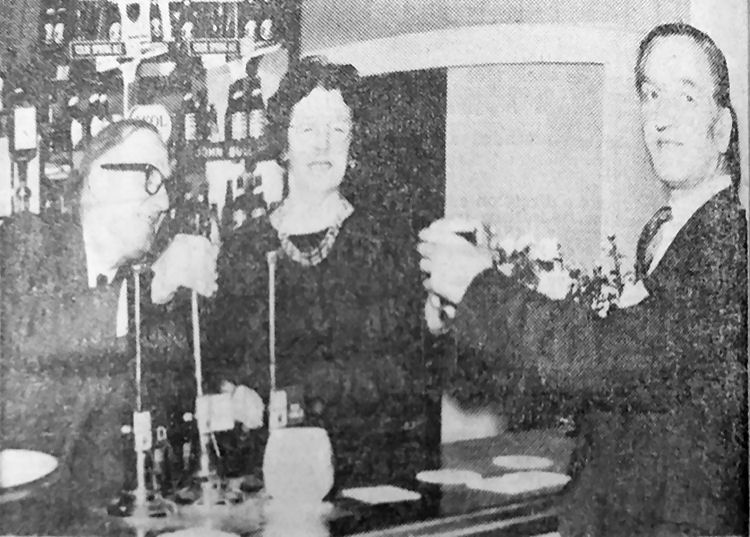
When the reconstructed "Railway Bell," Dover Road, was opened on
Thursday, Mr. Harry Reader, the licensee, pulled the first pint for a
director of Ind Coope Ltd., the landlords, in the centre is mrs. Elsie
Reader. The "Railway Bell" was badly damaged by a hit and run raider's
bomb on October 17th, 1940. The new house is attractive contemporary
style.
|
|
Folkestone Gazette 17 May 1967.
Local News.
Mr. Leonard Barker, of 14, Segrave Road, Folkestone, retired licensed
victualler, who died in March, left £12,491 gross, £12,416 net. Duty
paid was £745. Probate has been granted to his niece, Miss Winifred M.
Barker, of 10 Hurst Avenue, Horsham, and nephew Walter E. J. Barker, of
148, Comptons Lane, Horsham. He left £500 and certain effects to Mrs.
Dorothy M. de Vere, if still in his employ at his death and not under
notice; £50 to Dr. Fritz Ewer, of Greenoaks, Military Road, Sandgate,
“for his kindness and attention to my late wife during her long and
painful illness”; and £25 to the Rev. Gethin-Jones, late of The
Vicarage, Sandgate.
|
|
Folkestone Gazette 19 February 1975.
Obituary.
Mrs. Elsie Reader, landlady of the "Railway Bell" public house in Dover
Road, Folkestone, for almost 30 years, has died, aged 81. Mrs. Reader
was born in Elham, and her husband took over the public house in 1945. A
funeral service at Hawkinge was conducted by the Reverend W. Foster.
|
|
From the Folkestone Gazette, 25 March, 1975.
Local News.
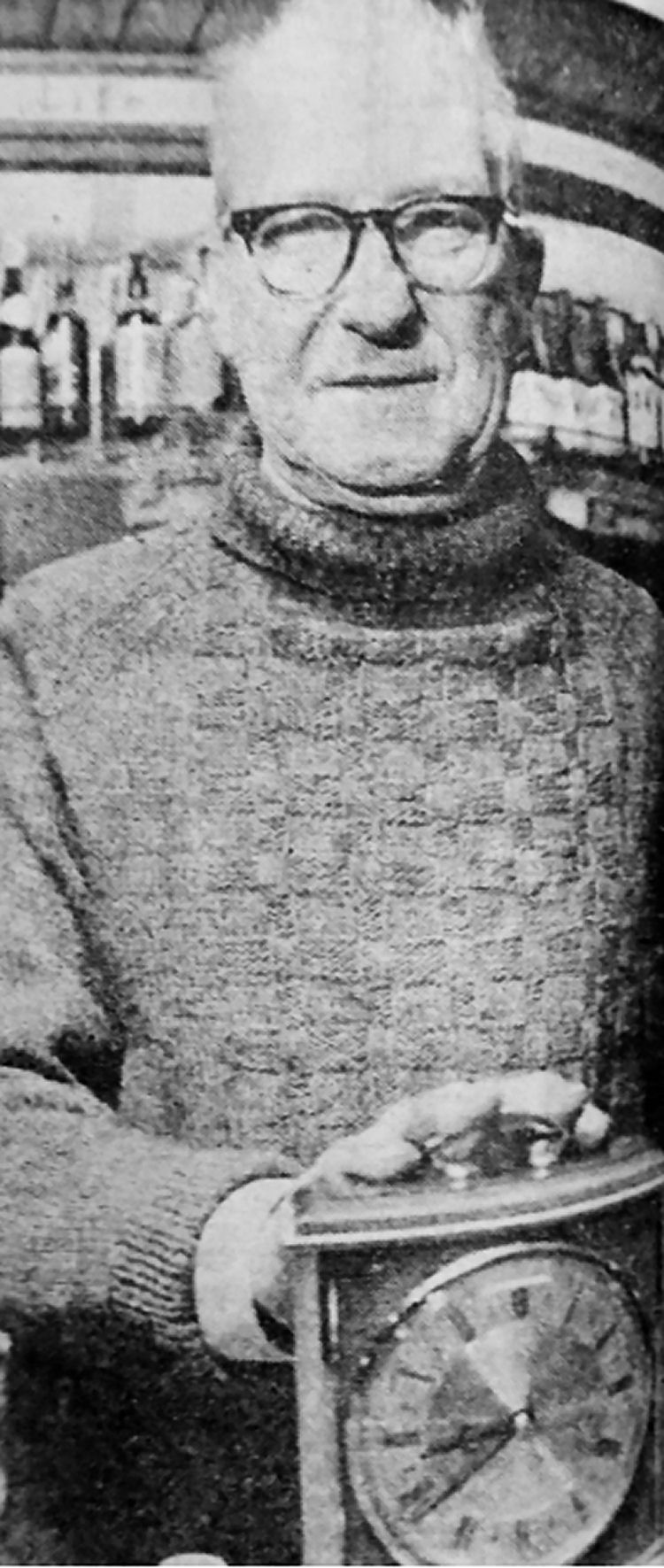
Landlord Harry Reader believes he is the longest serving publican in
Folkestone. He retires soon after having been mine host of the "Railway
Bell," Folkestone, for 30 years. Mr. Reader, aged 67, has been given a
good send-off by his Ind-Coope colleagues. Eight Folkestone publicans
got together and presented Harry with an inscribed clock at a surprise
meeting in the saloon bar of the Railway Bell on Wednesday. When he
moves to a new home at East Cliff, Folkestone, he plans to spend his
time gardening and taking photographs.
|
|
South Kent Gazette 22 November 1978.
Local News.
Empty tankards brought few cheers at four Folkestone pubs when beer kegs
and bottles ran dry. Regulars had to make do with fruit juice and
spirits as a result of a brewery workers' strike at Ind Coope. The
brewery supplies local pubs including the "Black Bull," "Nailbox," Morehall
and "Railway Bell" from its Aylesham depot. After missing three
deliveries, pub supplies dwindled last week to nothing.
One landlord said his trade had been cut by 50 per cent, and another
claimed his darts league and pool players had turned to lemonade and
Coke.
Now customers will be finding what their right arms are for again. The
14 workers at Aylesham agreed to return to work yesterday. A spokesman
for the brewery said the strike by a total of 1,750 production and
distribution employees was over a pay claim. Most of the other workers
agreed to return to work on Monday.
|
|
South Kent Gazette 25 November 1981.
Local News.
Cheers ten times over was the cry when a group of sponsored walkers set
out on a pub crawl to help the Kent Association for the Blind. Ten pubs
were visited, and on Thursday walk organiser, postman Dave Garrod,
handed over a bumper cheque for £1,210 to association deputy secretary
Les Ellis.
Mrs. Olive Hallett, landlady of the "Railway Bell," in Dover Road,
Folkestone, received an award for the most cash raised. Her customers
collected over £350. It was a double night of success for the pub, with
regular Mike Kingston winning an award as the highest individual
money-raiser by raking in £222.
|
|
South Kent Gazette 27 April 1983.
Gravesend Crown Court.
After being struck in the face with a broken bottle by a man in a pub,
Michael Reece needed 25 stitches in his wounds, a court heard.
Sean Coyne, 23, and Mr. Reece were playing pool in the "Railway Bell" in
Dover Road, Folkestone. Trouble broke out as they chalked up their
names, Gravesend Crown Court was told on Tuesday. Before it finished
Coyne had broken an empty bottle and hit Mr. Reece in the face.
Mr. Simon Buckhaven, prosecuting, said that according to Coyne the
incident started when Mr. Reece nudged him. Coyne started a short fight
and another and another brief fight outside the toilets was stopped by
one of the pub's customers. Later Coyne picked up an empty bottle from a
crate, and broke it against a toilet wall. He rushed past the publican
into the bar and struck Mr. Reece in the face with it. Before the two
men were eventually separated there was more fighting. Mr. Reece was
taken to hospital with wounds on his face and neck. Seen by police,
Coyne, who bore some bruises, admitted being involved in fighting, but
at first denied using a bottle. Next day he admitted what had happened,
and said “He was antagonising me. He really got on my back. I have never
been so mad in my life, and I just did it”.
Coyne, of Tyson Road, Folkestone, admitted wounding Mr. Reece on
February 4 last year. His Not Guilty plea to a charge of intending to
cause grievous bodily harm was accepted.
Sentence was postponed for a psychiatric report and Coyne was bound over
until then.
For Coyne, Mr. Elikkos Georghiades said he had been epileptic since
boyhood and showed signs of possible brain damage. Further reports were
necessary before sentence was passed, both in the public interest and
Coyne's own, he submitted.
|
|
Folkestone Herald 9 December 1983.
Local News.
A cheque for more than £1,000 was handed over to the Kent Association
for the Blind on Thursday, thanks to the efforts of local postman David
Garrod and a band of thirsty walkers. The money was raised during a
charity pub crawl organised by Mr. Garrod in August, when 84 people went
on a 10 mile trek from Folkestone to Hythe and back, boozing all the
way. They visited 10 pubs en-route with varying amounts of sponsor
money riding on them.
After handing the cheque to K.A.B. representative Mr. John Crook at the
"Railway Bell" in Dover Road, Folkestone, Mr. Garrod said he was delighted
with the result. It was the third year running that the sponsored crawl,
which has now become an annual event, has raised more than £1,000. He
said he had first held the walk in 1978 when just himself, his wife and
a couple of friends took part. They raised £70, but it started the
postman thinking about the fundraising potential of such an event. Now
he is determined to continue the yearly crawl, but says next year it
will be held in July rather than August to avoid clashing with a number
of other sponsored events which are held in the town.
|
|
Folkestone Herald 23 August 1985.
Local News.
Angry about missing a ferry, Adrian Hall hurled a stool through the
window of a pub, a court heard last Wednesday.
Thirty-year-old Hall was preparing to leave the "Railway Bell" pub in
Dover Road, Folkestone, after having a couple of drinks in the saloon
bar. He picked up his haversack, shouted something, then picked up a
stool and threw it through a side window. Landlord Edward Hallett and
some customers chased Hall, said Jackie Morey, prosecuting at Folkestone
Magistrates’ Court. Mrs. Morey said she understood Hall got into the
back of a lorry and stayed there until the police arrived. After seeing
Hall hiding in the parked lorry, they took him to the police station and
questioned him. Asked why he threw the stool he said it was bad temper
caused by the frustrations of being in the wrong place at the wrong
time. He was then asked if he had missed a ferry or something. He
replied “Yes” and said that he should have been in Germany. Told he
could have hit two elderly women sitting near the window, Hall said he
did not mean to hit anyone, he aimed at the window Mrs. Morey said Hall
had already given Mr Hallett £20 towards the £56.75 cost of repairing
the window.
Hall, who comes from Devon, admitted destroying the window. He was
given a one-year conditional discharge and ordered to pay £36.75
compensation.
|
|
Folkestone Herald 5 June 1987.
Local News.
Regulars of the "Railway Bell" Pub in Dover Road, Folkestone, recently
completed a marathon darts game where the final score totalled
323,000,064. A team of 10 people including licensees Mike and Wendy
Roberts spent an exhausting 12 hours playing, starting at 11 a.m. in the
morning and continuing until 11 p.m. closing time. Around £500 was
raised from the game, and this will be donated to the Les Adams appeal,
an International Charity - which will finance a holiday for handicapped
children.
|
|
Folkestone Herald 28 August 1987.
Local News.
The British Heart Foundation was £200 richer this week thanks to the
efforts of regulars at a Folkestone pub who played pool for 12 hours.
Six regulars at the "Railway Bell," Canterbury Road, were sponsored by
family and friends. The marathon match started at 11 a.m. and ended with
the last orders bell at 11 p.m. that night. Mike Roberts, landlord of
the pub said “It was a good turn out especially as there was lots going
on in Folkestone that same day”. Mike chose the British Heart Foundation
as the charity as his father-in-law suffers from a heart condition. Mike
and his wife Wendy are moving to Scotland at the end of the week so they
can be nearer to him.
|
|
Folkestone Herald 11 March 1988.
Local News.
Red-faced pool player Keith George is still squirming about the day he
stopped the yellow ball from jamming the table. For he got his hand
trapped in the pocket of the pool machine and became the centre of a
full-scale rescue operation while his mates just carried on playing. Pub
regular, Keith, of Westbourne Gardens was trying to stop a yellow ball
that kept getting stuck in the machine, from falling into one of the
holes. But when he put his hand down it got painfully lodged and
wouldn’t come out. Watching the spectacle was a full house at the
"Railway Bell" pub in Dover Road on Saturday. People had packed in to see
the local band Tom and Jerry. Relief manager Sylvia Colboume tried
washing-up liquid but with no success, so the fire brigade was called.
Eventually Keith was cut free and was taken to William Harvey Hospital
for treatment to his hand.
|
|
From the Folkestone Herald 24 June 1988.
Local News.
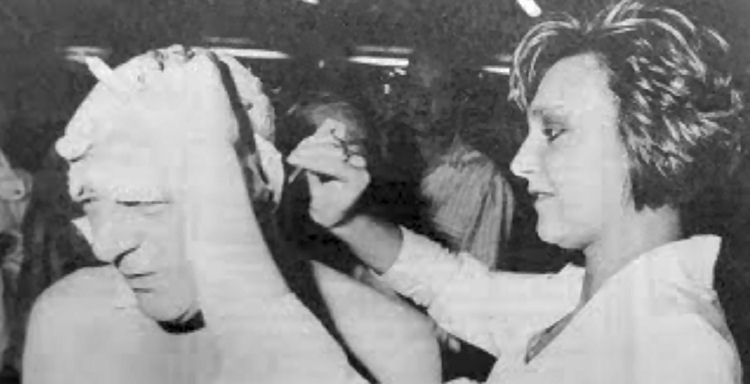
Still smiling after 24 hours of continuous darts, the ladies of the
"Railway Bell" on Dover Road were on double top form last Saturday.
Landlady Susan Bridle and her team of hardy players started their
marathon at 8 p.m. on Friday night. They raised £90 in a raffle, and
hope for another £500 from sponsorship. The hard-earned money is to go
to the William Harvey Hospital baby care unit and to the National
Schizophrenia Fellowship Folkestone Group.
Susan Bridle said “We stayed out of the Telethon fever because we felt
that our efforts would be swallowed up in the masses and would not have
a noticeable local effect. We are hoping to present the money personally
when we have collected it. We were all very pleased with the way the
event went, although we’re a bit stiff now”.
|
|
Folkestone Herald 19 May 1989.
Local News.
Our super readers lost their hair and their dignity to help raise over
£2,000 for the Herald's William Harvey Appeal. The fun began when
students from South Kent College took to the streets in weird and
wonderful outfits for a sponsored walk from Folkestone to Hythe, Over
130 joined in and those who didn't handed over £3 “fines”.
Meanwhile at the "Railway Bell" in Folkestone, landlord George Bridle
organised a fund fun night, with regulars lining up to have their heads
shaved, wrestle with an Alsatian or play one-armed pool. He said “The
ladies with the razors were a bit nervous, and quite a few plasters were
used – but it was all good clean fun”. George himself was one of the
sponsored baldies, and he added “It's a bit cold now, but the best thing
is you can wash your face all over. The only trouble is, I don't know
where to start when I have a shave in the mornings”.
The pub was packed right through to closing time, and new sponsors were
continually found and promises of money soared to more than £1,000.
Organisers also ran a raffle with prizes ranging from French lagers to
Hagar the Horrible T-shirts. George added “The whole evening was one big
party, and the pub was just teeming with people enjoying themselves. But
the most important thing is the amount of money raised. Everyone was
great and we are all over the moon with the cash we collected. Thanks
everyone”.
|
|
Folkestone Herald 20 July 1990.
Local News.
Shepherd Neame has bought four pubs in Shepway from Ind Coope. It was
part of a £5.85 million deal for 33 public houses in Kent, London and
the south east. The pubs taken over in Shepway are: "Britannia Inn," Shorncliffe;
"Harvey Hotel" (sic), Folkestone; the "Nailbox," Shorncliffe;
and the "Princess Royal," Folkestone.
Note: It was Railway Bell and not Harvey Hotel.
|
|
Folkestone Herald 30 October 1992.
Local News.
The manager of a pub has been left baffled by the theft of his sign.
Michael Lowe, who runs the "Railway Bell" in Dover Road, Folkestone,
locked up as usual on Saturday night and put his clocks back. An hour
later his wife thought something outside was missing, and when Mr. Lowe
checked the sign had gone. “God knows where it's gone”, said 46-year-old
Mr. Lowe. “It was 15 feet off the ground and it took two men to get it
up there. It must have been well planned. Whoever took it had to get a
ladder, unbolt it and lower it down. If it had just blown down in the
high wind and someone had picked it up it would have hit one of the cars
parked nearby first. But nothing was heard or seen by anyone. It's a
complete mystery why anyone would want it, unless they're a connoisseur
or railway freak”.
The 4ft x 3ft. Sign, which Mr. Lowe said was worth £250, was
hand-painted by an artist and had only been up for two months. It
depicts a steam engine, the "Railway Bell," on a red background.
|
|
From an email received 17 November 2022.
I have an old tin pint with
the inscription E. King Railway Bell Folkstone. Do you perhaps know if
this E. King owned the pub?
Regards,
Dirk Houtepen.
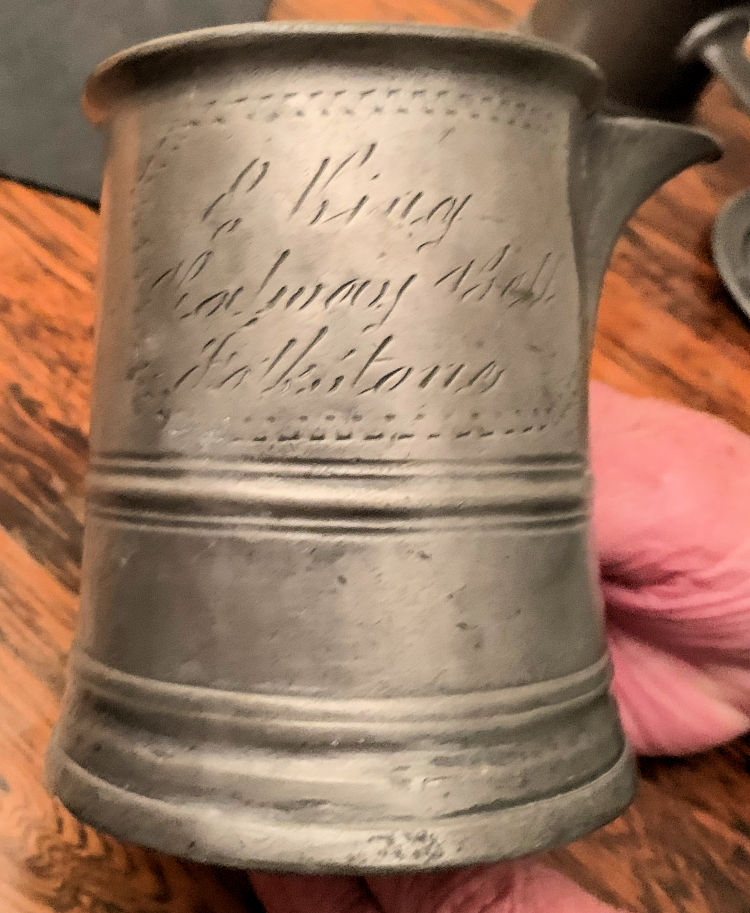
The name E. King certainly doesn't show up as a licensee, so I
suggest he may have been one of the regulars that had his own tankard. |
Shepherd Neame took charge of the house on 11th July 2002, but decided to
close the place some time around 2008. It is now boarded up if not
demolished. Local knowledge would be appreciated here, for me to be able to
update the page.
Latest news I have been informed about is the premises is now (November 2012)
operating as a Tesco Express.
LICENSEE LIST
HAYTOR C, WORMSTER G, & DRUMMOND J 1863-65

MORET Joseph 2/Jan/1865-68

WILLOWS John 1868-69
FLUX Robert 1871-74 (age 50 in 1871 ) )

HEAVENS Frederick 1874
MAJOR
Mr ???? 1874
ANGELL James 1874-75
NAVE
Theodore 1875-79
PHILLIPS
George 1879-80
CHARLTON Henry 1880-83 (age 57 in 1881)
 
PILCHER Richard 1883-86
 COLLINS George 1886-95


SMILES Joseph George 1895-1901+
(age 42 in 1901)

TUNBRIDGE James 1901-05
 
SAUNDERS Joseph Sidney 1905-11
HOARE George 1911-22
 
CLARKE John 1922-23
BEANE
Francis 1923-24
BROWN Joseph 1924-28
LEIGH
Albert 1928-29
RICHARDSON Peter C 1929-35+

GUMBRELL George 1935-42

GUMBRILL Maude 1942
BARKER Leonard 1944-45
(Also "Prince Albert")
READER Horace "Harry" 1945-75
HALLETT Edward 1975-86
GILL Patrick 1986
PARISH
Paul & BEEDON Arthur 1986-87
Arthur Beedon Also Black Bull
1985-87
ROBERTS
Michael & BEEDON Arthur 1987
BRINDLE
George & CLARK Edward 1987-1990
Also Black Bull 1987-90
BRINDLE
George & BLYTH Simon 1990-91
Simon Blyth Also Black Bull 1990-94
PEEKS
Allen & LOWE Michael 1991-93
Allen Peeks Also Master Brewer
RUDYARD
John & Malcolm 1993
John Rudyard To Master Brewer
COLE
Rodney & Lynn 1993-96
LYNES
Derek & Angela 1996-97
BETTS
Steve 1997
TUNNEY
Francis & Bridget 1997-2002
HAWARD
Steven & Christine 2002-03
GALLAGHER
Anthony & HAYWARD Stacey 2003-04+
http://www.closedpubs.co.uk/railwaybell.html
From the Post Office Directory 1874
From the Post Office Directory 1882
From the Post Office Directory 1891
From the Kelly's Directory 1899
From the Post Office Directory 1903
From the Kelly's Directory 1903
From the Post Office Directory 1913
From the Post Office Directory 1922
From the Kelly's Directory 1934
From the Post Office Directory 1938
More Tales from the Tap Room by Easdown and Rooney
From the Dover Express
From More Bastions of the Bar by Easdown and Rooney
Census
|

