|
28 South Street
Folkestone
https://whatpub.com/princess-royal
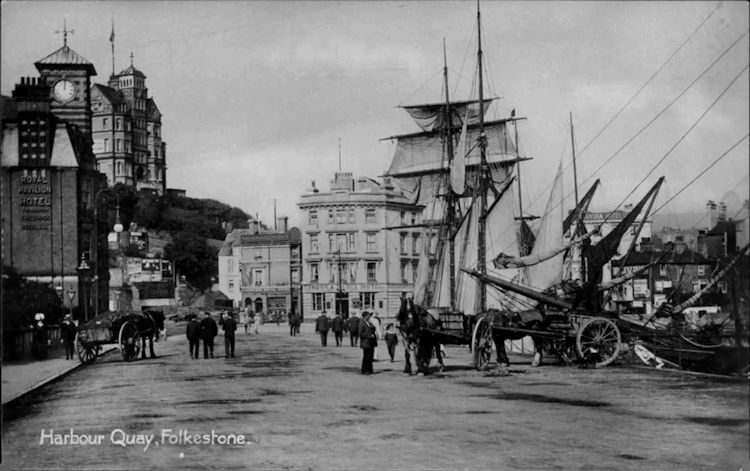
Above postcard, circa 1903, kindly sent by Rory Kehoe. Panoramic view,
which also takes in (from L to R) the "Royal
Pavilion Hotel," the "Princess
Royal Hotel" (in the livery of Nalder & Collyer's Croydon Brewery)
the "London and Paris Hotel"
and just visible behind the ships, the upper part of the "Alexandra
Hotel." |
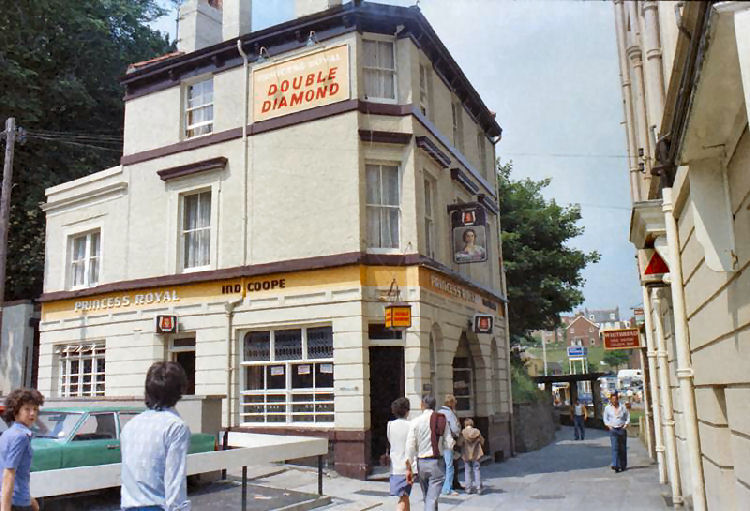
Above photograph kindly supplied by Jan Pedersen, 1978. |

Above photo, 17 October 1989, by Jim Ashby. |
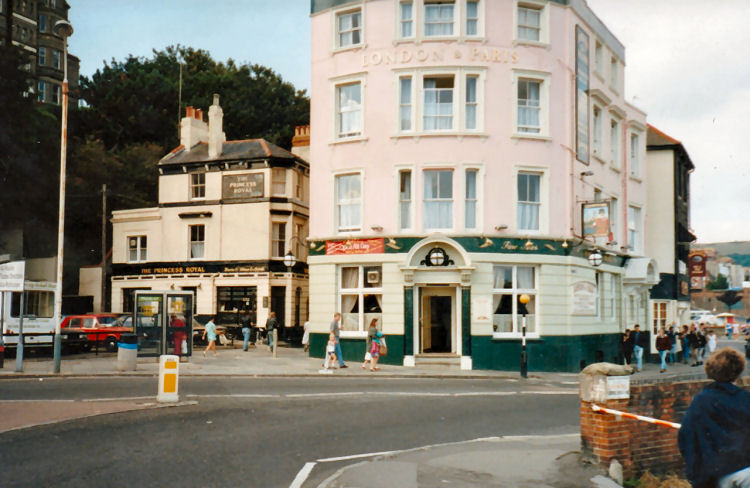
Above photo, circa 1990, kindly sent by Philip Dymott. Also showing the
"London and Paris." |
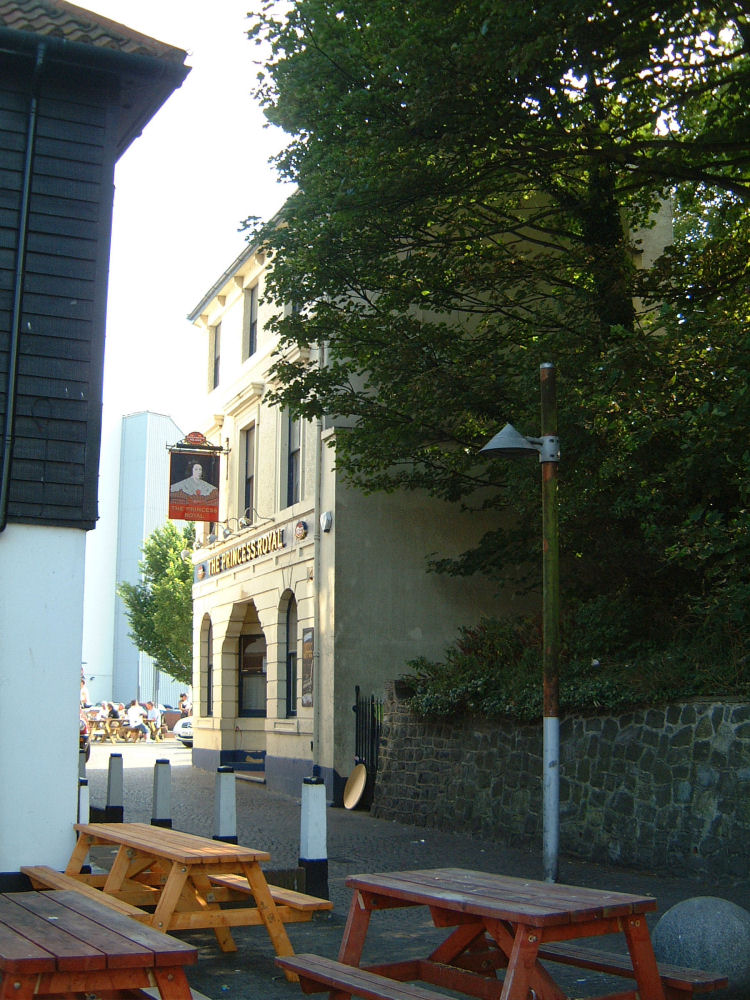
Photo by Paul Skelton, 27 June 2009. |
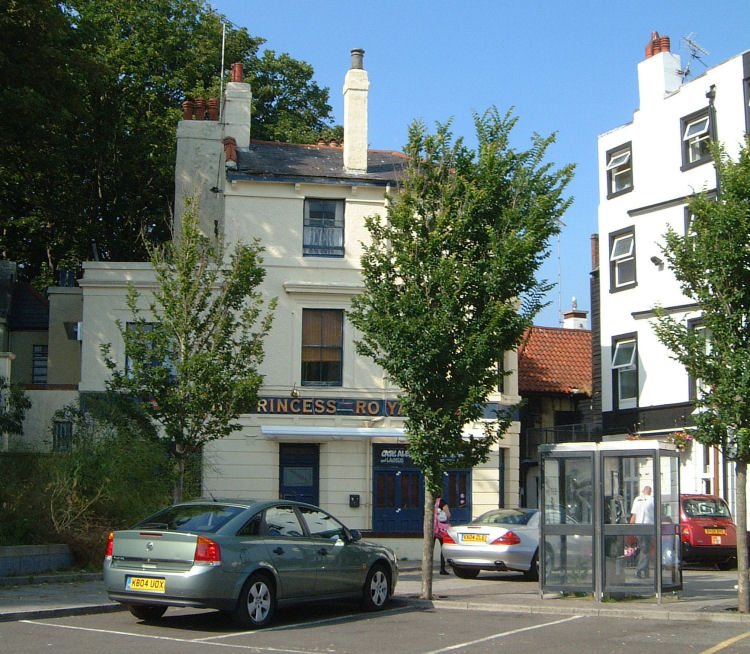
Photo by Paul Skelton, 27 June 2009. |
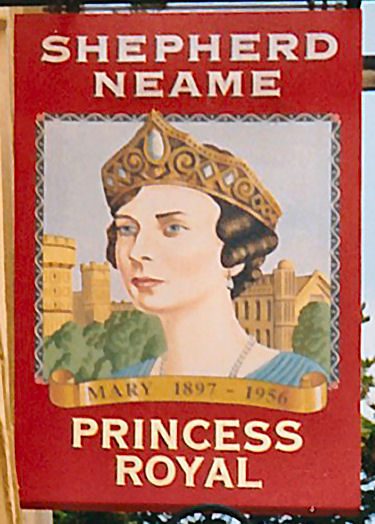 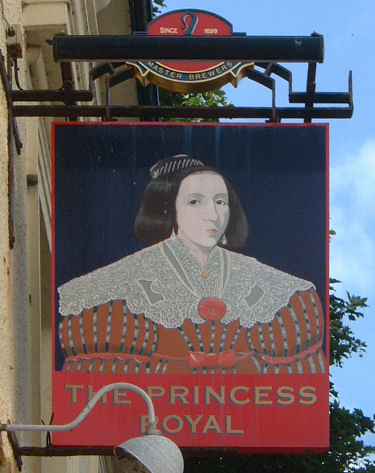
Princess Royal sign left, August 1992, thanks from Brian Curtis
www.innsignsociety.com. sign right and above by Paul Skelton, 27
June 2009.
|
 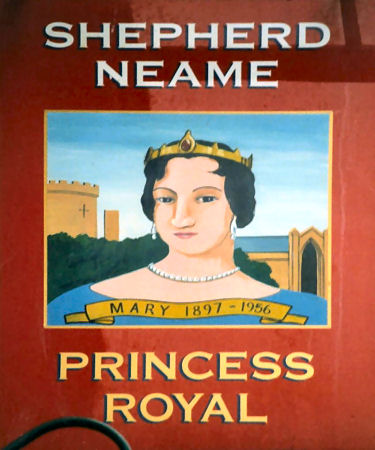
Above sign left, 1990, sign right, 2000.
With thanks from Brian Curtis
www.innsignsociety.com.
|
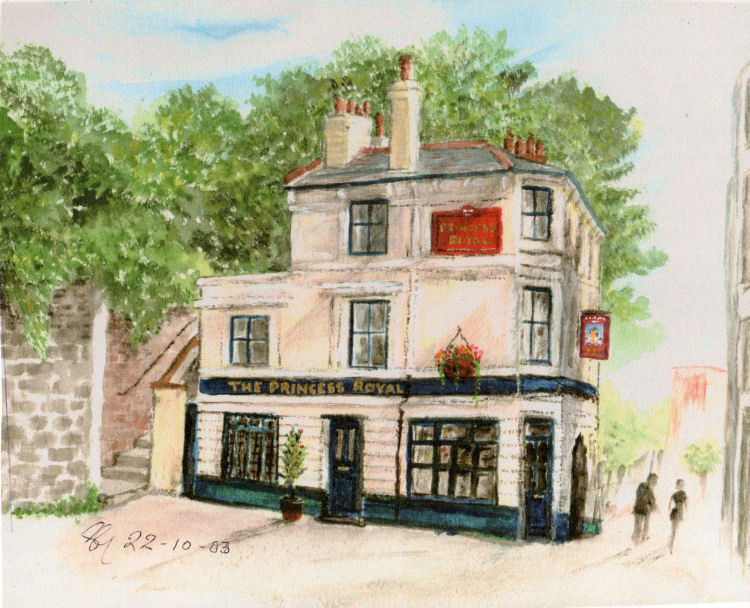
Above watercolour 2003 by Stuart Gresswell, once licensee of "Guildhall"
and "Raglan" kindly sent by Jan
Pedersen. |
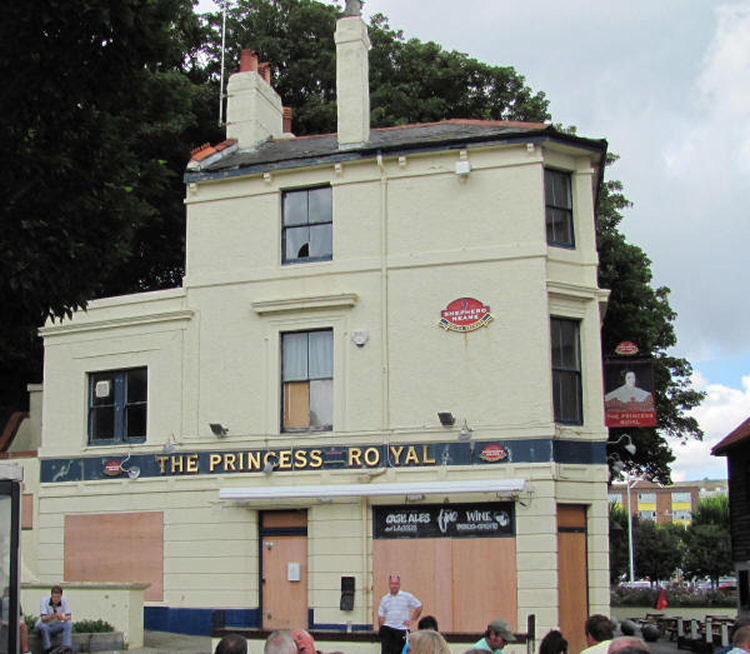
Picture taken from
http://deadpubs.co.uk
Photo by Roy Bennett.
|
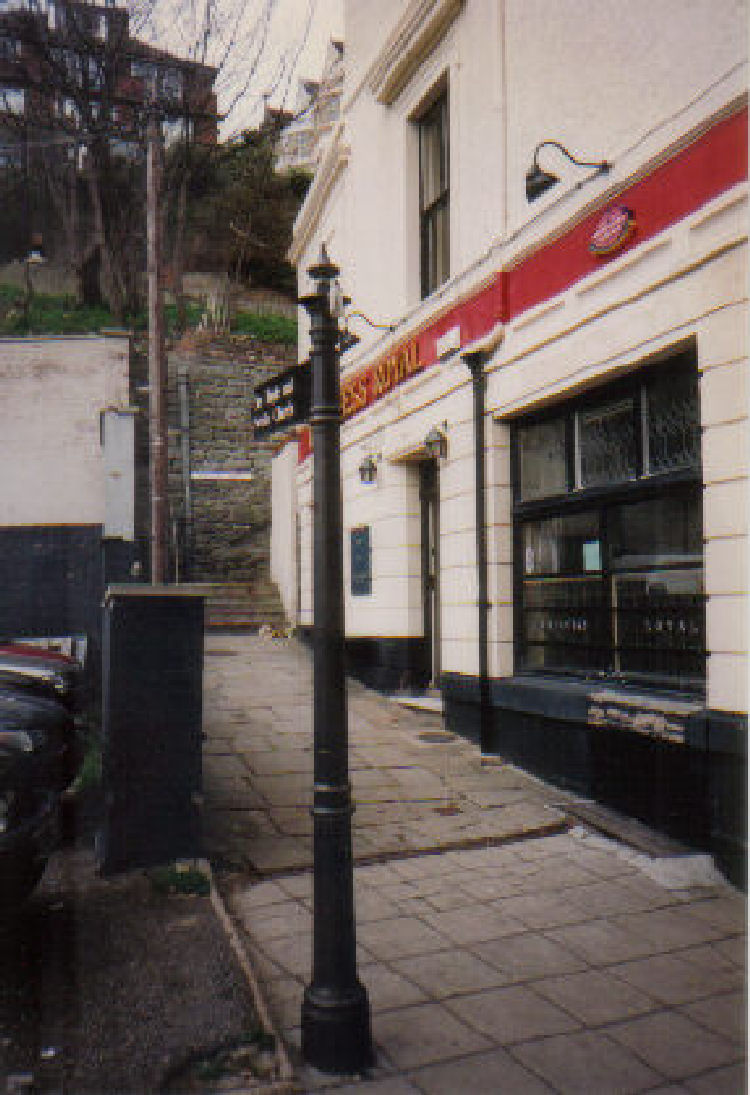
Above photo kindly supplied by Patricia Streater, April 1996. |
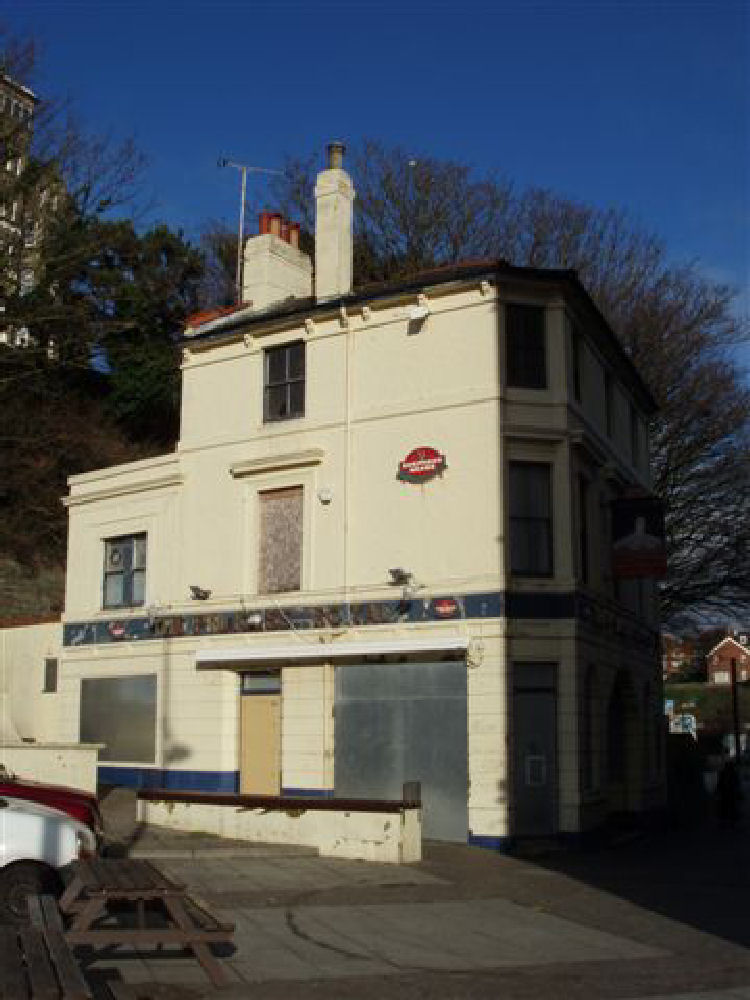
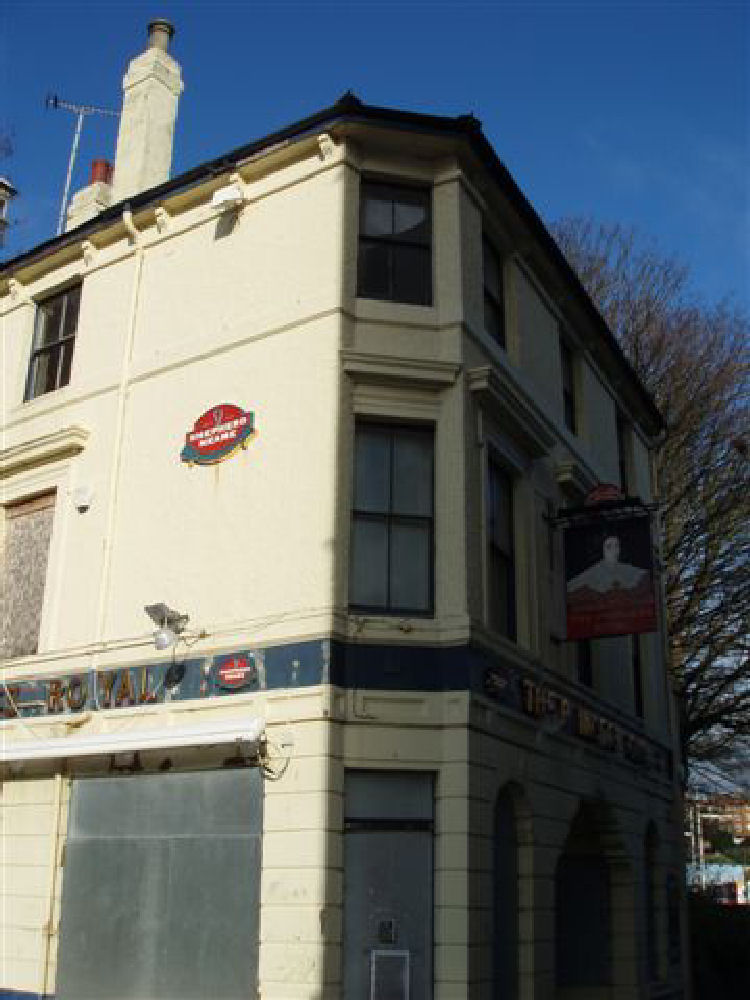
Above photos kindly sent by Phil Nicholson, 29 November, 2012. |
Originally called the "Engine Inn"
but changed name in 1856. Situated at the lower end of Parade Steps.
It was the title given to the eldest child of Victoria and Albert; she
later married a Prussian prince and was mother to the hated Kaiser Bill of
World War One.
Information received December 2010 tells me the pub is closed and boarded
up. It seems this is another pub that Shepherd Neame has found superfluous
to requirements.
It must have opened again after this as I have seen mention of it closing
in 2015.
I am informed by Jan Pedersen in November 2017 that the building is
likely to be demolished. A structural survey revealed that the building was
found to have dry and wet rot on all floors, which included the joinery,
collapsed rain water drains and asbestos. However as of November 2019 the
building still stands.
|
Folkestone Chronicle 20 September 1856.
Tuesday September 16th. Present – The Mayor, W. Major, W. Bateman, S.
Mackie and J. Kelcey Esqs.
William Whiting, landlord of the Princess Royal (late the Engine Inn)
appeared to answer an information, charging him with keeping his house
open during the hours of divine service on Sunday last.
Police constable Nicholls proved he found several persons drinking in
his house about noon on Sunday last. The house was usually well
conducted, and there was no noise or disturbances on that morning.
Defendant pleaded that his was a house for travellers, that he had 10
lodgers, and that he could not control the persons who might frequent
it.
The Mayor said he was glad to find the police give such a good account
of the general conduct of the defendant; he should therefore mitigate
the fine to 1s and costs to 8s 6d.
|
|
Southeastern Gazette 23 September 1856.
Petty Sessions: Before The Mayor, W. Major, W. Bateman, S. Mackie, and
J. Kelcey, Esqs.
William Whiting, landlord of the Princess Royal (late Engine Inn,)
appeared to answer the complaint of Superintendent Steer for keeping his
house open for the sale of beer during divine service on Sunday last.
Samuel Nichols, police constable, proved to finding 7 persons jn the
defendant’s house at half-past 12 o’clock; there was three or four
lodgers and strangers, and beer on the table in a glass. The men were
very quiet.
Defendant, said that several travellers had come in from Dover and had
refreshments; they had some beer and left it in a glass; he served no
other persons; a man named Tyas brought them in. He had kept a house for
many years, and had never been complained of before.
In answer to a question from Mr. Bateman Superintendent Steer said the
house was well conducted.
Fined 1s., costs 8s. 6d.
|
|
Folkestone Chronicle 5 September 1857.
Local News.
On Tuesday night, about 12 o'clock, a fire suddenly broke out in a
cellar of the public house known as the Princess Royal, in South Street,
greatly to the alarm of the inmates and the surrounding inhabitants. The
engines quickly arrived at the spot, but there being no water in the
harbour, and the Water Company's mains turned off, they would have been
useless, and the whole street might have been burned down, had it not
been for the exertions of the coastguard and Mr. Boult, the landlord of
the adjoining house, from whose premises all the water required was
obtained, and the fire speedily extinguished.
|
|
Southeastern Gazette 8 September 1857.
Friday: Before The Mayor, G. Kunnicott, J. Kelsey, and W. Major, Esqs.
William Whiting, publican, was charged with assaulting Michael Curtis
Clark, bailiff to Mr. John Banks.
It appeared that Mr. Banks, on the 27th August (under a bill of sale,)
put a bailiff named Punnett in defendant’s house, and on the Sunday
following the bill was stolen from Punnett’s pocket. Mr. Banks then
withdrew Punnett, and put the complainant (Clark) in possession, who
continued so until Wednesday last, when defendant asked him to produce
his authority He produced the draft of the bill of sale, the original
having been stolen from Punnett. Defendant then told him that he had no
authority to be there without the original bill of sale, and very
roughly pushed him out of the house.
Fined £5 for the assault, or two months’ imprisonment.
|
|
Kent Herald 10 September 1857
Petty Sessions, Friday: Before R.W. Boarer Esq., Mayor, G. Kennicott, J. Kelsey,
and W. Major, Esqs.
William Whiting, publican, was charged with assaulting Michael Curtis Clark,
bailiff to Mr. John Banks.
It appeared that Mr. Banks, on the 27th August (under a bill of sale,) put a
bailiff named Punnett in defendant’s house, and on the Sunday following the bill
was stolen from Punnett’s pocket. Mr. Banks then withdrew Punnett, and put the
complainant (Clark) in possession, who continued so until Wednesday last, when
defendant asked him to produce his authority. He produced the draft of the bill
of sale, the original having been stolen from Punnett. Defendant then told him
that he had no authority to be there without the original bill of sale, and very
roughly pushed him out of the house.
Fined £5 for the assault, or two months’ imprisonment.
|
|
Dover Chronicle 12 September 1857.
Petty Sessions: Before R.W. Boarer Esq., Mayor, G. Kennicott, J.
Kelcey and W. Major Esqs.
William Whiting, publican, was charged with assaulting Michael
Curtis Clark, bailiff to Mr. John Banks.
It appeared that Mr. Banks, on the 27th August, (under a bill of
sale,) put a bailiff named Punnett in defendant's house, and on the
Sunday following the bill was stolen from Punnett's pocket. Mr.
Banks then withdrew Punnett, and put the complainant (Clark) in
possession, who continued so until Wednesday last, when defendant
asked him to produce his authority; he produced the draft of the
bill of sale, the original having been stolen from Punnett;
defendant then told him he had no authority to be there without the
original bill of sale, and very roughly pushed him out of the house.
Fined £5 for the assault, or two months' imprisonment.
|
|
Folkestone Chronicle 19 September 1857.
Petty Sessions, Wednesday, Sept 16: Before R.W. Boarer, James
Tolputt and Gilbert Kennicott Esqs.
William Whiting, of the "Princess Royal," was fined £1 and costs, for
keeping his house open for the sale of beer during the hours of
Divine Service on Sunday morning last.
|
|
From the Kentish Gazette, 22 September 1857.
POLICE COURT. Wednesday.
Before R. W. Boarer. Esq., James Tollputt, Esq., and Gilbert
Kennicott, Esq.
William Green, was fined 10s. and costs, for allowing a ferocious
dog to be at large.
William Whiting, of the "Princess Royal," was fined £1 and costs,
for keeping his house open for the sale of beer during the hours of
divine service on Sunday morning last.
|
|
Kent Herald 24 September 1857
Police Court: Before R. W. Boarer. Esq., James Tollputt, Esq., and Gilbert
Kennicott, Esq.
William Whiting, of the Princess Royal, was fined £1 and costs, for keeping his
house open for the sale of beer during the hours of divine service on Sunday
morning last.
|
|
Folkestone Chronicle 7 November 1857.
Wednesday November 4th: - Before G. Kennicott and J. Kelcey Esqs.
William Tumber was fined 5s and costs for having his house, the Princess
Royal, South Street, open before 1 o'clock on Sunday last.
|
|
Southeastern Gazette 10 November 1857.
Local News.
Wednesday: Before G. Kennicott and J. Kelcey Esqs.
William Tumber, of the Princess Royal, was charged with having his house
open for the sale of beer at half-past one o’clock on the morning of
Sunday last.
Fined 5s. and costs.
|
|
Kent Herald 12 November 1857
Petty Sessions: Before G. Kennicott and J. Kelcey Esqs.
William Tumber, of the Princess Royal, was charged with having his house open
for the sale of beer at half-past one o’clock on the morning of Sunday last.
Fined 5s. and costs.
|
|
Southeastern Gazette 2 March 1858.
Local News.
At the Petty Sessions, before R. W. Boarer, Esq., Mayor, and Wm. Major,
Esq., Ann Mercer was charged with stealing a shawl and a petticoat, the
property of her sister Sarah, who resides with her mother, at the
Princess Royal, South Street. It appeared that the prisoner was in the
habit of robbing her sister whenever she came home, after being absent
for months; the last time her sister returned prisoner went upstairs and
took the above articles, and when found by police constable Ingram Swain
she was wearing them, and was in company of two soldiers at Sandgate.
Having been several times convicted and pleading guilty, she was
sentenced to two months’ hard labour in Dover gaol.
|
|
Folkestone Chronicle 29 May 1858.
Thursday May 27th:- Before R.W. Boarer and James Kelcey Esqs.
Ann Mercer, Elizabeth Howitt, Edward Young, and George Gallop were
brought up on remand, charged with being concerned in stealing a purse
containing 16s. and other monies, also a silver watch, gold seal and
key, value £2, the property of Robert Anash, master of the Deal lugger,
the Isabella. It appeared that the prosecutor came ashore in the
morning, and took lodgings at the Princess Royal public house in South
Street; that getting very drunk towards evening, he retired to be about
9 o'clock, having his watch with him, and some money, the landlord
having previously changed a sovereign for him. No evidence being adduced
agains the three last named prisoners, who were sleeping in the same
room with prosecutor, they were acquitted, and the other prisoner, Ann
Mercer, a prostitute, was put on her trial. It seemed that prisoner went
to prosecutor's room early in the morning, and rousing him asked him to
give her some beer, - or some money to get some. He refused, and on
getting up in the morning he missed his watch and money. The police were
called in, and the prisoners and room searched, but no trace of the
stolen property being discovered, or sufficient evidence to incriminate
the prisoner Mercer, she was discharged.
|
|
Kentish Gazette 1 June 1858.
At the Police Court on Thursday, before R. W. Bower and James
Kelcey, Esqrs., Ann Mercer, Elizabeth Howitt, Edward Young, and
George Gallup were brought up on remand, charged with being
concerned in stealing a purse containing 16s. and other monies, also
a silver watch, gold seal, and key, value £2, the property of Robert
Amish, master of the Deal lugger, the Isabella. It appeared that the
prosecutor came ashore in the morning, and took lodgings at the
"Princess Royal" public house in South Street; that getting very
drunk towards evening, he retired to bed about nine o'clock, having
his watch with him and some money, the landlord having previously
changed a sovereign for him. No evidence being adduced against the
three last-named prisoners, who were sleeping in the same room with
prosecutor, they were acquitted, and the other prisoner, Ann Mercer,
a prostitute, was put upon her trial. It seemed that prisoner went
to prosecutor's room early in the morning, and rousing him asked him
to give her some beer, or some money to get some. He refused, and on
getting up in the morning he missed his watch and money. The police
were called in, and the prisoners and room were searched, but no
trace of the stolen property being discovered, or sufficient
evidence to criminate the prisoner Mercer, she was discharged.
|
|
Folkestone Chronicle 2 October 1858.
Wednesday September 29th:- Before the Mayor, G. Kennicott and W. Major
esqs.
This being the adjourned licensing day the following licence was
transferred: The Princess Royal, South Street, from William Tumber to
Edward Sturges.
|
|
Southeastern Gazette 5 October 1858.
Victuallers’ Licenses.
At the sitting of the magistrates on Wednesday, the following licence
was transferred: The Princess Royal, South Street, from William Tumber
to Edward Sturges.
|
|
Kent Herald 7 October 1858
Petty Sessions: At the meeting of the magistrates on Wednesday, the following
licenses were transferred:
The "Princess Royal," South Street, from William Tumber to Edward Sturges.
|
|
Dover Chronicle 27 November 1858
Petty Sessions, Friday, Nov 19th: Before R.W. Boarer and W. Major
Esqs.
Philip Wellington Sings was charged with assaulting George Sturges,
the landlord of the Princess Royal, on the previous evening. Fined
20s. and costs.
|
|
Southeastern Gazette 18 February 1862.
Inquest.
An inquest was held at the Princess Royal Inn, South Street, Folkestone,
on Thursday last, before John Minter, Esq., coroner, on the body of
Norris Stokes, a hawker of poultry.
It appeared that the deceased had become low spirited from adverse
circumstances; his wife was in a lunatic asylum and his children
starving; his goods had been seized and sold for rent, and his children
were afterwards sent to the union. He engaged a bed at the above place,
and after having smoked a pipe he told the landlord not to call him till
12, as he meant to have a good night’s rest, not having had one lately.
In the morning he was found hanging to the bed-post, quite dead, and
there was a large knife on the bed near him.
Verdict, “Temporary insanity.”
|
|
Kentish Gazette 18 February 1862.
Norris Stokes, a hawker of poultry and game, hung himself in a
bedroom at the Princess Royal public house on Tuesday night The
deceased had not lodged at the Princess Royal before. It appears
that the conduct of the deceased has been somewhat strange lately.
Some time ago he and his brother were proceeding in a cart to Dover,
and the brother drove over the cliff. Since that accident the
deceased has not appeared to be in his right mind.
|
|
Kentish Gazette 18 February 1862
Norris Stokes, a hawker of poultry and game, hung himself in a
bedroom at the "Princess Royal" public house on Tuesday night The
deceased had not lodged at the "Princess Royal" before. It appears
that the conduct of the deceased has been somewhat strange lately.
Some time ago he and his brother were proceeding in a cart to Dover,
and the brother drove over the cliff. Since that accident the
deceased has not appeared to be in his right mind.
|
|
Maidstone Journal 18 February 1862.
An inquest was held on Thursday last at the Harbour Inn, Folkestone,
before John Minter Esq., borough coroner, on the body of Norris
Stokes, a hawker of poultry and game, who had committed suicide on
the previous day by hanging himself to a bad-post. Filmer Tyas
stated that he was a labourer in the employ of Mr. Pilcher, and that
he lodged at the Princess Royal public house. On the Tuesday evening
previous, deceased came to the house about September o'clock and
called for a pint of beer, which he sat and drank and smoked his
pipe. About an hour afterwards he went to bed, and witness saw no
more of him until about 12 the next day, when the landlady enquired
if he had seen deceased go out, and asked him to go upstairs and
see. Witness went up, and on opening the bedroom door, saw deceased
hanging to the bed-post. His feet were touching the skirting board,
and his knees were doubled under him, but he did not touch the
ground. He was quite dead. A knife recently sharpened was found in
his pocket. Other evidence was given to show that the deceased had
appeared depressed lately, and it also appeared that his brother had
once attempted to commit suicide. A verdict of “Temporary Insanity”
was returned.
|
|
Kent Herald 20 February 1862
An inquest was held on Thursday last, Feb. 13th, at the
Harbour Inn,
Folkestone, before the new coroner, John Minter Esq., on the body of Norris
Stokes, a hawker of poultry and game, who had committed suicide on the previous
day by hanging himself to a bed post.
The jury proceeded to view the body, which was lying at the Princess Royal
public house.
Evidence having been given, P.C. Woodland, sworn, said – On Wednesday about half
past twelve, from information received, I went to the Princess Royal, South
Street. I went up to the top room in the house. I saw the deceased hanging by a
piece of cord (produced) to the bedstead by a running noose – the knot under his
left ear; his knees were doubled under him but did not touch the ground. I cut
him down – he was quite dead. I searched his clothes and found a key and a
dinner knife recently sharpened. I have known deceased fifteen years. I remember
his brother Jesse, fourteen years ago, attempting to hang himself in a barn.
Deceased has appeared to be very strange for some time past. An accident
happened to deceased and his brother some time ago; his brother, driving a cart
from Dover, drove over the cliff, since which time deceased has not appeared
right in his mind. Verdict, “Temporary Insanity”.
|
|
From the Folkestone Chronicle 21 February, 1862.
CORONER'S INQUEST
An inquest was held on Thursday last, February 12th, at the "Harbour
Inn," Folkestone, before the new coroner, John Minter Esq., on the
body of Norris Stokes, a hawker of poultry and game, who had committed
suicide on the previous day by hanging himself to a bed post.
The jury, with Mr. H.T. Hale as their foreman, having been sworn,
they proceeded to view the body, which was lying at the "Princess Royal"
public house.
On their return the first witness called was Filmer Tyas, who being
sworn, stated that he was a labourer, in the employ of Mr. Pilcher, and
that he lodged at the "Princess Royal" public house. He knew the
deceased, and he believed him to be about 42 years of age. On the
Tuesday previous, deceased came to the house about 9.15. He came into
the taproom and called for a pint of beer, which he sat and drank, and
smoked his pipe. About 9.30 witness got up and went out, and did not
return until between 11 and 12. Deceased had then gone to bed, and
witness saw no more of him until about 12 the next day, when the
landlady enquired if he had seen deceased go out, and asked him to go
upstairs and see. Witness went up, and on opening the bedroom door, saw
deceased hanging to the bed post. He appeared to be on his knees, with
his face towards the door. He had seemed to be in a depressed state of
mind for some time past.
Mary Hobden, being sworn, said – I am the wife of John Hobden,
landlord of the "Princess Royal" public house. On Tuesday night, about 9
o'clock, deceased came to our house and asked for a bed. He had
frequently been to the house, but never slept there before. My husband
told him he could have a bed; he asked how much. On being told 6d., he
asked if it was a good bed, and if there were any other beds in the
room. He then went out, but returned in 10 minutes, and called for a
pint of porter. He sat for an hour smoking his pipe. I sat by his side
at work. He then paid his 6d., and I went upstairs with him with a
candle to show him in his room. I drew the curtains, and on looking
round, I saw the deceased was laughing, and he said he did not like
anyone else to be in his bedroom. We heard a slight noise in the night,
but it appeared like someone at the front door. I asked Tyas in the
morning if he had seen deceased go out. On his coming downstairs, and
saying the man was dead, my husband sent for a policeman.
P.C. Woodland, sworn, said – On Wednesday about half past twelve,
from information received, I went to the "Princess Royal," South Street.
I went up to the top room in the house. I saw the deceased hanging by a
piece of cord (produced) to the bedstead by a running noose – the knot
under his left ear; his feet were touching the skirting board; his knees
were doubled under him but did not touch the ground. I cut him down – he
was quite dead. I searched his clothes and found a key and a dinner
knife recently sharpened. I have known deceased fifteen years. I
remember his brother Jesse, fourteen years ago, attempting to hang
himself in a barn. Deceased has appeared to be very strange for some
time past. An accident happened to deceased and his brother some time
ago; his brother, driving a cart from Dover, drove over the cliff, since
which time deceased has not appeared right in his mind.
Verdict, “Temporary Insanity”.
|
|
Canterbury Weekly Journal 22 February 1862.
An inquest was held at the Princess Royal Inn, South Street,
Folkestone, on Thursday last, before John Minter Esq., coroner, on
the body of Norris Stokes, a hawker of poultry. It appeared that the
deceased had become low-spirited from adverse circumstances; his
wife was in a lunatic asylum and his children starving; his goods
had been seized and sold for rent, and his children were afterwards
sent to the Union. He engaged a bed at the above place, and after
having smoked a pipe he told the landlord not to call him before 12,
as he meant to have a good night's rest, not having had one lately.
In the morning he was found hanging to the bed-post, quite dead, and
there was a large knife on the bed near him. Verdict “Temporary
Insanity.”
|
|
Kentish Independent 22 February 1862.
An inquest was held on Thursday last at the Harbour Inn, Folkestone,
before John Minter Esq., borough coroner, on the body of Norris
Stokes, a hawker of poultry and game, who had committed suicide on
the previous day by hanging himself to a bad-post. Filmer Tyas
stated that he was a labourer in the employ of Mr. Pilcher, and that
he lodged at the Princess Royal public house. On the Tuesday evening
previous, deceased came to the house about nine o'clock and called
for a pint of beer, which he sat and drank and smoked his pipe.
About an hour afterwards he went to bed, and witness saw no more of
him until about twelve the next day, when the landlady enquired if
he had seen deceased go out, and asked him to go upstairs and see.
Witness went up, and on opening the bedroom door, saw deceased
hanging to a bed-post. His feet were touching the skirting board,
and his knees were doubled under him, but he did not touch the
ground. A knife recently sharpened was found in his pocket. Other
evidence was given to show that the deceased had appeared depressed
lately, and it also appeared that his brother had once attempted to
commit suicide. A verdict of “Temporary Insanity” was returned.
|
|
Kentish Mercury 22 February 1862.
An inquest was held at the Princess Royal Inn, South Street,
Folkestone, on Thursday last, before John Minter Esq., coroner, on
the body of Norris Stokes, a hawker of poultry. It appeared that the
deceased had become low-spirited from adverse circumstances; his
wife was in a lunatic asylum and his children starving; his goods
had been seized and sold for rent, and his children were afterwards
sent to the Union. He engaged a bed at the above place, and after
having smoked a pipe he told the landlord not to call him till 12,
as he meant to have a good night's rest, not having had one lately.
In the morning he was found hanging to the bed-post, quite dead, and
there was a large knife on the bed near him. Verdict “Temporary
Insanity.”
|
|
Folkestone Chronicle 11 October 1862.
Friday October 10th:- Before W.F. Browell and W. Wightwick Esqs.
John Hobden appeared on a summons, charged that on 1st October he
allowed certain improper and disorderly persons to assemble in his ale
house and victualling house.
Mr. Minter appeared for defendant.
Police constable Reynolds deposed that defendant was landlord of the
Princess Royal Inn, South Street. On Wednesday night, the 1st October,
witness went on duty in South Street a little before 12 o'clock; in the
bar parlour he saw two prostitutes sitting down with a sergeant of the
25th Regiment; in the tap room, another prostitute was sitting down,
each having drink before them; there was no noise. Witness told the
landlady he should report the circumstance; at a quarter past 12,
witness visited the house again, and found that two prostitutes were
still there. Witness had cautioned the landlady about a month ago about
one of the girls, named Ann Mercer. This was the case.
Mr. Browell said he did not think they would have to trouble Mr. Minter.
Mr. Browell, in summing up, said there was not sufficient to warrant a
conviction, but enough for a caution. The summons must be dismissed.
|
|
Kent Herald 16 October 1862
Petty Sessions: John Hobden appeared on a summons, charged that on the 1st of
October he allowed certain improper and disorderly persons to assemble in his
ale and victualling house.
Mr. Browell said there was not sufficient to warrant a conviction, but enough
for a caution. The summons must be dismissed.
|
|
From the Folkestone Chronicle 15 November, 1862.
COUNTY COURT
Thursday November 13th.
Hollidge v Henry Gibbs – This was an action of ejectment brought
against defendant, a brewer at Stourmouth, to recover possession of the
premises known as the "Princess Royal," South Street. Mr. Drummond, of
Croydon, appeared for plaintiff; Mr. Minter for defendant.
From the opening of Mr. Drummond, corroborated by evidence, it
appeared that notice to quit was served on defendant by Messrs. Brockman
and Harrison, the notice expiring at Michaelmas last, but defendant held
on; grounded his right of possession on an alleged verbal agreement with
a Mrs. Webb, since deceased, the previous owner of the property, the
tenancy by this agreement commencing on January 6th,1859; and therefore
the notice to quit not being equal, a good deal of conflicting evidence
on both sides was given, and His Honour ultimately gave a verdict for
the plaintiff, with costs of attorney and three witnesses.
Note: More about Gibbs can be found
here.
No record of Hollidge as a licensee. Jan Pedersen.
|
|
Folkestone Chronicle 6 December 1862.
Advertisement. To Builders.
Tenders are invited for pulling down and rebuilding the Princess Royal
Public House, South Street, Folkestone, for Messrs. Nalder and Collyer. Plans and specifications for the same may be seen at the office of Mr.
J. Gardner, Architect, Folkestone, on and after Monday next. The tenders are to be sent in at or before six o'clock p.m., on Monday,
the 15th inst. Messrs. Nalder and Collyer do not bind themselves to accept the lowest
or any tender. December 5th, 1862 |
|
Folkestone Observer 18 July 1863.
Public House Licence.
Saturday July 11th:- Before James Tolputt and A.M. Leith Esqs.
Mr. Drummond, of Croydon, made application for temporary authority to
sell at the Princess Royal, South Street, and authority was granted to
Mr. F. Graves.
|
|
Dover Express 6 February 1864.
On Saturday last Fanny Hardman, a young woman apparently about
twenty years of age, was charged on remand from the previous
Thursday with stealing a pair of ladies' boots from the shop of Mr.
Le Butt, boot and shoe maker, Broad Street.
Prosecutor said on the preceding Tuesday the prisoner came to his
shop and asked to be allowed to take some boots for Mrs. Lane, of
Dover Street, to look at. He handed her three pairs, but not being
satisfied from her manner that all was right he sent his shopman to
see where she went. In a short time the prisoner returned, saying
that it was another kind of boot Mrs. Lane wanted, and that if he
would do up some more she would call for them presently, as she was
going to the King's Arms. He sent his shopman to see if the prisoner
really went to the King's Arms, and in a few minutes he returned
with the intelligence that, instead of going to the King's Arms, she
had set off running round Church Street with all her speed. Mr.
Philip Hart sent a message that a pair of boots had been offered in
pledge. He went to the shop and identified them immediately. The
value of the boots was 15s. 6d.
Mary Hart said she knew the prisoner, having at one time been a
fellow servant with her. On Tuesday night she met prisoner in High
Street with a pair of boots in her hand. She said she had got the
boots from her home, which was at New Romney, and as they were too
small for her, and as she was without money, she wished to pledge
them. She asked witness if she minded taking them to the
pawnbroker's for her. She took the boots to Mr. Hart, High Street,
who asked how she came into possession of them. She replied that the
owner was outside, and directly called the prisoner into the shop.
The prisoner desired the case might be summarily dealt with. It
appeared the prisoner's father was dead, and he mother was now
cohabiting with another man at New Romney. The prisoner had been
servant at the Princess Royal public house, but left about a
fortnight ago, since which she had been living in a disreputable
house in The Narrows.
The Bench feared from the account they had heard that if they were
to allow the prisoner to go to her home it would have but little
effect in bringing about a reformation. It was a sad thing to see a
girl placed in such a position, and it was hoped the sentence about
to be passed upon her would have the effect of bringing about a
beneficial change in her character. She had rendered herself liable
to six months' imprisonment, but in the hope that leniency would
operate favourably upon her they would sentence her to two months'
hard labour only.
|
|
Dover Telegraph 6 February 1864.
Fanny Hardeman, a young woman apparently about twenty years of age,
was charged on remand from the previous Thursday with stealing a
pair of ladies' boots from the shop of Mr. Le Butt, boot and shoe
maker, Broad Street.
Prosecutor said on the preceding Tuesday the prisoner came to his
shop and asked to be allowed to take some boots for Mrs. Lane, of
Dover Street, to look at. He handed her three pairs, but not being
satisfied from her manner that all was right he sent his shopman to
see where she went. In a short time the prisoner returned, saying
that it was another kind of boot Mrs. Lane wanted, and that if he
would do up some more she would call for them presently, as she was
going to the King's Arms. He sent his shopman to see if the prisoner
really went to the King's Arms, and in a few minutes he returned
with the intelligence that, instead of going to the King's Arms, she
had set off running round Church Street with all her speed. Mr.
Philip Hart sent a message that a pair of boots had been offered in
pledge. He went to the shop and identified them immediately. The
value of the boots was 15s. 6d.
Mary Hart said she knew the prisoner, having at one time been a
fellow servant with her. On Tuesday night she met prisoner in High
Street with a pair of boots in her hand. She said she had got the
boots from her home, which was at New Romney, and as they were too
small for her, and as she was without money, she wished to pledge
them. She asked witness if she minded taking them to the
pawnbroker's for her. She took the boots to Mr. Hart, High Street,
who asked how she came into possession of them. She replied that the
owner was outside, and directly called the prisoner into the shop.
The prisoner desired the case might be summarily dealt with. It
appeared the prisoner's father was dead, and he mother was now
cohabiting with another man at New Romney. The prisoner had been
servant at the Princess Royal public house, but left about a
fortnight ago, since which she had been living in a disreputable
house in The Narrows.
The Bench feared from the account they had heard that if they were
to allow the prisoner to go to her home it would have but little
effect in bringing about a reformation. It was a sad thing to see a
girl placed in such a position, and it was hoped the sentence about
to be passed upon her would have the effect of bringing about a
beneficial change in her character. She had rendered herself liable
to six months' imprisonment, but in the hope that leniency would
operate favourably upon her they would sentence her to two months'
hard labour only.
|
|
Dover Chronicle 6 February 1864.
Petty Sessions, Saturday: Before James Kelcey and R.W. Boarer Esqs.
Fanny Hardman, a young woman apparently about twenty years of age,
was charged on remand from the previous Thursday with stealing a
pair of ladies' boots from the shop of Mr. Le Butt, boot and shoe
maker, Broad Street.
Prosecutor said on the preceding Tuesday the prisoner came to his
shop and asked to be allowed to take some boots for Mrs. Lane, of
Dover Street, to look at. He handed her three pairs, but not being
exactly satisfied from her manner that all was right he sent his
shopman to see where she went. In a short time the prisoner
returned, saying that it was another kind of boot Mrs. Lane wanted,
and that if he would do up some more she would call for them
presently, as she was going to the "King's Arms." She then left the
shop. His shopman then told him that the prisoner had not been to
any house with the boots, but simply wandered round two or three
streets and then returned to the house. Accordingly he sent him to
see if the prisoner really went to the King's Arms, and in a few
minutes he returned with the intelligence that, instead of going to
the "King's Arms," she had set off running round Church Street with
all her speed. Later in the evening Mr. Philip Hart sent him a
message that a pair of boots, which he believed to be his, had been
offered in pledge by a young woman. He went to the shop and
identified them immediately. The boots in question were quite safe
at the time the prisoner came to the shop. He was enabled to speak
positively upon that point, because he had been stocktaking in the
morning. The value of the boots was 15s. 6d.
Henry Upton, the prosecutor's shopman, gave evidence of the
prisoner's movements after she left the prosecutor's shop.
Mary Hart, who said she was a servant out of position (and who was
originally charged jointly with the prisoner, but was dismissed by
the Bench), said she knew the prisoner, having at one time been a
fellow servant with her. On Tuesday night she met prisoner in High
Street with a pair of boots in her hand. She said she had got the
boots from her home, which was at New Romney, and as they were too
small for her, and as she was without money, she wished to pledge
them. She asked witness if she minded taking them to the
pawnbroker's for her. Witness told her she had never done such a
thing before, but if it would be doing her a kindness she would
accede to her request. She then took the boots to Mr. Hart, High
Street, who asked how she came into possession of them. She replied
that the owner was outside, and directly called the prisoner into
the shop. On the question being repeated to her, she went out on the
pretence of calling somebody else and ran away. Mr. Hart said he
should detain the boots till morning, and told witness to call then
to see if anything was discovered respecting them. On going to the
shop the next morning she was given into the custody of a policeman,
with whom she went to find out the prisoner. Witness was discharged
by the Magistrates.
Mr. Philip Hart, pawnbroker, said the boots in question were offered
in pledge at his shop on Tuesday evening by the last witness. Seeing
they were of a quality quite superior to that which a girl of her
position would be likely to have in her possession, and knowing they
were Mr. Le Butt's make, he detained them for the purpose of making
further inquiries. They were subsequently identified by Mr. Le Butt
as his property.
Sergeant Newman having spoken to receiving the boots from Mr. Le
Butt, the prisoner desired that the case might be summarily dealt
with, and pleaded Guilty to the charge. It appeared the prisoner's
father was dead, and he mother was now cohabiting with another man
at New Romney. The prisoner had been servant at the
Princess Royal
public house, but left about a fortnight ago, since which she had
been living in a disreputable house in The Narrows.
The Bench feared from the account they had heard that if they were
to allow the prisoner to go to her home it would have but little
effect in bringing about a reformation. It was a sad thing to see a
girl placed in such a position, and it was hoped the sentence about
to be passed upon her would have the effect of bringing about a
beneficial change in her character. She had rendered herself liable
to six months' imprisonment, but in the hope that leniency would
operate favourably upon her they would sentence her to two months'
hard labour only.
|
|
Folkestone Chronicle 20 February 1864.
Coroner's Inquest. February 17th.
An inquest was holden on Wednesday last at 2 p.m., at the Princess
Royal, South Street, before the coroned, John Minter Esq., on the body
of Elizabeth Bridgland, a young woman, a domestic servant, in the employ
of Mr. Thos. Goodban, professor of music, Upper Sandgate Road, who came
to her death as detailed in the evidence given.
The jury, having been sworn, proceeded to view the body, which lay in a
most inconvenient shed on the beach, in which there was hardly room for
the body to lie, and into which it was therefore impossible for all
jurymen to get at once, and at which much surprise and indignation was
expressed by the jury.
The following evidence was then adduced:
James Bridgland, a brother of the deceased, being sworn, deposed he
resided in Radnor Street, and was a baker; identified the body as that
of his sister, Elizabeth Bridgland. She was 22 years of age and was
living with Mr. Goodban, Sandgate Road, as domestic servant; saw her
last alive at Mr. Goodban's about a week ago; witness was passing and
saw her at the door. She had been living there about 2 years and 3
months; had seen her occasionally during that time at his house – she
being an orphan had no other home. She had complained to witness lately
that she was troubled with the chest and head. She had never said
anything to witness that led him to suppose she had any intention of
destroying herself.
Thomas Lee, being sworn, deposed he was a labourer, living in
Folkestone; went on the beach from the Lower Sandgate Road, the west
side of the gas house, about a quarter to seven this morning; looked
over the full of the beach and saw something floating in the water.
Witness then went closer and saw it was the body of a female floating;
the tide was very high and the water very deep; witness made two
attempts to recover the body by going into the water; the body was
floating about 10 feet out, and the water was about 6 or 7 feet deep.
Witness then called for assistance, and a man called Thomas Stone, who
was loading shingle into a cart, came, but they both could not get the
body out. Witness then called a preventive man named Charles Budden, who
was on duty near the coast guard cottages. Witness then procured a
clothes prop, and by means of it got the body of deceased out. When
witness took the body out, he felt her hand and it was cold, but the
body was limp. Witness did not think she had been in the water long, but
there was a discussion as to how long the body had been in; someone said
“She is hardly cold”. Witness sent for a policeman and thought the
policeman would have brought a doctor. Witness turned the body over to
see if water would run out of her mouth.
The Coroner remarked “You had better have sent for a doctor”.
Witness resumed: He and Budden carried the body up to the shed on the
beach where it is now lying; did not notice any marks of violence on the
body. It was about 15 yards to the eastward of the jetty next the
gashouse where the body was floating.
Charles Budden, sworn, deposed he was a preventive man, residing at the
Coast Guard Cottages, Folkestone; went on duty at a quarter past six
this morning and relieved a man named George Gammon, just opposite the
jetty before spoken of, in the Sandgate Road. Witness's beat was from
the Clock House to the Tollgate. The tide was full and making to the
eastward and had been so for some time before six, so that deceased must
have got into the water westward of where she was found. Witness went to
his beat by way of the back of the gashouse and then on to the Sandgate
Road. Witness went through to the beach near Cook's garden and then
returned into the road, and came back along the road as far as Mr.
Tolputt's yard, and then through the buildings into the Watch House, and
got back about half past six. Witness saw no-one on the beach or in the
road as he went to and fro; saw the last witness beckon him and went
towards him; saw the body and then returned to get a grappling iron.
Witness did not think the body had been long in the water from it's
being limp, and from knowing that anything falling into the water
westward would not come on shore so soon in consequence of the action of
the tide.
In answer to a question from the coroner, witness said he did not know
what to do in the event of a person being found recently drowned. He
could not read very well. He thought there were regulations posted in
the Watch House, but could not be sure of it; assisted the last witness
to carry the body where it now lies; have been stationed here two years
next May; there is a grappling iron in the boathouse, kept by the
carpenter, but the shop was locked. The grappling irons belonging to the
Town are so heavy that they would be useless to recover a person
drowning.
Thomas Goodban, sworn, deposed that he resided in the Sandgate Road and
was a professor of music. Deceased had lived with him about two years
and three months as a domestic servant; saw the deceased the night
before last; she cami into the parlour to take the plate basket away as
is her usual custom. She had gone to bed when witness got home last
night between 10 and 11. Just before light this morning, or about 6
o'clock, witness heard deceased come out of the bedroom and go
downstairs. Witness heard nothing more till about half past 8 when the
knife-boy called witness, who went downstairs and questioned the boy,
who said he had found the area door open, none of the fires alight, but
found the breakfast tray partly prepared. Sims, the milkman, was in the
passage and said a woman had been taken out of the water. Deceased had
been ailing for some time past and had been suffering from depression of
spirits, and had been placed under the care of Mr. Bowles, who attended
her professionally. Latterly her depression had assumed a religious
form, she declaring herself a lost soul. Yesterday Mrs. Goodban had made
arrangements for deceased to go away for a week or two's holiday. She
has never been strong-minded since she had been in witness's service.
The Coroner, in summing up, observed he wished to cast reflections on
no-one, but he could not help observing that if the ordinary means had
been resorted to in this case there is little doubt but that the poor
girl's life would have been saved. He could not help remarking that if
the directions, which it appeared were posted up in the Watch House, had
been duly read to the men engaged in the preventive service, they would
have been able in an emergency like this to resort to the means to be
used for restoring life. It was a frequent, he was almost going to say,
a daily occurrence, where lives were saved after being immersed for a
long time in the water. He wished to cast ni imputation on anyone, but
felt bound to make these observations: with respect to the witnesses who
had been examined, he felt bound to say that if they had sent for a
doctor first, and a policeman afterwards, they would have been acting
wisely. He trusted, however, that in the future those in authority at
the Coast Guard Cottages would take some steps to instruct the men under
their charge to take some means to endeavour to restore life to persons
apparently dead from drowning, as in this case, as he observed before,
no doubt the life of the girl would have been saved. The Coroner then
adverted to the evidence which went to prove that deceased could not
have fallen into the water out of a boat, as the action of the tide
would have carried her away and not to land as in this case. There were
two things to be considered by the jury – the manner of her death and
the state of her mind. They had heard the evidence of Mr. Goodban which
showed that the deceased had religious delusions and a depressed state
of mind. It was for the jury to consider all the circumstances and give
a verdict in accordance with what they had heard.
The jury then consulted and returned a verdict that the deceased had
destroyed herself whilst labouring under temporary insanity.
The foreman of the jury, by their request, wished the Coroner to
represent to the Town Council the very inefficient means available on
the beach for the recovery of persons drowning, and suggesting that some
appliances for the purpose might be supplied by the Council.
|
|
Folkestone Observer 20 February 1864.
Inquest.
An inquest was held at the Princess Royal public house on Wednesday,
before John Minter Esq., on the body of Elizabeth Bridgland, which had
been that morning found in the sea, near the coastguard station. The
jury, having been sworn, inspected the body, after which the following
evidence was taken:
James Bridgland, baker, living in Radnor Street, identified the body of
deceased as that of his sister Elizabeth Bridgland, 22 years of age,
living as domestic servant at Mr. Thomas Goodban's, Sandgate Road. The
last time he saw or spoke to her was a week ago, as he was passing Mr.
Goodban's, when she was standing at the door. She had been living at Mr.
Goodban's upwards of two years. Had seen her occasionally on a Sunday.
Witness had no father or mother and she looked upon his house as her
home. She had complained lately of being troubled in her chest and head.
She never said anything to witness as to her having a design to destroy
herself. He had noticed nothing strange in her manner.
Thomas Lee, labourer, went on the beach that morning about ten minutes
past seven, at the Sandgate side of the gas works, when he saw something
floating in the water. Going closer to it, he saw it was the body of a
female. He made two attempts to get the body out, but the tide was high,
and the water deep, and he was each time obliged to return. The body was
floating nine or ten feet in and rolling over and over. Witness finding
he could not get at the body, called to a man named Thomas Stone, who
was loading beach. Stone was on the beach when witness went down, and
was the only person he could see. He came to witness's assistance, but
they still could not get at the body. Witness ran to get a clothes prop,
and seeing Charles Budden abreast of the Coast Guard Cottages, he
beckoned to him and he came up. Witness obtained a clothes prop, and
brought the body ashore, Stone assisting to pull the body up the beach.
The body was limp, and someone said she was dead; Stone said she was
not; witness took hold of her hand, and found it cold, and said “Oh, she
is dead enough”. It was said about there that she had not been in the
water long, because she was so limp, so they turned the body over to see
if water would run out of her. A boy came running down off the bank just
before the coastguardsman came and they sent him for a policeman.
Witness never thought for a moment that the policeman would not bring a
doctor. They then carried the body up to the shed where it had been seen
by the jury. Witness did not see any marks of violence on the face of
the body. It was found about 150 yards east of the jetty.
Charles Budden, coastguardsman, went upon duty this morning at a quarter
past six, relieving George Gammon in the road just opposite the first
jetty the other side of the gas house. His beat is from the clock house
to the toll gate. The tide was running eastward, and the deceased must
have thrown herself in to the west of where she was found. Witness went
on to the beach, and the last witness beckoned to him. He went down to
the beach, and returned to get the grappling irons, but he got a boat
hook. When he got down again the body was taken out. He thought deceased
might have thrown herself in this morning before daylight. He thought so
because of the action of the tide, as anything in the water to the
westward of the jetty would not get in along shore there; it would go
out to sea, or sink. He did not know anything of how to restore persons.
He could read a little, but not much. There might be regulations as to
restoring persons, on a board in the watch room, but he did not know,
and he had never heard them explained. He heard other men say that
morning that regulations were posted up in the watch room. There was
nothing supplied to save life. The carpenter had some grappling irons in
the shop, but the shop was locked. There were some grappling irons on
the beach, but it would take quarter of an hour to get them, as they had
probably not been taken down since they were first hung up. Besides they
were so heavy they could not be thrown five or six feet.
Thomas Goodban, professor of music, living in Sandgate Road, said
deceased had lived with him as domestic servant between two and three
years. Just at the twilight that morning he heard her come out of her
bedroom and go downstairs. About a quarter past eight the boy who
cleaned the boots and knives called him downstairs, as he had found the
area door open, none of the fires alight, and no-one about. On the table
was the breakfast tray, with the cups and saucers and table cloth. She
had been ailing for some time past and suffered from depression of
spirits. In consequence she was placed under the care of Dr. Bowles.
Latterly her depression had assumed a religious form. She thought she
was a lost soul. He believed her to be a thoroughly upright and modest
girl. She had complained to her mistress very much about her head. They
were about to make arrangements for her to go away for a holiday.
The Coroner, charging the jury, said he thought if there were directions
posted up in the coastguard room as to what should be done in the event
of a body being brought ashore it was the duty of someone in authority
to see that the men were fully instructed in them.
The jury returned a verdict of temporary insanity, and requested the
Coroner to draw the attention of the Council to the absence from the
beach of proper means for saving life.
|
|
Southeastern Gazette 23 February 1864.
Inquest.
On Wednesday last an inquest was held at the Princess Royal
public-house, before the coroner, J. Minter, Esq., on the body of
Elizabeth Bridgland, which bad been found that morning in the sea near
the coastguard station.
It appeared from the evidence that the body of the deceased was found
about ten minutes-past seven on Wednesday morning, floating on the
water, at the Sandgate side of the gas works, by a labourer named Thomas
Lee, who obtained assistance and got it out. Deceased had been in the
service of Mr. Goodban, music-seller, Sandgate Road, between two and
three years. She was heard to go down stairs just at twilight that
morning, and at a quarter-past eight it was found that she had left the
house. She had been ailing for some time past, and suffered from
depression of spirits, in consequence of which she was placed under the
care of Dr. Bowles. Latterly her depression had assumed a religious
form. She thought she was a lost soul. Mrs. Goodban believed her to be a
thoroughly upright and modest girl. She had complained to her mistress.
very much about her head.
The jury returned a verdict “That deceased destroyed herself while in a
state of temporary insanity, and wished to draw the attention of the
council to the absence from the beach of proper means of saving life.
|
|
Kent Herald 25 February 1864
On Wednesday last an inquest was held at the "Princess Royal" public-house, before
the coroner, J. Minter, Esq., on the body of Elizabeth Bridgland, which bad been
found that morning in the sea near the coastguard station.
It appeared from the evidence that the body of the deceased was found about ten
minutes-past seven on Wednesday morning, floating on the water, at the Sandgate
side of the gas works, by a labourer named Thomas Lee, who obtained assistance
and got it out. Deceased had been in the service of Mr. Goodban, music-seller,
Sandgate Road, between two and three years. She was heard to go down stairs just
at twilight that morning, and at a quarter-past eight it was found that she had
left the house. She had been ailing for some time past, and suffered from
depression of spirits, in consequence of which she was placed under the care of
Dr. Bowles. Latterly her depression had assumed a religious form. She thought
she was a lost soul. Mrs. Goodban believed her to be a thoroughly upright and
modest girl. She had complained to her mistress very much about her head.
The jury returned a verdict “That deceased destroyed herself while in a state of
temporary insanity”, and wished to draw the attention of the council to the
absence from the beach of proper means of saving life.
|
|
Kentish Chronicle 27 February 1864.
Last week an inquest was held at the Princess Royal public-house,
before the coroner, J. Minter, Esq., on the body of Elizabeth
Bridgland, which bad been found that morning in the sea near the
coastguard station.
Deceased had been in the service of Mr. Goodban, music-seller,
Sandgate Road, between two and three years. She was heard to go down
stairs just at twilight that morning, and at a quarter-past eight it
was found that she had left the house. She had been ailing for some
time past, and suffered from depression of spirits, in consequence
of which she was placed under the care of Dr. Bowles. Latterly her
depression had assumed a religious form. She thought she was a lost
soul. Mrs. Goodban believed her to be a thoroughly upright and
modest girl. She had complained to her mistress very much about her
head.
The jury returned a verdict "That deceased destroyed herself while
in a state of temporary insanity", and wished to draw the attention
of the council to the absence from the beach of proper means of
saving life.
|
|
Dover Chronicle 27 February 1864.
On Wednesday last an inquest was held at the Princess Royal
public-house, before the coroner, J. Minter, Esq., on the body of
Elizabeth Bridgland, which bad been found that morning in the sea
near the coastguard station.
It appeared from the evidence that the body of the deceased was
found about ten minutes-past seven on Wednesday morning, floating on
the water, at the Sandgate side of the gas works, by a labourer
named Thomas Lee, who obtained assistance and got it out. Deceased
had been in the service of Mr. Goodban, music-seller, Sandgate Road,
between two and three years. She was heard to go down stairs just at
twilight that morning, and at a quarter-past eight it was found that
she had left the house. She had been ailing for some time past, and
suffered from depression of spirits, in consequence of which she was
placed under the care of Dr. Bowles. Latterly her depression had
assumed a religious form. She thought she was a lost soul. Mrs.
Goodban believed her to be a thoroughly upright and modest girl. She
had complained to her mistress. very much about her head.
The jury returned a verdict "That deceased destroyed herself while
in a state of temporary insanity", and wished to draw the attention
of the council to the absence from the beach of proper means of
saving life.
|
|
From the Kentish Chronicle, 27 February, 1864.
SUICIDE.
Last week an inquest was held at the “Princess Royal” public-house,
Folkestone, before the Coroner, J. Minter, Esq., on the body of
Elizabeth Bridgland, which had been found that morning in the sea near
the coast-guard station. Deceased had been in the service of Mr.
Goodban, music-seller, Sandgate-road, between two and three years. She
was heard to go down stairs just at twilight that morning, and at a
quarter-past eight it was found that she had left the house. She had
been ailing for some time past, and suffered from depression of spirits,
in consequence of which she was placed under the care of Dr. Bowles.
Latterly her depression had assumed a religious form. She thought she
was a lost soul. Mrs. Goodban believed her to be a thoroughly upright
and modest girl. She had complained to her mistress very much about her
head. The jury returned a verdict “That the deceased destroyed herself
while in a state of temporary insanity,” and wished to draw the
attention of the Council to the absence from the beach of proper means
of saving life.
|
|
Folkestone Observer 28 May 1864.
Wednesday May 25th:- Before James Kelcey and R.W. Boarer Esqs.
George Warman appeared on summons charged with assaulting Thomas Warman,
his father.
Thomas Warman said that on Sunday evening, a trifle after eleven
o'clock, he went into the cellar for some fish baskets, when the
defendant took both his hands and knocked him down, and then knocked him
down again. He said “---- you. I'll kill you for what you have been
telling the sergeant of police”. Defendant struck him a third time, and
then witness got clear after that, and got out of his hands, and ran
away as fast as he could.
Cross-examined: He was going to take the pony and cart out that night,
for he had a chance to earn a sovereign, and he was going to do it. Part
of the pony belonged to him. He was not going to turn the pony out into
the street; he was going down for some mackerel. The cart belonged to
him. Not one halfpenny of it belonged to defendant. When defendant
struck him he was not going to turn the pony out; he was after a basket
to have a half hundred of mackerel. The cart belonged to him, and
defendant bought the horse, and paid for it. His son kept the horse; not
defendant, but another son. Defendant did not pay all the price of the
pony; he (witness) paid £3 towards it. He could have earned a sovereign
easily, and defendant stopped him from it. Defendant did not give him
one halfpenny to pay for the cart. Witness left his watch in pawn for a
part of the money, for the springs and the axle-tree. He paid for the
other part of it.
Defendant said he bought the horse for his young brother, for him to get
money to support his sisters while his father was a bankrupt. His father
told him he would turn the pony into the streets, and he was going down
to do it. As plaintiff went into the stable, he (defendant) pushed the
door with one hand.
Frederick Graves, landlord of the Princess Royal, South Street, when he
shut up his house about eleven o'clock on Sunday night, went along as
far as the arches, and hearing a grumbling he walked through the arches
towards the fish market. When there, he saw Mr. Warman and his son had
hold of a cart, and one said he should not have it, and the other said
he would. They stood in that position for some little time, and at last
the father let go the cart, and his son ran it back close to the North
Foreland. After that both went into the market, and there were some
words passing between them. One was one side of the market, and the
other the opposite side. After that the cart was wheeled out round to
the harbour side of the market place by the father, then the son wheeled
it back where it was before. After that the father went into the stable.
What he went in there for witness did not know. Then he saw the father
go home. There were no blows struck that witness saw, none at all.
Cross-examined: No-one but complainant was in the yard. All that witness
heard him say was that he would summon his son for taking away the cart;
that the cart belonged to him, and the son had paid nothing towards it.
It was about ten minutes past eleven that witness first went along, and
he stayed there until about twenty minutes to twelve. He never lost
sight of defendant before he went home. The father went down towards the
stable and came out again, but the son did not go down and witness heard
nothing about blows being struck.
The bench said complainant had failed to prove the charge and the case
must be dismissed.
|
|
Folkestone Observer 11 June 1864.
Monday June 6th:- Before Captain Kennicott R.N. and James Tolputt Esq.
Mr. George Hobday, Shellons Lane, having taken the Princess Royal public
house, South Street, applied for protection until the 27th July next,
the next licensing day.
Note: This transfer is at variance with More Bastions. Probably meant
John Hartley.
|
|
Folkestone Chronicle 23 July 1864.
Monday July 18th:- Before C. Doridant Esq., Mayor.
Mr. John Hartley, of the Princess Royal Inn, South Street, applied for a
temporary licence to sell excisable liquors, until the next general
licensing day, which was granted.
|
|
Folkestone Chronicle 11 March 1865.
Tuesday March 7th:- Before Captain Kennicott R.N., James Tolputt and
A.M. Leith Esqs.
Thomas Mills, residing at a small cottage in Mill Lane, was brought up
in custody, charged with stealing a piece of 10 inch hawser (about 15
fathoms), value £2, between the 1st of January and the 1st of March, the
property of James Dunn and James Worsell.
James Dunn, sworn, deposed he was the master of the schooner “Three
Brothers”, of Folkestone. About five or six weeks ago, he missed from
the beach the piece of hawser produced. Identified it from it's make and
general appearance. It's value was about £2. On Monday last, from
information received, witness went to prisoner's house, and made
enquiries as to the rope. Prisoner denied having it in his possession,
but said he could no doubt be able to get it for him, as he had heard a
man was in possession of it. The police were then applied to, and the
rope was found by them in an outhouse attached to prisoner's house.
Cross-examined by Mr. Minter: When I went back to Mills I said “That
rope which you have got belongs to us”. He did not reply “Well, if it's
yours you can have it”. I don't know that he made any answer: shan't
swear anything of the sort, and he also told me that the man on The
Narrows had picked it up during the late gales. I asked the prisoner if
the rope had got a thimble in it, and he said “Yes the rope has a
thimble in it”. I said there was about 14 or 15 fathoms of it, and he
said “Yes, there was”, he thought. I said to the prisoner before I saw
the rope “If I find It's my rope, I shall make you take it back again”.
The man Sinclair told me he had picked up the rope on the beach.
By the Bench: I saw the rope about 11 o'clock in the morning on the day
before I missed it, about six weeks ago.
The prisoner was then remanded till Thursday morning.
Thursday March 9th:- Before Captain Kennicott, A.M. Leith, James Tolputt
and James Kelcey Esqs.
Thomas Mills was again brought up on remand from Tuesday last.
William Pope, sworn, deposed he was a mariner, residing in Folkestone.
About a fortnight or three weeks ago witness was in the Princess Royal
public house, prisoner being also there. A conversation commenced about
ships and other things, and prisoner said he knew a person who had a
piece of rope for sale. He said it was a 10 inch rope, about 15 fathoms
long. He told witness if he knew where to sell it, he might get an
allowance. That was all that passed. About a week ago, witness asked
Captain Neville if he wanted to buy a piece of rope, and offered to take
him to where he could see it, but Neville never went with witness. On
Monday last, Captain Dunn came to witness and asked him about the rope,
but witness told him he should not tell him.
Mr. Minter, who appeared for the prisoner, cross-examined the witness:
There might have been 7 or 8 people in the room when the prisoner first
spoke about the rope.
William Martin, sworn, deposed he was superintendent of police for the
Borough. On Monday evening, about 7 o'clock, witness received
information that the police were wanted in Mill Lane. Witness
accompanied P.C. Sharp to the prisoner's house, when the witness Dunn
informed them that there was a rope in the house, which had been stolen
from the harbour. Witness went into a small workshop attached to the
house, in which he found the piece of rope produced. Dunn identified it
as his property. Witness asked the prisoner if the workshop was part of
his premises, and he replied “Yes”. Witness cautioned prisoner, and told
him it was a stolen rope, and asked him “how he became possessed of it”.
His reply was “Three or four men brought it here about five weeks ago”,
but he did not know who they were. Prisoner afterwards mentioned a man's
name on The Narrows as one of them. The witness Dunn said “I have been
there and he told me it was here”.
Cross-examined by Mr. Minter: He mentioned the name of “Sinclair”.
Mr. Minter said as the bench were resolved to commit the prisoner, he
should reserve the defence.
The usual caution was read over to the prisoner, who was then fully
committed to Dover Gaol, to take his trial at the next Quarter Sessions
for the Borough, and the witnesses were bound over to attend and give
evidence.
Bail was fixed in two sureties of £20 each, but the prisoner was taken
to Dover in default.
|
|
Folkestone Observer 11 March 1865.
Tuesday March 7th:- Before Captain Kennicott R.N., Captain Leith V.R.
and J. Tolputt Esq. Thomas Mills, carpenter, Mill Lane, was charged with stealing about 15
fathoms of bass rope, value £2, belonging to the collier Newport, the
property of Messrs. Dunn and Worsell, from the beach near Captain
Boxer's house. James Dunn said he was a master mariner, living at Folkestone. Six weeks
ago he missed from the beach, 20 yards from Captain Boxer's house, about
15 fathoms of bass rope. They used it to moor their vessel whilst in
harbour, and before they went away it was their custom to place it on
the beach till the vessel returned. He had three pieces of the same sort
of rope on the beach, two of which were found by the crews covered in
shingle, but the third piece could not be found. He made enquiries about
it, and heard that the prisoner or some person who was connected with
him had been offering a rope for sale. On Monday nigh, about six
o'clock, he went to the prisoner's house, but he was not at home; he
found him at work at a shop on the opposite side of the road, and asked
him if he had a bass spring for sale. He said “No, but I know a man who
has got one”. He said the man's name was Vincent or Sinclair. Witness
went to this man and asked if he had one for sale and he said he had.
Witness asked him where he got it from, and when prisoner said that he
picked it up on the beach, he told him that he had found it before it
was lost. The man also told witness that prisoner had the rope in his
possession, and he went back and told him that if he did not produce it
he should send for a policeman and have his premises searched. Prisoner
then said he had got the rope and would show it to him, upon which he
unlocked the door of an outhouse adjoining his premises. As soon as
witness saw the rope and felt it, he identified it as his property, and
told prisoner so, upon which prisoner wanted to know where he should
take the rope for him. The master of the vessel then fetched a policeman
and gave prisoner into custody. The rope produced in court was the same
one he missed, and the same that was found in the prisoner's possession;
he bought the rope himself some years ago and now identified it by it's
peculiar hardness, and by the siezings, which he put in himself. A new
rope like this would cost from £3 to £4, and he estimated the value of
this one at £2. In cross-examination by Mr. Minter, witness said that when he went back
to Mills (after he had been to see Vincent) he said to him “The rope you
have got I think belongs to us”, but he didn't know whether Mills said
anything in reply. – Mr. Minter: Did he not say “If the rope is yours,
you may have it.”? – Witness: He said he would show it to me. – Mr.
Minter: And didn't he tell you that a man on The Narrows had picked it
up during the late gales? – Witness said that he did, and that he asked
prisoner whether the rope had a thimble in it, and he told him it had,
and that there was about 15 fathoms of it. The master of the ship, Mr.
Neville, a man named Grant, and a boatman named May were with him when
he went to see the prisoner. Before prisoner showed him the rope,
witness told him if it was his he should make him take it back. When he
went to The Narrows, Vincent told him the rope was at Mills's house, in
Mill Lane, but that he (Vincent) picked it up on the beach. A man named
Pope and another man, both of whom have since gone to sea, offered the
rope for sale to the master of the vessel on Saturday. In answer to the bench, witness said that the rope had not been washed
away from the place where it had been put, and he had it in his hands a
few hours before, at least he saw it at eleven o'clock in the forenoon,
and missed it the next morning. It would take four or five men and a
horse and cart to carry the rope away, and other persons besides the
prisoner must have had a hand in taking it away. Superintendent Martin asked for a remand till Thursday in order to
produce the man Vincent, and other witnesses. The bench remanded prisoner till Thursday. Thursday March 9th:- Before Captain Kennicott R.N., Captain Leith V.R.,
J. Kelcey and J. Tolputt Esqs. Thomas Mills was brought up on remand from Tuesday last, and charged
with having stolen a piece of bass rope, the property of Messrs. Dunn
and Worsell, shipowners. William Cook said he was a mariner, living in Folkestone. About a
fortnight or three weeks since, he and Mills were sitting in a public
house – Princess Royal – in the evening. They were in the parlour, which
they generally used, and in conversation about vessels prisoner said he
knew who had a piece of rope to sell. He said it was a piece of 10 inch
rope, about 15 fathoms long, and that if he (witness) knew where he
could sell it, he might have some “allowance”. He tried to sell the
rope. The week before last witness asked Captain Neville whether he
wanted a piece of rope, as he knew a man who had a piece to sell.
Captain Dunn, the owner of the vessel, came to him on Monday and asked
him about it, and because he spoke sharp to him he refused to tell who
had got the rope, and he said he would make him tell, if it cost him
£20. By Mr. Minter: There were seven or eight people in the parlour of the
Princess Royal when he saw the prisoner there. Superintendent Martin said that on Monday evening, about seven o'clock,
he accompanied P.C. Sharp to the prisoner's house in Mill Lane. The
witness James Dunn informed him that a rope had been stolen from the
harbour, and that it was in the prisoner's house. He went into a small
workshop adjoining the cottage where the prisoner lived, and there found
the rope now produced. The prosecutor identified the rope and said it
belonged to him. Witness asked the prisoner whether the workshop was
part of his premises, and he said it was. Witness cautioned him, and
after telling him the rope was stolen, asked him how it came into his
possession. He said three or four men brought it there about five weeks
before, but he could not say who the men were. He afterwards mentioned
the name of a man who lived in The Narrows as one of the men, and
Captain Dunn said that he had been to see him about it. By Mr. Minter: The name he mentioned was either Sinclair or Vincent; he
was not sure which, but the man was known by both names. The prisoner was then cautioned in the usual manner. The magistrates then committed him for trial at the ensuing Quarter
Sessions, and he was allowed to find bail in two sureties of £20 each. |
|
Southeastern Gazette 14 March 1865.
Local News.
At the Petty Sessions, on Tuesday, Thomas Mills, residing at a small
cottage in Mill Lane, was brought up in custody, charged with stealing a
piece of 10-in. hawser (about 15 fathoms), value £2, between the 1st of
January and 1st of March, the property of James Dunn and James Worsell.
James Dunn deposed he was master of the schooner “Three Brothers,” of
Folkestone. About five or six weeks ago he missed from the beach the
piece of hawser produced. On Monday, from information received, witness
went to prisoner’s house and made enquiries as to the rope. Prisoner
denied having it in his possession, but said he could no doubt be able
to get it for him, as he had heard a man named Sinclair was in
possession of it. The police were then applied to, and the rope was
found by them in an out-house attached to prisoner’s house.
In answer to Mr. Minter, for the accused, the witness said Sinclair told
him he picked up the rope on the beach. The prisoner was remanded till
Thursday, when a mariner named Wm. Pope stated that about a fortnight or
three weeks ago witness was in the Princess Royal public house, prisoner
being also there. A conversation commenced about ships and other things,
and prisoner said he knew a person who had a piece of rope sale; it was
a 10-in. rope, about 15 fathoms long, and he told witness if be knew
where to sell it, he might get an allowance.
The prisoner, whose defence was reserved, was committed for trial at the
Quarter Sessions.
|
|
Folkestone Chronicle 25 March 1865.
Wednesday March 22nd: Before the Mayor and James Kelcey Esq.
Vincent Sinclair was brought up in custody, charged with feloniously
stealing one bass rope of the value of £2, the property of James Dunn
and James Worsell.
It will be recollected that on the examination of a man named Mills,
committed on the 9th instant to take his trial for stealing the above
rope, the name of Sinclair was mentioned as being concerned in the
robbery.
The prisoner was then very unwell, but has since recovered. Precisely
similar evidence to that given at the hearing of Mills was given, and
the prisoner was fully committed to take his trial at the ensuing
general quarter sessions to be holden in this borough. The prisoner was
admitted to bail in his own, and two sureties of £20 each.
|
|
Folkestone Chronicle 8 April 1865.
Quarter Sessions.
Tuesday April 4th:- Before J.J. Lonsdale.
Extract from Recorder's address: “Two prisoners are charged with
stealing a piece of rope. In the depositions in the rope case I find the
defence set up is that it was found upon the beach. I need hardly remind
you that if it possessed any mark by which the owner could have been
readily ascertained, and it be taken away and appropriated without the
consent of the owner, it would constitute theft. With these remarks I
dismiss you to your duties”.
The Grand Jury having returned with a true bill against Thomas Mills and
Vincent Sinclair on a charge of stealing one bass rope, value £2, the
property of James Dunn and James Worsell, of Folkestone, the prisoners
were placed in the dock, and both pleaded Not Guilty.
Mr. Moorsom appeared as counsel for the prosecution, and Mr. Smith,
instructed by Mr. Minter, defended the prisoner Mills; Sinclair was
undefended.
Mr. Moorsom, in stating the case to the jury, said, although there was
no direct evidence against either of the prisoners, but was what is
called circumstantial, it was made up of a combination of little
circumstances, which often proved to be the strongest evidence.
He then called James Dunn, who, being sworn, said he was a master
mariner living in Folkestone. In the month of January last he was in
possession of a piece of rope, about 15 fathoms. The rope produced is a
part of it. On the 6th February, about 5 or 6 weeks before he appeared
before the magistrates, he saw the rope safe. It was lying on the beach,
about 30 yards from Capt. Boxer's house. When he went the next day it
was gone. On Monday 6th March, he went to Mills's house and asked him if
he had a piece of rope to sell. He said “No, he knew a man on The
Narrows who had”. He then went to Sinclair's house and asked if he had a
bass spring to sell. He said “Yes, I have one. It is down at Mills's
house”. He asked him what size it was and he said “It is about 4 inches
round; as big as my arm. It has not a thimble in it, it has a ring”.
Prisoner said he found it on the beach. Witness asked prisoner to go to
Mills's with him, but he said he could not, he was ill. Witness then
went to Mills's workshop and told him Sinclair said he had the rope and
he had better show it to him, or he would fetch a police constable.
Mills then said he would go and show it him. He unlocked the door of a
shed adjoining his house, and there he saw the rope produced. He
identified it by the seizings.
By the Recorder: By what?
r. Moorsom: The witness has spoken of a bass spring. He did not know if
that had anything to do with the seasons (seizings). (laughter)
Examination continued: The witness explained the seizings to be the
small twine with which the thimble (or small ring) was secured. He
claimed the rope as the property of himself and Mr. Worsell. Prisoner
said “I found it on the beach. I'll carry it for you wherever you wish”.
Cross-examined: I have 3 similar ropes, but there is none in Folkestone
like this – none so hard laid, and not with such seizings. I was
surprised to see it gone. We do not often borrow of each other. I never
borrowed a rope without asking for it. When I first went to Mills, he
said he had not got one.
Re-examined: It is not usual among sailors to borrow ropes without
asking. Prisoners are not sailors.
Superintendent Martin, sworn, said, from information received, On
Monday, 6th March, he went to Mills's house and saw Mills and the last
witness, who said a rope had been stolen from the harbour, and it was
upon the prisoner's premises. The rope was in the shed, coiled up.
Prosecutor identified it. Prisoner, being cautioned, said three or four
men (mentioning the name of Sinclair as one) brought it to him five or
six weeks before. Witness then took him into custody.
William Pope, examined, said he was a mariner, living at Folkestone. One
day early in March he remembered being in the Princess Royal public
house in company with the prisoner Mills. He said he knew someone who
had a rope to sell, describing it as being ten inches round and fifteen
fathoms long. He said “If you can sell it you may have an allowance”.
Cross-examined: It is a place where the mariners and fishermen assemble.
There were seven or eight there “spinning a yarn”.
Ingram Swain, examined, said he was a police constable of the borough.
He apprehended the prisoner Sinclair on the 21st of March in Broad
Street, about seven o'clock in the evening, and told him the charge. He
said “We picked it up on the beach”.
The prisoner Sinclair, in defence, said: We found the rope on the beach
on a Saturday night as we were coming from Sandgate. It was the night
the barrels and things were washed ashore. It was high tide and the sea
was washing over it. There were two more with me. We pulled it up out of
the beach and coiled it up, leaving it there eight or nine days.
Mr Smith then addressed the jury in defence of Mills, urging that the
open manner in which his client went about, and offered to sell the
rope, was not the conduct of a guilty man. There was not an atom of
evidence against him that he stole it. They could therefore only return
a verdict of guilty by receiving.
The learned Recorder then carefully summed up the evidence to the jury,
and they retired to consider their verdict at 1.20.
The jury returned into court at 3, having deliberated one hour and a
half, and asked the prosecutor if, when he last saw the rope, it was
near the harbour, or lower down on the beach, where the sea could have
washed over it, and if it was at the time of the recent gales that he
last saw it.
The prosecutor said it was 2 or 3 weeks after the gales, and that the
rope was laid about 30 yards from Capt. Boxer's house, where the sea
could not possibly wash over it.
The jury thereupon retired, and coming into court again at 4.20 the
foreman said there was no possibility of their arriving at a verdict.
The learned Recorder thereupon discharged them, and as they could not
agree, gave the prisoners the benefit of the doubt and discharged them.
Editorial.
The abrupt termination of the trial of the two men, for stealing rope,
at the sessions on Tuesday last, was so singular as to induce us to make
a few remarks upon it. Here are two men charged with a serious offence,
and a true bill found against them by the Grand Jury, yet because three
or four cantankerous Petty Jurymen determine not to agree with the
remainder in returning a verdict, after being in consultation for over
three hours, the Jury are discharged by the learned Recorder, and most
unaccountably, as appears to us, he at the same time also discharged the
prisoners from custody. From the clearness of the evidence put before
the jury, and the summing up of the Recorder, we are of opinion that
there was no difficulty in their arriving at an unanimous verdict. What
that verdict should have been, however, is not for us here to say. The
course adopted by the learned Recorder, however, in discharging the
prisoners, took everyone in court by surprise, the expressed opinion
being that the Recorder ought to have renewed the prisoners' bail till
the next sessions, and then again put them on their trial. We do not
know if the power exercised on this occasion by the learned Recorder is
in accordance with the law or not. If it be, we are of opinion that for
the better administration of justice, the sooner it is altered, the
better, for if the principle of the jury not agreeing is to be a reason
for discharging a prisoner who may have committed any offence, we shall
some day or other witness the escape from punishment of a criminal whose
offence far exceeds that charged against the prisoners who were tried on
Tuesday last.
|
|
Folkestone Observer 8 April 1865.
Quarter Sessions.
Tuesday April 4th:- Before J.J. Lonsdale Esq.
Thomas Mills and Vincent Sinclair were charged with stealing one bass
rope, value £2, the property of Messrs. James Dunn and Joseph Worsell,
at Folkestone, between the 1st January and the 1st March. A second
charge in the indictment charged Mills with receiving the rope knowing
it to have been stolen.
Both prisoners pleaded Not Guilty.
Mr. Moorsom prosecuted; Mr. Smith defended Mills; Sinclair was
undefended.
In opening the case for the prosecution Mr. Moorsom said it was one of
circumstantial evidence entirely, but was stranger than any other.
Instead of depending upon the statements of witnesses who might perjure
themselves, a combination of little circumstances tended to fix the
charge on the prisoners. The rope, as the jury could see, was not one
that could be put in the waistcoat pocket and walked off with, or such
as the Davenports were tied up with, and the prisoners had woven such a
concatenation of circumstances around them as to leave little doubt of
their guilt.
James Dunn said he was a master mariner, living in Folkestone. In
January last he had 15 fathoms of bass rope. He last saw it safe on the
16th of February, about ten o'clock in the morning, on the beach near
Captain Boxer's house. The next day he missed it. Early in March, on a
Monday, he went to Mills and asked if he had a rope for sale. Mills said
“no” but a man on The Narrows had one to sell. Prosecutor went to
Sinclair's house and asked him if he had a bass rope to sell. He said
“Yes, I have one. It is down at Mills's house, in Mill Lane”. When asked
how big it was round, he said about four inches. Witness asked if it was
as big as his arm, and he said “Yes”. Asked if it had a thimble on it,
he said “No, it has a ring in it”. Asked where he got it from, and he
said he found it on the beach. He told him he had been to Mills, and he
said he hadn't got it. He said “Yes he has. I put it there”. Went to
Mills and told him he had been to Sinclair, and Sinclair said he had got
it. Mills then said “I will go and show you”, and unlocked the door of a
small place by the side of the house, got a candle and showed him the
rope. Prosecutor put his hand on it and said that it belonged to himself
and Mr. Worsell. Prisoner Mills said “I'll carry it for you wherever you
want”. The rope produced was the same he missed. He identified it by the
seizings. It was worth £2.
Recorder: What does he identify it by?
Mr. Moorsom: The seizings.
Recorder: The seasons!
Mr. Moorsom: The charge says it is a bass Spring. I don't know if that
has anything to do with the “seasons” (laughter).
Cross-examined by Mr. Smith: He had three of these ropes. He had others
like this one. There were very many more, but not so hard as this one.
When he missed it, he thought some captain had borrowed it. He never
borrowed a rope without asking for it, but he might in an emergency if
it belonged to a neighbour. He asked Mills whether he had a rope to
sell, and he said a man named Sinclair had one. Mills showed him the
rope and asked where he should carry it for him.
Re-examined: It was not unusual among sailors to borrow one another's
ropes without asking. These men were not sailors.
Supt. W. Martin said that on Monday, March 6th, he went to the house of
the prisoner Mills and found the prisoner and prosecutor there. Dunn
spoke to him about a rope which had been stolen. He said one had been
stolen from the harbour, and that it was on this man's (prisoner Mills's)
premises, and pointed out where it was. Asked Mills whether it was on
his premises, and he said it was. The rope was coiled up in a little
shed by the house. Mr. Dunn identified the rope as his property. He
cautioned the prisoner, who said three or four men brought it there
about five weeks previous. Asked them who they were, and he mentioned
Sinclair's name. He took him into custody.
Cross-examined: He said he did not know who the men were.
William Pope said he was a mariner, living in Folkestone. He was in the
Princess Royal public house in March. Mills was there and said he knew
who had a piece of rope for sale, about 10 inches round and 15 fathoms
long, and if he could sell it he might get some allowance. Seven or
eight people were in the room.
Cross-examined: The company were spinning yarns about vessels.
Police Constable Ingram Swain (5) said he apprehended Sinclair on the
25th of March, about half past seven o'clock in the evening, in Broad
Street, and told him he was being charged with being concerned with
another man in stealing a piece of rope from the beach. He said “I
picked it up on the beach”.
The Recorder asked the prisoner Sinclair whether he had anything to say
in his defence.
Prisoner Sinclair said “We found the rope near the clock, coming home
from Sandgate, on the Saturday night the barrels were washed ashore. The
sea was washing over it. Two others were with me. We dragged it up to
the front of the clock house, and left it there for eight or nine days”.
Mr. Smith addressed the jury on behalf of Mills. He contended that his
conduct had not been that of a guilty man, or one having a guilty
knowledge, and that the evidence was not sufficient to show that Mills
received this rope knowing it to be stolen.
The Recorder, in summing up, said that Sinclair was charged with
stealing the rope, and Mills with stealing, and a second count in the
indictment charged him with receiving the rope knowing it to have been
stolen. He explained to the jury the law of the case. If the jury were
going along the Lower Sandgate Road, and saw a man take a spade (which
was sticking in the ground) from a garden, he not being the owner, they
must know he was stealing it; it did not follow that the spade was lost
because it was sticking there. In the same way it did not follow,
because a rope was lying on the beach, taht it was lost, for he took it
that all were aware that ropes were left by captains of ships on the
beach, and they must see whether it was reasonable to suppose that
prisoner imagined the rope he said he found had been washed ashore, and
that an owner could not readily be found for it.
After being locked up for two hours the jury came into court and said
they wished to ask Captain Dunn a question.
The Recorder said they had better put the questions themselves.
The Foreman: Where did the rope lie when you last saw it?
Prosecutor: About 20 yards from Captain Boxer's house.
Foreman: In what direction from it – east, west, north or south?
Prosecutor: South.
Foreman: Nearest the harbour, or on the other side?
Prosecutor: Nearest the harbour.
Forman: Was it covered with water?
Prosecutor: No. It was out of reach of the water.
Foreman: Was it on the night of the gale that you last saw the rope on
the beach?
Prosecutor: No. It was after that.
The jury were again locked up, and after waiting for a considerable
time, the Recorder sent for them, and asked them whether they had agreed
as to their verdict.
The foreman said they had not and were not likely to if they were locked
up all the evening.
A juryman said the point of disagreement between was whether the
prisoner would have been liable if the rope had been thrown from a ship
during the gale.
The Recorder told them that if there had been no reasonable chance of
finding an owner for the rope – if it had been a waif – then there would
be no felonious intention, and they would find the prisoners not guilty.
The Recorder told the jury that he had the power to order them to be
locked up all night, but as they said there was no chance of agreeing
their verdict – which perhaps meant that they would not – he should take
it upon himself to discharge them.
The jury were then discharged after being locked up for two hours and a
half.
The prisoners were also discharged from custody.
|
|
Southeastern Gazette 11 April 1865.
Quarter Sessions.
These sessions were held on Tuesday last, before J. J. Lonsdale, Esq.,
Reoorder.
Thomas Mills and Vincent Sinclair were a charged with stealing one bass
rope, value £2, the property of James Dunn and James Worsell, of
Folkestone.
Mr. Moorsom was for the prosecution, and Mr. Smith defended the prisoner
Mills; Sinclair was undefended. We have but recently given the
particulars of this case. The defence of the prisoners was that they
found the rope, and the jury, after being a long time locked up in
consultation without coming to any agreement, were discharged, the
prisoners also being liberated.
|
|
Folkestone Chronicle 28 July 1866.
County Court.
Monday July 23rd:- Before J. Biron Esq.
John Lukey v F. Graves – A claim of £17 7s 7d for spirits supplied to
defendant when he kept a public house two years ago. To be paid by £2
per month.
|
|
Dover Express 31 August 1866
Police Court, Monday: Before Captain Kennicott R.N. and J. Tolputt Esq.
Robert Court, mariner, was charged with using obscene language and
assaulting police constable Reynolds in the execution of his duty on the
26th inst. Mr. Minter appeared for the defendant.
Police constable Reynolds said: After the disturbance in Tontine Street
a great many people remained behind, and the defendant was one of them.
I was quietly trying to disperse the mob, and begged of them to go away
to their homes. I went up to the party the defendant was talking to and
asked them to get away home. He then began to abuse me and called me a
drunken ----. He said I had locked a man up for nothing, and that I was
drunk. He made use of an obscene expression several times. Defendant was
quite sober. I asked him to go away home, and he said he would see me
---- first – he didn't care a ---- for any policeman, and I took him
into custody. I took hold of his arm and he then laid hold of me by the
collar. He said he would go quietly to the station house, and he came
there with me and police constable Ovenden. He neither struck nor kicked
me, but only took hold of my collar. It is not the first time he has
abused me. He held my collar about half a minute. At the police station
he resisted when he was about to be searched. I found on him 18s. 3d., a
foreign piece of money and a watch.
Mr. Minter cross-examined the witness, who said: I did not throw him
(defendant) back on the seat at the station house two or three times,
but put him back. The sergeant did not say to me “Steady, Reynolds”; he
did not interfere with me at all.
The Bench said that as the evidence in the charge of assault was so
slight they should dismiss that part of the charge.
Mr. Minter then addressed the Bench for the defendant. He said he could
bring forty witnesses, if necessary, to prove that defendant was not at
the disturbance in Tontine Street. He had spent the evening at the
"Princess Royal," and afterwards went down to his ship, which was lying
near the tramway, and came away again with several others. When he got
into Harbour Street he saw a crowd and said to his companion “There
appears to have been a row,” when the policeman came up and in an
imperative manner ordered him to go home, and said if he did not he
would take him into custody. The defendant was naturally indignant at
being treated in this manner, told the policeman he should not go home,
and said he must be drunk. This took place opposite Benfield's, in
Harbour Street, from which place the defendant kept on walking, and it
would have been quite as well if Reynolds had let him alone after this,
but instead of doing so he followed close after him and kept telling him
to go home, in a very officious manner, when the defendant, exceedingly
annoyed, turned round and made use of the expression the policeman said
he did, upon which Reynolds took him into custody.
The magistrates dismissed the charge and told defendant to be more
circumspect in his language.
|
|
Kentish Express 1 September 1866
Police Court, Monday: Before Captain Kennicott R.N. and J. Tolputt Esq.
Robert Court, mariner, was charged with using obscene language and assaulting
police constable Reynolds in the execution of his duty on the 26th inst. Mr.
Minter appeared for the defendant.
Police constable Reynolds said: After the disturbance in Tontine Street a
great many people remained behind, and the defendant was one of them. I was
quietly trying to disperse the mob, and begged of them to go away to their
homes. I went up to the party the defendant was talking to and asked them to get
away home. He then began to abuse me and called me a drunken ----. He said I had
locked a man up for nothing, and that I was drunk. He made use of an obscene
expression several times. Defendant was quite sober. I asked him to go away
home, and he said he would see me ---- first – he didn't care a ---- for any
policeman, and I took him into custody. I took hold of his arm and he then laid
hold of me by the collar. He said he would go quietly to the station house, and
he came there with me and police constable Ovenden. He neither struck nor kicked
me, but only took hold of my collar. It is not the first time he has abused me.
He held my collar about half a minute. At the police station he resisted when he
was about to be searched. I found on him 18s. 3d., a foreign piece of money and
a watch.
Mr. Minter cross-examined the witness, who said: I did not throw him
(defendant) back on the seat at the station house two or three times, but put
him back. The sergeant did not say to me “Steady, Reynolds”; he did not
interfere with me at all.
The Bench said that as the evidence in the charge of assault was so slight
they should dismiss that part of the charge.
Mr. Minter then addressed the Bench for the defendant. He said he could bring
forty witnesses, if necessary, to prove that defendant was not at the
disturbance in Tontine Street. He had spent the evening at the "Princess Royal,"
and afterwards went down to his ship, which was lying near the tramway, and came
away again with several others. When he got into Harbour Street he saw a crowd
and said to his companion “There appears to have been a row,” when the policeman
came up and in an imperative manner ordered him to go home, and said if he did
not he would take him into custody. The defendant was naturally indignant at
being treated in this manner, told the policeman he should not go home, and said
he must be drunk. This took place opposite Benfield's, in Harbour Street, from
which place the defendant kept on walking, and it would have been quite as well
if Reynolds had let him alone after this, but instead of doing so he followed
close after him and kept telling him to go home, in a very officious manner,
when the defendant, exceedingly annoyed, turned round and made use of the
expression the policeman said he did, upon which Reynolds took him into custody.
The magistrates dismissed the charge and told defendant to be more
circumspect in his language.
|
|
Kentish Express 27 October 1866
Police Court, Wednesday, Oct 24th: Before C. Doridant Esq., Mayor, Captain
Kennicott R.N., J. Tolputt and R.W. Boarer Esqs.
Temporary licenses were granted to Matilda Macdonald for the Princess Royal
under the license granted to Alicia Pennington.
|
|
Dover Chronicle 27 October 1866
Police Court, Wednesday, Oct 24th: Before C. Doridant Esq., Mayor,
Captain Kennicott R.N., J. Tolputt and R.W. Boarer Esqs.
Temporary licenses were granted to Robert Nelson Stratton for the "Royal
George" under the license granted to Charles Plater; to Louis Furminger
for the "Two Bells" under the license granted to William White; to John
Davis, for the "Wheatsheaf" under the license granted to Louis Furminger;
to Frederick Toghill for the "London Stores" under the license granted to
Henry August Herwig; and to Matilda Macdonald for the "Princess Royal"
under the license granted to Alfred Pennington.
|
|
Folkestone Chronicle 27 October 1866.
Wednesday October 24th: Before the Mayor, Captain Kennicott R.N., J.
Tolputt and R. W. Boarer Esqs.
Temporary license was granted to Matilda MacDonald for the Princess
Royal.
|
|
Folkestone Chronicle 20 April 1867.
County Court.
Tuesday April 16th: Before W.C. Scott.
Leney & Evenden v Frederick Graves: Account for 10s 3d. Order for
payment forthwith.
|
|
Kentish Express 20 April 1867
County Court, Tuesday last: Before W.C. Scott Esq.
Leney & Evenden v Frederick Graves: A debt of 10s 3d. Defendant did not
appear, and an order was made for payment forthwith
Note: Graves had been landlord of Princess Royal
|
|
Folkestone Chronicle 25 May 1867.
Friday May 24th: Before the Mayor and J. Tolputt Esq.
Stephen Godden, mariner, was brought up charged with maliciously
breaking a pane of glass, value £2 12s., at the Princess Royal on the
previous afternoon.
Prosecutrix, Matilda McDonald did not press the charge, and prisoner was
dismissed.
|
|
Folkestone Observer 22 February 1868.
Wednesday, February 19th: Before Captain Kennicott R.N., and James
Tolputt Esq.
Mrs. MacDonald was charged with having her house open for the sale of
beer during unlawful hours.
It appeared that about half past three on Sunday afternoon a Folkestone
tradesman came to the house with some soldiers and asked her to supply
them with refreshment, he pledging his word that they had come from
Dover. A policeman watched the proceedings, and after they had been a
little time in the house, he entered and found them drinking. Defendant
said the tradesman had promised her to be at Court that morning, and she
wished the magistrates to adjourn the case for his attendance. The
magistrates declined to adjourn, and imposed a penalty, with costs, of
£2 10s.
|
|
Southeastern Gazette 24 February 1868.
Local News.
At the Borough Police Court, on Wednesday, before Captain Kennicott, R.N.,
and J. Tolputt, Esq., Matilda McDonald, landlady of the Princess Royal
Inn, South Street, was charged with keeping open her house for the sale
of beer within prohibited hours, on Sunday afternoon week.
The bench inflicted a penalty of 40s. and costs.
Defendant said it was very hard; the men were travellers and she was
bound to serve them.
Mr. Bradley said she was not compelled to serve any one in prohibited
hours, but if she did, and proved he was a traveller, she had committed
no offence.
|
|
Folkestone Express 29 August 1868.
Wednesday, August 26th: Before The Mayor, Captain Kennicott, and
Alderman Tolputt.
The licensing day was held at the Town Hall on Wednesday.
The licenses were all renewed with an exception in the case of Mrs.
MacDonald, of the Princess Royal.
The Mayor said that several complaints had been made regarding her
house, and she was fined once in the course of the year.
Mrs. MacDonald: Several travellers came to her house, and she was not
supposed to ask what they were. She had not had a free and easy since
Christmas, and the house was never opened after twelve. When she took
the house it was carried on in a very bad way.
Superintendent Martin said he had several complaints about the house.
The Mayor: As complaints have been made, the license will be suspended
till the adjourned meeting.
|
|
Southeastern Gazette 31 August 1868.
Local News.
The annual licensing day was held on Wednesday. The licenses were all
renewed with the exception of the case of Mrs. Macdonald, of the
Princess Royal. The Mayor said several complaints had been made
regarding her house, and she was fined once in the course of the year.
In answer to the bench, Supt. Martin said he had several complaints
against the house. The license was suspended till the adjourned meeting.
|
|
Kentish Gazette 8 September 1868.
The annual licensing day has been held here. The licenses were
all renewed with the exception of the case of Mrs. Macdonald, of the
"Princess Royal."
The license was suspended till the adjourned meeting.
|
|
Kentish Gazette 15 September 1868.
At the adjourned licensing day on Wednesday, present, Capt.
Kennicott and Ald. Tolputt, several licences not applied for on the
last occasion were renewed, and Mrs. McDonald, whose license was
suspended on account of the character given to her house, also
obtained her license, it being reported by the police that the house
had been kept in better order.
|
|
Folkestone Chronicle 16 October 1869.
County Court.
Monday, October 11th:
Matilda McDonald v Frederick Bonney: Claim for £50 damages. Mr. Minter
appeared for plaintiff, who is keeper of the Princess Royal. It appeared
that in the spring of the year defendant applied in reply to an
advertisement in the Daily Telegraph, and signed an agreement to take
the house from the 6th of April, paying £230 for all fixtures, furniture
and effects, and taking the stock-in-trade at a valuation. Defendant
gave an IOU for £20 as a deposit, and a penalty of £50 was agreed upon
as a forfeit to be paid by either party not fulfilling their part of the
agreement. The defendant pleaded that the agreement was unstamped, that
the house was of improper character, that it's takings were overstated,
and that some of the furniture had been removed. The agreement was found
to be properly stamped, and His Honour, observing that the points raised
were no defence in that court, gave judgement for plaintiff.
|
|
Folkestone Express 16 October 1869.
County Court.
Monday, October 11th: Before W.C. Scott Esq.
Matilda MacDonald v Frederick Bonny: Mr. Minter appeared for the
plaintiff, who claimed £50 for breach of contract.
Mr. Minter said defendant had not performed an agreement he entered into
with the plaintiff to take the house occupied by her at a valuation. The
memorandum was dated March 15th, 1869, and the defendant was to take
possession of the house, the Princess Royal, on the 6th of April
following, and to pay a sum of £250. The agreement also said if either
person fail in carrying it out they shall forfeit a sum of £50. The
valuation was made by Mr. Banks at the time mentioned and then the
defendant failed to carry out the agreement, hence the present
proceedings. He had various letters containing excuses received from
time to time from the defendant.
Mrs. MacDonald was then sworn. She said: After I entered into the
agreement I was ready and willing to give up possession, and am still
willing to do so.
By defendant: I did advertise the house, but I do not know if I did so
in the Telegraph.
The defendant said it was all a misrepresentation from beginning to end.
The advertisement said the house was doing £100 per month, and he had
since ascertained it did not.
His Honour: Why did you not ascertain that before you signed the
agreement?
Mr. Minter read some of the letters received from defendant, his wife
and solicitor, which contravened the statement of the defendant, and
showed he was trying up to the middle of June to dispose of freehold
property to effect the purchase.
His Honour gave judgement for the full amount of damages.
|
|
Kentish Gazette 19 October 1869.
Folkestone County Court: Before W.C. Scott Esq.
On Monday week the following case was heard: Matilda Macdonald v
Frederick Bonny.
A claim of £50 damages for breach of contract. Mr. Minter
appeared for plaintiff. He put in an agreement signed by the
defendant on the 15th March last, by which he was to take possession
of a public house near the harbour called the "Princess Royal," and
occupied by plaintiff, on the 6th of April following, and to pay a
sum of £250 for the goods at a valuation, or forfeit £50. He gave an
I O U for £20 deposit, but he failed to take possession, and
consequently the present proceedings were taken. The valuation was
made by Mr. Banks.
The defendant denied all knowledge about the valuation.
Mr. Minter had several letters from defendant and his wife,
containing various excuses for not complying with the terms of the
agreement, which he would read if necessary. Mrs. Macdonald was
called, and said she was willing to give up possession now, and that
she did advertise the house.
Defendant said it was a misrepresentation from beginning to end;
plaintiff informed him that she was doing £100 per month, and he had
since discovered that was wrong, and also that improper characters
resorted there.
His Honour: You should have found that out before signing the
agreement.
Mr. Minter read various letters containing excuses received by
plaintiff from defendant; he was at first ill, and then he could not
realise some freehold property he possessed, and therefore could not
get the money. Plaintiff had been put to great inconvenience, as she
was negotiating for a house at Dover.
His Honour gave judgment for the plaintiff for the full amount
claimed.
|
|
Folkestone Express 24 December 1870.
The Princess Royal Inn.
Wednesday, December 21st: Before W. Bateman and J. Tolputt Esqs.
Mr. Raynor Holmes applied for a temporary authority to sell excisable
liquors at this house, which he had taken of Mrs. MacDonald. The
application was granted.
|
|
Folkestone Chronicle 4 February 1871.
Tuesday, January 31st: Before The Mayor, R.W. Boarer, J. Kelcey, J.
Clarke and J. Gambrill Esqs.
George Walford, a well-clad youth, was brought up in custody charged
with feloniously breaking and entering a dwelling house, No. 7, Longford
Terrace, and stealing therefrom three £5 notes.
Mrs. Sarah Ann Castle, lodging house keeper, living at No. 7, Longford
Terrace, said: A gentleman named Colvin is lodging at my house, and has
been there since the 12th of October. The prisoner has been in the house
as footman to Mr. Colvin. He left on the 10th of January. Since he left
I have lost £15 from my cash box. I missed it about ten o'clock on
Tuesday night. The money was in a cash box, which was kept in a cabinet
in the housekeeper's room. I was going to take it upstairs, when the lid
came up and I found the lock had been forced, and the tray removed from
the way in which I had left it. Three £5 notes were gone. One was a Bank
Of England note, and another on a Manchester bank; the other I do not
know. The numbers of two of the notes were 34,117 and 01,026. I put the
notes in the cash box myself. When I missed them I gave information to
the police.
Mr. Binney James Colvin said that since the 12th of October last he had
been in the house of Mrs. Castle. The prisoner entered his service as
footman on the 7th of October, and he discharged him on the morning of
the 26th of January. On Wednesday last Mrs. Castle received from him,
with other money, a bank note, number 41,648. The money was not passed
direct to Mrs. Castle, but he gave it to Mrs. Colvin to settle with Mrs.
Castle.
Louisa Bennett said: I am a housemaid at Mrs. Castle's, No. 7, Longford
Terrace. On Saturday last I locked up the house about ten minutes past
ten. The catch in the middle of the dining room window was broken. The
next morning, about half past seven, I examined the house. The breakfast
and dining room door was open. I left it shut the night before. The
dining room window was open, the bottom sash having been pushed up, and
the curtain removed.
Rayner Francis Holmes said: I am a licensed victualler, living at the
Princess Royal, Harbour Street. The prisoner came to my house on
Saturday night between eleven and twelve o'clock. He stayed about twenty
minutes. About half past one on Sunday morning he returned, and after he
had been ringing about twenty minutes I let him in. He said he was
locked out and asked if I would let him have a bed. I told him I could,
and we went upstairs together. He asked me, as we were going upstairs,
if I could cash a £5 note for him. I said “Not now. We will talk about
that in the morning”. On Sunday morning, about eleven, he ordered some
hot water, and shortly after he came and had breakfast. I spoke to him
about being so late overnight, and he said he had a situation to go to
on Wednesday, and had come down for his character. He afterwards had his
dinner and tea, and he then gave me a five pound note which he said he
wanted cashed. I looked at the back to see if it had any name. There was
the name “Minikin” on it, as far as I could make out. Mrs. Holmes took
the note to Madame Pay's. The note had been cut and joined. Mrs. Holmes
returned about nine o'clock and handed me five sovereigns. She gave the
gold to me, and I gave it to the prisoner, who had his supper and went
to bed, and said he wanted to be called to go with the excursion train
in the morning. The policeman called on Monday morning.
Elizabeth Ann Pay, of Pier House, Harbour Street, said Mrs. Holmes came
to her house about half past six on the evening of Sunday. She asked her
to change a note – a bank note, No. 34,117. It was dated January 15th,
1869. She afterwards handed it to P.S. Reynolds.
P.S. Reynolds said he went to the Princess Royal public house on Sunday
morning, shortly before eight o'clock. He apprehended the prisoner in
his bedroom, and charged him with breaking into and entering the house,
No. 7, Longford Terrace, and stealing therefrom £15. The prisoner made
no reply. On searching him, witness found two £5 notes and five
sovereigns in his possession. The notes were in a cigar case in the
right hand pocket of his trousers. Both notes were on the Bank Of
England, Nos. 01,026 and 41,648. The money was in the other part of the
trousers. Prisoner said nothing, and he (witness) took him to the
station.
This was the whole of the evidence, and the usual caution having been
administered to the prisoner, he preserved silence. The Bench then
committed him to take his trial at the approaching Maidstone Assizes,
Mrs. Castle being bound over to prosecute, and the witnesses to appear
and give evidence.
Note: Holmes appears as Francis Rayner Holmes in More Bastions.
|
|
Folkestone Express 4 February 1871.
Tuesday, January 31st: Before The Mayor, R.W. Boarer, J. Kelcey, J.
Clarke and J. Gambrill Esqs.
George Walword, a respectably dressed young man, was charged with
feloniously and burglariously entering No. 7, Longford Terrace on the
27th ult. The prisoner gave his address as No. 2, Smith's Court, Great
Windmill Street, Haymarket, London.
Mrs. S.A. Castle, lodging house keeper, living at 7, Longford Terrace,
said: Mr. Colvin is lodging at my house. He has been there since the
12th of October. The prisoner lived as footman to Mr. Colvin. He left
last Friday week (the 20th ult.). I have lost £15 since he left from my
cash box. I missed it on Sunday night about ten o'clock; both were
locked. I took the cash box out to take it upstairs, when I found that
the back of the box was broken, and a tray removed from the position I
had placed it in. I missed three five pound notes. I know the numbers on
one of Bank of England and one of the Manchester Bank. I do not know the
other. The numbers of the two notes are 35117 and 01026. Mr. Colvin
knows the number of the other one. I received one of the notes from Mrs.
Colvin last Wednesday and two from the bank here.
Mr. Binny James Colvin, the gentleman referred to by the prosecutrix,
said: The prisoner was in my service as footman. He entered service on
the 7th October; he left me on the morning of the 20th January. Last
Wednesday Mrs. Castle received from me, with other money, a Bank of
England note for £5, numbered 41648.
Miss Louisa Barnett, housemaid to Mrs. Castle, said: On Saturday night I
fastened all the doors at 10-10 p.m. All the windows were fastened,
except the middle dining room window, that was not fastened in
consequence of the catch being broken. I examined the house at half past
seven o'clock the next morning. The breakfast room and dining room door
was open. The dining room window was open and the table removed and the
curtains disturbed. The dining room is in the front of the house. The
prisoner broke off the catch while cleaning the window over a week
before.
Mrs. Colvin said: I paid Mrs. Castle money last Wednesday, and amongst
that money was a Bank of England note for £5. The number of that note
was 41648.
Mr. R.A. Holmes, a licensed victualler at the Princess Royal, South
Street, said: I know the prisoner. Last Saturday night between eleven
and twelve he came to my house and had six pennyworth of brandy and
water. He went away again and wished me goodnight. He returned about
half past one; he rang about twenty minutes, then I got up and let the
prisoner in. I asked him how it was he came so late; he said he had got
locked out. He did not lodge at my house. He asked me whether he could
have a bed. I told him “Yes” and we both went upstairs and I showed him
the bedroom. He asked me whether I could cash him a £5 note. I said “Not
now. We will see about that tomorrow morning”. On Sunday about eleven
o'clock he asked for hot water, and ordered breakfast. He said he had a
situation to go to on Wednesday and he came down here for his character.
He said he should not go up to the house on Sunday morning. He had his
dinner and tea. After tea he gave me a £5 note he wanted cashed. I told
him I had not got it in the house, and that Mrs. Holmes was going to see
a friend of hers, and most likely she would cash it for me. He gave me
the note – can't say if it was a Bank of England or not – but I looked
at the back and saw the name of Minikin on it, as near as I could make
out. Mrs. Holmes took the note to Madam Pay's and she brought me back
the change. The note was in two halves; it had been cut and joined
together. It was about nine o'clock when she returned. She gave the gold
to me, and I gave it to the prisoner. He went to bed and he said he
wanted to be called to go to London by the excursion train. A policeman
came and apprehended him about a quarter to eight o'clock.
Mrs. Elizabeth Ann Pay said: I live at Pier House in Harbour Street.
Mrs. Holmes came to me on Sunday evening and asked me to change a Bank
of England note 35117. I gave the note to the policeman on Monday
morning.
P.S. Reynolds said: I went to the Princess Royal public house shortly
after 8 o'clock. I apprehended him in the bedroom. I charged him with
breaking into 7, Longford Terrace and searched him. I found on him two
five pound notes and four sovereigns. I cautioned him; he did not make
any reply to the charge. The two notes are both of the Bank of England
and are numbered 01026 and 41648. I then brought him to the station.
Mrs. L. Holmes, the wife of Mr. Holmes deposed to getting the note
changed by Mrs. Pay.
After reading the depositions, the prisoner was formally charged. He
made no reply.
He was then committed to take his trial at the next Maidstone Assizes,
the witnesses being bound over to prosecute.
|
|
Southeastern Gazette 4 February 1871.
Local News.
A young man named George Walford was charged before the magistrates on
Monday with entering No. 7, Longford Terrace, and stealing therefrom
three £5 Bank of England notes, the property of Mrs. Castle. It appeared
that the prisoner had been in the service of Mr. Binny Colvin, a
gentleman lodging at the house, as footman. He was discharged about a
fortnight since, and left Folkestone for London. He returned on Saturday
and managed to effect an entrance through the parlour window, breaking
open a cash box and stealing the three notes therefrom. The whole
proceeding showed that the robbery must have been committed by someone
well acquainted with the premises, and suspicion at once fell on the
prisoner, who was apprehended at the Princess Royal Inn on Monday
morning. Two £5 notes were found in his pocket, with five sovereigns.
The numbers of the notes were known, and consequently no doubt existed.
He was committed for trial to the assizes.
|
|
Folkestone Chronicle 18 March 1871.
Kent Spring Assize.
The commission of Assize for this County was opened on Monday afternoon
by Mr. Justice Hannen, who is associated on the Home Circuit with the
Lord Chief Justice.
George Walford, 17, footman, for burglary, and stealing three £5 notes,
the property of Mrs. Castle, lodging house keeper, Folkestone, on
January 28th, was sentenced to 12 months' hard labour.
|
|
Southeastern Gazette 18 March 1871.
Kent Assizes: Thursday.
George Walford, 17, footman, to burglary and stealing three five pound
Bank of England notes, the property of Sarah Hannah Castle, at
Folkestone, on the 28th January last.—One year’s hard labour.
|
|
Folkestone Express 19 September 1874.
Wednesday, September 16th: Before The Mayor, J. Tolputt and J. Clark
Esqs.
The following received temporary authority to sell intoxicating liquors
at the houses named until the transfer day:
Mr. Baker, Princess Royal.
|
|
Folkestone Express 19 May 1877.
County Court.
Saturday, May 12th: Before G. Russell Esq.
George Bartholomew Baker v Rayner Francis Holmes: This was an action
brought to recover the sum of £1 0s. 9d. for goods supplied and money
lent. Mr. Minter defended.
The plaintiff, a licensed victualler, stated that the claim was made up
of 10s. money lent to the defendant, and refreshments, including soda
water, whisky, bottled ale and tea, 10s. 9d. The money was lent in May,
1876, and the refreshments were had when the defendant visited the town.
His Honour: Was the refreshment supplied on the premises? – Yes.
His Honour said that doubtless the plaintiff, being a licensed
victualler, knew as well as he did that the law would not permit him to
recover.
The plaintiff said that the defendant stopped at his house, and he
further pointed out that the items of the bill included tea.
In answer to Mr. Minter the plaintiff said that he took the house of
which he was the landlord from the defendant, and was at the present
time in his debt.
Mr. Minter informed His Honour that the defendant pleaded a set-off. His
client was quite willing to pay the plaintiff's claim, and did not wish
to take advantage of the Statute.
His Honour entered judgement for the plaintiff, but suspended execution
of order for one month.
|
|
Southeastern Gazette 7 October 1878.
Local News.
Richard Bingham was charged with stealing a sovereign, the property of
James Berry, a licensed hawker.
The prosecutor said he was in the Princess Royal public-house on Friday
afternoon, and in the course of conversation prisoner offered to bet him
that his (prisoner’s) donkey would trot his pony. Witness accepted the
bet and put a sovereign on to the counter. Prisoner immediately
“whipped” it up and, putting down a halfpenny in its place, said that
was all he had produced. As prisoner refused to give the sovereign up
witness sent for a policeman and gave him into custody.
The prisoner pleaded guilty and was sentenced to two months’ hard
labour.
|
|
Folkestone Chronicle 12 October 1878.
Saturday, October 5th: Before The Mayor and J. Clark Esqs.
Richard Bingham was charged with stealing a sovereign, the property of
James Berry.
James Berry said he was a licensed hawker, and about three o'clock
yesterday afternoon he was in the Princess Royal public house. Prisoner
was also there, and he offered to back his donkey against witness's pony
for a sovereign. He pulled out the money, when the prisoner whipped it
up and put down a halfpenny, and immediately put his hand behind him. He
said “You've got my sovereign”, and having sent for a policeman, gave
him into custody.
David Hearne said he was in the Princess Royal on the previous
afternoon, and saw the prosecutor and the prisoner there. Prisoner said
he would back his donkey against the pony for a sovereign. Prosecutor
pulled out the money and placed it on the counter. Prisoner took it up
immediately and put down a halfpenny instead. Berry asked for the
sovereign, and prisoner replied that he did not lay one down, and he
didn't think prosecutor had one.
John Sullivan said when the prisoner took up the money he was about to
hand it to one of his companions, but Berry said “No. Give it to me”
Prisoner said “Here you are. Here's your sovereign”. Berry took it and
put it on the counter and said “This is not my sovereign. It's only a
halfpenny”.
Walter Polhill gave corroborative evidence.
John Watts said he was barman at the Princess Royal, and saw the
prosecutor pull out a sovereign. He told him to put it into his pocket.
Prosecutor, however, pulled it out a second time and put it on the
counter. Witness then left the bar, and on returning heard prosecutor
say that the prisoner had stolen a sovereign from him. The prisoner put
a halfpenny on to the counter, and heard him say “That's what you put
down”.
The prisoner pleaded Guilty, and was sentenced to two months' hard
labour.
|
|
Folkestone Express 12 October 1878.
Saturday, October 5th: Before Colonel De Crespigny, Captain Carter,
Alderman Caister and W.J.Jeffreason Esq.
Richard Bingham, an itinerant photographer, was charged with stealing a
sovereign on the previous afternoon, the money of James Berry, a hawker.
Prosecutor said about three o'clock on Friday afternoon he was standing
in front of the bar of the Princess Royal public house. Prisoner was
also there with two companions. He (prosecutor) was talking to a
waterman about a very nice pony he was the owner of, when the prisoner
joined in the conversation, and said he could produce a donkey which he
would back for a sovereign to trot against the pony. Prosecutor
immediately took a sovereign from his trousers pocket and placed it upon
the counter. Prisoner snatched it up and put it behind him. Prosecutor
asked him to put the sovereign back, and he then offered him a
halfpenny, saying that was the coin he had laid down. As he refused to
give up the sovereign, prosecutor sent for a policeman, and prisoner was
given into custody.
In reply to prisoner, prosecutor denied putting the sovereign back into
his pocket.
David Hearne, a mariner, living in Mill Bay, said he was in the company
of the prosecutor at the Princess Royal and saw the sovereign put down
on the counter, and also saw the prisoner take it up and substitute a
halfpenny.
In reply to the prisoner he said he was sitting about two yards from the
counter and he could see the coins as they laid upon it.
John Sullivan and Walter Polhill gave similar evidence, and John Watts,
barman at the Princess Royal, said when Berry produced the sovereign, he
told him to put it in his pocket. He did so, and afterwards produced it
again. He saw the prisoner put down a halfpenny, and he said “That's
what he put down”.
P.C. Old, who took the prisoner into custody, said he had no money upon
him when searched.
Prisoner, after the usual caution, hesitated for a moment, and then said
“I think I had better plead Guilty”, and he was sentenced to two months'
hard labour.
|
|
Folkestone Express 25 June 1881.
Friday, June 17th: Before The Mayor, Captain Crowe, Captain Fletcher,
Alderman Hoad. M.J. Bell and F. Boykett Esqs.
Ellen Guthrie was charged with stealing a sovereign, the property of
Emily Pryke, from a bedroom at the Princess Royal Hotel.
Prosecutor said she was living at the Princess Royal Hotel. On the 26th
May she left a sovereign in a bag in her bedroom. She missed it on the
morning of Thursday the 16th, and told her sister, Mrs. Arthur, the wife
of the landlord. Prisoner was called upstairs and asked if she had taken
it, and she denied having been to the bag or having seen the sovereign.
Sarah Arthur, wife of the proprietor of the Princess Royal, said on
Thursday morning, having been informed by the prosecutrix, her sister,
of the loss of the sovereign, she questioned the prisoner, who denied
having seen it. In the evening she again asked prisoner about it, and
she the confessed that she had taken it. Prisoner was then given into
custody. She had been in witness's service nine weeks.
Superintendent Rutter said he was taken to the prisoner's bedroom about
ten o'clock on Thursday evening. In reply to his questions, prisoner
said she had bought a dress, and given 10s 6d. for it. In her box he
found 5s. in silver.
Prisoner pleaded Guilty and was sentenced to one month's imprisonment.
|
|
Folkestone Chronicle 13 December 1884.
Sad Accident.
An inquiry was held at the Town Hall on Wednesday, concerning the death
of Mr. Arthur of the Princess Royal, and from the facts elicited it
appears that the health of the deceased had given way of late, and a
short while ago he went away for a change. He returned home much
benefitted, and on Tuesday last he was going down to his cellar, when by
some means or other he fell downstairs, receiving some hurt, losing a
quantity of blood, and it was found he was seriously injured, and,
eyrsipalis setting in, the deceased gradually sank, and died on Tuesday
next.
Dr. Eastes having given evidence, the jury immediately returned a
verdict of Accidental Death.
|
|
Folkestone News 13 December 1884.
Inquest.
An inquest was held at the Town Hall, Folkestone, on Wednesday
afternoon, touching the death of William Arthur, aged 43, late landlord
of the Princess Royal. William Henry Charles Arthur, son of the
deceased, said that on December 1st he was in the kitchen of the
Princess Royal about four o'clock in the afternoon and saw his father
come down to the cellar, which was on a level with the kitchen. After a
short time he went up the stairs, and when near the bend half way up he
lost his balance. He tried to catch hold of the shutters on the stairs,
but failed to do so, and falling backwards his head struck a box at the
foot of the stairs. Witness helped him up, and he did not complain of
anything, but went upstairs again. Witness noted that his head was
bleeding. About a quarter of an hour afterwards witness went up, and his
mother asked him to go for Mr. Lee, the chemist. Mr. Lee came in about
an hour and strapped the deceased's head up with plaster. Deceased kept
upstairs after that, but on Saturday was apparently quite well. On
Sunday morning he seemed rather giddy, and Dr. Eastes was fetched about
five in the afternoon.
Dr. Eastes said that on Sunday afternoon he saw the deceased at the
Princess Royal in the Coffee Room. He was dressed and walking about.
Witness found him suffering from erysipelas of the head and left arm,
and was seriously ill. There was a scalp wound at the back of the head,
and the left arm was very much swollen and inflamed. He was partly
delirious at the time. Witness ordered him to be put to bed, and gave
him proper treatment, but he became rapidly worse, and died about five
o'clock on Tuesday morning from erysipelas. Witness saw him twice on
Monday and gave him every attention.
The jury returned a verdict of Accidental Death.
|
|
Southeastern Gazette 13 December 1884.
Inquest.
An inquest was held on Thursday on the body of Mr. Arthur, the
proprietor of the Princess Royal Hotel, who met with his death under
painful circumstances. It appears that in going down to the cellar the
deceased by some means fell and sustained serious injury, through which
he lost a quantity of blood. The deceased gradually sank, and died on
Tuesday.
Verdict “Accidental death.”
|
|
Folkestone Chronicle 31 January 1885.
Licence Transfer.
Wednesday, January 28th.
At the Police Court on Wednesday morning the following transfer of
licence was effected:
The Princess Royal; from the late Mr. Arthur to Mrs. Arthur.
|
|
Folkestone Express 31 January 1885.
Wednesday, January 28th: Before The Mayor, Aldermen Caister and Hoad, W.
Bateman and F. Boykett Esqs.
The Licence of the Princess Royal was transferred to Mrs. Arthur,
administratrix of her late husband.
|
|
Folkestone News 31 January 1885.
Wednesday, January 28th: Before The Mayor, Aldermen Caister and Hoad,
Mr. Bateman and Mr. Boykett.
Mrs. Arthur applied for a transfer of the licence of the Princess Royal.
The applicant, a widow, had obtained temporary authority to sell, and
the application was granted.
|
|
Folkestone Express 13 June 1885.
County Court.
Tuesday, June 9th: Before W.L. Selfe Esq.
Sarah Arthur v H. Thomas: Plaintiff, the landlady of the Princess Royal
Hotel, sued the defendant for £8 for money lent. Defendant admitted the
debt, and an order for payment by instalments was made.
|
|
Folkestone Chronicle 17 March 1888.
Saturday, March 10th: Before J. Hoad Esq., Alderman Sherwood, Major
Penfold, J. Ward, J. Fitness and J. Holden Esqs.
Sarah Arthur, a widow, and proprietress of the Princess Royal Inn, was
summoned for permitting gambling to take place on her premises by 13 men
on the 29th February. Mr. Minter defended.
Sergeant Harman stated that on Wednesday the 29th of February he was on
duty in South Street at 10.30, in company with Constable Swift. They
were eight or ten yards from the house when they heard a noise of money
rattling and voices in the Princess Royal. Witness listened at the
window and heard a noise of cards being thrown on the table, and heard
someone say “I will go another halfpenny” and “I'll go another” and so
on until that game was finished. Then one said “I have not got enough by
a halfpenny”, “I put in a penny and took out a halfpenny”, “Put in your
halfpenny”, and so the conversation went on. Witness and Swift then
entered the house and opened the door of the right hand smoking room.
Upon going inside they found the room full of young men – about 13 in
number. There was a sudden scramble, and in the attempt to hide the
cards two or three glasses were knocked under the table. The cards and
money were thrown about the room. Witness succeeded in getting 19 of the
cards out of the pack with which they were playing – three being on the
table and the rest underneath. Saw five or six men with cards in their
hands, which they concealed away. Mrs. Arthur then came in. She said
“What is the matter?” and witness replied that he had found the men
gambling for money. She said “Oh, dear, were they playing for anything?”
Asked for their names and addresses, which they gave him. They were all
over the age of 18, whilst some were from 20 to 25 years. Witness spoke
to them about wasting their time and money in such a manner. (Laughter)
Mr. Minter: Was Mrs. Arthur present at that time?
Witness: No, sir.
Mr. Minter: Then we don't want to hear your sermon. (Laughter)
Sergeant Harman, continuing, said as he went out he told Mrs. Arthur
that he should report her. She said “How do you suppose I can pay my
rates and taxes unless I allow these men to do so?”
Mr. Minter: That conversation between you and Mrs. Arthur was most
unfair, because you did not caution her.
Mr. Bradley (clerk): How long did you watch the house?
Sergeant Harman: About ten minutes, sir, and during that time I heard
someone in the front bar.
By Mr. Minter: There is a passage between this room and the bar. It was
an adjoining room and we could hear people go to and fro. There was a
door from the bar into the passage, and then a door from the passage
into the room, but it was a public place.
Mr. Minter: No-one says it is not.
Witness, continuing: After we got into the room and the scuffle took
place, Mrs. Arthur came in and asked what was the matter. She did not
say that she was not aware of it, or anything to that effect. Found four
pence in coppers on the table and about the room, and Swift found
sixpence in coppers.
P.C. Swift gave corroborative evidence, with the addition that he found
a pack of cards and a cribbage board on the mantle piece.
This closed the case for the prosecution.
Mr. Minter, in defence, said it was a pity that the police had not got
anything else to do but to watch a poor widow's house. The charge was
that she permitted gambling on her premises, but he would show that she
did not permit it, because she did not know anything about it. The
police always thought if they brought a charge they must get a
conviction, and were not very particular in their evidence, but, he
would say that Sergeant Harman had given his evidence in a very fair
manner. Although there were thirteen men alleged to have been gambling,
yet none of them were interfered with, but this poor widow, who knew
nothing whatever about it, was brought up on such a charge. They were
playing an innocent game of cards – pink dominoes they called it – for
beer, but not for money.
Mr. Bradley (interrupting): It answers to the same thing whether it was
for money or money's worth.
Mrs. Arthur knew nothing of the affair. She had not been in the smoking
room all the evening, for whenever they wanted any beer one of the men
fetched it. The practice of the men was no more than was carried on all
over the country. He knew of a principal hotel in a city of this country
where the same game was played every night, and by gentlemen such as sat
upon that Bench.
Sarah Arthur, the defendant, was then called as a witness, and said her
husband kept the house for five years and she had kept it three years
since his death. There had never been any complaint whatever against the
house. On the night in question she was standing in the bar, which was
divided from the smoking room by a passage. Had not the slightest idea
that they were playing cards, as she had not been in the room the whole
evening. The beer required for the room was fetched by one of the young
men. Did not hear the police come in, as they entered by the front door.
The first she heard was a scuffle, but did not take any notice of it as
she thought it was someone in the room playing about. As the noise
continued she went to see what it was and found Sergeant Harman and a
constable. Witness saw that they had taken possession of the cards and
the money and had knocked all the beer off the table. She said “What's
the matter?” Harman said “The men are gambling”> Witness said “They are
not playing for anything, surely?” Harman then began to talk to the men
about wasting their money and time in playing cards. Witness then said
“How do you expect I can pay my rates and rent unless I have someone in
the house?”
John Kitwood, of 7, Queen Street, who was in the house at the time, said
he took the cards to the house. They were merely playing a game of pink
dominoes. The cards produced were part of the pack with which they were
playing. They were playing for beer. There were only six of them playing
cards – the others were looking on. The landlady did not come into the
room the whole evening, and all the beer which they had was fetched by a
fellow named Elliott.
John Rolfe, of 1, Marine Terrace, who was also present, deposed that he
was playing in the game. The landlady did not go into the room all the
evening. They had just finished on game and the money was lying on the
table ready for someone to fetch some beer, as the police rushed in.
They grabbed at the cards and sent everything flying down to the floor.
Mr. Hoad said the Magistrates had some doubt as to whether defendant did
know what was going on, but, as there was a doubt in the case it would
be dismissed.
|
|
Folkestone Express 17 March 1888.
Saturday, March 10th: Before Alderman Sherwood, J. Hoad, J. Holden, S.
Penfold, J. Fitness, and E.T. Wards Esqs.
Sarah Arthur was charged with allowing card playing on her premises on
the 29th February.
Sergt. Harman said on the 29th February he was on duty at half past ten
o'clock at night with Constable Smith. He heard a noise in Mrs. Arthur's
house, the Princess Royal. He heard money rattling, and voices, and
cards thrown on the table. He heard someone say “I'll go another
halfpenny”, “I'll have another”, and so on, until the game was finished.
After listening for some time he and Swift went into the house. The
right hand room was full of young men. There were 13. There was a
general scramble, two or three glasses of beer were knocked off the
table, cards thrown about the room, and money as well. He succeeded in
getting 19 cards out of the pack they were playing with. Five or six men
had cards in their hands, which they concealed. He found 4d. in coppers,
and Swift found 6d. Mrs. Arthur came in and asked what was the matter.
He told her he found the men gambling for money. She said “Oh, dear, was
they playing for anything?” He asked the men for their names and
addresses and they gave them. He spoke to them about the folly of
wasting their money and time in that manner.
Mr. Minter: Was Mrs. Arthur there then? – No.
Sergeant Harman: I spoke to the young men about the folly of wasting
their time and their money in that way.
Mr. Minter: We don't want to hear your sermons. (Laughter)
Witness continued: He told Mrs. Arthur he should report her. She said
“How do you think I can pay my rent and taxes unless I let these men do
something?”
By the Magistrates: I was waiting outside some minutes, and heard the
door open to the bar several times.
By Mr. Minter: There is a passage between the room and the bar. Mrs.
Arthur's son was present when she said “How can I get a living unless I
let these men do something?” Mrs. Arthur did not say she was not aware
of what they were doing.
P.C. Swift corroborated Sergt. Harman's evidence. He added that he saw
two packs of cards and a cribbage board on the mantelpiece.
Mr. Minter, for the defence, said one could not but regret that the
police had nothing better to do than to go round and interfere with
people playing an innocent game of cards. He supposed that strictly
legally, according to the endorsement on the licence, a landlord or
landlady was bound not to allow his or her customers to play at cards,
dice, or any other unlawful games in their house. Everyone was perfectly
aware that was the law.
Mr. Bradley: Games themselves are perfectly lawful. It is playing for
money.
Mr. Minter said very good. The real question was whether the defendant
had knowingly permitted gaming to take place. Generally speaking,
Sergeant Harman gave his evidence very surely, but unfortunately he was
like all policemen, when they went for a prosecution they thought it was
their duty to get a conviction, and did not always confine themselves to
speaking the truth, but allowed their imagination to run away with them.
Sergt. Harman felt because he had a weak case against the widow he must
make it blacker by suggesting that the room where the men were playing
opened to the bar where Mrs. Arthur was sitting, but they found there
was a passage between the two. Then, as to his statement that Mrs.
Arthur said to him “How can I live unless I let these men do
something?”, she would deny ever having said it. There was such a thing
as straining the law, and the police would, he thought, be much better
engaged in looking after thieves and vagabonds than in straining the law
against persons like the defendant. He should call before them witnesses
who would tell them they took the cards to the house, and that they were
not playing cards in the ordinary sense, but a game called Pink Dominoes
– that, as he was informed, was a game played by laying the cards on the
backs the same as they did dominoes.
Alderman Sherwood remarked that he had heard of a play called Pink
Dominoes.
Mr. Minter said at all events it was a very innocent game. Further, he
said that he knew of hotels in a city of this country where, for fifty
years, night after night, cards were played for shilling or half crown
points – aye, and by Magistrates sitting on the Bench, too – without the
police ever dreaming of interfering. He would not say it was done in
Folkestone, but it was quite probable. (Laughter) He urged that if it
was not a matter which the Bench ought to take cognisance of because,
although technically the men might have been breaking the law, Mrs.
Arthur knew nothing of it.
Mr. Minter then called the defendant as witness. She said she had kept
the house three years since her husband's death and there had been no
complaints about it. On that particular evening she had not been in the
room at all and did not know what was going on. The customers were very
quiet. The first she heard was a scuffle. She did not hear the police
enter. She said “They are not playing for money, are they?”, and asked
the sergeant how he thought she could live unless she had people in her
house.
In reply to the Magistrates' Clerk, defendant said they did play cards
in her house, but not for money.
John Ketward, a fitter, said he took the cards produced to the Princess
Royal about eight o'clock. They played Pink Dominoes for a drop of beer.
He thought six were playing. The others were looking on. The money on
the table was to pay for beer.
John Rolfe, a mariner, said Mrs. Arthur did not enter the room while he
was there. Sergt. Harman jumped over him and he “thought the ceiling was
coming in”. The police would have had a drop of beer if they had waited
a little longer. (Hear)
The case was dismissed, but the Bench said there were grave doubts in
their minds.
An individual in court cried “Hear, Hear”, and the Superintendent was
asked who it was. This individual, however, like Sam Weller's “Guvnor”,
under similar circumstances, did not come to the front.
|
|
Folkestone Express 18 August 1888.
Saturday, August 11th: Before The Mayor, H.W. Poole and W. Wightwick
Esqs.
Frederick Smith was charged with creating a disturbance on the 6th
August.
P.C. Keeler said at eleven o'clock on Monday evening he saw the
defendant and others leave the Princess Royal, in South Street. They
made a disturbance, and he told them to go away. They went into Harbour
Street, and he again cautioned them, and a third time in Tontine Street.
He then asked defendant his name, which he refused to give, and was
taken to the station.
Defendant was bound over to keep the peace in 1866. He was again bound
over in the sum of £10 for three months, and ordered to pay 8s. 6d.
costs.
|
|
Folkestone Chronicle 30 August 1890.
Annual Licensing Session.
Wednesday, August 27th: Before The Mayor, Major H.W. Poole, Alderman
Pledge, Dr. Bateman, and J. Clarke Esq.
Superintendent Taylor raised a complaint against the conduct of the
Princess Royal Inn (Mrs. White). On Christmas night a man was seen to be
carried out of the house dead drunk. There was no proof that he got
drunk on the premises. The house generally was badly conducted, the
applicant encouraging boys and girls.
The licence was granted with a caution.
Note: No record of Mrs. White in More Bastions.
|
|
Folkestone Express 30 August 1890.
Wednesday, August 27th: Before The Mayor, Dr. Bateman, Alderman Pledge,
J. Clark, F. Boykett and H.W. Poole Esqs.
The Brewster Sessions were held on Wednesday. Most of the old licenses
were renewed, but some were objected to by the Superintendent of Police.
The Princess Royal.
Supt. Taylor said on Tuesday night a man was carried out of this house
dead drunk and taken on board a collier. There was no proof that he was
supplied with any drink in the house, but no doubt he was. The house was
very badly conducted generally, and gave the police a lot of trouble.
Noisy characters were encouraged, and boys and girls 17 or 18 years of
age assembled outside dancing and shouting. The applicant was a widow,
and if she was unable to conduct a house like that properly, she should
get assistance.
The Mayor said they had had complaints brought to them on Monday night
as to the conduct of people in that particular street. The applicant
would certainly be punished if she harboured boys and girls, and the
police would have their eye upon the house.
Granted.
|
|
Folkestone Express 6 September 1890.
Letter.
The Princess Royal.
Dear Sir,
My object in writing this is to vindicate that which to my mind appears
a gross injustice. I have been staying at the above house for the past
fortnight, and can confidently say during that period none of those
unsightly disturbances complained of in your issue of 30th inst. have
taken place.
It is said complaints arise from the conduct of people in that
particular street; surely this woman (the proprietress) is not to be
held responsible for the whole street merely because she happens to hold
a licence on one house.
I trust you will kindly insert the foregoing, especially as the
paragraph referred to is calculated to do the house no good.
I am, dear sir,
Yours sincerely,
A Lover Of Justice.
|
|
Folkestone Chronicle 20 December 1890.
Monday, December 15th: Before Major Poole and W.G. Herbert Esq.
Arthur Crowley was charged with being a deserter from the 3rd East Kent
Militia.
Inspector Brice stated that he saw the prisoner in South Street on
Saturday night. He entered the Princess Royal, and witness followed him
and took him into custody on a charge of being a deserter from the 3rd
East Kent Militia (Buffs). He said “I will go with you, but I was
cleared off their books last year”.
Prisoner said he was a mariner and was away longer than he thought he
should be. When he returned from sea he reported himself to the Regiment
at Canterbury. He thought that was the best thing he could do, as he was
late.
Mr. Bradley read a document from the post-master at Canterbury, in which
he stated that the prisoner's telegram to the Commanding Officer had not
been delivered in consequence of that gentleman not being a resident. A
communication was also read from the Adjutant of the Regiment asking the
Bench to adjourn the case until Wednesday – a request to which the Bench
acceded.
Prisoner asked for bail, but it was refused, Mr. Bradley remarking that
the Bench had no power.
Wednesday, December 18th: Before Major Poole, W.G. Herbert, and Surgeon
General Gilbourne.
Francis Crowley (sic) was charged on remand with absenting himself from
the East Kent Militia at the annual training of 1890.
Sergeant Stanley put in the authority to prosecute from the Commanding
Officer, and proved that the defendant was absent.
Fined 40s. and 7s. costs, or 31 days'.
The money was paid.
|
|
Folkestone Chronicle 19 December 1891.
Saturday, December 12th: Before The Mayor, Major Poole, Aldermen Banks
and Pledge, W. Wightwick, J. Clarke, and W.G. Herbert Esqs.
Henry Bailey, a coal lumper, was charged with stealing one hundredweight
of coal, value 1s., the property of Messrs. Dunning and Bryant, from the
ship Robbie Burns, on the morning of the 12th inst.
P.C. Knowles said he was on duty at the Harbour about half past five
that morning when he noticed a sack standing in Mr. Pope's yard at the
bottom of the Parade Steps, and next to the Princess Royal. Witness
watched the bag until quarter to six, when the prisoner went to the
cellar flap of the Princess Royal and knocked on it with his hand. It
was an iron flap let into the pavement. He then went away, and walked up
and down for some time. Afterwards he went back to the sack, and witness
saw the flap raised. He did not know who raised it. As soon as the flap
was raised, the prisoner shot the coal down. He then went round to the
door of the Princess Royal, and witness followed. Witness asked him if
the sack belonged to him, and he said it did. Witness said “Is that your
coal you shot down there?” He said “Yes, it was the sweepings of the
ship. That's our privilege”. He charged him with stealing it, and he
replied that the captain gave it to him. Witness took him into the
Princess Royal and went into the cellar, where he found a heap of coal
on top of some dust. It was immediately under the flap. The landlady
said “He asked me to buy some coal, but I have not paid him”.
Thomas Goldsack said he was the captain of the ship Robbie Burns, now
lying in Folkestone Harbour. He knew the prisoner, who was employed in
unloading the ship. The cargo was the property of Messrs. Dunning and
Bryant. The stolen coal was worth 1s. It was the best East Hartlepool
coal, and there was no other ship in the harbour with that description
of coal. He did not give it to the prisoner, nor had he ever given him
permission to take any away from the ship. The men were allowed to have
the sweepings after the ship was cleared out. The ship was not finished
unloading until half past nine that morning.
Mrs. Sarah Arthur, landlady of the Princess Royal, South Street, said
she knew the prisoner by sight. She had not been in the habit of buying
coal from him. A few minutes past six that morning he came to the door
and asked her if she wanted a bag of fine coal. She hesitated for a
moment and then said she did not. He said “There is only about a
hundredweight from the Robbie Burns”. She said she would have them, and
he walked away. She did not see the coal, but thought the prisoner had
come by it honestly.
Mr. Bradley said there was a previous conviction against the prisoner,
and he was committed for trial at the Quarter Sessions.
|
|
Folkestone Express 19 December 1891.
Saturday, December 12th: Before The Mayor, Aldermen Banks and Pledge,
H.W. Poole, W. Wightwick, W.G. Herbert and J. Clark Esqs.
Henry Bailey was charged with stealing one hundredweight of coals from
the ship Robbie Burns, the property of James Bryant and another.
P.C. Knowles said at half past five that morning he was on duty at the
Harbour, and noticed a sack in a yard outside the house next door to the
Princess Royal Inn. He watched until a quarter past six, when he saw the
prisoner go to the coal-plate of the Princess Royal and knock on it with
his hand. He then walked up and down for some time, and a female came
out of the Princess Royal. Prisoner went back to the sack, and witness
saw the coal plate raised, but he could not see who it was raised by.
Prisoner shot the coal into the hole and hung the sack on the iron fence
in front. Prisoner went to the door, and was moving the sack again as
witness was coming down the steps. He took the sack from prisoner and
asked if it belonged to him. He said “Yes”. He asked “Is that your coal
you shot down there?” He replied “Yes, it was the sweepings of the ship.
That's our privilege”. He charged him with stealing it, and he replied
“The Captain gave it to me”. Witness then went into the cellar of the
Princess Royal, and found a quantity of nubbly coal on top of a lot of
fine coal, and Mrs. Arthur was at the top of the stairs when he came up.
She said “The man asked me to buy some coals, but I have not paid him”.
When charged at the station by Sergeant Harman he made no reply. Witness
had previously put the coal into the sack, and prisoner carried it up
the street to the station.
Thomas Goldsmith, Captain of the Robbie Burns, said the prisoner was
employed in unloading the ship. She was laden with best East Hartlepool
coal for Messrs. Dunning and Bryant. There was no other ship in the
harbour with the same description of coals. The coals produced were the
same kind as his cargo. He had not given any coal to the prisoner, nor
had he authorised him to take any from the ship. Men employed in
unloading had no privilege to take anything until the ship was unloaded,
and then only dust. The ship had not finished unloading until half past
nine that morning.
Sarah Arthur, landlady of the Princess Royal, South Street, said she
knew the prisoner by sight. Prisoner went to her house a few minutes
past six, and asked her if she wanted to buy a bag of fine coal that
morning. She hesitated, and he said “It's only about a hundredweight
from the Robbie Burns”. Nothing was said about the price. She did not
know he was going to bring them then. The iron plate of the coal cellar
was not fastened. She saw the constable, and told him she had bought the
coal, but had not paid for them. She knew the prisoner by sight. She had
not bought coals of him before. She thought they were the sweepings of
the ship. She did not see them.
There was a previous conviction against the prisoner, and he was
committed for trial at the Quarter Sessions.
The Mayor said the Magistrates thought the conduct of Mrs. Arthur was
very reprehensible in buying coal in that manner.
|
|
Folkestone Visitors' List 6 January 1892.
Quarter Sessions.
The visit of Mr. J.C.L. Coward, the Recorder of Folkestone, to hold the
General Quarter Sessions of the Peace of the Borough, took place on
Monday at the Town Hall. A new arrangement of the Bench and Jury boxes
had been made to try and avoid the cold draughts in the hall, which the
Recorder had previously complained of.
Henry Bailey, 30, labourer, pleaded Guilty to stealing one hundredweight
of coal, value one shilling, on the 12th December, 1891. Mrs. Arthur, of
the Princess Royal, was cautioned by the Recorder not to buy coal again
like that, or she might find herself in a very awkward position; and in
passing sentence on the prisoner he said it was most remarkable how
great were the facilities in Folkestone for disposing of stolen goods.
Prisoner had been previously convicted, but because of the terrible
temptation of being able to dispose of the stolen coal, the Recorder now
inclined to deal leniently, and he was sentenced to hard labour for two
months.
|
|
Folkestone Chronicle 9 January 1892.
Quarter Sessions.
Monday, January 4th: Before J.C. Lewis Coward Esq.
Henry Bailey pleaded Guilty to stealing one hundredweight of coal, value
1s., the property of Messrs. Dunning and Bryant, from the ship Robbie
Burns. Prisoner was convicted for a felony on the 6th of Feb. last year,
and also on the 20th October, 1883.
Mr. Matthew prosecuted.
Mrs. Arthur, to whom the prisoner sold the coal, was the called by the
Recorder, and asked how she came to buy the coal. She replied that she
bought it without thinking.
The Recorder said Mrs. Arthur was greatly to blame – buying coal at six
o'clock in the morning. It was a great temptation to people to steal,
and he would advise her not to do it again or she might find herself in
a very awkward position. There would be no thieves if there were no
receivers. The facilities for disposing of stolen goods in Folkestone
was a most remarkable thing. He had never heard of any place where
greater facilities existed. It put temptation in the way of such men at
the prisoner when they could dispose of coal they had robbed from ships
by shooting them down the cellars of publicans. The sentence he passed
upon him was two months' hard labour.
|
|
Folkestone Express 9 January 1892.
Quarter Sessions.
Monday, January 4th: Before J.C. Lewis Coward Esq.
Henry Bailey, a labourer, pleaded Guilty to stealing a hundredweight of
coal, the property of Messrs. Bryant and Dunning, coal merchants. He
also pleaded Guilty to a previous conviction for felony. Mr. Matthew
prosecuted.
The Recorder said he saw there was a previous conviction for resisting
the police, in October, 1883.
Mrs. Arthur was called by the Recorder, and asked how it was she came to
buy the coal at six o'clock in the morning. She said she did it really
without thinking – it was fine coal.
The Recorder said it was a great temptation to people. He advised her
not to do the same again, remarking that if there were no receivers
there would be no thieves. Addressing the prisoner, he said the facility
with which stolen goods seemed to be disposed of in Folkestone was a
most remarkable thing. He had noticed ever since he first sat there as
recorder; he had never heard of any place where greater facilities
seemed to exist. It put temptation in the way of people like the
prisoner when they could readily dispose of coal they had robbed from
ships by shooting them down into the cellars of publicans. Under the
circumstances he would only inflict a sentence of two months'
imprisonment with hard labour.
|
|
Folkestone Herald 9 January 1892.
Week by Week.
That if there were no receivers there would be no thieves is, according
to our learned Recorder, a matter of established belief with the police.
Probably no-one would care to join issue with those astute officials
upon the point. Ladies who have hundredweights of coal shot down into
their cellars at six o'clock of a December morning by men who are not
empowered to dispose of what is now in Folkestone becoming an article de
luxe, need not be surprised if the authorities refuse to believe they
are quite so innocent in the matter as they wish to be considered.
Still, no doubt, people very often buy stolen property under the idea
the vendor has come honestly by it. I have had an experience myself od
the kind, and although I did not have to undergo a wigging from a
Recorder, yet I had cause to remember it for a long time afterwards.
Several years ago I bought a couple of brace of trout, not knowing they
had been poached. But they were, and the gentleman who had “wired” them
received a month for his trouble. On coming out of prison he used to pay
me a visit every Saturday, until I refused to be bled any longer, to
receive monetary compensation for the trouble and inconvenience he had
undergone, as he said “all through them blessed trout you bought”.
Quarter Sessions.
Monday, January 4th: Before J.C. Lewis Coward Esq.
Henry Paine, 30, labourer, of imperfect education, pleaded Guilty to
stealing 1 cwt. of coal, value 1s., the property of Thos. W.F. Dunning
and another, on December 12th, 1891. The prisoner further pleaded Guilty
to a previous conviction for felony on the 6th of February previous. Mr.
Matthew appeared for the prosecution.
Calling up Mrs. Arthur, the Recorder asked: How came you to take this
coal from the man?
Mrs. Arthur replied: Without thinking, sir. He said it was fine coal.
The Recorder (severely): You are to blame for putting temptation in the
man's way. At six o'clock in the morning you have this coal shot down
into your cellar. The police think there would be no thieves if there
were no receivers. I advise you not to buy coal again like that, or you
will find yourself in a very awkward position, madam. You can go.
Addressing the prisoner, he said, as he had remarked before in that
court, he must remark again, that the facility with which stolen goods
seemed to be disposed of in Folkestone, was one of the most remarkable
things he had noticed since he had sat there as Recorder. He never heard
of any place where greater facilities existed. It was putting temptation
in the way of such men as the prisoner that led to offences of that
description. In this case the coal which was stolen was readily got rid
of by being shot down the cellar of a publican. He was inclined to deal
leniently on account of the terrible temptations which seemed to exist,
and he would give him another chance. He would have to go to hard labour
for two months.
|
|
Folkestone Express 10 January 1894.
Wednesday, January 7th: Before J. Fitness, J.R. Davy and W.G. Herbert
Esqs., and Surgeon General Gilborne.
Alfred John Pope was charged with being drunk and disorderly in South
Street on the 23rd December. Defendant pleaded Guilty.
P.C. Lawrence proved the case. He stated that at a quarter past eight on
the 23rd of December he saw the defendant in South Street. He was very
drunk and rolled against the fence in front of the Princess Royal.
Witness helped him up and afterwards got him into the street. Defendant
used very bad language, so witness took him into custody.
Defendant said he hadn't had anything to drink for some time. He had got
a drop too much, and could not remember what he said.
The Magistrates fined him 2s. 6d. and 9s. costs, or in default seven
days' hard labour.
|
|
Folkestone Express 24 February 1894.
Provisional Transfer.
Wednesday, February 21st: Before J. Fitness, E.T. Ward, and W. Wightwick
Esqs.
Authority to draw at the Princess Royal was granted to Mrs. Rebecca
Felmingham.
|
|
Folkestone Chronicle 15 February 1895.
Local News.
At the Borough Police Court on Wednesday, Arthur Felmingham, late
landlord of the Princess Royal, South Street, was summoned for refusing
to quit the Victoria Inn when requested to do so.
P.C. Osborne proved the summons and said defendant, who was hurt, was in
bed.
The Superintendent said defendant's wife stated that he had a medical
certificate, showing that he was unable to attend.
The case was adjourned for a week.
|
|
Folkestone Express 16 February 1895.
Wednesday, February 13th: Before W.G. Herbert and C.J. Pursey Esqs.
Arthur Felmingham was summoned by Arthur Smith for refusing to quit the
Victoria Inn when ordered, but did not appear.
Supt. Taylor said he had received a doctor's certificate stating that
defendant was not in a fit condition to attend.
The summons was therefore adjourned for a week.
|
|
Folkestone Chronicle 22 February 1895.
Local News.
On Wednesday morning at the Town Hall, Robert Felmingham, formerly of
the Princess Royal Inn, South Street, was charged before the Borough
Bench, on remand, with being drunk on licensed premises and refusing to
quit the same. The offence was committed at the Victoria Inn, South
Street, Mr. Hall conducting the prosecution on behalf of the licensee,
Mr. Smith. Mr. Watts defended.
According to the opening statement of prosecutor's solicitor, the
offence arose through jealousy on the part of the accused, who had an
idea the custom of the house next door, which he had just left, had been
taken by the Smiths.
Mrs. Smith, wife of the prosecutor, said on Monday, February 11th, while
her husband was away at Ashford, defendant came to the Victoria Inn, and
used indecent language to her sister, who was in charge of the bar. He
was drunk. He went out eventually, only to return and make trouble by
knocking over glasses and quarrelling with customers. Although asked
five times by her to leave the premises, he refused to do so. He struck
a man named Mackay, and a young fellow named Marshall.
Cross-examined by Mr. Watts, witness said she saw Mackay strike
defendant, but he did so in self defence. She did not hear men say to
defendant that they would “do” him. No-one knocked defendant down, he
fell on the floor.
Annie Turner, the barmaid, was the next witness, and she corroborated
the former testimony.
In answer to Mr. Watts, she said defendant was neither insulted,
assaulted, or knocked down in the Victoria Inn.
A man named Onslow was called to prove defendant was drunk and fighting
before he went into the public house. Witness saw defendant in the house
challenging people to fight, and breaking glasses. He saw defendant put
out of the house, and the door bolted against him.
To Mr. Watts: Defendant was knocked down twice by Mackay, who was
compelled to do so in self defence. He did not consider defendant was
drunk.
A further witness, named Bricknell, testified as to the determination of
the defendant to fight while in the Inn, and said defendant took his
coat off, and struck out right and left, knocking several people down.
He refused to quit, except at the bidding of a constable, and said he
would not leave for twenty constables.
For the defence, Mr. Watts urged that defendant was assailed when in the
house, and got excited thereby; he was not responsible for the row.
The Bench convicted and imposed a fine of £1 10s., and £1 0s. 6d. costs.
The money was paid by the wife of the defendant.
|
|
Folkestone Express 23 February 1895.
Wednesday, February 20th: Before J. Fitness Esq., Aldermen Pledge and
Sherwood, J. Brooke, T.J. Vaughan, and Geo. Spurgen Esqs.
Robert Felmingham, whose wife until recently was the holder of the
licence of the Princess Royal, was charged with being drunk and refusing
to quit the Victoria Inn on the 11th February. Mr. F. Hall appeared for
the complainant, and Mr. H.W. Watts for the defendant.
Caroline Louisa Smith, wife of Ernest Victor Smith, the holder of the
licence of the Victoria Inn, South Street, said: On Monday the defendant
came into our house. I heard him using bad language, and went down and
requested him to leave. My sister had previously asked him to leave. He
left after a few minutes, and the door was bolted to prevent him
returning. He came back again when somebody else entered and was again
requested to leave. I was afraid he would smash the windows. He went out
and returned a second time. He put out his arms and knocked all the
glasses over – two grog glasses and two pints of beer. I requested him
to go out the third time, and he would not, and I sent for a policeman.
In the meantime defendant commenced to fight. He said he had got no
licence, and he was going to cause a disturbance in my house. His wife
was the licence holder of the Princess Royal. When I went downstairs,
defendant had blood on his face, and I saw that he was intoxicated.
During the time he was there he was not served with any intoxicating
liquor. He had been served with some soda water. He asked for whisky and
soda, but we refused to serve him. A customer came in and asked for a
pint of beer. Defendant took out his tester and tested it. When I went
downstairs he asked me if I was the landlady. He tested the beer in
front of my face, and asked where the landlord was. I asked him four or
five times to leave, and after a time he went out. I saw him strike a
man named McKay. He struck a man named Marshall as well. Defendant was
the aggressor.
In reply to defendant, witness said: I requested you to leave four times
altogether. I did not serve you with whisky and soda – only plain soda.
I saw the blood on your face when I came down. It was here (pointing to
her lips).
Mr. Watts, who came in rather late, took up the cross-examination at
this point, and in answer to him she said: I did not hear anyone say to
defendant “We'll do you”. I saw McKay strike defendant, but it was in
self defence. I sent for Charles Caggett, a constable, between four and
five. In the meantime another constable was fetched by a friend of
defendant's.
Annie Louise Turner, sister of the first witness, and barmaid at the
Victoria Inn, gave similar evidence as to defendant's behaviour.
Edward Henry Anslow, a labourer, said he saw defendant outside the
Princess Royal on the 11th inst. He spoke to a young fellow, and asked
him if he wanted a pint of beer, and he declined. He then asked witness
if he wanted a pint, and he said “Yes”, but did not get it. (Laughter)
Defendant offered him half a sovereign if he would hold his coat, as he
wanted to fight a young man in the road, but he did not fight with him.
Instead, he went and interfered with Mr. Tolputt's waggoner, and his
nose was cut. When defendant returned he went into the Princess Royal,
and the company there dispersed. Then he followed them into Swift's
house. Witness went in after, and saw defendant with his clothes off. He
said he was the best man in Folkestone, and no-one could take it out of
him. He was served with some soda water – nothing else. He refused to
quit the place three times. The second time he knocked over all the
glasses – one pint of beer belonged to witness. He was not what witness
would call drunk. He seemed to know what he was about. With regard to
the row that took place between McKay and defendant, defendant kept
saying he was the best man, and he struck McKay, and got knocked down.
In reply to Mr. Watts, witness said Mrs. Smith sent for a policeman
before defendant was knocked down. When the constable came he was
standing up.
Edward George Bricknell gave similar evidence. He said defendant wanted
to fight with him.
Mr. Hall had other witnesses, but did not think it necessary to call
them.
Mr. Watts said it must be admitted his client had a certain amount of
liquor, but he was not responsible for the disturbance.
The Bench, however, held that the charge was fully proved, and fined
defendant 30s. and 20s. 6d. costs, or a month's imprisonment.
Mr. Hall asked for the costs of his witnesses, but the Bench declined to
allow them.
|
|
Folkestone Herald 23 February 1895.
Local Jottings.
Arthur Felmingham, late landlord of the Princess Royal, was charged on
Wednesday with having been drunk and disorderly on February 11th at the
Victoria Inn, South Street. He had ultimately to pay a fine of 30s. and
20s. 6d. costs.
|
|
Folkestone Up To Date 23 February 1895.
Hall of Justice.
On Wednesday a publican was charged with refusing to quit licensed
premises.
Fined 30s. and 21s. 6d. costs.
|
|
Folkestone Chronicle 8 March 1895.
Local News.
On Wednesday the Borough Magistrates granted a transfer of the licence
of the Princess Royal, South Street, to Mr. Walter Young.
|
|
Folkestone Chronicle 11 December 1897.
Wednesday, December 8th: Before The Mayor, Messrs. J. Fitness, and W.G.
Herbert.
Mr. Andrew Adams applied for temporary authority to sell at the Princess
Royal. The applicant handed in a number of testimonials, one being from
the Mayor of Croydon.
The Superintendent opposed, as he had received a communication from the
Metropolitan Police, stating that when applicant held a licence at
Thornton Heath, he was fined for permitting betting. The licence was not
endorsed.
Mr. Herbert was against granting the application, but Mr. Fitness and
Mr. Wightwick thought perhaps the man would be careful in the future.
Mr. Fitness said the police would have instructions to keep a strong
look out.
The application was granted.
Note: Date is at variance with More Bastions.
|
|
Folkestone Express 11 December 1897.
Wednesday, December 8th: Before The Mayor, J. Fitness, and W.G. Herbert
Esqs.
Temporary authority was granted to sell at the Princess Royal Inn to
Andrew Adams.
Note: Date is at variance with More Bastions.
|
|
Folkestone Herald 11 December 1897.
Local News.
The following licence was transferred on Wednesday at the sitting of the
Folkestone Justices: Princess Royal to Mr. Andrew Adams (temporary).
Note: Date is at variance with More Bastions.
|
|
Folkestone Up To Date 22 January 1898.
Wednesday, January 19th: Before J. Fitness, C.J. Pursey, and W.
Wightwick Esqs.
The licence was transferred to Mr. Adams of the Princess Royal Hotel.
|
|
Folkestone Chronicle 2 December 1899.
Local News.
At the Petty Sessional Court on Wednesday, the licence of the Princess
Royal public house was transferred temporarily from Andrew Adams to
Henry Stuart Williams.
Note: More Bastions gives John Stewart Miller.
|
|
Folkestone Herald 2 December 1899.
Folkestone Police Court.
On Wednesday a temporary licence was granted to Mr. John Stewart Miller
for the Princess Royal.
|
|
Folkestone Up To Date 2 December 1899.
Wednesday, November 29th: Before Colonel Penfold, and Messrs. Medhurst,
Stainer, and Pledge.
A temporary licence of transfer was granted to John Stewart Miller for
the Princess Royal Hotel, South Street.
|
|
Folkestone Herald 9 December 1899.
Folkestone Police Court.
On Wednesday transfer was granted to Mr. J.S. Miller, Princess Royal.
|
|
Folkestone Chronicle 15 June 1901.
We Hear.
That at the Bromley Petty Sessions on Monday, Mr. Gregory, solicitor,
applied on behalf of Mr. A. Adams for a protection order in respect of
the Swan and Mitre, Bromley. The police reported that the applicant, who
had kept the Prince George at Thornton Heath, was convicted in 1895 on
five summonses for permitting betting on his premises, and was fined £5
on each summons, but his licence was not endorsed.
He had since held the licence of the Princess Royal at Folkestone, and
there had been no complaint whatever about the conduct of that house.
Mr. Gregory stated that the applicant bore an irreproachable character,
with the exception of that single occurrence. He submitted that, having
been fined about £25, he had been sufficiently punished, and that such a
thing should not be a bar to any man from gaining a livelihood in the
future. Applicant sold his Folkestone house to go to the war in South
Africa.
The Chairman said that the Bench had decided to grant the licence,
though not without some misgiving. It was, however, fair to say that the
misgiving was only produced by the fact that in that district a great
deal of betting was carried on.
Wednesday, June 12th: Before Messrs. Hoad, Pursey, Wightwick, and
Pledge, and Lieut. Col. Westropp.
The following licensing transfer was granted: Mr. Riddell takes the
Princess Royal.
|
|
Folkestone Express 15 June 1901.
Wednesday, June 12th: Before J. Hoad, J. Pledge, C.J. Pursey, and W.
Wightwick Esqs., and Lieut. Col. W.K. Westropp.
Mr. John Riddall was granted a transfer of the licence of the Princess
Royal.
|
|
Folkestone Chronicle 7 March 1903.
We Hear.
That Mr. John Riddalls, of the Princess Royal Hotel, was fined 2s. 6d.
and 9s. costs for allowing his chimney to catch fire. Mr. Riddalls said
that a soldier who came to the house foolishly threw a piece of greasy
paper on the fire, which caught the chimney.
|
|
Folkestone Express 7 March 1903.
Monday, March 2nd: Before W. Wightwick, C.J. Pursey, W.G. Herbert, and
G.I. Swoffer Esqs.
William Fredk. Godfrey was charged with being drunk on licensed
premises.
P.C. Nash said about 6.20 on Saturday evening he was called to the
London And Paris Hotel, and there saw prisoner. At the request of the
landlord witness turned him out. Prisoner then went to the Princess
Royal Hotel, where he was refused drink. He then went to the Harbour
Inn, where he was again refused drink. About 7.20 p.m. witness was again
called by Mr. Gray to eject prisoner. On getting him outside, witness
found he was drunk, and consequently arrested him.
Fined 2s. 6d. and 4s. 6d. costs.
|
|
Folkestone Express 30 January 1904.
Saturday, January 23rd: Before E.T. Ward Esq., Lieut. Cols. Westropp and
Fynmore, W.C. Carpenter and J. Stainer Esqs. The Mayor and Aldermen
Vaughan and Spurgen were present, but did not adjudicate.
More than ordinary interest was evinced in the Police Court proceedings,
a well-known resident – George Colman, of 5, Marine Terrace, appearing
to answer two charges; while the landlord of the Princess Royal, South
Street, was served with a summons by the police in relation to the
conduct of his house.
At the outset Supt. Reeve stated that there were two informations
against the defendant Colman – one for being drunk on licensed premises,
taken out by the police, and the other for refusing to quit, taken out
by the landlord.
The latter case was taken first, and in reply to the charge, defendant,
who was represented by Mr. J. Minter, pleaded Not Guilty.
Mr. G.W. Haines appeared for Mr. Riddall, the landlord, and in opening
the case, said that on January 14th the defendant entered the Princess
Royal, but by reason of his disorderly conduct the licensee had to order
him out. Defendant, however, omitted to go, and remained in the house
for some ten minutes until the police came, when he left. He (Mr.
Haines) need hardly say that the licensed victualler in these days had
an important duty to perform, not only to himself in the interests of
the licence entrusted to him, but also to the public. Defendant was a
man not unknown in Folkestone, and his eccentricities and extraordinary
conduct made him such that the licence holder considered him a nuisance
whether he had a drink or not; in fact Mr. Riddall had given orders to
refuse to serve him if ever he went to the house. On this occasion
defendant remained in the house, singing and striking dramatic
attitudes, and carrying on in that extraordinary way which so many knew
of, and in order to put a stop to such conduct the Licensed Victuallers'
Association, which he also represented that day, desired the Bench to
support them in their endeavours to carry out their duties in a proper
way. Whether the defendant's eccentricities were due to the fact of not
having a properly balanced mind he did not know, but at all events, he
“broke out” at times in such a way that one hardly knew what to do with
him. If in the end the Bench were satisfied that the case had been
proved, he need hardly say that he did not press for a heavy penalty;
but certainly it was time that an individual like the defendant was
prevented from being a nuisance to everybody, and from being a means to
endangering the licences held by publicans.
Selina Riddall, the first witness, said: I am the wife of the
complainant, who is the landlord of the Princess Royal, South Street.
The defendant is not a regular customer at the house, but I know him; I
have seen the gentleman before. I also know he is an eccentric man. On
the evening of the day in question, I remember the defendant coming to
the house. A musical box was playing in the saloon bar, and when he came
in he imitated a man playing a violin. He also recited a little, and did
a good deal of talking. His conduct was such that I desired him to leave
the house. He made a noise and created a disturbance in the bar.
Defendant refused to leave, and remained another five minutes. The
police eventually came, and then he left. I did not serve him with any
drink; in fact I have had instructions from my husband not to serve him.
During the examination of this witness, the Clerk frequently reminded
Mr. Haines not to trouble about the defendant's eccentricities, the
charge being one of refusing to quit. Mr. Minter also complained of the
manner in which Mrs. Riddall was led in giving her evidence.
Cross-examined by Mr. Minter: What kind of a thing is this musical box?
– Not a very large one.
Is it anything like these barrel organs we hear in the street? – No.
Is it anything that would make your stomach ache to hear? – No answer.
I suppose the music is very nice and very exhilarating? – No answer.
It is done for the purpose of merriment, I suppose? – I don't know.
The music is not played to make people serious and sorry, is it? – No, I
think not.
Was your husband there? – No.
Do you remember what tune the musical box was playing? – No.
How many tunes does it play? – A good many.
When the musical box began playing the defendant imitated the playing of
a violin? – Yes.
That is what you call disorderly conduct? – He was acting and such like.
The music set him dancing.
That is what it is meant for? – I think not. He was very noisy.
James Taylor, residing at 25, Victoria Road, a fly driver, stated that
he went into the Princess Royal a few minutes before ten in company with
two others. Just behind them was the defendant, and on hearing the
musical box he began to imitate a banjo. Afterwards he tried to show
people how he learnt boxing some time ago. He was not dangerously near
the customers. Witness and the others had something to drink, but he did
not hear the defendant call for anything. The landlady asked him to go,
and witness's friend, on hearing that he refused, remonstrated with him.
Mr. Minter: When this musical box was playing you say he imitated the
banjo? – I should think so.
He didn't do any harm? – No.
And when he was showing his skill and science at what he had learnt in
his youth in fighting, he didn't do any harm? – No, but he was a
nuisance in the bar. He interfered with the customers.
In what way? – In showing his fighting attitude.
Did you hear the defendant sing? – Yes.
What did he sing? – I could not say. It was only a line or two.
Do you know him? – I know him by sight.
Do you know the eccentricities talked about? – Yes.
John Baston, a hairdresser, 12, South Street, corroborated the last
witness's evidence, adding that defendant emptied a glass of beer which
did not belong to him.
Without hearing any further evidence, the Bench decided to dismiss the
case.
John Riddall, the landlord of the house, was then charged with
permitting drunkenness on his premises. Mr. Haines appeared for the
defendant, and pleaded Not Guilty.
Inspector Swift gave evidence to the following effect: About 25 minutes
past 10 on the night of the 14th inst., in consequence of what P.C.
Ashby told me, I went with him to the Princess Royal, of which house the
defendant is the licensed holder. In the bar I saw a man named Geo.
Colman, drunk, in front of the counter, attempting to execute a step
dance. He was flinging his arms and legs about. Mrs. Riddall was behing
the counter, watching Colman and laughing. There were other men in the
bar, and they appeared to be highly amused. I said to Mrs. Riddall “Do
you see the condition of this man Colman?”, but she made no reply. I
then said “Have you served him?” She hesitated, but eventually replied
“I have not served him; the other gentlemen treated him with it”. I
advised her to get him removed from the premises, and I also asked
Colman to leave. Defendant said to Mrs. Riddall “Is there anything
owing?”, and she replied “No. It is all paid for”. I told her that I
should report her husband for permitting drunkenness on his licensed
premises. She said “Thank you. He has paid for nothing here. What he has
had the other gentlemen paid for”.
Cross-examined by Mr. Haines: Did you make any note at the time? – I
committed it to writing.
At the time? – My report was made while it was fresh in my memory – not
two hours afterwards.
Do you suggest this was all said by Mrs. Riddall? – Yes.
What ledy you to believe that Colman was drunk? – His conduct.
How long did you keep him under observation before you told him to leave
the house? – I had the door opened and watched before I entered. They
were all looking on and laughing at his antics.
But you cannot say that he was drunk? – I know him when he is sober, and
I know that there is a vast difference in him when he is sober.
When he is sober he is not eccentric, I suppose? – I don't say he is an
eccentric.
I put it to you that he is an eccentric man? – No, not when he is sober.
What was his appearance? – He was unable to stand erect.
What was your duty if he was unable to stand erect? – No answer.
It was your duty to take him in charge. – He was not incapable.
Could he walk erect? – No, hardly.
Did you follow him up? – No.
You didn't think he wanted to be followed? – I swear he was drunk.
In further cross-examination it was gathered that witness had seen
defendant the worse for liquor on previous occasions, but it was not his
duty to follow a drunken person.
Re-examined by Supt. Reeve: Where does the defendant live? – 5, Marine
Terrace.
How many public houses would he pass between the Princess Royal and his
home? – None.
P.C. Ashby stated that at 10.15 p.m. on the 14th inst. he was on duty in
South Street, when he noticed the door of the Princess Royal was open.
Colman was leaning on the bar. Witness waited a moment, and hear
defendant call for a “long sleever”. At 10.25 p.m. he went in company
with Inspector Swift to the house, where he saw the defendant drunk and
doing a step dance in front of the bar. Having corroborated the
statement made by the last witness as to what transpired, witness added
that Colman said to Inspector Swift “Hands off me or you are a dead
'un”.
Mr. Haines: You heard the defendant ask for a 'long sleever”? - Yes.
Did you see him supplied? – No.
Why did you go to Inspector Swift? – I didn't make a report.
But you would not have gone unless you made a report to him? – I didn't
speak to him about the house. Inspector Swift said “Have you seen
Coloman?”, and I answered “Yes, I saw him in the Princess Royal”.
Defendant could not walk straight? – No.
Was he helped out? – No.
What made you think he was drunk? – His face was flushed, his speech
very thick, and he could not walk erect. (Loud laughter)
No evidence was called for the defence, the Bench, after consulting with
their Clerk, being quite satisfied that the case ought to be dismissed.
In face of the decision of the Magistrates, Supt. Reeve asked permission
to withdraw the charge against Colman for being drunk. With this view
the Chairman quite acquiesced.
Mr. Minter said that on behalf of the defendant Colman he ought to say
that he had abundant testimony to prove that he was perfectly sober.
They had heard a greta deal about his eccentricities, and unfortunately
it was so. He was well known throughout the town, and it was lamentable
that he was so eccentric. This, to his mind, was the only excuse that
could be offered to the police for believing that Colman was drunk. No
doubt they had mistaken his eccentricities for drunkenness.
The Chairman: We quite agree with what you say. We are quite satisfied.
|
|
Folkestone Daily News 22 March 1905.
Wednesday, March 22nd: Before Messrs. Ward, Fynmore, and Herbert.
The licence of the Princess Royal was transferred from Mr. Riddall to a
gentleman from London who has never had a public house before.
|
|
Folkestone Chronicle 25 March 1905.
Local News.
On Wednesday morning the Folkestone boro' justices granted a temporary
transfer of the licence of the Princess Royal Hotel, South Street, from
the present tenant, Mr. John Riddall to Mr. Charles Stephen Barrett
(sic), of London.
|
|
Folkestone Express 25 March 1905.
Wednesday, May 22nd: Before E.T. Ward Esq., Lieut. Col. Fynmore, and W.G.
Herbert Esq.
The licence of the Princess Royal Hotel, South Street, was temporarily
transferred from John Riddalls to Charles Stephen Bassett.
|
|
Folkestone Herald 25 March 1905.
Wednesday, March 22nd: Before Mr. E.T. Ward, Alderman W.G. Herbert, and
Councillor R.J. Fynmore.
The licence of the Princess Royal, South Street, was temporarily
transferred from John Riddalls to Charles Brassett.
|
|
Folkestone Daily News 12 April 1905.
Wednesday, April 12th: Before Messrs. Spurgen, Carpenter and Fynmore.
The Princess Royal was transferred from Mr. J. Riddall to Mr. S.
Bassett.
|
|
Folkestone Express 15 April 1905.
Wednesday, April 12th: Before Lieut. Col. Fynmore, and W.C. Carpenter
Esq.
The Bench considered several applications for the transfer of licences,
and granted the following: The Princess Royal from Mr. J. Riddall to Mr.
G.S. Bassett.
|
|
Folkestone Herald 15 April 1905.
Wednesday, April 11th: Before Mr. W.C. Carpenter and Councillor R.J.
Fynmore.
A special licensing session was held, when the licence of the Princess
Royal was transferred from Mr. John Riddall to Mr. G.S. Bassett.
|
|
Folkestone Daily News 25 November 1905.
Saturday, November 25th: Before The Mayor and Mr. Ames.
Pose Annie Maud Foreman pleaded Guilty to smashing a plate glass panel
at the Princess Royal Hotel.
P.C. Cox stated that he was on duty in South Street at 10.50 on the
previous night. He saw the prisoner go towards the Princess Royal and
smash the plate glass panel of the door. He took her into custody, and
at the police station she made no reply to the charge.
Mr. Thos. Bassett, landlord of the Princess Royal Hotel, said he had
reason to eject the prisoner from his house. She returned, and he again
put her out, and locked the door. He heard the panel of the door
smashed, and on looking out saw the prisoner in custody of the
constable. The amount of damage was 10s.
The prisoner, in reply to the Bench, said she was very sorry.
She was ordered to pay 10s. damage, 2s. 6d. fine, and 4s. 6d. costs, or
undergo 14 days' hard labour.
Prisoner had no money, and asked for time to pay, as she had good work
and did not want to lose it.
She was taken below, and it did not transpire if the Magistrates granted
her request for time or not.
|
|
Folkestone Chronicle 2 December 1905.
Saturday, November 25th: Before The Mayor and Mr. C. Ames.
Rose Annie Maud Foreman is a lady with a pretty name but a bad temper,
and with the bump of destruction largely developed. On Friday night Mr.
Thomas Barrett, landlord of the Princess Royal, had cause to eject Rose
Annie Maud from his house. She wished to return, so he locked the door.
Still the lady had longings to get inside, and with that purpose she
smashed the plate glass panel, value 10s., of the door.
P.C. Cox, who saw the act, took the lady into custody, and on Saturday
morning she expressed her contrition for that which had occurred.
Accused was ordered to pay the damage, 10s., a fine of 2s. 6d., and 4s.
6d. costs, or go to Canterbury for 14 days.
|
|
Folkestone Express 2 December 1905.
Saturday, November 25th: Before The Mayor and T. Ames Esq.
Rose Annie Maud Foreman was charged with wilfully breaking a glass panel
in the door of the Princess Royal Inn, South Street, and doing damage to
the amount of 10s., the previous night.
P.C. Cox said about 10.50 the previous night he was in South Street,
when he saw the prisoner deliberately smash with her fist the plate
glass panel in the door of the Princess Royal. He took her at once to
the police station, and charged her with wilfully breaking the glass.
Charles Stephen Bassett, the landlord of the Princess Royal, said he had
to turn the prisoner out and lock the door on her. He then went to serve
other customers in the bar, and while doing so he heard a smash of
glass. He rushed out and saw the prisoner taken into custody. He
estimated the damage at 10s.
Prisoner expressed her sorrow, and was ordered to pay the damage, 10s.,
and a fine of 2s. 6d. and 5s. 6d. costs, or in default 14 days' hard
labour.
|
|
Folkestone Herald 2 December 1905.
Saturday, November 25th: Before The Mayor and Mr. T. Ames.
Rose Annie Maud Foreman was charged with breaking a plate glass window
at the Princess Royal Hotel the previous evening.
The Bench ordered prisoner to pay the 10s. damage, as well as a fine of
2s. 6d. and 5s. costs, or, in default, undergo fourteen days' hard
labour.
Prisoner asked for time to pay, but was taken below. It afterwards
transpired that she went to prison.
|
|
Folkestone Daily News 10 October 1906.
Wednesday, October 10th: Before Messrs. Banks, Stainer, Herbert, Pursey,
Fynmore, Ames, Swoffer, and Linton.
James Sellis pleaded Guilty to assaulting Charles Stephen Bassett.
Mr. De Wet appeared for the Licensed Victuallers' Association, and said
the case was a most aggravated one. The complainant was practically a
newcomer, and tried to conduct his house in an orderly manner. After
assaulting the landlord the defendant left, but came back afterwards and
again assaulted Mr. Bassett.
Charles. S. Bassett, landlord of the Princess Royal, said the prisoner
came in about 10.30, and a customer came in and was insulted by the
prisoner. Witness asked him to leave, whereupon prisoner attacked him in
such a manner as to render him insensible. Prisoner then left, but
afterwards came back and further assaulted him by tearing his waistcoat
off his back.
Prisoner said he was very sorry. He was in drink at the time, and hoped
the Bench would take a lenient view of the case. He would take care
drink would never get the better of him again.
Fined £3 and 9s. costs.
Defendant said he had £1 with him, and asked for time to pay the
remainder.
He was allowed 14 days to pay the balance.
|
|
Folkestone Express 13 October 1906.
Wednesday, October 10th: Before Alderman Banks, Lieut. Colonel Fynmore,
Major Leggett, E.T. Ward, C.J. Pursey, J. Stainer, W.G. Herbert, G.I.
Swoffer and R.J. Linton Esqs.
James Sellis was summoned for assaulting Charles Stephen Bassett, the
landlord of the Princess Royal, South Street. Defendant pleaded Guilty.
Mr. De Wet said he was instructed to prosecute by the Licensed
Victuallers' Association. The defendant had pleaded Guilty, but he asked
the Magistrates to bear in mind that the case was of a decidedly
aggravated nature. The prosecutor was a newcomer and that was his first
licence. Up to the present he had always conducted his house in a proper
and able manner, and he took all the steps he possibly could to protect
his own licence, and also his customers. The defendant, it appeared,
insulted a customer, and, on being rebuked by the landlord, he turned
round and swore at him. On being requested to leave, he at once hit Mr.
Bassett on the nose and eye. He then left the house,, but not being
satisfied he immediately came back and ripped off the landlord's tie and
waistcoat. He asked the Magistrates to deal with the defendant very
seriously indeed, because they were aware licensed houses must be
conducted properly, especially at that end of town.
Charles Stephen Bassett, the prosecutor, said at about 10.30 p.m. Mr.
Angelo Sellegro came in for some stout. Defendant said to him “Hello,
old Saffron Hill”, and hit him on the head with a hat. Sellegro left the
house, and he called Sellis to order for insulting his customers. He
asked him to leave, but defendant remarked he did not care for the whole
Italian colony. Witness then told him he should have to put him out. He
went round the bar and opened the door. Defendant then hit him on the
nose, in the eye, and loosened some teeth. He (witness) did not lay
hands on him. Defendant rushed into the house again shortly after and
said “Come outside and fight me in the street”. He then pulled his tie
and also his waistcoat off his back. Sellis had been a regular customer
at the house.
Cross-examined by the defendant, prosecutor said he had only had to find
fault with defendant on one occasion previously. He took it the
defendant was acting drunk at the time of the assault. He did not see
his (prosecutor's) wife throw a pint of beer over him.
Defendant said he was very sorry. He was in drink at the time, or else
it would not have happened. He hoped the Magistrates would be as lenient
as possible with him, and he would take care the drink would not get him
into trouble like that again.
The Chairman said the landlord had taken a very proper step in bringing
the defendant before the Bench, and they had decided to fine Sellis £3
and 9s. costs, or one month's hard labour in default, for the assault.
Defendant said he had only £1 with him, and he asked for time to pay the
remainder.
The Magistrates ordered defendant to pay £1 down and the balance in 14
days.
|
|
Folkestone Herald 13 October 1906.
Wednesday, October 10th: Before Alderman J. Banks, Alderman W.G.
Herbert, Lieut. Colonel Hamilton, Councillor R.J. Fynmore, and Messrs.
E.T. Ward, J. Stainer, G.I. Swoffer, C.J. Pursey, and R.J. Linton.
John Sellis was summoned for assaulting Chas. Stephen Bassett, the
landlord of the Princess Royal public house on the 3rd October.
Mr. De Wet appeared to prosecute on behalf of the Licensed Victuallers'
Association, and asked the Bench to make an example of the defendant, as
they knew that houses in that part of the town must be conducted
properly.
Complainant stated that at 10.30 the defendant was in the bar, when a
gentleman, who kept a restaurant nearby, came in for some ale. Defendant
struck the customer on the head with a cap, saying “How do, old Saffron
Hill?”. The gentleman went out, and witness called defendant to leave
the house. He said he would “Go when he liked, and did not care a ----
for the whole Italian colony”. Witness said he would have to put him
out, and simply opened the door, whereupon defendant hit him on the eye
and nose, and loosened his teeth. He afterwards tore witness's waistcoat
and tie off.
Questioned by Alderman Banks, complainant said defendant had been a
customer of his for eighteen months.
In answer to defendant, witness said he did not see his wife throw a
pint of beer over him.
Defendant said he was very sorry. He was in drink at the time. He hoped
they would deal leniently with him, and he would take care that drink
did not get him into trouble again.
Alderman Banks thought the landlord had taken a very proper step in
bringing the defendant before the Bench. Sellis would be fined £3 and
9s. costs, or one month's imprisonment. Defendant paid £1, and was
allowed 14 days to pay the balance.
|
|
Folkestone Daily News 8 April 1908.
Wednesday, April 8th: Before Messrs. Ward, Fynmore, Wood, and Leggett.
George Robert Clark was summoned for being drunk on licensed premises.
He pleaded Not Guilty.
P.C. Sales said he saw the defendant in Beach Street, very drunk. He
went into the Wellington, and also into the Royal George. Witness
followed him, and told him he should report him for being drunk on
licensed premises.
P.C. Styles corroborated.
Defendant said he never went into the Wellington, nor into the Princess
Royal, and when he went into the Royal George they served him.
He was fined 5s. and 10s. costs, or seven days'.
|
|
Folkestone Express 11 April 1908.
Wednesday, April 8th: Before E.T. Ward Esq., Lieut. Col. Fynmore, R.J.
Linton and R.G. Wood Esqs.
George Robert Clark was summoned for being drunk on licensed premises.
He pleaded Not Guilty.
P.C. Sales said shortly after ten o'clock on the 26th March, he saw the
defendant, who was drunk, go into the Wellington public house.
Immediately after he came out without being served. He cautioned him
about going on licensed premises whilst he was drunk. About 10.20 he saw
him go into the Royal George, so in company with P.C. Prebble, he went
into the house and told the barmaid not to serve defendant. Mrs. Kirby,
the landlady, came into the house and refused to serve him. At first
defendant refused to go, but when they were going to eject him he left
the premises.
P.C. Stiles said at 8 p.m. on the same day he went into the Princess
Royal after the defendant and another man, who were drunk, and told the
barmaid not to serve them.
Defendant, who said it was of no use him saying anything against the
constables, was fined 5s. and 10s. costs, but he preferred to do seven
days' hard labour in default.
The Chief Constable said he would like to say a few words with regard to
the duty of the police. His instructions were to his men – and he had no
reason to doubt that they were carried out – that at any time when they
saw a drunken man enter a licensed house they were to follow him and
warn the licensee or the person in charge. In the case referred to, when
the man was seen drunk, he was practically on his own doorstep.
|
|
Folkestone Daily News 19 January 1910.
Wednesday, January 19th: Before Messrs. Ward, Herbert, Fynmore, Leggett,
and Linton.
The licence of the Princess Royal was temporarily transferred from Mr.
Bassett to Mr. Heritage.
|
|
Folkestone Express 22 January 1910.
Wednesday, January 9th: Before Messrs. E.T. Ward, W.G. Herbert, R.J.
Linton, Major Leggett, and Lieut. Colonel Fynmore.
The following licence was transferred: The Princess Royal, from Mr. C.S.
Bassett to Mr. W. King Heritage.
|
|
Folkestone Herald 22 January 1910.
Wednesday, January 19th: Before Mr. E.T. Ward, Lieut. Colonel Fynmore,
Major Leggett, and Messrs. W.G. Herbert and R.J. Linton.
The licence of the Princess Royal Hotel, South Street, was transferred
from Mr. Stephen Bassett to Mr. H.W. Heritage.
|
|
Folkestone Daily News 23 February 1910.
Wednesday, February 23rd: Before Messrs. Herbert, Swoffer, Linton,
Hamilton, and Stainer.
Application was made for the transfer of the licence of the Princess
Royal from Mr. Bassett to Mr. Heritage.
The application was granted.
|
|
Folkestone Express 26 February 1910.
Wednesday, February 23rd: Before Mr. W.G. Herbert, Major Leggett, and
Messrs. J. Stainer, G.I. Dwoffer, and R.J. Linton.
The following transfer was confirmed: The Princess Royal from Mr.
Bassett to Mr. Heritage.
|
|
Folkestone Herald 26 February 1910.
Wednesday, February 23rd: Before Mr. W.G. Herbert, Major E.T. Leggett,
Messrs. G.I. Swoffer, J. Stainer, and R.J. Linton.
The licence of the Princess Royal was transferred from Mr. Bassett to
Mr. Heritage.
|
|
Folkestone Herald 27 May 1916.
Local News.
At the Folkestone Police Court yesterday, the licence of the Princess
Royal, South Street, was transferred to his wife. It was stated that Mr.
Heritage was joining H.M. Forces.
|
|
Folkestone Express 3 June 1916.
Friday, May 26th: Before E.T. Ward Esq., Colonel Fynmore, Alderman
Pepper, Councillor R.G. Wood, and H. Kirke Esq.
The licences of the Castle Inn, Foord Road, and the Princes Royal, South
Street, were temporarily transferred from the landlords to their wives,
the husbands having been called up for military service. It was elicited
that the wives had assisted in the management of the houses, and that
there would be a competent man left on each of the premises.
|
|
Folkestone Herald 8 July 1916.
Local News.
At a transfer Sessions at the Police Court on Wednesday, Mr. William
King Heritage, of the Princess Royal, South Street, applied for the
transfer of the licence to his wife. To assist her he had secured an old
man, who had good references and was very reliable. His wife was
thoroughly experienced in the business. The application was granted.
|
|
Folkestone Express 1 March 1919.
Local News.
The following licence was transferred at the Police Court on Wednesday:
The Princess Royal, South Street, to Mr. Heritage from his wife.
|
|
Folkestone Herald 1 March 1919.
Local News.
On Wednesday the Magistrates consented to the transfer of licence as
follows: The Princess Royal, South Street, from Mrs. Heritage to Mr.
Heritage.
|
|
Folkestone Express 22 December 1923.
County Court.
Tuesday, December 18th: Before Judge Terrell.
Reginald Herbert Baker v W. Purbrick: Claim for damage for personal
injury, £50.
Mr. C.T. Williams (instructed by Messrs. Berry, Tomkins and Co., London)
appeared for Baker, and Mr. A.K. Mowll defended.
The case was originally set down for trial by jury, but the parties
agreed that the case should be tried by His Honour, who ordered
plaintiff to pay 1s. each to eight members of the jury, who were drawn
by ballot. After they had received the shilling they were discharged.
Mr. Williams said they had agreed that the amount should be £25 for
damages, and the only point was one of liability. He would have thought
that the case was hardly open to argument, having regard to authorities
on the subject. He could not see that there was any defence in law.
Reginald Herbert Baker, 45, Chart Road, Folkestone, said that on the
18th July, at 7 o'clock in the evening, he was walking along South
Street, and when passing the True Briton public house he felt a severe
blow on the top of the head. He was taken into the Princess Royal, and
when he came out, twenty minutes later, he saw the guttering lying on
the floor. There would be thirteen or fourteen feet. He saw Mr. Purbrick,
who gave him assistance. It was quite a calm evening.
Cross-examined by Mr. Mowll: He did not see anything fall; he would have
got out of the way if he had seen it. He would imagine that it was the
guttering that struck him. At the time of the accident he was alone.
There was no wind that evening. He remembered falling forward.
Mrs. Strode, 24, South Street, said she saw the accident, when she was
standing on the doorway of her house. She saw the guttering falling from
the True Briton, and it struck the plaintiff on the head, knocking him
forward. A large quantity of guttering came down, and it smashed on the
road.
Cross-examined by Mr. Mowll: She did not see the guttering strike any
part of the wall. Everyone was surprised that the man was not killed.
William King Heritage, Princess Royal Hotel, said he was standing in the
doorway of the hotel, and saw the accident. The man staggered after
being struck by the guttering. He rendered assistance.
Cross-examined by Mr. Mowll: He did not see the guttering strike the
coping, but he would imagine that some of it did hit the coping.
That completed the plaintiff's case.
Defendant said the True Briton was three storeys high, and the guttering
would fall 35ft. to 40ft. The agreement with the brewers for the tenancy
did not call upon him to do any exterior repairs. The landlords were in
liquidation at the time. The Receiver for the Brewery paid for the
repairs to the guttering. Some of the guttering might have struck the
coping and the wall, but he could not say as he did not see the
accident.
Frederick William Parker, of Messrs. Cook and Parker, builders,
Folkestone, said he repaired the guttering, which was in a very fair
condition. The screw heads were rusty, but the fascia board was in good
condition. It would not be possible to see the defects in the guttering
from the road. It would require quite a minute inspection.
Cross-examined by Mr. Williams: Guttering was liable to decay and fall
if it was not attended to, but if attended to in time it would not fall.
His Honour held that an occupant of a house that was in a decayed state,
either wholly or in part, was liable if by reason of the decay an injury
was done to the public.
He gave judgement for £25 and costs.
|
|
Folkestone Herald 22 December 1923.
County Court.
Tuesday, December 18th: Before Judge Henry Terrell.
Reginald Herbert Baker v W. Purbeck: Claim for £50 damages for personal
injury. A jury had originally been called to deal with the case, but the
parties agreed to the matter being settled by His Honour. Mr. C.T.
Williams (instructed by Berry Tomkins and Co., London), appeared for the
plaintiff, and Mr. A.K. Mowll (Dover) for the defendant.
Mr. Williams stated that the parties had agreed to put the amount of the
claim at £25. The question was simply one of liability.
Plaintiff stated that he lived at 45, Chart Road, Folkestone. On the
18th July he was passing the True Briton Hotel, South Street, when he
felt a severe blow on the head. He was stunned, and was attended to in
the Princess Royal Hotel. When he came out he saw a large piece of
broken guttering lying on the pavement in front of the True Briton. The
defendant rendered assistance when he was struck down. The weather was
quite calm at the time. The piece of guttering measured about fourteen
or fifteen feet.
By Mr. Mowll: He would imagine that the pieces of guttering he saw in
the road were those which had struck him. There was no wind at all.
Mrs. Nellie Strode, of 24, South Street, nearly opposite the True
Briton, said that at the time of the accident she was standing in the
doorway of her house, when she saw a piece of guttering coming through
the air. It struck the plaintiff, who fell into the bar opposite. The
guttering broke into pieces in the roadway.
Cross-examined by Mr. Mowll, witness said that the guttering fell from a
great height. It was a wonder that the man was not killed.
Wm. Henry Heritage, of the Princess Royal, South Street, said that on
the day in question he was standing at his doorway, when he saw the
guttering fall on the plaintiff's head. He staggered, and witness caught
hold of him, and sent for the police. The guttering was splintered into
pieces.
By Mr. Mowll: He would imagine that some of the guttering hit a coping
before striking the plaintiff.
Defendant stated that the True Briton Hotel was three storeys high, and
the height was thirty five to forty feet. Under the terms of his tenancy
he had no exterior repairs to do. At the time of the accident the
landlords were in liquidation. Some of the guttering may have struck the
coping on the wall.
Frederick Parker, of Messrs. Cook and Parker, builders, said that he
repaired the guttering at the True Briton. It was in a good condition.
He could not account for the guttering falling.
By Mr. Williams: There should be no danger if the guttering were
inspected.
His Honour held that the guttering had decayed, therefore it was a
public nuisance, for which the tenant was responsible. He would give
judgement for the plaintiff for the £25 claimed and costs.
|
|
Folkestone Herald 25 June 1938.
Local News.
Stated to have been “unfit to be seen in a public house”, Stanley James
Knight, of 91, Folkestone Road, Dover, was charged at Folkestone Police
Court on Tuesday with being an idle and disorderly person. He pleaded
guilty.
P.C. White said at 10.20 the previous evening he went to South Street
where he saw defendant standing outside the Princess Royal Inn, shouting
and attracting a crowd. He had on trousers, a jacket, and shoes, and
carried under his arm a bundle of wet underclothes. When witness
approached him defendant said “I have been in the sea at Sandgate after
a child, and the landlord-has refused to give me a pint owing to my
condition”. He was shouting to the crowd, telling them what had
happened.
P.S. Allard gave corroborative evidence. Defendant, he said, was
surrounded by a large crowd, and was gesticulating to them with his
hands. Witness said to him “What is your trouble?” and defendant replied
“I have no trouble, I have just rescued a child at Sandgate, and the
landlord refuses to serve me”. Defendant was quite sober but refused to
go away quietly. He was not dressed decently enough to be seen in a
public house, and for that reason the landlord had refused to serve him.
Defendant refused any information about himself.
The Chairman (Mr. L.G.A. Collins): Was there any rescue at Sandgate?
P.S. Allard: We made enquiries but can find no evidence of a child being
rescued.
Defendant said he was extremely sorry for what he had done. He did not
know why it happened.
The Bench bound over defendant in the sum of £5 to be of good behaviour
for six months.
|
|
Folkestone Herald 15 October 1938.
Local News.
The Folkestone Magistrates yesterday granted a Protection Order to Mr.
T. Buddell, of Forest Hill, in respect of the Princess Royal public
house, South Street. Mr. Buddell is succeeding Mr. W.K. Heritage as the
licensee.
|
|
Folkestone Express 7 January 1939.
Local News.
At the Folkestone Transfer Sessions on Wednesday, a protection order in
respect of the Princess Royal, the former licensee of which was the late
Mr. F.D. Buddell, who had only been in occupation for a very short time
before his death, was granted to Mr. Horace Robins, of 52 Walton Road.
|
|
Folkestone Herald 7 January 1939.
Local News.
The Folkestone Licensing Justices on Wednesday granted a protection
order in respect of the Princess Royal public house. Mr. W.J. Mason, who
appeared on behalf of all interested parties, said Mr. F.G. Buddell, the
previous licensee, had died on December 11th last year. Mr. Mason asked
for a protection order for Mr. Horace Robins, of 52, Walton Road,
Folkestone, and stated that application for a full transfer would be
made later.
|
|
Folkestone Express 11 February 1939.
Annual Licensing Sessions.
There was a decrease of six cases of drunkenness before the Magistrates
during last year, the total number being 24 as against 30 in 1937. There
were no proceedings against any licence holder during the twelve months.
These were the main features presented by the Chief Constable (Mr. A.S.
Beesley) in the annual report he submitted to the Magistrates at the
annual licensing sessions at the Folkestone Police Court on Wednesday,
when the Chairman (Councillor R.G. Wood) offered congratulations upon
such a satisfactory state of affairs.
The other magistrates on the Bench were Mr. A.E. Pepper, Dr. W.W.
Nuttall, Alderman Mrs. E. Gore, Mr. R.J. Stokes, Dr. F. Wolverson,
Alderman W. Hollands, Mr. S.B. Corser, Alderman J.W. Stainer and Mr. P.
Fuller.
The following licences were transferred: The Princess Royal from the
executor of the late Mr. Tom Buddle to Mr. H. Robbins; the Shakespeare
Hotel from Mr. P. Attwood to Mr. W A. Powell.
Note: Executors not listed in More Bastions.
|
|
Folkestone Express 11 February 1939.
Annual Licensing Sessions.
On Wednesday, at the Folkestone Licensing Sessions, the justices had
before them applications for the removal of the licences of the Princess
Royal in South Street and the South Foreland in Seagate Street to
premises, for which there were off licences at present, at Morehall and
Cheriton respectively, but they refused both. The proceedings lasted
throughout the whole of the day until the early evening.
The Magistrates who heard the application with regard to the removal of
the Princess Royal to the Morehall Wine and Spirit Stores, Cheriton
Road, were Councillor R.G. Wood, Mr. A.E. Pepper, Dr. W.W. Nuttall,
Alderman Mrs. E. Gore, Dr. F. Wolverson and Alderman W. Hollands.
Mr. B.H. Waddy (instructed by Messrs. F. Hall and Co.) appeared for
Messrs. Ind Coope and Allsopp, the owners of the Princess Royal, and Mr.
J H. Kent, the licence holder of the Morehall Wine Stores.
There was a good deal of opposition. Mr. B.H. Bonniface represented Mr.
C. Garland, the licensee of the London and Paris Hotel and other
licensees, Mr. Rutley Mowll appeared for Mr. Samway, the licensee, and
also the owners of the White Lion Hotel at Cheriton, and Mr. L. Pocock
for the Commissioners of Customs and Excise. The Rev. W.J.T. Brown
represented the Cheriton Baptist Church and a number of ratepayers, the
Rev. H. Charleston, the St. Andrew’s Methodist Church and Mrs. Longhurst,
251, Cheriton Road, who, with others, had prepared and presented a
petition against the application.
Mr. Waddy said that application, if granted, would have the effect of
bringing about a re-distribution of the licences in the borough and a
reduction in their number by one. The latter fact should certainly
appeal to those who were opposing in the temperance interest.
At the outset he might say if the Magistrates removed the licence of the
Princess Royal from the Harbour district they and the licensees in that
district would have no need to fear that the premises would thereafter
be used club premises, because it was part of the policy of Messrs. Ind
Coope and Allsopp, pursued in all parts of the country, to insert a
clause in the agreement for the sale of the premises that they would not
be used as a registered club.
Mr. Bonniface: In that event I withdraw my opposition.
Mr. Waddv, proceeding, said the taking away of the licence of the
Princess Royal would not hurt the public in any way. In a quarter of a
mile radius of that particular area there were 28 full licences and if
they added to that the beer on-licences and the off-licences there were
within that quarter of a mile circle 45 licensed premises for the use of
the public. Therefore it was quite obvious if they removed the Princess
Royal from that district the public were not going to suffer through
lack of facilities. The opposition from the Customs and Excise was
really on the question of the monopoly value. They all knew of cases
where the little country pub was being shifted to a main arterial road,
but it could not be suggested that in that case they were, in any way,
removing a house with a dying trade. He had figures dealing with the
trade at the Princess Royal and he was in a position to prove them. In
1936 the number of barrels of beer sold there was 108, in 1937, 132, and
in 1938, 150. Therefore in two years there was an increase of very
nearly 50 per cent., so it could not be possibly suggested that they
were removing a house with a dying trade. The spirits sold were 89
gallons in 1936, 89 in 1937, and 92½ in 1938. His clients sought to
remove the licence to the Morehall Wine Stores, which had been in
existence since the year 1912, when a justices’ off-licence was obtained
for the premises. If the removal was granted then that particular
licence would go. Within a half mile radius of the Morehall Wine Stores
there was only one licensed house on that side of the railway line, and
that was the White Lion Hotel, exactly on the half mile circumference.
South of the railway was the Railway Bell (sic), which did not oppose
the application.Concerning the opposition of the White Lion Hotel, they
would find on looking up the records that in 1904 the proprietors of
that hotel actually applied for a full on-licence within 100 yards of
the present Morehall Wine Stores. If anyone was going from Cheriton to
Folkestone they had to go a long way into Folkestone before they could
reach a fully licensed house. There had been a very considerable
increase in the number of houses in the district since the magistrates
granted the off-licence. He could not give them the actual accurate
figures concerning the number of houses, but in the quarter mile radius
of the Morehall Wine Stores there were 900 houses and within a half mile
area there were 1,915. Therefore they had somewhere in the neighbourhood
of 8,000 or 10,000 people in the area. The number of houses erected
since 1927 in the area was no less than 727. If the application was
granted it was quite obvious substantial alterations would have to be
made.
The Chairman: Is the building coming down?
Mr. Waddy: No. He then proceeded to explain the alterations to be
carried out according to the plans which he submitted. He said
accommodation would be provided for Mr. Robbins, the temporary manager
at the Princess Royal, who would be the manager under Mr. Kent if that
application was granted.
The Chairman pointed out that the magistrates did not see on the plans
any special room for women and children.
Mr. Waddy said there was not such a room at the Princess Royal and they
had kept in the plans as near to the accommodation as they had there,
because if they had more accommodation the Customs and Excise would say
at once they were building bigger premises.
The Chairman intimated that the magistrates that day had decided to deal
with the application as an ordinary removal of a licence.
Mr. Waddy said regarding the opposition concerning the monopoly value, a
removal was allowed without monopoly value. They were only removing the
licence to slightly bigger premises. The White Lion Hotel opposition was
purely a trade opposition, which should not carry any weight. The
opposition of the Churches was always difficult. His clients respected
the views of such opposition, but they thought they were mistaken as to
the effect of the granting of such a licence. It would certainly not be
putting a licence in the district where there was not one before. He did
not know whether a petition was to he presented against the application.
The Rev. W.J.T. Brown said there was a petition signed by 220 people, 21
of whom were nearby residents. The canvass had been taken within the
quarter of a mile.
The Clerk (Mr. C. Rootes) was handed the petition by the Rev. W.J.T.
Brown. It stated that in the petitioners’ opinion the opening of a fully
licensed house would be detrimental to the wellbeing of the locality.
Mr. E.F. Carr, manager of Messrs. Ind Coope and Allsopp, said the
Company would give an undertaking that if the premises of the Princess
Royal were sold a clause would be included preventing their use as a
club. The figures concerning the trade at the house given by Mr. Waddy
were correct.
Cross-examined by Mr. Rutlev Mowll, Mr. Carr said the Railway Bell (sic)
was their house. They hoped by the removal of the Princess Royal to have
an increased trade, and it might be a much more increased trade.
Mr. J.H. Kent said he had held the licence of the Morehall Wine Stores
since 1912, when it came in existence. His experience during the whole
of that time definitely was that full licence facilities were required
at that particular spot. Almost daily he had had that opinion expressed
by people who came to the Stores. If the Bench granted the facilities
for the premises, he was prepared to have Mr. Robbins, the present
licence holder of the Princess Royal, as the manager.
Mr. W.B. Macgowan, of 7, Beachborough Villas, said he knew the area very
well. He supported the application. He happened to be a life long
abstainer. They were, in that particular area, expecting a large
increase of population which had not been taken into account because a
huge building of flats, probably as big as the Grand Hotel, was in
course of erection within a few hundred yards of the licensed premises.
He thought the licence was very useful and necessary.
Mr. W. Wood, of 285, Cheriton Road, said he was a retired builder and
his home was about 50 yards from the Morehall Wine Stores. If he wanted
a drink he had either to go to the White Lion, or come into Folkestone,
where he went to the Bodega to have a full two pennyworth ride on the
bus.
Mr. Mowll: Do you drink beer or do you drink spirits?
Mr. Wood: I drink anything I can get hold of.
Mr. George A. Wood, 11, Trimworth Road, said he was a retired Civil
Servant, and had resided in Folkestone since his retirement. He was not
a relation of the previous witness. He certainly supported the
application. In his case, the only time he went into a public house was
to have an opportunity of having a chat with his friends, and under
present conditions to do that he had either to go to the White Lion or
the Railway Bell (sic), quite a long distance.
Mr Rutley Mowll said if that removal was likely to receive the large
amount of custom, which he presumed Messrs. Ind Coope and Allsopp
expected, he suggested it was a case where monopoly value should be
paid. He could not go back 30 years as Mr. Waddy suggested, but he did
not think that could have any bearing on the position that day. He
represented Mr. Samway, of the White Lion Hotel, and if that application
was granted his trade was going to be redistributed. Mr. Samway's
prosperity would not be enhanced. He also represented Messrs. George
Beer and Rigden, the Kent brewers, who opposed the application as a full
licence at the Morehall Wine Stores would affect the business of the
White Lion Hotel. With regard to the people who resided in the area,
they went there knowing perfectly well there was no public house in it.
Mr. Pocock said it would be unfair for a licensee or the owner of a
licence not to pay a fair value for being allowed to go to such an area
as suggested in that application. He did not think it would be a fair
thing to allow a new licence in that rapidly growing area without some
payment. Therefore he opposed the application strongly.
The Rev. W.J.T. Brown said he had seen practically all the new houses
grow up and he knew quite a number of the tenants who occupied them.
Seeing such an application had previously been refused by the
magistrates it was clear there was no demand for such a house among the
old residents. The people who occupied the new houses were not the kind
of people to frequent public houses. Twenty-one tradespeople in the
nearby locality had signed the petition against the granting of the
licence. There were moral arguments which should be borne in mind by the
magistrates, but he did not think there was any need for him to stress
some of the evil effects of strong drink to them.
The Rev. H. Charleston said he associated himself with Mr. Brown’s
remarks.
Mrs. Longhurst said she owned and lived in a house practically opposite
the Morehall Wine Stores. They did not want a public-house because they
considered the neighbourhood was well served. She and two others
obtained the signatures for the petition, and she only had three people
who said they wanted a public house there.
The Magistrates retired for some time to consider their finding and on
their return to the Court the Chairman said the application for the
removal of the licence of the Princess Royal to the Morehall Wine Stores
was not granted.
|
|
Folkestone Herald 11 February 1939.
Annual Licensing Sessions.
Satisfaction was expressed by the Folkestone Licensing Justices at the
report submitted by the Chief Constable at the annual Licensing Sessions
held at the Town hall on Wednesday. The report showed that during 1938
there had been a decrease in the number of persons proceeded against for
drunkenness, and also that proceedings had not been taken against any
licensee during the year.
The Magistrates were: Councillor R.G. Wood, Mr. A.E. Pepper, Dr. W.W.
Nuttall, Alderman Mrs. E. Gore, Alderman J.W. Stainer, Alderman W.
Hollands, Dr. P. Wolverson, Mr. R.J. Stokes, Mr. S.B. Corser and Mr. P.
Puller.
The licence of the Princess Royal was transferred from the executors of
the late Mr. G. Buddle to Mr. H. Robins, the application being made by
Mr. W.J. Mason. The Magistrates also confirmed the transfer of the
Shakespeare Hotel, Guildhall Street, from Mr. Pat Attwood to Mr. W.A.
Powell.
Note: Executors not listed in More Bastions.
Annual Licensing Sessions.
Two applications were made at the annual Folkestone licensing Sessions
held at the Town Hall on Wednesday, for the removal of the licences of
two public houses to other premises in the borough. There was a
considerable amount of opposition to both proposals, which affected
residential districts that have developed rapidly during the past few
years. After a lengthy hearing both applications were refused.
The first application was for the removal of the Justices' Licence
respect of the Princess Royal public house, South Street, to the
Morehall Wine Stores, 284, Cheriton Road. The second application was to
remove the licence of the South Foreland public house, Seagate Street,
to the Imperial, Tile Kiln Lane.
Mr. B. H. Waddy, instructed by Frederic Hall and Company, Folkestone,
appeared for Mr. J.H. Kent, who made the application in the first case.
Mr. B.H. Bonniface opposed on behalf of a number of licensees in the
immediate neighbourhood of the Princess Royal; Mr. Rutley Mowll opposed
on behalf of the owners of the White Lion Hotel, Cheriton, and Mr. H.T.
Samway, the licensee; and Mr. L. Pocock appeared for H.M. Commissioners
of Customs and Excise. The proposal was also opposed by the Rev. W.J.T.
Brown on behalf of the Cheriton Baptist Church and a number of
ratepayers.
The Clerk (Mr. C. Rootes) said he had before him a letter or two. There
were resolutions opposing from the Cheriton Baptist Women's Meeting, and
the Ashley Avenue Congregational Church Women's Meeting.
Mrs. Longhurst and the Rev. H.E. Charleston, of St. Andrew's Methodist
Church, Morehall, also opposed the application.
Mr. Waddy said it was an application which if granted would have the
effect of bringing about a redistribution of the licences in the
district and a reduction in their number by one. That was a fact which
might well appeal to those who opposed in the temperance interests. If
they agreed to the removal of the licence of the Princess Royal they
need have no fear that the premises would be used as club premises
because part of the policy of the owners of the property, Messrs. Ind,
Coope and Allsopp, was to insert a clause, when disposing of the
premises, barring its use as a registered club.
Mr. Bonniface: In that event I withdraw entirely my opposition; the
application now has my support. Continuing, Mr. Waddy said Messrs. Ind,
Coope and Allsopp owned both premises. The Magistrates had to be
satisfied that the removal of the premises would not hurt the public in
any way. Within a quarter mile radius of the Princess Royal there were
already 28 full licences, and if they added to that all the other
licences in the area, beer licences, “off” licences, etc., there were 45
licensed premises in the quarter of a mile circle. Messrs. Ind, Coope
and Allsop had no other house in the area so it could not be said that
they hoped to transfer the trade of the Princess Royal to some other
house belonging to them In the same district. The trade would go to
other houses. Referring to the Excise opposition, Mr. Waddy said on an
application for a removal monopoly value did not have to be paid;
Parliament made provision for such applications He realised that there
had been abuse in some cases in the past, for instance where a little
country “pub” had been shifted on to an arterial road perhaps several
miles away and had blossomed out as a roadhouse, but no suggestion of
that kind could be made in regard to that application. Nor could it be
suggested that they were removing a house with a dying trade out of a
congested area. The beer consumption at the Princess Royal for the year
ending 1936 was 108 barrels, said Mr. Waddy. For 1937 the figure was 132
and for 1939, 150 barrels, which showed an Increase over 1936 of very
nearly 50 percent. In regard to the wines and spirits trade, the figure
for 1936 was 89 and in 1938 it had risen to 92½.They were seeking to
remove to “off ” licence premises known as Morehall Wine Stores, which
had been in business under a Justices’ Licence since 1912. Before that
the business had been carried on there under an Excise Licence. If they
granted the removal then that licence would go because an “on” licence
included an “off”. In that way the number of licences would be reduced
by one. Within a half mile radius of the Morehall Wine Stores there was
the White Lion Hotel to the west, and south of the railway there was the
Railway Hotel, which did not oppose. In his submission the opposition of
the White Lion Hotel was very much of "a dog in the manger” character
because in 1904 the owners of the White Lion applied for a full “on”
licence actually within 100 yards of his client's premises. Since 1912
there had been a very considerable increase in the district, and many of
the houses there today had been erected since 1927. A count had been
made and the number of houses in a quarter-mile circle of the premises
was 900, and in a half-mile radius was 1,975. In the district they had
some 8,000 to 10,000 people. Since 1927 the number of houses erected was
727. Mr. Waddy said alterations would be carried out to the Morehall
premises, but no-one would be able to suggest that what they were going
to do there would be an eyesore.
The Chairman: Is the present building coming down?
Mr. Waddy: No.
Continuing, counsel said if the application were granted arrangements
would be made for Mr. Robbins, who was temporary manager of the Princess
Royal, to help at these premises at Morehall under Mr. Kent. He
submitted it was just the right sort of house for the district. It dealt
with the situation with the minimum amount of trouble or alteration and
it would provide all the accommodation required.
The Chairman: We don't see any room available for women and children.
Mr. Waddy: There is not one at the Princess Royal. If we propose to put
in accommodation like that, we at once met the Customs people saying
“You are building bigger premises”.
Referring to the church opposition, Mr. Waddy said it was always a
difficult type of opposition to deal with from an advocate’s point of
view, but they were quite mistaken in thinking that the granting of that
facility would do any harm to anyone. He did not know whether any
petition was going to be laid before them, but if so he would ask them
to scrutinise it with the greatest possible care. Petitions might be
some evidence of local feeling, but sometimes they were not evidence at
all.
The Rev W.J.T. Brown then put in a petition signed by about 220 persons,
21 of whom, it was stated, lived in the immediate area.
The Clerk (Mr. C. Rootes) said the petitioners asked the Magistrates to
refuse the application on the grounds that in their opinion a licence
was not necessary and would be detrimental to the well-being of the
locality.
Mr. Waddy then called evidence in support of his application.
Thomas William Allen, 17, Queen Street, Folkestone, and Frank Haisell,
employed by Messrs. Frederic Hall and Company, gave formal evidence of
serving notices in connection with the application.
Edward Carr, General Manager of Messrs. Ind, Coope and Allsopp, stated
that his firm were the owners of the premises known as the Morehall Wine
Stores. His company were prepared to give an undertaking that the site
of the Princess Royal would not be used as a registered club as that was
against the policy of the company. The Princess Royal lost its tenant
during the latter half of 1938 and Mr. Robbins was installed as
temporary manager, but he would be found a position under Mr. Kent in
the new premises.
Mr. Mowll: It was stated by your counsel that the Railway Hotel did not
oppose the application?Witness: That is so.
Isn't it a fact that the Railway Hotel is owned by your company? - Yes.
I suggest to you that you would not be making this application unless
you knew you were going to do a much greater trade at Morehall? - I
understand from Mr. Kent that there need for a full “on” licence there.
Mr. Pocock: Do you seriously mean to tell me that the reason for your
application for a removal order is purely to benefit the public?
Witness: Naturally we expect to get something out of it.
Enough to justify these alterations? -That remains to be seen.
Mr. Pocock: The phrase "re-distribution of licences’’ means getting away
from fierce competition to an area where there is little or none, so
your order is to enable you to remove from a place where there are 45
other licensed premises to another district where there are only two in
a half- mile radius? - I think it is sound.
James Henry Kent said he was the licence holder of the Morehall Wine
Stores. He had held a Justices’ Licence there since 1912 and he had also
held “on” licences at three other houses in other parts of the country.
He was definitely of the opinion that “on” licence facilities were
required in that district. He was to be the tenant of the new premises.
William Bertram Macgowan, 7, Beachborough Villas, Folkestone, stated
that he had lived there for 34 years. He supported the application
although he happened to be a total abstainer. Witness said it was
expected that there would be a large increase in the population Of
Morehall shortly. A large block of flats was being built and he
considered that when they were completed there would be only two bigger
buildings in Folkestone, the Grand and the Metropole hotels. He was of
the opinion that full licence facilities were required. Many people had
complained to him that there was not an “on” licence in Morehall.
William Wood. 285, Cheriton Road, a retired builder, said that his house
was opposite the Morehall Wine Stores. He also supported the
application. If anyone wanted a drink they had to go either to the White
Lion Hotel, or to the Bouverie, Cheriton Road.
Mr. Mowll: I understand YOU do drink?
Witness: Yes, sir, anything I can get hold of. (Laughter)
Do you have beer in your house? - Yes, but I have to put it on the
mantlepiece otherwise I can’t get the atmosphere. (Laughter)
George Arthur Wood, 11, Trimworth Road, Morehall, a retired civil
servant, also gave evidence in favour of the application.
Mr. Mowll said if those making the application expected a large custom,
then he suggested it was case in which they should pay monopoly value.
If that were not suggested, then there was no need for a licence. He
represented Mr. Samway, who was the tenant of a very expensive house. If
this trade was going to be re-distributed, then it was obvious that Mr.
Samway's prosperity was not going to be enhanced. His submission to the
Bench was that having regard to all the circumstances there might not be
any need for further accommodation. People who had come to reside in the
district knew that there was no public house at Morehall and they also
knew probably that the Magistrates had persistently refused to grant an
application for one there in the past.
Mr. Pocock asked the Magistrates to consider whether that was a proper
case in which they could exercise the discretion which was theirs. Was
it not unfair competition when all over the country other licensees were
made to pay, made to pay dearly, when opening up in a district like this
one? He did not think it would be fair to allow this new licence in this
rapidly growing area without monopoly value being paid.
The Rev. W.J.T. Brown said he had been in the district for over nine
years. He had seen nearly all the new houses built and he knew quite a
number of the tenants who occupied them. Seeing that an application was
refused some years ago on the grounds that there was no demand for it by
the older people, an application was now being made on the grounds that
people who had since come into the district required such facilities. He
submitted that the people who occupied the type of houses in the
district were not the kind of people who frequented public houses. Legal
arguments were not the only arguments in those cases; there were also
moral arguments against the granting of such applications. The effects
of strong drink were only too well known to some of them. As Magistrates
they had to consider the welfare of the community, and he respectfully
asked them not to grant the application.
The Clerk said a count showed that 223 people had signed the petition.
In some cases there was more than one surname to the same house.
The Rev. H.E. Charleston said he associated himself very definitely with
Mr. Brown’s remarks.
Mrs. Longhurst said they did not want a public house there because they
considered the neighbourhood was well served. She had collected a number
of the signatures to the petition and only three persons out of the
large number of people on whom she called wanted a public house there.
The Magistrates retired and after being absent some time the Chairman
announced that the application was not granted.
|
|
Folkestone Herald 6 July 1940.
Local News.
A considerable amount of licensing business was transacted at the
Folkestone Police Court on Wednesday.
A protection order was granted to Mr. J. Chisman, of Romford, in respect
of the Princess Royal, South Street, which he was taking over from Mr.
J.D. Gamble.
|
|
Folkestone Herald 24 April 1943.
Local News.
At Folkestone Police Court on Wednesday, the licence of the Princess
Royal, South Street, was transferred from Mr. John Chisman to Mr. L.J.
Kenward, of Messrs. Ind, Coope and Alsopp.
Alderman R.G. Wood presided with Alderman J.W. Stainer, Mr. P. Fuller
and Mr. P.V. Gurr.
|
|
Folkestone Gazette 16 December 1953.
Local News.
A protection order was granted in respect of the Princess Royal, South
Street, Folkestone, from Mr. Patterson to Mr. Sidney Claude Grinstead,
of Shorncliffe Road, Folkestone.
Note: Date is at variance with More Bastions.
|
|
Folkestone Gazette 19 June 1957.
Local News.
A kitchen porter told Folkestone Magistrates on Friday that he was so
drunk that he did not know what he was doing when he hurled a boulder
through a public house window. Maurice Joseph Ledger, 27, of no fixed address, pleaded Not Guilty to
wilfully damaging a window at the Princess Royal public house and being
drunk and disorderly. Ledger, who failed to surrender to his bail the
previous Tuesday, was arrested and brought before the court. He was sent
to prison for two months. Sidney Claude Grinstead, licensee of the Princess Royal, South Street,
said at 8.45 p.m. on June 8th there was a crash of glass and a ground
floor window fell in “I rushed outside and saw Ledger attempting to pick
up another boulder”, continued witness. “As I grabbed hold of him a
police constable ran towards us”. P.C. Cave said he was on duty in Harbour Street when he saw several
people moving away from the Princess Royal public house. He saw Ledger
lunge forward towards a ground floor window and then heard a crash of
glass. “Ledger ran towards me and fell”, the officer went on. “He then
attempted to pick up a piece of rock and was grabbed by the licensee.
Ledger was unable to get to his feet without assistance. He was
shouting, and was in a dishevelled condition. He smelt strongly of
drink, and kept on repeating “He struck me” when I told him he would be
taken to the police station”. Defendant told the magistrates that he had had quite a bit to drink -
about four bottles of wine. “I got pretty steamed-up but I still cannot
remember breaking the window”, he admitted. “I would be willing to pay
for the damage (£4 2/6) if I am allowed time". |
|
Folkestone Herald 2 September 1961.
Local News.
A 27-year-old window cleaner pleaded Guilty at Folkestone Magistrates'
Court on Thursday to stealing £5 from the Princess Royal public house in
South Street.
D. Inspector Ivan Packman said the accused, George Jolly, who lives in
lodgings in Folkestone, went with another man to the public house for a
drink on Tuesday. They ordered drinks, and one of them tendered a £5
note, which the wife of the licensee, Mrs. Dennis, put on a shelf at the
back of the bar. She left the bar for a few moments, and when she
returned the note was gone, said the Inspector. She stopped Jolly
outside the public house and demanded the money back. He gave it to her.
In a statement at Folkestone police station on Thursday morning, Jolly
was alleged to have said he was tempted, reached over and took the note.
“I realise how stupid I was”, he told the Magistrates. “I immediately
admitted I was wrong to do it, and gave the note back”.
D. Inspector Packman said the defendant had been in court four times
between 1951 and 1957. In 1951 he was put on probation; three years
later he was sent to prison for nine months for shop-breaking and
larceny. In 1956 he was sent to prison for two months for taking away a
car without consent, and in 1957 he went to prison for three months for
unlawful wounding.
|
|
Folkestone Herald 12 October 1968.
Local News.
Bill and Annie Dennis, mine hosts at the Princess Royal public house for
the past seven years, retired this week. And in doing so they paid
tribute to Folkestone. Said Mr. Dennis “This was our fifth pub. We have
been in towns throughout the country and we have decided Folkestone is
the place for us. We shall continue to live here in our retirement.”
On their last night at the Princess Royal - Monday - there was a special
ceremony and farewell presentation for Mrs. Dennis. Friends from the
local Women’s Auxiliary of the Licensed Victuallers’ Association visited
to wish her a happy retirement. And the Chairman, Mrs. Mick Rayner,
presented her with a standard lamp on behalf of the auxiliary. Later in
the evening the glass-fronted wall collection boxes, which have been a
feature of the pub, were emptied. In them was £15, which will go to
local charities.
Mr. Dennis is not giving up his interests in the licensing trade. He has
agreed to fill the offices of treasurer and secretary of the Folkestone
Licensed Victuallers’ Association.
|
|
Folkestone Herald 15 May 1971.
Local News.
When 1,400 continentals visit Folkestone next Thursday the doors of
local pubs will be open to them all afternoon. On Tuesday local
Magistrates decided in favour of a second application to allow 17 pubs
to remain open especially for the visitors. They had vetoed a previous
application. The second made by publicans was amended to allow for a
half-hour break at 5.30 p.m. before their premises opened for the
evening session.
Mr. J. Medlicott, for the publicans, told the Magistrates that the
visitors were delegates attending a conference in Bruges. One of its
highlights was to be a visit to England. He referred to a letter
received by Folkestone Corporation from the British Tourist Authority
supporting the publicans' application. The visit – by Dutch, Swiss,
Belgians and Germans – was a special occasion, not just a shopping
expedition, said Mr. Medlicott. It had been arranged by a Bruges tourist
organisation which had particularly asked that pubs should be open in
the afternoon.
Police Inspector R. Sanders made no formal objection to the application
– but doubted whether the visit was a special occasion.
The Chairman of Folkestone Chamber of Trade, Mr. Alan Stephenson, said
later “The cross-Channel visitors' committee of this Chamber is very
pleased that this has been seen as a special occasion by the Justices.
When one is reminded that this extension is no more than happens in many
market towns every week of the year, it seems a fair request, especially
as Folkestone’s image abroad could be much influenced by the original
decision not to allow the pubs to open”.
The pubs which will stay open are; Jubilee, Ship, Oddfellows, Royal
George, London and Paris, True Briton, Harbour Inn, Princess Royal,
Clarendon, Brewery Tap, Earl Grey, Prince Albert, George, Globe, East
Kent Arms, Guildhall and Shakespeare.
|
|
Folkestone Gazette 19 May 1977.
Local News.
An alert store detective followed the landlady of a Folkestone pub from
a chemist's into a supermarket. And she stopped Margaret Gallagher, of
the Princess Royal public house, South Street, for the second time
within minutes.
Store detective Mrs. Margaret Bath said that on the first occasion
Gallagher walked out of the Boots store in Sandgate Road, Folkestone,
with a bottle of moisturiser she had not paid for. Mrs. Bath, who works
for Boots, stopped Gallagher, who was shocked. “Oh, no, I forgot’,'
Gallagher had said. She was allowed to go back into the store and pay
for the oil. But Mrs. Bath followed her into Tesco’s and watched her
place several items of meat into a carrier bag and go past the checkout
without paying for them. When stopped again in the road, Gallagher had
said “I haven't done it again, have I? I don’t know why I did it”.
Gallagher denied, at Folkestone Magistrates' court on Tuesday, stealing
beef, steak and lasagne worth £3.61. A regular shopper at the store, she
was known by all the assistants, she said. And she had no reason to
steal. She had over £40 in her purse and offered to pay for the goods as
soon as she realised her mistake. She said she was shattered by the
strain of running the pub on her own for three months. She was being
treated for an allergy and also suffered a bad back. “It was agony with
the bags but there was nobody else to do the shopping for me”, said
Gallagher. After completing some of her shopping, she went into the
Guildhall for a relaxing Scotch.
But her doctor, Dr. Ganpati Saraf said that one of the conditions of her
allergy treatment was that she should have no alcohol, which could lead
to drowsiness, sleepiness and confusion.
Her cleaner, Mrs. Vera Laws said: “She changed in January. There was so
much going on about the pub changing hands she was very forgetful. She
sometimes had problems with the bar change”.
The court was told that Gallagher would soon be leaving the pub, after
eight-and-a-half years.
Gallagher said: “I was in a dreadful state. They were talking to me as
it I had done something criminal”.
Miss Diane Wray, defending, said that Gallagher had already paid for her
mistake. “The stigma of this is penalty enough”, she said.
The case was found proved and Gallagher was fined £25 with £15 costs.
She was given 28 days to pay.
|
|
Folkestone Herald 20 May 1988.
Canterbury Crown Court.
Three youths who beat up two men outside a Folkestone pub last December
have been sent to youth custody, by Canterbury Crown Court.
Jason Keller, 17, of Warren Close, Folkestone, Peter Welsh, 20, of no
fixed address, and Alexander Smith, 18, of Hollands Avenue, Folkestone,
denied the charge. The jury cleared them of robbing David Collins and
Nicholas McGuinness of a bottle of rum and 200 cigarettes.
Keller was convicted of assaulting Mr. Collins, causing actual bodily
harm, Welsh pleaded Guilty. Smith was acquitted. The trio denied
assaulting Mr. McGuinness causing actual bodily harm. Smith and Welsh
were convicted and Keller acquitted. All pleaded Guilty to burglary at a
Salvation Army hostel and Smith asked for one further matter to be
considered. Keller was sentenced to 12 months, Smith to 14 months and
Welsh to 16 months. All had been in trouble before.
Roderick Johnson, prosecuting, said the two men had been on a
cross-Channel trip, then called at the Princess Royal pub. “It was
outside the pub these men were subjected to a ferocious attack by a
group of youths including the accused and their property allegedly
stolen”.
Mr. Collins, 41, of Reachfields, Hythe, said he was kicked in the head.
He grabbed his attacker round the neck and a struggle ensued.
Keller claimed one of the two men began fighting with Welsh then one
attacked him. He began fighting Mr. Collins, then other men came out of
the pub and he made off. He denied any assault or robbery.
|
|
Folkestone Herald 20 July 1990.
Local News.
Shepherd Neame has bought four pubs in Shepway from Ind Coope. It was
part of a £5.85 million deal for 33 public houses in Kent, London and
the south east. The pubs taken over in Shepway are: Britannia Inn,
Shorncliffe; Harvey Hotel (sic), Folkestone; the Nailbox, Shorncliffe;
and the Princess Royal, Folkestone.
Note: It was Railway Bell and not Harvey Hotel.
|
|
Folkestone Herald 9 March 1995.
Local News.
Two soldiers have been cleared of attacking a pub manager during a
Christmas Day incident in Folkestone.
Barry Greaves, manager of the Princess Royal, was hit a number of times
with a pool cue and ended up with a fractured jaw and a deep cut to the
head after being approached by two men with Scottish accents, Maidstone
Crown Court heard.
Miss Caroline Knight, prosecuting, said on Christmas Day, 1993, there
was a private party at the Harbour public house in Folkestone, to which
other publicans were invited. Paul Provan and David Boyes, both Argyll
and Sutherland Highlanders stationed at Folkestone, arrived. They were
not invited, but were allowed in because one of them was the boyfriend
of a member of staff and was a regular there. Mr. Greaves, who had been
invited, arrived during the evening, followed shortly afterwards by his
girlfriend, Barbara Day. But they had a slight disagreement and when the
time came for them to leave she walked out first, followed by Mr.
Greaves. From various people in the public house a picture was pieced
together, said Miss Knight. One person recalled letting the two into the
party, and in particular remembered Mr. Boyes, who was going out with a
member of the staff. A customer remembered them both going out and
coming back in with a pool cue. “This is a case where the defendants
were arrested shortly afterwards, and the question of identification may
be something to which you may have to pay close attention”, Miss Knight
told the jury.
In evidence, Mr. Greaves told the Court he was aware of a number of
people with Scottish accents in the pub that night. “Barbara arrived
about 20 minutes after me, and she wasn't very pleased with me because I
hadn't told her where I was going”, he said. “As we left she was still
not happy. We started walking back to the Princess Royal. Two people
came from out of the Harbour and said “What's going on here?”, and I
said “It's none of your business”. I didn't take any notice of who it
was. Barbara had run up the Old High Street. I caught her uo halfway. We
were both out of puff and we just sat down on a window ledge laughing
and got our breath back. Then two men came up the High Street and said
again “What's going on here?” Barbara was stood in front of me. I was
still sitting on the window ledge. At that point I didn't see them. We
were talking”, he said. “These two came up with Scottish accents and
said “What are you two up to?” One of them pushed Barbara out of the
way: one grabbed me by the throat while the other one hit me several
times with a billiard cue”.
The two, neither of whom gave evidence, were cleared of wounding with
intent and discharged.
|
|
From the
https://www.kentonline.co.uk By Oliver Leonard, 8 December 2023.
Plans submitted to transform derelict The Princess Royal pub in South
Street, Folkestone.
Eye-catching images reveal how a historic but derelict pub will be
brought back to life.
Plans have been submitted to restore the The Princess Royal in South
Street, Folkestone, which has been a public house since 1845.
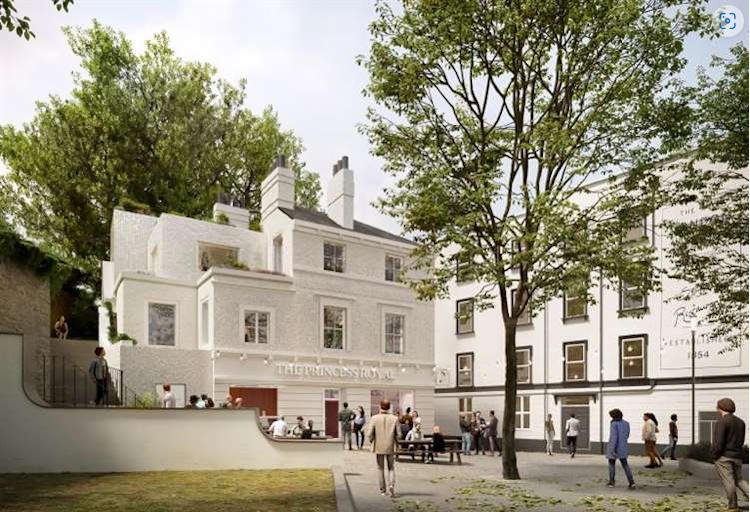
Plans to restore The Princess Royal in South Street, Folkestone, have
been revealed. Picture: FHSDC.
Currently covered in scaffolding and graffiti, the building will be
transformed with renovations taking place inside and out. An extension
will also be added.
Floral rooftops, lighting and outside seating will all be installed.
The boozer, formally known as the "Engine Inn" due to its proximity to the
former harbour railway line, stopped trading in 2015.
The Folkestone Harbour & Seafront Development Company (FHSDC) is behind
the ambitious project, which could be completed in 2024.
The firm is led by former Saga boss Sir Roger De Haan, and is also
responsible for the transformation of the harbour arm, and the new homes
being created along the seafront.
Sir Roger, chairman of FHSDC said: “The plans to refurbish and restore
The Princess Royal is another important step in our work to breathe life
into some of the most historic and significant parts of Folkestone.
“We want to do everything we can to bring it back to its former glory
and make it a central hub of the community once more and feel these
proposals achieve that.”
Architects from A IS FOR_ are behind the designs.
The team say they want to repair and rebuild the existing external
fabric while improving its “energy efficiency, whilst the existing
floors will be restructured using timber joist construction with the
extensions to the existing building constructed in CLT and clad in
glazed tiles”.

Sir Roger De Haan says the plans are an 'important step in work to
breathe life into some of the most historic and significant parts of
Folkestone'. Picture: FHSDC.
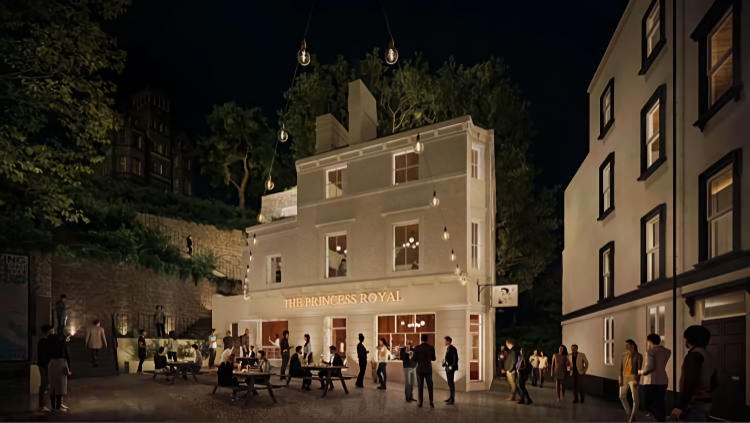
The pub stopped trading in 2015. Picture: FHSDC.
The site of The Princess Royal has been occupied by different public
houses since 1845.
Situated at the lower end of Parade Steps on South Street, it took its
current title in 1856 in homage to the eldest child of Queen Victoria
and Prince Albert (Princess Victoria).
Duarte Lobo Antunes, director at A IS FOR_ said: “This is our first
retrofit project and we’re excited to work on restoring this cherished
and historic gathering place.
“A lot of thought has been put into the designs to ensure that we retain
the original charm and characteristics of the public house, whilst
adding modern elements that will make it an attractive and popular
establishment once more.”
The pub is a stone's throw away from the new London & Paris Hotel, which
was formerly Gillespies.
FHSDC and A IS FOR_ now seek to secure planning permission in 2024, with
works to commence on the restoration and retrofit shortly after. |
LICENSEE LIST
 WHITING
William 1856-57
WHITING
William 1856-57
TUMBER William 1857-Sept/58

STURGES George Sept/1858+
GIBBS
Henry 1859-60
WHITING
William 1860+
PAYNE
Walter 1861 (age 38 in 1861 ) )
BOURNE
Charlotte 1861
HOBDEN John 1861-62


HOLLINGE ???? 1862
GRAVES Frederick 1863-May/64
HOBDAY George June/1864
HARTLEY John July/1864-66
McDONALD
Matilda 1866-70
HOLMES Francis Reynor 1870-74

BAKER
George Bartholomew 1874-78
WATTS
William 1878-79
ARTHUR William 1879-85

ARTHUR Sarah 1885-93 (widow age 50 in 1891)

ALEXANDER
Amos 1893-94
FELMINGHAM
Rebecca 1894-95
YOUNG
Walter 1895-96
TAYLOR
Alfred 1896-97
ADAMS Andrey 1899+

MILLER
John Stewart 1899-1901
RIDDALL(S) John 1903
 
BASSETT
Charles 1905 1910
HARITAGE
William 1910-16
HERITAGE
Mabel 1916-19
HERITAGE William K 1919-38
   
BUDDELL
Thomas 1938-39 dec'd
BUDDELL Thomas Executors of 1939
ROBBINS
Horace 1939
GAMBLE
John 1939-40
CHISMAN
John 1940-43
KENWARD
Leonard 1943-44 (Also "Morehall")
Licence Suspended
1944-48
KENNEDY Frank 1948-50
SMITH
Charles 1950-53
PATERSON
Hugh 1953
GRINSTEAD
Sidney 1953-57
MONAGHAN
John 1957-58
BURFOOT
Arthur 1958-60
ROWELL Frederick 1960-61
DENNIS
William 1961-68
GALLAGHER
Thomas 1968-77
FERET
Bryan 1977-82
COLES
Leslie 1982-86
WEST
Peter 1986-87
ASKEM
Richard 1987-89
FARRELL
Anthony 1989-93
RICHARDS
Stanley & BLENKINSOPP James 1993
RICHARDS
Stanley & FERGUSON Andre 1993
RICHARDS
Stanley
& GREAVES Barry 1993-94
BROWN
Robert & Pamela 1994-2004
DAVIES
Michael 2004 (Also "Earl Grey")
LYNCH
Nicky 2004+
http://www.closedpubs.co.uk/princessroyal.html
From the Post Office Directory 1862
From the Post Office Directory 1874
From the Post Office Directory 1882
From the Post Office Directory 1891
From the Kelly's Directory 1899
From the Post Office Directory 1903
From the Kelly's Directory 1903
From the Post Office Directory 1913
From the Post Office Directory 1922
From the Kelly's Directory 1934
From the Post Office Directory 1938
From the Folkestone Chronicle
Census
|

