|
2 Sandgate Road

Shellens Lane
 
Shelton Lane

Folkestone
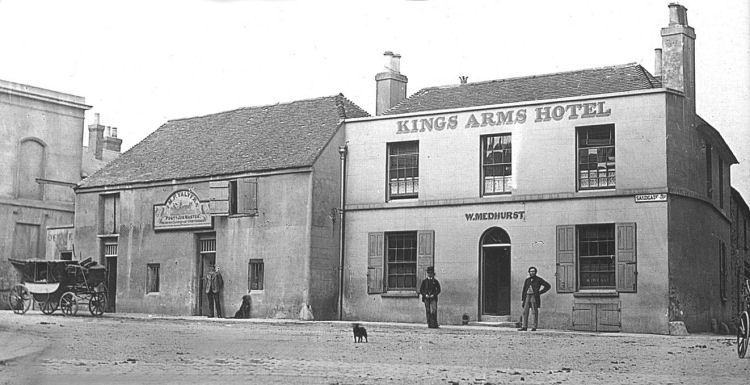
King's Arms Hotel, Sandgate Road. Sowing William Medhurst as the
licensee over the door. Photo circa 1870. |
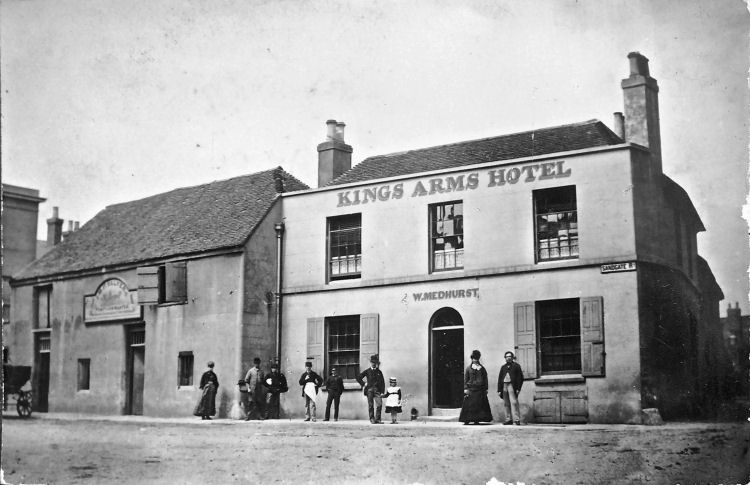
Above postcard circa 1870, kindly submitted by Kathleen Hollingsbee. |
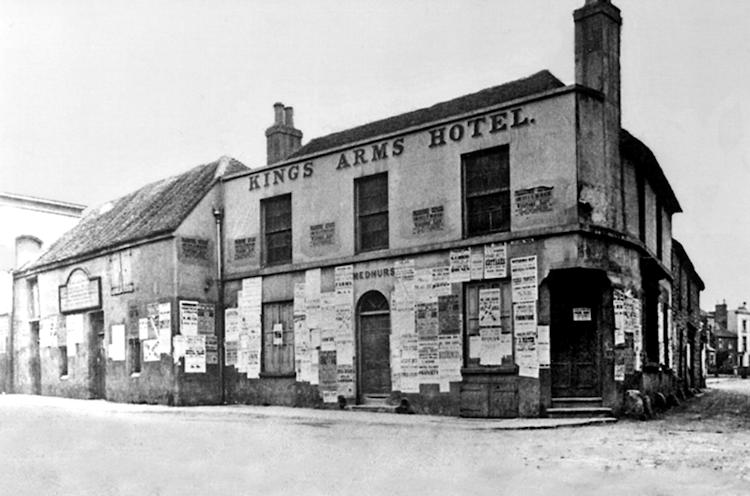
Above photo date unknown. |
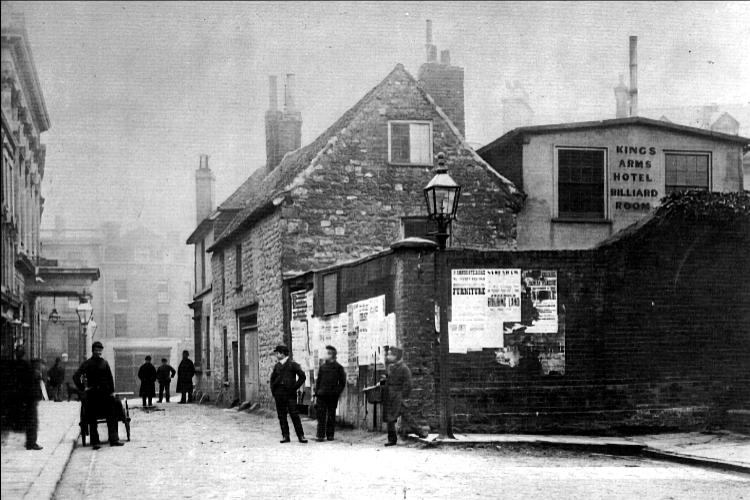
Above photo, date unknown. |
Bagshaw's directory of 1847 states that the "King's Arms" was also
operating livery stables.
|
From the Kentish Post or Canterbury News-Letter, May 2-6, 1730. Kindly
sent from Alec Hasenson.
Auction of Foreign Brandy at the King's Arms in Folkestone, May 11,
1730.
|
|
Kentish Post 10 July 1731.
To be let at Michaelmas next: The King’s Arms, at Folkestone, in the
county of Kent, with about 18 acres of meadow land, and a very good
garden, being a very good accustomed house, lately in the occupation
of Mr. Richard Verrier, and now in the occupation of his widow to
Michaelmas next.
Enquire of Mr. Jacob Wraight, of Folkestone, aforesaid.
|
|
Kentish Post 8 April 1738.
At Mr. Nicholas Binfield’s at the "King’s Arms" in Folkestone, on
Thursday, the 13th of this instant, April, will be held a florists’
feast for auriculas; the largest, beautifullest (sic) and best-blown
flower to be entitled to a silver punch ladle; the second-best
flower to two China punch bowls. No flower to be shewn under six
pips, and no person to shew a flower for the prizes but subscribers
only, and the person that wins the first prize is not to shew any
flower for the second.
N.B. Any person or persons whatsoever, who have not subscribed, on
paying to Mr. Binfield aforesaid five shillings the day before the
feast, will be deemed a subscriber, and be entitled to the above
prizes as a subscriber.
|
|
Kentish Post 10 February 1750.
At Mr. Binfield’s, at the "King’s Arms," in Folkestone, on Tuesday the
13th instant, will be fought a cock-match, between the gentlemen of
Folkestone and the gentlemen of Hythe: To shew eleven cocks a side,
for four Guineas a battle, and six Guineas the odd battle.
N.B. There will be a close pit, and a very good ordinary on the
table between twelve and one o’clock.
|
|
From the Kentish Post or Canterbury News-Letter, Feb, 1750. Kindly
sent from Alec Hasenson.
Cock fight at Mr. Binfold's at the King's Arms in Folkestone, Feb.
13, 1750.
|
|
Kentish Post 18 June 1763.
To be sold to the highest bidder, at Mr. Pilcher's, the King's
Arms, in Folkestone, on Tuesday next: A fine whole set of
pencil-worked china and china bowls, a clock, a watch, a larum, a
fine-toned spinet (wanting a little repairing), a bass fiddle, a
violin, a German flute, several implements for making sky rockets, a
quantity of saltpetre, with a great number of different articles.
The sale will begin at one o'clock in the afternoon.
|
|
Kentish Gazette 29 June 1776.
Advertisement.
Lost, on the 27th instant, from this town, a heavy pointer dog, with a
whole tail, and some small liver coloured spots about his shoulders;
answers to the name of Ponto. Whoever brings him, or gives information
where he is, so that he may be had again, by applying to Mr. Geo. Boxer,
at the "King's Arms" in this town, shall receive half a guinea for their
trouble. |
|
Kentish Gazette, 3 July 1776
Advertisement
Lost, on the 27th instant, from this town, a heavy pointer dog, with a whole
tail, and some small liver coloured spots about his shoulders; answers to the
name of Ponto. Whoever brings him, or gives information where he is, so that he
may be had again, by applying to Mr. Geo. Boxer, at the King’s Arms in this
town, shall receive half a guinea for their trouble.
Folkestone, June 30th, 1776.
|
|
Kentish Gazette, 21 April 1781
To be sold by auction, on Wednesday, May 16, 1781, at the sign of the King’s
Arms, in Folkestone, between the hours of two and four o’clock in the afternoon,
unless disposed of before by private contract, of which notice will be given, a
freehold house and garden, with its appurtenances thereunto belonging, situate,
and being in Mercery Lane, Folkestone, and now in the occupation of John Cusick.
For further particulars enquire of Mr. Wm. Wormer, near the church, Hythe, or
Mr. Richard Wright, New Romney.
|
|
Folkestone, July 14, 1817.
Kentish Chronicle 12 August 1817.
Auction Advertisement Extract:
To Brewers and Others – to be sold by auction at the "Folkestone Arms
Inn," Folkestone, on Thursday, the 21st August, 1817, in three lots:
Lot 2: All that good accustomed freehold public house and premises,
with a piece of ground adjoining, known by the name of the "King's
Arms," situate in the upper part of the town of Folkestone, and now
in the occupation of Henry Stokes, tenant at will.
Note: Not listed in More Bastions.
For further particulars apply to Mr. Thomas S. Baker, Folkestone.
|
|
Kentish Chronicle 1 January 1819.
Folkestone: Desirable freehold and free public houses to be sold by
auction by F.J. Hiller, on Friday, the 8th of January, 1819, at two
o'clock, at the sign of the "Folkestone Cutter," in Dover Street,
Folkestone.
All that desirable free and freehold public house, known by the sign
of the "King's Arms," in Shellons Lane, Folkestone, and now in the
occupation of Mr. William Gittens.
Note: Earlier date for Gittens.
Also that free and freehold public house, known by the sign of the
"Folkestone Cutter," in Dover Street, Folkestone, and now occupied by
John Sills.
Note: Not listed in More Bastions.
Both of these premises are advantageously let for an unexpired term
of six years.
Further particulars known by applying to F. J. Hiller, surveyor, 145,
Snargate Street, Dover.
|
|
Kent Herald 19 May 1825
Advertisement:
Freehold public houses, to be sold by auction, by Mr. Jones, at the "King's
Arms" public house, in Folkestone, on Monday, the 30th May, 1825, at 12 o'clock
in the forenoon (unless previously disposed of by private contract), the
following estates:
....
Lot 2 All that messuage or tenement, also licensed as a public house, and
called the "King's Arms," with the yard, ground, and appurtenances thereto
belonging, situate and being in Folkestone aforesaid, and now in the occupation
of William Gittins.
For particulars apply (if by letter post paid) to Mr. Chalk, solicitor,
Dover.
|
|
Kent Herald 9 June 1825
Advertisement:
Folkestone, to be sold by private contract, all those two freehold messuages or tenements, licensed as public houses, and called the
"King's Arms," and "Folkestone Cutter," with the yards, ground, and appurtenances thereto belonging, situate and being in Folkestone aforesaid, and now in the occupation of William Gittins and William Downing.
For particulars apply (if by letter post paid) to Mr. Chalk, solicitor, Dover.
|
|
Kent Herald 13 January 1831
Death.
Jan. 7, at Folkestone, Mr. Wm. Gittens, of the King's Arms public house, aged 65 years.
|
|
Maidstone Journal 18 January 1831.
Death: Jan. 7, at Folkestone, Mr. Wm. Gittens, of the King's Arms
public house, aged 65 years.
Note: Later date for Gittens.
|
|
Kentish Gazette 3 December 1833.
Dover, Dec. 2: Tomorrow the Insolvent Southern Assizes Circuit Court
will be held here, when the following prisoner will be brought
before J.G. Harris Esq., His Majesty's Commisioner, upon petition
for discharge –
In Dover Castle Prison: Nicholas Rolfe, late of Folkestone,
victualler. (King's Arms.)
|
|
Kentish Gazette 10 December 1833.
Dover, Dec. 4: Yesterday Thos. Barton Bowen Esq., one of His
Majesty's Commissioners for the Relief of Insolvent Debtors (in the
absence of Jno. Greathed Harris Esq.) held the Assize Circuit Court
in the Town Hall here, when the following prisoner was called to
pass his examination to entitle him to his discharge: Nicholas Rolfe,
late of Folkestone, victualler, to be discharged, conditionally,
upon filing some papers relative to a distress which had been levied
on his goods, and upon giving up possession of the house in the
occupation of his wife, at Folkestone.
|
|
Kent Herald 26 November 1835
Advertisement: "King’s Arms Inn," commercial house, near the Guildhall,
Folkestone. Edward Pierson begs to inform his friends, commercial
gentleman, and the public in general, that he has taken the above house,
and fitted it up with every convenience, and hopes by attention, and
moderate charges, to obtain a share of their support. Good wines,
spirits, &c. N.B. Good stall stabling and lock-up coach houses.
Note: Pierson previously unknown.
|
|
Dover Telegraph 31 August 1839.
Advertisement: To be let at Folkestone, that well-known and
established roadside inn and commercial house, the "King's Arms."
The terms on which this house is to be disposed of are that the
incoming tenant shall take all that the outgoing tenant leaves, at a
fair valuation.
The operations of the South Eastern Railroad which are now in
progress must tend very materially to increase the value of this
house. Which possesses every convenience for the comforts of
travellers, viz., in good and airy bedrooms, sitting rooms, water
closet, with excellent stables, &c., &c.
Possession may be had immediately, if desired.
For further particulars apply to Mr. G. Dunk, on the premises, if by
letter post-paid.
|
|
Kent Herald 5 September 1839
Advertisement: To be let at Folkestone, that well-known and established
roadside inn and commercial house, the "King's Arms."
The incoming tenant to take the goods and effects at a fair valuation.
The operations of the South Eastern Railroad which are now in progress
must tend very materially to increase the value of this house. Which
possesses every convenience for the comforts of travellers, viz., in
good and airy bedrooms, sitting rooms, water closet, with excellent
stables, &c., &c.
Possession may be had immediately, if desired.
For further particulars apply to Mr. G. Dunk, on the premises, if by
letter post-paid.
|
|
Kentish Gazette 22 March 1842.
SHOOTING MATCH, OPEN TO ALL ENGLAND.
To be shot for on Tuesday, 29th March, 1842, a Fat Bullock, weighing
about Thirty Score, at Mr. John Bromley's "King's Arms Inn," Folkestone,
Thirty Subscribers at £1 each, (including shots and pigeons). N.B.—The Subscriptions to be paid on or before the 26th instant to
prevent disappointment, and received by Mr. Taylor, "White Lion Inn,"
Canterbury; Spices' "Harp Inn," Dover; and at Mr. Bromley's "King's Arms
Inn," Folkestone, where the Bullock may be seen by applying to F. Keen,
on the premises. |
|
Maidstone Journal 30 July 1844.
Assizes, Before Baron Gurney.
Coomber v The South Eastern Railway Company.
Mr. Sergeant Shee, with Mr. Lush, was for the plaintiff: Mr.
Peacock and Mr. Russell for the defendants.
Sergeant Shee, in stating the case to the jury, said that the
plaintiff was a ginger beer and lemonade manufacturer, of
Folkestone, and the defendants were the South Eastern Railway
Company. The action was brought to recover compensation for damages
sustained by the plaintiff in consequence of the company having
destroyed a portion of his property in making their line to
Folkestone. It had been pleaded that the property in question was
not the property of the plaintiff, and that would be a question the
jury would have to consider. In July, 1842, the plaintiff went to
Folkestone to see if he could find suitable premises to carry on his
business, and ultimately agreed with Mrs. Pope for a lease of some
premises, on which he erected buildings suitable for carrying on his
extensive business. Between that time and the month of July, 1843,
the plaintiff had expended a very considerable sum of money in the
improvement of the premises. About that time the South Eastern
Company had purchased Folkestone Harbour, and extended their line to
it, without waiting for the tedious process of an Act of Parliament.
In carrying out their intentions they had thought proper to knock
down the plaintiff's manufactory, and otherwise damage his property,
whereby he had been unable to carry on his business, and for the
loss sustained in consequence this action was brought.
The following witnesses were then called:
John Holten stated that in July, 1842, he was in the employ of
Mr. Coomber, at Croydon, and went with him to Folkestone, where he
took some premises that had been a builder's workshop. It was about
42 feet in length, and surrounded by a stone wall. Mr. Coomber took
possession of it on the 27th July, 1842, and built a stable and
manufactory there. He also built a pigsty and sank a well there, and
had all the necessary apparatus erected for carrying on his trade as
a ginger beer manufacturer. Witness remained with him for a
twelvemonth, and was there when the railway company, on the 20th
Oct., 1843, began to pull the wall down on the railway side. He got
up early that morning and saw three or four labourers at work. His
master was not there, but he went and found him. In the course of
the day they had pulled the wall down as far as the stables. There
was a board outside describing it as a manufactory. When they took
down the wall they made a regular use of the premises, and broke
stones there. The plaintiff could not carry on his business in
consequence. There were about 60 dozen bottles of ginger beer and
lemonade, and 60 dozen empty bottles. A great many of the latter
were stolen, and some of the full ones. In about a week afterwards
he left Mr. Coomber, who was unable to carry on his business, as he
could not find a suitable place at Folkestone. His returns were from
£6 to £7 a week, and his business was increasing. He usually sent
out about 150 doz. a week, ginger beer at 1s. 6d. a doz., and soda
water and lemonade 2s. 6d. a doz. Some of the bottles were stone. He
did not know the names of any of the workmen employed in pulling
down the wall. There were 180 doz. empty stone bottles, some of
which were broken.
Cross-examined: He did not stop to see all the wall pulled down.
The bottles were not stored in the pigsty, but outside, in the air.
He could not tell how many were broken by the rocks falling from the
walls. He thought there were almost a doz. stone bottles broken, not
more. They were worth a penny a piece. He could not say how long it
was before Mr. Coomber sold his stock. Perhaps he had not sold more
than 12 doz. when he left him. He was obliged to carry them out in
his arms, as from the quantity of rubbish they could not get the
cart out. It was a light spring cart capable of carrying about 50
dozen. There was a road made afterwards by the company. There was no
road there before. There was a road by the side of the factory in
Seagate, which they enlarged. The plaintiff could not carry on his
business afterwards, for he was forced to sell his horse, not having
any place to keep him. They could manage to get the horse out, but
not the cart. They sold ten dozen a week to the innkeepers and
others, amongst whom were Mr. Hodges, Mr. Paul, and Mr. Jeffries,
who were Mr. Coomber's principal customers. They took about 10 or 12
dozen a week. There was one copper on the premises, which held 18
gallons. This they filled two or three times a day. Sometimes he
brewed and sometimes his master. He believed his master took the
copper away.
Re-examined: His master had a son about 14 or 15 years of age,
who assisted in the business. By the 10 or 12 dozen he had
mentioned, he meant each customer took that. The cart was in the
stable when he last saw it.
Mr. Wm. Lee stated that he kept the
King's Arms at Folkestone. In
July, 1842, he went with Mr. Coomber to Mr. Willis, and was with him
when the agreement was made for the premises. He saw it after he had
taken possession. (Witness then described the state of the premises
as the previous witness had done, and also spoke to the improvements
made by the plaintiff.) He had seen the premises within a few days.
There is a heap of rubbish there and a cart. Half a dozen men might
remove the rubbish.
Cross-examined: He could not swear that a couple of men would not
remove the rubbish in an hour. He had not looked at it close enough
to make a calculation. The rent agreed was £31 a year.
Wm. Coomber, son of the plaintiff, deposed to the quantity of
stock on the premises, which agreed with the first witness. He
fetched away 3 dozen of ginger beer, 15 dozen of stone bottles and 3
dozen of glass. He might have been a month fetching these away. His
father could not get another place in the town to carry on his
business. He used to assist his father by washing the bottles and
draining off.
James Tallad proved having received 3 quarters rent from Mr.
Coomber for Mrs. Pope. The last was in July, 1843, since when they
had not received any.
Cross-examined: Mrs. Pope was the executor to her deceased
husband, James Pope, who died in February, 1842. Mr. Willis was the
executor. Mr. Hague was the proprietor of the premises, and Mr. Pope
was tenant at the time of his death. Witness was present at a
conversation between Mr. Hague Jnr. and Mrs. Pope in November, 1842.
After that conversation he saw Mr. Coomber. He told him that Mr.
Hague had let him, witness, the premises after the expiration of
Mrs. Pope's term in July, 1843. He asked witness if he should want
them or if he would let him remain. Witness said he had a coal
warehouse that was likely to be sold, but he might remain till he
wanted them. An application was made to witness by the railway
company for permission to knock down a portion of the wall.
A letter from the plaintiff dated December, 1843, to the
directors was then read, claiming £306 16s., for costs of premises
and goodwill of business.
This closed the plaintiff's case.
Mr. Peacock, for the defendants, contended that no case had been
made out. The declaration stated that they had destroyed the
plaintiff's manufactory and his stables, whereas the utmost that
could be proved against the company was the damage done by breaking
a dozen of stone bottles and removing a portion of the wall. He was
obliged to confine himself to the record or he could have shewn them
that the premises were actually rented by another person, and not
the plaintiff. The premises were not demised to Mrs. Pope, but were
merely rented to her as executrix to her deceased husband, which was
very different to holding them in her own right. There was no
evidence whatever to show that Messrs Hague had made a demise of
this property to Mrs. Pope after the death of her husband. He
denied, therefore, that the premises could be considered as Mr.
Coomber's. If it were the plaintiff's wall that had been knocked
down then he was entitled to compensation, but he, Mr. Peacock,
denied that it was his wall, and if it were not then he had no right
to come there for damages. Mrs. Pope's tenancy had expired on 6th
July, 1843, but the damage complained of did not take place until
October, 1843, and it had been proved that another person, not the
plaintiff, had rented the premises. With respect to the damage done
to the bottles there had been no evidence to show that it had been
done by the company's servants, but he would admit that the bottles
had been broken, perhaps through the negligence of the persons
employed, but the company was not answerable for that; for it had
not been charged against them as arising through any neglect on
their part, and it was clear that they were not liable for anything
that was stolen. Mr. Peacock then read the various items of the
plaintiff's claim, by which it appeared that a considerably larger
quantity of ginger beer and bottles had been charged than were
proved to have been on the premises.
At the conclusion of Mr. Peacock's address, His Lordship said he
could not find any demise of the premises to Mrs. Pope, and the
plaintiff had only a permissive tenancy, Mrs. Pope, as executrix,
having expired in July, 1843. He should, therefore, reserve the
point of law. His Lordship then strongly commented on several parts
of the plaintiff's claim, and said he hoped the jury would defeat
any attempt at extortion by giving such damage only as he was
entitled to.
The jury retired to consider their verdict, and after a short
time returned a verdict for the plaintiff with £50 damages.
Baron Gurney: That will be on the second count.
Mr. Peacock submitted it could not be on the second count, as
that was merely for the bottles broken, which appeared from the
plaintiff's witnesses to be about a dozen, and His Lordship had
stated they were not to give damages for the wall.
After a short discussion His Lordship requested the jury to
reconsider their verdict and say upon which counts they had relied.
The jury again retired, and in about a quarter of an hour gave
their verdict: upon the first count (for removal, &c.) £49 19s., and
upon the 2nd, 1s. for bottles destroyed.
Note: No record of William Lee in More
Bastions.
Jeffrey v The South Eastern Railway Company.
Mr. Sergeant Shee, with Mr. Lush, was for the plaintiff: Mr.
Peacock and Mr. Russell for the defendants.
Mr. Lush having opened the proceedings, Sergeant Shee stated the
case to the Jury. The plaintiff kept the Victoria Inn, at
Folkestone, and the defendants were the South Eastern Railway
Company. It appeared that the Victoria Inn was the property of a
family of the name of Marsh, for whom Mr. Gravenor was trustee, and
as such the freehold was vested in him. The premises were rented in
1841 by a person of the name of Lee, of whom they were taken in 1842
by the plaintiff. Mr. Jeffrey had carried on the business at the
Victoria for some time with great success, and was daily improving
it – the maintenance of himself and family depending upon it. When
common people committed depredations they were punished for it by
the criminal law, but when railway companies destroyed other
peoples' property they were to be treated with indulgence; although
if they choose to go to Parliament, they could obtain all the powers
they required to carry their intentions into effect. But when the
trespass of which he complained was committed they had no such
powers, and yet they had made a railroad on a turnpike road. The
principal business of the inn was derived from the parties who
frequented a fish market opposite the plaintiff's. The company had
thought proper to take the turnpike road and make an embankment upon
it, by which means the custom of the market was for some time
entirely lost to the inn. The company had afterwards made a sort of
archway, by which access to the market was obtained. The plaintiff
did not complain of any injury done by the workmen employed, but of
the loss sustained from the circumstance he had mentioned, and by
the company afterwards making a road by which the public road in
front of the plaintiff's house was reduced to nine feet wide, and
his trade had been in consequence entirely destroyed. The company
had not thought it worthwhile to apply to Parliament, but took the
thing into their own hands, thereby depriving the plaintiff of such
fair compensation as he would have been entitled to under the
provisions of an Act of Parliament. If it could be proved to them
that at the time this injury took place the plaintiff had been
carrying on a profitable business, and was suddenly deprived of a
good connection, he was entitled to fair and reasonable damages.
Mr. Wm. Lee stated that he formerly kept the Victoria, which is
in the lower part of the town of Folkestone. He held it under Mr.
Ham Tite, and let it on 2nd May, 1842 to Mr. Jeffrey, with the
consent of Mr. Ham Tite. The plaintiff had paid him £150 for it -
£75 for the goodwill and £75 for fixtures &c. There was a public
road in front of the house, upon which the company had built a
railroad. The house was now down. The railroad was about 5 yards
from the house. There was a fish market about 25 yards in front of
the house, and there were a great many persons continually passing
along the road. There were a great many customers frequented the
house, and by passengers calling for refreshment.
Cross-examined: He came here with the witnesses in the last
cause. Mr. Robertson was attorney in both cases.
Sarah Hart stated that she was servant to Mr. Jeffrey at the
Victoria Inn. Went to live there in August, 1843, before the
railroad was commenced. There was a very respectable business
carried on in the house. There was a fish market opposite and a
great many persons came from there to the house, as well as persons
walking along the road. They drank principally beer – there was a
good company in the evening. About a week before she left the custom
began to fall off. The dust and dirt was so great that no
respectable persons would go there. She used to get a great many
“vales” but the last month she had hardly any. Persons used to call
them down the packets, but in consequence of the dust respectable
persons would not call.
Cross-examined: When the arches were being built the fish market
was removed lower down the beach. The greater number of the fishing
boats were landed opposite the Victoria – the market had been
removed 20 or 30 yards. The principal part of the custom that fell
off were parties that came from the packets – several that used to
attend from the market went to the other house. There were three or
four houses the other side of the road – the Victoria was nearer to
the fish market than the other houses before the road was made. The
fish market stood almost the middle between the North Foreland and
the Victoria – if anything it was a few yards nearer the Victoria.
Re-examined: The fish market was removed in consequence of the
road being made.
Wm. Morford is a butcher at Folkestone, - he knew the situation
of the Victoria. Previous to the works commencing he had frequently
seen people going in there from the fish market. After that there
was an obstruction, which prevented people from getting there. The
embankment is so high that persons on the harbours where fish are
landed cannot see the Victoria. When Mr. Jeffrey took the house he
altered the bedrooms and made it more respectable for the
accommodation of parties. He had supplied the house with meat, but
after the works had begun the trade in steaks and chops had been
gone altogether. It was never much of a house until the Dover
railroad began, when the labourers working upon it frequented the
Victoria.
Cross-examined: Mr. Jeffery had left the house about last May. It
had been pulled down about a fortnight ago.
Re-examined: When the house was altered it was frequented by
parties who came by the packets and visitors from Dover, because
there was a beautiful view of the harbour from it.
Mr. Hawkins, excise officer, stated that the trade of the
Victoria had considerably fallen off from the time of the tram road
had commenced, which he thought was about the latter end of October.
Mr. Coomber deposed that the works commenced about September
last.
Cross-examined: Was the plaintiff in the last case and had sent
in the plaints which had been read.
Mr. Hawkins recalled: The trade had fallen off in spirits 3 or 4
gallons a week in each sort. He knew nothing about the beer. Persons
from the fish market could get to plaintiff's house under one or two
of the arches.
Re-examined: The falling off in the first place was owing to the
labour being taken off the road. The obstruction might have caused a
further falling off.
By the Bench: There were not so many pleasure people in October
and November as in other seasons.
John Timby deposed to the falling off in the business of the
Victoria after the rent had been made.
Mr. Lee re-called: Mr. Ham Tite, the landlord of the Victoria,
was a brewer and supplied the house with beer.
Mr. Peacock, in his address to the Jury, remarked upon the fact
that neither the brewer nor the spirit merchant had been called,
either of whom could have proved more readily the tailing off in the
business than the witnesses who had been called.
The Learned Baron, in addressing the Jury, also alluded to that
circumstance and said that it was the duty of the plaintiff to
furnish them with the best evidence upon the plaint that he could.
It would be, however, for them to award him such fair and reasonable
compensation as they considered him entitled to for any loss he had
sustained by the proceedings of the company.
Verdict for the plaintiff. Damages £125.
Note: No record of William Lee in More
Bastions.
|
|
Maidstone Gazette 18 March 1845.
Advertisement: Folkestone, Kent. To persons wishing to embark in the
public line. To let, with immediate possession, that well-known and
old-established commercial house and family hotel called the King's
Arms, Folkestone, Kent.
The present proprietor, having embarked in other business in the
north, is desirous of treating with some person for the above. Owing
to the increased traffic betwixt Folkestone and the Continent it
affords an opportunity rarely to be met with. Rent £40 per annum.
For further particulars apply to Mr. W. M. Lee, King's Arms Inn,
Folkestone.
N.B. A good stable and lock-up coach house.
Note: No mention of Lee in More Bastions.
|
|
Dover Telegraph 10 May 1845.
Marriage: May 8, at Kennington, Mr. James Collard, of the "King's
Arms Inn," Folkestone, to Miss Jane Elizabeth Spain, of Kennington.
|
|
Kentish Gazette 13 May 1845.
Marriage: May 8th, at Kennington, Mr. James Collard, of the King's Arms
Inn, Folkestone, to Miss Jane Elizabeth Spain, of Kennington.
Note: No mention of Collard in More Bastions.
|
|
Maidstone Gazette 13 May 1845.
The licence granted to William Lee to keep open the King's Arms
was transferred to James Collard.
Note: William Lee not listed in More
Bastions.
|
|
Kent Herald 15 May 1845
A special session was held at the Town Hall on Tuesday before John Bateman Esq.,
Mayor, W. Major and W. Sherren Esqs.
The license granted to William Lee, to keep open the "King’s Arms," was
transferred to James Collard.
|
|
Kent Herald, 15 May 1845.
Marriage.
May 8, at Kennington, Mr. James Collard, of the King's Arms Inn," Folkestone, to
Miss Jane Elizabeth Spain, of Kennington.
|
|
From the Kentish Gazette, 22 July 1845.
FOLKSTONE. FREEHOLD ESTATES. TO BE SOLD BY AUCTION.
By Mr. THOMAS ROBINSON,
ON MONDAY, the 26th day of JULY, 1845, at Mr. Collard’s "King's Arms Inn."
Lot 1:- An eligible FREEHOLD DWELLING-HOUSE and Appurtenances, situate
in Fancy Street, FOLKESTONE, in the occupation of Mr. John Laws and
others.
Lot 2:- A valuable Plot of FREEHOLD BUILDING LAND, situate in the rear
of Fancy Street, and in a very advantageous and pleasant situation.
Lot 3:- A FREEHOLD DWELLING-HOUSE and Appurtenances, situate in Little
Fancy Street, FOLKESTONE, in the occupation of Mr. John Mercer.
The Sale will commence at Four o’clock precisely.
For Particulars apply to Mr. Thomas Robinson, Auctioneer, 18, Bench
Street, Dover, or Mr. Edw. Knocker, Solicitor, Castle Hill, Dover.
|
|
Maidstone Gazette 12 August 1845.
At a Special and Petty Sessions held at the Town Hall on Tuesday
last, before J. Bateman Esq., Mayor, D. Major and W. Major Esqs.,
and Capt. Sherren, the following alehouse licenses were transferred,
viz: from Joseph Earl, of the "Folkestone Lugger," to Richard Fowle;
from said Richard Fowle, of the "British Lion," to Robert Burvill;
from William Harrison, of the "Marquis of Granby," to James Hall; from
said James Hall, of the "Ship," to John Harrison; from James Collard,
of the "King's Arms" to William Smith.
Note: Transfers of Folkestone Lugger, British Lion, Marquis of
Granby are earlier than previously known. Neither licensee for Ship
listed in More Bastions.
|
|
Kent Herald 14 August 1845
At a special petty sessions held at the town hall in this town, before J.
Bateman Esq., Mayor, D. Major and W. Major Esqs., and Capt. Sherren, the
following alehouse licenses were transferred, viz., from Joseph Earle, of the
Folkestone Lugger, to Richard Fowle; from said Richard Fowle, of the British
Lion, to Robert Burvill; from William Harrison, of the Marquis of Granby, to
James Hall; from the said James Hall, of the Ship, to John Harrison; from James
Collard, of the King’s Arms, to William Smith.
|
|
Canterbury Journal 12 December 1846.
A Catch Club has been formed here. From the success attending its first
meeting, in the enrolment of nearly forty of the most respectable
inhabitants of the town, it promises to be a useful society. It is held
at Mr. Smith's, the "King's Arms," whose liberality and attention to his
guests are too well known to require any comment.
Note. Smith does not appear in More Bastions.
|
|
Maidstone Gazette 7 September 1847
Petty Sessions, Tuesday; Before Capt. W. Sherren, Mayor, S. Bradley,
J. Bateman and S. Mackie Esqs.
General Licensing Day: All the licenses were renewed. There were ten
applications for new licenses, two of which only were granted for
spirit vaults, one for Mr. Smith, of the "King's Arms," for a house in the High Street, conditionally, and the other
to Mr. Thomas Maycock (the agent for Guinness's stout). Liberty was also granted to Mr.
Field to remove his licence from his present house to more
commodious premises opposite.
Notes: It is not known that the licence granted to Smith was ever
taken up. Also the only person by the name of Field(s) to hold a
licence at that time was William Fields who was at the short-lived
Folkestone Arms Tavern and it is at present not known that that
house ever moved. It is not outside the realms of possibility that
Fields DID move premises across the road and that the original
“Folkestone Arms Tavern” is the unknown “old Folkestone tavern”
which was demolished in January, 1848.
|
|
Kent Herald 9 September 1847
General Licensing Day, Tuesday: All the licenses were renewed. There were ten
applications for new licenses, two of which only were granted for spirit vaults,
one for Mr. Smith, of the "King’s Arms," for a house in High Street,
conditionally, and the other to Mr. Thomas Maycock (the agent for Guinness’s
stout), Liberty was also granted to Mr. Field to remove his license from his
present house to more commodious premises opposite.
(Field is "Folkestone Arms Tavern")
|
|
Dover Chronicle 10 June 1848
Auction advertisement extract: To Brewers, Spirit Merchants and
Others; To be sold by private contract (together or separately), the
undermentioned valuable licensed houses, offering an opportunity for
desirable investment, as well as advantageous increase of business,
which but seldom occurs, viz.:-
A freehold inn called the "King's Arms," situate in a most eligible
position in the flourishing town of Folkestone, in Kent. It
possesses ample and excellent accommodation for travellers, and is
admirably placed to command an extensive town trade.
The whole of the above are old-established, well-accustomed houses,
have good tenants, are in full trade and good condition. The death
of the late proprietor causes them to be now offered for sale.
For further particulars apply to James Worsfold, House and Estate
Agent, Guardian Fire and Life Assurance Office, Castle Street,
Dover.
|
|
Dover Telegraph 10 June 1848
Auction advertisement extract: To Brewers, Spirit Merchants and
Others; To be sold by private contract (together or separately), the
undermentioned valuable licensed houses, offering an opportunity for
desirable investment, as well as advantageous increase of business,
which but seldom occurs, viz.:-
A freehold inn called The King's Arms, situate in a most eligible
position in the flourishing town of Folkestone, in Kent. It
possesses ample and excellent accommodation for travellers, and is
admirably placed to command an extensive town trade.
The whole of the above are old-established, well-accustomed houses,
have good tenants, are in full trade and good condition. The death
of the late proprietor causes them to be now offered for sale.
For further particulars apply to James Worsfold, House and Estate
Agent, Guardian Fire and Life Assurance Office, Castle Street,
Dover.
|
|
Maidstone Journal 13 June 1848
Auction advertisement extract: To Brewers, Spirit Merchants and
Others; To be sold by private contract (together or separately), the
undermentioned valuable licensed houses, offering an opportunity for
desirable investment, as well as advantageous increase of business,
which but seldom occurs, viz.:-
A freehold inn called The King's Arms, situate in a most eligible
position in the flourishing town of Folkestone, in Kent. It
possesses ample and excellent accommodation for travellers, and is
admirably placed to command an extensive town trade.
The whole of the above are old-established, well-accustomed houses,
have good tenants, are in full trade and good condition. The death
of the late proprietor causes them to be now offered for sale.
For further particulars apply to James Worsfold, House and Estate
Agent, Guardian Fire and Life Assurance Office, Castle Street,
Dover.
|
|
Maidstone Gazette 19 December 1848
Folkestone County Court, Friday, before C. Harwood Esq.
Sheen v Wordsell: Mr. Harvey, of Dover, for the plaintiff, and Mr.
Hart for the defendant. This was an action for an assault. The
damages were laid at £10. From the evidence of the plaintiff, who is
a leather-seller at Dover, it appeared that he was summoned on the
20th November last by Mr. W. Vigor, of the Rose Inn, for £5 money
lent; that after the trial he went to the King's Arms, and was there assaulted by a person named Hodges and several
others; that himself and friend afterwards proceeded to the Pavilion
Shades to dine. A short time afterwards the defendant and several
others whom he had seen at the King's Arms came to the Shades: the defendant came upstairs into the room
where he was. Plaintiff requested him to leave the room, and rang
the bell. The landlord requested the defendant to go downstairs; an
altercation took place, and he (plaintiff), was struck by the
defendant on the neck and thrown downstairs, receiving a severe
bruise on the thigh. Plaintiff called a witness, named Benjamin
Wright, a woolstapler at Dover, who corroborated the plaintiff's statement. The plaintiff, in answer to a question put by Mr. Hart,
stated that he did not challenge anyone to fight at the King's Arms that day. This closed the case for the
plaintiff.
Mr. Hart then addressed the jury for the defendant, and after
alluding to the conduct of the plaintiff, proceeded to show that the
defendant was not present at the scuffle on the stairs by which the
plaintiff was injured as he alleged. He called several witnesses,
respectable tradesmen, who distinctly swore that Wordsell was in the
smoking room below, and did not leave the room till after the affray
was over; that a person named Hodges had gently handed the plaintiff
downstairs, he being in such a state of intoxication as to be unable
to walk down himself. One of the witnesses also stated that he was
present at the King's Arms when the plaintiff challenged anyone to fight him for £5. A
person, now present in court, took out his purse to lay the money
down, but the plaintiff then declined, not having sufficient cash.
There was great excitement caused by the conduct of the plaintiff,
and he was in consequence expelled from the King's
Arms.
His Honour, in summing up, read over the evidence of the plaintiff
and his witness, Wright, observing that there was no doubt but that
a gross assault had been committed – but by whom? It did not appear
to be by the defendant, who was stated by the defendant's witness to have remained below after being requested to walk
downstairs. It had been stated that a man named Hodges, who had been
summoned before the Magistrates and fined, was the guilty party, but
with that they had nothing to do. It certainly was very singular
that the same persons who were present at the King's Arms in the morning should be
all of them at the Shades in the afternoon; if the witnesses for the
defendant were worthy of belief, the defendant could not have been
the person who committed the assault. The plaintiff had not called
the landlord, as he might have done, or the policeman might have
been fetched by the witness Wright. The question for them to
consider was, was the defendant in that state described by the
witness Roberts as to be unable to identify the person who had
committed the assault? The plaintiff had denied that he had
challenged anyone to fight, but the whole of the witnesses for the
defence had proved the contrary. After some further remarks, His
Honour left it to the Jury to decide whether the identity was proved
to their satisfaction.
The Jury retired, and shortly after returned a verdict for the
defendant.
The same v Vigor: This was an action for an assault alleged to have
been committed the same day, at the Pavilion Shades. The same
witnesses were produced to negative the plaintiff's statement.
Verdict for the defendant.
Mr. Hart applied for costs, which were granted.
Upon this announcement a loud clapping of hands took place, which
was immediately suppressed by the Judge. The court was crowded to
excess.
Mr. T. Delasaux held an adjourned inquest yesterday (Friday) at the
Star public house, at Newington, next Hythe, on the body of Richard
Barton, a chair bottomer, who had come to his death through a
quarrel.
The depositions, as taken at each sitting, were the following:
Richard Marsh, of Newington, stated that on Friday night, a little
before nine o'clock, he was in the public house above mentioned, as
was the deceased, who was intoxicated, John Baker and George Wells
jun.: They were there drinking, and Baker said to the deceased “You
had better go, or someone may steal your rushes”, upon which the
deceased immediately took off his clothes and said “I will let your
inside out”. Baker begged him to be quiet, and accordingly he sat
down a short time, but got up again and pushed his hands towards the
face of Baker, who held his hands up to prevent being struck. The
contest continued for nearly half an hour. Deceased then took from
his pocket a hog knife (produced), and held it towards Baker while
wrangling was going on, and was in the act of sitting down again
when Baker struck him on the right side of the head and he fell
against the grate. Deceased was picked up an carried out of doors.
Mr. George, a medical gentleman, residing at a distance of two
miles, was sent for, but before his arrival deceased was dead.
George Wells, blacksmith, one of the company, corroborated portions
of the above, adding that deceased was much excited, and by his
threatening language and menacing attitude, and being close to
Baker, he (witness), had he been in Baker's place, should have
considered his life in danger.
John Paramore also spoke to the violent conduct of the deceased.
Mr. E. George, surgeon, of Folkestone, who was called in to the
deceased between eleven and twelve o'clock at night, when lying in
the Star stable, stated that on his arrival he found the deceased
dead, and nearly cold. He was of opinion that the deceased died from
a severe concussion of the brain, which might have been occasioned
by a blow.
As it appeared very clear that Baker had acted only in self-defence,
a verdict of “Justifiable homicide” was returned.
|
|
Dover Telegraph 23 December 1848
Folkestone County Court, Friday, before C. Harwood Esq.
Sheen v Wordsell: Mr. Harvey, of Dover, for the plaintiff, and Mr.
Hart for the defendant. This was an action for an assault. The
damages were laid at £10. From the evidence of the plaintiff, who is
a leather-seller at Dover, it appeared that he was summoned on the
20th November last by Mr. W. Vigor, of the "Rose Inn," for £5 money
lent; that after the trial he went to the King's Arms, and was there assaulted by a person named Hodges and several
others; that himself and friend afterwards proceeded to the "Pavilion
Shades" to dine. A short time afterwards the defendant and several
others whom he had seen at the King's Arms came to the Shades: the defendant came upstairs into the room
where he was. Plaintiff requested him to leave the room, and rang
the bell. The landlord requested the defendant to go downstairs; an
altercation took place, and he (plaintiff), was struck by the
defendant on the neck and thrown downstairs, receiving a severe
bruise on the thigh. Plaintiff called a witness, named Benjamin
Wright, a woolstapler at Dover, who corroborated the plaintiff's statement. The plaintiff, in answer to a question put by Mr. Hart,
stated that he did not challenge anyone to fight at the King's Arms that day. This closed the case for the
plaintiff.
Mr. Hart then addressed the jury for the defendant, and after
alluding to the conduct of the plaintiff, proceeded to show that the
defendant was not present at the scuffle on the stairs by which the
plaintiff was injured as he alleged. He called several witnesses,
respectable tradesmen, who distinctly swore that Wordsell was in the
smoking room below, and did not leave the room till after the affray
was over; that a person named Hodges had gently handed the plaintiff
downstairs, he being in such a state of intoxication as to be unable
to walk down himself. One of the witnesses also stated that he was
present at the King's Arms when the plaintiff challenged anyone to fight him for £5. A
person, now present in court, took out his purse to lay the money
down, but the plaintiff then declined, not having sufficient cash.
There was great excitement caused by the conduct of the plaintiff,
and he was in consequence expelled from the King's
Arms.
His Honour, in summing up, read over the evidence of the plaintiff
and his witness, Wright, observing that there was no doubt but that
a gross assault had been committed – but by whom? It did not appear
to be by the defendant, who was stated by the defendant's witness to
have remained below after being requested to walk downstairs.
The Jury retired, and shortly after returned a verdict for the
defendant.
The same v Vigor: This was an action for an assault alleged to have
been committed the same day, at the Pavilion Shades. The same
witnesses were produced to negative the plaintiff's statement.
Verdict for the defendant.
Mr. Hart applied for costs, which were granted.
Upon this announcement a loud clapping of hands took place, which
was immediately suppressed by the Judge. The court was crowded to
excess.
|
|
West Kent Guardian 23 December 1848
Folkestone County Court, Friday, before C. Harwood Esq.
Sheen v Wordsell: Mr. Harvey, of Dover, for the plaintiff, and Mr.
Hart for the defendant. This was an action for an assault. The
damages were laid at £10. From the evidence of the plaintiff, who is
a leather-seller at Dover, it appeared that he was summoned on the
20th November last by Mr. W. Vigor, of the Rose Inn, for £5 money
lent; that after the trial he went to the King's Arms, and was there
assaulted by a person named Hodges and several others; that himself
and friend afterwards proceeded to the Pavilion Shades to dine. A
short time afterwards the defendant and several others whom he had
seen at the King's Arms came to the Shades: the defendant came
upstairs into the room where he was. Plaintiff requested him to
leave the room, and rang the bell. The landlord requested the
defendant to go downstairs; an altercation took place, and he
(plaintiff), was struck by the defendant on the neck and thrown
downstairs, receiving a severe bruise on the thigh. Plaintiff called
a witness, named Benjamin Wright, a woolstapler at Dover, who
corroborated the plaintiff's statement. The plaintiff, in answer to
a question put by Mr. Hart, stated that he did not challenge anyone
to fight at the King's Arms that day. This closed the case for the
plaintiff.
Mr. Hart then addressed the jury for the defendant, and after
alluding to the conduct of the plaintiff, proceeded to show that the
defendant was not present at the scuffle on the stairs by which the
plaintiff was injured as he alleged. He called several witnesses,
respectable tradesmen, who distinctly swore that Wordsell was in the
smoking room below, and did not leave the room till after the affray
was over; that a person named Hodges had gently handed the plaintiff
downstairs, he being in such a state of intoxication as to be unable
to walk down himself. One of the witnesses also stated that he was
present at the King's Arms when the plaintiff challenged anyone to
fight him for £5. A person, now present in court, took out his purse
to lay the money down, but the plaintiff then declined, not having
sufficient cash. There was great excitement caused by the conduct of
the plaintiff, and he was in consequence expelled from the King's
Arms.
His Honour, in summing up, read over the evidence of the plaintiff
and his witness, Wright, observing that there was no doubt but that
a gross assault had been committed – but by whom? It did not appear
to be by the defendant, who was stated by the defendant'
s witness to have remained below after being requested to walk
downstairs. It had been stated that a man named Hodges, who had been
summoned before the Magistrates and fined, was the guilty party, but
with that they had nothing to do. It certainly was very singular
that the same persons who were present at the King's Arms in the morning should be
all of them at the Shades in the afternoon; if the witnesses for the
defendant were worthy of belief, the defendant could not have been
the person who committed the assault. The plaintiff had not called
the landlord, as he might have done, or the policeman might have
been fetched by the witness Wright. The question for them to
consider was, was the defendant in that state described by the
witness Roberts as to be unable to identify the person who had
committed the assault? The plaintiff had denied that he had
challenged anyone to fight, but the whole of the witnesses for the
defence had proved the contrary. After some further remarks, His
Honour left it to the Jury to decide whether the identity was proved
to their satisfaction.
The Jury retired, and shortly after returned a verdict for the
defendant.
|
|
Kentish Gazette, 22 January 1850.
FOLKESTONE. The Tradesmen's Dinner.
On Friday evening se'nnight the tradesmen of Folkestone, to the number
of 50, dined together, at Mr. Medhurst’s, the "King's Arms." The chair
was taken by Charles Golder, Esq. The toasts of the evening, loyal,
corporate, and personal, were given with discretion and effect, and
suitably acknowledged. The dinner was substantial and plentiful, and the
wines excellent.
|
|
Maidstone Gazette 10 December 1850
Petty Sessions, Tuesday; Before R. Hart Esq., Mayor, S. Mackie, T.
Golder and W. Major Esqs.
Henry Vale, labourer, lately in the employ of the Tontine Building
Company, was charged by Henry Porter (son of Mr. Christopher Porter)
with assaulting him on Monday, the 2ns inst. It appeared that during
the election of Councillors the prisoner thrust himself into the
company of others at the "King' Arms," and having conducted himself
improperly, he was turned out. The complainant advised him to go
home, when the prisoner struck the complainant a blow on the
forehead, knocking him down. Police constable Burvill, seeing the
assault committed, endeavoured to take the prisoner into custody,
and succeeded, after much resistance. Prisoner then amused himself
by destroying all he could in his cell, having been twice before
convicted of an assault.
Fined £4 and costs, and two months' imprisonment.
|
|
Maidstone Gazette 11 March 1851.
Advertisement: Folkestone, Kent. To brewers, publicans and others.
Mr. J. Messenger has received instructions from the proprietor to
sell by auction, at the "King's Arms Inn," Folkestone, on Friday, the
21st inst., at two o'clock,
The freehold and free public house known as the "George Inn," situate
in the centre of the town of Folkestone, in the immediate
neighbourhood of extensive improvements. The premises are in the
occupation of Mr. W. Pay, who is under a notice to quit.
For plan and particulars apply at the offices of Mr. J. Messenger,
Folkestone and Canterbury, or to Mr. W. Sladden, Solicitor,
Folkestone.
|
|
Dover Telegraph 15 March 1851.
Advertisement: Folkestone, Kent. To brewers, publicans and others.
Mr. J. Messenger has received instructions from the proprietor to
sell by auction, at the "King's Arms Inn," Folkestone, on Friday, the
21st inst., at two o'clock.
The freehold and free public house known as the "George Inn," situate
in the centre of the town of Folkestone, in the immediate
neighbourhood of extensive improvements. The premises are in the
occupation of Mr. W. Pay, who is under a notice to quit.
For plan and particulars apply at the offices of Mr. J. Messenger,
Folkestone and Canterbury, or to Mr. W. Sladden, Solicitor,
Folkestone.
|
|
Southeastern Gazette 13 February 1855.
Notice: In the county of Kent at Folkestone.
Whereas a petition of Edward Hughes, of No. 1, Beach Street,
Folkestone, ("Commercial
Coffee House") in the county of Kent, beer shop and eating house
keeper; formerly of Lenham, in the same county, carrier and general
dealer; then of the same place, general dealer and ostler; then of
Saint Peter's Street, in the town of Folkestone aforesaid, general
dealer, an insolvent debtor, having been filed in the County Court
of Kent, at Folkestone, and an interim order for protection from
process having been given to the said Edward Hughes under the
provisions of the statutes in that case made and provided, the said
Edward Hughes is hereby required to appear at the next Court, to be
holden at the Guildhall, at Folkestone aforesaid, on the seventeenth
day of March, 1855, at ten o'clock in the forenoon precisely, for
his first examination touching his debts, estate, and effects, and
to be further dealt with according to the provisions of the said
statutes. And notice is hereby given that the choice of assignees is
to take place at the time so appointed.
All persons indebted to the said Thomas Hall, or who have any of his
effects, are not to pay or deliver the same but to Mr. Ralph Thomas
Brockman, the Clerk of the Court, at Folkestone, the official
assignee acting in the matter of the said petition.
Thos. Harris, High Bailiff, Messenger of the said Court.
Letters: Sir, I observe in your paper of this week a report of a
meeting of the Watch Committee, held for the purpose of enquiring
into certain charges made on a previous occasion by myself and Mr.
Jefferey against Superintendent Steer. The report states that the
complainant did not appear. I am not aware which person might have
been kind enough to furnish you with the information, but I do think
before such information is sent it should be ascertained to be
correct. I beg to say that I did not, either jointly with Mr.
Jeffery or by myself, make any charge against Superintendent Steer,
and it therefore could not be necessary for me to attend a meeting
of the Watch Committee for the purpose of enquiring into a charge
which I have never preferred. By inserting this letter you will
oblige.
Your obedient servant, John Minter.
Folkestone, 9th Feb., 1855.
Sir, I shall feel obliged by your inserting in your next
publication, my distinct and positive denial of having used Mr.
Joseph Gambrill's name, as alleged by Mr. Steer in his explanation
to the magistrates, of the compromise offered by him to me,
respecting the broken knockers, or having said it was the first
knocker I had broken; and further that I did not go to the "Rose" and
"King's Arms Inns" to seek for Mr. Gambrill, and also to myself, this
should be made public, the magistrates not allowing me to make any
statement in answer to the one made by Mr. Steer. As to the meeting
of the Watch Committee, I can only say I was not aware there was to
be one.
Yours obediently, John Jeffery.
Folkestone, Feb 10, 1855.
|
|
Southeastern Gazette 20 February 1855.
Letter: Sir, As Mr. John Minter and Mr. John Jeffery have thought
proper, in your last week's impression to publish two letters
denying certain statements they made during the progress of the
investigation of certain charges made against them in this town, I
feel bound, in justice to myself, to state the real facts, which are
as follows:- 1st, on the hearing of the charge against Mr. Jeffery
of assaulting a police officer, Mr. Minter appeared as his attorney,
and in his address distinctly stated that I had offered to receive
from Mr. Jeffery a sovereign to say nothing more about the latter
having pulled the knockers off several doors in the town; in other
words (as appeared from Mr. Minter's tone and manner) that I offered
to receive it as “hush money”. To this any magistrate then present
or any person in court can testify. That was the very reason why the
Watch Committee afterwards called me before them. 2ndly, Mr. Jeffery
did state to me, one evening, in the presence of a person he called
his cousin, that he and Mr. Gambrill had pulled the knockers off,
and that it was the first time he (Jeffery) had ever done so. After
some conversation Mr. Jeffery asked me what the amount of damage
was, and I told him that as ten knockers had been pulled off, I
thought a sovereign would be enough to satisfy all the parties. He
then said he was willing to pay his share if Mr. Gambrill would pay
his, and he asked me to go with him to see if he could find Gambrill
and get it settled. I agreed to go with him and we went, with Mr.
Jeffery's cousin, to the Rose Inn, where, Mr. Gambrill not being
found, we went to the King's Arms, but there did not find him. Mr.
Jeffery may perhaps recollect that at the King's Arms he asked me to
drink with him, and that I declined.
As to Mr. Jeffery not knowing of the meeting of the Watch
Committee, he stated in public company on the previous evening that
he was going to attend the committee on the following evening about
the affair; and of that meeting, I am informed, notice had been
previously sent to his cousin and solicitor, Mr. Minter.
Your obedient servant,
Jas. Steer, Superintendent of police.
Folkestone, Feb. 17, 1855.
|
|
Folkestone Chronicle 28 July 1855.
Advertisement: W. Medhurst, wine and spirit merchant, King's Arms
Inn and Commercial House, Sandgate Road, Folkestone. Families
supplied.
|
|
Folkestone Chronicle 25 August 1855.
Petty Sessions, Monday: Before Samuel Mackie Esq., Mayor, Capt.
Kennicott R.N., W. Major, James Kelcey, Stephen Godden, J.
Kingsnorth and Thomas Golder Esqs.
Mr. Richard Lyddon, solicitor, appeared to answer a complaint of Mr.
Richard Hart, for having unlawfully threatened that he would send a
bullet through the “defendant's heart, were it not for the law.”
Mr. Hart being Clerk to the Magistrates, the magistrates decided to
have Mr. Wightwick, solicitor, for their advison on the present
occasion.
Mr. Hart was sworn, and proved that in the trial of Lyddon v Temple
in the County Court, on the 17th inst., he heard defendant say that
he deserved a bullet through his heart, and also that he had said
the same thing previously to Mr. Jinkings, or a company of which Mr.
Jinkings formed one. Mr. Hart stated that from all the
circumstances, he went in bodily fear from the defendant, and was
obliged to claim protection.
Mr. James Jinkings being sworn, said that on the 1st August he was
in the King's Arms Inn, with other gentlemen, when defendant came
in, and in a very excited state complained of someone having served
him with a notice, and said that he would like to send a bullet
through the villain's heart, if it was not for the law. Defendant
mentioned no names, but from what has subsequently transpired,
witness had no doubt he meant Mr. Hart.
Mr. Lyddon, in defence, admitted the substance of what he was
reported to have said, but he had only said Mr. Hart “deserved” to
be so served, and he absolutely now repeated it, but said he did not
intend doing it himself.
The magistrates having retired, returned, and the Mayor stated that
they had come to the unanimous conclusion to bind defendant over to
keep the peace for six months, himself in a penalty of £200, and two
sureties in £100 each. Defendant was allowed a week to procure
sureties.
|
|
Kentish Gazette, 1 April 1856
The return match on Easter Monday between Mr. R. Medhurst, of this place, and
Mr. B. Sharp, of Ashford, for £10 a side, was won by the former killing 17 to
his opponent’s 15 out of 21 birds.
|
|
Kentish Gazette, 1 April 1856
Auction Advertsiement: Very valuable investment. To Brewers and Capitalists. Sale
of the excellent Free Public House, known as the
White Lion, Cheriton next
Folkestone, Kent. Mr. Wm. Jacobs has been favoured with instructions to sell by
Public Auction, at the King’s Arms Inn, Folkestone, on Wednesday, April 16th,
1856, at Two for Three o’clock in the afternoon;
All that substantially built and well situated Free Public House, known as the
White Lion, in the parish of Cheriton, possessing a frontage to the Cheriton
High Road to the Shorncliffe Camp of about 42 feet - doing a first rate trade;
containing on the ground floor, front and back parlours, bar, bar parlour, and
tap room: first floor, two bedrooms and a large club room; also a good store
cellar, bake-house, washhouse, and out offices, and a capacious and desirable
room adjoining the said premises, in the occupation of Mr. Benjamin Collins.
This property is held under lease from Lord Radnor for a term of 99 years, from
29th September, 1847, at a ground rent of £5, and lies within about ten minutes’
walk of the Shorncliffe Camp, possessing all the business advantages of a good
country house. The whole is well fitted, and has recently been improved and put
into thorough repair.
For particulars and conditions, apply to the Auctioneer, 4, Townwall Street,
Dover; or to Messrs. E. And N. Knocker, Solicitors, Dover and Hythe.
|
|
From the Folkestone Chronicle 9 February, 1856.
Friday February 8th :- Before James Tolputt esq., Mayor, and W. Major
esq.
Mr. John Minter, Solicitor, appeared on a warrant taken out against
him by Mr. T.A. Davidson, the clerk to the Magistrates' Clerk, the
object being to bind him (the defendant) over to keep the peace, he
having used (according to the charge) insulting language and behaviour,
with threats, towards the plaintiff.
Thomas Atkinson Davidson, being sworn, said – On Friday last,
February 1st, in the evening, I went to the "King's Arms" public house.
After sitting there some time Mr. Richard Medhurst came in. Soon after,
or at the moment, he had a bill in his hand, which he produced. It was a
printed bill. I understood him to say that it had been put up in his
house, and that he had taken it down. The bill was read to the company,
and afterwards handed round, when I asked to have a look at it, and it
was handed to me. I have not the bill, but I believe this (produced) to
be an exact copy. (The bill was here read in court.) Upon reading the
bill, I said whoever has done this it gives them no great credit for
their grammar. Independently of the grammar, I said it is a dirty mean
thing for anyone to have taken the liberty with Mr. W. Major's name in
the manner they seem to have done, or words to that effect. I was not
addressing myself to the defendant in particular, it was merely a
general observation for the company. Mr. Minter, who was sitting at the
other end of the room, said I should like to know if there is anybody as
mean, or more mean, in the town than the clerk to the Magistrate's Clerk
– and immediately looking at me, said, I should like to, or I shall, and
I would if I could get a chance, punch your head. I am quite certain the
defendant looked at me when he made the observation, but he did not put
himself in any attitude against me. I was not apprehensive that he would
there make any attempt as the room was full of company, and I felt I
should be protected. So soon as he had said this, which was done in a
very angry tone, (this was about 11) I said I beg your pardon, Mr.
Minter, I was not addressing myself to you, (I spoke this very mildly)
and therefore I will thank you to confine your observations to yourself.
Mr. Minter then called me “a cur”. Some other observations equally
offensive were made about my having brought his name before the
magistrates, and he said if I did it again he would punch my head.
Nothing more occurred then, but the next morning I took out a warrant
against the defendant.
Upon a representation being made by Mr. Medhurst to me that the
defendant did not mean anything, I asked him to see Mr. Minter, and if
he could induce him to give me his assurance that he meant nothing by
what he had said on the Friday night, and meant nothing for the future,
I should be perfectly satisfied, and would proceed no further in the
matter. I asked for no apology. I afterwards asked Mr. Elgee, Mr.
Medhurst having mentioned his name to me. I got no answer in return. Not
receiving any, I believed defendant was in earnest by what he said that
night. I am afraid the defendant would, if he had a chance to, do me, or
cause to be done to me, some bodily injury. I believe myself to be in
danger. I do not know exactly whether he would do it himself or get
others to do it.
Cross-examined by the defendant :- This occurrence took place on
Friday night. I took out the warrant on Saturday. It was made out and
signed by the magistrates on that day but was not issued. It was
delivered to the Superintendent on Wednesday evening about five o'clock.
The warrant remained in our office until it was delivered to Mr. Steer.
The whole of this time I was under bodily fear from you, but in
consequence of what was passing between Mr. Medhurst and others I
retained the warrant, and studiously avoided meeting you. Not receiving
any answer I proceeded with the matter. I did not see you in the
meantime that I remember. I never spoke to you.
On Sunday evening when Mr. Medhurst was talking with me, you passed
by, and I said good evening. I scarcely knew you until I looked at you.
I was sober. I did not notice where you went. I think you passed me, and
went round to the bar fire, and spoke with Mrs. Medhurst, but did not
notice particularly. I cannot say how long I remained at the bar. I
talked to Mr. Medhurst seriously about it, and was anxiously asking him
to get me this assurance. I might have stood at the bar and had three
glasses of ale. I did not see you the whole of this time. When I left I
might have said goodnight, Mrs. Medhurst, goodnight, sir. It is possible
I might have said so, but cannot swear. I will swear I went home sober
last night. I may have had some other threats made to me by other
persons, but none like this.
Observations were here made by the defendant as to the plaintiff's
general character, to show that he was a very quarrelsome man.
Cross-examination continued :- I never threatened or struck anyone.
You threatened me twice. I was perfectly sober, but you seemed excited.
I remained some long time afterwards in your company that evening. I was
arguing upon politics, but not with you. I believe you made some remarks
agreeing with me. I was under no apprehension that night.
The defendant, (in answer to the Mayor) said “I bear no malice to the
plaintiff”.
Mr. Minter here spoke at long length in defence, complaining in
strong terms of the frivolous and vexatious nature of the charge, which
was got up entirely to injure his character, and particularly of his
having been apprehended on a warrant, and subjected to some hours
confinement; and stated that the bill (or squib) in question, with which
he had had nothing to do, had been introduced into court with a view to
prejudice his case with Mr. Major (one of the sitting magistrates) whose
name appeared in it.
The magistrates immediately dismissed the case.
|
|
Kentish Gazette 18 March 1856.
A pigeon shoot came off last week between Mr. Barling Sharpe, of the
"Somerset Arms," and Mr. Medhurst, of Folkestone,
("King's Arms") for £5 a side at 21
yard rise. The former killed 15 out of 21 birds, and the latter only
13.
|
|
Dover Telegraph 22 March 1856.
Dover Petty Sessions, Thursday: Before the Mayor, B.B. Wilkins and
J. Coleman Esqs.
Margaret Brown, remanded from Saturday on suspicion of stealing a
spoon, was again brought up. The landlord of the King’s Arms,
Folkestone, who had lost several spoons similar to that found in the
prisoner’s possession, was in attendance, but could not swear to the
article. The result, therefore, was the discharge of the prisoner,
who had only been released from our gaol a few days since, where she
had undergone imprisonment for stealing some brushes. The Bench
reminded her to be careful in future, or penal servitude would be
awarded her if sent before the Recorder.
|
|
Kentish Gazette 1 April 1856.
The return match on Easter Monday between Mr. R. Medhurst, of
this place, and Mr. B. Sharp, of Ashford, for £10 a side, was won by
the former killing 17 to his opponent’s 15 out of 21 birds.
|
|
From the Folkestone Chronicle 31 July 1858.
FIRE
On Monday night a fire broke out in an out-house used as a bottle
house adjoining the "King's Arms Inn". By the prompt assistance of many of
Mr. Medhurst's friends the fire was prevented extending to the stables
and the house, and was extinguished before the engines arrived, but not
until the shed in which it broke out was burnt down. The water having
been shut off from the Company's mains, the whole of it had to be
fetched in buckets from a pump some 250 yards from the spot.
|
|
Kentish Gazette 3 August 1858.
On Monday night, about 10 o'clock a fire broke out in an
out-house used as a bottle-house adjoining the King's Arms. By the
prompt assistance of many of Mr. Medhurst’s friends the fire was
prevented extending to the stables and the house, and was
extinguished before the engines arrived, not until the shed in which
it broke out was burnt down. The water having been shut off from the
Company's mains, the whole of it had to be fetched in buckets from a
pump some 250 yards from the spot.
|
|
Kent Herald 5 August 1858
Assizes, Saturday: Before Mr. Baron Bramwell
On Monday se’nnight, about 10 o'clock a fire broke out in an out-house used as a
bottle-house adjoining the King’s Arms. By the prompt assistance of many of Mr.
Medhurst’s friends the fire was prevented extending to the stables and the
house, and was extinguished before the engines arrived, not until the shed in
which it broke out was burnt down. The water having been shut off from the
Company's mains, the whole of it had to be fetched in buckets from a pump some
250 yards from the spot.
|
|
From the Folkestone Chronicle 3 December 1859.
COUNTY COURT William Medhurst v C. Armytage
Monday November 28th:- Before Charles Harwood esq., Judge
Claim for £5, balance of an IOU for £10 – defendant did not appears.
Forthwith order.
|
|
South Eastern Gazette, 20 November, 1860.
VOTES FOR THE COUNTY. CHERITON STREET.
Messrs. W. & J. PLEDGE
HAVE been favoured with instructions to offer by PUBLIC AUCTION, on
Wednesday, 5th December, 1860, at Two for Three o’clock, at the
"King’s Arms Inn," Folkestone, in six lots.
Twelve newly-erected FREEHOLD MESSUAGES or tenements, together with
the "Three Horse Shoes" Free beerhouse, and slaughterhouse
adjoining, with their appurtenances, situate and being in the
principal part of Cheriton-street, in the county of Kent, let to
most respectable tenants, and realising an annual rental of £129
10s.
Lot 1:— Four newly-erected (brick and tile) MESSUAGES or tenements,
containing 4 rooms each, with bakery, washhouse, carpenter’s shop,
lodge, and well of spring water attaohed, in the occupation of very
respectable tenants, at a yearly rental of £8 each, containing
a frontage of 62ft. by a depth of 142ft., more or less.
Lot 2:— The "Three Horse Shoes" Free BEERHOUSE, with washhouse,
stabling, slaughterhouse, and conveniences attached, containing 11
rooms and large cellar, in the occupation of James Rye, at a yearly
rental of £30. Also a Messuage or Tenement adjoining, in the
occupation of Mr. Eldridge and another, at the yearly rental of £15
per annum, with a frontage of 30ft. by a depth of
142ft., more or
less, walled in, with large gates, &c., in front.
Lot 3:— A FREEHOLD HOUSE in the occupation of Thomas Hammond, with
superior fittings, and washhouse attached, at the yearly rental of
£6 10s., with a frontage of 25ft. by a depth of 25ft., more or less.
Lot 4:— Two similar FREEHOLD HOUSES, in the occupation of Messrs.
Eldridge and Goodban, at the yearly rental of £8 each, with a
frontage of 50ft. by a depth of 30ft., more or less.
Lot 5:— Two similar FREEHOLD HOUSES, in the occupation of Messrs,
Austen and Piddook, at the yearly rental of £7 each, with a frontage
of 30ft. by a depth of 32ft., more or less.
Lot 6:— Two similar FREEHOLD HOUSES, in the occupation of Messrs.
Godden and Hunt, at the yearly rental of £8 each, with a frontage of
36ft. by a depth of 39ft., more or less.
The property abuts on the high road to Folkestone and Newington, and
is in close proximity to Shorncliffe camp, and the supposed point of
junction of the intended branch line of railway to Folkestone
harbour.
Particulars and conditions of sale to be obtained of the
Auctioneers, Folkestone and Sandgate, and of Messrs. Knocker and
Wilke, Solicitors, Hythe.
|
|
Folkestone Chronicle 27 April 1861.
Advertisement extract: Folkestone, in Kent. To Brewers, builders,
speculators, and others requiring a safe investment. Mr. John Banks
will sell by auction, on Tuesday, May 7th, at three o'clock in the
afternoon, at the "King's Arms Inn," Folkestone, the following
valuable free public house.
Lot 1: All that well-built freehold detached free public house,
known as the "Bouverie Arms," with stable belonging thereto, situate
in Cheriton Road, and in the immediate vicinity of Victoria Grove,
Folkestone; let to Mr. Thomas Baker as a yearly tenant at the sum of
£30, which tenancy will expire at Midsummer, 1862. The above
premises are well-adapted for carrying on a very lucrative business.
|
|
Folkestone Chronicle 11 May 1861.
The freehold building land and free public house offered for sale on
Tuesday last at the "Kings Arms Inn," was not disposed of, and may now
be treated for by applying to Mr. John Banks, Auctioneer and Estate
Agent, Tontine Street, Folkestone.
|
|
South Eastern Gazette 29 October 1861.
Advertisement Extract.
The very desirable and valuable Freehold, Copyhold and Leasehold
estates of the late John Craxford Esq.
The Copyhold portion consists of that commandingly situate and
substantial building the "Paris Hotel," fronting the Harbour, corner
of South Street, and opposite the "Pavilion," which will be sold by
auction by Mr. J. Banks, at the "King's Arms Inn," Folkestone, on
November 5th, 1861, at six o'clock in the evening, by direction of
the executors.
|
|
Folkestone Chronicle 2 November 1861.
Advertisement: Folkestone. Eligible freehold estate, to be sold by
auction, by Mr. James B. Terson, at the "King's Arms Inn," Folkestone,
on Thursday the 14th November, 1861, at two o'clock in the
afternoon.
All that substantially-built messuage or alehouse, with the ground
and appurtenances thereto belonging, situate and being No. 24,
Victoria Terrace, Dover Road, Folkestone, Kent, held by Messrs.
Leney and Evenden, at the yearly rent of £22, paid quarterly, for an
unexpired term of three years, ending 25th March, 1862.
The premises are held under the usual lease from Lord Radnor and
Viscount Folkestone, for a term of 99 years, from the 25th March,
1845, at an apportioned ground rent of £2 8s. per annum.
Particulars and conditions of sale may be had of the auctioneer, 6,
Castle Street, Dover, or of Mr. R.W. Watson, solicitor, Dover.
("Railway Tavern") Appears to give an earlier start date.
|
|
Southeastern Gazette 5 November 1861.
Local News.
Mr. Medhurst, King’s Arms Inn, who has been collecting large penny
pieces, had £8 of coppers, which he had purchased, in his bar, last
Friday. A sporting farmer at Broadmead was talking about the weight of
them, when Mr. Medhurst said he could not carry them so far as his home
without stopping. The farmer thought to the contrary, and it was
arranged that he was to pay down £1, an if he carried the coppers home,
without resting once, he was to have them, which he did with perfect
ease, thus winning £7. The weight was 110lbs.
|
|
Kent Herald 7 November 1861
Mr. Medhurst, King’s Arms Inn, who has been collecting large penny pieces, had
£8 of coppers, whioh he had purchased, in his bar, last Friday. A sporting
farmer at Broadmead was talking about the weight of them, when Mr. Medhurst said
he could not carry them so far as his home without stopping. The farmer thought
to the contrary, and it was arranged that he was to pay down £1, an if he
carried the coppers home, without resting once, he was to have them, which he
did with perfect ease, thus winning £7. The weight was 110lbs.
|
|
Canterbury Weekly Journal, East Kent Times. Faversham Mercury.
Kentish Mercury, Maidstone Telegraph.
Sheerness Guardian 9 November 1861.
Maidstone Journal 12 November 1861.
Mr. Medhurst, "King's Arms Inn," who has been collecting large penny
pieces, had £8 of coppers, which he had purchased, in his bar last
Friday. A sporting farmer at Broadmead was talking about the weight
of them, when Mr. Medhurst said he could not carry them so far as
his home without stopping. The farmer thought to the contrary, and
it was arranged that he was to pay down £1, and if he carried the
coppers home without resting once he was to have them, which he did
with perfect ease, thus winning £7. The weight was 110 lbs. |
|
Dover Telegraph 9 November 1861.
Mr. Medhurst, King's Arms Inn, who has been collecting large penny
pieces, had £8 of coppers, which he had purchased, in his bar last
Friday. Mr. T. Griffiths, of Broadmead, was talking about the weight
of them, when Mr. Medhurst said he could not carry them so far as
his home without stopping. The farmer thought to the contrary, and
it was arranged that he was to pay down £1, and if he carried the
coppers home without resting once he was to have them, which he did
with perfect ease, thus winning £7. The weight was 110 lbs.
|
|
From the Folkestone Chronicle 12 December, 1863.
COUNTY COURT DUD CHEQUE
Friday December 11th:- Before Charles Harwood Esq., Judge.
W. Medhurst v S. Fenn – Claim for £5.
Mr. Minter appeared for plaintiff.
It appeared from the opening statement of Mr. Minter, and the
evidence of the plaintiff, that some short time ago the servant of
defendant came to plaintiff's house, the "King's Arms," and asked for
change of a cheque for £5, made payable to Self, drawn on the London and
Westminster Bank, and signed “Bathurst”. The wife of defendant endorsed
the cheque with her name. Plaintiff without any hesitation cashed the
cheque – defendant being a customer. On being presented, however, it
turned out that no person of that name banked with the London and
Westminster Bank. Plaintiff thereupon demanded his £5 back, which was
refused by the defendant, hence the present action.
For the defence it was urged that the cheque was sent to get changed
at the request of the drawer, who was a person then occupying furnished
apartments at defendant's house, and that plaintiff changed it at his
own risk; that the person who wrote the cheque only paid her 33s. due to
defendant, and took the rest of the money himself.
His Honour adjourned the case for enquiries to be made with reference
to the person who uttered the cheque.
|
|
Dover Chronicle 19 December 1863
County Court, Friday, December 11th: Before Charles Harwood Esq.
W. Medhurst v S. Fenn; claim for £5. Mr. Minter appeared for
plaintiff. It appeared that some time ago the servant of defendant
went to plaintiff's house, the King's Arms, and asked for change of
a cheque for £5, made payable to self, drawn on the London and
Westminster Bank, and signed “Bathurst.” The wife of defendant
endorsed the cheque with her name. Plaintiff, without any
hesitation, cashed the cheque, the defendant being a customer. On
being presented, however, it turned out that no person of that name
banked at the London and Westminster Bank. Plaintiff thereupon
demanded his £5 back, which was refused by the defendant, hence the
present action. For the defence it was urged that the cheque was
sent to get changed at the request of the drawer, who was a person
then occupying furnished apartments at defendant's house, and that
plaintiff changed it at his own risk; that the person who wrote the
cheque only paid 33s. due to defendant, and took the remainder of
the money himself.
His Honour adjourned the case for enquiries to be made with
reference to the person who uttered the cheque.
|
|
From the Folkestone Chronicle 30 January, 1864.
STEALING BOOTS
Mary Hart and Fanny Hardman were brought up in custody, charged with
stealing one pair of boots, the property of Edwin LeButt, from his shop
in Broad Street.
Mr. LeButt deposed that on the 26th instant the prisoner, Fanny
Hardman, came into his shop and asked for some boots for Mrs. Lane to
look at. Whilst looking out the boots, the prisoner said she was going
to the "King's Arms" and would call for them on her return, but she did
not come back. The same evening Mr. Hart, the pawnbroker, sent for him
and showed him a pair of boots, which witness identified as being his;
had only two pair of that description in the shop that morning, and had
only one pair now; knew them by the private mark on them; they are worth
15s. 6d.
Mr. P. Hart deposed he was a pawnbroker in the High Street. On the
evening of the 26th, the prisoner Hart came into his shop, and producing
a new pair of boots, wished to pledge them. Witness having a suspicion
of the prisoner detained them, the prisoner saying the owner was outside
and she would send her in; she did not return, however, till next
morning when she came in and said she had come to give every information
that she had received them from the prisoner Fanny Hardman. Witness then
sent for a policeman and gave her into custody.
Michael Upton deposed he was assistant to Mr. LeButt, by whose
request he had followed the prisoner out of the shop. She did not,
however, go near the "King's Arms," but up Church Street. Witness
returned, and going up Bayle Street saw the prisoner, who immediately
ran down the Bayle steps, when witness lost sight of her.
P.C. Ovenden deposed that he took Mary Hart into custody at Mr.
Hart's shop. She said to witness that the prisoner Hardyman had given
her the boots five minutes before she went into the shop to pawn them
for her. Witness then proceeded to Hardyman's lodgings, and taking her
into custody brought her to Mr. LeButt, who identified her as the girl
who had been in his shop on the previous day. Prisoner was then charged
with stealing the boots, and made no reply to it.
The magistrates ultimately discharged the prisoner Mary Hart, and
remanded Fanny Hardman until Saturday, the 30th inst.
|
|
From the Folkestone Observer 6 February, 1864.
ASSAULTING A POLICEMAN
Saturday January 30th:- Before J. Kelcey and R,W, Boarer Esqs.
Fanny Hardyman was brought up on remand for stealing a pair of boots
from the shop of Mr. Edwin Lebutt, Broad Street, valued at 15s 6d.
Edwin Lebutt, bootmaker, keeping a shop in Broad Street, said: The
prisoner Fanny Hardyman came to my shop on Tuesday last, the 25th of
January, and obtained from me three pairs of boots at her request, as
she stated that she wanted to show them to a Mrs. Lane in Dover Street.
She went away with them, and brought them all back. She stated that she
wanted another kind of boot and I put up some, which she said she would
call for. She then went away, but did not call for the second parcel of
boots. I sent my shopman, Michael Upton, to watch the prisoner. Late in
the evening Mr. Philip Hart sent for me, and on going to his shop I
identified a pair of boots there which belonged to me, and which I had
noticed in my shop in the afternoon of the Tuesday before the prisoner
came in. I particularly noticed these boots in stocktaking, which I had
been doing in the afternoon. The boots now produced are the same I was
shown at Mr. Philip Hart's shop; they are quite the value of 15s. 6d.,
and were taken from my shop in the afternoon of Tuesday, but were not
sold out of the shop. Am able to state decidedly that the boots are mine
from the private marks which are made on the soles. I had but two pairs
of boots of this particular kind in my possession, and I have the other
pair still. When she (prisoner) asked for the second parcel of boots she
said she was going to the "King's Arms," and would call for them as she
came back. I received the boots from Mr. Philip Hart, and handed them
over to Sergeant Newman. The boots now in court are the same I received
from Mr. Hart.
Michael Upton, shopman in the employ of Mr. Lebutt, said: On Tuesday
last, the 26th of January, the prisoner came into Mr. Lebutt's shop and
asked for some boots to take to a Mrs. Lane in Dover Street. She had
three pairs, and some time after returned with them. I followed the
prisoner when she left the shop. She went round several streets, but did
not go into Dover Street. I did not lose sight of her from the time she
left the shop until she returned to it. On her return to the shop she
said the boots were not the sort she wanted. She described what she
wanted to Mr. LeButt and asked him to put some up for her by the time
she came back: she said she was going to the "King's Arms." I followed
her the second time. She didn't go to the "King's Arms," but ran round
Church Street. I went back by Broad Street and met her on The Bayle. As
soon as she saw me she started off running again, and went down the
Parade steps. I then lost sight of her. The shoes produced belong to Mr.
LeButt. I did not sell them out of the shop. I am quite certain she did
not go to the "King's Arms," as she stated when she left the shop the
second time.
Mary Howett, a domestic servant, but out of situation, said: The
prisoner has been a fellow servant of mine. On Tuesday evening, the 26th
of January, about half past 6, I met the prisoner in High Street. She
had a pair of boots, which she showed to me, and said she had had them
from home, but they were too small for her. She said she could not get
home, and that she had no money and asked me to pledge them for her. At
her request I took the boots to Mr. Hart's, the pawnbroker, at the
bottom of High Street. On seeing the boots Mr. Hart asked me where I had
got them from. I said the owner was outside and I called her in. The
prisoner came in, and on Mr. Hart questioning her she ran out of the
shop. I did not see her till the next morning. On Wednesday morning I
went to Mr. Hart's, as I had promised him the previous evening that I
would. I went with a policeman, and assisted him to discover the
prisoner. I was then charged with stealing the boots, but was discharged
by the magistrates.
Philip Hart, pawnbroker, keeping a shop at the bottom of High Street,
said: On Tuesday evening, the 26th of January, a pair of boots (the same
now produced) were brought to my shop to be pledged by the last witness.
Having a suspicion, I retained the boots, and suspected they were stolen
from Mr. Edwin LeButt's shop. I sent for him, and he identified them as
his property. The last witness called at my shop on the next morning as
she had promised. I marked the boots inside before I parted with them,
which enables me to state they are the same which Mary Howett brought to
my shop as above stated. I gave the boots to Mr. LeButt.
P.C. Newman said: I produce a pair of boots, which I received from
Mr. Edwin LeButt, on Tuesday evening the 26th of January, which he
stated to me had been stolen from his shop.
The prisoner was convicted, and sentenced to 2 months' hard labour.
|
|
Dover Chronicle 6 February 1864.
On Friday last two horses attached to an omnibus belonging to Mr.
Valyer, while standing at the Junction Station unattended by a
driver, took fright from some cause not known and started off
towards the town. At Tanner's Hill they ran into a pony ridden by a
servant of Colonel Walker, of Sandgate, upsetting both man and
beast. The man sustained a very serious cut just above the right
ear, and he complains also of hurt to one of his legs. He was taken
to the "King's Arms," where Mr. Medhurst very kindly attended to his
injuries, and afterwards sent him on to Sandgate. The pony, too, did
not escape without sundry cuts and bruises.
|
|
Dover Express 6 February 1864.
On Saturday last Fanny Hardman, a young woman apparently about
twenty years of age, was charged on remand from the previous
Thursday with stealing a pair of ladies' boots from the shop of Mr.
Le Butt, boot and shoe maker, Broad Street.
Prosecutor said on the preceding Tuesday the prisoner came to his
shop and asked to be allowed to take some boots for Mrs. Lane, of
Dover Street, to look at. He handed her three pairs, but not being
satisfied from her manner that all was right he sent his shopman to
see where she went. In a short time the prisoner returned, saying
that it was another kind of boot Mrs. Lane wanted, and that if he
would do up some more she would call for them presently, as she was
going to the King's Arms. He sent his shopman to see if the prisoner
really went to the King's Arms, and in a few minutes he returned
with the intelligence that, instead of going to the King's Arms, she
had set off running round Church Street with all her speed. Mr.
Philip Hart sent a message that a pair of boots had been offered in
pledge. He went to the shop and identified them immediately. The
value of the boots was 15s. 6d.
Mary Hart said she knew the prisoner, having at one time been a
fellow servant with her. On Tuesday night she met prisoner in High
Street with a pair of boots in her hand. She said she had got the
boots from her home, which was at New Romney, and as they were too
small for her, and as she was without money, she wished to pledge
them. She asked witness if she minded taking them to the
pawnbroker's for her. She took the boots to Mr. Hart, High Street,
who asked how she came into possession of them. She replied that the
owner was outside, and directly called the prisoner into the shop.
The prisoner desired the case might be summarily dealt with. It
appeared the prisoner's father was dead, and he mother was now
cohabiting with another man at New Romney. The prisoner had been
servant at the Princess Royal public house, but left about a
fortnight ago, since which she had been living in a disreputable
house in The Narrows.
The Bench feared from the account they had heard that if they were
to allow the prisoner to go to her home it would have but little
effect in bringing about a reformation. It was a sad thing to see a
girl placed in such a position, and it was hoped the sentence about
to be passed upon her would have the effect of bringing about a
beneficial change in her character. She had rendered herself liable
to six months' imprisonment, but in the hope that leniency would
operate favourably upon her they would sentence her to two months'
hard labour only.
|
|
Dover Telegraph 6 February 1864.
Fanny Hardeman, a young woman apparently about twenty years of age,
was charged on remand from the previous Thursday with stealing a
pair of ladies' boots from the shop of Mr. Le Butt, boot and shoe
maker, Broad Street.
Prosecutor said on the preceding Tuesday the prisoner came to his
shop and asked to be allowed to take some boots for Mrs. Lane, of
Dover Street, to look at. He handed her three pairs, but not being
satisfied from her manner that all was right he sent his shopman to
see where she went. In a short time the prisoner returned, saying
that it was another kind of boot Mrs. Lane wanted, and that if he
would do up some more she would call for them presently, as she was
going to the King's Arms. He sent his shopman to see if the prisoner
really went to the King's Arms, and in a few minutes he returned
with the intelligence that, instead of going to the King's Arms, she
had set off running round Church Street with all her speed. Mr.
Philip Hart sent a message that a pair of boots had been offered in
pledge. He went to the shop and identified them immediately. The
value of the boots was 15s. 6d.
Mary Hart said she knew the prisoner, having at one time been a
fellow servant with her. On Tuesday night she met prisoner in High
Street with a pair of boots in her hand. She said she had got the
boots from her home, which was at New Romney, and as they were too
small for her, and as she was without money, she wished to pledge
them. She asked witness if she minded taking them to the
pawnbroker's for her. She took the boots to Mr. Hart, High Street,
who asked how she came into possession of them. She replied that the
owner was outside, and directly called the prisoner into the shop.
The prisoner desired the case might be summarily dealt with. It
appeared the prisoner's father was dead, and he mother was now
cohabiting with another man at New Romney. The prisoner had been
servant at the Princess Royal public house, but left about a
fortnight ago, since which she had been living in a disreputable
house in The Narrows.
The Bench feared from the account they had heard that if they were
to allow the prisoner to go to her home it would have but little
effect in bringing about a reformation. It was a sad thing to see a
girl placed in such a position, and it was hoped the sentence about
to be passed upon her would have the effect of bringing about a
beneficial change in her character. She had rendered herself liable
to six months' imprisonment, but in the hope that leniency would
operate favourably upon her they would sentence her to two months'
hard labour only.
|
|
Dover Chronicle 6 February 1864.
Petty Sessions, Saturday: Before James Kelcey and R.W. Boarer Esqs.
Fanny Hardman, a young woman apparently about twenty years of age,
was charged on remand from the previous Thursday with stealing a
pair of ladies' boots from the shop of Mr. Le Butt, boot and shoe
maker, Broad Street.
Prosecutor said on the preceding Tuesday the prisoner came to his
shop and asked to be allowed to take some boots for Mrs. Lane, of
Dover Street, to look at. He handed her three pairs, but not being
exactly satisfied from her manner that all was right he sent his
shopman to see where she went. In a short time the prisoner
returned, saying that it was another kind of boot Mrs. Lane wanted,
and that if he would do up some more she would call for them
presently, as she was going to the King's Arms. She then left the
shop. His shopman then told him that the prisoner had not been to
any house with the boots, but simply wandered round two or three
streets and then returned to the house. Accordingly he sent him to
see if the prisoner really went to the King's Arms, and in a few
minutes he returned with the intelligence that, instead of going to
the King's Arms, she had set off running round Church Street with
all her speed. Later in the evening Mr. Philip Hart sent him a
message that a pair of boots, which he believed to be his, had been
offered in pledge by a young woman. He went to the shop and
identified them immediately. The boots in question were quite safe
at the time the prisoner came to the shop. He was enabled to speak
positively upon that point, because he had been stocktaking in the
morning. The value of the boots was 15s. 6d.
Henry Upton, the prosecutor's shopman, gave evidence of the
prisoner's movements after she left the prosecutor's shop.
Mary Hart, who said she was a servant out of position (and who was
originally charged jointly with the prisoner, but was dismissed by
the Bench), said she knew the prisoner, having at one time been a
fellow servant with her. On Tuesday night she met prisoner in High
Street with a pair of boots in her hand. She said she had got the
boots from her home, which was at New Romney, and as they were too
small for her, and as she was without money, she wished to pledge
them. She asked witness if she minded taking them to the
pawnbroker's for her. Witness told her she had never done such a
thing before, but if it would be doing her a kindness she would
accede to her request. She then took the boots to Mr. Hart, High
Street, who asked how she came into possession of them. She replied
that the owner was outside, and directly called the prisoner into
the shop. On the question being repeated to her, she went out on the
pretence of calling somebody else and ran away. Mr. Hart said he
should detain the boots till morning, and told witness to call then
to see if anything was discovered respecting them. On going to the
shop the next morning she was given into the custody of a policeman,
with whom she went to find out the prisoner. Witness was discharged
by the Magistrates.
Mr. Philip Hart, pawnbroker, said the boots in question were offered
in pledge at his shop on Tuesday evening by the last witness. Seeing
they were of a quality quite superior to that which a girl of her
position would be likely to have in her possession, and knowing they
were Mr. Le Butt's make, he detained them for the purpose of making
further inquiries. They were subsequently identified by Mr. Le Butt
as his property.
Sergeant Newman having spoken to receiving the boots from Mr. Le
Butt, the prisoner desired that the case might be summarily dealt
with, and pleaded Guilty to the charge. It appeared the prisoner's
father was dead, and he mother was now cohabiting with another man
at New Romney. The prisoner had been servant at the "Princess Royal"
public house, but left about a fortnight ago, since which she had
been living in a disreputable house in The Narrows.
The Bench feared from the account they had heard that if they were
to allow the prisoner to go to her home it would have but little
effect in bringing about a reformation. It was a sad thing to see a
girl placed in such a position, and it was hoped the sentence about
to be passed upon her would have the effect of bringing about a
beneficial change in her character. She had rendered herself liable
to six months' imprisonment, but in the hope that leniency would
operate favourably upon her they would sentence her to two months'
hard labour only.
|
|
From the Folkestone Chronicle 12 March, 1864.
BREAKING GLASSES
Monday March 7th:- Before Capt. Kennicott R.N., James Tolputt and
A.M. Leith, Esqs.
William Cowen was brought up in custody charged with wilfully and
maliciously breaking seven glasses, doing damage to the amount of 2s 6d,
being the property of Mr. Wm. Medhurst, of the "Kings Arms Inn."
William Medhurst, sworn, deposed he was the landlord of the "Kings
Arms Inn," and on the last evening, the 6th instant, prisoner came into
his bar. Witness was sitting behind the screen, and presently saw a jug
and some glasses come tumbling to the floor; some of the glasses were
broken; witness got up and saw the prisoner in the passage; in his
hearing Mrs. Medhurst said “This soldier has deliberately knocked the
glasses off the counter”; witness put him out of the front door; he kept
attempting to strike witness; he just struck witness, but not so as to
hurt him; afterwards witness found seven glasses broken, their value is
half a crown.
Richard Medhurst, sworn, deposed he was the son of previous witness;
corroborated the statement of his father.
Prisoner convicted in 2s 6d for malicious injury, 2s 6d the damage,
and 5s 6d costs. Prisoner committed for seven days in default.
|
|
From the Folkestone Observer 12 March, 1864.
BREAKING GLASSES
Monday March 7th:- Before Captain Kennicott R.N., James Tolputt and
A.M. Leith, Esqs.
William Cowan, private, 5th Fusiliers, was charged with wilfully and
maliciously breaking seven glasses, the property of Mr. William Medhurst,
on the 8th instant.
William Medhurst, landlord of the "King's Arms," said that last
evening about a quarter before 8 o'clock the prisoner came to the bar.
He was sitting behind a screen and saw a jug and some glasses come
tumbling on the floor, and some were broken. He got up, and saw the
prisoner in the passage. In prisoner's hearing Mrs. Medhurst said to
witness “That soldier has deliberately kicked the glasses off the
counter”. He repeatedly attempted to strike witness, and did just strike
him, but not to hurt him.
Richard Medhurst, son of complainant, saw the prisoner come into the
bar and deliberately lift his leg, and sweep some of the glasses off the
bar. He was not very drunk.
The magistrates fined prisoner 2s. 6d, with 2s 6d. damages, and 5s.
6d costs, or 7 days' imprisonment. He went to prison.
|
|
From the Kentish Chronicle, 28 May, 1864.
SALE OF FREEHOLD PASTURE LAND.
The 3n. 3r, 7p. of Freehold Pasture Land, known as Wiltie, in Highlands,
was sold by auction by Mr. John Banks, at the “King’s Arms Inn,”
Folkestone, on Wednesday. It was put up at £700, and after a very
spirited contest, was knocked down to Mr. J. Kingsnorth, at the enormous
sum of £1,530. This piece of freehold land, being a portion of several
parcels of land, eight acres in extent, situated in different parts of
the borough, was bequeathed to the town in the year 1595, for the relief
of the town and parish, and formed part of what was known as Jacob,
Stone, and Jenkins’ charity. For a long series of years it has only
realized the annual rental of £12. By this sale, therefore, the charity
will be benefited by above £50 per annum after all expenses are paid.
The charity is distributed by the Mayor, and Aldermen, according to a
scheme approved by the charity commissioners in 1859, the income being
divided into eight parts:- four-eighth parts among the deserving poor of
the town and parish —one-eights part to the treasurers of each of the
public schools viz., St. Mary’s and Christ Church National schools, and
the British School and the remaining one-eighth part for the benefit of
the Dispensary. The piece of land situate in Mill-lane some time since
laid out for building purposes, formed another portion of this charily
land. We should be glad indeed if this could be turned to equal
advantage.
|
|
Kent Herald 9 February 1865
A case which created a good deal of amusement came before the Court of Common
Pleas last Wednesday. It was that of Collier v Chaplin, it being an action to
recover damages for an injury to the plaintiff and to her clothes from being
upset by the defendant while riding in his spring cart. Mr. Lawrence appeared
for the plaintiff, and Mr. D. Seymour Q.C. and Mr. Biron for the defendant.
Matilda Collier, the plaintiff, said she lived in Brunswick Square, London, and
was a straw bonnet maker. On a Sunday in September last she went by an excursion
train to Folkestone. She did not return that day, and in the evening she went
out for a walk with two friends, Sergeant Gregory and Mrs. Gregory. They walked
up the Folkestone Road. Mr. Chaplin, the defendant, had a spring cart standing
at a tavern door, and Mr. Chaplin and Sergeant Gregory went into the tavern. On
coming out the defendant invited the plaintiff and her friend to take a drive.
He also asked them to have a glass of ale, “and out of politeness to him they
took it and got into the cart.” They had not got up five minutes when he drove
violently, and Mrs. Gregory said “Oh, good ‘evans, we shall be killed.” “Oh no,
it’s all right,” he said, “I can drive through the hi of a needle.” (Loud
laughter) He had scarcely said the words when he met a gig, ran against it, and
“we was all upset, and a can of gas tar in the cart was all upset over us.”
(Laughter) Her silk dress, which cost £5 10s., was spoilt, and her ankle very
much hurt.
On cross-examination the witness said she had talked the price of her dress over
with her attorney and Mrs. Gregory and, “of course,” she had put up the price a
little, and Mrs. Gregory had brought another action.
On re-examination she said the value of the rest of her clothing – her
under-clothing, was £30, and it was all spoilt.
A juryman: £30! Can you describe what they were?
Mr. Justice Byles: That is a question you would hardly press. (Laughter)
Mrs. Gregory corroborated the plaintiff’s statement. They were covered with gas
tar, and “had to ‘ire everythink in clothes to come home in.” (Great laughter)
The defendant, a farmer, said he called at the "King’s Arms," in the Folkestone
Road, on this night, he having bought a bucket of tar and a sail, which he had
in his cart when he was asked by the plaintiff’s friend to give them a ride. He
rather objected because of the load in his cart. Their friend offered him a
glass of ale, and while he was in the tavern they went out and got into his cart
against his wish, and he drove them carefully at the rate of five miles an hour
to give them a lift towards the Camp. A pony cart was standing in the road, and
a cottage door opening at the time a glare of light was sent across the road,
which made his mare shy; he pulled up, and all would have been right, but the
woman jumped up and “split out” – made a noise, which frightened his mare, and
his cart was overturned and broken to pieces, and his own clothes spoilt with
the tar.
His Lordship having summed up, the jury returned a verdict for the defendant.
|
|
Folkestone Chronicle 30 September 1865.
Saturday September 23rd:- Before Captain Kennicott R.N., A.M. Leith and
J. Tolputt Esqs.
Mr. Valyer, of Sandgate, and a bus driver in his employ named Jordan
were charged with having caused a wilful obstruction in the Sandgate
Road on Sept. 19.
The charge against Mr. Valyer was that he allowed his cart to stand for
two and a half minutes in the road in front of the King's Arms stables,
and the charge against Jordan was that he allowed his bus to stand with
one wheel a foot and a half over the kerb stones, marking the division
of Mr. W. Medhurst's property from the road.
Mr. Minter appeared for the defendants and contended that no wilful
obstruction, within the meaning of the Act, had been made out in either
case, and the bench discharged the defendants with a caution.
|
|
Folkestone Observer 30 September 1865.
Saturday September 23rd:- Before Captain Kennicott R.N., J. Tolputt and
A.M. Leith Esqs.
Michael Valyer, fly proprietor, appeared to answer a summons, charging
him with causing an obstruction in a public thoroughfare on the 19th of
September.
Mr. Minter for defendant.
Supt. Martin deposed that on Tuesday morning, the 19th of September,
about half past ten, he was in his office in the Hall when the Mayor
called him out and directed his attention to a trap which was standing
opposite the entrance to the King's Arms yard, about three feet from the
kerb. The Mayor directed him to have it moved, and he went to Mr.
Valyer's man and told him to remove it. He then received an order from
the Mayor to summon Mr. Valyer before the magistrates. He saw the trap
there about two minutes.
By Mr. Minter – The trap was standing outside the kerb forming the
boundary of the private property belonging to the King's Arms.
Mr. Minter said the case was simple enough. Valyer had driven up from
Sandgate to the King's Arms, where, as was often the case in his
business, he found it necessary to change horses, and the yard being
filled with traps, and also the space in front of the inn, he left the
trap in the road whilst the horses were being changed, and he was
returning to have the trap removed when he met Supt. Martin.
He contended there was no wilful obstruction in the meaning of the Act,
and called William Philpott, an omnibus driver, who corroborated the
statement made by Mr. Minter and said the trap was left standing there
two or three minutes only.
After a short discussion the Chairman said the magistrates had taken the
case into their consideration, and bearing in mind the narrowness of the
street they felt that no obstruction ought to be allowed for any period
of time, long or short. They should, however, dismiss the case with a
caution, recommending defendant to be careful for the future.
James Jordan, an omnibus driver, was summoned for causing an obstruction
at the King's Arms on the Tuesday previous.
Mr. Minter for defendant.
P.C. Swain deposed that on Tuesday morning his attention was called by
the Mayor to an omnibus and two horses which were standing opposite the
King's Arms stables. The horses were eating from their nosebags, and one
wheel of the omnibus was about a foot and a half outside the kerb. He
saw it standing there a few minutes, and he then went and told the
driver, who immediately removed it.
In answer to Mr. Minter, witness said he did not take a rule to measure,
but he could tell it was about a foot and a half.
Mr. Minter said a more ridiculous case he had never heard brought before
the bench. If they were to be so nice, really the police must be
furnished with a rule to measure. But to speak seriously: to come and
ask the bench to say that this was an obstruction was absurd in the
extreme.
Case dismissed with a caution similar to that given in the previous
case.
|
|
Folkestone Chronicle 13 January 1866
An inquest was held at the Town Hall on Monday afternoon, before J.
Minter Esq., the borough coroner, and a respectable jury, on the body of
a man well-dressed, which had been found the same morning washing
against the rocks at the entrance to the harbour. It was immediately
taken out, and still being warm, the clothes were taken off and means
used to restore suspended animation, but without effect, and the body
was then taken to the Dispensary, but was quite cold when the doctor
arrived. The jury went to the Dispensary to view the body, which
appeared to be that of a man aged between 30 and 40 years of age, and
greatly emaciated. He evidently wore whiskers at one time, and they
appeared to have been shaved quite recently. The following evidence was
adduced after the jury returned to the Town Hall:-
Richard Smith, a seaman in the employ of the South Eastern Railway
Company on board the Albert Edward steamboat said that morning, about
half past nine o'clock, he was at work on a merchandise boat close to
the pier head; the boat was lying at the bottom tier, near the
lighthouse. He heard there was something wrong, and saw some people
running; he also went to look, and down by the rocks on the west side of
the lighthouse he saw the body of a man washing to and fro in the water.
Several men were trying to get hold of the body, and he succeeded in
doing so, and with assistance got it on to the pier; it was afterwards
taken to the Dispensary. The body was clothed in a dress coat, black
trousers, but no hat; it was very lissom, not so stiff and cold as dead
bodies usually are.
In reply to a juror, witness said that the body was stripped by the
Coastguardmen and others before it was taken to the Dispensary, as they
thought life might still be in it.
William Cooper, a fisherman, said he was on the old pier, close to the
gun at the lighthouse. He walked round the “Planket” to see if the
Nightingale fishing boat was coming, when he saw a body in the water
washing against the rocks at the bight of the horn (the pier head.) He
assisted in getting it ashore, and on unbuttoning the waistcoat he found
that it was quite warm. The body was stripped and taken to the
Dispensary.
In answer to a juror, witness said that means were taken to restore
life. One of the Coastguardsmen took a gold pin out of a handkerchief
round deceased's neck and ran it through his tongue; and they rolled him
over and over; on the way to the Dispensary they raised the shoulders.
Another juror said he always understood that the best plan was to turn
the body heels uppermost.
Dr. Fitzgerald here interposed, and said that this was a common mistake,
and often a very dangerous one.
C.E. Fitzgerald Esq., M.D., a physician and surgeon, practicing in
Folkestone, said that about ten o'clock that (Monday) morning he was
sent for to the Dispensary to see a man who was said to have fallen off
the pier. On his arrival at the Dispensary he saw the deceased, who was
apparently over 30 years of age; the body was very emaciated. He was
then quite dead, and to the best of his judgement must have been dead
from half an hour to an hour, but it was difficult to judge in cold
weather when a body has been taken out of the water; the body was then
quite cold; he examined it to see if he could detect any marks of
violence and found several excoriations and superficial wounds on the
forehead and nose, which had probably been caused by its being washed
against the rocks. On the left arm, about midway between the wrist and
the elbow there were several small wounds, evidently caused by some
sharp instrument, and the penknife produced might have caused them. (The
knife had been sharpened at the point.) The wounds varied in depth from
a simple scratch on the skin to one third of an inch. There were also
one or two smaller wounds in the neighbourhood of the wrist. In his
opinion the wounds had evidently been inflicted with a view to open some
of the larger veins in the arm but being ignorant of anatomy, the person
had made them in the wrong places. He had no doubt that the deceased
came to his death by drowning, although he had formed an idea that it
might have been caused by the fall, but there were no outward marks to
support it, and he could not tell without making a post mortem
examination. The body had not the appearance of a person who had bled to
death.
William Medhurst, landlord of the "King's Arms Hotel," recognised the body
as that of a man who engaged a bed at his house on the previous Saturday
evening. He recollected that he came into the house at 7.30, when he had
a glass of sherry. He seemed by his appearance to be in a great deal of
trouble. He spoke with a foreign accent, in broken English, and wore an
Inverness cape, like the one produced. He called for some paper and
envelopes and wrote a letter, but did not post it there. The envelope
produced corresponded to one which he supplied the deceased with. He
went up to his room about 9.30, but came down again directly, and asked
whether he should be disturbed by any other person, as there was a hat
box and carpet bag in the room. Witness took them out of the room, and
deceased went up again immediately, and he saw no more of him till 11.30
on Sunday morning, when he came down to the bar, and thinking he would
want to take breakfast, he asked him to walk upstairs into a sitting
room. Shortly after he rang the bell and asked what he had to pay, came
downstairs, paid at the bar, and went away. Soon after he had gone the
attention of witness was called to the room in which the deceased had
passed the night. Witness saw he had not used the bed at all, but had
merely taken off the pillows and placed them on the sofa. There was a
small quantity of blood on the pillows, a good deal in the chamber
utensil, and drops all over the carpet in the room. About 6.30 the same
evening the same man called at the house again and asked if he could
have a smaller room, which witness interpreted as meaning a cheaper one.
He told deceased that as he had not ordered the bed to be kept for him
when he left in the morning it was engaged and he could not sleep there.
He said “Very well” and went away immediately.
In answer to the Coroner, witness said the room was not engaged, but
they did not like the appearance of the man.
In answer to a juror, witness said the man seemed to be in deep trouble
about something; he seemed very restless and uneasy, walked up and
downstairs several times, and while in the smoking room put his face in
his hands, but he seemed quite sane, and spoke as a sane man would.
James Powell said he kept a coffee-house in Beach Street. Last (Sunday)
night a person whom he imagined was a foreigner, as he did not speak
good English, called at his house about 9.30, and asked if he could have
a bed. Noticed that he was remarkably pale, and asked if he was cold; he
said he was not cold, and remarking that the gas in the room gave a
great heat, came out again and asked for a glass of water. The man had
on an Inverness cape and dark clothes; he had previously been at the
house and had tea, when he sat talking to some person in the room for
about an hour, but he did not take much notice of him. About 11 p.m. he
went to bed; witness asked whether he would like to be called in the
morning; he said there was no occasion to do so, as eight o'clock was
quite early enough for him, and he should be awake about that time.
About 7.30 this (Monday) morning witness saw the same man leave the
house while he was busy in the shop, and he believed he went towards the
pier. Witness asked his wife about him; she said that he told her he was
going out for a walk, and would be back in half an hour to breakfast. He
did not pay for his bed, neither did he come back again. He left the
Inverness cape produced at the house. In the pockets were two pairs of
dark dog-skin gloves, and a letter addressed “Mr. Taylor, perfumer, 26,
The Cross, Worcester.” He had seen the body, but could not identify it
as the person who had been at his house, because he did not take enough
notice of him.
In reply to the Coroner, witness said when he saw the man wheeling the
body along the street he went out of curiosity to look, but did not
think it was the man who slept at his house and left the cape.
Police constable Ovenden said he heard that a man had been drowned in
the harbour that morning about 9.40, and had been taken to the
Dispensary. Witness went to Dr. Fitzgerald's and asked him to attend. He
then went to the Dispensary and found the body there stripped. A man
named Bench handed him the things produced – a penknife, two rusty keys,
three copper coins, a small silver coin and some scraps of paper. There
were no marks on the linen.
The Coroner said the question was whether the man who left the coat at
Powell's was the same on whom the inquest was held. He had no doubt
about it himself, and he would take upon himself to open the letter
found in the pocket, as it might afford some clue to his identification.
The letter was then broken open and was found to be written in German.
It was dated January 6th. The following is the translation given by Mr.
Herwig: “Mr. Taylor, I take the pen and write in German, and I hope you
will find someone who will read the letter to you. I know no better.
It's too late. They have played rather hard with me. What grieves me
most is that Miss ---- has deceived me. I thought always she had some
love for me, and I hoped I should marry her; rather has this hope come
to nothing. I felt rather happy when I came to Worcester, but I could
not go on right because of a misunderstanding, so that after all my
happiness came to grief. What made me most unhappy was that there was
no-one who could understand me. Had Miss ---- better understood me I
should have got on quicker. Show her this letter so that she can see
that I loved her, then I would wait till I could marry her. Hoping she
is as happy as I am, which I wish her from my heart. Leave all well, and
particular Miss ----. Peter Muller.”
The Coroner said this was all the evidence. No person could be found who
had seen the deceased about the Harbour that morning, and it was
impossible to tell whether he fell into the water accidentally or
whether he committed suicide. It was for them to find their verdict.
After deliberating for a few minutes the jury found an open verdict of
“Found Drowned.”
|
|
Dover Chronicle 13 January 1866
An inquest was held at the Town Hall on Monday afternoon, before J.
Minter Esq., the borough coroner, and a respectable jury, on the body of
a man well-dressed, which had been found the same morning washing
against the rocks at the entrance to the harbour. It was immediately
taken out, and still being warm, the clothes were taken off and means
used to restore suspended animation, but without effect, and the body
was then taken to the Dispensary, but was quite cold when the doctor
arrived. The jury went to the Dispensary to view the body, which
appeared to be that of a man aged between thirty and forty years of age,
and greatly emaciated. He evidently wore whiskers at one time, and they
appeared to have been shaved quite recently. The following evidence was
adduced after the jury returned to the Town Hall:-
Richard Smith, a seaman in the employ of the South Eastern Railway
Company on board the Albert Edward steamboat said that morning, about
half past nine o'clock, he was at work on a merchandise boat close to
the pier head; the boat was lying at the bottom tier, near the
lighthouse. He heard there was something wrong, and saw some people
running; he also went to look, and down by the rocks on the west side of
the lighthouse he saw the body of a man washing to and fro in the water.
Several men were trying to get hold of the body, and he succeeded in
doing so, and with assistance got it on to the pier; it was afterwards
taken to the Dispensary. The body was clothed in a dress coat, black
trousers, but no hat; it was very lissom, not so stiff and cold as dead
bodies usually are.
In reply to a juror, witness said that the body was stripped by the
Coastguardmen and others before it was taken to the Dispensary, as they
thought life might still be in it.
William Cooper, a fisherman, said he was on the old pier, close to the
gun at the lighthouse. He walked round the “Planket” to see if the
Nightingale fishing boat was coming, when he saw a body in the water
washing against the rocks at the bight of the horn (the pier head.) He
assisted in getting it ashore, and on unbuttoning the waistcoat he found
that it was quite warm. The body was stripped and taken to the
Dispensary.
In answer to a juror, witness said that means were taken to restore
life. One of the Coastguardsmen took a gold pin out of a handkerchief
round deceased's neck and ran it through his tongue; and they rolled him
over and over; on the way to the Dispensary they raised the shoulders.
Dr. Fitzgerald here interposed, and said that this was a common mistake,
and often a very dangerous one.
C.E. Fitzgerald Esq., M.D., a physician and surgeon, practicing in
Folkestone, said that about ten o'clock that (Monday) morning he was
sent for to the Dispensary to see a man who was said to have fallen off
the pier. On his arrival at the Dispensary he saw the deceased, who was
apparently over thirty years of age; the body was very emaciated. He was
then quite dead, and to the best of his judgement must have been dead
from half an hour to an hour, but it was difficult to judge in cold
weather when a body has been taken out of the water; the body was then
quite cold; he examined it to see if he could detect any marks of
violence and found several excoriations and superficial wounds on the
forehead and nose, which had probably been caused by its being washed
against the rocks. On the left arm, about midway between the wrist and
the elbow there were several small wounds, evidently caused by some
sharp instrument, and the penknife produced might have caused them. (The
knife had been sharpened at the point.) The wounds varied in depth from
a simple scratch on the skin to one third of an inch. There were also
one or two smaller wounds in the neighbourhood of the wrist. In his
opinion the wounds had evidently been inflicted with a view to open some
of the larger veins in the arm but being ignorant of anatomy, the person
had made them in the wrong places. He had no doubt that the deceased
came to his death by drowning, although he had formed an idea that it
might have been caused by the fall, but there were no outward marks to
support it, and he could not tell without making a post mortem
examination. The body had not the appearance of a person who had bled to
death.
William Medhurst, landlord of the "King's Arms Hotel," recognised the body
as that of a man who engaged a bed at his house on the previous Saturday
evening. He recollected that he came into the house at 7.30, when he had
a glass of sherry. He seemed by his appearance to be in a great deal of
trouble. He spoke with a foreign accent, in broken English, and wore an
Inverness cape, like the one produced. He called for some paper and
envelopes and wrote a letter, but did not post it there. The envelope
produced corresponded to one which he supplied the deceased with. He
went up to his room about 9.30, but came down again directly, and asked
whether he should be disturbed by any other person, as there was a hat
box and carpet bag in the room. Witness took them out of the room, and
deceased went up again immediately, and he saw no more of him till 11.30
on Sunday morning, when he came down to the bar, and thinking he would
want to take breakfast, he asked him to walk upstairs into a sitting
room. Shortly after he rang the bell and asked what he had to pay, came
downstairs, paid at the bar, and went away. Soon after he had gone the
attention of witness was called to the room in which the deceased had
passed the night. Witness saw he had not used the bed at all, but had
merely taken off the pillows and placed them on the sofa. There was a
small quantity of blood on the pillows, a good deal in the chamber
utensil, and drops all over the carpet in the room. About 6.30 the same
evening the same man called at the house again and asked if he could
have a smaller room, which witness interpreted as meaning a cheaper one.
He told deceased that as he had not ordered the bed to be kept for him
when he left in the morning it was engaged and he could not sleep there.
He said “Very well” and went away immediately.
In answer to the Coroner, witness said the room was not engaged, but
they did not like the appearance of the man.
In answer to a juror, witness said the man seemed very restless and
uneasy, walked up and downstairs several times, and while in the smoking
room put his face in his hands, but he seemed quite sane, and spoke as a
sane man would.
James Powell said he kept a coffee-house in Beach Street. Last (Sunday)
night a person whom he imagined was a foreigner, as he did not speak
good English, called at his house about 9.30, and asked if he could have
a bed. Noticed that he was remarkably pale, and asked if he was cold; he
said he was not cold, and remarking that the gas in the room gave a
great heat, came out again and asked for a glass of water. The man had
on an Inverness cape and dark clothes; he had previously been at the
house and had tea, when he sat talking to some person in the room for
about an hour, but he did not take much notice of him. About 11 p.m. he
went to bed; witness asked whether he would like to be called in the
morning; he said there was no occasion to do so, as eight o'clock was
quite early enough for him, and he should be awake about that time.
About 7.30 this (Monday) morning witness saw the same man leave the
house while he was busy in the shop, and he believed he went towards the
pier. Witness asked his wife about him; she said that he told her he was
going out for a walk, and would be back in half an hour to breakfast. He
did not pay for his bed, neither did he come back again. He left the
Inverness cape produced at the house. In the pockets were two pairs of
dark dog-skin gloves, and a letter addressed “Mr. Taylor, perfumer, 26,
The Cross, Worcester.” He had seen the body, but could not identify it
as the person who had been at his house, because he did not take enough
notice of him.
In reply to the Coroner, witness said when he saw the man wheeling the
body along the street he went out of curiosity to look, but did not
think it was the man who slept at his house and left the cape.
Police constable Ovenden said he heard that a man had been found in the
harbour that morning about 9.40, and had been taken to the Dispensary.
Witness went to Dr. Fitzgerald's and asked him to attend. He then went
to the Dispensary and found the body there stripped. A man named Bench
handed him the things produced – a penknife, two rusty keys, three
copper coins, a small silver coin and some scraps of paper. There were
no marks on the linen.
The Coroner said the question was whether the man who left the coat at
Powell's was the same on whom the inquest was held. He had no doubt
about it himself, and he would take upon himself to open the letter
found in the pocket, as it might afford some clue to his identification.
The letter was then broken open and was found to be written in German.
It was dated January 6th. The following is the translation given: “Mr.
Taylor, I take the pen and write in German, and I hope you will find
someone who will read the letter to you. I know no better. It's too
late. They have played rather hard with me. What grieves me most is that
Miss ---- has deceived me. I thought always she had some love for me,
and I hoped I should marry her; rather has this hope come to nothing. I
felt rather happy when I came to Worcester, but I could not go on right
because of a misunderstanding, so that after all my happiness came to
grief. What made me most unhappy was that there was no-one who could
understand me. Had Miss ---- better understood me I should have got on
quicker. Show her this letter so that she can see that I loved her,
although I did not tell her there I would wait till I could marry her.
Hoping she is as happy as I am, which I wish her from my heart. Leave
all well, and particular Miss ----. Peter Muller.”
The Coroner said this was all the evidence. No person could be found who
had seen the deceased about the Harbour that morning, and it was
impossible to tell whether he fell into the water accidentally or
whether he committed suicide. It was for them to find their verdict.
After deliberating for a few minutes the jury found an open verdict of
“Found Drowned.”
|
|
Dover Express, Saturday 13 January 1866.
Folkestone. Tradesman's dinner.
On Thursday evening about 50 of the principal tradesmen of the town
dined together at the "Kings Arms Hotel." The Mayor, C. Doridant
Esquire, took the chair, supported by J. Gambrel Esquire (Deputy Mayor)
and Captain Leith. Mr. T. Caister accompanied the vice-chair. The dinner
was provided in Mr. W. Medhurst's usual excellent style, and a very
harmonious and pleasant evening was spent.
Baron Rothschild and his Constituents.
At the tradesman's dinner, at the "King's Arms," Folkestone on Tuesday a
little incident occurred showing the strong feeling which exist in
favour of an opposition to the return of Baron M de Rothschild at the
next election for the borough. A tradesman, in proposing the health of
the borough member, added dignificantly... "Although I am called upon to
propose the health of the borough member Baron Rothschild - I must say
that I am not very sweet on him" - an observation which drew forth a
storm of "here, here." We have it on good authority that a gentleman of
high standing is willing to contest the borough on Conservative
principles, and there is every reason to believe the change would prove
of great advantage to Folkestone. We understands the proposer of the
toast forms one of the Baron's election committee.
Kentish Gazette.
|
|
Kentish Express 13 January 1866
An inquest was held at the Town Hall on Monday afternoon, before J.
Minter Esq., the borough coroner, and a respectable jury, on the body of
a well-dressed man, name unknown, which was found early on Monday
morning washing against the rocks near the lighthouse of the old pier at
Folkestone. The evidence adduced was rather singular in its character,
and may afford some clue to the identity of the deceased.
The body was recognised by Mr. W. Medhurst, landlord of the "King's Arms
Hotel," as that of a person who came to his house on Saturday night and
engaged a bed. His manner attracted attention, and he seemed to be in
great trouble about something. He went to his room about 9.30 p.m.,
after writing a letter, and came down on Sunday morning about eleven
o'clock, paid for his bed, and went away. Soon after he had gone, Mr. Medhurst's attention was called to the room in which he had passed the
night. The bed had not been slept on, but the pillows had been taken off
and put on the sofa. These were covered with blood. There was also blood
in the night commode, and spots of blood all over the carpet. The same
man came in the evening and wanted to sleep there again, but Mr.
Medhurst did not like his appearance, and told him the room was engaged.
The same evening he called at Powell's Coffee House, in Beach Street,
had some refreshments, talked to some person for half an hour, and went
to bed. He got up about half past seven o'clock on Monday morning and
went out while Mr. Powell was busy in his shop. Powell asked his wife a
question, and she said the man had gone for a walk, had left his
Inverness cape, and would be back in half an hour. He did not return,
and in about two hours after a body was wheeled past on a truck. He
looked at it, but failed to recognise the man who had slept at his
house.
The body had been found by a fisherman, washing against the rocks under
the lighthouse on the old pier, and it was quite warm when taken out.
Means were taken to restore animation, but without effect, and the body
was removed to the Dispensary and examined by C.E. Fitzgerald Esq.,
M.D., who found on the left arm a number of wounds varying in depth,
which, in his opinion, had been caused by the man himself in an attempt
to open the larger blood vessels of the arm with a penknife, but being
ignorant of anatomy they had been made in the wrong places, and there is
little doubt that he attempted to commit suicide while he was at the
King's Arms.
A letter addressed to Mr. Taylor, perfumer, Worcester, was found in the
pocket of the Inverness cape. For the purpose of ascertaining the name
of the man, the letter was opened by the Coroner, when it was found to
be written in German. It was signed “Peter Muller,” and complained that
owing to some misunderstanding he had been unable to gain the affection
of a young lady in Worcester, but offered no evidence as to his
intention to commit suicide.
As there was no evidence to show how deceased got into the water, the
jury returned an open verdict of “Found drowned.”
Hythe County Petty Sessions, Thursday: Before the Rev. Edwin Biron,
Thomas Denne Esq., and the Rev. F. Wrench.
Patrick Morgan, remanded from the 8th inst., on a charge of stealing a
coat, value £2, the property of Mr. George Wollett, at Acrise, on the
2nd January, was brought up to answer the charge.
Ellen Jackson said that she lived at the Radnor public house, Radnor
Street, Folkestone. The prisoner came there on Wednesday week with the
coat, and wished her to pledge it for him. She was to ask 15s. for it,
which she did, but only got 7s., and the money, with the ticket, she
gave to the prisoner.
Philip Hart, pawnbroker, Folkestone, said that one day last week, he
thought the 3rd inst., the last witness came to his shop with the coat
produced and wished to pledge it. He offered her 7s. on it, which she
ultimately took. The coat, she stated, belonged to her husband. Witness
afterwards gave it up to the police.
William Woolett, a nephew of the prosecutor, deposed that he met the
prosecutor in the neighbourhood of his uncle's house, at Acrise, on
Tuesday, the 2nd inst., and he asked the way to Stelling Minnis.
Prisoner had a dark coat on, but witness did not take much notice of it.
P.C. Bevan, K.C.C., deposed that having received information of the loss
of a coat, he went to Mr. Hart's, pawnbroker, and found there the coat
produced. He afterwards apprehended the prisoner, and charged him with
stealing the coat. Prisoner said “You can know all about it; it is all
right.”
The Bench committed him for trial at the adjourned Quarter Sessions at
Maidstone in February next.
|
|
Maidstone Journal 15 January 1866
An inquest was held at the Town Hall on Monday afternoon, before J.
Minter Esq., the borough coroner, and a respectable jury, on the body of
a man well-dressed, which had been found the same morning washing
against the rocks at the entrance to the harbour. It was immediately
taken out, and still being warm, the clothes were taken off and means
used to restore suspended animation, but without effect, and the body
was then taken to the Dispensary, but was quite cold when the doctor
arrived. The jury went to the Dispensary to view the body, which
appeared to be that of a man aged between thirty and forty years of age,
and greatly emaciated. Deceased had evidently worn whiskers, but they
appeared to have been shaved quite recently.
It appeared from the evidence that the deceased had been at the "King's
Arms Hotel" on Saturday evening, and had engaged a bed, but in the
morning it was found that he had not slept in it, but had used the sofa.
There was blood on the pillows, and about the room. The deceased seemed
very restless and uneasy, but quite sane.
James Powell, the keeper of a coffee-house, said a person corresponding
in appearance to the deceased slept at his house on Sunday, and went out
the next morning, saying he was going for a walk. He left behind him an
Inverness coat, with a letter in the pocket, addressed to “Mr. Taylor,
Perfumer, 26, The Cross, Worcester.”
The coroner said the question was whether the person who left the coat
at Powell's was the same on whom the inquest was held. He had no doubt
about it himself, and he would take it upon himself to open the letter
found in the pocket, as it might offer some clue to his identification.
The letter was then broken open, and was found to be written in German.
It was dated January 6th. The following is in the translation given:
“Mr. Taylor, I take the pen and write in German, and I hope you will
find someone who will read the letter to you. I know no better. It's too
late. They have played rather hard with me. What grieves me most is that
Miss ---- has deceived me. I thought always she had some love for me,
and I hoped I should marry her; rather has this hope come to nothing. I
felt rather happy when I came to Worcester, but I could not go on right
because of a misunderstanding, so that after all my happiness came to
grief. What made me most unhappy was that there was no-one who could
understand me. Had Miss ---- better understood me I should have got on
quicker. Show her this letter so that she can see that I loved her,
although I did not tell her there I would wait till I could marry her.
Hoping she is as happy as I am, which I wish her from my heart. Leave
all well, and particular Miss ----. Peter Muller.”
The coroner said this was all the evidence. No person could be found who
had seen the deceased about the harbour that morning, and it was
impossible to tell whether he fell into the water accidentally or
whether he committed suicide. It was for them to find their verdict.
After deliberating for a few minutes the jury found an open verdict of
“Found drowned.”
|
|
Kentish Gazette 16 January 1866.
An inquest was held at the Town Hall, Folkestone, yesterday
afternoon work, before J. Minter, Esq., the borough coroner, on the
body of a well dressed man, name unknown, which was found early on
the same day washing against the rocks near the lighthouse of the
old pier at Folkestone harbour. The evidence adduced was rather
singular in its character, and may afford some clue to the identity
of the deceased. The body was recognised by Mr. W. Medhurst,
landlord of the "King’s Arms Hotel," as that of a person who came to
his house on Saturday night and engaged a bed. His manner attracted
attention, and he seemed to be in great trouble about something. He
went to his room about 9.30 p.m., after writing a letter, and came
down on Sunday morning about eleven o’clock, paid for his bed, and
went away. Soon after he had gone, Mr. Medhurst’s attention was
called to the room in which he had passed the night. The bed had not
been slept on, but the pillows had been taken off and put on the
sofa. These were covered with blood. There was also blood in the
night commode, and spots of blood all over the carpet. The same man
came again in the evening and wanted to sleep there again, but Mr.
Medhurst did not like his appearance, and told him the room was
engaged. The same evening he called at Powell’s Coffee House, in
Beach Street, had some refreshments, talked to some person for an
hour and went to bed. He got up about half-past seven o’clock on
Monday morning and went out while Mr. Powell was busy in his shop.
Powell asked his wife a question, and she said that the man hail
gone for a walk, had left his Inverness cape, and would be back in
half an hour. He did not return, and in about two hours a body was
wheeled past on a truck. He looked at it, but failed to recognise
the man who had slept at his house. The body had been found by a
fisherman washing against the rocks under the lighthouse on the old
pier, and it was quite warm when taken out. Means were taken to
restore animation, but without effect : and the body was removed to
the Dispensary and examined by C. E. Fitzgerald, Esq. M.D., who
found on the left arm a number of wounds varying in depth, which, in
his opinion, had been caused by the man himself in an attempt to
open the larger blood vessels of the arm with a penknife, but being
ignorant of anatomy they had been made in the wrong places, and
there is little doubt that he attempted to commit suicide while he
was at the King’s Arms. A letter addressed to Mr. Taylor, perfumer,
Worcester, was found in the pocket of the Inverness cape. For the
purpose of ascertaining the name of the man, the letter was opened
by the Coroner, when it was found to be written m German. It was
signed uPeter Muller,” and that owing to some misunderstanding he
had been unable to gain the affection of a young lady in Worcester;
but offered no evidence as to his intention to commit suicide. As
there was no evidence to show how deceased got into the water, the
jury returned an open verdict of Found drowned.
|
|
From the Southeastern Gazette, 16 January 1866.
Supposed Suicide Through Disappointment in Love.
On Monday afternoon an inquest was held at the Town-hall, before J.
Minter, Esq., the borough coroner, on the body of a man found washing
against the rooks of the old pier, Folkestone harbour. The body was that
of a well-dressed man, who had not been positively identified. Mr.
W. Medhurst, at the “King’s Arms Hotel,” stated that the deceased came
to his house on Saturday night, and engaged a bed, retiring to his room
about half-past nine, apparently with some trouble on his mind. He left
in the morning, and witness, on examining his room, found that the bed
had evidently not been slept in, while the pillows, which were found to
be covered with blood, had been placed on the sofa. There was also blood
on the carpet, and in a night commode. The man again made an application
for a bed on Sunday evening, but witness told him his room was engaged.
It seems that the prisoner then went to Mr. Powell’s coffee house,
Beach-street, engaged a bed, and left in the morning, leaving an
Inverness cape behind him. About two hours afterwards the body was found
washing against the old pier, and on being taken out it was found to be
quite warm. Means were taken to restore animation, but without effect.
The body was examined by Dr. Fitzgerald, who found a number of wounds
on the deceased’s arms which had been caused by the man himself in an
attempt to open the larger blood vessels of the arm with a penknife, but
they had been made in the wrong places, and there is little doubt that
he attempted to commit suicide while he was at the “King’s Arms.” A
letter addressed to Mr. Taylor, perfumer, Worcester, was found in the
pocket of the Inverness cape. It was found to be written in German, and
was signed “Peter Muller.” The letter complained that, owing to some
misunderstanding the writer had been unable to gain the affection of a
young lady in Worcester; but offered no evidence as to his intention to
commit suicide.
The jury returned a verdict of “Found drowned.”
|
|
Kent Herald 18 January 1866
An inquest was held at the Town Hall on Monday afternoon, before J. Minter Esq.,
the borough coroner, and a respectable jury, on the body of a man well-dressed,
which had been found the same morning washing against the rocks at the entrance
to the harbour. It was immediately taken out, and being still warm, the clothes
were taken off and means used to restore suspended animation, but without
effect, and the body was then taken to the Dispensary, but was quite cold when
the doctor arrived.
William Medhurst, landlord of the King’s Arms Hotel, recognised the body as that
of a man who engaged a bed at his house on the previous Saturday evening. He
recollected that he came into the house at 7.30, when he had a glass of sherry.
He seemed by his appearance to be in a great deal of trouble. He spoke with a
foreign accent, in broken English, and wore an Inverness cape, like the one
produced. He called for some paper and envelopes and wrote a letter, but did not
post it there. The envelope produced corresponded to one which he supplied the
deceased with.
In answer to a juror, witness said the man seemed to be in deep trouble about
something; he seemed very restless and uneasy, walked up and downstairs several
times, and while in the smoking room put his face in his hands, but he seemed
quite sane, and spoke as a sane man would.
Police constable Ovenden said he heard that a man had been drowned in the
harbour that morning about 9.40, and had been taken to the Dispensary. Witness
went to Dr. Fitzgerald’s and asked him to attend. He then went to the Dispensary
and found the body there stripped. A man named Bench handed him the things
produced – a penknife, two rusty keys, three copper coins, a small silver coin
and some scraps of paper. There were no marks on the linen.
The Coroner said he would take upon himself to open the letter found in the
pocket, as it might afford some clue to his identification. The letter was then
broken open and was found to be written in German. It was dated January 6th. The
following is the translation given by Mr. Herwig: “Mr. Taylor, I take the pen
and write in German, and I hope you will find someone who will read the letter
to you. I know no better. It’s too late. They have played rather hard with me.
What grieves me most is that Miss ---- has deceived me. I thought always she had
some love for me, and I hoped I should marry her; rather has this hope come to
nothing. I felt rather happy when I came to Worcester, but I could not go on
right because of a misunderstanding, so that after all my happiness came to
grief. What made me most unhappy was that there was no-one who could understand
me. Had Miss ---- better understood me I should have got on quicker. Show her
this letter so that she can see that I loved her, then I would wait till I could
marry her. Hoping she is as happy as I am, which I wish her from my heart. Leave
all well, and particular Miss ----. Peter Muller.”
The Coroner said this was all the evidence. No person could be found who had
seen the deceased about the Harbour that morning, and it was impossible to tell
whether he fell into the water accidentally or whether he committed suicide. It
was for them to find their verdict.
After deliberating for a few minutes the jury found an open verdict of “Found
Drowned.”
|
|
Dover Chronicle 21 September 1867
Police Court, Friday: Before the Mayor and Messrs. J. Kelcey and S,
Eastes.
Richard Medhurst, of the King’s Arms, was summoned for allowing a dog to
be at large, contrary to the Mayor’s order for the prevention of canine
madness.
Police constable Woodlands proved the case, but on cross-examination
said he couldn’t swear the dog belonged to defendant. Case dismissed.
Mr. Minter, who appeared for defendant, applied for costs, because he
had been put to expense needlessly. The claim was not allowed.
|
|
Southeastern Gazette 24 September 1867
At the Folkestone Borough Police Court on Friday, before the Mayor, and
J. Kelcey and S. Eastes Esqs., Richard Medhurst, of the Kings Arms, was
summoned. P.C. Woodlands proved the case, but on cross-examination said
he could not swear the dog belonged to defendant, and the case was
dismissed.
|
|
Kentish Gazette 31 March 1868.
Advertisement extract: Mr. John Banks is directed by the
proprietor to submit to auction at the King's Arms Inn, Folkestone,
on Monday, April 20th, 1868, at six o'clock in the evening:
Lot 1: All that well-built and suitably arranged Leasehold Free
Corner Beer-House, being No. 1, Broadmead Terrace, containing dry
cellars, kitchen, bar, bar parlour, tap room, scullery, club room,
and 4 bedrooms, now let at the low annual rent of £30. Held under a
lease from Lord Radnor and Viscount Folkestone, for a term of 99
years, from 25th December, 1865, at the low annual ground rent of
£5.
Note: Agnes Inn. Start date much earlier than previously known.
Further cross-checking with Census for
1871 leads me to think that the advert which I'd labelled as Agnes
Inn is actually for Prince of Wales. Census gives 1, Broadmead
Terrace as POW's address.
|
|
Kentish Gazette 21 December 1869.
On Tuesday last, James Clark, a private in the 10th Hussars,
stationed at Shorncliffe Camp, was convicted of stealing an overcoat
belonging to a flyman named White, from the King’s Arms stables, and
sentenced to three months hard labour. Prisoner’s defence was that
he found it on the dust heap of the camp.
|
|
Folkestone Chronicle 25 January 1873.
Wednesday, January 22nd: Before The Mayor, J. Tolputt and J. Kelcey Esqs.
Mr. William Medhurst applied for an occasional license authorizing him
to keep the King's Arms Hotel open between the hours of 12 p.m. and 5
a.m. on the night of Wednesday, on the occasion of a ball at the Town
Hall. Application granted.
|
|
Folkestone Express 20 December 1873.
Monday, December 15th: Before The Mayor, R.W. Boarer and J. Kelcey Esqs.
A private in the Royal Artillery, named Kennedy, was charged with being
drunk and assaulting P.C. Keeler.
From the evidence of the constable, it seems that prisoner was making a
noise near the King's Arms during the small hours on Sunday morning, and
on requesting him to go away and be quiet, prisoner shouted “Come up
here in the dark, you ----, and I'll warm you”. Witness then went down
Rendezvous Street and prisoner followed him and said “If you don't come
to me, I'll come to you”, and then struck him with his clenched fist on
the back of the head, knocking him down. Witness got up and after two or
three scuffles succeeded in locking him up.
Prisoner's Sergeant was in Court, and said he had only been in the
service four or five months, and bore a good character. He had a pass up
to six o'clock on Sunday morning. He would be punished on his return to
camp for being drunk and exceeding his pass.
The Mayor said as prisoner would be punished on his return to camp, and
as the Bench did not think much of the assault, he would be discharged.
Prisoner then left in custody of his Sergeant, evidently surprised and
pleased with the decision.
|
|
Folkestone Express 2 January 1875.
Monday, December 28th: Before J. Tolputt and J. Clark Esqs.
Mr. William Medhurst, of the King's Arms, Sandgate Road, applied for
leave to open his house for an additional hour on New Year's Eve.
Granted.
|
|
Southeastern Gazette 10 May 1875.
Local News.
At the Police Court a few days since Robert Acton Beresford, a tramp,
was oharged with begging in Sandgate Road.
Prisoner went into the King’s Arms and Guildhall Tavern, and told people
that he was a cashiered military officer.
Mr. Boarer, before whom prisoner was charged, asked the ex-captain if
they did not know each other, to which prisoner replied that he was not
aware of it.
He begged to be allowed to leave the town, saying he had a family at
Brighton.
He was told that he would be at perfect liberty to go away after he had
received the public hospitality for fourteen days, during which period
he would be kept to hard labour for the benefit of his health.
The “gallant captain,” who seemed indignant at the degradation he was
doomed to undergo, was then removed.
|
|
Folkestone Express 29 January 1876.
Wednesday, January 26th: Before The Mayor, Col. De Crespigny, R.W.
Boarer and T. Caister Esqs.
Mr. Medhurst, of the King's Arms Hotel, applied for an extension of time
on Thursday, the occasion being a private subscription ball.
Application granted.
|
|
Folkestone Express 9 March 1878.
Local News.
A few days ago we inserted a paragraph retaining to wanton acts of
mischief committed by a retriever dog. The same animal has since given
further proof of the extraordinary development of his bump of
destructiveness. Finding himself confined in the smoking room at the
King's Arms Hotel, he gnawed a hole in the gas pipe. Not succeeding in
making his exit by this means, and probably being incommoded by the
escape of the noxious element, he with great sagacity turned his
attention to the door, in which he also made a hole. The escape of gas
was fortunately discovered, otherwise a terrible blow might have been
inflicted on the ancient hostelry.
|
|
Southeastern Gazette 11 March 1878.
Local News.
A retriever is making itself famous by its development of the spirit of
mischief. Among other antics it has recently gnawed a hole in a gas pipe
in a smoking-room of the King’s Arms Hotel, and also in the door,
effecting his exit from the room by means of the latter. The escape of
gas was fortunately discovered before any accident resulted.
|
|
Folkestone Express 10 August 1878.
Wednesday, August 7th: Before The Mayor, Alderman Caister, General
Armstrong, and J. Kelcey Esq.
The license of the King's Arms Hotel was transferred from Mr. William
Medhurst to Mr. Richard Medhurst.
|
|
Southeastern Gazette 24 August 1878.
Corporation Meeting.
A meeting of the corporation was held on Wednesday morning, the Mayor
(J. Fitness, Esq.), presiding.
A correspondence was read from Mr. Richard Medhurst in reference to his
intention of rebuilding the King’s Arms Hotel, and asking the sum of
£4,000 for a piece of land to be given up to the town for the purpose of
widening Guildhall Street. After some discussion the matter was referred
to a committee empowered to make arrangements with Mr. Midhurst, and
report back.
|
|
Southeastern Gazette 21 September 1878.
Corporation Meeting.
The King’s Arms.
The Council was occupied for some considerable time in discussing the
proposed widening of Guildhall Street, in the event of Mr. Medhurst
pulling down and rebuilding the King’s Arms. A committee had been
appointed to consider the matter, and they recommended the council to
prescribe certain lines in Guildhall Street and the Sandgate Road, and
to submit to arbitration the proposal to take over a certain portion of
Mr. Medhurst’s land. It was stated that Mr. Medhurst had asked a very
much larger sum than the corporation thought it was worth, and therefore
the only resource was to refer the matter to a jury. The recommendation
of the committee was adopted. Another resolution empowering the
committee to appoint a valuer to value the land, and to offer the amount
to Mr. Medhurst, was also carried.
|
|
Folkestone Express 19 July 1879.
Wednesday, July 16th: Before Captain Crowe and J. Fitness Esq.
Thomas Foster was charged with being drunk and disorderly in Sandgate
Road on Tuesday, and with assaulting P.C. Sharpe in the execution of his
duty.
P.C. Sharpe said about 20 minutes past five he was sent for to go to the
King's Arms. He saw the prisoner in front of the King's Arms, helloing
and shouting. His face was bleeding. He tried to persuade defendant to
leave, but he said he would not until he found out who hit him. As he
would not go, witness took him into custody. When they reached the
middle of the road defendant kicked him and tried to throw him down. He
obtained assistance, and defendant, who was extremely violent, was
secured.
Sergeant Ovenden said the defendant was drunk and in a very excited
state.
Defendant said he was excited by having been struck by someone. He was
well known in the town, having supplied most of the publicans in the
town with trade utensils for some years.
He was dismissed with a caution.
|
|
Folkestone Chronicle 22 November 1879.
Notice.
Notice is hereby given that the Mayor, Aldermen, and Burgesses of the
Borough of Folkestone, in the County of Kent, acting by the Council of
the said Borough, as the Urban Sanitary Authority for so much of the
said Borough as is not included within the Local Government District of
Sandgate, [the same being under the Public Health Act, 1875, a separate
Urban District, under the jurisdiction, for the purposes of the said
Public Health Act, 1875, of the said Mayor, Aldermen, and Burgesses as
the authority for executing The Folkestone Improvement Act, 1855] in
pursuance of the 176th section of the Public Health Act, 1875, intend to
present a petition, under their Corporate Seal to the Local Government
Board for an order and authority to put in force with reference to
certain Lands, Buildings and hereditaments within their district,
required for the several undertakings hereinafter described, the powers
of The Land Clauses Consolidation Acts, 1845, 1860, and 1869, with
respect to the purchase and taking of lands otherwise than by agreement.
The nature of the said several undertakings, and the quantity of land
required for, and in connection with the same respectively, are as
follows, namely
No. 1: Guildhall Street and Sandgate Road Improvement
The altering, widening and improving Guildhall Street and Sandgate Road,
and for the purposes of such improvement the acquisition of the whole of
the property known as The King's Arms Hotel, with the Stabling, Yards,
Land, Outhouses and appurtenances thereto, belonging to Richard Medhurst,
jun., and in the occupation of himself and Michael Pierrepoint Valyer,
jun.
The quantity of land required for and in connection with this
undertaking is 1210 superficial yards or thereabouts.
|
|
Folkestone Chronicle 4 December 1880.
Town Council Meeting Extract.
Wednesday, 1st December.
The next business was “To consider claim of Mr. R. Medhurst for the
value of the King's Arms Hotel, compensation, and as to offer. To
appoint an arbitrator, and to affix seal of his appointment, and as to
evidence to be obtained, and business in relation thereto”.
Ald. Hoad suggested they should have a small committee to report back,
and he would name The Mayor, Deputy Mayor, and Mr. Dunk.
The Town Clerk said the matter must now be adjourned, as the necessary
communications had not been received from the solicitors in the affair.
Mr. Pledge said that he should certainly enter a protest against a small
committee, and should propose that the whole Council should deal with
the matter. He should deem, if this business was relegated to three men,
that a slight had been put upon the rest of the Council.
Mr. Coules expressed a similar opinion.
Ultimately it was agreed that this business should, when ready for
consideration, come before the whole of the Council.
|
|
Folkestone Chronicle 25 December 1880.
Editorial.
The negotiation between the Council and the proprietor of the King's
Arms Hotel has at length reached the practical stage, and we are in
hopes that the great improvement to the town involved in the purchase of
this property is not far off. On Monday evening a Special Meeting of the
Council was held, when Mr. Medhurst's claim was made, which is given in
our report of the meeting, and it was unanimously agreed that the matter
should be decided by arbitration. We are glad to state that in view of
these proceedings the Corporation – with one exception – maintained a
judicious silence as to the amount claimed. For the same reason we must
decline to discuss the subject, with the exception of saying that Mr.
Medhurst, not yet having developed into a celestial being, and still
having the elements of human nature about him, has done what everyone
else would under the circumstances, and asked for substantial
compensation for valuable property forced by the Corporation upon the
market.
The value of the property will now be thoroughly argued in an
Arbitration Court, and we feel confident that Mr. Medhurst will have
awarded to him a just and equitable compensation.
Corporation and Council Meetings
A special meeting of the Corporation was held on Monday evening last,
the chief business of which was to consider the claim of Mr. Richard
Medhurst for the value of the King's Arms Hotel, lands, and premises,
and compensation, &c., and as to steps to be taken, and offer to be
made, and as to reference and arbitration, and as to the evidence to be
obtained, and generally in relation thereto, and to make orders, and
secondly to appoint an arbitrator, and to affix seal to such
appointment.
The Mayor said that this matter, which had occupied their attention so
long, had now advanced another stage. They should approach the subject
in a calm and judicial mind. Let them face the issue before them, and as
most of them knew by report the nature of the demands put in, they
would, as men of business, dismiss that from their minds, and act on
facts and facts alone, with the object of doing justice to both parties.
|
|
Folkestone Express 22 January 1881.
Local News.
The Kentish Post, published July 24th, 1731, contained the following
advertisement:
The King's Arms in Folkestone, in the County of Kent, with about 18
acres of meadow land, with a very good garden, being a very good
accustom'd house, lately in the occupation of Mr. Richard Vierrier, and
now in the occupation of his widow to Michaelmas next. Enquire of Mr.
Jacob Wraight, of Folkestone.
|
|
Folkestone Chronicle 22 January 1881.
A Special Meeting of the Corporation was held on Monday night, the
business being to receive the report and certificate of the valuers (on
the part of the Corporation), and of the Town Clerk as to the offer to
be made to Mr. Richard Medhurst for the purchase, and as compensation,
for the property and interest in the King's Arms Hotel.
The Town Clerk stated that he had communicated with the witnesses, all
of whom had examined the premises. On Friday they met in London for the
purpose of consulting as to the amount which should be offered as
compensation. The Mayor said they would remember that on the last
occasion he asked them to take no notice of the amount claimed by Mr.
Medhurst, as it had no bearing on the real value of the place. They had
taken the opinion of four or five eminent men, and the sum they advised
the Corporation to offer was such a one as they could fairly stand upon.
The Town Clerk said that he had received notice from Mr. Medhurst
stating he had appointed Mr. J.W. Ellis to act as his arbitrator, and he
(the Town Clerk) had arranged with Mr. Vigor to act for the Corporation.
The certificate of the valuers was then read, advising the sum of £8,000
to be offered to Mr. Medhurst, and which was signed by Messrs. J.
Tootell, J. Orgell, R. Read, E. Rye, G.W. Haynes, and W.E. Springall.
The Town Clerk said that if he had tried everywhere he could not have
selected better men, and when the matter was mentioned to Mr. Vigor he
said they had got first-rate and able men.
Ald. Hoad moved, and Mr. Holden seconded, that amount be offered to Mr.
Medhurst, which was unanimously carried; also one appointing Mr. Vigor
arbitrator to the Corporation.
|
|
Southeastern Gazette 24 January 1881.
Council Meeting.
A special meeting of the corporation was held on Monday evening, the
Mayor presiding, to receive the report and certificate of the valuers
(on the part of the corporation), and of the Town Clerk as to the offer
to be made to Mr. Richard Medhurst for the purchase, and as compensation
for his property and interest in the King’s Arms Hotel.
The Town-clerk explained the course of the proceedings which had been
taken by him in consulting witnesses who had been to see the property,
and who had on Friday last met together in London.
The Mayor wished to remind the council that he had told them on a former
occasion to take no notice of the offer made by Mr. Medhurst, as it had
really nothing to do with the final result as to the value of the
property, and he thought they had, in the report about to be read, sum
to offer that they might really stand by.
The Town Clerk, resuming, said that he received from Mr. Medhurst, on
the 6th inst., a notice of the appointment of Mr. Alderman Ellis as his
arbitrator, and the arbitrator for the corporation was Mr. Robert Vigors.
The report and certificate of the valuers was then read, recommending
that the Mayor and corporation should offer £8,000 as compensation for
the property and loss of business to Mr. Medhurst. The document was
signed by the valuers, Messrs. J. Tootall, W. Orgill, R. Reed, E. Ryde,
G. W. Haines, and W.E. Springall.
The Town Clerk added that he thought he could not have selected
gentlemen more capable to value the property, and Mr. Vigors was of the
same opinion.
Alderman Hoad proposed, and Councillor Holden seconded, that the sum of
£8,000 be offered. The Mayor made a few remarks, urging upon the members
to confine themselves to the recommendation of the valuers, and to stand
or fall by their offer.
The resolution was carried unanimously, and the corporate seal was
affixed to the appointment of Mr. Robert Vigers as the arbitrator on the
part of the corporation.
|
|
Folkestone Chronicle 14 May 1881.
Editorial.
The King's Arms arbitration case is the subject of local importance
which occupies the attention of the week. We regret the case has ever
gone to litigation, and we are inclined to think the ratepayers must
look and feel “glum” – a vulgar and expressive word – when they
contemplate the expenses which must be involved in the legal lights
engaged on this occasion. How this should teach Corporations to avoid
litigation if possible. Of course we do not presume to offer any comment
upon the evidence given, and which one paper devoted much of it's space
to reporting. We have consistently maintained throughout that Mr.
Medhurst should have substantial compensation for property that the
Corporation insist upon his parting with. People who have shares in the
Bathing Establishment, or property contiguous to the South Eastern
Railway would be very tenacious of their rights if they were forced to
part with them, and few, we imagine, amongst the most immaculate of our
townsmen would be above asking for a fancy price.
What necessity is there for all this litigation? There needed to be only
two parties to the contract – one meeting the other in as liberal a
spirit as possible, considering the circumstances under which the claim
is made. As it is, we think the ratepayers will have the opportunity of
seeing the lawyers swallow the nicest, plumpest, and well-seasoned
oyster they have ever in the course of their profession come across.
The King's Arms Arbitration.
On Thursday week the case of the Corporation of Folkestone v Medhurst
came on for hearing at the Institute of Surveyors, London, before John
Clutton Esq. (Umpire). Mr. Webster Q.C., and Mr. Biron (instructed by
Mr. Minter) appeared for the claimant, and Mr. Philbrick Q.C., and Mr.
Pitt Lewis for the Corporation. After Counsel had been heard and the
evidence of Mr. Medhurst and other witnesses taken, the enquiry was
adjourned until Friday next.
|
|
Southeastern Gazette 25 June 1881.
Local News.
In reference to the King’s Arms arbitration, in which the Corporation of
Folkestone compulsorily acquire the King’s Arms Inn for purposes of
street improvement, the umpire, Mr. Clutton, has awarded the owner and
occupier £11,000, and the whole of the costs of the arbitration will
fall on the council.
|
|
Folkestone Chronicle 9 July 1881.
It is with deep regret we record the death of Mr. William Medhurst, late
proprietor of the King's Arms, in his 60th year, who, after a painful
and somewhat lingering illness, expired on Saturday afternoon last.
Amongst all classes of the community Mr. Medhurst was greatly esteemed.
Indeed the hotel which he kept was more associated in the minds of those
who frequented it with the idea of the kind-hearted, genial landlord
than by it's name, for Mr. Medhurst was one of those few men who. By
their courteous and generous disposition make friends with all and
enemies with none. For the many years that he kept the King's Arms he
was intimately identified with all movements which minister pleasure to
the inhabitants and visitors. The cricket club, for instance, (at a time
when Folkestone boasted of a club that did credit to the town), the
local races, in the promotion of balls, in the superintendence of
dinners, &c., on public occasions. When he retired from the hotel, the
host of friends whom he had made hoped that he would have many years of
happy ease before him, but it was not to be, and amidst the regrets of
all, and especially the seven children he leaves behind him and his
relatives, he was buried in the Cemetery on Thursday beside his wife,
who preceded him to the grave by a few years, carrying with her equal
respect and regret. The esteem with which Mr. Medhurst was held was seen
by the representatives of all classes which attended his funeral on
Thursday, and who mourned the loss of an old inhabitant, and a
consistent, upright, true hearted man, who will long be held in
regretful memory.
A special meeting of the Corporation was held on Wednesday last.
The King's Arms.
The next notice on the agenda paper was “To receive the reward of the
umpire in the matter of the King's Arms arbitration, and to consider the
steps to be taken in relation thereto, and as to purchasing the property
and providing of ways and means”.
The Town Clerk said he had been to London and taken up the award, which
he read to the meeting, and which offered the proprietor of the King's
Arms £11,000, The necessary course now to carry into effect that
decision was to obtain an abstract of the title, to communicate with the
Local Government Inspector, and then arrangements could be made and the
money immediately paid over, and the property must be given over.
The Mayor: Does the money include the valuation?
The Town Clerk said everything; stock, fixtures, house and land. It did
not include costs, as Mr. Medhurst had got more than he was offered.
They paid him compensation for the removal of the stock.
Mr. Robinson suggested that when they issued notices for the Debenture
bonds they should have the law costs included.
The Town Clerk said that would be the case when they would be in a
position to know the amount they would have to pay and to borrow.
Mr. Pledge said that he understood that the Town Clerk meant we had not
the stock and furniture, but only the freehold. He wished to know
whether it included the fixtures?
The Town Clerk said as he had intimated before, that compensation
included everything, fixtures, license and building. When they went over
stock and fixtures it was agreed to give Mr. Medhurst compensation for
their removal.
In answer to a persistent enquiry by Mr. Pledge, the Town Clerk said
they would see by the schedule that the fixtures would be arranged by
agreement between the incoming and outgoing tenant.
The Mayor said that Mr. Pledge, as a man of business in this particular
line, he should be acquainted with that fact by instinct. (Laughter)
Ald. Caister said they should get possession as soon as possible to
avoid expense.
On the motion of Ald. Caister, seconded by Ald. Sherwood, the award was
accepted.
|
|
Folkestone Express 9 July 1881.
Local News.
We have to record the death of our old and much respected townsman, Mr.
William Medhurst, for many years proprietor of the King's Arms Hotel,
who, after a lingering illness, expired at the age of 60 on Saturday
last. The funeral took place on Thursday, and was attended by a large
number of the deceased's friends.
|
|
Southeastern Gazette 9 July 1881.
Local News.
The Folkestone Corporation have decided to accept the award in the
King’s Arms arbitration case, by which they will have to pay £11,000,
and the costs of both sides in the case. The matter was referred to at
the last meeting of the corporation, when the Town Clerk said he went to
London and took up the award, and the course now to pursue was to carry
that award into effect, unless either party differed on the subject and
tried to upset it. So far as he had heard, Mr. Medhurst had no such
intention, and the course would be this: to call upon him to produce an
abstract of his title, and, upon that being found satisfactory, to apply
to the Local Government Board to send down an Inspector to make the
necessary inquiry, in order that power might be granted the corporation
to borrow the necessary money.
In answer to the Mayor, the Town Clerk said the award included
everything, excepting the costs which followed the event.
Alderman Sherwood said he thought they must accept the decision of the
umpire as final. Mr. Robinson hoped when they raised the money they
would know the amount of costs, so that the whole sum could be borrowed
at one time.
The Town Clerk said that would be so. At the same time he did not
contemplate the necessity of borrowing all the £11,000, for by
arrangement they could sell the land they did not require, and deduct
the proceeds from the amount to be borrowed.
Mr. Pledge asked whether, when the Town Clerk said the award included
stock, fixtures, and fittings, it meant everything as it stood, or did
the award merely cover the freehold and the licence?
The Town Clerk said all they would get was the land the place was built
upon, the fixtures, and the licence. What he meant to convey was, that
the award included a sum as compensation for the removal of the stock
and furniture.
Alderman Sherwood moved that the necessary steps be taken to carry out
the award, and that application be made to the Local Government Board
for permission to borrow the money. Alderman Caister seconded, and the
motion was agreed to.
|
|
Folkestone Chronicle 17 September 1881.
The King's Arms Hotel.
On Tuesday morning, Major Tulloch, Inspector of the Local Government
Board, held an enquiry at the Town Hall, relative to an application by
the Corporation to borrow £14,000 for the purchase of the above named
hotel. There were present Aldermen Caister, Banks, and Sherwood, and the
own Clerk. The Town Clerk stated that the Arbitrators wanted £11,000,
and he estimated the law costs at £3,000. In answer to questions by
Alderman Banks, the Inspector said the Corporation were compelled to
resell the property, but he thought the Corporation could erect a market
thereon, by consent of the Local Government Board. The Town Clerk stated
that he had not yet received a statement of claimant's costs, although
he had applied for them, and the Inspector stated that he thought the
Board would require the Law expenses to be taxed. With regard to
borrowing the required money, the inspector advised a temporary
arrangement with the bankers of the Corporation, on an extension of the
Board that they would be willing to grant such sum as they might
require. The Board would not sanction a loan of £11,000. It was against
an absolute rule. The loans would be granted in two sums, one for that
portion intended to be resold, and one for that to be retained. In
answer to the Town Clerk, the Inspector said he saw no objection to the
Corporation borrowing £11,000 for six months, to be borrowed temporarily
from the bankers. It was agreed after a long discussion between the
Inspector and the Town Clerk that the application should be for
permission for a loan of £11,000, on the understanding that the amount
actually required should be lent for 30 years, and in the meantime an
exact statement of account should be sent in.
|
|
Southeastern Gazette 17 September 1881.
Local News.
Major Hector Tulloch on Monday held an enquiry at the Town Hall,
Folkestone, into an application by the Town Council for sanction to
borrow £14,000 for the purpose of street improvement, the purchase of
the King’s Arms Inn and the widening of Guildhall Street being the main
object for which the money is required. A long discussion as to the
propriety of the loan took place between Major Tulloch and the Town
Clerk, and it was stated by the former that the Local Government Board
would require a detailed statement of the taxed costs in the matter of
the Kings. Arms Inn arbitration before they oould grant permission for
£3,000 to be borrowed for the purpose of paying them. Consequently the
application for the present must be confined to £11,000 and here again
there was the objection, that if the corporation sold the land not
required for the improvement, and it became necessary for all £6,000 to
be borrowed, it would leave £5,000 at the disposal of the corporation
which they might be disposed to devote to other purposes, and therefore
the Local Government Board would probably decline to sanction the loan
for this amount. Major Tulloch suggested an arrangement with the bank,
and in reply to Mr. Harrison said he had not the slightest objection to
recommend a loan of £11,000 for six months, but he did not think the
board would do so, as it was unusual. Personally he saw no objection to
it on the condition that at the end of that time the proceeds of the
sale were immediately repaid and a detailed statement of the loan
required sent in, its repayment to extend over 30 years. It was
mentioned in the course of the enquiry that of the present King’s Arms
Inn site of 10,704 feet, 3,100 feet is to be thrown into the road
leaving 7,604 feet super to be resold for building purposes.
|
|
Folkestone Chronicle 17 December 1881.
Auction Advertisement.
King's Arms Hotel, Folkestone.
Notice of Auction Sale of the whole of the valuable stock, untensils-in-trade,
and household furniture of the above old-established Hotel.
T.J. Harrison has been favoured with instructions from Mr. Richard
Medhurst jun. (in consequence of his hotel being taken over by the
Corporation of Folkestone) to Sell by Auction on Tuesday Decem. 20th and
21st the whole of the useful household furniture, stock, and
utensils-in-trade of the above old established Hotel.
The furniture comprises iron bedsteads, beds and bedding, large quantity
of mahogany frame and other chairs, couches, mahogany and deal tables,
dinner wagons, sideboards, Brussels, tapestry, and other carpets,
fenders, fire irons, and the usual kitchen and cooking utensils, several
prints and engravings, Kent's refrigerator, excellent full compass
pianoforte in mahogany case by Hopkinson, also the contents of a well
arranged billiard room, comprising nearly new billiard table by Cox and
Yeaman, with all balls, cues, markers, &c., deal seats in American
leather, mahogany frame chairs, couches, &c. The stock consists of Old
Vintage Ports, Sherry, Marsala, Champagne, Hocks, Moselle, Spirits,
Cordials, Cigars, &c. The utensils-in-trade comprise a large assortment
of glass, plated goods, dinner, tea, breakfast and dessert services, and
all the requisites for carrying on the business of an hotel.
The whole will be fully particularised in Catalogues, to be obtained at
the Offices of the Auctioneer, 14, Guildhall Street, Folkestone.
Goods on view, Monday, December 19th, between the hours of 10 and 5
o'clock.
Sales each day at twelve o'clock.
Local News.
On Thursday evening, a very gratifying testimonial was presented to Mr.
Richard Medhurst, landlord of the King's Arms Hotel, by a number of his
personal friends, to mark the occasion of his leaving the Hotel, with
which himself and family have been so long and honou class="rably connected. The
parting gift consisted of a large and handsomely mounted timepiece, with
chimney ornaments, and in the presence of a circle of Mr. Medhurst's
personal friends, the presentation was made, the gentleman deputed to
perform the pleasing duty making a few appropriate remarks, which were
heartily endorsed by all present. He said that that slight memento of
esteem was the outcome of general admiration of Mr. Richard Medhurst,
who, for the time he had been landlord of that hotel, had displayed
those pleasing features of character which had made his father so
generally popular and esteemed in Folkestone. In taking their final
leave of the King's Arms – which they did that night – they were
separating their connection with an hostelry which was a link,
connecting the past and present of Folkestone. However, they hoped, they
had not seen the last of the landlord. When a man was generally
esteemed, as in the present case, they had a longing desire to know
where he was going, what was to become of him, the new home that he was
to make, the fresh circle of friends of which he was to become the
centre, or part. Well, he, the speaker, trusted that the son of William
Medhurst would remain in Folkestone, but if he, in the course of life,
was called elsewhere, that clock would accompany him to remind him of
the friends that he had left behind, and to recall many happy
associations as pleasant to the recipient as they were to the givers.
The paw of the Corporation having clutched within its claws what they
must now look upon as an ancient building, the old landmark of Sandgate
Road would soon be swept away, and not even the tail of a rat –
proverbial in natural history for deserting a – he would not say sinking
but a departing ship – would remain behind. One thing, however, would
remain, and that was their happy reminiscences of the place of the good
old sire, and the genial and straightforward son, and in the name of old
inhabitants and fervent friends he begged to present him with that
slight memento of esteem, coupled with the most earnest wishes that
himself, wife, and family, wherever they went, may be swept into the
harbour of prosperity on the tide of their good wishes.
Mr. Richard Medhurst, who was received with loud applause, in a few
feelingly expressed sentences stated his gratification on receiving that
mark of their regard. Few, whatever their positions, or wherever their
lot may be cast, could escape enemies, or the voice of censure. It was
his happy lot, however, to reflect that if he had foes he did not know
where to look for them, but, on his leaving the old place, he had
abundant proofs of the number of friends he possessed, and that
testimonial would ever happily remind him of the fact, and wherever he
might go would be the ornament of his home and the pride of his life.
|
|
Folkestone Chronicle 7 January 1882.
Corporation Meeting Extract.
The King's Arms Hotel.
The next business was to consider the bills of costs and charges of Mr.
Medhurst's solicitor, and fees in the matter of the King's Arms
Arbitration, and as to mode of dealing with the same, and as to claim of
Mr. Medhurst for interest on amount of compensation, and letter from his
solicitor thereon.
The Town Clerk, in the course of a long statement, said they now had
before them the bill of costs on both sides, with particulars of items.
The amount of Mr. Minter's claim, to begin with, for professional
services was £406 12s.; Counsel's fees £438 18s. 6d.; amount for
professional services and general witnesses £1,318 11s. 1d.; total, with
other items £2,164 1s. 7d.
A communication was read from Mr. Minter stating that although the costs
may be deemed high, they were made on the scale furnished by Mr. Ryde,
President of the Institute of Surveyors. However, he was willing to come
to an agreement, that Mr. Medhurst's witnesses should be dealt the same
as those on behalf of the Corporation. If a settlement was not arrived
at, and they preferred to go into Court, he should require that interest
be paid on the amount claimed, as some time would elapse before
settlement, particularly if they went to a court of appeal.
The Town Clerk then gave particulars of the claim made by the
Corporation. The Town Clerk for professional services £378 11s. 11d.;
for disbursements £286 16s. 7d.; stamp £25; counsel fees £326 1s. 6d.;
professional and general witnesses £1,072; umpire's fees £171; Mr.
Mowle's expenses for deed £1 11s. 6d.; Mr. Wright for conveyancing £26
15s. 6d., and other expenses, total £2,262 17s.
The Town Clerk then proceeded to explain to the Corporation the position
they were in over this matter. They were bound to pay Mr. Minter, the
plaintiff's solicitor, what was fair and just, and with regard to
himself and accounts, he was willing to fix a time, and to go through
his bill in all it's aspects. He believed it was drawn up in a moderate
way, and therefore was willing to submit it to the judgement of any
professional man. He had seen Mr. Minter , who stated that he was
willing, if the Council so decided, to leave him (the Town Clerk) to go
through is bill in all it's aspects, and to fix what he considered fair
and reasonable for his own charges and those of others. Whether the
Corporation would entertain that proposal, it was for them to decide. If
they determined to so settle the bill, bearing in mind the
non-settlement which prevented them taking the King's Arms, the matter
could be speedily settled. With regard to the question of interest, they
could pay the £11,000 into Court, and allow it to remain in consols. The
interest would go towards the payment of claimant. But if they did that
they would be borrowing at 5 per cent interest and investing at 3. He
thought they should not deal with it in that way, as it would be an onus
thrown on him, and an unpleasant one, and the simple question was this,
that in trying to do their duty to the town, was it better to settle the
bill amicably, or to have it taxed? He believed it could be settled
without taxation. Referring to the charges of professional and general
witnesses, he observed the amounts paid on behalf of the claiman were in
excess of what the Corporation had paid. Incident to the evidence got
up, was that of taking up quantities. Mr. Skiller had charged £220, and
another architect £201 12s. 6d., the reason given for the charges being
that unless they had taken quantities, they could not be cognisant of
the plans. He had mentioned that to Mr. Minter, who hinted that himself
and Mr. Medhurst would, if the Corporation desired, reconsider any of
the items deemed extravagant charges.
Ald. Hoad said he was under the impression that Major Tulloch had said
that it was essential that the costs should be traced.
The Town Clerk said that Mr. Hoad was in error. If the costs were deemed
reasonable by the Corporation they would be accepted.
Mr. Tolputt could not understand the discrepancy between the counsel's
fees on their side and those on the other side, and he wished to know
what was included in the disbursements of £231.
The Town Clerk read through the list of items of money expended under
this head, including £61 for shorthand notes.
Mr. Pledge said they now had the two statements before them, and they
could all give an opinion and speak their minds freely. The Corporation
ship had, between these two pilots, got into difficulty, and they must
expect to pay salvage (Laughter). Now he should like to see this matter
settled at once, if they could do so. Solicitors were like auctioneers;
they made their bills as big as possible, expecting their wings to be
clipped. (Laughter) If the bills went before a taxing master they would
be sure to undergo the clipping process. But if they went through that
routine, considerable delay would be involved. They would not get
possessed of the keys of the premises until a settlement had been made.
Then the decision of the taxing master might be appealed against, and so
the matter might dwindle on. Why not for once make their Town Clerk
taxing master and let him cut down these exorbitant claims within
reasonable charges? He was most competent to do this, considering how
well acquainted he was with the merits and circumstances of the case. If
the two could not agree, then they would have no alternative but to go
before the taxing master. Then, as the Town Clerk cut down the claims
made by Mr. Minter, so he would be able to clip off some of his own
(Laughter), and if there was any dispute about the matter between the
Corporation and himself – well, they could appeal to Mr. Minter.
(Laughter) The matter had been so long in hand, the final settlement so
desirable, that he thought if they could make a compromise it would be
better than the delay and trouble involved in taking the other course.
Ald. Hoad said there was so much necessity to discuss the details of the
accounts that he thought they should have an adjournment for that
purpose.
The Mayor said he was willing to fix a time in the afternoon to meet
them.
Mr. Robinson contended that it was usual when bills were sent in of this
nature from solicitors to have the same taxed. The Town Clerk was
willing to have his taxed, and Mr. Minter's claim should be subject to
the same process.
Ald. Banks said that admitting, for argument's sake, that the figures
were right, what was the usual course in such cases? Either side would
naturally expect to be taxed. This was a public affair (Hear, Hear).
They were not dealing with their own property. They had been badly
advised, but now they were in the difficulty, they must make the best of
it. He was perfectly sure that Major Tulloch had intimated to them that
it was necessary for them to have the costs taxed before the Local
Government Board would grant the loan.
Mr. Tolputt characterised the charges made as most exorbitant. One
charge of a surveyor and architect was £212, another £201. They were not
to treat with this matter in their private capacity, but as ratepayers
(Hear, Hear), but Mr. Pledge seemed ready to swallow anything. And then
they had on their side the most preposterous claims. One, £64 10s., for
his evidence, another, £78, a valuer from the country, £55, and another
from a neighbouring town, £55. The question was, whether they were bound
to pay these sums? They had to consider the outside public and not
themselves over this matter. He should advise that they should meet in
Committee and consider the matter over, and when they saw the different
items in the charges made they would have their eyes opened.
Ald. Sherwood advocated having the bills before them, when they would be
able to arrive at a conclusion over the matter.
Mr. Pledge said that Mr. Tolputt observed that he was ready to swallow
anything. Now he had said in his remarks that the bills were most
exorbitant and should not be passed. All that he advocated was that the
Town Clerk should examine the same, and if a way out of the difficulty
could be found without going to the delay and trouble of going before
the taxing master he wished to follow it.
Mr. Willis said he disapproved of taking over the King's Arms, and was
strongly opposed to it, but he thought they should now make the best of
a bad bargain. He thought that if one portion of the expenses was taxed,
all of it should be taxed. He considered it would be invidious to ask
the Town Clerk to cut down another solicitor's bill.
Ald. Banks remarked, amidst laughter, that they might have to employ Mr.
Wightwick to cut down both bills.
The question before the meeting being the advisability of adjourning the
same, Mr. Holden wished to know what they would gain by an adjournment.
They were there to do their duty on a most important matter. They would
vote for taxing these bills, and he thought to adjourn for the
examination of details would do them no good. These bills were enormous,
and could not in their present shape be entertained.
The Mayor thought an adjournment necessary in order that they should not
be in the dark. They ought to be thoroughly acquainted with the
particulars.
Mr. Petts was opposed to an adjournment. They would be no nearer a
solution of the matter at the conclusion than they were at the
beginning.
Ald. Caister: I should like to go through the bills, and I will, too,
before I give a vote.
Ald. Sherwood said they should look upon the matter in a business light.
They would never think of disputing a bill unless they had seen it. As
for the waste of time, they were there to give that for the benefit of
the public and they should not grudge it.
Mr. Tolputt said he was interested in this matter, inasmuch as during
his mayoralty it unfortunately had cropped up. The amount of the bills
was so large that it was almost incredible how it was made up. However,
they were plunged into this difficulty, and they should endeavour to see
how to best meet it.
Ald. Banks characterised the charges as enormous, and reiterated his
opinion that the bills should be taxed. He could not see what good there
could be in meeting again, and why they should not vote at once for the
taxation.
After some further observations a resolution to adjourn the meeting
until six o'clock was carried.
The Adjourned Meeting.
The adjourned meeting of the Corporation to consider the King's Arms
compensation was held at six, and lasted until half past nine, but was
not public. We understand that no definite conclusion was arrived at,
and the meeting was adjourned until Monday evening.
|
|
Southeastern Gazette 7 January 1882.
Council Meeting.
The important question of the costs in the King’s Arms arbitration came
before the Folkestone Corporation on Wednesday morning. The meeting was
called to consider the bills of costs and charges of Mr. Medhurst’s
solicitor, and fees in the matter of the King’s Arms arbitration, the
bill of costs and charges of the Town Clerk, and fees in the same
matter, and as to making application to the Local Government Board for
sanction to borrow a loan adequate to defray the costs incident to the
arbitration, to the purchase of the King’s Arms property, the re-sale of
the surplus land, and matters incidental thereto, and to make orders.
The Town Clerk said the amount charged by Mr. Minter far his own
professional services was £406 10s: counsels’ fees incidental to the
arbitration £438 18s. 6d: professional and general witnesses £1,318 11s.
1d.; total £2,164 1s. 7d. In sending in the account Mr. Minter wrote
saying that the fees charged by the valuers were high, but they had
informed him they were entitled to them according to Hyde's scale, and
he understood the corporation witnesses had charged at the same rate. He
was willing that in considering the bill the corporation should deal
with those charges in the same way as they would with their own
witnesses, and if they liked to make a proposal to pay an agreed sum and
settle the whole matter, he would consider it. In the event of a
settlement not being arrived at and the bills going before the taxing
master he must call upon the corporation to pay the £11,000 into court
or put the same upon deposit at the bank. In the case of taxing the bill
and a probable appeal months would elapse before the affair was finally
settled. With regard to his (the Town Clerk’s) bill it was as follows:
Professional servioes rendered £378 10s. 11d., disbursements £231 16s.
7d„ stamps £55, making a total of £286 ;16s. 7d.; counsel’s fees £326
Is. 6d., professional and genera1 witnesses £1,072; amount paid to
umpires £171- to Mr. Mowll for production of deed £1 11s. 6d.: to Mr.
Wright for conveyancing £2 15s. 6d.; and reconveyance £1: Grand total
£2,262 17s. There were two courses open to them, either to accept the
suggestion of Mr. Minter and settle the bill if possible, or to refer it
to the taxing master which meant considerable delay, and some months
would elapse before they could get possession. If they settled the bill
they could at once take possession and realise the property He believed
the account could be fairly settled without taxation. Of course in
dealing with the bill his greatest difficulty would be in respect to the
charges made by the professional witnesses who, on Mr. Minter’s account,
charged £1,318 and on the account of the corporation £1,070.
The question was discussed at considerable length, the opinion being
that some of the charges were most exorbitant, but In the end the
question was farther adjourned.
|
|
Folkestone Chronicle 14 January 1882.
Editorial.
The King's Arms Question,
It is to be regretted that the Council did not, when the question first
came before them, resolve that the legal and other expenses over the
late arbitration should have been taxed on all sides. It was admitted
that some of the charges were most outrageously high; and much
dissatisfaction would have been felt outside the Council if the paring
down of the bills had been left between plaintiff's and defendant's
solicitors. Messrs. Harrison and Minter have therefore reason for
congratulation that the subject will come before the taxing master.
If the members of the Council had studied public feeling more than they
have done, the meeting on Monday evening need not have been held. The
dignity of the gentlemen who desired to have the matter locally settled
was not enhanced by this sudden caving in before the unmistakable
display of public sentiment, neither was the politeness of the
Corporation shown by the refusal to allow the large hall for the
ratepayers to wait in whilst the Council were discussing the matter in
private. Why this privacy we cannot make out. The public might have been
much wiser if they had heard the discussion; certainly they were
entitled to do so, considering that they have to pay the piper. However,
the demonstration will not be lost if it teaches the Council the
necessity of going with, and not running counter to, public opinion.
Various are the proposals made for the use of the King's Arms site when
it has become the property of the ratepayers. Some have proposed that it
should have been converted into a Post Office, a Museum, and public
offices for the town. We would ask the Council to seriously consult
public opinion before they take any hasty step. We think it is not at
all probable the Post Office will give the sum likely to be asked for
the site, especially as perhaps at some future time and office might be
established further west, when probably the Post Office authorities
might obtain from the Lord Of The Manor a site on easy terms. As for a
Library and Town Offices, they are quite sufficient for the purpose for
many years to come. The ratepayers want to see some of the money back.
The appropriation of the site to Corporation purposes would mean an
expenditure at the lowest calculation of £20,000. On the other hand this
large slice of ground, sold for an hotel (we believe the license alone
would be worth a large sum) and other purposes, would bring in a
considerable sum of money. Is the town prepared now to make this great
outlay? Is it required? Are not the rates at present sufficiently high?
Would not the increase this would involve be adding an extra burden to
the town seriously detrimental to it's interest, when for it's welfare
we should do all in our power to lighten local taxation to encourage
people to reside here? These are serious questions. The representatives
should consult the opinion of the ratepayers during the lucky interim
before their decision will be given. The ratepayers, we would think, in
the words of a familiar quotation, say “Consider it, take advice, and
speak your minds.”
Corporation Meeting.
The adjourned meeting of the Corporation, held on Monday evening last,
excited much interest in the town. The following is a copy of a bill
which was extensively circulated about the town:
FELLOW RATEPAYERS!
Attend the Public Council Meeting, which will be held at the Town Hall,
on Monday evening next, at 6 o'clock, to consider the King's Arms
compensation case. Your interest is largely involved in the question
then to be decided. Consider how your representatives Vote! When such
enormous monetary issues are at stake it is only responsible that you
should watch the proceedings of your Representatives with unusual care.
We now know the grave responsibility connected with the selection of
Councillors. By observance of the manner in which they Speak and Vote
over this question, you may, perhaps, learn to select the fittest
Candidates to guard your interest in November next.
A. RATEPAYER.
Before six o'clock the Town Hall lobby was crowded with a most
respectable body of ratepayers, which stretched some distance into the
road, whilst a number were in waiting within the precincts of the hall.
The Superintendent of Police and two constables were stationed at the
bottom of the stairs to prevent anyone going up. This crowd was kept
waiting for an hour, and considerable indignation was expressed. About
half past six, a letter was sent up to His Worship, through the
Superintendent, signed on behalf of the audience by Messrs. S. Major and
C. Wedderburn, requesting that they might have the use of the large hall
to wait in until the meeting was opened to the public. No official
notice was given to this respectfully worded communication, except a
reply that they would not have to wait much longer. Another half an hour
elapsed, the audience showing unmistakable signs of resentment. This was
particularly the case with one ratepayer, who, casting his eyes towards
the Council Chamber, shook his fist, and with an expression of the
utmost indignation said he'd “let them know next November”. A cheer was
given for the Superintendent, and a verse of Rule Britannia sung. The
Superintendent appealed to them to keep order, as a respectable body of
ratepayers. To this, Mr. Wedderburn asked whether it was not treating
the ratepayers like “a lot of dogs” to keep them waiting in that manner.
Other and similar complaints were heard on all sides, but the
Superintendent reminded them that he was only stationed there to do his
duty, and that was a question he could not enter into, a sensible
rejoinder which elicited applause. Just before seven o'clock a strongly
worded resolution was drawn up condemning the action of the Corporation,
and it was about to be put, and would have been carried, had not
fortunately an announcement that the Council Chamber was opened been
made.
A great rush was made for the Council Chamber, which was speedily
filled, but not a quarter of those present could be accommodated.
Mr. Wedderburn, amidst loud cheers, declared that the ratepayers had
been treated like a lot of dogs.
Mr. Harrison moved, and Ald. Caister seconded, that the large room be
used.
This, however, was objected to, as no preparations had been made.
The Mayor, amidst much confusion, explained what had been done in
Committee. It had been decided to refer the two bills relating to the
King's Arms business to the taxing master. (Cheers) They might talk as
long as they liked, but it was impossible for them to do more.
The Town clerk read the resolution passed, moved by Mr. Robinson, and
seconded by Mr. Holden, that the bills be sent for taxation in the usual
way; also a resolution moved by Ald. Hoad, and seconded by Mr. Poole,
that the Corporation be recommended to appoint a Committee, consisting
of the Mayor, the ex-Mayor, Ald, Sherwood, and Mr. Holden to arrange for
the conducting of the taxation, with power to appoint a separate
solicitor to carry out the necessary steps.
Ald. Hoad and Mr. Robinson moved that the recommendation of the
Committee be adopted. All the members voted for it, with the exception
of Mr. Pledge.
Mr. Tolputt moved, amidst several interruptions, the adjournment of the
meeting, a voice remarking “It's all cut and dried”, and another voice
“Why can't we have the names of those who voted for and against
taxation?”
After some further remarks, the Mayor reminded the meeting that the
business was over, and they were then going into Committee.
Mr. Wedderburn: It's disgraceful! We've all been made fools of!
Mr. Robinson said it was the fact of their being present that evening
that had brought about the result. (Cheers)
Some further observations followed, succeeding which Ald. Banks said
they had been there an hour, but they had considered the public
business, and these matters must be dealt with in Committee first (A
voice: It's a hole and corner meeting). In sending these bills to be
taxed they only desired to look after the ratepayers' interest. Did they
think he would sit there in the Corporation for 26 years unless he
looked after their interest as closely as he did after his own business?
(Cries of Oh!, Oh!, and groans, which continued for some time), when
Ald. Banks said that if they did not want to hear him, he would go about
his own business.
In answer to a question from the Mayor, the Town Clerk said they were
all standing there with nothing before the meeting. He should advise the
Mayor to leave the chair, and the meeting would then be over. (Hisses)
The Mayor was leaving, but on the suggestion of Mr. Tolputt, came back.
The Mayor said “With a view to bringing these unseemly proceedings to a
close”
Mr. Wedderburn: Why unseemly? The Council have been treated.
The Mayor, resuming, said that if they wanted to send one of their
number to say what they wanted, they would hear him.
Mr. Stephen Major, amidst loud cheers, said that there was a strong
feeling among the ratepayers that they should be informed why this large
amount should be spent in law and litigation over the King's Arms
matter. When negotiations were first commenced between Mr. Medhurst and
the Council, there was a small Committee appointed to treat with Mr.
Medhurst and report back. Why had that never been done? (Hear, Hear) He
wished the Town Clerk to produce the minutes to show to the ratepayers
that the Committee of the Corporation had done what was required of
them. If the Mayor could have the minutes read, it would show that if
the Committee had done their duty honestly and faithfully, it will
satisfy the public.
The Mayor said the Mr. Major was in the Corporation at the time, and he
should have called upon the Corporation then to do what was required.
In reply to Mr. Vaughan, Mr. Major said he was not a member on that
Committee.
Some further remarks were made condemnatory of the proceedings, but the
Mayor left the chair, and several members of the Corporation were hissed
as they left the hall.
|
|
Southeastern Gazette 16 January 1882.
Council Meeting.
The King’s Arms question is still creating great excitement in
Folkestone. Owing to an indisposition on the part of some of the
councillors to vote for the large bills for law costs in connection with
the arbitration to be taxed, an angry crowd assembled at the Town Hall
on Monday evening, and when the doors of the Council Chamber were opened
the ratepayers rushed in, threatening to overwhelm the collective wisdom
of the borough.
Mr. Wedderburn asserted that the Corporation had treated the ratepayers
like dogs, and a suggestion was made and loudly supported that the
meeting should be adjourned to the big hall. Great disorder prevailed.
Mr. Counoillor Tolputt: If there is not order I will move the
adjournments the meeting altogether.
The Mayor, who arose amid much interruption, said: A suggestion has been
made by Mr. Tolputt that he will move the adjournment of the meeting if
there is not order [groans]. It will be a very good thing for you if you
will listen [great interruption]. He says if we can’t get order he will
move that we adjourn altogether [groans]. Then there will be an end to
the matter. If you will but listen for two or three minutes I think you
will be satisfied with the course we have adopted.
A voice: Yes, all cut and dried [cheers and laughter].
The Mayor: Really, it is only fair to ask you to listen to what we have
done, and the position we have taken. I will tell you just the course
the corporation have adopted. It is perhaps a little out of order; but
it is to satisfy you we have not been idle during the time you have been
waiting. It has been decided to refer those two bills for taxation and
then to appoint a committee to conduct the two bills through the taxing
master’s office. Now you may talk as long as you like, but it is utterly
impossible for any human being to do more than this [applause and
laughter].
Mr. Fitness: Give them the names Mr. Mayor [loud cheers].
The Town Clerk: I will read the recommendation of the committee if you
will kindly listen to me.
A Ratepayer: It is all cut and dried then [groans and cheers].
The Mayor: Listen to the Town Clerk.
The Town Clerk: The recommendations made by the committee of the
corporation now sitting are these:—It was moved by Mr. Councillor
Robinson [cheers], seconded by Mr. Holden [oheers], and carried, “That
the bill of Mr. Medhurst’s solicitor, in respect to the ' King’s Arms’
arbitration case as presented to this corporation, together with the
bill of the Town Clerk in the same matter and the original bills of the
witnesses as named in the Town Clerk’s bill, be sent for taxation in the
usual manner. The next resolution, whioh was carried, was moved by
Alderman Hoad, seconded by Councillor Poole. It was “That the
corporation be recommended to appoint a committee, consisting of the
Mayor, the ex-Mayor, Alderman Sherwood, and Mr, Holden to arrange and
conduct the taxation of the two bills, with power to appoint a separate
solicitor to carry out the steps necessary and incidental to the
taxation.”
The Mayor—That is the position of affairs.
Alderman Hoad moved that the recommendation of the committee be adopted
by the corporation.
Mr. Robinson: I will second it.
All the members voted for the resolution excepting Mr. Pledge.
The Mayor: That is all the business, gentlemen, and I am sorry you have
had the trouble of coming here [laughter].
The ratepayers did not see the fun of being dismissed so summarily, and
they kept the Mayor a prisoner, continuing the altercation for a
considerable time, and eventually the meeting broke up in confusion.
|
|
Folkestone Chronicle 21 January 1882.
A special meeting of the Corporation was held on Monday evening.
The meeting was called to consider notice from the solicitor of Mr.
Medhurst demanding the immediate payment of £11,000, and interest at 5
per cent, as from the 22nd June, 1881, and as to steps to be taken.
The Town Clerk said he received the notice on the 10th. The Corporation
still were prepared to pay £11,000 to complete that purchase, on
condition of their having possession of the property, but they do not
recognise any claim as to interest.
Ald. Hoad thought they had already passed a resolution that the £11,000
be borrowed from the Bank, and three members of the Corporation
empowered to sign the cheque for the amount in the usual way, pending
the bill of costs being delivered. He thought there was a Committee to
consider the advisability of sending these costs to the taxing master,
and he considered that the matter ought to have gone to that Committee.
The Town Clerk said that the matter could not come before the Committee
because the claim for interest had been set up. The Committee had solely
to arrange for taxation.
Ald. Hoad said that Mr. Medhurst was in possession as late as Saturday
night, and he surely would not require interest as long as this was so.
Mr. Holden said he had seen goods removed that day.
Ald. Sherwood thought that they could not be desirous of interest,
seeing the Corporation were not yet in possession. If they had been
ready to complete, the Corporation would have been ready to treat, as
they were one and all anxious to settle. He would move that the Town
clerk be instructed to reply to the notice and inform Mr. Minter that
the Corporation had been for some time past, and are now, prepared to
pay the £11,000 and to carry out the award on possession, being given
the whole of the property, subject to the existing tenancy of Mr.
Valyer, but they did not recognise any claim for interest, and declined
to pay interest as not being due or payable.
Mr. Holden seconded the resolution.
Mr. Petts, Mr. Simpson and Mr. Robinson having raised questions as to
position the Corporation would be in, relative to Mr. Valyer's tenancy,
the Town Clerk said they must remember the nature of Mr. Medhurst's
claim. He could not send in a claim on any other form, and it was
“subject to the weekly tenancy of Mr. Valyer”. That was the way ordinary
cases of purchase and sale were transacted, that they complete the
purchase subject to the existing tenancy. All they had to do was to give
Mr. Valyer notice, but they could not compel Mr. Medhurst to get rid of
him.
Mr. Pope thought there was a design in the matter. It was perfectly
certain the money should be held until possession was given.
The Mayor and Mr. Fitness thought that the matter might be safely left
in the hands of the Town Clerk.
Ald. Hoad said he could not vote for the motion unless the words in
reference to Mr. Valyer's tenancy were struck out.
Mr. Holden said he was willing to have the words taken out of the motion
if they wished.
The Town Clerk, after some further remarks had been made, said it was
useless to strike out the words, for the very first claim sent in by Mr.
Medhurst expressly stated that the property was subject to Mr. Valyer's
tenancy as a weekly tenant. They had then Mr. Clutton's award, which was
£11,000, subject to Mr. Valyer's weekly tenancy.
Mr. Pledge urged that it would be of no use to tender the money when Mr.
Minter had told them that until costs were paid, he would not give
possession.
Mr. Fitness said that Mr. Minter did not say so.
Ald. Caister: He did in a former letter.
Mr. Pledge wished to know why they desired a favour of Mr. Minter. They
had gone so far now that they must deal with the matter in a business
like manner. They had got into a mess – at least the Corporation had,
for he washed his hands of the whole thing (Cries of Oh! Oh!). He would
ask Ald. Caister and Mr. Willis whether he did not strenuously oppose
applying for the Provisional Order. And because he had set his face
against it, he was now branded as a traitor to his constituents, because
he declined to vote for taxation. The most philosophical thing they
could do now was to turn their attention as to how they could get out of
this mess. The best thing they could do was to get the bills paid as
soon as possible. Mr. Minter had as good as said that he would take any
offer that was reasonable, and now he could say they had never
condescended to make him an offer. They had now formed another small
committee to carry the thing through and they would now have to employ
another solicitor to watch the other two, and a precious pretty bill
would come in bye and bye.
The Town Clerk said there was no asking Mr. Minter to do anything, and
no asking a favour. There was a simple notice given by Mr. Minter
demanding payment and interest. The response to their reply might be “If
you don't pay, I shall take proceedings to recover”. At present they
were simply answering Mr. Minter's letter to this effect, that the
Corporation were prepared to complete the purchase, but they declined to
pay interest. He should have answered Mr. Minter's letter himself, but
he considered this was a subject of interest, and thought it best to
call that meeting.
Ald. Banks said that if he understood the matter rightly, the
Corporation was prepared to pay the money when the other party was
willing to grant possession. The question of solicitor's costs must
stand over. He always understood that Mr. Valyer was a weekly tenant.
They were bound to pay and take possession at once. As to the costs, he
never in his life heard of a solicitor's bill being paid at the time the
award was made. It was generally, he could assure them, usual to have
the costs taxed in such cases, and this should be no exception. All they
could do was to instruct the Town Clerk to pay the £11,000, and to take
possession. Mr. Valyer, it is true, might turn round and say he was a
yearly tenant. They could not go to the County Court and get rid of him,
but to the assizes, and undertake an expensive process to eject him.
The Town Clerk in reply reminded Ald. Banks of the case of an ordinary
sale by auction. The purchaser was bound to complete the purchase,
subject to the tenant in possession. The Corporation were in precisely
the same position, the original claim of Mr. Medhurst being subject to
the weekly tenancy of Mr. Valyer, and there was not the slightest
scintilla of a doubt as to the position they were in.
Mr. Robinson suggested that it should be subject to the existing weekly
tenancy as stated by Mr. Medhurst.
The Town Clerk said he would put the words in.
The motion was then unanimously carried.
Payment Of Costs.
The Town Clerk said that when the notice was served upon him he could
foresee what was the meaning of the pressure for payment. He therefore
made the remark that it was a pity that they had declined to complete
the purchase, when he had given an assurance that he was ready to
complete, and that the Corporation would pay costs. Mr. Minter then said
that if they were prepared to take that course he would agree to it. He
(the Town Clerk) replied that it would be subject to the bills being
taxed. Mr. Minter replied that according to the determination of the
previous evening he could not dispute it, and was willing to let it be
so. An undertaking was immediately drawn up on the part of the
Corporation to carry that intention into effect, and he immediately let
Mr. Minter have it. He had not yet received the reply.
In reply to Ald. Hoad, the Town Clerk said it was most requisite to
receive that reply, as it was very important that an arrangement should
be made to give Mr. Medhurst the money, as it was for his benefit, which
he would do if they arrived at an agreement, and it would also be better
for the town to obtain the site. He fully believed that Mr. Minter
intended to accept the offer, and he moved the meeting to be adjourned.
Mr. Tolputt said it was as clear as possible, and moved the adjournment
of the meeting, which, being seconded, was unanimously carried.
|
|
Southeastern Gazette 21 January 1882.
Council Meeting.
A special meeting of the corporation was held at the Town-hall on Monday
evening, the Mayor presiding. The following notices appeared on the
agenda.
(1).—To consider a notice received from the solicitor of Mr. Richard
Medhurst (the claimant), demanding the immediate payment of the
compensation of £11,000 and interest at £5 per cent, as from the 22nd
June, 1881.
(2).—To consider the proposal for the immediate settlement of the
purchase of the King’s Arms Hotel and property, and as to proposed
undertaking for payment of the legal costs, charges, and expenses, under
the arbitration pursuant to the provisions of the Lands Clauses Acts,
and the provisions as to taxation therein contained, and, if deemed
expedient so to do, affix seal to an agreement for carrying out the
arrangements and generally to make orders in relation thereto.
The Town Clerk, recommended that as they did not recognise any claim
whatever as to the question of interest [hear, hear], that was the
answer they should give.
Alderman Sherwood moved, “That the Town Clerk be and is hereby
instructed to reply to the notice, and inform Mr. Minter that the
corporation have been for some time past and are now prepared to pay
£11,000 and carry out the award and complete the purchase on possession
being given of the whole property, but they do not recognise any claim
for interest and decline to pay the same as not being due or payable ”
[applause].
Mr. Holden seconded, and the resolution was carried unanimously.
The Town Clerk said they would now proceed to the second notice on the
paper. When Mr. Minter’s claim was served upon him of course he could
see what that meant—i.e. extra pressure for the payment of the £11,000.
He subsequently saw Mr. Minter, and made this remark to him, “What a
pity it is: you have systematically declined to complete the purchase
and receive the £11,000 and give me possession when I have offered to
complete the purchase and give you an understanding to pay the legal
costs.” Mr. Minter then said “Well, if you are prepared to take that
course now I will agree to it.” He said, "Of course it will be subject
to your bill and mine being taxed.” Mr. Minter said, “After the
determination arrived at last evening I cannot dispute it; let it be
so.” He (Mr. Harrison) afterwards drew up an understanding on the part
of the corporation to carry that into effect, and he let Mr. Minter have
it immediately. He had had it under his consideration since Mr. Moat saw
him on Tuesday and he was then unable to give a reply, as he wanted to
communicate with London, but he promised it by Saturday evening. On
Saturday he said he had received no reply, but expected it on Sunday
morning, and agreed to send the result on Monday. The reply had not yet
been received. With regard to the other aspect of the case, if any
arrangement could be made by which Mr. Medhurst could have his £11,000,
it would be very much to his benefit and to the benefit of the town. In
view of these facts he asked for a further adjournment of the matter,
which was agreed to.
The Town Clerk said nothing would prevent the bills going to taxation.
|
|
Folkestone Chronicle 28 January 1882.
Corporation Meeting.
A meeting was held on Wednesday last, the whole of the members being
present.
The Town Clerk referred to the proceedings of the last meeting, at which
he stated he was awaiting the reply of Mr. Minter to a proposal that an
undertaking should be given by the Corporation to pay the taxed costs.
He had received no answer, but a writ had been served on him. On that,
he wrote to Mr. Minter stating the proceeding was altogether premature.
As to interest, he should strongly advise the Corporation not to pay it.
The Corporation would pay the costs as soon as they were taxed. The
question of interest could stand over to be discussed hereafter. He
added that he should regret to have to pay the money into court, but the
course which was being taken would leave him no alternative. The only
result would be to increase the costs of Mr. Medhurst. The Town Clerk
also complained that although the King's Arms was sold as a going
concern, Mr. Medhurst had, notwithstanding that the Corporation had paid
for new licenses, shut up the house. To that letter Mr. Minter replied,
stating that the offer of the Town Clerk removed all difficulty, and he
would advise his client to accept the £11,000. With regard to the
complaint as to the business being sold as a going concern, Mr. Medhurst
would have been only too glad to have handed it over, but the
Corporation compelled him to dispose of all his stock, refusing to take
any portion.
The Town Clerk said that was the shape which the matter had taken. At
the same time, Mr. Medhurst's solicitor returned the memorandum of
undertaking, with reference to the costs of arbitration, which had been
submitted to him a week or two ago, in which was inserted a clause which
he deemed essential with reference to the nature of Mr. Valyer's
tenancy.
The Town Clerk read the memorandum, and then said he could now advise
the Corporation to complete the purchase, and pay the £11,000. Then they
would ask in what position it left them. Mr. Minter was setting up a
claim for interest on £11,000, from the date of the award, and there was
also the question of costs. As to interest, he advised strongly, there
was no claim to interest which could be supported. As to the costs, they
had already appointed a committee to see them taxed, and the first step
would be taken in a few days to carry out those instructions. As to the
other step which had been taken, the service of the writ; on the back
was endorsed the demand for £11,000 due under the award of Mr. John
Clutton &c., with interest thereon, at the rate of 5 percent from the
22nd June. He need hardly say that the question of the £11,000 would be
disposed of at once by the amount being paid. The question of interest
would be reserved for future decision. Assuming that they approved of
the steps taken, they would pass a resolution that the corporate seal be
affixed to the undertaking, when it had been signed by Mr. Medhurst.
With rgard to the writ, it was absolutely essential that an appearance
should be entered. That would require another resolution, “That the Town
Clerk be instructed to enter an appearance, and that he be retained to
defend any proceedings which might be taken against the Corporation”.
Ald. Hoad moved the first resolution, that the seal be affixed to the
undertaking by the Corporation to pay the taxed costs. Mr. Holden
seconded the resolution.
Mr. Pledge asked if the Corporate seal was to be affixed to the
document, and that they were still to go on in litigation over this
matter? He gathered, from what had been said, that the amount they were
to give, according to the decision of Mr. Clutton when he made his
award, was with interest from the date. And now Mr. Medhurst had served
them with a writ, which was just what he expected. (Laughter, “Hear,
Hear”, and “So you said”.) Did he understand that the Town Clerk was to
put in an appearance against that which was quite right? (Laughter)
Mr. Tolputt rose to order. Mr. Pledge was not speaking to the question.
As Mr. Pledge persisted in speaking, Mr. Tolputt said that he protested
against the abominable waste of time which Mr. Pledge was causing.
(Hear, Hear) If he was so dense, so thick, he would say if he was so
stupid (Laughter) as not to be able to understand the simple working of
a resolution, that was not the fault of the Corporation. He got up and
interrupted the business, when he ought to know better. Such conduct was
an insult to the Corporation. (Hear, Hear)
Mr. Holden thoroughly endorsed Mr. Tolputt's remarks. As men of business
they met there to transact their business in a proper way. (Hear, Hear)
When a resolution was read, if a man could not understand the purport of
it, it was not their fault, but his own. (Hear, Hear and laughter)
Mr. Pledge repeated that he was not present when the resolution was
read.
Mr. Holden said that he ought to have been, whereupon Mr. Pledge
rejoined that that was a hole and corner meeting.
The Mayor protested against such remarks. Mr. Pledge was perfectly aware
that there was to be a meeting half an hour before the adjourned meeting
to consider the question. The reporters were present, and were quite
open to report anything.
Mr. Holden thought the time had arrived when the members were bound to
make a stand against the irregular remarks made not only in that room,
but in the public prints.
The resolution was then put and carried, there being but one non-voter,
Mr. Pledge.
Alderman Sherwood then moved that the Town Clerk be instructed to enter
an appearance to the writ served upon the Corporation by Mr. Medhurst,
but he sincerely hoped that they would hear no more of it. Mr. Simpson
seconded.
The Mayor then submitted the question to the vote and Mr.Pledge said
that it was then true they were going on with litigation. (Laughter and
interruption) He asked if it was possible for them to know when this
business was coming to an end. It was one of the greatest sells they had
ever had, and it had fetched a good price. He did not hesitate to say it
was one of the finest milk cows ever brought into Folkestone, and they
had milked £15,500 out of the ratepayers.
Some irregular remarks passed between Mr. Pledge and the other
Councillors, when Mr. Petts protested against the waste of time, as the
resolution was carried.
Mr. Tolputt said he must rise again to protest against the Mayor's
Deputy's remarks. (Hear, Hear) He wondered the Mayor did not try to
drive a little common sense into his mind. (Laughter) He (Mr. Pledge)
knew very well there was a writ served on the Corporation. Why didn't he
get up and make a proposition to pay? (Laughter) It was a waste of time,
because Mr. Pledge knew very well they must put in an appearance. He
repeated that it was an abominable waste of time. (Hear, Hear)
After some further desultory remarks the motion was then put and
carried, there being only one non-voter.
|
|
Southeastern Gazette 28 January 1882.
Council Meeting.
The King's Arms Arbitration: This matter was again under consideration
at the meeting of the Town Council on Wednesday, and it gained increased
interest from a writ having been served on the corporation by Mr.
Minter.
The Town Clerk explained at length the position of affairs, and said he
should now advise the Corporation to pay the purchase money of £11,000,
but with reference to the interest demanded, he advised them strongly to
resist, as the claim could not be substantiated. The Corporation had
ordered the costs to be taxed and the first step had already been taken,
the necessary order having been obtained. On Saturday Mr. Minter served
him with a writ, and the particulars of the demand were endorsed on the
back “£11,000 with interest at five percent from the 22nd June, 1881”.
The £11,000 would be paid immediately, and the question of interest left
for future discussion, if the other side followed it up. The question of
costs would be decided by the taxing master.
Alderman Hoad then moved, and Mr. Holden seconded, “That the
arrangements between the Town Clerk and Mr. Minter be confirmed and
carried out.” This was eventually carried, Mr. Pledge not voting.
Alderman Sherwood next proposed: “That the Town Clerk be instructed to
enter an appearance to the writ, and that he be retained to defend any
proceedings taken against the corporation.” This was seconded by Mr.
Simpson and also carried.
|
|
Folkestone Chronicle 4 February 1882.
Corporation Meeting Extract.
The next business to consider was the memorial from certain ratepayers
“as to retaining the site of the King's Arms hotel for the purpose of
establishing there the General Post Office, and also Free Library,
Science and Art Rooms &c., and as to powers and steps to be taken, and
generally in relation thereto, and to make orders”.
Ald. Banks said he thought the memorial should be dealt with at once,
coming as it did from 500 or 600 ratepayers, who, it was alleged,
represented a fourth part of the rateable value of the town. He thought
that in their present financial position they could not grant the
request. They would not only be disposing of a first class site, but
they would have to spend £10,000 or £15,000 for buildings, in addition
to the establishment charges. If these 500 gentlemen would, however,
form themselves into a company to purchase the site for some such
purpose, he should be glad to be a large subscriber.
Mr. Tolputt said that many of the persons who had signed the memorial,
who were entitled to their respect, were not aware of the dimensions of
the site. He thought the building should be pulled down, and the
consideration of the memorial should be adjourned until then, for the
public would be then able to form a judgement in what they had got, and
could decide how far it was expedient to erect a post office, a free
library, and a school of science on the plot.
Ald. Banks said all the members of the Corporation would, he believed,
be in favour of granting the site for the purpose asked on the memorial
if they were in a financial condition to do so. There were means of
getting the land if the 500 would form a company to purchase the site.
He, for one, would take shares to the extent of £500. He did not think
that as a body they had the power, if they had the will, to agree with
the memorial in it's fullest extent. They would have to pay £15,000 for
buildings, and establishments charges amounting to £300 to £400 a year.
This ought not to be done without a public meeting being called. He
would move that the Town Clerk be instructed to write to Mr.
Whitechurch, whose name was attached to the letter, and state that the
Corporation, after considering all the circumstances, could not grant
the request. Ald. Caister seconded the resolution.
Ald. Sherwood said they did not come there to ventilate their own
opinions as against those of the public. They had a very numerously
signed memorial bfore them and surely this was a question which rested
with the ratepayers, who had to find the money for the purpose. He
understood the memorial would have been much more numerously signed if
time had been given to it's promoters, and it certainly was premature to
send an answer in at that moment.
Mr. Tolputt proposed that the consideration of the memorial stand over
until the building was pulled down. This was seconded by Mr. Robinson,
and on being put as an amendment, 9 voted for, and 7 against, and it was
carried.
The Last Of The King's Arms.
Ald, Banks proposed that the King's Arms be pulled down. The material
would be useful to the Corporation, and Mr.Pope had offered them a piece
of land to deposit the material on.
This was seconded and carried.
|
|
Folkestone Chronicle 4 March 1882.
Corporation Meeting Extract.
The King's Arms Difficulty.
The Town Clerk stated that he had served a Notice to Quit personally on
Mr. Valyer, which expired on the 14th February, and he attended to
receive possession, but was refused. A letter came, in which Mr. Valyer
said “I am in receipt of your notice dated today, giving me a week's
notice to quit the booking office, stables, &c. I require the usual six
months notice to quit, as I claim that my tenancy is a yearly one at
£100 per annum. You are aware what buildings belong to me. If the
Corporation are prepared to compensate me, I am prepared to give up
possession immediately.” The Town Clerk said that he had no alternative
then but to take the course the law prescribed, and he immediately
issued a writ and served it on Mr. Valyer. It was open to Mr. Valyer to
enter an appearance, but he believed up to that time he had not done so.
Respecting the tenancy, he did not hesitate to say that on the oath of
Mr. R. Medhurst himself, and in the statement in writing made by him in
his claim for compensation, it was stated to be a weekly tenancy.
Therefore they had it on the oath, not only of Mr. Medhurst, but of Mr.
Valyer in his evidence in chief, when examined by his own counsel, and
repeated in cross-examination more than once, that it was a weekly
tenancy at a rate of £100 per year. It was corroborated in many other
ways in connection with the arbitration. The Town Clerk then quoted the
award given as an additional proof of tenancy. There was only one course
to pursue, and the action must proceed. As regarded any matter of Mr.
Valyer being entitled to compensation, he would never admit such a
thing. But with reference to the sheds upon it, he said they were
desirous to get possession, and if Mr. Valyer had any conditions to make
as to giving up the key, and being paid for the things then left, and
the buildings which were put up, then the only way in which it could be
regarded would be a payment to be made for leaving a lot of things
instead of doing what he was told to do, take them away. He mentioned it
to the committee as to what had taken place with the solicitor of Mr.
Medhurst, and it emanated from the committee that if Mr. Valyer left
everything exactly as it was, he should offer Mr. Valyer £25, as h would
simply have considered whether it was worthwhile to get rid of the
difficulty by paying that sum.
Mr. Robinson moved that the Town Clerk be confirmed in the action he had
taken, and that the matter be conducted in a proper, legal,
straightforward manner.
Ald. Banks said that an offer of £25 having been made they had bound
themselves by that offer.
The Town Clerk said he would not for a moment recognise any £25 in the
shape of compensation at all if the key was delivered to him and the
buildings – as they were – given over, his advice was for £25 to be
given. That was all, nothing more. Mr. Valyer had the right to take them
away, or the Corporation had the right to say “If you like to leave
them, we will take them”. He would be perfectly willing to get into the
witness box at Maidstone and state that.
Ald. Banks was proceeding to make some remarks on the course of the
negotiations.
The Town Clerk appealed to him not to proceed. If so, he would not take
the responsibility, as things had been said on former occasions, and
reported, which would damage their positions.
The motion, after some observations, was put and carried, only Ald.
Banks voting against it.
|
|
From the Dover Express and East Kent Intelligencer, 3 March, 1882. Price 1d.
THE KING'S ARMS AFFAIR
At a meeting of the Town Council on Wednesday the Town Clerk said he had
served notice upon Mr. Valyer to give up possession of the booking
office and stables on the “King's Arms” premises, and the notice expired
on the 14th February. He attended for the purpose of obtaining
possession, but was refused. He had previously received a letter from
Mr. Valyer acknowledging the receipt of a week's notice to quit and
demanded six months notice, as he claimed that his was a yearly tenancy
of £100 per annum. If, however, the Corporation would compensate him for
the buildings, &c., which belonged to him he would give up possession.
The compensation was to be arrived at by valuation. Following out his
instructions he (the Town Clerk) had served Mr. Valyer with a writ of
ejectment to be heard at the assizes, and he (Mr. Valyer) had until that
day to enter an appearance.
The Town Council on Wednesday resolved “that the picture of the late
Richard Hart, Esq., Mayor of Folkestone in 1857, and Clerk to the
Justices for thirty years, and presented to the Town Council as an
appropriate memorial of long services to the town, and of the great
respect and esteem in which he was held, should be accepted.”
|
|
Southeastern Gazette 4 March 1882.
Council Meeting Extract.
The next business was to consider further as to the King’s Arms
property. The Town Clerk said at the last meeting he was instructed to
serve notice upon Mr. Valyer to give up possession of the booking office
and stable on the King’s Arms premises. He did so and the notice expired
on the 14th Feb., but Mr. Valyer demanded six months notice, as he
claimed that his was a yearly tenancy at £100 per annum. If, however,
the corporation would compensate him for the buildings, &c., which
belonged to him, he would give up possession. The compensation was to be
arrived at by valuation. Following out his instructions he (the Town
Clerk) had served Mr. Valyer with a writ of ejectment to be heard at the
assizes. To the question which had been asked “What is the nature of Mr.
Valyer’s tenancy? ” he would state that it was a weekly one. He (the
Town Clerk) would not entertain the question of compensation for one
moment [hear, hear]. A conversation had taken place between Mr.
Medhurst’s solicitor and himself as to what the corporation would pay
Mr. Valyer if he left the buildings, which it was admitted were put up
by him, and which he could take away if he chose to do so, and the sum
of £50 was mentioned. He subsequently mentioned this to some of the
members and it was decided by the committee that if Mr. Valyer would
give up possession on the following Monday, and would leave everything
as it was, they would pay him £25. He had not up to that time heard
whether he had accepted that offer but as far as the action was
concerned it was now proceeding. Mr. Robinson moved that the steps taken
by the Town Clerk be confirmed, and that the idea of compensation be not
entertained. Alderman Hoad seconded the resolution, which was carried,
Alderman Banks alone dissenting. The meeting was then adjourned until
the 16th inst.
|
|
Folkestone Chronicle 22 April 1882.
Editorial.
The King's Arms Hotel.
The unsightly appearance of this deserted hotel is an eyesore to the
Sandgate Road, and people are loudly asking “Why is it not pulled down?”
To this question when put to the members of the Town Council there is
scarcely an intelligible answer. All we can gather is that in all
probability the season will pass, and the King's Arms will still remain
a monument of Folkestone folly and stupidity.
We are confronted by some with the remark “Mr. Valyer stops the way”.
Firmness and determination at the outset might have overcome this
difficulty. At any rate the Corporation could not be in a more
ridiculous position than they now are, and much of ridicule might have
been saved by the removal of the cause of it. As soon as Mr. Medhurst
gave up possession, why was not the building pulled down? Why did they
listen to Mr. Valyer's claim at all? Why, having listened to him, did
they not give him half a year's rent, which we understand he would have
been ready to accept, and close the matter? Thses are questions
indignant ratepayers are asking, and they will call some of their
representatives to account for their lamentable want of firmness if they
are not answered.
The fact is, the King's Arms business, or the Folkestone Folly, has been
a bungling mess all through. Mr. Medhurst says in the commencement no
offer to negotiate with him was made from the Council, and certainly he
has been approached since as if he were being anxious to swallow up the
Corporation. We think that he is much to be commiserated with over the
matter. He had something to sell which the Corporation wanted to buy. A
small committee, meeting with him in a proper manner, might have steeled
the whole matter in an hour.
We have had meetings upon meetings, squabbles upon squabbles, an
arbitration, taxed costs, and £11,000 to pay, and now we cannot get rid
of the nuisance or have the improvement. Surely they are not all light
heads in the Council; some amongst nineteen must be balanced with the
weight of Common Sense. The only one who receives any benefit as yet
from the King's Arms is Surrey, who has turned it into a bill posting
place. Surely, for their own credit's sake, the Corporation will listen
to the indignant protest of the ratepayers and have this place down
before the season. We know this, that if a master mind like the late Mr.
Hart had been at the head of affairs, objection or no objection, Valyer
or no Valyer, protest or no protest, as soon as possession had been
gained busy workmen would have razed this ramshackle place to the
ground, and he would have faced the consequences, which cannot be worse
than what they now threaten to be.
|
|
Folkestone Chronicle 29 April 1882.
Corporation Meeting Extract.
The King's Arms Costs.
The first matter to be considered was the report of the Committee upon
the taxation of the bills of costs of Mr. Medhurst's solicitor, and of
the Town Clerk, and as to payment of same, and as to remuneration of
witnesses.
The report of the Committee stated that the Council passed a resolution
“That the Mayor, ex-Mayor, Ald. Sherwood and Mr. Holden be appointed as
a Committee to examine the bills, with power to call in an independent
solicitor to conduct the taxation, and to carry out the proceedings
incident thereto”.
The Committee examined the bills and came to the decision that the
taxation of the bill of Mr. Medhurst's solicitor should be conducted
before the taxing master by the Town Clerk, and that the taxation of the
Town Clerk's bill, and also the bills of the witnesses, should be taxed
by the master himself, and that the presence of an independent solicitor
thereat was unnecessary.
The requisite order for taxation was accordingly drawn up, and the bills
left with the master for taxation.
As to the bill of Mr. Medhurst's solicitor, £2,217 15s. :
1st – The Town Clerk attended before the taxing master with a gentleman
from the office of Mr. Medhurst's solicitor on the following days, viz.
– Jan. 20th, February 3rd and 9th, and the taxation proceeded.
Here follows a minute statement of the account sent in, the following
being a summary of the result:
As Delivered As Allowed on Taxation
Charges of the Town Clerk and Payments 1156 12 8 1061 10 8
Fees and costs of Taxation 29 0 0
________
1090 10 8
Surveyor's fees 1154 11 0 496 15 6
________ ________
Totals 2311 3 8 1587 6 2
And this sum of £1090 10s. 8d. is due to the Town clerk, and ought to be
at once paid, and the Committee recommended it to be done.
Beyond this amount there are the Town Clerk's charges for business done
in negotiations in 1878 and 1879, with Mr. Medhurst's bill, and for
certain charges incurred since the delivery of the taxed bill, and for
extra fees for attendance of himself and his clerk on the citation of
his bill, and all which charges and fees will have to be raised under
the order of the Local Government Board.
There is, however, another point to which the Committee desire to draw
the attention of the Corporation, and that if the fees of the surveyors
and skilled witnesses. The separate accounts as delivered by them amount
to £1154 11s., from which the master has taxed off £657 15s. 6d.,
leaving a balance of £496 15s. 6d. only.
How is this disallowance to be dealt with?
The Town Clerk suggests that he should convene a meeting of the skilled
witnesses in London, and lay the whole circumstances before them,
explain the views and decision of the taxing master, and offer to pay
the amount allowed, and report back to the Corporation; and the
Committee is of opinion that this will be the most judicious course.
As to Mr. Minter's fees, as delivered, £82 11s., the Town Clerk has
submitted them to the taxing master, and he has declined to allow more
than £8 11s., and this sum has therefore been included in the item of
fees to witnesses - £496 15s. 6d.
Francis Coules (Mayor)
Chairman of Committee,
Town Hall,
April 24, 1882
The Mayor said he wished to state that beyond the account of the Town
Clerk, there were some charges for business done during 1878-79 in
conducting the negotiations, and in the taxation of Mr. Minter's bill.
Mr. Robinson said that out of the original charge of £1,156 12s. 8d. of
the Town Clerk, only about £95 had been taxed off. He wished to know
whether it was for legal expenses, or for what that £95 had been
deducted. Mr. Minter's bill had been terribly cut down, and he was
surprised that although a solicitor (in the person of the Town Clerk)
attended the taxation of Mr. Minter's bill, no solicitor was appointed
to attend the taxation of the Town Clerk's. In justice to Mr. Minter an
independent solicitor should have been present, but it appeared that the
Town Clerk only attended to the taxation of his own bill.
The Mayor replied that they could not have got an independent solicitor
to act in the matter. It was thought the wisest course to adopt that the
Town Clerk should attend at the taxation of Mr. Minter's bill. They were
advised by a legal gentleman that it was by far the better course, and
that there would be justice done to both sides.
The Town Clerk reminded Mr. Robinson that it was not a solicitor, but
the taxing master, who taxed the bill. The solicitors were simply asked
questions that arose in the mind of the taxing master – nothing more.
How, under the circumstances, was it possible to get a solicitor with
information as to all the intricacies of the matter from beginning to
end, or who could have got up a matter of that sort? There was only one
person who could tax Mr. Minter's bill, and that was himself. The usual
course was that when the bill of a public officer was under taxation, he
should himself be present to give information. With reference to the
£95, he said the whole bill, with the disbursements, being submitted for
taxation, the whole of the disbursements were allowed, with the
exception of £10.
Mr. Robinson was proceeding to make some further observations when the
Mayor reminded him that he had spoken before, whereupon Mr. Robinson
said that if they did not allow free discussion there, they could
express their sentiments in the newspapers, whereupon the Mayor said “So
you can”.
Mr. Simpson objected to the remark made by Mr. Robinson, and after some
further remarks Mr. Holden said that although Mr. Robinson was in order,
it was another thing when he attacked the Committee. He would ask him –
What good was Mr. Ward before the taxing master? He was there in the
interest of Mr. Minter, and all he could get was £508 7s. The taxing
master had taxed off between £600 and £700 in respect to their
witnesses, and considering that the Committee considered the charges so
reasonable, he was surprised to see as much as £95 taken off the Town
Clerk's bill.
Mr. Robinson moved that the report of the Committee be received and the
whole matter stand over until they got the Town Clerk's bill in. It
seemed that now they had got to meet witnesses in London and have a
parley with them. He wanted the whole matter wound up, and to know
really what they did owe.
Mr. Tolputt observed that the Town Clerk should explain their position
as regards the witnesses they got so much taxed of, but were the
witnesses going to take the money?
The Town Clerk said with reference to the items they had had taxed off
the £1,90 odd, he did not see any other way of dealing with it. He could
not see why he should be £700 out of pocket positively money paid,
therefore he thought if they dealt at all with justice they would pay
the bills now before them. It was impossible to bring up the bills
relating to the whole matter until they got the loan. How were they
going to deal with those gentlemen, several of whom had written to him
for their accounts? Were they going to pay them the amounts asked for,
or were they going to offer them what the taxing master had said was
fair and reasonable? He merely drew their attention to these accounts
certified to be due for disbursement, and secondly the charges which the
master felt justified in saying should be awarded to several witnesses.
The resolution he suggested was the report be received and adopted, and
that the amount certified to be due to the Town Clerk should be paid,
and the sums which the master had authorised to be paid to the several
witnesses should be offered to them.
Ald. Sherwood moved that the report be received and adopted, and that
the sum due to the Town Clerk and witnesses as certified in the report
be paid. They could not, he was sure, come to a better determination.
They could not expect that the Town Clerk's bill should be reduced the
same as Mr. Minter's because the former was between party and party, and
the latter between lawyer and client. In the bill of the Town Clerk
there was a large sum paid out of pocket.
Mr. Petts moved an amendment that they vote the money paid by the Town
Clerk out of pocket, but not the whole bill, until they got the whole
account.
Mr. Simpson contended that they ought to have more time to examine the
accounts. It would not occasion inconvenience if they allowed the matter
to stand over.
Mr. Robinson, in seconding Mr. Petts' amendment, said that at the last
Committee meeting bills for £300 for 1879 were presented. Those matters
should be settled up, as all businessmen would do, every year. He was
very much surprised to learn there were three gentlemen on the Committee
who were anxious to cut things down. He should like to know who the
fourth was, who was opposed to that. It was time they put their house in
order. They did not know what they owed their legal adviser. He urged
that they should insist upon having all the bills in and send them to
the taxing master. They had not got all the bills before them. He wanted
to see “all the boiling lot” of law charges brought in, and he, for one,
did not care if they had to make a shilling rate to pay them off, so
long as they could start on a clear course.
Mr. Tolputt said it was time to make a stand against the manner in which
their business was conducted. The money must be borrowed from the Local
Government Board, and it was high time some steps were taken in the
matter. He was himself ashamed to see the bungling way in which the
whole thing had been managed, although they had been fortunate enough,
against the advice of Mr. Pledge, to get a good slice of the bills taxed
off. He was not surprised to see that a strong article on the subject
had appeared in a local paper, and he had no doubt it would have great
influence in the town. Let them try to bring this interminable business
to a close. He was prepared to vote for, say, a thousand pounds on
account, but let them have all the bills in and know what they were.
The Town Clerk said that all he asked for was for money paid out of
pocket.
In reply to a remark the Town Clerk said that they had all the bills
with the exception of things relating to the action brought by Mr.
Valyer.
Mr. Tolputt suggested that the Town Clerk be armed to pay the surveyor
if they agreed.
The Town Clerk said it simply came to this: He would assemble the
witnesses and say “Mr. Valter, will you take £47 5s. instead of –“ If he
said he would, there would be an end of the matter.
Mr. Holden said they could not vote for Mr. Petts' amendment, because it
left the witnesses out in the cold. They would be open to an action by
the witnesses.
Mr. Robinson agreed to withdraw his amendment.
Mr. Robinson then moved that the Town Clerk be requested to send in the
whole of the law bills due from the Corporation within one month from
that date, and that they be submitted to the Council.
Mr. Holden seconded the resolution. What immediately concerned them was
the King's Arms business, and he sincerely hoped they would have all the
accounts in as speedily as possible, but the costs subsequent to the
arbitration could not be before them until the whole business was
settled.
The Town Clerk said that he could not bring in the bills relating to the
action pending. He only succeeded in getting “the plea”, as it was
called, from Mr. Valyer the other day. It was impossible for him to go
any further, but they should have the whole of the bills, and every item
owing to him, in a month.
Ald. Sherwood contended that the Town Clerk had done the best he could,
and it was disagreeable to sit there and hear these bickering.
Mr. Tolputt said it was most unsatisfactory, these excessive law
charges. They wanted to carry out many improvements, but they were
prevented from doing so for fear of the law charges. If they wanted the
Grace Hill improvement they would have more law expenses. Ald. Sherwood
and Mr. Holden were frightened of going on with any improvements because
of the excessive law charges. They wanted to build a new fish market,
but in order to do that they must have an Act of Parliament. They ought
to have an Act of Parliament to enable them to do several things, but he
dreaded himself to initiate anything on account of the legal expenses.
Ald. Sherwood did not see why Mr. Holden and himself should be excepted
out of the whole 19 members. (Laughter)
The subject then dropped, it being understood that the bills of the Town
Clerk should be submitted to the June meeting.
|
|
Folkestone Chronicle 3 June 1882.
Editorial.
We wonder whether “Progress will be reported” as regards the King's Arms
property at the next Council meeting. As things stand, the place is a
disgrace to the town, and we were in hopes that before the advent of the
Season something would be done to sweep away this unsightly place. We
are afraid, however, that at the snail's pace the Corporation now moves,
another year will find us in the same unenviable predicament in which
the town now stands regarding this matter.
|
|
Folkestone Chronicle 10 June 1882.
Corporation Meeting Extract.
Professional Witnesses v King's Arms.
The Town Clerk gave the result of his interview with the skilled
witnesses, the whole of the gentlemen being present. After putting the
matter before them, the witnesses said they must adhere to their
charges. At the same time they expressed their willingness to arrange
matters in a friendly spirit, and said they were justified in adhering
to the scale. He could not concur in that, because legally, Ryde's
charges on which they relied, was simply a question of practice. He
contended that they must charge for services actually rendered. He
thought, having made the overture, they should leave it until some
overture was made by the witnesses.
The matter was then allowed to stand over.
Valyer's Claim.
The Town Clerk stated that this action was now ripe for trail. He (the
Town Clerk) had filed interrogations – that was, he had put questions to
defendant, formed upon the shorthand notes of the proceedings taken. He
never saw such vague and impertinent answers in all his experience, so
much so that he had applied to the judge that the defendant should be
made to give a further and better affidavit. The order was at once given
that if defendant did not answer the interrogations faithfully the
defence would be struck out, which meant that virtually the claim would
be against him. At half past nine Mr. Valyer called at his office and
said “I have called and wish to offer you the key without prejudice”. He
declined to go into the question with Mr. Valyer, but requested him to
make any communication he had to offer in writing. During the meeting
the following note was brought to him – “I have now cleared out of the
King's Arms, and am willing to give up possession to the Corporation
without prejudice”. Having given the Corporation the key and not in the
interrogatories, it was easy to arrive at the conclusion why this was
done. They knew the answer had not been given, and the order of the
Court been made. In such a case, when they were ripe for trial, they
could not entertain the proposition for one moment. They had been driven
– and he used the word strongly – to take these proceedings. If they
once gave way he could not foresee the consequences. He hoped they would
not swerve from the position they had taken. They were in position of
vantage ground, and must not do anything to imperil it. The keys were
offered to be given up “without prejudice”. They were easy words to
pronounce, but very difficult words to put a legal construction upon.
The solicitor who was acting for Mr. Valyer was a gentleman in Mr.
Minter's solicitors' office, and his agent in London was Mr. Medhurst's
solicitor's agent. Therefore he must say, looking at those points, that
he did hope the Corporation would do that which they had hitherto done –
rely on him, (Hear, Hear) and not weaken his hands by allowing what he
considered and believed to be an attempt to try and burke the whole
transaction at the last moment.
Ald. Banks said that if Mr. Valyer had offered to pay all costs they
might have accepted the key. It was their bounden duty to uphold the
Town Clerk.
Mr. Robinson said it seemed almost like a conspiracy by the way in which
the property had been depreciated in value, some hundreds. He trusted
the Corporation would proceed to the last extremity and obtain costs.
The meeting then adjourned.
|
|
Folkestone Chronicle 24 June 1882.
Editorial.
At length we appear to be in sight of a clearance of this obstruction
and eyesore to the town. At the meeting held on Wednesday last the
Corporation saw their way to instruct the surveyor to immediately pull
the place down. The next question was: What to do with it after the
ground was cleared? There were some who wanted it referred to a small
Committee, or some other process whereby delay would be caused. Is there
not too much referring of things to Committee? A little more openness on
the part of the Corporation would be more agreeable to the public. There
is a spirit of enquiry abroad amongst the ratepayers which is a healthy
sign of the times. Men begin to open their eyes as they realise the fact
of the thousands the Corporation are enabled to spend on what is termed
an “improving town”.
They ask: Cannot the advisability of these improvements be discussed in
public, instead of being recommended in a cut and dried form in private,
and then passed after a few observations in public? What is there to
conceal from the most interested party, the public? Surely, if a
Corporation like Dover throws the whole of it's meetings open, a little
more publicity may be courted by our Council. If they do not choose to
make their Committee meetings open, they might at least refrain from
sending so many matters to be decided, or perhaps cooked, in this secret
chamber, to be sent up for the prepared digestion of the Council at a
public meeting. Perhaps, too, a little less personal feeling imported
into discussion might be advantageous, and of that elsewhere we have
given our readers some notion.
The idea of the public is, that the King's Arms Improvement having cost
so much, the Council should endeavour to get by the sale of the land as
large a sum back as possible. The suggestion of converting it into a
Post Office is not practicable, so Mr. Pledge's proposal was easily
dismissed. The conversion of the same into a school of Science and Art
would be most objectionable to the ratepayers, who would resent such an
additional burden upon the rates, consequently the Council had the good
sense to acquiesce in their views in this respect. Besides, Mr. Holden's
remark on this subject deserves much consideration. The time will come
when a free library will be required, in connection with which the
Science and Art school might be identified, but for this purpose it is
not necessary to select the most prominent and expensive site in the
town. We are surprised, therefore, that almost in the same breath, such
a sensible and practical man as Mr. Holden should suggest that the site
should be laid out for shops. Who, in the presence of the fine shops
erected in the Sandgate Road, would give the sum required by the
Corporation to construct buildings of the size of what Mr. Tolputt calls
“Lollipop shops”?
We believe that the way to realise the largest sum for the land is to
sell it for an hotel. It's all very well for Mr. Tolputt to depreciate
Mr. Banks's value of the license. This is a most suitable place for
another medium class hotel. Moreover, premises of that character are
required near the Town Hall on occasions of luncheons, dinners, balls,
&c., and for the provision for which a kitchen was a few years ago
arranged in the Town Hall. Now, sold for this purpose, the license must
undoubtedly much enhance the value of the land. Sold without the license
on it, there can be no doubt, amongst practical men, that the property
would be knocked down at a very diminished figure. Then again, it should
be sold as a whole, for the purchaser would know how to lay it out to
his own advantage, and thus having freewill over the premises, would be
inclined to give more than if restracted in his choice. We hope the
Corporation will not fetter the purchaser with any vexatious
restrictions. They have sufficient powers, when the plans for the new
building are submitted to them, to eliminate anything objectionable. The
great object should be to make the most of our JUMBO. He has passed
through his state of “Must” and let us hope that some BARNUM will give a
price for him to recompense us for all the trouble and annoyance he has
caused us.
THE KING'S ARMS.
Active work is going on in pulling down the King's Arms, which it is
anticipated will be demolished next week. A large number of rats were
found in the basement of the building, and the people in Guildhall
Street will have to protect themselves from an invasion. Rats, in
leaving a fallen house, have a keen scent for newly built ones;
Councillor Pledge's house being so handy, they some time ago paid him a
visit, which he most indignantly resented.
Corporation Meeting.
Mr. Pledge asked for leave to explain his connection with Mr. Valyer's
business. When Mr. Valyer applied to him, he did what the law required
and registered the bill of sale, which was duly published, and it would
have been unwise of him to make a song about the matter after the man
had given a bill of sale. In such a case, the least said, the better. It
was at the time that the Town Clerk, acting as the executors of the late
T.W. Cobb, had put a distress warrant into Mr. Valyer's premises for
£150. Mr. Valyer said “How can I pay it? I have not £150 to pay down”.
He said he owed Mr. Sherwood £50 for rent. He (Mr. Pledge) said to
Valyer “If I give this £150 to Mr. Harrison, £50 to Mr. Sherwood, and
give you £50, it will get you quit of your creditors, and you will be in
a position to carry on your business, and defy anyone to molest you”. He
(Mr. Pledge) did this, and handed Mr. Valyer the rest of the money. Mr.
Sherwood knew where one portion of the money went, and the Town Clerk
the other, and after that he thought it was unfair and unjust to him
that such a statement should go forth, that he was endeavouring to do
the Corporation out of their rights. Mr. Pledge then handed the Council
his cheque book to prove to them and to the ratepayers that there had
been nothing clandestine, and he simply brought it forward in order that
he might clear himself in the eyes of the Corporation and the public.
The King's Arms Once More.
The Town Clerk explained that he had filed interrogatories to which Mr.
Valyer had not answered, and in consequence of his lapse judgement
followed in their favour, and a writ of fi fa had been issued which
entitled them to take possession of the King's Arms at once, and they
could direct the surveyor to pull down the same at once. In such a case
he should ask them to pass a confirmatory resolution ordering the same
to be done.
Mr. Holden moved, and Ald. Caister seconded a resolution giving power to
the surveyor to instantly carry out the demolition of the King's Arms.
What's To Be Done With It?
The next business was to consider the course to be taken in relation to
the building.
The memorial sent by ratepayers, and a letter from Mr. Edward
Whitechurch on the said memorial were read, and which had been received
at a previous meeting, asking that the site be used for a building for
the promotion of Science and Arts, a public library, &c. The memorial
was signed by ratepayers holding upwards of £25,000 rateable value.
Mr. Robinson said that whatever they might do with the land they should
recollect the value of the license, which, upon the authority of Ald.
Banks, he understood, was not worth less than £1,000.
Mr. Pledge said that was before the Blue Ribbon Army had come here.
(Laughter) He could not see that they could do anything until they had
the plans of the dismantled ground before them.
Plans were produced.
Mr. Tolputt said that this matter of the King's Arms Hotel had been
standing over an interminable length of time, and it was agreeable to
think that there was some prospect of the affair coming to an end. Those
were excellent ideas foreshadowed in the memorial, but he did not think
they could be carried out, for if they were entertained they must also
consider the desirability for utilising the ground for building
municipal offices. The King's Arms would cost them something like
£14,000, and the public were anxious to see some of the money come back,
and although the memorialists represented a large body of largely taxed
ratepayers, he did not think, with all due respect to them, that they
could entertain the scheme propounded. He thought that the most
advisable thing was to sell the land for a good medium class hotel. Such
a place was required in Folkestone, for there was no good middle class
hotel, and for want of such, visitors who would frequent this place were
restricted in their choice between the Pavilion and the West Cliff
Hotels, and he had no hesitation in stating that he believed that such a
building would answer well. In this way he thought they would find the
readiest manner in getting as much money as possible back. With regard
to Mr. Robinson's statement of alderman Banks' estimate of the value of
the license, he (the Alderman) said all sorts of things, had all sorts
of notions, and spoke at random. (Laughter) He considered they must be
prepared to face the matter with the idea of selling the land for the
highest price it would fetch, and the sooner they realised, the better.
Mr. Pledge said he was of opinion that they should get as much money as
possible to recoup themselves for the outlay. He was of opinion that it
was just the site for the Post Office, and if they had the office built
there they would have suitable accommodation provided for two
generations. As the Post Office authorities were on the look out for a
place, could not they be approached with respect to this matter?
Mr. Willis reminded Mr. Pledge that under the conditions that the
property had been acquired there must be a public sale.
The Town Clerk, being appealed to, said that was the case, as in this
matter they held the property in trust for the public.
Mr. Tolputt said that he could put Mr. Pledge right on this matter. The
Post Office authorities would only build a place of one storey, they
wanted the land cheap, and he had it on the authority of Sir H. Hunt
that they would not think of giving the price they would require.
Mr. Pledge said that that being the case he would have no more to say on
that point.
Mr. Holden said that they had heard that this land must go for sale.
They had paid so much for it that he was sure the ratepayers wished them
to realise back, however much they (the Council) might be in sympathy
with the memorialists, who desired the same to be used at the public
expense for another purpose. He thought that great care should be
exercised as to the manner in which this property was brought before the
public. He did not think that it should be offered in one site. If they
sold this for a middle class hotel, which was said to be so much needed,
he, for one, should be very guarded in watching what was done with the
land as to the conditions made, so as to avoid the great nuisance which
would be involved if they had stables attached to the hotel, as in the
case of the King's Arms.
The Mayor said that stables, when well built, did not necessarily
involve a nuisance, as they could see by so many which existed elsewhere
in the town.
Mr. Holden, continuing, said that, if in connection with the land
stables were not required, they would not want all for the hotel, and
the rest might be apportioned out in lots for shops. He regretted that
they could not listen to the prayer of the memorial, but he did not
think the ratepayers would wish the land laid out in that manner. There
was no doubt the time would come when they would have to find another
site for the Free Library, but they did not require a valuable one for
this object, one, for instance, in a large public thoroughfare like
this, but that, at any rate, could wait for a time. They had a site of
their own which might be available for this purpose.
Mr. Robinson moved that a Committee be formed, composed of the Mayor,
Aldermen Banks and Hoad, and Councillors Holden, Petts, Gardner and
Dunk, to whom the matter should be referred to bring up a report.
Mr. Tolputt objected to this course. What good could a Committee do?
They had had the thing ad nauseum before them, and what better could
they do than now to have the whole place down, and give instructions to
sell the whole of it?
Mr. Fitness: What, without a reserve?
Mr. Tolputt said of course they all understood that they were not going
to offer this property without having first a settled idea of what they
would accept. He combated Mr. Holden's idea concerning apportioning the
land for shops. What, he (Mr. Tolputt) wished to know, could they build
there except a set of “lollipop shops”? (Laughter) And who would give
the money they would expect to build premises of this character?
Mr. Fitness said he was one of those who always wished to have two
strings to his bow. Why could they not do so in this case? In the first
instance let them put the property up as a whole, and if it did not
fetch what they anticipated, let them divide the same into lots. He
could not agree with the remarks made by Mr. Tolputt with regard to a
Committee. He thought the same could be relegated to a small Committee
who would bring up a report, and he would name the Mayor, Ald. Banks,
and Messrs. Tolputt and Gardner.
Mr. Pledge: But what about Alderman Sherwood? He has taken a great
interest in this matter.
Mr. Robinson: Oh!, hang Ald. Sherwood. He is always shoved on every
Committee. Let's have someone else. (Laughter, and cries of “Order)
Ald. Hoad suggested that the same Committee should take this in hand
that had gone through the whole of the matter before, and he would move
that the old Committee be re-appointed.
Mr. Pledge seconded the motion, as he thought that having gone through
the question on a previous occasion they were now most competent to deal
with it.
Asked the names of that Committee, the Town Clerk said they consisted of
the Mayor, Aldermen Sherwood and Banks, and Councillors Holden and
Tolputt.
Mr. Willis wanted to point out the position of the North and East wards,
which he did not think was adequately represented, and he thought Mr.
Dunk or Petts, practical men, should be placed on the Committee. This as
much concerned east as west, and there had been complaints lately that
these wards had not been represented. As far as the King's Arms job was
concerned he protested against it then, and he did so now, as from
beginning to the end it was a bad job.
The Mayor said he regretted that invidious comparisons had been made. He
apprehended that whether they represented north or south they were
equally animated with a desire to promote public interest.
Ald. Hoad also strongly protested against such language being used.
Mr. Simpson quite endorsed what had been said, and felt it a grievance
that the north ward was persistently left out in the cold. He considered
that it was an insult to him personally that he was not fit to be on the
Committee.
Mr. Tolputt said that he should be pleased to name Mr. Simpson.
Ald. Hoad intimated that he should not agree to the addition.
Mr. Fitness said that he deeply regretted that such a scene should
prevail in the Council Chamber. He was an old member of 21 years
standing and formerly represented the east ward, and no man in the
Council had voted more for the benefit of the town than he had done.
Ald. Caister (turning round excitedly and knocking his stick on the
floor): Don't sound your own trumpet so. (Loud laughter)
Mr. Fitness said that it was necessary to do so sometimes when such
comparisons were made between east and west.
After some remarks concerning the adding of additional names, Ald. Hoad
said that he wished to explain that when Mr. Simpson was speaking, Mr.
Robinson interfered, and, as he thought, cast a slur upon Ald. Sherwood.
He did not think it fair for any member to do that, but Mr. Simpson took
it to himself, but he intended to call Mr. Robinson's, not Mr.
Simpson's, name into question.
Some other conversation ensued, and in the course of a remark made by
Mr. Fitness, Ald. Caister said “All that you've done is to praise
yourself”.
The motion for the appointment of a Committee, with the additions of
Messrs. Simpson's and Dunk's names was carried.
Proceedings Against Mr. Valyer.
The Town Clerk said there were three claims against Mr. Valyer:-
possession, which they had got; rent up to the day when they gave
notice; thirdly, damages at the rate of £550 per annum, being interest
at 5 per cent on £11,000. The amount, including damages, costs and rent
was £240.
It was agreed, on the motion of Mr. Tolputt, that the Town Clerk be
instructed to continue the proceedings.
Cost Of Witnesses.
It was agreed after an explanation given by the Town Clerk, which was in
every way deemed by the Council satisfactory, to offer the witnesses
£500 in settlement of their claim.
|
|
Southeastern Gazette 24 June 1882.
Council Meeting Extract.
The Town Clerk said that the next business was to consider as to the
proceedings to be taken against Mr. Valyer for recovery of the costs,
damages, and expenses in the recent action for ejectment brought against
him. He asked whether he was to proceed in the ordinary way, and whether
he was to proceed with the action in which were three claims;
possession, which they had obtained; rent up to the day when they gave
notice, which they had in part; and damages at the rate of five percent
on the amount of award (£11,000) from the 14th February, 1882, till last
Wednesday, when they received possession. The ordinary course would be
that the damages be reckoned, and judgment entered against the defendant
in respect to those damages, and their recovery sought from Mr. Valyer.
Estimating the costs of the action, and taking the interest upon the
award, he thought £240 was about the sum they ought to recover from Mr.
Valyer. He was directed to adopt the latter course.
The Town Clerk said that the witnesses in the King’s Arms arbitration
had not accepted the amount the council had decided to offer them, and
the matter stood thus: if they did not make overtures with reference to
the settling of the amounts, and if the council made up their minds to
adhere to the sum, then he would advise them to offer the amount to the
witnesses in money in the ordinary way of tendering it. Then the council
would be in the correct position if the witnesses should sue for payment
and fail, for in that case the costs would not fall upon the council.
It was decided to draw a cheque for £496 15s. 6d., the amount awarded by
the Taxing-Master and leave it to the Town Clerk to pay it over.
|
|
Folkestone Chronicle 8 July 1882.
Town Council Meeting Extract.
The King's Arms.
In the course of reading the minutes Mr. Tolputt took exception to the
wording of a resolution which he had moved at the last meeting, and
which embodied more than he intended. It was a motion relative to the
payment of the skilled witnesses, and the words objected to were those
which authorised the Town Clerk to tender to the several witnesses the
amounts sanctioned by the taxing master. He (Mr. Tolputt) objected to
that motion. What he proposed was that a cheque be drawn for £496 and
handed to the Town Clerk to settle the business so far as the
Corporation was concerned, seeing that £496 was all that had been
allowed by the taxing master, and, as they were advised, that was all
they would be allowed to borrow with the sanction of the Local
Government Board. His motion was for the payment of the £496 to the Town
Clerk, and for him to settle the best he could. He did not embody in his
motion that he was to offer the sums to the witnesses.
After some discussion it was moved by Mr. Robinson and carried that the
minutes be brought up for confirmation at the next meeting, and also a
resolution was subsequently carried to let the matter of the claims of
the skilled witnesses, and their refusal to accept the offer tendered,
to stand over until the next meeting.
|
|
Folkestone Chronicle 15 July 1882.
The King's Arms.
On Thursday Mr. F. Scudamore, Under Sheriff for Kent, held a Court at
Maidstone to assess the amount of damages to be paid by the defendant in
the case of the Folkestone Corporation v M.P. Valyer for the latter
unlawfully retaining some premises formerly occupied by him, but which
had been purchased by the Corporation for the purpose of public
improvement. Mr. Glynn, barrister, appeared for the plaintiff, and Mr.
F. Ward for the defendant. Mr. Glynn pointed out the damage sustained by
the Corporation by this vexatious delay in the loss of rent, and after
evidence had been called to prove the same, Mr. Ward briefly addressed
the Court in mitigation of damages, which the jury assessed at £25.
|
|
Southeastern Gazette 15 July 1882.
Local News.
On Thursday at noon, Frederick Scudamore, Esq., under Sheriff for Kent,
held a court at the Town Hall, Maidstone, to assess the amount of
damages to be paid by the defendant in the case of the Folkestone
Corporation v. Michael Pierrepoint Valyer for the latter unlawfully
maintaining possession of some premises formerly occupied by him, but
which had been purchased by the corporation for purposes of public
improvement. Mr. Glyn, barrister, appeared for the plaintiffs, and Mr.
J. Ward, of Folkestone, for the defendant.
In his opening statement Mr. Glyn explained that the Corporation had
obtained possession of the property under an order of the High Court
upon the defendant neglecting to answer certain interrogatories, and
what the jury now had to decide was what reasonable compensation ought
to be paid to the plaintiffs as damages sustained by the defendant
retaining possession of the premises in question after the notice to
quit had expired. The corporation, on the 26th January last, paid
£11,000, being the amount awarded by the arbitrator for the King’s Arms
and adjoining property, part of which was occupied by Mr. Valyer, and
from that date they were entitled to possession. Notice to quit was
given to the defendant, expiring on the 14th February, but he remained
in possession till the 14th Jane, when possession was taken under the
order of the High Court. The learned counsel then pointed out that by
the action of the defendant the plaintiffs had been entirely debarred
from proceeding with their improvement scheme, and said that besides
that they had not derived, during these four months, any benefit from
the payment of the £11,000. The interest on that sum, at five per cent.,
for the period named, would be £177 16s. 1d., and he asked the jury to
award the plaintiffs such an amount as was reasonable compensation for
the loss they had sustained.
Mr. Albert Moate, clerk to Mr. Harrison, Town Clerk of Folkestone, was
then called, and proved the payment of the sum awarded by the arbitrator
as the value of the King’s Arms and the premises occupied by the
defendant. He confirmed the statement made by Mr. Glyn as to the delay
caused in the commencement of the work by their being unable to obtain
possession of the premises occupied by the defendant, and said Mr.
Valyer knew what the proposed scheme was and what the corporation
intended to do with the premises.
By Mr. Ward: The corporation decided on the first Wednesday in February
that the scheme should be carried out. In the schedule of claim sent in
by Mr. Medhurst, the vendor, the defendant was described as a weekly
tenant, and the order of court was worded accordingly.
Mr. John Banks, auctioneer and valuer, Folkestone, said he valued the
whole of the property in question in 1880 for the corporation at £11,994
12s., and he estimated that after the improvement was carried out the
surplus land would fetch £6,000.
Alfred Emmerson, assistant to Mr. Smith, sheriff’s officer, proved
taking possession of the premises occupied by defendant on the 14th June
under the order of the High Court.
Mr. Ward briefly addressed the jury in mitigation of damages, observing
that his client was never the tenant of the plaintiffs and that
therefore they had no claim against him.
After deliberating in private the jury assessed the damages at £25.
|
|
Folkestone Chronicle 22 July 1882.
The Last Of The King's Arms.
The old material of the demolished building was sold on Thursday last by
Mr. John Banks, auctioneer, who offered his services free to the
Corporation. The ground will, it is understood, be offered for auction
by the same auctioneer in the latter part of August, first in one lot,
when, if it does not fetch the reserved price, it will be sold in plots.
|
|
Southeastern Gazette 5 August 1882.
Corporation Meeting.
A meeting of the corporation was held on Wednesday, the Mayor presiding.
It will be remembered that at the last meeting a discussion arose as to
the correctness of certain minutes relating to the payment of the
witnesses in the King’s Arms arbitration case, and as the mover and
seconder had objected to the wording of the resolution as it appeared on
these minutes, the question was adjourned. It was now agreed to refer
the matter to the General Purposes Committee. A letter was ordered to be
sent to Mr Valyer demanding payment of the amount due from him.
|
|
Folkestone Chronicle 26 August 1882.
The Sale Of The King's Arms Site.
As might be supposed, considerable interest was attached to the sale of
the above-mentioned property, bought by the town in order to widen
Guildhall Street, and which has been the subject of costly litigation,
and submitted to auction by Ald. Banks at the Town Hall on Thursday
evening last. About 300 were present, including most members of the
Council. At the commencement of the sale, Mr. Minter, who stated that he
came there as a buyer, asked several questions in the particulars and
conditions of sale, all of which were satisfactorily answered, and one
of which was respecting the wall adjoining Mr. Major's property, and
concerning which Mr. Major rose and entered a protest against it being
sold. Another question related to the exercise of the right of veto the
Council had over the building to be erected on the ground, Mr. Minter
observing that although he had confidence in the judgement and ability
of some of the Corporation to decide on such a matter, there were others
in whom he had no such trust, a remark greeted with loud applause. Mr.
Banks then proceeded to dilate on the value of the property. He asked
for bids; £5,000 was instantly named; Mr. Holden bid £5,200. Other bids
brought it up to £5,900. Mr. Minter followed with a bid of £6,000. There
was then a pause, when, Mr. Banks looking round the Hall used his
onerous words “For the first time – going, £6,000. For the second time.
(No answer) For the third and last time.” (No answer) “Gentlemen”, said
the auctioneer, “The property is sold” and the company instantly
dispersed.
|
|
Southeastern Gazette 26 August 1882.
Local News.
On Thursday, at the Town Hall, Mr. John Banks, on behalf of the
Corporation, sold the site of the well-known King’s Arms Hotel in
Sandgate Road, having an area of 6,650 feet. The price fetched was
£6,000, for what is considered the best piece of freehold building land
in the town.
|
|
Folkestone Chronicle 9 September 1882.
Corporation Meeting Extract.
The Last Of The King's Arms Difficulty.
The next business was to consider the steps to be taken against Mr.
Valyer consequent on the proceedings instituted by him for liquidation
by arrangement or composition with his creditors.
After some discussion it was agreed that the Town Clerk should attend
the meeting of creditors in Sept., and take the best course he thought
proper in the interest of the Corporation debt, which was £97.
The meeting then adjourned.
|
|
Southeastern Gazette 30 September 1882.
Local News.
A special meeting of the Town Council was held at the Town Hall on
Monday, Alderman Caister presiding. The only business for transaction
was to affix the corporate seal to the conveyance of the site of the
King s Arms which has been purchased by Mr. John Minter for £6,000. It
was moved by Mr. Harrison, and seconded by Alderman Banks, that the
corporate seal be affixed, and the resolution was carried unanimously.
|
|
Southeastern Gazette 7 October 1882.
Council Meeting Extract.
The Town Clerk next explained that the purchase of the King's Arms site
had been completed, and the money paid on the day fixed. He remarked
that the question might be asked “How long would that unsightly bit of
building remain?” The answer was that as soon as soon as the plans of
the proposed new buildings had received the sanction of the corporation
and the transfer of the licence been obtained, the buiding would be
removed.
|
|
Folkestone Chronicle 21 October 1882.
The King's Arms Site.
Workmen are busy digging out the foundations and making arrangements for
the beginning, we hear, of as large an hotel as can be built upon the
land. As the public are feverishly eager to know what is to be done with
the site which has cost so much, we can only tell them what the local
gossips say, whose mission in life is to find out everyone else's
business. They say that the land has been purchased for three or four,
one local businessman holding the lion's share, and an hotel with 90
bedrooms – some say 116 – is to be built, with other suitable
accommodation. We cannot ouch for this, but, as we can get no other
information from the reliable source, our readers must be satisfied with
this.
|
|
Folkestone Express 27 January 1883.
Local News.
In excavating for the foundations of the King's Arms Hotel last week,
the workmen came upon a large bone, which has been examined by experts
and pronounced to have belonged to an animal much larger than the
elephant of the present day. It is in a very fine state of preservation,
and we understand that it will be placed in the Folkestone Museum.
Several portions of the skeletons of extinct animals have been found at
various times in this locality, which is frequently referred to as an
“elephant bed”.
Note: During the early stages of the development of the Queen's Hotel it
was often referred to in the press as the King's Arms Hotel.
|
|
Folkestone Chronicle 10 March 1883.
Editorial Extract.
Settlement Of Corporation Accounts.
At the last meeting of the Council, most important business was
transacted, involving the discharge of accounts amounting to over
£3,000. Two accounts were submitted to taxation – that of the Town Clerk
for extra legal expenses, and the charges made by the “skilled”
witnesses over the King's Arms litigation. On the agenda paper for
consideration was a notice “to consider the position of the Town Clerk,
and his remuneration or salary”. The discussion of the latter point was
very properly adjourned for a future occasion. The Clerk of the Peace
for the County, to whom, by Act of Parliament, it is arranged that
disputed accounts should be submitted, reduced the original claim of the
Town Clerk by about £200. It is only fair to Mr. Harrison to state that
he gave explicit orders that every matter of a disputed nature should be
carefully considered that he cheerfully acquiesced in his bill being
taxed, and the comparatively small amount shows that as a legal
practitioner acting for the town, he may claim to have kept within his
legal rights. The result of this taxation will serve as a precedent to
guide the Council in the future. Surely it should point as a warning
against rashly embarking on any course likely to lead to litigation. In
the case of the King's Arms litigation it comes particularly hard on
many of the ratepayers. The accounts passed on Wednesday cover a period
of something like six years, so that ratepayers who have recently come
to Folkestone have to bear their share of these expenses, while those
who have left the town during that period have escaped this liability.
This is decidedly unjust, and we trust it will have the effect of
producing a more regular arrangement, by which the public accounts will
be presented more frequently.
Council Meeting Extract.
The King's Arms Again.
The next business was to receive the report of the Town Clerk upon the
reference to Mr. Philbrick Q.C. of the claims of certain of the
witnesses in the “Medhurst” Arbitration case and to make order for
payment of the several amounts certified to be due to such witnesses,
and also to the costs of and incident to such reference.
The Town Clerk presented the following report of amounts charged and
taxed:
Charged Allowed
Vigors £105 0s. 0d. £89 5s. 0d.
Ryde £112 13s. 0d. £89 5s. 0d.
Orgill £ 92 8s. 0d. £73 10s. 0d.
Haynes £ 93 2s. 0d. £73 10s. 0d.
Reed £ 94 17s. 0d. £73 10s. 0d.
Clifton £ 84 0s. 0d. £70 0s. 0d.
Tootell £144 5s. 6d. £105 0s. 0d.
Terson £ 78 17s. 6d. £ 56 7s. 6d.
Total £805 3s. 0d £630 7s. 6d.
The Town Clerk said that three other of the bills were not settled; one
from Mr. Hogg for £55, which, taken on the scale by which Mr. Terson's
bill was reduced would be £39, and one from Mr. Bailey, both agreeing to
have theirs reduced according to that allowed to the others. Mr. Fry's
bill of £64 10s. was unsettled, but he had not heard whether he would
accept the same as the others, and also one of £2 2s. from Mr. Andrews.
It was agreed that the whole of the bills with the exception of Mr. Fry
should be paid, that gentleman being left on his own part to approach
the Corporation on the matter.
|
|
Folkestone Express 23 June 1883.
Wednesday, June 20th: Before R.W. Boarer Esq., Alderman Hoad, and
General Armstrong.
The license of the Kings Arms Hotel was transferred to Mr. Tolputt.
|
|
Folkestone Herald 13 January 1923.
Extract from “Our Ancient Buildings”
As far as the writer knows, the earliest building upon the site of the
Town Hall was the King's Arms Inn and its yard, and the earliest plan
showing this is one dated 1698, in the Manor Office. A tracing of a
portion of this plan, together with tracings of corresponding portions
from two other plans, also in the possession of the Earl of Radnor, are
the principal sources of the information at present available.
A map of 1628, also at the Manor Office, shows the buildings very
similarly on the site, but it does not give any reference to them, so
that it is rather unwise to definitely state that the King's Arms
existed at that date, though there is a strong probability.
The reference to No. 3 on the 1698 plan runs as follows: “The King's
Arms and the Towne Prison”, and No. 4 as “The Market Place and Court
Hall”; evidence that the municipal business of the town has been
conducted in the same neighbourhood for two and a quarter centuries.
References Nos. 1 and 2 help materially to the understanding of the
precincts of the King's Arms at the end of the 17th century, being;
“Entering into the Towne is called Cow Street”, and “The cistern house
against the King's Arms” respectively.
A careful observer of our earliest plan will notice that the buildings
are conveniently drawn, with the exception of the King's Arms, which
appears to have been a two-storied rectangular structure facing and
abutting on the street; that a narrow path or roadway immediately to the
north of the inn connected the street with a path leading to Gigg's Lane
(Shellons Street) as at present, and that the land on either side of
what is now Guildhall Street was not built upon.
In 1698, as the references to this map show, the King's Arms was a farm
as well as an inn, and a list of the properties runs as follows: “Q,
House, yard and garden; R Little Copt Hall; S, Great Copt Hall; T,
Shellons; V, Great Dirlocks; W, Little Dirlocks. Total 17ac., 2 rds., 39
pls.”
A note to these maps comprising the 1782 survey says the buildings
hatched with lines from left to right were either stables, barns, or
warehouses, so that two of the buildings included in the King's Arms
property facing Sandgate Road (Cow Street) came under this category.
Coming to our third plan, which is also one at the Manor Office, and
which shows the property of the Earl of Radnor in detail, that of other
owners having the frontage only drawn, we are able to study this part of
the town in it's period of greatest change from narrow lanes to moderate
streets. The gardens of the King's Arms have been built upon; a terrace
of dwelling houses having areas in front and long narrow gardens behind
occupy the site; Shellons Lane has been nearly doubled in width in the
process; whilst the famous old inn has crossed the yard and supplanted
the old workhouse yard, and the Wesleyan Chapel stands on part of the
garden formerly cultivated by the unfortunate inmates.
|
|
Folkestone Herald 9 March 1929.
Felix.
I have before me a copy of some old Folkestone Corporation records, and
here I read that “On September 25th, 1781, that the Common Assembly
(Town Council) ordered that the town chests and records on account of
the ruinous situation of the Town Hall be removed to Mr. Reynold's house
(the Town clerk) until a new hall is built”.
Was this due to the “ruinous situation” of the Town hall or other
causes? Was there a cold snap, or was it desired to give the proprietor
of the King's Arms Hotel a good turn? Be it remembered that the King's
Arms Hotel was Folkestone's principal hostelry. There was no Royal
Pavilion then or other palatial hostelry of the character that now
exists. What does this mean? Quoting from the records (dated February,
1782) I find “the Assembly (Town Council) was bidden by adjournment from
the Guildhall to the King's Arms in Folkestone”. This latter, a small
establishment that stood on the site of the present Queen's Hotel.
Cannot we imagine the good Mayor looking round at his colleagues and
requesting one and all collectively to partake of his hospitality.
Cannot we imagine, too, how under the influence of the more pleasant
surroundings and the home-brewed ale, the business of the town moved on
apace? Cannot we imagine one councillor, perhaps for all his colleagues,
asking “May we smoke?”? Cannot we imagine the ready answer “Certainly”?
And then probably the long clay pipes with the red-waxed ends would
appear with subsequent “incense” curling ceilingwards. By the way, a
local solicitor (the late Mr. Till) once wrote a pantomime, the subject
matter being local men and matters. One of the scenes in this was “The
smoking room at the King's Arms”. And wasn't there some fun in this
production?
It would appear that the meeting of the Assembly (Town Council) held at
the King's Arms was a great success, for a further and like gathering
was afterwards held in a public house down by the fishmarket known then,
as it is now, as the Marquis of Granby. The entrance to it is Seagate
Street. There was at one time here a fine specimen of a Tudor
mantelpiece and fireplace. Cannot we imagine how these old Folkestonians
would have quaffed “some of the best”?
Note: Not only is the location wrong, as will be corrected, but it
appears he is confusing it with the Chequers, where the fireplace was.
|
|
Folkestone Herald 30 November 1957.
Guildhall Street by “L.R.J.”
It was a quiet little lane, about 12ft. wide, with few buildings along
its length and wide open spaces either side of it. Almost a country
lane. Shellons Lane was that part of the Guildhall Street of today from
the Town Hall to the Cheriton Road turning, and it is so shown on a
street map of 1782 in the possession of Folkestone Public Library. The
present Shellons Street was then Griggs Lane, and the part of Guildhall
Street from the Cheriton turning onwards was called Broad Mead, Bottom
Lane.
Why “Shellons” Lane? Shellons was the name of a large field on the west
side of the lane, and the thoroughfare, such as it was, took its name
from it, just as Copthall Gardens derived from the field called Copt
Hall, to the north of Shellons Lane.
Both these fields belonged to the King's Arms Farm, which in all
consisted of about 171 acres. An old map of 1698 lists the various
fields that formed the farm. There were only one or two old buildings on
the west side of Guildhall Street a century and a half ago, and very few
on the east side. Shellons Lane was ..... just a lane.
On the site where the Town Hall now stands was the King’s Arms inn, with
next to it two or three small buildings. Behind it was the town gaol,
with stocks in which malefactors were placed. Lord Radnor was the
hereditary gaoler. Some time after 1782 the King's Arms was moved across
the road to part of the site on which now stands the Queen's Hotel. It
was the corner building of Cow Street (now Sandgate Road) and Shellons
Lane. The old King's Arms buildings were demolished, and a building
known as “The Cistern House” was erected on the site. This too was
pulled down in 1859, to make way for the present Town Hall, opened in
1861. The Town Hall had no portico until 18 years later.
The first houses on the eastern side of Guildhall Street were erected in
1844, approximately where the Guildhall Hotel and the shop next door now
stand. The hotel itself was opened probably about 30 years later, for
the first reference to it is in 1870, when the proud landlord, named
Andrews, announced “Mine is the only house in Folkestone where there is
a stand-up bar like the London style.”
By 1844 Guildhall Street - still Shellons Lane - was built up on the
east side to about the present premises of Messrs. Halfords. Development
went on until by 1870 there were houses and shops up to the corner of
Griggs Lane (Shellons Street), though Messrs. Vickery's premises were
built a little later. For nearly a century the comer building now
occupied by Messrs. Olby was a baker's shop. The premises were built in
1856. It is interesting to note that a very old boundary wall still
exists between the premises of Richmond’s dairy and Halfords, a wall
more than 150 years old. Towards the end of the nineteenth century
Guildhall Street developed with the expansion of the town and
undoubtedly became a popular shopping centre, but it was still far
removed from the Street of today.
The west side of the Street, as has already been stated, had very few
buildings in 1782. The removal of the King’s Arms from the present Town
Hall site to the comer opposite may have been one of the first
developments on this side of Guildhall Street. The exact date is
uncertain, but it was probably after 1782. The road junction at that
time was small, the meeting place of four narrow lanes, and the building
stood well out into what is now the roadway. It was not until 1882, and
alter protracted litigation between the owners and the Corporation that
the junction was widened to its present proportions. The Kings Arms was
a small hostelry by modern standards, with a billiards room at the back
and a skittle alley. One wall ran a short distance along Guildhall
Street and appears to have been a popular place for posting notices of
auction sales, meetings and so on. Later the hostelry was extended and
improved. When all the litigation was ended (there is a sizeable volume
of the proceedings in the Reference Library) the King’s Arms was pulled
down, and on May 30th, 1885, the Queen’s Hotel was opened.
A large garden occupied most of the length of Guildhall Street from the
King’s Arms, nearly to what is now Messrs. Andrews’ shop. It is possible
that this garden, quite extensive in length and depth, may have belonged
to a Mr. Solomon, who built Alexander Gardens.
On the site of Stace’s stood two small cottages, known as Pay’s
cottages, and where Mr. Lummus’s cycle shop is now situated stood
another building, called Gun cottage. In the course of years the open
spaces were built over. On the site of the Playhouse cinema once stood a
substantial property known as Ivy House, and behind it, approached by
the alley-way which still exists, were stables. A little further along
was Marlborough House, the residence of a veterinary surgeon.
Part of the Guildhall Street of days gone by was the Gun barn, shown on
the 1782 map. About 1840 the Gun brewery occupied the site of Messrs.
Walter’s furnishing store. There is reason to believe that a brewery
originally stood on the site of Messrs. Plummer Roddis in Rendezvous
Street and was transferred to the new site rather more than a century
ago.
The Gun Tavern takes its name from an old gun of the Tudor period,
upended, that had long been in position at the comer of Guildhall Street
and Cheriton Road. It was removed to the western end of the Leas prior
to the 1914-18 war, and about that period it disappeared. What became of
it is a mystery to this day.
The Gun brewery - and breweries were small and many in those days - was
owned by a man named Ham Tite. His beer may not always have been up to
standard, for in a County Cunt case in 1871 a witness said the beer was
so bad that his customers couldn’t drink it. The brewery continued until
about 1880, but by 1882 part of it had become, of all things, a Chapel
and coffee house. It was known as the Emanuel Mission Church, conducted
by a Mr. Toke. The tinted windows of the church remain and there is
still an “atmosphere” about the building, though it has long ceased to
serve any religious purpose.
The Gun smithy is certainly a piece of old Folkestone, for the building
itself has changed, there has been a smithy on this site for at least a
century.
The Shakespeare Hotel at the comer of Guildhall Street and Cheriton Road
is more than a century old, for all its up-to-date facade. It was
refronted in 1897, when it belonged to the Army and Navy Brewery
Company. In 1848 it was the Shakespeare Tavern, and a directory of a
later date announces that tea and quoits were available. For some
obscure reason it was stated to be “near the Viaduct”.
So the transformation of Guildhall Street from the virtually open fields
of Shellons Lane into a modern, progressive and popularshopping centre
has taken place in less than 150 years. The unpaved, narrow lane is no
more, gone are some of the ”landmarks” of over 80 years ago, many of the
old names have been lost. Changes and development have given to
Folkestone a street of which the town can be proud, a street of many
trades, a progressive street, a street of good and efficient service to
the public, a street of shops where the customer is always right.
Guildhall Street.
|
Folkestone Herald 4 May 1963.
Local News.
The demolition of the Queen's Hotel, Folkestone, now almost complete,
makes specially topical the gift within the past month of an old beer
mug to the Folkestone Museum. The mug was found in 1883 during
excavations for the foundations for the Queen's Hotel, and it has been
given to the Museum by Miss. S. Medhurst, of Augusta Gardens, members of
whose family in the past were proprietors of the King's Arms Hotel. The
King's Arms originally stood on the site of the present Town Hall.
The mug is stamped with a crown and the letters W.R., and inscribed
“Richd. Verrier at ye King's Armes in Folkestone, 1727”.
In 1727 the Queen's Hotel site was occupied by a brew-house, presumably
producing “home-brewed” for the King's Arms opposite. At some time
between 1782 and 1796 the King's Arms moved across the road and
continued on its new site until it was acquired by the Corporation for
road widening in 1881. Part of the site was sold in 1883 and the Queen's
Hotel was erected on it and opened at Easter, 1885.
Who was Richard Verrier? There is no reference to him at the King's Arms
in the Corporation Archives, but he is probably the same Richard
Verrier, shipwright, who was admitted to the Freedom of the Corporation
in 1663.
The stamp W.R. with a crown seems curious as William III died in 1702,
and the next William, William IV, did not accede to the throne till
1830. It appears, however, that an Act of 1700 provided for the
verification and stamping of ale quarts and pints with a W.R. and Crown,
and the Statute was not repealed until 1824. The W.R. stamp, therefore,
continued in use throughout this period, but was not invariable.
Instances of A.R. and G.R. are also known.
We are indebted to the Borough Librarian and members of his staff for
information concerning the King's Arms and the beer mug.
|
LICENSEE LIST
VERRIER Richard 1717-July/28 dec'd

VERRIER (widow) July/1831+
BINFIELD/BINFOLD Nicholas 1738-50+
PILCHER Thomas circa 1763-66
PILCHER Elizabeth 1766-68
BOXER George 1768-1800+
 PILCHER James 1815+
STOKES Henry 1817+
GITTENS William 1823-30

ROLFE Nicholas 1830-37
CORK D Mr to Jan/1837
PIERSON Edward Jan/1837+
DUNK George John 1837-41

BROMLEY John 1841 (age 28 in 1841 ) )
RICHARDSON William 1841-46
LEE William 1844-May/1845
COLLARD James May-Aug/1845

SMITH William Aug/1845-46
MEDHURST William 1846-78 (age 40 in 1861)
 (Also "Rose Hotel")
MEDHURST Richard 1878-81 (age 33 in 1881)
(Also "Rose Hotel")
TOLPUTT Mr June/1883+
From the Pigot's Directory 1823
From the Pigot's Directory 1828-29
From the Pigot's Directory 1832-33-34
From the Pigot's Directory 1839
From the Pigot's Directory 1840
From Bagshaw Directory 1847
From the Post Office Directory 1874
From More Bastions of the Bar by Easdown and Rooney
Census
|

