|
The Harbour
Folkestone
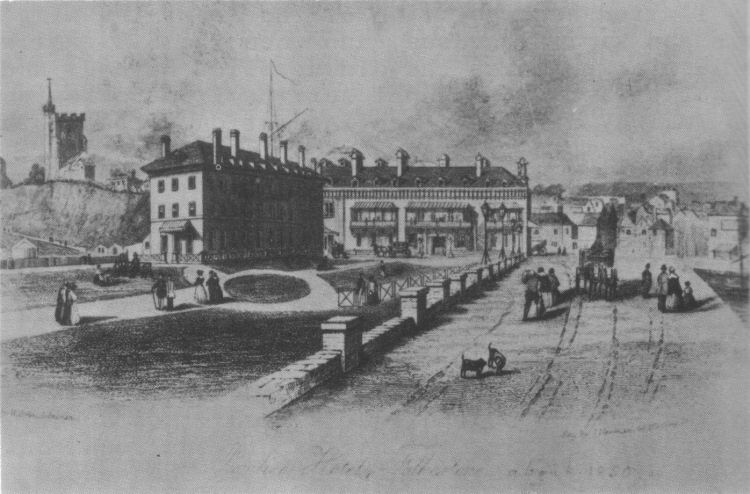
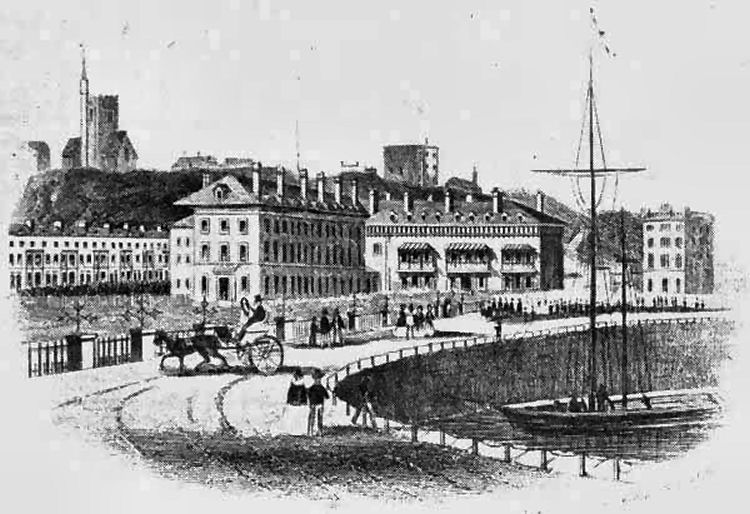
Pavilion Hotel circa 1850. |
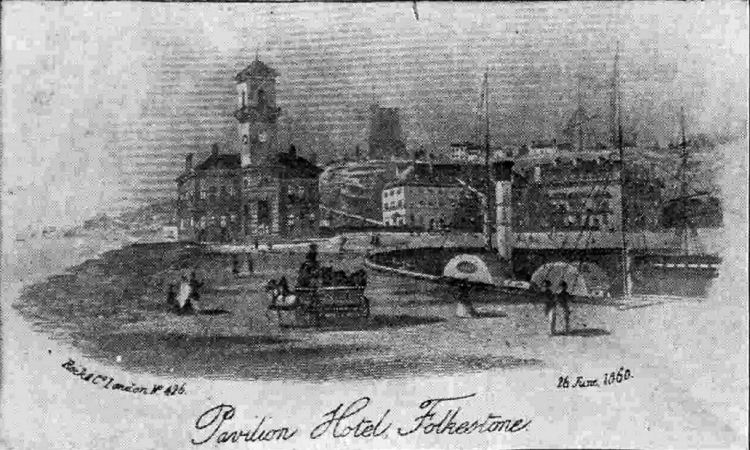
Above print dated 20th June, 1860 also showing the Tidal Packet Boat in
the Inner Harbour and the old Custom-house. |
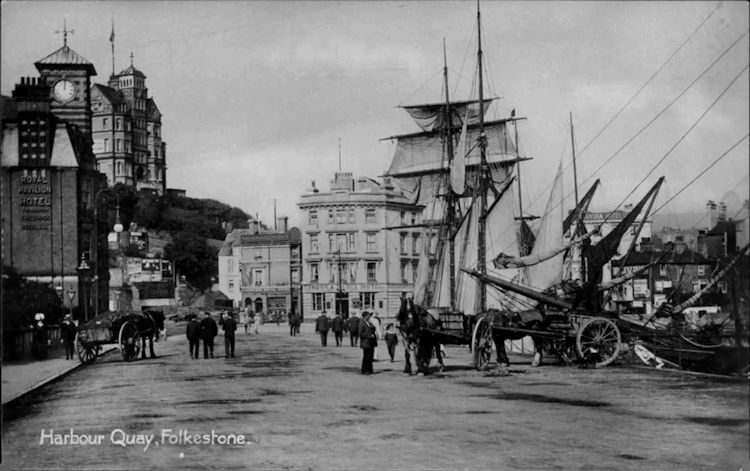
Above postcard, circa 1903, kindly sent by Rory Kehoe. Panoramic view,
which also takes in (from L to R) the "Royal
Pavilion Hotel," the "Princess
Royal Hotel" (in the livery of Nalder & Collyer's Croydon Brewery)
the "London and Paris Hotel"
and just visible behind the ships, the upper part of the "Alexandra
Hotel." |
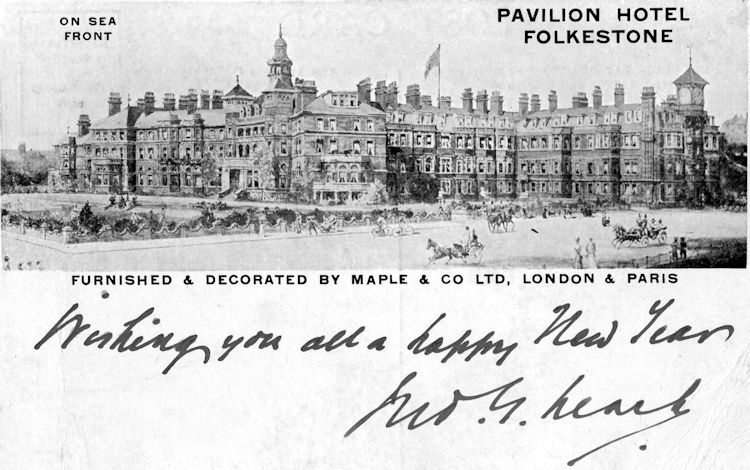
Above postcard, postmarked 30 December 1906. |
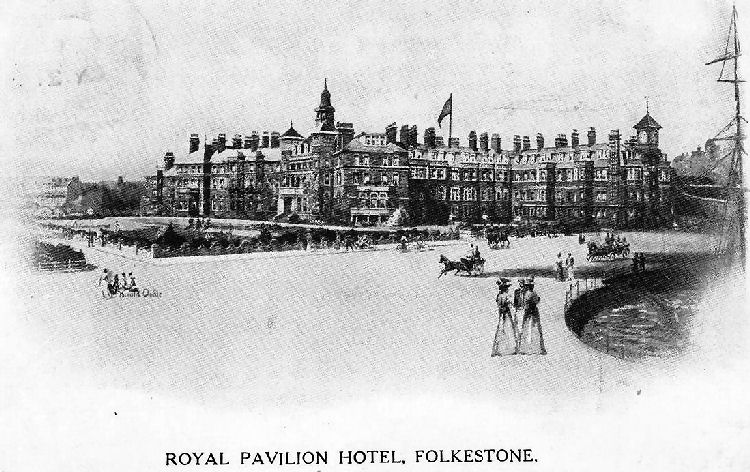
Above postcard, date 1911, kindly sent by Mark Jennings. |
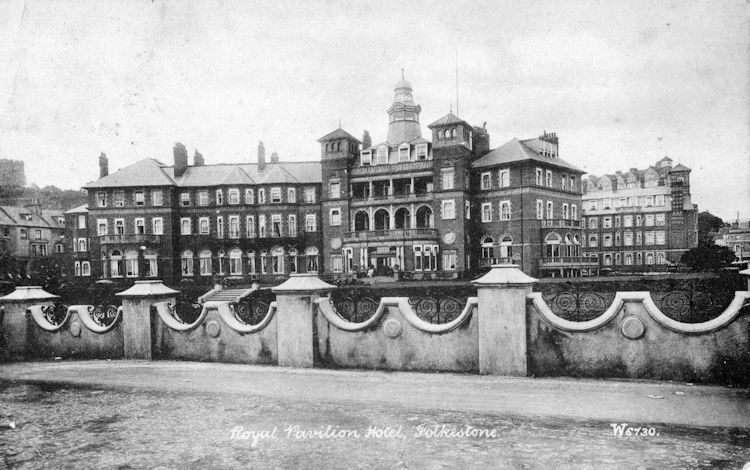
Above postcard, pre 1918. |
 Above print from the book "Dickensian Inns and Taverns, 1922." |

Above photo, 1923, showing grandparents of Ann Darby. |
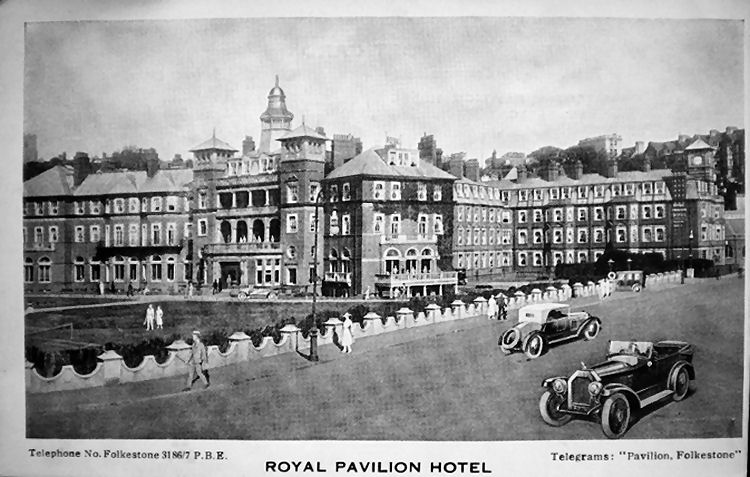
Above postcard undated. |
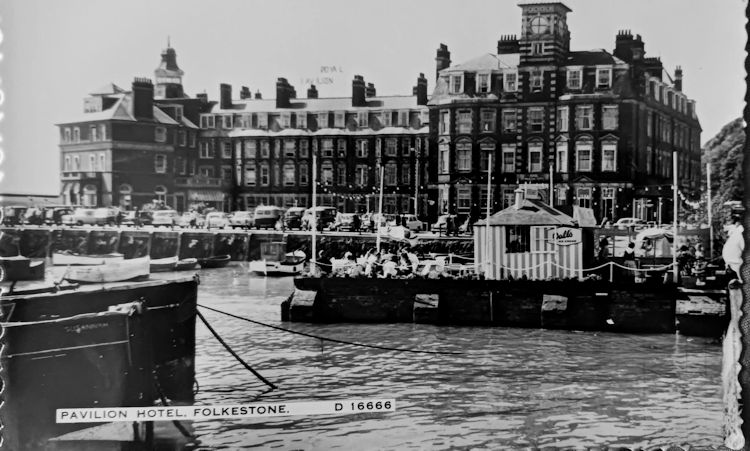
Above postcard, date unknown. |
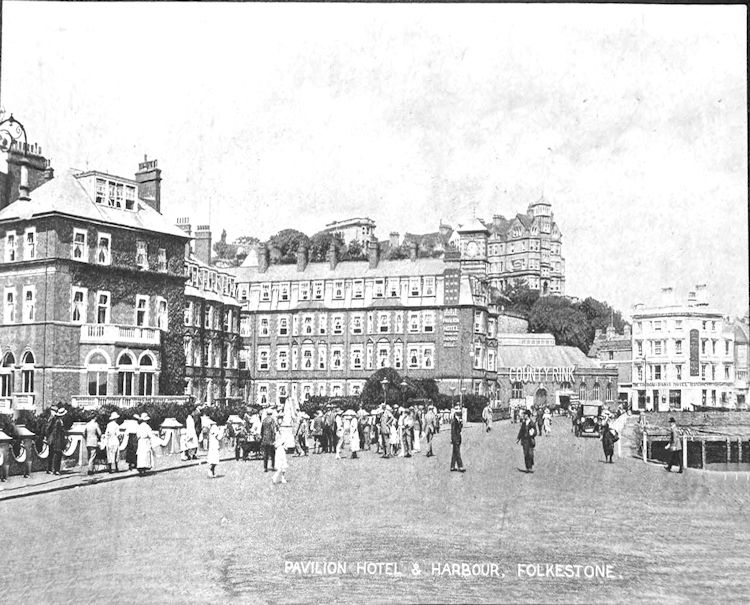
Above postcard, date unknown. |
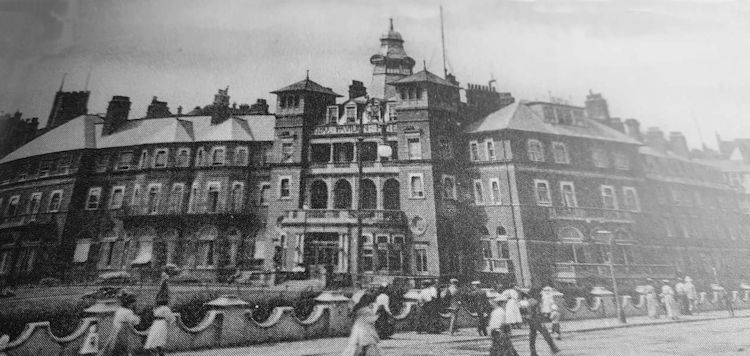
Above photo, date unknown. |
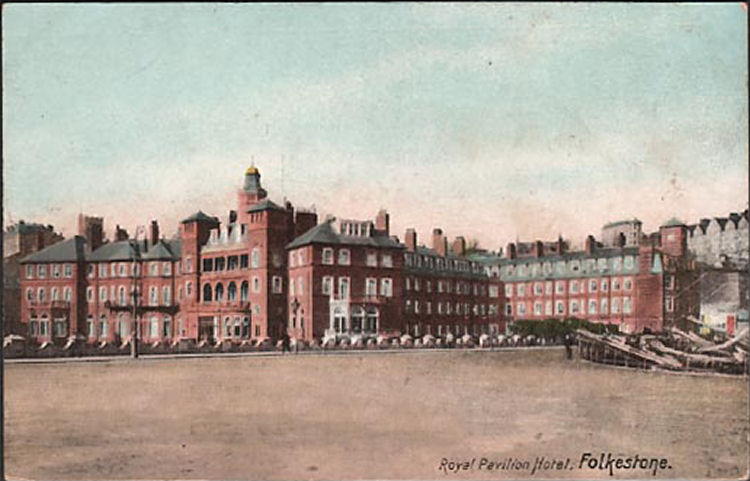
Royal Pavilion Hotel date unknown. |
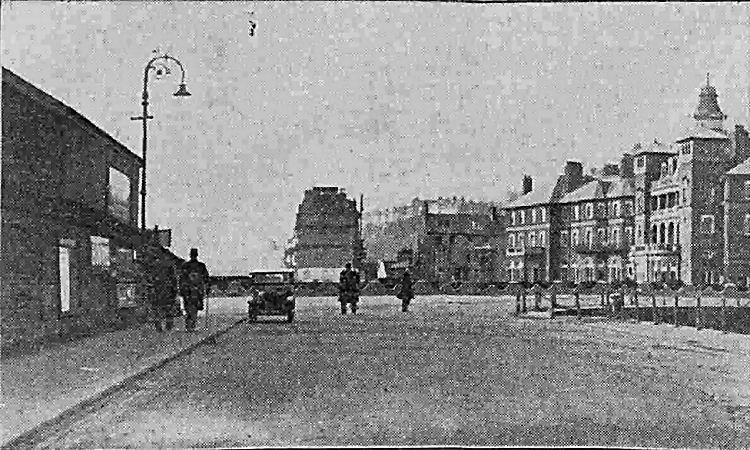
Above photo, 1933. |
It appears that the new building with this name replaced another earlier
one with the same name that was being demolished in 1844.
Kelly's directory of 1899 says the following:- "The Royal Pavilion Hotel"
which faces the sea in a sheltered position, has an extensive Winter garden,
and is close to the steamboat and promenade piers and the Undercliffe.
Kelly's 1934 stated that it was adjacent to the landing stage. Bedrooms
fitted with heating, hot and cold water. Garage. Telegrams, "Pavilion,
Folkestone;" Telephone: Folkestone 3186.
|
Kent Herald 3 August 1843
The South Eastern Railway Fete
The mayor and corporation of Folkestone, and the directors of the Dover and
South Eastern Railway Company, on Tuesday, celebrated the opening of the
communication by regular steam-packets between the ports of Folkestone and
Boulogne by a public breakfast and other festivities at the "South Eastern
Pavilion Tavern" at Folkestone. The town was filled all day long with visitors
from the adjacent places, and by arrivals from London, to be present at the
celebration. The vessels in the harbour, which has been purchased by the railway
company, and which it is in contemplation to enlarge and improve forthwith, were
decorated with flags and ensigns, and presented a very gay appearance. At
half-past 12 o’clock the City of Boulogne steamer came into the harbour and
landed the mayor and authorities of Boulogne, and the gentlemen of that place.
Their arrival was announced by a salute of ordnance, and they were received on
landing by the mayor (Mr. Major) and corporation of Folkestone and conducted to
the terminus of the railway, where they inspected the engines, carriages, &c,
and expressed their satisfaction with the arrangements. About this time the down
train from London came in, having brought down several of the directors and many
more guests to the breakfast. In the earlier part of the day the Sir William
Wallace, one of the eight vessels intended to make the passage between Boulogne
and Folkestone, had arrived from London, and taken from Folkestone to Boulogne
in this her first trip upwards of 100 passengers, and another vessel shortly
afterwards came in from Boulogne with a large number of passengers. It appears
that the harbour of Folkestone in its present state contains at high tide water
to the depth of 20 feet, and that when the wind is south or south-west it
affords a better entrance for vessels than Dover. By 4 o’clock the town was
filled with people, and the two moyors, and those by whom they were attended,
the directors and visitors having returned from the railroad, the breakfast
commenced. In order to afford accommodation to the very numerous party
assembled, and to the various groups collected together, an elegant marquee,
sent down for the occasion from the manufactory of Mr. B. Edgington, of Duke
Street, Borough, had been erected in front of the Pavilion Tavern facing the
sea, and beneath this were placed seats and tables; and in addition to this a
building, formerly a boat-house, had been converted into a banqueting room, and
fitted up with great taste by Mr. Vantini, the proprietor of the tavern, to whom
it is but justice to say that his arrangements for the gratification of his
guests were most satisfactory. The repast, to which nearly 200 persons sat down
at 4 o’clock was in a very excellent style.
The chair was taken by the mayor of Folkestone, supported on his right hand by
Mr. Baxendale, and on his left by M. Adam, the mayor of Boulogne. There were
also present. Mr. Marjoribanks, M.P. for Folkestone, M, Bailley, commandant of
the artillery at Boulogne. M. De la Sabloniere, Lieut. Col. Of the National
Guard of that city, M. De Mentque, sub-prefect, M. Sauson, Colonel of the
National Guard, Captain Tyndall, M. Marquet, civil engineer of Boulogne, M. Le
Compte, Grand Vicaire, Mr. Cardwell, M.P., Mr. Hamilton, Consul of Her Britannic
Majesty, Baron de Chivenet, Commandant of the garrison at Boulogne, M. De
Hastingham, King’s Advocate at Boulogne, M. Desaux, Captain Barthelemy, Mr. F.
Cubitt, Captain Charlwood, R.N., Captain Peat, R.N., General Hodgson, M. De la
Porte &c., the directors of the railway, &c. The company, in addition to the
good things placed on the tables, were entertained by a musical band from
Boulogne, which during the breakfast played some of the national airs of England
and France.
The mayor of Boulogne gave the first toast, viz., “the health of her Majesty
Queen Victoria" which was drunk with the usual honours. The mayor of Folkestone
then proposed “the health of his Majesty Louis Philippe," which was also
received with cheers, and drunk with all the honours. The next toast, “the Royal
Families of England and France," was the third in succession, and was drunk with
the honours, after which the health of “the Mayor of Folkestone," was proposed
and drunk, and the mayor returned thanks. On the health of “the Mayor of
Boulogne" being drunk, which came next in succession, M. Adam, in returning
thanks, detailed the history of the projected railroad from Paris to Boulogne
through the French Chambers, and observed that the recent fete given at Boulogne
on occasion of the railroad and steamboat excursion from London to that city had
had a beneficial effect in showing what could be done by railroads and steamers,
and had expedited the wished-for proceedings. M. Adam repudiated all intention
of injuring Calais by supporting a communication between Boulogne and
Folkestone, and said there was sufficient traffic for both ports, and enough to
render the competition of the one no injury to the other.
On the health of Mr. Baxendale and the Directors of the South Eastern Railroad
being drunk, that gentleman returned thanks, and in doing so described the state
of Folkestone harbour from the printed report and memorial laid before the
commissioners of Her Majesty's treasury by the merchants, shipowners, and
masters of ships of the port of London. Mr. Baxendale said he considered the
interests of the four ports of Boulogne, Calais, Dover, and Folkestone, would
all be advanced by the more rapid communication of railroads, and that it was
not from the injury of any one of them that the others should receive increased
advantages. He then briefly adverted to the state of the harbour of Folkestone
before it was purchased by the railroad company; and pointed out the
capabilities it possessed, and the improvement of which it was susceptible. He
hoped the example set to the government of the country by the company would lie
productive of good effects in calling their attention to what might be done to
render other harbours better than they now were. Mr. Baxendale concluded amidst
loud cheering.
The healths of Mr. Marjoribanks, Mr. Bleaden, and several other gentlemen were
then drunk, and those gentlemen returned thanks. After which a large portion of
the company retired in order to return by the train. The festivities were,
however, not over till a late hour, and it was nearly midnight before the
steamer conveyed the French guests back to Boulogne.
|
|
Dover Telegraph 5 August 1843.
The South Eastern Railway Fete.
The mayor and corporation of Folkestone, and the directors of the
Dover and South Eastern Railway Company, on Tuesday, celebrated the
opening of the communication by regular steam-packets between the
ports of Folkestone and Boulogne by a public breakfast and other
festivities at the South Eastern Pavilion Tavern at Folkestone. The
town was filled all day long with visitors from the adjacent places,
and by arrivals from London, to be present at the celebration. The
vessels in the harbour were decorated with flags and presented a
very gay appearance. At half-past tweIve o'clock the City of
Boulogne steamer came into the harbour and landed the mayor and
authorities of Boulogne, and the gentlemen of that place. Their
arrival was announced by a salute fired by the galvanic batteries,
and they were received on landing by the mayor (Mr. Major) and
corporation of Folkestone and conducted to the terminus of the
railway, where they inspected the engines, carriages, &c, and
expressed their satisfaction with the arrangements. About this time
the down train from London came in, having brought down several of
the directors and many more guests to the breakfast. They then
proceeded to take an experimental trip per rail to Ashford and back.
Upon their return, about 4 o'clock, the breakfast commenced, to
which about 200 persons sat down.
The chair was taken by the mayor of Folkestone, supported on his
right hand by Mr. Baxendale, and on his left by M. Adam, the mayor
of Boulogne. There were also present. Mr. Marjoribanks, M.P. for
Folkestone, the authorities and various gentlemen from Boulogne, Mr.
F. Cubitt, Captain Charlwood, R.N., Captain Peat, R.N., General
Hodgson, the directors of the railway, &c., &c.
The mayor of Boulogne gave the first toast, viz., “the health of her
Majesty Queen Victoria" which was drunk with the usual honours. The
mayor of Folkestone then proposed “the health of his Majesty Louis
Philippe," which was also received with cheers, and drunk with all
the honours. The next toast, “the Royal Families of England and
France," was the third in succession, and was drunk with the
honours, after which the health of “the Mayor of Folkestone," was
proposed and drunk, and the mayor returned thanks. On the health of
“the Mayor of Boulogne" being drunk, which came next in succession,
M. Adam, in returning thanks, repudiated all intention of injuring
Calais by supporting a communication between Boulogne and
Folkestone, and said there was sufficient traffic for both ports,
and enough to render the competition of the one no injury to the
other.
On the health of Mr. Baxendale and the Directors of the South
Eastern Railroad being drunk, that gentleman returned thanks, and in
doing so described the state of Folkestone harbour from the printed
report and memorial laid before the commissioners of Her Majesty's
treasury by the merchants, shipowners, and masters of ships of the
port of London. Mr. Baxendale said he considered the interests of
the four ports of Boulogne, Calais, Dover, and Folkestone, would all
be advanced by the more rapid communication of railroads, and that
it was not from the injury of any one of them that the others should
receive increased advantages. He then briefly adverted to the state
of the harbour of Folkestone before it was purchased by the railroad
company; and pointed out the capabilities it possessed, and the
improvement of which it was susceptible. He hoped the example set to
the government of the country by the company would lie productive of
good effects in calling their attention to what might be done to
render other harbours better than they now were. Mr. Baxendale
concluded amidst loud cheering.
The healths of Mr. Marjoribanks, Mr. Bleaden, and several others
were then drunk, and those gentlemen returned thanks. After which a
large portion of the company retired in order to return to London by
the train. The festivities were, however, not over till a late hour,
and it was nearly midnight before the steamer conveyed the French
guests back to Boulogne.
|
|
West Kent Guardian 5 August 1843.
The mayor and corporation of Folkestone, and the directors of the
Dover and South Eastern Railway Company, on Tuesday, celebrated the
opening of the communication by regular steam-packets between the
ports of Folkestone and Boulogne by a public breakfast and other
festivities at the South Eastern Pavilion Tavern at Folkestone. The
town was filled all day long with visitors from the adjacent places,
and by arrivals from London, to be present at the celebration. The
vessels in the harbour, which has been purchased by the railway
company, and which it is in contemplation to enlarge and improve
forthwith, were decorated with flags and ensigns, and presented a
very gay appearance, whilst from the old tower of the church the
bells rang forth a merry peal. At half-past 12 o'clock the City of
Boulogne steamer came into the harbour and landed the mayor and
authorities of Boulogne, and the gentlemen of that place invited to
be present at the festival. Their arrival was announced by a salute
of ordnance, and they were received on landing by the mayor and
corporation of Folkestone and conducted to the terminus of the
railway, where they inspected the engines, carriages, &c, and
expressed their satisfaction with the arrangements. About this time
the down train from London came in, having brought down several of
the directors and many more guests to the breakfast. In the earlier
part of the day the Sir William Wallace steamer, one of the eight
new vessels intended to make the passage between Boulogne and
Folkestone, had arrived from London, and taken from Folkestone to
Boulogne in this her first trip upwards of 100 passengers, and
another vessel shortly afterward came in from Boulogne with a large
number of passengers. It appears that the harbour of Folkestone in
its present state contains at high tide water to the depth of 20
feet, and that when the wind is south or south-west it affords a
better entrance for vessels than Dover.
By 4 o'clock the town was filled with people, and the two mayors,
and those by whom they were attended, the directors and the visitors
having returned from the railroad, the breakfast commenced. In order
to afford accommodation to the very numerous party assembled, and to
the various groups collected together, an elegant marquee, sent down
for the occasion from the manufactory of Mr. B. Edgington, of Duke
Street, Borough, had been erected in front of the Pavilion Tavern,
facing the sea, and beneath this were placed seats and tables; and
in addition to this a building, formerly a beat house, had been
converted into a banqueting room, and fitted up with great taste by
Mr. Vantini, the proprietor of the Tavern, to whom it is but justice
to say that his arrangements for the gratification of his guests
were most satisfactory. The repast, to which nearly 200 persons sat
down at 4 o'clock, was in a very excellent style. The chair was
taken by the mayor of Folkestone, supported on his right hand by Mr.
Baxendale, and on his left by M. Adam, the mayor of Boulogne. There
were also present Mr. Marjoribanks, M.P. for Folkestone; M. Bailly,
commandant of the artillery ait Boulogne; M. De là Sabloniere,
lieutenant colonel of the national guard of that city; M. De
Mentque, sub-prefect; M. Sanson, colonel of the national guard;
Capt. Tyndall, M. Marquet, civil engineer at Boulogne; M. Le Comte,
grand vicaire; Mr.Cardwell, M.P., Mr. Hamilton, consul of her
Britannic Majesty; Baron de Chivenet, commandant of the garrison at
Boulogne; M. de Hestingham, king’s advocate at Boulogne: M. Dessaux,
Captain Barthelemy, Mr. F. Cubitt, Captain Charlwood, R.N., Captain
Peat, R.N., General Hodgson, M. de la Porte, &c., the directors of
the railway, &c. The company, in addition to the good things placed
on the tables, were entertained by a musical band from Boulogne,
which, during the breakfast, played some of the national airs of
England and France.
The mayor of Boulogne gave the first toast, viz., “the health of her
Majesty Queen Victoria" which was drunk with the honours. The mayor
of Folkestone then proposed “the health of his Majesty Louis
Philippe," which was also received with cheers, and drunk with all
the honours. The next toast, “the Royal Families of England and
France," was the third in succession, and was drunk with the
honours, after which the health of “the Mayor of Folkestone," was
proposed and drunk, and the mayor returned thanks. On the health of
“the Mayor of Boulogne" being drunk, which came next in succession,
M. Adam, in returning thanks, detailed the history of the projected
railroad from Paris to Boulogne through the French Chambers, and
observed that the recent fete given at Boulogne on occasion of the
railroad and steam boat excursion from London to that city, had had
a beneficial effect in showing what could be done by railroads and
steamers, and bad expedited the wished-for proceedings. M. Adam
repudiated all intention of injuring Calais by supporting a
communication between Boulogne and Folkestone, and said there was
sufficient traffic for both ports, and enough to render the
competition of the one no injury to the other.
On the health of Mr. Baxendale and the Directors of the Smith
Eastern Railroad being drunk, that gentleman returned thanks, and in
doing so described the state of Folkestone harbour from the printed
report and memorial laid before the commissioners of Her Majesty's
Treasury by the merchants, shipowners, and masters of ships of the
port of London. Mr. Baxendale said he considered the interests of
the four ports of Boulogne, Calais, Dover, and Folkestone, would all
be advanced by the more rapid communication of railroads, and that
it was not from the injury of any one of them that the others should
receive increased advantages. He then briefly adverted to the state
of the harbour of Folkestone before it was purchased by the railroad
company; and pointed out the capabilities it possessed, and the
improvement of which it was susceptible. He hoped the example set to
the government of the country by the company would lie productive of
good effects in calling their attention to what might be done to
render other harbours better than they now were. Mr. Baxendale
concluded amidst loud cheering.
The healths of Mr. Marjoribanks, Mr. Bleaden, and several others
were then drunk, and those gentlemen returned thanks. After which a
large portion of the company retired in order to return to London by
the train. The festivities were, however, not over till a late hour,
and it was nearly midnight before the steamer conveyed the French
guests back to Boulogne.
|
|
Kentish Gazette 8 August 1843.
The South Eastern Railway Fete at Folkestone.
On Tuesday the mayor and corporation of Folkestone, and the directors of
the Dover and South Eastern Railway Company, celebrated the opening of
the communication by regular steam-packets between the ports of
Folkestone and Boulogne by a public breakfast and other festivities at
the South Eastern Pavilion Tavern at Folkestone. The town was filled all
day long with visitors from the adjacent places, and by arrivals from
London, to be present at the celebration. The vessels in the harbour,
which has been purchased by the railway company, and which it is in
contemplation to enlarge and improve forthwith, were decorated with
flags and ensigns, and presented a very gay appearance, whilst from the
old lower of the church the bells rang forth a merrv peal. At half-past
tweIve o' clock the City of Boulogne steamer came into the harbour and
landed the mayor and authorities of Boulogne, and the gentlemen of that
place invited to be present at the festival. Their arrival was announced
by a salute of ordnance, and they were received on landing by the mayor
and corporation of Folkestone and conducted to the terminus of the
railway, where they inspected the engines, carriages, &c, and expressed
their satisfaction with the arrangements. About this time the down train
from London came in, having brought down several of the directors and
many more guests to the breakfast. In the earlier part of the day the
Sir William Wallace steamer, one of the eight new vessels intended to
make the passage between Boulogne and Folkestone, had arrived from
London, and taken from Folkestone to Boulogne in this her first trip
upwards of one hundred passengers, and another vessel shortly afterward
came in from Boulogne with a large number of passengers. It appears that
the harbour of Folkestone in its present state contains at high tide
water to the depth of twenty feet, and that when the wind is south or
south-west it affords a better entrance for vessels than Dover.
By four o'clock the town was filled with people, and the two mayors, and
those by whom they were attended, the directors and the visitors having
returned from the railroad, the breakfast commenced. In order to afford
accommodation to the very numerous party assembled, and to the various
groups collected together, an elegant marquee, sent down for the
occasion from the manufactory of Mr. B. Edgington, of Duke Street,
Borough, had been erected in front of the Pavilion Tavern, facing the
sea, and beneath this were placed seats and tables; and ii addition to
this a building, formerly a beat house, had been converted into a
banqueting, room, and fitted up with great taste bv Mr. Vanlini, the
proprietor of the Tavern, to whom it is but justice to say that his
arrangements for the gratification ot his guests were most satisfactory.
The repast, to which nearly two hundred persons sat down at four
o'clock, was in a very excellent style The chair was taken by the mayor
of Folkestone, supported on his right hand by Mr. Baxendale, and on his
left by M. Adam, the mayor of Boulogne. There were also present. Mr.
Marjoribanks, M.P. for Folkestone; M. Bailly, commandant of the
artillery ait Boulogne; M. De là Sabloniere, lieutenant colonel of the
national guard of that city; M. De Mentque, sub-prefect; M. Sanson,
colonel of the national guard; Capt. Tyndall, M. Marquet, civil engineer
at Boulogne; M. Le Comte, grand vicaire; Mr.Caidwell, M.P., Mr.
Hamilton, consul of her Britannic Majesty; Baron de Chivenet, commandant
of the garrison at Boulogne; M. de Hestingham, king’s advocate at
Boulogne: M. Dessaux, Captain Barthelemy, Mr. F. Cubitt, Captain
Charlwnod, R.N., Captain Pent, R.N., General Hodgson, M. de la Porte,
&c., the directors of the railway, &c. The company, in addition to the
good things placed on the tables, were entertained by a musical band
from Boulogne, which, during the breakfast, played some of the national
airs of England and France.
The mayor of Boulogne gave the first toast, viz., “the health of her
Majesty Queen Victoria" which was drunk with the honours. The mayor of
Folkestone then proposed “the health of his Majesty Louis Philippe,"
which was also received with cheers, and drunk with all the honours. The
next toast, “the Royal Families of England and France," was the third in
succession, and was drunk with the honours, after which the health of
“the Mayor of Folkestone," was proposed and drunk, and the mayor
returned thanks. On the health of “the Mayor of Boulogne" being drunk,
which came next in succession, M. Adam, in returning thanks, detailed
the history of the projected railroad from Paris to Boulogne through the
French Chambers. and observed that the recent fete given at Boulogne on
occasion vf the railroad and steam boat excursion from London to that
city, had had a beneficial effect in showing what could be done by
railroads and steamers, and bad expedited the wished-for proceedings. M.
Adam repudiated all intention of injuring Calais by supporting a
communication between Boulogne and Folkestone, and said there was
sufficient traffic for both ports, and enough to render the competition
of the one no injury to the other.
On the health of Mr. Baxendale and the Directors of the Smith Eastern
Railroad being drunk, Ihat gentleman returned thanks, and in doing so
described the state of Folkestone harbour from the printed report and
memorial laid before the commissioners of Her Majesty's treasury by the
merchants, shipowners, and masters of ships of the port ol London. Mr.
Bnxemhile said he considered the interests of the four ports of
Boulogne, Calais, Dover, and Folkestone, would all be advanced by the
more rapid communication of railroads, and that it was not from the
injury of any one of them that the others should receive increased
advantages. He then briefly adverted to the state of the harbour of
Folkestone before it was purchased by the railroad company; and pointed
out the capabilities it possessed, and the improvement of which it was
susceptible. He hoped the example set to the government of the country
by the company would lie productive of good effects in calling their
attention to what might be done to render other harbours better than
they now were. Mr. Baxendale concluded amidst loud cheering.
The healths of Mr. Marjoribanks, Mr. Bleaden, and several others were
then drunk, and those gentlemen returned thanks. After which a large
portion of the company retired in order to return to London by the
train. The festivities were, however, not over till a late hour, and it
was nearly midnight before the steamer conveyed the French guests back
to Boulogne.
|
|
Kentish Gazette 5 September 1843.
A great many workmen are now employed in forming the Railway to the
Harbour; upwards of twenty houses are already down, and many more will
be removed in a short time. The contractor for clearing the harbour has
put on more men, who work night and day. As soon as the mud and shingle
are cleared out, other contracts are ready to be let. Messrs. Grissel
and Peto are building a large hotel, which will contain a great number
of bedrooms; its situation is fronting the harbour, on what was called
Farley’s Ground, close by the Pavilion. The pier is being made wider,
and is lighted with gas, which is a great improvement. The company seems
“to stand for nothing” - whatever is wanted is done.
|
|
Kentish Gazette 21 November 1843.
Mr. Major, on his re-election to the office of Mayor on the 9th inst.
invited the Town Council, and Joseph Baxendale, Esq. the chairman of the
South Eastern Railway, to a breakfast, a la fourchette, at the Pavilion.
The Mayor and Corporation, and a party of gentlemen, afterwards dined
together at the Rose Hotel.
|
|
Kentish Gazette 28 November 1843.
The new hotel and harbour house are now nearly completed. The tramway
from the station to the harbour will shortly be finished. It is expected
the trains will now run to the permanent station.
|
|
From the Dover Telegraph and Cinque Ports General
Advertiser, Saturday 20 January, 1844. Price 5d.
It is said that another Hotel is to be erected here, on the site of
the "Pavilion," 150ft larger than the recently built one.
|
|
Kentish Gazette 23 January 1844.
The improvements of this place had been for two or three weeks nearly at
a standstill, but considerable activity is again evinced in the progress
of the works, and a good number of hands are employed on the branch tram
road from the station to the harbour, which is rapidly approaching
completion. The clearing out of the mud and stones from the bed of the
harbour is finished, and the depth of water much increased, but this has
had a serious effect in increasing the shingle bank at the mouth, which
has caused considerable obstruction to vessels entering or leaving the
port. The company, however, intend to carry out their work with spirit,
and a large space is laid out for the purpose of forming a capacious
back water bay, the effect of which will be to prevent the bar from
forming at the mouth. An act is about to be applied for to enable the
company to do this, of which notice has been given to the inhabitants of
500 houses in the lower part of Folkestone, the whole of which houses
are to be taken down. The new pavilion facing the harbour has been
opened to the public by the company. It is a fine building, replete with
every accommodation, and capable of making up a hundred beds. Baths are
fitted up on a superior construction, which, as well as the whole house,
are supplied with water from a deep well sunk on the premises, the water
from which is conveyed into every department on the hydraulic principle.
The new harbour house is nearly completed. It is a handsome building,
surmounted by a square lower, in which an illuminated clock with four
faces is now being placed. The lawn in front of the pavilion has been
neatly laid out, and well turfed down, which gives it a gay and cheerful
appearance. The trains now run over the viaduct to the permanent
station, which is in every way commodious, and stands in an excellent
situation to command the communication with every part of the town, the
Dover road and the adjoining country. Well-horsed omnibuses are plying
to and from the station, the harbour, Dover, Sandgate, Hythe, &c.; and
the communication between this place and the continent is rendered
expeditious and safe, by the establishment of steamboats, which leave
and arrive in the harbour every tide to and from Boulogne. An excellent
road, lit with gas, has been constructed from the station to the
harbour, with a raised footpath, which renders the communication with
the lower part of the town easy and safe. This place is rapidly
progressing in importance, the effects of which are every day apparent
in the rapidly increasing value of property, and there is no doubt it
will soon become a port of considerable consequence. There are many
opinions afloat respecting the probable time when the line will be
opened to Dover; but whenever that may be, there is no reason why this
port may not become the grand outlet to the continent. A great
proportion of travellers will prefer the shorter and more expeditious
route by Boulogne, which is not only a saving of time and distance, but
a saving of expense, and will be preferred to the more circuitous route
by Dover and Calais. The whole aspect of the town has much improved of
late, and the streets (which are lit with gas) are much better kept and
cleaner swept than formerly.
|
|
West Kent Guardian 3 February 1844.
The old Pavilion Hotel is in course of demolition, and we hear that
another large building will be erected to match the new Pavilion. A
handsome parapetted wall is building in front of the hotel, which
encloses the lawn, and enhances the appearance of the harbour.
|
|
Kent Herald 8 February 1844
The new "Pavilion Hotel": The old building is fast being razed to the ground, and
an extensive enlargement of this new hotel is in progress. The workmen are
sinking the foundation, and the works are commenced towards building a large and
handsome wing to the hotel on the site of the old building, which will have a
fine appearance in conjunction with the present hotel and harbour house, and
present a splendid range of edifices to grace our neat and commodious harbour.
|
|
West Kent Guardian 16 March 1844.
The improvements and buildings at the new Pavilion are in progress,
and the newly-turfed lawn in front gives it now a very pretty and
imposing aspect. Some new buildings are also about to be erected in
the place, and we hope soon to see the activity of Folkestone return
and its present dullness dissipated.
|
|
Canterbury Weekly Journal 25 May 1844.
The building of the new "Pavilion Hotel" is going on very rapidly and,
when completed, it will be, probably, the finest hotel on the coast.
|
|
Dover Chronicle 25 May 1844.
The addition to the new Pavilion Hotel is proceeding with
expedition; when completed it will rival the best hotel in England,
or on the Continent. The addition comprises billiard room, coffee
room, ballroom, a large club room, a table d'hote; a large balcony
will run along the front, consisting of York slabs six feet wide,
supported by large iron ornamental brackets, which have a rich
appearance. Altogether the building, when completed, will be an
ornament to our town, and reflects great credit on the architect and
the railway company.
|
|
Dover Telegraph 25 May 1844.
On Tuesday, a man employed in pulling down the old Pavilion trod
upon a board, which canted up and precipitated him several feet to
the ground, by which he was much bruised, but, fortunately, no bones
were broken. The man is a sawyer by trade, but work being slack he
was temporarily employed as a labourer.
|
|
Kentish Mercury 1 June 1844.
An accident happened to one of the workmen, named Johnson
Herbert, at the New Pavilion, on Wednesday last, by treading on a
piece of timber, which gave way with him and precipitated him from a
height of 12 to 14 feet. The poor fellow was considerably hurt, but
is recovering.
|
|
Maidstone Gazette 14 January 1845.
The new, or northern, wing of the great Pavilion Hotel is now
finished, and will soon be open to the public. The western wing of
that immense establishment has, ever since its opening, enjoyed a
good patronage and, no doubt, the whole establishment will be
unequalled for beauty and convenience, from its interior
arrangements and good management.
The new Royal George Hotel is also completed, and will soon be open.
|
|
Maidstone Gazette 22 April 1845.
The Royal George hotel, we have heard, will be occupied in May next.
This has now become absolutely necessary, the Pavilion Hotel, large
as it is, being frequently obliged to “billet” travellers on its
neighbours.
|
|
Kent Herald 27 June 1844
The approach to the harbour has been much improved by the demolition of the
house at a narrow and dangerous corner (late the Victoria Inn), which will widen
the road by ten feet at this point, and improve the appearance of the harbour.
The building at the "Pavilion Hotel" is going on satisfactorily, and when
completed will render it the most extensive, and handsomest hotel, on this side
of the Channel.
|
|
Kent Herald 23 January 1845
The new, or northern, wing of the great "Pavilion Hotel" is now finished, and will
soon be open to the public. The western wing of that immense establishment has,
ever since its opening, enjoyed a good patronage and, no doubt, the whole
establishment will be unequalled for beauty and convenience, from its interior
arrangements and good management.
The new "Royal George Hotel" is also completed, and will be soon open.
There is also a row of houses near Grove House School, sixteen in number, with a
large building opposite, intended for an inn.
|
|
Kent Herald 24 April 1845
The "Royal George Hotel," we have heard, will be occupied in May next. This has
now become absolutely necessary; the "Pavilion Hotel," large as it is, being
frequently obliged to “billet” travellers on its neighbours.
|
|
From the Kentish Gazette, 27 May 1845.
PAVILION HOTEL, FOLKESTONE.
THE present Proprietor of this Hotel (Mr. Vantini having ceased to be
Proprietor thereof), begs to inform the Nobility, Gentry, and Public
that this Establishment affords accommodation of a most superior
character for Families, Visitors, and Travellers to the Continent, with
a scale of charges that will be found as moderate as any first-class
Hotel in the kingdom. The Cuisine is under the management of eminent
foreign Cooks, and the Wines, which are of the highest order, are now
wholly supplied by a first-rate and old-established House in the City,
the former stock having been entirely removed.
PARIS via FOLKESTONE and BOULOGNE. — The Hotel is also situated close to
the Quay, where the steamers (which go from Folkestone to Boulogue and
back daily) land their Passengers. It need hardly be observed that this
is the shortest and best route to and from Boulogne, avoiding the
numerous Tunnels that lie beyond. Folkestone on the Dover Line, whilst
the present Boulogne steamers on this station, the Queen of the Belgians
and the Princess Maude, being first-class Vessels, are, unrivalled in
speed, safety, and accommodation. The present Proprietor is happy to say
that although Mr. Vantini has ceased to be the Proprietor of this Hotel,
he will still have the valuable assistance of himself and Mad. Vantini
in the management of the same; and families and others requiring rooms
or information, are requested to address letters to Mad. Vantini,
"Pavilion Hotel," Folkestone.
|
|
Dover Telegraph 31 May 1845.
Advertisement: The present Proprietor of this Hotel (Mr. Vantini
having ceased to be Proprietor thereof), begs to inform the
Nobility, Gentry, and Public that this Establishment affords
accommodation of a most superior character for Families, Visitors,
and Travellers to the Continent, with a scale of charges that will
be found as moderate as any first-class Hotel in the Kingdom. The
Cuisine is under the management of eminent foreign Cooks, and the
Wines, which are of the highest order, are now wholly supplied by a
first-rate and old-established House in the City, the former stock
having been entirely removed.
Paris via Folkestone and Boulogne - The Hotel is also situated close
to the Quay, where the steamers (which go from Folkestone to
Boulogne and back daily) land their Passengers. It need hardly be
observed that this is the shortest and best route to and from
Boulogne, avoiding the numerous tunnels that lie beyond Folkestone
on the Dover Line, whilst the present Boulogne steamers on this
station, the Queen of the Belgians and the Princess Maude, being
first-class Vessels, are unrivalled in speed, safety, and
accommodation. The present Proprietor is happy to say that although
Mr. Vantini has ceased to be the Proprietor of this Hotel, he will
still have the valuable assistance of himself and Mad. Vantini in
the management of the same; and families and others requiring rooms
or information, are requested to address letters to Mad. Vantini,
Pavilion Hotel, Folkestone.
|
|
Kentish Gazette 23 September 1845.
Folkestone, Sept. 22: The traffic between this place and Boulogne
during the past week has been immense, and notwithstanding the
violent gales, only on one day interrupted. We hear that it is
contemplated to erect increased accommodation for the public by
extending considerably the "Pavilion Hotel," for although the "Royal
George Hotel" is opened and in full business there is yet a want of
means to meet the tide of demand, which is daily increasing here.
|
|
From the Dover Telegraph and Cinque Ports General Advertiser, Saturday, 23 May, 1846. Price 5d.
FOLKESTONE
On Thursday week the new burial ground attached to Folkestone Church
(presented by the Earl of Radnor,) was consecrated by his Grace the
Archbishop of Canterbury, who was attended by the Venerable Archdeacon
Croft and the clergy of the district. Owing to the very unfavourable
state of the weather, but few spectators were present to view the
ceremony. The Archbishop, Archdeacon, and several clergymen and
gentlemen, afterwards adjourned to the “Pavilion Hotel,” when an
excellent dinner was prepared for them.
|
|
Maidstone Gazette 1 September 1846
Town Hall, Tuesday: This being the licensing day for this town, all
the licenses were renewed, and an additional licence was granted to
Mr. Zenon Vantini, for the Pavilion tap.
Note: Pavilion Hotel.
|
|
Maidstone Gazette 4 May 1847
Petty Sessions, Tuesday; Before Capt. W. Sherren, Mayor, D. Major &
S. Bradley Esqs.
Louis Turiam, waiter at the Pavilion Hotel, was summoned by Henry
William Mayne (a man who gets his living by singing at public
houses), for an assault. The complainant stated that he entered the
hotel with some friends and called for wine, and that for some
offence given he was turned out of the house and struck by the
defendant, without provocation; he was perfectly sober at the time.
The defendant, in answer to the charge, stated that the complainant
came to the hotel and called for wine; that while there he conducted
himself in a disgraceful manner – so much so that several ladies and
gentlemen complained of his conduct to the manager. Finding he was
much intoxicated and refused to be quiet, he, with assistance,
turned him out of the hotel. Defendant then went outside, and while
looking at the complainant, who was still creating a disturbance, he
was struck by him on the mouth; he defended himself from a second
attack of the complainant, who was ultimately locked up in the
station-house.
Walsh, the night porter, corroborated the defendant's statement in
every particular, and stated that the complainant was very tipsy.
The Magistrates consulted together, and decided that the assault was
justified, and dismissed the summons.
|
|
Dover Chronicle 8 May 1847
At the Folkestone Petty Sessions last week, Louis Turiam, waiter at
the Pavilion Hotel, was summoned by Henry William Mayne
(professional singer), for an assault. The complainant stated that
he entered the hotel with some friends and called for wine, and that
for some offence given he was turned out of the house and struck by
the defendant, without provocation; he was perfectly sober at the
time.
The defendant, in answer to the charge, stated that the complainant
came to the hotel and called for wine; that while there he conducted
himself in a disgraceful manner – so much so that several ladies and
gentlemen complained of his conduct to the manager. Finding he was
much intoxicated and refused to be quiet, he, with assistance,
turned him out of the hotel. Defendant then went outside, and while
looking at the complainant, who was still creating a disturbance, he
was struck by him on the mouth; he defended himself from a second
attack of the complainant, who was ultimately locked up in the
station-house.
Walsh, the night porter, corroborated the defendant's statement in
every particular, and stated that the complainant was very tipsy.
The Magistrates consulted together, and decided that the assault was
justified, and dismissed the summons.
|
|
West Kent Guardian 8 May 1847
Petty Sessions, Tuesday; Before Capt. W. Sherren, Mayor, D. Major &
S. Bradley Esqs.
Louis Turiam, waiter at the Pavilion Hotel, was summoned by Henry
William Mayne (a man who gets his living by singing at public
houses), for an assault. The complainant stated that he entered the
hotel with some friends and called for wine, and that for some
offence given he was turned out of the house and struck by the
defendant, without provocation; he was perfectly sober at the time.
The defendant, in answer to the charge, stated that the complainant
came to the hotel and called for wine; that while there he conducted
himself in a disgraceful manner – so much so that several ladies and
gentlemen complained of his conduct to the manager. Finding he was
much intoxicated and refused to be quiet, he, with assistance,
turned him out of the hotel. Defendant then went outside, and while
looking at the complainant, who was still creating a disturbance, he
was struck by him on the mouth; he defended himself from a second
attack of the complainant, who was ultimately locked up in the
station-house.
Walsh, the night porter, corroborated the defendant's statement in
every particular, and stated that the complainant was very tipsy.
The Magistrates consulted together, and decided that the assault was
justified, and dismissed the summons.
|
|
Dover Telegraph 21 July 1849
Advertisement: Folkestone, Kent, to be sold by auction, at the
"Pavilion Hotel," in Folkestone, on Saturday, July 28th, 1849, at
three o'clock in the afternoon (by order of the mortgagee, under
powers of sale), subject to such conditions as will be then and
there produced:-
All that messuage or tenement, known by the name of the "York Hotel,"
situate in the Dover Road, in the town of Folkestone.
The property is held under a lease from the Earl of Radnor and
Viscount Folkestone for a term of 99 years, from the 24th day of
June, 1844, subject to the annual rent of £11 5s., and to the
covenants and agreements contained in such lease.
The premises are well situated, are very capacious, and are
constructed with a view to being easily converted into two large and
commodious family residences. Immediate possession of the property
can be given.
To view the premises apply to the Auctioneer, and for further
particulars to Mr. Chalk, or Messrs. Gravener and Sons, Solicitors,
Dover, or to Messrs. Brockman and Watts, Solicitors, Folkestone.
July 12th, 1849
|
|
Kent Herald 9 August 1849
Petty Sessions:
July 28, at the Pavilion Hotel, Folkestone, by Mr. M. M. Major: the York Hotel,
Folkestone, put up at £800 (no bidders).
|
|
Kentish Gazette, 14 August 1849.
Public Sales.
July 28, at the "Pavilion Hotel," Folkestone, by Mr. M. M. Major;
Freehold estate, Cheriton, near Folkestone, with 22 acres of arable and
meadow land, sold for £1,520; freehold residence and acre of pasture
land, in the Upper Sandgate-road, £1,800 (bought in); freehold messuages,
Dover-road, £500 (bought in); freehold pasture land, two acres, near
Dover-road, Folkestone, sold for £385, to Mr. John Jeffery, whose
property it adjoins; the "York Hotel," Folkestone, put up at £800 (no
bidders). — July 21, by Messrs. Farebrother and Co., at Garraway's:
Freehold farm, called Clinch-street, Hoo, Kent, let for £300, knocked
down at £8,400.
|
|
Maidstone Gazette 2 October 1849
Petty Sessions, Monday; Before C. Golder Esq., Mayor.
John Cane was charged with breaking a window at the Pavilion Hotel.
From the evidence of the manager, Gullous Gianini, it appeared that
the prisoner was playing a flute at the south end of the building;
he was requested to go away by one of the waiters sent out by a lady
in the hotel; he refused, and threw his flute at the waiter's head, which it missed, and went through a square of glass. The
prisoner was intoxicated. Fined 5s/ and costs, or fourteen days' hard labour.
Committed.
|
|
Maidstone Gazette 1 January 1850
Petty Sessions, Friday; Before W. Major, C. Golder and S. Mackie
Esqs.James Osborne, chimney sweep, and Osborne Lee, ostler at the Duke's
Head, Hythe, were charged with stealing a piece of copper, the
property of Owen Tickel Alger Esq., of the Pavilion Hotel.
John Myers, marine store dealer, being sworn, deposed: I live at
Hythe. On the 19th December instant the prisoner Osborne Lee brought
me the piece of copper produced, and asked me to purchase it. I
asked him where he obtained it, and he said it was all right, I need
not be afraid. I told him I thought it was not all copper, and that
I would give him 4s., and if when I sold it they did not knock
anything off I would give him more; it weighed 13 lbs.
Mary Roker deposed: I am still-room maid at the Pavilion Hotel. The
piece of copper produced was formerly used in the bain-marie, in the
still-room, to keep things hot. We have no use for it now, but I
have fitted it in its former place, and can swear to it by the make
of it.
William Francis Smith deposed: The article now produced was made by
my father for the bain-marie. I can swear to it as I cut the hole in
it to let out the steam. The value of it as old copper is about 9s.;
it cost new about 26s.
Richard Bishop, chimney sweeper, deposed: I lodge at the Duke's Head, Hythe. About the 15th or 16th instant the prisoner, James
Osborne, came into the Duke's Head, and enquired for me; I shortly
after saw him, when he asked me if I would purchase some old copper;
he said he had about 12lbs. or 14 lbs. I was afraid to buy it, and
told him to take it to my master, Mr. Myers. I did not see it till
my master showed it to me. The prisoner Osborne Lee told me he had
sold it for the other prisoner, and got 4s. for it, and 6d. for his
own trouble.
The Magistrates consulted, and the prisoner Osborne Lee was then
sworn as a witness; he deposed: The prisoner (James Osborne) brought
me a piece of copper into the tap room of the Duke's Head, said he
had found it on the sea shore, and wished me to sell it for him. I
told him I would try and sell it for him if it was all right; he
assured me it was, and that I need not be afraid. I took it to Mr.
Myers, and he gave me 6d. for my trouble. I was asked by Mr. Myers
where I got it from, and I told him it was all right.
The prisoner, in defence, said: When I had done my work a few days
before I gave the copper to the ostler. My master, Mr. Driscoll,
chimney sweeper, sent me over from Hythe to the Pavilion to empty
sawdust and bring back ashes. One of my master's men was at work at
the hotel all the morning. When I got there he was lying in the
ash-hole, awaiting my coming. I gave him the basket down to fill,
and he shortly handed me the copper from out of the sawdust, and
said it would fetch a shilling or two. I asked him who it belonged
to, and he said to them, the sweeps. I told him he had better not
carry it away, for fear of getting themselves and master into
trouble. He said whatever was in there was to throw away, or carry
home. Being a perfect stranger to the work and house, I did not know
what the sweeps were allowed to have. He told me it was all right;
we then took it home, and afterwards I employed the ostler to sell
it for us, and we were to divide the money.
Remanded till Tuesday. A warrant was issued in the course of the day
for the apprehension of the other man concerned in the robbery.
|
|
Kent Herald, 3 January 1850.
Petty Sessions: James Osborne, a chimney sweep, and Osborne Lee, ostler at the
"Duke's Head," Hythe, were charged with stealing a piece of copper, the property
of Owen Tickel Algar Esq., of the "Pavilion Hotel." Remanded. A warrant was issued
in the course of the day for the apprehension of another man concerned in the
robbery.
|
|
Maidstone Gazette 8 January 1850
Petty Sessions, Tuesday; Before D. Major Esq., Mayor, C. Golder, W.
Major and S. Mackie Esqs.
James Osborne and Thomas Graham, the former remanded from last week,
were brought up in custody for final examination, charged with
stealing a piece of copper from the Pavilion Hotel. The prisoner
Graham had been apprehended at Canterbury by police constable
Pearson, who has shown much vigilance in the matter. The statement
made last week by Osborne was read to the prisoner Graham.
Police constable Pearson stated that on Christmas Day last he looked
in at Mr. Myers's, the marine store dealer, and seeing the piece of copper asked him
where he bought it; he gave the name of the ostler at the Duke's Head, Hythe. Witness then took him and the other
prisoner into custody on Saturday last; on the 29th he apprehended
Thomas Graham at Canterbury.
The prisoner Graham, in his defence, stated that he always took the
rubbish away and put it on the beach; he did not know it was copper
when he took it away.
Committed to the Quarter Sessions.
|
|
Kent Herald, 10 January 1850.
Petty Sessions: James Osborne and Thomas Graham, the former remanded from last
week, were brought up in custody for final examination, charged with stealing a
piece of copper from the "Pavilion Hotel." The prisoner Graham had been
apprehended at Canterbury by police constable Pearson, who has shown much
vigilance in the matter. Committed to the Quarter Sessions.
The "Pavilion Hotel" changes hands next week. We understand that it has been taken
by Mr. Breach, of the firm of Bathe and Breach, of the "London Tavern," Bishopsgate Street.
|
|
Dover Chronicle 12 January 1850
The Pavilion Hotel changes hands next week. We understand that it
has been taken by Mr. Breach, of the firm of Bathe and Breach, of
the London Tavern, Bishopsgate Street.
|
|
Canterbury Journal 12 January 1850.
On Tuesday last, the quarter sessions for the borough of Folkestone
were holden at the Guildball, Folkestone, before the Recorder (J. J.
Lonsdale, Esq.,) the Mayor (D. Major, Esq.,) and Messrs. C. Golder,
Wm. Major, and S. Bateman, magistrates.
James Osborne, labourer, late of Hythe, was indicted for having
stolen a piece of copper, value 9d., the property of Mr. Owen
Fickell Algar, proprietor of the "Pavilion Hotel."
Guilio Giovarni, manager of the "Pavilion Hotel," deposed that the
piece of copper was brought to him by Pearson, the policeman, and
which he recognised as being the top of a “bain marie” It had not
been used for two years; originally coat 25s.; and had been put away
in the scullery.
Matthew Pearson, policeman, on the 25th of December, went to John
Myers, the marine store dealer, at Hythe, in consequence of
information he had received; saw the piece of copper produced; asked
where it came from; was told by Myers that he had purchased it from
the ostler of the "Duke’s Head Inn," named Osborn Lee; took it away
and brought it home; next day took it to the "Pavilion Hotel," where
the servants identified it as being the property of Mr. Algar.
John Myers, marine-store dealer, deposed that Osborn Lee, ostler of
the "Duke’s Head," brought the piece of copper produced; asked him how
he came by it; said it was all right; told him all right was
sometimes all wrong; gave him 4s. for it, but told him he might have
the difference in the price, if any, at some future time; did not
know the exact value; told him, over and over again, he was afraid
it was stolen.
The Recorder cautioned this witness about his dealings, and told him
to be more cautious in future.
Osborn Lee, ostler at the "Duke’s Head," Hythe, deposed to selling the
piece of copper for Osborne, without any suspicion that it had been
stolen.
Mary Roker, still-room maid at the hotel, identified the copper as
belonging to the “bain marie” at the "Pavilion." Saw it last in the
still-room, two or three years since.
William Francis, whitesmith, identified the copper produced, it
being fitted by him in the place it occupied.
The prisoner, on being asked what he had to say, stated that about a
fortnight ago he was sent for a load of ashes. One of his master's
sweeps was down the ash-hole at the "Pavilion Hotel;" he passed the
piece of copper through the hole, and when be (prisoner) cautioned
him about it, he said all thrown in there belonged to the sweeps.
The sweep asked him to sell it for him, and he passed it to Osborn
Lee for the purpose.
The Recorder summed up, and the jury, having retired for a short
time, acquitted the prisoner. He was, however, detained in custody,
to be brought up as evidence against the sweep.
James Graham, the sweep alluded to in the previous trial, was then
indicted for having stolen the piece of copper, value 9s., and
pleaded Not Guilty.
The evidence in this case was precisely as before, with the addition
of James Osborn's statement as to the conversation between him and
the sweep, and his undertaking to sell the item in question.
Witnesses were called to speak to character.
Verdict: Guilty – one month's imprisonment.
|
|
Kentish Gazette, 15 January 1850.
FOLKESTONE.
The "Pavilion Hotel" is about to change hands. We understand that it has
been taken by Mr. Breach, of the firm of Battle and Breach, of the
"London Tavern," Bishopsgate-street.
|
|
Maidstone Gazette 15 January 1850
Quarter Sessions: Before J. Lonsdale Esq., Recorder.
James Osborne, labourer, was indicted for stealing a piece of
copper, value 9s., from the Pavilion Hotel.
Not Guilty.
|
|
Kentish Gazette, 15 January 1850.
QUARTER SESSIONS.
On Tuesday last, the quarter sessions for the borough of Folkestone
were holden at the Guildhall, Folkestone, before the Recorder (J. J.
Lonsdale, Esq.,) the Mayor (D. Major, Esq.,) and Messrs. C. Golder, Wm.
Major, and S. Bateman, magistrates.
James Osborne, labourer, late of Hythe, was indicted for having
stolen a piece of copper, value 9s., the property of Mr. Owen Fickell
Algar, proprietor of the "Pavilion Hotel."
Guilio Giovarni, manager of the "Pavilion Hotel," deposed that the
piece of copper was brought to him by Pearson, the policeman, and which
he recognised as being the top of a "bain marie." It had not been used
for two years; originally coat 25s.; and had been put away in the
scullery.
Matthew Pearson, policeman, on the 25th of December, went to John
Myers, the marine store dealer, at Hythe, in consequence of information
he had received; saw the piece of copper produced; asked where it came
from; was told by Myers that he had purchased it from the ostler of the
"Duke’s Head Inn," named Osborn
Lee; took it away and brought it home; next day took it to the "Pavilion
Hotel," where the servants identified it as being the property of Mr.
Algar.
John Myers, marine-store dealer, deposed that Osborn Lee, ostler of
the "Duke’s Head," brought the
piece of copper produced, asked him haw he came by it, said it was all
right, told him all right was sometimes all wrong; gave him 4s. for it,
but told him he might have the difference in the price, if any, at some
future time; did not know the exact value, told him, over and over
again, he was afraid it was stolen.
The Recorder cautioned this witness about his dealings, and told him
to be more cautious in future.
Osborn Lee, ostler at the "Duke's
Head," Hythe, deposed to selling the piece of copper for Osborne,
without any suspicion that it had been stolen.
Mary Roker, still-room maid at the hotel, identified the copper as
belonging to the "bain marie" at the "Pavilion." Saw it last in the
still-room, two or three years since.
William Francis, whitesmith, identified the copper produced, it being
fitted by him in the place it occupied.
The prisoner, on being asked what he had to say, stated that about a
fortnight ago he was sent for a load of ashes. One of his master's
sweeps was down the ash-hole at the "Pavilion Hotel"; he passed the
piece of copper through the hole, and when he (prisoner) cautioned him
about it, he said all thrown in there belonged to the sweeps. The sweep
asked him to sell it for him, and he passed it to Osborn Lee for the
purpose.
The Recorder summed up, and the jury, having retired for a short
time, acquitted the prisoner. He was, however, detained in custody, to
be brought up as evidence against the sweep.
|
|
Kent Herald, 17 January 1850.
On the 8th inst., the quarter sessions for the borough of Folkestone were holden
at the Guildball, Folkestone, before the Recorder (J. J. Lonsdale, Esq.,) the
Mayor (D. Major, Esq.,) and Messrs. C. Golder, Wm. Major, and S. Bateman,
magistrates.
James Osborne, labourer, late of Hythe, was indicted for having stolen a piece
of copper, value 9d., the property of Mr. Owen Fickell Algar, proprietor of the
Pavilion Hotel.
Guilio Giovarni, manager of the Pavilion Hotel, deposed that the piece of copper
was brought to him by Pearson, the policeman, and which he recognised as being
the top of a “bain marie” It had not been used for two years; originally coat
25s.; and had been put away in the scullery.
Matthew Pearson, policeman, on the 25th of December, went to John Myers, the
marine store dealer, at Hythe, in consequence of information he had received;
saw the piece of copper produced; asked where it came from; was told by Myers
that he had purchased it from the ostler of the Duke’s Head Inn, named Osborn
Lee; took it away and brought it home; next day took it to the Pavilion Hotel,
where the servants identified it as being the property of Mr. Algar.
John Myers, marine-store dealer, deposed that Osborn Lee, ostler of the Duke’s
Head, brought the piece of copper produced; asked him how he came by it; said it
was all right; told him all right was sometimes all wrong; gave him 4s. for it,
but told him he might have the difference in the price, if any, at some future
time; did not know the exact value; told him, over and over again, he was afraid
it was stolen.
The Recorder cautioned this witness about his dealings, and told him to be more
cautious in future.
Osborn Lee, ostler at the Duke’s Head, Hythe, deposed to selling the piece of
copper for Osborne, without any suspicion that it had been stolen.
Mary Roker, still-room maid at the hotel, identified the copper as belonging to
the “bain marie” at the Pavilion. Saw it last in the still-room, two or three
years since.
William Francis, whitesmith, identified the copper produced, it being fitted by
him in the place it occupied.
The prisoner, on being asked what he had to say, stated that about a fortnight
ago he was sent for a load of ashes. One of his master’s sweeps was down the
ash-hole at the Pavilion Hotel; he passed the piece of copper through the hole,
and when be (prisoner) cautioned him about it, he said all thrown in there
belonged to the sweeps. The sweep asked him to sell it for him, and he passed it
to Osborn Lee for the purpose.
The Recorder summed up, and the jury, having retired for a short time, acquitted
the prisoner. He was, however, detained in custody, to be brought up as evidence
against the sweep.
James Graham, the sweep alluded to in the previous trial, was then indicted for
having stolen the piece of copper, value 9s., and pleaded Not Guilty.
The evidence in this case was precisely as before, with the addition of James
Osborn's statement as to the conversation between him and the sweep, and his
undertaking to sell the item in question.
Witnesses were called to speak to character.
Verdict: Guilty – one month's imprisonment.
|
|
Maidstone Gazette 29 January 1850
The Pavilion Hotel: It is said that the new proprietor (Mr. Breach)
intends to make various alterations and additions to the Pavilion,
with a view to render that accommodation so much wanted in the
season.
Letter: In reference to your report respecting the trial of Osborne
and another for a robbery at the Pavilion, Folkestone, I merely
wish, in justice to myself, that you will state what appeared to the
Court, viz., that I gave the information to the policeman that was
the means of the man Osborne being convicted. I trust you will
insert a line or two in my favour to exonerate me from public
obloquy. Your most obedient servant, John Myers, Hythe, Jan. 27,
1850.
|
|
Dover Chronicle 2 February 1850
The Pavilion Hotel: It is said that the new proprietor (Mr. Breach)
intends to make various alterations and additions to the Pavilion,
with a view to render that accommodation so much wanted in the
season.
|
|
Kentish Gazette, 15 January 1850
The Pavilion Hotel is about to change hands. We understand that it has been
taken by Mr. Breach, of the firm of Battle and Breach, of the London Tavern,
Bishopsgate Street.
On Tuesday last, the quarter sessions for the borough of Folkestone were holden
at the Guildball, Folkestone, before the Recorder (J. J. Lonsdale, Esq.,) the
Mayor (D. Major, Esq.,) and Messrs. C. Golder, Wm. Major, and S. Bateman,
magistrates.
James Osborne, labourer, late of Hythe, was indicted for having stolen a piece
of copper, value 9d., the property of Mr. Owen Fickell Algar, proprietor of the
Pavilion Hotel.
Guilio Giovarni, manager of the Pavilion Hotel, deposed that the piece of copper
was brought to him by Pearson, the policeman, and which he recognised as being
the top of a “bain marie” It had not been used for two years; originally coat
25s.; and had been put away in the scullery.
Matthew Pearson, policeman, on the 25th of December, went to John Myers, the
marine store dealer, at Hythe, in consequence of information he had received;
saw the piece of copper produced; asked where it came from; was told by Myers
that he had purchased it from the ostler of the Duke’s Head Inn, named Osborn
Lee; took it away and brought it home; next day took it to the Pavilion Hotel,
where the servants identified it as being the property of Mr. Algar.
John Myers, marine-store dealer, deposed that Osborn Lee, ostler of the Duke’s
Head, brought the piece of copper produced; asked him how he came by it; said it
was all right; told him all right was sometimes all wrong; gave him 4s. for it,
but told him he might have the difference in the price, if any, at some future
time; did not know the exact value; told him, over and over again, he was afraid
it was stolen.
The Recorder cautioned this witness about his dealings, and told him to be more
cautious in future.
Osborn Lee, ostler at the Duke’s Head, Hythe, deposed to selling the piece of
copper for Osborne, without any suspicion that it had been stolen.
Mary Roker, still-room maid at the hotel, identified the copper as belonging to
the “bain marie” at the Pavilion. Saw it last in the still-room, two or three
years since.
William Francis, whitesmith, identified the copper produced, it being fitted by
him in the place it occupied.
The prisoner, on being asked what he had to say, stated that about a fortnight
ago he was sent for a load of ashes. One of his master's sweeps was down the
ash-hole at the Pavilion Hotel; he passed the piece of copper through the hole,
and when be (prisoner) cautioned him about it, he said all thrown in there
belonged to the sweeps. The sweep asked him to sell it for him, and he passed it
to Osborn Lee for the purpose.
The Recorder summed up, and the jury, having retired for a short time, acquitted
the prisoner. He was, however, detained in custody, to be brought up as evidence
against the sweep.
|
|
Maidstone Gazette 19 February 1850
At the Petty Sessions on Tuesday the licence of the South Eastern
Pavilion was transferred from T. Algar to James Gaby Breach, of the
London Tavern, Bishopsgate, London, and the licence of the
Oddfellows Arms was transferred from Edward Brooks to Frances
Shovler.
Note: Oddfellows Arms; Earlier end date for Brooks – and different
first name. Shovler previously unknown.
|
|
Kent Herald, 21 February 1850.
Petty Sessions: At the Petty Sessions the license of the "South Eastern Pavilion"
was transferred from T. Alger to James Gaby Breach, of the London Tavern, Bishopsgate,
London.
|
|
Dover Chronicle 23 February 1850
At the Petty Sessions on Tuesday the licence of the "South Eastern
Pavilion" was transferred from T. Algar to James Gaby Breach, of the
"London Tavern.
|
|
Maidstone Gazette 26 February 1850
Petty Sessions, Monday; Before D. Major Esq., Mayor, W. Major and S.
Mackie Esqs.
James Driscall, of Hythe, master chimney sweeper, was charged with
having, on the 12th inst., stolen a chimney sweeping machine, value
£10, from the Pavilion Hotel, the property of James Gaby Breach.
Guilio Giovannini deposed: When I was manager of the Pavilion Hotel,
I repeatedly missed different articles belonging to it. The sweeping
machine now produced is the property of Mr. Breach; it has been in
use at the hotel. The last time I saw the machine was about three
weeks ago, and on Thursday last I missed it. I never gave James
Driscall permission to take the machine. He must have taken it away
from part of the house where he had no business. I have known that
there was a machine belonging to the house about two years.
James Gaby Breach deposed: I am proprietor of the said hotel, and as
such the sweeping machine belongs to me. One day in the early part
of last week I was in the basement storey of the hotel. I saw
Driscall in the lower part of the house, and asked him what business
he had there; he said “I want to see Mr. Giavannini”. I said that
was not the place to find him, and told him to go upstairs. I saw a
boy with him carrying the machine, and asked Driscall what he was
going to do with it. He said “I am going to take it away, as it
belongs to me”. I then suffered him to take it away, as I did not at
that time know it belonged to me. The prisoner had no business
whatever in the hotel where I found him.
Frederick George Francis deposed: When my father used to sweep the
chimneys at the hotel, I bought two machines for the use of the
house. There are no particular marks on the machine, but I believe
it is the one belonging to the Pavilion Hotel. I have frequently
used the machine myself. I know it by the sticks being much shorter
than those usually used by sweeps.
Matthew Pearson, police constable, deposed that he found the machine
in the premises belonging to James Driscall.
The prisoner was committed for trial, but liberated on bail.
|
|
Kent Herald, 28 February 1850.
Petty Sessions: James Driscall, of Hythe, master chimney sweeper, was charged
with having, on the 12th inst., stolen a chimney sweeping machine, value £10,
from the Pavilion Hotel, the property of James Gaby Breach. After taking
evidence, the prisoner was committed for trial, but liberated on bail.
|
|
Dover Chronicle 27 April 1850
Folkestone Quarter Sessions, before W. Lonsdale Esq., Recorder.
John Driscoll, master sweep, of Hythe, was indicted for stealing a
sweeping apparatus, or machine, from the Pavilion, at Folkestone.
Mr. Sladden prosecuted, and Mr. Mercer, of Ashford, defended.
It appeared that the article was taken under the idea that it was
his own property, and that this was stated to the prosecutor, Mr.
Breach, master of the hotel, at the time the prisoner took the
article in question, and the Jury, after an able defence from the
prisoner's advocate, returned a verdict of Not Guilty.
|
|
Maidstone Gazette 30 April 1850
Folkestone Quarter Sessions, yesterday week, before J.J. Lonsdale
Esq., Recorder.
James Driscall, master sweep, residing at Hythe, was indicted for
feloniously stealing one sweeping machine, value £10, the property
of James Gaby Breach.
James Gaby Breach deposed: I have been the occupier of the Pavilion
Hotel since the 13th January last. About the second week of February
I met the prisoner in the basement of the premises with a sweeping
machine. I asked him what he did there; he told me he was looking
for Mr. Giovannini. I told him that was not the place to look for
him, but in his office; he was going in the direction of the steps
into the road above. I asked him if the machine was mine; he said
“No, his own, and he was going to take it home”. I afterwards
discovered that the one belonging to me was gone. I believe the one
the prisoner had was mine; it was part of the fixtures of the house,
and included in the inventory when I took the hotel. The prisoner
had no business in the hotel, as his contract was terminated and his
account settled.
The witness, in cross-examination, stated that he was not sure that
the machine was in the inventory, but he believed it was. He had not
prosecuted one of the prisoner's servants for theft; he had heard
that one had been tried and convicted before he took possession of
the hotel.
Gulion Giovannini deposed: I hold a situation at the Pavilion Hotel,
as manager, and have done so about 4½ years. The prisoner succeeded
a Mr. Francis as sweep, and a contract was entered into and the
machine was handed over by Francis to the prisoner, for his use in
the hotel.
Cross-examined: I recollect seeing the machine, but do not recollect
if it was in the dust-hole; it had short sticks like the one in
Court; the prisoner had no business to take it away. Before I paid
the prisoner his account, I sent the policeman, Pearson, to the
prisoner's to request him to send back the machine belonging to the Pavilion,
and he did so. Did not know how long a machine would last; had never
used one (laughter). Never looked to see if the machine was kept in
the dust-hole; that was not his business. Had never been called upon
to repair the machine. When the agreement to sweep the chimneys was
made, other parties were present. The prisoner was to have £16 a
year for it, and to pay £5 yearly for the ashes. He had prosecuted
the prisoner's servant, Thomas Graham, for stealing a
piece of copperfrom the dust-hole.
Frederick Francis deposed: I do the smith's work at the Pavilion. My
father used to sweep the chimneys by contract when I was in London.
My father wrote to me to purchase two machines of the Ramoncur
Company in 1845. I sent them down and received the money for them;
they were numbered 101 and 102; the heads produced are those I
purchased, and were in use at the Pavilion Hotel. The canes are
similar in appearance. I understood they were for the South Eastern
Railway Company, and that Mr. Sims, the foreman, paid my father for
them.
Mr. Mercer addressed the jury for the defence, and observed that the
prisoner was indicted for feloniously stealing a certain machine,
the property of one James Gaby Breach, but he could prove to them
that the machine never was his property; that on the prisoner taking
the contract from Francis he was told by him that he might have the
machine, and he had always considered it his own. The prisoner's
conduct throughout was that of an honest man; he had never applied
to the proprietors of the Pavilion to repair the machine at any
time, and when he found they claimed a machine, he took the one away
to select those canes from his own, and to return them; those canes
had remained in his store-room until the policeman came, when the
prisoner immediately took him to the room, and gave them to him. The
machine sworn to by the prosecutor, as seen by him on the day it was
said to have been stolen, was not the one now produced, but it was
one he should produce to them. (The machine was brought in, and was
a round headed one, the Pavilion machine having a square head.)
James Harman deposed: I have been two years in the employ of Mr.
Driscoll. I have used machines at the Pavilion. We took them home to
repair when they wanted, and used the machine for other works
besides the hotel work. I always thought the machine at the hotel
was my master's property; he said it was. I heard my master order a
man to take the machine home, to separate the canes belonging to the
old machine from his, and return the others to the Pavilion. We
never used the square-headed machine produced, but a round-headed
one.
James Osborne deposed: The square-headed machine was in the room
where I sleep, from last October to February. I heard my master tell
James Harman to take the machine home and pick out the sticks he
thought belonged to the hotel. He had been sixteen years a sweep. A
machine would last three or four years at the Pavilion.
Robert Greenland deposed: I was formerly a scullery-man at the
Pavilion. One Sunday afternoon in 1846 I was called to a chimney on
fire in one of the servants' rooms. I used a machine then on the
premises to extinguish the fire, and burnt the head of it and part
of one of the canes. I always thought that the machine belonged to
the prisoner; he called it his own.
The Recorder summed up, and the jury returned a verdict of Not
Guilty. The trial lasted five hours, and the Court was crowded to
inconvenience.
|
|
Kent Herald, 2 May 1850.
Quarter Sessions: John Driscoll, master sweep, of Hythe, was indicted for
stealing a sweeping apparatus, or machine, from the Pavilion, at Folkestone.
Mr. Sladden prosecuted, and Mr. Mercer, of Ashford, defended.
It appeared that the article was taken under the idea that it was his own
property, and that this was stated to the prosecutor, Mr. Breach, master of the
hotel, at the time the prisoner took the article in question, and the Jury,
after an able defence from the prisoner's advocate, returned a verdict of Not
Guilty.
|
|
Dover Telegraph 4 May 1850
Folkestone Quarter Sessions.
John Driscoll, master sweep, of Hythe, was indicted for stealing a
sweeping apparatus, or machine, from the Pavilion, at Folkestone.
Mr. Sladden prosecuted, and Mr. Mercer, of Ashford, defended.
It appeared that the article was taken under the idea that it was
his own property, and that this was stated to the prosecutor, Mr.
Breach, master of the hotel, at the time the prisoner took the
article in question, and the Jury, after an able defence from the
prisoner's advocate, returned a verdict of Not Guilty.
|
|
Kentish Gazette, 7 May 1850
The adjourned Borough Session, which was abruptly terminated on the 8th ult., in
consequence of the learned Recorder being suddenly sent for, to attend the
death-bed of his brother, has been held, when James Driscoll, master
chimney-sweep, residing at Hythe, was indicted for feloniously stealing a
sweeping machine, value £10, the property of James Gaby Breach.
Not Guilty. The trial lasted four hours.
|
|
Canterbury Journal 2 November 1850.
On Friday last, soon after midnight, a gentleman in great haste
applied at the London Bridge station for a special train, and as
soon as it could be got ready, proceeded to Folkestone, where he
arrived about five o'clock. He proceeded direct to the "Pavilion" and
was shown, at his request, into one of the principal apartments. The
bell soon announced that he had some wants which he wished supplied;
one of the first was a message to the electric telegraph office,
informing his friends of his safe arrival, soon after another
desiring their presence. Then there were the usual wants of a
traveller; and about seven o'clock he wanted medical assistance. On
arrival of the medical attendant no complaint could be discovered,
but there was no difference of opinion about the remedy proposed – a
composing draught and a suggestion that he should retire to bed. But
retiring to bed and retiring to rest were soon found to be very
different matters; the only difference to the servants being that
they were incessantly summoned by the bedroom instead of by the
parlour bell. The whole of the inmates having been disturbed from
five o'clock till eight, with no prospect of being quiet, Mr. Breach
was at last compelled to insist upon his guest dressing and quitting
the hotel. This is one of the “desagrements” to which hotels are
unavoidably subject, accompanied, as in this case, with loss; but we
are surprised to hear that for his special train trip, and
affectionate messages to his friends through the telegraph, he is
indebted to the company £38.
|
|
Kentish Mercury 2 November 1850
On Friday last, soon after midnight, a gentleman in great haste
applied at the London Bridge station for a special train, and as
soon as it could be got ready, proceeded to Folkestone, where he
arrived about five o'clock. He proceeded direct to the Pavilion and was shown, at his
request, into one of the principal apartments. The bell soon
announced that he had some wants which he wished supplied; one of
the first was a message to the electric telegraph office, informing
his friends of his safe arrival, soon after another desiring their
presence. Then there were the usual wants of a traveller; and about
seven o'clock he wanted medical assistance. On arrival of the medical
attendant no complaint could be discovered, but there was no
difference of opinion about the remedy proposed – a composing
draught and a suggestion that he should retire to bed. But retiring
to bed and retiring to rest were soon found to be very different
matters; the only difference to the servants being that they were
incessantly summoned by the bedroom instead of by the parlour bell.
The whole of the inmates having been disturbed from five o'clock till eight, with no prospect of being quiet, Mr. Breach
was at last compelled to insist upon his guest dressing and quitting
the hotel. This is one of the “desagrements” to which hotels are
unavoidably subject, accompanied, as in this case, with loss; but we
are surprised to hear that for his special train trip, and
affectionate messages to his friends through the telegraph, he is
indebted to the company £38. Should he be a singer at taverns in
towns, as reported, the prospect of payment is, we fear, remote. He
left for Dover. The above account may put persons upon their guard
against him.
|
|
Maidstone Gazette 7 January 1851.
Enlargement of the Pavilion Hotel: We understand that an addition to
the above hotel will be immediately made, the building being
continued on the north side to the boundary of the South Eastern
Company's property. The Marine cottage will be removed to make way
for it. The hotel will then be made of the following form, L, and
make up over two hundred beds.
|
|
Kent Herald 9 January 1851
Enlargement of the Pavilion Hotel: An addition to this hotel will immediately be
made, the building being continued on the north side to the boundary of the
South Eastern Company’s property. The Marine cottage will be removed to make
room for it. The hotel will then make up over 200 beds.
|
|
Canterbury Journal 11 January 1851.
Enlargement of the Pavilion Hotel: We understand that an addition to
the above hotel will be immediately made, the building being
continued on the north side to the boundary of the South Eastern
Company's property. The Marine cottage will be removed to make way
for it. The hotel will then make up over two hundred beds.
|
|
Maidstone Journal 14 January 1851.
Enlargement of the Pavilion Hotel: We understand that an addition to
the above hotel will be immediately made, the building being
continued on the north side to the boundary of the South Eastern
Company's property. The Marine cottage will be removed to make way
for it. The hotel will then be made of the following form, L, and
make up over two hundred beds.
|
|
Kentish Gazette, 14 January 1851.
Folkestone. Enlargement of the "Pavilion Hotel."
An addition to this hotel will be immediately made, the building being
continued on the north side to the boundary of the
South Eastern Company's property. The Marine cottage will be removed to
make room for it. The hotel will then be of the
following form and make-up over 200 beds.
|
|
Kentish Gazette 14 January 1851.
Enlargement of the Pavilion Hotel: An addition to this hotel will
immediately be made, the building being continued on the north side to
the boundary of the South Eastern Company's property. The Marine cottage
will be removed to make room for it. The hotel will then make up over
200 beds.
|
|
Kentish Gazette, 25 February 1851
Death: Feb. 19, aged 17, Jeanne Frederica, third daughter of M. Vantini, late
proprietor of the Pavilion, Folkestone.
|
|
Kent Herald 27 February 1851
Death: Feb. 19, aged 17, Jeanne Frederica, third daughter of M. Vantini, late
proprietor of the Pavilion, Folkestone.
|
|
Dover Chronicle 19 July 1851.
Fatal accident at Folkestone harbour; A poor fish-seller named Wm.
Impett, a native of Hythe, but for some years a resident of Dover,
was here on Monday last, waiting the arrival of the fishing boats.
In passing round the harbour, near the clock house, his cap blew
off; he ran after it, and in so doing, when hear the kerb, a gust of
wind blew him into the harbour, where he remained nearly twenty
minutes before he could be got out, there being no drags or means of
saving from drowning in case of accident. He was taken to the
Pavilion Hotel, where Mr. Breach kindly gave the use of the hot
bath, but it was of no avail, life was extinct. This is not the
first case of persons falling over at that place. Ought not the
South Eastern Company to be compelled, as they will not do so
voluntarily, to place chains round the harbour, as is the case in
all other ports? An inquest was held on the body next day, and a
verdict of accidental death returned.
|
|
Southeastern Gazette 19 October 1852.
Petty Sessions, Wednesday: Before W. Smith Esq., Mayor, S. Mackie
and T. Golder Esqs.
Alfred Hoadley, chef de cuisine at the Pavilion Hotel, appeared to
answer the complaint of Ann Morgan, kitchen maid. From the evidence
adduced it appeared that an altercation took place in the kitchen on
the 24th September last, and that the defendant ordered the
complainant out of the kitchen; she refused to go, and he put her
out, hurting her wrists.
The defendant acknowledged having taken the complainant by the
wrists to put her out of the kitchen, but that he had not used any
violence in so doing. He called Ann Pantry, one of the kitchen
maids, who confirmed his statement.
The Magistrates told the defendant that he ought not to have taken
the law into his own hands, but to have sent for the proprietor of
the hotel. They fined him 1s. and 9s. costs.
|
|
Canterbury Journal 30 September 1854.
Coroner's Inquest: An inquest was held on Saturday last, before Mr.
Brockman, on the body of Samuel Augustine Courtauld, a gentleman on
a visit to this place. The evidence of Mr. John Warren was taken at
the house before the coroner and jury, on account of the illness of
the witness from immersion. He deposed that he was second cousin to
the deceased, and went with him to bathe on Saturday morning last,
between nine and ten o'clock. He and deceased took a double
machine, and witness, having undressed first, went into the sea, and
shortly afterwards saw the deceased on the steps of the machine, and
then dip his head under the water and swim out; the deceased was a
better swimmer than witness, and passed him towards Sandgate.
Witness was swimming towards the shore, when he observed persons
running to and fro, and saw something was the matter. As soon as his
feet touched the beach he heard a cry “Save him; he is drowning;”
heard no cry from the deceased, but on looking round saw his head
turned up out of the water and his lips moving. After he had taken
breath he swam out and took hold of him, but he had no power to
bring him in, being exhausted. Nothing was done by the persons on
shore to save him; he returned and asked for a rope; a piece of
clothes line was given to him, and he returned with it in his mouth,
thinking that the persons on shore held hold of it, but on reaching
the deceased he found that it had been let go, and he felt he must
be lost. Deceased appeared to be in the same position as before, and
did not clutch hold of him, as a drowning man, and witness thought
he must have been in a fit. Afterwards he saw the colour of deceased's face change to a purple hue, and finding he could not bring him
to shore, witness returned himself, quite exhausted. The coroner and
jury then returned to the Guildhall, and as it was late, the inquest
was adjourned.
On the reassembling of the jury on Monday, further evidence was
taken, at the close of which the deputy coroner, in summing up, said
that the whole of the evidence led to the supposition that the
deceased was dead before he sank. With reference to the rumour that
had prevailed as to the conduct of the proprietors of the
"Pavilion
Hotel," he thought it right to observe that the evidence given that
day completely exculpated them from any blame. It could scarcely
have been believed that such inhumanity had been perpetrated; but if
such a belief had gained currency, the satisfactory evidence
elicited was sufficient completely to exculpate them. Whether the
deceased died from drowning, or any unknown cause, it was impossible
to say; but they knew this fact, that he died whilst in the water,
and he was sorry to be obliged to make some remarks upon the
arrangements which appeared to exist at the bathing establishment. Rofe, who had the care of the machines, seemed to be an ignorant
man, and perhaps his mode of giving evidence might be partly
attributed to that fact; but certainly he had not made the most
favourable impression upon him (the deputy coroner), for he seemed
to be thinking more of the preservation of his master's property
than the saving of life. From some cause – whether he wanted the
wit, or whether there was a carelessness on his part, or whether he
was too much alarmed to give the matter all the attention he might
have done, it was hard to say – but he certainly did not use the
best means that might have been used for saving the life of the
deceased. He thought it would be quite right that the jury should
take into their consideration the arrangements of the bathing
establishment, and recommend that some greater care should be used
and some better arrangements made which might assist in preventing
so sad an accident again occurring.
The jury, after due consideration, returned the following verdict:
Died suddenly whilst bathing in the sea from a machine, and not by
any violent means. The jury are of opinion that means and appliances
ought to be at hand in case of an accident, and that the proprietor
of the machines should be recommended to have a boat and oars and
rope, and if possible life-buoys, to prevent the recurrence of such
a melancholy accident; and that a competent person should be
employed to attend the machines.
The want of drags or ropes to save life in case of accident while
bathing is much felt here, and we hope the proper authorities will
take the matter up.
|
|
Dover Telegraph 30 September 1854.
No small sensation was created here on Saturday last, by the
circumstance of a visitor named Samuel Augustin Courtauld, a medical
student, having met with his death while bathing from one of the
machines to the westward of the harbour; and the excitement was much
increased, and another pang added to the poignant grief of the
deceased's relatives, by a report of the neglect of those having
charge of the bathing machines; and that fatal delay in using
restorative means after recovering the body had resulted from
alleged opposition offered by the proprietors of the Pavilion Hotel
to its reception there. With a view of arriving at the facts, we
attended the adjourned inquiry on Monday, at the Town Hall, before
R. T. Brockman, Esq.. Deputy Coroner, when the evidence of a
principal witness (Mr. John Warren, taken on Saturday) was
recapitulated, and several other witnesses examined, the
investigation occupying nearly 5 hours, and being conducted so as to
elicit every possible fact associated with the lamentable
occurrence, and what amount of blame (if any) attached to the
conduct of any in the least involved in any feature of the
transaction. With the evidence before us, we are in a position to
state, (adopting the language of the Coroner,) that the proprietors
of the Pavilion are completely exculpated from the slightest charge
of refusing to receive the body of the deceased gentleman. Of the
bather, whatever may be urged in extenuation, we cannot speak so
favourably. In the first place, the boat connected with the
machines, and provided against accidents, was said by the
bathing-man to be unseaworthy, and when run to was without oars, tholes, plug, or warp, and secondly, the attention of this man
appears to have been so engrossed about the preservation of his
employer's machines, as to induce conduct that called forth a
stricture from Mr. Brockman, that it was evident the bather had not
used the best means he could to save the deceased. It is to be hoped
that the proprietor (Mr. Willis) will forthwith supply what the
deplored issue of Saturday revealed to be so much wanted. An uncle
and two brothers of the deceased were present not the adjourned
examination, when the following witnesses were examined: Mr. John
Warren, a relative of the deceased, recalled; Mr. Tapham, a visitor;
Mr. Tyson, surgeon; Thomas Hall, mariner, who recovered the body
with his seine net; John Rolfe, the bather; his daughter, who
attended the ladies' department; and Mr. George Courtauld, the
elder brother of deceased. Annexed is an outline of the evidence,
commencing with the witness John Warren:
Deceased arrived at Folkestone on Thursday afternoon, the 21st
instant, joining some relations, who had preceded him, at 1,
Pleydell Gardens. On Friday he bathed from a machine with his second
cousin, the witness John Warren, and the same parties entered a
double machine for bathing shortly before 10 o'clock on the morning
of the accident. Warren first entered the waterm and the deceased
followed. The former, being an indifferent swimmer, soon turned for
the shore, having first observed the deceased pass him, swimming
strongly. On nearing the machine, Mr. Warren was induced by the
actions of those on the beach to turn his head in the direction of
his companion, who was seen floating with his face above the water,
and motionless, save a quivering of his lips. Mr. Warren suspected
the fatal truth that his friend was drowning, and he lamented to
those on shore his utter inability to render any assistance. Urged,
however, to make an effort, he swam out to deceased, then a distance
of sixty feet from the shore, and caught hold of his right arm,
which he held for some time, but finding himself much exhausted, and
that his strength was insufficient to move his relative towards the
shore, he was compelled to relinquish his hold, and regain the
machine. At this juncture a rope was obtained, and, at the imminent
risk of his own life, Mr. Warren plunged once more to the rescue of
deceased, bearing an end of the rope in his mouth. He succeeded in
reaching him the second time, and grasped his friend's wrist, who
made no attempt to clutch, but still lay motionless in the water,
some discolouration of the face being observable. At this juncture
the witness cried out “Pull!” to those on shore, when to his dismay,
instead of being dragged with his drowning friend to the beach, the
alarming fact was revealed that the rope had been thrown into the
sea, and no end of it retained on shore. Exhausted, and in danger of
drowning himself, Mr. Warren released his hold of his companion,
(who afterwards went down,) and with difficulty gained the machine,
from which he was assisted, and shortly afterwards was put to bed.
The witness Tapham spoke to the efforts made by Mr. Warren, who
risked his own safety for the preservation of his friend; and to the
indifference of some excavators at present employed at the gas
works, who remained impassive spectators of the scene, though urged
to lend a helping hand.
Mr. Tyson, surgeon, was called in after the removal of the body to
Pleydell Gardens. He found that life was extinct; and though
believing that no efforts of restoration would be of any avail, yet,
at the most urgent request of the relatives, he resorted to the
usual remedies (in which he was assisted by a medical gentleman, a
friend of deceased,) but without producing the slightest effect.
From the appearance of the body, witness would have said that
deceased died from drowning; but from the evidence of Mr. Warren,
the statement of deceased having recently had an attack of
rheumatism, and from the fact of his making no attempt to clutch, it
being proverbial for drowning persons to grasp at anything within
their reach, he (Mr. Tyson) was of opinion that the unfortunate
gentleman might have been dead before he sank, and probably from
disease of the heart. In this view, the witnesses generally
coincided.
The evidence of the bather Rofe evinced that the poor man was
wanting the presence of mind for emergencies so essential in
individuals filling the situation he holds, and his statements in
reference to the means available for aiding casualties disclosed a
state of things that added little to his credit. The daughter gave
her evidence in a clear and straightforward manner. She observed
deceased go under the water after leaving the machine, and on rising
he appeared as if strangled, and shortly went down again. She
immediately gave an alarm, and deceased arose to the surface a
second time, when he floated as described until he finally sank.
This witness was desired by a relative of deceased to request the
men bearing the corpse to the Pavilion to carry it to 1, Pleydell
Gardens.
The evidence of Mr. Hall referred to the recovery of the body, and
its intended removal to the Pavilion Hotel to be placed in a hot
bath. When crossing the Pavilion Green, those bearing the corpse
were informed that the relatives wished it borne to Pleydell
Gardens, where everything was prepared for its reception. No-one
opposed to its being carried to the Pavilion, and but for the
message from deceased's relatives, it would have been taken
thither. Not more than 15 minutes elapsed from the time of his
hearing of the accident to the recovery of the body, within 20 feet
of the shore.
Deceased's brother, who was examined touching the general health of
his unfortunate relative, said that deceased had an attack of
rheumatic fever 4 or 5 months ago, and had since been in an ill
state of health, which was partially attributed to his studies, and
to his being constantly in the dissecting room at the hospital.
No-one imagined that he had disease of the heart.
The Coroner having briefly summed up, the jury retired, and after a
deliberation, recorded “That deceased died whilst bathing.”
|
|
Dover Chronicle 30 September 1854.
This place was thrown into some excitement on Saturday last by a
melancholy and fatal accident to a gentleman whilst bathing. The
unfortunate deceased, Samuel Augustin Courtauld Esq., was a student
of the medical profession, and was staying on a visit at the
temporary residence of some relatives (who are visitors to
Folkestone) at No. 1, Pleydell Gardens, with one of whom, Mr. John
Warren, a second cousin, he was in company with at the time of the
sad occurrence. A rumour obtained currency to the effect that proper
means had not been used by persons on the shore, and especially by
those connected with the bathing establishment, to rescue the
drowning man; and, by some means, it was also reported that on the
body being picked up its admission to the Pavilion Hotel was
refused. The latter was quickly dispelled on examination of the
witnesses, and the grounds which existed for the former will be seen
by the following report of the investigation into the circumstances
attending death, held by the deputy coroner of the borough, R.T.
Brockman Esq. The jury was empanelled on Saturday at the Guildhall,
but it was stated that, owing to the exertions made by Mr. John
Warren to render his cousin assistance, he had been conveyed home in
an almost exhausted state, and that he was consequently unable to
attend the examination. It was therefore proposed that the deputy
coroner and jury, of which Mr. Flaherty had been chosen foreman,
should proceed to Pleydell Gardens to take Mr. Warren's deposition
at his residence. The following was the statement of that gentleman,
made after the body had been identified by Mr. T.R. Warren, the
uncle of the deceased.
Mr. John Warren: I am second cousin to the deceased. At quarter
before ten o'clock this morning the deceased and myself got into a
double bathing machine on the sea shore at Folkestone, with a view
to bathing. I entered the right hand compartment, and he entered the
left; and the bathing man wheeled us down whilst we were undressing.
I had undressed first, and plunged first into the water. I am a very
poor swimmer, but I went a little way out of my depth in the
direction of Sandgate, that being described by the man in attendance
as the safest course, on account of the current. I had proceeded
about ten or a dozen yards and was, I should think, in about eight
feet of water, when I saw that the deceased had come out of the
machine and was standing at the bottom of the steps. On the wave
approaching he covered his head, and swam out after me and soon
passed me, he being a much stronger swimmer than I. Having by this
time become tired I turned round and swam towards the shore; but
before I had reached my depth I saw several people on the shore,
from whose actions I fancied that something was the matter.
Immediately afterwards, on reaching my depth, I heard them shout
“Save him; he is drowning”, or words to that effect. I directly
turned round and saw the deceased's head out of the water and a
little reclined back. His face, mouth, and nostrils at least, were
clearly out of the water, and his lips were moving. I replied to the
observations of the people “I have no strength”, upon which they
cried out “You can save him”. I asked for their help, and having
succeeded in reaching the deceased, I caught hold of his right arm.
He was then in the same position as when I first saw him. I held him
as long as I could; he was quite motionless all the time. His lips
were working, but he did not speak. I found I had not sufficient
strength to save deceased, as, by using of my hand to support him, I
perceived that I was sinking. Having had so little practice in
swimming, and being exhausted, I found that all my efforts to move
the body were unavailing, and seeing that my persistence in these
endeavours would cause the loss of my life, I again swam towards the
shore, and called to the persons on the beach to bring a rope. They
then cut down one of the lines upon which some clothes were hanging,
but while they were doing so the current was drifting deceased away
to the eastward, and he was then further off. I took the rope in my
mouth, however, and swam out again to him, thinking that the persons
on shore had hold of the other end. On reaching deceased again, I
called out “Pull, pull!”, bt I then discovered that no-one was
holding the other end of the rope. The deceased did not clutch me
this time. I thought I must have been drowned, as I had depended on
being drawn in with the rope. I was obliged to let the deceased go,
but his lips were still moving. I was completely exhausted, but was
by some means washed to the shore. On recovering myself I observed
that deceased's face had considerably changed. I did not see the
body sink, for what with the excitement and the quantity of water I
had swallowed I felt very unwell. I was taken home before the body
was brought on shore, but I saw that boats were out searching. I did
not hear any struggling by the deceased during the whole of the time
we were in the water.
The inquiry up to this point had occupied three hours, and the jury,
having returned to the Guildhall, decided to adjourn till the Monday
following, at two o'clock.
On the reassembling of the jury on Monday last, the following
corroborative and additional facts in connection with this
melancholy occurrence were deposed. Mr. T. R. Warren attended to
watch the inquiries on behalf of the friends of the deceased. One of
the proprietors of the "Pavilion Hotel" (whose name did not transpire)
also attended.
Mr. Joseph Topham, solicitor, of Lincoln's Inn, a visitor at
Folkestone, stated: I was on the beach at this place at 10 o'clock
on the 23rd inst., and saw two gentlemen enter a double bathing
machine. I soon after saw them in the water, and almost immediately
heard a girl scream out “There's a man drowning!” I looked and saw
the deceased floating in the water not a very long distance from Mr.
Warren. I saw no apparent danger, as deceased seemed to me from his
position to be floating on his back. I heard Mr. Warren say “I can't help him. I can hardly swim myself”. Upon this I turned round to
the bathing man, John Rofe, and observed “I am afraid that man's
drowning; can you swim?” He replied that he could not. I then said
“Is there not someone here who can swim?” and he again replied that
there was not. With the exception of the bathing man and some
workmen (navigators or men employed upon the gas works) there were
no other persons there besides myself. I ran to these men and asked
if any of them could swim, but they took very little notice. I am
not able to swim myself, but I asked for a rope, when Rofe replied
there was not one there. “Then, for God's sake,” said I, “go and
get one.” I ran a little way and found a clothes line, and having
cut it down, it was taken from me by someone and thrown to Mr.
Warren. I then directly after heard Mr. Warren say “Pull, pull!”
Shortly afterwards I observed the deceased sink. There did not seem
to be the slightest struggle during the whole time. The deceased
remained perfectly motionless. Just before the body sank I saw that,
by some means or other, a large rope had been brought. I took this
rope through the next machine and threw it within half a yard of the
spot at which Mr. Warren then was; but he seemed exhausted and did
not succeed in catching hold of it. Mr. Warren was shortly
afterwards pulled out of the water in an exhausted state. I observed
the efforts of Mr. Warren, whilst in the water, to rescue the
deceased, and he appeared to use every means in his power. He made
several attempts to draw the drowning man to the shore. Deceased was
about forty feet from the beach. Mr. Warren could not have done more
than he did. There was no reply to Mr. Warren's request to pull. I
was surprised to find that no-one had got a boat. From the time my
attention was drawn to the circumstance till the body sank I should
think about three minutes elapsed. About five minutes after the body
had sunk some boats came to search for it. If a boat had been upon
the spot at the time my opinion is that the deceased might have been
saved. The tide was running fast, but there was only one other
machine occupied.
By a juror: If there had been expert swimmers connected with the
bathing establishment, the deceased might have been saved. I hardly
ever knew a bathing establishment before without expert swimmers.
Mr. Tyson, sworn: I am a surgeon, residing in Folkestone. I was sent
for soon after eleven o'clock on Saturday morning last, and saw the
deceased in a room at No. 1, Pleydell Gardens. Upon examining the
body, I found that life was quite extinct, and that it would be of
very little service to use any applications to attempt restoration;
yet, at the most urgent request of the deceased's friends those
means were used which, under ordinary similar circumstances, we
should make use of, but without producing the slightest effect.
Another medical gentleman, a friend of the deceased, was with me,
and assisted in using these restoratives. From the appearance of the
body, I believe deceased came to his death by drowning; but I would
add that, from the evidence of Mr. Warren, as to the deceased's
making no effort to grasp him on being touched, and also from having
learnt that he had been subject to rheumatism, I think it is
possible that he might have had disease of the heart, and that that
was the immediate cause of his death. My opinion is that he was dead
before he sank.
The deputy coroner here reminded Mr. Tyson that Mr. Warren had sworn
that he had seen deceased's lips move even when he last touched
him, although, in touching him, he gave no indication of
consciousness.
Witness replied that there would often be muscular action of the
lips after death; and that this circumstance was not sufficient to
induce him to alter his opinion.
Thos. Hall, mariner, of Folkestone, sworn: On Saturday morning,
between ten and eleven o'clock, a man came to me, and asked me to
get my “Seine-gear” out, as a man was drowned. A cart having been
procured we immediately drove to the shore near to Mr. Willis's
bathing establishment; and, having got the gear into the water,
shortly succeeded in getting up the body of the deceased, which I
and some other men proceeded to take to the Pavilion Hotel, some
persons having suggested that he should be taken there in order that
he might be put into a warm bath. We had taken the deceased as far
as the Pavilion green, on our way thither, when Mr. Rofe's daughter
came running after us and told us we were to take the body to No. 1, Pleydell Gardens, stating that she had been so ordered by the
deceased's friends, who had prepared the house for the reception of
the body. There was no obstacle to our taking the body to the
Pavilion. On getting to the house where deceased was staying, we
completed in carrying him upstairs, in rubbing him with hot water,
and in using other remedies; but these efforts produced no effect. I
should think that upwards of a gallon of water came out of the
deceased's body, from first to last. The body was found about
twenty feet from the shore.
The deputy coroner, at this juncture, addressed the gentleman who
attended on behalf of the proprietors of the Pavilion, observing
that he was glad the evidence of this witness had been such as to
dispel any misconceptions as to the hospitality which was held out
at that establishment.
The gentleman addressed replied that he could not conceive how such
a rumour could have originated. There were not the slightest grounds
for such a statement; for the deceased would have had every
attention had he been brought into the Pavilion. He might say that,
on two previous occasions, persons recovered from drowning had been
brought into the Hotel, and had received every assistance their
state required.
John Rofe, sworn: I am employed by Mr. Willis to look after the
bathing machines, and am present during the time bathing is going
forward. I am assisted in this duty by a man named Hart. On Saturday
last, about ten minutes after the deceased and Mr. Warren had
entered a double machine for the purpose of bathing, I heard an
alarm, which was raised by my daughter screaming out that a man was
drowning. I immediately ran to the boat-house near for a piece of
rope, but could not find any. We have never had any rope there, with
the exception of clothes line. Then I ran to a boat belonging to Mr.
Willis, but there were no theles, oars, or plug in it, Mr. Willis
not having made use of it lately. It has been used principally by
the men belonging to the gas works, and the oars, I believe, were at
the gas-house. I then ran into the water to try and reach the
deceased, but could not. He was out of my depth, and I could only go
up to my shoulders, as I could not swim. After going out till I
could just feel my feet, I was obliged to retreat. There were some
men near, who ran to look at the object in the water – the man
drowning. I ran to the boat myself, but did not ask them to assist
me. If the boat had been put off, it would have lasted long enough
to save the gentleman, but we could have done nothing without oars,
as there was a strong flood tide running. It would have required six
men to have got the boat out. I had to attend the machines at the
time, to keep them from becoming floated with the tide. There were
two full ones; the rest were empty. I drew those up, and I also went
to look at the object in the water. It did not occur to me that it
would be better to attend to this particular case (the drowning man)
than to look after my master's property. There were persons in some
of the machines, and it was my duty to look after one party as much
as the other. I attended to the empty machines because I was fearful
they would was away. If I was asked which I would first do – save an
empty machine or a human life – I should, if it came to that, save
the life, but it is my duty to look after my master's property.
By a juror: I never remember a machine upsetting in the water, but
am quite sure machines would upset. The machines have long planks
attached to them, leadng to the shore, so that the persons inside
them could have come out if they had been deposed.
By the deputy coroner: I am 63 years of age. I cannot say the age of
my assistant. We have never had an accident of this kind, where life
has been lost, ever since I have been connected with the bathing
establishment – about 40 years. The deceased was 60 feet from the
shore. I can't say why I went into the water, knowing that I could
not swim, when the deceased was that distance out.
Mr. John Warren here said that he was prepared to swear that this
witness rendered him no assistance whatever.
By the deputy coroner: I drew up three machines between the time the
alarm was given and the sinking of the deceased.
The deputy coroner, addressing the witness, here said that he did
not think he (the witness) had done all that he might have done in
the endeavour to save the life of the deceased. His efforts should
certainly have been directed to getting the boat down, for which
purpose he should have claimed the assistance of the navigators, or
whoever was standing by. Although placed in his situation to look
after the bathing machines, it was hardly necessary that he should
be told that it was his duty on every occasion to use all means in
his power to save life. The boat, it appeared, was placed there for
the express purpose of being used in the event of any accident
occurring, and instead, therefore, of running to the water and doing
nothing, he should have concentrated his attention in this mode of
rendering assistance.
The witness here carelessly remarked that he was employed not to
look after bodies, but machines.
The deputy coroner said it did not become the witness to contend
what was the letter of his employment. It was his duty to use every
effort to save life.
Eliza Rofe, daughter of the last witness, was then sworn. She
briefly deposed that she was alarmed by seeing the deceased change
colour in his face after going twice under the water, after which he
cried out.
The deputy coroner then said that, in consequence of what had fallen
from the medical witness, it would be satisfactory to have some
evidence of the state of deceased's health previous to his death.
Mr. John Warren was therefore re-sworn, when he stated that about
six months ago the deceased was afflicted with a rheumatic fever.
Since he had been at Folkestone (from Thursday) he had complained
once or twice of indigestion, but he seemed remarkably well before
going into the water.
Mr. George Courtauld, a brother of the deceased, also gave similar
testimony. He added that his brother was in delicate health, but he
had never heard that his heart was diseased.
This was the whole of the evidence.
The deputy coroner, in summing up, said that the whole of the
evidence led to the supposition that the deceased was dead before he
sank. With reference to the rumour that had prevailed as to the
conduct of the proprietors of the Pavilion Hotel, he thought it
right to observe that the evidence given that day completely
exculpated them from any blame. It could scarcely have been believed
that such inhumanity had been perpetrated; but if such a belief had
gained currency, the satisfactory evidence elicited was sufficient
completely to exculpate them. Whether the deceased died from
drowning, or any unknown cause, it was impossible to say; but they
knew this fact, that he died whilst in the water, and he was sorry
to be obliged to make some remarks upon the arrangements which
appeared to exist at the bathing establishment. Rofe, who had the
care of the machines, seemed to be an ignorant man, and perhaps his
mode of giving evidence might be partly attributed to that fact; but
certainly he had not made the most favourable impression upon him
(the deputy coroner), for he seemed to be thinking more of the
preservation of his master's property than the saving of life. From
some cause – whether he wanted the wit, or whether there was a
carelessness on his part, or whether he was too much alarmed to give
the matter all the attention he might have done, it was hard to say
– but he certainly did not use the best means that might have been
used for saving the life of the deceased. He thought it would be
quite right that the jury should take into their consideration the
arrangements of the bathing establishment, and recommend that some
greater care should be used and some better arrangements made which
might assist in preventing so sad an accident again occurring.
The jury, after due consideration, returned the following verdict:
Died suddenly whilst bathing in the sea from a machine, and not by
any violent means. The jury are of opinion that means and appliances
ought to be at hand in case of an accident, and that the proprietor
of the machines should be recommended to have a boat and oars and
rope, and if possible life-buoys, to prevent the recurrence of such
a melancholy accident; and that a competent person should be
employed to attend the machines.
|
|
Southeastern Gazette 3 October 1854.
The inquest upon the body of Samuel Augustine Courtauld, a medical
student, was resumed on Monday. The Coroner read a letter which he
had received from the owner of the bathing machines, who was unable
to attend through illness; it stated that there was a boat provided
on purpose in case of accident, which had been lent to the gas
company, who had broken one of the oars; it being a spring tide the
men were obliged to draw the other machines up, or a worse
catastrophe would have occurred as there were several machines in
use, and they would have floated; the men consequently were not able
to render the assistance they otherwise would. It also stated that
no lives had been lost from his machines for 15 years.
The first witness examined was Mr. Joseph Tatham, a gentleman
residing in Loncoln's Inn, but at present in lodgings at
Folkestone. He deposed: I was on the beach on Saturday morning, the
23rd September. At about 10 o'clock I saw two gentlemen go into a
double machine, and saw them in the water; immediately afterwards I
heard the bathing woman scream and say “That man is drowning.” The
deceased was then floating on the top of the water, not a very long
distance from the other gentleman (Mr. Warren). I thought he was
floating on his back for amusement. I heard no cry or alarm proceed
from him, and I could not believe he was drowning. I heard his
companion say “I cannot help him”, or words to that effect. I said
to John Rolfe, the bathing man, “I am afraid that man is drowning.”
He said he could not swim; nor could I. There were only myself and
another person present, except some females. Some excavators were
working close by at the gas works, but they took little or no
notice, and offered no assistance. I asked the bathing man for a
rope, but he said he had not got one. There was a line on which the
towels hung to dry; I cut it down, and it was snatched out of my
hand and thrown to Mr. Warren, who was near the wheel of the
machine. I saw Mr. Warren with it in the water, and I think I heard
him say “Pull.” I was fearful that Mr. Warren would lose his life,
as the deceased appeared to sink when he reached him. The deceased
appeared to lie inactive on the water, and made no exertion to save
himself. I did not observe a struggle from the first moment I saw
him till he sunk. I took a rope and went through the machine up to
my waist in water, to throw it to Mr. Warren, but he was so
exhausted that he could not hold it.
By the Coroner: Mr. Warren did everything he could to save the
deceased; it appeared to be about 40ft. to where the deceased was.
By a juror: I was surprised to find no-one had hold of the rope on
shore. From the first moment I heard the scream of the bathing woman
till I saw the deceased sinking it was about three minutes. My
opinion is that if a boat had been handy, or the bathing man been an
expert swimmer, the deceased might have been saved.
By the foreman: Only one or two machines were in use at that time.
Thomas Hall, mariner, deposed: Between 9 and 10 o'clock a
Preventive man called me to assist, as there was a man drowned; he
asked me to get my seine net or gear to get the body out of the sea.
We got it into a boat within eight or ten minutes after the alarm
was given. The deceased was about 15 or 20ft. from the shore. I and
three others then took the deceased on our backs, intending to put
him in a warm bath at the Pavilion Hotel, and we had proceeded as
far as the Pavilion green when we were ordered by the bathing man's
daughter to take the body home to No. 1, Pleydell Gardens, which we
did.
By the foreman: Never heard of any objection from the proprietor of
the Pavilion Hotel to a body being taken there. The bathing girl
informed us that the friends of the deceased desired the body to be
taken to the house. I assisted in trying to restore deceased, but
without success.
The Coroner, addressing Mr. Breach, the proprietor of the Pavilion
Hotel, said that he had been informed that the body had been refused
admittance to the Pavilion, and he had sent for him to be present,
but as the last witness had fully stated the facts, he would not
wish Mr. Breach to remain, unless he pleased.
Mr. Breach said he was standing at the door when the body passed,
and was not asked any question; on other occasions he had rendered
every assistance, and should have done so if the body had been
brought to the Pavilion; he could not imagine how the report
originated.
Mr. William Taylor Tyson deposed: I was sent for soon after 11 o'clock on Saturday morning to No. 1, Pleydall Gardens; on my arrival
I found 2 or 3 medical men there, and that life was extinct, but at
the earnest request of deceased's friends I used the usual
restoratives, but without effect. A friend of the deceased assisted
me. From the appearance of the deceased my opinion was he died from
drowning, but from the evidence I have read and heard, that the
deceased did not cry out, and also that when his companion was near
him there was no clutch (which is proverbial in a drowning man), and
also hearing from the family of the deceased that he had suffered
from rheumatism, I think it possible that he might have had disease
of the heart, and that that was the immediate cause of death. I am
decidedly of opinion that the deceased was dead before he sank.
By a juror: If the deceased had disease of the heart, swimming would
be injurious to him.
John Rolfe, bathing man (who appeared to be unwilling to be sworn),
deposed: I am employed by Mr. Willis to work and superintend the
bathing machines; I have only the assistance of a person named
Thomas Hart. On Saturday last deceased and his friend went into a
double machine, and in about ten minutes afterwards I heard an alarm
from my daughter, who said “A man is drowning.” I ran to the
boat-house for a rope, but there was none there; we have no rope
except the clothes line. I then ran for the boat, which is provided
by Mr. Willis, the owner of the machines, in case of accident, but
there were no oars, plugs or tholes, and the boat could not be
launched. I ran into the sea up to my neck and tried to reach the
deceased, who was about 60ft. out at sea from shore, and as I could
not swim I returned. I don't think the boat was seaworthy if it had
been launched but it might have lasted to have saved the deceased. I
never asked anyone to assist me down with the boat; it would have
taken 6 men as she was half-sunk in the beach. I never went to the
gas house for the oars, although I knew they were there. I saw the
men running out of the gas house with the oars when it was too late.
I went back to the machines, three of which were occupied. I could
not be everywhere, and as the tide was coming in I was obliged to
wind them up to save them floating. I consider the safety of my
master's property was as much my duty as to save life. I tried to
save life first, and finding I could not, I directed my attention to
the machines. I would not lose my machines to save life (sensation).
The Coroner said he hoped the witness was not so inhuman as to say
that he would not risk his machines to save life.
Witness: Well, life first, and machines afterwards; I would try to
save life certainly first. I have been 40 years off and on with the
machines, and never lost a life. I am 63 years of age.
By a juror: The deceased appeared to be resting, as it were, on his
back.
The Coroner: You say the deceased was 60 feet from the shore; how
could you expect to save him if you could not swim?
Witness: I went to assist Mr. Warren, who was trying to reach the
deceased.
Mr. Tatham, re-examined: Never saw the bathing man in the water at
all.
Mr. Warren, re-called: The witness Rolfe rendered me no assistance
whatever.
The Coroner told the witness Rolfe that he did not render all the
assistance that he ought to have done, and that if he had called the
excavators the deceased might have been saved; in common humanity he
ought to have tried every means to save live, and others would have
been found to have helped up with the machines.
Eliza Rolfe, bathing woman, deposed: I attend Mr. Willis's bathing
machines. On Saturday morning I saw a gentleman go into the water;
he dived, and on coming up he went down again. When he came up the
second time, he looked dark in the face; he was then out of his
depth; he went under as if he was drowning or sinking. I called to
the other gentleman to assist the deceased, and called out to the
workmen near, who came. I did not see the deceased go down again, or
struggle, or hear him call out at all, and he appeared dead.
By the Coroner: The lady at No. 1, Pleydell Gardens told me that
when the body was picked up, it was to be taken to the house, where
everything was prepared, and I told the men, when close to the
Pavilion Hotel, to go to the house.
By the foreman: There were ladies in each of the other machines.
Mr. John Warren deposed: About six months since the deceased was ill
from rheumatic fever. I heard him once or twice, during the time he
was in Folkestone, complain of indigestion, but he seemed remarkably
well on Saturday last, when we went to bathe.
Mr. George Courtauld, sworn: I am brother to the deceased, who about
four or five months since was ill of rheumatic fever, and confined
to his bed. He has since been in a delicate state of health, and we
partly attributed it to his profession as a medical student, he
being constantly in the dissecting room. He was 22 years of age.
Several times he had been obliged to leave his studies and go to the
country. Neither myself or parents had reason to think the deceased
had disease of the heart.
This being the whole of the evidence, the Coroner summed up,
pointing out the various important parts of the evidence, and the
probability that deceased had a fit in the water, the medical
evidence giving no decided cause of death. In reference to the body
being refused admittance to the Pavilion Hotel, that had been
satisfactorily explained by the witness Hall. The evidence of the
witness Rolfe certainly showed either great ignorance or the want of
common humanity; he believed it to be attributed to his ignorance,
but his evidence certainly showed a want of exertion to save the
deceased. The jury would also take into consideration the manner in
which the bathing establishment was conducted; the bathing man being
unable to swim, and there being no ropes or other things at hand to
save life in case of accident.
The jury retired for ten minutes and returned the following verdict:
“That the deceased died suddenly whilst bathing from a machine, and
not by any violence; and the jury are of opinion that means and
appliances ought to be at hand in case of an accident, and that the
proprietor of the machines should have ropes, boats, oars, and if
possible life-buoys, to prevent the recurrence of such a melancholy
accident; and that a competent person should be employed to attend
the machines.”
It would be fair to state, on behalf of Mr. Willis, that he has
notice to leave the bathing ground in October, and that he had not
taken that interest in the bathing business this year as formerly;
still that would be no excuse for not having a few ropes and the
boat in working order during the time he lets out the machines; but
the fact of an accident not having occurred for fifteen years
appears to have led him to suppose that precautions were hardly
necessary.
The melancholy affair has created quite a sensation amongst the
numerous visitors here. Deceased was the second son of George
Courtauld Esq., silk manufacturer, of Bocking, Essex.
|
|
Kentish Gazette 3 October 1854.
No small sensation was created here on Saturday last, by the
circumstances of a visitor named Samuel Augustin Courtauld, a medical
student, having met with his death while bathing from one of the
machines to the westward of the harbour; and the excitement was much
increased, and another pang added to the poignant grief of the
deceased’s relatives, by a report of the neglect of those having charge
of the bathing machines; and that fatal delay in using restorative means
after recovering the body had resulted, from alleged opposition offered
by the proprietors of the Pavilion Hotel to its reception there. With a
view of arriving at the facts, we attended the adjourned inquiry on
Monday, at the Town Hall, before R. T. Brockman, Esq.. Deputy Coroner,
when the evidence of a principal witness (Mr. John Warren, taken on
Saturday) was recapitulated, and several other witnesses examined, the
investigation occupying nearly 5 hours, and being conducted so as to
elicit every possible fact associated with the lamentable occurrence,
and what amount of blame (if any) attached to the conduct of any in the
least involved in any feature of the transaction. With the evidence
before us, we are in a position to state, (adopting the language of the
Coroner,) that the proprietors of the Pavilion are completely exculpated
from the slightest charge of refusing to receive the body of the
deceased gentleman. Of the bather, whatever may be urged in extenuation,
we cannot speak so favourably. In the first place, the boat connected
with the machines, and provided against accidents, was said by the
bathing-man to be unseaworthy, and when run to was without oars, holes,
plug, or warp, and secondly, the attention of this man appears to have
been so engrossed about the preservation of his employer's machines, as
to induce conduct that called forth a stricture from Mr. Brockman, that
it was evident the bather had not used the best means he could to save
the deceased. It is to be hoped that the proprietor (Mr. Willis) will
forthwith supply what the deplored issue of Saturday revealed to be so
much wanted. An uncle and two brothers of the deceased were present nt
the adjourned examination, when the following witnesses were examined:
Mr. John Warren, a relative of the deceased, recalled; Mr. Tapham, a
visitor; Mr. Tyson, surgeon; Thomas Hall, mariner, who recovered the
body with his sceine net; John Rolfe, the bather; his daughter, who
attended the ladies' department; and Mr. George Courtauld, the elder
brother of deceased. The Coroner having briefly summed up, the jury
retired, and after a deliberation, recorded “That deceased died whilst
bathing.”
|
|
Maidstone Journal 3 October 1854.
An inquest was held on Saturday last, before Mr. Brockman, on the
body of Samuel Augistine Courtauld, a gentleman on a visit to this
place. The evidence of Mr. John Warren was taken at the house before
the coroner and jury, on account of the illness of witness from
immersion. He deposed that he was second cousin to the deceased, and
went with him to bathe on Saturday morning last, between nine and
ten o'clock. He and deceased took a double machine, and witness
having undressed first went into the sea, and shortly afterwards saw
the deceased on the steps of the machine, and then dip his head
under the water and swim out; the deceased was a better swimmer than
witness, and passed him towards Sandgate. Witness was swimming
towards the shore, when he observed persons running to and fro, and
saw something was the matter. As soon as his feet touched the beach
he heard a cry, “Save him. He is drowning;” heard no cry from the
deceased, but on looking round he saw his head turned up out of the
water and his lips moving. After he had taken breath he swam out and
took hold of him, but he had not power to bring him in, being
exhausted. Nothing was done by the persons on the shore to save him;
he returned and asked for a rope; a piece of clothes line was given
to him and he returned with it in his mouth, thinking that the
persons on shore had hold of it, but on reaching the deceased he
found that it had been let go, and he felt he must be lost. Deceased
appeared to be in the same position as before, and did not clutch
hold of him, as a drowning man, and witness thought he must have
been in a fit. Afterwards saw the colour of deceased's face change
to a purple hue, and finding he could not bring him to shore, he
returned himself, being quite exhausted.
The inquest was adjourned.
The want of drags or boats to save life in case of accident while
bathing is much felt here.
|
|
Kent Herald 5 October 1854
No small sensation was created here on Saturday se’nnight by the circumstance of
a visitor, named Samuel Augustin Courtauld, a medical student, having met with
his death while bathing from one of the machines to the westward of the harbour;
and the excitement was much increased, and another pang added to the poignant
grief of the deceased’s relatives, by a report of the neglect of those having
charge of the bathing machines; and that fatal delay in using restorative means
after recovering the body had resulted from alleged opposition offered by the
proprietors of the Pavilion Hotel to its reception there. At the adjourned
inquiry on Monday, at the Town Hall, before R. T. Brockman, Esq.. Deputy
Coroner, the evidence of a principal witness (Mr. John Warren, taken on
Saturday) was recapitulated, and several other witnesses examined, the
investigation occupying nearly 5 hours, and being conducted so as to elicit
every possible fact associated with the lamentable occurrence, and what amount
of blame (if any) attached to the conduct of any in the least involved in any
feature of the transaction. With the evidence before us, we are in a position to
state, (adopting the language of the Coroner,) that the proprietors of the
Pavilion are completely exculpated from the slightest charge of refusing to
receive the body of the deceased gentleman. Of the bather, whatever may be urged
in extenuation, we cannot speak so favourably. In the first place, the boat
connected with the machines, and provided against accidents, was said by the
bathing-man to be unseaworthy, and when run to was without oars, holes, plug, or
warp, and secondly, the attention of this man appears to have been so engrossed
about the preservation of his employer's machines, as to induce conduct that
called forth a stricture from Mr. Brockman, that it was evident the bather had
not used the best means he could to save the deceased. It is to be hoped that
the proprietor (Mr. Willis) will forthwith supply what the deplored issue of
Saturday revealed to be so much wanted. An uncle and two brothers of the
deceased were present nt the adjourned examination, when the following witnesses
were examined: Mr. John Warren, a relative of the deceased, recalled; Mr. Tapham,
a visitor; Mr. Tyson, surgeon; Thomas Hall, mariner, who recovered the body with
his seine net; John Rolfe, the bather; his daughter, who attended the ladies’
department; and Mr. George Courtauld, the elder brother of deceased.
The Coroner having briefly summed up, the jury retired, and after a
deliberation, recorded “That deceased died whilst bathing.” “The jury are of
opinion that means and appliances ought to be at hand in case of an accident,
and that the proprietors of the machines should be recommended to have a boat
and oars, and rope, and if possible life buoys to prevent the recurrence of such
a melancholy accident, and that a competent person should be employed to attend
the machines.”
|
|
Kentish Independent 7 October 1854.
An inquest was held on Saturday, on the body of Mr. S. A.
Courtauld, a gentleman. It appeared from the evidence of Mr. John
Warren, taken at his house before the coroner and jury, on account
of the illness of witness from immersion, that he was second cousin
to the deceased, and went with him to bathe on Saturday morning,
between nine and ten o'clock. He and deceased took a double bathing
machine, and witness having undressed first went into the sea, and
shortly afterwards saw the deceased on the steps of the machine, and
then dip his head under the water and swim out; the deceased was a
better swimmer than witness, and passed him towards Sandgate.
Witness was swimming towards the shore, when he observed persons
running to and fro, and saw something was the matter. As soon as his
feet touched the beach he heard a cry of “Save him. He is drowning;”
there was no cry from the deceased, but on looking round he saw his
head turned up out of the water and his lips moving. After he had
taken breath he swam out and took hold of him, but he had not power
to bring him in, being exhausted. Nothing was done by the persons on
the shore to save him; he returned and asked for a rope; a piece of
clothes line was given to him and he returned with it in his mouth,
thinking that the persons on shore had hold of it, but on reaching
the deceased he found that it had been let go, and he felt he must
be lost. Deceased appeared to be in the same position as before, and
did not clutch hold of him, as a drowning man, and witness thought
he must have been in a fit. Afterwards saw the colour of deceased's
face change to a purple hue, and finding he could not bring him to
shore, he returned himself, being quite exhausted.
Mr. Tyson, surgeon, said: Upon examining the body, I found that
life was quite extinct, and that it would be of very little service
to use any applications to attempt restoration; yet, at the most
urgent requests of deceased's friends, those means were used which,
under ordinary circumstances, we should make use of, but, without
producing the slightest effect. Another medical gentleman, a friend
of the deceased, was with me, and assisted in using those
restoratives. From the appearance of the body, I believe deceased
came to his death by drowning; but I would add that, from the
evidence of Mr. Warren, as to the deceased making no effort to grasp
him on being touched, and also from having learnt that he had been
subject to rheumatism, I think it possible that he might have had
disease of the heart, and that that was the immediate cause of his
death. My opinion is that he was dead before he sunk.
After a lengthened inquiry, the jury returned the following
verdict: Died suddenly whilst bathing in the sea from a machine, and
not by any violent means. The jury are of opinion that means and
appliances ought to be at hand in case of an accident, and that the
proprietor of the machines should be recommended to have a boat and
oars and rope, and if possible life-buoys, to prevent the recurrence
of such a melancholy accident; and that a competent person should be
employed to attend the machines.
|
|
Canterbury Journal 10 March 1855.
Petty Sessions.
Felix Denibas, landlord of the Paris Hotel and licensed Customs
agent, appeared on Wednesday to answer the complaint of Thomas
Harfleet, an officer belonging to the South Eastern Railway Company,
for obstructing him in the execution of his duty. Mr. Lvddon
appeared for the defendant.
Thos. Harfleet, on being sworn stated that it was his duty, on the
arrival of the packets from Boulogne, to prevent as much as possible
the passengers from being annoyed by the touting of custom-house
agents, hotel-keepers, porters, and others, and to inform the public
as much as possible that the Company was always in attendance and
would clear their luggage free from all charges; and while
performing this duty he was obstructed by the defendant by his
seizing him by the breast of the coat, shaking him, and telling him
to mind his own business.
Mr. Lyddon, in addressing the bench, contended there was no case
against his client, as the place where the alleged obstruction took
place was the refreshment room, where anyone had a right to go, and
licensed to Mr. Breach, of the Pavilion Hotel, as a public-house.
The bench taking the same view of the case, dismissed the
information.
Felix Denibas appeared again on Friday, charged with assaulting
Thomas Harfleet. This case arose from the previous transaction.
The magistrates having heard the evidence deferred their decision
until they heard a cross charge of assault preferred by the
defendant against the plaintiff.
A great deal of evidence was gone into, which occupied the bench
over two hours, but was quite uninteresting to the general reader.
After a short consultation, the bench dismissed both cases, each
party to pay his own costs.
Felix Denibas was then charged with an assault on his waiter,
Hippolyte Virgel. It appeared that the defendant came to him in the
kitchen, on the morning of the 27th ult., asking him if he was not
going to appear against him as a witness on the following morning on
behalf of the South Eastern Railway Company, when he was told he
knew nothing of the matter, in the above cases, whereupon the
defendant struck him several times and requested him to leave the
house.
Mr. Lyddon, solicitor, who appeared for the defendant, questioned
the complainant as to whether the dispute did not arise in
consequence of the complainant endeavouring to take away a box left
at the hotel by a gentleman that had been a customer to Mr. Denibas.
Complainant admitted that a dispute had arisen respecting the box,
but not till after the assault complained of had taken place. He
denied endeavouring to get unlawful possession of the box, having
received a letter from the gentleman, which he then produced,
authorising him to dispose of the property.
The magistrates, after a short consultation, considered the case
proved, and fined defendant 8s. and 12s. costs. Paid.
|
|
Canterbury Journal 10 March 1855.
Petty Sessions.
Felix Denibas, landlord of the "Paris Hotel" and licensed Customs
agent, appeared on Wednesday to answer the complaint of Thomas Harfleet, an officer belonging to the South Eastern Railway Company,
for obstructing him in the execution of his duty. Mr. Lvddon
appeared for the defendant.
Thos. Harfleet, on being sworn stated that it was his duty, on the
arrival of the packets from Boulogne, to prevent as much as possible
the passengers from being annoyed by the touting of custom-house
agents, hotel-keepers, porters, and others, and to inform the public
as much as possible that the Company was always in attendance and
would clear their luggage free from all charges; and while
performing this duty he was obstructed by the defendant by his
seizing him by the breast of the coat, shaking him, and telling him
to mind his own business.
Mr. Lyddon, in addressing the bench, contended there was no case
against his client, as the place where the alleged obstruction took
place was the refreshment room, where anyone had a right to go, and
licensed to Mr. Breach, of the "Pavilion Hotel," as a public-house.
The bench taking the same view of the case, dismissed the
information.
Felix Denibas appeared again on Friday, charged with assaulting
Thomas Harfleet. This case arose from the previous transaction.
The magistrates having heard the evidence deferred their decision
until they heard a cross charge of assault preferred by the
defendant against the plaintiff.
A great deal of evidence was gone into, which occupied the bench
over two hours, but was quite uninteresting to the general reader.
After a short consultation, the bench dismissed both cases, each
party to pay his own costs.
Felix Denibas was then charged with an assault on his waiter,
Hippolyte Virgel. It appeared that the defendant came to him in the
kitchen, on the morning of the 27th ult., asking him if he was not
going to appear against him as a witness on the following morning on
behalf of the South Eastern Railway Company, when he was told he
knew nothing of the matter, in the above cases, whereupon the
defendant struck him several times and requested him to leave the
house.
Mr. Lyddon, solicitor, who appeared for the defendant, questioned
the complainant as to whether the dispute did not arise in
consequence of the complainant endeavouring to take away a box left
at the hotel by a gentleman that had been a customer to Mr. Denibas.
Complainant admitted that a dispute had arisen respecting the box,
but not till after the assault complained of had taken place. He
denied endeavouring to get unlawful possession of the box, having
received a letter from the gentleman, which he then produced,
authorising him to dispose of the property.
The magistrates, after a short consultation, considered the case
proved, and fined defendant 8s. and 12s. costs. Paid.
|
|
Kentish Gazette 8 May 1855.
On Monday, Nyssen Peeters, the booking-clerk of the Harbour Station, was
charged before the magistrates, with having stolen a tartan cloak and a
black silk mackintosh coat, the property of a gentleman named Oswald,
who had come down by the boat train on Friday, and, on leaving the
carriage to go to the Pavilion Hotel, the valet left a bundle,
containing coats, cloaks, &c., in the train, which was taken to the
booking-office by the carriage-searcher, and given up to the prisoner,
whose duty it was to receive it. Shortly after arriving at the hotel,
the bundle was missing, and, on inquiry being made, it was found in the
office; but, during the short interval, the two articles were
abstracted. Mr. Oswald had proceeded to Paris, and the prisoner was
remanded, to enable Superintendent Steers to find that gentleman.
|
|
Kentish Gazette 29 May 1855.
At the Pavilion, this day, we understand a dinner is to be given to
Captain Heartley, as a mark of respect for his long military services.
It will be in the recollection of our readers that Captain Heartley, at
a review in Eastwell Park, many years since, of the East Kent Yeomanry,
now the East Kent Mounted Rifles lost an arm by the accidental discharge
of a cannon. Notwithstanding this loss, we have had frequent
opportunities of witnessing the indefatigable exertions of Captain
Heartley in the discharge of his duties, and we have no doubt that the
company present today will do every justice to the services of so
valuable an officer.
|
|
Kentish Mercury 1 September 1855.
On Wednesday last information was received that Mrs. Granville, of
Elliot Vale Brook, near Hastings, whilst in the refreshment room of
the Pavilion Hotel, Folkestone, had been plundered of her purse,
containing a 500f. note, a 100f. note, and £15 in gold, besides
silver. The room was instantly closed, but the thief could not be
found.
|
|
Maidstone Journal 4 September 1855.
On Thursday information was received that Mrs. Granville, of Elliot
Vale Brook, near Hastings, whilst in the refreshment room of the
Pavilion Hotel, Folkestone, had been plundered of her purse,
containing a 500f. note, a 100f. note, and £15 in gold, besides
silver. The room was instantly closed, but the thief could not be
found.
|
|
Kent Herald 6 September 1855
On Thursday information was received that Mrs. Granville, of Elliot Vale Brook,
near Hastings, whilst in the refreshment room of the Pavilion Hotel, Folkestone,
had been plundered of her purse, containing a 500f. note, a 100f. note, and £15
in gold, besides silver. The room was instantly closed, but the thief could not
be found.
|
|
Canterbury Journal 8 September 1855.
A day or so ago Mrs. Granville, of Elliot Vale Brook, near Hastings,
whilst in the refreshment room of the Pavilion Hotel, Folkestone,
was plundered of her purse, containing a 500f. note, a 100f. note,
and £15 in gold, besides silver. The room was instantly closed, but
the thief could not be found.
|
|
Kentish Gazette 11 September 1855.
A day or so ago Mrs. Granville, of Elliot Vale Brook, near Hastings,
whilst in the refreshment room of the Pavilion Hotel, Folkestone, was
plundered of her purse, containing a 500f. note, a 100f. note, and £15
in gold, besides silver. The room was instantly closed, but the thief
could not be found.
|
|
Dover Telegraph 6 October 1855.
Petty Sessions, Monday: Before a full bench.
Two persons giving their names as Thomas Whately and Robert Parkin
were brought in custody of Superintendent Steer charged with
obtaining, under false pretences, 10 shillings from Mr. Breach,
proprietor of the Pavilion Hotel. The prisoners represented
themselves as belonging to a society called “The Sailors'
Improvement Benefit Society”. They were remanded till Friday. From
enquiries since made, it appears that they collect between £500 and
£600 per annum, which their balance sheet shows to be expended to
their agents, who comprise only Whately and his son. The former, who
is inferred embracing in himself director, secretary, treasurer,
&c., &c., is quite notorious in the profession, and is believed to
have visited Dover for the purpose of levying contributions from the
benevolent. He is said for the last 10 years to have been pursuing
his present course, first in connection with one society, and then
starting another, as exigencies needed. The public are cautioned
against gross impositions of this character, and if a little trouble
were taken by those who are solicited for aid by strangers, a check
would often be put to practices that have a tendency to stop the
current of benevolences from the really deserving channels.
|
|
Folkestone Chronicle 6 October 1855.
Friday October 5th:- Before W. Major Esq., James Kelcey Esq., Thomas
Golder Esq., and Capt. Kennicott, R.N.
William Whitely and Robert Parkins were brought before the bench on
remand, charged with having endeavoured to obtain money under false
pretences.
Mr. Lewis of Ely Place, Holborn, appeared for the witness Whitely, and
Mr. Minter, of Folkestone, for the defendant Parkins.
It appeared from the evidence of several gentlemen, viz, Mr. Sibeth, now
staying at the Pavilion, Mr. Breach, of the Pavilion, and a lady called
Martin, that the defendants had called upon them representing themselves
as being collectors and agents for a society called the “Sailors'
Improvement Society”, and professing to emanate from some obscure street
in Shadwell; from the apparent respectability of the prisoners and their
very plausible manners they had succeeded in obtaining several sums of
money varying in amounts from a guinea to 2s 6d., in aid of the above
society.
Superintendent Steer, on going to London ascertained that the office of
the society was held at a small shop, but with no external recognition
of it to be seen. When he called he saw the son of the defendant
Whitely, who showed him a bookcase, containing about 150 books, which he
said was the library of the society. One or two Rev. Gentlemen whose
names appeared on the circular of the society, on being written to,
replied that they had no connection with the society.
Mr. Lewis having briefly addressed the bench, pointed out there was not
the slightest foundation for the charge against his client. The
magistrates dismissed the prisoners.
A balance sheet appended to the circular, showed that during four years
the society had collected over £600, at the trifling charge of only £552
for Agent's and Collector's expenses.
|
|
Kentish Gazette 9 October 1855.
Two persons, giving their names as Thomas Whately aril Robert Parkin,
were had before the magistrates last week, charged with obtaining under
false pretences 10s. from Mr. Breach, proprietor of the Pavilion Hotel.
The prisoners represented themselves as belonging to a society called
the “Sailors' Improvement Benefit Society.” They were remanded. From
inquiries since made it appears that they collect between £500 and £600
per annum, which their balance sheet shows to be expended on the agents,
who comprise only Whately and his son. The former, who is in inferred as
embracing in himself directors, secretary, treasurer, &c., is quite
notorious in the profession, and is believed to have visited Dover for
the levying contributions from the benevolent. He is said for the last
ten years to have been pursuing his present course, first in connection
with one society, and then starting another, as exigencies needed. The
public are cautioned against gross impositions of this character; and if
a little trouble were taken by those who are solicited for aid by
strangers, a check would often be put to practices that have a tendency
to stop the current of benevolence from really deserving channels.
|
|
Southeastern Gazette 9 October 1855.
Local News.
Monday: Before W. Major, J. Kelcey, T. Golder, W. Bateman, J. Kingsnorth,
and G. Kennicott, Esqs.
William Whitely, dressed in the garb of a dissenting minister, and
Robert Parkins, similarly dressed, were brought up in custody, having
been arrested on the previous Saturday, charged with obtaining money
under false pretences from several clergymen and gentlemen.
The defendants represented that they were agents for the “Sailors’
Improvement Society,” and were authorized to receive subscriptions. The
ground of their apprehension was that there was no such society
existing. After the magistrates had heard the evidence of several
gentlemen they were remanded.
Friday: Whitely and Parkins were again brought up, having in the interim
been confined in Dover gaol. Mr. Lewis, of the firm of Lewis and Lewis,
Ely Place, Holborn, attended for the defendants. The court was thronged
with respectable individuals.
Mr. Lewis wished to know who were the prosecutors, and on being informed
that Superintendent Steer was asked what charge there was against the
prisoners, as he was prepared with witnesses to prove the respectability
of his clients and of the existence of the Society.
Superintendent Steer deposed that he proceeded to London, to the
residence of the defendant Whitely; he saw no name on the door
indicating the name of the society; it was a bookseller’s shop. He saw
the son of Whitely, who showed him a room which he said was the office;
he saw the library, which contained about 200 books. Witness was
proceeding to state what Mr. Whitely, jun., said, but was stopped by Mr.
Lewis.
John Nicholas Sibeth, gentleman, residing at No. 2, Bouverie Villas,
deposed: The defendants came to me and exhibited to me a book containing
a list of subscribers to a society, the name of which I could not
recollect. I thought they were belonging to the town, and I gave them a
guinea. Afterwards they talked of the salubrity of the air and fine
hotel, &c., and I advised them to go and see Mr. Breach, the proprietor,
and I would speak to him about them. I don’t recollect telling them to
use my name.
James G. Breach deposed: I am the proprietor of the Pavilion Hotel.
Defendants came to me and said they were sent by Mr. Sibeth; they wanted
to go and solicit subscriptions from the visitors in the hotel, which I
refused, and as they were so importunate I gave them 10s. to get rid of
them.
Miss Martin also proved that the defendants called upon her for the
Sailors’ Improvement Society, and she gave them 5s., for which they gave
a receipt.
From the papers taken from the defendants, it appeared that the balance
sheets showed that out of £432 5s. 4d received for subscriptions, about
£390 went to the 7 paid agents.
The name of the Rev. B. C. Sayer, of the Rectory, Shad-well, also
appeared-on the printed papers, but that gentleman, on being written to,
denied belonging to the society; he only knew one of the defendants,
from his living opposite his house at Shadwell.
Mr. Lewis argued that there was no case for him to answer. The
defendants had not been guilty of using any false pretence; they had
merely solicited subscriptions like any other agents.
The magistrates, having consulted together, said as there was not
sufficient evidence to send the case for trial, the defendants must be
discharged. The defendants then left the court accompanied by their
friend.
|
|
Dover Chronicle 13 October 1855.
Petty Sessions, Friday.
William Whitely, dressed in the garb of a dissenting minister, and
Robert Parkins, similarly dressed, were brought up in custody, on
remand, having been arrested on the previous Saturday, charged with
obtaining money under false pretences from several clergymen and
gentlemen. The defendants represented that they were agents for the
“Sailors' Improvement Society,” and were authorized to receive
subscriptions. The ground of their apprehension was that there was
no such society existing.
Mr. Lewis, of the firm of Lewis and Lewis, Ely Place, Holborn,
attended for the defendants. The court was thronged with respectable
individuals. Mr. Lewis wished to know who were the prosecutors, and
on being informed that Superintendent Steer was asked what charge
there was against the prisoners, as he was prepared with witnesses
to prove the respectability of his clients and of the existence of
the Society.
Superintendent Steer deposed that he proceeded to London, to the
residence of the defendant Whitely; he saw no name on the door
indicating the name of the society; it was a bookseller's shop. He
saw the son of Whitely, who showed him a room which he said was the
office; he saw the library, which contained about 200 books. Witness
was proceeding to state what Mr. Whitely, jun., said, but was
stopped by Mr. Lewis.
John Nicholas Sibeth, gentleman, residing at No. 2, Bouverie Villas,
deposed: The defendants came to me and exhibited to me a book
containing a list of subscribers to a society, the name of which I
could not recollect. I thought they were belonging to the town, and
I gave them a guinea. Afterwards they talked of the salubrity of the
air and fine hotel, &c., and I advised them to go and see Mr.
Breach, the proprietor, and I would speak to him about them. I don't
recollect telling them to use my name.
James G. Breach deposed: I am the proprietor of the Pavilion Hotel.
Defendants came to me and said they were sent by Mr. Sibeth; they
wanted to go and solicit subscriptions from the visitors in the
hotel, which I refused, and as they were so importunate I gave them
10s. to get rid of them.
Miss Martin also proved that the defendants called upon her for the
Sailors' Improvement Society, and she gave them 5s., for which they
gave a receipt.
From the papers taken from the defendants, it appeared that the
balance sheets showed that out of £432 5s. 4d received for
subscriptions, about £390 went to the 7 paid agents.
The name of the Rev. B. C. Sayer, of the Rectory, Shadwell, also
appeared-on the printed papers, but that gentleman, on being written
to, denied belonging to the society; he only knew one of the
defendants, from his living opposite his house at Shadwell.
Mr. Lewis argued that there was no case for him to answer. The
defendants had not been guilty of using any false pretence; they had
merely solicited subscriptions like any other agents.
The magistrates, having consulted together, said as there was not
sufficient evidence to send the case for trial, the defendants must
be discharged. The defendants then left the court accompanied by
their friend.
|
|
Kentish Gazette 11 December 1855.
The corporation had prepared an address for presentation to the King of
Sardinia before his embarkation, but in consequence of his hurry to get,
to save the tide, at Boulogne, his Majesty was prevented receiving the
address with the usual ceremony -the Mayor and Town Clerk only being
presented at the top of the grand staircase, at the Pavilion, as the
King passed out on his way to the Quay. The King graciously received the
address, although in a great hurry, and the Marquis d’Azeglio, speaking
for him (in English) said, that his Majesty was highly pleased with the
reception he had met with, and the attention shown him. He regretted
that time did not permit him to reply to the address, hut he would do so
from Paris.
|
|
Canterbury Weekly Journal 28 June 1856.
Dover News: On Thursday, considerable interest was excited in the
neighbouring town of Folkestone, by the flight of a young Frenchman,
named Auguste Hastier, who filled the responsible position of
manager of the Pavilion Hotel at that place, under Mr. Breach, the
proprietor, taking with him a sum of nearly £1,600, principally in
bank notes and bills of exchange, which had been left in his keeping
for security by a foreign gentleman staying at the hotel. In the
morning of the day Hastier left the Pavilion, stating that he was
urgently called to London upon business connected with the hotel,
but that he would return immediately. This circumstance, it
appeared, excited no suspicion in the mind of anyone, and nothing
more was thought of him until about five o’clock in the afternoon,
when his prolonged absence, coupled with the knowledge that the sum
of money in question had been entrusted to his keeping, created an
alarm in the mind of Mr. Breach, who ordered Hastier’s bureau to be
broken open, when the money was not to be found. The Superintendent
of Police at Folkestone, Mr. Steer, was immediately put into
possession of the particulars, and he proceeded to London, while
another officer (Sergeant Fleet) was despatched to Dover in company
with a commission agent named Richards, who was well acquainted with
Hastier’s person, and whose assistance was therefore deemed
valuable. Telegraphic messages were in the meantime sent to Dover
and to other ports by which it was thought probable that Hastier
might make his escape from the country. In consequence of the
message despatched to Dover, Mr. Wheeler, of the Lord Warden Hotel,
who had also obtained information of the fact that Hastier had
arrived in Dover, sent for our Superintendent of Police, Mr. Coram,
about 11 o’clock, and gave him such instructions as induced him to
proceed as quickly as possible to the Union Club House, where he
found Hastier, whom he took into custody. The sergeant of the
Folkestone police, however, came up directly after Mr. Coram had
secured the man, and at the sitting of the magistrates yesterday the
prisoner was handed over to the Folkestone authorities. Nearly the
whole of the missing property was discovered upon Hastier when he
was apprehended. The prisoner is a sharp, intelligent fellow about
twenty five years of age, speaks English well, and is very
gentlemanly in his manners.
|
|
Dover Chronicle 28 June 1856.
Dover News: On Thursday, considerable interest was excited in the
neighbouring town of Folkestone, by the flight of a young Frenchman,
named Auguste Hastier, who filled the responsible position of
manager of the Pavilion Hotel at that place, under Mr. Breach, the
proprietor, taking with him a sum of nearly £1,500, principally in
bank notes and bills of exchange, which had been left in his keeping
for security by a foreign gentleman staying at the hotel. In the
morning of the day Hastier left the Pavilion, stating that he was
urgently called to London upon business connected with the hotel,
but that he would return immediately. This circumstance, it
appeared, excited no suspicion in the mind of anyone, and nothing
more was thought of him until about five o’clock in the afternoon,
when his prolonged absence, coupled with the knowledge that the sum
of money in question had been entrusted to his keeping, created an
alarm in the mind of Mr. Breach, who ordered Hastier’s bureau to be
broken open, when the money was not to be found. The Superintendent
of Police at Folkestone, Mr. Steer, was immediately put into
possession of the particulars, and he proceeded to London, while
another officer (Sergeant Fleet) was despatched to Dover in company
with a commission agent named Richards, who was well acquainted with
Hastier’s person, and whose assistance was therefore deemed
valuable. Telegraphic messages were in the meantime sent to Dover
and to other ports by which it was thought probable that Hastier
might make his escape from the country. In consequence of the
message despatched to Dover, Mr. Wheeler, of the Lord Warden Hotel,
who had also obtained information of the fact that Hastier had
arrived in Dover, sent for our Superintendent of Police, Mr. Coram,
about 11 o’clock, and gave him such instructions as induced him to
proceed as quickly as possible to the Union Club House, where he
found Hastier, whom he took into custody. The sergeant of the
Folkestone police, however, came up directly after Mr. Coram had
secured the man, and at the sitting of the magistrates yesterday the
prisoner was handed over to the Folkestone authorities. Nearly the
whole of the missing property was discovered upon Hastier when he
was apprehended. The prisoner is a sharp, intelligent fellow about
twenty five years of age, speaks English well, and is very
gentlemanly in his manners. Dover Police Court, yesterday: Before S.M. Latham, C.B. Wilkins and
G.F. Jennings Esqs. Auguste Hastier, a good looking young Frenchman, about 23 years of
age, formerly the manager of the Lord Warden Hotel, at Dover, was
placed at the bar by Superintendent Coram, on a charge of embezzling
£1,500, the property of a gentleman staying at the Pavilion Hotel,
Folkestone, and entrusted to the care of the prisoner, as manager of
that establishment. Mr. Coram said that at eleven o’clock on the preceding evening he
was sent for by Mr. Wheeler, the proprietor of the Lord Warden
Hotel, who had received a telegraphic message from Folkestone,
stating that the prisoner had absconded from that place, stealing
about £1,600. Mr. Wheeler told him (the Superintendent) that he
wanted Hastier arrested, and that he had heard he was at Mr.
Galante’s hotel (the United Service Club House). He (the
Superintendent) therefore took a fly immediately and drove to
Galante’s, where he found the prisoner in one of the rooms with a
person named Richards, a commission agent, who at first said he was
a constable. He soon discovered, however, that Richards was not a
constable, and he therefore took the prisoner into his custody. He
had already done so, when Sergeant Fleet, of the Folkestone police,
cane up and claimed Hastier as his prisoner. As he (Superintendent
Coram) had taken him into custody, however, he did not deem himself
justified in giving Hastier up previous to bringing him before the
Bench. The sergeant of the Folkestone police had followed him into
the room, but he was unknown to him (the Superintendent). Mr. Hart, solicitor, of Folkestone, was in attendance, and submitted
that Mr. Coram had not acted in the way he should have done in the
proper discharge of his duty. Police officers were bound to assist
one another as much as possible, but, in this case, instead of
assistance being given, obstruction had been offered. The Bench, after a private consultation, said they thought
Superintendent Coram had acted very properly in pursuing the course
he had. They felt, however, that the case was in the jurisdiction of
the Folkestone magistrates, and they should, therefore, order that
the prisoner be handed over to the Folkestone authorities. The prisoner was immediately handed over to Sergeant Fleet. |
|
Dover Telegraph 28 June 1856.
Dover Petty Sessions, Friday: Before S.M. Latham, C.B. Wilkins
and G.F. Jennings Esqs.
Auguste Hastier, formerly manager of the Lord Warden Hotel, was
brought before the Bench under the following circumstances:-
Prisoner was engaged at the Pavilion Hotel, Folkestone, and had
absconded from that place with the property of a gentleman staying
at the hotel, amounting to £1,600. Information was communicated to
Mr. Wheeler, the present proprietor of the Lord Warden Hotel, who
forthwith informed Superintendent Coram, and the latter immediately
commenced a search. He found prisoner at Galante’s United Club
House, in the company of a person named Richards, who had been
instructed by the Folkestone authorities to assist Sergeant Fleet in
the search for Hastier. Superintendent Coram and Sergeant Fleet
entered the room at the same time, and as Richards said he was not a
police officer, Mr. Coram took the prisoner into custody. Mr. Hart,
the clerk of the Folkestone magistrates, now applied for the
delivery of Hastier to the Folkestone police, with which the Bench
complied, after approving the conduct of Superintendent Coram in the
matter. £1,500 of the property was found upon the prisoner.
|
|
Folkestone Chronicle 28 June 1856.
Same day, at 3 o'clock :- Before the Mayor, S. Godden, S. Mackie, W.
Major and J. Kelcey esqs.
Augustus Hastier, manager of the Pavilion Hotel, was brought up in
custody of sergeant Fleet, charged with having absconded from the hotel,
and having stolen certain monies to the value of £1600, the property of
a gentleman named Alfred De la Motte who was staying at the hotel.
Joseph Ollivier sworn as interpreter.
Alfred De la Motte, being sworn, deposed – I am an independent gentleman
residing at Paris. I came to the Pavilion Hotel on Sunday afternoon
last, about half past 2, on my way to London. I had in my possession
430,000 francs, more or less. I had made no arrangement with Mr. Breach
about it. I gave it to John Francis Bond, a waiter in the hotel, on
Sunday evening. There was a large portfolio containing money to the
value of 385,000 francs, in French notes of 1,000 francs each: it was
locked. I had a sac or courier bag containing about 12,500 francs in
value, in gold, English bank notes and Post Bills, and a few French
notes. I do not know the amount exactly; I had not counted it when I put
it in. The gold was in English coin, sovereigns and half sovereigns. I
had in the sac about 35,000 francs in notes, or about £1500. I gave both
the sac and portfolio to Bond (who acted as my interpreter, Mr. Breach
not speaking French). Bond went and sought Mr. Breach, and when he came
in I told him there was a considerable amount of money in them, and that
I did not wish to keep so much in my room, and wished him to take charge
of it. Mr. Breach took it, and they both went away. Both the sac and the
portfolio were locked. I had no further conversation with Mr. Breach
then. On the same evening, or the next day I saw Mr. Breach; he told me
he was going from home, and said if you want your money today or
tomorrow, I will give it you, but if you should want it after my
departure you must apply to Mr. Hastier, and he will give it to you.
Hastier was not there then. Mr. Breach told me Hastier was his
representative, and it would be just the same as if he was there
himself. He did not tell me where the money was placed. Mr. Breach left
by the eight o'clock express train on Tuesday morning. On Wednesday
morning I asked Mr. Hastier for my money, as I had an intention of going
to Dover and thence to London. He said if you wish it I will fetch it
directly. Soon after I saw him again and told him that I had altered my
mind, and as I was going to Dover in a small boat I did not wish to take
it with me, and wished him to take charge of it until Thursday. I
started for Dover about one o'clock on Wednesday, in a small four-oared
boat, and left Dover on the 2 p.m. train on Thursday, coming direct to
the Pavilion Hotel. When I returned I asked for Hastier, and was told he
had gone to London during the night. I waited until about three o'clock
on the Thursday afternoon but he did not return. They showed me a
telegraph message from him which stated he should be back by half past
2. I waited about half an hour before anything was done. I then went to
Bond, as he knew my position. Fearing that the money would not be
recovered by the next day, I wished the house to be searched. I sent for
the housekeeper and asked for this to be done, requesting them to force
the locks and offering to pay the expenses. Search was made and in a
small cupboard the bag was found, but I was not present. I think it was
Bond who showed me the bag, and found that it had been cut open.
There was a silk purse full of gold in it, none of which was missing.
But there were no notes, they had all been abstracted. The purse was
twisted and knotted in a peculiar manner, so that no other person could
undo it and do it up again the same but myself. They gave me the
portfolio, which was not touched, and on opening it, found that nothing
had been removed from it. All my French money was there. It was quite
full of notes, &c. I am in the habit of carrying my money in bundles of
notes of 10,000 francs each, and by the respective Nos. written on the
bundles, and the peculiar manner of pinning them together, I identify
the notes (produced) as part of my property. I had 28 notes of 1,000
francs each. One packet I cannot identify, but I think they might be at
the bank in Paris. I had ten £5 and one £10 Bank Of England notes, and I
believe those produced are the same which I got changed in Boulogne on
Sunday morning by an Englishman named Pay, residing on the quay at
Boulogne. All my English notes which I received from Pay were put in the
sac; and were marked by him, with the exception of 1 or 2. Those I
retained, were not marked by Pay. The rest I received from Pay himself
at his house. The two bank Post Bills, value £50 each, I received from
Monteau in Paris. Those produced I believe are the same.
Various other notes, Post Bills, and Bills of Exchange were identified
as those which the prosecutor had received from a person named Chaigneau,
living in the Rue de la Paix, Paris.
Examination resumed – The prisoner knew there was a large sum in the
portfolio and sac. I told him so myself on the Monday, when Hastier came
to speak to me. He said “I have your money, and when you want it I will
give it to you. There is a portfolio and a bag which Mr. Breach has put
in my charge”. I said to the prisoner take great care of them, as they
contain a large sum of money (describing the amount in each).
This closed the examination of the prosecutor, when the case was
adjourned till eleven o'clock on Tuesday.
The prisoner was committed to Dover.
|
|
Southeastern Gazette 1 July 1856.
Local News.
Robbery at the Pavilion Hotel.
On Thursday afternoon information was received by the magistrates’
clerk, that a most extensive robbery had taken place at the Pavilion
Hotel. Upon inquiry it appeared that a French gentleman, of large
fortune, had arrived on Sunday evening, bringing with him several
thousands of pounds, which he had entrusted to Mr. Breach, the
proprietor of the hotel, until he left. Mr. Breach having occasion to
leave Folkestone for a short time, gave the money into the care of his
manager, Mr. Augustus Hastier. Mr. Alfred de la Motte went to Dover, and
on his return asked for the money. The manager left the hotel at two
o'clock that morning for London; he telegraphed down to say he should be
home next day, which message arrived while the waiter Bond was
conversing with Mr. de la Motte, who became uneasy about the money, and
wished the place to be searched. A cupboard was broken open, and the bag
in which the money was placed found there, but it had been cut open, and
£1,500 abstracted in English and French notes. Telegraphic messages,
with a description of the manager, were sent to all parts of the
kingdom, and Superintendent Steer was dispatched to London to make
enquiries, and Mr. Mark Richards (Custom-house agent) was dispatched to
Boulogne, via Calais, to get the number of the notes; Sergeant Fleet was
also sent to Dover to look out. As Mr. Richards left the train, he
thought it would be possible Hastier might also be there, and watching,
saw him come out muffled up, and at once gave him into custody, taking
charge of the money. On searching him the whole of the notes were found
upon him, and some loose cash of his own, a handsome bag, containing
every requisite for the toilet, and a passport for Belgium.
On Friday, at three o’clock, the prisoner was brought before The Mayor,
Wm. Major, S. Mackie, S. Godden, W. Bateman, J. Kelcey, and J.
Kingsnorth, Esqs,, borough magistrates, when the following evidence was
adduced:—
Alfred de la Motte sworn, through Mr. Olivier, interpreter: I am a
private gentleman, residing in Paris. I came by the Folkestone steamer
from Boulogne to Folkestone on Sunday, intending to go to London. I had
with me a leather bag containing about 430,000 francs, but I could not
exactly say how much. I made an arrangement with Mr. Breach about the
money, through Mr. Bond, the waiter. I gave him the bag, and he told Mr.
Breach, interpreting my words, that he was to take charge of it, that it
contained about 430,000 francs, and that I did not wish to have such a
large sum by me in my room. The money was contained in a leather bag,
and enclosed in a portfolio, and no one could open it but myself. The
notes were English and French, the latter of 1,000 francs each, with a
quantity of sovereigns and half-sovereigns. Next day Mr. Breach told me
that he was going from home, and that he had given the money to his
manager, Mr. Hastier, whom he introduced to me. I told him what it
contained, and he said I could have it when I wanted it. Having an
intention to go to Dover I asked for the money, but as I was going in an
open boat I thought the money would not be safe. I returned from Dover
on Thursday afternoon, at 2 o’clock, and asked for my money, when I was
told that Mr. Hastier was in London. Feeling uneasy about it, I asked
them to search the house and break open locks, and I would pay expenses.
At this moment a telegraphic dispatch came, saying he would return next
day. A cupboard was opened, and the bag was found, but the notes were
gone; the portfolio was not broken. Nearly all the notes produced I can
identify as those I left in the bag.
The prisoner (who appeared to be very downcast and was leaning on the
dock) said that when the matter was explained there would be no occasion
to proceed further with it. He was then remanded to Tuesday next.
The prosecutor was most anxious to forgive the prisoner, and said he
would freely give him the money. This, however, did not occur in court,
but previously. He agreed, however, to be bound over in £1,000 to appear
at the sessions next Friday, to prosecute.
Singular Disclosures. Since the examination of Mr. Hastier, some very
curious circumstances have come to light respecting the money brought
over by the prosecutor. After the prisoner had been conveyed to Dover
gaol, Mr. Mark Richards, custom-house agent (and to whom great credit is
due for the vigilance he exercised in apprehending the prisoner at
Dover) was employed by Mr. de la Motte to go with a lady, then supposed
to be his wife, to London, with the money, and to place the same in the
hands of Messrs. Rothschild, for investment. Mr. Richards proceeded
there, but the money was declined, and they returned to Folkestone.
These suspicious circumstances induced Superintendent Steer to telegraph
to London, making enquiries, and particularly as the sister and uncle of
the prosecutor had arrived from London, having been in search of him
there. They stated that Mr. de la Motte had had the money entrusted to
him in France to invest in French securities, but that he had brought it
to England and also another man’s wife, and they wished him to be
apprehended. Mr. Hart, the magistrate’s clerk, having been consulted,
could not advise that course and soon afterwards, Saunders, one of the
Detective force from London, arrived, having been deputed by Sir Richard
Mayne, commissioner or police, to make enquiries; it was ultimately
agreed that the balance of cash, about £15,000, should be sealed up and
deposited in the joint names of Mr. Hart and Mr. Saunders, and taken to
the French Embassy, there to await the issue of events. Mr. de la Motte
still remains at the hotel, possibly till the final examination of the
prisoner.
The affair has created some sensation in the town, and it is generally
believed that the prosecutor has made the prisoner aware that he was not
the owner of the property, and that, as he was not returning to the
hotel till Friday he would by that time have been out of the country.
Prosecutor, however, returning on Thursday, the whole affair was
discovered and the delinquent apprehended. We believe that very great
exertions were made by Mr. Hart his clerk (Mr. Davidson), Superintendent
Steer, and Sergeant Fleet, to trace the prisoner and recover the money.
The prisoner Hastier did not attempt to change the notes so that no clue
could be obtained, and he sent a stranger to the station to telegraph to
the Pavilion station when he proposed returning; on the same evening he
made for Dover, a route it was hardly likely he would take, being well
known and recently manager at the Lord Warden Hotel, Mr. Richards
particularly deserves a handsome reward for his vigilance in the apprehension of the prisoner and the recovery of
the money.
|
|
Kentish Gazette 1 July 1856.
On Thursday, considerable interest was excited by the flight of a
young Frenchman, named Auguste Hastier, who filled the responsible
situation of manager of the "Pavilion Hotel" at this place, under Mr.
Breach, the proprietor, taking with him a sum of nearly £1,600,
principally in bank notes and bills of exchange, which had been left
in his keeping for security by a foreign gentleman staying at the
hotel. In the morning Hastier left the Pavilion, stating that he was
urgently called to London upon business connected with the hotel,
but that he should return again immediately. This circumstance, it
appeared, excited no suspicion in the mind of anyone, and nothing
more was thought of Hastier until about five o’clock in the
afternoon, when his prolonged absence, coupled with the knowledge
that the sum of money in question had been entrusted to his keeping,
created an alarm in the mind of Mr. Breach, who ordered Hastier's
bureau to be broken open, when the money was not to be found. The
superintendent of police at Folkestone, Mr. Steer, was immediately
put in possession of the particulars, and he proceeded to Loudon,
while another officer (Sergeant Fleet) was despatched to Dover in
company with a commission agent named Richards, who was well
acquainted with Hastier’s person, and whose assistance was therefore
deemed valuable. Telegraphic messages were in the meanwhile sent to
Dover and to other ports by which it was thought probable that
Hastier might make his escape from the country. In consequence of
the message despatched to Dover, Coram, the superintendent of
police, proceeded to the Union Club House, where he found Hastier in
the temporary charge of Richards, who it appeared had met him at the
railway terminus upon the arrival of a recent train, Fleet being
engaged at the time in watching the departure of the packets, to see
if he could detect Hastier among tiie passengers. Mr. Coram, on
learning that Richards was not a regular constable, took the
prisoner into custody, and had him before the magistrate's on
Friday, by whom he was delivered up to the Folkestone authorities.
Nearly the whole of the missing property was discovered upon Hastier
when he was apprehended. The prisoner was had before the magistrates
on Friday, when evidence was taken confirmatory of the above
particulars, after which the case was adjourned till to-day.
|
|
Kent Herald 3 July 1856
Petty Sessions, Friday June 27: Before the Mayor, S. Godden, S. Mackie, W.
Major, and J. Kelcey Esqs.
Augustus Hastier, manager of the Pavilion Hotel, was brought up in custody of
sergeant Fleet, charged with having absconded from the hotel, and having stolen
certain monies to the value of £1600, the property of a gentleman named Alfred
De la Motte who was staying at the hotel.
Joseph Ollivier sworn as interpreter.
Alfred De la Motte, being sworn, deposed – I am an independent gentleman
residing at Paris. I came to the Pavilion Hotel on Sunday afternoon last, about
half past two, on my way to London. I had in my possession 430,000 francs, more
or less. I had made no arrangement with Mr. Breach about it. I gave it to John
Francis Bond, a waiter in the hotel, on Sunday evening. There was a large
portfolio containing money to the value of 380,000 francs, in French notes of
1,000 francs each: it was locked. I had a sac or courier bag containing about
12,500 francs in value, in gold, English bank notes and Post Bills, and a few
French notes. I do not know the amount exactly; I had not counted it when I put
it in. The gold was in English coin, sovereigns and half sovereigns. I had in
the sac about 35,000 francs in notes, or about £1,500. I gave both the sac and
portfolio to Bond (who acted as my interpreter, Mr. Breach not speaking French).
Bond went and sought Mr. Breach, and when he came I told him there was a
considerable amount of money in them, and that I did not wish to keep so much in
my room, and wished him to take charge of it. Mr. Breach took it, and they both
went away. Both the sac and the portfolio were locked. I had no further
conversation with Mr. Breach then. On the same evening, or the next day I saw
Mr. Breach; he told me he was going from home, and said if you want your money
today or tomorrow, I will give it you, but if you should want it after my
departure you must apply to Mr. Hastier, and he will give it to you. Hastier was
not there then. Mr. Breach told me Hastier was his representative, and that it
would be just the same as if he was there himself. He did not tell me where the
money was placed. Mr. Breach left by the eight o’clock express train on Tuesday
morning. On Wednesday morning I asked Hastier for my money, as I had an
intention of going to Dover and thence to London. He said if you wish it I will
fetch it directly. Soon after I saw him again and told him that I had altered my
mind, and as I was going to Dover in a small boat I did not wish to take it with
me, and wished him to take charge of it until Thursday. I started for Dover
about one o’clock on Wednesday, in a small four-oared boat, and left Dover on
the 2 p.m. train on Thursday, coming direct to the Pavilion Hotel. When I
returned I asked for Hastier, and was told he had gone to London during the
night. I waited until about three o’clock on the Thursday afternoon but he did
not return. They showed me a telegraph message from him which stated he should
be back by half past 2. I waited about half an hour before anything was done. I
then went to Bond, as he knew my position. Fearing that the money would not be
recovered by the next day, I wished the house to be searched. I sent for the
housekeeper and asked for this to be done, requesting them to force the locks
and offering to pay the expenses. Search was made and in a small cupboard the
bag was found, but I was not present. I think it was Bond who showed me the bag,
and found that it had been cut open. There was a silk purse full of gold in it,
none of which was missing. But there were no notes, they had all been
abstracted. The purse was twisted and knotted in a peculiar manner, so that no
other person could undo it and do it up again the same but myself. They gave me
the portfolio, which was not touched, and on opening it, found that nothing had
been removed from it. All my French money was there. It was quite full of notes,
&c. I am in the habit of carrying my money in bundles of notes of 10,000 francs
each, and by the respective Nos. written on the bundles, and the peculiar manner
of pinning them together, I identify the notes (produced) as part of my
property. I had 28 notes of 1,000 francs each. One packet I cannot identify, but
I think they might be at the bank in Paris. I had ten £5 and one £10 Bank of
England notes, and I believe those produced are the same which I got changed in
Boulogne on Sunday morning by an Englishman named Pay, residing on the quay at
Boulogne. All my English notes which I received from Pay were put in the sac;
and were marked by him, with the exception of one or two. Those I retained, were
not marked by Pay. The rest I received from Pay himself at his house. The two
bank Post Bills, value £50 each, I received from Monteau in Paris. Those
produced I believe are the same.
Various other notes, Post Bills, and Bills of Exchange were identified as those
which the prosecutor had received from a person named Chaigneau, living in the
Rue de la Paix, Paris.
Examination resumed – The prisoner knew there was a large sum in the portfolio
and sac. I told him so myself on the Monday, when Hastier came to speak to me.
He said “I have your money, and when you want it I will give it to you. There is
a portfolio and a bag which Mr. Breach has put in my charge”. I said to the
prisoner take great care of them, as they contain a large sum of money
(describing the amount in each).
This closed the examination of the prosecutor, when the case was adjourned till
Tuesday.
The prisoner was committed to Dover.
Singular Disclosures: Since the examination of Mr. Hastier, some very curious
circumstances have come to light respecting the money brought over by the
prosecutor. After the prisoner had been conveyed to Dover gaol, Mr. M. Richards,
custom house agent (and to whom great credit is due for the vigilance he
exercised in apprehending the prisoner at Dover) was employed by Mr. De la Motte
to go with a lady, then supposed to be his wife, to London, with the money, and
to place the same in the hands of Messrs. Rothschild for investment. Mr.
Richards proceeded there, but the money was declined, and they returned to
Folkestone. These suspicious circumstances induced Superintendent Steer to
telegraph to London, making enquiries, and particularly as the sister and uncle
of the prosecutor had arrived in London, having been in search of him there.
They stated that Mr. De la Motte had had the money entrusted to him in France to
invest in French securities, but that he had brought it to England, and also
another man’s wife, and they wished him to be apprehended. Mr. Hart, the
magistrates’ clerk, having been consulted, could not advise that course, and
soon afterwards Saunders, one of the detective force from London, arrived,
having been deputed by Sir Richard Mayne, commissioner of police, to make
enquiries; it was ultimately agreed that the balance of cash, £15,000, should be
sealed up and deposited in the joint names of Mr. Hart and Mr. Saunders, and
taken to the French Embassy, there to abide the issue of events. Mr. De la Motte
still remains at the hotel, possibly until the final examination of the prisoner.
The affair has created some sensation in the town, and it is generally believed
that the prosecutor has made the prisoner aware that he was not the owner of the
property, and that, as he was not returning to the hotel till Friday he would by
that time have been out of the country. Prosecutor, however, returning on
Thursday, the whole affair was discovered and the delinquent apprehended. We
believe that very great exertions were made by Mr. Hart his clerk (Mr.
Davidson), Superintendent Steer, and Sergeant Fleet, to trace the prisoner and
recover the money. The prisoner Hastier did not attempt to change the notes so
that no clue could be obtained, and he sent a stranger to the station to
telegraph to the Pavilion station when he proposed returning; on the same
evening he made for Dover, a route it was hardly likely he would take, being
well known and recently manager at the Lord Warden Hotel, Mr. Richards
particularly deserves a handsome reward for his
vigilance in the apprehension of the prisoner and the recovery of the money.
|
|
Maidstone Journal 5 July 1856.
Some excitement was caused last week by the flight of a young
Frenchman, named Auguste Hastier, who filled the responsible
situation as manager of the Pavilion Hotel at that place, under Mr.
Breach, the proprietor, taking with him nearly £1,500, principally
in banknotes and bills of exchange, which had been left in his
keeping for security by a foreign gentleman staying at the hotel.
Telegraphic messages were in the meanwhile sent to Dover and to
other ports, in consequence of which he was arrested at Dover, and
nearly the whole of the missing property found upon him.
|
|
Kentish Mercury 5 July 1856.
On Thursday afternoon information was received by the magistrates’
clerk that a most extensive robbery had taken place at the Pavilion
Hotel. Upon inquiry, it appeared that a French gentleman, of large
fortune, had arrived on Saturday evening bringing with him several
thousands of pounds, which he entrusted to Mr. Breach, the
proprietor of the hotel, until he left. Mr. Breach having occasion
to leave Folkestone for a short time gave the money into the care of
his manager, Mr. Augustus Hastier. Mr. Alfred de la Motte went to
Dover, and on his return asked for his money. The manager left the
hotel at two o’clock that morning for London; he telegraphed down to
say he should be home the next day, which message arrived while the
waiter, Bond, was conversing with Mr. de la Motte, who became uneasy
about the money, and wished the place to be searched. A cupboard was
broken open, and the bag in which the money was placed found there,
but it had been cut open, and £1,500 abstracted in English and
French notes. Telegraphic messages, with a description of the
manager, were sent to all parts of the kingdom, and Superintendent
Steer was dispatched to London to make inquiries, and Mr. Mark
Richards (custom-house agent) was dispatched to Boulogne, via
Calais, to get the number of the notes; Sergeant Fleet was also sent
to Dover to look out. As Mr. Richards left the train, he thought it
would be possible Hastier might also be there, and watching, saw him
come out muffled up, and at once gave him into custody, taking
charge of the money. On searching him, the whole of the notes were
found upon him, and some loose cash of his own, a handsome bag,
containing every requisite for the toilet, and a passport for
Belgium.
On Friday, at three o’clock, the prisoner was brought before James
Tolputt Esq., Mayor, Wm. Major, Samuel Mackie, S. Godden, W.
Bateman, J. Kelcey, and J. Kingsnorth Esqs., borough magistrates,
when the above facts were deposed to.
The prisoner (who appeared to be very downcast and was leaning on
the dock) said that when the matter was explained there would be no
occasion to proceed further with the case. He was then remanded.
The prosecutor was most anxious to forgive the prisoner, and said he
would freely give him the money. This, however, did not occur in
court, but previously. He agreed, however, to be bound over in
£1,000 to appear at the sessions to prosecute.
Since the examination of Mr. Hastier some very curious circumstances
have come to light respecting the money brought over by the
prosecutor. After the prisoner had been conveyed to Dover gaol, Mr.
Mark Richards, custom-house agent (and to whom great credit is due
for the vigilance he exercised in apprehending the prisoner at
Dover) was employed by Mr. de la Motte to go with a lady, then
supposed to be his wife, to London, with the money, and to place the
same in the hands of Messrs. Rothschild, for investment. Mr.
Richards proceeded there, but the money was declined, and they
returned to Folkestone. These suspicious circumstances induced
Superintendent Steer to telegraph to London making enquiries, and
particularly as the sister and uncle of the prosecutor had arrived
from London, having been in search of him there. They stated that
Mr. de la Motte had had the money entrusted to him in France to
invest in French securities, but that he had brought it to England,
and also another man’s wife, and they wished him to be apprehended.
Mr. Hart, the magistrates’ clerk, having been consulted, could not
advise that course, and soon afterwards Saunders, one of the
detective force from London, arrived, having been deputed by Sir
Richard Mayne, commissioner of police, to make enquiries; it was
ultimately agreed that the balance of cash, about £15,000, should be
deposited in the joint names of Mr Hart and Mr. Saunders, and taken
to the French Embassy, there to abide the issue of events.
The affair has caused some sensation in the town, and it is
generally believed that the prosecutor had made the prisoner aware
that he was not the owner of the property, and that, as he was not
returning to the Hotel till Friday, he would by that time have been
out of the country. Prosecutor, however, returning on Thursday, the
whole affair was discovered and the delinquent apprehended. We
believe that very great exertions were made by Mr. Hart, his clerk
(Mr. Davidson), Superintendent Steer and Sergeant Fleet, to trace
the prisoner and recover the money. The prisoner Hastier did not
attempt to change the notes, so that no clue could be obtained, and
he sent a stranger to the station to telegraph to the Pavilion
stating when he proposed returning; on the same evening he made for
Dover, a route it was hardly likely he would take, being well known
and recently manager at the Lord Warden Hotel. Mr. Richards
particularly deserves a handsome reward for his vigilance in the
apprehension of the prisoner and the recovery of the money.
|
|
Dover Chronicle 5 July 1856.
On Thursday afternoon week information was received, as stated in
our last, by the magistrates’ clerk, that a most extensive robbery
had taken place at the Pavilion Hotel. Upon enquiry it appeared that
a French gentleman of large fortune had arrived on Sunday evening,
bringing with him several thousands of pounds, which he had
entrusted to Mr. Breach, the proprietor of the hotel, until he left.
Mr. Breach having occasion to leave Folkestone for a short time gave
the money into the care of his manager, Mr. Auguste Hastier. Mr.
Alfred de la Motte went to Dover, and on his return asked for the
money. The manager left the hotel at two o’clock that morning for
London; he telegraphed down to say he should be home next day, which
message arrived while the waiter Bond was conversing with Mr. de la
Motte, who became uneasy about the money, and wished the place to be
searched. A cupboard was broken open, and the bag in which the money
was placed found there, but it had been cut open and £1,500
abstracted in English and French notes. Telegraphic messages, with a
description of the manager, were sent to all ports of the kingdom,
and Superintendent Steer was despatched to London to make enquiries,
and Mr. Mark Richards, custom-house agent was despatched to Boulogne
via Calais, to get the number of the notes; Sergeant Fleet was also
sent to Dover to look out. As Mr. Richards left the train he thought
it would be possible Hastier might also be there, and watching, saw
him come out muffled up, and at once gave him into custody, taking
charge of the money. On searching him the whole of the notes were
found upon him, and some loose cash of his own, a handsome bag
containing every requisite for the toilet, and a passport for
Belgium.
On Friday, at three o’clock, the prisoner was brought before James
Tolputt Esq., Mayor, William Major, S. Mackie, S. Godden, W.
Bateman, J. Kelcey and J. Kingsnorth Esqs., borough magistrates,
when the following evidence was adduced:
Alfred de la Motte, sworn, through Mr. Olivier, interpreter:- I am a
private gentleman, residing in Paris. I came by the Folkestone
steamer from Boulogne to Folkestone on Sunday, intending to go to
London. I had with me a leather bag containing about 430,000 francs,
but I could not say exactly how much. I made an arrangement with Mr.
Breach about the money through Mr. Bond, the waiter. I gave him the
bag and he told Mr. Breach, interpreting my words, that he was to
take charge of it, that it contained about 430,000 francs, and that
I did not wish to have such a large sum by me in my room. The money
was contained in a leather bag, and enclosed in a portfolio, and
no-one could open it but myself. The notes were English and French,
the latter of 1,000 francs each, with a quantity of sovereigns and
half-sovereigns. Next day Mr. Breach told me that he was going from
home, and that he had given the money to his manager, Mr. Hastier,
whom he introduced to me. I told him what it contained, and he said
I could have it when I wanted it. Having an intention to go to Dover
I asked for the money, but as I was going in an open boat I thought
the money would not be safe. I returned from Dover on Thursday
afternoon and asked for my money, when I was told that Mr. Hastier
was in London. Feeling uneasy about it, I asked them to search the
house and break open locks, and I would pay expenses. At this moment
a telegraphic dispatch came, saying he would return next day. A
cupboard was opened, and the bag was found, but the notes were gone;
the portfolio was not broken. Nearly all the notes produced I can
identify as those I left in my bag.
The prisoner (who appeared to be very downcast and was leaning on
the dock) said that when the matter was explained there would be no
occasion to proceed further with it. He was then remanded to Tuesday
next.
The prosecutor was most anxious to forgive the prisoner, and said he
would freely give him the money. This, however, did not occur in
Court, but previously. He agreed, however, to be bound over in
£1,000 to appear at the Sessions next Friday to prosecute.
Since the examination of Mr. Hastier some very curious circumstances
have come to light respecting the money brought over by the
prosecutor. After the prisoner had been conveyed to Dover gaol, Mr.
Mark Richards, custom-house agent (and to whom great credit is due
for the vigilance he exercised in apprehending the prisoner at
Dover) was employed by Mr. de la Motte to go with a lady, then
supposed to be his wife, to London, with the money, and to place the
same in the hands of Messrs. Rothschild, for investment. Mr.
Richards proceeded there, but the money was declined, and they
returned to Folkestone. These suspicious circumstanced induced
Superintendent Steer to telegraph to London making enquiries, and
particularly as the sister and uncle of the prosecutor had arrived
from London, having been in search of him there. They stated that
Mr. de la Motte had had the money entrusted to him in France to
invest in French securities, but that he had brought it to England,
and also another man’s wife, and they wished him to be apprehended.
Mr. Hart, the magistrates’ clerk, having been consulted, could not
advise that course, and soon afterwards Saunders, one of the
detective force from London, arrived, having been deputed by Sir
Richard Mayne, commissioner of police, to make enquiries; it was
ultimately agreed that the balance of cash, about £15,000, should be
sealed up deposited in the joint names of Mr Hart and Mr. Saunders,
and taken to the French Embassy, there to abide the issue of events.
Mr. de la Motte still remains at the hotel, possibly until the final
examination of the prisoner.
The affair has caused some sensation in the town, and it is
generally believed that the prosecutor had made the prisoner aware
that he was not the owner of the property, and that, as he was not
returning to the Hotel till Friday, he would by that time have been
out of the country. Prosecutor, however, returning on Thursday, the
whole affair was discovered and the delinquent apprehended. We
believe that very great exertions were made by Mr. Hart, his clerk
(Mr. Davidson), Superintendent Steer and Sergeant Fleet, to trace
the prisoner and recover the money. The prisoner Hastier did not
attempt to change the notes, so that no clue could be obtained, and
he sent a stranger to the station to telegraph to the Pavilion
stating when he proposed returning; on the same evening he made for
Dover, a route it was hardly likely he would take, being well known
and recently manager at the Lord Warden Hotel. Mr. Richards
particularly deserves a handsome reward for his vigilance in the
apprehension of the prisoner and the recovery of the money.
|
|
Dover Telegraph 5 July 1856.
Petty Sessions, Friday: Before the Mayor, and S. Godden, S. Mackie,
W. Major and J. Kelcey Esqs.
Auguste Hastier, removed from Dover this morning, on a charge of
absconding from the Pavilion Hotel with £1,600 in his possession,
alleged to be the property of a gentleman staying at the hotel, was
brought up for examination this afternoon. The particulars of his
arrest we gave last week. Hastier was formerly manager of the Lord
Warden Hotel, Dover, where he was highly and deservedly respected,
and up to the moment of the present occurrence, it is said that he
bore an irreproachable character. The evidence adduced at the
examination was as follows.
Alfred de la Motte, being sworn, deposed:- I am an independent
gentleman, residing at Paris. I came to the Pavilion Hotel on Sunday
afternoon last, about half past two, on my way to London. I had in
my possession 430,000 francs, more or less. I had made no
arrangement with Mr. Breach about it. I gave it to John Francis
Bond, a waiter on the hotel, on Sunday evening. There was a large
portfolio containing money to the value of 380,000 francs, in French
notes of 1,000 francs each. I had a sac, or courier bag, containing
about 12,500 francs in value, in gold, English bank notes and Post
Bills, and a few French notes. I do not know the amount exactly, as
I had not counted it when I put it in. The gold was in English coin,
sovereigns and half sovereigns. I gave both the sac and portfolio to
Bond, who acted as my interpreter, Mr. Breach not speaking French.
Bond went and sought Mr. Breach, and when he came I told him there
was a considerable amount of money in them, and that I did not wish
to keep so much in my room and wished him to take charge of it. Mr.
Breach took it, and they both went away. Both the sac and portfolio
were locked. I had no further conversation with Mr. Breach then. On
the same evening, or the next day, I saw Mr. Breach; he told me he
was going from home, and said “If you want your money today or
tomorrow I will give it you, but if you should want it after my
departure, you must apply to Mr. Hastier, and he will give it you.”
Hastier was not there then. Mr. Breach told me Hastier was his
representative, and that it would be just the same as if he was
there himself. He did not tell me where the money was placed. Mr.
Breach left by the eight o’clock express train on Tuesday morning.
On Wednesday morning I asked Hastier for my money, as I had an
intention of going to Dover, and thence to London. He said “If you
wish it I will fetch it directly.” Soon after I saw him again and
told him that I had altered my mind, and as I was going to Dover in
a small boat I did not wish to take it with me, and wished him to
take charge of it until Thursday. I started for Dover about one
o’clock on Wednesday, in a small four-oared boat, and left Dover by
the February p.m. train on Thursday, coming direct to the Pavilion
Hotel. When I returned I asked for Hastier, and was told he had gone
to London during the night. I waited until about three o’clock on
Thursday afternoon, but he did not return. They showed me a
telegraph message from him, which stated he should be back by half
past two. I waited about half an hour before anything was done. I
then went to Bond, as he knew my position. Fearing that the money
would not be recovered by the next day, I wished the house to be
searched. I sent for the housekeeper, and asked to have this done,
requesting them to force the locks, and offering to pay the
expenses. Search was made, and in a small cupboard the bag was
found, but I was not present. I think it was Bond who first showed
me the bag, and found that it had been cut open. There was a silk
purse full of gold in it, none of which was missing. But there were
no notes, they had all been abstracted. They gave me a portfolio,
which was not touched. All my French money was there. I am in the
habit of carrying my money in bundles of notes of 10,000 francs
each, and by the respective Nos. written on the bundles, and the
peculiar manner of pinning them together, I identify the notes
(produced) as part of my property. I had twenty eight notes of 1,000
each. One packet I cannot identify but I think they might be at the
bank in Paris. I had 10 £5 and one £10 Bank of England notes, and I
believe those produced are the same, which I got changed in Boulogne
on Sunday morning by an Englishman named Pay, residing on the quay
at Boulogne. All my English notes which I received from Pay were put
in the sac, and were marked by him with the exception of one or two.
Those I retained were marked by Pay. The rest I received from Pay
himself at his house. The two Bank Post Bills, value £50 each, I
received from Monteau in Paris. Those produced I believe are the
same. The prisoner knew there was a large sum in the portfolio and
sac.
(Previously to the examination, it is alleged that Mr. de la Motte
was most anxious to forgive the prisoner, and would have freely
given him the money abstracted: since the examination some very
curious circumstances have transpired touching the real ownership of
the property. From inquiries instituted by Superintendent Steer, it
has been discovered that the money was entrusted to Mr. de la Motte
for investment in French securities, but that, accompanied by
another man’s wife, he had crossed to England and endeavoured to
place the money in the hands of Messrs. Rothschild for investment,
but it was declined.)
When, on Tuesday last, Hastier appeared before the Bench, Mr. Lewis,
of London, attended as his attorney, but as it was apparent that the
case could not be completed in time for the Quarter Sessions of
Friday, and as Richards, an important witness, was not in a fit
state for examination, the case was again adjourned, until Tuesday
next.
|
|
Folkestone Chronicle 5 July 1856.
Tuesday July 1st :- Before the Mayor, S. Godden, S. Mackie, W. Major, W.
Bateman. J. Kelsey esqs., and Captain Kennicott.
Augustus Hastier was brought up on remand from Friday last, for the
robbery at the Pavilion Hotel.
Mr. Lewis of the firm Lewis and Lewis, of Ely Place, Holborn, attended
on behalf of the prisoner.
Mr. Lewis demanded the privilege of cross-examining Mr. De la Motte, on
the evidence given by him on Friday last. This being refused, Mr. Lewis
said, from circumstances which had come to his knowledge, he might not
have another opportunity of cross-examining this gentleman.
Sergeant Fleet said he had investigated the case, and in order to
complete it he must ask for a further remand.
This the clerk to the magistrates advised, as the case was so
incomplete, there not having been sufficient time to procure the
necessary evidence. The magistrates having consulted for a short time,
again remanded the prisoner till Tuesday next, at 11 o'clock.
Mr. Lewis then applied for some portion of the money, found upon the
prisoner, and which he could prove was his own property, to be given up
to him for the purposes of his defence, but this the magistrates agreed
they could not allow.
|
|
Canterbury Weekly Journal 5 July 1856.
Embezzlement from the Pavilion Hotel: On Friday, at three o’clock,
the prisoner was brought before Jas. Tolputt Esq., Mayor, Wm. Major,
S. Mackie, S. Godden, W. Bateman, J. Kelcey and J. Kingsnorth Esqs.,
borough magistrates, when the following evidence was adduced:
Alfred de la Motte, sworn, through Mr. Olivier, interpreter:- I am a
private gentleman, residing in Paris. I came by the Folkestone
steamer from Boulogne to Folkestone on Sunday, intending to go to
London. I had with me a leather bag containing about 4,300,000
francs, but I could not say exactly how much. I made an arrangement
with Mr. Breach about the money through Mr. Bond, the waiter. I gave
him the bag and he told Mr. Breach, interpreting my words, that he
was to take charge of it, that it contained about 430,000 francs,
and that I did not wish to have such a large sum by me in my room.
The money was contained in a leather bag and no-one could open it
but myself. The notes were English and French, the latter of 1,000
francs each, with a quantity of sovereigns and half-sovereigns. Next
day Mr. Breach told me that he was going from home, and that he had
given the money to his manager, Mr. Hastier, whom he introduced to
me. I told him what it contained, and he said I could have it when I
wanted it. Having an intention to go to Dover I asked for the money,
but as I was going in an open boat I thought the money would not be
safe. I returned from Dover on Thursday afternoon at two o’clock,
and asked for my money, when I was told that Mr. Hastier was in
London. Feeling uneasy about it, I asked them to search the house
and break open locks, and I would pay expenses. At this moment a
telegraphic dispatch came, saying he would return next day. A
cupboard was opened, and the bag was found, but the notes were gone;
the portfolio was not broken. Nearly all the notes produced I can
identify as those I left in my bag.
The prisoner (who appeared to be very downcast and was leaning on
the dock) said that when the matter was explained there would be no
occasion to proceed further with it. He was then remanded to Tuesday
next.
The prosecutor was most anxious to forgive the prisoner, and said he
would freely give him the money. This, however, did not occur in
Court, but previously. He agreed, however, to be bound over in
£1,000 to appear at the Sessions next Friday to prosecute.
Since the examination of Mr. Hastier some very curious circumstances
have come to light respecting the money brought over by the
prosecutor. After the prisoner had been conveyed to Dover gaol, Mr.
Mark Richards, custom-house agent (and to whom great credit is due
for the vigilance he exercised in apprehending the prisoner at
Dover) was employed by Mr. de la Motte to go with a lady, then
supposed to be his wife, to London, with the money, and to place the
same in the hands of Messrs. Rothschild, for investment. Mr.
Richards proceeded there, but the money was declined, and they
returned to Folkestone. These suspicious circumstanced induced
Superintendent Steer to telegraph to London making enquiries, and
particularly as the sister and uncle of the prosecutor had arrived
from London, having been in search of him there. They stated that
Mr. de la Motte had had the money entrusted to him in France to
invest in French securities, but that he had brought it to England,
and also another man’s wife, and they wished him to be apprehended.
Mr. Hart, the magistrates’ clerk, having been consulted, could not
advise that course, and soon afterwards Saunders, one of the
detective force from London, arrived, having been deputed by Sir
Richard Mayne, commissioner of police, to make enquiries; it was
ultimately agreed that the balance of cash, about £15,000, should be
deposited in the joint names of Mr Hart and Mr. Saunders, and taken
to the French Embassy, there to abide the issue of events. Mr. de la
Motte still remains at the hotel, possibly until the final
examination of the prisoner.
The affair has caused some sensation in the town, and it is
generally believed that the prosecutor had made the prisoner aware
that he was not the owner of the property, and that, as he was not
returning to the Hotel till Friday, he would by that time have been
out of the country. Prosecutor, however, returning on Thursday, the
whole affair was discovered and the delinquent apprehended. We
believe that very great exertions were made by Mr. Hart, his clerk
(Mr. Davidson), Superintendent Steer and Sergeant Fleet, to trace
the prisoner and recover the money. The prisoner Hastier did not
attempt to change the notes, so that no clue could be obtained, and
he sent a stranger to the station to telegraph to the Pavilion
stating when he proposed returning; on the same evening he made for
Dover, a route it was hardly likely he would take, being well known
and recently manager at the Lord Warden Hotel. Mr. Richards
particularly deserves a handsome reward for his vigilance in the
apprehension of the prisoner and the recovery of the money.
|
|
Southeastern Gazette 8 July 1856.
Local News.
The Pavilion Hotel Robbery.—On Tuesday last, Auguste Hastier, late
Manager of the Pavilion Hotel, was brought before the sitting
magistrates for re-examination, charged with stealing £400. Mr. Lewis,
of the firm ot Lewis and Lewis, of London, attended for the prisoner.
After some consultation, the prisoner was remanded to Tuesday (this
day.) It is generally thought that a special sessions will be held by
the Recorder, and the prisoner tried here.
|
|
Kent Herald 10 July 1856
Petty Sessions: On Tuesday week, Auguste Hastier, late Manager of the Pavilion
Hotel, was brought before the sitting magistrates for re-examination, charged
with stealing £400. Mr. Lewis, of the firm of Lewis and Lewis, of London,
attended for the prisoner. After some consultation, the prisoner was remanded.
It is generally thought that a special sessions will be held by the Recorder,
and the prisoner tried here.
|
|
Dover Chronicle 12 July 1856.
Petty Sessions, Tuesday: Auguste Hastier was again brought up. The
evidence of Mr. Bond, the head waiter at the Pavilion Hotel, Mr.
Breach, the proprietor, and Mr. Coram, the Superintendent of the
Dover Police, was taken, when application was made by Superintendent
Steer for a further remand till Tuesday next, the 19th inst., which
was complied with. Mr. Lewis, of Ely Place, Holborn, again appeared
for the prisoner. At the close of the hearing, he again made
application to the Bench for a portion of the money found on the
prisoner at the time of his apprehension, to be given up for the
purpose of his defence. The Bench ordered that £35 should be allowed
for that purpose.
|
|
Dover Telegraph 12 July 1856.
Petty Sessions: Auguste Hastier, remanded from last week, was
brought up again on Tuesday, when the evidence of Mr. Bond, the head
waiter at the Pavilion Hotel, Mr. Breach, the proprietor, and Mr.
Coram, the Superintendent of the Dover police, was taken, after
which application was made by Superintendent Steer for a further
remand till Tuesday next, the 15th inst., which was complied with.
Mr. Lewis, of Ely Place, Holborn, again appeared for the prisoner.
At the close of the application he renewed his application to the
Bench for a portion of the money found on the prisoner to be given
up for the purpose of his defence. The Bench ordered that £25 should
be given up for that purpose.
|
|
Folkestone Chronicle 12 July 1856.
Tuesday July 8th :- Before J. Tolputt esq., Mayor, S. Mackie, G.
Kennicott, S. Godden, W. Major, W. Bateman, J. Kelcey and J. Kinsnorth
esqs.
Augustus Hastier was brought before the bench on remand, for
re-examination, charged with robbery at the Pavilion Hotel, Folkestone.
Mr. Lewis, of the firm Lewis Brothers of Ely Place, Holborn again
attended for the defence. No solicitor was present to support the
charge.
John Francis Bond deposed he was a waiter at the Pavilion Hotel, and
remembered Mr. De la Motte coming to the hotel on June 22nd; he came by
the Boulogne boat, about a quarter past 2; it was a Sunday. He wished to
have a sitting room and bedroom on the first floor. He then said he
wanted to see Mr. Breach to deposit some money. The witness took him to
Mr. Breach, with a bag and portfolio, (the bag was quite full of
something). The witness saw some bank notes put in the bag; there were
some Bank Of England notes and some French bank notes; the bag was
locked before it was given to him. Did not see the portfolio opened. The
bag appeared heavy. Witness did not see any coin. Gave both bag and
portfolio to Mr. Breach. Mr. De la Motte went with him, and they were
handed over in his presence; the prisoner was not present at the time.
Mr. De la Motte told witness to tell Mr. Breach that they contained gold
and notes; witness interpreted for him. Mr. Breach left home on the
Tuesday, and witness had no instructions about the money until the
following day, when Mr. De la Motte went to Dover. He told witness he
should not return until the following day, and he wished to see the
prisoner. They left the hotel and met prisoner on the beach, and witness
handed Mr. De la Motte's keys to him. (The witness was about to give a
conversation that passed, but Mr. Lewis interposed, and said it was
proposed to give as evidence a conversation that took place; now as both
parties who heard that conversation were present, and one of them would
be examined as a witness, he held it was more to the purpose to elicit
that conversation from a principal rather than a witness; he should
therefore object to this witness stating the conversation that took
place).
Mr. Hart advised the magistrates to accept the witness' evidence.
Mr. Lewis said there was an act of Parliament expressly to prevent
magistrates' clerks from being advocates, and strongly condemned the
practice.
Examination continued – Mr. De la Motte gave his keys to witness, who
handed them to prisoner; did not give the message, Mr. De la Motte being
there himself. On the Thursday Mr. De la Motte came back from Dover,
about half past 2. Witness saw him in his room, and he immediately asked
him about his money. Witness told him that the prisoner had gone to town
by the 2 o'clock a.m. mail train. Witness made enquiries, and found that
no message had been left for Mr. De la Motte, who became very anxious
about his money, and suggested that locks might be opened; if he could
but see it he would be satisfied. Witness consented, with the other
principal servants, and the result was that a cupboard was opened by a
locksmith, who picked the lock, and witness took out the bag and
portfolio, the same as Mr. Breach received.The bag was cup, and all the
top part of it was emptied; there were no notes in it. Mr. De la Motte
was called in immediately. The portfolio was also there, but apparently
not opened. Witness showed Mr. De la Motte the bag, and he immediately
remarked it had been cut. He took out his keys and opened the bag, and
also the portfolio. There were a number of sovereigns at the bottom –
about 485. The portfolio, Mr. De la Motte said, had not been opened. Saw
a large number of bank notes in it. The prisoner was not present when
this took place. Mr De la Motte gave a receipt for the money left to the
housekeeper of the Pavilion. Measures were afterwards taken to recover
the missing money.
Cross-examined by Mr. Lewis – After the conversation on Wednesday,
recollected having one with the prisoner on the Monday about the
gentleman who had arrived on Sunday. Witness did not remember that
prisoner said Mr. De la Motte had given him (prisoner) some money. Would
not swear that prisoner said nothing about it. He (witness) told the
prisoner that the gentleman had given him as much gold as he could
carry. Had some conversation with Mr. De la Motte about exchanging the
money for him; offered £39 2s. for every 1,000 francs. Prisoner did not
tell Mr. De la Motte he could get better exchange in London than that
offered by witness. Believed the conversation ended there. After the
money was counted, Mr. De la Motte stated that he had lost from £1,400
to £1,600 or about 35,000 francs. When Mr. De la Motte was pressing for
his money, witness, for the first time, heard of the serious amount of
the whole, about 400,000 or 500,000 francs. The bag produced was stuffed
at the top with notes; could not say if they were in the divisions. Mr
De la Motte took the notes from separate packets and pressed them into
the bag; they were not pinned together. Mr. De la Motte's hand passed
from his pocket to the bag more than twice; his hand was moderately full
each time.
By the Bench. – The cupboard was relocked after Mr. De la Motte had his
money.
James Gaby Breach deposed he was proprietor of the Pavilion Hotel. The
prisoner was manager of the hotel, and had been so for three months. On
Sunday, June 22nd, the witness Bond came to him with a gentleman, having
a bag and a portfolio. The gentleman was Mr. De la Motte; the bag
produced was the one given to witness. Bond put the bag and portfolio in
his hands, and told him they contained money, which he was requested to
take car of until Monday. Mr. De la Motte told witness (through Bond)
that the bag contained gold, and the portfolio notes of the Bank Of
France, and there was much in value. Witness took them and locked them
up; no-one knew where they were put. Later in the day the prisoner gave
witness two rolls of bank notes, one of the Bank Of England, the other
of France; the French notes were pinned together. The prisoner did not
know how much money there was; he told witness they were as the
gentleman had given them to him. Witness counted the notes, but could
not recollect if there were 38 or 39 1,000 franc notes; there were 65 £5
Bank Of England notes. The prisoner was not present when the notes were
counted. Witness kept the notes in his possession until the following
day, when, going home for a week, he told the prisoner there was a
considerable sum of money deposited with him by the gentleman in No. 21,
and that on the following morning he should have possession of the
money. When the prisoner gave witness the notes he (witness) remarked to
him that the gentleman had already deposited a great amount of money
with him. On the following morning (Tuesday) witness called prisoner
into his private sitting room, unlocked a cupboard, and took the two
bundles of notes given him by the prisoner, and put them into the drawer
in the cupboard: there was a nest of drawers that the door enclosed.
Witness then showed prisoner the portfolio and the bag of money, which
were in the cupboard, but forgot whether they were taken out, drew the
prisoner's attention to them, locked the door, and gave him the key.
Told the prisoner to ascertain if the gentleman would take the money
away that day, if not, the prisoner was to take the money to the bank,
and deposit it there, as he (witness) did not like the responsibility of
having such a quantity of money, it being more than he liked. Witness
did not say which bank, but it was understood that he meant the bank in
Folkestone, there being only one here. Witness added he did not like the
manner in which the money was brought to him, and wished it taken away,
as he understood he was only taking care of it for one night. Witness
also told him that if anything occurred he was to telegraph to him, as
he would travel too fast for a letter to overtake him. This had
reference to the general business of the hotel of sufficient importance
to communicate. Witness left by the 8 a.m. express train, and received a
telegraphic message in Dublin, on the following Saturday, about 8 p.m.,
the first communication from Folkestone. On witness' return he found the
cupboard locked, but was informed it had been opened, and the money
removed, and the receipt was now put into his hands. Witness afterwards
obtained the key of the cupboard from the police; he then opened the
cupboard, and found the rolls of notes, &c., were gone.
Cross-examined by Mr. Lewis – Prisoner had been in his employ about 3
months; he had been manager of the Lord Warden at Dover for 2 years
previous. Witness told the prisoner what the proprietor of the Lord
Warden had told him respecting him. The proprietor might have told him
what his duties had been, but he had not been told that he had entire
control of the money department. The money was brought to witness by the
prisoner between 8 and 9 o'clock on Sunday evening. Could assign no
reason why he did not count the money given him by the prisoner: it was
the confidence he had in the prisoner that induced him to receive it
without counting it. Witness afterwards counted it, but not in
prisoner's presence. If there had been fictitious money, or lead, he
should have placed it where he did. Might have told the prisoner to be
careful of the Frenchman, as he did not like the way in which the money
had been deposited, it appeared such a careless way of doing business.
When the money was deposited by Mr. De la Motte he might have named
there was upwards of £400 in gold, but that the other was of the most
value. Witness counted the notes given him by the prisoner, and was
quite sure there were 38 or 39 French ones. The notes the prisoner gave
him he kept in his own possession till the morning of leaving, when they
were put into the cupboard with the bag and portfolio. Between the
Sunday and the Monday the money was put in a private drawer by night,
but was kept by witness about his person in the daytime. When witness
was about to leave he re-deposited the money with the prisoner that he
received from him, and showed him where the other was deposited, and
gave him the key of the cupboard. Between the Sunday and Tuesday that
witness kept the key, it was never out of his possession the whole time.
Others had access to that room at all times; the outer door is never
fastened. Never heard that the gentleman had other valuable property in
the house.
From a question here put by the clerk to the magistrates, Mr. Lewis
again addressed the bench, and said he must again press upon the bench
that the magistrates' clerk must not be allowed to act as an advocate;
he might look and appear very innocent, but he was afraid he was not so.
Cross-examination continued – Witness meant by his last answer to imply
that he put the notes into the cupboard, and gave him the key. He meant
by this that he redelivered the money he had received from him. Witness
did not know whether any letters had been received for the prisoner
since his return, but he understood letters had been received, addressed
to the prisoner, and he had been told they were given to Mr. Hart.
John Coram deposed he was superintendent of the Dover police. He was
sent for on the 22nd June by Mr. Wheeler, the proprietor of the Lord
Warden. The witness went and was informed that a telegraphic message had
been received from Folkestone. While in conversation a person came and
said the prisoner was at Galantie's Hotel in Dover. I went to the hotel.
On being informed there was no officer there, he entered one of the
rooms and found the prisoner in company with a custom-house agent from
Folkestone, named Richards. On entering the room witness apprehended the
prisoner, but before he could charge him, Richards said it was all
right, that Mr. Hastier was going back to settle the matter. Witness
enquired what he meant, when witness said there was no charge against
him, and that everything would be amicably arranged, and that he had the
property in his possession in a bag. Witness asked Richards if he was a
constable, when he said he was, and also a commission agent. Witness had
doubts about it, and pressed Richards for a direct answer, when he said
he was not a constable. Witness then required possession of the property
from him, Richards however handed the bag to sergeant Fleet who was also
present. Witness detained the prisoner about two hours and ultimately
locked him up at the station, prisoner was searched and there was found
on him five £5 Bank Of England notes, £5 6s. in gold and silver, two 20
franc gold pieces, a Tuscan lottery ticket, a passport, a railway
through-ticket, a gold watch and key with small compass attached, all
these articles were afterwards given up to sergeant Fleet.
Cross-examined by Mr. Lewis – Witness was fetched by Mr. Way, station
master, Dover station, to Galantie's Hotel. When witness got there he
was told they had sent for a fly to return to Folkestone. Some person in
the room said this. The prisoner and Richards were the only persons in
the room when he went in. The landlord of the Inn followed, and Fleet
came close after. Witness waited 2 hours because some persons were
coming from Folkestone, one named Davidson, and another named Palmer,
when everything would be arranged. When Davidson arrived he told witness
that the matter was going before the magistrates, where he would prefer
a charge of stealing or embezzling £1,600. No-one signed the charge
sheet. This occurred after the prisoner was in custody, and after
Richards told him no charge would be preferred. Witness would have
detained the prisoner without the conversation between Davidson and
himself. Would have detained him till he had seen the person to whom the
property belonged. Was not present when anything else was said about a
settlement. Ten minutes elapsed after Davidson arrived before the
prisoner was locked up. Davidson wanted the prisoner to be taken before
the police at Folkestone. The prisoner was ultimately locked up about 2
a.m.
Mr. Steer the superintendent here applied for another remand until
Tuesday next.
Mr. Lewis addressing the bench requested that a portion of the money
found on the prisoner and not owned, might be handed over to him for the
purpose of the prisoner's defence.
A female witness, we understand from London, was bound over in the sum
of £100 to attend and give evidence on Tuesday next.
|
|
Kentish Gazette 15 July 1856.
At the Petty Sessions, on Tuesday, Auguste Hastier, the late manager
of the Pavilion Hotel at Folkestone, who stands charged with
stealing the sum of £1,600 and upwards from the establishment, the
property of a Frenchman named De la Motte, was further examined
before the magistrate. After a lengthened examination of witnesses,
the prisoner was again remanded for a week, on which day it is
arranged that the matter shall be concluded. The money alleged to
have been stolen is part of a sum of £16,000 deposited by the
prosecutor with the proprietor of the hotel, who, being about to
leave his business for a short time, handed the property to the
prisoner, who held the confidential situation of manager, having
previously filled a similar position at the Lord Warden Hotel,
Dover. All the money alleged to have been abstracted was found in
the possession of the prisoner. On the application of Mr. Lewis, £25
was ordered to be returned towards the defence of the prisoner, by
the officers who had the money. (Is not this an extraordinary
proceeding? What! Return a portion of that which may prove to be
stolen property, to defend the prisoner against the accusation of
such theft ?)
|
|
Southeastern Gazette 15 July 1856.
Local News.
Sessions Hall, Tuesday: Before the Mayor, W. Major, S, Mackie, S.
Godden, J. Kelcey, W. Bateman, J. Kingsnorth, and G. Kennieott, Esqs.
The Pavilion Hotel Robbery.—Auguste Hastier, late manager at the
Pavilion Hotel, was brought up from Dover gaol, for re-examination,
charged with stealing £1,500.
The hall was numerously attended by the inhabitants, anxious to hear the
proceedings.
Mr. Lewis, of the firm of Lewis and Lewis, of London, attended for the
prisoner.
John Francis Bond examined: I am a waiter at the Pavilion Hotel. Mr. de
la Motte came to Folkestone on Sunday, June 22nd, by the Boulogne
steamer, at about half-past 2; he wished to have a bed-room and
sitting-room, which I gave him on the 1st floor. He then told me he
wished to see Mr. Breach, the proprietor, to deposit some money with
him, I took the money (in a bag) and a portfolio to Mr. Breach ; it was
a leather bag, and appeared quite full. I partly saw it crammed with
notes, which he took out of different pockets. The bag appeared very
heavy. Mr, de la Motte went with me, and I handed the articles to Mr.
Breach in his presence; prisoner was not present. Mr.de la Motte told me
to translate to Mr. Breach his request, which I did, that he should take
charge of it, as it contained notes and gold. I heard no more about the
money until Wednesday, the 25th. Mr. Breach left home on the 24th. I had
no direction about the money from Mr. Breach. On Wednesday Mr. de la
Motte was going to Dover, and said he would be back on Thursday. He
asked me to see Mr. Hastier, whom we found sitting on the beach. I
handed the keys of Mr. de la Motte's apartments to the prisoner on
Thursday. Mr. de la Motte returned, he came by the 2 o’clock train from
Dover. As soon as I had seen him to his room, he asked me for his money.
I told him Mr. Hastier had gone up by the 2 o’clock mail train that
morning. I made enquiries, and found that no message had been left. I
then went to Mr. de la Motte, and asked him to wait until 4 o’clock.
While I was talking a message came down from London, that the prisoner
would not return till next day. Mr. de la Motte being very impatient,
and offering to pay for breaking open any locks, I consulted 4 or 5 of
the other servants, and we decided to break open a cupboard in No. 1
room. It was my suggestion. Mr. Francis’s man “picked” the lock. I
opened the door and took out the bag; it was cut, and the top part was
empty; there were no notes in it. 1 then called Mr. de la Motte, and ne
unlocked the bag and also his portfolio. There was a large lump of
sovereigns at the bottom of the bag. I assisted to count sovereigns;
there were 485, as near as I can recollect. The portfolio had not been
touched. I saw a number of French bank notes. We took a receipt for the
rest, and then handed the money to Mr. de la Motte. The housekeeper
(Miss Pollock) had the receipt. Goldsmith and Leggatt (waiters) were
present.
Cross-examined by Mr. Lewis—No conversation took between me and any
other persons about the money between Sunday and Tuesday. I do not
recollect the prisoner stating that Mr. de la Motte had given him money.
I had some conversation changing some French money with Mr. de la Motte.
I offered £39 5s. for a 1000fr. note. I limited it to taking 10,000fr. I
told Mr. de la Motte he would get a better exchange in London. He told
me that the bag contained about 400,000 or 500,000 francs when we were
searching for the money. The notes were pressed into the bag with the
hand.
James Gaby Breach, examined: I am the proprietor of the Pavilion Hotel.
Prisoner was manager in my establishment about three months. On Sunday
afternoon, 22nd June, Bond came to me with Mr. de la Motte, who, he
said, wished me to take care of portfolio and bag, containing money,
until Monday. Mr. de la Motte also told me they contained gold and
notes, and were very valuable. I locked them up; no one knew where I put
them. Later in the day the prisoner gave me two rolls of notes; one was
French, the other English; the French notes were pinned together. I
asked him how much money there was, and he said they were in the same
state as when he received them. I counted the notes; there were 38 or 39
French notes of 1,000fr. each and £65 in English notes. I had a
memorandum of them, which I cannot find. I did not count them in the
prisoner’s presence. I kept them in my possession. Nothing more occurred
until the following day, when told the prisoner I was going away for a
week. I told him I had a considerable sum of money deposited with me by
the gentleman in the No. 21 room, and that on the following morning I
would hand over the money to him to take care of. I recollect that when
the prisoner gave me the notes, I said that the gentleman had also
deposited a large sum of money with me. On Tuesday morning, before 8
o’clock, I called the prisoner into my sitting-room. I unlocked the
cupboard, took out the bundle of notes, and put them into the drawer of
the cupboard, which is enclosed. I showed him the portfolio and the bag
of money which were in the cupboard, and I particularly drew his
attention to them. I then locked the cupboard door and gave him the key.
I told him to ascertain from the gentleman whether he was going to take
it away that day; if not, to take it and deposit it in the bank, in the
same state as I left it, as I did not wish it to be left in the house. I
did not feel comfortable in going away and leaving such a sum of money
in the louse, as it was throwing considerable responsibility on those I
left behind. I said I did not like the manner in which the money was
brought and left with me, but I did not expect to keep it for more than
one night. I told the prisoner to telegraph me if anything particular
occurred. I received a telegraphic message in Dublin on Saturday
evening, at about 8 o'clock, to return home. When I returned I found I
could not open the cupboard. I got the key from the police officer
Fleet, and found that both bag and portfolio were gone.
Cross-examined—The prisoner was formerly manager at the Lord Warden
Hotel; he did not tell me he conducted all the money transactions there.
I had other strong recommendations with him, and I had no reason for
doubting him. It was the confidence I had in the prisoner that induced
me to receive the notes from him as I did, without counting them. If the
bag had contained lead or fictitious paper, I should have been placed in
a position of great difficulty. I think it likely I said to the prisoner
“Be careful of the Frenchman”. I did not like the way in which the money
was left; there appeared so much carelessness about it.
By the Mayor: The prisoner gave me no guarantee or sureties.
John Coram, superintendent of the Dover police, examined: I was sent for
on the 25th last month, by the proprietor of the Lord Warden (Mr.
Wheeler), who told me that he had had a telegraphic message from
Folkestone to get Hastier stopped for stealing £1,600 from Mr de la
Motte. While I was there a person came and told me that the prisoner was
at Galante s, and had been stopped by a person, but there was no officer
present. I went there, and saw the prisoner in company with a
Custom-house agent (Mr. Richards). On entering the room I told Mr.
Hastier he must come with me. Before I could state the charge, Richards
said “lt is all right. He is going back with me to Folkestone”. I asked
mm what ne Meant; he said everything would be amicably settled, and
there would be no charge against the prisoner, and also that he had got
the property there (holding it in his hand.) I asked him if he was a
constable and he said he was. I had my doubts and cautioned him; he then
said he was not. I told him as he was not a constable he must deliver
the property up to me. He refused to do so, and handed it to Sergeant
Fleet, who was also present. I took the prisoner to the police-station,
and found a quantity of property on him, which I have since delivered
up.
At this stage of the proceedings, upon the application of Supt. Steer,
the prisoner was remanded to Tuesday, at 11 o clock. Upon the
application of Mr. Lewis, £25 was ordered to be given up to him for the
prisoner’s defence. The prisoner looked very dejected, and appeared to
feel his degraded position.
|
|
Kent Herald 17 July 1856
Sessions Hall, Tuesday: Before the Mayor, W. Major, S, Mackie, S. Godden, J.
Kelcey, W. Bateman, J. Kingsnorth, and G. Kennieott, Esqs.
The Pavilion Hotel Robbery.—Auguste Hastier, late manager at the Pavilion Hotel,
was brought up from Dover gaol, for re-examination, charged with stealing
£1,500. The hall was numerously attended by the inhabitants, anxious to hear the
proceedings.
Mr. Lewis, of the firm of Lewis and Lewis, of London, attended for the prisoner,
who was remanded.
|
|
Folkestone Chronicle 19 July 1856.
Tuesday July 15th – Before J. Tolputt, esq., Mayor, G. Kennicott, J.
Kelcey, S. Mackie, W. Major, S. Godden and W. Bateman esqrs.
Augustus Hastier, charged with the robbery at the Pavilion Hotel, was
again brought up on remand from Tuesday last, for further examination.
Mr. Lewis again attended on behalf of the prisoner.
The first witness examined was Emily Hamilton, who deposed that she had
known the prisoner 2 years, and that she had last seen him about 5
months since. (Some objection was made here by Mr. Lewis to a question
regarding some letters). The witness here fainted in court so that her
examination could not be proceeded with.
The next witness called was William Smith, who deposed that he was a
detective officer in the Metropolitan Police, and that on Sunday, 30th
June, he went to the lodgings of Miss Hamilton, Hanover Place, Pimlico,
and asked her if she had hear from Hastier lately; she said she had.
Asked her if he could see the letters. She answered “Yes” and gave them
up. The two now produced are the same witness received. They had
remained in his custody since then.
Cross-examined by Mr. Lewis, - She told me she had been in the habit of
receiving letters from Hastier. She showed me more than the two
produced; I only asked for them. Did not read any of the letters she had
received. There might have been about 100 more in a bundle; did not take
charge of them.
The witness Hamilton returning into court, her examination was resumed.
– She desposed that the letter (No. 1) handed to her she received by the
post on Wednesday 25th or 26th June. It was in the prisoner's
handwriting, and in the following terms:-
Pavilion Hotel,
Wednesday.
Dearest Emily; - When you receive this note send me the following
telegraphic message and I will settle with you when in town. Yours ever,
A. Victor.
“From Hamilton, London, to Mr. Hastier, Pavilion, Folkestone”
“Come up immediately, I must see you; urgent”
Sent a telegraphic message as required from an office in Westminster,
according to the instructions in the letter received from the prisoner,
and in the same words as the letter produced. Did not see the prisoner
in London, nor till she saw him here. The second letter produced witness
received after she had written to know if the telegraphic dispatch had
reached him. The answer was received about 3 days after, and was in the
following terms:-
June 27th
I must pray you, my dearest Emily, not to write to me any more until you
hear from me, for your letter would not reach me. You will hear from me
in a few days, and believe me ever yours.
Victor,
In haste.
Did not keep a copy of the letter she wrote. The letter came in reply to
the one written to Hastier. The letter was in the handwriting of
Hastier.
Cross examined by Mr. Lewis – Had never seen Hastier write. This was the
first telegraphic dispatch of a similar kind she had received from him.
Never had telegraphed that she would receive him. She might have written
in reply. Had written to him many times. Never received a visit from
Hastier in consequence of letters written to him. Hastier did not visit
the witness in consequence of the telegraphic message. In March or April
1855 the prisoner did visit the witness in Church Street, London. Could
not say if that visit was in consequence of a telegraphic dispatch.
Witness visited Dover in consequence of a dispatch. Left Dover by the
3.20 train for London. (Witness here again fainted and was obliged to
leave the court.)
Frances Pollock deposed she was housekeeper at the Pavilion Hotel.
Remembered Mr. Breach leaving Folkestone on Tuesday morning before the
prisoner's departure. Prisoner left on the night of the 26th. Saw him
about 11 o'clock in No. 1. (Mr. Breach's private sitting room). Prisoner
said he was to leave for London on the mail train at 2 a.m., from the
upper station. Witness was surprised, and said to the prisoner, “am I to
be left alone when Mr. And Mrs. Breach are both away – a poor little
nervous housekeeper – I shall feel as if all the bricks in the house are
falling on my head”. Tried to persuade the prisoner to stay till the
morning; thought the matter was not of much importance. The prisoner
said he would lie down on the couch until the train left – he had had a
telegraphic dispatch and must go. The prisoner requested witness to get
up early, so as to keep the other servants out of mischief. Noticed the
prisoner was very agitated, and asked him if he was unwell. Witness left
the prisoner in the room and retired to rest about 12 p.m., and came
down again about half past 8. Before she left her room she received a
telegraphic dispatch from the prisoner, which she destroyed – thought it
of no consequence – it merely informed her where she could find the key
of Mr. De la Motte's room to give him in the morning. It was from Mr.
Hastier. Witness was directed by it to give the keys to Mr. De la Motte
only. This was on Thursday morning. Received another telegraphic
dispatch about 3 p.m. from the prisoner, as follows:-
“Hastier, London, to Miss Pollock, Folkestone”. “Cannot come down
tonight. Will be at Folkestone by first train tomorrow morning”. Mr. De
la Motte did not return till about half past 2. She gave him his keys
after receiving the message. Mr. De la Motte enquired if prisoner had
returned, and was very anxious about his money. Witness told him she
knew nothing about any money, but it would be all right when prisoner
returned later that night or the next morning. Mr. De la Motte was very
excited, and said it was a large sum of money. Witness told him if she
knew where it was she could not give it to him; to which he answered if
he saw it he would be satisfied. Witness and the principal waiters then
consulted together, and they agreed to search for the money. Bond, the
waiter, suggested that if the money were anywhere it must be in No. 1
(Mr. Breach's private room). A locksmith was then sent for and the lock
of an escritoire in No. 1 was picked; inside was a portfolio and a
courier's purse. Bond felt in and thought the money was all right, and
immediately called Mr. De la Motte, who opened the portfolio, and found
the money all right. The purse was found cut. Could not understand what
Mr. De la Motte said, but was told that notes had been abstracted and
the gold left.
Cross-examined by Mr. Lewis: - Mr. De la Motte took the money away, put
the gold in little piles, but did not count it in witness' presence. Mr.
De la Motte gave witness a receipt for the money. Mr. Davidson was
present. Mr. De la Motte did not take the money away before the receipt
was given. Believed she had received the receipt from Mr. Bond's hand.
It was an error when she said Mr. De la Motte gave her (witness) the
receipt; an hour had passed since the discovery of the money and the
giving of the receipt. Could not say if any other person beside Mr. De
la Motte had counted the money. After the receipt was given nothing
further was done. Prisoner had had a conversation with witness regarding
some articles of vertu, which Mr. De la Motte had shown him in his room.
The prisoner told witness Mr. De la Motte had filled his (prisoner's)
pockets with money, prisoner named a gold basin and ewer that Mr. De la
Motte had shown him, and also some pictures. Prisoner did not say that
Mr. De la Motte had “done the custom house officers”. With reference to
the “telegraphic message” first received, it was not written on half a
dispatch paper, did not sign for the same, it was given to witness by
“Sarah”, one of the still room maids. Did not recollect how the paper
was folded, it was addressed to witness on the outside, formed an
opinion it was a telegraphic message from the appearance of it. Could
not recollect by whom it was signed. Cannot remember if it was signed by
Hastier or not. The second telegraph message was folded and in an
envelope, but could not recollect if the first was in an envelope or
not.
William Bevan deposed, he was one of the night porters at the Pavilion
Hotel. On the 28th June was on duty at about half past 11 p.m. Mr.
Hastier was on the lawn. Afterwards found he had gone to bed, saw a
light in his room. This was about 12 p.m. Half an hour after Mr. Hastier
had directed witness to get him a fly for the upper station, as he was
going to London by the mail train at 2 a.m. He went into No. 1 (Mr.
Breach's room), soon after Mr. Hastier came out and asked for a sheet of
brown paper. Mr. Hastier gave witness the key of No. 19 (his office) and
asked him to give it to the housekeeper in the morning. At half past one
Mr. Hastier left in the fly, had not seen the prisoner since, till now.
Cross-examined by Mr. Lewis: - It was not unusual to see a light in Mr.
Hastier's room at 12 p.m., he generally went to bed at that hour.
Prisoner told witness to call Miss Pollock at 7 o'clock in the morning,
he answered it was all right she was booked.
Cross examined by the bench: - When the prisoner left the hotel he had a
small brown paper parcel in his hand, he was dressed in his usual
clothes.
Francios Miland Chaigneau being now about to be examined, Joseph
Ollivier was sworn interpreter. Mr. Lewis addressing the interpreter
said he understood at the last examination he had not interpreted
correctly; he therefore cautioned him as he (Mr. Lewis) had now a check
on him.
Francois M. Chaigneau deposed he was a money changer, residing at No.
32, Rue de la Paix, in Paris. Knew nothing of Mr. De la Motte.
Recollected seeing him on the 20th of June at his (witness') place of
business. This was Friday. He then requested to have English money for
bank post bills, because they came from an agent and he was afraid they
were bad ones. Witness gave change for them in French bank notes to the
value of £200; there was no gold given in the change. Possibly he might
be able to know the money given in change. Could not identify the
English bank notes but identified an Irish bank note or bill now
produced for £20; an order for £5 on the Glasgow bank; a circular note
on the National Bank of Scotland for £10, dated 18th June, payable at
Glynn & Co., London, or what is known as a letter of credit. Knew the
notes being produced as being the same from his signature being endorsed
on the back, and from the entry in his book. Remembered the circumstance
of giving those notes in change, it being the last transaction he had
had that night. The book he now produced was the book in which the
business done every day was first entered.
(Some remarks being made on the case, the Mayor said the bench only
wanted to be put right on the matter. Mr. Davidson, clerk to the
magistrates' clerk, here started up, and addressing the bench, said he
wanted no putting right, he was always right).
Examination continued: - The circular letter or note was taken by the
witness the same evening, the 13th June, in the way of business. The
particular entries referred to in the book produced were made by the
witness himself. He was certain he gave the notes produced to Mr. De la
Motte, as they were in the show case in the window of his place of
business; one of these had been placed in the case but a short time
before.
(Another discussion here took place, when Mr. Lewis interposed, and
remarked that Mr. Davidson should not take upon himself to interfere in
the manner he had done. He (Mr. Davidson) had addressed the bench in a
very impudent manner; and he (Mr. Lewis) understood that all the
witnesses had been examined by Mr. Hart previous to coming into court,
without he (Mr. Lewis), as the attorney for the prisoner, being there.
Mr. Hart, the clerk to the magistrates, explained that Mr. Lewis had
interposed and created confusion by irrelevant remarks being introduced
into the case before the bench).
Examination continued: - The £5 and £10 Bank Of England notes produced
were there all day; that is to say, from the time they were purchased.
Witness could not say whether from 1, 2, or 3 o'clock on that particular
day. The £20 Bank Of Ireland post bill produced was the last purchase
witness had made that day.
Mr. Lewis declined to cross-examine this witness.
Herny Pay deposed that he resided at No. 84, Rue de Boston, Boulogne sur
Mer; he was by profession a money changer. On 22nd June, Mr. De la Motte
came to his place of business and requested change for French money into
English. The amount changed was £328. Witness gave him part in notes and
part in gold. There was a Bank Of England note for £100, one for £50,
and £85 in five and ten pound notes, principally five pound notes of the
Bank Of England, the remainder was in sovereigns and half sovereigns;
could identify the £100 note produced but not the smaller ones. They
were all stamped at the time he gave them to Mr. De la Motte. The notes
were stamped with the witness' name; the stamp was coloured blue, (stamp
produced) inscribed “H. Pay, House Agent, 84, Rue de Boston, Boulogne
sur Mer”. No-one could have stamped them except witness as he kept no
clerk; there was no date on the stamp. Had not the slightest doubt but
that the notes produced were the same as given by witness to Mr. De la
Motte.
Cross-examined by Mr. Lewis: - Was not in a larger way of business; had
not used the stamp long; might have used it for 3 or 4 months; could not
tell how many notes he had stamped in that time; always stamped the
notes paid to private persons. If the notes produced had been shown to
him in Boulogne, he should not be able to tell to whom they had been
paid, nor how recently they had been in his possession – all witness
could say was that the notes had been stamped by him and had been in his
possession. Was requested to attend as a witness by Mr. Hart. Mr Hart
had asked witness if he had sold any notes. Mr. Davidson had first
written a note to witness to attend the examination – had seen Mr. Hart
in Boulogne the day before yesterday; had had no conversation with Mr.
Hart about this business. Mr Hart had called at his place of business
yesterday, but witness was not at home. Saw Mr. Hart go on board the
Folkestone boat. Had not seen Mr. Hart today before coming to the court,
but saw Mr. Davidson who said nothing to witness.
Mr. Chaigneau re-examined: - The superintendent of police requested him
to attend today. Mr. Hart came to his place of business and showed him
the notes. Mr. Hart saw the entries made by witness. Mr. Hart spoke but
the policemen were present. The conversaition was in English in the
presence of witness' wife. Witness' wife was an Englishwoman.
Mark Richards deposed he was a custom house agent residing at
Folkestone. On June 26th witness was at the Pavilion Hotel in
conversation with Bond the waiter, had been informed of what had taken
place and offered his services. Mr. Hart and Mr. Davidson came past at
the time and wished someone to go to Boulogne to get the number of some
notes. No person was at this time in custody for the robbery. Witness
offered to go. On which he was introduced to Mr. De la Motte, who gave
witness the name of a commissioner in Boulogne. Witness was to proceed
via Dover to Calais and thence to Boulogne and back to Folkestone.
Witeness asked if he met prisoner on the way what should he do with him,
was told he should take him into custody and bring him back. This was on
the day the robbery was discovered. Bond had told witness Mr. Breach had
been robbed. The witness then went to the Junction Station to go to
Dover by the mail train at 11 p.m. Witness looked through the carriages
at the Junction too see if the prisoner was in the train, but did not
see him. Proceeded to Dover by that train; before the train stopped at
Dover witness got out on the platform and saw the prisoner going towards
the door. Did not see the prisoner get out of the train. Witness stepped
up to him and said “Mr. Hastier, you must go back to Folkestone with
me”, thought he touched him, prisoner replied “Must I? Then I shall go
back in the morning”. Witness answered “You must go back tonight”, upon
which Mr. Bayly, who was with witness, stepped up and said “I suppose
you don't want force to be used”, this was said to the prisoner.
Prisoner immediately without witness asking him handed the bag he had in
his hand, it was a small leather bag. The witness and prisoner walked on
together to an hotel and witness told him he might have a fly to go back
to Folkestone. Prisoner mentioned an hotel at the top of the town where
flies could be obtained, but ultimately they went into Galantie's Hotel.
On entering the prisoner asked the landlord if he could send to
Packham's for a fly, and also ordered a room into which they all went.
Witness then wrote a telegraph message to send to Mr. Hart at
Folkestone. An answer was returned that Mr. Davidson was coming in a fly
with Mr. Palmer. Shortly after a personn entered the room who gave his
name as Mr. Coram, who spoke to the prisoner. Sergeant Flint of the
Folkestone Police came in at the same time. Witness did not hear what
passed between the prisoner and Mr. Coram, but the prisoner said “I am
in the custody of Mr. Richards”. Mr. Coram spoke to witness, who replied
he had no doubt he was a policeman, but not knowing him he refused to
give him the bag prisoner had given him. Sergeant Fleet stepped up and
said “You know me as a policeman”, and witness gave the bag to him.
Witness had not opened the bag but the prisoner had, and had taken out a
pocket handkerchief. There was no key to it; it opened with a spring.
Witness returned to Folkestone by the mail train at 2 a.m. Witness on
the way from the station charged prisoner with taking the money away, to
which the prisoner answered how it came about. Witness told the prisoner
that Mr. De la Motte had returned and had insisted upon seeing his
money, and that he (prisoner) was suspected of having run away with it;
that telegraphic dispatches had been sent to almost every port to detain
him if he attempted to embark. The prisoner made an observation that it
was his own fault, and that he had been a great fool and he must bear
the consequences of it.
Cross-examined by Mr. Lewis: - The last observation was made while they
were on the way to Galentie's Hotel. No-one was present when the
prisoner made the observation “I am a great fool”. Prisoner also said “I
don't know how it was, but I could not resist the temptation”. Bayly at
this time was gone to the station with the telegraphic message. Mr.
Galantie was in and out of the room during this time. Witness looked
into all the carriages at Folkestone. Knew Mr. Taglioni, the father of
the danseuse; did not see him in the train at Folkestone: saw him at
Dover. Prisoner, when first seen by witness, was walking with a
gentleman. Hear the prisoner wish someone goodnight as witness was going
up to him; did not know if it was the Station Master. Witness spoke to
Mr. Hipgrave, the commissioner of the Lord Warden Hotel, but did not
recollect the prisoner speaking to him. Never told the prisoner that Mr.
De la Motte had sent him to look after him. Had no recollection of
saying anything about a fly before Bayly came up. The prisoner lit a
cigar at the Dover Castle Hotel. The prisoner had given witness the bag
before the corner was turned at the end of the station. Bayly was
walking on one side of the prisoner, and witness on the other at the
time the cigar was lit. A proposal was made that they should come to
Folkestone in a fly. Witness thought Bayly proposed to come by the
train. The prisoner, however, proposed to come by a fly. Witness told
prisoner he might go to any hotel he liked; the Shakespeare was proposed
as it was near to Packham's, where a fly could be obtained. Never told
the prisoner that it would be all right – that no charge would be
preferred. Witness told Coram the prisoner was going to Folkestone with
him. Coram never asked witness what he meant by “all right”. Never said
all would be amicably arranged, and that no charge would be preferred
against him. If Coram had sworn that it is false. (Sensation in court).
Witness stayed at Galastie's till the arrival of Mr. Davidson. They
began talking about the technicalities of law, which witness did not
understand. Mr. Davidson said a charge would be preferred against the
prisoner, and it would save expense if it was done at Folkestone. Coram
asked the question as to whether a charge would be preferred at
Folkestone; but previous to that the prisoner had said to Coram “You
don't want to prefer a charge against me if I go back to Folkestone”.
Witness had been a customs agent about 2 years; had never been in the
police. Told Coram he was a constable. Witness supposed himself a
constable while he had the prisoner in his charge. Never had been a
constable at any time. (Mr. Lewis here recommended the witness, on any
other occasion, to call himself “an amateur thief-taker”, as he (Mr.
Lewis) liked things to be called by their proper names.)
The witness here added to his evidence – When the prisoner said he was
very sorry for doing what he had done, witness told him that Mr. De la
Motte had said he would rather have given him the money than it should
have happened.
The magistrates here decided to adjourn the case till Wednesday, July
16th.
From the report of the examination of Hastier being so voluminous, and
with a desire to give our readers a full report, we are compelled to
defer the second day's examination until next week.
|
|
Southeastern Gazette 22 July 1856.
Local News.
The final examination of Auguste Hastier took place on Tuesday last,
before a full bench of magistrates; the examination lasted two days. At
the late hour we received the report, we are unable to give the
evidence, but as the trial will shortly take place, we shall give a full
report of it then.
The Special Sessions to be held by the Recorder for the trial of Auguste
Hastier, for the robbery at the Pavilion Hotel, is fixed for the 30th
July. The trial is likely to last two days.
|
|
Kent Herald 24 July 1856
Assizes, Wednesday, before Mr. Justice Erle
Augustus Winchler, a private in the German Legion, was indicted for stabbing,
cutting and wounding Henry Decroo, with intent to do him some grievous harm, at
Folkestone, on the 10th of May. The prisoner was proved guilty of unlawfully
wounding, and sentenced to six weeks’ hard labour
The Special Sessions to be held by the Recorder for the trial of Auguste Hastier
for the robbery at the Pavilion Hotel is fixed for the 30th July. The trial is
likely to last two days.
|
|
Folkestone Chronicle 26 July 1856.
The adjourned examination of Auguste Hastier, which was resumed on
Wednesday, 16th inst, (continued from our report of last week), took
place before James Tolputt esq., Mayor, J. Kelcey, W. Major, W. Bateman,
S. Godden, G. Kennicott and S. Mackie esqs.
The interest in this protracted inquiry continued unabated. Several
ladies who sat through the hearing of yesterday were again in
attendance, having taken their seats before the bench was occupied, and
expressed a quiet determination to see, as it is popularly called, “the
end of it”.
William Fleet, police sergeant, repeated his evidence in chief, as
deposed to at the first hearing, and fully reported in our columns, and
was cross-examined by Mr. Lewis – Went from Folkestone to Dover about 7
o'clock on Thursday, the 26th of June. Was watching the steam boats when
the mail train arrived about 11 p.m.; saw the boats start. It was 20
minutes past 11 when witness first heard of the prisoner being in Dover;
saw the prisoner first about 12 o'clock. It would take 5 minutes to go
from the pier to Galantie's Hotel. When witness first saw the prisoner
Mr. Richards was with him. Mr. Galantie followed witness and Mr. Coram
into the room. Heard Coram tell Hastier he must go with him; Hastier
replied “no, I am going to Folkestone with Mr. Richards”. Richards
answered “That is quite right”. Witness thought a Mr. Palmer came into
the room with them; to the best of witness' recollection no other person
was present; saw Bayly there afterwards. Upon his solemn oath, did not
recollect seeing a person asleep in the corner of the room. Will swear
he had no conversation respecting an engineer. Cannot say whether Bayly
came into the room alone; did not recollect Bayly coming in to the room;
Bayly was not in the room when witness first entered; could not say if
Bayly came into the room alone or not. The room was a small parlour. It
was unlikely for a person to be in the room without witness seeing him.
Bayly came into the room and said something about a fly. Bayly belongs
to Folkestone; does not know what Bayly is; has seen him with
custom-house officers. Does not know (why) he went to Dover. Does not
know if Bayly took any part in the matter after Mr. Coram came into the
room. When Richards said it was all right, Coram asked him what was all
right; Richards replied they were going back to Folkestone. Heard
nothing about the matter being “amicably settled”, or that “no charge
would be preferred”. Heard Richards tell Coram he had property in the
bag. Arrived at the Union about 12 p.m.. There was a dispute between
Coram and Richards as to who should have the prisoner. There were
several persons in the room during the time. The bag was on the table a
great part of the time – witness leant upon it. Witness carried the bag
to the police station. Witness came to Folkestone during the time. On
his return the prisoner was searched and property given up to witness.
Prisoner was left in Dover in custody. Witness brought the bag to
Folkestone; came over in a fly. Stopped at one place on the road; did
not go into any house. It took the witness till 4 o'clock to search the
prisoner and count the money. Witness then went into the Lord Warden and
waited for the train. The bag was in witness' possession the whole of
this time. Prisoner never expressed any wish to stay in Dover; on the
contrary, he rather wished to come to Folkestone. On witness' arrival at
the Union, believed the prisoner said he had sent for a fly to go to
Folkestone. Was present when Mr. Davidson arrived. Thought he had heard
the prisoner ask if any charge would be preferred. It might have been
Richards that asked the question. Mr. Davidson answered, “Oh, yes, I
will charge him, or give him in charge”. When the prisoner was searched,
made a memorandum of what was found on him. Prisoner seemed surprised
when Davidson said he would charge him, and wrote something in his
pocket-book. Witness had had possession of the book ever since. Witness
entered what was found in the bag; the paper produced was the original
memorandum. Witness did not go to Mr. Pay's, at Boulogne. Went to the
witness Chaigneau's house, in Paris. There was a difficulty in obtaining
the number of the notes. Conversed with Mrs. Chaigneau in English; Mrs.
Chaigneau spoke to her husband in French; part of the conversation was
translated to witness. Witness told Mrs. Chaigneau her husband would be
wanted in Folkestone, and that he must bring his book with him, and he
said he would come. The difficulty was he (Mr. Chaigneau) could not
speak English. Witness did not go to Paris alone – Mr. Hart went with
him to advise him, and to speak French for him.
The witness here added to his examination in chief – That on the morning
of the 27th, on his way from Dover with the prisoner in a fly, he said
to witness, “if Mr. De la Motte declines to prosecute will Mr. Breach do
so?”; witness answered he thought he would. Prisoner then said “I don't
think he will, but if he does it will be in consequence of his
establishment: but whether he does or not my character will be gone –
time will only retrieve it and that not in this country. I must try some
other; but it is not for myself I care, it is for my friends”.
Cross-examined by Mr. Lewis – Nothing had occurred to cause prisoner to
say this to him. Did not recollect Mr. Hart's name being mentioned. Did
not think the prisoner said it was wrong for Mr. Hart to act so harshly
against him. This concersation took place after the charge was made
against him by Mr. Davidson. The prisoner said nothing further about Mr.
Hart, but he did about Mr. Breach – he said it would be an injury to the
establishment. Witness did not caution the prisoner that anything he
might say would be given in evidence against him. Witness told prisoner
he was under a mistake in saying Mr. Coram had entered the room first:
the prisoner said he was under the impression he had done so. All this
was said without witness having cautioned the prisoner.
Angus Mackay Leith deposed he was manager of the National Provincial
Bank, at Folkestone, and that no money had been deposited with him in a
portfolio or bag.
Mr. De la Motte was re-examined, and repeated (through an interpreter)
the evidence he gave at the first examination.
Cross-examined by Mr. Lewis – Witness resided at No. 7, Rue Trudon.
Carried on business there for himself and friends. Witness' occupation
was to buy and sell valeur. Was not a commercial man. He worked with his
money. Could not tell better what he was; he had what belonged to him
and lived on it. Could not say how long he lived at the Rue Trudon, but
thought about 6 or 7 months; resided previously in the Faubourg, St.
Germains. He bought valeur and sold them again; by this he meant
everything that has a value, and is represented by paper, the paper now
shown to witness was a receipt for the sale of some French Rente, it was
his own; another paper was a receipt given by a broker for the sale of
shares in the Credit Mobilier sold in Paris, it was his own. The whole
of the money belonged to himself or somebody else, but that was business
of the advocate: the money had come legally into his own hands, it was
his own or those to whom he owed anything, friends had given him money
to make profit of, and share with the witness, to whom he had given
receipts; some might not have had receipts, (this witness showed an
evident reluctance to answer the question put in cross-examination).
Mr. Lewis addressing the bench said by a recent Act of Parliament the
evidence given at a preliminary enquiry like the present could be put in
as evidence on trial, therefore the bench would see the necessity of his
strictly cross-examining the witness.
Cross-examination continued – The money he had with him was about being
deposited at Rothschild's in London. Witness had not been called upon to
pay the money to any person before he left Paris. Came to England to
deposit the money himself; could have done so without coming. There had
been no legal proceedings commenced against him before he left Paris; is
not a bankrupt by the French laws; has a friend who resides at Paris,
62, Rue Chasse de Autin, her name is the Baroness de ------, had however
telegraphed to her in the name of Stewart, it was not arranged before
witness left Paris to do so, he had sent a telegraph to this person by
Hastier. Can play billiards, played on the Monday night. Did not send
Hastier to get £5 from that deposited with him. Hastier lent him £5
which he (Hastier) had borrowed from another servant in the Pavilion.
Never asked Hastier to go to London in a special train, and that he
(witness) would pay for it. Had asked permission of Mr. Breach to take
Hastier to London to act as interpreter for him, Mr. Breach refused to
let him go. He afterwards wished Bond to go, this was for the purpose of
depositing his money. Witness counted his money in Paris, had then
15,000 francs in English money, he also received 15,000 francs in
English money in Boulogne. Did not count his money at the Pavilion, he
only looked at it and thought it was right by the sight, gave the money
to Bond in his sitting room; he could not tell the exact amount he had
when at the Pavilion. Had money in all his pockets. Hastier did not ask
him on Sunday what he was going to do with all that money; did not
recollect a conversation having taken place between Hastier and himself
on the Sunday night; recollected Hastier coming into his room respecting
a telegraphic dispatch, (witness here went into calculation to prove the
amount of his loss which he estimated as being about 75,875 francs).
Could not tell nearer that 1,000 or 2,000 francs because of various
petty amounts he had expended. This closed the case against the
prisoner.
Mr. Lewis addressing the bench said he supposed the bench had made up
their minds to commit his client, he should therefore not take up the
time of the court needlessly but would reserve the ample defence he had
for another opportunity.
The prisoner having been cautioned in the usual way said that the
greater part of Mr. De la Motte's evidence was false, and that part of
Richard's was incorrect. The prisoner was then committed for trial, and
the witnesses bound over to attend and give evidence. Mr. Breach being
bound to prosecute, and the witness De la Motte was bound in the sum of
£1,000 to attend and give evidence.
To the editor of The Folkestone Chronicle:
Sir, - In the report, in your last impression, on the proceedings before
the magistrates on Tuesday week, touching a charge against Auguste
Hastier, for an alleged robbery at the Pavilion Hotel, I am reported to
have said that “I wanted no putting right – I was always right”. As such
an observation by anyone making it must subject him to much ridicule, I
beg you will allow me to state what actually occurred. In the
examination in chief of Mr. Chaigneau, of Paris, he was interrupted by
remarks from Mr. Lewis, which the latter was clearly out of order in
making. I objected, and Mr. Lewis appealed to the magistrates, and after
some conversation, I read from a previous part of the deposition what
the witness had stated, (and which he then re-affirmed), and it was
admitted on all hands, and especially by the witness, that there was no
foundation for the interruption. I was about to proceed with the
deposition, when an observation to Mr. Lewis fell from the Mayor to the
effect that “all was right – that we only wanted to be put right”. I,
knowing that it was purely a mistake or mis-recollection of Mr. Lewis,
immediately stood up and observed “I beg your pardon, Sir, we did not
want any putting right – we were right”. Now, what a difference there is
between these words, and those in your report. I simply did not wish the
public, or the prisoner, to be under the impression that either his
interests, or the ends of justice, were furthered by continued
interruptions, which were equally unjustified by law, and wholly
uncalled for.
Yours, most obediently,
Thomas A. Davidson.
|
|
Canterbury Weekly Journal 2 August 1856.
Special Sessions, July 30th: before the Recorder.
This was a special Sessions, held for the purpose of disposing of
the case of Auguste Hastier, a young Frenchman, late in the employ
of Mr. Breach, of the Pavilion Hotel, who was charged with
embezzling £1,500, that amount being a portion of a large sum of
money left in the custody of Mr. Breach, and subsequently
transferred to the charge of the prisoner as manager of that
establishment.
Mr. Sergeant Parry, with Mr. Biron, were for the prosecution, and
Mr. Robinson, instructed by Messrs. Lewis and Lewis, of Ely Place,
Holborn, appeared for the defendant.
The Court opened at eleven o’clock and was soon crowded, the case
exciting considerable interest amongst the townspeople.
The indictment charged him with stealing £1,500, the property of Mr.
James Gaby Breach, at the Pavilion Hotel, on the 26th of June. A
second count charged him with stealing the same money, the property
of Mr. de la Motte, and a third count charged him with stealing it
as the servant of Mr. Breach.
The prisoner, who is a young man of remarkably prepossessing
exterior and intelligent demeanour, stood forward to the bar and
pleaded Not Guilty. He did not seem at all discomposed throughout
the day, until within a few moments of the proceedings being
concluded.
Evidence was taken at considerable length, and the Recorder having
summed up, the jury, after a brief deliberation, returned a verdict
of Guilty, but with a recommendation to mercy on the ground of the
temptation thrown in the prisoner’s way, and of his previous good
character.
The Recorder sentenced the prisoner to three years’ imprisonment,
with hard labour.
On hearing the sentence, the prisoner appeared much moved, and there
was also a general expression of similar feeling throughout the
Court.
The trial lasted between six and seven hours.
|
|
Dover Chronicle 2 August 1856.
Special Sessions, Wednesday: Before J.J. Lonsdale, Recorder.
This was a special sessions, held for the purpose of disposing of
the case of Auguste Hastier, a young Frenchman, late in the employ
of Mr. Breach of the Pavilion Hotel, who was charged with embezzling
£1,500, that amount being a portion of a large sum of money left in
the custody of Mr. Breach, and subsequently transferred to the
charge of the prisoner as manager of that establishment.
Mr. Sergeant Parry and Mr. Biron were for the prosecution; and Mr.
Robinson, instructed by Messrs. Lewis and Lewis, of Ely Place,
Holborn, appeared for the defendant.
The court opened at 11 o’clock and was soon crowded, the case
exciting considerable interest among the townspeople.
The following magistrates were upon the Bench with the Recorder:
William Major, James Kelcey, Captain Kennicott, Thomas Gaolder,
James Tolputt, Mayor, William Bateman, and J. Kingsnorth Esqs.
The usual forms having been disposed of, the Recorder, in briefly
charging the grand jury, said he was sorry to have to call the
gentlemen of the grand jury together in this unusual manner, but he
had no doubt that they were all aware that at the time when the
usual sessions were last held there was a case undergoing
investigation by the magistrates, upon which the magistrates were
unable to come to a conclusion. The prisoner in that case was
therefore not committed for trial at those sessions, but he had
since been committed, and the case being one of considerable
importance – whether looked at in relation to the amount of property
alleged to have been stolen, or the position in life of the party
accused of the theft – this circumstance, connected with others
which appeared upon investigation, had rendered it desirable that no
time should be lost in having the person charged put upon his trial,
in consequence of which this sessions had been convened. The
prisoner was charged under the 7th and 8th Geo. IV., c.29; and
although the case was of the serious nature he had intimated, the
jury would, he thought, find no difficulty in arriving at a
conclusion upon the facts, and very little of their time would, he
believed, be occupied. The learned Recorder then briefly reviewed
the facts of the case, which will be found in the particulars given
below, remarking that it would only be necessary for the jury to
find that the person accused of the robbery was off the premises of
his employer, Mr. Breach, with the money in his possession, without
satisfactorily accounting for his absence, in order for them to find
a bill and send the case for further investigation by another jury.
It would not, therefore, to call the whole of the witnesses whose
names were placed at the back of the bill, or to go through the
depositions, which were exceedingly long, if, at an earlier stage of
the evidence they arrived at the simple fact to which he alluded.
The name of Mr. Breach, he might observe, appeared upon the
indictment as the owner of the property, and he begged the jury to
understand that it would not be necessary for them to inquire
further into the question of ownership, as in cases where property
left in the custody of an individual was stolen, the law regarded
the person so having the custody of the property the owner of it as
against the person accused of the robbery. The Recorder, after a few
observations upon the nature of their functions, then dismissed the
gentlemen of the grand jury to their duties.
After an absence of about an hour the foreman of the jury returned
into court with a true bill against the prisoner, who was therefore
put upon his trial.
The indictment charged him with stealing £1.500, the property of Mr.
James Gaby Breach, at the Pavilion Hotel on the 26th of June. A
second count charged him with stealing the same money, the property
of Mr. de la Motte, and a third count charged him with stealing it
as a servant of Mr. Breach.
The prisoner, who is a young man of remarkably prepossessing
exterior and intelligent demeanour stood forward to the bar and
pleaded not guilty. He did not seem at all discomposed throughout
the day until within a few moments of the proceedings being
concluded.
Mr. Sergeant Parry, in opening the case for the prosecution, begged
the jury to dismiss from their minds all that they might have heard
out of doors with reference to the case at issue, and confine their
attention strictly to the evidence that would be sworn to on that
occasion. In alluding to the circumstances under which the alleged
offence had been committed, he said that in all probability the
prisoner had yielded to a momentary temptation, for he believed that
prior to this matter there had never arisen any complaint against
him. What aggravated his conduct, however, was the fact that Mr.
Breach had placed him in the highest confidence, as, indeed, he was
justified in doing, the prisoner having come to the Pavilion Hotel
from the Lord Warden Hotel, at Dover, where he had been acting as
manager of that establishment, and Mr. Breach having received with
him an excellent character. The circumstances of the case were
briefly these:- On Sunday, the 22nd of June, Mr. de la Motte, a
French gentleman, came from the continent to the Pavilion Hotel, at
Folkestone. Mr. de la Motte had travelled from Paris to Boulogne,
and from Boulogne to the latter port, where he arrived during some
portion of Sunday – probably in the afternoon or evening. Having
arrived at the hotel, he spoke to one of the principal waiters, a
person named Bond, from which it appeared that Mr. de la Motte had
about him a very large sum of money – indeed a sum which it was most
unusual for persons to carry with them, and he was bound to say that
the circumstances of a person coming from the continent with such a
sum of money in his possession was calculated to arouse suspicions
as to whether such money was properly his or not. Indeed, in the
course of the case, it would turn out that the money was not really
his, although it was not at all important for the purposes of this
enquiry as to how this might be. It was sufficient that he had in
his possession a sum of 485,000 f., or about £19,000 sterling. This
money consisted of notes, among which there were a great many
1,000f. notes of the Bank of France. There were as many as 383 of
these notes, representing a sum of 383,000f. There were also a
considerable number of Bank of England notes and a large quantity of
gold, consisting of about £600 in sovereigns and half sovereigns.
There were also – and this it was very important for the jury to
know – a Bank Post Bill of the Bank of Ireland for £30; a Bank Post
Bill of the city of Glasgow for £5; and a letter of credit upon
Messrs. Glyn and Co., drawn by the National Provident Bank of
Scotland for £10. These three securities were in the possession of
Mr. de la Motte, and it was important that this should be borne in
mind, because, although it was possible to identify other property
belonging to Mr. de la Motte, and entrusted to Mr. Breach, yet these
three securities could be identified as having formed part of such
property beyond all doubt. Now Mr. de la Motte would appear before
the court as a witness in custody of a civil officer, for, since he
had been in this country, he had been arrested for debt, but it
would also be clear to the jury, beyond all doubt, that Mr. de la
Motte came from Paris with his money, not with the intention of
appropriating it for himself, but that it was money belonging to his
creditors in France, and that it had since been lodged at the French
Embassy for their benefit. It had always been the intention of Mr.
de la Motte to take this course, and the circumstances under which
Mr. de la Motte left Paris were simply these:- He was an agent for
the French Stock Exchange and employed by persons of position in the
government of France; there came a crash and a settling day; Mr. de
la Motte was not enabled to meet it, and he came over to this
country with this property, which belonged to his creditors, and
which would be distributed amongst them. Having traced the money to
the possession of the proprietor of the Pavilion Hotel, the learned
sergeant adverted to the position of Mr. Breach, as the legal
prosecutor in this case, remarking at the same moment, that Mr.
Breach had, independent of the £1,500 which was the subject of this
enquiry, been held responsible for other money to the extent of
several hundreds of pounds. It appeared that on the evening of
Monday, the 23rd June, Mr. Breach stated to the prisoner, as his
manager, and so holding a superior and confidential position that he
was going from home on the following morning for a week, and that on
the following morning before the eight o’clock train started Mr.
Breach called Hastier into his private room, No. 1, where the money
brought by Mr. de la Motte had been deposited in an escritoire. Mr.
Breach then showed the prisoner the money, and said to him “If Mr.
de la Motte asks for this money today, let him have it; if he does
not, and he still remains, I do not wish it to be left longer in the
hotel; therefore, under those circumstances, lodge it in at the
Folkestone Bank.” On Tuesday morning, Mr. Breach left, giving
Hastier the key of the door of room No. 1, in which the escritoire
containing the money still was, and on that day nothing particular
happened. On the Wednesday Mr. de la Motte stated to the prisoner
that he wanted to go to town by way of Dover and that he would take
his money with him. Subsequently, however, he decided that he would
not take it with him as he was going to Dover in an open boat. but
that he would return to Folkestone on Thursday. It was then, in all
probability, that the robbery was planned by the prisoner; and when
he stated the circumstances under which it was committed, he thought
the jury would consider it had been planned with a great deal of
cut. The contrivance he adopted to get to town and to deceive the
housekeeper of the hotel, Miss Pollock, would be seen by the
following letter, which the prisoner addressed to a young lady
residing in London: “Pavilion Hotel, Folkestone, Wednesday. “Dearest
Emily, When you receive this note, send immediately the following
telegraphic message, and I will settle with you when I arrive in
town”. Yours ever, A. Victor. “From Hamilton, London, to Mr.
Hastier, Pavilion Hotel, Folkestone.” “Come up immediately. I must
see you. Urgent.” Miss Hamilton would tell the jury that on receipt
of that note she went to the Westminster Telegraph Office in London,
that being the nearest telegraph office to her residence, and sent
the message in question. There was no doubt about the prisoner
having sent for and received this telegraphic message, for it was
found upon him when taken into custody; and when he stated that the
prisoner on getting to London did not go near Miss Hamilton, it
would be for the jury to say whether this was not simply a sham
telegraphic message to deceive Miss Pollock and the waitress at the
Pavilion Hotel? On the prisoner telling her of his intention to go
to London, Miss Pollock, as it might be easily understood, was
extremely nervous, not liking to be left by herself in charge of so
large an establishment as the Pavilion Hotel, but the prisoner said
“I must be in town on urgent business. I go by the February o’clock
train in the morning, and shall come back by the half past two
o’clock down train on Thursday”. All the representations she made to
him were vain, and she retired to bed about December o’clock on
Wednesday night, leaving the prisoner in the room No. 1, where he
remained for upwards of an hour and a half by himself. He went at
half past two. What became of him in town was unknown, but on
Thursday afternoon Miss Pollock received of him a telegraphic
message stating that he could not come down that day, but that he
would return on the following day, viz., by the first train on
Friday morning. Mr. de la Motte, it would appear, returned from
Dover on the Thursday afternoon, heard that Hastier had gone to
London, compared that fact with certain circumstances he had
observed in the prisoner’s manner previous to leaving Folkestone,
and insisted that the escritoire should be unlocked. No-one had the
key, and he then insisted it should be broken open. It was opened,
and it was then discovered that a sum of nearly £3,000 had been
abstracted. Mr. de la Motte would not be able to tell the particular
securities which mad up this amount, but he would be able to say
that the £3,000 was in notes and securities, English and French, and
Bank Post Bills, and that the amount had been taken from the leather
bags, which, it would be seen, had been cut open at the top. The
learned sergeant then went on to state that a search was instantly
instituted, and detailed circumstances, which are fresh in the minds
of our readers, leading to the prisoner’s apprehension with about
£1,600 in his possession, remarking, however, that among the
property found upon the prisoner at the time of his arrest were the
two Bank Post Bills and the letter of credit already alluded to,
which were somewhat curiously placed together with two £5 notes,
having been pinned by Mr. de la Motte with his left hand. What had
become of the rest of the money it was impossible to say. The
prisoner might have left it behind him in London, or otherwise
disposed of it. These were the facts of the case, and the learned
counsel for the prosecution having again begged the attention of the
jury to the evidence that would be adduced, called the following
witnesses:-
Alfred de la Motte, stockbroker upon the Paris Stock Exchange,
examined: I arrived in Folkestone on Sunday, the 22nd of June last,
when I had a large sum of money in my possession. I had with me a
black portfolio, containing 383,000f., also a portmanteau,
containing about £60 to £80 English money, but I do not recollect
whether it contained any French money. I also had a leather sac
containing English bank post bills, French bank notes, and some
English gold in a silk purse. The whole amount of money it contained
was about 36,000f. to 40,000f; and altogether in my possession I had
about 475,000f. The portfolio and sac were both locked. On arriving
at the Pavilion I gave the portfolio and bag to a waiter at the
hotel, named Bond, to give to Mr. Breach, the proprietor of the
Pavilion Hotel, and Bond, holding the portfolio and sac in his hand,
went with Mr. Breach into his room. On the same evening I learned
that the prisoner spoke French, and I therefore sent for him, and
gave him about 40,000f. from my portmanteau, to be delivered to Mr.
Breach, and placed along with the other money. On the following day,
and subsequently, I had several conversations with the prisoner On
the Wednesday I told Hastier that I was going to Dover and that on
my return I should want the money I had left with Mr. Breach, as I
desired to deposit it at Rothschild’s, in London. I went to Dover on
that day, and, on returning on Thursday I asked for Hastier, when I
found he was not there. The escritoire in which the money was
deposited was then broken open, and 394,135f. given up to me, about
70,000f. being missing.
By Mr. Robinson:- I have come here from the Queen’s prison, London,
where I found my way from Maidstone Gaol. I was arrested on Thursday
last. When I gave my evidence before the magistrates I was an
independent gentleman, and I had not left France in a hurry because
I could not pay my debts. I was arrested because my money was taken
at Folkestone, in consequence of which I was prevented from
depositing it at Rothschild’s. I left France because my accounts
were not in order, and I could not regulate them at the moment. When
first examined I said I had £17,000 sterling when I landed. I have
since found the amount was £13,000, but I have not made the
discovery in consequence of my arrest, and finding that I should
have to answer my creditors in France. On the day the bag was
opened, after the robbery, I said that there should be about
35,000f. in it, speaking from memory, and not 70.000f. I had
previously enquired of Bond how much he could get my French notes
changed for, and Bond said the rate of exchange was 15s. upon a
thousand francs. I subsequently asked Hastier whether that was too
little or too much, when Hastier said that Bond has asked too much,
and that he thought he could get them exchanged at a more
advantageous rate. He said he would write to London and ascertain
and I believe he wrote to Messrs. Speilmann and Co., and obtained an
answer from them. I swear I told the prisoner I should return from
Dover on Thursday. I played at billiards with Hastier and two or
three other persons. I asked Mr. Breach to permit Hastier to go to
London with me for the purpose of depositing my money at
Rothschild’s, and after Mr. Breach went away I asked Hastier to
allow Bond to go, and Hastier refused. All I received at the Bank of
France on the evening previous to leaving Paris was 510,000f., out
of which I paid about 40,000f., and that is why I state there
remained to mem 475,000f.
By Mr. Parry:- After making certain payments in France, I arrived in
Folkestone with 475,000f. in my possession. The money remaining
after the robbery, viz., 390,000f. has been deposited for me at the
French Embassy. My arrest was a civil arrest.
Mr. James Gaby Breach, proprietor of the Pavilion Hotel, Folkestone,
examined:- The prisoner was in my employment as manager about three
months previous to this transaction. I had had a good recommendation
with him from the Lord Warden Hotel, at Dover, and placed every
confidence in him. I recollect Bond giving me some money in the
presence of Mr. de la Motte, who wished me to take care of it. The
amount was not stated, but Mr. de la Motte said that the sac
contained notes of the Bank of France to a great amount, and that
the portmanteau contained English gold. The same evening Hastier
brought me two rolls of banknotes containing in all thirty nine
1,000f. notes. I had an engagement which called me away from home
for a week. I therefore told Hastier I was going away for that
period, stating that I had in my possession some money belonging to
Mr. de la Motte and that in the morning I should give it into his
charge. On the next morning I took him with me into room No. January
and unlocked the escritoire, showed him the money and gave him the
key of the escritoire, telling him that if the gentleman did not go
on Tuesday to deposit in the Folkestone Bank. I heard nothing
further of the matter till I got home, having arrived in consequence
of having received a telegraphic message requesting me to come home
immediately.
By Mr. Robinson:- The prisoner is a very intelligent man and speaks
several languages.
By Mr. Parry:- I placed great confidence in him in consequence.
John Francis Bond, waiter at the Pavilion Hotel, examined:- I
recollect Mr. de la Motte coming to the Pavilion Hotel. He gave me a
leathern bag and a portfolio. He locked the bag after putting in
some money, and I gave both to Mr. Breach in his presence. On the
following Thursday Mr. de la Motte enquired for his money, in
consequence of which, and as Hastier had gone to town, I assembled
about half a dozen of the principal servants, and consulted with
them about breaking open the cupboard. The cupboard was ultimately
broken open, and it was then discovered that the leathern bag had
been cut. Mr. de la Motte counted the money remaining.
By Mr. Robinson:- I have not seen a letter from Messrs. Speilmann,
of London, to the prisoner, nor heard of such a letter. I was
present at the last examination of the prisoner, and I do not
remember seeing a letter of the kind produced, but I will not swear
one way or the other. I told Hastier there was such a weight of gold
in the bag that I could hardly carry it.
By Mr. Parry:- On returning from Dover on the Thursday Mr. de la
Motte asked me where Hastier was? I said Hastier had gone to town by
the February o’clock train, and that I would make enquiries as to
whether any message had been left by him.. The bag appears to have
been cut. The gold was at the bottom of the bag.
Frances Pollock, housekeeper at the Pavilion, examined:- I know
Hastier, who was manager of the hotel. On Wednesday evening, the
25th of June, about ten o’clock, the prisoner said he was going to
town by the mail train at two o’clock the following morning. I said
“What? Leave me all alone when Mr. and Mrs. Breach are away?” (A
laugh) I described myself as a poor little nervous housekeeper, and
said I should not feel as though all the bricks in the building were
tumbling about my ears if I was left by myself. (Renewed laughter)
He said, however, that his business was important, and that he must
go. When I said I should not like to be left alone, he observed
“Only get up a little earlier and show yourself to the servants, and
it will keep them out of mischief.” He then said he should return
the next day in time for dinner – that would be before half past
two. On Thursday I received from the prisoner a telegraphic message
to the following effect: “Cannot come down tonight. Will be down by
the first train tomorrow morning.” In the afternoon of that day Mr.
de la Motte returned from Dover. Eventually, after some discussion,
it was agreed that the escritoire should be broken open. I saw Mr.
de la Motte open the portfolio and count the notes, and saw some
gold remaining in the bag.
Mr. de la Motte, re-called by Mr. Robinson:- I asked for the money
before I went to Dover, but before starting I recollected it might
not be safe with me in the boat. When I first asked the prisoner for
the money he said he would get it directly.
By Mr. Parry:- I was searching for Hastier all the morning until
noon, before I could find him, and I then discovered him on the
beach. I never authorised the prisoner to take up notes to London to
change for me, nor to cut open the bag and help himself. (A laugh)
Bond, re-called by the Recorder:- The bag was cut in this way when
first discovered, I am quite sure.
William Bevan, night porter at the Pavilion, examined:- On the night
of the 25th June, about half past twelve, Hastier asked me to go for
a fly for him. He said he was going to London by the two o’clock
train, and wanted to go to the upper station. I found the prisoner
lying on the couch in No. January room when I returned with the fly.
I was about an hour.
Emily Hamilton, residing at Hampstead:- I know the prisoner. On
Wednesday, the 25th of June last, I received from him the following
letter: (the letter read by the learned counsel in opening the case
was again read.) In consequence of receiving that letter, I sent a
telegraphic message to the prisoner. I was quite unaware of the
purpose for which it was wanted. I sent the message between six and
seven on Wednesday evening. I did not see him on the Thursday. I
wrote to him afterwards and received a reply.
By Mr. Robinson:- I have telegraphed to him before.
Mr. Mark Richards, custom-house agent at Folkestone, examined:- I
was at the Pavilion Hotel on the 26th of June when the cupboard was
being broken open. I thereupon started for Boulogne to obtain the
number of some of the missing notes which had been obtained at
Boulogne by Mr. de la Motte in exchange for French money. I went by
way of Dover, intending to come to Calais and go thence to Boulogne.
On jumping out of the train, just as it stopped at Dover, I saw the
prisoner going out of the door. I went up to him and told him he
must go to Folkestone. He said he would go back tomorrow. I retorted
that he must go that night. He then said “If I must, I must.” Mr.
Bayley was with me, and he immediately stepped up to the prisoner
and said “I suppose you don’t want force used.” We then all three
walked on together. I said to the prisoner “You can go to any hotel
you like, and I will order a fly, and we will go back to
Folkestone.” As we walked on, and when we had got to the corner of
the terminus, he gave up to me a leather travelling bag, which he
said contained the money. We went to Galante’s hotel. Bayley went in
with me, and after about an hour had elapsed Superintendent Coram,
of the Dover Police Force, and Sergeant Fleet, of Folkestone, came
in. I then gave the bag to Fleet. I did not leave Hastier till two
o’clock. On the way from the station I told the prisoner that Mr. de
la Motte had come back again, and that he had insisted on having his
money given up to him, and that his (Hastier’s) absence had raised
suspicions that the money was wrong. Whilst sitting at Galant’s I
sent Bayley to telegraph to Mr. Hart, solicitor, of Folkestone. The
prisoner, in reply to my observations, said he did not think it was
de la Motte’s own money, and that he could not resist the temptation
of taking part of it away. He also said he wished de la Motte had
never come over the water, and that he had never seen him. When Mr.
Coram entered the room he shook hands with the prisoner saying he
was sorry to see him in that situation, and demanded the prisoner
from my custody.
By Mr. Robinson:- I volunteered to go to Calais. I did not stipulate
to be paid for it. I have before said that the prisoner stated the
money was not de la Motte’s. I have made this statement in
Folkestone, but not before the magistrates, and cannot recollect
where, but it was previous to my examination. I cannot say Bayley
was present when the prisoner first told me this. The prisoner spoke
when in the house as well, however, and I am certain Bayley was
present then. Bayley is not here today. I did not tell the prisoner
when I apprehended him that it was all right, nor did I say in
Coram’s presence that everything would be amicably settled. I led
the prisoner to believe it was a serious matter. I did not say in
anyone’s presence that no charge would be made against the prisoner.
I did not give up the bill till I saw Fleet. I did not know
Superintendent Coram. I had never seen him before. I was smoking and
drinking with Hastier when the officers entered, but what I had I
paid for.
By sergeant Parry:- When I left Folkestone for Boulogne Mr. Hart
gave me instructions that if I fell in with Hastier to detain him.
The moment Fleet came in I gave him the bag. When Coram came in he
appeared to be on friendly terms with the prisoner, and spoke in
such low tones that I could not hear what he said.
Sergeant William Fleet, of Folkestone, examined:- I heard of the
robbery about five o’clock on Thursday, the 26th of June. I went to
Dover at half past seven o’clock, and at about half past eleven that
night I found the prisoner in the custody of Mr. Richards at
Galante’s. Mr. Coram followed me in. I don’t know whether he is a
friend of the prisoner’s. He told the prisoner he must go with him,
to which the prisoner replied “No, I am going to Folkestone with Mr.
Richards.” There was some dispute between Coram and myself as to who
should take the prisoner. I charged Hastier with stealing from the
Pavilion Hotel the sum of £1,600 – the property of Mr. Breach, I
think I said – and he replied “I have told Richards about it. I have
given him the bag.” The prisoner also said “Had I not seen my folly,
you would not have caught me these two or three months.” He
afterwards said “I am guilty to a certain extent.” Mr. Coram
searched the prisoner in my presence, and I saw him produce several
articles from his person. They consisted of a passport to Paris, a
through ticket to Paris, issued at the Regent Circus, in London, and
dated the 26th of June, 1856, a first class return ticket from
Folkestone to London, five £5 notes, a gold watch, cigar case, and
some gold and silver. The bag, which was opened at Folkestone, was
found to contain twenty eight 1000f. notes, two parcels of ten being
placed in a particular way; two Bank Post Bills of £30 each; twenty
three bank notes of £5 each; nine bank notes of £10 each; two bank
notes of £20 each; and, pinned together, a Bank Post Bill of the
Bank of England for £30, one of the Bank of Glasgow for £5; and a
letter of credit, drawn by the National Provident Bank of Scotland
ob Messrs. Glyn and Co. for £10, making together
£1,500.
By Mr. Robinson:- Mr. Coram is Superintendent of Police at Dover. I
don’t know how long he has been so, but he has been at Dover, in
that capacity, as long as I have been at Folkestone.
Mr. F.M. Chaigness, money changer, Paris, examined:- I exchanged
some French money for English for Mr. de la Motte in June last. The
Bank Post Bills produced are some of the securities I gave him on
that occasion. The bills are all endorsed by me.
Fleet, re-called by Mr. Robinson:- Before there was any talking of
locking up, the prisoner said he had sent for a fly, and was going
to Folkestone. He also said “The money is in the bag, which I have
given up to Richards.”
Mr. Henry Pay, money changer, Boulogne, examined:- I exchanged for
Mr. de la Motte, on Sunday, the 22nd of June last, notes to the
extent of £330. The notes were all stamped, but I cannot swear
positively that the notes produced are the same. Among the money
there was a £100 and a £50 note which I could have sworn to, but
they are not here.
Mr. de la Motte, re-called by Mr. Parry:- The two £5 notes and the
March Post Bills produced are part of the property stolen from me. I
had placed them together as they are at present. The £5 notes
produced are those I received from Mr. Pay, at Boulogne. There was
also among the notes I received from Mr. Pay a £50 note, but I do
not recollect if there was one for £100.
William Cook, night watchman at the upper station, Folkestone, said
that he issued to the prisoner a first class return ticket to London
on the night of the 25th of June.
Mr. F.M. Faulkner, consul at Folkestone, said that the passport had
been vised for France on the 26th June by Mr. Delepierre, the
Belgian consul in London.
By Mr. Robinson:- I have known the prisoner as manager of the hotel,
and knew nothing adverse to his character previous to this
transaction.
Superintendent Coram, called for the prosecution by the Recorder, on
the application of Mr. Robinson, said:- I have been Superintendent
of Dover Police six years. I have known prisoner as manager of the
Lord Warden Hotel. I have often seen him there and have known him to
speak to. On the 26th June I went to Galante’s. Fleet went in at the
same time. The moment I entered the room I went to the prisoner and
put my hand on him, saying “You must come with me.” Before I had
finished what I was saying, Richards said “It is all right. He is
going back to Folkestone with me.” I asked Richards if he was a
constable, and he said “I am.” I had seen Richards previously at the
Pavilion and had seen him at Folkestone on two occasions serving
warrants. Richards also said that it would all be “amicably
arranged.”
By Sergeant Parry:- I learnt from the Lord Warden Hotel, about
twenty minutes to twelve in the morning, that a robbery had been
committed at the Pavilion. I should have taken Hastier into custody.
There was a dispute about him being my prisoner, and when Mr.
Davison, Mr. Hart’s clerk, came, he wished me to give him up. I
refused, however, and took the prisoner before the magistrates at
Dover.
This concluded the case for the prosecution.
Mr. Robinson then replied on behalf of the prisoner, characterising
the prosecution as one of the most vindictive it had ever been his
lot to experience, and analysing what he alleged to be the motives
of the parties who had appeared the most prominently against the
prisoner. In this strain he commented upon the part which Mr. Mark
Richards had taken in the matter, and drew the attention of the jury
to the fact that his statement that day, with respect to the
admissions of the prisoner at the time of his apprehension were
altogether new, and had not been brought out at either of the
examinations before the magistrates. He also adverted with some
severity to the fact of Mr. Hart being the solicitor for the
prosecutor in this case while he also held the post of magistrates’
clerk, and consequently the magistrates’ adviser in any step they
might have deemed it their duty to take with reference to the
prisoner; and, after contrasting the credibility of Superintendent
Coram with that of Mr. Mark Richards, he proceeded to reply to the
facts which had been advanced in evidence. He did not attempt to
deny that Hastier took to London the notes and securities found upon
him, but he denied that the prisoner took any greater amount than
the amount found upon him, or that he even took it with a felonious
intention. He could well understand how it suited the purpose of Mr.
de la Motte to represent to his creditors that he brought to England
£1,500 more than he really did bring, and how, therefore, it
answered the object of those acting on de la Motte’s behalf to make
out that the prisoner had taken from the escritoire £3,000, instead
of £1,500. But on discovering that the notes had been taken, what
was de la Motte’s first observation? Why, that there ought to be
35,000f. in the bag – a sum representing but £1,500, and this was
the sum which Hastier had been originally charged with stealing. The
£3,000 was an afterthought, and he left the jury to put their
construction on it. The prisoner, he admitted, went to London with
the notes, but for what? To appropriate them for his own purpose?
Certainly not. He had had a conversation with de la Motte, they
would remember, as to the rate of exchange for which he could get
these notes converted into English money, and he had informed Mr. De
la Motte that he could get the notes changed at a more advantageous
rate to the holder than the rate proposed by Bond, the waiter; and
what, then was more natural to conceive than that, being left in
possession of those securities, the prisoner yielded to the force of
temptation presented to him of making a few pounds by their exchange
in London? This, he urged, was a construction of which the
prisoner’s proceeding was fully compatible, and it was further borne
out by the prisoner not taking with him any of the gold. Not that he
contended for a moment that even this construction exonerated the
prisoner from blame of the severest character. Undoubtedly the
prisoner had greatly violated the confidence reposed in him, and
whether found guilty or not guilty of the present charge, he had
done that which irretrievably ruined him and blunted his character
for life; but this, the jury must remember, was not a felonious
intention, and however great a breach of confidence, it was not an
act which would warrant them returning a verdict of guilty of the
offence with which the prisoner was charged. The learned counsel
went with great minuteness over most of the questionable parts of
the prisoner’s conduct, and combated the deductions made by the
prosecution with great ability. His speech occupied nearly an hour
and a half in its delivery, and more than once elicited in the court
an ebullition of sympathy, which, however, was immediately
suppressed.
The learned Recorder then summed up, and the jury, after a brief
deliberation, returned a verdict of guilty, but with a
recommendation to mercy, on the ground of the temptation thrown in
the prisoner’s way, and of his previous good character.
The Recorder sentenced the prisoner to three years’ imprisonment,
with hard labour.
On hearing the sentence, the prisoner appeared much moved, and there
was a general expression of similar feeling throughout the court.
The trial lasted between six and seven hours.
|
|
Dover Telegraph 2 August 1856.
On Wednesday, the Recorder, J.J. Lonsdale Esq., held a special
sessions for the trial of Auguste Hastier, manager of the Pavilion
Hotel, and formerly of the Lord Warden Hotel, Dover, charged with
stealing £1,600, the portion of a larger sum of money entrusted into
his care by the proprietor of the Pavilion, Mr. Breach, who had
received charge of it from a visitor staying at the house. The
particulars of the affair we have before given. The case occupied
about June hours, the prosecution being conducted by Mr. Parry, with
Mr. Biron as junior, while Mr. Robinson was engaged for the defence
of Hastier. The result of the trial was a verdict against the
prisoner, with a strong recommendation to mercy on the ground of the
temptation that the possession of so much money proved. The Recorder
sentenced the prisoner to three years’ imprisonment with hard
labour.
|
|
Folkestone Chronicle 2 August 1856.
A special sessions was holden at the Guildhall, on Wednesday last, July
30th, before J.J. Lonsdale esq., the Recorder, J. Tolputt esq., (Mayor).
S. Mackie, W. Bateman, W. Major, J. Kelcey, G. Kennicott, and J.
Kingsnorth esqs. Were on the bench.
These special sessions were held for the purpose of trying Auguste
Hastier, the late manager of the Pavilion Hotel, on a charge of stealing
£1,500, the property of Alfred De la Motte.
The Recorder, in addressing the grand jury, said he was sorry for the
occasion that induced him to hold these sessions. They, the grand jury,
had no doubt heard of the prisoner who was there to take his trial. He
however need not detain them long, but would offer briefly a few remarks
on the case that would be brought before them. The bill of indictment to
be laid before the grand jury contained three counts: - 1st, for
stealing £1,500 the property of James Gaby Breach; 2nd, for stealing
£1,500 the property od Alfred De la Motte; and the 3rd, for stealing
£1,500 from the same J.G. Breach, the prisoner being then a servant of
the said J.G. Breach. The grand jury however, in considering this case,
had more particularly bear in mind that the tracing of any portion of
the property stolen to the possession of the prisoner would be
sufficient for them to return a true bill. By a recent Act of Parliament
the foreman of the grand jury was empowered to administer the oath to
witnesses to be examined before them, but he would impress upon the
foreman to be very careful at to the manner in which the oath was
administered. He (the Recorder) had now been a County Court Judge for a
year and a half, and he had had sufficient experience in that time to
observe that the sanctity of an oath was not regarded with that
reverence it ought to command. The learned Recorder then desired the
grand jury to withdraw and consider the bill to be brought before them.
Some delay arose to the grand jury by the bill of indictment not being
prepared properly; the time of the jury and court being wasted while the
counsel and solicitors were arranging a new form of indictment. This
being handed to the grand jury they very shortly returned a true bill.
Mr. Sergeant Perry and Mr. Biron appeared to support the prosecution,
and the prisoner was defended by Mr. Robinson, instructed by Mr. Lewis,
of Ely Place, Holbord.
On the prisoner being called upon to plead, he in a loud and confident
tone answered “Not Guilty”.
Mr. Sergeant Parry then opened the case by observing that he had the
honour to appear before the court to conduct the prosecution, assisted
by his friend Mr. Biron. He begged the jury to dismiss everything from
their minds that they might have heard out of doors, and be guided
entirely by the evidence that would then be adduced. The prosecutor
would be Mr. Breach, the proprietor of the Pavilion Hotel, and the
prisoner Auguste Hastier was the manager. He would be indicted under
three counts as the learned Recorder had explained to the jury. The
prisoner had committed a serious crime in a crafty manner, and he was
happy to say one not common to his class, (that of a waiter) who he (Mr.
Parry) must bear testimony were generally most trustworthy persons. The
prosecutor had received a most excellent character with the prisoner,
and reposed the most implicit confidence in him. The circumstances of the
case were briefly as follows: Mr. De la Motte, the gentleman who had
lost the money, it appeared had arrived at the Pavilion Hotel on June
22nd, by the boat from Boulogne; he then saw Bond, a waiter, and spoke
to him about a large sum of money which he (De la Motte) had in his
possession, and which he wished to deposit for safe custody with Mr.
Breach. He ultimately saw that gentleman, and deposited with him notes
and gold amounting in the whole to about 485.000 francs, amongst which
were one or two bank Post Bills, which he, Mr. Parry, desired the jury
particularly to remember, as they would be positively identified, and be
the chief means of bringing the robbery home to the prisoner. Mr. De la
Motte would be brought before them in custody, he was an agent on the
Bourse at Paris, and had in his possession a large quantity of money,
the property of several persons, his clients. A crisis came in the money
markets, and De la Motte being unable to meet his creditors, came to
this country with this large sum of money which would now be given up,
and he might add that Mr. Breach was personally liable for the loss Mr.
De la Motte and his creditors might suffer from the robbery that had
been committed. It would appear from the evidence that Mr. Breach being
about to go to London, entrusted the money that had been deposited with
him to the custody of the prisoner, giving him instructions that in the
event of Mr. De la Motte not claiming it the next day he should take it
to the bank and deposit it there. This however he did not do, but on a
day or two after Mr. Breach's departure, he left Folkestone by the 2
a.m. train and did not again return. Mr. De la Motte being anxious about
his money a consultation took place amongst the principal servants of
the hotel, and the result was that a cupboard was opened where the money
had been deposited, and it was then discovered that a robbery had been
committed. Suspicion at once fell on the prisoner, and means were
immediately taken for his apprehension, which was ultimately effected at
Dover by a witness named Richards, who would be examined before them.
The learned Sergeant then concluded his address and called Alfred De la
Motte, who was examined, through an interpreter, by Mr. Biron. The
substance of his evidence, which has already appeared in extenso in our
columns, was to the effect that he had brought a large sum of money from
Paris to the Pavilion Hotel, which he had deposited with Mr. Breach, and
that in the absence of Mr. Breach and the prisoner he, becoming anxious
about it, had had the place where it was deposited opened, and found he
had been robbed of a sum of 75,000 francs, or about £3,000.
Cross-examined by Mr. Robinson – Was now a prisoner in the Queen's Bench
– went from Maidstone Gaol there; was apprehended on Thursday last. When
at home was an independent gentleman, but was not so now. (A laugh). Was
not in debt when he left France, but was so now from being robbed. His
accounts were not in order so therefore he left. He brought with him
about £19,000. Had stated at first it was £1,600 he had lost, but now
found it was nearly double that amount. Had had conversations with the
prisoner, and showed him several valuable articles he had with him, and
also some pictures. Witness had a conversation with a waiter named Bond
with reference to the amount of exchange he would give for French
money.He had offered him £39 5s, being a discount at the rate of 15s.
for every 1,000 francs. Prisoner told witness that Bond had asked too
much, and that he would write to London and ascertain the amount he
could get there for every 1,000 francs. Witness had heard that the
prisoner had received a letter from Speilman, a money changer, with
reference to this matter. Had played at billiards with Hastier; did not
borrow £5 from him. Had asked prisoner to go to London with him to
deposit his money at Rothschild's, which Mr. Breach would not allow.
Wished Bond to go with him after Mr. Breach had left home, but prisoner
would not allow him to go. Had received 510,000 francs in Paris, and had
expended about 50,000, making the sum he deposited to be about 475,000.
Re-examined by Mr. Sergeant Parry – The money was now deposited by Mr.
Hart at the French Embassy. The arrest he was under was a civil, not a
criminal one.
James Gaby Breach, examined by Mr. Sergeant Parry, deposed he was
proprietor of the Pavilion, and repeated the evidence which has already
appeared, to which nothing new was added.
Cross-examined by Mr. Robinson – Had received a good character with the
prisoner. He was peculiarly useful to him in his hotel, and had placed
great confidence in him.
Francis Bond, examined by Mr. Biron, added nothing new to his previous
statement, and was cross-examined by Mr. Robinson. – Had had a
conversation with Mr. De la Motte about changing money; had offered £39
5s. per 1,000 francs. Had never received a letter addressed to the
prisoner from Spielman's; would swear to it. The bag produced was the
one given to him by Mr. De la Motte. Told Hastier that there was a great
quantity of money in Mr. De la Motte's possession.
Examined by Mr. Parry – The bag produced could not have been torn by the
weight of the gold, but in his (witness's) opinion had been cut.
Frances Pollock, housekeeper at the Pavilion, examined by Mr. Sergeant
Parry, repeated her former evidence in chief, as given before the
magistrates, and already reported.
Cross-examined by Mr. Robinson – Had heard from the prisoner that Mr. De
la Motte was friendly with him. Mr. De la Motte, when the cupboard was
opened, found out the cut in the bag. Bond took the bag out and gave it
to Mr. De la Motte.
Francis Bond re-examined by Mr. Sergeant Parry – The bag was cut when
found in the cupboard.
Mark Richards, examined by Mr. Biron, also repeated his former evidence
in chief as to the apprehension of the prisoner, and added that the
prisoner told him at Dover that hi did not think it was Mr. De la
Motte's money at all, and that he (the prisoner) wished that Mr. De la
Motte had never come across the water, he did not know why he took it,
he could not resist the temptation.
Cross-eaxmined by Mr. Robinson – Was a custom house agent. Volunteered
to go to Calais. Made no arrangements as to being paid for going.Had
stated in conversation in Folkestone what the prisoner had said to him
regarding the money, but did not give it in evidence before the
magistrates. The conversation with prisoner about the money took place
in the street, Bayly is not present when this was said. Bayly is not
here today. Did not tell the prisoner it would be all right. Never said
in Coram's presence it would be amicably settled. Witness told the
prisoner he was a very foolish young man; stated this before the
magistrates. Never told the prisoner no charge would be preferred
against him. Would not give up the bag till he had seen Fleet. Never saw
Coram before. Did not know him. Stayed at Dover about three hours.
Re-examined by Mr. Sergeant Parry – Went from Folkestone to go to Calais
and then to Boulogne.
Mr. Robinson here remarked that the witness was an amateur police
officer, who seemed more anxious that anyone else in this case, he (Mr.
Robinson) thought it would not do him much good.
Re-examined by Mr. Sergeant Parry – Did not know Coram; but gave up the
bag to Sergeant Fleet. Coram shook hands with the prisoner and seemed to
be on friendly terms with him, he also spoke to him in a low tone of
voice, but the witness did not hear what was said.
Police sergeant Fleet, examined by Mr. Sergeant Parry, repeated his
evidence in chief, as given at the examination before the magistrates,
and added, that the prisoner after he was in custody said to him “had I
not seen my folly you would not have caught me these three or four
months”. He afterwards said “I am guilty to a certain extent”, this was
after an answer to a question who would charge him, when Mr. Davidson
said “that he would”. Witness here described the things found on the
prisoner when searched.
Cross-examined by Mr. Robinson – Was Sergeant of police at
Folkestone.Coram is superintendent of police at Dover. Told the prisoner
the loss was about £1,600. The prisoner before he was charged said that
he was going to Folkestone.
Alfred De la Motte, re-called and examined by Mr. Sergeant Perry – The
two £5 notes and the bank bills, &c., produced, were pinned together by
him, and were his; he had received them from Mr. Pay, of Boulogne.
Believed the whole of the money found on the prisoner was his.
William Cook, examined by Mr. Biron, proved that the prisoner had a
first-class return ticket from Folkestone to London, but could not
identify the half produced as being part of the one so issued.
Framcis Macnamara Faulkner, examined by Mr. Sergeant Perry, proved the
passport produced to be a Belgian one, and that it was vised on the 26th
of June to enable the holder to pass through into Belgium.
Cross-examined by Mr. Robinson – Would have vised the passport himself
for the prisoner if he had applied to him.
Mr. Sergeant Parry, addressing the bench, said that was the case for the
prosecution.
Mr. Robinson here remarked that he observed on the back of the bill of
indictment the name of Coram, he would therefore call upon the learned
Recorder to put Coram in the witness box, which his Honour having
acceded to –
James Coram deposed he was superintendent of Dover police; had been so
for six years. Had known the prisoner for about a year and a half. Was
not on friendly terms with him, but saw him frequently in pursuance of
his duty. Fleet and witness went into Galantie's Hotel together, when he
apprehended the prisoner. Never shook hands with the prisoner, but went
up to him and apprehended him at once, laying his hand on his arm. Had
seen the witness Richards before; received money from him with respect
to one or two warrants he had to serve when he (Richards) was at the
Pavilion Hotel. Richards said no charge would be preferred.
Examined by Mr. Sergeant Parry – Went to the hotel about 20 minutes to
12 o'clock. Would have taken the prisoner into custody from the
information received. When Davidson came he wished the prisoner to be
taken to Folkestone, but witness would not accede to this.
Mr. Robinson then proceeded to address the jury in favour of the
prisoner, and occupied about an hour and a half in the luminous and
certainly ingenious defence, urging that there was no proof that the
prisoner intended to steal the money of Mr. De la Motte, but though he
might have taken it to London for the purpose of exchanging it as was
requested by Mr. De la Motte and so profit by the exchange, he strongly
condemned the conduct of some of the witnesses, and concluded by
exhorting the jury that if they had a doubt, they would give his unhappy
client the benefit of it.
The learned Recorder then proceeded to sum up the evidence, and said no
defence was attempted to be made, except the assumption brought before
them by the counsel for the prisoner, but which he must beg to remind
them did not appear in the evidence at all: the sending to London for a
telegraph dispatch to be sent to him was not consistent with innocence,
the getting his passport vised also told strongly against him, the
suggestion also of the counsel that the bag was not cut was not borne
out in the evidence, but rather to the contrary; the jury must however
dismiss from their minds every suggestion then given, and give their
verdict solely on the evidence brought before them, if they had
reasonable doubt about the guilt of the prisoner he hoped they would
give him the benefit of it but not otherwise.
The jury then retired for about 10 minutes, and on their return into
court delivered a verdict of “Guilty” but strongly recommended the
prisoner to mercy from his previous good character, and also believing
that he had yielded to a sudden temptation.
Mr. Sergeant Parry addressing the learned Recorder said he was
instructed by the prosecutor Mr. Breach, also to recommend the prisoner
to mercy on precisely the same grounds that the jury had done.
The Recorder then, addressing the prisoner, told him he had been
convicted on the clearest evidence of having committed a very serious
crime. It was most painful to see a young man like him, possessed of his
superior advantages of education, and from the situation in life he
previously occupied, placed in such a degraded position. From the
serious nature of the crime, which was a double robbery, not only of Mr.
De la Motte, but also of his employer, Mr. Breach, a clearer case could
not be, and he had the power to sentence him to 15 years'
transportation; but taking into consideration the recommendation to
mercy of the jury, and also that of Mr. Breach, he should pass a
comparatively lenient one, which would be 3 years' imprisonment, with
hard labour.
The prisoner seemed astounded at the sentence, and burst into tears.
Great surprise was also manifested by a number of persons in the court,
at the heavy sentence, considering all the circumstances of the case.
|
|
Southeastern Gazette 5 August 1856.
Local News.
Special Sessions.
On Wednesday last,, a. special sessions for this borough, was held at
the Guildhall, before J. J. Lonsdale,Esq., Recorder, for the purpose of
trying Augustus Hastier, 24, late manager of the Pavilion Hotel,
Folkestone, charged with stealing £1,500, the monies of James Gaby
Breach, at Folkestone, on the 26th June.
The case appeared to excite considerable interest, the court being
crowded during the trial.
Mr. Sergeant Parry and Mr. Biron were for the prosecution; and Mr.
Robinson for the prisoner.
The Recorder briefly charged the grand jury. He said he was sorry to
have to call them together in this unusual manner, but he had no doubt
that they were all aware that at the time when the usual sessions were
last held, there was a case undergoing investigation before the
magistrates, upon which they were unable to come to a conclusion. The
prisoner in that case was therefore not committed for trial at those
sessions. The case, however, was one of considerable importance, whether
considered in relation to the amount of property alleged to have been
stolen, or the position in life of the party accused of the theft; and
these, circumstances, connected with others which appeared upon
investigation, rendered it desirable that no time should be lost in
having the person charged put upon his trial. The prisoner was charged
under the 7th and 8th Geo. IV., c.29; and although the case was of the
serious nature he had intimated, the jury would, he thought, find no
difficulty in arriving at a conclusion upon the facts of the case. After
some, further remarks with respect to the case, already familiar to our
readers, the Recorder dismissed the grand jury.
The witnesses were ordered out of court.
Mr. Sergeant Parry stated the case. After begging the jury to dismiss
from their minds whatever they might have previously heard with regard
to the case, he proceeded to observe that the prosecutor was the
proprietor of the Pavilion Hotel, Folkestone, one of the best-conducted
establishments in Europe. Prisoner was employed by prosecutor as manager
of the hotel, and the highest confidence was reposed in his integrity,
having previously filled a similar situation at the Lord Warden Hotel,
Dover, the duties appertaining to which he had discharged most
satisfactorily. On the-22nd June last, a French gentleman named De la
Motte came direct from Paris, via Boulogne, to Folkestone, where he took
apartments at the Pavilion Hotel. Mr. De la Motte had a considerable sum
of money in his possession, amounting to about 475,000f. (£19,000.) A.
large proportion of the money consisted of notes, many of which were
1,000f. notes, on the Bank of France; besides a number of Bank of
England notes, consisting of £5, £10, £15,£20, one£50, and one £100. Mr.
De la Motte had also a large quantity of gold, in sovereigns and half-
sovereigns ; a bank post bill on the Bank of Ireland for£20, besides
other property of a miscellaneous character, several of which documents
were subsequently found in the possession of the prisoner. He (the
learned sergeant) should here state that Mr. De la Motte would appear as
a witness before them in the custody of a civil officer of this country;
because since he had been in England he had been arrested for debt. He
had come over from Paris with this money, not with the intention of
appropriating it to himself—for the money belonged to his creditors in
France, and was now lodged at the French embassy; but being a large
speculator on the French Stock Exchange, he had become embarrassed, and
not being able to meet his engagements, he had adopted this course in
order to regulate his affairs, and the money at the embassy would
ultimately be distributed among his creditors. The property, which was
placed in a portfolio, leather bag, and a sac, was handed over by Mr. De
la Motte to the custody of a waiter named Bond, who gave it to
prosecutor, and the latter placed the bag in an escritoire, which he
locked. On the following day Mr. Breach left Folkestone, having
previously handed over the custody of the property in the escritoire,
with the key, to the prisoner, giving him at the same time directions to
lodge the money in the Folkestone Bank, as he (prosecutor) did not like
the responsibility of having so much money in his possession. On the
following Wednesday, after Mr. Breach’s departure prisoner told Miss
Pollock, the housekeeper, that he had urgent business to transact in
London, and he must leave that evening. Miss Pollock remonstrated with
him on the imprudence of leaving her alone at the head of so large an
establishment, and prisoner, finding he eould not leave without some
excuse, wrote the following letter to a Miss Hamilton, of Hampstead, an
acquaintance of his:-
“Dearest Emily, When you receive this note, send immediately the
following telegraphic message, and I will settle with you when I arrive
in town”.
The message was to the effect that Miss Hamilton urgently desired to see
him, and that he must come up directly. On receiving this message, Miss
Hamilton immediately telegraphed to Folkestone, and prisoner accordingly
went to London by the two o’clock train the following morning. The
learned sergeant then proceeded to describe the circumstances attending
the discovery of the robbery, and the subsequent arrest of the prisoner,
the details of which are given in the evidence of the witnesses.
Alfred De La Motte, a deafer and speculator on the Paris Bourse, deposed
to having arrived in Folkestone on the 22nd June last, with a large sum
of money in his possession, amounting to about 475,000f., which was
partly placed, in notes and gold, in a portfolio. Witness had also a
portmanteau which contained from £60 to £80 English money, and a small
amount of a French coin. In a sac he also had some bank and French and
English notes. On arriving at the Pavilion, Folkestone, witness gave the
bags to a man named Bond, who gave them to Mr. Breach, the proprietor of
the hotel. Witness on the same day was informed that prisoner knew
French, sent for him, and had some conversation with him; subsequently
giving him 40,0000 francs in French notes, for the purpose of being
given to Mr. Breach. On Wednesday witness, told prisoner that he was
going to Dover, and that the next day he should return; and that he had
deposited some money with Mr. Breach. Witness went to Dover and returned
on Thursday, enquired for his money, and learned that Mr. Hastier had
left Folkestone. Some of witness’s money, amounting to 394,000 francs,
was then given up to witness; about 75,000f. were missing.
Cross-examined bv Mr. Robinson: Witness had since been arrested for
debt, and was taken from Maidstone gaol to the Queen's prison. Was an
independent gentleman at the time he gave hiss depositions before the
magistrates. The reason why he left France was that his accounts were
not in order, and he came to England in order to regulate them. Witness
did not recollect what amount he had stated was stolen. On the day after
his arrival witness had several conversations with prisoner; he took him
into his room and showed him some pictures, a vase (silver-gilt,) and
other things belonging to him (witness). Witness enquired of Bond, a
waiter, what he could get for exchanging, and was told £39 5s. for
1OOOf., the discount being 15s. Witness thought Bond asked too much, and
was told by Hastier that he could get more money, at a less discount.
Would swear that he told prisoner he should be back on Thursday from
Dover. Had a conversation about getting more money for the notes with
Hastier, and the latter wrote to London on the subject. Played at
billiards with prisoner, and told him to get £5 for him of the
proprietor of the hotel, which prisoner obtained for him, and witness
returned it next morning. Witness asked Mr. Breach to allow Hastier to
go to London with him, to deposit the money with the Messrs. Rothschild.
He afterwards requested that Bond might go. Received from the Bank of
France 510,000f, That was all received. The evening before he left he
received two bills, one for 310,000f., and the other for 200,000f., upon
which he paid away to various persons the sum o about 40,000f., the
amount remaining being 475,000f.
By Mr. Parry: About 390,000 francs were deposited with Messrs.
Rothschild about twenty days before his arrest.
James Gaby Breach, proprietor of the Pavilion Hotel, deposed to the
prisoner being in his employment as manager. Before this occurrence he
had been in witness's service for about three months. Remembered Mr. De
la Motte coming to his house on the 22nd June; a portfolio and a bag
were deposited with witness, containing a large amount of money. Witness
deposited the money in an escritoire in No. 1 room. Witness also took
charge of a number of notes, which were placed in the escritoire.
Witness told Hastier he was going away for a week, and that he had a
large amount of property belonging to the French gentleman, which he
should hand over to prisoner, which he did on the succeeding day, giving
him the key to the escritoire. Witness also told him to deposit the
money in the bank, as he did not like having so much money in his
possession. On his return home witness found that prisoner had been
apprehended. Witness did not receive an intimation in Dublin that the
robbery had taken place.
Cross-examined by Mr. Robinson: I placed the utmost confidence in the
prisoner. I had a very high character with him.
John Francis Bond, waiter at the Pavilion Hotel, deposed to receiving a
bag and portfolio from Mr. De la Motte on the 22nd June; also some
money, which witness gave to Mr. Breach. On the succeeding Thursday,
witness assembled about half a dozen of the principal servants, and in
their presence the cupboard was opened where the property had been
deposited, and the top of one of the bags was found to have been opened,
and some of the notes abstracted. Witness did this at the request of Mr.
De la Motte.
Cross-examined by Mr. Robinson: Did not receive a letter for the
prisoner on Thursday or Friday from Messrs. Spielman, bankers, of
London. Was present at the examination of the prisoner before the
magistrates. Mr. De la Motte, on his return from Dover, immediately said
“Well, Bond, about money?” Witness said he would go and inquire, and
afterwards, on telling him that Hastier had gone to London, De la Motte
requested that the cupboard should be opened. He told Hastier that one
of the bags was so heavy that he could hardly carry it.
Frances Pollock, housekeeper at the Pavilion Hotel, deposed: On
Wednesday, the 25th June, prisoner told witness about 10 p.m. that he
was going to London, Mr. Breach having left on the previous day.
Prisoner said he should go by the mail train at 2 o'clock, and witness
remonstrated with him, as he master and mistress were absent. Prisoner,
however, persisted in going, as he alleged it was of importantance that
he should be in London early in the morning. Prisoner said he would
return in time for dinner next day. On Thursday witness received a
telegraphic message from the effect that he could not come down that
night, but would return on the following morning. Mr. De la Motte
returned on Thursday, and the escritoire was broken open, when a bag was
found to have been cut and notes extracted.
Cross examined by Mr. Robinson: Prisoner was on friendly terms with Mr
De la Motte. Bond took the bag out of the escritoire, and found it was
cut.
Mr. De LaMotte, re-called by Mr. Robinson: Before going to Dover witness
asked Hastier for his money, but on subsequent reflection he determined
on not taking it, as some accident might happen.
By Sergeant Parry: Before going to Dover witness searched for several
hours for Hastier and found him on the beach. Never authorised the
prisoner to carry any notes for him to London.
Mr. Bond, re-called by the Recorder: —The bag was perfect when given
into my custody.
William Beavan, night porter at the Pavilion Hotel, deposed to
prisoner’s having told him to fetch a fly for him on the night of the
25th June, about half-past 12. The fly was obtained an hour after.
Witness found him in No. 1 room. Prisoner said he was going to London,
and that he should leave by the 2 o’clock train.
Emily Hamilton, of Hampstead, deposed to receiving a letter from the
prisoner on the 25th June, and in consequence of this letter she sent
the message as requested. Was quite unaware for what it was required.
Sent it off between 6 and 7 on Wednesday evening. Did not see prisoner
on Thursday. Wrote to him afterwards, and received an answer.
Cross-examined: Had telegraphed to the prisoner before, and received
replies.
Mark Richards, a Custom-house agent, Folkestone, deposed to starting for
Boulogne via Dover, on the 26th June. He jumped out of the train at
Dover, and looked at the passengers who were coming out of the railway
station. Witness then saw prisoner coming towards the door. He bade
someone good night. Witness immediately stepped up to him, and after
informing him of the suspicions excited at his absence, and also about
the robbery, he told prisoner he must go back with him to Folkestone.
Prisoner said “Must I?”, and on witness replying in the affirmative he
said that he would return in the morning. This, however, was not acceded
to, and he was taken into custody. Prisoner subsequently gave up a
leather travelling bag to witness. Witness told prisoner that
telegraphic messages had been forwarded to all the principal ports and
towns to arrest him on the charge of the robbery Prisoner told witness
that he did not think the money belonged to Mr. De la Motte; that he
could not resist the temptation of taking away the money; and that he
wished De la Motte had not come over the water. Superintendent Coram
came into the hotel at Dover, where they had retired, and took the
prisoner in charge.
Cross-examined: I did not, in evidence before the magistrates, state
what I have above related. I did not say in Coram’s presence that no
charge would be preferred against the prisoner. Prisoner would not give
up the bag until I saw a police officer. I paid for whatever
refreshments we had at Dover.
By Sergeant Parry: It was by accident that I met the prisoner. I was to
go to Boulogne in order to find out the number of the notes. Had been
told that the escritoire had been opened before he started on his
errand. Did not bring the prisoner back himself. The bag was given up to
Fleet, the constable of Folkestone.
Police-Sergeant Fleet deposed to having heard of the robbery on Thursday
afternoon, the 26th June, about 5 o’clock, and to going to Dover the
same evening. Found prisoner in custody at Galantie’s Hotel Mr. Richards
was also there. A black leather bag was handed to witness by Mr.
Richards. Witness told prisoner the nature of the charge, when he said
“l have handed over the money to Mr. Richards; it is in the bag.”
Prisoner said “Had I not seen my folly, you would not have caught me for
two or three months.” He also said “I am guilty, to a certain extent.”
Prisoner said “Who is to charge me?” A Mr. Davidson said “Mr. Breach is
out, but I will charge you.” Coram searched prisoner in my presence. On
his person was found a passport (produced) for Paris, a through ticket
to Paris, (issued at the Regent Circus, and available for 7 days), a
half ticket (first class return ticket from London to Folkestone,) five
£5 notes, a pocket-book, &c. In the bag was the telegraphic despatch
already referred to, 28 one thousand franc notes, pinned in a particular
manner, two lots of 10 notes each, pinned together and the remainder
loose; two bank of England post bills for £5 each, 23 £5 bank notes, 9
£10 ditto, and a bank post bill on the Bank of Ireland for £20, &c.
Francis Mc .Chaigneau, a money changer of Pans, deposed to having changed
some money for Mr. De la Motte, in June last. Witness identified various
notes and securities which he had given to Mr. De la Motte, and which
were found in the possession of the prisoner.
Henri Pay, money changer of Boulogne, deposed to changing some money to
the amount of £328, for Mr. De la Motte, on Sunday the 22nd June last.
The transaction was entered in a book by his wife, under his (witness’s)
own direction, and in his presence. The notes (produced) bore his stamp
of that day. Could not swear that the notes produced were the same.
Mr De la Motte, re-called by Sergeant Parry. The five £5 notes, and the
post-bills produced, are part of the property stolen from me. Witness
had pinned them together in a peculiar manner.
William Cook, night watchman, in the employ of the South Eastern
Railway, identified various tickets found on the prisoner.
Francis M. Faulkner, French consul, of Folkestone, identified the
passport found on the prisoner visaed for France to Belgium. It was
dated 26th June.
This concluded the case for the prosecution.
At the request of Mr. Robinson, Superintendent Coram was put in the box.
He deposed that he had known prisoner for about a year and a half. On
Thursday, 26th June, witness saw the prisoner at Gallantie’s hotel, in
company with Mr. Richards. The latter said it would be “all right,” and
that the matter would be amicably settled.
By Sergeant Parry: Heard of the robbery about twenty minutes to 12. I
should have taken him into custody had I seen him. Afterwards he was
given in my charge, but I gave prisoner up on the order of the
magistrates.
Mr. Robinson then addressed the jury at considerable length on behalf of
the prisoner, characterising the prosecution as vindictive and harsh,
and calling in question the unsupported testimony of Mr De la Motte,
whose character was, he alleged somewhat questionable, while the
character of the prisoner had been unblemished up to the time of this
unfortunate occurrence. The learned gentleman also discanted at some
length on the fact that prisoner had not taken the whole of the property
(£19,000) which he might very easily have done, and have started for an
outport where he was entirely unknown, instead of going to Dover where
he was well known. He also affirmed that the prisoner had gone to London
merely for the purpose of getting a liberal discount for the notes.
The Recorder then summed up, and the jury, after an absence of about ten
minutes, returned a verdict of Guilty, with a strong recommendation to
mercy, on account of the great and unusual temptation to which the
prisoner had been exposed.
The Recorder, in passing sentence, said he could have sentenced the
prisoner to fifteen years’ transportation, but under the circumstances,
and taking into consideration the recommendation of the jury, the
prisoner would receive a more lenient punishment. The Recorder then
sentenced him to three years’ hard labour.
|
|
Kentish Gazette 5 August 1856.
Quarter Sessions.
On Wednesday, the Recorder, .J. J. Londsdale, Esq., held a special
sessions for the trial of Augustus Hastier, manager of the "Pavilion
Hotel," and formerly of the "Lord Warden Hotel," Dover, charged with
stealing £1,600, being part of £50,000 (sic) which had been placed
in charge of Mr. Breach, proprietor of the hotel. On account of
doubts as to who was the exact owner of the money, it was laid in
the indictment “money entrusted to the defendant’s master.” The
prisoner, who is said to be most respectably connected, and speaks
no less than nine languages, pleaded not guilty.
The facts were these: On Sunday, the 22nd June last, M. De la Motte,
a French gentleman, who said he was a merchant of Paris, arrived at
the Folkestone Hotel from Boulogne, and asked for a bedroom and
sitting-room on the first floor. He then called for Mr. Breach and
handed him a portfolio and a leather bag, containing notes and gold.
There was nearly 500,000f. in the bag, and 38 or 39 French notes for
1,000f, each, and £65 in English notes. Next day Mr. Breach called
the prisoner (who for three weeks had been manager of the hotel),
and told him he was going to Dublin for a week, and that he,
prisoner, should take charge of Mr. De la Motte’s property. Mr.
Breach unlocked the cupboard and took out the gold and notes in the
prisoner’s presence, then locked them in a drawer, and gave the
prisoner the key. The prisoner was told to ascertain from M. De la
Motte whether he would take the money away that day, and if he did
not, to deposit it in the bank, as Mr. Breach objected to its being
left at the hotel. Mr. Breach left that day for Dublin, and on the
next day M. De la Motte went to Dover, saying that he would return
on Saturday. Late that night the prisoner told the housekeeper that
he had received a telegraphic message requiring his immediate
presence in London, and he showed her a message to this effect
“From Hamilton, London, to Mr. Hastier, "Pavillion Hotel,"
Folkestone. Come up immediately, I must see you. Urgent.” She urged
him to stay till next day. as there was no one to manage the hotel,
but he said he must go, and he went by the train at half-past one.
Next day a telegraphic message came from him from London at three
o'clock to Miss Pollock, the housekeeper, saying “I cannot come down
to night, but I will be at Folkestone by the first train tomorrow
morning.” Just previous to the delivery of this message, M. De la Motte unexpectedly returned to the hotel. On M. De la Motte finding
that the prisoner had gone to London, he became alarmed for the
security of his money. As none of the waiters would find the keys of
the cupboard where the money was deposited, he had the place
forcibly opened. The bag and portfolio were there, but the bag had
been cut open and all the notes were gone. But the gold (482
sovereigns) and other valuable papers remained. The prisoner was
suspected, and he was apprehended on that night, at Dover, on his
way to a Belgian steamer, for the Continent. A Custom House agent
had just taken him to a hotel in the vicinity, and Mr. Coram, the
superintendent being sent for, took him into custody. The Custom
House officer opposed his apprehension, and said that no charge
would be preferred, as the prisoner was going back to Folkestone to
make an amicable settlement. But Mr. Coram would not permit such a
proceeding. All the stolen notes were found on the prisoner. It was
proved that the telegraphic message was sent by a female in London
to whom the prisoner had written on Wednesday night, telling her to
telegraph the message which he enclosed. At the station-house the
prisoner admitted his guilt, and said “I don’t know how it was, but
I could not resist the temptation.”
Sergeant Parry addressed the jury for the defendant.
The Recorder then summed up, and the jury, after short deliberation,
found the prisoner guilty, with a recommendation to mercy, which
Mr. Breach joined in. The prisoner was sentenced to three years’
penal servitude.
It was stated that an attachment, was lodged on £1,600, by the
sheriffs, and that proceedings have been instituted by parties in
Paris, who claim it as belonging to them.
|
|
Kent Herald 7 August 1856
Petty Sessions, July 31: Before J. Tolputt Esq., Mayor, and W. Major Esq.
Richard Williams was charged with burglariously entering the dwelling house, No.
7, Marine Parade, and stealing therefrom several books, a quantity of bread,
cheese, and bacon, and several other articles, among which was a bottle of
brandy and a bottle of wine. Shortly after the burglary was discovered the
prisoner was taken into custody at his lodgings, the Radnor Inn, by
Superintendent Steer, and the whole of the property found in his possession.
Remanded till next day, when he was committed to take his trial at the next Kent
Assizes.
Special Sessions, Guildhall, July 30th.
This was a special Sessions, held for the purpose of disposing of the case of
Auguste Hastier, a young Frenchman, late in the employ of Mr. Breach, of the
Pavilion Hotel, who was charged with embezzling £1,500, that amount being a
portion of a large sum of money left in the custody of Mr. Breach, and
subsequently transferred to the charge of the prisoner as manager of that
establishment.
Mr. Sergeant Parry, with Mr. Biron, were for the prosecution, and Mr. Robinson,
instructed by Messrs. Lewis and Lewis, of Ely Place, Holborn, appeared for the
defendant.
The Court opened at eleven o’clock and was soon crowded, the case exciting
considerable interest amongst the townspeople.
The indictment charged him with stealing £1,500, the property of Mr. James Gaby
Breach, at the Pavilion Hotel, on the 26th of June. A second count charged him
with stealing the same money, the property of Mr. de la Motte, and a third count
charged him with stealing it as the servant of Mr. Breach.
The prisoner, who is a young man of remarkably prepossessing exterior and
intelligent demeanour, stood forward to the bar and pleaded Not Guilty. He did
not seem at all discomposed throughout the day, until within a few moments of
the proceedings being concluded.
Evidence to the effect of that reported in this journal at the time of the
prisoner’s apprehension was taken at considerable length, and the Recorder
having summed up, the jury, after a brief deliberation, returned a verdict of
Guilty, but with a recommendation to mercy, on the ground of the temptation
thrown in the prisoner’s way, and of his previous good character.
The Recorder sentenced the prisoner to three years’ imprisonment with hard
labour.
On hearing the sentence, the prisoner appeared much moved; and there was also a
general expression of similar feeling throughout the court.
|
|
Kentish Independent 9 August 1856.
On Wednesday week a special Sessions for this borough was held at
the Guildhall, before J.J. Lonsdale Esq., Recorder, for the purpose
of trying Augustus Hastier, 24, late manager of the Pavilion Hotel,
Folkestone, charged with stealing £1,500, the monies of James Gaby
Breach, at Folkestone, on the 26th June.
The case appeared to excite considerable interest, the court being
crowded during the trial.
Mr. Sergeant Parry and Mr. Biron were for the prosecution, and Mr.
Robinson for the prisoner.
The Recorder briefly charged the grand jury. He said he was sorry to
have to call them together in this unusual manner, but he had no
doubt that they were all aware that at the time when the usual
sessions were last held there was a case undergoing investigation by
the magistrates, upon which they were unable to come to a
conclusion. The prisoner in that case was therefore not committed
for trial at those sessions. The case, however, was one of
considerable importance, whether considered in relation to the
amount of property alleged to have been stolen, or the position in
life of the party accused of the theft; and those circumstances,
connected with others which appeared upon investigation, had
rendered it desirable that no time should be lost in having the
person charged put upon his trial. The prisoner was charged under
the 7th and 8th Geo. IV., c.29; and although the case was of the
serious nature he had intimated, the jury would, he thought, find no
difficulty in arriving at a conclusion upon the facts of the case.
After some further remarks with respect to the case, already
familiar to our readers, the Recorder dismissed the grand jury.
Mr. Sergeant Parry stated the case. After begging the jury to
dismiss from their minds all that they might have previously heard
with regard to the case, he proceeded to observe that the prosecutor
was the proprietor of the Pavilion Hotel, Folkestone, one of the
best-conducted establishments in Europe. Prisoner was employed by
prosecutor as manager of the hotel, and the highest confidence was
reposed in his integrity, having previously filled a similar
situation at the Lodr Warden Hotel, Dover, the duties appertaining
to which he had discharged most satisfactorily. On the 22nd June
last a French gentleman named de la Motte came direct from Paris,
via Boulogne, to Folkestone, where he took apartments at the
Pavilion Hotel. Mr. de la Motte had a considerable sum of money in
his possession, amounting to about 475,000f. (£19,000). A large
proportion of the money consisted of notes, many of which were
1,000f. notes on the Bank of France, besides a number of Bank of
England notes, consisting of £5, £10, £15, £20, one £50, and one
£100. Mr. de la Motte had also a large quantity of gold, in
sovereigns and half sovereigns, a bank post bill on the Bank of
Ireland for £20, besides other property of a miscellaneous
character, several of which documents were subsequently found in the
possession of the prisoner. He (the learned sergeant) should here
state that Mr. de la Motte would appear as a witness before them in
the custody of a civil officer of this country, because since he had
been in England, he had been arrested for debt. He had come over
from Paris with money, not with the intention of appropriating it to
himself, for the money belonged to his creditors in France, and was
now lodged at the French Embassy; but being a large speculator on
the French Stock Exchange, he had become embarrassed, and not being
able to meet his engagements, he had adopted this course in order to
regulate his affairs, and the money at the Embassy would ultimately
be distributed among his creditors. The property, which was placed
in a portfolio, leather bag, and a sac, was handed over by Mr. de la
Motte to the custody of a waiter named Bond, who gave it to
prosecutor, and the latter placed the bag in an escritoire, which he
locked. On the following day Mr. Breach left Folkestone, having
previously handed over the property in the escritoire, with the key,
to the prisoner, giving him at the same time directions to lodge the
money in the Folkestone Bank, as he (prosecutor) did not like the
responsibility of having so much money in his possession. On the
following Wednesday, after Mr. Breach’s departure, prisoner told
Miss Pollock, the housekeeper, that he had urgent business to
transact in London, and he must leave that evening. Miss Pollock
remonstrated with him on the imprudence of leaving her alone at the
head of so large an establishment, and the prisoner, finding that he
could not leave without some excuse, wrote the following letter to a
Miss Hamilton, of Hampstead, an acquaintance of his:- “Dearest
Emily, When you receive this note, send immediately the following
telegraphic message, and I will settle with you when I arrive in
town.” The message was to the effect that Miss Hamilton urgently
desired to see him, and that he must come up directly. On receiving
this message, Miss Hamilton immediately telegraphed to Folkestone,
and prisoner accordingly went to London by the two o’clock train the
following morning. The learned sergeant then proceeded to describe
the circumstances surrounding the discovery of the robbery, and the
subsequent arrest of the prisoner, the details of which were given
in the evidence of the witnesses.
After the whole of the witnesses had been examined, Mr. Robinson
addressed the jury at considerable length, characterising the
prosecution as vindictive and harsh, and calling in question the
unsupported testimony of Mr. de la Motte, whose character was, he
alleged, somewhat questionable, while the character of the prisoner
had been unblemished up to the time of this unfortunate occurrence.
The learned gentleman also decanted at some length on the fact that
the prisoner had not taken the whole of the property (£19,000),
which he might very easily have done, and have started for an
outport where he was entirely unknown, instead of going to Dover,
where he was well known. He also affirmed that the prisoner had gone
to London merely for the purpose of getting a liberal discount for
the notes.
The Recorder then summed up, and the jury, after an absence of about
ten minutes, returned a verdict of Guilty, with a strong
recommendation to mercy, on account of the great and unusual
temptation to which the prisoner had been exposed.
The Recorder, in passing sentence, said he could have sentenced the
prisoner to fifteen years’ transportation, but under the
circumstances, and taking into consideration the recommendation of
the jury, the prisoner would receive a more lenient punishment. The
Recorder then sentenced him to three years’ hard labour.
|
|
Kentish Mercury 9 August 1856.
At a special Sessions at Folkestone on Friday, Auguste Hastier was
indicted for stealing banknotes and moneys to the amount of £1,600.
It formed part of £50,000 which had been placed in the custody of
Mr. Breach, the proprietor of the Pavilion. On Sunday, 22nd June, a
French gentleman named de la Motte arrived at the hotel by the
Boulogne steamer. Soon afterwards he desired to see Mr. Breach, the
proprietor, in order to place some money in his charge. Mr. Breach
received from him a portfolio and a leather bag containing notes and
gold. There were about 400,000 or 500,000 francs in the bag, and
thirty eight or thirty nine French notes of 1,000 francs each and
£65 in English notes. On the following day Mr. Breach called the
prisoner, who had had the management for about three weeks, and told
him he was going to Dublin, and that he (the prisoner) would have to
take charge of Mr. de la Motte’s property. The next day Hastier
absconded with the notes, leaving the gold. He was pursued and
arrested. He said “I don’t know how it was, but I could not resist
the temptation.” The jury found the prisoner Guilty, with a
recommendation to mercy. He was sentenced to three years’ penal
servitude.
|
|
Folkestone Chronicle 27 September 1856.
Local News.
It has been suggested to us by a correspondent from the Great Western
Hotel, Paddington, that as Mr. Giovanni, late manager of the Pavilion
Hotel (which he left for the Great Western) was for a long time a
resident here, and well known by most of our readers, it might be
interesting to his friends to know that a handsome testimonial was
presented to him the other day, on quitting that hotel, by all the
servants of the establishment. The testimonial consisted of a chased
silver inkstand for himself, and a handsome gold bracelet for Mrs.
Giovanni, as a mark of the esteem in which they were held by all, and of
the appreciation of their kindness and consideration towards them. The
whole of the servants were assembled on the occasion, and the oldest of
them deputed to present the testimonial with a suitable address.
|
|
Southeastern Gazette 27 January 1857.
We regret to state that Mr. J. G. Breach is about to vacate the
"Pavilion Hotel." The generous support given to all public
institutions and subscriptions has rendered that gentleman
deservedly popular amongst his townsmen, and his excellent
management and gentlemanly conduct to all visitors has rendered the
"Pavilion" one of the most flourishing hotels in the kingdom. A
misunderstanding with the directors of the South Eastern Railway
Company is said to be the cause of the discontinuance of his
tenancy.
|
|
Kent Herald 29 January 1857
We regret to state that Mr. J. G. Breach is about to vacate the Pavilion Hotel.
The generous support given to all public institutions and subscriptions has
rendered that gentleman deservedly popular amongst his townsmen, and his
excellent management and gentlemanly conduct to all visitors has rendered the
Pavilion one of the most flourishing hotels in the kingdom. A misunderstanding
with the directors of the South Eastern Railway Company is said to be the cause
of the discontinuance of his tenancy.
|
|
Folkestone Chronicle 31 January 1857.
Local News.
Our readers at a distance will learn with equal regret to that
manifested in the town that the excellent proprietor of the Pavilion
Hotel, Mr. J.G. Breach, is about to quit that establishment, which his
superior management has rendered so universally celebrated. The uniform
courtesy and kindness of this gentleman have gained for him the esteem
of all his fellow townsmen, and his munificent contributions to all
benevolent purposes, both public and private, will be greatly missed,
unless we should be fortunate enough to include him among our permanent
or temporary residents.
|
|
Canterbury Weekly Journal 31 January 1857.
Mr. J. G. Breach is about to vacate the "Pavilion Hotel." The generous
support given to all public institutions and subscriptions has
rendered that gentleman deservedly popular amongst his townsmen, and
his excellent management and gentlemanly conduct to all visitors has
rendered the Pavilion one of the most flourishing hotels in the
kingdom. A misunderstanding with the directors of the South Eastern
Railway Company is said to be the cause of the discontinuance of his
tenancy.
|
|
Dover Chronicle 31 January 1857.
Mr. J. G. Breach is about to vacate the "Pavilion Hotel." The
generous support given to all public institutions and subscriptions
has rendered that gentleman deservedly popular amongst his townsmen,
and his excellent management and gentlemanly conduct to all visitors
has rendered the "Pavilion" one of the most flourishing hotels in
the kingdom. A misunderstanding with the directors of the South
Eastern Railway Company is said to be the cause of the
discontinuance of his tenancy.
|
|
Kentish Gazette, 3 February 1857.
The Pavilion.
It is with regret that we have to record that Mr. Breach is about to
quit this establishment which his superior management has rendered
so celebrated.
|
|
Kentish Gazette, 10 February 1857.
Pavilion Hotel.
On Saturday the servants of the establishment presented a
testimonial to Mr. and Mrs. Breach on their retirement from its
management. The testimonial consisted of a handsome 15-day ormolu
clock, by Savory and Sons, which strike the hours and half hours.
The clock is of exquisite workmanship and tasteful design. The
address was signed by 70 persons.
|
|
Kentish Gazette 10 February 1857.
The Pavilion: On Saturday the servants of the establishment
presented a testimonial to Mr. and Mrs. Breach on their retirement
from its management. The testimonial consisted of a handsome 15-day
ormolu clock, by Savory and Sons, which strikes the hours and half
hours. The clock is of exquisite workmanship and tasteful design.
The address was signed by 70 persons.
|
|
Kent Herald 12 February 1857
The Pavilion: On Saturday the servants of the establishment presented a
testimonial to Mr. and Mrs. Breach on their retirement from its management. The
testimonial consisted of a handsome 15-day ormolu clock, by Savory and Sons,
which strikes the hours and half hours. The clock is of exquisite workmanship
and tasteful design, the dial being supported by two beautifully wrought
figures, and surmounted by two turtle doves, the whole representing “love and
peace.” On the base is engraved the following inscription: This testimonial was
presented to Mr. and Mrs. Breach on their leaving the Pavilion Hotel,
Folkestone, by the servants of the establishment, as a token of their sincere
regard and esteem. Feb. 1857.
|
|
Southeastern Gazette 6 October 1857.
A few weeks since, an Irish gentleman, worth some £10,000 or £12,000
a year, arrived at the "Pavilion Hotel," and after staying a few days
fell in love with a pretty chambermaid, to whom he offered his hand,
which, after some conversation, was accepted. The wedding took place
in London, and the happy couple are now sojourning in Ireland. The
gentleman's age was 65; his bride is about 36.
|
|
Kent Herald 8 October 1857
Petty Sessions, September 30th:- Before the Mayor, and T. Golder, W. Major, J.
Tolputt, G. Kennicott, and J. Kelcey Esqs.
This being the adjourned general annual licensing meeting, the following
licenses were renewed, viz.:
Charles Doridant, "Pavilion Hotel" and "Pavilion Shades."
|
|
Dover Chronicle 10 October 1857.
A few weeks since, an Irish gentleman, worth some £10,000 or £12,000
a year, arrived at the "Pavilion Hotel," and after staying a few days
fell in love with a pretty chambermaid, to whom he offered his hand,
which, after some conversation, was accepted. The wedding took place
in London, and the happy couple are now sojourning in Ireland. The
gentleman's age was 65; his bride is about 36.
|
|
Dover Telegraph 10 October 1857.
A few weeks since, an Irish gentleman, worth some £10,000 or £12,000
a year, arrived at the "Pavilion Hotel," and after staying a few days
fell in love with a pretty chambermaid, to whom he offered his hand,
which, after some conversation, was accepted. The wedding took place
in London, and the happy couple are now sojourning in Ireland. The
gentleman's age was 65; his bride is about 36.
|
|
Kentish Independent 10 October 1857.
A few weeks since, an Irish gentleman, worth some £10,000 or £12,000
a year, arrived at the "Pavilion Hotel," and after staying a few days
fell in love with a pretty chambermaid, to whom he offered his hand,
which, after some conversation, was accepted. The wedding took place
in London, and the happy couple are now sojourning in Ireland. The
gentleman's age was 65; his bride is about 36.
|
|
Kentish Mercury 10 October 1857.
A few weeks since, an Irish gentleman, worth some £10,000 or £12,000
a year, arrived at the "Pavilion Hotel," and after staying a few days
fell in love with a pretty chambermaid, to whom he offered his hand,
which, after some conversation, was accepted. The wedding took place
in London, and the happy couple are now sojourning in Ireland. The
gentleman's age was 65; his bride is about 36.
|
|
From the Kentish Gazette, 13 October 1857.
Love at First sight.
A contemporary tells the following interesting anecdote:- A few
weeks since an Irish gentleman, worth some £10,000 or £12,000 a
year, arrived at the "Pavilion Hotel," and after staying a few days
fell in love with a pretty chambermaid, to whom he offered his hand,
which, after some conversation was accepted. The wedding took place
in London, and the happy couple are now sojourning in Ireland. The
gentleman’s age was 65; his bride is about 36.
|
|
Southeastern Gazette 17 November 1857.
On Sunday evening, at about half-past ten o'clock, two young men,
employed at the "Pavilion Hotel," took a walk on the pier, and when on
the east side of the lighthouse, one of them, employed in the
kitchen as a sculleryman, named Edward Turner, leant forward over
the chains, and fell on the rocks into the sea. An alarm was raised,
and boats put out to assistance, but he could not be seen. The body
was found on Monday morning, and conveyed to the Shades Inn to await
a coroner's inquest.
|
|
Canterbury Weekly Journal 21 November 1857.
On Sunday evening, at about half-past ten o'clock, two young men,
employed at the "Pavilion Hotel," took a walk on the pier, and when on
the east side of the lighthouse, one of them, employed in the
kitchen as a sculleryman, named Edward Turner, leant forward over
the chains, and fell on the rocks into the sea. An alarm was raised,
and boats put out to assistance, but he could not be seen. The body
was found on Monday morning, and conveyed to the Shades Inn to await
a coroner's inquest.
|
|
Dover Telegraph 21 November 1857.
On Sunday evening, at about half-past ten o'clock, two young men,
employed at the "Pavilion Hotel," took a walk on the pier, and when on
the east side of the lighthouse, one of them, employed in the
kitchen as a sculleryman, named Edward Turner, leant forward over
the chains, and fell on the rocks into the sea. An alarm was raised,
and boats put out to assistance, but he could not be seen. The body
was found on Monday morning, and conveyed to the Shades Inn to await
a coroner's inquest.
|
|
Kent Herald 26 November 1857
The inquest was held on Monday week, before the borough coroner, at the "Shades
Inn," on the body of Benjamin Turner, sculleryman at the "Pavilion Hotel," who was
drowned on Sunday evening.
It appeared that the deceased leaned over the chains at the pier-head, or sat on
them, and they slackened suddenly, throwing him on to the rocks into the sea.
Evidence was given to show that had there been assistance rendered, the man’s
life would have been saved.
The jury returned a verdict of “Accidental death,” coupled with a
recommendation to the directors of the South Eastern Railway Company that in
future the chain round the south pier-head be kept tightened, and that a boat be
always kept at the lower landing, which may be used in case of a similar
accident.
|
|
Kent Herald 26 November 1857
A project for a winter garden, attached to the Pavilion Hotel, has been set on
foot by the enterprising proprietor, Monsieur Doridant. The apace proposed to be
taken is the west side of the Pavilion Hotel, and will extend down to the beach,
forming a delightful addition to this well conducted hotel.
|
|
From the Kentish Gazette, 1 December 1857.
Winter Garden.
A project for a winter garden, attached to the "Pavilion Hotel," has
been set on foot by the enterprising proprietor, Monsieur Doridant.
The space proposed to be taken is the west side of the "Pavilion
Hotel," and will extend down to the beach, forming a delightful
addition to this well conducted hotel.
|
|
Kent Herald 28 July 1859
A few evenings ago considerable consternation was excited among the visitors at
the Royal Pavilion Hotel, Folkestone, by a sudden disturbance in the grand
saloon, which, upon inquiry, was ascertained to arise from the arrival of a
police messenger, who was in hot pursuit of a lady and gentleman, travelling as
Lord and Lady M’Donald, who had two days previously taken up their quarters
there with a suspiciously small quantum of luggage and no servant. It would seem
that the housekeeper of the "Royal Pavilion," having a keen and critical eye to
rank and its indications, did not on their appearance forthwith install them in
the first class apartments. Her Ladyship, however, disdaining the well-furnished
first floor sitting room, being, as she protested, quite unaccustomed to such
localities, and demanding of the landlord the use of the grand saloon, was
accommodated accordingly. There, in state, they rested, luxuriating upon the
choicest viands, and indulging in the most expensive wines, until the messenger
informed Mr. Doridant, the proprietor of the hotel, of their doubtfulness, upon
which, proceeding to the grand saloon, he insisted upon his noble guests paying
his bill, £9. His Lordship, at first indignant, was unable to produce the
required amount, and stoutly pleaded the privilege of his nobility, whilst Her
Ladyship sought her help in tears – the usual safety valve of ladies in
distress. The “cruel-hearted landlord” proved obdurate to the melting entreaties
of “my Lady” and the dodges of “my Lord,” still demanding “the due and forfeit
of his – bill.” All they could muster between them was £4, but upon the threat
of handing them over to the police, Her Ladyship took her bracelet from her arm,
and her chain and charms (of a very trashy description) from her neck, and,
depositing these also with the landlord, they, at the midnight hour, were
allowed to depart, when they repaired to the "Royal George," but thinking the
neighbourhood dangerous for a longer sojourn, abruptly quitted the town by the
half past 2 a.m. train for London, accompanied by a message along the wires
warning the authorities at the station. Much to the regret of all who knew of
the affair at Folkestone, the Justices’ warrant had not been forwarded from
Hastings at that time for their apprehension, and thus the self-styled “Lord and
Lady M’Donald” are now at large. It appears that for the last 18 months this
noble pair have been preying upon the credulity of hotel-keepers, assuming
various cognomens and titles of nobility, their modus operandi being to run up a
large bill, then to obtain, if they had luck, some small amount as a balance on
a forged cheque, and to decamp to the next fashionable hotel, always taking
care, by way of further blind, to leave behind them an advertisement, cut out
from some newspaper, announcing the sale of an estate, attached to which is a
copy of a letter negotiating for the purchase of the same, with sundry
calculations as to extent, rental, &c. They left the Marine Hotel, Hastings,
having obtained in the above manner £7, upon a forged cheque of £40, and it was
on this charge that a warrant was issued, and an attempt without success made to
apprehend them at Folkestone. The police authorities are in possession of the
following description of the parties:- The “Lady” is about 40 years of age, not
prepossessing, dressed elegantly; black moiré antique dress; paints her face;
carries a white parasol, and wears a white lace bonnet and Indian shawl. The
“Gent” is about 48 years of age, stands 5 feet 10 inches high, is of a military
appearance, has swelled eyes, large whiskers, and face much powdered with white.
He dresses in a greyish coloured suit, all alike.
|
|
Kent Herald 8 September 1859
Petty Sessions: Thomas Monstow, 24, servant to Mr. Prendergast, a barrister,
staying at the Pavilion Hotel, was charged last week with stealing 2s. from the
till at Mr. Boult’s, the Victoria Inn, South Street, Folkestone.
It appeared that the prisoner was in the habit of using the house, and the
prosecutor having missed some money from his till, marked it. Prisoner came
twice that morning, and on the second occasion was observed by Mr. Boult, who
was watching, to put his hand over the counter and take out some money. On being
detected he immediately laid it on the counter, and no further notice would have
been taken, but the prisoner went to a sergeant of police, and told him what he
had done, hoping that Mr. Boult would not prosecute him. He was then taken into
custody.
He pleaded guilty, and expressed contrition, and was sentenced to one mouth’s
hard labour.
|
|
Dover Express 29 December 1860.
Dover Petty Sessions, yesterday: Before G.F. Jennings and L. Stride
Esqs.
Mr. Charles Doridant, the proprietor of the "Pavilion Hotel,"
Folkestone, was charged on the information of Mr. Barrow, the
barrister, with smoking in a railway carriage.
The defendant, for whom Mr. Knocker appeared, was fined 10s., and
the costs, 17s. 6d.
There was a second charge of assaulting Mr. Barrow, which, after a
portion of the evidence had been heard, was adjourned till Monday.
|
|
Dover Chronicle 11 May 1861.
Marriage: May 8, at St. Catherine Cree church, Leadenhall Street,
London, Charles Doridant Esq., of the "Royal Pavilion Hotel,"
Folkestone, to Adeline, second daughter of Mr. George Painter, of
the Ship and Turtle Hotel, Leadenhall Street, London.
|
|
Kentish Gazette 14 May 1861
Mons. Doridant, the respected proprietor of the "Royal Pavilion
Hotel," was married in London, on Wednesday last, to Miss Painter,
the eldest daughter of the worthy proprietor of the “Ship and
Turtle,” Leadenhall Street. The church was crowded to excess, the
numerous friends of the bride attending to show their respect and
affection for her, and warmly congratulating her on the bright
future which appears to lie before her on entering upon this new
relation. The bride and bridegroom passed through Dover in the
evening, en route for Brussels to spend the honeymoon.
|
|
Kent Herald 16 May 1861
Marriage
May 9, at St. Andrew’s Undershaft, Leadenhall Street, by the Rev. P.C.
Blomfeld, Mr. Charles Doridant, of the Pavilion Hotel, Folkestone, to Adeline,
second daughter of Mr. George Painter, of Leadenhall Street, City.
|
|
South Eastern Gazette 29 October 1861.
Advertisement Extract.
The very desirable and valuable Freehold, Copyhold and Leasehold
estates of the late John Craxford Esq.
The Copyhold portion consists of that commandingly situate and
substantial building the "Paris Hotel," fronting the Harbour, corner
of South Street, and opposite the "Pavilion," which will be sold by
auction by Mr. J. Banks, at the "King's Arms Inn," Folkestone, on
November 5th, 1861, at six o'clock in the evening, by direction of
the executors.
|
|
Dover Chronicle 15 February 1862.
Birth: Feb. 10, at the Pavilion Hotel, Folkestone, the wife of
Charles Doridant Esq., of a son.
|
|
South Eastern Gazette 18 February 1862.
Birth: On the 10th inst., the wife of Mr. Charles Doridant,
proprietor of the Royal Pavilion Hotel, Folkestone, of a son.
|
|
Maidstone Journal 18 February 1862.
Birth: On the 10th inst., the wife of Mr. Charles Doridant,
proprietor of the Royal Pavilion Hotel, Folkestone, of a son.
|
|
Kent Herald 20 February 1862
Birth: Feb. 10, the wife of Mr. Charles Doridant, proprietor of the Royal
Pavilion Hotel, Folkestone, of a son.
|
|
Dover Telegraph 22 February 1862.
Birth: Feb. 10, the wife of Mr. Charles Doridant, proprietor of the
Royal Pavilion Hotel, Folkestone, of a son.
|
|
Canterbury Weekly Journal 22 February 1862.
Birth: Feb 10, the wife of Mr. Charles Doridant, proprietor of the
Royal Pavilion Hotel, of a son.
|
|
Folkestone Chronicle 22 February 1862.
Birth: Feb 10th, the wife of Charles Doridant, proprietor of the
Royal Pavilion Hotel, Folkestone, of a son.
|
|
Kentish Chronicle 22 February 1862.
Birth: Feb 10, the wife of Mr. Charles Doridant, proprietor of the
Royal Pavilion Hotel, of a son.
|
|
Kentish Gazette 23 September 1862.
A correspondent of The Times writes:—I believe that most persons,
especially those who are encumbered with the transport of little
children, are mainly disposed to give the preference to the much
advertised “quickest route” to Paris by Folkestone, because they
fancy that at the Pavilion Hotel, at Folkestone they have, at a
stone’s throw from the station and the boats, a comfortable halting
place at their command, at which either to await a favourable sea,
or repose after the horrors of a bad passage. At least I, for one,
have hitherto been under the delusion that the South-Eastern
Company’s house called the Pavilion Hotel still continued to supply
the accommodation customary in an inn, and which in the days of poor
old Giovannini Ï have many a time enjoyed. That this is no longer
the case must be held established by what has happened to me;
although the house is still studded with the traditional placard, in
which occurs the time-honoured puff of landlords, “that the annexed
scale of charges will convince every reasonable person that the
proprietor desires to accommodate the public at a charge to suit the
most moderate expenditure.” I make no complaint at present on the
score of charges, but I say that the public is now excluded by Mr.
Doridant from his house. I landed here a few days ago, and went to
the Pavilion, where I established myself to await my family, whom I
had preceded. Having received intimation of their coming over I
enquired about half-past 9 in the morning whether I could see the
landlord, with the view of asking him if I could have the
accommodation required. I was told that Mr. Doridant did not come
down at so early an hour, and that I must wait until his appearance,
the functionary in the office affirming that he had no authority to
promise any rooms. So I waited, smoking my cigar, and lounging on
the green, until I was informed that Mr. Doridant was visible.
Ushered into a charming little boudoir, I found the owner of the
house not only out of bed, but actually having had time to finish a
most exquisite toilet, and actively engaged in discussing the
luxuries of a choice breakfast. I must also bear testimony to the
condescension with which, after having properly eyed me, he deigned
to interrupt this occupation and leave his chair to listen for a
moment to my wants and my inquiry whether he could give me a sitting
room and beds for myself, my wife, four children, a governess,
nurses, a lady’s-maid, and a man-servant. “As for the man-servant, I
never take one in” was Mr. Doridant’s reply, “but I might possibly
lodge him out. As for the other accommodation -would it be for any
time?” I replied that possibly I might require it for ten days.
“Then," said this Prince of Innkeepers, accompanying his words with
an inexpressibly artistic rubbing of the back of his bands, which
had for effect quite to dazzle my eyes with the flush of his
jewelled rings, “I cannot accommodate you, Sir. It is best to be
frank. Governesses, nurses, children, do not spend money, and it
does not suit me at this season of the year to have for more than
one night in my house families with such. For one night, Sir, I
could, perhaps, take you in with your family, though not for more.
But I shall be very happy to receive you at another season. It is
best to be frank, Sir.” Of course I thanked him for his frankness,
promised, within me, certainly not to trouble Mr. Doridant at any
season of the year, and went out to get for my family in an hotel
the accommodation refused on principle by Mr. Doridant at the
Pavilion. My object in writing to you, however, is not to analyze
Mr. Doridsnt, his principles, or his actions, but through you to
warn all such travellers as at this season of equinoctial gales, and
encumbered wth the appurtenances of a family, may have chosen the
Folkestone route to the Continent with the idea that, in the event
of bad weather, they might abide their time at the house called the
Pavilion; that on the unquestionable authority of its owner, Mr.
Doridant, its doors are inexorably closed against them, except, at
the outside, for one night, that is to say, if they be of the
million, for to my own personal knowledge the millionaires, at the
very time Mr. Doridant was speaking to me, were by him admitted to
all the privileges which be refused me and my family in his house.
|
|
Folkestone Chronicle 26 November 1864.
Petty Sessions, Saturday, November 19th: Before Capt. Kennicott
R.N. and James Tolputt Esq.
Charles Gatehouse and William Beer, of Buckland, near Dover, were
brought up in custody charged with stealing a quantity of water
cresses, the property of Charles Doridant Esq, proprietor of the
Pavilion Hotel.
Charles Ovenden, police constable of this borough stated that he
met the prisoners on the previous evening, when they ran away; he
pursued them and overtook Gatehouse. They had each a basket with
water cresses in them. He brought them to the police station, and
then went to Mr. Doridant's garden, where Mr. Peden, the gardener,
found that a quantity of cresses had been stolen.
Mr. Peden proved the loss of the cresses, and the prisoners were
committed, Gatehouse for two months and Beer for 1 month hard labour
to Dover gaol.
|
|
Folkestone Observer 15 July 1865.
Monday July 10th:- Before the Mayor and R.W. Boarer Esq.
Daniel MacDonnell, a tailor, who appeared with his face covered with
blood, and his left eye dreadfully contused, was charged with being
drunk and incapable on Sunday night.
Police constable Swain said that the defendant was brought to the
station house and given into his custody, and he was then drunk, and
unable to stand upright.
Superintendent Martin explained that defendant had been put out of the
Pavilion Hotel, after which he fell down and cut his face against the
pavement. Constable Reynolds took him into custody and he had met with
an accident and was unable to attend and give evidence.
The bench said that as defendant appeared to have been punished already
they should discharge him.
|
|
Kentish Express 19 August 1865 Folkestone
Police Court, Monday: Before W. Bateman Esq.
Charles Castle, a young man of respectable appearance, was
charged with having stolen a quantity of watercress, value 1s., the
property of Charles Doridant Esq., Mayor of Folkestone, from his
garden at Foord, on Sunday morning.
James Edwards, gardener to Mr. Doridant, said that he saw the
defendant in the kitchen garden of the Pavilion Hotel, at Foord,
about half past eight o'clock on Sunday morning. He had two baskets
containing watercress, which he had got out from a stream. He valued
the watercress at a shilling. He took defendant into custody.
Prisoner said he could not deny taking the watercress, but did
not think he was doing anything wrong, as two or three men were
walking about the garden, and he thought the watercress were growing
wild, and that any person had a right to take them.
The Magistrate told defendant it was in his power to send him to
prison for six months, with hard labour, but he was inclined to
think there was some truth in what he had stated, and he should
order him to pay 1s., the value of the watercress, and a fine and
costs amounting to 8s. 6d. In default, to be imprisoned for seven
days, with hard labour.
|
|
Kent Herald 26 October 1865
On Saturday last the Dowager Countess of Dunraven, on returning to the
Pavilion Hotel, Folkestone, from a short walk, missed her jewellery from her
room, to the value of nearly £1,000. Suspicion at first fell upon a party who
had in her absence left the hotel, but that suspicion is now known to be
unfounded. A London detective has been investigating the matter since Sunday,
but nothing has been brought out to justify direct suspicion of the thief.
|
|
Deal Mercury 27 October 1865
Jewels to the amount of £1,000 value were stolen on Saturday from
the apartments of the Dowager Countess of Dunraven, at the Pavilion
Hotel, where the Countess and several members of her family have
been staying for several weeks. M. Doridant, the hotel-keeper, was
on the continent at the time, but active measures were taken by the
local police, and detectives were brought down from Scotland Yard.
Up to Tuesday night, however, no clue to the thief or the property
had been obtained. The jewels include bracelets from £300 to £400
value.
|
|
Canterbury Weekly Journal 28 October 1865
Jewels to the amount of £1,000 value were stolen on Saturday from
the apartments of the Dowager Countess of Dunraven, at the "Pavilion
Hotel," where the Countess and several members of her family have
been staying for several weeks. M. Doridant, the hotel-keeper, was
on the continent at the time, but active measures were taken by the
local police, and detectives were brought down from Scotland Yard.
Up to Tuesday night, however, no clue to the thief or the property
had been obtained. The jewels include bracelets from £300 to £400
value.
|
|
Folkestone Chronicle 28 October 1865.
Extensive Jewel Robbery At The Pavilion Hotel.
This day week it was discovered that a large quantity of jewellery, in
value estimated at £1,500, had been stolen from a drawer in the
apartments of the Dowager Countess of Dunraven, at the Pavilion Hotel,
where she has been staying for some time past. Information was at once
given to the police and detectives placed on the alert, but no clue has
as yet been obtained as to the perpetrator of the robbery.
|
|
Kentish Express 28 October 1865 On Saturday
last the Dowager Countess of Dunraven, on returning to the Pavilion
Hotel, Folkestone, from a short walk, missed her jewellery from her
room, to the value of nearly £1,000. Suspicion at first fell upon a
party who had in her absence left the hotel, but that suspicion is
now known to be unfounded. A London detective has been investigating
the matter since Sunday, but nothing has been brought out to justify
direct suspicion of the thief.
|
|
Dover Telegraph 28 October 1865 Jewels to the
amount of £1,000 were stolen on Saturday from the apartments of the
Dowager Countess of Dunraven, at the "Pavilion Hotel," where the
Countess and some members of her family have been staying during
several weeks. Mons. Doridant, the hotel-keeper, was on the
continent at the time. Active measures were taken by the local
police, and detectives from Scotland Yard were brought down. Up to
Wednesday night, however, no clue to the thief or the property had
been obtained.
|
|
Kentish Chronicle 28 October 1865 On Saturday
the Dowager Countess of Dunraven, on returning to the Pavilion
Hotel, Folkestone, from a short walk, missed her jewellery from her
room, to the value of nearly £1,000. Suspicion at first fell upon a
party who had in her absence left the hotel, but that suspicion is
now known to be unfounded. A London detective has been investigating
the matter since Sunday, but nothing has been brought out to justify
direct suspicion of the thief.
|
|
Kentish Mercury 28 October 1865 Jewels to the
amount of £1,000 value were stolen on Saturday from the apartments
of the Dowager Countess of Dunraven, at the Pavilion Hotel, where
the Countess and some members of her family have been staying during
several weeks. M. Doridant, the hotel-keeper, was on the continent
at the time. Active measures were promptly taken by the local
police, and detectives from Scotland Yard were brought down. No clue
to the thief or the property, however, has been obtained.
|
|
Thanet Advertiser 28 October 1865 Jewels to
the amount of £1,000 were stolen on Saturday from the apartments of
the Dowager Countess of Dunraven, at the Pavilion Hotel, where the
Countess and some members of her family have been staying during
several weeks. Mons. Doridant, the hotel-keeper, was on the
continent at the time. Active measures were promptly taken by the
local police, and detectives from Scotland Yard were brought down.
Up to Tuesday night, however, no clue to the thief or the property
had been obtained.
|
|
Dover Express 28 October 1865 On Saturday
last the Dowager Countess of Dunraven, on returning to the Pavilion
Hotel, Folkestone, from a short walk, missed her jewellery from her
room, to the value of nearly £1,000. Suspicion at first fell upon a
party who had in her absence left the hotel, but that suspicion is
now known to be unfounded. A London detective has been investigating
the matter since Sunday, but nothing has been brought out to justify
direct suspicion of the thief.
|
|
Southeastern Gazette 31 October 1865.
Local News.
A very serious robbery of jewels took place at the Pavilion Hotel about
the end of last week. The Dowager Countess of Dunraven has been staying
at the hotel during the summer with her youngest son. On Saturday
afternoon week, on returning from a walk, she missed a large portion of
her jewels, including several articles of more than market value because
of their being heirlooms, wedding presents, &c. The jewellery stolen had
been kept in a drawer, and been seen two or three days before the
discovery of the robbery. Mr. Doridant was on the continent, but
immediate proceedings were taken for the detection of the thief, and our
local police have been aided by London detectives. Nothing, however, is
yet known. The Hon, Windham Quin, the invalid son of the Countess
Dunraven died on Tuesday.
|
|
Kentish Gazette, Tuesday 7 November 1865.
The Loan of a Grave.
Among our obituary notices will be found the record of the death of a
daughter of Mr. A. O. Aldis, the United States Consul to Nice, France.
This lady, with her father and family, landed at Liverpool on 28th
October, and arrived at the "Pavilion Hotel," Folkestone, on the 29th.
She had been in an extremely delicate state of health and was on the way
to Nice, but was not destined to reach that place, as she died on the
following day.
She was temporarily buried in the cemetery this day (Tuesday) week, in a
grave which had been kindly lent, and it is the intention of a friend to
convey her remains to America to be buried.
|
|
Folkestone Chronicle 17 March 1866
Police Court, Wednesday, March 14th: Before J. Tolputt and A.M. Leith
Esqs.
John Nolan, a pensioner, was brought up under a warrant (having failed
in appearing to a summons on the previous day), charged with having
wilfully damaged a gate and a post, the property of C. Doridant Esq., on
the 1st March.
Richard Rye, a lad, proved that he saw the defendant break the gate,
which stood under the railway viaduct, near the rope walk, on Monday,
March 1st.
Mr. Peden, gardener at the "Pavilion Hotel," proved that the gate in
question belonged to C. Doridant Esq., and that the damage done to it
was 5s.
Defendant denied the charge, and called George Coultham, a lad employed
by Mr. Slade, of Foord, who said that he saw a man named Daniel Herwig
take part of the gate away, but he did not know who broke it.
The magistrates said that they considered the case proved, and ordered
defendant to pay 17s. 6d., including fine, damage and costs, in default
14 days imprisonment.
|
|
Folkestone Observer 18 May 1866.
The Pavilion Hotel.
The Dover News says a change in the proprietorship of this establishment
has recently taken place. Mons. Doridant retires upon a handsome
fortune. He is succeeded in the proprietorship by a Mr. Edwards. The
transfer is said to be a very costly affair, involving in the purchase
of the lease, furniture, and goodwill an outlay of some £30,000. We may
add that Mr. Edwards was formerly in the wine trade.
|
|
Folkestone Chronicle 19 May 1866
There is no foundation whatever for the paragraph which has appeared in
the other local papers respecting the transfer of the "Pavilion Hotel"
from Mons. Doridant to a Mr. Edwards.
|
|
Dover Chronicle 23 May 1866
The Dover News has been obliged to retract as “premature” the
announcement of the transfer in the proprietorship of the "Pavilion
Hotel," about which they published detailed particulars last week. They
say it has not taken place. The “change” was a rumour in circulation,
not a consummation. Folkestone is a noted place for rumour, and any week
the Dover News has the opportunity of filling the little space it has to
spare with announcements as devoid of foundation as this one. Of course
the Folkestone Observer copied it.
|
|
Folkestone Observer 28 September 1866.
Tuesday September 25th:- Before Captain Kennicott R.N. and James Tolputt
Esq.
Vincent Brown, a well dressed man, lately employed at the Pavilion
Hotel, and described on the charge sheet as “aged 20, cook”, was charged
with feloniously stealing £8 10s.
George Peal, brickmaker, living at No. 5, Bayle Street, said: Prisoner
lodges in my house. He came to lodge with me a fortnight ago last
Saturday. He occupied a bedroom – a little back room. He went away on
Saturday afternoon. He came back on Sunday morning, but I did not see
him then; the wife saw him. He went away about four o'clock on Saturday.
He returned on Saturday morning about eleven or twelve o'clock. On
Sunday morning about eight or nine o'clock, while he was absent, I
discovered I had lost £8 odd from the box in the room upstairs that I
slept in. It is a large square box, three feet long. My wife locked the
box on Thursday night. It is a clothes box. I keep a small box in it
also, in which I keep money. I went to the box on Sunday morning to put
in some gold and silver that I had taken on Saturday, and I them missed
£8 10s or £8 12s – I can't say exactly. I last saw the money on the
Sunday morning before, when I went to put money in. My wife had taken
three sovereigns out to pay for a pig, and so it might be pretty well
all silver that was left. £3 10s was in a bag in a corner, to pay my
rent, which I had taken from my lodgers. On Sunday, or Saturday week – I
can't say which – I took £8 in gold and silver from a drawer and put it
in the box, where there was already the small bag of £3 10s in silver.
It was on Thursday night, after nine o'clock, that I sent my wife
upstairs for the £3, and she came down and put the money into my hand in
the shop. The clothes box was locked, but I can't say whether or not the
key was taken out. My bedroom door was not kept locked. My bedroom was
just above prisoner's on the next floor. I live in the lower part of the
house. Prisoner might go to my bedroom, and neither my wife nor me know
it. I have one other lodger in the house. He occupied the bedroom next
to ours, at the top. There is a little boy in the house besides, twelve
or thirteen years of age. Prisoner told me he had been getting up balls
on the camp. When I discovered my loss In came to the station and told a
policeman about it. I did not see prisoner on Sunday morning. The little
boy saw him. I saw him yesterday morning at ten minutes or a quarter
past twelve. I saw him under the Cheriton arch, and I held up my hand to
him and told him I wanted him to come along with me. He said “Alright,
I'll come”. I told him about the money, coming along. When he wanted to
know what was the matter, I told him I had lost the money. “I am sorry
for that” he said. Then I told him I thought he must have it. He said “I
can't tell how you came to pick upon me”. “Do you think”, he said, “If I
had had your money, I should not have said, when you came to me “Now, I
had your money, I know, and I'll pay you back when I can””. He came to
the police station with me, but another man was with me, and I gave him
into custody. When in the market place he said “Now don't I look well
with all these people looking at me? I'll make you pay for this, or I'll
punish you”.
Mary Alice Peal, wife of last witness, said: I went to the box on
Thursday night, and I saw the money in the small box in the clothes box.
I took three sovereigns out of it. I don't know how much money was left.
I can say that there were several pounds in it. The little box was not
locked. I locked the large box, but I don't know whether I left the key
in it. My husband found they key in it on Sunday morning when he went
upstairs. We keep the key on a string tied to the handle of the box at
the side. The prisoner left my house on Saturday about four o'clock. I
was in the back room and saw him go out. He did not sleep in the house
on Saturday night. He returned on Sunday morning between eleven and
twelve. He had been absent before all night during the time he had
lodged with me. On Sunday morning when he came in he said “I did not
come home last night. I slept at Dover”. I only said “Oh!”. He told me
not to cook his breakfast or dinner; he was going to his cousin's for
breakfast and dinner. He went upstairs and fetched a book, and came down
directly and left. He was not in the house two minutes. I stood against
the door to look for someone, but as I could not see anyone I went out.
I told my brother to see which road he took. He did not return to sleep
on Sunday night, but he came in about half past eleven on Monday
morning. He asked me how much he owed me. I told him three shillings. He
gave me half a crown. I said “That is not enough”, and he then gave me
half a sovereign, to take for his meat and lodging out of it. I took
three shillings for his lodging, but not for his meat. He then gave me a
two shilling piece and two sixpences to pay for his washing. He then
went upstairs and dressed, and went out. I did not see him go out.
James Standing, an intelligent boy twelve years old last April, said:
Mrs.Peal is my sister. I was at home last Sunday morning between eleven
and twelve when the prisoner came there. My sister told me to follow him
and see where he went. He went down by Grace Hill, and up Mill Lane, and
by the side of the low school he stood still and looked around and saw
me. When he saw me coming he ran away, and I did not see him afterwards.
I ran after him but lost sight of him. I mean up there by the side of
the British School.
Superintendent Martin said: About half past twelve yesterday I came into
the police station and found the prisoner and prosecutor in the reserve
room. The prosecutor accused the prisoner of stealing £8 from a box in
his bedroom. I then said to the prisoner “You hear what the charge is.
You must be cautious what you say. What money do you have about you?”.
He immediately put his hand in his pocket and pulled out a portmannaie.
I asked him what sum he had got, and he said he did not know. I then
opened the portmonnaie, and found three sovereigns, half a crown, three
shillings, and two sixpences. In his waistcoat pocket he had two gold
finger rings, and in his coat pocket a bunch of keys. He denied all
knowledge of the robbery. The prisoner was detained.
Prisoner said that on being asked a second time by the Superintendent,
he said he had three pounds and some silver.
Committed for trial at the Quarter Sessions, but an offer was made to
accept bail. When the prisoner said no-one down here knew him, he was
then taken to Dover jail.
|
|
Folkestone Chronicle 20 October 1866.
Quarter Sessions.
Wednesday October 17th:- Before J.J. Lonsdale Esq.
Vincent Brown, 22, man cook, was charged with stealing £8 10s, the
property of George Peal, in his dwelling house, at Folkestone, on
September 21st, 1866. The prisoner pleaded Not Guilty.
The petty jury having been sworn, the following evidence was adduced in
support of the charge:
George Peal: I am a brickmaker. I know the prisoner, who lodged at my
house. He came on the 8th September, a Saturday. I live at 5, Bayle
Street. He occupied the back room on the middle floor. He lodged with me
a fortnight and a day or two. Prisoner often slept out. A gas pipe layer
named Arnold also lodged with me. He slept in a room next to mine, on
the top floor, above the room the prisoner occupied. One was to the
right, and the other was to the left of the staircase. Whilst the
prisoner was lodging at my house I lost £8 10s. from a square box in my
bedroom. The money was in a little box. The large box was kept in a
corner of the bedroom, furthest from the door. The large box I kept
locked. The key was tied to the handle at the side of the box. I last
saw the money safe in the box on the 16th of September, on a Sunday
morning when I counted it, and put some more to it. It was pretty much
all silver. I don't suppose there was a terrible sight of gold, as my
wife brought me three sovereigns from it the night before. I sent her
for the three sovereigns. I knew there was £3 10s. in silver in a little
bag, kept for the rent, and £8 besides. There might have been two half
sovereigns besides the three sovereigns she brought me down. I first
missed the money on Sunday morning, the 23rd. I went to put some more
money in the box, and found the key of the big box in the lock instead
of hanging by the side. I looked in the little box and found it empty.
Prisoner could not get into my room without going upstairs. There was
another lodger and a little boy who slept with him. It was my wife's
brother. The boy is a good boy for what I know. I have no reason to
suspect him. Arnold is respectable as far as I know. He never went into
my room. I never found the prisoner up the stairs away from his room. On
the night of Saturday the 22nd prisoner did not sleep at home. He said
he had been to a cousin's at Dover. He had been absent several times –
nearly half the time he lived with me. I did not go to the box from the
time my wife fetched down the £3, to the time I missed the money. I
never looked to see if the key was there. I gave information to the
police, and looked for the prisoner. My wife told me prisoner had been
home on Monday. I saw him on Monday, the 24th, under the Cheriton arch
about a quarter past twelve. He was walking along the road. I held my
hand up to him, called him, and told him I wanted him. He said “All
right. I'll come”. He came to me at once. I told him I had lost mu
money, and I told him I thought he must have had it. He said “I am sorry
for that. Do you think if I had your money I should not have said “I
have had your money and will pay you back when I can”?. I can't think
how you came to pick on me”. When in the market he said he would make me
suffer for this, because a crowd of people were looking at him. Prisoner
walked voluntarily to the station house with me and my wife's father. I
gave prisoner in charge. He did not object to going to the station, and
when I charged him with stealing the £8 10s., he said nothing. The lad
is just turned twelve, and is here. I have never had occasion to find
fault with my wife for spending too much money, but rather t'other way.
(laughter).
The Recorder: Do you mean she does not spend enough?
Prosecutor: Neither of us put our hands on prisoner.
Mary Alice Peal: I am wife of prosecutor. On Thursday, September 20th,
my husband sent me to get some money out of a box in the bedroom. He
sent me for £3. The key was on the handle of the box, not in the lock. I
took out $3 in gold; the rest was pretty much all in silver. I don't
think there was much gold left. I went up in a hurry, and I am not sure
that I did not leave the key in the lock; I might have left it in as it
was found in on the Sunday morning. I never did so before, but always
locked the box. I never saw the prisoner near my room. Prisoner did not
sleep at home on Saturday night, but came in between 12 and 1 on Sunday
and told me not to cook his dinner as he was going out. He went upstairs
to get a book and went out again. I said nothing to him about the loss
of the money because I was there by myself and was afraid to do so.
Prisoner came in again about 12 on Monday and asked me what he owed me.
I told him 3s. and he gave me half a crown. I told him that was not
enough and he then gave me half a sovereign. I gave him the change. He
also gave me 2s 6d for the laundress. He took the money from his pocket.
He gave me a sovereign on the Thursday previous. The day before he
borrowed 4s. to pay for his boots. He said he was employed in cooking
for a ball on Shorncliffe Camp. He said he was to have £3 for it. It was
the same week, before he game me the sovereign to change. The ball had
taken place before the money was missed. It was before he borrowed the
4s., which was repaid out of the sovereign. He did not tell me where he
got it from. After prisoner paid me the 3s., he dressed and went out. I
said nothing to him about the money being missed because I was afraid he
would go right away if I did. Someone followed him; it was my husband's
mother, Mrs. Peal. On Sunday morning I sent the little boy to follow
him.
James Standing, a lad 12 years of age: The last witness is my sister. I
recollect Sunday morning, 22nd September. That morning my sister told me
to follow prisoner and see where he went. I did so. He went down Grace
Hill, up Mill Lane, and when near the new school he saw me and ran away.
I ran after him but lost sight of him. I know Arnold and slept in the
same room as his. I have been in my sister's bedroom, but never saw the
key in the box. I am sure the prisoner saw me because he turned round
and looked. I don't know whether he cannot see persons at a distance.
William Martin: I am Superintendent of Borough Police in Folkestone. On
the 24th September I went into the station house and saw the prisoner
there. Prosecutor and one of the constables were also there. Prosecutor
accused prisoner of stealing £8 from a box in his house. I cautioned
prisoner and asked what money he had about him. He made no reply, but
pulled out the portmonnaie I now produce. I opened it and found three
sovereigns in a compartment, one half crown, three shillings and two
sixpences. Prisoner denied all knowledge of the robbery and he was
detained. We found on him a bunch of keys and two gold rings. The
portmonnaie is a new one.
This was the case.
In his defence prisoner said he could account for the money he had. I
received £10 8s 3d from the Pavilion. I went to the prosecutor's house
the same night. For getting up a ball dinner on the Camp, Captain Talbot
gave me £2 4s 6d. For getting up a ball dinner I had £1 5s. I have
summoned no witnesses to prove this, but my letters will show that I did
get up the ball dinners. The reason I borrowed the 4s was because I did
not wish to change a £5 note which I received from the manager at the
Pavilion.
The Recorder, in summing up, reminded the jury of the offence, which (at
the discretion of the Court) could be punished with 14 years penal
servitude, and said it was for the jury to consider whether there was
sufficient evidence to convict him. When the money was missed the
prisoner was away from the house, but on enquiry he found that he was
frequently absent, which did away with any little suspicion which might
attach to him on that account. The next thing was the evidence of the
lad, who said that the prisoner ran away when he saw he was being
followed. Nothing had been said about it, but they jury could see that
prisoner wore glasses and was near-sighted, and it might be could not
see a person at six or seven rods distance. His running at that time, if
they believed the lad, might only have been a coincidence. There were
these strong facts in his favour, that neither prosecutor nor his wife
could speak of any gold having been taken, and he had never been seen
beyond his own room. Where other persons might have had access to the
money the evidence ought to be very direct and conclusive to fix the
theft on any single person. If they thought there was any reasonable
doubt, they should give the prisoner the benefit of it.
The jury consulted, and the foreman had collected the opinion of his
fellow jurors, and was waiting till the Recorder had finished his
perusal of some letters and papers belonging to the prisoner, when the
Recorder told the jury that the prisoner had, of his own act, asked him
to look at the papers, and it was only right to tell them that they
showed his habits to have been very extravagant.
The jury, after hearing this, requested to retire, and after an absence
of about five minutes they returned and found a verdict of Not Guilty.
Prisoner thanked the jury for their verdict, and was about to make a
speech, when the Recorder told him he had better say nothing, but go.
This ended the business.
Before they were discharged the foreman of the Grand Jury called
attention to the inaccuracies in the calendar. In this case prisoner was
charged in the indictment with stealing £8 10s.; in the calendar it was
£8.
|
|
Folkestone Observer 20 October 1866.
Quarter Sessions.
Wednesday October 17th:- Before J.J. Lonsdale.
Vincent Brown, 22, mancook, imperfectly educated, was placed in the dock
and arraigned on an indictment for stealing £8 10s, the property of
George Peal, from his dwelling house, at Folkestone, on the 21st
September last.
George Peal, sworn, said he was a brickmaker. He knew the prisoner, and
he came to lodge in his (witness's) house on Saturday the 8th of
September. His house was No. 5, The Bayle, and prisoner occupied the
back room on the middle floor. He lodged there for a fortnight and a day
or two. He came in on Monday the 24th September for the last time. He
had not slept there every night up to that time. A gas-pipe layer named
Arnold also lodged in the house, and slept above prisoner's room, in a
room next door to witness's room, at the top of the house. There is no
door from Arnold's room into witness's room, but the rooms are both on
the same landing. While the prisoner lodged in the house, witness lost
£8 10s, which was kept in a square little box inside of the clothes box.
The clothes box was kept in a corner of the room. Not under anything,
nor near the door. The big box was kept locked, and the key was tied to
the handle by the side of the box. Last saw the money safe in the box on
Sunday morning, the 16th of September. Was putting some more to the
money on that morning. It was in both gold and silver. On Thursday
night, the 20th, his wife brought three sovereigns out of the box,
witness having sent her for that amount. Did not recollect how much gold
and how much silver was in the box before the wife brought the three
sovereigns. There was £3 10s in silver in a bag in the corner for the
rent. There might have been a half sovereign or two among the money,
besides the three sovereigns. First missed the money on Sunday the 23rd,
when he found the key in the lock of the large box. The little box was
quite empty. The prisoner could get from his room to witness's room only
by going up the stairs. The wife's brother, a little boy, was also in
the house and he slept with Arnold. Had no reasons to think that he was
not a good boy. Arnold was a respectable man; knew nothing against him;
never found prisoner upstairs beyond his own room. When witness found
the money was gone he went to the station and informed the police.
Prisoner did not sleep at home on the Saturday night previous. He said
he had slept with his cousin at Dover. Should think he had slept away
from the house nearly half his time. Had not been to the box between the
wife fetching the three sovereigns and the discovery of his loss.
Prisoner came in on Sunday morning after witness had been to the
Folkestone station. Did not see him till Monday; only heard from his
wife that prisoner had been at the house on Sunday. He had been at the
house on Monday morning while witness was away. Saw him under the
Cheriton Arch about ten minutes or a quarter past twelve. Held up his
hand to prisoner and said he wanted him. Prisoner came over to him at
once, and witness said he had lost his money and thought he (prisoner)
must have had it. Prisoner said “Do you think if I had it I should not
have said to you when I came over “Well, I know I had your money and I
shall pay you back?””. In the market place, underneath here, he said
“Don't I look pretty here, with a lot of people about? I'll make you
suffer for this”. Witness's wife's father was with him and prisoner came
along quietly. Gave him in charge at the station for stealing £8 10s,
and prisoner said nothing. The wife's brother is turned twelve years of
age. Never found occasion to find fault with his wife for being
extravagant. T'other way (laughter).
Cross-examined: Did not say that the other man put his hand on prisoner.
Had asked him to assist before prisoner came up, but did not know if
prisoner heard it. Witness was on one side, and prisoner on the other.
Neither of them put his hand on prisoner.
Mary Alice Peal, wife of last witness, recollected her husband sending
her to get some money out of the box in her bedroom on Thursday the 28th
of September. He sent her for £6. The key was on the handle of the box.
Did not see how much gold was left in the box. Did not think there was
much gold left. Went upstairs in a hurry and is not sure whether she
left the key in the box or not. Found it in the lock on the following
Sunday, which was the only reason for thinking she might have left it
in. Never left it in the box before. Had never seen the prisoner up the
stairs near the room door. Prisoner did not sleep at home on Saturday
night. He came in between eleven and twelve on Sunday morning, just as
her husband had gone out. Her husband had told her of the loss of the
money before that. Prisoner told her not to cook any dinner; he had
slept at Dover. He went upstairs and immediately came down again with a
book. Witness said nothing to him, as she was alone, and afraid to
speak. He came in again on Monday morning, while witness's husband was
at work, and asked what he owed, and witness said 3s. He gave witness 2s
6d and witness said that was not enough. He then gave her half a
sovereign, which he took from his pocket. He then asked what he owed his
laundress, and witness said 2s 4 1/2d. He then gave her money for that
out of the change to the half sovereign. Prisoner gave her a sovereign
to change on the Thursday, the day she brought down the three
sovereigns. On the day before, the Wednesday, he borrowed 4s of witness
to pay for his boats. Prisoner said he was getting balls up on the Camp.
He said he was to have £3 for getting up the dinner. The ball took place
before the money was missed, and before he borrowed the 4s. Lent him the
4s. He told witness to take the 4s out of the sovereign he had given her
to change. On Monday, after he paid the money to witness for the rent
and laundress, he dressed and went out, leaving his things in the house.
Did not mention to him the loss of the money because she thought he
would go right away altogether if he did. Her husband's mother saw him
go out, and then followed him. On Sunday morning sent a little boy to
follow prisoner.
Cross-examined: Prisoner said Capt. Talbot would give him £3, not £2.
James Standing, 12 years of age, brother to last witness, recollected on
Sunday morning 22nd September his sister told him to follow prisoner,
and see where he went. He went down Grace Hill and up Mill Lane, and up
near the new schools, prisoner looked round, and seeing witness coming,
he ran away. Witness then lost sight of him. He was about seven or eight
rods off when he began to run. Slept in the same room with Arnold. Had
been in his sister's bedroom once or twice. Never saw a key in the box
there.
Cross-examined: Prisoner did not go into the wooden church.
William Martin, Superintendent of police, said he came into the police
station about half past twelve on Monday the 24th of September, when
prisoner was there, with the prosecutor and one of the constables.
Prosecutor accused prisoner of stealing £8 from a box in his house. Said
to the prisoner “You hear the charge against you. You must be cautious
what you say. What money have you about you?”. He made no reply, but put
his hand in his pocket and took out the portmonnaie now produced. Asked
what money was in it. He made no reply. Found in one compartment of the
portmonnaie three sovereigns, in another compartment were three
shillings and a sixpence.
This was the case for the prosecution.
The prisoner then said he could account for what money he had had. He
came from London to the Pavilion Hotel where he was employed by Mr.
Doridant. He was there for seven weeks and was paid monthly. At the
expiration of the first month they gave him £3. The day he left they
gave him £7 8s 3d. What was the amount of silver he could not say. On
the following evening that he left the hotel he went into prosecutor's
house. When he left the hotel, Mr. Farrant, the manager, gave him a card
for Captain Talbot of the Royal Artillery, and said that there were
balls coming off on the Camp, and he thought that he (prisoner) was
quite capable of doing them. He went up there and got engaged, and they
gave him at first 35s, but when the ball was over they gave him £2 4s
6d. Captain Talbot gave him a recommendation besides, which he thought
was in court. After the ball was over he spoke to Captain Talbot about a
ball of the 10th Battalion, and asked him if he could do him (prisoner)
a service by recommending him. He said “With that recommendation I have
given you, you had better go over and see the cook or messmaster”.
Accordingly he went over and saw the cook, who arranged with him to go
there for two days, but he did not know the date of the ball. The cook
afterwards sent him a letter to go over to the Camp the same day, as the
ball was the same evening. Accordingly he put his cap, jacket &c., in
his pocket. In the evening the cook gave him £1 5s. He had summoned no
witness to prove these statements, but he had a testimonial from the
Camp, and a letter asking him to go and do these balls.
The Recorder reminded the prisoner that a witness that a witness said he
had borrowed 4s of her.
Prisoner said the reason he borrowed that 4s was that he had lent a
friend of his here some money, who had promised he should have it, and
he had a £5 note which he did not wish to change. That £5 note he had
from Mr. Farrant, the manager.
The Mayor, on being appealed to, said he believed what the prisoner had
said was perfectly true, because his wages as second cook were rather
high.
The Recorder then summed up the case to the jury, remarking that the
offence charged was a very serious one, an offence for which the
prisoner was liable to have fourteen years penal servitude. The evidence
in such an offence ought to be very valid. The evidence was that the
prisoner slept away, but the prosecutor said it was not the first time
that the prisoner slept away, which did away with that little suspicion
against the prisoner. The next thing was, if they believed the boy, he
was told on Sunday morning to follow the prisoner, and he had said he
followed the prisoner and the prisoner turned round and saw him, and
when he saw him he turned round again and ran away. The prisoner wore
spectacles, and he might not have seen the witness. The other thing
against the prisoner was that when he paid his bill he pulled out a half
sovereign, but he had previously had a sovereign. He had three
sovereigns on him when searched, but there was this strong fact in the
prisoner's favour – that neither the prosecutor nor his wife, when the
three sovereigns were taken out of the box can speak to more than half a
sovereign being left there. There might have been two half sovereigns,
but they did not go much beyond that as to gold. The prosecutor and his
wife had told them that they never saw the prisoner above his own room,
and that there was another room on the same floor as theirs in which
another lodger slept. The only facts that showed a suspicion against him
were his going away – which was not the first time -, his running away
from the boy, and his pulling out a half sovereign. The evidence ought
to be very clear, and if the jury had a doubt, they should give him the
benefit of any doubt.
The jury then consulted in their box, and the papers to which the
prisoner had referred in his defence were brought into court and
examined. Among them were several bills for cab hire &c.
The Recorder then drew the attention of the jury to the papers, among
them a bill for a fly to Beachborough and back for £1, another fly bill
£1 13s, a third fly bill £1, &c. &c. There was a good deal of money gone
there, the jury would see.
Prisoner: Yes, sir, but when I came down I had money with me besides
what I had at the hotel.
The Recorder: It is my duty now, gentlemen, to tell you, as he has
referred to these bills, that all these bills show that his habits were
very extravagant.
Prisoner: I came down here on both pleasure and work.
The Recorder: Gentlemen, I leave the case now with you. They are his own
papers, and they certainly show that his habits were very extravagant.
The money had been got rid of, you know, but if you have any reasonable
doubt, give him the benefit of it.
The jury retired, but in a few minutes returned with a verdict of Not
Guilty, and the prisoner was discharged.
This closed the business of the court.
|
|
From the Whitstable Times and Herne Bay Herald, 18 May, 1867. Price 1d.
FOLKESTONE FREEMASONRY
The preparatory meeting of the Provincial Grand Lodge of Kent was held
at the “Pavilion Hotel”, on Thursday last, when the usual routine
business was transacted, after which, the Dep. Prov. Master (W. P.
Dobson, Esq.) and about forty of the Provincial officers dined together.
The annual provincial grand festival is, we believe fixed to he held
here this year, on Wednesday, the 19th June.
|
|
Kent Herald 19 December 1867
A correspondent is authorized to contradict the statement that the Pavilion
Hotel has been sold, and to say that Mr. Doridant has no intention of leaving
Folkestone.
|
|
Kent Herald 26 December 1867
The Pavilion Hotel: With regard to a statement made during last week that the
hotel was let, and that Mr. Doridant intended leaving Folkestone, having
disposed of his estate, we are very glad to be able to say that as to the hotel,
it is premature, and false as to the other portions, so that the town will not
lose the benefit of Mr. Doridant’s residence, nor will his seat in the Council
be vacant, unless he be driven from it by the abusive and insulting epiphets
heaped upon him by a certain party in the town from personal motives.
|
|
Kentish Gazette 31 December 1867.
The Pavilion Hotel: With regard to a statement made that the hotel
was let, and that Mr. Doridant intended leaving Folkestone, having
disposed of his estate, we are very glad to be able to say that as
to the hotel, it is premature, and false as to the other portions,
so that the town will not lose the benefit of Mr. Doridant’s
residence, nor will his seat in the Council be vacant, unless he be
driven from it by the abusive and insulting epithets heaped upon him
by a certain party in the town, from personal motives.
|
|
Folkestone Observer 14 December 1867.
Editorial.
We have a pleasant fact to announce to the town – that the Pavilion
Hotel will almost immediately pass into other hands, and Monsieur
Doridant, ridding himself also of the lately purchased estate, will
retire to Mentone, there to spend the remainder of his days in the quiet
of his family and the respect of his neighbours.
The fact is pleasant to the town, because it may be hoped that once
again our important personages, having no modern representative of the
Israelite object of worship, will raise themselves into self-respect and
the respect of the townsmen who are no longer important.
It is a pleasant fact, also, because we may hope that, as in the days of
Mr. Breach, the trade of the town may be benefitted by the trade that is
done at the hotel, and that Mr. Edwards, the incoming lessee, will not
strain to the utmost, by resorting on every occasion to the London
wholesale markets, his advantage as a large consumer.
Nor will the Town Council be subjected during the next twelve months to
the growing swagger, which in it's last exhibition defied them to meddle
with the hotel in it's sewerage or it's rating without an Act of
Parliament – no sensible relief, perhaps, to the meek Pavilion-fed
councillors, but a matter of some consideration to their constituents
outside the council room.
Then, too, it saves some unpleasant labours contemplated for next
November, and the representation of the East Ward will now be wholly
changed almost without exertion, for if the Don goes, Sancho cannot
possibly be endured.
Sundry other causes for rejoicing might be enumerated, but we hasten to
terminate our relations with Monsieur Doridant by stating that the
separation we do not lament is imminent, and that invitations to the
farewell ball on Friday next are already issued.
Note: The reference to November was in relation to the election of the
Town's Mayor.
|
|
Southeastern Gazette 17 December 1867
A correspondent is authorized to contradict the statement that the
"Pavilion Hotel" has been sold, and to say that Mr. Doridant has no
intention of leaving Folkestone.
|
|
Dover Chronicle 18 December 1867
The Pavilion Hotel: A correspondent is authorised to contradict the
statement that the Pavilion Hotel has been sold, and may say that Mr.
Doridant has no intention of leaving Folkestone.
|
|
Dover Express 20 December 1867, Kentish Express 21 December 1867
The Pavilion Hotel: A correspondent is authorised to contradict the
statement that the Pavilion Hotel has been sold, and to say that Mr.
Doridant has no intention of leaving Folkestone.
|
|
Folkestone Observer 21 December 1867.
Editorial.
Mr. Doridant gave a farewell party on Thursday and ball on Friday
(yesterday) to his immediate friends, prior to his giving up the hotel
and retiring to Mentone. Mr. Edwards, late of the Salisbury Hotel,
Salisbury Square, Fleet Street, London, enters into possession in a few
days.
Our announcement last week of the transfer of the hotel took the town by
surprise, and many were incredulous – most of the unbelievers having no
positive ground for unbelief, though a few, who were cognisant of
certain proceedings between Mr. Doridant and the South Eastern Director,
and, especially of a recent interview with the Board, justified their
doubts by questioning the consent of the Directors to release Mr.
Doridant from his tenancy. Mr. Doridant's recently purchased estate at
Hawkinge is not yet disposed of, though an offer has been received for
it within £400 or £500 of the price asked.
This is a miserable collapse of Mr. Doridant's ambition. With all his
good fortune in acquisition of money, he has been as remarkably
deficient in capacity to take up the life of an English gentleman among
English gentlemen as in understanding the character of our English
institutions and of the English press. Essentially French – French
bourgeois, in all his ideas, he is incapable of thinking as an
Englishman, or of appreciating things that are distinctly English; and
though, as amongst the blind, the one-eyed is king, so here, in a town
that has in it no native root of gentility, the moneyed man, for his
money, is accepted as the representative of a gentleman, yet among
ancient families whose root of gentility was struck in English soil ages
since, Mr. Doridant's pretensions to genteel life were ignored, and
after a brief twelve months' struggle he retires, even from England. We
do not pretend to mourn his retirement. Let Mr. Doridant leave us, with
the regrets, doubtless, of the haunters of the Pavilion, but to the
satisfaction of the town at large.
|
|
Folkestone Chronicle 21 December 1867
The Pavilion Hotel: With regard to a statement made during last week
that the hotel was let, and that Mr. Doridant intended leaving
Folkestone, having disposed of his estate, we are very glad to be able
to say that as to the hotel, it is premature, and false as to the other
portions, so that the town will not lose the benefit of Mr. Doridant’s
residence, nor will his seat in the Council be vacant, unless he be
driven from it by the abusive and insulting epiphets heaped upon him by
a certain party in the town from personal motives.
|
|
Dover Chronicle 25 December 1867
The statement that the Pavilion Hotel is let again was made last
Saturday. We are enabled to state positively that no arrangements have
yet been made, and that Mr. Doridant has no intention, under any
circumstances, of leaving Folkestone, so that his seat will not be
vacant at the Council, nor has he sold his estate in Sussex.
|
|
Folkestone Chronicle 11 January 1868.
Pavilion Hotel.
Arrangements were concluded on Tuesday last for transferring the lease
of this important hotel to Mr. Edwards, and as soon at the valuation and
other necessary preliminaries are executed the new landlord will take
possession. Although Mr. Doridant leaves the hotel, he will not
necessarily absent himself from Folkestone, reserving to himself as a
summer residence for occasional visits to Folkestone his own private
establishment on the Marine Parade.
|
|
Folkestone Observer 11 January 1868.
Editorial.
When, less than a month since, we said “We have a pleasant fact to
announce to the town – the Pavilion Hotel will almost immediately pass
into other hands, and Monsieur Doridant, ridding himself also of the
recently purchased estate, will retire to Mentone, there to spend the
remainder of his days ........ we hasten to terminate our relations with
Monsieur Doridant by stating that the separation we do not lament is
imminent” – when, we say, that on the 14th ultimo we unveiled a
jealously guarded fact of interest to the town, all the newspapers of
the county were called into requisition by the haunters of the Pavilion
to deny, blankly, or circumstantially, or with a qualification – the
denial becoming less peremptory with the lapse of days – all that we had
said. And yet on Old Christmas Day – the day to which we pointed, though
without naming it – the gentleman whom we named as the future lord of
the Pavilion became it's actual master. The fact is announced on the
authority, we believe, of a friend of Mr. Doridant's, a dignitary of the
town, that “Arrangements for the transfer of this hotel to Mr. Edwards
were made on Tuesday evening last, and in the course of a week or two
that gentleman will take possession. We are very glad to be able to say,
however, Mr. Doridant does not give up his pretty private residence in
Marine Parade, and will retain his seat on the Town Council. Although
Mr. Doridant now retires from business it is well known that it is not
the profits of the Pavilion, large though they may have been, that has
enabled him to do so, but his succession to the family estate in France.
The fortunate investment of a legacy provided the purchase money of
Mentone”.
“Pretty private residence” indeed! The corner house of a row of lodging
houses, and which has hitherto been used by Mr. Doridant merely as a
supplement to the hotel, whose lawn it immediately adjoins. If the
hog-head cook whose portrait used to face the title pages of cheap
editions of Dean Swift's “Advice To Servants” were to appear among us as
a man of wealth, not a few would prostrate their souls before him too as
before Monsieur Doridant, and talk of his pretty private residence,
family estate (Mercy upon us! Do we not all know the hole of the pit
from whence he was digged?), and so on.
Now as to the legacy, let us say that it is four years since, before the
legacy story was dreamt of, that Mr. Doridant, feeling his wealth
increase, attempted to set up for a private gentleman – that he was
looking out for “an estate of £20,000 with a house on it; he did not
care if it was an old house, but it must be a large house where he could
entertain his friends when they called on him”, that four years since,
or more (for both the facts have been in our possession that length of
time, and from sources outside this town), Mr. Doridant offered £17,000
for Mr. Morris's estate at Sandgate. The legacy indeed! To say nothing
about a certain £5,000 that could not co-exist with the legacy, we may
point to the Mentone purchase fund (surely it is not intended to say
that “Mentone” in it's entirety has become a Doridant appanage), even
apart from the Pavilion revenue, when we remind all who two or three
years since had conversation with Monsieur Doridant, of the building
operations at Mentone on the line to be taken by a railway, which were
pushed on in hot haste, and which were ultimately taken by the Railway
Company, on compensation.
But we are tired of Monsieur Doridant; we would not have thrown these
words after him, but first of all to point to the verification of that
which we had said, and which had been so positively, and then so
cunningly denied; and secondly, to reprove again, and we hope for the
last time, that undignified – unmanly, we would say, if, unfortunately,
humanity were not capable of the vilest grovelling – prostration of our
public men before mere wealth, wealth unassociated with anything that in
their callow days mankind are taught to admire; that anxious snobbism
that has it's highest happiness in fawning and being patronised. Faugh!
Mr. Doridant will not long trouble us, nor his seat on the Council. Our
late chief publican's residence will henceforth be Mentone.
|
|
Kentish Gazette 14 January 1868.
The Pavilion Hotel: We are given to understand that arrangements for
the transfer of this hotel to Mr. Edwards were made on Tuesday
evening last, and in the course of a week or two that gentleman will
take possession. We are very glad to be able to say, however, that
Mr. Doridant does not give up his pretty private residence in Marine
Parade, and will retain his seat in the Town Council. Although Mr.
Doridant now retires from business, it is well known that it is not
the profits of the Pavilion, large though they may have been, that
have enabled him to do so, but his succession to the family estate
in France. The fortunate investment of a legacy provided the
purchase money of Mentone.
|
|
Folkestone Observer 18 January 1868.
Editorial.
In the exercise of our vocation last week, we treated somewhat
contemptuously, as Niebuhr treated the history of the founders of Rome,
those fables that were beginning to encrust the history of the man whom
our civic magnates have lately delighted to worship; and we called upon
those gentlemen whom the town really has honoured to do honour to
themselves and to the town. Sorry are we to say that the call was in
vain, for on the very next business day, at the invitation of that
expiring Councillor, Mr. Fitness, the Council, in General Purposes
Committee assembled, considered the propriety of inviting Mr. Doridant
to a dinner, for the reason (!) simply that the Observer had laughed at
the pretensions set forth for him, and had given some incidents of his
career, not in themselves opprobrious, but which they would have
preferred to have been kept from public observation. Such a proceeding
is not distasteful to the Observer, for, notwithstanding much
provocation thereto, these columns have as yet contained no review of
the three Mayoralties of Mr. Doridant. We have been content to let him
pass into the natural insignificance that attaches to such a character
as his when no adventitious circumstances surround him. It is true that
we did announce his approaching departure, and congratulate the town
thereupon; and beyond that we should not have proceeded, had not the
fulsome flatterers of the man, who has nothing to which flattery can
attach but his wealth, blundered into ubiquitous denial, and malignant
lying. Let them blunder on; the man whose second Mayoralty opened with a
Sunday drinking row at his own table, and closed with a Sunday fight in
his kitchen on which the magistrates were called to adjudicate, has very
small honour to gain from canvassing of his Mayoralties, and we pledge
ourselves that if challenged to do it in the form indicated they shall
be canvassed.
We have dealt with Mr. Doridant as a public man, or in his acts
affecting the public welfare – and thus only; and if the public men of
the town think that it is to the advantage of themselves and of the town
that unsparing and just criticism shall follow the occupant of the civic
chair, they may have the same by challenging it, either for Mr. Doridant,
or any successor of his.
Local Intelligence.
The inmates of the Pavilion have raised a subscription in order to
present Mr. Doridant with a testimonial.
|
|
Folkestone Chronicle 15 February 1868.
Presentation.
The employees of the Royal Pavilion Hotel, determined to present Mr.
Doridant, on his relinquishing the hotel, with some memento of their
long association, set on foot a subscription among themselves with that
object, and within two hours of it being mooted they raised sufficient
to enable themselves to purchase a large and very handsome Tureen,
weighing over 100 ounces, which was presented to Mr. and Mme. Doridant
on Monday evening at the hotel, the occasion being the birthday of their
little son. Mr. Quiddington, the manager, with all the servants of the
establishment having assembled in one of the saloons, requested the
attendance of Mr. and Mme. Doridant, who were entertaining a few
friends, and upon their coming in with their friends, Mr. Quiddington
stepped forward and begged their acceptance of the tureen, at the same
time reading the following address, and presenting each of them with a
copy of it, which had been very neatly printed on white satin:-
To Mons. And Mmme. Doridant
Respected Sir and Madam,
We find with much regret that you are about retiring from business, and
we cannot permit such an event to take place without expressing our
gratitude for you kind and generous consideration at all times, and our
deep sorrow at parting.
We, the undersigned, beg to offer you this tureen as a proof of our
attachment to you, and as a remembrance of the event which separates us
from an excellent Master and Mistress.
That you may be blest with health, long life, and happiness, with your
little son, is the sincere prayer of your faithful and humble servants.
(Here follow the signatures, 76 in number)
The inscription on the tureen was as follows:
Presented to Mons. and Mme. Doridant on their leaving the Pavilion
Hotel, Folkestone, by their servants, as a token of regard and esteem.
Mr. Doridant, who was very much moved, replied that he did not expect so
valuable a memorial from his servants, and but for the manner in which
it was presented, would certainly have refused it. If it had been a gold
pencil case, or something of that sort, he should have been quite
satisfied, but he was now quite overcome by their kindness. Every person
must make his own place in the world, by his ability, and he wished
every one of them might do as well as he had done. It was not his
position or his fortune that caused him to retire, but the delicate
health of Mrs. Doridant. He did not like changes, and some of the
servants had been in the house 20 or 30 years, which showed that they
were good servants, and that it was a good house. After again thanking
them for the expression of good will, he asked them all to drink the
good health of little Charlie. A first rate supper was provided for them
in the servants' hall, to which they repaired, and after justice had
been done to it songs and toasts were given, and the party did not break
up till after two o'clock, having thoroughly enjoyed themselves.
|
|
Folkestone Observer 15 February 1868.
Editorial.
The Folkestone Chronicle has a special vocation for denial – something
like a Pavilion retainer for special assertion. During Mr. Doridant's
second Mayoralty a dinner ticket reached the Chronicle office one
Wednesday for a dinner on Thursday in the following week. A penal year
and a half had passed since such an invitation had been received there,
and it was more than a fortuitous circumstance, we may assume, that on
the Saturday intervening between the receipt of the ticket and the
receipt of the dinner, the Folkestone Chronicle contained a denial of a
certain not very creditable letter asserted by the Observer a week
before to have been sent by the Mayoral lord of the Pavilion. The dinner
was over when the Observer came out next week with a repetition and
enlargement of it's assertion; and the dinner being over, the pugnacity
of the Chronicle had evaporated, and no further denial was given.
So, too, when in December last the Observer intimated the approaching
transfer of the Pavilion Hotel from Mr. Doridant to Mr. Edwards, the
Chronicle gave a point blank denial; and yet already Mr. Doridant has
ceased to be landlord of the Pavilion and Mr. Edwards reigns in his
stead – though, to be exact, we must say that there is a more than
trifling difference between the two valuations, which is not yet
settled.
Then, more recently, the Observer asserted that the increased yearly
rent to be paid to the South Eastern Company by the new lessee of the
Pavilion was £500 – and the Chronicle copied the paragraph. But last
week that paper came out with the following disclaimer – “We desire now
to contradict that erroneous statement, as we have been informed on the
best authority that Mr. Edwards enters upon his new undertaking on
precisely the same terms as Mr. Doridant relinquishes it, for the
remaining ten years of the term of his lease”. This statement may be
true, and we care not to know whether it be true or not. The original
statement was made by the Observer on the authority of a person only
less interested in the future rental of the Pavilion than Mr. Edwards
himself. We do not care to maintain that authority; and at the same time
we do not accept as of any weight whatever the denial of the Chronicle,
for there is a very evident reason why the rental of the Pavilion should
be publicly stated at a figure much below it's actual amount. Even under
the old rental, as paid by Mr. Doridant, the Pavilion escaped a very
large proportion of the rates which it ought to have contributed to the
town, and if the rental is publicly known to be increased to £2,500 or
£3,000, there can be no hope that the Pavilion can be rated at £1,140 a
year, the other ratepayers of the town continuing to be rated at
four-fifths their rentals. It is the Pavilion's advantage which lies in
the fact being as last stated in the Chronicle that utterly vitiates the
credibility of the Chronicle in making it's assertion. It may be as
stated, and it may be otherwise, and the probabilities either way are
not increased by the statements or by the silence of the Folkestone
Chronicle on the matter.
All the other ratepayers of the borough have to pay more because the
lessee of the Pavilion pays less. There can be no difficulty in
ascertaining the rental for the purpose of assessment for rating; the
Assessment Committee of the Poor Law Guardians have extraordinary powers
as to documentary evidence, and there are documents very easily within
their reach on which they can found a fair and equitable assessment; and
if the Assessment Committee continue to suffer so unjust an inequality
to exist, it will become a subject for consideration whether an appeal
should lot be made to the Poor Law Board.
|
|
Kentish Gazette 18 February 1868.
In view of the approaching retirement of Mr. Doridant, for three
successive years Mayor of this borough, the servants employed at the
Pavilion Hotel, decided a few weeks ago to present that gentleman
with some testimonial of their regard for him, during the long
period some of them have been with him. To show the heartiness with
which the matter was taken up we may remark, that within two hours
after the subject was broached at the hotel, a sufficient sum was
raised to purchase a very handsome Tureen of solid silver, weighing
over 100 ounces, which was supplied by Messrs. Garrard, of the
Haymarket, and bore the inscription: “Presented to M. and Mdme.
Doridant, on their leaving the Pavilion Hotel, Folkestone, by their
servants, as a token of regard and esteem.” Yesterday week being the
seventh birthday of Master Charles Doridant, and as a party of
friends were being entertained at dinner on that day, the occasion
was taken advantage of by the excellent manager of the hotel,
Mr.Quiddington, to present the testimonial, and accordingly the
persons employed on Pavilion work - at the farm, the garden and the
laundry - were invited to be present in the evening, and they
assembled with all the servants in the house that could be spared,
in one of the spacious salons of the south-west, and Mr. and Mrs.
Doridant, were requested to attend; accordingly escorted by their
friends and leading in little Charlie they came, and Mr. Quiddington
in a neat brief speech presented the tureen for their acceptance,
hoping that they both would be spared for many years to enjoy its
use, and assuring them that they would be always remembered with
gratitude. He read an address, a copy of which, beautifully excected
on white satin, he presented to each of them. Mr. Doridant, who with
Mrs. Doridant, seemed deeply affected, replied. He said he did not
expect so valuable a testimonial from his servants, and almost
regretted that they had given him so handsome a token of their
hearty goodwill. However he could not refuse it, because of the
marner in which it was offered, and would always regard it as a
token of the esteem he felt for every one of them. When Mr.
Quiddington asked permission to make him a present from the
servants, he thought perhaps it would have been a pencil case, and
was now quite overcome. Every person must make his station in the
world by his own ability, and he hoped they would each succeed as he
had done. He had been in very many hotels, but wherever he was he
thought of the Pavilion with pride, not because it was such a large
house, but because of the manner in which it was conducted, and
because of the servants with whom he was quite satisfied. He did not
like changes, and as some of the present servants had been in the
house for 20 or 30 years it shewed that they must be a set of good
servants and it must be a good house. He again thanked them for
their expression of good will, and said that their present would
always continue to remind him of them. They bad been good enough to
mention little Charlie, and as it was his birthday he hoped they
would all drink his health. The party then, after admiring the
tureen and its oak case, retired, the guests to the drawing room en
suite, and the servants to their hall, where a good supper was
provided, after which wine was placed on the table, and with songs
and speeches the evening passed merrily away. Mr. and Mrs. Doridant
have not forgotten heir faithful servants who have held responsible
positions for some little time, but in one way or another have
acknowledged their long services.
|
|
Folkestone Chronicle 28 August 1869.
Tuesday August 24th: Before S. Eastes, J. Gambrill, J. Clark, and J.
Tolputt Esqs.
The court was crowded chiefly with visitors from the Pavilion Hotel.
Theophile Alexandre Gohier was charged with stealing certain articles
from the Pavilion Hotel on Monday morning last.
Henry King, a barrister, said: I am staying at the Pavilion Hotel. On
Sunday evening I occupied a private room, No. 39 on the second floor. I
was disturbed soon after four o'clock on Monday morning by a noise, and
on rousing myself I saw the figure of a man by my bedside. I jumped up
and said “Who the Devil are you?”, and the man glided out of the room. I
jumped out of bed, ran outside the door, and saw him retreating along
the corridor, disappearing about the centre of it, on the right hand. I
made a great noise shouting “Friends” and “Porter”, and lots of people
came out. It was not light, but there was a dim light. I searched my
room, and missed my gold watch with two gold chains attached, a gold
pencil case, (one chain was a neck curb, the other an Albert, with a
seal attached), a silver fusee case, and my purse, with £6 in gold, and
22s. or 23s. worth of silver, to the best of my belief. The purse was a
green and brown knitted silk purse with gold slides. My bedroom door was
not locked. A chair was placed against it, but I am a heavy sleeper and
I did not hear it pushed away. About the middle of the day I saw my
property in the hands of Supt. Martin. That now produced is mine. I
identify it by it's general appearance. The value of the property stolen
was about £60.
Charles Badois having been sworn, interpreter, translated the evidence
to the prisoner, who did not cross-examine any witness.
William Frederick Goldsmith, head waiter at the hotel, said prisoner
came to the hotel three or four days ago, occupying room 55 on the
second floor, nearly close to that occupied by prosecutor, in the centre
of the corridor on the right. On Monday morning prisoner paid his bill
to go by the 9 a.m. train.
Supt. Martin said: Yesterday morning I was sent for to go to the
Pavilion, and from information received I watched prisoner's room. He
left it soon after eight o'clock, and I saw him leave the hotel. I
directed a constable to watch him, and going up to his room, examined
it. In a black bag I found those (thieves) tools produced, which made me
suspect prisoner. The tools are a pair of key nippers, and of cutting
nippers. I afterwards went to the railway station, and apprehended
prisoner just as he was leaving by the nine up train. I searched him in
presence of Inspector Burr of the railway police, and found the purse
with the watch and chains inside his left hand breast pocket, the fuse
box and pencil case in his waistcoat pocket. They were afterwards
identified by prosecutor as his property. Another gold watch, knife,
portmonnaie with £3 in gold and 12s. 6d. in silver, and a snuff box in
one trouser pocket, and 10s. loose in another trouser pocket. 20s. was
returned to me by the South Eastern Railway Company as cash put down to
pay for his ticket. An hotel bill was in his pocket. I charged him with
stealing the articles from the hotel. He made no reply. I think prisoner
understood what I said, although he is not an Englishman, for he has
since spoken in English to ask for food.
Prisoner was then formally charged with stealing the articles mentioned,
and having been cautioned said he had only been in England six weeks. He
was a stranger here, and knew no-one that he could call as a witness to
character. He acknowledged himself guilty of the crime imputed to him,
and he was committed for trial at the ensuing Quarter Sessions for the
borough.
Prosecutor applied to have the articles given up into his possession, as
they were the daily necessaries of existence, but the Bench was unable
to comply with his request.
|
|
Folkestone Express 28 August 1869.
Tuesday, August 24th: Before S. Eastes, J. Tolputt, J. Gambrill and J.
Clark Esqs.
Theophile Alexandre Goleier, alias Lion Antoni, was charged with
stealing a gold watch, two gold chains, one gold pencil case, one silver
fusee box, and one knitted silk purse with gold slides, and £7 3s. in
money, the property of Mr. Henry King, being of the value of £60. The
prisoner being a Frenchman, Mr. Charles Badois was sworn interpreter.
Mr. Henry King said he was a barrister, of No. 5, Paper Buildings, Inner
Temple. He was now staying at the Pavilion Hotel, Folkestone, occupying
room No. 39 on the second floor. A little after four o'clock on Monday
morning he awoke and saw the figure of a man by his bedside. He jumped
up and said “Who the devil are you?”. The man glided out of the room. He
jumped out of bed and ran outside the door and saw the man retreating
along the corridor, and ultimately disappearing about the centre. He
raised an alarm and several people came. He missed the property from the
room he slept in. The door of the bedroom was not locked; there was a
chair against it, but being a heavy sleeper he did not hear it pushed
back. The property produced was that lost.
Mr. William F. Goldsmith, head waiter at the Pavilion Hotel, deposed to
the prisoner occupying No. 55 on the second floor at the hotel; that
room is nearly central.
Superintendent Martin said from information he received he went to the
Pavilion Hotel and watched the prisoner go out. He then went to the
bedroom he had occupied, and in a black travelling bag he found a pair
of key nippers for opening doors, and a pair of nippers for cutting gold
chains. He went to the Lower Railway Station just as the nine o'clock up
train was starting. The prisoner was at the ticket box and asked for a
ticket for London. He then went to the prisoner and told him he was
suspected of committing a robbery at the Pavilion Hotel. He made no
reply, but shook his head. Witness then took him into the ladies'
waiting room and searched him in the presence of Inspector Burr, of the
Railway Police. The property produced was found on him. The prisoner
spoke English at the police station.
The Magistrates committed the prisoner for trial at the next Borough
Quarter Sessions.
|
|
Southeastern Gazette 30 August 1869.
Local News.
Theophine Alexandre Gohier was charged on Tuesday, at the Police Court,
before Silvester Eastes, James Tolputt, J. Gambrill, and John Clark,
Esqrs., with stealing from the Pavilion Hotel a gold watch, two gold
chains, a gold pencil case, a silver fusee box, and a silk purse with
gold slides, containing £6 in gold and 23s. in silver the property of
Henry King, on the 23rd instant.
Prosecutor said: I am a barrister-at-law, and am staying at the Pavilion
Hotel. I was there on Sunday evening last, and occupied room No. 39 on
the second floor. Something caused me to wake a little before four
o’clock, when I was conscious of the figure of a man standing by my
bedside. I jumped up in bed and said, “Who are you?” or rather “Who the
devil are you?” (laughter) and the man went out of the room.
I got out of bed, and saw the man retreating along the corridor, and go
into a room about half way down it. I made an alarm and gave information
to the landlord, Mr. Edwards.
Supt. Martin deposed that having received information of the robbery, he
on Monday examined the prisoner’s bedroom while he was out, and found in
a bag two nippers—one evidently used for opening doors and the other for
clipping chains. He afterwards saw the prisoner at the railway station,
and watched him take a ticket for London. He then took him into custody,
and found on him most of the property stolen.
The prisoner, who is a Frenchman, had the evidence interpreted to him by
Monsieur Bandoit. He said nothing in answer to the charge, and the
magistrates committed him for trial at the next quarter sessions.
|
|
Folkestone Chronicle 9 October 1869.
Quarter Sessions.
The usual Michaelmas Quarter Sessions for the borough were held
yesterday before the learned Recorder J.J. Lonsdale Esq., who in his
charge to the Grand Jury referred to various changes in the law during
the past session, and as they are important, and the demand on our space
this week prevents our giving them, we shall probably do so next week.
There was only one case for trial, that of Theophile Alexandre Gohier,
alias Leon Antoni, for stealing on the 23rd August, at the Pavilion
Hotel, a gold watch, two gold chains, a gold pencil case, a silver fusee
box, a slik purse with gold slides, and £7 3s. in money, the property of
Henry King, a barrister, staying at the hotel. Prisoner pleaded guilty,
and was sentenced to five years' penal servitude.
|
|
Folkestone Express 9 October 1869.
Quarter Sessions.
Friday, October 8th: Before J.J. Lonsdale Esq.
Theophili Alexandre Gohier, alias Leon Antoni, 30, described as a
Commercial Agent, was charged with stealing on the 23rd of August last a
gold watch, two gold chains, a gold pencil case, a silver fusee box, a
silk purse with gold slides and containing a sum of £7 3s. in money,
altogether of the value of £60, the property of Mr. Henry King, a
gentleman temporarily stopping at the Pavilion Hotel. The prisoner
pleaded Guilty. Mr. C. Badois acted as interpreter in this case, the
prisoner affecting to be unacquainted with the English language.
The circumstances attending this case were published by us in our Police
Report. The prisoner passed himself off as a gentleman and put up at the
Pavilion, where he effected the above robbery, but was captured by Supt.
Martin.
The learned Recorder, in passing sentence, said he had no doubt that the
prisoner had been in the habit of committing these crimes, and he must
therefore pass the severe sentence that he be kept in penal servitude
for five years.
|
|
Southeastern Gazette 11 October 1869.
Quarter Sessions.
The usual Michaelmas Quarter Sessions for the Borough were held on
Friday, before the learned Recorder J.J. Lonsdale Esq.
Theophile Alexandre Gothier, alias Leon Antoni, for stealing on the 23rd
August last a gold watch, two gold chains, a gold pencil case, a silver
fusee box, a silk purse with gold slides, containing a sum of £7 3s. in
money, altogether to the value of £60, the property of Mr. Henry King, a
gentleman temporarily stopping at the Pavilion Hotel.
The prisoner pleaded Guilty.
Mr. C. Badois acted as interpreter in the case, the prisoner affecting
to be unacquainted with the English language.
The prisoner passed himself off as a gentleman, and put up at the
Pavilion, where he effected the above robbery, but was captured by Supt.
Martin.
The learned Recorder, in passing sentence, said he had no doubt that the
prisoner had been in the habit of committing these crimes, and he must
therefore pass the severe sentence that he be kept in penal servitude
for five years.
|
|
Kentish Gazette 12 October 1869.
The usual Quarter Sessions for the borough were held on Friday,
before the learned Recorder, J. J. Lonsdale, Esq. There was only
ease for trial, that of Theophile Alexandre Golner for stealing a
gold watch, two gold chains, and other property, to the value of
£60, from the Pavilion Hotel, on the 23rd August last. Prisoner
pleaded guilty, and was sentenced to five years' penal servitude.
|
|
Folkestone Express 23 December 1871.
Thursday, December 21st: Before T. Caister and R.W. Boarer Esqs.
James Smith, a tall fellow, evidently an old soldier, was charged with
begging on Wednesday.
Richard Pilcher, a porter at the Pavilion Hotel, said: About half past
eight o'clock last evening prisoner came to the front door of the
Pavilion Hotel and said a gentleman had told him to come there, but he
did not know his name, but that it was no business of mine, and used
very abusive language. He afterwards said the gentleman's name was Capt.
Fisher. I told him there was no gentleman of that name staying at the
hotel, but if he would come down again in the morning I would make
enquiries. He then asked for some coppers to help him for the night,
which I refused to give him as he was very tipsy. He was going towards
the coffee room and said he would see the mistress. I told him he would
get me and also himself into trouble. He then made at me as if he was
going to strike me. I then got him out of the house and he walked up and
down the front, obstructing the visitors, and was very abusive. I then
fetched a policeman and gave him into custody.
Prisoner: A gentleman told me to go to the hotel. I did not beg.
P.C. 8: Prisoner was drunk when received into custody.
Prisoner: A gentleman told me he would give me money to pay my lodgings
and my fare to Canterbury.
Supt. Martin: Prisoner has been here all the summer.
P.C. Hogben was called, and said prisoner was about Folkestone in the
summer, and he had instructions to watch him.
Prisoner: I have only been here two days these last twenty years.
Mr. Caister: It is of no use you denying being in the town. I have seen
you myself several times.
The Clerk: How do you live?
Prisoner: By selling a few things. I have no wish to live by begging.
The Bench: You are committed to Dover gaol for 14 days' hard labour.
|
|
Folkestone Chronicle 7 September 1872.
Wednesday, September 4th: Before The Mayor, Col. Crespigny, T. Caister,
J. Kingsnorth and W. Bateman Esqs.
The Pavilion Riots.
Richard Mercer was charged with assaulting P.C. Smith on the 2nd inst.,
while in the execution of his duty.
Mr. Minter appeared to defend the prisoner, who pleaded Not Guilty to
the charge.
P.C. Smith said that he was on duty outside the Pavilion on the 2nd
inst., when his attention was called to a crowd in front of that place.
He saw the prisoner there along with twenty or thirty more. He heard
someone shout out “Let him have it”. He turned round immediately, and
saw the prisoner, who kicked him in the leg and struck him on the
shoulder. Prisoner tried to throw him on the ground, and he (witness)
said “All right, I know you”.
Mr. Minter said he must ask the magistrates to adjourn this case, as he
had not had time to procure witnesses for the defence. The prisoner had
no opportunity to consult him, and persons would not care to come
forward to give evidence, unless summoned to do so.
After a consultation among the magistrates the Mayor said the Bench
considered the application ought to have been made before P.C. Smith had
given his evidence, and the Bench must decline to grant it.
P.C. Smith, cross-examined, said: It was about twenty minutes to twelve
when the assault occurred, and I saw the prisoner when I first went
there. He stood outside the Pailion about ten minutes. The prisoner was
close by me in the middle of the crowd. He pushed on to me.
P.C. Sharp said he was on duty at the Pavilion on the night in question.
He did not see the prisoner there. There was a great number of people,
and much noise and shouting, and a great disturbance for a time.
Mr. Minter said, in defence, that he regretted that his application for
an adjournment had not succeeded. On other occasions, when making a
similar application, he had not been met with the observation “Wait and
see what the prosecution has to say”. The evidence, however, that had
been produced had quite failed in substantiating the charge that had
been made. He would ask the Bench to look at the circumstances: Smith
said he had been kicked on the calf of the leg by Mercer. How little
reliance could be placed on such evidence was manifest, when Smith said
that Mercer rushed on to him, and that he (Smith) turned round and faced
the prisoner. How, then, could he kick him on the calf of the leg if
Smith was facing Mercer? The fact was that Mercer was pushed in by
others in the crowd, and accidentally pushed against the shoulder of the
police constable. Mercer had been brought before that Court before, and
that had operated on the minds of the police on the principle of “Give a
dog a bad name and hang him”. Other persons were concerned in this riot,
and it was astonishing that they were not there that day, but the fact
was the police intended to make the prisoner the scapegoat. Evidently
there was a riot, and in the affray the police constable was struck, but
there was no evidence whatever in proof that this had been done by the
prisoner.
The Court was then cleared, and at the expiration of about twenty
minutes was re-opened.
The Mayor, addressing the prisoner, said the magistrates were determined
to put down these disturbances, which seriously interfered with the
quietude and peace of the town, and tended to drive away visitors. The
assault upon the police had been proved, and the Bench intended to visit
on prisoner the severest sentence of the law, and he would be committed
to six months' imprisonment in Dover gaol, with hard labour.
The prisoner was then charged with assaulting William Pett, waiter at
the Pavilion.
William Pett said that between eleven and twelve o'clock he was standing
outside the Pavilion, when he received a severe blow by one man, and was
partly knocked down by another. The head cook and porter came to his
assistance.
George Spurgeon, manager at the Pavilion, said he was on the scene of
the disturbance when he heard someone exclaim “Here, Sir Roger Tichborne,
let the b------ have it”. He saw two men rush at the last witness. One
struck him and ran away, and the other also gave him a blow. It was too
dark to distinguish the men, whom he did not recognise.
P.C. Hogben said he was on duty near the Pavilion on Monday evening,
when he heard a number of people shouting and making a great noise. He
saw Spurgeon leaving the hotel and going towards the harbour. He heard
some scuffling, and a threat used against Petts by Mercer, who struck
him on the head and ran away. He did not hear Petts say anything to
Mercer to provoke him. Immediately after Mercer had said “Drop the
------ one”, he struck him a blow. He went towards him a second time in
a fighting attitude, and then ran away.
The Bench sentenced the prisoner to two months' imprisonment with hard
labour, to commence at the expiration of the first sentence.
|
|
Folkestone Express 7 September 1872.
Editorial.
The proceeding of our local Justices in the case against the man Mercer,
reported in our columns, will not, we fear, give the public a notion
that the man had the fair play which his advocate asked for, being
unintentional no doubt on the part of the Magistrates, but displaying an
utter want of knowledge of the first principles of justice. The man was
apprehended on Tuesday upon a warrant, charged with assaulting the
police in the execution of their duty, and brought up before the
Magistrates the next morning at 11 o'clock. An adjournment was asked for
by the prisoner to enable him to produce his witnesses, but the
Magistrates refused this most reasonable request because the application
was not made until after the police constable had given his evidence. A
more absurd reason was never given. The prisoner being in custody, the
Magistrates were bound to take evidence to justify an adjournment. The
public do not look for or expect that the Great Unpaid should be
possessed of any knowledge of the law, but it is supposed that common
sense should prevail. In this instance it was wanting to a lamentable
extent, not only in refusing the application for adjournment, but in
pronouncing a sentence of merciless severity upon the prisoner of six
months imprisonment with hard labour, which the facts of the case as
proved, did not warrant, and which we believe to be illegal.
Wednesday, September 4th: Before The Mayor, Col. Crespigny, F.
Kingsnorth, T. Caister and W. Bateman Esqs.
Richard Mercer, carpenter, of Folkestone, was charged with having
assaulted P.C. Smith in the execution of his duty on the 2nd of
September, at the Pavilion Hotel.
Mr. Minter appeared on behalf of the defendant.
Complainant deposed that he was on duty at the time named in front of
the Pavilion Hotel, and his attention was called to a large crowd. The
prisoner was along with twenty or thirty others. He heard some shout out
“Let him have it”. He turned round and the prisoner kicked him on the
calf of the leg and he was hit on the shoulders, and the prisoner tried
to throw him on the ground and then ran again into the crowd.
Mr. Minter asked the Bench to adjourn the case as his client had not had
sufficient time to be prepared with witnesses.
After a brief consideration the Mayor refused the application.
Complainant, in being cross-examined, stated that he saw defendant's
hand upon his shoulder. The crowd pushed a great deal. Defendant was
pushed on to him.
P.C. Sharpe corroborated the evidence with regard to the disturbance.
Mr. Minter addressed the Bench at some length, calling their attention
to the fact that his client was unfortunately pushed upon the policeman
by the crowd, and therefore the charge entirely failed, more especially
because they were in such a position that his client could not have
kicked the policeman as stated. If the case had been adjourned he meant
to show that Mercer did not interfere with the police. The police had
acted on the principle of “Give a dog a bad name and hang him”. They had
not charged him with being riotous, nothing of the kind, because it was
more convenient for the policeman to swear that he was kicked and
received a blow on the shoulder. The defendant was unable to tell them
his story and the Bench, by the course they had taken, had prevented him
producing testimony in his favour.
After a deliberation of some twenty minutes, during which time the
public were turned out of Court, the Mayor said the prisoner had been
found Guilty of a serious charge and the Magistrates were determined to
put a stop to such conduct, and therefore punished him in the full
penalty of six calendar months imprisonment with hard labour.
The same prisoner was then further charged with assaulting William Pett,
waiter at the Pavilion Hotel, between 11 and 12 o'clock on Monday
evening. It appeared from the evidence that complainant was knocked down
the steps, but the cook came to his assistance and rescued him.
George Spurgeon, clerk at the hotel, and P.C. Hogben gave evidence that
the assault was committed by the prisoner.
The Mayor sentenced the prisoner for this offence to two calendar
months' hard labour in Dover gaol, to take effect at the expiration of
his first sentence.
|
|
Southeastern Gazette 10 September 1872.
Local News.
The “Pavilion” Riot.
At the Police Court, on Wednesday last, before the Mayor, Col Crespigny,
Alderman Caister, J. Kingsnorth, Esq., and W. Bateman, Esq., Richard
Mercer, a notoriously bad character, was charged on a warrant with
creating a disturbance in front of the Pavilion Hotel, and assaulting
P.C. Smith in the execution of his duty. Mr. Minter appeared to defend,
and asked for an adjournment of the case, a request the bench declined
to comply with.
P.C. Smith stated on oath that he was in front of the Pavilion on the
night of the 2nd inst., when a large crowd had assembled. He heard some
one shout “Let him have it” He turned round and immediately the prisoner
kicked him in the calf of his leg, and struck him on the shoulder.
Mr. Minter, in defence, said that Mercer was present, but was notin any
way concerned in the riot, and in this case was made the scapegoat.
The defendant was sentenced to six months’ imprisonment with hard
labour.
The prisoner was further charged with assaulting William Pett, waiter at
the Pavilion, and was sentenced to two months’ hard labour, to commence
after the expiration of the first sentence.
|
|
Southeastern Gazette 17 September 1872.
Local News.
The New Licensing Act.
A renewal of the late disturbances was anticipated on Saturday evening
last, and a strong cordon of policemen was thrown across the road
opposite the Pavilion Hotel. The police dispersed all persons
congregating in the neighbourhood, and there was no disturbance, the
example of Mercer having apparently had a salutary effect. On Sunday and
Monday evenings the policemen were again stationed in the neighbourhood,
but had no occasion to exercise their authority, the town having resumed
its wonted quietude.
It is stated that the hours of closing will shortly be extended to half
past eleven throughout the week, twelve on Saturday, and eleven on
Sunday.
|
|
Folkestone Chronicle 21 September 1872.
Tuesday, September 17th: Before The Mayor, T. Caister and J. Gambrill
Esqs.
Mary O'Driscoll was brought up in custody, charged with stealing one
sheet from her master, Mr. J. B. Edwards, of the Pavilion Hotel, on the
16th instant, value 7s.
Mary Littlewood said she was housekeeper at the Pavilion Hotel, where
the prisoner was a servant. She searched her bedroom on Monday afternoon
with Mr. Edwards, and in her bed she found a linen sheet cut up, which
belonged to the men-servants' beds in the hotel. The sheet produced by
P.C. Hills was the property of Mr. Edwards. She asked the prisoner, who
was present, how she came to cut up the sheet, and she replied that it
was her property. The prisoner had been in the hotel about 8 months.
Cross-examined by prisoner: The sheet was in pieces on the bed when I
first went into the room. When I went into the room the second time,
prisoner had put part of the sheet into her box and I took it out.
Harriett Cornish, linen keeper of the hotel, said the sheet produced
belonged to Mr. Edwards. It was marked “Pavilion Hotel” in red letters.
The prisoner had nothing to do with the linen, except coming to her for
it to put on the beds.
P.C. Hills deposed to apprehending prisoner, who said at the time that
it was her sheet.
The prisoner, electing to be tried under the Criminal Justices Act, and
pleading Guilty, was sentenced to two calendar months' imprisonment with
hard labour.
The same prisoner was also charged with stealing four pocket
handkerchiefs of the value of 2s.
Charles Preston, waiter at the Pavilion, being sworn, said he had missed
several pocket handkerchiefs from his bedroom, and saw them on Monday
afternoon in the prisoner's bedroom. They are the same as now produced,
and the name is marked on them.
P.C. Hills, who apprehended the prisoner in this charge, said at the
time she said they were her property.
Prisoner was sentenced to one month's imprisonment with hard labour.
|
|
Folkestone Express 21 September 1872.
Tuesday, September 17th: Before The Mayor, T. Caister and J. Gambrill
Esqs.
Mary Ann Briscoe, one of the servants at the Pavilion Hotel, was charged
with stealing four pocket handkerchiefs, the property of Charles
Preston, waiter, on the 16th September. The prisoner was also charged
with stealing a bed-sheet, the property of her master.
Charles Preston deposed that the prisoner was servant and housemaid at
the Pavilion Hotel, where he was employed as waiter. He missed four
pocket handkerchiefs about a month ago, but he could not say exactly. He
missed them out of his bedroom. He saw tham yesterday in prisoner's
bedroom. He was going into the room, and on the drawers was a box, which
he knocked over, and in which he saw the four pocket handkerchiefs. He
took the box and showed it to the head waiter and asked him what he had
better do, and he told him to put them back again. He valued them at 2s.
P.C. Hills stated that he was called to the Pavilion Hotel, and the
prisoner given into custody on another charge. He took charge of the
pocket handkerchiefs produced. He charged her with stealing them at the
Pavilion Hotel and also at the Police Station, and she said they were
hers.
Prisoner said she was Guilty of having the property in her possession,
but it was not with intent to steal.
The Magistrates' Clerk put the usual questions to the prisoner, who
thereupon pleaded Guilty, and wished the Bench to dispose of the case.
The second charge was then gone into.
Mary Littlewood, housekeeper at the Pavilion Hotel, deposed that the
prisoner was employed at the hotel as “Basement Woman”. She (witness)
searched her bedroom with Mrs. Edwards and found the sheet and things
produced. The parts of the linen sheet were outside the prisoner's bed,
but not concealed. It belonged to one of the men servants' beds in the
hotel. She could identify it. When she made the search she asked the
prisoner how she came by it, and she said it was her property. She had
been in the hotel eight months. The value of the sheet was 7s. She took
the remainder out of the prisoner's box, but when she first went up into
the bedroom the sheet was all on the bed.
Harriett Cornish, linen-keeper at the Pavilion Hotel, stated that she
could identify the sheet by it's quality and make. It had been marked
with a stamp – “Pavilion Hotel” – but it was not to be found. She valued
it at 7s. She found one missing, but she could not say how many more
there were, as some were at the wash and some in use. Prisoner had no
right with the sheet in her room and had no occasion to take it there.
P.C. Hills deposed to taking the prisoner into custody.
Prisoner pleaded Guilty, and desired the Bench to settle the case. She
then stated that the sheet was upon one of the mens' beds, but it was
set on fire and the blankets and sheets were burnt. The servants went to
take the sheet to burn it in the copper, and Mrs. Tombs went round to
see if they were burnt, and she was asked to destroy the things. She
(prisoner) told her that she was afraid to destroy them as she could not
get any more, and told Mrs. Tombs that she had better go to the
housekeeper. The housekeeper came down afterwards and saw the things in
her room. If she had herself reported the things she would have been
looked upon as being very bad, but at the same time she had a right to
have done so. She had been in the Pavilion nine months.
The Magistrates' Clerk asked if they had a fire there.
Harriett Cornish, linen-keeper, said that there were some things burnt,
but they were brought to her.
Prisoner said the only witness she could bring was the man who had set
fire to the bed. She knew nothing about how the sheet got cut up.
After a brief consideration the Mayor said the prisoner had been in a
place of trust, and ought to have set an example to those about her. It
was too serious a case for the magistrates to let go unpunished. She
would be sent to Dover gaol for two calendar months' hard labour on the
first charge of stealing a sheet, and on the second for stealing the
pocket handkerchiefs she would have one month's hard labour at the
expiration of the first term. There were other charges of theft against
her, but which would not be proceeded with.
Prisoner was taken out of Court protesting that the articles she was
convicted of stealing were her own.
|
|
Folkestone Chronicle 7 December 1872.
Notice.
Who will help?
A man, advanced in years, has a wife and 6 children, the eldest of whom
(a girl) is alone able to support herself, having just got a place as a
pupil teacher, the rest are in childhood. He is well known to the public
as Manager of the Pavilion Hotel, Folkestone, from 1845 to 1856, since
when he has experienced nothing but losses, and now through the
bankruptcy of a trustee his property is entirely gone, leaving him quite
destitute. Particulars, if desired, and subscriptions received by the
Honble. Mrs. B.J. Bingham, Shirley Lodge, Southsea, and Henry Lewis M.D.,
West Terrace, Folkestone.
|
|
Folkestone Chronicle 5 April 1873.
Thursday, April 3rd: Before J. Kelcey, J. Gambrill, R.W. Boarer and J.
Clarke Esqs.
Thomas Syers was charged by Mr. Edwards with stealing a quantity of
bread from the Pavilion Hotel, where he worked as a porter.
William Mortimer, waiter at the Pavilion, sworn, said tha prisoner was a
porter connected with the Pavilion Hotel. After the boat came in on
Sunday he saw the prisoner with half or whole of a loaf in his pocket.
He was in the kitchen near the Refreshment room of the station. He told
prisoner not to go out because he had some bread sticking out of his
pocket. He did not see him leave the station.
Cross-examined by prisoner: Did not see you take the bread from the
station.
Eliza Watkins said she was attached to the Pavilion Hotel in the
capacity of a still-room maid. About half past five on the day in
question she saw prisoner take some meat and bread from a shelf at the
Harbour Station. His business there was to clear the things away. She
saw the prisoner take the sandwiches off the plate on the counter. She
asked him what he was going to do with them, and he replied he was going
to give them to someone who would be glad of them. She had seen him cut
sandwiches before. She saw him put the sandwiches in paper, and then
place them in his pocket.
Cross-examined by prisoner: Did not hear you say that you took it away
to bait a rat trap. The sandwiches were not left by visitors, as there
was no business on that day.
This being the only evidence the Bench dismissed the case, as there was
no evidence of felonious intention.
Mr. Edwards said that he was sorry to bring this case before the Bench,
and he hoped the Magistrates would not think him severe, but the fact
was that he had so many servants in his employ that he thought it his
imperative duty to bring any cases of dishonesty before their worships
as a protection to those servants who were honest.
|
|
Folkestone Express 5 April 1873.
Thursday, April 3rd: Before J. Kelcey, J. Gambrill, J. Clarke and R.W.
Boarer Esqs.
Thomas Sayers, porter, was charged with stealing a loaf of bread, the
property of Mr. Edwards, Pavilion Hotel.
William Mortimer, waiter, said he was in the kitchen at the Harbour
Station on the arrival of the boat on Sunday afternoon, when he saw
prisoner there with a loaf of bread in his pocket, and told him not to
take it away. He did not see him leave the station, nor did he see him
take the bread away, and did not know whether he left it or not.
Eliza Watkins, still room maid, said she missed some meat from a shelf
in the still room on Sunday afternoon about half past five. Prisoner had
no business in the still room except to clear away and to take the meat
back to the hotel. She saw him put some pieces of meat in his pocket,
and he said he was going to give them to someone who would be glad of
it.
By prisoner: I don't know whether you took the meat away or left it. I
have seen you get slices on other days, but not last Sunday. There were
no pieces of meat left on the plates by the visitors on Sunday.
The Chairman said prisoner knew best what were his intentions, but the
Bench did not think the evidence sufficiently strong to convict him and
therefore he would be discharged, but he perhaps might consider himself
fortunate.
Prisoner said there were pieces of meat left on the visitors' plates.
Mr. Edwards said he was sorry to have had to trouble the Bench, but
having so many servants he was liable to be robbed, and it was only
justice to the honest servants to bring the matters before their
Worships. Although the value of the articles was trifling, the principle
involved was serious.
|
|
Folkestone Express 22 May 1875.
Tuesday, May 18th: Before The Mayor, R.W. Boarer and J. Tolputt Esqs.
Peter Seboo, of Jersey, who appeared to be deaf and dumb, was charged
with being drunk and with begging by means of cards on the previous
evening.
In answer to the charge of drunkenness, prisoner wrote on a slate “I got
some drink given me by some sailors. If the Court will allow me, I will
leave the town”. As to the second charge, he wrote “I was looking for
people who understood French, as I was in France twelve years. I don't
think anyone gave me anything”.
John Thatcher, porter at the Pavilion Hotel, deposed that the prisoner
came to the hotel begging by a card on Monday night about eight o'clock.
As witness saw the prisoner was drunk, he turned him out. Prisoner then
showed his card to some visitors on the lawn, when witness pointed, and
ordered him off the premises.
P.C. Joseph Willis proved apprehending the prisoner, who was drunk.
The prisoner did not deny being drunk, but said he did not remember
anything about it.
He was sentenced to seven days' imprisonment for drunkenness, and
fourteen days for begging, in both cases the imprisonment to be
accompanied with hard labour.
|
|
Folkestone Express 18 September 1875.
Before The Mayor, J. Tolputt and W.J. Jeffreason Esqs.
James Hunt Angell, late a waiter at the Pavilion Hotel, was charged with
stealing a pencil case, value 2s., the property of William Pike, another
waiter at the same hotel, on the 9th ult.
Mr. J. Minter appeared for the prisoner.
Prosecutor deposed that the prisoner left the Pavilion Hotel on the
previous Wednesday. Some time in August prosecutor lost a pencil case
from the pantry. H could remember working in the pantry on one occasion,
when he left his pencil case on the bench. He returned in about ten
minutes and found it gone. He enquired of the prisoner and others
afterwards, but they said they had not seen it. On Wednesday the 8th
inst. Mr. Spurgeon, the assistant manager at the Pavilion, shwoed
prosecutor a pencil case, which he identified as his property. He knew
it (the one produced) to be his property by the marks upon it made by
his teeth, by the absence of the lead, and by a piece of dirt in the
groove at the top. It was a present given to witness. On Wednesday,
while the prisoner was having his dinner, prosecutor said “I've heard
you have got a gold pencil case. Do you mind showing it to me?” He said
“Certainly, I'll not show it to you”, and after putting his hand in his
waistcoat pocket said “I've not got one. I did have a plated one once,
but it's in my box”. Prosecutor afterwards went downstairs with prisoner
and Mr. Spurgeon. Prisoner then opened his box, and after taking out a
collar box, gave them leave to search the clothes. They did look, but
did not find the pencil case, and prisoner then said he had not got it,
and had not seen it since the Superintendent of Police searched his box
the previous night.
George Spurgeon, assistant manager at the Pavilion, corroborated the
prosecutor's statement as to the searching of the prisoner's box, and as
to them not being able to find it. Witness was afterwards shown a pencil
case by a servant named Challis, and prosecutor at once identified it as
his property.
Cross-examined by Mr. Minter: We had a good character when we engaged
prisoner.
Superintendent Wilshere deposed that on Tuesday week he saw the prisoner
at the Pavilion Hotel in the presence of Mr. Edwards, the proprietor.
Witness went to inquire about a cash box that had been stolen, and asked
prisoner if he had any objection to witness's looking in the box. He
said “No” and witness looked at it in the presence of Mr. Williams.
Witness saw a pencil case in the box amongst the clothes, which prisoner
said belonged to him, and witness handed it back. The following day,
witness received a similar case (the one produced) from Mr. Spurgeon,
and on Friday apprehended the prisoner on a charge of stealing the case.
Witness showed him the case received from Mr. Spurgeon, when he said it
was the one which was in his box.
Cross-examined by Mr. Minter: I cautioned the prisoner before he made
the statement that anything he might say might be given in evidence
against him. After cautioning him I consider I had a right to question
prisoner on the charge.
The prisoner was remanded till Wednesday for the production of further
evidence. As Mr. Minter, his solicitor, did not appear on that day, the
case was further adjourned till Thursday.
Thursday, September 16TH: Before W. Bateman and J. Tolputt Esqs.
James Angell was further charged on remand with stealing a pencil case,
value 2s., the property of William Pike, waiter at the Pavilion Hotel.
Mr. Minter appeared for the defendant.
Jane Challis deposed that she was a servant living at Guestling, near
Hastings. She had recently been living at the Pavilion Hotel, as
servant, but left on Thursday. On that day she found a pencil case in a
dust box in the hotel. Witness took it at once to Mr. Spurgeon. The dust
box was near the room where prisoner slept.
Cross-examined by Mr. Minter: There are seven bedrooms on the basement
near the dust box. The reason I looked in the box was because Mr.
Spurgeon asked me if I had seen a pencil case. I replied that I might
have swept it up in sweeping the bedrooms. All the waiters in the coffee
room and table d'hote who do not sleep in the hotel wash and dress in
the pantry, where prosecutor said he lost the pencil case. Eight or nine
men used the pantry.
Alfred Back, head waiter at the Pavilion Hotel, said he was present on
Tuesday week when prisoner's box was searched by Superintendent Wilshere,
and the pencil case was found. He looked at it for five or six minutes,
but witness did not.
Cross-examined by Mr. Minter: I was asked to come up to the court by the
manager, not by the Superintendent of Police. The reason I say that Mr.
Wilshere looked five or six minutes at the case is to clear the other
waiters by seeing justice was done, as there had been a great number of
robberies at the hotel. I did not want to fasten them on the prisoner to
clear the other waiters. I was asked by the assistant manager to come
here and corroborate the Superintendent. The cash box was missing, and
the Superintendent came on Tuesday week and searched prisoner's box. The
Superintendent turned over the clothes and found a pencil case and asked
the prisoner where he got it from. Prisoner said it was his own, and to
the best of my belief, said he had it some time. The Superintendent had
it in his hand about six minutes, and that is what the manager asked me
to come here and say. I think the Superintendent placed the pencil case
in the box or put it in the prisoner's hands.
Mr. Minter submitted that there was not sufficient evidence to send the
case for trial. He drew attention to the fact that the charge was
probably brought against the prisoner because the cash box had
disappeared and could not be found, and showed that the last witness had
admitted that he was brought to Court to corroborate the Superintendent.
After referring to the evidence in detail, Mr. Minter said there was not
a scintilla of evidence against the prisoner.
The Chairman said Mr. Minter's remarks might have some effect with a
jury, but the Magistrates were of opinion that there was a prima facie
case against the prisoner and should therefore feel it their duty to
commit him for trial.
Mr. Minter applied that the bail, if granted, be fixed in a moderate
amount.
The evidence having been read over, prisoner, who reserved his defence,
was formally committed to take his trial at the next Borough Quarter
Sessions, bail being allowed, himself in £20, and two sureties in £10
each.
|
|
Folkestone Chronicle 30 October 1875.
Quarter Sessions.
Tuesday, February 26th: Before J.J. Lonsdale Esq.
James Hunt Angell, 28, waiter, on bail, was charged with stealing a
pencil case, of the value of 2s., the property of William Pike, waiter
at the Pavilion Hotel.
Mr. Forbes Mosse prosecuted, and Mr. Minter defended.
From the evidence of William Pike, waiter at the Pavilion Hotel, it
appears that in September prosecutor lost a pencil case, which he left
in bench in the pantry. He enquired of prisoner if he had seen it, who
declared that he had not. He afterwards saw Mr. Spurgeon, the assistant
manager, who showed him a pencil case, which he identified as his own by
a mark near the point, caused by using it as a tooth pick, and by a
black spot on the groove. On the day the pencil case was found he saw
prisoner and asked prisoner to show him the pencil case he had, and he
replied he had not got one, but that he did have a plated one, which was
in his box. On going to his box with him, prisoner took a collar-box out
and said “You can see for yourself”. No pencil case was found, and
prisoner said he had not seen the pencil case since he had seen it in
the Superintendent's hands.
Mr. Spurgeon, assistant manager of the Pavilion, deposed that on telling
the prisoner that a pencil case was seen in his box, he said “Well, if
it was there then, it is there now”. The pencil case produced was
brought to him by Jane Challis, and when showed to the prisoner, he
exclaimed “This is my pencil case”.
Supt. Wishere said that on Tuesday, the 7th September he went to the
Pavilion Hotel and saw Mr. Edwards, and prisoner was sent for and he
told him a cash box had been stolen. He was asked if he had any
objection to have his box searched, and he said he had not. He (the
Supt.), Mr. Edwards, and the head waiter went to prisoner's room, and
prisoner produced a small tin which he took out of his large box. He
(the Supt.) was searching for the cash box, not knowing anything about
the pencil case. Among prisoner's clothes was found the pencil case
produced, and he held it in his hands five or six minutes. He
endeavoured to remove a black mark in the groove, which he could not. He
(the Supt.) asked prisoner if it belonged to him, and he said he had had
it four or five years, and he gave it back to him. On the following day
the pencil case was brought to him by the assistant manager. He (the
Supt.) apprehended the prisoner at the Randolph Mews, Bayswater. He gave
him the usual caution, read the warrant, and asked him where the opera
glasses were, which were in the box with the pencil case, showing him
the case, and he said he had given up the opera glasses to the owner.
Jane Challis said she was in employ at the Pavilion in September. She
remembered finding a pencil case in a dust box in the basement, which
was similar to the one produced. Prisoner slept in the end room in the
basement, about ten or twelve yards from where she found the case, which
she gave to Mr. Spurgeon.
Alfred Back, head waiter at the Pavilion Hotel, said he was present when
prisoner's box was searched and Supt. Wilshere found a pencil case.
Prisoner said it was his.
Each of the above witnesses were severely cross-examined by Mr. Minter,
and although the facts were not wrong, the drift of their meaning were
shown to be considerably altered.
Mr. Minter, in a most able address, rebutted the facts produced against
the prisoner, and showed the impossibility of his guilt, and in defence
of character he called Mr. Charles Bateman, 14, Cambridge Street, Hyde
Park, who said he was 13 years in service in Connaught Square, and that
he had known prisoner eight years, he lodged with him four years, and he
had always known him as an honest man.
After the Recorder summed up, the jury immediately acquitted the
prisoner, a verdict that was received with considerable applause.
|
|
Folkestone Express 30 October 1875.
Quarter Sessions.
Tuesday, October 26th: Before J.J. Lonsdale Esq.
James Hunt Angell, 28, waiter, of imperfect education, pleaded Not
Guilty to a charge of stealing a pencil case, value 2s., from a waiter
named Pike at the Pavilion Hotel last September.
Mr. James Forbes Moss, for the prosecution, briefly stated the case to
the Petty jury, and then called Edward Pike, who said: I am a waiter at
the Pavilion Hotel. Some time about the middle of September last I lost
a pencil case. I left it on the bench in the pantry at the hotel. There
was no-one in the room with me at the time, nor was there on my return
five or six minutes after. When I came back the pencil case was gone. I
am certain I left it there.
The learned Recorder: When I left the pantry there was no-one there, nor
was there anyone when I came back.
By Mr. Moss: I made enquiries among my fellow servants, and among them
the prisoner, if they had seen a pencil case, as I had lost one. When I
asked the prisoner he said “No, my boy, I have not”. On the 8th of
September I saw Mr. Spurgeon, the assistant manager at the hotel, and he
showed me a pencil case – the one now produced. I identify it by the
marks of my teeth round the bottom, the absence of lead, and a black
spot in one of the grooves as the one I lost. On the 8th of September I
went to the prisoner in the pantry and said “I hear you have a gold
pencil case. Do you mind showing it to me?” Prisoner said “Certainly
not”. He then felt in his pockets, and said he had not got it, but also
said “I did have a plated one once, but it is somewhere in my box now”.
Asked him if he would come and look in his box after he had finished
dinner, which he was having at the time. Mr. Spurgeon, prisoner, and
myself went down, and the prisoner unlocked his box, took out a small
tin collar box, which I searched, as well as his other box, but could
not find the pencil case. Prisoner said he had not seen it since the
Superintendent had it the night before, and supposed he took it away
with him. Then went into the room where the box was searched the night
before and looked about the room, but could not find the pencil case. I
lost it after the prisoner came to the hotel.
Cross-examined by Mr. Minter: Prisoner came the early part of September.
I lost the pencil case about a fortnight after the prisoner came.
Mr. Minter: You say the prisoner came in September, and you lost the
pencil case in August?
Witness: I made a mistake. Am not certain what month prisoner came into
Mr. Edwards' service. Did not give him a description of the pencil case,
but told him it was a gold one. I mean by the description the pattern of
the pencil case. The pantry was used by the waiters for washing
themselves. There was no-one there when I went in. I took the pencil
case out to pick my teeth with, as I suffered with toothache. There is
no-one but the waiters supposed to go into the pantry.
By Mr. Moss: I was not aware of the material of which the pencil case
was made.
By the learned Recorder: I asked the prisoner on the day I lost the
pencil case if he had found one.
Mr. G. Spurgeon, the assistant manager at the Pavilion Hotel was then
called, and said: I know the prisoner. He was employed at the Pavilion
Hotel, and came into our service on the first Monday in August, and left
on Wednesday, September 8th. Before he left I spoke to him about a
pencil case having been seen in his possession. At first he said he had
not one, but on my saying it had been seen in his box the previous
night, he said “If it was there then, it is now”. I went with Pike to
search his box. He showed Pike a tin collar box, but the pencil case was
not in that, nor in his clothes box. The pencil case was brought to me
by Jane Challis. I swear this is the one. When it was brought to me I
showed it to Pike, who said “This is mine”.
Cross-examined by Mr. Minter: I identify the pencil case by the teeth
marks. I showed it to Pike and he identified it, and I then gave it to
Superintendent Wilshere.
J.M. Wilshere, Superintendent of Police for the Borough, said: I
remember on the seventh of last month going to the Pavilion Hotel. I saw
Mr. Edwards. From information received I asked to see the prisoner, and
then told him he had been seen leaving the Hotel with something under
his arm. Asked if he had any objection to his box being searched. Mr.
Edwards and the head waiter went with me down to prisoner's room.
Prisoner unlocked his box and produced a small tin collar box containing
a quantity of sundry articles, saying “This is the only one box I have”.
I was searching for the cash box at the time, not the pencil case. I saw
among his clothes the pencil case, which I had in my hands five or six
minutes. I know it by what I thought was a piece of dirt. Asked prisoner
if it belonged to him, and he replied he had had it five or six years,
and I gave it him back. The next day a pencil case was brought to me by
Mr. Spurgeon, and I got a warrant out and apprehended the prisoner at
Randolf Mews, London.
Cross-examined by Mr. Minter: I went to the hotel to search for a box of
money, and told prisoner he had been seen leaving the hotel with
something under his arm. There was no gas in the room where I searched
the box; we had a single candle held over the box by the head waiter. I
mean to say that I saw the flaw in the pencil case by the light of the
candle. When I went to apprehend prisoner I took the pencil case out of
my pocket and said “Where are the opera glasses that were in your box at
the time I found this?”, and he replied he had given them back to the
owner. I found prisoner at his residence, 9, Randolf Mews, London.
Jane Challis: I was in the employ of Mr. Edwards, but am now living at
Guestling, near Hastings. I remember the prisoner very well. I found a
great many things while at the hotel, but particularly remember finding
a pencil case in a dust box in the basement. Prisoner slept on the left
hand side and the end room of the passage. The room was about ten or
twelve yards from the dust box where I found the pencil case, which I
took to Mr. Spurgeon.
Cross-examined by Mr. Minter: The rooms are occupied by the kitchen
people and waiters. I might have swept it up, but I do not think I did.
Alfred Back, head waiter at the Pavilion Hotel, said: I was present when
the box was searched.
By Mr. Minter: I did not say before the Magistrates that the
Superintendent was examining the pencil case five or six minutes. I
don't know what became of it after he looked at it. It is tru the
Superintendent was talking and twiddling the pencil case in his hand at
the same time.
Charles Pateman was called by Mr. Minter as a witness to the prisoner's
character. He said: I have known him eight years. He has always borne
the best of characters. He lodged with me four years.
This being the end of the evidence, Mr. Minter addressed the jury in the
following terms: Mr. Minter, on addressing the jury on behalf of the
prisoner, said that although he felt some anxiety in addressing the
jury, it was not from any fear that he should be able to demonstrate the
prisoner's innocence, but from a fear that his interests might suffer
from his having to undertake the defence at a short notice, in
consequence of the absence of counsel. The whole case rested upon
Superintendent Wilshere's evidence as to the identity of the pencil case
found by the housemaid with the pencil case seen by him in the
prisoner's box. If the jury were not satisfied that the Superintendent's
evidence was to be relied on on that point, then there was an end of the
case, and he confidently asked the jury to disbelieve him, looking at
the manner in which he had given his evidence relative to the alleged
admission made by the prisoner in London, which, under
cross-examination, turned out to be no admission at all, but were the
Superintendent's own words put into the prisoner's mouth for the purpose
of bolstering up a weak case. Mr. Minter proceeded to make further
comments upon the conduct of the Superintendent, and said the case might
do very well according to the understanding of the Superintendent,
examined by the light of a solitary candle in the basement of the
Pavilion Hotel, but would not bear examination by daylight in the Town
Hall. He ridiculed the idea of the Superintendent having seen the speck
of dirt upon the pencil case, and attributed his statement to the vivid
imagination of a police officer anxious for a conviction, and concluded
by calling upon the jury to give a verdict of acquittal.
The Recorder summed up the case, pointing out to the jury that unless
they were satisfied the pencil case found by the housemaid was the same
pencil case as seen by the Superintendent in the prisoner's box, they
would be bound to give a verdict of Not Guilty. The Recorder censured
the Superintendent for having questioned the prisoner, having no right
to do so, and left it for the jury to say whether they believed the
Superintendent had really seen the small speck of dirt on the pencil
case, as alleged by him.
The jury acquitted the prisoner, at which there was applause in Court,
which was immediately suppressed.
|
|
Southeastern Gazette 6 March 1876.
Inquest.
An inquest was held at the Pavilion Hotel, on Thursday evening last,
before J. Minter, Esq., touching the death of Stephen Bowbrick, a
painter aged 31 years.
William Solly said deceased was a painter, and lived at Sandgate. He was
in the employ of Holden and Son, of Folkestone. He was 31 years of age.
Witness saw him at work painting the cornice at the top of the Pavilion
Hotel on Thursday afternoon. He was standing on a pair of steps, which
stood on two planks, resting on the window sills. The window sills were
about twelve inches wide and four feet in length. The height from the
ground was quite 25 feet. Witness was working below deceased, and saw
him fall. He slipped from the steps and was in the act of getting from
the steps to the plank. He fell first on the corridor roof, and thence
through the glass roof of the entrance hall. Witness with the assistance
of the hall porter picked him up and brought him into the steward’s
room. Witness believed that the plank and steps were perfectly safe to
work upon.
Some further evidence having been given, the jury returned a verdict of
“Accidental death.”
|
|
Folkestone Express 27 April 1878.
Saturday, April 20th: Before The Mayor, General Armstrong, Colonel De
Crespigny, W.J. Jeffreason, James Kelcey and J. Clark Esqs., and
Aldermen Caister and Sherwood.
John Adams, a tramping bricklayer, was charged with being drunk and
refusing to quit the Pavilion Hotel when requested. He pleaded Guilty
and was fined 5s. and 8s. 6d. costs, or seven days', and was committed
in default.
|
|
Southeastern Gazette 5 September 1881.
Local News.
At the Police Court this (Monday) morning, Ellen Hodges, a servant at
the Pavilion Hotel, was charged with stealing a diamond cross, valued at
£600, the property of a Mrs. Saunders. £100 had been advertised in the
public papers for the cross. Mrs. Saunders had been staying at the
Pavilion Hotel and on her return home missed the cross. Every inquiry
was made and on a close search being instituted at the Pavilion the
cross was found behind a cistern in a paper box. The prisoner was
subsequently seen to fetch the box away and when charged with the
robbery said she had found it and intended keeping it and claiming the
reward. She was remanded till Wednesday.
|
|
Folkestone Chronicle 10 September 1881.
Monday, September 5th: Before J. Holden and F. Boykett Esqs.
Ellen Hodges, late a chambermaid at the Pavilion Hotel, was charged with
stealing a diamond cross, of the value of £600, the property of Mrs.
Saunders, a lady who had been staying at this hotel, on the 4th August.
Mr. Minter, who prosecuted, in opening the case stated that in order to
secure the attendance of witnesses from London, he should have to apply
for a remand. It appears that Mrs. Saunders and her husband were staying
at the hotel on the date named. From Folkestone she went to the
Alexandra Hotel, London, when she discovered she had lost the jewel, and
a communication was made to Mr. Edwards, who had the hotel searched, but
the cross could not be found. Suspicion rested upon a person who was
seen to go in and out of another room. The girl was watched, but nothing
was found against her. The prisoner was observed to go into this room,
and the place was thoroughly searched by a Mr. Tickell, when behind a
cistern over the sink, where the knife box was kept, a little paper box
was discovered. On opening it, the diamond cross was found there, with a
silver spoon and some trinkets, which were no doubt stolen property. The
box was taken down to Mr. Edwards, the cross taken out, but the box
returned to the place where found in order to lay a trap for the thief.
From a window looking into this room Tickell kept watch, and he saw the
prisoner come in, raise the knife box, take something out, and she was
immediately secured with the box in her possession. The box must have
been hidden there by herself or some confederate. He believed she had a
confederate whom he thought they could bring to justice. First of all,
prisoner denied knowing anything about it, then she admitted she knew
the cross was in the box. She said she did not intend to steal it, but
wait for an offered reward. Then she told Mr. Spurgeon she was afraid to
give it up for fear of being charged with the theft. It looked very much
like stealing when she knew that a reward of £100 was offered for it's
recovery, and prisoner admitted seeing an advertisement offering the
reward. It transpired that she had intended to wait until the room
occupied by Mrs. Saunders was vacant, and then having previously put the
cross behind a chest of drawers, to get one of the other servants to
pretend to find it, and to claim the reward. These matters would be gone
into at the trial, and it would be necessary to ask for a remand, which
was granted until Saturday.
|
|
Folkestone Express 10 September 1881.
Monday, September 5th: Before J. Holden and F. Boykett Esqs.
Ellen Hodges, late a chambermaid at the Pavilion Hotel, was charged with
stealing a diamond cross of the value of £600, the property of Mrs.
Saunders, a lady who had been staying at the above hotel, on the 4th of
August.
Mr. Minter appeared for the prosecution, and in opening the case,
prefaced his remarks by stating that he should have to apply to the
Bench for a remand in order to obtain the attendance of witnesses from
London. He proposed to relate shortly the facts of the case, and then
call evidence sufficient to justify a remand being granted. From Mr.
Minter's statement, it seems that the lady, Mrs. Saunders, and her
husband stayed at the hotel for some time, and left on the 4th of
August. The lady had a diamond cross, the value of which was £600, which
she wore while at the hotel, and when she left she placed it, as she
thought, in her jewel case. From Folkestone she went to the Alexandra
Hotel, London, and on the 10th of August, when she wished to wear the
cross, she found it was gone. She began to consider when and where she
could have lost it, and telegraphed to Mr. Edwards of the Pavilion Hotel
on the same day, informing him of her loss and asking him to cause a
search to be made, and to make enquiries to see if it could be
discovered. Search was made, and notice was given to everybody in the
hotel, including the prisoner, of the loss, but the cross could not be
found, and Mr. Edwards wrote back informing the lady of the result.
Curiously enough, suspicion was raised against another person in the
hotel, who was seen to go in and out a certain room. She was watched,
but nothing was discovered against her. The prisoner also was seen to go
into this room, and this induced Mr. Edwards to have the place
thoroughly searched by a Mr. Tickell, when, behind a cistern over the
sink, where the knife box was kept, Tickell saw a little paper box. He
took it out, and on opening it the diamond cross was found there, with
some other articles – a silver spoon, some little trinkets, and so on –
which no doubt were stolen property, but with which he (Mr. Minter) need
not trouble the Bench then. The box was taken down to Mr. Edwards, who
took the cross out, but had the box returned to the place where it was
found, in order that it might be ascertained who the thief was. There
was a window looking into this room. A ladder was placed against it, and
Tickell was instructed to watch. Presently the prisoner went in, raised
the knife box, and took the paper box and it's contents. She was
immediately secured with the box in her possession. Of course then they
had caught the thief. The box must have been hidden there, either by her
or some confederate, otherwise she would not have known it was there. He
(Mr. Minter) had his own notion about it, and he believed she had a
confederate, whom he thought they would be able to bring to justice as
well. First of all the prisoner denied knowing anything about it. Then
she admitted that she did know the diamond cross was in the box, but she
did not intend to steal it, but to wait for the reward which was going
to be offered for it. Then she also stated to Mr. Spurgeon, the manager
of the hotel, that when she found it she was afraid to give it up for
fear it might be said she had stolen it. Of course that statement would
not hold water. It looked very much like stealing, when it was known
that a reward of £100 was offered for the recovery of the cross.
Prisoner admitted that she had seen the advertisement offering the
reward. It appeared that she intended to wait until the room which Mrs.
Saunders had occupied had become vacant, and then to get one of the
other servants into the room, having previously put this diamond cross
behind a chest of drawers, and pretend that she had just found it, and
then claim the reward. Those matters would be gone into on her trial.
Mrs. Saunders was in London, and also Mr. Streeter, whom it would be
necessary to call as witnesses, and therefore he must ask the Bench for
a remand.
He called Superintendent Rutter, who said he received the prisoner into
custody on Saturday on a charge of stealing a diamond cross. The owner
of the cross, Mrs. Saunders, was living at the Alexandra Hotel, London.
She was a material witness, and also Mr. Streeter, jeweller, of New Bond
Street. From information he had received he anticipated being able to
connect the prisoner with the robbery of this diamond cross. She
confessed she had the cross in her possession previous to it's being
found behind the cistern. She said she did not intend to steal it. She
found it behind the drawers. She said she intended to keep it in order
to claim the reward.
The prisoner was remanded till Saturday.
|
|
Southeastern Gazette 12 September 1881.
Local News.
The Alleged Robbery of a Diamond Cross: At the Police Court on Saturday,
Ellen Hodges was charged with stealing a diamond cross, value £600, the
property of Mrs. Saunders.
Mr. Minter again appeared to prosecute, and for the information of those
magistrates not present at the former hearing briefly narrated the facts
of the case as already reported. He then called the following additional
evidence:—
Theodore Sickell, who is employed at the Pavilion Hotel, said: I
remember a letter coming from Mrs. Saunders stating that she had lost a
diamond cross. The prisoner and another servant named Thomason were
among those informed of the loss. I noticed Thomason going very
frequently into the housemaid’s pantry. I received instructions in
consequence to make a thorough search there, with the result that on
Friday morning I discovered a paper box, containing the cross with
several other articles, behind the cistern over the sink. I put the box
back, and was directed to watch the room from a ladder placed outside a
window. On Saturday morning, between 11 and 12 o’clock, I saw the
prisoner come in and, getting up on the sink remove, a knife box, and
putting her arm between the cistern and the wall take up the box. I
immediately got down and questioned prisoner, who denied all knowledge
of the box. On taking her to Mr. Edwards he asked her whether she knew
what the box contained, and she said she did not. Afterwards she said
“If I tell the truth will you believe me?'’ She said “I found the cross
four or five days ago, after the people had gone, behind the drawers. I
did not intend to steal it, and I was frightened to give it up for fear
of being accused of stealing it.”
George Spurgeon, manager at the Pavilion Hotel, said that after the
prisoner had been taken into custody he was sent for by her, and she
told him she did not steal the cross, nor did she find it as stated to
Mr. Edwards, but she saw the cross in her bedroom in the possession of
Thomason. She took it in her hand and looked at it and gave it back to
Thomason, who took it out of the room. About a week after this time
Thomasson told her where she had secreted it, and on the Friday on which
it was found Thomason and her had agreed between them to get a third
party in the bedroom the next time it was vacated, and then she (the
prisoner) should take the cross from its hiding place and, taking it
into the room, pretend to find it there, and then share the £100 reward
which had been offered.
Agnes Thomason was next placed in the witness box, but on the
Superintendent making a communication to Mr. Minter, that gentleman
declined to question her on the ground that she perhaps might be placed
in the dock herself.
Mrs. Saunders, the lady to whom the cross belonged, and Mr Streeter,
jeweller, of New Bond Street, were next called, but neither answered to
their names, although they had been summoned.
Mr. Minter said that was as far as he could carry the case that day. He
rather anticipated that the absent witnesses would not come, from what
they said when the subpoenas were served, but he was in hopes that in
consequence of what was pointed out to them at the time they would feel
it their duty to obey and to attend there. He believed Mrs. Saunders was
going abroad. Mr. Edwards, who had directed the prosecution so far, and
had now fulfilled his duty, would leave the matter in the hands of the
Bench to deal with in such a way as they might think proper. He (Mr.
Minter) suggested that it was a case for the Public Prosecutor, who, if
he thought fit, could carry on the prosecution and compel the attendance
of the witnesses. Mr. Edwards had delivered up the cross to Mrs.
Saunders, who no doubt now did not care to trouble further in the
matter.
After some further discussion as to the course which should be pursued
the Bench adjourned the case until Saturday.
The prisoner wished to make a statement, but was strongly advised not to
do so by the Clerk and the magistrates, and she accordingly desisted.
|
|
Folkestone Chronicle 17 September 1881.
Saturday, September 10th: Before Alderman Banks and Caister, A.M. Watkin,
M.J. Bell, F. Boykett, and J. Holden esqs.
Ellen Hodges was charged on remand with stealing a diamond cross, value
£600, the property of Mrs. Saunders.
Mr. Minter again appeared to prosecute, and for the information of those
magistrates not present at the former hearing, briefly narrated the
facts of the case as already reported.
He then called Theodore Tickell, who said: I am employed at the Pavilion
Hotel, in the service of Mr. Edwards. Prisoner was also employed there.
I remember a letter coming from Mrs. Saunders, stating that she had lost
a diamond cross. She had been occupying rooms on the first floor. Search
was made for it, and the prisoner and another servant named Thomason
were among the rest informed of the loss. The cross was ultimately found
in the housemaid's pantry, and into this room I noticed Thomason go very
frequently, and I received instructions from the manager to make a
thorough search there, with the result that on Friday morning I
discovered a paper box containing the cross, with several other
articles, behind the cistern over the sink. It had been placed between
the cistern and the wall, and I had to reach down to get it. After I had
seen what was in it, I put the box back, and communicated with Mr.
Spurgeon, the manager, and by the direction of Mr. Edwards, the
proprietor, the cross was taken out and the box replaced. I was directed
to watch the room from a ladder placed outside a window, and on Saturday
morning between eleven and twelve o'clock I saw the prisoner come in,
and, getting upon the sink, remove a knife box, and, putting her arm
between the cistern and the wall, take up the box. I immediately got
down and ran round and asked the prisoner what she had done with the
box. She denied all knowledge of it, although I told her I had seen her
with it in her hand. I left her in charge of a waiter, and went to
report the matter to Mr. Edwards, who told me to bring the prisoner down
to him. On taking her to Mr. Edwards, he asked her whether she knew what
the box contained, and she said she did not. Afterwards she said “If I
tell the truth, will you believe me?”. She said “I found the cross four
or five days ago, after the people had gone, behind the drawers. I did
not intend to steal it, and I was frightened to give it up for fear of
being accused of stealing”.
George Spurgeon, manager at the Pavilion Hotel, said last witness had
informed him that he had discovered the cross, and witness took the
diamond cross away and instructed Tickell to put the box back again with
a watch. After the prisoner had been taken into custody he was sent for
by her, and she told him she did not steal the cross, nor did she find
it as stated to Mr. Edwards, but she saw the cross in the bedroom in the
possession of Thomason. She took it in her hand and looked at it, and
gave it back to Thomason, who took it out of her room about a week after
this time. Thomason told her where she had secreted it, and on the
Friday on which it was found, Thomason and her had agreed between them
to get a third party in the bedroom the next time it was vacated, and
that she (the prisoner) should take the cross from it's hiding place,
and, taking it into the room, pretend to find it there, and then share
the £100 reward which had been offered.
Supt. Rutter, of the borough police, who was present when prisoner made
this statement, confirmed the version given of it by the last witness.
Agnes Thomason was then placed in the witness box, but on the
Superintendent making a communication to Mr. Minter, that gentleman
declined to question her on the ground that she perhaps might be placed
in the dock herself.
Mrs. Saunders, the lady to whom the cross belonged, and Mr. Streeter, a
jeweller, of New Bond Street, were next called, but neither answered to
their names.
Supt. Rutter proved the service of summonses upon both directing their
attendance here that day.
Mr. Minter said this was as far as he could carry the case that day,
with neither of the witnesses down here. He rather anticipated that they
would not come from what they said when the subpoenas were served, but
he was in hopes that in consequence of what he pointed out to them at
the time that they would feel it their duty to obey and to attend there.
He believed Mrs. Saunders was going abroad. Mr. Edwards, who had
directed the prosecution so far, and had now fulfilled his duty, would
leave the matter in the hands of the Bench to deal with it in such a way
as they might think proper. He (Mr. Minter) suggested that it was a case
for the public prosecutor, whom he thought could carry on the
prosecution, and compel the attendance of the witnesses. Mr. Edwards had
delivered up the cross to Mrs. Saunders, who no doubt did not care to
trouble further in the matter.
Ald. Banks: If she had not got the cross, she would have come forward to
prosecute.
Mr. Minter: No doubt she would.
After some further discussion as to the course which should be pursued,
the Bench adjourned the case until today (Saturday).
The prisoner wished to make a statement, but was strongly advised not to
do so by the Clerk to the Magistrates, and she accordingly desisted.
|
|
Folkestone Express 17 September 1881.
Saturday, September 10th: Before Aldermen Caister and Banks, M. Bell,
A.M. Watkin. F. Boykett and J. Holden Esqs.
Ellen Hodges was brought up on remand, charged with stealing a diamond
cross, value £600, the property of Mrs. Saunders, at the Pavilion Hotel,
on the 4th of August.
Mr. Minter appeared for the prosecution, and recapitulated the
particulars of the case, which were given in our last. He then called
the following witnesses in support of his statements:
Theodore Tickell deposed: I am in the employ of Mr. Edwards, of the
Pavilion Hotel. The prisoner was in his service also. I remember a
letter about the loss of a diamond cross coming to the hotel from Mrs.
Saunders on the 10th of August. Mrs. Saunders occupied rooms E and F on
the first floor when she was staying at the hotel. On receipt of the
letter search was made to see if the cross could be found. The prisoner
and another servant named Thomason were informed of the loss. The cross
was ultimately found in the housemaids' pantry under the following
circumstances: I observed Thomason going into the housemaids' pantry
very frequently, and I received instructions from Mr. Spurgeon, the
manager, to watch the room. In consequence of what I observed I made a
thorough search on Thursday morning, and again on Friday. On Friday I
got up on the sink. There was a knife box on the top of a housemaid's
box placed on the top of the sink on the left hand side. It was resting
in the corner against the cistern and the wall. I removed it and looked
down between the cistern and the wall, and found that cardboard box
(produced). On taking it out and opening it I found a diamond cross, a
spoon, and various other small articles. I put the box back and
communicated with Mr. Spurgeon. I did not take the cross out then. By
direction of Mr. Edwards it was taken out in my presence and the box
placed back again in the position in which I found it, and also the
housemaid's box. There is a window in the pantry, and by direction of
Mr. Spurgeon, I placed a ladder so as to be able to get up to the window
and watch. I watched on Friday, and again on Saturday. On Saturday I saw
the prisoner come in about a quarter or half past eleven o'clock. I saw
her get up on the sink, remove the knife box, and put her arm down
between the cistern and the wall and take up the box now produced, which
had contained the diamond cross. I immediately got down and ran round.
The prisoner was still in the pantry, but she had not the box then in
her possession. She had dropped it back again behind the cistern. When I
got in she was standing still. I asked her what she had done with the
box I saw her have in her hand. She said “I have not had a box in my
hand”. I said “You have, because I saw it in your hand”. She said “I
have not had a box in my hand”. I then went down to Mr. Edwards, leaving
her in charge of another waiter who came at the time. Mr. Edwards told
me to bring prisoner down to him. I went back to the housemaids' pantry
to fetch the prisoner. I got up on the sink and took the box out in her
presence When she got down she was asked by Mr. Edwards if she knew what
was in the box. It did not then contain the cross. Mr. Edwards asked her
if she knew it was in there. She said “I do not”. He asked her again,
and she said the same. Then she said “If I tell the truth, will you
believe me? I found the cross behind the drawers four or five days after
the people had gone. I did not intend to steal it. I was frightened to
give it up for fear you should accuse me of stealing it”. Mr. Edwards
said it was her duty to bring it to the office.
Prisoner, on being asked if she had anything to ask, said she told Mr.
Edwards she found the cross many days after the people had left.
Witness: I understood you to say four or five days. I don't think you
said many days.
George Spurgeon said: I am manager at the Pavilion Hotel. Tickell showed
me that box on Friday the 2nd September. I opened it with him in the
pantry, and amongst the articles in it I found a diamond cross. I told
Tickell to put it back behind the cistern and went down and told Mr.
Edwards. I came back and took the cross out of the box and took it to
Mr. Edwards, for fear anyone should take it away. By Mr. Edwards'
direction I instructed Tickell to replace the box behind the cistern and
to watch. I was not present when the girl was given into custody.
Afterwards, when she was at the Town hall, she sent a message saying she
desired to make a statement to me. The Superintendent gave her to
understand it was a voluntary statement. I believe he cautioned her, but
I can't remember the words he used. She then said “I didn't steal the
cross, and I didn't find it as I stated to Mr. Edwards. I saw the cross
in the bedroom in the possession of Thomason. I took it in my hand to
look at it and gave it back to Thomason, who took it out of the room.
About a week before this time Thomason told me where she had secreted
the cross. On Friday, the day it was actually found, Thomason and I
agreed between us that we should get a third party into the bedroom the
next time it was vacated, and I should take it from the hiding place
behind the cistern, take it into the bedroom, and pretend to have found
it there at that moment and share the reward of £100 between us”. On
hearing from Mrs. Saunders that she had lost the cross I made it known
to the servants and to the prisoner and Thomason. I think the reward was
offered on the Monday before the cross was found. It was advertised in
several papers.
Superintendent Rutter was called, and said he received the prisoner in
custody on Saturday the 3rd, on a charge of stealing the diamond cross.
He received a message from the prisoner on Sunday for Mr. Spurgeon. He
was present at the interview between prisoner and Mr. Spurgeon, and
cautioned her that whatever she might say would be said voluntary, and
would be taken down in writing and might be used as evidence against her
on her trial. She then made the statement. He did not take the statement
in writing. Mr. Spurgeon's version of it was quite correct.
Agnes Thomason was then called, and went into the witness box. Mr.
Minter, however, said that in consequence of a communication he had
received from the Superintendent he would not examine her.
Superintendent Rutter proved serving Mrs. Saunders, at the Alexandra
Hotel, Knightsbridge, with a subpoena to appear at this Court, and also
with a subpoena to produce the cross. The subpoena for Mr. Streeter's
attendance he left with his manager in New Bond Street.
Mr. Minter said this was as far as he could go with the case that day.
Neither of the two witnesses were present, and he rather anticipated
they would not be, from what was said when the subpoenas were served.
But he was in hopes, in consequence of what was pointed out to them at
the time, that they would have felt it to be their duty to attend. He
believed Mrs. Saunders was going abroad, and it would of course put her
to great inconvenience to attend and prosecute in that case. That,
however, had nothing to do with it. They were bound to follow out the
instructions given by the prosecution in the case, and they had done all
they could in the matter. He must therefore leave it in the hands of the
Bench to deal with it in such a manner as they thought fit. There was a
public prosecutor who had the power to take up the matter, and to direct
and compel the persons who had been robbed to attend and prosecute, if
he thought it necessary and proper. It might be that it was not for him
to dictate, nor should he presume to do so, but he might suggest to the
Bench that they could, if they were satisfied with the evidence placed
before them that a robbery was committed – about which he presumed there
could be no possible doubt – they had power to remand the case in order
that the depositions might be sent up to the public prosecutor, leaving
him to take such steps as he thought proper. Mr. Edwards had done his
duty to himself and the public by proceeding thus far with the case, but
as a private individual he couldn't proceed any further. There was only
one piece of evidence omitted to be given, and he would call Mr.
Spurgeon to prove that he delivered the diamond cross into the hands of
Mr. Streeter on behalf of Mrs. Saunders, and Mrs. Saunders admitted to
the Superintendent that she had the cross.
Mr. Spurgeon was re-called and said by direction of Mr. Edwards he took
the cross he received out of the box to Mr. Streeter, and delivered it
up at ten o'clock on Saturday morning.
Alderman Banks: If the lady had not had the cross she would have come
forward fast enough.
Superintendent Rutter said when he asked Mrs. Saunders to come as a
witness she said “I have got the diamond cross, and I don't want to
trouble any further in the business”.
Mr. Bradley said Mr. Minter could apply for a crown office subpoena.
Mr. Minter said he was afraid it would not be of any use because Mrs.
Saunders would be on the Continent. Without her he could not proceed any
further. Under those circumstances, it was a matter which he thought
might be submitted to the public prosecutor, leaving him to take such a
course in the matter as he thought proper. He added that it was only
fair to the girl to state that from all the information they had been
able to gather from every inquiry they had made, they felt that the
prisoner, although guilty as an accessory after the fact, was not the
original thief. They had not the slightest doubt about it. She was led
into the matter afterwards.
Mr. Bradley said that under the Act of '79 he must report to the Public
Prosecutor, and send up a copy of the depositions. It rested with the
Public Prosecutor whether he took it up.
Mr. Minter said they had done everything they could and they were met
with the refusal of those persons to attend. Having shown to the Bench
that a crime had been committed it rested with others to carry on the
prosecution.
It was then decided by the Bench to remand the prisoner until next
Saturday. She said she could not find bail – she had no friends. She
wished to make a statement, but the Magistrates' Clerk advised her to
say nothing at this stage.
|
|
Southeastern Gazette 17 September 1881.
Local News.
We understand the Public Prosecutor has taken up the case of the alleged
hotel robbery and will be represented at the resumed hearing today
(Saturday).
|
|
Southeastern Gazette 19 September 1881.
Local News.
On Saturday, at the Borough police court, Ellen Hodges was again brought
up on remand charged with stealing a diamond cross, value £600, the
property of Mrs. Saunders.
Mr. Pollard, the solicitor to the Treasury, appeared on behalf of the
Public Prosecutor, and, addressing the Bench, said he was sorry to say
he could not complete the case owing to the absence of Mrs. Saunders,
who was not well enough to be present. Therefore he would suggest that
the evidence should be read over and signed by the witnesses, in order
that their presence might not be required again. He had one or two
questions to ask the witnesses, and their answers could be added to the
depositions. He should then ask for a further remand.
The depositions were then read over by Mr. Bradley.
George Spurgeon, manager at the Pavilion Hotel, said Mr. and Mrs.
Saunders came to the hotel on the 4th August, and occupied E and F rooms
on the first floor. The prisoner was engaged on that floor, and it was
her duty to clean out the rooms after the people had gone. When the
cross was found behind the cistern he examined it before taking it to
Mr. Streeter in London. He would know it again.
Mr. Pollard here called upon Mr. Saunders, who was present, to produce
the cross and that gentleman did so. Mr. Pollard then applied that the
cross should be detained for the purposes of the trial, and, although
Mr. Saunders objected, saying he would much rather take it back with
him, the Bench granted the application and remanded the further hearing
of the case until Saturday next, when Mrs. Saunders will attend.
|
|
Folkestone Chronicle 24 September 1881.
On Saturday, at the Borough Police Court, Ellen Hodges was again brought
up on remand, charged with stealing a diamond cross, value £600, the
property of Mrs. Saunders.
Mr. Pollard, the solicitor to the Treasury, now appeared to prosecute on
behalf of the Public Prosecutor, and addressing the Bench said he was
sorry to say he could not complete the case, owing to the absence of
Mrs. Saunders, who was not well enough to be present, and therefore he
would suggest that the evidence should be read over and signed by the
witnesses, in order that their presence might not be required again. He
had one or two questions to ask the witnesses, and their answers would
be added to the depositions. He should then ask for a further remand.
The depositions were then read over by Mr. Bradley.
Theodore Tickell, re-called, said the place where the housemaid's box
was found above the sink was not the proper place for it.
George Spurgeon, manager at the Pavilion Hotel, said Mr. and Mrs.
Saunders came to the hotel on the 4th of August, and occupied E and F
rooms on the first floor. The prisoner was engaged on that floor, and it
was her duty to clear out the rooms after the people had gone. When the
cross was found behind the cistern, he examined it before taking it to
Mr. Streeter in London. He would know it again.
Mr. Pollard here called upon Mr. Saunders, who was present, to produce
the cross, and that gentleman did so.
Mr. Pollard then applied that the cross should be detained for the
purpose of the trial, and although Mr. Saunders objected, saying he
would much rather take it back with him, the Bench granted the
application, and remanded the further hearing of the case until Saturday
next, when Mrs. Saunders will attend.
|
|
Folkestone Express 24 September 1881.
Saturday, September 17th: Before The Mayor, Aldermen Banks and Caister,
Captain Crowe, R.W. Boarer, F. Boykett, and A.M. Watkin Esqs.
Ellen Hodges was again brought up on remand, charged with stealing a
diamond cross, value £600, the property of Mrs. Saunders, a visitor who
was recently staying at the Pavilion Hotel.
It will be remembered that the prisoner was remanded in order that the
facts of the case might be made known to the Public Prosecutor.
Mr. Pollard, Solicitor to the Treasury, now appeared to prosecute on
behalf of the Crown, and stated that his friend Mr. Bradley had made a
communication as stated above. He regretted that on the present occasion
he should not be able to complete the case. Mrs. Saunders, the lady to
whom the cross belonged, was unwell and unable to appear, but her
husband was present, and he had brought the diamond cross. He proposed
then to have the evidence already given read over, and to add a word or
two to the examination of the witnesses so that there would be no
necessity to ask for their further attendance, and then Mrs. Saunders
would come down and prove the loss of the cross.
The depositions were then read over.
Theodore Tickell, was re-called, and in reply to Mr. Pollard, said he
had never seen the box on the cistern before the 2nd September. It was
the top of a housemaid's box. It was in consequence of seeing it there
that he got on the sink.
George Spurgeon was also re-examined. He said: Mr. and Mrs. Saunders
came to the Pavilion Hotel on the 13th of July. They left on the 4th of
August. They occupied rooms E and F, bedroom and dressing room. Prisoner
was housemaid on the same floor. Her duty was to keep the rooms clean,
and when the visitors left to turn the rooms out and give them a
thorough cleaning, removing the furniture. I did not notice that Mrs.
Saunders wore any jewellery. When the cross was found I had a good look
at it before I gave it to Mr. Streeter. I am sure I should know it
again. To the best of my belief that is the same cross. I have no doubt
whatever about it. I delivered it to Mr. Streeter himself on the 3rd of
September.
Mr. Pollard said the cross was now produced, and probably seeing the
necessity for the production of it at the trial, he did not know whether
Mr. Saunders would have any objection to leaving it in the hands of the
Superintendent of Police so that it might be produced on the trial.
Mr. Saunders: I would rather take it with me. Having found it, I do not
want to lose it again. It can always be produced whenever it is wanted.
The Mayor: Would you have any objection to it's being deposited at the
National Provincial Bank?
Mr. Saunders: I certainly should.
Mr. Bradley said: Mrs. Saunders has been served with a Crown subpoena,
which she has treated with contempt, and she was liable to an attachment
for her non-appearance. We have had trouble enough already, and I shall
advise you to empower the Superintendent to retain it.
Mr. Pollard said if the lady would not attend voluntarily, she would be
attached. It was impossible to complete the case without her evidence.
Mr. Saunders said he hoped she would be able to attend on Wednesday.
Mr. Bradley told Mr. Saunders that it was an error of judgement to give
up the cross at all. If it had not been given up, they would have got
Mrs. Saunders there.
The prisoner was then further remanded until Saturday.
|
|
Southeastern Gazette 26 September 1881.
Local News.
On Saturday Ellen Hodges, a domestic servant, who stands charged with
stealing a diamond cross, value £600, the property of Mrs. Saunders, at
the Pavilion Hotel, was again brought up on remand, at the Borough
Police Court, before the Mayor, Alderman Caister, General Cannon, Capt.
Carter, and Messrs. J. Clark, W. J. Jeffreason, J. Holden, and F.
Boykett.
Mr. Pollard, solicitor to the Treasury, again appeared on behalf of the
Public Prosecutor.
Mrs. Saunders, to whom the cross belongs, now appeared, and said that in
July last she was staying at the Pavilion Hotel, and was there about
three weeks, leaving on the 4th August. During that time she wore a
diamond cross, and placed it in her jewel box on the drawers in her
bedroom. She afterwards left and went to the Alexandra Hotel, London,
and having occasion to wear it on the 9th August looked for it in her
jewel, ease, but found it not. She communicated with the Director of the
Criminal Investigation Department, and afterwards, at the suggestion of
Mr. Streeter, of New Bond Street, £100 reward was offered for its
recovery. On the 5th September she received the cross from Mr. Streeter,
and paid the reward.
Nathan Clayton, manager to Mr. Streeter, proved the receipt by Mr.
Streeter of the cross from Mr. Spurgeon, manager at tho Pavilion, and
afterwards saw it handed to Mrs. Saunders. He did not know what became
of the reward.
This was the case for the prosecution, and the prisoner, who pleaded not
guilty, was committed for trial at the next Quarter Sessions.
An application of the solicitor on behalf of Mrs. Saunders for the
return of the cross until the trial was refused.
|
|
Folkestone Chronicle 1 October 1881.
Saturday, September 24th: Before The Mayor, Gen. Cannon, Capt. Carter,
Ald. Caister, J. Clark, W. Jeffreason, J. Holden, and F. Boykett Esqs.
Ellen Hodges, a domestic servant, who stands charged with stealing a
diamond cros, value £600, the property of Mrs. Saunders, at the Pavilion
Hotel, was again brought up on remand.
Mr. Pollard, solicitor to the Treasury, again appeared on behalf of the
Public Prosecutor, and the prisoner was undefended.
Mrs. Saunders, to whom the cross belongs, now appeared, and said: I am
the wife of Charles Wickenden Saunders, of Nonning Hall, Penryth,
Comberland. In July last I was staying at the Pavilion Hotel, and was
there about three weeks, leaving on the 4th August. During the time I
was there, I wore a diamond cross, which I kept in my jewel box on the
drawers in my bedroom – F, on the first floor. After wearing it, I put
it away in the jewel case, which was kept locked, and the key left in
the lock. I afterwards left the Pavilion and went to the Alexandra
Hotel, London, and having occasion to wear it on the 9th August, I
looked for it in my jewel case, and found it gone. I communicated with
the Director of the Criminal Investigation Department, and afterwards,
at the suggestion of Mr. Streeter, of New Bond Street, £100 was offered
for it's recovery. On the 5th September, I received the cross from Mr.
Streeter, and paid the reward.
Nathan Clayton, manager to Mr. Streeter, proved the receipt by Mr.
Streeter of the cross from Mr. Spurgeon, manager at the Pavilion Hotel,
and afterwards saw it handed to Mrs. Saunders. He did not know what
became of the reward.
This was the case for the prosecution, and the prisoner, who pleaded not
guilty, was committed for trial at the next Quarter Sessions.
An application by a solicitor, on behalf of Mrs. Saunders, for the
return of the cross until the trial was refused.
|
|
Sevenoaks Chronicle and Kentish Advertiser, Friday 30 September 1881.
Folkestone. The Alleged Hotel Robbery.
On Saturday Ellen Hodges, a domestic servant, who stands charged with
stealing a diamond cross, value £600 the property of Mrs. Saunders, at
the "Pavilion Hotel," was again brought up on remand, at the Borough
Police cought. The prison was now committed for trial.
|
|
Folkestone Express 1 October 1881.
Saturday, September 24th: Before The Mayor, General Cannon, Captain
Carter, Alderman Caister, J. Clark, W.J. Jeffreason, J. Holden and F.
Boykett Esqs.
Ellen Hodges was again placed in the dock, charged on remand with
stealing a diamond cross, value £600, the property of Mrs. Saunders,
late a visitor at the Pavilion Hotel.
Mr. Pollard, Solicitor to the Treasury, appeared to conduct the case on
behalf of the Crown Prosecutor. He said that Mrs. Saunders, by dint of
much persuasion, had been induced to attend, and he intended to call her
and complete the case. He should either ask the Bench to commit the
prisoner, or if she should plead Guilty, they might take into
consideration whether they would deal with her summarily.
Mrs. Fanny Eliza Saunders was hen placed in the witness box, and in
reply to Mr. Pollard she said: I am the wife of Charles Wickenden
Saunders, of Nonning Hall, Penrith, Cumberland. In July of this year I
was staying with my husband at the Pavilion Hotel for about three weeks.
I remember the day we left. It was the 4th of August. During the time I
was there I had a diamond cross, an article of jewellery which I was in
the habit of wearing. It was kept in my jewel case, which stood on the
drawers in my bedroom, F, on the first floor. I remember wearing it on
the 19th of July. When I took it off, I don't remember putting it away,
but I think I put it in my jewel case. I saw the cross again on the last
day of July – the Sunday before we left. It was then in the case. I took
it, then replaced it, I think. The case was left on the drawers as
usual. It was locked, but the key was in the lock. We left on the 4th of
August, and on the 9th I wanted the cross to wear. We were then staying
at the Alexandra Hotel, Hyde Park, London. I looked for the cross in the
jewel case, and missed it. I made a communication to the Director of
Criminal Investigation, Scotland Yard, and afterwards, by Mr. Streeter's
advice, an advertisement was inserted in the newspapers, offering £100
reward. On the 5th of September I went to Mr. Streeter's, and there
received the cross I had lost. That is it now produced. I paid Mr.
Streeter the reward.
Nathan Claydenn was next called. He said: I am manager to Mr. Streeter,
jeweller, of 18, New Bond Street. I know Mr. Spurgeon, manager of the
Pavilion Hotel. I saw him in London on the 3rd of September. He came to
18, New Bond Street. I saw Mr. Spurgeon hand Mr. Streeter the cross
produced. I was present on the 5th September when the last witness came
to Mr. Streeter's, and I saw him give her the diamond cross. I do not
know what became of the reward. I was not present when Mr. Streeter gave
any of it away.
This was the case for the prosecution, and the prisoner, who pleaded Not
Guilty, was committed for trial at the Quarter Sessions.
In reply to the question as to whether she had anything to say, she
answered “I had better tell you all that I know about it”.
Mr. Bradley informed her that whatever she might say would be evidence
only against herself, and not against any other person, and she decided
not to say anything.
An application was made by a solicitor, on behalf of Mr. Saunders, that
the cross be handed back to the owner.
Mr. Pollard said it was a question for the Bench entirely, and he did
not know whether the fact of Mrs. Saunders having appeared and given her
evidence would make any difference in their judgement, or whether,
looking to the difficulty they had in getting Mrs. Saunders to come, and
that she would not come until they had possession of the jewel, that
would deter them from making any further order. There was no doubt any
Bench of magistrates had the right, which was invariably exercised, to
impound anything produced in evidence to ensure it's production, and
very properly so, because in a case of forgery, for instance, the forged
documents might not be forthcoming.
The Bench decided that the cross should not be given up to Mrs.
Saunders.
The solicitor then asked that it might be given into the hands of Mr.
Clayden, Mr. Streeter's manager, who was a responsible person, and used
to the custody of articles of value.
The Bench, however, refused to accede, and ordered the jewel to be
retained by the Superintendent of Police.
|
|
Folkestone Chronicle 22 October 1881.
Quarter Sessions.
Monday, October 17th: Before J.J. Lonsdale Esq.
The only case for trial was that of Ellen Hodges, a domestic servant,
who was charged with stealing a diamond cross, value £600, the property
of Charles Richardson Saunders.
Mr. Stuart Sankey, instructed by Mr. Pollard, solicitor to the Treasury,
prosecuted, and the prisoner, who pleaded not guilty, was undefended.
Fanny Elizabeth Saunders said in July last she was staying at the
Pavilion Hotel with her husband, and whilst there wore a diamond cross.
She was in the habit of keeping it in her jewel case, which she kept on
the drawers in her bedroom. She last saw the cross, now produced, on
July 31st, when she put it away in her jewel case and locked it up,
leaving the key in the lock. On August 9th, at the Alexandra Hotel,
London, she discovered that the cross had been taken, and she
immediately telegraphed to the Pavilion stating her loss. She also
communicated with the authorities at Scotland Yard, and inserted
advertisements in several newspapers, offering £100 reward.
Theodore Tickell, a waiter at the Pavilion, said prisoner was employed
there as housemaid, and it was part of her duty to keep the rooms
occupied by Mr. and Mrs. Saunders in order. He remembered a letter
coming to the Pavilion Hotel respecting the loss of the cross, and on
Friday, September 2nd he made a search for it in the housemaid's pantry.
He got up on the sink, and, removing the top of a housemaid's box, saw
between the cistern and the wall a cardboard box, which he took up, and
found it to contain the missing cross. He communicated with the manager,
who, taking the cross out, caused the box to be replaced. Witness was
set to watch through a window, and on the following day he saw the
prisoner come in, get up on the sink, and reach the cardboard box down.
He then came round to the room and asked prisoner what she had done with
the box, but she denied all knowledge of it. On being taken down to Mr.
Edwards, the proprietor, she at first denied all knowledge of the box or
it's contents, but afterwards said she found the cross behind the
drawers after Mrs. Saunders had left.
George Spurgeon, manager of the Pavilion Hotel, gave corroborative
evidence, and added that on being sent for to the police station,
prisoner said to him that she did not steal it, nor did she find it. She
saw the cross in the possession of Thomason (another servant employed in
the hotel), who showed it to her, and arranged to get a third party into
the bedroom and then pretend to find it, so that they might get the
reward and share it between them. Witness took the cross to London, and
left it with Mr. Streeter of New Bond Street.
Easton Clayton, manager to Mr. Streeter, proved the receipt of the cross
and Superintendent Rutter gave corroborative evidence as to the
prisoner's statement at the police station.
This completed the case for the prosecution.
Prisoner repeated her story of the cross having been shown to her by her
fellow servant Thomason, she denied that she stole it, and said that it
was arranged that they should put it in the room where it was lost, and
that in the presence of a third party it should be found.
The Recorder, in summing up, strongly put before the Jury the fact that
prisoner had told two different stories to account for her possession of
the cross; also the fact that in spite of enquiries which had been made
about the article, which she must have heard of, she persisted in
keeping her knowledge about it to herself.
The Jury acquitted her, and the prisoner left the Court amid applause.
|
|
Folkestone Express 22 October 1881.
Quarter Sessions.
Monday, October 17th: Before J.J. Lonsdale Esq.
Ellen Hodges, 25, servant, was indicted for stealing a diamond cross, of
the value of £600, the property of Mr. Charles Richardson Saunders, on
the 4th of August. A second count charged her with receiving the said
cross, knowing it to have been stolen. She pleaded Not Guilty. She was
unrepresented by counsel.
Mr. Stuart Sankey prosecuted, instructed by Mr. Pollard, solicitor to
the Treasury, and after briefly stating the facts of the case he called
the following witnesses, whose evidence in full was so recently reported
in our columns, that it is now only necessary to summarise it.
Mrs. Fanny Eliza Saunders, wife of the prosecutor, said in July she was
staying at the Pavilion Hotel, and remained there until the 4th of
August. She had in her possession the diamond cross produced. It was
usually kept in her jewel case, which was placed on the drawers in her
bedroom, on the first floor. She last saw the cross on the last day of
July, when she replaced it in the jewel case. The case was locked and
the key left in the lock, she believed. From the Pavilion Hotel they
went to the Alexandra Hotel, London, and on the following Tuesday, the
9th of August, the cross was not in her jewel case. She at once
telegraphed to the Pavilion, and also communicated with the authorities
of Scotland Yard, and Mr. Streeter, the jeweller, and offered a reward
of £100 for the recovery of the cross, which she next saw at Mr.
Streeter's on the 5th of September.
Theodore Tickell, waiter at the Pavilion Hotel, said the prisoner was
employed at the hotel as housemaid. It would be her duty to keep the
room clean which Mrs. Saunders occupied. He could not say if she did so
when Mrs. Saunders left. He remembered a letter coming from Mrs.
Saunders on the 10th of August about the loss of the diamond cross. He
searched for the cross on Friday, the second of September, in the
housemaids' pantry. He saw a box on the top of the sink in a slanting
position. He got up on the sink and removed the box, behind which,
between the cistern and the wall, he found a cardboard box (produced).
On opening it he saw something that glittered. He went to Mr. Spurgeon,
the manager, who returned with him to the pantry, and in witness's
presence took the cross out of the box. The box was then replaced, and
also the housemaids' box. There was a window communicating with a
storeroom adjoining this pantry, and by standing on the steps a person
could see what was going on there. On Saturday, while he was watching,
he saw the prisoner go in, and getting on the sink, put her arm down
between the cistern and the wall, took out the box. He got down from the
ladder and went round into the pantry, and asked her what she had done
with the box. She daid “I have not had a box in my hand”. He replied “I
know you have, because I saw it in your hand”. Another waiter came in,
and witness went to tell Mr. Edwards. He then went back to the prisoner,
and in the presence of the prisoner took the box out from behind the
cistern. He took the prisoner and the box back to Mr. Edwards. Mr.
Edwards asked her if she knew what was in the box. She said “I do not”.
Mr. Edwards again asked her, and she made the same reply, but afterwards
said “If I tell the truth will you believe me? I found the cross behind
the drawers four or five days after the people had gone. I did not
intend to steal it, but I was frightened to give it up in case you
should accuse me of stealing it”. Mr. Edwards told her it was her duty
to take it to the office.
George Spurgeon, manager of the Pavilion Hotel, said he knew that on the
4th of August prisoner turned ou the room which Mrs. Saunders occupied.
On the 10th of August the fact of the loss of the cross was communicated
to the prisoner. On the 2nd of September he opened the box produced in
Tickell's presence. He found in it several trinkets and a diamond cross.
He immediately communicated with Mr. Edwards, by whose direction the
cross was taken out, and the box replaced in the position in which it
had been found by Tickell, who was instructed to watch. On the 4th of
September he went to the police station at the request of the
Superintendent of Police, who cautioned prisoner. She then said “I
neither found the cross, nor did I steal it. I saw it in the possession
of Thomason”. Thomason was chambermaid and would have access to letter F
bedroom. She said Thomason took it out of the room in her pocket, and
they afterwards arranged to get a third party in the bedroom and then
pretend to find it. She said Thomason had had it in her possession until
within a week of that time. They arranged to share the reward between
them. Witness took the cross to Mr. Streeter on the 3rd of September and
left it with him.
Nathan Clayden, manager to Mr. Streeter, 18, New Bond Street, remembered
seeing Mr. Spurgeon hand to Mr. Streeter the cross produced.
Samuel Rutter said on the 3rd of September he received the prisoner into
custody. On Sunday, the 4th, she saw Mr. Spurgeon in his presence. He
cautioned her that any statement she might make would be used in
evidence against her. Mr. Spurgeon's statement as to what took place was
correct.
The prisoner then made a statement to the following effect: She was not
sure, but she thought it was on the last Tuesday in August, that
Thomason called her and said she wanted her to help make the beds in
letter E and F bedrooms. It was not her place to help, but she did go,
as Thomason asked her. While she was in letter E room, she said to her
companion “Oh, Thomason, I wish we could find that diamond cross”.
Thomason replied “I wish you could, my girl”. Presently she said
“Promise me, Ellen, that you won't tell any of the girls or the porters
what I am going to tell you”. Prisoner replied that she would not, and
after cautioning her a second time not to say a word about it to anyone,
Thomason put her hand into her pocket and said “Here is the cross”. She
said “Oh, Thomason”, and was very much overcome. Thomason said “Don't
you be silly, and don't say a word to anyone. If you was to say one word
you would only be suspected of stealing it”. Thomason then took her
downstairs and gave her some brandy to revive her, and in the evening
told her she had put the cross where it could not be found, and that she
intended to hide it. On Friday evening Thomason went to her and told her
that the people were going out of E and F rooms on Saturday morning, and
wished her to go and get the cross. Then, so that there might be no
blame attached to either of them, she (Thomason) would get one of the
ladies' maids into the room to help her make the beds, while she
(prisoner) was to pretend to have found the cross under the bed. She
went to the pantry to get the cross, and as she was coming out Tickell
asked her where the box was. She told him she had got no box, and he
replied that he saw it in her hand. She made no further answer. She did
not steal the cross.
At prisoner's request, Mr. Spurgeon stated that she went to the Pavilion
Hotel on the 8th of June, and had conducted herself in a proper manner
so far as he knew. They received a good character with her.
The Recorder the summed up, pointing out to the jury that even if there
was a doubt in their minds as to the actual theft, there could be none
on the second count, that of being an accessory, as her own admission
showed that she was privy to the theft.
The jury retired, and after a short consultation returned into court and
gave a verdict of Not Guilty.
The verdict was greeted with loud applause, which was repeated when the
prisoner left the dock.
|
|
Southeastern Gazette 22 October 1881.
Quarter Sessions.
On Monday the Quarter Sessions for the borough were held at the
Town-hall, before the Recorder, J. J. Lonsdale, Esq.
The only case for trial was that of Ellen Hodges, a domestic servant,
who was charged with stealing a diamond cross, value £600, the property
of Charles Richardson Saunders. Mr. Stuart Sankey, instructed by Mr.
Pollard, solicitor to the Treasury, prosecuted, and the prisoner was
undefended.
Mrs. Fanny Eliza Saunders said that in July last she was staying at the
Pavilion Hotel with her husband, and whilst there wore a diamond cross.
She was in the habit of keeping it in her jewel case, which she kept on
the drawers in her bed-room. She last saw the cross, now produced, on
July 31st, when she put it away in her case and looked it up, leaving
the key in the lock. On August 9th, at the Alexandra Hotel, London, she
discovered that the cross had been taken, and she immediately
telegraphed to the Pavilion, stating her loss. She also communicated
with the authorities at Scotland Yard, and inserted advertisements in
several newspapers offering £100 reward.
Theodore Tickell, a waiter at the Pavilion, said the prisoner was
employed there as housemaid, and it was part of her duty to keep the
rooms occupied by Mr. and Mrs. Saunders in order. He remembered a latter
coming to the Pavilion respecting the loss of the cross, and on Friday,
Sept. 2, he made a search for it in the housemaid’s pantry. He got up on
the sink, and removing the top of a housemaid’s box saw between the
cistern and the wall a cardboard box, which he took up and found to
contain the missing cross. He communicated with the manager, who, taking
the cross out, caused the box to be replaced. Witness was set to watch
through a window, and on the following day he saw the prisoner come in,
get up on the sink, and reach the cardboard box. He then came round to
the room and asked prisoner what she had done with the box, but she
denied all knowledge of it. On being taken down to Mr. Edwards, the
proprietor, she again denied all knowledge of the box or its contents,
but afterwards said she found the cross behind the drawers after Mrs.
Saunders had left.
Mr. George Spurgeon, manager of the Pavilion Hotel, gave corroborative
evidence, and added that, on being sent for to the police-station,
prisoner said to him that she did not steal it nor did she find it; she
saw the cross in the possession of Thomason (another servant employed in
the hotel) who showed it to her and arranged to get a third party into
the bedroom, and then pretend to find it so that they might get the
reward and share it between them. Witness took the cross to London and
left it with Mr. Streeter, of New Bond Street.
Nathan Clayden, manager to Mr. Streeter, proved the receipt of the
cross.
Supt. Rutter gave corroborative evidence as to the prisoner’s statement
at the police station.
Prisoner repeated her story of the cross having been shown to her by her
fellow servant Thomason, and denied that she stole it.
The jury acquitted her, and the prisoner left the court amid applause.
|
|
Folkestone Chronicle 13 May 1882.
Local News.
We regret to record the death of James Gaby Breach Esq., some years ago
proprietor of the Pavilion Hotel. His courtesy and kindness rendered him
a gentleman deeply respected by the visitors to the Hotel, whilst his
interest in the town was manifested in the large property he acquired
here, and his desire when opportunity offered, to promote its welfare in
every way. He was buried at the Cemetery this week.
|
|
Folkestone Chronicle 9 February 1884.
Tuesday, February 5th: Before The Mayor, T. Caister, J. Holden and J.
Fitness Esqs.
Emily Dyer, a married woman, living at Walton Terrace, was charged with
feloniously receiving fifteen linen sheets, the property of Messrs.
Spurgeon and Waite, of the Pavilion Hotel, valued at £10. Mr. Minter
prosecuted and Mr. Ward defended.
It appeared from the evidence that the sheets came in the possession of
the accused some time ago, and that she had sent, on two different
occasions, five of them to be pawned at Mr. Joseph's, who received them
in pledge. A witness named Hoad had pawned them each time, and on
Saturday he went again with the remaining five sheets to be pawned, when
Mr. Joseph's suspicions were aroused, and he communicated with Messrs.
Spurgeon and Waite, who identified the sheets by the texture, &c., the
stamp of the hotel which had been upon them having been torn off and
rendering them shorter than those in use at the hotel. It is alleged
that a French woman named Georgina Miller, who was employed in the
Pavilion laundry, and who lodged with the accused, purloined the sheets
and gave them to her landlady in discharge of rent, &c., that she owed
her. Miller made her escape by taking train to Dover and crossing to
Calais on Sunday.
Defendant was committed for trial at the next Quarter Assizes; two
sureties of £25 each being accepted, and herself in £25.
|
|
Folkestone Express 9 February 1884.
Tuesday, February 5th: Before The Mayor, Alderman Caister, J. Holden and
J. Fitness Esqs.
Elizabeth Dyer was charged with receiving 15 linen sheets from George
Muller, the property of Messrs. Spurgeon and Waite, of the Pavilion
Hotel, well knowing them to have been stolen.
Mr. Minter prosecuted, and Mr. Ward defended.
Mr. G. Spurgeon, one of the proprietors of the Pavilion Hotel, said on
Friday, February 1st, in consequence of a communication from Mr. Joseph,
he went to his shop and inspected the five single sheets produced.
Having examined them, he believed them to be his property. He had
compared them with others and found they were of the same make and
material. The sheeting was purchased in May, 1883. They were marked in
one corner “Pavilion Hotel, Folkestone”, and the date and number of the
sheet with a stamp. The five sheets are smaller than those in use. There
is a difference in the hem, for on one side there was a narrow hem done
by hand, and the other side was machine hemmed. They had a girl named
Georgette Muller in their employ. She was at the laundry and had no
authority to dispose of any sheets. There are 20 sheets missing of the
same texture and quality as those produced. The value of the five sheets
is about £3. The girl Muller was in his employ until Saturday morning
between seven and eight o'clock, and she had since absconded.
Cross-examined by Mr. Ward: The sheets produced I believe are my
property. I could not swear that they are.
Mr. Simeon Joseph said he knew the defendant, Mrs. Dyer, as a customer.
The five sheets produced were taken to him by a boy named Alfred Hoad
last Thursday. He caused enquiries to be made about them. He saw Alfred
Hoad and asked him who sent them, and he said Mrs. Dyer, who was then
sent for. She went to him on Friday evening at the pledge shop. The five
sheets were in his office, and he asked her where she obtained the
sheets which Hoad had left, and if they were her own. She said “No”. He
said “Where did you get them from?”, and she said “From my lodger”. He
questioned her who her lodger was, and her reply was “Eugenie Muller”.
He asked her where Eugenie Muller worked, and she stated at the Pavilion
Laundry. He said those sheets belonged to the Pavilion Hotel, and she
asked him to give her the sheets back, but he refused. He told her that
she had pledged two other lots of sheeting, and she knew they did not
belong to the girl Muller. She said she thought they did. She was French
girl, and going to get married, and all French girls were fond of plenty
of linen. He communicated with Mr. Spurgeon, who went to his shop and
examined the sheeting.
Cross-examined by Mr. Ward: She pawned some sheets before, but it did
not excite his suspicion. He had known her as a very respectable woman
for some years.
Alfred John Hoad, a boy living at 27, Walton Terrace, said Mrs. Dyer
went to his house and asked him if he would take a parcel down the
street, and she would give him sixpence. Mrs. Dyer told him there were
five sheets packed up in a towel. She told him to take them to Mr.
Joseph's and get £1 on them; if he could not get that, he was to take
15s. He took them to Mr. Joseph's and delivered them into the pawn shop.
When the parcel was opened, Mr. Joseph went into the shop. He left the
sheets there and went back to Mrs. Dyer and told her that Mr. Joseph
wished to see her about the sheets, and she said she would go and see
him. He had taken sheets and other articles for Mrs. Dyer before. He had
taken four lots of sheeting for Mrs. Dyer. They were all wrapped in
towels.
Cross-examined by Mr. Ward: He did not know that Mrs. Dyer dealt in that
sort of thing. When he took the other sheets he got what he asked for
them.
Sarah Morgan, a deaf and dumb woman, who was interpreted by a boy named
Edward Phillips, said she had lodged at Mrs. Dyer's one year and six
months. She knew the girl Muller, who had also lodged there for about
three or four months, and left last Saturday. She had seen some sheeting
at Mrs. Dyer's and had seen Mrs. Dyer sewing the sheets. She did not
know how many sheets there were. She saw them picking the hem. She
produced a piece of sheet which she found in her room, left there by
Mrs. Dyer to make pillows of.
Cross-examined by Mr. Ward: It was a part of a sheet. She did not know
what Mrs. Dyer's business was.
Mr. Spurgeon, re-called, said he had examined the sheets in the parcel
with the ticket number 57. There were five sheets but they were not full
sized. In his judgement those five sheets belonged to him, and were
marked in the same way as the last five sheets. The hemming on one side
was machine, and on the other, hand. They had been dealt with in a
similar manner to the other sheets. They were wrapped in a towel, which
he also believed to be a part of his property. The name was on the
towel, which had been cut down. Another parcel, 2,087, containing five
sheets wrapped in a towel, he also identified as his property. He
compared the pieces of linen produced by the last witness, which he
believed were portions of sheets. The pieces showed the width of the
linen which corresponded with the width of the hem on the sheets. He
believed that a piece the width of that produced would take off the mark
on the sheets. The value of the 15 sheets was about £10.
Mr. Joseph, re-called, said the parcel No. 57 was taken in pledge on the
22nd December from Alfred Hoad for Mrs. Dyer. The parcel No. 2,087 was
taken in pledge from Alfred Hoad for Mrs. Dyer on the 20th December. He
advanced 15s. on No. 57, and 10s. on the other parcel.
Mr. Ward said that he reserved the defence on the part of the prisoner.
The prisoner was committed for trial.
|
|
Southeastern Gazette 11 February 1884.
Local News.
At the Police Court on Tuesday, Emily Dyer, a married woman living at
Walton Terrace, was charged with feloniously receiving fifteen linen
sheets, the property of Messrs. Spurgeon and Waite, of the Royal
Pavilion Hotel, valued at £10. Mr. Minter prosecuted and Mr. Ward
defended.
The sheets came into the possession of the accused some time ago, and
she had sent, on two occasions, five of them to be pawned at Mr.
Joseph's. A witness named Hoad had pawned them each time, and on
Saturday he went up with the remaining five sheets to pawn, when Mr.
Joseph's suspicions were aroused, and he communicated with Messrs.
Spurgeon and Waite, who identified the sheets, the stamp of the hotel
which had been upon them having been torn off, thus rendering them
shorter than those in use at the hotel.
It is alleged that a French woman, named Georgina Miller, who was
employed in the Pavilion laundry, and who lodged with the accused,
purloined the sheets and gave them to her landlady in discharge of rent
owing. Miller made her escape by taking train to Dover and crossing to
Calais on Sunday.
Defendant was committed for trial at the next Quarter Sessions, two
sureties of £25 each being accepted, and herself in £25.
|
|
Folkestone Chronicle 12 April 1884.
Quarter Sessions.
Thursday, April 10th: Before F.W. Maxton Esq.
The jury returned a true bill against Elizabeth Dyer, charged with
receiving 15 sheets, value £7 10s., the property of Messrs Spurgeon and
Waite, of the Pavilion Hotel, knowing them to have been stolen. Mr.
Denman prosecuted. Prisoner pleaded Not Guilty.
Mr. Spurgeon, sworn, said that on the 1st of February he received a
communication from Mr. Joseph about some sheets. The sheets produced
were the same as those in use at the hotel. There was a piece short in
the sheet – a width and a length – on one side, on which the mark of the
Pavilion Hotel would be put. The piece cut off would about cover the
stamp. They had missed twenty sheets from their establishment. There was
a girl named Miller in their laundry, and the girl left the
establishment on the day when the sheets were pawned at Mr. Joseph's.
When the sheets were shown to him they were wrapped in a kind of
towelling, similar to that produced. The value he put on the sheets was
£7 10s.
Alfred Hoad said he lived in Walton Terrace, next to Mrs. Dyer, and on
the day in question he was asked by her to take a bundle to Mr. Joseph.
He went back and said Mr. Joseph wanted to see her. He had been to Mr.
Joseph on previous occasions and pawned things for her, and gave
prisoner the money.
Mr. Simon Joseph deposed to the last witness coming to him with the
sheets. The prisoner was known to him as a customer. He sent for her and
asked her where she got the sheets from. She said she had them from a
girl named Miller, who had lodged with her, and worked at the Pavilion
laundry, and he told her she had no business to take them. She told him
that the sheets were given to her as a security by her lodger, and as
she could get no money from her she wished to pawn them. He then
informed the proprietor of the Pavilion. He had advanced money on two
lots of sheets before.
Alice Morgan, who is deaf and dumb, was examined. Edward Phillips,
acting as an interpreter to witness, said she lodged with prisoner, and
knew a girl named Miller, who in January last lodged at the same place.
She had often seen prisoner and Miller together. She had seen
tablecloths and sheets there, and prisoner had given her the pieces
produced, which had been torn off the sheets. Prisoner was cutting the
pieces in the kitchen when she gave them to her. She had seen prisoner
sewing the sheets.
Cross-examined by prisoner: Was it not new unbleached sheets you saw me
sewing, and not the ones produced?
Witness said it was the sheets produced.
Prisoner: I beg pardon; it was not.
In answer to a further question witness said that she did not know that
Miller had given the sheets to prisoner.
Prisoner, in defence, said that the French girl, Miller, lodged with
her, and asked her to give to the witness the pieces from the sheets,
but the sheets witness saw her cutting up were her own. She denied that
she was aware that the sheets had been stolen.
The Recorder summed up, and pointed out that the pieces cut off showed
that whoever did that wanted to hide the identity. Prisoner alleged that
she took them from Miller, but they must consider that she knew that
Miller was employed at the Pavilion. Then she pawned them for a small
sum, and sent someone else to do it.
The jury returned a verdict of Guilty.
The Superintendent said prisoner had been in the town about seven years,
and nothing was known against her.
The Judge, in passing sentence, said that perhaps she had yielded to a
sudden temptation, but hearing there was nothing against her, and that
she was 54 years of age, he should sentence her to only three months'
imprisonment with hard labour.
The Judge warmly praised Mr. Joseph for the assistance he had rendered
to the police in the information he had given.
The Superintendent said it was not the first time that Mr, Joseph had
assisted him in the recovery of stolen property.
Mr. Joseph thanked His Honour, and said he had always endeavoured to be
most particular in his business transactions.
|
|
Southeastern Gazette 14 April 1884.
Quarter Sessions.
The Quarter Sessions were held on Thursday, before the Deputy-Recorder,
Mr. W. F. Laxton. The oases were more important than usual, and excited
much interest.
Charles Sibley, the manager of a brewery in the town, was indicted for
assaulting Robert Lilley, a police-constable. After hearing the evidence
a verdict of Not Guilty was returned, and loud applause was raised in
the court.
Elizabeth Dyer, a married woman, was indicted for stealing a quantity of
table linen from the Pavilion Hotel. The prisoner had received the goods
from a servant named Muller, who was engaged in the laundry, and who has
absconded.
Prisoner was sentenced to three months’ hard labour.
|
|
Folkestone Express 19 April 1884.
Quarter Sessions.
Thursday, April 10th: Before F.W. Laxton Esq.
Elizabeth Dyer surrendered to her bail, charged with receiving 15 linen
sheets, value £10, the property of Messrs. Spurgeon and Waite of the
Pavilion Hotel, knowing them to have been stolen. She pleaded Not
Guilty.
Mr. Denman prosecuted. The prisoner was undefended.
In this case it appeared that there was a woman named Georgina Muller,
employed at the Pavilion Laundry, and who lodged at the prisoner's
house. This woman had absconded, but the sheets were sent by Mrs. Dyer
to a pawnbroker, whose suspicions being aroused, he communicated with
the police, and the prisoner was subsequently taken into custody.
Mr. George Spurgeon, one of the proprietors of the Pavilion Hotel, said
on Friday 1st February he received a communication from Mr. Joseph, and
in consequence went to his shop, where he was shown some sheets, of the
kind in use at the hotel. He found that on one side the machine hem had
been cut off and hemmed by hand. There was a difference also in the
width of the sheets. Their sheets were always marked in one corner, and
the portion which appeared to have been cut off the sheets produced
would have the effect of removing the stamp. The difference in the
length was about six inches. They had missed 20 sheets from the hotel.
They had a girl named Muller employed at the laundry. She left on the
day the sheets were taken. The towelling in which the sheets were
wrapped was similar to others which they used. He had been shown some
strips of linen by a woman named Morgan, and if those strips were added
on they would make the sheets the same length as those missed from the
hotel. He valued the 15 sheets at £7 10s.
Alfred Hoad, a lad, said he took a bundle of sheeting down to Mr.
Joseph's at Mrs. Dyer's request. She asked him to get 15s. or 20s. on
them. He returned and told Mrs. Dyer Mr. Joseph wanted to see her. He
had been on three or four occasions previously with parcels to Mr.
Joseph for Mrs. Dyer, and had given the money he obtained to her.
Mr. S. Joseph, pawnbroker, said he knew the prisoner as a customer. On
the 31st January the last witness took a parcel to the shop, and he
directed him to tell Mrs. Dyer to come and see him. She went. He asked
her where she got the sheets from. She said from a girl of the name of
Muller. He asked her where Muller lived. Prisoner said she lodged with
her. He then asked where Muller was working, and she replied “At the
Pavilion Laundry”. He told her she had no business to take the sheets to
pledge. She said they were given to her as security for money her lodger
owed her. He went to the Pavilion Hotel, saw Mr. Spurgeon, and asked him
to look at the sheets. Mr. Spurgeon examined them and said he thought
they were his. On two former occasions he had advanced money to the boy
Hoad for Mrs. Dyer. He advanced 10s. on one lot and 15s. on another.
Sarah Alice Morgan, a deaf and dumb woman, whose evidence was
interpreted by Edward Phillips, said she lodged at Mrs. Dyer's. She knew
Muller, who in January last lodged at Mrs. Dyer's, 28, Walton Terrace.
She had seen some sheeting at that house, and had seen Dyer and Muller
together, working at table cloths and sheets.The pieces of linen
produced, Mrs. Dyer gave to her. She cut them from some sheets in the
kitchen, but witness did not see them cut off. She had seen Dyer sewing
sheets.
In answer to the prisoner, witness said they were not new unbleached,
but those produced. She did not know Muller gave them to Mrs. Dyer.
Prisoner said the sheets were taken to her by Muller in the condition in
which they were now produced. The pieces produced were given to Morgan
to make pillow slips.
The Recorder having summed up, the jury returned a verdict of Guilty.
Superintendent Taylor said nothing was known against the prisoner
previously. She had lived seven or eight years in the town. Her husband
was in bad health, and the prisoner obtained the living.
The Recorder sentenced the prisoner to three months imprisonment without
hard labour.
The sheets were ordered to be given up to Mr. Spurgeon, and the Recorder
complimented Mr. Joseph on the manner in which he had acted. There was,
he said, no imputation on him, but having his suspicion aroused he at
once communicated with the prosecutor.
Superintendent Taylor remarked that on several occasions Mr. Joseph had
rendered great assistance to the police.
|
|
Folkestone Chronicle 13 June 1885.
Obituary.
We regret to record the death of Mr. Charles Doridant, at the age of 71,
formerly proprietor of the Pavilion Hotel, and for many years member of
the Town Council, which took place at Paris, after a long illness. Mr.
Doridant was four times Mayor of Folkestone, 1864-65-66, and again in
1869. He presented to the town the gold chain of office, to which
successive Mayors are expected to add a link. No public man was more
esteemed. His hospitality was unbounded, and he was most energetic in
promoting every movement for the interest of Folkestone, in which he was
much assisted by his respected wife. Mr. Doridant was a Nationalised
Frenchman, but he had lived so long in England as to share our insular
tastes and prejudices. He was an ardent Conservative. He had seen so
much of the evil effects of Revolution in his own country as to dread
the tendency of Liberal doctrines in England, in the commercial
prosperity of which country he had a great interest. In the contest of
1868 he rendered great service to the Conservative cause, and his warm
advocacy of Mr. Nugent's candidature secured for that gentleman
considerable support. Then the Conservative Party were thoroughly
united, having as their agent and legal advisor that astute and able
organiser, Mr. John Minter. The pluck that fought an opposition against
the enormous influence of Baron Rothschild, who was supported by the
late Mr. R. Hart, can readily be appreciated by those who have a
knowledge of the influences at work at the time. The unity of the Party;
the abandonment of all petty and personal motives; the open and
confidential dealings of the leaders of the Party with the rank and
file, contributed to the respectable defeat the Conservatives received,
and the enthusiasm, and energy displayed. It was Mr. Charles Doridant
who helped to infuse this spirit into the Party, aided by the
gentlemanly tact and courtesy which distinguished all the actions of his
public life. With the approach of a general election, his death reminds
us of the great loss the Conservative Party sustained when he separated
his connection with Folkestone, by the inhabitants of whom, whether
Liberal or Conservative, he was so greatly respected.
|
|
Folkestone Express 1 August 1885.
Tuesday, July28th: Before J. Holden and J. Fitness Esqs.
Frederick Arthur King was charged with being drunk at the Pavilion
Hotel, and with resisting the police in the execution of their duty.
P.C. Bean said he was called to the Pavilion Hotel. The prisoner was
there drunk and making a disturbance. Mr. Spurgeon requested the
prisoner to leave, but he refused, and witness had to obtain assistance
to remove him as he was very violent.
There was a previous conviction for being drunk and disorderly.
The Bench commented strongly upon the defendant's misbehaviour, when n
the service of so excellent an employer as Mr. Spurgeon, and fined him
2s. 6d., and 3s. 6d. costs for the first offence, and 5s. and 3s. 6d.
costs for the second.
Superintendent Taylor said there was a summons for sureties issued
against the defendant, who had previously used threats against the head
porter at the Pavilion.
|
|
Folkestone Express 14 August 1886.
Saturday, August 7th: Before The Mayor, H.W. Poole Esq., General
Armstrong C.B., Captain Crowe, and A.M. Watkin Esq.
George Richardson was charged with begging on Sunday outside the
Pavilion Hotel. He was dismissed on promising to leave the town.
|
|
Holbein's Visitors' List 9 February 1887.
Obituary.
It is with regret that we have to record the death of Mr. J.B. Edwards,
late proprietor of the Pavilion Hotel. He died of paralysis at his
residence in Augusta Gardens, Folkestone, on Monday afternoon, after a
lingering illness, at the age of 62.
John Bowen Edwards, like most successful hotel proprietors, commenced
life as a chef. While still young in his position his talents were such
that he was appointed maitre-de-cuisine to Queen Adelaide. Resigning
this post after some time, he acquired Rider's Hotel (now the Salisbury
Hotel) in Fleet Street. This business he successfully carried on until
the acquirement of the premises by the Board of Works for street
improvements. In February, 1868, he succeeded Mr. Doridant as the
proprietor of the Pavilion Hotel, Folkestone, and this hotel he kept
until his retirement from business at Christmas, 1882. As an hotel
proprietor Mr. Edwards was probably second to none, being possessed of
remarkable industry and assiduity, indeed, during the 14 years he
retained the proprietorship of the hotel, he only took one holiday.
The funeral is to take place at the Folkestone Cemetery on Thursday
afternoon at 2.30.
|
|
Folkestone Express 24 September 1887.
Friday, September 9th: Before J. Clark, J. Fitness, and S. Penfold Esqs.
William Davison was charged with being drunk on licensed premises, and
with being drunk and disorderly in Lower Sandgate Road.
Charles Horton, hall porter at the Pavilion Hotel, said he saw the
defendant in the corridor at the Pavilion Hotel on Thursday evening
about nine o'clock. He had no boots, shoes, or coat on, but he appeared
to have a pair of bathing drawers on. He ran into one of the sitting
rooms and out of the window into the garden.
Richard Burchett, watchman, said he was on duty at the pier about ten
minutes past nine on Thursday, and saw the defendant on the works. He
“made for him”, but he got away, but he subsequently caught him behind
some iron. He had a shirt, waistcoat and cap on. He was very drunk and
did not appear to know what he was doing. He did not shout or make any
disturbance. Witness took him to the police station.
Supt. Taylor said the defendant's clothes were found on the Pavilion
lawn.
The charge of being drunk and disorderly was dismissed, but for being
drunk on licensed premises the defendant was fined 10s. and 5s. 6d.
costs, or 14 days'.
|
|
Folkestone Express 5 November 1887.
Monday, October 31st: Before F. Boykett and H.W. Poole Esqs.
Benjamin Parsons, a respectable looking man, was charged with begging on
the harbour.
Wm. Brice, boat inspector, said he saw the prisoner on the harbour, and
heard him ask several people between the clock tower and the Pavilion
Hotel. He went into the Pavilion Hotel and was ordered away.
He was sent to prison for seven days.
|
|
Folkestone Chronicle 21 March 1891.
Local News.
At the Police Court yesterday before Aldermen Sherwood, Dunk and Pledge,
J. Holden and J. Fitness Esqs., Thomas Ford was placed in the dock,
charged with stealing a half sovereign and a pair of eye-glasses from
the Pavilion Hotel on the 19th inst.
Elizabeth Churchill Morrison said: I am housekeeper at the Pavilion
Hotel. Prisoner has been in the employ of Mr. Spurgen as waiter for
about two years. In consequence of having missed money from my desk, in
my private room, I communicated with Mr. Spurgen. I received two marked
half sovereigns yesterday morning. I put them in my purse and placed it
in my desk, placing an empty purse on top of it. I put them there about
half past eight in the morning. I locked the desk and took the key out.
I went back about quarter to two in the afternoon. The position of the
purses was the same. I went there again about four o'clock. I then found
that the empty purse had been moved on one side, and when I opened the
other purse, which had contained the marked coins, I found one of them
was gone. I then made a communication to Mr. Spurgen, and saw the
prisoner about six o'clock in the presence of Mr. Spurgen and Sergeant
Butcher in sitting room No. 2. Mr. Spurgen handed me the half sovereign
produced and a key. It is not my key, but it is like mine. I gave him
into custody for stealing the half sovereign. He said he would not rob
anyone a penny piece. He first said the money was his wages and then
said his mother had given it to him. About seven o'clock, after the
prisoner had been taken to the police station, Sergeant Butcher handed
me a pair of eye-glasses. They are mine. I can identify them by the
knot, which I tied myself. They are worth about 5s. I left them in the
table drawer in my private room and missed them on Wednsday. It was part
of prisoner's duty to attend to my room.
The Mayor (G. Spurgen Esq.) was then sworn and said: I am proprietor of
the Royal Pavilion Hotel. The prisoner has been in my services about two
years. From a communication that was made to me by Miss Morrison I
handed her two marked half sovereigns. The one produced was one of them.
About four o'clock Miss Morrison again made a communication to me and I
sent for the prisoner to come to my room. I asked him if he had cleared
Miss Morrison's dinner table. He said “Yes”. I then told him Miss
Morrison had lost some money, and took him into room No. 2, which is
Miss Morrison's private room. I asked him if he had taken any money, and
he said “No, certainly not”. I asked him to show me his keys. He
produced three box keys on a ring. I said “These are not all the keys
you have. Let me see the others”. He then gave me the key produced. It
was single in his pocket. I tried it and it fitted Miss Morrison's desk.
I then asked him to produce the money he had in his pocket. He produced
a token like a half sovereign, some coppers, and a half sovereign. I
asked him to account for the possession of the half sovereign and he
said he had taken his mother his two weeks' wages, and she returned the
half sovereign out of it. Sergt. Butcher then came in and he was given
into custody.
Sergeant Butcher deposed: At 6.20 last night I went to the Pavilion
Hotel. I saw the prisoner in No. 2 sitting room in the presence of Mr.
Spurgen and Miss Morrison. I received a half sovereign and a key from
Mr. Spurgen. I examined the half sovereign and found that it had been
marked with a small scratch a little under the ear, and bore the date of
1884. He also handed me a key, which I found unlocked the desk. Miss
Morrison said “I shall give him into custody for stealing the money”. I
charged him with stealing the half sovereign. He said “You might look
over it, Miss Morrison”. She replied “I cannot”. I brought the prisoner
to the police station, and on searching him I found a pair of
eye-glasses in his waistcoat pocket. He made no reply to the charge, but
said he hoped it would be kept out of the papers. I then went back to
the Pavilion Hotel, and Miss Morrison identified the eye-glasses as her
property.
Prisoner, who pleaded Guilty, said he was very sorry and hoped the Bench
would be as lenient as possible.
Miss Morrison pleaded for mercy, and the Mayor said he had behaved
himself very well during the time he had been in his service. His
parents were very respectable and lived in Darby Road. He was very sorry
to see him in such a position.
Alderman Sherwood said the Bench had decided to take a lenient view of
the case, and he would be fined 40s., or 14 days' imprisonment.
The money was paid by prisoner's father.
|
|
Holbein's Visitors' List 25 March 1891.
Friday, March 20th: Before Aldermen Sherwood, Pledge and Dunk, J. Holden
and J. Fitness Esqs.
Thomas Ford was charged with stealing half a sovereign and a pair of
eye-glasses, the property of Miss Morrison, at the Pavilion Hotel, on
the 19th inst.
Miss E.C. Morrison said that the prisoner had been a waiter for the past
two years at the Pavilion Hotel. Having missed money from her desk, she
spoke to Mr. Spurgen, who gave her two marked half sovereigns, which she
put in her desk, locking the desk and taking the key away. Shortly
before two she saw the desk had not been disturbed, but at four o'clock
she found that one of the marked sovereigns had been taken from a purse.
She told Mr. Spurgen about it, and shortly afterwards (in the presence
of prisoner) he handed her the missing half sovereign, a key which
fitted her desk, and also a pair of eye-glasses, which were her
property, and which were worth about 5s.
Mr. George Spurgen said that in consequence of something Miss Morrison
told him he asked prisoner if he had cleared her dinner table, and
prisoner replied “Yes”. Witness then asked him if he had taken any
money, and he said “Certainly not”. Being asked for his keys, he
produced three on a ring, and a single small one. The latter fitted Miss
Morrison's desk. When told to turn out his pockets he produced some
coppers and the missing half sovereign. He then gave prisoner into
custody.
P.S. Butcher proved apprehending the prisoner, who said at the police
station that he hoped the matter would not be reported in the papers.
Prisoner pleaded Guilty, and asked the Bench to deal as leniently with
him as possible. Miss Morrison also asked the Bench to be as lenient as
possible.
After consultation, the Chairman said it was a sad case, and there was
no doubt the lad was Guilty, but the Bench had decided to deal with the
case under the First Offenders' Act, and would only impose a fine of 40s.
The money was paid by the lad's father.
|
|
Folkestone Express 28 March 1891.
Friday, March 20th: Before Aldermen Sherwood, Dunk and Pledge, J. Holden
and J. Fitness Esqs.
Thomas Ford, 17, was charged with stealing a half sovereign and a pair
of eye glasses, value 5s., the property of Miss Morrison, housekeeper at
the Pavilion Hotel.
Prosecutrix said the prisoner was in the employ of Mr. Spurgen as
waiter, and had been for about two years. In consequence of missing the
money from the desk, in her private room, she made a communication with
Mr. Spurgen. On Thursday morning she received from Mr. Spurgen two
marked half sovereigns. She put them into a purse and placed them in the
desk, with another purse on top of it. That was about half past eight in
the morning. She locked the desk and took away the key, which she always
carried in her pocket. Her room was on the ground floor. She went to the
desk about a quarter to two in the afternoon and found the purses had
not been disturbed. She went again about four o'clock in the afternoon,
and then found that the purse had been moved – the one left on top was
lying by the side of the other. She opened the purse which had contained
the two half sovereigns and found one of them was gone. She told Mr.
Spurgen, who sent for the prisoner. They were all three in No. 2 room,
and there Mr. Spurgen handed to her the marked half sovereign produced.
The coin was marked with a scratch under the ear. Mr. Spurgen also gave
her a key. Sergeant Butcher had been sent for, and she gave the prisoner
into custody for stealing the half sovereign. Prisoner made no remark at
first, except that he would not rob anyone of a penny piece. Mr. Spurgen
asked him how he came by the half sovereign. At first he said it was his
wages, and afterwards that his mother had given it to him. Afterwards
Sergt. Butcher showed her the pair of eye glasses, which she identified
as hers. She used them on Monday and missed them on Wednesday. She
identified them by the knots tied in the cord. They were left in the
table drawer in her room. The value of them was 5s. It was part of the
prisoner's duty to look after her room.
Prosecutrix was re-called later, and said that prisoner said “You might
look over it, Miss Morrison”.
Mr. George Spugen, proprietor of the Pavilion Hotel, said in consequence
o a communication made to him by Miss Morrison, he on Thursday handed to
her two marked half sovereigns. About four o'clock in the afternoon she
made a communication to him, and he sent for the prisoner to his room,
and asked him if he had cleared Miss Morrison's dinner table, and he
said he had. He then told prisoner that Miss Morrison had lost money,
and asked him if he had taken the money, and he said “No, certainly
not”. He asked prisoner to show his keys, and he produced three on a
ring – ordinary box keys – and afterwards a small key, which witness
tried in the lock, and found it unlocked it. He then asked prisoner to
produce the money he had in his pocket and he produced a token, like a
half sovereign, some coppers, and the marked half sovereign produced. He
asked him to account for the possession of the half sovereign. He said
he had taken two weeks' wages home to his mother, and she returned him
half a sovereign. Sergt. Butcher came in, and Miss Morrison gave the
prisoner into custody.
Sergeant Butcher said he went about 6.20 on Thursday to the Pavilion
Hotel, and saw the prisoner in No. 2 Sitting Room with Mr. Spurgen and
Miss Morrison. He received from Mr. Spurgen the half sovereign and the
key produced. He examined the half sovereign and saw it had been marked
below the ear. The small key he tried, and found it unlocked Miss
Morrison's desk. Miss Morrisone said she should give the prisoner into
custody for stealing the money. Witness charged him with stealing the
half sovereign and he said “You might look over it, Miss Morrison”. She
replied “I cannot”. He took prisoner to the police station, and on
searching him found the eye glasses produced, which Miss Morrison
identified as hers.
Prisoner elected to be tried by the Magistrates, and pleaded Guilty.
Prosecutrix said the prisoner's mother had been to see her, and asked
her to request the Magistrates to be merciful, and she hoped they would
deal leniently with the lad.
Mr. Spurgen said the prisoner's conduct had been fairly good. Miss
Morrison had been losing money for a long time. He was sorry to see him
in the position he was.
Alderman Sherwood severely reprimanded the prisoner, and said they were
willing to give him an opportunity to do better, and not send him to
prison. He would be fined 40s., and they hoped it would be a lesson to
him for the rest of his life.
|
|
Folkestone Express 5 December 1891.
Tuesday, 1st December: Before J. Holden and J. Fitenss Esqs., Aldermen
Dunk, Sherwood and Pledge.
Fredk. Heiman was charged with stealing a pair of field glasses, the
property of Mr. W.J. Phillips, from the Pavilion Hotel on Sunday.
George Spurgen said: I am the proprietor of the Pavilion Hotel,
Folkestone. I recognise the prisoner, who came to the hotel on Wednesday
last. He gave me the name of Herstling, and engaged a suite of rooms on
the ground floor, adjoining those occupied by a gentleman named Phillips
and his wife. Prisoner left the hotel on Sunday morning, without notice
and without paying his account. After he had left, I went to his room,
No. 11, and examined his portmanteau. It was strapped up, but unlocked.
It was empty with the exception of a pair of socks, a pair of gloves, a
medicine bottle, and a portion of old newspaper.
Mr. Bradley: Do you wish to ask Mr. Spurgen any question?
Prisoner shook his head.
Theodore Tickell, waiter at the Pavilion Hotel, said: I recognise the
prisoner as a man who was staying in the hotel. On Sunday morning at a
quarter past eight I saw him coming from the sitting room, No. 10B, and
go into the adjoining room, No. 11. I am sure he is the man I saw.
Walter John Phillips said: I reside at 59, Wallington Crescent, Maida
Hill, London, and am now staying at the Pavilion Hotel. I occupy sitting
room No. 10b on the ground floor. I had in the room a pair of field
glasses. I saw them safe in their case about midday on Saturday, when I
used them, and put them on the table, and a young lady staying with us
put them in the case. I missed the glasses at midday on Sunday. Sergeant
Harman showed them to me yesterday evening. I identify them by my
initials underneath the shade on both sides. The value is about 50s.
Sergeant Harman said: From information I received I went on Monday
afternoon to the Saracen's Head Hotel, Ashford, and there found the
prisoner in the coffee room. I said “How do you do, Mr. Kelly?” He made
no reply. I said “I suppose you don't know me”. I was in plain clothes.
I said “I am a police sergeant at Folkestone, and you answer the
description of a gentleman I am enquiring for”. I also said “There may
be a charge preferred against you, and I am about to ask you some
questions. You need not answer them unless you like. Whatever you say I
shall use as evidence against you. What is your name?” He said
“Frederick Heiman”. “Were you at the Pavilion Hotel on Sunday morning?”
He said “No” “Were you at Seabrook Hotel on Sunday afternoon?” He said
“No”. I said “Will you show me your bedroom?” I followed him to a
bedroom at the top of the hotel, and on a table I found the glasses
produced. I said “Are these your glasses?” He said “Yes”. I looked for
the initials “J.W.P.” and found them on the shade inside. Prisoner said
“You won't find any initials”. I charged him with stealing the glasses
and he made no reply. On the way to the railway station he voluntarily
made a statement, and said “I am an Austrian, suffering from a very bad
disease, and have no means of getting a living. I am glad it has come to
this. A lady was sleeping in the room next to me. I took the glasses out
of a leather case in the room to make a little money”. I went to the
Seabrook Hotel.
Mr. Bradley: Never mind that.
Supt. Taylor asked for a remand until Wednesday, which was granted, and
prisoner said he had nothing to say why he should not be remanded.
It is understood there will be other charges brought against the
prisoner, who is an elderly man.
It is understood that the prisoner is wanted for similar robberies at
Birkenhead, Chester, and other places. After leaving the Pavilion, it
appears that he went to the Seabrook Hotel, where he appropriated a
portmanteau or bag. He had in his possession an overcoat and a pair of
gloves, which Mr. Baker, of the Hotel De Paris, Dover, has identified as
his property.
Wednesday, December 2nd: Before J. Holden and J. Fitness Esqs.
Fredk. Heiman was brought up on remand charged with theft from the
Pavilion Hotel. No further evidence was offered, and the prisoner was
committed for trial at the Assizes, commencing on Monday next.
|
|
Folkestone Chronicle 16 July 1892.
Wednesday, July 13th: Before Councillor J. Holden, Aldermen Dunk and
Pledge, Mr. J. Fitness and Mr. H.W. Poole.
Stephen Maxted, a little lad of about nine years of age, was charged
with stealing a quart of gooseberries, value 3d., the property of Mr.
George Spurgen, of the Pavilion Hotel, on the 10th inst.
The gooseberries, still hanging to the branch of the tree, were produced
in court, and Mr. Fitness observed that the lad was not satisfied with
the gooseberries, he wanted the tree also!
Percy Amos, of Pavilion Gardens, said on the 10th inst. he saw the
defendant in the gardens during the afternoon. Witness told him that he
ought not to be there. The defendant made no reply to this. Witness
attempted to sieze the lad, but he kicked him and got away.
The Superintendent of Police said the boy was one of a large family
which was a continual nuisance to the neighbourhood. In fact, as soo as
the defendant got away from the garden, he and another went and damaged
a stack of hay belonging to Mr. Spurgen, and when remonstrated with they
pelted the woman in charge of the stack with stones.
Mrs. Maxted was present, and the Bench advised her very strongly to keep
a watchful eye over the boy in the future. They imposed a fine of 1s.
and 10s. costs, and 3d., the value of the gooseberries.
The woman asked the Bench to “birch” the boy, as she thought it was very
hard to make her suffer for the boy's depradations.
|
|
Folkestone Express 27 August 1892.
Local News.
Margaret Galway was charged with being drunk and disorderly in Lower
Sandgate Road on Tuesday evening.
P.C. Scott said he was called on Tuesday evening to turn the prisoner
out of the hall of the Pavilion Hotel. She was drunk, and when she got
into the road she became noisy and disorderly. She refused to go away
and he took her into custody.
Defendant said she had been employed in the Laundry, and she went to the
hotel for her money. She only wanted the porter to take a message to the
proprietor. She wanted money to get back to London. She only said when
she got outside “My God, I hope they will be punished as they are
punishing me”. All she wanted was her money.
The Bench said as Mr. Spurgen did not press the charge, and as she had
been locked up all night, the defendant would be discharged.
|
|
Folkestone Chronicle 3 September 1892.
Local News.
On Sunday afternoon, we learn, a large quantity of valuable jewellery
was stolen from a bedroom at the Pavilion Hotel. It is stated that a
lady saw a man in her bedroom, and asked his business. He said he had
mistaken the room, apologised, and departed. Soon after another lady,
having an apartment on the same floor, discovered that her jewels were
stolen. It is presumed that the thief went off to London by the boat
train with his booty. The police have issued the following notice:
Stolen, 28th August, 1892, one yellow gold and cameo brooch, subject
“Psyche and Cupid”; two gold rings, each set with five large oval
turquoise and diamonds; one steel bead purse, gold slides. Gold seal, at
one end set bloodstone, engraved “H.G.W.”, containing six sovereigns and
a George IV sixpence (bent); one small gold pin, set single paste stone;
one small gold and coral pin; one small gold open-face watch, white
dial; one long snake pattern gold chain, with gold chatelaine; Napoleon
guinea, half guinea, and seven shilling piece; gold lockets containing
photos of a gentleman, child, and hair, gold seal, set white stone,
engraved “H.R.”, and a number of other gold trinkets and three bars
attached; one gold brooch, set paste, shape of leaf; one gold brooch,
set paste, bar shape; by a man, aged 28 to 30, fair, square build;
Dress, light clothes.
|
|
Southeastern Gazette 13 September 1892.
Local News.
The police are endeavouring to trace the perpetrator of a robbery of
jewels and money at Folkestone. The robbery was perpetrated at the
Pavilion Hotel. Amongst the articles stolen were two gold rings set with
turquoises and diamonds, a cameo brooch, a gold pin set with coral, a
gold open-face watch with gold chain, four 100 francs French notes, and
100 francs in French gold.
|
|
Folkestone Chronicle 10 October 1896.
Local News.
It is stated, apparently authoritatively, that Mr. Spurgen is giving up
the Pavilion Hotel, having disposed of it to a company, who propose to
entirely rebuild it in modern style. However, the popular Mayor will
continue to take an active part in the town, and will reside in the ward
he represents on the Town Council (the North) at Radnor Park, where he
has built a splendid villa.
|
|
Folkestone Express 14 November 1896.
Local News.
The Pavilion Hotel: This hotel, which has just changed hands, is now
being carried on by Henry Frederick and Co. Limited.
|
|
Folkestone Express 21 November 1896.
Local News.
“An Ancient Hostel” – Under this heading the following paragraph
appeared in the Daily Chronicle on Wednesday. “Sir J.B. Maple writes
with reference to our notice of the Royal Pavilion Hotel, Folkestone, to
explain that the purchase has not been made by himself, but by a
syndicate in which he is interested. The old Pavilion Hotel at
Folkestone is not to be pulled down. The home-like comfort for which it
has been so long famous will be maintained, and the same officials and
servants remain at the hotel.”
|
|
Folkestone Chronicle 12 December 1896.
Wednesday, December 9th: Before Mr. W. Wightwick, Mr. J. Fitness, and
General Gwyn.
The licences of the Pavilion Hotel and Harbour Refreshment Room were
transferred to Mr. Evans.
|
|
Folkestone Chronicle 25 February 1899.
Inquest.
Mr. Minter, the Coroner of the Folkestone district, has had many sad
stories of death to hear during the last few months, but no other so
tragic as that told by the witnesses of the death of George Henry
Teandle Newington, who was crushed to death beneath the ram (a rod of
six ton power) working a hydraulic lift in the Pavilion Hotel. The lift
is used in carrying food from the kitchen to rooms above, and Newington,
a bricklayers' labourer employed in the rebuilding of the Pavilion, had
been engaged assisting an engineer in repairing the lift.
Reginal Meyer, foreman of the works, said the manager had told him to
get some small work done at the bottom, underneath the cage. The cage
could not reach the ground, as there were two India-rubber stops 2ft
8½in. from the ground. The counterpoise, however, came right down to the
ground when the cage went up to Floor 2. The work required was allotted
to Edward Gibbons, bricklayer. It could safely be done while the lift
was in work. The ram was in a separate place, by the side of the cage,
and closed in. There was no necessity at all to go in the place where
the ram was.
Edward Gibbons said deceased was serving him at the time of the accident
as his labourer. Deceased had no occasion to go near the ram. His duties
were outside altogether. The work occupied about an hour. During that
time deceased had found a few knives and spoons at the base of the ram
box. About one o'clock the cook asked whether the lift could be used, to
which he replied “Yes”, and began to clean his tools. On hearing a
shriek he turned round and saw deceased crushed under the ram. He tried
to release him but was unable to do so until the engineer arrived about
ten minutes later. He was of opinion that deceased had voluntarily gone
into danger with the object of picking up some other spoons.
William Jenner, engineer at the hotel, gave evidence as to the nature of
the lift, and as to finding deceased under the ram.
William Lageu, billiard marker, stated that as he was passing the lift
he saw the deceased kneeling in the ram box, looking up the lift with a
lighted candle in his hand. He saw him immediately drop the candle and
groan. The man was killed instantly.
Dr. J. Hoggan Ewart said he was summoned by telephone to the scene of
the accident. The ram had then been raised from deceased, who was so
crushed against the wall that it was difficulty that he could be
extricated. Artificial respiration was tried. Death was primarily due to
asphyxia. Five ribs were broken and there was internal haemorrhage.
The jury returned a verdict of Accidental Death.
During the week, at the request of the unfortunate man's mates, Mr.
Meyer the foreman of the works, and Mr. Ovenden, the foreman of the
rebuilding, opened a subscription list for a burial fund, the deceased
being one who was believed to have no friends or relatives, but who had
earned the affection of his fellow workmen. Messrs. Meyer and Ovenden
found their staff readily responded, with the result that £8 was
subscribed. The funeral will take place today (Saturday), with Messrs.
Meyer and Ovenden in attendance with the men.
|
|
Folkestone Herald 25 February 1899.
Inquest.
On Tuesday afternoon the Borough Coroner (Mr. J. Minter) held an inquest
at the Town Hall, touching the death of a labourer named George Henry
Yeannell, Newington, a bricklayers' labourer, who was crushed to death
by the ram of the hydraulic lift at the Pavilion Hotel under shocking
circumstances.
Mr. Reginald Meyer, foreman of the works at the Pavilion Hotel, produced
a sketch of the lift, which he said was correct. (This was passed to the
jury.) He deposed that he had a representation made to him by the
manager that he wanted some small work done at the bottom underneath the
cage. He inspected the work, which could be safely done by the front
part of some casing being taken away, even while the lift was being
worked.
Edward Gibbons, foreman bricklayer, deposed that he went by order to
work on the previous morning to do some repairs under the cage. He took
the deceased with him as his labourer. The house carpenter took down the
matchboarding and opened the door of the ram. Witness looked on, but the
ram would not hinder him. He proceeded to his work under the cage,
having got a candle. It took about an hour. The deceased had no occasion
to go where the light was or anywhere near the ram. His duties were
altogether outside. When he hda nearly finished one of the servants
asked him whether he could work the lift, which was simply for plates,
dishes, and food, and was near the kitchen. It was worked by hydraulic
pressure. Witness wanted to finish cementing a pipe. He said “Yes”. It
could have gone while he was doing his work without any danger to him or
anyone. A pastrycook came and started the lift. Witness went on
finishing his work while the lift was going up. The work took about five
minutes. After he had finished he got up and said to his mate, who was
standing close to him, “I have finished that”. Witness started cleaning
his trowel in a pail. The candle was still alight in the place the ram
came down. His mate's duty was to take the candle out. After the lift
had started he did not notice how high it went, or how far the ram came
down. The deceased shrieked, and he saw him lying, his head on one side,
the ram having caught him. He was got out. Witness tried to pull the
rope, but it would not work. His idea was that the poor fellow must have
seen a knife which had fallen down, and got in. Previously the deceased
had pulled out two from the corridor. That was the only way witness
could think of. The deceased could have taken the candle out without
going in.
William Jenner, engineer, of Bouverie Cottage, deposed that the lift was
in his charge. He kept the key of the door which enclosed the ram of the
lift. The door was to clean rubbish out, and he had unlocked it the day
before for this purpose. (The Coroner said he would imagine it was for
protection.) He was called and found the man under the ram a few minutes
past one. It would be possible for someone on the first floor to start
the lift again to the second floor. If he had known, he could have
prevented the lift moving at all.
Anatole Sachau, cook, deposed that at five past one he had an order for
luncheon from the second floor, and he asked Gibbons if the lift could
be worked. He replied in the affirmative. Witness did not see the lift
started. He saw the deceased sitting down inside the lift doing
something. The candle was not lit and was in the right hand. Witness had
two dishes, and asked before he put the things in if it could be used.
Gibbons, re-called, said he did not know his mate was inside. He was by
witness's side, out of the lift.
Louis Bizeau deposed that he started the lift.
William Lague deposed that he was passing the lift at the Pavilion Hotel
on the previous day, and saw a man inside the lift. He was kneeling
down, looking up the lift, with a lighted candle in his hand. He was
under the ram. Seeing the man looking up, witness stopped to see what he
was doing, and heard the deceased groan. Witness caught hold of the
rope, but pulled the wrong way. He saw the ram press on him.
Dr. John Holland Ewart, practicing in Folkestone, deposed that he was
called to the Pavilion Hotel at 1.15. He found the deceased in the
basement, with the ram off. He was crushed into a square space between a
pipe and the wall. Witness gave orders to have him got out, and tried
artificial respiration. There were five ribs broken. The primary cause
of death was asphyxia. There was a pressure on the breastbone.
The Coroner summed up exhaustively, and the jury ultimately returned a
verdict of Accidental Death. The enquiry lasted about three hours.
|
|
Folkestone Up To Date 25 February 1899.
Inquest.
A fatal accident occurred at the Pavilion Hotel on Monday last to a
bricklayer's labourer named James Henry Y. Newington. The poor fellow
was crushed to death under the ram of a lift.
At the inquest on Tuesday the jury returned a verdict of Accidental
Death.
John Hotham Ewart said: I am a doctor of medicine practicing in the town
of Folkestone. I found the deceased crushed between a steam water pipe
and the wall. I got him removed with difficulty, he was so wedged in. On
examination I found there were five of his ribs broken on the left side.
There was a deep red mark on his chest. He died from asphyxia, caused by
pressure. There would be about six tons weight upon him.
The Coroner, in summing up the evidence, raised the question of
responsibility for the accident. It could not be said that there was any
negligence on the part of the bricklayer, Gibbons. There were India-rubber stops which prevented the lift coming lower than 2ft. 8ins.
from the ground, and he ran little risk working under the cage. The
deceased, on the contrary, knew very little about the working of lifts.
|
|
Southeastern Gazette 28 February 1899.
Local News.
A labourer named George Henry W. Newington was, on Monday, February
20th, crushed to death at the Royal Pavilion Hotel, Folkestone. He
crawled beneath a hydraulic lift to recover some knives and forks. The
lift descended and forced his chest into his ribs, five of them being
crushed. At the inquest on Tuesday a verdict of “Accidental death” was
returned.
|
|
From the Folkestone, Hythe, Sandgate and Cheriton Herald, Saturday 16 September, 1899.
EXCERPTS FROM A SHORT TALK WITH MR. JOHN HEALEY.
Mr. Healey had a long connection with the South Eastern Railway
Company's local carpenter's shop, and had worked for 57 years in one
employment.
(The above paper published an article containing some of his
memories, parts of which I have copied below:- Paul Skelton)
Well I remembered that where the "Pavilion Hotel" stands were a
collection of boat-houses. Sandgate Road and the Leas were either
meadows or cornfields
|
|
Folkestone Chronicle 5 May 1900.
Thursday, May 3rd: Before Alderman Banks and Messrs. Herbert and
Fitness.
Caroline Norris and Harriett Hall, alias Rye, were charged with larceny
from the bakehouse of the Royal Pavilion Hotel, the articles stolen
being some electric incandescent lamps.
Detective Burniston and Wm. Jenner, the engineer at the Pavilion, gave
evidence, and the Chief Constable said he would like a reman for a day.
From a statement made by one of the prisoners he had reason to believe
that they were taken into the hotel by one of the employees. He wished
to investigate this statement.
The Bench granted the application.
When the case was resumed on Friday, before Messrs. J. Banks, J.
Fitness, and Wightwick, the Chief Constable explained that a certain man
had been found, but the accused failed to positively identify him. Under
the circumstances he did not intend to carry that part of the case any
further.
Thursday's witnesses had the evidence of the previous day read over to
them, and prisoners pleaded Guilty. They were, they said, coming down
the slope, when an employee of the Pavilion whistled to them, and took
them inside. He gave Norris a shilling and a loaf. They were both very
sorry for the theft.
The Chief Constable said neither of the prisoners had been charged with
a similar offence, but Norris had been before the Bench on five
occasions for drunkenness.
The Chairman told the prisoners that even if they were taken into the
hotel there was no reason why they should commit a theft. They would
both be sentenced to one month's hard labour.
|
|
Folkestone Express 12 May 1900.
Friday, May 4th: Before J. Banks, W. Wightwick, and J. Fitness Esqs.
Caroline Norris and Harriett Hall were charged with stealing five
electric lamps, of the value of 9d., from the Pavilion Hotel, the
property of Messrs. Frederick and Co.
Detective Officer Burniston said about 12.05 a.m. on Thursday he saw the
prisoner Norris in Dover Road carrying something under her shawl. He
followed her and saw her go into a gateway. After a few minutes she came
out again and went away. He went to where she had been and found three
electric lamps. He stopped her and asked her what she had just hidden,
and she then admitted hiding the electric lamps and confessed she stole
them. About one a.m. on the same morning he went to 14, Fenchurch
Street, where the other prisoner lived, and found she was asleep. He
woke her and asked her for the other two lamps. He was handed them, and
then took her to the police station and charged the two prisoners
together with the theft.
Mr. C. Jenner, engineer at the Royal Pavilion Hotel, said he identified
the lamps produced, and there were some similar ones still in the engine
room. They were the property of Messrs. Frederick and Co., and valued at
9d.
The two prisoners pleaded Guilty and said they were very sorry.
Norris said they went down the slope and saw a man standing at the door
of the Pavilion. They asked him for some food, and he gave them a
shilling and a loaf.
Supt. Reeve said the prisoners declined to identify the man.
The Bench sentenced the two prisoners to one month each.
|
|
Folkestone Daily News 8 January 1901.
Local News.
The swell thief who was arrested at the Pavilion Hotel some weeks ago by
Sergeant Lilley, and who, it will be remembered, was a young fellow of
good position and education, has just received eighteen months' hard
labour for a jewel robbery at Kensington, and six months' for an hotel
affair at Worthing. When arrested at Folkestone, he was evidently
planning operations on a large scale, for he had taken rooms at the
Metropole, the Pavilion, and St. Osyth's.
|
|
Folkestone Chronicle 1 March 1902.
Local News.
The authorities at Folkestone are seeking to clear up the mystery
attached to an alleged daring safe robbery at the Royal Pavilion Hotel.
A few of the particulars, which are religiously guarded, have leaked
out. From these it is gleaned that between Friday night and Sunday last
the safe at the hotel was in some mysterious way rifled of its contents,
one item being the proceeds in gold of a recently cashed cheque
amounting to considerably over £100. A peculiar circumstance of the case
is that the safe was locked up with every precaution, and the key
deposited elsewhere. What then was the astonishment of one of the
responsible officials, when, on visiting the safe, it looked as if the
money had disappeared without any evidence of the iron walls having been
tampered with? That is all we know for certain at present, but it is
understood that the police have a clue.
|
|
Folkestone Chronicle 21 February 1903.
Local News.
Just twelve months ago a great mystery attended the loss of £100 in gold
from a safe at the Royal Pavilion Hotel, Folkestone. Many people were
suspected, and many were shadowed, yet the money was never found.
The mystery was on Saturday morning voluntarily cleared up by a person
whom neither management nor police had ever suspected.
This individual was William James Abbott, late a plateman at the Royal
Pavilion, who was charged upon his own confession with having stolen, in
February, 1902, the sum of £100 in gold from a safe in the manager's
office.
Samuel Eeley, manager of the Royal Pavilion Hotel, Folkestone, and the
Burlington, Dover, said that he mostly resided at the Dover hotel, the
assistant manager, Mr. Percy James Hope, being left in charge in his
absence. He remembered Tuesday, February 18th, 1902, because on that
date he placed £100 in gold in a canvas bag, and put the bag in a cash
box in a drawer in a safe. The money was made up of 80 sovereigns and 40
half sovereigns. The safe, which stood in the general office, was not
locked, but the drawer inside it was. No-one but himself had a key to
the drawer, and the key was with others on a bunch. When he left the
hotel he always left the key in charge of the assistant manager. On the
22nd of February witness went to the safe, and on looking into the cash
box missed the money. The canvas bag remained, but was empty. Prisoner
had been employed in the hotel as plateman from February 23rd, 1901,
until April 21st, 1902, and formerly from July, 1898, until September,
1900. In the dates between those mentioned he had been employed at the
Burlington, Dover.
Percy John Hope, assistant manager, said he saw the money placed in the
safe by Mr. Eeley. He was in the habit of placing the keys in one of the
drawers of the manager's office. It had been usual to leave the drawers
unlocked.
Minnie Bassett, book-keeper at the Royal Pavilion, said she remembered
the 22nd of February last year, when she found a half sovereign on the
desk in the general manager's office just underneath the ledge. She had
kept it ever since, and now produced it. The key of the safe was left in
her charge. The drawer in the safe was always kept locked.
Det. Sergt. Burniston said that on Saturday, from information received,
he proceeded to London, and at 9 p.m. saw the prisoner detained at
Tottenham Court Road police station. Witness, after duly cautioning him,
said “I am a police sergeant from Folkestone, and shall charge you with
stealing £100 in gold between the 18th and 22nd February last year, from
a locked drawer in a safe at the Royal Pavilion Hotel, Folkestone”.
Prisoner replied “There was only £99 10s. I dropped one half sovereign.
I counted the money when I got into my bedroom. It was about midnight
when I took it. I found the key of the safe in the office, I opened the
safe and unlocked the drawer, and took out the money. The reason I gave
myself up to the police is because I had no work and no money”.
Inspector Ellis, of the Metropolitan Police, who was present, then
handed witness (the inspector) the written statement produced, which had
been signed by the prisoner. Inspector Ellis said “This is a written and
voluntary statement made by prisoner to Inspector Moody”. Prisoner
testified to its being his handwriting and signature.
The Clerk of the Court read over the statement, but owing to the noise
made by the new electric fans not a word could be heard by anyone in
Court.
When formally charged, prisoner made no reply.
The Bench committed him for trial at the next Quarter Sessions, offering
bail, himself in £50 and two sureties in a like amount.
|
|
Folkestone Express 21 February 1903.
Saturday, February 14th: Before W. Wightwick and W.G. Herbert Esqs.
William James Abbott was charged on his own confession with stealing
£100 from the Royal Pavilion Hotel between the 18th and 22nd February,
1902.
Samuel Eely, manager of the Royal Pavilion Hotel and the Burlington
Hotel, Dover, said he resided at Dover, but used to make daily visits to
Folkestone. On Tuesday, the 18th February, 1902 he placed £100 in gold
(80 sovereigns and 40 half sovereigns) in a canvas bag. This in turn was
placed in a cash box, which had no lock, and locked in his private
drawer in the safe, which stood in the general office. On leaving the
hotel, he gave his keys in charge of the assistant manager. On Saturday,
the 22nd of February, about one o'clock (noon), he visited the safe, and
then found the money missing; the canvas bag, however, had been left
behind. Prisoner had been employed at the hotel as plateman from
February 3rd, 1901 to April 1st, 1902. Previous to that he was at the
Pavilion from July, 1898 to September, 1900, and between those periods
at the Burlington Hotel, Dover.
Percy John Pope, assistant manager at the Royal Pavilion Hotel, said he
saw the previous witness place £100 in the cash box on the 18th
February, 1902, but did not see the box placed in the safe. He was
present when the robbery was discovered on the 22nd. He had placed the
keys in a desk in the Manager's office. That, however, was unlocked.
Minnie Bissett, head bookkeeper at the hotel, said on the 22nd February
last she found half a sovereign on a desk in the general office. She had
kept it in her possession ever since, and now produced it.
Detective Burniston said the previous day, from information received, he
proceeded to London, and about nine p.m. saw the prisoner detained at
the Tottenham Court Road Police Station. Witness charged him, and after
the usual caution, prisoner replied “There was only £99 10s. I dropped
one half sovereign in the office. I counted the money when I got back to
my bedroom. It was about midnight when I took the money. I found the
keys of the safe in the office. I opened the safe, unlocked the drawer,
and took out the money. The reason I gave myself up to the police was
because I had no work or money”. In the presence of prisoner, Inspector
Ellis, of the Metropolitan Police, handed witness the written statement
produced, made in the presence of Inspector Moon.
When charged at the Folkestone police station, prisoner made no reply.
Prisoner, who had nothing to say, was committed to the Quarter Sessions,
bail being fixed at £50 and two sureties in like amount.
|
|
Folkestone Herald 21 February 1903.
Local News.
About a year ago the town was somewhat startled when it was spread
abroad that a daring safe robbery had been committed at the Royal
Pavilion Hotel. £100 in gold, which had been under lock and key in the
Manager's Office, had suddenly disappeared, and in spite of searching
enquiries, both by local and London detectives, the affair remained a
mystery up to Friday morning of last week, when a message was received
by the local authorities from Tottenham Court Road Police Station that a
man had surrendered himself there and made a full and detailed
confession.
The sequel was heard at the Folkestone police Court on Saturday morning
last, before Mr. W. Wightwick and Mr. W.G. Herbert, when William James
Abbott was charged with stealing £100 in gold from a safe at the Royal
Pavilion Hotel between the 18th and 22nd February of last year.
Mr. S. Eeley, manager of the Royal Pavilion Hotel, Folkestone, and
Burlington Hotel, Dover, said he generally visited the Pavilion daily.
In his absence Mr. Pope acted as assistant manager. Witness placed
eighty sovereigns and forty half sovereigns in a canvas bag on Feb.
18th, 1902. This money was placed in a private drawer in the safe in
witness' general office. No-one had the key of the drawer but himself.
The key was in a bunch, and this he gave into the charge of Mr. Pope
when leaving the hotel. On the 22nd February, about 1 p.m., he had
occasion to go to the safe, and found the cash had been taken out of the
bag. Prisoner had been employed as plateman from February 23rd, 1901 to
April 1st, 1902, and from July, 1898 to September, 1900. Between those
dates he had been employed at the Burlington hotel, Dover.
Percy J. Pope, assistant manager, said he remembered Mr. Eeley placing
the gold in the cash box, but not in the safe. Witness had charge of the
keys, and on this occasion they were kept in an unlocked drawer.
Miss Bisset, head bookkeeper at the hotel, said on the afternoon of
February 22nd she found a half sovereign near the ledge of a desk in the
general office. She now produced the coin. The safe was always kept
locked. Witness had a duplicate key.
Mr. Eeley, re-called, said that on the bunch of keys there was a key of
the safe, and also a key of the drawer within the safe.
Detective Sergeant Burniston said, from information received he went to
London, arriving at Tottenham Court Road Police Station about 9 p.m.
Witness here saw prisoner detained, and told him he should charge him
with feloniously stealing £100 in gold from a locked drawer at the Royal
Pavilion Hotel between 18th and 22nd of February last year. After
witness had given prisoner the usual caution, the latter said “There was
only £99 10s. I dropped a half sovereign in the office. I counted the
money when I got in the bedroom. I found the key of the safe in the
office. I opened the safe and then unlocked the drawer and took out the
money. The reason I gave myself up was that I had no work and no money”.
Witness now produced a statement made by prisoner to Inspector Moon. It
was signed William Abbott, and when witness read this over to prisoner
he replied “That is my handwriting and signature”. Detective Sergt.
Burniston further added that on charging prisoner at Folkestone he made
no reply.
Prisoner, who asked no questions, nor desired to make any further
statement, was formally committed for trial at the next Quarter
Sessions.
|
|
Folkestone Chronicle 25 April 1903.
Quarter Sessions.
Monday, April 20th: Before J.C. Lewis Coward.
William James Abbott, 23, pleaded Guilty to stealing from the Pavilion
Hotel, Folkestone, £100 in money, belonging to the Fredericks Hotels
Limited, on the 22nd of February, 1902.
Mr. T. Matthew (instructed by Mr. J. Minter), for the Crown, said the
prisoner had been employed in the hotel, where he had by some means got
possession of the keys of the safe, from which he stole £100 in gold,
less half a sovereign, which he dropped. Almost twelve months afterwards
he made a voluntary confession to the police. Needless to say, by that
time the money had gone.
Mr. Eeley, the manager of the Pavilion Hotel, said that prisoner had
been previously engaged in the hotel for three years.
The Chief Constable said there was no previous conviction against the
accused to his knowledge.
The Recorder (to prisoner): Well, what have you got to say?
Prisoner: Nothing.
The Recorder: Nothing! This is a serious offence. What made you write a
confession?
Prisoner: Because I had no money, sir.
The Recorder said that, considering that prisoner had been in prison
awaiting trial since the 14th of February, he would now be sentenced to
four months' hard labour.
|
|
Folkestone Express 25 April 1903.
Quarter Sessions.
Monday, April 20th: Before John Charles Lewis Coward.
William Jas. Abbott was charged with stealing £100 from the Frederick
Hotels Limited, on the 22nd February, 1902.
Prisoner pleaded Guilty, and was sentenced to four months' hard labour.
It will be remembered that the prisoner was a plateman at the Royal
Pavilion Hotel, and he took the money from a safe at night. He left the
service and spent all the money. He then gave himself up to the police.
|
|
Folkestone Herald 25 April 1903.
Quarter Sessions.
Monday, April 20th: Before J.C. Lewis Coward Esq.
A true bill was returned against William James Abbott (23), plateman,
who was indicted on a charge of feloniously stealing in the dwelling
house of the Frederick Hotels Ltd., the sum of £100, monies of the said
Frederick Hotels Ltd., on the 22nd February, 1902, at Folkestone. He
entered a plea of Guilty.
The facts of the case, as reported at the Police Court proceedings some
time ago, were briefly reiterated by Mr. Matthews, prosecuting counsel.
In view of the largeness of the sum of money, the offence, he said, was
a somewhat serious one. The money was the property of Mr. Eeley, manager
of the Pavilion Hotel. On the 18th of February last year that gentleman
placed it in a safe at the Hotel, and on the 22nd of the same month it
was missed. Prisoner had been employed at the Hotel as plateman, and in
that way became familiar with the Hotel and the different parts of it.
Somehow or other he seemed to have obtained the keys of the safe, and
extracted the money, with the exception of half a sovereign, which he
left behind. Last February – a year after – prisoner made a confession
to the London police and was thereupon arrested and charged. He was
instructed that there was no previous conviction against the man, he
having, so far as he knew, hitherto been an honest man.
Evidence was given by Mr. Eeley, who said that prisoner, during the
three years he was in the service of the Pavilion Hotel behaved himself
to his satisfaction.
Prisoner had no defence to offer.
In answer to the Recorder, who impressed upon him the fact that it was a
very serious crime, Abbott said he wrote his confession because he had
no money. He had been in prison since the 14th February. He was a single
man.
A warder from the gaol said that Abbott had behaved himself all right
during the time he had been in prison.
The Recorder remarked that it was a matter of great regret to have to
sentence a man who had been in the service of the Royal Pavilion Hotel,
where he had spent so many of his days since he had been in this
borough. He, however, had a duty to perform, and must perform it. He had
taken into consideration the fact that he had been in prison awaiting
his trial for a period of two months; otherwise he would have passed a
much heavier sentence. The sentence which he would inflict was one of
imprisonment with hard labour for four calendar months.
|
|
Folkestone Chronicle 16 May 1903.
Saturday, May 9th: Before Alderman Banks, Lieut. Col. Hamilton, Mr. W.G.
Herbert and Mr. G.I. Swoffer.
The Manager of the Royal Pavilion Hotel applied for an extension of
licence until 4 a.m., for the 15th and 19th of May, the occasion of
social balls.
Alderman Banks, in granting the application, remarked, amid laughter,
that it was rather late for ladies to stop up.
|
|
Folkestone Express 13 October 1906.
Friday, October 5th: Before E.T. Ward Esq., Lieut. Colonel Fynmore, and
W.C. Carpenter Esq.
James Ryan was charged with being drunk and incapable that morning. He
pleaded Guilty.
P.C. Nash said at about five minutes to one he was in South Street, when
he was called by the night porter of the Pavilion Hotel, who said there
was a man, drunk, lying on the mat in the doorway of the hotel. Witness
raised prisoner up, and, finding he was drunk, brought him to the police
station. Going up High Street Ryan became very violent. His boots had to
be taken off, and he had also to be handcuffed. They had eventually to
carry him to the police station.
Prisoner, who was said to hail from Newmarket, was fined 2s. 6d. and 4s.
6d. costs, or seven days'.
|
|
Folkestone Express 14 September 1912.
Tuesday, September 10th: Before W.G. Herbert, J. Stainer, G.I. Swoffer,
and G. Boyd Esqs.
George Coleman was charged with being drunk and disorderly in Harbour
Street the previous night.
Prisoner, on entering the dock, said before the proceedings went any
further he thought he was justified in asking Mr. Herbert not to sit on
the Bench, because he attacked him in a very cruel manner when he had
the misfortune to be placed there the last time. He thought Mr. Herbert
himself would feel that under the circumstances he should not act.
The Clerk: I am sure you will get justice from Mr. Herbert as well as
from the other Magistrates. Personally I am sorry you have made such a
statement.
Coleman: He is prejudiced.
The Clerk: Are you Guilty or not?
Coleman: I was elevated.
The Clerk: Were you drunk and disorderly?
Coleman: I don't think I was disorderly. I had three drops of spirit.
Inspector Lawrence said at five minutes to eleven the previous night he
was called to the Royal Pavilion Hotel buffet, where he saw the prisoner
leaning over the bar, and at the request of the barmaid he got Coleman
out of the hotel. When he got into the road, prisoner commenced to shout
and swear, and he was compelled to bring him to the police station.
Prisoner said it was not his habit to swear. He had been in great pain
all day. He had been working very hard, and he did not take alcohol in
any way whatever. However, the previous evening when he had finished his
business he took a little drop of gin. There were three drops, but not
very large, only twopennyworths. When he went to the Pavilion Hotel the
young woman, very rightly, probably, did not wish to serve him. When he
was asked to leave, the Inspector would admit, he left. He had no
recollection of using obscene language. He might have said it was d----
stupidity, but he could not call that obscene language.
Inspector Lawrence then gave an example of the language.
Prisoner said he saw men rolling and staggering about the town almost
every day, but no-one interfered with them. However, he was the
“pilgarlic”, and he was taken. It must be prejudice, and was persecution
and nothing less. Everyone in that Court knew that between the Harbour
and the north end of the town any time of day, and on all days of the
week, they would see a man or certain men staggering or rolling about,
but no-one interfered with them. That, however, was no justification for
him, but it was not fair. He had been a tradesman, and had lost £6,000
in that town. His wife had lost her business owing to the insanitary
condition of the premises, and his children had been injured. He
admitted he might have been excitable, but he did not admit that he was
using obscene language.
The Clerk said during the past six years Coleman had been fined three
times for drunkenness.
The Chairman said the prisoner would be fined 5s. and 4s. 6d. costs, and
the Magistrates hoped that he would not come there again.
Coleman: I hope I shall not.
|
|
Folkestone Express 29 August 1914.
Saturday, August 22nd: Before Mr. E.T. Ward and Col. Owen.
Lucy Foreman was charged with stealing a ring, the property of a fellow
servant at the Royal Pavilion Hotel.
Maud Ellen Lambert, a chambermaid employed at the Royal Pavilion Hotel,
said the prisoner had also been employed there as staff maid from July
28th until August 14th, when she left without notice. The ring
(produced) was her property. On Thursday week she placed the ring in a
hatpin box in her bedroom, and she saw it safe on the following morning
at ten o'clock. The same evening she went to the box, but the ring was
missing. She made a search for it, but could not find it, and on
Saturday she gave information to the police. On Friday she was shown the
ring with two others, and identified it as her property. She valued the
ring at 32/6. On Thursday before the prisoner left she was sweeping he
(prosecutrix's) room at four o'clock. She did not give the prisoner
permission to take the ring; in fact, she had not even shown it to her.
Harrison Prescott, manager to Mr. S.W. Joseph, pawnbroker, of High
Street, said the previous day, at half past eleven, the prisoner came to
the shop and offered the ring produced in pledge, and asked a loan of
5/- or 6/-. She said it was her property, and had been in her possession
five or six years, it having been given to her by a young man. He
ultimately advanced 5/- on it. Prisoner gave the name of Lily Gilham,
85a, Marshall Street. Later in the day he handed it over to Det. Sergt.
Johnson.
Det. Sergt. Johnson said from information received he made inquiries.
The previous evening at 9.45, he, in company with P.C. Butcher, saw the
prisoner in the public bar of the Swan Inn, Dover Road. He called her
outside, and told her they were two police officers, and asked her her
name. She replied “Lucy Foreman”. He then cautioned her, and showed the
ring (produced), which had been given to him by the last witness, and
told her she answered the description of a woman who had pledged the
ring, which had been stolen, at Mr. Joseph's, and had been identified by
Maud Lambert as her property. He informed her she would be charged with
stealing it from a bedroom at the Royal Pavilion Hotel on the 14th. She
replied “My young man, named Carter, gave it to me two years ago”. He
saw Carter in the prisoner's presence, and showed him the ring produced,
and told him that the prisoner said he gave her the ring two years ago,
He replied “I did not. She asked me to pledge it for her. I took it down
to the pawnshop, and they refused to take it in”. Prisoner then said “I
may as well tell you the truth. My husband gave it to me as an
engagement ring ten years ago, but he is now in Canada”. He brought her
to the police station and formally charged her, and she again said her
husband gave it to her ten years ago. Prisoner had not a wedding ring
on.
Prisoner asked the Magistrates to decide the case, and pleaded Not
Guilty. She said her husband gave her the ring ten years ago when she
was in the Victoria Hospital.
The Clerk pointed out that she told Det. Sergt. Johnson that her young
man gave it to her two years ago.
Prisoner said what she told the Magistrates was the truth.
The Chief Constable (Mr. Reeve) said they knew nothing about the
prisoner there. She had, however, been drifting about a good deal. Mr.
Easton, the Police Court Missioner, told him that she was eight or nine
years ago in service in the town, and bore a very good character then.
She was married, but her husband had deserted her, and she had one or
two children in the Cottage Homes at Chatham. He was afraid she had not
been leading a very good life since she had been down there.
The Clerk said Mr. Easton informed him that the prisoner had been in a
Salvation Army Home from January to July, when she was found that
situation down there.
Prisoner agreed to go into a home.
The Chairman said they did not wish to send her to prison. They wished
to give her another chance. They had decided to bind her over for twelve
months, the condition being that she was to go into a home for that
period, during which time she would be under the supervision of the
Probation Officer.
|
|
Folkestone Herald 29 August 1914.
Saturday, August 22nd: Before Mr. E.T. Ward and Col. G.P. Owen.
Lucy Foreman was charged with stealing a ring, the property of Maud
Ellen Lambert. She pleaded Not Guilty.
Miss Maud Ellen Lambert said she was employed at the Royal Pavilion
Hotel, and prisoner was employed there as staff maid from July 24th till
August 10th. On the 14th inst. accused left without giving notice. The
ring produced was identified by the witness as her property. On
Thursday, August 13th, witness placed the ring in a hairpin box. At 10
o'clock on Friday morning it was safe there, but on the same evening
when witness went to the box it was gone. She made a search, but was
unable to find it. On Saturday afternoon witness gave information to the
police, and on Friday afternoon, the 21st inst., she was shown the ring
with two others. She identified hers. She valued it at 32s. 6d. On the
day it disappeared prisoner swept out her room. Accused left about seven
in the evening. Witness had not given or lent the ring to prisoner.
Mr. H. Prescott, employed by Mr. S.W. Joseph, pawnbroker, deposed that
on Friday, 21st inst., at 11.30, prisoner came into the shop and asked
for a loan of 5s. or 6s. on the ring. Witness asked her if it was her
property, and she said it had been in her possession for about two
years, it having been given to her by her young man. Witness advanced
her 7s. in the name of Lillie Gibbons, 85a, Marshall Street. Later in
the day witness handed over the ring to Detective Sergt. Johnson.
Detective Sergt. Johnson deposed that on Friday night, at 9.45, he saw
prisoner at the Swan Hotel, in Dover Road. In the company of P.C.
Butcher he called her outside and told her they were two police
officers. Witness asked her for her name and she replied “Lucy Foreman”.
He then cautioned her and showed her the ring, telling her that it had
been stolen and that Miss Lambert identified it as her property. Witness
added that she would be charged with stealing it from a bedroom at the
Royal Pavilion Hotel on the 14th inst. She said “My young man, Carter,
gave it to me two years ago”. Witness then saw Carter in prisoner's
presence and showed him the ring, but he said he did not give it to her.
Carter said she had asked him to pledge it, but they refused to do so at
the pawnshop. Accused then said “I may as well tell you the truth. My
husband gave it to me ten years ago, but he is now in Canada”. Witness
brought her to the police station and there formally charged her.
Prisoner again said her husband, who was in Canada, gave it to her ten
years ago.
Prisoner, in defence, said her husband had given it to her ten years ago
when she was in the Royal Victoria Hospital.
The Chairman asked her if she would go in a home. At first she refused,
but on second thought she said she would. She was then bound over for 12
months, and to go into a home selected by Mr. Easton, the Police Court
Missioner, for that period.
|
|
Folkestone Express 16 March 1918.
Wednesday, March 13th: Before Mr. G.I. Swoffer and other Magistrates.
Thomas Leonard Ford was charged with stealing a pair of fur gauntlet
gloves, value 50s., from the cloakroom of the Royal Pavilion Hotel.
William Alfred Taunton, head porter at the Royal Pavilion Hotel, said
the prisoner was the attendant in charge of the cloakroom. On January
16th he was on duty there. A few days later he asked the prisoner if he
knew anything about a letter concerning the loss of some gloves. He
handed him the letter and prisoner said “Mr. Taunton, I know nothing
whatever about them. I have never seen him”.
Lieut. G.T. Mellitt said on January 16th he stayed at the hotel for a
few hours, and left his pack in the cloakroom with the attendant, from
whom he received a receipt. The pack was there about five hours, and he
received it from the same attendant. Included in the pack was the pair
of gloves (produced), which he valued at 50s. On opening the pack later
he missed the gloves.
Harold Robert Manning, taxicab driver of the Pavilion Garage, said some
evening about the end of January he was standing with his cab near the
entrance to the Hotel when the prisoner came out of the Hotel to him and
asked him if he would buy a pair of gloves, which he had had for some
months. Witness enquired what sort they were, and Ford replied “Big fur
gloves”. He asked the prisoner if he could see the gloves, and he said
he could if he went down into his room. Witness went with him to a room
in the basement, and the gloves (produced) were taken by Ford from a
drawer, and witness asked him the price. Ford replied “10s.” and witness
gave him that money, as he thought it was a fair price, having seen
gloves like them marked up for 18s. 6d. He wore them for a fortnight.
Det. Sergt. Leonard Johnson said about 11.30 the previous morning he
went to the Royal Pavilion Hotel, where he saw the prisoner, whom he
told he should charge with stealing the pair of gauntlet gloves, one of
which he showed to the prisoner. Ford replied “I went round to dinner,
and when I came back to the cloakroom I found them. I asked several
officers there if they belonged to them, and they said “No”. I kept them
two or three days and then sold them”. Witness brought him to the police
station, where he made no reply to the charge. Manning handed him the
gloves on February 25th, when he was making inquiries about them.
Prisoner said he wished to be tried by the Magistrates. He was Not
Guilty. When he went to dinner on the day in question he left the
cloakroom in charge of another attendant. He found the gloves, and he
ought to have taken them to the office. When spoken to by Taunton
concerning them, he had sold the gloves.
The Chief Constable (Mr. Reeve) said the prisoner was a Folkestone man,
and had been working about the town in the different hotels. Stange to
say, some 27 years ago he was fined for stealing property from the same
hotel. He understood that several complaints had reached the hotel of
property having been missed from officers' luggage in the cloakroom.
The Chairman said had it not been for the prisoner's good character for
a long time they would have dealt very severely with him, for he was in
a place of trust. Other people must be protected, and the prisoner would
have to go to prison for a month's hard labour.
The witness Manning was called forward, and the Chairman said he must
think himself lucky that he was not in the dock. He ought to have known
better than to buy the gloves. He never inquired where they came from,
and the Magistrates warned him that if he ever came there again in such
a way he might find himself doing time.
|
|
Folkestone Herald 16 March 1918.
Wednesday, March 12th: Before Mr. G.I. Swoffer and other Magistrates.
Thomas Leonard Ford was charged with stealing a pair of gauntlet gloves,
value 50s., from luggage left by an officer in the cloak room of the
Royal Pavilion Hotel on January 16th.
Wm. Alfred Taunton, head porter at the Royal Pavilion Hotel, said
defendant was the cloakroom attendant at the Hotel. On January 16th
witness gave him a letter to read, complaining that a pair of fur
gauntlet gloves had been taken from an officer's pack in the cloakroom.
Defendant said he knew nothing whatever about them, and had never seen
them.
Lieutenant G.T. Mallett stated that on January 16th he stayed at the
Hotel for a few hours, and deposited his pack in the cloakroom, leaving
it with the attendant. He could not say prisoner was the attendant. He
received the luggage back from the same attendant. Later he opened his
pack and missed the gloves, which were a present to him, and were worth
about 50s.
Harold Robert Manning, a taxi driver employed at the Pavilion Garage,
stated that on an evening near the end of January he was standing with
his cab in front of the Pavilion Hotel, when defendant came out of the
hotel to him and asked him if he would buy a pair of big fur gloves he
had had for some months. Witness asked to see the gloves, and defendant
took him to his room in the hotel and showed them to him. Witness asked
him the price, and he said “10s.”, which witness gave him. Witness wore
the gloves for a fortnight, and then put them away. Later he handed them
to Detective Sergeant Johnson.
Detective Sergeant Johnson stated that on the previous morning he saw
prisoner at the Royal Pavilion Hotel, and told him he would be charged
with stealing the gloves. Witness showed him one of the gloves, and he
said “I went round to dinner, and when I came back to the cloakroom I
found them. I asked several officers if they belonged to them, and they
said “No”. I kept them two or three days and then sold them”. When
charged at the police station he made no reply. Witness saw Manning on
February 25th, and from what he told him Manning handed him the gloves.
Prisoner said he was Not Guilty. He left the cloakroom in charge of
another attendant. When he came back he found the gloves lying on a
suitcase. He inquired of the officers present, and finally kept them for
several days. As they were still unclaimed, he sold them.
The Chief Constable said prisoner had been working in local hotels for a
good many years. He had been charged at that Court and fined £2 for
stealing property from the Royal Pavilion Hotel 27 years ago. He
understood the management of the Hotel had had many complaints of
property being stolen from officers' luggage.
The Chairman said if prisoner had not had a good character he would have
had a long sentence. A person in a position of trust like this must be
taught in order to protect the public. Prisoner would go to prison for
one month with hard labour.
Addressing the witness Manning, the Chairman said he was fortunate in
not finding himself in the dock. He ought to have known better that to
buy a pair of gloves like that for 10s. He must have known they were
worth more. He had better not come before the Bench again under similar
circumstances.
|
|
Folkestone Herald 11 February 1922.
Friday. February 10th: Before Mr. G.I. Swoffer, Mr. G. Boyd, Mr. A.
Stace, Cr. C. Ed. Mumford, Dr. W.W. Nuttall, and Colonel P.
Broome-Giles, C.B.
Floyd McKinn Garrison as summoned for assaulting Edward Haines. Mr. A.K.
Mowll prosecuted, and Mr. C.J. Roberts appeared for the defendant, who
admitted the offence.
Mr. A.K. Mowll, in his opening remarks, said that the defendant had
offered to give the prosecutor £15 as compensation, and pay the costs in
the matter. No doubt the Bench would bear that in mind. Otherwise he
would have strongly pressed that the only punishment defendant should
receive would have been imprisonment.
Edward Haines, night porter at the Royal Pavilion Hotel, said he was on
duty there on Sunday about midnight when the defendant and another man,
both strangers to him, called at the hotel and wanted to be supplied
with drinks. He told them that he could not do that. They pressed
witness several times, and he told them several times he could not serve
them. Defendant said he would make it worthwhile for him to do so, but
witness told him that it was more than the job was worth. He then
requested them to leave, but defendant took up his position with his
back to the door and said “You don't intend to serve us, then?” Witness
replied “No”. Defendant then suddenly lashed out at witness, striking
him three or four blows with his fist on the face. One eye was blackened
and a tooth loosened.
Cross-examined, witness said he did not accuse defendant of being an
American.
Mr. Roberts said his client understood the foolishness of his action,
and he informed him that he only acted as he did after being accused of
being an American. He was of Canadian origin, and he thought it spoke
rather well for his honour for his flag that he took it so seriously to
heart. That was the reason he became excited. He quite realised the
seriousness of his conduct, and he called the next day and apologised to
the prosecutor and offered compensation. He had done everything in his
power to apologise and satisfy the prosecutor, and he asked the Bench to
take this into consideration.
Mr. Haines, re-called, said on the night after the occurrence the
defendant came and saw him. He pulled out a bunch of Treasury notes, but
witness would not have anything to do with him. Defendant offered to
square it then. He said it was a very serious matter to him, and that he
did not remember anything that happened, but his friend told him
afterwards.
The Bench then retired, and upon returning the Chairman said they were
unanimously agreed that this was one of the most brutal cases they had
had for some time, and the licensed victuallers must be protected. This
man was carrying out his duties, very arduous duties. If it had not been
for the pleading of Mr. Mowll with regard to compensation they would
have sent him to prison without the option of a fine. He would be fined
£5 or 14 days' imprisonment.
|
|
Folkestone Express 18 February 1922.
Friday, February 10th: Before Mr. G.I. Swoffer, Col. Broome-Giles, Mr.
C.E. Mumford, Dr. Nuttall, Mr. G. Boyd and Mr. A. Stace.
Floyd McKinn Garrison was summoned for assaulting Edward Haynes, night
porter at the Royal Pavilion Hotel, on the 6th February. Mr. C.J.
Roberts appeared for defendant and pleaded Guilty.
Mr. A.K. Mowll appeared on behalf of the prosecution, and said defendant
had undertaken to give the prosecutor £15, and to pay his costs. It was
a matter no doubt the Magistrates would bear in mind, or otherwise he
would strongly press that the defendant should receive the punishment of
imprisonment.
Edward Haynes said he was the night porter at the Royal Pavilion Hotel,
and he was on duty there on Sunday night last. About midnight the
defendant and a friend, who were strangers to him, went into the hotel,
and defendant asked to be supplied with drinks. He told him he could not
do that. The defendant pressed him several times, and said he would make
it worth his while. He told defendant it was more than his job was
worth. He requested defendant and his friend to leave on three
occasions. Defendant stood with his back to the door, and said “You
don't intend to serve us”, and he replied “No”. Defendant suddenly
lashed out; struck him on the jaw, cut his eye and ear, and also hit him
on the mouth, loosening a tooth. It was a very great shock.
Cross-examined by Mr. Roberts: He did not accuse defendant of being an
American.
By the Clerk: The conversation probably continued five minutes before
defendant struck him.
Mr. Roberts said his client quite understood the foolishness of his
action, and had informed him that he only got excited after being called
an American. Defendant was, in fact, a Canadian, and he took it rather
seriously to heart that he was accused of being an American. Defendant
called at the hotel the day following the occurrence, and apologised to
Haynes and offered him compensation. His client had done everything to
satisfy prosecutor before coming into Court in endeavouring to make
amends even before he had instructed him, and it was an evident sign of
his good faith that he was genuinely repentant for his foolish act.
Mr. Haynes was re-called, and said defendant went to the hotel the
following night, and asked him to go outside. He pulled a roll of
Treasury notes out of his pocket and offered to settle it, stating it
was a very serious matter for him, and he did not want his name to
appear in the Press. Defendant said he did not remember anything about
it, but his friend had told him about it in London.
The Magistrates retired, and on their return to Court the Chairman said
they were unanimously agreed that this was one of the most brutal cases
they had had for some time, and licensed victuallers must be protected.
The prosecutor was carrying out his duty, and a very arduous duty the
man had to perform. If it had not been for the plea of Mr. Mowll that
defendant had decided to compensate Haynes, defendant would have been
sent to prison without any option. He would be fined £5.
|
|
Folkestone Express 10 February 1923.
Local News.
On Tuesday morning the Magistrates heard applications for the extensions
of licences for various functions, and the Clerk called attention to the
supplying of refreshments to outsiders.
Mr. Bright (Pavilion Hotel) applied for extensions for February 15th to
11 p.m. for the dinner of Master Bakers; February 24th until 12 midnight
for the Post Office officials' dinner and smoker; February 28th until 1
a.m., Masonic dinner and dance (ladies' night).
The Chairman (Mr. Swoffer) said the licence on February 15th would be
granted until 11 p.m., and those for the 24th and 28th to 12 midnight.
The Magistrates considered that twelve o'clock was late enough for the
supplying of drink. There was no reason why they should not dance on
until three o'clock in the morning, but drinks must not be supplied.
Mr. Bright said he only based his application on the fact that a similar
licence was granted a few months ago.
The Clerk said that with regard to a matter arising out of the recent
granting of some of these extensions of hours for the purpose of a ball,
it had been brought to the knowledge of the Licensing Justices that the
letter and spirit of the Act of Parliament, which enabled the
Magistrates to grant these exemptions from ordinary closing hours, had
been transgressed. Precise information had been brought to the Licensing
Justices in one or two instances of gentlemen who were not patrons of
the ball driving up to a certain hotel in the town, and they went in,
and were supplied with refreshments for a considerable time. The
Magistrates desired him to point out to the licence holders that that
was a distinct infringement of the Act of Parliament, and the conditions
on which they granted the extension of hours. He need not tell them that
the Act o Parliament merely allowed the Magistrates to grant them for
the accommodation of people attending the hotel on special occasions,
and not for outsiders to go and get a drink after hours.
|
|
Folkestone Herald 10 February 1923.
Local News.
At the Folkestone Police Court on Tuesday (Mr. G.I. Swoffer in the
chair), Mr. Bright, on behalf of the Royal Pavilion Hotel, asked for
three extensions: on Thursday, February 15th, until 1 o'clock, on the
occasion of a dinner; on Saturday, 24th, until 12 o'clock, for a Post
Office dinner; and on Wednesday, February 28th, until 1 o'clock, for a
Masonic dinner.
The Bench, after retiring, stated that in respect of the first
application they would allow an extension to 11 o'clock. For the Masonic
dinner and dance and the Post Office dinner an extension would be
granted to 12 o'clock in each case. In their opinion that was quite late
enough for the supply of drink. There was no reason why the guests
should not dance on later, but drinks could not be served after that
time.
The Magistrates' Clerk (Mr. J. Andrew) said the Justices wished him to
explain a matter arising out of these recent applications for extensions
of hours for balls. It had been brought to the knowledge of the
Licensing Justices that the letter and spirit of the Act of Parliament
which enabled them to grant these orders of exemption from the ordinary
closing hours had been transgressed. Precise information had been
brought to the notice of the Justices that in one or two recent
instances gentlemen who were not patrons of the ball, and who had not
ball tickets, had driven up to a certain hotel in the town, gone in, and
had been supplied with refreshments for a considerable time. The Bench
desired him to point out to licence holders that the Magistrates granted
these extensions solely that those taking part in the ball could obtain
drinks, and outsiders should not be supplied with drinks after hours.
|
|
Folkestone Express 29 September 1923.
Tuesday, September 25th: Before Mr. G.I. Swoffer, Dr. Nuttall, Col. P.
Broome-Giles, and Mr. W.R. Boughton.
Priscilla Burton was summoned for receiving from a person, whose name
was unknown, a tablecloth and serviettes, well knowing them to have been
stolen, belonging to the Frederick Hotels Ltd. Mr. A.K. Mowll defended.
Det. Sergt. Johnson said that on the 11th inst. he received a search
warrant to search the premises of the defendant. About 4 p.m., in
company with P.C. Allen, Mr. Bright (Manager of the Pavilion Hotel) and
Miss Drake (the housekeeper), he went to 21, St. Michael's Street, a
dwelling house in the occupation of defendant's husband. A second hand
business was carried on there by the defendant. Defendant was not there,
and in her absence he searched the premises. In the front room he found
one serviette, marked Hotel Burlington, Dover; 5 serviettes were found
in a drawer in the back bedroom, all marked in the same way, and 10
serviettes in a drawer in the kitchen, four marked Pavilion Hotel,
Folkestone, and six marked Hotel Burlington, Dover. They were identified
by Mr. Bright and Miss Drake as the property of the Frederick Hotels
Ltd. On the 18th he received a summons for the defendant. About 6.50 he
went to 21, St. Michael's Street, where he saw defendant, and read the
summons to her, and she replied “I found them here with the linen when I
came back in February of this year. I had let my rooms furnished. A Mr.
Frank, who worked at the Royal Pavilion Hotel, has also lived here”. The
serviette and tablecloth produced were handed to him by P.C. Allen, and
the corner of the tablecloth had either been cut or torn away.
Cross-examined by Mr. Mowll: As far as he knew defendant had borne an
excellent character up to the present. The front room was full of all
kinds of things, boxes packed and unpacked. Defendant did say “I should
not be so foolish as to ruin my character by buying such things”.
Miss W.V. Drake, linen-keeper at the Royal Pavilion Hotel, said she took
stock of the linen in June last. Since then she had missed three
tablecloths and sixteen serviettes. They supplied daily linen from the
hotel for use on the boats, and after use it was returned to the hotel,
and then sent to the Folkestone Sanitary Steam Laundry. All the
serviettes were marked, either with Burlington Hotel, Dover, or Royal
Pavilion Hotel, Folkestone. The serviettes belonged to the hotel, and
she identified the tablecloth by the pattern. All the tablecloths were
marked in one corner. The serviettes were worth 2s. each, and the
tablecloths 49s. each. No linen was ever sold, but was used for other
purposes. Since June she had missed 21 serviettes, and had missed some
previous to her stocktaking. Practically every time she had made her
quarterly stocktaking she had been short of serviettes and tablecloths.
Mr. F.C. Bright, Manager of the Royal Pavilion Hotel, said that on the
8th September he received a communication from the manager of the
Folkestone Steam Laundry, and in consequence he communicated with the
police. The serviettes marked “m213” had probably been in stock for
years. The undated ones had been in use recently, and were a later
stock.
Miss Hilda Burbridge, employed at the Folkestone Sanitary Steam Laundry,
said the tablecloths and a serviette bore their mark. The tablecloth had
been at the laundry about three weeks ago, and the serviette about a
fortnight ago.
Defendant pleaded Not Guilty.
The case was adjourned until today (Friday).
|
|
Folkestone Herald 29 September 1923.
Local News.
At the Folkestone Petty Sessions on Tuesday (Mr. G.I. Swoffer in the
chair) Priscilla Burton was summoned for, on or about August 20th,
receiving from a person unknown tablecloths and serviettes to the value
of £3 4/-, well knowing them to have been stolen. Mr. A.K. Mowll
defended.
Det. Sergt. Johnson said from information received he made enquiries. On
the 11th instant he received a search warrant, and, in company with P.C.
Allen, Mr. Bright, Manager of the Royal Pavilion Hotel, and Miss Drake,
housekeeper at the hotel, he went to 21 St. Michael's Street, where
defendant lived. A second hand business was carried on there by
defendant, the front room being devoted to the purpose. The defendant
was then absent. He searched the house, and in the front room he found
one serviette, marked “Hotel Burlington, Dover”. He found five
serviettes in a brawer in the back bedroom, these being marked in the
same way, and he found ten serviettes in a drawer in the kitchen
downstairs. Some were marked “Royal Pavilion Hotel, Folkestone”, and
others “Hotel Burlington, Dover”. They were identified by Mr. Bright as
the property of Frederick Hotels Ltd. He took possession of them. On the
18th instant he received a summons for the defendant, and about 6.50
p.m. he went to St. Michael's Street, where he saw her. He read the
summons to her, and she replied “I found them here with the linen when I
came back in February of this year. I had let my rooms furnished. A Mr.
Frank, who worked at the Royal Pavilion Hotel, has also lived here”. A
serviette and tablecloth were handed to him by P.C. Allen. The corner of
the tablecloth had been torn off.
In reply to Mr. Mowll, witness said that up till then defendant had
borne a good character.
Miss Violet Drake, linen keeper at the Royal Pavilion Hotel, said that
she took stock of the linen in June last. Since then she had missed
three tablecloths and sixteen serviettes. They supplied from the hotel
linen for use on the boats. After use the linen was returned to them,
and then sent to the Folkestone Sanitary Steam Laundry. Every serviette
supplied to the boats was marked. The serviettes produced were part of
the stock. She identified the tablecloth by the pattern as belonging to
the hotel. The tablecloths were marked in one corner. The serviettes
were worth about 2/- each, and the tablecloth about 49/-. The linen was
all in good condition. Actually she had missed twenty one serviettes
since the stocktaking. Practically every time she had taken her
quarterly stock she missed serviettes and tablecloths.
Mr. Frank Bright, Manager of the Royal Pavilion Hotel, said on the 8th
September he received a communication from the manager of the Sanitary
Steam Laundry with regard to a tablecloth sent to the laundry, and in
consequence he communicated with the police. Six of the serviettes had
been in use at the hotel for some years past. The others were portion of
a later stock, and had been in use quite recently.
Miss Dolly Berbridge, employed at the Sanitary Steam Laundry, said the
tablecloth and serviettes bore their laundry mark. The tablecloth was
received about three weeks ago, and the serviettes about a fortnight
ago.
Defendant pleaded Not Guilty.
Mr. Mowll objected to the tablecloth being included in the summons. He
said he considered that this part had not been proved.
The Chief Constable said he could call witnesses to prove that part of
the summons.
The Magistrates' Clerk said the Bench considered it was a case for the
Quarter Sessions.
The Bench adjourned the case until yesterday (Friday).
At yesterday's hearing Mrs. Grace Swift, of 6, Garden Road, a niece of
the defendant, stated that she had suggested to her aunt that she should
sell some of her linen to Mrs. Fairburn, of 32, Bouverie Square,
witness's employer, who was not willing to pay the price of new stuff.
Mrs. Burton told her to ask 27/6 for the goods, which consisted of two
tablecloths, five or six serviettes, half a dozen knives, and half a
dozen tea cloths. As defendant was in bed at the time, having been
seriously ill, witness got the linen from a chest of drawers and took
the things to Mrs. Fairburn, who paid the 27/6, which she handed over to
defendant.
Defendant, on oath, stated that in July she found the linen in two
boxes, which she took down to Encombe, Sandgate, in 1920, when she
looked after the house. She determined to return them to the Royal
Pavilion Hotel when she had sorted out the things, but as she fell ill
she did not think much about it. At no time had she purchased any
serviettes belonging to the Frederick Hotels Company.
The Bench dismissed the case.
|
|
Folkestone Express 21 February 1925.
Local News.
The following extension of licence was granted by the Magistrates at the
Folkestone Police Court on Tuesday:—Royal Pavilion Hotel, on Wednesday
evening, when the Rowing Club Ball was held, from 10 p.m. to 1 a.m.
|
|
Folkestone Herald 16 January 1926.
Local News.
When Mr. F. Bright, Manager of the Royal Pavilion Hotel, applied at the
Folkestone Petty Sessions yesterday for two extensions of licence for
dances at the hotel, the Presiding Magistrate (Mr. G. Boyd) said that he
did not know whether Mr. Bright noticed the remarks which were made a
few days previously with regard to the extension of licences. The Bench
had reason to say that care should be taken to see that no-one was
allowed to go into the hotel for drinking purposes other than those at
the dance. He thought that he had better remind him of the matter
because they had reminded one smaller house, and he thought that perhaps
it would be just as well if Mr. Bright knew. There were reasons for the
remarks, otherwise they would not have been made.
The Magistrates' Clerk (Mr. J. Andrew) said that there was a feeling
that the extension of licences entitled the holder to let outsiders in
for drinking.
Mr. Bright said that he quite understood the danger, which was one he
personally took every step to guard against.
The extensions asked for were granted.
|
|
Folkestone Express 6 March 1926.
Local News.
At the Folkestone Police Court, on Friday morning, Mr. F. Bright applied
for extensions of his licence at the Royal Pavilion Hotel.
The Chairman: What the Bench have to consider is whether these are
special occasions. You are not supposed to ask for an extension until
one o'clock in ihe morning unless there is a special reason for it.
Mr. Bright: Quite so.
The Chairman: It seems to me you are rather inclined to ask for these
late hours.
Mr. Bright: In the majority of cases they are repetitions of what you
have been kind enough to grant.
The Chairman: The procedure of the Bench also is to see they are special
occasions and that is what we are bound to keep in mind, and if it is
not a special occasion you are not entitled to special indulgence.
Mr. Bright: I follow that.
The licences were granted.
|
|
Folkestone Herald 6 March 1926.
Local News.
When Mr. E. Bright, manager of the Royal Pavilion Hotel, applied at the
Folkestone Petty Sessions on the 26th ult. for extensions of hours in
respect of social functions to be held at the hotel, the Chairman (Col.
G.P. Owen) said that licensees were not supposed to have an extension
until 1 o'clock unless there was a special reason for it.
Mr. Bright: Quite so.
Col. Owen: It seems to me you are inclined always to ask for these late
hours.
Mr. Bright: In the majority of cases they are a repetition of what you
have been previously kind enough to grant.
The Chairman said that what governed the procedure of the Bench was that
they were special occasions. That was what they were bound to keep in
mind. If they were not special occasions the licensee was not entitled
to special indulgence.
Mr. Bright said that he quite followed that.
The applications were granted.
|
|
Folkestone Express 30 June 1928.
Tuesday, June 26th: Before Mr. G.I. Swoffer, Dr. W.W. Nuttall, Mr. W.R.
Boughton, Alderman T.S. Franks, Mr. S. Seager, Mr. W. Smith, and Mr.
R.J. Stokes.
George Alfred Steib, a waiter at the Royal Pavilion Hotel, was charged
with stealing two bottles and four half bottles of champagne, the
property of the Fredericks Hotels Ltd.
Defendant said he wished the Magistrates to deal with the case, and he
pleaded Guilty. He was very sorry for what he had done.
Mr. B.H. Bonniface prosecuted, and said he wanted to put before the
Magistrates quite plainly the position with regard to that matter, and
with regard to the man himself. His clients desired to protect their
other employees. Having regard to the fact that the defendant had been
in the employ of the hotel for 13 years with an absolutely clean
character, they did not ask the Magistrates to send him to prison. For
some three months there had been leakages from the wine cellar. Mr.
Bright, the manager of the hotel, had the keys, and the cellarman was
the only other man, other than the manager and assistant manager, who
were entitled to have the keys in their possession. The cellarman had
the keys in his possession during the day, and when he went off duty he
either handed them to Mr. Bright, or put them on the table in Mr.
Bright’s private office if the manager was out. On Sunday, having regard
to the leakages from the cellar, observations were kept on the wine
cellar by a police officer. The cellarman left shortly after three
o’clock and took the keys to Mr. Bright’s office. In the morning a check
had been taken of the wine. The keys were placed on Mr. Bright’s table.
About five o’clock Detective Constable Budgen, who was keeping
observation on the wine cellar, saw the defendant open the door of the
cellar and go inside. He came out with two bottles of champagne in his
hand. Det. Budgen went to him and found, on searching him, that he had
also four half bottles of champagne in his possession. When a check was
made of the stock in the cellar in the evening the identical bottles
were missing. The position from the cellarman’s point of view was a
serious one. He had worked his way up to the position and he had only
been there for a matter of twelve months, and when three months ago
bottles of champagne were missed he had been under suspicion until
Sunday. During the past three months there had been lost champagne of
the total value of £15 19s. 5d. The defendant had been in the hotel's
service for thirteen years, and was a married man with two daughters.
There had been nothing against him of complaint that could be made
previously, and he had always done his work well. They could not help
thinking that there had been someone receiving the champagne, and the
prosecution would only like to have before the Magistrates the receiver
as well as the thief. The defendant had lost his position, and would
certainly not be reinstated.
Det. Constable Budgen said at 1-10 p.m. on Sunday he kept observation on
the main wine cellar. At 5 p.m. he saw the defendant enter the wine
cellar by means of a key. Shortly after he came out carrying two large
bottles of champagne. He went to Steib and informed him that he should
take him to the Police Station on a charge of stealing the champagne. He
cautioned him and defendant said “Can this be looked over?” He searched
him and found four half bottles of champagne and the bunch of keys
(produced). He brought the defendant to the Police Station where he
formally charged and cautioned him. He replied “I have nothing to say. I
am sorry, that is all”.
Claude Albert Attwood, of 12, Belgrave Road, Dover, said he was the
cellarman at the Royal Pavilion Hotel. He was present when the wines
were checked by Mr. Bright on Sunday morning. He left the Hotel at 3-15
in the afternoon and before doing so placed the keys on the Manager’s
desk in his office. He was the only man who had a right to! have the
keys. The stock was checked in the evening when two bottles and four
half bottles of champagne were missing The bottles produced were similar
to those in the cellar, and the champagne was the same kind as that
missing from the cellar. The defendant had no right to the keys and had
no right to go into the cellar.
Mr. F. C. Bright, the Manager of the Hotel, said during the last three
months he had lost a considerable quantity of champagne from the cellar.
The defendant had been in the employment of the Hotel for 13 years and
had been a good servant, other than the complaints concerning the
champagne, which had been going on for the last two and a half months.
The value of the missing champagne was between £12 and £15. The keys
(produced) were his property.
Defendant said he had noting to say except that he was very sorry. He
wished the Magistrates to settle the case that day because he wanted to
make a fresh start. He had worked hard all his life.
The Clerk (Mr. J. Andrew): There has been other wine missed. Is there
anything you wished to say as to what has become of that?
Defendant: Nothing except that I took it to drink.
The magistrates retired to consider their decision and on their return
the Chairman said that was a very serious case because the defendant had
involved so many other people, and suspicion had fallen on innocent men
and their families. It was undoubtedly a grave thing he had done. He
would be bound over in the sum of £5 to be of good behaviour. He really
deserved having to go to prison.
|
|
Folkestone Express 13 October 1928.
Inquest.
An inquest was held at the Folkestone Town Hall on Monday afternoon by
the Deputy Coroner (Mr. B.H. Bonniface) concerning the death of Adolphe
Charles Bieri, for 25 years in the employ of the Fredericks Hotels Ltd.,
and who was 57 years of age.
Benjamin Flowers, second night porter, said deceased was employed as
chef at the Royal Pavilion Hotel. He saw deceased go in on Saturday
morning at five minutes to three. He spoke to deceased, who also spoke
to him (witness). He asked if the dance was finished at the hotel, and
he asked how many were in the hotel. Deceased went through the swing
doors to go through the lounge up to his bedroom. He did not see
deceased go upstairs. On going along the second floor he heard weird
noises, and it was a noise something like a groan or a snore. When he
came to the staircase he saw deceased on the stairs, about half way up.
He was sitting against the wall, with his head hanging on his chest. Mr.
Bieri was very tall and very heavy. The lights all the way up the
staircase were on. He found deceased at 3.20. He went to deceased, and
there was only a small clot of blood from the nose. He went down into
the hall for assistance, and called the night porter. They went up
straight away, and got cushions. He left the night porter with deceased.
Twenty minutes later he saw deceased again, still in teh same place, and
he was then semi-conscious, and he looked better. Witness continued with
his duties, and a quarter of an hour or ten minutes later he again saw
deceased, who, with his assistance, sat up a bit. The night porter had
been with him all this time. Then he laid back on his right side, and
the next time he saw deceased was about ten minutes to five. They
assisted him to sit up, and still sitting on the floor he moved himself
towards the stairs, and caught hold of the banister, as if he was going
to stand up. Mr. Hardwick asked him to see if there was a vacant room on
that floor, and he found one vacant. When he returned he found they had
gone. He went down to the hall, and Mr. Hardwick went down five minutes
later, and told him he had left deceased in the lavatory. They then went
to get the chef from the lavatory, and when they got there deceased was
standing just inside the door. They then took deceased to the vacant
room, took his boots off, and laid him on the bed. Later on he saw
deceased again, when he was half in and half out of the bed. Deceased
sat on the bed, and witness put him back in bed, and put a wet
handkerchief on his forehead, and, seeing he was comfortable, he left
him. He saw deceased again at ten minutes to eight, when he was lying on
his back, and breathing heavily. A little bruise was then coming out
over the eye. He saw him again at 8.20, and deceased was in the same
position. The bruise had then come out more. Deceased touched his
forehead, and said he wondered what was the matter there. That was the
first time he had heard deceased complain. He reported this to the night
porter, and he did not see deceased again.
John Hardwick, night porter at the Royal Pavilion Hotel, said that while
deceased was in the lavatory he asked him not to inform Mr. Bright or
get a doctor. At 7.30 a.m. he noticed that the deceased's right eye was
closing. At 8.20 a.m. he saw Mr. Bright.
Mr. Frank Cecil Bright, manager at the Royal Pavilion Hotel, said
deceased had been with the company for 25 years, part of the time in
London and the rest of the time at Folkestone. He was a most reliable
man, and a very valued and esteemed servant. He saw deceased at 8.15
p.m. on Friday, and his health generally was good. He had had a very
busy season, and he had been to the doctor, who had prescribed him a
rest. He (witness) arrived in the hall at 8.25 a.m. on Saturday, and the
night porter was looking for him, and he told him about the accident,
and where deceased was. He went straight away to the bedroom, and he
found deceased lying on the bed breathing very heavily, and he was
holding his hand to his nose. Deceased had a badly discoloured eye, and
the other was slightly discoloured. Deceased was alive. He telephoned to
the doctor, and also for an ambulance. He went back about twenty minutes
later, and found that deceased had ceased to beathe.
Dr. J.W.D. Buttery said he received the telephone message about 9.30
a.m., and he went to the Royal Pavilion Hotel, and found the chef dead.
He made a post mortem examination, and death was due to a fractured
skull. It was an extensive fracture. He had an unusually thin skull for
a man of his age and build. Had he been called earlier there was nothing
he could have done for the deceased.
The Deputy Coroner said it was a most unfortunate thing both for the
hotel and for the relatives that this should have happened, but it was
some consolation for them to know that the hotel porters did everything
they possibly could under the circumstances. The doctor had told them
the cause of death. He found that deceased died from an extensive
fracture of the skull, following a fall on the stairs, but there was no
evidence to show how he came to fall.
Mr. E.J. Chadwick (Coroner's Officer) said he would like to express his
sorrow that deceased had met with such an untimely end. He had known him
for many years as a good and true friend.
Mr. Bright said that on behalf of his company he had been asked to
express their regret at the untimely end of such an esteemed and valued
servant.
|
|
Folkestone Herald 13 October 1928.
Obituary.
We regret to announce the death, on Saturday, at the Royal Pavilion
Hotel, Folkestone, of Mr. Charles Adolphe Bieri. His death was caused by
injuries sustained in a fall downstairs, as detailed in our report of
the inquest.
Deceased, who was in his 58th year, was widely known, not only locally,
but beyond. He had been employed as a chef for 30 years by the
Fredericks Hotel Company Ltd. He earned for himself the highest esteem
of the Chairman and Directors of the Company, as he did also the
successive managers under whom he served.
Mr. Bieri was a Swiss by birth, and never lost his love for the little
republic situated amidst the Alps. He was a patriot in the highest sense
of the word. However, he became devoted to the country of his adoption
and for the people of England he had a fond affection.
No ordinary man was Charles Adolphe Bieri. He was of fine stature – tall
and broad shouldered. He always wore a pleasant smile, and had a kindly
word for all. No trace of envy or jealousy possessed his soul. If he was
big man so far as his frame was concerned, his heart was bigger still.
It can be said without exaggeration that he went about doing good. Only
his intimates know the extent of this. It can be said too that no-one
who was in real trouble ever sought his aid in vain.
Deceased was one of the first twelve to join the local Brotherhood of
Cheerful Sparrows, and, although it was accomplished quietly, he did
some splendid work for an organisation that appealed to his heart and
soul.
Deceased was a Freemason, and in this connection was associated with the
Temple Lodge, Folkestone, and the Mark Lodge. He was also a member of
the Folkestone Club and it goes without saying he won the esteem and
respect of all his associates.
In his profession he was regarded as a peer amongst chefs. Deceased was,
indeed, in this connection highly gifted, whilst his power of
organisation in reference to staff work was beyond compare. Thousands of
patrons that have sat at tables of the Royal Pavilion Hotel during the
nearly quarter of a century that the late Mr. Bieri occupied the post of
chef have testified to the excellence of his art. The almost countless
public banquets, including those of successive Mayors of Folkestone,
held at this hotel have won fame too because of their merit. It has been
the fashion for years to hear the expression when a banquet has been
held at the Pavilion “Ah! Bieri is here tonight. We are sure of an
excellent menu and well served into the bargain”. By the death of Mr.
Bieri, Mr. Bright, the manager of the hotel, has sustained the loss of a
friend and invaluable colleague. The whole staff at the Pavilion Hotel
were grief stricken when they knew that he had passed away.
The deceased was unmarried. He lost a brother recently in Australia.
Another resides in New York. Deceased's nephew, Captain Frederick Bieri,
came to Folkestone from Switzerland immediately on being informed of his
relative's death.
There are many in this town who by the death of Mr. Bieri feel the loss
of a brother and friend. For full twenty years the writer of this notice
has enjoyed the sunshine of deceased's friendship. He was always the
same, and had a good word for all, be he rich or poor.
“He was a man; think what a man ought to be. He was that”.
Inquest.
The inquest was held at the Town Hall on Monday by Mr. B.H. Bonniface
(Deputy Borough Coroner).
Mr. Benjamin Flowers, second night porter at the Royal Pavilion Hotel,
said he saw Mr. Bieri come in at about five minutes to three on Saturday
morning. He spoke to Mr. Bieri, who asked him about a dance. Mr. Bieri
then went through the swing doors to go through the lounge and up to his
bedroom. Witness did not see him go up the stairs. On going up to the
second floor at about 3.20, he heard a queer noise – something like a
groan or snore. When he came to the staircase he saw deceased on the
stairs, sitting up against the wall, with his head hanging down on his
chest. Deceased was a very tall and very heavy man, and he did not move
him. The lights were on all the way up the staircase. Witness went down
and fetched the night porter. They fetched cushions and undid deceased's
collar. The night porter then instructed witness to go on with his
duties. About 20 minutes later he saw deceased in the same place and he
was then semi-conscious and looked better. About ten or fifteen minutes
after that deceased sat up, but lay back on his side. At about ten
minutes to five he again saw deceased, who moved himself along the floor
with his hands, in a sitting position, to a banister. At the request of
the night porter, who had been with deceased all the time, he (witness)
found a vacant room on that floor. When he returned he found the night
porter and deceased had gone. The night porter came down and told him he
had helped deceased downstairs to the lavatory. They found deceased
standing inside the lavatory door and took him to a vacant room, took
his boots off, and laid him on the bed. At about a quarter to seven he
again saw deceased, who was half out of bed. He got his legs out of bed
and sat on the side. Witness wetted his handkerchief and put it on his
forehead. When he was comfortable witness left. At about ten minutes to
eight he saw deceased in the bedroom. He was then on his back and
breathing heavily. At about 20 minutes past eight deceased was in the
same position and a bruise had come out over one eye. He touched his
forehead and said he wondered what was the matter there. That was the
first time witness had heard him complain. Witness reported it to the
night porter.
Mr. John Hardwick, the night porter, also gave evidence. Deceased asked
him not to get a doctor. That was at about 5.30. At 7.30 he noticed Mr.
Bieri's right eye was closing.
Mr. Frank Cecil Bright, manager of the hotel, said that deceased had
been with the company 25 years, part of the time in London, but most of
it in Folkestone. He was a very esteemed and valued servant. He enjoyed
good health generally, but witness thought he was in need of a holiday
after a busy season. At about 8.25 he went to the bedroom and found
deceased lying on the bed breathing heavily, holding his nose with his
hand. He had a badly discoloured eye, and the other was slightly
discoloured. Witness communicated with the doctor and on going back to
the room about 20 minutes later he found deceased had ceased to breathe.
Dr. J.W.D. Buttery said he received a message at about 9.30 on Saturday
morning and went to the Royal Pavilion Hotel. Mr. Bieri was dead on his
arrival. He made a post mortem examination and found that the cause of
death was an extensive fracture of the skull in the frontal region.
Deceased had an unusually thin skull for a man of his age and build. Had
witness been called earlier he could not possibly have done anything for
the deceased.
The Deputy Coroner found that deceased died from a severe fracture of
the skull following a fall on the stairs, but there was no evidence to
show how he came to fall. Mr. Bonniface said it was a most unfortunate
thing for the hotel and the relatives that this should have happened,
but it was perhaps some consolation to know that the night porters did
everything they possibly could in the circumstances.
The Coroner's Officer (Mr. E.J. Chadwick) said he had known deceased for
many years. He was a very good, true friend.
Mr. Bright expressed regret on behalf of the company for this untimely
end of a very valued and esteemed servant.
|
|
Folkestone Express 14 June 1930.
Inquest.
A frequent visitor to Folkestone, Mr. Patrick Stewart Leckie, a
brother-in-law of Sir Arthur Conan Doyle, died under somewhat tragic
circumstances during the Whitsun holiday while staying in the town.
Mr. Leckie, who was 52 years of age, was a tea and rubber merchant in
London, being associated with his father, and many times throughout the
year he stayed at the Royal Pavilion Hotel. He came to Folkestone on
Friday and went to the Hotel as usual. During the evening when going
down the stairs leading from the main entrance hall to the billiard room
he fell to the bottom of the stairs, and when assistance reached him he
was unconscious. Dr. T.J. Howell was immediately called, and he ordered
Mr. Leckie's removal to the Eaton Court nursing home. An operation was
subsequently performed, but Mr. Leckie passed away on Sunday morning.
The inquest was held at the Town hall on Tuesday morning by Mr. G.W.
Haines (the Borough Coroner), when evidence was given by Sir Arthur
Conan Doyle, who stated that for the past two years deceased had
suffered from Bright's disease, which caused him to have attacks of
giddiness, and also he had had blood pressure.
Mr. E.J. Chadwick, the Coroner's Officer, said on Sunday the deceased
was identified in his presence by Mr. Patrick Leckie Forbes, of 63,
South Way, London, S.W. 1, as that of his uncle, aged 52, of Monkstown,
Crowborough, Sussex, a tea and rubber merchant.
Mr. Percival Frank Flood, a waiter at the Royal Pavilion Hotel, said he
knew the deceased as a visitor. He arrived on Friday. At about a quarter
to ten in the evening he was proceeding along the basement towards his
dressing room when he heard a few bumps down the stairs leading to the
gentlemen's cloakroom. On turning round he saw the deceased lying on the
mat on the stairs. He was unconscious. He would say the deceased had
fallen from about halfway up. He went upstairs for assistance, and the
manager and others returned with him. Together they carried deceased to
the billiard room. He remained with him until Dr. Howell arrived, and
deceased was subsequently removed that night in a motor ambulance to the
Eaton Court Nursing Home. There was just a small pool of blood on the
mat where deceased had fallen. He had only seen deceased once that
evening, at ten minutes to seven in the dining room.
Miss Blanche Evelyn Stratford, a hotel bar attendant at the hotel, said
she knew the deceased as a visitor. On Friday evening she saw the
deceased at about 6.30, and spoke to him. He seemed quite all right and
in good health. The bar was close to the top of the stairs leading down
to the billiard room. She thought it must have been at about nine
o'clock when she saw him again, and they had a few words of
conversation. He seemed quite normal. Later on, some three quarters of
an hour afterwards, she heard someone walking down the stairs, and then
there was a terrific thud. She ran out to see what it was. She would say
the person had got halfway down before he fell. She then saw the
deceased lying at the bottom of the stairs. She went back to the hall
immediately to report. There was no other person present on the
staircase so far as she could see.
Sir Arthur Conan Doyle, of Windlesham, Crowborough, said the deceased
was his brother-in-law. He had suffered from Bright's disease for at
least a couple of years, and he thought his blood pressure was rather
high. He had many times complained of giddiness, and he had known him to
seize hold of furniture when attacked by the giddiness, although he had
never seen him fall. Folkestone was his favourite weekend place when he
did not go down to see his father. He was a bachelor, and was very
temperate indeed. During the last 25 years he had never known him to
exceed in any way.
Dr. Thomas John Howell, practising in Folkestone, said on Friday last at
about half past ten, he was called to the Hotel. On arrival he found
deceased lying in the billiard room on a couch. He was unconscious and
breathing stertorously. There was something bleeding from the back of
the head. He advised Mr. Leckie's removal to a nursing home. He could
not then say whether deceased was suffering from concussion or a
fractured base. Deceased was removed to Eaton Court and witness examined
his head, and could not find the least signs of a fracture, and put s
stitch in the wound. His heart was normal and the pulse was good. The
next morning, at about eleven o'clock, he discovered that there was a
fracture of the skull on the top of the brain, towards the front of the
head. He called in Dr. Molesworth, and they decided to operate
immediately, and found a fracture. Decompression was performed, and a
clot of blood removed from the upper surface of the brain. Deceased did
not regain consciousness as they thought he would, and they then came to
the conclusion that there were other injuries involving the base of the
brain. Deceased died on Sunday morning at one o'clock. The effects of
Bright's disease did at times cause giddiness. Death was due to a
fractured skull.
Mr. Flood, in reply to the Coroner, said there was nothing on the stairs
upon which the deceased could have caught his heel, and there was
nothing on his heel to cause him to slip.
The Coroner said it was clear that Mr. Leckie had suffered from Bright's
disease, and that at times he became very dizzy. Functioning as a jury,
he found that the deceased had died from fractured skull caused by
falling down a staircase.
|
|
Folkestone Herald 14 June 1930.
Inquest.
Whilst staying at the Royal Pavilion Hotel for the Whitsun Holidays, Mr.
Patrick Stewart Leckie, of Monkstown, Crowborough, Sussex, a member of
the firm of James B. Leckie and Company, Norfolk House, Lawrence Poultry
Hill, London E.C., tea and rubber merchant, fell down a flight of
stairs, and died later in a nursing home from a fractured skull. Mr.
Leckie, who was 52, was a frequent visitor to Folkestone, a town which
he loved very much. He was the brother of Lady Conan Doyle.
The Borough Coroner (Mr. G.W. Haines) held an inquest at the Town Hall
on Tuesday afternoon, when Sir Arthur Conan Doyle was called as a
witness. A verdict that deceased died from a fractured skull received as
a result of falling down stairs at a Folkestone hotel was returned.
Edward John Chadwick, the Coroner's Officer, said on Saturday the body
was identified in his presence by Mr. Patrick Leckie-Forbes, of 63,
South Way, London S.W. 11, as that of his uncle.
Percival Frank Flood, a waiter at the Royal Pavilion Hotel, said the
deceased came to stay at the hotel on Friday. The same evening at 9.45
p.m. witness was in the basement when he heard a few bumps down the
stairs leading to the gentlemen's cloak room. On turning round he saw
Mr. Leckie lying on the mat at the bottom of the stairs. He was
unconscious and witness summoned assistance. From the number of bumps he
judged that deceased had fallen about halfway down the stairs. With
assistance Mr. Leckie was carried into the billiard room on the same
floor. Dr. Howell arrived, and by his instructions he was removed in an
ambulance to the Eaton Court Nursing Home. There was a small pool of
blood on the mat. He had seen the deceased once before that evening, at
6.50, when he was in the dining room.
Blanche Evelyn Stratford, a hotel bar attendant at the Royal Pavilion
Hotel, said she knew the deceased as a visitor. On Friday evening she
saw Mr. Leckie at 6.30, and at that time he seemed quite all right. The
bar was close to the top of the stairs leading down to the cloakroom and
billiard room. She saw deceased again about 9 o'clock, when they passed
a few words in conversation. There was nothing abnormal about him. A
little later she heard someone pass and proceed down the stairs and then
she heard a terrific fall. She believed deceased had got about halfway
down the stairs. She rushed out and looked over the stairs. She saw Mr.
Leckie lying at the bottom of the stairs. She immediately went to the
hall and reported the matter.
Sir Arthur Conan Doyle, Windelsham, Crowborough, said deceased was his
brother-in-law, and he had suffered from Bright's Disease for at least
two years. As a result his blood pressure was rather high, and many
times he had complained of giddiness. He had seen him suddenly have to
catch hold of something to prevent himself from falling. When he did not
go to see his father at Crowborough he always came down to Folkestone
for weekends. He was a man of very temperate habits.
Dr. T.T. Howell said on Friday last about 10.30 p.m. he was called to
the Royal Pavilion Hotel. On arrival, he found deceased lying on a
couch. He was unconscious and there was some bleeding from the back of
the head. He advised deceased's removal to a nursing home. There was a
slight wound at the back of the head. The next day about 11 a.m.
deceased had a fit, which indicated that there was some fracture on top
of the brain. He then called in Dr. Molesworth, who operated in teh
afternoon. There was a fracture of the skull. A clot of blood on the
upper surface of the brain was moved, but deceased did not recover
consciousness, this indicating that there were other injuries affecting
the base of the brain. Deceased died on Sunday morning at 1 o'clock.
Dizzy attacks were very common when a person was suffering from Bright's
Disease. The cause of death was a fracture of the skull.
The Coroner, on returning his verdict, said nobody was present, but
there was little doubt that deceased fell down the stairs and having
regard to the fact that he was suffering from Bright's Disease he was of
the opinion that he became giddy and that was why he fell.
|
|
Folkestone Express 24 February 1934.
Wednesday, February 21st: Before Dr. W.W. Nuttall, Mrs. E. Gore, and Mr.
W. Smith.
High Vernon Nelson, a well-dressed elderly man, was charged with
obtaining credit by alleged false pretences from the Fredericks Hotel
Company.
The Magistrates' Clerk (Mr. C. Rootes) said the police would offer
evidence of arrest only that morning, and then ask for a remand to
complete the case. One essential witness had left the employment of the
Company, and was now in residence in Warwickshire. The warrant was
issued in March, 1932.
Det. Con. Pearce said at 12.35 p.m. on the previous day he saw the
prisoner detained at Marlborough Street Police Station. He informed him
he was a police officer from Folkestone and held a warrant for his
arrest. He produced and read the warrant to him and cautioned him. He
replied “I plead Guilty to that. I admit it”. He was brought to
Folkestone, and at 3.15 p.m. was formally charged by Acting-Sergt.
Bowley in his presence and again cautioned. He replied “I plead Guilty
to it”.
A gentleman in the Court informed the Magistrates that he was instructed
by relatives of the defendant to engage a solicitor to defend him.
The Chairman, at this stage, said the prisoner would be remanded until
Tuesday next, and bail would be allowed, himself in a surety of £50 and
one surety of £50, and that would have to be satisfactory to the police.
|
|
Folkestone Herald 24 February 1934.
Local News.
Hugh Vernon Nelson, a well dressed man, was remanded on bail at
Folkestone Police Court on Wednesday, when he was charged with obtaining
credit from the Frederick Hotels Ltd. by false pretences. The charge was
dated March 12th, 1932.
The Clerk (Mr. C. Rootes) said he understood the police would offer
evidence of arrest only that morning, and then ask for a remand because
one of the essential witnesses, who at the time was working at the
hotel, was now in Warwickshire.
Detective Constable Pearce said at 12.35 p.m. the previous day he saw
the prisoner detained at Marlborough Street Police Station. He informed
him that he was a police officer from Folkestone and held a warrant for
his arrest. He read the warrant over to Nelson, who after being
cautioned said “I plead Guilty to that. I admit it”. He was brought to
Folkestone, and when formally charged he replied “I plead Guilty to it”.
Chief Inspector H.G. Pittock then asked for a remand.
It was stated that arrangements were being made for Nelson to be
defended.
The Magistrates remanded accused until next Tuesday, bail being offered
in one surety of £50, and prisoner himself in a similar sum.
|
|
Folkestone Express 3 March 1934.
Tuesday, February 27th: Before Mr. W.R. Boughton, Dr. W.W. Nuttall,
Alderman T.S. Franks and Mrs. E. Gore.
Hugh Vernon Nelson was brought up on remand charged with obtaining £3
13s. 2d. credit by alleged false pretences from the Royal Pavilion
Hotel, in March, 1932. Mr. H.B. Bonniface defended.
Mrs. K. Vougan, of 130, Bills Lane, Shipley, Birmingham, said she was
employed as receptionist and clerk in 1932 at the Royal Pavilion Hotel.
In February of that year the defendant, accompanied by a woman and
child, stayed at the hotel for about three weeks. He made payments in
cash for two weeks. On March 12th he called for his bill, which she gave
him. He said he came down in a hurry, and asked her if she would take
the cheque (produced) for £25 12s. 2d. When there was a question of her
taking the cheque he said something to the effect that he was not
running away, and he also said they would be coming back for Easter,
when they would require similar accommodation. The cheque came back
marked “No Account”. The account was never paid during the time she was
at the hotel. The man was staying at the hotel as “C.A. Moreton”.
Mr. F.C. Bright, manager at the Royal Pavilion Hotel, said he remembered
the defendant staying at the hotel. He paid the cheque into the bank,
and it was subsequently returned. The defendant was not seen again at
the hotel after Monday morning, March 14th. The date of the cheque was
March 12th. He incurred a debt of £1 1s. 7d. for himself because the
lady and child left on the 12th. Had he (witness) been aware that the
cheque would not have been met the defendant would not have been allowed
to stay in the hotel after the 12th.
Mr. F.A. Jeffreys, manager of Barclay's Bank, Radlett, Herts., said the
cheque signed “C.A. Moreton” was on March 16th, 1932, received at the
branch of the bank, and it was returned marked “No Account”. The cheque
came from a book issued to Mrs. J. Nelson, whose account was closed in
January, 1930, it being moribund.
Det. Con. Pearce repeated the evidence he gave concerning him taking the
prisoner into custody when he was detained at Marlborough Police Court.
The amount specified in the charge was then altered to £1 1s. 7d., and
the defendant pleaded Guilty.
Mr. Bonniface, on behalf of the defendant, said he had the defendant's
wife present. The circumstances in connection with that case were
unfortunate. The defendant formed a liaison with another woman and was
staying at the hotel with her and her child. Is instructions were that
he would have paid the hotel, only the money ran short, and the cheque
was issued actually to the lady with whom he was staying. Since that
time he had been able to make good to a considerable extent, and until
Christmas he was regularly employed. During that time he had been the
sole support of his widowed mother and consumptive brother and had
contributed to his wife and child's support, and also contributed to the
support of the child of the other woman. He asked the Magistrates to
take the lenient course of binding the defendant over as it was the
first offence. Fortunately the defendant and his wife had been
reconciled, and he could go back to her. His invalid mother had passed
away recently, and the brother had got employment.
Mrs. L. Nelson said her mother told her that her husband was concerned
with another woman. He had always treated her with kindness, and when he
was away he provided for her and her child and for her mother. He had
also had to provide for his mother and brother, who was an invalid.
Mr. Bonniface: If the Magistrates were to adopt a certain course would
you live with him again?
Mrs. Nelson: If it would help him. I feel that I should give him a
chance of making a fresh start.
When were you separated? – We were never really separated. He was always
travelling, but he continued to support me, coming hom occasionally.
The Chairman said they were going to treat defendant leniently. He would
be bound over for twelve months to be of good behaviour, but he would
have to pay the costs, £4 15s. 9d.
|
|
Folkestone Herald 3 March 1934.
Local News.
“As a result of this case the parties (a husband and wife) have been
reconciled”, said Mr. B.H. Bonniface at the Folkestone Police Court on
Tuesday, when he defended Hugh Vernon Nelson, a well-dressed man, who
appeared on remand, charged with obtaining by false pretences £3 13s.
2d. by incurring a certain liability at the Royal Pavilion Hotel,
Folkestone, on March 12th, 1932.
Nelson appeared before the Magistrates on Tuesday of last week, and was
remanded after evidence of arrest had been given.
After hearing Mr. Bonniface and accused's wife, the Magistrates on
Tuesday bound Nelson over for 12 months on condition that he paid the
costs, amounting to £4 15s. 9d.
The first witness was Mrs. Kathleen Vangar, Bull's Lane, Shirley, who
said that in 1932 she was employed at the Royal Pavilion Hotel as a
receptionist and cashier. She recognised the defendant, who came to stay
at the hotel in February, 1932, with a lady and a child. He stayed about
three weeks, and he made payments in cash at the end of two weeks. On
March 12th he called for his bill to date, and she took a cheque for £25
12s. 2d. in payment. On that day defendant said they were not running
away. He made that remark when there was a question of taking the
cheque. He also said that they would be coming back at Easter, when they
would require the same accommodation. The cheque, which was signed
“Morton”, eventually came back, and whilst she was at the hotel the
cheque was never met.
Frank Cecil Bright, manager of the Royal Pavilion Hotel, said the cheque
was returned marked “No Account”. Defendant left the hotel on March 14th
without giving notice of his intention to leave, and there was a further
amount of £1 1s. 7d then due.
The amount mentioned in the charge was at this stage amended to £1 1s.
7d.
Fred. H. Jeffries, Manager of Barclay's Bank, Radlett, Herts., said the
cheque was presented to his bank on March 16th. They had no account in
the name of “A.C. Morton” then or at any other time. The cheque had been
taken from a book which was issued to Mrs. Joan Nelson. That account was
closed in January, 1930, as the funds were exhausted.
Det. Con. Pearce gave evidence of taking defendant into custody at
Marlborough Street police station.
Defendant pleaded Guilty, and elected to be tried summarily.
Mr. Bonniface said at the time of the offence Nelson formed a liaison
with another woman, and he stayed at the hotel with her. He came to the
hotel with a certain sum of money, and then when the money ran short he
gave this cheque, which had been issued to the lady he was staying with
at the hotel. Afterwards he made good a considerable part of the money.
Until Christmas he was regularly employed, and during that time he had
been the sole support of his widowed mother, a consumptive brother, and
he had also contributed to the support of his wife and child. At the
same time he was supporting this other woman and her child. As a result
of that case the parties had been reconciled, and he would go back and
live with his wife. His mother had passed away recently, whilst his
brother had just got work. Under all the circumstances he asked the
Magistrates to give Nelson another chance by binding him over.
Mrs. Eva Nelson, defendant's wife, said her husband had always treated
her very well. He had always provided for her and their child, and her
mother. He had also provided for his own mother and brother, who was an
invalid. She was prepared to live with her husband again if that would
help him to make a fresh start.
The Chairman (Mr. W.R. Boughton) said they were treating him very
leniently by binding him over for 12 months. He would have to pay the
costs, which amounted to £4 15s. 9d.
|
|
Folkestone Express 4 April 1936.
Local News.
When an application was made for the extension of the licence of the
Royal Pavilion Hotel on the occasion of a Folkestone shops’ staff dance,
Alderman Hollands drew attention to the fact that he had seen posters
advertising the dance, stating that there would he an extension of the
licence, although it had not been granted.
Mr. Bright said he had nothing to do with the issuing of the posters,
and the promoters should certainly have seen him first. He had, however,
omitted to have applied for that extension earlier.
The extension was granted, and Eng. Rear Admiral L.J. Stephens, the
Chairman, in announcing the magistrates’ decision, said it ought to be
generally known that when such a thing as that was advertised it rather
stultified any action that ought to be taken. The magistrates might even
disagree with the application.
The Clerk (Mr. C. Rootes) said the magistrates wished it to be generally
appreciated that bills announcing such events should not be posted until
applications had been made.
|
|
From the Dover Express and East Kent News, 8 October, 1937.
THE EAST KENT HUNT BALL.
Will be held at the "Royal Pavilion Hotel," Folkestone, on 4th
March, 1938.
|
|
Folkestone Express 16 September 1939.
Local News.
Because he was hungry, George Frederick Humbles, of no fixed abode,
smashed a plate glass window of the grill room at the Royal Pavilion
Hotel. At Folkestone Police Court on Monday, he was sentenced to one
month's hard labour.
Alec Gunn, a night porter at the Royal Pavilion Hotel, said at about 8.15
that morning he was on duty at the main entrance of the hotel when
Humbles came over to the door and asked if he could give him something
to eat. He told the defendant that he had no authority to give him
anything as it was against the rules of the hotel, and advised him to go
away. Humbles asked to see the manager, and said perhaps he would like
some of his windows broken. Witness told him not to be silly, and
advised him to leave. He watched Humbles leave and cycle towards Auto
Pilots' garage.
Sidney Reeves, a carpenter employed at the Royal Pavilion Hotel, said he
was on duty at about 8.20 a.m. when he found that a grill room plate
glass window measuring 6ft. by 18ins. had been broken. The defendant was
standing outside with a cycle. Witness informed the manager and sent for
the police, remaining with the defendant until an officer arrived.
Mr. Percy Thomas Ladd, assistant manager at the Royal Pavilion Hotel,
said the grill room window was smashed, and the approximate cost of
replacement would be 30/-.
P.C. Morgan said at 8.40 a.m. that day he went to the Royal Pavilion
Hotel, where he saw the prisoner standing outside the grill room. In
reply to questions, Humbles said “Yes, I did it”, and when cautioned
replied “I have been trying to get into the Army, and I am hungry”. When
he was charged at the police station he made no reply. Witness said he
found a piece of York stone amongst the garments of glass in the grill
room.
Chief Inspector W. Hollands said Humbles had been tramping the country
for some time. He was sentenced to 14 days' and 14 days' consecutive in
1937 for wilful damage and refusing to work in a casual ward, and in
1938 he received three weeks’ hard labour for wilful damage at a public
institution.
Humbles told the magistrates that he had had no food since four o’clock
on Saturday, when he had 8ozs. of bread and a piece of cheese at the
institution.
The Chairman (Mr. L.G.A. Collins): What was the point of smashing the
window?
Mumbles: If I cannot get food I had better go into jail and get food
there.
The Clerk (Mr. C. Rootes): He could have applied to the police for
assistance.
Humbles said he went to the police, and they told him to see the
Relieving Officer. He was then given a ticket for a bed because the
casual ward was closed.
The Chairman: You will go to prison for one month with hard labour.
|
|
Folkestone Herald 16 September 1939.
Local News.
That he was hungry was the explanation given by George Frederick
Humbles, of no fixed abode, at the Folkestone Police Court on Monday,
when he was charged with wilfully damaging a window at the Royal
Pavilion Hotel that day. Humbles, who was sentenced to a month's hard
labour, said if he could not get food outside, he could get it inside
gaol.
Alec Gunn, night porter at the Royal Pavilion Hotel, said he was on duty
at 8.15 that morning. He was at the main entrance when the accused asked
him for some food. He told Humbles he had no authority to give him
anything as it was against the rules, and advised him to go away.
Humbles asked to see the manager and witness told him that was not
possible. Humbles said perhaps the manager would like some of his
windows broken. Witness told him not to be so silly and to go away. He
walked as far as the entrance with Humbles who went off with his bicycle
down to the left.
Sidney Reeves, a carpenter at the Royal Pavilion Hotel, said he was
working there that morning at about 8.20. As a result of something
reported to him he went outside the grill room, which was on the ground
floor and facing the Harbour Garage. There he found a plate glass
window, about six feet by eighteen inches, was broken. The accused was
standing nearby and had his bicycle with him. Witness informed the
manager and later communicated with the police. He went to the place
outside the grill room again and Humbles was still there and remained
until the police came.
Percy Thomas Ladd, Assistant Manager at the Hotel, said he saw the
broken window at about 9 o’clock that morning. The approximate cost of
putting in a new glass would be about 30s.
P.C. Morgan said he was on duty in Beach Street when he was informed of
the occurrence. He went to the hotel and saw Humbles standing on the
footway in Lower Sandgate Road opposite the grill room of the hotel. He
questioned the accused respecting the incident and Humbles replied “Yes,
I did it”. He took accused to the Police Station where he was charged.
He later examined the broken window and found a piece of stone inside
the grill room among fragments of plate glass.
Humbles told the Magistrates he had had no food since 4 o'clock the
previous day and was hungry.
Chief Inspector Hollands said the accused had been tramping the country
for some time. He had admitted two previous convictions. In February,
1937, for wilful damage and refusing to work in a casual ward he had
been sent to prison for 14 days and 14 days to run concurrently. In
September last year for wilful damage to a public assistance institution
he had been given three weeks’ hard labour.
The Chairman of the Bench (Mr. L.G.A. Collins): What did you think you
were going to do by smashing this window?
Humbles: If I can't get food, I can go in gaol and get food. The
casualty wards were closed.
You could have applied to the Police? - I did and they told me to go to
the Relieving Officer.
Humbles was sentenced to one month's hard labour as stated.
|
|
Folkestone Express 16 December 1939.
Local News.
On Tuesday at the Folkestone Police Court the licensed victuallers were
granted an hour extension at night on the Friday and Saturday before
Christmas Day. The magistrates on the Bench were Councillor R.G. Wood,
Mr. L.G.A. Collins, Mr. A.E. Pepper, Alderman W. Hollands, Eng.
Rear-Admiral L.J. Stephens, Alderman J.W. Stainer and Miss G.
Broome-Giles.
Extensions were granted for the Christmas festivities as follows: The
Royal Pavilion Hotel, Saturday before Christmas, from 10 p.m. to 11.45
p.m.; Boxing Day, for a dinner and dance, from 10 p.m. to 1.30 a.m.; on
December 31st, for a dinner, concert and dance, from 10 p.m. to 1.30
p.m., dancing not to take place before midnight.
|
|
Folkestone Express 23 March 1940.
Lighting Order.
There have been more prosecutions at the Folkestone Police Court during
the past week of offenders against the lighting regulations regarding
the black-out.
William Belfield, the manager of the Royal Pavilion Hotel, Folkestone,
said he was Guilty of the offence.
A War Reserve Police Constable said on March 9th he saw two bright
lights coming from the hotel. He saw the manager and he asked him if he
was responsible. He said “Yes”. He (witness) told him he had two
unscreened bright lights coming from the top of hotel. The defendant
accompanied him into the road, where he could see the lights and he then
said “You are quite right. I am guilty”.
The defendant said the man on duty who should have gone round the whole
of the hotel only went halfway round. The light was from the staff’s
bathroom window and someone had been into the room, turned on the lights
and not drawn the blinds.
The Mayor said the defendant would have to pay a fine of 10/-.
|
|
Folkestone Express 20 April 1940.
Lighting Order.
Seventeen summonses were heard by the Magistrates, the Mayor (Alderman
G.A Gurr), Dr. F. Wolverson and Mrs. A.M. Saunders, on Friday at the
Folkestone Police Court against defendants for failing to observe the
lighting regulations in the black-out.
William Belford, the manager of the Royal Pavilion Hotel, admitted the
offence.
P.C. Josty said at 11.15 p.m. he saw a light issuing from a window of
the hotel. He made inquiries and the defendant eventually found the
room. He said the black-out had fallen down, and someone had left on the
light.
Defendant said the material looked as if it had been torn down by one of
his staff, who was probably disgruntled. He twice went round the
building.
Chief Inspector Hollands said there was a previous conviction.
Fined £1.
|
|
Folkestone Herald 17 August 1940.
Lighting Order.
Edward Barton was summoned m respect of a light at the Royal Pavilion
Hotel, Folkestone. P.C. Crane said at 12 40 a.m. on August 3rd he was on duty near the
Marine Gardens Pavilion and from there he saw a light showing from two
windows of a top floor room at the Royal Pavilion Hotel He went to the
hotel and saw defendant, who was the caretaker. He took him to the
passage where there was a 40 watt lamp burning. Barton told the Magistrates that during the day he had occasion to go to
the roof to turn off some water and he switched on the light in the
daylight. It would not occur again, however, because he had removed the
lamp. A fine of £1 was imposed. |
|
Folkestone Herald 24 August 1946.
Local News.
Pearl Candy, Folkestone's carnival beauty queen, gave evidence at the
Folkestone Magistrates' Court last Friday, when A.B. Colin Sutherland,
stationed at Dover, was charged with stealing her bicycle from the Royal
Pavilion Hotel. Stoker Harry Hoskins was also charged with stealing a
bicycle from the Royal Pavilion Hotel on the same evening, the property
of the War Department. Both pleaded Guilty.
Cpl. Coral Pilgrim, in charge of the Quartermaster's Stores, No. 2
Service Women's Transit Camp, Royal Pavilion Hotel, said three bicycles
were usually kept in the passage outside the stores for use by the
staff. On Friday morning she noticed two were missing; they were valued
at £3.
P.C. Saville said he stopped defendants in Dover Street and they told
him they were going to catch a train to Dover; they had borrowed the
machines in Dover. Later the bicycles were found abandoned against a
hedge at the Junction Station. Defendants were subsequently arrested.
Sutherland made a statement in which he alleged that two girls had told
them where the bicycles were.
Both men told the Magistrates that they had been drinking during the
evening.
The Chairman (Eng. Rear-Admiral L.J. Stephens) said the Bench was
satisfied that the event was just a “drunken frolic” and they were
willing to give the men another chance. The case was dismissed, each man
paying 15/- costs.
Eng. Rear-Admiral L.J. Stephens sat with Mr. P. Fuller, Alderman N.O.
Baker and Dr. Esme Stuart.
|
|
Folkestone Gazette 24 December 1956.
Local News.
After being fined £5 at a Dunfermline court on a charge of larceny just
nine days beforehand, James Easton, of no fixed address, appeared before
Folkestone Magistrates on Friday on a similar charge. He was sent to
prison for a month after pleading Guilty to stealing, between December
4th and 6th, a pair of trousers, a shirt, five handkerchiefs, a wallet
and a mirror, total value £3 14/3, the property of Leonard Thomas
Boucher.
Inspector A. Gray said Mr. Boucher, a caretaker at the Royal Pavilion
Hotel, found the property missing from his room after accused had slept
in the hotel for two nights from December 4th.
P.C. Baynes said he saw accused at Aberdeen Police Station at 5.30 a.m.
on December 20th and brought him to Folkestone where he was charged with
the offence at 12.45 a.m. the following day. The police officer said
Easton, in a statement, said that he sold the property to a secondhand
dealer in Folkestone for 30/- and with the money bought himself some
clothes.
Defendant told the Magistrates that he took the money because he wanted
to get home to his people in Scotland. He asked for another offence of
stealing two white jackets, valued at £6, the property of Mr. Victor
Behar, manager of the Royal Pavilion Hotel, to be taken into
consideration.
Inspector Gray said Easton was 22 and had six previous convictions for
larceny, the last being nine days ago at a Dunfermline Court where he
was fined £5. Defendant had also undergone two periods of Borstal
training.
The Chairman (Ald. W. Hollands) said in view of defendant’s very bad
record the magistrates had no alternative but to send him to prison for
a month.
|
|
Folkestone Herald 28 May 1960.
Local News.
Plans for the proposed licensed parts of the Royal Pavilion Hotel,
Folkestone, were approved by Folkestone Justices on Wednesday at a
licensing transfer sessions. The plans were put forward by Mr. H. S.
Worthington-Edridge on behalf of the licensee, Mr. Richard James
Butcher, the present owners, Anglo Scottish and Foreign Trust, Ltd., and
the purchasers, Mount Liell Court, Ltd.
Mr. Worthington-Edridge stated that the licence was in suspense at the
moment, but it was proposed to renew it on the completion of the hotel’s
purchase. He said there would be a bar in the reception room and a
cocktail lounge to the left of the main entrance hall, which served as a
smoking room in the hotel’s pre-war days. There would be two more bars
in the north block, which would be completely cut off from direct access
to the main part of the building. Alterations were to be made to the
banqueting hall and to the toilets and cloakrooms.
The architect, Mr. Cyril P. Griggs, of Folkestone, was present in court,
but was not called to explain the plans to the Justices.
“I think the plans are so clear that we don’t need to”, commented the
Chairman, Mrs. D.M.T. Buttery.
|
|
Folkestone Gazette 17 May 1961.
Local News.
Two bars were re-opened at the Royal Pavilion Hotel on Monday. For the
first time since before the last War the public can walk into the hotel
and buy a drink. The old pre-war omnibus booking office at the corner of
the hotel is once again an attractive lounge bar, while across the
corridor the pre-war American bar has been redecorated as a cocktail
bar. The bars are being run by Truman Hanbury Buxton and Co., Ltd., by
arrangement with Mr. M. Burstin, owner of the hotel, which has been
converted into flats. The Royal Pavilion Bars were opened on Monday by
Sir Thomas Buxton, a director of Trumans, and by Mr. Burstin, who pulled
the first pint to be served across the counter of the new lounge bar.
|
|
Kentish Gazette 23 September 1862
A correspondent of The Times writes:— I believe that most persons,
especially those who are encumbered with the transport of little
children, are mainly disposed to give the preference to the much advertised “quickest route” to Paris by Folkestone, because they
fancy that at the "Pavilion Hotel," at Folkestone they have, at a
stone’s throw from the station and the boats, a comfortable halting
place at their command, at which either to await a favourable sea,
or repose after the horrors of a bad passage. At least I, for one,
have hitherto been under the delusion that the South-Eastern
Company’s house called the Pavilion Hotel still continued to supply
the accommodation customary in an inn, and which in the days of
poor old Giovannini Ï have many a time enjoyed. That this is no
longer the case must be held established by what has happened to me;
although the house is still studded with the traditional placard, in
which occurs the time-honoured puff of landlords, “that the annexed
scale of charges will convince every reasonable person that the
proprietor desires to accommodate the public at a charge to suit the
most moderate expenditure.” I make no complaint at present on the
score of charges, but I say that the public is now excluded by Mr.
Doridant from his house. I landed here a few days ago, and went to
the Pavilion, where I established myself to await my family, whom I
had preceded. Having received intimation of their coming over I
enquired about half-past 9 in the morning whether I could see the
landlord, with the view of asking him if I could have the accommodation
required. I was told that Mr. Doridant did not come down at so early
an hour, and that I must wait until his appearance, the functionary
in the office affirming that he had no authority to promise any
rooms. So I waited, smoking my cigar, and lounging on the green,
until I was informed that Mr. Doridant was visible. Ushered into a
charming little boudoir, I found the owner of the house not only out
of bed, but actually having had time to finish a most exquisite
toilet, and actively engaged in discussing the luxuries of a choice
breakfast. I must also bear testimony to the condescension with
which, after having properly eyed me, he deigned to interrupt this
occupation and leave his chair to listen for a moment to my wants
and my inquiry whether he could give me a sitting room and beds for
myself, my wife, four children, a governess, nurses, a lady’s-maid,
and a man-servant. “As for the man-servant, I never take one in” was
Mr. Doridant’s reply, “but I might possibly lodge him out. As for
the other accommodation -would it be for any time?” I replied that
possibly I might require it for ten days. “Then," said this Prince
of Innkeepers, accompanying his words with an inexpressibly artistic
rubbing of the back of his bands, which had for effect quite to
dazzle my eyes with the flush of his jewelled rings, “I cannot
accommodate you, Sir. It is best to be frank. Governesses, nurses,
children, do not spend money, and it does not suit me at this season
of the year to have for more than one night in my house families
with such. For one night, Sir, I could, perhaps, take you in with
your family, though not for more. But I shall be very happy to
receive you at another season. It is best to be frank, Sir.” Of
course I thanked him for his frankness, promised, within me,
certainly not to trouble Mr. Doridant at any season of the year, and
went out to get for my family in an hotel the accommodation refused
on principle by Mr. Doridant at the Pavilion. My object in writing
to you, however, is not to analyze Mr. Doridant, his principles, or
his actions, but through you to warn all such travellers as at this
season of equinoctial gales, and encumbered wth the appurtenances of
a family, may have chosen the Folkestone route to the Continent with
the idea that, in the event of bad weather, they might abide their
time at the house called the Pavilion; that on the unquestionable
authority of its owner, Mr. Doridant, its doors are inexorably
closed against them, except, at the outside, for one night, that is
to say, if they be of the million, for to my own personal knowledge
the millionaires, at the very time Mr. Doridant was speaking to me,
were by him admitted to all the privileges which be refused me and
my family in his house.
|
|
Folkestone Gazette 21 November 1962.
Obituary.
Mr. Frank Cecil Bright, a former manager of the Royal Pavilion Hotel,
Folkestone, since residing at the Hatfeild residential home in Trinity
Gardens, died in the Royal Victoria Hospital on Monday at the age of 80.
Mr. Bright, born in Ireland, first came to Folkestone in the 1890s, and
attended a Folkestone preparatory school which has now closed. He then
moved to Scotland, where he lived until 1919, when he returned to
Folkestone as manager of the Royal Pavilion Hotel, a position he
retained until his retirement in 1938. One of the founder members of the
Folkestone Golf Club, Mr. Bright was a keen player. During World War H
Mr. Bright moved north again, but came back to Folkestone again in 1950,
since when he had been a resident at Hatfeild House. Former Worshipful
Master of the Temple Lodge of Freemasons. and a member of the Rotary
Club of Folkestone, Mr. Bright also took a keen interest in the
Folkestone Hockey Festival, and during his managerial term at the Royal
Pavilion catered for many of the competing overseas teams. Mr. Bright, a
widower, leaves a son and a daughter. His son is managing director of
the company running the Prince of Wales Hotel in Southport, and his
daughter, a business woman, lives in Hythe. The funeral service at Holy
Trinity Church, Folkestone, tomorrow will be followed by cremation at
Hawkinge.
|
|
Folkestone Herald 24 November 1962.
Obituary.
Mr. Frank Bright, the well-known former manager of the Royal Pavilion
Hotel. Folkestone, died in the Royal Victoria Hospital on Monday at the
age of 80.
Mr. Bright was born in Ireland, and came to Folkestone some 60 years
ago. He attended a preparatory school in the town before going to
Scotland, and returned to Folkestone in 1919 as manager of the Royal
Pavilion Hotel, a position he retained until his retirement in 1938.
Among his interests were Folkestone Golf Club, of which he was a founder
member and an enthusiastic player, and the Folkestone Easter Hockey
Festival. Many of the overseas teams playing at Folkestone stayed at the
Royal Pavilion during Mr. Bright’s term as manager. Mr. Bright was also
well-known as a keen Rotarian in Folkestone, and was also Worshipful
Master of the Temple Lodge of Freemasons. During the last war Mr. Bright
moved to the north of England, returning to Folkestone in 1953. He was a
resident at Hatfeild Lodge, premises acquired some years ago for the
accommodation of elderly residents. Mr. Bright leaves a son, who is
managing director of the company operating the Prince of Wales Hotel in
Southsea, and a daughter, a business woman in Hythe.
A funeral service at Holy Trinity Church, Folkestone, on Thursday, was
conducted by the Vicar, Rev. A.L.E. Hopkins, and was followed by
cremation at Hawkinge.
|
|
Folkestone Gazette 13 February 1963.
Local News.
Permits under the Betting and Gaming Act for amusements with prizes have
been granted to the Martello Hotel, True Briton, Ship Inn, East Cliff
Tavern, Raglan Hotel, Royal Pavilion Bars, Railway Tavern, and Royal
Standard.
|
|
Folkestone Herald 24 February 1973.
Local News.
A girl was knocked unconscious and a member of a pop group had two front
teeth knocked out when they were assaulted in a bar, Folkestone
magistrates heard on Monday.
John Friend, aged 20, of Beatty Road, Folkestone, pleaded guilty to
assaulting Ian Whitby, occasioning him actual bodily harm. Friend also
admitted three other assaults committed on the same occasion in the
pavilion bar at the Royal Pavilion, Folkestone. Ian Whitby was a member
of a pop group playing at the Pavilion that night. Also assaulted were
Steven Robert Whitby, Neil Clinton Buckie, both members of the pop
group, and Miss Jacqueline Payne. Friend pleaded guilty to the assaults
as well, and to a charge of criminal damage.
Inspector Ronald Young, prosecuting, told the court that the pop group
were with two girls, one of them Miss Payne, in the bar, awaiting
transport home to Dover. “The accused was in the bar and had been
drinking. He first punched Ian Whitby and two other members of the
group, and one of the girls, who was knocked unconscious”. Friend then
struck Ian Whitby in the mouth, knocking him unconscious and breaking
two teeth. Inspector Young said the police were called during the
violence and after Friend had hit Ian Whitby unconscious, he ran off. He
was found on The Leas and became “extremely violent” towards police
officers and was later placed in the detention room at the police
station. There he did £22.50 worth of damage to the wooden cover round a
radiator and the framework of the door.
Friend said “I had been drinking quite heavily. I went to ask the young
lady if I could have a dance, and before she had time to speak one of
the lads interrupted and said no. He took a swing at me. I took a swing
at him and he got out of the way and the young lady got in the way and
she fell on the floor”.
The case was adjourned until March 9 for a probation report.
|
|
Folkestone Gazette 14 March 1973.
Local News.
Violence flared after Saturday night dancing to a pop group called
Brainstorm. Punches flew in the Pavilion Bar near Folkestone harbour,
Folkestone magistrates heard on Friday. Three members of the group were
taken to hospital. So was a 16-year-old girl who was knocked out in the
fight. Cause of the trouble was 20-year-old John Friend, of Beatty Road,
Folkestone. And on Friday he paid the penalty – the Magistrates ordered
him to Borstal.
Friend had admitted assault occasioning actual bodily hard to three
members of the pop group, Ian and Roger Whitby and Neil Buckle, and
Jacqueline Payne, one of two girls with the group. He had also pleaded
Guilty to causing criminal damage to a detention room at Folkestone
Police Station.
Inspector Philip Roberts, prosecuting, said the incident, on February
17, resulted in one of the men losing two teeth, and the two others
receiving black eyes. Friend ran off, but was later found on The Leas.
He was aggressive to police officers. He was left in a detention room at
the police station, where he damaged a wooden radiator cover and a wall.
Friend had been remanded in custody by the court two weeks previously
for reports. On Friday, magistrates were told that he had been released
from Borstal training last September.
Mr. Thomas Hulme, defending, said Friend had been drinking at the time
of the incident. He had recognised that he had a drink problem and had
made an effort to do something about it.
Friend’s mother said that since returning from Borstal her son had got
on well and had worked hard. “I was shocked that night when I heard he
was at the police station”, she said.
The presiding Magistrate, Mrs. Dorothy Buttery, told Friend “Due to the
seriousness of the offences we are ordering you to be returned to
Borstal”.
|
|
Folkestone Herald 10 August 1974.
Local News.
Warning that he now had a bad reputation was given to a 34-year-old man
who appeared before Folkestone magistrates on Monday.
William Daniel Bolland, of Cambridge Gardens, Folkestone, admitted being
drunk and disorderly on Folkestone sea front on Sunday.
Inspector John Ansell, prosecuting, said the police went to the Royal
Pavilion bar in Harbour Approach Road at about 10.35 p.m. Holland, who
was in a group of people, started to use “extremely obscene language”.
He was told to stop, but continued to use it. “It got stronger and
stronger”, said Inspector Ansell. Bolland was arrested and charged.
The court was told he had two previous convictions for being drunk and
disorderly. Fining him £10, the presiding magistrate, Mr. John
Moncrieff, said “You realise now that you have become well-known?”
Bolland, who said he worked as a builder’s labourer, agreed.
|
|
Folkestone Herald 11 February 1978.
Except from “Front Line Folkestone” article.
There was a lucky escape for the Royal Pavilion Hotel, Folkestone,
during one of many raids on the town in September, 1940. The hotel
escaped destruction because a 1,000 lb bomb, dropped from roof-top
height by a Ju.88, did not explode. The bomb hit the roadway and then
went through a window into the basement of the hotel before coming to
rest on a shelf where carpets were stored. A bomb disposal officer,
using a doctor’s stethoscope, found that the bomb was ticking when he
examined it.
|
|
Folkestone Herald 16 June 1979.
Local News.
The demolition of Folkestone's dilapidated Royal Pavilion Hotel and the
re-housing of its tenants in the adjacent Pavilion Court flats has come
a big jump nearer.
Shepway District Council's Health and Housing Committee accepted on
Monday the District Valuer's negotiations and price for acquiring
Pavilion Court. This followed the committee's decision last February to
"immediately and urgently” open negotiations for the flats.
Referring at Monday’s meeting to an estimate of £51,000 to correct
defects in the 100 flat complex, the treasurer, Mr. Arthur Ruderman,
said that £75,000 would be more realistic. The negotiations with the
owner, Mr. Motel Burstin, were on the basis that the council should pay
sitting tenant value, although 40 flats were vacant. “I think the
council needs to grasp this nettle and decide on the broader issues”,
said Mr. Ruderman. “I don’t think anybody would deny that conditions in
the Royal Pavilion are deplorable". “It might well be that, in taking
this action, the council would be helping the owner out of a difficult
position”, the treasurer added. But if it were not taken, nothing was
likely to be done for the people in the Royal Pavilion.
Asked if there was any way the council could force the owner to
“bulldoze this place down”, the chairman, Councillor Will Harris, said a
condition of the contract would be that money would be withheld unless
this were done. "We don't want him to get this money - and I would say
this to his face - and then find we are still faced with the problem”,
said the chairman. The 37 tenants would be re-housed “directly or
indirectly." If any of them were housed elsewhere, their empty flats
would be available for others.
|
|
South Kent Gazette 22 August 1979.
Local News.
When Folkestone’s Royal Pavilion Hotel was sold to property tycoon Motel
Burstin it was hailed as “splendid news” for the town. That was in April
1960. The early Victorian building had lain empty since the War Office
gave up possession 15 years before. Today, after a public outcry over
living conditions for elderly tenants of flats at the former hotel,
Shepway District Council is preparing to buy up the adjacent Pavilion
Court annex so that the Royal can be demolished.
Household Works - a little-known essay by Charles Dickens published in
1855 - gave the watering hole of the well-to-do rave reviews. It was,
said Dickens, the epitome of good catering standards, having been built
in 1843 to an "unpretending” design by Mr. W. Cubitt. And its importance
to the developing port impressed him so much that he referred to the
town throughout as Pavilionstone! A century later Folkestone’s pride and
glory has deteriorated into a dilapidated slum Formerly owned by
Frederick Hotels Ltd., the building was closed after the Dunkirk
evacuation in 1940. Later it was occupied by the Royal Navy and towards
the end of hostilities the Army used it for leave troops. Its last
wartime role was as a married families' hostel.
With the takeover in 1960, Polish-born Mr. Burstin promised a major
overhaul of the Royal and its speedy conversion into flatlets. But as a
success story it was short-lived. The town’s oldest large hotel, and the
first to be lit by electricity, deteriorated into one of its worst
slums. The rise of the Motel Burstin hotel in 1974 brought a rapid
decline to the Royal. For his 250-room harbour complex, Mr. Burstin
envisaged a future as one of the biggest conference centres in Europe.
But the 650-room extension would come at the expense of the old hotel.
“We hope to have 30,000 conference delegates in Folkestone by 1977. It
is our minimum figure”, he said at the time. However, speculation never
took concrete form and after the remaining wings of the Royal were
overshadowed by the massive new edifice, conditions in the Royal
deteriorated.
Early in 1969 the old ballroom had been closed down. Mr. Burstin
described it as “a victim of the changing times”. Another disappointment
struck four years later. Old Folkestonians had remembered that 800 books
of gold leaf were used to gild ornamental domes in 1909.
Unfortunately, they had been camouflaged at the outbreak of war. The
cost of recovering the precious metal would have been more than it was
worth.
Teething troubles at the motel had created problems for the parent
company – Mount Liell Court Ltd. – of which Mr. Burstin is a director.
Lack of safety precautions on the uncompleted site had already cost
Folkestone Construction Ltd. £800 in fines. A year later - November 1975
- Mount Liell was fined £980 by the town’s magistrates after the company
was convicted on 22 summonses alleging insanitary conditions at the
hotel - which still had kitchens in the Royal Pavilion. Elderly tenants
complained of rain coming through the roof, stuck and broken windows,
violent attacks by intruders, too few staff and no milk deliveries.
Vandals and thieves rampaged through the crumbling corridors -
terrorising old folk living alone. They also had to put up with a
“firebug” terror.
By September 1975, millionaire Mr. Burstin admitted the Royal was no
longer a haven. Faced with a barrage of complaints from residents, he
said “Those who don’t like it and feel so bitter, should move”.
Armed intruders bludgeoned a night-watchman unconscious in 1976. He was
sacked shortly afterwards for taking a weekend off sick. Just over two
years ago the professed socialist announced that the 130-year-old Royal
was to be demolished in favour of the long-awaited Burstin extension.
More than 80 occupants would be given a choice of moving to other
properties owned by the company at Southend, Bexhill, Hastings and the
nearby Pavilion Court, he said. At that time he was replying to an
attack by Hastings Council, which had accused him of deliberately
letting four sea-front buildings, housing nearly 100 elderly people,
become run down. He replied that he had been hit hard by the economic
recession. There were no money problems in Folkestone and his £10
million scheme would start in nine months and be completed within three
years, Mr. Burstin claimed.
To date it has not materialised and in February this year - under
pressure from the housing action group, Shelter - the former Southend
councillor admitted: “Things are bad at the Royal Pavilion flats”.
Speaking to Folkestone Junior Chamber of Commerce, he said candidly “I
wouldn’t put my own mother up at the Royal Pavilion”.
Unharmed when a “dud” 2,000 pound bomb fell into a basement during the
war, the once-glorious hotel is now under sentence of death.
Shepway District Council has been given the go-ahead to take over and
improve the 100-flat Pavilion Court by the Department of the
Environment. Now all that remains is for financial arrangements to be
settled so that re-housed tenants officially come under local authority
care. Before the affair is dead and buried, the Royal Pavilion must be
razed to the ground.
|
|
Folkestone Herald 19 January 1980.
Local News.
Demolition workers have started to knock down a notorious Folkestone
seaside slum. In the next four months a ten-man crew will gut the
building and finally raze it to the ground. And owner, Mr. Motel
Burstin, said this week he will use the site to extend the existing
motel. Shelter, the housing action group, branded Pavilion Court “a
seaside slum”. Backed by former Folkestone parish curate, the Rev. Tony
Shepherd, members campaigned to have it knocked down.
Old folk complained of damp, unhealthy conditions. They were prey to
vandals, muggers and firebugs. Then Shepway District Council stepped in
and agreed to buy Pavilion Court from Mr. Burstin, who agreed to
demolish the Royal Pavilion. The Council said it would turn the Court
into sheltered homes for old people.
Mr. Burstin said on Wednesday “I intend to build the approved extensions
to the existing motel on the site. These include kitchens and
restaurants. When the complex is finished I hope to be able to
accommodate about 1,400 people. The sooner the Royal Pavilion is down
the better. It can only be in the interests of the remaining residents”.
Mr. John Gluntz, deputy controller of Shepway District Council's
Technical and Planning Services Department, said the Council has no
details of Mr. Burstin's plans. “We would like to see what he has in
mind”, he said. “We're glad to see the Royal Pavilion go down, but we
would be interested to see his ideas for development”.
|
|
Information taken from website gofolkestone.org.uk
During the second World War, the hotel was used as a hospital and one
of the wards is still laid out in the basement. So too, is the mortuary
and one man who worked at the hotel until recently said, "Even now, the
mortuary is deathly cold and still has the smell of death."
Liam Dray, who was night manager in 2003, and John Lambert, the night
porter who has been at the new hotel since it opened both have seen two
separate ghosts and have even chased one together.
The first ghost is that of Mary, a waitress in the original hotel. She
refused the romantic advances of one of the hotel chefs and he, in a fit
of rage, brutally stabbed her to death with a kitchen knife.
He then dragged her body through the hotel and locked it in the cellar,
where it lay, undiscovered for several months afterwards. Today she
often appears in the Victorian restaurant where she runs across the room
and disappears into the Green room, which is now used as an overflow
restaurant but which used to be the main entrance to the old hotel.
Many have felt her presence and some have even had her run right through
them but she is only ever actually seen in reflection – either in a
mirror or the windows. Those sightings are said to be clear (not just an
outline) enough to describe her as having long, flowing, curly black
hair and wearing a white dress.
The story behind the second ghost is not so well known although he has
been clearly seen by both the people mentioned above on two separate
occasions. He is described as a young man, in his teens, with short,
blond hair and wearing a black suit – possibly a battledress.
The night manager and the night porter both saw the young man run across
the foyer towards the ballroom. They both chased him, thinking that he
was intent on mischief, but when they got to the ballroom the cleaners
already in there said that nobody had entered even though both men had
clearly seen the doors open. A search of the adjacent toilets also
proved fruitless and there was no other way out of that part of the
hotel.
|
LICENSEE LIST
VANTINI Zenon Mr 1843-Sept/46+
BENNETT Thomas 1847

ALGAR T to Jan/1850
BREACH James Gaby Jan/1850-Jan/57

GIOVANNINI Guilio 1851+
 (manager age 50 in 1851
 ) )
DORIDANT Charles Oct/1857-67+ (age 45 in 1861)

EDWARDS John Bowen 1874+

From Bagshaw Directory 1847
From the Dover Telegraph
From the Post Office Directory 1874
From the Folkestone Chronicle
Census
|

