|
5 St. James' Lane
  and Flying Horse Lane
after 1891 and Flying Horse Lane
after 1891
Butchery
  
Dover
01304 783386
http://www.lordnelsondover.co.uk
https://whatpub.com/lord-nelson
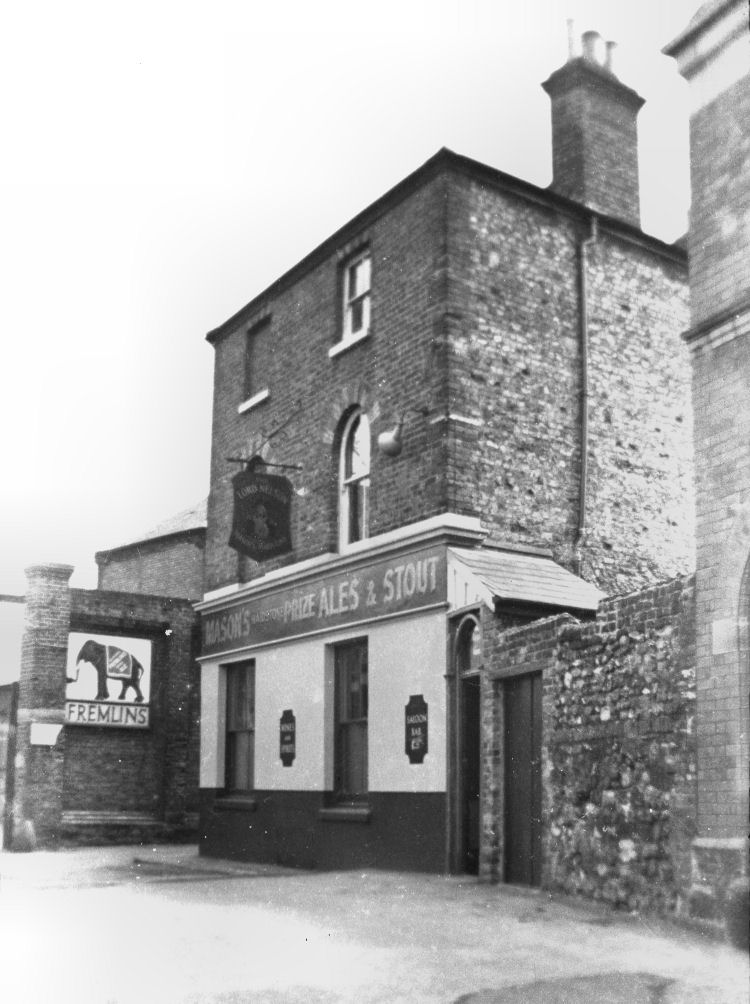
Above photo kindly taken and sent by Norman Clark, circa 1955.
Above sign taken from photo above. |
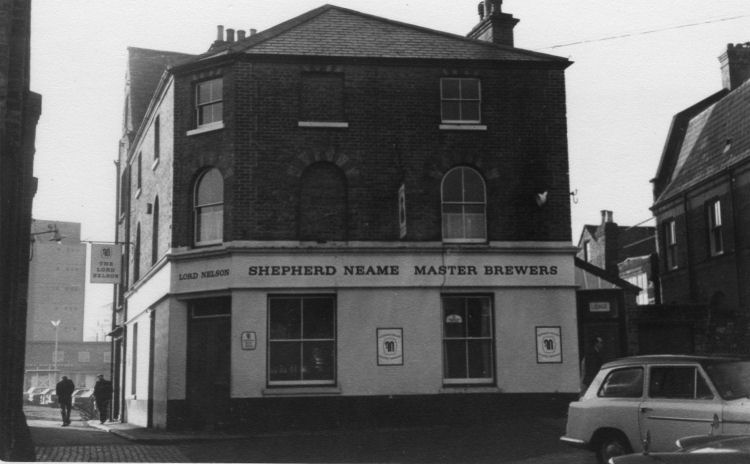
Lord Nelson 1970 by kind permission Dover Library ILL/519 |
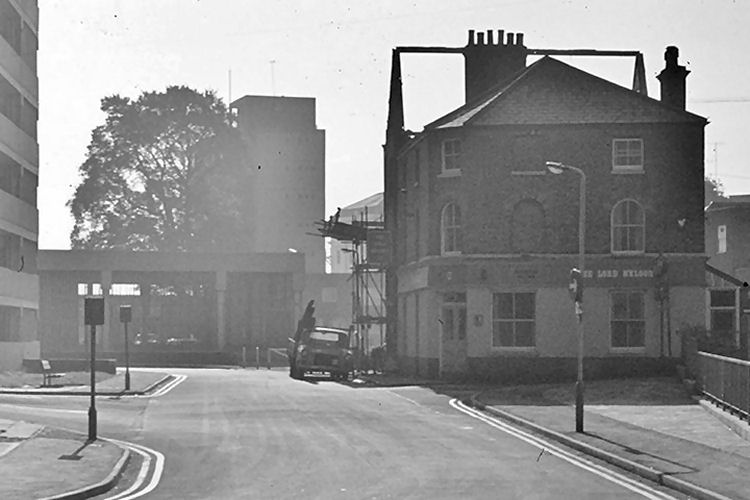
Above photo early 1970s, kindly sent by Bill Beer. |
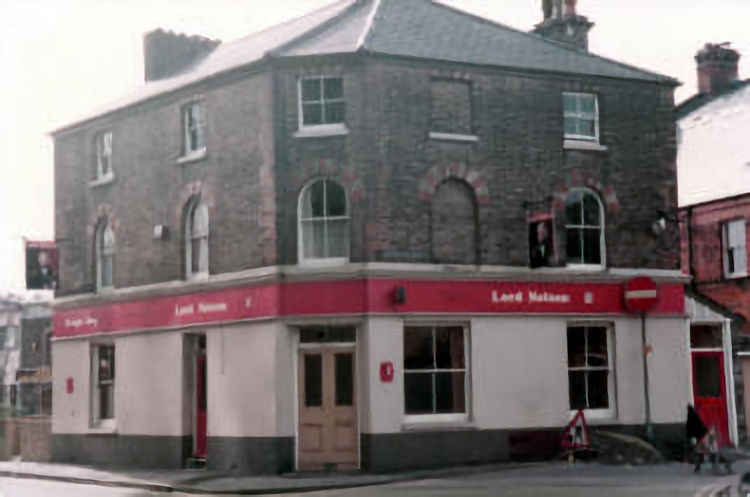
Above photo, 1983. Photo by Eddie Chard. |
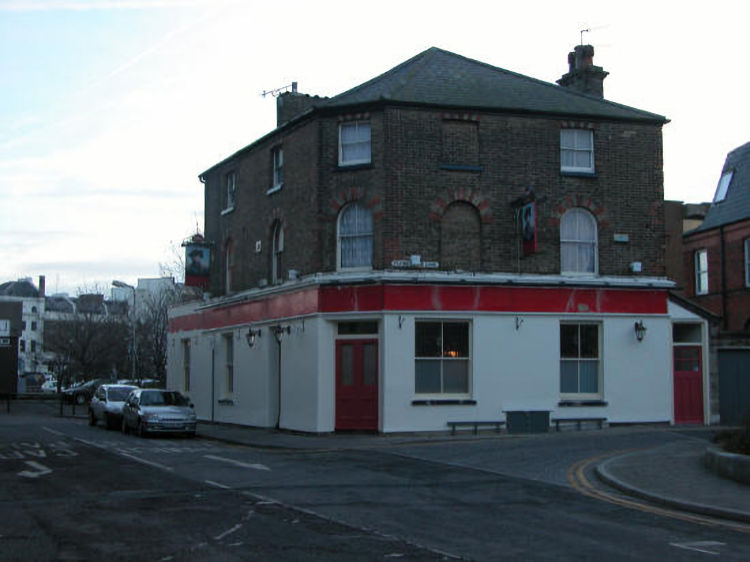
Above photo, date unknown. |
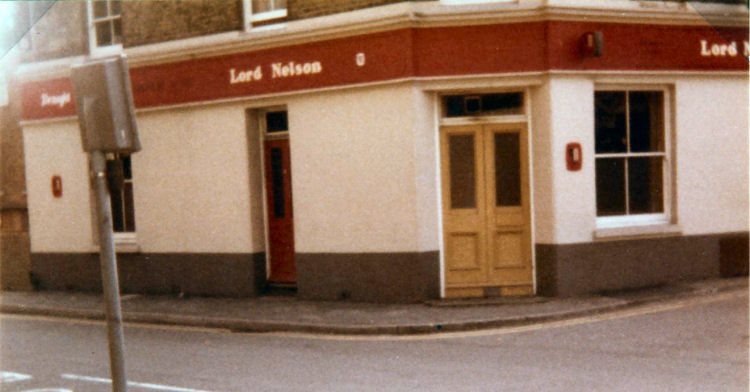
Above photo circa 1994 by Barry Smith. |
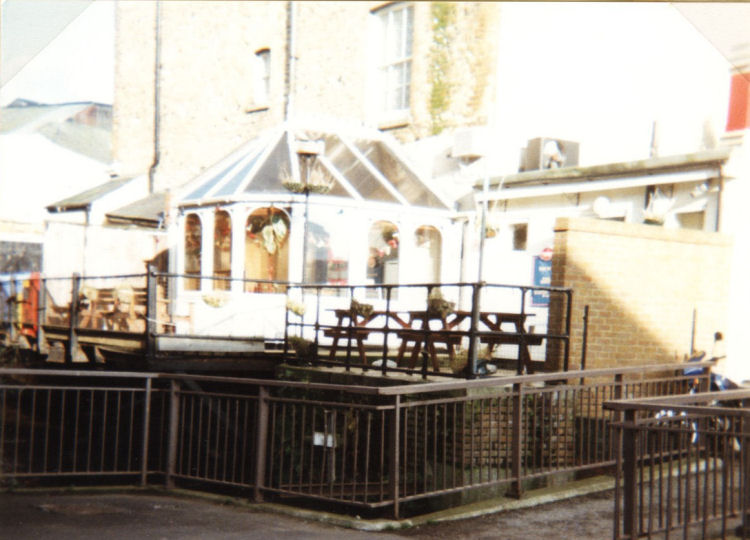
Above photo circa 1994 by Barry Smith.
|
Above photo circa 1994 by Barry Smith. |
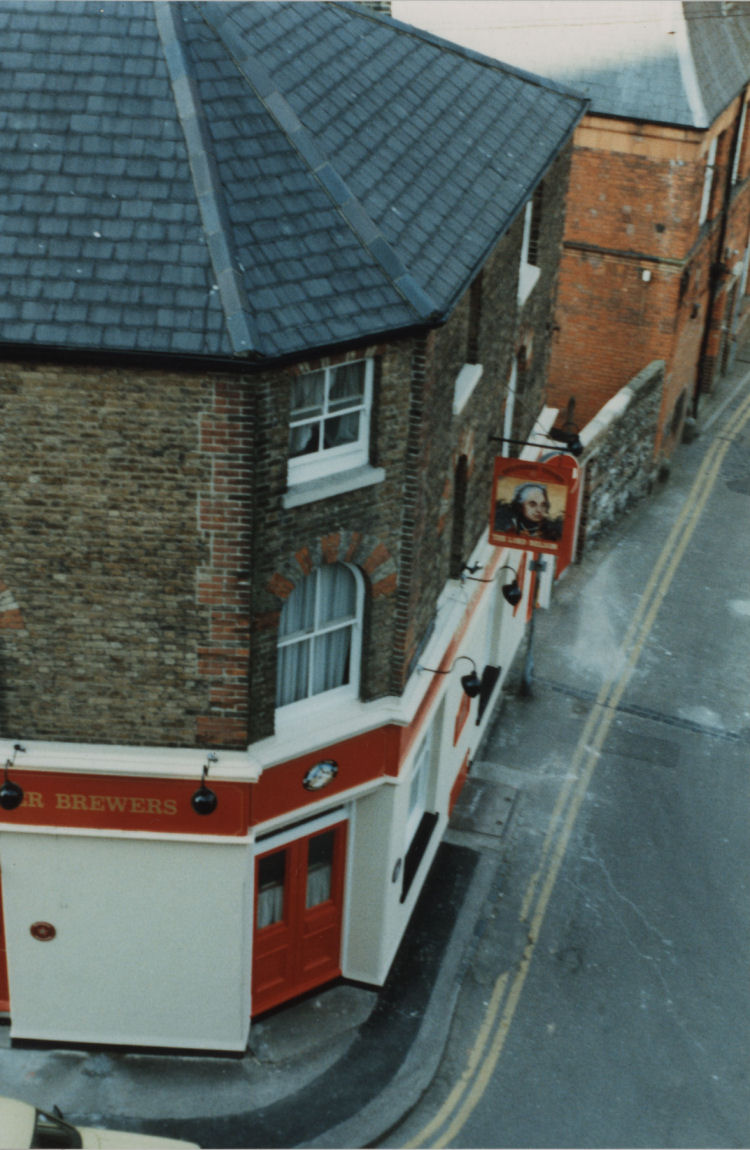 |
|
Lord Nelson circa 1989 by kind permission of Dover Library.
ILL/4197. |
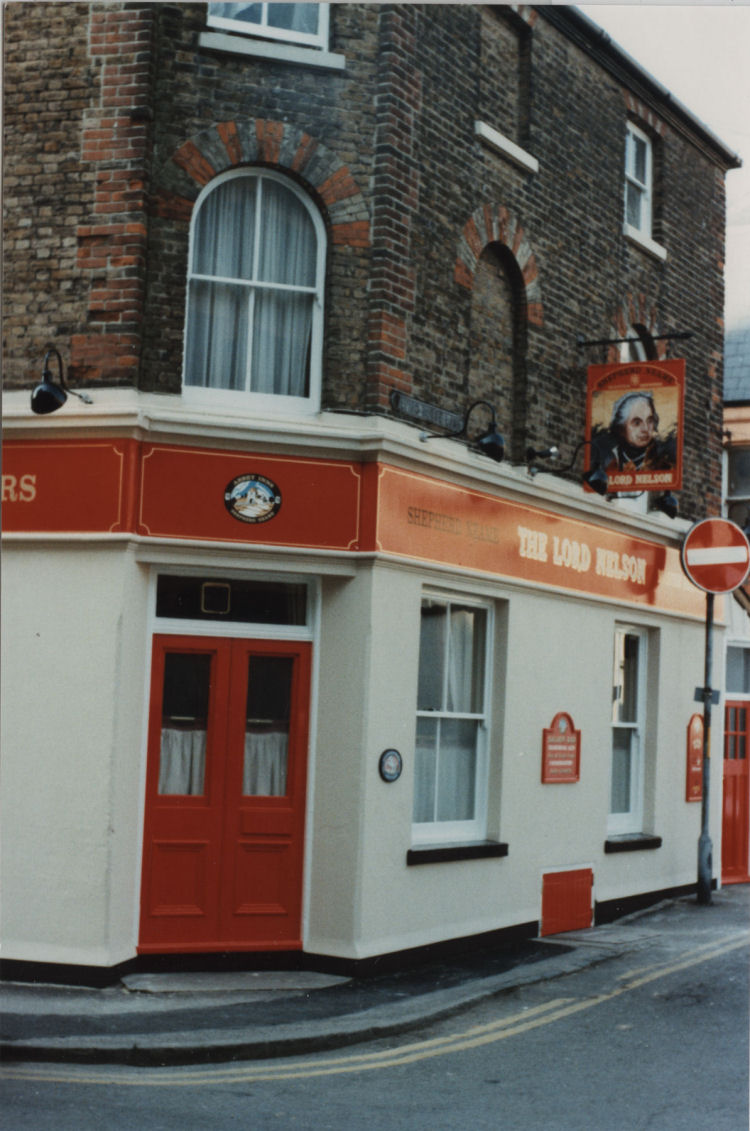 Above photo, circa 1989, by kind permission of Dover Library, ILL/4196. |
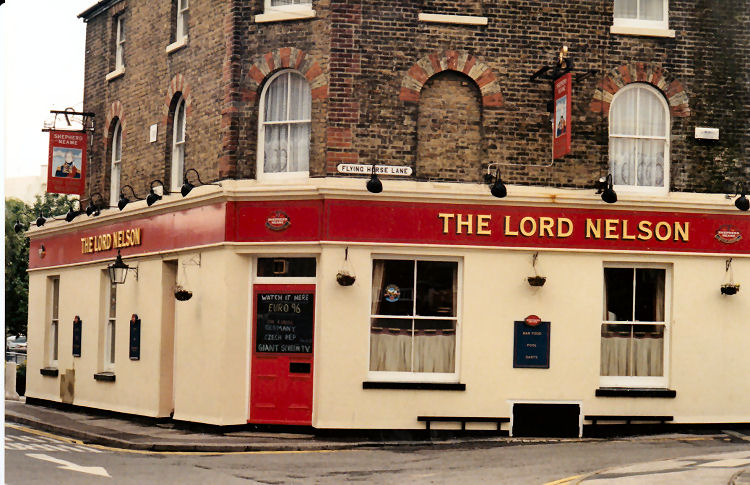
Above photo, 1996, kindly sent by Michael Lock. |
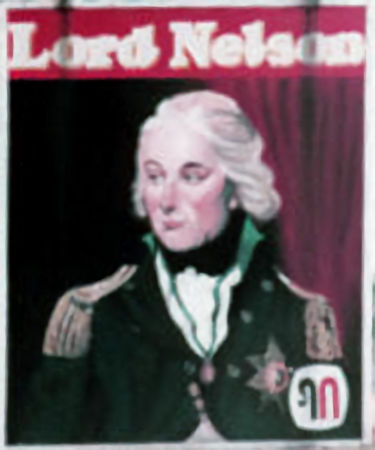
Above sign, 1983. Photo by Eddie Chard. |
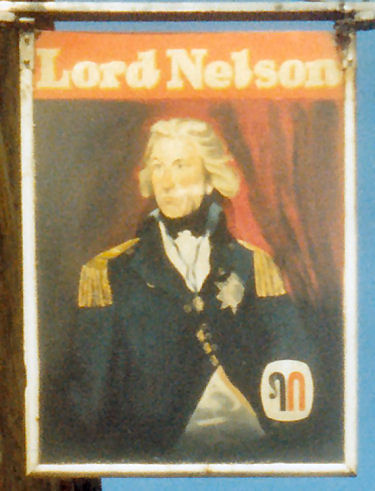 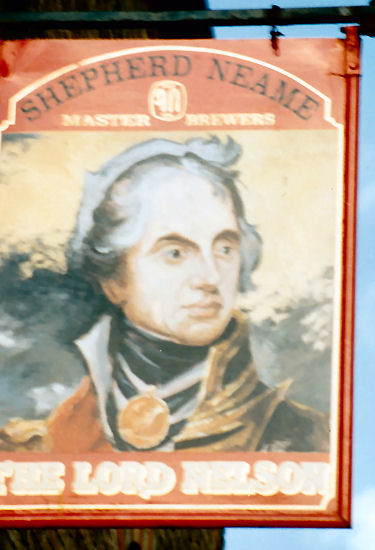
Lord Nelson sign left, April 1986, sign right, October 1991.
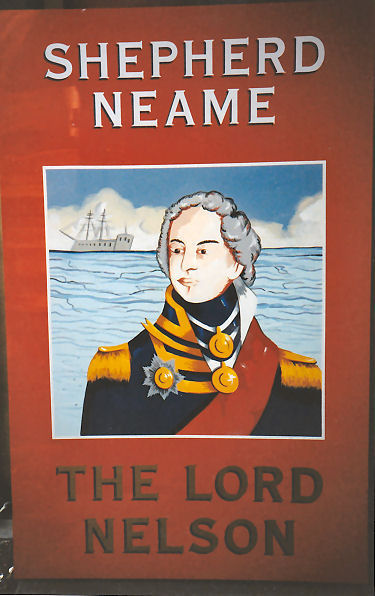 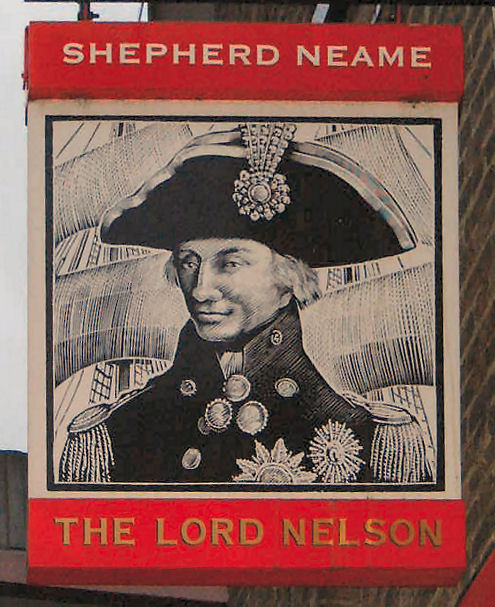
Sign left, 1993, sign right, by Paul Skelton 2007.
Above with thanks from Brian Curtis
www.innsignsociety.com |
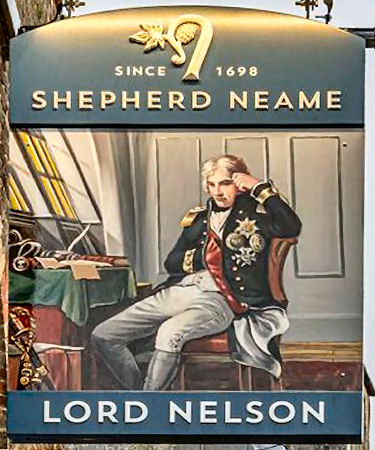
Above sign, 2020, kindly taken and sent by Roger Pester. |
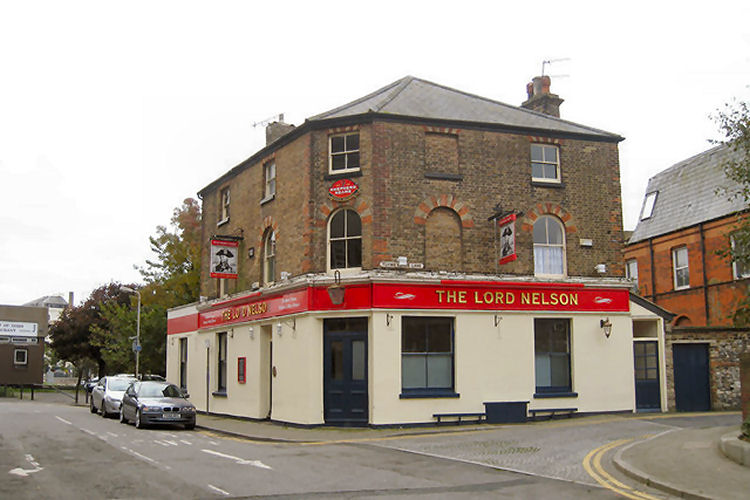
Above photo 2010 by Oast House Archives
Creative Commons Licence. |
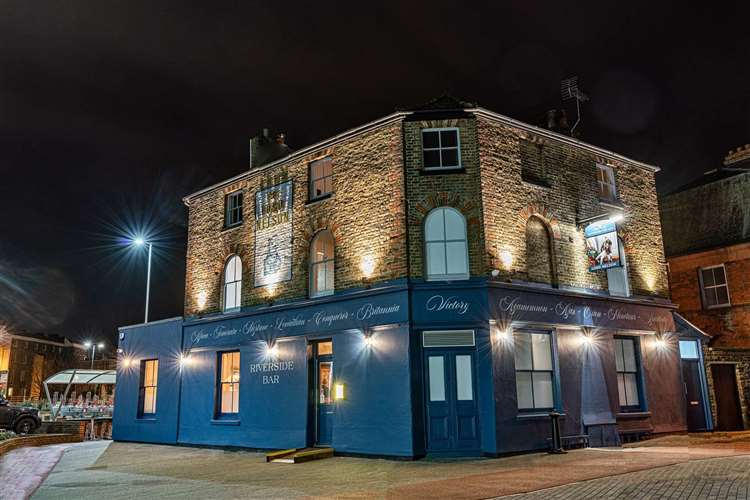
Above photo, 2019. |
On the corner, the original was a licensed lodging house where the sign
had been displayed since at least 1805.
That was destroyed by fire in 1872 but was rebuilt and the freehold, with
licence, was on offer in 1881. Mason of Maidstone took possession paying
over £1,000. The brewery was bought out by Shepherd Neame in 1956 and the
brewery was subsequently closed and demolished.
In 1923, whilst it was still being used as a lodging house, with 23 beds,
opposition to the renewal began. Within 137 yards the "Red Lion", "Robin
Hood", "Prince of Wales", "Wine Lodge", "Chandos", "Dolphin", "Granville
Hotel", "Sussex Arms" and the Market Square outlets all competed. I pause
here to consider the present government of the day which maintains that is a
good thing.
The workmen who dwelled there at the time supplied the answer. So many of
them would have been deprived of their digs that common sense prevailed and
the pub is still with us today, a fully licensed outlet of Shepherd Neame.
|
From the Dover Telegraph and Cinque Ports General
Advertiser, Saturday 27 April, 1839. Price 5d
POLICE REPORT
MONDAY - Sydney Smith was charged with an assault on Police Constable
Price, while in the execution of his duty. The defendant had been
drinking at the "Nelson" public house, where he created a disturbance;
and on the police being called in, the assault was committed.
Fined 10s. or one week's imprisonment.
|
|
From the Kentish Gazette, 29 March 1842.
DEATHS.
At Dover, the wife of Mr. Samuel Peckham, landlord of the "Lord Nelson,"
public-house.
|
|
From the Dover Telegraph and Cinque Ports General Advertiser, Saturday, 30 October, 1847. Price 5d.
CORONER'S INQUEST
An inquest was held on Wednesday, at the “Lord Nelson,” before G. T.
Thompson, Esq., Coroner, ion the body of Judah hart, aged 53. the Jury
having been sworn, and Mr. T. Brockman elected foreman, the Coroner
said, that a report of the sudden death had been communicated to him
that morning by Mr. Reuben, when he (the Coroner) stated that it would
be necessary to have a certificate of the cause of death, or an inquest
must be held. Mr. Williams subsequently called, and stated that he had
little doubt death ensued from natural causes, but could not give a
certificate to that effect, as he could not state from what cause it
arose. Under there circumstances he ( the Coroner) considered it his
duty to hold the inquest.
The Jury then proceeded to view the body, and, on their return, the
following evidence was adduced:-
Sarah Packham deposed: Deceased, who is a traveller, has for five years
been in the habit of lodging at the “Lord Nelson” when in Dover. He came
about six weeks since, during which he has complained very much of a
pain on his chest, and has been a patient at the Dispensary for eight
days. He has continued out on his business till within the last day or
two. About half-past seven this morning I heard deceased unlock his
bed-room door, and immediately heard a heavy fall in the passage. I
called my husband, and we laid deceased on his bed; he appeared in a
dying state, and we sent for a surgeon. Mr. Williams came in about ten
minutes, but he had then expired. Deceased was dressed, with the
exception of his coat. He said last evening he felt better, and thought
the medicine had done him good.
George Edwin Williams, resident medical officer at the Dispensary,
deposed: This morning about a quarter to eight o'clock I was called to
see the deceased. On my arrival I found he had just expired. He had been
a patient at the Dispensary for about a week, during which period I saw
him twice. He was treated for indigestion, under which he appeared to
labour. I was not in the least prepared to hear of his death. I cannot
say what was the cause of his death, but from the manner in which he was
taken I consider it to have been from a fit, or, by the falling of the
head forcibly against the door, concussion of the brain might have
ensued. I presume he died from natural causes, but cannot now take upon
myself to give a certificate to that effect. There were no external
marks of violence on the body.
Mr. Packham, the landlord, and two other witnesses were examined, but
their evidence only being corroborative of that given by Mrs. Packham,
they were not sworn.
The Coroner observed that this being the whole of the evidence, it was
for the Jury to consider if it was sufficient for them to give a verdict
as to the cause of death. If not, it would be necessary to adjourn the
enquiry to have a post-mortem examination of the body.
The foreman said the medical witness not being satisfied as to the cause
of death, he did not think the evidence sufficient to give a verdict
according to the oath they had taken, in which view 9 of the Jury
coincided.
The Coroner said it was necessary the Jury should be unanimous. The room
was then cleared, and the Jury after a consultation of one hour, agreed
to the following verdict:- “That deceased died from natural causes.”
|
|
From the Dover Telegraph and Cinque Ports General
Advertiser, Saturday 25 February, 1854. Price 5d.
BOROUGH PETTY SESSIONS
Mary Ann Hayler, a prostitute, was committed for trial on a charge of stealing 17s., a bag, knife and key, from the person of
Edward Hysted, a labourer in the employ of the South Eastern Railway
Company. The evidence went to show that illicit intercourse had
transpired between the parties at the "Lord Nelson," in Saint James's
Lane, and that on leaving the house they proceeded as far as Cross Wall,
where they separated; shortly after which prosecutor missed his money,
and informed he police. Hayler's apprehension followed, and a partner,
at least in her mode of life, communicated evidence sufficient to
justify committal.
George Pritchards, a fish seller, &c., recently liberated from gaol
on a charge of assault, was placed at the bar on suspicion of receiving
the money stolen from Hysted; Pritchards and Hayler were said to be
living together as man and wife. No evidence of the guilt of the former
was forthcoming, and he was discharged.
|
|
Kentish Gazette, 29 March 1853.
Inhuman Conduct.
The other evening, a monster in human shape, who we understand has
been employed us a "navvy" on some of the works now progressing at
Dover, threw a female into the stream in Dolphin-Lane, and left her
there to perish. The result must have been death to the poor
"unfortunate" had not some flymen observed an object in the water,
and on pulling it out it proved to be the female we have alluded to,
in a state of insensibility. The man was nowhere to be found; the
brute had disappeared; but some knowledge is possessed of his
whereabouts, and he may yet have to learn that however low in
society's grade was his victim, the law has protection for her, and
punishment for the miscreant who so vilely conducted himself. The
female was removed to the "Lord Nelson," where medical aid was
called in, and every exertion used in her behalf. A short time
sufficed for her restoration, and she was then removed to her
lodgings on the Commercial Quay.
|
|
From the Dover Express and East Kent Intelligencer, 16
January, 1864.
DRUNK
John Horwin, a rough-looking fellow, charged with drunkenness and
annoying the landlady of the "Lord Nelson" public house, was liberated
on promising not to conduct himself in such a way again, the landlady of
the "Lord Nelson" being satisfied with this undertaking.
|
|
From the Dover Express and East Kent Intelligencer, 20
February, 1864.
DESERTION
William Pocock, a rough-looking fellow dressed in a navvy's "slop"
was charged with disserting from the second brigade of Royal Artillery.
A bombardier of the same brigade, which he quartered in Dover, happened
to notice the prisoner at the "Lord Nelson" public house and recognised
him as a man who had been reported a deserter. He did not lose sight of
the prisoner, but caused him to be handed over to the police, in whose
custody the man was now brought up. The prisoner had no reply to make to
the charge, and the usual return having been filled up the Magistrate
ordered his conveyance back to quarters.
|
|
From the Dover Express and East Kent News, Friday,
28 January, 1870.
THE LORD NELSON PUBLIC HOUSE TRANSFER
Mr. Fox attended upon an adjourned application in order that the
license of the "Lord Nelson" public-house might be transferred to George
Matson.
Up on the application coming before the Bench on the previous Friaday,
there was some question as to whether the defendant was a fit person to
hold the license.
Mr. Fox now stated that although, as he was informed, there had been
a conviction against the defendant for an infringement of his
license, the conviction was six or seven years old, and had never been
allowed to stand in the way of the defendant's renewing his license of
the very house in respect to which the conviction took place. He.
therefore, submitted that this in itself, was not sufficient reason for
preventing the transfer now applied for, and he should be glad for Mr.
Coram to be asked whether anything else was known against the applicant.
Superintendent Coram said he had referred, and found the conviction
was as far back as the time mentioned by Mr. Fox, and he knew of nothing
else that should prevent the transfer.
Mr. Fox, said that, as far as the conviction was concerned, he might
plead the "statute of limitations." (A laugh.)
The Magistrates granted the license.
|
|
From the Dover Express and East Kent News, Friday, 11 February, 1870
ASSAULT.
Albert Cotterell a journeyman painter, was charged with being drunk and
assaulting Henry Gill another knight of the brush, on the previous
night.
The complainant who had lost a tooth by the violence of his
alleged encounter with the defendant appeared in Court, with his face
much swollen and his power of articulation greatly impaired. From what
could be made out, however, it appeared that he was returning home to his
lodgings at the "Lord Nelson" Public House, St. James Lane, on the previous
night about twelve o'clock, when the defendant ran out of a passage near
to the "Lord Nelson," and without provocation whatever hit him a violent
blow in the face. He was walking along with his hands in his pockets and
was therefore almost unable to defend himself; but had his hands been at
liberty he should have given the defendant a jolly good thrashing for
his pains. [The complainant was a man of unusually small stature, and
this bellicose avowal, uttered in a tone of great determination, caused
some laughter in the court.]
The defendant declared that the complainant gave him provocation. He
was standing in the passage, as the complainant passed, when the
complainant started back, and exclaimed, “Bless me! how you frightened me!”
He (defendant) replied “Did I? You'll be frightened more if you come
back.” The complainant then returned, and scratched him down the face, and
he (defendant) hit him in self-defence. He admitted that he hit him to
hard, and he might have knocked a tooth out.
The magistrates considered
the defendant the aggressor, and fined him 1s and 6s costs.
|
|
From the Dover Express and East Kent Intelligencer,
24 February, 1871. Price 1d.
A TROUBLESOME LODGER
Charles Cork, a costermonger, lodging at the "Lord Nelson"
public-house, was charged with being drunk and using obscene language at
the "Lord Nelson," and with assaulting the landlord, Mr. Matson.
George Matson, said: I keep the "Lord nelson," public-house, in St.
James's Lane. This assault took place last night between eleven and
twelve. I had just come into my house and found Cork in front of my bar.
He was not sober; and was using obscene language. Upon my telling him
not to use obscene language, he struck me in the eye. Mr. Pankhurst was
also standing there, and Cork struck him also. I then sent for a
policeman.
Police-constable George Ash said he was sent for to the "Lord nelson"
public-house, on the previous night, and on arriving there took the
prisoner into custody. It was about 5 or 10 minutes past twelve. He took
him to the station-house, and he there used very bad language. He had
been drinking; but he was not drunk.
Prisoner said he had desired to go to bed, and was on his way up
stairs when Mr. Matson came and dragged him down again. That was how the
quarrel arose, and he submitted that he was not the first aggressor.
Superintendent Coram, in reply to the Bench, said the prisoner had
been before the Magistrates a number of times previously.
The Bench sent the defendant to prison for fourteen days, with hard
labour.
|
|
From the Dover Express and East Kent News, Friday, 1 December, 1871. Price 1d.
A DRUNKEN FREAK
John C. Smith. 49, described a s a schoolmaster, residing at the “Lord
Nelson” public-house, St. James's Lane, was charged with assaulting Mr.
Charles Pain, of the “Fountain Inn,” and also with wilfully breaking two
decanters containing wine, valued at 15s.
Mr. Charles pain deposed: Last night, about twenty minutes to eleven, I
was in my front bar talking to two gentlemen, when the prisoner came in
and asked me whether my name was Pain. I turned round towards him, and
saw that he was in a fighting attitude. He took a stick that belonged to
one of the gentlemen from off the bar and struck at me, and missed me,
but broke two decanters and a glass containing wine. I then put the
prisoner outside. He made another blow at me, and I took the stick away
from him. This is the stick produced. A policeman then came and took him
away; I gave him into custody. The damage done is 15s.
The Mayor: Was he very drunk?
Prosecutor: he had quite sufficient; he was not sober.
Prisoner: I can't say how it occurred; it was a most unaccountable
thing. I had been talking to a friend and got excited.
The Mayor, to prosecutor: These decanters I understand were broken by
accident; that is hardly a case of wilful damage.
Prosecutor: Well, sir, I would rather have had that done than my head
hurt. I don't suppose it will happen again.
Prisoner: I promise you it shall not happen again.
By Mr. Rees: It was a very unprovoked attack, but he (prisoner) says he
is very sorry.
The Mayor, to prisoner: Do you think you will be in a position to pay
this money in a reasonable time?
Prisoner: Well, sir, what is a reasonable time?
Prosecutor: Two months.
The Mayor to prisoner: I think Mr. Pain has acted very honourably
towards you.
Prisoner: I will endeavour to pay it. It shall not happen again for the
next twelve months.
Smith was then discharged.
|
|
From the Deal, Walmer, and Sandwich Mercury,
29 May, 1872. 1d.
A WOMAN BURNT TO DEATH AND A MAN KILLED
One of the most terrible and disastrous fires that have occurred in
Dover for many years past attended, we are sorry to say, with fatal
consequences took place at the "Lord Nelson" public-house, St James's
Lane, Dover, early on Monday morning last. The house is well known as a
resort for travellers and workmen who lodge in the town during the time
they are in employment, and the house is kept by a man named George
Matson, the other members of his household being a woman named Simmick,
who acted in the capacity as housekeeper, a niece of the house-keeper's
named Sedgwick, and a domestic servant, aged about forty, and known by
several names, such as Dinah, Eliza Glover, Eliza Baker, and Eliza
Clough, the latter being, we believe, her proper name. On Sunday night
there were about a dozen lodgers of the poorer class remaining in the
house, and they retired to their beds, situated in the second and top
storeys of the building, about ten o'clock at night. The landlord
remained behind till about ten minutes to twelve, when, having,
according to his custom, seen that the house was safe, and all the
lights out, he went to bed, leaving the housekeeper and her niece, who
had gone out to spend the evening, out of the house. About twenty
minutes past twelve the latter arrived home, and on knocking at the door
Mr. Matson came down stairs and let them in. They immediately proceeded
upstairs to their rooms, followed by the landlord, leaving all
downstairs in apparent safety. The deceased woman Clough, who slept at
the top of the house had gone to bed previous to this, and locked
herself in her room, as was her wonted custom. Nothing occurred till
about ten minutes to one, when the niece, who was sitting in her room
plaiting her hair previous to retiring to rest, heard a crackling noise
downstairs but at first took no notice of it. The noise, however,
becoming each moment louder and louder, she alarmed the landlord by
crying out that something was the matter. She then opened the door of
her room, and saw that the whole of the downstairs portion of the house
was in flames, and, without waiting to dress herself, she rushed
downstairs in her night-dress, burst open the front door, and ran into
the street. About this time, Mr. Joseph Henry Parks, son of Mr. G. T.
Sparks, builder, Dover, was passing by in King Street, and fancying he
smelt fire, he turned down St. James's Lane, and seeing smoke proceeding
from the "Lord Nelson," he immediately ran to the Police Station and
gave the alarm. He went back, and by this time the flames had burst
forth, and were lighting the heavens up with their lurid glare for a
considerable distance around the neighbourhood. The first person he saw
was the niece standing outside, and the landlord and housekeeper jumped
out of the second storey window. Previous to this, however, Matson had
tried to get out through the door, but finding the flames too strong,
was forced back upstairs. He then alarmed the lodgers upstairs, and two
of them rushed into his room, the sheets and blankets were made into
ropes, and they were let down into the street with little or no injury.
The landlord not waiting for assistance, which was close at hand,
immediately clambered out of the window, and jumped down a height of
thirty feet, and was followed by the housekeeper. On getting up from the
ground Matson found he had injured himself by placing, it is said, one
of the bones of his foot out; and was with the housekeeper, who was also
injured, taken to the "Flying Horse
Inn." In the meantime, the house, which was very old and chiefly
made of wood, was one mass of seething fire. Mr. J. H. Parks ran to Mr.
Middleton, the painter, living opposite, and getting the key of the
storehouse, procured a ladder and placed it alongside the burning mass
with a view of rescuing the poor creatures who were running frantically
about with little or nothing on them on the top of the house, battling
with the smoke and flames and attempting to get down. Two men, who
were on the second floor managed to get down by the aid of the ladder,
but as the ladder was only long enough to reach the gutters of the roof,
those on the top became more maddened and wild than ever to see aid at
hand, almost within their reach, but unable to avail themselves of it.
Mr. Parks shouted out to them to be quiet and remain still; and then, at
some risk to his life, he raised the ladder on top of his shoulders,
and by this means putting it within reach of the persons on the roof,
he, with assistance of Mr. T. V. Brown and Mr. Tart, held it against the
burning wall till they had all scrambled down, some having been injured
with the smoke and flames. One poor fellow, whose name is unknown, more
frantic than the rest, did not heed the advice given him, but remarking
to a comrade on the roof, "I am going to jump for it," jumped into the
street, and, falling upon his head, sustained such severe injuries to
his skull (having a scalp wound into which two fingers might easily be
placed) that he died shortly after he was taken to the hospital. The
poor creatures, who had barely time to save themselves (and several not
without severe burns) and much less to save their clothing, were taken
to the Police-station, where Mrs. Sanders, with kindly feeling hunted
all the old trousers, coats, and under-linen she could to clothe the
destitute lodgers, and with the assistance also of several neighbours,
who also furnished clothing, they were clothed and sent in flys to the
Union, where their injuries were attended to. Three were taken to the
hospital. All this occurred in far less time than it had taken us to
relate it, not more than three minutes having elapsed from the time Mr.
Parks gave the alarm to the time when the people were rescued by the aid
of Mr. Parks, the fire-escape which it was impossible to get sooner,
arriving too late for the purpose it was required.
In about five minutes after the alarm had been given the Police
Force, under the superintendence of Mr. O. T. Sanders, were upon the
spot with the fire-cart, and the pipes and the hydrants in St.
James's Street and Fishmonger's lane were both put into requisition. The
Mayor (R. Dickeson, Esq.) was immediately in attendance, and himself did
invaluable assistance in encouraging and superintending the men, as also
did the Deputy-Mayor (Mr. T. V. Brown), Mr. Edward Bolton, Mr.
Councillor Wilson, Mr. John Judge, Mr. H. Harris, Mr. J. Marley, and
various of the neighbourhood who were likewise on the spot, and were
endeavouring to do all they could to assist in mastering the flames. In
less than fifteen minutes after the fire had broken out, the building
was entirely in flames, and the roof and floors falling in, made the
flames shoot still further in the air, and red-hot flakes falling into
King Street, and in some instances going over the houses on the opposite
side. The property is situated in a dense neighbourhood, surrounded by
small houses and sheds, very old and chiefly composed of wood. It being
found that the flames had complete mastery over the "Lord Nelson," the
attention of all was given to save the adjoining property and prevent
fire spreading, and had this not fortunately been done there is no
saying what the extent of damage or loss of life would have been.
Opposite the house are situated the stables of Mr. Pankhurst and several
horses were inside. By the assistance of several bystanders the animals
were got out with comparative ease. Almost adjoining the premises of the
"Lord Nelson," and within two or three doors from it, is situated the
slaughter-house of Mr. Elgar. Snargate Street, and it being ascertained
there were several animals inside, the place was opened, and some sheep
and a very fine bullock were got out and driven to the Waterloo Mews.
The scene about half-past one was of a most harrowing and
heart-rendering description, for the neighbours were running about in
their night-dresses, expecting each moment the flames to "lick up" their
homes. Fortunately, however, the river Dour runs close by. The pipes
were placed in the stream, and a volume of water poured upon the burning
mass. The fire-engine was brought down and placed near Mr. Leney's
brewery. The telegraph apparatus having been used with great success,
the water was immediately turned on, and the hose, under the management
of Police-constable Geddes, did valuable service. The adjoining premises
next caught, and all efforts were turned upon this building, and
eventually the fire in this direction was got out, but not till the
place was gutted and seriously damaged. Mr. Williams and Mr. Fogg, of
the Coastguard Service, with several men under them, next came, and
great praise is due to them for the admirable service then rendered in
extinguishing the flames. Mr. Hills, a gentleman belonging to one of the
yachts in Dover Harbour, and who had been on the spot from nearly the
commencement of the fire, then mounted the stables premises opposite,
and notwithstanding the intense heat that enveloped him, he took the
nozzle of one of the pipes, faces the flames, having first covered his
head with a wet cloth, and played for an hour upon the fire. Mr. Hanvey,
the Borough Surveyor, was also present, and worked very energetically to
assist in putting out the fire. In fact, all that it was possible to do
was done, and no means could have been taken quicker to master the
flames.
On getting the inmates out of the burning house, it was found that
the servant girl "Dinah" was missing, and it was of course naturally
supposed that she had been burnt to death. Matson, it appears, shouted
out to alarm her, but she either had not heard because she was deaf, or
not being aware of her position, did not stir, and accordingly perished
in the flames. It is stated the poor woman was nearly burnt to death
about four years ago, and also on being told that there was a fire in
the house on the morning in question coolly remarked, "Put some water on
it," and went to bed again. Everything was done to rescue her, and one
of the occupants on the roof previous to the descent was seen tearing
off the tiles in a frantic manner with the view of knocking in the
ceiling of her attic bedroom, but all to no avail.
The fire raged furiously till about three in the morning, when by the
exertion of those who had been working the engine the flames were got
under but not before the whole building was one mass of charred and
smoking ruins, the only remains being a chimney shaft and part of four
walls. As soon as it was possible, the Mayor, who it may be stated, was
present during the whole of the time, ordered a search be made for the
body of the deceased woman. Sergeant Johnson thereupon entered the
ruins, and at the place cooled he cleared the debris from the
part of the building which was over the cellar. On doing so he came upon
a bedstead turned over, and underneath he saw the remains of the poor
woman, although so complete had been the work of calcination that it was
impossible to recognise the body, the arms and legs being burnt off to
the stumps, and the head being only the size of a good-sized doll. The
trunk was placed upon a stretcher, and Dr. Gill pronounced that it was
the remains of a female.
The fire continued to burn all night, and the engines did not leave
till about nine o'clock on Monday morning. During the night, the Mayor,
with his usual consideration, visited the poor sufferers at the Hospital
to enquire after their injuries, and on his second visit to the Hospital
the poor fellow who had fallen from the roof died, having been
insensible from the time of his admittance. An old man, named White, we
hear, who lived near the premises, would have been burnt to death also
had it not been for some of the bystanders forcing their way into his
house and pulling him out by main force. Just after this the flames
swept over his house. The ruins smouldered considerable all day on
Monday, and in the afternoon the hose had to be put in requisition
again. The severe thunderstorm, however, that swept over Dover on Monday
evening had the effect of keeping the smouldering under, and nothing but
a heap of charred ruins now remains to show where once stood the "Lord
Nelson" public-house.
The stable opposite of Mr. Pankhurst, were damaged, the wood work
being burnt. The shop of Mr. White, furniture dealer, is also injured,
and the scouring establishment of Mr Scott, dyer, is greatly damaged,
the back upper floor and roof being very much burnt. All kinds of
conjectures are afloat as to the origins of the fire, but as far as we
can learn no authentic cause has been ascertained. Some state it was
through men smoking their pipes in bed, but this does not seem feasible,
inasmuch the flames, from whatever cause they originated, came from the
basement. At least for the present the origin of the fire must remain a
mystery. The "Lord Nelson" is insured in the Kentish Fire Office,
Matson's property in the Phoenix office, and Mr. Scott's premises are
insured in the Union Fire Office. Mr. White's premises are totally
uninsured, and he has sustained a loss of about £50 through the fire,
the property left in charge of his brother being completely destroyed.
In conclusion too much praise cannot be bestowed upon both police,
coastguardsmen, and civilians for the amicable way in which everybody
worked together, and the admirable manner in which the arrangements were
carried out. Everyone worked with heart and will, with the object in
view of extinguishing the flames, and the best of thanks are due to the
gentleman we have mentioned, and the neighbours also for the invaluable
services they have rendered. We cannot help, however, singling out Mr.
Park's services for especial mention, and Dover aught to be proud of
possessing a man through whose keen foresight, energy, and heroic
conduct the lives of seven persons were saved. We may mention the
Police-constable Corry who was working the hose near the river, in
crossing the stream fell backwards and sustained a severe cut in his
right hand.
THE INQUEST
The inquest on the bodies of Eliza Glover and the man who was killed,
and whose name is unknown, was held at the "Flying Horse Inn," King
Street, the same afternoon, before the borough Coroner (W. H. Payn,
Esq.)
Evidence having been given, the Coroner summed it up, in remarking
that the only point was the origin of the fire. If the Jury thought that
it was accidental, their verdict would be brought in accordingly.
After a short consultation, the Jury found the following verdict:-
That the deceased Eliza Glover was burnt to death at a fire which
occurred at the "Lord Nelson" public-house, and the deceased man, name
unknown, died from injuries received from falling off the roof of the
said house in his endeavours to escape from the flames.
The Coroner said they could not separate without expressing
their sense of praise at the active and humane exertions of Mr. J. H.
Parks. Through his intelligence he knew where to obtain a ladder, and
entirely owing to his own energy and activity he was thus the means of
saving the lives of several persons. He felt sure in saying so he was
only expressing the feelings of the jury.
The Jury concurred in this, and the proceedings terminated.
|
|
From the Dover Express and East Kent Intelligencer,
28 June, 1872. Price 1d.
FATAL FIRE AT DOVER
A fire broke out shortly before one o'clock in the morning in a
lodging house at Dover, known as the "Lord Nelson," and situated near the
Flying Horse Lane, a very close thoroughfare at the Market Place. The
house had a large number of inmates of the poorest class, and upon the
alarm being raised a scene of great excitement and disorder ensued among
them, one unfortunate man rushing to the attic and throwing himself into
the street. The town fire escape and some ladders were quickly brought
to the spot; and most of the other inmates were rescued without serious
injury, although, owing to the smallness of the apertures by which alone
they could make their escape from the burning premises, and the number of
people the house contained, several persons were more or less injured by
crushing. The man who rashly leaped from the window was taken up
fearfully mangled and conveyed to the Hospital, where he died shortly
afterwards. One other life was lost, one of the lodgers, a woman named Eliza Clough, 39 years of
age, being exceedingly deaf and not being awakened until too late to
rescue her from the burning building. The occupiers of the adjoining
premises were much alarmed, and had to save themselves in their
nightdresses; but the local fire brigade, which consists, in Dover, of the
Borough Police, under the direction of Superintendent Sanders, aided
by several men of the coastguard service, who were on duty at the Sea Front
when the alarm was given, used such prompt and efficient exertions that
the fire was subdued in about an hour after it was first discovered; and
although the neighbourhood is closely packed with buildings, the disaster
was confined to the premises in which it broke out and two small shops
adjoining. Nothing is actually known as to the cause of the
conflagration, but it is believed to have originated in the tap-room, the
niece of the Landlord, a young woman, who was first to become conscious
of the disaster, perceiving flames coming from the direction of the
tap-room on descending the stairs. Upon the young woman rushing out into the street and raising the
alarm, having previously apprised of the disaster the inmates of the
house, Mr. J. H. Parks, son of Mr. G. T. Parks builder, who happened to be passing through Bench
Street at the time, ran to her assistance, and having communicated the alarm
to the police, straight away procured a ladder and rendered the most
valuable and timely help to the inmates in their endeavours to escape. The ladder Mr. Parks had obtained were hardly long enough to
reach the roof; but by an almost super human effort, he supported it upon
his shoulders while eight of the unfortunate inmates descended. As the
last of the inmates got down, the fire escape and the extinguishing
apparatus arrived. There was fortunately a copious supply of water, and
it was so effectively used by the borough police, acting under the direction of
Superintendent Sanders than in an hour after the alarm had been first
raised the fire was completely extinguished. Every effort was made to
rescue the poor unfortunate woman Clough. One of the inmates occupying
the top-most room who knew that the woman was sleeping on the same floor,
was seen upon the roof desperately tearing of the tiles in order to
reach the apartment where she was sleeping, but all was useless. After
the fire had been extinguished the charred remains of the woman was
found under a bedstead. The persons who were injured were taken to
Hospital; but there were no causes of serious importance. Some damage
was done to the premises on either side of the "Lord
Nelson" one being used as the Dye House by Mr. Scott and the other by Mr. White, a
tailor; but by the prompt and efficient exertions of the Fire Brigade it
did not become very serious, and the whole of the surrounding property,
although in
very close contiguity to the premises in which the fire broke out is
happily uninjured. The "Lord Nelson" is insured in the Kent Fire Office and the effects of
the landlord, Mr. Matson, in the Phoenix. Mr Scott's premises are insured
in the Union, but the stock of Mr. White, who has sustained a loss about £50,
is totally uninsured.
The Mayor (R. Dickeson Esq.) and the Deputy Mayor (Councillor Brown)
were both in attendance, together with the Borough Surveyor (Mr. Hanvey),
soon after the fire broke out, and by their advice and assistance
rendered valuable service to those engaged in extinguishing the flames.
The Deputy Mayor sends the following description of
what he saw:-
"Being awake about one on Monday morning, and hearing a voice cry
"Fire", I turned out at once into the street. The streets were empty and
silent, not anybody to be seen in the Market Square. The police where at
the time getting the escape and fire apparatus out, but not in my sight,
and I describe only what I saw. The Lane where the fire was, was empty,
while as I ran the volume of the lurid smoke and burning sparks covering a
great part of the sky, told me at once that I was coming on a fire of
some magnitude - one that had burst out fully developed without alarm
previously given - and once at the fire, a glance told that and the worse was the case. There was the house on fire
from top to bottom - flames coming through
doors and windows, making everything bright as day, and there lay in the
middle of the street on his back straight ahead a man, nearly naked,
moaning and unconscious; three or four poor creatures in their night
shirts were cowering on the roof, and in the midst of the smoke and
threatening forks of flame; some three or four others were in the street
with bleeding faces and hands; which, with their almost nakedness, told of the
haste and difficulty of their escape - and all this but one brave man to
help them all, Mr. Joseph Parks, who deserves well of the town. Most
providently he passed that way, just at the right time, and, with great
judgement, obtained a ladder from Mr. Middleton (just opposite) and had
half the people off the roof in the time he would have taken to get the
fire escape, and had done this by the time I, one of the first spectators
arrived. Down the ladder the remainder came with ease and quickness. Poor
souls, they were some old and some ill; yet fear made them agile enough
to hold onto a slanting roof and descended a ladder they could not
have faced in cold blood. But, to my astonishment, one man at the top of
the house, while the others were descending, was attacking the tiles on the roof, pulling them off
with frenzy and throwing them anywhere into the street, many in the midst
of the descending people (cutting one of them), and their helpers. He
knew what I did not know then, that there was a woman still in the room
below suffocating or burning, and he was making a vain attempt to pierce
the roof with his hands and aid her. Mr. Parks made him come away. We in
the street could see that what he was doing was useless and out of the
question.
"All this took no more than a minute or two from the time I got
there. Meanwhile, the poor groaning man at our feet was to be attended
to. He still wanted saving, and Providence and the Doctor alone could
help him. Going to the station for a stretcher showed the force were
there in great numbers. The fire escape, was being got out - no fault of
theirs that the marvellous rapidity of the affair rendered it useless; -
but when we got across the road again with the stretcher, the police had
got the cart, hose, and hydrants and where about to play on the burning
property. Alas! They could not save the life that had been burnt away in
that "Nebuchadnezzar's furnace. Helpers were now numerous. Mr. Henry Harris, Mr. John Judge, and
Mr. Edwin Bolton assisted us in putting the young man on a stretcher,
and he was then taken to the Hospital. How had he received such an awful
gash on his head? - a hole into which you might get two fingers. By
jumping or falling off the house, instead of coming down the ladder,
which saved the others - some old and very infirm, - and but for his rashness
or want of nerve would have saved him, young, athletic, and hearty. Mr. Parks says that he begged him to stop, but he jumped and came
on his head, Mr. Parks having to drag him from the falling tiles.
"No
human organization could have prevented a catastrophe. The Fire Brigade
was on the spot with no loss of time; water was in the mains
immediately, everything was satisfactory to me as a witness I took no
account of the time, but it seemed well managed.
"Our excellent Mayor arrived at the very first, and by his
encouragement stimulated all. The fire was fierce, the contiguous property old and inflammable;
the Mayor and Surveyor took at once the wise plan of letting the house
on fire burn out, and devoted all their strength to cut it off, and save
the surrounding houses.
"The Mayor made two visits during the night to
the Hospital, to see how the sufferer's where, as Dr. Gill explained to
us all at three o'clock the case of the man with the crushed head was
utterly hopeless. At four o'clock we went again, and while we were there
the poor fellow breathed his last, having been insensible from the first.
An excellent institution is the Dover Hospital. The man was poor,
unknown, and friendless; but if he had been the son of the Duke no one
could have done more for him."
"I write these few particulars of one of the most painful events
that have happened in Dover lately, that honour may be done to young Mr.
Parks, whose deeds I was a witness of, and of which, therefore, it seems
a duty to me speak; also that the public may know how their Chief
Magistrate exerted himself as a true and good head of the town during
the lifelong night, leaving no comfort unprocured for those who
have suffered; that Mr. Sanders (the Superintendent) and the brigade may
have the credit of their zealous and successful exertions; and that all
may impress on their minds in stone for future use, in cases of
emergency should they arise this rule - never to jump from a
considerable height till there is no other chance, because in most cases
jumping from an upper story window means mortal injury or death."
THE INQUEST
On Monday afternoon, the Borough Coroner, W. H. Payne Esq., held an
inquest at the "Flying Horse Inn," King Street, on the bodies of the poor
unfortunate man and woman who met their death at the fire. the following
gentlemen were summoned on the Jury:- Mr. Samuel
Jacob's, Mr. George Wells, Mr. Thomas Sewell, Mr. William Overden, Mr.
John Rowe Adams, Mr. Edward Worger, Mr. Alfred Browning, Mr. Alfred
Lipsham, Mr. Joseph Palfrey, Mr. Edward James Bourner, Mr. Henry Smith,
Mr. John Stokes and Mr. James Ball of whom Mr. Alfred Brown was chosen
foreman.
The two bodies, one lying at the hospital and the other at the Dead
House, having been viewed, the Coroner took the following positions:-
George Matson, landlord of the "Lord Nelson" deposed: the deceased,
Eliza Clough, was a servant at my house; and the deceased man (unknown)
was a lodger. I think he had been staying at my house about four days
before the fire took place. I retired to bed last night between five and
ten minutes to twelve; having closed the house. All the other people in
the house went to bed at the same time. There were, I think, about a dozen
lodger's altogether. It is my custom to go round every night before
going to bed to see if the lights are out. I did not go last night. I
heard an alarm of fire about twenty minutes to one. A young person in
the house sung out that she thought something was the matter; and then
shouted “fire.” I jumped up immediately, and on opening my bedroom door, I
found that the house was on fire. My bedroom is situated on the first
floor at the corner of the house. I immediately alarmed the inmates, as
I could not get out of my room, by shouting out loudly. The fire was flaming
up the stairs to my landing. There were four lodgers sleeping on the
same floor as I. The deceased, Eliza Clough, slept above me, at the top of
all, in the garret.
By Mr. Sewell: The partition of the floor underneath seemed to be
alight.
Witness continuing: There were six or seven sleeping above the
floor on which I slept. The deceased, Eliza Clough, was very deaf. Two
lodgers came into my room, I assisted them out of the window. Those two
came out of the room on the same floor. I jumped down into the street, as
I did also as the two men who got out before me. The flames prevented
any one from either going up above or coming down to my bedroom. The
flames appeared to me to proceed from the kitchen. The house contained a
good deal of wood-work, which was very old. There was no one down below
when I went to bed. The lodgers generally stirred all the fire out of
the grate, and lay the wood in its place ready to light the fire in the
morning. I do not know whether there was any wood left in the grate last
night. There was no escape of gas in my house that I was aware of. The
deceased, Eliza Clough, was 39 years of age.
By Mr. Sewell: I believe the gas was turned off at the meter last
night.
Witness continuing: To the best of my belief, I turned it off
last night. I did not see the deceased man jump off the top of the
house. There were a number of people collected outside the house when I
got out. Mr. Parks was there, and he told us particularly not to jump; but
we were obliged to do so, as the fire was so close to us. I injured
myself by jumping out. The windows all faced the front of the house. I
believe the ladder was brought about four minutes after I got out. The
ladder almost reached to the top of the gutter of my house. I saw two
people come down from the roof by ladder. The deceased man had jumped
out before I got out. I found him lying down on the stones. He must have
jumped from the roof. I don't think it could have been more than twenty
minutes from the time I first heard the alarm that the roof of the house fell in. The deceased man, I think, had been working for Mr. Stiff, making
the new Hythe and Sandgate railroad. I think his age was twenty-five
years.
By Mr. Worger: I do not generally ask my lodgers their names.
By Mr. Sewell: I do not quite know how many lodgers I had in my
house - eleven or twelve.
By the Foreman: Mr. J. Parks did very good service in rescuing
lodgers from the house, and endeavouring to extinguish the fire.
John Rose deposed: I am a labourer and lodged at the "Lord Nelson"
public house. I had
been lodging there little more than a fortnight when this fire took
place. The deceased man was lodging at the "Lord Nelson," and slept in the
same room with me. We slept in a room at the top of the house. At about
half past twelve last night, I heard some shouting of “fire” in the
house. I and the deceased tried to break the windows to get out. We
subsequently broke the window altogether. I got out on the sill and
broke away some tiles. While I was holding the rafters he got hold of my
feet. He was hanging over the side of the house. He asked me to pull him
up, but I could not do so. The flames reached him there, and he was
obliged to leave go, and fell down into the street. The fire had reached
the room from whence we had escaped when the deceased left go of my feet. I do not know how the other people escaped from the roof. There were seven up there altogether, Mr. Parks brought a ladder
for some of us to get down or we must have been burnt. The fire escape was not brought until we all got of the roof. I retired to bed last
night at ten minutes to ten.
By Mr. Lipscombe: The water was not playing on the house when we
got down from the roof.
Witness continuing: It was almost a quarter of an hour after we
were all down before the escape was brought.
Police Sergeant James Johnson deposed: I attended the fire at the
"Lord Nelson," at about a quarter to three. I made search by direction of
the police superintendent and the Mayor for a body that was missing.
Some two or three yards from where I was standing I saw an iron
bedstead. Something seemed to be suspended from underneath the bed. I
called for assistance, and having removed the bed, I felt the substance of a
burnt mass, and it was soft. From the smell that proceeded from it I
was almost certain that it was the body. It had no legs or arms. It was almost
burnt to a cinder; but still flesh was discernible on some parts of the
back. I had a stretcher fetched, and the body removed on it to the Dead
House. Dr. Gill was sent for and he examined the body.
In reply to Mr. Sewell, this witness said he could not tell whether the
statements of the last witness as to the fire-escape not having been
brought until all the people, except the deceased woman, were rescued, was
true, as he did not arrive at the scene of the fire until it was there.
John Beadnell Gill, a surgeon, residing and practising in Dover,
deposed: Near four o'clock this morning I was called to examine something that
had been picked up from the ruins of the "Lord Nelson Inn," which had
been burnt. I went immediately, and saw the remains of a human body
lying on a stretcher. I found it to be that of a female. It was
fearfully burnt everywhere, and had neither arms nor legs on it.
Clement Walker, a surgeon, residing in Dover, deposed: I was called
about a quarter to two this morning to go to the Hospital to see a man
who was said to have fallen off the roof of a house. I attended
immediately; and found a man lying there who, on examination, I found to
be very severely injured. He had a severe cut on the right eye, and a very large scalp
wound, with a fracture of the skull. He was quite insensible; and he
remained in that condition right up to the time of his death, which took place
at about four o'clock. I remained with him till past three. The injuries he
received were quite sufficient to cause his death.
John Henry Parks deposed: I was coming along Bench Street this
morning, about ten minutes to one, when I smelt fire. I was looking about
to see where it could be, when I heard a smash of glass down St. James's
Lane, and someone shouting “fire.” I ran to the corner of Queen Street
and gave the alarm to a constable at the station house. I then went down
the lane and saw the "Lord Nelson" on fire. The door was wide open. There
was a girl belonging to the house standing outside; and someone inside
threw me out a cash box, which I handed to the girl. I then ran to Mr. Middleton's, the painter opposite, and knocked
at his
door. A policeman came down St. James's Lane; and I told him to get the
fire-escape. Mr. Middleton came down in his night dress and gave me the
key of the shop. I immediately went and got the ladder, and while I was
getting it someone had jumped out of one of the windows. I saw Mr.
Matson, his housekeeper, and another woman just rising from the ground. I
looked up to the roof and saw a number of people standing there. The
house by this time appeared to be all in flames. I placed the ladder I
had fetched up to the roof and one man came down first. I heard a noise
at the time, and on looking round saw the deceased man lying on the
ground. Another man came up to me and assisted me to raise the ladder up to the
roof, as it did not quite touch the spot where the other people were.
The people then came down, and, as the last man was stepping on the ground
the fire escape reached the top of the lane. All the people,
except the deceased, Eliza Clough, were then out of the house. The fire
escape came
about five minutes after I told the constable to see about it. The fire brigade arrived at the spot at the same time. The water
was on before the engine was ready. The hose began playing in about
ten minutes after the arrival of the engine; but the house was then a
complete wreck. I first saw the fire issuing from the lower room at the
back of the house. The stair-case leading upstairs was also alight.
The Coroner then summed up and, the Foreman of the Jury said that,
before they could give there verdict, he should like to know if there
was not more primary evidence that could be brought before them?
Superintendent Sanders said that the niece of the housekeeper, who had
given the alarm of fire, was present, and could, if desired, be put under
examination.
The jury all seemed to think it necessary that this witness
should be heard, and the Coroner there-upon called her.
Ellen Sedgewick deposed: I am the niece of the housekeeper that
was at the "Lord Nelson." I was staying there when the fire took place. I
was sitting in my room, which is in the front of the house on the second
storey, plaiting up my hair, at about half-past twelve, when I heard a
cracking noise. I called to Mr. Matson, and then opening the door and
saw the fire, that proceeded from the tap-room. The staircase was not on
fire then. I ran down the stairs and came into the street by the
front door. I afterwards saw my aunt and Mr. Matson get out of the
window. My aunt and I went to bed last night about twenty minutes past
twelve. We had been out during the whole of the previous evening; and
when we got home we went straight up to bed. We did not smell any fire when
we first went home. The house was not closed then.
By Mr. Ovenden: Mr. Matson was up stairs when we got home last
evening; but he came down and let us in and then fastened the door after
us.
By the Foreman; I know it is the custom of Mr. Matson to go round
every evening before going to bed to see that all is safe.
After hearing this evidence the Jury returned a verdict to the
following effect. "That the deceased Eliza Glover, was accidentally burnt
to death, and that the deceased man (unknown) died from injuries received
from his falling accidentally from the roof of the burning house."
The Coroner said that, in the course of the evidence brought before
them by the police, the Jury could not have failed to notice the valuable
services rendered by Mr. Joseph Thomas Parks, son of their respected
townsman Mr. G. T. Parks, in the saving of life and property. He (the
Coroner) thought his conduct was most gallant and praiseworthy. Had it
not been for his prompt exertions in fetching a ladder to enable the
unfortunate inmates to escape, the results might have been far more
shocking than they were. He thought everyone in the room would concur
with him when he said that Mr. Parks had acted in a truly manly and
courageous manner, (hear hear), and he thought it only a duty to the public
and himself, that he should thank him for the prompt, efficient and kind
exertions he had used at the scene of the fire. (Hear hear).
The proceedings before the Coroner then terminated.
The following is the official report presented by the superintendent
of the Fire Brigade at the meeting of the Local Board yesterday:-
Dover Fire Brigade.
Chief Office June 27th 1872.
Gentlemen, - I beg to report that at 12.30 a.m. the 24th inst., Police-sergeant Barton reported that a fire had broken out
at the “Lord Nelson”
public house St. James's Lane, occupied by Mr. George Matson. The Brigade
immediately conveyed the fire escape and apparatus to the spot, where the
house was found to be in flames from the top to the bottom. The engine
was then sent for, a good supply of water was instantly procured from the
Waterworks, and the hose of the fire apparatus was got to work in about
ten minutes. On the arrival of the Brigade, Mr. Joseph Parks had, with the
assistance of a man named Read, rescued seven persons from the roof of
the building by means of a ladder obtained from Mr. Middleton, painter,
St. James's Lane. A man - name unknown - fell from the roof while endeavouring to escape
from the burning building. He was very severely injured about the head,
and was conveyed to the Hospital, where he died at 4 a.m. A woman, named
Eliza Clough, servant to Mr. Matson, was unable to make her escape, and
perished in the flames. Her remains were recovered about 3 a.m., and
conveyed to the Dead House. An inquest was held on the bodies at the
“Flying Horse Inn" at 3 p.m. the same day, when a verdict of “accidental
death” was returned.
Great assistance was rendered by Messrs Fagg and William's
(Superintendents) and the crews from the Coastguard Stations at the
Casements and Townsend, and also by a large number of gentlemen present,
amongst who were his Worship the Mayor, the Deputy Mayor, Mr. Alderman
Claris, Mr. Councillor Wilson, Mr. Ayers, Mr. Parks, and a gentleman
named Hill, owner of a yacht lying in the harbour. The fire was
extinguished about 3 a.m. The hydrants were brought into requisition -
one in St. James's Street, from which water was thrown on the front of the
building, and the other in Fishmonger's Lane, from which water was thrown
on the rear. The engine was placed by the brook in front of Mr. Leney's
Brewery, by means of which quantity of water was thrown on the building
from Flying Horse Lane, and also on to the stables of the "Flying Horse"
and the other buildings at the rear of the burning premises. Origin of
the fire unknown. Brigade in attendance, Superintendent and 13 firemen.
Damage - The "Lord Nelson" entirely destroyed. Building insured in the
Kentish Fire Office, stock and furniture in the Phoenix Fire Office. House adjoining, occupied by Mr. White, in Flying Horse Lane, entirely
destroyed. Building insured in the Kentish Fire Office. Furniture and
stock not insured. House belonging to Mr Scott, dyer, of Snargate Street, adjoining the
"Lord Nelson" in St. James's Lane, roof and back portion of premises very
much damaged by fire and water. Insured in the Union Fire Office.
Stables and coach-house, occupied by Mr. H. E. Pankhurst, fly
proprietor, slightly damaged by fire, and roof injured by falling wall,
which was removed for the safety of the public.
The premises remain in charge of the Brigade.
I am gentlemen your obedient servant. T. O. Sanders.
The Local Board of Health.
The Mayor said he was sorry to find that there was a report current in the town that there was some delay in the arrival of the fire engine
and in the supply of water. He did not know how this report originated;
but every one present at the fire would give it the most unqualified
denial. He had done so whenever he had heard it. He had been present at many fires, but he had never observed
greater efficiency or promptitude on the part of the officials, and it
was justly remarked at the time that, if Mr. Sanders had had a weeks notice,
his arrangements could have not been more complete. (Hear hear.) His
worship paid a glowing tribute of admiration to the heroism and presence
of mind of Mr. Joseph H. Parks, and said that the Secretary of the Royal
Society for the Protection of Life from Fire had written to him to
obtain particulars, in order that the name of Mr. J. H. Parks might be
submitted for the Society's medal. He had also received the following
letter from the Recorder, Sir W. H. Bodkin, in reference to the
subject:-
West Hill, Highgate, N.
June 26th, 1872.
My Dear Mr. Mayor
I have read in the local papers the very afflicting account of the
recent fire, and of the praiseworthy and courageous conduct of Mr.
Parks. It occurs to me that some public notice should be taken of his
heroic and judicious exertions, and I should be glad to contribute
towards any testimonial which it may be determined to offer him.
I am glad also to observe that, with your usual attention to the
duties of the office you worthily fill, you were amongst the most active
of those who endeavoured to render assistance to the sufferers by this
awful calamity.
Believe me, yours very truly.
W. H. BODKIN.
His Worship also referred to the exertions of other gentlemen whose
names have already been mentioned in connection with the catastrophe;
and concluded by moving a resolution formerly expressing the thanks of
the authorities to Mr. Parks.
The Deputy Mayor seconded the resolution, and echoed the observation
of the Mayor as to the energy, presence of mind, and heroism of Mr.
Parks.
The Mayor and Deputy-Mayor had been guided by extreme modesty and
reticence in his remarks as to his personal exertions; but he (the
Mayor) was proud to inform the Council that the efforts of Mr. Parks
were promptly seconded and materially enhanced by the active exertions
of Councillor Brown. (Here, here.)
Councillor Lewis, Alderman Rees, and other gentlemen added their
congratulations on the efficiency of the Fire Brigade, and expressed
their admiration of the manner in which all who had taken part in the
extinction of the fire and the saving of life had done their duty, from
the Mayor downwards.
the resolution was carried by acclamation; and it was determined, on
the motion of Alderman Rees, that the name of Mr. Parks should be
recommended by the Mayor for the medal of the Royal Society for the
protection of Life from Fire.
Alderman Claris, though not aware that the Council, in its official
capacity, could act upon Sir William Bodkin's suggestion, was sure that
every member of the Council would, in his personal capacity, gladly
assist in carrying out the suggestion of the worthy recorder.
The mayor said he would be happy to take charge of the matter, and
would at once adopt measures for the establishment of a testimonial fund
for the purpose of rewarding the bravery of Mr. Parks.
In reply to Councillor Clark, Superintendent Sanders said it was
impossible to ascertain the origin of the fire; and he could not account
for the great mass of flames which enveloped the building shortly after
the fire which was discovered, except from the fact that it was an old
house and contained in its construction a large quantity of wood.
Alderman Claris moved a vote of thanks to the Superintendent and the
members of the Fire Brigade, the Coastguard, and others who assisted in
the extinction of the fire, which was seconded by Councillor Lewis and
carried unanimously, though it was not deemed necessary to make any
record of the vote upon the books.
Superintendent Sanders, in acknowledging this expression of thanks,
which was conveyed to him by the Mayor, said he hoped the Fire Brigade
would always be ready to perform their duty in the manner which had now
secured for them the approbation of the Council. he also apologised for
the accidental omission of the Surveyor's name from the report. Mr.
Harvey was present shortly after the fire broke out, and rendered the
most valuable assistance in subduing it.
It will be perceived that a subscription list has been opened, in
accordance with the Mayor's promise, for the purpose of presenting a
suitable testimonial to Mr. Parks; and we beg to state that we shall be
happy to receive the names of subscribers at our office.
|
|
From the Dover Express and East Kent Intelligencer, 28
June, 1872. Price 1d.
FELONY
Oliver Pique, a boy about 10 years of age, was charged with stealing
from the ruins of the "Lord Nelson Inn," early on the same morning, 1s.
11d., in silver and coppers.
Superintendent sanders said that between five and six that morning he
was engaged at the ruins of the "Lord nelson," which had just been burnt
to the ground, when he saw the defendant there, groping about. he had
some coppers in his hand, which had evidently, from their appearance,
been in the fire. Some more money was found in his pockets, the whole
amounting to 1s. 11d.
Defendant did not seem to know that he had been doing anything wrong.
he had seen other boys doing the same thing without being interfered
with; so thought he might as well try to find a few coppers.
Mrs. Pique, mother of the defendant, was in Court, and said that her
son was generally a very good boy. She had never known him to commit any
act of dishonesty.
Dr. Astley said he hoped this would be a warning to him in the
future. Believing that defendant did not really know he was committing
a theft, the Magistrates had determined to discharge him.
|
|
Kentish Gazette, 4 January 1876.
DOVOR QUARTERSESSIONS.
These Sessions were held before the Recorder, Harry Bodkin Poland,
Esq., at the "Maison Dieu," yesterday (Monday).
A DOUBLE ROBBERY.
William Clark, 17, labourer, was placed upon trial for feloniously
taking away 1 bit and 7 keys, of the value of 1s., the property of
GeorgeScott, his master, on the 29th November, 1875.
There were two other counts in the indictment.
Mr. Crofts conducted the case on behalf of the prosecution, and
prisoner was undefended.
The prosecutor's evidence having been taken, William White, in the
employ of Mr. Forrester general store dealer, proved that on the
29thofNovember, prisoner came to the store and sold some rags, and
offered the bit and keys for sale. Witness refused to have anything to
do with them, Mr. Forrester being away. When apprehended by Police-constable
Pilcher the prisoner denied having stolen them and said he had got
them to clean for Mr. Scott. The Recorder having reviewed the
evidence the jury found the prisoner "guilty."
The prisoner was further charged with stealing one purse, and £1 6s.
6d. the property of William Forrester, at Dover, on the 29th
November, 1875.
William White, in the employ of Mr. Forester was again examined, and
proved that prisoner came to the store on the 29th November last and
sold some rags, for which he was paid 4d., by Mr. W. Forrester.
jun., and Mr. Forrester stated that he took a purse from his
pocket on that occasion which contained a sovereign, a half-crown,
and 2 florins. He laid the purse on the desk near where prisoner was
standing and left.
Police constable Pilcher apprehended prisoner at the "Lord Nelson"
and took him to the police station, where upon being searched there
was found upon him a florin, a sixpence, and 2 half-pence. Ann
Trowel, wife of the landlord of the "Lord Nelson Inn," where
prisoner was lodging, deposed to finding a bag with a sovereign
wrapped in a piece of newspaper, and a half-crown secreted in a tea
kettle which stood upon a high shelf in the kitchen to which lodgers
in the house had access.
The prisoner had nothing to say in answer to the charge and the jury
found him "guilty." A previous conviction for felony having been
proved against him the Recorder sentenced him to nine calendar
months' imprisonment with hard labour.
|
|
From the Dover Express and East Kent
News, Friday, 3 December, 1875. Price 1d.
THEFT
William Clark was charged with stealing from a stable in priory
Street, one bit and seven keys, the property of George Scott, a general
dealer. He was also charged with stealing from a shed on London Road, on
the 29th ult., a purse, a sovereign, two florins, and one half-crown,
the property of William Forrester, a marine store dealer.
William Wright said: I am in the employ of Mr. William Forrester, a
marine store dealer, carrying on business at High Street, Charlton.
Yesterday afternoon the prisoner came to Mr. Forrester's store in London
Road, about 10 minutes past three. He brought some rags, seven keys, and
a bit with him, and said he had seen Mr. Forrester in the morning and
that he had told him to bring them up and he would look at them. Mr.
Forrester's son was there and asked me to look at them. I did so, and
prisoner said to me “ain't they worth a shilling?” I told him I should
have nothing to do with them, and laid them on the desk. For the rags he
had two-pence, and two-pence for the bag they were in. Mr. Forrester's
son paid him four-pence in coppers. Whilst prisoner was in the store Mr.
Forrester's son took a purse out of his pocket to pay a young woman
nine-pence, and left the purse on the desk whilst she paid him. When
prisoner had received his money for the rags he took the keys and bit
from off the desk and left the shop. About three minutes after prisoner
had left Mr. Forrester's son drew attention to the purse being gone. I
gave information to the Police.
By Prisoner; I did not see you take the purse. There were no boys in
the store when you left.
William Forrester: I am son of Mr. William Forrester, marine store
dealer. I was yesterday left in charge of the business. About three
o'clock in the afternoon prisoner came to our store in the London Road.
He had with him a bag with some rags, some keys, and a bit in it. He
said he wanted to sell the rags, and put them in the scales, and laid
the keys and bit on the desk before I paid him for the rags. I told him
they were only worth 2d., and told the last witness to look at the bit
and keys, and he said he should have nothing to do with them. I told
prisoner to bring them up in an hour's time, when Mr. Forrester would be
here. A young woman, whilst he was there, came in with some rags. I took
my purse out and laid it on the desk beside the bit and keys. I paid the
young woman and some coppers I had loose, and I paid prisoner the
four-pence after I paid the woman. About ten minutes after prisoner was
gone I missed the purse. It contained a sovereign wrapped in a piece of
newspaper, one half-crown and two florins. It was a black leather purse
lined with blue. When I told the last witness it was lost he gave
information to the Police. Nobody entered the store after prisoner left
it.
Police-constable George Edward Pilcher deposed; Yesterday afternoon
in consequence of information I received I went in search of the
prisoner, and found him in the “Lord Nelson” public-house, about half
past four. I charged him with stealing the bit and keys first, and then
on suspicion of having stolen a purse and money. He said, “Here's the
bit and keys; I have not stolen them. I have got them to clean from Mr.
Scott. When I charged him on suspicion of stealing the purse, he said,
“All right.” I took him to the Police-station and searched him. I found
one florin, a six-pence, and a penny. I then went back to the “Lord
Nelson” and searched about in his bed and other places in the house, but
found nothing.
Ann Trowell deposed: I am the wife of Walter Trowell, who keeps the
“Lord Nelson Inn,” St. James's Lane. It is a common lodging house, and
prisoner had lodged with me these last three weeks. The Constable came
to the house yesterday afternoon and took the prisoner into custody on
the charge of stealing a purse. The Constable afterwards came back and
searched the place. Ne did not find anything. After he had gone again I
searched further, and finding the lid of a kettle was gone, I looked
into it. It was standing on a high shelf in the kitchen. Prisoner is
allowed to go into the kitchen, and so are all the other lodgers. I
found in the kettle a bag containing a sovereign, wrapped in a piece of
newspaper, and a half-crown, and a shilling. I have not found the lid of
the kettle. The money is not mine, and I carried it myself in the kettle
to the Superintendent of Police.
George Scott: I am a general dealer and occupy a stable in Priory
Street. I have had a bit similar to the one produced in the stable, and
I also have had some keys in the same box. The keys I have had for years
and can swear to them, but not the bit. Last evening about 5 o'clock a
Police-constable came in, and from what he said I looked into the box
when I went to the stable, and missed the keys and bit that I had had
there. The value of them is 1s. The prisoner has done little jobs for me
at times, and last Saturday I sent him to feed the pony and told him not
to take anything out of the stable. I never gave him leave to take the
articles to clean. I have also missed a bushel and a half of onions.
William Wright and Police-constable Pilcher were again sworn, and
gave similar evidence as before, the latter adding that prisoner said he
had not offered the bit and keys for sale. He took him to the
Police-station and communicated with Mr. Scott, who denied giving
prisoner permission to take the articles to clean.
Prisoner had nothing to say in defence, and was committed for trial
on both charges at the ensuing Quarter Sessions.
|
|
From the Dover Express and East Kent Intelligencer,
1 August, 1879. Price 1d.
ATTEMPTED SUICIDE
Sarah Jane Lake, the wife of a private in the Royal Artillery, living
at 84, St. James's Street, was charged with attempting to commit suicide
by throwing herself into the River Dour.
Edmund Stephen Youden said: I am in the employ of Mr. Jennings,
dairyman, at River. I was round the river opposite Leney's Brewery
yesterday about three in the afternoon. I saw the prisoner come through
the lane by the "Lord Nelson" public house and go and jump into the
river and lie with her face downwards. The water was running rather
fast, and she was carried down by it. She did not attempt to get up but
threw her hands about, nor did she scream. I ran towards her and caught
hold of her, but one of Mr. Leney's men caught her first, and we got her
out of the water to the road. She was soon after taken to the police
station.
Charles Archill said: I live at 28, Tower Hill, Tower Hamlets, and am
in the employ of Messrs. Leney and Co. About a quarter to three
yesterday afternoon I was in the grain room, which is opposite the
brook. I saw the prisoner jump into the water, and afterwards lie with
her face downwards, with only just the back part of her head out of the
water. I went in after her, and with the assistance of the last witness,
got her on the road. The water was about three inches above my knee. I
then tried to get her to the station alone, but on my way I met a police
sergeant who helped me. Prisoner used very bad language whilst I was
getting her out of the water. She looked the worse for liquor. Several
times she asked me to let her go.
The husband of the prisoner then came forward, and in answer to the
Bench, said: I belong to the Royal Artillery, and live at 84, St.
James's Street. My wife is subject to fits. I will be responsible for
her. There has been no quarrelling between us.
The prisoner said she was very sorry, and that she was drunk at the
time, or she would not have done it.
The Bench dismissed the prisoner with a caution.
|
|
From the Dover Express and East Kent News, Friday 2 September, 1881. 1d.
WEST CLIFF BREWERY SALE
A corner freehold public-house, known as the “Lord Nelson,” at the
junction of St. James's Lane and Flying Horse Lane, Dover, in the
immediate vicinity of the Market Place, recently rebuilt, containing
nine bedrooms, club room, bar, bar parlour, tap room, public parlour,
private entrance, scullery, &c.; let to Mrs. Ann Trowell at £50 per
annum, was the subject of a very spirited competition, and ran up from
£500 to £1,100 at which sum it was bought by Mr. Mason, of Maidstone.
|
|
From the Dover Express and East Kent News, Friday, 26 January, 1900.
THEFT OF MEAT
Lionel Ernest Hall was charged with being concerned with three other men
not in custody, with stealing a piece of cooked beef from the “Lord
Nelson.”
Moses Lockyer said he lodged at the “Lord Nelson” public house, St.
James' Lane. The prisoner and three other men had lodged there for a
week. On Saturday witness bought a piece of beef for 4/6, and on Sunday
put it in a cupboard in the kitchen after having cooked it. On Monday
after having re-heated the meat he put it back into the cupboard, and
then went to bed. Defendant and his mates were in the kitchen. About
eleven o'clock the landlord called witness into the kitchen. The tin in
which the meat had been was empty on the table. The landlord said the
men had eaten the meat. They denied it. The landlord put them out of the
house. The Police were sent for afterwards. By the time the Police came
the other men had gone away, and witness gave the prisoner, who had
returned to the house, into custody.
George Mittens said he lodged at the “Lord Nelson.” On the previous
evening the prisoner, after the prosecutor had gone to bed, said, “The
old chap has got plenty of money, let us take it.” Witness refused to
have anything to do with it, and told the landlord. On returning with
the landlord the four men had just finished eating the meat.
Police Constable Lawrence said that about 10 o'clock he was called to
the “Lord Nelson” public house. The prisoner, who was in the bar, was
given into custody for the offence. He denied having taken the meat.
The prisoner, who pleaded not guilty, said he only ate some food which
he had brought himself.
The prisoner was sent to Canterbury for 14 days' hard labour.
|
|
From the Dover Express and East Kent News, Friday 4 January, 1907. Price 1d.
TERRIBLE SUICIDE OF A PUBLICAN
WIFE'S DISCOVERY AT THE LORD NELSON
On Monday morning a publican named Arthur Carpenter, who has kept the
“Lord Nelson” public house and common lodging house for some years cut
his throat. He was found by his wife, and although medical aid was
quickly obtained he died within an hour of the discovery. There was no
apparent reason for this desperate act, but some months ago he had to be
treated for mental trouble, and probably his mind suddenly gave way. The inquest was held on Monday afternoon in the Vestry of Queen Street
Baptist Chapel by the Borough Coroner, Sydenham Payn, Esq. Mr. Goldsack
was the foreman of the Jury. Mrs. Kate Carpenter said: The deceased, Arthur Carpenter, was my
husband. He was landlord of the “Lord Nelson” a beer house and common
lodging house. He was 46 years of age. He got up at 7.30 and went about
his work as usual, and seemed as usual. He was not in the bar above five
minutes, and then went up to his bedroom. About two seconds later I went
up to his room. I went up because I thought he had gone to lay down. I
did not suspect anything. I found that I could not open the door, which
was partly open. I then forced it open and found that the body of my
husband was full length on the floor against the door. He was in a pool
of blood. I ran downstairs directly, and sent for a doctor. Dr. Best was
sent for and he come. The Coroner: Did you see anything in your husband's hand when you went
into the room? Witness: No, I went into the room a second time and saw a razor lying
near him. It was near his right hand side. It was on the floor near the
hand, but not in it. Witness continuing, said. My husband did not speak to me. He had a very
bad throat about two months ago. Twelve months ago he was at the Union
Infirmary on account of something the matter with his head. He was there
for a fortnight, and then came back, but went away for a change. He has
been better since. He has never threatened to do anything to himself. I
cannot say who the razor belonged to. There were several razors that he
used to shave himself with. He had spoken about trade being quiet
lately. He has not seemed depressed of late. William Edward Tucker, a labourer, living at the “Lord Nelson” public
house, said: This morning I went to work at Messrs. R. Dickeson and Co.
I was told I could have the day off, and returned to the house. That was
at nine o'clock. I was going to bed on account of having a cold. As I
went up I met Mrs. Carpenter, who said “Bill, I cannot get the door
open.” I went up, and pushed the door open. I found the deceased lying
behind the door with his throat cut. I put my hand to feel the wound,
and found that it was a very bad one. I at once took a sheet off the
bed, and wrapped it round till Dr. Best came. There was a good deal of
bleeding. I saw Mrs. Carpenter pick up the razor. I can not say whether
it was in his hand. Carpenter was not dead. He said, “Bill,” my name,
but nothing after. When the doctor came he put him on the bed. The Coroner:
He meant you when he said Bill? Witness: That is what he said. In reply to the Foreman, witness said he had been strange in his head.
Fifteen months ago he was very strange in the head. He was taken to the
Union, and I saw him there and he was very strange in his mind. Dr. W. J. D. Best said: I was called at 9.15 to the “Lord Nelson.” When
I arrived I found the deceased behind the door, being supported by a
Constable and two other men. I gave instructions for him to be placed on
the bed. On the opposite side of the room was a chamber containing three
or four pints of blood. It looked as if he had been bleeding direct into
the chamber. The deceased was unconscious, quite pulseless, but
breathing. On examining his throat I found a very extensive would about
seven inches being on the left hand side of the neck, which had severed
the jugular vein, but missed the carotid artery. The bleeding had
stopped. I secured the ends of the veins. He then roused up and opened
his eyes, and began to struggle but said nothing. I thought he would
revive sufficiently to get him to the Hospital, but these struggles
apparently so exhausted him that he suddenly collapsed, and ceased to
breathe. The struggling lasted for two minutes, and brought on cardiac
failure. He fell back after a violent struggle, and was practically
dead. I tried every means to revive him, but he died. He had bled to
death, as he was quite blackened. There were other wounds on the other
side of the neck. Apparently after making the big wound he tried to make
others on the other side of the neck. There was not much haemorrhage
from them. I have attended the deceased about three or four years ago.
There was nothing about him mentally wrong, then. The wound was
obviously self-inflicted. Acting Sergeant Fox said: This morning at 9.05 I was in Biggin Street,
and from what I was told I went to the “Lord Nelson” public house, St.
James's Lane. I was shown into the bedroom where the deceased laid. I
found the deceased was near the door leaning against the partition,
supported by Tucker and another man. There was a sheet wound round his
neck. There was a quantity of blood lying behind the door, and a chamber
close to the body full of blood. I rendered what assistance I could till
Dr. Best arrived. Deceased did not speak, and was practically
unconscious. The deceased was placed on the bed, and the sheet removed.
I remained till he died about 9.40. Inspector Lockwood said that the man had had the house for a number of
years. The man always seemed a very decent fellow. Acting Sergeant Fox said that the razor found was on the washstand
closed. It was said that it was owned by the deceased. His wife said
that it was his. The Jury asked to see the razor, and carefully examined it. The Coroner asked what it was they thought? One of the Jury said from the look of the blade it appeared to be an
Army razor, but it was not. A Juryman asked if there was a large family. A Juryman said there were eight, and a grand child. The Coroner said that it was a very sad but simple case. The wounds were
undoubtedly self-inflicted, and the question was what was the state of
the deceased's mind. He appeared some time ago to have been at the Union
Infirmary on account of his state of mind. What caused him suddenly to
commit this act, goodness only knows. He does not appear to have got
into any trouble, and although he complained that trade was a little
slack, he supposed they all suffered from that, and there was nothing to
cause him to commit the act. A Juryman said that he had been informed by a neighbour who saw him that
morning that he seemed very queer in his head. The Coroner said that probably was so, and the deceased feeling that his
mental trouble coming on again, might have committed the act for that
reason. A verdict of “Suicide during temporary insanity was returned.” |
|
From the Dover Express and East Kent News, Friday, 7 February, 1913. Price 1d.
DOVER LICENSING SESSIONS
The Magistrates
declined to recommend for closing the “Lord Nelson,”
in regard to which a large trade was reported. |
|
From the Dover Express and East Kent News, Friday, 7 February, 1913. Price 1d.
DOVER LICENSING SESSIONS
In regard to the “Lord Nelson,” Mr. Pitman, instructed by Messrs.
Mowll and Mowll, appeared for the licensees.
The Chief Constable said that the “Lord Nelson” which was fully
licensed, was owned by Messrs. Mason and Co., of Maidstone, the present
tenant was Mrs. E. F. Williams, who took the house on August 6th, 1909,
on the death of her husband, who took it on the 2nd August, 1907. The
rateable value gross was £34, and nett £27. It was also a common lodging
house. The licensed houses in the immediate neighbourhood were the “Red
Lion,” St James's Street (14 yards), the “Robin Hood,” Townwall Street
(54 yards), the “Prince of Wales,” Fishmonger Lane (69 yards), the “Wine
Lodge,” Townwall Street (77 yards), the “Chandos,” Townwall Street (81
yards), the “Granville,” Townwall Street (97 yards), the “Dolphin,”
Dolphin Lane (105 yards), the “Sussex Arms,” Townwall Street (137
yards). There were 23 beds.
Cross-examined: The house was held from 1870 to 1890 by one tenant, and
then fro 1890 Mr. Carpenter held it till 1907. From 1870 there had been
no change except on death. He did not see the rooms upstairs, so he
could not say whether the bedrooms were large and airy.
Mr. Pitman: You are not so inquisitive as I was.
Witness, in reply to further questions, said that he objected to the
house partly on the grounds that it was a common lodging house. He
mentioned that it was a common lodging house. Speaking from a Police
point of view, it was not desirable that any common lodging house should
have a licence.
Mr. Pitman: There are others. There is the “Red Lion” opposite.
The Chief Constable: These are the only two left.
You have not included the “Red Lion”?
Not yet.
Are you going to in the future? I should like to know.
I cannot say. You see, these houses are selected by the Magistrates.
The Magistrates act a great deal on your advice? (Laughter).
Personally, I should like to see every common lodging house without a
licence.
Perhaps every house?
No; I am not prejudiced in that way.
Chief Inspector Lockwood said he served the notice on the 23rd January.
On January 22nd at 3.30 p.m., he found no customers; at 11.05 a.m. on
the 23rd January, no customers; at 10.10 a.m. on the 27th January, one
customer; on the 29th January, at 7.38 p.m., he found three customers;
at 5.05 p.m. on the 30th January, three customers; and on the 31st
January, at 9.05 p.m., he found eighteen customers.
Mr. Mackenzie: Was that independent of the lodgers?
The Witness: yes.
Mr. Pitman: As a matter of fact, does the house do a very considerable
trade?
I have seen a few people enter.
You say the house is a lodging house?
Yes, and as a lodging house it does a fair trade.
It does a better trade than some of these in the immediate
neighbourhood?
No; I do not think so.
When you paid your visits, was it only to the houses selected or those
around?
Only the house selected.
The “Red Lion” opposite is a common lodging house, and that belongs to
Messrs. Leney and Co., and within 135 yards no less than five houses
belong to Messrs. Leney and Co.?
I cannot say.
I will tell you the names. The “Walmer Castle.” That is quite close?
It is across the main street.
The “Dolphin,” Dolphin Lane?
Yes.
The “Sussex Arms”?
Yes.
The “Palace”?
The Chief Constable: I have not mentioned that.
Mr. Pitman: I am cross-examining the witness; not you.
Does the “Palace” belong to Messrs. Leney and Co?
Yes.
Do you know that this particular house is the only one Messrs. Mason
have in Dover?
I believe so.
So that if anyone prefers Messrs. Mason's beer to Messrs. Leney's, they
will be done?
Yes; not able to get it (laughter).
The Chairman: Mr Pitman, would you have any objection to telling us how
many barrels of beer you draw? It may possibly affect the case in regard
to redundancy.
Mr. Pitman said that it was a four and a half barrel house per week. The
spirit trade in 1911 was 86 gallons, and in 1912, 113 gallons, so that
it would be seen that for a house doing such a trade the compensation
would be very large.
The Chairman, after consulting his colleagues, said: We will not send
this house to Canterbury. The licence will be renewed.
|
|
Dover Express, Friday 22 September 1939.
Breaches of Blackout Rules.
Frank Edward Martin, "Lord Nelson Inn," Flying Horse Lane, was fined
10s. for showing lights at 8:50 p.m. on September 4th. He pleaded
guilty.
Chief Inspector Saddleton said that P.C. Wood saw lights showing
through the panels of the public bar door and through fanlights over the
windows and door of the private bar. When the Constable opened the
public bar door, strong light shine across the roadway. Defendant said
that he would attend to the matter, but when the Constable returned at
9:50 all that have been done was that a piece of brown paper have been
fitted over the lamp, and nearly as much light was showing outside.
|
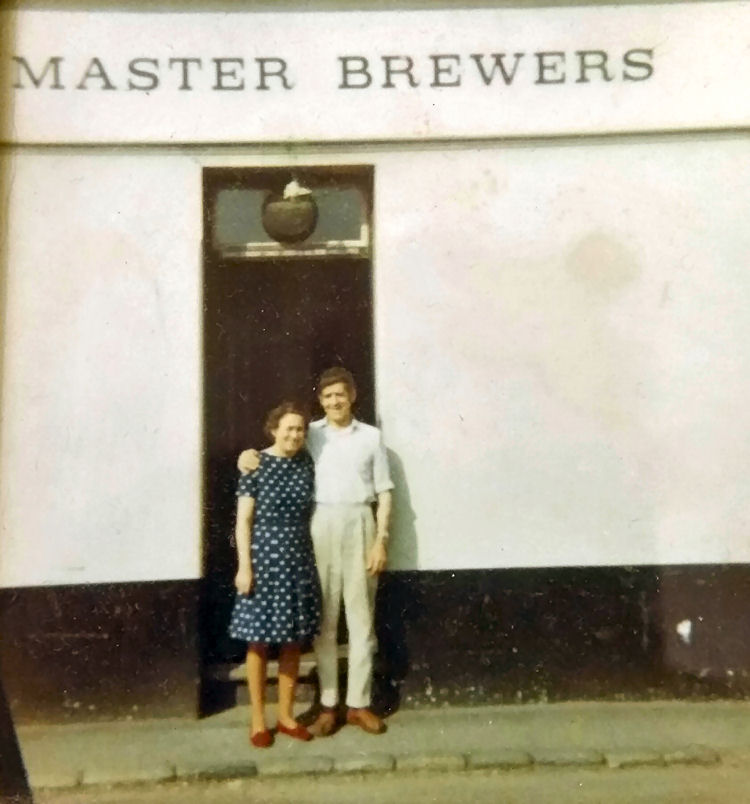
Above photo, kindly sent by Nigel Turner (son) showing his father
Charles, licensee 1972+ and his mother taken in the summer of 1971. |
|
From the Dover Express,4 February 1999.
Pub goes potty on its opening night.
A JUNIOR pool champion was guest of honour at the re-opening of a Dover
pub famous for its sports teams.
Kent brewer Shepherd Neame spent
£90,000 enlarging the bar of the Lord Nelson, in Flying Horse Lane,
re-carpeting its lounge and redecorating its walls with prints of
sportsmen and their pursuits.
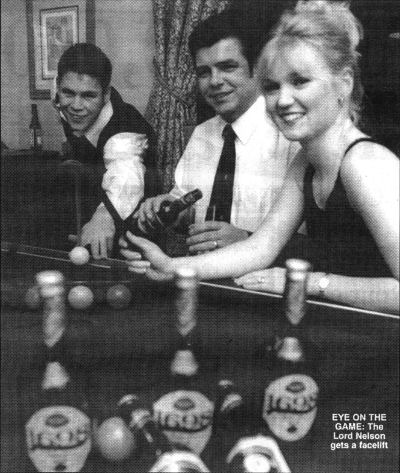 David and Jayne Harvey, the pub's
landlords, laid on a buffet while Jonathan Neame, the company's trade
director, was watched by Dover Chamber of
Commerce, Trade and Industry's chairman, Anne Hopkins, as he pulled the
first drink of the night, a pint of Masterbrew. David and Jayne Harvey, the pub's
landlords, laid on a buffet while Jonathan Neame, the company's trade
director, was watched by Dover Chamber of
Commerce, Trade and Industry's chairman, Anne Hopkins, as he pulled the
first drink of the night, a pint of Masterbrew.
World junior eight ball
champion, Curt Morris, whose parents run a Shepherd Neame hotel in
Sheerness, was challenged to
a game of pool by some of the pub's customers.
Mr Harvey said: "I
wouldn't have wanted to play him for money because he's rather good. The
evening went well and I'm satisfied with my new look pub, The bar's a
little bigger and it's a lot brighter and cleaner."
|
|
From the Dover Mercury 24 April 2003.
Historic hostelry is a
hidden gem
SECLUDED in the centre of Dover, the historic Lord Nelson pub is
featured in the second edition of Hidden Inns of the South East.
Landlord
Jim Turner's 18th century gem, tucked into Flying Horse Lane, caught the
eye of the author, Oxford scholar Peter Long.
His specialist subject at university was Classics. Now it is tracking
down and celebrating hostelries which may escape general notice because
of their location.
And he describes The Lord Nelson itself as "a truly
classic English pub and one of the oldest in Dover".
It is the only pub
in the Dover
District Council area to win inclusion in the book, published by Travel
Publishing Ltd, at £7.99, which covers
Kent, Sussex and Surrey.
The Lord Nelson has real ales from the Shepherd Neame brewery and, for
travellers, the benefit of being two minutes from the High Street and 20
minutes from the ferries.
|
|
From the Dover Mercury, 13November 2003.
Shots fired outside pub.
POLICE are appealing for information about a shooting incident
which took place in Dover on Sunday evening.
Officers were called to Flying Horse Lane, off the Market Square, at
about 5.30pm where a 43 year-old local man had left the Lord Nelson pub
and was confronted by two men, one of whom produced a shotgun. Two shots
were fired, but neither hit the man, and nobody was injured during the
incident.
The area was sealed off while officers examined the scene.
Both men were said to be white and skinny.
One was about 5ft 10in and wore a dark baseball cap, dark glasses
and a scarf over his mouth.
The second man was about 5ft 5in and also wore a baseball cap and
dark glasses.
Police are asking anyone with information to contact Det Sgt Stuart
Ward on 01304 240055 or Crimestoppers on 0800 555111.
|
|
From the Dover Mercury, 3 May 2007.
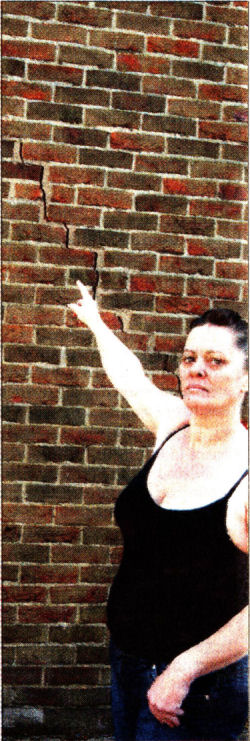
Landlady asks if bus garage is cracking up.
Picture left shows Lord Nelson landlady Helen Rickard pointing out the crack in the wall of
the bus garage. Picture Dave Downey pd1196545.
BUS company bosses have denied a crack in the wall of their garage at
Russell Street was caused by Saturday's earthquake.
People living and
working in the area said they thought the crack was new, although it
obviously followed the line of a previous crack which had subsequently
been repaired and had then opened up again.
Fragments of brick on the
path at the bottom of the wall seemed to back up the fears that this was
new damage.
Helen Rickard, licensee of the nearby Lord Nelson pub, said
she was concerned about the derelict multi-storey car park and former
Snoops nightclub which are in the area.
''As I understood it, those buildings were closed because they were not
safe, so I wonder what damage the earthquake might have caused to them.
The sooner they are demolished the better."
Dangerous
She says she is also concerned about the number of incidents
involving children getting into the former nightclub building.
"It's
just an adventure to them, but it is very dangerous. If we had suffered
the same sort of effects as Folkestone did, I wonder how that building
would have stood up to it."
A spokesman for the Stagecoach bus company
assured the
Mercury the cracks in the garage wall were there before Saturday's
tremor.
The bus garage is now owned by the district council, ahead of
the Dover Town Investment Zone redevelopment, and a council spokesman
said: "Our senior structural engineer has inspected the garage site
following Saturday's earthquake and found no evidence of any new damage.
However, if people have ongoing concerns we will be pleased to discuss
these."
District council leader Cllr Paul Watkins said they had not
received any calls about the former multi-storey car park or nightclub
buildings being damaged.
|
|
From the Dover Express, 9 November 2006. Report by Yamurai Zendera.
Pub Tipped for Victory.
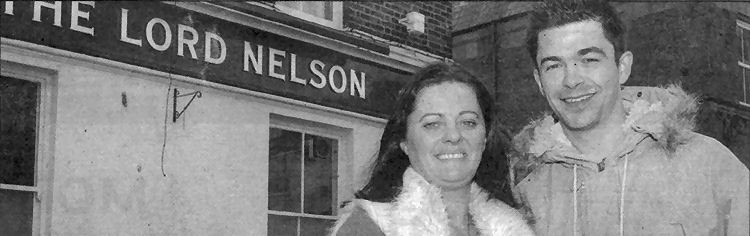
THE new owners of a Dover pub will seek to inject a traditional
family atmosphere into the establishment by giving it a fresh makeover.
Helen Rickard, 42, and partner Andy Stratford, have just taken over the
reins at The Lord Nelson pub, situated on the comer of Flying Horse Lane
and St James’ Street.
The pub is only partially open for business as refurbishment work is
taking place ahead of its official opening night next Friday.
The new venture means mother-of-four Helen returns
to Dover after a 26-year absence.
Having managed various pubs in Dartford and Medway, Helen said she was
keen to draw on her experience to provide “a traditional old-fashioned
pub atmosphere”.
She said: “We are spending a lot of money making it a pleasant and
comfortable environment for people to come in and have a good time.”
Existing facilities including two bars, a conservatory, an outside
seating area by the River Dour, and a pool table
will be given a facelift.
Helen said the establishment would also be providing a range of family
entertainment while serving up tasty homemade pub grub.
She explained: “We will be introducing quiz nights and laying on
activities such as darts and pool. There will also be a traditional
home-cooked Sunday roast, as well as OAP lunchtime specials.”
The opening of The Lord Nelson will be marked by a Champagne buffet and
disco.
The event will begin at 7pm with no admittance after 11.30pm.
|
|
From the Dover Mercury, 12 July 2007. By Graham Tutthill.
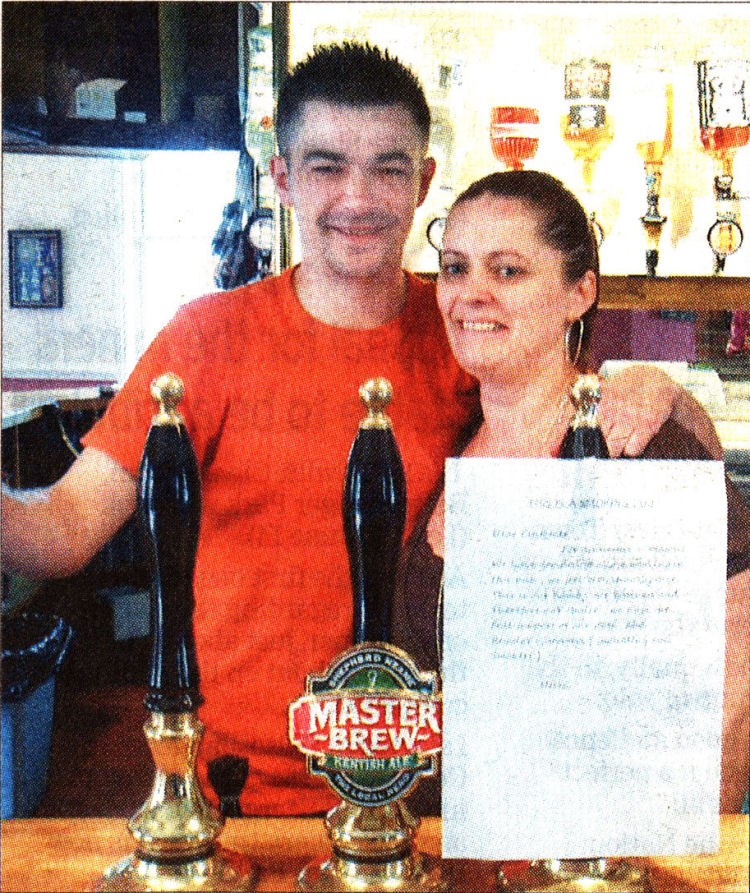
Andy Stratford and Helen Rickard at the Lord Nelson with the notice
telling customers smoking is still allowed. pd1239056.
Row ignites over pub smoking ban.
A COUPLE who run a Dover pub are set for a head-on clash with the
Government over the no-smoking legislation.
Helen Rickard and Andy
Stratford, licensees of the Lord Nelson public house in Flying Horse
Lane for the past eight months, have put signs up telling their
customers they can still smoke.
Non-smokers are being told that if they
don't like it, they can leave.
"This is more than just being about the
smoking issue," said Helen Rickard. "It's about freedom of choice and
human rights. If they get away with this, what's next?
"This is not just
our business, it's our home. We have the full support
of our staff and our regular customers, including those who do not
smoke. About 99 per cent of our customers are smokers.
"It's not so bad
at the moment while the weather is reasonably good, but in the winter,
when it's cold and wet and people don't want to go outside, our business
is going to be hit very badly, and we may
not survive."
Helen is also managing the First and Last pub at East Cliff, which has
been put on the market, which she is running as a non-smoking pub.
"It
gives people the choice. This is an important principle.
"We believe we
should have a choice as to whether people smoke in the pub or not, and
we are prepared to fight for it.
"Even when the pub is closed and I am
cleaning the bars I am not legally allowed to smoke in here."
Mr Stratford said that he didn't believe the smoking ban would force
people to give up the habit.
"If you tell someone they can't do
something like this, it just makes them more determined," he said.
WHAT THE LAW SAYS
UNDER the new legislation, "no smoking" signs, at
least A5 in size, have to be displayed at all entrances to public
buildings.
Smoking in a smoke-free building can result in a £50 fixed penalty
notice, or a fine in court of up to £200.
Failure to display no-smoking signs incurs a fixed penalty of up to £200,
and failing to prevent smoking in a smoke-free building can lead to a
fine of up to £2,500.
Lucy Manzano, public protection team leader for Dover District Council,
said the council had a duty to ensure the legislation was being complied
with.
The council has appointed a smoke free enforcement officer; Jeremy
Lewis, who can give advice. His phone number is 01304 872264.
|
|
From the Dover Mercury, 12 July 2007.
Fired up over smoking ban.
WHENEVER new laws are introduced, there are always some people who
object, and there are always unforeseen consequences. The smoking ban is
generally welcomed, especially if it protects people from second hand
smoke.
But, it has already led to large groups of smokers gathering outside
pubs and work places to light up, and, in some cases, "taking over"
other areas which are not really appropriate.
So licensees Helen Rickard
and Andy Stratford are making a stand, not just because it is a ban on
smoking, but because they believe it takes away their freedom to choose
whether their pub, is smoking or non-smoking.
Whether or not they will be as successful as the Metric Martyrs who
eventually won their right to display items in imperial measures remains
to be seen. But you have to admire their determination.
|
|
From the Dover Express, Thursday, 15 May, 2008.
Chemo care cash thanks
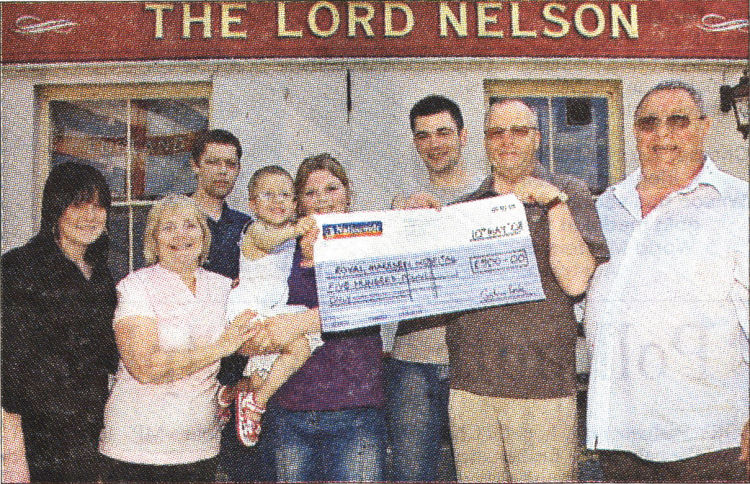
Helping hand: (left to right) family members Kirsty Tuckwell, Sandra
Cookabbott and Michael Sherman, with Kia-Louise, mum Nicola, Lord Nelson
landlord Andy Stratford, grandad Ray Sherman and Michael Cookabbott,
with the £500 cheque.
A GRANDAD has raised £500 for the Royal Marsden Hospital to say thank
you for their treatment of his granddaughter.
Plucky Kia-Louise
Cookabbott is receiving chemotherapy after it was found she had a tumour
behind her eye.
The dedicated staff at the hospital inspired Ray Sherman
to raise the cash.
One haircut, plus a chest and leg wax by son Ian, has
resulted in the £500 pot.
Ray said: "I decided to have my hair shaved
off as Kia had lost her hair. Now we are both growing it back."
|
Closed for a few months in 2008 to reopen in 2009 when the licensees from
the "Kingfisher" moved here requiring a bigger
establishment. So, I am not sure whether this is now being advertised as a
gay venue.
|
From the website
www.thisiskent.co.uk. Thursday, December 18, 2008.
SHOPLIFTER ENJOYS SECRET BOOZING SESSION.
A SHOPLIFTER has admitted sneaking into a Dover pub and pouring
himself a pint of beer despite it being closed.
Adam Bryan Walford, 35, of Dryden Road, Dover, also admitted
possession of heroin and stealing a joint of meat from Somerfield in the
town when he appeared at Folkestone Magistrates' Court today.
Ruth Hawkins, prosecuting, said: "The burglary was at the "Lord
Nelson" pub which was closed at the time.
"He went into the pub through the conservatory and knew he was
trespassing, he went to the bar and pulled a pint and drank it."
The secret drinking session happened in August when the pub had been
shut for a few days, and when Walford went in another criminal had
already been in and stolen drinks and cash.
Martyn Archbold, defending, said: "It does point to the fact that he
does have a serious drug problem which as you will see has been looked
at in the past. He does have a letter which indicates the possibility of
a rehab place."
Walford pleaded guilty to burglary, theft and possession of a
controlled drug, while he also asked for two other offences to be taken
into consideration.
The magistrates decided the matter was so serious they had no choice
but to commit the case to Canterbury Crown Court for sentencing at a
date yet to be set.
|
The CAMRA meeting of 18th January 2010 reported that the "Lord Nelson"
was up for sale.
Latest photo, October 2014, shows the pub closed and boarded up.
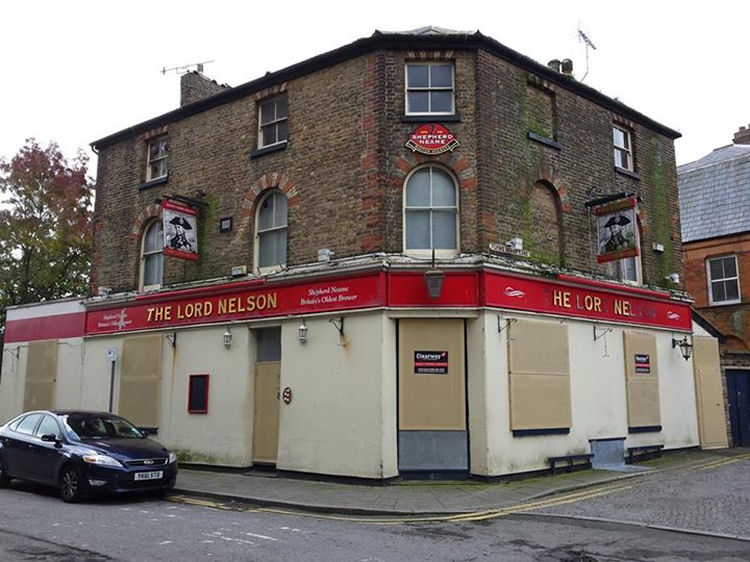
Above photo kindly sent by Stuart Kinnon, October 2014. |
Now open again, so glad to say.
|
From the Dover Express, 3 September 2015.
By Jordan Bluer.
Family loved pub - so now they’re running it.
New lease of life for Lord Nelson after 2014 closure.

DOVER’: Shpend Vranoci, Elena Dimitrijeva, Eldi (aged 3) and Tyler
(14).
RAISING three children while running a popular pub may sound like a
tough task, but the new owners of the Lord Nelson say they’re up to it.
Elena Dimitrijeva, 26, and Shpend Vranoci, 40, of Westbury Road, took
over their dream pub in August and have big plans for its future.
The daring duo started their grand adventure with a massive opening
party that rocked St James Lane until 3am.
Loved.
Elena said: “It was a shame when the Lord Nelson closed last year. We
used to go quite often and we loved the pub.
“When we heard it was a free house and the brewery, Shepherd Neame, was
no longer involved, we decided to take it over.
“It’s got a great view, it’s by a river and it’s in a nice location. We
love it.
“It’s a very old pub and it’s an important part of Dover.”
The mother to three-year-old Eldi moved to England from Lithuania ten
years ago, and lived in Canterbury with Albanian-born Shpend and his two
children Rozafa, 13, and Tyler, 14.
The couple worked across East Kent - Sphend in a factory and Elena in
cafes and pubs - before they chose to settle in Dover.
“I love Dover,” said Elena. “It’s a quiet town, the people are lovely,
and it’s a great place to raise our kids.”
“We’ve wanted to take over the pub for a long time and it’s going well.
"We have a disco and karaoke on Friday and we’re planning to have live
bands on a Sunday, as well as open the kitchen for food.”
|
|
From the Dover Express, 24 March 2016.
Unbeaten champion boxer pays visit to pub to meet young fans.
YOUNG boxing fans from Dover met current British and WBC International
champion Ryan Burnett on Saturday when the Belfast lad visited the Lord
Nelson.
Owners of the St James Lane
pub Shpend Vranoci and Elena Dimitrijeva were delighted.
Elena said: “It was a real pleasure to see him.”

Burnett, who is 23, won gold at the Olympic Youth Games in 2010 and
turned professional in January 2012.
He is 13 matches unbeaten and his latest win came last month against
Frenchman Anthony Settoul, winning him the WBC International
Bantamweight title.
|
Rumour has it that the pub will close at the end of March 2019 for
refurbishment expected to reopen in November 2019.
Eventually opened again in February 2020.
|
From the
https://www.kentonline.co.uk By Sam Lennon, 15 October 2019.
Lord Nelson, one of Dover's oldest pubs, to be refurbished by Shepherd Neame.
One of Dover's oldest pubs is to get a major revamp.
Planning permission has been granted to comprehensively refurbish the
Lord Nelson in Flying Horse Lane.
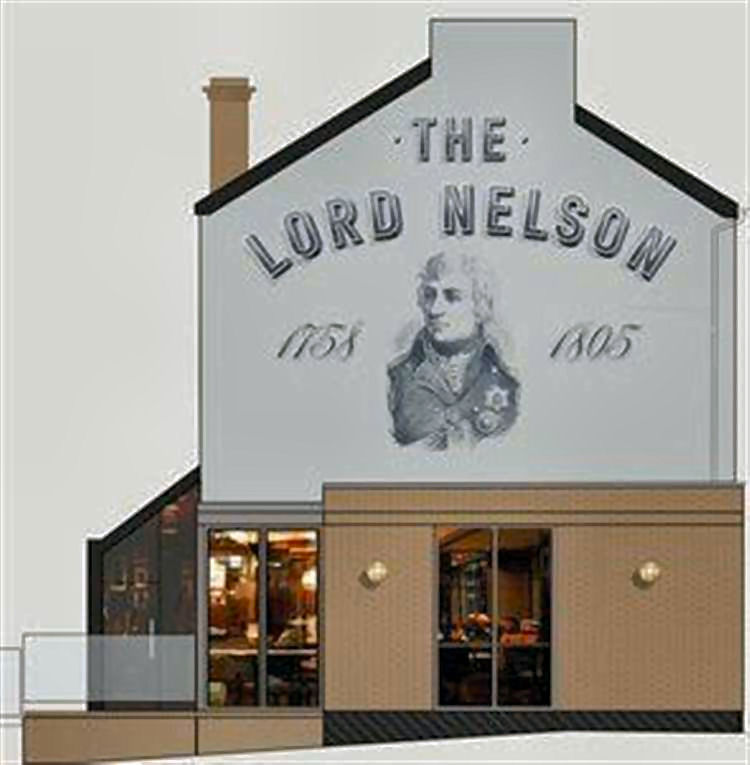
The expected side view of the pub, an artist's impression. Picture: Dover District Council.
Owners Shepherd Neame has plans including an open plan bar area and
dining space.
The new look outdoor areas will include patio seating to the front of
the property.
There is to be a stone-paved terrace to the back of the property with a
retractable awning and café style furniture.
Permission was given by Dover District Council.
Cllr Nick Kenton, cabinet member for planning, said: “We’re delighted to
see Shepherd Neame investing in Dover and capitalising on the Lord
Nelson’s fantastic town centre location.
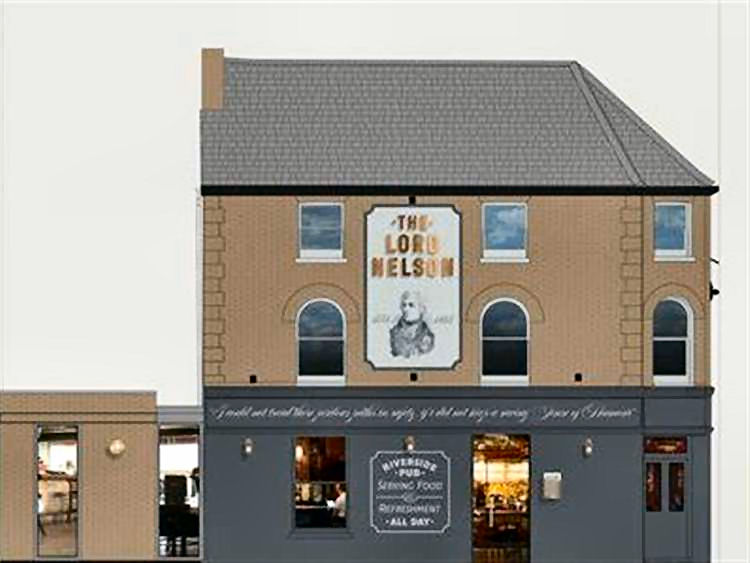
Artist's impression of the refurbished Nelson. Picture: Dover District
Council.
"It’s another excellent example of the growing interest from the food
and beverage sector in Dover.”
Nigel Bunting, director of detail and tenanted operations at Shepherd
Neame, said: “We are looking forward to developing the Lord Nelson.
"We will be improving all trading areas internally and externally to
make the most of this historic pub, which boasts a unique riverside
location with views up to Dover Castle and is also in a prime position
alongside the new St James' development.
"As part of this process we will be recruiting a new licensee and would
invite anyone interested in the role to contact our team."
The pub, right next to the River Dour, adjoins the St James' Retail and
Leisure Park and is a couple of minutes' walk from Market Square.
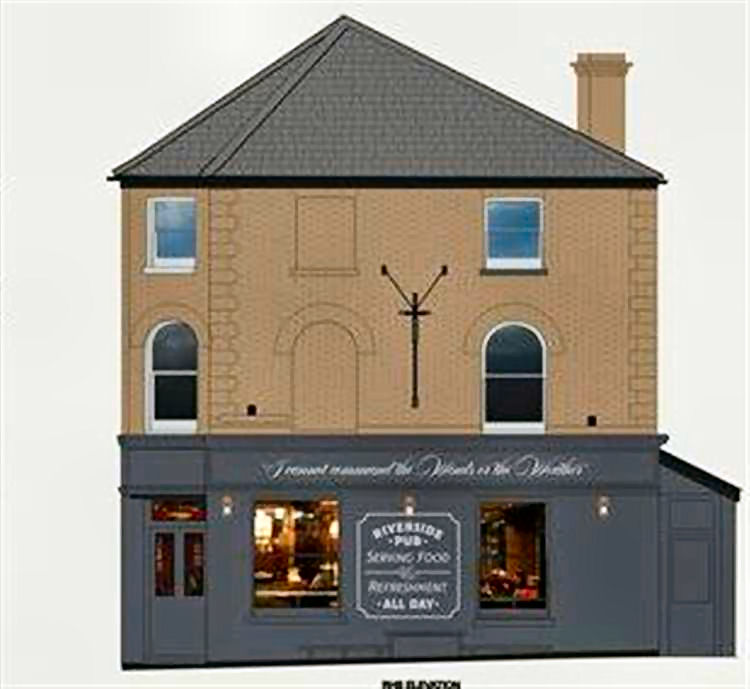
Planning permission has been given to transform the pub, an artist's
image shown here. Picture: Dover District Council.
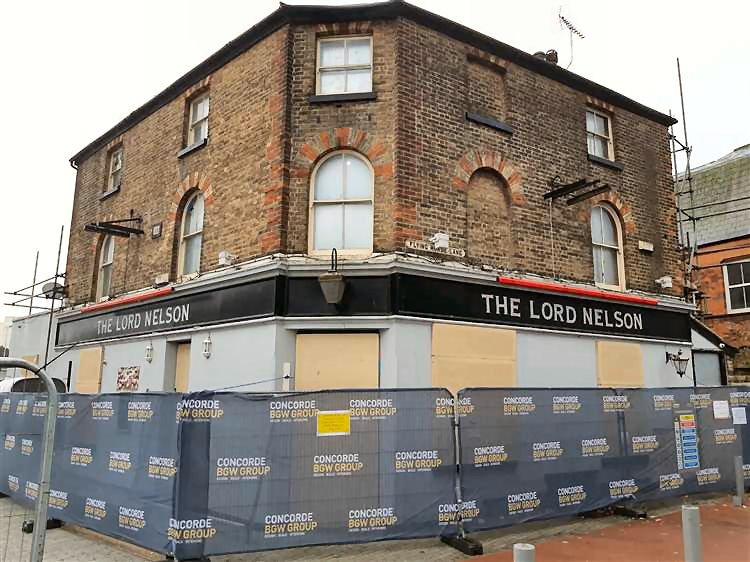
The Lord Nelson as it is now, prepared for revamp.
Over the centuries it has been a licensed premises of one form or
another.
It is thought to have been in the town centre from as far back as 1805,
the year the British naval hero was killed in the Battle of Trafalgar.
|
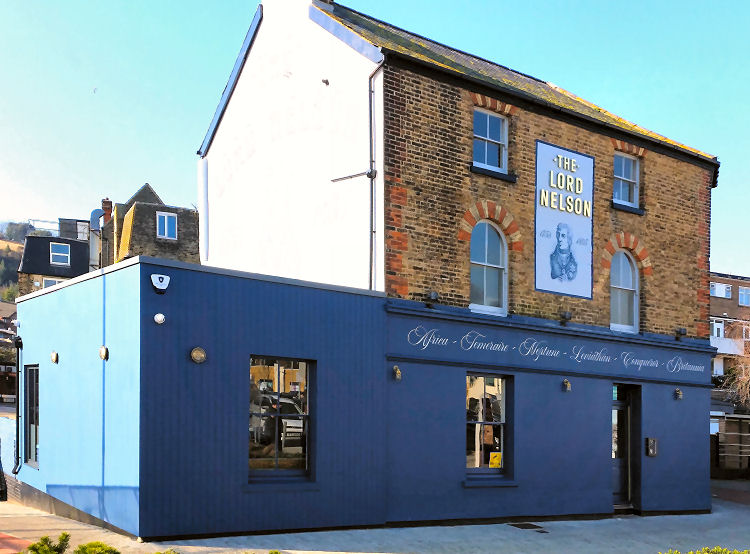
Above photo 7 February 2020, kindly taken and sent by Steve Bell. |
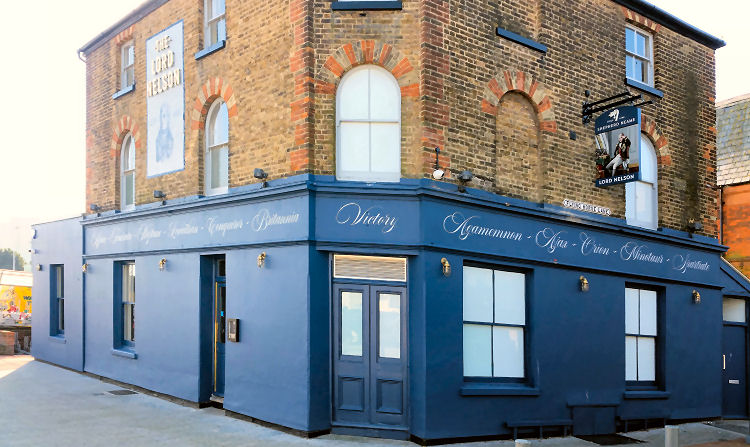
Above photo 7 February 2020, kindly taken and sent by Steve Bell. |
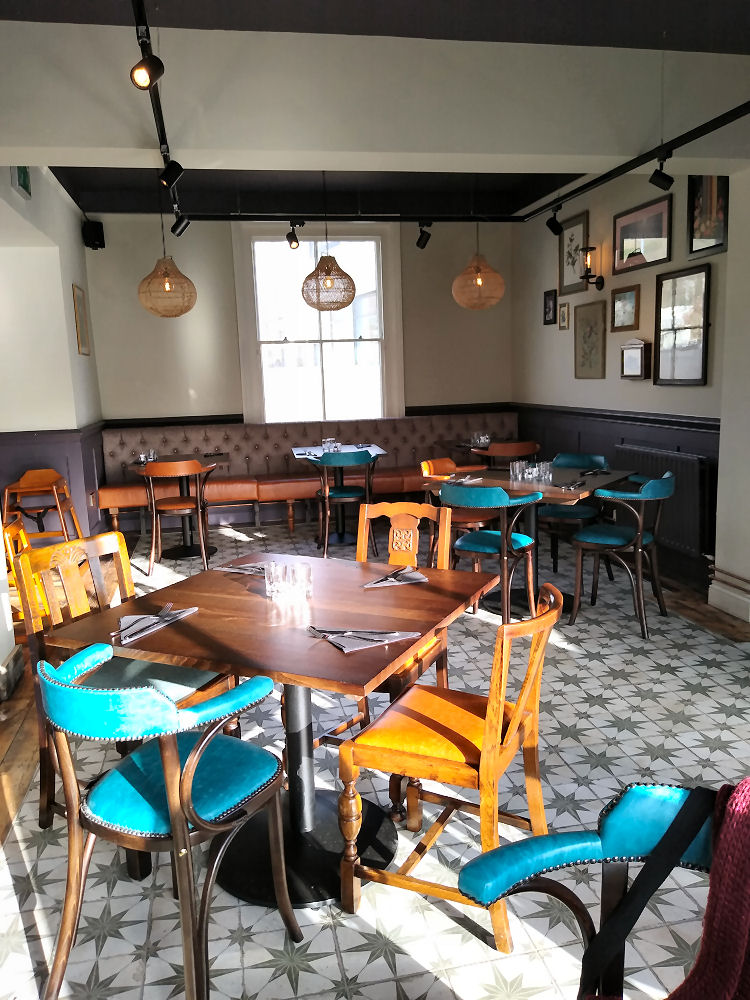
Above photo, February 2020, kindly taken and sent by Graham Butterworth. |
|
From the
https://www.kentonline.co.uk By Sam Lennon, 11 March 2023.
Lord Nelson pub in Dover reopens under Joe Taylor and Laura Taylor of
Wild Box Events, Folkestone.
A couple is hoping to reinvent one of a town's oldest pubs for the 2020s
by hosting "DIY events" and getting street food vendors to take over the
kitchen.
The 19th century Lord Nelson in Dover has now reopened under new
management after a three-month hiatus.
The pub reopened on March 1 under couple Joe Taylor and Laura Taylor,
who although are not married, by coincidence share the same surname.
Bands will now on be a regular feature of the pub but Mr Taylor says the
unique aspect of the venue will be its "DIY nights" when people can
organise their own events arranging for their own music and food.
The kitchen at the venue in Flying Horse Lane will also be available for
small traders such as street food vendors whose outdoor stalls have less
trade in the winter.
Mr Taylor said: "We want to market this place as a versatile events
space. People can use it pretty much as they like. It can be a
completely DIY venue or we can provide.
"We have some great street food vendors and obviously that line of work
dries up a bit come winter so we'd like to give them a space to carry
on.

New managers of the Lord Nelson at Dover, Joe and Laura Taylor.
"We'd like to give the people of Dover the chance to try the different
cuisines of these very talented people.
"It's exciting because this will be something different for Dover."
The kitchen will be set up so that any type of cuisine can pop-up there
from Caribbean to Mexican and beyond.
Lord Nelson is thought to have been in the town centre as far back as
1805, the year the British naval hero, whose name inspired the pub, was
killed in the Battle of Trafalgar.
It has closed and reopened under different management over the years in
recent years but in February 2020 it reopened again after a four-month
£330,000 refurbishment.
By then it came under the license of Chris Bichard, who continues as
landlord.

Joe and Laura Taylor's formal reopening for the pub is on Saturday. Picture: Sam Lennon KMG.
The Taylors, from Folkestone, run Wild Box Events, an events and mobile
bar company.
It has a permanent bar on Folkestone's Harbour Arm and also provides
cocktail kits and cocktail masterclasses.
The Lord Nelson will not come under the Wild Box brand but it will have
a cocktail menu and host various Wild Box events, particularly live band
performances, the DIY nights and available for corporate hire and family
events. |
LICENSEE LIST
WILLIAMS 1805
COLYER Alton/Allen 1823-28+

WOOD Timothy 1832-40+

PACKHAM Samuel 1841-Mar/64 ( lodging house) lodging house) (age 60 in 1861
 ) ) 
HARRIS Mr Mar/1864+
MATSON George Mar/1870-71+ (age 60 in 1871)(pub burnt down in 1872)
ORAM Morris Jarvis 1873
TROWELL Walter May/1873-74+
CLARK 1877
TROWELL Ann Mrs 1881-82 (widow age 63 in 1881)

SMITH Horace 1891 (mentioned as maltster age 26 in 1891)
CARPENTER Arthur 1890-1907 dec'd (age 40 in 1901)
     
CARPENTER Mrs Kate 1907 end
WILLIAMS B D 1907 dec'd
CAREY Michael June/1909 dec'd

CAREY Mrs Elizabeth Frances June/1909-11+ (age 42 in 1911)
KNIGHT George James 1913

WILLIAMS Mrs Eliza F 1907-23 end

BOOKER Frederick William 1923-Aug/25
(attempt made to close)
PRICE James Aug/1925-Feb/27
(Grocer
from Tottenham)
SEAGER Sidney Thomas Feb/19278-Aug/31
 (Former Naval
petty officer.)
(Former Naval
petty officer.)
KNIGHT George James 1930?

PEARSON Walter Oliver 1931-32 end

MARTIN Frank Francis Edward 1932-Aug/40 (age 60 in 1939)
 
MARTIN William Thomas Aug/1940+ (Mason & Son secretary)
ASKHAM George Harry June/1948-1950+
BOWLEY Leonard 1953 end

OLIVER William James 1953-56+

HAWKINS James 1964
MALLETT Stanley 1969
TURNER Charles R Feb/1971-Feb/83
 (Edward Mason's beer)
HERRING Henry 1983-87
SUTHERLAND Andrew 1990
WOOLACOT Kelvin 1992
HARVEY David & Jayne Feb 1999+
TURNER Jim 2001-06
STRATFORD Andy & RICKARDS Helen Nov/2006+
 PAGE Mr L 2009-16/May/2010
DOWSETT Mrs S 16/May/2011+Oct/14
VRANOCI Shpend Vranoci & DIMITRIJEVA Elena 2016+
BRICHARD Chris Feb/2022+
TAYLOR Joe & Laura 11/Mar/2023+
Unknown name 12/Jan/2024+
CAMPBELL Ian 2026+
From the Pigot's Directory 1823
From the Pigot's Directory 1828-9
From the Pigot's Directory 1832-33-34
From the Pigot's Directory 1839
From the Pigot's Directory 1840
From Bagshaw Directory 1847
From Melville's Directory 1858
From the Post Office Directory 1874
From the Post Office Directory 1882
From the Post Office Directory 1891
From Pikes Dover Blue Book 1895
From the Kelly's Directory 1899
From the Post Office Directory 1901
From the Post Office Directory 1903
From the Kelly's Directory 1903
From Pikes Dover Blue Book 1909
From the Post Office Directory 1913
From the Post Office Directory 1922
From Pikes Dover Blue Book 1924
From the Post Office Directory 1930
From Pikes Dover Blue Book 1932-33
From the Post Office Directory 1938
From Pikes Dover Blue Book 1938-39
From the Kelly's Directory 1950
From the Kelly's Directory 1953
From the Kelly's Directory 1956
Library archives 1974
From the Dover Express
Census
|

