|
124 London Road (15 Buckland Street 1851 ) )
01304 204417
http://www.theoldendeavour.co.uk
https://www.facebook.com/theoldendeavour
https://whatpub.com/old-endeavour
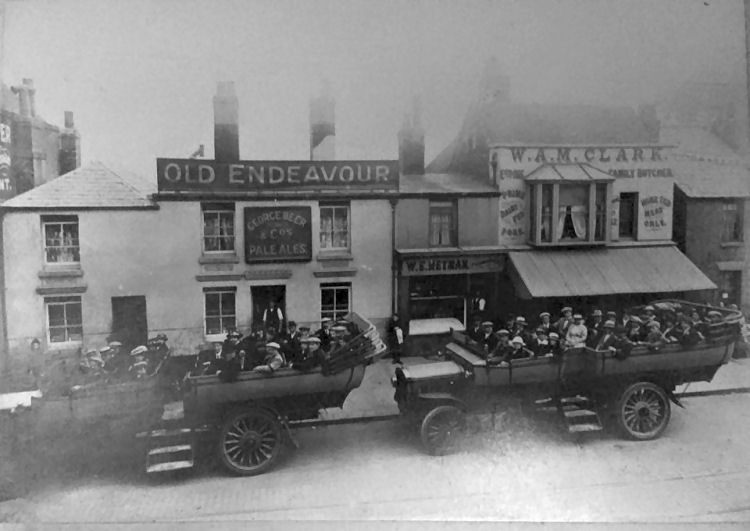
Above photo from the John Gilham collection, circa 1920. |
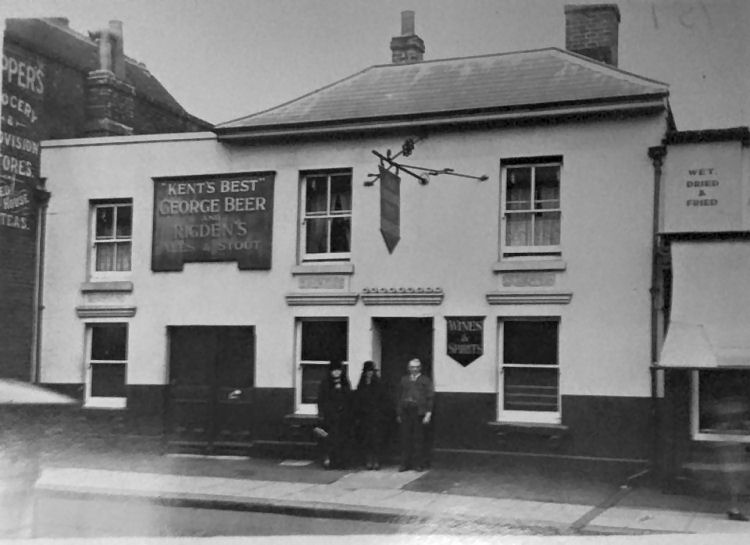
Above photo from the John Gilham collection, circa 1920. |
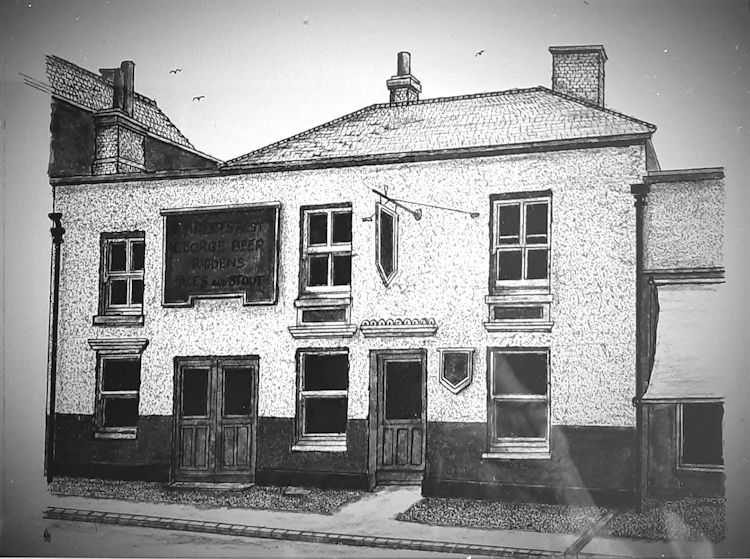
Above drawing taken from 1920 photo, by Nigel Walkling. |
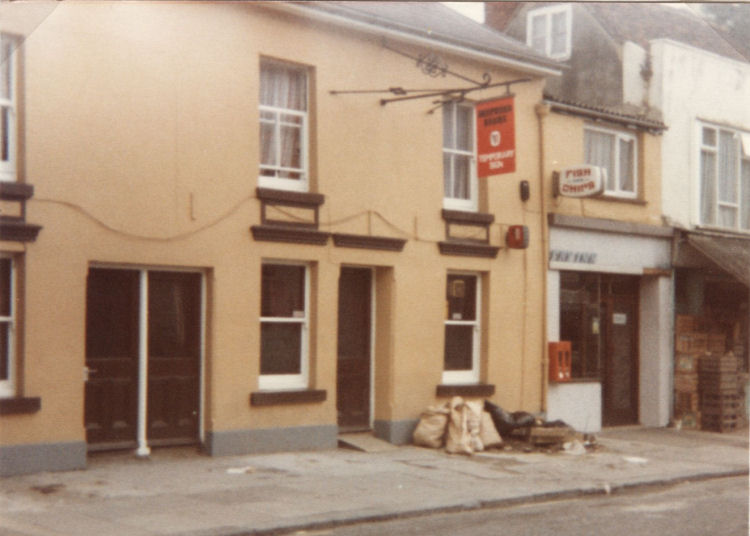 Above picture 1980 by Barry Smith. |
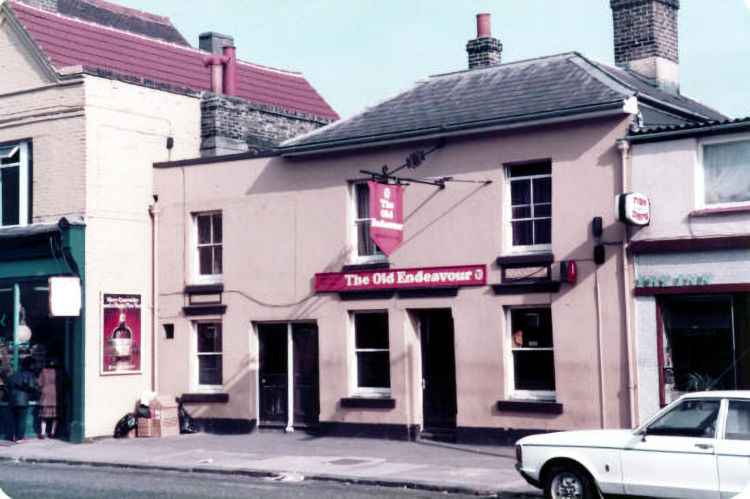
Above photo, 1983. Photo by Eddie Chard. |
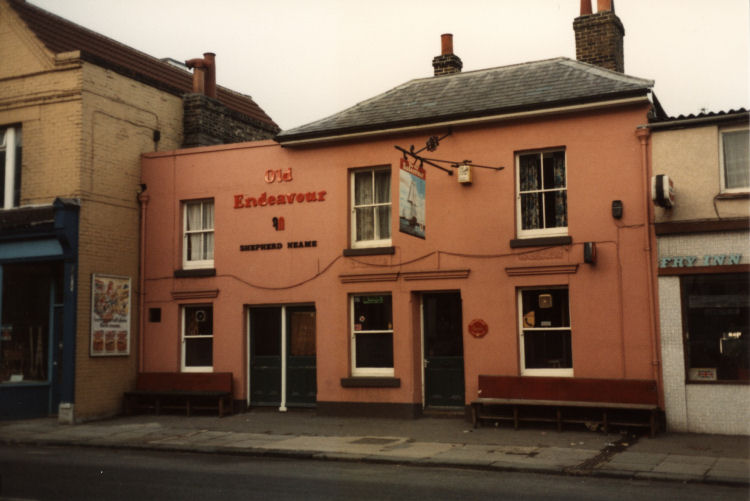
Old Endeavour circa 1987 (Photo by Paul Skelton) |
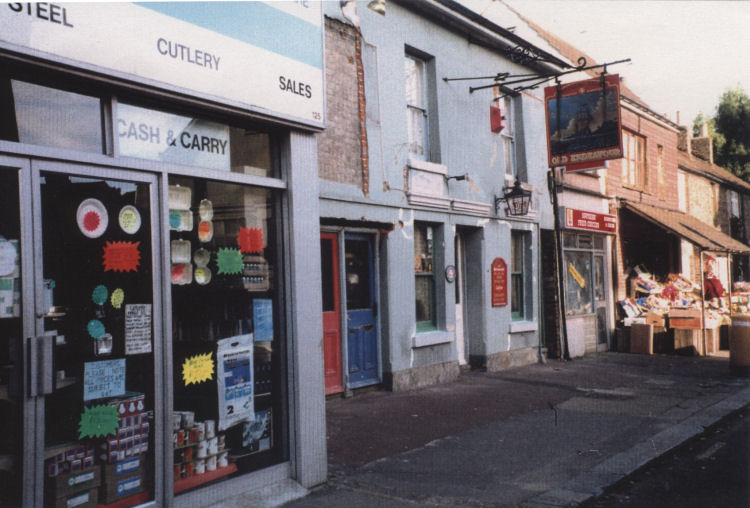 |
|
Old Endeavour 1993 |
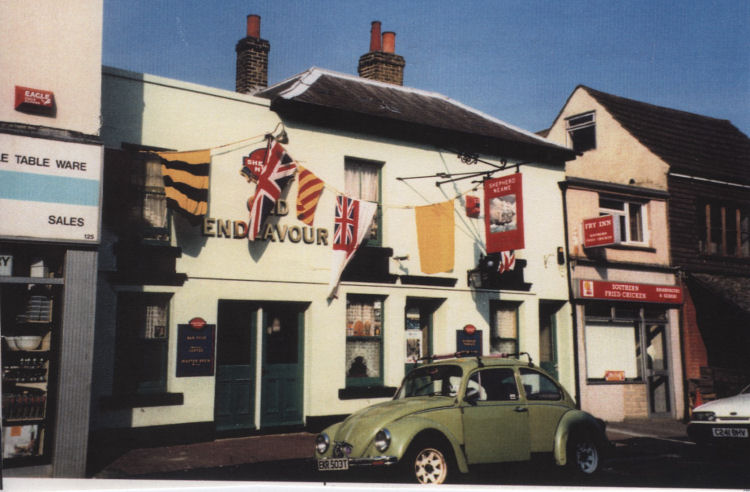 |
|
Old Endeavour 1995 |
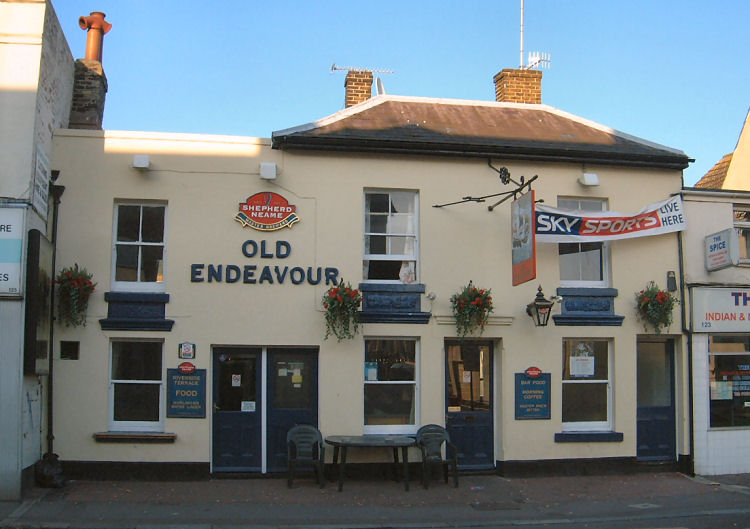 Above two photos by Paul Skelton 6 Oct 2007. |
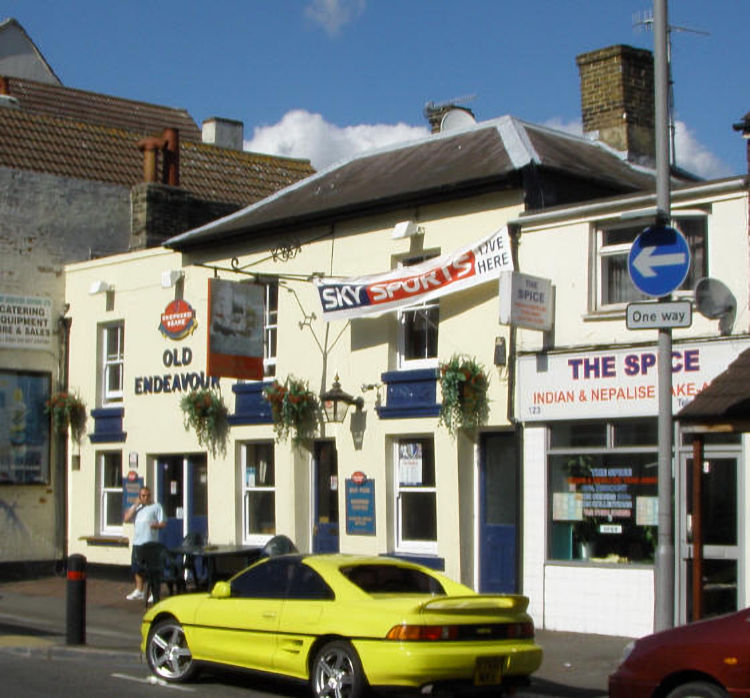
Above photo, date unknown. |
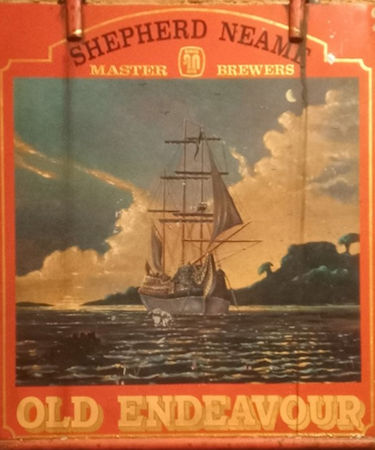 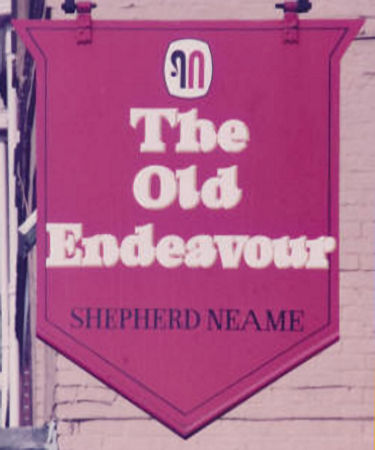
Above sign left 1980, sign right 1983 by Eddie Chard. |
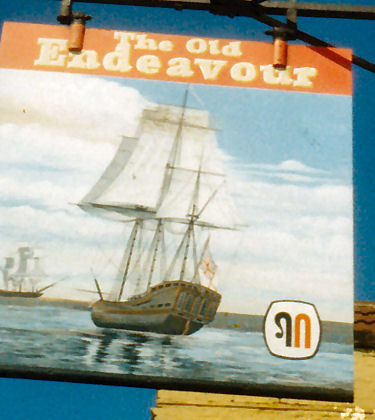 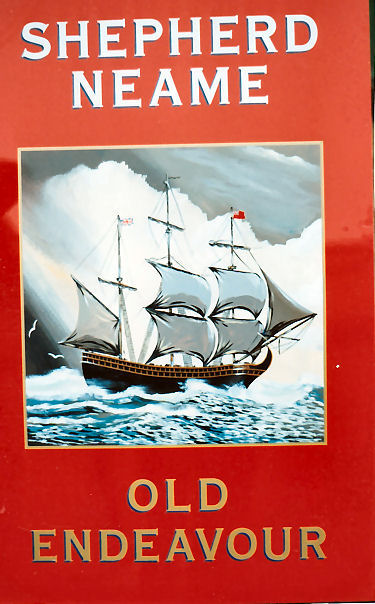
Old Endeavour sign left, April 1987, sign right, November 1993.
Above with thanks from Brian Curtis
www.innsignsociety.com |
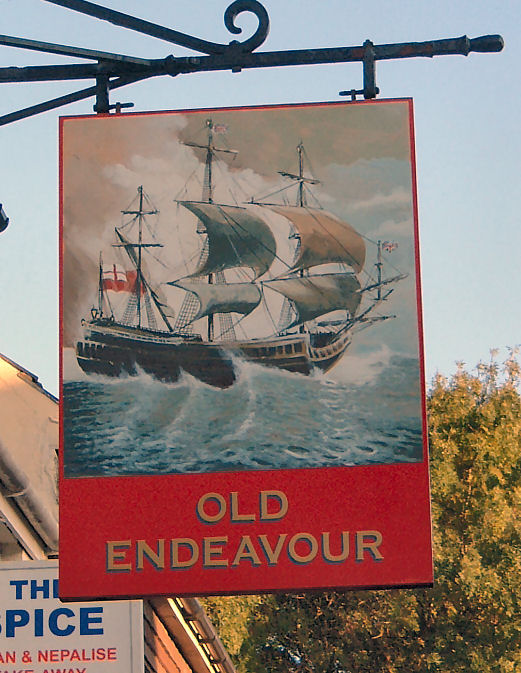 Above two photos by Paul Skelton 6 Oct 2007. |
A house of Shepherd Neame and reputedly named after a privateer called
"Endeavour" which was fitted out at Dover in July 1746.
Mark Frost kindly sent me the following:- I've been researching a book on
Dover privateers 1739 - 1814 and found a little more - the Dover "Privateer"
pub, like the "Old Endeavour" pub, was named after the 'Dover' privateer,
which was a famous and successful privateer of the War of Austrian
Succession 1739 - 1748. She was a Dover vessel captained by James Gravener,
150 tons, 120 crew, 14 carriage guns and 20 swivel guns. She made a fortune
in prize money for her entire crew so I suspect that one of them invested
his money in a pub named after his old ship.
Incidentally, regarding the "Old Endeavour," another Dover privateer
1746-48 was the 'Endeavour', Captain Robert Crouscuall (Crascall). Again, I
suspect one of the crew has invested his prize money in a pub after the War
ended in 1748.
For the above reason I am not sure whether that "Old Endeavour" named
after the privateer is the same building as this one, as I would have
thought this being too far from the sea for any naval person to consider.
However, I also have references to a "Fresh
Endeavour" and what was also known as "Pain's
Endeavour" both located in the pier district, which could be the same
connection.
The first documented licensee I have found for this one being in 1841.
|
From the Dover Telegraph and Cinque Ports General Advertiser, Saturday, 31 May, 1845. Price 5d.
DOVER POLICE REPORT
John Crick, labourer, of quarrelling notoriety, was charged by his
brother-in-law, Philip Holes, with assaulting and threatening to kill
him, on Thursday. It appeared that Crick went into the “Endeavour”
public house, near Buckland Bridge, where he met the prosecutor, and
without any provocation, threw nearly a pint of beer into his face,
struck, and otherwise maltreated him. The landlord and another witness
corroborated this evidence, and Crick was ordered to find two sureties,
in £10 each, and be bound in £20 himself, to keep the peace till, and
appear at the next accessions, to answer the charge, and in default was
committed, but was admitted to bail on Monday.
|
|
From the Dover Telegraph and Cinque Ports General
Advertiser, Saturday 13 June, 1846. Price 5d.
Robert Millen, wheelwright, was charged by the wife of David Wills,
butcher, with an assault. From the evidence it appeared that Millen was
intoxicated when the assault was committed; that he went to
complainant's door, and upset a sack of barley meal. She went out to
him, and tried to prevent the meal being spoiled, when he knocked her
down two or three times. He was fined 40s., and 18s. costs; and in
default of payment was committed for 40 days.
Millen was also summoned for the damage done to the barley meal, and
for breaking a pane of glass at the "Endeavour," in Buckland; but these
cases were settled without the interference of the Bench.
|
|
From the Dover Express and East Kent Intelligencer, 18 May, 1861.
PETTY ROBBERY
George Rye, a general dealer living at Eythorne, was charged with stealing from the "Endeavour" public house,
Buckland, a whip value 3s. the property of James Birch, cow keeper, of
Ewell, near Dover.
It appeared that the prosecutor, in company with a neighbour he had
met, went into to "Endeavour" public house about noon on the previous
Wednesday. Each of them were in charge of horses and they left their
whips outside the public house, in the skittle ground at the rear. On
their entering, the prisoner was in the house, but he left about a
quarter of an hour before the prosecutor and his companion; and when
they came out of the house they both missed their whips. They suspected
the prisoner had taken the whips and they followed him in the direction
of Old Park, but did not overtake him. Birch, however, met the prisoner
the next day on the Eythorne road, and asked him if he had his whip. The
prisoner at first denied all knowledge of the whip, but subsequently
said he had found a whip in his cart, but did not know how it had got
there, and ultimately admitted taking it, promising that he would carry
it back to the place he had taken it from. On the previous day (Friday)
the prosecutor was passing the "Bull," when prisoner called to him and
showed him his whip, saying he was very sorry he had taken it, but he
had done so in consequence of being the worse for liquor. They walked to
Ewell together and defendant then gave him the whip. Witness had given
information to the police on the preceding evening.
By the Bench:- When I took the whip I did not "make it up" with the
prisoner. I told him that matters had gone too far for that.
John Pope, sergeant in the Kent County Constabulary, said that from
information he had received he apprehended the prisoner that morning on
a charge of stealing a whip belonging to Birch. The whip was given him
by the prosecutor's daughter, and he now produced it. On the charge
being read over to the prisoner at the station-house, he said he had
taken Birch's whip and another from the "Endeavour" skittle ground.
It appeared that the prisoner, although promising to restore the
whips, had not offered to do so until he found that information had been
given to the police and there was danger of him being taken into custody
upon the charge now before the Bench, and that when first charged with
stealing the whip he said it was given him. It was only afterwards, when
he found there was a clear case against him, that he confessed to
stealing it.
The Magistrates thought this a very grave and aggravated feature of
the case, and that it tended seriously to mitigate against the
prisoner's defence.
Thomas Wright, the prosecutor in the second case, said he did not
wish to press the charge against the prisoner, who had till now borne a
very good character, and that he and Mr. Birch both desired to
recommend the prisoner to the regretful consideration of the Bench.
Sergeant Pope, in reply to the Magistrates, said that nothing against
the prisoner's history had been known to the police previous to this
occurrence. The prisoner was a general dealer and had lived at Eythorne
for the past six or seven years, and the only irregularity of which he
was known to be guilty was being occasionally apt to get too much to
drink.
The prisoner in reply to the usual questions, requested that he might
be dealt with summarily and pleaded guilty to the charge.
The Magistrates told the prisoner that it was unfortunate for him
that Mr. Wright had consented to forego his charge, and that both he and
Mr. Birch had united to recommend him to mercy. For this offence he was
liable to a punishment of three months in the House of Correction, with
hard labour, but after a consideration of all the circumstances, the
Bench were of opinion that a more lenient sentence would answer the
justice of the case, and had decided to mitigate the penalty to fourteen
days imprisonment.
|
|
From the Dover Express and East Kent Intelligencer, 12
September, 1863.
ANNUAL LICENSES
Charles Eastes of the "Endeavour," Buckland, failed to answer his
name at the Dover Police Court Annual Licensing day and therefore had to
go to Broadstairs to get the license renewed.
|
|
From the Dover Express and East Kent News, Friday 2 January, 1885.
DISORDERLY CONDUCT
Thomas Menter, a labourer living at Buckland was brought up charged with
disorderly conduct in the “Endeavour Inn,” Buckland by breaking 3
glasses and two match stands value 4s. the property of Sarah Baldwin.
Sarah Baldwin, landlady of the “Endeavour Inn” said: the defendant came
into my house several times on Saturday. He came in between 9 and 10 in
the evening and said he wanted to be locked up as he could get no work.
I told him that if he wanted to be locked up he should go to the police
station and ask the police to lock him up. He said he would do something
in order to get locked up, he then knocked over 3 or 4 glasses, the
contents of which went over the gentleman that were standing at the bar.
He then broke two match stands. The damage done is about 4s. I sent for
a policeman and the language defendant used while in the house was
something disgusting.
The Magistrates fined the defendant 1s. 6d. and damage 4s. or in default
7 days' imprisonment. He went to prison.
|
|
From the Dover Express and East Kent News, Friday 11 May, 1888.
SUDDEN DEATH AT BUCKLAND
An inquest was held before the Borough Coroner (Sydenham Payn, Esq.), at
the “Old Endeavour,” Buckland, on Monday evening, on the body of a widow
named Susannah Belsey, who was found dead at her sitting room early on
Saturday morning last. The following gentlemen composed the Jury:-
Messrs. J. G. Chapman, T. Beer, E. C. Simpson, W. Wright, W. H. Johnson,
H. Brown, T. Tunbridge, J. J. Filmer, B. Terry, E. Pierce, J. West, J.
C. Sellens, G. Solley, W. J. Coleman, and W. Pelham.
Mr. Sellens was chosen foreman of the Jury, and after viewing the body,
which was lying at 47, Oswald Road, the following evidence was taken:-
Fanny Halke said: I am the wife of William Halke, and live at 76,
Limekiln Street. The body the Jury have viewed is that of my mother,
Susannah Belsey. She lived at 47, Oswald Road, and her age was 49 years.
She was a widow; her husband was George Belsey, a carpenter. I last saw
her alive on Friday, 4th instant, and she was then down the town, and
appeared to be in her usual health and spirits, but complained of her
feet troubling her, and she said she would be glad when she got home
again. My mother never had any fits, but she had rheumatic fever very
bad about six years ago, and this has effected her right hand. The
deceased had only lived in the present house a fortnight, but previously
lived with and nursed a Mrs. Middleton. To my knowledge my mother's
habits were sober, and she was having parish relief.
Charles Belsey, 14 years of age, said: I live with my mother, the
deceased, at 47, Oswald Road, and I have been working at Mr. Finnis'
back yard. On Friday last night, about seven o'clock, I went home from
my work and saw my mother in the sitting room. She appeared quite well,
except that she complained of pains in the legs and feet, as she
frequently did. I left home and came back about eight o'clock, and my
mother was then in the same room. I did not go out again, but went to
bed with my mother about nine o'clock. About a quarter to twelve p.m. I
heard Mr. Rigden, who occupies half of the house, calling out to my
brother and me, and shortly after I heard my mother calling us. I went
down stairs with my brother, and found her lying on the floor of the
sitting room on one side of her face, with her feet under a chair. My
brother and I tried to get her up, but she could not stand. She called
us, but she did not say how she had fallen on the floor. I did not ask
what was the matter with her. My brother and I afterwards left her lying
on the floor, as we could not get her up, and went back to bed. The
bolster which my mother was lying upon had been kept in the sitting room
several days, as it was for my brother who was going to sea, and has
since gone. My mother was standing up in the room when I went to bed,
and she was not in the habit of sleeping downstairs. I got up the next
morning at 5.30 a.m. and my brother had got up some time before and had
left the house, as he was going down to the ship. On going down stairs I
found my mother on the floor in the same position as we left her when we
went down in the night, and she was asleep and snoring heavily. I
remained in the room about ten minutes, and then left the house to go to
work, but before I left she had moved and was lying more on her face. I
tried to rouse her but could not. I have not known my mother to get
drunk. I did not call Mr. Rigden in, as I was not alarmed. On Saturday
morning I went down the town and told my brother that my mother was
dead.
In answer to a Juryman, witness said he did not know his mother was out
on Saturday morning.
Mr. Solley, on of the Jury, said he saw the deceased out on Saturday
morning about seven a.m.
Margaret Mary Rigden, wife of Edward Thomas Rigden, and living in a part
of the same house as deceased, gave evidence. Witness said he returned
home from work on Friday night about ten o'clock, and the deceased was
then standing in witness's room drying some clothes, which she had been
washing, before the fire. She appeared to be in her usual health, and
left witness's room and went into her own room. About an hour afterwards
Mr. Rigden heard Mrs. Belsey call. Witness went into the room and found
her lying on the floor. Deceased asked witness to help her up. Witness
called her husband and he lifted her up in a chair, but she fell on the
floor twice after. Witness's husband suggested to the deceased to go
upstairs, but she said that she would remain in that room, as she wanted
to call her son early the next morning. Witness remained in the room
some time, and when she left Mrs. Belsey was lying on the floor on the
bolster. The next morning witness heard nothing of the deceased, and
about ten o'clock went into her room, as she knew that it was time Mrs.
Belsey should go for her parish money, and there found her lying on the
floor dead, in the same position as when witness left her the previous
night. Witness did not hear Mrs. Belsey go out on Saturday morning, but
would have done so if she had, as the front door had to be slammed to
shut it properly. On Friday night witness noticed the deceased did not
speak properly but spluttered.
Mr. Clement Cuthbert Walters gave evidence to being called to the
deceased's house on Saturday morning. He found that death had taken
place two or three hours. He examined the body but found no marks of
violence. From the evidence he had heard he thought that the deceased
had a fit of apoplexy, and that probably was the cause of death, but he
did not think it likely that the deceased had left the house on Saturday
morning.
The Coroner, in summing up the facts of the case, said he thought there
must have been a mistake made as to the day the deceased was seen out.
The Jury returned a verdict of “Death from natural causes.”
|
|
From the Dover Express and East Kent News, Friday, 28 December, 1888. Price 1d.
EXTENSION OF TIME
Mr. Baldwin of the “Old Endeavour Inn,” Buckland, applied for an
extension of time, until 4 a.m., for a ball to be held on the 31st inst.
The application was granted.
|
|
From the Dover Express and East Kent News, Friday 16 August, 1889.
DROWNED AT BUCKLAND
On Tuesday afternoon an inquest was held at the “Old Endeavour” on the
body of an old inhabitant of this town, Henry Harman, a carpenter, who
had been found lying face downward in the river at the back of his
house, 139, London Road. The following gentlemen composed the Jury:- Mr.
E. Simpson (foreman), Messrs. E. Bell, F. Pennal, W. Atkins, C. Pierce,
E. Wood, J. Gould, E. Pearce, J. R. Abbott, J. Penley, E. Vaughan, W.
Johnson, James Joyce, and F. Friend.
The first witness called was the deceased's son, H. Harman. He said the
body that the Jury had viewed was that of his father, who lived at 139,
London Road. He would have been 73 years of age next Saturday. He last
saw him alive at his own house on Sunday; he was quite well then, and in
good spirit. He had complained of his head being rather giddy. He had
been in the habit of getting up very early. Witness heard of his death
about eight o'clock that morning. He went down at once to his house and
saw the deceased lying in the water, face downwards. The water was just
covering him, and in that spot it was about 2ft. deep. He went down
London Road and met Police-constable Dixon, who at once went to the
body, and witness went on to the Police Station. On returning he found
the body which had been left in the river, had been taken out and laid
on the opposite bank. The body was taken into the house by the
constable.
By the Jury: he knew at once when he saw the body that it was his
father's.
Mr. Walters, F.R.C.S., was next called. He said he was sent for that
morning at half-past eight. He saw the body and found no marks of
violence. He was of opinion that death had resulted from drowning. He
had been dead some three hours. Witness had attended him some years. In
the spring he fell down in Harden's Brewery and hurt his head. He was
suffering from vertigo at the time.
Samuel Prescott, engine driver at Phipps' Mill, who lived in a cottage
opposite the garden of the deceased, said he saw him in his garden
walking up from the bottom about six a.m.
Eliza Browning, housekeeper to the deceased, said that the previous day
he had gone to Alkham and returned in the evening. He complained of
being low spirited and of his head feeling bad. She went downstairs
about half-past seven, and finding the shutters had not been opened, it
being the custom of the deceased to open them every morning, she asked
the next door neighbours if they had seen him, but they had not. She
looked for him in the garden, and not finding him she looked into the
river, and saw him lying face downwards in the water. She gave
information. She had never heard him threaten to do away with himself.
Police-constable Dixon, who took the body out of the water, said he
found upon him an empty purse, a pocket knife, and a piece of pencil.
He searched the house but did not find anything.
The Jury after some discussion, brought in a verdict of “Found Drowned.”
|
|
From the Dover Express and East Kent News, Friday, 26 December, 1890.
THE OLD ENDEAVOUR
The landlady of the “Old Endeavour” was allowed authority to keep open
for a ball on the last night of the year till 4 o'clock the next
morning.
|
|
Dover Express, Friday 3 February 1950.

The "Old Endeavour" Sports and Social Club at the Buckland Hut on
Saturday. |
|
From an email received 18 August, 2013
Hello,
It's was interesting to see the photos of the pub where a number of
my ancestors were the landlords.
Charles Baldwin was my great great grandfather. (1876-Apr/1881)
Filmer Charles Baldwin was my great grandfather. (Apr-Dec/1881)
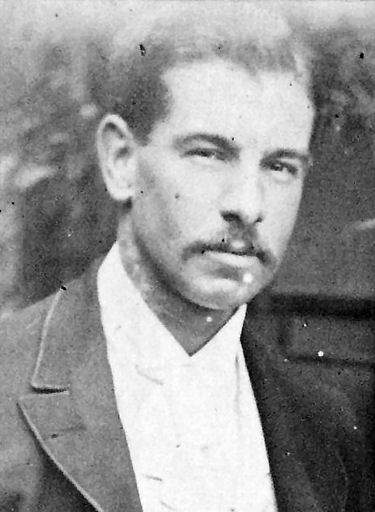
Above photo shows Charles Filmer Baldwin.
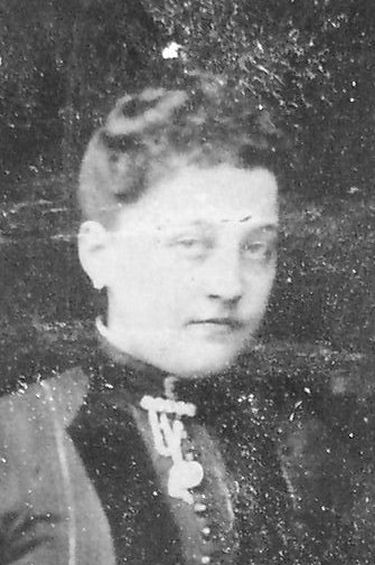 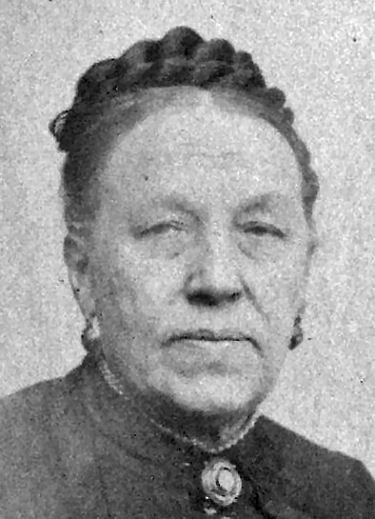
Above two photos show Sarah A Baldwin nee Wiseman
Sarah A Baldwin was not Filmer's mother, but his stepmother. His real
mother was Elizabeth Sophia Hall. Sarah A Baldwin (nee Wiseman) had been
married (and possibly still was !!) to Robert Tuffnell with whom she had
had four children: Edith, Kate, Robert and Harriett.
Filmer Charles Baldwin went on to buy/run Elveys Mineral Waters of
Dover.
Regards,
Ian Baldwin.
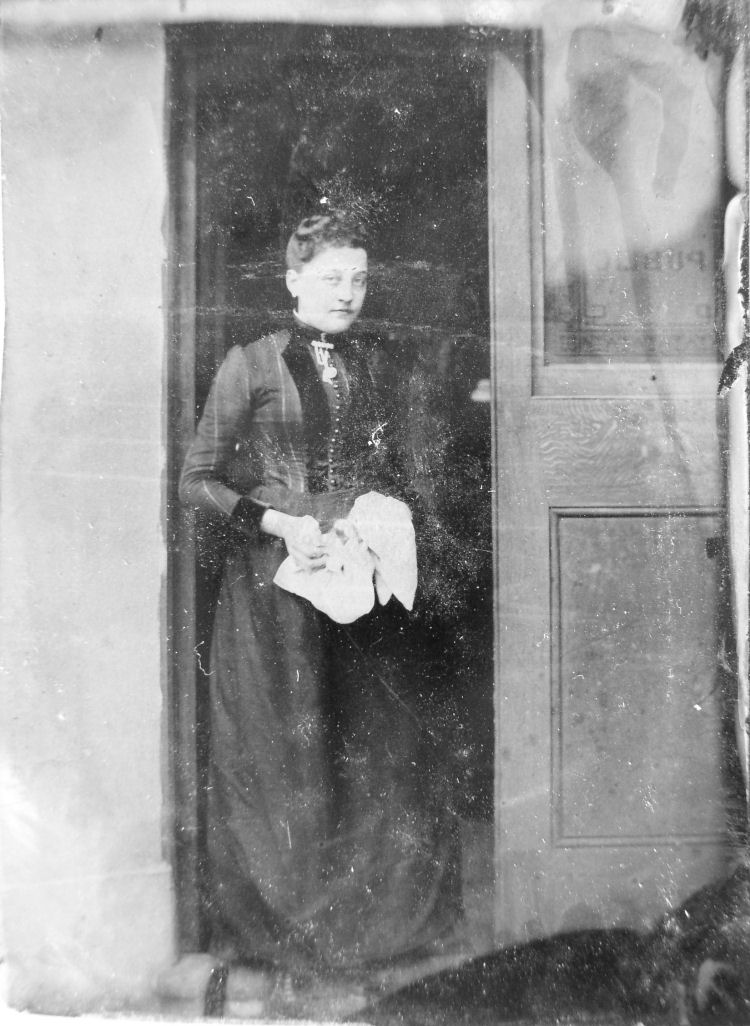
Above photo shows Sarah A Baldwin again, probably in the doorway of
the Old Endeavour. Date unknown. |
For many years this was popular with the local motor cycle fraternity and
was used by them for meetings in the seventies and eighties. They also had
their own window installed denoting 'The 69 Club'. The club now hold their
meetings at The "Royal Oak" in River.
In 1982 a window was installed by voluntary contribution to recognise and
acknowledge that.
|
From the Dover Express, 10 August 2000.
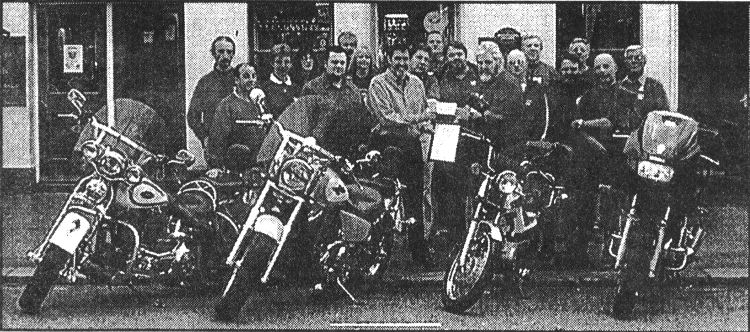
MEMBERS of the 69 Motorcycle Club raised £500 from helping with Dover District Council's events on the
seafront on New Year's Eve.
The money was donated to the Pegasus Playscheme, a voluntary
organisation providing four-week play schemes for children aged five to
19 with learning difficulties in Dover and Deal.
Anyone interested in joining the 69
Motorcycle Club can turn up on any Sunday evening, form 8pm onwards, at
the Old Endeavour pub, Dover.
All types of riders are welcome.
In our
picture, 69 MCC chairman Clive Luckett, (centre right) is with other
club members presenting a cheque to two representatives from the
playscheme.
They are outside the club's headquarters at the Old
Endeavour pub.
|
|
From the Dover Mercury, 21 November, 2002.
Pub helps fuel motorcycle spirit
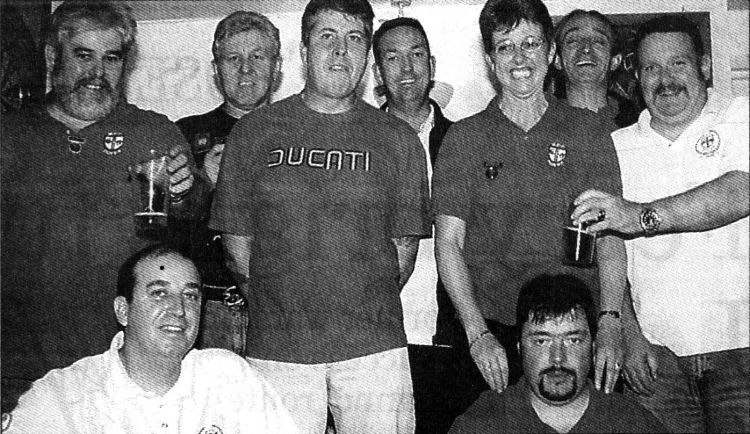
RAISE A GLASS: Celebrating 30 years at the Old Endeavour pub in Dover,
the committee of The 69 Motorcycle Club Ref' pd 290447.
TWO wheels is all it takes to tour the world on a motorbike but for The
69 Motorcycle Club there's been one fixed point for the last 30 years -
The Old Endeavour, London Road, Dover.
Colin Baxter, club press secretary, said: "Our members are all ages and
backgrounds and there are very few places
we haven't been - their bikes are anything from little mopeds to
Goldwings.
"We were founded when the Rev William Shergold came to Dover. He had
run a 59 club in London and he was vicar of St Bart's in Templar Street
and retired to Wells in Somerset.
"There are around 70 of us and meeting at The Old Endeavour
grew out losing our original club house. The landlord welcomed us in the
pub. We've taken over the back room and got a trophy cabinet there and
The 69 Club is also a big fund-raiser for good causes."
The club gathered at The Old Endeavour to celebrate with a 30th
anniversary party this month.
|
|
From the Dover Mercury, 18 August 2005.
Pubs bid to open round the clock.
Many pubs have applied for longer hours, especially at weekends. The Flotilla and Firkin, in Bench Street, wants to close at 3am on
Fridays and Saturdays, while the Old Endeavour, in London Road, has
applied to stay open until at 2.30am on Fridays and
Saturdays.
|
April 2008 I have heard that the "Old Endeavour" has been forced to
close, the rumour, so far unsubstantiated, has been that a police raid found
drugs on the premises. I am awaiting confirmation of this from the local
papers.
|
From the Dover Express, 15 May 2008. Report by Kathy Bailes.
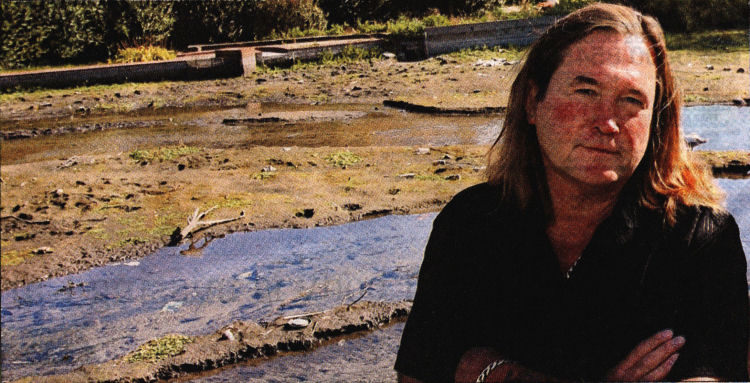
On remand: Archie Dryden, pub landlord and dad to Whites striker Jimmy
Dryden, is behind bars.
THE dad of Dover Athletic striker Jimmy Dryden is behind bars after
being arrested in a drugs raid.
Kevin Dryden, known to pals as Archie, was one of 20 people picked up by
officers from Kent Police's serious and organised crime unit and the
tactical support group in two
days of swoops last month targeting alleged drug importation, supply and
dealing.
Mr Dryden, the popular landlord of the Old Endeavour pub in London Road,
has been remanded 'in custody' after
being charged with conspiracy to supply cocaine. He is believed to be in
Chelmsford Prison.
The 50-year-old is due to attend Canterbury Crown Court for a plea and
case-management hearing on June 9.
The doors of The Old Endeavour have been shut
since the police carried out the operation on April 2 and 3, although Mr
Dryden's daughter and her baby are believed to still be living at the
premises.
Brewer Shepherd Neame said no decision has been made about Mr Dryden 's
future at the
pub, but it will be reopened. All those charged with conspiracy to
supply have been remanded in custody apart from Kim Kendall, and will
appear at Canterbury Crown Court alongside Mr Dryden on June 9.
The raid was part of a series carried out after a year of undercover
investigations. More than 200 police searched 14 Dover properties and
two addresses in Merseyside. Cocaine worth £60,000, cash and vehicles
were seized.
An eye witness to one of April's early-morning raids, in Astley Avenue,
said: "It was one of the big police vans and about six officers went in
and out of the house. They came out with plastic evidence bags.
"At about 9am they got in the van and left. It was a bit of a
shock to see them, it makes you wonder."
Dover fans' favourite and former St Edmund's pupil Jimmy Dryden, 28, has
been a striker with the Whites since moving from Folkestone lnvicta in
December 2005.
He was top scorer in 2006/07 and netted the winner against Burgess Hill
last month which took Dover Athletic up into the Ryman League One
South.
The dad-of-one is currently on a team-bonding holiday in Spain but is
expected this week to make a decision about his future with Dover
Athletic. His one-year contract is up for renewal.
The striker was brought up by his grandparents in Folkestone but has
renewed his relationship with his father.
The Dover Express called Mr Dryden but had received no reply at the time
of going to press.
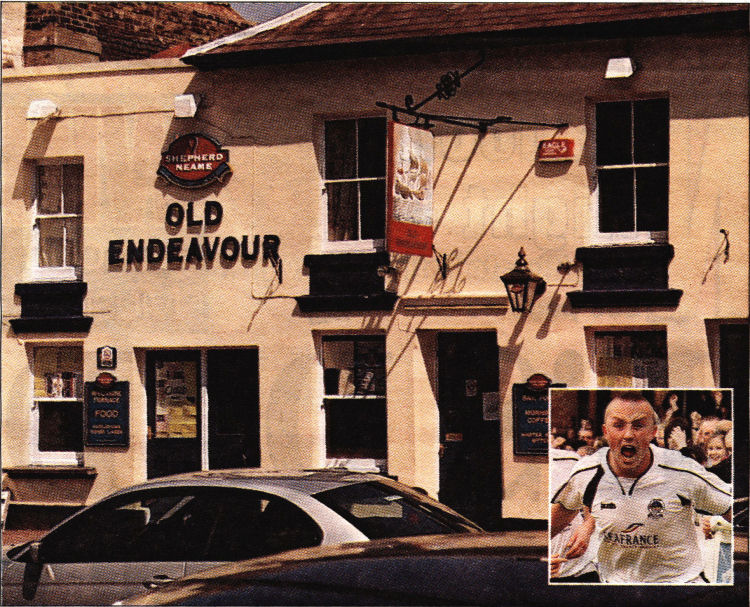
Eight people have been charged with conspiracy to supply class A
drugs.
|
|
Latest news I have been told is from the mother of Kevin Dryden's
youngest daughter. She says:- "I can assure you that no drugs were
found on the premises of the pub when recently raided by police in the
early hours of the morning! Please feel free 2 contact Folkestone Police
who were dealing with this at the time. Kevin Dryden never has been +
never will be a drug dealer! The bags taken out the premises that
morning contained money + paperwork, nothing more! Although The Dover
Express has used this to sell papers it is all untrue + assuming!
Disgusting!"
I will continue to update the history of pubs and licensees in Dover
and District as I find information. I have no hidden agendas and I am
only the messenger. (Paul Skelton.)
|
From the Dover Mercury, 24 July, 2008.
STING OPERATION NETS DRUG DEALERS
Undercover officers infiltrated cocaine ring after making contact.
MORE than a kilo of cocaine and £39,000 in cash were seized in a
police sting in Dover.
Undercover officers spent more than a year infiltrating, a group of
dealers in Operation "Glimmer, which culminated in two arrests and
the drugs seized at the "Ramada Hotel" in April.
Seven men and a woman appeared at Canterbury Crown Court in
relation to various drug-related offences and four men have been
jailed for between two-and-a-half and five years. Four other people
will be sentenced in September.]
Robert Acheson, prosecuting, said the operation targeted the problem
of supply of
cocaine and crack and focused on The "Old Endeavour"
pub run by Kevin Dryden.
On a number of occasions, officers were supplied with wraps of the
class A drug for £40 up to ounces worth £1,000.
Dryden, known as Archie, became friendly with officers "Simon" and
"John" and on March 22 they spoke to him about sorting them out with
cocaine. Dryden said he could supply and the next day he handed over
a 1.21g wrap in the gents for £40, followed by further supplies from
a man called John Hammond.
Two other officers "Neil" and "Mick" became familiar with those in
the pub and in August Dryden offered to get hold of 'thing', meaning
cocaine.
He rang at least two potential suppliers and soon after they were
supplied with two wraps by Hammond.
BULK SUPPLY.
In December they were again supplied twice by Dryden and others but
in larger quantities.
"Simon" was supplied with half-an-ounce of cocaine for £450 in
December and a similar deal just after Christmas. Dryden's
involvement then ended.
The officers made it clear they were interested in larger amounts
and in January 2008 asked Hammond if they could get hold of an ounce
of cocaine. A deal was struck for £1,000 and Hammond's son Leigh
handed over some good quality cocaine.
The officers were then introduced to Stuart Nicholson; who was able
to get hold of larger amounts. In January the officers received
about 2oz of cocaine for £1,800.
A further 4oz, of which one ounce was pure cocaine, was supplied for
£3,500 on January 24, 20z on January 30 for £1,700 and the same
again on February 6 and 12.
"About a fortnight later, 125g - 30g of pure cocaine - was supplied
for £3,750 and those transactions all conducted with direct supplies
by Nicholson," said Mr Acheson.
He then introduced them to Michael Griffith and arranged for
Griffith to supply a quarter of a kilo at 100 per cent purity for
£7,000 on March 18.
"Nicholson also brought David Leonard into the arena," said Mr
Acheson.
In early February Nicholson and Leonard handed over 2oz of cocaine
at the "Ramada Hotel."
He indicated the officers could deal direct with Leonard and on
February 20, he handed over 41.6g of cocaine at McDonald's in Dover.
"In the later part of March there were discussions about serious
quantities, kilos, and a transaction was arranged for April 2.
Nicholson arranged for about one-and-a-half kilos to be supplied for
£40,000.
"Undercover officer 'Frank' went to the hotel car park and handed
over £39,000. This was where the operation come to an end and
arrests were made.
"Griffith was arrested' in the car but Nicholson drove off but was
stopped soon after by officers who had been ready for the sting,"
concluded Mr Acheson.
SENTENCED WERE:
• Kevin Dryden, 50, The, "Old Endeavour," London Road, Dover. and
father of former Dover Athletic footballer Jimmy - four years. He
admitted five offences of supplying 'drugs, total value £900.
• Stuart Nicholson, 41, of Bindon Blood Road, Whitfield -
five-and-a-half years. Admitted conspiracy to supply class A, total
value of his involvement £61,150.
• David Leonard, 42, Dixon Road, Dover - two-and-a-half years.
Admitted two offences of supply, total value just under £3,000.
• Michael Griffith, 36, Penmann Crescent, Liverpool - five years.
Also admitted conspiracy with an involvement of £47,000.
• Yet to be sentenced are John Hammond, his son Leigh, Paul Cannon
and Kim Kendall, all from
Dover.
• Judge Adele Williams said cocaine was a dangerous and pernicious
drug.
She told Dryden: "You were the licensee and introduced the
undercover officers to the other defendants and must bear the
responsibility for this activity. The amount you supplied does not
reflect your involvement."
DEALER PUBLICAN THOUGHT HE WAS HELPING A FRIEND.
BRIAN St Louis, for Dryden, said he was assisting friends get
small amounts of cocaine and made no profit. He got involved through
stupidity and thought he was helping a friend which he believed
"Simon" to be.
It would be Dryden's first time in custody and he was unlikely to
re-offend.
Kenneth Aylett, for Griffith, said he was a family man who had
been unable to work in recent years because of an ankle injury. At
the time he was vulnerable and succumbed to suggestions being
desperate for money. His involvement was limited to carrying two
amounts and he was basically a courier.
David Hughes, for Nicholson, said the officers were trying to get
larger quantities while he only had access to ounces and his role
changed from being a supplier to that of facilitator.
Ian Dear, for Leonard, said he was addicted to class A drugs for
many years having started using cannabis at 14 and graduated to LSD
and speed and by 21 was hooked on cocaine spending £150 to £200 a
week.
|
|
From the Dover Mercury, 4 September, 2008.
POLICE SMASH PUB DRUG RING.
A FORMER Dover nightclub doorman and his son have been jailed
for their involvement in a ring of cocaine dealers in the town.
John and Leigh Hammond and another Dover man, Paul Cannon, were
arrested as a result of Operation Glimmer, in which police officers
infiltrated the group posing as drug purchasers.
Four other men also involved are now serving sentences ranging
from 30 months to more than five years.
After their arrests, police went to the home of Dover woman Kim
Kendall where they recovered an ounce of cocaine.
John Hammond, 40, who lives in Old Park Road, admitted conspiracy
to supply drugs and was jailed for four-and-a-half years.
His son Leigh, 19, of the same address, admitted supply and was
jailed for 18 months.
Paul Cannon, 50, who lives in Astley Avenue, Dover, was jailed
for 21 months for supplying and Kim Kendall, 55, who lives in
Primrose Road, Dover was given 51 weeks, suspended for two years
with 200 hours' unpaid community work.
The centre of the drugs operation was the "Old Endeavour" pub in
Dover. The landlord, Kevin Dryden, is serving four years for
supplying cocaine.
Christopher Badger, prosecuting, told Canterbury Crown Court it
was through Dryden that under cover officer "Simon" met John
Hammond, who was a doorman at the "Euphoria"
nightclub.
Through Hammond, the officer made contact with other suppliers
and was supplied with cocaine.
Leigh Hammond became involved when his father asked him to make a
cocaine delivery to Simon at the pub. Cannon was involved in one
deal.
Large sums of cash were exchanged in exchange for the class A
drug and the operation culminated in the arrests of two suppliers,
now in prison, in a hotel car park in April as £39,000 was about to
be handed over in exchange for one and a half kilos of cocaine.
Sentencing the four, Judge Adele Williams said cocaine was a
dangerous drug capable of creating havoc in people's lives and
anybody who involved themselves in its supply should expect such
sentences.
IN DEFENCE
Philip Wakeham, for John Hammond, said he was at times in
possession of cocaine but the majority of times he acted as a middle
man.
At the time Hammond was in debt but didn't make an enormous
amount out of it and was clearly not at the top of the chain.
"It was against the background of significant and crippling debt
he became involved and appreciates he has been a fool," said Mr
Wakeham.
Edmund Fowler, for Leigh Hammond, said he had effectively been
doing a delivery for his father which he did without thinking. He
was not involved in the network of drug supply.
Barbara Lockyear, for Cannon, said his involvement was one single
supply to Simon and he felt deeply ashamed and embarrassed.
John O'Higgins, for Kendall, said she was a thoroughly decent,
trustworthy and kind person who got involved because of debt.
|
|
From the Dover Mercury, 11 September, 2008.
DRUGS-STING PUB RELAUNCHED WITH STRICT NEW RULES
THE pub at the centre of a drugs operation which resulted in
three people being jailed has re-opened with a zero tolerance policy
towards drugs.
New licensee Chris Gardener, who also runs other pubs in the Deal
area and has wide experience in the licensed trade, said he is
determined to make the "Old Endeavour," in London Road, a family pub
again.
He is holding an official opening at the pub this Sunday, with
live music from 2.30pm.
“The pub is open daily from noon and it will be known as a pub
with a zero tolerance to drugs,” he said.
“It will be a community pub with a family atmosphere.”
|
Glad to say the Old Endeavour after closing has been re-painted
outside and also shows a new sign and is now open
again.
|
|
From the Dover Mercury, Thursday, 18 September, 2008
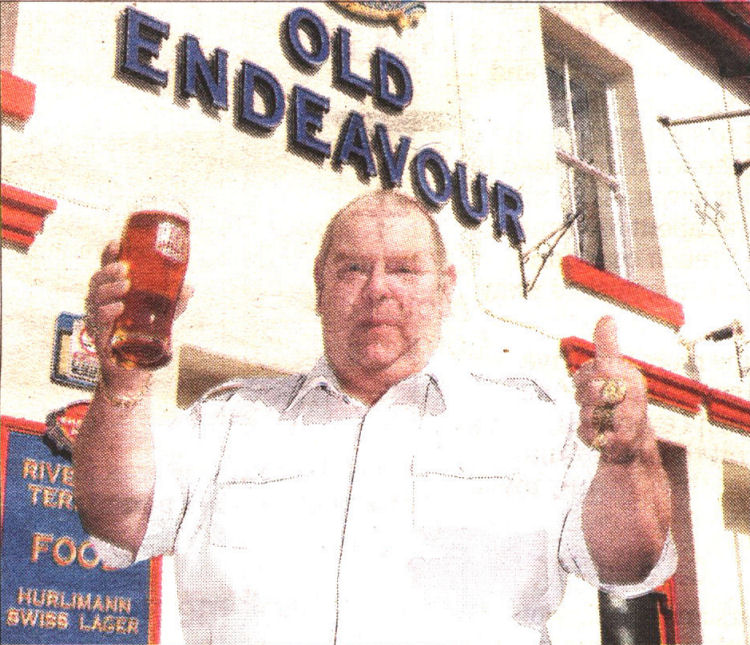
Picture Paul Amos pdl481294
New beginning for blighted pub.
MUSICAL celebrations marked the reopening of a Dover pub at the weekend
as the new licensee vowed to make it a family place again.
The "Old Endeavour" in London Road was closed after police carried out a
major drugs operation that resulted in three people, including the
former licensee, being jailed.
Chris Gardener, who has a wealth of experience in the licensed trade and
who runs other pubs in the Deal area, is committed to making it a family
pub and has imposed a policy of zero tolerance regarding drugs.
Live music was provided on Sunday to mark the start of the new chapter
in the pub's
history.
|
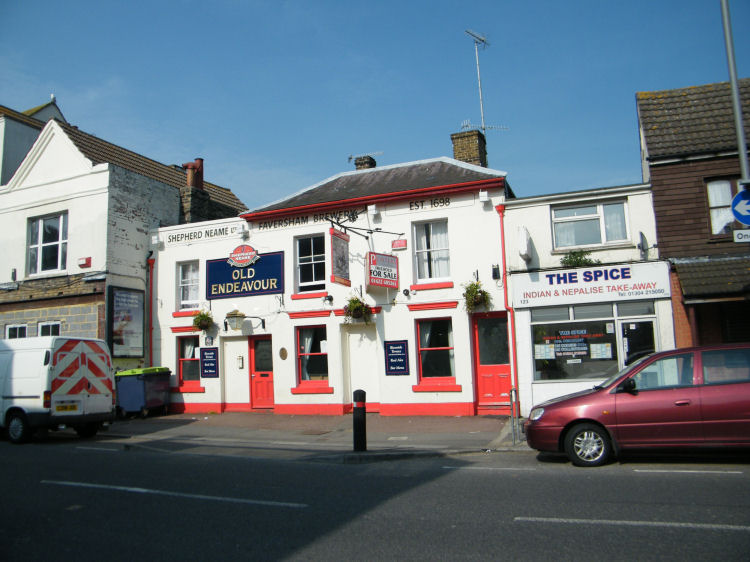
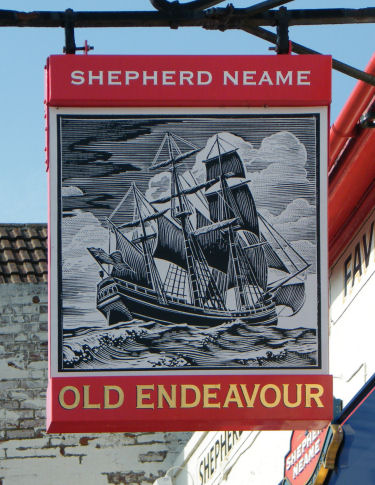
Above photographs by Paul Skelton, 9 April 2010. |
Looks like as of April 2010 the pub is up for sale.
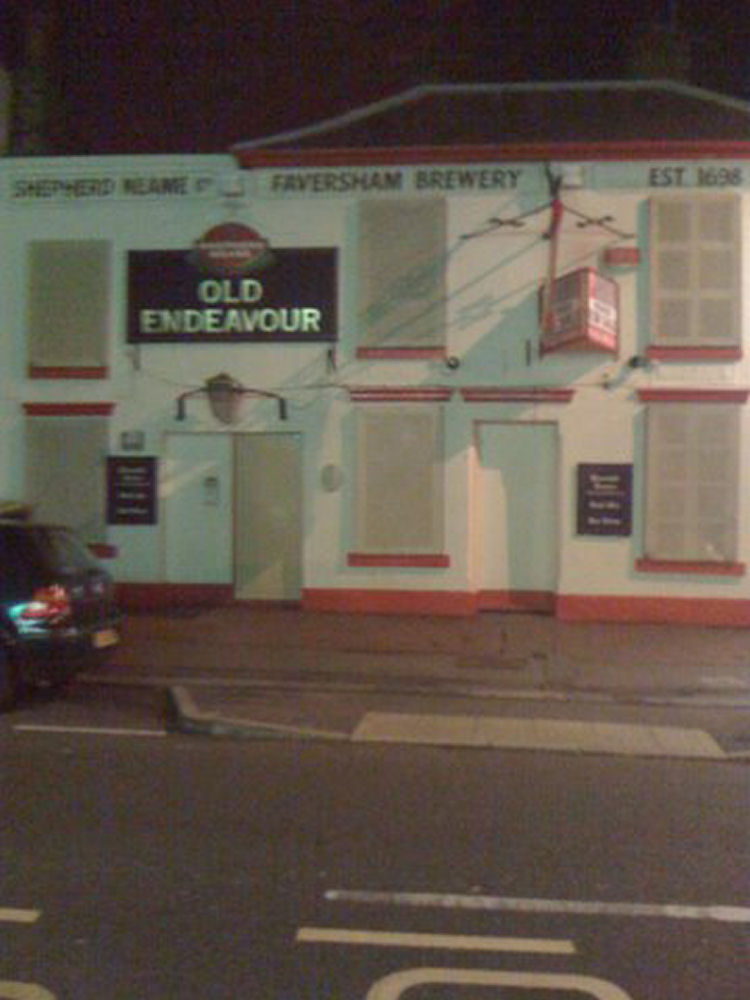
Looks like it's closed again 29 Oct 2010. Photo supplied by Chris
Grimes. |
This would have been known as the "Endeavour" when originally built, but
circa 1861 when the "New Endeavour" was
opened, this would have changed name to the "Old Endeavour." Whether it was
envisaged to close the pub at the time as a new one had opened is as yet
unknown. At it happened though both ran at the same time till October 1869
when the "New Endeavour" closed.
(2010) Currently undergoing renovations and just heard that the workmen are
saying that although the renovations are taking longer to complete than they
had hoped, the pub should open again early in June. It is said that it will
become a bistro/pub, with seating overlooking the river.
Just seen today 25 May 2011, a new sign hanging on the
pub. It's still called the "Old Endeavour" and now a Freehouse. The same
evening I received an email from the new licensee Deborah Gunn, who informs
me that she hopes the premises will be open for trade in about 6 weeks, and
confirms it will be a pub and bistro.
|
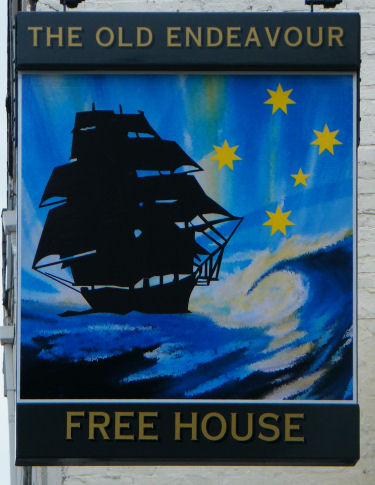 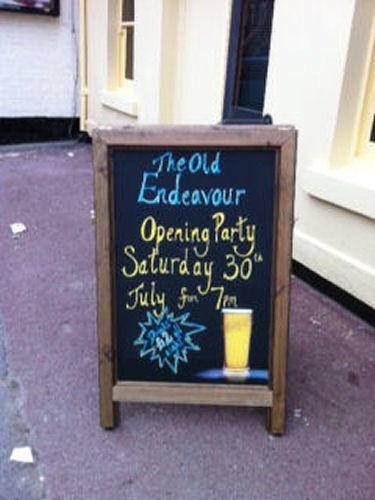
Above sign photo by Paul Skelton, 28 May 2011. Right July 2011.
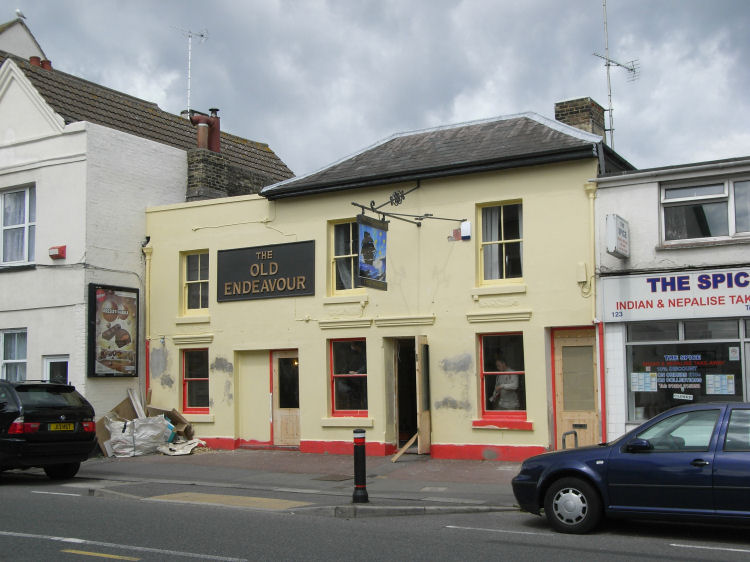
Latest update on the pub taken by Tony Wells, 24 June 2011. |
|
From the Dover Mercury, 16 June, 2011.
70p
PUB RECALLED PRIVATEER THAT TOOK ON FRENCH
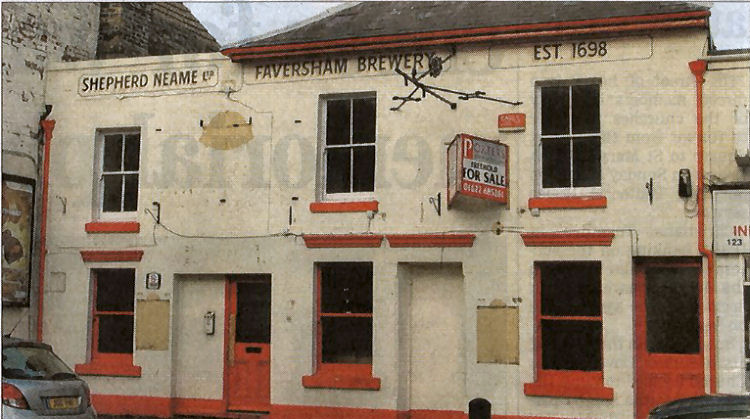
Above the "Old Endeavour" 2010.
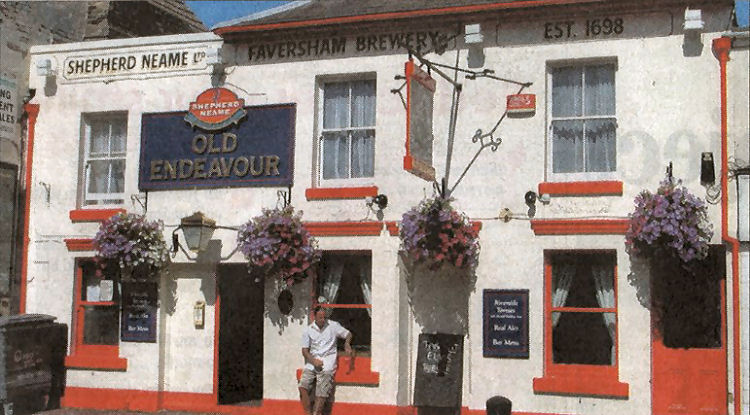
Above "Old Endeavour" 2011.
On London Road, Buckland, stands the "Old Endeavour pub, which closed
in 2010. It was said to be named after
a privateer, the Endeavour, fitted out at Dover in
July 1746. Local researcher Lorraine Sencicle looks
at the history of privateers in Dover.
PRIVATEERlNG was legalised piracy and
one of the main income earners
for the folk of
Dover, particularly in the 18th century.
During the reign of Henry III (1216-1272), privateering commissions were
granted
to specific individuals. These allowed them to seize the King's
enemies at sea in return for splitting the proceeds with the Crown.
They were limited to a specific locality and to ships of specific
nations, and breaches would lead to punishment, including hanging.
During Edward III's reign (1327-1377), the commissions were formalised as Letters of Marque.
In the Channel, English merchant ships were in constant threat from 'Dunkirkers', privateers in the service of
Spain, which operated from ports along the Flemish coast for about
100 years from 1568. Ship owners from Dover sought Letters of Marque and
were
so successful that the Spanish Ambassador complained to the Privy
Council of 1571 that the Channel was almost blockaded by English and
Dutch privateers, who were only interested in seizing Spanish ships! The
captured ships were brought into Dover Harbour and their cargoes and
crew were taken to the Market Place to be sold.
In 1608 Dover's Mayor, Robert Jarrett, was committed to Marshalsea
Prison, London, for not arresting a Dover privateer. During the Nine
Years War (1688-1769), England lost roughly 4,000 merchant ships to
French privateers.
In the peace that followed, Dover council encouraged the fitting out of
local ships to double as privateers. By time of the War of the Austrian
Succession (1739-1748), many Royal Navy ships were in need of repair so
when Dover ship owners applied for Letters of Marque their ships,
suitably equipped, were dispatched.
One of these was the Endeavour.
Fitted out at Dover in July 1746, her master was Thomas Kennett.
James Boyton, Dover's Revenue Officer from 1743 to 1756,
described an engagement typical to those that the Endeavour was involved
in.
"(The) privateer engaged two French privateers for six hours. He was
obliged to pull away
- he had four men killed and nine wounded. The vessel is very much shattered... One of the French had
20 guns and the other 16; he
had but 14 guns and 100 men. This privateer helped fight a 20-gun ship in
the Calais Road... and had all his masts shot away, but was not taken."
By the time of the seven Years' War (1756-1763), Dover was a base for
privateers. The town's shipbuilders produced vessels ranging from 20
tons to 150 tons burden. The Privateering Act of 1759 was brought into
force to stop vessels of less than 100 tons and with a company of fewer
than 40 men claiming Letters of Marque.
Records show that Dutton, an East Indiaman running out of Dover, made
£30,000 in profits from only three privateering voyages during this
time.
On February 1, 1793, France declared war, the Napoleonic wars began, and
Letters of Marque were sought.
Diarist Thomas Pattenden, who lived on Townwall Street, gives accounts
of confrontations between Dover privateers and French privateers.
However, Thomas Pattenden gives an account in 1817 of a Tunisian
privateer brought into Dover having been seized in the Downs.
He comments: ''A very uncommon occurrence."
|
|
From the Dover Express, Thursday, 21
July, 2011. 60p
ENDEAVOURING OLD PUB IS NOW UNDER THE GUNN
Deborah takes on refurbished bar
Report by Yamurai Zendera
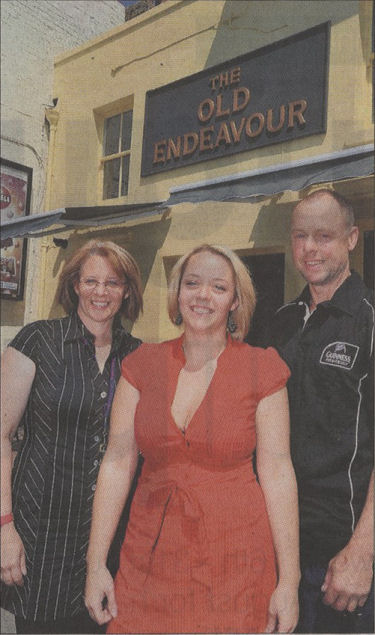
A DOVER pub which has had its fair share of, problems over the years is
to be reopened under new management.
The "Old Endeavour," in London Road is now In the hands of former
Folkestone School for Girls pupil Deborah Gunn.
The 26-year-old has bought the freehold from Shepherd Neame, with
parents Barry and Angela Gunn as business partners, and plans to reopen
it at the start of next month.
The pub was temporarily shut down after a drugs raid in 2008 and then
reopened under new management before closing again last year.
Deborah said she hopes the refurbishment she has given it will help
to
wipe away the stain of the past.
She said; "The pub has had a complete refurbishment and will be a
family-run, family-friendly pub and bistro with seating overlooking the
river."
Deborah has worked in pubs and bars since she was 15 - most recently as
joint manager of Bar Vasa in Sandgate.
Yet she could have just as easily been in France right now following
one of her other passions, snow boarding.
She said; "I went to Meribel in France in February last year. I enjoy
snowboarding and had not been travelling for a little while. The slopes
were amazing, so I decided that I would return and work there for six
months.
"I was meant to be going back last December to work as a chalet host
during the snowboarding season. The flights were all booked but then
around the same time my parents saw the pub
being advertised online. As soon as l saw the place l fell in love with
it.
It was worth giving up the snowboarding for."
Deborah said she is determined to make the pub a success and has
employed six people.
She said: "Since I was 16 I have wanted to own my own pub. I'm passionate
and determined to do whatever it takes to make it a success. I want to
give people a reason to come in, with a warm friendly atmosphere and
value for money."
|
|
From the Dover Mercury, 9 August, 2012. 80p
OLD ENDEAVOUR SAILS OFF WITH PRIZE
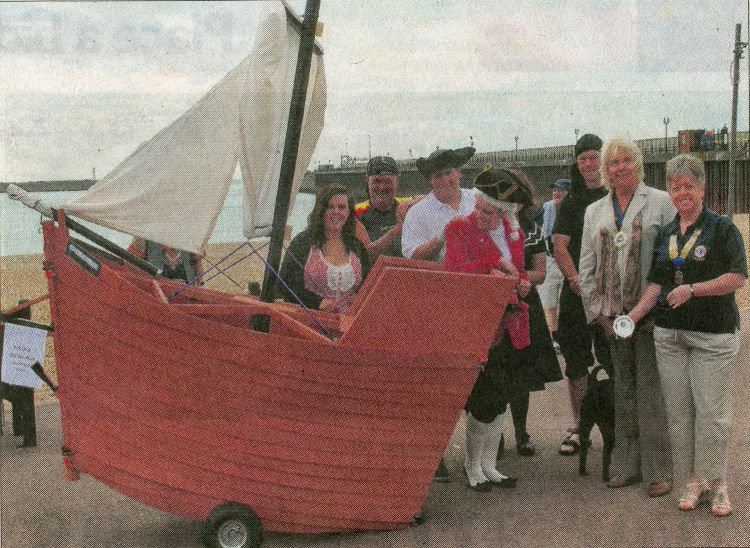
HEADS were turned on Dover seafront as a motley crew of characters set out
for a Sunday morning stroll.
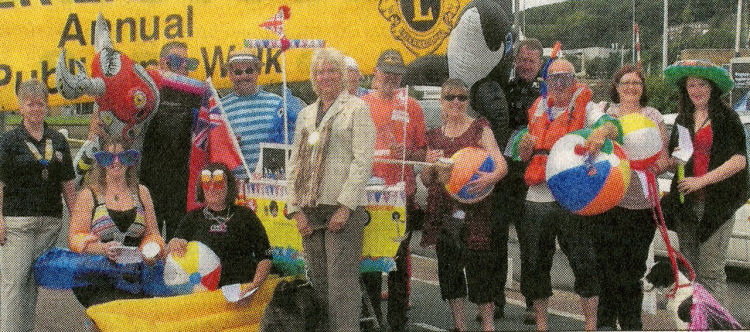
Among the walkers were a model galleon HMS Endeavour, a killer whale,
Scooby Doo, St Trinian's schoolgirls, and some Channel swimmers.
The unlikely bunch were in fact participants on the 39th Dover Lions Club
Annual Publicans' Walk.
The event was supported by publicans and their regulars and has raised
thousands towards the club's charities since its launch, thanks to the
goodwill of pubs and generosity of sponsors.
Money raised this year will pay for the pre-Christmas lunch and an
afternoon of entertainment to be organised by the Lions for about 100
pensioners.
The fancy dress group winner was The Old Endeavour complete with model
sailing ship. Runners-up were The "White Horse" with their channel swimmers
theme with The "Carriers Arms" as St Trinian's.
The trophy for the best individual went to The Endeavour's Admiral.
Scooby Doo from The "Dewdrop" was second place and Carol's Tart from The
"Carriers Arms" was third.
The judges were club president Elaine Prime and Dover's Deputy Mayor Cllr
Ronnie Philpott, who also presented the fancy dress trophies.
Awarded
Participants had to earn their sponsorship by walking three return
journeys of the Promenade.
Trophies will be awarded later for the most sponsorship collected.
The "Carpenters Arms," Coldred, and Dover Sea Angling Club, also supported
the event.
The Lions want to thank all who contributed for their time and efforts.
The club particularly appreciates the consistent support from the
district's pubs and clubs for its fundraising activities.
For more on Dover Lions Club, members' fundraising and community
service, call 0845 8339908 or visit
www.doverlions.org.uk
New members are always welcomed.
|
|
From the Dover Express, 24 March 2016.
Old Endeavour regulars dig deep to raise £2,500 for a children’s charity.
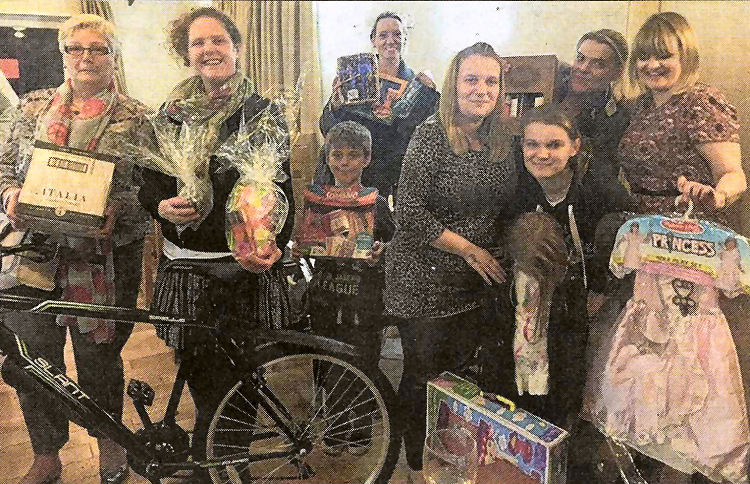
PUNTERS at a Dover pub have raised more than £2,500 for a children’s
charity over the past year.
With help from businesses Toys Around Again and Deals of Dover - and local
legend Johnny B - the Old Endeavour held an auction to raise most of the
cash for Demelza
Children’s Hospice.
The pub also held raffles, a free hog roast and a family photo shoot
before a Demelza representative collected the cash last month.
The Old Endeavour is holding a March madness quiz, a free hog
roast and another auction over the Easter weekend.
Landlady Deborah Anslow said: “We have had real fun raising money for
different charities over the last year and it’s nice to see so many people
pull together for such a good cause.”
|
|
From the Dover Express, Thursday, 6
June, 2013. 70p.
STUDENT HAS CLOSE SHAVE TO RAISE FUNDS FOR CHARITY
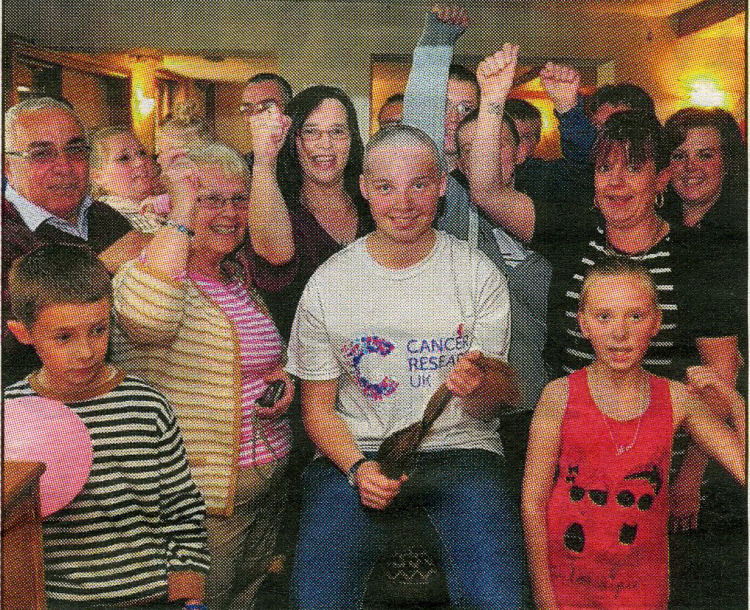
CHARITY EFFORT: Dennie Dunsby, 17, had her head shaved in the Old
Endeavour pub to raise money for Cancer Research UK
A FEMALE student had her hair cut off and a man had a body wax in a
Dover pub.
Dennie Dunsby, 17, had her head shaved to raise money for Cancer
Research UK, and was cheered on by partner Leanne May, mum Wendy, dad
Clive and nan Jill Kelly.
Dennie shed her locks in the "Old Endeavour" pub, London Road, Dover, and
landlady Deborah Anslow said the final total may reach £500.
Meanwhile, a male drinker at the pub, Chris Maggs, had his hair shaved
and body waxed.
Deborah said: “Dennie had lovely long hair so I think it was a big thing
to do for a 17-year-old.
“And we charged people £1 a strip to wax Chris. It was quite amusing.”
|
|
From the Dover Express, 19 June, 2014.
Pub permission.
DOVER: Improvements have been carried out at The "Old Endeavour pub,"
including a new decking area at the rear.
But the work was carried out without planning consent so now Barry Gunn,
who lives there, is applying for retrospective permission for the
extension to the decking and a new canopy erected over it.
In his application he points out that if the rear smoking area is not
comfortable some customers congregate at the front of the pub which could
be dangerous with the traffic.
|
LICENSEE LIST
EAST George 1841 (age 25 in 1841)
EAST Charles 1841-74 (age 41 in 1861)
    
HUBBARD Edward 1871+ (age 27 in 1871)
WEST Edward 1874-76 end
BALDWIN Mr Charles 1876-Apr/81 dec'd

BALDWIN Filmer Charles Apr/1881+
(son of
deceased)
BALDWIN Mrs Sarah A 1881-91 (age 45 in 1881)
 
 HILLS Johnathan 1895


WARD William to Jan/1897
MORSE R Jan/1897+
MORSE Mrs Elizabeth 1899-Jan/13 (age 55 in 1911)
 (R
Morse (R
Morse ) )  
PANTER Robert Jan/1913-17
AYERS William James 1917-38+
     
VALE Mrs E 1948

VALE Leonard John June/1948-59 dec'd
  
VALE Mrs Edith L 1959
COOK Philip C 1964-77 end
 Shepherd Neame
ANSLOW J 1975-77 end
ANSLOW R 1981
GRAVENELL Paul 1987+
CLARK Mr John (date unknown)
DRYDEN Mr Kevin 2007- April 2008
Closed April/2008 - Sept/2008
GARDNER Chris Sept/2008-Feb/2010
GUNN Deborah May/2011+
ANSLOW Deborah 2013+
From Bagshaw Directory 1847
From the Post Office Directory 1874
From the Post Office Directory 1882
From Pikes Dover Blue Book 1889
From the Post Office Directory 1891
From the Kelly's Directory 1899
From the Post Office Directory 1901
From the Post Office Directory 1903
From the Kelly's Directory 1903
From the Post Office Directory 1913
From the Post Office Directory 1922
From Pikes Dover Blue Book 1924
From the Post Office Directory 1930
From Pikes Dover Blue Book 1932-33
From the Post Office Directory 1938
From Pikes Dover Blue Book 1938-39
From Pikes Dover Blue Book 1948-49
From the Kelly's Directory 1950
From the Kelly's Directory 1953
From the Kelly's Directory 1956
Library archives 1974
From the Dover Express
Census
|
