|
Deal Road
(West Cliffe near Guston)
01304 204043
http://www.swingate.co.uk/
https://whatpub.com/swingate-inn
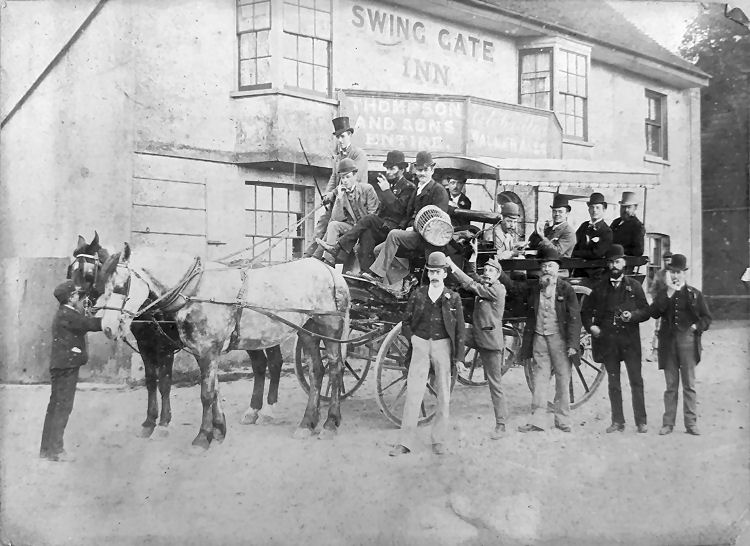
Above photo, late 1890s, kindly sent by Sandra Heard. The Gentleman
standing next to the coach third from right with the longish beard is
Thomas Benjamin Reed b. 1836 near Wye, Kent. His family ran a coaching
business out of Birchington/Whistable from late 1800s to early 1900s. |
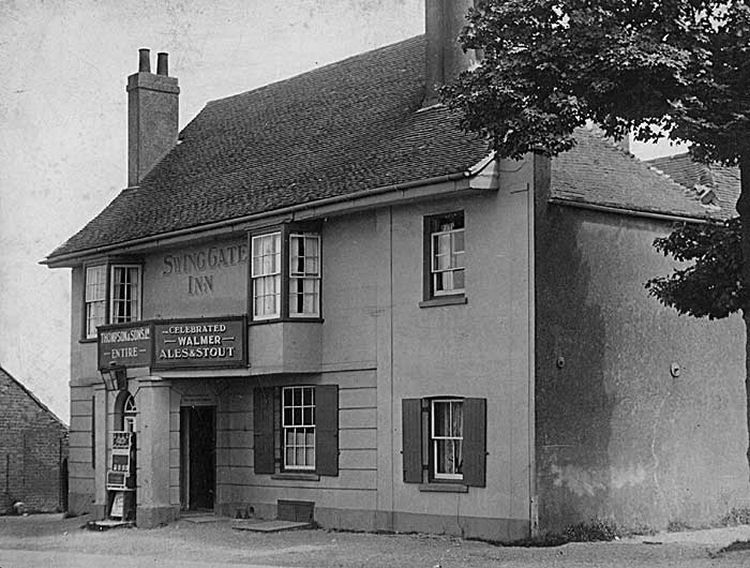
Above photograph kindly sent to me by Ian Norris and shows the pub circa
1920-30's. |
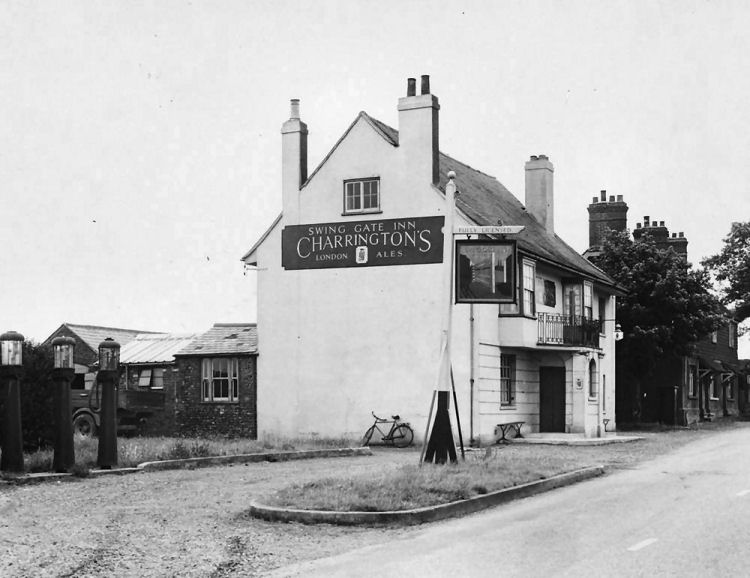
Above photo 1952.
Creative Commons Licence. |
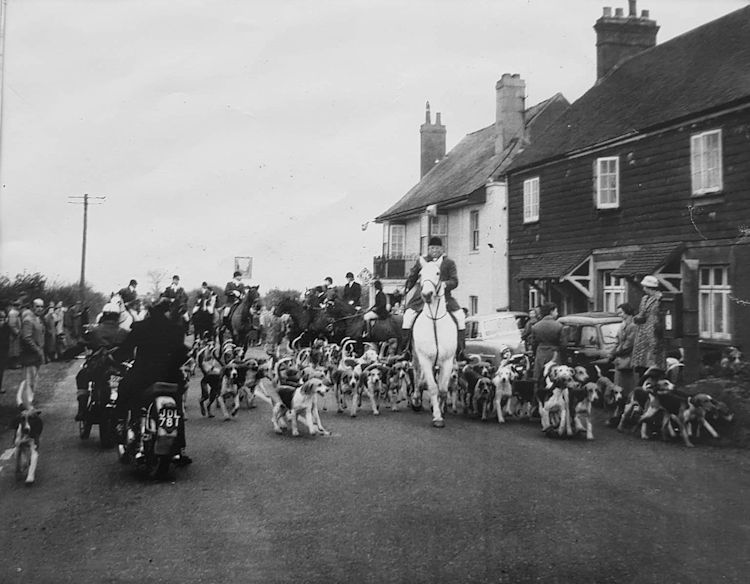
Above photo, date unknown. |
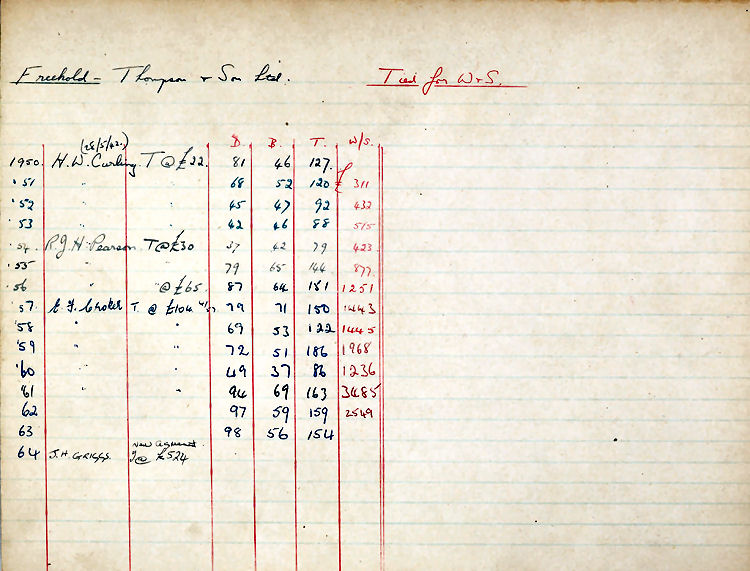
Thompson & Sons ledger, 1950-1964.
Creative Commons Licence. |
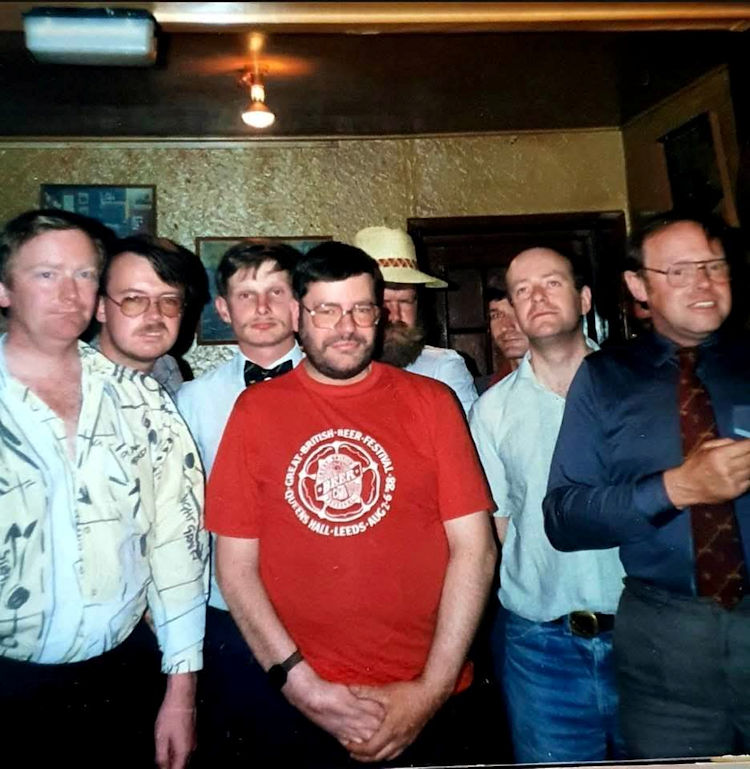
Above photo, 1980s, showing the Dover CAMRA group. Names from L to R:-
Chris Excell, Andrew Bushby, Mike Green, Dave Underdown, Roger Marples, Unknown,
John Underhill, Jim Green. |
 |
 |
 |
 |
|
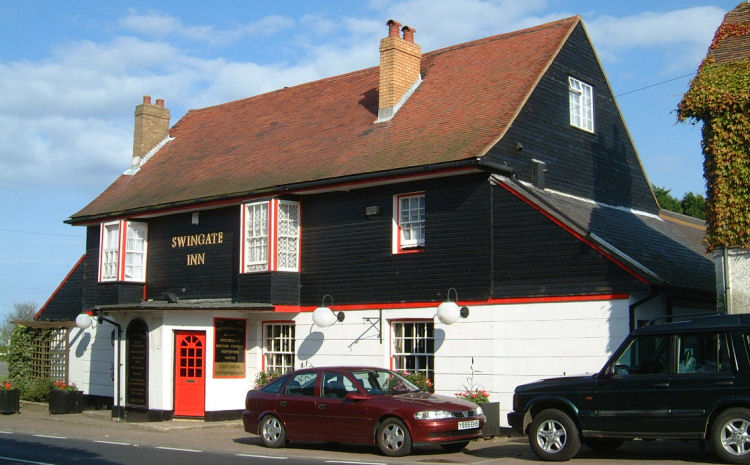
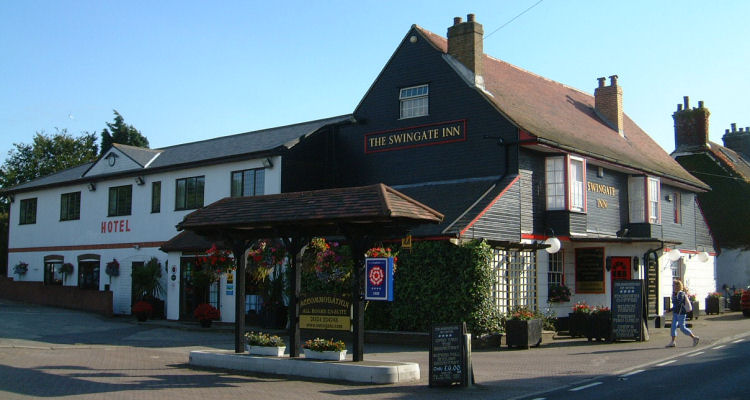
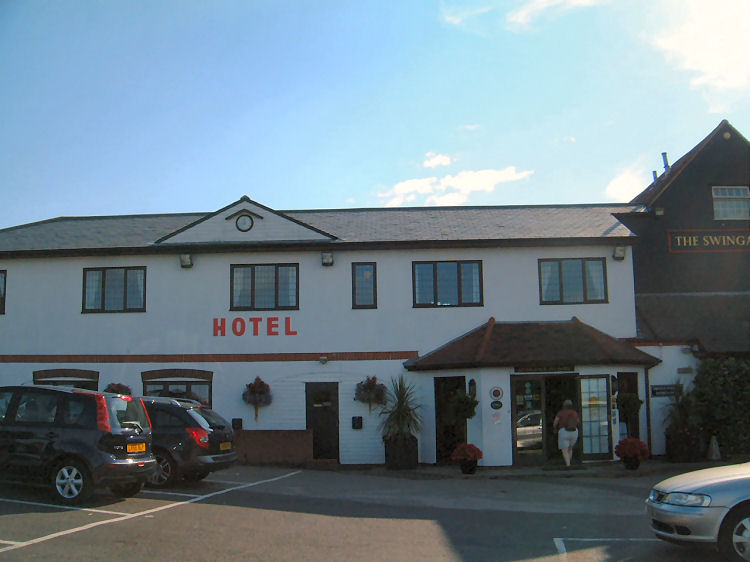
Above photographs of the Swingate Inn by Paul Skelton 4 August
2007 |
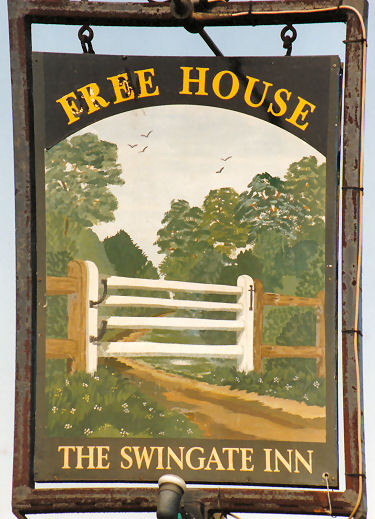
Swingate sign August 1991.
Above with thanks from Brian Curtis
www.innsignsociety.com |
|
From the Dover Telegraph and Cinque Ports General
Advertiser, Saturday 16 February, 1839. Price 5d.
DOVER POLICE COURT
Thomas Taylor, a vagrant character, who stated that he came from
Bromley, was brought into Dover on Wednesday night, and delivered in
charge of the police, having been detected breaking into a fowl roost,
at the "Gate" public-house, adjoining Beere-pasture, on the Deal road.
Next morning, the prisoner was examined before George Stringer, Esq.,
when as it did not appear that any thing had been stolen, he was
committed as a rogue and vagabond, to two months' imprisonment in the
house of correction, at St. Augustine's.
|
|
From the Dover Telegraph and Cinque Ports General
Advertiser, Saturday 12 December, 1840. Price 7d.
A PAIR OF CUT-THROATS.
On Saturday night last or early Sunday morning, while Henry Price, a
policeman, was on duty near the "Dog Kennel," he observed two men
driving a loaded donkey. Suspecting all was not right, he made up to
them with a view of ascertaining what their load contained, and on his
approaching, the men deserted their charge and ran away. He then made
search and discovered a pig weighing 30lbs., with its throat cut, and
two new sacks containing one bushel and a half of potatoes. The names of
the men are Gatehouse and Bean: they are still at large. The pig
belonging to Mr. Marsh, landlord of the "Swing Gate," Guston. The
animal's throat was cut completely across, not at all in the usual way
such brutes are slaughtered. The wives and the families of the accused
parties have left Charlton to join their husbands, which may be the mans
o tracing the delinquents. When the contents were taken from the donkey,
he was set at liberty to find his way home, and went direct, to the
house of the offenders, whose wives were on the watch, with a fire ready
prepared to scald the pig.
|
|
Kentish Gazette, 3 June 1851.
In the afternoon of the same day, as the van of Mr. Stevenson, tea
dealer, of Snargate Street, was returning from Deal, the horse shied at
something about a mile beyond "Swingate Inn," which resulted in the van
being overturned, and a young woman inside being thrown out violently
and much bruised. The driver escaped unhurt.
|
|
South Eastern Gazette 2 June 1857.
WESTCLIFF. SUDDEN DEATH.
On Friday last, T. T. Delasaux, Esq., held an inquest at the "Swing
Gate," West Cliff, touching the death of John H. Gibb, of London, who
had been found dead, with a mug lying by the side of him, and in
consequence of which it was reported that he had been poisoned. Evidence
was given allowing that the deceased had been walking near the place
where his dead body was found, about an hour previously, and the medical
testimony was to the effect that death had resulted from disease of the
heart, there being no symptoms at all of any poison having been taken.
The jury therefore returned a verdict of "Natural death."
|
|
From the Kentish Gazette, 17 January 1865.
Burglary at the "Swingate Inn."
During the night of Friday, the "Swingate Inn," on the Turnpike-road
between Dover and Deal, was burglariously entered, and some silver
teaspoons, money, mid other things carried off. The property was
traced to a man named Thomas Butler alias Jacob Myer, a journeyman
tailor, lodging at the "Red Lion" public-house. He was taken before
W. P. Elsted, Esq., one of the county magistrates, yesterday, and
committed for trial at the next assizes.
|
|
From the Kentish Gazette, 21 March 1865.
Tuesday. (Before Mr. Baron Braomwell.)
Burglar at Westcliffe.
Thomas Butler, 40, tailor, for burglariously breaking into the
house of William Prescott, at Westcliffe, on the 14th January, and
stealing therefrom 13s. 2d.
Mr. Biron was for the prosecution.
The prosecutor is landlord of a public-house at Swingate, and
when he went to bed on the night of the 14th January his house was
fastened in the usual way. Hearing a noise in the house at about two
o’clock, on the morning of the 15th, he got up, and on going down
stairs, found some one had broken a pane of glass in the back
window, which enabled the thief to open the door. The bar was
ransacked, the drawers open, and the desk broken. Six silver spoons,
marked "H. S.," were stolen, 10s. in money, a pair of spectacles, a
bottle of "shrub," some tobacco, and other articles. Prisoner was at
the house from eleven o'clock in the morning until four o'clock in
the afternoon on the 14th January, and suspicion falling upon him,
information was given to Sergeant Pope, K.C.C., who went to prisoner
at his lodgings, at the "Red Lion," Dover, and charged him with the
robbery. Under prisoner’s bed he found nearly the whole of the
article stolen from prosecutor’s house, and of which prisoner could
give no account as to how they came into his possession.
The jury found prisoner "guilty" and sentenced to be imprisoned
twelve months' with hard labour.
|
|
From the Borough of Greenwich Free Press, 23 April, 1859.
THE RAMSGATE MURDER. RAMSGATE, Saturday.
By the exertions of the police sufficient light has been thrown upon
this sad occurrence to lead the belief that it is a case not of
murder but of deliberate suicide. It will seem from what follows,
that the object of the deceased was to conceal his identity, and
this would explain almost all the mysterious circumstances connected
with the case.
The deceased landed at Southampton at the end of March from America,
and went to the "Hotel de L'Europe," in that town. He there gave a
name which sounded like "Maitinger." He left Southampton for London
on the 31st of March, and there put up at "Hahn's Hotel,"
America-square. where he remained till the 7th of April. He wore his
left hand in a bondage, and said it had been injured on board ship.
On leaving the house he stated that he was a German, travelling for
pleasure, and that he intended to make the tour of Scotland before
returning to Germany, but must first go to Paris. The people of the
hotel believed him to be a native either of Baden or Wurtemberg.
During his stay he appeared perfectly rational, but on an occasion
when asked to write an address card he said he would do it at once,
as his memory had been very had since he suffered so severely from
brain fever in America. On the 7th of April he left by the South
Eastern Railway for Dover, and as has been already stated, in the
same carriage with Mr. S. Kidd. It has been said that Mr. Kidd
noticed two of the deceased’s finders to be wanting. The fact was,
however, that Mr. Kidd only observed that the fingers were bandaged
— that is to say, concealed, as they were at the hotel in London. On
the 8th, the deceased bought the hatchet at Mr. Green s shop at
Dover, as described, and stated himself to be a Russian. There is
now no doubt that he was a German.
On the same day he went from Dover to Deal by omnibus, and while on
the wav the deceased being the only inside passenger, a German Bible
was thrown or dropped outside the omnibus, and was picked up by a
travelling hawker, who sold it at the "Swingate Inn" adjoining. The
Bible has been examined by the police, and contains no name or
marks. The motive of deceased in getting rid of it was probably
because the possession of the book would have pointed out the
country to which he belonged, and thus have given a clue to his
Identity, for from this time the deceased always declared himself to
be a Russian.
On arriving at Deal the deceased went to the "Walmer Castle Inn,"
stayed there on Friday night, and on Saturday came from Deal to
Ramsgate by train. On arriving at Ramsgate he had his beard and
moustaches shaved off. He then put up at the "Royal Oak." While
there, a gentleman in the coffee-room addressed him in French and in
German but he shook his head saying, "Me Russ, me Russ." On Sunday
he visited Margate, as already described, and after dining at the
"Elephant and Castle" went to the house of Braiser. He then went for
a walk with his carpet-bag under his arm, and returned to the
railway without it. The bag was found near Westbrook empty, and near
it two shirts and a white handkerchief with the marks picked out. He
returned to Ramsgate the same afternoon, and at half-past five
o'clock entered an oyster shop, where he partook of some
refreshment. At a quarter to seven he was at the inn at Broadstairs,
and at a quarter past seven he was seen near Sir Moses Montefiore’s
wall upon the cliff. At a quarter past eight a man whose clothes and
hat (the latter of large size and peculiar shape) exactly resembled
those of the deceased, was seen by a young man named Jackson at the
eastern end of the Parade on Mount Albin. The man walked rapidly,
with his arms folded and his eyes fixed on the ground. Here all
trace of the deceased is lost till he was found at six o'clock next
morning, dead, under the East Cliff.
The following are among the circumstances which point most directly
to suicide. The spot where the body was found was twenty-five feet
from the cliff, and the tide had risen some feet above it, high
enough to have washed the body to the place where it lay. About
eighty yards lower down the beach in nearly a direct line, cuts were
found in one of the chalk rock exactly corresponding with the blade
of the hatchet found close by. The rock would be covered as soon as
the water rose above half flood. Now half flood on Monday morning
was about half-past one o'clock, and the death consequently took
place between a quarter-past eight and half-past one. The rick is as
high as a chair, so that a man might easily have knelt beside it,
placed his fingers upon it, and chopped them off. The hatchet,
fingers, boots, and umbrella (the articles moat likely to sink) were
found near this latter spot, while the clothes were found among the
seaweed near the body, It is stated by experienced boatman that if
the deceased add chopped off his fingers at the rock alluded to, and
had then stabbed himself to the heart and fallen instantly dead, his
body would have been washed by the regular set of the rising tide
right in shore, and a little to the northward, or exactly to the
place where, in point of fact, the body was found. The knife, which
has been searched for without success would probably have been
knocked out of the wound by the body washing against the low rocks,
and if the knife had a wooden handle, as many sailors' knives have
it might have floated and been carried out to sea. The medical
evidence was that that the skin was frayed, which would have
resulted from the body washing up the beach.
Why, It may be asked, did the deceased chop off his fingers? The
answer is, for the same reason that he had previously bandaged them,
viz., to conceal his identity. One joint of the first finger and two
joints of the second had been amputated some years age, and were
perfectly healed. By this mark the deceased would be recognised, and
therefore he determined to take all his fingers off. There was no
sign of disease or other injury upon his hand to requires a bandage.
The absence of his watch and ring is now easily accounted for. Both
being of peculiar appearance, and likely to lead to his
identification, he would destroy them. If there was a name written
inside his boots, to cut off the tops would effectually get rid of
it. The wristbands of the shirts were torn off and the marks picked
out with a similar object. The unfortunate man, however, forgot a
scrap of paper which was found near the body in the storehouse. and
which there is no reason to doubt belonged to the deceased. It
contained these words, written in pencil in indifferent German:—
"Dear Mother, here are five dollars — little, but from a good heart.
Henry Mattereigh.
The fact that the deceased's money was gone has led many persons to
believe that a murder had been committed. Now, when the body was
found the tide was two hours ebb, and long before that time country
carts may have gone down to the beach, as in frequently the case,
for gravel, or persons may have been, as one was known to be,
looking for shells. It is not improbable that the deceased was
robbed after death. The pockets of his coat were turned inside out
and two front pockets in his angola shirt were ripped open. We may
add that it is very doubtful whether the deceased had so much money
as has been represented. The few words addressed to his mother led
to the belief that be was poor. His cloth es were scanty, much worn,
and of the coarsest description. He never paid in gold, always in
silver and his watch was silver and not gold, as has been stated.
Had the unfortunate man been murdered there are three ways by which
the body must have been carried to the beach, viz., past the
harbour, where police are stationed all night, down Augusta stairs,
where a coastguard is stationed, or by Dumpton stairs, where there
is another guard. To suppose that the man was murdered on the beach
is contrary to all the evidence to suppose that he was carried down
past the guard is nearly incredible; or indeed that it should have
been attempted, when the body might so much more easily have been
dropped over the cliff.
The facts point, we think, clearly to the conclusion that the
deceased returned from America a disappointed man, reduced in means,
and that this circumstance, affecting a brain previously weakened by
disease, led him to determine on suicide. At first intending to send
his mother some little money, he changed his mind, and endeavoured
by the means we have described to do away with all trace of his
identity, and thus lead his family to the belief that he had
perished at sea or in a foreign land.
Melancholy as such a solution of the mystery is it in some
satisfaction to know that what at first appeared an atrocious murder
can be thus explained. No circumstance that has happened for many
years has created so deep a sensation in East Kent as this shocking
affair.
At the adjourned inquest held on Wednesday the jury found the
following verdict:- "That deceased died from a wound in the left
breast, but by whom it was inflicted there is not sufficient
evidence to show."
|
|
From the Dover Express and East Kent Intelligencer, 21 January, 1865.
COUNTY POLICE COURT
BURGLARY AT THE "SWINGATE INN"
Thomas Butler, alias John Myres, a middle-aged man of sinister
appearance, who described himself as a journeyman tailor lodging at the
"Red Lion" public house, in this town, was brought up in custody of two
officers of the Kent County Constabulary, charged with burglariously
entering the "Swingate Inn," in the parish of Westcliffe, on the night
of the 13th or the morning of the 14th inst. and stealing a coat, six
silver teaspoons, a quantity of tobacco, about 13s. 6d. in money, a
bottle of shrub, and some other property, valued in all by the
proprietor of the Inn, Mr. W. Prescott, at 50s.
Mr. William Prescott said he kept the "Swingate Inn," in the parish
of Westcliffe, near Dover. He fastened up his house securely previous to
retiring to rest on the night of the 13th. He went to bed about eleven
o'clock. There were shutters to the front windows, and these were
fastened. The back windows were without shutters, but were fastened by a
means of a pin, which went through the inside stile and held the outer
stile so as to prevent the window being opened in the ordinary way.
There were no lodgers in the house. Himself and his wife were the only
inmates. He was disturbed two or three times during the night by what he
thought was the wind, and once he got up. This was as near two o'clock
as he could tell. He went upstairs into a room over that in which he
slept, to see if anything had blown adrift, but he found everything
right, and returned to his bedroom. He was still unsatisfied, however,
and he therefore put on some of his clothes and went down stairs,
carrying a light with him. He first went into the bar, and as soon as he
entered the room he saw that the house had been robbed. The front window
was open. All the drawers in the bar were drawn out, and rifled of their
contents. A desk standing in the room had been broken open, and the
drawers of that also pulled out. The room was in great disorder, about a
pound of tobacco being strewn upon the floor. He then looked about to
see by what means an entrance had been effected. On going over the house
he found that the door was open connecting the wash-house with the
kitchen had been opened, the lock having been taken off. Entrance had
been obtained to the wash-house by the window, the fastening of which
had been undone. He was certain it had been fastened the night before.
The door connecting the wash-house with the kitchen was fastened with a
stock-lock, screwed on upon the wash-house sides, and the screws holding
it had been removed. The amount of money taken from the bar was 10s. as
nearly as he could say - silver and copper together. The silver
consisted of two six-pences and three or four threepenny or fourpenny
pieces. From the desk half a dozen silver spoons had been taken. The
spoons were marked "H.S." Those produced were the same. Besides these
spoons were an old fashioned tea spoon, broken in halves, and a metal
spoon. Among the other things taken were a pair of spectacles, a pair of
scissors, two pocket handkerchiefs, an old coat, and a bottle of shrub.
At the side of the desk he observed a screw-driver, which had overnight
been left in his basket in the kitchen. A chisel also, which was found
lying near the lock taken off the kitchen door, had been removed from
the place in which it had been left the night before.
Magistrate: Did you ever see the prisoner before?
Witness: A man was in my house a long time on Friday, and the
prisoner is the same as nearly as I can say. He came in soon after
eleven in the morning and was served with a glass of beer and half a
screw of tobacco, and he remained till twenty minutes to four. During
the time he was there he asked at what time the Deal coach would pass. I
did not notice whether the prisoner had anything with him. He was
dressed in dark clothes as at present, and wore a black hat.
Isabella Whiting, a girl about thirteen years of age, said he mother
kept the "Red Lion," St. James's
Street. The prisoner had been lodging there for the past week or
fortnight. She was able to say that he was not in the house on Friday
night, but he came to the bar on Saturday morning about nine o'clock and
asked for a black bag belonging to him which had been left there. She
gave him the bag, and after a short time he brought it back again and
placed it under the table.
George Dawkins said he was a labourer lodging at the "Red
Lion." He slept on the ground floor. Early on Saturday morning, the
prisoner, who had also been lodging at the "Red
Lion," knocked at the shutters and asked to be admitted. Witness
answered him and opened the shutters. Prisoner said it was about one
o'clock, but soon afterwards he heard a clock strike three or four, he
would not be quite certain which. The head of witness's bed was close to
the window shutters, and on opening the window he told prisoner he had
better get in that way, as it would save him the trouble of getting up
to open the door. On getting into the room prisoner asked him to drink
from a bottle, saying it contained brandy, which had been given to him
by his sister, who had had a party, to which he had been, his sister
having given him the bottle on his leaving. He did drink from the
bottle, but it did not contain brandy. It tasted very much like shrub.
Ellen Summerfield, another lodger at the "Red
Lion," said she was sleeping in the same room as the last witness on
Friday night. She had been asleep some time, when she heard a knocking
at the shutters. She awoke with a great fright. She saw Dawkins opening
the shutters, and asked him who he was letting in. He told her to hold
her tongue, for it was all right, as he was only letting in the tailor.
The prisoner then got in at the window. He asked her to have some
brandy, but she declined. He gave Dawkins some and then passed out of
the room. She knew the prisoner from his having lodged at the same house
for some little time. From her notion of the time she had slept, she
thought it was three or four o'clock when the prisoner came home in the
manner described. The next morning, when witness got up, the prisoner
was sitting by the fire in the taproom, drinking beer and smoking. He
asked her to get him some breakfast, and she did so, and afterwards took
breakfast with him. He said he had been to his sister's, to a party, on
the night before, and that he was not going to work for a short time. He
also said he wished her not to say anything about his coming home at the
time he did. During the day he treated those who were in the taproom
with several pots of beer.
John Isaiah Pope: I am a sergeant in the Kent County Constabulary. In
consequence of information received I went to the "Swingate" public
house about three o'clock on Saturday afternoon. I examined the
premises. [Witness's description of their condition corresponded with
that given by the prosecutor, and left no doubt that the house had been
entered from the rear.] I then went to the "Red
Lion," in St. James's Street. On going into the taproom I saw the
prisoner sitting by the fire. Several other lodgers, male and female,
were in the room. The prisoner answered the description which had been
given me by the prosecutor of the man who had stayed so long at the
house on the day previous to the burglary, but he was wearing a Scotch
cap, instead of a hat. A Dover constable was in my company. I asked the
prisoner to walk with me into another room, which he did. I then asked
him if he was away from Dover on Friday or on Friday night. He replied,
"No, I went to bed at ten o'clock in the evening." I asked him if he
slept up stairs, and he said "Yes," adding that he had lodged in the
house for a week. I then asked him if he ever wore a hat or a black
overcoat, and he replied, "No, I never wear a hat, and all I have is
what I stand upright in." He asked why I put these questions, and I told
him a burglary had been committed either that morning or the previous
night, and that he answered the description of a man who had been
loitering about the premises in the afternoon. On asking him if he had
any objection to be searched there and then. He said no, and he was
searched in my presence by the Dover constable. In his pocket he found a
"porkmonio."
Magistrate: Call it a purse. What do we want with these French words?
You can't pronounce it, and you'd better say purse.
Constable: Yes, Sir, "purse." (A laugh.) In the purse was 1s. in
silver, three sixpences, three threepenny piece, one fourpenny piece, 10½d.
in coppers, and a French coin. I then went upstairs to the bed occupied
by prisoner, and there I found the coat I produced under the mattress.
The coat was wet and apparently had been recently placed there.
Having taken charge of the coat, I went to the bar, where I found a
black bag, which I produced. It contained the six silver spoons marked "H.S.,"
a small spoon broken in halves, a metal teaspoon, 9s. 7d. in coppers, a
pair of scissors, a pair of spectacles, 3¼oz of
tobacco, done up in "screws," and two pocket handkerchiefs, besides some
needles and thread and a tailor's thimble. I then returned to the
prisoner and charged him with committing the burglary. He made no
answer, and I took him to the station house and locked him up. Among the
prisoner's things at the "Red Lion"
a black overcoat an hat were also found.
This completed the evidence, and the prisoner,
having been cautioned, was asked if he had anything to say.
Prisoner answered that he had not except that the
female witnesses had not told the truth.
The Magistrates committed him for the next
Maidstone trials.
|
|
From the Southeastern Gazette, 27 March 1866.
Inquest at Swingate.
An inquest was held at the “Swingate Inn” on Wednesday, by T. T.
Delasaux, Esq., coroner, relative to the death of a lad named Williams,
who came to a premature end under the following melancholy
circumstances. It seems that his father, Stephen Williams, of Deal, had
been to carry a load of cabbages to Dover, and on returning home,
somewhere between Swingate and Ringwould, the father, who had been
drinking, kept shifting about, and ultimately appears to have resigned
the reins into the hands of his son, a boy about 13 years of age. The
latter, according to the account elicited from him when dying, perceived
a horse and cart approaching, and in getting down to remove his wagon
out of the way, it would appear that he fell, and the wagon passed over
him, fracturing three ribs and the collar bone. This happened as near as
possible between seven and eight o’clock in the evening. The father,
quite unconscious of the occurrence, drove on, or rather let the horses
take their own head, which was clearer than their driver’s, and was not
aware of what had happened until he bad proceeded a considerable
distance. He then went back, and in the meantime the poor little fellow
had crawled, as well as he was able, to a cottage by the roadside, where
he was taken in by the owner, a Mr. Ashford. He begged for a pillow to
rest his head upon; but the father on his return refused to go for a
doctor, alleging that it was no use. Syncope set in, and after
protracted suffering the innocent victim of inebriation was relieved
from earthly sorrow about midnight.
A verdict of “accidental death” was returned.
|
|
From the Whitstable Times and Herne Bay Herald. 26 October 1867. Price 1d.
FORTHCOMING ANNUAL PLOUGHING MATCH
A meeting of the Committee of the Dover and Deal Association for the
encouragement of ploughmen and agricultural labourers, was held on
Tuesday last, at the "Swingate Inn," West Cliff, to arrange for the next
annual ploughing match in connection therewith. The ploughing will,
under present arrangements, take place in a field in the pariah of West
Cliff, kindly placed at the service of the Committee by Mr. W. W.
Pilcher, of St. Margaret's. The committee have increased the premiums to
be awarded to shepherds, and also the number of prizes to female
service, as they felt that receiving considerable support from the
towns, the prizes for domestic servants being the only premiums for
which they could compete, it was desirable to add to them both in number
and amount. There will be a new feature in the forthcoming meeting,
viz., a show of ewe tegs and ewe lambs, which will of course add to the
interest of this meeting, and it is hoped the show of roots will be
larger than it has been hitherto. |
|
Kentish Gazette - Tuesday 2 June 1868.
Strange case of drowning.
On Tuesday T. T. Delasaux, county coroner, held an inquest at the "Swingate
Inn," Deal Road, on the body of a woman, apparently a tramp, name
unknown, aged about 32 years, whose body had been found on the beach by
a Corn Hill Coast Guard Station, on Saturday, where it had apparently
been washed up by the waves. The following evidence was adduced.
Thomas Artlett, and mariner of Guston, said:- On Sunday last, about 5
o'clock in the evening, whilst walking along the beach towards the
light, I saw the body of the deceased lying on the beach, just by the
high water mark near the Falls. She appeared to have been washed up
there by the waves, and was quite dead. I do not know know how she got
into the water.
Mr. Henry Taylor depose:- I live in a little cottage cut in the base of
the cliff, in the parish of Guston. I have looked at the body of the
deceased, and identified her as a person who called at my house on
Saturday morning, between the hours of 7 and 8, and who asked for some
water. As it was breakfast time, I gave her a cup of tea and some bread
and butter, for which appeared thankful. She stayed and talked to the
children about 20-minutes, and in conversation she asked me to purchase
a brooch (the one now produced is this one) to enable her to buy a loaf
of bread. She said that she had lost a little penknife, which she went
back to find. The tide was coming up at the time, and her body was
afterwards found in that direction.
Mr. John Walter Thomas, surgeon of Dover, deposed:- A policeman came for
me on Sunday night, and yesterday I proceeded to the Corn Hill Station,
in the parish of West Cliff. There I saw the body of the deceased. She
was dead, and on carefully examining her body externally I found some
very slight scratches on the forehead, but not sufficient to cause
death. From her appearance I am satisfied that she was drowned.
The jury returned a verdict of "Found Drowned."
|
|
From the Dover Express and East Kent Intelligencer,
16 July, 1869. Price 1d.
INQUEST BY THE COUNTY CORONER
An inquest was held on Saturday afternoon at the "Swingate Inn" before
the County Coroner, T. T. Delasaux, Esq., on the body of Robert Hall
Edwards, a gentleman who committed suicide by cutting his throat. It is
believed he was a merchant from London.
William Stoner, a member of the County Constabulary, of the parish of
Westcliffe, deposed: I was sent for this morning, at about eight
o'clock, and in consequence of something said to me I went to the "Swingate
Inn," and on arriving there I requested to enter the bedroom of the
lodger, but not being able to make him hear, I procured a ladder, placed
it against the side of the house, and ascended it. I looked in the
window of the bedroom, and there saw the deceased lying on the floor.
Shortly afterwards I managed to get into the room, and then I saw the
deceased lying on the floor in a pool of blood, a razor being within a
yard from the body, covered with blood. I also found on him a pocket
book, some cards, a knife, and three shillings in silver.
george Potter, a brick-maker, living at Guston, deposed: I have
looked at the body of the deceased, and identified it as that of a
person who I saw yesterday morning at Swingate, on his way to St.
Margaret's to see the school there, as he had been there himself
some twenty-five years ago. he was perfectly rational to speak to at the
time. I saw the deceased again in the evening, and spent an hour in
conversation with him at the "Swingate Inn," where he appeared to be
very drowsy and desponding.
Juilius Potter, a brick-maker, living at Guston, said: The evidence
of the police-constable is quite correct, and I ascended the ladder to
which he alludes, and got in by the window, which I smashed, opened the
bedroom door, which was locked on the inside, and let the constable in.
I also saw the deceased as described by William Stoner, and I cannot add
any more evidence to his deposition.
Richard Jones of the parish of Westcliffe deposed: I am landlord of
the "Swingate Inn." The deceased came to my house yesterday afternoon,
about four o'clock, and had a biscuit and cheese and a glass of ale. he
told me that he wanted to go to St. Margaret'sas he had been educated
there about 25 years ago, and went away in that direction. About eight
o'clock the same evening he returned to my house, and engaged a bed for
the night, and spent the evening in the house with other customers,
going into the bowling green and smoking a cigar. He afterwards had
supper, which consisted of eggs and two four-penny-worths of brandy and
water. He retired to rest at half-past eleven, and I saw him as far as
his bedroom, where I left him, and took his boots away. The deceased
asked me to call him at half-past seven. I went to his bedroom this
morning at that time, knocked the door several times but getting no
answer I feared something was wrong, and sent for the police-constable,
who very soon came, accompanied by Mr. Julius Potter. The deceased, when
he retired to rest last evening, ordered his breakfast, which was to
consist of tea, ham, and eggs. He appeared perfectly sane and rational.
John Walter surgeon, residing at Dover, said: I have completely
examined the body of the deceased. I found him lying on the floor on his
right side, his left arm lying over his head, with a very deep wound in
his throat, such as could be inflicted by the razor nor produced. It was
evidently the act of the deceased by his hand, and was the cause of his
death.
The following extract was found in the deceased's pocket-book:- "I
thought the water under Shakespeare's cliff was very deep, but not
wishing to be smashed to a mummy I preferred the razor."
The Jury returned a verdict, "That deceased cut his throat, but there
was not any evidence to show in what state of mind he was when he
committed the act."
|
|
From the Dover Express and East Kent News, Friday, 21 April, 1870.
A LITTLE PIGEON SHOOT
Charles Cork, St. James's Street, William Binfield, of the Kent
Artillery Militia, St. James's Street, and Charles Forster, Charlton,
were summoned by Richard Jones, landlord of the “Swingate Inn,” in the
parish of West Cliffe, for unlawfully and wilfully committed damage by
breaking pots, glasses, mugs, &c., to the amount of 10s., on Friday, the
8th inst.
They all pleaded not guilty.
Mr. Fox was for the prosecution.
Sarah Rachael Jones: I am the wife of Richard Jones, who keeps the
“Swingate Inn,” on the road to Deal. I remember the 8th of this month. I
was in my house that afternoon. The defendants came in between two and
three o'clock in the afternoon, and stayed in the tap-room till about
seven o'clock. About seven o'clock they came into the bar, where they
stayed till about half-past eight. I was standing in the passage during
a part of the time. I saw Binfield, the soldier, strike a gentleman (Mr.
Charles Potter) down in the passage. He afterwards went into the bar and
hit at one or two other people. He also struck Mr. Walter Potter, kicked
the panel of the counter in, and attempted to get over the bar, but was
prevented by Mr. Jones, who pushed him back. There was a pane of glass
broken in the bar window, but I can not say who did it, though I am sure
it was either Forster or Binfield, for they were struggling with two
others just by the window. A great many jugs and glasses were taken into
the road and broken, but I do not know whether either of the defendants
did that. There were about six of them. There was a Mrs. Fields in our
house at the time. We lost one candlestick. When they went out I shut
the door, and Cork pushed it open, and deliberately pushed me down. He
said he would not go out for me or anyone else. They had forty-five
quarts of beer to drink, but I do not know how many drank it. There were
seven or eight of them drinking it. I drew all the beer, and they were
all drunk at the end of it, though not so much as not to know what they
were about. The amount of the damage done is about 10s.
By Dr. Astley: When Binfield broke the counter he was the worst for
liquor.
Mr. Mr. Elsted: There had been a little pigeon shooting in the field
adjoining our house that afternoon, between two gentlemen of Deal and
two of Dover, and the defendants had come up to it. They do not
generally frequent our house.
Cross-examined by Cork: You knocked me down in the passage, and said you
would not be put out by anyone.
Cross-examined by Binfield: I saw you kick the panel of the counter in.
Forster had nothing to ask.
Mr. Walter Potter: I live near the “Swingfield Inn.” On the night of the
8th inst, about half-past six. I was at the “Swingfield Inn.” I saw the
three defendants there. I did not see them break anything, but I saw
Binfield attempting to get over the bar. I pushed him back, and he
struck me on the head. He was not so drunk as not to know what he was
about. I had not been drinking with the men. I had been in the parlour
with some gentlemen, when Mrs. Jones called me to her assistance.
William Davis, a carpenter, carrying on business at St. Margaret's-at-Cliffe:
I was at the “Swingate Inn” on Friday the 8th instant, about seven
o'clock in the evening. I saw the three defendants there, making a great
disturbance. I saw a window broken in the bar, but I could not say
exactly who broke it; but I am sure it was one of the three defendants.
The three men were all near the window when I heard the glass go. The
panel was kicked in by my endeavouring to pull Binfield back from
getting over the bar, and by Mr. Potter pushing him back. It was done
maliciously. He was in a rage because he could not get behind the bar,
and he kicked the panel in. When he kicked it in, he was trying to get
behind the bar. The other men also attempted to get over the bar, and I
endeavoured to keep them back.
By Dr. Astley: The three men were struggling with me when the window
broken.
Cross-examined by Cook: I did not see you get over the bar.
Cross-examined by Forster: You tried to get over the bar.
Binfield in his defence, said: I went into the public-house that day,
and I did not know whether Mr. Jones was drunk or mad, but he kept
supplying us with drink without orders for it, till I got drunk. That is
all I have to say.
Cork said: We went up to the pigeon shooting that day, with a truck of
oysters for sale, and Mr. Jones called us in and gave us forty quarts of
beer, brandy and water, lemonade, cigars, bread and cheese, tobacco, and
everything else he could give till we all got drunk.
Forster said he went up to the meadow for the same purpose as Cork, and
that Mr. Jones called him in and gave him a bottle of sherry, ham, &c.,
till he was quite intoxicated.
Dr. Astley asked Mrs. Jones how much brandy and water the defendant had?
Mrs. Jones said they each had six glasses.
Defendant Cork: “No such thing, gentlemen, we had sixteen glasses each.”
Dr. Astley said there was no doubt that the damage done to the panel and
window was committed by the defendants; but the Bench were not at all
surprised either at the disturbance or its consequences, considering the
quantity of drink with which the defendants had been supplied. Still,
this could not be accepted as a complete excuse, and the Magistrates
thought they ought to inflict a small fine. Binfield would therefore be
fined 13s. and Cork and Forster 10s. each, including costs; in default,
seven days' imprisonment, with hard labour.
Binfield paid the money; but the two others said they must go to prison,
and an order was therefore made for their committal to St. Augustine's.
The Bench, at the close of the case, called Mrs. Jones forward, and told
her that the conduct of herself, or her husband, or whoever had supplied
these men with so much drink, was very reprehensible.
Mrs. Jones said the men had exaggerated the quantity supplied to them;
but she admitted that drink to the amount of 30s had been supplied to
them at the request of two gentlemen who were at the pigeon shoot.
|
|
From the Dover Express and East Kent News, Friday, 6 September, 1874. Price 1d.
ANNUAL LICENSING MEETING
TWO HOUSES
The Magistrates refused to grant the renewal of the license of the “Rose
and Crown” to William Johnson, as he was also the keeper of the
“Swingate Inn,” Deal Road.
|
|
From the Dover Express and East Kent News, Friday 28 June, 1878
DESERTER
William Brown was brought up and charged with being a deserter from the
2nd Battalion 6th Regt., stationed at the Citadel.
The Constable found the prisoner at half-past six this morning at
Swingate, and on his failing to produce a pass, he took him into custody
as a deserter.
Prisoner was ordered to be sent back to his Regiment.
|
|
From the Dover Express and East Kent News, Friday 22 January, 1884. 1d.
Leonard Wraike, landlord of the “Swingate Inn,” was summoned for selling
whiskey 31 below proof.
The Bench fined the defendant 5s. and 10s. costs.
|
|
From the Dover Express and East Kent News, Friday, 14 August, 1914. Price 1d.
DRUNK IN CHARGE OF A MOTOR CAR
At a sitting of the Dover County Police Court on Saturday before the
Messrs. F. W. Prescott (in the chair), and T. A. Terson.
Peter John Shrubsole was charged with having been drunk in charge of a
motor car, on the public highway, at Dover road, in the parish of West
Cliffe, and also with failing to produce his licence.
P.C. Wilding, K.C.C. stationed at Deal said: About 8.20 yesterday
evening I was on duty near the “Swingate Inn,” West Cliffe, when I saw a
motor car driven by defendant approach from the direction of Dover. When
about 50 yards away the car suddenly swerved to the off side and slid
sideways for about 15 feet down the road. The car was then driven up to
a gateway on the off side, stopped dead, and shot back across the road
almost into a telegraph post. Defendant then turned the car in the
direction of Dover, stopped it, reversed it and backed almost against
the “Swingate Inn.” In company with P.C. Barker and a military officer I
approached the defendant and asked him where he was going. He said he
came from Dover, and drove for Mr. Elliott. I said, “You have been
drinking.” He replied, “I know I have.” I said, “You are drunk and not
fit to be in charge of the car,” and told him to get out. He alighted
from the car in which were two of his friends. He spoke incoherently and
smelt of drink, whilst his eyes were half closed. I asked him to produce
his licence, but he said he had left it at Dover. I brought him to the
Dover Police Station on a trolley. Witness in reply to the Chairman said
the car was going too fast.
Defendant said that he was not guilty of being drunk. An hour after he
was stopped he saw a doctor. He admitted that he failed to produce his
licence.
The Magistrates' Clerk said that at 9.20 p.m., on August 7th, Dr. Long
certified that he had examined defendant and considered he had been
drinking heavily, but that he was not at the time of examination, the
worse for drink.
P.C. Barker of Deal, said that he corroborated the evidence of P.C.
Wilding.
Defendant said that at about 6.30 he was driving Dr. Elliott. He came
home, adjusted the brakes, went to the “Sussex” and had a drink, leaving
at 10 minutes to 8. he went on the Deal Road, and got to the “Swingate”
at 10 minutes past 8. Just before he got there two old men came out from
the hedge and he put on the brakes and the car swerved and he ran into a
gateway. He reversed, went forward again, and then ran back to the “Swingate.”
In reply to Mr. Prescott defendant said the reason for him leaving his
licence (which he produced in Court) at home was because he was called
out and put on an old coat instead of his driving coat in which he kept
it.
The Magistrates' Clerk said that in January 1909 defendant was charged
with driving a car without a light.
Defendant in reply to the Clerk said that he had been driving for Dr.
Elliott for nearly four years. He was examined by Dr. Long at his own
request.
The Chairman said defendant had a narrow escape of being sent to prison
for this affair. For being drunk he would be fined the maximum penalty
of 40s. and for failing to produce the licence he would be fined 10s.,
and have to pay the costs 9s. 6d.; the total payment being £2 19s. 6d.
for which he would be allowed a week in which to pay; in default a
month's imprisonment.
|
|
My great Grandfather, William Stephen Norris, is shown
as licensee in 1922. I can add some information, as follows (lifted from
my family history data):
Although most of his working life was spent as a publican, William
Stephen worked for some time as an undertaker, carpenter and wheelwright
in Petham. As a carpenter, he made all of the coffins needed by the
undertaking side of the business.
He eventually became one of the best known licensees in the Dover area.
Before finally settling at the Swingate Inn, on the main Dover to Deal
road, he had also been landlord of the Chance Inn, Guston, The Duke's
Head, Canterbury, Cross Keys Inn, Chartham and the Royal Oak on the
Dover to Folkestone Road.
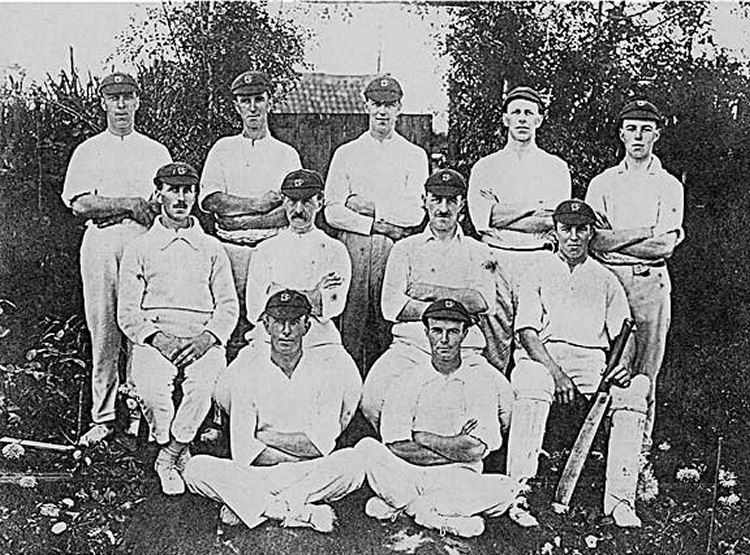
Whilst he was landlord at the Swingate Inn, in 1920, William formed a
cricket team consisting of himself and his ten sons. From the beginning,
the club was run on the same lines as any other club - with weekly
meetings, fixture cards etc. The team competed against teams from Dover,
Deal and the surrounding district with some success, on one occasion
winning as many as 16 matches out of 21 during the season.
Notable members of the team were Claude (bat), Steve (fast bowler),
Wilfred (slow bowler) and Algy (wicket keeper). Carrie, one of the two
daughters, often kept the scores at matches. The club played as a family
team until 1928 when William died. Sheet's giving averages for the 1932
and 1933 seasons show that nine of his sons were still playing regularly
for the team - the exception was Douglas, a farmer, who had cows to milk
on Saturday, afternoons!
The Second World War put an end to matches. The cricketing tradition
continued after the war when William Stephen's eldest son, William
Thomas, formed a team at the Red Lion, St Margaret's-at-Cliffe. A number
of members of the original Swingate team, together with other relatives,
played for this team.
I understand that, when William died in 1928, his wife Harriet became
licensee of the Swingate Inn and that, sometime later, my grandfather
Oscar took over from her.
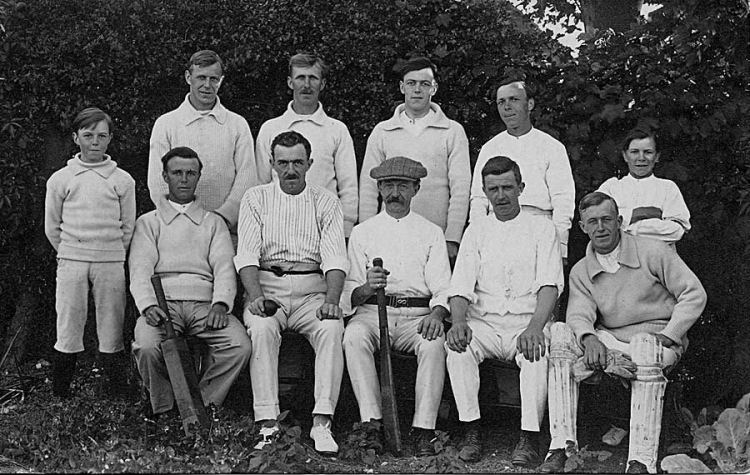
I have attached three photographs. These show the cricket team in the
garden of the Swingate Inn around 1920, the team in a newspaper article
in 1926 (much better gear by then!) and the Swingate Inn. I would guess
this was taken sometime during the 1920's or 30's.
Incidentally, my father was born at The Plough Inn, Guston, where his
mother was renting rooms whilst her husband Oscar was away serving in
the Royal Navy. Maybe this is why I enjoy the odd pint or two!
I hope this is of some interest.
Regards
Ian Norris
|
 |
|
The Norris Cricket XI Swingate Inn July 1921.
Standing l to r:- Steven Andrew, Oscar, Douglas, Lewis, Alec, Claude.
Seated l to r:- Wilfred, William Thomas, William Stephen, Algernon,
Ralph.
Photo kindly sent by Ian Norris. |
 |
|
The Norris Cricket XI Swingate Inn 1926.
Standing l to r:- Alec, Algernon, Lewis, Oscar, Stephen Andrew.
Seated l to r:- Douglas, William Stephen, William Thomas, Claude.
Seated l to r:- Ralph, Wilfred.
Photo kindly send by Ian Norris.
|
|
From the Dover Express and East Kent Intelligencer, 12 April, 1929. Price 1½d.
FOUND DEAD AT FOOT OF CLIFF
On Wednesday, Mr. Arthur Tuson, who lives at 1, Buckland Cottages,
Guston, and is a gardener at the Duke of York's School, was missed
during the day, and a piece of paper was found with the words “Good-bye
all.” Later his cap was found on the cliff near the Old Coastguard
Cottages, Cornhill, and a search was made at the foot of the cliff, and
eventually his body was found by Mr. Atkins, of St. Margaret's. As it
was impossibly to get it up the cliffs that night, it was placed on a
ledge, and on Thursday morning the Police succeeded in getting the body
up the cliff by Langdon Stairs, and it was taken to the “Swingate Inn.”
The inquest has not yet been fixed, and it may not be held until
Saturday.
|
|
From the Dover Express and East Kent Intelligencer, 19 April, 1929. Price 1½d.
THE CLIFF SUICIDE
DELUSION LEAD TO FATAL FALL
The inquest of Arthur Tuson, of Brickfield Cottage, Guston, who was
found dead at the foot of the cliff at Langdon Hole on Wednesday last
week was held at “Swingate Inn” on Friday afternoon by the East Kent
Coroner, Mr. W. Rutley Mowll, who sat with a Jury. Mr. W. L. Norris
being the foreman.
The Coroner said they had the inquire into the death of Arthur Tuson,
(49), of Brickfield Cottages, Guston. It appeared he had been depressed
and under the impression that people were against him, and spoke about
his letters being opened, and said people despised him and were always
talking about him. He was missing at 10.30 on the 10th April and his
son-in-law went down to the School where he worked and found pinned ton
a fence on the way an envelope on which were the words, “Please don't
move this,” and on the other side “Disused railway.” The son-in-law
recognised the hand-writing and went along by the railway line to the
cliffs, where he found the deceased cap on the cliff at Cornhill. He
reported the matter to the Police and they in consequence patrolled the
foreshore with a boatman and found the body lying at the foot of the
cliffs. It was taken to the top and then conveyed to Swingate.
John Augustine Swain, of 12, Trevanion Street, Dover, a brush-hand,
identified the body as that of his father-in-law, Arthur Tuson. He was
49 and a gardener at the Duke of York's R.M. School. He last saw him
alive on Sunday night, and he seemed the same as usual and very happy.
He told witness that certain people in Guston had been worrying him and
letters of his had been opened. He was under the impression that people
despised him. He never used to say much to the deceased when he spoke in
that way, as he believed he was imaginative. As far as he knew he had no
trouble. On Wednesday morning, 10th April, his wife and her brother came
to him and said the deceased was missing. He left work immediately and
went to Guston and found that everything in the house was intact. He
thought he had lost his memory and was wandering about. He went to the
Duke of York's School to see if he had reported for work and on the way
he found the envelope (produced) sticking to a post beside a tree near
the Swingate Bridge. He recognised the hand-writing which was in a blue
pencil. The words “Please do not move this,” on one side, and on the
other “Disused railway.” He patrolled the railway for some distance and
then sent for the Police. He followed the railway again later down to
the cliffs, and near the houses on the cliffs he found the deceased's
cap. At 10.30 on Wednesday, when his wife, and brother-in-law reported
the matter to him, they produced a little piece of newspaper edging, but
he thought that was now lost. On it was written “Good bye all.” This
piece of paper was found by the son under a plate in the kitchen.
The Coroner: it looks to me as if he was suffering from delusions.
Yes, I think so too.
Arthur William Tuson (25), of Brickfield Cottages, Guston, an
electrician, said he last saw his father on Tuesday evening and he
seemed very depressed. He had an idea he was going to get the “sack”
from the school. He did not know he was missing until 7 o'clock on
Wednesday morning, and he discovered the piece of paper under his plate.
He went upstairs to see if his father's best clothes had gone as he had
spoken of going to Essex to take up brickmaking. He did not have a
doctor. He told his sister that the deceased was missing.
P.C. Hopper, K.C.C., stationed at St. Margaret's, said he was informed
by Swain, and in consequence he patrolled the foreshore towards Dover.
At the foot of the cliffs at Cornhill, where they were 300ft. high, he
found the deceased. He was lying face downwards in a crevice between the
rocks and the cliffs. The body was fully dressed and had received severe
injuries. He searched the body and found a knife in one of the pockets.
He carried the body to the foot of Langdon Stairs and with assistance
got the body to the top of the cliff, and later to the “Swingate Inn.”
He knew the deceased, who always seemed to be a steady man.
Dr. Theodore Molesworth, F.R.C.S., practising at St. Margaret's, said he
examined the body on Thursday afternoon and found multiple injuries,
which comprised scalp wounds, fracture of the left ankle, compound
dislocation of the right ankle and ribs broken on both sides of the
chest. Both arms were also broken, and he thought that death must have
been rapid. The injuries were quite consistent with his having fallen
over the cliff.
The Coroner said they could have no doubt that this was a case where the
man, probably without any justification at all, except that he was
suffering from delusions, decided to take his own life by throwing
himself over the cliffs.
The Jury returned a verdict of suicide whilst of unsound mind.
|
|
From the Dover Express and East Kent News, Friday, 12
April, 1935.
"SWINGATE" INN COLLISION
Ernest Walter Crump, a Deal garage proprietor, was summonsed for driving
without due care and attention and for failing to stop after an accident.
Mr. A. K. Mowll appeared for the defendant and pleaded guilty to both
charges.
Superintendent Webb said the defendant was driving his car at about 10.30
p.m. on February 17th on the Deal-Dover Road in the direction of Dover. He
was between the "Swingate" Inn and the bridge which goes over the light
railway when a collision occurred between his car and a motor van driven by
Mrs. Archer, of Alpha Road, Deal which was coming in the opposite direction.
Just before the collision the car had passed a man on foot and, according to
his statement, and that of Mr. Spain, another motorist, it appeared hat the
defendant was driving the car rather too fast to take the bend in the road.
defendant's conduct following the accident was rather unexplainable for he
made no attempt to stop. Mr. Archer got out of the van and stopped another
car and followed the defendant into Dover. In the Market Square he lost him,
but later picked him up at Rennie's Club. Crump gave his name as Little and
they went to see the car he had been driving. Mr. Archer pointed out the
damage that had been done but defendant denied being in an accident that
evening. He said the damage occurred at Ramsgate that morning. P.C. Ivory of
Deal, later interviewed the defendant who then admitted being the driver of
the car involved in the accident. He thought the impact was not sufficient t
cause any serious damage. Apparently the defendant must have had a fair
collision for the window and doors of the car were smashed and the head
lamp, window, and door handle of the van were damaged.
Mr. Mowll said there would have been no accident at all if the driver of
the van had kept to the proper side. The defendant inquired of a Mr.
Davison, who was in his car, whether there had been an accident and was told
the other car had not stopped. When asked who was the owner of the car,
defendant said Mr. Little. This man had an extremely fine record for he had
driven for 21 years without a driving offence.
The Chairman said they did not look upon it as a light case and all an
imposed a fine of £10 for the first offence and £5 for the second, or three
months in default. Defendant's licence was ordered to be endorsed.
|
|
From the Dover Express and East Kent News, Friday, 18
September, 1936.
Occasional Licenses
An occasional licence was granted for the "Swingate" Inn, Guston, on
October 14th, from 10.30 a.m. to 5 p.m., for a sale at Solton Farm.
|
|
Picture kindly supplied by Stuart Kinnon.
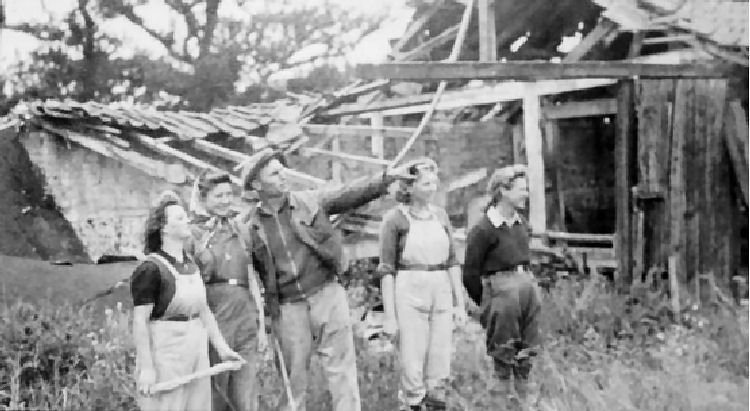
Shell damage at West Cliffe farm.
Harry Curling, Landlord of the "Swingate Inn", points to the latest
shell damage to Land Army girls. Circa WW2 after 1942.
|
|
Dover Express 09 December 1949.
HUNTING APPOINTMENTS.
The East Kent Hunt meets at 11 a.m. on Saturday at Wye College; on
Wednesday at Bilsington Priory; and Saturday, Dec. 17th, at Lydden.
West Street Hunt meets at 11 a.m. on Saturday at the "Swingate Inn;" and on
Saturday, Dec. 17th, at the "Hare and Hounds," Northbourne.
Ringwould and R.A. Beagles meet at 1.30 p.m. on Saturday at the "Hill
House Hotel," Walmer; and on Wednesday at the "White Horse," Finglesham.
|
|
From the Dover Express and East Kent News, Friday, 28 November 1958.
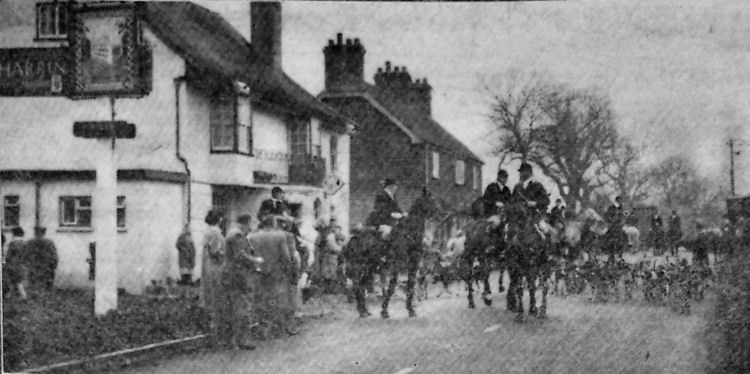
The scene at the Swingate Inn on Saturday, as the West
Street and East Kent Hunts gathered for their joint meet.
Little Terrier Had The Best of the Sport.
With a joint force of over fifty riders and thirty couples of hounds,
the East Kent and West Street Hunts met at Swingate on Saturday morning.
Ahead of them they had a day of excitement which only ended at
darkness fell.
The day began with punch from the stirrup cup at the Swingfield Inn
and ended with a double kill by match glow in a liar near Church
Whitfield.
A large crown saw the Hunts set off, but few were left to see the
kill, after a sixty minute fight between fox and terrier.
The first scent took the Hunts to Guston, where the field of nearly
fifty made a wonderful sight.
The second scent was picked up in a field of kale on Sutton Downs.
But the cunning fox low until the hounds had moved on, and then made a
dash for it through a crown of stunned followers.
The alarm was raised and the hounds and riders set off in close
pursuit. The chase led through lanes and fields to a burrow near Church
Whitfield.
By the time the fox had gone to earth most of the riders had given
up, as it was getting dark and horses had to be put away in their boxes.
A terrier was put down the burrow and the hounds could hear the
fight, deep in the clay. Spades and shovels set to work, and it was
getting dark by the time the terrier - at grips with the fox - was
unearthed.
But a surprise awaited the digging huntsmen. As they shot one fox -
with a humane killer - a second was found cowering behind it.
This was also shot, and both were thrown to the waiting, yelping and
frenzied hounds.
The little terrier? Covered in mud, he was full of life. He, at
least, enjoyed the "sport."
|
|
From the Dover Express, 23 January, 1970
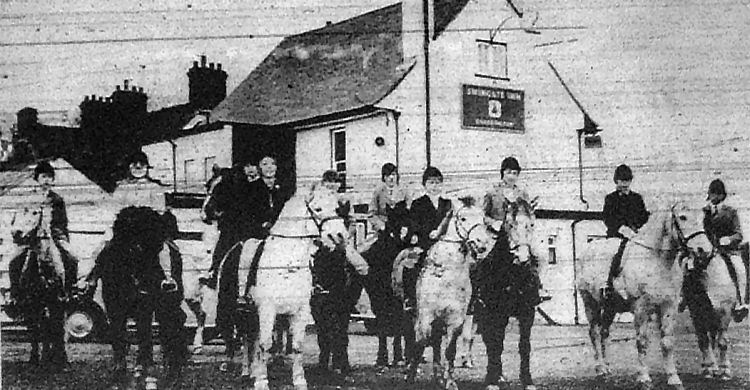
Above: Some of the twenty-two competitors before they set off on the
West Street Pony Club's treasure hunt at "Swingate Inn" on Sunday. |
|
From the Dover Express, 8 May, 2001.
Swingate lnn
Advertising feature
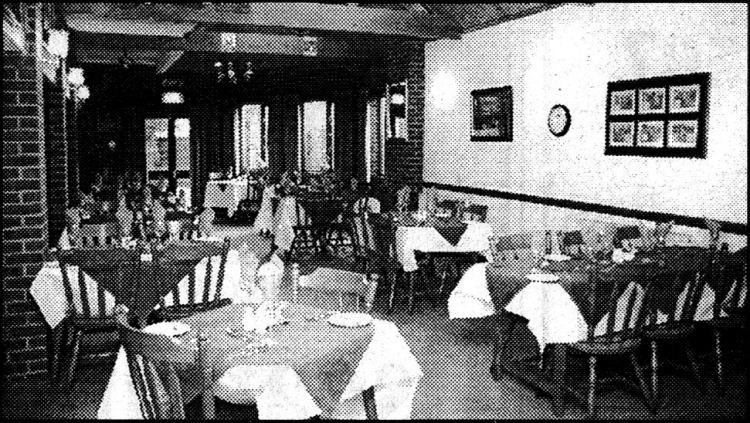
LOCATED on Deal Road in Dover, the award winning Swingate Inn Hotel
and Restaurant offers sumptuous accommodation, fine food and drink and
superb live entertainment.
Gourmets will delight in the extensive a la
carte restaurant menu. Freshly prepared and cooked to order, dishes
include such mouth watering delights as seafood pancakes, medallions of
fillet steak served in a port and mushroom sauce and a tasty range of
vegetarian options from deep fried brie served with cranberry sauce to
a selection of pasta dishes.
The extensive wine list offers fine wines
from around the world to complement your meal, Alternatively, an equally
tasty bar menu features everything from a ploughman's lunch to jacket
potatoes and lasagne.
Sunday lunchtimes have proved particularly popular
with a traditional three course roast available
in the a la carte restaurant for only £10.50. or a single course
available in the bar for just £5.95.
Live entertainment features on a regular basis with jazz on
Thursday evenings and a selection of live acts on a Saturday and Sunday evening.
The last Saturday of each month
- beginning Saturday 24 February -
will feature a cabaret evening. For £25 per head you can enjoy a three
course meal and an evening of live entertainment!
The hotel boasts
twelve bedrooms, all of which have en-suite and tea and coffee making
facilities.
The Swingate Inn and hotel can cater for special occasions
including weddings and conferences The Hotel and restaurant are open
seven days a week with the restaurant opening at 6pm.
The Swingate has
ample car parking facilities. To make a reservation tel: 01304 204043.
|
|
From the Dover Express, 8 May, 2001.
Swing at the Swingate boosts ambulance
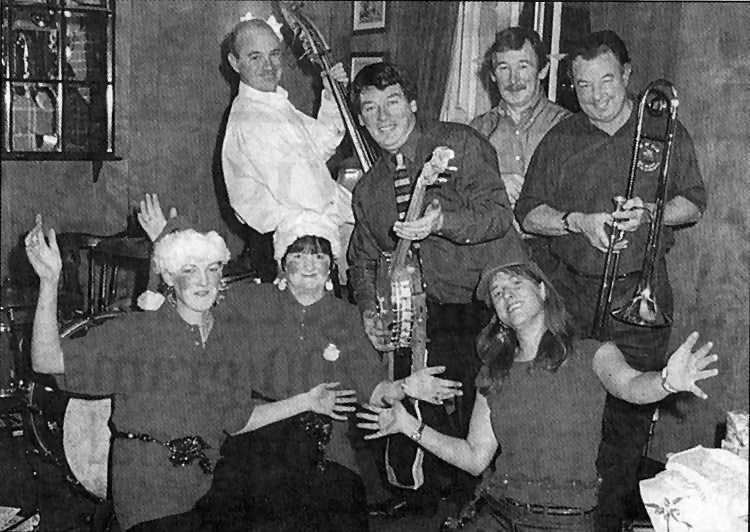
The Swingate pub on the Deal Road held a fund-raising
evening and raised more than £300 for the Kent Air Ambulance.
Staff in fancy dress and more than 80 revellers
enjoyed a jazz night with a raffle.
head waitress Clair Pitchford said: "We sold three
books of raffle tickets and we all enjoyed the jazz.
"A great charity - and a great evening."
|
|
From the
https://www.kentonline.co.uk 7 August 2003.
Bubbly Victoria's tragic death.
ANIMAL LOVER: Victoria Smith and her pet Macy after winning first prize
at a dog show at Elvington last November. Picture: PAUL DENNIS.
HEARTFELT tributes have been paid to a popular and vivacious student who
has died after a road accident.
Victoria Smith, 17, of Ewell Minnis, near Dover, was driving to Swingate
Inn on the A258 where she worked when the collision occurred.
Police are appealing for witnesses to the crash involving Victoria's
Peugeot 106 travelling east and a westbound Mini Cooper and Citroen
Zsara Picasso.
Astor College pupil Victoria lived with her mother Diane Kirby, her
boyfriend Martyn Beaumont and grandparents Kit and Shirley Lorenzen. She
was a great animal lover and keen horsewoman who had ridden all her life
and competed successfully at numerous local shows.
The former Temple Ewell Primary School pupil had her heart set on going
to college. Her uncle Steve Matthews said: "She was a lovely, bright,
bubbly girl, always so full of life, and with her whole life ahead of
her.
"She was very likeable and will be missed by so many people. All I can
say is she was too good for this world and feel that's why she was taken
from us."
Astor College principal Chris Russell said: "We are all devastated at
Victoria's tragic death. She was a wonderful student and a lovely person
who gave a huge amount to college life. Academically, she was doing
extremely well. Our thoughts and prayers go to her mother and family at
this time of great sorrow."
Staff at the Swingate Inn where Victoria was a waitress are
grief-stricken. She had transferred to the pub three months ago when
proprietor Karen Williams moved her team there from the "Marquis of
Granby" in Alkham where Victoria had worked previously.
Mrs Williams said Victoria had worked for her for two years in total and
was an extremely popular member of her 25-strong team.
She said: "Vicky was a bubbly, kind, lovely, gorgeous girl. Nothing was
too much trouble for her. She was friends with my daughter Jamie and
they went to school together. Vicky was going back for her A-levels and
afterwards planning to go into the police force.
Mrs Williams has already ordered a bench to stand outside the pub
inscribed "in loving memory" to Victoria.
Victoria suffered multiple injuries and was treated by paramedics at the
accident scene, also attended by Kent Fire Brigade. She was taken to the
William Harvey Hospital in Ashford and was pronounced dead shortly
afterwards.
The other drivers received minor injuries. Police investigating the
crash would like to hear from anyone who has not already spoken to an
officer. They are asked to contact PC Paul Howe on 01304 240055.
Victoria's funeral will be held at noon on Monday at Barham crematorium.
Family flowers only, donations to the Kent Air Ambulance or the East
Kent Hospitals NHS Trust, c/o WJ Farrier & Son, 161 London Road, Dover.
|
|
The Swingate Inn now offers (2007) hotel accommodation with 10 ensuite rooms and is also an approved
premises for civil marriages. It also offers 2 conference rooms, one
accommodating 35 and the other 100 people.
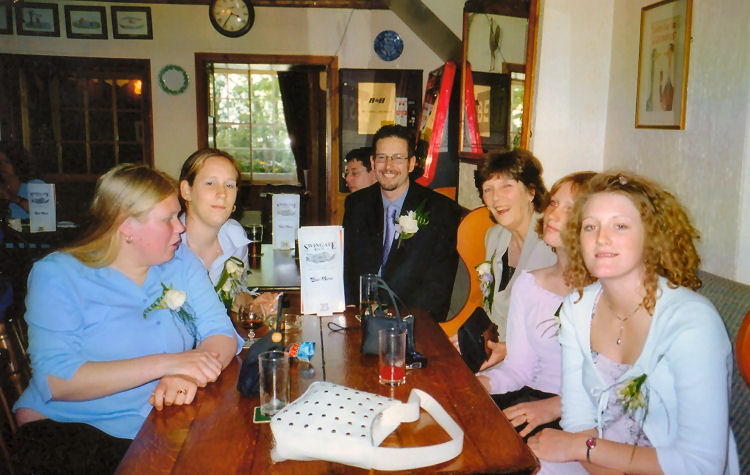
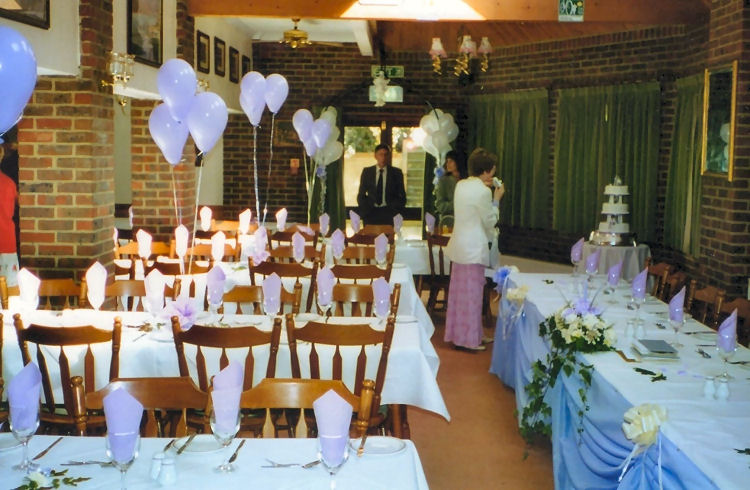
Below and kingly sent to me from Mark and Wendy Cullip who were the
first couple to be married at the "Swingate Inn" on 24 May 2002.
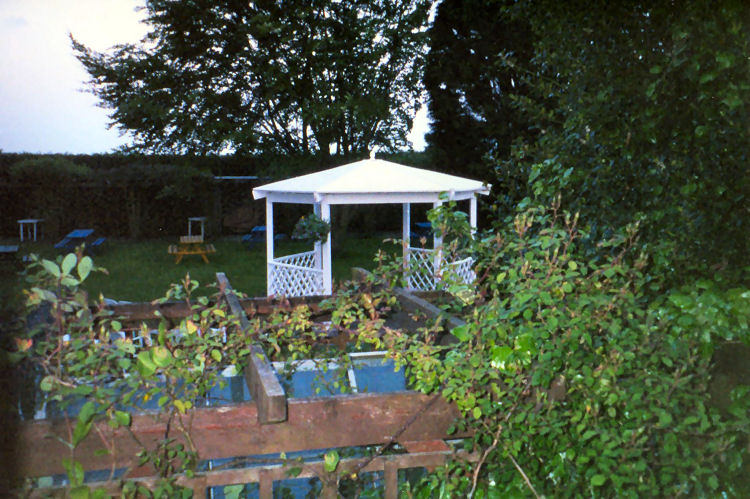
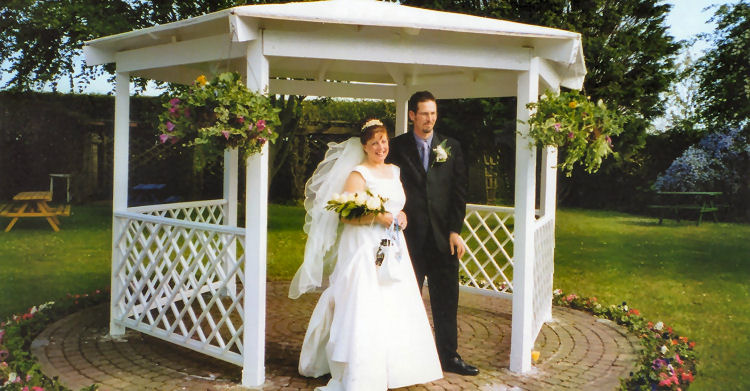
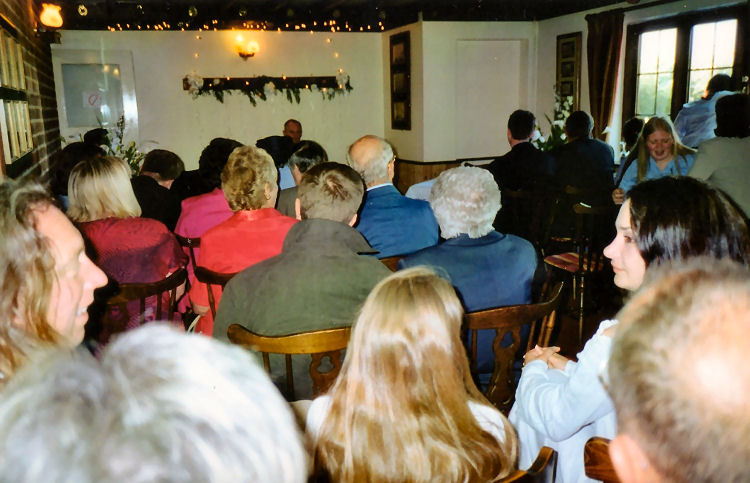
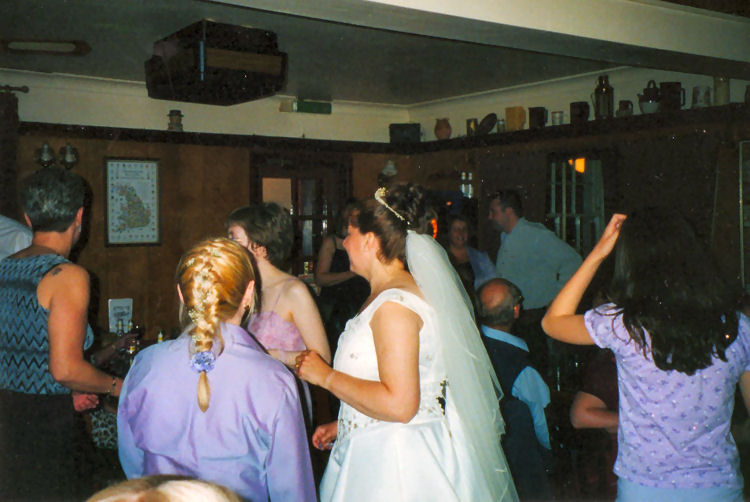
 |
The CAMRA branch meeting of June 2008 reported that the "Swingate" was up
for sale.
|
From the Dover Mercury, 5 March, 2009.
Hotel's new lease.
Report by Yamurai Zendera.
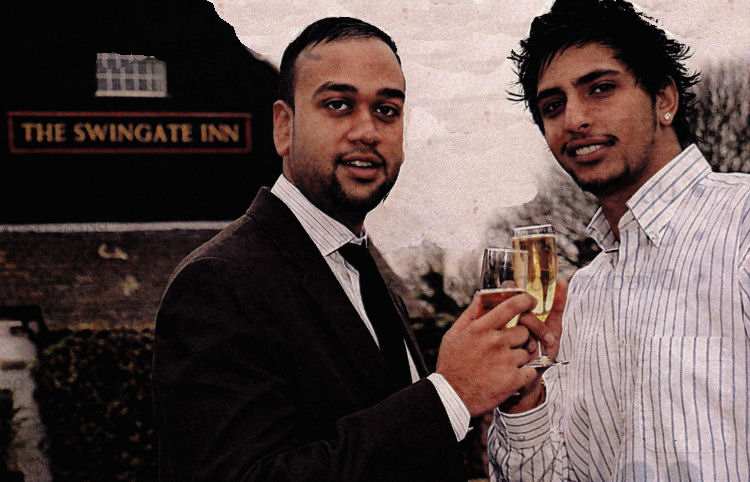
University graduates Kunaal Patel and Sumit Patel have taken on the
lease of the pub, restaurant and hotel venue just off the A258 Deal
Road.
The 23-year-olds plan to introduce Indian food onto the menu and
create a balanced "modem and rustic" feel to the premises.
Canterbury
Christ Church University graduate Kunaal said:
"I took a little break to Thailand after I graduated last year.
"When I
came back I thought about a career in finance but always wanted to have
my own bar and restaurant so started looking at a few places in
Canterbury.
"I found out that Sumit was
also interested in doing something similar after graduating from BruneI
University.
"We were both out of work and I was helping my parents with
their convenience store in Littlebourne."
The freehold to the Swingate is
owned by both sets of parents who offered to lease the hotel to the two
friends.
Kunaal said: "I had only seen the Swingate once before and that
was very briefly, so I'd never really thought about it in those terms,
plus it was not up for sale then.
"When I looked at it properly I realised it was screaming potential.
"The fact it has a 10 bedroom hotel as well was a bonus."
Kunaal says
they are bullish about the business's prospects despite the recession,
adding:
"It's one of the worst times to do it but we're ready.
"A lot of pubs
are closing down. People don't have the money to go out, especially
during the week. But if you have got the right place and right product
to offer, they will come."
The two businessmen, who have retained the
eight employees from the previous leaseholder, are training the head
chef in Indian cuisine and planning
theme nights.
|
|
From the Dover Mercury, 5 March, 2009.
LIFEBOAT CREW BENEFITS FROM PUB'S QUIZ NIGHTS.
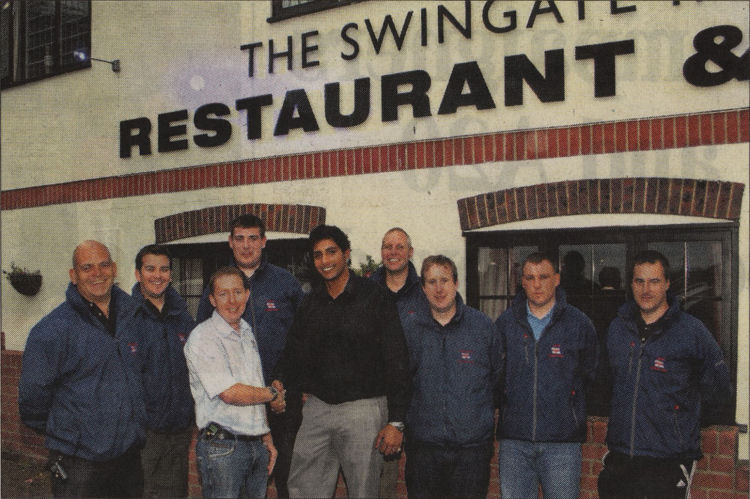
Dover lifeboat crew with "Swingate Inn" landlord Sumit Patel.
DOVER Lifeboat Coxswain Stuart Richardson and members of his crew
went to the pub the other day - but only to receive a £387 donation from
landlord Sumit Patel.
The money had been raised at the monthly quizzes held at the "Swingate
Inn" since May.
The next quiz is on October 18 and new teams are very welcome. It
costs £1 per person to enter.
Mr Patel said they had chosen the lifeboat to benefit from their
fundraising because they understood the hard work which the RNLI
volunteers do.
He said: "We are so close to the Channel and when we sat down to pick
a charity the RNLI was the winner by far."
Dover RNLI Deputy Launching Authority Ray Couzens thanked Mr Patel
and his team at the Swingate. He said: "The support we receive from the
people and businesses of Dover has always been excellent and with
examples, such as the fundraising quizzes at the Swingate, we know that
we are still being supported in these difficult times."
The quizzes are part of a variety of regular events put on by the
Swingate's team including curry nights on Tuesdays and live jazz on
Thursdays.
• For more details about any of the events, telephone the Inn on
01304 204043.
|
|
From the
https://www.kentonline.co.uk By Sam Lennon, 1 July 2016.
Triple traffic holdup after crash on A258 near Swingate Inn, Dover.
Traffic tailbacks built up in three directions after a three-vehicle
crash.
It happened on the busy A258 Dover to Deal Road, near the Swingate Inn,
at 3pm today.
Queues of traffic built up on both sides of the road and also on the
nearby A2 for vehicles coming from Whitfield.
Kent Police were called and said that South East Coast Ambulance Service
treated a man with a wrist injury.
|
|
From an email received 6 May 2020. Attached photos were taken in 1990
when Peter Stevens was landlord.
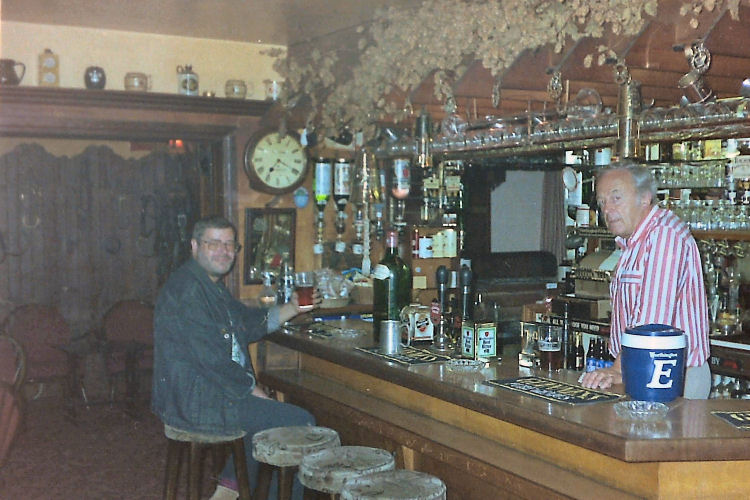
Bloke at the bar is Dave Underdown.
The local branch of CAMRA Dover played daddlums against the locals.
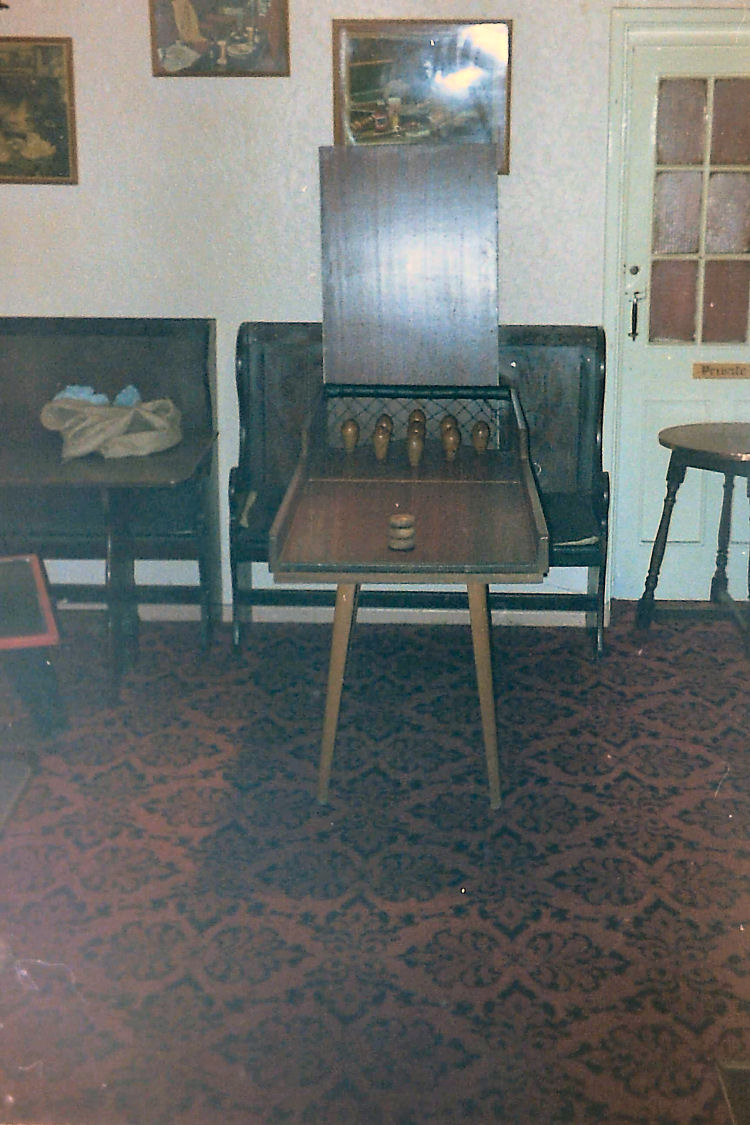
The table was made by branch member David Green. The skittles were
given to the branch by Charlie Willet of the "White Horse." The table
was taken to various pubs to play matches in and around Dover.
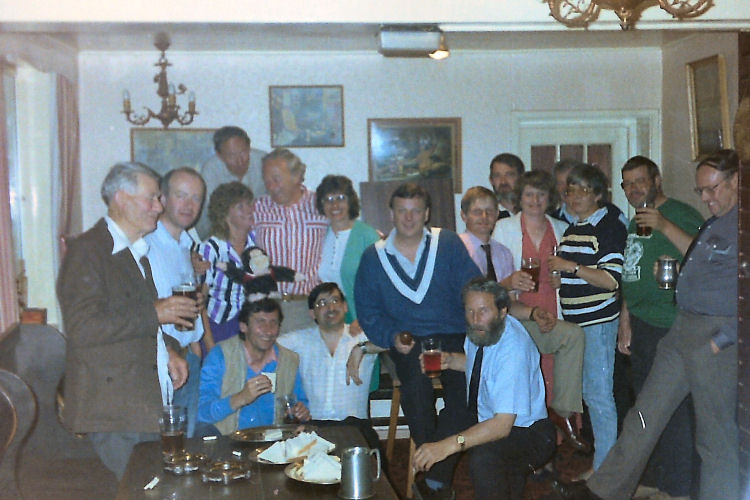
Jim Green extreme right and Dave Underdown
next to him.
Regards,
Michael Lock.
(And still in use today 2020)
|
|
From the East Kent Mercury, 10 January 2024.
By Sam Lennon.
Hotel Boss submits plans for ANPR technology in car park used by rogue motorists.
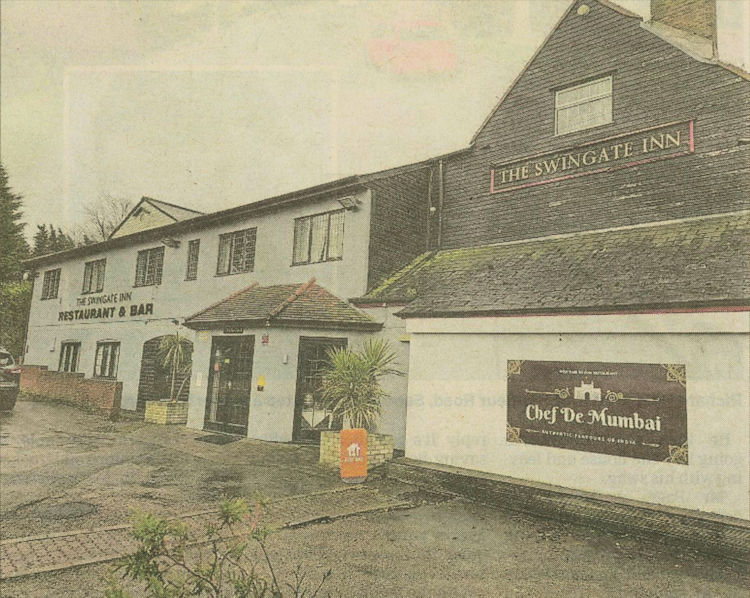
Diners are being left with no spaces - cameras are needed!
A frustrated businessman wants to install cameras in his car park to stop
rogue drivers hogging his customers’ spaces.
Hardik Jani, of The Swingate Inn hotel and restaurant, between Deal and
Dover, says some people have left their vehicles on his premises for as
long as four days.
He claims the issue
has become so bad there are sometimes not enough spaces for customers
hoping to visit his business.
Now he wants Dover District Council (DDC)
to allow the installation of automatic number-plate recognition (ANPR) cameras to weed out those who
shouldn’t be there.
“I have had a lot of nuisance parking and that causes problems for my
customers,” said Mr Jani, the business leaseholder.
“People just leave their cars and walk off. A few times I don’t have any
space for customers.
“One Mini was left there for four days and a Jaguar for two.”
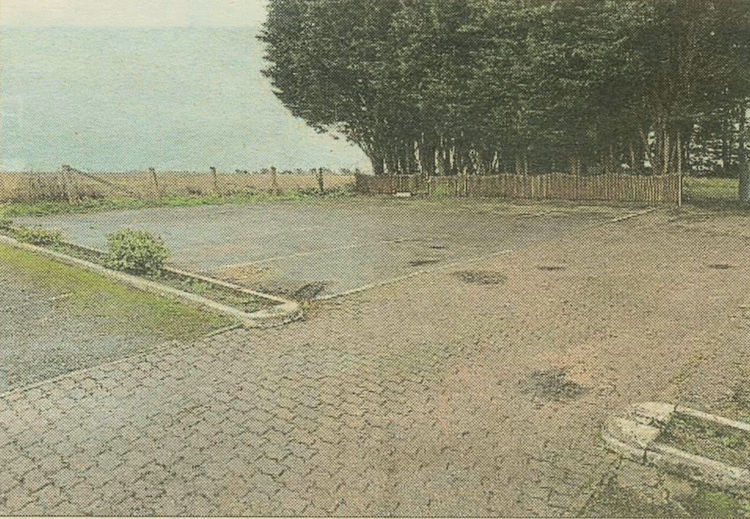
“Sometimes two cars are driven in, one is left behind and the people
will all take off in the other vehicle. Vans are also left there
overnight at times.”
Mr Jani, who has run the site since May, says the camera equipment will
act as a form of security for his customers as he does not know why the
vehicles are there.
His 10-room hotel, which also features the Chef De Mumbai Indian
restaurant, sits on the busy A258 Deal Road.
It is close to the key Duke of York roundabout for Dover Eastern Docks
and the town centre.
It is otherwise remote with few other properties or facilities nearby.
The application for the 50-space car park is being made on Mr Jani's
behalf by Parkingeye Ltd, a specialist management company that can issue
penalties to drivers.
If the cameras are allowed and the system goes ahead non-customers would
still be allowed to use the car park if they pay online. Exact charges
for this are to be confirmed.
Customers, who give their registration details to the venue, would
continue to be exempt from fees.
The site sits within the boundary of St Margaret’s-at-Cliffe Parish
Council.
It is the only group or individual that has commented on the application
on the DDC planning portal, but it has raised no objection. A decision
on the scheme will be made by planning officers at DDC.
|
LICENSEE LIST
MARSH William 1840-61+ (also potter age 73 in 1861 ) )
EASTES R 1862

PRESCOTT William 1865+ 
JONES Richard 1870-71+ (age 55 in 1871)
JOHNSON William 1874
 ERRIDGE William 1874-81 (age 48 in 1881)

COUSENS George 1881-82 (age 43 in 1881)

WRAIKE Leonard 1884+
DIXON Mr C to Dec/1888 dec'd
CLARINGBOULD Frederick T William Dec/1888-1901+ (age 41 in 1901)
   (Previously in employ of Messrs. Hawkesfield and Son for 9 years)
CLARINGBOULD William 1911+ (age 24 in 1911)
NORRIS William Stephen 1920-24+
 
NORRIS Harriett 1928-Jan/31
 ( ( St Margaret's at
Cliffe) St Margaret's at
Cliffe)
NORRIS Oscar Augustus  Jan/1931-Jan/38 Jan/1931-Jan/38
BYKER Walter Leslie Jan/1938-12/Jun/42
 
CURLING Henry W 28/May/1942-54
 
PEARSON Ronald G H 1954-57

CROAKER E J Mr 1957-64
(CROKER E F 1961)
GRIGGS J H 1964+
STEVENSON Peter J & TOBIN J 1974-90
 Charrington & Co
DOVE Graham and Sue 2007-Feb/09
PATEL Sumit & Kunaal Feb/2009-10+
JANI Hardik May 2023+
From the Post Office Directory 1862
From the Post Office Directory 1874
From the Post Office Directory 1882
From the Kelly's Directory 1903
From the Post Office Directory 1913
From the Post Office Directory 1914
From the Post Office Directory 1922
From Pikes Dover Blue Book 1924
From the Post Office Directory 1930
From Pikes Dover Blue Book 1932-33
From Pikes Dover Blue Book 1938-39
From the Post Office Directory 1938
From the Kelly's Directory 1950
From the Kelly's Directory 1953
From the Kelly's Directory 1956
Library archives 1974
From the Dover Express
Census
|

