|
18 Biggin Street
76 Biggin Street

Dover
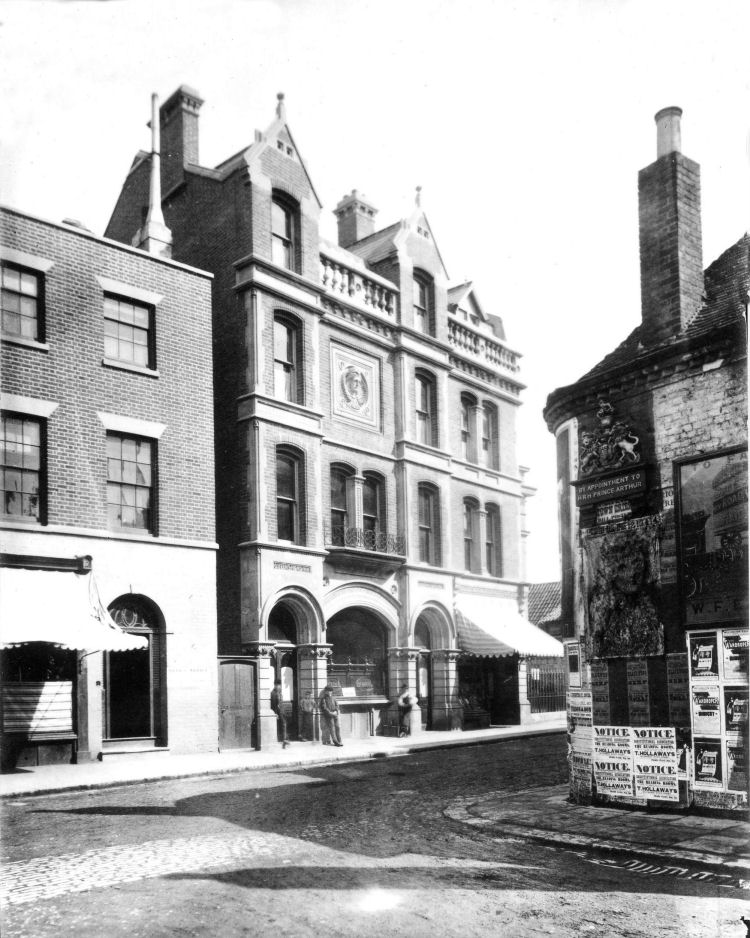
Queen's Head date unknown. |
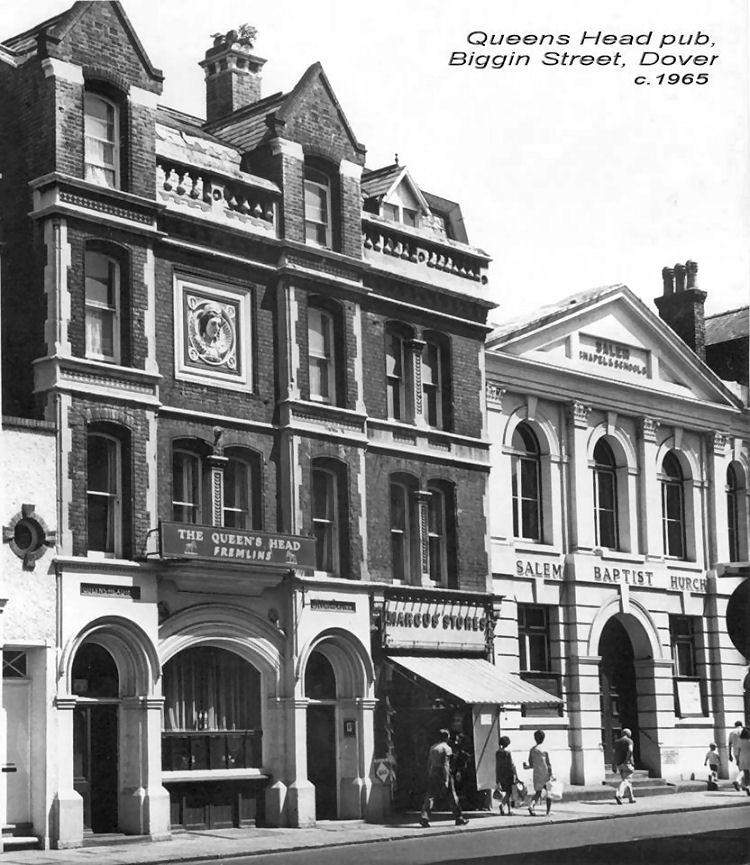
Above photo circa 1965. |
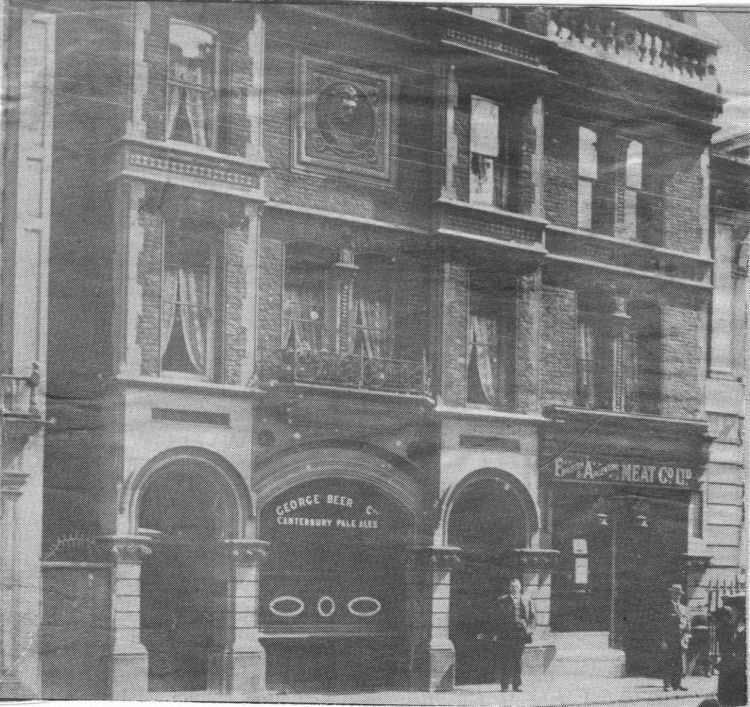
Above shows Queen's Head, date unknown.
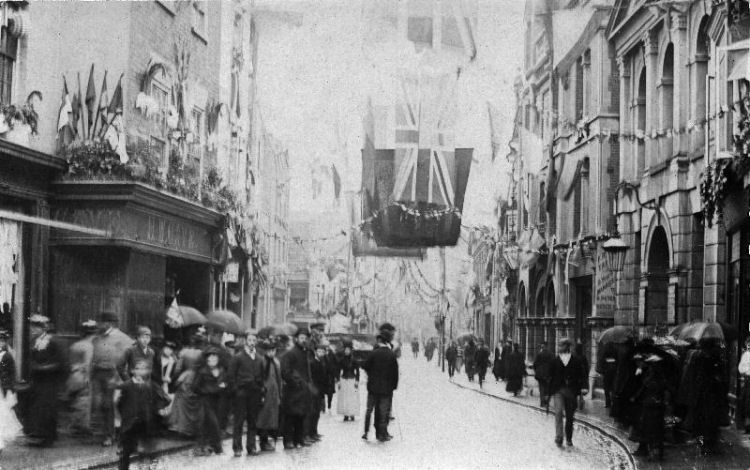
Above photo kindly supplied by Jeanette Harper, c/o Jackie Bowles of
the Louise Armstrong showing Queen's Head on right just to the left of the
Salem Baptist Church, pre 1897. |
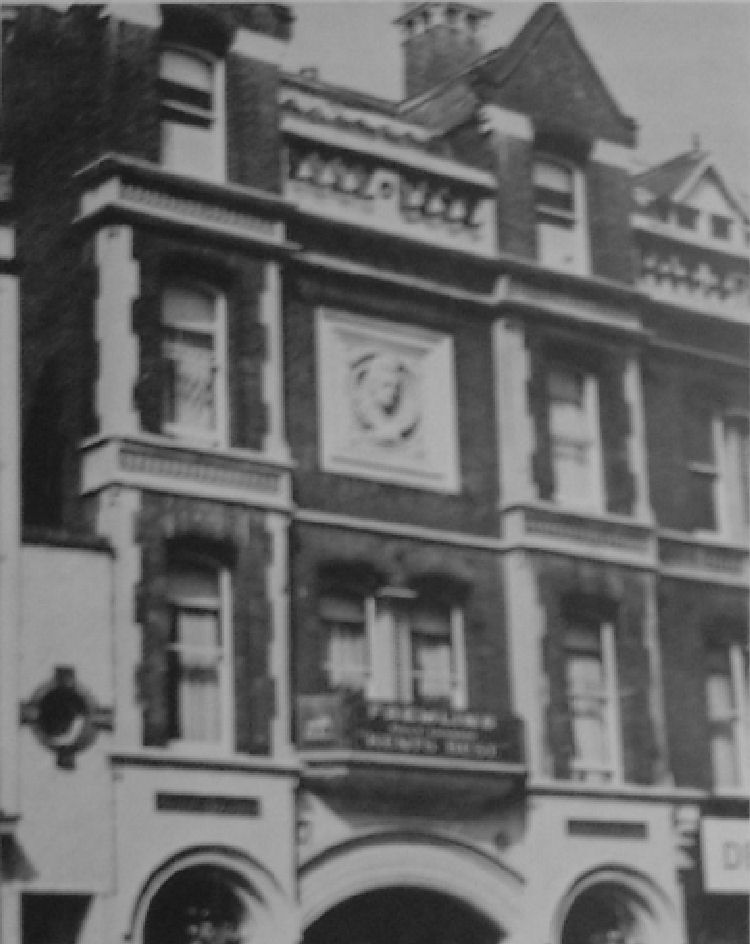
Above photo date unknown. |
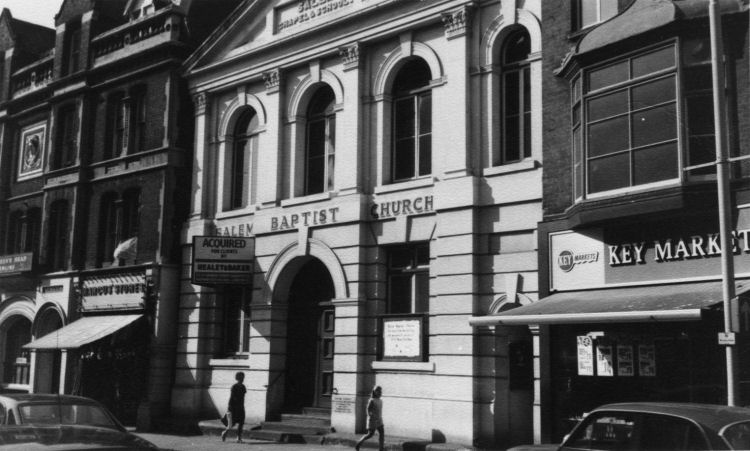
Above photo circa 1969. |
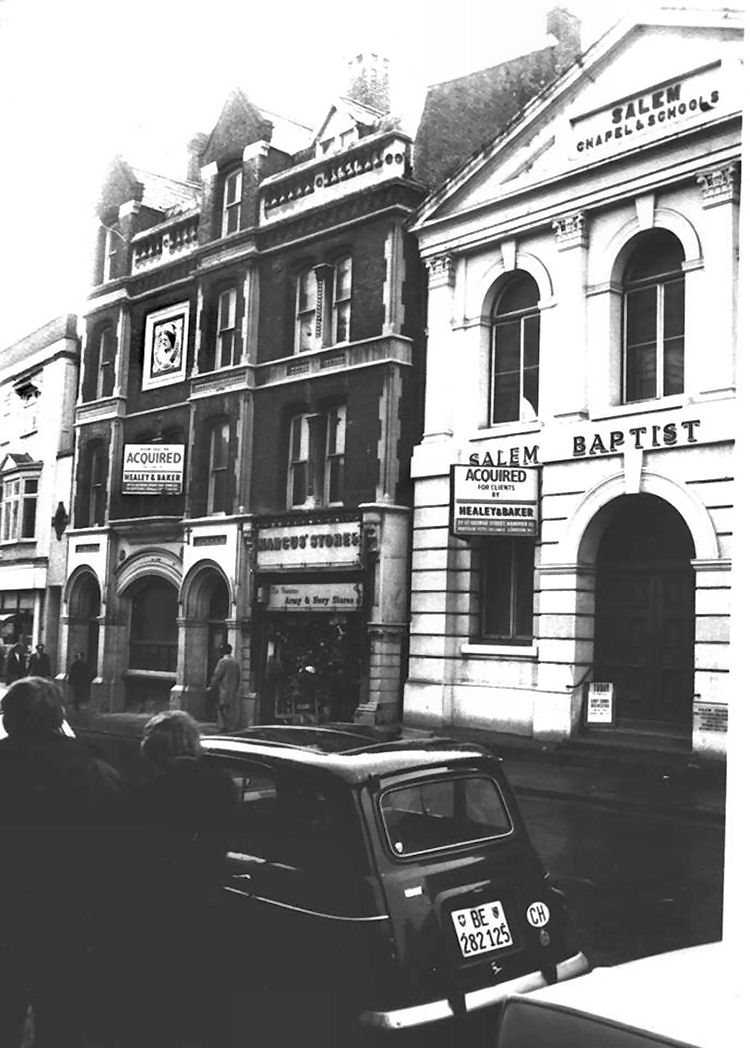
Above photo, 1970. Kindly sent by Kathleen Hollingsbee. |
An effigy of the queen's head, presumably Victoria, adorned the front of
the building together with the date 1873. That was the house which had been
built following the road widening that year. The original had been well
forward of that. Its neighbour from 27 August 1840 had been the Salem
Baptist Church and that possessed a forecourt or front garden. The pub was
said to protrude beyond that line. We know that it was active in 1791 under
the direction of Elizabeth Purflow or Susannah Smith.
I think I have now traced it back even further to 1730, obviously not the
same pub referring to Queen Victoria, but definitely with the same name.
|
From the Kentish Post or Canterbury News-Letter, May
16-20, 1730. Kindly sent from Alec Hasenson.
Sale at Dover of Bardoes Rum ….. ‘Enquire of Mr. James Willis at the
"White Lion" in Dover or Mr. Edward Worthington at the
"Queen's Head" in
Dover.'
Bardoes was the name know known as Barbados.
Paul Skelton.
|
|
Even better news, I believe the pub can now be traced back to as
early as 1580. The following reference taken from the Dover Chronicle of
April 24, 1841, and referring to manuscript written by William Borough,
Controller of the Navy, circa 1580, on the state of Dover harbour and
suggesting means for remedying its deficiencies. The start of the
article gives mention to Thomas Dawkes as licensee. Thomas Dawkes,
yeoman, was certainly around in 1558 when it is suggested he built the "Fleur
de Lis," later to be named the "Flying
Horse Tavern" in King Street near to Flying Horse Lane.
(William) Borough frequently visited the town (of Dover) and
occasionally lodged at the Quieen's Head, (kept by Thomas Dawkes)
..........................
From various dates and inferences, this would be between about 1576 to
1580.
|
|
From the Kentish Gazette, 1 May 1810.
A Qualm of Conscience
Mr Richard HARVEY the present landlord of the “Queen's Head” public house
at Dover, formerly drove one of the coaches between that place and
Canterbury during that time he lost out of the same a pair of shoes and
had forgotten the transaction until yesterday morning, when he received
by the post the following letter with a 7 shilling piece under the seal.
"To Mr Richard HARVEY:
Being in company with a man who expressed much sorrow and contrition
having taken a pair of shoes of yours out of the coach you drove from
Dover to Canterbury, while standing in the street, he wishes to make you
satisfaction for the injury he did you at that time.
He has directed me
to send you 7 shilling piece, the price the shoes cost you, then hoping
you will forgive the injury done.
The shoes was taken in the year 1797
or 1798 – the money is under the seal."
|
|
From the Kent Herald, 10 January 1828. Death.bmp"
DEATH.
Jan 1, at Dover, Mr. John Morley, formerly landlord of the "Queen's Head.
|
It was the property of Walker's Phoenix Brewery when sold for £700 in
1859.
Three years later it was damaged by fire, details from the Dover Express
shown below.
Redevelopment of the site caused the closure of the second house in
September 1971 but it stood empty until October 1975 before it was taken
down and Boots the chemist erected.
|
Dover Telegraph 2 April 1842.
Dover Quarter Sessions: Yesterday these Sessions commenced before
W.H. Bodkin Esq., M.P., the Recorder; Edward Poole Esq., the Mayor;
and a full bench of Magistrates.
James Watson, carpenter, aged 50, was charged with stealing, at
Dover, two saws, the property of Thomas Farley Pettman. Prisoner was
also charged with stealing two saws, the property of Thomas Chaney.
T. Pettman stated that he was working at the new houses on Camden
Crescent, and left his tools in the attic when he left work in the
evening. On the following morning he found his saws gone. He
afterwards found that Henry Bailey, who lodged with him in the same
house, had on the previous evening bought one of his saws of a man
at the "Queen's Head" for 1s. 6d. Henry Bailey stated that he bought
the saw for 1s. 6d.
Mr. Pearson, police constable, of Folkestone, stated that Mr. T.
Chaney and another person came to Folkestone, and from information
he went to the "Three Herrings" (sic) (Note:
"Three Mackerel") public house, where he found a
basket of tools, from which Chaney identified two saws as his
property. The prisoner soon afterwards came in, when he took him
into custody and brought him to Dover.
Guilty – Six months imprisonment and hard labour.
|
|
From the Dover Telegraph and Cinque Ports General
Advertiser, Saturday 24 September, 1842. Price 5d.
ACCIDENT
Yesterday morning, about 7 o'clock, a timber-tug passing down Biggin-street,
caught the wheel of a donkey cart, standing outside the "Queen's Head,"
public house. The concussion was so great as to force the donkey, head
foremost, through the tap-room window, to the no small astonishment of
an unfortunate wight (human being) who had selected the window seat as his "sleeping
den," all the beds at this hotel being occupied.
|
|
From the Dover Telegraph and Cinque Ports General
Advertiser, Saturday 5 February, 1853. Price 5d.
BOROUGH PETTY SESSIONS
MONDAY - Before the Mayor, W. Cocke, W. F. Elsted, J. Coleman, and H.
Elve, Esqrs.
Ann Griggs, widow, described as a prostitute, was placed at the bar
on a charge of felony.
Thomas Bean, labourer, residing in Lady well Lane, deposed - I was
with the prisoner on Saturday evening, at the "Queen's Head." We engaged
a bed there. On Sunday morning, I found, on dressing, that all my money
was gone, and charged Griggs with the theft. She denied taking the
money. I told her if she didn't give it up, I should send for a
policeman. She still persisted in he denial, and at this moment police
constable Terry passed, whom I called, and into whose custody I gave the
prisoner. I cannot say exactly how much was stolen from me, by within a
6d. of 7s. either way. There was one half crown among the money.
Policeman Terry deposed to apprehending Griggs at about seven o'clock,
on Sunday morning. On going to the station, she said she had only a
shilling and a few coppers in her pocket. Prosecutor said there was a
half-crown among the money. Mary Ann Coram, daughter of Superintendent
Coram said she searched the prisoner at the police station, and in one
pocket found 1s. 3¼d., and 3s. 3d. in silver, (tied in the corner of a
handkerchief,) and a half crown in another pocket. Prisoner said, "the
money you found in the first pocket is mine, the other is not." No
defence was made, and the prisoner was committed for trial.
|
|
From the Dover Express and East Kent Intelligencer, 28
May, 1859.
BEGGING IN A STATE OF DRUNKENNESS
Eliza Rand, a slatternly and ill-clad woman, was brought up, charged
with begging in Castle Street on the preceding day, in a state of
drunkenness.
The policeman who had taken her into custody said he saw her ask
several persons for a halfpenny. The prisoner was a well-known vagrant,
and had been lodging at the "Queen's Head" public house.
The superintendent said that complaints had reached him on the
previous day with respect to the insolent behaviour of the prisoner.
From what was then stated it appeared that she had begged off some
gentlemen at the "Shakespeare Hotel,"
to whom her language was most disgraceful. Her conversation at the
station-house was also very obscene.
The Magistrates sent her to prison for fourteen days, with hard
labour.
|
|
From the Dover Express. September 1862.
On Sunday a fire originated in a carpenter shop at the back of The
Queens Head public house in Biggin Street which for a short time caused
considerable alarm. The proprietor of the Queens Head, Mr Whitney is a
carpenter by trade and had a small shop at the rear of his house
adjoining the Salem Chapel and in close proximity to the timber yard of
Mr Finnis.
The origin of the fire is unknown but it was discovered between seven
and eight o'clock in the morning. A few members of the Salem Chapel
congregation were engaged at the time in early devotional exercise in
the school room attached to the Chapel, which overlooks the scene of the
fire, and to this circumstance may be attributed to the speedy
suppression of the conflagration. On the calamity becoming known the
service was suspended and all those engaged in it that were capable of
giving assistance did their best to extinguish the flames. Meanwhile the
alarm was raised and the volunteer fire brigade with their apparatus was
promptly in attendance under the direction of Mr. Superintendent Coram.
The water mains were charged at the time, as there was therefore a
copious supply of water at a pressure that speedily put flight of all
apprehensions of further damage. Some of the Chapel windows were broken
some gas pipes melted and a staircase leading to the schoolroom was
considerably scorched so that if aid had not been rendered in the most
prompt and effectual manner the consequence to the edifice and the
surrounding property would have been most disastrous. In addition to a
large store of timber there were nearly fifty barrels of tar on the
premises of Mr. Finnis. The carpenter's shop was entirely destroyed
together with a number of valuable tools it contained. The police report
that a man was brought before the magistrates on suspicion of setting
the place on fire, but the Bench considered the evidence produced too
vague to justify his detention and he was therefore set at liberty
again. Mr. R. H. Jones the owner of some adjoining property has
addressed the following letter to the members of the volunteer fire
brigade.
To the volunteer fire brigade Dover.
Gentleman, Your services at the fire on Sunday morning last have placed
me under great obligation to you for which I beg to thank you most
sincerely. I regret my absence prevents me from personally thanking you.
Although your services are voluntary I hope you will permit me to send
you a “check” for £5 as on the other side which can be placed to the
credit of your treasurer towards the necessary expenses attendant on
your service or otherwise disposed of as you may think fit. Again
thanking you for your ascertains believe me.
Your obliged and faithful servant R. H. Jones. September 1862.
Information kindly supplied by Joyce Banks.
|
|
From the Dover Express and East Kent Intelligencer, 10
August, 1866.
DRUNK AND DISORDERLY
John Andrews was charged with being drunk, and assaulting a German
musician in the "Queen's Head," Biggin Street. It appears that the
prisoner is a low and desperate character.
Police-constable John Adams said that while on duty his attention was
called to the "Queen's Head." On his approach he found the prisoner very
drunk. He had been striking a German, who was simply passing from his
bedroom out of doors, when the prisoner asked him to play a tune, when
the German remarked hat he had not time. The prisoner immediately struck
him in the face, and caused the blood to flow copiously from his nose,
and in the struggle they both fell, and the prisoner was taken into
custody.
The German not appearing against the prisoner, he was fined 2s. only.
|
|
From the Dover Express and East Kent News, Friday,
18 September, 1868.
DRUNK AND DISORDERLY.
Anastasia Reed, a married woman, who said she was lodging at the
"Queen's Head," was charged with drunkenness and disorderly conduct in
York Street.
It appeared that Anastasia had been taken into custody on the
previous night by Police-sergeant Barton, who found her divested of a
great part of her clothing and "stripping into" a navvy. She made her
appearance before the Bench minus a bonnet and boots, which, she
informed the Magistrates, with tears in her eyes, she had lost beyond
hope of recovery. She had been in town, she said, a week - up to Monday
last with her husband. He, however, went on to Folkestone on that day,
and left directions for her to follow him. Had she taken his good advice
her incarceration would have been avoided, but she fell too readily into
the hands of some friends who invited her to drink, and unfortunately
she took a sip too much. She assured the Magistrates, if he would
forgive her, that she would be on her way to Folkestone in ten minutes.
Sergeant Barton said the language of the prisoner, on being taken
into custody, was the worst he had ever heard from female lips; but the
prisoner attributed all her misfortunes to the drink, and submitted that
she had already been punished by the loss of her bonnet and boots. She
also mentioned that she had been washing her clothes previously to
yielding to the temptation of drinking with her friends; but where her
clothes were now she had no notion, although she feared they had been
"taken in" by some one who had no right to them.
Superintendent Coram said he had no doubt the prisoner would find her
clothes and her other property safe enough at the "Queen's Head."
Mr. Mummery said he would allow her ten minutes to go to the "Queen's
Head" and pack up her clothes and get upon her journey to Folkestone. A
policeman would go with her and see her out of the town; and if she was
found here again the present charge, which would be kept open against
her, would be gone into.
The prisoner quickly availed herself of the clemency of the
Magistrates, and left the Court at a pace which showed her determination
to make the best use of the limited time allowed her.
|
|
Whitstable Times and Herne Bay Herald, Saturday 16 January 1869.
Coroner's Inquest.
On Friday afternoon the Borough Coroner, W. H. Payn, Esq., held an
inquest at the "Salutation Inn," Biggin Street, on the body of a woman
named Ann Whitehead, who had died suddenly at the "Queen's Head" lodging
house, in the same street.
After hearing the testimony of Mr. John Walter, surgeon, who was called
in, the jury returned a verdict of "Death from natural causes."
|
|
From the Dover Express and East Kent News, Friday,
6 August, 1869.
A WILD IRISHMAN.
James Moore, a broken-down Irishman, whose clothes were so ragged as
barely to hang upon him, was charged with being drunk and disorderly in
Snargate Street on Saturday night.
It appeared from the evidence of police-constable Bowles, who had
taken the prisoner into custody, that he met him in Snargate Street
between 11 and 12 o'clock Saturday night. The prisoner had been put out
of a public-house and was extremely drunk and very disorderly. Witness
tried to get him away, and the prisoner finally promised to go home to
the "Queen's Head," where he was lodging. On witness passing down the
street, shortly afterwards, however, he found the prisoner still
occupying the pavement in the manner stated, and still more violent and
excited than before, the prisoner now having his coat off and expressing
himself prepared to fight all corners. Witness endeavoured to pacify
him, and offered to conduct him to his lodgings, but the prisoner
declined at avail himself of this service or to modify his bellicose
spirit, and witness therefore obtained assistance and conveyed him to
the station-house.
The prisoner said he was very sorry for the trouble he had given to
the police. He had drunk so much on Saturday night as to be quite
unconscious of anything that took place after he was put out of the
public-house. If the Magistrates would release him he would be out of
the town in five minutes and never return to it.
The magistrates taking into consideration that the prisoner had been
in custody since Saturday night, took him at his word, but informed him
that a policeman would accompany him to the limits of the borough, and
that if he was found returning he would be again taken up and the charge
proceeded withy.
|
|
From the Deal, Walmer, and Sandwich Mercury,
23 October, 1869. 1d.
DRUNK AND RIOTOUS
John Young, a man remanded from the previous day on a charge of being
drunk and disorderly and assaulting the police, was again brought
up.
The depositions of P.C. Ralph taken on the previous day having been
read over, the prisoner was asked what he had to say in answer to the
charge. He said he was a fish-seller, and belonged to Dover, and went
round the villages with his fish. He was out on the Deal road on Monday,
when he met two sailors, who asked him to have something to drink, and
gave him some gin. He drank it, and not being accustomed to liquor it
made him so drunk that he lost all his fish and wandered into Walmer.
When he went to the constable's house he must have supposed it was the
"Queen's Head," the house at which he lodged in Dover. He was very sorry
for what he had done, and as he had a wife and two children who were
dependent upon him, he hoped the Magistrates would only inflict a small
fine and not send him to prison.
P.C. Ralph said that before he took the prisoner into custody on
Monday night he had been locked up in the guardroom by the orders of
Colonel Rodney, who saw him steal some bread from a barrow of Mr. Cayley.
Prisoner pleaded very hard for the Magistrates not to send him to
gaol.
The Magistrates said if they could believe the prisoner was a
respectable fish-seller they would not do so. In spite of his plausible
story, however, they were afraid he was no good, and he would therefore
go to prison for seven days.
|
|
From the Dover Express and East Kent Intelligencer,
31 March, 1871. Price 1d.
SUPPOSED FELONY
George Wigglesworth, the man brought up on Friday last, charged with
having in his possession at the "Queen's Head," public-house, a dead
fowl supposed to have been stolen, was again brought up, but on the
application of the police was further remanded till Thursday.
|
|
From the Dover Express and East Kent Intelligencer,
19 March, 1875. Price 1d.
PUBLIC HOUSES
An extension of time for a private ball was granted to Miss Honeyset,
of the "Queen's Head Inn."
|
|
From the Dover Express and East Kent News, Friday,
14 April, 1876. 1d
PERMISSION TO DRAW
At the "Queen's Head" public-house was given to Mr. A. Wenze.
(of Grove Road, South Hackney)
|
|
From the Dover Express and East Kent News, Friday,
13 April, 1877. 1d
TRANSFER
The license of the "Queen's Head" public house, Biggin Street, was
transferred from the present tenant to Mr. Henry Nutley.
From the Dover Express and East Kent News, Friday, 20 April, 1877. 1d
ERRATUM
We erroneously stated in our police report last week that the
"Queen's Head" license had been transferred. The statement referred to
another house.
|
|
From the Dover Express and East Kent News, Friday 1 March, 1878
MOVE ON
John Knott was charged with being drunk and disorderly in Biggin Street
on the previous day. He was standing with a number of others by the
“Queen's Head” on the pavement, and refused to “move on” when told. He
was very disorderly, and was taken into custody.
The defendant was dismissed with a caution.
|
|
From the Dover Express and East Kent News, Friday, 27 January, 1888. Price 1d.
FORESTERS' ANNUAL MEETING
The annual meeting of the Court “Kent,” No. 1638, of the Ancient Order
of Foresters, was opened by the Chief Ranger, Bro. Henry Heath Toms, at
the Court Room, “Queen's Head Inn,” on Tuesday, 24th instant, there
being a large number of members in attendance. The abstract balance
sheet for the past year was then read by the acting Secretary, Brother
Richard Henry Keeler, showing:- Receipts to sick and funeral fund £1,004
18s. 4d., payments £814 7s. 6d.; receipts to management fund £90 18s.
9d., payments £101 6s. 1d.; receipts to benevolent fund £18 10s. 4½d.,
payments £12 15s. 11½d.; receipts to medical fund £118 18s. 10d.,
payments £118 18s. 10d, making the total receipts £1,233 6s. 4d., total
payments £1,047 8s. 4½d., leaving a balance or saving on the year of
£185 17s. 11½d., and a total capital £5,552 10s. 6½d. The report was
well received. The election of Auditors and Arbitration and Appeal
Committee then took place. The balance sheet of the Dover Jubilee
Foresters was then read by the Secretary, Brother Richard Henry Keeler.
The balance sheet of the Ancient Order of Shepherds, also was read by
the Scribe, Bro. William Allen. After a most enjoyable evening, during
which many excellent songs were given, the proceedings were brought to a
close at 10.30 p.m.
|
|
From the Dover Express and East Kent News, Friday, 26 October, 1888. Price 1d.
CAUGHT THROUGH THE TELEPHONE
Joseph Murray was charged with stealing from the shop of Walter Hard,
61, Biggin Street, one coat, value 9s. 6d.
Walter Hard said he was a clothier and draper carrying on business at
61, Biggin Street. The coat produced was his property and was hanging
outside his shop about five o'clock last evening. A police constable
came to his shop shortly afterwards, and from what he said witness found
that the coat was missing. He was sure the coat was not sold.
Charles Johnson, a painter living at 15, Union Road, Buckland, said he
saw the prisoner shortly after five o'clock the previous evening. There
were two other men with prisoner, who was wearing a light fustian coat.
Witness stood by the “Queen's Head” public house and watched the men, as
he thought they looked quite suspicious. One man stood by Mr. Morris's,
the baker' shop, another by Mr. Cave's and the prisoner was standing
between them, looking in at Mr. Hard's window. Witness afterwards saw
the prisoner walk away with the coat produced, on his arm, and turn up
Priory Street while the other two men turned up Worthington Street and
joined the prisoner at the top of Priory Street. They then went along
York Street and down New Street. He gave information to the police.
Police-constable F. Lawrence, of the Folkestone Police Forse, said in
consequence of a telephone message received at the Police Station from
Dover, at 8 p.m. he went in search of the man. Shortly before 10 p.m. he
was in Dover Street when the prisoner came out of the “Granville” public
house wearing the coat. As he answered the description of the man whom
he was looking for, he took him into custody and charged him on
suspicion of having stolen the coat. At the station prisoner said he had
stolen it.
The prisoner pleaded “Guilty,” and wished the case to be dealt with
summarily.
The Magistrates sentenced the prisoner to one month's imprisonment with
hard labour.
The message was sent back to the Folkestone Police at half-past seven,
and by ten o'clock the man was in custody.
|
|
From the Dover Express and East Kent News, Friday, 7 February, 1890.
FORESTERS ANNUAL MEETING
The annual meeting of Court “Kent,” Ancient order of Foresters took
place at the court house, Bro. Holloway's “Queen's Head Inn,” Biggin
Street, on Tuesday evening last, Bro. G. H. Southey, Past Chief Ranger,
presiding. The Secretary (Bro. R. H. Keeler) read the balance-sheet,
which proved satisfactory.
The Sick and Funeral Fund shows a gain of £335 11s. 9d., and the
Subsisting Fund a gain of £6 6s. 5d. but on the Management Fund there
has been a loss of £12 13s. 9½d., leaving the Society a total gain on
the year of £329 4s. 4½d. the Society has paid to sick members during
the year a sum of £534 6s. 6d., and for funeral allowances to five
members and six members' wives £156. The total funds of the Court amount
to £6,150 5s. 1½d., and were invested and disposed on the 30th December
as follows:- Corporation Bonds at 4 per cent., £1,900; mortgage on
freehold property at 4 per cent., £3,540; cost of £100 Gas-shares
averaging 4¾ per cent., £157 2s. 6d.; Post Office Savings Bank, at 2½
per cent., £487 3s. 11d.; and in hands of treasurer, £65 18s. 8½d.
Thirty-three new members had been admitted during the year, six had
died, and fourteen had left by non-payment, leaving the total number of
members at 770. There are 419 members wives, and 20 widows on the books.
The following members were elected on the Arbitration Committee for the
ensuing year:- Bros. T. J. Herbert, T. Goldsack, J. Rogers, R. Howdown,
G. Dye, G. Briggs, G. H. Southey, J. Matcham, G. T. Turner, B. A. Trice,
T. Henbery, and J. Marsh.
Bros. H. J. Struckett and W. J. M. Castle were re-elected Auditors, and
Bros. R. S. Hicks was chosen to act in the place of Bro. W. Smitthen,
who was elected Assistant Secretary during the past year.
The vote for granting the annual subscription to the Dover Hospital was
adjourned till the next meeting, in consequence of an objection raised
by the medical staff with reference to Bro. E. Terry, who had broken his
leg.
|
|
From the Dover Express and East Kent News, Friday, 20 November, 1891. Price 1d.
DRUIDS
A new Lodge of Druids was started at the “Queen's Head Inn,” Biggin
Street, this week.
|
|
From the Dover Express and East Kent News, Friday, 27 April, 1900. Price 1d.
PUBLIC HOUSE CADGER
Walter Smith was charged with being drunk and begging in Biggin Street.
Police Constable Southy said that about 8.15 p.m. on Sunday he was on
plain clothes duty in Biggin Street. He saw the prisoner come out of the
“Queen's Head” with another man. The prisoner was drunk, and witness
kept him under observation, and saw the pair of them go to three other
public-houses. They eventually went to the “Prince Albert” public house,
and witness followed them in. the prisoner asked some soldiers in the
bar if they would give him a drop of beer, as he was hard up and on the
road, and he also asked for a penny to get a crumb of bread with.
Witness took him into custody. He said, “I shall get a night in bed.”
The prisoner was sent to seven days' hard labour.
|
|
From the Dover Express, 13 October, 1916.
LICENCE TRANSFERS.
At the Dover Police Court on Monday, before Captain R. B. Cay, R.N. (in
tie chair), Messrs. J. W. Bussey, H. Hobday and Kdward Chitty.
The licence of “ The Queen's Head ” was transferred to Mr. Wells, where
the late landlord, Mr. Shrimpton, had recently died. Mrs. Shrimpton had
temporarily taken over the licence, but was giving it up.
|
|
Dover Express 18th August 1944.
NO CYCLE LIGHTS.
At the Dover Police Court on Friday, before Messrs. G. Golding, W. G.
Jeffery, C. Byford and J. H. Brazier and Mrs Binge.
Donald William George Pritchard, Post Office Engineer, “Queen's Head”, Biggin Street, was summoned for riding a bicycle without a rear light in
Folkestone Road at 12.20 a.m. on 19th July.
Defendant wrote pleading guilty.
Insp. Drury said that defendant had no rear light and, when stopped,
said “I just borrowed the cycle and knew there was not one on, but
thought I would chance it”
Fined 5s.
|
|
Dover Express 21st June 1946.
Capel-le-Ferne. Wedding of Miss G. R. Howie.
The wedding took place at the Baptist Church, Capel, on Saturday,
between Miss Grace Rankine Howie, second daughter of Mr. & Mrs. Andrew
Howie of Cauldham Farm, Capel and Mr. Donald Pritchard, son of Mrs. and
the late Mr. Pritchard of the "Queen’s Head" Hotel, Dover.
The service, which was fully choral, was conducted by the Rev. L. A. Bayly (Baptist
Minister of Salem, Dover) with Mrs. J. Chidwick at the organ. The bride,
who was given away by her father, was attired in a white satin gown and
veil and carried a shower bouquet of red roses. She was attended by Miss
M. Howie and Miss J. Howie (bride’s sisters) who wore powder blue gowns
with turbans of pale blue and pale pink and carried bouquets of blue and
pink sweet peas. The best man was Mr. G. E. Jackson (bridegroom’s brother
in law). A Guard of Honour of the Capel 1st Girl Guides formed outside
the church, the bride having been a Lieut of the company for a number of
years. A reception was held at the home of the bride, where about 70
guests were present. The honeymoon was spent motoring in Devonshire, the
bride travelling in a blue costume with accessories to match. Mr. & Mrs.
D. Pritchard were the recipients of many presents, including a canteen
of cutlery from the Dover Post Office. |
LICENSEE LIST
 DAWKES Thomas 1580
DOVES Clement 1713+
WORTHINGTON Edward 1730+
PURFLOW Elizabeth 1791
SMITH Susannah 1791
HARVEY 1805-10+
MORLEY John 1823+

BISHOP Weston 1826-28+

BISHOP Elizabeth 1832-41+ (age 55 in 1841 ) )
  
WHITING Ann 1847-58
 
WHITING George 1854-71+ (also carpenter age 58 in 1871)
FRASER W J 1874 end
YOUNG George Charles Apr/1874-75

 
HONEYSETT Miss Hannah F 1875-May/76
WENZE/WENTZELL Mr Andrew Apr/1876+
NUTLEY Henry 1877 (Wrongly reported as this house)
HOOKER George Henry 1882
SMITH Alexander 1882

LONGFORD Rowland Davis to Jan/1888
FULCHER George James Jan/1888+
(Late
gentleman of Hounslow)
LOWE Robert William July/1891+
SHIRLE Benjamin 1895 ( (Late Captain Royal Mail Service)
STREET Mr early 1900's
WITMARSH F G May/1898+
HOWARD Mrs Eva 1899

REED Mark 1901+

WRAITH/WRAIGHT Percy G 1903-07
 
WRAITH/WRAIGHT Mrs Phyllis E Sept/1904
WRAIGHT Mr (son of above) Sept/1904+
(Manager
of Dover Water Works)
CLARETT George Celistin 1905-June/13
(age 53 in 1911)
 
SHRIMPTON George Marshall June/1913-16 dec'd
SHRIMPTON Mrs Oct/1916
WELLS Henry James Oct/1916-24 end
 
CLARETT George Celestin 1924-Dec/33 dec'd
 
PRITCHARD Mrs Mabel Frances (daughter of deceased and widow) Dec/1933-58 end
     
SINDELL P J 1959 only dec'd
SINDELL Mrs Ivy 1959-Aus/71
From the Pigot's Directory 1823
From the Pigot's Directory 1828-9
From the Pigot's Directory 1832-33-34
From the Pigot's Directory 1839
From the Pigot's Directory 1840
From Bagshaw Directory 1847
From Melville's Directory 1858
From the Post Office Directory 1874
From the Post Office Directory 1882
From Pikes Dover Blue Book 1895
From the Kelly's Directory 1899
From the Post Office Directory 1901
From the Post Office Directory 1903
From the Kelly's Directory 1903
From Pikes Dover Blue Book 1909
From the Post Office Directory 1913
From the Post Office Directory 1922
From Pikes Dover Blue Book 1924
From the Post Office Directory 1930
From Pikes Dover Blue Book 1932-33
From the Post Office Directory 1938
From Pikes Dover Blue Book 1938-39
From Pikes Dover Blue Book 1948-49
From the Kelly's Directory 1950
From the Kelly's Directory 1953
From the Kelly's Directory 1956
From the Dover Express
|

