|
From the Sevenoaks Chronicle and Kentish Advertiser, Friday 7 February, 1936.
INNS LIKE CLUBS IN WEALD OF KENT.
"The very satisfactory reports we have received reflect great credit
upon the licence holders. It means that licensed houses are conducted rather more as clubs and meeting places than they
used to be."
This comment was passed by the Chairman of the Cranbrook Licensing Bench
(Mr. E. E. Selmes) on hearing the reports
presented at the Brewster Sessions on Monday.
Supt. Polington (Tonbridge), for the villages in his area said he was
very pleased to report that the license holders had
conducted their houses in an excellent manner. No proceedings had been
taken against any of the licensees, who totalled
57. There had been three convictions for drunkenness during the year,
one resident and two non-residents.
Supt. Robertson (Ashford) said the houses in his area had been
satisfactorily conducted during the year, and there had
been no proceedings against licensees and no complaints. There were no
cases of drunkenness.
|
|
From the Dover Express and East Kent News, Friday, 14 February, 1936.
WINGHAM PETTY SESSIONS
Brewster Sessions
At the Annual Licensing Sessions the following reports were submitted:-
Supt. Webb stated that in the area submitted within the jurisdiction of
that Court there were 49 ale houses, 25 beer on, 5 beer off, and 3 grocers,
giving an average of 282 persons per licence. There was one case of
drunkenness and one licence fined for breach of hours.
Supt. Wheatley reported that in the Wingham portion of the St.
Augustine's Division, there were 16 ale, 5 beer on, and 2 beer off licenses,
an average of 205.69 persons per house. There were two convictions for
drunkenness.
The Chairman announced that all licences would be renewed with the
exception of that of the "Ship" Inn, Ash,
which would be deferred to the next Licensing Sessions, on the question of
redundancy. Until then it could carry on.
|
|
Dover Express, Friday 14 February 1936.
WINGHAM PETTY SESSIONS.
The County Police Petty sessions were held at Wingham on Thursday,
before Viscount Hawarden, Messrs.
W. G. Chandler, A. J. Lilliott and Stainton, and Mrs. Plumptre.
Brewster Sessions.
At the Annual Licensing Sessions the following reports were submitted:—
Supt. Webb stated that in the area situated within the jurisdiction of
that Court there were 49 ale houses,
25 beer on, 5 beer off, and 3 grocers, giving an average of 282 persons
per licence. There was one case of
drunkeness and one licensee fined for breach of hours.
Supt. Wheatley reported that in the Wingham portion of the St.
Augustine’s Division there were 16 ale, 5
beer on, and 2 beer off licences, an average of 205.69 persons per
house. There were two convictions for
drunkenness.
The Chairman announced that all the licences would be renewed with the
exception of that of the "Ship
Inn," Ash, which would be deferred to the next Licensing Sessions, on
the question of redundancy. Until
then it could carry on.
|
|
Whitstable Times and Herne Bay Herald, Saturday 15 February 1936.
ST. AUGUSTINE’S LICENSING SESSIONS. SUPERINTENDENT'S SATISFACTORY REPORT.
The annual licensing meeting of the St Augustine's Division was held at
Canterbury on Wednesday.
The magistrates were Mr. G. K. Anderson (Chairman), the Hon. Mrs.
Hardcastle, Colonel D. Carnegie. Major H. S. Hardy, Captain F. J. Watts,
Messrs. G. Blaiklock, W. Colthup, A. Pragnell, D. Reynolds, A. Collard.
and H. Luckett
THE SUPERINTENDENT’S REPORT.
Superintendent Wheatley, in his report, stated that he was pleased to
say that the houses had all, with one exception, been well conducted
during the year. One licensee was proceeded against for serving during
prohibited hours, but no conviction was recorded. The number and
descriptions of licensed houses were 100 ale-houses. 24 beer-on. and
eight beer-off. The population was 40,570, which gave a ratio of 307.34
per house. During the past year four persons were proceeded against for
drunkenness, one being a resident and three non-residents. Three of the
four were convicted. In 1931 there were 4; 1932, 2; 1933, 4; and 1934,
2.
The Chairman said they would have liked, of course, to have found they
were making progress towards fewer cases of drunkenness, but on the
whole the average seemed to be maintained. He supposed that as a matter
of fact the business done during the year had been on a larger scale
than in previous years. There were more people rushing—he hardly liked
to use the word—about the roads than there used to be, and they must
stop here and there for the accommodation they wanted. He supposed they
would be right in thinking that the houses were as a whole better looked
after by licensees. Having regard to the fact that more people were
using the houses if they found that the average of drunkenness did not
increase they could only come to the conclusion that the houses were
well managed and that people were not giving way to drunkenness as much
as they used to do. He congratulated the tenants of the houses on the
way they had carried on their businesses and the police for the
supervision they had exercised.
BILLIARDS LICENCE AT WHITSTABLE.
An application for a billiards licence in respect of the Assembly Hall,
Whitstable, was made toy Mr. Thomas H. R. Emerson, and this was granted.
|
|
From the Dover Express and East Kent News, Friday, 21 February, 1936.
WINGHAM PETTY SESSIONS
Brewster Sessions
At the adjourned Annual Licensing Sessions, Supt. Isaacs (Elham Division)
reported that there were twelve fully licensed and four beer-on licenses in
the district, and one club, that of Messrs. Martin Walters, Capel-le-Ferne.
The population of the district, according to the 1931 census, was 3496,
which gave ratio of one licensed house to 218.5 persons. Two licences had
been transferred during the year. No licenses had been proceeded against.
The drunkenness table for the past six years was:- 1930, 1; 1931-35 nil. All
the licensed houses had been well conducted throughout the year, and he had
no objection to the renewal of any of the licences.
The Chairman said that it was a very satisfactory report, which reflected
credit on the public, publicans and police. All the licenses would be
renewed.
|
|
From the Dover Express and East Kent News, Friday, 6
March, 1936.
LICENSING SESSIONS
THE OLD "EMPIRE" LICENCE.
The adjourned general annual licensing meeting for Dover and the
Liberties was held at the Town Hall on Monday, before the Mayor (Alderman G.
M. Norman), Messrs. W. J. Barnes, T. Francis, W. B. Brett, S. Lewis, W. L.
Law, J. W. Bussey, W. Bradley, W. J. Palmer, H. E. Russell, Dr. C. Wood,
Lt-Col. J. A. Purefoy-Robinson, Miss Elnor and Mrs. Binge.
Townsend Ferry Application.
Thomas Charles Webb, 37, Kenley Road, Kingston Hill, Surry, Secretary of
Townsend Bros., Ferries Ltd., 78 Leadenhall St., E.C.3 applied for an order
sanctioning the provisional ordinary removal of the justices' licence held
by James William Hover in respect of the "Empire," Market Square, Dover, to
a building to be erected as an addition to existing premises situated in the
Eastern Dockyard, used by Townsend Ferries Ltd., in connection with their
cross-Channel motor car ferry service.
Mr. Rutley Mowll appeared for the applicants. There were objections by
Messrs. George Beer and Rigden, owners of the "Prince
Alfred," East Cliff, who were represented by Mr. C. J. Doughty, and by
Messrs. Gardner and Co., owners of the "Albion,"
East Cliff, who were represented by Mr. C. Gardiner. Mr. Wright, of the
Inland Revenue, said he had been instructed not to take any action.
Mr. Mowll said the application was for the same facility that had been
granted all the other passenger berths in Dover, at the Marine Station, at
the Admiralty Pier and at the Prince of Wales' Pier and the case for
Townsend was really stronger, because in that case there was no Pullman car
train that the passengers could enter upon leaving the boat. It was a
service that was conducted irrespective of the railway. With regard to the
objections he would like to assure those who opposing the application that
the applicants did not want anything to do with any one of their customers,
and they wanted the Bench to impose a condition in the licence that would
prevent the persons who now use either the "Albion" or the "Prince Alfred"
from coming to Messrs. Townsend's refreshment room. It would be necessary
for him to apply for the same hours as they had got at the Marine Station,
because the hours of the boat did not fit in with the licensing hours. For
instance, the "Forde" left at 11 o'clock; there was no difficulty about that
because the hours begun at 10.30, and when the boat went it was proposed to
close the refreshment room down. But in the afternoon the boat arrived any
time between 3.30 and 5, and in respect of that it would be necessary to
have altered hours. That was what happened at the Marine Station; passengers
producing their vouchers were entitled to the concession the Bench allowed
them. He wished to say that they did not wish the place to be open at any
other time. They desired to close it when the boat left at 11 o'clock in the
morning, until the arrival of the boat at 3.30 in the afternoon, and then
from 5 o'clock to close for the rest of the day. Moreover as the Townsend
service only operated from April to October, they wanted to be enabled to
close the restaurant for the rest of the year. Captain Townsend was empathic
on the point that he did not want to be under any obligation to keep the
place open, except in connection with his boats. If the Bench thought fit,
it would be a convenience in the working of the licence that they should be
able to supply not only the passengers but also the persons who were down
there in connection with the service, such as A.A. and R.A.C. men, Customs,
etc.
Stewart Morse Townsend said he was the Chairman of Townsend Bros. Ferries
Ltd., which had been running motor car services from Dover to Calais since
1928. Last year they carried 6688 cars and 16,965 passengers. They had
received many complaints in regard to the absence at their berth of the
facilities possessed by all the other passenger berths in Dover. He agreed
with all that Mr. Mowll had said in his opening. An hour before the
departure of the ship, and an hour after its arrival was all they really
wanted.
Mr. Doughty referred to the plan, and asked the witness what it was
proposed to do with the room. 8ft. by 8ft. shown on it.
Witness: I understand the room is provided to conform with the
regulations that provide that you must have two rooms.
I put it to you that it is simply a subterfuge to evade the Act? It is
not a room at all? - I do not agree at all. It is conforming with the Act.
Is it going to be used at all? - Certainly.
What for? - That will remain to be seen. I have not got this worked out
yet.
If it is not worked out yet you can hardly ask the Magistrates to licence
it? - If it were necessary in order to conform with the letter and spirit of
the Act in every way we can make this room larger. It is not built yet.
Mr. Doughty: You are asking for the removal of the licence to
premises not built yet?
Mr. Mowll: It is by way of a provisional
grant.
Mr. Doughty: This is not a new application. You are applying to
remove from the Empire Music Hall. That has not been open for ten years?
- That I do not know.
To say the licence was of no value on closed
premises is obvious? - Well, I don't much about licensing. This is the
first experience I have had in connection with licensing.
Where it is
going to be moved it will be of some value? - As an amenity, but so far
as money is concerned I do not know that it will be of much value.
You
know that if it was a new application you would have to pay a monopoly
value? - I have heard that.
Is that why you brought up a derelict
licence? - I was advised that.
To avoid the monopoly value? - I
naturally do what my advisers tell me.
All those passengers of yours
who want any refreshment, it is perfectly easy for them to go to the "Albion."
At this remark by Mr. Doughty, Mr. Brett, one of the Magistrates laughed
loudly.
Mr. Doughty: I do treat the Bench with respect. I hope
and ask that the same facilities be granted to me.
Mr. Brett: It is a
ridiculous question to ask.
Mr. Doughty: Those passengers who desire
refreshment on landing have the facilities of an enormous number of
licensed premises in Dover?
Witness: That is in licensed hours, not
the time we come in.
They have not got to wait very long, or else they
can go across to the other side of the harbour? - Three miles.
And
they have all got cars? - And a considerable walk when they get to the
other side.
What is the rateable value of these licensed premises? - I
am afraid I cannot answer that. I simply don't know.
Mr. Gardiner: Are
you running in connection with the Railway Company at all?
Witness:
No.
A private show?: Yes.
Is there any reason why the Railway
Company has not made this application? - I cannot speak for the Railway
Company.
There is nothing to prevent your failing and the licence
failing with it? - We hope that will not happen.
But supposing it did.
The Railway Company, if they had a licence of that sort, would have some
financial backing? - I do not really follow you.
What I am getting at
is that you are not paying for the monopoly value? - I understand not.
I suggest the reason is that you have not the financial backing which
other people might have? - I think we could find the necessary money.
Thank you, that is what I am getting at. Now we have something we do
know. Do you know where the "Empire"
is? - I don't know. I understand it is in the Market Square.
And you
have got the sauce to come here and ask for the removal of a place when
you don't actually know what it is like? - I am not interested in where
it is coming from; I am interested in where it is going to.
Henry
Arthur James Ryeland, a member of the firm of George Hammond and Co.,
agents for Dover for Messrs. Townsend, said that according to the last
demand note he had received, the rates on the premises were £68 gross
and £54 nett. The premises included a shed, R.A.C. office, A.A. office
etc.
Mr. Mowll: You are not able to say how much the rates will be
increased by the addition? - No, I'm afraid not.
Mr. Doughty: We are
only concerned with the licensed premises, not what the whole building
will be.
Mr. Mowll: It is the whole premises that are to be licensed.
In reply to further questions, witness said he thought Messrs. Townsend
in the summer time carried one car for every one carried by the Railway
Company, probably a little more than that.
Mr. Doughty said he had
three objections to the proposed transfer. The justices have to be
satisfied that the premises were structurally adapted to the class of
licence required, and where a spirits licence was asked for, there had
to be two rooms for the accommodation of the public. They had seen the
plans before them. The second point was that the premises had to be of
the annual value set out in the schedule, which was £30 a year. In his
submission the premises did not comply with either of those sections in
the Act, and in law, the Bench could not grant the licence, because to
say that a cubby-hole, 8ft. by 8 ft., was a room within the meaning of
the Act, particularly when it was marked "private" on the plan, was not
two rooms within the meaning of the Act. It was simply a subterfuge to
get round the Act without complying with its provisions. The Bench could
not grant the licence when there was no evidence at all of the annual
value of the premises was £30 a year. Such evidence as they had related
to all the premises. He said that the "cubby-hole" was a dodge to evade
the Act and the transfer was a dodge to evade payment of monopoly value.
The "Empire," which
everyone seemed to have forgotten about, was a licence of no value,
because the premises were closed. It was proposed to transfer that to a
place where thee was a demand, so that it would become of pecuniary
value, and by the transfer the revenue was done out of the monopoly
value. The Court of appeal had upheld the decision of a Bench in
refusing a removal from a house which was doing a certain trade, when
the brewers built better premises, which it was held increased the value
of the licence. The present application was an even weaker one, because
the house from which the licence was to be removed had no trade at all.
It clearly should have been an application for a new licence. There was
no relation whatever between a licence in a music hall and a licence to
provide convenience for passengers on boats. It was simply a dodge to
get out of paying a monopoly value which the Act said should be paid,
and it was hard on those who already held licenses in the neighbourhood
and had to pay monopoly value. Finally, the number of passengers on one
boat, with an occasional relief boat, hardly constituted a demand for
such a rather out-of-the-way application. He submitted that the Bench
could not grant the application, and even if they could, it should come
in the form of an application for a new licence, and then they would be
granting something in the Marine Station had not got, and something
there was no serious demand for, and penalising other licensees in
Dover, many of whom had had to pay monopoly value.
Mr. Gardiner
associated himself with Mr. Doughty's arguments and asked that they
should be settled.
Mr. Mowll said that in answer to the legal points
Mr. Doughty had put forward, first of al, nothing whatever was said as
to the size of the second room had got to be where spirits were sold.
Second, with regard to the annual value, the building was not yet
complete and could only give them the annual value which had been given
to the addition would make it more. The third point, the monopoly value,
he could answer in a sentence. They had heard the revenue
representative, whose duty it was to protect the Government on that
point, say they had no objection to the application.
After the Bench
had retired the Magistrates' Clerk said they had decided to adjourn the
application until the 20th. The Bench wanted further information. The
plan wanted elaborating a bit more.
Mr. Doughty said surely the
application had been made closed. He must formally object to that. The
plans had been deposited, and you could not alter plans once they were
deposited.
The Magistrates' Clerk: They can ask for more information.
Mr. Doughty said that when he said they could not have it he did not
mean anything disrespectful. If it were adjourned he asked that a note
should be taken of his objection.
The Magistrates' Clerk: The bench
say the licensed premises are those coloured pink on the plan.
Mr.
Doughty said that was his submission. He said that there was no power in
law to adjourn it when the case of the applicant was closed.
Mr.
Gardiner asked for his objection to be noted too. They could not make
any further alteration to the plans until next year.
The Magistrates'
Clerk: That remains to be seen.
Mr. Doughty: I ask you to take a note
of my objection. Could I have an undertaking that the plan will not be
altered, because it has been put in.
The Magistrates' Clerk said the
plan would not be altered. The applicants could put in an amended one.
Mr. Doughty said they had closed their case. One could not alter plans
once deposited. That was an elementary rule rule of licensing law. He
hoped his objection was perfectly clear, because if that procedure were
to go on he would at once try to quash it in the High Court. He wanted a
note made of his objection, which was that the case for the applicant
had been closed and no further evidence could be called for or more
documentary evidence put in. That the plans having been deposited, they
were the only plans that could be considered. No amended plans could be
put in and those plans could not be altered or amended in any way.
The
Magistrates' Clerk: Till the adjournment?
Mr. Doughty: Or any time
till the next annual general licensing meeting.
|
|
Whitstable Times and Herne Bay Herald, Saturday 14 March 1936.
ADJOURNED LICENSING MEETING OF ST. AUGUSTINE'S DIVISION.
The adjourned annual licensing meeting of the St. Augustine's Division
was held at Canterbury on Wednesday morning. Mr. G. K. Anderson
(Chairman) presiding.
BILLIARDS LICENCE GRANTED.
An application was made on behalf of Mrs. Cox for a billiards licence in
respect of “The Little Brown Teapot,” Beltinge.
Mr. J. W. Girling opposed on behalf of the adjoining occupier who, it
was stated, already had a billiards licence.
Mr. S. F. Oliver, architect, Herne Bay, stated that the Herne Bay Urban
District Council approved the plans for the billiards hall and tea
rooms.
Mr. Girling said that his client had held a billiards licence for some
years. He had two tables and these were sufficient to meet the demands
of the neighbourhood.
Mr. G. Blaiklock (a magistrate):- How far are your client's premises
from the applicant’s?
Mr. Girling:- Four feet. (Laughter.)
The application was granted.
LICENCE FOR “THE SQUIRES." UPSTREET, REFUSED.
Mr. Monier Williams applied on behalf of Cecil George Henry Willing for
a licence in respect of “The Squires,” Upstreet.
Mr. A. K. Mowll opposed on behalf of Messrs. Fremlins. and Mr. H.
Spratt, of the "Royal Oak," Upstreet; Mr. J. Thorn Drury opposed on
behalf of Mr. Barton, of the "Ship," Upstreet. and Mr. George, “King's
Head,” Sarre; Mr. J. W. Girling opposed on behalf of the licensee of the
"Crown," Sarre; and Superintendent Wheatley opposed on behalf of the
police.
Mr. Monier Williams said that his application was a reasonable one and
there might be some misapprehension in the minds of the opposition. The
application was not for a licence which was to be entirely unrestricted.
All that it was desired to do was to sell alcoholic refreshment with
meals. That was what was commonly known as a restaurant licence, and he
submitted that was a reasonable facility. The premises were situated not
far from Upstreet and applicant and his wife were eminently suitable for
running this kind of business. Applicant had been one of the head
waiters at the Holborn Restaurant; for four years was manager at the West
End Hotel, Margate, from 1928 to 1932 he ran a boarding house at
Ramsgate, and from 1932 to 1934 he was head waiter at the "Grand Hotel," Cliftonville. Mrs. Willing was chief cashier for Messrs. Lyons at
Wembley and in 1926 became a manager at Dreamland. Margate. The premises
occupied a piece of ground about two acres in extent, and were run as a
roadside house. There was ample space for cars and behind the house was
a site for a marquee which was erected during the busy summer season.
Catering was done for large parties. The premises were the headquarters
of a small Club known as "The Squires Country Club," and that was
registered. This was quite separate from the restaurant and the members'
room was cut off from the rest of the house. Alcoholic refreshment could
be served to the members but the greatest care had been taken that no
drinks should be served to those other than members of the Club. A lease
had been taken for five years from 1935 at a rental of £70 a year plus
rates. Last season over 2,000 meals, excluding teas, were served. Six
waitresses were employed during the season. Every day there had been
demands by people, who were attracted by the surroundings and wished to
stay there, for alcoholic refreshment with their meals. In some cases
bookings had been cancelled when it was mentioned that drinks could not
be supplied with meals. The opposition, except that of the police, was
all trade opposition. There were no licensed premises within a quarter
of a mile. Within half a mile there was the "Grove Ferry Hotel," and
outside the half mile radius they had the "Ship" and the "Royal Oak,"
and the "Crown" was about a mile and a half away. He suggested that
opposition of this sort should not weigh at all with the Bench because
it was common knowledge that in this part of the world there was room
for everybody in the busiest season of the year. There was a real demand
and it was not to be suggested because "The Squires" were empowered to
serve a glass of beer, or a whiskey and soda with lunch or dinner that
they would in any way injure the public houses which already existed and
had Licences. Applicant had got the people without having had the
licence. When they came they wanted alcoholic refreshment and that, in
his submission, was the deciding factor which the Bench had to consider.
If the people had not been to the premises and the object of getting a
restricted licence was to attract customers there might be something in
the opposition.
Cecil G. H. Willing gave evidence in support of Mr. Monier Williams’
statement. and in reply to Mr. Mowll agreed that the premises were
originally a farm house. He had not brought any books with him so they
had to take his word that 2,000 meals were supplied. He first opened the
premises about Easter. The membership of the Club was 27. He was not
aware that the "Georgian House" Hotel had no licence. He, actually, was
sub-tenant of the premises.
Mr. Mowll:- Are you suggesting you have not gone to any of these
licensed premises for refreshments for people?
Witness:- No.
You have a motor vehicle which you could fetch this in if anyone wanted
it?
Yes.
All these thousands of people were satisfied with the food without the
drink?
They could not have it.
In reply to Mr. Thorn Drury, witness said that members of the Club came
from Ramsgate and Margate.
Mr. Thorn Drury:- I suppose if this licence is granted the value of your
lease will be increased?
Witness:- I should think it would be.
So if you wished to dispose of your lease you could, if this licence is
granted, naturally ask a bigger price?
If I had the licence.
To further questions, witness said that the largest party he had catered
for was 120, but he could accommodate upwards of 200 in the marquee.
Witness told the Chairman that he started the business and also the
Club.
In answer to Mr. Girling, witness said that if the licence were granted
he would cut out the Club because it did not pay.
Mr. Girling suggested that witness had mentioned that this would be done
because he knew the Justices might not be in favour of granting a
licence if there was a Club on the premises.
Witness admitted, in reply to Mr. Girling, that he was aware that
facilities for catering at the "Crown," Sarre, had been recently
increased.
Superintendent Wheatley cross-examined to show that despite the fact
that alcoholic refreshment could not be supplied with meals people still
went to "The Squires."
Witness agreed that although he had said that morning that one room was
used by the members of the Club, when the Superintendent visited the
premises he told him that they used three of the four rooms.
The Chairman asked the reason for the Club, and witness said that the
members went there for a motor run and a meal and a drink and to lounge
about.
The Chairman:- There are no games of any sort?
Witness:- No.
There is nothing to prevent people, who know they cannot get alcohol at
your premises, bringing it with them?
No.
Mr. Monier Williams:- Do you like the idea of people bringing their own?
Witness:- No.
Mrs. Edith G. V. Willing, wife of the applicant, gave similar evidence,
and in cross-examination said that the premises were too far from
licensed houses for them to send out for alcoholic refreshment. A big
trade was done in catering for motorists apart from parties which made
arrangements for accommodation.
Mrs. May Waite, a waitress at "The Squires," said that quite a number of
people asked for alcoholic drinks with their meals, but these could not
be supplied.
Mr. Mowll said that not a penny had been spent on alterations at what
was a farmhouse. No independent evidence had been called in support of
the application. It was obvious there was no demand in the district, and
it was apparent that charabanc parties on the way to Margate would not
now go anywhere near the premises because they would use the Coastal
Road. The Bench had to be satisfied that the district required the
facilities. If the licence were granted the legitimate business of
licensees would be affected.
Mr. Thorn Drury described it as a weak application and one almost
amounting to nothing as it had nothing of substance at all. The house
was somewhat isolated and was erected in the middle of the marshes. That
was Mr. Monier Williams' opinion of the beauty of the countryside.
(Laughter.) It would be open to Mr. Willing, having obtained the
licence, to sell his lease at a considerable profit. Whether he was
going to do that he (Mr. Thorn Drury) could not say, and perhaps he
ought not to suggest it, but it was a possibility which had to be taken
into account.
Mr. Girling said the question of the "Crown" appeared to have been
entirely overlooked by the applicant. He submitted that no real demand
had been shown. All demands could be supplied in the immediate district.
The opposition had not had the opportunity of cross-examining any
witness who had been to the applicant's premises and wanted alcoholic
refreshment.
Superintendent Wheatley said that his opinion was that the licence was
entirely unnecessary. He did not consider the premises were at all
suitable. It seemed that the application was being made in order to
catch the motor trade in the summer months for the marquee.
The application was refused.
|
|
From the Dover Express and East Kent News, Friday, 27
March, 1936.
ADJOURNED LICENCE MEETING
"EMPIRE" LICENCE REMOVAL REFUSED
The adjourned general annual licensing meeting for the Borough of Dover,
was held at the Town Hall on Friday, before h Mayor (Alderman G. M. Norman),
Messrs. W. Bradley, J. W. Bussey, W. J. Palmer, and W. B. Brett.
The chief business was the consideration by the Licensing Committee of
the adjourned application by Messrs. Townsend Ferries, Ltd., for the removal
of the licence of the old "Empire,"
in the Market Square, to premises to be erected by them in the Eastern
Dockyard, in connection with their Cross-channel car ferry service.
Mr. Rutley Mowll appeared for the applicants, and Mr. C. J. Doughty and
Mr. C. Gardiner for the objectors, Messrs. G. Beer and Rigden, Ltd., and
Messrs. Gardner and Co., owners of the "Albion,"
and the "Prince Alfred," public houses
at East Cliff.
Mr. Doughty submitted that the justices had no power to deal with the
application for the removal because, according to the Act, the annual
licensing meeting had to be held in the first 14 days in February, and the
adjourned meeting within one month after, which was not later than the first
14 days of March. Having made that point he, proposed to take no further
part in the proceedings.
Mr. Gardiner associated himself with Mr. Doughty's remarks.
Mr. Mowll said that the adjournment was at the request of the Bench
themselves, as they wanted some further information on a certain point,
therefore it was quite an order.
Mr. Doughty said the section was perfectly clear that the adjourned
meeting must be held within the dates mentioned.
The Magistrates' Clerk said the Court had power to take any steps they
desired to obtain annual values or elaboration of plans.
Mr. Doughty said that was only within the statutory period.
The Bench decided to hear the application.
Col. F. G. Howard, who drew up the plans said the annual value of the
premises would be £47 10s. That was arrived at by the rental based on the
cost of the building, which was £950. The whole building would be licensed.
The Magistrates' Clerk: That does not include the Customs Waterguard
Office.
Witness: Yes, it is all in the building.
The Magistrates' Clerk said the Bench thought the licence aught to be
limited to the portion coloured pink.
Mr. Mowll said in that case there would be difficulty with an annual
value. In a public house it was not the annual value of the bar only that
counted, it was the whole premises.
After the Magistrates had retired to consider their decision, the Mayor
said that after considering all points they had decided to refuse the
transfer.
|
|
From the Dover Express and East Kent News, Friday, 10
April, 1936.
EASTER LICENCE EXTENSIONS
POLICE OBJECTION
At the Dover Police Court on Friday, before the Mayor (Alderman G. M.
Norman), Messrs. W. J. Barnes, J. W. Bussey, W. Bradley, W. L. Law, S.
Lewis, W. B. Brett, C. W. Chitty, G. D. Clark, and E. H. Russell, Dr. C.
Wood, Miss Elnor and Mrs. Binge.
Mr. A. K. Mowll said he appeared on behalf of Mr. Knight, of the "Angel"
Inn, High Street, to apply for one hour's extension on Easter eve and Easter
Monday. If the Bench took the view that the application aught to be granted,
then he would make an application on behalf of 85 other licensed victuallers
in the district. The real crux of the whole case was, "Is this a special
occasion or not?" It had been decided in the High Court that the question of
what was a special occasion, was a matter entirely for the justices to
decide. The justices had decided in various places, and had granted the
application, that it was a special occasion. For instance, at Margate they
had granted the application until 11.30 for Thursday, Saturday an Monday,
and at Ramsgate, Deal and Seabrook until 11 on those days. The application,
of course, was not necessary last year; this year, summer time started after
Easter. It was entirely in the justices' discretion whether they held it was
a special occasion or not. There were various things that were happening at
Easter, football, dances, etc., and of course there would be a lot of extra
trains and people coming to Dover. During his lifetime there had been a
tremendous difference in the way people had conducted themselves as far as
drink was concerned. In the last few years there had been practically no
drunkenness, certainly in this county. They had only got to listen to the
police reports at the annual licensing meeting to realise that thee was
practically no drunkenness at all. They had to ask themselves if the
privilege had ever been abused. The Chief Constable was opposing because, he
said, in law it was not a special occasion. It was not a question of law at
all; it was a question for the justices. It had not been abused at
Christmas; why should it not be granted? Those licensed victuallers had a
very hard time, and some had difficulty making ends meet, because the sale
of drink had gone down. All the houses, he understood were properly
conducted and had been on other occasions when the facilities been granted.
The Chief Constable said he objected on the ground that the two days were
not special occasions on which an extension should be granted. If those
extensions were granted, there were many other occasions, practically any
other week-end throughout the whole of the year, which could be termed
special occasions within the meaning of the Act, and extensions granted as a
consequence.
The application was granted.
Mr. Mowll then made a similar application on behalf of 85 other members
of the Licensed Victuallers' Association, which was granted, and a number of
other licensees, who are not members of the Association, were granted the
same extension on the application of Mr. Wood, of the "Walmer
Castle."
|
|
Thanet Advertiser, Friday 22 May 1936.
Whitsun drinks. 11:00 closing at Ramsgate.
Extensions in respect of 90 licensed premises until 11 p.m., on
Whit-Sunday and Whit-Monday were granted at Ramsgate police Court on
Monday.
The magistrates refuse the application of Mr. Walter Daniel for an
extension until 11:30 p.m. On the Bank Holiday.
Application was made by Mr. Daniel I'll be half of 80 licences for an
hour's extension of the permitted hours on each of the two days. Mr.
Daniel pointed out that whereas on Saturday and hours extension means an
extension from 10 to 11 p.m., on Monday it will take them up to 11:30 as
the summer period of hours of opening came into operation on that day.
He understood, said Mr. Daniel, that the Chief Constable (Mr. S. F.
Butler) was opposing the extension on Monday from 11 to 11:30 p.m., and
he asked the bench if they would permit him to address them after the
Chief Constable had stated his objections.
Mr. Butler said that last year in connection with the Whitsun holiday,
which were in June, application was made for extension until 11:30 p.m.,
but the bench refused this and granted an extension until 11 p.m. That
was why he suggested that it was a reasonable hour for this year.
The Chief Constable added that his reason for opposing the 11.30 opening
was that the number of people in the town did not warrant it. He will go
as far as to say that with a large number of licences the extension
until 11 p.m. was not warranted.
Addressing the bench, Mr. Daniel pointed out that in the neighbouring
towns the extension was granted until 11:30. At Margate apparently there
was enough trade being done, and he believed he was right in saying that
the extension was granted at Broadstairs last year.
With regard to demands, surely, he asked, the best people to know the
requirements were the licensees themselves. At the quarterly meeting of
the Isle of Thanet Licensed Retailers' Protection Society it was
unanimously resolved that the application he was making that morning
should be made. It was felt by the members that it was invidious to make
a distinction between Ramsgate and the neighbouring towns.
Mr. Daniel said that if the bench refused the application it would make
Ramsgate peculiar in relation to the other towns. There was no objection
to the way in which the houses were conducted. It was just a mild
objection alleging that the extensions until that hour were not wanted.
The Chairman (Mr. C. J. Fells) said the bench had decided to grant the
extension in respect of Saturday and Monday until 11 p.m.
The granting of similar applications made by Mr. J. H. Robinson and Mr.
T. Hoppit brought the total number to 90.
MINSTER HAS MORE LUCK.
Extensions until 11 p.m. on Whit-Saturday and 11:30 p.m. on Whit-Monday
at the "Bell Inn," the "Freehold Inn," the "New Inn" and the "White
Horse," Minster, and the "New Inn," Monkton, were granted by Ramsgate
County magistrates on Tuesday.
Mr. M. C. C. Daniel, who applied on behalf of the licences, said they
wanted the extensions to bring them more or less into line with Acol,
where extensions and until 11.30 on both Saturday and Monday have been
granted.
The Chairman Capt. J. I. H. Friend) said that in view of the decision of
Margate Cinque Ports magistrates in respect of a Acol, the Minster and
Monkton applications would be granted.
ELEVEN THIRTY AT BROADSTAIRS.
The Cinque Ports magistrates, at Margate, on Monday, granted the
application made by Mr. A. J. Pepin, licensee of the "Rose Inn,"
Broadstairs, on behalf of 22 licences at Broadstairs and St. Peters for
an hour's extension of the permitted hours on Whit-Saturday and Monday,
30th May and 1st June respectively.
A similar privilege was granted to the licensee of the "Royal Albion
Hotel," Broadstairs.
No objection was offered by the police, Inspector Northam saying that
the same facilities are afforded the Broadstairs and St. Peters licences
last year.
|
|
From the Dover Express and East Kent News, Friday, 28
August, 1936.
THE HOP PROSPECTS
Reports from the Kent hop district this week show that crop prospects
have much improved. As the result of two brilliant week-ends in succession
with conditions generally favourable on the intervening days, hops have
jumped ahead.
No definite date for picking, which will be later than usual, is yet
given, but there is an expectation at Faversham that a start will be made
there at the beginning of next week. Last year a good deal of picking had
already been done by the end of the last week in August.
Fuggles now promises a heavy crop, having developed very quickly, and the
show by Golding variety is also good, though there is complaint that Golding
gardens have too much bine.
The return of more normal summer conditions has considerably benefited
the hops in the Canterbury area, and a continuation of warm sunshine will
help them to recover from the set-back of the previous spell of rainy
weather. Cultivation is naturally considerable in arrears, and too much
downy mildew is to be seen in the more susceptible varieties, although the
bine appears to be free from mould. Aphis is to be found in places.
Predictions in the Canterbury district as to picking vary, but the start
will be later than usual.
|
|
From the Dover Express and East Kent News, Friday, 11
September, 1936.
THE HOP PROSPECTS
Hop-picking is now in full swing in the Kentish hop gardens. Dover
pickers, who left for the fields between Canterbury and Sandwich last week,
have now settled down to a moderately good season's work. The crop, which
was seriously threatened by the damp weather, is a fairly good one.
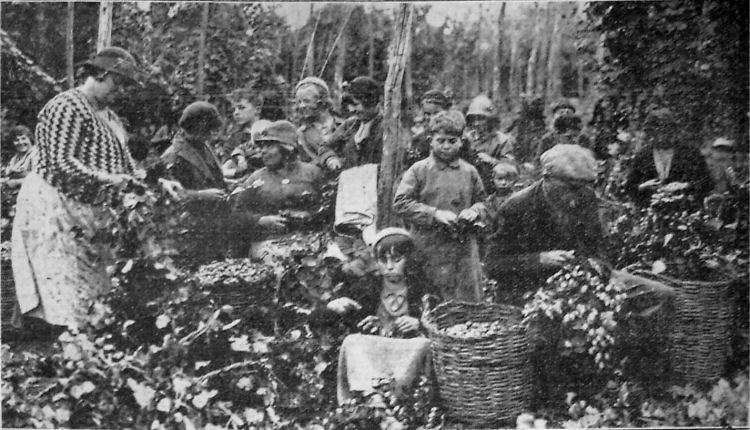
Above photo shows a group of hop-pickers, taken on Tuesday 8th September,
near Ash.
|
|
From the Dover Express and East Kent News, Friday, 25
September, 1936.
FOUR GENERATIONS IN THE HOP FIELDS.
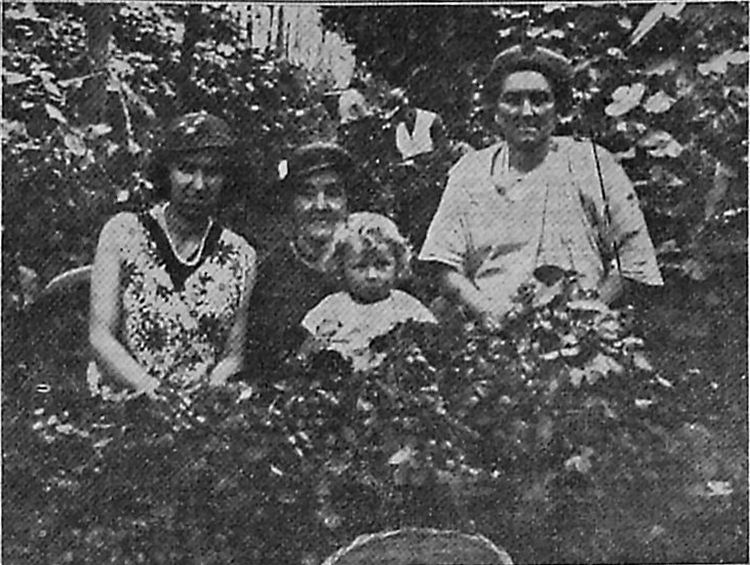
Above photo taken at Selling, near Faversham.
Reading from left to right:- Mrs. Carswell (mother), Mrs. Whiles
(great-grandmother), Joyce Carswell (great-grandchild) and Mrs. Voller
(grandmother). Mrs. Carswell lives at 9, Prospect Cottages, Maison Dieu
Road, Dover.
|
|
Sevenoaks Chronicle and Kentish Advertiser 18 December 1936.
HOLIDAY DRINKS EXTENSIONS IN KNOCKHOLT AND DISTRICT.
At Bromley Petty Sessions on Monday application was made to the
licensing Justices for an extension of time until midnight on Christmas
Eve, Boxing Day and New Year's Eve by the following licensees: Mrs.
Ethel Hazel, "Fox and Hounds," Westerham Hill; Ernest Russell, "Bull’s
Head," Chelsfleld; George Cook, "Black Horse," Biggin Hill; Henry John
Parkes, the "Five Bells," Chelsfleld; Herbert Ashby, "Royal Oak," Knockholt; Thomas Fisher, the "Harrow," Knockholt; and Leon Dupree, the
"Old Jail," Biggin Hill.
Mr. Belshar, who made the application, said that seven other licensees
were concerned in the same district. These houses were outside the
Metropolitan Police area; if they had been under the Commissioners'
supervision no application would be necessary. Last year the applicants
were granted an extension till 11 p.m. on Christmas Eve and New Year’s
Eve. There was, however, a desire among people to celebrate the incoming
of the New Year. With regard to Boxing Day, the Commissioner of Police
took the view that it was a special occasion just as Christmas Eve or
New Year's Eve was.
Inspector Kirby, of Sevenoaks, said he was instructed by the
Superintendent of the Kent County Constabulary to oppose the
applications as an extension of facilities was not needed in rural
areas.
The Chairman (Mr. C. A. Elgood) said that applications would be granted,
but the licensees would have to see that customers were out of the
houses by midnight.
Mr. Beisher suggested that the Justices should make the extension up to
12.15 a.m. for the New Year's Eve occasion. The extra quarter of an hour
would, he submitted, help the licensees.
The Chairman agreed.
The application in respect of Boxing Day was not granted.
|
|

