|
324 London Road and 2 Tower Hamlets Road
Dover
https://www.facebook.com
https://whatpub.com/eagle-tavern
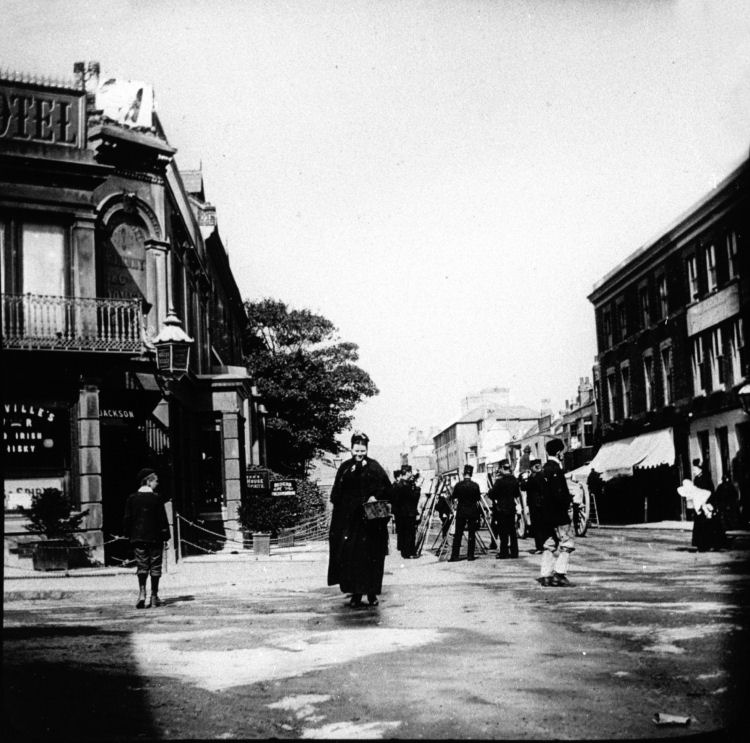
The above photo shows the "Eagle Hotel" before 1900. Just by the
gentleman's head on the right is also just seen the original "Royal
Standard." It also appears as if the pub today has another 2 storeys
added to the one shown here.
|
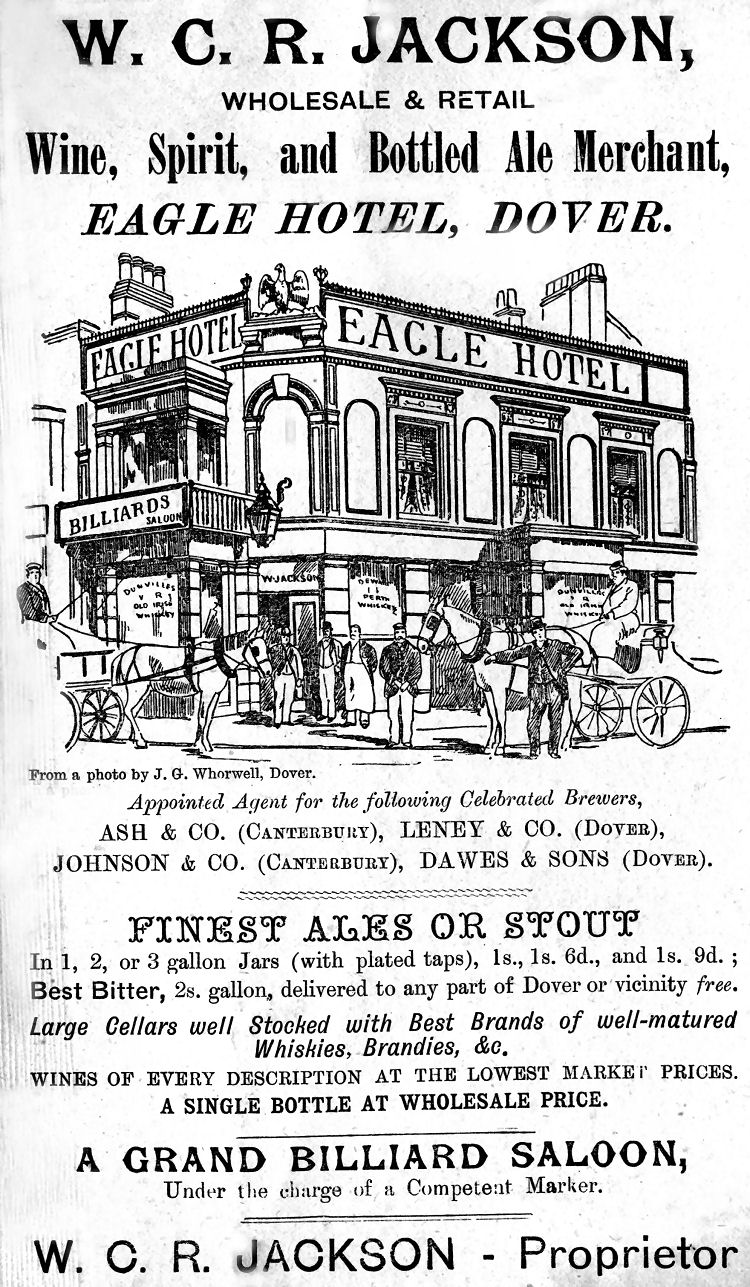
Above advert circa 1890. Kindly sent my Ken Chapman. |
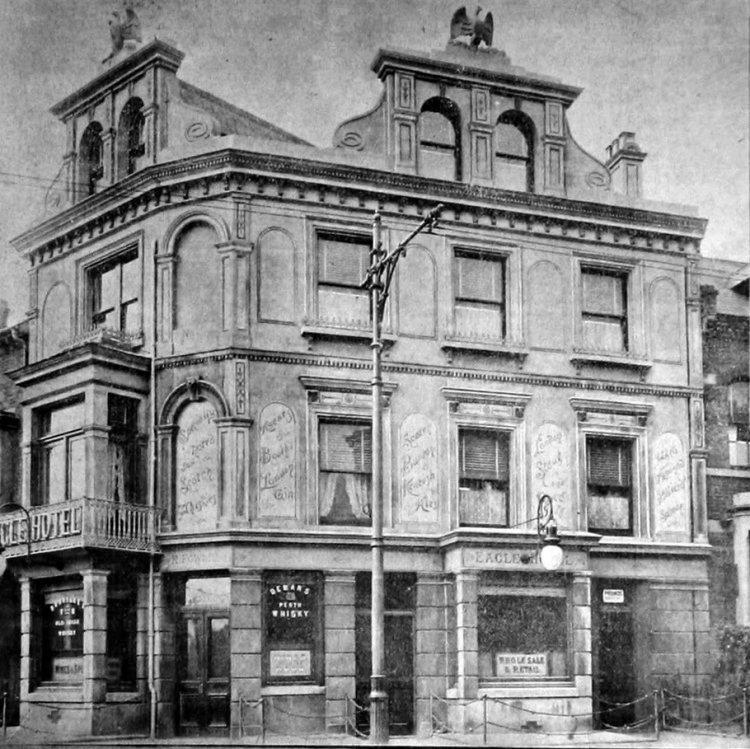
Above photo, stated to be 1 April, 1899, but I think that must be an
April fool joke as I'd say more like the 1920s. I don't believe in the 19th century the
building didn't have the top 2 storeys. Rory Kehoe says that above the
door is the name R Edwards, but I don't have that name yet.
The Eagle had previously sold Ash's East Kent Brewery Ales, from the
Dane John Brewery, Canterbury, which was acquired by Jude, Hanbury's
Kent Brewery, Wateringbury, in 1923. Jude, Hanbury's livery is painted
above the ground floor windows. Jude, Hanbury was acquired by
Whitbread's in 1929, which would suggest that the Eagle went on to stock
their bottled beers, with draught coming from Mackeson's Hythe Brewery.
Given that the Eagle sold a variety of beers, it was likely either a
free house, or leased out to local breweries. The transition from a
Whitbread/Mackeson house in the early 1930s to a Courage pub by 1948
might be explained by this. |
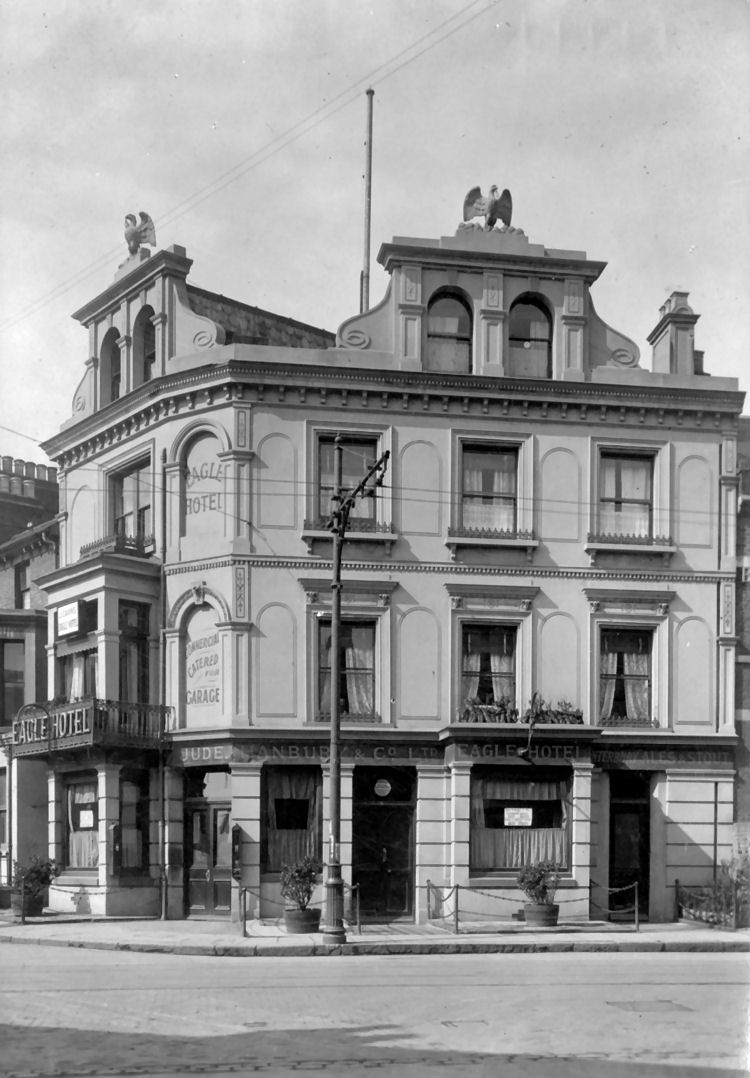
Above postcard postmarked 8th July 1931, probably taken circa 1927. Kindly sent by Graham
Butterworth. |
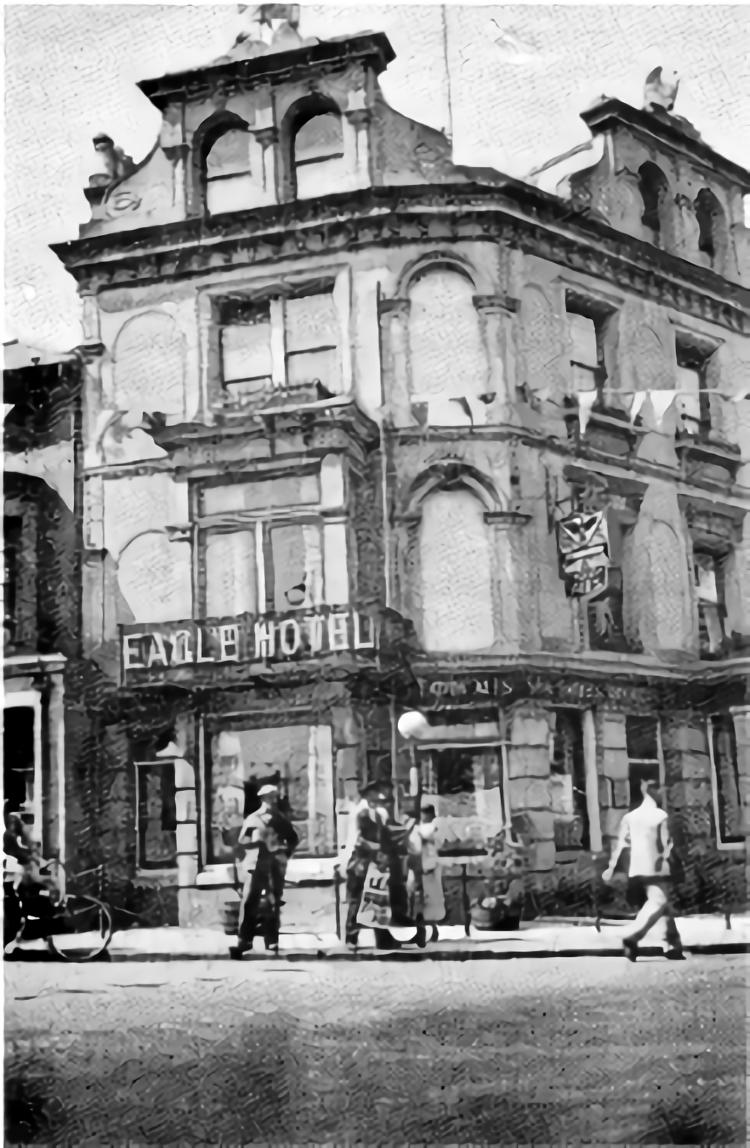
Above photo, 1930s when it was part of the Samuel Smith's chain, so
someone told me, but would they bring their beer all the way down from
North Yorkshire? |
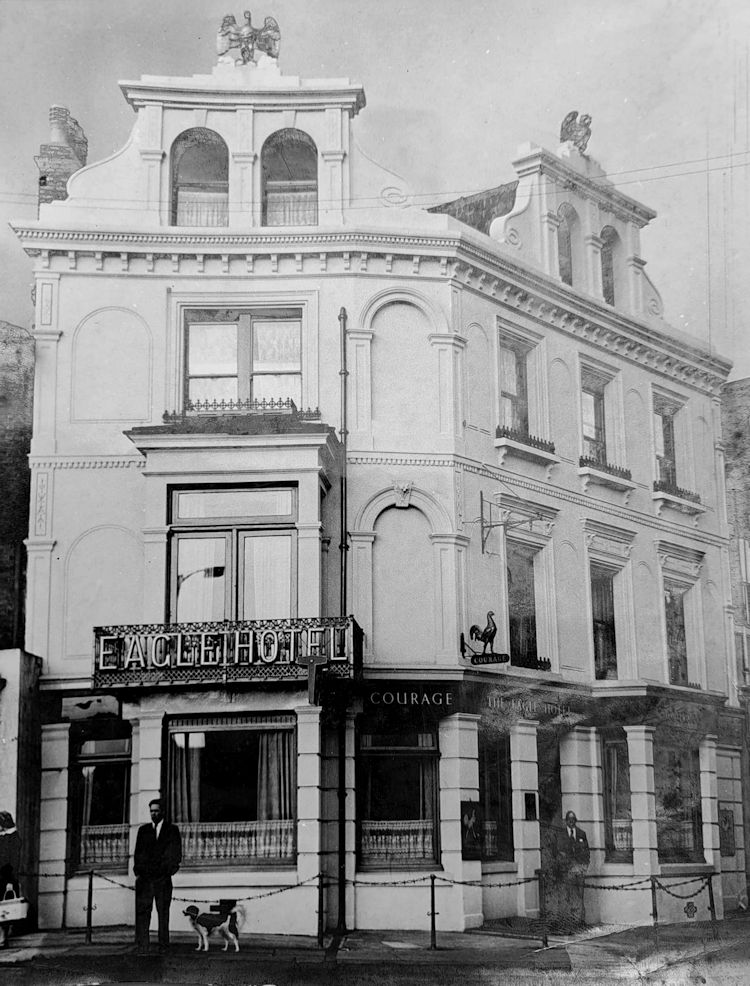
Above photo, 1948. |
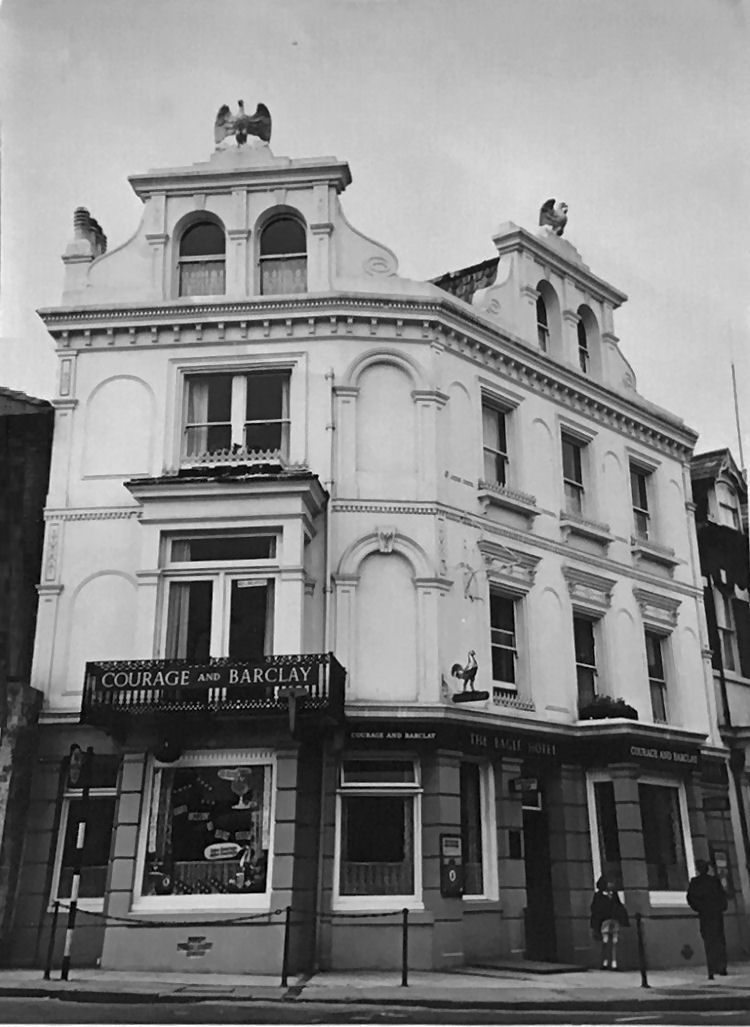
Above photo, circa 1958, kindly sent by Rory Kehoe. |
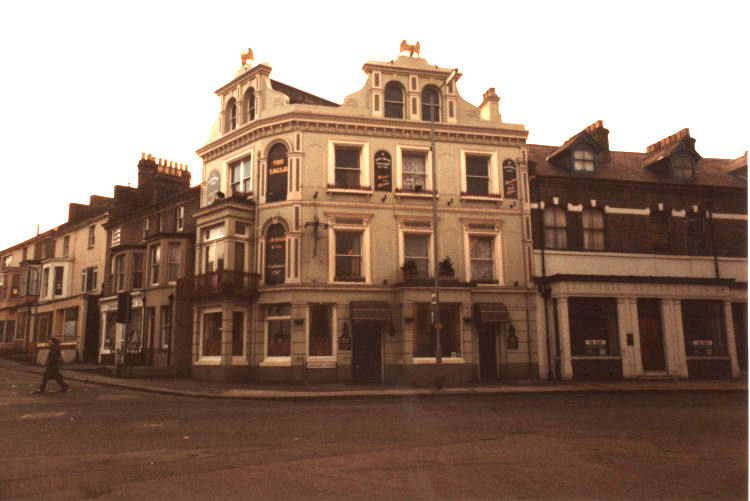
Eagle 1976 (Photo by Paul Skelton) |
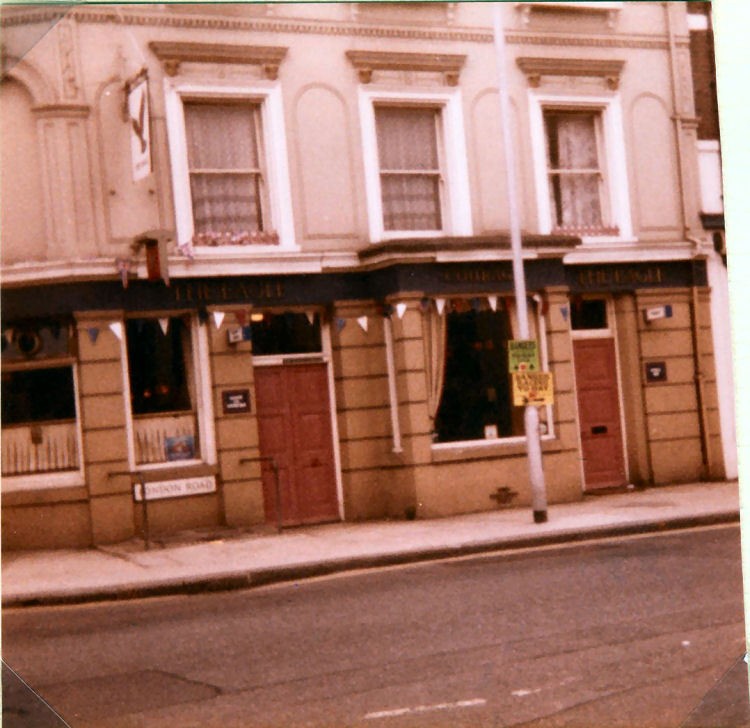 |
|
Above and below Eagle circa 1980 by Barry Smith. |
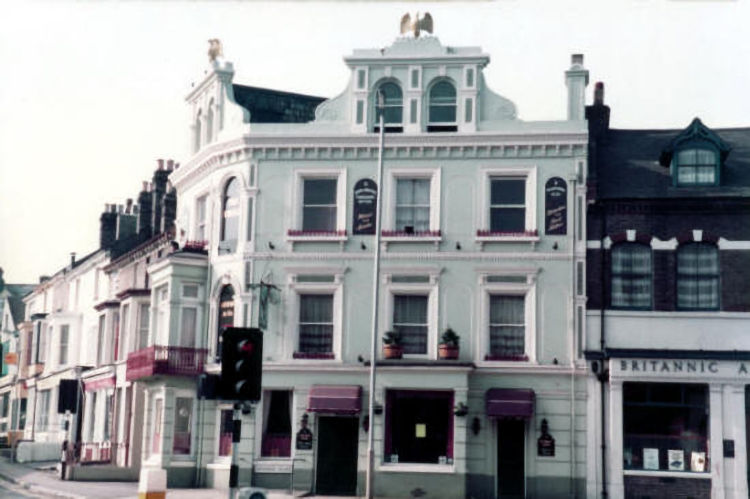
Above photo, 1983. Photo by Eddie Chard. |
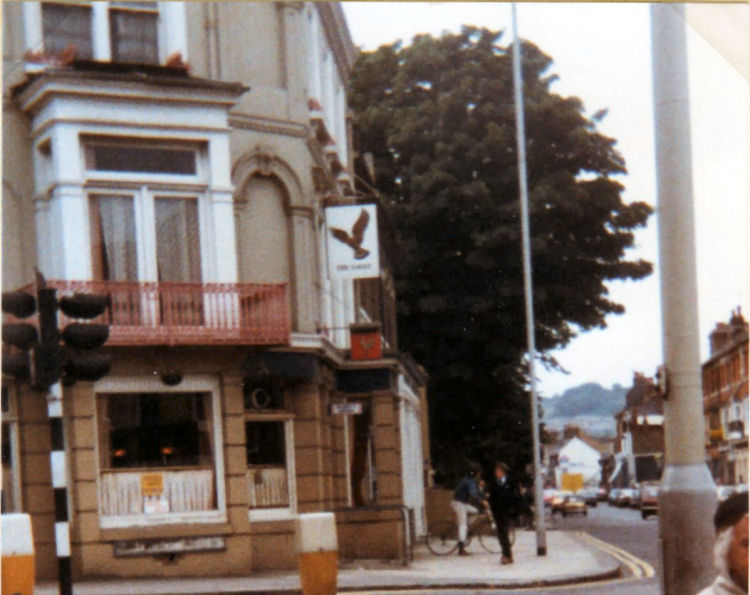
 
Eagle sign left, 1973, sign right 1983.
Above with thanks from Brian Curtis
www.innsignsociety.com |
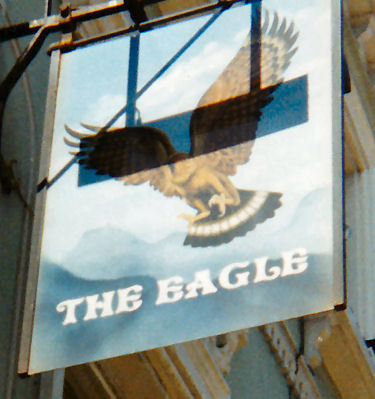
Above sign, August 1990. |
On a commanding corner position, the original was built on the former
site of the "Black Horse", shortly after 1840. It possessed a tea garden but
that attraction was discontinued when it was rebuilt in 1863. Brockman
served in 1843 and might well have been the first to do so.
|
Kentish Gazette, 23 January 1844.
DEATH.
Jan. 13, Mr. J. Brockman, keeper of the "Eagle Tavern and Tea Gardens,
at Charlton,
Dover.
|
|
Kentish Gazette, 13 February 1844.
JOHN BROCKMAN, Deceased.
NOTICE.
ALL Persons indebted to the Estate of JOHN BROCKMAN, late of the "Eagle
Tavern,"
DOVOR, are required to pay their respective debts at our Office, within
one month, or
they will be sued. And any parties who have claims on the said estate
are requested to
deliver particulars thereof at the same office, in order that they may
be examined.
By order of the Administratrix,
KENNNET and SON,
12th February, 1844. Solicitors, Dovor.
|
|
Kent Herald, 30 January 1845.
Rumoured Case of Child Poisoning. Coroner's inquest.
An inquest was held at the "Eagle Tavern," Charlton, on Thursday last, before
the Borough Coroner, on view of the body of Mary James Blythan, aged three years
and six months, whose death occurred under somewhat suspicious circumstances.
On opening the inquiry, the Coroner said to the Jury:- Gentleman, you are called
together to inquire into certain circumstances which have come to my knowledge;
and perhaps you will be satisfied, after hearing the evidence, that death in
this case was purely natural, or perhaps that it resulted from unfair means. The
deceased child died on Monday; and on application being made to have the death
registered, the registrar, Mr. Payn, says he was told that death was occasioned
by inflammation of the stomach - that Mr. Walkings, surgeon, attended it and
that it expired after an attack of illness last in only three and a half hours.
Mr. Payn went to Mr. Watkins, and he informed him that he had never seen the
child; and on seeing Mr. Williams, of the Dispensary, Mr. Pain was informed by
him that he (Mr. Williams) had received intimation that the child had been ill
for a week, and had been vomiting. I have heard a report that the deceased was
not the first child of the same parents who had died from poisoning; and taking
the whole of the circumstances into consideration, I have deemed it advisable to
institute and inquiry into the case.
The witnesses were then called, when Elizabeth Jarvis Blythan deposed:- I am not
married, I live at Branch Street, Charlton, and this child is mine. It was my
first, and I have had two other children, who are both alive, the same man being
father to them all. Deceased was poorly all last week with a cold; but was taken
worse on Sunday night, when it's breath seemed much shorter, as it breathed with
difficulty. I sent for Mr. Watkins, surgeon, about seven o'clock on Sunday
evening, but he was absent from town; and I did not send for another medical man
until Monday morning, when I sent to the Dispensary directly after breakfast. On
the same evening Mr. Williams came about six o'clock; but the child was dead,
having expired between two and three o'clock that afternoon. The child had
nothing more than a common cold, and vomited a little on Monday morning; but
there were no other symptoms of fever or any other illness about her. It was
when I gave her a little of a mixture of syrup of violets and oil of almonds
that vomited. My mother (Maria Smith,) who was with the child when she died,
went to get her death registered; but I do not know what she's said when she did
so. I only gave the child a teaspoonful of the mixture above named, which I
brought at Mr. Ralph's, chemist; and it had two leeches and a mustard plaster
placed on its chest, and that is all the remedial treatment it received. No one
else but myself nursed the child. She was moving about the house the whole week;
but on Monday morning, although she got out of the bed herself, she only moved
about her own room. I now produce the file containing the remains of the mixture
given the child.
Stephen Manser Pain, registrar of St. James's district, including the parish of
Charlton, deposed:- On Tuesday evening, the 21st., a woman named Smith applied
to me to have deceased death registered. She answered the questions I put to her
regularly and satisfactorily till she came to the cause of death, her account of
which was very confused; and after a deal of questioning, she replied that the
child died from inflammation of the stomach, that the inflammation was very
strong, and that the child went off in about three hours and a half, or three
hours. She also said she was present at its death; and I asked her if a medical
man had seen it, when she answered that the disease was so rapid that there was
hardly time for that, but that Mr. Watkins had seen it. On questioning her very
closely, she replied. "I am not positive that the gentleman did see it, but Mr.
Williams of the Dispensary, has seen it." She afterwards explained that he (Mr.
Williams) had seen it while visiting some other members of the family, and that
he had also seen it after its death; and although he had been sent for before
the deceased, yet he had not arrived till it had taken place. She did not
mention at what time it was that he had visited others of the same family. This
was all that passed at the time. Next day I saw Mr. Watkins, who said he had not
seen the child at all during its illness. I afterwards saw Mr. Williams also,
who informed me he had not seen the child till after its decease, but that its,
or of a similar name, was on the Dispensary books. Smith appeared confused while
making her statement as to the cause of death; and not being able to satisfy
myself on that point. I left a blank in the register.
George Edwin Williams, resident surgeon of the Dover Dispensary deposed that he
had not seen the child till after death, but he had only made a superficial
examination of the body, he could not tell the cause of death. There were no
external marks on the body, and the mixture deposed to have been given the child
was harmless.
Maria Smith, the person who went to have the death registered, was examined at
length. Her evidence was corroborated of the mother's, as to the treatment and
illness of the child. she, however, denied having told Watkins, surgeon, had
seen the child, or having stated the cause of death to him to have been
inflammation of the stomach, but rather inflammation of the chest. She farther
denied that she had stated that the child went off in three hours and a half.
She was afterwards recalled, but persisted in her statement, although she
admitted being somewhat confused and unhappy at the time she made them, in
consequence of the neglect of the child's mother in not obtaining medical
assistance in time.
The Coroner, before they proceeded farther, put it to the jury whether they
would have a post mortem examination of the body made, which he considered might
be necessary for the clearing up of all doubts, and for removing the stigma
which might be supposed to rest on the mother from the rumours that had arisen.
The Jury did not consider this necessary; and without a verdict and returned a
verdict of "Died by the visitation of God." \[Without a post mortem examination
the inquest was almost useless.]
|
|
From the Dover Telegraph and Cinque Ports General
Advertiser, Saturday 23 May, 1846. Price 5d.
CORONER'S INQUEST
An inquest was held on Tuesday, at the "Eagle Gardens," Charlton,
before G. T. Thompson, Esq., coroner for the Borough, on the body of
William Wellard, mariner, aged 19.
The first witness was called:
Richard Wellard, father of deceased, who deposed: In September last I
entered my son as cabin boy on board the schooner Falcon, of Whitby. He
came home at Christmas in good health, and he then wished to be
apprenticed on board the same vessel. On Saturday last he again
returned, when, from his altered appearance, I scarcely knew him. The
next day finding him very ill I sent for Mr. Walter.
Elizabeth Wellard, wife of last witness, deposed: When deceased came
home he complained of being ill and said he had been put on shore from
his vessel at Deal. He said he had not been allowed to write home, but
did not otherwise complain of ill-treatment.
John Walter, surgeon, deposed: I was on Sunday called to see
deceased, who was then in the last stage of low fever, of which he died
the following morning. He complained on no pain in his back, nor did I
discover any marks of injury or violence on his person. Under an attack
of fever a person ought to have been kept perfectly quiet, and not
exposed to the weather or work.
The jury here expressed a wish to have evidence of the treatment the
lad had received on board, for which purpose the enquiry was adjourned
till the following day, and the coroner issued his warrant for the
attendance of the master and crew of the vessel.
ADJOURNED INQUEST
The jury re-assembled on Wednesday, when the first witness called was
John Hawkesfield, seaman on board the Falcon, who deposed: On Wednesday
last deceased complained of a sore throat, and on the following day a
pain in his back, which he said was caused by a cork fender falling on
him. He appeared to suffer from cold, and I told him to take some nitre. He was worse on Friday, and was at his own request discharged from the
vessel. The captain took him ashore at Deal in his own boat. I did not
hear him complain of illness, or wish to be put on shore before. He
never asked to write home. I never saw him ill-treated, but he was very
dirty, and would never clean himself. He would have gone ashore at Deal
in his shirt sleeves had I not given him fresh clothing. The captain was
always kind to him, and I only saw him strike him once slightly for
eating some sugar. We put into Dover harbour on Saturday last,
wind-bound, and sailed the following Monday.
Thomas Bingham, jun., master of the Falcon, deposed: Deceased had
sailed with me since the first of March last. He did not complain of any
illness till Sunday week, when he said he had a sore throat. The vessel
was then at Middleborough, and he ate a hearty dinner on that day. On
Thursday he said his throat was still troublesome, and I gave him some
rhubarb, that being the only medicine I had on board. We made the Downs
on Friday last, when deceased wished to be discharged, and I sent him
ashore at Deal the following morning. He walked up the beach, but
appeared weak. I saw him put his hammock into a fish cart, and he said
he was going to ride to Dover. I did not know his father lived in Dover.
He never asked to go on shore, and was not prevented from writing home.
I never struck him with a ropes-end, and he appeared satisfied with his
berth.
The jury after a short consultation returned a verdict "that deceased
died from natural causes," and added, that there was no imputation
against the character of the master.
|
|
From the Dover Telegraph and Cinque Ports General Advertiser, Saturday, 17 April, 1847. Price 5d.
CORONER'S INQUEST
On Monday afternoon an inquest was held at the “Eagle Tavern,” Charlton,
before G. T. Thompson, Esq., Coroner, on the body of Charles Wilson,
aged 4 years, son of Stephen Wilson, labourer, in the employ of Mr.
Joseph Walker, and whose death was occasioned by his clothes having
caught fire. The Jury having been sworn, the body was viewed, after
which the following evidence was adduced:-
John Young, labourer, deposed: On Sunday morning last, at 8 o'clock, I
heard children screaming, and on going into Wilson's house I saw a child
with its clothes in flames, which I immediately extinguished, and took
off the remains of its dress. There were only two other little children
in the room. There were some scorched peas strewn on the floor.
Edmund Bath, stoker at Mr. Brock's mill, deposed: While at breakfast on
Saturday morning I heard children screaming, and on looking out of the
window was smoke coming out of Wilson's door. I ran across, and on going
in saw Young wrapping a baize cloth round deceased, and on assisting him
in pulling off the burnt clothes.
Mary Wilson, mother of deceased, deposed: On Saturday morning I left
home a little before 8 o'clock, to take my husband his breakfast. He was
working at Mr. Walker's mill, at Finnis Hill. I left deceased in bed
asleep. The other boy, aged 6 years, was up; and I left the youngest
child in a chair for him to take care of. When I returned I found
deceased had been burnt. He lingered till 8 o'clock in the evening, when
he expired. Deceased could not dress himself, but his brother had been
taught to do so. About 12 months since I found the children playing with
matches. I corrected them, and have not seen them do so since. I cannot
say how the accident originated. The eldest boy told me that he went
next door to buy a farthing's worth of scorched peas.
Verdict. – Accidental Death.
|
|
From the Dover Telegraph and Cinque Ports Advertiser, 6
January, 1849.
Thomas Saunders, a shoemaker, was charged with carrying off a
beer glass from the Eagle Tavern, Charlton. From the evidence, it
appeared that several young men were drinking at the "Eagle" on the
previous evening (Sunday) and having broken two glasses, they were
hidden to prevent discovery of the damage, one of them being
pocketed by Saunders. - Ordered to pay the cost of the glasses and the
summons.
|
|
From the Dover Telegraph and Cinque Ports General Advertiser, Saturday 20 November 1852.
Eagle Gardens, Charlton.
Foord's Eagle Gardens open on Tuesday, November 23rd and continue during
the fair.
Talented quadrille band will be in attendance.
Refreshments of every description of first-rate quality, at moderate
charges. Good fires and good order will be constantly kept. Dancing to
commence at 8. Admission 6d.
|
|
Kentish Gazette, 9 May 1854.
Coroners Inquest.
On Saturday evening last a coroner's inquest was empanelled at the
"Eagle Tavern," Charlton, before G. T. Thompson, Esq., the coroner for
the borough, to enquire into the circumstances connected with the death
of a child aged six months, named Ann Maria Hearn, whose parents resided
in Bridge Street, Charlton.
It was stated that death had occurred from suffocation, it appearing
that the child had been laid in a bed by the person in whose charge it
had been left, and who upon going to it some time afterwards found it
had sunk below the bed clothes, and was just breathing its last. From
the evidence that was adduced, it appeared that the parents of the child
occupied a house jointly with a Mrs. Farr, and that the mother of the
deceased on leaving home on the morning of the occurrence left the child
in Mrs. Farr's charge. It then appeared in good health. The mother also
stated that it was a healthy child, and was generally well.
Mrs. Farr said that she laid the deceased down about half-past 11
o'clock the same morning, and on going to look at it an hour and a half
afterwards found that it was just expiring. She immediately called in a
neighbour, in whose arms the deceased breathed its last.
K. T. Hunt, Esq., the parish surgeon, who it appeared had been called
in, was here examined as to the cause of death; but being unable to
state positively upon this point, the jury adjourned till the following
Monday, in order that a post mortem examination might be made in the
interim.
Upon again assembling on Monday, Mr. Hunt, being recalled, said:— I
yesterday made a post mortem examination of the deceased child. From the
large size of the head my attention was first drawn to the necessity of
opening it; and on removing the skull-cap I found the membranes of the
brain very much thickened, the substance of the brain highly congested,
and the lateral ventricles containing a large quantity of fluid. Such
appearances would occasion convulsions, which would result in death. I
examined the chest. The lungs presented a very healthy appearance,
indicating that the child did not die from suffocation. The heart and
all the other organs were healthy, and presented a natural appearance. I
attribute the death of the child to convulsions arising from the state
of the brain.
The jury, without further deliberation, returned a verdict of "Died from
natural causes."
|
|
Kentish Gazette, 6 January 1857.
In Re Foord.
The bankrupt, who was a licensed victualler, of the "Eagle Tavern,"
Charlton, near Dover, applied in the Bankruptcy Court on Tuesday to
pass on accounts showing debts, £1,526; assets, £472. The bankrupt
passed.
|
|
From the Dover Express and East Kent Intelligencer, 2
October, 1858.
DOVER COUNTY COURT
DOVER GAS LIGHT COMPANY v. THOMAS SMITH-FOORD'S
BANKRUPTCY
There was a claim for £11 2s. 1d. for gas supplied to the "Eagle
Tavern," Charlton. Mr. Fox appeared for the plaintiffs, Mr. Elwin for
defendant.
Mr. R. H. Jones, one of the managers of the Dover Gas Light Company,
stated that at the end of the year 1856, a Mr. Foord was in occupation
of the "Eagle Tavern," Charlton, but in the beginning of 1857, the Gas
Company having threatened to cut off the supply, Mr. Smith, the
defendant, requested, that it might be continued, and guaranteed payment
of the debt due. Foord renewed his occupation in the following February,
and had since kept the gas account paid up.
Mr. T Winterbourn, collector, in the employ of the Gas Light Company,
corroborated the statement of Mr. Jones as to Smith's admission of his
ability and his promise to pay the claim due by Foord.
Mr. Elwin, for the defendant, contended that although the trade
assignee of Mr. Foord he was not liable for the debts of the bankrupt.
He called Mr. Smith, who denied that he ever became liable for Foord's
debts. All he promised to the Gas Company was that if he got the money
out of the Bankrupt Court he would pay them.
Verdict for defendant, with costs.
|
|
From the Dover Express. 1861.
Juvenile Pickpockets.
Ellen Goldfinch and Barbara Duff, two girls one nine and the other 10
years of age where charged with picking the pocket of Mary Garlinge wife
of William Garlinge, New Street, in the Eagle Gardens, Charlton on
Monday. It appeared that “Charlton Fair” was held at the Eagle Gardens
on the evening in question.
Complainant went into the gardens and shortly after coming out she
missed her purse containing a florin and some other coins together with
four or five pawnbroker's duplicates. She remembered pulling out her
purse shortly after getting into the gardens and was positive she
replaced it in her pocket.
The prisoner Goldfinch was apprehended by P.C. Terry on Thursday
afternoon in Limekiln Street and on being told by the constable of the
charge against her she said “Yes Barbara Duff told me to take it.” She
first put her hand in but would not take the purse out. I then put my
hand in and took the purse.
Mrs. Garlinge was with the constable when this took place and nothing
was said to induce the child to make the confession. She was afterwards
taken to the Station House and on the charge being read over she again
admitted that she had taken the purse out of the complainant's pocket.
Terry afterwards apprehended the prisoner Duff at a house in Church
Street. She said she did not take the purse but that she had one
duplicate which she had torn up and part of the money. She also repeated
this statement on being cautioned in the usual way at the Police
Station.
Supt. Coram in reply to the magistrates said the girl Goldfinch was
brought before the Bench three years ago charged with pocket picking but
she was then only six years old, and in consequence of her tender age
the charge was not pressed. In the interim there had been some complaint
made against her by her schoolmistress but it was not gone into. The
prisoners both pleaded guilty and the Bench in sentencing them to seven
days imprisonment censured their mothers who were both present for the
want of care they had manifested in the control of their children. The
magistrates also said they were of the opinion that Mr. Foord the
proprietor of the Eagle Gardens, was much to blame for permitting the
“fair” to take place on his premises and intimidated that the
circumstances would not be forgotten when he applied for renewal of
license.
Information kindly supplied by Joyce Banks.
|
|
From the Dover Telegraph, 3 January 1863.
ROBBERY AT THE EAGLE GARDENS.
Fanny Blunt, 21, described as a servant, pleaded "Not guilty" to a charge of
stealing a porte-monaie, containing 9s., on the 2nd Dec., from the person of
Elizabeth Finlayson, at the "Eagle Gardens," Charlton.
Mr. Addison, for the prostitution, stated that in the neighbourhood of Dover
there was a place called the "Eagle Gardens," where there was a dancing hall, to
which the youth of both sexes were accustomed to repair for the purposes of
recreation and refreshment. It appeared that the prosecutrix had visited this
place in company with some of her companions and after exercising herself for
some time, she became, as ladies were sometimes in the habit of doing in
ball-rooms rather giddy, and a faintness ensuing, she was taken into the garden
and laid upon her back upon one of the seats; where, in the course of a few
moments; all material object gradually receded, and she remained insensible for
some time — she either went to sleep, fainted, or something else — it would he
impossible to say at that moment what! Upon coming to, she found herself
surrounded by three or four young ladies, who were rendering her assistance; and
as she recovered, she became distinctly sensible that some one was removing her
purse from her bosom. When the party returned to the saloon, it would seem that
the doors were closed, and a search was made in the pockets of the young ladies
for the missing purse: but Fanny Blunt for some time refused to let her pocket
be examined. At last she did so, but no purse was found; and whilst searching
the bosoms of the other young ladies, prosecutrix saw the prisoner remove her
hand from the top part of her dress towards her pocket, and immediately pounced
upon the purse she had lost, minus 4s.
These facts having been sworn to by Elizabeth Finlayson, of 3, Queen Street,
p.c, Williams proved the apprehension of the prisoner at the "Sportsman,"
Charlton Green.
Verdict:- "Guilty".
The prisoner’s mother was severely censured for living upon the proceeds of her
daughters' vice — one of whom had died in a dreadful state of disease, and the
Recorder having sentenced the prisoner to four calendar months hard labour urged
Finlayson, who stated that she had left her parents in Glasgow and gone to
London as a nurse, to accept the refuge of the Female Home, and so avoid the
misery of her life and an early grave.
The girl resolved upon embracing the offer, and a private conference ensued at
the adjournment of the Court.
|
|
From the Dover Telegraph, 17 January 1863.
STONE v. MONTI.
An action to recover £9 2s. 0d. for damages occasioned to a dog-cart in
consequence of defendant's alleged negligent driving on the Crabble Road, on the
3rd Sept., 1862.
Mr. Minter appeared for the plaintiff and Mr. Towne for the defence.
Mr, Minter having opened the case at considerable length called Robert Stone,
who said:- I am a draper's assistant living at Dover. On the 3rd of last
September I drove some friends in a dog-cart to Shepherdswell, and we left that
place to return to Dover about four minutes after eight o’clock in the evening:
it was so light that we did not require lights. A young man named Prentice (who
had his leg broken) was sitting on the front seat with me, and a young lady and
another young man on the seat behind. I am quite used to driving, and have had a
great deal of it. When we arrived at Buckland Bridge, and within a very short
distance of it, a collision took place with a cart driven by Mr. Monti. At the
time, I was driving at the rate of about four or five miles an hour: I ran down
to within a foot of the kerb, on the near side of the road, which is from 20ft
to 25ft. wide. Defendant was coming out of Dover and I was corning in — he was
on his wrong side of the road. I cannot say at what pace he was going. because I
did not see him until he was into me: he was driving a two-wheeled cart, and his
wheel took my shaft on the off-side. The young lady and the young man thrown out
— one on to the kerb, and the other a little way off. I did not see the position
of them myself. I was throne out I saved myself by catching hold of the
splashing board. When I had stopped the horse some little distance on, the first
thing I did was to see what injury was done to the vehicle.
His Honour:- Not to the people who were thrown out?
No Sir.
Mr. Minter:- What did yon next?
Then I went to see about the cart, and spoke to the defendant.
What state was he in?
He was tipsy.
His Honour:- What was he doing?
Taking his horse out - the horse was down.
Mr. Minter:- What distance did you go before you stopped your horse?
About the length of this court.
Cross-examined by Mr. Towne:- When I went back I asked Mr. Monti whether he was
the owner of the trap and he said he was. It was then upon the ground, on one
wheel and with the other high up in the air. I do not know whether the wheel of
the cart caught the wall. I saw some lucifers alight in the road. I do not know
whether the cart was much damaged. I do not know Mr. Walker.
Is he not one of your witnesses here to-day?
I believe he is. Who passed him as we were coming down the hill just before the
accident happened.
When you passed him, I believe you were in the middle of the road?
Driving in the country and driving in the town are two different things.
How far was Monti's cart from the side when you saw it overturned in the road?
About 15ft, or 20ft.
Will you swear to that?
No, I should not like to do so.
By Mr. Minter:- What I moan by "a difference driving in the country and in the
town," is that I take any part of the road in the country that is clear, to
avoid ruts, but when coming into a town, I always keep my right side in case
anything is coming along, I am always very particular about this.
Mrs. Mary Stone (of the "Angel" Charlton) remembered seeing Monti and a man
named Tupsell at her house on the night of the accident. They had two glasses of
ale; Mr. Monti paid for them, but did not drink his.
Mr. Minter:- Now, was Monti sober or drunk at the lime?
Drunk, sir.
Mr. Towne objected to “leading question."
His Honour:- What condition was Monti in when he was at your house?
Drunk, sir.
What makes you think so?
The way in which he stood against the bar; and he reeled when he went out.
Mr. Minter:- You made a remark to Mr. Tapsell about him as he went out, did you
not?
Mr. Towne:- Really, I must object to such a mode of questioning. One would fancy
you did not know the rules of evidence.
By His Honour:- We live about a mile from the spot where the accident happened.
By Mr. Towne:- It was a little before nine o'clock, when Mr. Monti left, but I
did not particularly observe the clock.
Your husband is a publican, I believe?
Yes; he is ill, or he would have attended to-day.
I have no doubt! Now, are you in the habit of serving drunken people?
If a man of a particularly low older came in drunk, I should not serve him; but
when a person seems a little bit respectable, and is along with another, I
should not refuse.
I do not know what the magistrates would think of that evidence!
John Stone (living at Mr. Norman’s, Woolcomber Street) corroborated this
testimony.
Mr. Minter:- What condition was Monii in?
Intoxicated.
John Williams, a shoemaker, also deposed that defendant was "tipsy" when he saw
him and Tapsell at the "Angel."
His Honour:- Where was his carriage all the time?
I don't know: I did not go out to see him go away.
Mr. Towne:- What made you think he was drunk?
Why, he couldn't stand steady without holding on to something.
You did not see him drive away?
It was no business of mine.
I am surprised you make it your business to know so much about it now! How long
were you in the house?
Five or ten minutes, perhaps a quarter of an hour.
How did you know of the accident?
When I re-turned from Dover, Mr. Stone told me his son had met with an accident.
What time was that?
I don’t know — it might be seven, eight, or nine o'clock.
By Mr. Minter:- But I am certain I saw Monti there, and that he was drunk.
George Bowles, a police constable, saw Monti driving along the High Street,
Charlton, between the "Angel" and the "Eagle" towards Buckland, the horse was
going as fast as it could, but defendant was cutting into it with his whip. He
spoke of the circumstance when he went down to the station house about ten
o'clock.
Cross-examined by Mr. Towne:- I did not make a report in writing; it is my duty
to do so, but I neglected it — I spoke of it, and that is the same thing. I
ought to have summoned him for furious driving.
Thomas Bewse, a labourer, saw Monti whipping the horse about a dozen rods from
the spot where the collision took place. He was drunk. Witness did not see the
collision, but hearing the noise, ran up and helped to get the horse out of the
cart, which was lying in the middle of the road.
Cross-examined by Mr. Towne:- I helped Monti hold the horse down; he kept
bundling about between the horse’s legs. I stayed there about two hours.
William Godden, a gardener, living at Chapel Mill, whilst walking home with his
wife, saw defendant driving very fast, about five or six rods from Buckland
bridge; he was first on one side of the road, then the other. When he heard the
collision, he ran to the spot and afterwards went for a doctor. Monti was drunk.
His Honour:- What makes you think so?
He was falling about, all over the place.
Mr. Towne:- That was after you fetched the doctor?
Yes.
Mr. Minter:- You had a difficulty to get out of his way when he drove past?
Yes, I was crossing the road, and had to get back again pretty soon.
William Knott, a labourer, living in a collage opposite the spot where the
collision look place, had gone to bed, but he run downstairs immediately. They
were bringing in the young lady as he got down, and the young man who had his
leg broken was lying right up against the window of the house, close to the
wall. Monti's cart was upon its left side about 3ft. from the wall, and
everything was shot out of it. Monti was very drunk — he was tumbling about over
his things as he was picking them up, and making use of very bud language.
Pater Beer deposed there wag plenty of room to walk round the cart after it
fell. He helped haul it up, and one wheel was within 4ft. of the kerb on the
right hand going from Dover. The accident happened at ten minutes to nine
o’clock.
Henry Walker, clerk to Mr. Percy Claris, solicitor, saw the plaintiff driving
very steadily in the middle of the road, 300 or 400 yds. from where the vehicles
came into collision.
Mr. Minter:- What condition was Monti in?
Well, he was drunk; I avoided speaking to him.
I believe you are a friend of Monti’s?
I am.
What condition was Stone in?
Sober.
By His Honour:- I thought there was no occasion to speak to Monti, seeing he was
tipsy.
William Birt and Miss Swaffer, who were seated at the back of the dog cart, gave
corroborative statements to the foregoing; and Albert Masey (who was passing
shortly after the accident) heard several broken sentences, one of which was
something about going to h---, from Monti, who was evidently intoxicated.
Mr. Edward Hills, coachmaker, Castle Street:- I was on my way to my residence,
Whitfield, and arrived at the spot shortly after the accident had occurred. I do
not know much about the position of the cart, but the goods were scattered about
in the middle of the road: they were small and light parcels.
Mr. F. Packham, livery stable-keeper, Townwall Street, the owner of the horse
driven by Stone, remembered that the animal was very "cool and comfortable"
half-an-hour after it was returned to the stable. Mr. Stone frequently hired
horses of him.
This being the case for the prosecution, Mr. Towne addressed the jury at great
length for the defendant. They had all of them had some experience in
running-down cases, collisions. &c., and these cases were generally tarnished
with a great deal of improper evidence. He might have great difficulty in
pointing out clearly to them the errors into which the plaintiff had fallen, but
he could assure the jury with the greatest confidence that this was a very
improper case to come into court — that the plaintiff had entirely mistaken the
law, and there was not the slightest occasion or pretence for an action against
his client.
If the "tables had been turned" it would have been more clearly shewn that the
plaintiff (Mr. Stone) was liable to a far greater amount for the damage done to
Mr. Monti, a very humble tradesman at Sandwich.
The plaintiff had himself stated that it was a very fine moonlight night, and
how was it Mr. Stone was not able to keep a sharp look out? Instead of that he
had told them that he had not seen Mr. Monti until he was close into him, and at
the spot where the collision took place, one might see for at least 100 yards.
Then again, plaintiff's own witness (Walker) saw them driving in the very centre
of the road. There was another important matter for the jury especially to bear
in consideration, and a fact that would clearly satisfy them on which side the
charge of fast driving belonged. It was in evidence that the dog-cart left
Shepherdswell at 8.10, and two or three witnesses had said the accident occurred
at 8.50. Bowles, the policeman, had seen Monti driving furiously, galloping as
fast as ever he could go, at 8.30; but had he been walking the half-mile
Buckland-bridge is from the "Eagle" he would have reached the place before ten
minutes to nine — the time Peter Beer had declined the collision to have taken
place.
His Honour:- I have not a note of that evidence.
Mr. Towne:- I am lorry for that — the witness distinctly said so.
His Honour:- Perhaps in his cross-examination but not in chief.
Mr. Towne submitted that any matter favourable to his client that had fallen
from the lips of plaintiffs own witnesses was his indisputable right; and they
had shewn that the distance from Shepherdswell to Buckland, only six miles, had
been done at a "nice cosy pace" by four persons in a dog-cart, in thirty or
five-and-thirty minutes! He did not know much about the laws of motion, but he
thought the result of the collision would prove who was during at a furious rate
and who was not. The defendant Monti had a very large, heavy spring cart, and
there is no question but that had he been travelling furiously his heavy vehicle
would have smashed the dog-cart into shivers; but from the circumstance that the
dog-cart was able to go on its way (he had almost said "rejoicing"), that fact
alone proved where the momentum was; for if a weaker vessel was at any time
driven against a stronger one, it invariably realized the old proverb "the
weakest went to the wall." But in this instance, the strongest went to the wall,
and the dog-cart went fifty yards before it could be pulled up. No doubt
plaintiff had tried to stop himself soon as possible, but he was unable to do ho
sooner in consequence of the speed at which he was going. Having heard these
remarks upon the evidence as to the width of the road and the speed of the
vehicles, he thought the minds of the jury must be very much relieved as to the
necessity for their entering into any consideration as to the charge of
intoxication — such charges made a very awkward impression, and as they had been
pressed in the evidence, it would be his duty to rebut them in the best manner
he might be able, it was a very easy thing for witnesses to come up and say that
a man was intoxicated, but he must ask the jury to bear in mind that some of
those witnesses had seen Mr. Monti before the accident and others had seen him
after the collision, when Mr. Monti had been nearly killed - after he had had
his head Knocked against a wall and been almost crushed by a wheel — when he was
suffering pain, and in a high state of confusion! It was not the coachmaker's
bill, or whether he should pay £5 or £9 he was contesting, but if a verdict were
given for this amount it might be taken as a precedent for another jury, and
others might come upon his unfortunate client and ruin him entirely. Many
witnesses had been called up - what for? — to prove drunkenness — to damage the
defendants case; he denounced it as foul conspiracy. But it was not because a
man was drunk he was to be held liable for damage from a collision — he might be
an drunk as "David's sow," but that was not the question for the jury to
determine; it might be a question for them whether his drunkenness had placed
him in such a position as led to the accident; but the witnesses were like the
North and the South in America, entirely at variance, and he thought very little
reliance was to he placed upon the evidence as he had said, the whole case had
more the appearance of a conspiracy than anything else. Taking, however, such
portion of the evidence as related to the position of the vehicles, the jury
must see that Monti was on his right side of the road, the exact width of which,
at the spot where the accident occurred, was 23ft. 4in., and whether drunk or
sober, everybody knows exactly how much of the road we were entitled to — one
half. Mr. Hills, like a respectable witness, would have nothing to say as to the
position of the cart; but where did he say the snuff-boxes and parcels were? Why
just in the middle of the road! Notwithstanding the violence of the concussion,
he would submit to the jury, as these light parcels did not come further than
the middle of the road, this was an additional proof that the cart was on its
right side. With so large a number of witnesses as had been called to support
the plaintiff's case it was impossible for them to keep in the truth — it was
sure to out — and here was the advantage of having the witnesses out of court.
He then compared the evidence given by Knott and Bewse as to the distance the
cart lay from the wall, and calculating the wheel at 5ft., the width of the cart
at 5ft. 6in., and the distance from the wall at 2ft., making a total of 12ft.
6in., the jury would readily see that the dog-cart had ten or eleven feet of
clear road to have passed through upon, had it been on the proper side. What
then had the dog-cart to complain of it? A bar of iron running round Mr. Monti's
cart was also broken on the left aide against the wall, and here was another
proof, he hoped, to their satisfaction. Commenting upon the expletives used by
Mr. Moti in a moment of excitement (which his learned friend Mr. Minter had had
the bad taste to have repeated by the witnesses), he remarked that Mr. Monti was
not too drunk to give his name and address when Mr. Stone went up, and ran him
through the catechism of "Who are you? What’s your name?" and "Where do you come
from?" These questions were properly replied to; and this went far to prove that
the charge of drunkenness was pure fiction! The evidence of the witnesses upon
this point was not at all consistent, and taking the evidence of the landlady,
who thought he was drunk because he was leaning up against the bar, it was an
exceedingly unfortunate thing for a man who may have been canvassing or running
about after his business the whole day, if he should happen to be seen leaning
against the counter or against a post, to encourage his laziness, it he was to
be judged in that manner. He thought, if the magistrates had heard that
evidence, it would have been conclusive that the landlady was supplying liquor
to a person who had already had enough; certainly, she did attempt to qualify it
afterwards by saving something about not letting vulgar people have any more;
but supposing the customer to be a gentleman it would seem they imagined he had
a right to call for as much as he liked, and to get as drunk as Chloe, if he
pleased; at any rate, the very fact of his not drinking the ale when it was
drawn was not the act of a drunken man — nor was his determination to proceed
home, when they wished to detain him to be taken for such. There was another
remarkable incident to which he begged the jury to direct attention: Bowles and
Godden had declared upon oath that Monti was driving furiously, and the former
had admitted that he did not do his duty in not summoning him — it was much to
be regretted that hardly a case came on in any court in which a policeman did
not come up to garnish it in some shape or another; and he submitted that a man
driving at the furious rate Monti is represented to have done would not be
likely to escape with a chance of being brought up, for the police are always
ready to bring custom to their shop, in this town as in others. He should,
however, shew by perfectly disinterested witnesses who, unless they came there
for the mere purpose of condemning their souls hereafter, by a falsehood, would
shew that just previously to the accident, and within a few feet of the spot
where the collision occurred Mr. Monti was seen walking slowly over Buckland
Bridge. Only two witnesses had alluded to the speed at which he was travelling,
and that was at a considerable distance this side of the bridge, so that after
he had escaped the clutches of the policeman, and had not been booked in the
manner he ought to have been, he appears to have come upon a locus poenrtentice,
as the lawyers might say. Mr. Monti would himself tell them that he had had an
accident, and sustained serious damage, but he would also tell them distinctly
that he saw the dog-curt coming down upon him, and halloed out to those in it,
but before they could check the speed they were into him. Now, if half the road
was not enough for them, then they ought to take the consequences for running
against defendant. He quoted Cotron v. Wood (Law Journal, vol. 29, 1860) to show
that where injury had not been proved through negligence the judge would not be
justified in leaving the matter to the jury — there must be a well-defined proof
of negligence; and further, the law had said, that where evidence was balanced,
the plaintiff should not recover. He had been anxious in dealing with this case,
because if the jury gave a verdict for £9, another might give a verdict lor
£900. The question of "tipsy or not tipsy" he trusted the jury would at once
discharge from their consideration — the witnesses had taken advantage of an
unfortunate injury and a moment of excitement, and when Mr. Monti was trembling,
and shivering and shaking about from the effects of the injury he had received,
they had attributed it to drunkenness, and most uncharitably so.
He called Mr. Monti (the defendant), who said:- I am a tradesman at Sandwich. At
the time the accident occurred, it wanted about seventeen minutes to nine
o’clock. I was alone at the time the cart turned over against the wall; my knee
and head were hurt very much; I cannot kneel at the present time, and had it not
been for my hat, I believe the blow would have killed me. My cart had a strong
iron rail round it, and this was broken on the left side. My wheel was about
4ft. from the wall, when the wheel of the dog-cart got under my axle.
Mr. Towne:- And when your wheel fell against the wall, that shoved the cart out
a bit, didn’t it?
Yes.
Mr. Minter:- Well! a very nicely told tale, Mr. Towne! You complain of my
"leading questions!"
Mr. Monti:- I called at the "Prince Albert" on my way home; Mr. Foster is a
friend of mine, and had paid me some money during the day. After that I went to
the "Angel" my friend induced me to go in; he paid for the ale. I drove off
afterwards at the rate of about four miles an hour, or five at the outside. I
can’t go faster if I want to, and I defy anybody to drive my horse and cart at
the furious rate they have been talking about.
I walked the horse across Buckland Bridge and called out when I saw Stone
coming, but he could not pull up quick enough to avoid the collision. When Stone
came to me afterwards, and I accused him of galloping down hill, he said "No, I
wasn't galloping; the horse stumbled, and I touched him up with the whip." My
cart was turned over, and some of my goods lost; some spoiled, and some stolen.
As soon as I saw the horse begin to kick, I laid down to its neck, and hearing
some man asked for a knife to cut the harness with, I begged he would not do so
as it was new harness. I was as sober then as I am now. I have driven for
five-and-twenty years, and never had an accident before.
Mr. Minter:- Do you mean to seriously swear you were sober?
I do.
Who is the friend you were with?
I do not know his name.
Let me try and help you — was it Tapsell?
Yes, that's it.
How many public-houses had you been into that day?
I go where my business calls me — I do not drink at every house I go into.
Do you remember passing the gaol after you left the "Prince Albert?"
Yes.
And nearly run against the lamp-post? and Tapsell catching at the reins?
Yes, that's right.
Is Tapsell here?
I have not asked him to come.
Didn't Terry say you were unfit to drive home?
He did, but I told him my head was better, and I should punish him if he
detained me.
Recalled by Mr. Towne:- I want him to explain why Tapsell interfered with the
reins?
Monti:- As I jumped up at the "Prince Albert," the reins became twisted, and Tapsell pulled them right; that was all.
Mr. John Foster, landlord of the "Prince Albert" inn, Biggin Street:- On the 3rd
Sept. Mr. Monti was at my house with a friend; they had a glass of beer each,
but Monti only drank about half of his.
Mr. Towne: From what you saw of him, did you think ho was, drunk or sober at the
time?
Well, certainly; he looked as if he had had a glass or so; but he was not to say
drunk.
Not too drunk to drive?
Well, you see, people in a house like ours can’t look at every person
particularly.
Mr. Minter:- But it seems that you did look at him particularly! Did you not say
to Tapsell, or to some person at the bar, "He’s pretty full" or "pretty tight"
or something of that sort?
Weil, I must admit that something of the kind was said. We all get a little that
wav, sometimes, you know! (laughter).
Mr. Towne:- He is subpoenaed as a competent witness to prove that Monti was as
steady as any man he ever saw in his life! (laughter). He told me so, at his
house this morning!
George Wells, coach man to Mr. Jennings, Buckland, was leaving his mistress's
house, about a quarter or twenty minutest to nine on the night of the accident,
and was passed by Monti about six rods the other aide of the bridge; he was
walking his horse. Monti started into a slow trot after he had passed, and he
looked after him, and did not lose sight of him until he was about four rods
from the spot where the collision occurred. He had seen the road measured, and
it is 23ft. 4in. wide.
Cross-examined by Mr. Minter:- The distance from the bridge to the place of the
accident is about twenty rods. When I got up to the place, half an hour after
the accident, I did not see anything the matter with Monti — he put his hand to
his head and complained of being hurt.
Mrs. Sarah Wells (the wife of the last witness) residing on the bridge,
corroborated her husband's evidence.
Benjamin Terry, carrier:- I saw Monti within four or five rods of the accident;
he was driving at about four or five miles an hour, and was on his right side of
the road. I am sure of that. His cart is a heavy cumbersome thing, and I do not
think his horse capable of going faster. The cart lay upon its "float" and close
to the wall. Monti fell against the wall, and did not recover himself for more
than a quarter of an hour.
By His Honour:- I did not tee him fall; I took his cart into my yard.
Was he the worse for liquor?
No he was not.
Mr. Minter:- Is that what you mean to swear to?
Yes, it is.
And that he didn’t come to his senses for more than fifteen minutes?
About that.
Then if he says he sat upon the horse’s head, or knelt upon it, is it untrue?
I never noticed him.
Did you remove the cart?
Oh! there was a rare lot of us there.
His Honour:- The wheels were not broken?
No.
You had a conversation with some people us to the propriety of letting Monti go
home, did you not?
Yes.
Did you say he was too drunk to drive?
No, I did not.
Mr. Mintcr:- On your oath, did yon not tell some one Monti was too drunk to go
home?
Did you not say so to Birt, or something to that effect?
Well, I did not, then. I did not speak to Mr. Birt at all.
Edward Stephens, a publican, saw Monti at his house, about 10.15. after the cart
had been lifted, and considered he was sober; he stopped about three minutes.
Mr. Minter:- Then you didn’t have much opportunity to observe him?
Oh yes I had though. He paid for a glass of beer, and drank about half of it.
J. Scarlett, a wheelwright, had measured the height of the wheel at 4ft- 6in.;
the width of the cart was 5ft. It would take 10ft. 6in. to set the cart right.
His Honour:- If some strong men lifted the cart by the iron bar, would they
break it?
No.
---- Bushell, a blacksmith from Sandwich, proved that he mended a broken rail
round the cart — particularly the left side.
Mr. Minter addressed the jury in reply, fully certain they must be tired of the
long evidence and the long speeches; but it Mr. Towne’s speech was to be taken
as evidence, there was no further difficulty, and they might as well at once
return their verdict. He disagreed entirely with his learned friend as to the
facts of drunkenness being unimportant evidence in this question, and thought
the jury would be of his opinion that it was most material. Could they for a
moment doubt that Monti was drunk, when even his own witness (Mr. Foster), who
was called to prove the contrary, was obliged to admit it in his
cross-examination.
Mr. Towne:- I beg your pardon, only slightly intoxicated.
Mr. Minter:- Then if defendant's witnesses say "a little" we may believe our own
witnesses that he was very drunk! The learned advocate proceeded to point out
the uselessness of the evidence given by Bushell, Scarlett, and Terry, remarking
upon the careless and indifferent manner in which the hither had given his
answers and observed everything at the time of the collision. The whole of the
evidence given by the witnesses called by the defendant did not affect the case,
and Mr. Towne had endeavoured to divert the minds of the jury by appealing to
their sympathies instead of to the facts at issue, and with which alone it was
their duty to deal, according to the evidence. Alluding to the manner in which
Mr. Towne had abused the witnesses for the prosecution by imputing to them
improper motives, he submitted that the case, so far as defendant was concerned,
had not been answered satisfactorily, and that plaintiff was entitled to their
verdict.
His Honour summed up at great length, and Mr. Towne having reminded the court
that plaintiff and his party had driven from Shepherdswell to Buckland in about
half-an-hour, the jury retired, and in about a quarter of an hour returned a
verdict for the plaintiff.
His Honour ordered costs on the lowest scale.
|
|
From the Dover Express and East Kent Intelligencer, 11
April, 1863.
PERMISSION TO SELL
Permission to sell at the "Eagle Tavern," Charlton, was given to Mr.
George Prescott. Superintendent Coram, in reply to the Bench, said
complaints had been made of the manner in which the "Eagle" had been
conducted, and the Magistrates advised the new landlord to be careful.
The outgoing tenant was Mr. James Foord.
|
|
From the Dover Express and East Kent Intelligencer, 12
September, 1863.
ANNUAL LICENSES
George Prescott of the "Eagle," Charlton, failed to answer his
name at the Dover Police Court Annual Licensing day and therefore had to
go to Broadstairs to get the license renewed.
It is not know whether he did as January the following year shows
George Chatwin as licensee.
|
|
From the Dover Express and East Kent News, Friday, 13
February, 1864.
TRUMPERY CHARGE.
Frederick Keyton, summoned for the assault on George William Chatwin,
the landlord of the "Eagle Tavern," was dismissed. The complainant
charged him with throwing some dirt at him, but defendant said the dirt
went over complainant by accident, the latter passing his cart as he was
shovelling it in.
|
|
Maidstone Journal and Kentish Advertiser, Monday 25 July 1864.
EAGLE TAVERN, DOVER, KENT. Eligible Freehold Building Land.
Mr. Whittingham is instructed to sell by auction, at the "Royal Oak
Hotel," Cannon Street, Dover, on Wednesday, July the 27th, 1864, at six
for seven o'clock in the evening, in 32 lots, the first portion of the
eligible Freehold Building Land, situate in the Canterbury Road and
Black Horse Lane, formerly being part of the "Eagle Tavern" Grounds.
The corner lot, with frontages to the Canterbury Road and Black Horse
Lane, is set apart for the erection of a Tavern; the present building to
be pulled down.
Nine-tenths of the purchase money may be remain on mortgage or contract
at 5 per cent., to be paid in nine years by half-yearly instalments; but
the whole or any part of the balance may be paid off at any time without
notice.
Particulars, plans, and conditions of sale may be obtained about ten
days before the sale, at the "Eagle Tavern;" of the foreman on the
estate; of Messrs. Russell and Davies, 59, Coleman Street, E.C.; of the
Auctioneer, No. 14, Moorgate Street, London, E.C.; and at the place of
sale.
|
|
From the Dover Express and East Kent Intelligencer,
22 April, 1865.
INFRINGEMENT OF LICENSE
Isaac Watson, the landlord of the "Eagle Tavern," Charlton, was
charged with having his house open in the hours of divine service on
Sunday, April 9th, contrary to the form of his licence.
The offence was proved by police-sergeant Stevens, who said that
about half-past nine in the morning of the day named in the information
he went to the defendant's house, and found a man, who belonged to the
parish of Charlton, sitting on a table with a quart of beer before him.
The father of the defendant's wife was also in the room, and he took the
pot off the table as soon as witness appeared, and endeavoured to hide
it behind a coal-scuttle.
The defendant said he was not about at the time, and that the beer
was drawn by a nephew of his who had no business at the engine.
The police-officer said that men were frequently seen to leave the
house of this defendant in the prohibited hours, although he admitted
that this was the first case the police had been able to bring home to
him.
The Magistrates gave defendant the benefit of every assumption that
might be made in his favour, and fined him, as the penalty of a first
offence, 2s. 6d., and the costs, 10s.
|
The new house had teething troubles from the start and by 1868 the
licence was suspended.
|
From the Dover Express and East Kent Intelligencer,
11 September, 1868.
THE ANNUAL LICENSING DAY
THE EAGLE TAVERN
In the name of the "Eagle Tavern," landlord Frederick Adams.
Superintendent Coram said that the house had been greatly complained
of by the neighbours during the time Mr. Adams had conducted it, and
that the police had found it necessary on several occasions to
interfere. Reports to this effect had been made both by Sergeant Stevens
and Sergeant Johnson.
Police-constable Baker, who had also found it necessary to make a
report of proceedings at the house, was examined. He said that on one
occasion he found a mob around the door, and found the landlord in an
excited state and a great disturbance in the bar. On his getting to the
door Adams ordered him to come in and clear the house. He declined to do
that, but said he would stand by the door, while the landlord cleared
the bar, and that if there was any breach of the peace he would do his
duty. He remained for some time, but the landlord made no attempt to
clear the house, and he was, in fact, under the influence of liquor.
Mr. Adams made a statement with the view of showing that the police
were not inclined to give him that degree of assistance in keeping order
which it was their duty to render, and made special complaint of the
conduct of Police-constable Faith.
Faith was present, but the Magistrates did not think it necessary to
call upon him for any reply; and they informed Mr. Adams that his
license would not be renewed that day, but would be suspended.
Mr. Adams: Till when?
The Mayor: You will have liberty to make application at Broadstairs,
when the Magistrates sit there.
|
|
From the Dover Express and East Kent Intelligencer,
17 July, 1868. Price 1d.
CHARGE OF EMBEZZLEMENT
A charge of embezzlement brought by Mr. Adams, the landlord of the
"Eagle Tavern," against a man named John Dennis. was to have been
proceeded with today, but the defendant, who had undertaken voluntarily
to come before the magistrates, was not in attendance.
From the statement of Mr. Adams it appeared that Dennis was employed
on a recent occasion as door-keeper to a dancing saloon at the rear of
the tavern, the charge for admission to which was two-pence, and that
Dennis having received certain two-pence's for admission, vacated his
post, and allowed such as pleased to have ingress to the saloon free of
cost. Mr. Adams was prepared, he said, to prove the breach of trust in
two or three cases where the admission money was paid to this effect
having just been taken, the police received instructions to secure the
attendance of Dennis on Friday (this day).
|
|
From the Dover Express and East Kent Intelligencer,
31 July, 1868. Price 1d.
DRUNKENNESS AND DISORDERLY CONDUCT
William Gibbons, a labourer, was charged with drunkenness by
Police-constable Baker, on Sunday afternoon, opposite the "Eagle
Tavern," at Charlton, was fined 5s. and 6s. costs. In the case of the
defendant was one, and the worst, of four or five men who were standing
outside the "Eagle Tavern" between four and five o'clock in the
afternoon, all more or less drunk, and were amusing themselves by
insulting every respectably-dressed person who passed.
The practice in which the prisoner had indulged, the policeman
explained, was not at all an uncommon one; and Superintendent Coram said
it was of such a serious nature that he had been obliged to put an extra
policeman on the beat with the view of repressing it.
The defendant said he had no money; and the Magistrates told him he
must go to prison, then, for seven days.
|
|
From the Dover Express and East Kent Intelligencer,
31 July, 1868. Price 1d.
MORE DISORDERLY CONDUCT AT THE EAGLE TAVERN
Thomas Minter, a labourer, living at Tower Hamlets, was charged with
drunkenness and disorderly conduct in front of the "Eagle Tavern,"
Charlton, at half-past ten o'clock on the previous night, and was fined
1s. and the costs.
The police repeated what had transpired on the previous day that the
disorderly conduct of the persons frequenting the "Eagle Tavern" was
becoming a serious nuisance to the neighbourhood, and Mr. Finnis said he
thought that if an improvement did not take place the Magistrates would
be justified in taking some special action in the matter.
|
|
From the Dover Express and East Kent Intelligencer,
14 August, 1868. Price 1d.
LANDLORD AND HIS CUSTOMERS
William George Prescott, a labourer living at Charlton, was charged
with drunkenness and unlawfully obstructing Mr. Frederick Adams, the
landlord of the "Eagle Tavern," in his business.
It appeared that the defendant had been drinking at the "Eagle," and
having taken a brief nap in a chair he arose in a volatile frame of mind
and threatened to turn the rest of the customers out of the house. The
landlord, considering that the defendant was obstructing him in his
business, sent for a policeman and had him removed.
It appeared that the defendant had been locked up since the preceding
day; and he was therefore, after a suitable admonition, set at liberty.
|
|
From the Dover Express and East Kent Intelligencer,
21 August, 1868. Price 1d.
OBSTRUCTION
William Beer was charged with obstructing the footway in High Street
on Saturday night. It appeared that a disturbance was caused at the
"Eagle Tavern," a house about which complaints are made daily (or
nightly) by the inhabitants.
As this was the first time defendant had been brought up, he too was
discharged on paying 2s. for the hearing.
DISORDERLY CONDUCT
John Wood was also charged with disorderly conduct in High Street,
and further with assaulting police-constable Faith.
Police-constable Faith said that on Saturday night, about half-past
eleven, he was on duty at Charlton. The landlord of the "Eagle Tavern"
came after him, and asked him to put defendant out of his house because
of the disgraceful language he was using. He went to the house, and
hearing defendant's conversation he asked him to go out, which he did.
As soon as he got out, however, he, having a pint of beer in his hand,
threw it directly at the constable's head. It struck him on the
shoulder, and then struck a son of Mr. Clark on the leg. After this
defendant ran away to the "Royal Standard" public-house, from which he
afterwards was removed with the assistance of police-constable Sabin.
By the defendant: I did not push you backwards.
Defendant said the pot fell out of his hand; he did not throw it.
The Magistrates imposed a fine of 8s. 6d., including costs, which was
paid.
|
|
From the Dover Express and East Kent News, Friday,
18 September, 1868.
CHARGE OF ASSAULT.
James Dowell, a costermonger belonging to Charlton, was charged with
assaulting Mrs. Clara Adams, wife of Frederick Adams, the landlord of
the "Eagle Tavern."
Mr. Lewis appeared for the complainant, and stated that the
defendant's absence from the town was the reason of the summons not
being issued earlier.
Clara Adams, wife of Frederick Adams, said the defendant was in the
bar of the "Eagle Tavern" on the 20th August. She was in the bar alone,
and on defendant asking to be supplied with some gin, she refused to
serve him, as he had already been drinking. On her refusing he took up a
half-pint tumbler and threw it at her, making use of violent language at
the time. The tumbler struck her on the shoulder. He also threw at her
an iron spittoon. Her husband came in shortly afterwards, and she told
him what Dowle had done. Dowle told her husband that if he would come
round the bar he would serve him the same. In consequence of the
defendant's violent proceedings and his threatening language she went in
bodily fear of him. He exclaimed several times that he would murder both
her and her husband.
Frederick Adams deposed to finding the spittoon in the middle of the
bar, and observing sawdust on his wife's dress, on entering the bar.
Dowle was present, and on his asking his wife what was the matter, Dowle
exclaimed that "he had served her _____ well right." This witness gave
corroborating evidence as to the defendant's violent threats.
The defendant denied that he used any threats or did anything like
what he was imputed to him, and declared he was "solid and sober."
George Williams said he was in the bar with Dowle on the race-day.
The defendant came in with another man and called for some ale. Adam's
who was at the bar, as well as his wife, told the defendant to go to
____, as she should not serve him. He also leaned over the bar and
struck the defendant. Dowle asked why he had done that, and Adams told
him to go out of his house or he should put him out, at the same time
pulling off his coat and offering to fight him.
Israel Hicks, a labourer employed in the Gas Works, was also called
for the defendant, and corroborated his story.
The Magistrates considered justice of the case would be met by the
defendant being bound over in his own recognizance's to keep the peace
for six months, which was done.
|
|
From the Dover Express and East Kent News, Friday,
18 September, 1868.
DISORDERLY PROCEEDINGS AT THE EAGLE.
James Dowell, a costermonger belonging to Charlton, for whose
apprehension a warrant was issued on the 24th August, was brought up in
custody, charged with threatening the life of Frederick Adams, the
landlord of the "Eagle Tavern," Charlton. The threats alleged to have
made use of by the defendant were said to have been uttered on the
evening of the 20th August - the day of Dover Races - and on the summons
being issued it was found, on this day that it was made returnable, that
the defendant had left the town. Upon the affidavit of the complainant a
warrant was then granted by the Magistrates, and upon the warrant the
defendant had been apprehended on returning to the town the previous
day.
The defendant, on the charge being read over to him, indignantly
denied that he was the transgressor, and said that Adams himself ought
to stand in his place, as he had caused whatever disturbance had been
created on the race night.
Frederick Adams, on being sworn, said the defendant came into his bar
on the evening of the 20th, between five and six o'clock, and called for
two pennyworth of gin and water. Witness declined to serve him, as he
considered he had had enough to drink already, whereupon the defendant
became very abusive and threatened to murder him, declaring that his
bar-shutters should be ornamented with his brains on the following
morning. In consequence of these threats he went in bodily fear of the
defendant. Adams also mentioned that the defendant had been a source of
great annoyance to him for some time, as he had been the instigator of
disturbance which had taken place at his house. [The complainant's
license was suspended on the annual licensing day.]
Magistrates: I suppose strong language is commonly indulged in my
your customers?
Complainant said it was unfortunately so to too great an extent.
Magistrates: Then language of this sort would hardly have the same
force used in your house as it would in other places.
Complainant was obliged to admit that this was the fact.
In cross-examination by the defendant complainant declared to swear
that the time which the disturbance took place was between five and six.
It might have been more in the evening part, but he was certain he had
stated the time correctly within an hour.
The defendant: It was between eight and nine, Sir.
Complainant in reply to another question put by the defendant; denied
that he employed him on the evening in question to wash up glasses
behind the bar. He also denied that he struck him in the first instant,
or in any way gave cause for the creature of any disturbance. If the
Bench wanted corroborative proof he could have his wife in attendance on
the following day.
The Magistrates would have no objection to granting a remand, if the
complainant could furnish himself with any independent testimony, but if
the only witness he could produce was his wife, it was of no use to
grant a remand, as she could not be examined.
The defendant called a couple of witnesses, Frederick Keyton, another
costermonger, who was in his company on the night in question, and
George Williams, a lad sixteen years of age, who was in the bar at the
time, who both stated that he made use of threatening language, but that
Adam's conduct was on that occasion, as well as upon others, highly
provocative of disturbance. The witness corroborated the defendant's
statement as to the time of the occurrence.
The complainant impugned the testimony of both these witnesses, and
denied that the boy was present at all; but he rather weakened the force
of the latter assertion, and elicited much laughter, by enquiring
immediately afterwards about something which had occurred when he "first
came into the house."
The Magistrates dismissed the case, but advised Dowle to keep away
from the "Eagle" for the future - a recommendation which the defendant
promised to act upon.
|
|
From the Dover Express and East Kent News, Friday,
2 October, 1868.
STEALING A PEWTER POT.
William Jarrett was charged with stealing a pewter pot from the
"Eagle Tavern," where he had been drinking Saturday afternoon. It
appeared that the prisoner had secreted the pot, and after battering it
had endeavoured to sell it for old pewter, but not succeeding he had had
the impudence to bring it back to the owner. He was given into the
custody of the police; and the Magistrates now sentenced him to fourteen
days' imprisonment, with hard labour.
|
|
From the Maidstone and Kentish Journal, Saturday 8 January 1870.
EAGLE TAVERN, DOVER, KENT.
Eligible Freehold Building Land.
Mr. Whittingham is instructed to sell by auction, at the "Royal Oak
Hotel, "Cannon Street, Dover, on Wednesday, July
the 27th, 1864, at six for seven o'clock in the evening, in 32 lots, the
first portion of the Eagle Freehold Building
Land, situate in the Canterbury Road and Black Horse Lane, formerly
being part of the Eagle Tavern Grounds.
The corner lot, with frontages to the Canterbury Road and Black Horse
Lane, is set apart for the erection of a Tavern; the
present building to be pulled down.
Nine-tenths of the purchase money may remain on mortgage or contract at
5 per cent., to be paid in nine years by half-yearly instalments; but the whole or any part of the balance may be
paid off at any time without notice.
Particulars, plans, and conditions of sale may be obtained about ten
days before the sale, at the "Eagle Tavern;" of the
foreman on the estate; of Messrs. Russell and Davies, 59 Coleman Street,
E.C.; of the Auctioneer, No. 14, Moorgate
Street, London, E. C.; and at the place of sale.
|
|
From the Dover Express and East Kent News, Friday, 14 January, 1887. Price 1d.
DAVIS v. JACKSON
In this case the plaintiff, a furniture dealer, claimed of the
defendant, a builder £1 4s. 10d. for a number of loads of bricks and
bats.
The hearing of this case commenced at the last sitting when his Honor
reserved judgement until the next Court.
Mr. Martyn Mowll, who appeared for the defendant, said that since the
last court Mr. Jackson had traced the whereabouts of the man Petts, who
had sold the bricks in question to him. Mr. Mowll had subpoenaed him as a
witness, and hoped that his Honor would hear his evidence before giving
judgement.
William Petts then deposed as follows: I live at Alexander Cottages,
Ramsgate. I remember selling some bats to Mr. Jackson at the “Eagle
Hotel.” I purchased them of the plaintiff, Mr. Davis. The bargain was
made at the back of the Snargate Street premises about a fortnight
previous to my taking them away, after having sold them to Mr. Jackson.
I made arrangements to give plaintiff 4s. per load. I told him that I
could not give more. There was no specific time for me to remove them. I
subsequently agreed to sell them to Mr. Jackson for 6s. per load
delivered. They were removed by two carts. Mr. Davis opened the gate
when I went for the first load of bricks. We had a conversation together
about the bricks and also about the two chimney pots which I had
previously bought. I told him that I thought there were about seven or
eight loads of bricks, but I found out that there were only six. Mr.
Davis then said to me that he wished he had sold them to me for eight
loads. I had paid him for the chimney pots, but they were no use, as I
afterwards found they were broken. I offered 18s. as part payment for
the bricks, but he refused to take it. He wanted 24s.
Mr. Davis subjected the witness Petts to a long cross-examination, in
the course of which Petts replied that he did not take the bricks on the
understanding that Mr. Dolbear was going to purchase them. They were not
purchased in Dolbear's name.
In reply to his Honor, Mr. Davis said that after the bricks were gone he
made out a bill and gave it to Mr. Dolbear. He refused to have any
dealings with Petts. The bricks were removed on his having been given to
understand that Mr. Dolbear was to have them.
His Honor was op opinion that Mr. Davis had allowed Petts to cart away
the bricks with the understanding that they were going to Mr. Dolbear's,
and gave judgement for the plaintiff for the amount claimed.
|
|
From the Dover Express and East Kent News, Friday 20 April, 1888.
SAD SUICIDE
The messenger recently employed in the Surveyor's office, named George
Griffin and who was discharged a fortnight ago for drunkenness committed
suicide on Thursday morning at his house in Peter Street. The deceased
was a pensioner and when he first came to Dover was employed by Mrs.
Johnson at the “Shaftsbury Café” he being a member of the Good Templars
at the time. Latterly he has given way to drink and after his last
pension day he had another outbreak. The loss of his situation preyed on
his mind, and no doubt his despondency led to the rash act which ended
his career. An inquest was held at the “Eagle Inn” yesterday afternoon,
when Mr. Wright was the foreman of the Jury. The evidence was to the
effect that the deceased hung himself on Thursday morning, in the
scullery of his dwelling house at 52 Peter Street and also that for the
past fortnight he had given way to drink through which he lost his
situation. A verdict of suicide during “Temporary insanity” was
returned.
|
|
From the Dover Express and East Kent News, Friday, 13 February, 1891. Price 1d.
THREE DRUNKEN CHUMS
James Murton, Edward Murton, and Robert Murton, two brothers and a
cousin, were charged with being drunk, disorderly, and using obscene
language in London Road.
Police-constable Groombridge said that on Saturday night, about
half-past seven, he was on duty in London Road, when he saw the three
prisoners go across to the “Eagle,” and try the door. He told them they
were too late, and they turned round and asked him what that was to do
with him. He saw they were all drunk, and advised them to go home. They
were making use of very bad language, and Police-constable Cook came,
and also advised them to go away. They went up Tower Hamlets Road a
little way, and came back again, and started using bad language. Then
they took them into custody.
Police-constable David Cook corroborated the last witnesses evidence.
The Magistrates dismissed the prisoners, it being their first
appearance; but severely cautioned them that if they were again brought
up they would not be dealt with so leniently.
|
It has been suggested that it operated as the "Denmark Arms".
But I now believe this to be untrue, as the "Denmark Arms"
is actully addressed on the opposite side of the London Road.
|
From the Dover Express and East Kent News, Friday 12
May, 1905. Price 1d.
LICENSING BUSINESS
An occasional licence was granted to Mr. H. Fowie, of the "Eagle
Hotel," to sell refreshments at the Town Hall on Monday, 15th May, on
the occasion of the presentation of the Dover Hospital Club.
|
|
From the Dover Express and East Kent News, Friday 6 July, 1906. Price 1d.
ROUGH IN HIS CUPS
Arthur E Clark was charged with being drunk and disorderly and refusing
to quit the “Eagle Hotel” when requested to do so.
Police-constable A. W. Holmes said that at 5.30 on Saturday evening he
was outside the “Eagle Hotel,” and Mrs. Fowlie came out and said that
the defendant was in the public bar wanting to fight. He appeared to
have been fighting his right hand being bleeding. He refused to leave
the house. On being ejected he became very rough and was taken to the
Police Station by two constables.
The defendant said that if they would be lenient with him, he would give
up the beer altogether.
He was fined 10s., including costs.
|
|
From the Dover Express and East Kent News, Friday, 7 March, 1913. Price 1d.
LICENSING BUSINESS
Mr. Harvey, of the “Eagle Hotel,” applied for an occasional licence to
supply refreshment at the Drill Hall, Northampton Street, on March 12th,
on the occasion of a St. Patrick's dance.
The application was granted.
|
|
From the Dover Express and East Kent News, Friday, 10
February, 1922.
LICENSING BUSINESS
Mr. Ovenden, of the "Eagle Hotel," was granted an extension for the
dinner of the Dover Amateur Billiards Association on Wednesday.
|
|
From the Dover Express, 8 September, 1922.
NO INTOXICANTS IN THE PARK. MAGISTRATES REFUSE A LICENCE.
At the Dover Police Court on Friday last, before Dr. C. Wood (in the
chair) and Messrs. S. Lewis, W. B. Brett. T. Francis and C. E. Beaufoy.
Mr. E. Ovenden, licensee of the "Eagle Hotel," applied for an occasional
licence to supply refreshment at the military tattoo and dance to be
held in the Park from 7 p.m. to 11 p.m. on September 6th. He stated in
his application that the dance was under the supervision of the
Entertainments Committee, who were in favour of the application.
Chief Constable Green said that he had been in touch with the Town
Clerk, and he stated that anything the Bench did would be subject to the
approval of the Corporation on Tuesday, as no article could be sold
there without their consent.
The Chairman, after the Magistrates had consulted, said that the Bench
were not prepared to grant the application.
|
|
From the Dover Express and East Kent News, Friday, 16
November, 1923. Price 1½d.
LICENSING
The licence of the "Eagle Hotel," London Road, was temporarily
transferred from Mr. H. Beasley to Mr. W. H. Smith, of Sundridge, near
Tunbridge Wells - The transfer was under the usual period, but a medical
certificate was produced from Dr. Waugh, stating that Mr. Beasley had to
give up the licence on account of his health.
|
The house was suggested for redundancy to the Compensation Committee in
1929. Perhaps the mayor had something to do with its continuation as James Robinson Cairns, landlord 1929-31 was the longest serving Mayor of
Dover in the 20th century. (See
info.)
|
From the Dover Express and East Kent News, 29 April, 1927. Price 1½d.
LICENSED VICTUALLER DUPED
At the Dover Police Court on Tuesday, before Messrs. W. J. Barnes and J.
W. Bussey.
Walter Vincent, described as a horse trainer, was charged with (1)
stealing by means of a trick or fraud, on April 10th, 1926, £10 in
money, the property of Hugh Own Ellis; (2) stealing, by means of a trick
or fraud, £5 in money, the property of Ida Mabel Gower Ellis.
Mr. De Wet defended.
Hugh Owen Ellis, landlord of the “Eagle Hotel,” London Road, Dover,
said: On Thursday, April 8th, 1926, the prisoner came to the hotel and
asked for a bed and breakfast and I accommodated him. He spent the
evening in the saloon bar. He went out the following morning and came
back o the Friday evening and slept at my hotel again that night. He
talked a good deal about horse racing and said he had considerable
wealth and a motor-car. His friends, he said, were staying at a
prominent hotel in the town, and he thereby excused himself of having no
sleeping kit. He said they were left at the other hotel. I was given to
understand that he was a horse trainer. He said: “I suppose you remember
I won a very large sum of money recently” (running into thousands.) I
provided him with requisites for sleeping and he expressed himself very
grateful. On Saturday morning, at breakfast time, I was in my bedroom
completing my toilet. My wife came up and said I that the prisoner would
put £5 on a horse for her. In consequence, I gave her £3 to go with the
£2 she had, to make the £5. The prisoner came into the dining-room
practically at that moment, and after dealing with my wife he turned to
me and said, “This is what I have done for you, Mr. Ellis,” naming two
horses, and stating he had put £5 each way on each of them. He gave me
two cards, but I have not got them now. He said “I don't usually do this
for people, but you have been very good to me and I am doing it as an
extra favour.” I gave prisoner £10 and he went away. I have not seen him
since this day. He did not pay his bill.
Cross-examined: The cards prisoner gave were mislaid. Prisoner showed
witness his passport, which showed him as a trainer at Newmarket. He did
not ask prisoner for a tip. The ticket had the name of a bookmaker on
it. It was in respect of two horses, not one.
The horse won at 16-1 didn't it?
No, it didn't win at all.
Witness said that the horses were Myra Grey and Emplacement, and they
didn't win according to the records. He did not know prisoner was
leaving that morning, and he was staying the week-end. He did not say if
the horse won he need not worry about the bill.
Did you present the cards to the bookmaker whose name was on the ticket?
No.
Why not?
Because the horse didn't win.
He was backing these horses for you and that is why you gave him £10?
I understand he had already placed his money on them for me, as
compensation for the treatment he had received.
What?
My contention is, it is shown by Vincent's procedure throughout the
business, and not coming back as a gentleman to meet his obligations.
What was his obligation?
To pay for his accommodation.
How much?
Two nights, 16/2.
Because he didn't discharge his obligation of 16/2 you are alleging he
obtained £10 by a trick?
Yes.
Re-examined: To the best of his recollection the entries on the cards
were in pencil.
Mrs. Ellis said that on the Friday evening she got into conversation
with the prisoner, who said he had been a horse trainer and had won
plenty of money. Folkestone races being on, she said to him, “Perhaps
you can tell me a winner for to-morrow.” Nothing was said there as he
was in the saloon bar, but next morning at breakfast he handed her a
card with the name of the horse “Rock Fire” on, which won. The card had
a large number in pencil on it. Prisoner said “Keep this.”
The Magistrates' Clerk: You didn't?
Unfortunately, I haven't.
Witness said prisoner said “I have put £5 on for you.” She said “Do you
want the money now?” He said, “Yes, I have just been out to put it on
for you.” This is about 9.30 or 10. She gave him the £5, and he said it
was a sure thing. She was very excited all day expecting to get the
money. She did not see prisoner again, but presumed he had gone because
a coat and hat were.
Cross-examined: The race was at Newbury Saturday afternoon. She only
received one ticket as she had only one horse. She had never had a
ticket of that kind given to her before. She had had a bet once or
twice, but was not in the habit of doing that kind of thing.
Mr. De Wet: Otherwise you would not have got a 16:1 home. Did you take
the ticket to the bookmakers whose name it was in?
No, I suppose I was too lenient.
Too lenient to get the money back you had put on?
I was not in the habit of doing it, but I thought it was no use.
Detective-sergeant Cadman said in consequence of information received,
two warrant against the prisoner were issued on April 16th, 1926.
Witness saw the three betting cards at the time, and to the best of his
recollection they had the name of Rawlinson printed right across them,
but no address, as far as he could remember. The cards had since been
mislaid. When charged at the Police Station that morning prisoner made
no reply. There was no bookmaker of the name Rawlinson in Dover.
Mr. De Wet submitted that there was no case to answer.
The Magistrates said that they considered there was a case to answer.
Mr. De Wet said that he would enter a plea of guilty in that case, and
asked the bench to take late consideration the sentence the prisoner was
now serving. This was not a case of doing down the widow or the poor,
but a case of obligating the licensed victualler.
It was stated the prisoner had still five months to do of another
sentence.
Chief Constable Bond said that there was also a warrant against the
prisoner for stealing a wallet containing £80 by snatching, at Oxford.
There were many convictions against him. In March 1878, he was sent to
an industrial school for stealing money; 25th May, 1880, 19 months for
robbery with violence; 1891, three months for stealing boots; 1893,
seven months, stealing money; 1894, three months, stealing tobacco; and
also eight months, stealing gold chain; 1896, six months' hard labour
under Prevention of Coiners' Act, 1897; five weeks for loitering, and
three months for false pretences; 1899, eight months and a year's
supervision for stealing money; 1905, three year's penal servitude for
stealing £5 note, after previous conviction; 1908, three years'
imprisonment at Dieppe and fined 16 francs for picking pockets and
insulting behaviour; three years at Carlsruhe for fraud; 1916, fined £10
for falsely representing himself to be a Police Officer; 1921, three
months for stealing £60 by a confidence trick; 1922, six months and to
refund £100, stealing cheque £10 by trick; 1924, at Auckland, New
Zealand, six months for three cases of theft and three false pretences;
and on March 3rd, 1927, for false pretences, six months, at Brighton.
The Chief Constable added that the offences took place all over the
country.
The Chairman said that the Bench had no hesitation in awarding a
sentence of six months in each case, to commence from the present time,
and to run consecutively.
Mr. De Wet: Con currently.
The Magistrates' Clerk: No, it means he will have an additional seven
months to serve.
Mr. De Wet made an appeal for the sentence to be concurrent, but the
Chairman said that the Magistrates would not alter their decision seeing
the record of the man.
Mr. De Wet: The Oxford case is taken into account?
Yes.
|
|
From the Dover Express and East Kent News, Friday, 26 June, 1931. Price 1½d.
FIGHTING AT TOWER HAMLETS
At the Dover Police Court on Saturday, before Messrs. W. J. Palmer and
W. L. Law.
Harry Clubb, of Chapel Hill Yard, was charged with being drunk and
disorderly on the 19th June in Tower Hamlets Road.
P.C. Southey said that at 10.50 p.m. the previous evening he was on duty
at the top of Bridge Street, when he saw a number of men in conversation
outside the “Eagle Hotel” in Tower Hamlets Road. Shortly afterwards he
noticed the defendant with three other men fighting in the doorway of
the hotel. Witness went across to separate them, when in the scuffle he
tripped over the iron chains, and fell to the ground, the defendant and
the other men falling on top of him. Witness's trousers were badly torn
and his hands and face were scratched. He told the men to go home
quietly and that they would be proceeded against. Clubb stayed on and he
took him into custody. Defendant denied being drunk and asked to be
examined by a doctor. Dr. Richardson examined him and gave him a
certificate. Defendant was later admitted to bail.
The Chairman: Did you have any difficulty in getting him to the Station?
No.
Defendant said that he was standing on the road side waiting for his
brother to come up and that was all that he said to the Constable.
The Chief Constable said that there were several convictions against the
defendant, but that was the first time for drunkenness.
Fined £1, including doctor's fee of 10s. 6d., and part of the costs of
the Constable's torn trousers.
Defendant was allowed a fortnight to pay.
|
|
Dover Express, Friday, 22nd November 1935.
On behalf of Samuel Smith, Old Brewery (Tadcaster), Ltd., for
alterations at the "Eagle Hotel," providing for re-arrangement of the
bar and lounge and living quarters, sanitary accommodation for both
sexes and reconstruction of the billiards room.
|
|
From the Dover Express and East Kent Intelligencer, 13
December, 1935. Price 1½d.
LICENSING TRANSFER SESSIONS
Alterations to the "Eagle," which had been passed by the Council,
were approved.
|
|
Dover Express 6th June 1941.
WHISKY GLASS 10s. A WARNING TO PUBLIC HOUSE THIEVES.
At the Dover Police Court on Monday before Messrs. W. B. Brett and W. L. Law.
Alfred Davidson, butcher’s assistant, 11, Albion Road, Folkestone, was
charged with stealing a whisky glass, value 1s, from the “Eagle” Hotel,
London Road, Dover, on 31st May.
Defendant pleaded not guilty.
Mr. P. A. G. Aldington, prosecuting, said that it might seem a small offence
but he particularly desired to point out that the theft of glasses from
public houses in the borough was very serious and it was almost
impossible to obtain replacements. The case was brought to try and stop
the offence.
Alfred Mark Harrison, licensee of the “Eagle” Hotel, said that about 10
p.m. on Saturday, May 31st, he was on duty in the hotel and defendant
ordered three whiskies and he served them in stem glasses. A few minutes
later he saw defendant pass the serving hatch and noticed he had a glass
under his coat. Witness said “You’ve got one of my glasses”. Defendant
said “Yes”. Witness took it from him and then defendant bolted out.
Witness gave chase, but was unable to catch him, but told a soldier.
Witness saw defendant again 10 minutes later with a policeman. Witness
added that that type of glass was unobtainable at the present time.
Defendant: I never left your house with the glass did I ?
Witness: No.
Police War Reserve Constable Russell said that, at 10.15 on 31st May, he
was given a description of defendant and saw him outside the Hospital.
He admitted coming from the “Eagle” and witness took him back there. The
licensee said “That’s the thief who took the glass.
Defendant said that the glass was not stolen and he had no intention of
stealing it. He ran away because the landlord chased him, but he didn’t
know why he ran.
The Chief Constable said that defendant was aged 18 years. He had no
previous convictions.
The Chairman said that they considered the case proved and they were
sorry to see a young man in that position. There were a lot of those
offences going on and it must be stopped. They were letting defendant
off lightly, but they warned others against doing the same thing.
Fined 10s.
|
|
Dover Express 5th July 1946.
TOWN, PORT & GARRISON.
When the "Eagle Hotel," London Road, Dover, was offered for sale in
London public auction by Messrs. Fleuret Howell, Marks and Barley last
week, it was sold for just over £18,000 to a London buyer. |
It was an outlet for many years of Samuel Smith's Tadcaster Brewery but
changed in 1946 to Courage (Elder).
|
From the Dover Express and East Kent News, Friday, 20
May, 1960.
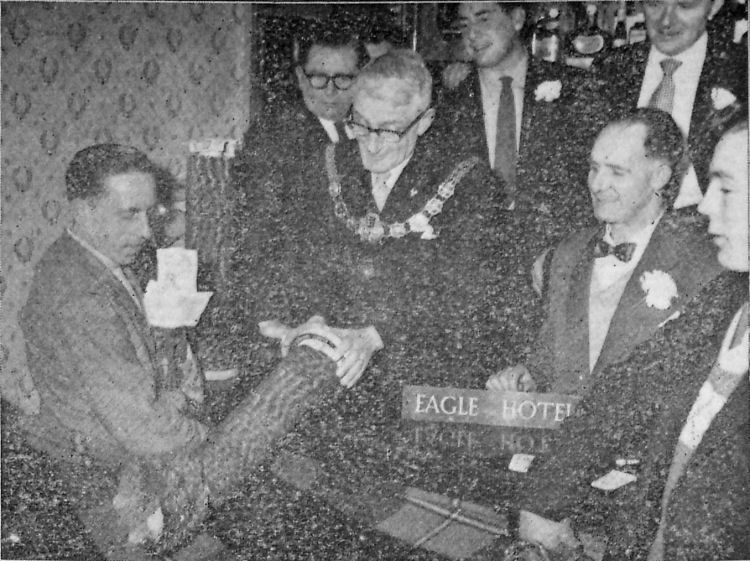
Down crash £10-worth of pennies, after a push by the
Mayor. Waiting to catch the cash in a blanket are members of the
Gloucestershire Regiment. Next to the Mayor is licensee of the "Eagle,"
Mr. Frank Townsend.
|
|
From the Old Brewery News Magazine, September 1978.
The Good Old Days"
From Mr. Norman Swindon of our Cashiers Dept., who has been with the
firm for over 40 yrs comes the following article.
In the early 1930's the Company opened a Depot in Deal to supply Clubs
run by the Miners who had moved down from South Yorkshire to work the
Kent Coalfields and had not liked the local brew. Deliveries to the
Depot were made by rail from Tadcaster to Deal via London. The Eagle
Hotel in Dover was purchased to support the local operation.
During the 1939-45 war. beer deliveries were zoned because of obvious
transport difficulties: the Depot was therefore closed, and not
re-opened after the cessation of hostilities. The Eagle Itself was sold
round about 1947.
|
This remained the "Eagle" till 1998 when it changed name to the
"Old Irish Times", but this only lasted till 2002, when again it reverted to
the old favourite of the "Eagle" again, where it is still trading under this
name (March 2009).
|
From the Dover Mercury 7 February 2002.
Plans for town pub to reopen.
A DOVER pub is due to reopen
later this month.
The Eagle, at the junction of London Road and Tower Hamlets, had
been known as the Olde Irish Times, but was closed some time ago.
Building work has been carried out, and 'new' landlord Mick Murphy
is planning to reopen the pub as a free house and revert to
calling it The Eagle.
|
|
From the Dover Express, 7 March 2002.
EAGLE HAS LANDED
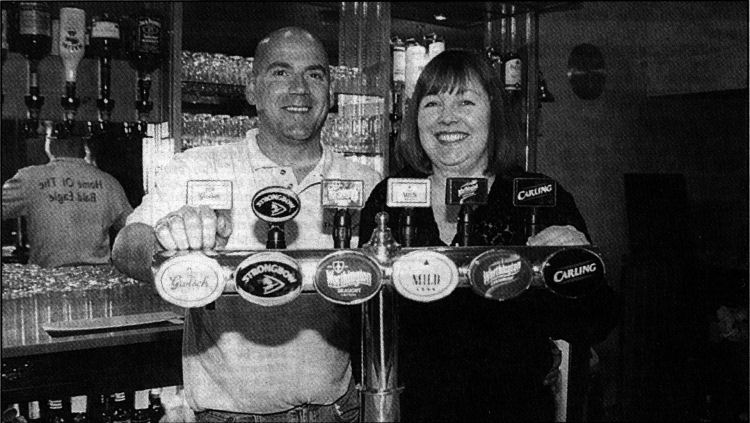
Mick and Karen Murphy behind their new bar.
A new watering hole called the "Eagle" held its grand opening on
Friday night.
The pub, formerly known as the "Old Irish Times," was taken over by
Mick Murphy and given a massive face lift.
Mick said: "We've re-plastered the walls, brought new furniture and
created a back bar area. It looks fantastic and the response we've
received from customers was extremely positive.
"Our first weekend was a huge success. It went above and beyond all
our expectations."
|
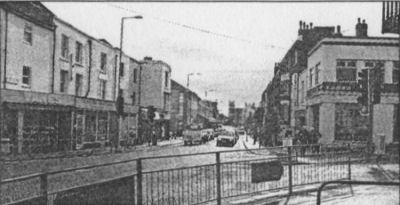
ABOVE:-
KILLING TIME: The gallows used
to stand at the junction of Tower Hamlets, Bridge Street and London
Road. Ref pd 237674
RIGHT:-
COMMEMORATION:
The blue plaque near the gallows' site.
Ref pd 237673 |
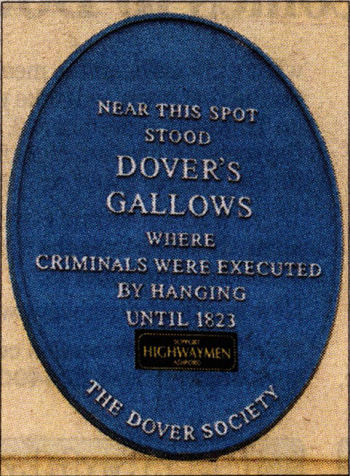 |
|
From the Dover Mercury 26 September 2002
Hang around the Eagle for a grisly history lesson
THE spot where the town's criminals were executed has been marked with
the last in a series of 10 blue plaques erected by the Dover Society.
The Honorary Recorder of Dover, Judge Andrew Patience QC, unveiled the
memorial on Saturday following the Confederation of Cinque Ports
Speaker's Day event in the town.
The mayor Cllr Diane Smallwood and members of the Dover Society were
among those who watched the ceremony at the Eagle public house, at the corner of Tower Hamlets and London Road.
And she was reminded that, until 1837, it was the mayor's duty to
announce the death sentence.
The public hangings used to take place on the corner opposite the Eagle,
at the junction of Bridge Street and
London Road, but there had been difficulty in obtaining permission to
put the plaque there.
The Dover Society started on the plaque project five years ago to
commemorate the Millennium by choosing sites around the town where
important events had taken place.
Dover Society chairman Terry Sutton told how the wretched felon would be
drawn on a cart, his coffin beside him, to the gallows while townspeople
hurled abuse.
|
|
From the Dover Express, 6 November 2003. By Nadine Miller.
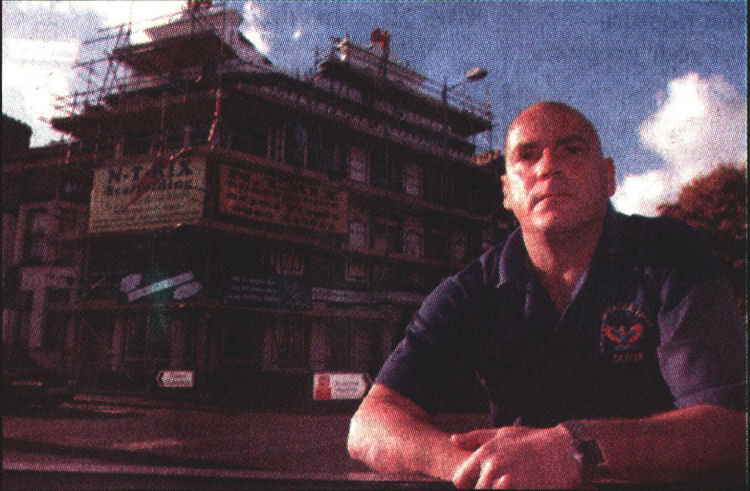
CLOCK STOP: Eagle landlord Mike Murphy
Clock plans hit a new hurdle.
PLANS for a controversial new clock have stumbled at the last hurdle
after The Eagle pub's landlord refused to have it sited on his London
Road building.
Although planning permission has been passed, Mike
Murphy, 40, does not want any part of the scheme which has stirred up
local opinion about the cost implications.
He said: "Since the town
council plan was announced I've had people come and stop me in the
street and in the supermarket to say they've signed a petition to stop
the clock.
"When the councillors
approached me about putting it up I said yes straight away as I hoped it
would be a focal point, not just for myself but for all the traders in
the area.
"Then I thought about the cost and I just could not justify it
and I just thought no."
Mr Murphy is a board member of the Dover
Partnership Against Crime and would like to see the money set aside by
the council spent on more CCTV cameras.
Dover Web's Rick Jones has been
organising a campaign to
stop the clock since the decision to construct it was announced at a
meeting at the beginning of October.
He said: "The response against the
idea has been overwhelming and the support for us has just been terrific
with probably more than 1,000 signatures already.
"If Mr Murphy's
decision stops the clock then this really is a victory for the people of
Dover who have made their voices heard over an issue they feel is just
sheer folly.
"What we want to do now is follow up the campaign with a
poll of seven more suitable projects
where the estimated £23,000 should be spent, so the residents have their
say."
Mayor George Allt voted for the clock and says he will continue to
support it.
He said: "If Mr Murphy does not want to go ahead, then he
should tell us but we've received nothing from him.
"I would ask why
he has now said no. Maybe it's because of bad press and he has reacted
to the pressure. If he is certain, then the clock will have to be
renegotiated, but we certainly want to know the real reason why he has
changed his mind."
|
|
From the Dover Express, Thursday, November 13, 2003.
Is the clock a waste?
AS REVEALED exclusively in last week's Express, a pub landlord has
called time on the town council's decision to build a controversial
four-sided clock on his premises.
LAURA SMITH took to the streets to ask the people of Dover if the
£10,000 expenditure seemed to them like a tick-tock idea...
KAYLEIGH HEATH, 16, a Tower Hamlets resident was adamant the council had
made the wrong decision in deciding to build the clock in the first
place. She said: "It's pointless, isn't it? We've got the clock tower in
town anyway. They could spend the money on something better because
there's not much to do in Dover, especially for the kids. All we've got
is the skate-park, and that's not very good."

Facilities for the younger
residents of Dover was also a strong theme with Dover resident PENNY
BOND, 45. She said: "I think the money could be spent on something
better to be honest. With all the empty shops around here it could have
gone elsewhere. And there's nothing for the kids to do."
TOM MacGAWAN,
36, who campaigns for the rights of asylum seekers, agreed that
the money could be useful if directed elsewhere. He said:
"I think that there are more important things to spend money on. It's
especially difficult to see how money is wasted on asylum seekers when
they're spending £10,000 on the aesthetics of Dover. The hospital should
also be a priority."
Retired resident LORNA THOMPSON, 68, felt strongly
about the matter, and believed the clock was not the only construction
money would have been wasted on in the town. She said: "It's ridiculous.
The bandstand was a waste of money as well. What do we need a four sided
clock for? We're not Westminister!"
BRIAN CLAW, 60, who has lived in Dover for most of his
life also questioned how useful and relevant the clock would be to
residents. He said: "I think a better idea would be to get the one on
the town hall working, then that would be all we need. Most people have
got a watch anyway."
Only OLIVER BOULTON, 20, who works at the
magistrate's court, thought the clock had the potential to be a good
expenditure. He said: "I would be interested to know the reasoning
behind the decision to build it, but £10,000 isn't really that much when
it comes to expenditure on local issues.
"The council have been put in
place, trusted with the money, and I'm sure they probably had a reason
behind spending it."
|
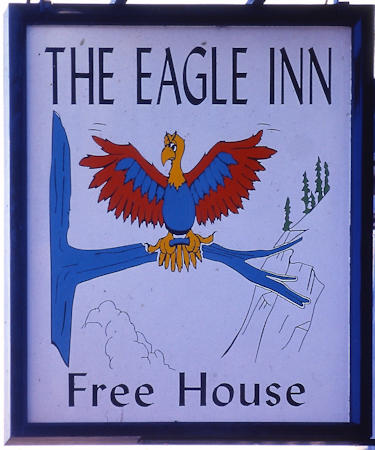
Above sign 2002.
With thanks from Roger Pester
www.innsignsociety.com. |
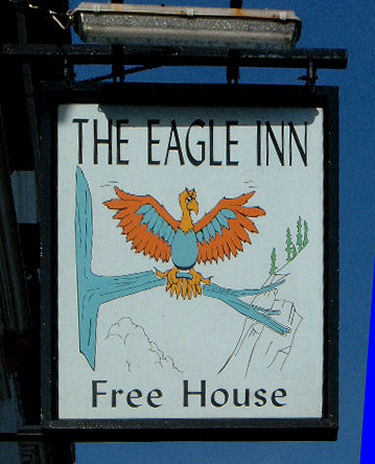 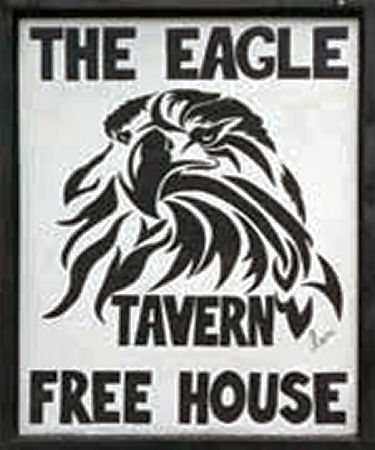
Above sign left showing Eagle sign November 2006. Sign right 2012. |
|
From the Dover Express, 7 August, 2008. By Rhys Griffiths.
STABBED 20 TIMES IN ATTACK
MAN 24, FIGHTS FOR HIS LIFE.
A DEVASTATED dad has described his family's pain as his son was left
fighting for his life after a vicious stabbing in Dover.
Mike Brankley, of Pilgrims Way, was stabbed 20 times during a
horrific attack in London Road at about 2.30am last Thursday.
The 24-year-old dump-truck driver was taken to the William Harvey
Hospital in Ashford where he underwent a six-and-a-half hour lifesaving
operation on his horrendous injuries.
Mike's family were woken by police at their Pilgrim's Way home at
about 3.30 a.m. and they dashed to the former Archers Court pupil's
bedside at hospital.
Dad Michael Brankley and mum Joan, both 48, had to be warned of the
horrific injuries their son had sustained before they arrived at the
hospital.
The sickening assault, which happened outside the "Eagle" pub, left
Mike with a deep cut to his face, a punctured bowel and a 10-inch stab
wound.
Michael, is a storeman at regeneration company EDSR where he works
alongside Mike.
He said: “When the police came here in the morning they told us to
prepare ourselves because it was not a pretty sight.
“Half his face was hanging off - it was like a horror movie. It was
devastating.
“It has ripped us apart, it is just devastating to see him lying
there. Even though he is on the mend, it is upsetting for us all.”
Mike had been out for the evening with friends.
His dad thinks if it was not for pal Dean Forrest-Holden and a woman
they were with tending to the stricken victim, then the attack could
have ended with a fatal tragedy.
He said: “They phoned an ambulance but a police car came by.
“From what I can make out, if Mike had been on his own and the car
had not come by, then it could have been a lot worse than it is.
“The emergency services did their job very well.” Mike's family have
been visiting him in hospital every day since he was attacked.
He has been able to leave intensive care but he still faces a long
period of recovery ahead.
His family had to cancel a holiday to Bulgaria they were due to leave
for on Monday.
Now they just want to help Mike recover and to see his attacker
brought to justice.
Michael said: “We just want to get him home and see him out and about
again.
“It has turned everything upside down. All we can hope is that Mike
makes a speedy recovery.
“Of course we want to see the man who did this caught because we
don't want him out there doing this to other people.
“I just don't know what possesses people to do this sort of thing,
this guy needs to be taken off the streets.
“This is happening all over the country. If you are caught with a
knife then you have got to go to prison. It has just got to stop.”
Detectives have set up an incident room at Folkestone and are hunting
for a man seen in the area at the time of the attack.
A police spokesman said: “He is described as a white man in his
mid-to- late-20s, of stocky build with a Scottish accent.
“He has short dark hair and was wearing dark-coloured shorts. His
clothing is likely to have been blood-stained.
(Link to more info)
|
|
From the Dover Mercury, 5 November, 2009
Grim ride to the gallows with his coffin for a seat
From the days before William the Conqueror, Dover, as a Cinque Port,
had a number of privileges in return for providing ship service to the
ruling monarch - including passing all sentences, including the death
sentence. Local historian Lorraine Sencicle looks at the history of
execution in Dover right through to the
last hanging in the town, in 1822.
FR centuries, execution by hanging took place outside of Dover's town
walls opposite to where the Eagle pub now stands, on the corner of the
High Street.
The Dover Society plaque is on the Eagle as they were unable to get
permission to put it in the correct place.
Public hangings in the 18th and early 19th centuries were
a regular feature of town life. In earlier days, felons were hurled from
the top of Western Heights, near the Bredenstone, which was nicknamed
the 'Devils Drop of Mortar' for that reason. Alternatively, they were
thrown from the top of Sharpness (now Shakespeare) Cliff, which also had
a nickname ... 'Devil's Drop!'
Hanging was increasingly preferred as the punishment was seen as a
deterrent so the wooden gallows were always there as a reminder.
They were only replaced
when dilapidated or when an incoming mayor wanted to make a point. For
instance, Thomas Warren, who was elected mayor five times from September
1549, had strong views on punishment. So not only were the gallows
replaced regularly, the ducking stool repaired and a new lock on the
stocks was ordered.
A description of the execution of Alexander John Spence, the last Dover
man to be publicly hanged, still survives. It tells us that Spence was a
"robust
good-looking man", who shot Coastal Blockade Officer (forerunners to
Coastguards) Lieutenant Philip Graham on August 9 1822.
On the morning of-his execution, Spence ate a "hearty breakfast"
followed
by a visit from the Rev John Maule. Spence was resolute but following
the visit of his sisters, his attitude changed.
He was then given the sacrament and climbed into the cart to take him to
the gallows.
The cart, with horse and
driver, was hired from Worthington's stables in
what was Worthington Lane, (now Street). Mr Worthington charged 10s (50p)
of which 2s 6d (12½p) was paid to the driver. Spence sat on his coffin
in the body of the cart.
The executioner, carrying
the rope, sat at the front with the driver. The Rev Maule accompanied
them, constantly praying. The Mayor and town dignitaries travelled in
covered carriages behind.
The spectacle of the condemned man being taken up the Charlton High Road
(now High Street) in open carts to Black Horse Lane
- the old name for Tower Hamlets Road, was enjoyed
by the 'multitudous' crowd. Rooms had been hired at the Black Horse Inn,
rebuilt in 1863 (now the Eagle) for the town's wealthy.
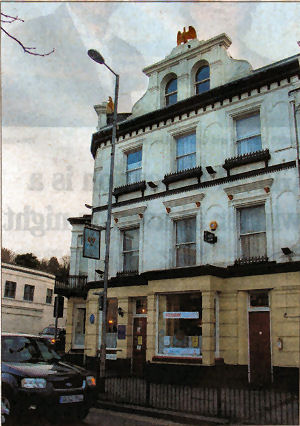
The mayor and officials, having carried out their duties, joined them.
It is reported that the proprietor of the Black Horse Inn charged £1 1s
(£1 5p) for rooms with a window.
On his way, Spence stood up
and bowed to friends and relatives. However, at the place of execution,
he was meditative as the hangman put the hood over his head.
Before the executioner could drive the cart away, Spence either slipped
or threw himself off and "struggled wildly." Afterwards, Spence's body
was given to relatives for disposal and he was buried in St Mary's
Churchyard.
In 1835, the Municipal Corporations Act took most of the ancient
privileges out of the hands of the town's officials. This included the
right of passing the sentence of death.
Although Alexander Spence was the last Dovorian to be publicly hanged on
the town's gallows, in 1823 a young man from Margate was hanged there
for robbery.
That is not the end of Dover's connection with hanging, for in August
1868 the hanging of a local man made national headlines.
He was Thomas Wells, a 19-year-old London, Chatham and Dover Railway
carriage cleaner. Part of his duties was looking after the station
garden but, against railway policy, he used a gun to scare birds away.
Wells was reprimanded by Stationmaster Edward Walshe and shot him
dead. Wells pleaded insanity but the jury were not convinced. Wells was
hanged at Maidstone Prison the first person to be convicted of murder
since an act banned public executions.
Capital punishment in the UK was abolished (except
for treason) in 1964. The last execution took place in that year.
Capital punishment was abolished totally in 1998.
|
Latest news (February 1st 2012) the premises was being boarded up, so
looks like another closed pub, let's hope it's not for long.
|
From the Dover Mercury, 29 March, 2012. 80p
PUB HAS REOPENED
THE Eagle public house in London Road, Dover, has opened under new
management.
The new managers say they will be introducing a daily carvery.
|
June 2016, the pub appears to be closed again.
Glad to say that after being renovated inside, the pub opened again at
the end of August 2016.
|
From the
https://www.kentonline.co.uk By Secret Drinker, 31 January 2025.
Secret Drinker reviews the Eagle Tavern pub in London Road, Dover.
A cross between a sewage works and a shrine to Liverpool FC, this
dour Dover pub was pretty much devoid of atmosphere.
With walls strewn with a multitude of LFC scarves, and painted in
Anfield red, it’s not difficult to work out who the landlord
supports. But, I was left thinking that if he could be persuaded to
spend time fixing the plumbing instead of following football then
the hefty wafts of sewage flooding the bar could be stifled.
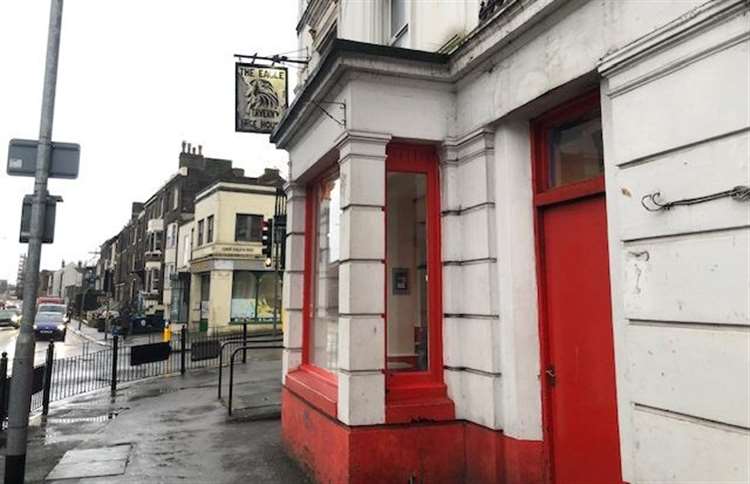
The Eagle Tavern in Dover sits on the corner of London Road and
Tower Hamlets Road.
At first sight, the Eagle Tavern on London Road doesn’t look to have
much going for it; ignoring the footie frippery, the front bar is
fairly tatty, there’s not a great selection of drinks and the
fireplace looks as dead as the rest of the pub.
To give the barmaid her due she did grab a bottle of Domestos to
tackle the stench from the gents but said in her experience no
amount of bleach would touch it. In the end, she quickly gave up
and, taking the advice of the punter dressed in a burgundy suit,
popped outside for a fag instead.
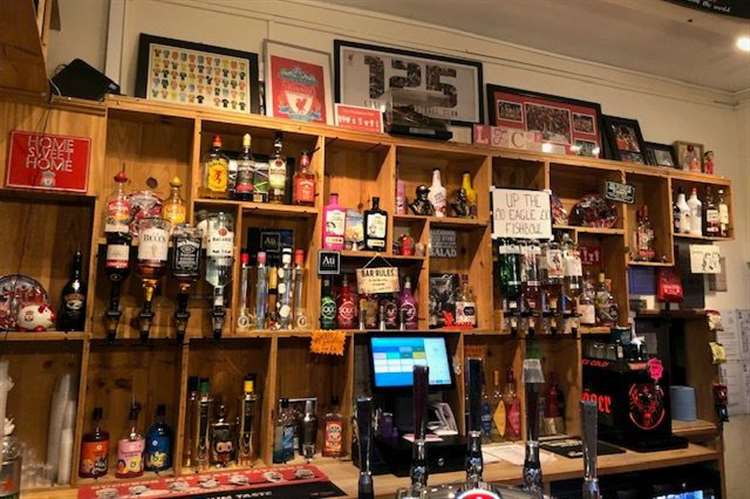
The shelves of the bar have been stocked to ensure everything on the
cocktail list can be created, although there is still plenty of room
among the bottles for Liverpool memorabilia.
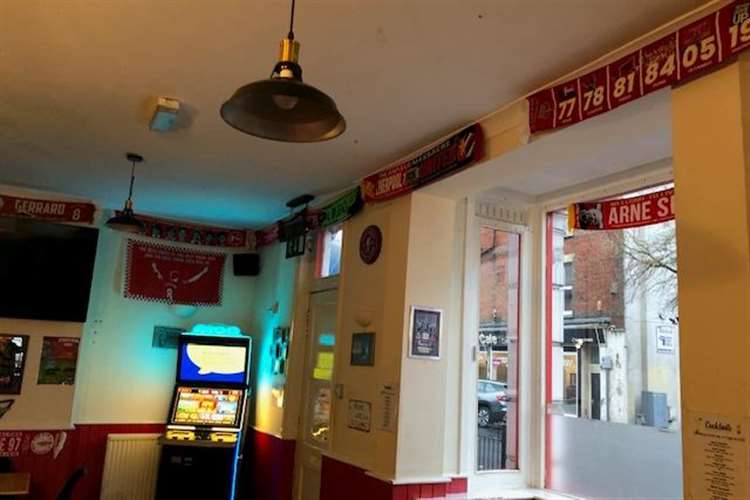
There are plenty of Liverpool scarves displayed at every
opportunity. A couple of folk did chance their arm on the fruit
machine at one point. The door in front of it is the one used for
putting the bins out.
I’d played it safe with a pint of Madri lager for £5, which seemed
fairly reasonable and, at the time, I didn’t think much of it, but
later realised the pricing model has been set at this rate for all
the beers.
Although it’s not surprising the pub was quiet on a Thursday
afternoon it was frequented by some interesting characters and I
quickly found myself surrounded by a couple of likely fellows, who
it turns out, were both ex-publicans in a past life.
Now a big open bar at the front, I’m told the Eagle Tavern used to
have a fantastic little snug on the left where you’d have ‘felt safe
to bring your mum in for a drink’. A previous owner had the wall
knocked out to create a larger, more open pub which was then renamed
the "Old Irish Times."
I could avoid visiting the gents no longer and was surprised that
the smell inside wasn’t quite as bad as the smell leaching into the
bar, though the sign stuck on the wall with Blu Tack told the story
of the lack of running water – ‘Sink out of use, please use
sanitizer’.
Just a swift glance around was enough to confirm that there are
other areas of the toilets which also need urgent attention.
And, I must mention the square black stickers added to the white
wall tiles, many of which have now peeled off, as I have absolutely
no idea what purpose they serve or what the person who applied them
was thinking.
A sign on the wall opposite greets you as you leave the gents
informing you that you’re stupid whichever direction you choose.
A page torn out of an A5 notebook, and stuck to the wall of the
gents, told the story of a lack of running water.
I, perhaps stupidly, turned right, where I witnessed a steady stream
of black bin bags being taken through the bar to the front of the
pub ready for collection.
There is also a back bar, equipped with a pair of pool tables and
two dartboards, as well as another fruit machine and many more
Scouse scarves.
In the front there is a larger fruit machine, a jukebox, two big TV
screens (not switched on) and several very bright lightbulbs hung
above the bar on what looked like rope nooses.
The first thing you'll see when you exit the gents is this sign and,
given the state of the facilities, it might not seem so funny!
By now, despite the wind and rain, one regular had managed to arrive
bang on his usual time, and as soon as he was seated in front of the
window by the door his pint of Fosters was delivered by the barmaid.
She also said she put the radiator on ahead of his arrival so it had
time to warm up. Now, that’s service for you.
All that remains to be explained is the Eagle’s charging policy,
which declares ‘cash is king’. Any card payment is set at a £5
minimum – thus a £5 Madri costs £5, a £4.70 Boddingtons costs £5 and
a £4.70 Kronenbourg costs £5. I’m not sure how much I would have
been charged if I had ordered two pints of Boddingtons.
I’m sure that over the years this has been a grand establishment,
renowned for serving decent ales and extending a warm welcome to all
visitors.
Sadly, the Eagle Tavern now seems a shadow of what it was years ago
and it’s extremely difficult to come up with a single reason to
recommend it.
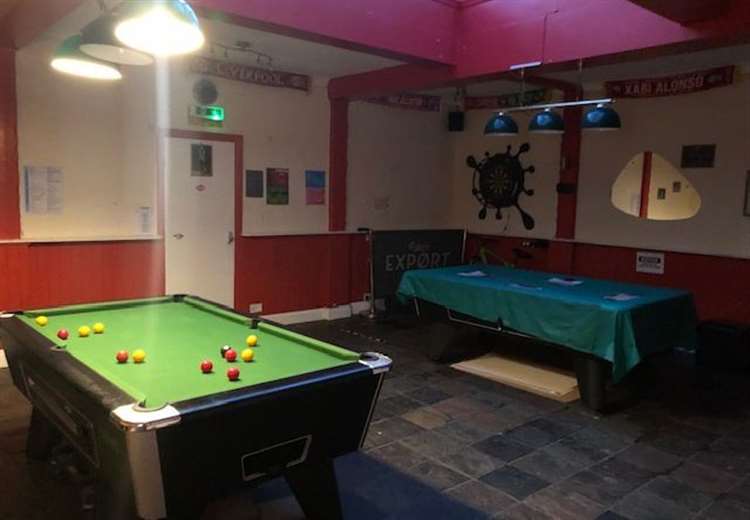
The back room, lit by a large central skylight, is large enough to
accommodate two pool tables and two dartboards.
Décor: Disregarding the partisan nature of much of the decoration,
the rest of the place is tatty and unkempt. The state of the gents
is frankly unforgivable and much could be improved here very easily.
*
Drink: Boddingtons is the only ale on tap but there are a reasonable
number of lagers available. Cocktails were on offer but I chose not
to go this route. **
Price: It doesn’t matter what you order, each pint is a fiver if you
choose to use a card. Boddingtons £4.70 (£5), Kronenbourg £4.70
(£5), Madri £5. An Up The Eagle fishbowl is a tenner and four pints
of cocktail £15. ***
Staff: By her own admission the barmaid is fairly new to her role
but, between serving, she did try to keep herself busy with other
tidying tasks. ** |
LICENSEE LIST
BROCKMAN 1843-Jan/44 dec'd
FOORD James 1846-May/63 (Eagle Tavern)
 (SMITH-FOORD Thomas
 ) (widower
age 75 in 1861 ) (widower
age 75 in 1861 ) )
PRESCOTT George May/1863-Sept/63
 CHATWIN George William Jan/1864-Mar/1865
WATSON Isaac Mar/1865+
HARRIS T B to Jan/1868
KNOTT J Jan/1868-July/1868
ADAMS Frederick July/1868

FISHER Thomas 1871+ (age 40 in 1871)
See "Denmark
Arms"
JACKSON Charles William R 1887-1911+ (hotel manager age 66 in 1911)
 
FOWLIE Hugh 1898-Mar/1914
 (Wine
and spirit merchants (Wine
and spirit merchants ) )  
BEANE Francis James Mar/1914-May/15
(Late of
St. Stephen's, Canterbury and who served for 19½ years in
the 21st lancers.)
FAGG William John May/1915-19+
OVENDEN Ernest G 1920-Apr/23
 
BEASLEY Henry Arthur Charles Apr-Nov/1923
(Retired
Army officer of Cambridge)
SMITH Herbert WaIter Nov/1923-Aug/25

BROWN Edwin Curtis Aug/1925-Sept/25
(Of
Clapham Common)
ELLIS Hugh Owen Sept/1925-28 end
RICHARDSON George Joseph 1928 end
STREETER Percy 1928-May/29
CAIRNS James Robinson May/1929-Apr/31

SMITH Herbert WaIter 1931-Jan/38
 (Late of "Anglesey Arms Hotel," Winstall, Burton-on-Trent, Staffordshire.)
HARRISON Alfred Mark Jan/1938-48+
(age 46 in 1939)
  
TOWNSEND Frank to 1960+
ANSTEY H G 1961-73
STUART-SMITH Michael I L 1974-75
 Courage, Barclay & Simonds
STOKES Victor T 1974-76 dec'd
STOKES Mrs Celia 1976-77 end
ARMSTRONG 1977-80
SCOTT Clive 1981
BLACKHURST Michael N 1987 end
LEWIS David 1988
TOWNSEND John ????
MURPHY Mick and Karen 2002+
WRIGHT John 2011-14+
According to the Dover Express Alfred Mark Harrison was a Licensed
Victualler from the "Anglesey Arms Hotel," Winshall, Burton-on-Trent,
Staffordshire.
From Melville's Directory 1858
From the Post Office Directory 1891
From Pikes Dover Blue Book 1895
From the Kelly's Directory 1899
From the Post Office Directory 1901
From the Pos/t Office Directory 1903
From the Kelly's Directory 1903
From the Post Office Directory 1913
From the Post Office Directory 1922
From Pikes Dover Blue Book 1923
From Pikes Dover Blue Book 1924
From the Post Office Directory 1930
From Pikes Dover Blue Book 1932-33
From the Post Office Directory 1938
From Pikes Dover Blue Book 1938-39
From Pikes Dover Blue Book 1948-49
Library archives 1974
From the Dover Express
Census
|

