|
London Road
Dover
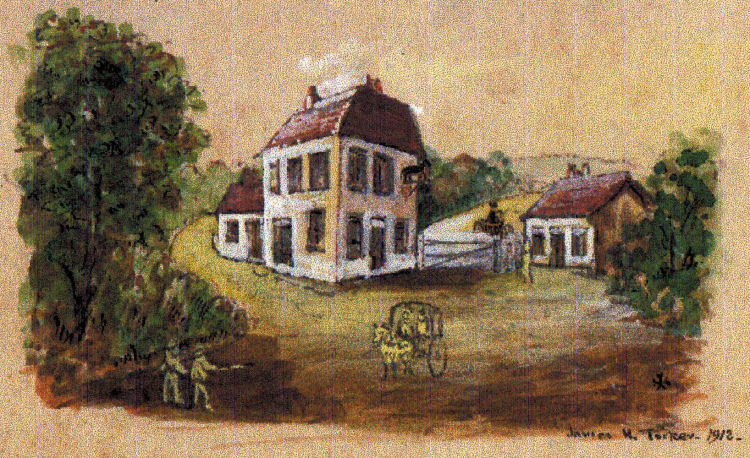
Above water colour is dated 1912 by James M Tucker
1912. It also says:- "Black Horse Inn" - Now "Eagle Hotel - Bottom of Tower Hamlets Road 1825. Turnpike Road to London on right,
Road to left now Tower Hamlets Road used for abundance of ???? ?????? spot marked with X (bottom right)
where formally hanging took place.
Picture kindly supplied by Joyce Banks.
|
This tavern stood opposite to where the gallows once stood. Alexander
John Spence was the last Dovorian to be hanged here on Friday 9th August
1822. He would have been 22 the following day. The dubious distinction of
being the last person to be hung at the Dover gallows, in 1823, was of a
young man from Margate convicted of robbery.
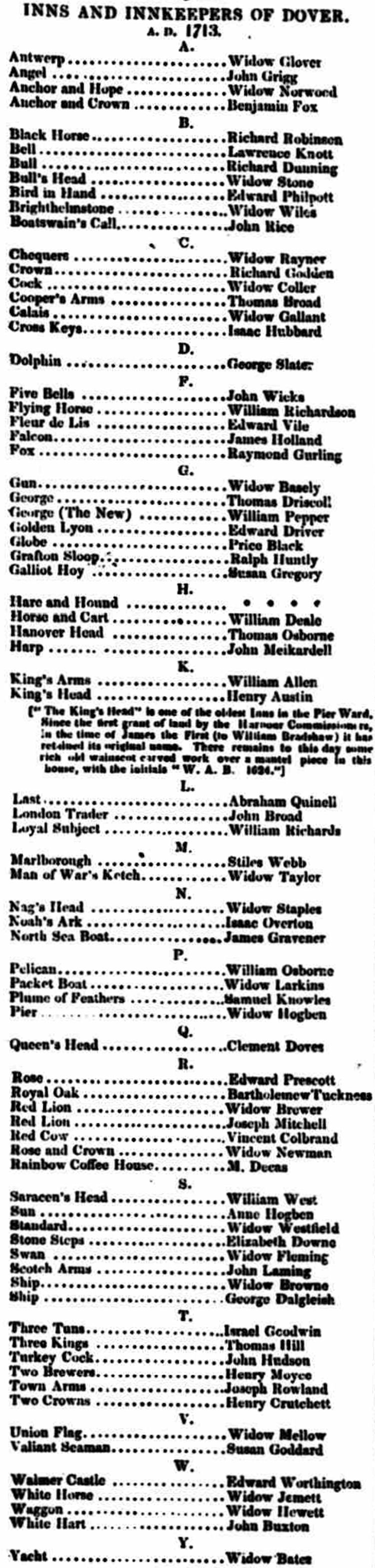
The Dover Chronicles on 7 May 1842, printed a list of "Inns & Innkeepers
of Dover A.D. 1713. Unfortunately no addresses were given.
|
From the Dover Chronicles, 7 May 1842.
 |
|
Kentish Gazette, Tuesday 10 May 1791.
Thursday last died, Henry Wells, master of the "Black Horse" public
house, Charlton, near Dover.
|
|
Kentish Gazette, 13 April, 1821.
On Wednesday, an inquest was held before John Dell, Esq. at the
"Black Horse," Charlton, on the body of John Knight, formerly a
butcher of Dover, who in a fit of insanity stabbed himself with a
case-knife.
|
|
From the Kent Herald, 14 June 1827.
Dover Sessions.
On Tuesday the General Sessions of the Peace for the town and Port of Dover, and
the Limbs and Liberties thereof, was held at the Guildhall, before George
Stringer, Esq. Mayor, George Baker, Esq., Recorder, and a full Bench of
Justices.
Thomas Chilton stood specially indicted for having on the 10th of February last,
at the parish of Charlton, received into his possession 18 pieces of current
silver cola called shillings, the property of John Alexander Walker, his
employer, and secreted and embezzled the same; the indictment also contained
four other counts charging the offence to have been committed in the parish of
St. Mary the Virgin and in different ways.
Mr. Bullock stated the case for the prosecution briefly, and called John
Tappengden, who proved that he was a servant to the prosecutor, and accompanied
the prisoner to deliver a task of X. X. to a Mr. Welch, and they met Mr. Welch.
a short distance from the "Black Horse" public house, who desired then to
deliver it to Mr. Carswell, the landlord, which they did. Mr. Welch desired Mr.
Carswell to pay for it, but witness did not see it paid.
Cross-examined by Mr. Dixon:- I was always obliged to obey Mr. Chilton's orders,
and did whatever he told me, Mr. Walker was chiefly in France. "I did not
consider Mr. Chilton my master exactly, nor yet Mr. Walker, because Mrs. Walker
who is Mr. Walker's mother, was my Master. (A loud laugh.)
Benjamin Carswell proved the payment of 18s. when the cask was delivered, but
admitted that he could not say whether the sum was in shillings, sixpences, or
half crowns.
John Alexander Walker:- I am a brewer, I employed the prisoner to conduct my
business, I have been much on the continent, when I returned from Flanders I saw
the prisoner, who said he was going out with beer. I saw him on the return and
called him to account, he did not however account for the 18s. he received. I
considered it to be a final and conclusive account of every thing between the
prisoner and me up to that day.
The witness upon being cross-examined by Mr. Dixon, admitted that the prisoner
had the soul management of the business, and made payments on his account, and
that he was to have £1. 7s. per week as a salary, and to be paid his extra
expensive, but denied having seen the prisoner's book containing an account of
such expenses, or that he considered the prisoner had any further charges to
make against him. This was the case for the prosecution.
Mr. Dixon here took several objections to the indictment, and particularly that
the money the prisoner had received did not appear in evidence to be shillings,
the Court however said the case must go to the Jury.
William Chilton, the prisoner's son, proved that his father had been a
respectable brewer at Rickmansworth, in Hertfordshire, when he was obliged to
obtain time for payment of his debts, and ultimately sold off all his property,
and paid 20s. in the pound with it, leaving himself destitute; that he heard the
prosecutor agree to give him £2 per week and also to pay his expenses in
procuring business, that the book of such expenses was constantly in the
brewhouse and Walker saw it, that he did not make any objection to it, (this
book contains an account of disbursements amounting to more than £21) and was
unsettled, he also stated that the prosecutor had offered to settle with his
father and let him out of prison upon having three bonds of £50 each, that he
would not set up the business of a brewer at Dover.
Several other witnesses were called to prove that the prisoner had completely
created the business by procuring custom and that he had lost several sums of
money in doing so doing.
The Recorder had addressed the Jury at a considerable length and commented upon
the whole of the evidence and the points of law with great ability.
The Jury found the prisoner Guilty, and sentenced him to 7 years transportation.
This case excited great interest, and occupied the Court several hours, during
which time the Court was much crowded.
There was also another indictment against the prisoner for a similar offence,
but no evidence being offered he was acquitted.
|
|
From the Dover Express and East Kent Intelligencer, 28 April, 1882. Price 1d.
THE LAST EXECUTION IN DOVER
Owing to the finding of a skeleton at the entrance of Bridge Street,
Charlton, which was said to be that of Spence, the last Dover murderer
executed at that spot, much discussion has arisen with regard the event.
The assertion that Spence was buried at that spot has been disproved by
the recollection of many old inhabitants, but in addition to those
fleeting recollections, our readers who are interested in this subject
may be glad to read the following account, which we copy from a pile of
old Kentish newspapers in our possession:-
On Friday (August 9th 1822), Alexander John Spence, who was convicted at
the last Dover Sessions under Lord Ellenborough's Act for shooting at
Lieutenant Philip Graham, of the coast blockade, and sentenced to death,
underwent the awful penalty of the law. During the trial, the passing of
the sentence, and since his condemnation, the unhappy man evinced the
greatest fortitude. Until Thursday he slept remarkably well, and ate
heartily, when he became extremely restless, and arose a number of
times; yet about five o'clock he made a very hearty breakfast. Having
been attended by the Rev. M. Maule, who was indefatigable in his
exertions to impress on the mind of the unhappy man the dreadful
position on which he stood, it is believed that inwardly he was truly
penitent, and in a great measure prepared for the awful change from life
to death, but in outward appearance his fortitude never forsook him. On
parting with his sisters on Friday morning he was more affected than he
had been since his trial, but soon gained his presence of mind. After
receiving the sacrament he came out of Gaol, ascended the ladder, and
got into the cart which was to convey him to the fatal gibbet with a
firm and undaunted step and look. Having recognised of his friends he
rose in the cart and respectfully bowed to them. Mr. Maule constantly
prayed with him until the arrival at the place of execution, when the
executioner having placed the cap over his eyes and adjusted the rope,
the unhappy man, before the hangman could whip on the horse, either
slipped or threw himself from the platform, which caused him to struggle
very hard, and was launched into the presence of the Almighty Being to
whom all secrets are known. Thus ended the life of one who might, had he
not associated with bad company, have deserved a much better fate. He
was a robust good-looking young man and, would have been 22 years of age
on Saturday. After hanging the usual time the body was cut down and
delivered over to his friends, who are respectable for interment.
The forgoing report does not say where the body was interred, but it is
consistent with the statement that he was buried, in St. Mary's
Churchyard. What a spectacle it must have been for a criminal, with
numerous friends and relatives living in the town, to be carted from the
old prison in the Market Place up to the top of High Street, and there
hang in the main thoroughfare! Who will say the former days were better
than these?
Dover Express August 1872.
It will be fifty years ago on the 23rd of the present month since the
last execution took place in the Borough of Dover. The culprit was an
unfortunate youth of respectable connections John Spence and he had been
convicted of shooting with intent to murder a young man who had been
paying attentions to his sister against his (Spence's) wishes.
The execution took place on the corner of Black Horse Lane, Charlton
near the spot now occupied by the “Denmark Arms” and was witnessed by a
crowd of spectators, the fate of the poor lad exciting much
commiseration at the time. It was the custom at the time to convey to
the place of execution the coffin in which the remains of the culprit
were to be interred with his name and age painted on the plate and this
barbarous and unnecessary piece of torture was duly observed in the case
referred to.
|
The site of the tavern
to-day is occupied by the "Eagle". Its tea gardens extended towards Buckland
and they were auctioned together with the tavern on 4 September 1839.
Demolition quickly followed the sale and the "Eagle"
as it is known today appeared shortly afterwards. At the time of its demise the tavern was kept by William
Dawkins. Earlier, in 1805, kept by Robinson.
However, in 1868, presumably under the name of the "Eagle"
(to be confirmed) the licence was suspended for some reason and from 1869,
the same year the Queen of Denmark paid a visit to Dover, the pub was
referred to as the "Denmark Arms". This
lasted until around 1893, when the name was definitely the "Eagle"
again.
I am assuming here, that the next two adverts offering the "Black Horse"
to let, is the house now the "Eagle" and not
the other "Black Horse" in
Bridge Street, but I could be wrong. It seems strange to think that there
was enough space for a Bowling-green here.
I am certainly starting to doubt that there were two pubs with the name
"Black Horse" in the same area and that they are indeed referring to the one
and the same building. Perhaps the "Eagle"
was built on the land owned by the "Black Horse."
|
Evening Mail 31 January 1831.
On Wednesday evening a fire broke out on the premises of Mr. Clarke,
landlord of the "Black Horse," Dover. The fire burnt with great fury,
and destroyed the upper part of the house. From an investigation of the
circumstances, there is no doubt that the house was purposely set on
fire.
|
|
From the Dover Telegraph and Cinque Ports General
Advertiser, Saturday 5 March, 1836. Price 7d.
TO BE LET BY TENDER
ALL THAT LONG ESTABLISHED
FREE PUBLIC HOUSE
With spacious Yard, Garden Ground, Coach House and Stabling,
thereunto belonging, known by the sign of the BLACK HORSE, Charlton,
next Dovor.
The above ground has recently been laid out for a Bowling-green and
Tea Gardens, with Bowers, &c. &c.
Persons desirous of the above Premises, will signify the same by
sending in their Tenders, with the amount of Rent, in words at full
length, on or before Saturday, 19th day of March, 1836, with the word
'Tender' on the outside, directed to T. A. TERSON, Estate Agent, Dovor.
N.B. The Proprietor will not be bound to accept the highest Tender.
Immediately possession may be had. To view the Premises and for further
Information, apply to the Agent, 172, Snargate Street, Dovor.
Tenders and all other applications must be post paid, otherwise they
will not be attended to.
|
|
From the Dover Telegraph and Cinque Ports General
Advertiser, Saturday 6 October, 1838. Price 7d.
INN TO LET
All that Old-established and well-known House the BLACK HORSE INN,
Charlton, next Dover, TO LET, with immediate possession, Fixtures, &c.
&c. to be taken at valuation.
Further particulars may be known (by letter, post paid) addressed to
T. A. TERSON, Estate Agent, 172, Snargate Street, Dover
|
|
From the Dover Telegraph and Cinque Ports General
Advertiser, Saturday 19 October, 1839.
POLICE REPORT
John Belsey was charged by the Rev. C. C. Snowden with an assault.
The prosecutor stated that passing the "Black Horse" public-house on
Saturday night, near 12 o'clock, he heard a disturbance, and saw Belsey,
who, after being very insolent, shook his fist in his face, and said if
the men in the house would help, he would throw him in the river. He
then gave Belsey in charge of Price, the Policeman, who stated that on
the road to the Station-house, Belsey said that he had been to Charlton
for the express purpose of meeting him, (the prosecutor,) to serve him
out. The defendant then entered into a long rambling pompous defence, in
which he denied having committed any assault. The magistrates, after a
consultation decided that Mr. Snowden not having any witnesses, and the
defendant denying the assault, they must dismiss the charge.
|
|
From the Dover Telegraph and Cinque Ports General
Advertiser, Saturday 4 April, 1840.
POLICE REPORT
William Dawkins, landlord of the "Black Horse," Charlton, charged by
Mary, wife of Henry Castle Pepper, with an assault. Complainant stated
that on Thursday last, she gave her husband money to buy half a ton of
coals, instead of doing which, he went to the public-house and spent the
money. She went to fetch him out; on which, the defendant struck her,
and turned her out of the house. Fined £1, 12s. including costs.
|
|
From the Dover Telegraph and Cinque Ports General
Advertiser, Saturday 11 April, 1840.
POLICE REPORT
Dawkins, landlord of the "Black Horse," public-house, Buckland, was
charged by police constable Nethersole, with allowing gambling on his
premises during divine service on Sunday last. Nethersole stated, that
about eleven o'clock on Sunday, hearing a noise of nine-pins falling in
the Black Horse alley, he went in, and saw two persons, named Gould and
Chandler, in the act of setting up pins. The house was closed, and the
landlord sitting at the bar; he came out and stopped the play. Dawkins,
in his defence said, that hsi house was closed at the time stated, and
that he was not aware any one was in the alley, until the policeman came
and told him. They had no beer; and he stopped play as soon as he went
out. The Mayor said that they were determined to keep the public-house
closed during divine service on Sundays; and the police had instructions
to look after them. It appeared that Dawkins was not aware of the men in
the alley, the mitigated penalty of 12s. including costs, was inflicted,
with an intimation that if again offending, the full penalty of £5 would
be imposed.
|
|
From the Dover Telegraph and Cinque Ports General
Advertiser, Saturday 31 October, 1840.
DOVER POLICE REPORT
Mr. C. B. Gorley was summonsed before the magistrates, by C. Lines,
the collector, for refusing to pay the toll demanded of him, for a cart,
drawn by two donkeys, passing through the new toll-bar that has lately
been erected near the "Black Horse," Charlton. Mr. Gorley considered
that it was a very hard case to make one pay for going upon private
property.
|
LICENSEE LIST
ROBINSON Richard 1713+
WELLS Henry to May/1791 dec'd
ROBINSON M 1805-23+ (Black Horse, Charlton)

CARSWELL Benjamin 1826-28+ (Black Horse, Charlton)

CLARKE S 1831-33+
DAWKINS William 1839-40
CURLING David (Black Horse, Charlton) 1840

From the Pigot's Directory 1823
From the Pigot's Directory 1828-29
From the Pigot's Directory 1840
|

