|
Back Street
Stade
Folkestone
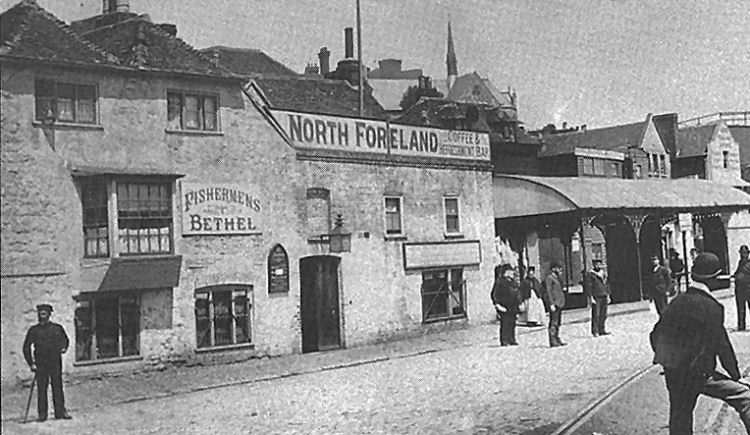
Above photo showing the "North Foreland." Shown as a coffee house in
1885. |
|
Folkestone Sessions Books 1765 – 1779 & 1792 - 1811.
General Sessions 29 April 1765.
Before John Hague (Mayor), Mr. John Jordan, Mr. William Pope, Mr. Thomas
Baker, Mr. Thomas Rolfe, and Mr. John Baker.
Neat Ladd, James Francklyn, Chas. Hill, Thos. Wilton, Ambrose Dadd, Ric
Boxer, Widow Jeffery, Widow Gittens, Ric Beear, Mary Gittens, and Joseph
Trevillon were fined at this Session 3/4 each for having false measures
in their houses, which fines were paid into the hands of the Overseers
of the Poor.
Neat Ladd, George; James Francklyn, Rose; Charles Hill, White Hart;
Thomas Wilton, no record; Ambrose Dadd, Chequers; Richard Boxer, Fishing
Boat; Widow Jeffery, Royal George; Widow Gittens, North Foreland;
Richard Beear, Three Compasses; Mary Gittens, Privateer; Joseph
Trevillon, Crown.
|
|
Folkestone Sessions Books 1765 – 1779 & 1792 - 1811.
General Sessions 27 April 1767.
Before John Hague (Mayor), Mr. John Jordan, Mr. Thomas Baker, Mr. John
Baker, and Mr. Thomas Rolfe.
James Lipscomb, Ric Coveney, John Milton the elder, John Milton the
younger, Henry Barber, Thomas Golder, George Parker, Cassell Burwell,
and Samuel Wicks were fined ¾ each for continuing drinking and tippling
in an alehouse in the township, which fines were paid to the poor.
Elizabeth Pilcher, widow, Jane Fox, widow, Anne Gittens, widow, and
William Cressey were fined 10/- apiece for suffering persons to continue
drinking and tippling in their houses, which fines were given to the
poor.
Notes: Elizabeth Pilcher PROBABLY widow of at King's Arms. Not listed in
More Bastions. Jane Fox, Five Bells. Anne Gittens, North Foreland.
William Cressey, Red Cow.
|
|
Kentish Gazette 17 March 1779.
Advertisement: To be sold by auction, at the sign of the "North
Foreland," at Folkestone, on Wednesday the 31st day of this instant
March, at three o'clock in the afternoon: All that good new-built shallop, or vessel, called Le Compte de Dillon, about 50 tons
burthen, an English-built vessel, lately a French privateer,
condemned as prize to, and taken by the Letter of Marque the
Eclipse, belonging to Folkestone, Henry Baker, commander. She is in
exceeding good condition and a remarkable fast sailer, having been
many times chased by His Majesty's Cutters and never out-sailed.
At the same time will be sold her masts, sails, yards, anchord,
cables, guns (consisting of six two-pounders and ten swivels) and
iron ballast.
The said privateer now lies on Folkestone beach, and inventories may
be had of Mr. Farley, of Folkestone, or James Graveney, attorney, at
Dover.
|
|
Kentish Gazette, 20 March 1779
Advertisement: To be sold by auction, at the sign of the North Foreland, at
Folkestone, on Wednesday the 31st day of this instant March, at three o’clock in
the afternoon: All that good new-built shallop, or vessel, called Le Compte de
Dillon, about 50 tons burthen, an English-built vessel, lately a French
privateer, condemned as prize to, and taken by the Letter of Marque the Eclipse,
belonging to Folkestone, Henry Baker, commander. She is in exceeding good
condition and a remarkable fast sailer, having been many times chased by His
Majesty’s Cutters and never out-sailed.
At the same time will be sold her masts, sails, yards, anchord, cables, guns
(consisting of six two-pounders and ten swivels) and iron ballast.
The said privateer now lies on Folkestone beach, and inventories may be had of
Mr. Farley, of Folkestone, or James Graveney, attorney, at Dover.
|
|
Kentish Gazette, 30 September 1780
On Friday the 6th, at two o’clock in the afternoon, will be sold by auction, at
the North Foreland, at Folkestone, all that good shallop or vessel called the
Compte de Dillon, about forty tons burthen, a French privateer, lately taken by,
and condemned by, Henry Baker, Commander of the Eclipse, letter of marquee,
belonging to Folkestone.
She is a handsome vessel, a prime sailer, and now lies on Folkestone beach, and
may be seen by applying to Mr. Thomas Farley.
|
|
Kentish Gazette 20 March 1782.
Advertisement: To be sold by auction, on Monday, the 25th of this
instant March, at the sign of the "North Foreland," Folkestone,
between the hours of seven and eight o'clock in the evening, unless
disposed of in the meantime by private contract, of which notice
will be given in this paper; All that good Cutter, called the Flora,
of the burthen of one hundred and thirty tons, or thereabouts, with
her tackle and furniture, well found, and in good condition, clinker
built, only a year old, copper-nailed, and a prime sailer. Now lying
in Dover harbour.
For further particulars apply of Captain John Pysing, or of E.
Smith, Attorney at Law, Folkestone.
|
|
Folkestone Sessions Books 1765 – 1779 & 1792 - 1811.
General Sessions 25 April 1808.
Before Thomas Baker (Mayor), Joseph William Knight, John Castle, John
Gill, John Bateman and James Major.
The following person was fined for having short measures in their
possession, viz.:
John Beverley 2 quarts, 1 pint 3/-
|
|
Kentish Gazette 28 February 1812.
Advertisement.
To be sold by Auction, by Mr. David Major, at the North Foreland Inn, in
Folkestone, on Thursday, the 5th of March, 1812, at two o'clock (unless
previously disposed of by private contract):
Lot 1: The Schooner Venus, with all her materials and stores, burthen
about 70 tons.
Lot 2: The Smack Thomas and Eleanor, with all her materials and stores,
burthen about 54 tons.
Lot 3: The Smack Aurora, with all her materials and stores, burthen
about 32 tons.
Lot 4: A Six-Oared Galley, 52 feet long and 4 feet 4 inches wide, with
all her mast, oars, sail, &c., &c.
The above vessels are now lying on Folkestone Beach, are well found, and
fit for immediate service.
The stores may be seen, inventories had, and further particulars known,
on application to the Auctioneer, Folkestone.
|
|
Kentish Gazette 5 September 1815
Death.
August 31, Mary Ann, the eldest daughter of Mr. Mace, of the
North Foreland public house, Folkestone, aged six years.
|
|
Kentish Gazette 20 October 1815
On Monday last a Coroner`s inquest was held at the North Foreland
public house, Folkestone, before Thomas Baker Esq., Mayor and
Coroner, on the body of Thomas Pettit senior, who was found hanging
in his cellar on Saturday night last, when the jury, after a long
investigation, returned a verdict of “Felo de se”.
|
|
Kentish Chronicle 20 October 1815.
On Monday last a Coroner's inquest was held at the "North Foreland"
public house, Folkestone, before Thomas Baker Esq., Mayor and
Coroner, on the body of Thomas Pettit senior, who was found hanging
in his cellar on Saturday night last, when the jury, after a long
investigation, returned a verdict of “Felo de se”.
|
|
From the Kentish Gazette or Canterbury Chronicle, 20 October 1815.
Thomas PETTIT Snr. Inquest held "on Monday last". Held at the "North
Foreland" public house Folkestone, before Thomas BAKER Mayor and
Coroner, on body of Thomas PETTIT Snr who was found hanging in his
cellar on Saturday night last - when the Jury after a long investigation
returned a verdict of Felo de Se.
|
|
Kentish Chronicle 5 June 1827.
Death: May 31, at Folkestone, after a long illness, Ann, wife of
Mr. James Mace, of the North Foreland public house, aged 49 years.
|
|
Kent Herald 7 June 1827
Death.
May 31, at Folkestone, after a long illness, Ann, wife of Mr. James Mace, landlord of the North Foreland public house, aged 49 years.
|
|
Kent Herald 23 October 1834
Advertisement: Folkestone, to be disposed of, the business of a carrier, where four horses have been kept for many years, and will be valued to the purchaser, together with a wagon, three carts, one dray, harness, and sundry other useful implements necessary for carrying on the above. Business, offering a good opportunity for an industrious man with a small capital to engage it to advantage, the present proprietor having taken another business is the sole cause for parting with this.
For particulars, and to treat for same, apply to James Jenkins, "North Foreland Inn."
Note: It is at present uncertain whether Jenkins was licensee of the North Foreland.
|
|
Kent Herald 22 March 1838
To be Let: A public known by the sign of the "North Foreland," situated
near the Harbour, in the town of Folkestone.
For particulars apply at the Till Brewery (sic), Folkestone, if by
letter, post paid.
|
|
Kentish Gazette 1 May 1838.
To be Let: A public house called the North Foreland, situated near the
Harbour, in the town of Folkestone. A good wholesale and retail spirit
trade has been carried on to a considerable extent on the premises,
which might be resumed by an industrious couple with a small capital.
For particulars, apply at the Broad Street Brewery, Folkestone, if by
letter Post Paid.
Note: Broad Street Brewery was owned by Ham Tite and later relocated to
become Gun Brewery.
|
|
Kent Herald 15 August 1839
Advertisement: To be let, a public house, called the "North Foreland,"
situate near the harbour, in the town of Folkestone. As considerable
improvement is expected to take place in the harbor, and the town is
already full of people employed on the railway, an industrious couple,
with a small capital, will find this worth their notice.
For particulars apply to H. Tite, Walton Farm, near Folkestone; if by
letter, post paid.
|
|
Kentish Mercury 20 November 1841.
Died, at Folkestone, on Sunday, the 14th inst., Mr. James Mace, many
years landlord of the North Foreland Inn.
|
|
Kent Herald 16 May 1844
Transfer of licences: The license of the "North Foreland" was transferred from
William Williams to George Lott.
Note: William Williams previously unknown.
|
|
Maidstone Gazette 18 December 1849
Petty Sessions, Tuesday; Before David Major Esq., Mayor, Charles
Golder and Wm. Major Esqs.
Transfer of licenses: William Wilson,
North Foreland, to John Wallis.
Notes: North Foreland; Earlier dates.
|
|
Southeastern Gazette 1 May 1855.
Peters, the booking clerk at the Folkestone harbour station, was
arrested on Saturday evening by Superintendent Steer, on a charge of
abstracting a cloak, silk mackintosh and cap from a parcel left at
the railway station, and belonging to a member of Parliament, en
route to the Continent. The cloak was found in an iron chest by Mr.
Steer, the prisoner having the key, and the mackintosh he found at
the "North Foreland Tavern," where it had been left by the prisoner.
Since his arrest a deficiency of £35 has been found in his accounts.
|
|
Kent Herald 3 May 1855
Peters, the booking clerk at the Folkestone harbour station, was arrested on
Saturday evening by Superintendent Steer, on a charge of abstracting a cloak,
silk mackintosh and cap from a parcel left at the railway station, and belonging
to a member of Parliament, en route to the Continent. The cloak was found in an
iron chest by Mr. Steer, the prisoner having the key, and the mackintosh he
found at the North Foreland tavern, where it had been left by the prisoner.
Since his arrest a deficiency of £35 has been found in his accounts.
|
|
Kentish Mercury 5 May 1855.
Peters, the booking clerk at the Folkestone harbour station, was
arrested on Saturday evening by Superintendent Steer, on a charge of
abstracting a cloak, silk mackintosh and cap from a parcel left at
the railway station, and belonging to a member of Parliament, en
route to the Continent. The cloak was found in an iron chest by Mr.
Steer, the prisoner having the key, and the mackintosh he found at
the "North Foreland Tavern," where it had been left by the prisoner.
Since his arrest a deficiency of £35 has been found in his accounts.
|
|
Kentish Independent 5 May 1855.
Peters, the booking clerk at the Folkestone harbour station, was
arrested on Saturday evening by Superintendent Steer, on a charge of
abstracting a cloak, silk mackintosh and cap from a parcel left at
the railway station, and belonging to a member of Parliament, en
route to the Continent. The cloak was found in an iron chest by Mr.
Steer, the prisoner having the key, and the mackintosh he found at
the "North Foreland Tavern," where it had been left by the prisoner.
Since his arrest a deficiency of £35 has been found in his accounts.
|
|
Southeastern Gazette 8 May 1855.
Petty Sessions, Monday; Before the Mayor and W. Major Esq.
Myssen Peters, a Belgian, who was very respectably attired, was
brought up in custody, charged by the South Eastern Railway Company,
with stealing a cloak, mackintosh, and cap. Mr. Coxhead attended on
behalf of the Company, and Mr. John Minter for the defendant.
Superintendent Steer deposed that having received information that
some cloaks had been abstracted from a parcel left at the railway
station, he proceeded there, and saw the prisoner, whom he asked if
he kept the key to an iron chest that was in the office, and if
anyone else ever had the key. The prisoner said no-one had it but
himself. On examining the chest witness found a tartan cloak, which
answered to the description of the one lost. On making further
enquiry in the town he found a silk mackintosh at the "North Foreland
Inn," where it had been left by the prisoner.
Henry Dinies, station-master, deposed that the prisoner was booking
clerk at the Folkestone harbour station. No-one had control over the
iron chest but the prisoner. On Friday last a parcel of clothing was
left in a carriage, and shortly after the valet of Mr. Oswald told
him some articles were missing from the bundle. It was the general
practice to have the carriages searched after each train arrived;
the bundle was left in the charge of the prisoner Peters.
James McNie, railway constable, said he searched the carriages on
the day named, and found a bundle of clothing in a second class
carriage, which he took to the office and gave to the prisoner; the
bundle was fastened with a leather strap. He had observed some of
the articles, and he believed those missing and produced were the
same he saw in the bundle.
The prisoner was remanded for a week to obtain the evidence of the
valet, from Paris, whither he had gone with his master.
|
|
Southeastern Gazette 15 May 1855.
Petty Sessions, Monday; Before the Mayor, Wm. Major and J. Kelcey
Esqs.
Myssen Peters was brought up for second examination, charged with
stealing a cloak and coat from a parcel left in his charge at the
railway station. Superintendent Steer stated that he had gone to
Paris and seen the gentleman who had lost the articles, but that he
was ill himself and could not spare his servant to come to
Folkestone; he, however, gave him his card, and told him where to
find his butler in Ayrshire, who could identify the goods. He wished
the magistrates to remand the prisoner for another week, to enable
him to bring the servant before them as a witness.
Mr. Minter (who defended the prisoner) objected to a remand, as
ample time had been given to produce a witness.
Mr. Davidson (Mr. Hart's clerk) objected to Mr. Minter addressing
the magistrates, whose duty, he said, only applied to the
cross-examination of witnesses.
Mr. Minter claimed it as right, and was proceeding to do so, when he
was stopped by the Mayor, who said that the magistrates had decided
to remand the prisoner to Monday.
Mr. Minter then applied for some money found upon the prisoner to be
given up to pay for the defence, but the magistrates declined to
give it up, as there was a charge of embezzlement against the
prisoner. A gold watch, however, belonging to the prisoner, was
ordered up to be given to Mr. Minter.
The solicitor to the South Eastern Railway Company stated, in answer
to a question, that the sum the prisoner was charged to have
embezzled was £32 7s. 8d., but that he should not proceed with the
case until the one for felony was concluded.
|
|
Canterbury Journal 16 June 1855.
Petty Sessions, Tuesday.
Edward Jardon was charged by Mr. John Wallis, landlord of the North
Foreland Inn, with being drunk and assaulting him on the previous
evening.
Fined 5s. and 5s. 6d. costs, or to be imprisoned for one month.
Allowed till Saturday to pay the money.
|
|
Dover Telegraph 16 June 1855.
Petty Sessions, Tuesday: Before J. Kelcey and G. Kennicott Esqs.
Edward Jardon was charged by Mr. John Wallis, landlord of the North
Foreland Inn, with assaulting him on the previous evening. It
appeared that the prisoner went into complainant's house and called
for a glass of wine, for which he put down 6d., and after drinking
it asked for his change, but on being told there was none, he became
violent and struck at Mr. Wallis over the bar, when he was given
into custody.
Fined 5s. and 5s. 6d. costs, to be paid in a week.
|
|
Southeastern Gazette 19 June 1855.
Local News.
Tuesday: Before J. Kelcey and G. Kennicott, Esqs.
Edward Jordon was charged with an assault on Mr. Wallis, landlord of the
North Foreland Inn.
Defendant had gone into the complainant’s house on the previous evening,
and called for a glass of wine, for which he put down 6d. After drinking
the wine he asked for change, and was told there was none; he then
became excited, and struck at the complainant across the bar, when he
was given into custody.
Fined 5s. and 5s. 6d. costs, or one month’s imprisonment.
|
|
Southeastern Gazette 10 July 1855.
Quarter Sessions, Thursday; before J.J. Lonsdale Esq.
The Recorder, in his address to the Grand Jury, called their
attention to the charge of stealing a mare by one Crumby, an
indictment that could not be sustained, for no man could be
convicted of stealing his own property. The circumstances arose out
of taking away a mare that had been distrained upon, and which was
upon the premises of the person owing the rent; it had been removed
from one place to another, and at last was taken away by the owner.
William Crumby, committed for stealing a mare, value £3, the
property of John Banks. Bill ignored.
Nyssen Peters, 26, was indicted for stealing one plaid cloak and one
mackintosh, value £4, the property of Alex. Oswald Esq., on the 27th
April last. Mr. Byron conducted the prosecution, and Mr. Harry
Bodkin Poland defended the prisoner.
It appeared that Henry Carter, valet to the prosecutor, left a
bundle of clothing, strapped round, in a second class carriage at
Dover (sic), which James McNie, then a policeman, took to the
prisoner, the booking clerk, and who abstracted the above articles.
The cloak was found in a safe, of which the prisoner had the key,
and the mackintosh at the North Foreland Inn.
Ten months' hard labour.
|
|
Kent Herald 12 July 1855
Quarter Sessions, Thursday; before J.J. Lonsdale Esq.
The Recorder, in his address to the Grand Jury, called their attention to the
charge of stealing a mare by one Crumby, an indictment that could not be
sustained, for no man could be convicted of stealing his own property. The
circumstances arose out of taking away a mare that had been distrained upon, and
which was upon the premises of the person owing the rent; it had been removed
from one place to another, and at last was taken away by the owner.
William Crumby, committed for stealing a mare, value £3, the property of John
Banks. Bill ignored.
Nyssen Peters, 26, was indicted for stealing one plaid cloak and one mackintosh,
value £4, the property of Alex. Oswald Esq., on the 27th April last. Mr. Byron
conducted the prosecution, and Mr. Harry Bodkin Poland defended the prisoner.
It appeared that Henry Carter, valet to the prosecutor, left a bundle of
clothing, strapped round, in a second class carriage at Dover (sic), which James
McNie, then a policeman, took to the prisoner, the booking clerk, and who
abstracted the above articles. The cloak was found in a safe, of which the
prisoner had the key, and the mackintosh at the North Foreland Inn.
Ten months’ hard labour.
|
|
Kent Herald 13 March 1856
Assizes, Tuesday, Nisi Prius Court: Before Baron Alderson
Wallis v Payne
This was an action brought by Wallis, a publican at Folkestone, to recover
damages for an alleged assault upon his wife (daughter-in-law to defendant). Mr.
Lush for the plaintiff, and Mr. Chambers Q.C. for the defendant.
Mr. Lush stated that the plaintiff in this action kept a public house at
Folkestone. The defendant, Payne, was the husband of Mrs. Wallis’s mother. In
November, 1854, Mrs. Wallis and a cousin went to defendant’s house, and Mrs.
Wallis asked to see her mother. “Was she in?” Defendant said “I dare say she
is,” and Mrs. Wallis went through the tap room into the wash-house, returning
with her mother. She was about to go into the parlour, when defendant interposed
and said she should not enter the room. Mrs. Wallis insisted, and then the
defendant struck her, and broke her bonnet. She told defendant she wished she
was a man for his sake, and shook her fist in his face, whereupon he spat in her
face several times, and eventually sent for a constable to remove her from the
premises.
For the defence it was contended that defendant exerted no more violence than
was necessary in order to remove Mrs. Wallis from the premises, he having
several times requested her to leave. That the defendant merely acted as he did
in order to preserve his own property, and that the action was of the most
trumpery character, as the whole matter might well have been settled before the
County Court.
Verdict for the defendant.
(North Foreland)
|
|
Canterbury Journal 15 March 1856.
Assizes, Nisi Prius Court, Tuesday, before Baron Alderson.
Wallis v Payne.
Mr. Lush, for the plaintiff, said the action was brought to recover
damages for an assault. Plaintiff pleaded that defendant was in his
house, and she desired to have some liquor, but, as he refused to
serve her, and she declined to go, he put her out without any more
force than was necessary.
Mary Ann Wallis, the plaintiff, wife of John Wallis, who keeps a
public house at Folkestone, said:- The defendant keeps a public
house in Warren Street, Lenham. ("Red
Lion.") Defendant married her mother. On the
8th Nov., 1854, she went to defendant’s house to see her mother. A
young woman, Mary Hughes, went with her. She called defendant by his
name, and asked him if her mother was there. He said “She is in, I
believe.” She went through the tap-room into the wash-house to find
her. Defendant was sitting in the tap-room. She found her mother in
the wash-house, and came back with her, and was going to the
parlour, which was close to the tap-room, across a passage. When her
mother and her were going into the parlour, defendant struck her in
the chest and knocked her against the wall, and then hit her on the
side of the head, and knocked in the side of her bonnet. She went
into the parlour and sat down. He called her a vulgar name, and then
he struck her while she was sitting, and said he would send for a
constable to put her out, as she had no business there. She told him
she came civilly, to see her mother. He said no such ---- “varmint”
like her had any business there. She sent for her son, to protect
her. He came to the house, and she left with him.
By Mr. Chambers: She went home then to Folkestone. Her son drove her
to Ashford; thence she went by rail. Defendant would not allow her
mother to give her anything, so she could not tell if her son had
anything when he came. She had seen her mother that morning before,
at her sister’s, and had been in her company for half an hour. She
knew that defendant had kept her mother without food for three or
four days. Some months after the marriage, in 1854, they began to
quarrel. Had not said that she knew of that, and that she and her
mother would do for Payne if it cost £1,000. Her husband applied to
Mr. Minter, an attorney, as soon as she got home. She had only taken
some coffee and bread and butter at her aunt’s, before she went to
defendant’s house. Went into the bar parlour after defendant struck
her. Don’t know if there was a gin cupboard there. They used to keep
it standing on a bureau. Would swear she did not say “Mother, let’s
have some gin.” After she was beat she asked her mother for
something, when she brought some beer from the cellar. Defendant
then put a bottle into the cupboard, and put his back against it.
She said she would not be pushed out, as it was a public house. Did
not call him a blackguard or a thief. She wore the same bonnet on
her way home, in the train, and everybody looked at it. (Laughter)
She had the bonnet with her. Did not call in a doctor. She did put
her fist in defendant’s face, and say she wished she was a man, for
his sake. After defendant told her to leave the house, he tried to
move her by taking hold of her bonnet. He crushed her comb. Thought
her mother was older than her husband.
Mary Hughes, residing at Wichling, stated that she went with
plaintiff to defendant. Plaintiff said to him, in a civil sort of
way “How d’ye do, Payne. Can I see my mother?” He said “I dare say
you can.” On plaintiff’s return from the wash-house, defendant used
very bad language, and struck her against the wall. No words had
passed between them up to that time, but before he struck her he
said “You are not a-going in there.” She went in, notwithstanding,
and then he struck her – first in the chest, knocking her against
the wall. He hit her on the head as she was sitting on the chair. He
spat at her face. Her mother was crying. Payne’s daughter said “The
old woman’s going to the cellar.”
By Mr. Chambers: Witness is the daughter of the aunt who keeps the
beer-shop. The cross-examination consisted principally of what she
had for dinner. Witness did not recollect. His Lordship then said it
was evident she had had “something short.”
John Wallis, the son, said he was sent for to the defendant’s house.
His mother appeared much frightened. She showed him marks on her
bonnet by defendant spitting, and told him defendant had struck her.
Witness asked why he did it, but he made no distinct reply. Did not
think defendant was sober. Whilst he was there defendant kept his
foot on a chair near a cupboard.
Mr. Chambers, in reply, said if a verdict were given for the
plaintiff the family would have accomplished the ruin of the
defendant as they had said they would, the whole family being
leagued against him. The plaintiff was going to a closet to get some
gin, and as defendant declined to let her have it she persisted, and
he then pushed her.
Mr. Payne, the defendant, said he kept a beer-shop called “The
Harrow”, near Lenham. The plaintiff came to his house on the day
named. He asked her what business she had there, and plaintiff said
“Now, mother, let’s have some gin.” He told her she had had too much
already, as he thought she was tipsy. Plaintiff took an empty glass
and gave it to her mother to get some gin. It was in the cupboard,
and he put his back against it to keep her from it. They pushed him,
and then the mother took a jug and went into the cellar. He did
nothing when they pushed him. The mother brought up some ale, when
plaintiff, his wife, and the witness Young drank it. He told them he
wanted them to leave that room, as it was where he kept his spirits.
She was sitting in a chair, and he tried to push her out, but could
not, and he sent for the constable. He could not be found, so he
sent for a policeman, but one did not come. He did not call her bad
names. She shook her fist in his face, and said she would do for
him. He did not spit in her face. They went away before the man he
had sent for a policeman came back. He did not speak to her roughly.
The first time he struck her was after they went into the cellar.
The cupboard had no lock on it.
Kate Payne, daughter of defendant, said she saw Mrs. Wallis with a
jug, going to the cellar. Plaintiff knocked her arm down on a desk
and said “If it costs me a thousand pounds I’ll do for you.” Her
father put his back against a door. She said “I wish I was a man for
your sake.” He desired her to leave the room, saying it was where he
kept his cashbox. Her mother-in-law left the house on the same day
this occurred, and had not been heard of since.
The jury consulted for a short time, and it was announced by the
foreman that they were not agreed – they were eleven to one.
His Lordship: That won’t do. You must be twelve to nothing.
The foreman turned round, and in a moment returned a verdict for the
defendant.
|
|
Kentish Mercury 15 March 1856.
Assizes, Tuesday, Nisi Prius Court: Before Baron Alderson.
Wallis v Payne.
This was an action brought by Wallis, a publican at Folkestone, to
recover damages for an alleged assault upon his wife
(daughter-in-law to defendant). Mr. Lush for the plaintiff, and Mr.
Chambers Q.C. for the defendant.
Mr. Lush stated that the plaintiff in this action kept a public
house at Folkestone. The defendant, Payne, was the husband of Mrs.
Wallis’s mother. In November, 1854, Mrs. Wallis and a cousin went to
defendant’s house, and Mrs. Wallis asked to see her mother. “Was she
in?” Defendant said “I dare say she is,” and Mrs. Wallis went
through the tap room into the wash-house, returning with her mother.
She was about to go into the parlour, when defendant interposed and
said she should not enter the room. Mrs. Wallis insisted, and then
the defendant struck her, and broke her bonnet. She told defendant
she wished she was a man for his sake, and shook her fist in his
face, whereupon he spat in her face several times, and eventually
sent for a constable to remove her from the premises.
For the defence it was contended that defendant exerted no more
violence than was necessary in order to remove Mrs. Wallis from the
premises, he having several times requested her to leave. That the
defendant merely acted as he did in order to preserve his own
property, and that the action was of the most trumpery character, as
the whole matter might well have been settled before the County
Court.
Verdict for the defendant.
|
|
Kentish Gazette, 18 March 1856
A pigeon shoot came off last week between Mr. Barling Sharpe, of the Somerset
Arms, and Mr. Medhurst, of Folkestone, for £5 a side at 21 yard rise. The former
killed 15 out of 21 birds, and the latter only 13
Note: Kings Arms.
Kent Assizes: Nisi Prius Court (Before Mr. Baron Alderson)
Wallis v Payne:
This was an action brought by Wallis, a publican, at Folkestone, to recover
damages for an alleged assault upon his wife, daughter-in-law to defendant.
Mr. Lush stated that the plaintiff in this action kept a public-house at
Folkestone. The defendant, Payne, was the husband of Mrs. Wallis’s mother. In
November, 1854, Mrs. Wallis and a cousin went to defendant’s house. and Mrs.
Wallis asked to see her mother, “Was she in?” Defendant said, “I dare say she
is” and Mrs. Wallis went through the tap-room into the wash-house, returning
with her mother. She was about to go into the parlour, when defendant
interposed, and said she should not enter the room. Mrs. Wallis insisted, and
then the defendant struck her, and broke her bonnet. She told defendant she
wished she was a man for his sake, and shook her fist in his face, whereupon he
spat in her face several times, and eventually sent for a constable to remove
her from the premises.
For the defence it was contended by Mr. Chambers that this was a very trumpery
case, got up for the sole purpose of ruining the defendant, who had, by his
marriage, very much annoyed the family of his wife. The defendant said that it
was solely in consequence of his refusal to allow Mrs. Wallis to have some gin
-she having had too much to drink already-that the disturbance commenced. Mrs.
Wallis finding she could have no gin, had some ale, and positively refused to
leave the bar parlour when he requested her. He took hold of her arm and tried
to pull her out of the chair, but could not, and he sent for the parish
constable and then for a policeman, lie did not strike her but merely pulled
hold of her left arm. He did not use bad language, nor did he spit in her face.
He was not very angry, but he wasn’t well pleased.
Mr. Lush replied upon defendant’s case, and the bonnet (which had been carefully
preserved in a box ever since November twelvemonth), was produced for the
inspection of the jury, who after a little consideration, announced that they
could not agree.
A Juror: We are eleven to one, your lordship.
The Judge: But you must be twelve to nothing (laughter).
Note: North Foreland
|
|
Kentish Gazette 18 March 1856.
Kent Assizes: Nisi Prius Court (Before Mr. Baron Alderson)
Wallis v Payne:
This was an action brought by Wallis, a publican, at Folkestone,
to recover damages for an alleged assault upon his wife,
daughter-in-law to defendant.
Mr. Lush stated that the plaintiff in this action kept a
public-house at Folkestone. The defendant, Payne, was the husband of
Mrs. Wallis’s mother. In November, 1854, Mrs. Wallis and a cousin
went to defendant’s house. and Mrs. Wallis asked to see her mother,
“Was she in?” Defendant said, “I dare say she is” and Mrs. Wallis
went through the tap-room into the wash-house, returning with her
mother. She was about to go into the parlour, when defendant
interposed, and said she should not enter the room. Mrs. Wallis
insisted, and then the defendant struck her, and broke her bonnet.
She told defendant she wished she was a man for his sake, and shook
her fist in his face, whereupon he spat in her face several times,
and eventually sent for a constable to remove her from the premises.
For the defence it was contended by Mr. Chambers that this was a
very trumpery case, got up for the sole purpose of ruining the
defendant, who had, by his marriage, very much annoyed the family of
his wife. The defendant said that it was solely in consequence of
his refusal to allow Mrs. Wallis to have some gin -she having had
too much to drink already-that the disturbance commenced. Mrs.
Wallis finding she could have no gin, had some ale, and positively
refused to leave the bar parlour when he requested her. He took hold
of her arm and tried to pull her out of the chair, but could not,
and he sent for the parish constable and then for a policeman, lie
did not strike her but merely pulled hold of her left arm. He did
not use bad language, nor did he spit in her face. He was not very
angry, but he wasn’t well pleased.
Mr. Lush replied upon defendant’s case, and the bonnet (which had
been carefully preserved in a box ever since November twelvemonth),
was produced for the inspection of the jury, who after a little
consideration, announced that they could not agree.
A Juror: We are eleven to one, your lordship.
The Judge: But you must be twelve to nothing (laughter).
|
|
Southeastern Gazette 18 March 1856.
Assizes, Nisi Prius Court, Tuesday: Before Mr. Baron Alderson.
Wallis v Payne.
This was an action for damages for an assault. Mr. Lush for the
plaintiff, and Mr. M. Chambers, Q.C., for the defendant.
The plea of the plaintiff was that she went to defendant’s house, at
Lenham, in November, and required to be served with something, but
the defendant, stating that she had had enough already, refused to
serve her, and after ordering her out of the house, struck her and
put her off the premises. The defence was that no more violence was
used than was necessary to put her off the premises.
The evidence merely went to the effect stated, with the addition
that after the commencement of the assault, Mrs. Payne brought up
some beer from the cellar to quiet the parties, but it was not
drunk. In fact, the quarrel altogether was one between near
relations, in which the defendant struck the plaintiff and spat in
her face. The quarrel had occurred at the time of a visit paid by
the plaintiff and several members of her family to the defendant.
The cause of the disagreement was that the defendant had married,
contrary to the wishes of the plaintiff, her daughter in law, and
her family. After the row occurred, it was the defendant who sent
for the constable. These occurrences took place in November, 1854.
The action was brought in the following January, and it has lingered
ever since, none of the parties feeling disposed to make any
conciliation to effect an amicable arrangement.
His Lordship having summed up the case, the jury returned a verdict
for the defendant.
|
|
Maidstone Journal 18 March 1856.
Assizes, Tuesday, Nisi Prius Court: Before Baron Alderson.
Wallis v Payne.
Mr. Lush, for the plaintiff, said the action was brought to recover
damages for an assault. Plaintiff pleaded that defendant was in his
house, and she desired to have some liquor, but, as he refused to
serve her, and she declined to go, he put her out without any more
force than was necessary.
Mary Ann Wallis, the plaintiff, wife of John Wallis, who keeps a
public house at Folkestone, said:- Defendant keeps a public house in
Warren Street, Lenham. Defendant married her mother. On the 8th
Nov., 1854, she went to defendant’s house to see her mother. A young
woman, Mary Hughes, went with her. She called defendant by his name,
and asked him if her mother was there. He said “She is in, I
believe.” She went through the tap-room into the wash-house to find
her. Defendant was sitting in the tap-room. She found her mother in
the wash-house, and came back with her, and was going to the
parlour, which was close to the tap-room, across the passage. When
her mother and her were going into the parlour, defendant struck her
in the chest and knocked her against the wall, and then hit her on
the side of the head, and knocked in the side of her bonnet. She
went into the parlour and sat down. He called her a vulgar ----. He
struck her while she was sitting, and said he would send for a
constable to put her out, as she had no business there. She told him
she came civilly, to see her mother. He said “No such ---- “varmint”
like her had any business there.” She sent for her son, to protect
her. He came to the house, and she left with him.
By Mr. Chambers: She went home then to Folkestone. Her son drove her
to Ashford; thence she went by rail. Defendant would not allow her
mother to give her anything, so she could not tell if her son had
anything when he came. She had seen her mother that morning before,
at her sister’s, and had been in her company for half an hour. She
knew that defendant had kept her mother without food for three or
four days. Some months after the marriage, in 1854, they began to
quarrel. Had not said that she knew of that, and that she and her
mother would do for Payne if it cost £1,000 – never had said so. Her
husband applied to Mr. Minter, attorney, as soon as she got home.
She had only taken some coffee and bread and butter before she went
to defendant’s house. Went into the bar parlour after defendant
struck her. Don’t know if there was a gin cupboard there. They used
to keep it standing on a bureau. Would swear she did not say
“Mother, let’s have some gin.” After she was beat, asked her mother
for something, when her mother brought some beer from the cellar.
Defendant then put a bottle into the cupboard, and put his back
against it. She said she would not be pushed out, as it was a public
house. Did not call him a blackguard or a thief. She wore the same
bonnet on her way home, in the train, and everybody looked at it.
(Laughter) She had the bonnet with her. Did not call in a doctor.
She did put her fist in defendant’s face, and say she wished she was
a man, for his sake. After defendant told her to leave the house, he
tried to move her by taking hold of her bonnet. He crushed her comb.
Thought her mother was older than her husband.
Mary Hughes, residing at Wichling, stated that she went with
plaintiff to defendant. Plaintiff said to him, in a civil sort of
way “How d’ye do, Payne. Can I see my mother?” He said “I dare say
you can.” On plaintiff’s return from the wash-house, defendant used
very bad language, and struck her against the wall. No words had
passed between them up to that time, but before he struck her he
said “You are not a-going in there.” She went in, notwithstanding,
and then he struck her – first in the chest, knocking her against
the wall. He hit her on the head as she was sitting on the chair. He
spat at her face. Her mother was crying. Payne’s daughter said “The
old woman’s going to the cellar.”
By Mr. Chambers: Witness is the daughter of the aunt who keeps the
beer-shop. The cross-examination consisted principally of what she
had for dinner. Witness did not recollect. His Lordship then said it
was evident she had had “something short.”
John Wallis, the son, said he did not go to the defendant’s house.
His mother appeared much frightened. She showed him marks on her
bonnet by defendant spitting, and told him defendant had struck her.
Witness asked why he did it, but he made no distinct reply. Did not
think defendant was sober. Whilst he was there defendant kept his
foot on a chair near a cupboard.
Mr. Chambers, in reply, said if a verdict were given for the
plaintiff the family would have accomplished the ruin of the
defendant as they had said they would - the whole family being
leagued against him. The plaintiff was going to a closet to get some
gin, and as defendant declined to let her have it she persisted, and
he then pushed her.
Mr. Payne, the defendant, said he kept a beer-shop called “The
Harrow”, near Lenham. The plaintiff came to his house on the day
named. He asked her what business she had there, and plaintiff said
“Now, mother, let’s have some gin.” He told her she had had too much
already, as he thought she was tipsy. Plaintiff took an empty glass
and gave it to her mother to get some gin. It was in the cupboard,
and he put his back against it to keep her from it. They pushed him,
and then the mother took a mug and went into the cellar. He did
nothing when they pushed him. The mother brought up some ale, when
plaintiff, his wife, and the witness Young drank it. He told them he
wanted them to leave that room, as it was where he kept his spirits.
She was sitting in a chair, and he tried to pull her out, but could
not, and he sent for the constable. He could not be found, so he
sent for a policeman, but one did not come. He did not call her bad
names. She shook her fist in his face, and said she would do for
him. He did not spit in her face. They went away before the man he
had sent for a policeman came back. He did not speak to her roughly.
The first time he struck her was after they went into the cellar.
The cupboard had no lock on it.
Kate Payne, daughter of defendant, said she saw Mrs. Wallis with a
jug, going to the cellar. Plaintiff knocked her arm down on a desk
and said “If it costs me a thousand pounds I’ll do for you.” Her
father put his back against a door. She said “I wish I was a man for
your sake.” He desired her to leave the room, saying it was where he
kept his cashbox. Her mother-in-law left the house on the same day
this occurred, and had not been heard of since.
This was the whole of the evidence.
The jury consulted for a short time, and it was announced by the
foreman that they were not agreed – they were eleven to one.
His Lordship: That won’t do. You must be twelve to nothing.
The foreman turned round, and in a moment returned a verdict for the
defendant.
|
|
Kentish Gazette 25 March 1856.
Assizes: In the case of Wallis v. Payne, an assault heard at the
late assizes, and reported in our last, the verdict was for the
defendant.
|
|
Folkestone Chronicle 25 July 1857.
Monday July 20th: - Present, the Mayor, Thomas Golder, and James Tolputt
esqs.
John Wallis was summoned with keeping his house open after the hours on
Sunday night.
Police constable Munns, sworn, said on Sunday night the 12th July, I was
on duty near the North Foreland Inn. Thinking it was past 11, I went
into the house, finding it open. I went into a large room and saw four
or five persons there, some were just leaving. I turned to Mr. Wallis
who was behind me, and said it was time his house was closed, it was
past 11. He said I was not aware of it, I am going to clear the house
directly. I then went into the little back parlour, and saw three or
four more persons in there. They said they were going. A man and woman
who appeared to be travellers came in and I believe Mr. Wallis drew some
gin for the woman. The persons in the house were residents in the town.
Benjamin Wyld, a person lodging at the North Foreland, said he had been
out for a walk and went in about a quarter to 11, there were several
tradespeople of the town there. I called for a glass of gin and water. I
was the last person Mr. Wallis served. At 11 o'clock he came in and said
the time was up, we must go. Mr. Wallis did not tell the policeman he
did not know what the time was. It was 5 minutes past 11 when the
policeman came in. I never saw a policeman in the house before. There
were some relatives of Mr. Wallis in the private room. I cannot say if I
ever saw Mr. Martin before. I will swear he was not in the large room. I
may know Mr. Matchett, a tall man. His son was there. I think the father
also. If Mr. Matchett was there he was in the large room. – Case
dismissed.
|
|
Folkestone Chronicle 23 March 1861.
County Court.
Coroner's Inquest.
Friday March 22nd:- Before C. Harwood Esq.
Leney & Evenden v J. Wallis. Claim £13. To be paid forthwith
An inquest was holden on Wednesday afternoon, at the North Foreland Inn,
by S. Eastes esq., coroner for the Borough, on the body of William
Fowler, who met his death in the circumstances detailed in the following
evidence.
The jury having been sworn, proceeded to view the body, and on their
return, the following witnesses were called –
William Henry Marshall, sworn, deposed that he was employed as a
labourer on the tramroad. He knew deceased by sight, but did not know
his name; had identified the body of the deceased, witness last saw
deceased on the previous afternoon, about half past 12. He was going on
the tramroad with a basket containing potatoes, turnips and cabbages; he
was carrying the basket with both hands. Witness saw him go to a ladder,
leading from the tramway, to a vessel lying alongside. The Clarence was
the name of the vessel he was going to, he slipped from the top of the
ladder, and fell between the vessel and the quay, striking against the
side of the vessel, and falling into the water. There was not much
water, about 5 or 6 feet. The tide was then flowing. Deceased never
spoke afterwards. There were some coal trucks standing near, but no-one
was with them at the time. Witness cried out for help, when his brother
John came, and sliding down a rope into the water tried to save the
deceased; he did not succeed the first time, but the tide brought the
body within reach, when he held him up until a boat came to his
assistance, he was taken into the boat and carried ashore. The body did
not go under water. The witness did not go down into the boat. Deceased
fell from the top rail of the ladder, the distance would be about 20
feet from the tramway to the water. The basket he was carrying seemed to
be heavy; it was a carpenter's basket. Deceased did not appear to move
after he was in the water.
John Marshall, sworn, deposed as follows – I am a mariner. About half
past 12 yesterday afternoon I was standing on the tramway, near the
harbour. I heard my brother (the last witness) call out for help – a man
is overboard. I ran to the spot, across the line to the Dover side of
the tramroad, and saw the body of deceased floating on the water. I slid
down a rope to the water, and held his head up with one hand, and myself
with the other. I held him up until a boat came; he did not speak or
move. He did not go under water, only his head partly. I think the wind
had got under his frock. He was in the water about four minutes. I
assisted to bring him ashore in a boat, and took him to the North
Foreland Inn. I should think it must have been 30 feet he fell – there
was not above five or six feet water at the time.
Thomas Mullett, sworn, said I am a labourer, working about the colliers.
I have identified the body of the deceased, whom I have known ever since
he came from Hastings, about three years. He was about 50 years of age,
he told me so last week. About half past twelve yesterday afternoon I
saw deceased on the tramway. I was standing at the lower part of the
road. He asked me to hail the brigantine Clarence for him. I told him I
would if he would go to the beach. He had a basket with potatoes,
cabbages, and turnips, and some cabbages under his arm. He asked me to
help him put his basket on his back. I refused to do so, as I saw he was
very tipsy, and told him he was not in a fit state to be on the tramroad.
He persisted in going down the ladder, but I cautioned him not to do so.
He was walking along the narrow edge of the tramway, in a space of a few
inches, some coal trucks being on his right side. I had just got down
the hold of the vessel where I was at work, when I heard them cry out
“Fowler's overboard”. I saw him in the water; he did not speak or move.
I did not see him fall. I should not have left him, but it was time for
me to go to work.
The coroner then said as no medical gentlemen had seen him alive he
might just state to the jury what medical evidence there was. When he
was sent for about half past twelve he found deceased sitting in a
chair. He immediately had him laid down, stripped and rubbed with coarse
towels, and other restoratives applied in cases of drowning, from which
he partially recovered. He then had him taken upstairs and laid on a
bed. He soon found however that he was rapidly getting worse, and in
half an hour he died. Upon examination he found that three of his ribs
were broken near the spine, and had penetrated the lungs, causing the
air to escape, and ooze out under the skin. This was the cause of death,
and had it not been for these severe internal injuries, he would have
recovered from the effects of the drowning.
The jury immediately returned a verdict of “Accidental Death”.
|
|
Folkestone Observer 23 March 1861.
Inquest.
An inquest was held on Wednesday at the North Foreland public house by
Silvester Eastes Esq., coroner, on the body of William Fowler, a rag and
bone dealer, on the Bayle. On the morning of the accident deceased had
been engaged selling cards of the races. It appeared, from the evidence
of an intelligent lad, named William Henry Marshall, that on the
previous day, about half past 12 o'clock, he saw deceased, whom he had
previously known by sight, on the tramroad, on the portion laid upon the
pier between the two portions of the harbour. He was carrying a large
carpenter's basket, containing potatoes, cabbages, and turnips ( a later
witness added that cabbages were also under his arm), and weighing
together about half a hundredweight. He was going down the ladder from
the tramroad (close to the bridge) into the brigantine Clarence, but he
was intending, witness believed, to pass on to the Port Glasgow, lying
near. The witness saw him slip, and fall against the edge of the vessel,
and then into the water. There was about five or six feet of water.
Witness cried out for help, and his brother slid down the rope and
caught deceased and held him up. He did not get hold of him the first
time he came near to him. He drove away from witness's brother, and then
came back with the tide, when witness's brother got hold of him, and a
boat coming up, he brought him ashore. It would be about 6 or 7 feet
from the top of the ladder to the side of the ship, and about 11 or 12
feet from that to the water. He did not appear to move after he got into
the water.
John Marshall, mariner, was standing on the tramroad when he heard his
brother give the alarm. He ran over, and saw deceased in the water on
the Dover side. He slid down the rope, and held his head up with the one
hand while he supported himself with the other. Deceased neither moved
nor spoke. A boat then came up and he got on board with the body. He
thought deceased had not been altogether under the water, though his
head was so for some time. He had been in the water about 4 minutes when
the boat came up. He came ashore with the body and brought it to that
house.
Thomas Mullett, labourer, had known deceased ever since he came from
Hastings a few years ago. He was about 50 years of age. On the previous
day, about 12 o'clock, he saw him on the tramroad. Deceased asked
witness to hail a ship. He had a basket with him, and wanted witness to
put it on his back, but he would not in the condition deceased then was.
He was the worse for liquor, and witness told him he would hail a ship
if he would go on the beach, for he was not fit to be on the tramroad.
He said he would go down the road on that side, and witness told him to
go down on the other side where he would not have been in such danger.
But he would walk down the road, on the narrow baulk of wood close to
the edge of the tramroad. Witness begged and prayed him not to go down
the road on that side. Witness could not have done more to prevent him
from going that way if he had been his own brother. Witness was himself
going down on board a vessel, and had just got down below when he heard
a call that Fowler was overboard. Witness saw him in the water, but did
not hear him speak, nor see him move. He left deceased because it was
time for him to go to work. He would otherwise have carried his basket
round for him. He was very drunk. Witness hoped it would not make any
difference to his widow or family, but that was the truth. If the basket
had only been 10 lbs. Weight, he was not fit to carry it.
The coroner said no other medical man than himself saw deceased. He came
to that house about half past twelve the day before and saw deceased. He
had his wet clothes taken off and his body rubbed with flannel, and at
that time he had a very distinct pulse and respiration was pretty full.
He thought the man would recover. On getting him upstairs and examining
him he found two or three ribs on his right side were broken, and that
the broken ribs had entered his lungs, the air from the lungs oozing out
through the skin. The coroner had no doubt whatever that if deceased had
not received these internal injuries he would have recovered. His
opinion was that the man did not die from actual drowning.
The jury returned a verdict of accidental death.
|
|
Dover Chronicle 23 March 1861.
Inquest: The following evidence is the result of an investigation
instituted by the borough coroner, Sylvester Eastes Esq., into the
circumstances attending the decease of William Fowler, an elderly
man, who had met with his death the previous afternoon through
falling from the tram-road into the harbour.
The inquiry was held at the "North Foreland" public house; and the
body, which was lying in an upstairs room, having been viewed,
William Henry Marshall was first called. He said – I am a labourer
working on the tram-road. I have seen the body of the deceased, and
recognise it as that of a man whom I saw standing on the tram-road
about half past twelve yesterday afternoon. Deceased was carrying a
basket containing some vegetables, which he intended taking on board
a vessel named the Cleveland. As deceased was going down the ladder
I saw him slip and fall into the harbour, striking against the edge
of the vessel in the fall. I immediately gave the alarm, and my
brother slid down a rope and ultimately got hold of him. A boat was
afterward procured and the deceased was hauled on board. I should
think it was about two minutes before my brother caught hold of him,
as the body receded with the motion of the water. There was about
five or six feet of water in the place where he fell. The water was
flowing at the time of the accident. The deceased did not sink, but
floated on the top of the water. The distance from the top of the
water to the edge of the vessel I should say is about seven or eight
feet, and about twenty feet from the top of the ladder to the water.
Deceased did not speak, and seemed to be insensible while in the
water. The basket he carried was one of those usually used by
carpenters, and appeared to be very heavy.
John Marshall – I am a mariner. About half past twelve o'clock
yesterday afternoon I was standing on the tram-road near the
harbour, when I heard my brother call out that a man was overboard.
I ran to the spot and slid down a rope into the water, when I saw
the deceased floating on top of the water. I took hold of him, and
held his head up with one hand and supported myself with the other.
A boat was soon on the spot, and the deceased was taken on board,
but he never moved. Although his head was partly under water, I do
not think the deceased had sunk, as the air had got under his frock
and by that means kept him afloat. The deceased was in the water
about four minutes. I cam on shore with the body, and brought it to
this house.
Thomas Mullett deposed – I am a labourer on board ship. I have seen
the body of the deceased, and identify it as William Fowler, whom I
have been acquainted with since he came from Hastings – about two
years since. I think his age was about fifty. I last saw him alive
about 20 min. past twelve yesterday afternoon on the tram-road.
Deceased had a basket of vegetables on the ground beside him, and he
wished me to hail a ship for him. He also requested me to lift the
basket on to his shoulder; but I would not do so, as I perceived he
was the worse for liquor. I told him if he would go down on the
beach, I would hail the ship (the Cleveland) for him, as he was not
in a fit condition to be on the tram-way. In spite of my
remonstrances he persisted in going along the road, and I then left
him. Shortly afterwards I heard a cry that he was overboard, and I
then saw him in the water. I also advised the deceased to go to the
other side of the tram-road, and the wagons standing by the side of
the quay would have prevented him falling over; but deceased
persisted in walking the Dover side of the road which only afforded
a space of about two feet.
By the Foreman – I was compelled to leave him in consequence of its
being time for me to return to my work.
Other witnesses were in attendance, but it was not thought necessary
to examine them.
The Coroner, in summing up, said that as he was the only medical man
who had attended the deceased, he was in a position to supply them
with all the necessary information. He was called to attend the
deceased on the previous afternoon, when he found him sitting in a
chair in his saturated clothed. He gave orders for his immediate
removal upstairs, where the usual restoratives resorted to in cases
of drowning were applied. The result was that respiration was pretty
fairly established, and other indications were presented which led
him to the conclusion that deceased would recover. A relapse,
however, took place, and on making a more minute examination of the
body, he discovered that two or three ribs had sustained severe
fractures, which ribs had penetrated the lungs, and the air which
inflated them consequently escaped. There was no doubt that these
severe injuries were the immediate cause of death, although his
immersion in the water must have had anything but a favourable
tendency.
The jury, after a short consultation, returned a verdict of
“Accidental Death.”
|
|
Southeastern Gazette 26 March 1861.
Inquest.
On Wednesday an inquest was held at the North Foreland Inn, Folkestone,
before Silvester Eastes, Esq., coroner, on the body of William Fowler,
aged 50.
William Henry Marshall, labourer, deposed that on Tuesday, at about
half-past 12, he saw the deceased on the tramroad, carrying a basket
containing vegetables, which appeared to be heavy. He made an attempt to
get on board a ship, when he fell into the harbour. His brother slid
down a rope and picked him up. There was about 6ft. of water in the
harbour, and the distance the deceased fell was about 20 feet.
John Marshall, brother of the last witness, deposed that he was standing
on the tramway when his brother informed him that a man was overboard.
He went down by a rope and with one hand lifted the deceased’s head up
till a boat came, when the deceased was brought ashore. He did not speak
a word.
Thomas Mullett, labourer, deposed that he saw the deceased with a
basket; he was very tipsy. Witness tried to persuade him not to go on
board the vessel. A few minutes afterwards he heard that the deceased
had fallen overboard, and assisted in bringing him ashore.
The Coroner said that he was called to see the deceased who was then
breathing. He was then in his wet clothes. He (the coroner) ordered him
to be well washed and rubbed, and thought it possible he might recover
if he had received no internal injuries, but on examining his ribs he
found that two were broken and had penetrated his lungs, admitting the
air. He ceased to breathe shortly afterwards.
Verdict, “Accidental death.”
|
|
Kent Herald 28 March 1861
An inquest was holden on Wednesday afternoon, at the North Foreland Inn, by S.
Eastes esq., coroner for the Borough, on the body of William Fowler, who met his
death in the circumstances detailed in the following evidence.
The jury having been sworn, proceeded to view the body, and on their return, the
following witnesses were called –
William Henry Marshall, sworn, deposed that he was employed as a labourer on the
tramroad. He knew deceased by sight, but did not know his name; had identified
the body of the deceased, witness last saw deceased on the previous afternoon,
about half past twelve. He was going on the tramroad with a basket containing
potatoes, turnips and cabbages; he was carrying the basket with both hands.
Witness saw him go to a ladder, leading from the tramway, to a vessel lying
alongside. The Clarence was the name of the vessel he was going to, he slipped
from the top of the ladder, and fell between the vessel and the quay, striking
against the side of the vessel, and falling into the water. There was not much
water, about 5 or 6 feet. The tide was then flowing. Deceased never spoke
afterwards. There were some coal trucks standing near, but no-one was with them
at the time. Witness cried out for help, when his brother John came, and sliding
down a rope into the water tried to save the deceased; he did not succeed the
first time, but the tide brought the body within reach, when he held him up
until a boat came to his assistance, he was taken into the boat and carried
ashore. The body did not go under water. The witness did not go down into the
boat. Deceased fell from the top rail of the ladder, the distance would be about
20 feet from the tramway to the water. The basket he was carrying seemed to be
heavy; it was a carpenter’s basket. Deceased did not appear to move after he was
in the water.
After some further evidence the coroner then said as no medical gentlemen had
seen him alive he might just state to the jury what medical evidence there was.
When he was sent for about half past 12 he found deceased sitting in a chair. He
immediately had him laid down, stripped and rubbed him with coarse towels, and
other restoratives applied in cases of drowning, from which he partially
recovered. He then had him taken upstairs and laid on a bed. He soon found
however that he was rapidly getting worse, and in half an hour he died. Upon
examination he found that three of his ribs were broken near the spine, and had
penetrated the lungs, causing the air to escape, and ooze out under the skin.
This was the cause of death, and had it not been for these severe internal
injuries, he would have recovered from the effects of the drowning.
The jury immediately returned a verdict of “Accidental Death”.
|
|
Folkestone Chronicle 25 May 1861.
County Court, Wednesday, May 22nd: Before Charles Harwood Esq.
John Wallis sen. v John Craxford: Claim £9 16s. for goods supplied
John Wallis jun. v John Craxford: Claim £1 10s. 6d. for money lent
(the career of a fast young man).
Mr. Minter appeared for both plaintiffs.
John Wallis, examined by Mr. Minter: I am a licensed victualler.
Defendant has been in the habit of using my house, and has gradually
incurred the sum applied for; defendant was in a position to pay the
demand. The following are a few of the items – July 24, 25s. for
five bottles of sherry for himself and eight friends; carriage to
Terlingham races, 3s.; 1s. for visit to circus; 1s. 6d. for bottle
of Cologne water; bed and refreshment, 6s.; to December last £2 5s.
on the slate, £1 of which was for beer; £3 15s. on the slate, of
which about 30s. was for beer.
His Honour said about £6 was for spirits, which plaintiff could not
recover. He thereupon awarded £5 in settlement of both claims, with
costs.
|
|
Kentish Gazette 28 May 1861.
Folkestone County Court, Wednesday, before C. Harwood Esq.
John Wallis Sen. v John Craxford: This was a claim for £9 16s. for
goods supplied.
John Wallis Jun. v John Craxford: This was a claim for 10s. 6d. for
money lent.
Mr. Minter appeared for both plaintiffs.
John Wallis, examined by Mr. Minter: I am a licensed victualler.
Defendant has been in the habit of using my house, and has gradually
incurred the sum applied for. Defendant was in a position to pay the
demand. The following are a few of the items: July 24, 25s. for five
bottles of sherry for himself and eight friends; carriage to
Terlingham races, 3s.; 1s. for visit to circus; 1s. 6d. for bottle
of Cologne water; bed and refreshment 6s.; to December last £2 5s.
on the slate, £1 of which was for beer; £3 15s. on the slate, of
which about 30s. was for beer.
His Honour then said about £6 was for spirits, which plaintiff could
not recover. He thereupon awarded £5 in settlement of both claims,
with costs.
|
|
Kentish Gazette 28 May 1861
Folkestone County Court, Wednesday, before C. Harwood Esq.
John Wallis Sen. v John Craxford: This was a claim for £9 16s. for
goods supplied.
John Wallis Jun. v John Craxford: This was a claim for 10s. 6d. for
money lent.
Mr. Minter appeared for both plaintiffs.
John Wallis, examined by Mr. Minter: I am a licensed victualler.
Defendant has been in the habit of using my house, and has gradually
incurred the sum applied for. Defendant was in a position to pay the
demand. The following are a few of the items: July 24, 25s. for five
bottles of sherry for himself and eight friends; carriage to
Terlingham races, 3s.; 1s. for visit to circus; 1s. 6d. for bottle
of Cologne water; bed and refreshment 6s.; to December last £2 5s.
on the slate, £1 of which was for beer; £3 15s. on the slate, of
which about 30s. was for beer.
His Honour then said about £6 was for spirits, which plaintiff could
not recover. He thereupon awarded £5 in settlement of both claims,
with costs.
|
|
Kent Herald 30 May 1861
County Court: Before Charles Harwood Esq.
John Wallis Sen. v John Craxford: This was a claim for £9 16s. for goods
supplied.
John Wallis Jun. v John Craxford: This was a claim for 10s. 6d. for money lent.
(The career of a fast young man)
Mr. Minter appeared for both plaintiffs.
John Wallis, examined by Mr. Minter: I am a licensed victualler. Defendant has
been in the habit of using my house, and has gradually incurred the sum applied
for. Defendant was in a position to pay the demand. The following are a few of
the items: July 24, 25s. for five bottles of sherry for himself and eight
friends; carriage to Terlingham races, 3s.; 1s. for visit to circus; 1s. 6d. for
bottle of Cologne water; bed and refreshment 6s.; to December last £2 5s. on the
slate, £1 of which was for beer; £3 15s. on the slate, of which about 30s. was
for beer.
His Honour then said about £6 was for spirits, which plaintiff could not
recover. He thereupon awarded £5 in settlement of both claims, with costs.
|
|
Folkestone Observer 31 August 1861.
County Court.
Wednesday 28th August:- Before C. Harwood Esq.
Calvert & Co. v John Wallis – This was an action for ejectment. Mr.
Knocker for plaintiff; Mr. Minter for defendant.
Mr. Knocker said the defendant was the tenant of the North Foreland Inn,
and the plaintiffs the lessors. In 1859 the defendant entered into an
agreement to quit and surrender the premises on receiving three calendar
months' notice to quit. He produced the agreement.
Mr. Minter objected to the agreement, it being unstamped.
Mr. Knocker said he was prepared to pay the penalty, and he did so to
the Registrar of the Court; but the defendant, who had been subpoenaed,
was not then in court, and it was necessary to prove his signature to
the document. He had been in Court that morning.
His Honour said he did not know but he should fine the defendant for
contempt of Court, as he had been in the precincts of the Court that
morning.
Mr. Minter said no conduct money had been given to the defendant when
served with the subpoena. His Honour had decided in the case of Mills v
Pledge, when Charles Turland did not appear, that money should have been
given with the subpoena.
Mr. Knocker asked for the expenses of a gentleman who had been brought
from London to prove the execution of the deed of assignment of all
interest in the premises by Calvert & Co. to the Brewery Company.
Mr. Minter took an objection to His Honour's jurisdiction, that as the
premises were let to Messrs. Calvert & Co. for £75, although Mr. Wallis
did not pay but £24, he had no jurisdiction, it being above £50 in rent
or value, the brewers binding the defendant to take beer of them: he
also submitted that as a premium of £10 had been paid, that too would
oust the case.
His Honour, having looked into the Act Of Parliament, thought
differently. The premium was not a fine on the lease. He was willing to
adjourn the case for a few days, the defendant to be subpoenaed. He
considered the case proved, and it only required verification of the
defendant's signature to the agreement.
Mr. Minter said he should be able to show a defence to the action at the
adjournment, but he did not think it was the proper time for him to
explain what course he should take.
The case was then adjourned to the 10th of September.
|
|
Southeastern Gazette 3 September 1861.
County Court.
This Court was held on Wednesday last, before C. Harwood, Esq., Judge.
Calvert and Co. v John Wallace.—Mr. Knocker for plaintiffs and Mr. John
Minter for defendant.
This was an action for ejectment. The plaintiffs were the lessees of the
North Foreland Inn, Folkestone, which the defendant hired at £24 per
year, although the plaintiff paid £75. In 1859 the defendant signed an
agreement to leave the house at three months’ notice, which notice had
been given, but the defendant still retained possession.
Mr. Knocker produced the agreement, which he said was unstamped, but he
was prepared to pay the penalty if Mr. Minter objected to it, which he
did, and the fine was paid to Registrar of the Court. The defendant had
been subpoenaed, but was not in court when the ease was called. Mr.
Minter ejected to the jurisdiction of the Judge, as the rent was more
than £50.
His Honour, however, overruled the opinion.
The defendant not being present to verify his signature, some delay took
place. His Honour said he felt he ought to fine the defendant, he having
been in the precincts of the court that morning.
Mr. Minter said that his Honour had already decided, in the case of
Mills v Pledge, that unless conduct money was given with a subpoena the
parties could not be compelled to attend. He hoped his Honour would
adjourn the hearing till next court when he would be prepared to prove
that the case could not be tried there.
His Honour said he considered the case proved, and all that was required
was the presence of the defendant, who must be subpoenaed. He would
adjourn the case till the 10th September.
|
|
Folkestone Chronicle 14 September 1861.
County Court.
Tuesday 10th September:- Before C. Harwood Esq., Judge.
Calvert and City Of London Brewery v J. Wallis, defendant, to show cause
why he refused to deliver up possession of a certain public house called
the North Foreland Inn.
Mr. Knocker appeared for plaintiffs, whilst Mr. John Minter appeared for
defendant.
The court being formally opened, His honour called upon Mr. Knocker to
open the case.
Mr. Knocker said he should call defendant as witness. Defendant who was
in court was then sworn, and being shown a printed form of agreement
filled in, in writing, was asked if he had signed it: defendant after
looking at it for some time admitted it was his writing, upon which Mr.
Knocker said he should put it in, and he thought His Honour would at
once give his clients a verdict.
Mr. Minter asked to look at the deed, and remarked it was a personal one
of a peculiar kind, by which defendant bound himself to take a house and
beer of the other party to it.
His Honour then addressing defendant asked him if he was not in court on
the previous court day, to which witness replied he was. His Honour then
enquired why he left before the court closed; defendant said he acted on
the advice of his solicitor. His Honour said it was highly improper.
Mr. Minter in explanation said his client had received no money with the
subpoena, and therefore he thought he had no right to or reason to
remain: he (Mr. Minter) had not the least desire of showing any
disrespect to His Honour or the court by the course he had advised his
client to pursue. Mr. Minter then commenced to address His Honour on the
agreement produced, as also upon the provisions of a deed produced by
Mr. Knocker, which assigned all the effects of the original party to the
agreement to other parties therein named; the deed set forth that the
rent of the premises leased to them was £79 a year, although the rent
paid by defendant was only £24, and therefore it was out of His Honour's
jurisdiction. Mr. Minter said he should call a witness to prove that the
house was not worth more than £50.
He called Mr. James Pledge who proved that he was in negotiation now
with a person who would give £65 a year rent for the premises.
A long argument then took place upon the construction of clauses in the
9th and 10th of Victoria, section 122, and the 19th and 20th of
Victoria, section 50 and 60.
His Honour ultimately decided that he should look carefully into the
point raised by Mr. Minter, and would give his decision when the court
met again in about a fortnight's time.
|
|
Folkestone Observer 14 September 1861.
County Court.
Action For Ejectment – How Brewers Supply Their Beer.
Tuesday September 10th:- Before C. Harwood Esq.
Calver & Co. V John Wallis – This was an adjourned case from last court.
Mr. Knocker appeared for plaintiffs; Mr. Minter for defendant.
Defendant held the lease of the North Foreland public house from
plaintiffs, paying £24 a year rent, and bound by agreement, under a
penalty of £300, to purchase beer only off his landlord. Calvert & Co.
had been in trade difficulties, and wound up under assignment, the
London Brewery Company succeeding to their trade, and taking up their
rights. Mr. Minter objected to the defendant being sued by parties other
than those with whom he agreed for tenancy, asserting that the agreement
was personal, there being no authority given to heirs or assignees; also
argued further that the deed under which the plaintiffs were proceeding
was invalidated by the term of tenancy being varied, as shown by
receipts given, and distress for rent issued at the regular quarters
instead of the 8th November and corresponding months of the original
holding of the deed; but the point on which the case now turned was the
ousting of the jurisdiction of the court by the “rent and value” being
over £50. Mr. Minter showed by the deed of transfer from Calvert & Co.
to the London Brewery Company that the firm had been in the habit of
sub-letting houses at much lower rentals than the rent in chief, paid by
themselves, making up the difference by the profit on beer, which they
bound their tenants to purchase only from themselves. For the North
Foreland they were shown to be paying £75 per annum and receiving £24
only. This, his honour conceded, was presumptive evidence of value. Then
Mr. Minter called Mr. James Pledge, auctioneer and valuer, who deposed
that he went over the North Foreland public house about a fortnight
since. In his opinion the yearly value at the present time was £60. He
had a tenant who was now ready to take it at that price. His Honour said
that the 9th and 10th Victoria, to which Act only his attention had been
drawn at the first sitting, used the words “rent or value” and under
those words he did not deem that his jurisdiction was ousted, the rent
being £24 yearly; but the 19th and 20th Victoria repealed the words of
the other act, and substituted “rent and value”. Under these latter
words it was open to receive evidence of value. He should therefore
adjourn the case to the regular court day, both sides to bring evidence
as to value.
|
|
Kentish Gazette 17 September 1861
Folkestone County Court: An adjourned sitting of this court was held
on Tuesday, but with the exception of one case the business was of
no public importance.
Important to publicans: Calvert and the City of London Brewery v J.
Wallis. This was an action against the defendant to recover
possession of a certain public house called the "North Foreland Inn."
Mr. Knocker appeared for plaintiffs, whilst Mr. John Minter appeared
for defendant.
Mr Knocker said he should call defendant as witness. The defendant,
who was in court, was then sworn, and being shown a printed form of
agreement filled in, in writing, was asked if he had signed it. The
defendant after looking at it for some time admitted it was his
writing, upon which Mr. Knocker said he should put it in, and he
thought His Honour would at once give his clients a verdict.
Mr. Minter asked to look at the deed, and remarked it was a personal
one of a peculiar kind, by which defendant bound himself to take a
house and beer of the other party to it.
His Honour, addressing defendant, asked if he was not in that court
on the previous court day, to which witness replied he was. His
Honour then enquired why be left before the court closed, and
defendant said he acted under the advice of his solicitor. This
proceeding His Honour said was highly improper.
Mr. Minter, in explanation, said his client had received no money
with the subpoena, and therefore, he thought he had no right to or
reason to remain. He (Mr. Minter) had not the least desire to show
any disrespect to His Honour or the court by the course he had
advised his client to pursue. Mr. Minter then addressed his Honour
on the agreement produced, as also upon the provisions of a deed
produced by Mr. Knocker, which assigned all the effects of the
original party to the agreement to other parties therein named. The
deed set forth that the rent of the premises leased to them was £79
a year, although the rent paid by defendant was only £24, and
therefore it was out of His Honour’s jurisdiction. Mr. Minter said
he should call a witness to prove that the house was worth more than
£50.
Mr. James Pledge deposed that he was in negotiation with a person
who would give £65 a year rent for the premises.
A long argument then took place upon the construction of clauses in
the 9th and 10th of Vic. sec. 122, and the 19th and 20th of Vic.
sec. 50 and 60.
His Honour ultimately decided he should look carefully into the
point raised by Mr. Minter, and would give his decision when the
court met again.
|
|
Southeastern Gazette 17 September 1861.
County Court.
This court was held on Tuesday, before Charles Harwood, Esq., Judge.
This was an adjourned court for the purpose of the production of the
defendant as witness in the ejectment case of Calvert and. Co. v. John
Wallis. Mr. Knocker appeared for the plaintiffs and Mr. Minter for the
defendant.
The defendant was examined as to his signature to the agreement to quit
at three months’ notice. The deed of assignment of Messrs. Calvert’s
interest to the brewery company was, at Mr. Minter’s request, put in and
examined, and he endeavoured to show that they had no interest in the
property, but that it had devolved on some one else.
The Judge said the defendant had paid rent to the present plaintiffs up
to July.
Mr. Minter submitted that his Honour could not give a judgment of
ejectment against the defendant upon the deed produced. He also
maintained that the rent or value being above £50, it ousted his
jurisdiction. He particularly alluded to the 19 and 20 Vic., which
repealed the 9th and 10th.
He called Mr. James Pledge, who deposed: I am an auctioneer and valuer
in this town. I know the North Foreland Inn. About a fortnight since I
went over the property, and in my opinion it is of the yearly value of
£60, as between landlord and tenant. I have a person ready to take it
and give £60.
Mr. Knocker: Will the party you know take it under the condition that he
be supplied by Messrs. Calvert and Co. with porter, &c?
Mr. Pledge: I cannot promise that.
His Honour said the question as to the value was important, and he would
adjourn the case again to the next court, when it could be fully argued
on both sides and evidence given of its value.
Adjourned accordingly.
|
|
From the Folkestone Chronicle 28 September, 1861.
COUNTY COURT.
Calvert and others v John Wallis.
Wednesday 25th September: Before Charles Harwood Esq., Judge.
Mr. Knocker, as before, for the plaintiffs and Mr. John Minter for
defendant.
The case was now brought on to prove the value of the premises as one
of the points raised by defendant's solicitor was the non-jurisdiction
of the court to try the case, the rent being over £50 per annum.
His Honour said he was now prepared to hear evidence upon this point.
Mr. Minter thereupon called John Wallis Jr., who proved he conducted
his father's business at the "North Foreland;" that the premises were
well worth £65 per year, and that he should have no hesitation in giving
that rent for them; they were well situated near the harbour, and an
excellent trade could be done therein.
On the other hand, Mr. Knocker called Mr. Robinson, an auctioneer,
residing at Dover, who deposed he had known the premises for sixty
years; he was of opinion that the premises were not worth more than £35
per annum.
Cross-examined by Mr. Minter – Had not been in the premises for some
few years; formed his opinion from his knowledge of them and their
general appearance.
Mr. John Banks, examined by Mr. Knocker, considered the premises
worth not much more than £35 or £36 per annum. The "Queen's
Head," a beer-house near, lets for £33.
Mr. James Harrison, collector of poor's rate, proved the gross rating
of the North Foreland to be £35, net rating £28 10s; the rating of the "Chequers"
was £28 gross, £22 net; the "Chequers
Inn," having stables attached, was more valuable than the
"Foreland;" the gross rating of the "Queen's
Head" was £37.
Mr Ebenezer Pope, examined by Mr. Knocker, was collector of assessed
taxes; the "North Foreland" was assessed for the house tax at £35.
Mr. Knocker said that was the case.
Mr. Minter for defendant argued that the evidence of value brought
against him was purely speculative. Mr. Robinson as a witness at Dover
might be very valuable, but here he comes today with his recollections
of 60 years ago, this was purely speculative. The way to test the value
of a house was to see what would be given for it, and there was the
evidence of Mr. Pledge, which showed he had a party willing to give £65
a year for it; the present defendant also would give £60 a year for it;
again a deed is put in which shows that the rent of the premises now on
lease is £75 a year, and none of the plaintiffs are brought forward to
say they repent of having made such a bargain. The lease passes through
two or three hands, and none of them complain. Mr. Pledge's sworn
evidence that he has a party willing to give £65 a year for the premises
is conclusive evidence against that of Mr. Robinson and Mr. Banks.
His Honour said Mr. Pledge did not give the name of the party.
Mr. Minter said it was offered privately to His Honour and
plaintiff's solicitor, and in addition they had the evidence of
defendant, and his son, that they were willing to give £60 a year for
the premises. The date of the deed put in is February 1860, and in that
The City of London Brewery Company agree to give £75 a year for the
leasehold.
His Honour, in summing up, said £75 a year value was out of the
question altogether. If he was sitting as revising Barrister, say, and
the present evidence was brought to support a claim of £50 holding for a
vote, he should feel bound not to allow it. Mr. Robinson and Mr. Banks
both put the rent at £35 a year; he therefore felt bound to give a
verdict against the defendant, who must leave the premises in five or
six days at the utmost.
Verdict for the plaintiffs recorded.
Note: Did he actually leave then? More Bastions gives him there
until 1863. Jan Pedersen.
|
|
Folkestone Observer 28 September 1861.
County Court.
Wednesday September 25th: - Before C. Harwood Esq.
The London Brewery Company v Wallis – Mr. E. Newman Knocker for
plaintiffs; Mr. Minter for defendant. This action, for ejectment, came
on today for the thirds hearing, the point reserved for further
evidence, being the rent and value of the North Foreland public house,
of which the defendant holds the tenancy from plaintiffs, who themselves
hold upon a lease originally granted to Messrs. Calvert.
Mr. E.N. Knocker, having addressed the court on the point of rent or
value, called – Robinson, auctioneer and valuer, residing in Dover, who
had been about 26 years in the business. He remembered the North
Foreland 60 years ago. In his business he valued public houses, in and
out, very extensively. Comparing the North Foreland with other property
he had valued in the town, as well as sold, he should take £35 a year as
the outside rent for it.
John Banks, auctioneer and valuer, residing in Folkestone, had known the
North Foreland these 20 years. He had been in the habit of valuing
public houses, in and out, for the last 10 years. He took it that £35
was the outside value.
By His Honour – He should think there were fifty other public houses in
the neighbourhood.
John Harrison, poor rate collector, produced the last rate book, in
which the North Foreland is entered at a gross rental of £35, rateable
value £28 5s. The Chequers was assessed at £28, rateable value being
£22; the Queen's Head was rated at a gross estimated rental of £27, the
rateable value being £20.
Ebenezer Pope, collector of assessed taxes, showed that the house tax
was laid on the North Foreland at an annual value of £35.
Mr. Minter, for the defendant, contended that all the evidence adduced
was speculative. The fair way to value a house was by the business that
could be done in that house. The rent and value of a house in a back
street where no business could be done would be very much less than the
rent of a similar house situated in a thoroughfare where business could
be done. Mr. Robinson knew nothing about the business done in the house;
Mr. John Banks's evidence was likewise speculative; he knew nothing of
the indide of the house. On the part of the defendant a deed had been
put in. He showed that he paid a rent of £35 for the house, and he held
it on a lease that did not expire for another five years. That was the
fair way of estimating rental. The plaintiffs put in their deed, which
showed they were paying £75 a year for the house; and they made no
complaint of that rental. Then they had had the evidence of Mr. James
Pledge, which evidence was not speculative. He swore that he had a
person ready to pay £60 a year for it.
His Honour – For aught I know he might have meant the defendant.
Mr. Minter intimated that it was not the defendant; but they had the
defendant himself who was prepared to give £60 a year for the house, and
he knew what business he had been doing in it.
His Honour said the rent of £75 a year was out of the question. It would
be very fair to use the deed; it came to a very close point, £5 or so.
He ought to decide the case upon the evidence, as if he were a revising
barrister and they were claiming a vote upon £50 a year. It appeared to
him that the rent was £28, and that they were rated at £35 in the gross.
He considered that they must not say that because a tenant who did not
want to go out would say that he would give £60 or £75 a year therefore
that was the true rent. He (His Honour) must have what was called the
true value of the house. He thought that the rent was below £50,
therefore his jurisdiction was not ousted. His honour then gave
judgement for the plaintiffs.
Possession to be given in seven days, or warrant for ejectment to issue.
|
|
Kentish Gazette 1 October 1861
Folkestone County Court. On Wednesday the monthly County Court for
this district was held before C. Harwood, Esq. There were 33 cases
set down for hearing, thirteen of which were settled out of Court,
and one judgment summons. The cases were generally for simple
contract debts, and for the most part devoid of public interest.
Calvert and others v John Wallis:
This case was adjourned from the
last Court. Mr. Knocker, as before, for the plaintiffs and Mr.
Minter for defendant. The adjournment was to prove the value of the
premises, as one of the points raised by defendant’s solicitor was
the non-jurisdiction of the court to try the case, the rent being
over £50 per annum.
His Honour said he was now prepared to hear evidence upon this point.
Mr. Minter thereupon called John Wallis, jun., who proved that he
conducted his father’s business at the "North Foreland;" that the
premises were well worth £65 per year, and that he should have no
hesitation in giving that for rent for them; they were well situated
near the harbour, and an excellent trade could be done therein.
On the other hand Mr. Knocker called Mr. Robinson, auctioneer, of
Dover, who deposed he had known the premises for sixty years. He was
of opinion that the premises were not worth more than £35 per annum.
Cross-examined by Mr. Minter: Had not been in the premises for some
few years; formed his opinion from his knowledge of them, and from
their general appearance.
Mr. John Banks, examined by Mr. Knocker, considered the premises not
worth more than £35 or £36 per annum. The “Queen’s Head,” a
beer-house near lets for £33.
Mr. James Harrison, the collector of poor’s rate, proved the gross
rating of the “North Foreland” to be £35, net rating £28 10s.: the
rating of the “ Chequers” was £28, gross £22 net; the “Chequers Inn,
having stables attached, was more valuable than the “Foreland.” The
gross rating of the “Queen’s Head” was £37.
Mr, Ebenezer Pope, collector of assessed taxes, said that the “North
Foreland” examined by Mr. Knocker, was assessed for the house tax at
£35.
Mr. Knocker said that was the case.
Mr. Minter for defendant argued that the evidence of value brought
against him was purely speculative; Mr. Robinson as a witness at
Dover, might be very valuable, but here he comes today with his
recollections of 60 years ago, this was purely speculative. The way
to test the value of a house, was to see what would be given for it,
and there was the evidence of Mr. Pledge, which showed he had a
party willing to give £65 a year for it, the present defendant also
would give £60 a year for it; again a deed is put in which shows
that the rent of the premises now on lease is £75 a year and none of
the plaintiffs are brought forward to say they repent of having made
such a bargain; the lease passes through two or three hands, and
none of them complain. Mr. Pledge’s sworn evidence that he has a
party willing to give £65 a year for the premises is conclusive
evidence against that of Mr. Robinson, and Mr Banks.
His Honour said Mr. Pledge did not give the name of the party.
Mr Minter said it was offered privately to his Honour and plaintiffs
solicitor, and in addition they had the evidence of defendant, and
his son, that they were willing to give £G0 a year for the premises.
The date of the deed put in is February 1860, and in that the City
of London Brewery Company, agree to give £65 a year for the
leasehold.
His Honour, in summing up, said £75 a year value was out of the
question altogether,. If he was sitting as revising Barrister, say,
and the present evidence was brought to support a claim of £50
holding for a vote, ho should feel bound to not allow it. Mr.
Robinson and Mr. Banks both put the rent at £35 a year; he therefore
felt bound to give a verdict against the defendant, who must leave
the premises in five or six days at the utmost. Verdict for the
plaintiffs recorded.
|
|
Southeastern Gazette 1 October 1861.
County Court.
This court was held on Wednesday last before C. Harwood, Esq., Judge.
The adjourned case of Calvert & Co. v. John Wallis, was first. Mr.
Knocker for plaintiff and Mr. Minter for defendant.
His Honour said the case having been adjourned for evidence of the value
of the property, he called upon Mr. Minter to produce it.
Mr. Minter then called John Wallis, jun., who said: I manage the
business at the North Foreland for my father. From a knowledge of the
trade done, I would give £60 a year rent for it.
Mr. Knocker said he had witnesses to prove the contrary, and called
Thomas Robinson, who said he was an auctioneer and valuer at Dover, and
had had great experience in valuing public house property. Knew the
North Foreland Inn for 60 years, considered the outside rental value of
the property to be £35 per year.
Cross-examined: I compared it with the Chequers Inn which has stabling
and yard.
Mr. J Banks, auctioner and valuer, considered £35 rent the outside
value; had known the house for 20 years.
Mr. Harrison, tax collector, stated that the gross estimated rental was
£32, rateable value £28 5s. Ebenezer Pope proved that the premises were
assessed at £35 to the house tax.
Mr Minter, for the defence, said that the evidence given by Mr. Robinson
and Mr. Banks was only speculative, and was not the real value of the
premises. Neither of them knew the amount of business done. The witness
Wallace knew that it was worth £60 a year, and he had sworn to it. Then
at the last court there was the evidence of Mr. James Pledge, who,
although not of so long a standing as Mr. Robinson, had ample practice,
and had perhaps often met Mr. Robinson at valuations.
Mr. Robinson: I never met him at one.
Mr. Knocker: Mr. James Pledge is not an auctioneer, nor has he a
licence.
Mr. Minter: He is in partnership with his brother; at any rate he
positively swore at the last court that the value of the Rent was £60,
and he had a person ready to take it at that rent, and had seen Messrs.
Calvert about it. He maintained that their evidence was positive as to
the value. Messrs. Calvert paid a rental of £75 for it, and he had some
doubts as to whether they had a right to it. Mr. Minter ably argued the
points of his Honour’s jurisdiction.
His Honour said that looking at all the facts and the evidence brought
forward, which was so far off £50, the point of jurisdiction complained
off, he could not but give a verdict for the plaintiffs, with possession
in 7 days. If not given, Mr. Knocker to apply for a warrant to the
bailiff to eject.
Mr. Minter said there were fixtures that could not he removed and they
were to be taken at a valuation, but Messrs. Calvert declined to take
them.
His Honour said a long time had been given to arrange that matter. Mr.
Knocker would at his own risk obtain a warrant, electing which he
thought best, Messrs Calvert or the Brewery Company.
|
|
Kent Herald 3 October 1861
County Court, Wednesday 25th September: Before Charles Harwood Esq., Judge
Calvert and others v John Wallis
Mr. Knocker, as before, for the plaintiffs and Mr. John Minter for defendant.
The case was now brought on to prove the value of the premises as one of the
points raised by defendant’s solicitor was the non-jurisdiction of the court to
try the case, the rent being over £50 per annum.
After evidence had been taken, His Honour, in summing up, said £75 a year value
was out of the question altogether. If he was sitting as revising Barrister,
say, and the present evidence was brought to support a claim of £50 holding for
a vote, he should feel bound not to allow it. Mr. Robinson and Mr. Banks both
put the rent at £35 a year; he therefore felt bound to give a verdict against
the defendant, who must leave the premises in five or six days at the utmost.
Verdict for the plaintiffs recorded.
|
|
South Eastern Gazette 8 October 1861.
Birth: On the 29th ult., at the "North Foreland Inn," Sandgate Road,
Folkestone, the wife of Mr. Taylor, of a daughter.
Note: This is incorrect and refers to the
"Folkestone Lugger."
Confirmed by birth record on Ancestry. Although to be fair, she may
have been at the "North Foreland" when birth took place.
|
|
Folkestone Chronicle 9 November 1861.
Death: On Monday, November 4th, at the Martello Tavern, Dover Road,
Folkestone, Mr. Edward Down, aged 32 years. (Sic)
Advertisement: "North Foreland Inn," Folkestone. Notice of positive
and unreserved sale of the whole of the household furniture, stock,
utensils in trade, plate, linen, valuable oil paintings and prints
framed and glazed, &c., &c., contained in the above premises, which
will be sold by auction by Messrs. W. and J. Pledge, on Friday next,
November 15th, 1861. The whole of the fixtures will be sold in one
lot.
Catalogues to be obtained of the auctioneers, Folkestone and
Sandgate. Sale to commence at twelve o'clock on account of the great
number of lots.
|
|
Kent Herald 10 October 1861
Birth: On the 29th ult., at the North Foreland Inn, Sandgate Road,
Folkestone, the wife of Mr. Taylor, of a daughter.
Note: This is incorrect and refers to the "Folkestone
Lugger." Confirmed by birth record on Ancestry.
|
|
South Eastern Gazette 12 November 1861.
Death: On the 4th inst., at Folkestone, after a few hours' illness,
Mr. George Downs, of the "Martello Tavern," aged 37, much respected.
Auction Advertisement: North Foreland Inn, Folkestone. Notice of
positive and unreserved sale of the whole of the household
furniture, stock, utensils in trade, fixtures, plate, linen,
valuable oil paintings and prints, framed and glazed, &c., &c.,
contained in the above named premises, which will be sold by auction
by Messrs. W. & J. Pledge, on Friday next, November 15th, 1861.
The furniture comprises: In the 4 parlours, a pair of Spanish
mahogany dining tables, on turned legs, several smaller ditto,
coffee, stand, work, Pembroke, and card tables, large size mantel
glasses, horse-hair, cane seated, polished Windsor and other chairs,
Brussels and Kidderminster carpeting, and hearth rugs, wool, cocoa,
and other mats, 17 large size oil paintings (good), sofas and
couches, 8 day dial, mahogany sideboard, bird organ, large quantity
of sporting prints, very large quantity of pewter quart and pint
pots, about 80 in number, spirit measures, 12 decanters, ale, hock,
dram and wine glasses and tumblers, liqueur bottles, copper spirit
measures, good harness, bridles and saddles, together with a very
large assortment of culinary and other utensils, too numerous to
describe.
The bedrooms comprise mahogany 4 post, tent, iron and French
bedsteads, with dimity and chintz hangings, palliasses, horse-hair,
wool and cotton mattresses, goose and other feather beds, bolsters
and pillows. Witney and other blankets, linen and cotton sheets and
pillow slips, Marseilles and other counterpanes, mahogany and
japanned double and single washstands with fittings complete, toilet
tables and covers, dressing glasses, cane-seated and other bedroom
chairs, Kidderminster and stairs carpeting, mahogany and japanned
high and low chests of drawers, &c., &c.
The fixtures comprise a very superior counter with pewter top,
fitted with drawers (complete), a five-motion beer engine with the
usual piping (complete), a superior spirit fountain with six taps,
fitted complete with the usual piping, and five spirit casks to
supply the same, with taps (complete), three bottle and spirit
cases, and glass shelves, the enclosure, with shutters and doors to
the bar, glazed cupboards and shelving, oven and boiler range,
elliptic and register stoves, &c., wine bins, the whole of the seats
round the coffee room, two York sinks with lead piping, bottle
racks, copper and furnace, with brickwork, kitchen range, lead
cistern and piping to supply closet, very handsome gas lamp in front
of house, as now fixed, with standards (complete), ditto at back of
house, the whole of the gas fixtures and piping, with unions, bends,
ties, &c., &c., contained in the above house, with lots of sundries
connected therewith.
The stock is of the usual description, together with a large
quantity of new cod lines. The whole of the fixtures will be sold in
one lot.
Catalogues to be obtained of the Auctioneers, Folkestone and
Sandgate.
Sale to commence at twelve o'clock, on account of the great
number of lots.
|
|
Dover Chronicle 30 November 1861.
County Court, Wednesday, before C. Harwood Esq.
The London Brewery Company v Wallace – Mr. Knocker, Hythe, for
the plaintiffs; Mr. Minter for defendant.
This case has been several times before the Court, but the
parties had not come to terms, and today Mr. Knocker expressed his
belief that no arrangement would be come to. His Honour said that if
the attorneys would make an appointment to attend before him, he
would hear the argument and settle the case. This offer was acceded
to.
|
|
South Eastern Gazette 9 December 1862.
A fisherman, named Harmer, belonging to Ramsgate, was on
Wednesday passing along the tramroad to get to his boat, near the
coal hulk, when he fell over, and his foot slipped, breaking three
ribs and fracturing his jaw bone. Some fishermen in a boat near
heard Harmer groaning as he lay on the harbour bottom and took him
to the North Foreland public house, where he was attended to by Mr.
Eastes, and afterwards removed to his sister's residence, in
Darlington Place.
|
|
Kent Herald 11 December 1862
A fisherman, named Harmer, belonging to Ramsgate, was on Wednesday morning,
about half past three o’clock, passing along the tramroad to get to his boat,
near the coal hulk, when he fell over, and his foot slipped, breaking three ribs
and fracturing his jaw bone. Some fishermen in a boat near heard Harmer groaning
as he lay on the harbour bottom and took him to the North Foreland public house,
where he was attended to by Mr. Eastes, and afterwards removed to his sister’s
residence, in Darlington Place.
|
|
Folkestone Chronicle 27 June 1863.
Coroner's Inquest.
On Thursday last an inquest was held at the North Foreland Inn on the
body of Mary Cockett, aged 68, before John Minter Esq., coroner for the
borough.
The jury having been sworn, they viewed the body, which was lying in an
upper room at the above house. The first witness examined was Mr.
William Bateman, who bing sworn, deposed he was a surgeon, living and
practicing in Folkestone; identified the body just viewed as that of
Mary Cockett, wife of Thomas Cockett, town crier. On Monday evening
last, about 9 o'clock, he was called to the North Foreland Inn; found
deceased sitting in a chair in a back parlour, with a shawl wrapped
round her; found, on examining her, that the lower part of her clothing
was completely burnt away; she was extensively burnt on the left side,
from the top of her head to the knee; there was a deeper burn on the
left arm, as if she had fallen on the bar of the fireplace; she was in a
state of collapse, from which she never rallied; she was removed
upstairs to bed at once, her clothes taken off, and wrapped in wadding.
Witness administered opiates. Had no doubt the cause of her death was
from being extensively burnt; she died on Wednesday morning, the 24th,
at 6 o'clock.
Mary Ann Murphy, sworn, deposed she was the wife of Henry Patrick
Murphy, landlord of the North Foreland Inn. Deceased lodged in the Inn
with her husband. On Monday evening last about half past eight witness
was sitting in the bar parlour, when she observed a light at the upper
part of the staircase; she went towards it and saw deceased standing at
the top of the staircase all in flames; witness called out “Fire”; the
deceased screamed, who then attempted to come downstairs and fell to the
bottom; deceased had gone into her room about three quarters of an hour
before; some neighbours then brought in water and threw it over deceased
to put out the fire; Doctor Bateman was then sent for, who came
immediately; Doctor Eastes attended her next day; her husband was not at
home; he had been from home since eleven o'clock that morning; there was
a large fire in the room where she used to cook.
Mrs. Meal, a sister of Mr. Cockett, came into the house and went
upstairs with Mrs. Cockett about a quarter to eight, and left about ten
minutes past.
Fanny Emery, sworn, deposed she was the wife of Henry Emery, labourer,
Mill Bay. At ten minutes past ten on Monday evening last, witness came
to North Foreland, and found deceased in bed; deceased wished witness to
remain with her until Tuesday evening. On Monday night about a quarter
to twelve deceased wished witness to look at her wounds; she then said
she would tell witness how it occurred; she said she cooked one fish,
and after that she sat down to eat it; she put her foot on the fender,
it slipped, and she fell with her arm across the grate; deceased
recovered herself and then found she was on fire. She died about a
quarter past six yesterday morning.
Mr. Minter then said that was all the evidence he had to put before
them; it appeared from the evidence of the witnesses that her death was
purely accidental.
The jury returned the following verdict – That deceased was accidentally
burnt to death.
|
|
Folkestone Observer 27 June 1863.
Burnt To Death.
An inquest was held at the North Foreland, before J. Minter Esq.,
coroner, on Thursday, touching the death of Mrs. Cockett, wife of the
Town Crier, Mr. G. Brickman being foreman of the Jury.
The unfortunate condition of Mrs. Cockett has long been known to the
town, but the law not recognising a mania for drink as sufficient cause
for personal restraint, the poor woman has necessarily been left to meet
that horrible fate that she has this week encountered at the North
Foreland, where she has been lodging. The following is the evidence
taken at the inquest.
Mr. Bateman: I am a surgeon, residing at Folkestone. I identify the body
of the person now being viewed as that of Mary, the wife of Thomas
Cockett, of Folkestone, town crier. On Monday the 22nd instant, at 9
o'clock p.m., I was called to the North Foreland. I found deceased
sitting in a chair, on the ground floor, with a shawl wrapped around
her. I found on examining that the skirts of her clothing were
completely burnt away. She was extensively burnt on the left side, from
the top of her head to the knee. There was a deeper burn on the left
arm, as if she had fallen upon the bar of a fireplace. She was in a
state of collapse. She was removed upstairs, her clothes taken off, and
she was wrapped in wadding. Going out of town, I asked Mr. Eastes to
attend for me. Deceased died at 6 o'clock Wednesday morning. She never
recovered from the state of collapse in which I left her. I have no
doubt her death was caused by the extensive burns.
Mary Jane Murphy, wife of Henry Patrick Murphy, landlord of the North
Foreland, Folkestone said: The deceased lodged at the North Foreland,
with my husband. On Monday evening last, about half past eight, I was
sitting in the bar parlour, and on looking up I saw a light glancing
downstairs. I went to look, and saw deceased stand at the top of the
stairs with her clothes on fire. I cried “Fire”, and deceased screamed
and fell down the stairs at the foot of the bar door. Two gentlemen from
Dover threw water on deceased to extinguish the flame. I then sent for
Dr. Bateman, who attended. Mr. Eastes attended next day for Dr. Bateman.
Deceased's husband was not at home when this occurred. There was a large
fire in deceased's room where she used to cook her victuals for herself
and husband. Mrs. Neal came in and went upstairs with deceased about a
quarter to eight and left about 10 minutes past eight.
Fanny Emery, wife of Henry Amery, living in Mill Bay, said: About 10
minutes past 10 I went to the North Foreland. About a quarter to 12
deceased said “I want you to open my wounds and see where I am burnt”. I
sat her up and asked her how it occurred. She said “I went across the
road and bought a pennyworth of fish, and was going to have my tea. I
cooked one fish and got my tea. As I was eating the fish with my feet on
the fender, my foot slipped, and I fell with my arm across the bar.
Shortly afterwards I got up and found my clothes on fire”. She died on
Wednesday.
The Jury immediately returned a verdict of accidental death.
|
|
Southeastern Gazette 30 June 1863.
Inquest.
Death by Burning.—On Thursday an inquest was held at the North Foreland,
before J. Minter, Esq., coroner, touching the death of Mrs. Cockett,
wife of the town crier.
Mary Ann Murphy, landlady of the above house, said that on Monday
evening, about half-past eight, she was sitting in the bar parlour, when
she observed a light at the upper part of the staircase. She went
towards it, and saw deceased standing at the top of the staircase in
flames. The deceased screamed, then attempted to come down stairs, and
fell to the bottom. She had gone into her room about three-quarters of
an hour before. Some neighbours then brought in water and threw it over
deceased to put out the fire.
Mr. Bateman, surgeon, deposed to being called, and finding the deceased
extensively burnt on the left side, from the top of her head to the
knee. There was a deeper burn on the left arm, as if she had fallen on
the bar of the fire place. She was in a state of collapse, from which
she never rallied. She died on Wednesday morning at six o’clock.
Fanny Embery said the deceased told her how the accident occurred; that
she had cooked a fish, and after that she sat down to eat it. She put
her foot on the fender, when it slipped, and she fell with her arm
across the grate. She recovered herself, but found she was on fire.
Verdict, “Accidental death.”
|
|
Kent Herald 2 July 1863
Coroners Inquest.
On Thursday last an inquest was held at the North Foreland Inn on the body of
Mary Cockett, aged 68, before John Minter Esq., coroner for the borough.
The jury having been sworn, they viewed the body, which was lying in an upper
room at the above house. The first witness examined was Mr. William Bateman, who
being sworn, deposed he was a surgeon, living and practicing in Folkestone;
identified the body just viewed as that of Mary Cockett, wife of Thomas Cockett,
town crier. On Monday evening last, about 9 o’clock, he was called to the North
Foreland Inn; found deceased sitting in a chair in a back parlour, with a shawl
wrapped round her; found, on examining her, that the lower part of her clothing
was completely burnt away; she was extensively burnt on the left side, from the
top of her head to the knee; there was a deeper burn on the left arm, as if she
had fallen on the bar of the fireplace; she was in a state of collapse, from
which she never rallied; she was removed upstairs to bed at once, her clothes
taken off, and wrapped in wadding. Witness administered opiates. Had no doubt
the cause of her death was from being extensively burnt; she died on Wednesday
morning, the 24th, at six o’clock.
Mary Ann Murphy, sworn, deposed she was the wife of Henry Patrick Murphy,
landlord of the North Foreland Inn. Deceased lodged in the Inn with her husband.
On Monday evening last about half past eight witness was sitting in the bar
parlour, when she observed a light at the upper part of the staircase; she went
towards it and saw deceased standing at the top of the staircase all in flames;
witness called out “Fire”; the deceased screamed, who then attempted to come
downstairs and fell to the bottom; deceased had gone into her room about three
quarters of an hour before; some neighbours then brought in water and threw it
over deceased to put out the fire; Doctor Bateman was then sent for, who came
immediately; Doctor Eastes attended her next day; her husband was not at home;
he had been from home since eleven o’clock that morning; there was a large fire
in the room where she used to cook.
Fanny Emery, sworn, deposed she was the wife of Henry Emery, labourer, Mill Bay.
At ten minutes past ten on Monday evening last, witness came to North Foreland,
and found deceased in bed; deceased wished witness to remain with her until
Tuesday evening. On Monday night about a quarter to twelve deceased wished
witness to look at her wounds; she then said she would tell witness how it
occurred; she said she cooked one fish, and after that she sat down to eat it;
she put her foot on the fender, it slipped, and she fell with her arm across the
grate; deceased recovered herself and then found she was on fire. She died about
a quarter past six yesterday morning.
The jury returned the following verdict – That deceased was accidentally burnt
to death.
|
|
Canterbury Weekly Journal 4 July 1863
On Thursday an inquest was held at the North Foreland by J.
Minter Esq., coroner, touching the death of Mrs Cockett, wife of the
town crier.
Mary Ann Murphy, landlady of the above house, said that on Monday
evening about half past eight she was sitting in the bar parlour,
when she observed a light at the upper part of the staircase. She
went towards it, and saw deceased standing at the top of the
staircase in flames. The deceased screamed, then attempted to come
down the stairs, and fell to the bottom. She had gone to her room
about three quarters of an hour before. Some neighbours then brought
in water and threw it over deceased to put out the fire.
Mr. Bateman, surgeon, deposed to being called and finding the
deceased extensively burned on her left side, from the top of her
head to the knee. There was a deeper burn on the left arm, as if she
had fallen on the bar of the fireplace She was in a state of
collapse, from which she never rallied. She died on Wednesday
morning at six o'clock.
Fanny Emberry said the deceased told her how the accident
happened; that she had cooked a fish, and that after that she sat
down to eat it. She put her foot on the fender, when it slipped, and
she fell with her arm across the grate. She recovered herself, but
found she was on fire.
Verdict “Accidental Death.”
|
|
Dover Chronicle 4 July 1863
On Thursday week an inquest was held at the North Foreland before
John Minter Esq., coroner, touching the death of Mrs Cockett, the
wife of the town crier.
Mary Ann Murphy, landlady of the North Foreland, said that on
Monday evening about half past eight she was sitting in the bar
parlour, when she observed a light at the upper part of the
staircase. She went towards it, and saw deceased standing at the top
of the staircase in flames. The deceased screamed, then attempted to
descend the stairs, and fell to the bottom. She had gone into her
room about three quarters of an hour before. Some neighbours then
brought in water and threw it over the deceased to put out the fire.
Mr. Bateman, surgeon, deposed to being called and finding the
deceased extensively burned on her left side, from the top of her
head to the knee. There was a deeper burn on the left arm, as if she
had fallen on the bar of the fireplace She was in a state of
collapse, from which she never rallied. She died on Wednesday
morning at six o'clock.
Fanny Emberry said the deceased told her how the accident
happened; that she had cooked a fish, and in sitting down to eat it,
put her foot on the fender, when it slipped, and she fell with her
arm across the grate. She recovered herself, but found she was on
fire.
Verdict “Accidental Death.”
|
|
Dover Express 4 July 1863
On Thursday an inquest was held at the North Foreland before John
Minter Esq., coroner, touching the death of Mrs Cockett, the wife of
the town crier.
Mary Ann Murphy, landlady of the above house, said that on Monday
evening about half past eight she was sitting in the bar parlour,
when she observed a light at the upper part of the staircase. She
went towards it, and saw deceased standing at the top of the
staircase in flames. The deceased screamed, then attempted to
descend the stairs, and fell to the bottom. She had gone into her
room about three quarters of an hour before. Some neighbours then
brought in water and threw it over the deceased to put out the fire.
Mr. Bateman, surgeon, deposed to being called and finding the
deceased extensively burned on her left side, from the top of her
head to the knee. There was a deeper burn on the left arm, as if she
had fallen on the bar of the fireplace She was in a state of
collapse, from which she never rallied. She died on Wednesday
morning at six o'clock.
Fanny Emberry said the deceased told her how the accident
happened; that she had cooked a fish, and after that she sat down to
eat it. She put her foot on the fender, when it slipped, and she
fell with her arm across the grate. She recovered herself, but found
she was on fire.
Verdict “Accidental Death.”
|
|
Dover Telegraph 4 July 1863
On Thursday an inquest was held at the North Foreland before J.
Minter Esq., coroner, touching the death of Mrs Cockett, wife of the
town crier.
Mary Ann Murphy, landlady of the above house, said that on Monday
evening about half past eight she was sitting in the bar parlour,
when she observed a light at the upper part of the staircase. She
went towards it, and saw deceased standing at the top of the
staircase in flames. The deceased screamed, then attempted to come
down the stairs, and fell to the bottom. She had gone to her room
about three quarters of an hour before. Some neighbours then brought
in water and threw it over deceased to put out the fire.
Mr. Bateman, surgeon, deposed to being called and finding the
deceased extensively burnt on her left side, from the top of her
head to the knee. There was a deeper burn on the left arm, as if she
had fallen on the bar of the fireplace She was in a state of
collapse, from which she never rallied. She died on Wednesday
morning at six o'clock.
Fanny Emberry said the deceased told her how the accident
happened; that she had cooked a fish, and that after that she sat
down to eat it. She put her foot on the fender, when it slipped, and
she fell with her arm across the grate. She recovered herself, but
found she was on fire.
Verdict “Accidental Death.”
|
|
Kentish Express 4 July 1863
On Thursday an inquest was held at the North Foreland by J.
Minter Esq., coroner, touching the death of Mrs Cockett, wife of the
town crier.
Mary Ann Murphy, landlady of the above house, said that on Monday
evening about half past eight she was sitting in the bar parlour,
when she observed a light at the upper part of the staircase. She
went towards it, and saw deceased standing at the top of the
staircase in flames. The deceased screamed, then attempted to come
down the stairs, and fell to the bottom. She had gone to her room
about three quarters of an hour before. Some neighbours then brought
in water and threw it over deceased to put out the fire.
Mr. Bateman, surgeon, deposed to being called and finding the
deceased extensively burned on her left side, from the top of her
head to the knee. There was a deeper burn on the left arm, as if she
had fallen on the bar of the fireplace She was in a state of
collapse, from which she never rallied. She died on Wednesday
morning at six o'clock.
Fanny Emberry said the deceased told her how the accident
happened; that she had cooked a fish, and that after that she sat
down to eat it. She put her foot on the fender, when it slipped, and
she fell with her arm across the grate. She recovered herself, but
found she was on fire.
Verdict “Accidental Death.”
|
|
Kentish Mercury 4 July 1863
On Thursday an inquest was held at the North Foreland by J.
Minter Esq., coroner, touching the death of Mrs Cockett, wife of the
town crier.
Mary Ann Murphy, landlady of the above house, said that on Monday
evening about half past eight she was sitting in the bar parlour,
when she observed a light at the upper part of the staircase. She
went towards it, and saw deceased standing at the top of the
staircase in flames. The deceased screamed, then attempted to come
down the stairs, and fell to the bottom. She had gone to her room
about three quarters of an hour before. Some neighbours then brought
in water and threw it over deceased to put out the fire.
Mr. Bateman, surgeon, deposed to being called and finding the
deceased extensively burned on her left side, from the top of her
head to the knee. There was a deeper burn on the left arm, as if she
had fallen on the bar of the fireplace She was in a state of
collapse, from which she never rallied. She died on Wednesday
morning at six o'clock.
Fanny Emberry said the deceased told her how the accident
happened; that she had cooked a fish, and that after that she sat
down to eat it. She put her foot on the fender, when it slipped, and
she fell with her arm across the grate. She recovered herself, but
found she was on fire.
Verdict “Accidental Death.”
|
|
Folkestone Chronicle 11 July 1863.
Fatal Accident.
On Thursday afternoon a melancholy accident, by which a poor man named
Thomas Rains, employed on the new pier, lost his life, and another
narrowly escaped, occurred through a crane overbalancing and falling
into the sea, carrying deceased with it and drowning him.
An inquest assembled at 8 o'clock the same evening, before the coroner,
John Minter Esq., at the North Foreland Inn, where the body of the
unfortunate deceased lay. The body having been viewed, the following
evidence was adduced.
Thomas Hall, sworn, deposed he was a barge man in the employ of the
South Eastern Railway Company, and identified the body as that of Thomas
Rains, residing in Dover Street, and in the company's employ working in
the barge at the mole edge at the mouth of the harbour, assisting in
getting up stone from the ground, for the purpose of deepening the mouth
of the harbour. The deceased was working on board a larger barge,
pumping air to the diver, and then went on the little barge to discharge
the stone; the stone was discharged by cranes on the new pier. Witness
heard an outcry three or four minutes after, when witness got in a small
boat, and went to ascertain the cause. On arriving at the new pier, he
saw that a crane, which was usually on the new pier, had disappeared.
Witness got a rope from Mr. Latham, and sent it down to the diver, who
slung the body of the deceased in the bight of the rope, and witness
hauled the body on board his boat; several persons assisted in hauling
the body on board; deceased was then dead, but witness did not observe
any wounds on his head. Witness then assisted to bring the body to the
North Foreland Inn; it occurred about a quarter to three p.m.
John Goldsmith deposed he was foreman at the new pier, under the
direction of Mr. Latham, inspector of Permanent Way and Works; in Mr.
Latham's absence, witness had the entire charge of the works: saw the
small barge come alongside the new pier about quarter to eleven;
deceased was on the new pier at work. They began to discharge the vessel
about quarter past two, under witness's direction; there were eight
labourers employed, deceased being one. The stone was removed by a
moveable crane, on wheels, running on the rails of the new pier. Six
tons can be removed with safety from the barge by the crane. Deceased
was employed on the crane, winding the stone up; this occurrence took
place about a quarter to three. Previous to that he had taken out four
stones, some weighing 14 or 15 cwt., and some a ton; this one that
caused the accident was from 2 ½ tons in weight. There was a man in the
barge employed in slinging the rocks; witness saw him sling this
particular rock to the crane chain; witness saw it properly fastened,
and witness directed the men to what is technically called “set up”, or
to work the crane. Deceased with five others began to turn the handle;
the crane was then in a proper position to lift the weight; the
labourers had almost got the stone to a level with the top of the pier,
when the half-hitch, which fastened the sling on to the crane chain,
slipped from six to eight feet, and by the sudden pressure of the fall,
it over-balanced the crane, which fell over into the sea, and two men
with it, deceased being one, and a man named George Grey; could not tell
whether deceased was struck or not. The remainder of the men jumped on
to the pier. Just before the stone was hauled up, witness told a man
named Richard Pledge, who was in the barge, to take care and make a good
half-hitch with the sling chain, and witness saw him do it; deceased
sank, and the body was not seen afterwards; witness saw deceased's body
hauled into the boat; witness could not account for the hitch slipping,
as witness had seen hundreds made, and never knew one to slip before;
the same kind of half-hitch is always used; witness has been 2 years and
2 months at the pier; the crane was properly weighted by a balance box
at the hind part; we have lifted four tons with the same balance; it was
not possible for the balance box to slip forward; deceased was in the
water for about an hour, and was brought up by a diver.
Silvester Eastes deposed he was a surgeon working in this town; was
called to see the body of deceased about half past four this afternoon,
and on examining it, found it had the usual appearance of death from
drowning; the surface of the body pallid, the pupils of the eye dilated,
and a quantity of froth oozing from the mouth; there was also an
extensive compound fracture of the upper part of the skull over the
right temple; he had evidently been dead some time, as the body was
getting cold; should say that death occurred from drowning, though it
was probable he would have died from fracture of the skull if he had not
been drowned; the fracture was no doubt occasioned by head of deceased
coming into contact with some hard substance under water.
Richard Pledge deposed he was in the employ of the South Eastern Railway
Company on the new pier; was in the null at the new pier, on the small
barge; two pieces of rock had been lifted before the one that fell over;
it was about two tons in weight. Witness fastened the sling round the
rock and the blackwall on the hook of the crane chain, and a half-hitch
under. Mr. Goldsith said to me “set up taut”, and witness hailed those
on the crane to “set up”. As soon as this was done witness took a
half-hitch under the blackwall and the ring at the end over the crane
hook, and then went forward and hauled the barge out of the way. Witness
did not see the crane fall over, but heard a crash and a fall into the
water. The sling and blackwall were made fast in the usual manner.
Witness had been about four years employed in slinging rocks.
The coroner said that was all the evidence he proposed to call. The
occurrence seemed to him to be purely accidental, as every precaution
had been taken by the men employed.
The jury, after a short consultation, returned a verdict of accidental
death.
|
|
Folkestone Observer 11 July 1863.
Fatal Accident At The Pier.
An inquest was held on Thursday evening at the North Foreland, before J.
Minter, Esq., coroner, on the body of Thomas Rains, Dover Street, a
labourer in the employ of the South eastern railway Company. Mr. Brickman
was foreman of the jury, and the following evidence was taken:-
Thomas Hall, bargeman in the employ of the Company, said deceased worked
with him in the barge that day at the entrance to the harbour, getting
up rock for the purpose of deepening the entrance. There were two
barges. The large one was used to get up the rock, and the other to
convey it to the new pier. Deceased went to the pier in the small barge,
leaving witness in the large barge. At the pier the rock was discharged
by means of cranes. Three or four hours afterwards, while mooring the
large barge, he heard an outcry and went in a small row boat to see what
was the matter, when he met his own boat, rowed by some of the Company's
men, and got into it and proceeded to where the cry came from. He then
noticed that a crane used for hoisting rock had disappeared. The diver
then went down, found the body, and put a rope around it; and witness
assisted in hauling it on board, and taking it to the North Foreland.
Rains was dead when taken on board. Witness did not then notice the
wound on the head. The occurrence happened about a quarter to three.
John Goldsmith, foreman at the new pier, under Mr. Latham, said that he
saw the small barge rowed to the new pier about a quarter to eleven that
morning, for the purpose of discharging cargo. Eight men began to
discharge under witness's direction about a quarter past two. The
portable crane on the new pier could lift 6 tons with safety. Deceased
was employed at the handle of the crane winding up stone when the
accident happened which cost his life. They had already taken out four
stones, weighing from 14 and 15 cwt. to a ton. The stone they were then
lifting weighed from two ton to two ton and a half. A man in the barge
slung the rocks. Witness saw him sling this rock and make it fast to the
crane chain, and then he himself gave orders. They had almost got the
stone to the edge of the pier when a knot or half hitch in the crane
chain slipped from six to eight feet, and by the sudden jerk overturned
the crane into the sea – the deceased and George Gray falling into the
sea also. The others jumped onto the pier. He could not say if deceased
fell clear of the crane. Witness told Richard Pledge, the man in the
barge, to take a good half hitch with the sling chain, and he saw him do
so. Gray got out of the water himself with a scratch on his head. Could
not account for the slipping of the half hitch. Pledge had been in the
habit of slinging in the stone, and in witness's opinion was a steady
and good workman. They always use the same kind of half hitch. Witness
had been here two years and two months. The crane was properly weighted
by a balance box on the handfast. They had lifted five tons with the
same balance as they had used that day. The balance box would not shift
from it's place. It would take up about two feet.
Silvester Eastes was called to the North Foreland about half past four
that afternoon, where he saw the body of deceased, Thomas Rains, and
upon examination found the usual appearance of persons who had died from
drowning. There was also a compound fracture of the upper part of the
skull, or right temple. The man was then evidently dead. He was told the
body had been under water about an hour, and it was getting cold. The
man probably died from drowning, and if he had not been drowned, he
might have died from the wound. He thought the wound was caused by the
head coming in contact with some hard substance under the water.
Richard Pledge, employed by the Company at the new pier, was that
afternoon in a small barge unloading rock. They had lifted two pieces
before the crane tumbled over. The piece of rock with which the crane
tipped over he believed did not weigh more than two tons. He put a back
wall around a piece of rock about two tons in weight, and a half hitch
under the back wall. Before he put the half hitch under, Mr. Goldsmith
said to him “Set up taut” and he hailed those on the quay to set up. As
soon as they had set up he took a half hitch under the chain, and then
left it and went forward to get ready to haul the barge out of the way.
As soon as the men on the crane had lifted the stone clear of the barge
he hauled it ahead. He took the barge out of the way every time. He did
not see the crane fall over, but he heard the splash. Witness had been
engaged about four years in slinging things. He made the half hitch in
the usual way.
This being the whole of the evidence, the Coroner addressed the jury,
remarking that he thought no blame could be attributed to anyone in
connection to the death of Rains, and the jury at once returned a
verdict of accidental death.
|
|
Southeastern Gazette 14 July 1863.
Inquest.
An inquest was held on Thursday evening, at the North Foreland, before
J. Minter, Esq., coroner, on the body of Thos. Rains, Dover- Street, a
labourer in the employ of the South-Eastern Railway Company.
Thomas Hall, bargeman in the employ of the company, said deceased worked
in the barge with him that day at the entrance to the harbour, getting
up rock for the purpose of deepening the entrance. There were two
barges. The large one was used to get up the rock, and the other to
convey it to the new pier. Deceased went to the pier in the small barge,
leaving witness in the large one. At the pier the rock was discharged by
means of cranes. . Three or four hours afterwards witness heard an
outcry, and proceeded to where the cry came from. He then noticed that a
crane used for hoisting rock had disappeared. The diver then went down,
found the body of deceased, and put a rope around it, and witness
assisted in hauling it on board and taking it to the North Foreland, but
Rains was dead when taken on board.
John Goldsmith, foreman at the pier, said deceased was employed at the
handle of the crane winding up stone, when the accident happened. They
had already taken out four stones, weighing from 14 and 15 cwt. to a
ton. The stone they were then lifting weighed from two ton to two ton
and a half. A man in the barge slung the rocks. Witness saw him sling
this rock and make it fast to the crane chain, and then he himself gave
orders. They had almost got the stone to the edge of the pier, when a
knot or half hitch in the crane chain slipped from six to eight feet,
and by the sudden jerk overturned the crane into the sea, the deceased
and George Gray falling into the sea also. The others jumped on to the
pier. He could not say if deceased fell clear of the crane. Gray got out
of the water himself with a scratch on his head.
Richard Pledge gave confirmatory evidence.
Mr. Silvester Eastes said he saw the body about half-past four, and it
had the usual appearances of persons .who had died from drowning. There
was also a compound fracture on the upper part of the skull and right
temple.
Verdict, “Accidental death.”
|
|
Kent Herald 16 July 1863
Fatal Accident.
On Thursday afternoon a melancholy accident, by which a poor man named Thomas
Rains, employed on the new pier, lost his life, and another narrowly escaped,
occurred through a crane overbalancing and falling into the sea, carrying
deceased with it and drowning him.
An inquest assembled at eight o’clock the same evening, before the coroner, John
Minter Esq., at the North Foreland Inn, where the body of the unfortunate
deceased lay. The body having been viewed, the following evidence was adduced.
Thomas Hall, sworn, deposed he was a barge man in the employ of the South
Eastern Railway Company, and identified the body as that of Thomas Rains,
residing in Dover Street, and in the company’s employ working in the barge at
the mole edge at the mouth of the harbour, assisting in getting up stone from
the ground, for the purpose of deepening the mouth of the harbour. The deceased
was working on board a larger barge, pumping air to the diver, and then went on
the little barge to discharge the stone; the stone was discharged by cranes on
the new pier. Witness heard an outcry three or four minutes after, when witness
got in a small boat, and went to ascertain the cause. On arriving at the new
pier, he saw that a crane, which was usually on the new pier, had disappeared.
Witness got a rope from Mr. Latham, and sent it down to the diver, who slung the
body of the deceased in the bight of the rope, and witness hauled the body on
board his boat; several persons assisted in hauling the body on board; deceased
was then dead, but witness did not observe any wounds on his head. Witness then
assisted to bring the body to the North Foreland Inn; it occurred about a
quarter to three p.m.
John Goldsmith deposed he was foreman at the new pier, under the direction of
Mr. Latham, inspector of Permanent Way and Works; in Mr. Latham’s absence,
witness had the entire charge of the works: saw the small barge come alongside
the new pier about a quarter to eleven; deceased was on the new pier at work.
They began to discharge the vessel about a quarter past two, under witness’s
direction; there were eight labourers employed, deceased being one. The stone
was removed by a moveable crane, on wheels, running on the rails of the new
pier. Six tons can be removed with safety from the barge by the crane. Deceased
was employed on the crane, winding the stone up; this occurrence took place
about a quarter to three. Previous to that we had taken out four stones, some
weighing 14 or 15 cwt., and some a ton; this one that caused the accident was
from 2½ tons in weight. There was a man in the barge employed in slinging the
rocks; witness saw him sling this particular rock to the crane chain; witness
saw it properly fastened, and witness directed the men to what is technically
called “set up”, or to work the crane. Deceased with five others began to turn
the handle; the crane was then in a proper position to lift the weight; the
labourers had almost got the stone to a level with the top of the pier, when the
half-hitch, which fastened the sling on to the crane chain, slipped from six to
eight feet, and by the sudden pressure of the fall, it over-balanced the crane,
which fell over into the sea, and two men with it, deceased being one, and a man
named George Grey; could not tell whether deceased was struck or not. The
remainder of the men jumped on to the pier, just before the stone was hauled up.
Witness told a man named Richard Pledge, who was in the barge, to take care and
make a good half-hitch with the sling chain, and witness saw him do it. Deceased
sank, and the body was not seen afterwards; witness saw deceased’s body hauled
into the boat; witness could not account for the hitch slipping, as witness had
seen hundreds made, and never knew one to slip before; the same kind of
half-hitch is always used; witness has been two years and two months at the
pier; the crane was properly weighted by a balance box at the hind part; we have
lifted four tons with the same balance; it was not possible for the balance box
to slip forward; deceased was in the water for about an hour, and was brought up
by a diver.
Silvester Eastes deposed he was a surgeon working in this town; was called to
see the body of deceased about half past four this afternoon, and on examining
it, found it had the usual appearance of death from drowning; the surface of the
body pallid, the pupils of the eye dilated, and a quantity of froth oozing from
the mouth; there was also an extensive compound fracture of the upper part of
the skull over the right temple; he had evidently been dead some time, as the
body was getting cold; should say that death occurred from drowning, though it
was probable he would have died from fracture of the skull if he had not been
drowned; the fracture was no doubt occasioned by head of deceased coming into
contact with some hard substance under water.
Richard Pledge deposed he was in the employ of the South Eastern Railway Company
on the new pier; was in the null at the new pier, on the small barge; two pieces
of rock had been lifted before the one that fell over; it was about two tons in
weight. Witness fastened the sling round the rock and the blackwall on the hook
of the crane chain, and a half-hitch under. Mr. Goldsith said to me “set up
taut”, and witness hailed those on the crane to “set up”. As soon as this was
done witness took a half-hitch under the blackwall and the ring at the end over
the crane hook, and then went forward and hauled the barge out of the way.
Witness did not see the crane fall over, but heard a crash and a fall into the
water. The sling and blackwall were made fast in the usual manner. Witness had
been about four years employed in slinging rocks.
The coroner said that was all the evidence he proposed to call. The occurrence
seemed to him to be purely accidental, as every precaution had been taken by the
men employed.
The jury, after a short consultation, returned a verdict of accidental death.
|
|
Folkestone Observer 18 July 1863.
Foul Language.
Saturday July 11th:- Before James Tolputt and A.M. Leith Esqs.
James Sacree, sen., was sent to prison for five days for using very foul
language to Mr. Murphy of the North Foreland, after refusing to pay for
some rum he had ordered and given away.
|
|
Canterbury Weekly Journal 18 July 1863
An inquest was held on Thursday evening at the North Foreland,
before J. Minter Esq., coroner, on the body of Thos. Rains, Dover
Street, a labourer in the employ of the South Eastern Railway
Company.
Thomas Hall, a bargeman in the employ of the company, said the
deceased worked with him in the barge that day, at the entrance to
the harbour, getting up rock for the purpose of deepening the
entrance. There were two barges. The large one was used to get up
the rock, and the other to convey it to the new pier. Deceased went
to the pier in the small barge, leaving witness in the large one. At
the pier the rock was discharged by means of cranes. Three of four
hours afterwards witness heard an outcry, and proceeded to where the
cry came from. He then noticed that the crane used for hoisting rock
had disappeared. The diver then went down, found the body of
deceased, and put a rope round it, and witness assisted in hauling
it on board and taking it to the North Foreland, but Rains was dead
when taken on board.
John Goldsmith, foreman at the pier, said deceased was employed
at the handle of the crane winding up stone when the accident
happened. They had already taken out four stones, weighing from
about 14 or 15 cwt. to a ton. The stone they were then lifting
weighed from about two ton to two ton and a half. A man in the barge
slung the rocks. Witness saw him sling this rock and make it fast to
the crane chain, and then he himself gave orders. They had almost
got the stone to the edge of the pier, when a knot or half hitch in
the crane chain slipped from six to eight feet, and by the sudden
jerk overturned the crane into the sea, the deceased and George Gray
falling into the sea also. The others jumped onto the pier. He could
not say whether deceased fell clear of the crane. Gray got out of
the water himself with a scratch on his head.
Richard Pledge gave confirmatory evidence.
Mr. Silvester Eastes said he saw the body about half past four
and it had the usual appearances of persons who had died from
drowning. There was also a compound fracture to the upper part of
the skull and right temple.
Verdict “Accidental Death.”
|
|
Dover Chronicle 18 July 1863
On Thursday an accident occurred at the harbour works, by which a
man named Thomas Bains lost his life, while another workman had a
narrow escape. Bains was in a barge assisting to discharge some
stone on to the new pier, by means of a crane. The crane gave way
and fell into the sea, taking the deceased and another man with it.
The other man was rescued, but Bains was not got out for an hour,
and then he was quite dead.
An inquest was held on the body on Thursday evening at the North
Foreland before J. Minter Esq., coroner.
Thomas Hall, a bargeman in the employ of the company, said the
deceased worked in the barge with him that day, at the entrance to
the harbour, getting up rock for the purpose of deepening the
entrance. There were two barges. The large one was used to get up
the rock, and the other to convey it to the new pier. Deceased went
to the pier in the small barge, leaving witness in the large one. At
the pier the rock was discharged by means of cranes. Three of four
hours afterwards witness heard an outcry, and proceeded to where the
cry came from. He then noticed that the crane used for hoisting rock
had disappeared. The diver then went down, found the body of
deceased, and put a rope round it, and witness assisted in hauling
it on board and taking it to the North Foreland, but Bains was dead
when taken on board.
John Goldsmith, foreman at the pier, said deceased was employed
at the handle of the crane winding up stone when the accident
happened. They had already taken out four stones, weighing from
about 14 and 15 cwt. to a ton. The stone they were then lifting
weighed from about two ton to two ton and a half. A man in the barge
slung the rocks. Witness saw him sling this rock and make it fast to
the crane chain, and then he himself gave orders. They had almost
got the stone to the edge of the pier, when a knot or half hitch in
the crane chain slipped from six to eight feet, and by the sudden
jerk overturned the crane into the sea, the deceased and George Gray
falling into the water. Gray got out of the water himself, with only
a scratch on his head.
Richard Pledge gave confirmatory evidence.
Mr. Silvester Eastes said he saw the body about half past four
and it had the usual appearances of persons who had died from
drowning. There was also a compound fracture to the upper part of
the skull and right temple.
Verdict “Accidental Death.”
|
|
Dover Express 18 July 1863
An inquest was held on Thursday evening week at the North
Foreland, before J. Minter Esq., coroner, on the body of Thos.
Rains, Dover Street, a labourer in the employ of the South Eastern
Railway Company.
Thomas Hall, a bargeman in the employ of the company, said the
deceased worked with him in the barge that day, at the entrance to
the harbour, getting up rock for the purpose of deepening the
entrance. There were two barges. The large one was used to get up
the rock, and the other to convey it to the new pier. Deceased went
to the pier in the small barge, leaving witness in the large one. At
the pier the rock was discharged by means of cranes. Three of four
hours afterwards witness heard an outcry, and proceeded to where the
cry came from. He then noticed that the crane used for hoisting rock
had disappeared. The diver then went down, found the body of
deceased, and put a rope round it, and witness assisted in hauling
it on board and taking it to the North Foreland, but Rains was dead
when taken on board.
John Goldsmith, foreman at the pier, said deceased was employed
at the handle of the crane winding up stone when the accident
happened. They had already taken out four stones, weighing from
about 14 or 15 cwt. to a ton. The stone they were then lifting
weighed from about two ton to two ton and a half. A man in the barge
slung the rocks. Witness saw him sling this rock and make it fast to
the crane chain, and then he himself gave orders. They had almost
got the stone to the edge of the pier, when a knot or half hitch in
the crane chain slipped from six to eight feet, and by the sudden
jerk overturned the crane into the sea, the deceased and George Gray
falling into the sea also. The others jumped onto the pier. He could
not say whether deceased fell clear of the crane. Gray got out of
the water himself with a scratch on his head.
Richard Pledge gave confirmatory evidence.
Mr. Silvester Eastes said he saw the body about half past four
and it had the usual appearances of persons who had died from
drowning. There was also a compound fracture to the upper part of
the skull and right temple.
Verdict “Accidental Death.”
|
|
Folkestone Chronicle 18 July 1863
Advertisement: City of London Brewery, Company's Stores, The
North Foreland Inn, next door to Pickford's office (Folkestone
Harbour), H.P. Murphy, proprietor.
This establishment is opened for the sale of the above company's
ale, stout, beer and porter; also for the sale of Fearon's pure gin;
any quantity sent to order. A good sitting room, with capital sea
views. Chops, steaks and dinners provided on the shortest notice. An
harmonic meeting every Monday and Saturday nights. Chair taken at
half past eight o'clock.
|
|
Kentish Chronicle 18 July 1863
An inquest was held on Thursday evening at the North Foreland,
before J. Minter Esq., coroner, on the body of Thos. Rains, Dover
Street, a labourer in the employ of the South Eastern Railway
Company.
Thomas Hall, a bargeman in the employ of the company, said the
deceased worked with him in the barge that day, at the entrance to
the harbour, getting up rock for the purpose of deepening the
entrance. There were two barges. The large one was used to get up
the rock, and the other to convey it to the new pier. Deceased went
to the pier in the small barge, leaving witness in the large one. At
the pier the rock was discharged by means of cranes. Three of four
hours afterwards witness heard an outcry, and proceeded to where the
cry came from. He then noticed that the crane used for hoisting rock
had disappeared. The diver then went down, found the body of
deceased, and put a rope round it, and witness assisted in hauling
it on board and taking it to the North Foreland, but Rains was dead
when taken on board.
John Goldsmith, foreman at the pier, said deceased was employed
at the handle of the crane winding up stone when the accident
happened. They had already taken out four stones, weighing from
about 14 or 15 cwt. to a ton. The stone they were then lifting
weighed from about two ton to two ton and a half. A man in the barge
slung the rocks. Witness saw him sling this rock and make it fast to
the crane chain, and then he himself gave orders. They had almost
got the stone to the edge of the pier, when a knot or half hitch in
the crane chain slipped from six to eight feet, and by the sudden
jerk overturned the crane into the sea, the deceased and Geo. Gray
falling into the sea also. The others jumped onto the pier. He could
not say whether deceased fell clear of the crane. Gray got out of
the water himself with a scratch on his head.
Richard Pledge gave confirmatory evidence.
Mr. Silvester Eastes said he saw the body about half past four
and it had the usual appearances of persons who had died from
drowning. There was also a compound fracture to the upper part of
the skull and right temple.
Verdict “Accidental Death.”
|
|
Kentish Express 18 July 1863
An inquest was held on Thursday evening at the North Foreland,
before J. Minter Esq., coroner, on the body of Thomas Rains, Dover
Street, a labourer in the employ of the South Eastern Railway
Company.
Thomas Hall, a bargeman in the employ of the company, said the
deceased worked with him in the barge that day, at the entrance to
the harbour, getting up rock for the purpose of deepening the
entrance. There were two barges. The large one was used to get up
the rock, and the other to convey it to the new pier. Deceased went
to the pier in the small barge, leaving witness in the large one. At
the pier the rock was discharged by means of cranes. Three of four
hours afterwards witness heard an outcry, and proceeded to where the
cry came from. He then noticed that the crane used for hoisting rock
had disappeared. The diver then went down, found the body of
deceased, and put a rope round it, and witness assisted in hauling
it on board and taking it to the North Foreland, but Rains was dead
when taken on board.
John Goldsmith, foreman at the pier, said deceased was employed
at the handle of the crane winding up stone when the accident
happened. They had already taken out four stones, weighing from
about 14 or 15 cwt. to a ton. The stone they were then lifting
weighed from about two ton to two ton and a half. A man in the barge
slung the rocks. Witness saw him sling this rock and make it fast to
the crane chain, and then he himself gave orders. They had almost
got the stone to the edge of the pier, when a knot or half hitch in
the crane chain slipped from six to eight feet, and by the sudden
jerk overturned the crane into the sea, the deceased and George Gray
falling into the sea also. The others jumped onto the pier. He could
not say whether deceased fell clear of the crane. Gray got out of
the water himself with a scratch on his head.
Richard Pledge gave confirmatory evidence.
Mr. Silvester Eastes said he saw the body about half past four
and it had the usual appearances of persons who had died from
drowning. There was also a compound fracture to the upper part of
the skull and right temple.
Verdict “Accidental Death.”
|
|
Folkestone Observer 29 August 1863.
Public House Disturbance.
Saturday August 22nd:- Before R. F. Browell, Captain Kennicott R.N.,
A.M. Leith and J. Tolputt Esqs.
William Coil was brought up on a charge of maliciously breaking four
squares of glass and damaging a mahogany cupboard and a black coat.
Henry Patrick Murphy, landlord of the North Foreland, Back Street, said:
Between ten and eleven o'clock last evening I was in my club-room at the
North Foreland. The prisoner was there also, and tried to get up and
fight, and was very disorderly. I requested him to be quiet, and to go
downstairs. He went out of the room as far as the top of the stairs,
where he seized me by the collar, and by the skirt of my coat, and
attempted to pull me downstairs. I freed myself, and he went downstairs
and burst open the door of my bar parlour. From there he went into my
beer cellar, where I left him, and fetched a policeman, and gave him
into custody. The prisoner tore my black frock coat down the front. I
estimate the damage to the coat at £1, as it is nearly new. When P.C.
Smith arrived I went with him into the cellar, and found the prisoner in
the corner with a piece of wood (an oak wedge) in his hand, which he
flung at us. The wood hit a mahogany cupboard with a glass front, which
was in the bar parlour. The wood flung by the prisoner went out through
the cellar door and broke four squares of glass in the mahogany
cupboard, and also some of the woodwork. I estimate the damage to the
cupboard at 4s. P.C. Smith then took him into custody. He was very
violent.
P. C. Smith said: Last night, about eleven o'clock, I was fetched by the
last witness, and I went with him to the North Foreland. We went into
the beer cellar, and as soon at the door was opened, the prisoner, who
was in a corner, up with the block of oak I produce and flung it at me
as I was standing in the doorway. I dodged my head and the wood missed
me and went through the door and into a mahogany cupboard in the bar
parlour. I afterwards found four panes of glass and the framework of the
cupboard broken. I seized the prisoner, and with assistance he was
brought to the station-house.
The bench ordered the prisoner to pay £1 4s., the amount of damage, and a
fine of 6d., with the costs; in default, ten days' hard labour.
|
|
Southeastern Gazette 22 September 1863
Town Council meeting extract: Letters were read from the landlord
and tenant of the North Foreland public house, complaining that the
new roof to the fish market obstructed the light to that house, and
interfered with the business. The light to the best room was almost
entirely obliterated. Referred to General Purposes Committee.
|
|
From the Folkestone Observer 28 November, 1863.
DRUNK
Thursday November 26th:- Before Captain Kennicott R.N. and James
Tolputt, Esq.
Sarah Wilson, found by P.C. Swain dead drunk in the passage of the
"North Foreland," was magisterially cautioned and discharged.
|
|
Folkestone Chronicle 12 December 1863
County Court, Friday December 11th:- Before Charles Harwood Esq.,
Judge.
Jos. Baxendale and others v P. Murphy: Claim of £6, value of bill
for the carriage of goods. Defendant, the landlord of the North
Foreland Inn, did not appear, and a verdict for the amount claimed
within fourteen days was given.
|
|
Kentish Gazette 15 December 1863.
Folkestone County Court, Friday, December 11th: Before Charles
Harwood, Esq., (Judge.)
W. Medhurst v S. Fenn: Claim for £5. Mr Minter appeared for
plaintiff. It appeared that some time ago the servant of defendant
went to plaintiff’s house, the King’s Arms, and asked for change of
a cheque for £5, made payable to self, drawn on the London and
Westminster Bank, and signed “Bathurst.” The wife of defendant
endorsed the cheque with her name. Plaintiff without any hesitation
cashed the cheque, the defendant being a customer. On being
presented, however, it turned out that no person of that name banked
at the London and Westminster Bank. Plaintiff thereupon demanded his
£5 back, which was refused by the defendant, hence the present
action.
For the defence it was urged that the cheque was sent to get
changed at the request of the drawer, who was a person then
occupying furnished apartments at defendant’s house, and that
plaintiff changed it at his own risk; that the person who wrote the
cheque only paid her 33s. due to defendant, and took the remainder
of the money himself.
His Honour adjourned the case for enquiries to be made with
reference to the person who uttered the cheque.
Jos. Baxendale and others v P. Murphy: Claim of £6, value of bill
for carriage of goods. Defendant, the landlord of the North Foreland
Inn, did not appear, and a verdict for the amount claimed within
fourteen days was given.
|
|
Dover Chronicle 19 December 1863
County Court, Friday, December 11th: Before Charles Harwood Esq.
Jas. Baxendale and others v P. Murphy: Claim of £6, value of bill
for carriage of goods. Defendant, the landlord of the North Foreland
Inn did not appear, and a verdict for the amount claimed within
fourteen days was given.
|
|
From the Folkestone Chronicle 16 January, 1864.
ASSAULT
Monday January 11th:- Before Captain Kennicott R.N., A.M. Leith and
James Tolputt, Esqs.
Henry Patrick Murphy, landlord of the "North Foreland" appeared on a
summons, charged with assaulting Mr. Henry Flaherty, accountant.
Defendant pleaded not guilty.
From the evidence of the complainant, which was corroborated by a
preventive man, it appeared that on the Friday night previous,
complainant was in the Chronicle office, Tontine Street, when he was
alarmed by hearing cries from a woman, seemingly in distress. Witness
went out to ascertain the cause, and found a woman, who it appears lives
with the defendant, standing at the junction of High Street and Tontine
Street, crying bitterly and threatening to drown herself, arising from
the ill-usage of defendant; complainant persuaded her to go home, and
accompanied her, and a daughter of the defendant, who came up while they
were talking, towards defendant's house; when they reached the "North
Foreland" defendant's daughter went indoors, and directly afterwards he
came out, and using some foul language, struck the complainant two
violent blows, one at the back of the ear whilst walking away from him,
and the other on the left eye when complainant turned round: complainant
had not spoken to, nor previously done anything, to defendant. This was
the assault complained of.
For the defence, defendant made an accusation that complainant had
pushed against him, and had uttered threats against him to the two
females on their way towards his house; he also endeavoured to insinuate
that complainant had used a dangerous weapon against him. He called the
two females to substantiate this defence; they, however, signally failed
in this, as they committed deliberate perjury, and contradicted each
other in the most important points of their statements.
The court was then cleared for deliberation, and on the re-admission
of the public, Capt. Kennicott said a majority of the bench had decided
on a conviction; it would have been more severe if they had all agreed.
The decision of the bench was that defendant be fined £1 and 12s costs.
Mr. Leith added that a majority of the court were also of opinion
that the defendant had deliberately endeavoured to make the bench
believe that the complainant had been guilty of improper conduct with
the two women, one of them his own daughter, which was a most vile
calumny.
|
|
Folkestone Chronicle 6 February 1864.
Folkestone Corporation Meeting, Wednesday: Mr. Harrison read a
letter from the London Brewery Company, to the effect that their
surveyor had been down to survey the market recently erected near
their premises, the North Foreland Inn, by causing an obstruction to
the light; the opinion of their surveyor was that the Corporation
had no right to have caused such a nuisance.
In answer to a question from Mr. Rayment, Mr. Bamford said the
marlet recently erected was within five feet of the North Foreland,
and to Mr. Tolputt that it would cost £10 to take down ten feet at
the west end and extend it the same distance at the east end.
In answer to a question from a member, Mr. Harrison said the soil
was in Lord Radnor, and the public had the right of way over it, but
the Corporation had no power to erect any building to obstruct so as
complained of in this case.
Mr. Wightwick suggested that the Mayor, Ald. Tite and Tolputt,
and Councillors Baker and Hoad act as a committee for investigating
the matter, with the advice of the Town Clerk, and report back to
this meeting. Seconded by Mr. Caister and carried.
|
|
Folkestone Chronicle 13 February 1864.
Special Meeting of the Council, Wednesday: The Committee on the
obstruction at the North Foreland Inn reported that they had
examined the fish market, and recommend that 10 feet be taken off
the west end and added to the east end, also that the standard for
water be removed, and that the northern and southern ends be braced
with iron to the approval of the committee.
|
|
From the Folkestone Observer 14 May, 1864.
DRUNK AND DISORDERLY
Tuesday May 10th:- Before Captain Kennicott R.N. and James Tolputt,
Esqs.
Mrs. Nash, charged with being drunk and disorderly at one o'clock in
the morning, denied that she was drunk. She had been to the "North
Foreland" to see her husband before he went across the water that night,
and get some money of him. He had thrashed her before he left home. She
had only one pint of beer during the day. The testimony of P.C.s Hills
and Reynolds and of the prisoner presently to be named (whose case was
heard before Mrs. Nash's was finally decided) was, however, very
positive, and Superintendent Martin stated that drunkenness was not an
unusual fault with her. The bench fined her 5s., with an alternative of
seven days.
James Sekree was charged with assaulting P.C. Reynolds in the
execution of his duty. Reynolds said the prisoner tried to prevent him
and Hills from taking Nash into custody, and he therefore took him also.
Sekree said he had actually been assisting Hills in lifting Nash up and
putting her on her feet before Reynolds came up, and when he did come
up, Reynolds laid hold of him. The bench cautioned him and dismissed
him.
|
|
Kentish Gazette 12 July 1864.
On Sunday afternoon a small party of excursionists went out in a
small pleasure boat from the beach behind the Custom House at
Folkestone, the owner of the boat, an industrious man named Kemp,
taking the oars. A child belonging to one of the party was afraid of
the water and remained behind on the beach. Some time afterwards,
about 3 o'clock, the lugger No. 6, of Folkestone, Dawson master, was
proceeding to Dover, and a mile and a half off the land they
observed a boat bottom upward, with a man clinging to the keel, and
bore down immediately to render assistance, but failed to come close
alongside, and as another tack would take some time, and the man
might meanwhile become exhausted, one of the party of the lugger was
about to jump overboard, but he was restrained by his companions,
lest by a struggle in the water both he and the man already in
jeopardy might be lost. A rope thrown to the boat was not caught by
the man; and then the crew of the lugger hailed a brigantine that
was passing, which, after some delay, sent a boat which took off the
man and conveyed him ashore at Folkestone harbour, senseless, but
breathing.
Dr. Fitzgerald and Messrs. Eastes and Bowles, surgeons, were
immediately in attendance, and used the best means for his recovery.
When our parcel left he was doing well, but a fatal reaction is
possible.
The man saved is Mr. Robert Scott, about 25 years of age,
unmarried, of No. 2, Rorkliffe Street, Islington, who says he had
been an hour on the bottom of the boat. The persons lost are Mr.
James Bowyer and his sweetheart, Miss Lawrence, both of London, Mr.
Woolgar, a fly driver, of Folkestone, and John Kemp, the boatman. It
was Woolgar's child who was left on the beach, and the widow is near
her confinement. The boatman has left a widow and four children.
|
|
Southeastern Gazette 12 July 1864.
On Sunday afternoon last, about four o'clock, a party consisting
of the following persons, Robert Scott, of 2, Rockliff Street,
Macclesfield Street, Islington, James Bowyer, of 1, Vineyard Walk,
Clerkenwell, and Miss Lawrence, of Ware, Herts., excursionists from
London, Alfred Worger, of Sandgate, fly driver (a married man with
three children), and a boatman named John Kemp (a married man with
four children0, went off in a boat for the purpose of rowing to
Dover, to see the Kearsarge sloop of war. When about two miles from
Folkestone the boat from some unexplained cause capsized, and the
whole party, with the exception of Robert Scott, were drowned.
Scott, having clung to the boat, was picked up by the crew of a
Hastings vessel, who rowed with him to Folkestone, and prompt
assistance being rendered by Mr. S. Eastes, surgeon, he is now in a
fair way of recovery. Worger is the brother of a young man who was
some years since killed accidentally near Broadmead, Folkestone.
This sad event has cast quite a gloom over the town, such an
accident not having occurred here for many years. A child belonging
to one of the deceased persons was left on shore, being afraid of
the water, and thus escaped a watery grave.
|
|
Tunbridge Wells Journal 14 July 1864.
On Sunday afternoon a small party of excursionists went out in a
pleasure boat from the beach behind the Custom House at Folkestone,
the owner of the boat, a man named Kemp, taking the oars. Some time
afterwards, about three o'clock, the lugger No. 6, of Folkestone,
was proceeding to Dover, and about a mile eastward of Folkestone,
they observed a boat bottom upwards, with a man clinging to the
keel, and bore down immediately to render assistance, but failed to
come close alongside, and as another tack would take some time, and
the man might meanwhile become exhausted, one of the party of the
lugger was about to jump overboard, but was prevented by his
companions, lest by a struggle in the water both he and the man
already in jeopardy might be lost. A rope thrown to the boat was not
seized by the man; and then the crew of the lugger hailed a
brigantine that was passing, which, after some delay, sent a boat
that took off the man and conveyed him ashore at Folkestone harbour,
senseless, but breathing.
Dr. Fitzgerald and Messrs. Eastes and Bowles, surgeons, were
immediately in attendance, and used the best means for his recovery.
When our parcel left he was doing well, but a fatal reaction was
possible. The man saved is Mr. Robert Scott, of No. 2, Rockliffe
Street, Islington. He had been an hour on the bottom of the boat.
The persons lost are Mr. James Bowyer and his sweetheart, Miss
Lawrence, both of London, Mr. Huntley, a fly driver, of Folkestone,
and John Kemp, the boatman.
|
|
Kent Herald 14 July 1864
On Sunday afternoon a small party of excursionists went out in a small pleasure
boat from the beach behind the Custom House at Folkestone, the owner of the
boat, named Kemp, taking the oars. A child belonging to one of the party was
afraid of the water and remained behind on the beach. Some time afterwards,
about three o’clock, the lugger No. 6, of Folkestone, Dawson master, was
proceeding to Dover, and a mile and a half off the land they observed a boat
bottom upward, with a man clinging to the keel, and bore down immediately to
render assistance, but failed to come close alongside, and as another tack would
take some time, and the man might meanwhile become exhausted, one of the party
of the lugger was about to jump overboard, but he was restrained by his
companions, lest by a struggle in the water both he and the man already in
jeopardy might be lost. A rope thrown to the boat was not seized by the man; and
then the crew of the lugger hailed a brigantine that was passing, which, after
some delay, sent a boat which took off the man and conveyed him ashore at
Folkestone harbour, senseless, but breathing.
Dr. Fitzgerald and Messrs. Eastes and Bowles, surgeons, were immediately in
attendance, and used the best means for his recovery. The poor fellow is doing
well.
The man saved is Mr. Robert Scott, about twenty five years of age, unmarried, of
No. 2, Rockliffe Street, Islington, employed in a gin distillery in London. He
says he had been an hour on the bottom of the boat. The persons lost are Mr.
James Bowyer and his sweetheart, Miss Lawrence, both of London, Mr. Huntley, a
fly driver, of Folkestone, and John Kemp, the boatman. It was Huntley’s child
who was left on the beach, and the widow is near her confinement. The boatman
has left a widow and four children. Huntley and Bowyer were related.
|
|
Folkestone Chronicle 16 July 1864.
On Sunday afternoon last a melancholy accident occurred by the
upsetting of a small pleasure boat, by which four persons
unfortunately lost their lives. It appears that a Mr. Robert Scott,
and Mr. James Bowyer, with a young girl named Lawrence, to whom the
latter was engaged, came down from London to spend the day; in the
afternoon they put off in a boat with a Mr. Woolgar, of Sandgate,
(Bowyer's brother-in-law) and a boatman named Kemp for a row out to
sea; when about a mile of Copt Point, to the eastward of Folkestone,
in consequence of a strong east wind blowing at the time, a sudden
swell capsized the boat, by which four of the five unfortunate
people were drowned. The only survivor of the accident, Scott, clung
to the bottom of the boat for upwards of an hour, when he was
observed by the crew of one of our luggers, which was running down
to Dover. They immediately made for his assistance, but being a
sailing boat failed to come alongside near enough to rescue the poor
fellow. One of the crew volunteered to jump overboard, but was
prevented by his companions. That no time might be lost by their
tacking, and making another attempt, they hailed the brig Queen
Victoria, of Hastings, that happened to be passing, four of the crew
of which, named Vines, Veness, Welch and Pettit, immediately put off
in the brig's boat, and rescued the poor man, Scott, in an exhausted
condition, but still breathing, and rowed as hard as possible with
him into Folkestone harbour. He was taken first to the North
Foreland Inn, where he was at once attended by Dr. Fitzgerald and
Messrs. Eastes and Bowles. After some three or four hours he was
sufficiently recovered to be removed to the Infirmary, where he has
since remained, and is now doing well. A striking incident occurred
in the providential preservation of a little boy, son of Mr. Woolgar,
who being afraid of the water, declined to go in the boat, though
pressed by his father to do so. None of the bodies have yet been
recovered. The boatman Kemp has left a widow and four young children
totally unprovided for. The poor woman Woolgar, having lost her
husband and brother, is also left in an almost destitute condition,
with two young children, and daily expecting her confinement.
|
|
Maidstone Telegraph 16 July 1864.
On the afternoon of Sunday, July 10, a small party of
excursionists went out in a pleasure boat from the beach behind the
Custom House at Folkestone, the owner of the boat, named Kemp,
taking the oars. A child belonging to one of the party was afraid of
the water and remained behind on the beach. Some time afterwards,
about three o'clock, the lugger No. 6, of Folkestone, Dawson master,
was proceeding to Dover, and about a mile eastward of Folkestone,
and a mile and a half off the land they observed a boat bottom
upwards, with a man clinging to the keel, and bore down immediately
to render assistance, but failed to come close alongside, and as
another tack would take some time, and the man might meanwhile
become exhausted, one of the party of the lugger was about to jump
overboard, but he was prevented by one of his companions, lest by a
struggle in the water both he and the man already in jeopardy might
be lost. A rope thrown over the keel of the boat was not seized by
the man; and then the crew of the lugger hailed a brigantine that
was passing, which, after some delay, put off a boat that took off
the man and conveyed him ashore at Folkestone harbour, senseless,
but breathing.
The man saved is Mr. Robert Scott, about twenty five years of
age, unmarried, of No. 2, Rorkliffe Street, Islington. He says he
had been an hour on the bottom of the boat. The persons lost are Mr.
James Bowyer and his sweetheart, Miss Lawrence, both of London, Mr.
Huntley, a fly driver, of Folkestone, and John Kemp, the boatman. It
was Huntley's child who was left on the beach, and the widow is near
her confinement. The boatman has left a widow and four children.
Huntley and Bowyer were related.
|
|
Orr's Kentish Journal 16 July 1864.
On the afternoon of Sunday, July 10, a small party of
excursionists went out in a pleasure boat from the beach behind the
Custom House at Folkestone, the owner of the boat, named Kemp,
taking the oars. A child belonging to one of the party was afraid of
the water and remained behind on the beach. Some time afterwards,
about three o'clock, the lugger No. 6, of Folkestone, Dawson master,
was proceeding to Dover, and about a mile eastward of Folkestone,
and a mile and a half off the land they observed a boat bottom
upwards, with a man clinging to the keel, and bore down immediately
to render assistance, but failed to come close alongside, and as
another tack would take some time, and the man might meanwhile
become exhausted, one of the party of the lugger was about to jump
overboard, but he was prevented by his companions, lest by a
struggle in the water both he and the man already in jeopardy might
be lost. A rope thrown over the keel of the boat was not seized by
the man; and then the crew of the lugger hailed a brigantine that
was passing, which, after some delay, put off a boat that took off
the man and conveyed him ashore at Folkestone harbour, senseless,
but breathing.
The man saved is Mr. Robert Scott, about twenty five years of
age, unmarried, of No. 2, Rorkliffe Street, Islington. He says he
had been an hour on the bottom of the boat. The persons lost are Mr.
James Bowyer and his sweetheart, Miss Lawrence, both of London, Mr.
Huntley, a fly driver, of Folkestone, and John Kemp, the boatman. It
was Huntley's child who was left on the beach, and the widow is near
her confinement. The boatman has left a widow and four children.
Huntley and Bowyer were related.
|
|
Thanet Advertiser 16 July 1864.
On Sunday afternoon a small party of excursionists went out in a
pleasure boat from the beach behind the Custom House at Folkestone,
the owner of the boat, an industrious man named Kemp, taking the
oars. A child belonging to one of the party was afraid of the water
and remained behind on the beach. Some time afterwards, about three
o'clock, the lugger No. 6, of Folkestone, Dawson master, was
proceeding to Dover, and at about a mile eastward of Folkestone, and
a mile and a half off the land they observed a boat bottom upwards,
with a man clinging to the keel, and bore down immediately to render
assistance, but failed to come close alongside, and as another tack
would take some time, and the man might meanwhile become exhausted,
one of the party of the lugger was about to jump overboard, but was
restrained by his companions, lest by a struggle in the water both
he and the man already in jeopardy might be lost. A rope thrown to
the boat was not caught by the man; and then the crew of the lugger
hailed a brigantine that was passing, which, after some delay, sent
a boat which took off the man and conveyed him ashore at Folkestone
harbour, senseless, but breathing.
Dr. Fitzgerald and Messrs. Eastes and Bowles, surgeons, were
immediately in attendance, and used the best means for his recovery.
The man saved is Mr. Robert Scott, about 25 years of age,
unmarried, of No. 2, Rockliffe Street, Islington, who says he had
been an hour on the bottom of the boat. The persons lost are Mr. J.
Bowyer and his sweetheart, Miss Lawrence, both of London, Mr.
Huntley, a fly driver, of Folkestone, and John Kemp, the boatman. It
was Huntley's child who was left on the beach, and the widow is near
her confinement. The boatman leaves a widow and four children.
|
|
Maidstone Journal 18 July 1864.
On Sunday afternoon a small party of excursionists went out in a
pleasure boat from the beach, the owner of the boat, named Kemp,
taking the oars. A child belonging to one of the party was afraid of
the water and remained behind on the beach. About three o'clock, a
lugger was proceeding to Dover, and at about a mile and a half off
the land they observed a boat bottom upwards, with a man clinging to
the keel. They bore down immediately to render assistance, but
failed to come close alongside, and as another tack would take some
time, and the man might meanwhile become exhausted, one of the crew
of the lugger was about to jump overboard, but he was restrained by
one of his companions, lest by a struggle in the water both he and
the man already in jeopardy might be lost. A rope thrown to the boat
was not caught by the man, and the crew of the lugger hailed a
brigantine that was passing, which, after some delay, sent a boat
and the man was taken off and conveyed ashore, senseless, but
breathing.
The man saved is Mr. Robert Scott, of Islington, who says he had
been an hour on the bottom of the boat. The persons lost are Mr. J.
Bowyer and Miss Lawrence, both of London, Mr. Huntley, a fly driver,
of Folkestone, and John Kemp, the boatman. It was Huntley's child
that was left on the beach. The boatman leaves a widow and four
children.
|
|
Folkestone Observer 8 July 1865.
Temporary license has been granted to David Rigden for the North
Foreland.
Note: This is at variance with dates in More Bastions, which also gives
the name of David Rigden Taylor for North Foreland.
|
|
Folkestone Chronicle 9 December 1865.
Friday December 8th:- Before J. Kelcey and R.W. Boarer Esqs.
Felony By Soldiers.
Evan Griffiths and Charles Wayman, two privates in the Fusilier Guards,
were charged with stealing a knife and fork from the North Foreland
public house on Thursday night.
David Rigden Taylor said that he was landlord of the North Foreland
public house, Folkestone. A little before eleven o'clock last night the
prisoner Griffiths came to his house and asked whether any soldiers were
in. Told him there were none. The prisoner turned, as he thought, to
leave the house, but soon after prosecutor missed a knife and fork from
a table in the tap room, where a man had been eating his supper. He
afterwards saw police constable Swain who told him that two soldiers had
been apprehended who had a knife and fork in their possession, which he
afterwards identified as his property. The value of them was 9d.
By the prisoner Griffiths: There was another man in the tap room asleep
when you saw me go in.
Albert Duncan, a gunner in the Royal Artillery said he was Assistant
Provost at Sandgate last night. About 12-30 he saw the two prisoners
searched at Sandgate Castle. A knife and fork was found on Private
Griffiths.
Police constable Smith said that while he was on duty in the Upper
Sandgate Road last night, about 11-45 he saw the two prisoners pass
towards Sandgate. Soon after an officer on horseback told him that two
of the foot guards had knocked a woman down, and as he was going to
Sandgate he received information that two prisoners were in custody at
Sandgate Castle. He went there and charged both prisoners with stealing
the knife and fork from the North Foreland public house. The prisoner
Griffiths said that he and another soldier were in a public house
playing cards, but how the knife and fork came into his pocket he did
not know. The prisoner Wayman made no answer. He took them into custody
and brought them to Folkestone.
The magistrates discharged the prisoner Wayman. The other prisoner
pleaded guilty, and the magistrates ordered him to one month's
imprisonment, with hard labour.
|
|
Folkestone Observer 9 December 1865.
Friday December 8th:- Before J. Kelcey and R.W. Boarer Esqs.
Evan Griffiths and Charles Wayman were charged with stealing a knife and
fork from the North Foreland public house.
D.R. Taylor, the landlord, saw them in the house and saw Griffith leave
the room where he had placed the knife and fork just before.
The Provost proved that on searching Griffiths he found the knife and
fork in his greatcoat pocket.
Wayman was discharged, there being no evidence against him, and
Griffiths was sentenced to one month with hard labour.
|
|
From the Kentish Gazette, 12 December 1865.
Friday. Before J. Kelcey, Esq., and R. W. Boarer, Esq.
Felony by Soldiers.
Evan Griffiths and Charles Wayman, two privates in the Fusilier
Guards, were charged with stealing a knife and fork from the "North
Foreland" public house, on Thursday night.
David Rigden Taylor said that he was landlord of the North
Foreland public house, Folkestone. A little before eleven o’clock
list night, the prisoner Griffiths came to his house and asked
whether any soldiers were in. Told him there were none. The prisoner
turned as he thought to leave the house, but soon after prosecutor
missed a knife and fork from a table in the tap-room, where a man
had been eating his supper. He afterwards saw police-constable
Swain, who told him that two soldiers had been apprehended who had a
knife and fork in their possession, which he afterwards identified
as his property. The value of them was 9d.
The missing knife was found in Griffiths’ possession, but there
was no evidence against the other prisoner, and he was discharged.
Griffiths pleaded "guilty," and was sentenced to one month’s
imprisonment.
|
|
Kent Herald 14 December 1865
Petty Sessions, Friday: Before J. Kelcey Esq., and R.W. Boarer Esq.
Evan Griffiths and Charles Wayman, two privates in the Fusilier Guards, were
charged with stealing a knife and fork from the North Foreland public house, on
Thursday night.
The missing knife was found in Griffiths’ possession, but there was no
evidence against the other prisoner, and he was discharged.
Griffiths pleaded guilty, and was sentenced to one month’s imprisonment.
|
|
Dover Express 16 December 1865 Folkestone
Police Court, Friday: before J. Kelcey and R.W. Boarer Esqs.
Evan Griffiths and Charles Wayman, two privates in the Fusilier
Guards, were charged with stealing a knife and fork from the North
Foreland public house on Thursday night.
David Rigden Taylor said that he was landlord of the North
Foreland public house, Folkestone. A little before eleven o'clock
last night the prisoner Griffiths came to his house and asked
whether any soldiers were in. Told him there were none. The prisoner
turned, as he thought, to leave the house, but soon after prosecutor
missed a knife and fork from a table in the tap room, where a man
had been eating his supper. He afterwards saw police constable
Swain, who told him that two soldiers had been apprehended who had a
knife and fork in their possession, which he afterwards identified
as his property. The value of them was 9d. The missing knife was
found in Griffiths' possession, but there was no evidence against
the other soldier, and he was discharged.
Griffiths pleaded guilty, and was sentenced to one month's
imprisonment.
|
|
Dover Telegraph 16 December 1865 Evan
Griffiths and Charles Wayman, two privates in the Fusilier Guards,
were charged at Folkestone on Friday with stealing a knife and fork
from the North Foreland public house on Thursday night. David
Rigden Taylor said that he was landlord of the North Foreland public
house, Folkestone. A little before eleven o'clock last night the
prisoner Griffiths came to his house and asked whether any soldiers
were in. Told him there were none. The prisoner turned, as he
thought, to leave the house, but soon after prosecutor missed a
knife and fork from a table in the tap room, where a man had been
eating his supper. He afterwards saw police constable Swain, who
told him that two soldiers had been apprehended who had a knife and
fork in their possession, which he afterwards identified as his
property. The value of them was 9d. The missing knife was found in
Griffiths' possession, but there was no evidence against the other
soldier, and he was discharged.
Griffiths pleaded guilty, and was sentenced to one month's
imprisonment.
|
|
Kentish Express 16 December 1865 Folkestone
Police Court, Friday: before J. Kelcey and R.W. Boarer Esqs.
Evan Griffiths and Charles Wayman, two privates in the Fusilier
Guards, were charged with stealing a knife and fork from the "North
Foreland" public house on Thursday night.
David Rigden Taylor said that he was landlord of the "North
Foreland" public house, Folkestone. A little before eleven o'clock
last night the prisoner Griffiths came to his house and asked
whether any soldiers were in. Told him there were none. The prisoner
turned, as he thought, to leave the house, but soon after prosecutor
missed a knife and fork from a table in the tap room, where a man
had been eating his supper. He afterwards saw police constable
Swain, who told him that two soldiers had been apprehended who had a
knife and fork in their possession, which he afterwards identified
as his property. The value of them was 9d. The missing knife was
found in Griffiths' possession, but there was no evidence against
the other soldier, and he was discharged.
Griffiths pleaded guilty, and was sentenced to one month's
imprisonment.
|
|
Kentish Gazette 1 January 1867, Dover Express 4 January 1867, Kentish
Express 5 January 1867
As the Sprightly, of this port, Mr. C. Page, Harbour Inn, Master, bound
from Shields to Folkestone with a cargo of coals, was passing the North
Foreland, a strong smell of burning was noticed, and it was discovered
that the cabin was on fire. By the strenuous exertions of the crew,
after the deck had been broken open so as to command the whole of the
cabin, the flames were extinguished. The origin of the fire is enveloped
in mystery; the damage done is considerable, but the amount cannot be
ascertained until the vessel is put into the hands of the shipwrights
for repair.
|
|
Southeastern Gazette 1 January 1867.
Canterbury Weekly Journal,
Faversham Mercury, Whitstable Times 5 January 1867
The Sprightly, of this port, (C. Page, Harbour Inn, Master) caught fire
last week while passing the North Foreland, from Shields to Folkestone,
with a cargo of coals. A strong smell of burning was first noticed, and
it was discovered that the cabin was on fire. By the strenuous exertions
of the crew, after the deck had been broken open so as to command the
whole of the cabin the flames were extinguished. The origin of the fire
is a mystery; the damage done is considerable, but the exact amount
cannot be ascertained until the vessel is put into the hands of the
shipwrights for repair.
|
|
Kentish Gazette 27 October 1868.
G. Punnett, was summoned for assaulting H. Levy. Mr. Minter
appeared for defendant. H. Levy deposed that he was a fish merchant,
residing at Boulogne. He was generally insulted when passing the
fish market at Folkestone, by some of the fishermen. On Thursday he
was waiting for his dinner in the private room at North Foreland
Inn, when the defendant came in and knocked him down.
By Mr. Minter: He had a fight on Tuesday with a man named Fagg;
Fagg assaulted him first, and of course he took his own part. Was
not aware that Punnett had sent 3,000 mackerel to Boulogne, nor did
he go to the telegraphic office at Folkestone and send a telegram
across to Boulogne saying, there were 16,000 mackerel sent by packet
boat.
Mr. Hall, the landlord of the North Foreland corroborated the
account of the assault.
Mr. Minter in answer to the charge said this was only an ordinary
fight; Levy had tried to monopolise the whole of the fish trade
between Folkestone and Boulogne, and it seemed that Punnett and some
others had caught some mackerel, which, instead of selling to Levy
they determined to ship to Boulogne. When they arrived at Boulogne,
instead of getting a good price as they anticipated, owing to the
fish being scarce, they were informed that a telegram had been
received from Folkestone, saying that 16,000 mackerel were coming
across. Upon that they sold the fish at a sacrifice. Returning they
found the statement was false, and they were incensed at the
plaintiff who they supposed was the cause of the telegram being
sent. He called John Fagg to prove the plaintiff had used
threatening language to the defendant.
The Magistrates fined defendant 20s. and costs or twenty one
days’ for the assault.
|
|
Folkestone Chronicle 31 October 1868.
Saturday October 24th: Before the Mayor and R.W. Boarer Esq.
George Punnett was summoned for assaulting H. Levy, a fish buyer of
Boulogne, in the North Foreland Inn, on Thursday. Mr. Minter appeared
for defendant.
Complanant stated that he was waiting for his dinner in the North
Foreland on Thursday, and defendant came in and knocked him down. Daniel
Hall, landlord of the house, corroborated the evidence.
Mr. Minter, for the defence, said that it was a fight instead of an
assault; Punnett and others had taken some fish over to Boulogne
expecting to get a good price for it, but were obliged to sell at a
sacrifice in consequence of a telegram that 16,000 were on board the
steamer. This was false, and they, thinking Levy sent the message,
picked a quarrel with him.
Fined 20s. and costs, or 21 days.
Note: Hall being landlord at this time differs with info in More
Bastions.
|
|
Folkestone Express 31 October 1868.
Saturday, October 24th: Before The Mayor and Alderman Boarer.
George Punnett was charged with committing an assault on Henry Levy.
Mr. Minter appeared for the defendant.
Henry Levy, who described himself as a fish buyer, residing at Boulogne,
deposed that as he was sitting in a room at the North Foreland public
house the prisoner came in, and after spitting in his face, challenged
him to fight, but he refused; defendant then came and knocked him down.
Mr. Hall and another man interfered and pulled him away. But plaintiff's
face was covered in blood from the effect of the blow, and he went at
once in that state to the police station to take out a summons. He had
given the defendant no provocation.
By Mr. Minter: This happened on Thursday; on Tuesday he had to fight
with another man in self-defence. Was told that Punnett had taken 3,000
mackerel across to Boulogne, but did not go to the telegraph office and
send a message saying that 16,000 mackerel were coming across by the
packet boat, nor was he aware that someone sent that telegram. The
dispute and fight with Fagg was not in consequence of the telegraphic
message. Did not say after he had fought with Fagg that he would paint
Punnett the same. Did not advance to Punnett in a fighting attitude and
challenge him to fight when he came in the North Foreland.
Mr. Hall, landlord of the North Foreland, said that Mr. Levy had lodged
with him for six or seven weeks. He was at home on Thursday and was
talking to Mr. Levy when Punnett came in and said to Levy “You are the
man I have been looking for”, and added that he was bound to give him a
“tanning” before the night's up. He then ran to Levy and struck him, and
they had a tussle together. Mr. Levy said nothing to him, and Punnett
struck the first blow.
The Mayor: Did you say Levy struck Punnett?
Witness: I was down myself and could not see.
By Mr. Minter: They had a fight, there is no mistake about that, but
there was only two or three blows. Did not hear anything said about the
telegraphic message.
Mr. Minter said there was no doubt that this was a fight, and a fight
meant a mutual exchange of blows. When Levy got the best of the fight
with Fagg, he did not complain, but when he got the worst of it he came
to this court. The fact of the case is this: Levy has been trying to
monopolise the whole of the fish trade between Folkestone and Boulogne.
Fagg and Punnett, and others, caught a quantity of mackerel, and they
would not let Levy buy it of them at the price offered, but shipped it
off themselves to Boulogne, expecting to get a good price for it there,
as fish was scarce. When they arrived and offered it for sale they were
informed that a telegram had been received that 16,000 more were coming
over in the packet boat, and the dealers laughed at them for asking such
a price. They, therefore, thinking this information was true, disposed
of the fish at a great sacrifice. When they afterwards found out that
they had been tricked, and happening to meet Mr. Levy going along
Backway, no doubt some choice epithets were applied, and he taking his
own part pitches into Fagg and gives him a good beating. He also says
the first time he catches Punnett he will serve him the same as he has
served Fagg. Fagg tells Punnett what Levy has said, Punnett therefore
feeling that he had not only been robbed, but threatened, goes into
Daniel Halls and said to Levy “You are the man that said you would paint
me the same as you did Fagg”. Of course Punnett had no right to break
the peace, but undoubtedly the threat was the immediate cause, and if
the Bench considered that the peace had been broken, the smallest
possible fine would meet the justice of the case.
He called John Fagg, who said that Mr. Levy pitched into him and marked
his face. He then said he would paint Punnett the same as he had him,
and not only him but all the people along Backway.
The Bench considered the case proved and fined defendant 20s. and 12s.
6d. costs, or 21d days' hard labour, and stated they would give Fagg a
summons against Levy if he wished. The fine was paid.
|
|
Folkestone Chronicle 5 June 1869.
Monday, May 31st: Before J. Gambrill and R.W. Boarer Esqs.
Daniel Bates, a lad of 16, well known to the police, was charged with
stealing a piece of rope that morning, value 2s., the property of Mr.
Daniel Hall.
Prosecutor, who keeps the North Foreland, Back Street, said he was the
owner of three fishing smacks, from which he had lately lost £30 or £40
worth of gear. The boat from which the piece of rope produced was cut
was lying opposite his house in the west corner of the harbour. From
information he had from a coastguardsman, he went to the boat about
seven o'clock that morning and found a rope cut, and the piece coiled up
in a punt close by. Four or five fathoms had been cut off. Prisoner was
then by the side of another vessel and ran away, but witness caught him
near the Royal George, and being confronted with the coastguard was
identified as being the boy who had cut the rope. Witness sent for a
policeman and gave him into custody. The piece of rope produced by P.C.
Swaine was his property, and was worth 2s. Prisoner was not in his
employ, and had no business on board the boat.
James Sacrey, a seaman living in East Street, said he saw the prisoner
at ten minutes to seven that morning, leaning over a boat's side in the
harbour, coiling a piece of rope. Mr. Summers, a coastguardsman, was
with witness. Witness called out “What are you ding with that rope?”,
and the boy ran away with a basket.
William Summers said he was with the last witness on the quay side that
morning. About half past six he saw prisoner go aboard Mr. Hall's boat,
and knowing that he was not a fisherman, watched him. Mr. Hall's father
spoke to prisoner, who left the boat, and a few minutes afterwards
witness saw him leaning over a small punt, about twenty yards away,
close to the tramway. Sacrey said to prisoner “What are you doing with
that rope?”, and prisoner said “Going to let it be”, or words to that
effect, and ran away. Witness told prosecutor of what he had seen, and
soon after Mr. Hall brought prisoner to him and asked if he was the boy
who had the rope. Witness said he was, and prisoner denied having cut
the rope, that he saw the rope lying in the punt, and not knowing
whether it was cut or not, picked it up to look at it. Witness saw the
rope lying there. The cut ends were not more than two inches apart.
P.C. Swaine said he was on duty at the police station at half past seven
that morning, and from information received he went to prosecutor's
house, where he found the prisoner, and Mr. Hall gave him into custody
for cutting the rope, and intending to steal it. He charged the prisoner
with the offence, and he said he did not cut it, but admitted he was on
board Mr. Hall's boat that morning. Witness asked why he went on board,
and prisoner said to get a piece of string to lace up his shoes. On
searching prisoner he found a clasp knife on him, with tar on the blade.
Prisoner, on being called for his defence, said he did not cut the rope.
He went on board for a piece of string to fasten his boots with, and he
saw the rope hanging over the side of the boat, coiled it up, and left
it.
The Bench, after considering the case, found the prisoner guilty. They
were always very reluctant to send young people to prison, but felt they
must make an example of the prisoner, as property was so often stolen
from the harbour, and they trusted it would be a caution to others.
Prisoner was liable to three months' hard labour, but looking to his
youth he was only sent for one month, and the Bench hoped that at the
expiration of his sentence prisoner would endeavour to regain his good
character.
|
|
Folkestone Observer 5 June 1869.
Monday, May 31st: Before R.W. Boarer and J. Gambrill Esqs.
Daniel Betts, a boy, 16 years of age, was charged with stealing a piece
of rope, value 2s., the property of Daniel Hall.
Daniel Hall said he kept the North Foreland Inn, Back Street. He was
owner of three fishing boats; the one from which he had lost something
was in the west corner of the harbour, opposite his house. A man told
him that he saw a boy cut a piece of his rope, and on going to the boat
he found the rope cut, and the piece from which it had been cut coiled
up in the punt close by. This was about seven o'clock. There had been
four or five fathoms cut off. On enquiry he found the prisoner by the
side of a vessel and he ran away, but at the Royal George he caught him
and took him to the coast guard, who said that was the same boy who cut
the rope. Prisoner said he did not cut the rope. He then sent for the
policeman and gave him in charge. The value of the rope cut off was
about two shillings. Prisoner was not in his employ, and had no business
on board of his boat. He had lost £30 or £40 worth of gear lately, and
only the other day he lost a cable worth £7. The rope produced by P.C.
Swain was the piece cut off his rope.
James Sacrey, a seafaring man, living in East Street, said he knew the
prisoner. Saw him at ten to seven when he (Prisoner) was leaning over
the boat side opposite prosecutor's house coiling a piece of rope into a
small compass to put into a basket. Mr. Summers was with witness. He
said “What are you doing with that rope?”, and the boy made no reply,
but took up his basket and ran away. The rope lay on the keelson already
cut. The rope produced was compared by him and he found it to match.
William Summers, a coarstguardsman, said he saw the boy at half past six
on board Mr. Hall's boat, then lying on the beach opposite Mr. Hall's
house. Knowing that he was not a fisherman, witness took notice of him.
Soon after he saw Mr. Hall's father go to the prisoner, who then left
the boat. About twenty minutes to seven he again saw the prisoner on the
beach close under the tramway, leaning over a small punt, which was
about twenty yards from Mr. Hall's boat. Sacrey, who was near him, said
“What are you doing with that rope?”. Witness understood prisoner to say
“Going to let it be”, after which he ran away. Mr. Hall shortly after
came to him with the prisoner and asked if that was the lad that had the
rope and witness said “Yes”. Prisoner said he did not cut the rope. When
he saw the rope at first he could not say whether it was cut or not. The
two cut ends were not more than two inches apart. Did not lose sight of
the rope from that time until Mr. Hall took it.
P.C. Swain was on duty at the police office at half past seven that
morning, and from information received he went to the prosecutor's house
in Back Street. Found prisoner there, and Mr. Hall gave him into custody
for cutting his rope and intending to steal it. In answer to witness,
Mr. Hall said it had been cut from one of his boats, and he knew it was
his property. He received both pieces of rope from Mr. Hall, and on
their being matched by him he found them to correspond. On charging the
prisoner, he said he did not cut the rope, but admitted that he was on
board Mr. Hall's boat that morning. Asked him why he went on board, and
he said to get a piece of string to lace up his shoes. On searching the
prisoner he found a clasp knife. There was tar on the blade.
Prisoner said he went on board the boat at half past six to get a piece
of twine to lace up his shoes, and Mr. Hall's father told him to go
away, which he did, and going there afterward he saw a piece of rope
hanging over the ship, and he coiled it up and let it lie there. He
denied cutting the rope.
The mother of the boy said if the public houses were kept shut against
such boys, they would not get into mischief. It was a nasty trick of Mr.
Hall's in bringing the boy there.
Mr. Boarer said that after consideration they must find the prisoner
guilty. They were always very reluctant to send so young a boy to
prison, but they must now do so, as property had been frequently taken
from the harbour, and he hoped this case would be a warning to other
persons. Under the law the prisoner was liable to a term of three
months' imprisonment with hard labour, but the sentence upon the
prisoner would be one month's imprisonment with hard labour, and he
hoped that after the expiration of that time prisoner would seek to
regain a good character.
|
|
Folkestone Express 5 June 1869.
Monday, May 31st: Before J. Gambrill and R.W. Boarer Esqs.
George Betts, 16, was charged with having stolen on the 31st ult., a
piece of rope, value 2s., the property of Daniel Hall. Prisoner pleaded
Not Guilty.
Daniel Hall said: I live at the North Foreland Inn, and am the owner of
three fishing boats. A little after seven o'clock this morning I went on
board one of them that was lying opposite my house, and found the coil
of rope by which it was fastened to the shore cut, and the piece was
lying in a punt alongside. The piece cut off was about five fathoms in
length. I saw the prisoner close to the Royal George, and I said “You
are the lad I want”. He made no answer. I took him to a coastguardsman
named Summers and said “Is this the lad you saw with a piece of rope?”.
He said “Yes”. The prisoner then said he did not cut the rope. I
afterwards gave him into the custody of P.C. Swain. The prisoner is not
in my employ, and had no business on board the boat. The rope produced
is my property.
James Sacree was sworn, and deposed that he saw the prisoner at about
ten minutes past seven o'clock by the side of a punt on the beach,
coiling a rope to put in a basket. He said to him “What are you doing
with that rope?”. Prisoner made no answer, but took up his ballast and
ran away. Witness, seeing a piece of rope hanging over a boat's side,
compared the pieces cut off with it, and saw they matched.
Matthew Summers confirmed the evidence of the last witness.
P.C. Swain said: I went to Mr. Hall's house and took the prisoner into
custody for cutting the rope. The prisoner said “I did not do it”; I
said “Do what?”; he said “Cut the rope”. I then cautioned the prisoner,
and he said “I know I was on board the boat this morning to get a piece
of string to lace up my shoes”. I searched him and found the clasp
knife, which I now produce. There is tar on the blade.
The prisoner was then charged by the Bench, and pleaded Guilty.
The Chairman said he had great reluctance in convicting so young a lad
as the prisoner, but as things had been so often missed from the harbour
they must punish him as a warning to other persons. He could sentence
him to three months' imprisonment, but the sentence in this case would
be one month's imprisonment with hard labour.
|
|
Folkestone Observer 7 April 1870.
Wednesday, April 6th: Before The Mayor, R.W. Boarer, J. Tolputt, and
A.M. Leith Esqs.
This was a special session for transferring and granting alehouse
licenses.
Thomas Bailey applied for the transfer of the license of the North
Foreland Inn from Daniel Hall to himself. Application granted.
Note: This date differs from information in More Bastions.
|
|
Folkestone Chronicle 9 April 1870.
Wednesday April 6th: Before the Mayor, R.W. Boarer, J. Tolputt and A.M.
Leith Esqs.
The license of the North Foreland was transferred from Daniel Hall to
Thomas Bailey.
Note: Date for transfer differs from info in More Bastions.
|
|
Folkestone Express 9 April 1870.
Wednesday, April 6th: Before The Mayor, A.M. Leith, J. Tolputt and R.W.
Boarer Esqs.
The following transfer received the sanction of the Magistrates:
North Foreland Inn: From Daniel Hall to Thomas Bailey
Note: Date differs from information in More Bastions.
|
|
Southeastern Gazette 11 April 1870.
Special Petty Sessions.
A special session was held on Wednesday for transferring and granting
alehouse licences.
Thomas Bailey applied for the transfer of the licence of the North
Foreland Inn from Daniel Hall to himself; application granted.
Note: Transfer is at variance with More Bastions.
|
|
Folkestone Express 26 August 1871.
Saturday, August 19th: Before J. Clarke, J. Gambrill and J. Tolputt Esqs.
Thomas Bailey, of the North Foreland Inn was summoned for leaving a cart
on the highway on the 14th inst., and fined 2. 6d. and costs.
|
|
Folkestone Chronicle 13 April 1872.
Auction Advertisement.
The North Foreland Inn, occupying the best position in the fish market;
close to the quay, and in the most populous part of this flourishing
seaport town.
Messrs. Beadell will sell by auction at the Mart, Tokenhouse Yard,
London, on Thursday, the 9th day of May, at 12 for 1 o'clock, (unless
previously sold by private contract), the above old established FREEHOLD
INN, known as the North Foreland, situate immediately joining the fish
market, and having a frontage of nearly 60 feet to the quay.
|
|
Folkestone Chronicle 7 June 1873.
Advertisement.
NORTH FORELAND INN, near the Harbour, Folkestone.
Mr. John Banks will sell by auction, on Thursday, June 12th, 1873, the
HOUSEHOLD FURNITURE, Trade and Tenants' Fixtures &c.
On view the morning of sale. Sale to commence precisely at One o'clock.
|
|
Folkestone Express 16 August 1873.
Friday, August 15th: Before The Mayor, J. Clarke and J. Tolputt Esqs.
Mr. Fitzgerald, North Foreland Inn, applied for a license to sell beer
and spirituous liquors in a booth at Park farm on the occasion of
athletic sports by the Folkestone Athletic Club on Monday next.
The Bench said, the occasion not being a fair, or any affair within the
provisions of the Act, they had no power to grant the application, which
was accordingly refused.
Note: No mention of Fitzgerald at the North Foreland in More Bastions.
|
|
Folkestone Chronicle 4 October 1873.
Adjourned Licensing Day.
Wednesday, October 1st: Before The Mayor, J. Clarke and J. Tolputt Esqs.
Mr. Till made an application for an extension of hours for the North
Foreland, from after 12 o'clock until five a.m., and put in a memorial
largely signed by fishermen and others in support of the application.
Mr. Till said such a concession was much needed in this locality, where
men were out late at night, and needed refreshment. The Bench refused
the application.
|
|
Folkestone Express 4 October 1873.
Adjourned Licensing Meeting.
North Foreland.
Tuesday, September 30th: Before The Mayor, J. Tolputt and J. Clark Esqs.
Mr. Till said he had an application to make at the instance of Mr.
Thomas Bailey for an extension of hours, and produced a memorial signed
by several fishermen asking that the house might be opened at two
o'clock in the morning in order to enable fishermen to obtain
refreshment when going to sea or on returning from fishing.
The Mayor remarked that many of the signatures were of Brighton,
Hastings, and Eastbourne fishermen.
Mr. Till said that was so, and those men were in the same position as
the Folkestone men, being unable to obtain refreshments when they came
on shore early in the morning. At Dover the hours had been extended.
Mr. Tolputt remarked that the men took coffee and other refreshments to
sea with them.
Mr. Till said they only took enough for consumption on the voyage.
The Mayor said the Magistrates decided on a former occasion that the
hour for opening should be five, and they did not feel disposed to undo
what they had done.
Application refused.
|
|
Southeastern Gazette 18 May 1874.
County Court.
This court was held on Saturday last, before G. Russell, Esq., Judge.
An important question touching expenses at Parliamentary elections was
raised in the action, H. Payne, baker, v S. Fitzgerald, North Foreland
Inn.
Plaintiff alleged that defendant applied to him to be allowed to post
bills on his house in connection with the candidature of Capt.
Merryweather at the last general election for the Borough, and defendant
agreed to give him £2 10s. for the privilege, which was made use of.
Mr. Till, who appeared for defendant, contended that the amount could
not be recovered, inasmuch as there was no proof that defendant was
agent for Capt. Merryweather, and further that by 26 and 27 Vic., Cap.
29, sec. 3, the name of a candidate must be published, and the accounts
sent in within a month of the election. He claimed a judgment for
defendant as he had never been published as the agent of Capt.
Merryweather, and the account had not been rendered in time.
His Honour said there was no privity of contract, and defendant appeared
to have no authority to pledge Capt. Merryweather’s credit. There were
two questions to be considered. First, whether plaintiff could recover
against Capt. Merryweather, and secondly, if so, could the particulars
be amended. As these points were of great importance he should reserve
his judgment until the next court.
Note: No record of Fitzgerald in More Bastions.
|
|
Folkestone Chronicle 23 May 1874.
County Court.
Saturday, May 16thth: Before G. Russell Esq.
Henry Payne v Fitzgerald: This was a claim for £2 10s. made by plaintiff
against defendant, who is landlord of the North Foreland public house,
for the use of his wall during the last election to place bills on in
the interest of the unsuccessful candidate, Captain Montague
Merryweather.
The plaintiff having stated the nature of his claim, Mr. Till, who
appeared for defendant, said he was not liable to pay, and the bill
should have been sent to Captain Merryweather. Such a claim could only
be made against a legally appointed agent, who should have a written
engagement. Mr. Till read the clause in the Act in confirmation of his
statement.
His Honour: Who was the agent?
Mr. Till: There was no agent appointed. It was not legally necessary to
have one. Captain Merryweather acted as his own agent.
The defendant, sworn, said: I am the defendant. I have not in writing
been appointed Captain Merryweather's agent, but I only acted indirectly
for him. The Captain has paid some of the bills, and I have paid others
for him.
His Honour: This is a contract. The order was given by defendant, and I
think he is liable. You must prove that the order was given by Captain
Merryweather before you make him responsible.
Mr. Till said the defendant was willing to pay this and other bills, but
considering the numerous claims resulting from the election that would
follow, he advised him not to pay. The bill said the charge was made for
loan of wall to Captain Merryweather.
His Honour: It is in my power to amend particulars by striking out
Captain Merryweather's name from the bill.
Mr. Till submitted that under the circumstances this would hardly be
fair to his client.
His Honour said that considering that this was an important case
affecting the conduction of elections, and that it is likely that other
cases would arise out of it, he should take time to consider his
judgement. He should consider first whether he should amend the
particulars of the bill, and secondly whether defendant should pay the
amount. It seemed that he must have acted as agent to have given the
order.
Defendant: The Captain asked me to do this for him, and said he would
not hold me responsible.
Mr. Till: I did not say that Fitzgerald was not an agent, but not a
legal agent according to the law.
His Honour: Has this claim been sent to Captain Merryweather?
Plaintiff: Yes.
His Honour said he was clearly of opinion that if plaintiff sued Captain
Merryweather for this amount he would be nonsuited. As the question of
who was liable was such an important one he should reserve his
judgement.
|
|
Folkestone Express 23 May 1874.
County Court.
Saturday, May 16th: Before G. Russell Esq.
Payne v Fitzgerald: This was a suit in which important points were
raised touching the payments of expenses of Parliamentary Elections, and
it was understood to be a kind of test case as to the agent of Capt.
Merryweather, the unsuccessful candidate at the last General Election.
Plaintiff is a baker in High Street, and defendant keeps the North
Foreland inn, in the fish market.
Plaintiff alleged that defendant applied to him to be allowed to post
bills on his house in connection with the candidature of Capt.
Merryweather at the last General Election for the Borough, and defendant
agreed to give him £2 10s. for the privilege, which was made use of.
The claim was not disputed, but Mr. Till, who appeared for defendant,
contended that the amount could not be recovered, inasmuch as there was
no proof that defendant was agent for Capt. Merryweather, and further
that by 26 and 27 Vic., Cap. 29. Sec 3, the name of a candidate must be
published, and the accounts sent in within a month of the election. He
claimed a judgement for defendant, as he had never been published as the
agent of Capt. Merryweather, and the account had not been rendered in
time.
His Honour said there was no privity of contract, and defendant appeared
to have no authority to pledge Capt. Merryweather's credit. There were
two questions to be considered. First, whether plaintiff could recover
against Capt. Merryweather, and secondly, if so, could the particulars
be amended? As these points were of great importance he could reserve
his judgement until the next Court.
Note: No mention of any Fitzgerald at the North Foreland, according to
More Bastions.
|
|
Southeastern Gazette 15 June 1874.
County Court.
The monthly sitting was held on Saturday, before George Russell, Esq.,
Judge.
His Honour gave judgment in the suit Henry Paine v Fitzgerald, in which
a claim of £2 10s. was made for use of plaintiff’s wall for posting
placards referring to the candidature of Captain Merryweather at the
last general election, when Mr. Till objected to the claim, on the
ground that Mr. Fitzgerald was not the legally appointed agent of the
candidate.
His Honour said the account was made out to defendant as the election
agent. The question was, was there any election law which would overrule
the common law, which his Honour held could not be, and the 2nd and 3rd
section Viet. 26 and 27, cap. 29, stated that an election agent must be
duly appointed, and his appointment published; it being quite clear that
Fitzgerald was never the legally appointed agent of Captain Merryweather,
and therefore not liable for the claim, a nonsuit must be entered,
without costs; and, although it was a hard case on plaintiff, it could
not be helped.
|
|
Folkestone Chronicle 20 June 1874.
County Court.
Saturday, June 13th: Before G. Russell Esq.
Payne v Fitzgerald: This was a case heard at the last County Court, Mr.
Till appearing for defendant, and the result involved the question
whether plaintiff was liable to pay a sum of £2 for space on which to
put bills for Capt. Merryweather at the recent election. His Honour
reserved judgement until the next County Court.
His Honour, in giving his decision, said that Capt. Merryweather
appointed defendant as his agent, but the facts showed that this was a
case in common law for disclosing the principal, and defendant had not
in this case done anything but what in common law would render him
liable, as he was acting for another. He should give judgement for
defendant with costs, although he thought it was a hard case for
plaintiff, who ought to get his money.
|
|
Folkestone Express 20 June 1874.
County Court.
Saturday, June 13th: Before G. Russell Esq.
His Honour gave judgment in the case of Paine v Fitzgerald, heard in the
last Court, when it will be recollected Mr. Henry Paine, baker, High
Street, sued Mr. Fitzgerald, North Foreland Inn for £2 10s. for use of
wall for exhibiting placards in connection with the candidature of Capt.
Merryweather at the General Election. The advocates were Mr. Minter for
plaintiff, and Mr. Till for defendant, and the amount of the claim was
not disputed, but Mr. Till objected to the claim on the ground that Mr.
Fitzgerald had not been legally appointed as agent for Capt.
Merryweather and therefore the claim could not be recovered. As certain
legal questions were thus raised, and as it was understood to be a case
by which other similar claims should be decided, His Honour deferred his
judgement until the present Court, which was as follows:
In this case Mr. Till took objection to plaintiff's claim based upon the
second and third section, 26 and 27 Victoria, cap. 29, and plaintiff
claimed in the terms “Mr. Fitzgerald, as agent of Capt. Merryweather, to
hire of my property and my time, £2 10s.” It appears that Capt.
Merryweather was a candidate at the last General Election and, according
to the evidence, appointed Mr. Fitzgerald as his agent, and if so, I
should have a right to take the particulars, and must take it that it
was so. It is simply a case hinging upon a rule of common law. That
defendant was appointed as agent to Capt. Merryweather appears upon the
face of the particulars, and there is nothing in the nature of the
services rendered beyond the scope of an agent. The question is whether
there is anything in the election law to overrule the common law, and
would the candidate be held personally liable for the claim because he
employs an agent, and that being so defendant cannot personally be sued.
I do not think I should be right in amending the particulars and
striking out the name of Capt. Merryweather. I must consider the
particulars as they appear before me. Defendant is sued as agent of a
principal, and the terms of the section would seem to point to the
liability of the principal.
Mr. Minter: Your Honour will see that no election agent can be
recognised as such, unless he is duly appointed, and the fact published.
His Honour: It is quite clear that Mr. Fitzgerald was not appointed
agent to Captain Merryweather, and although it is no doubt a hard case
for plaintiff, there must be a nonsuit, without costs.
|
|
Folkestone Express 19 September 1874.
Wednesday, September 16th: Before The Mayor, J. Tolputt and J. Clark
Esqs.
The following received temporary authority to sell intoxicating liquors
at the houses named until the transfer day:
Mr. G.S. Whitton, North Foreland.
|
|
Folkestone Express 17 June 1876.
Wednesday, June 14th: Before J. Tolputt and J. Clars Esqs., and Alterman
Caister.
A temporary license was granted to William Ashton for the North Foreland
Inn.
Note: More Bastions give this as John Ashton.
|
|
Folkestone Express 10 September 1881.
Local News.
The Folkestone Coffee and Refreshment House Company have acquired the
premises lately occupied as a public house, known as the North Foreland,
the license of which was allowed to lapse. The house has been thoroughly
renovated, admirably fitted up for the new class of business, and placed
under an efficient manager. It's proximity to the harbour, and it's
situation in a neighbourhood thickly populated by fishermen and
seafaring men will cause it to become an extremely useful and beneficial
institution.
|
|
Southeastern Gazette 12 September 1881.
Local News.
The Folkestone Coffee and Refreshment House Company have acquired the
premises lately occupied as a public-house, known as the North Foreland,
the licence of which was allowed to lapse. The house has been thoroughly
renovated and admirably fitted up. Its proximity to the harbour and its
situation in a neighbourhood thickly populated by fishermen and
seafaring men will doubtless render it useful as well as successful.
|
|
Folkestone Chronicle 3 December 1881.
Extract from the Annual Meeting of the Folkestone Coffee and Refreshment
House Company (Limited).
The Directors wish to call the attention of the Shareholders to the fact
that, according to the decision arrived at at the last meeting, the
North Foreland public house has been secured and adapted to the purposes
of the Company. It is now in full work, and for an old house possesses
considerable advantages, consisting of a convenient bar, large smoking
room, an upstairs sitting or public room, with suitable kitchen, and
other offices, besides bedroom accommodation for 16 beds.
The building was not cheap as a purchase, and was also in a deplorable
condition, being both unsafe as well as most inconvenient for trade
purposes. The outlay for purchase and alterations was considerable, but
the Directors feel assured that they were fully justified in
recommending the shareholders to secure the property, because its
situation is such as to command support on account of its close
proximity to the Harbour and Fish Market, the situation being the very
best in which our programme is likely to be carried out, viz., do good
first, and in doing so make five percent.
By the purchase of this property we have done away with a public house
and converted it into a respectable home for sailors and their friends.
At the same time we must not forget that one item increasing the value
of the place arose from the fact of a full licence being attached to it.
|
|
Folkestone Herald 1 July 1893.
Local News.
An old Folkestone building has been handed over to the builder, and will
shortly be razed to the ground. It is none other than the North Foreland
on The Stade. Originally a public house, it was purchased by the
“Edinburgh Castle” Company, and subsequently sold to Mr. Bartley, who
has used it for some years past as a fisherman's “Bethel”. There the old
place has stood, it is computed, for close on three centuries. The
smugglers made it their rendezvous in the “good old days”, when the
“cross Channel” passage was generally made by men who depended on their
own stalwart arms to row the galleys and guineas to the other side. I
understand the builder, in carrying out some alterations a few years
back, found a golden guinea in one of the crevasses of the building, and
this was presented to Mr. Holden as a souvenir. It is satisfactory to
learn that a new “Bethel” will be built on the same site and the good
work, so well begun, be continued.
|
LICENSEE LIST
GITTENS Ann c1765-71

GITTENS Thomas 1771-75
MULLETT James 1775-1806
BEVERLEY John 1806-09
MACE James 1809-39+
   (died 1841)
WILLIAMS William to May/1844
LOTT George May/1844-48

WILSON William 1848-Dec/49

WALLIS John Dec/1849-63
(age 58 in 1861 ) )

 MURPHY Henry Patrick 1863-65

TAYLOR David Rigden 1865-69
HALL Daniel 1869-Apr/70

BAILEY Thomas Apr/1870-74
(age 42 in 1871)
FITZGERALD Thomas 1874

WHITTON George 1874-76
ASHTON John 1876-77
HARNDEN William 1877-79
From the Pigot's Directory 1823
From the Pigot's Directory 1828-29
From the Pigot's Directory 1832-33-34
 From the Pigot's Directory 1839 From the Pigot's Directory 1839
From Bagshaw Directory 1847
From the Post Office Directory 1874
From the Folkestone Chronicle
From the Folkestone Observer
From More Bastions of the Bar by Easdown and Rooney
|

