|
Temple Ewell
 |
|
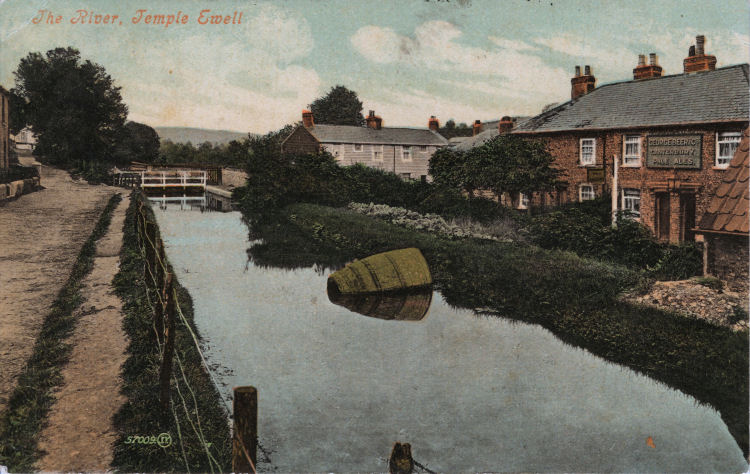
Above picture shows the Donkey at Temple Ewell, circa 1903.
|
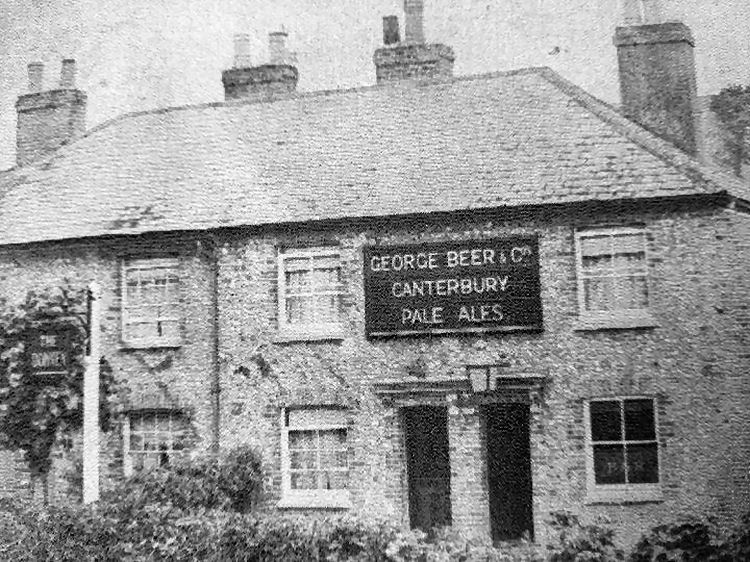
Above photo, date unknown, kindly sent by Paula Lewis. |
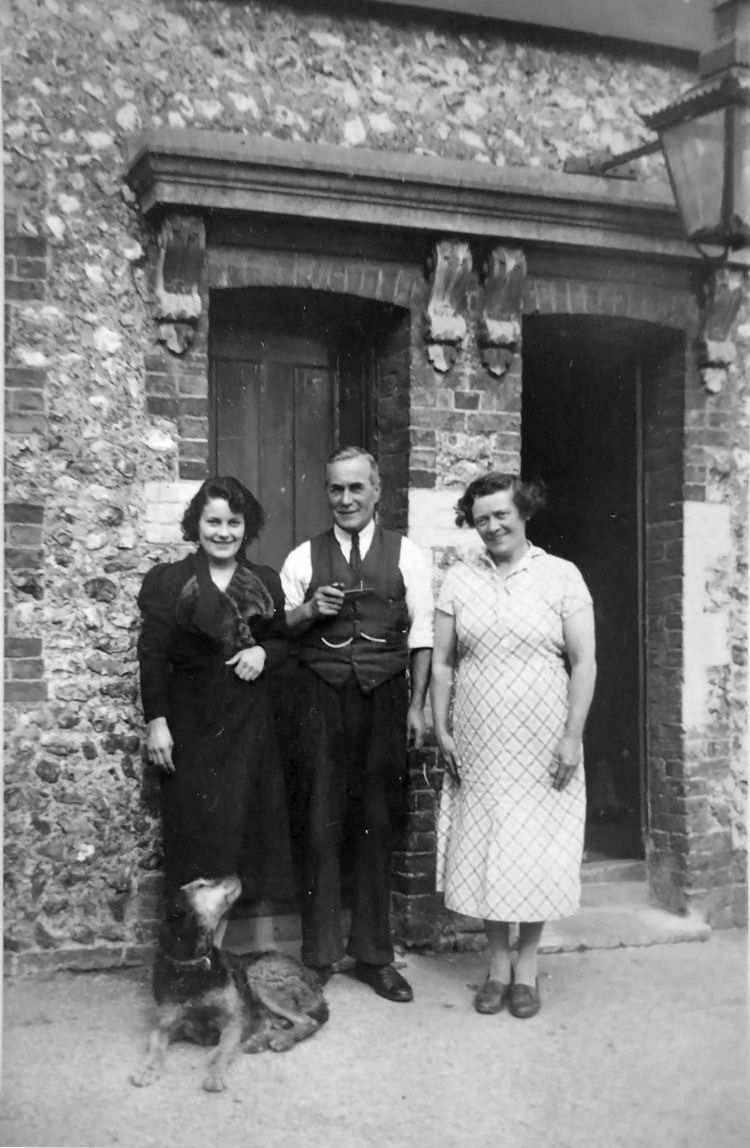
Above photo showing Eileen Rogers nee Gambrill with her parents, outside
the pub, date unknown sent by Paula Lewis. |
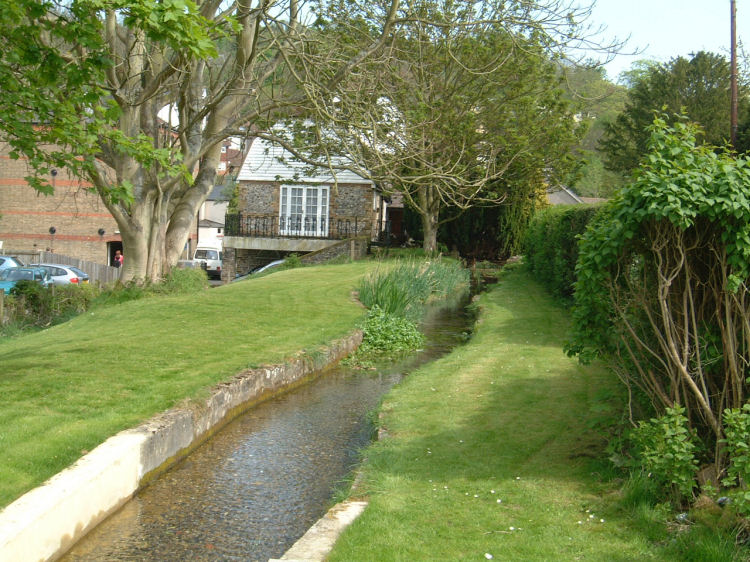
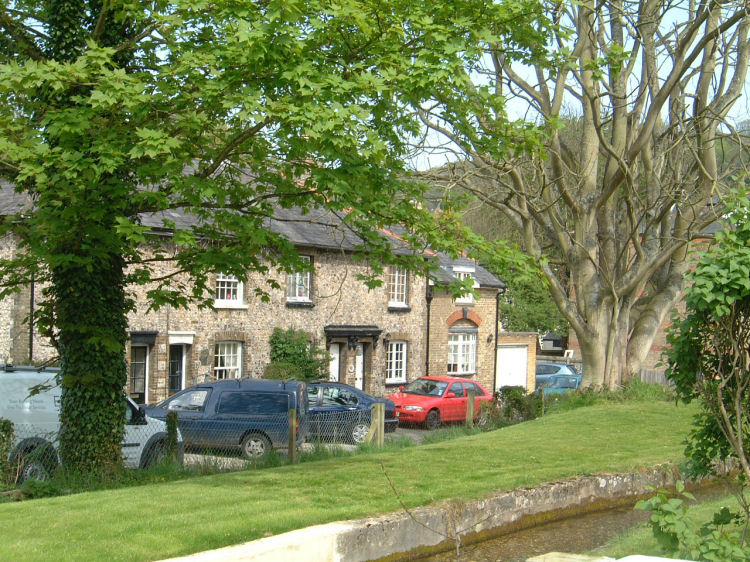
Note the river, which is now no more than a tiny stream as shown
above from a photo taken on 14 May 2008. The Donkey would be on the
direct left. |
 |
|
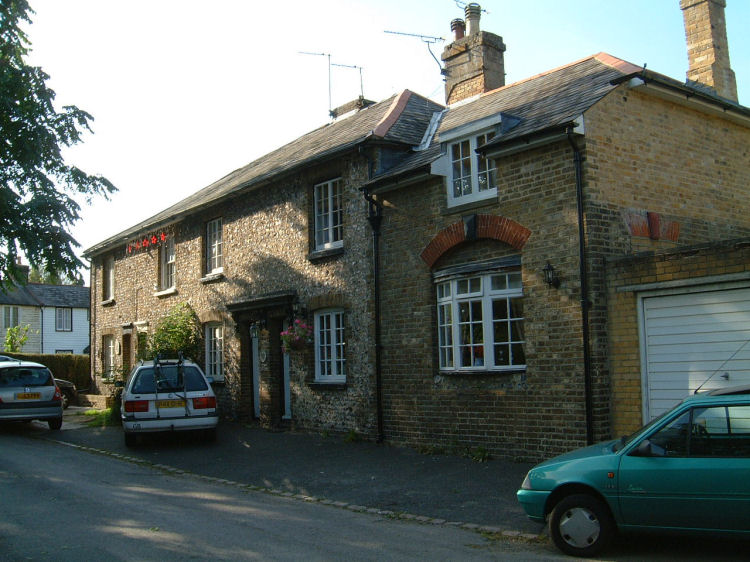
Above photos of the former Donkey by Paul Skelton 10 August 2007 and
below from the opposite direction 4 May 2008.
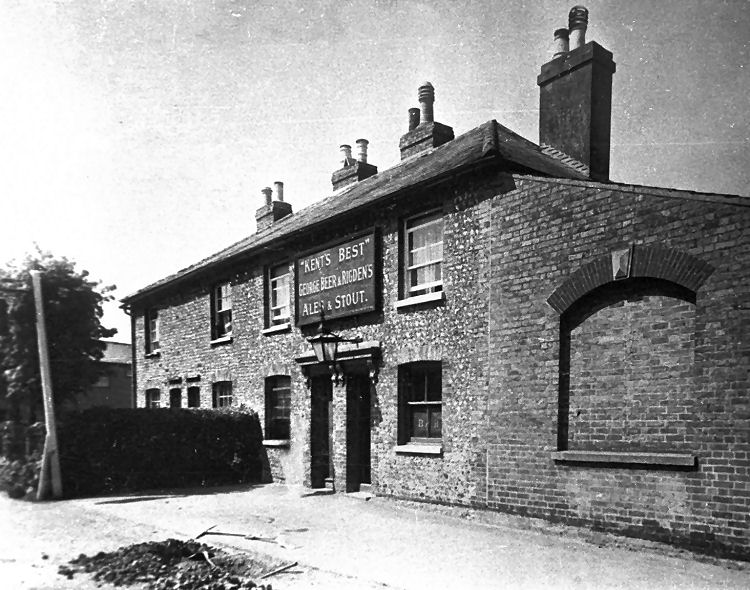
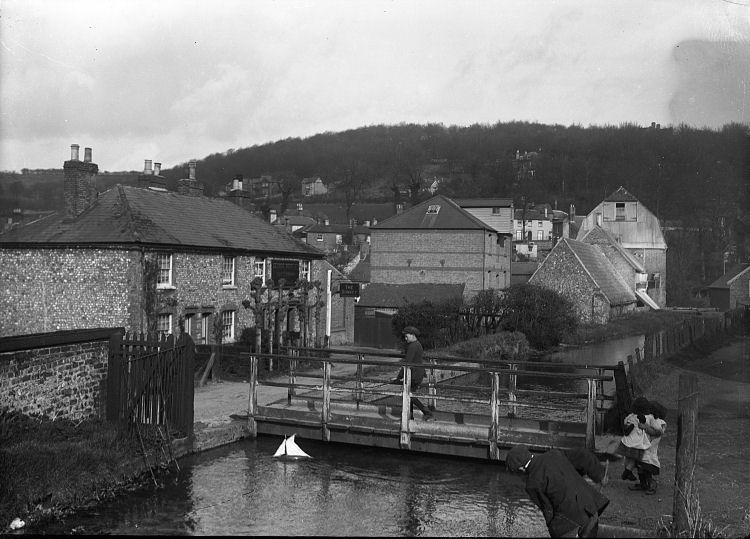
Same shot, this time circa 1930. Kindly supplied by Kathleen
Hollingsbee. Notice the end house (right) was not there at the time.
 |
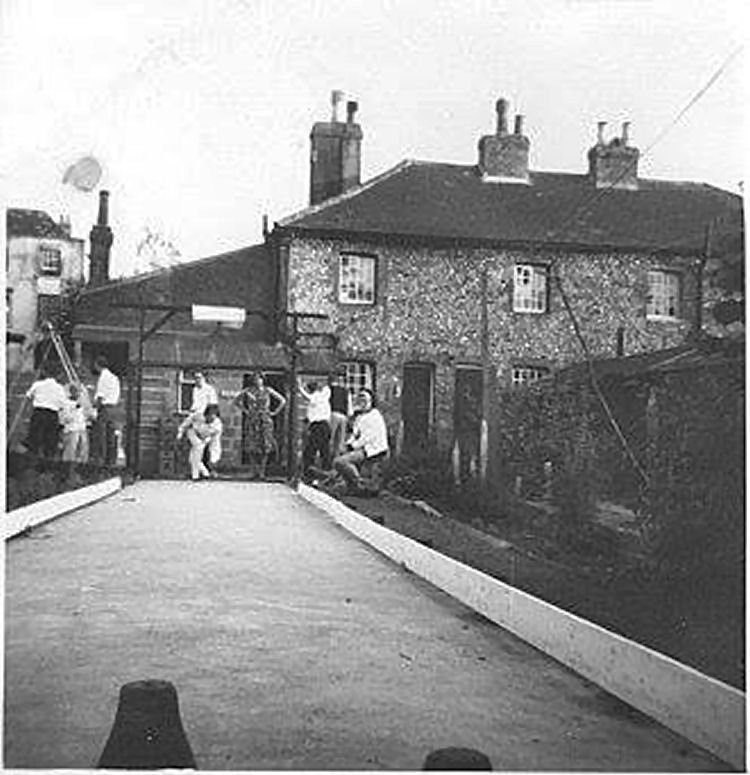
Above photo showing the "Donkey" skittle alley, 1960. |
The Donkey was always an ale house under George Beer and Co. brewery of
Canterbury and was without a spirit license. Locals would often be seen moving
around the corner to the Fox for their tot of whisky or rum and then back to the
Donkey again to finish off their beer.
I have now traced the "Donkey" back to as early as 1858, but it may be even
older.
It unfortunately closed some time after 1974.
|
From the Dover Express and East Kent Intelligencer, 21 January, 1865.
FAMILY TROUBLES
Elizabeth Friend, a respectably-attired female, was charged with
stealing some chimney ornaments, the property of Sarah Friend, her
mother-in-law, and the keeper of the "Donkey" beer-house, at Ewell, and
William Hopkins was charged with receiving the same, knowing them to
have been stolen. Mr. Minter defended the accused.
William Friend, a labourer living at Ewell, said he was sent for on
the previous afternoon by his mother. When he arrived at her house, he
found his mother crying. Elizabeth Friend was also there. A Mrs. Smith
said some things had been broken and some chimney ornaments taken away.
He then went for a policeman and charged the prisoner with stealing the
ornaments and Hopkins with receiving them. The value o the articles was
1s. 6d.
By Mr. Minter: Elizabeth Friend was his brother's wife. He went into
their house once, and could swear that he did not see the ornaments
there, nor had he ever heard they were their property. He knew Mrs.
Friend's husband had left Ewell; but did not know whether he had run
away from his wife, or did he know that his things had been removed to
his mother's house. His mother told him to give the prisoner into
custody.
Sarah Friend, the prosecutrix, said she was a widow, and kept the
"Donkey" public-house. The prisoner Friend was her daughter-in-law. Her
husband had gone away from Ewell. About three o'clock the previous
afternoon, the prisoner came with a Mrs. Smith, to her door, and asked
for their things. She replied she had no things belonging to them in her
house, when Mrs. Smith knocked her down with her fist, and Mrs. Friend
went upstairs into her bedroom and came down with the chimney ornaments
in her hand, which she handed to Hopkins. The ornaments were her own
property; she bought them and paid for them; and they had never been
from her house. Hopkins took the things away, and the women remained
there until her son came and gave them into custody of the police.
By Mr. Minter: Her son had gone away because of the illusage of his
wife (the female prisoner). When he went away, his furniture was sold.
She gave half-a-crown for the ornaments produced, and bought them off
her son, the prisoner's husband. When the prisoner came on Wednesday,
Mrs. Friend said that as her husband would not support her, she wanted
her clothes. The prisoner did not say when she came down stairs that the
ornaments were hers, and she should take them away.
The presiding magistrate ( W. P. Elsted, Esq.,) said that without
hearing any further evidence, he should dismiss the charge of robbery.
The prosecutrix then charged Elizabeth Smith, the mother of the
defendant Friend, with an assault.
Complainant deposed that the defendant, Mrs. Friend, and Hopkins,
came into her house on Wednesday, knocking her down, inflicting several
bruises upon her arms and body, and took a handful of silver coin from a
saucer in her cupboard.
By Mr. Minter: When Mrs. Smith came in she took hold of some
crockery-ware and said it was her property; but witness did not then
seize her and smash the crockery-ware. Mrs. Smith knocked her down three
times altogether.
Mr. Minter called a witness who proved that the marks the complainant
exhibited were not caused by the defendant's violence; that a struggle
took place at the complainant's instance on Mrs' Smith endeavouring to
take her away; and that no silver was taken away, as stated, the only
thing done being that the defendant took hold of the saucer in which the
money was kept and claimed it as her property.
The Bench dismissed this case also.
|
|
Whitstable Times and Herne Bay Herald, Saturday 21 February 1874.
INFRINGEMENT OF POLICE RULES.
At the County Police Court, on Saturday last, Horace Skinner, K.C.C.,
was summoned for having, whilst on duty, entered curtain licensed
premises and bought and consumed liquor.
Mary File and Daniel File,
keeping the "Donkey," at Ewell, deposed that defendant came into their
house on the 27th of January, and drank some beer. He appeared to be
drunk, and abused them.
Defendant said, he was not drunk, and called two
witnesses who said he was sober.
The Bench said it did not signify if he
were drunk or not. It was clear he was in the house drinking beer whilst
on duty. As the costs were very considerable (£1 17s.) they would fine
him 1s.
|
|
From the Dover Express and East Kent News, Friday 12 August, 1881. 1d.
Messrs. Terson and Sons, had an important property sale, at the “Royal
Oak” yesterday. No. 6 Russell Street sold for £380, 7, Russell Street
for £360, and the “Donkey” beer-house at Ewell fetched £800, said to be
the best price realised for a donkey for many a day.
|
|
Whitstable Times and Herne Bay Herald 30 September 1882.
WINGHAM. PETTY SESSIONS. - DOVER SITTING. LICENSES.
It being the annual licensing day - all the licenses were granted
without opposition.
Mr. Ward, solicitor, of Folkestone, applied for a full licence, on
behalf of a man named Hopper, for the "Donkey" beerhouse, Ewell.
The application was opposed by Mr. M. Mowll, on behalf of the
proprietors of the "George and Dragon," Ewell, and the Bench refused the
application.
|
|
From the Dover Express and East Kent News, Friday 19 September, 1884. Price 1d.
SPIRITS WANTED
Alfred Hopper, landlord of the “Donkey Inn,” Temple Ewell, applied for a
license to sell spirits. In answer to Mr. Mercer he said he paid £18 a
year as rent for house he was landlord for; it had five rooms on the
ground floor, one recently built, and four on the 2nd floor. His
business was increasing and he had lodgers in the summer time who came
down from London; also a great many people came to his place to play
bowls of an evening, and if any of them wanted spirits he had to fetch
some at the “George and Dragon.” He thought there was more demand for
them now as the inhabitants had increased since he last applied for his
license, and numbered now 600 inhabitants. There were houses. He had
applications for spirits on an average five or six times daily. He had a
bowling green and parties who came to play, and had to go to the “George
and Dragon” if they wanted.
In reply to Mr. Mowll the applicant said he applied for his license last
year and then was refused; there had been no new houses built nearer
his, than the “George and Dragon” since then.
Mr. Martin Mowll who appeared on behalf of the landlady of the “George
and Dragon,” contended that there had been no cause why the Bench should
reverse the decision of the previous years.
The Bench refused to grant the application and said they hoped it would
not be brought again.
|
|
From the Dover Express and East Kent News, Friday 29 May, 1885. 1d.
BREWSTER SESSIONS – DOVER DIVISION
Mr. Woolaston Knocker applied for a full license for the beer-house
known as the “Donkey,” Ewell. This was the forth time of asking, the
same arguments being adduced as on former occasions. Mr. Martyn Mowll on
behalf of the owner of a neighbouring house opposed the application.
The Magistrates decided to refuse the application.
|
|
From the Dover Express and East Kent News, Friday 17 September, 1886. 1d.
THE DONKEY OF EWELL
Mr. Vernon Knocker applied on behalf of Messrs. Beer and Co, of
Canterbury, for a spirit license for the “Donkey” at Ewell. He stated
that Alfred Hopper had been the tenant for a good many years, and the
house had been properly conducted. There were about 600 inhabitants of
Ewell, and the landlord of the “Donkey” had several times been asked for
spirits. He had about three-quarters of an acre of ground adjoining the
house, which was used as a bowling green, the only one in the village.
He (Mr. Knockler) had a memorial signed by about twenty five residents
in the village or close by, in favour of the license. For the
application he called the following witnesses:-
George Andrews proved serving the copies of the notice of the
application on the Superintendent of Police and Overseers.
Mr. Alfred Hopper said: I posted a copy of the notice produced on the
Church doors and on the house on the three last Sundays in August. I am
the tenant of the house and have been in occupation five years. The
house is rented at £16 10s. I produce the memorial, which is signed by
the parties named. The “George and Dragon” is about 200 yards away.
Attached to my home is a bowling green, the only one in the village.
During the summer I have visitors staying at my house. They require
something more than beer. I have had constant applicants for spirits.
By Mr. Mowll: There have been no new houses erected near my house since
last year.
Mr. Martyn Mowll appeared to oppose the license and contended that it
was not required, the “George and
Dragon,” which was a fully licensed
house, being near by.
The Bench declined to grant the application and stated they were of the
same opinion as last year, when the same application was made.
|
|
From the Dover Express and East Kent News, Friday 21 June, 1889.
THE DONKEY
At the County Police Court, at the Town Hall, Dover, on Thursday
afternoon, V. Fisher, H. Gillham, W. Phipps, and W. Gregory were charged
with being on licensed premises on Sunday, June 2nd, during prohibited
hours, at the “Donkey Inn,” Ewell. Mr. Hopper, the landlord, was charged
for keeping his house open during prohibited hours. Police-constable
Crapps went to the house on the Sunday morning in question, and found
the men drinking round a table. They said that they were “travellers,”
but it was found that they all lived within three miles of the house,
and therefore were not entitled to “travellers'” privileges. Mr.
Worsfold Mowll, who appeared for the landlord, called Mr. Hopper, who
said he asked all the men if they lived outside the three mile boundary,
and they said that they did. The whole of the defendants were convicted
excepting Gilham, in which case there seems to have been an instance of
mistaken identity. The men were fined 1s. and costs. The landlord was
fined 2s. 6d. and costs, but as he might have supposed that the men were
travellers, they would not indorse the license.
|
|
From the Dover Express and East Kent News, Friday, 20 September, 1889. Price 1d.
COUNTY LICENSING SESSION
At the County Licensing Sessions held at Dover yesterday afternoon,
Superintendent Maxted and Superintendent Kewell both reported that the
public houses in their districts had been all well conducted except at
the “Donkey,” at Ewell, where there had been a conviction for selling
during closing time. All the licenses were renewed.
|
|
From the Dover Express, Friday 21 July 1905.
Permission was given to Mr. Walter Gambrill, of the "Donkey," Temple
Ewell, to sell beer at the Ewell Flower Show on the 26th; and to Mr. G. Austen, of the "Fleur-de-Lis," Dover, for the sale of
wines and spirits at the same place.
|
|
From the Dover Express and East Kent News, Friday,
18 January, 1907. Price 1d.
Permission was granted for an hour's extension at the
"Donkey," Ewell, on February 6th, on the occasion of the Temple Ewell
Cottage gardeners' Society Dinner.
|
|
From the Dover Express and East Kent News, Friday 1
March, 1912. Price 1d.
LICENSING
An occasional licence for the supply of refreshments was granted to
Mr. Gambrill, of the "Donkey," Temple Ewell on the occasion of a
Conservative smoking concert at the Parish Hall.
|
|
From the Dover Express, Friday 9 April 1948.
Licences Confirmed.
Granted at the Wingham Licensing Sessions, the following licences were
confirmed at Canterbury on Wednesday by the East Kent
Confirming Committee. The "Donkey," Temple Ewell (wine on); the
"Endeavour," Staple (wine on); the "Ship," Wingham (wine
on); and the "Supply Stores," Shepherdswell (beer and wine off).
|
|
From the Dover Express and East Kent News, Friday 19
November, 1954.
Walter James Gambrill, licensee of the "Donkey" public
house, Temple Ewell was granted an occasional license to sell beer in
Mr. Stanley's meadow on July 22nd, from 10 a.m. to 10 p.m., on the
occasion of the Temple Ewell flower show.
|
|
From the Dover Express and East Kent News, Friday 19
November, 1954.
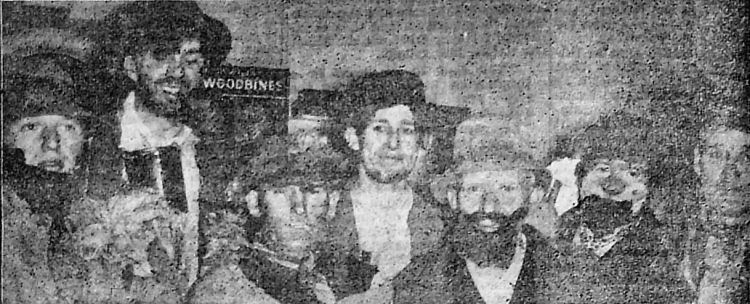
VERY REALISTIC.
Entrants in the annual Tramp's Supper, at the "Donkey" Inn, Temple
Ewell, on Friday evening.
|
LICENSEE LIST
FRIEND Thomas 1858+ (Beer Retailer)
FRIEND Sarah 1858-65+ (age 58 in 1861 ) )

BIRCH James 1871+ (age 54 in 1871)
FILE Daniel & Mary 1874+
FILES/FILL Edward Elmer to Oct/1881+
(age 66 in 1881)

HOPPER Albert Arthur Oct/1881-91+ (age 34 in 1891)
  
GAMBRILL Walter James 1895-Jan/1931 dec'd (age 49 in 1911)
      (beer house)
GAMBRILL Elizabeth Jane Jan/1931+
GAMBRILL Henry G 1932-50
  
BALDWIN Patrick 1953-56+
 
PRESTON J 1961+
COOMBER John F A 1974+
 Fremlins
From Pikes Dover Blue Book 1889
From Pikes Dover Blue Book 1890
From Pikes Dover Blue Book 1891
From Pikes Dover Blue Book 1895
From Pikes Dover Blue Book 1896-97
From Pikes Dover Blue Book 1898
 From Pikes Dover Blue Book 1899 From Pikes Dover Blue Book 1899
From Pikes Dover Blue Book 1899-1900
From the Post Office Directory 1914
From Pikes Dover Blue Book 1924
From Pikes Dover Blue Book 1932-33
From Pikes Dover Blue Book 1938-39
From the Kelly's Directory 1950
From the Kelly's Directory 1953
From the Kelly's Directory 1956
Library archives 1974
From the Dover Express
Census
Whitstable Times
and Herne Bay Herald
|

