|
Temple Ewell
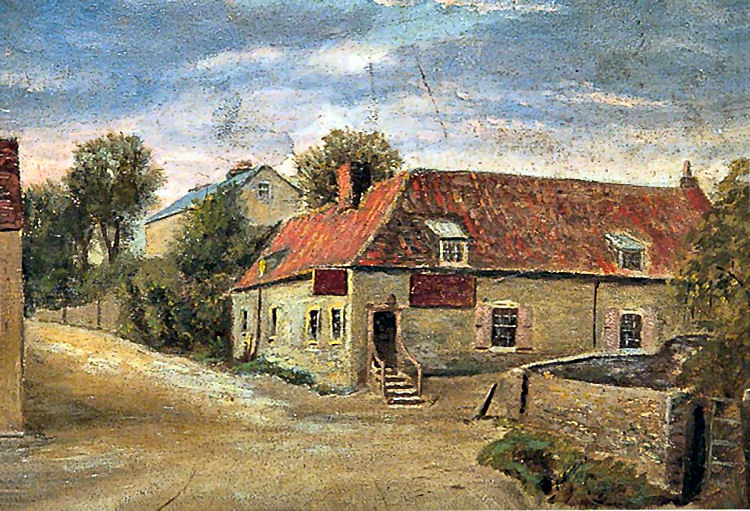
Above painting, date and painter unknown. |
 |
|
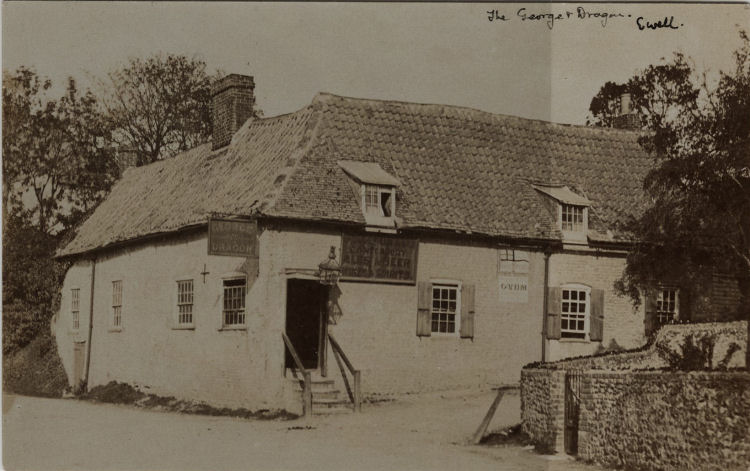
The above picture shows the original George and Dragon in Temple
Ewell, date unknown. |
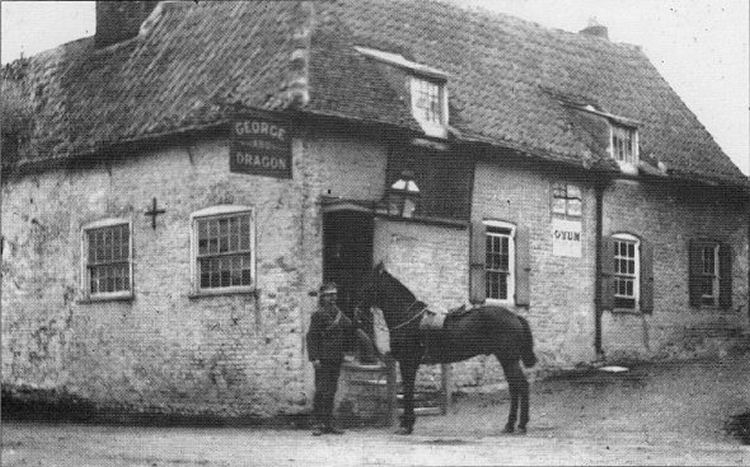
Again, date unknown but obviously the original building. |
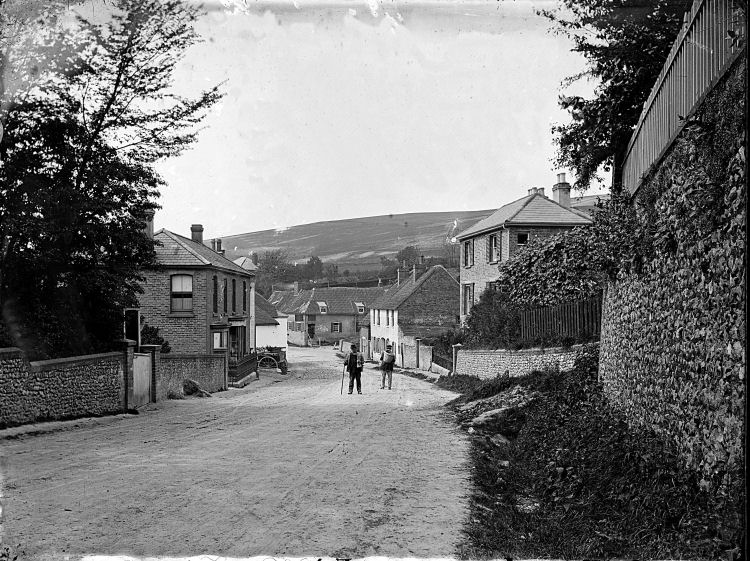
Above shows the old "George and Dragon" about 1890. |
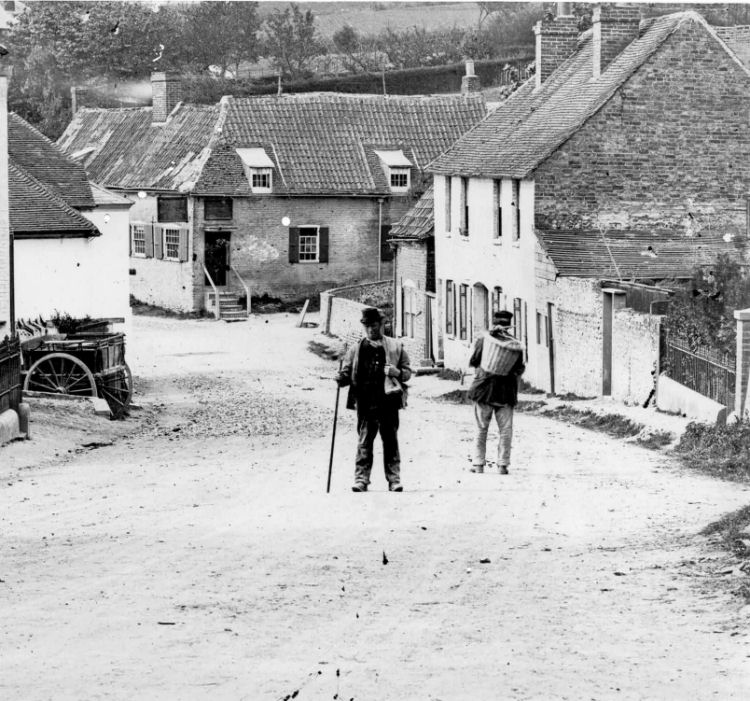
Above photo a blown-up one of above, circa 1890. |
 |
|
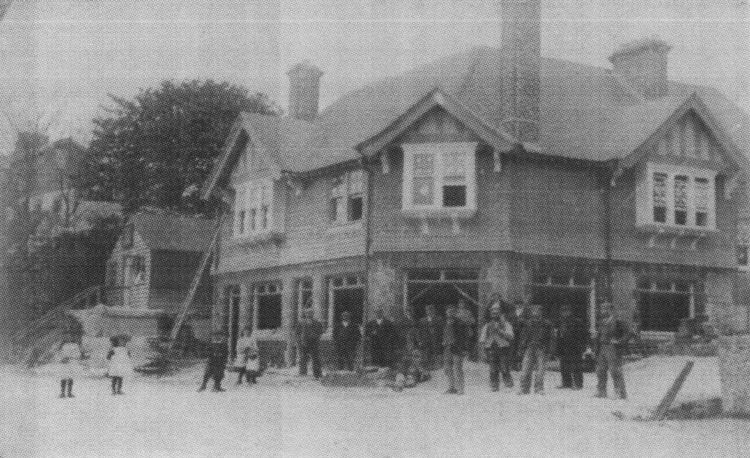
The New building almost complete of the George and Dragon in Temple
Ewell, date after 1904. |
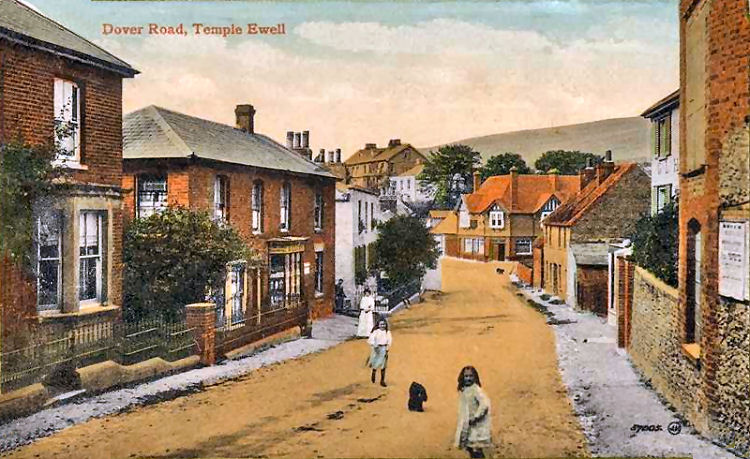 Above postcard, circa 1906, kindly sent by Rory Kehoe. |
 |
|
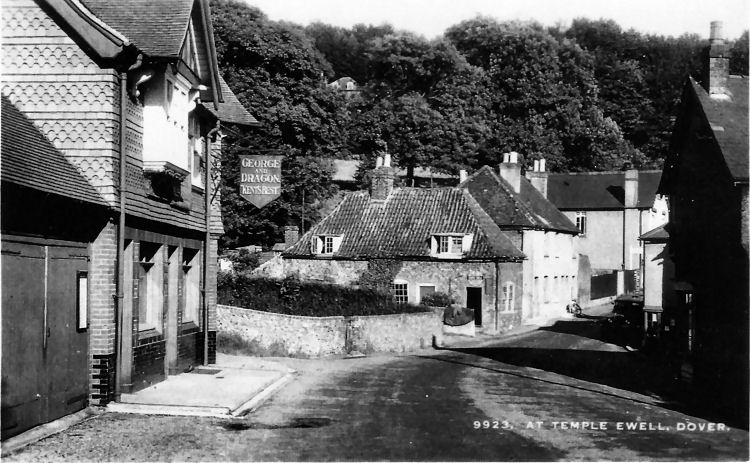
George and Dragon, date unknown.
|
 |
|
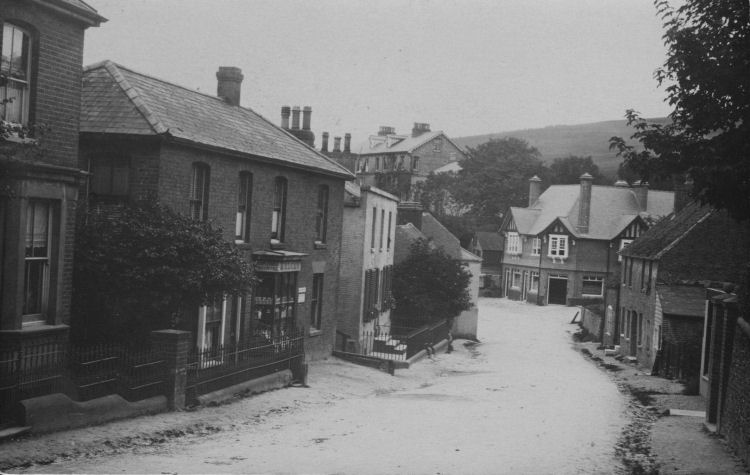
Above picture showing the George and Dragon in 1903. The name on the
shop on the left says Temple Ewell Post Office, and the name KELCEY. |
 |
|
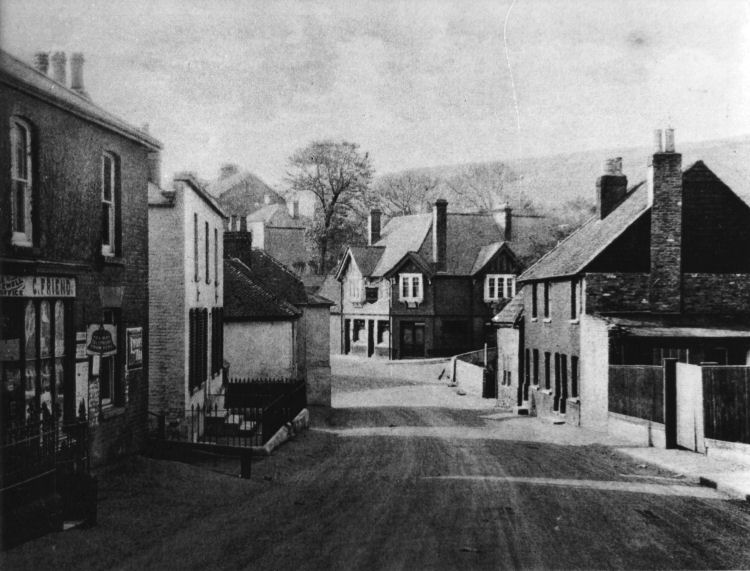
The above picture is a different date from the previous one and the
name on the shop at the left is C. Friend.
|
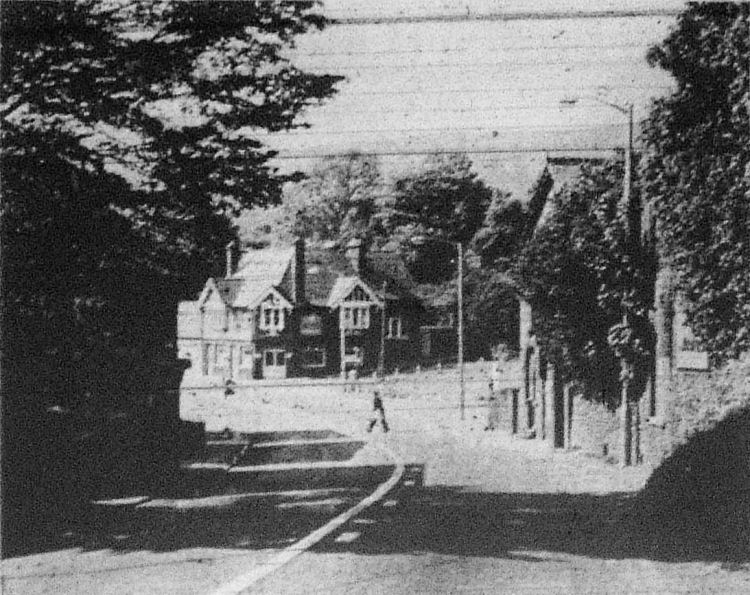
Above photo, "George and Dragon" 1970. |
|
From the Dover Express and East Kent News. 9 August,
1963.
Half Century Behind The Same Bar.
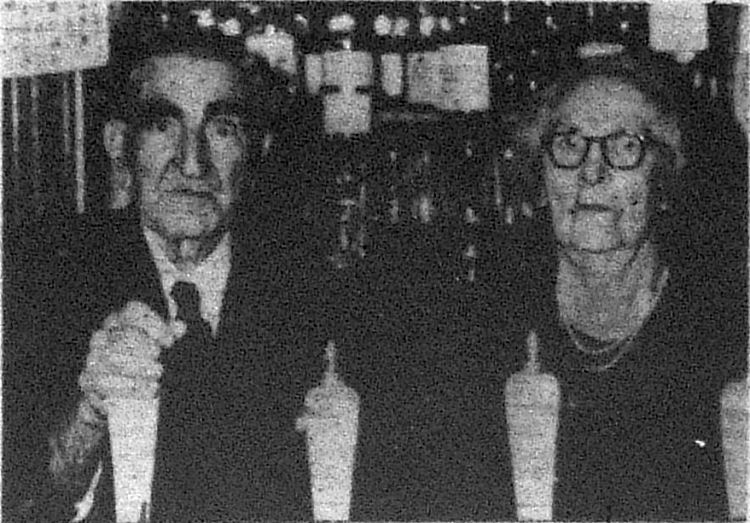
A TRIPLE ANNIVERSARY, this week, for Mr. and Mrs. Percy Parks, of the
George and Dragon public house at Temple Ewell. They celebrated their
fifty-eighth wedding anniversary on Wednesday, their fifty-eighth year
in the licensed trade, and their half century behind the same bar.
"And we hope we've got the same cheerful smile for our customers as
we had when we first started," says Mrs. Mabel Parks.
Both Dovorians, they were wed at St. Bartholomew's Church, and, the
same day, took over as host and hostess at the Hope Inn, Lydden.
They remained there for four years, and moved to the old Globe, in
Peter Street, for another four years.
After that they transferred to the "George and Dragon" .... and have
been there ever since.
Four of their seven children are still living, and they have nine
grandchildren and one great-grandchild. One son, Percy, keeps the
butcher's shop just across the road. A daughter. Mrs. Doris Keeler,
lives at Church Hill, nearby, and another daughter, Mrs. Mabel Roberts,
is at Swingfield.
"They are all very good and take it in turns to come and help us
behind the bar," says Mrs. Parks.
|
 |
|
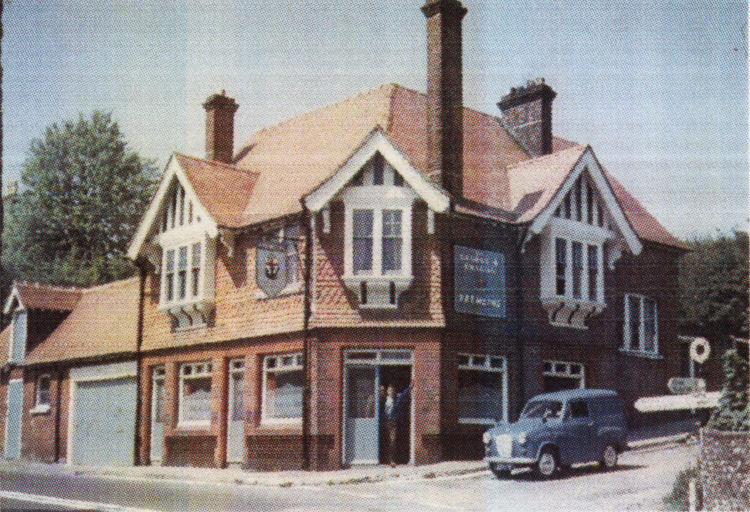
George and Dragon circa 1970. |
 |
|
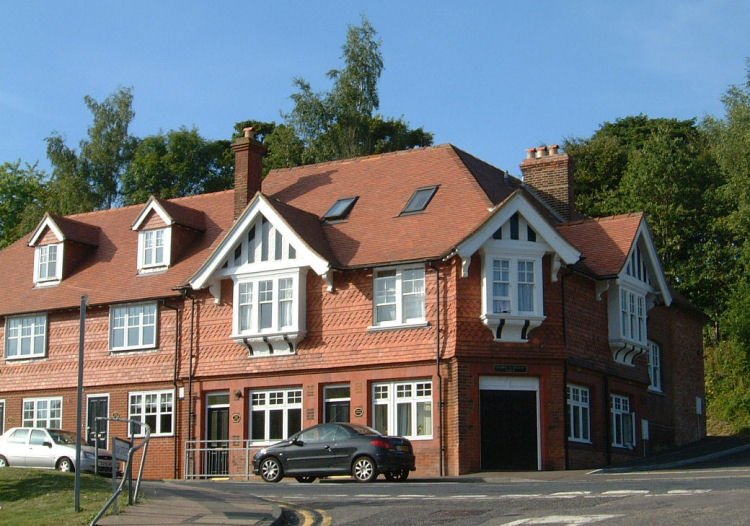
Above photos of the former George and Dragon by Paul Skelton 10
August 2007. This premises has now been turned into flats. Notice the
chimney missing on the front right and the extra buildings on the left,
converted from the stable block. |
Earliest reference found so far is in the Wingham Division Ale Licence list,
which shows the "George," Ewell, to be re-licensed for the sum of 8 shillings in
1740 indicating that the pub was present before 1740. I am assuming here that
perhaps the "George" is one and the same as the "George and Dragon" and that it
may have changed name sometime, or perhaps there was a misprint in the original
documentation of 1740.
|
Kentish Weekly Post or Canterbury Journal 25 February
1812.
Feb. 20, suddenly at Ewell, Mr. Thomas Reeves, landlord of the
"George" public-house, after eating a hearty supper and while taking his
glass of grog as usual, he complained of a pain in his stomach, and
instantly fell from his chair and soon after expired.
|
|
From the Dover Telegraph and Cinque Ports General
Advertiser, Saturday 9 March, 1839. Price 5d.
SUICIDE
A young woman, about eighteen, named Sarah Rose, servant at the
"George Inn," at Ewell, terminated her existence by hanging herself with
a handkerchief and towel, in the outhouse, yesterday evening.
|
|
From the Kentish Gazette, 19 March 1839.
INQUESTS TAKEN BEFORE MR. T. T. DELASAUX, CORONER.
Yesterday se'nnight, at the parish of Ewell, in this county, on view of
the body of a young woman named Sarah Rose, who was
found hanging in that parish on the evening of the previous Friday. It
appeared that the deceased was servant to Mr. Daniel
Ralph, of the "George and Dragon" public-house, in that parish, and was
of a cheerful disposition, and on the day in question she
performed her usual work without any appearance of depression, when
about five o'clock in the afternoon, after being missing a
short time she was found suspended by a towel from a hook fixed in a
beam in the washhouse of her master's house; she was
immediately taken down, and Mr. Rutley, surgeon, of Dover, being
promptly in attendance every means of restoring animation
was resorted to without effect as she was quite dead. It further
appeared in evidence that the deceased being of a playful
disposition, had been in the habit of dressing up figures and laying
them in the bed of some young men who lodged at her
master's house, and there was but little doubt that she had met her
death by an attempt at a lark—she intending only to have
turned off for the purpose of creating an alarm, as the towel was not
tied but merely turned round her neck without being
fastened, but in consequence of her weight it drew it tight and did not
slip as it was evident she intended it should have done.
The Coroner having summed up the evidence, the jury returned a verdict
that "the deceased hanged herself for the purpose of
frightening her fellow servants and not with an intention of taking away
her life."
|
|
Kentish Gazette 1 May 1849.
DEATH. REEVES.
April 25, at Charlton, Mr. Thomas Reeves, many years landlord of the
"George and Dragon," at Ewell.
|
|
Kentish Gazette, 20 January 1857.
EWELL.
Death by Accident.
On Saturday, Mr. Delasaux held an inquest at the "George and
Dragon," in this village, on the body of Stephen Tutt, a labouring
man, who it appeared by the evidence of David Fox, hay trusser, was
engaged in tying a load of hay to a wagon which they had been
loading, and the rope breaking the deceased fell to the ground, and
was so severely injured that he survived but five minutes. This
statement was corroborated by another witness.
Mr. Walter, surgeon, of Dover, who was called in, found deceased
dead, the bones of the neck being broken and displaced, so as to
press on the spinal marrow, which he had no doubt had been
occasioned accidentally.
A verdict was so returned.
|
|
South Eastern Gazette, 14 February, 1860.
DEATH.
On the 30th ult., at the "George and Dragon," Ewell, Mr. Wm.
Luscombe, aged 68.
|
|
From the Kentish Chronicle, 27 October, 1860.
Accident on the Railway Works near Dover.
THREE MEN KILLED.
On Tuesday afternoon, at a little after one o'clock, at the navvies
engaged in making the line to Dover were at work at a bridge at Temple
Ewell, the whole structure suddenly gave way, with a dreadful crash.
Three men were at work under it, at the time, and they were all buried
under the ruins. Immediate efforts were made for the recovery of the
bodies; but it was not until two hours had elapsed that they were dug
out. Quite dead, we need not say, they were; and two of them had
sustained the most dreadful injuries, their faces being so bruised that
they were unrecognisable. Their names were Jackson, Hammond, and Rumle.
They were at once removed to the "George and Dragon," Ewell, and
information was conveyed to the coroner for East Kent, T. T. Delasaux,
Esq.
The inquest was held at the "George and Dragon," at a little after
one on Wednesday afternoon. Mr. Potter was named foreman. The jury first
viewed the bodies of the unfortunate men, and afterwards went to the
scene of the accident. Previously the coroner had, in a few appropriate
observations, explained to them, that although the accident had resulted
in the death of three persons, yet the jury might confine their
attention to the case of Henry Jackson; because it was presumed, that
the same cause which produced his death, produced also that of the other
two. He felt it necessary to request the jury to visit the scene of the
casualty, because they would not, otherwise, have a clear idea of all
the circumstances attending it.
After their return the following witnesses were called.
Thomas Russell:— I come from Worcestershire, and am engaged on the
railway works at Ewell, as labourer. I have seen the body of the
deceased, and I identify it as that of Henry Jackson, my half brother. I
cannot say anything as to the cause of death. I had left the cutting
about six minutes before the bridge fell. For the last week I have been
working under or near it. The deceased has been also so employed. I was
working all yesterday with the deceased. I heard the bridge full, just
as I had got out of the cutting. I ran back at once. I am employed by
Mr. Packson; but I do not think he is the contractor for the erection of
the bridge. I have seen the bricks as they now lie. Most of them seem as
clean of mortar us ever they were. Some have a little mortar; but many,
I should think, can never have had a particle of mortar on them. I
cannot say whether the bridge was properly built I have seen many
buildings pulled down, and the bricks in these cases have always had a
great deal of mortar sticking to them—very different to the bricks of
this bridge. I was present when my brother was dug out. I did not assist
the workmen. He was quite dead. His body was much injured.
The Coroner asked Mr. Macdonald (Mr. Crompton's agent) who was
responsible for the building of the bridge?
Mr. Macdonald:— Messrs. Hawley (of Dover). I think they had the
sub-contract for its erection, and they did not sub-let it to any one.
Mr. Delasaux:— The bridge must be re-built. Who will re-build it?
Mr. Mills (the resident engineer of the company):— Mr. Crompton, I
should think. He is responsible to the company, and Messrs. Hawley to
him. I understand that Messrs. Hawley undertook it themselves, and did
not sub-let it. They appointed a foreman to superintend the works.
Mr. Hawley, at the suggestion of the Coroner, was sent for, and
remained in the room during the rest of the inquiry.
Mr. Macdonald, in answer to the Coroner, said that he had the
contracts between the company and Mr. Crampton, and between Mr. Crumpton
und Messrs. Hawley; but he had not got them with him then.
The Coroner said, they must be produced, and no further evidence
could be taken, as he should have to adjourn the inquiry. It was a very
important one, and intimately affected the public interests, as well as
the safety of the other labourers. It would, he thought, be necessary to
have a professional opinion, as to the erection of the bridge, and
whether the proper materials had been used, and in the proper way. He
should therefore propose an adjournment.
After a little discussion the inquest was adjourned till next Tuesday
morning at eleven o’clock.
The Coroner directed that no alteration should be made in the present
position of the fragments of the bridge during the week.
The jury were bound over for the nest Tuesday, and the proceedings
then closed.
|
|
South Eastern Gazette, 30 October, 1860.
EWELL. Fatal Accident at the Railway Works.
An inquest was held on Wednesday last at the "George and Dragon
Inn," Ewell, before T. T. Delasaux, Esq., coroner, on the bodies of
Henry Jackson, George Hammond, and ---- Rumle (supposed to be a
foreigner), who had been killed on the previous afternoon, by the
fall of a new railway bridge. This bridge was situated on the line
from Dover to Chartham, near Temple Ewell Church; and on Tuesday
afternoon the deceased men were engaged in removing a quantity of
chalk and rubbish from the spot immediately beneath the bridge.
After they had been at work for some time, the bridge suddenly came
down with, a tremendous crash and buried them beneath its ruins,
which, as it had stood 40ft. or 50ft. high, were considerable. Every
effort was at once made to extricate them, but when got out at
nearly 4 o’clock next morning, they were all quite dead. The
features of two of them were so much broken in as to be
unrecognisable, and the third had his hand severed from his arm at
the wrist. The arch of the bridge had a span of 54ft., and rested on
chalk at each side. What occasioned the accident did not appear, and
the inquiry was adjourned till Tuesday (this day).
|
|
From the Kentish Chronicle, 3 November, 1860.
EWELL. THE LATE ACCIDENT ON THE RAILWAY.
The adjourned inquest on the bodies of the three men who lost their
lives on Tuesday week, by the falling of the bridge at Ewell, near
Dover, was resumed on Tuesday morning. In the meantime, Mr. Vincent, of
Canterbury, had, by the directions of the coroner, made a professional
survey of the bridge. Mr. Warder, from the office of Messrs. Freshfield,
the company’s solicitors, attended to watch the proceedings. Some
further evidence having been taken the jury retired for about an hour,
and then announced that they had agreed upon a verdict of "Accidental
Death," and suggested that the Company should be more careful in
building such bridges in wet weather.
|
|
South Eastern Gazette, 6 November, 1860.
The late Accident on the Railway Works near Dover.
The adjourned inquest on the bodies of the three men who lost their
lives last Tuesday week, by the falling of the bridge at Ewell, near
Dover, was resumed yesterday morning week. In the meantime, Mr.
Vincent, of Canterbury, had, by the direction of the coroner, made a
professional survey of the bridge. Mr. Warder, from the office of
Messrs. Freehfield, the company’s solicitors, attended to watch the
proceedings. Some further evidence having been taken, the jury
retired for about an hour, and then announced that they had agreed
upon a verdict of accidental death, and suggested that the company
should he more careful in building such bridges in wet weather.
|
|
From the Kentish Gazette, 23 May 1865.
Melancholy Suicide.
On Tuesday last an inquest was held at the "George and Dragon"
public house, Ewell, near Dover, by the county coroner, T. T.
Delasaux, Esq., on the body of Thomas Ashcroft, a milkman, who had
destroyed himself by discharging a pistol at his head on the
previous day. It is supposed that unusual depression of mind
resulting from some pecuniary embarrassment under which the
unfortunate man had been recently labouring led to the commission of
the rash act. Mr. Henry Coleman was chosen foreman of the jury, and
the following evidence was adduced:—
John Baynton, blacksmith, living at Ewell, deposed that at a
quarter before twelve on Monday morning, he was in the "George and
Dragon Inn," when he heard the report of a pistol. Shortly
afterwards, the wife of the deceased came to the turnpike road and
called for assistants, saying that her husband had shot himself. He
ran into the stable near the house, and saw the deceased sitting on
a corn chest with a pistol lying on the ground about a yard from his
feet. He noticed that the deceased was quite dead, and that the
lower jaw had been shot away; blood was flowing extensively from the
wound, he believed the pistol was loaded with powder and a bullet,
as the latter appeared to have passed through the deccased’s jaw,
right through the window, for there were marks of blood upon the
glass, which was pierced apparently by a bullet.
Richard Ashcroft, a mariner, living at Ewell cottage, said the
deceased was his father. About a month ago the deceased complained
of pain in his head, since which he had been in a melancholy state
of mind. Between Thursday last and Monday his father appeared
particularly low-spirited, and once said he could not live much
longer. At that time the deceased appeared very different from usual
in his manner. He had never heard his father threaten to destroy
himself.
By the foreman:- Witness never saw the pistol produced until
Monday, and he did not think it had been kept in his father’s house.
The Jury returned as their verdict that the deceased shot himself
while in a state of mental derangement.
|
|
From the Southeastern Gazette, 3 April 1866.
Fatal Accident to a Lad at Ewell.
On Monday afternoon, as the 1.5 p.m. down express train was passing
through Ewell, a little boy named Martin, three years old, was standing;
on the dangerous crossing near that station, and was run over and
literally dashed to pieces by the engine, portions of his brains being
scattered several yards along the line. His right arm was cut asunder
between the elbow and the shoulder. The poor mother was a witness of the
scene from her window, and cried out, “Oh, my dear child! he’ll be
killed!” which turned out to be too true. What makes the matter more
lamentable is that she is about to give birth to another child, and the
father is unable to work through illness. A coroner’s inquest was held
on Tuesday, before T. T. Delasaux, Esq., county coroner, at the “George
and Dragon Inn,” Ewell. The principal witnesses examined were Alice
Martin, sister of the sufferer, and a man named Birch. Gibbs, the
engine- driver, was also questioned, but nothing further was elicited
than the particulars stated above. The verdict was “Accidental death,”
the jury finding that no blame was attached to any one.
|
|
From the Dover Express and East Kent News, Friday, 4
February, 1870.
Whitstable Times and Herne Bay Herald, 12 February
1870.
A CHILD BURNT TO DEATH
An Inquest was held at the "George and Dragon" public-house, Ewell,
near Dover, yesterday morning, before the County Coroner, T. T. Delasaux,
Esq., on the body of a female child named Ann Elizabeth Friend, aged 4
years, who was burnt to death by falling over a fire guard into the
fire.
Elizabeth Gambrill, the wife of John Gambrill, of the parish of Ewell
deposed: My husband is a labouring man, and we live next door to the
father of the deceased. On Tuesday morning last, about 11 o'clock, I
heard screams proceeding from Mr. Friend's house. In consequence, I went
in, and found the deceased sitting on the floor with her clothes in
flames. I took a mat from the room and extinguished the flames. When I
went in another child was sitting on the floor, beside the deceased. I
also saw the child about six or seven years of age run from the house,
towards where the mother was at work about the time I heard the screams.
When I went in, I do not know whether the fire-guard was up, but it was
there. The deceased child died from the injuries of the burns, which had
extended over the greater part of the body, yesterday about eight
o'clock.
By the foreman, Mr. Dombrain: I heard the screaming before the child
was out of the house.
Alice Friend deposed: I am the wife of William Friend, a labourer, of
Ewell. The deceased was my child, and was aged four years and three
months. I went out to wash on Tuesday morning last, at Mrs. Goldsack's.
Her house is not far from my own. I went there about six o'clock in the
morning, leaving the deceased and two other children in bed upstairs. I
went home again about nine, to see to them, and found them all up and
dressed. I left them in the care of the little girl now present, who is
between six and seven years of age. I have been in the habit of doing so
for some time, leaving home early in the morning, and going occasionally
to attend to the children myself. I remained at home nearly half an
hour, when I went home that morning. When I went away the fire-guard was
up, and there was a fender inside the guard. The guard was before the
fire, but not hooked. It did not quite fit the fire-place. I was called
by this child. When I went home Mrs. Gambrill was just coming out of the
door. When I returned the guard was just where I had left it. The
deceased told me she fell over the guard, but how she got out without
moving it I don't know.
The jury returned a verdict to the effect that the child was
accidentally burnt to death.
|
|
From the Dover Express and East Kent News, Friday, 2
June, 1876. Price 1d.
DESERTION
Walter Nicholls and Stephen Ryan were charged with being deserters
from the 24th Regiment, stationed at Dover.
Instructing-constable Jessop said he saw the prisoners in the “George
and Dragon” public house at Ewell that morning at seven o'clock. He
asked them if they were on pass. They said “Yes.” Nicholls produced a
pass which expired at 12 o'clock midnight, on
Sunday. Ryan had no pass.
Prisoners were ordered to be sent back to their quarters.
|
|
From the Dover Express and East Kent News, Friday 13
July, 1877.
SHOCKING ACCIDENT NEAR KEARSNEY
An inquest was held at the “George and Dragon Inn,” Ewell, on Monday
afternoon, before F. J. Till, Esq., on the body of Mr. Green, whose body
was found on the London, Chatham, and Dover Railway line early in the
morning.
The gentleman with whom deceased was staying in Dover said: I am a
barrister-at-law. I identify the body as that of Mr. Green. He had no
fixed residence. He was unmarried, and his age was 43. I last saw him
alive yesterday evening in Dover. I asked him where he was going, and he
said he was going for a walk over the hills in the direction of Fort
Burgoyne. This was a little after six. He seemed in his usual health and
spirits. He had no pecuniary difficulties of the sort.
By the Jury: He was not a relation of mine.
Mr. Alfred Stanley said: I am a miller, living at Ewell. I saw
deceased walking about in the road last night at about a quarter to
nine. He stood looking at the road leading to the school for some time,
and then went on towards the church. I noticed nothing strange in his
manner. He stood looking about as a stranger would.
By a Juror: He was certainly not intoxicated.
William Allen said: I am a waggoner in the employ of Mr. J. G.
Churchward, of Kearsney Manor. This morning I was walking along the line
to go to work. I go that way to see if the horses are in the meadow by
the lower side of the line. I happened to look over the bank on the
lower side of the line, and saw something on the line. I went a little
way back to a place where I could get on the line. I then saw the body
of a man. The head was separated from the body. I went and called a man
named Page who is employed on the line, and told him what I had found.
It appeared to me that the train had passed over deceased's neck. There
was a little blood on the rail.
Mr. William George said: I am in inspector of permanent way in the
service of the London, Chatham, and Dover Railway. The down trains
between nine last evening and a quarter-to-four this morning are one
from London reaching Kearsney at 9.43 (a slow train) and the express,
which passes at about 10.10. I went to the place where deceased was
killed this morning. The body was lying in the 6ft. way, and the head
was about six feet nearer Dover, in the 4ft. way. It was evident that he
was coming towards Dover; his feet were towards London and his head
towards Dover. The nearest signal-box is about 600 yards off on the
Dover side; it is not in view of the spot. In the 6ft. way there is a
well-trodden path in the middle. He might have slipped without there
being any mark on the gravel.
Mr. Exell, Divisional Inspector, said no report of any accident had
been made by the engine drivers.
Dr. Alfred Grandison said: I reside in Dover. This morning, about
twelve o'clock, I saw the body of the deceased in the shed at the back
of this inn where it now lies. The head was completely severed from the
body. Death must have been instantaneous. In addition to the head being
clean cut off, the back part of the skull was smashed in, as if it had
been struck but the axle-tree of the train. There were no other marks on
the body.
By a Juror: I have not attended the deceased. I never saw him before.
Henry Page said: I am a platelayer in the employment of the London,
Chathan, and Dover railway Company. This morning, a little before four,
I was called by Allen. In consequence of what he told me I went then to
the village and called David Brown, one of my mates. I went down the
line, and saw the body of deceased lying in the 6ft. way; the head was
lying in the 4ft. way. The feet lay towards Canterbury. The collar of
the clothes were black, as if something had touched them. I assisted the
Police-constable to take the body to where it now lies. I live about
twenty rods from where the body was found. I was not out after twelve
o'clock yesterday morning. At half-past nine in the evening I was in bed
I heard no cry or anything of the sort.
Police-constable Thomas Ray, stationed at Ewell, said: At half=-past
five this morning I received information that a man had been run over. I
proceeded to the spot, and found the body as described by previous
witnesses, and removed it to this place. I found in the pocket 20s. in
silver, £8 in gold, and 4½d. in copper, a gold chain, which was broken,
and a silver watch, which was still going, a pocket book, two receipts,
a cigar case, a letter in German. I happen to know German, and the
letter refers to having some graves attended to.
The Coroner summed up, pointing out that there was no evidence
whatever of suicide, and the Jury returned a verdict of “Accidental
Death.”
|
|
From the Dover Express and East Kent Intelligencer, 27
July, 1877. Price 1d.
DESERTION
Two soldiers named Bartlett and Hardy, belonging to the 61st
Regiment, were brought before the Magistrates charged with desertion.
The prisoners were apprehended on Tuesday at the "George and Dragon"
public-house, Ewell, by Instructing-constable Jessup, and brought to the
Dover Police-station. The prisoner Bartlett was most violent in his
conduct and struck the constable with his belt, and also attempted to
bite his nose. he also struck him when at the Police-station. They were
ordered to be taken back to their regiment.
|
|
Whitstable Times and Herne Bay Herald, Saturday 5 August 1882.
Fatal Accident.
An inquest was held by T. T. Delasaux, Esq., coroner, on Wednesday, at
the "George and Dragon Inn," Ewell, on the body of William Boothroyde,
aged about four years. On the previous Saturday deceased was playing
near his home with some other children when he fell down. Subsequently
he complained of pains in the stomach, and died on Monday morning before
medical assistance could be obtained. Mr. Arthur Long, surgeon, of
Dover, said he found a discolouration on the right side of the deceased,
and believed death had been caused by some internal injury which might
hare been produced by a-fall.
A verdict of "Accidental death" was returned.
|
|
From the Dover Express and East Kent News, Friday, 26
December, 1902.
GREAT FIRE AT EWELL – WOMAN BURNT TO DEATH
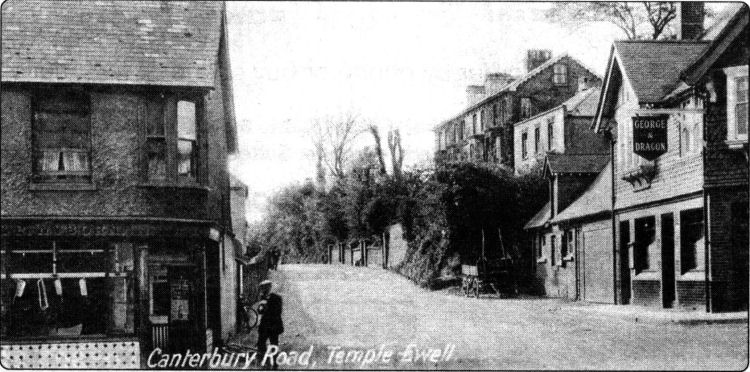
Above photo date unknown, probably after 1904, showing the butchers
shop opposite the "George and Dragon."
Shortly after midnight this morning a terrible fire broke out at the
butcher's shop of Mr. Marshall, Temple Ewell, at the corner of Ewell
Street and the main road, opposite the “George and Dragon.”
The family, consisting of Mr. George Marshall – an elderly widower –
his step-daughter, Miss Mary Elizabeth Johncock, aged about 50 years,
and a younger daughter, had retired to rest.
The fire broke out in the following way: Suddenly Mr. Marshall heard
an explosion in his step-daughter's bedroom. He called out, “What is
that?” and the woman replied, “The lamp has exploded.”
Mr. Marshall at once rushed to her room, which is over the shop, and
found her a mass of flames. He got an overcoat and attempted to throw it
round her. He made several brave attempts to rescue the woman, who was
frantic with fear. She persisted in trying to get to the window, while
Mr. Marshall tried to carry her down the stairs – the only way of
escape. Both being extremely corpulent in build, Mr. Marshall, who is
also aged, was unable to get her out. The room was in a mass of flames,
and he was driven back with his hair burnt off.
The room was now burning like a furnace. The alarm was quickly raised
in the village, and a telephone message was at once sent to Dover for
the fire engine. The message was received at 12.35 and the engine was
promptly dispatched, under the charge of Inspector Nash, Sergeant
Cadman, Police-constable Dunford, and Fireman Newman.
In the meantime the father, Mr. G. Marshall, and the girl had got
out, but nothing more was seen of his stepdaughter. The neighbours set
to work and got all the meat out of the shop and saved the furniture in
the lower rooms. When the fire engine arrived, shortly after one
o'clock, the whole of the top of the building was a mass of flames.
Water was first obtained from a tank in Mr. Hambrook's, Street Farm, but
it was quickly pumped dry. The engine was then taken down by the river
by Mr. Stanley's Mill, but little could be done in saving anything. The
gas pipes had melted, and great flares of lighted gas kept the fireman
back. It was necessary to open out the road and plus these.
The only portion of the building not on fire was the slaughter-house,
and water was continually poured on this, and the fire prevented from
getting hold of it.
The efforts of the firemen prevented the flames spreading, and all
danger was over before three o'clock.
It was not until four o'clock that the body of the unfortunate woman
was recovered. It had been burnt to a cinder, and only the trunk and the
upper parts of the body were found. The body was in such a terrible
condition that to preserve it, it had to be placed in a tub.
The whole of the property and furniture is insured.
From the Dover Express and East Kent News, Friday, 2
January, 1903.
THE FATAL FIRE AT EWELL – A QUESTION OF OIL
The inquest on Mary Elizabeth Johncock, who was burnt to death at the
fire at Mr. Marshall's, Temple Ewell, on December 24, was held on Boxing
Day afternoon at the “George and Dragon” public house, Temple Ewell, but
the County Coroner (R. M. Mercer, Esq.). The Jury were as follows: A.
Stanley, (foreman), F. Knocker, G. Hollands, O. Golder, E. Horton, G.
Jarrett, H. Page, G. Hobday, R. Sharp, L. Hambrook, W. H. Smith, T.
Bryson, and F. Paynton.
Mr. H. J. Jacobs appeared to represent Mr. Rawlings, of the
Washington Fruit Stores, who sold the oil which was in the exploded
lamp.
George John Marshall said: I reside and carry on business at Ewell as
a butcher. The deceased, who is my step-daughter, lived with me. Her
name is Mary Elizabeth Johncock. At a quarter to 12 on Tuesday night I
was in bed sitting up, when I heard something explode. I said, “Polly,
what is that?” She replied, “The lamp has burst,” all so quiet, so calm,
that you would not think there was anything wrong about it at all. She
was in her bedroom adjoining mine, there being only a thin partition.
She then said, “Call Rosie.” I did so, and Rosie went, and called out
“Oh, daddy, come; she is on fire.” I got out of bed, and taking my great
coat, tried to put it round her. She was standing near the door of her
room. Her night-dress, which was of flannelette, was all on fire.
The Coroner: The importance of that is that flannelette is one of the
most inflammable materials that exist.
Witness, continuing, said: I tried to get her out, but owing to the
door being very narrow we could not get by, or else I could have pushed
her out. I began to catch fire myself, my night short and the hair on
back part of my head, and I could not get by breath owing to the smoke.
Suddenly I heard her drop, and after that heard nothing more of her. It
was all done in five minutes, and when I had to go away the place was
all on fire, burning like a furnace. Our oil is usually bought from a
man at River named Hayes. My daughter, who is dead, usually bought it.
Half a gallon was bought at a time, and kept in a stone bottle, and the
remainder is still in an outhouse. I cannot say what sort of lamp it was
she kept in her bedroom. I could not see any lamp when I went into her
room. I could not get by her to see anything. She had the lamp to air
the room. Her age was 42.
By Mr. Jacobs: My daughter-in-law suffered from fits, and had one on
Sunday.
Rose Johncock, a daughter of the deceased, said: The lamp has been in
the house for some eight or nine years, and was a double burner with an
earthenware oil receptacle. It was in good repair, and would cost 12/-
or 15/- to buy. I sometimes bought oil from a man named Hayes of River,
and paid 4d or 4½d. a gallon. There had never been an explosion
previously with the lamp. When I went into the room I did not see the
lamp. Earlier in the evening I saw it alight on the chest of drawers at
the foot of the bed – that was about half-past nine. We all went to bed
at half-past ten. I slept on the same floor a little distance away. I
was asleep when I was called. When I got into the room I saw the flames
were all over her, and running over the place, apparently from the oil.
The valance of the bed was also alight. The deceased was standing just
inside the door, and I could not get by her. I cannot say why she did
not come out. I picked up a cloth and rubbed it down her to put the
flames out.
Do you think she knew what was happening?
Yes, she said, “I'm burning.” I do not know why she remained there in
the midst of the flames. Perhaps it was the shock. She was very heavy. I
did not try to pull her out as daddy came with a coat.
Witness stated that she was not aware of any regulation that
petroleum of a certain kind must be kept in separate half pints.
In reply to the Coroner, Police-sergeant Crowe stated that no remains
of the lamp could be found.
In reply to questions by Mr. Jacobs, the witness said that she had
seen her mother clean the lamp out, but not very lately.
In reply to the Coroner, witness said that on one occasion the oil
was purchased from another person, but not by witness.
Charles Hayes said that he lived at River, he was a licensed hawker
and oil dealer. He supplied oil to the deceased's house, but not for
four weeks. They had half a gallon for 4½d., and the oil was Royal
Daylight, and its flask-point was 130 degrees. This was marked on the
casks when witness purchased it in that form. Tea Rose was 73. He
purchased the oil from Mr. Bushell.
The Coroner: What has James Rawley to do with this?
Police-sergeant Stone: He is manager of the firm who sold the last
lot of oil to the deceased's house.
Witness said that he usually supplied half a gallon of oil every
fortnight to the deceased. Last Friday week there was a man in the
village selling oil at 6½d. a gallon, and when witness went to the
house, they said they had got the oil from him. He had seen the oil
which was in the jar, and as soon as he smelt it he knew that it was not
the oil he sold. The various kinds of oil had distinctive smells.
William Horace Lyon, 8, St. John Road, a hawker in the employ of Mr.
Rawley, of the Washington Stores, said that on the 12th of December he
supplied a gallon of oil to the deceased's house. The price was 3½d, or
6½d. for a gallon. It was Rock Light oil, and its flash point was 80
degrees. It was supplied by Mr. Mills, of Dover. He was told its flash
point was 80 degrees by the manager. He asked the question out of
curiosity. He did not know what flash point meant. If he had been told
it was 60 or 70 he would not have known anything more. He asked the
question out of curiosity. He supposed that at 80 or 100 it was not so
likely to explode.
The Coroner: That is rather peculiar. Do you not know that it would
require heating up to that temperature before giving off an explosive
vapour? Did you understand that?
Witness: No I didn't.
Witness further stated that he had sold hundreds of gallons since he
started on December 4th.
The Coroner: Did you make the enquiry about the flash point because
you were told that Rock Light was a particularly dangerous oil?
Witness: No, I did not know it was Rock Light until just now.
The Coroner: Have you been given any caution as to the oil – not to
allow a light close to it?
Witness: No.
Witness said that no regulation had been shown him as to its sale.
The Coroner: How many times have you been in Ewell?
Witness: Once.
Police-sergeant Crowe stated that he found the body. He had since
made a thorough search, and found an ankle bone, which he had placed
with the body in the tub. He had not been able to get a copy of the
petroleum regulations.
Chief Constable Knott, who had been directed to attend as a witness,
said he was not the Inspector of petroleum, but of gunpowder and
explosives. Mr. Stilgoe, the Borough Engineer, was the Inspector for
petroleum. He had been informed at the Town Clerk's office that Mr.
Rawley never had a license, and had never applied for one.
The Coroner: Well, this is not the place to deal with that. Why is
Mr. Rawley not here?
Witness: It was stated that he was indisposed, suffering from a heavy
cold, and his wife had also undergone an operation.
Arthur Langley, 16, Townwall Street, said that he kept Mr. Rawley's
books. All he knew was that Mr. Rawley had paid £2 2s. for a license.
William Dray, of Liverpool Street, Dover, an agent for oil, &c., said
he supplied the oil to Mr. Rawley. A certificate was supplied with it
that its flash point was 80 to 120 degrees. He explained that lamps were
liable to explode when not full and the wick not large enough. He had
heard of the best oil exploding under these conditions. The lamp should
also be cleaned out, as there was a residual left which was really the
dangerous part.
The Coroner, in summing up, said that the case was a simple one from
the point of view of the Jury, but the enquiry, owing to the Police not
getting the necessary evidence, was not so complete as he should have
liked. Where oil is sold with the flash point under 73 degrees it had to
be kept in a certain prescribed method. There were also certain
regulations as to the sale of petroleum, and he ought to have had a copy
produced there. He would draw their attention to the dangerous nature of
flannelette, and mentioned that a substance of similar nature was sold
which would resist fire perfectly.
The Jury returned a verdict of “Accidentally burnt to death,” and
expressed their opinion that the oil should be tested before any more
was sold.
The Coroner: I do not think there will be much more sold in Ewell for
a few weeks.
|
|
From the Dover Express, Friday 16 October, 1903.
(Before J. H. Monins, H. Hart, J. L. Bradley, W. H. Burch Rosher, W.
J. Adcock, and E. Dawes, Esqrs., at Dover, yesterday.)
TRANSFER OF LICENSES.
The George and Dragon, Temple Ewell, from Mr. A. A. Hopper to Mr. J.
Stretton.
|
|
From the Dover Express and East Kent News, Friday, 16
September, 1904. Price 1d.
IMPROVING THE GEORGE AND DRAGON
An application was made for the approval of plans of alterations to
the “George and Dragon,” Ewell, on behalf of the brewers, Messrs. G.
Beer and Co. Mr. Duthoit, of Messrs. Jennins and Dutholt, produced the
plans, which showed that the building was to be pulled down and
re-erected 15ft back from the road.
Superintendent Holland said that he considered it would effect a
great improvement, and the plans were approved.
|
|
From the Dover Express and East Kent News, Friday, 16
June, 1905. Price 1d.
NEW GEORGE AND DRAGON AT EWELL
Application was made of behalf of Mrs. Stretten to use the new
premises erected for the "George and Dragon," Temple Ewell, provisional
sanction to plans having been given last November.
Mr. Duthoit said that the building was complete, and the fittings
would be finished in a week's time. The plans had been carried out
without alteration.
The application was granted.
|
|
From the Dover Express and East Kent News, Friday 20
August, 1926. Price 1½d.
TRAGEDY AT TEMPLE EWELL
POSTMAN'S BODY FOUND IN WOODS
On Tuesday morning a party of Wolf Cubs who were encamped at Temple
Ewell, came across the skeleton of a man in the Beech Wood, between
Creek Lane and Singledge Lane. They at once told their Cub Mistress,
Miss Skey, who notified the Police, and the body was removed. Later it
was identified as that of Henry Francis McKeen, a postman of Temple
Ewell, who had been missing since June 30th.
The inquest was held at the “George and Dragon,” Temple Ewell, on
Wednesday afternoon, by the East Kent Coroner (Mr. Rutley Mowll)
assisted by a Jury.
The Jury was as follows:- James Freeman (foreman), P. A. Parkes, F.
Austen, D. Saunders, H. J. Parker, H. G. Tyler, D. W. Johncock, C. W.
Johncock and A. Reynolds.
Henry Kettle, Uphill, near Folkestone, said: I am a farmer. I have
seen the body and identified it as that of Henry Francis McKeen. He
married my first cousin. His age was 41, and he was a postman of Temple
Ewell, he had been missing since June 30th. I identified the body by
reason of a certain deformity of the left wrist which is well known to
me. It is a kind of twist back of the wrist, and I have no doubt it is
the man. I was told of his relatives that when he disappeared he was
wearing a pair of canvas slippers with red soles. I noticed one was on
the body.
Edward Arthur McKeen, 38, Council House Street, Dover, said: I am a
seaman, but am at present employed as a ganger at the West Blockyard.
The deceased was my late brother's son. I saw him the night he was
reported missing. He came to my house at six o'clock on the Tuesday
evening, 29th June, staying till 7.45 p.m. Whilst there he wrote a
letter card. I lent him the pencil to do it with, but I knew nothing of
the purport of the letter. He asked me to spell “hypocrisy” for him. His
ways seemed very strange at the time. He seemed miles away. He seemed as
if he wanted to say something, but did not tell me the trouble. My wife
and friend both cleared out of the room to allow him to do it. When he
left me he went to the pillar box by the “Lord
Warden” to post the card.
Mrs. Jessie Harriet McKeen said: I live at Glenmore, Temple Ewell,
and I am the wife of the deceased. I was away on the 29th, and when I
came home on June 30th I could not find my husband, so I looked round
and in the drawer in his bedroom I found the communication (produced) in
his handwriting.
The Coroner, after the witness had retired, said the letter referred
to was: “Oh my dear, I cannot stand the disgrace. Goodbye. My very best
love to you both. Mac.”
Miss Margaret Skey said: About ten o'clock on Tuesday morning I was
in charge of some Wolf Cubs encamped in the woods consisting of beeches
at Temple Ewell. My attention was called by one of the boys to something
and on going to see, I saw what it was and immediately reported the
matter to the Police.
Mr. Mowll: I take it nothing was touched?
Only that the boys ran ahead in the thicket and said they had found a
skeleton and one of them touched it and the skull fell off.
P.Sgt. Fry said he would like to express his praise of the assistance
rendered to him by Miss Skey's two brothers in the removal of the body,
which was a difficult performance. They assisted him down the hill until
he got on the hard road.
P.Sgt. Fry said: At 11.20 a.m. on Tuesday I received a telephone
message from the Dover Borough Police, in consequence of which I went to
the Beech Wood at Temple Ewell, where I saw the last witness. Following
her direction I went to a cluster of thick undergrowth where I saw the
body of a man, fully clothed and in an advanced state of decomposition.
The body was lying upon its back in a hunched up position with the legs
double under it, and lying immediately beneath a small tree. The head
was detached from the trunk. It was devoid of flesh, but lying in line
with the shoulders. The body was dressed in a blue suit and had on
canvas slippers with red rubber soles. A grey cap was lying by the
skull. The left hand was deformed. Around a protruding portion of the
vertebrae was a piece of cord tied in a noose and suspended from a small
branch immediately above the body was the other piece of cord. It was
securely tied, and I had to cut it away with a knife. I brought the body
to the mortuary where it now lies, and on searching the clothing, found
no property or documents. I then noticed the description of clothing
etc., and the deformity coincided with that circulated at the time that
deceased was reported missing.
The Coroner said he would like to see the report that was circulated.
P.Sgt. Fry said that he had not a copy with him, but it was sent
throughout the county.
The Coroner: Mr. McKeen spoke of a letter written by deceased. Were
you able to find out to whom it was written?
No sir, it was not round here.
The Coroner: Do you know Mr. McKeen?
No I don't, but I think he posted it at the pillar box near the “Lord
Warden.”
The Coroner asked what opinion witness formed from the legs being
under the body.
P.Sgt. Fry said that it gave him the impression that the position was
formed from rigor mortis set in. From the position of the body and the
branch, he should say that the weight of a man's body suspended would
weigh the branch down and cause the legs to be doubled up.
The Coroner said that there were representatives there from the Post
Office, and whilst he did not want to go into too much detail, he did
not think they could shut their eyes to the motive in this case. He
would like to hear Mr. Hicks.
Alfred Charles Hicks, assistant Superintendent at the Post Office,
Dover, said that the deceased was under his jurisdiction at the time.
The Coroner: He says he couldn't stand the disgrace. Was it anything
to do with Post office work?
I have reason to believe it was.
The Coroner: In trouble?
He was suspended from duty that afternoon, June 29th, about 3.45 to 4
p.m.
The Coroner (to the Jury): Do you want to hear any more as to why he
was suspended and that sort of thing? I only called evidence to show
motive. I don't think it necessary to go into detail.
Dr. Adamson said: I saw the body at half-past two yesterday, and
concur with the evidence as to its condition. The noose was as thought
it might have been round the neck. I formed the opinion that the
probably cause of death was strangulation by hanging.
The Coroner said it was a sad case.
The verdict of “Suicide during temporary insanity” was returned.
Mr. Lewis, the Postmaster, said he wished on behalf of the staff, to
express their sympathy with the relatives.
|
|
From the Dover Express and East Kent News, Friday, 21
March, 1930. Price 1½d.
FATAL MOTOR ACCIDENT AT TEMPLE EWELL
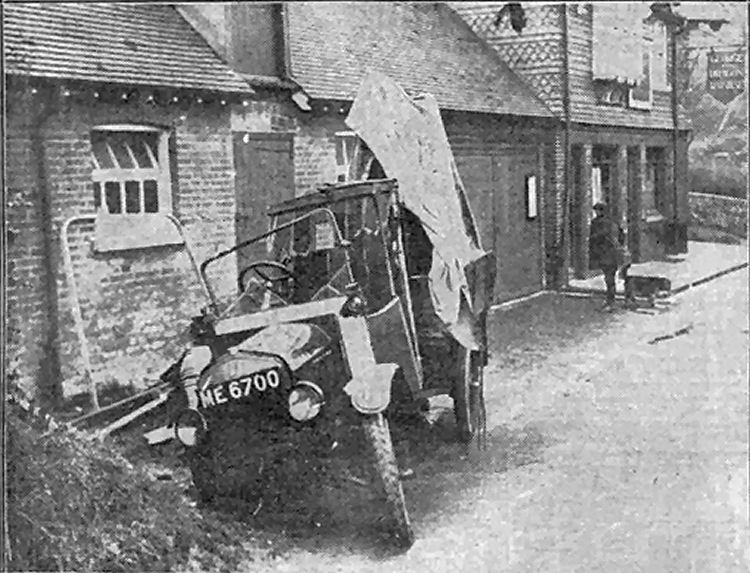
On Thursday night last week. The car, after bursting its front tyres,
hit the "George and Dragon" Inn. One man was killed and seven injured,
the driver losing an eye as the result of his injuries.
|
|
From the Dover Express, 20 October 1933.
WINGHAM PETTY SESSIONS.
The "George and Dragon." Temple Ewell, was granted an occasional
licence for an invitation dance by Lady Cynthia North, at Waldershare
Park, on November 3rd. |
Once a tied Fremlins house, the building has now been turned into residential
houses.
In the 1874 Post Office Directory the address was just "Ewell".
LICENSEE LIST
BELSEY Joseph 1740+

REEVES Thomas (sen) to Feb/1812 dec'd
REEVES Thomas (jun) to May/1849 dec'd

 LUSCOMBE William 1851-30/Jan/60 dec'd (age 56 in 1851
 ) )

LUSCOMBE Elizabeth 1861+ (age 70 in 1861)
LUSCOMBE The Misses Mary A 1871-1891+ (age 43 in 1881)
    
HOPPER Alfred Arthur 1895-Oct/1903+
(age 44 in 1901)
      
STRETTON J Mr Oct/1903+
MILES Ernest 1911-Oct/13
 (age 33 in 1911)
 
PARKS G H to Apr/1917
PARKS Mrs (wife) Apr/1917+
PARKS Percy Alfred Oct/1913-63+
      
CHAMBERLAIN Gerry 196?-81
 Fremlins
https://pubwiki.co.uk/GeorgeDragon.shtml
From
Wingham Division Ale Licences 1740 Ref: KAO - QRLV 3/1
From
Melville's Directory 1858
From
the Post Office Directory 1874
From
the Post Office Directory 1882
From
Pikes Dover Blue Book 1889
From
Pikes Dover Blue Book 1890
From
Pikes Dover Blue Book 1891
From
Pikes Dover Blue Book 1895
From
Pikes Dover Blue Book 1896-97
From
Pikes Dover Blue Book 1898
From
Pikes Dover Blue Book 1899
From
Pikes Dover Blue Book 1899-1900
From
the Post Office Directory 1901
From the Kelly's Directory 1903
From
the Post Office Directory 1913
From
the Post Office Directory 1914
From
Pikes Dover Blue Book 1924
From
Pikes Dover Blue Book 1932-33
From
Pikes Dover Blue Book 1938-39
From
the Kelly's Directory 1950
From
the Kelly's Directory 1953
From
the Kelly's Directory 1956
Library
archives 1974
Kentish
Gazette
Census
|

