|
1 Tower Hamlets Street
Dover
 |
|
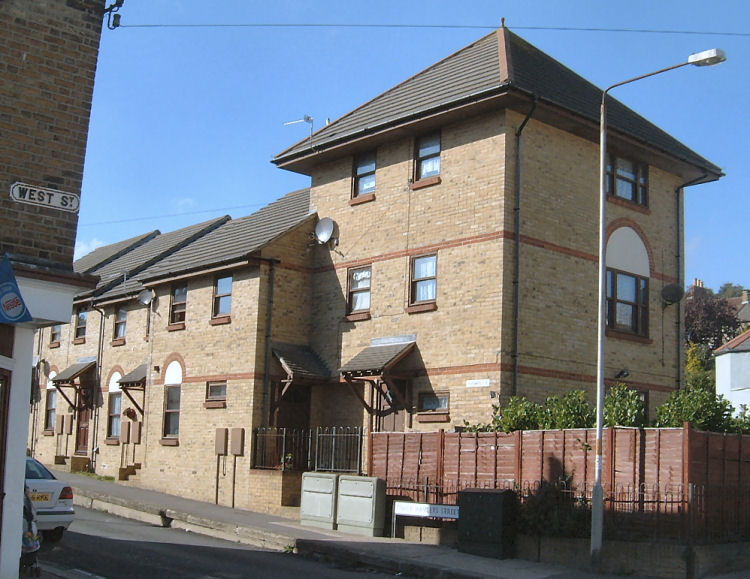
Above photo shows the position of 1 Tower Hamlets
Street 6 Oct 2007. This is obviously a new set of buildings and not the
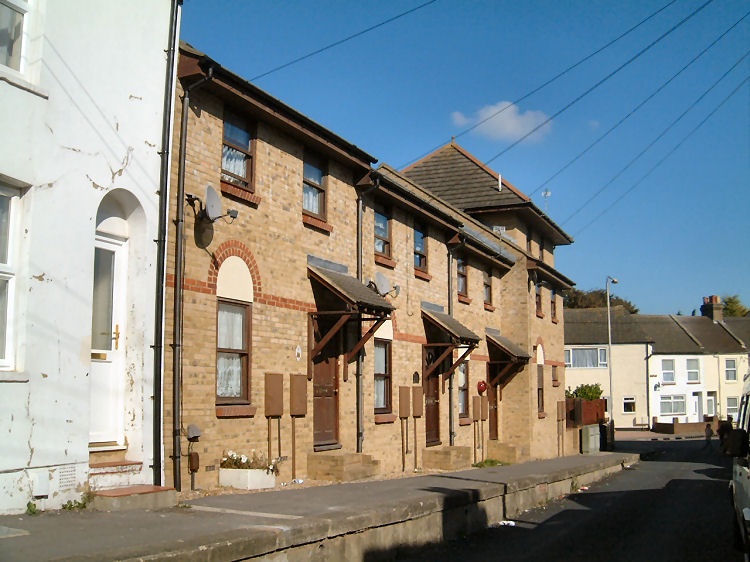
original. Photo below shows the extent to which the new buildings have
been rebuilt. Photos by Paul Skelton. |
 |
An outlet of Ash and Company and fully licensed, the site was occupied in
1848 by another pub called "Paul Pry". The sign changed whilst the Gann
family were in residence, probably between 1865 and 1867.
An open and shut existence prevailed here in the last century and it
closed for the last time in 1913. Ash and Company received £165 compensation
and William Kennett the tenant £10.
Another with this sign traded from Clarence Place, then Crane Street and that later became
the "Cinque Ports Arms". (Henry Jell 1791 and Atkins 1805).
|
From the Dover Express and East Kent Intelligencer,
25 January, 1867.
VIOLENT CONDUCT
Richard Gunn, was charged with breaking 13 panes of glass, the
property of James Gann, and assaulting him, and also with assaulting the
police in the execution of their duty.
James Gann said he kept the "Coach and Horses" public-house, at Tower
Hamlets. On the previous evening the defendant, who was in his employ,
came home drunk at about half-past five o'clock. He put his horses in
the stables, and threw the harness upon the ground. Mr. Newing, who
looked after witnesses' horses, said "You're tipsy; go home, and I'll
look to your horses for you." Defendant declined to go but before he had
had a "b_____ row." The defendant then came into the house, and had
half-a-pint of beer, with which complainant's wife served him. Witness
thought he was gone home. After drinking the first half pint of beer he
called for another, but on its being brought to him he broke the pot,
and called his (complainant's) wife foal names. Witness thereupon turned
him out of the house, and defendant then fell to breaking the window. He
broke thirteen windows, the cost of repairing which was 6s. 6d. The
defendant kicked at witnesses child and assaulted him and all the other
persons in the house. He was in a state of frenzied intoxication.
The defendant had no questions to ask the complainant.
Police-constable Henry Frederick Birch said he was called upon to
take prisoner into custody on the previous evening, for the wilful
damage and the assault on the complainant. He went quietly in custody
from the "Coach and Horses" as far as the "Eagle" corner. He then wanted
witness to release him, in order that he might get a pint of beer. (A
laugh.) Witness told him he could not allow him to do that, but must
take him to the station house. The prisoner then resisted him, and a
scuffle ensued, in the course of which witness fell with the prisoner
several times. The prisoner struck him in the mouth, and loosened four
of his teeth, and tried to choke him off, both his hands being round his
collar. He also tried to bite him and to get him underneath the wheels
of a cart which was passing. In the course of the scuffle he got away
from witness and made his escape. Witness, however, traced him, and with
the assistance of some other constables took him into custody. The
conduct of the prisoner was more like a madman's than anything else. It
required four constables to convey him to the station house.
The Magistrates considered they were bound to mark their sense of
this violence. The defendant would be fined on the charge of wilful
damage, 5s., the value of the glass 6s. 6d., and the costs 7s. 6d. In
default, seven days' imprisonment. For the assault on the constable, he
would be fined 20s., and 6s. costs. In default, fourteen days'
imprisonment.
The defendant paid the money.
|
|
From the Dover Express and East Kent News, Friday, 12 November, 1869.
INFRINGEMENT OF LICENSE
William Baker, was charged on the information of Police-sergeant Stevens
with having sold liquor during prohibited hours on Sunday, the 7th
November.
The defendant pleaded guilty.
Police-sergeant Stevens said about nine o'clock on Sunday, the 7th
inst., he visited the “Coach and Horses,” Tower Hamlets, kept by the
defendant. He saw two men one of which was smoking at the bar, and a
quart jug and two glasses were placed near. The landlady was present,
and admitted serving them, but said she had given the liquor to them.
Both men lived in the neighbourhood.
The Magistrates fined the defendant 2s. 6d., and the costs 9s. 6d.;
which was paid.
|
|
From the Dover Express and East Kent Intelligencer,
15 March, 1872. Price 1d.
SUDDEN DEATH
A very sudden death occurred at Tower Hamlets on Saturday evening
last. A man named Harvey, a milkman, very soon after eating his supper,
fell out of his chair to the ground. Medical aid was procured; but life
was pronounced to be extinct.
The borough Coroner, W. H. Payne, Esq., held an inquest on Monday
afternoon, at the "Coach and Horses" public-house, Tower Hamlets, on the
body of the unfortunate man. Mr. Henry Eastman was elected foreman of
the jury; and, when the body had been viewed, the Coroner took the
following depositions:-
John Harvey deposed: I am a son of the deceased. I assisted my father
in his business, and reside in Tower Hamlets. He was fifty years of age.
He had complained of pains in the head some time before his death,
though otherwise his health has been very good. He was not a very sober
man. He died suddenly on Saturday night last, without previously
complaining of any illness. He had his supper about nine o'clock. I was
present at the time. I don't think he drank anything; but I saw him eat
six or seven mussels. He did not say where he had got them from. They
were black mussels. No one else ate any of the mussels. Soon after the
deceased had finished his supper he wanted to go out to get a glass of
beer; but I endeavoured to persuade him not to go, and wanted him to go
to bed. He would not go, however, and threw himself back in his chair,
supporting his head by placing his elbow on one of the arms of the
chair. He often sat in this position for hours together. I afterwards
had my supper; and my father still remaining in the same position I went
out to get a glass of porter. While I was at the public-house my sister
came to call me, telling me that my father had fallen out of his chair.
I went home with her, and found him lying on the ground snoring. When I
got in, he got up off the floor and sat down in his chair again, I
thought he was all right then, so I went up stairs to bed, telling my
sister to call me if my father made any more noise. I had not been in my
bedroom more than five minutes, when my sister called me again, and I
went down immediately. The deceased was then sitting in his chair as I
had left him, but he had ceased snoring. After sitting by him some few
minutes, I became alarmed at the appearance, and thought I had better
get medical advice. I therefore sent for Mr. Walter. He soon came, and
having ordered deceased to be laid on the ground, remained in the house
from half-past ten till half-past twelve, when he pronounced the
deceased to be dead. I think my father had been drinking during the
evening.
By the Coroner: I had brought home some scallops for our supper; but
he did not eat any.
Clement Walter deposed: I am a surgeon residing and practising in
Dover. On Saturday evening I was called to Tower Hamlets to see the
deceased, Henry Harvey. When I arrived at his house I found him in the
position described by the last witness. He was then senseless, and to
all appearances dead. There was nothing in his appearance indicating
that he had died of any particular disease, and I must decline to give
any opinion as to the cause of his death.
After some deliberation on the evidence of Mr. Walter, the jury
considered a post mortem examination necessary, and in order to
give Mr. Walter an opportunity of making one, the enquiry was adjourned
for a few hours.
The jour having re-assembled at eight o'clock, Mr. Walter gave the
following additional evidence.
I have made a post mortem examination, and have found all the
organs of the deceased's body very much diseased. The heart and its
valves were particularly unhealthy. I think there can be no doubt that
the deceased died from disease of the heart, accelerated by distension
of the stomach, this causing pressure upon the heart and thereby
inducing fatal syncope. The deceased's stomach was very much overloaded,
and, judging from the state in which I found the body, the deceased was
liable to death at any moment from any exciting cause.
The Coroner briefly summed up, and the jury returned a verdict, "That
the deceased died from disease of the heart, brought on through natural
causes."
|
|
From the Dover Express and East Kent News, Friday 5 September, 1873.
TRANSFERS
The license of the “Coach and Horses,” Tower hamlets, was transferred to
Thomas Matcham, a fruiterer, the applicant promising that his wife, who
was 32 years of age, would attend the business in his absence.
|
|
From the Dover Express and East Kent News, Friday, 21 May, 1875. Price 1d.
DROWNED IN A WELL
An inquest was held on Thursday before the Borough Coroner (W. H. Payn,
Esq.,) at the “Coach and Horses” public-house, Tower Hamlets, upon the
body of Jeremiah Scott, belonging to Dover, who was found drowned in a
well. Mr. Charles Beeching was chosen foreman of the Jury.
Mingaye Bean, brickmaker, residing at Charlton, said: I am in the employ
of Mr. Nightingarl and Bushell. The deceased is my cousin, and lived
with my father at Charlton. I have known him many years, his health was
generally good, but he was of intemperate habits. I last saw him alive
on Monday night at Tower Hamlets. He appeared to be all right then. On
Wednesday morning I was loading some bricks in Mr. Nightingarl's
brickfield, and I saw a hat and a pair of shoes near the well. I knew
the hat belonged to the deceased. I went to the well-house and saw the
well-handle all out of its place. Thinking he was down the well I came
and made enquiries about him. Mr. Bushell told me to get a grapple and
see if I could find him. I went and grappled and hooked deceased
directly. When he was brought up to the top he was quite dead. A doctor
was sent for, but life was extinct when he came. I never heard him
threaten to commit suicide. I think he went in the well-house to lay
down. The mouth of the well is not covered over, but the well-shed is
generally shut up when the men are not at work. The well is 115 feet
deep, and there are two buckets used.
David Coob, a boy about 12 years of age, said he was in the brickfield
on Tuesday morning about 8 o'clock, and saw a hat and a pair of shoes
lying near the well. He took them to a man named Champkins, and he told
him to throw them away as they were no good to him, and said very likely
someone is down the well. He took the shoes away, and went home and
spoke to his mother about it.
Isaac Champkin, labourer, said: I have been working in the brickfield
two or three days lately. On Tuesday morning about half-past eight I was
near the well-house, when a boy came along and called my attention to a
pair of shoes and a cap he had seen in the well-house. I told him to
bring them to me to look at, seeing they were of no use I told him to
throw them away. I am certain I did not say they might belong to
somebody in the well. I thought someone had shifted the shoes and left
them there.
Clement Walter, surgeon, practising in Dover, said: On Wednesday morning
I was called to see the body of deceased. I examined him and found a
fracture of the right thigh. Death was most probably caused by drowning.
The injury most likely proceeded from the fall down the well.
An open verdict, that the deceased was found drowned in a well, but
there was no evidence to show how he came there, was returned.
|
|
From the Dover Express and East Kent News, Friday 29 August, 1890.
DOVER BREWSTER SESSIONS
The landlady of the “Coach and Horses,” Mrs. Maxted was called up.
Sir Richard Dickeson said it was recorded that she had been convicted of
having the house open during illegal hours, and refusing to admit the
police. It was his duty to seriously caution her, because if the offence
were repeated, the license might be taken away. He was informed by the
Superintendent of Police, that since that conviction the house had been
properly conducted.
|
|
From the Dover Express and East Kent News, Friday, 27
March, 1891. Price 5d.
APPLICATION
Mr. Spain applied, on behalf of Mr. F. Flood for, permission to draw
at the "Coach and Horses," the outgoing tenant being Mrs. Quested.
The application was granted.
|
|
From the Dover Express and East Kent News, Friday, 10 March, 1905. Price 1d.
TEMPORARY LICENSES
An application was made for the transfer of the license of the “Coach
and Horses,” Tower Hamlets, from John Lawler to William Ward, now
residing with his son at the “Bricklayer's Arms,” Shepherdswell, and the
Clerk asked how it was that the transfer was asked for, although the
last change had taken place within six months, the Magistrates rule
being not to grant a transfer except after nine months?
Applicant presented a certificate from Dr. Baird that his wife was
suffering from meningitis, and that it would be prejudicial to her
health.
The Clerk said that the certificate was a month old.
The Chairman said that the matter should be properly represented by a
lawyer, and not in the off-hand way it had been.
Inspector Fox said that the Police had not received the assistance they
ought to have received from the brewer's agent. They were informed that
the applicant had previously the license of the “Old Endeavour,”
Buckland, but it appears that since that date, which was five years ago,
he had held a license at Sandwich and that of the “Black Horse” at Swingfield, which he left in January, 1902, when the brewers gave him
notice because proceedings were instituted against him though
unsuccessful.
The Chairman said the matter would be postponed until the application
was made in proper form. He hed then better get his solicitor to take
notice of what the Police had complained of.
|
|
From the Dover Express and East Kent News, Friday, 21
April, 1905. Price 1d.
LICENSING BUSINESS
Mr. R. Mowll applied for permission to transfer the licence of the
"Coach and Horses, Tower Hamlets, from Mr. Lawler to Mr. G. Finnis. The
tenant had only been in the house since the 13th of September, but the
health of his wife had necessitated her leaving the house and going to
Bradford, and Mr. Lawler wished therefore to go to her there. Dr. Baird,
who was called, said that Mrs. Lawler would have died if she had not
been sent away for a change. She was suffering from meningitis.
The Magistrates granted the application.
|
|
From the Dover Express and East Kent News, 18 December, 1908.
A PUBLIC HOUSE RATE
Mr. Bruce Payne, representing W. J. Kennett, who was summoned
for rates in respect of the "Coach ad Horses" public house, contended
that as over six months had elapsed since the demand was made the
Magistrates had no jurisdiction, and the debt was a civil one
recoverable only in the County Court. He produced a demand note served
on August 4th to the previous licensee of the house, and made out in his
name. The rate had not been served on Kennett, but he believed was
simply left in the house, which was not a proper service.
Mr. Leigh, rate collector, said the amount was a proportion of the
rate due on the public house, and a proportion for stabling at Tower
Street.
The Chairman pointed out that it was the usual custom for the agents
to allow for the proportion of the rates in the valuation; probably that
course had followed in this case.
Mr. Bailey, assistant rate collector, on oath, said that he served a
demand on defendant on August 26th. Defendant refused to take it, so he
placed it on the bar in his presence. He produced the rate book with a
counterfoil giving particulars of date of the service.
The Chairman said the Bench were satisfied that the rate had been
properly served on August 4th, less than six months ago, and an order
would therefore be made for payment forthwith.
|
|
From the Dover Express and East Kent News, 11 June, 1909.
TOWER HAMLETS PUBLICAN FINED
HEAVY PENALTY FOR USING AN OLD HORSE
At the Dover Police Court on Friday, before the Mayor (WalterEmde,
Esq.) M. Pepper, J. R. Bradley, G. C. Rubie, T. A. Terson, F. G. Wright,
J. Scott, F. W. Prescott, W. Bradley, E. Chitty, J. H. Back, and W. J.
Barnes, Esqrs.
William John Kennett, landlord of the "Coach and Horses," Tower
Hamlets, was summoned by the Royal Society for the Prevention of Cruelty
to Animals for working a horse in an unfit condition. Henry Sindon was
charged with working the same.
The defendant pleaded not guilty and Mr. Bruce Payne defended.
Inspector Adams, R.S.P.C.A., said that on Wednesday, May 26th, about
10.45 a.m. He went into Priory Street and saw the defendant Sindon in
charge of an old bay stallion, lying on the ground, having fallen down
in the cart, on which were two barrels of beer. It was old, in a weak
state, emancipated, and the muscles of the hind quarters wasted. It was
so weak that it would not get up. Six men had to lift it up. They had to
lift it up twice, and when it tried to walk away it staggered. He would
not Sindon put it in the cart. The horse was quite unfit for work. The
defendant admitted having been warned not to work the horse. He said his
master was at the bottom of Castle Hill to help him pull it up the hill.
He saw Kennett near St. James's Street, and he said that he would have
it done away with that afternoon. Witness expressed surprise that he had
not already done so.
Cross-examined he did not notice its shoes. The road was tarred but
not slippery. He though that there was bodily pain. He noticed no
spasms. Its coat was in good condition.
Police-constable Fogg said that he saw the horse on the ground. It
was in a very weak state, and staggered about when walking away. He
should say it would be cruel to work it. Sindon, in the presence of
Kennett, said that he had received orders from Kennett to work the
horse.
Mr. Hoile, veterinary surgeon, said that he saw the horse on
Wednesday morning about 11 o'clock in Priory Street. It was then in
Ayres' forge. It was very old and weak and not fit for anything. It
staggered about. He had told Kennett two months ago to get rid of the
horse. It did not seem in any pain.
Mr. Payne said that the horse slipped on the tarred road. The horse
was taken home and destroyed. Kennett did not know the horse was out. He
had always looked after horses, and was very kind to them. The horse was
well fed. There was no cruelty to work it as it was not in pain, and he
contended that it therefore was not an offence.
The defendant Sindon said that he took the horse out at ten minutes
to six. The first work was to take the two barrels. In coming down
Priory Street, the horse slipped on the tar and fell. He did not intend
to use it further.
The Mayor: What would induce you to do that? - I thought he had hurt
his leg. There were horses walking about Dover poorer than he was.
Cross-examined by the inspector: The horse fell in March and lay in
the road a hour and twenty minutes. He received a warning not to use it
and he did not do so till that Saturday. His master did not tell him
what horse to take the previous night.
The defendant Kennett said that he gave no orders for it to go out.
Mr. Hoile told him to use it lightly and get rid of it as soon as
possible. He intended to do that. After the horse was destroyed it was
found that the lungs were dried up. He had always been kind to his
horses. He had been convicted of cruelty, but that was 18 years ago, and
he had only just received the horse.
The defendant Kennett asked the Inspector why he did not stop the
horse when he saw it the previous day.
The Mayor said he could not allow the defendant to ask that question.
The Mayor said that the Bench were not satisfied that Sindon had told
the truth. He could not too often warn witnesses that even if they found
the case go against them they had better tell the truth. This was a
parcel of stories that no one would believe.
He would be fined £1, including costs, 12/6, or in default 14 days.
In regard to Kennett, they considered that he was responsible for the
working of the horse, and under these circumstances he would be fined
£3, including costs, or in default 6 weeks.
Kennett applied for time as he would have to pay the other poor
fellows fine. He was granted till the end of the month.
|
|
From the Dover Express and East Kent News, 11 June, 1909.
TOWER HAMLETS CRUELTY CASE
STRANGE ACTION OF THE BENCH
At the Dover Police Court on Monday, before the Mayor (W. Emden,
Esq.,) and L.J. Bradley Esq. William John Kennett, of the Coach and
Horses, Tower Hamlets, was summoned by Inspector Adams of the R.S.P.C.A.,
for cruelty to a horse by causing it to be worked when suffering from
lameness, it being in an unfit condition. John Sindon was summoned for
working the horse.
Both defendants pleaded not guilty.
Mr. R. Mowll appeared to defend.
Inspector Adams, R.S.P.C.A., said: On Saturday, February 26th, about
2.50 in the afternoon, I was in Northampton Street, and saw the
defendant Sindon in charge of a black gelding that was attached to a
coal cart loaded. I noticed that the animal was in a poor and weak
state, and rolled and staggered about in the shafts and was lame in the
forelegs, the near one especially. I requested Sindon to stop. I
examined the horse and found it old, poor, and crippled in its fore
legs. There was heat in the near one, and the horse was resting it at
the time. I said to Sindon, "You must see that it is not fit to work."
He said, "If you will tell me to take it out I will, and take it home."
It was taken out, and it had enough to do to walk away. I had spoken to
him about it before. It was perhaps six weeks before, at the Priory
Station. I also spoke to him about it when drawing flour to Mr. Chitty's
Mill. About 4 o'clock, with Police-constable Vincent, I went to the
"Coach and Horses," kept by the defendant Kennett. Mr. Toope, the
veterinary surgeon, was there. He had been called by the defendant to
see the horse. Kennett brought the horse out to show Mr. Toope. Mr.
Toope said, "What were you doing with this horse?" He said, "I sent it
down to draw coals from the ship this morning." Mr. Toope said, "What do
you complain about, Mr. Inspector?" I said, "I complain of the horse
being at work in an unfit condition, and it cannot do the work." Mr.
Toope then said, "I will say you are not guilty this time, but never you
let the horse go to work any more; it is not fit to work; otherwise you
must not send for me." I pointed out to Mr. Toope that Kennett had been
cautioned several times .I walked away with Mr. Toope, and returning
said to Kennett, "I shall have to report you for working the horse,
especially after what Mr. Toope said." Kennett said, "I hope you will
not; I shall not use it again." I said, "Yes, you have told me that so
many times." I had seen Kennett several times previously about the
horse. Kennett replied, " I will promise you faithfully I will not work
it again." I said, "I know Mr. Hoile told you a week ago not to work the
horse." He replied, "Mr. Hoile said I was not to overload it. On the 1st
March I saw Mr. Kennett, and asked him what horse he had to work that
morning. He said, "The bay horse." I said, "You had the black one at
work." He said, "No."
The Magistrates Clerk pointed out that this was another offence.
Mr. Mowll said tat he would not object to it being gone into.
Witness (continuing): "Do you say that the black one was not at work
this morning at the Priory?" He said, "I had it to draw some empties
down to the Priory; that is all I did with it." I called Mr. Hoile to
see the horse. I cautioned Kennett in October and again in December.
Mr. Mowll said that his client was summoned for using a horse when
lame. That he denied. It was said that it was physically unfit to work.
As to that he was prepared to say that the work the horse was doing it
ought not to be doing. That very nearly admitted the offence, but what
he wanted to show was that it was not as bad as the Inspector had put
it.
In reply to Mr. Mowll, witness said that he did not remember Mr.
Toope saying that the defendant must not work the horse any more except
on the land.
Police-constable Vincent said that on Saturday, the 26th, at 2.50, he
was in company with Inspector Adams in Northampton Street, and saw
Sindon with the black horse. The horse was poor and lame in the fore
feet. He afterwards was present at Kennett's, and heard nothing about
the horse being fit for use on the land.
Police-constable Smithen said that on March 1st or 2nd he saw the
horse in question attached to a four-wheeled trolley laden with barrels
and empty beer bottles in crates, coming down High Street in charge of
Sindon. He was very stiff in the fore legs, but he should not have
stopped it.
Cross-examined. I cannot particularly remember the date, but I knew
it had been stopped on the Saturday, and that drew my attention to it.
Mr. Mowll: There is all the difference in the world between stiffness
and lameness.
The Mayor: Yes, does your client think it worth while to continue?
Mr. Mowll: I should like to have Mr. Hoile called, as I shall have to
pay his expenses when I am fined.Mr. Hoile said that he saw the horse on
the 15th March. It was poor, old and lame on both fore legs, especially
the near leg, evidently caused by contracted muscle of the fore leg.
The Mayor: Would the horse have been suitable to work the land? - I
should not think so.
I consider to have worked it in the state I say it was cruel. I told
Kennett a week previously that if he did not get the horse off the road
there would be trouble.
Cross-examined: I told him because it was getting worse. I did not
tell Kennett if there was a case I had better appear for him. I did not
tell him I did not consider it cruel then. I went up to the "Coach and
Horses" on Friday. It was a voluntary call, and I advised him to have
the horse killed.
Was it your view that on he horse being destroyed nothing much more
need be said about the case? - I said in my opinion the horse was not
fit for work.
It seems to be a most extraordinary thing to have done. On the Friday
afternoon of the day on which the case was to have been brought here you
call on the defendant and suggest that the horse be destroyed? - I did
it out of friendship for Kennett.
Was not the real reason to dispose of the case because of the opinion
you previously gave Kennett that it was not cruel to work the horse? -
No such thing.
The Mayor: He said he did it as an act of friendship.
Mr. Mowll remarked that it was indiscrete. He had the horse for the
Bench to look at, because these cases were so often a mass of
exaggeration. He knew the Bench were against him, and knew the reason.
The Mayor said that they were most desirous as seeing things fairly
dealt with, but it appeared to them that so far the evidence had not
broken down in any way.
Mr. Mowll: I have got in mind the little hint the Bench gave me.
Mr. Bradley: I will sit here till 1 o'clock and here what you have to
say. It is not right to say the Bench had made up their minds.
Mr. Mowll: I never said so.
Mr. Bradley: You say the Bench are against you.
Mr. Mowll: You must give me a little credit for seeing that the Bench
are against me. In this case I am going to save your time and mine and
the defendant's, as the sooner this case is finished the sooner he will
be able to go and earn the money he will have to pay. (Laughter.)
Mr. Mowll then called Mr. Toope.
Mr. Toope, veterinary surgeon practising in Dover, said that he
examined the gelding on Saturday, February 26th. He examined it in the
presence of the Inspector and the constable. The horse was scarcely
perceptibly lame. What lameness there was was due to contracted tendons,
and painless. It would not be perceptible except when the animal was
trotted. It was in a somewhat poor condition, and physically unfit for
hard work. I told Kennett that it was fit for slow work on land. I told
the inspector this, and afterwards, in reply to a question, told him
that I thought it was a case that would be satisfied with a headquarters
admonition.
The Mayor: It would be just as well to leave it to the Magistrates to
decide whether an admonition is sufficient.
The witness: Surely I am entitled to an opinion on the matter?
The Magistrate's Clerk: The admonition was to be from the head
office.
In reply to the Mayor. Police-constable Vincent said that when he saw
the horse it was walking, and he could see it was lame.
Mr. Mowll pointed out that Police-constable Smithen two days
afterwards said he should not have stopped the horse for lameness.
After Mr. Mowll had addressed the Bench, pointing out that the horse
had been constantly used until it was now in the sere and yellow leaf,
and that the defendant, to whom a horse was a valuable asset, would have
to suffer severely by having the horse destroyed, urged that it was not
a serious case.
The Mayor said that there was a difference of opinion between the two
veterinary surgeons, and they took the opinion of the prosecution. On
reference to the register, he found that the defendant had been there
four times before.
The Magistrates' Clerk: Not for cruelty.
The Mayor said that was so; twice for not having a dog licence, and
twice for cruelty to animals. There was such a thing as being sent to
prison for cruelty. He would be fined £3 3s. including costs. Sindon
would be fined 10s. including costs.
Kennett, who said that he would pay both fines, asked for time.
The Mayor said that the instructions Kennett had given his
representative might have been more open. He would allow a fortnight to
pay.
|
|
From the Dover Express and East Kent News, Friday, 7 February, 1913. Price 1d.
DOVER LICENSING SESSIONS
One of the firm of Messrs. Ash and Co., the owners, appeared to
represent them.
The Chief Constable said that the “Coach and Horses” was a fully
licensed house in Tower Hamlets Street. The owners were Messrs. Ash and
Co., Canterbury. The present tenant was W. Kennett, the licence having
been transferred to him on June 5th, 1908. It changed hands in 1902,
1903, 1904, 1905 and 1907. the rateable value was £20 gross, and £15
nett. The licensed houses in the immediate neighbourhood were the
“Carrier's Arms,” West Street (56 yards); the “Dewdrop,” Tower Hamlets
Street (104 yards), the “Tower Inn,” Tower Hamlets Street (109 yards).
There were eight licensed premises over the bridge in the Tower Hamlets
area besides this house.
In reply to Messrs. Ash and Co., the Chief Constable said that a room,
used as a spare room, he believed was used as a tap-room occasionally.
There was nothing against the tenant.
Chief Inspector Lockwood said that he served the notice on January 23rd.
On January 22nd he visited the house at 2.35 p.m., and found no
customers; on the 23rd January, at 10 a.m., and found no customers; and
again at 9.20 a.m. on the 27th January; on the 29th January, at 7.15
p.m. he found one customer; at 5.50 p.m. on the 30th January, two
customers; and no customers at 8.45 p.m. on the 31st January.
Mr. Kennett, the landlord, said that there were plenty of empty glasses
on the last occasion. He wished that the Inspector were two minutes
earlier, and then he could have cleared up the mess (laughter).
Chief Inspector Lockwood: I am sorry I did not come (laughter).
The representatives of Messrs. Ash and Co., who were present said that
although the trade was not very great, at least one-third of it was done
in crates, for the convenience of the neighbourhood. They only held two
licenses in Dover, and if they took this one away, only one would be
left. He hoped the Magistrates would renew the licence.
The Chairman said that they were afraid they could not. It would have to
go to Canterbury.
|
|
Dover Express 13th September 1946.
Town, Port & Garrison.
The death occurred at Peckham, London SE 15 on August 22nd of ex
Sergt. Maj J. O’Keefe, formerly one of the Dover National Reservists. He
has been interred in Forest Hill Cemetery. Mr. O’Keefe, who was 79 years
of age, served throughout the South African War and was in the siege of
Ladysmith. His wife was the fifth daughter of the late Mr. W. Flood of
the “Coach and Horses”.
|
|
From an email received 9 July 2011.
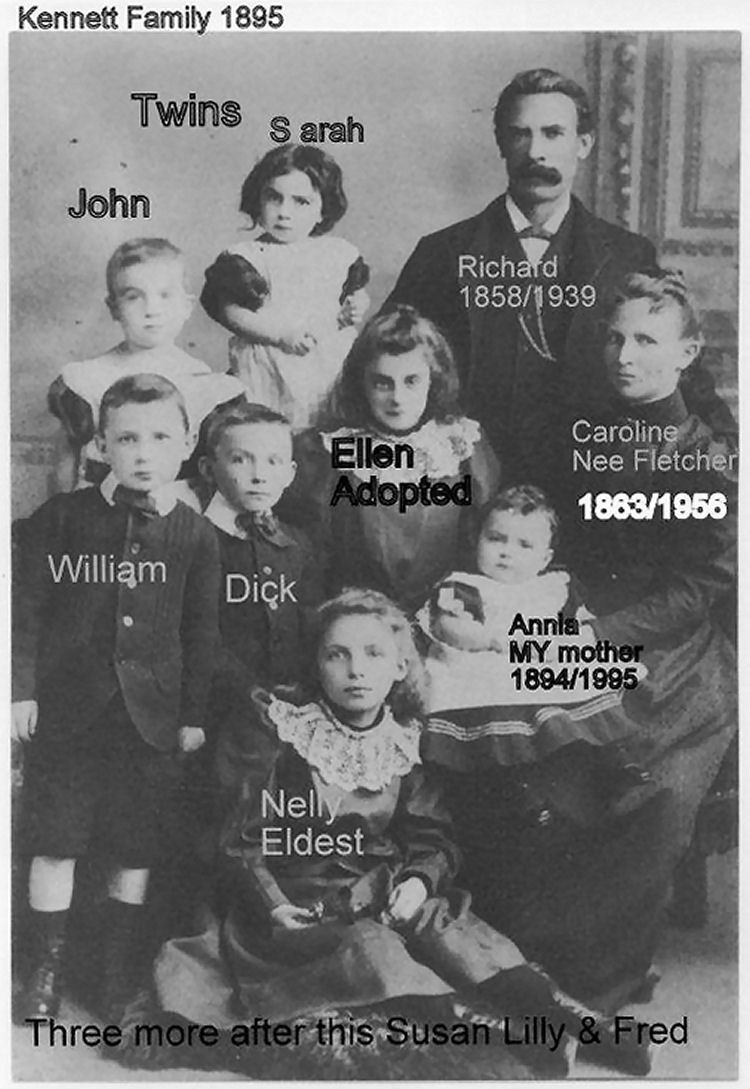
Picture kindly sent by Benjamin Twist who says:-
Dear Sir,
I was searching for a pub in Tower Hamlets Street near the square
I think it was called the "Coach & Horse's", my Grandmother's brother by
the name of Fletcher was the licensee. I would like to know round about
the year. If you can help thank you very much.
Ben Twist.
I couldn't find a Fletcher in my list, but did find a Fulcher, but
names were often misspelt in the directories. Ben says further:-
Whilst reading the court case of the "Coach & Horse's" the name
William Kennett, that was my grandmothers maiden name, so it could be my
grandfathers brother.
Ben Twist.
|
|
From the Dover Express 21 July 1989.
Flats for garage site.
A THREE-storey block of eight one-bedroom flats is planned for Tower
Hamlets, Dover.
Dawes Development Ltd is seeking planning approval to demolish
buildings at 1 and 2 Tower Hamlets Street in order to construct the
eight self-contained flats.
They say the property was last used as a commercial garage.
The site is at the junction of Tower Hamlets Street, Ethelbert Road
and West Street.
|
LICENSEE LIST
GANN James 1867+

BAKER William 1869
 BROWNING Moses 1869
MATCHAM Theodore (Thomas) Sept/1873-May/76

GOLDFINCH Walter Pascall May/1876-81+ (age 27 in 1881 ) )
EVERSFIELD Mr William Oct/1887-Jan/1889
ROBERTS John Thomas Jan/1889+
MILLINGTON John Thomas 1889
MAXTED Mrs 1890
QUESTED Mrs Eliza Mary 1890-Mar/91
FLOOD William
 Mar/1891-98
GREEN Francis 1898-99 (beer retailer ) )
MARTIN Sarah 1901+ (widow age 61 in 1901)
HUBBARD Stephen R (listed as general carrier age 37 in 1901)
FULCHER J 1901-03
  
MASTERS Mr W or Mrs Sarah Dec/1903
MATTHEWS Mr Dec/1903+
(Of
Southall)
MULLINS Matthew 1903-Sept/04
LAWLER John 13/Sept/1904-Apr/05
(Former
licensee of beer-house in Bradford.)
FINNIS George Apr/1905-07 end
(Late of
St. Lawrence, beer house keeper.)
BAILEY Walter John 1907-08 end
KENNETT William Joseph 1909-13 (also carrier age 49 in 1911)
 
From the Post Office Directory 1874
From the Kelly's Directory 1899
From the Post Office Directory 1901
From the Post Office Directory 1903
From the Kelly's Directory 1903
From Pikes Dover Blue Book 1909
From the Post Office Directory 1913
From the Dover Express
Census
|

