|
46 York Street (Priory Lane and Back Ditch)
1 York Terrace in 1881
Bowling Green Lane in 1930
Dover
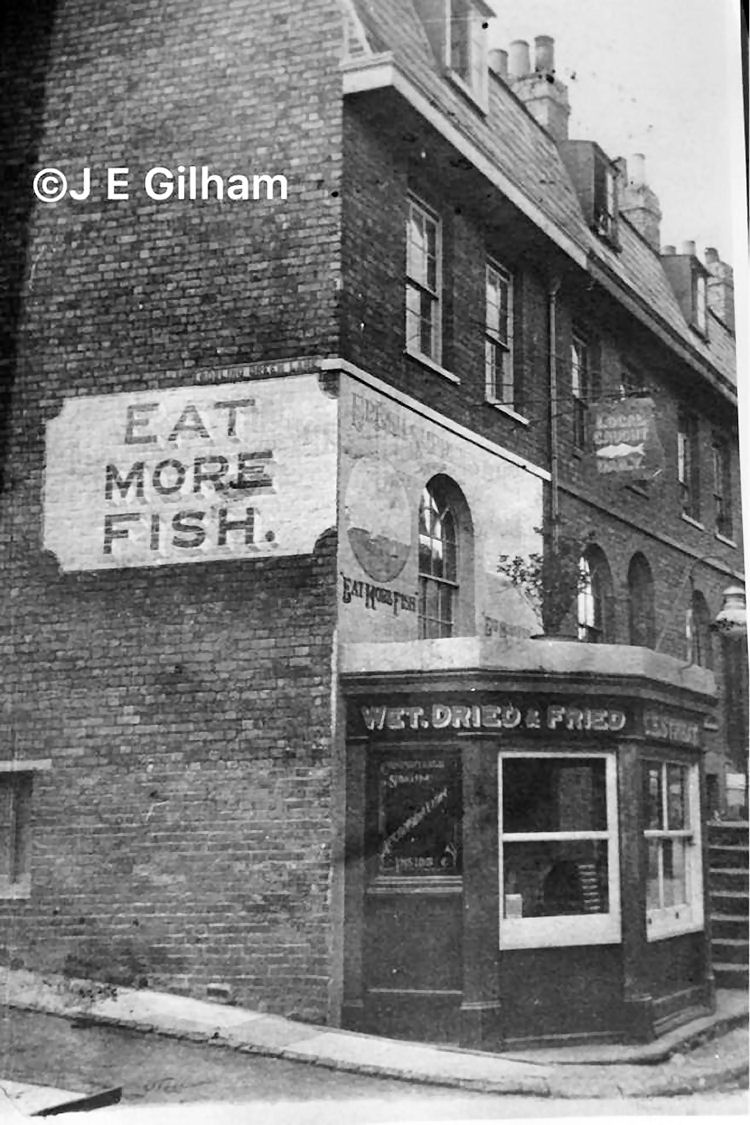
Above photo showing the premises as a fish shop 1930. |
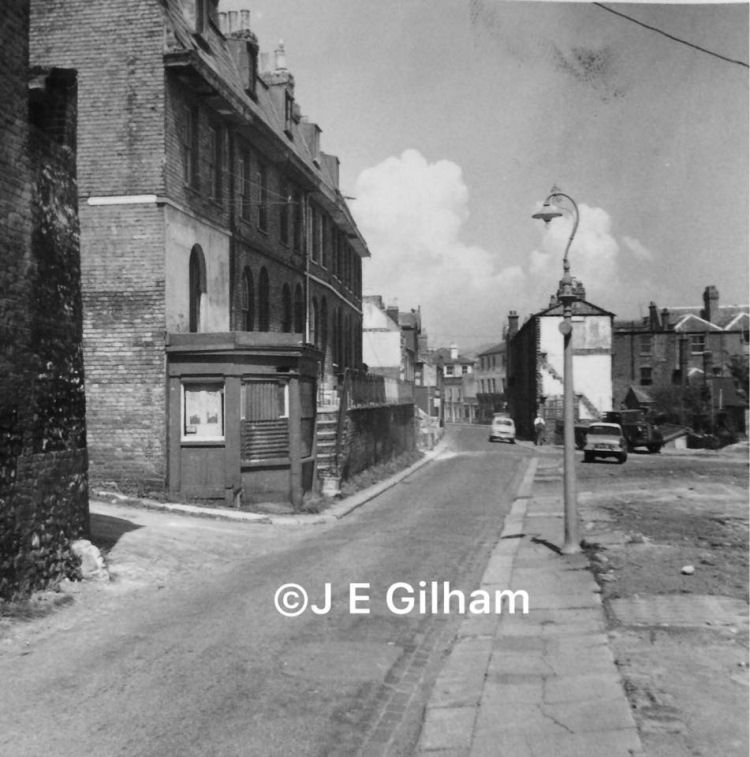
Above photo, circa 1960. |
On the corner with Bowling Green Lane, Stephen Smith might well have been
the first to serve in 1847. It was a fully licensed outlet of Flint, one of
his nine pubs in the town. Four of those had already disappeared by 1917 but
the "Marquis" continued to 1929 when the licence was allowed to lapse.
The building after closure became a hair-dressers and later became a wet
fish shop.
|
From the Dover Telegraph and Cinque Ports General
Advertiser, Saturday 26 January, 1850. Price 5d.
CORONER'S INQUEST
On Monday evening last, at seven o'clock, a jury was panelled before
the Coroner for the Borough of Dover, George Thomas Thompson, Esq., at
the "Marquis of Anglesey," in York Street, parish of St. Mary, to
investigate the circumstances attending the death of Emma Elgar Osborne,
a child nearly four years of age, who dies early in the morning of that
day from injuries alleged to have arisen from exposure to extreme cold.
The jury, on assembly, selected Mr. G. T. Parks as their foreman; and,
being severely sworn, the Coroner observed, before viewing the body he
wished to remind that various rumours relating to the cause of death had
appeared in the public press, some of them implying grave charges. It
was necessary for the jury to divest their mind, entirely of the reports
that had been spread, and judge solely by the evidence that might be
brought before them - to weigh very carefully the statements that would
be made by the witnesses who would be examined - and not be actuated on
one side or the other by anything that had appeared or that had been
said.
The jury then proceeded to view the body, which was lying in the
house of the party whose charge the child had been placed. With the
exception of the frost-nipped feet, a few slight bruises on the back
part of the right thigh, and some spots of apparently congealed blood on
the back, the body presented no other than an ordinary appearance. The
nose, from the child's being found resting on her face, was said to have
been marked, but when viewed by the jury all traces of injury in the
face had disappeared, and must therefore have been of a very superficial
character. The room in which deceased had slept was next examined, and
with the exception of a mattress lying on the floor at one end of the
bed - on which mattress fancy might easily have conjectured an
ill-treated child would be placed, neither the contents or arrangements
of the chamber called forth any remark from the jury. The cellar,
reached by descending two narrow flights of stairs from the bedroom, and
passing through a back living-room was next visited. The cellar was
paved with bricks, and appeared to be used as a wash-house. The
water-crock from which the child is said to have satisfied its thirst,
was placed near the entrance door; and the copper, against he fire-place
of which deceased was found, stood in a corner on the opposite side. The
fact of so young a child descending to such a place in darkness of
night, unseen and unheard, seemed to excite surprise in the minds of the
jury, who most intimately examined the locality preparatory to receiving
evidence. On their return to the inquest-room the investigation was
continued by the examining of witnesses, when the following statements
were elicited:-
Elizabeth Mary Osborne, grandmother of deceased - I live at Broome,
in the parish of Barham; my husband is steward of the Broom estates. I
knew deceased, who would have been 4 years old on the 7th of April next.
She was the illegitimate child of my daughter Sarah Ann, and since April
1849, has been under the care of, and living with, Mrs. Meadows, who is
a married daughter of mine, and was allowed 4s. a week for the board and
maintenance of the child, I agreeing to clothe deceased myself.
previously the child was living with a Mrs. Amlin, at the Pier, in
Dover; and on account of her leaving the town it was placed with Mrs.
Meadows. About three months back I became dissatisfied with her having
the child; I thought it was not spoken kindly to; but I had nothing to
complain of besides the harsh manner of speaking to deceased. I wished
to remove the child; but Mrs. Meadows wanted to keep it, saying she had
never ill-used it, and would always treat it as one of her own. I then
allowed the child to remain wit her. The three letters now produced and
read were received by me from Mrs. Meadows, and are in her hand-writing.
I always thought her to be good-tempered and very kind, and have no
reason to think but what her husband is a kind man. When, in November, I
thought of removing the child, I went over meadows house, accompanied by
Mrs. Meadows, who showed me where the child slept, which was in a back
room up stairs. I noticed a mattress lying in the room, and I said to
Mrs. Meadows - "Fanny, the child, does not sleep here, dos she?" She
replied, "Oh no she sleeps with my children, altogether in one bed."
About five weeks ago I last saw the deceased; I know but little of her
habits. The woman with whom she was placed at the Pier said, that at her
first coming she was a dirty child, but improved after time. The child
never complained to me. Nothing but the harsh speaking induced me to
think of removing the deceased. Mrs. Meadows said she made no difference
in her treatment of the children, but I thought she did. On two
occasions I noticed her unkind manner of speaking to the child. The 4s.
a week has been regularly paid. This witness was deeply affected during
the examination, and gave her evidence with considerable feeling. The
letters referred to above were of no material import - the first,
written in November last, alluded to dissatisfaction expressed by the
grandmother, and the mode of correction used my Mrs. Meadows, with a
promise that she would not again beat deceased, nor shut her up stairs,
if wished; but that the good of the child had been aimed at in what had
been done. The other letters simple detailed the finding of the child in
the cellar, and the results following, with some other minor matters.
R. T. Hunt, Esq., surgeon, practising in Dover - On Sunday, the 13th
inst., saw the deceased at the request of Mrs. Meadows. I found
the toes of each foot in a state of gangrene. I prescribed the usual
remedies, but told Mrs. Meadows that there would be a loss of a portion
of each foot, if the child survived. He deceased continued to get worse,
and I attended it till this morning, when it died. Death arose from
gangrene. Tetanus, or lack-jaw, supervened upon the constructional
derangement consequent on the state of the feet. The gangrene state had
arisen from exposure to extreme cold. I should not have applied hot
water to the feet myself, as Mrs. Meadows did before calling in my
professional aid; but I considered that gangrene had set in before the
application of the hot water. No reaction afterwards took place. If
there had been no hot water applied, I should still have expected to
find the child's feet just in the same state as when first seen by me. I
have upon my visits seen nothing but kindness shown towards the child by
Meadows and his wife. I believe that everything prescribed by me was
duly administered by them. Looking at the severity of the weather on
Thursday night, the 10th inst., the place in which the child was found,
and other attendant circumstances, I consider the deceased was exposed
to the action of severe cold for about five hours. In the presence of
Meadows and his wife I questioned the child as to how it came to go into
the cellar, thinking it extraordinary for one so young to go down stairs
alone in the night. The child replied that she went down to get some
water. I put the same question at various times, and invariable received
the sae answer. Mrs. Meadows, when calling on me, stated the deceased
was found on Friday morning, the 11th inst., in the cellar, dressed in
its night clothes, and in a state of partial collapse. She further said
that she supposed the child had gone down in the night to get water, the
crock being placed there; and that she had put it to bed on the previous
night with the rest of the children. I have attended Meadows and his
wife some months, calling often at the house, and have seen deceased
there, whom I took to be one of their own children. I saw no difference
in the treatment or clothes of the children generally, and deceased
always appeared healthy and happy.
By the Foreman - The child complained of no pains; it was in a state
of partial insensibility. If I had been called in earlier, the result
would have been the same. Yesterday another professional gentleman
called with me, and put the same questions to the child that I had put,
and was answered in the same way as I had been.
By a Juror - Sloughing had not set in; it was a dry state of
gangrene. I called in another professional gentleman for satisfaction to
myself. I should say that the proper circulation was stopped instantly
by the cold, and the contraction of the vessels soon produced
mortification. Had the child been found earlier, the result might have
been different; but I do not think any different result could have
followed on being called in, after the finding of the child at that time
it was found.
Sarah Relf, wife of Edward Relf, cabinet-maker - I reside at No. 2,
Bowling-green-lane, and next door to Mr. Meadows. Previous to about
three months back I frequently heard the sound of blows in Meadows'
house, as from a person struck with the open hand. Such blows were
followed by the sound of the deceased's voice, which I know very well,
saying, "Oh dear, oh dear!" I remonstrated with Meadows and his wife
with regard to it, and they said it was no business of mine. Since
November I have heard nothing that would induce a belief in my mind that
the child was ill-treated. I have observed in its general appearances
that the child did not seem to be so well cared for as for Meadows' own
children. I have never heard deceased cry as if in the cellar.
By a Juror - I was on friendly terms with Meadows and his wife
previously to the child coming to their house. Their treatment of the
child produced remonstrance's from me, disputes ensued, and we have not
been friendly since. Three times in one day I have heard the deceased
beaten. My husband and Mrs. Meadows never had any dispute other than
what arose in reference to the ill-usage of the child.
Edward Relf, husband of the foregoing witness, made a statement of
corroborative character, in the course of which he observed that the
spirit of the deceased seemed broken, and that the child was ruled by
terror.
Jane Parker, a girl ten years of age, who had been occasionally
employed by Mrs. Meadows to mind her children, was next examined, but
from the evident incapacity of the witness, her replies to the questions
asked were very vague and unsatisfactory. Witness stated that she had
not been there for the last three months; that when there, on one
occasion, she saw deceased sitting up stairs alone on a box, with only a
flannel around her. About an hour afterwards she cam down stairs and
tapped at the back room door, asking for a little water. Witness gave
her some water, and she then returned to her bed-room alone. Witness
afterwards went up stairs again, where she saw deceased lying on a
pillow on the floor asleep and dressed; she having dressed herself.
deceased was a dirty child, and Mrs. meadows sometimes beat her for
being so.
At this stage of the proceedings (quarter to 10) and there being
several other witnesses to examine, the Coroner, at the desire of the
jury, adjourned the enquiry till the following day, at 10 o'clock in the
morning.
TUESDAY
On the re-assembling of the jury this morning, the examination was
at once resumed by the calling if:-
Elizabeth Lombard, single woman, who deposed - I now reside at
Charlton, but was living at the Pier with Mrs. Amlin when deceased was
under her charge. Deceased was a dirty child, but Mrs. Amlin seldom
corrected it, as she believed the habits arose from disease or
complaint. About three months ago I went to Mrs. Meadows' house and
heard the deceased crying up stairs. I asked what the child was crying
for, and Mrs. Meadows said she had been a naughty girl. I called the
child down, and when she came into the room she was very cold, and had
only a flannel petticoat on, her arms and feet being bare; it is then
between 10 and 11 o'clock in the morning. On asking deceased what she
cried for, she replied that she had been a naughty girl, and had been
put into a tub of water. Mrs. Meadows confirmed the statement of the
child, and said it was cold water. On my saying the child was very cold,
Mrs. meadows said - "Yes, she is; and I shall soon see about dressing
her." A fortnight afterwards I went to see the child; it was then
dressed in its proper clothes. About two o'clock in the afternoon of the
same day I was allowed to take deceased out for a walk; and on taking
her home in the evening she cried very much, and said - "Don't take me
home to my aunt, she does beat me so." Deceased was a very patient
child, but unforbidden - that is to say, when told to do anything, she
neglected to do it.
By a Juror - I am quite sure Mrs. Meadows said the water was cold; it
was not very cold weather, but deceased was cold from being up stairs
with only a flannel on.
Jane Hadlow, wife of Charles Hadlow, painter - Between two and three
months ago I went with Mrs. Relf to see Mrs. Meadows. There was an
altercation between them, Mrs. Relf acusing Mrs. Meadows of ill-treating
the deceased, which she denied. Mrs. Relf said, "You are a brute and a
beast for using the child as you do, and for allowing your children to
ill-use her as they do." Mrs. Meadows still denied the truth of the
accusation, and Mrs. Relf persisted that it was correct. Mrs. Meadows
then asked Mrs. Relf if she had heard the child cry that morning, and
was answered in the negative. "Then," said Mrs. Meadows, "you might have
done had you been listening, for Mr. Meadows beat the deceased very much
before he went to work." I said it was shameful on the part of Mr.
Meadows, and that if his wife could not correct such a child properly it
was time some one else looked after it. Mrs. Meadows said that he sister
had given her leave to correct deceased, and she should do so when she
thought proper; it was no business of mine. She added, that the child
had dirty habits. I replied, that was very trying, but it was no unusual
circumstance, and parents must put up with it, and not ill-use their
children in consequence. Mrs. Relf and Mrs. Meadows were at that time
bad friends on account of the treatment of the child by the latter.
Ann Vinall, upholsteress at Flashman's, deposed to attending on the
child on two or three occasions since the unfortunate occurrence. She
had done so at the wish of Mrs. Flashman, who was very desirous that
deceased should be carefully attended to. Witness was present at the
child's death, and while in attendance previously saw nothing but
kindness to the child on the part of Mr. and Mrs. Meadows.
Charles Golden and a person named Shepherd, both in the employ of Mr.
Flashman, stated that on he morning when the child was found in the
cellar Mr. Meadows had communicated to them, as soon as he came to the
shop, the particulars of what had transpired.
Richard Philpots, a fellow workman of Meadows - I overheard Mr.
Meadows detailing the incidents of the case referring to the deceased.
About a month since I was at his house, and also three months ago. On
those occasions I observed no difference either in the treatment or
dress of deceased and Mr. Meadows' children. I saw no harsh treatment;
had there been any, I think I must have noticed it. The manners of
deceased were as much to be expected from a child of her age.
Sarah Spires, a very intelligent girl, 14 years of age - For the last
three or four months I have been in the habit of taking some children to
Mrs. Meadows' school. I have been as often as two or three times a day.
I used to go into the house, and take off the children's things. I have
always seen deceased when I went. I never saw her badly clothed, but
sometimes she had no shoes or stockings on. I have never seen ay of the
little Meadows without shows or stockings, nor do I know why deceased
went without them. I last saw her about a month ago. I have never seen
her crying. Deceased was not in the habit of speaking to me; she did not
seem to be like the other children, for she was so quiet, and did not
play when the other children played, but kept to her seat on the stool.
Harriet Beer, wife of Edward Beer, cabinet-maker - Since September
last I have taken tea with Mrs. Meadows, at her house, quite ten times;
the last occasion as on the 26th of December. On several occasions I
went about half-past three, and remained till about either or nine. On
each occasion I saw deceased, who had tea with the family. She always
appeared as well clothed as the other children, and I never saw her
without shoes or stockings, nor did I ever notice her being harshly
spoken to. He was treated equally as well as Meadows' own children. I
sometimes went by invitation, and at other times dropped in by accident.
By a Juror - I never observed any marked difference in the child.
Mrs. Meadows said deceased was a dirty child, but she was never dirty
when I was there. She was not quite so cheerful as children generally
are; there was something gloomy about her. She appeared to have
sufficient food.
The husband of the last witness was called, but his statement added
no new feature to the evidence already given.
Mrs. Meadows being about to be called in, the Coroner observed that,
had anything in the examination already made shown a continued series of
ill treatment to deceased, or any system of persecution or ill usage
that might have given rise to suspicion of something wrong, he should
have hesitated in calling this witness, less she might have criminated
herself by his statements; but, from the evidence taken, he saw no
ground for thinking that such a result would follow; if the Jury thought
a caution were necessary, that could be given.
The Jury coincided with the views of the Coroner and thought no
necessity existed for giving a caution.
Mrs. Meadows was then called, and deposed as follows - I am the wife
of Henry Meadows, a cabinet-maker, in the employ of Mr. Flashman. In
April last deceased was put under my charge. I at times corrected her -
scolded her, and sometimes giving her a slap on her neck, and sometimes
on her bottom; but I have never beaten her violently. I corrected her
for her dirty habits, but never confined her in the cellar. Sometimes I
have sent deceased up in the bedroom for half an hour, instead of
beating her. I have never seen my husband beat the child, nor have I
ever heard her cry as if he was beating her. I recollect the dispute
between myself, Mrs. Hadlow, and Mrs. Relf. I don't remember saying they
might have heard the deceased cry that morning. I might have said so. Oh
yes - I recollect that was the morning he said he gave her a little
spat. I have never put deceased into cold water as punishment; but have
sometimes washed her, and my own children too, in cold water. Deceased
was a very dirty child, but not so bad of late. She slept with three of
my children in one bed. On two occasions I have remover her from the bed
to a mattress on the floor. This was on account of her having wet the
bed. I then covered her wit a blanket. The deceased was never without
shoes and stockings in the daytime. I did not clothe her myself, but she
was dressed a swell as my own children were. I have never parted with
any of her clothes at any time, and she always took her meals with the
family, and was never fed in the bed-room. Deceased always seemed
thirsty, and would drink anything she could come near. She was not in
the habit of helping herself to water, but she knew where it was kept,
and she had once helped herself from the cellar, about six weeks ago,
and in the day time. In November last my mother talked about removing
the child from us, because she fancied deceased was not treated so well
as our own children; that it seemed to her as if Mr. Meadows did not
speak kindly to the child. I told my mother I had made no difference in
the treatment of the children, and promised her that there should be
none made. My own children were in the habit of treating deceased
kindly. On Thursday night, the 10th ult., at about half-past six
o'clock, I put deceased and two of my own children to bed, when I tucked
the bedclothes round the four. Myself and my husband retired to rest
about ten. O left my bed-room door open, and the door of the children's
room, which is opposite to mine, was also open. The door of the room
below was open; this door was at the bottom of the stairs, but the door
at the top of the cellar, in the same room, was shut, though on the
latch only. It was in this room that my husband and myself had been
sitting till we went to bed, and any one going to the cellar must have
passed through the room in which we were seated. I heard no noise the
whole of Thursday night. The next morning (Friday) between 6 and 7
o'clock, my youngest boy called me, saying he wanted to get up. I went
to him - it was then dawn - and I could see that deceased was not in
bed. I searched about the room, but not finding her, I got a light and
went down stairs. I entering the back room I looked about, but not
seeing deceased I went to the top of the cellar stairs, and then I heard
the child in the cellar, either breathing loudly or snuffling at the
nose. I went down directly, and found deceased lying on the brick paving
near the copper fire-place; her arms were folded against her breast, and
she was resting with her head and face upon the bricks, her knees being
bent and drawn under. Deceased was dressed in her chamise and night gown
- the same dress in which I put her to bed. The brick paving had been
washed that day, and was very cold and damp; the cellar is a cold place,
for when I am engaged there I feel its effects myself. At the time I
lifted deceased up she was asleep, but awoke as I carried her to the
living-room. I asked her what she went in the cellar for, and she said
for some water. I put her down in the back room, and told her to go up
stairs to bed. She was stiff, and seemed unable to walk, upon which I
wrapped her up in my cloak, and put her in a chair while I lighted the
fire, and put a kettle of water on. When the water was hot I put her
bodily into a bath; she was in it about 10 minutes. The tips of her toes
looked purple when put into the water, but seemed better when taken out.
I then dressed her and during the day she ran about with the rest of the
children, apparently without effort or pain. At tea-time Mr. Meadows
played a tune on the violin, when deceased danced about with the rest of
the children. On undressing her at night I noticed that her toes
presented about the same appearance as they did at first in the morning,
and I again put them into hot water, and then carried her up and put her
to bed with the other children. On Saturday morning she did not complain
of her feet, and ran about during the day. In the evening I put her feet
again into hot water, with mustard; they looked purple, and I asked her
if they were sore, to which she replied no. She slept on Saturday night
as she did on the previous night. At breakfast time on Sunday morning my
husband told me to go to Mr. Hunt, as deceased feet looked more purple.
I went, and Mr. Hunt came to see the child, when he said that her toes
were frost-nipped. He did not say then he thought badly of the case, but
when he called on Tuesday or Wednesday, he stated that he thought the
child would lose a toe or two from each foot. He came to see deceased
twice a day. On Wednesday I wrote to my mother. Up to the time of the
altercation with Mrs. Hadlow and Mrs. Relf, which I think was in
September last, Mrs. Relf and myself had been on good terms. Since the
matters have not been pleasant between us. I don't remember ever taking
the deceased out in the cow-lodge on any occasion so late as eight or
nine o'clock in the evening. I think deceased got some water on Thursday
night, as I noticed a small pot had been used; she could lift the cellar
door latch, and she knew her way down.
The Jury considered that there was no necessity to examine the
husband of the foregoing witness, the investigation here closed, the
Coroner observing, that he had examined Mrs. Meadows at such an extreme
length for the purpose of satisfying the public mind in reference to the
various rumours afloat. From the evidence, no disposition to concealment
had been evidenced, and from the facts being communicated by Meadows to
his fellow-workmen so soon after the occurrence, there appeared no
probability that the tale was a concocted one. The rumours seemed to
have stopped at a certain period, about three months back; and it was
most likely that the correction administered previously to that period
had proved to some extent successful; at least, no cause of complaint
appears to have been given subsequently, as far as any evidence that has
been elicited. It was not necessary for him to recapitulate the
voluminous statements made; the facts were before them, and he would
leave them to consider their verdict.
The Jury then deliberated for about ten minutes, and at the
expiration of that time returned the following verdict - "It is of the
opinion of this jury that the deceased, Emma Elgar Osborne, died from
tetanus, or lock-jaw, produced by gangrene arising from exposure to
extreme cold."
|
|
Kentish Gazette, 29 January 1850.
The poor child, Emma Elgar Osborn, who was found nearly frozen to death
in a cellar, died on Monday morning last. An inquest was held on the
body at the "Marquis of Anglesea," on the same day, before G T.
Thompson, Esq., coroner; and after a very protracted investigation, the
jury returned a verdict that "death resulted from tetanus or lock-jaw,
induced by gangrene, arising from exposure to extreme cold."
The case has excited great interest in the town, and is the subject of
general conversation. |
Dover corporation paid compensation of £1,250 to Flint and Company who in
turn, allowed £25 to the tenant.
I did find mention of an "Anglesey Arms" in York Street in 1870. I have
presumed that to be the "Marquis of Anglesey".
|
From the Dover Express and East Kent News, Friday,
5 July, 1868.
REMANDED CHARGE.
William Castle, a pensioner, remanded from Friday, on the charge of
stealing a silver watch and chain was again brought up for examination.
The prisoner had been twice remanded. On his first examination, on
Saturday week, it appeared that he had been found by police-constable
Pilcher, on the previous day, at the "Marquis of Anglesey" public-house,
in York Street, attempting to dispose of a watch and chain. He offered
to sell both for two shillings, and the circumstances being suspicious,
the policeman took him into custody.
It now turned out that on the evening before the prisoner was
discovered offering the watch for sale he had been in the company of
George Jones, a shoemaker living in Stembrook. He had accompanied Jones
home, and the next morning he called on Jones, who took him for an
officer's servant, "on the spree." He told Jones that he was absent
without leave, and on Friday morning asked whether he might wash and lie
down for a little while. Jones good-naturedly consented, and allowed him
to go into a bedroom on his house. In an adjoining room were the watch
and chain in question, which belonged to Jones's son, and when the
prisoner had left the house they were missing. It was not very long
afterwards that he was found by the police endeavouring to dispose of
the articles.
The prisoner cross-examined the prosecutor and his wife with the view
of showing that the prosecutor was drunk on the Thursday night, but he
did not try to account for his possession of the watch, either in his
cross-examination or his defence.
He made a statement, after being cautioned in the usual manner, in
which he endeavoured to show that he found the prosecutor stretched on
the footway in Castle Street on Thursday night, and assisted him home.
He declined to carry his defence any further than that, and the
Magistrates fully committed him for trial at the next Quarter Sessions.
|
|
From the Dover Express and East Kent Intelligencer,
22 March, 1872. Price 1d.
Two men named Baynton and Cullen were fined 1s., and costs for
drinking in the "Marquis of Anglesey" public-house within prohibited
hours.
|
|
From the Dover Express and East Kent Intelligencer, 6 September, 1872. Price 1d.
ANNUAL LICENSING MEETING
The “Marquis of Anglesey” public-house, York Street, from Mrs.
Caroline Marsh (the former licensee) to her husband, Mr. James Brown,
she having married since the licence was last renewed.
|
|
From the Dover Express and East Kent News, Friday 22 August, 1873.
PUBLIC HOUSE OFFENCES
George Coombe, the landlord of the “Marquis of Anglesey” public-house,
York Street, was charged with having his house open for the sale of
liquor, at 10.35 p.m. on Sunday last.
Police-constable Corrie said he saw the house open and more than one
person leave it after ten o'clock. At thirty-fives minutes past ten a
woman applied to be served with liquor at the public-house on the
opposite side of the road, and having been refused there, she walked
straight across the road into the house of the defendant, where she
obtained what she required.
The defendant, who did not deny the charge, pleaded that his clock had
stopped, and that he did not know it was so late.
The Magistrates fined him 40s. and 9s. 6d. costs, and ordered that the
offence should be endorsed on his license.
|
|
After hearing the other cases, Mr. Pritchard of the "Marquis of
Anglesey," York Street, attended.
The Chief Constable said that he thought perhaps there was some
mistake by Mr. Pritchard being asked to attend. he believed that it was
in the mind of some of the Magistrates that Mr. Pritchard used the back
room in question in this case, as a living room which people had to pass
to use the accommodation at the back. he thought he had satisfied the
Magistrates after the notice had been served that such was not the case.
Mr. Pritchard lived upstairs and that room was a taproom. he saw no
objection to it personally.
Mr. Mowll appeared in the case of the "Marquis of Waterford."
The Chief Constable said that that was a case which he was placing
before the Court against his own opinion. In that case the urinal and
W.C. accommodation was placed at the back and people wishing to use them
would have to go through the living room or sitting room of the
occupier to use it. In his report to the justices he stated fully that
all places of accommodation could be used on application to the tenant
or attendants. He was of opinion that the accommodation there was quite
sufficient for the public need. if the lavatory was placed at the
disposal of the public in his opinion it would be grossly abused and
would be likely to be damaged every day. The people using the house
lived in the neighbourhood and there was amply accommodation at their
own houses.
Mr. Mowll said that he was informed that the tenant had been there
ten years and had only had five applications for the use of the closet
during the whole of that time.
The Chairman said that with regard to the "Town Arms" they would
adjourn that matter until the adjourned meeting. he did not think there
would be very much difficulty about it, but the Magistrates took an
interest in those matters and it was just as well that they should do
so. With regard to the "Marquis of Waterford" and the "Marquis of
Anglesey" they did not see how they could go behind the statement made
by their officer and the licences would be renewed.
|
|
From the Dover Express and East Kent News, Friday, 6 February, 1914. Price 1d.
DOVER LICENSING SESSIONS THE MARQUIS OF ANGLESEY
Mr. R. Mowll said that he appeared in this case, and asked for the
renewal on behalf of the brewers and the tenant.
The Chief Constable said that the owners were Messrs. Flint and Co.,
Canterbury. The tenant was Mr. G. J. Pritchard, and the licence was
transferred to him on the 7th August, 1913. the rateable value was £20
gross and £16 net. The nearest licensed houses were the “Marquis of
Waterford,” 56 yards; the “Greyhound,” 65 yards; the “Five Alls,” 61
yards; and the “Crown,” 101 yards.
In reply to Mr. Mowll, the Chief Constable said that Mr. Pritchard was
formerly a Superintendent of Police, and there were no complaints as to
the way the house was conducted. The house was very nicely kept, and was
situated in York Street, through which there was a good deal of traffic,
it being a short cut from Snargate Street to Folkestone Road. The
previous tenant held the house for ten years.
Inspector Lockwood said that at 9.45 a.m. on the 22nd January, there
were two customers, on the 24th, at 2.55 p.m., six, on the 27th, at
6.30, seven customers; and on the 30th, at 8.45 p.m., fourteen
customers.
Mr. Mowll: Pretty well a record.
The Inspector: Quite so.
The Chairman asked for the trade.
Mr. Mowll said that he was not prepared to state that, but he asked for
a renewal on the evidence already given.
The Chairman said that the licence would be renewed.
|
|
From the Dover Express and East Kent News, 5 February, 1915.
SANITARY ACCOMMODATION
After hearing the other cases, Mr. Pritchard of the "Marquis of
Anglesey," York Street, attended.
The Chief Constable said that he thought perhaps there was some
mistake by Mr. Pritchard being asked to attend, he believed that it was
in the mind of some of the Magistrates that Mr. Pritchard used the back
room in question in this case, as a living room which people had to pass
to use the accommodation at the back. he thought he had satisfied the
Magistrates after the notice had been served that such was not the case.
Mr. Pritchard lived upstairs and that room was a taproom. He saw no
objection to it personally.
The Chairman said that with regard to the "Town Arms" they would
adjourn that matter until the adjourned meeting. He did not think there
would be very much difficulty about it, but the Magistrates took an
interest in those matters and it was just as well that they should do
so. With regard to the "Marquis of Waterford" and the "Marquis of
Anglesey" they did not see how they could go behind the statement made
by their officer and the licences would be renewed.
|
|
From the Dover Express and East Kent News, 1 January, 1926. Price 1½d.
DOVER LICENSEE'S INSOLVENCY
At a sitting of the East Kent Bankruptcy Court at Canterbury, before Mr.
Registrar Furley, Mr. A. Harold Ward (Official Receiver) conducted the
examination of Frederick James Parnell, “Marquis of Anglesey Inn,” York
Street, Dover, public-house manager, lately carrying on business at the
“Plough Inn,” New Romney; liabilities £166 10s., assets 5s.
Debtor stated that he joined the Royal Navy in June, 1904, and served
until December, 1913. He was then transferred to the Coastguard Service
and was stationed at Littlestone. He returned to the Royal Navy in 1914,
and served until July, 1919. He went back to the Coastguard Service and
remained in that service until the end of 1923, when it was abolished.
He received a gratuity of £77, and at first a pension of £50 a year.
Subsequently his pension was reduced, and in consideration of that
reduction his gratuity was increased to £320. he took the “Plough Inn,”
New Romney, on March 5th, 1923.
Debtor explained that this was a beer house, and common lodging-house,
at which vagrants were accommodated at a charge of 8d. a night.
The Official Receiver: A sort of Ritz. (Laughter.)
Debtor said he borrowed two sums of £40 from his brother-in-law (pending
the receipt of the balance of his gratuity), which he had repaid. He
calculated that on average he took from £10 to £15 a week at the “Plough
Inn.” When he left that house in October, the outgoing valuation
amounted to £150 4s. All that money was paid over to his brewer, to them
he was still owing just over £130. He was now receiving £2 a week.
The examination was closed.
|
|
From the Dover Express and East Kent Intelligencer, 22 February, 1929. Price 1½d.
STEALING WHISKEY BY A TRICK
DOVER LICENSEE DEFRAUDED
At the Dover police Court on Monday, before Messrs. W. B. Brett and T.
Francis.
Michael O'Brien, (30), 71, High Street, Cheriton, a dealer, was charged
with stealing, by means of a trick, from the “Marquis of Anglesey,” York
Street, a bottle of White label Whiskey, a bottle of Nicholson's dry
gin, valued together at 25s., the property of George Parks Wood. Michael
O'Brien and Frank Clubb (25), Upper Yard, Union Road, were charged with
being concerned together in stealing, by means of a trick, from the
“King William IV” two bottles of Johnny Walker Whiskey, valued 13s., and
further a bottle of Johnny Walker Whiskey, valued 12s. 6d., the property
of Ernest John Wood. They were further charged with receiving the two
half-bottles and a bottle of whiskey, well knowing them to have been
stolen.
William George Job, manager of the “Marquis of Anglesey” said on
Saturday 16th February, between 2 and 2.20, O'Brien came in the public
bar and asked for a whiskey, also asking witness to have one, which he
did. He called for another and a packet of Players, which he paid for.
He then asked for a bottle of whiskey and a bottle of gin, and he was
served by witness. He put the bottle inside his coat. He fumbled about
in his pocket and witness thought he was going to pay. He wanted
defendant to give him 15s. to make up the balance of a cheque for £2.
the spirits cost 25s. he saw a cheque book and he told witness he could
not change a cheque. He said he had a little deal, about £200, with Bob
Wood, of Snargate Street, and also said that he was going down to him as
he had no hard cash on him, and he would bring Bob Wood between 7 and 8
o'clock. He then told defendant he would not let the spirits go out
without payment. Defendant then made for the door, and when witness got
to the door he found that defendant had gone. He did not want to put the
matter in the hands of the Police, but in the evening he went to see Bob
Wood to enquire if defendant was there, and he was told that he was not,
so he informed the Police. He went to the Police Station again at 10.15
and charged O'Brien. There was a ring at the door at 5.30 on Sunday and
when he went to the door O'Brien and Clubb came in, and O'Brien paid for
the spirits he had bought the previous day. They asked him to let them
have a “small one” but he refused.
By Mr. De Wet: He only had one drink with O'Brien. He did not say he
could not square a whole bottle of gin and filled me two half bottles
with gin. He did not lend O'Brien 5s. he did not give O'Brien a half
bottle of gin but a large bottle. When the two came to pay the 25s. he
accepted the money and gave the receipt produced. He did not look out of
the door at 4.15 when O'Brien rang and asked if it was all right.
O'Brien came in soon after 2 o'clock and not at 4.15. he did not have
half a bottle of gin in the house.
Ernest John Wood, son of the licensee of the “King William IV,” Biggin
Street, said he was in charge of the bar on Saturday, 16th February,
when the defendants came in between 2.15 and 2.30 p.m. they asked for a
bitter and an old ale, which he served, and obtained payment from
O'Brien. They drank this, and Clubb asked for two whiskeys which he paid
for. Immediately afterwards O'Brien asked for a half bottle of Johnny
Walker whiskey which he handed to him. O'Brien then turned to Clubb and
asked him if he would like to take a bottle “for the old man” but he did
not hear Clubb reply. O'Brien said “You had better take one and we will
go 50-50,” and asked witness for another half bottle, which he gave to
him. When he handed over the second bottle he naturally asked for
payment, 13s. O'Brien said he would not pay then, but would call in that
night and do so. Witness said, “If you cannot pay me you had better hand
over the two half bottles.” He then called witness round into the room
and showed him a cheque book, and said it would be quite all right. He
asked O'Brien if he could cash a cheque for him, but he said he could
not let witness have a cheque then, mentioning something about “the
income tax people,” and something about having plenty of money at home.
O'Brien then joined Clubb in the other bar, and witness went into the
room. While he was there he saw a bottle of Johnny Walker removed from
the shelf in the bar. He could not see who it was at the time owing to a
partition causing a partial obstruction, but on going to the door he saw
Clubb join O'Brien who was at the front door and went out. He then
cleared the house and followed the defendants, whom he saw in Biggin
Street. He caught them up at Dieu Stone Lane. He saw a bottle of whiskey
in O'Brien's pocket. He took it from him and said “You had better come
with me now.” Clubb then went down Dieu Stone Lane and O'Brien went up
New Street. He again followed O'Brien for a few minutes but then lost
sight of him, so he reported to the Police. That night he went to the
Police Station and charged him. He charged Clubb on Sunday at about
1.15. On Sunday evening, at 10.15, he made a statement to the Police.
By Mr. De Wet: Defendants were not on the premises until 2.50. He did
not have a drink with the defendants. He did not lend O'Brien 5s. and he
did not say to O'Brien, on catching him up, that he had been told he
would not receive payment. He had no conversation with O'Brien at all.
Det. Sgt. F. Cadman said at about 5.40 on Saturday, as a result of
information received at the Police Station, he went to the “King William
IV,” where he saw witness, Ernest Wood, who told him that he had two
bottles of whiskey stolen by two men and gave their descriptions and the
name of O'Brien. At about 9 p.m. he received a complaint from Mr. Job
and about 9.30 p.m. he was in the Market Square and saw O'Brien. He told
him he was a Police Officer and asked him if he had been in the “King
William IV,” Biggin Street, that afternoon and he said he was. He told
him he answered the description of a man who was there with another man.
He cautioned him and told him he (witness) would take him to the Police
Station on suspicion of having stolen a bottle of whiskey from the “King
William IV,” and also that other charges might be preferred against him.
When witness referred to the bottle of whiskey, defendant said, “I paid
him for it.” At the Police Station he was cautioned and charged with
stealing a bottle of Johnny Walker whiskey and also two half bottles
from the “King William IV” and further with stealing a bottle of White
Label and a bottle of gin from the “Marquis of Anglesey.” Replying to
the charge, he said, “Where is that?” When searched a bottle of White
Label whiskey was found on him and also a small quantity of gin in a
whiskey bottle. The following day at 12.10 he saw the defendant Clubb in
Union Road. He told him he answered the description of a man who was in
company with Michael O'Brien the previous day in the “King William IV.”
He cautioned him and told him he would be arrested and charged with
being concerned in stealing a bottle and two half bottles of whiskey. He
said, “I am not guilty.” The two prisoners were cautioned and charged at
the Police Station. In reply, Clubb said “I asked Mr. Wood for no
whiskey whatever. Not guilty of stealing.” O'Brien made no reply. He
afterwards went to 12, Bowling Green Lane with Clubb and took possession
of two empty half bottles which Clubb produced from a sideboard.
Mr. De Wet pleaded not guilty on all charges.
O'Brien said that on Saturday he was in Dover on business and went into
the “King William IV,” at about 2.25 and had one or two drinks. He said
to Mr. Wood “Would you let me have a bottle of whiskey until tonight,”
and he said “Yes.” He called him into the next room and asked him to
lend him 6s. He gave him the money and said it would be all right. When
he was near St. Mary's Church, after leaving the public house, Wood came
up to him and said “I have received information that I shall never get
paid for the whiskey. What guarantee can you give me that you can pay
me?” Witness said, “I have got no guarantee, but you can have my name
and address,” and gave him a letter. Wood said, “It is not my whiskey. I
cannot let it go, and if you do not give it to me back there will be
trouble.” Witness gave him the whiskey. They shook hands, and Wood said,
“Well, that is finished.” Clubb, who was with him all the time, then
went away and Wood followed him. He went to the Market Square and waited
for a man who owed him some money, but this man did not turn up. He then
went to the “Marquis of Anglesey.” He rang the bell and Job came out and
said, “Is it all right!” He said it was and went in. They had five or
six drinks. He said to Jon, “Will you let me have a bottle of whiskey,”
and he gave it to him. He then asked Job for a bottle of gin but Job
said, “You cannot have a whole bottle, but I will measure you a half
bottle in a Johnny Walker bottle.” He asked Job if he could lend him
money and Job said, “You can have as much as you like as long as you let
me have it back on Monday,” and gave him 5s. He did not show a cheque
book because he had not got a banking account. He never mentioned Mr.
Bob Wood, of Snargate Street, and did not know him. When he went to the
“King William IV” he ordered a whiskey and said he would pay for it in
the evening. If he had not been arrested he would have gone home to get
the money to pay the debt. The statement that he put his arm round and
took the bottle of whiskey off the shelf, he did not know how Wood saw
the bottle in his pocket as it was inside and his coat was buttoned up.
The Chief Constable: Do you not think it lucky for a perfect stranger to
get two bottles of whiskey and 5s. from a man you had never met before?
I do not know; any body could have got it.
Do you expect any sane person to do that?
He did, anyway.
The Bench were absent ten minutes and on return the Chairman said that
the bench had found the defendants guilty of all the charges.
The Chief constable said that there were no criminal convictions against
the defendants.
The Chairman said – with regard to the “marquis of Anglesey” they found
O'Brien guilty and he would be fined £2. he would also be fined £2 for
the offence at the “King William IV;” and Clubb £1.
Defendants were allowed a month for payment.
|
|
From the Dover Express, 29 November 1929.
Compensation to the Commercial Quay public houses.
The following shares in the compensation awards where agreed:-
"Marquess of Anglesey," York Street, Dover - £1,250, all to Flint and
Co., Ltd, Dover, the licensee, who will receive £25 from the brewers,
being a manager.
|
The property sold for £230 freehold in 1930 and became a retail shop
thereafter.
Redevelopment saw the whole area compulsory purchased and demolition
proceeded in the 1960's. That programme had already started in 1935 with the
renewal of properties in Adrian Street. A new road now assists traffic using
the docks and a vast area which has been unproductive for years is at last
receiving attention in 1989.
LICENSEE LIST
SMITH Stephen 1841-47 (age 60 in 1841)

SMITH Stephen 1851+ (age 48 in 1851)
ROBBINS Jacob 1861+ (age 40 in 1861)
WARNER Edward May/1870-Nov/70

MARSH Caroline Mrs Nov/1870-Sept/72 (age 40 in 1871)
 BROWN James Sept/1872-Jan/73
(New
husband of above)
BROWN James Sept/1872-Jan/73
(New
husband of above)
COOMBES George Jan/1873-Jul/80 dec'd

COOMBES Mrs Maria Jul/1880-82+ (widow age 39 in 1881)

COTTERELL Charles E 1891

FRIEND L 1895 
CHARLES Miss L 1899

WHITE Mr W G  to Aug/1900

HAWKING William Webber Aug/1900-02 end
CAVE Mrs Mary 1903
 
HOUGHTON James Henry 1903-13 end (age 55 in 1911)
 
WHITE G 1910
PRITCHARD George James 1913-19 dec'd
PRITCHARD Mrs 1919
McKEEHNIE Mrs R (McKETCHNIE?) 1920 end
NEWING J W A 1920-Feb/22

WOOD Mr George John Arthur Feb/1922+
WOODS Frederick 1924-Jan/25

STACE George William Jan/1925-Nov/25
WOOD George Parks Nov/1925+
PARNELL Fred James 1926
From Bagshaw Directory 1847
From the Post Office Directory 1874
From the Post Office Directory 1882
From the Post Office Directory 1891
From Pikes Dover Blue Book 1895
From the Kelly's Directory 1899
From the Post Office Directory 1901
From the Post Office Directory 1903
From the Kelly's Directory 1903
From Pikes Dover Blue Book 1909
From the Post Office Directory 1913
From the Post Office Directory 1922
From Pikes Dover Blue Book 1924
From the Dover Express
|
