|
3 Queen Street
Dover
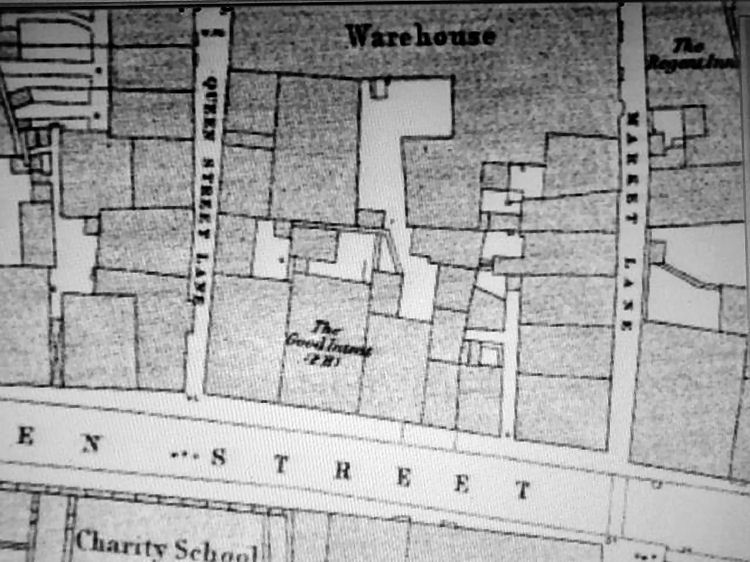
Above 1871 map showing the location of the "Good Intent" and "Regent Inn."
|
Well established by 1844 and an inquest was conducted there four years
later, when the mate of the schooner "Carl Adolphe" out of Hamburg, fell
from the masthead into the hold. The unfortunate man fought a losing battle
for some days. Perhaps of interest also, a schooner named 'Good Intent'
often put into Dover and Rye. It belonged to the smuggling fraternity and
its false bulkheads, fore and aft, provided room for 147 kegs of brandy
either end of the craft. She was eventually arrested by the revenue cutter
'Sylvia' in 1837.
The Kent Directory of 1837 mentions a Leonard Epps, Queen Street, Dover,
"The Good Intent" and the Dover Telegraph of 7 March 1846 p.8
col.3 a "transfer of public house licence from "The
Three Kings." Leonard Epps is also mentioned as being licensee of the "Three
Kings" from 1839-59, somehow the dates and changes have confused me on
this one at present.
From the Kent Herald,
28 February 1833.
Death.
Feb. 21, Mrs. Holliday, widow of the late Mr. Stephen Holliday, of the "Good Intent",
Dover, from the effects of falling down a trap hatch into the cellar.
|
|
From the Dover Telegraph and Cinque Ports General
Advertiser, Saturday 22 February, 1845. Price 5d.
CORONERS INQUEST
SHOCKING CASE OF DESTITUTION
An inquest was held on Monday afternoon, at the "Good Intent" public
house, Queen Street, before G. T. Thompson, Esq., Coroner for the
Borough, and a respectable jury on the body of Lydia Chatfield, aged 51.
The jury having been appointed Mr. W. Skillman their foreman, the
Coroner said before proceeded to view the body he thought it proper to
explain why the inquest was held so long after death. It appeared that
deceased died on Wednesday morning; but it was not till Saturday Correll
called to give him the information. He then, having ascertained that Mr.
Sibbett attended deceased, called upon that gentleman. From the
statement, and hearing a report was prevalent that the parish had
refused to bury the body, he considered it quite necessary to hold the
present inquiry. The jury then proceeded to view the body, which was
lying at the house opposite. On entering the place a scene of
wretchedness was presented, for which we were unprepared. The body was
lying in the corner of a dark damp cellar, in which it appeared the
whole family had lived. The floor was bare earth, and there was not a
particle of furniture or bedding in the place.
The jury having returned to the inquest-room, the following evidence
was adduced:-
Edward Sibbett, surgeon - On the 29th of January I was called
upon as a medical officer of the Dover Dispensary to attend a child,
named Martha Chatfield, for erysipelas in the face. When I called I saw
very great distress in the cellar, which was used as an apartment. The
deceased was at the time walking about attending to the child. There was
no bed or blankets for any of the family, nor the least particle of
furniture, except a box and a small table. I asked deceased if her
husband was in work, and she replied no, and had not been for a long
time. I then recommended her to make application to the parish for
relief. She said her husband did not like to do so. Two or three days
after I paid a second visit, and found then very much in the same state.
I asked if she had made application to the parish, and she replied no.
On Wednesday week I again called to see the child, and found her
recovering. I enquired for the mother, and the child told me that was
her lying on the floor before the fire. On looking I found her lying on
the bare floor, only covered over with an old sack. I spoke to her, and
found her extremely weak. I told the child to come with me to the
Dispensary, and I sent a cordial medicine, although I did not think it
would do much good without other nourishment. I then went and called on
Mr. Foord, one of the guardians, who said he could do nothing an the
relieving officer, Mr. Bourner, lived in the town; but promised to speak
to him should he meet him. I called at the house a day or two afterwards
to see the child, and found the deceased in much the same state, but
much weaker. One of her daughters was making her a little gruel, and
deceased told me her husband had been to work for a day or two. I told
her I should state her case to the relieving officer, which I did about
half an hour after; and also sent her more cordial medicine from the
Dispensary. I then returned to the cellar, and found they had procured a
small mattress, on which she was lying. I stated to them what I had
done, and did not see her afterwards. I attributed her death to want of
proper nourishment and necessaries of life, and by exposure of the cold
from lying on a bare earth-floor, without any covering to protect her
from the cold. She was labouring under no disease. I never saw any other
food in the house but the gruel I have mentioned and a piece of bread. I
did not attend to deceased professionally, nor had she made any
application at the Dispensary. I merely attended her out of charity from
seeing her miserable state.
In reply from a question from the foreman of the jury, Mr. Sibbett
said he certainly did consider deceased in great danger.
Thomas Chatfield - I am a labourer, and deceased was my wife. I have
rented the cellar in which I now live for the last eighteen months, and
am a weekly tenant, hiring it of Mr. W. Horsenaill. In the cellar I live
with my wife and three daughters. The rent I pay is 1s. 6d. per week.
During the time of my living there I have worked at Mr. Walker's
cement-store, and also for Mr. Iggulden and Mr. Bradley. I have not been
in regular employ; the longest time I recollect was five weeks at Mr.
Iggulden's. I had only three weeks work during the fortnight before my
wife's death. I earned 2s. 9d. per day, and owe 9s. 6d. for rent. I had
12s. a week when I worked for Mr. Iggulden. I do not think I have earned
more than 20s. a month for the last eighteen months. I have been in
Dover four years. My wife has been low and weak for the last four
months; but did not lay up until lately. We seldom had any meat, except
sometimes of a Saturday when I have been in work. When we had meat she
seldom ate any, as she liked bread and butter and tea better. On Friday
week when I came home she was worse, complaining of a pain in the side,
which continued till she died on the Wednesday morning following. During
this time she had gruel and a little wine, which my daughter got for
her. I bought her five half-pints of porter. She kept nothing in her
stomach for more than a few minutes. I went to Mr. Bourner on Tuesday
last, about 6 o'clock in the evening. I told him the state of my wife,
and he said he would report it to the Board of Guardians, and I was to
call again on Thursday. I went again on Wednesday morning and reported
the death of my wife. I have often gone without food; but have left some
for the family. I don't think my wife died for want of nourishment. We
have never slept on anything but straw littered on the floor, and were
very short of covering. I have been obliged to pawn my clothes, and so
has my wife. I think she has about 13s. worth now in pledge. The cellar
is not cold; but in wet weather the floor is damp.
By one of the jury - My wife used to go out washing till within the
last four months. I have never applied to the parish for relief since I
have been in Dover. I did once think of doing so, but my wife said we
had brought up the family so far, and thought we could keep out of the
union.
William Bourner - I am relieving officer for St. Mary's Parish. On
Tuesday, the 11th inst. Mr. Sibbitt called at my house and reported to
me the case of a woman who was ill in a cellar near the Charity School.
He said they were in a deplorable state, and if anything could be done
for them it would be an act of charity. I said the application did not
come in the regular way, as he could not apply for another person; but,
upon his representation, I would go down and see about it. About 5
o'clock the husband of the deceased called at my house, and I told him I
was about to see after his wife, as Mr. Sibbitt had called. I asked him
what he required, and he said he wished me to apply to his parish, High
Halden. He gave me the particulars, and I promised to write to Mr.
Longley, the relieving officer, who also promised to bring his case
before our Board of Guardians. He told me his wife was ill, and I said
if he wanted immediate relief would give him an order to go into the
house. I asked who attended his wife, and he replied Mr. Sibbitt. I said
then you don't want an order for a medical man, and he said no. I
offered him an order to go into the house as being an able-bodied man;
but could not give him out-door relief. He went away apparently
satisfied; but came back the following morning, saying his wife had died
at mid-night, and asked for a coffin and shroud, for which I gave him an
order. I did not go to see the family, as the man having called I
considered sufficient. I did not hear anything of the case till informed
by Mr. Sibbitt; nor did I know anything of the family.
Mr. Bourner said as reports were current that the parish had refused
to bury the body, he considered it necessary to state that, in addition
to giving Chatfield the order for the coffin on Wednesday, he had paid
the burial fees on Thursday.
Mr. Foord said he had heard such reports, in consequence of which he
had attended the inquest. If there had been any neglect on the part of
the relieving officer, he should be the first to bring the same before
the Guardians. They had hitherto had no ground for complaint against Mr.
Bourner, and he was happy to find that in this case no blame whatsoever
could be attached to him.
A desultory conversation took place between some of the jury and the
superintendent of police as to the irregular life led by the family,
which was stopped by the Coroner, and the examination continued.
John Barkley - I am a dealer in marine stores, and occupy the room
over the cellar in which deceased lived. I have lived there eight
months, during which time I have never entered their cellar, as they
were very close, and would not allow any one to go there. I have often
had conversations with deceased, who never complained of being
destitute, although I think she must have been so, and she often sold
me bones and rags for a halfpenny. I never saw deceased and her husband
quarrel, and think they lived comfortably. I have not seen deceased for
the last fortnight; she then appeared in good health. I heard nothing of
her illness until the day after she died.
Martha Chatfield - I am 17 years of age, and the deceased was my
mother. I have lived with her since we have been in Dover. My father has
only had odd jobs occasionally; he, however, always gave to my mother
the money he earned. We have never been a whole day without food, which
consisted chiefly of bread and butter. I have never heard my mother
complain of hunger and having nothing to eat. She was taken with a pain
in her inside last Friday week. On that day we had about 1½lbs.
of mutton, with potatoes, for dinner; and also had bread and butter for
breakfast and tea. This was not the best or worst day's living we had
had. Between Friday and the day my mother died she had had 3 or 4 penny
buns, some tart, 3 or 4 half-pints of porter, and four penny-worth of
wine, which were procured by my father. My sister also brought her some
gruel and brandy. My mother was always sick after she had eaten
anything. When she died, my father, sister and myself were in the
cellar; she was lying on the mattress before the fire. No one was called
in at her death; and my father got all that he could for my mother.
Edward Sibbit, surgeon, recalled - I am still of the same opinion
relative to the cause of death. The pain in her inside was caused, no
doubt, by the gastric juice acting on the coat of her stomach, which was
also the cause of the rejection of the food stated to have been given to
deceased during her illness, and which food was highly improper for her
state.
The whole of the evidence having been adduced, the summing up by the
Coroner was proceeded with, and the jury, after a brief deliberation,
returned the following verdict:- "That the deceased died from natural
causes, accelerated by the want of proper sustenance and necessaries."
|
|
Kentish Gazette, 13 June 1854.
Felony.
At the Police Court, on Monday, John Whitnal, a labourer, was charged
with having stolen two small beer-glasses, the property of William
Hesketh, (sic) the landlord of the "Good Intent" public-house, Queen-street.
It appeared that the prisoner had been drinking at the prosecutor's
house, in company with an artilleryman, at a late hour on Saturday
night, when the prosecutor, just prior to the defendant leaving the
house—his companion having quitted it previously—missed one of the
glasses out of which they had been drinking, and accused the prisoner or
breaking it. The prisoner, however, denied either breaking a glass or
attempting to carry one away, and offered to be searched, upon which the
prosecutor proceeded to do so, when he found in his pocket one of the
glasses now produced. The prisoner then pulled the other from another
pocket.
In defence, the prisoner said he took the glasses in a joke. He
added that he had often taken up glasses and put them in his pocket when
at the prosecutor's house, to prevent them being broken in different
squabbles that had taken place; and he did so on this occasion in
consequence of the artilleryman with whom he was in company being in a
state of intoxication.
Committed for trial; but admitted to bail.
|
|
Kentish Gazette, 13 June 1854.
TO BE PEREMPTORILY SOLD.
PERSUANT to an Order of the High Court of Chancery, made in a cause,
Chandler v. Mate, with the approbation of the Honourable Mr George Rose,
one of the Masters of the said Court, at the "ROYAL OAK INN," DOVER, in
the County of Kent, on MONDAY, the 26th day of JUNE, 1854, at 1 o'clock
in the afternoon precisely BY MR. WILLIAM EDWARD SMITH, the person
appointed by the said Master for that purpose.
In One Lot. A FREEHOLD PUBLIC HOUSE and Premises, situate in QUEEN
STREET, DOVER, in the County of Kent, called or known by the name or
sign of "The Good Intent." now in the occupation of William Escott, at
the yearly rent of £25.
Printed Particulars and Conditions of Sale may be had (gratis) in London
at the said Master’s Chambers. Southampton Buidings, Chancery lane. (on
personal application only), of Messieure Austen and DeGex, solicitors, 4
, Raymond buildings. Gray’s Inn, of Messieurs Richnrdson and Talbot,
solicitors, Bedford Row; and in the Country, of Meessieurs Mercer and
Edwards, solicitors, Deal and Ramsgate, Kent; of Mr. W. H. Payn.
solicitor, Dover, Kent; of Mr. William Edward Smith, Auctioneer,
Ramsgate; and at the "Royal Oak Inn," Dover. |
Dryland perhaps the last of the keepers here. There were signs of
disquiet between 1882 and 1885 when under Dryland. It was the intention of somebody to seek a
new licence that year but the application was withdrawn, although I do have
the name John Powell for 1887 as mentioned in the Dover Express.
|
From the Dover Express and East Kent Intelligencer,
Saturday 7 July, 1860.
Infringement Public House License.
William Escott, landlord of the Good Intent, was
summoned for infringing his license on the 1st. inst. He was fined 10s
and 10s costs, which he paid. 1860.
Information kindly supplied by Joyce Banks.
|
|
From the Dover Express and East Kent News, Friday 17 January, 1873.
DRUNKENNESS
Charles Cork, a fishmonger, was charged with being drunk and disorderly
and causing an obstruction of the footway in Queen Street, and with
wilfully breaking two panes of glass, the property of the landlord of
the “Good Intent.”
Police-constable Corrie said he found the defendant in Queen Street at
about a quarter to twelve on the previous night, with only his shirt and
trousers on him. He behaved in a very disorderly manner, and broke two
windows of the “Good Intent.” Witness ultimately took him into custody.
The Magistrates, considering that this was the eighth time defendant had
been brought up for drunkenness, fined him 20s. and costs; in default,
fourteen days' imprisonment.
Defendant went to prison.
|
|
From the Dover Express and East Kent News, Friday 9 October, 1885.
STEALING BOOTS
John Ratcliff, who bore the appearance of being a loafer, was charged
with stealing a pair of boots, value 3s., from a lodge at Hougham, the
property of the prosecutor.
Joseph George Seath, living at 14, Beach Street, said: I work for Mr.
Piker, Clarendon Place. The pair of boots produced are my property. I
last saw them on Monday morning, the 28th September. They were in a
piggery at Elms Vale. I saw the defendant on the same morning going up
Sydney Terrace, by the Folkestone Road. He had a ferret coming out of
his pocket. He also had a bag on his back, which appeared to be about
three-parts full. I went to the piggeries again about two o'clock, and
found the boots missing. I also missed three ferrets, and found two
since. They were kept in a cage at the piggeries, but could not get out.
I told my master about the occurrence, and then gave information to the
police. The value of the boots is 3s. The ferret I saw in defendant's
pocket corresponded to the colour of one my master lost.
Edward Martin Gilbert Cook, living at Christ Church steps, said: I saw
the defendant on the day in question about half-past eleven. He was
coming from the direct of Priory Farm. Defendant was about 100 yards
from Mr. Piker;s piggeries when I first saw him. He had a bag on his
back, which seemed to be about half full. I do not know what was in it.
Police-constable Ross, instructing constable, stationed at Alkham, said:
From information received I went to the “Good Intent” lodging house,
Queen Street, in the company of the first witness. I told the landlord I
had come respecting a pair of boots, which had been stolen from Hougham
piggeries. I then searched the house with his consent. I found the boots
in the tap-room under a table in the corner of the room. I showed them
to prosecutor and he identified them as his property. I then took
possession of the boots.
John Powell, landlord of the “Good Intent,” Queen Street, said: the
defendant has been lodging at my house. He came on the 25th of
September, and stopped four nights I believe. The police came to my
house on the 28th respecting a pair of boots. Defendant came in about
half past 10 o'clock. I told him the police had been about a pair of
boots. Defendant said he knew nothing about them and went to bed. He
said he had an old pair given to him that morning. I did not know who
the boots belonged to.
Police-constable Pack, stationed at Ewell, said: From information
received yesterday I proceeded to Faversham, and found the defendant
being detained there. I charged him with stealing a pair of boots on the
28th of September from a lodge at Hougham. He said “I did not take them
from there.” I then brought him to Dover.
The defendant was remanded until Thursday next at the Dover Division of
the Wingham Petty Sessions.
|
|
From the Dover Express and East Kent News, Friday, 27 May, 1887. Price 1d.
ASSAULT
Caroline Harding, who appeared in the dock with a baby in her arms, was
charged with breaking a pane of glass at the “Good Intent,” and also
with assaulting the complainant.
John Powell, landlord of the “Good Intent” public house, Queen Street, a
common lodging house, said: The prisoner was lodging at my house about a
fortnight ago. She came in about a quarter past three yesterday
afternoon and asked for lodgings. I told her that on account of her
language on a previous night I could not take her in again. She then
turned round to me and making use of very foul language, struck me.
Afterwards she put her fist through a pane of glass. The amount of
damage done is 9d. I then went for a Policeman and gave her into
custody.
Prisoner was fined, including costs, 10s. 3d., but in default she was
sentenced to seven days' imprisonment.
|
|
From the Dover Express and East Kent News, Friday,
June 1888, Price 1d.
IMPROVEMENTS IN QUEEN STREET
The following tenders were received of Friday last for "additions and
alterations to warehouse premises in Queen Street for Sir Richard
Dickeson and Company":- H. Richardson, £1,348; W. Bromley £1225; W. J.
Adcock, £1270; H. Stiff, £1225; W. J. Dowle,£1197 12s. (accepted). The
new buildings will consist of additional warehouses which will take
place of the old "Good Intent" public-house and the house adjoining. The
alterations will effect a very great public improvement and will clear
away a place which had been regarded for a long time past as a nuisance
to the neighbourhood. Sir Richard Dickeson and Company's premises will
now comprise the entire block of buildings.
Mr. E. W. Fry is the architect. |
LICENSEE LIST
HOLLIDAY pre 1833
EPPS Leonard 1837 (Kent Directory)
MATE William 1832-39+
 
HART William 1840-51+
(age 55 in 1841 ) )
 

HART George 1852
HUDSON George 1852
ESCOTT William 1854-64+ ( ESCALT)
ESCOTT Sarah 1874+

COOMBES Richard to Jul/1880
GODFREY Henry James Jul/1880+
(of
Barnes coachman)
FOORD Richard 1881 (age 27 in 1881)
DRYLAND Edward 1882-85

POWELL John 1885-87
Stuart Kinnon emails to say:- William Hart was at the Good Intent in
1851 according to the census, he then married a butchers daughter and left
the pub. In the 1861 census it says he was a carpenter although he was still
married to the butchers daughter and they had a shop in Biggin Street. He
died in 1862. Further information says he had a son called William Gilbert
Hart who was also licensee of many pubs, starting with the "True
Blue" in 1865.
From the Pigot's Directory 1832-33-34
From the Pigot's Directory 1839
From the Pigot's Directory 1840
From Bagshaw Directory 1847
From Melville's Directory 1858
From the Post Office Directory 1874
From the Post Office Directory 1882
From the Dover Express
Census
|

