|
87-89 Guildhall Street (Durham Place 1860)
(Darlington Place 1967)
Folkestone
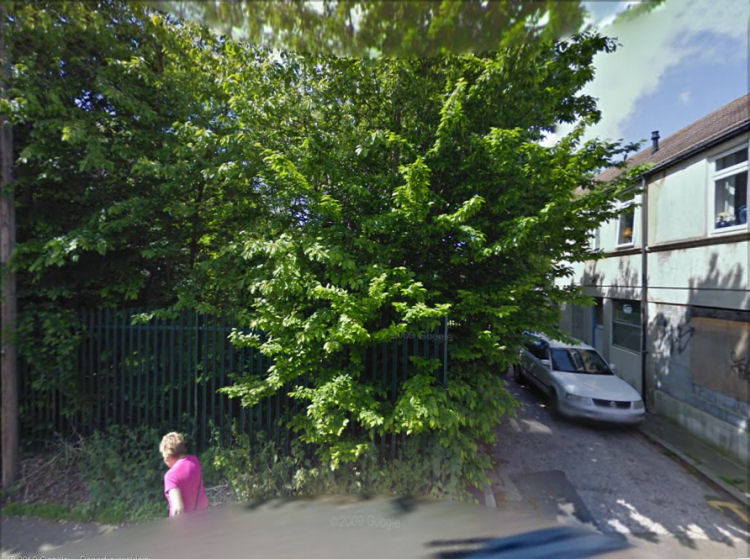
Above picture taken from Google maps, shows the site of the former Eagle
Tavern. |
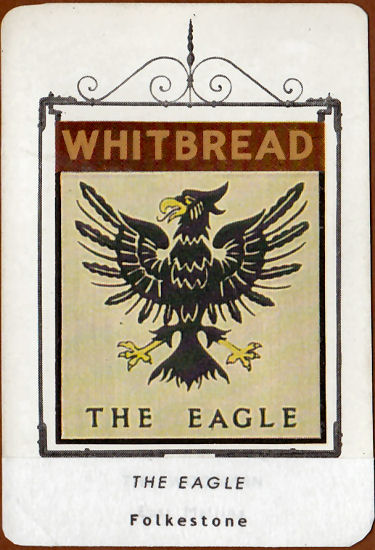
The above sign, wasn't actually designed and released by Whitbread, but has
been designed by Robert Greenham in the same style as the card sets they
distributed as a representation of what the sign looked like. Robert
says:- This was based on the image which appeared on Whitbread's metal
map for East Kent which was painted by D. W. Burley in 1950, on
commission from Whitbread. |
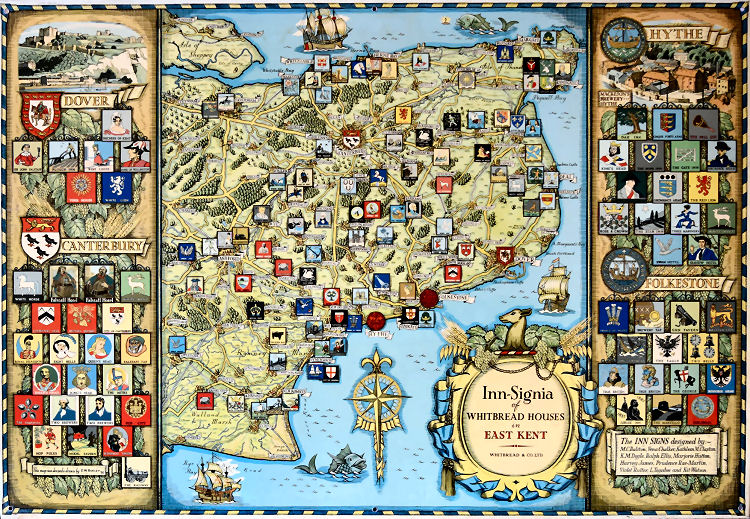
The above metal map, kindly sent by Robert Greenham was released, in
1950 and painted by D. W. Burley, and was titled Inn-Signia of Whitbread
Houses in East Kent, Whitbread & Co Ltd. The Inn Signs designed by:- M.
C. Balston, Vena Chalker, Kathleen M Claxton, K. M. Doyle, Ralph Ellis,
Marjorie Hutton, Harvey James, Prudence Rae-Martin, Violet Rutter, L.
Toynbee and Kit Watson. |
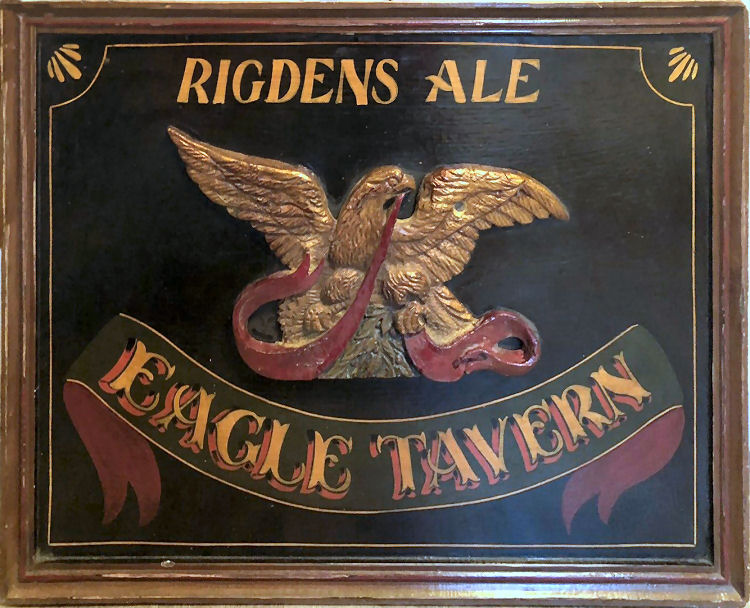
Although not known for definite, the above sign has recently been
purchased by Mark Golab from Chicago on an Ebay site, and it's suggested
it could have once been hanging outside this house.
Rory Kehoe says:- The image above, of the sign which might have once
hung in side or outside the pub. But It is just a modern repro, of a
type routinely flogged on eBay as being genuine! I wouldn't give it wall
space! As for the Eagle being a Rigden's pub? Nope, it was never
Rigden's but a Mackeson's tied house. |
Building opened as a public house in 1855 and was addressed as Darlington Place
when the name was the "Darlington
Arms". The house remained with this name till 1858 when John Baker
replaced Thomas Taylor.
Licensee John Baker seemed to be suffering from lack of funds during the 1860s and
having been proved to owe money was deemed insolvent.
Trading till 1966 when the premises was demolished. The house reverted
back to the "Darlington Arms"
briefly during Edwin Holloway's time to avoid confusion between the "Eagle
Tavern" in the High Street, but didn't remain with that name long and
again reverted back.
The following is a transcript of a passage describing the "Eagle" by a
person going under the name of G.H.C. Dated May 1967.
|
The Eagle
Rather more than forty five years ago, Bill Medhurst recently returned
from five years of war service, which had begun placidly driving the
Yeomanry water cart at Dumpton (the happiest days of his life) but had
included the Dardanelles Campaign, skirmishes with the Senussi in the
Western Desert, duty with the Camel Corps in Palestine, and garrison
work in Egypt, would lament the monstrous prospect of the future to his
fellow clerks in the Gas Office. Here we are scribing them in (the
records of the slot-meter collections) and so I suppose it will go on to
the end unless something happens to the Old Chief and Old
(indecipherable) (his deputy) comes to the throne. Then there might be a
few alterations and what should he do then? It would be a good thing to
take a pub, but certainly not The Eagle in Guildhall Street. It must be
a little one in the country, where he might get a bit of rough shooting
during the afternoon closing. The Eagle killed all it's landlords. The
statement, though not entirely accurate, could be supported by
considerable evidence. One man who kept it at the turn of the century, retired into private
life, but getting bored, took another and retired a second time, then
some years after shot himself. Another took his life at The Eagle, and a
third died by a tragic accident at his new home on the first night of
his retirement. However within ten years an alteration came without anything happening
to the Old Chief. The Company passed under other control and the new
owners dealt generously with Bill. With his compensation and his small
patrimony he realised his ambition to have his own car and follow his
own devices. Whether those days proved as happy as the ones at Dumpton,
I never knew, nor whether he regretted the hypothetical good job in
Egypt he turned down because his old mates wanted him home. Anyway
neither the "Dog" at Clambercrown nor the
"Cat" at Paddlesworth nor any
other pub repeated the inscription on the old "Kings Arms" at Folkestone.
He eventually served in Civil Defence through the Second World War and
died early in 1946. Now May 1967 The Eagle itself is dying slowly under the hands of the
demolition men, and is revealing what a good job it's builders made of
it. John Brown and I must have passed it four or six times a day during our
Grammar School and Technical School days, and I think it stood for all
the temptations, world, flesh and Devil. My most vivid memories of it
are on Sunday evenings about 1900. Father had a widowed aunt and her
bachelor brother who lived in Guildhall Street, nearer the Town Hall. We
used to call on them on Sunday evenings and leave about half past eight.
We had to pass The Eagle on our way home. It would be crowded to
overflowing. From inside came loud noises of talking, laughing, and
maudlin singing. This was repeated by the crowd milling outside the
door. Opposite stood Miss Flude's Gospel Mission Hall. By that time the
congregation would be gathered round a preacher who stood on a kitchen
chair in the forecourt. I suppose his address was directed to the
revellers at The Eagle, but he seemed to me to be as intoxicated with
religious fervour as they were with drink. One feature of The Eagle, and incidentally left to the last, was a bay
window of the bar which projected on to the pavement. In later years the landlord had previously been a railway signalman and
during the afternoon closing he was frequently to be seen standing at
the window and looking along the street, just as he might have watched
the line from his box in earlier days. After the Second World War the neighbourhood became a clearance area and
trade must have declined and habits changed. When do all the ghosts
return? Drinkers and preacher alike? Perhaps in those year when
Halloween falls on a Sunday? Do the police consider that an
extraordinary occasion and not oppose an extension to midnight? G.H.C. |
|
From the Folkestone Chronicle 10 December 1859.
STEALING FOWL
Monday December 5th:- Before W.F. Browell, James Kelcey, and R.W.
Boarer esqs.
Henry Godfrey and William Burvill, the younger, were brought up in
custody, charged with stealing a gander and three geese, the property of
Hunt Jeffery, of Walton, farmer.
Mr. Minter appeared for Burvill.
Godfrey was undefended.
Hunt Jeffery, being sworn, deposed, that he had lost a gander and
three geese; saw them last on Friday afternoon, they were near the pond
in the farm yard, was told next morning that they were missing, and the
place where they were kept, open; could swear to the gander and two
geese now produced, as being those lost.
Mr. Minter declined to cross-examine the witness.
James Winton, being sworn, deposed, he was employed by Mr. Hunt
Jeffery, the last witness, had to attend the pigs and geese; his master
had a gander and three geese; on Friday evening about 5 o'clock he drove
them into the goose house and shut the door, which was fastened with a
latch, missed the geese about 6 the next morning (Saturday); the door of
the goose house was open; found there the head of the gander and a
quantity of feathers; looked for the geese but could not find them;
believed the geese now produced to be the same that were lost –
identified them by certain marks in the feathers.
P.C. Charles Ovenden, being sworn, deposed, on Saturday, from
information received, he went to Walton Farm, and received the head of a
goose now produced from the last witness; was present when the geese
were found in a garden, in the joint occupation of the prisoner Burvill
and his father; the garden adjoins Wiltie Lane; they were found buried
in a sack in the garden. The Superintendent of Police asked the prisoner
Burvill previously, where the geese were; to which he replied he knew
nothing of them. After the geese were found the question was repeated,
and then prisoner answered, a man named Godfrey had brought them there
in the morning, and asked him to take care of them for him; he also
admitted the sack they were found in belonged to them, meaning his
father and himself; he added, that hearing there was a stir about the
geese, he had buried them himself.
Cross-examined by Mr. Minter – The Superintendent told the prisoner
that he came to look after some stolen geese, and that he
(Superintendent) believed they were there. Burvill denied the geese were
there first, and only admitted that they were when some feathers came to
the top of the ground after probing it with a crowbar.
Superintendent Martin deposed, from information received that some
geese had been stolen, he went to Darlington Place, and met the prisoner
Burvill in the road, asked him if he had the key of his cow-shed, he
said he had. Witness asked him to allow him to look in there, as some
geese had been stolen, and they wished to discover where they were. The
prisoner said he might look anywhere he pleased, as he knew nothing
whatever about any geese. Witness then cautioned prisoner to take care
what he said, and then told him there was a man named Godfrey in custody
on suspicion of stealing some geese. Prisoner again denied all knowledge
of any geese. Witness then left prisoner and met P.C. Ovenden, they
returned together and found the prisoner Burvill at work in a garden
behind the railway; asked him to let him look in a lodge in the garden;
prisoner took a key from his pocket and opened the door. Witness then
told him he knew the geese were about there, and he ought to be very
cautious what he said, or he might get himself into trouble. Witness
then commenced a search, and noticed behind the lodge that the earth had
been recently removed. Witness got a crowbar, and probing the place,
found some feathers come up with the clay. Witness turned round to
prisoner and said “Burvill, the geese are here”. He replied “I put them
there, I had them from a man named Godfrey, in the morning, and did not
know what to do with them, so I buried them, I did not know they were
stolen”. He also admitted the sack belonged to him. Prisoner got a
shovel and took them out at witness's desire. Prisoner was then taken
into custody; the geese and sack produced are those found.
P.C. Busbridge deposed, that from information received on Saturday,
he found some geese had been stolen from Walton Farm; he went to No. 20,
Darlington Place, the residence of the prisoner Godfrey, and knocked at
the door, heard a shuffling, and then opened the door and found the
prisoner going out the back way; told him some geese had been stolen
from Mr. Jeffery, at Walton, and charged him with stealing them; he said
he knew nothing about them. Witness then took him into custody, took him
to the station, and on him was the frock produced, inside which was
found some goose down and feathers, with spots of blood; the
Superintendent asked him how the feathers came there, to which he made
no reply.
Jane Baker deposed, she was wife to John Baker, landlord of the
"Eagle Tavern," Darlington Place; knew both the prisoners; saw them
together at her husband's house on Friday night about half past 11;
could not say whether they left together or not; they were using the
house as ordinary customers. Burvill was in the habit of coming in and
out of the house seven or eight times a day; had known him five or six
years, and always thought him a well conducted young man.
Mr Minter cross-examined this witness, to show that the prisoners
being together in the house was accidental, and not as companions, which
the witness admitted.
Mr. Minter then addressed the bench to the effect that the prisoner
Burvill had hitherto borne a good character, and that what he had done
was not an actual proof of guilty knowledge; he had certainly committed
a grave fault in telling a lie to the Superintendent, but that was all.
The Bench having consulted together, committed both prisoners to
trial, at the next quarter sessions. Application for bail was made for
the prisoner Burvill, which was granted, with 24 hours notice.
Note: Appears to confirm change of name from "Darlington
Arms" to Eagle in Baker's time. Jan Pedersen.
|
|
Folkestone Chronicle 7 January 1860.
Quarter Sessions.
Thursday January 5th: - The Grand Jury then retired, and returned very
soon with a true bill against Henry Godfrey for stealing four geese, the
property of Mr. Hunt Jeffery, and William Burvill for receiving the
same, well knowing them to have been stolen.
Mr. Minter appeared for Burvill.
The prisoner Godfrey was undefended.
The examination having appeared so recently in this journal, in the
report before the magistrates, it is not necessary to fully detail them.
The prisoner Godfrey pleaded “Guilty”, and William Burvill “Not Guilty”.
The Recorder then said, that the prisoner Godfrey having pleaded guilty,
could be taken as a witness against the prisoner Burvill.
He was then put into the box, and the Recorder, addressing the jury,
said, they must take Godfrey's evidence for what it was worth. If,
however, they believed that he was speaking the truth, they were bound
to believe him.
The witness was then sworn, and after being strongly cautioned by the
recorder as to what evidence he had to give, he proceeded to examine
him, and elicited from him, that on the 3rd December, about 3 o'clock in
the morning, he went to Mr. Jeffery's farm at Walton, and took the geese
from the lodge, and gave them to the prisoner Burvill to keep till he
could sell them; Burvill put them in the Lodge, and told witness he
might leave them there for a short time; was slightly acquainted with
Burvill; - did not see Burvill afterwards until both were apprehended;
the geese were all dead when he gave them to Burvill; he had killed them
himself before he left the lodge.
The Recorder asked the witness how he had killed them. Witness, with the
greatest coolness, and with a lurking smile on his lips, said, “he
pulled the head off one”. The Recorder, seemingly surprised, repeated
his question, but got the same reply.
Cross-examined by Mr. Minter – Lived in Darlington Place, near the
prisoner Burvill; the lodge was in the occupation of Burvill's father;
prisoner was feeding his cows when he asked him to take care of the
geese; had to pass the lodge on his way from Mr. Jeffery's; it was about
7 o'clock in the morning when the geese were left with the prisoner.
P.C. Ovenden repeated the evidence given before the magistrates as to
being present when the prisoner was informed by the Superintendent of
Police that some geese had been stolen from Mr. Jeffery's, and that
Godfrey was in custody on suspicion of having stolen them; prisoner
denied all knowledge at first, but afterwards when found, admitted that
Godfrey had given them to him, and he had buried them for fear of being
implicated in the matter.
Superintendent Martin deposed that in company with last witness he
searched the garden of prisoner, and noticing the ground had been
recently disturbed he probed it with a crowbar, on which some feathers
came up to the surface; witness then addressing prisoner, who had
previously denied all knowledge of the geese, although told Godfrey was
in custody, and was strongly cautioned by witness to be careful as to
how he answered, he said “oh, yes, the geese are there, I buried them
myself, but I did not know they were stolen”. The geese were in a sack
which prisoner said was “his” or “theirs” – meaning his father and
himself – Godfrey was in custody before Burvill was spoken to by
witness.
Police constable Busbridge deposed, he apprehended the prisoner Godfrey
on the 3rd inst., (sic) about one o'clock. Saw the prisoner Burvill, who
was in the road when witness went into Godfrey's house.
Cross-examined by Mr. Minter, who asked witness how in his depositions
he said 12 o'clock when he went to prisoner Godfrey's house – the
witness explained this by saying he was twice at the prisoner's house,
at 12 and 1 o'clock.
Jane Baker was examined but her evidence had no bearing on the case.
Mr. Minter then made a forcible address to the jury on the whole of the
evidence, and impressed upon them that his client might have been guilty
of an indiscretion in telling a lie when spoken to at first by the
Superintendent of police; there had been nothing proved against him that
he had stolen the geese, or that he knew in fact that they were stolen.
He is found at 7 o'clock in the morning feeding his cows, when asked to
take care of the geese by Godfrey. Afterwards seeing the police go into
Godfrey's house, he begins to suspect something is wrong, and afraid
that he might be implicated, he buried the geese; this is almost a
natural conclusion for a person in his position to arrive at, and though
an act of indiscretion, still it was no proof of guilt, and he pressed
upon the jury that if they had a doubt that the prisoner received the
geese knowing they were stolen, they were to give him the benefit of the
doubt and acquit him.
Mr. Minter then called Joseph Samson and John Garland, as witnesses as
to character, who gave the prisoner an excellent one; the former as his
schoolmaster, the latter as his employer.
The Recorder then summed up the evidence, minutely showing that against
the prisoner, and that in his favour, and put it to the jury, if they
had any doubt about the guilty knowledge of the theft committed by
Godfrey being known to the prisoner when the geese were left with him,
they would give him the benefit of it, and bring in an acquittal – if on
the other hand they believed the prisoner had that knowledge required by
the law, they were bound to return a verdict of Guilty.
The jury then retired, in about ten minutes returned into court and gave
a verdict of Not Guilty.
The Recorder then addressing the prisoner Godfrey, said, having pleaded
guilty to the crime of having stolen these geese; he the Recorder might
tel him he had had a very narrow escape from a charge of burglary, for
if the lodge from which the geese had been stolen had been attached to
the house, and he had lifted the latch, it would have amounted to that
crime, and a few years ago the punishment for that crime was death. He
the Recorder was afraid however the prisoner was not only a thief by his
own confession, but also a cruel one, for the manner in which he had
described what he had done together with the fact that he had pulled the
head off the goose while alive, showed he was a very cruel person. The
prisoner had been a month in prison, and he should imprison him to six
months' imprisonment with hard labour.
|
|
Folkestone Chronicle 25 August 1860.
Advert: Folkestone.
To Publicans And Others.
The Eagle Tavern Public House.
To Be Let.
Enquire of Messrs. Brockman and Harrison, Folkestone.
|
|
Folkestone Chronicle 1 September 1860.
Notice: Whereas a petition of John Baker, formerly of No. 10, Belle
Vue Fields, in the town of Folkestone, in the county of Kent,
journeyman whitesmith, then and now of the "Eagle Tavern," Durham
Place, in the town of Folkestone, in the county of Kent, whitesmith
and shoeing smith, and insolvent debtor, having been filed in the
County Court of Kent, holden at Folkestone, in the said county, and
an interim order for protection from process having been given to
the said John Baker, is hereby required to appear in the said Court,
to be holden at Folkestone aforesaid, before the Judge of the said
Court, on the twenty seventh day of September, 1860, at ten o'clock in the forenoon precisely, for his first examination touching
his debts, estate and effects, and to be further dealt with
according to the provisions of the said Statutes. And notice is
hereby given that the choice of assignees is to take place at the
time so appointed.
All persons indebted to the said John Baker, or who have any of his
effects, are not to pay or deliver the same but to Ralph Thomas
Brockman, the Registrar of the said Court, at his office at
Folkestone, the Official Assignee of the estate and effects of the
said insolvent.
William Venables, High Bailliff, Messenger of the said Court.
|
|
Folkestone Chronicle 29 September 1860.
County Court.
Thursday September 27th:- Before C. Harwood Esq.
John Baker. This insolvent keeping the Eagle Tavern, Folkestone,
petitioned under the protection acts, owing debts amounting to £208 15s.
11d. No assets. Mr. Minter supported.
The insolvent passed his first examination and His Honour named the next
sitting for the final order.
|
|
Kent Herald 4 October 1860
County Court, Thursday: Before C. Harwood Esq.
In re. John Baker: This insolvent, keeping the Eagle Tavern, Folkestone,
petitioned under the Protection Act, owing debts amounting to £208 16s. 11d. No
assets. The insolvent passed his first examination, and His Honour made the next
sitting for the final order.
|
|
Folkestone Chronicle 13 October 1860.
Notice.
In the matter of the petition of John Baker, formerly of No. 10, Belle
Vue Fields, in the town of Folkestone, in the county of Kent, journeyman
whitesmith, then and now of the Eagle Tavern, Durham Place, in the town
of Folkestone, in the county of Kent, Licensed Victualler, Whitesmith,
and Shoeing Smith.
Notice is hereby given that the County Court of Kent, at Folkestone,
acting in the matter of this petition, will proceed to make a final
Order thereon, at the said Court, on the 31st day of October, 1860, at
ten o'clock in the forenoon, unless cause be then and there shown to the
contrary.
William Venables, High Bailiff.
Messenger of the said Court.
|
|
Folkestone Chronicle 3 November 1860.
County Court.
Wednesday October 31st:- Before Charles Harwood esq., Judge.
John Baker, an insolvent, came up for his final order. Supported by Mr.
Minter. There was no opposition and the order was signed. His Honour
upon signing the petition cautioned insolvent that if any debts were
contracted after this he would allow no time for payment but make
forthwith orders. Insolvent then received his final order. |
|
Kent Herald 8 November 1860
County Court, Wednesday, 31st ult.:- Before Charles Harwood Esq., Judge.
John Baker, an insolvent, came up for his final order, supported by Mr. Minter.
There was no opposition and the order was signed. His Honour upon signing the
petition cautioned insolvent that if any debts were contracted after this he
would allow no time for payment but make forthwith orders. Insolvent then
received his final order.
|
|
Folkestone Observer 23 February 1861.
Assault on a publican.
Friday February 22nd: - Before James Tolputt, A.M. Leith, and James
Kelcey esqs.
Frederick Jones, of Brentwood, Essex, umbrella maker, was charged with
assaulting and beating George Francis Ball, landlord of the Eagle
Tavern, Darlington Place.
George Francis Ball, who appeared in court with one eye tied up, said –
I am landlord of the Eagle Tavern, Darlington Place. This morning, about
10 minutes past 12, I was sitting in the tap room of my house. I ordered
two cigars, which were brought me. The prisoner, who was sitting in the
room, took one of the cigars. I told him he must either pay for it, or
put it down. He did neither, and I attempted to take it from him. He
then seized me with both hands by the hair of the head. I made my way to
the bar, and on going there we both fell down together. As I was down he
kicked me several times in the eye, and all over the body, causing the
injuries which now appear. In reply to the prisoner witness added, “I
did not come to strike you first”.
Sarah Baker deposed that she was housekeeper to Mr. Ball, at the Eagle
Tavern. About ten minutes past twelve that morning Mr. Ball ordered her
to bring two cigars into the tap room. The prisoner took one, and she
left the room. Shortly afterwards she saw Mr. Ball and the prisoner fall
down together just in the bar. As they were lying down she saw the
prisoner kick Mr. Ball several times in the face. She tried to prevent
him but she could not. She saw him pulling Mr. Ball by the hair at the
time he was kicking him.
By the prisoner – Prisoner took the cigar out of another man's hand. She
did not know whether Mr. Ball had been gambling for the cigars.
John Dyer said he was in the tap room that morning, when the affair
about the cigars took place. Mr. Ball went to prisoner, and asked him
for the money for the cigars. After that they got tussling in the tap
room, and went into the passage. After a short time witness heard Mr.
Ball's housekeeper call. They were then in the bar. When he came out to
go towards the bar, there was Mr. Lee out there; and Mr. Lee, and Mr.
Ball, and prisoner lay on the ground. Mr. Ball asked witness to go for
the police, which he did. He saw no blow struck.
In reply to prisoner, the witness said he saw Mr. Ball toss for two
cigars, which he lost. He saw Hammon take up two cigars and give
prisoner one.
In reply to Mr. Leith, witness said neither prisoner nor Mr. Ball was
drunk.
This was the case for the prosecution. For the defence prisoner called
Elizabeth Lee, licensed hawker, who said she saw Mr. Ball toss for the
two cigars that morning, and lose them. William Hammon won them. Hammon
took two out of the box; one he gave into prisoner's hand, and one he
kept himself. Mr. Ball asked prisoner for the money for the cigar, and
prisoner said he had had the cigar given him, and would not give it up.
They both tussled in the passage, but which struck the first blow she
could not say. She did not see prisoner kick Mr. Ball. Mr. Ball brought
dice into the room, and witness rattled them with the young lady (the
housekeeper) for two pints, and lost. She beat witness out of two pints
of small beer, after twelve o'clock.
In reply to Mr. Ball, witness said the dominoes were there when she
came, but he (Ball) brought the dice, which they shook in a pot. It was
half past eleven when she raffled the young lady for a pint of beer.
Ball won half a crown.
William Hammon, licensed hawker, said, about eight o'clock the previous
night he went into the public house, and had half a pint of beer. Soon
after that he got another. The landlord wanted to spar. He said he
thought he should get some boxing gloves, and have a spar. He then wanted
to have some throwing with dice for money. Then about twelve o'clock he
pulled off his clothes, everything but his shirt and trousers and
flannel he believed. About ten minutes past twelve he tossed Ball for
two cigars.
Dyer being re-called, said he saw the landlord strip himself, but did
not see him fight. He had his shirt on. It was not one time in a hundred
that Mr. Ball was to be seen in the bar with his coat on. He saw dice.
Hammon proceeded to say that when he won the cigars he took them, and
gave prisoner one of them. Before twelve o'clock prosecutor said he
should beat all three of them if they did not pay for a pint of beer
apiece – that was him (witness), Elizabeth Lee, and prisoner.
Ball said as witness was on his oath, he did not wish to ask any
questions. He had sworn perjury.
In reply to Mr. Leith, Hammon said that after he had given the cigar to
the prisoner, Mr. Ball asked prisoner for the cigar. Prisoner said
witness had given it to him, and he should not give it up. They then
began tussling, and Mr. Ball took hold of him by the head. Witness
followed them out into the passage, and when they got there Mr. Ball
knocked prisoner into the bar, and prisoner dragged Mr. Ball down with
him, and knocked his head against the bar.
In reply to Mr. Ball, witness said he did not turn round to him, when he
was ordered out of the house, and say “You ------, you have got one eye
bunged, and I will bung the other for you”. He said nothing of the sort.
George Clayton saw Mr. Ball pull off his clothes, chuck one brace down
by the side of him, throw the other back across his shoulder, and turn
up his shirt sleeves and show his muscle. He talked so much of fighting
that witness began to be afraid of him. He said he would thrash them all
three if they did not pay for a pint of beer each; and witness said he
would not pay, but prisoner said he would pay rather than fight.
Elizabeth Lee, re-called, said she saw the housekeeper holding prisoner
by the hair, and beating him on the head, saying, “Get away, you
rascal”.
Sarah Baker – It was because prisoner was kicking Mr. Ball so.
Elizabeth Lee – I don't know about that; I did not see it.
After a brief consultation, the Bench said they were of opinion that the
case was proved against the prisoner, and notwithstanding that
provocation had been given, there was no justification for such brutal
kicking. The prisoner would be fined 5s., with 9s. 6d. costs, or 7 days
imprisonment. The bench added a caution to the prosecutor as to the
conduct of his house, which had been reported before. If such things as
these went on he would lose his licence.
Prisoner asked for time to pay the fine in, as he was expecting goods
down in a day or two, when he could pay it. But this was refused, and he
was committed to Dover jail.
|
|
From the Folkestone Chronicle 9 March, 1861.
ENTERING UNLAWFULLY
Wednesday March 6th:- Before the Mayor, James Kelcey and W.F. Browell,
Esqs.
George Milligate was brought up charged with being found in the
"Eagle" public house for an unlawful purpose. It appeared that the house
in question had been empty some time, the landlord having absconded, and
that a number of lads had been in the habit of loitering about these
premises of an evening, and on the occasion in question the prisoner and
another lad had been seen to get into the house by a broken window; but
from the contradictory statements made by the principal witness, Maria
Peel, the magistrates reprimanded her, and ordered the prisoner to be
discharged, with a caution.
|
|
Folkestone Observer 9 March 1861.
Charge of unlawful entry.
Wednesday March 6th:- Before the Mayor, W.F. Browell, and James Kelcey
esqs.
George Milligate, 17, labourer, was charged with being found in the
Eagle public house, Darlington Place, for an unlawful purpose.
Maria Peal, wife of William Peal, Darlington Place knew the prisoner.
About seven o'clock the previous night she saw him get into one of the
windows of the Eagle Tavern, Darlington Place, which is unoccupied. She
did not know whether he opened the window or not. Prisoner came to her
house for a box of lucifers. She saw a light in the house during the
evening.
In reply to the prisoner, witness said his legs were outside the window.
She did not know whether he got into the house.
P.C. Peel said that about a quarter to nine the night before he went to
the Eagle Tavern; he found the back and side doors shut, but unfastened.
He found the front window unfastened, and the lower sash about an inch
up. A square of glass at the bottom of the window was broken out. He saw
the door and window fastened about four o'clock the morning before.
There are lead fittings and gas pipes in the house.
The Bench thought the defence charge was not clearly made out, and
discharged the prisoner.
|
|
Kent Herald 14 March 1861
Petty Sessions, March 6: Before the Mayor, James Kelcey and W.F. Browell esqs.
George Milligate was brought up charged with being found in the Eagle public
house for an unlawful purpose. It appeared that the house in question had been
empty some time, the landlord having absconded, and that a number of lads had
been in the habit of loitering about these premises of an evening, and on the
occasion in question the prisoner and another lad had been seen to get into the
house by a broken window; but from the contradictory statements made by the
principal witness, Maria Peel, the magistrates reprimanded her, and ordered the
prisoner to be discharged, with a caution.
|
|
Folkestone Observer 13 April 1861.
Granting a licence.
Wednesday March 10th: - Before Captain Kennicott, A.M. Leith and James
Tolputt esqs.
Mr. Fowle, clerk to Messrs. Brockman and Harrison, applied for a fresh
licence to John Taylor, at present a police constable for the borough
(7F), for the Eagle Tavern, Darlington Place, Francis Ball, the late
holder for that house, having gone away. Evidence was given of Taylor
being in possession of the house, and Superintendent Martin spoke to his
good conduct while in the force, saying that he found the night duty
irksome and injurious, and being in possession of a small pension, he
was desirous of taking a public house, that he might have more regular
hours of rest. The Bench, reminding the applicant of the former
character of the house, granted the licence.
Note: This seems to cast doubt on Taylor being ex Marquis of Lorne as
stated in More Bastions.
|
|
Folkestone Observer 26 October 1861.
Sunday Amusement.
Tuesday October 22nd:- Before Captain Kennicott R.N., and James Tolputt
Esq.
William Hoad, a young man, was brought up on warrant, charged with
wilfully damaging the smithy of Mr. Hoile, Darlington Place.
William Rye said he was at Mr. Taylor's public house, Darlington Place,
on Sunday afternoon, about half past two o'clock, when he saw the
prisoner standing on the batten of the railway, throwing stones at Mr.
Hoile's forge. He heard the noise of stones going into the window, and
the smashing of glass. He was with another man, who was not present in
court, and they were both throwing stones at the forge. They might have
been throwing stones for about five minutes.
John Taylor, landlord of the Eagle, also saw prisoner throwing stones,
and heard the glass smash.
William Hoile, shoeing smith, and owner of the forge, on Monday morning
found 20 or 30 large stones and bricks inside the shop. The windows of
the shop were all out, and the frames smashed in. On Saturday he left
the frames all right, and partly filled with glass. This was not the
first, nor second, nor third time that this had been done. The damage
done was £1. The young fellows were in the habit on Sundays of getting
on the railway banks and throwing stones at his windows. The very last
time they did it they agreed to pay 1s 6d each towards the damage done.
The prisoner said he only threw one stone, and that fell on the roof and
bounded off. He saw two others throwing stones, but he was lying on the
bank himself.
The magistrates inflicted a fine of 10s. with 9s. costs, or 14 days'
hard labour. The fine was paid.
|
|
Southeastern Gazette 29 October 1861.
Local News.
At the police court last week, William Hoad, a young man, was charged
with wilfully damaging the smithy of Mr. Hoile, Darlington Place.
On Sunday afternoon week, the defendant was seen a young man named
William Eye, and John Taylor, landlord of the Eagle public house, on the
batten of the railway, throwing stones at the window of prosecutor's
smithy. Prosecutor said that the windows of his shop were all out, and
the frames smashed in. On Saturday he left the window frames all right,
and partly filled with glass. This was not the first, second, nor third
time that it had been done. The damage done was £1. A number of young
fellows were in the habit on Sundays of getting on the railway banks and
throwing stones at the windows.
Fined 10s., and 9s. costs.
|
|
Dover Chronicle 9 January 1867
Police Court, Tuesday: Before the Mayor (J. Gambrill Esq.) and Messrs.
Boarer and Kelcey.
Timothy Danohie, a soldier, was charged with stealing on the 7th inst.
one bottle of cloves, value 2s. 6d., the property of Mary Ann Holloway.
Mary Ann Holloway deposed: My husband’s name is Edward. I keep the Eagle
Tavern, Darlington. It is a licensed house. The prisoner came into our
house about nine o’clock on Monday morning. He was in the tap-room, and
he remained there till half past twelve. He had two pints of beer during
that time. After he was gone I missed a bottle of cloves from a little
shelf in the bar. I never saw the prisoner in the bar. I then gave
information to the police. The bottle was worth 2s. 6d., and contained
about a pint and 3½ quarterns.
By prisoner: I saw you pass the window directly after you left the
house.
Henry Hills said: I am a police constable in the Folkestone force.
Yesterday afternoon about half past one I received information from the
last witness that a bottle of cloves had been stolen from her house. I
saw the prisoner near the bottom of High Street. The prisoner when he
saw me went into the shop of Mr. Allebone’s, pork butcher, and I
followed him. I asked him if he was out on leave. He said he was, but
could not find his pass. He then took a bottle from under his greatcoat.
I charged him with stealing a bottle of cloves from the Eagle Tavern. He
said “Let me have a sup,” and drank something out of the bottle, after
which I took it away from him. The bottle produced is the one I took
from him. It contains about half a quartern. I then took him into
custody and he resisted very much, and I had to get the assistance of
police constable Ovenden, and several more persons. I gave last
witness’s son the bottle to hold while I took the prisoner into custody,
and he being deaf did not understand what I meant and took the bottle
away home, I think. That (pointing to the son of first witness) is the
boy to whom I gave the bottle.
By prisoner: When I took you into custody you were the worse for liquor,
but not so drunk but that you knew perfectly well what you were doing.
George Holloway said: I am the son of the first witness. I am fifteen
years of age.
Here it was deemed necessary to dispense with the boy’s evidence, as the
boy was too deaf to comprehend the questions put to him, consequently
Mary Ann Holliday was again called, and said: The last witness, who is
my son, brought me the bottle produced at about three o’clock yesterday
afternoon. I am able to recognise it as being the bottle I lost by the
fact that although it contained cloves it was not labelled as such. When
brought to me it contained the same quantity as it does now. Police
constable Ovenden came in directly afterwards and fetched the bottle
away.
Charles Ovenden said: I am a police constable in the Folkestone force.
Yesterday afternoon about three o’clock I assisted police constable
Hills to take the prisoner into custody. At about half past three on the
same afternoon I went to the Eagle Tavern, Darlington, where I saw the
prosecutrix and her boy. She gave me the bottle produced, which I have
had in my possession ever since.
By prisoner: You were the worse for liquor when I assisted to take you
into custody, but not so drunk but that you knew what you were doing.
The prisoner, on being asked what he had to say in answer to the charge,
said: I did not steal it. There were several persons in the house at the
time. When I went out of the house they saw me going. The bottle was
afterwards missed, and because they found a bottle on me they say I
stole it.
Prisoner was then committed to take his trial at the next Quarter
Sessions.
The next charge against him, namely that of stealing one cap, one
jacket, one apron and one plane, value in all about six shillings, the
property of Hampden Gilbert, on the 7th inst., was then proceeded with.
Hampden Gilbert said: I am a cabinet maker, living at No. 1, Prospect
Place, west Folkestone. I have a workshop on my premises. I went to my
workshop about seven yesterday morning, and noticed that a window was
broken. The window was from six to seven feet from the ground. I found a
ladder of mine removed from the usual place and lying under that window.
The shop was locked as usual. When I got into the shop I missed a
flannel jacket, cap, and apron. I should imagine that the person who
took the things got in through the window, which was made of calico
instead of glass. The last time I saw the articles previous to that was
on Sunday evening, the 6th. When I discovered my loss I gave information
to the police. Last night, about eight o’clock, a man from Cheriton,
named Tucker, brought me a plane, which I knew to be my property by my
name being upon it. The cap and jacket were shown to me this morning by
P.C. Ovenden. The jacket, cap, apron, and plane are worth about six
shillings. I do not know the prisoner, neither did I see him on my
premises. The cap, jacket, and plane produced are my property.
John Tucker said: I am a carpenter, living at Cheriton. About half past
four yesterday afternoon I was coming to Folkestone on business, when I
called at Mrs. Gilbert’s, of Cheriton, who gave me a plane to enquire if
anyone in Folkestone had lost it. I went to Mr. Banks, in Tontine
Street, who told me where Mr. Gilbert lived, and I took the plane
produced to his house, and he at once identified it as being his
property, in consequence of the name being marked upon it.
John Swain deposed: I am a labourer, living in Cheriton Street. I know
the prisoner. I met him yesterday morning about half past six in
Cheriton Street. He asked me what time the picquet had gone out. I told
him they went out between eight and nine, He then asked me if I wished
to buy a cheap article, and pulled a plane out of his bosom, but I never
took it into my hands, and cannot swear to it as it was dark. The
prisoner had his shako and greatcoat on at the time. I then went away. I
met him afterwards, about eight o’clock the same morning in the meadows
near the White Lion, Cheriton. He took a jacket from under his coat and
gave it to me, saying “You may have it if you like.” I took it. He then
said he had picked it up on the road. This morning police constable
Ovenden came to my house and I gave it to him. The jacket produced is
the same.
By prisoner: You did not say you picked the plane up upon the road.
Charles Ovenden said: I am a police constable in the Folkestone force.
From information received I went to the house of the last witness at
about nine this morning and received from him the flannel jacket
produced. It has been in my possession ever since. I afterwards went to
Mr. Gilbert’s and received the plane produced from him.
The prisoner was then remanded till this day for the production of
further evidence, at which time he will also stand charged with
assaulting the police.
|
|
Dover Express 11 January 1867
Police Court, Tuesday: Before the Mayor (J. Gambrill Esq.) and Messrs.
Boarer and Kelcey.
Timothy Dehamer, a soldier, was charged with stealing on the 7th inst.
one bottle of cloves, value 2s. 6d., the property of Mary Ann Holloway.
Mary Ann Holloway deposed: My husband’s name is Edward. I keep the Eagle
Tavern, Darlington. It is a licensed house. The prisoner came into our
house about nine o’clock on Monday morning. He was in the tap-room, and
he remained there till half past twelve. He had two pints of beer during
that time. After he was gone I missed a bottle of cloves from a little
shelf in the bar. I never saw the prisoner in the bar. I then gave
information to the police. The bottle was worth 2s. 6d., and contained
about a pint and 3½ quarterns.
By prisoner: I saw you pass the window directly after you left the
house.
Police constable Henry Hills said: Yesterday afternoon I received
information from the last witness that a bottle of cloves had been
stolen from her house. I saw the prisoner near the bottom of High
Street. When he saw me went into the shop of Mr. Allebone’s, pork
butcher, and I followed him. I asked him if he was out on leave. He said
he was, but could not find his pass. He then took a bottle from under
his greatcoat. I charged him with stealing a bottle of cloves from the
Eagle Tavern. He said “Let me have a sup,” and drank something out of
the bottle, after which I took it away from him. The bottle contains
about half a quartern. He resisted very much, and I had to get the
assistance of police constable Ovenden, and several more persons.
By prisoner: When I took you into custody you were the worse for liquor,
but not so drunk but that you knew perfectly well what you were doing.
Mary Ann Holliday said: I am able to recognise it as being the bottle by
the fact that although it contained cloves it was not labelled as such.
Police constable Charles Ovenden also gave evidence.
By prisoner: You were the worse for liquor when I assisted to take you
into custody, but not so drunk but that you knew what you were doing.
The prisoner, in answer to the charge, said: I did not steal it. There
were several persons in the house at the time. When I went out of the
house they saw me going. The bottle was afterwards missed, and because
they found a bottle on me they say I stole it.
Prisoner was then committed to take his trial at the next Quarter
Sessions.
There was another charge against him, namely stealing a cap, a jacket,
an apron and a plane, value in all about six shillings, the property of
Hampden Gilbert, on the 7th inst., was then proceeded with.
Hampden Gilbert, cabinet maker, No. 1, Prospect Place, west Folkestone:
I went to my workshop about seven yesterday morning, and noticed that a
window six to seven feet from the ground was broken. I found a ladder of
mine removed from the usual place and lying under that window. The shop
was locked as usual. When I got into the shop I missed a flannel jacket,
cap, and apron. I should imagine that the person who took the things got
in through the window, which was made of calico instead of glass. Last
night a man from Cheriton, named Tucker, brought me a plane, which I
know to be my property by my name being upon it. The cap and jacket were
shown to me this morning by P.C. Ovenden. The jacket, cap, apron, and
plane are worth about six shillings. I do not know the prisoner, neither
did I see him on my premises.
John Tucker said: I am a carpenter, living at Cheriton. About half past
four yesterday afternoon I was coming to Folkestone on business, when I
called at Mrs. Gilbert’s, of Cheriton, who gave me a plane to enquire if
anyone in Folkestone had lost it. I went to Mr. Banks’s, in Tontine
Street, who told me where Mr. Gilbert lived, and I took the plane
produced to his house, and he at once identified it as being his
property, in consequence of the name being marked upon it.
John Swain, labourer, living in Cheriton Street: I know the prisoner. I
met him yesterday morning about half past six in Cheriton Street. He
asked me what time the picquet had gone out. I told him they went out
between eight and nine, He then asked me if I wished to buy a cheap
article, and pulled a plane out of his bosom, but I never took it into
my hands, and cannot swear to it as it was dark. The prisoner had his
shako and greatcoat on at the time. I met him afterwards, about eight
o’clock the same morning in the meadows near the White Lion, Cheriton.
He took a jacket from under his coat and gave it to me, saying “You may
have it if you like.” I took it. He then said he had picked it up on the
road. He then went away. I carried the jacket home and hung it up. This
morning police constable Ovenden came to my house and I gave it to him.
By prisoner: You did not say you picked the plane up upon the road.
The prisoner was then remanded till Wednesday for the production of
further evidence on this charge, and on a further charge of assaulting
the police.
|
|
Dover Chronicle 12 January 1867
Police Court, Wednesday: Before the Mayor (J. Gambrill Esq.) and Messrs.
Boarer and Kelcey.
Timothy Danoher, the man remanded for stealing on Tuesday last, was
further remanded till Friday.
Police Court, Friday: Before John Gambrill Esq. (Mayor) and Messrs.
Boarer and Kelcey.
Timothy Danoher, a soldier in the 3rd Buffs, was again brought up –
remanded from Tuesday and Wednesday last – was charged with stealing one
plane, one jacket, one cap, one gauge, and one apron, value in all 6s.
6d., the property of Hampden Gilbert, on the 7th inst.
The depositions taken on Tuesday last and given in the Dover Chronicle
of Wednesday last having been read over and sworn to, Elizabeth Dorothy
Gilbert was the first witness called. She said: I am a widow, living at
Cheriton. I have seen the prisoner before. He called at my house at
about seven o’clock on Monday morning last. He said he had just come
from Folkestone, and picked up a plane. He said he was tired of carrying
it about and wished to leave it there at my house. I took it in. He
asked me to let him light his pipe, and I did so. I then said “I will
give you sixpence, and I dare say the man who owns it will give me the
sixpence back again.” He then went away. I noticed the name “H. Gilbert”
on one end of the plane, and some initials on the other. The same day I
gave the plane to my son-in-law, Tucker, and as he was going to
Folkestone I asked him to take it to the owner. I can swear that the
plane produced is the one the prisoner gave me, and the same I gave to
Tucker.
By the prisoner: I did not hear you say that someone will be enquiring
for the plane, and I was to say a soldier had left it.
Thomas Baker deposed: I am a carpenter, living at Risborough Lane, near
Cheriton. I know the prisoner. He came to me about nine o’clock on
Monday morning last. He said he found a gauge on the road, and asked if
it belonged to me. He said it was no use to him. I said I did not want
it. Daniel Pay, who was present, then gave the prisoner 2d. for it. The
prisoner then went away. I noticed the name of “H. Gilbert” upon it. I
kept it by me and delivered it up to police constable Ovenden last
night. The gauge produced is the one I took from the prisoner and
delivered up to police constable Ovenden.
Charles Ovenden said: I am a police constable in the Folkestone force. I
received the gauge produced from the last witness at his house in
Risborough Lane, and it has been in my possession ever since.
Hampden Gilbert deposed: The gauge produced is my property, and is worth
6d. I had no men at work anywhere on Monday last away from my shop. I
last saw the gauge produced in my shop on Saturday, the 5th inst.
The prisoner, on the charge being read over to him, said: I got drunk on
Sunday night in Folkestone and stopped absent. I fell asleep in some
public house and woke up about eleven o’clock. I was trying to make the
best of my way home. I was running near the railway arches because I was
cold. I turned round the end of a street and saw a man running in front
of me, who dropped something. I had my greatcoat and shako on at the
time, and no doubt the man took me to be a policeman, for he dropped the
articles produced in court, and I picked them up and carried them about
to see if I should meet the person who lost them. If I had stolen them I
should not have done that with them. I am as innocent as a child unborn.
That is all I have to say.
The prisoner was then committed to take his trial at the next Quarter
Sessions.
Prisoner, on being asked what he had to say in answer to the next
charge, namely that of assaulting police constable Henry Hills while in
the execution of his duty on the 7th inst., said: I was drunk at the
time. I am guilty of trying to get away. I thought as he knocked me down
I would do the same for him. I plead not guilty.
Henry Hills said: I am a police constable in the Folkestone force. On
Monday afternoon last, at about three o’clock, I was on duty in Harbour
Street, when I apprehended the prisoner in the shop of Mr. Allebone,
pork butcher, on a charge of stealing. He said he would go quietly if I
let him smoke, and I got him a light. He was the worse for liquor, but
not so drunk but that he knew what he was doing. When he got a light he
put his head towards the counter where there were two or three knives
lying, and got hold of the knife produced. He then struck at my side
with the knife, but I caught him by the wrists before the blow reached
me. We had then a very severe struggle before I could get the knife from
him. He tried, when I had him by the wrists, for a period of five
minutes to cut me on the left arm. When I got him down the second time
the knife was taken from him, with the assistance of several civilians.
I was obliged to hit him with my staff on the back of the head before he
would let go. He resisted very much, but we finally got him handcuffed.
With the assistance of police constable Ovenden and several others we at
last got him to the station.
Prisoner (in a burst of virtuous indignation): I don’t think I should be
guilty of such a base action, although I am very wild when drunk.
George Allebone deposed: I am a pork butcher, living in Beach Street. On
Monday afternoon last, at about three o’clock, the prisoner came into my
shop, followed by policeman Hills, who took prisoner into custody. They
were going away when prisoner asked to have his pipe lit. After that had
been done he seized hold of a knife from the counter and aimed a blow at
the policeman with it, but the policeman seized hold of his arms and
arrested the progress of the blow. They then had a great struggle
together, and I got out of the way as well as I could, and did not
render any assistance because I could hardly walk, but several people
then came into the shop and assisted the policeman.
Prisoner: If I had intended to stick the policeman I could have done. I
might have taken up a knife, but I only did it to frighten him. I am
very glad I didn’t stick him. I’d never forgive myself if I stuck a man
with a knife.
The Mayor: We are exceedingly sorry it is not in our power to give you
more than one month’s imprisonment with hard labour.
Prisoner was then leaving, saying “I’m better pleased I did not injure
the man with the knife. I would have been sorry if I had.”
It appears by a report sent in by prisoner’s captain from the Camp to
the magistrates that the prisoner has, between February 27, 1861, and
June 18, 1866, been convicted by regimental courts martial of the
following:
Cape Town – Habitual drunkenness – 42 days imprisonment with hard
labour, and deprived of 1d. per day for 168 days.
London – Absence without leave and making away with regimentals – 42
days imprisonment, with stoppages.
Sheffield- Insubordinate language – 28 days with hard labour.
Curragh Camp – Absence without leave – 42 days with hard labour.
Curragh Camp – Desertion and destroying regimentals – 112 days with hard
labour, and stoppages.
Curragh Camp – Absence without leave and drawing a knife on Private R.
Bowman, 2nd Dragoon Guards – 168 days with hard labour.
In addition to this he also appears 42 times in the defaulter book for
drunkenness, absence, &c., and it is said that when convicted of goose
stealing in Ireland, he accounted for the possession by saying “that he
met a fox running away with the goose in its mouth; he stopped the fox
and took the goose out of its mouth.”
|
|
Folkestone Chronicle 12 January 1867.
Tuesday January 8th: Before the Mayor, J. Kelcey and R.W. Boarer Esqs.
Timothy Dehamer, private, 3rd Buffs, stationed at Shorncliffe Camp, was
brought up charged with stealing from the Eagle Tavern, Darlington, a
bottle of cloves, and from a workshop in Shellons Lane a plane, flannel
jacket, apron, and cap; also with assaulting the police in the execution
of their duty. The first charge was taken.
Mary Ann Holloway, landlady of the Eagle Tavern, Darlington, said:
Prisoner came into my house at 9 o'clock yesterday morning – he was in
the tap room – and remained there till half past 12; he had two pints of
beer. After he was gone I missed a bottle of cloves from the bar. I had
not seen the prisoner in the bar. I gave information to the police. The
bottle contained about a pint and three half-quarterns, and it's value
was 2s. 6d.
Cross-examined: I did not see you leave the house, but did see you pass
the window; there were a lot of boys about.
P.C. Hills said: Yesterday afternoon, from information received, I went
in search of prisoner, and found him near Mr. Allebone's, corner of
Beach Street. Prisoner saw me and went into Allebone's shop. I went in
and asked him if he was on pass. He said “Yes”, but could not find it. I
told him he smelt strong of drink, and he pulled out the bottle produced
from under his greatcoat. I charged him with stealing it from the Eagle
tavern. I took him into custody, and he resisted very much through the
streets, and was very violent at the police station. The son of the
prosecutor took the bottle.
P.C. Ovenden said: I assisted P.C. Hills to take the prisoner into
custody, and afterwards went to the Eagle Tavern, at Darlington, where I
saw prosecutrix, and she gave me the bottle produced.
Cross-examined: You were the worse for liquor, but not drunk.
Prisoner said: I did not steal the bottle – there were several men came
in and went out of the house while I was there; the people saw me go.
The drink was missed and because I have a bottle of liquor they say I
was the person who stole it. It is the first time ever I was before a
court.
The prisoner was then committed to take his trial at the next Quarter
Sessions.
Prisoner was then charged with breaking into the workshop of Mr.
Gilbert, Prospect Place, on the 7th inst., and stealing therefrom one
plane, one apron, one flannel jacket, and one cap.
Hampden Gilbert said: Yesterday morning I went to work about seven
o'clock, and noticed a window six or seven feet from the ground had been
broken open, and a ladder put near, which was lying on the ground. I
missed a flannel jacket, a cap, and an apron, which I had seen safely
there on Sunday evening. I gave information of the loss to the police. A
man brought me a trying plane about eight o'clock last evening, which I
had not before missed; it has my name on it, and is my property. P.C.
Ovenden produced the jacket and cap this morning. The value of the whole
is 6s. I have not seen the prisoner before now.
Prisoner was then remanded.
Friday January 11th: Before the Mayor, J. Kelcey, and R.W. Boarer Esqs.
Timothy Dehamer was brought up on remand, charged with stealing several
articles, value 6s. 6d., the property of Hampden Gilbert.
Elizabeth Gilbert, widow, of Cheriton, said: On Monday morning, about
seven o'clock, prisoner called at my house. He said he had just come
from Folkestone, and had picked up a plane. He was tired of carrying it
about, and wished to leave it. My son saw it belonged to prosecutor. I
gave prisoner a sixpence as he was leaving, as it was a cold morning. I
gave the plane the same day to my son-in-law, Stephen Tucker, to bring
to it's owner. The plane produced is the same.
Thomas Baker, carpenter, Cheriton, gave evidence that he received the
gauge produced from the prisoner, who offered it to him for a pint of
beer. He took care of it, and gave it to P.C. Ovenden.
Prisoner made some rambling statement to endeavour to account for the
possession of the articles.
He was committed for trial at the next Quarter Sessions.
The prisoner was then charged with assaulting P.C. Hills on the 7th
Instant. He pleaded Not Guilty.
P.C. Hills repeated the evidence he gave on Tuesday as to the
apprehension of the prisoner in the shop of Mr. Allebone, and added that
prisoner was standing with his right hand towards the counter, on which
there were two or three knives. He reached his arm out and took hold of
the butcher's knife produced, and made a dart at my side, but I caught
his arm before he struck me. I had hold of both wrists, and had a severe
struggle; we fell in the shop twice before we could get the knife from
him. While I had his wrists, he tried to work the knife into my left
arm. With the assistance of several civilians, we got the knife from
him, but I was obliged to strike him across the back of the hand with my
staff first. I then got the handcuffs on him. He resisted violently all
the way to the station house, and we fell two or three times.
Prisoner: I know I'm very violent when drunk, but I don't think I could
be guilty of such an act.
Joseph Allebone, pork butcher, Beach Street, corroborated the
constable's evidence as far as related to what occurred in his shop.
The prisoner, after a short consultation by the magistrates, was
committed to one month's hard labour – the bench were sorry they could
not inflict a greater punishment.
|
|
Folkestone Observer 12 January 1867.
Tuesday, January 8th: Before The Mayor, R.W. Boarer and J. Kelcey Esqs.
Timothy Danaher, 3rd Buffs, attached to the 12th Depot Battalion,
Shorncliffe Camp, was charged with the several grave offences detailed
below.
Mary Holloway, wife of Edward Holloway, living at the Eagle Tavern,
Darlington, said: I saw the prisoner at my house yesterday. He came in
at nine o'clock in the morning, and remained in the tap room until half
past twelve. He had two pints of beer to drink while there. After he had
left I missed from a little shelf in the bar two bottles of cloves. I
had not seen him in the bar at all. When I discovered my loss I went to
the station house to inform the police. The bottle contained about a
pint and three half-quarterns of cloves. It's value was about 2s. 6d.
Cross-examined: Did not see you leave the house. I was in a little room,
and I saw you pass the window.
P.C. Hills said: Yesterday afternoon, about half past one, I received
information from the last witness that a bottle of cloves had been
stolen from the shelf in her bar. I went in search for the prisoner, and
found him in the lower part of the town, opposite Mr. Allebone's wall.
When he saw me coming he went round the corner, and I followed him. Mrs.
Allebone, the pork butcher, opened the door, and he went in. I went in
after him, and asked him if he was on pass; he said he was but he could
find no pass. I said he smelt very strong of drink, and he then pulled a
bottle from under his big coat, out of the pocket, I believe. I charged
him with stealing a bottle of cloves from the Eagle Tavern, and he said
“Let me drink a little”, and he did drink some, but I took it away from
him before he had drunk it all. The bottle produced is the one I took
from him. I then took him into custody, and he resisted very much. He
then said he would come quietly if I would let him have a smoke. I let
him have a light, and he then put his hand across the counter and seized
a knife. I had to get a great deal of assistance to bring him to the
station. We searched him there, but nothing was found on him, and he
refused his name. I gave the bottle to a little boy, son of the last
witness, who it seems is deaf, and did not hear what I said, and he went
home with it.
Cross-examined: Prisoner was the worse for liquor, but not so drunk but
he knew what he was about. The boy, George Holloway, in court, took the
bottle from me.
Mrs. Holloway, recalled, said: My son brought the bottle home yesterday
about three o'clock. It contained the same quantity of cloves as at
present – about half a quartern. The bottle is the same as I lost from
my bar. P.C. Ovenden came in immediately after my boy and took the
bottle away.
P.C. Ovenden went to the assistance of P.C. Hills about three o'clock
yesterday, and took the prisoner into custody. He afterwards went to the
Eagle Tavern, and received the bottle produced.
Cross-examined: Prisoner was the worse for liquor, but not so drunk but
he knew what he was doing.
Prisoner, being called upon for his defence, said he did not steal the
bottle. Several men came in and went out of the house at the time. When
he went away the people saw him go. Then the drink was missed, and
because they saw a bottle of liquor with him they said that he must have
stolen it.
The prisoner was then committed for trial for the felony.
A second charge of felony was then proceeded with against the same
prisoner.
Hampden Gilbert, cabinet maker, 1, Prospect Place, Shellons Lane, said:
I have a workshop on my premises, and yesterday morning, at seven
o'clock, when I went into my workshop I noticed that a window had been
broken open. The window was six or seven feet from the ground, and
without any shutter. A ladder had been brought from the shop and laid on
the ground under the window. My shop was locked up. As soon as I found
the window was broken open, I went into it, and missed a flannel jacket,
cap, and apron. The window was glazed with oiled calico, not with glass,
and the calico had been broken, and the bolt of the sash forced open. I
saw the articles safe in the shop on Saturday evening between five and
six o'clock. When I discovered my loss I gave information to the police.
I received a plane last evening about 8 o'clock from a Mr. Tucker,
carpenter, of Cheriton. I had not missed it before he brought it.
(Plane, jacket and cap produced and identified). The value of the
articles is about 6s. I do not know the prisoner, and have not seen him
on my premises.
John Tucker, carpenter, Cheriton, said: As I was coming into Folkestone
about half past four yesterday I called at Mrs. Gilbert's cottage to
light my pipe. I told her that I was going to Folkestone, and she said
she had a plane belonging to someone in Folkestone; that a soldier had
left it there. The plane had the owner's name at full length marked on
it. I told her I knew the owner, but did not know where he lived. I
brought it in, and enquired for Mr. Gilbert's residence. I took it to
Mr. Gilbert and he identified it.
John Swain, labourer, living at Cheriton Street, said: I know the
prisoner. I met him in Cheriton Street yesterday morning about half past
six. He asked me what time the provosts got about. I told him they came
down between eight and nine as far as I knew. Then he asked me if I
wanted to buy a cheap article, and pulled the plane out of his bosom. He
had on his shako and big coat. I did not take the plane in my hands, and
it was dark. I could not therefore swear to it. I told him the article
was no use to me. I could see it was a plane, and much about such an
article as that. I met the prisoner afterwards, about eight o'clock in
the meadow, close against the White Lion, at Cheriton. He pulled the
flannel jacket from underneath his coat and gave it to me, saying “You
may have it if you like”. E told me that he picked it up along the road.
Then he asked me if I had a piece of tobacco to give him, and I gave him
a piece. Then he asked me if I could tell him where he could get his
boots polished. I told him I could not tell him anything about it. I
took home the jacket and hung it up. This morning the policeman (Ovenden)
came for it, and I gave it to him. (Identified the jacket).
Cross-examined: He did not say he picked the plane up. He told me he
picked the jacket up. He did not say where he got the plane from.
By the Bench: I never saw the prisoner before. I am sure he is the same
man.
Prisoner: I don't deny what he says, only I told him I picked the things
up along the road.
P.C. Ovenden went to Cheriton to the house of the last witness at nine
o'clock, and received from him the flannel jacket produced. I afterwards
went to Mr. Gilbert, and received the plane from him. I saw the son of
the woman who received the plane, and she is gone to Newington today.
The attendance of Mrs. Gilbert being necessary, the prisoner was
remanded.
Friday, January 11th: Before The Mayor, R.W. Boarer and J. Kelcey Esqs.
Timothy Danaher was brought up this morning, when Mrs. Gilbert gave
evidence as to the prisoner leaving the plane with her, her giving him
6d., and sending the plane in to Folkestone.
Thomas baker gave evidence as to prisoner selling him for 2d. a gauge
that had been stolen from Mr. Gilbert.
Prisoner said in defence that he had been drinking, and turning a corner
as he was going home he frightened a man, who dropped the things and ran
away, probably mistaking him in his greatcoat for a policeman. He was
committed for trial on this charge also.
He was then sentenced to one month's hard labour for assaulting P.C.
Hills, with whom he had five or six minutes' desperate struggle, twice
on the ground.
Danaher's name appears on the regimental books 48 times for habitual
drunkenness, insubordination, desertion, attempting to stab &c.
|
|
Kentish Express 12 January 1867
Police Court, Tuesday: Before the Mayor (J. Gambrill Esq.) and Messrs.
Boarer and Kelcey.
Timothy Dehamer, a soldier, was charged with stealing on the 7th inst.
one bottle of cloves, value 2s. 6d., the property of Mary Ann Holloway.
Mary Ann Holloway deposed: My husband’s name is Edward. I keep the Eagle
Tavern, Darlington. It is a licensed house. The prisoner came into our
house about nine o’clock on Monday morning. He was in the tap-room, and
he remained there till half past twelve. He had two pints of beer during
that time. After he was gone I missed a bottle of cloves from a little
shelf in the bar. I never saw the prisoner in the bar. I then gave
information to the police. The bottle was worth 2s. 6d., and contained
about a pint and 3½ quarterns.
By prisoner: I saw you pass the window directly after you left the
house.
Police constable Henry Mills said: Yesterday afternoon I received
information from the last witness that a bottle of cloves had been
stolen from her house. I saw the prisoner near the bottom of High
Street. When he saw me went into the shop of Mr. Allebone, pork butcher,
and I followed him. I asked him if he was out on leave. He said he was,
but could not find his pass. He then took a bottle from under his
greatcoat. I charged him with stealing a bottle of cloves from the Eagle
Tavern. He said “Let me have a sup,” and drank something out of the
bottle, after which I took it away from him. The bottle contains about
half a quartern. He resisted very much, and I had to get the assistance
of police constable Ovenden, and several more persons.
By prisoner: When I took you into custody you were the worse for liquor,
but not so drunk but that you knew perfectly well what you were doing.
Mary Ann Holliday said: I am able to recognise it as being the bottle by
the fact that although it contained cloves it was not labelled as such.
Police constable Charles Ovenden also gave evidence.
By prisoner: You were the worse for liquor when I assisted to take you
into custody, but not so drunk but that you knew what you were doing.
The prisoner, in answer to the charge, said: I did not steal it. There
were several persons in the house at the time. When I went out of the
house they saw me going. The bottle was afterwards missed, and because
they found a bottle on me they say I stole it.
Prisoner was then committed to take his trial at the next Quarter
Sessions.
There was another charge against him, namely stealing a cap, a jacket,
an apron and a plane, value in all about 6s., the property of Hampden
Gilbert, on the 7th inst., which was then proceeded with.
Hampden Gilbert, cabinet maker, No. 1, Prospect Place, west Folkestone:
I went to my workshop about seven yesterday morning, and noticed that a
window six to seven feet from the ground was broken. I found a ladder of
mine removed from the usual place and lying under that window. The shop
was locked as usual. When I got into the shop I missed a flannel jacket,
cap, and apron. I should imagine that the person who took the things got
in through the window, which was made of calico instead of glass. Last
night a man from Cheriton, named Tucker, brought me a plane, which I
know to be my property by my name being upon it. The cap and jacket were
shown to me this morning by P.C. Ovenden. The jacket, cap, apron, and
plane are worth about 6s. I do not know the prisoner, neither did I see
him on my premises.
John Tucker said: I am a carpenter, living at Cheriton. About half past
four yesterday afternoon I was coming to Folkestone on business, when I
called at Mrs. Gilbert’s, of Cheriton, who gave me a plane to enquire if
anyone in Folkestone had lost it. I went to Mr. Banks’s, in Tontine
Street, who told me where Mr. Gilbert lived, and I took the plane
produced to his house, and he at once identified it as being his
property, in consequence of the name being marked upon it.
John Swain, labourer, living in Cheriton Street: I know the prisoner. I
met him yesterday morning about half past six in Cheriton Street. He
asked me what time the picquet had gone out. I told him they went out
between eight or nine, He then asked me if I wished to buy a cheap
article, and pulled a plane out of his bosom, but I never took it into
my hands, and cannot swear to it as it was dark. The prisoner had his
shako and greatcoat on at the time. I met him afterwards, about eight
o’clock the same morning in the meadows near the White Lion, Cheriton.
He took a jacket from under his coat and gave it to me, saying “You may
have it if you like.” I took it. He then said he had picked it up on the
road. He then went away. I carried the jacket home and hung it up. This
morning police constable Ovenden came to my house and I gave it to him.
By prisoner: You did not say you picked the plane up upon the road.
The prisoner was then remanded till Wednesday for the production of
further evidence on this charge, and on a further charge of assaulting
the police.
|
|
Dover Chronicle 13 April 1847
Quarter Sessions, Tuesday last: Before J.J. Lonsdale Esq.
A true bill was given against Timothy Danoher, a soldier, for breaking
and entering a shop and stealing one cap, one apron, one flannel jacket,
one plane and one gauge, value 6s. 6d., the property of Hampden Gilbert,
at Folkestone, January 7th, 1867, and likewise for stealing one bottle
of cloves, value 2s. 6d., the property of Edward Holloway, at
Folkestone, on the 8th January, 1867. To both these charges the prisoner
pleaded not guilty.
Hampden Gilbert deposed: I am a cabinet maker, living at No. 1, Prospect
Place, west Folkestone. I have a workshop on my premises. I went to my
workshop about seven on the morning of the 7th January last, and noticed
that a window was broken. The window was from six to seven feet from the
ground. I found a ladder of mine removed from the usual place and lying
under that window. The shop was locked as usual. When I got into the
shop I missed a flannel jacket, cap, and apron. I should imagine that
the person who took the things got in through the window, which was made
of calico instead of glass. The last time I saw the articles previous to
that was on Sunday evening, the 6th. When I discovered my loss I gave
information to the police. On the evening of the 7th, about eight
o’clock, a man from Cheriton, named Tucker, brought me a plane, which I
knew to be my property by my name being upon it. The cap and jacket were
shown to me this morning by police constable Ovenden. The jacket, cap,
apron, and plane are worth about six shillings. I do not know the
prisoner, neither did I see him on my premises. The cap, jacket, and
plane produced are my property. The gauge produced is my property, and
is worth 6d. I had no men at work anywhere on the 7th away from my shop.
I last saw the gauge produced in my shop on Saturday, the 5th January.
Stephen Tucker said: I am a carpenter, living at Cheriton. About half
past four on the afternoon of the 7th I was coming to Folkestone on
business, when I called at Mrs. Gilbert’s, of Cheriton, who gave me a
plane to enquire if anyone in Folkestone had lost it. I went to Mr.
Banks, in Tontine Street, who told me where Mr. Gilbert lived, and I
took the plane produced to his house, and he at once identified it as
being his property, in consequence of the name being marked upon it.
John Swain deposed: I am a labourer, living in Cheriton Street. I know
the prisoner. I met him on the morning of the 7th about half past six in
Cheriton Street. He asked me what time the picquet had gone out. I told
him they went out between eight and nine, He then asked me if I wished
to buy a cheap article, and pulled a plane out of his bosom, but I never
took it into my hands, and cannot swear to it as it was dark. The
prisoner had his shako and greatcoat on at the time. I then went away. I
met him afterwards, about eight o’clock the same morning in the meadows
near the White Lion, Cheriton. He took a jacket from under his coat and
gave it to me, saying “You may have it if you like.” I took it. He then
said he had picked it up on the road. On the morning of the 8th police
constable Ovenden came to my house and I gave it to him. The jacket
produced is the same. Prisoner was not the worse for liquor.
Charles Ovenden said: I am a police constable in the Folkestone force.
From information received I went to the house of the last witness at
about nine on the morning of January 8th and received from him the
flannel jacket produced. It has been in my possession ever since. I
afterwards went to Mr. Gilbert’s and received the plane produced from
him.
Elizabeth Dorothy Gilbert deposed: I am a widow, living at Cheriton. I
have seen the prisoner before. He called at my house at about seven
o’clock on the morning of the 7th January last. He said he had just come
from Folkestone, and picked up a plane. He said he was tired of carrying
it about and wished to leave it there at my house. I took it in. He
asked me to let him light his pipe, and I did so. I then said “I will
give you sixpence, and I dare say the man who owns it will give me the
sixpence back again.” He then went away. I noticed the name “H. Gilbert”
on one end of the plane, and some initials on the other. The same day I
gave the plane to my son-in-law, Tucker, and as he was going to
Folkestone I asked him to take it to the owner. I can swear that the
plane produced is the one the prisoner gave me, and the same I gave to
Tucker.
By the prisoner: I did not hear you say that someone will be enquiring
for the plane, and I was to say a soldier had left it.
Thomas Baker deposed: I am a carpenter, living at Risborough Lane, near
Cheriton. I know the prisoner. He came to me about nine o’clock on the
morning of the 7th January last. He said he found a gauge on the road,
and asked if it belonged to me. He said it was no use to him. I said I
did not want it. Daniel Pay, who was present, then gave the prisoner 2d.
for it. The prisoner then went away. I noticed the name of “H. Gilbert”
upon it. I kept it by me and delivered it up to police constable Ovenden
. The gauge produced is the one I took from the prisoner and delivered
up to police constable Ovenden.
Police constable Ovenden deposed: I received the gauge produced from the
last witness, and it has been in my possession ever since.
The following statement made by the prisoner at the time of his
examination before the magistrates was then read: I got drunk on Sunday
night in Folkestone and stopped absent. I fell asleep in some public
house and woke up about eleven o’clock. I was trying to make the best of
my way home. I was running near the railway arches because I was cold. I
turned round the end of a street and saw a man running in front of me,
who dropped something. I had my greatcoat and shako on at the time, and
no doubt the man took me to be a policeman, for he dropped the articles
produced in court, and I picked them up and carried them about to see if
I should meet the person who lost them. If I had stolen them I should
not have done that with them. I am as innocent as a child unborn. That
is all I have to say.
Prisoner said he had been ten years in the service, but was never
charged with theft before; drink had been the cause of all of his
misfortunes.
The jury returned a verdict of guilty. The next case was then proceeded
with.
Mary Ann Holloway deposed: My husband’s name is Edward. I keep the Eagle
Tavern, Darlington. It is a licensed house. The prisoner came into our
house about nine o’clock on Monday morning, January 7. He was in the
tap-room, and he remained there till half past twelve. He had two pints
of beer during that time. After he was gone I missed a bottle of cloves
from a little shelf in the bar. I never saw the prisoner in the bar. I
then gave information to the police. The bottle was worth 2s. 6d., and
contained about a pint and 3½ quarterns. I identify it by its general
appearance, and by its being labelled cognac and containing cloves.
Police constable Henry Hills deposed: On the 7th January about half past
one in the afternoon I received information from the last witness that a
bottle of cloves had been stolen from her house. I saw the prisoner near
the bottom of High Street. The prisoner when he saw me went into the
shop of Mr. Allebone’s, pork butcher, and I followed him. I asked him if
he was out on leave. He said he was, but could not find his pass. He
then took a bottle from under his greatcoat. I charged him with stealing
a bottle of cloves from the Eagle Tavern. He said “Let me have a sup,”
and drank something out of the bottle, after which I took it away from
him. The bottle produced is the one I took from him. It contains about
half a quartern. I then took him into custody and he resisted very much,
and tried to strike me with a knife, and I had to get the assistance of
police constable Ovenden, and several more persons.
Prisoner said he bought the bottle and its contents from a fisherman for
1s. 6d. He was very sorry there was not a gentleman from the regiment to
speak as to his character. It was the first crime of dishonesty.
The jury returned a verdict of guilty.
The Recorder, in pronouncing sentence of nine months imprisonment with
hard labour on the first charge, and three months with hard labour on
the second, to commence on the expiration of the first term, said that
as the prisoner had spoken of his own merits, and in order that his
sentence might not appear harsh, he should read the following document
from the prisoner’s captain showing the number of times he had been
convicted by regimental courts martial between February 27th, 1861, and
June 18th, 1866:
Cape Town – Habitual drunkenness – 42 days imprisonment with hard
labour, and deprived of 1d. per day for 168 days.
London – Absence without leave and making away with regimentals – 42
days imprisonment, with stoppages.
Sheffield- Insubordinate language – 28 days with hard labour.
Curragh Camp – Absence without leave – 42 days with hard labour.
Curragh Camp – Desertion and destroying regimentals – 112 days with hard
labour, and stoppages.
Curragh Camp – Absence without leave and drawing a knife on Private R.
Bowman, 2nd Dragoon Guards – 168 days with hard labour.
In addition to this he also appears forty two times in the defaulter
book for drunkenness, absence, &c.
|
|
Kentish Express 13 April 1867
Quarter Sessions, Tuesday last: Before J.J. Lonsdale Esq.
Timothy Danoher, a private in the 3rd Buffs, was indicted on three
counts; with breaking into a workshop on Prospect Place, in the
occupation of Hampden Gilbert, on the 7th January last, and stealing
therefrom a cap, an apron, a flannel jacket, a plane, and a gauge; with
simply stealing the above articles; and with stealing a bottle of cloves
from the Eagle Tavern, Darlington, on the 8th January.
Prisoner pleaded not guilty to each charge. On the first charge Hampden
Gilbert deposed that on the night of the 7th January he was aroused by a
noise, and on looking out of his window he saw that his workshop had
been broken open, but no-one was about. On the next morning he missed
the above articles.
Prisoner had given the articles to different persons stating that he had
found them on the road. He now stated, and he stated the same before the
magistrates, that he was going to the Camp late at night, and a man in
front of him dropped the articles, and that he picked them up and
carried them about to find the owner.
On the second charge, Mary Ann Holloway stated that prisoner was in her
house, the Eagle Tavern, on the 8th January, and that shortly after she
missed a bottle of cloves from the bar. The bottle had on it a cognac
label. Soon afterwards the prisoner was apprehended having a similar
bottle of cloves in his possession.
Prisoner said he bought the bottle of a fisherman for 1s. 6d. He
expected that an officer from his regiment would have been there to
speak for him, as he had always borne a good character.
The jury found him guilty on both charges, and the Recorder in passing
sentence said he had a certificate from his regiment that showed him to
have borne far from a good character, as he had been tried by court
martial in nearly all parts of the world for drunkenness, desertion,
making away with regimental necessaries, and drawing a knife on one of
his comrades. He should, therefore, be more severe than as though it was
an ordinary case coming before him for the first time. He would be
sentenced to an imprisonment of nine months for the first offence, and
of three months for the other, making twelve months in all, and he hoped
this punishment would be a lesson to him for the future.
|
|
Folkestone Chronicle 13 April 1867.
Quarter Sessions.
Tuesday April 9th: Before J.J. Lonsdale Esq.
Timothy Danoher, a private in the 3rd Buffs, was charged on an
indictment with breaking into and entering a shop, and stealing
therefrom a cap, an apron, a flannel jacket, a plane, and a gouge, the
property of Hampden Gilbert; a second count charged him with stealing
the above articles, and a third was for stealing a bottle of cloves
belonging to Edward Holloway. Prisoner pleaded Not Guilty.
Hampden Gilbert said that on the night of the 7th January last he was
aroused by hearing a noise, and on getting up he found that his workshop
had been broken open, but he could not see anyone. At seven o'clock the
next morning, on going to work, he missed the articles enumerated.
Stephen Tucker, carpenter, of Cheriton, brought the plane from Mrs.
Gilbert to the prosecutor's on Monday, the 8th of January.
John Swaine, labourer, of Cheriton Street, met the prisoner at six
o'clock on the morning of the 8th of January, when he offered witness a
plane for 3s. 6d.; he met him again at eight near the White Lion, and
prisoner gave him the flannel jacket, saying he had picked it up.
Witness afterwards gave him a bit of tobacco.
The Recorder: You had no business to take it; you knew it was not his;
you might have stood in the dock for receiving stolen property; it was
very foolish of you.
Cross-examined: I didn't walk with you at all; I might have stayed two
minutes with you; you were not the worse for liquor.
P.C. Ovenden assisted in taking the prisoner into custody, and received
the jacket from the last witness, and the plane from the prosecutor; the
cap was picked up in the road.
Elizabeth Dorothy Gilbert, keeping a small shop at Cheriton Street, said
prisoner came in about seven o'clock on the morning of the 8th January
and asked to be allowed to leave the plane produced, as he had picked it
up, and the owner might be looking for it. He lit his pipe, and as he
was going out she gave him 6d. to get something to drink.
Cross-examined: You did not offer it for sale.
Thomas Baker, a carpenter, said he met prisoner on the 8th, who asked
him if the gouge produced was his, as he had found it.
The statement of the prisoner before the magistrates was then put in and
read, after which he said he had been ten years in the service and
nothing had ever been alleged against his honesty. He expected an
officer from his regiment to speak for him. He adhered to his former
statement that he had been drunk and fell asleep on Sunday, the 7th
January, and that on waking up about ten o'clock at night, he set off to
camp, and just before getting to the Cheriton Road, he nearly overtook a
man, who dropped the articles and ran off. He picked them up and carried
them about, hoping to find the owner, and not doing so, he had left them
as stated. He had not sold anything.
The Recorder having summed up, the jury returned a verdict of Guilty.
Mary Ann, wife of Edward Holloway, of the Eagle Tavern, Darlington, said
that prisoner was in her house from nine o'clock on Monday morning, the
8th January, until twelve, and had two pints of beer while drying his
clothes, as he was very wet. When he was gone she missed a bottle of
cloves from a shelf in the bar. It was there while prisoner was in the
house. There was a cognac label on the bottle.
P.C. Hills apprehended the prisoner in Beach Street, with the bottle
produced in his possession. It contained cloves, and had on it a cognac
label.
Prisoner said he bought the drink of a fisherman, and gave him 1s. 6d.
for it.
The learned coroner remarked that it was a pity the fisherman was not
called.
Prisoner called no witnesses, saying “Drink was the cause of my present
difficulty”, and the Recorder having summed up, the jury returned a
verdict of Guilty.
The Recorder, in passing sentence, said that as the prisoner had given
so good an account of himself, it would be his duty to let the public
know the true state of the case, and accordingly read the account we
gave at the time of hearing before the magistrates, of the occasions on
which the prisoner had been tried by courts martial, and concluded by
hoping that his present punishment – nine months hard labour for the
first offence and three months for the latter – would have it's proper
effect.
This concluded the business of the court.
|
|
Folkestone Observer 13 April 1867.
Quarter Sessions.
Tuesday, April 9th: Before J.J. Lonsdale.
Timothy Danoher, a private in the 3rd Buffs, was indicted on three
counts: with breaking into a workshop in Prospect Place, in the
occupation of Hampden Gilbert, on the 7th January last, and stealing
therefrom a cap, an apron, a flannel jacket, a plane, and a gauge; with
a simple stealing the above article; and with stealing a bottle of
cloves from the Eagle Tavern, Darlington, on the 8th January. Prisoner
pleaded not guilty to each charge, but was found guilty on both, and was
sentenced on one charge to nine months' imprisonment, and on the other
to three months' imprisonment, consecutive.
|
|
Kentish Gazette 16 April 1867
Quarter Sessions, Tuesday last: Before J.J. Lonsdale Esq.
Timothy Danoher, a private in the 3rd Buffs, was indicted on three
counts; with breaking into a workshop on Prospect Place, in the
occupation of Hampden Gilbert, on the 7th January last, and stealing
therefrom a cap, an apron, a flannel jacket, a plane, and a gauge; with
simply stealing the above articles; and with stealing a bottle of cloves
from the Eagle Tavern, Darlington, on the 8th January.
Prisoner pleaded not guilty to each charge. On the first charge Hampden
Gilbert deposed that on the night of the 7th January he was aroused by a
noise, and on looking out of his window he saw that his workshop had
been broken open, but no-one was about. On the next morning he missed
the above articles.
Prisoner had given the articles to different persons stating that he had
found them on the road. He now stated, and he stated the same before the
magistrates, that he was going to the Camp late at night, and a man in
front of him dropped the articles, and that he picked them up and
carried them about to find the owner.
On the second charge, Mary Ann Holloway stated that prisoner was in her
house, the Eagle Tavern, on the 8th January, and that shortly after she
missed a bottle of cloves from the bar. The bottle had on it a cognac
label. Soon afterwards the prisoner was apprehended having a similar
bottle of cloves in his possession.
Prisoner said he bought the bottle of a fisherman for 1s. 6d. He
expected that an officer from his regiment would have been there to
speak for him, as he had always borne a good character.
The jury found him guilty on both charges, and the Recorder in passing
sentence said he had a certificate from his regiment that showed him to
have borne far from a good character, as he had been tried by court
martial in nearly all parts of the world for drunkenness, desertion,
making away with regimental necessaries, and drawing a knife on one of
his comrades. He should, therefore, be more severe than as though it was
an ordinary case coming before him for the first time. He would be
sentenced to an imprisonment of nine months for the first offence, and
of three months for the other, making twelve months in all, and he hoped
this punishment would be a lesson to him for the future.
|
|
Southeastern Gazette 16 April 1867
Quarter Sessions, Tuesday: Before J.J. Lonsdale Esq.
Timothy Dunbar, a private in the 3rd Buffs, was charged with breaking
into and entering a shop, and stealing therefrom a cap, an apron, a
flannel jacket, a plane, and a gouge, the property of Hampden Gilbert; a
second count charged him with stealing the above articles; and a thirs
was for stealing a bottle of cloves, belonging to Edward Holloway.
Prisoner was found guilty on both charges and sentenced to two months
hard labour.
|
|
Kent Herald 18 April 1867
Quarter Sessions, Tuesday last: Before J.J. Lonsdale Esq.
Timothy Danoherr, a private in the 3rd Buffs, was charged on an indictment with
breaking into and entering a shop, and stealing therefrom a cap, an apron, a
flannel jacket, a plane, and a gouge, the property of Hampden Gilbert; a second
count charged him with stealing the above articles; and a third was for stealing
a bottle of cloves, belonging to Edward Holloway. Prisoner pleaded Not Guilty.
The evidence having been given, the jury returned the prisoner guilty, the
Recorder sentenced him to nine months’ hard labour for the first offence, and
three months for the latter.
|
|
Folkestone Express 20 October 1894.
The Eagle Tavern (sic).
Wednesday, October 17th: Before The Mayor, Aldermen Banks and Pledge, W.
Wightwick, and C.J. Pursey Esqs.
The licence of this house was transferred to George Clark.
|
|
Folkestone Express 9 October 1897.
Saturday, October 2nd: Before The Mayor, Alderman Pledge, T.J. Vaughan
and J. Holden Esqs.
Elizabeth Botting, of 87, Guildhall Street, was charged with being drunk
and disorderly and using obscene language, and also with assaulting
James Large.
James Large, Curator at the cemetery, said: Last night, about five
minutes past eight, I was in Guildhall Street, and saw the defendant. I
went to Mr. Vaughan's shop, and then went to Cambridge Gardens on
business. I there saw defendant, who came up to me and asked me for half
a crown. She was a stranger to me. I asked her what the half a crown was
for, and she made use of obscene language. There were some people
passing. Defendant snatched off my hat and threw it in the garden of No.
24, Cambridge Gardens, making use of further vile expressions. I went to
Mr. Tite's and bought another hat. Defendant ran towards Guildhall
Street, and I lost sight of her. Mr. Cooper and my brother-in-law waited
outside Mr. Tite's shop whilst I got another hat, and then we returned,
and at the bottom of Victoria Grove we saw defendant. She abused me
shamefully, and took the new hat off my head and threw it into the
gardens. Then she kicked at me, but my friends prevented it from being a
serious kick. A man came up and said he was her husband.
Defendant made various accusations against the complainant, and said she
ran after him to give him in charge.
In answer to the Mayor, Mr. Large said the woman appeared to have been
drinking, but was not drunk. To the best of his knowledge he had never
seen her before, and he gave an emphatic denial to her accusations of
improper conduct on his part.
Richard Cooper, Assistant Overseer, said: Last night about twenty
minutes past eight I was passing along Guldhall Street with Mr. Large
and his brother-in-law. Mr. Large had complained to us of having been
assaulted in Cambridge Gardens, and I suggested we should endeavour to
find defendant. In Victoria Grove we saw her leaning against the wall of
the corner house. Mr. Large said “There she is”, and I went up to her.
She said to me “There's that ---- Cemetery man”, and made accusations
against Mr. Large. A man came up and said he was her husband. I said
“You had better take your wife home and take care of her”. She rushed
past me towards Mr. Large. She knocked his hat off into the forecourt of
the house on the corner, and used filthy language and demanded half a
crown. The husband came forward. Mr. Large's brother-in-law told him to
stand back, and held the woman to prevent her from assaulting Mr. Large.
I did not see her kick him. The woman, I should say, had been drinking –
she was furious – and went at Mr. Large like a tiger, and very much
upset him. I went for a policeman.
Alfred Bodkin, an officer in the Metrpolitan Police, brother-in-law to
Mr. Large, said he heard defendant use very bad language. She made a
kick at Mr. Large, and witness put up his leg and stopped it, so that it
only just touched him. The police arrived, and the husband went part of
the way to the station. Witness was with Mr. Large at five minutes to
eight, and he then told him where he was going.
Prisoner was then charged with being drunk and disorderly.
P.C. Burniston said at 10.35 on Friday night he saw defendant in
Guildhall Street, at the bottom of Darlington. He requested her to go
away. P.C. Holland was there on duty, and spoke to her, and she and a
man who was walking with her went towards the arch. About five minutes
past eleven, witness was standing near the arch, and heard a woman
screaming. He went through into Broadmead Road, and saw defendant with
30 or 40 persons round her, screaming and shouting, and trying to kick
someone in the crowd, and made use of disgusting language. Witness took
her into custody, and she tried to kick him. He asked P.C. Holland to
assist him to get her to the station. Holland said “You've got her. You
take her and charge her”.
The Mayor: Didn't he assist you?
Witness: No. He put his hands behind him and walked away through the
crowd. I said to him “Are you going to assist me?”, and he again said
“You've got her – you charge her”. I called a civilian called George
Godden to assist me. He took hold of her arm. P.C. Holland then came
along and told Godden to leave go. I told him not to, but Holland pushed
him away, and then he assisted me. I brought her to the police station,
and charged her with being drunk and disorderly.
Defendant said there was a man striking her husband, and she was
screaming “Police” because her husband would not fight.
P.C. Burniston said the husband had some blood on his face.
The defendant desired to call P.C. Holland.
P.C. Holland said: About 10.50 last night I was on duty in Guildhall
Street, near the Eagle public house. The prisoner was in front of No. 87
– next door to the Eagle – accompanied by her husband. The prisoner was
ejected by the occupier of the house. I don't know his name. She said
“Why are you turning me out?” She tried to go inside, but the man shoved
her back and shut the door. She then broke three windows with her hands.
I think it was with her hands, but I would not be certain. Just then
P.C. Burniston came.
The Mayor: Were you standing by all the time?
Witness: I was on duty outside the Eagle.
The Mayor: Next door to the house where this woman went?
Witness: Yes. P.C. Burniston came out of the Eagle public house with a
group of other men.
The Mayor: Was he on duty?
Witness: No.
The Mayor: Was he in plain clothes?
Witness: No. In uniform. He stood in the middle of the road with a cigar
in his mouth, smoking.
The Mayor thought the evidence was not relevant.
The Clerk: He has already said the woman was disorderly.
Witness: The woman went to Burniston and asked him if it was right that
she should be ejected. He said “Go away. I know enough about you
already”. I went to the occupier of the house and asked him if he wished
to charge her with damaging the windows.
The Clerk: That is not evidence.
Witness: I went to her and said “You don't want to be locked up, do
you?”, and she said “No”. I said “Will you go away quietly?”, and she
said “Yes”. I escorted her to Darlington Arch, accompanied by the man,
and then came back and stood outside of the Eagle public house again.
Two men and Burniston followed them towards Darlington Arch. After he
went I heard a scream of “Police! Police! Police!” P.C. Burniston ran,
and I ran also, in the direction where the screaming came from. When I
arrived on the scene, the man (the husband) came up to me and said two
men had been “banging” him. P.C. Burniston said “Her you are, Holland.
Lock her up”. I said “You have got the charge. You take her. I know
nothing about the case”. He said “All right. I'll take her myself”. He
called a civilian to assist in taking her to the station. I said “All
right, then. If you are going to take her, I'll assist you”. I took hold
of her arm. I heard no bad language.
The Clerk: What condition was she in as regards to sobriety? – She had
been drinking. I did not see her struggle.
The Mayor: How many persons were there in the Broadmead Road when you
went back?
Witness: I should say about twenty or thereabouts. About six of them
came out of the Eagle with Burniston.
Did you hear any bad language? – No, and I was close to Burniston.
Did you know this woman before yesterday? – No. I have seen her. I
always took her for a responsible woman till last night. I have seen the
man before.
Was she sober? – In all probability she was drunk.
The Clerk: Was she drunk or sober?
Witness: She could walk very steadily.
The Mayor: You hear what the evidence is. Now do you mean to say this
woman was not drunk? – I say she wasn't drunk. She had been drinking.
Walter Botting, the husband of the defendant, said when they got home to
their lodgings they were locked out. They had had a week's notice and
had paid their rent. (Defendant: 12s. a week for one small bedroom.) The
landlord “chucked” them out at once. They went away, and when they got
through the arch, two men came along and struck him a violent blow. His
wife called out “Help! Police!” The policeman came up and took his wife
into custody.
Superintendent Taylor said he was in the police station when the
defendant was brought in about half past eleven, and took the charge.
The woman was drunk. She was quiet, but very talkative.
The Magistrates retired, and on their return the Mayor said: Elizabeth
Botting, the charge against you is a very serious one, inasmuch as it is
the unanimous opinion of the Bench that you attempted to blackmail the
plaintiff Large. That alone is sufficient to justify us in sending you
to gaol. Under the circumstances detailed, it is very evident that you
might have very seriously injured the plaintiff by kicking him, had not
his friend, Mr. Cooper, and his brother-in-law prevented you. Therefore
you will be sent to Canterbury with hard labour for this offence for six
weeks. Then as to the charge of being drunk and disorderly. Your own
witness proved that you were drunk or had been drinking, and that you
were guilty is clearly proved. For that offence you will have to pay a
fine of 5s., and 6s. 6d. costs, or go to prison for seven days, the
second term of imprisonment to follow the first.
|
|
Folkestone Herald 9 October 1897.
Police Court Report.
On Saturday – the Mayor (Alderman Banks) presiding – Elizabeth Botting,
who gave an address in Guildhall Street, was charged with being drunk
and disorderly, and using obscene language in Broadmead Road, and
further with assaulting James Large. She pleaded Not Guilty on each
charge.
Mr. Large, Curator of the Cemetery, deposed that at five past eight on
the previous night he turned from Guildhall Street into Cambridge
Gardens on business, and the defendant, a stranger to him, came up and
asked for half a crown. This was nearly opposite No. 24. He indignantly
replied, and then she took his hat off and threw it over, calling him a
foul name, and said if he did not give her a half crown she would not
fetch it. She ran away towards Guildhall Street and he followed as long
as he could, but lost sight of her. He purchased a new hat, returning up
Guildhall Street with two friends, and at the bottom of Victoria Grove
he saw the defendant walk about as far as the first house on the left
hand side. As they were passing she took his hat off and did the same as
with the other. She began to abuse him and used most filthy language.
She threw the new hat over, and slipped between witness and his
brother-in-law, kicked at witness, the blow being arrested by his
brother-in-law. A man came up and said he was her husband; she had had
too much to drink, but was not drunk.
Mr. Richard Cooper, one of the friends mentioned, deposed that he saw
the defendant knock Mr. Large's hat off the second time into the
forecourt of the house at the corner. She had been drinking, and he
could smell her breath. She was furious, and went at Mr. Large like a
tiger. He went for police assistance.
In reply to defendant, witness said she used filthy language.
Alfred Bodkin, a Metropolitan Policeman, deposed that at the time the
defendant used very bad language to Mr. Large. The prisoner kicked him
on the stomach, and witness put his leg up and partially stopped, or it
might have been a very serious one. It just reached Mr. Large.
Previously, at 5 minutes to 8, Mr. Large left him and told him he was
going somewhere.
The prisoner, in defence, made an indecent charge against the
complainant, which he emphatically denied.
On the drunk and disorderly charge, P.C. Burniston deposed that at 10.50
on the previous night he was off duty in Guildhall Street, at the bottom
of Darlington Street. The defendant was drunk and screaming. He
requested her to go away. P.C. Holland was there on duty. He went and
spoke to her and a man that was there with her, and then went towards
Darlington Arch. About 5 past 11 he was standing near Darlington Arch,
Guildhall Street end. He heard a woman screaming and went through
Broadmead Arch into Broadmead Road and saw defendant and a crowd of 30
or 40 persons assembled round her, screaming and shouting. Defendant was
trying to kick someone in the crowd. He saw her kick three or four
times, using foul language. He took her into custody, and she struggled
to get away and tried to kick him. P.C. Holland came along, and witness
said “Help me with this woman to the station”. He said “You have got
her. You take her and charge her”.
The Mayor: The other policeman said that?
Witness added that he put his hands behind him and walked away with the
crowd.
The Mayor: What! Your brother policeman?
Witness stated that he said to him twice again “Are you going to assist
me?” He said “If you have got her, you charge her”. Witness then called
upon a civilian named Godden. He assisted him in Darlington Arch about
50 yards. The defendant tried to kick, and got her knee between his
legs. That was why he called for assistance. P.C. Holland came along and
said “Godden, leave go”, and pulled Godden off, and assisted him to the
Town Hall. Witness brought him to the police station and charged her
with being drunk that morning.
In reply to defendant, he said he did not see her husband kicked, and
the husband had some blood on his face.
Defendant said she was going through the Arch, and a man went to her
husband, but he would not fight, and that constable came up and took
hold of her arm, thinking she was the offending person.
She called as a witness P.C. Holland, who stated that about 10.50 on the
previous night he was on duty in Guildhall Street near the Eagle public
house. The defendant went to No. 87, Guildhall Street, accompanied by a
man. She was ejected by the occupier of that house. She said “Why do you
turn me out?” Then she tried to get inside, and a man shoved her back,
and put her things on the step. She broke three windows, he thought,
with her hands. Then P.C. Burniston came out of the public house with a
group of men. He was in uniform, not on duty. He stood in the middle of
the road with a cigar in his mouth, smoking. The woman went up to P.C.
Burniston and asked if it was right that she should be ejected. He said
“Go away. I know enough about you already”. She said she would go away
quietly, and went through the Darlington Arch, accompanied by a man.
Witness came back and stood outside the Eagle public house again. Two
men followed towards the arch. After half a minute witness heard the
shout of “Police! Police! Police!” P.C. Burniston ran, witness ran also,
in the direction of the screams, in the Broadmead Road. When witness
arrived on the scene the man came up to him and said two men had been
banging him. His face was bleeding. P.C. Burniston said “Lock her up”.
Witness said “You have got the charge. You take her. I know nothing
about the case”. Burniston said “All right. I will take her myself”.
Witness said “All right, then. I will assist you”. Witness got hold of
the arm himself and told the civilian to leave go. Witness heard no
obscene language. The defendant had been drinking. He did not see her
struggle. About 20 persons or thereabouts were in Broadmead Road. Some
ran out. He was close to P.C. Burniston the whole time. In all
probability she was drunk. He had seen her before the previous day and
always took her for a respectable woman before the previous night.
Walter Botting deposed that they locked the door and put the things out
in the road. They lodged at 87, Guildhall Street. About half past ten
they went away through the arch. Two men came off the footpath and
struck him in the eye. His wife helloed “Police!”, that was all she
said. The policeman came along and said “I want you”, and that was all
witness knew about it.
Superintendent Taylor deposed that he was in the police station when the
defendant was brought in at a quarter past eleven, and took the charge.
She was drunk – very quiet, very talkative.
The Mayor said that the charge against the defendant was a very serious
one, inasmuch as it was the opinion of the Bench that she attempted to
blackmail the complainant Large, and that alone was sufficient to send
her to jail, but under the circumstances the charge was clearly proved,
and she might have very seriously injured the complainant by giving him
that blow with the foot. It was a fortunate thing that his
brother-in-law chanced to be there. He thought she would find it serious
– hard labour for six weeks. On the other charge her own witness proved
that she was drunk or had been drinking. Under the circumstances she
would be fined 5s., 6s. costs, leviable by distress, or Canterbury with
hard labour for 7 days, to run consecutively.
|
|
Folkestone Express 17 June 1899.
Saturday, June 10th: Before J. Hoad, T.J. Vaughan, W. Wightwick, J.
Stainer, and W.G. Herbert Esqs., and Col. Westropp.
Mr. F. Hall applied on behalf of the owners for sanction of certain
plans for proposed alterations at the Eagle Tavern, Guildhall Street. He
said it was proposed to take in the adjoining house and make an
additional entry into the same street.
Mr. A. Bromley, architect, explained the plans, which the justices
sanctioned.
|
|
Folkestone Herald 17 June 1899.
Folkestone Police Court.
Mr. F. Hall submitted plans on Saturday showing proposed alterations to
the Eagle Tavern, Guildhall Street, of which Mr. Clarke is the present
licensed holder. The adjoining house would be taken in. There would be
another entrance to the same street, but no entrances to any other
street than at present.
The application was granted, subject to conditions.
|
|
Folkestone Up To Date 17 June 1899.
Saturday, June 10th: Before J. Hoad, W. Wightwick, T.J. Vaughan, and J.
Stainer Esqs., and Colonel Westropp.
An application of the landlord of the Eagle Tavern, Guildhall Street, to
make a new entrance to the front of his premises was granted.
Mr. F. Hall appeared on behalf of the applicant.
|
|
Folkestone Express 26 August 1899.
Folkestone Licensing Sessions.
Wednesday, August 23rd: Before Captain Carter, J. Hoad, W.G. Herbert, J.
Fitness, C.J. Pursey, and J. Pledge Esqs.
In the case of the Eagle Tavern, Mr. F. Hall explained that some six
weeks ago the Bench sanctioned certain alterations, which had been
carried out. He now wished for some slight alterations to the kitchen,
which Mr. Bromley would explain.
The Bench sanctioned the plan.
|
|
Folkestone Herald 26 August 1899.
Annual Licensing Sessions.
On Wednesday last the Annual Licensing Meeting was held at the Court
Room, Town Hall, the sitting justices being Capt. Carter, Mr. Fitness,
Mr. Pursey, Mr. Hoad, Mr. Alderman Pledge, and Mr. Alderman Herbert.
The Eagle, Darlington.
Mr. F. Hall, solicitor, appeared for the proprietors of this house in
reference to a slight structural alteration which it was desired to make
internally. Mr. A. Bromley, architect, attended with the plans of the
proposed alteration, and the Court gave their sanction.
|
|
Folkestone Up To Date 26 August 1899.
Licensing Day.
The Eagle, Darlington Street.
Wednesday, August 23rd: Before Captain Willoughby Carter, J. Hoad, J.
Fitness, W.G. Herbert, J. Pledge, and C.J. Pursey Esqs.
Mr. Frederic Hall, solicitor, of Bank Chambers, Sandgate Road, appeared
on behalf of the landlord of the Eagle, Darlington Street, to apply for
permission to make certain alterations on his premises. He said about
six months ago he submitted plans showing some alterations, which met
with the approval of the Bench, and had been carried out. The work
already done was strictly in accordance with the plans, but the landlord
proposed to make another very small improvement. At the present moment
the kitchen was very dark, and close to the beer cellar. The landlord
wished, therefore, to have a kitchen on the ground floor, and to utilise
the space on the basement for a beer cellar.
The application was granted.
|
|
Folkestone Chronicle 1 November 1902.
Saturday, October 25th: Before Mr. W. Wightwick, Lieut. Colonel
Hamilton, and Mr. W.G. Herbert.
Mr. Fred Taylor applied for and was granted temporary authority in
respect of the Eagle Tavern, Guildhall Street, Mr. Taylor having taken
over the business from Mr. Albert Clark.
|
|
Folkestone Express 2 April 1904.
Wednesday, March 30th: Before Alderman Banks, W.G. Herbert, and G.I.
Swoffer Esqs.
The licence of the Eagle Tavern was temporarily transferred from
Frederick Godden Taylor to George Wooderson.
|
|
Folkestone Herald 2 April 1904.
Wednesday, March 30th: Before Alderman J. Banks, W.G. Herbert and G.I.
Swoffer.
An application to draw at the Eagle Tavern was granted to George
Wooderson, the temporary transfer being from Fredk. David Godden Taylor.
|
|
Folkestone Chronicle 16 April 1904.
Wednesday, April 13th: Before Mr. W.G. Herbert, Lieut. Cols. Westropp
and Fynmore, Mr. G.I. Swoffer, and Mr. J. Stainer.
The Bench granted transfer of the licence of the following premises: The
Eagle Tavern, from Frederick Taylor to George Willis (sic).
|
|
Folkestone Express 16 April 1904.
Wednesday, April 13th: Before W.G. Herbert Esq., Lieut. Col. Fynmore,
Lieut. Col. Westropp, G.I. Swoffer and J. Stainer Esqs.
Geo. Wooderson applied for the licence of the Eagle Tavern to be
transferred to himself from Frederick Godden Taylor. Allowed.
|
|
Folkestone Herald 16 April 1904.
Wednesday, April 13th: Before Ald. W.G. Herbert, Lieut. Colonel Fynmore,
Mr. J. Stainer, Mr. G.I. Swoffer, and Lieut. Colonel Westropp.
Licence was transferred as follows:- The Eagle, from Fredk. Hayward
Godden Taylor to George Wooderson Gardner.
|
|
Folkestone Express 21 August 1915.
Wednesday, August 18th: Before Lieut. Col. Fynmore, Alderman Jenner, G.I.
Swoffer, R.J. Linton, G. Boyd and H.C. Kirke Esqs.
Mr. Haines appeared in the matter of the application for the temporary
transfer of the Eagle Inn, Guildhall Street, from Mr. Wooderson to Mr.
Toomer, the steward of the Masonic Club. He mentioned that he wished for
an adjournment of the application, as the valuer had not been able to
complete the valuation.
The Magistrates agreed to an adjournment until Friday in next week.
|
|
Folkestone Herald 21 August 1915.
Wednesday, August 18th: Before Lieut. Col. R.J. Fynmore, Mr. G.I.
Swoffer, Mr. R.J. Linton, Councillor G. Boyd, Alderman C. Jenner, and
Mr. H. Kirke.
On the application of Mr. G.W. Haines, the matter of the transfer of the
licence of the Eagle Tavern, Guildhall Street, was adjourned until
Friday week.
|
|
Folkestone Express 4 September 1915.
Friday, August 27th: Before E.T. Ward Esq., Lieut. Col. Fynmore, G.I.
Swoffer and G. Boyd Esqs., Col. Owen, J.J. Giles and H.C. Kirke Esqs.,
and the Rev. Epworth Thompson.
The licence of the Eagle Tavern was temporarily transferred from Mr. E.
Wooderson to Mr. H. Toomer, who for some years has been steward at the
Masonic Club.
|
|
Folkestone Express 4 September 1915.
Inquest.
The death occurred on Saturday afternoon of Mr. E.B. Wooderson, who is a
well-known licensed victualler in the town, at his residence, 25,
Victoria Road. The deceased was until the previous day the licensee of
the Eagle Tavern, Guildhall Street, and on that day the licence was
temporarily transferred. The circumstances surrounding his demise were
such that Mr. G.W. Haines, the Borough Coroner, deemed an inquest
necessary, and he conducted the inquiry at the Town Hall on Monday
afternoon.
George Hands, Albion Road, Sandhurst, Berks., said he identified the
body viewed by the jury as that of Edward Barnabus Wooderson, licensed
victualler, late of the Eagle Tavern, Guildhall Street, Folkestone, who
was 42 years of age. He had only left the Eagle Tavern on Friday last,
and at the time of his death was residing at 25, Victoria Road.
Dr. Cyril Patrick Stranaghan said he saw the deceased for the first time
on Saturday morning at nine o'clock, when he was sent for to 25,
Victoria Road. On arrival he found the patient in bed. He was not
conscious, but was very restless, and his mind was not very clear. There
were no signs of haemorrhage in the brain as the result of a fall he had
had earlier in the morning. He was informed that the deceased got up and
went downstairs, and came back to bed. He went down again, and got as
far as the first landing, when he was seized with a fit and fell into a
lavatory on the left. If he had fallen on the right he would have gone
down the stairs. Just previously he had been talking to some men who
were laying some oilcloth in the hall. Deceased's wife told him that her
husband was helped out of the lavatory, and that that was the second fit
he had had that morning, the first being slight. Deceased was put to
bed, but he got out again before he (witness) arrived. When he saw the
deceased he had a cut over the right eye, which was beginning to go
black, and he had an abrasion on the right arm, and another on the right
shoulder blade. On the left forepart of the head there was a lump about
the size of the top of an egg, he having sustained that a week
previously in the cellar of the house in which he resided at that time.
He (witness) left him, and at three o'clock when he called again
deceased was just dying. He subsequently made a post mortem examination,
and on turning back the scalp there was a good deal of bruising, but
there was no injury to the skull, not even a depression. In the inside
of the skull there was no depression. On opening the covering of the
brain there was a clot of blood, about a dessertspoon full, pressing on
the brain rather below the mark on the scalp. The membrane covering the
brain was very congested and very soft. The arteries of the brain were
congested. There was no sign of haemorrhage inside the brain, and no
trace of laceration of the brain surface. There were very marked signs
of old pleurisy in the lungs, and the heart was very soft and fatty. The
liver was very much enlarged. The kidneys were large and soft and there
was also degeneration. The stomach was empty. In his opinion death arose
from cerebral haemorrhage set up by a congested condition of the brain
accelerated by a blow.
Barton Andrews, of 21, Darlington Street, said he had assisted the
deceased in the bar at the Eagle in the evening. On Wednesday, August
18th, he noticed the deceased had a bump the size of a pigeon's egg on
the left side of the head. Deceased complained about it and said it was
very sore, making his head very bad. He told him that he had gone down
the cellar the night before. There was no light in the cellar, and he
knocked his head on a wooden strut. On every day following deceased also
complained very much about his head. The strut had been in the cellar
twelve months, and the deceased was in the habit of going into the
cellar. On the previous night when he left the house he thought the
deceased was in a fit condition to go down the cellar.
The jury returned a verdict of “Death from cerebral haemorrhage,
accelerated by the accidental blow”.
|
|
Folkestone Herald 28 August 1915.
Friday, August 27th: Before Mr. E.T. Ward, Lieut. Col. R.J. Fynmore, Mr.
G.I. Swoffer, Councillor G. Boyd, Mr. J.J. Giles, Col. G.P. Owen, Mr. H.
Kirke, and the Rev. H. Epworth Thompson.
An application was made by Mr. G.W. Haines for the temporary transfer of
the licence of the Eagle Tavern, Guildhall Street, from Mr. Wooderson to
Mr. Harry Toomer.
The application was granted.
Inquest.
The Borough Coroner (Mr. G.W. Haines) held an inquest at the Town Hall,
Folkestone, on Monday afternoon, concerning the death of Edward Barnabas
Wooderson, the late licensee of the Eagle Tavern, Guildhall Street.
George Hands, of Albion Road, Sandhurst, Berks., identified the body as
that of Edward Barnabas Wooderson, late of the Eagle Tavern, Guildhall
Street, Folkestone. He said deceased was 42 years of age. He had only
left the Eagle Tavern on Friday last. At the time of his death he was
residing at 25, Victoria Road.
Dr. C.A.P. Stranaghan said he saw deceased for the last time on Saturday
morning about nine o'clock, when he was sent for. On arrival he found
deceased lying in bed. He was very restless, and although he was not
unconscious his mind was not dear. There was no sign of haemorrhage in
the brain, or any concussion sustained from the fall earlier in the day.
Witness was informed deceased had got up that morning and gone
downstairs, and had come back to bed. He went down again, and got as far
as the first landing when he was seized with a fit and fell into the
lavatory. If he had fallen to the right he would have fallen downstairs.
He bad previously been instructing some men in the house how they were
to put down some linoleum on the floor. His wife found him unconscious
in the lavatory, and he was carried out and put into bed. That was the
second fit deceased had had. He had one slight fit previously in the
morning. Before witness arrived, however, deceased got out of bed again.
When witness saw him in bed deceased had a cut over his right eye, which
was beginning to go black at the time. He had an abrasion on the right
arm, and another on the right shoulder blade. On the left side of the
head there was a bump about the size of the top of an egg. He had
received that a week previously from a slight fall. There was no cut at
all. Witness was sent for again at one o’clock, and upon arriving about
three o'clock he found deceased was dying. He was blue in the face.
Witness made a post mortem examination, and noticed on turning back the
scalp there was a good deal of bruising, but there was no injury to the
skull, there not even being a depression. Inside the skull there was no
depression and it was perfectly smooth under the bruise. On opening the
cover of the hrain he found a clot of blood, about a dessert-spoonful.
This was rather below the bruise. The membrane was very congested with
blood and looked very soft, instead of being shiny and smooth. The
arteries of the brain were congested. There were no signs of haemorrhage
inside the brain, or of laceration of the brain surface. The chest
showed signs of old pleurisy. The heart was very soft and fatty. The
liver was very much enlarged, and the kidneys were large and soft. In
his opinion death arose from cerebral haemorrhage, set up by the
congested condition of the brain, accelerated by the blood. He thought
the blow on the head might have weakened the vessels.
Frederick William Andrews, of 21, Darlington Street, said he had
assisted deceased in the bar of the Eagle Tavern. The night after
deceased knocked his head in the cellar witness noticed that he had a
bump on his left forehead and also a bruise on his face. The bump was
about the size of a pigeon's egg. Deceased said it was very sore, and
made his head feel very bad. He said he had gone down to the cellar the
evening before, and had knocked his head on a wooden strut. Witness saw
deceased nearly every day, and he complained a good deal about his head.
The strut had been up there for about twelve months. Deceased was in the
habit of going into the cellar. When witness left deceased the previous
night he thought he was in a fit condition to go down there.
The jury returned a verdict in accordance with the medical evidence.
|
|
Folkestone Express 9 October 1915.
Local News.
At the Police Court on Wednesday licence was transferred as follows: The
Eagle Tavern, from the late Mr. Wooderson to Mr. Toomer.
|
|
Folkestone Herald 9 October 1915.
Wednesday, October 6th: Before Mr. E.T. Ward, Mr. G.I. Swoffer, Lieut.
Col. R.J. Fynmore, Mr. R.J. Linton, and Col. G.P. Owen.
The licence of the Eagle Tavern was transferred from the name of the
late Mr. Wooderson to Mr. Toomer.
|
|
Folkestone Express 26 October 1918.
Local News.
At the Folkestone Police Court yesterday (Thursday) Harry Toomer, the
landlord of the Eagle Tavern, Guildhall Street, was summoned for
supplying drink during prohibited hours, and Edward Wadham was summoned
for consuming drink during such hours. Mr. G.W. Haines, who defended,
pleaded Guilty.
Inspector Swift said he found Wadham in the public bar with a glass of
beer in front of him, and Toomer said he had given it to him.
The landlord was fined £3, and Wadham £1.
|
|
Folkestone Herald 26 October 1918.
Thursday, October 24th: Before Councillor G. Boyd, Councillor E.T.
Morrison, the Rev. H. Epworth Thompson, and Mr. W.R. Boughton.
Edward Toomer, landlord of the Eagle Tavern, Guildhall Street, was
summoned under the Defence of the Realm Act for supplying intoxicating
liquors during prohibited hours on licensed premises, and Edward Wadham
was summoned for consuming the same. Mr. G.W. Haines pleaded Guilty on
behalf of both.
Inspector Swift said on Saturday last, between eleven and noon, in
company with Constable Whittaker, he entered the Eagle Tavern at the
rear and found Wadham standing at the bar with a glass of ale before
him. Toomer was behind the bar. Witness asked Toomer if he had supplied
the liquor to the defendant, and he replied “Yes, Wadham has just
brought me up a few vegetables and I offered him a glass of ale”.
Witness then asked Wadham if he had consumed part of the beer standing
on the counter, and he replied “Yes”. Both defendants said “We're very
sorry”.
Mr. Haines said no doubt an offence had been committed. In pre-War days
there would have been no case in such an instance as this. No doubt Mr.
Toomer, with the many restrictions in force, had overlooked this one in
offering his friend (a gardener) a little hospitality for bringing up a
little vegetable produce, and also a walking stick Mr. Toomer had left
behind on his holding, which adjoined that of his other client. Both
regretted the offence.
The Bench fined Toomer £3 and Wadham £1.
|
|
Folkestone Express 8 February 1919.
Annual Licensing Meeting.
Wednesday, February 5th: Before Mr. E.T. Ward and other Magistrates.
Mr. H. Reeve presented his annual report as follows: I have the honour
to report that there are within your jurisdiction 113 places licensed
for the sale of intoxicating liquor by retail, viz.: Full licences 70,
beer on 7, beer off 6, beer and spirit dealers 15, grocers, etc. off 6,
confectioners wine on 3, chemists wine off 6, a total of 113. This gives
an average according to the Census of 1911 of one licence to every 296
persons, or one on licence to every 435 persons. During the last year 14
of the licences have been transferred. Only one licence holder had been
proceeded against during the year, viz.: the licensee of the Eagle
Tavern, for supplying intoxicating liquor during the period prohibited
by order of the Liquor Control Board, for which he was fined £3. During
the year ended 31st December last, 26 persons (17 males and 9 females)
were proceeded against for drunkenness, 14 of whom were convicted and 12
cautioned and discharged. In the preceding year 30 persons (19 males and
11 females) were proceeded against, of whom 20 were convicted and 10
discharged. The number of persons proceeded against for drunkenness last
year is, I find, the lowest number recorded in any one year for the past
26 years. The order of the Liquor Control Board restricting the hours
for the sale and supply of intoxicating liquor in licensed premises and
clubs remains in force. From the frequent visits paid by the police to
the licensed houses and places of entertainment, I have no complaint to
make as to the manner in which such premises have been generally
conducted, and offer no objection to the renewal of any of the present
licences on the ground of misconduct. Owing to the shortage of supplies
(principally beer), some of the licensees have at times kept their
premises closed until their stocks have been replenished. Ten clubs
where intoxicating liquor is sold are registered under the Act. There
are 20 premises licensed for music and dancing, 2 for music only, and 1
for public billiard playing.
The Chairman said the report was very satisfactory. The number of cases
of drunkenness was 26, and he hoped that low figure would be kept up.
Unfortunately, there had been four cases before the Court so far this
year. The Magistrates thought under present circumstances they should
not refer any houses this year to the Compensation Authority, therefore
all the licences would be renewed, with the exception of the Eagle
Tavern, which would be considered at the adjourned licensing sessions.
The date of the adjourned sessions was fixed for March 5th.
|
|
Folkestone Herald 8 February 1919.
Annual Licensing Meeting.
Wednesday, February 5th: Before Mr. E.T. Ward, Lieut. Col. R.J. Fynmore,
Mr. G.I. Swoffer, Councillor G. Boyd, Col. G.P. Owen, Councillor A.
Stace, the Rev. H. Epworth Thompson, Mr. T.H. Blamey, and Mr. W.R.
Boughton.
The Chief Constable read his annual report (for details see Folkestone
Express).
The Chairman said the Bench regarded the report as the most satisfactory
presented to the Committee for upwards of 26 years, and on behalf of
himself and the Committee he trusted the record would be maintained. The
Justices, under the circumstances, did not intend this year to refer any
of the licences back to Canterbury for consideration, and all licences
would be renewed that day, with the exception of the Eagle Tavern, which
would come up for consideration at the adjourned sessions.
|
|
Folkestone Express 8 March 1919.
Local News.
On Wednesday the adjourned licensing meeting was held, when Mr. G.W.
Haines appeared on behalf of Mr. Toomer, the licensee of the Eagle
Tavern, whose licence had been put back owing to a conviction under the
Defence of the Realm Regulations, and asked for the licence to be
granted. Mr. Reeve raised no objection, and the licence was renewed.
|
|
Folkestone Herald 8 March 1919.
Adjourned Licensing Sessions.
Wednesday, March 5th: Before Lt. Col. R.J. Fynmore, Councillor G. Boyd,
Col. G.P. Owen, and Councillor A. Stace.
Mr. G.W. Haines applied for the renewal to Mr. H. Toomer of the licence
of the Eagle, Guildhall Street. He said the renewal had been adjourned
because of proceedings which had been taken against the licensee, not
for any breach of the Licensing Act, but for a slight breach of the
Defence of the Realm Order. It was a simple case. The applicant and a
man named Warren were allotment holders, and after working together one
day Mr. Toomer treated his friend to a glass of ale, which, of course,
was contrary to the Order.
Mr. Reeve (Chief Constable) said he had no objection whatever to the
renewal. With the exception of the default referred to by Mr. Haines,
the premises were well conducted.
Renewal granted.
|
|
Folkestone Express 3 September 1921.
Local News.
Last (Thursday) evening, shortly after six o'clock, John Page, a potman
in the employ of Mr. Henry Toomer, the licence holder of the Eagle
Tavern, Guildhall Street, made a sensational discovery in the cellar at
the rear of the house. Having occasion to go down into the cellar he
there made the shocking discovery of Mr. Toomer hanging by means of a
sash cord fastened to a bolt just over six feet from the floor. He was
quite dead. Page at once went for assistance, and Mr. S.H. Kennett, of
12, Darlington Street, returned with him and cut Mr. Toomer down. An
inquest will be conducted by the Borough Coroner (Mr. G.W. Haines) this
afternoon.
The late Mr. Toomer was 52 years of age, and his tragic end will come as
a shock to a large circle of friends, with whom he was most popular. For
many years he was the steward at the Folkestone Club, leaving there to
take over control at the Eagle Tavern. The greatest sympathy will be
extended to Mrs. Toomer and the members of the family in their sad
bereavement.
|
|
Folkestone Herald 3 September 1921.
Local News.
A painful sensation was caused on Thursday evening when it became known
that Mr. H. Toomer, landlord of the Eagle Tavern, Guildhall Street, had
been discovered dead under distressing circumstances.
The deceased, who appeared to be in his usual health and spirits during
the day, was found by an employee, named Page, hanging in his cellar
about six feet from the floor. The body was cut down by Mr. S. Kennett,
a neighbour, but it was found that Mr. Toomer was dead.
Deceased, who was in his fifty second year, was widely known, and much
respected. At one time he was Head Waiter at the Radnor Club, and
subsequently Steward at the Folkestone Club, which he left to become
licensee of the Eagle Tavern. He had suffered of late with acute
rheumatic gout, and this, at times, caused him much pain. Sympathy is
felt with the widow and family in their great affliction.
Inquest.
An inquest was held at the Town hall yesterday afternoon by the Borough
Coroner.
Mrs. Edith Toomer, wife of the deceased, said her husband was 52 years
of age. They had been married nineteen years and had two children; one
was eighteen and the other fifteen. They had been at the Eagle Tavern
six years. Deceased last saw a doctor about two months ago. He had been
very well during the past few days. He never told her anything about his
money affairs. As far as she knew he had no money or other troubles. He
seemed rather depressed, however, and continually remarked that trade
was bad. There had been no differences of opinion between them. He had
been taking barley water for the past few months because of his gout,
and he had taken very little stimulant. He had never threatened to take
his life.
John Page, assistant barman at the Eagle Tavern, said on Thursday
evening he opened the house at five o'clock. When he went out earlier he
left deceased in the house. He naturally thought Mr. Toomer was out, as
he did not see him when he returned at 6 o'clock. Mrs. Toomer came back,
and just afterwards she went upstairs to find deceased, but he was not
in his bedroom. He next went down to the cellar, and saw deceased
hanging from a beam close against the wall.
Percy Wright, 29, Darlington Street, said he and Mr. Kennett were called
in by the last witness, who said “I think there is something the matter
with Mr. Toomer”. They found him hanging in the cellar, and Mr. Kennett
cut him down.
Stephen Henry Kennett, 12, Darlington Street, also gave evidence.
A representative of Messrs. Ash and Company said deceased had no
financial embarrassment. The company expressed their sympathy with the
widow.
The Coroner found that deceased hung himself, but that there was nothing
to show the state of his mind at the time.
|
|
Folkestone Express 10 September 1921.
Inquest.
The inquest on the body of Mr. Harry Toomer, the licensee of the Eagle
Tavern, Guildhall Street, who was found hanging in a cellar at his
residence on Thursday evening, was held on Friday afternoon at the Town
Hall before the Borough Coroner (Mr. G.W. Haines).
Mrs. Edith Toomer said the deceased was her husband, Harry Toomer, the
licensee of the Eagle Tavern. He was 52 years of age. They had been
married nineteen years, and there were two boys, the eldest eighteen,
and the other fifteen years of age. Decesaed was formerly steward at the
Radnor Club, and later at the Folkestone Club. They went to the Eagle
Tavern six years ago. His general health had not been good, and for the
past few years he had developed gout, which made him very depressed. He
was last seen by a doctor about two months ago. During the last few days
his health had been very good. On Thursday morning he told her there was
going to be a change in the weather, because he felt pain in the elbows.
They had dinner at the usual time, about 1.45, and closed at three
o'clock. He went into the bar after dinner. Witness went out about 2.30,
and told her husband that she intended to do so, and he was then in the
bar serving. He asked her to bring back with her some “Tatcho” for his
hair. On her return about six o'clock the house was open. She had to
pass through the saloon bar, and there were no customers in any of the
bars. John Page was in charge of the bar, and he said “Mr. Toomer is not
back yet”. He usually went for a walk to the Star at Newington. She went
into the sitting room, and saw that his caps were hanging on the stairs,
and she said “That is funny; where's his stick?”, and she saw it in the
corner. She told the boy he must be doing something in the cellar, and
told him to go and look. He went, and came back, and said “He has hung
himself”. The boy went and fetched someone, who went downstairs. She did
not know anything about his financial position, but the only thing he
had complained about was that trade was bad. As far as she knew he had
no money troubles at all. She simply thought he had got run down and was
worried. He had said he thought he would rather go back to club life
again. He was most considerate that day, and she did not think he would
have gone and done such a thing. He had been drinking barley water for
about three months, and he said it was doing him good. He had never
suggested taking his own life, and had always said it was a cowardly
thing to do.
John Page (17), assistant barman at the Eagle Tavern, said he had been
at the Eagle Tavern since the 31st December, and had always got on ver
well with Mr. Toomer. After dinner deceased went into the bar and
relieved him, and he returned to the bar himself about 1.40. They both
remained in the bar until three o'clock. Witness assisted Mr. Toomer in
closing the premises. Deceased went into the sitting room, and witness
saw him reading the paper. He went out about 3.10, and returned at five
o'clock. He thought Mr. Toomer must be out. Mrs. Toomer returned about
six o'clock, and he said “The boss is not in yet”. She said “It is an
unusual thing for him not to be in now”. Mrs. Toomer saw deceased's hat
and stick, and she went upstairs to the bedroom, but Mr. Toomer was not
there. Mrs. Toomer then told him to go and see if he was downstairs, and
he went into the cellar. On switching on the electric light he saw Mr.
Toomer hanging, close against the wall. He had never noticed the rope
(produced) in the cellar or elsewhere.
Mr. Percy Wright, 29, Darlington Street, labourer, said he saw the
deceased on Wednesday night, and he had always been cheerful. On
Thursday, at 6.10 p.m., he was walking along Guildhall Street, with a
man named Kennett, and saw Page, who asked them to go in. Page said he
thought there was something the matter with Mr. Toomer in the cellar. He
proceeded into the cellar, and saw Mr. Toomer hanging on the wall. Mr.
Kennett cut the body down. He thought deceased must have got on the
steps, thrown the rope over the nail, and swung himself clear.
Mr. Stephen Henry Kennett, 12, Darlington Street, storeman's assistant,
corroborated the evidence of the previous witness.
A representative of Messrs. Ash, brewers, said there was no financial
embarrassment whatever.
The Coroner returned a verdict that deceased hung himself, but there was
nothing to show the state of his mind.
The representative of the brewery, on behalf of the Directors, expressed
sympathy with the widow.
The Coroner said Mr. Toomer was very well known in Folkestone, and he
was surprised to know he had done such a thing.
|
|
Folkestone Express 8 October 1921.
Local News.
On Wednesday the Folkestone Magistrates at the special transfer sessions
had before them the question of hours for the sale of drink.
The Bench agreed to the following transfer: The Eagle Tavern, from the
late Mr. Toomer to his widow.
|
|
Folkestone Express 9 February 1924.
Annual Licensing Sessions.
Wednesday, February 6th: Before Alderman R.G. Wood, Dr. W.J. Tyson, Miss
Weston, Miss Hunt, the Rev. Epworth Thompson, Alderman Pepper, Col.
Owen, Col. Broome-Giles, Messrs. G.I. Swoffer, G. Boyd, A. Stace, W.
Hollands, E.T. Morrison, J.H. Blamey, and W.R. Boughton.
The licence of the Eagle Tavern, Guildhall Street, was transferred from
Mrs. Toomer to Mr. F. Burchett.
|
|
Folkestone Herald 15 November 1930.
Obituary.
The funeral of the late Mrs. Emma Burchett, wife of Mr. Frank Burchett,
of the Eagle, Guildhall Street, took place at the Folkestone Cemetery on
Friday of last week.
|
|
Folkestone Herald 25 November 1944.
Obituary.
Well-known in Folkestone as a licensed victualler for many years, Mr.
Frederick David Godden Taylor, 104, Somerset Road, Cheriton, died
recently in his 75th year.
In 1940 Mr. And Mrs. Taylor responded to the request of the authorities
that all who could do so should leave the town. They moved to Cheltenham
where, a year ago, Mr. Taylor was taken seriously ill. An operation was
performed, but he did not fully recover. At his request he was brought,
back to his home in Cheriton about a month ago. In his early days Mr.
Taylor assisted his father, the late Mr. Tom Taylor, of The Bayle, in
his milk business. Later he became landlord of the Eagle Tavern,
Guildhall Street. Subsequently he took over the licence of the George
Inn, George Lane, where he remained till he retired in 1927.
When the Hobnail Gang Club was formed at the London and Paris Hotel, he
became its Chairman. He was a good singer and took part in smoking
concerts and charity entertainments: his speciality was laughing songs.
Mr. Taylor, who had a wide circle of friends, leaves a widow, son and
daughter. The latter is in Canada.
The funeral took place at St. Martin's, Cheriton, the Vicar of All
Souls’ (Rev. A.C. Cawston) officiating.
|
|
Folkestone Herald 28 March 1953.
Local News.
A protection order was made by Folkestone Magistrates on Tuesday: Albert
George Miller, of 10, Hasborough Road, Folkestone, Eagle Tavern,
Guildhall Street.
|
|
Folkestone Herald 14 November 1959.
Local News.
The licence of The Eagle Tavern, Guildhall Street, was transferred from
Mr. Miller to Mr. D.A. Martin, at Folkestone Transfer Sessions on
Wednesday.
|
|
Folkestone Gazette 7 December 1960.
Local News.
Mr. Dave Martin, licensee of the Eagle Tavern, Guildhall Street, has
received numerous messages and expressions of sympathy in the sudden
death of his wife, Mrs. Susan Martin, which occurred early on Thursday
morning. Mrs Martin, who was born in London, and was aged 65, died in
her sleep. Before coming to Folkestone with her husband in 1926 she was
for a time landlady of the Red Lion, Covent Garden, London.
Mr. Martin was licensee of the True Briton Inn, Harbour Street,
Folkestone, for 33 years, until, in October last year, he and his wife
moved to the Eagle. In addition to her husband, Mrs. Martin is survived
by a son, David, and three daughters, Eileen, Jean and Thelma.
The funeral took place at Hawkinge Cemetery yesterday.
|
|
Folkestone Herald 10 December 1960.
Local News.
The funeral took place at Hawkinge on Tuesday, of Mrs. Susan Martin,
wife of Mr. Dave Martin, of the Eagle Tavern, Guildhall Street,
Folkestone.
|
|
Folkestone Herald 6 February 1965.
Local News.
Mr. Dave Martin, landlord of the Eagle inn, Guildhall Street,
Folkestone, was taken to Ashford hospital on Friday after he slipped on
a patch of ice and broke a thigh.
Mr. Martin, who is 69, was on his way to the East Kent Arms, Sandgate
Road, to buy one of his favourite cigars when the accident happened. Two
youths saw him lying helpless in the road and helped him into a taxi.
They left without giving their names.
It was later stated from Ashford hospital that Mr. Martin was “doing as
well as could be expected”.
|
|
Folkestone Herald 16 April 1966.
Local News.
Seventy-year-old Mr. Dave Martin, publican at the Eagle in Guildhall
Street, Folkestone, has been ordered to quit the premises within two
weeks, so that demolition crews can move in and tear the building down.
Kent Education Committee want the site to expand the playing fields of
Christ Church Primary School.
So now Mr. Martin is to retire after a lifetime in the brewery trade. He
says he is too old to find another pub, and anyway, a broken hip
prevents him from moving about. His father was a licensee and so was his
grandfather. He took up the trade 45 years ago in London, and after five
years, moved to Folkestone, and the True Briton. Mr. Martin is a little
bitter about having to go. “I have been told to quit, but no doubt this
pub will still be standing 12 months after I have gone”, he said. “It
was just the same when people were moved out of the cottages nearby. The
occupants were told that their homes were to be demolished. That was
five years ago, and they are still there”.
At the moment, his daughter is looking for a new home for her father.
Mr. Martin does not know whether or not he will get compensation from
the authorities.
|
|
Folkestone Herald 30 April 1966.
Local News.
Mr. Dave Martin, who retired recently as licensee of the Eagle,
Guildhall Street, Folkestone, has received a cheque for £500 from
Messrs. Mackeson & Co., Ltd., of Hythe, the owners of the public house.
Cigar-smoking Mr. Martin, who is 70, has been in the licensed trade for
40 years. He was landlord of the True Briton, near the Harbour, for 34
years and of the Eagle for the last six years.
Dave, who was a close friend of the comedian Max Miller, was secretary
of the former Whitbread Darts League from 1936 until it closed down some
four years ago. For more than 30 years he has been local organiser of
the News of the World darts competition. He will continue as
Folkestone's representative.
|
|
Folkestone Gazette 17 July 1974.
Obituary.
One of Folkestone's best-known former publicans, Mr. Dave Martin, died
recently at the Royal Victoria Hospital. He was 78. From 1928 until 1954
he was licensee of the True Briton, at Folkestone harbour. During that
time he was treasurer of the local branch of the Licensed Victuallers'
Association. For nearly 20 years he organised the local heats of the
News of the World championships. After leaving the True Briton, Mr.
Martin took over the licence of the old Eagle Tavern in Guildhall
Street, Folkestone. The pub has since been demolished.
The funeral service at Hawkinge Parish Church was attended by members of
his family and a few friends. Mr. Martin lived at 24, Tontine Street,
Folkestone, with his eldest daughter, Miss Eileen Martin. He left two
other daughters, Mrs. Jean Chard, and Mrs. Thelma Haywood, and a son,
Mr. David Martin.
|
LICENSEE LIST
BAKER John 1859-60

BALL George Francis 1860-61
 TAYLOR John 1861-64


HOLLOWAY Edwin 1864-84
  (Name back to "Darlington Arms")
HOPKINS George 1884-94

CLARKE Alfred Robert
1894-1902+
  
TAYLOR Frederick 1902-04
WOODERSON George 1904-15 dec'd

TOOMER Harry 1915-21

TOOMER Edith 1921-24
BURCHETT Frank 1924-46
  (Birchett )
FORD Horace 1946-53
MILLER Albert 1953-59
MARTIN David 1959-66
Demolished 5th May 1967
From the Post Office Directory 1862
From the Post Office Directory 1874
From the Post Office Directory 1882
From the Post Office Directory 1891
From the Kelly's Directory 1899
From the Post Office Directory 1903
From the Kelly's Directory 1903
From the Post Office Directory 1913
From the Post Office Directory 1922
From
the Kelly's Directory 1934
From the Post Office Directory 1938
From More Bastions of the Bar by Easdown and Rooney
|

