|
Laureston Place
Dover
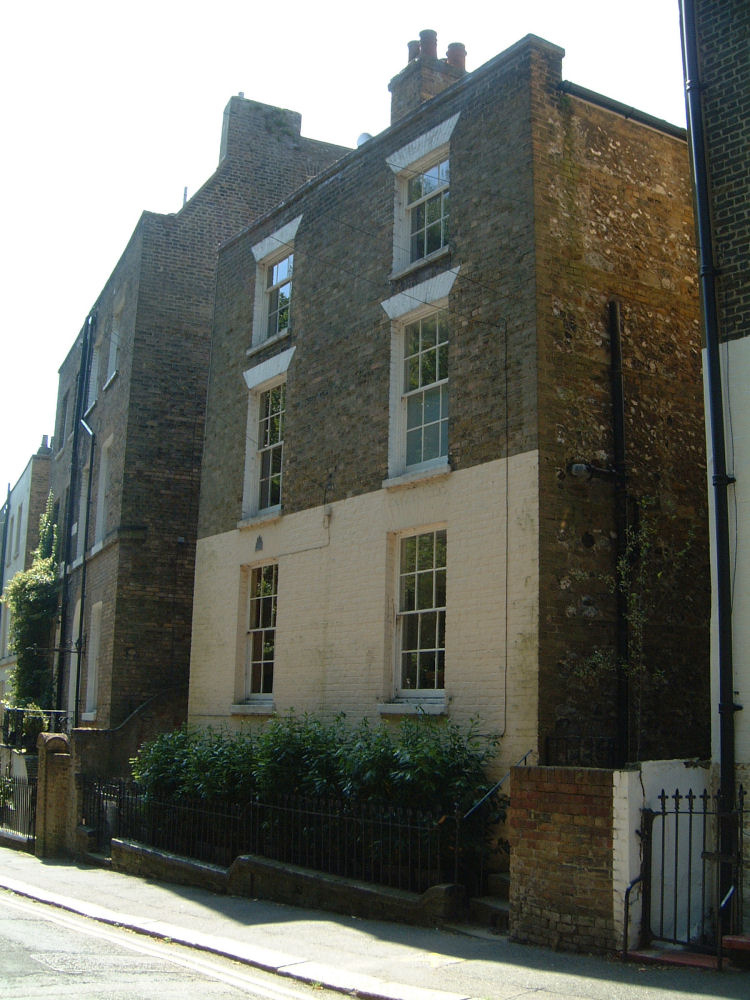
Above photograph by Paul Skelton, 19 August 2009, shows the pink house
on the left, today's premises that I believe was the "Dog and Gun."
This has just been stated that it is indeed not the correct house (8
July 2011) This house was built in 1832 and the "Dog and Gun" burnt down
in 1852.
|
Kept by John Stone from 1849-52. Evidently a house of ill repute as
shown by the passage from the Dover Express below.
|
From the Dover Telegraph and Cinque Ports Advertiser,
2 June, 1849.
A person named Moody, residing at Barham, attended to prefer a
complaint against John Stone, landlord of the "Dog and Gun," for
refusing to deliver up the clothes &c., of his sister, Elizabeth Moody,
who had been living for some time past at the said house.
From the statements made by complainant, it appeared that the girl,
about 18 years of age, had left her home some 4 or 5 months since, and
that her place of abode, and dissolute mode of living, had not been
discovered till recently. With a view of inducing the fallen one to
retrace her steps, and retrieve her character, the brother had arrived
at Dover, but, on applying for his sister and her clothes, was refused
an interview with the one, or the possession of the other; and the
present stop was taken to obtain the advice and assistance of the Bench
- The particulars of the complaint were corroborated by Elizabeth Moody
herself, who, with her father, appeared before the Magistrates, and
expressed her willingness to return home with her friends. During the
investigation, certain observations implicating Stone as the keeper of a
common brothel were elicited, and information against him thereupon
laid, upon which the police were ordered to bring him before the Court;
and on his appearance, the information being fully sustained by the girl
Moody, he was fined £5 6s. costs included, which was paid before the
defendant was permitted to retire.
Stone, in his defence, argued that he was ignorant of any improper
proceedings in his house, and thought it strange that he should be aimed
at by the Bench, when the "Three Tuns," at
which several females were kept, and other houses keeping a large
number, were left unmolested.
The Bench severely remonstrated with defendant on his attempting to
justify his conduct, which, as far as concerned his house, was
notorious, and his pretending ignorance of which was most atrocious.
With respect to the other places he had alluded to, the Magistrates only
awaited the necessary information, and the parties would then be
forthwith summoned.
[A somewhat similar case was last week presented before the Bench,
when a like fine was inflicted. "We cannot do otherwise than co-operate,
by our comment, with the proceedings of the magistracy - proceedings
that must prove a slight check at least, and we hope a powerful one,
upon a vice that rears its hydra head above the innumerable vices of our
fair land, and stalks forth with the unblushing effrontery of noon-day.
We at the same time incline to commiserate the degraded position of, we
had almost said the more automatons of the vile dealers in prostitution,
believing that no small number of the "unfortunates" are the victims of
deceptive seduction - wiled from the paternal roof by the sophistry of
the practiced villain, and, when forsaken by the base authors of their
miserable course, thrown with all their immoral habits upon the
community; and thus becoming the easy dupes of those who, for paltry
gain, despise alike the ultimate wretchedness of their victims, the
gross immoralities they are loosening amongst society, and the
disgraceful and disgusting system they, by means to disreputable and
unprincipled, are supporting and extending."]
|
The public house was completely destroyed by fire in the
month of June 1852. The proprietor lived next door, being the owner of
both properties. Two floors of his dwelling were also written off, the
contents being destroyed.
|
From the Dover Express and East Kent News, June 1852.
At an early hour on Thursday morning (about one o'clock) the slumbering
denizens of this almost suburban district were aroused by a cry of
“fire.” The alarm speedily circulated through the surrounding
neighbourhood and in a short time numbers were hastening in the
direction of the scene of the conflagration, which was soon observable
from the glare diffused around in consequence of the height the fire had
attained. Here it was found that two houses in Laureston Place the two
forming fortunately a detached block were on fire. One of the houses was
well known as the “Dog and Gun” in the tenancy of Mr. W. Stone and the
other was a private residence in the occupation of Mr. Meadows who is
the proprietor of both. Almost simultaneously with the shout of alarm
the rumbling of a fire engine towards the locality was heard by the
inhabitants-terror inspiring, yet grateful sound because it tells of an
approaching friend in the hour of need. This proved to be the No. 1
corporation engine and the despatch of it fully manned from Caroline
Place to Laureston almost after the echo of the first cry of fire had
died away, calls for a word of explanation mingled with a fair portion
of deserved praise. On the eve of the fire a party had assembled at the
Apollo Rooms and was still there when the message for the engine
arrived. Several of them at once rushed to the aid of those of the fire
brigade present and before a daughter of Meadows could convey
intelligence of the sad event to the Police Station, engine No. 1 was at
Laureston Place and ready for action.
The scarcity of water and a disposition in some unknown ones to assume
the dictatorship though they were not very remarkable circumstances in
connection with fires at Dover rendered the engine useless for twenty
minutes or more after the arrival.
At last by a supply of buckets distributed to the houses in the
vicinity, water was obtained and the engine brought into play in front
of the "Dog and Gun".
Three other engines soon appeared almost together on the spot one of
them being from the Castle manned by the men from the 30th depot under
the command of Major Hoey, which took up its position on the Old Deal
Road another the No. 2 corporation engine, which was placed in the rear
of the premises, as was the third from the Heights manned by the
Artillery. The two last were copiously supplied with water from the
stream.
We have no wish to particularise the efforts made on the occasion
because all strove most efficiently to discharge the duties upon which
they had so cheerfully entered. The Captains of the corporation engines
Messrs G. T. Parks and Jas. Wood while justly acknowledging that the
service of their own men was entitled to the full need of much praise.
They expressed themselves as highly gratified with the fearless conduct
of the military the excellent working of their engines and the
determination, which characterised their great efforts of doing all that
the exigencies of the case, demanded. Some idea of the water thrown upon
the burning houses may be gathered from the fact of the supply for the
engines in front having exhausted the contents of more than one well in
the neighbourhood. For three hours the engines almost combated the
flames and at four o'clock all apprehensions of further danger from the
fire, which had completely gutted the "Dog and Gun", and the two upper
floors of Meadows house was removed. From the first arrival of the
engines it was apparent that no effort could save the house occupied by
Stone and it was feared that but little success could crown any
exertions directed in reference to Meadows house.
In the latter instance however they particularly succeeded the ground
and first two floors escaping comparatively scathe less though furniture
removed from them was damaged beyond repair in its hasty transit to the
street. In addition to the whole depot of the 30th and a company of the
67th Superintendent Coram and some of his force were promptly on the
spot and naturally assisted in the maintenance of sufficient order. A
passage of some 16 feet wide intervened between each of the burning
houses and the premises adjoining. But for this circumstance and the
fact of their being scarcely a breeze at the time the extent of damage
might have been much more considerable. A temporary fence between the
"Dog and Gun" and the house below was much charred and some of the windows
in the upper storey of the house above that of Meadows are said to have
been cracked by the intense heat of the conflagration. With these
trifling exceptions the engines succeeded in confining the fire to the
two houses alluded to as well as preventing it reaching to some out
buildings attached to the "Dog and Gun". The origin of the fire consists
at present a subject of inquiry. The damage done as follows -: "Dog and
Gun" completely gutted and the whole contents destroyed. Meadows
house-two floors and contents destroyed and the furniture in the other
rooms damaged beyond recovery. The house was insured in the Sun to the
full value.
|
|
Kentish Gazette 22 June 1852.
FIRE AT LAURESTONE PLACE.
At an early hour on Thursday morning, (about one o'clock.) the
slumbering denizens of this almost suburban district were aroused by a
cry of "fire!" On reaching the spot, it was found that two houses in
Laurestone Place—the two forming fortunately a detached block—were on
fire: one of the houses was well known as the "Dog and Gun," in the
tenancy of Mr. W. Stone; and the other was a private residence, in the
occupation of Mr. Meadows, who is the proprietor of both. The scarcity
of water rendered the first engine useless for 20 minutes or more after
its arrival. At last water was obtained, and the engine brought into
play in front of the "Dog and Gun." Three other engines soon appeared
almost together on the spot. For three hours the engines almost
incessantly combated with the flames, and at four o'clock all
apprehension of further danger from the fire, which had completely
gutted the "Dog and Gun," and the two upper floors of Meadows's house.
The damage done is as follows "Dog and Gun" completely gutted, and the
whole contents destroy. Meadows's house—two floors and contents
destroyed, and the furniture in the other rooms damaged beyond recovery.
The houses were injured in the Sun, it is said to their full value. The
furniture of Stone was insured in the Union Office for £200, and the
stock in trade for £50. The furniture of Meadows was uninsured.
|
|
Lloyd's Weekly Newspaper 27 June 1852.
TWO PERSONS CHARGED WITH ARSON, AT DOVER.
The greatest excitement prevails at the present time in this town, in
consequence of the outbreak of a fearful fire, which was attended with a
great loss of property, and the subsequent apprehension of two persons,
John Stone and his servant maid, Eliza Chapman, on a charge of arson.
About one o'clock in the morning smoke was perceived issuing from the
premises belonging to Mr. Stone, formerly a wine and spirit store, the
licence of which had been taken away by the magistrates, owing to the
house being of bad repute. The premises of late have gone by the sign of
the "Dog and Gun" beer-house; and, as far as can be learned, at the time
of the discovery contained only Mr. Stone and the servant before alluded
to. If any other parties were in the building they unquestionably must
have perished in the course of a few minute, after the alarm was given,
the fire took possession of every part of the building, whence it
travelled to the house adjoining, No. 6, in Lancaster-place, so that in
a very brief period, both premises presented one tremendous sheet of
flame. Mr. Superintendent Coram with a body of police was soon on the
spot, as well as the Borough engine, which was followed by another from
the castle, under the superintendence of the officers, and about 200 of
rank and file of the 30th depot. After getting a supply of water, which
was effected with great difficulty from the different tanks belonging to
the houses adjoining, the whole force was brought to bear upon the
flames; but it was past four o'clock before the fire could be
extinguished, and not until Nos. 5 and 6 were entirely destroyed, and
damage done to those adjoining. No. 5 was insured for £640, in the Sun,
and the furniture in No. 6 was insured for £300, in the Union. Whether
the other houses were insured or not could not be ascertained. From
certain circumstances which came to the knowledge of the police, Mr.
Stone and Eliza Chapman were both given into the custody of Mr. Coram,
on a charge of having wilfully caused the fire.
|
|
Kentish Gazette 22 June 1852.
BOROUGH PETTY SESSIONS. - THURSDAY.
Charge of Arson against a Publican.
William Stone, landlord of the "Dog and Gun," Laurestone Place, taken
into custody by Superintendent Coran on suspicion of having wilfully set
fire to his residence, was brought up for examination.
Superintendent Coram deposed:— This morning, about 20 minutes past one
o'clock, I was present at a fire in two houses in Laurestone-place, one
of which, the "Dog and Gun," was in the occupation of the prisoner, whom
I saw about an hour after going thither. I enquired of him the cause of
the fire, and he replied that he had no idea, unless it had originated
from a fire made in a copper stove on the ground floor to heat some
water for cleaning up, as there had been painting in the house. He also
told me that he went to bed about eleven, and was awoke about one by a
crackling noise. On getting up and opening his chamber door, he found
the smoke intense, issuing up the staircase. Prisoner at once ran to his
servant's room, and succeeded in getting her into his own chamber in
safety. He said that if he had been two seconds longer, both must have
perished. I afterwards saw the servant, who told me that the copper fire
had not been lighted for a month: she said that three soldiers were the
last to leave the house on Wednesday night. They left about nine
o'clock. On again questioning Stone, he said that Mr. Meadows was the
last person in the house, and that he left about 10 o'clock. On taking
prisoner to the station-house I searched him, and found on his person
the following property:— In his coat pockets—a canvass bag containing
3s. 5 1/2d. in copper, 1 1/2d loose, 16 keys, some loose tea, a small
account book, a memorandum book, a pair of steelyards, a bottle of
clarified marrow and a pair of spectacles; in his right hand trousers
pocket—a silver watch and guard, and 5s. 6d. in silver; in the left hand
pocket—a silk and steel purse containing a silver watch, and a silk
purse with 5 1/2 sovs. in gold, a £5 Bank of England note, an old coin,
and a duplicate in the name of Hatton. I have since heard prisoner say
he had only his shirt on when he gave the alarm, in addition to a pair
of drawers. If the case be adjourned, I have every reason to believe
that I shall be able to produce additional particulars to the evidence
already in possession.
Eliza Chapman, servant to prisoner:— I have lived with Mr. Stone about 9
month. This morning I was awoke by my master calling "Fire!” I was in my
first sleep and I think it must have been before one o'clock. I went
part of the way down the flight of stairs leading from my chamber, and
was then caught by my master, who pulled me into has bed room. I had
only my night clothes on. On getting into his chamber, he opened his
window, and cried out "Fire!" I thought he had his trousers on, and
think so still; but I cannot say what colour they were, as it was dark.
By the Bench:— The flames were issuing up the staircase, but master
shut
the chamber door directly we got in, so that there was no light by which
I could observe the colour of his trousers. There had been no painters,
nor any oil brought in, other then what master and Mr. Meadows used, who
had themselves been painting. I made a fire in the small copper to heat
some water for cleaning up. I told Mr. Coram that no fire had been made
there for a month. I had then forgotten what I have since recollected,
that yesterday afternoon, between 4 and 5 o'clock, I did make a fire in
a small copper, I used all wood, and no coal. Can't say whether or not
the fire went out. Mrs. Stone left Dover about a fortnight ago, and took
with her a large box; what it contained I don't know, nor can I say
whether it was light or heavy. I have noticed nothing particular about
the house this last few days. I don't know where master keeps his money;
he threw his gun out of the chamber window, and such other articles as
could be easily taken hold of. I know the gun used to hang over the
fireplace in the bar, but about 2 months ago it was removed up stairs.
The copper money was always taken up stairs at night. The tea was kept
in a caddy in the bar, and I know nothing of the loose quantity found in
master's pocket; the steelyards were kept in the bar. From appearance
while up stairs, I must have gone through the flames to have smashed the
bar, from which the fire seemed to emanate. I missed the steelyards
yesterday from their usual place is the bar.
Sergeant Back:— I saw Mrs. Stone leave Dover by rail a short time since.
Her husband has said it was a week last Monday, and I believe that it
about the time. Her luggage, on entering the station, I observed to
consist of a large box about 1 feet long, and one or more packages
besides. The box appeared heavy. Stone told me that his wife was gone to
visit a sick sister at Cheltenham, Gloucestershire, and since her
absence bad been ill herself. He said nothing about her return to Dover.
The Bench considered that there were circumstances in the affair of a
sufficiently suspicions character to warrant a remand, and the case was
then adjourned to Monday next.
|
The name John Stone crops up on two other occasions in Laureston Place,
earliest at the "Almond Tree" and later at
the "Grove" and I am going to guess that those and
this one were in the same premises, just the names being changed.
LICENSEE LIST
 STONE John 1847-52 end
 (Beer retailer) (age 50 in 1851
 ) )
From
Bagshaw Directory 1847
Census
|

