|
The Marina
Sandown
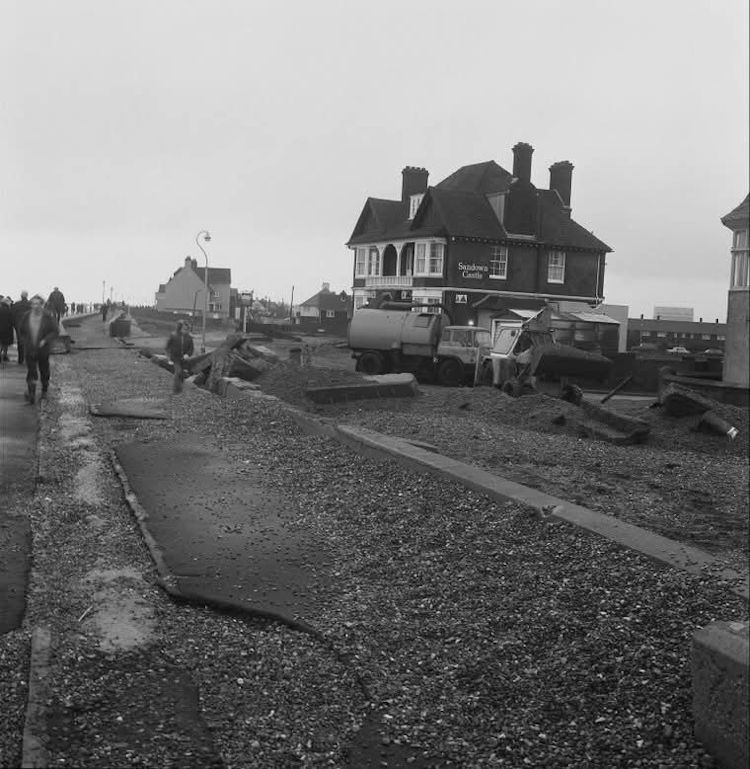
Above photo, date unknown. |
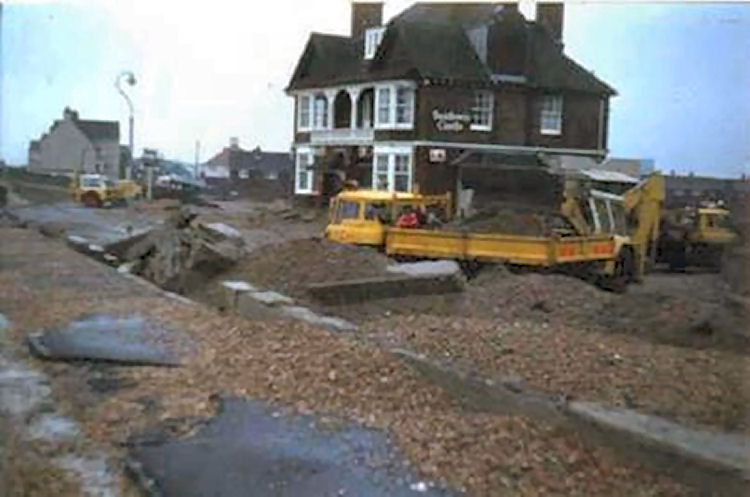
Above showing the Sandown Castle after the storms of 1978. Picture taken
with permission from
https://www.facebook.com |
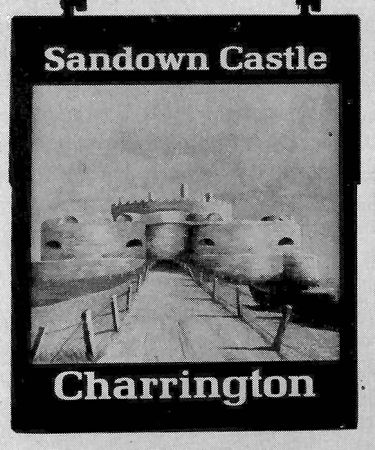
Above photo 1987. |
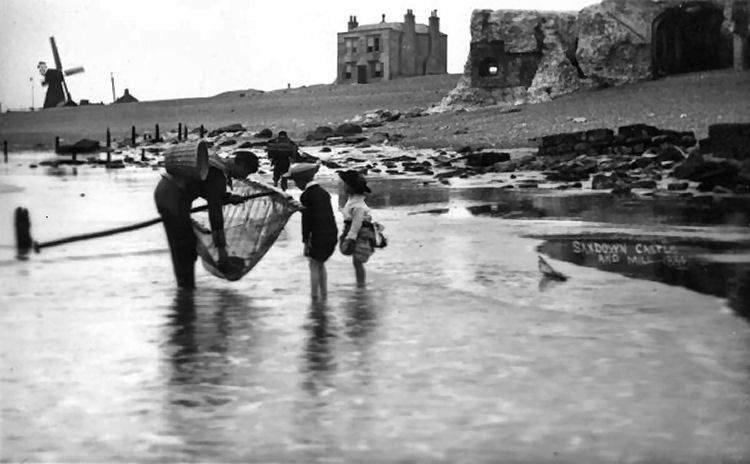
Above photo showing the pub between the Castle and the windmill.
Dated 1884. Kindly
supplied by Stuart Kinnon. |
|
From the Dover Mercury, 10 December, 2009.
Postcard is a souvenir of long vanished pub.
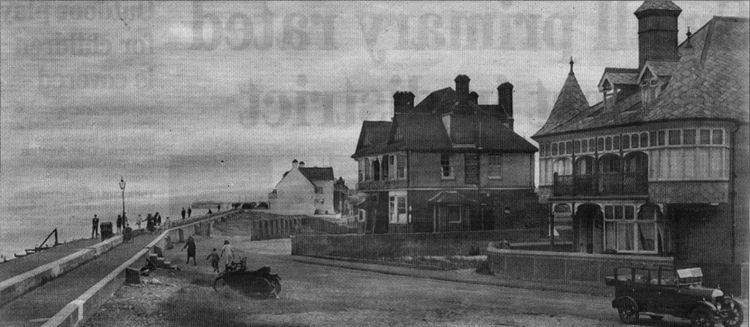
A view taken from the former Sandown Castle site, looking south
towards Deal. The pub In the centre has since been demolished.
MANY of Deal's pubs have been converted into homes, with few keeping
the original pub features so their history has been lost.
The Sandown Castle, close to the sea in the north of the town, was
one of the pubs in the area which was demolished, probably in the 1980s,
leaving no trace of its existence - except in old black and white
postcards.
It stood virtually at the end of Sandown Road and was closed for some
time before finally being knocked down.
The big detached property sat in its own grounds with a back garden
and at one time was run by an employee at Betteshanger Colliery and his
wife. The pit, off the Deal-Sandwich road, closed in 1989, the last
colliery in the Kent Coalfield.
In the days when the Sandown Castle pub was open for business, the
area also had a cafe and public conveniences on the old Sandown Castle
site and it was a popular place for visitors in the summer.
Crazy golf
There also used to be a crazy golf putting green in north Deal,
complete with a miniature windmill in the middle of the course.
In the old postcard the detached house with the distinctive roof,
built in 1900, was virtually sitting alone until the Deal Borough
Council's estate of council houses was built, now the Canute Road area.
The view shows a house standing close to the beach on the left, which
is still visible today and now painted a shade of blue.
Deal Pier, not the present one, can be seen in the distance and there
was a walkway along the seashore. This area now has a seawall and the
beach washes closer in to the land.
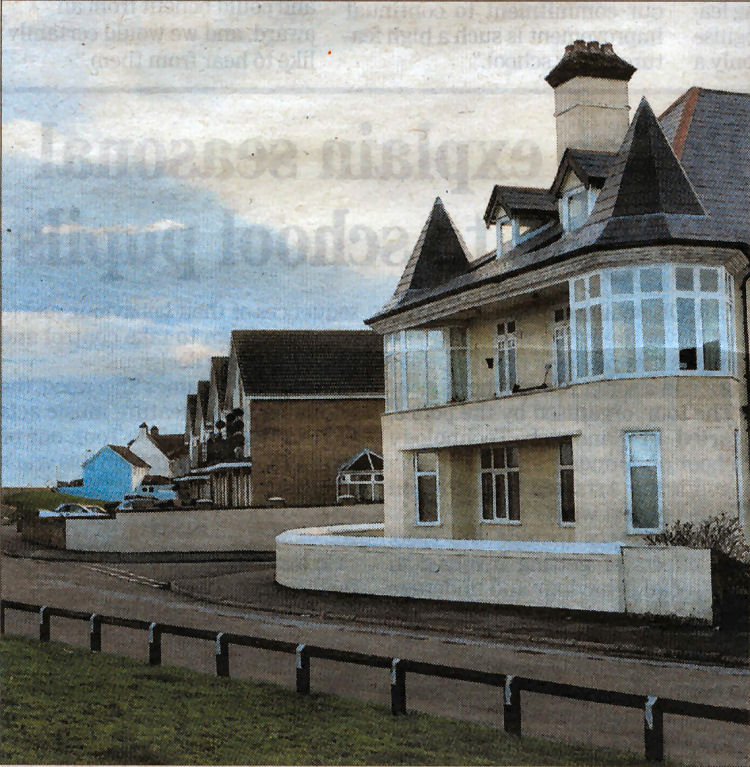
Above shows a 2009 version of the old postcard view of the northern part of
Deal's coastline.
|
Previously known as the "Good Intent" and changed name when Archibald Hewitson took over from Luke Jarvis
on 7 May 1863.
The Deal Licensing Register of 1892 mentions that an application for the
licence for a proposed hotel would be granted.
1903 saw it being referred to as the "Castle Inn, Sandown" and by 1908 the pub was referred to as the "Sandown Castle
Hotel."
|
From the Deal, Walmer, and Sandwich Mercury,
30 October, 1869. 1d.
Mr. Cattermole, landlord of the "Castle Inn", Sandgate, appeared
before the Magistrates and said he had a written authority to gather
stones from the beach, but on the previous afternoon two policemen, with
a man and a cart, came and tried to take away five stones that were not
worth 6d. He was not aware that he had taken away anything belonging to
the town authorities, and the matter had caused a little ill-feeling
between Mr. Parker and himself.
The Mayor said perhaps he could explain the matter. On the previous
afternoon the Surveyor of the Pavement Commissioners, Mr. Simon Marsh,
called upon him and stated that he had been instructed by the General
Purpose Committee, or some of them to go down to Sandown Castle and get
up and bring back certain old pavement stones which had been put for the
accommodation of the public under the seat erected by the Commissioners
of Pavement. The seat, however, was now no longer required and they
wished the stones brought back again. Accordingly the Surveyor sent down
for those stones, the men had returned without them and said Mr.
Cattermole had refused to allow them to be removed. The Surveyor
therefore came to him to know what he was to do. He told him he had
better go down again from him (the Mayor) and explain to Mr. Cattermole
that the particular stones that he wanted were not at all connected to
Sandown Castle, but had been put down there by the Commissioners of
Pavement for a certain purpose, and that they now wanted them back again
and must have them. He (the Mayor) understood that Supt. Parker
subsequently went down with Mr. Marsh and explained the matter to Mr.
Cattermole.
Mr. Cattermole said none of them came to explain the matter to him,
and he did not know they were down there till he was told they were
taking the stones away. He had got two men present in Court who picked
those very identical stones off the beach, and of course he did not know
that they belonged to the Pavement Commissioners. If Mr. Parker had come
to him in a proper manner and told him that the stones were the property
of the Commissioners, of course he would have immediately delivered them
up, but instead of that the Superintendent threatened to summons him and
also to strike him with a big shillelagh which he carried, and which he
thought a policeman ought not to be allowed to carry. Mr. Cattermole
also said that on the first occasion when he saw the boy picking up the
stones he spoke to him and asked him who had sent him to do so, and the
boy was then exceedingly impudent to him.
Supt. Parker said that whilst they were collecting the stones Mr.
Cattermole came out in a most violent manner and began interfering, and
as he wanted to have it all on his own way he threatened to strike him
if he did not leave off. He certainly would have done so to, if Mr.
Cattermole had not desisted.
After some further remarks from both parties, the Magistrates sad
they considered there had been some little misunderstanding, and that
Mr. Cattermole had not given himself patience to understand the
explanation. They were afraid he had been rather too energetic.
The Surveyor said there were still eleven more stones down there
belonging to the Commissioners and he supposed he was to fetch them.
The Mayor said no doubt if Mr. Cattermole had got them in his
possession he would give them up.
Mr. Cattermole said if they were amongst his of course the Surveyor
could have them at once.
|
|
From the Deal, Walmer, and Sandwich Mercury,
6 November, 1869. 1d.
CHARGE OF ASSAULT
Thomas Cattermole, landlord of the "Castle Inn," Sandown, was
summonsed for having on the 29th of October, unlawfully assaulted Mr. S.
Marsh, the Surveyor.
Mr. Mourilyan appeared for the defendant.
Simon Marsh deposed: Last Thursday we were here, and met together. I
had orders from Mr. Cavell to go to Sandown to get the remainder of the
stones that were under the seat, and I accordingly went down there on
the following day with my man Thompsett and a boy. The boy pointed out
to us the place where we thought the stones were, which was underneath a
lot of stones that Mr. Cattermole had collected together and the man
then began moving them. Whilst he was doing so the defendant came out of
his house and said to us, "What are you doing there?" I said, "Go on
Thompsett, take no notice," and he did so and presently he found one of
the stones, and shortly afterwards he also found another. This man (the
defendant) then began at me and called me "an old ____," "a _____
villain," and "a _____ old scamp." I said to him, "You must be drunk or
stupid, surely, to go o in this way." He said, "Yes, you old _____; I
will let you know. You have your £40 a year, don't you, and I will do
for you." I again asked him if he were drunk or sober and said to him,
"You must be drunk, surely, or else you would never go on like this." He
replied, "You _____, why don't you go and pay your rates; your poor
rates, and your pavement rates, and all the rates you owe." Now, I have
not been charged with these rates for these five years. I then took the
two stones away, but I aught to have nine more. That is all I have got
to say.
Mr. Mourilyan observed that if that were the complainants case he had
nothing to say, as the charge against his client was for an assault.
Marsh added: I then left as he kept on threatening me. He threatened
to do for me, and by those words provoked me to make a breach of the
peace, and had I been a young man I should not have stood it. He did not
strike me, but I thought he meant to, as he kept close to me.
In answer to the Magistrates, Marsh said he told the complainant that
he must have got the stones, and he must have had them as they were
found underneath some stones that he had collected, and they could not
have got there by themselves.
After some discussion, the Magistrates said they considered Marsh had
rather out-stepped his duty by making use of the observation he had to
Mr. Cattermole, and the case would be dismissed. The Mayor, however,
expressed his surprise that the defendant should, after the full and
amicable explanation which had been given of the whole affair on the
previous Thursday, have resisted a public officer in the discharge of
his duty.
Mr. Mourilyan then said he should ask the Magistrates to allow his
client costs, as he had never heard a more frivolous case. A public
officer went down to Sandown and accused the client of what very nearly
amounted to felony, and then complained that he used certain language to
him, but then Mr. Marsh, according to his instructions, called Mr.
Cattermole some equally delightful names. He did not think a charge like
the present should be presented before the Magistrates on, he could not
say light grounds, but on no grounds at all. because the complainant
said the defendant did not even lift his stick at him.
The Magistrates said they thought the defendant had taken it out in
abuse, and that they ought not to encourage such conduct. If they
allowed the costs it would be almost like offering a premium to others.
Mr. Mourilyan enquired whether the Magistrates did not consider they
would be giving a premium to persons bringing false charges, if they did
not mark their sense of this case by allowing them.
The Clerk said it was hardly correct to say that Mr. Marsh had
brought a false charge, because it was only a wrong one, and had he
taken out an information against Mr. Cattermole for inciting him to
commit a breach of the peace it might have resulted differently. Mr.
Marsh had only been mistaken.
Mr. Mourilyan said the Magistrates must remember that they had only
heard one side, and he thought according to instructions that it was
"six one and a half-a-dozen the other."
The Magistrates still declined to allow costs, and the case then
terminated.
|
|
From the Deal, Walmer, and Sandwich Mercury,
18 September, 1869. 1d.
ASSAULT
Thomas Cattermole, landlord of the "Castle Inn," Sandown, was
summoned on the information of Sarah Ottaway, for having on the 14th
inst. unlawfully assaulted and beaten her.
On being asked whether he were guilty or not, Mr. Cattermole said he
was not aware that he had struck the complainant, as he was so full of
drink. He had been drinking with the complainant's brother all the
afternoon, and he was really not aware that he had done anything wrong.
If he had he was truly sorry, as he was the last man to strike a woman.
He did not believe the affair would have occurred if the complainant's
brother had not brought up an old grievance.
The Magistrates inquired whether the parties could not make the
matter up amongst themselves.
Mr. Cattermole said the complainant's sister (who had also summoned
him for assault on the same occasion) was willing to do so, but she
would not.
The Magistrates again recommended an amicable arrangement of the
matter, and complainant then expressed her willingness to do so, but
said that as the defendant had publicly insulted her, she thought he
aught to make a public apology and be bound over to keep the peace.
The Mayor: And also pay the costs.
Mr. Cattermole said he was quite willing to, and did, apologise to
the complainant, and certainly would not repeat the offence. He could
not think how ever he came to do it. He then paid the costs, 10s., and
also gave another 10s. to the poor-box.
|
|
Whitstable Times and Herne Bay Herald, 2 July 1870.
FATAL ACCIDENT WHILST BATHING.
An accident occurred at Deal on Tuesday last to a young man named
Charles Spencer, 18, a native of Tunbridge Wells, who, accompanied by
another young man, took a boat from the beach, soon after 6 o’clock on
the morning in question for the purpose of taking a bath in the sea just
beyond Sandown Castle, and was unfortunately drowned. An inquest was
held on the body before George Mercer, Esq., Coroner for this borough,
on the afternoon of the same day at the "Castle Inn," formerly the "Good
Intent," when the jury, without hesitation, found as their verdict
"Accidental death" and appended thereto a caution to others not to bathe
from boats who were not thorough good swimmers, also that persons hiring
boats should be cautioned not to do so for bathing purposes, more
particularly to such as were not natives of the place and unacquainted
with the danger attending it. The remains of the deceased were deposited
in the Deal Cemetery on Thursday. The deceased was a very promising
young man and much respected in the town. He was a member of the
Institute in Park-street, many of the younger members of which followed
his remains to the ground, as did also the male teachers of the Wesleyan
Sunday School, of which he was a teacher. The Rev. W. M. Harvard
officiated at the ceremony, and many of the tradesmen at the south-end
of the town partially closed their shops on the occasion.
|
|
From the Kentish Gazette, Tuesday 24th January 1871.
Wreck of a Deal Lugger and loss of Eight lives.
As we briefly announced in our last, a melancholy case of wreck and
drowning occurred on Monday week at Deal, by which eight poor boatman
lost their lives almost within earshot of their own homes. Shortly after
6 o'clock, in the midst of a heavy gail from SSW. and in a driving rain,
a "flare" was observed on the Goodwin Sands, intimating that a vessel
was in distress, and immediate preparations were made for launching two
Luggers (the "England's Glory" and the "Reform"), to her assistance. The
former went on a voyage in safety; but, most unfortunately, the latter
to clear the "haul-off-ropes" in getting off, drifted to leeward, the
force of the gail and strong flood-tide driving her violently against
the pier, which is about 200 yards north of the stage from which the
boat was launched. The force of the collision carried away the foremast,
and a heavy sea sent the boat against the cross-bars of the piles,
staving in her sides, and she immediately began to fill. Knowing their
perilous position the crew commenced taking off their heavy sea
clothing, and ropes were at once thrown from the pier, but the boat sank
before any help could reach them. Most of the crew clung to spars and
sails, and floated with the tide northward. The screams of the poor
fellows as they were one by one swallowed up by the waves was most
heart-rending. Notwithstanding the terrific sea a galley pumt was put
off from the shore to save them, but being insufficiently manned was
unable to render any assistance. Further to the north, however, at the
"Castle Inn," Sandown, a boat was launched by two boatman, named Edward
Hanger --- Stanton, who succeeded in rescuing three of the crew - John
Bailey, William Goymer, and Thomas Baker. With great difficulties they
got ashore about two miles north of Deal, and the rescued men, who were
in an exhausted condition, were taken to the "Chequers Inn" in the Sandhills where they were promptly attended by 3 medical gentleman; Mr.
Cattermole, of the "Sandown Inn," also rendered valuable assistance. The
dead bodies of two more, viz., Edward Trott and Thomas Cottle (both
married), were washed ashore near Sandown Castle, and taken to the
"Castle Inn," and, subsequently, by the coroner's order, were removed to
their homes. Another poor fellow (Simon Pritchard) was observed
struggling in the water at some distance from the scene of the accident,
and a brave attempt was made to save him by a man named Finnis, who, at
the imminent risk of his own life, rushed into the water and succeeded
in clutching him, but was compelled by the violence of the sea to let go
his hold. Later in the day the bodies of William Middleton (unmarried),
William Baker (unmarried), Simon Pritchard (married), E. Penn (married),
G. Trott (married), and John Wilkins (married), were recovered. It was
impossible at first to ascertain the names or exact number of the crew,
as it was unknown who composed the crew of the two boats, it being the
custom of the men in a launch to jump into the first boat they come to;
consequently, until the "England's Glory" came ashore, great excitement
prevailed, and a cruel suspense had to be endured by those who knew that
their friends - father, brother, or husband, as the case might be - were
in one of the luggers. On her arrival in the afternoon and eager crowd
assembled on the beach and the men, about whose safety doubts had
existed, were joyfully received by the relatives and friends.
The inquest was held in the Council Chambers at the Guildhall, on
Tuesday last, before G. Mercer, Esq., Coroner. The Coroner, in charge in
the Jury, said they were called upon to investigate a most serious
calamity, of an extent such as he had never known before. The only
consolation was that the men who died in the discharge of their duty.
This enquiry was to ascertain how and by what means Edward Trott and
Thomas Cottle came to their deaths. There was six others who have met
their deaths at the same time, whose bodies will probably arrive from
Sandhills during the enquiry. The Jury having been viewed the first the
to first bodies, John Denne, labourer, said that, having heard that an
accident has taken place, he and three other men went to Sandown Castle
about 7:30 on Monday morning. When they got there they saw something
drifting along in the water. They followed it and found it to be the
body of a man. They got it ashore and someone said it was a body of
Edward Trott. Some medical gentleman came up, and the body was
afterwards taken to the "Castle Inn," kept by Mr. Cattermole.
Messrs. F. Woodman, W. Wilcox, and J. S. Leeson, three medical
gentlemen, stated that having heard of an accident they went to the
Castle, and on the beach found the body of Edward Trott. They did all
that could be done to restore life, but their efforts were unsuccessful.
They then went down the beach and saw another body floating in the
water, which, when got to shore, proved to be that of Thomas Cottle.
They tried to restore respiration in this case also, but found not the
slightest signs of life. The body was then sent on a stretcher to the
"Castle Inn."
Dr. Wilcox further stated that he went to the half-way-house and found
the three survivors, John Bailey, Thomas Baker, and William Goymer, of
whom Baker was in a very bad condition.
Henry Bailey, a Southend boatman, stated that in consequence of a night
signal from a ship in the Downs, the crew of the "Reform" and the
"England's Glory" were called up to man the boats. It was blowing a
strong gale from the SSW and a heavy sea was on. They were unable to
launch at 5 o'clock for want of water, and had to wait till the tide
made in order to whether the pier. Previous to launching he got in the
"Reform" to go off in her, but, with three others, jumped out again to
assist in laying the lower woods, fearing she might not get off. The men
left in her were Edward Trott, Thomas Cottle, Simon Pritchard, William
Middleton, George Trott, jun., John Wilkins, Edward Penn, William H.
Baker, Thomas Baker, William Goymer, and John Bailey. Having made all
preparations she went off at about 6:15. When the boat was about fifty
fathoms from the shore he saw them partly hoist the foresail and then
lower it, and she drifted stern foremost through the pier. He then
immediately ran to the pier, and when he got there saw the lugger sink
on the northernmost side, and all her crew in the water. He then came
off the pier and assisted in launching a galley punt abreast of the
"Fountain Tavern," in which three men named Thomas Goymer, George Hall,
and William Trott, went off. The men in the lugger were all sober and
were called from their beds to go off in her. Had a boat put off from
the northern Coastguard Station it would have been of great service.
Henry Freemere said that he and a man named George Hall went on to the
pier with a rope but it got entangled so that they could not cast it. He
then assisted and getting the galley punt off. If there had been a
life-boat suspended on davits from the pier they could have lowered it
easily and the whole of the men might have been saved.
William Goymer, one of the crew of the ill-fated lugger, said that when
they got clear of the surf and had let go of the haul-off rope they
tried to throw it overboard, but the rope inboard that kept the haul-off
rope in its place got jammed, from some cause which he could not
explain, and in consequence the vessel was brought head to wind. They
did not cut the rope, because they knew that if they did so they could
not clear the pier-head. They had lowered their mizenmast and where about
to lower the main mast, but could not do so in time. The stage from
which they put off was so near the pier that on a day like that was it
was impossible to clear the pier head if the least delay or accident
occurred. The boat being stern foremost they could not lower the
foremast quickly enough, and as they drifted through the piles the heavy
sea struck her and drove her with great force against the southernmost
pile, carrying away the foremast. The rebound of the blow sent her clear
again and she came out on the north side, where she filled and sank. He
got hold of one of the spare sails, which was rolled up, which kept his
head above water. He drifted as far as the northend and was eventually
rescued by boat which put off from Sandown. There were three men in her,
named Hangar, Foster, and Stanton. The same boat afterwards picked up
John Bailey and Thomas Baker.
Thomas Cattermole, landlord of the "Castle Inn," said they used to be a
coastguard boat at the Castle, but it was removed about two years ago.
The coastguard men could have rendered important service, if they have
been handy in their boats.
The Coroner said it certainly was a most extraordinary thing, that
though the accident occurred so near the Coastguard station, not one of
them appeared to take any part in any way, and although they might not
have been able to save their lives, they ought to have been there. Their
absence from the scene, however, was a fair subject for the jury to
remark upon, if they thought with him on the matter. There could be no
doubt that the cause of death was drowning, in consequence of the
chairman of the rope, which was purely accidental, and occurred through
no fault of the men.
The jury retired and on their return gave in a verdict of "Accidentally
drowned, the accident being caused by the boat's haul-off rope getting
jammed and the boat striking against the pier. It was there opinion that
a lifeboat with proper apparatus should be placed on the pier, in case
of a similar accident in future. They also recommended that the
Coastguard boat, which was formerly kept near Sandown Castle, should be
placed there again, for they were of opinion that provided there had
been a boat of that description on the spot at the time it might have
been the means of saving some of those lost on this occasion. At the
same time the jury regretted exceedingly that no coastguard was present
to render assistance, and that not one was seen during the whole time,
and that they had rendered no assistance whatever. Of course people of
that class were fully expected to be on the lookout to see what was
going on upon the water, and the jury could not think how it was that no
coastguardsmen was about.
The Coroner fully concurred in the remarks of the jury, and said their
thanks were due to Mr. Cattermole for his prompt and ready assistance.
Great praise was also due to the three young men who had gone in the
boat that saved the three survivors. He should have great pleasure in
bringing their conduct before the Royal Humane Society.
|
|
From the Deal, Walmer, and Sandwich Mercury,
27 May, 1871.
USING THREATENING LANGUAGE
Robert Thomas Stanton, sail-maker and publican of Dover ("Crusader")
was summoned by Mr. Cattermole the landlord of the "Castle Inn" for
having on the 15th inst, offered to fight with him and threatened to do
him an injury if he caught him anywhere.
Thomas Cattermole deposed: On the 15th of May the defendant came into
my house, in company with two others, and asked for a glass of whisky.
He had three-pennyworth, and he got up in a passion, and called me a
_____ villain. He walked into the parlour where there were two pictures.
He said, on looking at the pictures, "You are a _____ rogue, Cattermole,
they aught to have been mine." I replied to him in these words, "Well,
Robert, you know that at the valuation when my house was taken at Dover,
I said if you give the valuation, I have no doubt that the person, Mrs.
Chaney, who is going to take the house, will let you have them." She did
consent, and I took the pictures down to the defendant's house. He had
them for about twelve years without paying for them, and then, finding I
did not get the money, and that no notice was taken, I applied for the
pictures, and he (the defendant) on my application gave them up to me in
a passion. He then came out of the parlour into the bar, and sat down on
the bar seat, and asked for three pennyworth more whisky. I refused it
and said, "You aught not to have any more, Robert," but I afterwards
served him with it as he said he was not drunk. He then threw down two
half sovereigns on the table, and said he wanted to fight with me. He
was in a passion at the time. I told him to take his money up, and I
said I thought he must have come down there to make a row. I went round
to him from the inside of the bar, and he, thinking I was going to fight
with him went out of the front door, for he had said he would not strike
me in my own house, but he had asked me to go outside. As soon as he got
outside I locked the door. I then had to go and pick up my wife, who, in
consequence of what she had heard was in hysterics, and whilst he was
outside he looked through the windows and sparred at me, and said, "If
you will fight me for twenty minutes on your green I will pull your
_____ liver out." Presently Mrs. Cattermole got better, and she went to
the back gate to fasten it, and defendant, who was then round at the
back of the house, said something to her which I did not hear, but which
she told me afterwards. Defendant then left, and the other two men who
had been locked inside with me also left.
Cross-examined by Defendant: I can't say the time you entered my
house, but it was in the afternoon. You called for whisky. I did not
have a glass then - you did pay for one for me, but I did not drink it.
I only charged you 3d for it, although the usual price is 4d., but you
being a victualler I let you have it at cost price. I did not order you
out of my house. I will positively swear that. My wife did not take the
poker up at you.
In answer to the Bench, Mr. Cattermole said he had no witness. His
wife was too ill to attend.
Defendant then proceeded to make his defence, and gave his account of
the picture transaction. The substance of this was that when Mr.
Cattermole left his house at Dover, he (the defendant) said he should
like to have a picture that was in the house (Old Dover Harbour) and Mr.
Cattermole said although it was in the inventory no doubt he could have
it, and another one (the Review at Spithead) as well. Accordingly he had
the pair, and Mr. Cattermole told him that if he sent him 10s., that,
and his services in storing and sending his things on to him, would be
the value of the pictures. He (the defendant) offered him the 10s. at
the time, but he would not take it, and said he was to wait till Mr.
Cattermole got a house and they would then spend the 10s. and have a
friendly supper together, or something of that sort. After two years he
(Mr. Cattermole) went to his house and applied for the pictures, when he
offered him 10s., but Cattermole had wanted £2. He told him that he did
not feel disposed to give him that amount, and he had better give his
(defendant's) wife the 10s. for storing the goods, and to consider
himself no longer his friend. Cattermole then paid 10s. and took the
pictures away. On the 15th inst., he had a little occasion to come over
here on business with his sail makers, and being down at Sandown he
asked the persons he was with to have something to drink. He knew that
Mr. Cattermole kept the house, and they went into the "Castle Inn." When
he went in there was a friendly greeting between himself and Cattermole
and they all had glasses round. He saw the pictures which they had
previously fell out about hanging in the room and that revived the old
matter in his mind, and they had some words. He believed they were both
as bad as each other. He denied that he threw down two half sovereigns
or anything else, that he offered to fight with the complainant, or that
he threatened him in any way. In support of this statement he called W.
Pritchard, rope-maker at the North-end, one of the persons who
accompanied defendant into the "Castle Inn," but all he knew of the
matter was that while they were standing at the bar drinking some angry
words were passed between the complainant and the defendant, but he paid
no attention to it, and did not properly understand what it was about.
Afterwards both Mr. Cattermole and the defendant went into another room,
and he knew nothing of what passed there. He thought Mr. Cattermole was
the "irritablist" of the two.
In cross-examination by Mr. Cattermole, Pritchard said he did not see
the defendant take out his purse while they were at the bar and throw
down some money on the table, nor did he hear him (Cattermole) say,
"Well, Robert, you are more flash of sovereigns now, than when I used to
know you." He did hear him tell the defendant that he thought he had had
quite enough. He also believed that the defendant said that Cattermole
was no man.
In answer to the Bench Mr. Pritchard said: I noticed that Stanton had
had some drink, but he was not beastly drunk, as he could walk straight.
P. Finnis, sail-maker, was next called by the defendant to prove that
he was not at all intoxicated when he called at his store late in the
same afternoon.
He and Mr. Stanton was at his place twice on the day in question - at
half-past 12 and again at half-past four o'clock. He was quite sober in
his opinion on both occasions, and at the last visit he (Mr. Finnis)
showed him some sails that he had to dispose of, but they could
not agree about the price. He had known Mr. Stanton for years.
The Court was then cleared, and on the re-admission of the public the
Mayor said the Magistrates had gone carefully through the evidence, and
their decision was that the defendant had first commenced the row by
bringing up an old score which led to the dispute about the pictures. He
also made a remark about Mr. Cattermole being no man, and there was no
evidence to contradict the complainant's statement about the two half
sovereigns. They considered that he by his conduct, and in commencing
about the pictures, was the cause of all the row and annoyance, and he
would, therefore, be bound over for three months, in the sum of £10, to
keep the peace towards Mr. Cattermole. He would also have to pay the
costs, 16s.
|
|
From the Deal, Walmer, and Sandwich Mercury,
2 August, 1873.
ANNOYING A POLICE OFFICER
Thomas Hayhow, landlord of the "Castle Inn," Sandown, was present to
hear a complaint from P.C. Spicer. It will be remembered that on
Thursday last Hayhow was summoned for having his house open during
prohibited hours on Sunday, and that he was convicted upon Sergeant
Spicer's evidence. On Saturday night, shortly after ten, whilst the
officer was talking to some other constables near to the Town Hall,
Hayhow passed, and made use of an insulting and threatening observation
towards Spicer.
Mr. Hayhow said he did not see Spicer on the occasion referred to,
and was at home at the time stated. He admitted, however, that he left
the Assembly Rooms at twenty minutes to ten, and afterwards went to the
"Park Tavern" for a glass of ale. He saw some policemen standing near
the Town Hall, and one of them wished him good night, to which he
replied, "Good night, sir."
Sergt. Spicer said he was quite sure that Mr. Hayhow was the person
who made the remark. He had no desire to have the man punished, but he
wished to put a stop to the annoyance.
The Magistrates cautioned the latter, and then dismissed him.
|
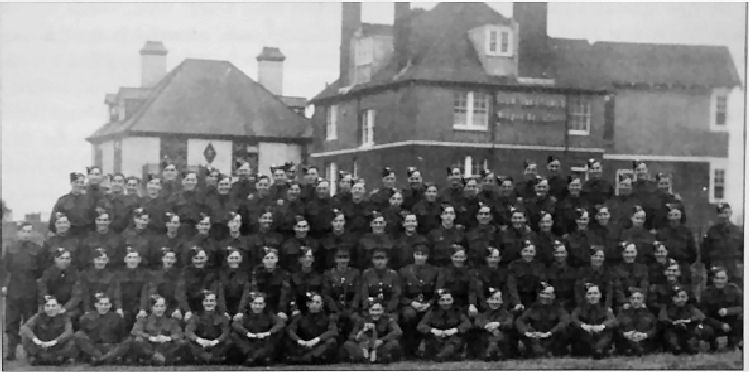
Above photo shows the personnel of 235 Battery at Sandown Castle,
pictured in front of the Sandown Castle Hotel. One of the front rooms of
the pub housed the battery searchlight, says Stuart Kinnon who kindly
sent me this photograph. |
|
From the Dover Mercury, Thursday 27 May, 2010. From Now
and Then.
CAFE TABLES IN THE SHADOW OF TUDOR FORT
A NOW and Then feature earlier this year reminded Mercury readers
about a popular cafe near the remains of Sandown Castle, at the extreme
northern end of Deal.
Dora Riley, from Ethelbert Road, brought in her own photo from the
1960s when she ran the Sandown Cafe with her husband James for a couple
of years.
Mercury reader Laurence Pitcher has now found an old view of part of
the cafe next to the remains of the Tudor fort, showing two men sitting
at tables outside and a child and adult sitting on a wall eating ice
creams. A corner of the cafe with its distinctive tiled roof can just be
seen on the right, surrounded by a crazy paving area. The building has
long gone, probably due to floods in the area.
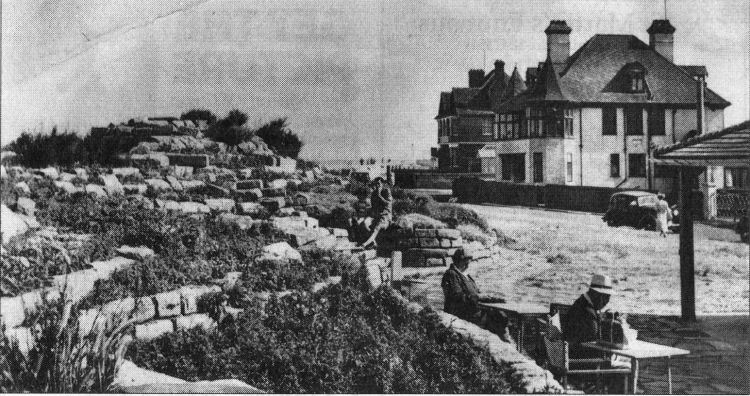
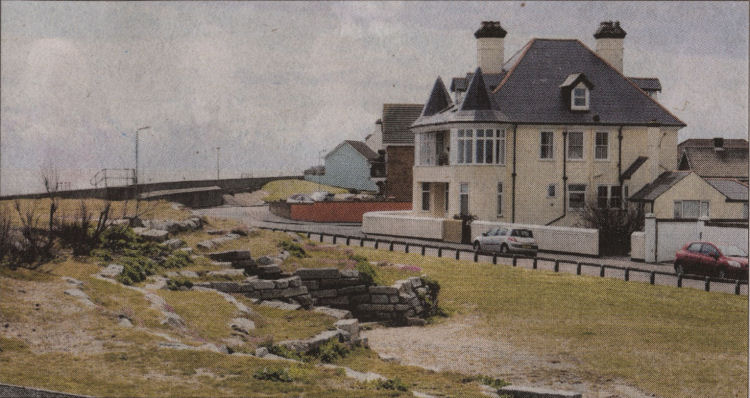
The detached property with its tall chimneys and side turrets, beyond
the parked car in Sandown Road, is still part of the street scene.
In the background of the old picture is the Sandown Castle pub, which
stood in its own grounds. It was empty before finally being demolished
and the land was later used for a housing development.
Sandown Castle was built as a trio of defences in Deal, all
rose-shaped coastal artillery forts constructed during the reign of
Henry VIII against the threat of invasion from Spain.
In all its glory it had cannon on the bastions and was originally
about 500 yards from the seafront.
By the end of the Napoleonic Wars the incoming sea often flooded the
castle until it became uninhabitable. In 1863 it was offered for sale
and the Admiralty decided it should not be totally demolished as its
could be a bulwark against the advancing waves. (It was in this year
that the pub changed name from the "Good
Intent." Paul Skelton.)
The sea eventually won the battle and little now remains of Sandown
Castle, although in the 1960s the rose shape could still be recognised
among the pile of stones.
|
|
From the Dover Mercury, 28 July, 2016.
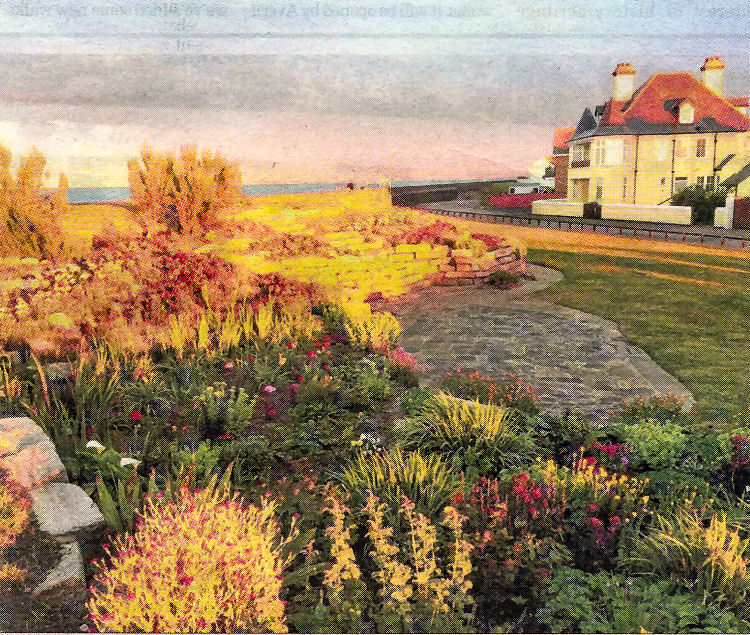
Photo by Linda Ford. |
LICENSEE LIST
HEWITSON Archibald May/1863+
CATTERMOLE 1869-Feb/73
 (age
53 in 1871 (age
53 in 1871 ) )
REDMAN Mr G R Feb/1873+
RAMSDEN George 1874-78+
 
SLADDEN Thomas 1881-82+ (age 40 in 1881)

TANDY John 1899-03+
 
CRANWELL George 1913-34+
  
BURNE Owen T 1938+

HOLLINGWORTH Winston & Marie 1958-Nov/71
BURNELL Walter 1974+
 Charrington & Co
https://pubwiki.co.uk/SandownCastle.shtml
http://www.closedpubs.co.uk/sandowncastle.html
From the Post Office Directory 1874
From the Kelly's Directory 1878
From the Post Office Directory 1882
From the Kelly's Directory 1899
From the Kelly's Directory 1903
From the Post Office Directory 1913
From the Post Office Directory 1922
From the Kelly's Directory 1934
From the Post Office Directory 1938
Library archives 1974
From the Deal Walmer & Sandwich Mercury
Census
|

