|
From the Dover Express and East Kent News, 15 December, 1905.
MURDER AT DEAL. PUBLICAN STABBED BY HIS POTMAN.
FULL REPORT OF INQUEST.
Early on Sunday last, in fact, only fifteen minutes after midnight, a
terrible murder was committed at Deal, the landlord of the "Fountain"
public house, in Beach Street, being stabbed to the heart by his potman
with a knife, causing a wound which severed the aorta and caused death
within two minutes.
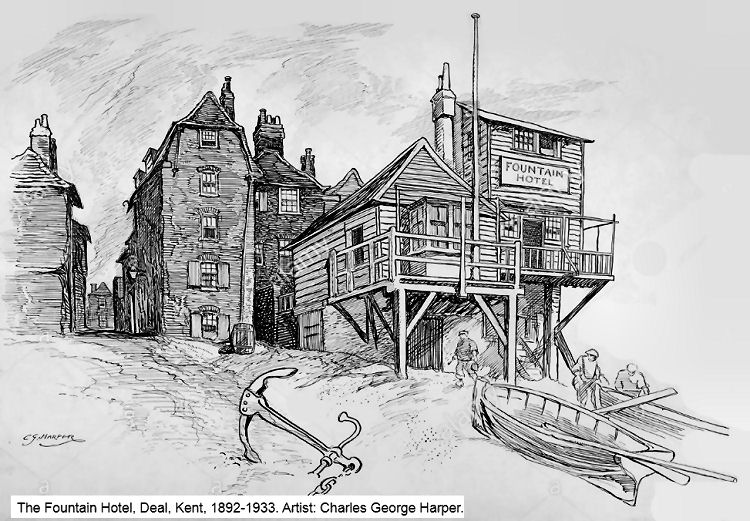
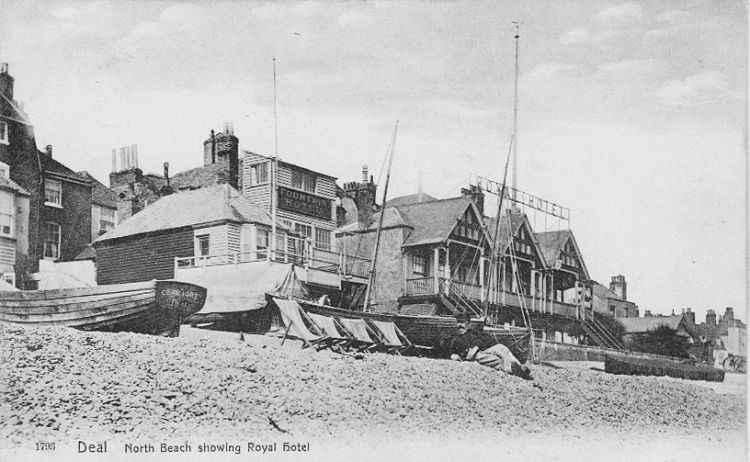
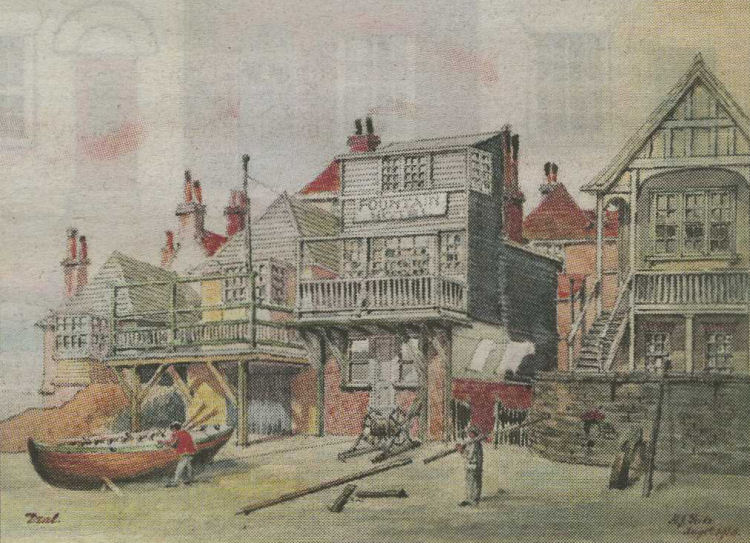
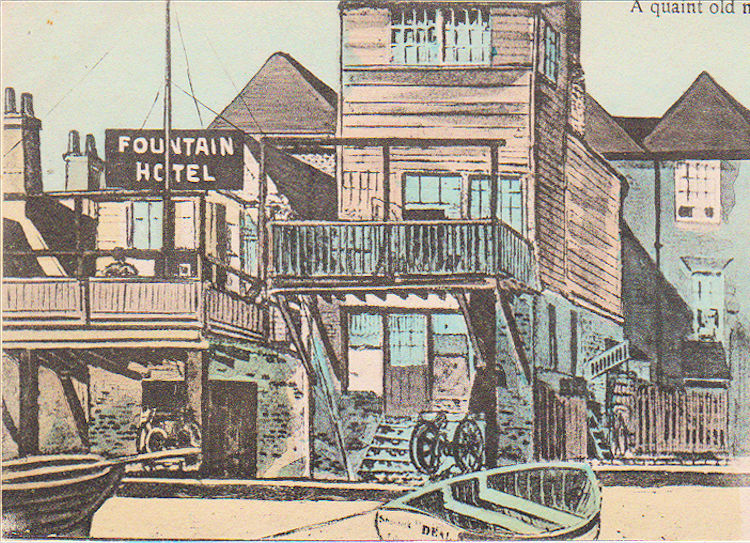
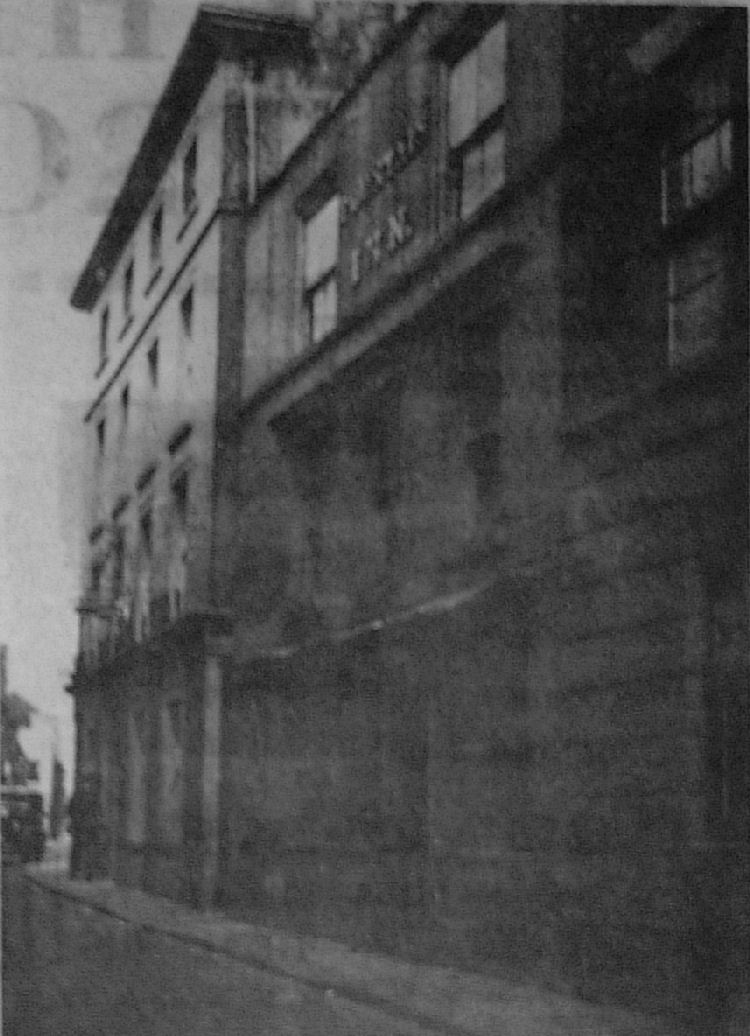
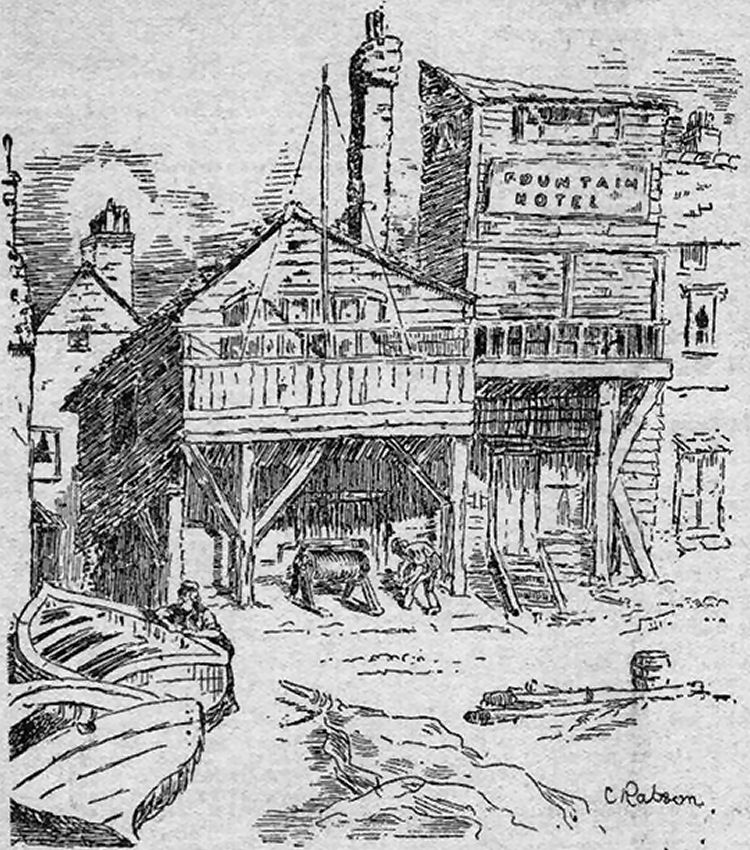
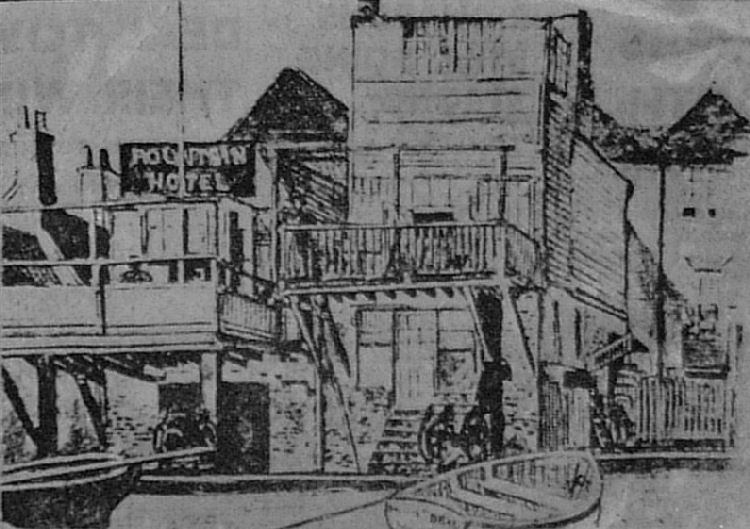
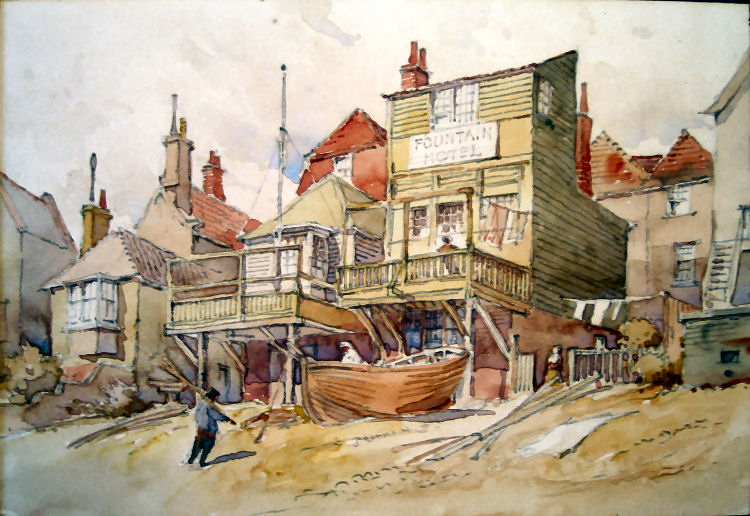
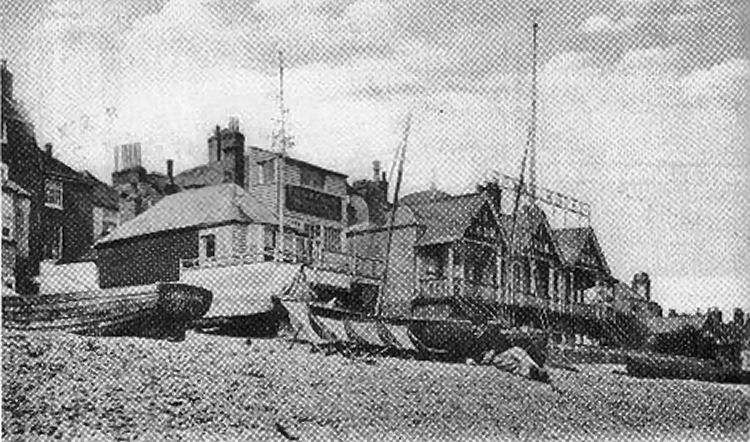
The "Fountain" is a small, old-fashioned public house on the sea side of
Beach Street, the narrow street connecting the main Sea Front with the
two little promenades and North Deal Promenade. The house was taken in
June last by the murdered man, Robert William Pearce, immediately after
his marriage. Pearce was an ex-soldier, and at the tine of his marriage
was living with his father, Mr. R. J. Pearce, a coal and wood dealer, of
Blue Town, Sheerness. He married a young woman who was at the time a
barmaid at the "New Inn," Gravesend, where the
young man who is now under arrest for the
murder of Pearce was employed at that time as a potman. After the
marriage of Mr. and Mrs. Pearce this young man, Percy John Murray, was
engaged by the deceased to act as potman at the "Fountain" public house.
During the inquest on the murdered man, a letter written by Murray to a
mutual friend of all three in the house, disclosed that Murray
considered that the Pearces were not leading a happy life, and that
Pearce was to blame through drink and jealousy. This letter, written a
week before the crime, describes the state of things as "as bad as
ever," referring apparently to the time when the person written to (his
name was only given as “Arthur”) had been at the house. The letter
contains the significant remark that "you will probably hear of
trouble," and expressed a determination to "defend our Hetty."
Meanwhile, Mr. and Mrs. Pearce occupied separate bedrooms. This state of
things ended on Saturday night with a quarrel at bed time, i.e.
midnight, between Pearce and Murray, Pearce accusing the latter of
talking upstairs to Mrs. Pearce, and pointing to a hole in the partition
of Mrs. Pearce’s bedroom immediately facing Murray’s door. Mrs. Pearce,
hearing the quarrel, came out of her room, but was told to go back by
her husband, and she did so. She says that her husband at the same time
went to his bedroom in the front, leaving Murray at the door of his
bedroom at the back. She adds, however, that as she shut the door she
heard Murray say. "If you hit me you are a coward, because you know I
can't fight." If that is so, it points to the two men having renewed the
quarrel, but Mrs. Pearce says that she heard no more.
The minutes that followed are shrouded in mystery. Police Serjeant
Curtis, K.C.C., stationed at Deal, heard a cry of a "Police." On making
a search and finding blood on the doorstep of the "Fountain," he tried
to get in, and failing, rattled the door. Murray opened it, and the
Sergeant at once saw the body of the murdered man lying inside the door.
Murray at once confessed that he had stabbed Pearce, but he has made no
further statement.
How the men got downstairs, whether they were fighting, whether Murray
was chased by Pearce and, picking up the knife, turned and stabbed him,
or whether it was done stealthily by Murray, are all matters that must
remain unsolved, unless Murray chooses to say more than he did at the
moment of his arrest. The investigation on Monday by the Coroner was
completed, and a verdict of Murder returned against Murray. The Police
Court proceedings stand adjourned till Monday.
At Deal, the sensation caused by the crime is profound. It seemed to be
the only topic of conversation on Monday, and all sorts of rumours were
flying about as to the reason of the crime.
In reply to a representative of this paper who visited the scene of the
murder, the widow said that Murray was the last person in the world that
she would have imagined would do such a thing. Till quite recently
Murray had been on good terms with her husband, and they used to play
"darts" together. Latterly, deceased had given Murray blowings up on
several occasions, but there had been no row before this. Murray had
always seemed very quiet and of a rather brooding nature. She could not
imagine how the two came to be downstairs again. She imagined that
Murray must have gone suddenly mad, and she thought it probable that if
she had heard anything and gone downstairs, Murray might have killed her
also.
POLICE COURT PROCEEDINGS.
The opening of the Police Court proceedings took place at the Town Hall,
Deal, on Monday at 11, when in the presence of a crowded Court the
prisoner was brought up and charged with the crime before a full bench
of Magistrates, consisting of the Mayor (Mr. Bayley), in the chair, and
Messrs. Alderman Hayward, Alderman Soloman, G. W. Donne, W. H. Rammell,
Alderman Hayman.
The charge was read by Inspector Heard as follows:-
"Percy John Murray, you stand charged that you, on the night of December
9th, or the morning of the 10th, this year, in the parish of Deal, did
feloniously, wilfully and with malice aforethought, kill and murder one
Robert William Pearce against the peace of our Lord the King, his crown
and dignity.
Superintendent Chaney was in charge of the case for the Police. Mr.
Bruce Payn appeared for the accused.
THE DISCOVERY OF THE CRIME.
Sergeant Curtis, K C.C., stationed at Deal, said: About 12.15 on Sunday,
December 10th. I was on duty in Beach Street, Deal, and when about 150
yards from the "Fountain," which I had passed, and was going southwards,
I heard someone call ‘‘Police, police.” I at once went back in the
direction where the sound came from, but could hear nothing more. I made
a search, and on the front door step of the "Fountain" I saw some blood.
Superintendent Chaney said he believed the prisoner was deaf in one ear,
and asked him
whether he could hear.
The prisoner said he thought he had heard all.
Superintendent Chaney directed witness to stand closer to the dock.
Witness (continuing): I tried the door, and found it fastened. I
knocked, and got no reply for a minute or two, and then the door was
opened by the prisoner. As soon as he did so I turned my light on, and
just inside the door I could see the body of someone lying just inside
the door. I could see on looking further that it was the body of the
landlord of the public house. Mr. Robert William Pearce. He was lying on
his back, in a pool of blood. I said to the prisoner. "What’s the
meaning of this? Did you call for the Police?" He said, "No. but I will
go and ask the missus, who is upstairs." He then went upstairs, and
returned very shortly afterwards with the landlady.
Superintendent Chaney: Did the prisoner do anything?
Witness: Yes, he picked up a knife a few yards from the body, which was
on the floor of the passage.
The knife, which was produced, was a large black-handled kitchen knife,
the blade 7 1/2 inches long. It was ground to a taper from the hilt to
the point.
Witness, continuing, said: The landlady said, "What is it, Percy?" He
said. "I have done it with that knife." I then took him into custody and
brought him to the Station, where he was charged.
Mr. Bruce Payne: Did you caution him first before he said he had done
it?
Superintendent Chaney: He had not been charged. This is all this
witness’s evidence.
Mr. Bruce Payne said he would reserve his cross-examination.
Superintendent Chaney said he was in communication with the Treasury,
and he did not wish to offer any further evidence that day. He therefore
asked for a remand till next Monday, December 18th.
The Mayor said the prisoner would be remanded to Canterbury till next
Monday at 11 o’clock.
Mr. Bruce Payne applied that the money found on the prisoner be handed
over for the purpose of his defence.
Superintendent Chaney said that there might be some objection as he
understood that some of it belonged to the landlady. There was only a
pound belonging to prisoner.
The Mayor said that that question could be dealt with next Monday.
THE INQUEST.
The inquest was opened at 2.30 p.m. on Monday at the Town Hall by Dr.
Hardman, Mr. Chandler being foreman of the Jury. The Coroner then
directed the Jury to view the body in the mortuary, and also to inspect
the scene of the murder at the "Fountain Hotel," so as to more readily
follow the details.
The evidence taken was as follows:—
Robert John Pearce said: I live at 28, Charles Street, Blue Town,
Sheerness. The body at the mortuary is that of my son, Robert William
Pearce, aged 38, a licensed victualler by occupation. I last saw him in
October.
Sergeant Curtis, K.C.C., gave evidence in repetition of that he gave at
the Police Court proceedings. He added that when he passed the
"Fountain" at 12.15 there was a light in the bar, but he heard nothing.
After passing about 150 yards he heard a man’s voice call "Police." He
could not say whether the sound came from the outside or inside a house,
but he should think from the inside. He went back, but could hear
nothing more. There was then no light in the bar of the "Fountain." On
the public bar doorstep of the "Fountain" he saw a quantity of blood. He
tried both front and side doors of the "Fountain" and could not get in,
so he returned to the front door and rattled it hard. Shortly afterwards
a light appeared in the bar, and the barman, Percy John Murray, opened
the door. A man named George William Baker had come up the street, and
he waited, and entered with the witness. Just inside the door he saw the
body of the landlord lying on his back in a pool of blood. And quite
dead. His feet were towards the door. Witness said to Murray. "What is
the meaning of this? Did you call for the Police?" He said, "No, but I
will go upstairs and ask the landlady if she did." He then went
upstairs, and returned a minute or two afterwards, the landlady
following. The deceased had only his shirt and trousers on, no socks or
anything else. The landlady was in a dressing gown. Murray had trousers,
socks and waistcoat, no boots or coat or hat.
CONFESSION OF MURDER BY MURRAY.
What happened when the landlady came down?
Mrs. Pearce said to me. "What is the matter? who is it?" I said, "It’s
your husband lying there dead." Murray turned round into the passage and
picked up the knife produced, and said to me, "Look at this." I said,
"That looks like the knife that has caused his death." Mrs. Pearce then
looked at Murray and said, "What is it, Percy, what is it?" Murray said,
"I have done it with that knife, and shall have to suffer for it. We
have a few words about 12 o'clock. I am done for; it's no use you
worrying yourself.” (He was addressing the landlady in my presence.) I
then sent for Inspector Heard. On his arrival, I told him what had
occurred. I then took charge of the prisoner, and the Inspector made a
search of the premises. Whilst the Inspector was doing that, Murray said
to me. "There’s a letter in a shoemakers blotting pad under the sofa in
the other room which I should like to have." I called out to the
Inspector and told him. Shortly afterwards I brought the prisoner over
to the Police Station. There were no blood stains on Murray’s clothing.
Did Murray make any further statement at the Police Station in your
hearing?
No.
Is the knife nearly as possible in the condition in which it was handed
you?
Yes.
Is the blade marked with bloodstains?
Yes.
The Coroner: What would you call this knife?
Witness: A carving knife.
One of the Jury said it was a chef's kitchen knife.
The Coroner had the blade measured, one of the Jury producing a foot
rule. It measured 7 inches, and tapered to a point.
Inspector Heard said that the blood stains showed on the back best. They
extended for about 5 1/2 inches from the point.
Was Murray excited?
He seemed very excited.
Did you form any opinion as to whether he had been drinking?
I should say not.
One of the Jury said he was a teetotaller.
A Juryman said they noticed that the outside of the door was splashed
with blood when they examined the house.
Witness, in reply to the Coroner, said that the splashes were on the
left side of the door, and on the weatherboard and door jambs. The
splashes were so situated that they would be close to where any person
would have stood in the doorway. He thought the splashes must have got
there when the door was open. When the door was opened by Murray he only
turned the key in the lock, the bolts and latch not being moved.
Would it have been possible to have heard the shout if the door was
shut?
I should say not.
The Coroner: There was blood round the outside of the house?
Yes.
A Juryman: He must have stood there and shouted, and then fell back and
died, and some one shut the door afterwards.
The Coroner: There is a mat between the bloodstains on the step and
where deceased's feet were. Did you notice any mark on the door cill?
Yes, there was a faint mark of a grown persons bare foot.
A Juryman: Were the prisoner Murray’s hands examined?
Witness: There was no blood about the prisoner at all.
George William Baker said: I was passing along Beach Street about 12.30
on Sunday morning, going northwards. I heard nothing before I met
Sergeant Curtis at the door of the "Fountain." He stopped me and said,
"You are George Baker?" I said, "Yes." He said, "I want you as a
witness." The Sergeant showed me the blood outside the door with his
bull’s eye. I waited, and when the door was opened by Murray I went in
with the Sergeant, and I remained till Murray was taken to the Station.
When we got inside I saw a candle unlit on the counter. The only light
came from the Sergeant’s bull's eye. The Sergeant said, "Light the gas,"
and the potman did so. The Sergeant said, "What's the matter here;
what's the bother?" Murray said, "I have done it." The Sergeant asked
who had called for the Police, and the potman went to fetch Mrs. Pearce.
When she came down she asked what was the matter. The prisoner produced
the knife and said, "I have done it with this knife." I went for
Inspector Heard, and went back before he came, and then went for Dr.
Mason. I did not hear all the conversation as I stood on one side.
EVIDENCE OF THE WIDOW.
Mrs. Hetty Pearce said: I am the widow of Robert William Pearce. We
married in June last, not more than six months ago. Before my husband
became a licensed victualler he was working for his father, who was a
coal merchant. He had never had a house before.
Had you any experience in managing a public house before?
Yes sir, all that was necessary. I was in the business some years?
Who lived in the house?
My husband, myself, and Percy Murray; no one else.
On Saturday night, had there been a quarrel or disturbance?
Not till the time I went to bed.
What time did you go to bed?
Just a little before 12.
Did you sleep alone?
I have done for over a fortnight.
You have not occupied the same room as your husband for over a
fortnight?
Yes.
Your room was the first on the left?
Yes, at the back. It is marked "Private."
Your husband's room, was his in the front?
Yes, it was in the right, on the other side of the sitting room.
Was Murry's again on the left, but beyond yours?
Yes, down through the passage.
Had you undressed before you heard anything?
I heard Bob go through the passage to Murray's room, and I heard them
talking. Murray came up first about five or ten minutes before I did. I
sat talking a little time to my husband. A few minutes after I came up
my husband came up. He went straight through the passage to Murray’s
room, without going to his own. I could hear because he had his shoes
on.
You heard someone talking. What did you hear?
When I heard them talking loudly I opened the door and went into the
passage. I had not begun to undress. I could not hear what they said at
first, but it got louder.
Did you think they were quarrelling?
Yes.
What was the first thing you heard?
My husband said he thought he heard some talking upstairs. He shouted
this as I came out. I said, "There’s been no talking up here. You must
be mistaken." I said this as I came through the passage to them.
Your husband meant you were talking, didn’t he?
I did not stop to think; I said, "You must be mistaken."
What happened then?
He pointed to a small hole in the wall in the passage. He was not
talking to me then.
What did he say?
He was talking quickly and said a lot. He wanted to know the meaning of
the hole.
Was this a small hole in the wooden partition that formed one side of
your bedroom and the other side of the hole is into a passage nearly
opposite Murray’s door?
Yes, I said I had noticed it before.
Was there a light in your room?
Yes, or else the hole would not have been visible. I first noticed the
hole two months ago.
What else was said?
My husband pushed me away and told me to go to my own room as it was not
my business, and nothing to do with me. As I turned to go he said. "You
can clear out of this (meaning the house) to-morrow morning." He meant
Murray. My husband went on, "I have had enough of this." I said to
Murray also, "Yes, go to-morrow morning." I also have had enough of
this."
Did Murray say anything?
I did not hear anything. I went into my room then.
Did the conversation continue after you went into your room?
I don't think so. Bob went into the sitting room, closing the door after
him. He had the cash box in one hand and the candle in the other as he
spoke.
You think that was all that was said?
As I went into my room the last words I heard were from Murray, "If you
hit me now, Bob, you are a coward; I can t fight." I can't say exactly
that they were the words. I heard no more except the door closing.
Did you hear anything of Murray?
No, he was nearer to his room.
What was the next thing?
I heard nothing more for a long time till I was just getting into bed.
Once I thought I heard some voices. Then I thought it might be Faney, or
someone outside.
Just as you were about to got into bed, what did you hear?
A knock or tap on my door. I put on my dressing gown and said, "Who is
it?" I did not hear any answer, so I opened the door because I thought
it was Bob.
Who was there?
Percy. I said, "What are you here for? What do you want?" He said, "Give
me that sovereign that belongs to me which you have had of mine." I
said. Go away, don’t stop here; if Bob sees you he will kill you." He
said, "Well, then, give me my sovereign." I put my hand up and got my
purse, which was on the chest of drawers, and gave it to him, and said,
"Oh take it, be off; it's in there." I wanted him to go as I was afraid
Daddy would come.
Did he take it.?
Yes, took it, and as I was trying to close the door he pushed it open
with his foot, and said, "I have done it. Did you shout out Police?" I
could not make out what he meant, he looked so strange. I felt
frightened, he looked so funny. Then he turned to go, so I put my
slippers on and followed him downstairs.
Had you a candle?
The gas was lit in my room; I always have it.
What was the first thing you noticed?
The Police Sergeant standing close to the door.
Was anything said?
I looked round wondering where Bob was. I saw the Sergeant and Percy
there, and said, "What's the matter? Where's Bob?" Then Percy moved, and
I saw Bob lying on the ground. I asked what was the matter. Someone
said, "There he is, dead." I looked at Percy, and knowing they had
quarrelled, and seeing how he looked, I knew he had done it. He said, "I
did it, and I shall suffer for it."
The inquest at this stage, 5 p.m., was adjourned till 6 p.m., whilst the
Jury went to tea.
After the adjournment, the examination of Mrs. Pearce was continued. She
said she could scarcely remember anything after this, as it all seemed
blurred to her mind. She saw the knife picked up, but she did not
remember who did so. Everyone kept asking questions, including Inspector
Heard and the doctor, but she could not remember what they were. She
took them to show them where the knife box was. She know the knife
produced as one she had used many a time. It was left with another like
it at their house by a cook. They were kept in the knife box with other
knives, on the end of the dresser. Percy always cleaned the knives. She
could not remember using those knives for the last day or two. The knife
was used for carving.
Whichever way you go you have to go down steps into the kitchen?
Yes.
Whilst witness was giving this portion of her evidence, prisoner broke
into convulsive sobbing, which lasted for some minutes.
A STRANGE LETTER BY MURRAY.
The Coroner then asked Inspector Heard for the letter found in the
blotting pad, which he handed to the witness and asked whose handwriting
it was?
Percy's.
How do you know?
I have received letters lots of times, and so has my husband, from him.
Had Percy a friend named Arthur?
Yes; he is a friend also of mine and my husbands. He stayed with us in
the summer.
Did you know Percy had written a letter to Arthur?
Yes.
How did you know?
I asked him, and he said he had partly done it.
When was this?
Last Saturday week; I can’t say exactly.
Did he show it you?
I looked at it, but I did not read it. He told me what it contained.
Do you believe it was the letter you have just seen?
I know it was.
Was there any further conversation about it?
I told him he was not to send it if he mentioned our affairs in it. He
said, "Oh, all right."
The Coroner: I will read the portion of the letter. It is:-
The Fountain, Beach Street,
Deal, Dec. 4. 1905.
Dear Arthur.— I hear from a reliable source tonight that there is likely
to be trouble. I think it would be best to avoid it, so I have found
courage to write to you.
Well, old boy, your opinion of me now must be at about the lowest. I
can't give proper exotics now, Arthur, but I must wait until such times
as we are together to settle these minor accounts. I am sorry to say,
dear Arthur, that things down here are as bad as ever, and if something
does not soon turn up, you may possibly hear of trouble.
I am not writing in this strain for fun, but it is only too true. Dear
Hetty is about broken down, and drink and jealousy are the two chief
causes. On Friday evening, or rather about 1 a.m., Hetty came home from
a dance. Bob grot drunk and went to meet her. She evidently thought he
had had enough. She asked me what I would have, and got one for herself,
and then he "started." Believe me, Arthur, he raved like a maniac,
cursing and swearing, and I made sure he would have would have killed
her. He made to strike her, but dropped his band. Thank God he did. I am
not a man capable of fighting
him, but I would defend our Hetty——
Here the letter stopped.
The Coroner: Had you been living on good terms with your husband?
Until very lately, sir.
What was the cause of any differences that may have arisen?
Things were going rather bad in the place, and sometimes we got
irritable one with another.
Do you mean trade?
Yes.
THE QUESTION OF JEALOUSY OR DRINK.
You heard what was stated in the letter. Two things were mentioned, one
was drink and the other was jealousy. Was your husband given to
drinking?
Only sometimes.
Did he take more recently than he was accustomed to?
When we first came to the house he used to take hardly anything, but he
may have taken a little too much lately.
Did you say that you took more?
No; I don't take much.
Did drink make his disposition more irritable?
I think it was not doing much trade more than anything else.
Was your husband jealous of Murray?
I don’t think so; not until quite recently—that is—he seemed to be at
times.
Did he object to your going out at nights?
I did not go out except on Fridays, that was the only time unless to
shop, and that not often.
Was your husband's conversation with Murray on Saturday night caused by
jealousy?
I don’t think so. We had been on such good terms all the evening and the
day previous.
To what reason did you put down your husbands conversation on Saturday
night?
He thought he heard me talking upstairs. I was very much surprised.
Was not that jealousy. He thought you were upstairs talking to Murray?
Yes.
How long have you known Murray?
Since last June twelve months. He came to work at the same place where I
was.
Were you acquainted with Murray before you know your husband?
No.
Did your husband know Murray before you were married?
Yes. I introduced him the first time he came over.
You have known Murray 18 months through both working at the same place?
When did Murray come to you at the "Fountain"?
About a fortnight after we came.
In what capacity?
As potman. He helped all over the place.
He got on with your husband until quite recently?
They were always friends together until very recently.
When did Arthur stay at your house?
About two months ago from a Saturday till Wednesday.
It is two months since Arthur had been in the house, and the letter said
"Things are as bad as ever." Do you say things were right then?
There had always been little differences, but not quite so much as now.
Had you some of Murray’s money?
A sovereign that he drew from the Bank to buy a present for his sister,
but Bob said he would be silly, as he would want the money at Christmas
to be like other people.
Did Murray and your husband ever come to blows?
No, my husband always seemed to treat Percy as a boy, and my husband
would not hit a boy.
Did you know his age?
We used to tease him about being a boy, and he said he would be a man in
July—that is, he would be 21.
Did you wish Murray to leave the house?
No, he seemed to do so much for us. Once before I said he was to leave,
but Bob said, "Talk it over again." Bob used to pay him. He hired him,
not me.
Did you think it better Murray should go owing to the disturbance?
Yes, I did at last.
You thought that things would be better?
Bob used to think so much of him. He used to smooth things over at
first, but not so much lately.
In reply to the Coroner, witness said Murray was abstemious. He did not
take much drink. She had never seen him the worse for drink since he had
been at Deal. On Saturday night Murray was sober, as far as she knew.
The Foreman said the Jury could not understand how it was that witness
heard no noise, whilst the sergeant heard the cry of "Police!" 150 yards
away.
The Coroner: Did you hear any noise?
Witness: I don’t think so, or I should have gone down. I once thought I
heard a noise, and then I thought that it was nothing.
The Foreman said the letter read referred to a ball. Where was that, and
did her husband
go to it?
Witness said that she went to the Sergeants' dance at the Depot. The
invitation came for both her husband and her. She went at 9 and her
husband was coming at 10. She had been to four dances, but her husband
had been at each.
Inspector C. A. Heard, Kent County Constabulary, at Deal, said: I was
called about 12.45 on Sunday morning by the witness Baker to the
"Fountain Hotel," Beach Street. On arriving there I saw a large quantity
of blood on the doorstep leading to the bar, and just inside the door
was the body of deceased, in a pool of blood, on the floor. Mrs. Pearce,
Murray, Sergeant Curtis, and witness Baker were all in the bar. Deceased
was only dressed in trousers, cotton tennis shirt, and flannel
undershirt. His feet were bare, and both covered with blood. Sergeant
Curtis having told me about the affair, I at once searched the prisoner.
In his pocket was the purse produced, containing £1 4s. 11d., also a
knife, a pencil in a case, some studs and sleeve links, and also a small
photo of the witness Hetty Pearce. I said to the witness Hetty Pearce,
"I want you to account to me for the movements of persons in the house
since closing time, and I will take it down." She stated: "About a
quarter to 12, I went to my bedroom. My husband and myself have been on
bad terms. About three minutes later my husband came upstairs and
shouted in the passage. "What’s all that talking about?" I then opened
my bedroom door and said, "There is not any talking here." My husband
then went along to Percy's room. I then came on to the landing. He said,
"You go back to bed." I went back to bed, and afterwards heard some
talking. Percy then came up and said, "here is my money, you have a
sovereign of mine?" I then opened my door, and Percy put one foot inside
the door. I then handed him my purse and said. "There’s your money."
Percy said, "I have done it; the police are downstairs. Did you shout
out of the window?" I said, "What's up then?" and came downstairs, and found the policeman there, and my husband lying on
the floor." When Mrs. Pearce finished, prisoner said, "I did it."
Sergeant Curtis then took charge of the prisoner, and I examined the
premises and deceased.
DESCRIPTION OF THE WOUND.
On the top of deceased's left breast, about two inches below the collar
bone, was a clean cut wound about an inch in length and perpendicular in
its shape. The two shirts deceased had on were saturated with blood, and
there were two clean cuts through the left side of the shirts
corresponding with the wound on the shoulder.
I took some measurements. The deceased’s feet were 23 inches from the
door. You had to move the right foot slightly to open the door. The head
was resting in a spittoon which was touching the counter. From the front
door to deceased there was a mat partly under his feet, and blood had
trickled from the doorstop to where deceased was lying—four or five
trickles as if it had dropped off something. There were four or five
patches of blood in different places till within six feet of the bottom
of the stairs. On the door at the bottom of the stairs, between the
passage and some part of the bar, there were splashes of blood from the
floor to about 18 inches upwards. There were also several small splashes
between these and the bottom of the stairs, some six feet high.
Did you find any trace of blood beyond this part towards the stairs?
That was the furthest point. Sergeant Curtis had previously pointed out
to me where the knife was found. From where the body was lying to there
was twelve feet distant. Sergeant Curtis, who was in charge of Murray,
told me that prisoner stated that there was a letter in a pad under the
sofa in a room behind the bar, and in a blotting pad was the letter that
was previously produced. I went through the whole of the place, and
failed to find the place disarranged in any way. There was no appearance
of a struggle having taken place. I also took possession of other
letters I found in a room upstairs, said to be occupied by Murray. There
were several letters and picture postcards, some received from witness
Pearce and also from her husband. I also produce a letter prisoner
received today. I afterwards went to the station, where I cautioned
prisoner, and charged him with the murder of deceased. He made no reply.
In reply to the Coroner, Mr. Bruce Payne said prisoner did not intend to
give evidence.
Dr. Mason, of Deal, said that he was called at 1.06 a.m. on Sunday, and
arrived at the "Fountain" at 11 minutes past one. Deceased was lying
inside the door in a pool of blood, as described. His left hand was
covered with dry bloodstains, and the soles and backs of both feet
covered in blood, and the soles with a small amount of dust mingled with
the blood. The right hand was clean except for a bloodstain on one of
the fingers, due to lying in a pool of blood. There was a wound in the
chest. The vest and shirt were saturated with blood and cut with a mark
corresponding to the wound beneath them. There was a small splash of
blood on the front of the chin. Witness made a post mortem on Sunday
afternoon with Dr. Hunt. The body was that of a strong man about 5ft.
5in. high. On the left side of the chest was a clean cut gaping wound
about one inch in length, the centre being situated two inches below the
junction between the collar bone and the breast bone. It was 2 1/2
inches from the middle line of the body. Passing a probe down the wound,
it went for a distance of five inches in a direction downwards and
inwards towards the middle line of the body. The wound passed through
the muscles on the front of the chest, the space between the second and
third ribs, divided the third rib, and went partly into the space
between the third and fourth ribs. On deeper dissection the wound was
found to pierce the anterior edge of the left lung, the lining of the
heart, the left auricular cavity of the heart, the junction of the
aorta—the largest body coming from the heart—and the left ventricle. The
rupture of the aorta would cause bleeding from which death would ensue
very quickly. The wound might have been caused with the knife produced,
and he considered considerable force must have been used. If a
right-handed man stabbed another, he should expect the stab to be on the
left side. There was no possibility of a wound like this being
self-inflicted.
Do you think this wound was caused by a person standing on the same
level, or by one standing higher or lower?
It might have been either higher or on the same level.
Would it have been possible for a person being wounded in this way to
have gone from the foot of the stairs to the door and called for the
Police?
Yes, I don’t think he could have called very loud.
Would the wound cause a person to bleed to death in a few minutes?
Yes, I could almost say in one minute or two minutes at most. The actual
cause of death would be haemorrhage from the wound.
In reply to the Coroner, witness said that the mortuary at Deal had
neither proper water supply, lighting, nor a proper table.
The Coroner said that perhaps the Committee were considering the
improvement of the building.
The Jury asked whether the doctor found from his post mortem if the
organs showed if deceased was addicted to drink?
Witness: No, the organs were perfectly healthy.
Dr. Hunt, of Deal, corroborated the medical evidence.
CORONER S SUMMING UP.
The Coroner, in summing up, said that the Jury had been occupied
something like five hours in listening in great detail to the evidence
of the case, but as there were not two stories or two theories for them
to consider, it would not be necessary for him to deal with it at
length. It appeared that in June last Mr. and Mrs. Pearce took the
"Fountain" at Deal. They were previously acquainted with Murray, who
came a fortnight later to act as barman and render general assistance,
and he had remained since that time. From the evidence of the wife,
there appeared to have been little disagreements, but they must take it
that nothing actually wrong occurred till recently, although the state
of things existing in the house for two months past had not been a
comfortable state of things, as was shown by the reference in the letter
to the person “Arthur.” It was no duty of the Jury however, to apportion
moral blame in this matter. They had simply to consider the cause of
death. Whether all or any of the parties have done what they ought not
to according to moral law was not a matter which concerned the Jury’s
attention or his except so far as the cause of death was concerned. It
seemed that matters between Mr. and Mrs. Pearce had arrived at such a
state that 14 days previously they had occupied different rooms. Mrs.
Pearce accounted for the difference because the business was small, but
that did not appear to be a cause which would be likely to lead to an
issue of life or death. There were suggestions that deceased had been
drinking more of late, but that was not borne out by the evidence of the
doctor or the statement of the wife. There remained the question of
jealousy. It was not for them to say whether or not the jealousy which
existed on the part of the deceased was well founded. He had refrained
from asking Mrs. Pearce any question which would tend to throw doubt
upon her fidelity to her husband, and he would be the last to suggest
anything of a blameworthy character in her conduct. It was not their
business—they had not enquired into it. They did not know, and could not
say. The fact of importance was that there was jealousy, and that there
was a strong feeling on the part of Percy Murray which was right, and
which was wrong, or whether both were wrong, was not of great importance
as regards that enquiry. After the incidents recounted by Mrs. Pearce as
to the loud talk in the passage, there was no distinct evidence as to
the movements of the deceased and Murray in the few crucial minutes that
followed this interview. There was a quarrel, and the husband appeared
to have gone back to his room. The potman was not wearing boots, nor was
the husband, and would not make much noise in walking about the house
after Mrs. Pearce's door was closed. It was not clear in what order
these two men got downstairs, where they were next seen. The knife was
kept in the kitchen, and both men would know where it was. It was hard
to draw an inference from the actual facts. It could hardly be that the
deceased man went downstairs first, and that the potman followed him.
The tragedy seemed to have occurred at the foot of the stairs. It
appeared to be clear from the blood stains that it was there that the
deceased received his death wound. The Doctor had said that although the
wound was of such a deadly character that it would cause death in a
minute or two, it would still be possible for the deceased to have gone
to the front door and called for the police and then to have fallen back
and died. The evidence of the Sergeant was that when he went by the
house first there was a light in the bar, and that when he returned
after hearing the cry of "Police," that the light was out. A curious
thing about the conduct of the potman was that when he went up to tell
Mrs. Pearce that the Police had come, he asked her for the sovereign,
and also asked her if she had called for the Police through the window.
In concluding the Coroner pointed out that the Jury would have no
difficulty as to their decision, as Murray had said he did it, and set
up no defence or explanation such as that the wound occurred in a
struggle, or was done in self defence. Murray, however, had repeated
several times the declaration that, he did it, and must suffer for it,
and therefore there should be little doubt, to cause the Jury trouble.
He also pointed out that they could not return any other verdict than
murder, as there could be no question of manslaughter under the evidence
before them.
The Jury then retired, and after an absence of about a quarter of an
hour, the Foreman returned and said: We find the prisoner guilty of
murder—that is to say, we find that deceased met his death by the hand
of Percy George Murray, being stabbed, and therefore we bring in a
verdict of "Wilful murder."
|




 alehouse


 )
)


