|
4 Radnor Street
Folkestone
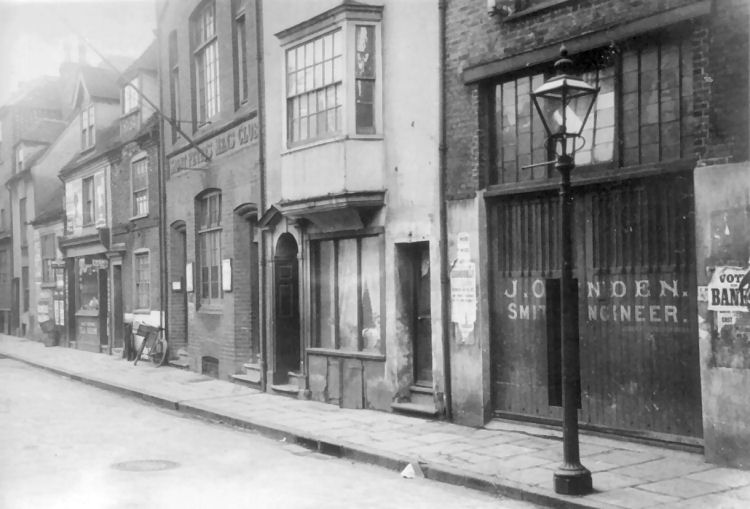
Above photo showing former "Tramway Tavern", centre of picture, 1928, by Martin Easdown. |
|
Maidstone Gazette 12 September 1848
Thursday – Licensing day; Before the Mayor and a full Bench of
Magistrates.
All the old licenses were renewed without opposition, and the
following new ones granted: William Larkins, late of the Old
Shakespeare, corner of Shellons Lane, for the New Shakespeare, Grace
Hill; Edward Iverson, Tramway Tavern, Radnor Street; Peter Wm. Foord,
New Inn, Mill Lane.
Notes: Tramway Tavern and New Inn transfers are later date. New
Shakespeare is a previously unknown house.
|
|
Canterbury Journal 26 July 1851.
On Saturday morning a boy, 12 years of age, belonging to one of the
colliers in the harbour, was getting ashore by means of a punt
fastened to the harbour, and in climbing the chain fastened to the
rocks, he slipped and fell on the boat's side, breaking his arm and
two or three ribs, and receiving other serious injuries. He was
conveyed to the Tramway Arms Inn, Radnor Street, where he now
remains. It was said to be his first voyage in a vessel, and he was
unused to climb.
|
|
Kentish Independent 26 July 1851.
On Sunday morning last a young lad, twelve years of age, belonging
to one of the colliers in the harbour, was getting ashore by means
of a punt fastened to the harbour, and in climbing the chain
fastened to the rocks, he slipped and fell on the boat's side,
breaking his arm and two or three ribs, and receiving other serious
injuries. He was conveyed to the "Tramway Arms Inn," Radnor Street,
where he now remains. It was said to be his first voyage in a
vessel, and he was unused to climb.
|
|
Dover Chronicle 26 July 1851.
On Sunday morning last a young lad, 12 years of age, belonging to
one of the colliers in the harbour, was getting ashore by means of a
punt fastened to the harbour, and in climbing the chain fastened to
the rocks, he slipped and fell on the boat's side, breaking his arm
and two or three ribs, and receiving other serious injuries. He was
conveyed to the "Tramway Arms Inn," Radnor Street, where he now
remains. It was said to be his first voyage in a vessel, and he was
unused to climb.
|
|
Kentish Gazette, 29 July 1851.
Folkestone. Serious accident.
On Sunday morning last, a young lad, 12 years of age, belonging to one
of the colliers in the harbour, was getting ashore by means of a punt
fastened to the harbour, and in climbing the chain fastened to the
rocks, he slipped and fell on the boat-side, breaking his arm and two or
three ribs, and receiving other serious injuries. He was conveyed to the
"Tramway Arms Inn" Radnor Street, where he remains. It was said to be
his first voyage in a vessel, and he was unused to climbing.
|
|
Dover Chronicle 13 September 1851.
On Thursday an accident occurred here, by which a poor man has got
his leg broken in two places below the knee. It appears that the
person injured is in the employ of Mr. Kingsford, brewer, Buckland.
He was descending towards the harbour by the tram road in a small
wagon drawn by one horse, and on the engine passing, the animal
plunged, by some means unskidded the wheel, and started off at an
alarming pace, until stopped by running against the Royal George,
upsetting the wagon, and breaking the shaft and the poor man's leg.
The sufferer was instantly removed to the house known as the "Tramway
Tavern," in Radnor Street, where the fracture was reduced by Mr.
Bateman, sen., and there is every prospect of his going on well.
Although there was a great number of people passing to and fro at
the time, fortunately no person but the driver was hurt.
|
|
Kentish Gazette, 23 September 1851.
Folkestone. Serious Accident.
On Thursday last as a drayman, named John Wills, in the employ of
Messrs. Kingsford and Co., brewers, of Buckland, was proceeding down
Dover-street with his dray, the horse suddenly started, throwing a
barrel of beer on to the driver, which broke his left leg, and inflicted
other injuries, he was immediately conveyed to the "Tramway Tavern," and
attended by Mr. Bateman, surgeon, of this town.
|
|
Folkestone Chronicle 21 February 1857.
Local News.
The adjourned meeting of the boot and shoe trade of this town was held
at the "Tramway Tavern" on Tuesday evening last, when the following
resolutions were unanimously agreed to:- 1st, that an average advance of
10 to 17½ percent be at once made; 2nd, that this meeting deem it
advisable not to follow the example of the trade in other towns, namely,
that of advancing their prices 25 to 30 percent, but that to transact
business at so low a rate for ready money would be much more beneficial
to the public at large than to charge 15 percent more and give credit;
3rd, that this meeting views with abhorrence the present ruinous 12
month credit system, and that each person present pledges himself to use
his utmost endeavours towards totally eradicating such a destructive
system from the boot and shoe trade of Folkestone. Arrangements were
made for a monthly meeting, the object of which is to promote a friendly
feeling, and the interests of this trade in the town and neighbourhood.
The meeting was numerously attended, and the greatest unanimity
prevailed.
|
|
Folkestone Chronicle, 14 June 1862.
Saturday June 7th:- Before James Tolputt and A .M. Leith esqs.
Temporary authority was given to Thomazine Cope to sell excisable liquor
at the "Tramway Tavern."
|
|
Folkestone Chronicle 19 July 1862.
Petty Sessions, Wednesday July 16th: Before W.F. Browell, W.
Wightwick, and A.M. Leith Esqs.
George Stewart and Edmond Bryan, two privates of the 96th Regiment,
were placed in the dock, charged with violently assaulting and
feloniously stealing from George Parker, the following articles: One
pair of boots, one knife, one handkerchief, one glove, one cap, and
two shillings and seven pence, in the borough of Folkestone, on the
15th July.
George Parker, sworn, deposed he was a moulder, residing in Shellons
Terrace; he was a private in the 5th Cinque Ports Rifle Volunteers,
and a member of the band. On Monday last he had been to Dover to
drill; on his return he went down street, and fell in with the two
prisoners about a quarter to 12. Witness was then in uniform; they
went into the Tramway Tavern to have some refreshment; about one
o'clock on Tuesday morning they all left the house, and met P.C.
Reynolds, who advised witness to go home. Witness said he would,
when the prisoner Edmond Bryan came back and asked witness to show
him the nearest way to the Camp; witness said he was going that way
and would show them; they all then started up the street, and along
Shellons Terrace towards the Camp. Witness stopped at his own door
to go in, when the prisoners persuaded him to go on, saying they did
not know the way; witness consented to go as far as Coolinge Farm.
About halfway between Ingles Farm and Coolinge Bridge witness said
to the prisoner Bryan “I shall go back now”, and wished him good
night; he said “No, you won't go back yet”, and took hold of the
collar of witness' tunic, and commenced pulling him down. Witness
asked him what he was about, and said “Let go.” Prisoner answered
“Oh, it's all right.” The prisoner Bryan threw witness down several
times, and then the prisoner Stewart caught witness by the leg and
laid him on the ground, and the prisoner Bryan sat on his chest.
Stewart commenced to pull off witness's boots; they then both knelt
on witness, when one of them put his hand in witness's pocket and
took out a knife and two shillings in silver and seven pence in
copper; they then turned witness over, and took a handkerchief out
of the pocket of his tunic, and also one kid glove; they then opened
his pouch to see if there was anything in it. They then got up and
left witness, taking with them the whole of the things, with his
boots and forage cap. Witness shouted “Murder” and an Artilleryman
came up, but the prisoners were gone. Witness then went to the Camp,
and enquired at the main guard, and from there to the guard-room of
the 96th Regiment. Soon after, the two prisoners came in; witness
identified them, and the men were searched. During the struggle
witness's wrist was cut and bled a good deal, and his face scratched
whilst on the ground. The volunteer cap and pocket handkerchief
produced by Sergt. Smith, K.C.C., were identified by the witness as
those stolen from him. Witness had been drinking, but was sober
enough to know what he was about.
Robert Gurney, sworn, deposed he was a sergeant in the 96th, now
stationed at Shorncliffe. He was Sergeant of the Barrack Guard of
the Regiment. On the night of Monday last the two prisoners were on
leave on pass; about three o'clock on Tuesday morning they came into
the guard room and left their passes. About an hour after, the last
witness came into the guard room and said that two men of the 96th
Regiment had robbed him. Witness had a suspicion of the two
prisoners, and sent for them; they were brought to the guard room,
where, as soon as the prosecutor saw them, he recognised them; they
were then searched, and on the person of Bryan a pocket handkerchief
was found, which the last witness at once identified. The prisoner
Bryan said it was his own. The prosecutor was sober when he came in,
and gave such a description of the prisoners that the witness was
satisfied they were the men who had robbed him. Stewart's trousers
were covered with mud, as if he had been struggling with someone.
Bryan's boots and tunic, and the lower part of his trousers were
very dirty The prisoners had passes till 12 o'clock on Monday night;
they did not come in before two o'clock on Tuesday morning to leave
their passes.
James Ellis Smith, Sergeant in the Kent County Constabulary, sworn,
deposed that yesterday afternoon he went to Mr. Kingsnorth's
wheatfield, in company with Police Constable Reynolds. He saw marks
where the scuffle had taken place, with one or two spots of blood.
Witness then came to the Station and spoke to the prisoner Stewart,
saying he should like to find the cap and boots. Stewart, in answer,
said he knew nothing of the boots, but the cap might perhaps be
found near the spot where they scuffled. Witness returned to the
spot and searched again, and found the cap about four yards from the
spot; it was in the wheat. Witness produced the cap, which
prosecutor identified as the one he had lost.
Police Constable Reynolds deposed that yesterday morning, about half
past twelve o'clock, he was passing the Tramway Tavern, in Radnor
Street; stopped, and looked in the passage, and saw the two
prisoners in company with Parker; they were drinking at the bar.
About May minutes to one he saw them again; they then went in the
direction of the High Street; was quite positive the prisoners were
the two men.
The prisoners then both made a short statement denying all knowledge
of the robbery, and saying that they returned to the Camp on the
night in question by the main road, and not by the fields. They were
then both committed to take their trial for highway robbery with
violence at the next Maidstone Assizes.
The prosecutor and witnesses were bound over to appear and give
evidence.
|
|
Folkestone Observer 19 July 1862.
Soldiers Robbing A Volunteer.
Wednesday July 16th:- Before W.F. Browell, A.M. Leith and W. Wightwick
Esqs.
George Stewart and Edmond Brian, privates of the 96th Regiment now at
Shorncliffe were charged with violently assaulting George Parker, and
feloniously stealing certain articles from his person.
George Parker, moulder, and living in Shellons Terrace, Folkestone,
private in the band of the 5th Cinque Ports Volunteer Rifles, had been
to Dover on Tuesday last to drill, and having left his rifle and bayonet
at the armoury, walked about, and fell in with the prisoners near the
tramroad arch. He was himself in uniform. It was about half past 11 that
he was at the railway arch. The prisoners accosted him, saying “Hello,
comrade, how are you getting on? Are you going to have anything to
drink?” Witness said “I don't mind”. They then went into the "Tramway
Tavern." About 1 o'clock they all left the tavern together. They then
went along to Radnor Street, where they met P.C. Reynolds, who called
witness by name, and said the best thing he could do was to go home.
Witness said he would do so, and started for home. He was then not
drunk, though he had had a good drop of liquor. Brian came after him,
and asked witness to wait a bit until he had found his chum, and he
would go with him. He wanted witness to show him the nearest way to
camp. After a while they all started up the town, and when they got to
witness's lodgings he was going in, but they persuaded him, and he said
he would go with them to Coolinge Farm. When they had got about halfway
between Mr. Kingsnorth's Farm and Coolinge Farm, in the cart road
through the fields, he said to Brian “I shall go back now” and wished
him goodnight. Brian said persuadingly, “No, you shall not go back yet”,
and at the same time put his hand on his (witness's) tunic and commenced
pulling him down. Witness said “What are you up to? Leave go”, but he
did not leave go, and said “Oh, all right”. Witness tussled with him,
trying to get away, but was thrown down two or three times. At last
Stewart got hold of his legs, and then both prisoners laid him on the
ground, among the wheat, and Brian sat on his chest. Stewart then pulled
witness's boots off, and both knelt on him, and rifled his trousers
pockets, and took a knife and 2s. 7d. They then turned him over on his
stomach, and took from his tunic pocket a handkerchief and a kid glove.
They kept turning him about seeking for something else. They also opened
his pouch. Then they got up and left him, taking with them the things
they had taken from him. They also picked up his uniform cap, and
carried it away. After they had left he shouted “Murder!”, on which an
artilleryman came up. Witness looked about with the artilleryman for his
boots and other things, and then on the advice of the artilleryman he
went on with him to the camp, to the guardroom of the 96th Regiment.
While he was waiting at the guardroom for the sergeant-major the two
prisoners came in. He told the sergeant of the guard that the two men
newly arrived were the men who had robbed him. The sergeant then
searched them. During the struggle with the prisoners among the wheat
his wrist received a severe cut, and his face was also injured while on
the ground. Witness identified a volunteer cap and handkerchief
produced, which was all that had been found.
Robert Gurney, sergeant, 96th Foot, was on duty as sergeant of the
barrack guard on the night of Monday last, when the two prisoners were
on pass. They came into the guardroom about 3 o'clock on the morning of
Tuesday, and left their passes with the corporal. About 4 o'clock the
prosecutor came into the guardroom and stated that two men of the 96th
had robbed him. Suspecting the prisoners, he sent a corporal and file of
men to the barrack room for them. As soon as prosecutor saw them he
recognised them as the two men who had robbed him. The prisoners were
then searched in witness's presence, and on the person of Brian was
found the pocket handkerchief produced, which prosecutor immediately
identified. Brian also claimed it as his own property. Nothing else was
found upon them. Parker was certainly sober when he came, but he had had
a glass of ale. Witness did not see the prisoners when they came into
barracks. At half past four o'clock, when he sent for the prisoners,
they were muddled with drink, and Stewart's trousers were very dirty –
dirty to the thighs with mud as if he had been tussling with someone.
His tunic was also dirty. Their passes only extended to 12 o'clock.
Witness could swear that the prisoners did not leave their passes at the
guard before two o'clock, when he himself lay down to sleep.
Sergeant Smith K.C.C. went on Tuesday afternoon to the wheat field where
the struggle had taken place, and saw marks of the scuffle, and one or
two spots of blood. Returning to Folkestone police station he told
Stewart where he had been, and asked him if he should tell him where he
would find the boots and cap. Stewart said he didn't know where witness
would find them, but he might find them about three or four yards from
where the scuffle took place. He found the boots and cap about four
yards from the spot in the wheat.
P.C. Reynolds said he was passing the "Tramway" beerhouse, in Radnor
Street, about half past 12 on Tuesday morning, and looked into the
passage, where he saw the two prisoners, the prosecutor, and another man
drinking at the bar. He saw them in company again at 5 minutes to one in
Queen Square. They then went away towards High Street. Witness said he
was certain of the identity as he had conversation with them. Stewart
was not drunk, but Brian was, but he was not so drunk but he knew what
he was about.
Stewart said that he had that night been in several public houses in the
town, drinking, with several civilians, and the prosecutor might have
been one, though he did not remember him. But as to injuring or robbing
him, he knew nothing about it, and he did not go to Shorncliffe by any
wheat field, but direct home by the carriage road. As to his telling the
policeman he might find the boots and cap there, or four yards from
where the scuffle took place, he said that because it was usual when
soldiers got into any scuffle and lost their things, to send to the spot
where the scuffle was, and to find the things close by.
Brian made a similar defence.
The prisoners were committed to the assizes for trial.
|
|
South Eastern Gazette 22 July 1862.
George Stewart and Edmond Bryan, two privates of the 96th Regiment,
were charged with violently assaulting and stealing from George
Parker one pair of boots, a knife, handkerchief, glove, cap, and two
shillings and seven pence, at Folkestone, on the 15th July. The
prosecutor, a moulder, residing in Shellons Terrace, a private in
the 5th Cinque Ports Rifle Volunteers, and a member of the band,
said that on Monday last he had been to Dover to drill, and on his
return fell in with the two prisoners about a quarter to 12. They
left the Tramway Tavern about January o'clock on Tuesday morning,
and met P.C. Reynolds, who advised witness to go home. The prisoners
accompanied him as far as his door, but persuaded him to go on to
show them the way to the camp, as they said they did not know. About
halfway between Ingles Farm and Coolinge bridge, Bryan threw witness
down several times, and Stewart caught him by the leg, and laid him
on the ground, while Bryan sat on his chest. Stewart commenced to
pull off his boots; they then both knelt on witness, when one of
them put his hand in witness's pocket and took out a knife, two
shillings in silver, and seven pence in copper; they then turned him
over, and took a handkerchief out of the pocket of his tunic, also
one kid glove. After this they decamped with the things above named,
and witness shouted “Murder.” Subsequently he went to the Camp and
identified the prisoners, who came in shortly afterwards. He
(prosecutor) was quite sober. The prisoners were both committed for
trial at the Assizes.
|
|
Kent Herald 24 July 1862
Petty Sessions: Before W.F. Browell, W. Wightwick, and A.M. Leith Esqs.
George Stewart and Edmond Bryan, two privates of the 96th Regiment, were placed
in the dock, charged with violently assaulting and feloniously stealing from
George Parker, the following articles: One pair of boots, one knife, one
handkerchief, one glove, one cap, and two shillings and seven pence, in the
borough of Folkestone, on the 15th July.
George Parker, sworn, deposed he was a moulder, residing in Shellons Terrace; he
was a private in the 5th Cinque Ports Rifle Volunteers, and a member of the
band. On Monday last he had been to Dover to drill; on his return he went down
street, and fell in with the two prisoners about a quarter to twelve. Witness
was then in uniform; they went into the Tramway Tavern to have some refreshment;
about one o’clock on Tuesday morning they all left the house, and met P.C.
Reynolds, who advised witness to go home. Witness said he would, when the
prisoner Edmond Bryan came back and asked witness to show him the nearest way to
the Camp; witness said he was going that way and would show them; they all then
started up the street, and along Shellons Terrace towards the Camp. Witness
stopped at his own door to go in, when the prisoners persuaded him to go on,
saying they did not know the way; witness consented to go as far as Coolinge
Farm. About halfway between Ingles Farm and Coolinge Bridge witness said to the
prisoner Bryan “I shall go back now”, and wished him good night; he said “No,
you won’t go back yet”, and took hold of the collar of witness’ tunic, and
commenced pulling him down. Witness asked him what he was about, and said “Let
go.” Prisoner answered “Oh, it’s all right.” The prisoner Bryan threw witness
down several times, and then the prisoner Stewart caught witness by the leg and
laid him on the ground, and the prisoner Bryan sat on his chest. Stewart
commenced to pull off witness’s boots; they then both knelt on witness, when one
of them put his hand in witness’s pocket and took out a knife, two shillings in
silver and seven pence in copper; they then turned witness over, and took a
handkerchief out of the pocket of his tunic, and also one kid glove; they then
opened his pouch to see if there was anything in it. They then got up and left
witness, taking with them the whole of the things, with his boots and forage
cap. Witness shouted “Murder” and an Artilleryman came up, but the prisoners
were gone. Witness then went to the Camp, and enquired at the main guard, and
from there to the guard-room of the 96th Regiment. Soon after, the two prisoners
came in; witness identified them, and the men were searched. During the struggle
witness’s wrist was cut and bled a good deal, and his face scratched whilst on
the ground. The volunteer cap and pocket handkerchief produced by Sergeant
Smith, K.C.C., were identified by the witness as those stolen from him. Witness
had been drinking, but was sober enough to know what he was about.
Robert Gurney, sworn, deposed he was a sergeant in the 96th, now stationed at
Shorncliffe. Was Sergeant of the Barrack Guard of the Regiment. On the night of
Monday last the two prisoners were on leave on pass; about three o’clock on
Tuesday morning they came into the guard room and left their passes. About an
hour after, the last witness came into the guard room and said that two men of
the 96th Regiment had robbed him. Witness had a suspicion of the two prisoners,
and sent for them; they were brought to the guard room, where, as soon as the
prosecutor saw them, he recognised them; they were then searched, and on the
person of Bryan a pocket handkerchief was found, which the last witness at once
identified. The prisoner Bryan said it was his own. The prosecutor was sober
when he came in, and gave such a description of the prisoners that the witness
was satisfied they were the men who had robbed him. Stewart’s trousers were
covered with mud, as if he had been struggling with someone. Bryan’s boots and
tunic, and the lower part of his trousers were very dirty The prisoners had
passes till twelve o’clock on Monday night; they did not come in before two
o’clock on Tuesday morning to leave their passes.
James Ellis Smith, Sergeant in the Kent County Constabulary, sworn, deposed that
yesterday afternoon he went to Mr. Kingsnorth’s wheatfield, in company with
Police Constable Reynolds. He saw marks where the scuffle had taken place, with
one or two spots of blood. Witness then came to the Station and spoke to the
prisoner Stewart, saying he should like to find the cap and boots. Stewart, in
answer, said he knew nothing of the boots, but the cap might perhaps be found
near the spot where they scuffled. Witness returned to the spot and searched
again, and found the cap about four yards from the spot; it was in the wheat.
Witness produced the cap, which prosecutor identified as the one he had lost.
Police Constable Reynolds deposed that yesterday morning, about half past twelve
o’clock, he was passing the Tramway Tavern, in Radnor Street; stopped, and
looked in the passage, and saw the two prisoners in company with Parker; they
were drinking at the bar. About five minutes to one he saw them again; they then
went in the direction of the High Street; was quite positive the prisoners were
the two men.
The prisoners then both made a short statement denying all knowledge of the
robbery, and saying that they returned to the Camp on the night in question by
the main road, and not by the fields. They were then both committed to take
their trial for highway robbery with violence at the next Maidstone Assizes.
The prosecutor and witnesses were bound over to appear and give evidence.
|
|
Kentish Express 26 July 1862.
George Stewart and Edmond Bryan, two privates of the 69th Regiment,
were charged with violently assaulting and stealing from George
Parker one pair of boots, a knife, handkerchief, glove, cap, and two
shillings and seven pence, at Folkestone, on the 15th July. The
prosecutor, a moulder, residing in Shellons Terrace, a private in
the 5th Cinque Ports Rifle Volunteers, and a member of the band,
said that on Monday last he had been to Dover to drill, and on his
return fell in with the two prisoners about 12. They left the
Tramway Tavern about January o'clock on Tuesday morning, and met
P.C. Reynolds, who advised witness to go home. The prisoners
accompanied him as far as his door, but persuaded him to go on to
show them the way to the camp, as they said they did not know. About
halfway between Ingles Farm and Coolinge bridge, Bryan threw witness
down several times, and Stewart caught him by the leg, and laid him
on the ground, while Bryan sat on his chest. Stewart commenced to
pull off his boots; they then both knelt on witness, when one of
them put his hand in witness's pocket and took out a knife, two
shillings in silver, and seven pence in copper; they then turned him
over, and took a handkerchief out of the pocket of his tunic, also
one kid glove. After this they decamped with the things above named,
and witness shouted “Murder.” Subsequently he went to the Camp and
identified the prisoners, who came in shortly afterwards. He
(prosecutor) was quite sober. The prisoners were both committed for
trial at the Assizes.
|
|
Dover Express 26 July 1862.
George Stewart and Edmond Bryan, two privates of the 96th Regiment,
were charged last week before the magistrates with violently
assaulting and stealing from George Parker one pair of boots, a
knife, handkerchief, glove, cap, and two shillings and seven pence,
at Folkestone, on the 15th July. The prosecutor, a moulder, residing
in Shellons Terrace, a private in the 5th Cinque Ports Rifle
Volunteers, and a member of the band, said that on Monday last he
had been to Dover to drill, and on his return fell in with the two
prisoners about a quarter to twelve. They left the "Tramway Tavern"
about January o'clock on Tuesday morning, and met police constable
Reynolds, who advised witness to go home. The prisoners accompanied
him as far as his door, but persuaded him to go on to show them the
way to the camp, as they said they did not know. About halfway
between Ingles Farm and Coolinge bridge, Bryan threw witness down
several times, and Stewart caught him by the leg, and laid him on
the ground, while Bryan sat on his chest. Stewart commenced to pull
off his boots; they then both knelt on witness, when one of them put
his hand in witness's pocket and took out a knife, two shillings in
silver, and seven pence in copper; they then turned him over, and
took a handkerchief out of the pocket of his tunic, also one kid
glove. After this they decamped with the things above named, and
witness shouted “Murder.” Subsequently he went to the Camp and
identified the prisoners, who came in shortly afterwards. He
(prosecutor) was quite sober. The prisoners were both committed for
trial at the Assizes.
|
|
Kentish Mercury 26 July 1862.
George Stewart and Edmond Bryan, two privates of the 69th Regiment,
were charged with violently assaulting and stealing from George
Parker one pair of boots, a knife, handkerchief, glove, cap, and two
shillings and seven pence, at Folkestone, on the 15th July. The
prosecutor, a moulder, residing in Shellons Terrace, a private in
the 5th Cinque Ports Rifle Volunteers, and a member of the band,
said that on Monday last he had been to Dover to drill, and on his
return fell in with the two prisoners about a quarter to twelve.
They left the Tramway Tavern about one o'clock on Tuesday morning,
and met police constable Reynolds, who advised witness to go home.
The prisoners accompanied him as far as his door, but persuaded him
to go on to show them the way to the camp, as they said they did not
know. About halfway between Ingles Farm and Coolinge bridge, Bryan
threw witness down several times, and Stewart caught him by the leg,
and laid him on the ground, while Bryan sat on his chest. Stewart
commenced to pull off his boots; they then both knelt on witness,
when one of them put his hand in witness's pocket and took out a
knife, two shillings in silver, and seven pence in copper; they then
turned him over, and took a handkerchief out of the pocket of his
tunic, also one kid glove. After this they decamped with the things
above named, and witness shouted “Murder.” Subsequently he went to
the Camp and identified the prisoners, who came in shortly
afterwards. He (prosecutor) was quite sober. The prisoners were both
committed for trial at the Assizes.
|
|
Faversham Mercury 26 July 1862.
Assizes, Wednesday: Before Mr. Baron Bramwell.
George Stewart and Edmund Brian, soldiers, were indicted for having
stolen, with violence, from the person of George Parker, 2s. 7d.,
and a pair of boots and other articles, at Folkestone, on the 15th
July. Mr. Biron was for the prosecution.
It appeared that the prosecutor, who is a member of the Cinque Ports
Rifle Corps, fell in with the prisoners at about half past eleven at
the railway arch at Folkestone, and went with them to the Tramway
Inn, where they stopped drinking till one o'clock. The prisoners
then asked him to show them the way to the camp. He went a part of
the way with them, and was about to turn back, when the prisoners
threw him down, and robbed him of the articles in question, and so
ill-used him that he became insensible. As soon as he recovered he
went to the camp and gave information. While he was there the
prisoners came in, and were arrested. Prosecutor's wrist was cut as
if some sharp instrument had been used, and his face was much cut
about. A handkerchief was found on Brian, which prosecutor
identified.
The prisoners, who bore indifferent characters, were sentenced each
to three years penal servitude.
|
|
Dover Telegraph 26 July 1862.
At the Folkestone Police Court on Wednesday (before W.F. Browell,
A.M. Leith and W. Wightwick esqs.) George Steward and Edmond Brian,
privates of the 96th Regiment now at Shorncliffe were charged with
violently assaulting George Parker, and feloniously stealing certain
articles from his person.
George Parker, moulder, living in Shellons Terrace, Folkestone,
private in the band of the 5th Cinque Ports Volunteer Rifles, had
been to Dover on Monday to drill, and having left his rifle and
bayonet at the armoury, walked about, and fell in with the prisoners
near the tramroad arch. He was himself in uniform. It was about half
past 11 that he was at the railway arch. The prisoners accosted him,
saying “Hello, comrade, how are you getting on? Are you going to
have anything to drink?” Witness said “I don't mind”. They then went
into the Tramway Tavern. About January o'clock they all left the
tavern together. They then went along to Radnor Street, where they
met P.C. Reynolds, who called witness by name, and said the best
thing he could do was to go home. Witness said he would do so, and
started for home. He was then not drunk, though he had had a good
drop of liquor. Brian came after him, and asked witness to wait a
bit until he had found his chum, and he would go down with him. He
wanted witness to show him the nearest way to camp. After a while
they all started up the town, and when they got to witness's
lodgings he was going in, but they persuaded him to go along with
them, else they would not find their way. Witness several times
started to come back, but they persuaded him, and he said he would
go with them to Coolinge Farm. When they had got about halfway
between Mr. Kingsnorth's Farm and Coolinge Farm, in the cart road
through the fields, he said to Brian “I shall go home now” and
wished him goodnight. Brian said persuadingly “No, you shall not go
back yet”, and at the same time put his hand on his (witness's)
tunic and commenced pulling him down. Witness said “What are you up
to? Leave go”, but he did not leave go, and said “Oh, all right”.
Witness tussled with him, trying to get away, but was thrown down
two or three times. At last Steward got hold of his legs, and then
both prisoners laid him on the ground, among the wheat, and Brian
sat on his chest. Steward then pulled witness's boots off, and both
knelt on him, and rifled his trousers pocket, and took a knife and
2s 7d. They then turned him over on his stomach, and took from his
tunic pocket a handkerchief and a kid glove. They kept turning him
about seeking for something else. They also opened his pouch. Then
they got up and left him, taking with them the things they had taken
from him. They also picked up his uniform cap, and carried it away.
After they had left he shouted “Murder!”, on which an artilleryman
came up. Witness looked about with the artilleryman for his boots
and other things, and then on the advice of the artilleryman he went
on with him to the camp, to the guardroom of the 96th Regiment.
While he was waiting at the guardroom for the sergeant-major the two
prisoners came in. He told the sergeant of the guard that the two
men newly arrived were the men who had robbed him. The sergeant then
searched them. During the struggle with the prisoners among the
wheat his wrist received a severe cut, and his face was also injured
while on the ground. Witness identified a volunteer cap and
handkerchief produced, which was all that had been found.
Robert Gurney, sergeant, 96th Foot, was on duty as sergeant of the
barrack guard on the night of Monday last, when the two prisoners
were on pass. They came into the guardroom about three o'clock on
the morning of Tuesday, and left their passes with the corporal.
About four o'clock the prosecutor came into the guardroom and
stating that two men of the 96th had robbed him. Suspecting the
prisoners, he sent a corporal and file of men to the barrack room
for them. As soon as prosecutor saw them he recognised them as the
two men who had robbed him. The prisoners were then searched in
witness's presence, and on the person of Brian was found the pocket
handkerchief produced, which prosecutor immediately identified.
Brian also claimed it as his own property. Nothing else was found
upon them. Parker was certainly sober when he came, but he had had a
glass of ale. Witness did not see the prisoners when they came into
barracks. At half past four o'clock, when he sent for the prisoners,
they were muddled with drink, and Steward's trousers were very dirty
– dirty to the thighs with mud as if he had been tussling with
someone. His tunic was also dirty. Brian's tunic, boots, and the
lower part of his trousers were dirty.Their passes only extended to
12 o'clock. Witness could swear that the prisoners did not leave
their passes at the guard before two o'clock, when he himself lay
down to sleep.
Sergeant Smith K.C.C. went on Tuesday afternoon to the wheat field
where the struggle had taken place, and saw marks of the scuffle,
and one or two spots of blood. Returning to Folkestone police
station he told Steward where he had been, and asked him if he could
tell him where he would find the boots and cap. Steward said he did
not know where witness would find them, but he might find them about
three or four yards from where the scuffle took place. He found the
boots and cap about four yards from the spot in the wheat.
P.C. Reynolds said he was passing the Tramway beerhouse, in Radnor
Street, about half past 12 on Tuesday morning, and looked into the
passage, where he saw the two prisoners, the prosecutor, and another
man drinking at the bar. He saw them in company again at May minutes
to one in Queen Square. They then went away towards High Street.
Witness was certain of the identity as he had conversation with
them. Steward was not drunk, but Brian was, but he was not so drunk
but he knew what he was about.
Steward said that he had that night been in several public houses in
the town, drinking, with several civilians, and the prosecutor might
have been one, though he did not remember him; but as to injuring or
robbing him, he knew nothing about it, and he did not go to
Shorncliffe by any wheat field, but direct home by the carriage
road. As to his telling the policeman he might find the boots and
cap there, or four yards from where the scuffle took place, he said
that because it was usual when soldiers got into any scuffle and
lost their things, to send to the spot where the scuffle was, and to
find the things close by.
Brian made a similar defence.
The prisoners were then committed to the assizes
|
|
Folkestone Observer, 2 August 1862.
Kent Summer Assizes.
Friday July 25th: - Before Baron Bramwell.
George Stewart and Edmon Brian, soldiers, charged with assaulting and
robbing George Parker, a volunteer in uniform, between Folkestone and
the Camp, were found guilty and sentenced to three years' penal
servitude.
|
|
Dover Telegraph 2 August 1862.
Assizes, Wednesday; before Mr. Justice Bramwell.
George Stewart (26) and Edward Bryan (21), two soldiers of the 96th
Regiment at Shorncliffe, were indicted for assaulting George Parker,
on the 15th July, at Folkestone, and stealing from his person 2s.
7d., and some portions of his wearing apparel.
Prosecutor is a member of the Folkestone Volunteer Rifles, and after
his return from Dover on the night of the 14th, incautiously
associated himself and went drinking with the prisoners. The
particulars were fully recorded in these columns a fortnight since.
Mr. Biron conducted the prosecution.
The prisoner Stewart endeavoured to overthrow prosecutor's statement
with reference to the handkerchief not being his own property.
Sergt. Gurney sent a file of men to arrest the prisoners; they were
found with mud upon their trousers, and the handkerchief, knife,
&c., on their persons. They were on leave until twelve o'clock that
night, and had not returned at that hour, as he sat reading in the
guard-room till two o'clock.
Stewart: I went in at twelve. It is well-known to every person who
knows anything of military life that if I was after time I should be
liable to punishment and a court martial. I was in at twelve and
gave my pass to the corporal.
The Judge: If you can prove that, you can prove you are not the man.
Is the corporal here?
Sergeant Gurney: No, my lord.
Both prisoners loudly protested their innocence, and Stewart said he
had only two years longer to serve, and that he had too much respect
for the service to commit such an act. It was well known that men
broke out of the Camp during the night; there was no wall or
anything to keep them in, and it was rather hard he should be taken
from 4,000 men. Had he not been on pass he would never have been
suspected.
His Lordship having summed up, the jury found both prisoners Guilty,
and they were sentenced to three years penal servitude.
|
|
Maidstone Telegraph 2 August 1862.
Assizes, Wednesday: Before Mr. Baron Bramwell.
George Steward, 26, soldier, and Edmund Brian, 21, soldier, were
indicted for robbing George Parker, and stealing from his person,
with violence, 2s. 7d., a pair of boots, and other articles, at
Folkestone, on the 15th July last. Mr. Biron prosecuted.
It appeared that the prisoners belonged to the 23rd Foot, and
were out of barracks on pass. The prosecutor swore that they met him
on the road, hit him on the head and face, and robbed him. Guilty.
Three years penal servitude.
|
|
South Eastern Gazette 5 August 1862.
Assizes, Wednesday: Before Baron Bramwell.
George Stewart and Edmund Brian, soldiers, were indicted for having
stolen, with violence, from the person of George Parker, 2s. 7d., a
pair of boots and other articles, at Folkestone, on the 15th July.
Mr. Biron was for the prosecution.
Prosecutor, a member of the Folkestone Rifle Corps, said that at
about half past eleven o'clock on the above night, he went to the
Tramway public house, and had something to drink with the prisoners,
with whom he had fallen in near the railway arch. They remained
there till one o'clock, and on leaving, Brian asked prosecutor to
show him the nearest way to the Camp. He went some little distance,
when he said he must go back. One of the prisoners then caught hold
of him by the collar of his tunic, and he was pulled down. The
prisoners then rifled his pockets of 2s. 7d. in money, a
handkerchief, and other articles. They also took his boots and cap,
and then made off. Witness went to the Camp as soon as he recovered,
and while he was there the prisoners came in, and he at once
identified them. He (prosecutor) had a cut on one of his wrists,
which the doctor said had been produced by some sharp instrument.
The handkerchief produced was his property.
Sergeant Gurney said that when the prisoners were searched at the
guard room the handkerchief produced was found on Brian.
P.C. Reynolds, of the Folkestone police, deposed to having seen the
prisoners and the prosecutor drinking at the bar of the inn, and
afterwards going towards the Camp.
The prisoners both stoutly denied having committed the robbery.
The Jury, however, found them Guilty, and they were each sentenced
to three years penal servitude.
|
|
Maidstone Journal 5 August 1862.
Assizes, Wednesday: Before Mr. Baron Bramwell.
George Stewart and Edmund Brian, soldiers, were indicted for having
stolen, with violence, from the person of George Parker, 2s. 7d.,
and a pair of boots and other articles, at Folkestone, on the 15th
July. Mr. Biron was for the prosecution.
It appeared that the prosecutor, who is a member of the Cinque Ports
Rifle Corps, fell in with the prisoners at about half past eleven at
the railway arch at Folkestone, and went with them to the Tramway
Inn, where they stopped drinking till one o'clock. The prisoners
then asked him to show them the way to the Camp. He went a part of
the way with them, and was about to turn back, when the prisoners
threw him down, and robbed him of the articles in question, and so
ill-used him that he became insensible. As soon as he recovered he
went to the Camp and gave information. While he was there the
prisoners came in, and were arrested. Prosecutor's wrist was cut as
if some sharp instrument had been used, and his face was much cut
about. A handkerchief was found on Brian, which prosecutor
identified.
The prisoners, who have indifferent characters, were sentenced each
to three years penal servitude.
|
|
East Kent Times 9 August 1862.
Assizes: George Stewart and Edmund Brian, soldiers, were indicted
for having stolen, with violence, from the person of George Parker,
2s. 7d., and a pair of boots and other articles, at Folkestone, on
the 15th July. Mr. Biron was for the prosecution.
Prosecutor, a member of the Folkestone Rifle Corps, said that at
about half past eleven o'clock on the above night, he went to the
Tramway public house, and had something to drink with the prisoners,
with whom he had fallen in near the railway arch. They remained
there till one o'clock, and on leaving, Brian asked prosecutor to
show him the nearest way to the Camp. He went some little distance,
when he said he must go back. One of the prisoners then caught hold
of him by the collar of his tunic, and he was pulled down. The
prisoners then rifled his pockets of 2s. 7d. in money, and other
articles. They also took his boots and cap, and then made off.
Witness went to the Camp as soon as he recovered, and while he was
there the prisoners came in, and he at once identified them. He
(prosecutor) had a cut on one of his wrists, which the doctor said
had been produced by some sharp instrument. The handkerchief
produced was his property.
Sergeant Gurney said that when the prisoners were searched at the
guard room the handkerchief produced was found on Brian.
P.C. Reynolds, of the Folkestone police, deposed to having seen the
prisoners and the prosecutor drinking at the bar of the inn, and
afterwards going towards the Camp.
The prisoners both stoutly denied having committed the robbery.
The Jury, however, found them Guilty, and they were each sentenced
to three years penal servitude.
|
|
Folkestone Chronicle, 15 August 1868.
Folkestone Express 15 August 1868.
County Court.
Monday August 10th: Before W. C. Scott.
Alfred Kingsford v Thomasin Cope: This was an undefended plaint to
recover possession of the "Tramway Tavern," Radnor Street, and an order
for a fortnight was granted.
|
|
Folkestone Observer 10 July 1869.
Wednesday, July 7th: Before Capt. Kennicott R.N. and James Tolputt Esq.
The magistrates granted the transfer of license of the "Tramway Tavern" to
James Nevill.
|
|
Folkestone Express 10 July 1869.
Wednesday, July 7th: Before Captain Kennicott R.N. and J. Tolputt Esq.
James Nevill applied for a transfer of the license of the "Tramway Tavern"
from Thomas Cope. A very respectable requisition was put in, and the
police superintendent reported very favourably of the house. The Bench
therefore granted the application.
|
|
Folkestone Observer 11 September 1869.
Wednesday, September 8th: Before Capt. Kennicott R.N., James Tolputt,
A. M. Leith and W. Bateman Esqs.
The following public house was granted a spirit license: "Tramway Tavern,"
John Rossiter.
|
|
Folkestone Express 11 September 1869.
Adjourned Licensing Day.
Wednesday, September 8th: Before Captain Kennicott R.N., A.M. Leith and
J. Tolputt Esqs.
Spirit license was granted to John Rossiter, of the "Tramway Tavern."
(It also appears that a John Rossiter was
licensee of the "Radnor" in this
year.)
|
|
From the Dover Express and East Kent Intelligencer,
6 September, 1872. Price 1d.
TO BE LET
The "Tramway Tavern," Public-house, Radnor Street, Folkestone.
Capital boatman's house, and in close proximity to the Fish Market.
Enquire on premises, or of Alfred Kingsford, Brewer, Dover.
|
|
Southeastern Gazette 13 September 1869.
Local News.
On Wednesday last, the adjourned licensing meeting was held at the Town
Hall, before W. Bateman, Esq., Captain Kennicott, R.N., J. Tolputt,
Esq., and A.M. Leith, Esq.
Spirit licenses were granted in the cases of the "Wheatsheaf," Bridge
Street; the "Albion Hotel," "London Stores," "Tramway Tavern," the "Radnor," and
the "Mechanic’s Arms."
|
|
Folkestone Express 31 August 1872.
Monday, August 26th: Before The Mayor, T. Caister and J. Tolputt Esqs.
Edward James Neville, public house keeper, Radnor Street, was charged
with assaulting Eleanor Ann Dalby on the 21st instant.
Complainant, whose tongue would outrival the most voluble Welshwoman,
stated that she went to remonstrate with defendant from brutally
ill-using her husband when he was in drink, and that Neville struck her
with his fist several times.
Defendant said he put up his hands to protect himself from complainant,
who said she would tear his eyes out, and he might have hit her and he
might not.
Fined 10s. and 10s. costs, or 14 days' hard labour. Defendant chose the
latter and asked the Bench to take care of his four little children
which he had left at home.
|
|
Folkestone Chronicle 21 September 1872.
Wednesday, September 18th: Before J. Tolputt and T. Caister Esqs.
Lloyd Thomas Kennett applied for a temporary license to sell excisable
liquors under the license granted to William Herbert at the "Tramway
Tavern."
Application granted.
|
|
Folkestone Express 21 September 1872.
Transfer.
Wednesday, September 18th: Before J. Tolputt and T. Caister Esqs.
The license of the Tramway Tavern was transferred from Mr. H.J. Neville
to Mr. Herbert.
|
|
Folkestone Chronicle 19 October 1872.
Folkestone Express 19 October 1872.
County Court.
Saturday, October 12th: Before W.C. Scott Esq.
Edward C. Tomalin, tailor, Hythe v E. Cope, late of the "Tramway Tavern."
Claim, £9 17s. for clothes supplied.
Mr. Till appeared for plaintiff, and said defendant admitted the fourth,
fifth, and seventh items in the bill, but denied owing others.
Mr. Tomalin said he made the clothes for defendant, who never disputed
the bill before. He had applied to him about thirty times for payment.
The son's clothes charged in the bill were ordered by defendant, who
said he was a minor, but in order to protect plaintiff he would draw his
son's money from the Customs' and pay him. He had received £5 12s. from
the customs, but no other payments had been made. Defendant had never
denied his liability, but asked him to wait, and as soon as he had left
the "Tramway Tavern," and had settled his affairs, he would pay the bill.
Cross-examined by Mr. Minter, who appeared for defendant: I have given
defendant credit for the Custom House clothes, and he said he would have
private clothes instead of a uniform. On the 14th January, 1864,
defendant's son had a pair of trousers and a vest, and I measured
defendant at the same time in the bar. Defendant walked over to Hythe
one morning, and called me out of bed to give him the clothes. I took a
piece of cloth back which defendant had for his daughter's jacket,
because she thought it was too thick.
Defendant said: I told plaintiff I admitted the three items, but I could
not remember anything about the others, as it was so long ago – 1864. I
know nothing about the cloth for my daughter's jacket – that was in
1866, and she is now 24 years of age. My son was about 14 then.
His Honour:- It is not likely that Mr. Thomalin would take an order from
the son. There is no defence at all. Defendant only says he cannot
recollect. Judgement must be for the plaintiff for the amount claimed. I
cannot allow expenses for loss of time, but will allow travelling
expenses and attorney's fee.
Defendant:- I asked plaintiff for a settlement dozens of times.
His Honour:- That is what he wanted (laughter).
Plaintiff:- Defendant is in a good position; when is the money to be
paid?
His Honour:- The judgement will issue, and you must take your own course.
|
|
Folkestone Express 24 April 1875.
Saturday, April 17th: Before J. Tolputt, J. Clark and R. W. Boarer Esqs.
Mrs. Eliza Ann Kennett was granted a temporary authority to sell
excisable liquor by retail at the "Tramway Tavern" under the license of
her late husband, Lloyd Kennett.
|
|
Folkestone Express 19 June 1875.
Wednesday, June 16th: Before R.W. Boarer, Col. De Crespigny and J.
Tolputt Esq.
The license of the "Tramway Tavern" was transferred from Lloyd Kennett,
deceased, to his widow and administratrix, Mary Ann Kennett.
|
|
Folkestone Chronicle 7 December 1878.
Wednesday, December 4th: Before Capt. Crowe, Gen. Armstrong C.B., Capt.
Fletcher, R. W. Boarer and J. Kelcey Esqs.
Eliza Ann Kennett, landlady of the "Tramway," was summoned for having her
house open during prohibited hours on Sunday.
The evidence was of the most trumpery character.
It appears that P.C. Ovenden had been hunting about the vicinity of the
house, and that sagacious constable, hearing someone moving about the
house, concluded that someone must have been inside, which was very
likely, as landlords and their retainers are not famous for attendance
at the morning services either of the Church of England or Dissenting
chapels. This active and intelligent constable, pursuing his enquiries,
stormed the house, and on arriving therein he concluded that he had
procured the most damaging evidence, as he saw marks of beer stains on
the table. Here was circumstantial evidence of the highest character!
Eliza Ann, perhaps, would have had her business settled in no time, for
of course on such testimony they would have immediately convicted, and
in consequence there would have been a loss of profit for someone upon
the beer barrels finding their way into the "Tramway" cellar.
The magistrates, however, did not take this view of the case, but
listened to the tale of the landlady and immediately dismissed the case.
Thereupon there was great applause in Court, which was very rightly
instantly suppressed.
The general public, as they left the Court, gave reasons why they
indulged in this applause, observing that it was shameful to drag a
woman through the odium of appearing in Court, unless there was a
probability of proving the case, and also remarking that the police, in
displaying this new born zeal should at least have reasonable grounds of
hoping to procure convictions before taking such extreme measures.
|
|
Folkestone Express 7 December 1878.
Wednesday, December 4th: Before Captain Crowe, General Armstrong,
Captain Fletcher, James Kelcey, and R. W. Boarer Esqs.
Eliza Ann Kennett, landlady of the "Tramway Tavern," was summoned for
having her house open during prohibited hours.
A constable said on Sunday morning about eleven o'clock he met a man
coming out of the back door of defendant's house with a glass in his
hand. The back door was open. He went and demanded admission, and saw
the landlady throw something out of a pot or glass she had in her hand.
She was going to shut the door, when he asked who was there in the
house. She said no-one but her lodger. The table was stained with fresh
beer marks. He asked who the man was who had just left and she said he
came to order some ice and salt of her lodger.
P.C. Ovenden said he entered by the front door. He saw beer marks on the
table, and he heard people moving about before he was allowed to go in.
Defendant said the man came to order some ice of her lodger. He took her
some herrings and she gave him a glass of beer, thinking there was no
harm in it.
The Magistrates dismissed the summons, and there was loud applause in
Court at the decision.
|
|
Southeastern Gazette 7 December 1878.
Local News.
Eliza Jane Kennett was summoned by Supt. Wilshere for opening her house,
the "Tramway Tavern," during prohibited hours, on Sunday, December 1st.
She pleaded not guilty.
P.C. Swain said on Sunday evening, at 11.15, he went to the back
premises of defendant’s house, and met a man named Hall coming out of
the back door, which was then open. He had a pint glass half full of
beer. The landlady then threw something dark out of a glass or pot and
was about to shut the door. Witness told her not to do so, as he wanted
to come in. There was a man standing by the fire, whom the landlady said
was a lodger. P.C. Ovenden at that moment knocked at the front door, and
the landlady let him in. The table in the tap room was wet and marked
with the rims of glasses and pots.
Defendant said the man Hall had been to order ice and salt.
The defendant called Charles Shrubsole, who said he lodged at the
"Tramway Tavern," and was there on Sunday evening when the man Fall came
to him for some salt. He did not come into the house but stood on the
step of the back door. He had brought some herrings for Mrs. Kennett,
who asked him whether he would have a glass of beer. He did not pay for
it. The Bench dismissed the case.
|
|
Folkestone Express 14 June 1879.
Wednesday, June 11th: Before Captain Carter, Alderman Caister, W.J.
Jeffreason and J. Clark Esqs., and Colonel De Crespigny.
This being transfer day, some licensing business was transacted. In the
case of Mr. Whiting, of the "Tramway Tavern," the applicant had omitted to
give the requisite fourteen days' notice to the overseers of his
intention to apply for a transfer. Mr. Mowll, who appeared for him, said
thirteen days' had been given, and the overseers and the superintendent
of police offered no objection, and the transfer was granted.
|
|
Folkestone Express 16 September 1882.
Auction Advertisement.
Sale Next Monday.
"Tramway Tavern," Radnor Street, Folkestone.
Mr. John Banks will sell by Auction, on the above premises, on Monday,
September 18th, 1882, the whole of the Household Furniture.
Consisting of French Bedsteads, Feather Beds, Bolsters, Pillows,
Palliases, Mattresses, Blankets, Counterpanes, Chests, Mahogany and
Painted Drawers, Washstands, Tables, Towel Horses, Chamber Services,
Dining, Loo and Pembroke Tables, Pianoforte, Chairs, Glass, China,
Earthenware, Clocks, Kitchen Utensils and Other Effects.
On View the morning of Sale. Sale to commence precisely at One O'Clock.
|
|
Folkestone Express 17 March 1883.
Saturday, March 10th: Before Colonel De Crespigny, J. Holden and W. J.
Jeffreason Esqs.
John Drury was summoned for having his house, the "Tramway Tavern," open
on Sunday morning, the 4th inst., during prohibited hours, and William
Martin and William Tumber for being on licensed premises during
prohibited hours.
All three defendants pleaded Guilty, and the Bench fined Drury £2 10s.,
and costs 8s., or in default one month hard labour, and the other two
defendants each 2s. 6d. and 8s. costs, or in default one week hard
labour.
|
|
Folkestone Chronicle 2 February 1884.
Wednesday, January 30th: Before The Mayor, Capt. Crowe, Ald. Hoad, Gen.
Armstrong C.B., and F. Boykett Esq.
Alfred Summers, for refusing to quit the "Tramway Tavern" when ordered to
do so, was fined 5s. and 9s. costs.
|
|
Folkestone Express 2 February 1884.
Wednesday, January 30th: Before The Mayor, Captain Crowe, Alderman Hoad,
General Armstrong, and F. Boykett Esq.
Alfred Summers was charged with refusing to quit the "Tramway Tavern."
John Hudson Drury, the landlord, said the defendant went to his house at
half past ten. He was sober. He caused a quibble about a coin with which
he paid for some beer, as to whether it was a threepenny or fourpenny
piece, and afterwards created a great disturbance. Witness called in a
policeman to eject the defendant, as he refused to go.
He was fined 5s. and 9s. costs, or seven days' imprisonment.
|
|
Folkestone News 2 February 1884.
Wednesday, January 30th: Before The Mayor, Gen. Armstrong C.B., Capt.
Crowe, Alderman Hoad, and F. Boykett Esq.
Alfred Summers was charged with refusing to quit licensed premises.
John Hudson Drury, landlord of the "Tramway Tavern," said on Saturday
night at 10.30 the defendant came to his house and called for some beer,
and they had an altercation about some change, and he eventually struck
at witness and witness's wife. He asked defendant to leave the house,
but he refused to do so.
Defendant could not remember the circumstances as he had had some beer.
He had been in the town nine years, and had not been before the Bench
before.
Defendant was fined 5s. and 9s. costs, or 7 days' imprisonment, and also
cautioned not to annoy the landlord of the "Tramway Tavern" again.
|
|
Folkestone Express 3 May 1884.
To Let, with immediate possession, a fully licensed public house, the
"Tramway Tavern," Folkestone. Has back entrance to Fish Market. Rent low,
incoming by valuation, or arrangement, £50 to £60. Satisfactory reasons
for leaving can be given by the present occupier. For further
particulars apply to the Dover Brewery Company, Dover.
|
|
Folkestone Express 2 May 1885.
Wednesday, April 29th: Before The Mayor, Aldermen Caister and Sherwood,
Captain Fletcher, J. Fitness, J. Clark, W.J. Jeffreason and J. Holden
Esqs.
Mr. G. Hambrook applied for temporary authority to carry on the "Tramway
Tavern," Radnor Street.
Mr. Holden said the "Tramway Tavern" was notorious for Sunday trading, and
he thought the applicant should know it. A previous tenant of the house
had been convicted.
Supt. Taylor said he had heard these assertions made frequently, but the
parties who made them could not be induced to come forward and
substantiate them. No doubt there was some truth in the statement, but
they could not be proved. He had offered to prosecute if those who
complained would give evidence.
Mr. Holden said it was all truth.
Supt. Taylor said it was not all truth. But it was a very difficult
matter to get at because there was a certain amount of freemasonry among
the inhabitants of Radnor Street.
Mr. Bradley said that was true. The people there would scale walls at
the back of the premises in order to get their wants supplied.
The applicant was cautioned by the Bench and told that a close watch
would be kept upon the house.
|
|
Folkestone News 2 May 1885.
Local News.
At the Police Court on Monday, before The Mayor, Captain Carter, J.
Fitness, T. Caister, J. Clark, W. J. Jeffreason, J. Sherwood and J.
Holden Esqs., on the application being made for temporary authority to
open the "Tramway Tavern," Mr. Holden from the Bench said this house was
notorious for it's Sunday trading, and desired the applicant should be
cautioned.
|
|
Folkestone Chronicle 25 July 1885.
Wednesday, July 22nd: Before The Mayor, Col. De Crespigny, J. Fitness
and J. Holden Esqs.
Frederick Hanoon was charged with causing an obstruction in Beach Street
on the 12th of July.
Sergeant Pay said he saw defendant's horse and cart at 6.15 p.m., which
was unattended till 7.05, when defendant came to it from the "Tramway
Tavern." It was standing opposite the "Royal George Hotel."
Fined 2s. 6d., 9s. costs, or seven days.
|
|
Folkestone Express 25 July 1885.
Wednesday, July 22nd: Before The Mayor, Colonel De Crespigny, J. Holden
and J. Fitness Esqs.
Frederick Hanson was summoned for obstructing Beach Street with a cart
on the 12th inst.
Sergeant Pay said he was in Beach Street and saw a horse and cart there
unattended from five minutes past six to a quarter past seven in the
evening. Defendant came out of the "Tramway Tavern," and witness told him
he should report him.
Defendant was fined 2s. 6d., and 9s. costs.
|
|
Folkestone Express 20 March 1886.
Tuesday, March 16th:- Before F. Boykett, A. M. Watkin and H. W. Poole Esqs.
Solomon Scamp, a young man, was charged with stealing a guernsey, value
9s., the property of Thomas Smith.
The prosecutor stated that he was in the "Tramway Tavern" with the
prisoner and others. He was the worse for drink, and when he left he
missed the guernsey, which he had seen the prisoner looking at.
Evidence was given that the prisoner had sold the guernsey at the shop
of a second hand clothes dealer named Smith in Dover Street.
P.C. Reed apprehended the prisoner on the night of the 6th, but he then
escaped from custody. Subsequently he enlisted in the Manchester
Regiment, and on receiving information of his whereabouts P.C. Reed
re-arrested him.
He was sentenced to one month's hard labour.
|
|
Folkestone News 20 March 1886.
Tuesday, March 16th:- Before H. W. Poole, A. M. Watkin, and F. Boykett Esqs.
Solomon Scamp, a private in the Manchester Regiment, was charged with
stealing a guernsey, value 9s., on the 6th inst.
Thomas Smith, mariner, said that he was with prisoner on the 6th in the
"Tramway Tavern" in the evening, and saw him looking at the guernsey.
Witness was the worse for drink at the time. The guernsey produced was
his.
Mrs. Catherine Smith, second hand dealer, Dover Street, said prisoner
brought the guensey to her and asked 3s. for it. She gave him 2s. for
it. He was not dressed as a soldier.
P.C. Reed said on the night of Saturday, the 6th, he apprehended
prisoner, and on his way to the station he escaped from witness's
custody. On Monday he obtained a warrant and apprehended prisoner at
Shorncliffe, where he had enlisted in the Manchester Regiment.
The Bench, in consideration of the youth of the prisoner, took a lenient
view of the case, and prisoner was sentenced to one month's imprisonment
with hard labour.
|
|
Folkestone Chronicle 20 November 1886.
Saturday: Before The Mayor, J. Clarke and J. Holden Esqs.
Benjamin Freeman, a labourer, was charged with having stolen a bottle of
cherry brandy, one of whisky, and one of cloves.
Henry Spillett, landlord of the "Tramway Tavern Inn," Radnor Street, said
that on the previous day prisoner entered his house several times and
had drink. One one occasion he went in about 5.30 while witness was
having tea in a room behind the bar, and remained about ten minutes. He
was in the bar alone during that time. A few minutes after prisoner left
he missed two bottles, the one containing about a pint of Scotch whisky,
and the other about the same quantity of cloves. He had also missed a
bottle of cherry brandy after one of prisoner's visits in the afternoon.
Prisoner could reach the bottle from where he stood in the bar.
William Henry Forbes, (sic. William Henry
Paul) landlord of the "Marquis of Lorne," in Radnor
Street, said that prisoner went into his house on the previous day,
about two o'clock in the afternoon, and engaged lodgings. He then left,
but came back in half an hour's time and, taking a bottle from his
pockets, poured some of it's contents into a glass of beer which he had
called for. Prisoner wanted him to taste it, which he did. It tasted
like rum, and prisoner told him he had got it from a wreck at Romney. He
then drew another bottle from his pocket, and offered it to him (Mr.
Forbes) for 2s. He ultimately bought it. He thought it was home made
cherry wine. Prisoner came back to his house again about six o'clock and
offered him a bottle of whisky for 2s., which he declined to buy.
Prisoner then called for a glass of beer and poured something into it
from another bottle he had. He was asked by prisoner to smell it, and
knew it to be cloves.
P.C. Lilley apprehended the prisoner, who, in answer to the charge, said
“There is no charge. You can't find anything on me”. At the police
station prisoner said nothing when the charge was read to him.
Prisoner, in defence, said he bought three bottles from a “chap” on the
Leas, and three others he brought from a wreck at Romney. They might
send him to gaol, but he should settle the matter with the “chap” who
sold him the stuff when he got out.
He was sentenced to one month's hard labour, and the Mayor advised Mr.
Spillett not to buy bottles of wine over his bar counter in this way.
|
|
Folkestone News 20 November 1886
Saturday, November 13th: Before The Mayor, J. Fitness, J. Clark and
J. Holden Esqs.
Benjamin Freeman, a labourer, was charged with stealing a quantity
of whisky, cherry brandy, and cloves, the property of Henry Spillett.
Henry Spillett, landlord of the Tramway Tavern, Radnor Street, said
the prisoner came to his house several times during Friday drinking.
The last time was about half past five. He then remained about ten
minutes. Witness was in the bar parlour getting his tea when he
heard the prisoner leave, and when he went back into the bar two or
three minutes after prisoner had left he missed two bottles from a
shelf, one containing about a pint of Scotch whisky, and the other
about a pint of cloves. Previous to that, about four o'clock in the
afternoon, he missed two bottles – one of cherry brandy, and the
other a show bottle.
William H. Paul, landlord of the Marquis Of Lorne, said the prisoner
went to his house about two o'clock on Friday and took lodgings. He
went away and returned about three. He had a pint of beer and took a
bottle from his pocket and poured some of the contents into the
beer. He asked witness to taste it. He did, and said “That is funny
stuff. What do you call that?” He replied that he had a lot of it,
brought from a shipwreck at Romney. Two other lodgers came in and
they tasted the liquor in the bottle, but none of them could say
what it was. It tasted like a weak solution of rum, sugar and water.
After that, prisoner pulled out a full bottle and offered to sell it
for 2s. It had a capsule on it, but no label. He drew the cork from
the bottle and tasted it, and gave the prisoner 2s. for it. He
thought it was home made cherry wine. Prisoner went away, and
returned a few minutes before six. He then pulled another bottle
from his pocket, and witness found that it was whisky. He told
prisoner that he did not want it. Prisoner had another half pint of
beer, and put something out of another bottle into it. He asked
witness to taste that, but he declined. He smelt the glass
afterwards, and it smelt strongly of cloves.
P.C. Lilley said he received information from the prosecutor that he
had lost a quantity of spirits. In consequence of what he said he
went with prosecutor to the Queen's Head, where they found the
prisoner, and prosecutor gave him into custody. Prisoner, in answer
to the charge, said “There is no charge. You can't find anything on
me”. He at first refused to go to the police station, but another
constable came up, and with some difficulty they conveyed him to the
station. He had the appearance of a man who had been drinking, but
was not drunk. He had 6s. and some bronze in his possession.
Prisoner pleaded Not Guilty, and said he bought three bottles off a
man, to whom he gave 3s. 6d. for them, and the other bottles he
brought from Romney.
The Bench sentenced him to one month's hard labour, and recommended
Mr. Paul in future not to buy bottles of liquor in his bar.
|
|
Folkestone Express 20 November 1886.
Folkestone News 20 November 1886.
Saturday, November 13th: Before The Mayor, J. Fitness, J. Clark and J.
Holden Esqs.
Benjamin Freeman, a labourer, who said he came from Bexhill, was charged
with stealing a quantity of whisky, cherry brandy, and cloves, the
property of Henry Spillett.
Henry Spillett, landlord of the "Tramway Tavern," Radnor Street, said the
prisoner was in his house several times during Friday, drinking. The
last time was about half past five. He then remained about ten minutes.
No-one else was in the bar whilst prisoner was there. Witness was in the
bar parlour getting his tea when he heard the prisoner leave, and when
he went back into the bar two or three minutes after prisoner had left,
he missed two bottles from a shelf, one containing about a pint of
Scotch whisky, and the other about a pint of cloves. Previous to that,
about four o'clock in the afternoon, he missed two bottles – one of
cherry brandy, and the other a show bottle.
William H. Paul, landlord of the "Marquis
of Lorne," said the prisoner
went to his house about two o'clock on Friday and took lodgings. He went
away and returned about three. He had a pint of beer, and took a bottle
from his pocket, and poured some of the contents into the beer. He asked
witness to taste it. He did, and said “That is funny stuff. What do you
call that?” He replied that he had a lot of it, brought from a shipwreck
at Romney. Two other lodgers came in, and they tasted the liquor in the
bottle, but none of them could say what it was. It tasted like a weak
solution of rum, sugar, and water. After that prisoner pulled out a full
bottle and offered to sell it for 2s. It had a capsule on it, but no
label. He drew the cork from the bottle and tasted it, and gave the
prisoner 2s. for it. He thought it was home made cherry wine. Prisoner
went away, and returned a few minutes before six. He then pulled another
bottle from his pocket, and witness found it was whisky. He told
prisoner he did not want it. Prisoner had another half pint of beer, and
poured something out of another bottle into it. He asked witness to
taste that, but he declined. He smelt the glass afterwards, and it smelt
strongly of cloves.
P.C. Lilley said he received information from the prosecutor that he had
lost a quantity of spirits. In consequence of what was said he went with
prosecutor to the "Queen's Head," where they found the prisoner, and
prosecutor gave him into custody. Prisoner, in answer to the charge,
said “There is no charge. You can't find anything on me”. He at first
refused to go to the police station, but another constable came up, and
with some difficulty they conveyed him to the station. He had the
appearance of a man who had been drinking, but was not drunk. He had 6s.
and some bronze in his possession.
Prisoner pleaded "Not Guilty," and said he bought three bottles of a man,
to whom he gave 3s. 6d. for them, and the other bottles he brought from
Romney. He was sentenced to one month's hard labour, and the Bench
recommended Mr. Paul in future not to buy bottles of liquor in his bar.
|
|
Folkestone Chronicle 23 July 1887.
Wednesday, July 20th: Before Dr. Bateman, J. Fitness, W.J. Jeffreason,
and E. Ward Esqs., and Alderman Caister.
James Johnson, a labourer, was charged with stealing from the "Tramway
Tavern," on Saturday night, the 16th inst., a coat, two dusters, one
towel, one pocket handkerchief and one shilling in bronze, the property
of William Wright.
William Wright, a hawker, said he lodged at the "Tramway Tavern." The
prisoner had also been lodging there, and on Saturday evening the
prisoner was lying on a form in front of the fire in the kitchen. The
landlord told prisoner it was time to go to bed, and he went upstairs.
Witness did not see his face. Witness slept in the same bed as prisoner,
and went to bed shortly after eleven o'clock. At that time the prisoner
was fast asleep. That bed was the only double bed in the house. Witness
got up at eight o'clock in the morning, and the prisoner was gone.
Believed he went away about five o'clock. Witness missed his coat, two
handkerchiefs, a towel, two dusters, a shilling in bronze, and other
things. Witness valued his clothing at 2s. 6d. When witness went to bed
he put his clothes under his pillow. Witness did not see the man's face
at all, and therefore he could not identify him. When he found that his
clothes had been stolen he gave information to the police.
Prisoner said the prosecutor had hung his coat over the foot of the
bedstead over his coat, and when he went out in the morning he
accidentally took the wrong coat.
Sergt. Pay said he apprehended the prisoner at the "Red Lion Inn," Paddlesworth, on Sunday last. Witness asked him if he had been to
Folkestone last week, and he answered “No”. Witness asked him where he
got the coat from which he was wearing, and he said he bought it at
Canterbury eight months ago. Witness asked him to let him see what he
had got in his pockets. He produced the dusters and handkerchief in
Court that morning. Witness then told prisoner he should charge him with
having stolen the articles from the "Tramway Tavern" on Saturday night.
Prisoner replied “I might as well tell you the truth. I went to bed
drunk and got up about five o'clock on the Sunday morning. When I went
out I made a mistake and put on the wrong coat. I did not know it until
I got to the top of the hill and then I felt ashamed to go back”.
Witness brought him to the Folkestone Police Station, when he was
charged by Sergeant Ovenden in witness's presence. In answer to the
charge, prisoner said “There was not a shilling's worth of coppers in
the coat. There was only 5½d.”
In answer to the Chairman, prisoner said he was guilty of taking the
coat, but not with the intention of stealing. He took it by mistake.
The Magistrates' Clerk said the prisoner had not the money in his
possession when he was arrested, and when he knew he had made a mistake
he ought not to have spent it.
Dr. Bateman said the Bench did not consider it was a very serious
offence, and the prisoner would be sent to prison for fourteen days,
with hard labour.
|
|
Folkestone Chronicle 30 July 1887.
Monday, July 25th: Before W. J. Jeffreason, J. Fitness and E. Ward Esqs.
Jane Cravener, a middle aged woman, whose face is somewhat familiar in
the dock, was charged with being drunk and disorderly on Sunday
afternoon on the Marine Parade.
William Price, boat inspector, said yesterday afternoon he was on duty
on the beach opposite the Marine Parade when he saw the prisoner rolling
about drunk and using very bad language.
Prisoner (interrupting):- You are a false-speaking man. I was not drunk.
I was exhausted.
Witness, continuing:- Prisoner was bleeding very much from a wound in her
wrist. A gentleman called witness's attention to her and said she ought
to be taken away. There were not many people around her. Witness took
her to the police station.
Prisoner, who was crying, said she had been badly treated by different
people in Folkestone. She had lived here four years. The other day, the
landlord of the "Tramway" nearly choked her.
The Magistrates' Clerk:- But that is no excuse for getting drunk.
Prisoner:- I was not drunk. I was lying on the beach with my hand in the
water trying to stop my wrist from bleeding. I was almost exhausted. I
had no money to buy drink with.
The Chairman said as it was not her first appearance the Bench had
decided to fine her 5s. and 4s. 6d. costs, or in default seven days'
imprisonment.
|
|
Folkestone Chronicle 10 September 1887.
Local News.
George Daice was charged at the Elham Petty Sessions on Monday with
stealing a dog from William Aird, a cow keeper and proprietor of the
"Valiant Sailor" at the top of Folkestone Hill. The value of the dog was
£1. It appears that Percy Southern, in the employ of the prosecutor, was
at the "Warren Inn" about six o'clock on Saturday morning, when he saw the
prisoner there. He observed that he had a dog in a basket, and after a
few words had passed between Southern and the prisoner, the former,
thinking that it looked like his master's dog, went to the prosecutor
and asked him if he had missed the animal. A search was made and it was
found to be missing. Aird immediately sent information to the Folkestone
police, with the result that enquiries were made, and the defendant was
subsequently found by Police constable Scott at the Tramway Tavern in
Folkestone. The prisoner had the animal, which was only two months old,
in his arms. When questioned by the magistrates the prisoner said that
he did not intend to steal the dog. When he saw it, it had evidently
lost it's way and he picked it up. Mr. Kirkpatrick said the Bench
entertained some doubt as to whether the prisoner really did mean to
steal the dog, and he would therefore be given the benefit of the doubt,
and the case would be dismissed.
|
|
Folkestone Chronicle 12 November 1887.
Tuesday, November 8th:- Before W. J. Jeffreason Esq. and Surgeon General
Gilbourne.
James O'Brien, a suspicious looking fellow, was charged with having, on
the 7th instant, stolen a coat from the "Tramway Tavern," value £1, the
property of Henry Gardener.
The prosecutor stated that he was a labourer, and lived at the "Tramway
Tavern." The prisoner lodged there also. Saw him there about nine o'clock
yesterday morning. He went out several times during the day, but did not
recollect seeing him after about two o'clock. Missed the coat (produced)
about four o'clock. Identified the coat produced as his property. The
landlord told him that his coat was gone. Witness valued it at £1.
By the prisoner:- Prisoner also had a coat in the same house, but he sold
it in the bar during the day. Was not there when he sold it, but knew
the man who bought it.
Henry Spillett, landlord of the "Tramway Tavern," stated that the prisoner
was in his house at four o'clock yesterday. Witness was going into his
kitchen about 5.20 when the prisoner stopped him and shook hands with
him, bidding him goodbye, as he was going home. Saw him with the coat
on, and therefore informed Mr. Gardener.
Prisoner asked witness whether he did not have a coat, and whether he
saw him sell it. The witness said prisoner did have a coat, but he saw
him sell it in the bar.
Gardener, re-called, stated that he fetched a policeman to the prisoner
and he was apprehended in the passage. He had the coat on at the time.
P.C. Smith deposed that he went with Gardener to the house and found the
prisoner in the kitchen of the "Tramway Tavern." The prosecutor had the
coat on.
Mr. Bradley:- Who had the coat on?
The prosecutor.
But the prosecutor says the prisoner had it on.
No, sir, he didn't. The prosecutor had it on.
Witness, continuing, said he charged him with stealing the coat, and he
said “It has to be proved”. He made a similar reply at the police
station.
Gardener was again called, and said he had had some drink and could not
quite remember whether he had the coat on or not. The prisoner had been
drinking with him.
Mr. Spillett, re-called, stated that the prisoner was the worse for
drink. When witness missed the coat he followed the prisoner and found
him near Mr. Davis' grocery shop. Witness asked him to take the coat
off, as it did not belong to him. He said he should not. He had bought
it, and if he liked to give him the same price as he gave for it he
could have the coat. Witness got him to go back to the house. When he
got back he asked Gardener if the coat was his, and he replied that it
was. Prisoner then took the coat off and threw it on the floor, and
Gardener put it on.
Prisoner said he did not steal the coat. He was the worse for drink, and
no-one saw him take it. He might have taken it by mistake. He did not
intend to steal it.
The prisoner called the landlord to testify to his character, of which
the landlord spoke satisfactorily.
Mr. Jeffreason said the Bench could not believe that the prisoner did
not intend to steal the coat, or that he took it by mistake. As to his
being drunk, that was no excuse. He was not too drunk to sell his own
coat. But, considering that he was a little the worse for drink, the
Bench would take a lenient view of the case, and he would be sentenced
to 14 days' imprisonment.
|
|
Folkestone Express 12 November 1887.
Tuesday, November 8th: Before Surgeon General Gilbourne and W. J.
Jeffreason Esq.
James O'Brien was charged with stealing a coat, value £1, the property
of Henry Gardner.
Prosecutor said:- I am a labourer, and lodge at the "Tramway Tavern." I
recognise the prisoner, who lodged at the same house. I saw him
yesterday morning at nine o'clock, when he went out. I missed my jacket
between four and five o'clock. The jacket produced is mine. In
consequence of what the landlord told me I went to look for my coat. I
value it at a sovereign.
By the prisoner:- You had a coat in the same house, but you sold it. I
was not there when you sold it. The man who bought it told me you sold
it.
Harry Spillett, landlord of the "Tramway Tavern," said:- Prosecutor and
prisoner lodged in my house. About twenty past four yesterday prisoner
shook hands with me and said he was going home. I saw he had
prosecutor's coat on. I went to Gardner and told him that his coat was
gone.
By the prisoner:- You had a coat, but you sold it about three o'clock in
the taproom.
Prosecutor was re-called, and said he went for a policeman and went
after prisoner. They found him in the passage wearing the coat.
P.C. Swift said he went with prosecutor in search of the prisoner. They
found him in the kitchen of the "Tramway Tavern." He was not then wearing
the coat. When charged with stealing it, prisoner said “That is to be
proved”.
Prosecutor said he had made a bit of a mistake. He thought the prisoner
had the coat on when he got the policeman. He and the prisoner had been
having a drop of drink together, and he did not quite remember what took
place.
The landlord said Gardner was not sober when he told him the coat was
gone. He followed the prisoner and told him to come back. He was wearing
the coat. He went as far as the arch, and refused to go any further. He
then told him he must take the coat off. He said he had bought it and
should not pull it off unless he was paid the money he gave for it. He
then went into the house and pulled the coat off, which Gardner picked
up and put on. Prisoner was drunk, and prosecutor too. They had some
drink in the house.
P.C. Swift said prisoner was the worse for drink when he apprehended
him.
Prisoner pleaded "Not Guilty." He was drunk and took the coat in mistake
for one he believed was his own.
The landlord of the house said prisoner had lodged there for a
fortnight. He had conducted himself properly during that time. He did
not know what he did for a living.
Prisoner was sentenced to 14 days' hard labour.
|
|
Folkestone Chronicle 25 february 1888.
Wednesday, February 22nd: Before The Mayor, Surgeon General Gilbourne,
Major Poole, Alderman Sherwood, S. Brooke, F. Boykett and W. Wightwick
Esqs.
William Hadlow Paul, landlord of the "Marquis
of Lorne," was summoned for
keeping his house open for an unlawful purpose.
Sergeant Harman stated that he was on duty in Radnor Street on Sunday
15th inst. from seven till ten o'clock. At 7.45 he observed two women –
Louisa Harris and Rose Flowers – whom he believed to be prostitutes,
come from the "Tramway Tavern" and enter the "Marquis
of Lorne." They went
back to the "Tramway," and subsequently at ten minutes to eight returned
to the "Marquis of Lorne." They spoke to two other women outside of this
place and afterwards went inside, remaining there about 20 minutes. They
came out again at half past eight with four soldiers and went to No. 20,
Radnor Street, the house of Mrs. Spearpoint. One soldier came out of
here at ten past nine and another went in. Then another soldier came out
with Rose Flowers and went across to the "Marquis
of Lorne," and was
followed shortly afterwards by another soldier. The girl Harris next
came out and went into the same place. She came out again at 9.10 with
another soldier in the Oxfordshire Regiment and went across to Mrs. Spearpoint's, and returned again in 20 minutes with the same man to the
"Marquis of Lorne." At that time Rose Flowers came out with a soldier in
the Hussars' uniform and went in the direction of Mrs. Spearpoint's
house, and came back again at quarter to ten. At ten minutes to ten
witness visited the "Marquis
of Lorne" and saw the two girls at the bar.
There was a third woman, but witness did not know her name. She was a
stranger to him. The bar was full of soldiers and some of them had their
arms round the waists of the women. Defendant was behind the bar
serving. Witness said to him “You see those women standing in front of
the bar? They are prostitutes, and you know them to be such”. He
answered “Yes, but I have never been spoken to about it”. Told him that
he had had the house under his observation for two or three hours and
should report the matter, and probably he would be summoned. When he had
been in the house about five minutes he saw the woman Harris leave in
company with a civilian, but could not say where she went to. Was on
duty Friday and Saturday in Radnor Street, but did not see any of those
women frequent the house then. Had frequently seen other women there.
One's name he knew to be Lewis.
By Mr. Minter, who appeared for defendant:- On this particular occasion
there were a great number of soldiers at the house. Did not go into the
"Tramway Tavern" and caution the landlord not to serve the soldiers.
P.C. Lilley said he was on duty in Radnor Street on the 6th of Jan. and
on the 5th of Feb. He kept the "Marquis
of Lorne" under his observation.
He had seen women there he had known to be prostitutes. Had seen them
leave sometimes with soldiers, and sometimes alone. He had seen them go
across to Mrs. Spearpoint's – 20, Radnor Street.
Mr. Minter said as far as the evidence went, it was clear that no
offence for which they could convict the defendant had been committed on
his premises. Defendant could not prevent prostitutes entering his house
or soldiers bringing them there. The charge was that these women
remained in the house longer than was necessary for the purpose of
obtaining refreshments. He did not know what was the length of time, for
he had never heard it mentioned. The defendant wished him to impress
upon the Bench the difficulties which a publican of that class had to
prevent that kind of people coming in and out. There was nothing against
the defendant's character, and he tried to keep his house respectable.
Mr. Bradley said it was a question whether these women were not there
for the purpose of prostitution.
Mr. Minter said there was no evidence to show it. It was all against
Mrs. Spearpoint.
The Mayor said although it was a suspicious case the Bench had decided
to dismiss it.
Folkestone Express 25 February 1888.
Wednesday, February 22nd: Before The Mayor, Surgeon General Gilbourne,
F. Boykett, W. Wightwick, and J. Brooke Esqs.
Wm. Hadlow Paul was charged with allowing his house, the "Marquis
of Lorne", to be used by immoral women.
Sergeant Harman said on the 5th he was on duty in Radnor Street from
seven till ten o'clock. At 7.45 he saw two women, Louisa Harris and Rose
Flowers, whom he believed to be prostitutes, go from the "Tramway Tavern"
to the "Marquis of Lorne." At eight o'clock they came out, and went to the
"Tramway Tavern." At ten minutes past eight they returned to the "Marquis
of Lorne." Outside they spoke to two women, Mrs. Spearpoint and Mrs.
Banks. They remained inside twenty minutes, and came out with four
soldiers of the Oxford Regiment. Two of the soldiers remained on the
pavement and the other two went into Mrs. Spearpoint's house with the
two girls. At ten minutes past nine one soldier came out and another
went in. At nine another soldier and Rose Flowers came out and went
across to the "Marquis of Lorne." At five minutes past nine the other
soldier came out of Mrs. Spearpoint's and went to the "Marquis
of Lorne,"
and ten minutes after he was followed by the other girl. At twenty
minutes past nine she came out and went with another soldier to Mrs. Spearpoint's. At half past nine she returned with the soldier to the
"Marquis of Lorne." Rose Flowers came out with another soldier belonging
to the Hussars and went across to Mrs. Spearpoint's. They returned to
the "Marquis of Lorne" at 9.46. Five minutes after, he visited the
"Marquis of Lorne," and saw the two girls and a third woman there. The bar was
full of soldiers. Paul was behind the bar serving. He said to him “You
see those women there in front of the bar. They are prostitutes, and you
know them to be such”. He said “Yes, but I have never been spoken to
about it”. He told him he should report the matter, and probably he
would be summoned. About five minutes after he saw Harris accompany a
civilian in the direction of Mrs. Spearpoint's. Both Flowers and the
other woman left at ten o'clock.
In reply to Mr. Minter, witness said there were a great many soldiers in
Radnor Street that night. He had not been into the "Tramway Tavern" to
caution the landlord.
P.C. Lilley said he was on duty in Radnor Street between the 5th and 6th
of January. He saw prostitutes go in and out of defendant's house with
soldiers, and go to Mrs. Spearpoint's, No. 20.
Mr. Minter contended that the evidence went to show that no offence was
committed. The women had a right to go in and stay a reasonable time. He
had never heard it defined what was a reasonable time. No complaints had
been made against the defendant. He suggested that instead of the
defendant, Mrs. Spearpoint, of No. 20, should have been prosecuted,
because it was clear that it was her house that was the resort of
prostitutes. The defendant had carefully prevented any girls from going
beyond the passage of his house.
The Bench dismissed the summons against the defendant, but cautioned him
as to his future conduct.
|
|
Folkestone Chronicle 8 December 1888.
Saturday, December 1st: Before The Mayor, Alderman Sherwood, J. Holden,
E. T. Ward, J. Hoad, and J. Fitness Esqs.
The licence of the "Tramway Tavern" was temporarily transferred to Mr.
Edward Paul Hill.
|
|
Folkestone Express 15 December 1888.
Transfer of License.
Wednesday, December 12th: Before H.W. Poole and W. Wightwick Esqs.
The licence of the "Tramway" was transferred to Edward Hill.
|
|
Folkestone Chronicle 11 May 1889.
Saturday, May 4th: Before Captain Crowe, F. Boykett Esq., Alderman
Sherwood, and Surgeon General Gilbourne.
Henry Ratcliffe was summoned for being drunk and disorderly in Radnor
Street on the 26th of January.
Mr. Hoad asked how it was that the summons had not been served before.
Supt. Taylor said the defendant had evaded it, and kept out of the way
until the other day.
Defendant pleaded Not Guilty. He was not drunk, neither was he
disorderly. He had not tried to evade the summons being served on him,
for he had not been out of the town.
P.C. Osborne said he was on duty in Radnor Street on Saturday, the 26th
January, when he saw the defendant outside of the "Tramway Tavern,"
fighting with another man. Witness parted them. The defendant was drunk.
The other man had been summoned and convicted in January for the
offence.
Defendant said the other man knocked a basin out of his hand. He was not
drunk, and as soon as the constable told him to go home he did so.
The Chairman said as the defendant had evidently evaded the summons
being served upon him he would be fined 10s. and 9s. costs. Allowed a
week for payment.
|
|
Folkestone Chronicle 29 June 1889.
Transfer.
Saturday, June 22nd: Before F. Boykett Esq., and Major H. W. Poole.
An applicant named Hogben applied for the transfer of the "Tramway
Tavern."
Mr. Minter appeared for the applicant.
It was refused on the previous occasion on the grounds that the
applicant did not bear a good character, the Superintendent of Police
stating that a short time ago he left the town with another man's wife.
Mr. Minter put in several testimonials giving Hogben a good character.
One was from Colonel Deedes; also one from Lord Chichester, who gave him
a high character. He had also been in the employ of the South Eastern
Railway, and Mr. Mitchell, the Station Master, wrote stating that he was
employed under him for four years and always found him straightforward
and everything that could have been desired. A testimonial was put in
from the Army and Navy Co-operative Society, and signed by about twenty
of the employees, stating that Hogben had been employed there for some
time, and was always found to be sober, honest and industrious. Mr. J. G.
Lauder, of the Folkestone Harbour Station, likewise gave him a good
character.
In answer to the Bench, Superintendent Taylor said the application was
refused on the last occasion in consequence of the circumstances under
which the applicant left the town.
Mr. Minter said he did not think it was right to bring up private things
against him which had taken place four or five years ago.
Mr. Boykett said on the strength of the testimonials, which the Bench
considered were very excellent, they would grant the transfer.
|
|
Folkestone Chronicle 30 August 1890.
Annual Licensing Session.
Wednesday, August 27th: Before The Mayor, Major H. W. Poole, Alderman
Pledge, Dr. Bateman, and J.
Clarke Esq.
The "Tramway Tavern":- Superintendent Taylor said on the 13th of May some
soldiers were found on the
premises after closing time. They were absentees from the Camp. The
general conduct of the house was
bad.
The application was adjourned.
|
|
Folkestone Express 30 August 1890.
Wednesday, August 27th: Before The Mayor, Dr. Bateman, Alderman Pledge,
J. Clark, F. Boykett and H. W.
Poole Esqs.
The Brewster Sessions were held on Wednesday. Most of the old licenses
were renewed, but some were
objected to by the Superintendent of Police.
The "Tramway."
Supt. Taylor said after closing time on the 18th May some soldiers were
found in this house by the picquet, and taken to the Camp.
The applicant said they told him they were on pass, but even if they
were they had no business in the
house.
The application was adjourned.
|
|
Folkestone Chronicle 27 September 1890.
Adjourned Licensing Sessions.
Wednesday, September 24th: Before The Mayor, Colonel De Crespigny, Major
Poole, Alderman Pledge, and
J. Clark Esq.
The first case dealt with was the "Tramway Tavern" (Herbert Hogben).
Sergeant Butcher was called and stated that he visited the "Tramway" at
quarter past eleven on the 13th of
May, and found three soldiers belonging to the Royal Engineers and two
civilians on the premises. The
landlord told him that they were there for the night and that they had
taken lodgings. The soldiers were
drinking.
In reply to Mr. Martyn Mowll, who appeared for tenant and Messrs. Beer &
Co., witness said he had visited
the house on other occasions.
Mr. Mowll said it was a fact that the soldiers said they were on pass
and that they had taken lodgings for
the night. As to the civilians, no doubt the tenant had made a mistake,
but he thought a caution from the
Bench would be sufficient. He thought the fact that Sergeant Butcher had
visited the house on several
occasions without finding any other complaint to report would convey to
the minds of the Bench that the
house was well conducted.
The Mayor said the police had done their duty in bringing the case
forward and he hoped they would
continue to be as active. The Bench would give them every support. There
was only one complaint against
Hogben, and the licence would be granted, but he must be more careful in
the future.
|
|
Folkestone Express 27 September 1890.
Wednesday, September 24th: Before The Mayor, Colonel De Crespigny, J.
Clark, J. Pledge, W.G. Herbert,
and H. W. Poole Esqs.
Adjourned Licenses.
This was the adjourned licensing session, and several certificates which
had been postponed were applied
for.
The "Tramway Tavern."
Herbert Hogben applied for a renewal of the licence of this house.
The
Superintendent of Police opposed on
the ground that soldiers had been found on the premises at quarter of an
hour after closing time on the
15th May last.
Sergeant Butcher gave evidence that he found a civilian and two soldiers
who were not on pass, and who
were taken in custody to the Camp.
Mr. Martin Mowll, of Dover, appeared for the applicant, and also on
behalf of Messrs. George Beer and Co,
the owners. He said there was no doubt whatever, so far as they could
get at the facts, that they were as
stated in evidence, that two soldiers were in the house after closing
time on the 15th May. The excuse was
that the soldiers were on pass and had taken lodgings for the night. No
doubt the applicant had made a
little slip, but he did not think it was such a one as would lead the
Bench to refuse a renewal of the licence.
The Bench said the considered the police had done their duty in bringing
the matter to the knowledge of the
licensing justices. They were very glad there was no other case against
the house, and therefore they
decided not to withhold the licence, although they cautioned the
applicant as to the conduct of the house in
future.
|
|
Folkestone Chronicle 6 December 1890.
Local News.
At the Police Court on Thursday before Mr. Fitness and Major Penfold,
Thomas ryan was charged with
assaulting William Marsh, of the "Lord Nelson Inn," Radnor Street.
Prosecutor said the prisoner, with several other soldiers of the
Leinster Regiment, had some beer at his
house, and ran out with a jug and a glass. He pursued them, and when the
prisoner got to the "Tramway
Tavern" he poured some of the beer into a bottle which a girl named Lily Hogben, who lived at the
"Tramway,"
was holding. Witness asked him to give up the jug, when he “butted” him
in the chest with his head,
knocking him down.
Lily Hogben was called, but stated that prisoner was not the man at all.
It was one of the prisoner's witness's, named Cunningham, who committed the assault. She could swear
to it, as she knew him well.
The Magistrates discharged Bryan, and Cunningham was placed in the dock
and ultimately fined 5s. and 6s.
6d. costs.
|
|
Folkestone Chronicle 3 January 1891.
Saturday, December 27th: Before Captain Carter, Major Penfold, Aldermen
Dunk and Sherwood, J. Holden,
E. T. Ward, and J. Fitness Esqs.
James Murphy, a private, belonging to the Leinster Regiment, was charged
with stealing one umbrella, one
hat, and a purse containing 3s., the property of Lucy Spearpoint, a
woman of loose character, on the night
of the 26th of December.
Prosecutor stated that she was a widow, living at 3, Portland Place,
Dover Road. She was going home about
one o'clock in the morning when she was overtaken by the prisoner. He
asked her to take him home with
her, but she refused to do so, and he struck her a violent blow with his
fists. The marks on her face were
caused by the blow. The blow knocked her down. She screamed, and a
policeman came up. He saw her
bleeding. When she got up she discovered that the prisoner had stolen
her purse, which contained 3s. It
was wrapped up in her handkerchief. The prisoner must have taken it out
of her pocket. He ran away immediately after he struck the blow. She also missed her umbrella and
her hat. She told the policeman
what had happened, and the prisoner was afterwards apprehended. She
identified the man in the dock as
the man who struck her. She had never seen him until the night in
question, to her knowledge, and she did
not wish to press the charge against him.
By the prisoner: Did not meet the prisoner by appointment. He followed
her. She was not in the "Tramway
Tavern" with him, and it was false that he had given her 2s. She did not
ask him for money; the blow was
struck because she refused to take him home.
In reply to Mr. Bradley, the prosecutrix further stated that she was in
the "Tramway Tavern" during the
evening, but left about half past nine. From that time up till about one
o'clock she was walking the streets.
Sergeant Lilley stated that he was on duty at the Police Station about
half past one on Saturday morning,
when he saw the prosecutrix. She was bleeding from a cut on the left
side of her nose, and her eye was
also swollen and discoloured. In consequence of what the prosecutrix
said he went in search of the
prisoner, and overtook him beside the entrance to the lower end of
Augusta Gardens, in Sandgate Road.
Witness asked him if he were on pass, and then asked him to go to the
police station with him. Prisoner
turned back, and walked a short distance towards the station, when he
asked what he was wanted for.
Witness told him that a woman had been assaulted and robbed, and that he
had reasons to believe that he
did it. He further told him that he should take him to the station for
the purpose of identification. Prisoner
immediately turned and ran up Sandgate Road in the direction of the
Camp. Witness pursued him, and
eventually caught him in a field, about mid-way between Westbourne
Gardens and Shorncliffe Railway
Station. He took the prisoner to the police station, where he was
identified by the prosecutrix.
In answer to the charge, prisoner said “I met this woman in a place – I
think it was called the "Tramway" –
where there were a lot of bad women. I stayed there awhile and then I
said I wanted to go. She came out
with me, and I gave her 2s. or 3s. She wanted some more money and I left
her”.
Prosecutrix said she had not recovered her hat or umbrella.
Prisoner was remanded until Monday.
Monday, December 29th: Before The Mayor, Aldermen Dunk, Pledge, and
Sherwood, Major Penfold, E. T.
Ward, J. Fitnes, J. Clark, and J. Holden Esqs.
James Murphy was placed in the dock and charged, on remand, of having
stolen one hat, one umbrella, and
one purse containing 3s., the property of Mrs. Spearpoint.
The evidence given on Saturday was read over and confirmed. Mrs.
Spearpoint said she did not believe she
was in the prisoner's company more than ten minutes before the blow was
struck.
William Thomason, a drummer, belonging to the Lincolnshire Regiment,
stated that he was in Dover Road
about one o'clock on Saturday morning. He saw a woman and a soldier
talking at the corner of Bradstone
Road. They were talking very loudly, but he could not hear what the
conversation was about. He could
neither identify the woman or the man, but he could distinguish that the
man had dark facings – like the
Leinster Regiment – and a scarlet tunic. Witness did not see him strike
the woman, but he heard her
scream, and when he looked round he saw her in the act of falling. The
man was then standing by her, but
ran away up Bradstone Road as soon as she fell. Witness told the
policeman he thought he belonged to the
Leinster Regiment, because he had black facings. He could not swear that
the man did not have an
umbrella when he ran away. So far as he could tell, he should say he had
nothing in his hand.
Mr. Bradley enquired whether there were any witnesses present from the
"Tramway Tavern."
Supt, Taylor said the landlord's daughter – Lily Hogben – was in the
time that the prisoner and the
prosecutrix were supposed to have been there, but she declined to come
as a witness. She said she got into
trouble the last time she gave evidence.
Mr. Bradley: Then you send for her at once and tell her if she does not
come a warrant will be issued to
compel her to come.
The girl eventually arrived, and stated that she lived at the "Tramway
Tavern" with her father. She knew the
prosecutrix, but she only knew the prisoner by sight. He had not been to
their house very frequently. He
was there on Friday evening. He came in about two minutes to eleven.
Could not say whether he was alone
or not. Several other soldiers came in at the same time. Should imagine
he was alone. He remained in the
house until “shut up time” – eleven o'clock. Witness called out “time”
and they all left together. Did not
recollect serving the prisoner with anything. The prosecutrix was in the
house about the same time, and
also remained until it closed. She had been in two or three times during
the evening. Did not see her in
conversation with the prisoner, neither could she say whether she was in
company with anyone on the last
occasion. They were all together.
By the prisoner: Did not remember whether the prosecutrix had a glass in
her hand on the last occasion or
not. She had to call “time” in two rooms.
The witness was very stubborn in giving her evidence, and gave Mr.
Bradley a great deal of trouble.
The Chairman said the evidence with regard to stealing from the person
was not sufficient to enable them
to convict, and the charge would therefore be dismissed, but if the
prosecutrix liked to proceed against the
prisoner for assault, she would have a clearer case.
Prosecutrix said she did not wish to press either of the charges against
the prisoner, and she would forgive
him for the blow he gave her.
Prisoner was then discharged.
|
|
Folkestone Express 3 January 1891.
Saturday, December 27th: Before Captain Carter, Aldermen Sherwood and
Dunk, J. Fitness, J. Holden, E. T.Ward and S. Penfold Esqs.
James Murphy, a private in the Leinster Regiment, was charged with
stealing 3s. from the person of an
unfortunate woman, named Lucy Spearpoint.
Prosecutrix said she was a widow, living at 3, Portland Place, Dover
Road. About one o'clock that morning
she was going home and met the prisoner, who asked her to let him go
home with her. She told him she
could not, and he then struck her with his fist. He knocked her down,
and when she got up she found her
purse, which contained 3s., was gone, and also she had, in the scuffle,
lost her hat and umbrella. Prisoner
ran away. The mark on her face was caused by the blow the prisoner gave
her. Her purse was in her
handkerchief in her pocket. A policeman came up and saw her bleeding.
She told the policeman what had
occurred, and the prisoner was afterwards apprehended. She had never
seen the prisoner before, but she
did not wish to press the charge against him.
In cross-examination by the prisoner, prosecutrix said she did not meet
him anywhere. She was not in a
public house called the Tram with him, nor did she ask him to go home
with her. She did not ask him for
money, and it was not true that he gave her two shillings. He struck her
because she would not let him go
home with her.
In reply to the Bench, the prosecutrix said she was in the "Tramway
Tavern" during the evening. It was half
past one in the morning when she met the prisoner. She had been walking
about the streets all the
evening, and she had just come from Tontine Street when she saw the
prisoner. She had not been in any
house in Tontine Street.
Sergt. Lilley said about 1.30 that morning he was in the police station,
where he saw the prosecutrix, who
was bleeding from a cut on the left side of the nose, and her eye was
swollen and discoloured. From a
statement she made to him he went in search of the prisoner, and
overtook him in Sandgate Road, near the
entrance into the lower end of Augusta Gardens. He asked if he was on
pass, and he said “Yes”. He told
prisoner he wanted him to go to the police station, and he at once
turned and commenced to walk back with
witness. Then he said “What for, Sergeant?” He replied “A woman has been
assaulted and robbed, and I
have reason to believe you are the man that did it. I shall take you to
the police station for the purpose of
identification”. Prisoner immediately turned and ran up Sandgate Road in
the direction of the Camp.
Witness chased him and caught him in the field about midway between
Westbourne Gardens and Shorncliffe
Railway Station, and brought him back to the police station, where he
was immediately identified by the
prosecutrix. The charge was read over to prisoner, who said “I met this
woman in a place – I think it is
called the "Tramway." I don't know where it is; where there are some more
bad women. I stopped there a
while and then I said I wanted to go. She came out with me and I gave
her 2s. or 3s. She wanted some
more and I left her”. When prisoner was searched, 4d. was found on him.
In answer to the Magistrates, the prosecutrix said she had not recovered
her hat and umbrella.
Prisoner was remanded until Monday, prosecutrix again saying she did not
wish to press the charge against
him.
Monday, December 29th: Before The Mayor, Aldermen Sherwood, Dunk, and
Pledge, E.T. Ward, J. Holden,
J. Fitness, J. Clarke, and S. Penfold Esqs.
James Murphy was charged on remand with assaulting and robbing Lucy
Spearpoint early on Saturday
morning.
The prosecutrix, in reply to the Magistrates' Clerk, said she was not
with the prisoner in the "Tramway Tavern" at all. She was sober. She was with him only about ten minutes
before he struck her.
William Thomason, a drummer in the Lincoln Regiment, said about one
o'clock on Saturday morning he
was in Dover Road and saw a woman and a soldier standing near the corner
of Bradstone Road. They were
talking very loudly. He could not identify the man or the woman, but the
man had a scarlet tunic with dark
facings. He saw the woman fall down, but he could not say what caused
her to fall. He heard her scream,
and he saw the man run away up the Bradstone Road. A policeman came
along, and he told him he thought
the soldier belonged to the Leinster Regiment.
Superintendent Taylor said the girl from the "Tramway Tavern" would not
come. She said she got into trouble
on a previous occasion. A message was directed to be sent to tell her
that if she did not attend, a warrant
would be issued to compel her to attend.
Lily Hogben, daughter of Herbert Hogben, landlord of the "Tramway Tavern,"
said she knew the woman and
the soldier by sight. He had been to her father's house once, and that
was on Friday night about ten
minutes to eleven. There were Lincoln and Leinster men in at the same
time. Prisoner went in alone and
remained in the house until closing time, eleven o'clock. She did not
recollect seeing him with anyone. All
the people in the bar left together at eleven. When prisoner entered the
bar, the woman was in the house,
and remained there until the house closed. She did not see her in
conversation with the soldier. She had
been in the house previously two or three times. She could not say if
she was in company with anyone. Did
not see the prisoner treat the woman.
By the prisoner: I do not remember when I called out “time” that the
woman who had a glass of beer in her
hand took it out with her. I had to call “time” in two rooms.
The Magistrates considered there was not sufficient evidence of robbery
to go to a jury, and discharged the
prisoner, telling the prosecutrix she could proceed against him for the
assault if she pleased. She replied
that she did not wish to do so.
The Magistrates' Clerk: Very well. The black eye is your own affair.
|
|
Folkestone Chronicle 29 August 1891.
Wednesday, August 26th: Before J. Clarke, J. Pledge, J. Holden, W.
Wightwick, H. W. Poole and F. Boykett
Esqs.
Annual Licensing Sessions.
An objection was raised in the case of the "Tramway Tavern."
Mr. Mowll, on behalf of the brewers, said if the Bench would adjourn the
case he would undertake to put a
fresh tenant in the house.
The case was adjourned.
The adjourned Sessions will be held on the 23rd of September.
|
|
Southeastern Gazette 1 September 1891.
Licensing Sessions.
The annual Licensing Sessions were held on Wednesday, when objections
were raised against the renewal
of the licences for the "Globe Hotel," the
"Bellevue Hotel." The "Bouverie
Hotel," and the "Tramway Tavern." Mr.
Rooke appeared on behalf of the council of the Folkestone Temperance
Society, and the whole of the cases were eventually adjourned until Sept. 23.
|
|
Folkestone Chronicle 26 September 1891.
Wednesday, September 23rd: Before J. Clarke Esq., Major Poole, J.
Holden, W. Wightwick, F. Boykett and
J. Pledge Esqs.
Adjourned Licensing Sessions
The Tramway.
The licence of the "Tramway Tavern" was transferred from Hogben to a new
tenant named Tarper. (sic George Barber).
|
|
Folkestone Express 26 September 1891.
Wednesday, September 23rd: Before J. Clark, J. Holden, H.W. Poole, W.
Wightwick, F. Boykett and J.
Pledge Esqs.
Adjourned Licensing Day.
The Tramway Tavern.
The granting of this licence was postponed in order that the tenant
might be changed. George Barber, of
Canterbury, had succeeded Hogben, and now applied for the licence, which
was granted.
|
|
Folkestone Chronicle 5 March 1892.
Monday, February 29th: Before Major H.W. Poole and W.G. Herbert Esq.
Thomas Davis, a labourer, was charged with stealing one pair of boots,
valued at 6s. 6d., the property of
Thomas Vickery.
P.C. Nash stated that from information he received on Saturday morning,
he went to the "Tramway Tavern"
at quarter to nine. He saw the prisoner there, and, noticing that his
coat pockets appeared to be bulky, he
called him outside and said “Where are those boots?” He replied “Here
they are”, and produced them,
taking one from each pocket. He said he won them in a raffle. Witness
took him to the police station, where
he was charged by Sergt. Butcher in his presence, and made no reply.
Thomas Vickery said he carried on business as a bootmaker at 54,
Guildhall Street. On Saturday night he
had some boots exposed for sale at the door of his shop. About half past
six he missed the pair produced,
and gave information to the police. The selling price of the boots was
6s. 6d.
Prisoner said he was Guilty of having the boots in his possession, but
not of having stolen them. He did not
know how he got them. He had been going from house to house all the
evening and was stupefied with
drink.
The Bench sentenced him to 21 days' hard labour.
|
|
Folkestone Express 5 March 1892.
Monday, February 29th: Before H. W. Poole and W. G. Herbert Esqs.
Thomas Davis, a sturdy looking man, was charged with stealing a pair of
boots, value 6s. 6d., the property
of Mr. Thomas Vickery, boot and shoe dealer, of Guildhall Street.
P.C. Nash said he received information from Mr. Vickery that the boots
had been stolen, and went to the "Tramway Tavern," where he saw the prisoner. He noticed that his pockets
were sticking out, and said to him
“Where are those boots?” He said “Here they are”. He said he won them at
a raffle.
Thomas Vickery said he had boots exposed, just at the doorway of his
shop in Guildhall Street. About half
past six on Saturday evening he missed a pair and gave information to
the police. He could swear to the
boots produced. They had his private mark upon them. The selling value
was 6s. 6d.
Prisoner pleaded Guilty to having the boots in his possession, but not
to stealing them. He did not know how
the boots came into his possession. He had been drinking from house to
house, and did not know what he
was doing.
Supt. Taylor said the man did not bear a good character and was regarded
with suspicion.
It appeared there was a conviction against the prisoner prior to 1877,
but it was not proved against him.
Prisoner was sentenced to 21 days' hard labour.
|
|
Folkestone Chronicle 27 August 1892.
Tuesday, August 23rd: Before The Mayor, Aldermen Banks and Pledge, and
Messrs. W. G. Herbert and W.
Wightwick.
John McKew and William Fitzpatrick, Highlanders from the Camp, were
severally charged with stealing, on
the 22nd August, 48 cigars, value 4s., the property of John Thomas
Warman, (sic John Thomas Forerman) landlord of the
"Tramway
Tavern," Radnor Street.
The prosecutor stated that the prisoners came to his house on Monday
evening and had two glasses of ale.
He left the bar shortly after serving them, and when he returned he
missed the cigars from a case over the
spirit jars at the rear of the bar. In order to reach them a person
would have to stand on a seat in the bar.
When he missed his property, he followed the prisoners into Tontine
Street, where he found them talking to
two young women, smoking cigars similar to those he had missed. He gave
information to the police and P.C. Smoker followed the men into the "Royal George," where he asked them
for the missing cigars, and one
handed him the case produced.
P.C. Smoker deposed that he went to the "Royal George," and there found
the prisoners smoking in the bar.
Warman (sic.) said he would give them into custody for stealing his cigars, and
in response to this McKew put his
hand into his pocket and drew out one packet of cigars (produced),
saying that was all he had.
McKew denied that he gave the police constable the cigars. He asserted
that a corporal of Military Police
put his hand into his pocket and withdrew the packet from it. He did not
say “There you are, guv'nor”.
The prisoner elected to be dealt with summarily, and both pleaded Not
Guilty. McKew stated that he
purchased the cigars of a sailor for 6d., and Fitzpatrick said he was
not in the habit of smoking.
The Captain of the Company, who was present, said both men had extremely
good characters.
The Bench considered the case proved against McKew, and fined him 10s.,
and in the case of Fitzpatrick,
they gave him the benefit of the doubt and dismissed him.
|
|
Folkestone Express 27 August 1892.
Tuesday, August 23rd: Before The Mayor, Aldermen Pledge and Banks, W. G.
Herbert and W. Wightwick
Esqs.
John McHugh and William Fitzpatrick, Cameronian Highlanders, were
charged with stealing 48 cigars, value
4s., the property of James Thomas Boorman.
(sic. Foreman)
Prosecutor is the landlord of the "Tramway Tavern," Radnor Street. He said
the prisoners went in on Monday
evening about a quarter past seven and called for two glasses of beer.
He served them and left them there,
and on his return they had two more glasses He left the bar again, and
on his return, missed the cigars
from a case on the shelf. The prisoners left the bar as he returned. He
followed them, and saw them talking
to two girls and smoking cigars similar to those produced. He spoke to
P.C. Smoker, and together they
followed the prisoners to the "Royal George," where McHugh handed him the
packet of six cigars produced.
P.C. Smoker said on Monday night he was on duty at the bottom of High
Street, when the prosecutor spoke
to him and they went together to the "Royal George," where they found the
prisoners with three other
soldiers. Prosecutor gave them into custody for stealing four packets of
cigars. McHugh took a packet of
cigars from his pouch and handed them to witness.
They both pleaded Not Guilty. McHugh said he bought the cigars from a
sailor for 6d.
An officer from the regiment said the prisoners bore an exceedingly good
character, and one of them had
eighteen months service.
The Bench considered the case proved against McHugh, and fined him 10s.
Fitzpatrick was dismissed with a
caution.
|
|
Folkestone Herald 27 August 1892.
Police Court Jottings.
Two privates in the Cameronians made their appearance in the iron
grating known as the “dock” on
Tuesday before the Mayor and Messrs. Pledge, Banks, Herbert, and
Wightwick, with having been concerned
in obtaining a surreptitious smoke at the expense of Jno. Thos. Foreman,
landlord of the "Tramway Tavern."
The evidence was very simple. The man, who were named John McKew and Wm.
Fitzpatrick, went into the
house the previous evening, and, having had some beer, left, the
landlord, as they were drinking what they
had ordered, having occasion to go out of the bar. On his return he
missed four dozen of cigars, which he
valued at 4s. Suspecting the prisoners, he followed them, and saw them
talking to a couple of fair ones and
smoking cigars similar in appearance to those he had lost. He invoked
the aid of the police, and curiously
found a representative of the law in the person of P.C. Smoker, with
whom he went to the "Royal George,"
where they found the prisoners. Smoker asked for the “smokes” they had
stolen, and McKew handed over a
packet of twelve with the remark “It's all I've got, guvnor”. They were
taken to the station, and on being
searched, nothing except what was their own property was found upon
them.
McKew now asserted that he had bought the cigars from a sailor, whilst
Fizpatrick declared that he knew
nothing about the matter, and as for himself, he was a non-smoker.
An officer of the Regiment, who was in Court, gave each of the men a
good character, in consequence of
which the Bench dismissed the charge against Fitzpatrick, and let McKew
off with a fine of 10s.
|
|
Folkestone Chronicle 10 June 1893.
Wednesday, June 7th: Before Mr. J. Fitness, Major Poole and Mr.
Wightwick
The licence of the "Tramway Tavern" was transferred to James Bayliss.
|
|
Folkestone Chronicle 26 August 1893.
Licensing Sessions.
The Folkestone Licensing Sessions was held on Wednesday, the Magistrates
present being Mr. J. Clarke and
Messrs. Boykett, Fitness, Pledge, Holden, Hoad, Wightwick, and Poole.
The Opposed Licenses.
Immediately on the court being opened, Mr. E. Worsfold Mowll said before
the business commenced he
would like to mention that in the cases of the 13 licenses which had
been objected to by the Superintendent
of Police, he was associated with Mr. Minter and Mr. Mercer, of
Canterbury, in supporting the renewals on
behalf of the tenants and owners of the houses. It had been utterly
impossible within seven days to prepare
the facts which it would be necessary to place before the Bench before
they came to a decision in the
matter, and his application was that the Bench would fix a special day
for the hearing of these cases – say
the 15th of September. No doubt it would take the Bench the whole of the
day, and possibly they would
have to adjourn until the following day as well, because although the
same principle might be involved, the
facts connected with each licensed house would have to be gone
thoroughly into before the Magistrates. He
saw Mr. Bradley late on Saturday night, and he said that under the
circumstances and looking at the mass
of facts and figures it would be necessary to put before the Bench, he
did not think there would be any
objection to the adjournment.
The Chairman said the Bench would accede to the request, and a special
sitting would be held on the 13th
September at 11 o'clock.
In the case of the "Tramway Tavern," one of the houses objected to, the
temporary authority to sell was
extended till the 13th September.
The Superintendent's Report.
Superintendent Taylor then read his report as follows: In accordance
with your instructions I have the
honour to report that the number of licenses granted at the general
annual licensing meeting, 1892, was
130, these consisting of 82 full ale-house licenses, 12 beer-house on
and six off, the remainder being wine
licenses to refreshment houses, strong beer and spirit licenses and
grocers' licenses. The bulk of the public
house and beer house licenses are granted in respect of premises situate
in an area bounded by South
Street, High Street, Dover Road, and the sea front. No full licence has
been granted for many years, the
last beer-house licence being granted in 1886, to premises situate in
Westbourne Gardens. Acting upon the
intimation given at the last annual licensing meeting in 1892, and
renewed at the special sessions held on
the 9th instant, I have given notice of objection to the renewal of the
licenses of the "Queen's Head," "Royal
George," "Victoria," "Jubilee," "British Colours," "Granville," "Harbour,"
"Tramway," "Cinque Ports," "Folkestone Cutter," "Ship," "Wonder" and "Oddfellows." With the exception of the
"Harbour," "Jubilee," "Victoria" and "Ship" I have at
former licensing meetings opposed the renewal of the licenses of these
houses. The general grounds of the
objection to the renewal of these licenses are that none of these houses
are required for the
accommodation of the public within the boundary referred to, and
evidence will be given as to the number
of licensed houses within a short distance of those objected to. The
second ground is that the houses have
for some time been conducted in an unsatisfactory manner, but this does
not apply to the "Jubilee," "Victoria," "Ship" or "Harbour." With reference to the necessity of these houses it will
be found in Harbour Street there are
four ale-houses and beer-houses, in Beach Street seven, in Radnor Street
eight, Dover Street five, South
Street two, and Seagate Street three.
The Chairman: Mr. Superintendent, I am requested to give you the thanks
of the Committee for this report.
You have only been acting under the direction of the Licensing
Committee, and we all feel obliged to you for
the trouble you have taken.
Mr. Boykett: Very much obliged.
|
|
Folkestone Express 26 August 1893.
Annual Licensing Meeting.
Wednesday, August 23rd: Before: J. Clark, W.H. Poole, J. Holden, F.
Boykett, J. Fitness, W. Wightwick, J.
Pledge, and J. Hoad Esqs.
The solicitors present representing the owners and tenants were Mr. W.
Mowll, Mr. J. Minter, Mr. F. Hall
and Mr. Mercer, and Mr. Clarke-Hall (barrister) and Mr. Montague Bradley
for the opponents.
Mr. Mowll, at the opening of the Court, said: Might I mention before the
business commences that there are
13 licenses that have been objected to by the Superintendent of Police.
I am associated with my friend Mr.
Minter, and my friend Mr. Mercer, of Canterbury in supporting the
applications for renewals on behalf of the
owners of these 13 houses. I have an application to make to you. It has
been impossible in the short space
of seven days to prepare facts and call witnesses with regard to those
houses which have been objected to,
and upon which I shall claim your judgement. And my application is that
you will be kind enough to adjourn
these 13 cases until Wednesday the 13th September – to fix a special day
in fact. No doubt it will take the
Bench the whole of the day, and perhaps an adjournment day as well, to
hear the cases. Because, although
the same principle may be involved, the facts connected with these
licensed houses may be different, and I
shall have to give evidence with regard to each house. I have spoken to
my friend Mr. Bradley, and asked
him whether, under the circumstances, he saw any objection, and he said
“No”. I may at once state that the
houses objected to are the "Jubilee," Radnor Street; the "Harbour Inn,"
Harbour Street; the "Tramway Tavern,"
Radnor Street; the "Granville," Dover Street; the "Queen's Head," Beach
Street; the "Royal George," Beach
Street; the "Victoria," South Street; the "Cinque Ports," Seagate Street;
the "Wonder," Beach Street, the "British
Colours," Beach Street; the "Ship," Radnor Street; the "Oddfellows," Radnor
Street; and the "Folkestone Cutter,"
Dover Street. There are 13 of them that are objected to. Although, as I
have said, no doubt the same
principle is involved in all of them, yet the Bench can easily
understand the facts and statements connected
with every case are different, and it is necessary that they should be
carefully and properly put before the
Bench before they give their decision.
The Chairman:- Will the 13th be the adjournment?
Mr. Bradley:- No, a special day. The adjourned meeting will be on the
27th September. Will you accede to
Mr. Mowll's application?
Mr. Wightwick: Will you make it after the 18th?
Mr. Mowll:- I am in the Bench's hands entirely as to the day. The 13th
would be the most convenient day.
Mr. Boykett:- The 13th is on Wednesday.
Mr. Bradley:- This day three weeks.
The Chairman:- The Bench will grant your application, Mr. Mowll.
"Tramway Tavern."
Mr. Mowll:- there is another matter that had better stand over till the
adjournment. I did not know till this
morning that Bayliss had only got temporary authority. He must apply at
the adjourned special session for a
licence to be granted before a renewal can take place. I therefore ask
the Bench to let the application stand
over till the adjourned day.
The Chairman:- We see no objection to that.
Mr. Bradley:- But you want temporary authority in the meantime. You are
selling without a licence at the
present moment.
James Bayliss therefore made formal application for temporary authority,
and it was granted till the 13th
September.
The Superintendent's Report.
The Superintendent of Police read his report as follows:-
“Borough of Folkestone Police, 23rd August, 1893.
Gentlemen, In accordance with your instructions I have the honour to
report that the number of licenses
granted at the general annual licensing meeting, 1892, was 130. These
consist of 82 full ale-house licenses,
12 beer-house on and six off, the remainder being wine licenses to
refreshment houses, strong beer and
spirit licenses and grocers' licenses. The bulk of the public house and
beer house licenses are granted in
respect of premises situate in an area bounded by South Street, High
Street, Dover Road, and the sea
front. No full licence has been granted for many years, the last
beer-house licence being granted in 1886,
to premises situate in Westbourne Gardens. Acting upon the intimation
given at the last annual licensing
meeting in 1892, and renewed at the special sessions held on the 9th
instant, I have given notice of
objection to the renewal of the licenses of the "Queen's Head," "Royal
George," "Victoria," "Jubilee," "British Colours," "Granville," "Harbour,"
"Tramway," "Cinque Ports," "Folkestone Cutter," "Ship," "Wonder" and "Oddfellows." With
the exception of the "Harbour," "Jubilee," "Victoria" and "Ship" I have at
former licensing meetings opposed the renewal of the licenses of these houses. The general grounds of the
objection to the renewal of these
licenses are that none of these houses are required for the
accommodation of the public within the
boundary referred to, and evidence will be given as to the number of
licensed houses within a short
distance of those objected to. The second ground is that the houses have
for some time been conducted in
an unsatisfactory manner, but this does not apply to the "Jubilee," "Victoria,"
"Ship" or "Harbour." With reference
to the necessity of these houses it will be found in Harbour Street
there are four ale-houses and beer-houses, in Beach Street seven, in Radnor Street eight, Dover Street
five, in South Street two, and in
Seagate Street three.
I have the honour to be, Gentlemen,
Your obedient servant,
John Taylor, Supt.
To The Licensing Committee.
The Chairman:- Superintendent, I am requested to give you the thanks of
the Magistrates for that report.
You have only been acting on the directions of the Licensing Committee,
and we all feel obliged to you for
the trouble you have taken and the report you have presented.
Mr. Boykett:- Very much obliged.
Mr. Mowll:- The Bench will not object to me having a copy of the report.
I don't know whether the shorthand
writers took it – the Superintendent read it very rapidly.
Mr. Bradley:- There is no objection to that at all.
The unopposed licenses were then granted.
Mr. Wightwick expressed a hope that the adjourned meeting would be held
in the large room.
|
|
Folkestone Herald 26 August 1893.
Police Court Notes.
On Wednesday morning the annual licensing meeting of this borough was
held in the Town Hall, the Bench
being presided over by Mr. J. Clark. The other Justices were – Mr. J.
Holden, Mr. James Pledge, Mr. H. W.
Poole, Mr. W. Wightwick, Mr. J. Hoad, Mr. J. Fitness, and Mr. F. Boykett.
The Bench were supported by their legal adviser, Mr. Henry B. Bradley,
solicitor. It had been anticipated
that the proceedings would have been invested with a high degree of
public interest and importance,
inasmuch as it had got rumoured abroad that the renewal of a whole batch
of licenses had been officially
objected to. Owing, however, to an application reported below, the
question was postponed until the 13th
September, and thus the meeting was divested of the principal elements
of interest that had been looked
forward to by the resident community.
There was a strong muster of solicitors. The interests of owners and
tenants were in the hands of Mr.
Worsfold Mowll (Dover), Mr. Minter, Mr. Hall, and Mr. Mercer
(Canterbury). The Temperance organizations
were represented by Mr. Clarke-Hall (barrister), and Mr. Montague
Bradley (of Dover).
The Black List.
The following is a list, in alphabetical order, of the thirteen houses
that have been objected to, the names of
the tenants being given also:-
(1) "British Colours," 1, Beach Street,
---- Gatley;
(2) "Cinque Ports," 2,
Seagate Street, R. Weatherhead;
(3) "Folkestone Cutter," 24, Dover Street,
---- Warman;
(4) "Granville," 63,
Dover Street, F. G. Stickles;
(5) "Harbour Inn," South Street, S. Barker;
(6) "Jubilee Inn," 24, Radnor Street, J. L. Adams;
(7) "Oddfellows," The Stade, G. Whiddett;
(8) "Queen's Head,"
11, Beach Street, W. Tame;
(9) "Royal George," 18, Beach Street, A. J. Tritton;
(10) "Ship Inn," 38, Radnor
Street, G. Warman;
(11) "Tramway
Tavern," 4, Radnor Street, J. Bayliss;
(12) "Victoria Inn," 26, South
Street, J. Watson;
(13) "Wonder Tavern,"
13, Beach Street, G. Laslett.
Mr. Worsfold Mowll, addressing the Justices, said: My application this
morning, sir, is that the Bench would
be kind enough to adjourn these thirteen cases until Wednesday, the 13th
of September. No doubt it will
take the Bench a whole day, and possibly an adjournment as well, to hear
these thirteen cases, for
although the same principle will be involved, the facts concerning each
licensed house will have to be gone
into. I saw my friend Mr. Bradley on Saturday night, and I asked him
whether under the circumstances he
would object to an adjournment, and he said that looking at the facts he
would offer no objection. There are
thirteen houses that have been objected to, and although no doubt the
same principle is involved in dealing
with them, yet, as the Bench can easily understand, the facts and
statements connected with each case are
different, and it is necessary that they should be very carefully
prepared and put before the Magistrates for
their decision.
The Chairman (after a short conference on the bench):- Mr. Mowll, the
Bench will accede to your request.
Mr. Mowll now brought forward the case of Mr. James Bayliss, of the
"Tramway Inn," whose temporary
authority to sell expired on this day. On the application of the learned
advocate, the applicant giving
evidence on oath, the Bench extended the temporary authority until the
13th September.
Superintendent's Report.
Mr. Superintendent Taylor read his report, which was in the following
terms: Gentlemen, In accordance with
your instructions I have the honour to report that the number of
licenses granted at the general annual
licensing meeting, 1892, was 130, these consisting of 82 full ale-house
licenses, 12 beer-house on and six off, the remainder being wine licenses to refreshment houses, strong
beer and spirit licenses and grocers'
licenses. The bulk of the public house and beer house licenses are
granted in respect of premises situate in
an area bounded by South Street, High Street, Dover Road, and the sea
front. No full licence has been
granted for many years, the last beer-house licence being granted in
1886, to premises situate in
Westbourne Gardens. Acting upon the intimation given at the last annual
licensing meeting in 1892, and
renewed at the special sessions held on the 9th instant, I have given
notice of objection to the renewal of
the licenses of the "Queen's Head," "Royal George," "Victoria," "Jubilee,"
"British Colours," "Granville," "Harbour," "Tramway," "Cinque Ports," "Folkestone Cutter,"
"Ship," "Wonder" and "Oddfellows."
With the exception of the "Harbour," "Jubilee," "Victoria" and "Ship" I have at former licensing meetings
opposed the renewal of the licenses
of these houses. The general grounds of the objection to the renewal of
these licenses are that none of
these houses are required for the accommodation of the public within the
boundary referred to, and
evidence will be given as to the number of licensed houses within a
short distance of those objected to. The
second ground is that the houses have for some time been conducted in an
unsatisfactory manner, but this
does not apply to the "Jubilee," "Victoria," "Ship" or "Harbour." With reference
to the necessity of these houses it
will be found in Harbour Street there are four ale-houses and
beer-houses, in Beach Street seven, in Radnor Street eight, Dover Street five, South Street two, and Seagate
Street three.
The Chairman:- Mr. Superintendent, I am requested to convey to you the
thanks of the Committee for your
report, and we all feel obliged to you for the trouble you have taken.
Mr. Boykett:- Very much obliged.
Mr. Mowll applied that he be furnished with a copy of the report, and
the application was at once acceded
to.
The remaining licenses were then renewed.
|
|
Folkestone Up To Date 14 September 1893.
Licensing.
The adjourned licensing meeting was held in the large hall before
Justices Hoad, Pursey, Davey, Holden, Clark, Fitness, Poole, Herbert and Pledge.
Messrs. Glyn and Bodkin were the counsel for the owners, Mr. J. Minter
for the tenants.
Superintendent Taylor conducted his own case.
Mr. Montagu Bradley, of Dover, said he represented the Temperance party,
but the Bench decided that he
had no locus standi. (The right or capacity to
bring an action or to appear in a court.)
At the commencement Mr. Glyn handed in a written objection to the
jurisdiction of certain Magistrates, and
asked them to retire and consider it. They did so and returned minus Mr.
J. Holden.
Mr. Glyn opened his case at great length, and asked “Where is the public
complaint? Where is the Watch
Committee?” He did not ask where Mr. Holden had gone.
The Bench eventually decided to close the "Tramway Tavern" only.
Of all the houses we should think this is the most insignificant, and
any benefit that the Temperance cause
may gain will be very trifling.
We shall give a fuller report in our next issue, with comments thereon.
|
|
Folkestone Chronicle 16 September 1893.
Local News.
Not many hours had elapsed since the Town Hall was occupied by a gay and
brilliant company who were
enjoying the pleasures of the terpsichorean art, when a gathering of a
very different nature took place
within it's walls at eleven o'clock on Wednesday morning. In the short
space which had elapsed the Hall
had been denuded of all it's tasty decorations and luxurious
appointments, and had put on it's everyday
appearance for the transaction of the business of the Special Licensing
Session, which had been appointed
for the purpose of dealing with the licenses to which notice of
opposition had been given by the police.
At the end of the Hall, backed by high red baize screens, raised seats
had been arranged for the accommodation of the Licensing Justices. Here
at eleven o'clock the chair was taken by Mr. J. Clark, he
was accompanied on the Bench by Alderman Pledge, Messrs. Holden, Hoad,
Fitness, Davey, Poole, and
Herbert.
Immediately in front of the Bench were tables for the accommodation of
Counsel and other members of the
legal profession, while in close proximity were seats for Borough
Magistrates who were not members of the
Licensing Committee, and for the brewers and agents interested in the
cases that were to occupy the
attention of the Bench. The body of the Hall was well filled with
members of the trade and the general
public, whilst there was quite an array of members of the police force
who were present to give evidence.
Objection to a Temperance Magistrate.
Mr. Glyn, barrister, who, with Mr. Bodkin, appeared in support of the
opposed licenses, made an objection
at the outset against Mr. Holden occupying a seat on the Bench. Mr. M.
Bradley (solicitor, Dover), who
appeared on behalf of the Temperance Societies, rose to address the
Bench on the point, but an objection
was taken on the ground that he had no locus standi. The Magistrates
retired to consider this matter, and
on their return to the court they were not accompanied by Mr. Holden,
whose place on the Committee was
taken by Mr, Pursey.
Mr. Glyn's Opening.
Mr. Glyn said he had consulted with the Superintendent of Police, and
had agreed to take first the case of
the "Queen's Head." He accordingly had to apply for the renewal of the
licence. The "Queen's Head" was
probably known by all the gentlemen on the Bench as an excellent house.
The licence had been held for a
considerable number of years, and the present tenant had had it since
1889. It was a valuable property,
worth some £1,500, and the tenant had paid no less than £305 valuation
on entering the house. He need
hardly tell the Bench that the licence was granted a great many years
ago by their predecessors, and it had
been renewed from time to time until the present. The Superintendent of
Police was now objecting on the
ground that it was not required, and that it was kept disorderly. With
regard to the objection of the
Superintendent to all these licenses, he (Mr. Glyn) thought he would
admit when he went into the box that
it was not an objection he was making on his own grounds, but an
objection made in pursuance of
instructions received from some of the members of the Licensing
Committee. Of course a very nice question
might arise as to whether under the circumstances the requirements of
the section had been complied with,
and as to the Superintendent acting, if he might say so, as agent for
some of the justices had no locus
standi at all to oppose these licenses. The Superintendent of Police, in
his report, states that he raised
these objections “in pursuance of instructions received from the
Magistrates”. Therefore, those gentlemen
who gave those instructions were really in this position: That having
themselves directed an enquiry they
proposed to sit and adjudicate upon it. He knew there was not a single
member of that Bench who would
desire to adjudicate upon any case which he had pre-judged by directing
that the case should be brought
before him for that particular purpose, and he only drew their attention
to the matter. He did not suppose it
would be the least bit necessary to enquire into it, because he felt
perfectly sure, on the grounds he was
going to put before the Bench, that they would not refuse to renew any
one of these licenses. But he
thought it right to put these facts before them, in order, when they
retired, that they might consider exactly
what their position was.
There was another thing, and it applied to all these applications. There
was not a single ratepayer in the
whole of this borough who had been found to oppose the renewal of any of
the licenses. The first ground of
objection was that the licenses were not required. He repeated that no
ratepayer could be found who was
prepared to come before the Bench and raise such a point. No notice had
been given by anybody except by
the Superintendent, who had given it acting upon the instructions of the
Bench.
He understood that even the Watch Committee, which body one generally
thought would be expected to get
the ball rolling, had declined to have anything to do with the matter,
and had declined to sanction any legal
advice for the purpose of depriving his clients of what was undoubtedly
their property. He ventured to say,
with some little experience of these matters, that there never was a
case where licenses were taken away
on the ground that they were not required, simply because some of the
learned Magistrates thought the
matter ought to be brought before them, without any single member of the
public raising any objection to
any of the licenses, and the Watch Committee not only keeping perfectly
quiet, but declining to enter into
the contest.
He was dealing with the case of the "Queen's Head," but his remarks would
also apply to the others, with the
exception of the cases of three beer-houses, the licenses of which were
granted before the passing of the
1869 Act, and his client was, therefore, absolutely entitled to a
renewal. With regard to the other licenses,
they were granted a great many years ago. Although at that time the
population of the Borough was about
half of what it is now the Magistrates thought they were required then.
They had been renewed from time to
time since then, and were the Magistrates really to say that licenses
which were required for a population of
12,000 were not necessary for a population of 25,000? He ventured to
say, if such an argument were raised
by the other side, that it was an absurdity. He should ask the Bench to
consider first, and if they formed an
opinion on it it would save time, whether having regard to the fact that
all the licenses were granted a great
many years ago when the population was nothing what like it is now, and
also that there had not been a
single conviction since the renewals last year. They were prepared to
refuse the renewal of any of the
licenses. He asked them to decide upon that point, because it decided
the whole thing.
Some of the objections were only raised on the ground that the licenses
were not required; others referred
to the fact that there had been previous convictions, or that the houses
had been kept in a disorderly
manner. With regard to any conviction before the date of the last
renewal he contended that the Bench had,
by making the renewal, condoned any previous offence. In not one single
instance had there been a
conviction during the past year in respect of one of the houses for
which he asked for a renewal, and he
ventured to put to the Bench what he understood to be an elementary
principle of British justice, that they
would not deprive the owner of his property simply because it was
suggested that the house had not been
properly conducted, and where that owner had never had an opportunity of
appearing before the Bench in answer to any charge which had been brought against his tenant. He
challenged anybody to show that there
was a single case in any Bench where a license had been taken away after
renewal without there being a
criminal charge made against that house, but only a general charge to
the Licensing Committee.
Mr. Bodkin, who followed, reminded the Bench of their legal position
with regard to the renewal of licenses,
and quoted the judgement of Lord Halsbury in the case of Sharpe v
Wakefield, in which he said in cases
where a licence had already been granted, unless some change during the
year was proved, they started
with the fact that such topics as the requirements of the neighbourhood
had already been considered, and
one would not expect that those topics would be likely to be re-opened.
Continuing, Mr. Bodkin said that
was exactly the position they were in that morning. There had been no
change with respect to these houses
except that Folkestone had increased in population, and there had been
an absence of any legal
proceedings against any of the persons keeping these houses. He ventured
to say it would be inopportune
at the present time to take away licenses where they found the change
had been in favour of renewing
them.
Mr. Minter said he appeared for the tenants of the houses, and he
endorsed everything that had fallen from
his two learned friends, who had been addressing them on behalf of the
owners. Mr. Glyn referred to the
population having increased twofold since the licenses were granted, and
he (Mr. Minter) would point out
that while the population had increased no new licenses had been granted
for the past twelve years. Mr.
Minter then referred to the fact that there was not a single record on
the licenses of any one of the tenants.
Was there any argument he could use stronger than that? As to the
objection that the houses were not
required for the public accommodation, he was prepared to show, by
distinct evidence, that each tenant
had been doing a thriving business for the last four or five years, and
that it did not decrease. How was it
possible, in the face of that, to say they were not required for the
public accommodation?
Mr. Bradley then claimed the right to address the Bench on behalf of the
Temperance Societies, but an
objection was raised by his legal opponents that he had no locus standi,
as he had given no notice of his
intention to appear, and this contention was upheld by the Bench.
The Bench then retired for a consultation with their Clerk on the points
raised in the opening, and on their
return to the Court the Chairman said the Magistrates had decided where
there were allegations of
disorderly conduct the cases must be limited to during the year, and no
cases prior to the licensing meeting
last year would be gone into. They thought it was right that the
Superintendent should state the cases that
they might be gone into, and that the Bench might know what the
objections were.
The Tramway Tavern.
Mr. Glyn said this was a beer-house, situated in Radnor Street, rented
at 10s. 9d. a week. The ground of
objection were that it was not required, and secondly that it was kept
disorderly. Messrs. Beer and Co., the
owners, had never had any intimation whatever that the house was
improperly conducted. If they had, they
would have made enquiries, and, if necessary, have secured another
tenant. There had been no conviction
since 1883, and he asserted without fear of contradiction that it would
be an unheard-of proceeding, even
assuming that the Superintendent had got evidence that the tenant had
not conducted the house properly,
to deprive the owners of their property without any charge being brought
before the Magistrates, or the
owners having an opportunity of obtaining another tenant.
Mr. Minter said the present tenant only took the house last June.
Evidence was given to the effect that there were thirteen licensed
houses within 100 paces of the "Tramway."
Evidence was given by Sergeant Harman, Sergeant Lilley, and several
members of the Garrison Police as to
the character of the house. It was stated that is was the resort of
soldiers and persons of a very indifferent
character. On several occasions disturbances had taken place there.
In answer to Mr. Bodkin, one of the witnesses stated that the house had
not been placed out of bounds by
the military authorities.
Mr. Taylor said there had been nine tenants since 1880.
Mr. Glyn said it had been suggested with regard to this house that there
had been disorderly conduct. There
had been no conviction since 1883, and he put it to the Bench that it
would be a most unusual proceeding
to deprive the owner of the licence for disorderly conduct, which was
suggested for the first time, so far as
he was concerned, when the application was made for a renewal,
especially having regard to the fact that
there was no record against the house whatever. Was it right that the
owners should be deprived of their
property without any notice whatever, and without the police thinking it
right to institute proceedings? He
(Mr. Glyn) could not help thinking that the military authorities could
not have thought the house was so bad,
or they would have put it out of bounds.
Mr. Sandeford said the house was purchased by his firm in 1888, and it
was valued at about £800. Bayliss
entered in possession this year, and had increased the trade of the
house. They had not received any
complaint at all from the police authorities since the last renewal.
James Bayliss, the tenants of the house, said he had tried to keep the
house respectably, and had made it
better since he had been there.
By Mr. Taylor:- This was his first house. The capital he put into it was
£5.
By Mr. Glyn:- The furniture in the house was his own.
William Austin, marine store dealer, was called in support of the
application for the renewal, and gave
evidence as to the way in which the house was conducted.
By Mr. Taylor:- He swore that he had not made complaints to Sergeant
Harman within the last six months as
to the disorderly conduct of the house.
A Doctrine Of Confiscation.
This concluded the list of objections, and Mr. Glyn addressed the Bench,
saying the result of the
proceedings was that with regard to all the houses, except the "Tramway,"
there was no serious charge of
any kind. As to the "Tramway," he challenged anybody to show that any
Bench of Justices had ever refused to
grant licenses unless the landlords had had notices, or unless there had
been a summons and a conviction
against the tenant since the last renewal. With regard to the other
houses the only question was whether
they were wanted or not. Superintendent Taylor, who, he must say, had
conducted the cases most fairly
and most ably, had picked out certain houses, and he asked the Bench to
deprive the owners of their
property and the tenants of their interest in respect of those houses,
while the other houses were to
remain. How on earth were the Bench to draw the line? There were seven
houses in one street, and the
Superintendent objected to four, leaving the other three. In respect to
one of these there had been a
conviction, and in respect of the others none. Why was the owner of one
particular house to keep his
property, and the others to be deprived of theirs? Mr. Glyn enforced
some of his previous arguments, and
said if the Bench deprived his clients of their property on the grounds
that had been put forward they would
be adopting a doctrine of confiscation, and setting an example to other
Benches in the county to do the
same.
The Decision.
The Bench adjourned for an hour, and on their return to the Court the
Chairman announced that the
Magistrates had come to the decision that all the licenses would be
granted with the exception of that of the "Tramway Tavern."
Mr. Glyn thanked the Bench for the careful attention they had given to
the cases, and asked whether, in the
event of the owners of the "Tramway Tavern" wishing to appeal, the
Magistrates' Clerk would accept service.
Mr. Bradley:- Yes.
|
|
Folkestone Express 16 September 1893.
Adjourned Licensing Session.
The special sitting for the hearing of those applications for renewals
to which the Superintendent of Police
had give notice of opposition was held on Wednesday. The Magistrates
present were Messrs. J. Clark, J.
Hoad, W. H. Poole, W. G. Herbert, J. Fitness, J. R. Davy, J. Holden, C. J.
Pursey and J. Pledge.
Mr. Lewis Glyn and Mr. Bodkin supported the applications on behalf of
the owners, instructed by Messrs.
Mowll and Mowll, with whom were Mr. Minter, Mr. F. Hall, and Mr. Mercer
(Canterbury), and Mr. Montagu
Bradley (Dover) opposed on behalf of the Good Templars.
Before the business commenced, Mr. Bradley handed to Mr. Holden a
document, which he carefully
perused, and then handed to Mr. J. Clark, the Chairman.
Mr. Glyn, who appeared for the applicants, speaking in a very low tone,
made an application to the Bench,
the effect of which was understood to be that the Justices should retire
to consider the document. The
Justices did retire, and on their return Mr. Holden was not among them.
Mr. Glyn then rose to address the Bench. He said he would first make
formal application for the renewal of
the licence of the Queen's Head. It was known to all the gentlemen on
the Bench as an excellent house,
and the licence had been held for a considerable number of years. The
present tenant had held it since
1887; it's value was £1,500, and the present tenant had paid no less
than £305 for valuation for going into
the house. The licence was granted a great many years ago, and had been
renewed from time to time. The
Superintendent of Police now opposed on the ground that it was no longer
required and was kept in a
disorderly manner. First, with regard to the objections of the
Superintendent, he thought he would admit
when he came into the box that it was not he who was making the
objections to all those licenses, but that
they were made in consequence of instructions received from some members
of the Licensing Committee.
Of course in his view, and in their view, a very serious question might
arise, whether the Licensing
Committee had any locus standi. His general observations in that case
would apply to all the cases. The
Superintendent, in raising those objections, was acting under
instructions from the Licensing Magistrates,
so that they were really in this position, that they were sitting to
adjudicate in a case they themselves
directed. He felt certain the Bench would not refuse to renew one of
those licenses, but he thought it right
to put the facts before them, in order that when they retired they might
consider what their position was.
He also pointed out that there was not a single ratepayer objecting to
any of the renewals. The first ground
of objection was that the houses were not required. Before going further
he referred to the very important
action of the Watch Committee, who were the parties one would expect to
put the law in action. But they
declined to have anything to do with it, and declined to sanction any
legal advice to the Superintendent for
the purpose of depriving his clients of what undoubtedly was their
property. He ventured to think that in all
his large experience in these matters that there never was a case where
a licence was taken away simply
because it was not required, or simply because some of the learned
Magistrates thought it ought to be done
and instructed the Superintendent to raise objections. There were two or
three of the houses existing
before 1869, and therefore his clients were entitled to a renewal of
their licenses, there having been no
convictions against them during the year. With regard to the other
licenses, they were granted a great
many years ago, at a time when the population of this borough was about
half what it is now, and the
Magistrates then thought they were required. They had been renewed from
time to time by that body, and
were they willing to say now that they were not required, and deprive
the owners and tenants of their
property and of their licenses? There was not a single Bench in the
county, which, up to the present time,
had deprived any one tenant of his licence and his property, simply
because a suggestion had been made
that it was not required. There had been one case in the county two
years ago, but the party appealed to
the Court of Quarter Sessions, and that Court said the licence ought to
be granted. It would be very unfair
to his clients, several of whom had spent large sums of money on their
property, to refuse a renewal of
their licenses, especially having regard to the fact that they were
granted a great many years ago, and
against which there had not been a single conviction during the year. In
order to save time, he put two
questions before the Magistrates:- first, were they prepared to deprive
the owners and tenants of their
property, and secondly, the licenses having all been renewed since any
conviction had taken place, were
they prepared to deprive the owners of their property without their
having an opportunity and investigating
the charges brought against them. It would save a great deal of time if
the Bench would consider those two
points.
Mr Bodkin followed with a few supplementary remarks. He referred to the
case of “Sharpe v Wakefield”, in
which the decision had been given that a licence, whether by way of
renewal or whether it was an annual
matter to be considered year by year, and not renewed as of right. He
quoted from the remarks of Lord
Halsbury, who seemed to consider that in dealing with renewals they
ought not to deal with them exactly in
the same way as in new applications. He dwelt upon the fact that last
year all the licenses were renewed,
and that though no new licenses had been granted for many years, the
borough had increased in
population, and there had been an entire absence of legal proceedings
against any of the houses in the past
year.
Mr. Minter, who appeared, he said, for the tenants, emphasised what had
fallen from the other two legal
gentlemen, and said it would be unnecessary for him to make any lengthy
remarks. Mr. Glyn had referred
to the population having increased twofold since those licenses were
granted. There was another very
important matter for consideration, and it was this. That although the
population had increased twofold
since the whole of those licenses were granted, during the last twelve
years no new licenses had been
granted. Mr. Glyn had also referred to the hardship on the owners if
they lost their property, having regard
to the fact that there had been no conviction against the tenants during
the year, but in addition to that he
desired to call attention to what was the intention of the legislature.
The legislature had provided that in all
cases where owners of licensed houses were brought before the Bench and
charged with any offence
against the licensing laws, the Magistrates had the power, if they
deemed the offence was of sufficient
importance, to record that conviction on the licence. They could do that
on a second conviction, and on the
third occasion the legislature said that the licence should be gone
altogether. He was happy to say there
was no record on any one of the licenses of the applicants,
notwithstanding that they might have been
proceeded against and convicted before the last annual licensing
meeting. That showed they were of such
trivial account that the Magistrates considered, in the exercise of
their judgement, that it was not necessary
to record it on the licence. Was there any stronger argument to be used
than that the Magistrates
themselves, although they felt bound to convict in certain cases, did
not record the conviction on the
licence? He cordially agreed with the suggestion of Mr. Glyn that the
Magistrates should retire and consider
the suggestion he had made, and he thought they would come to the
conclusion that all the licenses should
be renewed. There were cases where the houses could claim renewals as a
right, and in which he should be
able to show the licenses existed before 1869. That course would save a
great deal of time.
Mr. Montagu Bradley claimed to be heard on behalf of the Good Templars.
The Court held that Mr. Bradley had no locus standi, as he had not given
notice to the applicants that he
was going to oppose.
Mr. Bradley thereupon withdrew.
The Magistrates again retired, and on their return the Chairman said the
Magistrates had decided that where it was a question of disorderly conduct, it was to be limited to
during the year just ended, and not to
go into questions prior to the annual licensing day of last year. They
thought it right that the cases should
be gone into, in order that they might know what the objections were.
Mr. Glyn enumerated the houses, and they were then gone into separately
in the following order:
The Tramway.
Mr. Glyn said this was a fully licensed house in Radnor Street belonging
to Messrs. Beer. It was alleged that
it was not required and that it was kept disorderly. He said the brewers
never had any intimation that it was
kept disorderly, and there had been no conviction since 1883, and it
would be an unheard of proceeding to
deprive the owners of their property without any opportunity of
appearing before the Magistrates or to
change their tenant.
Sergeant Swift said there were 13 other licensed houses within 100
paces.
Sergeant Harman said the character of the people who resorted to the
house was very indifferent. He had
cautioned the landlord of the disorderly conduct of two soldiers and two
civilians, coming out and fighting in
the streets. He had frequently visited the house and found it full of
soldiers and women. They were drinking.
By Mr. Minter:- The offences were not sufficiently grave for me to take a
summons out.
By Mr. Bodkin:- I did not then see the landlord, nor do I know whether he
was there. I saw him after the
row outside was over.
By Superintendent Taylor:- I believe there was a quarrel inside.
Sergeant Lilley said he had been called to a disturbance at the Tramway
about the 29th or 30th of last
month, caused by a drunken man in the taproom. The landlord called him
to eject him. He assisted him.
The house was frequented by prostitutes and soldiers. No proceedings
were taken. He had frequently been
called to the house.
Corporal James Lake, of the Military Police, said the Tramway Tavern was
frequented by soldiers and
women. He had had information about the house and been there in
consequence of disturbances by
soldiers. During the past twelve months he had been called about three
times. He had brought the conduct
of the soldiers to the notice of the officers on two occasions.
By Mr. Bodkin:- I was in charge of the military police. I was not
subpoenaed, but had a notification that my
presence would be required. It was in the month of June I was last
called. The house has not been put out
of bounds by the military police.
Corporal James Harwood, of the Military Police, said the "Tramway" was
largely frequented by soldiers. The
majority of the customers were soldiers. He had been called there to
disturbances on several occasions
during the past twelve months. He had never confined soldiers for
misconduct there.
Mr. Glyn (to Supt. Taylor):- Don't lead him, please.
By Mr. Bodkin:- There was nothing serious about the disturbance. I and a
couple of men quieted them. The
house was not out of bounds. He had never reported the house to his
superiors.
Corporal Albert Edward Harris, of the Military Police, gave similar
evidence. He had confined one soldier for
being drunk and absent, and he was punished by a Court Martial.
Superintendent Taylor:- Can you tell us the result?
Mr. Bradley:- You can't have that – there is a conviction.
Mr. Bodkin objected to the witness's statement.
Mr. Bradley said Superintendent Taylor was at a great disadvantage. He
had conducted the case
remarkably well.
Mr. Bodkin:- We quite admit that. But we have to adhere to the rules of
evidence. We want to know what the
man was charged with.
Witness:- The man was drunk.
Mr. Bodkin:- No proceedings were taken?
Superintendent Taylor:- We will accommodate you next year. There have
been nine tenants since 1881.
Mr. Glyn said there had been no conviction since 1883, and it would be a
most unusual proceeding to
deprive an owner of a licence on the suggestion that there had been
drunkenness. He was not at all sure
that the Superintendent could have secured a conviction. It would be
monstrous, under those
circumstances, without any notice to the owners, that their property
should be taken away from them – as a
matter of law and elementary justice, without notice of some kind, to
give the owner an opportunity of
defending himself.
Mr. Sandiford, manager for Messrs. Beer and Co., said the house was
purchased in 1888 for £800, and a
large sum had been spent last year. Bayliss had increased the trade, and
was doing four barrels a week.
James Bayliss, the tenant, said he was doing between four and five
barrels a week. He had done his best to
keep the house respectable and had succeeded. In June he sent for a
constable to put a man out. He tried
three times to do it, and was afraid of hurting him. He therefore called
a policeman, and whilst he stood
there he ejected him.
By Superintendent Taylor:- I pay 10s. 9d. a week. I paid £5 when I went
into the house. (The tenancy agreement was put in, and showed it was a yearly tenancy, the rent
payable quarterly).
Witness:- If there was any complaint by the police, or he allowed
disorderly conduct likely to forfeit his
licence he would have to leave.
By Mr. Glyn:- The furniture in the house is my own.
William Austin, a marine store dealer, said the house was respectably
conducted.
Mr. Glyn then addressed the Bench on the whole of the cases, and urged
that no Bench had ever refused a
licence where there had been no complaint or conviction. He said the
Superintendent had conducted the
cases ably and fairly, but he had picked out several houses and asked
the Bench to refuse licenses to them.
How, he asked, could they do so? It would be very nice for the owners of
other houses, no doubt. He
emphasised his remarks that no Bench in the county had refused a licence
on the ground that it was not wanted. Nothing had occurred in the neighbourhood to alter the position
of things, yet Folkestone was
asked, as it were, to set an example to other boroughs in the county,
and to confiscate his clients' licenses,
when there was no ground whatever for that confiscation. It was not a
small matter. It was not a question
of £15. The lowest value was put at £800. The ground of objection was
merely that the licenses were not
wanted, although they had been in existence many years, and the owners
had spent large sums of money
on the houses on the faith of the licenses which the justices'
predecessors had granted, and which they
themselves had renewed. The population had largely increased, and the
Magistrates had refused to grant
fresh licenses because they thought there were sufficient. He ventured
to submit that they would not do
what other Benches had refused to do, and deprive his clients of their
property. They looked to the
Magistrates to protect their property and their interests. If there had
been any strong views in operation
against the licenses among the public, it would be different. But they
had not expressed any such views.
There was the Watch Committee, the proper authority to raise those
points, who had declined to support
the objection, which came from a member of their body, who was not
present, and who had not taken part
in the proceedings. He asked them, without any fear of the result, to
say that under all the circumstances
they were not going to deprive his clients of their licenses.
There was some applause when Mr. Glyn finished his speech.
The Justices then adjourned for an hour to consider all the cases.
On their return Mr. J. Clark, the Chairman, said: The Magistrates have
had this question under
consideration, and they have come to the decision that all the licenses
be granted, with the exception of the "Tramway Tavern." (Applause)
Mr. Glyn said he need hardly say they were much obliged to the Chairman
and his brother Magistrates for
the care they had given the matter. With regard to the "Tramway Tavern,"
he asked if they would allow him,
in the event of the owners deciding to appeal, which it was probable
they would do, to serve the notice on
their Clerk.
Mr. Bradley said there was no objection to that.
Mr. Glyn said his friends felt they ought to acknowledge the very fair
manner in which Superintendent Taylor
had conducted those proceedings.
The business then terminated.
|
|
Folkestone Herald 16 September 1893.
Editorial.
The large audience who crowded into the Licensing Justices' Court at the
Town Hall on Wednesday last
were evidently representative of the interests of the liquor trade in
this Borough. Every stage of the
proceeding was watched with the closest attention, and it was impossible
not to recognise the prevalent
feeling that a mistake had been committed in objecting wholesale to the
renewal of licenses. Thirteen
houses in all were objected to, but as two of them, through a technical
point of law, were entitled to a
renewal, there remained eleven as to which the Justices were asked to
exercise their discretionary powers.
In the event, after a long hearing, and a weighty exposition of law and
equity, the decision of the tribunal
resulted in the granting of ten of these eleven licenses and the
provisional extinction of one, as to which, no
doubt, there will be an appeal. As this journal is not an organ of the
trade, and as, on the other hand, it is
not inspired by the prohibitionists, we are in a position to review the
proceedings from an unprejudiced and
dispassionate standpoint. At the outset, therefore, we must express our
disapproval of the manner in which
the cases of those thirteen houses have been brought up for judicial
consideration. It was rather unfortunate that a Magistrate who is so pronounced a Temperance advocate
as Mr. Holden should have
taken a prominent part in having those houses objected to. We say
nothing of his official rights; we only
deprecate the manner in which he has exercised his discretion. We think
it likely to do more harm than
good to the Temperance cause, inasmuch as it savours of partiality if
not persecution. We also think that
Mr. Holden would have done well not to have taken his seat on the
Licensing Bench. It would be impossible
to persuade any licence holder that the trade could find an unbiased
judge in the person of a teetotal
Magistrate. Conversely, it would be impossible to persuade a Temperance
advocate that a brewer or a wine
merchant could be capable of passing an unbiased judgement upon any
question involving the interests of
those engaged in the liquor traffic. The presence of Mr. Holden on the
Bench was not allowed to pass
without protest. Counsel for the owners handed in a written document,
the Justices retired to consider it in
private, and as the result of that consultation Mr. Holden did not
resume the seat he had originally taken.
The legal and other arguments urged by the learned Counsel for the
owners and the tenants are fully set
out in our report. We attach special importance to one contention, which
was urged with a degree of
earnestness that made a deep impression in Court, and will make a deeper
impression outside. All these
houses, be it remembered, had had a renewal of licence at the annual
licensing meeting held last year. At
that date the discretionary power of the Court had been as firmly
established in law as it is at the present
moment. At that date whatever laxity had taken place during the previous
year in respect of the conduct of
any one of those thirteen houses had been condoned by the renewal of the
licence. At that date the
congestion of public houses in particular parts of the town was as
notorious as it is now, and nothing had
happened in the interval to change in any material degree the general
circumstances which prevailed in
1892 when the licences were renewed. In no single case out of the
thirteen has there been a conviction
recorded on the licence since the licenses were renewed in 1892, and
under these circumstances it was
argued by Counsel that to extinguish any one of these licences would
amount to an act of confiscation.
There can be no pretence for saying, therefore, that the objections
raised this year to the renewal of the
licences originated in the latches of the tenants themselves. They had
their origin with either the Bench as a
whole or a section of the Bench, and it was at the instance of the whole
body or of a section of the Justices
that the chief officer of police was instructed to report upon the
question. So far as the ordinary course of
police supervision was concerned the houses, with one solitary
exception, appeared to have had a clear
record, there being no conviction for any infraction of the Licensing
Acts. It therefore savoured of
persecution to arraign the whole of these thirteen houses and to press
against them the argument that they
are not required by the population, although last year the Justices, by
renewal of the licenses, had decided
that they were. Under these circumstances it was rather unfair to throw
upon the Superintendent of Police
the onerous and invidious duty of making the best case he could in
support of the objections. It is only right
to say that the fair and straightforward manner in which that officer
discharged the duty elicited the
commendation of everybody in Court – Bench, advocates, and general
audience. Ultimately the Justices
renewed all the licenses, with the exception of that of the "Tramway
Tavern," and on this case their decision
will be reviewed by an appellate court. The impression which all these
cases have created, and will leave on
the public mind, is that the Temperance party have precipitated a raid
upon the liquor shops, and that in
doing so they have defeated their own object. Persecution and
confiscation are words abhorrent to
Englishmen. The law fences the publican round with restrictions and
penalties in abundance, but in the
present case the houses had not come overtly within the law. To shut up
the houses would therefore savour
of confiscation, although in strict law the licence is deemed to be
terminable from year to year. In the result
the victory lies with the trade, and the ill-advised proceedings against
a whole batch of houses have created
a degree of sympathy for the owners and tenants which was given
expression by the suppressed cheers
that were heard on Wednesday at the close of the investigations.
Licensing.
It will be remembered that on the 23rd ult. the Justices adjourned until
the 13th inst. the hearing of
objections to the renewal of the following licensed houses – "Granville,"
"British Colours," "Folkestone Cutter," "Tramway," "Royal George," "Oddfellows" (Radnor Street),
"Cinque Ports," "Queen's
Head," "Wonder," "Ship," "Harbour," "Jubilee," "Victoria" – thirteen in all. These cases were taken on Wednesday
last at the Town Hall, the large
room having been transformed for the purpose into a courtroom. The
Justices were Messrs. Clarke, Hoad,
Pledge, Holden, Fitness, Poole, Herbert, Davy, Pursey, with the
Justices' Clerk (Mr. Bradley, solicitor).
Mr. Glyn, and with him Mr. Bodkin, instructed by Messrs. Mowll and Mowll,
of Dover, appeared on behalf of
the owners of the property affected; Mr. Minter, solicitor, appeared for
the tenants; Mr. Montague Bradley,
solicitor, Dover, appeared on behalf of the Folkestone Good Templars,
Sons of Temperance, Rechabites,
and the St. John's Branch of the Church Temperance Society. Mr.
Superintendent Taylor, Chief Constable
of the borough, conducted the case for the police authorities without
any legal assistance.
Mr. Glyn, at the outset, said: I appear with my learned friend, Mr.
Bodkin, in support of all these licences
except in the case of the "Royal George," for the owner of which my friend
Mr. Minter appears. Before you
commence the proceedings I should like you to consider an objection
which I have here in writing, and
which I do not desire to read. I would ask if you would retire to
consider it before proceeding with the
business.
Mr. Montague Bradley:- I appear on behalf of some Temperance societies in
Folkestone.
Mr. Glyn:- I submit, sir, that this gentleman has no locus standi.
The Justices now retired to a private room, and after about ten minutes
in consultation all the Justices
except Mr. Holden returned into Court. It was understood that the
objection had reference to the
appearance of Mr. Holden as an adjudicating Magistrate, that gentleman
being a strong Temperance
advocate.
Mr. Glyn then proceeded to say:- Now, sir, it might be convenient if you
take the "Queen's Head" first, and I
have formally to apply for the renewal of the licence of the "Queen's
Head." That is a house which is well
known by everybody, and by all you gentlemen whom I have the honour of
addressing, as a most excellent
house. The licence has been held for a very considerable number of
years, and the present tenant has had
it since 1889. It is worth £1,500, and the present tenant paid no less
than £305 valuation when he entered
that house. I need hardly tell you that the licence was granted a great
many years ago by your
predecessors and it has been renewed from time to time until now, when
the Superintendent of Police has
objected on the grounds that the house is not required and that it is
kept in a disorderly manner. As to the
objection made by the Superintendent, for whom I in common with all
others have the highest possible
respect, I think he will admit that the objection in not made of his own
motion but that it is made in
pursuance of instructions received from some members of the Licensing
Committee. Of course the point has
occurred to my learned friend and myself, and it is a very nice one,
whether under those circumstances the
requirements of the Section had been complied with, and as to whether,
the Superintendent having really
been acting as agent for the Justices, he had any locus standi at all to
oppose these licences. I must leave
that to your body, guided as you will be by your most able Clerk. He
knows the Section better than I do. He
knows under what circumstances and objection can be raised, and that it
must be done in open Court and
not introduced in the way these objections have been raised. These
observations apply to the whole of
these renewals, and you will find in this case, sir, indeed in all these
cases, that the Superintendent of
Police in raising these objections has been raising them, as he says in
his report, in pursuance of
instructions he received from the Magistrates; therefore those gentlemen
who formed that body and who
give the Superintendent these instructions are really in this position,
if I may so put it to them with humility,
of people complaining, by having themselves directed an inquiry, upon
which inquiry they propose to sit,
and, as I understand, to adjudicate. Now, sir, I know from some long
occasional experiences of this Bench
that there is not a single member of this Bench who desires to
adjudicate upon any case which he had
prejudged by directing that the case should be brought before him for a
particular purpose, and I only draw
your attention to these matters because I am perfectly certain that on
the grounds I am going to place
before you this Bench will not refuse to renew any of these licences. I
think it right, after very careful
attention, to put those facts before you in order that when you retire
you will consider exactly what your
position is. There is another thing I ought to say which applies to all
these applications. There is not a single
person, not a single ratepayer, in all this borough – and I don't know
exactly what the numbers are, but
they are very considerable – but there is not a single ratepayer who has
been found to object to the
renewal of any of these licences. Anyone would have a right to do it if
he chose, and I feel certain that the
Justices will think that where none of the outside public care to
object, this Bench will not deprive the
owners and tenants of their property simply because they themselves
think that the matter ought to be
brought before them, as I understand has happened in this case, for
adjudication. Now, let us see the first
ground of objection in respect of all these licences. The first ground
in respect of each of these licences is
that the licence is not needed, and I desire to make a few observations
on that. I repeat that no ratepayer
can be found here who is prepared to come before the Bench and raise
this point. No notice has been given
by anybody except by my friend the Superintendent, who has told us in
his report that he has been acting
upon the instructions of the Bench. But, sir, there is another and very
important matter. I understand that in
the Watch Committee, which one generally thought would be expected to
get the ball rolling, if it is to be
rolled at all – if, as my friend suggests, there is any public opinion
upon it that these licences are not
required – the Watch Committee has actually been approached in this
case, that is to say, by some
gentlemen connected with the Corporation. I don't know whether it is any
of the gentlemen I have the honour of addressing, but they have declined to have anything to do with
it or to sanction any such device for the purpose of depriving my clients of what is undoubtedly their
property. Therefore I venture to think,
speaking with some little experience, that there never was a case in
which licences were taken away simply
because some of the learned Magistrates thought that the matter ought to
be brought before them, and
instructed the Superintendent to do so. Now, sir, I am dealing with the
Queen's Head, but among the
licences are some beerhouses that existed before the passing of the Act
of 1869, and the owner is therefore
entitled to renewal, for although notice of objection has been given on
the ground of disorderly conduct
there has been a renewal, and that renewal has condoned any misconduct
there might have been.
Therefore these houses are absolutely entitled to renewal. Now, sir,
with regard to these licences that were
granted a great many years ago. Of course at that time, when the
population of the borough was about half
of what it is now, the Magistrates then thought they were required.
Those licences have been renewed from
time to time by your body, and are you really to say now that although
these, or some of these, licences
were granted when the number of inhabitants was 12,000, whereas it is
now 25,000 – these licences were
not required or are not necessary for more than double the original
population? I venture to say that such
an argument reduces the thing to absurdity. Of course I know, with
regard to these houses, that in this case
the Magistrates are clothed with authority, if they choose to deprive
the owners and tenants of their
property, if they think the licences are not required. But you will
allow me to point this out to the Bench,
that there is not a single Bench in this County – I am glad to be able
to say – who yet have deprived an
owner or tenant of his property simply because a suggestion has been
thrown out. That is at any rate the
case as far as Kent is concerned. It was done at one Bench in this
County, but when it came on appeal at
the Quarter Sessions they upset the decision of the Magistrates who had
refused the renewal of the licence
on that ground. This is the only instance I know, and I am sure that I
am right, where a Bench in this County
had been found to deprive an owner of his property which you are asked
to do in this way, and a tenant of
his livelihood. I venture to express my views, and I am sure that all
the Bench will coincide with me, that it
would be very unfair in such cases, when owners – whether brewers or
private individuals – have paid large
sums of money in respect of licensed houses, when those licences have
been renewed from year to year,
when the tenants have paid large sums in respect of valuation, and some
of them have been tenants for
many years and have gained a respectable livelihood in this business –
it would be very unfair to deprive
the owners and tenants of their property without giving them
compensation of any kind for being turned
adrift. That brings me again to a consideration I must bring before you,
that these licences were granted at
a time when the population of the borough was about half what it is now;
but now you are asked to say that
the licences are not required when the population has become twice as
much as it was when the licences
were originally granted. Perhaps my friend Mr. Minter will coincide with
me that if you should consider this
point in the first place and form an opinion on it, it would save a
great deal of time. It is now a question as
to whether you are, under those circumstances, prepared to refuse the
renewal of any of these licences,
having regard to the fact that there has not been a single conviction
since the last renewal. Having regard
to the fact that these licences were granted so long ago and have been
renewed from time to time, having
regard to the fact that there has been no conviction in the case of any
one of them during the present year,
and that if any offence had been committed prior to the last renewal it
was condoned by that renewal – are you going to deprive the owners and tenants of their property? Now, I
only desire to say another word.
Some of these objections are made on the ground that the licences are
not required; others refer to the fact that here have been previous convictions or that the houses have not
been kept in an orderly way. Of
course we shall hear what the Superintendent says, and we know that he
would be perfectly fair to all sides,
but I want to make a general observation about it, and it is this;
whether or not these houses have been
disorderly. As to that I think you would say that inasmuch as in any
case where there has been a previous
conviction and you had renewed the licence, that renewal condoned any
previous offence. It clearly is so,
and if there had been any offence committed since the renewal we should
have to consider what was the
class of offence which had been committed. But that does not apply in
this case. In no single instance has
there been a conviction in respect to any of the houses which Mr. Minter
and myself ask for the renewal of
the licence, and I am going to put to you what I understand to be an
elementary proposition of law, that you
would not deprive an owner of his property because it is suggested that
a house has not been properly
conducted where that owner has never had an opportunity of appearing
before the Bench or instructing
some counsel or solicitor to appear before the Bench in answer to any
charge under the Act of Parliament
which had been brought against his tenant. If there had been any charge
in respect of any of these houses
since your last renewal, the tenant would have been brought here, he
would be entitled to be heard by
counsel, and the question would be thrashed out before the Bench. That
has not been done in any single
case since you last renewed the licences of these houses, and I am
perfectly certain that no Bench in this
County, and no gentleman in Folkestone, would deprive an owner of his
property simply because it has
been suggested that since the last renewal a house has not been properly
conducted, although no charge
has been made against the tenant, so that he might have a right to put
the the authorities to the proof of
the charge. I am not aware of such a case, and I challenge anybody to
show that there has been any single
case before any Bench where a licence has been taken away after renewal
following a conviction when
there has been no criminal charge against that house, but only a general
charge after the renewal. I submit
that you are not going to deprive the owners of their property when
there has been no charge of any kind
investigated in this or any other court against the holders of those
licences, and if you would retire and
consider this point and give an answer upon it, it would save us a deal
of time.
Mr. Bodkin followed on the same side dealing with the legal questions
involved in the application.
Mr. Minter then addressed the Court as follows: I appear for the tenants
of these houses. The learned
Counsel have been addressing you on behalf of the owners, and though I
cordially agree with everything
that has been said by them, it will be necessary for me to make a few
observations. Mr. Glyn referred to the
population having increased twofold since these licences were granted,
but there is another very important
consideration, and that is this – that although the population has
increased twofold since the whole of these
licences were granted, within the last twelve years, I think I am right
in saying that no new licence has been
granted. Not only were the licences now under consideration granted when
the population was half what it
is now, but there has been no increase in the number of licences since
that period I have named. The
second point is with respect to the hardship which would fall upon
owners if a licence were refused on the
ground of convictions against the tenant. The learned Counsel has urged
that it would be unjust to take into
consideration a conviction that took place prior to the last annual
licensing meeting, and you will feel the
force of that argument. What is the intention of the Legislature? The
Legislature has provided that in all
cases where the tenants of licensed houses are convicted of a breach of
the Licensing Laws the Magistrates
have power to record that conviction on the licence, and on a third such
conviction the Legislature says that
the licence shall be forfeited altogether. Appearing on behalf of the
tenants, I am happy to say that there is
no such record on the licence of any one of the applicants, and
notwithstanding that a conviction may have
taken place prior to the last annual licensing meeting, the conviction
was of such a trivial character that the
Magistrates did not consider it necessary to record it on the licence.
Is there any argument to be used that
is stronger than that observation? You yourselves have decided that
although you were bound to convict in
a certain case, it was not of a character that required the endorsement
of the licence, and after that
conviction you renewed the licence, and again on a subsequent occasion.
One other observation occurs to
me, with regard to suggestions that have been put before you by Mr. Glyn
and Mr. Bodkin, and I entirely
concur in what has been said upon it. It is very pleasing to be before
you, but I think it will be pleasing to us
and you will be as pleased yourselves if time can be saved, and if you
will only retire and take into
consideration the points which Mr. Glyn has suggested to you, I think
you will come to the conclusion that
the applications should be granted, but I am excepting the one or two
cases in which I appear and in which
I can claim as a right to have the licence renewed as they existed
before 1869, and therefore these special
cases do not arise on the notice served upon my clients. I am sure you
will not take offence if I put it in that
way, but if we have to go through each one of these cases, and I appear
for nine or ten, the tenants are all
here and will have to go into the box and be examined, and their
evidence will have to be considered in
support of the application I have to make. Now let me call attention for
a moment to the notice of objection.
You may dismiss from your mind the previous conviction; the suggestion
is that the houses are not required
for public accommodation. I am prepared in each case with evidence to
show that the public
accommodation does require it, and the test is the business that a house
does. I am prepared to show by indisputable evidence that the tenants has been doing a thriving
business for the last four or five years, that
it has not decreased, and how is it possible with that evidence before
you to say that the licence is not
wanted? You may regret, possibly, that the number of houses is larger
than you like to see, but you would
not refuse to entertain the application made today unless you were
satisfied that the houses were not
wanted for the public accommodation. I hope you will take the suggestion
of Mr. Glyn and that you will
renew all the licences that are applied for, particularly as there is
not a single complaint against them.
Mr. Montague Bradley:- I claim the right to address the Bench.
Mr. Minter:- I object.
Mr. Bodkin:- My friend must prove his notice of objection.
Mr. M. Bradley:- I should like Mr. Glyn to state the Section under which
he objects to my locus standi.
Mr. Glyn:- I should like to know for whom my friend appears – by whom he
is instructed.
Mr. M. Bradley:- I appear on behalf of Temperance Societies of Folkestone
– Good Templars and others.
Mr. Glyn:- Now, sir, I submit beyond all doubt that the practice is
clear.
Mr. M. Bradley:- I think, sir, that the question ought to be argued. I
should like to hear Mr. Glyn state his
objection.
Mr. Minter:- We have objected on the ground that you have not given
notice of objection.
Mr. Glyn:- My friend should show his right – how he proposes to establish
his right.
Mr. M. Bradley referred to Section 42, subsection 2.
Eventually the Chairman said:- Mr. Montague Bradley, the Bench are of
opinion that you have no locus
standi.
Mr. M. Bradley:- Very well, sir.
The Justices now retired to their room.
The Chairman on their return said: The Magistrates have decided that
where there is a case of disorderly
conduct it is to be limited to within the year, and that the
Superintendent is not to go into any case previous
to the annual licensing day of last year. We think it right that
Superintendent should state these cases and
that they should be gone into in order that we may know what these
objections are.
The cases not eliminated by this decision were then proceeded with,
seriatim, and are noticed below in the
order in which they were called.
Then the Bench proceeded to consider the objection to the "Tramway
Tavern," a fully licensed house in
Radnor Street, belonging to Messrs. Beer and Co., the tenant being Mr.
Davis, at the rent of £14 a year,
and doing business of about £4 weekly. The grounds of objection were (1)
that the house was not required;
(2) that it was kept disorderly.
After a few prefatory remarks from Mr. Glyn, Sergt. Swift was called,
and said there were 13 licensed
houses within 100 paces of the "Tramway."
Sergt. Harman said the character of the persons who resorted to this
house was very indifferent. Recently
his attention was called to disorderly conduct at the house, and P.C.
Gosby was present. A man and two
soldiers came out of the house and commenced fighting in the street.
This was not an isolated case, and he
had frequently found the house full of soldiers and women drinking, and
he had been inside in consequence
of disorderly conduct.
Sergt. Lilley was called to the "Tramway" to quell a disturbance on 29th
or 30th August. The nature of the
disturbance was a drunken man in the tap room, and the landlord called
him to eject the man. The house
was frequented by prostitutes and soldiers.
Corporal Lake, of the Military Foot Police, Shorncliffe, said the
Tramway was frequented by soldiers and
women, and he had been called there in the discharge of his duty in
consequence of disturbances
committed by the military, with whom he had especially to deal. He had
been once during the tenancy of
the present occupier; three times during the past 12 months.
By Mr. Bodkin:- The house was not placed out of bounds.
Corporals Harwood and Harris, Military Foot Police, gave corroborative
evidence.
Superintendent Taylor said there had been 9 tenants since 1880.
Mr. Glyn: It is now suggested as to this house that there has been
disorderly conduct, but there has been
no conviction since 1883, and I put it to you that it would be a most
unusual proceeding to deprive the
owner of that house of the licence for disorderly conduct, which is
suggested, so far as he is concerned, for
the first time when application is made for renewal, especially having
regard to the fact that there is no
record of any kind against this house for ten years. It has been
suggested that there has been drunkenness
permitted in the house. I am not sure that the Superintendent, if he had
taken proceedings, could have
secured a conviction against any of these houses. I am not at all sure
of it as a matter of law, and in that
belief I am corroborated by the fact that no proceedings of any kind
have been taken by the
Superintendent, which it would have been his duty to have done if he
thought that such would be
successful. I submit to you that it would be a monstrous thing under
those circumstances to assume that the
house has been conducted in a disorderly manner up to June, or is now so
conducted. I submit it would be
monstrous without any notice to the owners that their property should be
taken away from them without
having had notice of a particular charge made against them. Is it to be
suggested that we are to be
deprived of our property on the ground that certain soldiers have
misconducted themselves, have taken
part in drunken riots, or have been quarrelsome, matters in respect of
which the police authorities have not
thought it right to institute proceedings? I cannot help thinking that
the Military Police have not thought this
house so bad up to June, or it would have been put out of bounds.
Speaking under the correction of your
very able Clerk when he comes to discuss the question with you, I submit
as a matter of law, as a matter of
elementary justice, that without notice of any kind to the person who is
owner of property of some value, it
would be an unheard of proceeding to deprive him of that property.
Mr. James Gilbert Sandiford, manager to Messrs. Geo. Beer and Co., who
has supervision of the "Tramway
Tavern," said the house was purchased by his firm in 1888. They gave £800
for it, and it has been kept in
repair at a considerable expense in faith of the licence being renewed.
Bayliss, the tenant, had been in the
house since July, 1893, and there had been no complaint since the last
renewal.
James Bayliss, the tenant, said he was doing a fair trade of four to
five barrels weekly. He had been in the
house since June, and had kept it far more respectable than it was when
he went into it. On the occasion
referred to, the constable did not eject the drunken man. Witness did
so, but sent for the constable to
witness no harm was done the man.
In answer to Superintendent Taylor: He had not been in the trade before.
He paid 10s. 9d. for rent; he paid
no goodwill when he went into the house, and only put £5 capital into
the business. That was the whole
stake he had in the house, excepting what he had put in since. He paid
his rent quarterly. If he did anything
to jeopardise the licence he would be liable to quit at once; otherwise
he was entitled to three months
notice.
William Austin, marine store dealer, attested that since Bayliss had
been in the house it had been better
conducted.
On the conclusion of the cases Mr. Glyn rose and said: The result of
these inquiries is, sir, that in respect to
all the houses except the "Tramway Tavern" there is no serious charge of
any misconduct of any kind. It is
only in the case of the "Tramway Tavern" that a serious attack has been
made, and I have already addressed
you as to the "Tramway Tavern." If the brewers had notice they might have
had an opportunity of testing the
case, whether the house has been properly conducted or not, and I
challenge anybody to allege that any
Bench of Justices in this County other than the Bench I have alluded to
have ever refused to grant the
renewal of a licence unless the landlord had had notice, or unless there
has been a summons or conviction
against the tenant. I take that point, sir. It is a technical point, but
I have not the slightest doubt that it is
conclusive against the points raised. Now, with regard to the other
houses, except the beerhouses which
have a positive right of renewal. The only other question is whether the
remaining houses are wanted or not. The Superintendent of Police has conducted his case most fairly and
most ably indeed, and he picks out
certain houses and asks the Magistrates to deprive the owners of their
property and the tenants of their
livelihood, and he asks that other houses may remain. How on earth are
you to draw the line? There are
seven houses in one street, and how can you deprive four of them of
their licence, and grant the renewal of
licence to the other three? I must again put before you that no Bench of
Magistrates in this County have
refused to renew a licence – with the exception of the case which I put
before you, and in that case they
were overruled – to any old licensed house on the ground on which you
are asked to refuse, viz., because it
is suggested that the house is not wanted. The County Magistrates, as
well as the Magistrates in Boroughs,
have felt this, inasmuch as their predecessors in office have granted
licences upon the faith of which repairs
have been done and expenditure has been incurred, it would be unfair to
take that property away unless –
as the late Lord Chancellor pointed out – something fresh had happened
to alter the neighbourhood since
the time of the last renewal. It is not suggested here that anything has
occurred with respect to any one of
these houses in order to satisfy you that they should be taken away as
not being required, and I venture to
submit that this Bench at any rate would not adopt a policy of
confiscation, for I cannot call it anything else,
and, as it were, set an example to other Benches in the County by
confiscating my clients' property in any
of these cases, having regard to the fact that they are old licences,
having regard to the fact that the
population has increased twofold, and having regard to the fact that
nothing fresh, in the words of the Lord
Chancellor, has arisen to induce you to deprive the owners of the
licences that were renewed last year. I
submit that you, gentlemen, will not be a party to the confiscation of
property. It is no small matter that you
have to consider. It is not a question of £10 or £15, for the lowest in
value of the houses before you today is
£800, and the licences have been granted by your predecessors and
renewed by you. Your population has
largely increased since those licences were granted, and as my friend
(Mr. Minter) has pointed out, you
have refused to grant any new licences, and under these circumstances I
venture to submit that you will not
deprive my clients of their property. My clients look to you to protect
their property; they have no other
tribunal. If there had been any strong view in the Borough against these
licences the public would have
expressed their views by giving notice of opposition, but they have not
done it, whereas the Watch
Committee, the proper body to raise these objections, have declined to
touch it. Where does the objection
come from? It comes from a member of your body, who has not taken part
in these proceedings, but who
has suggested that the Superintendent of Police should give notice in
respect of these houses and have
these cases brought before you. I thank you very much for the kind way
in which you have listened to my
observations and those of my friends, and without fear of the result I
am confident that you are not going to
deprive my clients of their licences, to which, I submit, the law
entitles them. (Suppressed applause in the
body of the court)
It being now 2.50, the Justices adjourned for an hour, returning into
court just before 4 o'clock.
The Chairman then said:- The Magistrates have had this question under
consideration, and they have come
to the decision that all the licences be granted, with the exception of
the "Tramway Tavern." (Suppressed
applause).
Mr. Glyn now applied that, in the event of an appeal, notice of appeal
served on the Justices' Clerk should
be accepted by the Justices.
This was at once acceded to.
Mr. Glyn:- My clients all feel, sir, what the professional men around the
table knew before, the fair way in
which Mr. Superintendent Taylor has conducted these proceedings.
|
|
Sandgate Weekly News 16 September 1893.
Local News.
The special sitting of the Folkestone Licensing Bench, for the
consideration of thirteen cases in which notice
of opposition to the renewal of the licences had been given by the
Superintendent of Police, was held on
Wednesday. Mr. Glyn and Mr. Bodkin appeared on behalf of the licence
holders and owners of houses,
together with Mr. Minter, solicitor. The ground on which the licences
were opposed were that they were not
required for the accommodation of the public, and in some cases that the
houses had not been conducted
satisfactorily. Mr. Glyn pointed out that the whole of the opposed
licences were granted a great many years
ago, when the population of the borough was about half what it was now.
No new licences had been
granted for twelve years, and were the Bench to say now that licences
which were required for a population
of 13,000 persons were not necessary with a population of more than
double that number? He further
pointed out that in none of the cases had there been any conviction for
improperly conducting the houses
since the period of the last renewal. Mr. Bodkin cited the decision in
the case of “Sharpe v Wakefield”,
which he said was on all fours with the cases in question, and said the
present was an inopportune time to
take away the licences, as the only change that had taken place was in
favour in continuing them, as
proved by the absence of complaints or police proceedings. The cases
were then gone into seriatim. The
Bench stated that they had decided to renew all the licences with the
exception of that of the "Tramway
Tavern," the complaints against which were that it was frequented by
soldiers and women of loose morals,
and that disturbances took place there.
|
|
Southeastern Gazette 19 September 1893.
Local News.
Much interest was manifested in the Special Licensing Sessions held at
the Folkestone Town Hall, on
Wednesday, for the purpose of dealing with thirteen cases in which
notice of objection to the renewal of the
licences had been given by the Superintendent of Police. The opposition
was conducted by Supt. Taylor, of
the Borough police force, while Mr. Glyn and Mr. Bodkin, barristers,
with Mr. Minter, solicitor, appeared on
behalf of the licence holders and owners of the houses. At the outset,
Mr. Glyn objected to one of the
Magistrates, Mr. J. Holden, who is one of the proprietors of a
temperance hotel, and that gentleman retired,
his place being taken by another Magistrate.
The general ground of objection to the licences was that they were not
required for the accommodation of
the public, and, further, in some of the cases, that the houses were not
conducted in a satisfactory manner.
It was shown that in one case there were eight houses in a street near
the harbour, five of which were
licensed, and several other instances where the proportion was unusually
great were mentioned. In another
case there were seventeen licensed houses within an area of 100 paces.
Mr. Glyn strongly commented upon the fact that the objections were
brought forward by the police in
pursuance of instructions received from some members of the licensing
committee. He questioned whether
the requirements of the section had been complied with, and whether the
Superintendent, acting as agent
for certain members of the committee, had any locus standi at all to
oppose the licences. Dealing with the
question whether the licences were required for the accommodation of the
public, it was pointed out that
they were granted a great many years ago, when the population of the
town was about half its present
number. Could it be suggested that, with a population of about 25,000,
licences which were held to be
required for a population of 12,000 were not necessary now? With regard
to the way in which the houses
had been conducted, Mr. Glyn remarked that there had not been a single
conviction during the past year,
and urged that any offence which might have taken place previously had
been condoned by the renewal,
and could not be taken into consideration now.
The Magistrates then considered the cases, and in those instances where
disorderly conduct was alleged
limited the complaints to occurrences during the last year. In the
course of the inquiry it transpired that
most of the licences had been in existence since 1810. In giving
decision, the Chairman said the Bench had
decided to renew all the licences, with the exception of the "Tramway
Tavern," which was said to be
frequented by persons of loose character, and was the scene of frequent
disturbances.
It was intimated that an appeal might be made in this case.
|
|
Folkestone Visitors' List 20 September 1893.
Licensing.
That the lot of the publican, like that of the policeman in the “Pirates
of Penzance”, is not over and above a
happy one, must be conceded. There is no business to which so many pains
and penalties are attached, and
to embark in which a man must be prepared to go through so keen an
enquiry into his antecedents as well
as his character at the time when he applies for his licence; and in
which he has at last, by the expenditure
of much time and money, obtained permission to sell, during certain
periods out of the twenty four hours
fixed for him by a tender-hearted legislature desirous that he should
not overwork himself, he is so heavily
handicapped by the restrictions which surround him. In fact, the
proverbial toad under the harrow would
seem to lead almost a pleasant existence in comparison with unfortunate
Mr. Boniface. His natural enemy,
the teetotaller, is ever on the alert to worry him, and, if possible, to
shut up his shop for him, totally
careless at to the ruin which may accrue to him and his family.
In pursuance of some of these tactics some of the members of the
Folkestone Licensing Committee a
twelvemonth ago discovered all at once, after a lapse of some fifteen
years, that there are too many houses
in the town. How some few weeks back a prominent member of that
Committee, and a steadfast advocate
of the Temperance movement, reverted to that decision, and announced
that if the brewers did not agree
among themselves as to what houses should be closed, the Committee would
forthwith proceed to act upon
their own judgement, is all a matter of history. Between the time when
this announcement was made and
the licensing day proper, the Superintendent of Police, who does not
seem to have held any pronounced
opinions as to the number of houses, drew up, at the request of the
Committee, an elaborate report upon
that point, showing that there were in the town 130 houses; and in
consequence of it he was directed to
give notice to the owners and occupiers of thirteen houses that they
would be objected to at the adjourned
session.
On Wednesday, the 13th, the Special Adjourned Session was held. The
Magistrates had wisely provided for
the very great interest taken in the question by holding the enquiry in
the Town Hall, a great improvement
on the stuffy little apartment dignified by the name of a police court.
As soon as the doors were opened the
body of the hall rapidly filled, the trade, of course, being present in
strong force, neighbouring towns also
being represented. The teetotallers also mustered pretty strongly, but
it may here be stated that Mr.
Montagu Bradley, of Dover, who appeared for them, was objected to, and
the Bench ruled that he had no
locus standi; or in other words the Magistrates could decide the
questions that would be submitted to them
without the interference of any outside body. So Mr. Bradley politely
took his leave shortly after the
commencement of the proceedings. A somewhat singular feature in
connection with them was the large
force of police in attendance in the Hall; probably the authorities
anticipated some exhibition of feeling, but
none such took place, except early in the morning a working man shouted
out “How can you expect justice
from that lot? They gave me eighteen months for nothing”. He was
speedily ejected, and the business for
the remainder of the day was conducted in the most orderly manner. The
Magistrates on the Bench were
Messrs. Hoad, Pledge, Pursey, Herbert, Davey, Clarke, Fitness, and
Poole. Mr. Holden also took his seat,
but in deference to a written protest handed in by counsel for the
owners he retired. Mr. Glyn and Mr.
Bodkin appeared for the owners, instructed by Mr. Mowll, of Dover, Mr.
F. Hall, Folkestone, and Mr. Mercer,
Canterbury; Mr. Minter, the solicitor for the Folkestone Licensed
Victuallers' Association, for the tenants.
Mr. Glyn first opened the proceedings in a temperate and exhaustive
speech, delivered quite in the best Nisi
Prius style, argumentative and without an attempt at claptrap or
sensational appeal. It was a capital
forensic effort, and afforded unmitigated pleasure to the Licensed
Victuallers themselves, whilst we fancy,
from the somewhat lengthened faces of the opponents of the licenses,
they must have felt at it's conclusion
that the ground had been cut from under them. There was just the
faintest attempt at applause when the
learned counsel sat down, but this, the only manifestation of feeling
throughout the day, was speedily
suppressed in the call for silence.
The Superintendent of Police supported his own objections – or rather
the objections of the Committee – in
person. Armed with a voluminous brief he made the best of a weak case,
but evidently it was not a labour
of love to him.
Mr. Bodkin's work was chiefly confined to the examination of witnesses,
and those who attentively followed
him could not have failed being struck with the fact that not an
unnecessary question was put to a single
witness.
Mr. Glyn based his arguments upon three general grounds, which he
applied to all the cases collectively.
The first was that this opposition did not emanate from the police. The
Superintendent had no grounds for
complaint, but was acting under the direction of certain members of the
Bench. How far that was approved
of generally was evidenced by the fact that the Watch Committee refused
to grant him legal assistance in
opposing these licenses. The objection urged against them was that they
were not required. Now, up to the
present time not a Bench in the county of Kent had been found to deprive
an owner of his property or a
tenant of his livelihood because someone chose to say a house was not
necessary. But what were the facts
in the present case? Why, that all these licenses were granted a dozen
years ago, and if they were thought
requisite when the population was only half what it was at present,
surely they could not say they were not
required now. Secondly, some of these houses had been objected to as not
having been properly
conducted. To meet that assertion the learned counsel adduced the fact
that during the last twelvemonth
not a single conviction had been recorded against any one of the
tenants. Any previous conviction had been
condoned by the renewal of the licence. That was common sense. The Bench
admitted that it was so by
subsequently deciding not to enquire into any laches that might have
taken place previous to the last
licensing meeting in 1892.
Mr. Bodkin followed briefly in the same vein, and Mr. Minter, on behalf
of the occupiers, addressed himself
to the requirements of the town, arguing, as we have ourselves pointed
out in the List, that the very fact of
their being supported by the public was a prima facie argument in favour
of the existence of these houses.
The Magistrates, at the conclusion of the learned gentlemen's arguments,
retired, and after an absence of
about a quarter of an hour, on their return announced they would hear
any complaints there were against any house since the last licensing meeting. This involved the calling of
a large number of witnesses –
owners, tenants, civil and military police, the examination of whom
lasted well into the afternoon.
The "Victoria," the "Oddfellows," the "Welcome," "British Colours," and
"Granville" were all objected to on the ground
that they were not wanted; and the "Tramway" for the additional reason
that disorderly conduct had taken
place, this consisting of a civilian and a soldier coming out and having
a fight; the disturbance, however,
was not sufficient to warrant proceedings.
Mr. Glyn having summed up his case, the Magistrates retired for an hour
to consider their decision, and on
their return the Chairman briefly announced that all the licenses would
be renewed with the exception of
the "Tramway."
Mr. Glyn intimated that in all probability the owners of the house would
appeal against the decision, and
having thanked the Bench for the attention they had given the cases, and
Superintendent Taylor for the fair
manner in which he had conducted the opposition, the proceedings came to
an end.
|
|
Folkestone Chronicle 23 September 1893.
Local News.
At the police court on Monday formal notice was given by the
representatives of Messrs. Geo. Beer and Son,
of Canterbury, to appeal against the decision of the Borough Justices in
refusing to renew the licence of the "Tramway Tavern."
|
|
Folkestone Express 23 September 1893.
Local News.
Notices of appeal from the decision of the Licensing Committee were
served on Monday morning. The
appeal will be held at Canterbury on the 16th October.
|
|
Sandgate Weekly News 23 September 1893.
Local News.
Notices of appeal from the decision of the Folkestone Licensing
Committee with reference to the "Tramway
Tavern" were served on Monday morning. The appeal will be held at
Canterbury on the 16th October.
|
|
Folkestone Chronicle 21 October 1893.
Editorial.
As will be seen by a report in another part of our journal, the East
Kent Justices at Canterbury on Tuesday
reversed the decision of the Folkestone Licensing Bench in the appeal
against their refusal to renew the
licence of the "Tramway Tavern." Commenting on the decision, the Kentish
Observer says:- “This is the
second time within a couple of years that the East Kent Quarter Sessions
Court has declined to deprive a
tenant of his licence and the owners of public houses of their just
rights. In the interest of the licensed
victuallers' trade the result of the last appeal has a most important
bearing. It shows that there is justice
still left for a much harassed and grossly maligned trade, and that,
when he facts are fairly and properly put
before the tribunal that has the power of reviewing the decision of the
licensing justices, they will receive
full and careful attention”.
Local News.
The appeal against the refusal of the Licensing Justices to renew the
licence of the "Tramway Tavern"
occupied for some hours the attention of Judge Selfe and a full bench of
magistrates at the East Kent
Quarter Sessions on Tuesday.
Mr. H. F. Dickens Q. C., with Mr. L. Glyn and Mr. L. H. Bodkin was for the
appellants (Messrs. G. Beer and
Co., the owners of the house), and Mr. Lewis Coward with Mr. Alec
Tassell was for the respondent justices.
Addressing the Court in support of the decision of the Licensing
Committee, Mr. Coward said that in the
eastern part of Folkestone, where the house in question was situated,
there were licenses in the proportion
of one to every twenty houses. There were fifty houses in Radnor Street,
and of these, including the "Tramway Arms," eight were licensed. The house in question was, moreover,
conducted in a disorderly
manner.
Superintendent Taylor said the house was principally frequented by
soldiers and loose women. Since 1882
the house had changed tenants on no less than 10 occasions, and once it
was temporarily closed. There had
of late been an improvement in the conduct of houses in the district.
Cross-examined:- The only conviction against the house was in 1883. A man
named Foreman occupied the
house from December, 1891, to April, 1893. Witness did not tell
Superintendent Farmery when applied to
for Foreman's character that he had conducted the business
satisfactorily.
Evidence as to the character of the house having been adduced by civil
and military police, Mr. Dickens
called rebutting evidence.
Mr. Dickens, for the appellants, pointed to the fact that there had only
been one conviction against the
house during the thirty years of the existence of the licence, and
contended that it would be most unfair to
pick out one of the oldest houses for condemnation.
The Magistrates retired for deliberation. On their return into Court,
the Chairman said the case had been
fully considered by nearly a full Bench, and though they were not
unanimous, the majority had come to the
conclusion that the licence should be renewed. They had had a new trial,
and the evidence had been much
fuller than when the case was before the local Magistrates. Although the
Bench were of opinion that the
number of licenses in Folkestone was considerably in excess of the
number required, it would not be just to take away the licence of so old a house on that ground only, and the
evidence was not sufficient to justify
the Court in saying that the house had been improperly conducted.
|
|
Folkestone Express 21 October 1893.
The Tramway Tavern Appeal Case.
At the East Kent Quarter Sessions on Tuesday, the case in which James
Bayliss, the holder of the licence of
the "Tramway Tavern," appealed against the decision of the justices of
Folkestone refusing to renew the
licence. W. L. Selfe Esq. (County Court Judge) presided. The appellant
was represented by Mr. H. F.
Dickens, Mr. Glyn, and Mr. Bodkin, instructed by Messrs. Mowll and Mowll
of Dover, and the justices by Mr.
J. C. Lewis Coward, and Mr. Tassell, instructed by Mr. H. B. Bradley.
Mr. Dickens, at the outset, suggested that it was for the other side to
begin.
The Chairman said it did not seem to have been the practice of the
sessions, but he understood it was
stated on high authority to be usual.
Mr. Dickens said it was usual and convenient.
Mr. Coward then stated shortly the nature of the appeal, and the
grounds, which were twofold – one, that
the decision was against the weight of evidence, and two, that the said
refusal to renew the licence was
erroneous, and that there was not sufficient reason given to justify
such refusal. Of course the justices in
quarter sessions were not limited to the evidence that was given below,
and he proposed to give evidence
of a conviction in 1883 against a previous licensee, and also evidence
of misconduct of the premises
previous to the year 1892.
His Honour asked if there was no statute of limitations?
Mr. Glyn said “Yes”. He was going to object strongly. There had been a
renewal every year.
Mr. Dickens said the Folkestone Bench had it put before them, and they
said it was a most unfair thing to go
into anything previous to the last renewal.
Mr. Coward said the evidence he should have to lay before them was to
the point that the premises were
not required for the public accommodation. It had been held that the
justices might rightly refuse a licence.
Nearly all the houses were at the east end of the town, but he added he
was addressing the Chairman, who
perhaps had local knowledge.
The Chairman was afraid he did not know much of the east end of
Folkestone.
Mr. Coward said as a matter of fact there was not much affinity between
the east and the west, but he
would not pray the Chairman's local knowledge in aid again. Radnor
Street had 50 houses, and of those 50,
eight, including the "Tramway Tavern," had licenses. The population of
Folkestone at the last Census was
23,900, and there were already in the borough 101 licensed houses,
giving an average of one licensed
house to every 237 inhabitants. But the majority of those licensed
houses were situated in a very restricted
area at the east end of the town. He should put in a map, which would
explain more clearly. Of those 101
houses, no less than 57 were situated within a small circle, comprised
by South Street, High Street,
Rendezvous Street, Dover Road and the Tram Road. That area was chiefly
populated by working classes.
Radnor Street was chiefly inhabited by fishermen. He mentioned that
because it might afterwards be
important, when they saw the nature of custom the appellant had. In the
borough there were 4557 houses,
and that gave to every 43 houses one licensed house. But in that
restricted area there were only 1054
houses, and as he had told them, there were 57 licensed houses, it gave
to every twenty houses one
licensed house. Within a radius of 100 yards from the "Tramway Tavern"
there were no less than 14 public
houses. Although the population of Folkestone had increased, the houses
in which the people resided were
increased at the west and northern portions of the town. Since 1882 the
"Tramway Tavern" had had a new
tenant every twelve months, and once or twice it had been temporarily
closed. There had been repeated
warnings to the various tenants, and repeated complaints were made to
the civil police, and the military
police had reported it to the military authorities.
Frank Newman was called first, and he put in a plan showing the position
of the Tramway and the various
other licensed houses, and was examined and cross-examined upon it.
Superintendent Taylor said he had been Superintendent of the Folkestone
Police for just upon 12 years. He
gave evidence as to the population of the borough and the number of
licensed houses, as stated by Mr.
Coward in his opening, and then described the situation of the "Tramway
Tavern," which he said had an
entrance from Radnor Street, and another from the Stade, making it
difficult of supervision. The house
consisted of a bar facing Radnor Street and a taproom beyond. A
passageway led to the back entrance, and
in the yard there was a detached building which consisted of one room.
The house belonged to Messrs.
George Beer and Co., of Canterbury. The rateable value of it was £22
10s. The customers were all of the
rough class, consisting principally of soldiers and the class of women
who usually associated with private
soldiers. During the time he had been Superintendent of Police, or since
1882, there had been ten tenants,
including the present one. He gave their names as Drury, Tournay,
Hambrook, Spillett, Hill, Hogben,
Barber, Foreman, Bailey (no other reference to
Bailey as yet found) and Bayliss, who had held the licence since June
last. That gave one tenant in 12
or 13 months, and once or twice the house had been temporarily closed.
It was closed for about a fortnight
after Hogben's tenancy. He knew the house was much frequented by
soldiers, but had not been there
himself. The disorderly and drunken soldiers were dealt with by the
military police, and they were dealt with
by the commanding officer. He had not proceeded against the "Tramway Inn,"
but from time to time had
received reports from the police and the military police, and in
consequence of those reports had warned
the incoming tenants, and had told them of the character of the house.
There had been an improvement in
the conduct of the houses generally during the past three years. He had
made representations to the
authorities at the Camp as to the conduct of soldiers at the "Tramway." On
the 10th of March, 1883, he
prosecuted a tenant named Drury for having his house open during
prohibited hours. There was no
endorsement of the licence. In his opinion the house was not required.
The Chairman:- That is for us to decide.
Examination continued: He was acquainted with many of the 51 licence
holders in the locality, and some of
them followed other occupations.
Mr. Dickens:- What have we to do with other houses and the occupations of
the licence holders? Ask him
whether the tenant of this particular house does.
Mr. Coward:- It is a question of the want of accommodation, and supposing
they did follow other
occupations, it would go to show the business was not enough to keep
them.
The Chairman thought it was very material to show the occupation of the
tenant of the "Tramway," and
whether the tenant gave the whole of the time to the management.
Superintendent Taylor said he could not say that the tenant followed any
other definite occupation.
Mr. Coward then proposed to put questions as to the conduct of the
house.
Mr. Dickens objected. He urged that the licensing justices decided, and
rightly decided, not to go beyond
the last licensing meeting, but after a brief argument he said he would
raise the point again later on.
In cross-examination by Mr. Dickens witness said he was aware that
within the last twenty years the
population had practically doubled. The last full licence was granted
twelve years ago. There was a beer
licence granted in Westbourne Gardens. He opposed 13 licenses on the
ground that they were not
necessary. There were not many of them of the same character as the
"Tramway." There were some
respectable houses in the restricted area. Some of them had been
licensed for 30 years. The "Tramway" had probably. It existed prior to 1872. He enumerated the houses he opposed
in Radnor Street – the "Ship," the "Jubilee," and the "Oddfellows." In Dover Street they were the
"Welcome" (or
the "Cutter") and the "Granville." The "Tramway" was frequented mainly by soldiers, but not much by fishermen.
The custom of soldiers was
comparatively large. Other houses were more fishermen's houses. The
conviction in 1883 was personal to
the man for selling after hours. He remained till 1884, and there was no
endorsement of the licence. Since
that time there had been no prosecution. He had complained to Foreman,
one of the tenants. He remained
till April, 1893. He was now a licence holder at Canterbury. He did not
give him a character to
Superintendent Farmery. He replied to a question asked by Superintendent
Farmery through the telephone.
The enquiry was as to the manner in which the house had been conducted.
His reply was that there had
been no prosecution against the house. His reply was a guarded one.
(Witness was closely questioned on
this point, and adhered to his statement).
In cross-examination witness said the reason there had been no
prosecution against the house was because
of the difficulty of getting evidence in that neighbourhood, and the
situation of the house made another
difficulty.
In answer to Mr. Dickens witness said there had been prosecutions
against the Cutter and the British
Colours, and both licenses had been renewed.
Sergeant Swift, of the borough police, said he had had the "Tramway
Tavern" under observation for some
time.
Mr. Coward was about to examine him as to it's conduct prior to 1892.
Mr. Dicken objected, alleging the unfairness of it when they had come
there to meet a specific case.
Mr. Coward replied, and quoted cases to show that such evidence as he
proposed to give had been taken in
similar appeals.
After considerable argument the Court considered the point and the
Chairman said the Justices had
considered the question raised, and though he was not prepared to say
they were unanimous on the point,
the decision of the justices was that the evidence ought not to be
admitted on the ground that it did not
come within the terms of the notice at the previous hearing. If the
notice had been in another form, he
thought it would have been admissible. Under the circumstances it would
not be admitted.
Sergeant Swift's evidence was then continued. He said he knew the house
in Foreman's time. From
August, 1892 to August, 1893, the conduct of the house had been bad. It
was frequented by prostitutes and
disorderly soldiers. He gave them the names of several of the former.
One woman, named Rye he was told,
lived in the house. The house was not frequented at all by fishermen.
The character of the house had not
improved at all under Bayliss. He was examined before the Magistrates by
Superintendent Taylor, who did
not ask him any questions about prostitutes.
In reply to Mr. Dickens, he said he had complained to the
Superintendent, who knew all about it. From first
to last he did not think he had suggested that thieves had been seen in
the house. Rye told him she was
living there in Foreman's time.
Sergeant Harman, examined by Mr. Tassell, said he had frequently visited
the house. There were constant
rows there with soldiers and women. The general customers there were
soldiers and women – all of a low
class. He could not be certain he had been called in during the past
twelve months. He gave evidence as to
the general proceedings at the house, and said it was used by
prostitutes. One of the ladies had been
“housekeeper to several widowers”. (Laughter)
Mr. Dickens:- I hope there is nothing wrong in that? (Laughter)
Witness:- I might correct that, and say men who are living away from
their wives. (Laughter).
In answer to Mr. Dickens he said he did not say anything before the
Magistrates about a quarrel he had
witnessed – he was not asked. He had seen disturbances in Foreman's
time. The disturbance he spoke of in
Bayliss's time was about a pincushion. He did not see the quarrel inside
at all, but outside, and he
prevented the men from fighting further. He saw no improvement in the
conduct of the house lately, and did
not agree with Superintendent Taylor on that point. There had not been
any case strong enough to cause
him to take out any summons.
Sergeant Lilley said he knew the house as the resort of thieves,
prostitutes, and soldiers. (He corrected
himself and withdrew “thieves”, although he said he had arrested a man
there). He knew many of the
women who frequented the house and he had seen them drinking with
soldiers. He had once cautioned
Bayliss, and many times Foreman. The man he arrested was charged with
stealing a gold watch from the
Alexandra. It was recovered from Foreman. On the 26th August last he was
called by Bayliss to eject a drunken man named Bailey, said to be the husband of Ann Bailey. He knew
Bailey, but he did not know
anything against the wife.
Mr. Dickens:- That is a good character you know from the police.
(Laughter).
Witness was cross-examined at considerable length.
James Lake, a lance corporal in the military police, Albert Edward
Harris, another corporal in the military
police, and a third soldier, named James Harman, gave evidence as to
their experience in connection with
soldiers who used the house, and this closed the case for the
respondents.
James Bayliss, the tenant of the house, said he entered into possession
on the 7th June, 1893. He first gave
his version of the disturbance Sergeant Harman spoke about, which he
said was a simple quarrel about a
pincushion. The men went outside and set to fighting. They had not been
long in the house. They were
drunk and he declined to serve them – hence the quarrel. Sergeant Harman
made no complaint whatever to
him, except to say “You must be careful what you are doing”, and he
replied that they had nothing to drink.
Soldiers frequented the house, but had fallen off lately. He had turned
some of them out. He had
sometimes had as many as 50 or 70 and two or three civilians. People of
all classes used the house. The
soldiers belonged to different corps and frequently began to quarrel
about their corps and very simple
matters. One night, after closing time, Sergeant Lilley assisted him in
ejecting a man who would not go out.
Corporal Lake went in one evening when there was a disturbance caused by
a fisher lad, about 18, striking
a soldier, who knocked his cap off. The soldier was a young fellow, and
he advised him to go out the back
way, and he did so. He never had any complaint from the police, except
on the occasion Sergeant Harman
spoke to him.
In cross-examination by Mr. Coward he said he had had nothing to do with
the trade before. He paid £28 a
year rent – 10s. 9d. a week. He paid nothing for the goodwill, except
£5. Then he had to furnish the house,
and there were other things belonging to the landlord, for which he had
paid altogether about £7. He was
examined as to the women, and said two of them had been servants, to
whom he paid wages, and he
believed they were respectable women. He paid Bailey, whose husband was
a soldier, 5s. a week. He had
dismissed her since. The consumption of liquor was three or four barrels
a week. There had never been any
disturbance in the house out of the ordinary way – nothing beyond what
they expected in houses of that
class. He was a married man and his wife assisted him in the house. On
only one occasion had he
summoned the military police to quell a disturbance.
James Thomas Foreman, who now keeps the "Alexandra Inn," Northgate,
Canterbury, gave evidence as to
the conduct of the house during the time he kept it. He said
Superintendent Taylor told the Superintendent
of Canterbury that he had conducted it in a proper manner.
Mr. Howard cross-examined him as to the women who used the house. He
said as far as he knew they were
respectable.
Superintendent Farmey, of Canterbury, said he received a verbal message
through the telephone from
Superintendent Taylor that Foreman had conducted the "Tramway Tavern" at
Folkestone in a proper manner, and he told the Magistrates that when
Foreman applied for the transfer of the licence of the "Alexandra Inn."
Mr. Coward cross-examined the witness with a view to showing that
Superintendent Taylor's evidence was
correct, but he adhered to his statement, that it was a certificate that
the house was conducted properly.
Mr. William Charles Chapman, a partner in the firm of Messrs. Beer and
Co., said since 1883 they had
received no complaints as to the conduct of the house. It was valued at
£800.
In answer to Mr. Coward he said he believed it was true there had been a
new tenant every 12 or 13
months, and it had been temporarily closed.
Mr. Dickens then addressed the Court, urging that upon the evidence it
would be most unfair to deprive the
owners of their property and that the case for the justices had
hopelessly broken down. The house had had
a licence for 30 years or more. It was true that the clientele were
rough, but there must be houses where
the rough classes could be supplied. He did not object at all to the
conviction in 1883 being put in, but he
had objected to the introduction of alleged offences since.
Mr. Coward, in his reply, referred first to the contradictory evidence
of the police superintendents, to which
Mr. Dickens had alluded, and also replied to that gentleman's remarks
disparaging the police evidence for
the respondents. He contended that the justices, as reasonable men,
could not fairly come to any other
conclusion or decision than they did. Having made an eloquent speech on
behalf of the respondents, he
asked the Bench not to grant the licence, and concluded by saying “This
is a sort of house which is
cancerous, one of the sort of houses that bring discredit to the trade,
and one of the sort of houses the
justices have exercised a proper judgement in putting down”
The Court then retired to consider the case.
The Chairman, in giving judgement, said: In the case of Bailey against
the Justices of Folkestone, it is an
appeal by way of a rehearing for a renewal of a licence for the "Tramway
Tavern." The case has been
considered by a somewhat full bench of Magistrates, and the bench is not
unanimous, but a majority of
them have come to the conclusion that the licence should be renewed. In
expressing that, as the deputy or
mouthpiece of the Court, it is, I think, usual to give the reasons of
the justices for coming to this conclusion,
and in doing so, I must refer briefly to the arguments addressed to the
bench by the learned counsel for the
justices, that the appeal was on the ground that the judgement of the
Magistrates was against the weight of
evidence, and he urged that I, as Chairman, would advise the Court that
they could not reverse the decision
of the Magistrates unless they came to the conclusion that the decision
was one which, as reasonable men,
they ought not have come to. I entirely agree with the proposition, that
if it rested with the evidence before
the Magistrates, their decision ought not to be interfered with. In that
case, I think it would have been my
duty certainly to have advised the sessions that the decision was
certainly the only one which they, as
reasonable men, could come to, and consequently this bench should not
interfere with that decision. It must
be admitted, however, that this is not only in the nature of an
application for a new trial, but in point of fact
there has been a new trial – not merely a consideration whether there
should be a new trial, and not only
has the evidence put before the Magistrates been put before us, but it
has been amplified. We do not,
therefore, interfere with the decision the Magistrates came to on the
evidence presented to them, but the
majority of this bench are of opinion that although no doubt the number
of licensed houses in proportion to
the population of the borough of Folkestone, and more especially in the
restricted area, in which the
evidence shows the houses are situated is very large, yet when a house
has been licensed for so many
years as this "Tramway" has been licensed, it would not be wise to take
away the licence on the ground that
there are more licensed houses than are required for the accommodation
of the inhabitants, except on
some evidence applicable especially to the house itself, namely, that
the house has been improperly
conducted, and therefore if any reduction were to be made, that house
should be closed. The Magistrates
have considered the question whether any evidence has been offered them
as to improper conduct. That
point has been taken into careful consideration, and also the evidence
given as to the character of the
frequenters of the house, which it was admitted was rough, and it was
also admitted that this was a rough house. It was admitted of course that in licensed premises there must be
differences of character. The
justices, or a majority of them, are not satisfied that this house has
been conducted by the late or the
present licence holder in such a manner as to call on the bench to say
that it has been improperly
conducted by them, and therefore the licence should be refused, and
taking that view of the question, the
majority of the bench have decided that the licence shall be renewed.
Mr. Coward asked the Chairman to order that the costs of the justices
should be paid out of the county rate.
The Chairman:- There will be no objection to that, I think.
Mr. Bodkin:- As to the order of the Court, it will be that the licence be
granted to the appellant, James
Bayliss?
The Chairman: That is the effect.
|
|
Folkestone Herald 21 October 1893.
Editorial.
The Court of Quarter Sessions for the district of East Kent has promptly
reversed the decision of the
Folkestone Licensing Justices in the matter of their refusal to renew
the licence of the Tramway Tavern. It
would be the idlest affectation to deny that the verdict of the
appellant court is in harmony with the
anticipations of the majority of the Folkestone community. All who have
given an impartial consideration to
the merits of this case must have felt that the refusal to renew the
licence was somewhat arbitrary. Two
main grounds for the refusal were relied upon by the Court below. One of
these grounds was that the
locality was more than adequately supplied with licensed houses; the
other ground was that the business of
the "Tramway Tavern" had been improperly carried on. As to the first of
these reasons, it is one which applies
with equal force in every old town in the country. If it be taken for
granted that this multiplicity of licensed
houses is a valid reason for refusing a renewal, we are landed in a very
awkward complication. The
congestion of liquor houses in that part of Folkestone is not a thing of
today or yesterday. It has existed for a considerable time, and for the fact of it's existence the licensing
Magistrates, and they alone, are to be
held responsible. In past times the licensing Justices created the
supply which is regarded as excessive, and
they created it, be it remembered, at a period or periods when the
requirements of the population were
fewer and less important than they are now. If the house was required
when the licence was granted, and
we are bound to assume that it was, it is still more needed at the
present time, in consequence of the
increase in population, both resident and casual. If it was not
originally needed, the licensing Justices of
that day must have taken a very lax view of the duties they had to
discharge and the responsibilities they
had assumed. This is a very awkward dilemma, from which there is no
reasonable method of escape. It's
awkwardness is enhanced, however, by the further consideration that from
year to year the licence has
been renewed, down to the last annual licensing meeting. This
circumstance must be accepted as a
conclusive proof that, in the opinion of the licensing justices, the
renewal of the licence was warranted by
the needs of that particular locality. As a matter of fact, nothing has
occurred since the Brewster Sessions of
1892 to call for or to justify the suppression of the licence. The
congestion of licensed houses in that
neighbourhood was quite as notorious in 1890 as it is in 1893, but the
Justices, in the exercise of their
discretion, made no attempt until this year to diminish the drinking
facilities in the East End. The
presumption is that in granting and in renewing the licence the Justices
acted in the interests of the
community, and therefore, to abolish the licence without due cause shown
for so strong-handed a
proceeding would be an arbitrary if not despotic exercise of
discretionary power. Under these circumstances
the upper Court held that it would be unfair to extinguish the licence
on the ground that the district was
sufficiently provided for in respect of drinking facilities. When we
turn to the second ground on which the
renewal was refused we are bound to concur in the opinion of the
appellate Court, that there was not
sufficient evidence to show that the house had been improperly
conducted. A general allegation of
disorderly conduct is too vague a charge on which to visit a tenant or
owner with the pains and penalties of
forfeiture. We are quite aware of the fact that it is quite difficult to
bring home a charge of disorderly
conduct in many cases of this kind. An unprincipled tenant may
successfully baffle the police for a long time,
but where there is a systematic violation of the law, the offender is
almost certain to be made amenable to
justice. How does it stand with regard to the present case? In other
towns there is at every Brewster
Sessions a list of incriminated licence holders, known as the “Black
List”. A record is kept during the licence
year of every case brought against a tenant, and the result is appended.
When the licensing day comes
round all these licence holders are called up to show cause why the
licence should not be refused. If the
cases are serious, the licence is in peril in each instance; if the
cases are not serious, the landlord is
solemnly warned against the consequences which may result in the event
of a fresh complaint being
brought against him before the Magistrates. In the case of the "Tramway
Tavern" there was no conviction
against the tenant, and of course there could be no endorsement of the
licence, and it certainly does seem
hard that a licence should be forfeited on a general allegation of
disorderly conduct, unsupported by even a
single conviction, or even by a prosecution before the Justices in petty
sessions. That is the view which
commended itself to the members of the appellate Court, the majority of
whom, presided over by the
distinguished County Court Judge of this Circuit, have held that there
was not sufficient evidence to justify
their saying that the house had been carried on in an improper manner.
On due consideration of all the
circumstances we cannot come to any other conclusion than that which has
been arrived at by the Court of
Quarter Sessions. Apart from the temperance question altogether, and
viewing the matter from a legal and
equitable standpoint, we think that the decision of the Court below was
unfair, not to say oppressive. The
Licensing Laws are about to be overhauled, the theory of Local Option
has made considerable headway,
and before many years there will probably be a fundamental change in the
regulation of the liquor traffic. It
is a time of transition, and therefore it is doubly inexpedient that the
licensing Justices should so exercise
their power as to be liable to the construction that they favoured a
policy of confiscation. The net result of
our Brewster Sessions this year is the refusal to grant a licence to the
proposed "Metropole Hotel," a building
which has thus been classified in the same category as the "Tramway
Tavern."
East Kent Quarter Sessions.
The refusal of the Folkestone Licensing Justices to renew the licence of
the "Tramway Tavern," Radnor Street,
was the subject of an appeal to the East Kent Quarter Sessions on
Tuesday last, before His Honour Judge
Selfe.
The parties to the case were: Appellants; Mr. John Bayliss (Folkestone)
and George Beer and Co.
(Canterbury), the landlord and owners, respectively, of the "Tramway
Tavern." Respondents: the Licensing
Justices of Folkestone.
Counsel:- For appellants; Mr. H. F. Dickens, Q.C., and with him Mr. Lewis
Glyn and Mr. A. M. Bodkin,
instructed by Messrs. Mowll and Mowll, Dover. For the respondents; Mr.
Lewis Coward (Recorder of
Folkestone), and Mr. A. Tassell (instructed by Mr. H. B. Bradley, Clerk
to the Folkestone Justices).
Mr. Coward, in opening, said the reason the Magistrates refused to renew
the licence was firstly that the
premises were not required, and secondly that they were conducted in a
disorderly manner. The premises
are situated in the east end of town. In Radnor Street there are 50
houses, eight of which are licensed.
Since 1882 there had been a new tenant every twelve months.
Mr. John Taylor, Superintendent of the Folkestone Police, said he had
held the position close on twelve
years. There are altogether 101 licensed houses in Folkestone; the
majority of them are situated in the
eastern part of the town. The house belongs to Messrs. George Beer and
Co., of Canterbury, and was
principally patronised by soldiers and prostitutes. Since 1882 there had
been ten fresh tenants; the
premises had also been temporarily closed. There had, however, been an
improvement in the conduct of
the houses in the district lately. In 1883 the then tenant of the
premises was convicted for selling beer
during prohibited hours.
By Mr. Dickens: Of late the Magistrates had not been granting fresh
licences. On the last occasion he
opposed the renewal of licences to thirteen houses, and this was the
only objection out of the lot sustained.
He cautioned Foreman, who had the house up to April, 1893. He understood
that Foreman was now a
licensed victualler in Canterbury. When asked by Superintendent Farmery
about Foreman he told him that
there were no convictions against him, but did not say that he had
conducted the business satisfactorily.
Sergeant Swift deposed that he had known the house since August, 1892.
Foreman left the house in the
spring of this year. The house, from that date to August, 1893, had been
badly conducted, and frequented
by prostitutes and disorderly soldiers. He knew that one of the women
was living in the house, as she said
so; that was before last Christmas. The house was situated in the
fishing quarter, but was not used by the
fishermen.
Cross-examined by Mr. Dickens: He did not agree with his Superintendent
that there was an improvement
in the house. He had not made any complaints since Bayliss' tenancy.
This was the first time any
suggestion had been made that one of the women lived in the house.
Sergeant Harman, of Folkestone, deposed that from August, 1892, to
August, 1893, he had constantly
visited the house, and it was of a bad character, there being constantly
rows of soldiers and women. He
visited the house on the 28th July through a fight between soldiers and
civilians. He followed them inside
and found that two or three soldiers and one civilian were there drunk.
On the 1st October he visited the
house; they were nearly all soldiers. In September a woman was living in
the house. He also knew another
woman who was there; she had been a housekeeper to several widowers.
Cross-examined:- He had seen rows there in the latter part of Foreman's
time. He saw no improvement in
the house. Since August, 1892, the character of the house had been bad.
It had been frequented by
prostitutes, and he had ejected drunken and disorderly persons from the
house. He had cautioned Foreman
as to the way he conducted his house. He had had frequent complaints
from persons living in the
neighbourhood. The fishermen did not use the house; the customers were
of a very low sort.
Cross-examined: He did not think anyone was there who made complaints.
He had seen prostitutes
frequent the British Colours, and the licence had been renewed.
Lamce Corporal Lake, of the Military Foot Police, stationed at
Shorncliffe Camp, stated that they started out
at seven o'clock at night and got back about half past twelve or one. He
had patrolled the lower parts of
Folkestone. He knew the "Tramway Tavern," and it had been a badly
conducted house, it's customers
consisting of all the roughest soldiers on the camp, costers, and
prostitutes. He had been there three times
this year, sometimes being called by the landlord. He had taken soldiers
into custody for drunk and
disorderly conduct twice this last year. He had seen a few civilian
customers there. He had to go to the
house twice in a fortnight in February, when he had to lock up five
soldiers the first time and seven the
second. In June he went to the house and found a soldier fighting with a
civilian. He tried to arrest the
soldier, but he was hustled out at the back by two or three men; the
landlord was one of them.
Cross-examined:- This house has not been put out of bounds by the
military authorities.
Lance Corporal Harris, Military Police, Shorncliffe, stated that he knew
the "Tramway Tavern," it was a badly
conducted house, and he had several times seen drunkenness there. He had
been called to the house about
three or four times to quell fights, by civilians who said they had been
sent by the landlord. On the 4th of
June he went to the house to arrest a drunken soldier. He had never seen
many civilians in there.
Cross-examined:- On each occasion he went he was called by the landlord.
Lance Corporal Harwood deposed that the house had been conducted very
badly. He should say it was the
worst conducted house round that quarter.
Cross-examined:- He was called in twice to the house.
This concluded the evidence in support of the action taken by the
Licensing Justices. Witnesses were then
called, as follows, on behalf of the appellants.
Mr. James Bayliss deposed that he was the present tenant fo the "Tramway
Tavern." Before then he was an
out porter at the station. He entered the house in June, 1893, and he
had done a fairly good trade since he
had been there. On the evening when Sergeant Harman was called in the
soldiers were fighting outside the
house. He had declined to serve two civilians with drink. If he thought
there was going to be a row he sent
for the police. He fetched Sergeant Lilley to turn a man out after
closing time. The military authorities had made no complaint about the way the house was conducted.
Cross-examined by Mr. Coward: He had a warning from the police a month
after he had been in the house.
He had been selling three to four barrels a week.
Re-examined:- He had done his best to keep the house orderly.
Mr. James Thomas Foreman deposed that he was the tenant of the "Princess
Alexandra Inn," Northgate,
Canterbury, and he was tenant from December, 1891, to April, 1893, of
the Tramway. During that time no
complaint of any sort was made by the police.
Cross-examined:- During the time he had the house two young ladies
visited the house, and they only
stopped ten minutes. While he was there the house was peacefully
conducted.
Mr. Superintendent Farmery deposed that the last witness had kept the
White Horse at Canterbury before
he went to Folkestone. When he wanted to come back to Canterbury, he
(witness) asked Superintendent
Taylor how the man had conducted the house at Folkestone, and he said he
conducted it satisfactorily, and
had not been before the Magistrates. Witness had had no complaints of
Foreman's present house.
Mr. W. C. N. Chapman deposed that he is a partner in the firm of Messrs.
Beer and Co., brewers, of
Canterbury. The house was purchased by them in 1888. Since then there
had been an expenditure in regard
to improvements to the house. He had had no complaints with regard to
any of the tenants.
Mr. Dickens contended that the opposition had entirely broken down, the
evidence being simply ridiculous.
He pointed out that during the thirty years the house had been licensed
not a single conviction had been
obtained against it, nor had the licence been endorsed. Just before the
time for the renewal of the licence
the police gave notice that it would be opposed owing to the way in
which the house had been conducted.
The Superintendent told them that the house was improved. At the
Licensing Court thirteen licences were
opposed on the ground that they were not wanted, twelve were renewed,
and they surely were not going to
stop this one house. He then carefully went through the evidence, and
stated that from first to last no notice
had been given to the owners as to the way in which it was alleged the
house was being carried on. He
asked that the licence should be granted, pointing out the amount of
money the owners had spent on the
house and the loss it would mean if it were closed.
Mr. Coward, in reply, dealt with the objections raised by Mr. Dickens,
and said the "Tramway Tavern" was
one of the sort of houses that were a curse to a borough, and brought
discredit on the trade, and he hoped
the Court would uphold the decision of the Magistrates.
The Bench retired, and on returning into Court the Chairman said the
case had been well considered by
nearly a full Bench of Magistrates, and although they were not
unanimous, the majority came to the
conclusion that the licence should be renewed. They had had a new trial,
and the evidence had been much
fuller than when before the Magistrates, and although the Bench were of
opinion that the number of
licensed houses at Folkestone was considerably in excess of the number
required, it would not be just to take away the licence of so old a house on that cause only, and the
evidence was not sufficient to call upon
the Court to say the house had been improperly conducted.
|
|
Sandgate Weekly News 21 October 1893.
Local News.
At the East Kent Quarter Sessions, held at Canterbury on Tuesday, the
appeal against the decision of the
Folkestone Magistrates refusing to grant the licence of the "Tramway
Tavern" was held. The case occupied
some considerable time, and in the end the decision of the Magistrates
was overruled and the licence
granted.
The Bench said although they were of opinion that the number of licensed
houses at Folkestone was
considerably in excess of the number required, it would not be just to
take away the licence of so old a
house on that cause only, and the evidence was not sufficient to call
upon the Court to say the house had
been improperly conducted.
|
|
Southeastern Gazette 24 October 1893.
East Kent Quarter Sessions.
John Bayliss, Folkestone, and George Beer and Co., Canterbury, v. the
Licensing Justices of Folkestone:
This was an appeal against the refusal of the Folkestone Magistrates to
renew the licence of the "Tramway
Tavern" in that town, kept by John Bayliss and owned by Messrs. George
Beer and Co., brewers, Canterbury.
Mr. H. F. Dickens, Q.C., with Mr. Lewis Glyn and Mr. A. M. Bodkin
(instructed by Messrs. Mowll and Mowll,
Dover, Canterbury, and Ashford) appeared for the appellants, while the
respondents were represented by
Mr. Lewis Coward and Mr. Alick Tassell (instructed by Mr. Bradley, the
Folkestone Magistrates’ Clerk).
Mr. Coward, in opening, said the reason the Magistrates refused to renew
the licence was first, the
premises were not required, secondly, that they were conducted in a
disorderly manner. The premises were
situated in the east end of the town. In Radnor Street there were 50
houses, eight of which were licensed.
Since 1882 there had been a new tenant in the "Tramway Tavern" every
twelve months.
Frank Newman, architect and surveyor, deposed that he prepared the plan
produced.
John Taylor, Superintendent of the Police at Folkestone, said he had
held the position close upon twelve
years. There were altogether 101 licensed houses in Folkestone; the
majority of them were situated in the
eastern part of the town. The house in question was principally
patronised by soldiers and women of ill-fame. Since 1882 there had been ten fresh tenants; the premises had also
been temporarily closed. There
had been an improvement in the conduct of the houses in the district
lately. In 1883 the then tenant of the
premises was convicted for selling beer during prohibited hours.
By Mr. Dickens:- Of late Magistrates had not been granting fresh
licences. On the last occasion he opposed
the renewal of licences to 13 houses, and the objection in respect to
the "Tramway Tavern" was the only one
sustained. He cautioned Foreman, who occupied the house up to April,
1893. He understood that Foreman
was now a licensed victualler in Canterbury. When asked by Supt. Farmery
about Foreman, he replied that
there were no convictions against him, but did not say that he had
conducted the business satisfactorily.
Sergeant Swift deposed that he had known the "Tramway Tavern" since
August, 1892. Foreman left the house
in the spring of this year. The house, from that date to August, 1893,
had been badly conducted and
frequented by women of bad character and disorderly soldiers. He knew
that one of the women was living in
the house, as she said so; that was before last Christmas. The house was
situated in the fishing quarter,
but was not used by the fishermen.
Cross-examined by Mr. Dickens: He did not agree with his Superintendent
that there was an improvement
in the house. He had not made any complaints against Bayliss since he
had occupied the premises. This was
the first time any suggestion had been made that one of the women lived
in the house.
Sergeant Harman, of Folkestone, deposed that from August, 1892, to
August, 1893, he constantly visited
the house, and it was of a bad character, there being constantly rows by
soldiers and women. He visited the
house on the 28th July through a fight between soldiers and civilians.
He found two or three soldiers and
one civilian drunk upon the premises. In September a woman was living in
the house. He also knew another
woman who was there; she had been a housekeeper to several widowers.
Cross-examined: He had seen rows at the house in the latter part of
Foreman’s time. He saw no
improvement in the house.
Sergt. Lilly deposed that from August, 1892, the character of the house
had been bad. It had been
frequented by women of bad character, and he had ejected drunken and
disorderly persons from the house.
He had cautioned Foreman as to the way he conducted his house. He had
had frequent complaints from
persons living in the neighbourhood. The fishermen did not use the
house; the customers were of a very
low class.
Cross-examined:- He did not think there was anyone in Court who made
complaints.
Lance-Corporal Lake, of the Military Police, stationed at Shorncliffe
Camp, stated that he had patrolled the
lower parts of Folkestone. He knew the "Tramway Tavern;" which had been a
badly conducted house, its
customers consisting of all the roughest soldiers in the camp, costers,
and women of low, character. He had
been to the house three times this year, sometimes being called by the
landlord. He had taken soldiers into
custody for drunken and disorderly conduct twice within the last year.
He had seen a few civilian customers
on the premises. He had to go to the house twice in a fortnight in
February, and had to lock up five soldiers
on the first occasion, and seven the second. In June he went to the
house arid found a soldier fighting with
a civilian. He tried to arrest the soldier, but he was hustled out at
the back by two or three men; the
landlord was one of them.
Lance-Corporal Harris, Military Police, Shorncliffe, stated that he knew
the "Tramway Tavern;" it was a badly
conducted house, and he had several times seen drunkenness there. He had
been called to the house about
three or four times to quell fights by civilians who said they had been
sent by the landlord. On the 4th June
he went to the house to arrest a drunken soldier. He had never seen many
civilians on the premises.
Cross-examined: On each occasion he went when he was called by the
landlord.
Lance-Corporal Harman deposed that the house had been conducted very
badly. He should say it was the
worst conducted house round that quarter.
This concluded the evidence for the respondents and witnesses for the
appellants were called.
James Bayliss deposed that he was the present tenant of the "Tramway
Tavern." He entered the house, in
June, 1893, and he had done a fairly good trade since he had been there.
On the evening when Sergeant
Harman was called in the soldiers were fighting outside the house. He
had declined to serve two civilians
with drink. If he thought there was going to be a row he sent for the
police. He fetched Sergeant Lilly to
turn a man out after closing time. The military authorities had made no
complaint about the way the house
was conducted.
Cross-examined by Mr. Coward:- He had a warning from the police a month
after he had been in the house.
He had been selling three to four barrels a week.
Re-examined:- He had done his best to keep the house orderly.
James Thomas Foreman deposed that he was the tenant of the "Princess
Alexandra Inn," Northgate, Canterbury, and from December, 1891, to April, 1893, occupied the
"Tramway Tavern." During that time he
had no complaint of any sort made by the police.
Supt. Farmery deposed that the last witness kept the White Horse at
Canterbury before he went to
Folkestone. When he wanted to come back to Canterbury witness asked
Supt. Taylor how the man had
conducted the house at Folkestone, and the reply was that he had
conducted it satisfactorily and had not
been before the Magistrates. Witness had had no complaints of Foreman's
present house.
Mr. W. C. N. Chapman deposed that he was a partner in the firm of Messrs.
George Beer and Co., brewers,
of Canterbury. The "Tramway Tavern" was purchased by the firm in 1888.
Since then there had been an
expenditure in regard to improvements to the house. He had had no
complaints with regard to any of the
tenants.
Mr. Dickens contended that the opposition had entirely broken down, the
evidence being simply ridiculous.
He pointed out that during the 30 years the house had been licensed not
a single conviction had been
obtained against it, nor had the licence been endorsed. Just before the
time for the renewal or the licence
the police gave notice that it would be opposed, owing to the way in
which the house had been conducted.
The Superintendent told them that the house had to improve. At the
Licensing Court thirteen licences were
opposed on the ground that they were not wanted; twelve were renewed,
and they surely were not going to
single out this one house. Mr. Dickens then went through the evidence,
and stated that from first to last no
notice had been given the owners as to the way in which it was alleged
the house was being carried on. He
asked that the licence should be granted, pointing out the amount of
money the owners had spent on the
house and the loss to them it would mean if it were closed.
Mr. Coward, in reply, dealt with the objections raised by Mr. Dickens,
and said the Tramway Tavern was
one of the sort of houses that were a curse to a borough, and brought
discredit on the trade, and he hoped
the Court would uphold the decision of the Magistrates.
The Bench retired, and on returning into Court the Chairman said the
case had been well considered by
nearly a full Bench of Magistrates, and although they were not
unanimous, the majority came to the
conclusion that the licence should be renewed. They had had a new trial,
and the evidence had been much
fuller than when before the Magistrates; and although the Bench were of
opinion that the number of
licensed houses at Folkestone was considerably in excess of the number
required, it would not be just to take away the licence of so old a house, on that ground only, and the
evidence was not sufficient to call
upon the Court to say the house had been improperly conducted.
|
|
Folkestone Visitors' List 25 October 1893.
Editorial.
Quarter Sessions quashed the refusal of the Folkestone Bench to renew
the licence of the "Tramway Tavern"
on two grounds, each of them a common sense one. First, they held that
after a house had been in
existence for over 30 years it was rather late in the day to discover
that it was not needed; and secondly,
the mere fact that it was patronised by a class of customers who would
not be looked for in a West End
hotel did not constitute bad management. “Rough” houses are a necessity
in all large towns. Men and
women whose language may not be the most polished have as much right to
refreshments as their kid-gloved superiors, as long as they behave with proportionate decency; and
to turn them from resorts which
meet their standard of social pleasure would only be to drive them where
their presence might hardly be
held so unobjectionable. The court, however, in thus nullifying the
decision of the Folkestone Bench, very
kindly saved their amour propre by intimating through their genial
chairman, Judge Selfe, that upon the
evidence before them when the application for the licence was made,
their decision was the only one which,
as reasonable men, they could come to. The fresh evidence adduced on
behalf of the tenant turned the
scale, so that everyone ought to be satisfied.
|
|
Folkestone Express 5 May 1894.
Saturday, April 28th: Before The Mayor, Alderman Banks, W. G. Herbert,
H. W. Poole, W. Wightwick, and J.
Brooke Esqs.
The "Tramway Tavern."
Temporary authority was granted to Joseph Henry Burton to sell at this
house.
The applicant, in answer to Mr. Mowll, who represented the owners, said
that he had paid the valuation and
taken the premises at a yearly rent.
|
|
Folkestone Chronicle 22 February 1895.
County Court.
Tuesday, February 19th: Before Judge Selfe.
C. J. Barr and Sons and Mrs. Law v C. H. Burton: Applications under
judgement summonses. Defendant was
examined by the Judge as follows:-
His Honour:- What are you, sir?
I am manager of the "Tramway Tavern,"
Radnor Street, under Beer, the
brewers.
What salary do you receive?
I do not get any salary; I am paid by
profits on the materials I sell.
Do you pay for what you have?
Yes.
What do you take per week?
I have taken about £50 since May.
What were you before you went there?
An upholsterer.
About how much do you take per week?
About 15s. or 16s.
Is it a fully licensed house?
Yes.
What do you pay for spirits?
You have the receipts there, sir.
Do Beer's supply you with spirits as well as with ale?
Yes.
Were you in business for yourself as an upholsterer?
Yes, in High
Street.
For how long?
For about 18 months.
What were you before then?
Nothing in Folkestone, but I was in
business in Euston Road, London, as an
upholsterer.
Where did you contract these debts?
In Folkestone.
Were you in debt in London?
No.
Then why did you come here?
Because I was not making money, for one
thing; and because I had ill-health, and had been ordered to the seaside by my doctor.
What family have you?
I have none of my own, but my widowed sister and
her four children live with me.
Whose is the furniture in the house?
I have none, it belongs to Beer.
Do you pay any rent?
No.
Who pays the taxes?
Beer has paid for everything up to now, as far as
I know.
C. J. Barr:- Burton attends sales, as an upholsterer. He is a man who
won't pay anything unless he is made.
His Honour (to defendant):- Do you attend sales?
Yes, on commission,
but I have made nothing this year.
What are your total average earnings per week?
I have only earned 15s.
this year altogether, for a little
job I did at the Catholic Church.
What offer do you make as to payment?
I do not see how I can make any
offer.
How much do you owe altogether?Between £40 and £50.
When did you have the goods?
About two years ago; I may tell Your
Honour that the landlord at High
Street came in and took all I possessed there. I do not see that I can
offer to make any payment.
How much do you get paid per week by the brewer?
You can see, sir, I
get 6s. in the £, and I have been
paying them £2 or £3 per fortnight. Then I have myself and my sister and
her children – six of us – to keep
out of that. In fact, if it were not for a few friends I have in
Folkestone – where I have made more friends
than I have done in any other place in my life – I do not know what we
should do. Mr. Barton, the
auctioneer, only the other day lent me £1.
His Honour:- I do not think there is much prospect of either of these
plaintiffs getting their money, but I will
make a fresh order for payment at the rate of 4s. per month in each
case.
|
|
Folkestone Express 23 February 1895.
County Court.
Tuesday, February 19th: Before Judge Selfe.
C. J. Barr and Son v J. H. Burton, and Laws Bros. v Same: Defendant said
he was manager of the "Tramway
Tavern" for Messrs. Beer and Co., and was paid by commission. He had
taken about £50 since May. Before
going in he was an upholsterer. The takings at the house were now about
30s. a fortnight. Some time since
he was in business in High Street as an upholsterer. He came from Euston
Road, London, where he had a
business. The debts were contracted in Folkestone. He had bad health in
London, and the doctor ordered
him to the seaside. He had no family of his own, but kept his widowed
sister and her four children. He paid
no rent to Messrs. Beer, who paid taxes and everything.
The plaintiff Barr said the defendant attended sales and did upholstery
work.
Defendant admitted that he attended sales, but only on commission. He
had only earned 15s. this year. His
debts altogether were between £40 and £50. He had the goods of Barr two
years ago. His landlord in High
Street distrained and took everything he had, and the County Court
bailiff had been “in” more than once.
Mr. Ward, for the other plaintiff, asked for a small instalment order
against the defendant.
His Honour thought there was not much prospect of either of the
plaintiffs getting their money. He made
orders of 4s. a month in each case.
|
|
Folkestone Chronicle 24 May 1895.
County Court.
Tuesday, May 21st: Before Judge Selfe.
Hyland v Burton: Defendant is the manager of the "Tramway Tavern."
Committed for 10 days; order
suspended for 28 days.
|
|
Folkestone Express 25 May 1895.
County Court.
Tuesday, May 21st: Before Judge Selfe.
Hyland and Co. v Burton: Committed for 10 days; order suspended for 28
days.
|
|
Folkestone Chronicle 23 August 1895.
County Court.
Tuesday, August 20th: Before Judge Selfe.
Hyland and Co. v J. H. Burton: Amount due £1 0s 9d. Defendant lives at
the "Tramway Tavern," Radnor
Street.
His Honour:- Who keeps it?
Defendant:- The brewers.
What do you do?
I manage it.
At what salary?
None at all.
How are you paid?
On the profit on the goods I sell.
What does that come to?
Seven or eight shillings a week. I cannot pay
this debt off at 5s. per month, as I
owe other debts, but if Your Honour will make an order for 2s. 6d. per
month I will meet it.
His Honour:- How long have you been at the "Tramway Tavern?"
Twelve
months last May.
What were you doing before?
Working as an upholsterer.
Where?
At different houses. I had to give up because of the
rheumatism, but I work for Mr. Barton when
he has anything for me to do. My widowed sister, who lives with me, had
to pawn her wedding ring to pay
off one debt of 16s.
Fresh order at the rate of 4s. per month.
|
|
Folkestone Express 24 August 1895.
County Court.
Tuesday, August 20th: Before Judge Selfe.
Hyland and Co. v J. H. Burton: Defendant is an upholsterer and manages
the Tramway Tavern. He said his
profits were only about 7s. or 8s. a week.
Fresh order for 4s. a month.
|
|
Folkestone Up To Date 24 August 1895.
County Court.
Tuesday, August 22nd: Before Judge Selfe.
Hyland and Co. v J.H. Burton: Claim 19s 9d. Defendant is an upholsterer,
and manages the "Tramway
Tavern." He said his profits were only about 7s. or 8s. a week.
Fresh order for 4s. a month.
|
|
Folkestone Express 8 May 1897.
Wednesday, May 5th: Before W. G. Herbert Esq., General Gwyn, and J.
Fitness Esq.
Joseph Henry Burton, landlord of the "Tramway Tavern," was summoned for
selling beer at No. 1 Martello
Tower without having a licence for the same.
Mr. Worsfold Mowll represented the owners of the "Tramway Tavern" (Messrs.
G. Beer and Co., Canterbury),
and Mr. F. Hall appeared on behalf of the defendant.
P.C. Skinner, of the Dover Borough Police, said on Saturday, the 1st of
May, in consequence of instructions
received, he went to work on the tunnel works in the Warren, Folkestone.
At seven o'clock in the morning,
in company with a man named Roper, he went into No. 1 Martello Tower.
The man Roper called for two
pints of beer, which was served by the defendant Burton. Defendant and
an assistant were there, and the
place was fitted up conveniently for their purpose. There were nine or
ten beer barrels there. He gave
Roper sixpence to pay for the beer,, which defendant took, and gave 2d.
change. There were two other
men there at the time. He went back to work and returned again with
Roper at a quarter to ten. There was
no-one there but defendant and his assistant. He called for two pints of
beer, which the defendant served
them with. During the time he was there, two or three men from the works
came in and were served with
beer. Again, accompanied by some men. he went in at half past ten, and
defendant served them with
another two pints. Five or six more men came in, and were served with
pints of beer, which they paid for.
He went in again at eleven with Roper, and called for another two pints
of beer, which were served by
defendant. Several more men came in on this occasion, some of whom were
served with beer, and others
porter. During this last visit he saw a brewer's dray standing by the
tower, and he saw that the barrels
inside had been removed. He could not say how many barrel were taken
into the tower. He also heard the
defendant say to the drayman “Never mind about putting in the taps. That
will all be gone by one o'clock”.
They went out and returned at 11.30, and were served with another two
pints of beer. They stopped there
until the police came at 12.45. During the time he was there, defendant
asked them their names and
numbers, and all the others that were there. He afterwards put them on a
big slate, which was hanging on
the wall. He asked defendant what this was done for, and he said it was
to bar the police of they came
along. From half past eleven to 12.45, over 50 or 60 men went in and
were supplied with beer, most of
which was supplied by Sparrow, whilst defendant was watching outside the
tower. About a quarter to one,
defendant came rushing into the tower, saying “Here the b----s come”.
Witness left when the police
arrived.
Examined by Mr. Hall: Defendant was a stranger to him. On the occasion
referred to, he passed as a navvy
in navvy's clothes. Everything was convenient for the accommodation of
men. He did not see any bread,
but he did see some beef pies. He did not see any plates or cups and
saucers. The men had to go all round
the inside of the tower before they found the beer. There were forms
there and a table. Durning the time he
was there only one man was refused – the ganger. The slate was 4ft. long
and 2ft. 6in. wide. It was not
there before half past eleven. At that time there were three marks on
it.
By Mr. Bradley: He did not notice the name on the brewer's dray.
P.S. Lilley was called, but Mr. Hall said he had no idea that evidence
like that of last witness would be
given, and he therefore, in order to save the time of the Bench, would
advise his client to plead “Guilty”,
and there would therefore be no need for any further police evidence.
They had already got everything that
as needed.
The plea of Not Guilty was withdrawn, and the Bench intimated that they
did not require any further
evidence from the police.
Mr. Hall then addressed the Bench for the defence.
The Chairman said the penalty was £50, but they would only inflict a
fine of £15 and costs, or in default one
month's imprisonment, the liquor seized on the premises to be
confiscated.
Two kilderkins of beer and several smaller quantities of ale and porter
were ordered to be confiscated.
|
|
Folkestone Herald 8 May 1897.
Notes by Felix.
When I advocated that the disused Martello Towers might be put to some
use, little did I think that “Burton”
beer would be dispensed from within their walls to thirsty navvies. Just
think of it! How are the mighty
fallen! These isolated and obsolete fortifications were all part and
parcel of a coast scheme of defence,
erected in anticipation of an invasion of the hosts of the first
Napoleon. The nation's hopes were fixed in
this chain of forts, commencing at the Warren and ending at Sussex.
Napoleon, however, did not visit us,
although he massed an army and a flotilla on the opposite shore for the
alleged purpose of visiting our
sea-girt isle. Whether it was the knowledge that the Martello Towers,
each armed with a single gun (and
pop-guns they were, compared to the ordnance of the present day) were
ready to receive him, caused him
to think twice before he crossed the silver streak we do not know. If
this should be the case, then, the
towers have been of some use, but there they have stood for close upon
one hundred years – monuments
of departmental waste, and also of the ever-changing conditions of
modern tactics. I have been told on high
authority that these same towers – built at the expenditure of a vast
sum of money – were condemned ten
years after their erection as being practically useless for the purpose
of repelling a possible invasion.
Folkestone Police Court.
On Wednesday – Mr. Herbert presiding – Joseph Henry Burton, landlord of
the "Tramway Tavern," was
charged with selling by retail intoxicating liquors at a Martello Tower
situated near the Warren while not
being licensed to sell the same.
Mr. Hall appeared for the defendant, and Mr. Worsfold Mowll represented
Messrs. George Beer and Co.,
brewers, who supplied the "Tramway Tavern," but not the liquor now in
question. The defendant pleaded Not
Guilty.
P.C. Skinner, constable in the Dover Borough Police Force, said that on
Saturday, May 1st, from instructions
he received he went to work upon the tunnel works situated at the
Warren, Folkestone. At 7 o'clock in the
morning he, in company with a man named Roper, went into the Martello
Tower situated near the works. He
called for two pints of beer, which were served by the defendant Burton.
In the tower there were the
defendant and an assistant named Sparrow, and everything was erected
conveniently for the purpose. He
saw nine or ten barrels erected on a stage. He gave the man Roper 6d. to
pay for the beer, and the
defendant took the money, giving Roper 2d. change. Two other men came in
while witness was there, and
each was served with beer. Witness went to work again with Roper. He
went in again at a quarter to 10
with the same man, and found only the defendant and his assistant there.
Witness called for two pints of
beer, the defendant served him, and he gave him 4d. to pay for it.
During the time he was there, two or
three men from the works came in, each paying for their beer. He did not
know any of them. Witness, again
accompanied by the same man, Roper, went in at half past ten and were
served with beer, each paying for
their own. He again went in at 11 o'clock with Roper and called for two
pints of beer, for which he paid, and
the defendant served him. During the time he was there, several more men
came in, some being served
with beer and some with porter, some by the defendant, and some by the
assistant, Sparrow. While he was
there he saw a brewer's dray standing at the door of the tower. He could
not say how many barrel were
put inside, but he saw the barrels had been shifted from the inside of
the tower and carried outside, while
the full ones were put inside. It was not particularly under his notice
at the time. At the 10 o'clock time he
heard the defendant say to the drayman “Never mind about putting in the
taps, old chap. That will all be
gone by 11 o'clock”. He returned again at 11.30, and called for two more
pints of beer, which he paid for to
the defendant. Witness stopped there until 12.45, when the police came.
At 11.30 the defendant asked
witness and Roper for their names and numbers, and all the other men
besides, and he put the names and
numbers on a big slate hanging upon the wall. Witness asked what the
names and numbers were taken for,
and the defendant said it was to bar the police if they came along. He
did not give his own name. Between
11.30 and 12.45 between 50 and 60 people came in and were served. Mostly
it was served by Sparrow,
while the defendant was watching outside the tower. At a quarter to one
the defendant came rushing in,
saying “Here they come”. He left the tower in the charge of the police.
Cross-examined by Mr. Hall: The defendant was a stranger to witness, who
at the time was not of course in
police clothes. He posed as a navvy in the usual navvies' clothes. Roper
was not a friend of his, and he had
never seen him before. On the first occasion witness asked Roper if he
would take a drink.
Mr. Hall: Being a navvy, you so effectively played the part that between
7 and 12.45 you had five pints of
beer?
Witness:- I did not have it all.
Mr. Hall:- You were playing the part to perfection.
Witness said he suggested that everything was convenient for the purpose
of accommodation. He did not
see any bread there, but he saw some beef pasties, which were on the
board near where the beer was. He
did not see tea, cups and saucers, or plates. There were nine or ten
barrels there, and you had to go all
round the tower before finding the beer, which was in the far corner. He
did not think it was put there
because it was the coolest corner, for he considered it would have been
as cool in the doorway. There were
no chairs about, but there were forms and a table. There was a partition
between the beer and the forms.
He suggested that was the “secretest” place for the beer. There was
nothing secret or unusual in a
brewer's van standing before the door. On the first occasion Roper asked
for the beer and paid, and on the
next he stood. Only one man was refused drink by the defendant, and that
was the ganger, who he asked
for a pint of beer and offered to pay for it. The conversation between
the defendant and the drayman was
between themselves, but he was close to them. With regard to the slate
on which the names and numbers
were put down by defendant, its size was about 4ft. long and 2ft. wide.
He first noticed it at 11.30, when
there were three marks on it. The slate was not out before. He did not
notice the name on the brewer's
dray. The slate was opposite the barrels on a rack. Bteween 11.30 and
12.45 he said the sales were mostly
by Sparrow, and the defendant was watching outside, and before that the
defendant had been serving. The
defendant was walking to and fro outside. He might have been taking
fresh air as he had been so busy. He
was at work during the day and was paid. He was served with five pints
of beer.
Mr. Hall:- I suppose you would not mind another job of that description
on the same terms.
P.S. Lilley then entered the witness box.
Mr. Hall said he did not think this evidence was necessary. He was not
aware that evidence of this
description would be brought before the Bench. He advised the defendant
to plead Guilty.
The defendant pleaded Guilty.
Superintendent Taylor said he would prove the extent to which this had
been carried on.
Mr. Hall said he thought the Bench had had sufficient evidence, and he
had withdrawn the plea of Not Guilty
to save the time of the Bench and the public.
Mr. Herbert:- The Bench is of opinion that we have heard quite enough.
Mr. Hall, in defence, said that it really read like the chapter of a
romance to think that in the nineteenth
century sales of beer could go on of the nature described by the
constable under the very eyes of the
police. It seemed most extraordinary. The Bench were perfectly well
aware that certain works were in
progress at the Warren, and there were 2, 3, or 400 men employed there.
There was a "Warren Inn" there two
or three years ago, but the Magistrates removed the licence, and there
was no licensed house nearer than
Radnor Street or North Street. The navvies were human, and they used
their muscles and worked hard, so
it was only natural that they should require beer. There was no facility
for the navvies having beer. The
defendant had been the licensed holder of the Tramway Inn for upwards of
three years, and there was
nothing of any description against his character. He had been led
entirely from mistaken notions as to what
the law allowed him to do, and had been under the impression until then
that the licence he held justified
him in doing the act for which he was now summoned. There was no
concealment at all about the sales,
and the defendant thought as a tradesman that he would be doing good to
the navvies and to himself, and
hired the Martello tower from the Government, paid a small rent, and
utilised it as a store for the supply of
goods to the navvies. The constable said there were beef patties, and
undoubtedly there was bread,
cheese, and ordinary eatables, in addition to the beer. There was
absolutely no concealment on the
defendant's part, or could they imagine a brewer's dray would stand
there in broad daylight in front of
unlicensed premises? After having quoted two cases from the “Law Times”,
1896, bearing on the question,
Mr. Hall said that at the initial stage no beer was sent out unless it
had been previously ordered and paid
for. That was the origin of the whole transaction. The defendant thought
he was justified in doing what he
did.
Mr. Worsfold Mowll said he wished to say one or two words. That it was
not Messrs. George Beer and Co.'s
beer. The Magistrates might think it a very important thing for the
brewers to deliver beer up at the Martello tower, but it was not Messrs. Beer and Co,'s beer. In
confirmation of the appeal by Mr. Hall to let
the man off with a small fine, the Superintendent of Police representing
the owners had intimated to him
that the man must leave the house, and therefore they must get him out
as quickly as they could.
The Chairman (Mr.Herbert) said the Bench had listened very carefully to
what Mr. Hall had said, but the
offence to which the defendant had pleaded Guilty was very, very
serious. They could not believe for a
moment that he, a licence holder, could have been in ignorance, and the
fact that he did not get the beer
direct from his own brewers showed he knew what he was doing. The
penalty was £50, but he would be
fined £15, or one month's imprisonment. The Bench understood that there
was a seizure of beer, which
would be confiscated.
P.S. Lilley gave evidence that on May 1st he received the warrant
produced, and in company with P.S.
Swift, P.C. Burniston, P.C. Johnson, and P.C Lawrence, went to No. 1
Martello Tower, entering at 12.45
p.m. No. 1 was the further tower. He found a hole had been cut in at
ground level, and inside there were a
number of men drinking, and in a recess were seven barrels of beer,
which he seized and conveyed to the
police station. The barrels were marked “Chapman, Ashford”.
Cross-examined: There were a good number of navvies in the place, but
they did not give any trouble, and
the defendant did not say “Oh, leave the police alone”.
Mr. Hall asked the Bench to consider the circumstances of the defendant,
and not confiscate the beer, as
the man had been punished enough.
Mr. Fitness said they had considered the matter in the reduction of the
penalty.
The Clerk to the Magistrates (Mr. H. B. Bradley) pointed out that the
Bench had no alternative.
The defendant was detained until the fine was paid.
|
|
Folkestone Up To Date 8 May 1897.
Police Court Proceedings.
Joseph Henry Burton, landlord of the "Tramway Tavern" was summoned for
selling beer at No. 1 Martello
Tower without having a licence for the same.
Mr. Hall addressed the Bench for the defence.
The Chairman said the penalty was £50, but they would only inflict a
penalty of £15 and costs, or in default
one month's imprisonment, the liquor seized on the premises to be
confiscated.
Two kilderkins of beer and several smaller quantities of ale and porter
were ordered to be confiscated.
|
|
Folkestone Programme 10 May 1897.
Notes.
It is said that it is not wise to “make haste to be rich”. At any rate a
gentleman, named Burton, has had his
way to fortune rudely checked. Mr. Burton was the defendant in
proceedings at the police court on
Wednesday, the charge having been that he was selling beer without
having a licence. The defendant is the
proprietor of a tavern in the Tram Road (sic), but he had been granted
leave to make use of No. 1 Martello
Tower in order to provide refreshments for the navvies employed at the
tunnel works in the Warren. No
doubt the navvies found that when they could procure cooked foods and
refreshing beverages, which do not
inebriate, they found it very convenient, but whether Mr. Burton found
it a paying concern is another
question. Whether the serving out of bread and beef and tea and coffee
paid or no, the defendant was no
doubt desirous of developing his business. But he proceeded to work in
an illegal manner, for he brought to
No. 1 Tower a quantity of beer, and this he retailed to the navvies
without having the necessary licence to
enable him o do so in a legal manner.
On May Day a police constable was sent off for special duty at the
tunnel works. He was not dressed in the
well-known blue, with bright buttons, but as a navvy, and he worked with
a will that made some of his
fellow labourers think that were they all to work so cheerily as he, the
job would not last long. This navvy-policeman and his mate had to pass No. 1 Tower at frequent intervals in
the course of their work, and they
never passed without entering the tower and having “a couple of pints of
beer”; nor did they enter without
giving a good look round, so that the “ganger” might not see them. About
one o'clock in the day other
policemen arrived, and the tower was cleared. Then it was that the men
on the “job” knew that the “new
hand” was a policeman.
At the police court the defendant was represented by Mr. Frederic Hall,
and pleaded “not guilty”, but after
hearing the evidence of the navvy-policeman he felt that it would be
better for his client to plead “guilty”,
which he eventually did. The Bench ordered the defendant to pay £15 with
costs, or in default one month,
and they also ordered the confiscation of two kilderkins of beer and
several smaller quantities of ale and
porter. It was an unlucky day for Mr. Burton, last May Day.
|
|
Folkestone Visitors' List 12 May 1897.
Editorial Quips.
The solicitors who defended in our Police Court last week the case of
beerselling without a licence to
navvies from one of the Martello Towers between Folkestone and Dover,
very truly remarked that “the
evidence reads like a chapter from a romance; seeing that large sales of
beer can go on like this under the
very eyes of the police”. I entirely agree with our popular solicitor
and Town Councillor. And it is a
remarkable fact that the offender was not “brought to book” until a
police constable, disguised as a navvy,
had partaken of five separate pints of beer in one morning.
It was not at all an inappropriate remark made by the same solicitor
that the policeman effectively acted his
part as a navvy, for it is a well-known fact that the “navvy”, whose
work is very heavy and laborious, is
generally recognised as a large consumer of beer, and it is thus obvious
that our national and popular
beverage of malt and hops has been proved by these hardy workers of the
ground to be a good,
strengthening “medicine”, so to speak. But one would hardly expect that
this good old English drink would
need sampling in quantities of pints on five occasions in one morning to
“prove” a case. Not only that, our
navvy-policeman could hardly have earned the money he was paid as a
navvy while spending such an
enjoyable morning in the consumption of “John Barleycorn”, whose
“praises have been sung by old and
young”.
It would be difficult to prove with what part of our population “John
Barleycorn” is most popular; the
Civilian, the “Bobby”, or “Tommy Atkins”. I have just heard of a funny
incident which happened not many
hundreds of yards from the Town Hall the other evening. It seem that at
one of our large local places of
business two of the maid-servants became increasingly enamoured of two
strapping soldiers from the
Camp, and to prove their love for these warriors, had been in the habit
of handing up, from the basement of
the house at a given hour on certain evenings, a jug of noble
dimensions, belonging of course, to the
master of the house.
This went on for some little time until the “master” began to have
suspicions as to whether his beer barrels
were “lasting out” long enough, and, on keeping watch, discovered the
fact that a goodly proportion of his
“nut brown ale” was being consumed at the evening hour on the pavement
outside. He said nothing, but
one evening, just as Messrs. “T. Atkins” and Co. were giving the old
familiar signal to the maids “below
stairs” to pass up the foaming jug from the basement window, down came a
torrent of water from the room
above them, ejected by the hands of the proprietor himself with an
unerring aim, right over their heads and
ears. This was sufficient for these warriors. They have not appeared at
that particular window since!
|
|
Folkestone Chronicle 22 May 1897.
County Court.
Tuesday, May 18th: Before Judge Selfe.
The Army and Navy Breweries Co. Limited v J. H. Burton: Mr. Richards,
traveller for the plaintiffs, stated
that the defendant was formerly a publican and kept the "Tramway Tavern."
He got notice and had left now,
the brewers having found another tenant. He was not paid by salary, but
merely received a percentage on
the profits of the drink sold. The previous week he had drawn 18
shillings. At the time the spirits, for which
the debt had been incurred, were supplied, defendant was getting 15
shillings weekly by letting lodgings,
and had four or five men “snobbing” for him. He paid no rent. An order
for 5s. a month was made.
|
|
Folkestone Express 22 May 1897.
County Court.
Tuesday, May 18th: Before Judge Selfe.
Army and Navy Co-Operative Brewery Company v J. H. Burton: Defendant is a
publican at the "Tramway Tavern," and has notice to leave. He said he was paid by profit on what
he sold. He took 18s. last week. An
agent of the plaintiffs said defendant told him he took 14s. or 15s. a
week for beds, and he had four or five
men “snobbing”.
Defendant said the debt was for spirits, which ought to have been
supplied by his own brewer.
Fresh order 5s. a month.
|
|
Folkestone Herald 22 May 1897.
County Court.
Tuesday, May 18th: Before Judge Selfe.
The Army And Navy Co-operative Brewery Company Limited v J. H. Burton:
This claim was for spirits
supplied.
The defendant was out of business now, but he had been a publican –
landlord of the "Tramway Tavern." He
had notice to leave now as soon as the brewers could find another
tenant. He was there yet, but might have
to go the next day. He had no salary at all, merely the profits on what
he sold, and this came to about 18s.
the previous week.
A traveller for the company, named Richards, said that at the time when
the goods were supplied the
defendant said he was taking 15s. or 16s. a week by lodgers, and he
employed four or five men.
His Honour made an order for 4s. a month.
|
|
Folkestone Chronicle 10 July 1897.
Wednesday, July 7th: Before Messrs. Holden, Fitness, and Salter.
Alfred Skinner applied for authority to supply customers with drink at
the "Tramway Tavern" on the Warren,
the licence of the house having previously been in the name of J. H.
Burton.
Sergt. Butcher gave applicant a good character, and his previous
testimonials being satisfactory, the Bench
granted the application, the Chairman, however, remarking that he would
have to be very careful, as the
eyes of the police were on the place after the previous infringement.
|
|
Folkestone Herald 10 July 1897.
Police Court Report.
On Wednesday – Mr. Holden presiding – Mr. Alfred Skinner made an
application for a temporary authority to sell under a licence granted to Mr. John Henry Burton at the Tramway
Tavern.
After a short discussion the Chairman said that it would be granted, but
the house had a very shady reputation, and he would have to be very careful to keep it respectably,
as the eyes of the police were upon it. |
|
Folkestone Herald 7 August 1897.
Police Court Record.
On Wednesday – Captain Willoughby Carter presiding – a transfer licence
was granted to Mr. Alfred Skinner, "Tramway Inn," Radnor Street.
|
|
Folkestone Chronicle 27 August 1898.
Monday, August 22nd: Before Messrs. J. Banks, J. Pledge, W. Wightwick,
J. Holden, W.G. Herbert, and C. J.
Pursey.
Two men, named Cooper and Phillips, were charged with stealing three
mackintoshes and a covert coat, the
property of someone unknown.
P.S. Lilley said that having received certain information he proceeded
to 58, Dover Street, occupied by
Robert Downey. Mrs. Downey showed him a bedroom in which were a lady's
and gentleman's mackintosh
under the bed, and a gentleman's mackintosh rolled up behind a door, and
a gentleman's covert coat.
Witness kept the prisoners under observation, and at 7.30 that morning
he saw Cooper leave the house with a gentleman's mackintosh wound round him under his coat. In Dover
Street he went into a passage
and, unrolling the mackintosh, put it on his arm. Witness followed him
into the "Tramway Tavern." Cooper
was alone. In reply to a question, he said “What mackintosh? I haven't
one”. Witness then saw it rolled up
on a shelf behind the counter. The manager came in and, in reply to
witness, said he had seen no
mackintosh, only having just come in. Witness said “I am a police
officer. Where did you get this mack?” He
replied “I got it from a man outside to sell for him. He is up the hill.
I'll show him to you”. They both went
out and in Seagate Street they met Phillips with a gentleman's
mackintosh on his arm. P.C. Ashby, who had
Phillips under observation, then joined them, and witness said “We are
police officers. Where did you get
that mackintosh?” Cooper said to Phillips “Has he given you one, old
man? They say it has been pinched”.
Phillips said it was given to him by a man up the street to sell. Cooper
said he bought his the previous night.
They were taken to the station and charged by P.S. Swift, and made no
reply. On Phillips was found one
shilling and three farthings; a letter addressed to “Mr. Howard, care of
Mrs. Downey, Dover Street,
Folkestone”, one pair and two odd gloves.
Mrs. Ellen Downey said the prisoners had lodged with her for a week.
They said they had come to work at
the harbour. They brought no luggage, but said it would be sent down. In
the evening Cooper brought in a
mackintosh – one of those produced. He said he had no money, and asked
her to take the coat as a
deposit. She agreed to do so, as they said they were going to work in
the morning. She saw the other coats
on Friday morning in the prisoners' bedroom, and gave information to the
police. She did not think they
went to work, as they did not leave the house until eleven, and returned
in the evening to wash.
On the application of P.S. Butcher a remand was granted.
|
|
Folkestone Up To Date 27 August 1898.
Monday, August 22nd: Before J. Banks, W. G. Herbert, W. Wightwick, C. J.
Pursey, J. Pledge, and J. Holden
Esqs.
George Cooper and a young man named Phillips were charged with stealing
a quantity of wearing apparel,
the property of some person unknown.
It appeared that one of the prisoners described himself as a fitter's
mate and the other as a labourer.
Inquiries were made into the matter on Saturday, and the prisoners were
apprehended that (Monday)
morning.
P.S. Lilley said that from information received he went to a bedroom
occupied by the prisoners at a house
of a Mr. Robt. Downey, No. 58, Dover Street. Underneath the bed he saw a
gentleman's mackintosh rolled
up, and behind the door were a gentleman's and lady's mackintosh, and a
gentleman's coat. He
afterwards saw the prisoner Cooper leave the house with a gentleman's
black mackintosh rolled round his
coat and he followed him down into a passage. He subsequently went into
the Tramway public house, in
Radnor Street, and saw Cooper and asked him about a mackintosh. Cooper
said “What mackintosh? I have
not had one”. Witness saw one wrapped up and placed behind the counter,
and spoke to the landlord and
said “Where is the mackintosh this man has brought in?” The landlord
replied “I haven't seen the
mackintosh, and did not know the man was here. A man has just been
upstairs and told me that there was
a man behind the bar”. Witness then took the mackintosh from a shelf
behind the bar and asked the
prisoner where he had got it from, and he replied “From a man named
Phillips”. I asked him “Where?” and
the prisoner said “Come this way and I'll show you”. Witness afterwards
saw Phillips and asked him “Where
did you get this from?” Phillips replied “It was given me by a man”. I
then took both prisoners into custody
on a charge of stealing coats, the property of some person unknown. The
name on one of the mackintoshes
is “H. Booth Esq”.
Ellen Downey said: I am the wife of Robert Downey, 58, Dover Street. The
prisoners had been lodging with
me for a week. When they came they said they were strangers come to work
at the harbour. They occupied
one bed and slept together, and informed me that their things would be
sent down. I afterwards found a
black mackintosh and other things under the bed. During the week they
would leave the house about 11 or
12 a.m., and return in the evening to was about six o'clock. They
afterwards went out and returned about
11 p.m., when they went to bed. I am not aware that they did any work.
On the Monday they told me they
were going I gave information to the police.
P.S. Butcher applied for a remand to make further inquiries.
The prisoners were then duly remanded.
|
|
Folkestone Herald 27 August 1898.
Police Court Report.
On Monday – Alderman Banks presiding – two men, named Phillips and
Cooper, were charged with stealing
some mackintoshes and a coat.
P.S. Lilley deposed that on the previous Saturday, from information
received, he went to a bedroom occupied by the defendants, 58, Dover Street. The landlord's name was
Downey. Underneath the bed
witness saw the mackintosh produced. Rolled up behind the door were two
mackintoshes and a coat, one
gentleman's and one ladies'. Since then witness had kept the defendants
more or less under observation.
On one occasion he saw the defendant Cooper leave the house with a
gentleman's mackintosh rolled round
him under his coat. Witness saw him go round the corner, and followed
him. The defendant rolled up the
mackintosh. He went into the Tramway public house in Radnor Street.
After a few moments witness
followed him. Witness said to him “Where is the mackintosh you brought
in?” He said “What mackintosh? I
have not had one”.
One of the defendants: That's a falsehood.
Witness, continuing, said that he then saw the mackintosh rolled up on a
shelf behind the counter. Witness
said to the manager “Where is the mackintosh this man brought in?” He
said “I have seen no mackintosh,
and I did not know the man was here”. Witness took the mackintosh and
said “I am a police officer. Where
did you get this from?” He said “I got it from a man outside to sell for
him”. Witness said “Where is he?” He
said “Up the hill. I will show you”. Witness brought him outside, and on
coming through the Radnor Arches,
witness saw the defendant Phillips coming down with the mackintosh
produced under his arm. He was
coming down Seagate Street. When opposite the Wonder Tavern, witness
stopped him and said “We are
police officers. (He meant P.C. Ashby, who joined him, and himself)
Where did you get this mackintosh
from?” Before Phillips could reply, Cooper said “What, has he given you
one, old man? Here, I have been
pinched”. After some hesitation, Phillips said “It was given to me by a
man up the street to sell”. Witness
then said to them “I shall charge you with being concerned together in
stealing two gentlemen's and one
ladies' mackintoshes, and a gentleman's covert coat, the property to some
person or persons at present
unknown”. Cooper said “I bought them last night”. Phillips made no
reply. Witness brought them to the
police station, and they were charged by P.S. Swift. On one of them was
found a letter addressed to Mr. F.
Howard.
Mrs. Ellen Downey deposed that she lived at 58, Dover Street. Defendants
had lodged with her a week that
day. They were strangers to her when they came. They said they had come
to work at the Harbour.
Defendants occupied one room, sleeping together. They brought nothing
with them, but said their things
would be sent down. In the evening they brought a coat, a grey
mackintosh. One said they had no money,
and asked if she would take the coat as a deposit. They were going to
pay 3s. each for the lodgings. She
gave information. During the week they had not left the house until
between 11 and 12 in the morning.
P.S. Butcher asked for a remand until today (Saturday), that the police
might try to ascertain where the
goods came from.
One of the defendants said they were not guilty of stealing the clothes.
The Bench remanded the defendants accordingly.
|
|
Hythe Reporter 27 August 1898.
Folkestone Police Court.
On Monday morning, at the Folkestone Police Court, before a full Bench
of Magistrates, the Deputy Mayor
being in the chair, two men named respectively Cooper and Phillips, were
charged with stealing several
articles of clothing, to wit two gentlemen's mackintoshes, one lady's
mackintosh, and a gentleman's
covert coat, the property of persons unknown.
P.S. Lilley deposed that “from information received” he went to a
bedroom occupied by prisoners at 58,
Dover Street. Mrs. Downey, the landlady, pointed out the room to him.
Under the bed he found a mackintosh, and behind the door two more mackintoshes and a gentleman's
coat. Since that time he had
kept prisoners under observation, and on Monday morning at 7.30 he saw
Cooper leave the house in Dover
Street with a mackintosh wrapped around him under his jacket. He
followed him down into a Dover Street
passage, where he (Cooper) unrolled the mackintosh from about him, put
it on his arm, and went into the
Tramway public house. He followed him in, and asked him “Where is the
mackintosh you brought in?” He
said “I didn't have one”. (Here the prisoner interposed with the brief
remark “That's a falsehood”.) He
looked around and found the mackintosh on a shelf. He took it, and said
to prisoner “I am a police officer.
Where did you get that from?” The reply was to the effect that he had it
to sell, on behalf of a friend. He
took him outside to find his “friend”, and beheld Phillips coming down
Dover Street with a mackintosh on his
arm. The question “Where did you get this mackintosh from?” being put,
equivocal answers were made,
until he, with the assistance of a police constable, took him into
custody, when Cooper said “I bought them
from a gentleman last night” Phillips had on him a pair of kid gloves
and two odd ones.
Mrs. Downey, the landlady of the house, 58, Dover Street, deposed that
prisoners had lodged with her for a
week. They were strangers and said they had come to work at the harbour.
They occupied a top bedroom
together. They brought no luggage, but the same evening when Cooper came
in, he had one of the
mackintoshes produced on his arm, and left it at the bedroom, saying he
would leave that until they had
paid the week's rent. On Friday last her suspicions were aroused as to
their being workmen, as she found
they did not get up until very late in the morning, and she found the
additional coats in the bedroom.
After this evidence, Sergeant Butcher, representing Superintendent
Taylor, asked for a remand until next
Saturday morning, when additional evidence will be forthcoming. The
Magistrates granted the remand, and
the prisoners were removed in custody. The following is a description of
the clothing which the prisoners are
charged with having stolen from persons at present unknown: Two men's
mackintoshes, 1 black, 1 grey;
one lady's mackintosh, navy blue; and one gent's covert coat,
fawn-coloured.
|
|
Folkestone Chronicle 3 September 1898.
Saturday, August 27th: Before Messrs. J. Banks, J. Fitness, C. J. Pursey,
and W. G. Herbert.
George Cooper and John Phillips were charged on remand with stealing
three mackintoshes and a covert
coat, the property of some person unknown.
The Superintendent of Police said he had been unable to trace the
mackintoshes. The owner of the covert
coat had been found, and had telegraphed that he did not desire anything
done in the matter.
The prisoner Cooper had been sentenced to two months' imprisonment.
The Bench discharged the prisoner, retaining the mackintoshes in the
hope of finding the owner or owners.
|
|
Folkestone Up To Date 3 September 1898.
Saturday, August 27th: Before Ald. Banks, W. G. Herbert, J. Fitness, and
C. J. Pursey Esqs.
Two young men, named George Cooper and John Phillips, were charged on
remand at the instance of P.S.
Lilley with stealing a number of mackintoshes and other coats, the
property of some person unknown.
It appeared that a detective had traced the owner of one of the coats
alleged to have been stolen, but as
there was no prosecutor in Court to give evidence against the prisoners,
they were discharged.
|
|
Folkestone Herald 3 September 1898.
Police Court Record.
On Saturday George Cooper and John Phillips were charged on remand with
stealing mackintoshes and a
coat.
Superintendent Taylor said that the coat referred to had the name of
Booth upon it. He traced the owner of
the coat and telegraphed to him. The reply was that Mr. Booth gave the
coat to someone who had since
been to Folkestone, and did not wish to take further steps. He also got
a report saying that the man Cooper
was a convicted thief.
A statement from Cooper was read to the Bench.
The Bench dismissed the case, but made no order as to the clothes.
|
|
Folkestone Chronicle 5 August 1899.
Police Court.
Alfred Skinner, of the "Tramway Tavern," applied for the licence of the
Victoria, South Street, to be
transferred to him from his brother, Frederick Skinner, and Frederick
Skinner applied for the licence of the "Tramway Tavern," Radnor Street, to be transferred to him. The case was
simply one of exchange of
premises. Mr. Minter, solicitor to the Folkestone and District Licensed
Victuallers' Protection Society,
appeared for both applicants. The Bench would remember, he said, that a
few months back both were fined
for serving drink off the premises to the workmen at the Pavilion new
works. The offence, however, was a
purely technical one, arising out of a practice which had prevailed for
a long time and had been carried on
under a misunderstanding of the proper interpretation of the law. The
prosecution had resulted in the
misapprehension being removed, but had left no stigma upon the Skinners,
and there had been no
endorsement of the licence. The Chief Constable had no objection to the
transfer, and the Magistrates
granted the request of the applicants without raising any question.
|
|
Folkestone Herald 5 August 1899.
Wednesday, August 2nd:
The following transfer of licence was allowed: Frederick Skinner,
"Victoria Inn," South Street.
(Frederick Skinner transferred to "Tramway Tavern.")
|
|
Folkestone Herald 11 November 1899.
Folkestone Police Court.
On Saturday last plans were submitted to the Bench for alterations to
the Tram Tavern (sic).
|
|
Folkestone Herald 13 January 1900.
Folkestone Police Court.
On Saturday last the remand case in which a young man named Christian Olaf Palndan Stephenson was
charged with stealing shoes was again before the Court.
The Chief Constable said that he had an additional witness to put in the
box.
Mr. Skinner deposed that he was the landlord of the "Tramway Tavern,"
Radnor Street. On the 19th
December last, defendant came to his house about seven in the evening
for the purpose of taking lodgings
with him. Witness asked defendant where he came from. He told him that
he came from Dover, and was
just paid off from a ship there. He said he had nothing with him. He
took lodgings in witness's house. On
the 30th December he was still a lodger, and witness saw him between 11
and 12 o'clock in his wash-house. There were a pair of shoes to put on, similar to those produced.
They were new shoes. Witness said
“Oh, a new pair of boots this morning”. He replied that they were given
to him by a friend of his at
Sandgate.
The Chief Constable said that that closed the case for the prosecution.
Defendant, who did not speak English very well, pleaded Not Guilty, and
was understood to say that he
gave a ring for 6s. for the shoes to a German. When asked where he got
them from, he had said “From a
German waiter”.
The Clerk to the Justices asked where was the German waiter. Defendant
had better call him.
Defendant said that he had been in a shop to try and sell, not far from
there. He found him.
The Bench sentenced defendant to 21 days' hard labour.
|
|
Folkestone Chronicle 13 April 1901.
Tuesday, April 9th: Before Messrs. Fitness, Swoffer, Pursey, Herbert,
and Vaughan.
John Field was charged with breaking a plate glass panel of a window at
the "Tramway Tavern," Radnor Street.
Frederick Skinner, the landlord of the "Tramway Tavern" in Radnor Street,
said shortly after six o'clock the
previous night prisoner came to his house drunk. He had been lodging at
the house. He was refused drink,
and was asked to leave the house. He did so, and then threw his boot
brush (defendant is a shoeblack)
through the glass panel of the door, the damage done being £2.
Prisoner admitted his guilt, and was fined 10s., 4s. 6d. costs, and 40s.
damages, or one month's hard labour.
Prisoner signified his intention of doing the month, and then paying
another visit to friend Skinner.
|
|
Folkestone Express 13 April 1901.
Tuesday, April 9th: Before J. Fitness, W.G. Herbert, C. J. Pursey, and
G. I. Swoffer Esqs.
John Field, a shoeblack, pleaded Guilty to a charge of wilfully damaging
a plate glass panel on the door of
the "Tramway Tavern," to the value of £2.
Fredk. Skinner, the landlord of the "Tramway Tavern," said about 6.50 p.m.
on Monday the prisoner went in
the worse for drink, and witness refused to serve him in consequence of
his bad language. He then went
outside, and taking a boot brush from the rack threw it through the
glass panel, and it hit witness's wife.
The amount of damage was £2, but he could not say if it was insured, as
it was the property of the brewers.
The prisoner had been lodging at his house for the past three weeks.
Defendant said he asked no mercy, and he was sorry he had hit the lady.
He was willing to serve his
sentence, but he thought the prosecutor ought to accompany him.
(Laughter).
The Chief Constable said there were several offences recorded against
the defendant, the chief being a
sentence of nine months in October, 1900, and in February this year he
was sent to imprisonment from
Hythe for stealing watercress.
A fine of 10s. and 4s. 6d. costs, and 40s. the amount of damage was
inflicted, with the alternative of one
month's hard labour.
The defendant:- I'll do the one month and stick there till I come out,
and then I'll smash his window again.
|
|
Folkestone Herald 13 April 1901.
Tuesday, April 9th: Before Messrs. Fitness, Swoffer, Pursey, Herbert,
and Vaughan.
John Field, a shoeblack, was charged with having broken a plate glass
window, valued at £2, the property
of Alfred Skinner, landlord of the "Railway Tavern."
Prisoner said prosecutor ought to be doing time at Canterbury with him.
There were three previous
convictions against prisoner, who was fined 10s., 4s. 6d. costs, and the
damages 40s., or to go to
Canterbury for two months'.
|
|
Folkestone Chronicle 7 March 1903.
Adjourned Licensing Sessions.
On Wednesday morning the large hall at the Folkestone Town hall was
crowded to excess by temperance
people, publicans, “trade” sympathisers, and some hundreds of the
neutral public, to witness the
anticipated legal combat over licensing matters in the borough. The
Court presented a very animated
appearance. On the Bench were Mr. W. Wightwick, Colonel Hamilton, Mr.
W. G. Herbert, Mr. E. T. Ward, Mr.
J. Pledge, Lieut. Col. Westropp, and Mr. C. J. Pursey. Facing the Bench
were a noble array of legal
luminaries, including Mr. Lewis Glyn K.C., and Mr. Percival Hughes,
instructed respectively by Mr. Martin
Mowll and Mr. G. Haines, to represent the applicants in the cases of
opposed old licences; Mr. Thomas
Matthew and Mr. Thorn Drury, instructed by Mr. Minter, representing new
applicants; and Mr. Montague
Bradley, solicitor, who held a watching brief for the Temperance
Council. The Chief Constable, Mr. Harry
Reeve, was present conducting the opposition. These gentlemen were
flanked by the Press on one side, and
on the other by either the principals or representatives of the various
breweries having interests in the
town, such as Messrs. Leney, Mackeson, Nalder and Colyer, Flint, G.
Beer, etc.
The Chairman, in opening the Court, said that 23 full licences stood
adjourned since the previous Court.
Since the adjournment, enquiries had been made, and from those enquiries
the Chief Constable was
instructed to persevere in the objection against nine houses, viz.: The
"Providence," Mr. Arthur F. East; "Marquis Of Lorne," Wm. R. Heritage; "Granville," Charles Partridge;
"Victoria," Alfred Skinner; "Tramway," Fredk.
Skinner; "Hope," Stephen J. Smith; "Star," Ernest Tearall; "Bricklayers Arms,"
Joseph A. Whiting; and "Blue
Anchor," Walter Whiting. From a recent inspection of those houses,
however, the Bench had decided to
withdraw the objections against the "Victoria," the "Hope," and the "Blue
Anchor," and proceed with the
remainder. Regarding the 17 houses which would that day have their
licences renewed without opposition,
the Bench had decided to deal with them at the 1904 Sessions according
to the then ruling circumstances.
The Bench desired to warn Mrs. Brett, of the "Swan Hotel," as to her
husband's conduct of the business. In
the cases of the "London and Paris," the "Imperial Hotel," the "Mechanics
Arms," and those houses against which
convictions were recorded, it was the desire of the Bench to warn the
various landlords that any further
breach of the licensing laws would place their licences seriously in
jeopardy. With respect to the !Imperial
Tap" (sic), the "Castle," and those houses which had been originally
objected to for structural alterations to be
made, the Bench now renewed the licences on the condition that the order
made as to the various
alterations should be carried out in 14 days. It was the wish of the
Bench that the general warning should
also apply to the beerhouses under the Act of 1869.
Coming to the licences in the old portion of the town, the Bench were of
opinion that they were out of all
proportion to the population, and it was the purpose of the Bench to
obtain information before the 1904
Sessions which would lead to their reduction. In the meantime, the Bench
invited the brewers and owners
to co-operate with the Magistrates in arriving at the mode of the
reduction. Failing that, the Justices would
take the matter into their own hands, and, he hoped, arrive at
conclusions on a fair and equitable basis.
(Hear, hear).
Mr. Lewis Glyn K.C. at once asked the Bench to withdraw their opposition
to all the opposed licences this
year. With the whole of his learned friends, he thought he was right in
saying that in view of legislation in
the coming year it would be fairer to the Trade to wait until 1904
before taking any drastic action. He would
submit that because a neighbourhood happened to be congested, it was
hardly fair to take away one man's
living and to hand it over to another, which such a proceeding
practically meant.
The Chairman said the Bench would note Counsel's observations, but the
applications must proceed in the
usual way.
The "Tramway."
On the "Tramway Tavern" (Mr. Frederick Skinner) being called, Inspector
Swift entered the box and was
examined by the Chief Constable. His evidence was to the effect that
there were 28 licensed houses within
200 paces of the "Tramway."
Detective Sergt. Burniston said the house was a common lodging house,
used by people who tramped from
town to town. There was only one public room, and the house had two
entrances (one from Radnor Street).
Mr. Glyn:- What do you mean by common lodging house? Do you mean to say
that it is used by tramps, or
anybody?
Witness:- I did not say tramps. I said people tramping from town to town.
Mr. Glyn:- You said tramps. When was it used by tramps?
Witness hesitated.
Mr. Glyn:- I said “when”? You know the meaning of when?
Witness said that he had made observations, but had not noted any
definite or individual instances. He was
speaking from general knowledge.
Mr. Glyn:- The objection is to the common lodging house. I take it the
tenant is a respectable man?
Witness:- The house is very clean indeed, and the tenant is a very
respectable person.
Mr. Glyn said that with his friend, Mr. Percival Hughes, he appeared in
support of the renewal of the licence,
and he would ask the Bench to define what was a common lodging house. At
Canterbury, the Chairman of
the Bench, a gentleman of great experience, laid it down that where
persons occupied separate rooms the
house was not a common lodging house. If that definition were right, he
would only have to address the
Bench on this question: Was the house unnecessary? This also could be
answered. Nine years ago, the
Bench, in their discretion, refused the renewal of the house on that
ground. An appeal was made to Quarter
Sessions, and the decision was reversed, it being held that for no
offence it was unfair to take away the
licence of one house for the benefit of another.
Mr. Skinner was then examined by Mr. Percival Hughes. He said he only
let to working men. Three of his
lodgers had been with him three years and worked on the harbour; two
others had been with him two
years.
The Chief Constable:- Do you say that they are all respectable men who
come to your house?
Witness:- Yes, I believe so.
The Chief Constable then read a list of names to witness, who said he
believed they were all respectable
men.
The Bench retired, and on returning to the Court asked Mr. Glyn whether
an undertaking would be given for
an additional public room to be supplied, and for each lodger to have a
separate room?
Messrs. Glyn and Hughes consulted the tenant and brewer, and at once
gave the required undertaking.
The Chairman:- On those conditions the licence will be renewed.
(Applause)
|
|
Folkestone Express 7 March 1903.
Wednesday, March 4th: Before W. Wightwick, Col. Hamilton, Col. Westropp,
E. T. Ward, J. Pledge, W. G.
Herbert, and C.J. Pursey Esqs.
Adjourned Licensing Sessions.
It will be remembered that at the last sessions the Justices ordered
notices of opposition to be given to nine licence holders, namely:- the "Providence," the "Marquis of Lorne," the
"Victoria," the "Tramway," the "Hope," the "Star," the "Bricklayers Arms," and the
"Blue Anchor."
Several other applications were adjourned, and in some cases plans were
ordered to be submitted. The
notices of opposition to the "Victoria," the "Hope," and the "Blue Anchor"
were afterwards, by direction of the
Bench, withdrawn.
The flowing counsel were engaged:- Mr. Lewis Glyn, K.C., instructed by
Mr. Mowll, Mr. Percival Hughes,
instructed by Mr. G. W. Haines, representing the Folkestone Licensed
Victuallers' Association; Mr. G. Thorn
Drury and Mr. Theodore Matthew, instructed by Mr. Minter; and Mr. Drake
was briefed in the matter of the "Blue Anchor," which was not in the end opposed. Mr. Bradley, of Dover,
representing the Folkestone
Temperance Party and Mr. W. Mowll opposed the applications for the two
new licences.
The Chairman said before the commenced business, he would, by direction
of the Magistrates, read to the
gentlemen present what they proposed doing. At the General Annual
Licensing Meeting they directed the
Chief Constable to give notice to the owners of nine houses. Since then
they had inspected those houses,
with the result that they had directed the Chief Constable to withdraw
the notices of objection served upon
the owners of the "Victoria," the "Hope," and the "Blue Anchor." The other
objections would be proceeded with.
As regarded the remaining houses, they decided to renew the licences,
but the Chairman referred to those
cases where there had been convictions, and warned the licence holders
to be careful in future. Certain
structural alterations were ordered to be made at the "Packet Boat," the
"Brewery Tap," the "Castle Inn," the "Lifeboat," and the "Prince of Wales."
The Licensing Justices expressed the opinion that the number of houses
licensed for the sale of intoxicating
liquors now existing in the borough, especially in that part of the town
near the harbour, is out of all
proportion to the population, and the Justices proposed between now and
the Licensing Sessions of 1904 to
gain information and determine what reduction shall then be made.
Meanwhile the owners of licensed
houses were invited to agree amongst themselves to voluntarily surrender
a substantial number of licences
in the borough in 1904, and submit the result of their united action to
the Licensing Justices. Failing a
satisfactory voluntary reduction, the Justices would in the exercise of
their discretion in a fair and equitable
spirit decide what reduction should then be made.
Mr. Glyn, who said he was instructed on behalf of Messrs. Nalder and
Colyer, thanked the Magistrates for
the statement as to the course they intended to adopt, and said he was
going to throw out a suggestion
that it would be fairer under the circumstances if the renewals which
still stood over for hearing should also
stand adjourned until the Annual General Licensing Meeting of next year.
The principal ground of complaint,
so far as he gathered, was that the houses were not wanted. He contended
that it would not be fair, for
instance, to take away one of the six licences which were to be opposed.
The Chairman, however, said the Magistrates decided to hear all the
evidence.
The "Tramway Tavern."
The Superintendent of Police conducted the opposition, and called
evidence.
Inspector Swift said there were within a radius of 200 paces 28 public
houses. There were altogether in
Radnor Street 158 houses, including eight fully licensed houses.
The Superintendent said that was a mistake – there were only 69 houses
in Radnor Street, including eight
licensed houses.
Sergt. Burniston said the "Tramway Tavern" was a common lodging house.
There was only one room for the
general public, and adjoining that was a large kitchen. There were two
entrances – one on to The Stade.
Mr. Glyn said there were three – two in front.
Witness said the place was used by tramps, who often stayed only one
night. Persons of bad character had
lodged at the house.
Mr. Glyn, in his address to the Bench, assured them that tramps were not
taken in. There were bedrooms in
which several people slept, but they were those who stayed for a
considerable time. Some had been there
for three years. The licensee had improved the business of the house,
and he was quite willing to agree not
to allow more than one person to sleep in one room.
Fredk. Skinner, the licence holder, said he took the house in 1899 at a
valuation, and there was nothing
against it. He was ready to accept any suggestion the Bench might make
as to the sleeping arrangements.
He had never had a tramp in the house. His lodgers were of the working
class men.
In answer to the Superintendent, witness said he did not know of any of
the lodgers at his house who had
been arrested and convicted. Two men who had been staying there at one
time had been charged before
the Magistrates, but only, he believed, for assaults. He occasionally
supplied a pint or two of beer to his
lodgers on Sunday mornings, but if the Magistrates wished he would not
do so in future. All his lodgers, as
far as he knew, were respectable men.
At the conclusion of the evidence Mr. Glyn suggested that it would be
more satisfactory to deal with each
case separately, and the Bench accepted this suggestion and retired to
consider this one case.
On returning into Court, the Chairman asked Mr. Glyn if he was prepared
to give an undertaking that there
should be another public room, and also whether h would provide separate
bedrooms for each bed?
Mr. Glyn said he would give the undertaking. With regard to the second
public room, they would provide
that upstairs – the large room, if that would do?
The Chairman:- Probably.
Mr. Glyn said they would do that.
The Chairman:- On that condition we grant the licence.
|
|
Folkestone Herald 7 March 1903.
Adjourned Licensing Sessions.
The Adjourned Licensing Sessions for the Borough of Folkestone were held
in the Town hall on Wednesday.
In view of the opposition by the police to a number of the existing
licences extraordinary interest was
evinced in the meeting, and when the proceedings commenced at eleven
o'clock in the morning there was
a very large attendance, the “trade” being numerously represented.
Representatives of the Folkestone
Temperance Council and religious bodies in the town were also present,
prominent amongst them being Mr.
J. Lynn, Mrs. Stuart, and the Rev. J.C. Carlile. Prior to the
commencement of business the Licensing Justices held a private meeting amongst themselves. When the doors were
thrown open to the public there
was a tremendous rush for seats. The Justices present were the
following:- Mr. W. Wightwick, Mr. E. T.
Ward, Mr. W. G. Herbert, Lieut. Col. Hamilton, Mr. J. Pledge, Lieut. Col.
Westropp, and Mr. C. J. Pursey.
Before proceeding with the business, the Chairman announced that at the
Annual Licensing Meeting the
Justices adjourned the renewal of 23 full licences and five on beer
licences, and directed the Chief
Constable to give notice of objection to the owners of the licences of
the following nine houses:- "Providence"
(Arthur F. East); "Marquis of Lorne" (William R. Heritage); "Granville"
(Charles Partridge); "Victoria" (Alfred
Skinner); "Tramway" (Frederick Skinner); "Hope" (Stephen J. Smith); "Star"
(Ernest Tearall); "Bricklayers Arms"
(Joseph A. Whiting); and "Blue Anchor" (Walter Whiting). Since the former
sessions the Justices had
inspected all the houses objected to, and considered the course which
they ought to pursue with respect to
the same, with the result that they had directed the Chief Constable to
withdraw the notices of objection
served by him with respect of the "Victoria," "Hope," and "Blue Anchor," and
to persist in the opposition to the
following:- "Providence," Marquis of Lorne," "Granville," "Tramway," "Star," and
"Bricklayers Arms." As regarded the
remaining 15 full licences and five beer licences they would renew the
same this year, and deal with them
next year according to the circumstances.
The Licensing Justices were of opinion that the number of licences for
the sale of intoxicating liquors now
existing in the Borough of Folkestone, especially in that part of the
old town near the immediate neighbourhood of the Harbour, was out of all proportion to the
population, and they proposed, between now
and the General Annual Licensing Meeting of 1904, to obtain information
on various matters to enable them
to determine what reduction should be made in the number of licences.
Meanwhile they invited the owners
of licensed premises to meet and agree among themselves for the
voluntary surrender, at the General
Licensing Meeting of 1904, of a substantial number of licences in the
Borough, and submit their united
action to the Licensing Justices. Failing satisfactory proposals for
voluntary reduction by the owners, the
Licensing Justices would, in the exercise of their discretionary powers
decide, in a fair and reasonable spirit,
what reduction should then be made.
At this stage Mr. Lewis Glyn K.C. (instructed by Mr. Mowll, solicitor,
Dover), who represented the brewers,
suggested that, under the circumstances, the opposition to all the
licences in the borough should be
postponed until the Annual Licensing Meeting next year.
The Chairman:- We want to hear the cases first.
Mr. Glyn:- I think it would be fairer to the “trade” to postpone the
consideration of this also till next year. In
the meantime any structural alterations which are required, the brewers,
in conjunction with the tenants,
will have an opportunity of doing what is required.
The Justices decided that the cases must proceed.
Consideration of the applications for the renewal of licences to which
objection was taken by the police was
then proceeded with, the "Tramway Tavern" being the first case on the
list.
On behalf of the brewers, Mr. Glyn supported the application for
renewal, and the opposition was conducted
by the Chief Constable (Mr. H. Reeve).
Inspector Swift, the first witness called for the opposition, deposed
that within 200 paces of the house in
question there were 28 public houses.
In answer to the Chief Constable, the Inspector said that altogether
there were 69 houses in Radnor Street,
including eight fully licensed public houses.
Detective Sergeant Burniston stated that the "Tramway" was used as a
common lodging house. There were
two entrances.
Counsel asked witness to define the meaning of a “common lodging house”,
to which he replied that it
meant a place where tramps were admitted for the night.
Mr. Glyn:- Will you undertake to swear that any tramp has been admitted
there, and only remained one
night.
Witness:- On some occasions.
Counsel:- Within one year?
Witness:- Oh, yes.
Counsel: Now, understand what you are swearing. Do you mean to say that
within a year a person has
been allowed to come in there and remain for one night only?
Detective Sergeant Burniston:- I swear that. He disappeared the next
morning.
Mr. Glyn:- Your only objection is on account of the lodging house?
Yes,
sir.
Counsel the addressed the Justices. As far as he could make out, he
said, the only objection to the licence
was that because it had been used as a common lodging house. In this
case he could at once state that the
house, in future, providing the licence was renewed, would not be used
as a common lodging house. But
they claimed that it had not been so used. In the immediate
neighbourhood there were a number of other
houses, and he considered that it was not fair to single out this one
house. Whatever alterations the
Justices desired, they would undertake to carry out.
Mr. Wightwick here interposed with the remark that there was only one
room for the public.
Proceeding, Counsel stated that in addition to this room for the public
there was a large kitchen. As to the
one room, he pointed out that the lodgers, who were all respectable men
employed in Folkestone, were not
allowed to remain in the room throughout the day. They went out to work
in the morning, returned in the
evening, had supper, and went to bed at nine o'clock. It was not
suggested that the house was conducted
in any other but the proper way. All sorts of objections, counsel said,
were now being made against these
unfortunate holders of licences, and the only objection against this man
was because his only
accommodation was a large kitchen, which Mr. lyn argued was more
comfortable than even some of the
men had at home.
In his evidence, Frederick Skinner, the licensee, said he never served
any beer on Sunday morning. He had
never had a tramp lodging with him, only working men, and he did not
take them in unless they could
guarantee to stop three or four nights. At present he had two or three
men who had lodged with him three
years, and two others who had been with him a year.
Chief Constable:- You say you do not sell anything on Sunday morning. Do
you supply your lodgers on
Sunday morning?
Well, I supply them with a pint, but if that is your
objection, I won't do so.
With regard to your lodgers, you say they are all respectable men?
I
should say so.
How many men have been convicted from your house during the last two or
three years?
I can't say.
Have any?
I don't know. There has never been a man arrested in my
house.
Do you know a man named Field?
Well, he got one month for doing wilful
damage to my premises.
Questioned by Mr. J. Percival Hughes, barrister, (instructed by Mr.
Haines), who appeared for the Licensed
Victuallers, applicant said there were four bedrooms in the house, one
of which contained six beds, two
four, and the other three.
Mr. Glyn:- Are you prepared to divide the rooms or do anything the Bench
say you have to do?
Witness:- I am prepared to do anything the Magistrates wish.
The Justices retired, and on returning into the Court in about five
minutes, the Chairman, addressing Mr.
Glyn, said: Are you prepared to give an undertaking that there will be a
second public room provided, and
are you also prepared to give each lodger a separate room?
On Mr. Glyn undertaking to do this, Mr. Wightwick intimated that on that
condition the renewal would be
granted.
This announcement was received with applause, which was, however,
immediately suppressed.
|
|
Folkestone Chronicle 11 April 1903.
Wednesday, April 8th: Before Mr. W. Wightwick, Lieut. Colonel Hamilton,
Mr. G. I. Swoffer, and Mr. E. T.
Ward.
The licence of the "Tramway Tavern" was transferred from Frederick Skinner
to his brother Charles.
|
|
Folkestone Express 11 April 1903.
Wednesday, April 8th: Before Lieut. Col. Hamilton, W. Wightwick, E. T.
Ward, and G. I. Swoffer Esqs.
Fredk. Skinner made an application for the transfer of the licence of
the "Railway Tavern" (sic.) to his brother,
Charles Skinner.
The application was granted.
|
|
Folkestone Herald 11 April 1903.
Wednesday, April 8th: Before Messrs. W. Wightwick, Lieut. Colonel
Hamilton, G. I. Swoffer, and E. T. Ward.
The licence of the "Tramway Tavern" was transferred from Frederick Skinner
to his brother, Charles Skinner,
the Chief Constable offering no objection
|
|
Folkestone Chronicle 23 May 1903.
Saturday, May 16th: Before Alderman G. Spurgen, Mr. J. Pledge, Lieut.
Col. Westropp, Mr. W. C. Carpenter,
Mr. T. J. Vaughan, Lieut. Colonel Fynmore, Mr. G. Peden, and Mr. J.
Stainer.
Jane Featherbee, the wife of a mariner living in Radnor Street, was
charged under the new Act with being
drunk while in charge of a child under 7 years (this being the first
case under this Section of the Act heard in
Folkestone).
P.C. Leonard Johnson said that at 8.15 on the previous evening, in
Seagate Street, he saw prisoner drunk
in charge of the child. He advised her to go home. She refused, and he
took her into custody. She then lay
down, and he had to have the help of P.C. Prebble and P.C. G. Johnston
to place her upon a truck. Witness
had previously been called by the landlord of the "Tramway Tavern," who
had refused to serve the woman.
He ejected her from the "Tavern," and tried to persuade her to go home,
but she refused.
The Chairman asked prisoner if she had any questions to ask the
constable.
Prisoner:- What I say is – speak the truth and shame anybody.
She then commenced a rambling statement, admitted that she had been
“upset” and had a few glasses, but
denied that she was drunk. Would not anybody lie down, she asked, if a
policeman wanted to take them up?
(In the meantime the constable had withdrawn from the box.)
The Chairman told prisoner she could make a statement later, but had she
any questions to ask?
Prisoner (looking at the empty witness box):- What's the good? They have
gone. (Laughter).
P.C. G. Johnston corroborated the last witness.
Prisoner: What did you say to me? Did not you tell me to go home and
look after my dirty children? My
children are at St. Peter's School. You go up there and see if they are
dirty. (Laughter).
In defence, accused said there had been a little disturbance in Radnor
Street. She had a difference with her
husband, and took a few glasses.
The Bench were in some doubt – the child not being in Court – as to
proving its age.
The voluble lady settled the question herself by blurting out “The child
is four years of age, and always
comes with me when I go out”.
The Chairman:- That settles it.
The Chairman then told the woman that she had placed herself in a very
serious position. She was liable to
a fine of 40s., or one month. She would be fined 5s. and 5s. 6d. costs,
or seven days.
Prisoner:- I've not got a farthing. I'll have to do the seven days.
The fine was paid later in the day.
|
|
Folkestone Herald 23 May 1903.
Tuesday, May 19th: Before Aldermen Spurgen and Vaughan, Councillor Peden,
Lieut. Colonel Westropp,
Messrs. W. C. Carpenter and J. Stainer.
Jane Featherbee, a married woman, living in Radnor Street, was charged
under the new Licensing Act with
being drunk when in charge of a child under the age of seven years, to
wit, four years. She pleaded Not
Guilty.
P.C. Leonard Johnson stated that at 8.15 on Monday evening he saw the
prisoner drunk in Seagate Road, in
charge of the child. When he attempted to take her into custody, she
refused to let him bring her by the
arm, and laid down in the road. With the assistance of P.C.s H. Johnson
and Prebble, prisoner was
conveyed in a trap to the police station. Here the child was handed over
to prisoner's sister-in-law. Witness
had previously, at the request of the landlord, ejected the woman from
the "Tramway Tavern." The child was
with her then, and he persuaded her to go home.
Similar evidence was also given by P.C. H. Johnson.
Prisoner denied being drunk, and said she had had only a few glasses of
beer. There had been a little
disturbance between her and her husband, and that was the reason she
went out. She always took the child
with her wherever she went, as she did not think it was doing anything
wrong.
The Chairman, after consulting with his colleagues, reminded the
prisoner that she had placed herself in a
serious position. Under the new Act she was liable to a fine of 40s., or
a month's imprisonment without the
option of a fine, for being intoxicated whilst in charge of a child. The
Bench, however, had decided to give
her another chance. She would be fined 5s. and 5s. 6d. costs, with the
alternative of seven days'
imprisonment.
Musings of the Week.
No-one will accuse the Magistrates sitting at the Town Hall on Tuesday
with having erred on the side of
severity in fining a woman 5s. and 5s. 6d. costs for being intoxicated
whilst having a child under seven
years of age in her care. The prosecution was instituted under the new
Licensing Act. There is a good deal
of discussion with reference to the wisdom and practicability of some of
the clauses in this measure, but
there can be no question as to the desirability of making such an
offence as that of Jane Featherbee was
convicted as one punishable by the law, and the Chairman of the Bench
did well to remind the accused that
the Justices had the power to fine her as much as forty shillings, or
even to send her to prison for a month
without the option of a fine. There are few more pitiable spectacles
than that of children of innocent and
tender years in the company and charge of adults in a state of
intoxication. In this case the poor little child
was only four years old, and the mother stated that she “always took it
with her, and it did not matter
wherever she went”. It is often said that half the world knows not how
the other half lives. Doubtless one
half is saved a good deal of mental anguish by such ignorance.
|
|
Folkestone Express 19 November 1904.
Saturday, November 12th: Before The Mayor, Ald. Spurgen, Lieut. Colonel
Hamilton, W. G. Herbert and G. I.
Swoffer Esqs.
Dangerfield Pitcher was summoned for being drunk on the licensed
premises of the "Brewery Tap" on
November 7th. Defendant pleaded Guilty.
P.C. Sales said about 10.30 a.m. on November 7th he had to eject
defendant from the "Tramway Tavern." At 1 p.m. he saw defendant go into the
"Brewery Tap" in company with another
man. He was drunk, and witness
drew the landlady's attention to him. She refused to serve the defendant
and asked him to go out. He
refused, so witness had to eject him.
Defendant said he “owned” being drunk, but he never caused any
disturbance.
Fined 5s. and 9s. costs.
|
|
Folkestone Herald 19 November 1904.
Saturday, November 12th: Before The Mayor, Alderman Spurgen, Alderman
W. G. Herbert, Lieut. Col.
Hamilton, and Mr. J. Stainer.
Dangerfield Pitcher was summoned for being drunk on licensed premises.
P.C. Sales stated that on the 7th inst. he was called to the Tramway
public house by the landlord to eject
the prisoner, who was drunk. Subsequently witness saw him go into
another public house in Tontine Street.
Witness requested the landlord not to serve him, as he was drunk. The
prisoner was ejected, and when he
got outside he became very abusive, and refused to go away, whereupon
witness took him into custody.
Defendant, who had nothing to say, was fined 5s., and 9s. costs; in
default 14 days'.
|
|
Folkestone Daily News 28 April 1905.
Friday, April 28th: Before The Mayor, Messrs. Stainer, Pursey, Herbert,
Hamilton, and Swoffer.
Thomas Wood was charged with stealing a shilling, the property of
Messrs. Burley and Strange, of Tontine
Street.
Norman Milliner, an assistant in the employ of Messrs. Burley and
Strange, said the prisoner came into the
shop and asked for a copper or two to help him on the road. Witness
refused to give him anything, and
prisoner then asked an apprentice in the shop, and was again refused.
The accused then snatched up a
shilling that was lying on the cash book on the counter and ran out of
the shop. A customer ran after him,
and shortly afterwards the prisoner was brought back to the shop by P.C.
Sales.
P.C. Sales said that shortly after 11 yesterday morning, from
information received, he went to the "Tramway"
beerhouse, Radnor Street, and found the prisoner there. Witness told him
he answered the description of a
man who had stolen a shilling from a shop in Tontine Street, and that he
should take him there for the
purpose of identification. He took him there and the last witness
identified him. Witness then took him into
custody and charged him with stealing the shilling, and prisoner made no
reply. On the way to the police
station prisoner became so violent and kicked and bit the constable that
it was necessary to take his boots
off, handcuff him, and put him on a trolley.
Prisoner was asked whether he would be dealt with summarily or go before
a jury at the next Quarter
Sessions. He preferred to have the case dealt with at once.
Inspector Swift said the prisoner had a very bad record, upwards of 40
convictions having been proved
against him.
He was sentenced to 21 days' hard labour.
Prisoner turned to leave the dock, but seemed somewhat surprised when he
was told by the Mayor that the
Magistrates had not quite finished with him, and he now be charged with
assaulting the police.
P.C. Sales having given evidence to the effect that the prisoner bit and
kicked him on the way to the police
station, the Magistrates sentenced him to an extra month's hard labour
for the assault.
|
|
Folkestone Chronicle 29 April 1905.
Friday, April 28th: Before The Mayor, Lieut. Col. Hamilton, Alderman W. G.
Herbert, Mr. C. J. Pursey, Mr. G. I. Swoffer, and Mr. J. Stainer.
Thomas Wood, who made his 41st appearance in the dock, was charged with
stealing 1s., the property of
Messrs. Burley and Strange, Tontine Street. Prisoner pleaded Guilty.
Norman Milliner, assistant to the prosecutors, stated that on the
previous morning the prisoner came into
the shop for the purposes of begging. A shilling was lying on the
counter, and prisoner picked it up and ran
out of the shop with it. A customer ran after him and caught him on the
doorstep. Prisoner then threw the
shilling into the road. Information was given to the police.
Subsequently prisoner was brought back to the
shop and witness gave him into custody.
P.C. Scale stated that from information he received he went to the
"Tramway Tavern," where he saw the
prisoner. Witness told him he answered to the description of the man who
had stolen a shilling from a shop
in Tontine Street. Prisoner made no reply. Witness took him to Mr.
Burley's shop, where the previous
witness identified him. When charged, prisoner made no reply. On the way
to the police station, prisoner
became very violent.
Prisoner had nothing to say in mitigation.
Inspector Lilley said the prisoner had a very bad record. He had been
convicted 40 times since 1896.
The Bench sentenced prisoner to 21 days' hard labour.
Prisoner was then further charged with assaulting P.C. Scales whilst in
the execution of his duty.
P.C. Scales stated that when he took the prisoner into custody on the
other charge he became very violent,
and kicked witness on the legs and also bit his finger. He was obliged
to take off prisoner's boots and
procure a hand truck to take him to the cells.
The Bench characterised the offence as very serious, and sentenced the
prisoner to a further term of one
month, the sentences to run consecutively.
|
|
Folkestone Express 4 November 1905.
Wednesday, November 1st: Before Aldermen Spurgen and Vaughan, Lieut.
Col. Fynmore, and W. C.
Carpenter Esq.
Robert James Smart, Patrick Maloney, and Robert Richard Fitzgerald were
charged with stealing a
mackintosh, an overcoat, a woollen scarf, and a pair of woollen gloves,
the property of General Jackson,
from the hall of No. 6, Castle Hill Avenue, the previous Wednesday.
Kate Hunter, parlour-maid in the employ of General Jackson, of 6, Castle
Hill Avenue, said she recognised
Maloney as a man who went to the house on the previous Wednesday evening
and asked for assistance. On
Sunday she missed from the hall a mackintosh coat, and also a dark cloth
overcoat. The cloth coat had silk
facings, and had covered buttons. She also missed a white woollen
knitted scarf, and also a pair of woollen
gloves. The articles were missed from the lobby of the hall, the door of
which was only closed at night. On
Monday evening Det. Sergt. Burniston showed her the mackintosh, which
she identified as the property of
General Jackson.
In answer to Maloney, she said he went to the house about seven o'clock,
and he was in the lobby.
Charles Dobbs, residing at 24, Athelstan Road, said he recognised the
three men. At half past eight on
Saturday night he saw Smart and Fitzgerald in Harbour Street. The former
was wearing a dark overcoat and
a white knitted scarf. The latter had the mackintosh produced on his
arm, and was trying to sell it. Smart
asked him if he could sell the mackintosh, but previous to that he asked
witness to have a drink. He
accepted the invitation, and they went into the Wellington public house,
where he asked him to sell the
overcoat. He said if witness sold it he would give him a shilling.
Witness told him he would not, as he did
not know where to sell it. They came out of the house together, and
witness left him after directing him to
the "Pavilion Shades" stables, where he said he might sell it. He
remembered one day last week he saw
Maloney and Smart going up Canterbury Road.
Frederick Charles Rigden, a licensed cab driver, residing at 5, East
Cliff, said he recognised Smart and
Fitzgerald. On Saturday night he was in the harness room at the Pavilion
Shades when they came to him.
Smart had the mackintosh, which he asked him to buy. He replied he did
not want it, and the prisoner then
said he could have it for 4s. Witness told him he did not want it, and
he had better take it away. Prisoner
then said he had been out of work several weeks and had got the coat
from General Jackson, who had
given it to him because he was going away. Witness eventually gave him
3s. for it. On Monday he handed
the mackintosh to Sergt. Burniston.
In answer to Smart, witness said he told him that General Jackson had
given him the overcoat.
Smart:- It is a lie.
Fitzgerald then said that Smart did tell the witness General Jackson
gave him the mackintosh, but as he was
drunk at the time he could not remember what he said.
Det. Sergt. Burniston said on Monday, from information he received
respecting an overcoat and mackintosh
missing from 6, Castle Hill Avenue, he made enquiries, and at 7 p.m. he
called on Rigden, who handed him
the mackintosh produced. Witness continued the enquiry, and the previous
evening he went to Canterbury.
At 10.20 p.m. he saw Maloney and Fitzgerald together. He said to them “I
shall charge you with being
concerned with a man named Smart, who is detained at Canterbury police
station, in stealing from the hall
of No. 6, Castle Hill Avenue, Folkestone, a mackintosh, an overcoat, a
woollen scarf, and a pair of woollen
gloves, the property of General Jackson”. Neither made any reply.
Witness took them to the Canterbury
police station, where Smart was brought forward, and he then charged the
prisoners with being concerned
in the theft. Later on he brought them to the Folkestone police station,
where they were formally charged.
Maloney replied “About 10 a.m. last Sunday I went in the "Tramway" public
house to look for Smart. I waited
half an hour, when I saw Smart and Fitzgerald. Smart said “Can you sell
an overcoat for me?” I told him I
would try, and Smart then handed me a dark mixture overcoat, which was
silk lined. I took the coat and
tried to sell it. I could not sell it, and later on I took the coat back
to Smart”. Smart said “Maloney and myself kept a look out while Fitzgerald went to the house and stole the
coats. When he sold the coat on
Sunday, Maloney had a share in the money”. Fitzgerald said “I am not
going to get the old sergeant into
trouble”, no doubt referring to Maloney as the “old sergeant”.
The Chief Constable said that was as far as he could take the case that
morning, and he should like the
Magistrates to grant a remand, so that he could endeavour to trace the
other coat.
Prisoners were the remanded until Saturday.
|
|
Folkestone Express 11 November 1905.
Saturday, November 4th: Before Aldermen Spurgen and Vaughan, Lieut. Col.
Fynmore, and W. C. Carpenter
Esq.
Robert James Smart, Patrick Maloney, and Robert Richard Fitzgerald, who
were before the Magistrates on
Wednesday, were brought up on remand and charged with stealing an
overcoat, a mackintosh, a woollen
scarf, and a pair of woollen gloves from the hall of No. 6, Castle Hill
Avenue, the property of General
Jackson.
The evidence given at the first appearance of the prisoners before the
Magistrates was read over.
Miss Hunter, a parlour-maid in the employ of General Jackson, said she
identified the overcoat produced as
that of her employer.
Detective Sergeant Burniston further stated that at midday on Wednesday
he called on Alfred Howard, who
handed him the coat now produced, which was afterwards identified by
Miss Hunter. The value of the coat
and mackintosh was 30s.
Henry Boorman, the landlord of the "Hope Inn," said he recognised Smart
and Maloney. On Sunday, just
before two o'clock, Maloney went to his private bar and asked him if he
wanted to buy the coat produced.
He said the man was “on the road” and stopping at the Radnor, and wanted
4s. for it. Witness told him he
had no use for the coat, and prisoner replied if he had the money he
would buy it. When Maloney got
outside, he was joined by Smart and another man and went off towards
Dover Street.
Alfred Howard, living at the "Tramway Tavern," said on Sunday, about a
quarter to two, he saw Smart in the
Clarendon Hotel with a man with whom witness worked. Smart was wearing
the coat, and he asked witness
if he would buy the coat for 4s. Witness asked him if the coat belonged
to him, and he said it did, but he
had not had it long. He further said he was hard up and wanted to get to
Canterbury and also wanted food.
Witness told him he could only afford to give him 3s. for the coat, and
also said that when the prisoner
pulled himself round at Canterbury he could have the coat if he returned
with the 3s. he gave for it. On
Wednesday Detective Sergeant Burniston came to him and he handed the
coat to him.
Smart pleaded Not Guilty to stealing the coat, but Guilty to selling it
knowing it to have been stolen.
Maloney did not steal the coat.
Maloney said he was Not Guilty. He met Smart on Sunday morning about ten
o'clock, and he asked him if
he could dispose of the coat. He (the speaker) took the coat, silly
enough, because he thought the coat
actually belonged to Smart.
Fitzgerald pleaded Guilty to stealing the coat.
Inspector Swift said he had not been able to find any convictions
against Maloney and Smart. However, he
identified Fitzgerald as William Murray, against whom there were nine
convictions for larceny dating from
1887. One of the sentences was three years penal servitude for theft
from a hall.
The prisoners were sentenced to six weeks' hard labour, and the Chairman
said it would have been a
serious thing for Fitzgerald if he had been sent to the Quarter Sessions
with a record like he had.
Smart said that if the two others had spoken the truth they would have
said that he did not steal the coat
but that Maloney took it.
The Chairman further said that people ought to be more careful in buying
anything from unknown men.
|
|
Folkestone Herald 11 November 1905.
Saturday, November 4th: Before Alderman G. Spurgen, Alderman T. J.
Vaughan, Lieut. Colonel R. J.
Fynmore, and Mr. W. C. Carpenter.
Robert Jas. Smart, Patrick Maloney, and Robt. Richd. Fitzgerald were
charged, on remand, with stealing a
mackintosh, a coat, a scarf, and a pair of gloves from the residence of
Major General W. Jackson, at 6,
Castle Hill Avenue. The evidence previously given was read over and
confirmed.
Detective Sergeant Burniston stated that at midnight on Wednesday, the
1st inst., he called on Alfred
Howard, who handed him the coat produced, which was afterwards
identified by Miss Hutter. The value of
the mackintosh and overcoat was 30s.
Henry Boorman, the licensee of the Hope Inn, Great Fenchurch Street,
said he recognised all the men
except Fitzgerald. Smart and Maloney came to his house on Sunday and
asked him to buy the coat
produced. Maloney said a “man on the road” stopped him at the Radnor and
asked him 4s. for it; he
(Maloney) refused, but said if he had had the money he would have bought
it. He went down Fenchurch
Street, and about a minute afterwards Smart and a short man joined him.
Alfred Howard stated that he lived at the "Tramway Tavern." On the
previous Sunday he saw the prisoner
Smart in Tontine Street with a party with whom witness worked, opposite
the Clarendon Hotel. He asked
him to buy a coat which he was wearing, saying he could have it for 4s.
On being asked if the coat belonged
to him, he replied that it did, and that he had not had it long. He also
said he was hard up, wanted to go to
Canterbury, and wanted food. He (witness) said he would give him 3s. for
it, but if, when the prisoner got
to Canterbury, he could pull himself round, he could have the coat back
for the same money. He (witness)
felt pity for the man, seeing his two badges (meaning his medal
ribbons), and the position he was in. On
the 1st inst., he handed the coat to D.S. Burniston.
Prisoners elected to be dealt with summarily. Smart pleaded Guilty to
helping to steal the articles. Maloney
pleaded Not Guilty, stating that he met Smart, who asked him to sell a
coat, and he requested witness
Boorman to buy it. Fitzgerald pleaded Guilty.
Inspector Swift stated that nothing was known against Maloney and Smart,
but Fitzgerald was believed to
be a Wm. Murray, who had many previous convictions for larceny against
him.
Prisoners were sentenced to six weeks' imprisonment with hard labour,
Alderman Spurgen remarking that
people should be more careful in buying articles offered them by
strangers, as they might find themselves
in a serious position. He cautioned the witness Howard.
|
|
Folkestone Daily News 7 February 1906.
Annual Licensing Sessions.
Wednesday, February 7th: Before Messrs. Ward, Hamilton, Pursey, Ames,
Herbert, Fynmore, and Leggett.
The Chief Constable presented his report.
Mr. Ward called attention to the increase of 12 cases of drunkenness,
and asked the licensed victuallers to
assist the police in carrying out their duties.
The Welcome public house was objected to on the ground of misconduct.
The "Hope," the "Channel," the "Providence," the "Tramway" and the "Blue Anchor" were objected to on the
ground that they were nor required.
All the other licences were granted.
|
|
Folkestone Chronicle 10 February 1906.
Annual Licensing Sessions.
Wednesday, February 7th: Before Mr. E. T. Ward, Alderman W. G. Herbert,
Col. Fynmore, Lt. Col. Hamilton,
Mr. C. J. Pursey, Mr. C. Carpenter, Mr. C. Ames, and Mr. Linton.
On the Court being opened the Chief Constable read his annual report,
which was as follows:-
“Gentlemen, I have the honour to report that there are at present within
your jurisdiction 136 premises
licensed for the sale of intoxicating liquors, viz.:- Full licences 85,
Beer “on” 9, Beer “off” 6, Beer and Spirit
Dealers 16, Grocers 12, Chemists 5, Confectioners 3.
This gives an average, according to the Census of 1901, of one licence
to every 225 persons, or one “on”
licence to every 326 persons.
Three of the “off” licences (two held by spirit dealers and one by a
chemist) will not be renewed, as the
premises are no longer used for the sale of drink, thus reducing the
number of licensed premises to 133, or
one to every 230 persons.
At the Adjourned Licensing Meeting, held in March last, the renewal of
six licences was referred to the
Compensation Committee for East Kent on the ground of redundancy, with
the result that four of the
licences were refused and two renewed,
The licences which were refuse were:- the "Victoria Inn," South Street;
!Star Inn," Radnor Street; "Duke of
Edinburgh," Tontine Street; and "Cinque Port Arms," Seagate Street.
Compensation was paid in each case and
the houses closed.
Since the last Annual Licensing Meeting 24 of the licences have been
transferred, viz:- Full Licences 17,
Beer “on” 2, Off licences 5.
During the year 13 occasional licences have been granted by the justices
for the sale of intoxicating liquor
on premises not ordinarily licensed for such sale, and 25 extensions of
the ordinary time of closing have
been granted to licence holders when balls, dinners, etc., were being
held on their premises.
During the year ended 31st December last 183 persons (135 males and 48
females) were proceeded
against for drunkenness; 164 were convicted and 19 discharged. This is
an increase of 12 persons
proceeded against, and eight convicted, as compared with the previous
year.
Only one licence holder has been convicted during the year, viz., the
licensee of the Welcome Inn, Dover
Street, who was fined £5 and costs for permitting drunkenness on his
licensed premises. He has since
transferred the licence and left the house.
Eleven clubs where intoxicating liquors are sold are registered in
accordance with the Act of 1902.
There are 16 places licensed for music and dancing, and three for public
billiard playing.
With very few exceptions, the licensed houses have been conducted in a
satisfactory manner during the
year. The only licence to which I offer objection on the ground of
misconduct is that of the "Welcome Inn,"
Dover Street, and I would ask that the consideration of the renewal of
this licence be deferred until the
Adjourned Licensing Meeting.
I would respectfully suggest that the Committee again avail themselves
of the powers given by the
Licensing Act, 1904, and refer the renewal of some of the licences in
the congested area to the
Compensation Committee for consideration, on the ground that there are
within the area more licensed
houses than are necessary for the requirements of the neighbourhood.
I beg to submit a plan on which I have marked out the congested area,
also the public houses within the
area.
Within this area there is a population approximately of 4,600, with 42
“on” licensed houses, giving a
proportion of one licensed house to every 109 persons.
There are also situate within the area six premises licensed for sale
off the premises, one confectioner with
a licence to sell wine on the premises, and four registered clubs, with
a total membership of 898”.
The Chairman said with regard to the report just read by Chief Constable
Reeve the Bench were pleased to
hear that the houses had been so well conducted, but he must point out
that over the preceding year there
had been 12 more cases of drunkenness. The Bench earnestly asked the
licence holders to do their utmost
to stop excessive drinking on their licensed premises. It was a curious
circumstance that although there
were many convictions there was no information where the drink was
obtained.
The whole of the licences, with the exception of six, were then renewed.
The six licences objected to were
the "Welcome," Dover Street, in which case the Chief Constable was
instructed to serve notice of opposition
on the ground of misconduct. In the five other instances the Chief
Constable was instructed to serve notices
of objection on the grounds that the licences were not required, the
houses opposed being the "Channel,"
High Street; "Hope," Fenchurch Street; "Blue Anchor," Beach Street; and
"Tramway," Radnor Street.
|
|
Folkestone Express 10 February 1906.
Annual Licensing Sessions.
Wednesday, February 7th: Before E.T. Ward Esq., Major Leggett, Lieut.
Col. Fynmore, Lieut. Col. Hamilton, W. G. Herbert, C. J. Pursey, W. C. Carpenter, and R. J. Linton Esqs.
The Chief Constable presented his annual report.
The Chairman said they were pleased to see that the whole of the
licensed houses had been well
conducted. There had only been one conviction during the year. He wanted
to point out that that year there
was an increase of twelve cases of drunkenness in the borough. They
earnestly asked the licence holders to
help the police as much as possible to prevent drunkenness. It was
always a curious thing where those
people got their drink, and they must ask the licence holders to try and
do their utmost to stop drunkenness
on their premises.
All the licences were granted with the exception of six. The Chief
Constable was instructed to serve notices
upon the tenants and owners of the following public houses on the ground
that they were not necessary;
The "Channel Inn," High Street; the "Hope," Fenchurch Street; the
"Providence," Beach Street; "Blue Anchor,"
Beach Street; and the "Tramway," Radnor Street. He was also instructed to
serve notices with regard to the "Welcome Inn" on the ground of misconduct.
The adjourned licensing sessions, when the six licences will be
considered, were fixed for March 5th.
|
|
Folkestone Herald 10 February 1906.
Annual Licensing Sessions.
The annual licensing sessions were held on Wednesday morning. The Police
Court was crowded with those
interested in the trade and the general public. The Magistrates present
were Mr. E. T. Ward, Lieut. Colonel
Hamilton, Mr. C. J. Pursey, Alderman W. G. Herbert, and Mr. R. J. Linton.
The Chief Constable presented his report.
It was intimated that at the adjourned licensing sessions the licences
of the "Blue Anchor," the "Providence,"
the "Welcome," the "Tramway," the "Channel," and the "Hope" would be opposed, on
the ground that they were in
excess of the requirements of the neighbourhood. The licence holders of
those houses received this
information as they stepped forward to ask for their renewals.
|
|
Southeastern Gazette 13 February 1906.
Local News.
The annual Licensing Sessions for the Borough of Folkestone were held on
Wednesday, before E. T. Ward
Esq., in the chair.
The Chief Constable reported that there were 136 premises licensed for
the sale of intoxicating liquors, viz.,
full licenses 85, beer “on” 9, beer “off” 6, beer and spirit dealers 16,
grocers 12, chemists 5, and
confectioners' 3. This gave an average, according to the census of 1901,
of one license to every 225
persons, or one “on” license to every 326 persons. Three of the “off”
licenses (two held by spirit dealers
and one by a chemist), would not be renewed, as the premises were no
longer used for the sale of drink,
thus reducing the number of licensed premises to 133, or one to every
230 persons. During the year ended
31st December, 183 persons (135 males and 48 females) were proceeded
against for drunkenness; 164
were, convicted and 19 discharged. This was an increase of 12 persons
proceeded against, and 8, convicted
as compared with the preceding year. Only one license holder had been
convicted during the year. All the
licenses were granted with the exception of six. The Chief Constable was
instructed to serve notices upon
the tenants and owners of the following houses on the ground that they
were not necessary: The "Channel
Inn," High Street; the "Hope," Fenchurch Street; the "Providence," Beach
Street; "Blue Anchor," Beach Street; and
the "Tramway," Radnor Street. He was also instructed to serve notice with
regard to the "Welcome Inn," on the ground of misconduct.
|
|
Folkestone Daily News 5 March 1906.
Adjourned Licensing Sessions.
Monday, March 5th: Before Messrs. E. T. Ward, W. G. Herbert, C. J. Pursey,
R. J. Linton, T. Ames, Lieut. Col.
Fynmore, and Lieut. Col. Hamilton.
The "Tramway."
This licence was opposed on the grounds of its not being required, and
the Bench decided to refer it to
Quarter Sessions.
Mr. Martin Mowll appeared for the owners, and made an eloquent appeal to
the Bench, but the licence was
referred.
|
|
Folkestone Chronicle 10 March 1906.
Adjourned Licensing Meeting.
The Adjourned Annual General Licensing Sessions were held at the Town
Hall on Monday, when the Chief
Constable opposed the renewal of five licences on the ground of
redundancy, and one on the ground of
misconduct. The evidence was of the usual technical order, where a whole
host of police witnesses testified
to an extraordinary state of things which had apparently gone on for
years. The sitting lasted from 11 a.m.
until 4.30 p.m., and was only relieved by one little light episode when
Mr. Mercer on two occasions quoted
the Folkestone Herald as bearing upon a case heard at the Court, and on
each occasion the Chairman
saying that the report was wrong, whereupon Mr. Mercer intimated that he
should give up taking the
Herald.
The Bench sitting on Monday morning were Mr. E. T. Ward, Alderman W. G.
Herbert, Lt. Col. Fynmore, Lt.
Col. Hamilton, Mr. C. J. Pursey, Mr. W. Linton, and Major Leggett.
The "Tramway Tavern."
This licence was also opposed on the ground of redundancy. Mr. Martin
Mowll represented the tenant, Mr.
Charles Skinner.
The Chief Constable said the present tenant obtained a transfer of the
licence on the 8th April, 1903. The
registered owners of the house were Messrs. George Beer and Co., of
Canterbury. The rateable value was
£22 10s. Radnor Street, where the house was situate, was 183 yards long;
there were 63 houses in the
street. Six fully licensed houses, five on one side, and one on the
other. The house had three entrances,
two from Radnor Street, and one from some stables behind the Fish
Market. The accommodation for the
public was a small front bar divided into two compartments, and a tap
room behind. In a radius of 100 yards here were 16 licensed houses, 150 yards 26 licensed houses, and 200
yards 32 licensed houses. The trade
he considered small, and the licence unnecessary for the needs of the
neighbourhood. The house had the
lowest rateable value of any of the licensed houses in the street. There
had been four transfers in 12 years,
three brothers having followed each other as licensees of the house.
Mr. Mowll said that after what had happened in respect to the other
licences, he did not address the
Magistrates with a very hopeful feeling. The beer trade, he said,
averaged about 120 barrels, and the spirits
about 30 gallons, a very moderate trade, with which the tenant was quite
satisfied.
The Chairman: The Bench have decided to report to Quarter Sessions.
|
|
Folkestone Express 10 March 1906.
Adjourned Licensing Sessions.
The adjourned licensing sessions were held on Monday, when the six
licences which were adjourned from
the Brewster Sessions were considered. On the Bench were E. T. Ward Esq.,
Lieut. Col. Fynmore, Lieut. Col.
Hamilton, W. G. Herbert, C. J. Pursey, and R. J. Linton Esqs.
The "Tramway Tavern."
Mr. Mowll represented the owners and the tenant of the "Tramway Tavern."
The Chief Constable said he would first put in a plan on which he had
marked the whole of the public houses
in a congested area, which was formed by a line from the Harbour, up
High Street, along the Dover Road to
the "Raglan Hotel," and then over Radnor Bridge to the sea. Within that
area there were 920 houses, with a
population approximately of 4,500, five to a house. There were 42
on-licensed houses within the area,
being 36 fully-licensed and six beer “on”, giving a proportion of one on
licence to every 109 inhabitants
within that area, whilst for the borough at large the number was one to
every 326 inhabitants. There were
also situate within the area six licences for the sale of beer, liquor,
and spirits off the premises, one
refreshment house with a licence, and one off licence, making a total of
50 houses for the sale of drink by retail, being one licence for every 92 persons within that area, against
one to every 230 in the borough.
There were also four registered clubs for the sale of drink, with a
membership of 898, within the area.
During the year 1905, out of 183 charges of drunkenness, 93 arose within
that congested area. The Chief
Constable said the objection against the licence was that it was not
necessary for the needs and
requirements of the neighbourhood. The house was situate in Radnor
Street. The present licensee was
Charles Skinner, who obtained a transfer of the licence on April 8th,
1903. The registered owners were
Messrs. George Beer and Company, Canterbury. The rateable value was £22
10s. Radnor Street was just
180 yards long. There were 63 houses in the street, six of which were
fully licensed houses, five of them
being situate on one side of the street. There were three entrances to
the Tavern, two from Radnor Street,
and a back entrance from The Stade. The accommodation for the public
consisted of a small front bar
divided into two compartments, and a tap room behind. Within a radius of
100 yards there were 16 other on
licensed houses, within 150 yards there were 26, and within 200 yards
there were 32. The trade he
considered to be a small one, and the licence was unnecessary for the
needs of the neighbourhood. The
house was the lowest rateable value of any in the street. There were
four transfers in twelve years, three of
them being brothers, and following one another.
The tenant said he had been in the house since April, 1903. He took it
from his brother Frederick, who had
been tenant since 1899, and he, in turn, took it from another brother,
who took the licence in 1897. He was
making a living out of the house, and was satisfied with it. During his
tenancy there had not been a scratch
against it in any way.
Mr. Mowll said he hoped that the justices might see their way, in spite
of what had been done, to allow the
licence, and not report it. The licence had been objected to twice, but
had been renewed.
The Chairman said it would have to be referred.
|
|
Folkestone Herald 10 March 1906.
Adjourned Licensing Sessions.
Monday, March 5th: Before Mr. E.T. Ward, Alderman W. G. Herbert, Mr. R. J.
Linton, Mr. C. J. Pursey, and
Mr. T. Ames.
The "Tramway Tavern."
Mr. Martin Mowll appeared for the owners in this case.
The Chief Constable said the "Tramway Tavern" was situated in Radnor
Street. The present lessee was
Charles Skinner, who obtained the transfer of the licence on the 8th
April, 1903. The registered owners
were Messrs. George Beer and Co., Canterbury. The rateable value was £22
10s. Radnor Street, from the
arch to the end, was just 180 yards long. There were 63 houses in the
street, and 6 of them were fully
licensed public houses. There were three entrances to the house, two
from Radnor Street, and a back
entrance from The Stade behind the Fishmarket. The accommodation for the
public consisted of a small
front bar divided into two compartments, and a tap room behind. Within a
radius of 100 yards there were
16 other on licensed houses; within a radius of 150 yards 26; and within
a radius of 200 yards there were
32. The trade was a small one, and he considered the licence was not
necessary for the needs of the
neighbourhood. This house was the lowest rateable value of any public
house in the street. It was opposed
in 1903 on the ground of redundancy. There had been four transfers in
twelve years.
Cross-examined by Mr. Mowll: He included in his statement as to the
radius four houses that the Bench had
sent to Quarter Sessions that day. The house that had had its licence
refused last year did not appear on
the plan. The houses in question were close to the Fishmarket and the
Harbour.
Charles Skinner said he had been the tenant since April, 1905, when he
took it from his brother, Frederick,
who had taken it from another brother, Alfred, in 1899. The latter took
the place in 1897. He (witness) was
making a living from the house, and was satisfied with it. During his
tenancy there had not been any
complaint against the house.
Mr. Mowll said the Chief Constable had forgotten to draw attention to
the proximity of all those houses to
the Harbour and Fishmarket. The majority of the houses close by the
Harbour did not depend upon the
persons living in the locality, but upon the many persons using the
Fishmarket and the Harbour.
The Chairman: The Bench have decided to refer this to Quarter Sessions.
|
|
Folkestone Daily News 1 October 1906.
Canterbury Licensing Sessions.
At the Canterbury Licensing Sessions today the question of the renewal
of the licences of The "Hope," The "Tramway," The "Providence," and The
"Blue Anchor" came up for hearing. Lord
Harris presided. The Folkestone
Licensing Justices were represented by Mr. T. Matthew, instructed by Mr.
H. B. Bradley.
The case occupied some time, and eventually the justices unanimously
decided not to grant the renewal of
either of the licences, but to uphold and confirm the decision of the
Folkestone Licensing Bench.
The question of compensation will come up for consideration at a later
date.
|
|
From the Canterbury Journal and Farmers' Gazette, Saturday 6 October, 1906.
On Tuesday the Committee settled the compensation to be paid to the
owners and tenants of some of the houses, the licenses of which had been
taken away. The following figures were agreed upon:-
"Tramway Tavern," Folkestone.
£891.
To the owners (Messrs. George Beer, Canterbury). £745.
To the Tenant. (Charles Skinner). £140.
|
|
Folkestone Express 6 October 1906.
Local News.
On Monday last the East Kent Licensing Bench at Canterbury considered
the question of renewing the
licences of the "Providence," the "Hope," the "Tramway Tavern," and the
"Blue
Anchor," public houses referred to
them by the Folkestone licensing justices. In each case they decided to
refuse the granting of the licence,
and the next matter for them to consider will be how much compensation
is to be paid to the brewers and
holders of the licences for the closing of the houses.
|
|
Folkestone Herald 6 October 1906.
Local News.
The Compensation Authority for East Kent sat at Canterbury on Monday and
Tuesday last, Lord Harris
presiding.
Amongst the 31 houses scheduled, there were four from Folkestone. These
were; The "Providence," "Blue
Anchor," the "Hope," and the "Tramway."
In the cases of the "Blue Anchor" and the "Tramway," the owners and tenants
did not seek for renewals, but
the owners of the "Providence" and the "Hope" sought for renewals.
On Tuesday the Committee fixed the compensation of the "Tramway" at £894,
the owners to have £745, and
the tenant £149.
In the cases of the "Providence," "Blue Anchor" and the "Hope," the fixing of
the compensation was adjourned to
a subsequent meeting.
|
|
Southeastern Gazette 9 October 1906.
Local News.
A meeting of the licensing justices for East Kent was held at Canterbury
on Tuesday. The magistrates
recommended 31 licences for extinction, and it was announced that in 16
cases the persons interested did
not press for a renewal. The Court proceeded to investigate those cases
in which the justices’
recommendation was opposed. The renewals to which objection was taken
were thus distributed:
Boughton-under-Blean, 2; Whitstable, 6; Deal, 6; Dover, 6; Folkestone,
4; Walmer, 2; and one each from
Hythe, Sandwich, Lyminge, Teynham and Throwley.
The authority decided that the whole of the licenses should be
extinguished, with the exception, of the "Ark,"
Lyminge; the "Ship," Boughton; and the "Rose," Greenstreet.
The Court then proceeded to consider the question of compensation, and
the following claims were settled
by mutual agreement between the justices' valuer (Mr. H. Cobb) and the
interested parties: "Tramway,"
Folkestone, £894, owners £745, tenant £149
|
|
Folkestone Express 13 October 1906.
Local News.
The amount of compensation to be paid to the owners and tenant of the
Tramway Tavern, the licence of
which is to be extinguished, is, to the owners £745; tenant £149. In the
other cases the compensation was
left over.
|
|
Folkestone Daily News 5 December 1906.
Wednesday, December 5th: Before Messrs. W. J. Herbert, Fymore, Hamilton,
Linton, Leggett, Ames,
Stainer, and Pursey.
An application was made by Mr. Skinner, the landlord of the "Tramway
Tavern" in Radnor Street, one of the
houses ordered to be closed by the Justices, to transfer the licence of
the "Wellington," now in the occupation
of Mr. Marsh.
The Chief Constable reported that Mr. Skinner at present had the licence
of the "Tramway."
Mr. J. Cobay, of Hythe, stepped forward and explained to the Bench that
he had settled the compensation
to be paid to Mr. Skinner, and the "Tramway Tavern" would be closed on the
30th of December.
The Bench then agreed to permit Mr. Skinner to have the Wellington on
his promising to reside on the
premises after the Tramway Tavern is closed.
|
|
Folkestone Herald 8 December 1906.
Wednesday, December 5th: Before Alderman W. G. Herbert, Lieut. Colonel
Hamilton, Major Leggett,
Councillor R. J. Fynmore, and Messrs. T. Ames, J. Stainer, C. J. Pursey,
and R. J. Linton.
Mr. Charles Coppin Skinner applied to have the licence of the Wellington
beerhouse transferred to him from
John Marsh.
The Chief Constable mentioned that Mr. Skinner was now holding the
licence of the "Tramway Tavern," which as cancelled at the Licensing Sessions, but he would be holding the two
licences for a time if the Bench
granted his application.
Mr. Cobay said the question of compensation to all the houses in the
district whose licences had been
refused at the Sessions had been settled the day before, and the "Tramway
Tavern" would be closed on the
30th of the present month.
The application was granted.
|
|
Folkestone Express 18 May 1907.
Auction Advertisement.
Banks and Son will sell by Auction at the "Queen's Hotel," Folkestone, on
Thursday, 23rd May, 1907 at Three 'clock in the afternoon:
Lot 3: All those Freehold Business Premises, No. 4, Radnor Street,
(Formerly the "Tramway Tavern"),
Folkestone, with a one-storey building, brick built with tiled roof,
used as shop and kitchen, yard, W.C., and
passageway in the rear, abutting to The Stade. The house is brick,
tiled, and cement built, with tiled roof,
and contains:- Basement – Cellar; Ground Flood – Shop and parlour; First
and Second Floors – Four
bedrooms, one with embayed window, and W.C.
Possession of this lot will be given on completion of the purchase. Of
the estimated yearly rental of £22.
Messrs. Mowll & Mowll, Dover, Ashford, and Canterbury, Vendor's
Solicitors.
Particulars and Conditions of Sale may be had of the Auctioneers, 73,
Sandgate Road, Folkestone, and of
the Solicitors.
|
|
Folkestone Express 25 May 1907.
Local News.
At the Queen's Hotel on Thursday, Messrs. Banks and Son held an auction.
No. 4, Radnor Street, which
was not sold, can be treated for privately at the auctioneer's offices,
Sandgate Road.
|
|
Folkestone Herald 30 November 1946.
Local News.
The funeral took place at Holy Trinity Church, recently of Mr. Frederick
Skinner, 77, of 8, Martello Road,
Folkestone, who died after a long and painful illness. Mr. Skinner, who
was born in Canterbury, came to
Folkestone as a young man. He entered the licensed victuallers’ trade
and held the licences in succession
of several premises.
A staunch member of the Borough of Hythe Conservative Association, he
was an arduous worker in the
East Ward. An active Freemason, his Mother Lodge was at Canterbury; he
was also a member of Temple
Lodge, Folkestone, and Castle Lodge, Sandgate. He is mourned by his
widow.
The interment was at Canterbury.
|
LICENSEE LIST
IVERSON Edward 1847-62
(age 50 in 1861 ) )
  
COPE Thomazine June/1862-July/69

NEVILL James Edward July/1869-72

ROSSITER John Sept/1869
HERBERT William 1872+
KENNETT Lloyd Thomas Sept/1872-Apr/75 dec'd

KENNETT Mary Ann Elizabeth Apr/1875-June/79
WHITING Edward June/1879-80
MAWLE Frederick 1880-81+ (widower age 46 in 1881)
BULL Henry James 1881-82

DRURY John Hudson 1882-May/84
TOWNAY Walter 1884-85
HAMBROOK Duboyce May/1885
SPILLETT Harry 1885-Dec/88

HILL Edward Paul Dec/1888-June/89
HOGBEN Herbert June/1889-Sept/91 (age 40 in 1891)
BARBER George Sept/1891
FOREMAN James Thomas Dec/1891-June/93
BAYLISS James June/1893-94
BURTON Joseph May/1894-97
SKINNER Alfred July/1897-Aug/1899 To Victoria (1)
 SKINNER
Frederick (brother) Aug/1899-Apr/1903
SKINNER
Frederick (brother) Aug/1899-Apr/1903

SKINNER Charles (brother) Apr/1903-06
From Bagshaw Directory 1847
From Melville's Directory 1858
From the Post Office Directory 1862
From the Post Office Directory 1874
From the Post Office Directory 1882
From the Kelly's Directory 1903
From the Folkestone Chronicle
Census
From More Bastions of the Bar by Easdown and Rooney
|

