|
1 Folkestone Road / Military Road / St Martin's Hill in
1871
Dover
 |
|
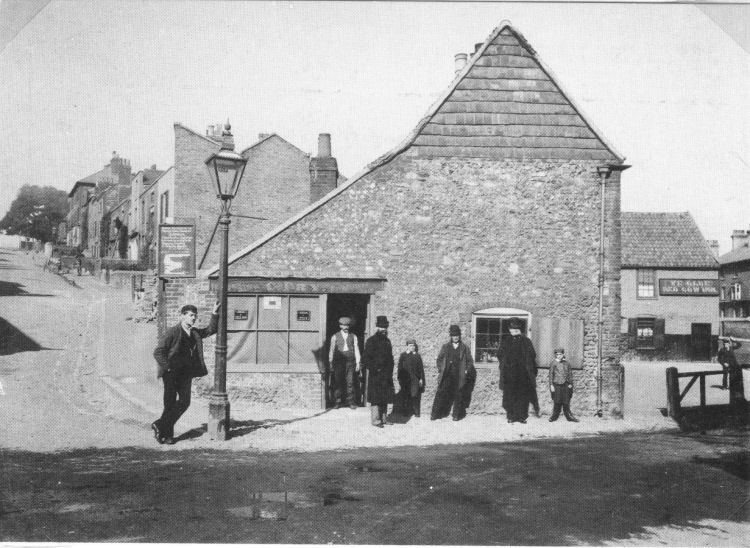
This interesting picture of the junction of Priory
Place, Worthington Street and Military Road dates from about 1895. In
the centre is the milk shop. Here it is pictured
when the proprietor was C. Fry who, apart from selling milk products of
the Priory Farm dairy, sold lemonade, soda and ginger beer. On the right
is Ye Olde Red Cow Inn and yard which stood on the corner of Folkestone
Road and Priory Place. |
 |
|
From the Kentish Gazette, Wednesday, 29 June to Saturday 2 July, 1768. Price 2d
FOLKESTONE, JUNE 19th, 1768
Notice is hereby given, That the ANNUAL MEETING of the UNION-SOCIETY at
FOLKESTONE will be held at the Sign of the “RED COW,” in Folkestone, on
Monday the 11th of July next, when and where the members of the said
Society are desired to meet by Ten o'Clock in the Forenoon, in order to
proceed to Church to hear a SERMON preached by the Reverend Mr.
Langhorne, after which to return to the said House, where a DINNER will
be provided.
AND WHEREAS it hath been represented to the said Society, that sundry
Persons would have entered for the said Society if the Age of FORTY
Years had not been reduced to THIRTY-FIVE; Therefore it is ORDERED, that
for the future, any sound and healthy Person not above Forty Years of
Age, whose Residence is not above Thirty-five Miles from the said Town,
by paying the usual Entrance, may be admitted a Member thereof.
|
|
From the Dover Telegraph, 30 December 1843.
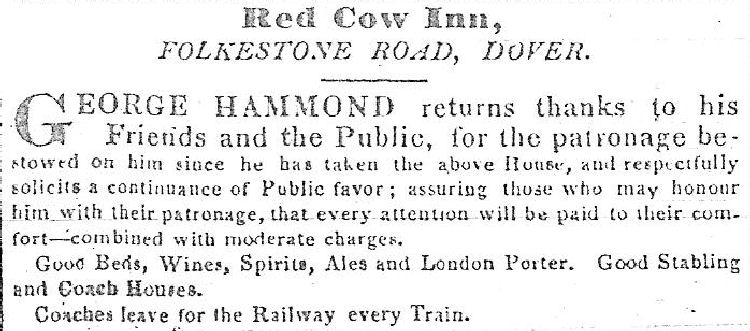
The above advert was kindly sent to me by Lorraine Sencicle. |
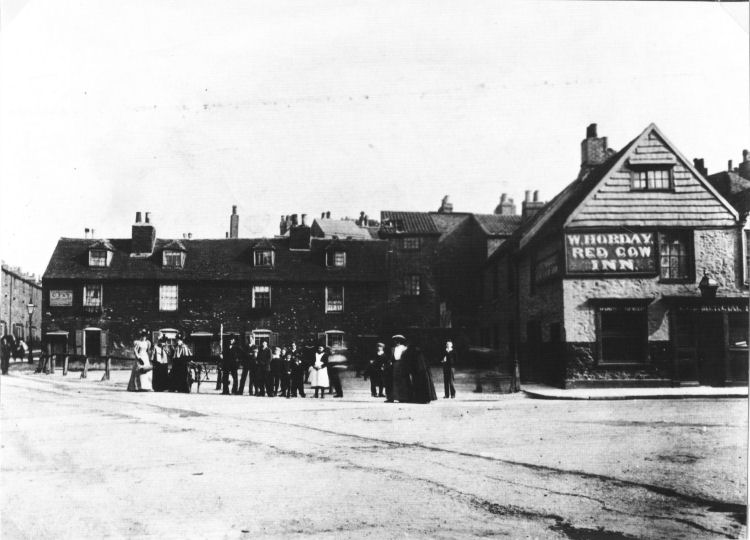
The original, "Ye Olde Red Cow Inn", was set back from the road with a
yard.
It was there long before buildings appeared in Folkestone Road in 1843.
It is known that in 1810 a piece of meadow land near the pub was used to
form Priory Street.
|
From the Kentish Post or Canterbury News-Letter,
December 7 to December 11, 1751.
A Notice in the ‘Post' reads that “Stray'd on Thursday the 5th Instant
[Cows and Heifers] from the Sign of the Red Cow in Dover………..
|
We also know that in 1805 it was kept by a character known as 'Mighty
Merit' and in 1791 by Thomas Starr, but the above passage from the Kentish
Post pre-dates all other mentions of this pub.
|
Kentish Gazette, 19 April 1803.
STOLEN, Out of the stable of the "Red Cow," Dover, on Saturday
night, or early on Sunday morning.
A BLACK MARE, almost Fifteen Hands high, the property of John Merrit;
supposed to be stolen by a young man who wore a smock frock, an old
hat, and an old pair of shoes, full of nails.
|
|
Kentish Gazette, 20 March, 1821.
DEATH.
March 15, at Dover, Mrs. Merit, aged 63 years, wife of Mr. John
Merit, landlord of the "Red Cow" public house; of which house she
had been landlady 32 years.
|
|
Kentish Gazette, 29 June, 1821.
DIED.
June 26th, Dover, Mr. Merit, landlord of the "Red Cow,"
public-house.
|
|
From the Dover Telegraph and Cinque Ports General
Advertiser, Saturday 30 April, 1836. Price 7d.
DOVER SESSIONS
Sarah Hogben, aged 23, charged with stealing a blanket, the property
of Samuel Pierce, landlord of the "Red Cow," on the Folkestone Road;
where she had slept. The blanket was restored by her relations, and she
acknowledged the theft to Southerden, the officer who took her into
custody. The prisoner said she had committed the offence from
destitution.
Guilty, but recommended to mercy. One month's imprisonment.
|
|
From the Kentish Gazette, 7 April 1840.
DEATH.
Last week, at Dover, the widow of Mr. Thomas Merritt, formerly of the
"Red Cow."
|
|
From the Kentish Gazette, 23 May 1843.
DEATH.
May 15, at Dover, Mrs. Hills, wife of Mr. Hills, of the "Red Cow Inn."
|
|
From the Kentish Gazette, 19 December 1843.
RED COW, FOLKESTONE ROAD, DOVER.
GEORGE HAMMOND returns thanks to his Friends, the Public, for the
patronage bestowed on him since he has taken the above House, and
respectfully solicits a continuance of public favours, assuring those
who may honour him with their patronage that every attention will be
paid to their comfort, combined with moderate charges.
Good Beds, Wine and Spirits, Ales and London Porter; Good Stabling and
Lock -up Coach House.
Coaches leave for the Rail to every Train.
|
|
From the Kentish Gazette, 9 January 1844.
DEATH.
Jan 4, at Dover, Mr. Hills, formerly of the “Red Cow Inn.”
|
|
From the Dover Telegraph and Cinque Ports General
Advertiser, Saturday 13 June, 1846. Price 5d.
ACCIDENT
Early on Saturday morning last, as the market butchers from Romney to
Dover were on their road and had reached near Farthingloe, the horse of
a Mr. Smith fell, by which the driver was thrown off the cart, and
received some severe bruising, but no bones were broken. The horse on
recovering his feet, and before he could be secured, started off at a
furious rate, with the bit dangling before him, and was not stopped till
he reached the "Red Cow," where the cart came in contact with some
scaffolding poles, by which a shaft was broken, and the horse much
injured. He was then secured, and further mischief thereby prevented.
|
|
From the Dover Telegraph and Cinque Ports General
Advertiser, Saturday 2 February, 1848. Price 5d.
CRUELTY TO A DOG
Henry Organ, licensed hawker, was charged with cruelty to a dog. Mr.
Rowland Rees deposed that on the previous afternoon, he saw defendant on
the Folkestone Road, driving three dogs in a cart, one of which he was
whipping unmercifully, although the poor brute appeared scarcely able to
crawl, and was dragged on by the other dogs. On remonstrating, defendant
made use of very abusive language, and witness considered it his duty to
the public that the case should be brought before the Magistrates.
Organ, in his defence, said that he bought the dog on the previous
day, and on taking it out for a trial it was sulky, and would not draw
at which he became much irritated, and in consequence made use of
language to complainant for which he was very sorry, and now apologised.
He could assure the Bench that the dog had not been over-driven,
as he had not been more than two miles on the road.
Mr. Look, landlord of the "Red Cow," stated that he had known
defendant, who was lodging at his house, for some time; and he always
evinced greater kindness towards his dogs than was usual with hawkers;
and that on the day in question he had not been out with the dogs more
than an hour.
The Bench, in consequence of this, and the contrition expressed,
dismissed the case on payment of 5s. costs.
|
|
Kentish Gazette, 13 August 1850.
Coroner's Inquest.
Another inquest was held on Friday afternoon before the same coroner, at
the "Red Cow," Dover, on the body of James Tredford, aged 26, a wagoner
in the employ of Mr. Thomas Foord, of Broadmead, near Folkestone.
Deceased, in driving a wagon with two horses, was standing on the
shafts, when he fell down, and both wheels passed over him. Mr. Foord,
master of deceased, said he was a very steady man, and had never seen
him the worse for liquor. The horses were very quiet, and had been
driven by deceased for the last four months.
Verdict:— "Accidental death."
|
|
From the Dover Telegraph and Cinque Ports General
Advertiser, Saturday 1st January, 1853.
DOVER PETTY SESSIONS
Charles Toms, 23, ostler, pleaded guilty to a charge of stealing
11d., the property of his master. Mr. Look, of the "Red Cow Inn," Dover,
and was sentenced to three months imprisonment.
|
|
South Eastern Gazette, 7 August, 1860.
Fatal Accident to a Child.
An inquest was held on Tuesday morning last, at the "Red Cow Inn,"
Folkestone-road, on the body, of Annie Jane Jones, infant daughter
of Mr. R. H. Jones, of the firm of Anderson and Jones, gas
contractors. It appeared that the deceased child had been at play in
her father’s garden, which is skirted by the river Dour, and
approaching too near the edge, the stream being swollen by the late
heavy rains, she fell from the bank and was almost instantly carried
out of sight by the rapid current. Although missed immediately, and
every search made for the body, it could not be recovered for nearly
an hour. The child got to the water through a gate which was used
for watering the plants in the garden. A verdict of "Accidentally
drowned" was returned.
|
|
Dover Telegraph and Cinque Ports General Advertiser, Saturday 22 December 1860.
Accident.
Wednesday evening last, as Mrs. Wayte landlady of the "Red Cow,"
Folkestone Road was carrying some linen upstairs, she unfortunately
missed her footing and fell. Being of active bustling habits, she was
loath at first to believe that any other injury had resulted than a
slight sprain or bruise; but as the pain continued to increase, Mr.
Walter, surgeon was sent for, and he pronounced a dislocated shoulder.
We are, however, happy in being able to add, from enquiries made at the
latest hour, that Mrs. Wayte is progressing favourably.
|
|
From the Dover Express, 17th March, 1863.
DOVER POLICE COURT
The following is a summary of the police intelligence of the week:-
On Sunday John Toon, a vagrant, charged with stealing 6s. 6d. from the
till of the "Red Cow" public-house, was convicted and sentenced to one
month's imprisonment.
|
|
Dover Telegraph and Cinque Ports General Adviser, Saturday 12 September 1863.
DEATH.
Sept. 10, at the "Red Cow Inn," Dover, Mr. George Wild, in the 59th year
of his age, much respected.
|
|
From the Dover Express and East Kent Intelligencer, 26
December, 1863.
INFRINGEMENT OF LICENSE
Ann Wylde, landlady of the "Red Cow" public-house, was summonsed on
the information of police-Sergeant Barton, charged with having her house
opened for the sale of liquor at ten minutes to twelve on Saturday night
last, but dismissed with a caution after paying the costs.
|
|
Dover Telegraph and Cinque Ports General Advertiser, Saturday 5 March 1864.
Red Cow Inn and Travellers' House. Folkestone Road Dover.
Thomas Browning has taken the above Inn, and respectfully solicits the
patronage of Travelers and others, to whose comfort (by personal
attention) he will pay every regard.
Well-aired Beds, Good Stabling, and Lock-up Coach-houses.
|
|
From the Dover Express and East Kent Intelligencer,
4 January, 1867. Price 1d.
KEEPING OPEN ON CHRISTMAS EVE
Thomas Browning, the landlord, of the "Red Cow Inn," Folkestone Road,
was charged with keeping his house open for the sale of liquors until
fifteen minutes past one o'clock on the morning of Christmas Day.
Police-constable Chard said that about quarter-past one on the
morning of Christmas Day he heard loud talking in the "Red Cow Inn," and
some one offer to toss for glasses of ale, and also heard the money
thrown on the counter. He opened the door and saw six men standing and
sitting before the bar with pots of glasses before them. He told the
landlord he had no business to have his house open at that time.
Browning replied, "You have no business here, you go out, if you don't
go out, I'll put you out." He told him that it was his duty to be there,
and then Browning said that he would go and fetch the Inspector, but
that he was afraid to trust his wife with him (the constable). There
were two other policemen outside the door, and they could hear what was
being said.
By Mr. Fox: I know one who was there by name - Johnson the pipe
maker. There were two men dressed as guards of the railway. I was not on
that beat, but I was on duty close to the house. I have noticed the
house, but did not know that the guards who come down by the late train
go there to supper before they go away in the morning. Mr. browning did
not say he was afraid to trust me in the house; he said he was afraid to
trust me with his wife. I was indignant at being told I was drunk. I did
not see anything drawn or sold whilst I was there. I only heard some
money on the counter.
Mr. Smith: Is it a fact that you were drunk?
Witness: No, Sir, I was sober.
George Harman, police-constable No. 12, proved hearing the
conversation between the last witness and the landlord of the house in
question.
By Mr. Fox: I have not had a conversation with Chard upon the matter.
I saw Mrs. Browning; she was behind the bar. I do not know that the
guards go there to supper after the last train.
By Mr. Smith: I only know one person there.
Mr. Coram said that there was evidence he proposed to offer on the
part of the police.
Mr. Fox then submitted that there was no case at all. Mr. Browning
was on that night, supplying refreshment to travellers, and these
travellers were guards of the railway. These men went to the defendant's
house every night to supper and they are entitled to do so, and the
landlord cannot refuse to serve them. These persons have to return to
London shortly after three o'clock, and therefore they are entitled to
be supplied with necessary refreshments. There is not the slightest
evidence that any beer or liquors of any description was sold or served,
and if the police wanted to have independent testimony why did they not
call the man Johnson, for he doubtless would have told the truth. It was
their duty to do so, but for reasons of their own they had not dome so.
It was rather singular that the two policemen, who had been called for
the prosecution, had spoken exactly the same words, although it must be
remembered one was not in the house. When two witnesses differed
slightly it was more generally supposed that they were witnesses of
truth, rather then when they came up with their words cut and dried in
their mouths, and each gave their evidences in the same terms. However
he did not wish for one moment to impute that they had spoken anything
but the truth (laughter). He thought the Bench would agree with him in
saying that it was rather unfair to Browning that the policemen should
so far have misinterpreted his words, and make him say that he would not
trust the man Chard alone with his wife, was it at all likely - when
there were six men in the house at the same time, according to the sworn
testimony of the police - that he would have said such a thing? The
words made use of by Browning, according to his (Mr. Fox's)
instructions, were that he would go to the superintendent but that he
would not leave the policeman in the house. But apart from all that he
thought the Bench would take the fact in its true light - there was no
beer or any liquor served or sold at the bar during that time; and
therefore there was no infringement of license. As the charge against
the defendant was for opening his house for the sale of liquors, and as
the sale had not been proved he contended there had been no offence
committed.
Mr. Latham said the Bench considered the case proved, and argued that
if houses were to be kept open of a night for railway guards, there
would not be a house in the town closed at its proper hour. The
defendant would be fined 10s. 6d. and 10s. 6d. costs.
The money was paid.
|
|
From the Dover Express and East Kent News, Friday,
10 June, 1870.
ASSAULTING A WIFE
John Claringbould, a shoemaker, living at Union Row, was charged with
assaulting his wife, Ann Claringbould.
Ann Claringbould, a young woman who seemed in delicate health, and
carrying a young baby in her arms, said: I live at Union Row, and am the
wife of the defendant. Last night we were returning home about eleven
o'clock, when he wanted me to go with him into the "Red Cow"
public-house. I refused, and he struck me. I proceeded home, and the
prisoner followed me about an hour afterwards. On coming into the room
he dragged me out of bed and knocked me about a good deal. The defendant
was the worse for liquor; but knew what he was about. I had to seek the
protection of the landlord of the house where we lodged, and I
afterwards dressed myself and went to the station-house, where I gave
information to the police.
In reply to the Magistrates, the complainant said that he husband had
repeatedly ill-used her before.
She called James Ashcroft, who said: I am a mariner, and live at 21,
Union Row. defendant and his wife lodge with me. Last night the wife of
the defendant came home, and said that her husband had ill-treated her
at the door of the "Red Cow" because she would not go into the house and
drink with him. That was a little after eleven. About a quarter past
twelve the defendant came home, and I immediately afterwards heard a
great disturbance in the bedroom he and his wife occupy. The wife
shortly after ran to me for protection. Her nightdress was torn all to
pieces and she was struck in the mouth. This is not the first or second
time the woman has run to me for protection, and the house has been
constantly disturbed by the defendant's treatment of her.
The defendant, in reply to the charge, said that his wife was "not
civil" to him, and that that was the reason he had struck her; but he
did not hurt her, and he had never hurt her on a previous occasion.
The Magistrates thought the cruel assault had been committed, and
sentenced the prisoner to fourteen day's imprisonment, with hard labour,
without option of fine.
|
|
From the Dover Express and East Kent News, Friday, 1 July, 1870.
SUSPICIOUS CHARACTERS
Thomas Stainsbury and John Bassett, a couple of suspicious looking young
men, were charged with being in the town for the purpose of committing a
felony. In the prisoners' possession was a quantity of flash notes,
together with some imitation jewellery and an imitation watch, and the
grounds upon which they had been detained were disclosed in the
following statement.
Samuel Thomas, a respectable looking young man said he had travelled
with scissors and needles, and other things used in tailoring business,
and was staying at the “Red Cow.” He deposed: yesterday evening, about
half-past five, I met Stainsbury near the Docks. I was going along the
street, when he accosted me, and asked me if I knew where the boat was
going to Calais. I said I did not, for I was a stranger and had only
come into the town for that day. He said he was also a stranger, and
that he had come to Dover in order to cross to Calais. He walked
alongside of me till we came to the “True Briton” public-house, at the
corner of Commercial Quay, when he asked me to have something to drink.
I said I would rather not, as I scarcely ever took anything to drink.
“Oh,” he replied, “you must come, or you will offend me.” I said no
several time; but the prisoner at length took hold of my hand, and
insisted on my going into the public-house with him. I suffered myself
to be persuaded, and entered the public-house in the prisoner's company.
He called for two glasses of ale, and while they were drawing it he
pulled out of his pocket what appeared to be a watch, and said, “It is
twenty minutes to six by my watch; but I think that is not right, - what
is it by yours?” I pulled out my watch, and said, “It is ten minutes to
six by mine.” I saw the prisoner looking very hard at my watch, and that
aroused my suspicion. He paid for the glasses of ale, and then said he
must go out for a minute. He laid his walking stick and one glove upon
the counter, and went out, but returned again very shortly. He sat down
by my side, and in about two minutes afterwards the other prisoner came
in, wearing green spectacles. He pretended to be strange to us both, and
stood a few minutes at the bar before speaking to either of us. He
accosted the other prisoner as a stranger; but I soon found them both
speaking to me at the same time, one on either side. I did not like my
position, and got up.
Mr. Mowll: I think you showed yourself very sagacious.
The Witness: I had hardly tasted the beer. I rose up and said that I
must be going, as I was in a hurry. They both rose at the same time, and
both talked to me so vehemently that I could not make my way to the door
without forcing myself between them. I made attempts to go several times
before I succeeded. Before this Stainsbury had pulled out a roll of
bills having the appearance of bank notes, and said he had recently come
into a large property; and these notes were just what he had put into
his pocket – about £500 – to have a spree with. (A laugh.) He said he
had been in London for a few days, and had there met a number of young
men in the same accidental way as he had met us, and to whom he had made
presents. He remarked that the principle presents he had made were hats,
with his name inside, and walking sticks with his name engraved on them.
(Loud laughter.) When I pushed my way out of the house, prisoners
followed me without finishing their beer. They followed me along the
street one on either side, till I stopped and said I would not go any
further with them. I saw them again afterwards, and Bassett had them
removed the spectacles.
Police-constable Hemming said he apprehended the prisoners on the
previous evening, in consequence of their suspicious conduct, and found
on them the flash notes, the green spectacles, the imitation watch and
chain, and the other articles produced.
The prisoners were sent to the House of Correction for two months, with
hard labour.
|
|
From the Dover Express and East Kent News, Friday, 25 June, 1886. Price 1d.
DRUNK AND DISORDERLY
Thomas A. Bakley, a labourer, living at Military Road, was charged with
being drunk, disorderly, and using obscene language the previous night
in Folkestone Road.
Police-sergeant Nash said: Last night, about 11.20, I was on duty in
Folkestone Road. I heard a disturbance by the “Red Cow” public house. On
going there I found the prisoner surrounded by a crowd of people. He was
using obscene language, and wanted to fight some one. I tried to
persuade him to go away, but he refused, and said he did not care for
any Policeman. His wife, who was there, also tried to get him home, but
he refused to go. With the assistance of a Police-constable, I took
prisoner to the station.
Prisoner, who was formerly a Police-constable of the Borough, said he
had had a little too much to drink, and did not remember anything he had
done.
The Bench fined him 5s. and costs 6d., or in default seven days'
imprisonment.
Time was given for the money to be paid.
|
|
From the Dover Express and East Kent News, Friday 31 March, 1893. 1d.
FATAL FALL
An inquest was held at the Town Hall, on Monday afternoon on the body of
Ambrose Moss, who met with his death on Saturday night, by falling down
a flight of stairs at the “Red Cow Inn.” The Coroner (Mr. Sydenham Payn,
Esq.,) swore the following gentlemen as a Jury to try the case: Mr. R.
Adams (foreman), Messrs. C. Rugley, William Goldsack, John Doyle, A. G.
Spain, G. C. Spain, R. W. Lowe, W. Grant, Albert Tapley, J. R. Adams, G.
L. Croft, W. H. Hogbin, R. Ayers, and W. C. Warden.
Caroline Moss deposed: I live at 92, Graham Road, Wimbledon. I have seen
the body of deceased; it is that of Ambrose Moss who was a draper by
trade, 51 years of age. I last saw him alive on the 21st of February,
when I saw him off from Herne Hill station. He has been in Dover in
business. He never had any illness except rheumatic gout. I had two
letter from him last week. He had for some time complained of a pain
round his heart, but it was not considered sufficient to require medical
advice.
George Minshull said he was a draper's assistant, living at 39, Sydenham
Road, Stockport, S.W. He had known deceased as a great friend for about
two years. Witness had been with him in Dover on a matter of business
for about a month. They had lodged at the “Red Cow” two days previous to
this occurrence. On Friday they went for a walk in the morning. Deceased
had complained about a pain in his side. Witness went out during the
afternoon the deceased remained in the house. Witness returned at 7.30.
They remained in the smoking room during the evening. Deceased had
nothing whatever to drink. About 11 o'clock he said “good night” and
left the room. A few minutes afterwards witness heard a fall and on
going to see what it was, found the deceased lying on the floor at the
bottom of the stairs.
Mr. W. Hobday, landlord of the “Red Cow Inn,” said that the deceased
stayed at the house on the Thursday evening. Witness saw him during the
day. He saw the deceased at the bar about half-past ten. About 11
o'clock whilst witness was putting the bar to the front door he heard a
crash, and on looking round saw the deceased lying at the foot of the
stairs. He was doubled up with his head under him. Witness tried to
raise him up but could not. He appeared dead and witness carried him
into a lobby at the back, and sent for a doctor. Deceased was perfectly
sober.
George east, 51, Military Road, said he was a Fly Proprietor and
occupied the stables at the “Red Cow.” He was in the house on Friday
evening last. He saw Moss in the parlour about half-past ten. Witness
spoke to him, and deceased said he felt tired and should go to bed.
Witness went into his stables then, and about 11 o'clock Mrs. Hobday
called witness in, and said that Mr. Moss had fallen down stairs.
Witness saw him and helped to carry him into the lobby. He was
unconscious but breathed twice after they got him into the lobby and
then appeared to die. He had complained a day or two previous about
suffering from his heart.
Dr. A. Long, Surgeon, said that he was called to the deceased of Friday
evening, shortly after 11 o'clock. He went to the “Red Cow,” and found
the deceased lying in the room called the lobby and quite dead, death
having recently taken place. Witness had examined the deceased, and
found no marks of violence. From the force of the fall deceased had
broken his neck. Witness thought from the evidence, that deceased might
have had some attack from his heart which had caused him to fall. The
deceased was a heavy man. The real cause of death was from a fracture
from the neck.
The Jury returned a verdict of “Accidental Death.”
|
|
From the Dover Express and East Kent News, Friday, 17 April, 1896.
THE POCKET PICKING
James Everett and Henry Beattie, boys of 14 years of age, were brought
up on remand, charged with picking a woman's pocket, at the Town Hall,
and also with picking pockets at the “Red Cow Yard,” both on Wednesday
evening.
Everett had been convicted of larceny three times, and the Magistrates
thought that it was a case for an Industrial School, and the facts have
been sent to the Town Council for them to consider whether they would
pay the maintenance. This was the first appearance for Beattie.
The prisoners both pleaded “Guilty,” and the Magistrates decided to
remand Everett until Friday, and Beattie's parents were bound over under
the First Offender's Act to bring him up for judgement if called upon.
|
|
From the Dover Express and East Kent News, Friday, 26 August, 1904. Price 1d.
LANDLADY'S FATAL FALL
On Thursday evening an inquest was held by Sydenham Payn, at the “Red
Cow Inn,” in the body of Mrs. Pink, the landlady, who was found dead on
the floor beside her bedside on Wednesday at mid-day. Mr. J. R. Adams
acted as foreman of the Jury, and the evidence was as follows:-
Reuben Betts said that he was of independent means, and had been staying
for the last five months at the “Red Cow” as a friend of the landlord,
who was too ill to attend the inquest. He identified the body as that of
the landlady of the “Red Cow,” Mrs. Sarah Elizabeth Pink, wife of
Frederick Pink. Witness last saw the deceased alive on Wednesday at
11.30 a.m. She was then lying on her bed partly dressed. About 1.30 he
was called to the bedroom by two young ladies. They had found her on the
floor and lifted her onto the bed. A doctor was sent for meanwhile, but
witness seeing she was dead, went to help the husband, who was taken ill
on hearing of it. Deceased had been upstairs about two days.
The Coroner: Was she suffering from the effects of drink?
I should say so.
The Coroner: May I take it she was greatly addicted to drink? You can't
help yourself, you know, in answering?
Yes, I am afraid she was so.
Maud Witham, staying with her sister at the “Red Cow,” said that about
1.30 on Wednesday she and her sister came upstairs to tidy themselves,
and they looked in intending to ask Mrs. Pink what she would have for
dinner. Deceased was not on the bed so they looked on the other side of
it, and they saw her lying on the floor with her head bent over on to
her chest. Witness and her sister picked the deceased up and placed her
on the bed. They then noticed that she was lifeless, and went to call
Mr. Pink, who came up and told them to send for a doctor. Witness last
saw the deceased about 11.30 that morning on the bed. Earlier in the
morning the deceased had come to witness's bedroom and asked her to undo
her blouse, having apparently been to bed dressed. She was then well,
but she had obviously been under the effects of drink. Mr. Pink, who is
subject to fits, was taken ill after the deceased was found to be dead.
There was no sign of poison about the room where deceased was found.
Witness could not say when deceased last had food, as, though she
frequently was able to take her meals, she used to go down to get
something at night.
Mr. C. Wood, surgeon, said he was sent for at 1.50 on Wednesday
afternoon, and at once went to the “Red Cow,” where he found the
deceased lying on her bed fully dressed. She was warm, and evidently
quite dead. She had a very strong smell of alcohol. Her features were
composed. Later in the afternoon he fully examined the body. With the
exception of a slight bruise on the back of the right hand there was no
mark of injury or accident. The body was fairly nourished. The husband
told him she had had no doctor. Witness said that there was nothing to
indicate the cause of death, but he imagined that deceased arousing from
a condition of stupor attempted to get out of bed, and fell in the
position in which she was found, with the result that the head pressing
over the chest caused her breathing to be interfered with and
suffocation to ensue.
The Coroner, in summing up, remarked incidentally that a public house
was rather a funny place for one to stay in who was addicted to drink.
A verdict was returned that deceased died from suffocation caused by
falling out of bed.
|
|
Dover Express 21st May 1909.
TOWN, PORT & GARRISON.
Mr. Tom Bishop of the "Red Cow" asks us to contradict a general report
that he is about to leave Dover. He absolutely denies what is opposed to
the truth.
|
|
From the Dover Express and East Kent News, Friday, 23 February , 1912.
DRUNK AND DISORDERLY
Alfred Valentine was charged with drunk and disorderly conduct.
Police-constable Vincent said: On Saturday afternoon, when I was in a
tram car on the Folkestone Road route, the defendant, who was also
inside the car, began to jeer and insult me about my uniform. I took no
notice, but as he commenced again, I spoke to him about it. The
defendant threatened me if, he said, I said he was drunk. The defendant
tried to get off near the “Red Cow,” and again threatened me, and I took
him into custody.
Defendant, who said he did not remember anything about the affair, was
ordered to pay the costs, 6s.
|
Outward coaches to Ham Street, starting from the "London Hotel", picked
up passengers here and in 1882, coaches from New Romney to the inn ran every
Tuesday, Thursday and Saturday, returning the same day. It was rebuilt at
the turn of the century, or possibly in 1895 when Priory Place was widened.
At a sale in May 1910, when it held a thirty five year lease from January
1906, it realised £2,400 In 1912, when Lewis was the host, the motor and
livery stables next door would no doubt be an accessory.
|
From the Dover Express and East Kent News, Friday, 10 April, 1931. Price 1½d.
COLLISION OUTSIDE THE RED COW
A Morris Cowley, driven by Mr. R. Hague, a commercial traveller, and an
East Kent ‘bus driven by Mr. E. Misele, of Coastguard Cottages, St.
Margaret's, collided at the junction of Priory Place and Priory Street
about 2 o'clock on Thursday. Both vehicles were damaged, the Morris
having its front knocked in and the panels of the ‘bus being damaged.
|
|
Dover Express 8th June 1945.
TOWN, PORT & GARRISON.
At Dover on Friday, Joan McMahon (24) of 16 Monins Road, was fined 5s
for riding a bicycle without lights on May 16th at 11.45 p.m. Defendant
told the policeman that she had walked through the town from East Cliff,
but mounted her machine at the “Red Cow” as sometime before, she had
been attacked by a soldier in Folkestone Road.
|
|
From an email received from Nina McSweeney, 21 September 2009.
The most exciting thing for me was your mention of Thomas Browning,
landlord of The Red Cow in 1866. I'm assuming he wasn't heard of after
1867 as that's when he ran off to France?
I know his running off caused a scandal, but I'm not sure if it would
have been in the newspapers. I'm hoping it was!
I really appreciate your help, and the whole family will be delighted
to know we finally have a name for "The man who once owned The Red Cow".
Nina McSweeney.
P.S.
There's mention in my Grandmother's diary of a Grandma Elvy, who
could possibly be the mother of Frank Browning (ex wife/girlfriend of
the publican Thomas Browning?), but she could equally be a Grandmother
on the maternal side, or as my Mum suggested she may just be an elderly
friend as they were often called Grandma.
|
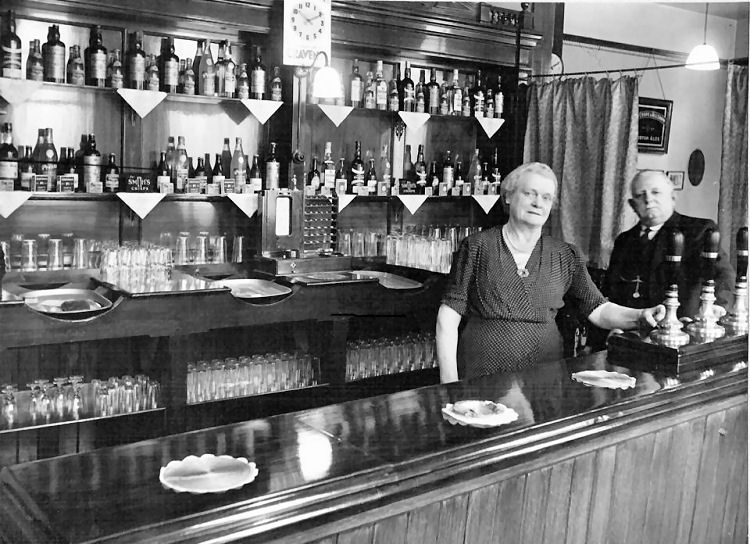
Above photo from Robert Bushell, showing William Ditton and his wife,
circa 1950. |
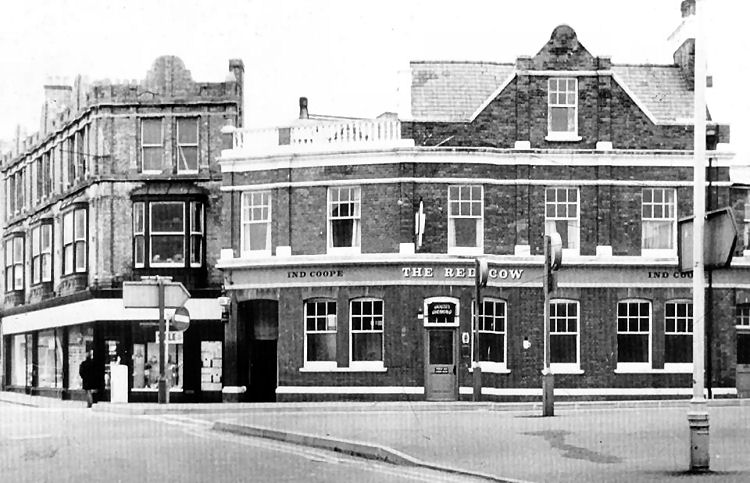
Above photo, circa 1960s. |
|
From an article in the Dover Mercury by Joe Harman.
Originally published circa 2000.
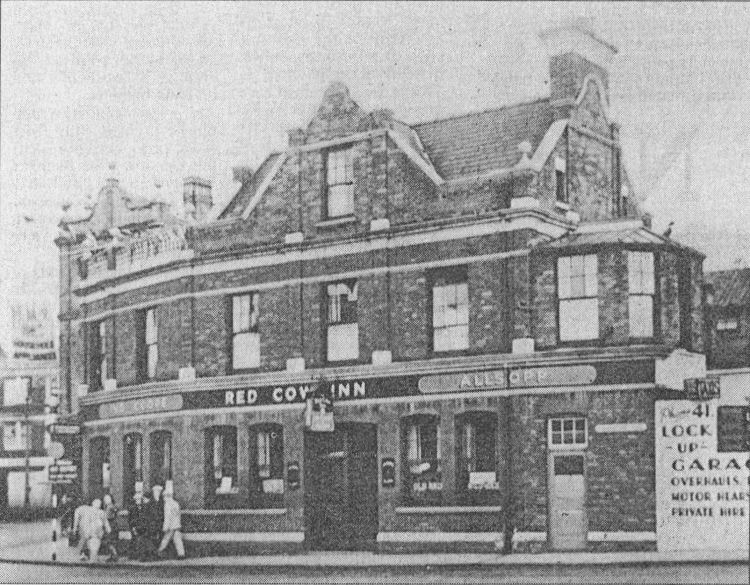
Travellers refreshed at Red Cow.
IT IS now 30 years since the Red Cow, at the bottom of Folkestone Road,
closed its doors and was demolished.
We know it was there in 1792, when
Thomas Starr was the landlord, and it may have dated from 1762, when
Folkestone Road was formed.
It was a stopping place for stagecoaches and
had a yard and stables for that purpose. The inn
was re-built in 1859 when Priory Street was laid out on meadow land.
Another re-build took place in 1895 when Priory Place was widened.
The
yard was used for political meetings and I am told that Ramsay McDonald
(twice prime minister) once addressed the public there.
|
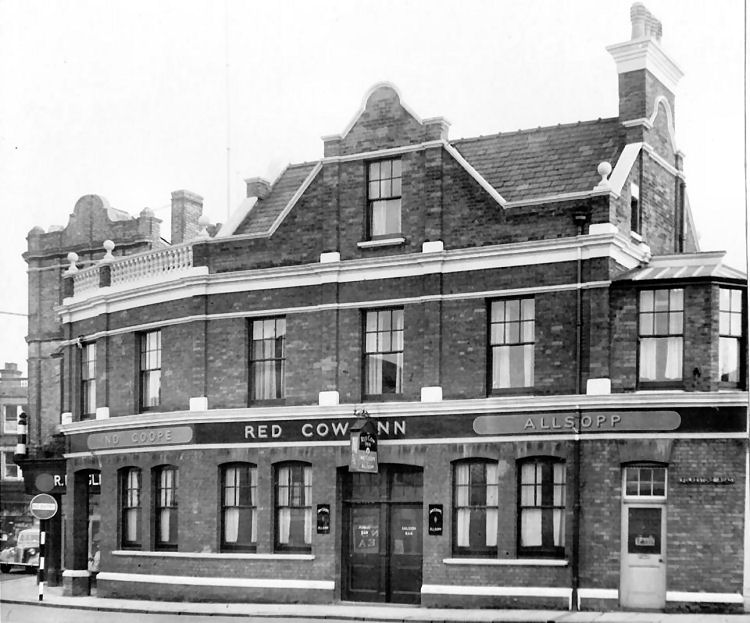
Above photo from Robert Bushell, circa 1950. |
This was just another closure as a result of redevelopment in June 1971.
The town took possession that month and it was taken down in October the
same year so that the road could be widened. The new York Street with dual
carriageways opened to traffic on 10 December 1972 and now joins Folkestone
Road at this point the dust having long settled.
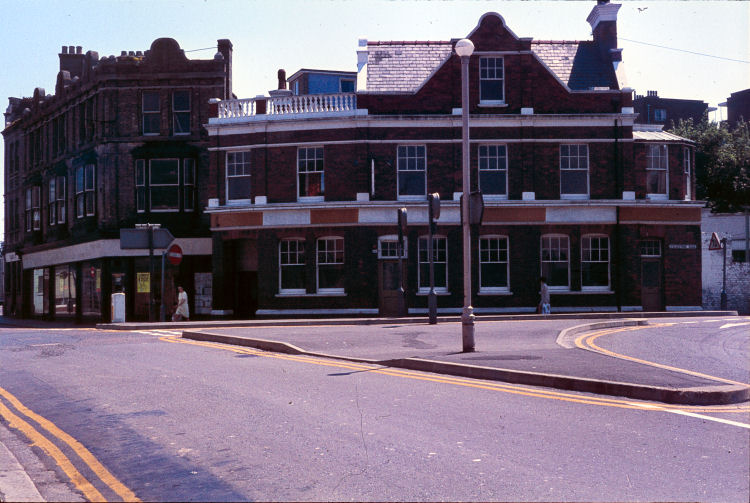
Above photo 1966, kindly sent by Paul Beecham. |
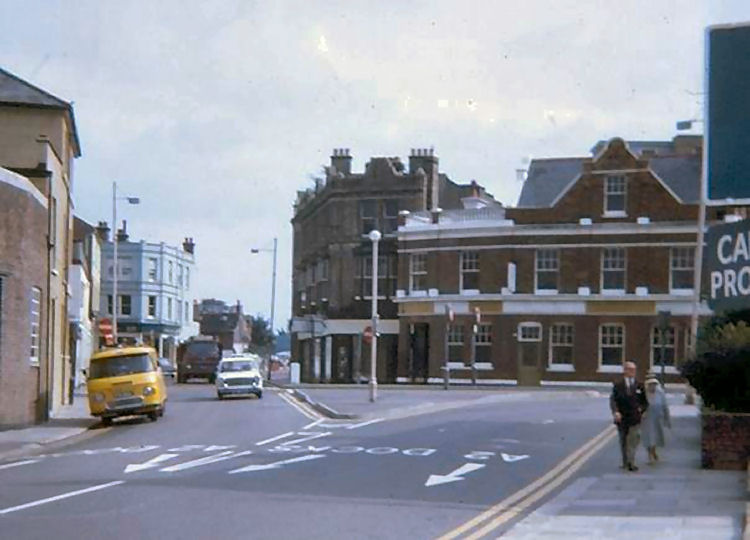
Above photo by Andy Yarrow, October 1971. He says 2 weeks before being demolished. |
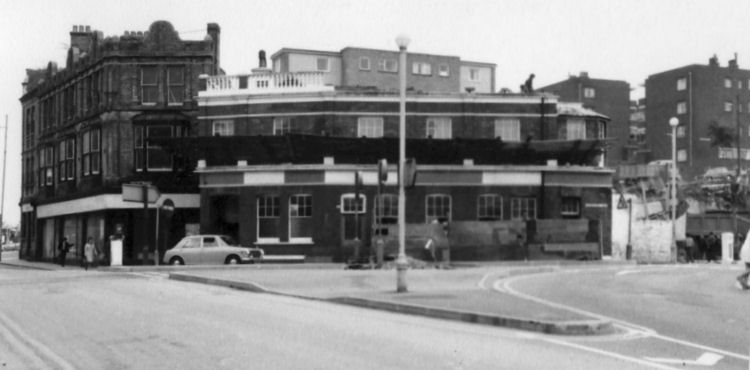
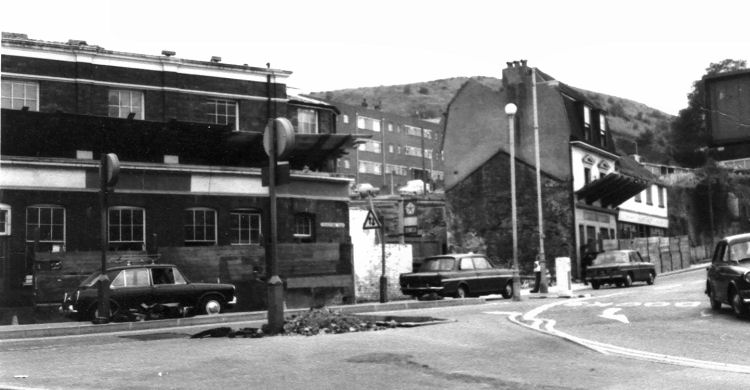
Photos above and below are of the Red Cow during demolition 1971. By kind permission of the over Library.
|
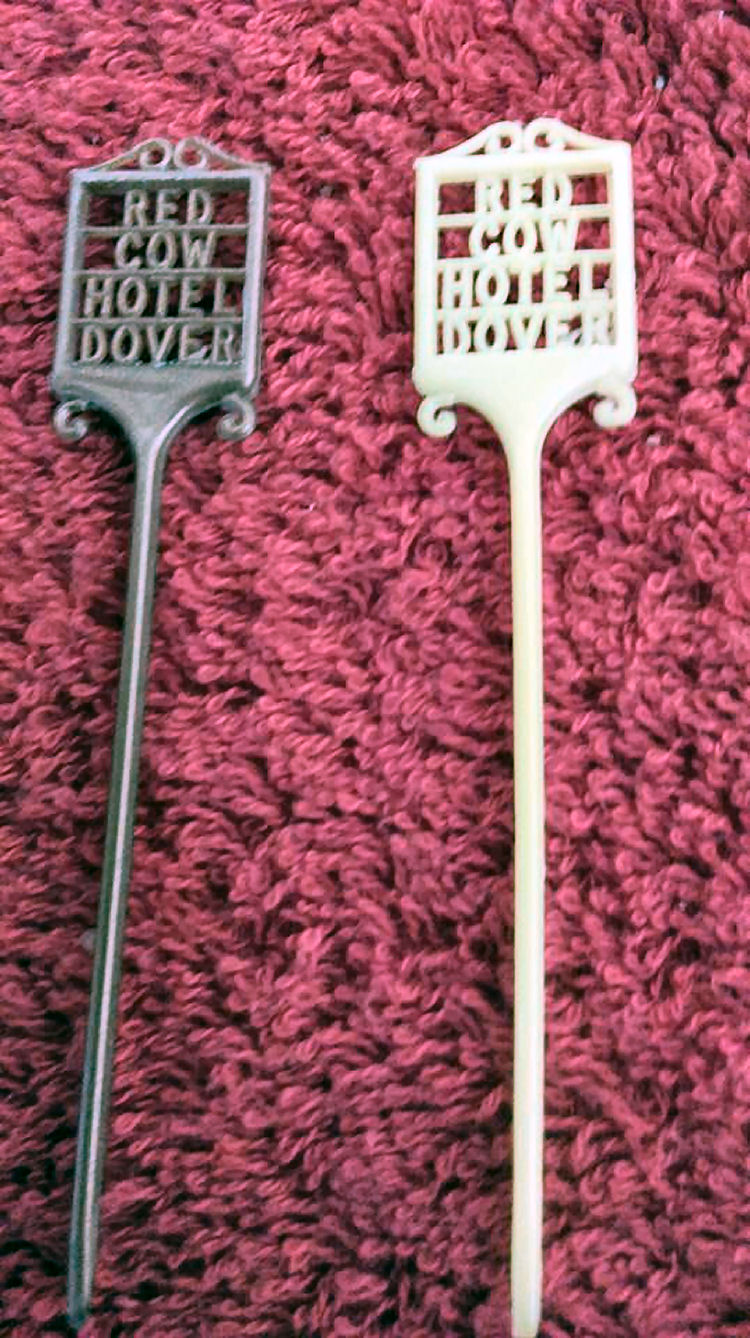
Above photo showing cocktail stirrers circa 1970. |
LICENSEE LIST
COLBRAND Vincent 1713+
STARR Thomas 1791-92+

MERIT/MERRITT "Mighty" John Thomas 1803-26/June/21 dec'd
PIERCE John (Samuel) 1823-39+
   
HILL Johnathan 1840-43+
 (4/Jan/1844 dec'd)
HAMMOND George Dec/1843+
LOOK William 1847-52
(age 60 in 1851)
 
WAY Elias 1854
MARSH William B 1958

MIDDLETON Palmer before 1858
WAYTE Henry 1860-62 (age 40 in 1861)

WILD George Jan/1862-10/Sept/63 dec'd
WYLDE Ann 1863+ (probably be wife of George Wild)
BROWNING Thomas Mar/1864-66

RICHARDSON William George 1874-July/91 dec'd (age 57 in 1891)
 
RICHARDSON Mrs (widow) July/1891+
HOBDAY Walter 1895-99+
 
BROOKER Mr H C to Aug/1901

MILES Charles Aug/1901+
(Of
Croyden/Reigate)
CHAPLIN George W 1903
 
PINK Frederick 1903-Sept/04
EXELL Charles Sept/1904-05 end
(Late of
Aldershot where he kept the Cavalry Brigade Canteen for 14 years.)
BISHOP Thomas 1905-Dec/10
LEWIS Josiah Dec/1910-13+
(age 62 in 1911)

LEWIS Mrs Anne 1914-24 end
  
STOCKLEY Herman 1924-8 end
HART William 1928-30+

DITTON Frederick James 1932-50+
     
DITTON P J 1939-Aug/53
O'NEILL Edwin Robert Aug/1953-56+

BESTE J G 1959-61
WILSON Harold 1962-71 end
MANBY Alan A B Closed June 1971
However, seen mentioned in the Library archives 1974
 obviously an overlook, but mentioned Allied Breweries Ltd as suppliers and
owners
obviously an overlook, but mentioned Allied Breweries Ltd as suppliers and
owners
Dover and Deal Directory and Guide 1792
From
the Pigot's Directory 1823
From the Pigot's Directory 1828-9
From the Pigot's Directory 1832-33-34
From the Pigot's Directory 1839
From the Pigot's Directory 1840
From Bagshaw Directory 1847
From Melville's Directory 1858
From the Post Office Directory 1874
From the Post Office Directory 1882
From Pikes Dover Blue Book 1895
From the Kelly's Directory 1899
From the Post Office Directory 1901
From the Post Office Directory 1903
From the Kelly's Directory 1903
From the Post Office Directory 1913
From the Post Office Directory 1922
From Pikes Dover Blue Book 1923
From Pikes Dover Blue Book 1924
From the Post Office Directory 1930
From Pikes Dover Blue Book 1932-33
From the Post Office Directory 1938
From Pikes Dover Blue Book 1938-39
From Pikes Dover Blue Book 1948-49
From the Kelly's Directory 1950
From the Kelly's Directory 1953
From the Kelly's Directory 1956
Library
archives 1974
From the Dover Express
From the Dover Telegraph
|

