|
120 London Road, Temple Ewell
Kearsney/River
  
01304 823949
https://www.facebook.com
https://whatpub.com/railway-bell
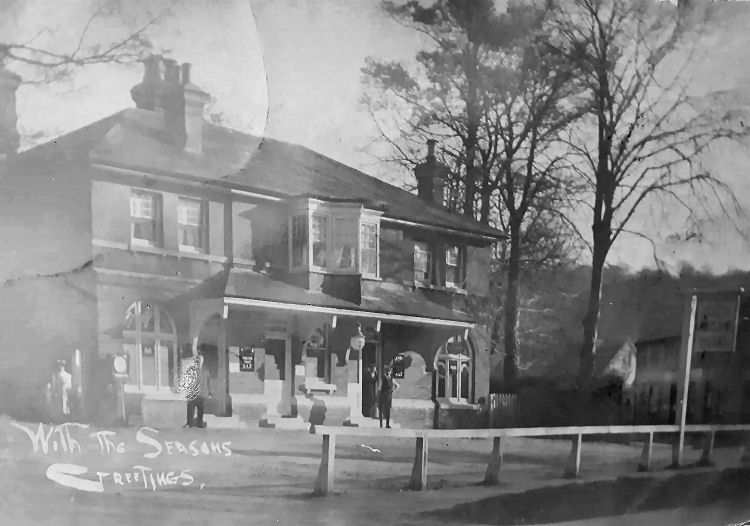
Above photo, 20 December 1909, kindly sent by Basil River. |
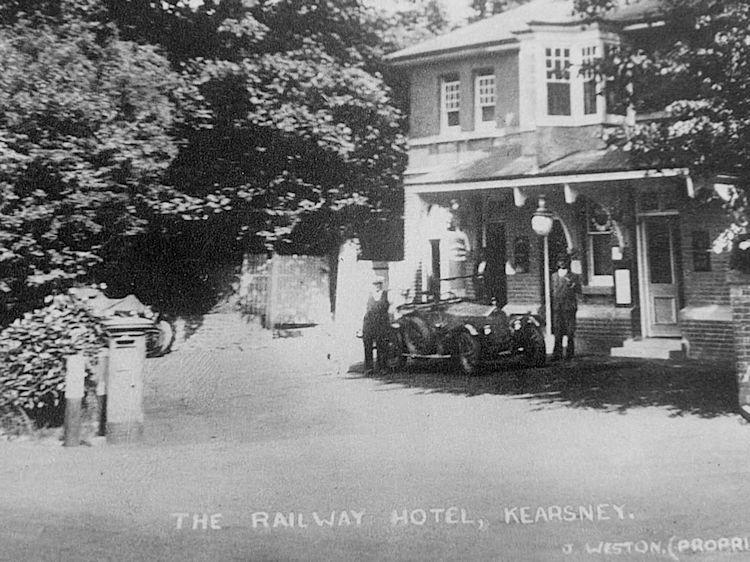
Above postcard, date unknown. |
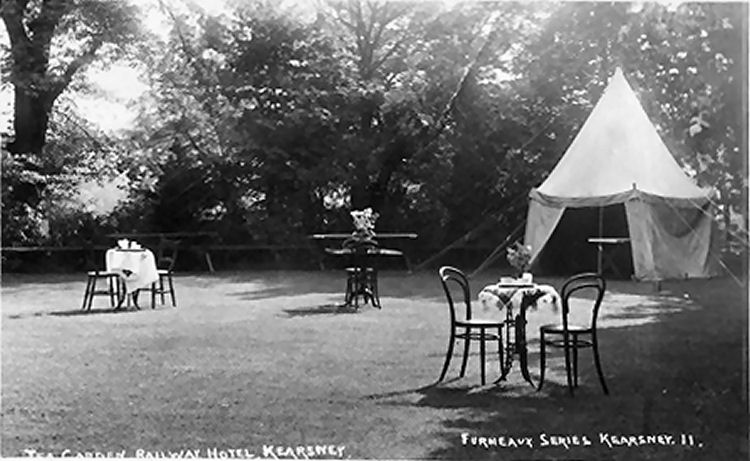
Above postcard, again kindly sent by Roger Reeve and showing the garden
of the Railway Bell, post marked 28 June 1918. |
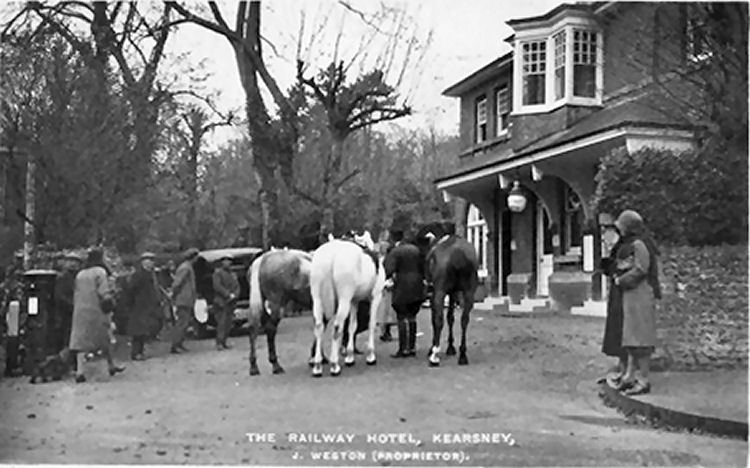
Above postcard kindly sent by Roger Reeve, showing horses outside the
Railway Bell, postcard post marked 03 June 1936. |
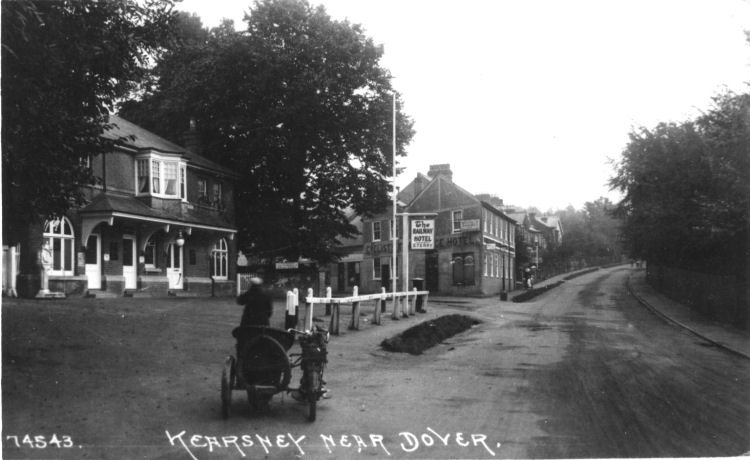 |
|
Above photo by kind permission Dover Library ILL/63. Please note, it was
then referred to as the "Railway Hotel, date unknown. |
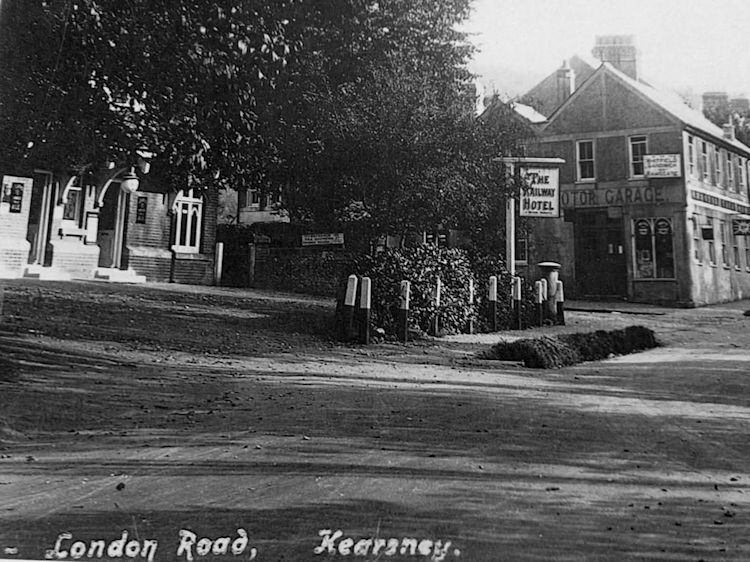
Above postcard, date unknown. |
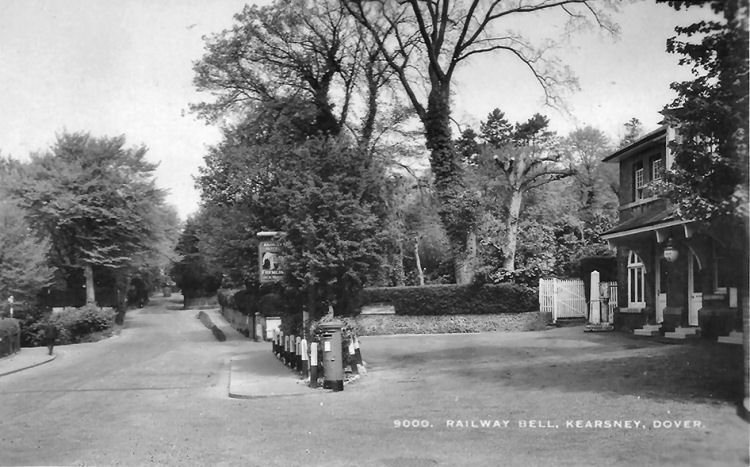
Above postcard, postmarked 5 March 1946. |
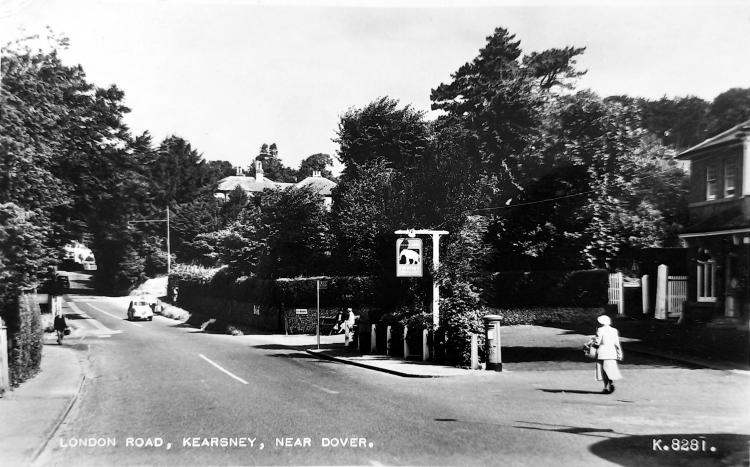
Above postcard, date unknown, kindly sent by Graham Butterworth. |
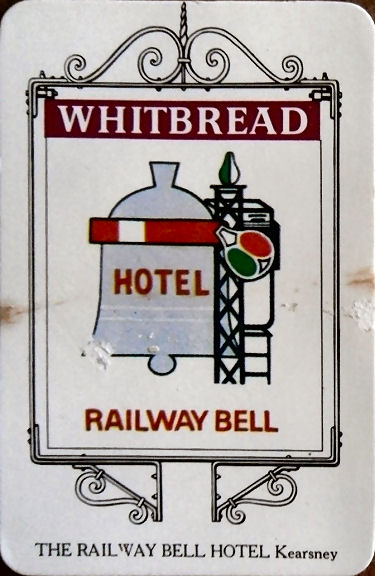 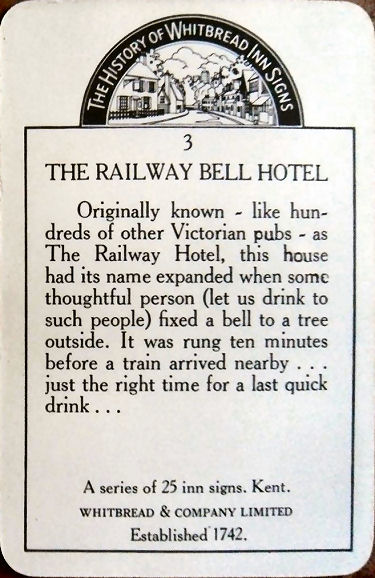
Above showing the Whitbread Inn Signs. |
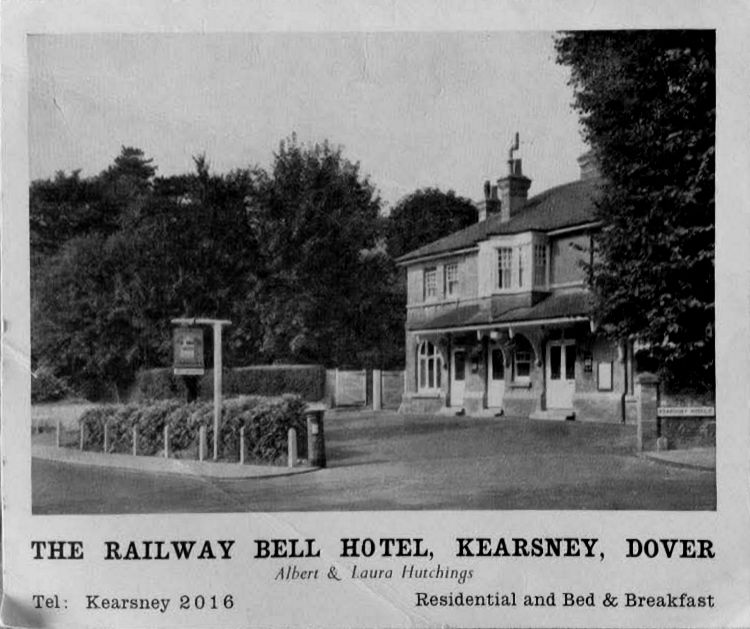
Above card, date unknown. |
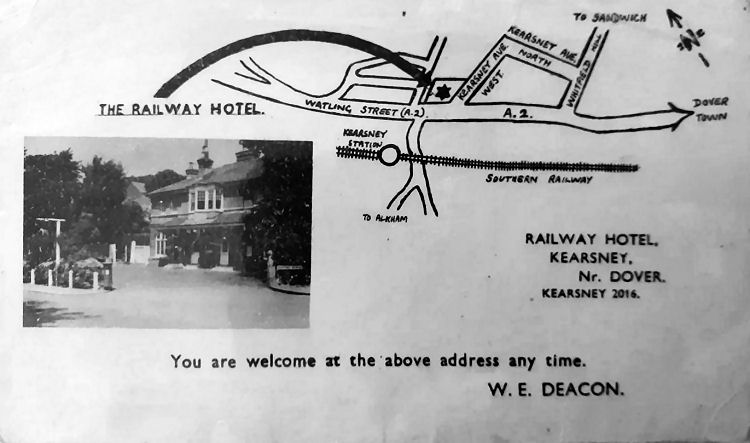
Above card, date unknown, kindly sent by Basil River. |
 |
|
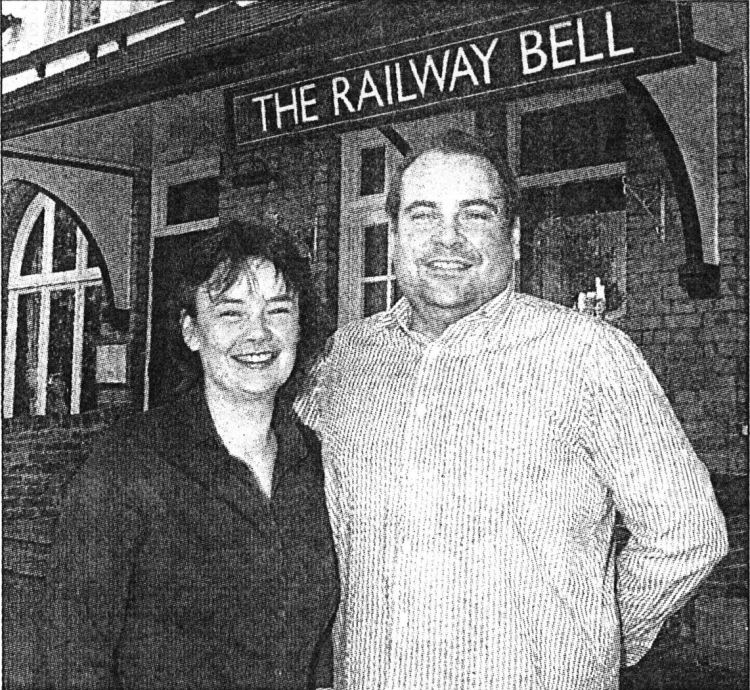
HIGH NOTE: Catherine Woodward and Francis Gorham outside The Railway Bell Ref: pd 91977
Dover Mercury 2/May/2002
Old pub's owners ring the changes
TWO centuries of hospitality and a return to an earlier name were
celebrated at The Railway Bell pub, Kearsney, on Tuesday by owners
Francis Gorham and Catherine Woodward, and their customers.
Francis explained: ''A lot of regulars still called the pub by its old
name, even though it had been The Pickwick since May 1983, when it had
been bought by Whitbread as part of its Wayside Inn chain.
"The place
has got to be couple of hundred years old, and an old coaching inn, and
it's had a number of names in that time.
"With the coming of the railway, tradition has it that there was a bell
at the pub which would be rung 10 minutes before the train was due at
the station across the road and that's how it first came by the name of
The Railway Bell."
Francis and Catherine already own the Lydden Bell and they plan to make
The Railway Bell chime with people's tastes in pubs today.
This will mean no loud music, no swearing and a new menu with good food,
freshly prepared throughout the day.
|
|
From the Dover Mercury, 2 May, 2002.
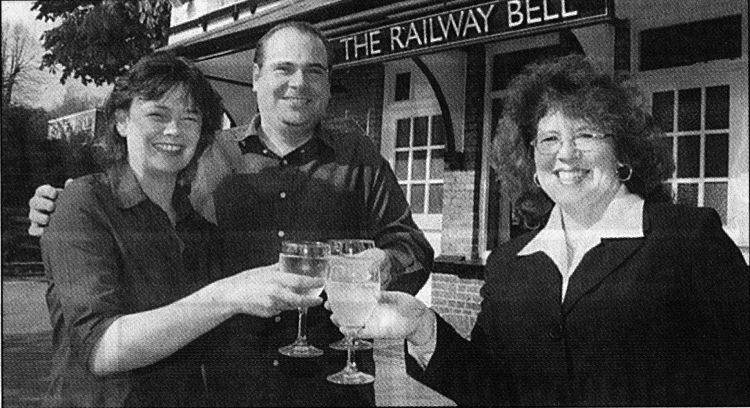
THE Railway Bell on London Road, has returned to its original name
after being known as Pickwicks since 1983.
Now boasting an all day food menu, the popular pub held its official
re-launch last Tuesday when it staged an 80s night to raise money for
the Temple Ewell Players.
For more information please call the Railway Bell on 01304 822016.
Landlady and landlord, Catherine Woodward and Francis Gorham are
pictured with manageress Deborah Whitehouse.
|
|
From the Dover Express, 23 October 2003.
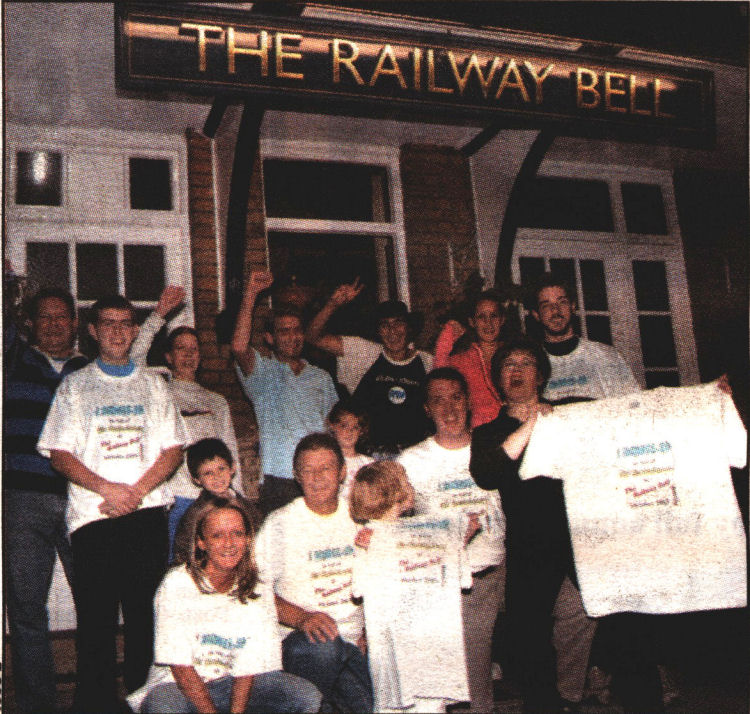
DAREDEVIL pub patrons have managed to raise over £2,000 for charity
by bungee jumping in the dark. The brave jumpers, regulars of the
Railway Bell pub in London Road, took the 200 foot plunge to raise money
for the Kent Air Ambulance on October 10. The crane and launch basket
were set up in the pub's car park, with participants falling towards
tarmac at an alarming speed before being bounced back up by the bungee
cord.
As well as the sponsored jumpers taking part, bungee enthusiasts
from around the county were also attracted to the event, making the
night a busy one for all involved. Pub manager Deborah Whitehouse
(right, holding Tee-shirt) was
thrilled with the event's success.
|
|
|
|
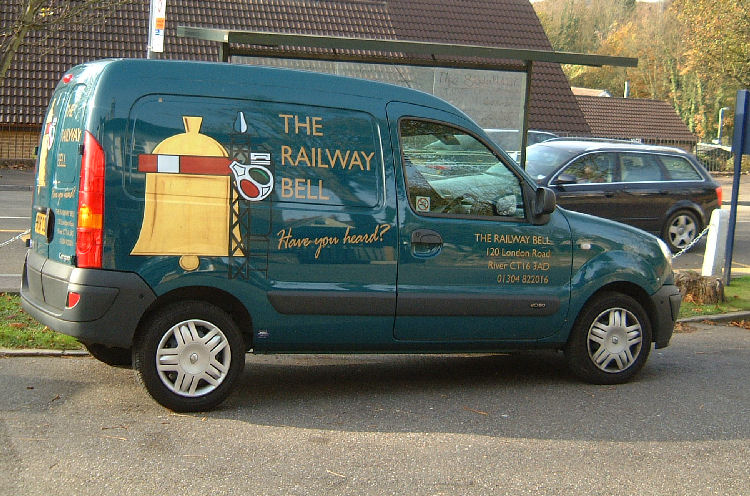
Photo above and below left by Paul Skelton 10 November 2007 |
 |
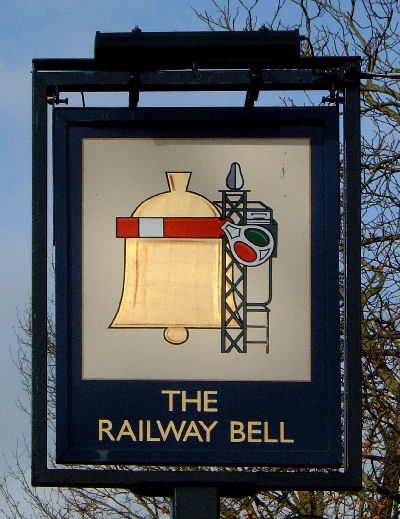 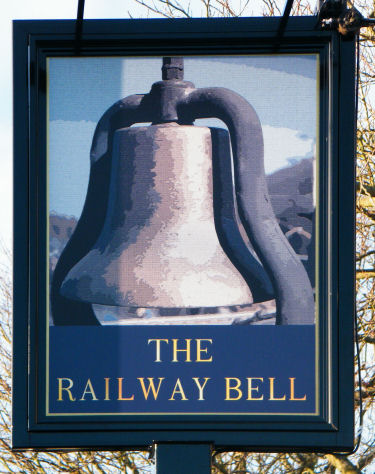
Sign on the right by Paul Skelton, taken 1 December 2013. |
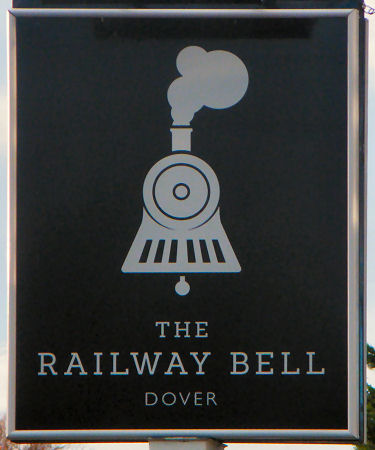
Above sign 2017, taken by Paul Skelton November 2017. |
Built at the time of the laying of the railway track through River
(1861ish), Kearsney and Temple Ewell to London from Dover and known unofficially by
locals as the "Kearsney Bell" due to a "Lydden Bell" being a few miles up
the road at Lydden.
Supplied by Alfred Leney Co Ltd, who bought out Thomas Walker's Phoenix
Brewery in 1859 and registered as such in 1896, until bought out by Fremlin
Brothers brewery of Maidstone in 1926, brewing at the Dover brewery ceased
in 1927, which later passed to Whitbread.
|
From the Dover Express and East Kent Intelligencer, 14 July, 1871. Price 1d.
ASSAULTING A CONSTABLE
John Cornish, 20 years of age, a soldier in the 2nd Battalion Rifle
brigade, quartered at Dover, was charged by K.C.C. Edward King with
being drunk and disorderly at the “Railway Bell,” River, and assaulting
him while in the execution of his duty.
It appeared that the prisoner got in behind the bar of the public-house
and becoming belligerent stripped himself to his skin, and declared
himself ready to fight all corners. The police were called in, and in
getting him out of the house King was assaulted.
The Magistrates sent him to prison for seven days, owing to the good
character given him by the sergeant of the company.
|
|
From the Dover Express and East Kent News, Friday,
26 March, 1875.
SUICIDE AT EWELL
A coroner's inquest was held on Tuesday afternoon at the "Railway
Bell Inn," Ewell, before T. Delasaux, Esq., Coroner for the County, on
the body of Thomas Claringbould, carpenter, aged 47 years, who shot
himself about five o'clock on the previous morning. Deceased formerly
resided at Dover, where he was well known, but for several years past he
has lived in one of the detached villa, residences at Ewell, occupied by
Mr. Shuttle. The following were sworn on the jury:- Mr. R. Tritton, Mr.
T. Shepherd, Mr. G. Down, Mr. W. Ayers, Mr. W. Wraight, Mr. G. Simpson,
Mr. R. T. Forward, Mr. J. W. Bacon, Mr. E. Maxted, Mr. J. Pierce, Mr. G.
Gammon, and Mr. C. Langley. The latter gentleman having been chosen
foreman, the jury proceeded to view the body, which was lying, saturated
with blood, on the floor beside the bed where the rash act was
committed. From the position of the wound it is supposed the deceased
must have leaned on the muzzle of the gun and fired it by means of a
brace attached to the trigger. On the return of the jury room the
following evidence was adduced:-
Louise Nye: I belong to River, and am in the service of Mr. Shuttle,
who is a widow. The deceased lived at Mrs. Shuttle's, who has brought
him up as a lad. I have lived with Mrs. Shuttle twelve months. Deceased
has lived in the house all the time I have been in Mrs. Shuttle's
service. Yesterday morning about five o'clock I heard the report of a
gun, apparently from the bedroom of the deceased. I immediately went
there and saw the deceased lying on the floor quite dead. During the
whole time I have been with Mrs. Shuttle deceased has appeared low and
melancholy, but from what cause I do not know. I last saw him alive at
ten o'clock on Sunday night, just before I went to bed.
By a Juror: There appeared no difference in him on Sunday night than
on any other night.
Thomas Newman: I live at Kearsney, and am agent to Mr. Churchward.
Yesterday morning at a quarter past five, I heard a loud knocking at my
front door. I ran down directly and there saw the last witness, Louisa
Wye. In consequence of what she said I directly went to the house of Mr.
Shuttle, and on going up the stairs to the bedroom, there saw deceased
lying on the floor in the same position as the jury have just viewed the
body. He was quite dead. I saw the gun now produced on the floor about a
yard from the body, and it had been recently discharged. I have known
deceased for upwards of twenty years. During the last week he has
appeared strange in his conduct, but from what cause I do not know. I am
quite satisfied the gun was discharged by the act of the deceased.
Thomas Ray, K.C.C., stationed at Ewell: I was sent for yesterday
morning to the house of Mrs. Shuttle, and there saw the body of the
deceased. On searching his person I found the following articles; a
purse containing 16s. 6d., four dog and gun licences, two knives, three
gun caps, and several other articles.
Francis Ezekial Barton, of Dover, surgeon: I was sent for yesterday
morning early to attend the deceased, whom I found on the floor, quite
dead. I examined the body and found a gun shot wound on the front of his
chest, at the right side of his heart, which, I believe, was caused by
gunpowder and a discharge of leaded shot, which I should imagine
produced instantaneous death. From the nature and position of the wound
I have no hesitation in saying the same was caused by his own hand.
The Coroner very briefly summed up the evidence and the Jury returned
a verdict that "Deceased shot himself when in a state of mental
derangement."
|
|
From the Dover Express and East Kent News, Friday 6 May, 1881. 1d.
REFUSING TO LEAVE LICENSED PREMISES
George Bradford, a labourer looking man, was charged with being drunk
and disorderly and refusing to leave the premises of the “Railway Bell”
public-house, Ewell.
Mrs. Downs, wife of the landlord of the “Railway Bell,” Ewell, said: On
Thursday week, the 21st of April, at ten minutes to four, the defendant
came into my house drunk, and asked to be served with two of rum, which
I refused to serve him, and he then called me bad names, and used very
obscene language, so I ordered him out of the house, but he refused to
go. I sent for my husband, and as soon as he came the prisoner ran out
of the house.
Alfred Davis residing at Ewell, said: I was in the “Railway Bell” on
Thursday week, and saw the prisoner there, drunk. He called for two of
rum, but the landlady refused to serve him, and he then called for a
bottle of ginger beer, which was supplied him, but not paying for it the
landlady told him of it, and he said he would see her b____d first, and
then would not pay for it. He used very bad language. When Mr. Downs
came the prisoner left the house.
The prisoner said the row was about an allowance he had left for a man,
and which had not been supplied.
The Bench fined him 10s. and 14s. 2d. costs, which was paid.
|
|
From the Dover Express and East Kent News, Friday 14 April, 1882. 1d.
BY WHAT AUTHORITY?
On behalf of the landlord of the “Railway Bell,” Kearsney, Mr. Carder,
solicitor, applied for permission for the public-house to be open half
an hour later every evening all the year round for the accommodation of
the people who came to meet the late train that arrives at ten minutes
past ten, which is ten minutes after the house is closed by law,
enlarging on the inconvenience caused by the closing of the house at
that hour, Mr. Carder put in a numerously signed memorial, playing for
the half hour's extension to be granted.
The Clerk asked Mr. Carder to point out the section under which the
Magistrates had the power to grant this request.
Mr Carder said he realised on the general discretion which was vested in
the Magistrates in the administration of the Act.
The Chairman asked Mr. Carden if he could quote any precedent at any
other railway station.
Mr. Carden said he was not prepared with one.
Mr. Humphries said that if time were granted in this instance, it might
be claimed by every public-house that was near a railway station.
The Chairman said they must, if they gave a decision, then give a
refusal, but if Mr. Carder preferred it they would adjourn the matter
for a month, that he might have time to search for some authority or a
precedent.
The case was adjourned.
|
|
From the Dover Express and East Kent News, Friday 19 May, 1882. 1d.
AN APPLICATION
Mr. W. Mowll applied on behalf of the landlord of the “Railway Bell,” at
Ewell, for an extension of half-an-hour at night, the house closing at
present at ten o'clock. He stated that an application had been made by
the landlord at the last Sessions, but the decision had been reserved
till that day. The extension was required more especially for
Saturday's, when there is a down train which arrives at Ewell at 10.15,
bringing persons of that village from Canterbury Market, and the
landlord was unable to serve them with refreshments. He was also obliged
to turn their horse and carts, which are left there, out into the front
at ten o'clock to await the arrival of the owners by the train, and
frequently they were left all that time in the rain. He had a memorial
with about twenty signatures of persons living in that locality to
support the application. If the Bench could not see their way clear to
granting the application for each night he would be satisfied with
Saturday alone.
After a short discussion the bench decided to refuse to grant the
application.
Mr. Mowll said that there was another matter that had arisen out of
this application at the last Court, it had come to the landlord's
knowledge that Captain Ruxton, of the County Police, had received a
letter which was the grossest possible slander on this house, and in
which it was stated that this house is the resort of women of immoral
character, and was in fact a bad place, the landlord and landlady being
accused of drunkenness, but on sending the letter to the captain he had
refused to give the name of the information, as it had been the
landlord's intention to proceed against the person, as under the
circumstances it was plainly proved to be untrue. Superintendent Maxted
had visited all the houses in the district with reference to the matter,
and had been told by all that such was not the case. He (Mr. Mowll)
would ask the Bench for the information as it was a libel.
The Magistrates Clerk said he did not believe Captain Ruxton would take
any notice of any order from the Bench, but he might if the application
were granted at the Board of General Sessions, which was held every
three weeks.
Mr. Mowll said that Superintendent Maxted, who had informed the landlord
of the complaint, had made an exhaustive enquiry into the matter, but
found that the charges were without foundation. This case arose out of a
remark made by the Superintendent at the last application.
The Magistrate's Clerk said that the Superintendent had merely said that
he had received complaints to the house. He had since found out that
they were not true.
The Bench said that they could do nothing in the matter except advise
the applicant to go to the Board of General Sessions, but with regard to
the application of extension of time, they had not been influenced by
any such report of complaint as made, but they did not know of any
statute by which they could grant the application.
|
|
From the Dover Express and East Kent Intelligencer, 3 November, 1882. Price 1d.
FOUND DROWNED AT RIVER
Mr. T. T. Delasaux, County Coroner, held an inquest at the “Railway
Bell,” Kearsney, near Ewell, on Saturday morning last, respecting the
death of a Dover tradesman named Pascall, whose body had been found in
the Dour near Mr. Mannering's mill at River. Edward Pascall, son of the
deceased, identified the body, and said that his father was 50 years of
age, and a cabinet maker, living in Dover. The deceased had left home on
the Thursday morning, and had not returned. James Martin, a cowman in
the employ of Mr. Jennings, at River, gave evidence with reference to
finding the body. He stated that at about half-past seven o'clock on
Friday morning he was near Mr. Mannering's mill when he saw something in
the river, which he took to be a coat, but on pulling it ashore found
that it was the body of the deceased. With assistance he conveyed it to
a shed near, belonging to Mr. F. Phipps.
It appeared that the deceased was missing on Thursday, and as it was
known that he had gone to River, Instructing Constable Ross was directed
to make enquiries, and he traced him from various public-houses, and one
would be led to suppose that the deceased had fallen in while the worse
for drink.
The Jury returned an open verdict of “Found Drowned.”
|
|
From the Dover Express and East Kent Intelligencer, 17 March, 1882. Price 1d.
APPLICATIONS
The landlord of the “Railway Bell,” Ewell, asked for permission to keep
his house open till half-past ten o'clock at night, as the down train
arrived at ten minutes past ten o'clock, and he was frequently asked for
drink from travellers by the train.
The bench said they could not grant the application, but advised the
applicant to attend the next Court, and in the meantime the Magistrates
would talk the matter over.
|
|
From the Dover Express and East Kent News, Friday, 26 April, 1889. Price 1d.
GREAT ROW AT RIVER
There was a great disturbance at the “Railway Bell,” River, on Easter
Monday, arising out of the refusal of the landlady to supply some
persons who went out from Dover, with as much beer as they wanted. A
Constable was called in to turn them out, and there was a free fight
outside the house, which lasted about half an hour. The parties were
brought before the Magistrates, Dr. Astley and Mr. G. E. Toomer, at
Dover, on Tuesday, charged with the assault.
Frederick Stamp, a shoemaker, living at 36, Tower Hamlets Road, and
Martha Stamp, his wife, Alfred Hatton, in the employ of the Dover Steam
Laundry Company, and Sarah Hatton, his wife, were charged with being
disorderly on licensed premises and refusing to quit, and assaulting
Police-constable Crapps while in the execution of his duty.
Mr. Martyn Mowll appeared for the prisoner Hatton and his wife.
Jane Down said: I keep the “Railway bell,” River with my husband George
Down. The prisoners came into my house all together last evening at a
quarter to six o'clock. They called for drink, and they were served with
some – four quarts they had altogether. They were all right and quiet
when they came in. They began to make a noise after they had been in the
house about half an hour, and I told them to go out. They did not go and
prisoner Hatton came out of the tap room and wanted another quart. I
refused him as they were making such a noise. The other man Stamp then
came into the front of the bar from the tap room and asked for more
beer. I refused him also, and they all came out fo the room and swore at
me, and created a noise. My husband was in the garden and I sent for
him. The two women used filthy language towards me. I told them again to
leave the bar, and they would not go, so I sent for a Constable, and
Police-constable Crapps came. They were in the bar when he came, and I
asked them to leave in the Constable's presence. The prisoner Hatton
said he was not going out for any Policeman, and Stamp and he said he
had been a Policeman and was not going. The Constable put Hatton out of
the door. The others followed them out. Mrs. Hatton struck the Constable
first, and they then all turned on him and struck him. They knocked him
down. The two men were striking him and knocking him down. They were
fighting outside for about half-an-hour, and the Constable's face and
clothes were covered with blood. He drew his staff and struck both of
the men. A young man – a Marine, - who was passing, went and assisted
the Constable. The Constable took all of them into custody with the
exception of the man Hatton, who ran away.
By Mr. Mowll: Hatton came into my house with the others. They were in
the house about an hour and a quarter before the Constable came. The
prisoners were sober when they came in, as far as I could see, and they
were not drunk when they left. No filthy language was used before I
refused to serve them with more beer. I refused to serve them because
they were making a noise. The prisoner Hatton and his wife were dancing
and I asked them to stop, but they did not do so. When they got outside
the fight commenced, and it was not until a quarter of an hour
afterwards that the Constable drew his staff. My husband could not
assist as he was suffering from rheumatism. The other people did not
assist, but only looked on. The Constable struck both the men. When the
Constable fell, the men also fall down. He was knocked down three times.
The Policeman fell underneath the first time. He kept his staff. There
were a number of ladies and gentlemen in the house.
By Stamp: I saw the Policeman knocked you down first, and when he
knocked you down you were fighting with him.
William Walter Crapps, whose face appeared to be much bruised, said: I
am a Police-constable, and was on duty last evening about seven o'clock.
I was at home, and was sent for to go to the “Railway Bell.” When I got
there I found all four prisoners in the house. The two women in
particular were using filthy language to Mr. and Mrs. Down. They were
all making a noise. Mrs. Down asked them to leave, and the two men said
they should not go. I then asked them to leave and also the woman, but
they refused. I asked Mrs. Down if they were to leave, and she said
“Yes.” Stamp said he would not be put out by any man. At the same time
Hatton struck me in the chest and face. I caught hold of him by the
shoulders and ran him out of the door. When near the doorway Mrs. Hatton
had got the other woman's baby in her arms and struck me twice in the
ear with her right hand. I swung my hand round to keep her off and she
fell down with the baby. With that they all set upon me. Mrs. Hatton
got, up left the baby on the ground, and came and struck me. They all
kept striking me until the blood got into my eyes that I could scarcely
see at times. In the struggle the two prisoners and myself went down
three times. They struck me while I was on the ground. I then drew my
staff in self-defence when I got up. I struck at Hatton, and believe I
struck him on the head. Someone said, “Give it to the b______.” And
Stamp was striking me. I struck him two or three times with my staff,
and Hatton ran away. A soldier came to my assistance. I took all the
prisoners into custody except Hatton. Hatton surrendered himself. My
coat is covered with blood. They struck me with their fists.
By Mr. Mowll: The woman Hatton had struck me twice before I pushed her
down. It might have been pushing the woman down that caused the
disturbance.
In answer to Mrs. Stamp, witness said he did not drink any beer which
she said she offered him.
Henry Harlow, belonging to Nonington, said: I am a Marine and stationed
at the Chatham Division. I was out on leave, and was going past the
“Railway Bell” last night about seven o'clock. I saw the Constable there
– he was just going inside the door. I heard some high words, so I stood
and watched. I saw the Constable push the prisoner Hatton out of the
house. Hatton's wife struck the Constable twice in the face, and the
Constable pushed her away, she fell down with the baby in her arms. The
men and women struck the Constable, and then Mrs. Hatton got up and also
struck the Constable, whose face was covered with blood. The Constable
fell with the men two or three times. I saw him draw his staff and
strike the men. In my opinion it was necessary for him to draw his
staff. There were nine or ten civilians near, but none went to his
assistance. Seeing he was getting the worst of it, I went and asked him
if he wanted any help. He said “Yes,” and I then assisted him in taking
them to the Police station. The man Hatton ran away.
The Chairman commended the witness for assisting the Constable.
Mr. Edward Fry said he had known Hatton for about two years, and knew
him to be an honest and sober man.
The Bench fined Hatton 14s 7½d., his wife 18s. 5½d; Stamp, 16s. 11½d.,
and his wife 18s. 5½d, including costs.
Fourteen days were allowed to Stamp and his wife for payment.
|
|
From the Dover Express and East Kent News, Friday, 7 February, 1890.
ENFORCING THE MUZZLING ORDER
On Saturday, before W. L. Lowndes and E. F. Astley, Esqrs., at Dover,
Mr. Richard Harvey Hammond, of River, was summoned for having on the
27th January allowed his dog to be in the public highway at River
unmuzzled, in contravention of the Muzzling Order.
The defendant admitted the fact.
Police-constable Crapps, stationed at River, said: On the 27th January,
he saw the defendant's dog in the road near the “Railway Bell Inn,”
River, unmuzzled. He had also seen it several times before in the public
road without a muzzle, and had called at the defendant's house, and left
word about the dog being unmuzzled.
Mr. Hammond said he had complied with the requirements of the order, and
obtained a muzzle for the dog. He gave instructions to the lad always to
muzzle the dog when it was let out. The dog however, on the day in
question had run out without the muzzle.
The Bench imposed a fine of 1s. and 8s. costs.
The money was paid.
Henry Addaye, residing at Alkham, was summoned for a similar offence, on
January 22nd.
Defendant pleaded not guilty.
Instructing-constable Ross, stationed at Alkham, proved the charge, and
said he met the defendant on the 22nd January at South Alkham. Defendant
had a terrier dog with him not muzzled, and witness told him that he had
previously cautioned him he should report the case.
The Magistrates fined the defendant 10s. including costs; and the money
was paid.
|
|
From the Dover Express and East Kent News, Friday, 26 January, 1900.
DEVELOPMENT OF KEARSNEY
KEARSNEY, Ewell, and River, three linked villages which are now almost
joining hands with Dover, are becoming the fashionable suburb of this
ancient Borough. As far back as 1821, Mr. J. M. Fector, a Dover banker,
selected this locality as a residence, and built for himself the mansion
known as Kearsney Abbey, which he occupied, and which has since been the
residence successively of Mr. Churchward, the Marquis of Ely, and now of
C. W. Curtis, Esq., J.P. At the time when the Abbey was built there were
only two other mansions of any note in the locality, namely, Old Park,
the new residence of Mr. J. Every, and Archer's Court, the domain of Mr.
G. Stringer. Since then there has been a wonderful development, mad both
by extensions and new buildings. Along Crabble Hill villas and bungalows
have sprung up, forming quite a suburb of itself. A little further away
at the lower corner of Whitfield Hill, Woodlands, since it has become
the residence of Sir William Crundall, has been greatly improved and
surrounded by extensive grounds, in which thousands of trees have been
planted. A little to the South-West on the other side of the main
Canterbury Road Mr. Eugene Carder has built for himself a very fine
country house. About Kearsney Station a considerable building estate has
been opened, and several handsome villas have already appeared. In Ewell
itself no great amount of modern buildings has been done, but the Church
in recent years has been restored, and the schools built.
The greatest building movement at Kearsney is now about to commence, Mr.
Alfred Leney having decided to erect on his newly acquired estate at
Kearsney Nest a new residence, which for size and importance will put
the Abbey in the shade. It will be built of Hastings stone and we hear
that the contract price of the work is £10,000. Tenders for building
were invited, the highest, we hear being £13,000, and the one accepted,
Mr. Paramour's, being the sum above mentioned. This house will
necessarily occupy a considerable time in building, for before one stone
can be laid on another several thousand tons of earth will have to be
removed to prepare the foundations. The residence will have a most
charming outlook on the sylvan scene, where the southern tributary of
the Dour runs along its front from Bushy Ruff.
To add to this activity in this locality we hear that something like a
thousand pounds is to be spent on improving the “Railway Bell Hotel”
near Kearsney Station, which has recently changed hands. Passing into
the lower part of the River the trail of the builder will be found
there, and growing up close by is the new building estate within the
Borough of Dover, which is being developed around the Athletic Ground.
The next thing will be an extension of the tram line to accommodate this
rising and fashionable suburb of Dover.
|
|
From the Dover Express and East Kent News, Friday, 16 February, 1900.
ANOTHER FIRST OFFENCE
John Cameron O'Hara was summoned by Inspector Hampshire, of the Royal
Society for the Prevention of Cruelty to Animals, for cruelly working a
mare on January 13th at River, while it was in an unfit state, suffering
from sores on the shoulders.
P.C. Mackie said that on January 30th he saw defendant driving a horse
attached to a cart loaded with bricks at River near the “Railway Bell.”
He saw the horse had something the matter with it, and he found two
sores on the shoulder and one on the withers.
Prisoner said that the horse had been in the stable for four days, and
that the sores had apparently healed, but the rough road from the
Brickfield at St. Radigund's to River had broken them.
George Lewis, jun., was summoned for causing the horse to be worked.
Defendant pleaded guilty.
The Inspector said that he saw Mr. Lewis the next day and he then said
that the horse would not be sent out again. He had not had to speak to
him before.
Mr. Lewis said the former carter in charge of the horse ill treated it,
and he discharged him for this on January 26th, and from that time till
January 31st it was kept in the stable. On the day in question he
telephoned to the Brickfield to take some bricks to River and the horse
was sent without his seeing it.
Inspector Hampshire: You said you saw the horse when it left.
Defendant said that he saw it when it came back.
He was continuing his statement when the Inspector interposed with the
remark that he had pleaded guilty.
Mr. Bradley: Inspector Hampshire you must allow this man to make a
statement as well as yourself!
The Bench eventually imposed a penalty of 10/6 on O'Hara, and 18/6 on
Lewis, and gave the latter the information that he was responsible for
his servants' acts.
Mr. Lewis said every carter was supposed to look after his horse.
|
|
From the Whitstable Times and Herne Bay Herald, 5 May 1900. Price 1d.
Mr. Curtis, who was for many years station master at Kearsney and
recently retired from that post, was on Tuesday evening made the
recipient of a handsome presentation from friends in Dover and the
district. The function took place at the "Railway Bell Hotel," Kearsney,
of which Mr. Curtis is now the landlord.
|
|
From the Dover Express and East Kent News, Friday, 18 May, 1900.
KEARSNEY RAILWAY BELL
Mr. Arthur Harby attended and submitted for formal approval plans of
works being carried out by Messrs. A. Leney and Co. at the “Railway
Bell,” Kearsney. It was a matter of courtesy that these plans should be
submitted to the Magistrates, but by an inadvertency they had not been
placed before the bench earlier. The works were now in progress, and
they comprised the alterations to a country house to meet more modern
requirements.
|
|
From the Deal, Walmer & Sandwich
Mercury,
2 June, 1900. 1d.
FATAL RESULT OF A BICYCLE ACCIDENT.
The East Kent Coroner (Mr. R. M. Mercer) held an inquest at the
"Railway bell," Kearsney, on Tuesday, touching the death of Harold
Longman.
It appears that a man named George Hogbin was driving a water cart
beside the tram shed on the Barton Road, Buckland, on the 11th may, when
the deceased, who was a solicitor's clerk, came along riding a bicycle. He came up from behind the water card, and got between the cart and a
milk van which was standing by the roadside. To avoid the cart's horse
the deceased turned his bicycle sharp round and went into the right hand
shaft of the van. He fell off his bicycle, but got up and walked along,
pushing his machine. When asked if he was hurt the deceased said he
thought he had only got a good shaking. Dr. John Rubel was called to
attend the deceased on the 11th may, and found him suffering from shock. He ordered him to bed until the 18th. He was then better and got up, and
on the 19th he went for a long walk without the doctor's knowledge. He
was suffering from injury to the liver, caused by the collision. Death
took place on the 28th, and was due to the accident, heppolytis, and
embolism.
The jury returned a verdict accordingly.
|
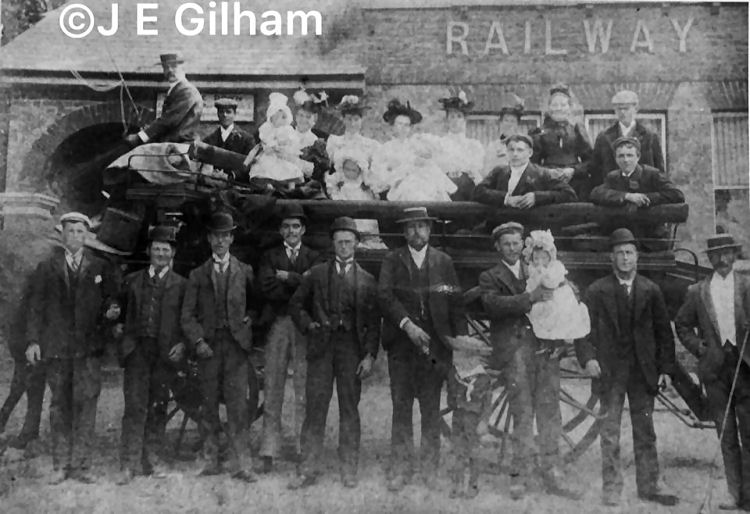
This photo from the J E Gilham collection has been suggested by Alan
Goodwin that it is
this pub, taken before the renovations in 1900. he says the giveaway is
the arch at the left which is now the window to the left of the main
entrance.
|
|
From the Whitstable Times, 28 July, 1900.
A COUNTY POLICEMAN FINED FOR ASSAULTING A CYCLIST.
At the Dover County Sessions on Thursday afternoon, Percy Stunt, a
youth, living at Bartholomew Street, Dover, was summoned for riding a
bicycle without a light on the 4th inst., at Ewell. Sergt Vrowe proved
the case, which was not denied, and Stunt was fined 1s. and 8d. costs.
Arising out of this was a summons issued by Mr. Thomas V. Simmonds,
Captain of the Dover Cycling Club, against P.C. John McKie for
assaulting on the evening of the 4th inst. in the parish of River.
Defendant pleaded Not Guilty.
Mr. A. M. Bradley, who appeared for
complainant, said his client was well-known to everyone as a local
tradesmen. On the evening in question the Dover Cycling Club were
returning from an outing, passing the "Bell Hotel," Kearsney, about
10.40. Mr. Simmonds was riding almost in front and the young fellow
Stunt, who was not a member, was riding near him without a lamp. When
opposite the "Bell" the police ran out into the road, waved their sticks
in a very excited way and stopped Stunt. Mr. Simmonds, to avoid a
collision with some 100 members who were riding closely behind, shouted
"Get out of the way," He then dismounted and the Sergeant and constable,
behaved very strangely. Mickie said "Oh, you have not managed it this
time." - meaning that they had not rushed Stunt through without giving
his address. This was not Mr. Simmond's wish at all, as he assisted the
police by spelling the name of the street in which Stunt lived. Sergeant
Crow asked who Mr. Simmonds was and in answer was shown his Captain's
badge. Mr. Simmonds asked the Sergeant for his name and then the
constable gripped him by the arm and held him for several minutes, which
was the assault complained of. he contended that as Mr. Simmonds had
committed no offence, had given his name and address, and after having
done so had been detained by McKie it was in the interest of cyclists
and the public generally that this should be brought before the notice
of the Magistrates.
Mr. Simminds and several members of the Dover C.C. all swore that McKie
continued to grip Mr. Simmond's arm for a considerable time after he had
given his name and address.
The defence was that McKie did not take old of Mr. Simmond's arm.
Plaintiff had shouted to Stunt to ride on, and when asked for his name
had put the name in question to Sergt. Crowe. When the cyclists mounted
their machines they shouted to the police that they were a pair of pigs
and ought to be put in a sty.
The Chairman said he did not think Mr. Simmonds was a man who could
lodge a complaint of this sort without some reason for doing so. There
was no doubt that on this occasion the police were very excited and lost
their tempers. They were quite right in stopping Stunt, but wrong in
detaining Mr. Simmonds, and the defendant had been guilty of an assault.
The penalty inflicted would be 5s. and 15s costs - in all £1.
|
|
Dover Express 21st September 1900.
KEARSNEY.
Permission was given for the name of the "Railway Bell Inn" to be
changed to the "Railway Hotel."
|
|
From the Dover Express and East Kent News, Friday, 30 November, 1900. Price 1d.
BURIED ALIVE AT RIVER
An inquest was held by Mr. R. M. Mercer, the east Kent Coroner, at the
“Railway Hotel,” Kearsney, on Wednesday evening, on the body of Walter
James Marley, a labourer, who was killed by a fall of earth, in a stone
pit, which buried him. The Jury consisted of Messrs. B. Burbridge
(foreman) , W. Clark, J. Robson, F. Peters, W. Smith, W. Lefevre, T.
Hymers, W. Simpson, E. Dann, H. Hopper, S. Smith, H. Stanley, and F.
Baynton.
Deceased's father said deceased's age was 22 years.
William Shapely said that he was at work on the afternoon of Tuesday
with deceased in a stone hole, at Mr. Leney's orchard. Witness had said
the deceased that they would fill one more barrow that day, before
knocking off to sift the stones. Deceased was in the hole, which was 14
or 15 feet deep, getting out flints, and witness went off with a
barrow-load and shot it 40 yards away. As he returned he saw the earth
from the top of the hole sliding down. Witness shouted to deceased who
made a rush. But was caught by the earth and witness, unable to reach
him, ran for a hand line. The earth came gradually at first, but then
came down with a rush. When witness got back with the line deceased was
covered completely. All the men then set-to and dug deceased out in a
very short time. Witness thought the earth was safe. They had often
tried to bar it down when it was like that, but found it very difficult
to dislodge. They had not undermined the side which fell, that was dug
as straight as the wall of a room. Witness was 24 years of age, and had
worked for Mr. Clark, at Chilton, at similar work. They had worked at
getting the top off nearly all day on Monday. Witness was paid
piece-work, 1½d. per yard top soil, 1s. per yard stone, 9d. per yard
breaking, and 1s. per yard gravel. Witness was quite sure they had not
undermined the side which fell, they had, however, undermined 1¼ feet
the other side.
William Lane, 9, River Street, River, said he worked at the same work in
another hole, and helped to dig out deceased. He was found doubled up as
though sitting, but with his head down. They were ten minutes digging
him out, and the doctor came three or four minutes afterwards.
The Coroner asked a number of questions as to the method of payment.
Witness said if they worked all day moving top soil they would only earn
about 1s. each, but it would give them two days work getting stones out
at 1s. 9d. a yard. In a good week they could earn £2 5s. 5d. between
them.
The Coroner: That is very fair.
Witness further said he was 19, and had never worked at this before.
Mr. A. Long said he was summoned at 2.20 and arrived at 2.30 at the
scene of the accident. Deceased had been dug out but was dead. There
were two severe injuries to his head, and from the appearance of one on
the forehead that might have caused death, and if it did not do so at
once deceased would have been rendered unconscious before being
suffocated by the earth.
The Coroner, in summing up, said that had elicited from his questions as
to the pay, that the men evidently regarded getting stones out as more
profitable work than getting the top soil away, and had dug the hole one
side perpendicular and the other side undermined. There seemed to be no
negligence on the part of anyone, except the men in not removing
sufficient top soil.
The Jury returned a verdict of accidental death.
|
|
From the Whitstable Times and Herne Bay Herald, 8 December 1900. Price 1d.
KEARSNEY. FATAL ACCIDENT IN A GRAVEL PIT.
The East Kent Coroner (R. M. Mercer Esq.) held an inquest at the
"Railway Bell Inn," Kearsney, on Wednesday, on the body of Walter James
Marley, aged 22 years. Deceased was working the previous day in a gravel
pit in the orchard at Kearsney Manor, in company with another labourer
named William Stanley. They were shovelling the earth out of the pit
when suddenly, without a moment's warning, a great quantity of
overhanging gravel gave way, and falling on Marley, completely burying
him. Stapley was horrified at the occurrence, but quickly overcoming his
fright, began shovelling the gravel away with all his might. At least
Marley was dug out, but he was dead. Dr. Long was sent for, but, of
course, he could do the deceased man no good. The jury returned a verdict of "Accidental Death." |
|
From the Whitstable Times, 5 April, 1902.
DOVER. DIED ON THE ROAD.
On Thursday last the county police at Temple Ewell discovered the body
of an old man lying on the roadway near the “Bell Hotel,” and finding
him to be insensible he was conveyed to the Union Infirmary, where he
died one hour after admission. It transpired that the deceased, whose
name was William Thomas Smith, was 83 years of age, and he had tramped
from Bethnal Green Workhouse, where he had been an inmate for some time.
He was stated to be a Crimean veteran. Death was due to natural causes,
and the Coroner, to whom the facts were reported, deemed an inquest
unnecessary.
|
|
From the Dover Express, Friday 20 June, 1902.
EXTRAORDINARY “SEALED BOTTLE” CASE.
Vincent Poil was summoned for sending his son Philip Poil, aged 12, to
the "Railway Hotel," River, for the purpose of obtaining liquor in an
unsealed vessel.
Police-sergeant Crowe said he saw the defendant go from the railway
station, Kearsney, on May 29th, in company with his son to the "Railway
Hotel" (formerly known as the "Railway Bell.") Defendant went inside,
leaving his son on the doorstep of the public bar. After a short time
defendant came out with a jug. The boy said to defendant, "There’s Crowe
coming." Defendant replied. "He has nothing to do with you." He then
handed the jug to the boy, and the boy stepped off the step and went
home. Defendant came towards witness, who asked what the jug contained.
He replied, “A pint of porter. What’s that to do with you?" "Witness
then called the boy back, and found that this was so, and he told the
defendant he should report the case.
Mr. Mowll addressed the Bench for the defence.
The Bench seemed to be at a variance as to there being an offence, and
eventually retired.
The Chairman, on returning to Court, said that defendant had committed a
breach of the law enacted for the protection of young children in the
hope that they would be removed from the temptations to which they had
been put in being sent to public houses.
He would be fined 5/- without costs.
|
|
From the Dover Express, 2 January 1903. Price 1d.
SUICIDE OF A VISITOR AT DOVER
A STATION MASTER SHOOTS HIMSELF
On Sunday, early in the afternoon, the body of a man shot in the right
temple was found on the old Roman road, at the top of Cow Pastures,
between Guston and Dover.
A revolver was found beneath him, and he had evidently shot himself and
fallen forward on the weapon. From documents' found upon him he was
identified at Mr. Arthur Hollot, station master of Upton Park station of
the London, Tilbury, and Southend Railway. As the body was in the pariah
of River, just outside the borough boundary, the inquest was held at the
"Railway Hotel," Kearsney, on Tuesday afternoon, by the County Coroner
(R. M. Mercer, Esq.). Mr. W. Clark was the foreman of the jury, and the
following evidence was taken:-
Joshua Charles Hollot, 79, Cecil road, Upton Manor, Plaistow, said the
deceased was his brother, a single man, aged 38 years. He had been
stationmaster of Upton Park station of the Tilbury line for some years.
Witness knew nothing of his brother being at Dover, the telegram
announcing his death being the first thing he knew about it.
Mr. C. R. Hone, solicitor to the London, Tilbury, and Southend Railway,
said that he had been directed to attend the inquest and give full
information to the Court, because several of the London papers on Monday
contained a report of the discovery of the body of the deceased, and it
was added that from papers found on him it seemed that there had been
some trouble between him and his Railway Company. This statement was
wholly incorrect. There was no trouble between the deceased and his
Company, and in justice to the deceased and his relations, Mr. Hone
wished to make this quite clear, as the paragraph inferred that the
deceased had run away, and that there had been some dishonesty; but
nothing of the sort was the case. The deceased had been with the Company
12 years, working his way from a lad to the position he held, having
been appointed stationmaster of Upton in 1894, and giving every
satisfaction. Early this year, however, his correspondence with the
Company became vague and involved, and his letters were of a long and
strange character. This becoming worse in August they had the deceased
medically examined, and the medical man advised
that the deceased was suffering from nervousness and insomnia, and he
advised that that he should go away for three weeks or a month. The
Directors, out of regard for the man's service, did more than this—they
put him on leave with full pay, and told him to go away until he was
completely recovered, and put a relief stationmaster in his place during
his absence. He wanted to stay near London, but the Directors advised
him to go right away, and in the beginning of September he came to
Dover. After staying here for a time he seems to have gone on the
Continent, visiting Belgium, and Switzerland. From letters received from
the deceased he seemed to have had some escapades on the Continent, and
got into some little trouble. Later on, he came back to Dover, but he
did not seem any better, and a week or so ago he wrote to the Directors
to say that he did not think he should ever get any better or be able to
take up his position strain. The Company then replied that they would
pay his salary to the end of the year, and that his case would then be
brought before the Directors.
The Coroner: There is then no suggestion against his honour?
No, he was a man to be defended upon.
The Coroner, who had been looking at some of the papers found oh the
deceased, said that in addition to having had his salary paid since
August, there was a letter from the deceased's bankers, addressed to the
deceased at Montreux, dated 18th December, informing him that his credit
balance was £300, so that he did not seem to be in any financial
trouble.
In reply to the Coroner, the deceased's brother said that he knew
nothing of his brother's illness as they did not, have time to call upon
each other owing to their businesses.
The Coroner: I suppose a stationmaster's work is sometimes too much for
some nervous people?
Mr. Hone: This is the first case I have met with after twenty years'
experience.
Mrs. Emma O'Connor, 2 Avenue road, Frith road, Dover, said that the
deceased lodged with her when he came to Dover in September, and that he
also came on his return from the Continent on December 22nd, and stayed,
till Saturday. When he returned from abroad he complained of being worse
than before. On Saturday he left at 11 a.m., saying that he should
return at 4 p.m., but he never did so. He had never spoken of suicide,
and witness had never seen the revolver in his possession.
The Coroner said that the revolver was a Belgian one.
James Fletcher, of the Roman Road Whiting Works, said that he saw a man,
apparently the deceased, between 3 and 4 p.m. walking on the Roman road
about 100 yards from where the body was found. He heard no pistol
report, but he was very deaf.
James Brown, a labourer, of River, said that he found the body at 20
minutes past noon on Sunday. The deceased was against a hedge in a
sitting position, but fallen forward. Witness was too shocked to notice
more than that the man was dead, and he at once went and gave
information to the Dover police.
Sergeant Crowe, K.C.C., said that he received information from the Dover
police, and went to the Roman road at 1.50 p.m. The body was quite dead,
with a bullet wound into the brain on the right of the head. The
deceased had fallen forwards and a four-chambered revolver was found
beneath him. It was loaded in four chambers, and one had been
discharged. A quantity of foreign money was found on him as well, and a
watch and chain. It did not look as if anyone had robbed the deceased.
There was no letter addressed to the Coroner or anyone else. Witness
produced the deceased's effects, which included the contents of a
handbag, a number of papers, railway passes, &c.
The Coroner said that apparently the deceased had been able to obtain
free passes when travelling on the Continent.
The jury returned a verdict of suicide whilst temporarily insane, and
expressed their satisfaction at the action of Mr. Hone in attending to
clear away the allegations against the deceased's character.
|
|
From the Dover Express and East Kent News, Friday, 6 January, 1905. Price 1d.
SAD DEATH AT RIVER
On Saturday evening, an inquest was held at the “Railway Bell,” at
Kearsney, by the Borough Coroner, Sydenham Payn, Esq., on the body of
Mary Ann Harbour, who for many years has been a resident of the parish.
On the previous day the neighbours noticed that no one was about at 2,
Avenue Terrace, where she lived, and her sister being informed, an
entrance was effected, and the unfortunately lady was found lying dead
on her bedroom floor, having apparently fallen dead on getting out of
bed. Mr. Toms was foreman of the Jury, and the following evidence was
taken:-
Mrs. E. Jacolette, wife of Mr. M. Jacolette, photographic artist,
Northbrook House, Biggin Street, Dover, said the body at 2, Avenue
Terrace, was that of his sister, Mary Ann Harbour. She was 60 years of
age, and a single woman. It was Miss Harbour's house, and Mrs. Minter
lived with her. Mrs. Minter had been away to Canterbury to spend
Christmas with her friends, and Miss Harbour was left alone. Witness
last saw her a month ago. She was very well then, but said that she was
not equal to coming to Dover very often. She was not of very strong
health. She could cook very well herself, but witness could not say if
she would take much trouble to prepare food for herself. She had every
means to get food, and she went without, it was her own fault. On Friday
afternoon, about four o'clock, Mrs. Goldfinch, a neighbour, sent a
message to witness that the house was closed and the blinds down.
Witness came over by the six o'clock train, and found the house locked
up and the blinds down. When they could not make anyone hear, witness
thought it best to get a carpenter to have the window opened. One came,
and he opened the window, and got through and opened the door. The
carpenter and Mrs. Goldfinch went upstairs first. She followed, and saw
the deceased in the back bedroom, on the floor, almost at the front of
the bed. She had been to bed, and was in her night clothes. There was a
teapot and some toast and biscuits. The teapot was empty, and the cup
and saucer had not been used. She was lying on her left side. Witness
had not the slightest reason to suppose that she took her own life. She
was comfortably off.
Dr. A. Long said he was called in about 7.30 on the previous evening. He
was taken into the bedroom described by the last witness, and found the
deceased lying on the floor, she having been dead for some hours. She
was lying on her left side, with both legs and arms bent up, but no
expression of pain on her face. It was apparent that she had quietly got
out of bed, and walked round the room and fell down. There were no
external marks on the body. Witness thought she fell down through sheer
disability. She was very thin, but she was of spare habit. Witness had
attended her about ten years ago for influenza, and saw her also about a
week ago, but not as a patient. When he attended her she was very weak,
and the same thing might have happened then. He attributed death to
weakness caused by the cold acting on her weak heart. There were no
suspicious circumstances as far as he could see.
One of the Jurymen said that he saw the deceased on Thursday morning
when he called for orders.
Mrs. Jacolette said that a Mrs. King had met the deceased out on
Thursday, going to the Stores.
The Coroner, in summing up, pointed out that the cause and manner of
death seemed to be clear. Probably, in the absence of Mrs. Minter, she
hardly looked after herself as she should have done, and in her weak
state was seized with an attack of syncope, and there being no one to
render her assistance, died.
The Jury returned a verdict in accordance with the medical evidence.
|
|
From the Dover Express and East Kent News, Friday, 16 July, 1915. Price 1d.
UNLAWFUL USE OF WATER
At the Dover Police Court on Monday, before Mr. M. Pepper (in the
chair), Captain R. B. Cay, R.N., and Messrs. H. Hobday.
Charles Hogg, of the “Railway Hotel,” River, pleaded guilty to a summons
for, on the 24th June, then being a person supplied with water from the
East Kent Water Company, unlawfully fixing a hose pipe to the supply
without first obtaining the permission of the said company. A second
charge was preferred against the defendant for using the water for other
than domestic purposes.
Mr. Ernest Chitty, appeared to prosecute and it was a serious case at
the present time when the company had to supply a large number of troops
in the district. It was a serious matter that people should have
unauthorised use of the water. It was well know that if water was
required for garden purposes the water was supplied by meter. Defendant
had a large garden and two lawns and not only did he get the ordinary
warning which is got by printed notices on the demand notes, but last
year a special notice was attached that the water should not be used for
garden purposes. In addition to that on the 14th, or 15th, or 16th of
June he was found having a hose attached to the supply and watering the
garden and he was warned about the matter, the Company decided not to
prosecute on that occasion. However, on the 24th, the same thing was
found to be going on, and, although the Company did not want to be
vindictive against this man they wished it to be a warning. If people
wanted water for their garden they have it by paying a minimum of 7s.
6d. a quarter, and to pay by meter.
George Harmer Gilham, 12, The Avenue, Kearsney, local manager to the
East Kent Water Company, said on or about the 16th June in the evening
he saw a hose pipe connected through defendant's window and water going
on to the lawn. Witness warned him that it must not be done again unless
he paid for it and had permission. On the 24th of June he saw the same
hose pipe through the window and watering the lawn. He went to the house
and saw the son, and the son's wife, he thought it was. He thought he
heard defendant in the house.
The Bench inflicted a fine of £1.
Defendant: The first summons I have ever had, and I am 67 years of age.
The second charge was withdrawn on the bench making a conviction of the
first case.
The Chairman said the bench had taken the two charges into
consideration.
|
|
Dover Express 12th July 1918.
The Dover Tribunal met on Wednesday afternoon at the Town Hall. The
Mayor presided and there were also present Messrs. Robson, Barnes and
Beeby.
Mr. R. Mowll appeared for Mr. T. Lewis, aged 45, Grade 11, landlord of
the "Railway Hotel", Kearsney. Applicant also cultivated a market garden
of 1 and a half acres and he had a large stable and yard, which provided
accommodation for officers in the district. He was also looking after 1
and a half acres of market garden for another man, He stated that he did
catering., whereupon the NSR said that he was informed that no catering
was done for civilians except on Saturdays. The applicant said that he
was surprised to hear that. The NSR said that he was so informed on a
Wednesday three weeks ago. He submitted that the business could be
carried on by the applicant's wife and daughter.
Two months exemption final was granted.
|
|
Dover Express, 03 April 1936.
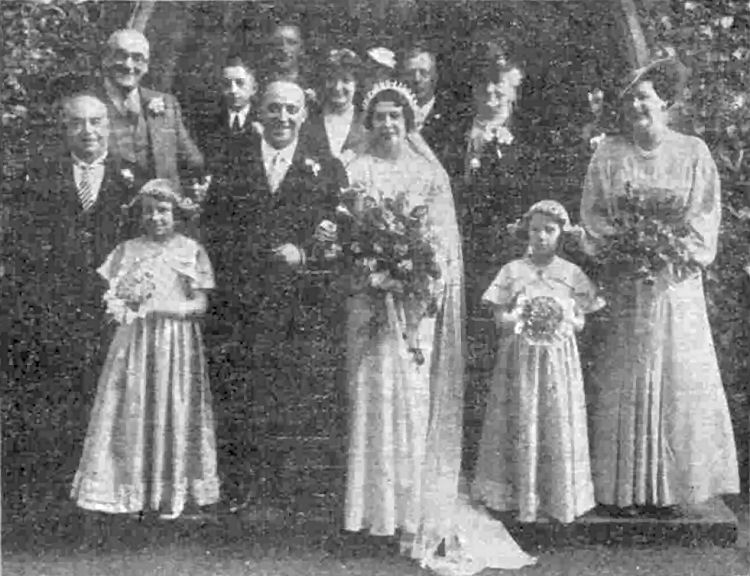
Above photo showing the Wedding at Buckland Church, on Tuesday, of
Miss Mary Hare, daughter of Mr. and Mrs. Harry Hare, of Dover, to Mr.
John Henry Weston, son of Mr. and Mrs. Jack Weston, of the "Railway
Hotel," Kearsney. |
Originally the "Railway Bell" and also referred to as the
"Railway Hotel" and then "Pickwicks"
(May 1983) but now reverted back to the "Railway Bell" again.
|
From the Dover Express and East Kent News, Friday, 10
December, 1937. Price 1½d.
SHARE OUT DINNER
Mr. Weston, licensee of the "Railway Hotel," Kearsney, applied for an
extension from 10 p.m. to 1 a.m., on December 8th , for a dinner and dance
in connection with the annual share out.
The Chief Constable said there was no objection.
The Mayor: Won't be much left, will there?
The application was granted.
|
|
From the Dover Express and East Kent News. 31 March 1939.
The West Street Foxhounds will meet at 11.30 a.m. on Thursday, April
6th - Bell, Kearsney, (by invitation).
|
|
From the Dover Express and East Kent News. 4 July 1952.
NEW SITE FOR "SUICIDE SEAT"
The Chairman, Alderman A. J. Fenn, reported to the Works Committee on
Tuesday that he and the Borough Engineer had agreed that the only
suitable alternative site for the seat at the bottom of Whitfield Hill
was by the Railway Hotel.
At its last meeting the Committee had agreed that the seat should be
removed from the bottom of Whitfield Hill after one member had said it
was almost suicidal to sit there.
|
|
From the Dover Mercury, 18 August 2005.
Pubs bid to open round the clock.
TWO of Dover's pubs and a 'supermarket' have asked for the right to serve alcohol 24 hours a day.
Under the Government's new licensing regime, all pubs, clubs and businesses serving alcohol and hot food after
11pm,
and offering public entertainment, can ask for variations in the times they serve alcohol.
The Britannia pub in Townwall Street, and the Railway Bell in London
Road, Kearsney, have applied for licences that would allow them to
serve alcohol at all times of the day and night.
And Tesco in Whitfield wants to offer its shoppers the choice of buying
alcohol whenever they visit the store.
Both licenses cite very different reasons for their applications,
dismissing any thoughts of round-the-clock binge drinking.
Sarah Webb, licensee of the Britannia near the harbour, said: "We are looking to cater for people who work
shifts and do not want to go to a nightclub. We know from our
customers that many would like a quiet drink, outside
normal hours."
Francis Gorham, licensee of the Railway Bell, said his application was
not about keeping the pub open 24 hours a day, seven days a week."
He added: "This is about being able to decide, as responsible
licensees, a suitable time to close the pub. One night that could be
3am, another 11pm."
Deadline
Following the August 6 deadline for licence applications,
the district council has received 480 applications out of an expected
650 for the Dover district.
Many pubs have applied for longer hours, especially at weekends. The Flotilla and Firkin, in Bench Street, wants to close at 3am on
Fridays and Saturdays, while the Old Endeavour, in London Road, has
applied to stay open until at 2.30am on Fridays and
Saturdays.
|
|
From the Dover Express, Thursday, 24 February, 2011. 60p
BELLS AT THE BELL
Advertising feature
Wedding co-ordinator Kylie Marsh, owner of Gorgeous to Go, the gift
and wrapping service, has recently launched Wedding Bells at The Railway
Bell.
Situated in the popular village of River near Dover, Kylie intends to
make the most of this traditional British pubs lovely location and
combine it with her planning skills to offer a truly bespoke service.
"The setting really lends itself to country-style weddings, explains
Kylie. "But I am more than happy to come up with a bespoke design or
theme - whatever your wish is."
Kylie likes to really get to know her clients and is available for
consultation 24/7. She is quick to point out what a wonderful wedding
need not cost the earth. With a book full of contacts, she will always
go the extra mile to ensure best possible deal on everything, from
teaspoons to toilets!
Kylie will take the strain and stress out of all your wedding
planning, leaving you free to enjoy the whole experience from beginning
to end.
Wedding Bells at The Railway Bell will be hosting a Wedding Fayre on
March 26. 2011, from 10am to 4pm. Held within the actual venue, there
will be a range of specially selected exhibitors from the local area,
all able to give you a taste of what they can provide. Admission is free
and there is parking available.
For more information, contact Wedding Bells at The Railway Bell on
07789 937638.
|
|
From the Dover Express, 16 October 2014.
Family-friendly pub voted the best by you
RAILWAY Bell publicans Billy and Zara White are “over the moon” after their pub was voted the best
place to drink in Dover in an Express online poll.
Despite running the London Road establishment for just six months, it
secured 17 per cent of almost 500 votes lodged.
The "Cricketers" in River came second with 12 per cent, with town centre micropub
"Rack of Ale" in third with 8.5 per cent.
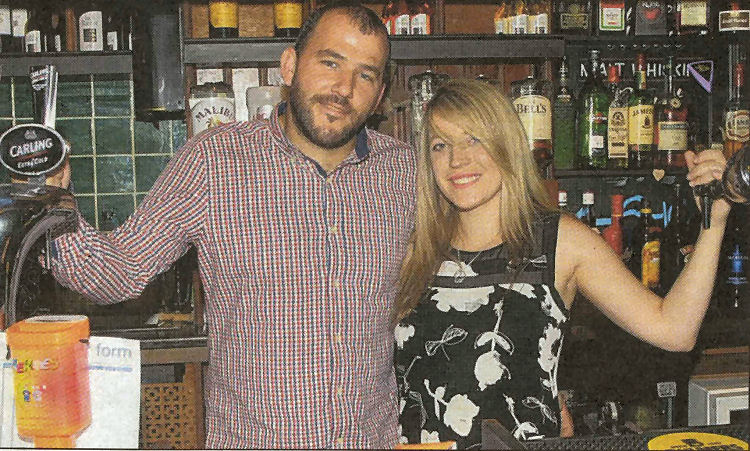
Born and bred Dovorian Billy, who was formerly store manager at the nearby
Iceland, said: “We’ve had lots of people come in and congratulate us and
saying they voted for us, so it’s been a lovely weekend.”
The family-friendly pub and offers kids’ meal for £1 when ordered with an
adult meal.
The pub and its nine staff members have also started a carvery on Sunday,
Monday, Tuesday and Wednesday lunchtimes, with reduced prices for senior
citizens.
The pub hosts live music every Saturday and a number of charity events,
including a walk over hot coals on November 2 alongside fireworks and
food.
On Saturday from 9pm local band Gentlemen of Few will be performing.
|
|
From the East Kent Mercury, 16 June 2015.
Landlady's night trek up Ben Nevis raises £1k.
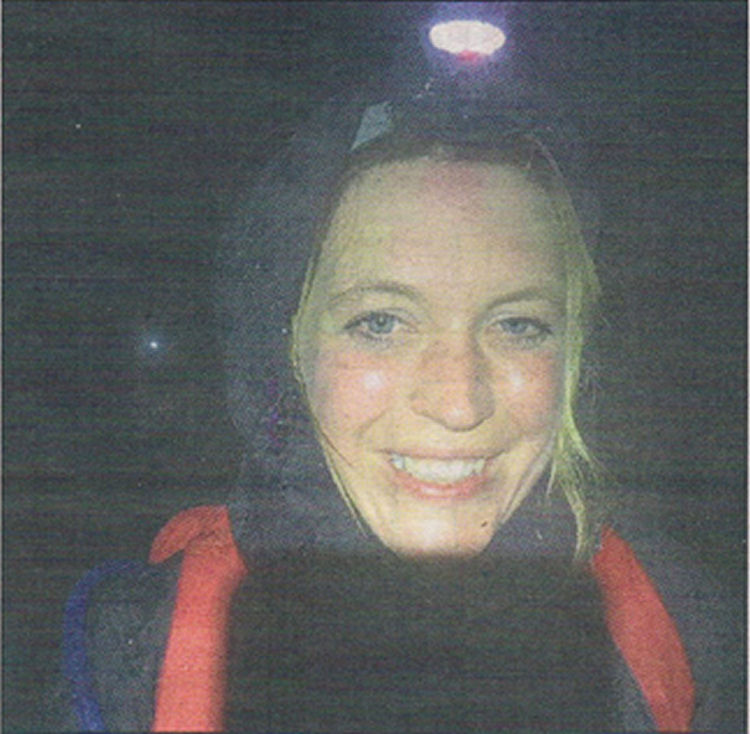
Above photo Zara White of the "Railway Bell" walked for seven hours. A DOVER landlady trekked to the top of Ben Nevis in the dark to raise more
than £1,000 in a tribute to her grandad. Zara White, who runs the "Railway Bell" with her husband Billy, set off at
10.30pm on Saturday, July 4, and climbed for seven hours and 13 minutes
amid gales and sleet. She completed the "midnight challenge" to raise money for the Alzheimer's
Society; as her grandad Tony Hyder, 83, suffers from dementia. Mrs White said: "I wanted to
complete the trek to raise awareness and support research into the
condition, as well as potentially providing funds to support the families
and carers of those who suffer with this cruel condition. She raised a total of £1,300, Any further donations can be made by texting
ZARZ81 £3 to 70070. • Mr and Mrs White plan to complete the 100km London to Brighton trek next
year to raise more money for the treatment of Alzheimer's disease. |
|
From the East Kent Mercury, 23 July 2015.
Landlady shows real spirit for peak climb.
A pub landlady has climbed Britain's highest mountain in aid of her
grandad who is suffering from dementia. Mother-of-five Zara White scaled Ben Nevis, near Fort William in Scotland,
overnight earlier this month, reaching the top in seven hours and 13
minutes.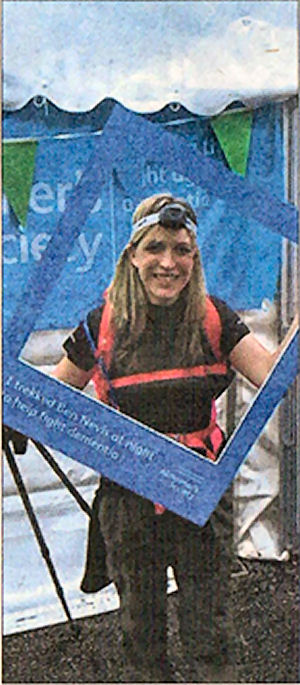 Zara, who runs the
"Railway Bell" in London Road, Dover, with her husband
Billy, did it for charity Alzheimer's Society and to raise awareness. The 33-year-old said: "Me being a bit of a grandad's girl I discredited it
for a little while until the last few years. "It has taken me years to accept that his condition has not just been a
touch of old age forgetfulness. "I used to walk a lot with him and I wanted to do something for
Alzheimer's that meant something to me and him." Grandad Tony is 83 and lives with his wife Shirley who is 80 and is his
full-time carer. "He hasn't got it as bad as some people have, we are lucky it isn't as bad
as some people at his age," she said. "I heard some really devastating stories when I was climbing the
mountain." Zara has always wanted to climb Ben Nevis as she felt it
represented the joint interest they both had in being outside. She said: "Together my
grandad and I would scale the surrounding hillsides when I was a child and
he would guide and encourage my love of the great outdoors." Climbing the mountain on her own, Zara said that it wasn't long before she
paired up with another climber
and they both completed the challenge together. She said: "It was really nice that everyone was there for the same reason. "My only hope of completing this climb was that he will know why I have
done it and on my way up I can reflect on his condition and come to terms
with the changes he is going through." A regular punter in the "Railway Bell" donated his walking poles to Zara
before she left for Scotland, and
his wife, one of her previous teachers at the Dover Grammar School for
Girls, is now in a care home with dementia. About £1,300 has been pledged in sponsorship of the climb, but donations
are still welcomed until this Saturday. Sponsorship forms are at the Railway Bell, or text ZARZ81 to 70070 to give
£3. To access Zara's Just Giving page, visit:
www.justgiving.com/zara-white33 |
After a few weeks closed during April 2014, the pub opened again on
the 3rd May.
Shock horror. The pub was open on Sunday 28th February 2016, and shut and
boarded up on Monday 29th February 2016. Local rumour has it (unconfirmed),
a manager employed by the license holder working inside absconded with
£8,000 in cash forcing the pub to close as payments couldn't be made to the
brewery. If that's true I hope the thief gets his just reward. A village
without a pub is no village at all.
Glad to say that the pub reopened again on Friday 18th March 2016.
|
From the Dover Mercury, 17 March 2016.
New team at the Bell.
The Railway Bell pub in River is set to re-open under new management
tomorrow (Friday).
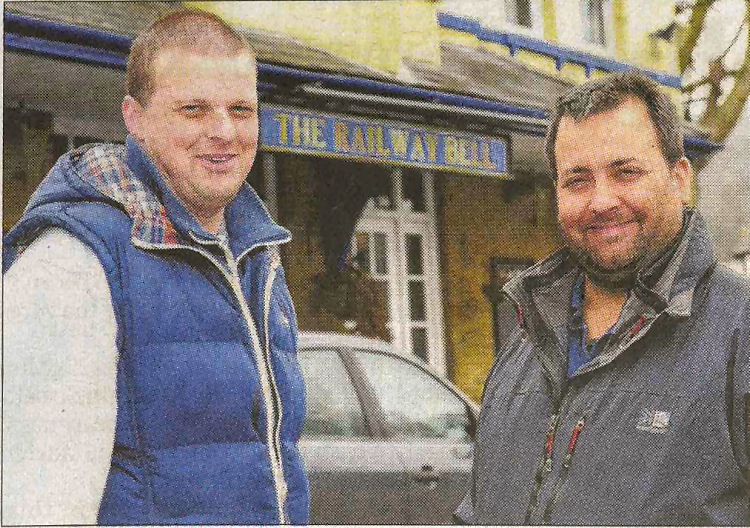
Nathan Morgan and Ron Hall outside The Railway Bell.
Nathan Morgan and Ronald Hall, who are landlords of the "Bridge Wardens"
and the "Sportsman" in Rochester, will be taking over the reins.
Their plan is to continue the pub's success but also develop the
restaurant side.
Mr Morgan said: "We will be carrying on as normal really, but the
restaurant will be used a lot more."
He said the pair were hiring a new chef who they hoped would develop a
great menu of pub grub.
The Railway Bell was formerly run by Zara and Billy White, who also ran
The "Park Inn" in Ladywell, before this too was taken over by new
management.
Mrs White, a former Dover Girls' Grammar pupil, posted on Facebook to
announce the pub's closure two weeks ago.
She said: "Sorry for shocking some of you with our closure.
"The pub is back up for rent this time. It's a beaut, so I am sure
someone will snap it up quickly.
"I can assure you there were no current plans when we left that it would
be developed and we are sure it will remain a pub."
It is owned by pub company Enterprise Inns, which also owns the "Bridge
Wardens" and "Sportsman" in Rochester, and asked Mr Morgan and Mr Hall to
take over the pub in River. Mr Morgan said the pub in London Road hadn't
been trading as it should have been but he had high hopes for its
future.
|
For a while between 1983 and 2002 the pub went under the name of "Pickwicks."
After being rather sporadic as to whether it would be open or not in
November and December 2018, it finally closed its doors around Christmas
time 2018. Hopefully awaiting new tenants.
Unfortunately planning permission went in on 16 January 2020 to erect 6
new dwellings and the conversion of the current building to 6 self-contained
flats on the site. That makes another 12 dwellings from the current premises
and another loss of a pub that had been serving the local community for over
150 years.
LICENSEE LIST
MORLEY Richard 1871+ (age 48 in 1871 ) )
DOWNS Richard 1874+

DOWN George 1881-Jan/1900 (age 54 in 1881)
        
CURTIS Samuel Jan/1900+
 (Formerly
stationmaster at Kearsney age 60 in 1901) (Formerly
stationmaster at Kearsney age 60 in 1901)
CURTIS Mary J 1901-Dec/04
 F F
 ELPHINSTONE Alfred Dec/1904-07+
TERRY Edward Ernest Gregory 1911-13+ (age 33 in 1911)

FURNEAUX A to Aug/1914

HOGG Mr Charles Aug/1914+ (
from Hamstead)
LEWIS T Mr 1918-Sept/19
WESTON John Sept/1919-48+
  
HUTCHINGS Albert & Laura ????
HAMMOND Alfred W 1969-81 Whitbread Fremlins 74
GORHAM Francis & WOODWARD Katherine 2002-Nov/11
CONNOLLY James Nov/2011-Feb/13
Holding Company Mar/2013-June/13
GEVAUX Pauline 28/June/2013-Feb/14
WHITE Billy & Zara Apr/2014-Feb/2016
HUBBARD Karl Mar/2016+
https://whatpub.com/railway-bell-river
From the Post Office Directory 1874
From the Post Office Directory 1882
From Pikes Dover Blue Book 1889
From Pikes Dover Blue Book 1890
From Pikes Dover Blue Book 1891
From Pikes Dover Blue Book 1895
From Pikes Dover Blue Book 1896-97
From Pikes Dover Blue Book 1898
From Pikes Dover Blue Book 1899
From Pikes Dover Blue Book 1899-1900
From the Kelly's Directory 1899
From the Post Office Directory 1901
From the Post Office Directory 1913
From the Post Office Directory 1914
From Pikes Dover Blue Book 1923
From Pikes Dover Blue Book 1924
From Pikes Dover Blue Book 1932-33
From Pikes Dover Blue Book 1938-39
From Pikes Dover Blue Book 1948-49
 Library
archives 1974 Library
archives 1974
From the Dover Express
|

