|
13 St. James' Street
Dover
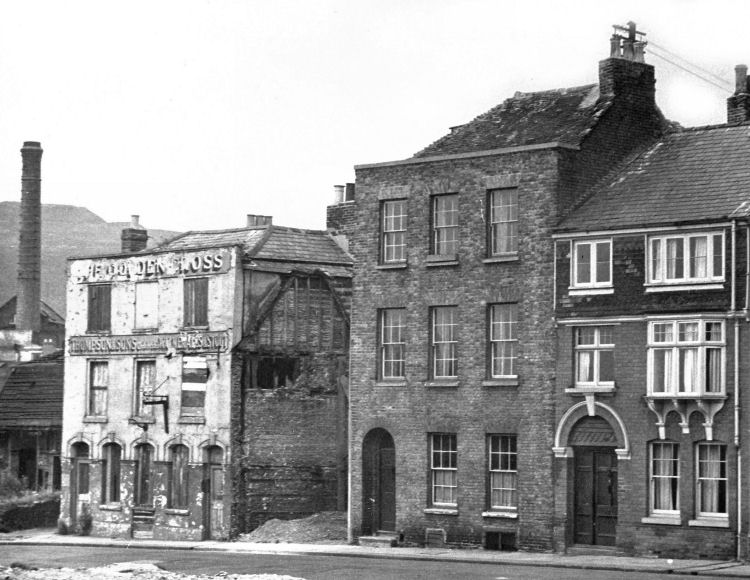
Above showing the "Golden Cross," with thanks from Bob Hollingsbury,
showing the war damage. Circa 1940. |
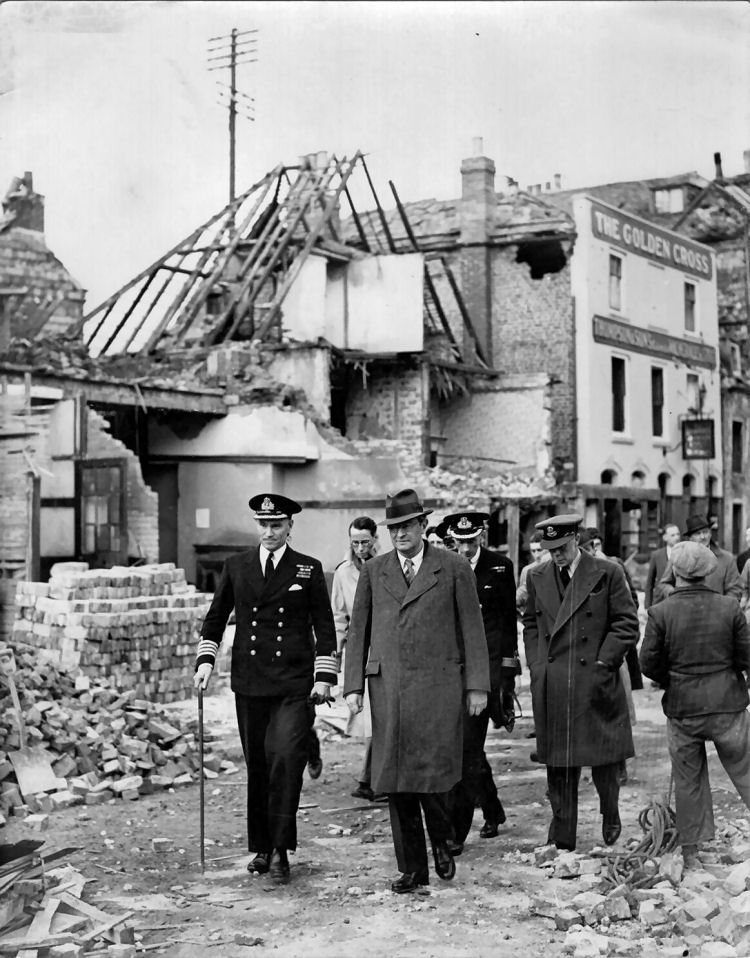
Above photo, 7 November, 1940.
Lord Lothian, British Ambassador to the United States, who is taking
the opportunity afforded by his stay in Britain to make himself familiar
with the manner in which the British people are fighting back against
intensified enemy attacks, inspected coastal defences and also visited
Dover. Photo shows Lord Lothian (right foreground) passing wrecked
buildings in Dover. With him is Captain Llewellyn-Morgan of the Royal
Navy.
G November 7th 1940. r. Censor No. 90554. |
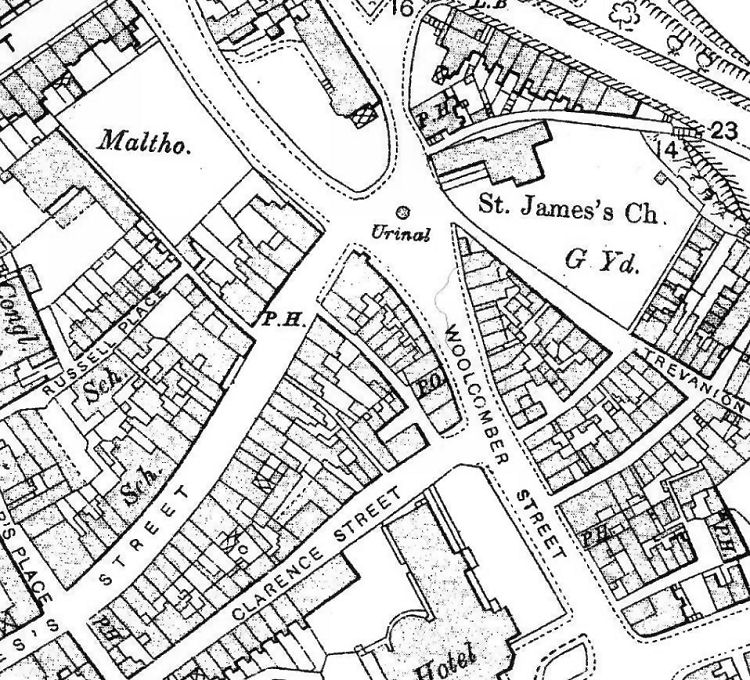
Above map 1937. |
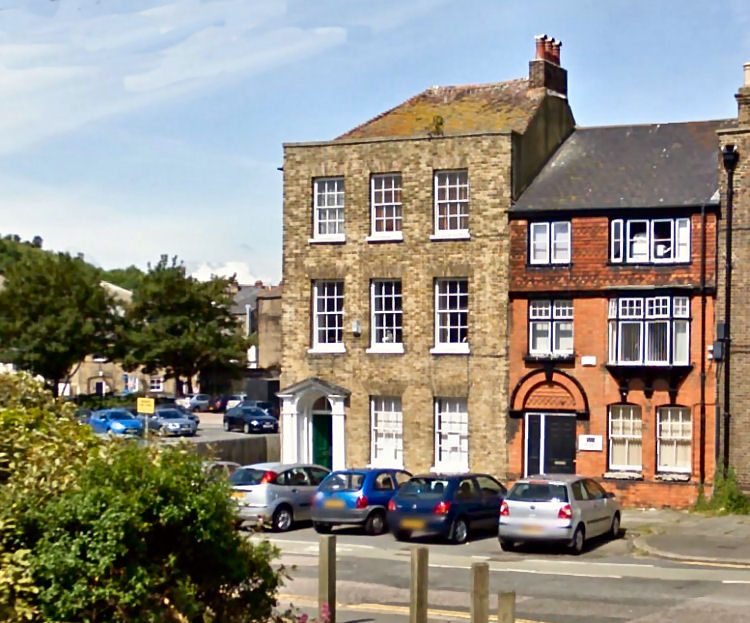
Similar shot taken in 2009. |
 |
|
Dover Mercury 6/4/2000
Pub outing facts arrive.
THE ink had hardly dried on the Dover Mercury two weeks ago before we
started receiving information about the mystery picture in our Those
Were The Days feature.
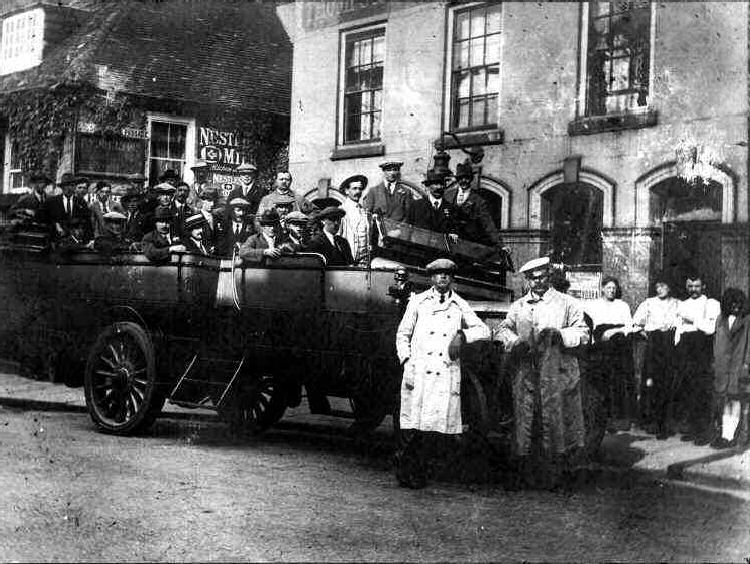
The picture showed people about to go on a charabanc outing from a pub
in Dover.
Bob Dunford was the first to get in contact, telling us it was taken at
Golden Cross Passage and the pub was the Golden Cross in at St James's
Street. Adding more information was Barry Smith who said the pub, run by
Charringtons, was at 13 St James's Street.
Quoting from the book By The Way, which is available in Dover Reference
Library, Mr Smith said: "The Golden Cross opened at 5am from 1881.
Another with the sign was reported in Snargate Street in 1826.
"Bomb damage was responsible for the closure on October 7, 1940. Further
damage made the building so dangerous that rebuilding was called for.
"It was ruled that although rebuilding was out of the question, the
brewer should not forfeit his licence.
"Post war, a compulsory purchase order was made for the site and war
damaged building thereon in January 1954.
"The brewer in turn asked for the licence to be transferred to a
newly-built house on the Buckland Estate and it then passed to the
Wheelwright's Arms in 1956."
Local historian Joe Harman confirmed it was the Golden Cross Inn in St
James' Street and the picture was probably taken about 1925.
"The charabanc is probably one of Father Wills' from Folkestone," he
said. "There was a Golden Cross Passage with a grocer's shop on the
other side, hence the Nestle's Milk sign in the picture."
|
|
From the Kentish Gazette, 21 July 1857.
Singular Discovery.
The other day us some men in the employ of Mr. Wood, builder, were
making excavations at the rear of the "Golden Cross" public-house in
St. James’s Street, they singularly enough dug up a golded cross, or
what at first sight appeared to be one, for on being placed in the
hands of a goldsmith it was found to be but a plated article after
all. It is elaborately carved, however, and of ancient manufacture,
and no doubt has belonged to a pious Catholic at some time, although
not very recently, as the ground from which it was taken has not
been disturbed within the memory of any one who knows the premises.
|
|
From the Kentish Gazette, 23 October, 1860.
DARING ROBBERY.
Early on Wednesday morning the inmates of the "Golden Cross Inn," St.
James's-street, were disturbed in their lumbers by a noise as of some
one moving about in the lower part of the premises. A lodger in the
house was so far persuaded of this, that she got up and went out of her
bed-room door to listen for a repetition of the sounds which had
attracted her attention, but not hearing anything more she went to bed
again. Later in the morning, on the servant going down stairs and
engaging in normal domestic work, she went into the bar, when her
attention was called to the waste-tin, which was broken down, apparently
by some one clambering over it into the bar, while one of the pots was
lying on the floor. The attention of the landlord being called to the
circumstance, he examined the till. It had been broken open, and its
contents, which fortunately did not amount to more than 5s. 6d.,
extracted. It is supposed that the thieves entered the house by the back
way, and a ladder some painters who were at work at an adjoining house
had left behind, had evidently been made use of by the thieves in
scaling the wall of the yard at the rear of the house. The perpetrators
of this daring robbery have not been discovered.
|
|
Dover Express, Saturday 12 March 1864.
Application was made by the executors of the late Mr. G Hipgrave, for a
new licence for the "Gun Hotel," Strond Street., and permission to sell
was given until the next transferred day. A similar application was made
by the widow and sole executrix of Mr. Barton Venner, for the "Golden
Cross," St James's Street, and permission to sell was given.
|
|
From the Dover Express and East Kent Intelligencer, 28 January, 1865.
INFRINGEMENT OF LICENSE
Charlotte Venner, landlady of the "Golden Cross," was charged by
Police-sergeant Bayley which serving during the prohibition hours on
Sunday morning last; but as this was her fist offence, and as Mr.
Knocker, who attended for her, adduced some extenuating circumstances,
the Magistrates dismissed the summons on defendant paying the costs, 6s.
6d.
|
|
Kentish Gazette, 4 January 1876.
DOVER SUDDEN DEATH OF A SOLDIER.
Corporal Ford, R.E., died very suddenly on Thursday morning last.
The deceased man had been engaged in his usual health, but,
complained of feeling poorly, retired rather early than usual that
night. Early next morning his wife was awakened by hearing a peculiar
noise, and then discovered that her husband was in a critical
condition. Dr. Marshall was sent for and was promptly in attendance,
but before his arrival the unfortunate man had breathed his last. An
inquest was held on Friday at the "Golden Cross Inn," before the
Borough Coroner (W. H. Payne, Esq.) when a verdict was returned in
accordance with the foregoing facts.
|
|
From the Dover Express and East Kent News, Friday, 25 January, 1895.
WATERS v WILSON
This was a claim for £2 0s. 0d., a month's wage. The plaintiff, a lad
had acted as groom and stable boy to the defendant, who had lived
successively at the “Pavilion” public house, Castle Street, and the
“Golden Cross,” and was discharged on December 29th at a minute's
notice. The next day the plaintiff saw the defendant and asked for the
wages due. Defendant stated he had paid him the previous day.
The defendant denied that he owed the defendant any money.
His honour gave judgement for the plaintiff in 14 days.
[I will say I do not know of a "Pavilion"
public house in Castle Street, and believe it to be an error. Paul
Skelton.]
|
|
http://www.dover.freeuk.com/entertainment/pubs/golden_cross.htm
Thanks to the sharp eyes of readers of the Dover Mercury for the
following information:
The public house was called the Golden Cross, 13 St James' Street, on
the corner of Golden Cross Passage. The shop on the opposite corner of
the Passage was a grocer's, which explains the Nestles Milk advert on
the wall.
A poster in Dover Museum proclaims "We were bombed and shelled out of
the Golden Cross and now we have no roof, but Hitler can't stop us! (we
hope)". According to the accompanying label, the pub was damaged by
bombs on 7th October, 1940. The area was badly damaged by shellfire and
the pub was eventually demolished in 1958, having never reopened.
The pub and the adjoining passage got their name from a golden cross
which was found when structural alterations were being carried out in
1860.
In 1881, this was another hostelry that opened its doors at 5 a.m.
Help wanted:
We still don't know what the occasion was, who the men were or where
they were going. Can anybody help us with this one? |
This outlet of Charrington stood on the corner with Golden Cross Passage
and opened at five a.m. from 1881.
The 1881 Census gace the address as 13 St. James Street, St. James the
Apostle.
When structural alterations were made in 1860, a small gold cross did
come to light. It has been passed down through the family and the proud
possessor today is David Clark of Tenterden.
|
Dover Express 18 September 1903.
DOVER POLICE COURT. THE GOLDEN CROSS.
An application for temporary permission to draw pending transfer was
made by E. A. Dane to take over the "Golden Cross Inn," St. James's
Street, from F. R. Cole, was granted.
|
|
From the Whitstable Times and Herne Bay Herald, Saturday 4 May 1907.
CANTERBURY BANKRUPTSY COURT.
Re. Frederick Richard Cole, of 52, Clarence Street, Townwall Street,
Dover, Carpenter formerly residing and carrying on business as a
licensed victualler at the "Golden Cross Inn," St. James's Street,
Dover.
The liabilities were returned at £266 2s 9d., and the assets were
estimated to produce £22 15s. 2d., leaving a deficiency of £243 7s. 7d.
Debtor stated that he first started in business in 1885 as a licensed
victualler. He had had several houses since then, the last one being
the "Golden Cross" at Dover. That was about ten years ago. he had always
kept a carpenter's shop on in Townwall Street, in addition to the
licensed victualler's business. In 1908 he took a book-making and lost
pretty well £300 over it.
The examination was closed.
|
|
The Dover Tribunal 18th October 1916.
Mr. E. A. Dane, aged 37, landlord of the "Golden Cross", having been
granted leave to appeal, applied for further time on the grounds of
serious hardship owing to the illness of his wife. He admitted he had
not been to the brewers since the last appeal. The Tribunal decided to
deal with the cases of two other licensed victuallers before coming to a
decision. Mr. E. J. Le Gros, aged 36, married, landlord of the "Avenue", Snargate
Street, also applied for further time. He said, in reply to the Military
Representative, that he had not gone to the brewers to see what they
would do. He had tried to get his father to try and keep on the
business. The Military Representative said that these men did not seem to have
"crossed the road" to get rid of their houses. They seemed to be playing
with the Tribunal. Mr. A. E. Elms, aged 28, married, landlord of the "Grapes" also applied
for further time. He stated that he spoke to the traveller the previous
day and they were very loth to lose him. They were leaving the matter
until they found out what time he got. The Tribunal decided to refuse each of the three cases. |
|
From the Dover Express and East Kent News, Friday, 31
July, 1925.
Price 1½d.
ST. JAMES'S STREET FLOODING
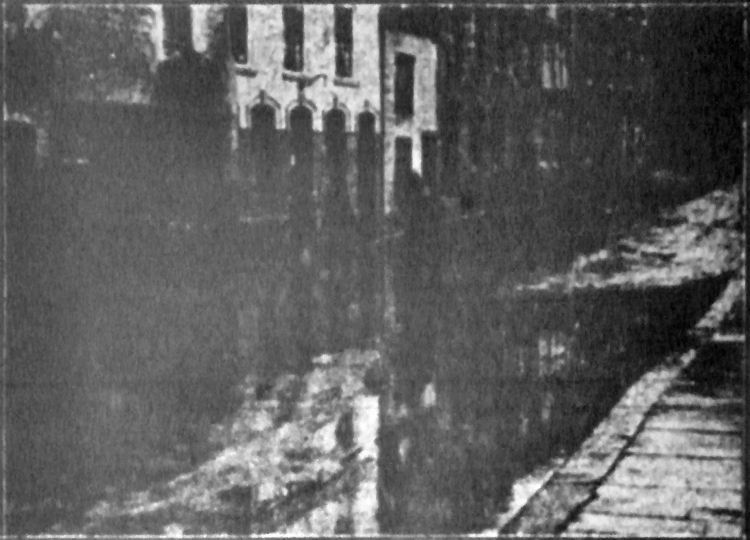
After heavy rain, St. James's Street is flooded from one side of the
street to the other, and large quantities of mud deposited. It comes
from a manhole in the street and fills the cellars of the "Golden
Cross," and prevents people from getting to the shops adjoining.
Although repeated efforts have been made to get the matter seen to,
these have been in vain.
The scene shows the flooded street after the heavy rain on Monday.
|
In August 1917, during the first world war, licensee Mr. Dane left to
join the colours, and his brother-in-law, Mr. Gillett took over the license.
|
Dover Express 12th July 1918.
The Dover Tribunal met on Wednesday afternoon at the Town Hall. The
Mayor presided and there were also present Messrs. Robson, Barnes and
Beeby.
Mr. R. Mowll appeared for Mr. H. Gillett, aged 47, Grade 1, licensed
victualler. It was stated that the applicant had been enrolled by the
Kent War Agricultural Committee but the voucher had not yet arrived and
the case was adjourned for a month.
|
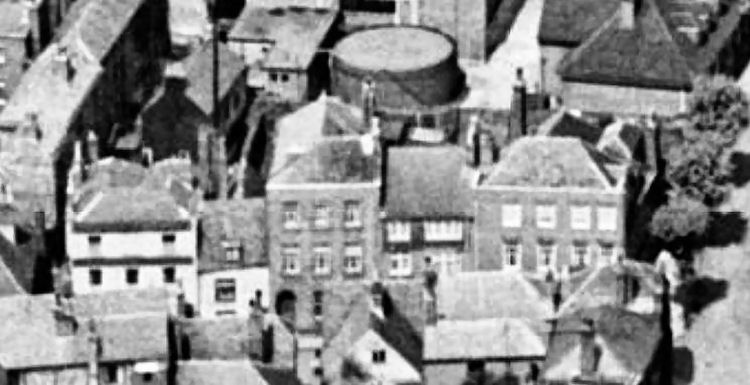
Above photo showing the Golden Cross as the building on the far left,
taken in 1932 from Britain from Above. |
Bomb damage was responsible for the closure on 7 October 1940. Further
damage by March 1941 made the building so dangerous that rebuilding was
called for. That produced a decision which was to affect all the licensed
premises throughout hostilities. It was ruled that although rebuilding was
out of the question the brewer should not forfeit the licence.
Post war, a compulsory purchase order was made for the site and war
damaged building thereon in January 1954. It was confirmed in May 1955. The
brewer in turn, asked for the licence to be transferred to a newly built
house on the Buckland Estate and it then passed to the "Wheelwright's Arms"
in 1956.
|
From the Dover Express and East Kent News, Friday, 19
August, 1938.
DOVER PUBLIC HOUSE CHANGES.
The Bench approved plans for alterations to the "Golden Cross," St.
James's Street.
|
|
From the Dover Express, 9 June 1950.
OLD ST. JAMES' TOWER.
To the Editor of the Dover Express.
Dear Sir, - I am sure there were many like myself who appreciated the
appearance of the two photographs of Old St. James' Tower in your recent
issue (shown below).
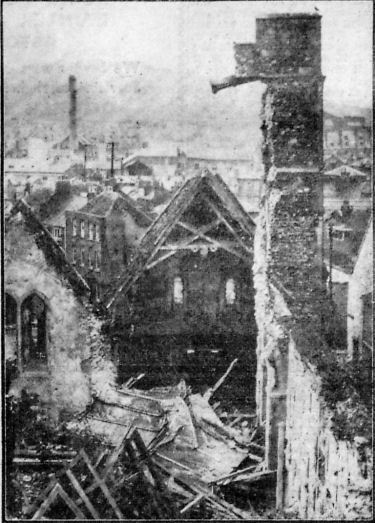 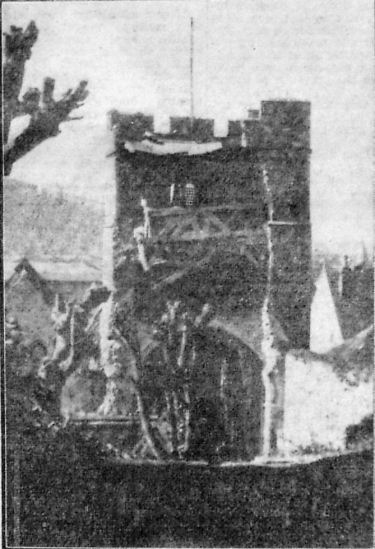
ST. JAMES' OLD CHURCH.
On Monday night the tower of war damaged St. James' Old Church
collapsed. The photograph above (right), by Mr. E. Austen, of 128
Snargate Street, taken only a few days before, gives an interesting
comparison with a similar view today. (1950) |
This was the only church tower to be destroyed in England by
shells from the Cross Channel guns on the French coast, although many
Towers were within range. The Tower has now collapsed and gone, but the
bell, cast by John Warner, of London has been saved and it will be
honoured for years as a treasure in the history of a fighting Dover. It
was dedicated for service in 1872, replacing a peal of six, cast in the
year 1637. Thus it was this last bell to sound out from the tower which
no doubt had bells to use as far back as the 14th century. Many old
books contain reference to the long connection of the church with the
Cinque Ports and the admiration of old Dovorians is revealed by the
nearby hostelry in St. James' Street, "The Golden Cross," being named in
close connection.
The Bell of St. James' is no oil-painting, therefore it cannot adorn
the walls of the Town Hall, but it can sound out in remembrance of the
courage and fortitude of all those who defended Dover during the
shelling and upheld the freedom of the ideal for which it was cast.
CHARLES TURNER.
(Capt.) St. Mary's Ringers.
|
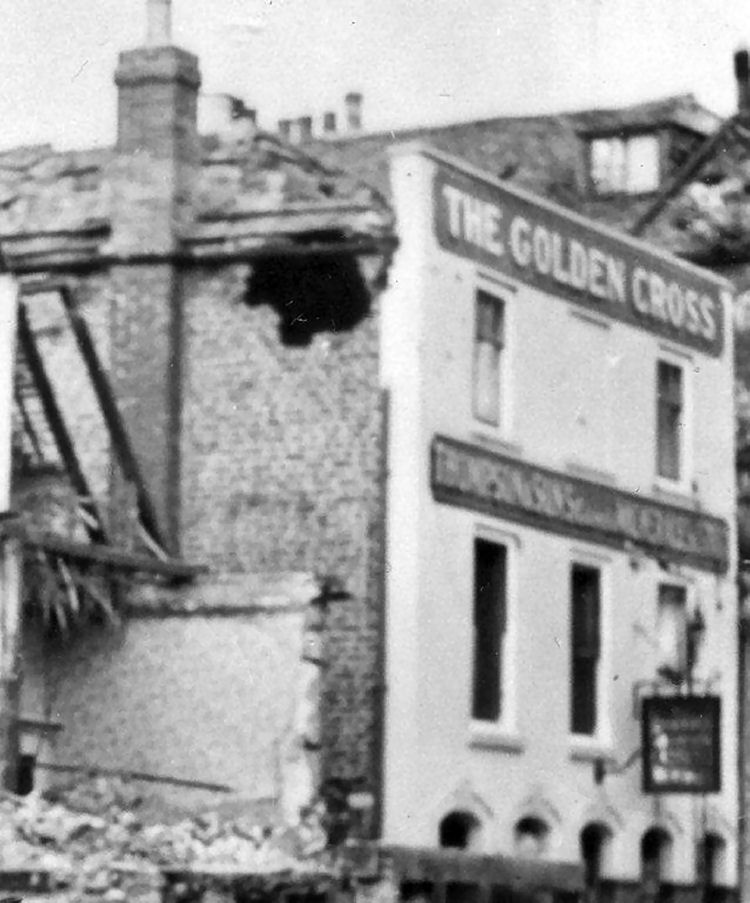
Photograph above, kindly
sent by Paul Wells shows the Golden Cross just after being hit by enemy
fire in 1940. |
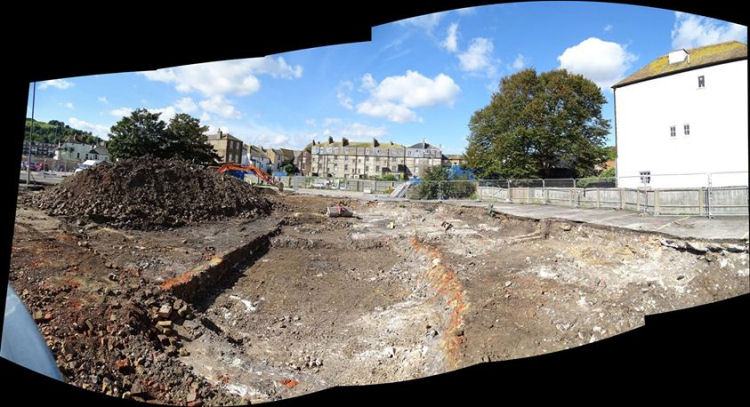
Above photo showing the location today (September 2015.) Kindly supplied
by Paul Wells. |
LICENSEE LIST
HATCH John 1851-61+ (also brewer age 55 in 1861 ) )

VENNER Barton Mar/1864 dec'd
VENNER Mrs Charlotte 1864-July/68

PEARSON Mr July/1868+
BEYNON Misses A & VENNER 1874

VENNER Jane Julia to May/1880
 YOUNG George Charles May/1880-Aug/82
 (age 47 in 1881)

DUNGEY John Aug/1882+
REED T B 1887 end
MACEY William Haynes 1887-91+ (age 59 in 1891)

NOBLE George Charles 1894-95

COLE Frederick Richard 1897-Sept/1903
   
DANE Edward Alfred Sept/1903-Jan/17
(age 31 in 1911)
 
GILLETT Mr H Jan/1917-22

AMBROSE W 1922
FAGG J 1923-Dec/32+
   
HOLNESS William James Dec/1932-Apr/36
OTTLEY Charles William Apr/1936-38 end
 
HAYWARD Enoch 13 Jan 1939-40 end
(Enoch Hayward was a
general stores keeper from Ramsgate)
 From the Pigot's Directory 1828-9 From the Pigot's Directory 1828-9
From Melville's Directory 1858
From the Post Office Directory 1874
From the Post Office Directory 1882
From the Post Office Directory 1891
From Pikes Dover Blue Book 1895
From the Kelly's Directory 1899
From the Post Office Directory 1901
From the Post Office Directory 1903
From the Kelly's Directory 1903
From Pikes Dover Blue Book 1909
From the Post Office Directory 1913
From the Post Office Directory 1922
From Pikes Dover Blue Book 1923
From Pikes Dover Blue Book 1924
From the Post Office Directory 1930
From Pikes Dover Blue Book 1932-33
From the Post Office Directory 1938
From Pikes Dover Blue Book 1938-39
From the Dover Express
|

