|
15 South Road (1871 ) )
Kingsdown
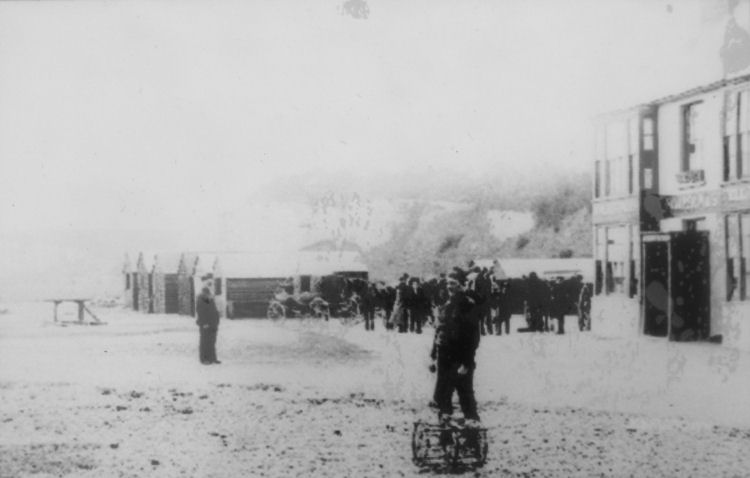
Above shows the "Zetland Arms" and Kingsdown beach, circa 1900.
|

Above photo, 1909. |

Above photo, circa 1909, kindly sent by Rory Kehoe. A slightly different
version of the other 1909 image. A note on the back of my card names
William Wellard but sadly, not the other people in shot. As the
licensee, it's reasonable to presume that Mr Wellard is the gentleman on
the left, standing in the doorway of his pub. At the time this
photograph was taken, the pub was a tied house, within the estate of
Thompson's Walmer Brewery, as indeed were the other three pubs in
Kingsdown! |

Above photo, circa 1910, kindly sent by Rory Kehoe. In the livery of
Thompson's Walmer Brewery. |

Above photo, 21 November 1983, by Jim Ashby. |
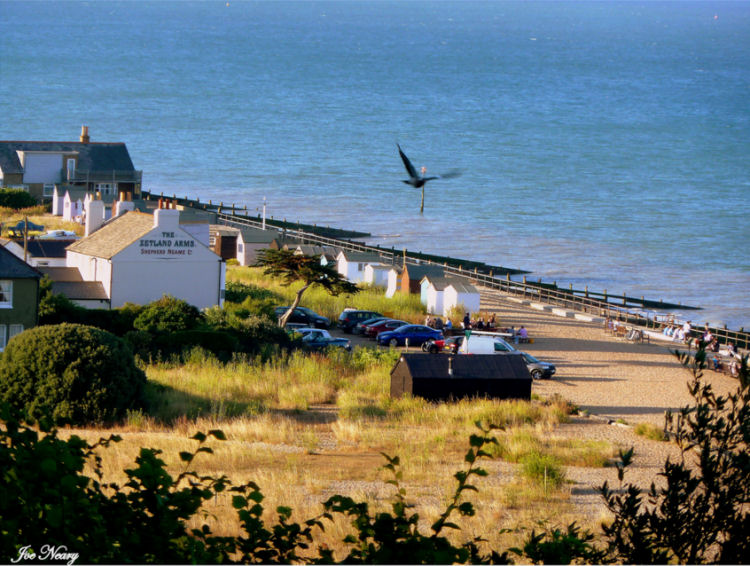
Above photo, August 2013, kindly submitted by Joe Neary. |
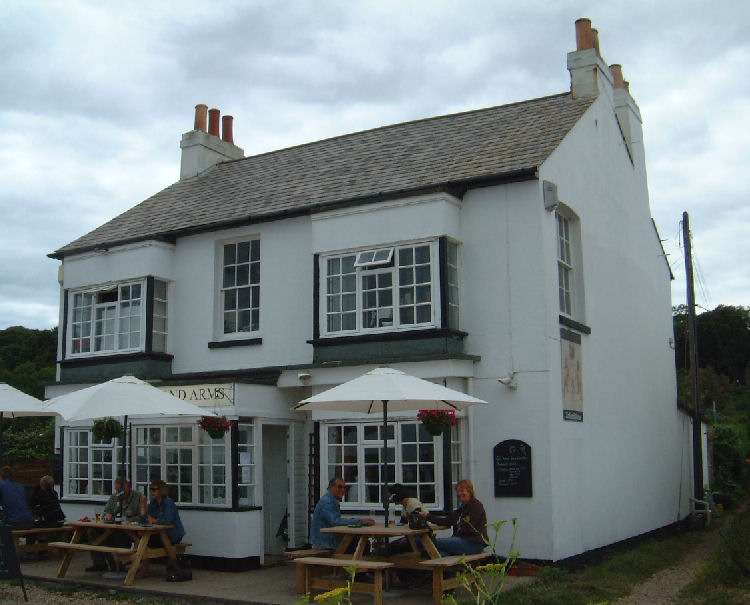
Photo by Paul Skelton, 12 July 2008.
|
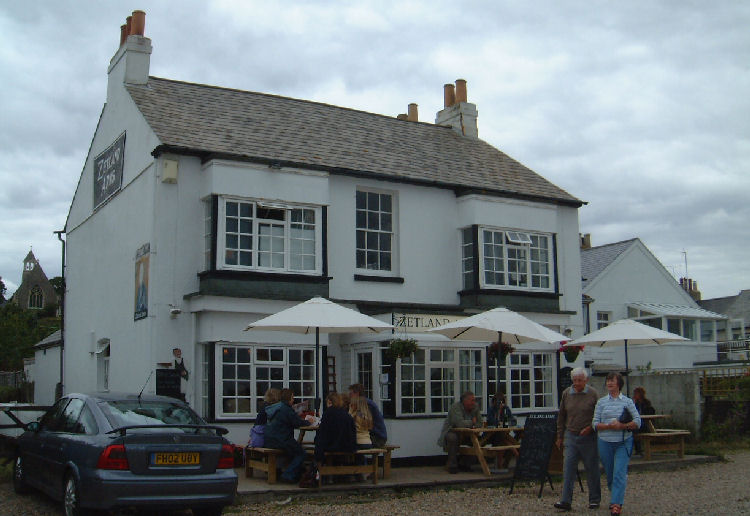
Photo by Paul Skelton, 12 July 2008.
|
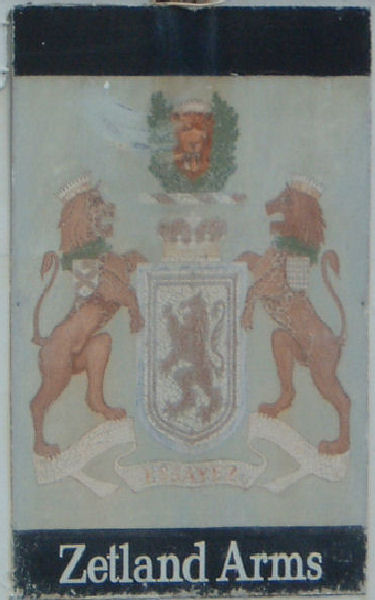 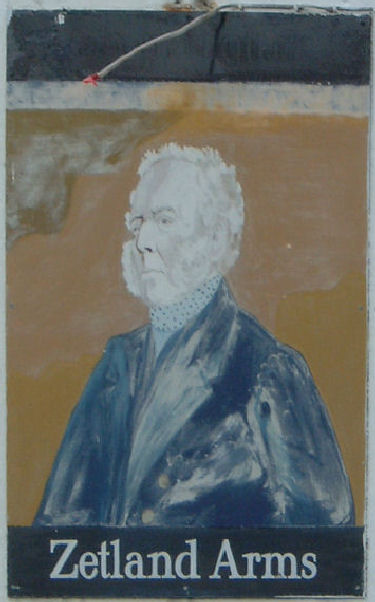
Photos by Paul Skelton, 12 July 2008.
|
Photo by Paul Skelton, 12 July 2008. |
|
From the Dover Mercury, 7 March, 2013. 80p.
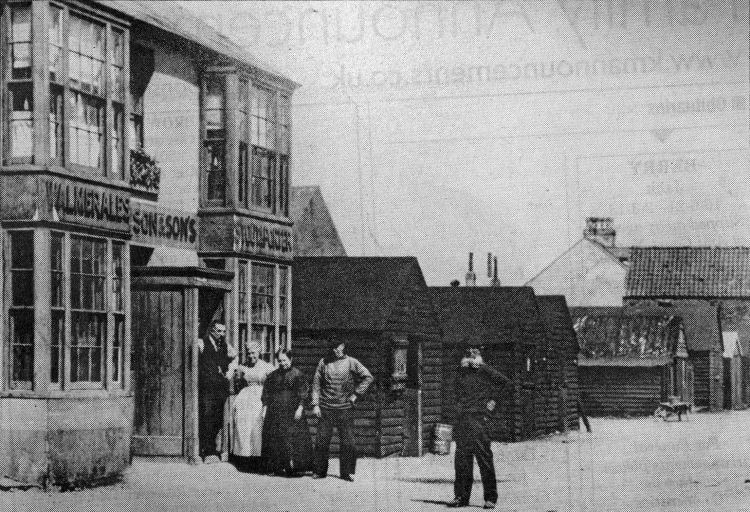
The Zetland Arms in 1900, when Walmer Brewery provided the beers. The
wooden huts beside the pub have long gone. |
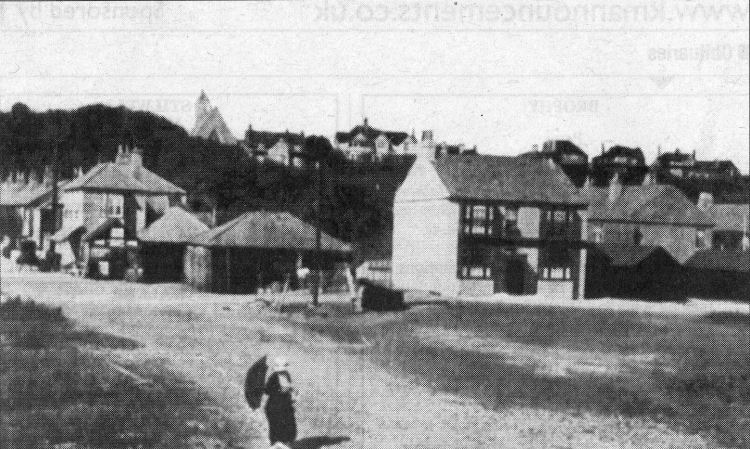
Above picture showing the "Zetland Arms," circa 1910. Photo from the
Deal Society. |
|
From the Dover Mercury, 13 December, 2012. 80p.
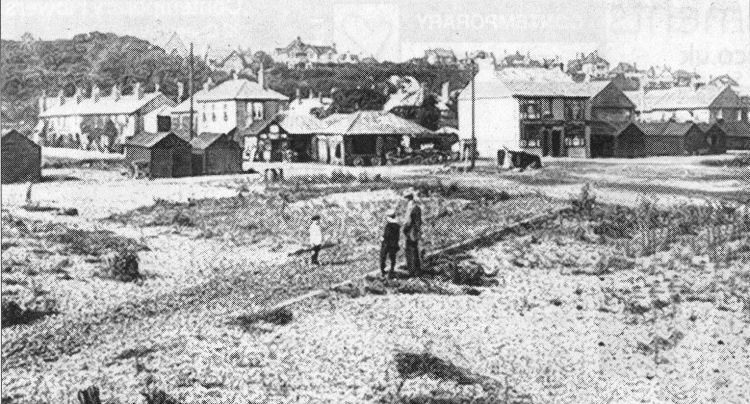
A 1920 scene along Kingsdown beach, showing the "Zetland" as the
large white-sided building.
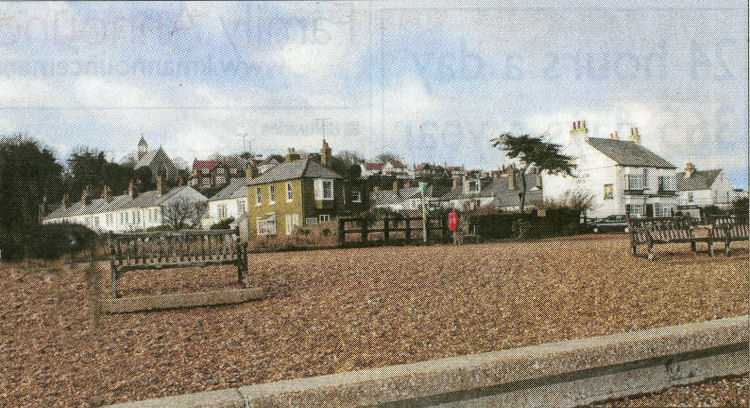
A 2010 view of Kingsdown beach showing little has changed since the
1920 view. |
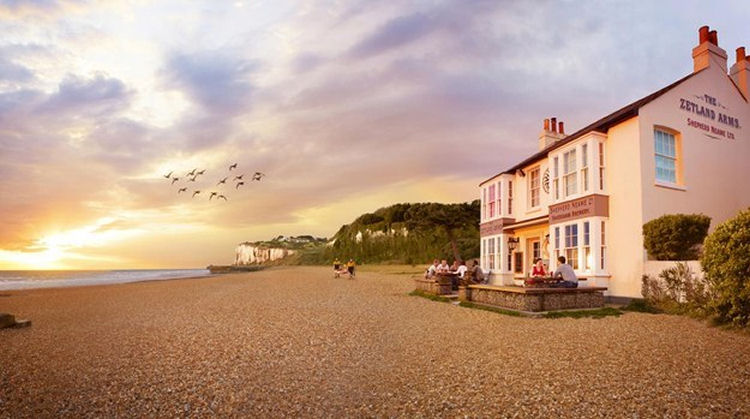
A view from the other direction 2015. |
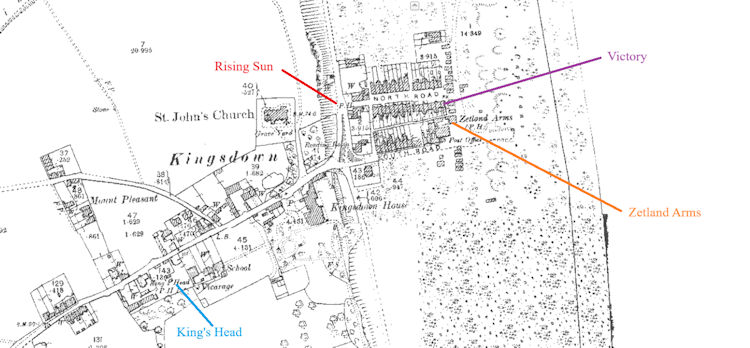
Above map 1930. Showing the locations of the "Rising
Sun," "Victory," "Zetland
Arms," and "King's Head." |
One time a tied house of Thompson and Sons, Walmer. Originally titled the "Earl
of Zetland." 1860 a lugger of the same name being towed, fully laden with goods
from the ship, the Earl of Eglington, which had been wrecked at St. Margaret's
Bay unfortunately being towed too fast, the Earl of Zetland was dragged under
and lost. I am wondering whether any of the timbers were used for the building
of this pub, hence the name.
Jarvest Arnold, an early licensee of this pub, was also coxwain of the Kingsdown
lifeboat "Sabrina," and according to the Times of 26 October 1866, was
responsible for the removal of property from the wreck of the "North," wrecked
on the Goodwin Sands in August of that year and they accused him of "plundering
the chests of the whole crew." Lucky that nothing followed this accusation as in
1872 Jarvest Arnold was still coxwain (he and his crew's average age of 55
years) saved the lives of 31 crew and 14 life-boatmen from Walmer who had been
stranded on a sinking ship, the "Sorrento."
|
From the Kingsdown Blodspot.
The lifeboat gave Kingsdown it's greatest hero, Jarvist
Arnold, who was skipper until 1889.
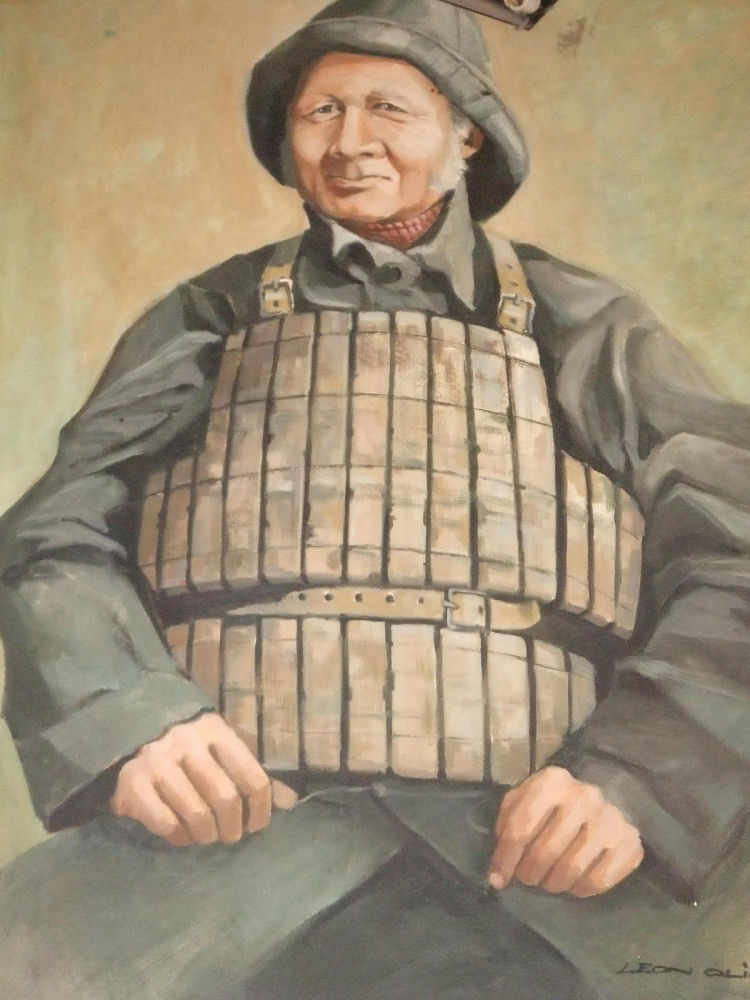
In December 1872, he and his crew
(average age 55) put to sea in a south-easterly storm towards a sinking
ship, the Sorrento, and saved the lives of the 31 crew and of 14 life-boatmen from Walmer who had become stranded on the ship.
With
remarkable bravery and seamanship he manoeuvred the Kingsdown lifeboat,
the Sabrina, alongside the Sorrento and gradually took every man off,
and then passed some from his fearfully overloaded boat onto the Walmer
lifeboat.
Having achieved this feat, he then had to navigate along the coast in the
storm to Broadstairs, because the south-easterly prevented landing on
the beach at Kingsdown.
Jarvist Arnold is commemorated by this lovely
smiling portrait in the village hall, and by having a road named after
him. It does us good to remember the harsh realities of life, not so
long ago.
|
|
From an excerpt taken from the Kent Archaeology web site.
Referenced to the Times 19-29 October 1866.
The most notorious incident of this type was that of the North,
wrecked on the Goodwin Sands in August 1866. The North was abandoned by
her crew, and as she lay on the Sands she was visited over the next few
days by boats from Deal, Walmer, Kingsdown and Broadstairs. The boatmen
stripped the North of everything that could be carried away, leaving,
according to two Broadstairs boatmen, 'not enough rope to make a mop
with,' or enough canvas 'to tie round your finger if it had been cut.'
Some property was surrendered to the Receiver of Wreck, but ship's
stores and crewmen's property worth about £400 were not recovered.
'About two tons of canvas and three quarters of a ton of rope... have
to be accounted for, and the deficiency in running rigging and hawsers
is about four tons. None of the ship's instruments ever came
into the possession of the Receiver... the carpenter's tools... have
never been recovered.... The vessel had at least 12,000 pounds weight of
copper on her [hull].... She was stripped on both sides for seven or
eight feet down.... The metal thus stripped would weigh about 35 cwt,
and only 10 cwt has been returned to the Receiver.'
Some rope from the North was traced to a paper mill near Dover, and a
marine store dealer named Foster was charged with handling stolen goods.
He was acquitted, but The Times the next day reported that 'The whole of
the evidence was of the most extraordinary character and proved
conclusively that "wrecking" is the profession of a large number of the
Deal boatmen.'
The newspaper referred to 'the robbery of the North [which]
represented nothing, it was said, but common practice.'
Of Foster's trial it said 'the evidence for the prosecution was given
very unwillingly.... Does all this point to a local impression that
taking property from a wreck is not stealing? Is there any general
impression at Deal that the relics of a castaway are common property?...
If taking these stores from the North was theft, and the Deal boatmen
were seen to take them, was there no authority competent to stop the
thieving? Would it be very surprising if men should really imagine they
had some right to do what they were at any rate allowed to do... without
any action on the part of the law?'
What The Times seemed unable to appreciate was that the removal of
property from a wreck was not in itself illegal - quite the reverse. A
ship on the Goodwin could be swallowed completely in two tides, and if
no attempt was made to remove her possibly valuable cargo, bring ashore
any salvageable rope or sails, rescue the crew's property and strip the
copper sheathing from the hull, a major loss would result for the ship's
owners or insurers. This was a normal and potentially profitable part of
the boatmen's work. As long as they were occupied in removing the
property from a wreck and stowing it in their own boats, they were
acting entirely properly.
Where they often transgressed was when they returned to shore. The
correct procedure was that on landing, boats were searched or 'rummaged'
by the Coastguard on duty on the beach, any salvaged goods being
declared and not concealed in any way. The Receiver of Wreck kept
account of what was recovered and reported to the owners or insurers. In
due course the boatmen were paid in proportion to the value of the goods
salvaged. Sometimes, however, the boatmen disposed of wrecked goods to
ships in the Downs, or attempted to land them without the Coastguards'
knowledge and sell
them themselves, as had allegedly occurred in the case of the North.
The Times report of Foster's trial initiated a protracted
correspondence.
Opinions in support of the boatmen and against them were expressed
strongly. One correspondent, signing as 'Veritas', alleged that 'The
[Deal] men actually plundered the chests of the whole of the
crew...appropriated the contents, and then, as if to add insult to
injury, had the audacity to deliver... the empty chests to the Receiver
of Wreck.'
The Rector of Deal wrote to refute this allegation against 'certain
individuals who... are sufficiently designated by the fact of their
having handed over the only seamen's chests which were brought ashore...
to be readily identified by all persons living in this place.'
The Rector enclosed an affidavit by the two men in question, Jarvist
Arnold and Thomas Edward Bingham, that the chests had all been empty
when they found them and 'the accusation in The Times that we plundered
the chests is false and untrue.'
Another correspondent was the Secretary of the Salvage Association at
Lloyd's, who wrote that he had been ordered by his committee to carry
out an investigation into 'this great robbery.' He had been ordered to
do this with strict impartiality, and it was his duty to obey this
instruction. Despite this assertion, his report was far from being a
reasoned assessment of the evidence, and in places verges on libellous.
Of the Rector's letter and the affidavits of Arnold and Bingham, the
report says:-
'There is no doubt that the chests of the crew were delivered up to
the Receiver of Deal empty. Who emptied those chests? Did the sea do it?
Will the rector suggest that the sea broke open the locks, cleared out
the contents and deposited the chests... on the ship's deck - or that
the cockroaches did it?... There is an old saying - "A man does not pick
up a squeezed orange." These boxes not worth a shilling appear to have
been carefully salved and delivered to the Receiver, by men who did not
steal their contents.... It was a very wise thing for [Arnold and
Bingham] to make that affidavit, because the persons handing over the
boxes ran a great risk of being supposed to know something about their
contents.'
|
|
From the Dover Express and East Kent News, Friday 6 September, 1878
DOVER ANNUAL LICENSING SESSIONS
The annual sitting of the Dover Magistrates Licensing Committee took
place on Monday at Dover, for the purpose of renewing public-house
licenses, and hearing applications for new ones. The Licensing Committee
consists of E. F. Astley, S. Finnis, R. Dickeson, T. E. Black, R. Rees,
W. R. Mowll, and C. Stein, Esqrs. They were all present except Mr.
Dickeson, who is in Cumberland.
THE ZETLAND ARMS – THE KINGSDOWN SAILORS HOME.
The Bench said the defendant had been fined on the 10th of December,
1877, for having his house open during prohibited hours for the sale of
beer on the 16th October, at Kingsdown.
Mr. Arnold, the landlord, said he thought his house was made a Sailors'
Home of on that particular occasion. He had nineteen shipwrecked sailors
and a dead one in his house, and how could he refuse to take them in?
The Bench were of opinion that he ought to have kept his house shut.
Applicant said the Magistrates were not always correct. (Laughter.) he
never served any beer to those men.
The Bench granted the application, telling the applicant to take care
and not let it occur again.
|
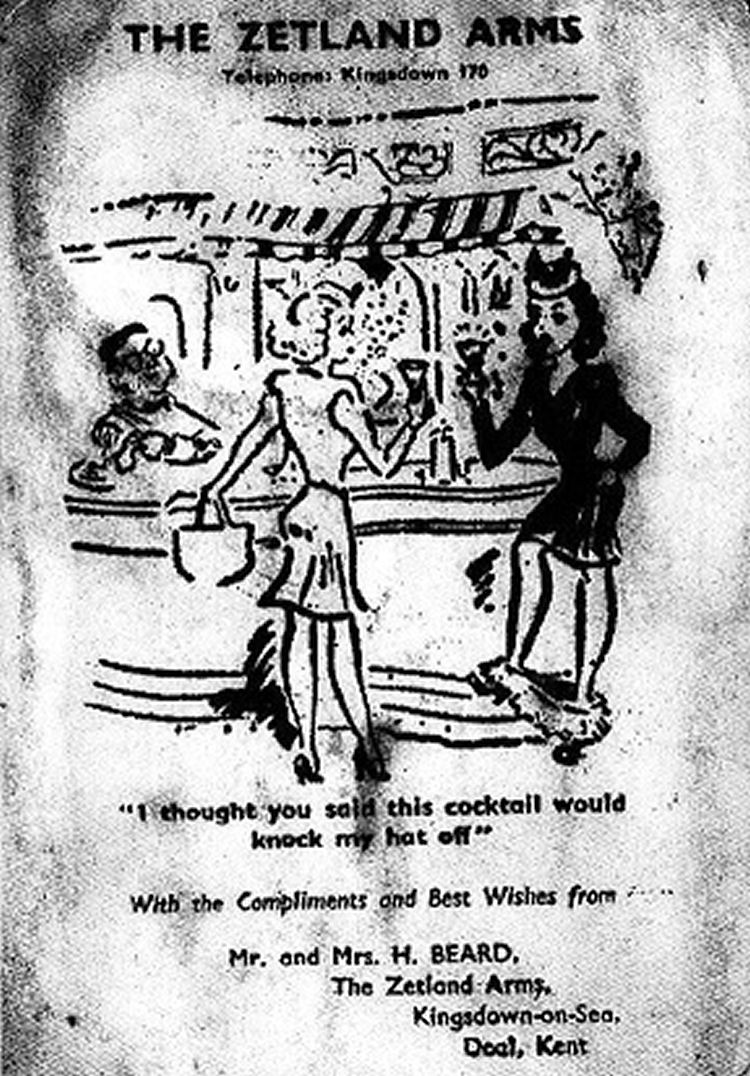
Above business card circa 1948. |
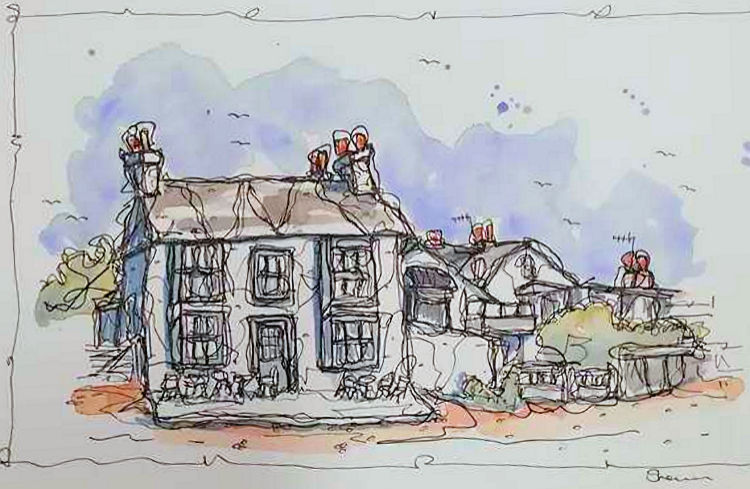
Above drawing 20th July 2026, by Shawn Smith. |
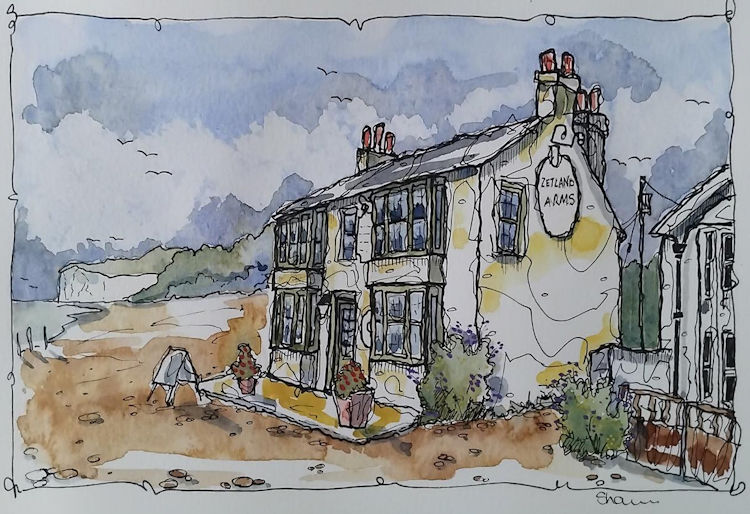
Above drawing 2026, by Shawn Smith. |
|
From the Dover Mercury, 22 July 2010.
By Steve Glover and Michael Rogers.
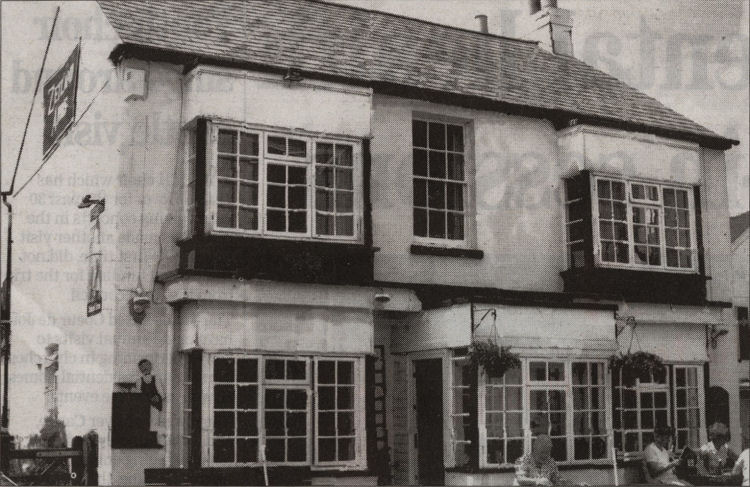
Above photo, date unknown post 1977.
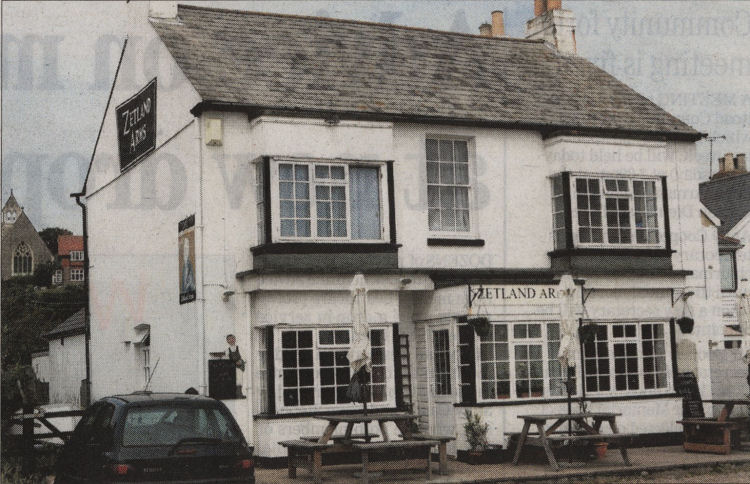
Above photo 2010.
PUB WHERE HAROLD WILSON STOPPED FOR PINT
THE beach front location of the Zetland Arms in Kingsdown, with its
idyllic vista of
the sea and the French coast beyond, can be enjoyed while relaxing
outside.
Conditions, however, were not always quite so tranquil when local man,
Thomas Bingham, was killed on the beach outside
by Customs men during a smuggling raid in 1813. One of the pub's notable
landlords
was Jarvist Arnold in 1874, who was also coxswain of the Kingsdown
lifeboat, Sabrina, from 1865 to 1888.
He remained at the Zetland until 1882 when he was succeeded by William
Erridge.
Numerous other landlords followed and, in March 1949, it was reported
that the sea flooded into the pub following violent storms.
The Zetland temporarily closed in 1977 when landlord, Frank Westby,
installed bow windows in order to give it a more historic look, as well
as to improve the
facade. It was reported that the grand re-opening took place on Friday,
July 8, at 6pm, and Timothy Cobbett, a direct descendant of the writer,
William Cobbett, took over as 'temporary' manager.
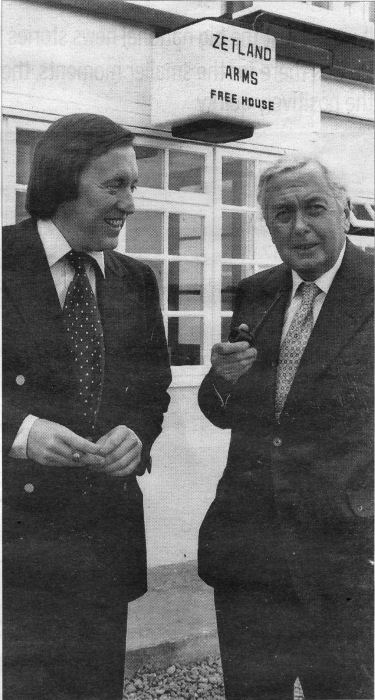
In September 1977, the broadcaster, David Frost, and former Prime
Minister Harold Wilson, were in Deal making a television programme about
prime ministers.
After visiting nearby Walmer Castle, they called at the Zetland Arms for
lunch, and a photograph of them both enjoying a pint hangs on the wall
of the bar in commemoration of the event.
Despite several changes of ownership, Timothy Cobbett remains landlord
to this day, having celebrated his 30th year at the Zetland Arms in July
2007.
Picture on the left was taken by Mercury photographer Basil Kidd.
|
|
Passage below kindly sent by Kathleen Hollingsbee.
Thomas BINGHAM was shot and killed by Customs officers on Kingsdown beach in 1813 whilst
engaging in smuggling. This fact was found on an information board
outside the "Zetland Arms public house, Kingsdown, and confirmed by Mr
Mark Frost of Dover Museum who was unable to give more details."
"The Local Studies at Maidstone were unable to help. Canterbury Library
Local Studies section confirmed that he was shot carrying cargo (info
found in a book by W. P. D. Stebbings "The Invaders Shore") "The
ref. librarian was mystified because there was nothing in Kentish
Gazette, Gentleman's Magazine or the Times and concluded that the
authorities did not know that his death was not due to natural causes at
the time, otherwise there would have been a report of the inquest as
well as the incident. He was able to tell me that he was buried in
Ringwould churchyard on August 30 1813 and left a widow and six
children." "The first mention of Binghams in the Ringwould parish
registers 1779."
"I can find no headstone for this Thomas Bingham in Ringwould
churchyard."
|
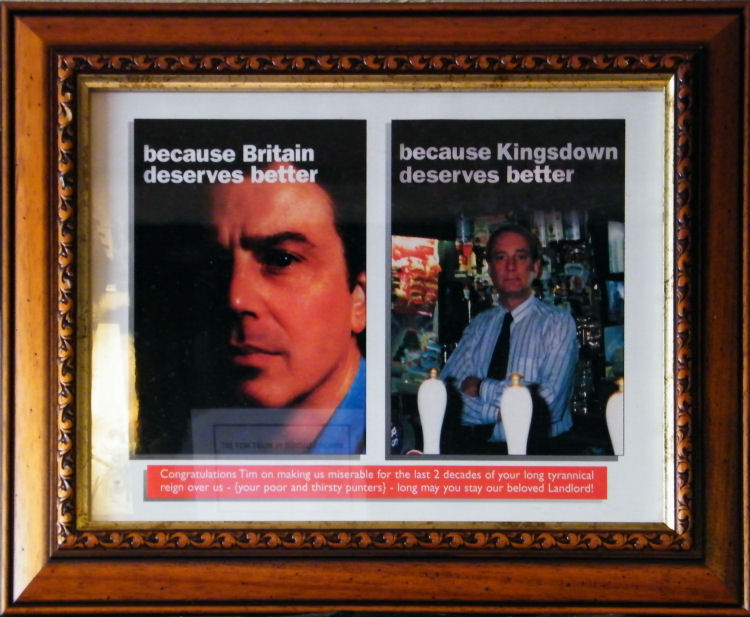
Above shows a presentation picture for Timothy Cobbett after reaching
his 20th year in the pub. This would have been in 1997. |
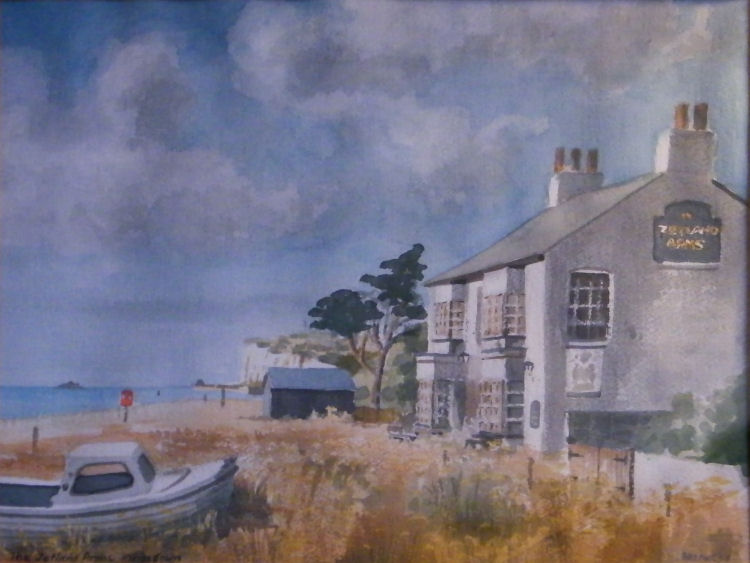
Painting of "Zetland Arms" date unknown. By kind permission of "Zetland
Arms." Painted in 1997-98 by local artist John Blezard.
|
|
From the Dover Mercury, 13 September, 2012. 80p
From NOW AND THEN
ZETLAND ARMS
Pub the perfect spot to watch the setting sun
GLORIOUS views and extremes of weather can be observed whatever the
season from the "Zetland Arms" and surrounding area, but when looking
towards the building, very little changes.
That is arguably its charm, but one thing that does remain is that the
beach pub in Kingsdown is one of the best spots to enjoy a pint while
the sun is out - or setting - during the summer.
That could be due to its unusual setting on the beach, overlooked by period houses at Church
Cliff, or looking out to sea or towards the chalk cliffs at Old Stairs
Bay.
The pub was once known as the "Earl of Zetland," named after a lugger boat
of the same name was sunk in 1860 after it was towed too fast to
Ramsgate.
The establishment has had a number of landlords and some are listed in
The Old Pubs of Deal and Walmer by Steve
Glover and Michael Rogers.
In 1870 the pub's landlord was James Arnold followed by Jarvist Arnold
the famous coxwain of Kingsdown lifeboat The Sabrina. By 1882 he had
been succeeded by William Erridge. William Wellard took over in 1910,
remaining there until 1915.
Robert Bartlett was landlord in 1936 followed in 1948 by Henry Beard,
and Percy Furnall in the 1950s.
The Mercury reported in May 1977 that Frank Westby planned to introduce
bar snacks and to enlarge the bars. It was a good move because food at
the "Zetland" has been appreciated by many, including TV broadcaster David
Frost and former Prime Minister Harold Wilson that year.
The pub was closed when bow windows were installed to give the pub a
more historic look. After several changes in ownership Tim Cobbett
celebrated his 35th year as landlord in 2012, close to the time Kent
brewery Shepherd Neame bought the pub and the "King's Head" in Deal from
Enterprise Inns in a four-pub deal.
Whatever happens, with the ownership, staff and management, area around
the "Zetland" will always be a beauty spot and just the place to stop off
and admire the sea, coast and cliffs of Kingsdown -maybe even with a
cold pint!
|
|
From the Dover Mercury, 6 December, 2012. 80p.
LANDLORD TIM PULLS HIS LAST PINT
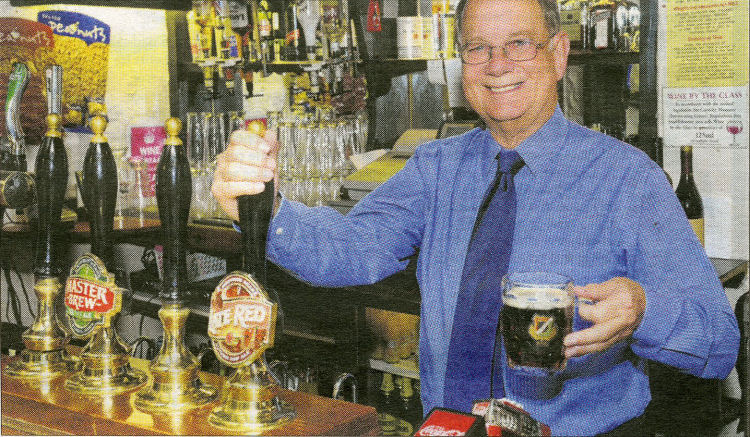
Tim Cobbett, pulling a final pint behind the bar at the "Zetland
Arms" in Kingsdown
Picture: Tony Flashman FM2349413
AFTER a record 35 years of service, licensee of the "Zetland Arms"
Tim Cobbett, 72, has left the pub and pulled his final pint of beer. He
retired on Saturday and said: “It's time to call it a day and have a
rest.”
The public house, which was taken over by Shepherd Neame six months
ago, will undergo £90,000 worth of refurbishment while the Kent brewer
looks for a successor. It will re-open in the New Year.
Tim lives near the "Zetland" and will continue to stay in the village
with his Jack Russell, Ronnie.
He was born in 1940 in Kasauli, a town in India where he lived for
seven years with his father, a military man who died in 1971 and his
mother who died eight years ago. His brother is a retired teacher who
lives in America.
Aged seven, Tim moved to Portsmouth and throughout his childhood, he
was sports crazy with a particular passion for squash and much adoration
for his pet poodle. He first worked in a Merchant Navy purser office for
three years before becoming an assistant manager in an Odeon cinema, in
Portsmouth. He then ventured across the Atlantic to the Bahamas where he
enjoyed work as a croupier for 12 years.
Tim finally found himself in Kent in 1977. He was hired as a relief
manager at the "Cliff Hotel" in St Margaret's before taking on the "Zetland"
where he has remained. He said: “It's been great fun and I'd love to do
it all again.”
Tim intends to enjoy his retirement relaxing and playing golf.
|
|
From the Dover Express, Thursday, 13 December, 2012. 65p.
LANDLORD CALLS TIME
THE "Zetland Arms" landlord Tim Cobbett has retired.
The 72-year-old, who has been at the helm of the beachside pub for 35
years, stepped down on Saturday.
He said: “The Zetland Arms enjoys a wonderful position with Kingsdown
and Walmer beaches on its doorstep. I have thoroughly enjoyed my time
there and will miss it a great deal but it's time to call it a day and
have a rest.
“My advice to others running a business in these challenging economic
times would be to work hard, be there as much as possible and play to
your strengths.
“At the pub, we've always taken advantage of our enviable seaside
location by serving high-quality local seafood and fish in the
restaurant and catering for holidaymakers, beach-goers and walkers.”
Kent brewers Shepherd Neame are planning to close the pub for several
weeks to complete a £90,000 refurbishment. Meanwhile, the search is on
to find a new licensee to take on the pub.
Shepherd Neame property and tenanted trade director George Barnes
said: “Tim's contribution to the pub and the local community over so
many years has been remarkable and we wish him a happy and restful
retirement.”
|
|
From the Dover Mercury, 13 December, 2012. 80p.
THE OLD ZETLAND IS GIVEN A FACELIFT
THE "Zetland Arms" is one of the closest public houses on the British
mainland to France and has enviable sea views from the beach at
Kingsdown.
It shut earlier this month, but is bucking the economic trend in the
pub world by reopening in the new year after a refit by its new owners
Shepherd Neame, the Kent brewers. According to The Old Pubs of Deal and
Walmer, its original name was the "Earl of Zetland" and in 1860 there
was a lugger of that title which sank on its way to Ramsgate.
In 1870 the landlord was James Arnold, followed a year later by
Jarvest Arnold who was coxwain at Kingsdown lifeboat Sabrina from 1865
to 1888. Jarvest was also related to Tony Arnold, a former chief
reporter of the East Kent Mercury.
In 1974 the Charrington brewery artist painted a new sign for the pub
and in May 1977 the Mercury reported that Frank Westby planned to
enlarge the bars and introduce snacks for customers.
There was a grand reopening and Tim Cobbett, a descendent of the
writer William Cobbett, became temporary manger.
In September 1977 the television broadcaster and former prime
minister Harold Wilson were in Deal making a programme about prime
ministers and visited Walmer Castle, popping into the "Zetland" afterwards
for lunch.
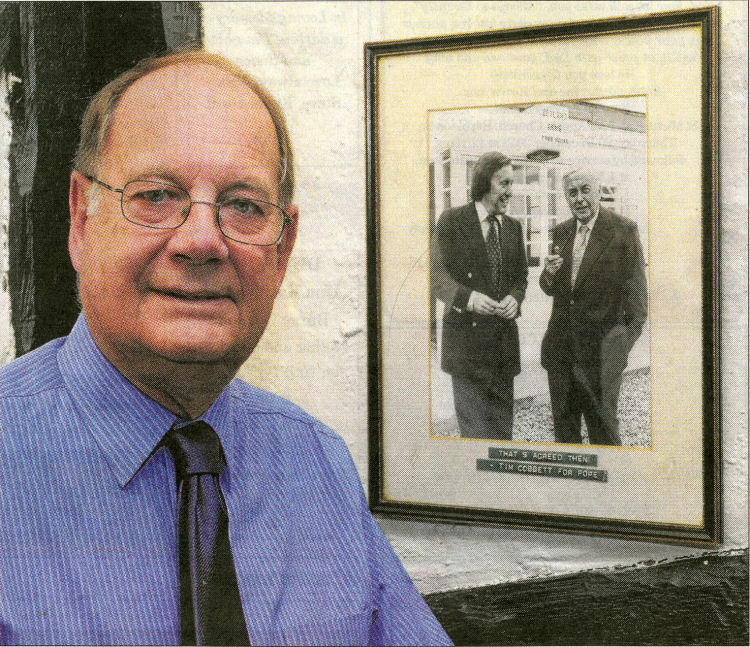
Retired licensee Tim Cobbett inside the "Zetland" with the 1977 photo
of television broadcaster David Frost and former Prime Minister Harold
Wilson who had lunch at the Kingsdown pub while filming in the area.
Picture: Tony Flashman FM2349398
Before the pub closed earlier this month a photo of the two was
hanging on the bar wall, showing them outside the front of the building.
The final person in charge behind the bar was Tim Cobbett, who
retired on December 1 after 35 years at the "Zetland," the longest serving
licensee in the pub's history.
He said: “I thoroughly enjoyed my time there and will miss it a great
deal but it's time to call it a day and have a rest.
|
After a time in the 21st century being owned by Enterprise Inns the ownership
changed to Shepherd Neame half way through 2012.
The pub is currently closed while Shepherd Neame are doing refurbishments to the
building and it should open again in 2013.
Latest news is that it has now opened again, February 2013.
|
From the East Kent Mercury, 7 February, 2013.
SEAFRONT PUB REOPENS AFTER £90k MAKEOVER.
PINTS are being pulled again at the Zetland Arms on Kingsdown
seafront, which has just reopened after a £90,000 refit from owners
Shepherd Neame the Faversham brewers.
The business closed on December 1, when former licensee Tim Cobbett
retired after 35 years behind the bar, which was a record time of
service at the public house.
Zetland's new licensees are husband and wife team Kerensa and Tom
Miller from Sandwich, who are looking forward to offering a warm welcome
to the community.
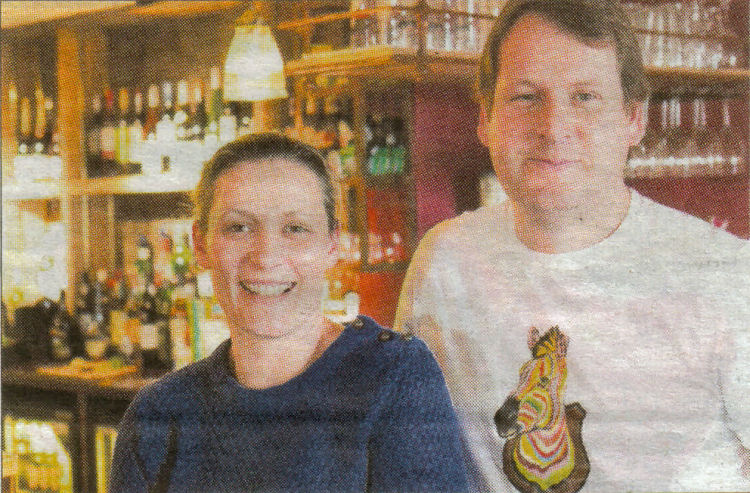
Mrs Miller said: “We are planning to hold music events, themed nights
and quizzes to brighten up winter nights but before we confirm details
we want to ask the locals what they enjoy. We're also going to serve
tea, coffee and breakfasts to tempt the local walkers.”
Mr Miller's mother Josie, who has more than 30 years' experience in
catering, will be cooking up a hearty winter menu of stews, soups and
pies, as well as traditional favourites like fish and chips. There are
also plans for ploughmans, salads and sandwiches, using local fish and
seafood, in the summer.
The pub now has heritage-style furnishings in keeping with its
beachside location and a partition wall has been removed to open-up the
restaurant area.
Shepherd Neame property and tenanted trade director George Barnes
said: “Kerensa and Tom's arrival marks a new chapter for this pub, which
is situated right on the beach and enjoys spectacular views of the
surrounding cliffs.
“They are looking forward to welcoming the local community and
creating a varied offer that caters for all tastes.” |
|
From the Dover Mercury, 7 March, 2013. 80p.
A PINT AND A SEA VIEW AT THE ZETLAND ARMS
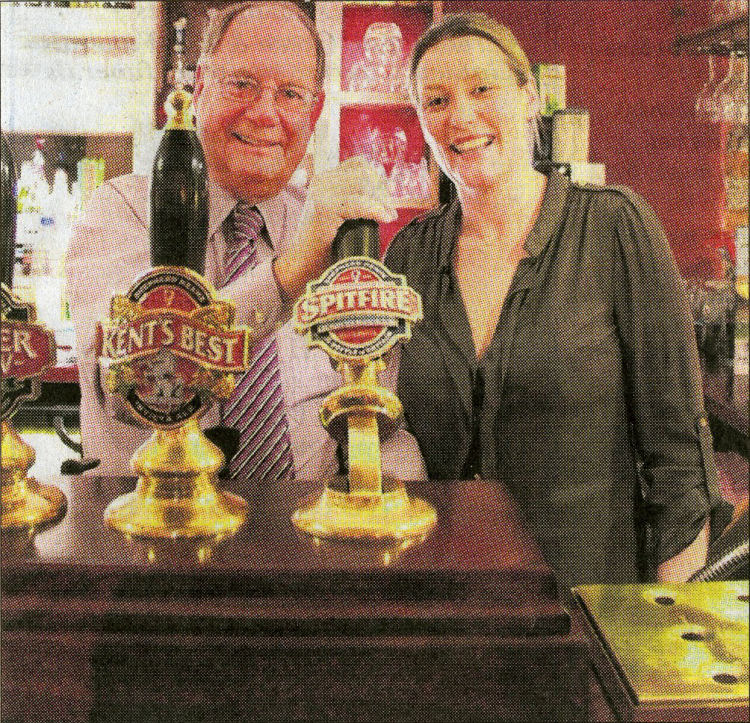
Former licensee Tim Cobbett pulls the ceremonial first pint with new
licensee Karensa Miller.
WITH pubs closing at alarming rates, it is encouraging to see one
being bought and reopened on the beach at Kingsdown.
The "Zetland Arms" is one of the closet public houses on the British
mainland to France and on Thursday its new owners Shepherd Neame held an
official ceremony to mark its reopening.
On December 1, after a remarkable 35 years as licensee, Tim Cobbett
retired and he was invited back to the new-look business to
ceremoniously pull the first pint.
Mr Cobbett said: “I thoroughly enjoyed my time there but it was time
to call it a day and have a rest.”
New licensees, husband-and-wife team Kerensa and Tom Miller, from
Sandwich, re-opened its doors in January but the official opening was
Rogers, the landlord in 1870 was James Arnold, followed by Jarvist
Arnold, famed for his heroic deeds with the Kingsdown Lifeboat. He was
cox from 1865 to 1888.
Mr Arnold was succeeded by William Erridge, then William Wellard in
1910 who stayed at least until 1915. Robert Bartlett was landlord in
1936 and in March 1949 the sea flooded the pub during storms. Harry
Beard became licensee in 1948, followed by Percy Fumall in the 1950s.
In May 1977, the bars were enlarged so the Zetland was closed for the
changes, to be reopened for Tim Cobbett to take charge. In September the
same year, television broadcaster David Frost and former prime minister
Harold Wilson called in at the pub while filming in the area.
At Thursday's reopening guests include actor Neil Stuke, who has a
home in Kingsdown.
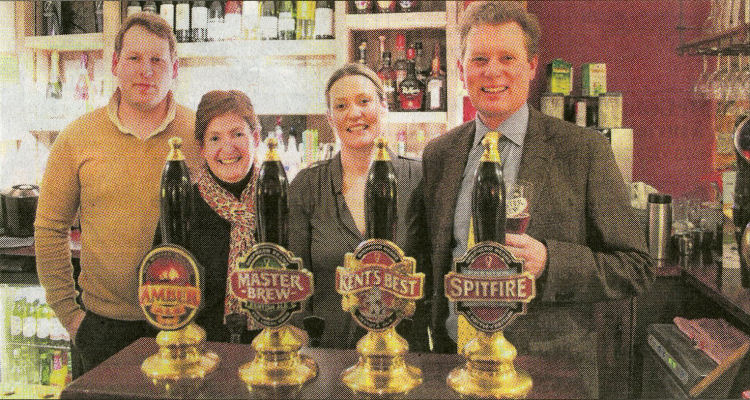
Tom, Josie and Kerensa Miller with Shepherd Neame's Jonathan Neame.
|
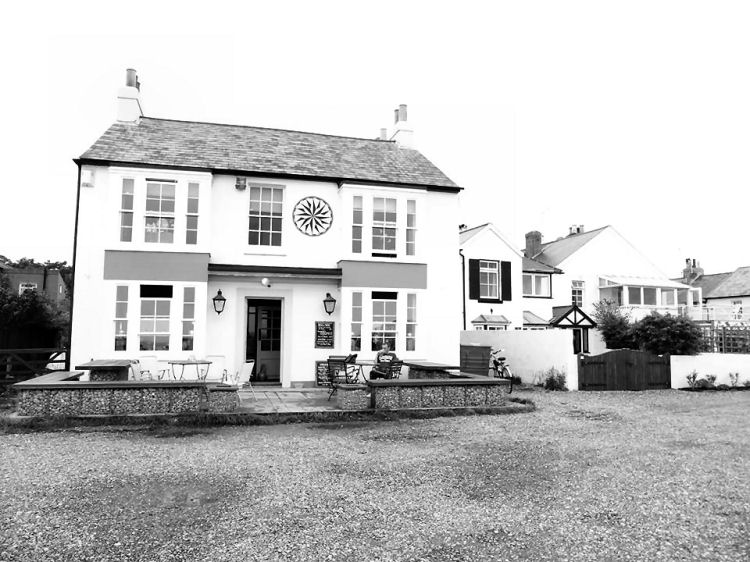
Above photo taken by Julius Benedict Pidduck. 24 August 2013. |
|
From the Dover Express, 17 July, 2014.
Kingsdown newcomers' pub award.
A KINGSDOWN couple have scooped a top pub gong.
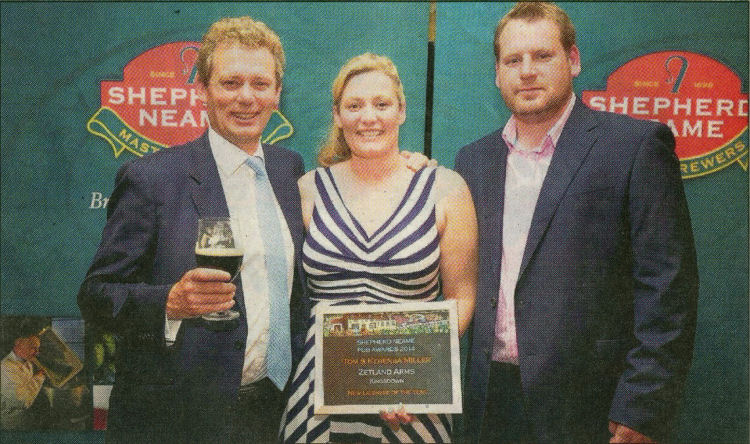
BEST NEWCOMERS: Jonathan Neame with the Kerensa and Tom Miller.
Tom and Kerensa Miller, who run the "Zetland Arms" in Kingsdown, were
crowned new licensees of the year at the annual Shepherd Neame Pub Awards.
The prize was presented by the brewery’s chief executive Jonathan Neame
during a glittering ceremony at the "Conningbrook Hotel" in Ashford on
Tuesday July 8.
The couple - who were up against 347 other pubs across London and the
South East - received £500 and a magnum of Taittinger champagne.
Mrs Miller said: “Tom and I are very proud to receive this award. We
hadn’t run a pub before we took on the "Zetland Arms," so it was a
challenge to begin with. But our hard work has definitely paid off and we
are really enjoying ourselves."
|
|
From the East Kent Mercury, 24 January 2024. By Ollie Leonard.
New look for pub loved by celebs.
A popular seafront pub loved by celebrities has undergone a huge refurbishment.
The Zetland Arms inKings-down has been given a fresh look and a
“delicious new menu”, according to brewery Shepherd Neame.
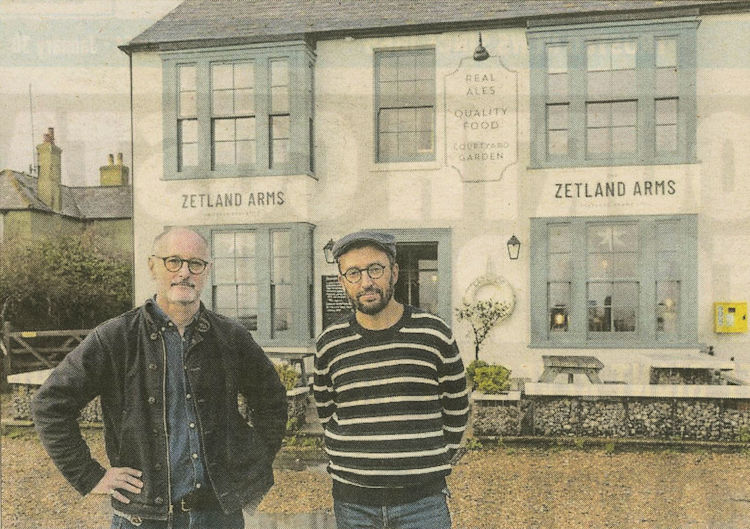
Zetland Arms manager Paul Claydon (left) and licensee Chris Hicks
outside the newly redecorated Shepherd Neame pub Picture: shepherd Neame
The site has seen its fair share of famous faces visit over the years,
including The Saturdays singer Frankie Bridge and legendary TV host
David Frost.
Now, following the arrival of new licensee, Chris Hicks, who took over
the Wellington Parade pub six months ago, the site has been given a
makeover.
Mr Hicks runs two other sites in Deal with his wife - the "Rose," a hotel,
bar and restaurant, and The Blue Pelican, a restaurant offering
Japanese-inspired dining.
“I love the informality of the place,” Mr Hicks said.
“It feels like a pub institution, as everyone knows it, and it's hereto
serve the community. I feel very strongly about that.
“People do come for its location, of course, but I want to make sure
that the ambience of
the building, and what we have to offer, make it somewhere you want to
come, regardless of the view and the weather.” Shepherd Neame bosses say
the pub has undergone a “stylish external redecoration in
blue and white tones”, and has a “delicious new menu inspired by its
location”.
Manager Paul Claydon, who previously ran the Black Douglas coffee house
in Deal, and has been friends with Chris
for some years, said: “Kingsdown is a beautiful place throughout the
year and we wanted to make The Zetland a place people think to come to,
even when they’re not necessarily coming to hang on the
beach.
“We have concentrated on the ambience inside and it feels fantastic.”
The new menu, which includes Swedish breakfast buns and mussels with
leeks, is available all day, from midday to 8pm.
When the weather is warmer, customers can also eat in a refurbished
enclosed courtyard garden to the rear.
There will also be a beach menu for those dining on the many picnic
tables at the front of the pub.
Mr Hicks added: “Our redecoration hopefully demonstrates our love for
the pub, enhancing all its unique features and making it a warm,
cosy environment for people to simply drop in for a drink while out on a
dog walk or gather as a group for a meal.”
The Zetland Arms is one of the closest public houses on the British
mainland to France and has enviable sea views from the beach at
Kingsdown.
According to The Old Pubs of Deal and Walmer, its original name was the
"Earl of Zetland" and in 1860 there was a lugger of that title which sank
on its way to Ramsgate.
In September 1977, David Frost and former prime minister Harold Wilson
were in Deal making a programme about prime ministers and popped into
the Zetland afterwards for lunch.
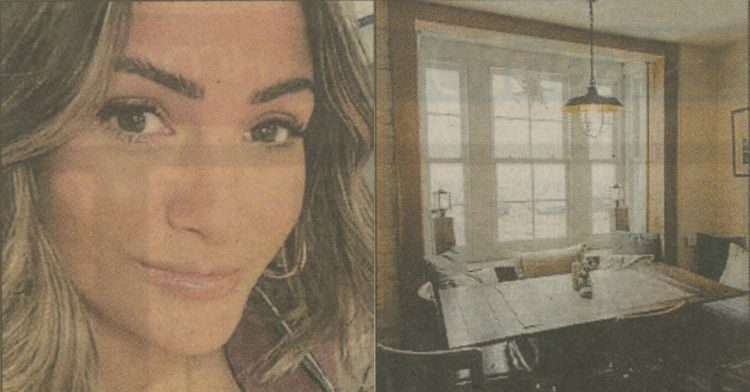
Frankie Bridge, from The Saturdays, visited the pub in 2022; right,
inside The Zetland Arms.
|
|
From the Dover Express, 1 February, 2024.
By Hedi Mehrez.
Iconic pub turns on the style.
NEW LOOK FOR ZETLAND ARMS MAKES IT A DESTINATION IN ITS OWN RIGHT'
AN ICONIC pub set right on Kings-down beach has undergone a “stylish
external redecoration" to give it a fresh new look.
Inspired by its location, Shepherd Neame’s Zetland Arms also has a brand
new menu from Swedish breakfast buns to mussels with leeks.
The changes were made following the arrival of new licensee Chris Hicks
six months ago, whose goal has been to make the pub a “destination in
its own right.”
Chris, who, with his wife Alex, also owns The Rose, a hotel, bar and
restaurant, and The Blue Pelican, a townhouse with Japanese-inspired
dining, both in nearby Deal, wants everyone to feel welcome at the
picturesque pub, which looks out on beach huts and lapping waves.
"It is a lovely pub," he said. “I love the informality of this place. It
feels like a pub institution, as- everyone knows it, and it is here to
serve the community. I feel very strongly about that - I want everyone
to feel welcome here."
He added: "People do come for its location, of course, but I want to
make sure that the ambience of the building, and what we have to offer,
make it somewhere you want to
come, regardless of the view and whatever the weather."
On top of the full internal refurbishment which he carried out in time
for the summer, he now offers a menu throughout the day, beginning with
Climpson & Sons coffee, Swedish breakfast buns and sausage rolls,
followed by a fish-led menu including mussels with leeks, Kent cider and
shallots, which has won
rave reviews. Other popular main dishes include The Zetland burger,
Crown Prince pumpkin gnocchi, sage butter and roasted hazelnuts and
beer-battered fish and chips.
Customers can also enjoy a range of bar snacks and kids' meals, and a
delicious range of puddings.
These include poached pear, fondant and ice cream; dark chocolate
mousse, sea salt walnut and maple
shortbread; and almond tart with preserved orange and lemon curd.
The informal nature of the pub has been enhanced with the introduction
of a piano, which has been used for several recent-impromptu singalongs.
There are more music events
coming up, including a ceilidh, as well as a monthly pub quiz.
Chris added: "Our redecoration hopefully demonstrates our love for the
pub, enhancing all its unique features and making it a warm, cosy
environment for people to simply drop in for a drink while out on a dog
walk or gather as a group for a meal."
Manager Paul Claydon, who previously ran the Black Douglas coffee house
in Deal, and has been friends with Chris for some years, said: "Kingsdown
is a beautiful place throughout the year and we wanted to make The
Zetland a place people think to come to, even when they’re not
necessarily coming to hang on the beach. We have concentrated on the
ambience inside and it : feels fantastic."
The menu is available all day, from noon to 8pm. When the weather is
warmer, customers can also eat in the newly refurbished enclosed
courtyard garden to the rear.
There will also be a beach menu offering light bites and snacks for
those dining on the many picnic tables at the front of the pub, which
boast spectacular sea views. |
LICENSEE LIST
ARNOLD Jarvis James 1863-May/79
   (aged 55 in 1871)
ERRIDGE William Robert May/1879-91+ (age 48 in 1881)
ERRIDGE Susanna 1901+ (widow age 65 in 1901)
WELLARD William 1910-Jan/33

BARTLETT Robert Jan/1933-39+ (Retired C.Q.M.S., Corps of Signals.) (age 45 in
1939)
BEARD Henry 1948+
FURNELL Percy 1950s
PROTHERO H 1961+
DORRAS Margaret L 1974+
 Charrington & Co
WESTBY Frank 1977
COBBETT Timothy 8/July/1977-Dec/2012
MILLER Tom and Kerensa Feb/2013-16+ also "Coastguard"
2016
CLAYDON Paul 23/July/2023+ (manager)
HICKS Chril 23 June/2023+ (licensee)
http://pubshistory.com/ZetlandArms.shtml
From the Post Office Directory 1874
From the Post Office Directory 1882
From the Post Office Directory 1913
Library archives 1974
The Old Pubs of Deal and Walmer by Glover and Rogers
Census
|

