|
From the South Eastern Gazette 28 January 1851.
DOVER. PETTY SESSIONS, MONDAY.
BRUTAL ASSAULT UPON A POLICEMAN WHILE IN THE EXECUTION OF HIS DUTY.
Frederick W. Gillespy, and his son, W. E. Gillespy, were brought up,
charged with having violently assaulted police-constable John Faith,
while endeavouring to clear a public-house in Trevanion-street, called
the "Three Mackerel." Faith appeared quite unable to stand, was
accompanied with a chair within the bar. It appeared that Faith, on
seeing the house above-named, which is kept by a person named Hobday,
open between the hours of twelve and one o'clock on Sunday morning, went
in, and saw the elder prisoner and a blacksmith just commencing to
fight; he ordered them to desist, and advised them to go quietly home.
Gillespy, sen., became very violent; a scruffle then ensued, in which
the younger Gillespy joined, seizing Faith by the collar, and fixing his
fingers firmly in his throat; the three went thus struggling through the
passage into the street, when they fell; the policeman being nearly dead
by strangulation. The hold of the throat was at length lost, and the
constable drew his staff, but had no power to use it. While down, one of
the prisoners kicked him tremendously in the side, and he was
unmercifully beaten; his rattle was forced from him before he could use
it; although his cries for help were continuous and his position so
perilous, no one came to his assistance, although several persons
witnessed the brutal affair. Some one at length begged him to "run away
for his life," which he at length succeeded in doing, but minus his
staff, rattle, hat, and handkerchief. Mrs. Hobday, the landlady, and
Charles Marks, a man who draws a bath chair, were brought up as
witnesses for the plaintiff, but evidence was reluctant and
contradictory. Both prisoners were fully committed to take their trial
at the next assizes, but bail was accepted for their appearance, each
surety being bound in £20. |
|
From the Dover Express and East Kent News, Friday, 30 April, 1909.
THE STORY OP DOVER A CENTURY AGO.
TOLD BY MRS. ANN BAILEY, AGED 94.
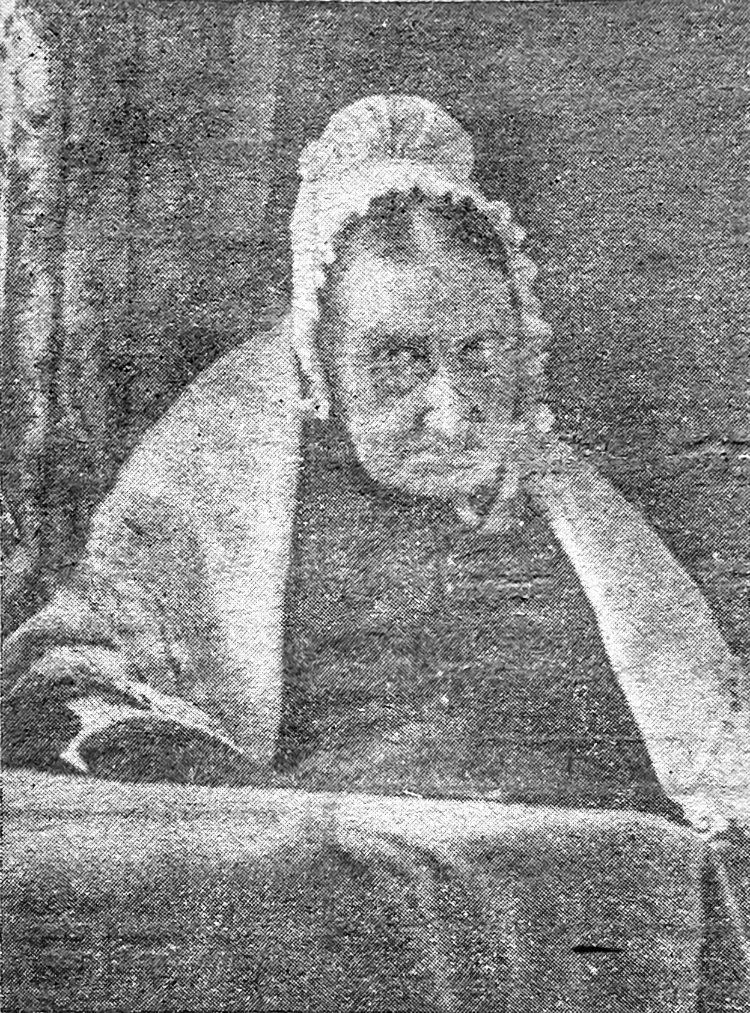
In the year of the Battle of Waterloo, Ann, daughter of Edward Fry, was
born in the little double-fronted, Dutch tiled house, next above the saw
mill on Charlton Green. The quaint old dwelling is there still, but Ann
Fry, who sixty-five years ago, by marriage, changed her name to Bailey,
and has been fifty-six years a widow, now lives at 4, Trevanion Place,
overlooking Old St. James’ churchyard, where her daughter carefully and
devotedly attends her. Although she is but six years short of a
centenarian, her mind is clear, her spirits good, and her memory
remarkable. Our portrait shows her in her favourite seat by the cottage
window, overlooking the old churchyard, where the afternoon sunbeams,
slanting across God’s Acre, bathe her surroundings in a flood of golden
light. By the aid of her spectacles, Mrs. Bailey can see to read
comfortably, and if those who converse with her speak up, she can hear
well enough to give clear and graphic replies, especially if the
questions relate to her favourite topic — Old Dover. As points relating
to the long-gone past are raised, she, with animated speech and many a
merry laugh, tells of the fun of Charlton Fair, of the quaint doings at
the tiny parish church before it was re-built in 1827, and other curious
facts about Dover in the reign of the “Georges,” for this marvellous old
Dover lady has lived under five sovereigns — George III., George IV.,
William IV., Victoria, and Edward VII. Her story of Old Dover, which we
are sure will interest our readers, we will give, as nearly as possible,
in her own words. In reply to questions, she said:
IN THE YEAR OF WATERLOO.
I was born at Charlton Green on 19th September, 1815. Edward Fry was my
father; he was a cooper, and worked for Mr. Kingsford at the Charlton
Oil Mills, and also for Mr. Walker at the Brewery which is now Leney’s.
He was the first of the Frys who came to Dover. All the Frys of Dover
were of the same family — they came from Sandwich.
ABOUT CHARLTON GREEN.
Charlton Green has changed a good bit since I was a child there. One of
my playmates was the late Mr. George Clark, who started the nurseries.
Right before our door just over the river, was St. Mary’s Workhouse. I
often used to be taken there to see the inmates. Mr. Birch, who was
afterwards Mayor of Dover, had to do with it. Charlton Mill was where it
is now before I was born. When I was a child it was owned by Mr.
Kingsford, who lived in the big house down below, which afterwards
belonged to Dr. Sillery. The Mill was used for grinding corn in the
summer and for crushing oil seed in the winter — and a very noisy mill
it was in the winter with its stampers. There was no bridge then across
the river, only a plank for foot passengers. The waggons, carts,
horsemen and cattle to our delight used to splash through the water.
There were great doings on the green at Charlton Fair, which was always
held on quarter day — July 6th. There used to be swings and stalls and
booths all down each side of the road. My father paid for me to go on
the swings.
CHARLTON OLD CHURCH.
When I was a child Charlton Church stood close by the river. It was a
poor little place, but was made larger in 1827. I used to go there
before that time, but they only had services once a fortnight. The
Rector then was Mr. Monins — a very good man, so they said, but he
usually sent his curate from Ringwould to preach at Charlton — he used
to ride over on a donkey. I was one of the singers at Charlton Church,
and so was my husband. There was no organ then, but there was a
clarionette, a serpent, a big bass viol, and other instruments. There
were no houses at all below Charlton Green except Mr. Kingsford’s and
three old cottages towards where the bottom of Park Avenue now is, until
you come to Ashen-tree Lane Dairy. The road down that way was called
Charlton Back Lane, and the land beside it was called Gorely’s Fields on
the one side, and the Maison Dieu Park on the other. There was a wall
round the Park until Mr. Moxon, the contractor, pulled it down and built
Brook House there. There was another big fair that lasted a week; that
was Bartholomew's Fair, kept at Buckland by Chapel Hill.
CHARLTON EXECUTION.
There was much talk of the executions at Black Horse Lane, Charlton,
when I was a child. I remember seeing one man hanged there, and I shall
never forget it. That was when I was seven years old. It was young
Spence, who shot at an officer of coastguards. Spence’s people and the
officer’s people lived in Dover, so there was a great to do when Spence
was hung. I remember my school teacher held me up to see the poor
fellow. I can see him now. I did feel sorry for him. The exact place of
execution was at the four cross-roads, just where the road now leads up
to Tower Hamlets, a little below the Turnpike Gate, which Mr. Bottle
(the father of Mr. Alexander Bottle, the chemist) then kept.
DOVER SCHOOLS IN THE TWENTIES.
I went to school in Queen Street — not to the Charity School, but to the
Quaker’s. There were a good many well-to-do Dover Quakers who kept up
that school. There were the Poulters, Reynolds’, Horsnails, and others.
They afterwards built a larger place at the foot of Durham Hill and
called it the Girls’ School of Industry.
CHANGES AT THE MAISON DIEU.
When I left home at Charlton Green to go to service I went as servant to
young Mr. Walker, whose father started the brewery which Leney’s now
have. Young Mr. Walker lived in a good large house, which had a fine
garden, right where the "Prince Albert Inn" now stands at the top of Biggin Street. The old Priory was just behind us with its farmhouse and
ponds — and there were no other houses that way until you came to
Maxton. I lived with Mr. Walker there when the Maison Dieu was bought by
the Corporation and turned into a gaol, after which the old gaol in the
Market Place was closed. While I remained in Mr. Walker’s service he
moved to a new house that was built for him at Alfred Place.
ST. JAMES’ PARISH FOLK 80 YEARS AGO.
There was no Castle Street then, and no other houses up there except Mr.
Jeken’s, which is now the Town Clerk’s Office, and Ashen Tree Dairy as
now. Where Castle Street now is there were meadows and gardens, but
there was the old road called Stembrook which ran from the back of St.
Mary’s Church, through the river, without any bridge, and went to
Dolphin Lane by the brewerv. There was some big houses about there then.
Old Mr. Walker, of the brewery, lived in a large house in St. James’
Street. Mr. Peter Fector's residence was at Fector’s Place, where the
Gas Offices are. Mr. John Finnis and Mr. George Stringer had houses in
Dolph'n Place, but Mr. John Finnis afterwards moved and had his timber
yard in Biggin Street. Mr. George Stringer was a farmer from Whitfield
and had a big barn where Castle Place Cottages used to stand, and
Victoria Park was then called Stringer's Field. Admiral Basely had a
house in St James’ Street,' beside Fox Passage, and I recollect Mr.
Edward Knocker coming to Castle Hill House. I also remember his father,
Mr. William Knocker. He had to do with the Harbour, and I have often
seen him walking arm-in-arm with the old Duke of Wellington to the
Church there (St. James’ Old Church) to hold the Admiralty Court. Mr.
William Knocker used to live down by the "York Hotel," where the
Esplanade now is. He afterwards had a house and a paper mill at Bushy
Ruff. There was a good lot of smuggling done when I was a girl an
Charlton. The seamen used to bring up beautiful things, lace, gloves and
silk; they never paid duty. My father would have nothing to do with
smuggling. Only sometimes he bought some things from them. They all did
it in those days.
REMINISCENCES OF THE FORTIES.
I was married in 1845, and came to live here at 4, Trevanion Place, and
have lived here ever since. Mr. Trevanion’s house was about here, but it
was before my time. I understand he owned nearly all the land here and
up Lauriston, which wan called Little Walderehare. When I lived at
Alfred Place with Mr. Walker there was only a little wooden house up
there, and Mr. Fector afterwards built Lauriston House there, all the
other part was then wood and warren. Wilson Gates had his farm beside
Trevanion Street and on the other side of Woolcomber Street, near the
sea, was Clarence House, where Madame Rice lived. She had a very large
garden all down the side of Upper Townwall Street, and in the tall elm
trees there was a rookery. Madame Rice was a very fine lady; she wore
wonderfully big bonnets, but never gloves, because she said it wore them
out! She kept a carriage and pair. Close by her garden, on the side of
Woolcomber Street, was the Quaker’s burial ground, but they did not bury
anyone there in my recollection. I remember the Round House in Townwall
Street being built by Mr. John Shipdem, the Town Clerk. They said he
built it round so that the devil should not catch him in a corner!
Before he built that house there was a black-hole there, where they used
to put prisoners. Woolcomber Street has been a good deal changed. There
were very old houses where Exhibition Place is, but I cannot say if they
belonged to the Wooloombers, who gave the name to the street. Mr. Marsh,
the Mayor’s Sergeant, lived in one of them. I remember the old Rectory
House at the corner of St. James’ Street and Woolcomber Street being
taken down after I came to live here. It reached nearly up to the Church
and made the entrance to Woolcomber Street and Trevanion Street very
narrow. I cannot remember anything about St. James’ Poor House which was
in Woolcomber Street, but my husband’s father, Richard Bailey, was a
verger at Old St. James’ Church, and they used to pay the Poor Relief in
the Vestry before the Dover Union was formed.
THE CONTRAST WITH LATER YEARS.
My husband died in 1853, when I was left with two children, who are
still living. Although I have been 56 years a widow, I have never had
parish relief, but I am having the Old Age Pension now, and the
gentleman who came to see me about it was very kind and hoped I should
live long to enjoy it. Yes, that (pointing to a photograph) was my
likeness ten years ago, but I look different now; and that one up on the
wall there is my likeness taken between fifty and sixty years ago, and
the little child is my daughter taken at the same time by a travelling
artist who was staying at the "Three Mackerel," Trevanion Street. That
public house has long gone; it was at the comer of Woolcomber Lane,
facing the grocer’s shop. I shall be very glad for you to have a
photograph of me now, but you must take me as I am by the window here,
for I am too old to get out of the house. I could have told you a great
deal more about old Dover for the town has so changed and so grown since
I was a child that it is hardly the same place. When I was a child there
were but two houses on the sea front — Smiths Folly under the Castle,
and the "York Hotel" by the Harbour. The bay outside the river was a
wide stretch of shingle used as a rope walk and as a military Parade.
There were no railways, no steamboats, and no gas light. I don’t know
what the population was, but it could not have been a quarter what it is
now. |


 (or Place
 )
)


