|
Drainless Drive
Woodnesborough
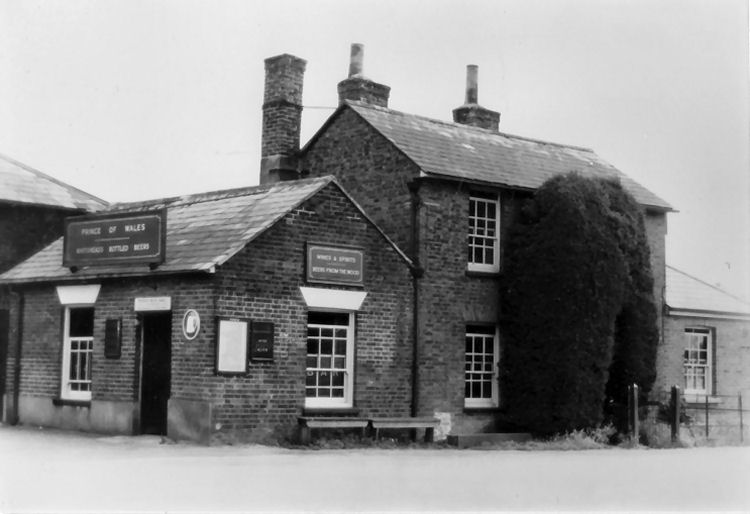
Above photo, circa 1950, kindly sent by Michael Mirams. |
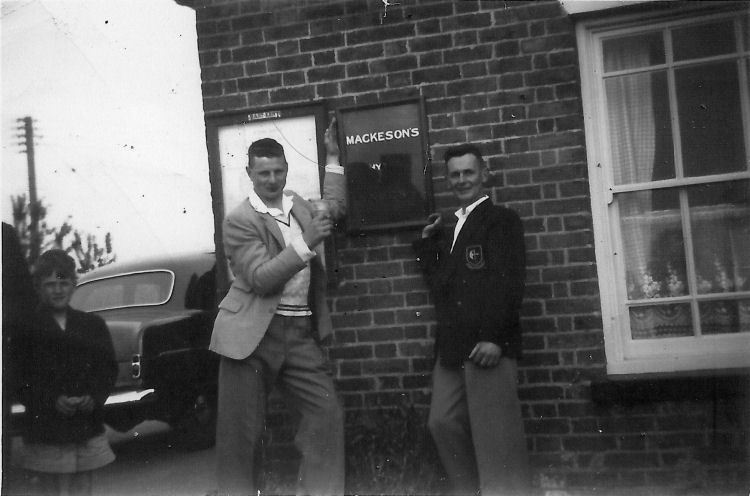
Duncan Brown has recently been given this photo, which shows Alan Wright
with Duncan's father (Charlie Brown), the small boys being Alan's nephew, John Saich.
|
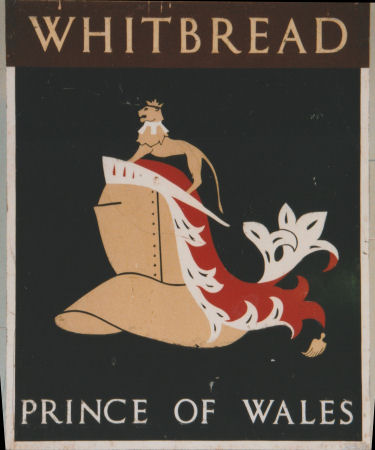 Above sign
circa 1950s, kindly sent by Robert Greenham who says:- This
Sign was hanging high up at Whitbread's Beltring Hop Farm (and which, I
was told, was subsequently bought by an American). |
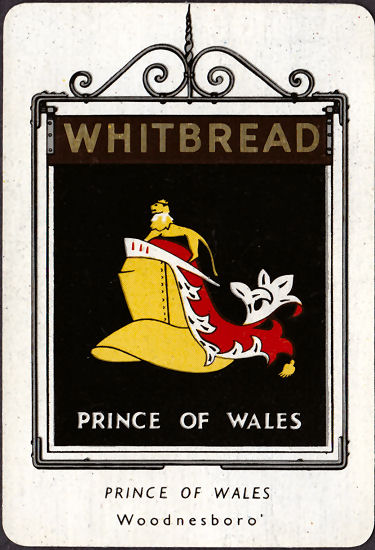 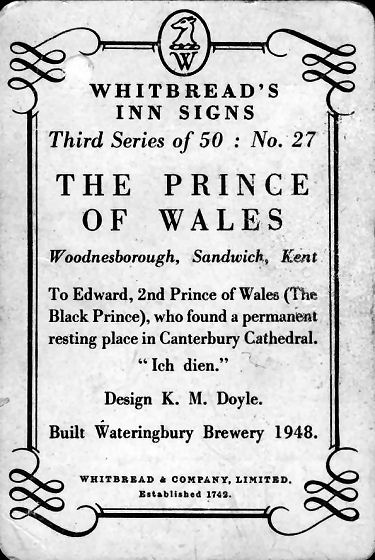
Above aluminium card issued June 1951. Sign series 3 number 27. |
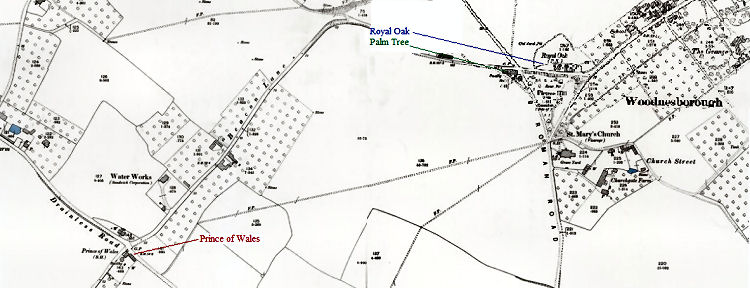
Above map 1896. |
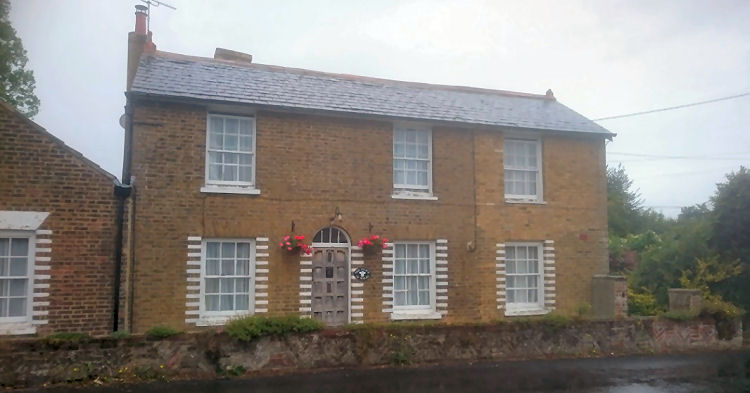
Above photo, August 2019, kindly taken and sent by Rory Kehoe. |
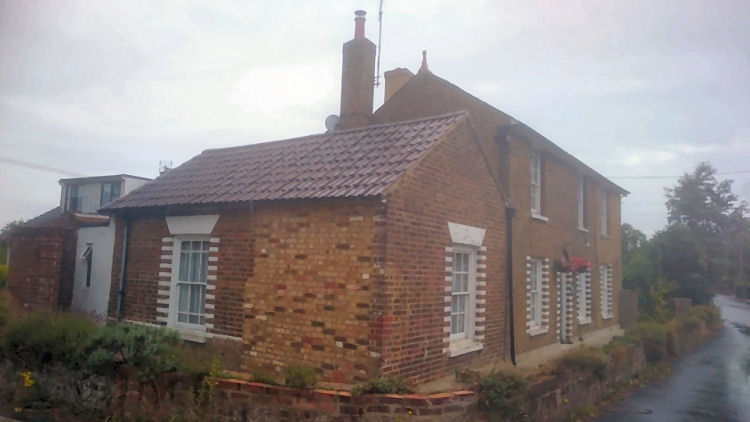
Above photo, August 2019, kindly taken and sent by Rory Kehoe. |
Regarding the Dover Express and licence transfers of the Taylor's (1937), the
address is given as Woodnesborough.
This was the local of of fighter ace Wing Commander Bob Stanford-Tuck DFC
who farmed nearby.
|
From the Deal, Walmer, and Sandwich Mercury,
16 June, 1900. 1d.
SUDDEN DEATH AT WOODNESBOROUGH
A cloud was cast over the rejoicings at this little village on
Saturday by the announcement that whilst the proceedings were in
progress, a young fellow, named Henry Dilnot Smith, who had taken an
active part in the preparation, had died suddenly. Young Dilnot had
prepared the costumes in which he was to appear in the procession, and
his father, with other members of the family, was to have taken part. On
the previous day the deceased was taken ill in his father's workshop,
but no fears were entertained as to his recovery, and the news of his
death came as a shock to the village in which the family had carried on
the business of wheelwrights for may generations. Death was due to
peritonitis, but, as will be seen from the evidence adduced at the
inquest, the seizure was not regarded as one that was likely to prove
fatal.
THE INQUEST
Was held at the "Prince of Wales," Drainless Drive, by Mr. R. M.
Mercer, on Monday evening, the jury comprising Messrs. Samuel W. Burbidge (foreman), Ernest Chas. Watson, John Ovenden, Edward Clements,
Chas. Rogers, Thomas. Cornes, Frederick. Burr, Wm. Gambrell, William. Dixon, Charles.
Sole, Albert Pettman, William. F. Rogers, and John Frederick. Taylor.
The Jury having viewed the body, John Dilnot Smith, wheelwright, the
father of the deceased was sworn. he did not know why the doctor had not
given a certificate. The deceased was 16 years of age, and was learning
the trade, working with witness. he was engaged in the shop, and was
apparently all right up to 3.30 on Friday afternoon. he had made no
complaints whatsoever. he had been working alone for a few minutes, and
when witness' daughter went into the shop about that time she found him
leaning across the bench and in great agony. She endeavoured to lead him
into the road, and when outside he fell. Witness was close by, and when
he arrived on the spot the deceased was on the ground. The young man was
unconscious, and witness believed the seizure took place about ten
minutes before his daughter's visit to the shop. Witness questioned the
deceased as to the cause of the illness, but he could give him no
reason, and said he had lifted nothing or done anything to strain
himself. Witness then got the assistance of Mr. Deveson, and they gave
him some brandy and took him to his home on a barrow, and he was put to
bed. His son complained of having severe pains in the stomach, but he
remained conscious until the time of his death at 8.45 on Saturday
evening. Deceased had only had ordinary plain food, and had never had an
illness before. No other member of his family had been seized with the
illness.
Harold J. Pickering, surgeon, at present practising at Sandwich, said
he was called to the deceased at about 8 o'clock on Friday evening. He
saw deceased in bed, and he complained of pain in the abdomen. He did
not make an absolute diagnosis, but enquired into the history of the
seizure, and localised the pains. He treated the case and ordered
medicine with the object of relieving the pain. The pain was very acute,
but he could discover no swelling. General swelling began almost
immediately after death. He visited him again on Sunday morning, when
there were no signs of collapse, but rather an improvement. Witness
spoke to the deceased, who said he felt some relief. Deceased had been
sick once or twice previously to the first visit, but when witness
visited again he did not think his life was in immediate danger. His
impression was that the complaint was internal, the primary cause of
death being peritonitis caused by ulceration, followed by collapse.
There were no signs of foul play whatsoever.
Isabelle Dilnot Smith, sister of deceased, said her brother had only
had ordinary plain food, which the rest of the family had partaken of,
and no other member had been seized with the illness.
The Coroner, in summing up, described the action of the perforation
and its results, and said he occasionally met very similar cases, and he
thought it practically impossible for a patient to get over such a
seizure. it was generally accompanied by the most fruitful agony. He
recommended the Jury to return a verdict in accordance with the doctor's
evidence.
The Jury gave a verdict accordingly.
|
|
From the Dover Express and East Kent News, Friday, 15 June, 1900.
and the Whitstable Times, 16 June, 1900.
DEATH IN THE WORKSHOP
The East Kent Coroner (R. M. Mercer, Esq.) held an inquest on Monday at
the “Prince of Wales,” Woodnesborough, touching the death of Henry
Dilnot Smith, aged 16. It appeared that deceased was at work alone in
his father's wheelwright shop at Woodnesborough at 3.30 on the previous
Friday afternoon, when shortly afterwards his sister found him leaning
over a bench. His father came up and asked him if he had been lifting
any weights, and he said “No.” he was taken home to bed, suffering from
pain in the stomach. He was conscious up to his death on Saturday at
8.45. According to Mr. Harold John Pickering, surgeon, of Sandwich, who
attended the deceased, death was due to (1) perforation of the bowels
and (2) syncope and collapse.
The Coroner summed up, and the Jury returned a verdict accordingly.
|
|
From the Deal, Walmer, and Sandwich Mercury,
24 November, 1900. 1d.
SUDDEN DEATH
Yesterday (Friday) morning Mr. T. Taylor, landlord of the "Prince of
Wales," Drainless Drive, died very suddenly indeed. He was employed by
Mr. Rogers, market gardener, and was at his usual occupation in the
morning. He went home to dinner about 11.30, and made a very hearty
meal, remarking to his wife how much he enjoyed it.
Very shortly
afterwards (about 12.30) he fell from his chair and expired.
|
|
From the Dover Express and East Kent News, Friday, 4
November, 1910.
WINGHAM PETTY SESSIONS
The license of the "Prince of Wales," Woodnesborough, was transferred
from T. Deverson to Albert Taylor. It was stated that it had formerly
been arranged to transfer the licence to J. F. Taylor. A temporary
transfer was granted at Dover from Deverson with the object to getting a
temporary one granted to J. F. Taylor. Both were granted.
|
|
From the Whitstable Times, 12 December, 1900.
WOODNESBOROUGH. SUDDEN DEATH.
On Friday morning Mr. T. Taylor, landlord of the "Prince of Wales,"
Drainless Drove, died very suddenly. He was employed by Mr. Rogers,
market gardener, and was at his usual occupation in the morning. He went
home to dinner about 11.30, and made a very hearty meal, remarking to
his wife how much he enjoyed it Very shortly afterwards (about 12.30) he
fell from his chair and expired.
|
|
From the Dover Express and East Kent News, Friday, 15
October, 1954.
HENRY NEVER MISSES.
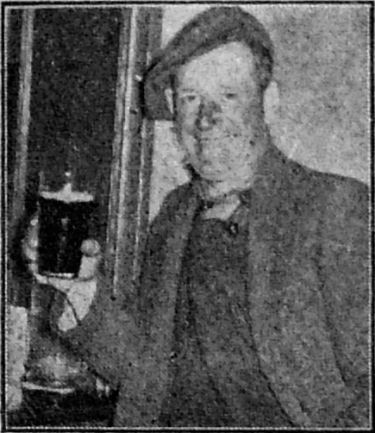
If we could see the inventory of the "Prince of Wales" pub at
Woodnesborough we'd expect to find, pretty high on the list of fixtures,
the name of Henry Farrier.
Farm-worker Henry, who lives at Drainless Drive, Woodnesborough,
claims that every single evening for the past thirty-three years, he's
popped into his local for a pint and a chat. He's never missed, he
declares.
"Mark you, that doesn't mean to say I'm a heavy drinker," says Henry
solemnly. "Call me a regular drinker if you like, but that's a very
different thing from the man who doesn't know how much is good for him."
"You get 'em, you know," muses Henry. "I remember one chap standing
at this very side of the bar, complaining that the beer was off. 'I'll
be glad when I've had enough,' he said."
|
LICENSEE LIST
WYBORN Alfred 1871+ 
TAYLOR James B to 1891-Nov/1900 (age 58 in 1891)
TAYLOR T to Dec/1900 dec'd
DEVERSON T to Nov/1910

TAYLOR Albert Nov/1910
(temporary for 1
week)
TAYLOR Mr John Frederick Nov/1910-Sept/1936 dec'd (also blacksmith age 42 in
1911)
TAYLOR Mrs Annie Sept/1936+
TAYLOR Mr H Jan/1937
GAMBLE Mr P W Jan/1937+
EDWARDS Mr F W Feb/1937?
STONE Jimmy 1950s
HONEYSETT G 1961+
Census
 From the Post Office Directory 1914 From the Post Office Directory 1914
From the Dover Express
|

