|
From the Dover Express, 3 October 2024.
'Token' sale offers glimpse of a time when shops
made their own change.
A FASCINATING window into the last decade of the 18th century, when
small merchants and shopkeepers produced their own coins, will be
given at an auction within a few days, when some will go under the
hammer as part of a spectacular collection.
Merchants, booksellers, library owners and more in Kent all used the
"tokens" which they had made after the official currency “vanished"
due to a copper shortage during the war with France. The collection,
"British 18th Century Tokens”, includes pieces from Deal and Dover,
each of which has a fascinating story.
The tokens will be sold at Baldwin's Auction House in the Strand,
London, on Monday (October 7), and the collection represents many
British counties.
It is described as "throwing colour" on the usage of coinage across
commercial industries and enterprises of the time.
The auctioneer's
notes describe these home-grown coins as "truly of the people, by
the people, for the people", and adds: "In the 1790s there was no
official small copper change in the country. Britain was at war with
France and the price of copper had risen, causing the regal issue to
‘vanish’. "This caused tremendous
hardship for small merchants and shopkeepers throughout the country,
unable to conduct the everyday transactions of selling small goods
without change.
"The Crown was busy with the war and any 'unofficial' production of
coin of the realm would be seen as forgery - punishable by hanging.
"Eventually a Welsh mining company hit upon the idea of turning
their copper straight into pennies and halfpennies, calling them
'tokens' that were redeemable in official coin - thus avoiding the
threat of being accused of forgery.
"As they were the correct weight, no one bothered to change them and
in the space of a year, merchants in every town in England had begun
issuing their token pence.
"This solved the lack of small change for ten years, until the
government got its act together
after the war and issued official copper coins. Throughout the last
decade of the 18th century it is these copper 'token' pence and
halfpence one would have had in one's pocket, all over the country,
as small change."
One particular halfpenny token was issued in Deal in 1794 by a
bookseller named Richard Long, who ran a library there.
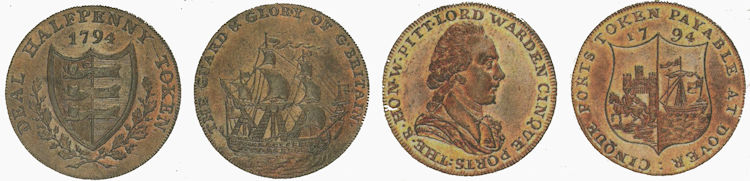
Long was fairly prominent in the town and was on the town council as
well as being an agent for Kent Life and Annuity Office. His token
features a man-of-war with the legend The Guard and Glory of
G'Britain, which had particular
relevance in those troubled times. The reverse bears the cinque Port
arms of nearby Sandwich.
This single token is expected to sell for £40-50 at auction.
Another bookseller and library owner who issued a token was John
Horn of Dover, who as well as having a public reading room in King
Street also operated the Apollo Circulating Library. His
establishment in King Street was not just a reading room but more a
fashionable lounge and watering-hole for the gentry, with music.
His token featured then Prime Minister William Pitt the Younger, who
was also Lord Warden of the Cinque Ports and, on the reverse, the
Cinque Port arms of Dover. This is expected to sell for £100-120. |

