|
37 St. John's Street
Folkestone
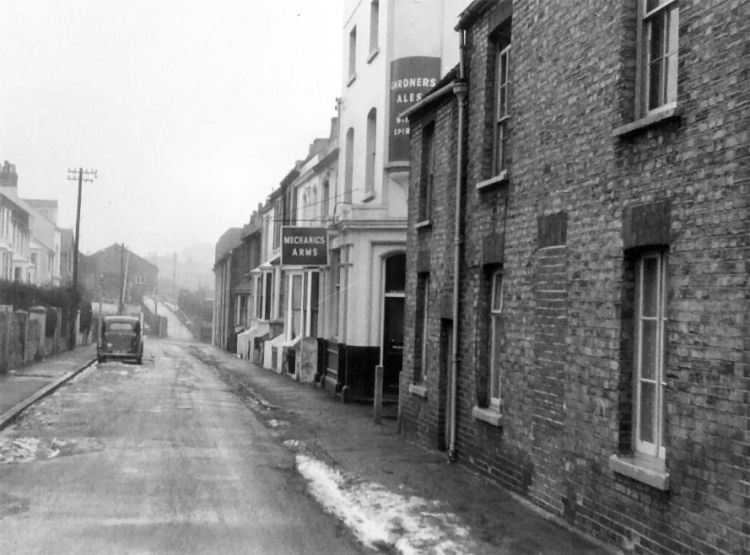
Above photo circa 1960 kindly supplied by by Terry Wheeler of the Ramsgate
Historical Society. |
|
By way of a postscript to the 1943 story of the murder of
Caroline Ellen Trayler (nee Stapleton) here is a picture of Mrs Trayler.
Also, a photo of her murderer, Gunner Dennis Edmund Leckey RA, who was
convicted of Mrs Trayler's rape and murder and sentenced to be hanged.
However, on appeal, it was found that the Judge had made a technical
error in his summing up and guidance to the Jury. As a result, the Court
of Appeal had to quash the conviction. There then, being no Double
Jeopardy, which would have allowed Leckey to have been retried on the
charge of Mrs Trayler's murder, he had to be released, although he was
convicted on a lesser charge of being AWOL from his RA unit. Can you
credit these images to me please, with thanks to Prash Ganendran.
BTW. The landlady/co-licensee of the MA was Mrs Dorothy Goldsworthy.
|
Address listed as Bellevie Fields in 1862 and earlier & at 37 St Johns
Street by 1938.
|
Southeastern Gazette 18 September 1855.
Local News.
Annual Licensing Day.
Monday: Before the Mayor and a full bench.
New licenses were applied for the Belle Vue Tavern, Mechanics’ Arms, and
Wheatsheaf, all of which were refused, the magistrates considering that
there were sufficient licensed houses already in the town.
|
|
Dover Telegraph 22 December 1855.
Petty Sessions, Wednesday: Before the Mayor, W. Major and S. Mackie
Esqs.
John Hobbs, the keeper of a beer-shop on Belle Vue Hill, was
leniently dismissed on payment of costs (and promising not again to
offend) for keeping his house open longer than allowed for the Act.
|
|
Southeastern Gazette 25 December 1855.
Local News.
Wednesday: Before The Mayor, W. Major, and S. Mackie Esqs.
John Hobbs, keeper of the Mechanics Arms beerhouse, was summoned for
having his house open after 11 p.m. on the 17th instant.
The Bench, receiving a good character of the house from the
Superintendent, dismissed the summons on payment of costs.
Note: No mention of Hobbs in More Bastions, and date would suggest new
start date for the house.
|
|
Kent Herald 27 December 1855
Petty Sessions: John Hobbs, keeper of the Mechanics Arms beerhouse, was summoned
for having his house open after 11 p.m. on the 17th inst.
The Bench, receiving a good character of the house from the Superintendent,
dismissed the summons on payment of costs.
|
|
Southeastern Gazette 19 February 1856.
Death: Feb. 15, at Folkestone, Mrs. Louisa Ann Malcolm, of the
Clarendon Hotel, relict of the late Mr. Robert Malcolm, of Warwick
Street, Charing Cross, London, aged 45 years.
|
|
Folkestone Chronicle 19 July 1856.
Auction Advertisement.
To Brewers, Capitalists and Others.
Notice of Auction Sale of a Capital well-built FREEHOLD BEER-HOUSE known
as the “Mechanics Arms”, Bellevue Fields.
Mr. J. Banks is favoured with instructions from the Mortgagee under
power of sale, to submit the above property to auction at the Clarendon
Hotel, Folkestone, on Tuesday, August 5th, 1856, at 2 for 3 o'clock in
the afternoon.
Lit 1 is the capital Freehold Beerhouse, known as the Mechanics Arms,
Bellevue Fields, let to Mr. A. Williamson, at a yearly rent of £25.
Containing 6 sleeping rooms, 2 club rooms, sitting room, bar, beer
cellar, kitchen, scullery, 2 water closets, and a very large skittle
alley.
For particulars and conditions of sale apply to the Auctioneer, Tontine
Street, or to Mr. Ralph Thomas Brockman, Solicitor, Folkestone.
|
|
Southeastern Gazette 5 August 1856.
Advertisement extract: Folkestone, in the county of Kent. To
brewers, capitalists and others. Notice of auction sale of a
capital, well-built freehold beer-house, known as the Mechanics
Arms, Bellevue Fields.
Mr. Banks is favoured with instructions from the mortgagee, under
power of sale, to submit the above property to auction, at the
Clarendon Hotel, Folkestone, on Tuesday, August 5th, 1856, at two
for three o’clock in the afternoon:
Lot 1 is the capital freehold beer-house, known as the
Mechanics Arms, Bellevue Fields, let to Mr. A. Williamson, at a
yearly rent of £25, containing four sleeping rooms, two club rooms,
sitting room, bar, beer cellar, kitchen, scullery, two water
closets, and a very large skittle alley.
The Auctioneer begs to call the attention of persons requiring good
property for investment.
For particulars and conditions of sale apply to the Auctioneer,
Tontine Street, or to Mr. Ralph Thomas Brockman, solicitor,
Folkestone.
|
|
Southeastern Gazette 21 October 1856.
Wednesday: Before the Mayor and S. Mackie, Esq.
Alexander Williamson, of the Mechanics’ Arms beer-house, appeared to
answer the complaint of Superintendent Steer, for keeping his house open
for the sale of beer after 11 p.m. on Sunday evening.
Defendant pleaded guilty, and was fined. 5s. and 8s. 6d. costs, with a
caution.
|
|
Dover Chronicle 22 November 1856.
Advertisement: To Hotel keepers. To be disposed of with immediate
possession, The Clarendon Hotel, Folkestone, situate contiguous to
the Custom House and Harbour, and also the terminus of the South
Eastern Railway. Satisfactory reasons can be given by the present
proprietor for relinquishing the business.
For particulars apply to Mr. W. Jacobs, Auctioneer and Estate Agent,
Dover.
|
|
Southeastern Gazette 23 December 1856.
Local News.
On Wednesday, before The Mayor, and Alderman J. Tolputt, Alexander
Williamson, of the Mechanics Arms beerhouse, was fined 30s., costs 8s.
6d., for keeping his house open after 11 o’clock at night on the 14th
inst., this being the third conviction.
|
|
Canterbury Journal 27 December 1856.
Petty Sessions, Wednesday.
Alexander Williamson, of the Mechanics Arms beer-house, was fined
30s., costs 8s. 6d., for keeping his house open after eleven o’clock
at night on the 14th inst., this being the third conviction.
|
|
Dover Chronicle 25 July 1857.
Dover Police Court, Wednesday: Before W. Cocke and J. Coleman Esqs.
Elizabeth Pritchard, a girl about eighteen years of age, was charged
with having stolen from her employer, Mrs. Mary Ann Williams, of the
"Mechanics Arms," Belle Vue Fields, Folkestone, a pair of stockings,
value 2s.; a cotton apron, value 3d.; a pair of boots of the value
of 4s.; a chimney ornament, value 6d.; and a portrait, value 2s.,
her property. Mr. Fox appeared for the prisoner.
Mrs. Williams, the wife of Alexander Williams, beer-shop keeper,
stated:- The prisoner lived in my service two months ago. I at
various times missed different articles belonging to me, among which
are the things the prisoner is accused with stealing. Having reason
to suspect that the prisoner had robbed me, I went to her mother's
house, in Last Lane, Dover, yesterday, accompanied by a police
officer, and there found the articles named. Previously to going to
the prisoner's mother's house, I went to the Cross Keys, where the
prisoner was lodging, when the prisoner, in reply to my enquiries,
denied having any property belonging to me. In calling in a police
officer, however, the prisoner no longer disowned having the
property named, but said she would give up everything belonging to
me. She then accompanied me to her mother's house and took the
things produced from a box, the key of which she took from her
pocket. In addition to the articles already mentioned, she gave me a
collar, which I put in my pocket (and which, for that reason, was
not entered in the charge book with the other articles.)
By Mr. Fox:- I hired the prisoner to assist me in doing my work
about the house – and for nothing else. My husband never sent her
into the bedroom with soldiers – she always did that of her own
accord.
The Bench thought this cross-examination irrelevant to the matter in
question and that Mr. Fox would not continue it.
Mr. Fox submitted, however, that he had a perfect right to examine
the witness as to the character of herself and the house she kept,
and in fact to endeavour to lessen the value of her testimony in any
way that he could; but he would not press the point.
Cross-examination resumed:- I missed some of the things in question
on the 16th April; but I did not know the prisoner had them until
Monday last. I am sure my husband never lent or gave any of the
things to the prisoner.
Sergeant Back, who accompanied the prosecutor in search of the
prisoner on the preceding day, gave confirmatory testimony. He also
said that he head the prisoner say that Mr. Williamson gave her the
boots.
Mr. Fox then applied for a remand of the case, in order that the
husband of the prosecutrix might be summoned, his instructions being
that the whole of the articles the prisoner was charged with
stealing were either given or lent to her by Mr. Williamson.
The Bench refused to grant this application, whereupon the prisoner,
on the advice of her solicitor, put in a plea of Guilty, and desired
that the case might be disposed of summarily.
Superintendent Coram spoke favourably of the girl's character.
The Bench, trusting that the lenience of the sentence would act in a
salutary manner upon the prisoner's future conduct, committed her to
prison for fourteen days, with hard labour.
|
|
Dover Telegraph 25 July 1857.
Dover Petty Sessions, Wednesday: Before W. Cocke and J. Coleman esqs.
Elizabeth Pritchard, servant, was brought before the Bench on a
charge of stealing a shawl, a pair of stockings, a pair of boot
shoes and other articles, the property of Mary Ann Wilson, landlady
of the "Mechanics Arms! beer shop at Folkestone. Mr. Fox appeared for
the prisoner.
The prosecutrix stated: I am the wife of Alexander Wilson, who
resides at Folkestone. The prisoner was in my service, in April
last. She left my service about two months since. Soon after she
went away, I missed a shirt, pair of stockings, and several other
articles. Yesterday I came to Dover, and went to her mother's
residence, in Last Lane, but the prisoner was not there. I then went
with police sergeant Back to the Cross Keys public house,
Custom-house Quay, and there found the prisoner in bed. I asked her
for my stockings and boot shoes, and she denied having them in her
possession; but when she saw the police officer, she consented to
give up all that she had taken. The prisoner then accompanied the
officer to her mother's premises, and there took from her box the
articles now produced, which I identify as the property stolen from
my house at Folkestone.
Police Sergeant Back: I went with the last witness to the Cross Keys
public house, and heard the prisoner deny taking any articles
belonging to the prosecutrix. Afterwards she said “If you go with
me, you shall have your things; they are at my mother's house.” All
three then proceeded to Last Lane, where the prisoner delivered up
the articles produced, and I took her into custody.
Mr. Fox applied for a remand for the purpose of producing Mr.
Williamson as a witness, the prisoner having stated that the boot
shoes were given to her by her master. The Bench said the property
stolen was the wearing apparel of the prosecutrix. She had
contradicted the statement of the prisoner that her husband had
given her the articles, and, therefore, they saw no necessity for a
remand.
Superintendent Coram said that prisoner had hitherto borne a good
character, and had lived in respectable situations.
The prisoner pleaded Guilty, and in consequence of her previous good
character, the lenient sentence of 14 days' imprisonment, with hard
labour, was passed upon her.
|
|
Kentish Express 28 July 1857
Dover Police Court, Wednesday (before W.J. Cocke and J. Coleman Esqs.)
Elizabeth Pritchard, a girl about eighteen years of age, was charged
with having stolen from her employer, Mrs. Mary Ann Williamson, of
the "Mechanic’s Arms," Belle Vue Fields, Folkestone, a pair of
stockings and other articles.
Mrs. Williamson stated “The prisoner lived in my service about two
months ago. Having reason to suspect that the prisoner had robbed
me, I went to her mother’s house in Last Lane, Dover, yesterday,
accompanied by a police officer, and there found the articles named.
The prisoner said she would give up everything that belonged to me.
She then accompanied me to her mother’s house and took the things
produced from a box, the key of which she took from her pocket.”
Some further evidence having been taken, the bench, trusting that
the lenience of the sentence would act in a salutary manner upon the
prisoner’s future conduct, committed her to prison for fourteen
days, with hard labour.
|
|
From the Kentish Gazette, 28 July 1857.
Wednesday.
Larceny.
(Before W. Cocke and J. Coleman, Esqrs.)
Elizabeth Pritchard, a girl about eighteen years of age, was charged
with having stolen from her employer, Mrs. Mary Ann Williamson, of
the "Mechanic’s Arms," Belle Vue Fields, Folkestone, a pair of
stockings and other articles.
Mrs. Williamson stated:— The prisoner lived in my service about two
mouths ago. Having reason to suspect that the prisoner had robbed
me, I went to her mother’s house in Last Lane, Dover, yesterday,
accompanied by a police officer, and there found the articles named.
The prisoner said she would give up everything that belonged to me.
She then accompanied me to her mother’s house and took the things
produced from a box, the key of which she took from her pocket.
Some further evidence having been taken, the bench, trusting that
the lenience of the sentence would not in a salutary manner upon the
prisoner’s future conduct, committed her to prison for fourteen
days, with hard labour.
|
|
Southeastern Gazette 6 October 1857.
Advertisement: Folkestone, a free beer house to let, in a good
neighbourhood; the proprietor leaving on account of ill-health.
Apply to Mr. Palmer, "Mechanics Arms," or to Mr. Banks, Auctioneer and Valuer, Folkestone.
Note: No record of a Palmer being at the
"Mechanics Arms" or any other
house at this time.
|
|
From the Folkestone Chronicle 21 November 1857.
CORONER'S INQUEST
Another inquest was holden before the Coroner, on Wednesday the 18th
inst., at the "Mechanics Arms", Bellevue Fields, on the body of Peter
Mahoney, a private of the 4th King's Own Regiment of Foot, the depot of
which Regt. is now stationed at Shorncliffe.
From the evidence of Hugh Evans, a soldier in the same regiment, it
appears that the deceased, witness, and five more soldiers left the camp
on the evening of Tuesday, about 6 o'clock, and directly they arrived in
Folkestone they went to the "Bellevue Tavern", where they remained
drinking till about 10 p.m. Deceased drank freely, as well as the other
soldiers, and became noisy and quarrelsome; the landlord and a sergeant
of the 98th endeavoured to put deceased and the others out, which they
had some trouble in doing. When they got into the street four of the
men, including deceased, then began breaking the windows – witness then
left, and presently deceased and one of the other soldiers passed
witness running, witness followed them, and upon arriving opposite the
"Mechanics Arms" witness asked deceased what was the matter with him, he
called out “I am bleeding to death”, when he fell on his back, and never
spoke afterwards: witness asked for some water, and then assisted by
another comrade carried deceased into the "Mechanics Arms", took off his
coat and found he was wounded on the right wrist, which was then
bleeding slightly – witness then bound the wound up and sent for a
doctor.
William Hills deposed, he was landlord of the "Bellevue Tavern". On
Tuesday night, about 8 o'clock, a party of soldiers, one of whom was
deceased, came into his house and remained drinking until 9 p.m., they
then wanted witness to let them have a gallon of beer on trust, which
witness declined, they continued in the house till 10, when they pulled
down the gas pendant, and came downstairs: witness with assistance then
put them out of the house and closed the door – immediately afterwards
six squares of glass were broken – witness then sent for the police.
Deceased had been in the house often, and always behaved himself well;
deceased was a little the worse for drink when he left the house.
Charles Egerton Fitzgerald deposed, he was a surgeon, residing at
Folkestone. About half past 10 on Tuesday evening witness was sent for,
to a soldier, who was wounded in the arm. Witness went to the "Mechanics
Arms", and found deceased sitting in front of the bar, supported by two
other soldiers. There was a large pool of blood on the floor, nearly all
coagulated; deceased was in a state of collapse, and could not speak,
the pulsation of the heart was feeble and fluttering, his extremities
were cold, and witness found two wounds on the right wrist, one
superficial and the other deep. Witness had deceased moved to another
room, laid him on his back, and gave him stimulants, but he never spoke
and lived about a quarter of an hour or twenty minutes after witness'
arrival. Witness examined the wound but found nothing in it, the radial
artery was wounded, four of the extensor tendons of the hand were
separated, and the joint was laid quite open. Witness attributed his
death to haemorrhage from a laceration of the radial artery. The artery
was extensively lacerated for about three quarters of its diameter,
there was no haemorrhage after the witness arrived. The wound was such
as would be caused by glass, it was not a clean cut but a lacerated one.
This being the whole of the evidence, the jury returned the following
verdict. “The deceased, Peter Mahoney, came by his death from a wound
received by breaking a square of glass at the "Bellevue Tavern"”.
|
|
Kentish Gazette 24 November 1857
An inquest was holden before the Coroner, on Wednesday, at the
"Mechanics’ Arms," Belle Vue Fields, on the body of Peter Mahoney, a
private of the 4th King’s Own Regiment of Foot. It appeared that the
deceased with some companions was drinking at the "Belle Vue Tavern"
on Tuesday, and when at nine o’clock p.m. the landlord refused to
give them any more beer, they began to break the windows, and the
deceased in doing so cut his wrist, dividing the radial artery, so
that he bled to death. The jury having heard the evidence returned
the following verdict. “The deceased, Peter Mahoney, came by his
death from a wound received by breaking a square of glass at the
"Belle Vue Tavern.”"
|
|
Southeastern Gazette 24 November 1857.
Inquest.
On Wednesday an inquest was held before Silvester Eastes, Esq., coroner,
at the Mechanics’ Arms, on the body of Peter Mahoney, aged 26, a soldier
in the 4th Foot, stationed at Shorncliffe.
From the evidence of private Hugh Evans, of the same regiment, it
appeared that on Tuesday evening himself and six other soldiers left the
camp at about half-past 5, and proceeded to the Bellevue Tavern, where
they had sundry quarts of beer. Deceased, Carroll, and Priest became
intoxicated. A quarrel took place, on the landlord refusing to supply
them with drink on credit. One of them pulled down the gas pendant, and
they all came downstairs, Priest and Carroll striking the landlord. The
men were afterwards turned out, and he stood opposite and saw the men
smash the window; deceased was amongst them ; he afterwards saw deceased
run away, and on overtaking him he told witness that he was bleeding to
death. Having procured assistance he took deceased to the Mechanics’
Arms, and a doctor was sent for, but he shortly after expired.
William Hills, landlord of the Bellevue Tavern, corroborated the last
witness, but said the deceased was a quiet, inoffensive man generally.
Mr. Charles Egerton Fitzgerald, surgeon, deposed that he was called to
attend the deceased; found him sitting upright on a form with two
soldiers ; he could not speak, and his heart was acting feebly;
administered stimulants, but he never railed. Had examined the body
after death, and found that there were two superficial wounds on the
wrist, and one deep one; four of the extenso tendons were cut through,
and the radial artery two-thirds through; the wrist joint also cut
through, evidently by glass and not by a knife.
Verdict, “That the deceased fame by his death from a wound received by
breaking a square of glass at the Bellevue Tavern”.
|
|
Kent Herald 26 November 1857
Death of a Soldier from Breaking a Window.
On Wednesday an inquest was held before Silvester Eastes, Esq., coroner, at the
Mechanics’ Arms, on the body of Peter Mahoney, aged 26, a soldier in the 4th
Foot, stationed at Shorncliffe.
From the evidence of private Hugh Evans, of the same regiment, it appeared that
on Tuesday evening himself and six other soldiers left the camp at about
half-past 5, and proceeded to the Bellevue Tavern, where they had sundry quarts
of beer. Deceased, Carroll, and Priest became intoxicated. A quarrel took place,
on the landlord refusing to supply them with drink on credit. One of them pulled
down the gas pendant, and they all came downstairs, Priest and Carroll striking
the landlord. The men were afterwards turned out, and he stood opposite and saw
the men smash the window; deceased was amongst them; he afterwards saw deceased
run away, and on overtaking him he told witness that he was bleeding to death.
Having procured assistance he took deceased to the
Mechanics’ Arms, and a doctor
was sent for, but he shortly after expired.
William Hills, landlord of the Bellevue Tavern, corroborated the last witness,
but said the deceased was a quiet, inoffensive man generally.
Mr. Charles Egerton Fitzgerald, surgeon, deposed that he was called to attend
the deceased; found him sitting upright on a form with two soldiers; he could
not speak, and his heart was acting feebly; administered stimulants, but he
never railed. Had examined the body after death, and found that there were two
superficial wounds on the wrist, and one deep one; four of the extenso tendons
were cut through, and the radial artery two-thirds through; the wrist joint also
cut through, evidently by glass and not by a knife.
Verdict, “That the deceased fame by his death from a wound received by breaking
a square of glass at the Bellevue Tavern”.
|
|
Kentish Express 28 November 1857.
On Wednesday an inquest was held before Silvester Eastes Esq.,
Coroner, at the "Mechanics Arms," on the body of Peter Mahoney, aged
26, a soldier of the 4th Foot, stationed at Shorncliffe.
From the evidence of Hugh Evans, of the same regiment, it appeared
that on Tuesday evening, himself and six other soldiers left the
camp at about half past five, and proceeded to the "Bellevue Tavern,"
where they had sundry quarts of beer. Deceased, Carroll and Priest
became intoxicated. A quarrel took place, on the landlord refusing
to supply them with drink on credit. One of them pulled down the gas
pendant, and they all came downstairs, Priest and Carroll striking
the landlord. The men were afterwards turned out, and he stood
opposite and saw the men smash the window; deceased was amongst
them; he afterwards saw deceased run away, and on overtaking him he
told witness that he was bleeding to death. Having procured
assistance he took deceased to the "Mechanics Arms," and a doctor was
sent for, but he shortly after expired.
William Hills, the landlord of the "Bellevue Tavern," corroborated the
last witness, but said that the deceased was a quiet, inoffensive
man generally.
Mr. Charles Egerton Fitzgerald, surgeon, deposed that he was called
on to attend the deceased and examined the body after death, and
found that there were two superficial wounds on the wrist, and one
deep one; the wrist joint was also cut through, evidently by glass,
and not with a knife.
Verdict: “That the deceased came by his death through a wound
received by breaking a square of glass at the "Bellevue Tavern."”
|
|
Kentish Independent 28 November 1857.
On Wednesday week an inquest was held before Silvester Eastes Esq.,
Coroner, at the "Mechanics Arms," on the body of Peter Mahoney, aged
26, a soldier of the 4th Foot, stationed at Shorncliffe.
From the evidence of Hugh Evans, of the same regiment, it appeared
that on Tuesday evening, himself and six other soldiers left the
camp at about half past five, and proceeded to the Bellevue Tavern,
where they had sundry quarts of beer. Deceased, Carroll and Priest
became intoxicated. A quarrel took place, on the landlord refusing
to supply them with drink on credit. One of them pulled down the gas
pendant, and they all came downstairs, Priest and Carroll striking
the landlord. The men were afterwards turned out, and he stood
opposite and saw the men smash the window; deceased was amongst
them; he afterwards saw deceased run away, and on overtaking him he
told witness that he was bleeding to death. Having procured
assistance he took deceased to the "Mechanics Arms," and a doctor was
sent for, but he shortly after expired.
William Hills, the landlord of the "Bellevue Tavern," corroborated the
last witness, but said that the deceased was a quiet, inoffensive
man generally.
Mr. Charles Egerton Fitzgerald, surgeon, deposed that he was called
on to attend the deceased; found him sitting upright on a form with
two soldiers; he could not speak, and his heart was acting feebly;
administered stimulants, but he never rallied. Had examined the body
after death, and found that there were two superficial wounds on the
wrist, and one deep one; four of the extensor tendons were cut
through, and the radial artery two-thirds through; the wrist joint
was also cut through, evidently by glass, and not with a knife.
Verdict: “That the deceased came by his death through a wound
received by breaking a square of glass at the "Bellevue Tavern.”
|
|
Maidstone Journal 28 November 1857.
Last week an inquest was held before Silvester Eastes Esq., Coroner,
at the "Mechanics Arms," Folkestone, on the body of Peter Mahoney,
aged 25, a soldier in the 5th Foot, stationed at Shorncliffe. It
appeared that deceased and several other soldiers of the same
regiment proceeded to the Bellevue Tavern, where they had sundry
quarts of beer, and the deceased became intoxicated. A quarrel took
place on the landlord refusing to supply them with drink on credit.
The men were afterwards turned out, when they commenced smashing the
window. Shortly afterwards deceased ran away, and on being overtaken
he was found to be bleeding to death. A doctor was sent for, but he
shortly afterwards expired. Mr. Charles Egerton Fitzgerald, surgeon,
examined the body after death, and found that there were two
superficial wounds on the wrist, and one deep one; four of the
extensor tendons were cut through, and the radial artery two-thirds
through; the wrist joint was also cut through, evidently by glass,
and not with a knife. Verdict: “That the deceased came by his death
through a wound received by breaking a square of glass at the
Bellevue Tavern.”
|
|
From the Folkestone Chronicle 3 April 1858.
Thursday April 1st:- Before the Mayor and James Kelcey esq.
John Taylor, a private in the West York regiment of militia, was charged
with obtaining £5 under false pretences, as detailed below.
Sarah Constable, wife of the landlord of the "Mechanics Arms", Bellevue
Fields, stated that about a fortnight ago, prisoner asked her for change
of a £5 note, at the same time giving her what she supposed was a £5
note; not having the change herself she sent her servant to a
neighbouring public house, the "Bellevue Tavern", to get it changed, her
servant brought the change, and she gave the same to the prisoner.
The servant corroborated the evidence of her mistress.
Mary Hills, wife of the landlord of the "Bellevue Tavern", deposed, that
about a fortnight or three weeks ago, the last witness came to her and
asked for change of what she supposed was a £5 Bank of England note; she
gave change for it, and put it away in a purse with some gold; she did
not see it again until yesterday morning (Wednesday), when her husband
having a payment to make, she gave him the note folded up; no person,
not even her husband, had access to the drawer in which she kept her
purse containing the money.
William Hills, husband of the last witness, deposed that his wife gave
him what he supposed was a Bank of England note for £5, upon unfolding
it, however, he found it to be a note on the Bank of Engraving, No.
7651, he immediately enquired of his wife where she got it, upon her
telling him, he went to the witness, Constable, who told him she had got
it from the prisoner. The police were then communicated with, and the
prisoner taken into custody.
The prisoner, in answer to the charge, said he took a £5 note to the
witness, Mrs. Constable, for change, he should be able to identify the
note again; upon taking it she opened and read it, and said it was all
right. He had received it from a young man in Lancashire for work he had
done for him.
The magistrates committed the prisoner for trial on Tuesday next, at the
Quarter Sessions.
|
|
Southeastern Gazette 13 April 1858.
Wednesday: Before the Mayor and J, Kelcey, Esq.
John Taylor, a private in the West York Rifles, was charged by Sarah
Constable, landlady of the Mechanics’ Arms, beer house, Belle Vue-Fields,
with obtaining money under false pretences, by giving her a “flash” note
to change, representing it as a £5 note.
Committed for trial.
|
|
From the Folkestone Chronicle 17 April 1858.
QUARTER SESSIONS
Tuesday April 13th :- John Taylor, a private in the West York Militia
regiment pleaded Not Guilty to a charge of obtaining under false
pretences the sum of £5, the property of Richard Constable, at
Folkestone, on the 22nd March, 1858.
Mr. Biron, by direction of the Recorder, conducted the prosecution,
prisoner was defended by Mr. John Minter. Before the case commenced the
witnesses were ordered out of court.
The learned counsel for the prosecution then said, this was a case of
obtaining £5 by false pretence. The facts were as follows – on 22nd
March prisoner went into a beerhouse kept by the prosecutor, and asked
his wife if she could change a £5 note for him, she could not herself,
but sent her servant to a neighbour's and there obtained it. She paid
the money over to prisoner, and heard no more about it, until a few days
ago, when Hills, the neighbour whose wife had changed the note, had
occasion to make a payment, and then it was found the supposed note was
one on the “Bank of Engraving”, perfectly useless. Mr. Biron then called
Sarah Constable, who on examination deposed the above facts.
Cross-examined by Mr. Minter. Could not swear that the piece of paper
produced was that given her by the prisoner. Was a married woman. Had
not any more flash notes. Did not tell the superintendent that she had
more flash notes in her possession – told Mr. Hills that she had some
six years ago. Knew a man named Homer Smith, of the 3rd West Yorks
Rifles – left her husband's house with Smith – took with her a
timepiece, some blankets, and the money from the till, and her clothes.
Her husband has never prosecuted Smith.
Cross-examined by the Court. Was a week and three days away with Smith –
went away just after prisoner changed the note – returned about a week
since.
Catherine Godden deposed to having been sent to Mr. Hills for change.
Cross-examined by Mr. Minter. The prisoner came frequently to the house
before and since the note was changed.
Mary Hills deposed to giving change for what she supposed was a Bank
of
England £5 note - had put it away until a payment was required to be
made, she then gave it to her husband.
Cross-examined by Mr. Minter. Knew the prisoner well – did not believe
him capable of committing such a crime.
William Hills deposed, he was husband of the last witness, and landlord
of the "Bellevue Tavern", his wife gave him the paper produced as a £5
note, said she had received it from the servant of Mr. Constable – when
he went to Mrs. Constable she told witness she had several such notes as
that, this one had been given to her by a soldier, naming the witness.
Cross-examined by Mr. Minter. Knew the prisoner well – he was a well
conducted young man – could not believe him guilty of the offence. Mrs.
Constable said before the superintendent she had two or three flash
notes in her workbox.
William Martin, superintendent of police, deposed that the piece of
paper now produced had been given to him by Mrs. Constable.
Cross-examined by Mr. Minter. Heard Mrs. Constable say she had some
flash notes like that one in her workbox. This completed the case.
Mr. Minter in addressing the jury for the defence said, he trusted the
jury would give the prisoner the benefit of the grave doubts that must
arise in their minds from revising the evidence given in support of this
charge – he had a good foundation to go upon. The evidence in this case
asked them to believe a manifest absurdity; here is a man in the daily
habit of visiting a house where it is proposed to be proved he had
effected this fraudulent transaction. Now, if the man were guilty,
surely the house where he had done it would not be the house he should
make his resort, putting himself as it were into the very hands of
justice; how was he to know the landlady would have to send out for
change, when that was proposed, one would imagine that having a guilty
knowledge of the note, he would have said, “No, give it back to me”; but
he does no such thing, he goes upstairs to his company, and quietly sits
down till called by the landlady to receive the change. The only person
from whom the prosecution rests, is Mrs. Constable; and who, hearing
that witness's evidence, was to prove that she did not take one of the
flash notes out of her workbox, and send for change, when, if
discovered, she could easily say the soldier gave it to me. The learned
counsel for the prosecution had not asked the question. “who was there
when the note was given by the prisoner to Mrs. Constable”, he should
assume no-one else. What then is the conviction that should force itself
upon their minds, - that looking at the witness's conduct, she wanted
money to go off with her paramour. Suppose Mrs. Constable an honest
woman, there would be no corroborative evidence, - but she had admitted
herself to be a prostitute. The entire case rested upon her evidence,
and he trusted the jury would show their idea of it by returning a
verdict of Not Guilty.
The Recorder in summing up said, the prisoner was charged with obtaining
five pounds by false pretences. Considering the serious nature of the
charge against the prisoner, and taking into consideration the slight
nature of the evidence against the prisoner, he thought they ought to
agree in acquitting him. The only fact against the prisoner was, that
soldiers are not often in possession of £5 notes. The principal grounds
on which they ought to return a verdict of Not Guilty, in his opinion,
arose from the fact of the principal witness being not worthy of belief.
When a woman runs away from her husband and robs him, it makes her
evidence excessively doubtful against the prisoner; again, it is
impossible that anyone would take that piece of paper from another
person, and that person a soldier, as a £5 note. He thought the jury
would be quite right in acquitting the prisoner, though of course it was
their verdict, and not his.
The jury the consulted for a few moments, and returned a verdict of “Not
Guilty”.
Some applause was manifested in court at the verdict, but it was
immediately suppressed.
|
|
Southeastern Gazette 20 April 1858.
Quarter Sessions.
These sessions were held, before J. J. Lonsdale, Esq., Recorder, on
Tuesday.
John Taylor, 21, soldier, was indicted for obtaining by false pretences
£5, the property of Richard Constable.
Acquitted.
|
|
Kent Herald 22 April 1858
Quarter Sessions, Tuesday: Before James John Lonsdale Esq.
John Taylor, 21, soldier, was charged with obtaining under false pretences the
sum of £5, the property of Richard Constable, at Folkestone, on the 22nd March.
Acquitted.
|
|
Southeastern Gazette 18 May 1858.
County Court.
The Court was held on Wednesday, before C. Harwood, Esq.
William Hills v. Richard Constable.: This was an action for £5. Mr.
Minter for plaintiff.
The facts, as stated by Mr. Minter, and proved in evidence, were, that
the defendant’s wife went to the plaintiff with a note purporting to be
a Bank of England note, and asked for change, which was given by Mrs.
Hills, landlady of the Bell Vue Tavern, who did not then observe that it
was a “ flash” note. Mr. Hills, about a fortnight afterwards, asked his
wife for the note; he then discovered what it was, and saw the
defendant’s wife, who said she had obtained it of a soldier, named
Taylor. The latter was apprehended and acquitted at the quarter
sessions. It came out then that the defendant’s wife had several similar
“flash” notes. Plaintiff now sought to recover the £5 obtained by the
defendant s wife.
Mr. and Mrs. Hills were examined, also Taylor, of the West York Militia,
who bore the character of a respectable man in his station. The Judge
examined him as to how he came into possession of the £5 note. He said
he was in work in Manchester previous to joining the Militia, at min
shoring, and earned a portion; a man named “Nickem Jack” paid him £3
10s., borrowed money, with the £5 note, which he had kept in his
knapsack, in an envelope, until he changed it at the Mechanics’ Arms. He
gave a Bank of England note to Mrs. Constable, and had been in the habit
of going to her house since.
His Honour said the further the case proceeded, the more it criminated
the defendant’s wife, and he did not wish to have to commit her. He did
not like Taylor’s account of how he became possessed of the note, and
the question was who was to be the loser? He thought the husband was not
liable for the acts of his wife. He would consider what verdict should
be given.
Verdict deferred.
|
|
Kent Herald 20 May 1858
County Court.
The Court was held on Wednesday, before C. Harwood, Esq.
William Hills v. Richard Constable.: This was an action for £5. Mr. Minter for
plaintiff.
The facts, as stated by Mr. Minter, and proved in evidence, were, that the
defendant’s wife went to the plaintiff with a note purporting to be a Bank of
England note, and asked for change, which was given by Mrs. Hills, landlady of
the Bell Vue Tavern, who did not then observe that it was a “ flash” note. Mr.
Hills, about a fortnight afterwards, asked his wife for the note; he then
discovered what it was, and saw the defendant’s wife, who said she had obtained
it of a soldier, named Taylor. The latter was apprehended and acquitted at the
quarter sessions. It came out then that the defendant’s wife had several similar
“flash” notes. Plaintiff now sought to recover the £5 obtained by the defendant
s wife.
Mr. and Mrs. Hills were examined, also Taylor, of the West York Militia, who
bore the character of a respectable man in his station. The Judge examined him
as to how he came into possession of the £5 note. He said he was in work in
Manchester previous to joining the Militia, at min shoring, and earned a
portion; a man named “Nickem Jack” paid him £3 10s., borrowed money, with the £5
note, which he had kept in his knapsack, in an envelope, until he changed it at
the Mechanics’ Arms. He gave a Bank of England note to Mrs. Constable, and had
been in the habit of going to her house since.
His Honour said the further the case proceeded, the more it criminated the
defendant’s wife, and he did not wish to have to commit her. He did not like
Taylor’s account of how he became possessed of the note, and the question was
who was to be the loser? He thought the husband was not liable for the acts of
his wife. He would consider what verdict should be given.
Verdict deferred.
|
|
Southeastern Gazette 15 June 1858.
Petty Sessions, Wednesday.
Richard Constable, landlord of the Mechanics’ Arms, Belle Vue Fields,
was summoned for keeping his house open at improper hours, and having
drunken prostitutes therein.
Fined £3 and costs.
|
|
Kent Herald 17 June 1858
Petty Sessions, Wednesday.
Richard Constable, landlord of the Mechanics’ Arms, Belle Vue Fields, was
summoned for keeping his house open at improper hours, and having drunken
prostitutes therein.
Fined £3 and costs.
|
|
From the Folkestone Chronicle 28 May 1859.
NO SIGN SHOWING
Saturday May 28th: - Before J. Kelcey, W. Browell, R.W. Boarer, and
S. Eastes Esqs.
James Driscoll, beer-shop keeper, landlord of the "Mechanics Arms,"
Bellevue Fields, was charged in a summons with not having a licence
board over his door according to the Act of Parliament.
P.C. Newman stated that the house had been open more than a month,
but that up to Thursday last no licence-board had been placed over the
door.
The defendant in excuse, stated that the board was taken down a day
or two after he took possession of the house, that he had given the
board to a man to paint for him, and that when it was finished the man
had promised day after day to put it up – he could not do it himself
because he had been ill, but that immediately he received the summons he
put the board up, and it was there at present. Fined 2s. 6d. And costs.
|
|
Southeastern Gazette 31 May 1859.
Local News.
James Driscoll, the keeper of a beershop called the Mechanics’ Arms, was
fined 2s. 6d. and costs, for not having his name painted over his door,
as licensed to sell beer by retail.
|
|
Kent Herald 2 June 1859
Petty Sessions, Saturday: Before J. Kelcey, W. Browell, R.W. Boarer, and S.
Eastes Esqs
James Driscoll, beer-shop keeper, landlord of the Mechanics Arms, Bellevue
Fields, was charged in a summons with not having a licence board over his door
according to the Act of Parliament.
P.C. Newman stated that the house had been open more than a month, but that up
to Thursday last no licence-board had been placed over the door.
The defendant in excuse, stated that the board was taken down a day or two after
he took possession of the house, that he had given the board to a man to paint
for him, and that when it was finished the man had promised day after day to put
it up – he could not do it himself because he had been ill, but that immediately
he received the summons he put the board up, and it was there at present. Fined
2s. 6d. and costs.
|
|
From the Folkestone Chronicle 16 February, 1861.
THEFT OF BOOTS
Tuesday February 12th:- Before W.F. Browell, A.M. Leith, and J. Tolputt,
Esqs.
Mary Ann Giles, of Capel, was brought up in custody of police constable
Woodland, charged with obtaining one pair of boots, of the value of 10s
6d. by false pretences, from the shop of Mr. LeButt, Broad Street.
Edwin LeButt deposed, he managed the business in Broad Street for his
father; on Monday 11th, about three o'clock prisoner came into the shop
and asked for boots for Mrs. English on approval; witness asked what
kind of boots she required, and prisoner said they were to be cloth
galoshed, which raised witness's suspicion, thinking Mrs. English would
not want that kind of boot; witness looked out six pairs, and asked if
the boy should carry them, which she declined; immediately she left the
shop witness sent the boy to see if she went to Mr. English's shop, he
followed her down High Street to the Millbay steps where she sat down
and looked at the boots, and then came back, went up Bayle Steps, along
The Bayle, and again examined the boots, when the boy left her and came
and told witness what she had done. Witness immediately sent the foreman
to see if he could find her, while witness went to Mrs. English; before
witness arrived there he met prisoner returning towards his shop.
Witness returned with her to hear her story. She said Mrs. English had
kept one pair, and wished to know the price, as Mr. English would sent
the money immediately; witness sent his foreman to watch while he went
to Mrs. English; he then discovered that the tale was not true, and then
sent for the police, and followed the prisoner to the "Mechanic's Arms" by
a circuitous route, when she was taken into custody; the value of the
boots are 10s. 6d.
By the Bench – Witness did believe her story that she came from Mrs.
English.
Sarah English, wife of Mr. John English, High Street, deposed, she knew
the prisoner from calling at the shop, but stated she had not on any
occasion given her directions to obtain boots or anything else on her
order.
William Woodland, P.C., deposed, about half past three o'clock, from
information received, witness went accompanied by Mr. LeButt to the
"Mechanic's Arms," and there found the prisoner; Mr. LeButt identified
prisoner as being the person who obtained the boots; witness charged her
with getting the boots, which prisoner denied; witness took her into
custody, and on the way to the station felt something under her arm, and
lifting up her shawl found the boots produced. Prisoner was then locked
up.
Prisoner was committed to take her trial at the next Quarter Sessions,
and the witnesses bound over to prosecute.
|
|
Dover Chronicle 6 April 1861.
Quarter Sessions, Wednesday last, before James John Lonsdale Esq.
Elizabeth Ann Giles, 20, servant, was indicted for obtaining by
false pretences on pair of women's boots, the property of Mr. Thomas
le Butt, on the 12th February last.
It appeared, from the evidence, that on the day in question the
prisoner went to the shop of Mr. Le Butt, in High Street, and
requested to be allowed some boots to show Mrs. English. The
prosecutor's son served her with six pairs, which she took away with
her, but his suspicions were aroused in consequence of the prisoner
objecting to allow Mr. Le Butt's errand-boy to accompany her, and
she was accordingly watched. Prisoner shortly returned with five
pairs of boots, saying that Mrs. English had decided to keep one
pair, and wishing to be informed of the price of them. Prisoner was
subsequently apprehended at the "Mechanics Arms" by police constable
Woodland, and on her way to the station-house the boots were taken
from underneath her shawl.
Six months' imprisonment with hard labour.
|
|
Folkestone Chronicle 6 April 1861.
Quarter Sessions.
Wednesday April 3rd:- Before J.J. Tolputt Esq.
Elizabeth Ann Giles, 20, servant, was indicted for obtaining by false
pretences one pair of boots, value of 5s., the property of Thomas LeButt.
The evidence proved that the prisoner went in the usual clumsy way to
the prosecutor's shop, saying she was sent by Mrs. English for some
pairs of boots on approval. Suspicion having been excited from the sort
she asked for, she was watched, and found to have passed the shop of Mr.
English. She however returned in a short time to Mr. LeButt's, and
returning five pairs, said Mrs. English had kept one pair; subsequent
enquiry proved Mrs. English had not sent her. Prisoner was afterwards
apprehended with the boots in her possession.
The Recorder summed up, and feelingly addressed the prisoner on the
crime she had committed; told her he was afraid she would go from bad to
worse as she commenced her defence by telling a lie; her poor mother had
to be removed from the court from being so affected at the disgrace
brought on her; he should, however, sentence her to a long term of
imprisonment to see if that would be a warning to her; the sentence he
should pronounce was one of six months with hard labour.
|
|
Kentish Gazette 9 April 1861
Quarter Sessions.
Wednesday; Before James John Lonsdale Esq.
Elizabeth Ann Giles, 20, servant, was indicted for obtaining by
false pretences one pair of women's boots, the property of Thomas Le
Butt, on the 12th of February last.
It appeared, from the evidence, that on the day in question the
prisoner went to the shop of Mr. Le Butt, in High Street, and
requested to be allowed some boots to show Mrs. English. The
prosecutor's son served her with six pairs, which she took away with
her, but his suspicions were aroused in consequence of the prisoner
objecting to allow Mr. Le Butt's errand-boy to accompany her, and
she was accordingly watched. Prisoner shortly returned with five
pairs of boots, saying that Mrs. English had decided to keep one
pair, and wishing to be informed of the price of them. Prisoner was
subsequently apprehended at the "Mechanics Arms" by police constable
Woodland, and on her way to the station-house the boots were taken
from underneath her shawl.
Guilty. Six months' imprisonment with hard labour.
|
|
Folkestone Chronicle 24 August 1861.
Annual Licencing Day & Petty Sessions.
Wednesday August 21st:- Before the Mayor, James Tolputt, W.F. Browell,
W. Major, W. Bateman, and A.M. Leith esqs.
The majority of the licences to victuallers were renewed, except in the
case of the Mechanics Arms, Bellevue Fields, which the bench declined to
grant.
|
|
Folkestone Observer 24 August 1861.
Annual Licensing Sessions.
The Magistrates sat on Thursday at the Sessions Hall for granting ale
and spirit licences.
The only licence refused was that to Mr. Driscoll, for the Mechanics
Arms, Bellevue Fields, the Magistrates being unanimous in the refusal.
|
|
Southeastern Gazette 27 August 1861.
Annual Licensing Day.
All the licenses were renewed except that of the Mechanics’s Arms, Belle
Vue Fields, which was refused.
|
|
Folkestone Observer 26 October 1861.
Transfer of Licence.
Tuesday October 22nd:- Before Captain Kennicott R.N., and James Tolputt
Esq.
The following licence was transferred on Wednesday, namely, The
Mechanics Arms from John Driscoll to Thos. Hodgson.
|
|
Kent Herald 29 January 1863
Dover Police Court, Monday: Before the Mayor and E.F. Astley Esqs.
There was one case, however, of some exceptional interest, Mr. Minter,
solicitor, of Folkestone, making application on behalf of Mr. Thomas Hodgson for
leave to sell at the "White Hart" public house, Dolphin Lane, till the next
transfer day. It had been till recently carried on by one Fred. Thatcher, who
was now a bankrupt, and at the original application of Mr. Hodgson the police
seemed to imagine that he would conduct the house in an improper manner. The
Magistrates therefore withheld their permission to sell. Mr. Minter’s object in
now appearing before their worships was to convince them that the police were
under a complete misapprehension. To show that this was the case he produced a
certificate signed by the Superintendent of police at Folkestone, who certified
that he had known the applicant for four years as landlord of the "Mechanics
Arms," at Folkestone, and that during the whole of that time he had conducted his
house in the most orderly manner, and without being the subject of any complaint
before the Magistrates. In addition to that he had to lay before the Bench a
certificate from the assistant provost marshal of Shorncliffe Camp, in which he
stated that he had known Mr. Hodgson as landlord of the Mechanics Arms, and that
during the last four years he had frequently visited it, and had on these
occasions found it conducted in a very orderly manner. This, the Bench would no
doubt regard as a good recommendation, seeing the proximity of the house
formerly kept by Mr. Hodgson to the Shorncliffe Camp. He also had a certificate
signed by a dozen of the neighbours living around the Mechanics Arms, also
bearing testimony to the good order which had pervaded the establishment during
the proprietorship of Mr. Hodgson.
The Mayor said the impression created in the minds of the Magistrates on Friday
was certainly such as induced them to withhold their permission to sell. The
White Hart had hitherto been very badly conducted, and the Bench were fearful
that little or no improvement would take place from the change of proprietors.
The testimonials now presented, however, were very satisfactory, and the
Magistrates had no hesitation in granting the permission applied for.
|
|
Dover Express 31 January 1863
Dover Police Court, Monday: Before the Mayor and E.F. Astley, L.
Stride Esqs.
Mr. Minter made an application on behalf of Mr. Thomas Hodgson
for leave to sell at the "White Hart" public house, Dolphin Lane, till
next transfer day. This house had been till recently carried on by
one Frederick Thatcher, who was now a bankrupt, and at the original
application of Mr. Hodgson the police seemed to imagine that he
would conduct the house in an improper manner. The Magistrates
therefore withheld their permission to sell. Mr. Minter's object in
now appearing before the Magistrates was to convince them that the
police were under a complete misapprehension. To show that this was
the case he produced a certificate signed by the Superintendent of
police at Folkestone, who certified that he had known the applicant
for four years as landlord of the Mechanics Arms, at Folkestone, and
that during the whole of that time he had conducted his house in the
most orderly manner, and without being the subject of any complaint
before the Magistrates. In addition to that he had to lay before the
Bench a certificate from the assistant provost marshal of Shorncliffe Camp, in which he stated that he had known Mr. Hodgson
as landlord of the "Mechanics Arms," and that during the last four
years he had frequently visited it, and had always on these
occasions found it conducted in a very orderly manner. This, the
Bench would no doubt regard as a good recommendation, seeing the
proximity of the house formerly kept by Mr. Hodgson to the Shorncliffe Camp. He also had a certificate signed by a dozen of the
neighbours living around the "Mechanics Arms," also bearing testimony
to the good order which had pervaded the establishment during the
proprietorship of Mr. Hodgson.
The Mayor said the impression created in the minds of the
Magistrates on Friday was certainly such as induced them to withhold
their permission to sell. The "White Hart" had hitherto been very
badly conducted, and the Bench were fearful that little or no
improvement would take place from the change of proprietors. The
testimony now presented, however, was very satisfactory, and the
Magistrates had no hesitation in granting the permission applied
for.
|
|
From the Dover Telegraph, 31 January 1863
DOVER BOROUGH PETTY SESSIONS.
Monday. Before the Mayor, E. F. Astley, and L. Stride, Esqrs.
REVERSAL OF A MAGISTRATES DECISION.
Mr. Minter, solicitor, made application on behalf of "The White Hart," Dolphin
Lane, till the next transfer-day. It had been till recently carried on by one
Frederick Thatcher, (a bankrupt) and at the original application of Mr. Hodson
the police seemed to imagine that he would conduct the house in un improper
manner. The Magistrates therefore withheld their permission to sell. Mr.
Minter’s object in now appearing before their worships was to convince them that
the police were under a complete misapprehension. To show this was the case, he
produced a certificate signed by the superintendent of police at Folkestone, who
certified that he had known the applicant for four years as landlord of the
"Mechanics' Arms," at Folkestone, and that, during that whole of that time he
had conducted his house in the most orderly manner, and without being the
subject of any complaint before the magistrates. In addition to that he had to
lay before the bench a certificate from the assistant provost-marshal of
Shorncliffe Camp, in which he stated that he had known Mr. Hodson as the
landlord of the "Mechanics' Arms," and that during the last four years he had
frequently visited it, and had always on these occasions found it conducted in a
very orderly manner. This the bench would no doubt regard as a good
recommendations, seeing the proximity of the house formerly kept by Mr. Hodson
to the Shornciffe Camp. He also had a certificate signed by a dozen of the
neighbours living round the "Mechanics’ Arm," also bearing testimony to the good
order which had prevailed the establishment during the proprietorship of Mr.
Hodson.
The Mayor said the impression created in the minds of the magistrates on Friday
was certainly such as induced them to withhold their permission to sell. The
testimonials now presented, however, were very satisfactory, and the Magistrates
had no hesitation in granting the permission applied for.
|
|
From the Folkestone Observer 28 February, 1863.
INQUEST
Wednesday February 25th:- Before the Mayor and W.F. Browell, Esq.
George Matthews, 9th Brigade R.A., was brought up on remand, charged
with stealing a gold chain, on the 16th instant.
Henry Luland said that on Monday week the prisoner came into his
shop, in High Street, and asked to look at a gold Albert chain. When
that was shown him he asked to see a silver chain. Witness turned round
to get it, and as he did so, prisoner ran off with the gold chain.
John Mockridge, Company's porter, was looking into the shop window
when prisoner stole the chain, and on his running off he gave chase to
him to the top of High Street, where he lost sight of him. Could swear
to the prisoner as the man who ran out of the shop.
Alexander Grant, tailor, thought he saw prisoner on Monday se'ennight
in the "Mechanic's Arms." The prisoner called the landlord into the bar,
and then the landlord called witness, and asked him in the prisoner's
presence if he wanted to buy a chain. He told the prisoner he did not
wear such things, and therefore would not buy it. That was about twenty
minutes to nine. The prisoner said he should have it cheap; it cost £2
15s.
Thomas Hodgson, landlord of the "Mechanic's Arms," confirmed the
evidence of Grant, but could not identify the prisoner.]
Richard Sorby, Provost-Sergeant, E Battery R.A., knew the prisoner as
belonging to the H battery. It was witness's duty to ascertain what
soldiers were absent without leave.
Prisoner, who was committed to Dover jail last July for six months,
for stealing a watch, was now committed for trial at the next Quarter
Sessions.
|
|
Folkestone Observer 4 April 1863.
Quarter Sessions.
Thursday April 2nd:- Before J.J. Lonsdale Esq.
George Matthews, Private R.A., was arraigned for stealing a gold Albert
chain, the property of Henry Luland, on the 16th of February last.
Henry Luland, haberdasher &c., High Street, said that on the 16th of
February, about half past eight in the evening, prisoner came into his
shop and asked to see a gold chain. Witness handed him one from the
window, with which he seemed satisfied, and remarked “It is worth £2
15s., is it?”. Witness then referred to the ticket, which was marked at
£2 10s. Prisoner then asked for a lever watch, but witness told him that
he had none. He then asked to see a silver chain, and witness took one
from the window, but on turning round the prisoner was gone. Witness
immediately ran out of the shop, calling “Stop thief!” and went to the
top of High Street, but he could not see him. He then went on to the
police station, and gave evidence of the theft. He knew the chain by the
appendages that he had put on. It was unusual for chains to be sold with
appendages. The chain was traced to Dover by Superintendent English,
K.C.C.
J. Mackridge, porter S.E.R.C., said that about half past eight on the
evening of the 16th of February, he was looking into the window of the
last witness, when prisoner came up the street, and looking also into
the window spoke to him. Witness did not answer, as he thought he was
drunk. Prisoner then went into Mr. Luland's shop, and witness saw Mr.
Luland take a gold Albert chain out of the window. As he unhooked a
second chain, prisoner ran out of the shop up High Street. Mr. Luland
came out and called “Stop thief!”. Witness followed prisoner to the top
of the street, but there lost sight of him.
John Martin, publican, Dover, said that on February 17th prisoner came
into his house and called for a glass of water, and put the chain in his
hand, offering it to him for 10s., or for what he would like to give for
it. Witness said he did not want it, and prisoner then asked for a
breakfast, but he had no money, though he would have some during the
day. Witness then let him have 5s. on the chain, with an understanding
that he should have it back on repaying the money.
The jury found the prisoner Guilty, and a sentence of eighteen months
hard labour was passed upon him.
|
|
Folkestone Express 28 March 1868.
Advertisement.
To Be Let.
The Mechanics Arms, Folkestone.
Apply on the premises.
|
|
Folkestone Express 18 April 1868.
Advertisement.
TO BE LET.
The Mechanics Arms, Folkestone.
Apply at the Maxton Brewery, Dover.
|
|
Folkestone Observer 11 September 1869.
Wednesday, September 8th: Before Capt. Kennicott R.N., James Tolputt,
A.M. Leith and W. Bateman Esqs.
The following public houses was granted a spirit license: Mechanics
Arms, John Jenkings.
Note: No records of Jenkings at the Mechanics in More Bastions, and a
report in the Folkestone Express will have this spirit license granted
to him at the Wheatsheaf (!)
|
|
Southeastern Gazette 13 September 1869.
Local News.
On Wednesday last, the adjourned licensing meeting was held at the Town
Hall, before W. Bateman, Esq., Captain Kennicott, R.N., J. Tolputt,
Esq., and A.M. Leith, Esq.
A spirit licence was granted in the case of the Mechanic’s Arms.
|
|
Folkestone Observer 16 October 1869.
Wednesday, October 13th: Before R.W. Boarer, John Gambrill, John Clark,
and – Dashwood Esqs.
Mr. Edward Wyman applied for a transfer of license granted to John
Wallis to sell excisable liquors at the Mechanics Arms. The application
was granted.
Note: Wyman appears to be a misprint for Whybourne according to
information in More Bastions.
|
|
Folkestone Express 16 October 1869.
Transfer of license.
Wednesday, October 13th: Before J. Gambrill, R.W. Boarer, J. Clark and
C. Dashwood Esqs.
Mechanics Arms, from John Wallis to Edward Wyburn.
|
|
Folkestone Express 24 February 1872.
Transfer of License.
Thursday: Before J. Tolputt, T. Caister and J. Clarke Esqs.
The license of the Mechanics Arms was transferred to a man named Nunn.
|
|
Folkestone Express 13 July 1872.
Wednesday, July 10th: Before The Mayor, T. Caister and J. Tolputt Esqs.
Temporary authority to sell was granted to Mr. Tompsett, Mechanics Arms.
Note: This does not appear in More Bastions.
|
|
Folkestone Express 23 August 1873.
Saturday, August 16th: Before The Mayor and J. Tolputt Esq.
George Keyton, Mechanics Arms, Bellevue Fields was summoned on a charge
of keeping open his house during prohibited hours on the 12th inst.
Defendant, who pleaded Guilty, was fined £2 and 8s. costs.
Note: Keyton is only listed to 1872 in More Bastions, and the transfer
to Nunn has already been reported by this date!!
Charles Quinton was charged with being on the premises as above during
prohibited hours. Pleaded Guilty and fined 2s. and 8s, costs.
A similar charge against Sophia Back was dismissed as a satisfactory
explanation was given.
Ellen Dawkins, who pleaded Guilty to a similar charge was fined 2s. 6d.
and 8s. costs.
It appeared that Sergt. Woodland visited the house, when a regular
stampede took place, the parties who were in the house rushing upstairs
and hiding in various places. Under the new Act it is not necessary that
anyone should be drinking during prohibited hours. The fact of a person
being on the premises is enough to secure a conviction unless he can
show that he had a reasonable excuse for being there.
|
|
Southeastern Gazette 26 August 1873.
Local News.
At the Police Court, on the 16th inst., before the Mayor, C.J. Tolputt,
Esq., George Keyton, Mechanics’ Arms, pleaded guilty to have his house
open during illegal hours on the 12th inst. Fined £2 and 8s. costs.
Charles Quinton and Ellen Dawkins were fined 2s. 6d. and 8s. 6d. costs
each for being on the above-named premises during prohibited hours on
the same day.
Note: Date for Keyton is at variance with More Bastions.
|
|
Folkestone Express 30 August 1873.
Annual Licensing Meeting.
Wednesday, August 27th: Before The Mayor, J. Gambrill, J. Tolputt, and
J. Clarke Esq.
The licensing committee met at ten o'clock for the purpose of taking
into consideration the question of making any alteration in the hours
for opening and closing public houses. Shortly after eleven o'clock the
licensed victuallers present were called into Court, where the Clerk
said the Bench would hear anything with reference to the alteration of
the hours for the opening and closing.
Mr. Mowll, of Dover, appeared for the owners of the Mechanics Arms,
Bellevue Fields, the landlord having been convicted on the 1st instant
of having his house open during prohibited hours. Mr. Mowll said the
tenant had been served with notice to quit, but if the house were
properly conducted during the next three months the notice would be
withdrawn.
Ordered to stand over to September 30th.
|
|
Southeastern Gazette 2 September 1873.
Local News.
The annual licensing meeting was held on Wednesday, when the magistrates
present were J. Hoad, Esq. (Mayor), J. Gambrill, J. Tolputt, and J.
Clark, Esqrs.
Mr. George Keaton applied for a licence for the Mechanics’ Arms. Mr.
Mowll, of Dover, watched the case on behalf of the brewer. The
Superintendent said there had been a conviction against the house. The
Magistrates stated that they would decide on granting applicant a
renewal of his licence at the annual licensing meeting.
Note: Date is at variance with More Bastions.
|
|
Folkestone Express 6 September 1873.
Wednesday, September 3rd: Before The Mayor and W. Bateman Esq.
Filmer Tyas and Ellen Dawkins were charged with being drunk and
disorderly in Dover Road; also with using obscene language.
P.C. Smith said the pair were fighting in front of the New Inn about
half past twelve on Wednesday morning. They were both drunk and using
obscene language. As they refused to go away he took them into custody,
but Tyas managed to escape. He then took the woman towards the police
station, and when near Hillside House met Supt. Wilshere and Sergt.
Reynolds and gave the woman into their custody and went back for Tyas
and found him near the Mechanics Arms and took him into custody.
Mr. Thomas Mummery said he was disturbed by a noise of two persons
quarrelling, and on looking out of the window saw the prisoners
scuffling, and heard them use very bad language. It was not the first
time he had been disturbed in a similar way.
Supt. Wilshere said he received prisoner Dawkins from P.C. Smith. He
could hear her using obscene language some time before they came up. She
threw herself down and it was as much as he and Sergt. Reynolds could do
to get her to the station, having to carry her some of the way.
Prisoner said they had a dispute about an earring which the female
prisoner had lost, but stoutly denied being drunk or fighting, or using
bad language.
Superintendent Wilshere said Tyas was very violent after he was taken to
the station, and threatened to do for two of the policemen. He had been
twice convicted of assaulting the police.
Prisoners were fined 10s. and 5s. costs each for being drunk and
disorderly, or 14 days' hard labour in default. For using obscene
language they were fined 10s. and 3s. 6d. costs, or fourteen days' hard
labour in default.
Dawkins paid, and Tyas was removed in custody.
|
|
Folkestone Chronicle 4 October 1873.
Adjourned Licensing Day.
Wednesday, October 1st: Before The Mayor, J. Clarke and J. Tolputt Esqs.
This was the day appointed to consider the postponed licenses, and Mr.
Mowll, of Dover, appeared, and in a long address, pleaded the cause of
the following house, the license of which the magistrates renewed,
giving the landlord a severe caution, that if they were again complained
of, they would not be granted: George Keyton, Mechanics Arms, Bellevue
Fields.
|
|
Folkestone Express 4 October 1873.
Adjourned Licensing Meeting.
The Mechanics Arms.
Tuesday, September 30th: Before The Mayor, J. Tolputt and J. Clark Esqs.
Mr. Mowll, who supported the application for the renewal of the license,
said that the owners of the house had kept a watch on the house, and no
further complaint had been made. License renewed.
|
|
Folkestone Express 4 March 1876.
Monday: February 29th: Before The Mayor, Captain Crowe, Captain
Fletcher, and General Armstrong.
George Welsh, a boy of 13, was charged with attempting to steal 6s
10½d., the monies of Edward Robin.
The prosecutor said he was landlord of the Mechanics Arms, St. John's
Street. He had on two or three occasions seen the prisoner. The last
time was on Saturday afternoon about four o'clock, when he saw him in
the bar. He had previously seen him peeping in at the window, and having
his suspicions aroused, he watched his proceedings. He saw the prisoner
put his foot upon the seat and lay across the counter, at the same time
trying to draw out the till. Prosecutor then went in and took hold of
him, and then sent for P.C. Smith. The prisoner was in the bar on the
previous Thursday, and he (prosecutor) had marked some money in the
till. He recommended the prisoner to mercy.
The Bench said that taking into consideration the age of the prisoner,
and also the recommendation of the prosecutor, they had decided not to
send him to prison, but they would order him to receive 12 strokes with
a birch rod.
|
|
Folkestone Express 29 June 1878.
Wednesday, June 26th: Before R.W. Boarer and J. Kelcey Esqs.
Mary Ann Bourne, a prostitute, pleaded Guilty to refusing to quit the
Mechanics Arms, and with breaking a pane of glass on the previous day.
The landlord, in reply to the Magistrates' Clerk, said the prisoner was
apparently sober, and the charge of refusing to quit therefore fell
through.
For the wilful damage she was fined 5s., damage 8s, 6d., costs 3s. 6d.,
and in default was committed for 14 days' hard labour.
|
|
Folkestone Chronicle 14 May 1881.
Monday, May 9th: Before Ald. Caister and F. Boykett Esq.
Charles Taylor, a private in the Army Service Corps was charged with
breaking four panes of glass, value 5s. 6d., the property of Joseph
Sheeran, the Mechanic's Arms, and also with being drunk and disorderly.
Prisoner went to the public house and demanded drink, but the landlady
refused to serve him, when he committed the assault in question.
The Bench fined him 5s., and 3s. 6d. costs, or seven days for being
drunk; 5s. 4d., and 3s. 6d. costs for breaking the windows; and for the
assault, 14 days' imprisonment.
|
|
Folkestone Express 14 May 1881.
Monday, May 9th: Before Alderman Caister and F. Boykett Esq.
Charles Taylor, a private in the Army Service Corps, was charged with
breaking four panes of glass, value 5s. 6d., the property of Joseph
Sheeran, and also with being drunk and assaulting Mrs. Sheeran. He
pleaded Guilty to the first two charges.
Emily Sheeran, wife of the prosecutor, who is landlord of the Mechanic's
Arms, St. John Street, said the prisoner went to the house just before
eleven on Saturday night. He went into the taproom and called for a pot
of beer, which witness refused to serve him with as he was drunk.
Prisoner immediately struck her with his fist and knocked her down. A
policeman was fetched, but before he arrived prisoner smashed four panes
of glass in the window of the side door.
Prisoner was fined 5s. and 3s. 6d. costs, or seven days' imprisonment
for being drunk; 5s. 4d. and 3s. 6d. costs for breaking the windows, and
for the assault was sentenced to 14 days' imprisonment without the
option of a fine.
|
|
Folkestone Express 19 December 1885.
Saturday, December 12th: Before The Mayor, Alderman Caister, Captain
carter, J. Holden and W.J. Jeffreason.
Mr. Flisher, landlord of the Mechanics Arms, applied for an extension on
the occasion of a ball to be held at his house, but the Bench declined
to grant the application.
|
|
Holbein's Visitors' List 7 January 1891.
Saturday, January 3rd: Before The Mayor, J. Holden Esq., Major Penfold,
J. Fitness Esq., and Alderman Pledge.
Mr. Richard Grant will be allowed to sell at the Mechanics Arms until
next transfer day. References produced from Ramsgate. Superintendent
Taylor to make some more enquiries before the day named.
|
|
Folkestone Express 10 January 1891.
Saturday, January 3rd: Before The Mayor, Alderman Pledge, J. Holden, J.
Fitness and S. Penfold Esqs.
The licence of the Mechanics Arms was provisionally transferred to
Richard Grant, of Ramsgate.
|
|
Folkestone Express 5 March 1892.
Advertisement.
To be Let; The Mechanics Arms, St. John Street, Folkestone; exceptional
terms to a suitable tenant. Apply E. Dawes and Sons, Diamond Brewery,
Dover.
|
|
Folkestone Express 19 March 1892.
Local News.
A petition has been filed in the Canterbury Bankruptcy Court by James
Fisher, 104, Black Bull Road, Folkestone, formerly of the Mechanics
Arms, St. John's Street, Folkestone, carpenter and licensed victualler,
lately of 60, Walton Road, Folkestone, carpenter.
|
|
Folkestone Herald 19 March 1892.
Bankruptcy.
Re. James Fisher, Carpenter and Licensed Victualler: Under the failure
of James Fisher, of 104, Black Bull Road, Folkestone, formerly of the
Mechanics Arms, St. John's Street, Folkestone, carpenter and licensed
victualler, lately residing at 60, Walton Road, Folkestone, the
statement of affairs shows gross liabilities of £288 12s. 9d., and the
only asset returned is £72 10s. surplus from securities in the hands of
creditors. The causes of failure are set down as follows: The cost of
the building of the two cottages in Black Bull Road is estimated to have
exceeded the bankrupt's calculations by £150. Want of employment for
four months during present winter.
The Official Receiver's observations are as follows: The receiving order
was made on the debtor's petition, and he has been adjudicated bankrupt
upon his own application. The bankrupt commenced business at the
Mechanics Arms, St. John's Street, Folkestone in May, 1883; he had
previously been a journeyman carpenter, and followed that occupation
during the time he carried on the public house. He gave up the public
house at Christmas, 1890, and for about nine months resided in lodgings
at 60, Manor Road, Folkestone. In June last he purchased two plots of
land in Black Bull Road, Folkestone, from the Kent and Sussex Land
Society for £178, and upon these plots he has erected two cottages,
which he estimates to be of the value of £600. They are mortgaged at
£300, £120, and £100 respectively. The furniture upon the bankrupt's
premises is claimed by his wife as having been given to her on her
marriage or purchased subsequently out of her own earnings. I have been
unable to admit this claim. The bankrupt's life is insured in the
“Pearl” for £30 under a policy effected about seven years ago at a
premium of 2s. 4d. a month.
|
|
Folkestone Express 16 April 1892.
Saturday, April 9th: Before Aldermen Banks and Pledge, H.W. Poole and G.
Spurgen Esqs.
Mr. Henry Parks was granted temporary authority to sell at the Mechanics
Arms.
|
|
Folkestone Express 23 April 1892.
Transfer.
Wednesday, April 20th: Before The Mayor, Aldermen Pledge, Sherwood and
Dunk, J. Fitness, J. Holden, Geo. Spurgen and W. Wightwick Esqs.
The licence of the Mechanics Arms was transferred to Mr. S. Parks.
|
|
Folkestone Herald 5 August 1899.
Wednesday, August 2nd:
The following transfer of licence was allowed: Mr. Ribband, Mechanics
Arms.
|
|
Folkestone Express 4 August 1900.
Wednesday, August 1st: Before Capt. Carter, W. Wightwick, J. Fitness, J.
Pledge, C.J. Pursey and W.G. Herbert Esqs.
Mr. G. John Lawrence, a professional singer, was granted a transfer of
licence of the Mechanics' Arms.
|
|
Folkestone Express 15 September 1900.
Wednesday, September 12th: Before J. Fitness, J. Pledge, W. Wightwick,
and J. Stainer Esqs.
George J. Lawrence applied for transfer of the licence of the Mechanics'
Arms. It was granted.
|
|
Folkestone Herald 15 September 1900.
Folkestone Police Court.
On Monday, transfer was granted to the following: Mr. George John
Lawrence for the Mechanics Arms.
|
|
Folkestone Chronicle 22 February 1902.
Wednesday, February 19th: Before Mr. J. Stainer, Lieut. Col. Westropp,
Alderman Vaughan, and Mr. G. Peden.
Mr. “Johnnie” Lawrence, Folkestone's popular comedian, and landlord of
the Mechanics Arms, St. John's Street, appeared to answer a summons for
keeping licensed premises open during prohibited hours. Mr. G.W. Haines
defended, and entered a plea of Not Guilty.
Inspector Swift said that about 12 minutes past eleven on the 13th
inst., he saw four men leave the Mechanics Arms, a licensed house in the
occupation of defendant. Witness went into the bar, and saw Mrs.
Lawrence, wife of the defendant. She was filling a measure from the
engine, and someone in the compartment handed her a jug into which she
emptied the contents. At the same time he observed two pennies on the
counter, which were pushed to Mrs. Lawrence. He went to the door of the
bottle and jug department, and saw Mr. and Mrs. Thomas Greengrass
leaving. Mr. Greengrass was carrying the jug which witness had seen. The
jug contained beer and had some froth on top. Witness said to Mrs.
Lawrence “You have served a pint of beer”. Mrs. Lawrence came to the
door and witness then observed “You have served this man: it is
considerably past 11 o'clock”. He also pointed to the two pence which
had been tendered in payment. Mrs. Lawrence looked at the money, and
then looked up at the clock. She said “Yes, you are quite right; I did
not think it was so late”. She added that she had just called time, and
that she was in charge of the house as Mr. Lawrence was away singing at
a concert. Witness said he would report her for having the house open
for the sale of and for selling intoxicating liquors during prohibited
hours.
By Mr. Haines: The time 11.12 was his own time, and was not taken from
the public house clock. He heard the Town Hall clock strike and set his
watch to it. He could not say what was Greenwich Time. The Town Hall
clock was set by Greenwich Time, and was not generally more than one
minute out. Mr. Greengrass did not make any statement as to why he was
in the house.
Mr. Haines, for the defence, submitted that the prosecution could not
succeed, as it was necessary under the Act to prove that the time given
in evidence was Greenwich Time. This the prosecution had not done, and
he would suggest that there was five minutes difference in the times,
and if the Inspector was going by the clock at the Mechanics Arms the
difference in time might be accounted for, as the clock was kept some
six minutes fast to enable the house to be cleared to time. The
Inspector had told them in evidence that he was in the habit of setting
his watch by the Town Hall, and as the prosecution had not proved that
the Town Hall clock was set by Greenwich Time, he submitted that they
could not succeed. Abandoning that part of the defence, he would also
submit that in the face of the evidence to be given for the defence,
that Lawrence had not committed an offence under the Licensing Laws.
Thomas Greengrass said he was a painter by trade, and lived at No. 33,
St. John's Street. He and his wife were, and had been some time,
personal friends of Mr. and Mrs. Lawrence. He had been asked by Mr.
Lawrence, when he was at concerts, etc., to look in at the house and
assist Mrs. Lawrence, and to see that nothing unpleasant occurred. On
the night in question he went to the Mechanics Arms at twenty minutes to
ten, and took his jug with him. At 11 o'clock he and his wife were in
the bar. As the clock struck once he went out. He did not know which
clock was striking. There was sometimes a difference of three minutes
between the clock at St. Michael's Church and the clock at the
Congregational Church. When all was quiet he said to Mrs. Lawrence “If
you will put me a pint of beer in the jug, I will say goodnight”. The
beer was served and as he went outside the door the Inspector met him
and told him to go back again. From the time he heard the clock strike
until he went out some three minutes had elapsed. The Inspector took his
name and address, and the last thing the officer did was to call his
attention to the time. The clock was at 12 minutes past eleven, but he
told the Inspector that it was six minutes fast. When witness looked at
his own watch it was four minutes past eleven.
Cross-examined by the Chief Constable: He did not know the Greenwich
meat time himself. (Laughter) The beer was drawn just before he left the
house. He did not deny that the Inspector saw it drawn. If the officer
said he heard the Town Hall clock strike eleven when beside the Red Cow
in Foord, it might take him more than two minutes to get to the
Mechanics Arms. Policemen did not generally run, but he had seen them
walk very fast. It would take perhaps more than two minutes to walk that
distance. He would admit that the beer was drawn at 11.02.
Mrs. Eliza Greengrass corroborated, and said that she was sitting down
to have her supper on her own house, one door off, when the clock struck
the quarter past.
In cross-examination by the Chief Constable, witness admitted that the
beer was drawn just after eleven according to the Mechanics Arms clock.
Mrs. Ellen Lawrence, wife of the defendant, also gave corroborative
evidence, and deposed as to Mr. Lawrence being at a concert on the night
in question, and to Mr. and Mrs. Greengrass coming in as previously
stated.
By the Chief Constable: She admitted that it was two minutes past eleven
when the beer was drawn.
By Mr. Haines: She only admitted that it was past eleven by their own
clock, which was fast.
The Chief Constable submitted that the witnesses for the defence had
proved the case by admitting that the beer was drawn after eleven.
The Chairman said that the Bench had given the case very careful
consideration, and they came to the conclusion that a technical offence
had been committed. It was not for the Bench to calculate between
Greenwich and Folkestone time, although the fair assumption would be
that Folkestone time, being regulated by the Post Office, was Greenwich
Time. The question at issue was but a small one, and the Magistrates had
decided to take a lenient view of the case. They considered that the
matter would be met by fining the defendant £1 and 12s. 6d. costs. The
licence would not be endorsed.
Alderman Vaughan and Mr. Peden did not adjudicate in this case.
|
|
Folkestone Express 22 February 1902.
Wednesday, February 19th: Before J. Stainer, Geo. Peden, and T.J.
Vaughan Esqs., and Colonel W.K. Westropp.
George John Lawrence, the landlord of the Mechanics Arms, St. John's
Street, was summoned for keeping his house open during prohibited hours
on the 13th inst. Mr. G.W. Haines appeared for the defendant, who
pleaded Not Guilty.
Inspector Swift said about 11.12 p.m. on the 13th inst. he was in St.
John's Street, when he saw four men leaving the public bar of the
Mechanics Arms, of which the defendant was the landlord. On going into
the bar he saw Mrs. Lawrence filling a pint pewter measure from the
engine, and someone in the adjoining compartment handed her a jug, into
which she emptied the contents. At the same time two pence was pushed on
to the counter. He went out of the door and saw Mr. Thomas Greengrass
and his wife leaving the house, one holding a jug containing beer, which
had a thick froth on the top. Mrs. Lawrence, the landlady, came to the
door, and he said to her “You have just served this man with a pint of
beer, and it is considerably past eleven o'clock”. Witness pointed to
the two pence still on the counter. She looked on the counter and then
at the clock, and said “Yes, that's right. I did not think it was quite
so late; I had just called time” She said she was in charge as her
husband was at a concert. When he told her that he would report it, she
made no reply.
By Mr. Haines: It was twelve minutes past eleven when he spoke to Mrs.
Lawrence. He timed his watch by the Town Hall clock, and he did not know
where Greenwich time could be obtained in Folkestone. He saw the two
pence placed on the counter.
Thomas Greengrass, of No. 33, St. John's Street, a painter and a
personal friend of the defendant, said he was in charge of the house
while the defendant's wife was indisposed, to see there was no
disturbance. He went on the night in question about 10.20, and about 11
o'clock there was only one customer in his bar, who went out. There was
a difference of three minutes between the Congregational Church and St.
Michael's Church clocks. He then got his pint of beer and was going home
when the Inspector ordered him back.
The Chief Constable: Now, Greengrass, can you give us the Greenwich
time? (Laughter)
Witness: No, sir.
Continuing, he said the beer was drawn after eleven o'clock. He knew Mr.
Lawrence's clock was five minutes fast.
Ellen Lawrence, wife of the defendant, said when her husband was absent
Mr. Greengrass assisted her if necessary. Mrs. Greengrass was also
there. Their clock was always six minutes fast so as to clear the house.
About eleven o' clock on the day in question Mr. and Mrs. Greengrass
were in the private bar, and another customer in the public bar. She did
not hear any clock strike, and she thought it was 11 o'clock when she
drew a pint of beer for Mr. Greengrass.
Supt. Reeve: You admit drawing the beer after eleven o'clock? – Yes,
sir.
Mr. Haines: When you say after 11 o'clock, you mean by your clock? –
Yes, sir.
Eliza Greengrass corroborated, saying the conversation took quite four
minutes before the Inspector took the time.
The Bench said it had been admitted all round the house was open after
11 o'clock. They assumed they had Greenwich time at the railway and the
Post Office, and the Town Hall clock was rarely defective. As it was a
small matter they would deal with it leniently, and only inflict a fine
of £1 and 12s. costs, or 14 days' imprisonment.
|
|
Folkestone Herald 22 February 1902.
Wednesday, February 19th: Before J. Stainer and G. Peden Esqs., Alderman
Vaughan, and Col. W.K. Westropp.
George John Lawrence, landlord of the Mechanics Arms, was summoned for
keeping his house open during prohibited hours on the 13th inst. Mr.
G.W. Haines appeared for the defendant. Defendant pleaded Not Guilty.
Inspector Swift stated that about 11.12 p.m. on the date in question he
was in St. John's Street when he saw four men leaving the public bar of
the house. On entering the bar he saw Mrs. Lawrence filling a pewter
measure from the engine, and someone in the adjoining compartment handed
her a jug, into which she put the contents. At the same time twopence
was pushed on to the counter. Witness went out of the door and saw Mr.
Thos. Greengrass and his wife leaving the house. They had a jug
containing beer, with a thick froth upon it. Mrs. Lawrence, the
landlady, came to the door, and witness said to her “You have just
served this man with a pint of beer; it is considerably past 11
o'clock”. Witness pointed to the twopence, which was still on the
counter. She said “Yes, that's right; I did not think it was quite as
late. I had just called time”. She then said she was in charge of the
house, her husband being out singing at concerts. Witness told her that
he should report the case, and she did not reply.
By Mr. Haines: It was 12 past 11 when he spoke to Mrs. Lawrence. His
watch was timed by the Town Hall clock. He did not know where Greenwich
time could be obtained at Folkestone.
Thos. Greengrass, of 33, St. John's Street, said he was a friend of the
defendant, and he often went to the house to see there was no
disturbance when defendant's wife was out, as the latter's wife was
indisposed. At 11 o'clock on the night in question there was only one
customer in the bar, and he went out. Witness said there was a
difference between the Congregational Church and St, Michael's Church
clocks. He got his beer as usual, and was on the way home as the
Inspector stopped him. The beer was drawn after 11 o'clock by Mrs.
Lawrence's clock, which was always kept 5 or 6 minutes fast.
Ellen Lawrence, defendant's wife, said Mr. Greengrass often came in to
assist her when her husband was not there. Their clock was always kept
about 6 minutes fast so that they could clear the house quickly. She did
not hear any clock strike, and thought it was 11 o'clock when she drew
the pint for Mr. Greengrass.
Supt. Reeve: Do you admit drawing the beer after 11 o'clock?
Witness: Yes, sir.
Mr. Haines: That is after 11 o'clock by your clock?
Witness: Yes, sir.
Eliza Greengrass also gave evidence.
The Chairman said it had been admitted all round that the house was open
after 11 o'clock. The Town hall clock was rarely wrong. As it appeared
to be but a small matter, the Bench would deal leniently with it, and
inflict a fine of £1 and 12. costs, or 14 days' in default.
|
|
Folkestone Express 28 June 1902.
Saturday, June 21st: Before Aldermen Penfold and Vaughan, W.G. Herbert,
J. Stainer, and W.C. Carpenter Esqs., and Lieut. Colonel Westropp.
Mr. G.J. Lawrence, of the Mechanics Arms, applied for a temporary
licence to sell liquors at the Coronation Fete on the 27th inst., the
hours being from 12 a.m. to 10 p.m.
Supt. Reeve objected to 10 p.m., and thought 9 p.m. quite late enough,
and the Bench granted it to that hour.
|
|
Folkestone Herald 28 June 1902.
Saturday, June 21st: Before Alderman Lieut. Colonel Penfold, Liuet.
Colonel Westropp, Aldermen Herbert and Vaughan, Mr. J. Stainer, and Mr.
W.C. Carpenter.
Mr. “Johnny” Lawrence, of the Mechanics Arms, was granted an occasional
licence for the Coronation Sports, from noon until 9 p.m.
|
|
Folkestone Express 2 August 1902.
Wednesday, July 30th: Before Alderman Banks, G.I. Swoffer, and W.G.
Herbert Esqs.
An occasional licence was granted to Mr. J. Lawrence for Ashley Park on
August Bank Holiday.
|
|
Folkestone Herald 2 August 1902.
Wednesday, July 30th: Before Aldermen Banks and Herbert, and Mr.
Swoffer.
Mr. J. Lawrence applied for an occasional licence in Ashley Park on Bank
Holiday. Granted.
|
|
Folkestone Express 9 August 1902.
Wednesday, August 6th: Before Lieut. Col. Hamilton and J. Stainer Esq.
Mr. J. Lawrence applied for a renewal of his licence for the Coronation
Fete on Saturday. Granted.
|
|
Folkestone Chronicle 7 February 1903.
Saturday, January 31st: Before W.G. Herbert Esq., Colonel Westropp, and
Messrs. G. Peden and J. Stainer.
r. Johnny Lawrence, of the Mechanics Arms, made a speech to the
Magistrates, from which it seemed that old workmen from the Corporation
were to be provided with a dinner at the Town Hall and as, in addition
to the old men, about 100 paying guests were expected, Mr. Lawrence
wanted an occasional licence.
The Chief Constable offered no objection, but said that under the new
Act he had to be served with a notice by the applicant. This Mr.
Lawrence had done, but had omitted to mention the date.
Mr.Lawrence said the date was Friday, the 6th inst.
The Chairman said that this being the first case in which a notice had
to be served, the application could be amended, and the date filled in,
but in future the Bench would require due observation of the conditions.
They granted the application.
|
|
Folkestone Chronicle 7 March 1903.
We Hear. £25 Reward.
That an anonymous letter having been written by some person or persons
unknown to the Magistrates with a view to injure Johnny Lawrence in his
application for a renewal of his licence of the Mechanics Arms, the
above reward will be paid to any person giving such information as will
lead to the conviction of the offender or offenders.
Information to be given to Johnny Lawrence, Mechanics Arms.
|
| Folkestone. 5th March, 1903.
Adjourned Licensing Sessions.
On Wednesday morning the large hall at the Folkestone Town hall was
crowded to excess by temperance people, publicans, “trade” sympathisers,
and some hundreds of the neutral public, to witness the anticipated
legal combat over licensing matters in the borough. The Court presented
a very animated appearance. On the Bench were Mr. W. Wightwick, Colonel
Hamilton, Mr. W.G. Herbert, Mr. E.T. Ward, Mr. J. Pledge, Lieut. Col.
Westropp, and Mr. C.J. Pursey. Facing the Bench were a noble array of
legal luminaries, including Mr. Lewis Glyn K.C., and Mr. Percival
Hughes, instructed respectively by Mr. Martin Mowll and Mr. G. Haines,
to represent the applicants in the cases of opposed old licences; Mr.
Thomas Matthew and Mr. Thorn Drury, instructed by Mr. Minter,
representing new applicants; and Mr. Montague Bradley, solicitor, who
held a watching brief for the Temperance Council. The Chief Constable,
Mr. Harry Reeve, was present conducting the opposition. These gentlemen
were flanked by the Press on one side, and on the other by either the
principals or representatives of the various breweries having interests
in the town, such as Messrs. Leney, Mackeson, Nalder and Colyer, Flint,
G. Beer, etc.
The Chairman, in opening the Court, said that 23 full licences stood
adjourned since the previous Court. Since the adjournment, enquiries had
been made, and from those enquiries the Chief Constable was instructed
to persevere in the objection against nine houses, viz.: The Providence,
Mr. Arthur F. East; Marquis Of Lorne, Wm. R. Heritage; Granville,
Charles Partridge; Victoria, Alfred Skinner; Tramway, Fredk. Skinner;
Hope, Stephen J. Smith; Star, Ernest Tearall; Bricklayers Arms, Joseph
A. Whiting; and Blue Anchor, Walter Whiting. From a recent inspection of
those houses, however, the Bench had decided to withdraw the objections
against the Victoria, the Hope, and the Blue Anchor, and proceed with
the remainder. Regarding the 17 houses which would that day have their
licences renewed without opposition, the Bench had decided to deal with
them at the 1904 Sessions according to the then ruling circumstances.
The Bench desired to warn Mrs. Brett, of the Swan Hotel, as to her
husband's conduct of the business. In the cases of the London And Paris,
the Imperial Hotel, the Mechanics Arms, and those houses against which
convictions were recorded, it was the desire of the Bench to warn the
various landlords that any further breach of the licensing laws would
place their licences seriously in jeopardy. With respect to the Imperial
Tap (sic), the Castle, and those houses which had been originally
objected to for structural alterations to be made, the Bench now renewed
the licences on the condition that the order made as to the various
alterations should be carried out in 14 days. It was the wish of the
Bench that the general warning should also apply to the beerhouses under
the Act of 1869.
Coming to the licences in the old portion of the town, the Bench were of
opinion that they were out of all proportion to the population, and it
was the purpose of the Bench to obtain information before the 1904
Sessions which would lead to their reduction. In the meantime, the Bench
invited the brewers and owners to co-operate with the Magistrates in
arriving at the mode of the reduction. Failing that, the Justices would
take the matter into their own hands, and, he hoped, arrive at
conclusions on a fair and equitable basis. (Hear, hear)
Mr. Lewis Glyn K.C. at once asked the Bench to withdraw their opposition
to all the opposed licences this year. With the whole of his learned
friends, he thought he was right in saying that in view of legislation
in the coming year it would be fairer to the Trade to wait until 1904
before taking any drastic action. He would submit that because a
neighbourhood happened to be congested, it was hardly fair to take away
one man's living and to hand it over to another, which such a proceeding
practically meant.
The Chairman said the Bench would note Counsel's observations, but the
applications must proceed in the usual way.
Mr. Lawrence, of the Mechanics Arms, was then called, and the Chairman
said that by that morning's post the members of the Licensing Committee
had each received an offensive letter purporting to be signed by “Johnny
Lawrence” threatening the lives of the said Magistrates if his licence
was not granted.
Mr. Lawrence looked very surprised, and denied all knowledge of the
letter, at the same time asking to be allowed to see the writing.
The Chairman said the Bench only mentioned the episode. They did not for
a moment believe Mr. Lawrence knew anything about it.
|
|
Folkestone Express 7 March 1903.
Adjourned Licensing Sessions.
Wednesday, March 4th: Before W. Wightwick, Col. Hamilton, Col. Westropp,
E.T. Ward, J. Pledge, W.G. Herbert, and C.J. Pursey Esqs.
It will be remembered that at the last sessions the Justices ordered
notices of opposition to be given to nine licence holders, namely:- the
Providence, the Marquis Of Lorne, the Victoria, the Tramway, the Hope,
the Star, the Bricklayers Arms, and the Blue Anchor.
Several other applications were adjourned, and in some cases plans were
ordered to be submitted. The notices of opposition to the Victoria, the
Hope, and the Blue Anchor were afterwards, by direction of the Bench,
withdrawn.
The flowing counsel were engaged:- Mr. Lewis Glyn, K.C., instructed by
Mr. Mowll, Mr. Percival Hughes, instructed by Mr. G.W. Haines,
representing the Folkestone Licensed Victuallers' Association; Mr. G.
Thorn Drury and Mr. Theodore Matthew, instructed by Mr. Minter; and Mr.
Drake was briefed in the matter of the Blue Anchor, which was not in the
end opposed. Mr. Bradley, of Dover, representing the Folkestone
Temperance Party and Mr. W. Mowll opposed the applications for the two
new licences.
The Chairman said before the commenced business, he would, by direction
of the Magistrates, read to the gentlemen present what they proposed
doing. At the General Annual Licensing Meeting they directed the Chief
Constable to give notice to the owners of nine houses. Since then they
had inspected those houses, with the result that they had directed the
Chief Constable to withdraw the notices of objection served upon the
owners of the Victoria, the Hope, and the Blue Anchor. The other
objections would be proceeded with. As regarded the remaining houses,
they decided to renew the licences, but the Chairman referred to those
cases where there had been convictions, and warned the licence holders
to be careful in future. Certain structural alterations were ordered to
be made at the Packet Boat, the Brewery Tap,the Castle Inn, the
Lifeboat, and the Prince Of Wales.
The Licensing Justices expressed the opinion that the number of houses
licensed for the sale of intoxicating liquors now existing in the
borough, especially in that part of the town near the harbour, is out of
all proportion to the population, and the Justices proposed between now
and the Licensing Sessions of 1904 to gain information and determine
what reduction shall then be made. Meanwhile the owners of licensed
houses were invited to agree amongst themselves to voluntarily surrender
a substantial number of licences in the borough in 1904, and submit the
result of their united action to the Licensing Justices. Failing a
satisfactory voluntary reduction, the Justices would in the exercise of
their discretion in a fair and equitable spirit decide what reduction
should then be made.
Mr. Glyn, who said he was instructed on behalf of Messrs. Nalder and
Colyer, thanked the Magistrates for the statement as to the course they
intended to adopt, and said he was going to throw out a suggestion that
it would be fairer under the circumstances if the renewals which still
stood over for hearing should also stand adjourned until the Annual
General Licensing Meeting of next year. The principal ground of
complaint, so far as he gathered, was that the houses were not wanted.
He contended that it would not be fair, for instance, to take away one
of the six licences which were to be opposed.
The Chairman, however, said the Magistrates decided to hear all the
evidence.
In the case of the licence of the Mechanics Arms, which was one of those
“put back”, the Chairman called Mr. Lawrence, the licensee, and said to
him: The members of the Licensing Committee today, before breakfast,
received an anonymous letter – or rather a letter purporting to be
signed by you – threatening their lives. I don't know whether you wrote
it or not, but we hope that you will not now carry out that threat just
at present (Laughter) because it would make us rather unhappy perhaps.
Mr. Lawrence: No, sir. I have not written any letter, and know nothing
about it.
The Chairman: Someone wrote it. You know, perhaps, who did it? It was to
make us go in fear and trembling. (Laughter)
Mr. Hughes said he appeared in the case, and he might say it was not in
his instructions. (Laughter)
Mr. Herbert: We don't think for a moment that Mr. Lawrence wrote that
letter, but it was written.
|
|
Folkestone Herald 7 March 1903/
Adjourned Licensing Sessions.
The Adjourned Licensing Sessions for the Borough of Folkestone were held
in the Town hall on Wednesday. In view of the opposition by the police
to a number of the existing licences extraordinary interest was evinced
in the meeting, and when the proceedings commenced at eleven o'clock in
the morning there was a very large attendance, the “trade” being
numerously represented. Representatives of the Folkestone Temperance
Council and religious bodies in the town were also present, prominent
amongst them being Mr. J. Lynn, Mrs. Stuart, and the Rev. J.C. Carlile.
Prior to the commencement of business the Licensing Justices held a
private meeting amongst themselves. When the doors were thrown open to
the public there was a tremendous rush for seats. The Justices present
were the following:- Mr. W. Wightwick, Mr. E.T. Ward, Mr. W.G. Herbert,
Lieut. Col. Hamilton, Mr. J. Pledge, Lieut. Col. Westropp, and Mr. C.J.
Pursey.
Before proceeding with the business, the Chairman announced that at the
Annual Licensing Meeting the Justices adjourned the renewal of 23 full
licences and five on beer licences, and directed the Chief Constable to
give notice of objection to the owners of the licences of the following
nine houses:- Providence (Arthur F. East); Marquis Of Lorne (William R.
Heritage); Granville (Charles Partridge); Victoria (Alfred Skinner);
Tramway (Frederick Skinner); Hope (Stephen J. Smith); Star (Ernest
Tearall); Bricklayers Arms (Joseph A. Whiting); and Blue Anchor (Walter
Whiting). Since the former sessions the Justices had inspected all the
houses objected to, and considered the course which they ought to pursue
with respect to the same, with the result that they had directed the
Chief Constable to withdraw the notices of objection served by him with
respect of the Victoria, Hope, and Blue Anchor, and to persist in the
opposition to the following:- Providence, Marquis Of Lorne, Granville,
Tramway, Star, and Bricklayers Arms. As regarded the remaining 15 full
licences and five beer licences they would renew the same this year, and
deal with them next year according to the circumstances.
They warned the holder of the licence of the Mechanics Arms, who was
convicted on the 19th of February, 1902, for selling intoxicating
liquors during prohibited hours, that any future breach of the licensing
laws would jeopardise his licence.
When Mr. Lawrence, landlord of the Mechanics Arms, stepped forward, the
Chairman informed him that that morning before breakfast, the members of
the Licensing Committee received a letter purporting to have been signed
by him (Mr. Lawrence), threatening the lives of the Justices. They did
not know whether Mr. Lawrence wrote it or not, but if he did they hoped
he would not carry out his threat just at present. (Laughter)
Mr. Lawrence: I know nothing whatever about that letter, sir.
The Chairman: It is threatening two of us.
Mr. Herbert: I don't think for a moment Mr. Lawrence wrote that letter.
|
|
Folkestone Chronicle 30 May 1903.
Wednesday, May 27th: Before Mr. W. Wightwick, Lieut. Col. Westropp,
Lieut. Col. Hamilton, Colonel Fynmore, and Messrs. W.G. Herbert, G.I.
Swoffer, E.T. Ward, and T.J. Vaughan.
Mr. Johnnie Lawrence was granted an occasional licence to sell at Ashley
Park at the Whit Monday Fete from midday to 9 p.m.
|
|
Folkestone Express 30 May 1903.
Wednesday, May 27th: Before Alderman Vaughan, Lieut. Colonels Westropp,
Fynmore and Hamilton, G.I. Swoffer, W. Wightwick, E.T. Ward, and W.G.
Herbert Esqs.
Mr. Lawrence was granted an occasional licence to sell beer at the
Ashley Park Fete on Whit Monday, the hours being from 12 noon to 9 p.m.
|
|
Folkestone Herald 30 May 1903.
Wednesday, May 27th: Before Mr. W. Wightwick, Alderman T.J. Vaughan,
Lieut. Colonels Westropp, Hamilton, and Fynmore, Messrs. W.G. Herbert,
J. Pledge, and G.I. Swoffer.
Mr. J. Lawrence, of the Mechanics Arms, was granted an occasional
licence to sell at Ashley Park on Whit Monday.
|
|
Folkestone Chronicle 4 July 1903.
Wednesday, July 1st: Before Mr. W. Wightwick and Alderman Spurgen.
Mr. Johnny Lawrence was given authority to sell excisable liquors, etc.,
on the Agricultural Show Ground on July 7th, 8th, and 9th.
|
|
Folkestone Express 4 July 1903.
Wednesday, July 1st: Before Alderman Spurgen and W. Wightwick Esq.
A temporary authority was granted to Mr. J. Lawrence to supply liquor at
the Agricultural Show for three days, the hours being from 12 to 9
o'clock.
|
|
Folkestone Herald 4 July 1903.
Wednesday, July 1st: Before Mr. W. Wightwick, and Alderman G. Spurgen.
Mr. Johnny Lawrence, of the Mechanics Arms, applied for a licence to
sell on the show ground for three days. It was explained that although
the show only lasted two days a number of men would arrive on the
previous day. The application was granted.
|
|
Folkestone Chronicle 1 August 1903.
Wednesday, July 29th: Before Mr. Wightwick, Alderman Herbert, Lieut.
Colonel Hamilton, Mr. G.I. Swoffer, and Mr. C.J. Pursey.
Mr. Johnny Lawrence, of the Mechanics Arms Hotel, was granted an
occasional licence to sell at the Ashley Park Fete on Bank Holiday.
|
|
Folkestone Herald 1 August 1903.
Wednesday, July 29yh: Before Messrs. W. Wightwick, W.G. Herbert, C.J.
Pursey, and G.I. Swoffer, and Lieut. Colonel Hamilton.
Mr. J. Lawrence was granted an occasional licence to sell intoxicants at
the Ashley Park Fete on Monday next.
|
|
Folkestone Express 2 April 1904.
Wednesday, March 30th: Before Alderman Banks, W.G. Herbert, and G.I.
Swoffer Esqs.
Mr. Lawrence, of the Mechanics Arms, asked for permission to sell at the
sports at Ashley Park on Easter Monday, from 12 o'clock noon to 9
o'clock. Permission was given.
|
|
Folkestone Herald 2 April 1904.
Wednesday, March 30th: Before Alderman J. Banks, W.G. Herbert and G.I.
Swoffer.
Mr. J. Lawrence, of the Mechanics Arms, was granted an occasional
licence to sell at the Ashley Park Sports on Monday.
|
|
Folkestone Express 21 May 1904.
Wednesday, May 18th: Before Aldermen Spurgen and Vaughan, Lieut.
Colonels Fynmore and Westropp, J. Stainer and W.C. Carpenter Esqs.
Mr. J. Lawrence, of the Mechanics Arms, was granted an occasional
licence to sell refreshments on Whit Monday at the Fire Brigade
Tournament.
|
|
Folkestone Herald 21 May 1904.
Wednesday, May 18th: Before Alderman G. Spurgen, Alderman T.J. Vaughan,
Lieut. Colonels Fynmore and Westropp, Mr. W.C. Carpenter, and Mr. J.
Stainer.
Mr. J. Lawrence, of the Mechanics Arms, was granted an occasional
licence to sell at the Fire Brigade Tournament on Monday.
|
|
Folkestone Chronicle 23 July 1904.
Wednesday, July 20th: Before W. Wightwick and C.J. Pursey.
Mr. Johnny Lawrence was granted a six days' occasional licence for the
Folkestone Cricket Week.
|
|
Folkestone Daily News 7 June 1905.
Wednesday, June 7th: Before Alderman Vaughan, J. Stainer, W.C.
Carpenter, Lieut. Col. Fynmore, and G.I. Swoffer Esqs.
Mr. Lawrence, of the Mechanics Arms, applied for an occasional licence
on the occasion of a cricket match on the Folkestone ground on Friday
and Saturday next, and also for a licence for Whit Monday on the
occasion of a Fete in Ashley Park.
Both were granted.
|
|
Folkestone Chronicle 10 June 1905.
Wednesday, June 7th: Before Alderman T.J. Vaughan, Lieut. Col. R.J.
Fynmore, Lieut. Col. Hamilton, Mr. W.C. Carpenter, and Mr. J. Stainer.
The application of Mr. Johnny Lawrence for an occasional licence to
serve liquor on the Folkestone Cricket Ground yesterday (Friday) and
today (Saturday) was granted. Mr. Lawrence was also granted a similar
licence on the occasion of the Ashley Park Fete on Whit Monday.
|
|
Folkestone Express 10 June 1905.
Wednesday, June 7th: Before Alderman Vaughan, Lieut. Col. Fynmore, J.
Stainer, W.C. Carpenter and G.I. Swoffer Esqs.
Mr. J. Lawrence was granted occasional licences at the Folkestone
Cricket Ground on June 9th and 10th from 11 a.m. to 7 p.m. and at Ashley
Park Fete on Whit Monday from 12 a.m. to 8 p.m.
|
|
Folkestone Herald 10 June 1905.
Wednesday, June 3td: Before Alderman T.J. Vaughan, Lieut. Colonel
Hamilton, Councillor R.J. Fynmore, and Mr. J. Stainer.
Mr. Johnny Lawrence was granted occasional licences for the new Cricket
Ground from 11 to 7 on Friday (yesterday) and Saturday (today), and also
for the Fete at Ashley Park on Whit Monday from 12 to 8.
|
|
Folkestone Daily News 8 July 1905.
Saturday, July 8th: Before Ald. Penfold, Ald. Vaughan, Ald. Herbert, and
Lieut. Col. Westropp.
Mr. Lawrence was granted an occasional licence on the occasion of a
cricket match on Wednesday next.
|
|
Folkestone Express 29 July 1905.
Wednesday, July 26th: Before W.G. Herbert Esq., Lieut. Col. Westropp, J.
Stainer and G.I. Swoffer Esqs.
Mr. J. Lawrence applied for the permission of the Magistrates to sell
intoxicating liquors from 11 a.m. to 7 p.m. each day next week on the
new cricket ground on the occasion of the annual cricket week. The
Magistrates granted the application.
|
|
Folkestone Herald 29 July 1905.
Wednesday, July 26th: Before Alderman W.G. Herbert, Lieut. Colonel
Hamilton, Mr. G.I. Swoffer, and Mr. J. Stainer.
Mr. Johnny Lawrence was granted an occasional licence to sell on the
Cricket Field during the Festival.
|
|
Folkestone Herald 5 August 1905.
Wednesday, August 2nd: Before Alderman T.J. Vaughan, Councillor R.J.
Fynmore, and Colonel Westropp.
Mr. J. Lawrence, of the Mechanics Arms, was granted an occasional
licence for the Ashley Park Fete on Monday.
|
|
Folkestone Daily News 9 April 1906.
Monday, April 9th: Before Messrs. E.T. Ward, T.J. Vaughan, and G.
Spurgen.
Mr. J. Lawrence, of the Mechanics Arms, applied for an occasional
licence for the fete to be held at Ashley Park on Monday next.
Mr. Lawrence made the application, but it was then found that there were
not a sufficient number of Magistrates present eligible as Licensing
Justices.
Urgent messages were sent to procure another Magistrate.
|
|
Folkestone Express 2 June 1906.
Wednesday, May 30th: Before W.G. Herbert Esq., Lieut. Colonel Hamilton,
Major Leggett, J. Stainer, C.J. Pursey, G.I. Swoffer and R.J. Linton
Esqs.
Mr. J. Lawrence was given permission to sell intoxicating liquors at the
Ashley Park Fete on Whit Monday.
|
|
Folkestone Herald 2 June 1906.
Wednesday, May 30th: Before Alderman W.G. Herbert, Lieut. Colonel
Hamilton, Major Leggett, Messrs. J. Stainer, R.J. Linton, G.I. Swoffer,
and C.J. Pursey.
Mr. J. Lawrence, of the Mechanics Arms, was granted an occasional
licence to sell at Ashley Park Fete on Whit Monday.
|
|
Folkestone Express 16 June 1906
Wednesday, June 13th: Before Alderman Vaughan, Lieut. Col. Fynmore, and
J. Stainer Esq.
George John Lawrence, the landlord of the Mechanics Arms, was summoned
under the Merchandise Marks Act for selling half a pint of soda water
with a false trade description.
Mr. De Wet appeared on behalf of the Kent and Sussex Association of
Mineral Water Manufacturers, and Mr. Minter represented the defendant.
Mr. Minter said he had an application with regard to that and five other
similar summonses against the defendant to have them adjourned, because
the summonses were so indefinite that it was utterly impossible for him
to prepare the evidence, and he was going to ask the Magistrates to
order the prosecution to supply to the defendant who the soda water was
served to. The summons was to the effect that the defendant sold half a
pint of soda water in a syphon to which a false trade description was
applied. He asked for the name of the person to whom the water was sold,
so that they could prepare their defence. He imagined the prosecution
would not refuse to supply them, and he was sure the Magistrates would
not let an act of injustice be done to the defendant by refusing to
order that which was only reasonable. He was going to say, and would say
later on, that he considered those summonses were an abuse of the
process of that Court.
Mr. De Wet said if his friend had asked for the information he required
the previous day, he would certainly have given it to him with the
greatest of pleasure.
Mr. Minter: I did apply and found that Mr. De Wet was away on a holiday.
Therefore I could not get the information from his office.
Mr. De Wet said he had his witnesses down there from London, Dover, and
Maidstone, and he thought he ought not to be asked for that information
at the last moment. Moreover, he had an apology from the defendant in
respect of those alleged offences, and he alleged in that apology that
the cases were so few and far between. Surely, therefore, it could not
be at all inconvenient or impossible for him to ascertain to whom those
sales were made. He also contended that there was no obligation on them
to say to whom the article was sold.
The Magistrates, after consultation, decided to hear the evidence.
Mr. Minter: I have no witnesses here.
The Clerk: If at the end of the case the Magistrates see any reason to
adjourn the case they will do it.
Mr. De Wet said the defendant was liable either to imprisonment or a
fine not exceeding £20. The prosecution in that and the other cases had
been instigated by the Kent and Sussex Association of Mineral Water
Manufacturers, and the proceedings were commenced owing to complaints
the Association had received from various manufacturers as to their
syphons being used and filled up. It was true the article which was sold
was of infinitesimal value, but when he told them that a syphon cost
2/-, they could quite understand the great benefit it rendered to the
defendant in filling up other people's syphons with his own mineral
water, and the great saving on his capital outlay of not having syphons
broken or mislaid. So far as the contents of the syphon mentioned in
that case, he would show it was not Idris water, and he would show that
it was nothing more or less than Folkestone tap water aerated. He
considered that the apology sent by the defendant was if anything an
aggravation of the offence.
Ernest Henry Philpott, residing at Riverdale, Thannington Road,
Canterbury, said he was a representative of the Idris Mineral Water
Company, of London and Southampton. In consequence of complaints
received, he attended at the Mechanics Arms, on Friday, April 20th, at
4.10 in the afternoon. He asked for a drop of Scotch and a splash of
soda in it. The syphon produced was handed to him by the barman. He did
not use the syphon. He told the man he was an inspector of the Company,
and wanted to take the syphon away with him. He asked the man to take
the money from the 2/6 he offered for the syphon and the soda as well.
There was approximately half a pint of soda in the syphon. Witness told
the man he would hear more of it in a day or two. He took the syphon
straight to Mr. McKenzie's manager and showed it to him. When he took
the syphon he expected to find the water in it to be their water. He had
submitted the contents of it to an analyst. His firm had never supplied
Lawrence with syphons of their water, neither had they ever consented to
the defendant filling up the syphons.
Cross-examined, he said his firm sold Idris to many people in
Folkestone. The defendant could have got the syphon from them if he
liked. He could not say whether he so got it or not.
Daniel Thomas Lyle, of Maidstone, secretary of the Kent and Sussex
Mineral waters Manufacturing Asociation, and Ale and Porter Bottlers'
Trade Protection Society, Maidstone, said these proceedings were
authorised by the directors of the Society on his information. The
object of the Association was to save a good deal of their expenditure
in connection with the bottles and syphons. In consequence of certain
complaints he visited Folkestone on April 23rd, on the afternoon of
which day he saw the defendant. After telling him who he was, he asked
him if he had any property belonging to other manufacturers on his
premises. He told him that he had received reports from the Folkestone
members of the Association that he had filled bottles belonging to them.
He acknowledged he might have filled a few and sent them out
accidentally. Witness told him he had sent out several belonging to
Idris, and the Silver Spring Company, but he said he had not. Defendant
told him he was dealing with Mackeson, and led him to believe that he
had purchased the Idris syphon from Mackeson. He said he was willing to
apologise if he had done wrong. He further stated that if the
Association prosecuted him, he would spend a couple of thousand to try
and ruin the trade, who were only jealous because he was serving a few
of their customers. The cost of a syphon to the manufacturer was 2/-.
The defendant sent an apology to the Council of the Society.
Mr. De Wet then read the apology, in which the defendant said he begged
to apologise for the unfortunate position in which his man had placed
him. He had been under the doctor since November until a week before
Easter, and during that time had had to depend on his man to carry on
the business. He could assure them he was exceedingly sorry, and he had
promised his man instant dismissal should he find another trade bottle
filled. He was going to personally overhaul all his bottling plant, and
those which belonged to other manufacturers he would place on one side,
so that they could be called for. The secretary had overhauled something
like 100 dozen bottles, and amongst them he had only found a dozen
strays. In conclusion he asked the Society to accept his apology.
Mr. Lyle said amongst the 100 dozen bottles he found bottles belonging
to firms who were not members of the Association. The Council refused to
accept Mr. Lawrence's apology, because they thought it was a bad case.
Cross-examined, witness said he went to the people to whom the bottles
belonged, but who were not members of his Association, and asked them to
become members of the Association. They, however, refused to do so.
Rowland Martin Wardley, a representative of Messrs. Mackeson and Co.,
said his firm had never supplied the defendant with syphons of Messrs.
Idris' soda water.
Frank Robert Stevens, a member of the Society of Public Analysts and a
Fellow of the Chemists' Society, said he resided in London. The syphon
produced was submitted to him for the purpose of analysis.
The Clerk: You have to prove it is the same syphon as was taken away by
the Inspector.
Mr. Stevens said the syphon was sealed up with paper. As a result of his
analysis he found the contents of the syphon, which were approximately
half a pint, were really ordinary aerated water. It was certainly not
Idris water.
The witness Philpott was re-called, and he stated that when he got to
Canterbury with the syphon, he wrapped the top up in paper and sent it
away for analysis.
Mr. J.W. Stainer gave the result of an analysis of Folkestone tap water
which contained 2½ grains of bicarbonate of soda to the pint.
Mr. Minter addressed the Magistrates on behalf of the defendant, who, he
said, was engaged in a very large manufacturing business of table water,
soda water, and so on. Through that he had incurred the displeasure of
the other manufacturers, and that prosecution was really a matter of
spite.
Defendant went into the witness box. He said he was the proprietor of
the Mechanics Arms, and was engaged in a large catering business. Some
time since he commenced manufacturing mineral waters. He had been unable
to attend to his business for five months, and up to April 21st he had
no plant for filling syphons. Had any syphon been brought into his
factory where he manufactured mineral waters, it would have been
absolutely impossible for him to have filled it previous to April 21st.
He had got some syphons of Idris soda water from Mr. Walsh, the manager
of the Victoria Pier, whose predecessor had been a customer of Idris
Company. Mr. Lyle, when he called, told him he had found other
manufacturers' bottles in his (the defendant's) possession, and the
apology he sent was in reference to the bottles, and not to the syphon.
He had always directed his men to examine the bottles, and had told them
not to fill anybody else's bottles, but to put them on one side, so that
they could be fetched away when there was a sufficient quantity.
Cross-examined, he said it was true he had a syphon filler on his
premises in April, but it was not fixed until May 1st.
James Fenton Walsh said he exchanged certain soda syphons with Mr.
Lawrence, possibly about Easter time.
The barman, Richard Henry Clark, employed by the defendant, gave
evidence of supplying Philpott with the whisky, and also handing him the
syphon.
Henry Trebell, a bottler in the employ of Mr. Lawrence, stated that they
did not use their syphon filler until May 1st.
After a consultation between the Magistrates, Mr. De Wet said he had an
application to make if the Magistrates decided to convict. He might say
the prosecution had already cost a great deal, and he asked the
Magistrates to grant substantial costs.
The Chairman said the Bench were unanimously of the opinion that the
case had been proved. They therefore fined the defendant £5 and £5 18s.
6d. costs.
Mr. De Wet said there were five other summonses against the defendant,
and one against a customer of his. Under the circumstances they were
prepared to withdraw the other cases if the defendant would pay the
costs the prosecution had been put to.
The Chairman said it was rather like piling on the agony to issue all
the summonses.
Mr. De Wet: They are in respect of different things.
Mr. Minter agreed to pay the costs, so the summonses were withdrawn.
|
|
Folkestone Daily News 1 August 1906.
Wednesday, August 1st: Before Messrs. Fynmore, Swoffer, and Carpenter.
An application from Mr. J. Lawrence for permission to sell drink at the
Ashley Park fete was granted.
|
|
Folkestone Herald 4 August 1906.
Wednesday, August 1st: Before Councillor R.J. Fynmore, and Mr. W.C.
Carpenter.
An application by Mr. J. Lawrence to sell intoxicating liquors at Ashley
Park on Monday, August 6th, between the hours of 12 and 8, was granted.
|
|
Folkestone Herald 23 February 1907.
Saturday, February 16th: Before Mr. E.T. Ward, Colonel R.J. Fynmore,
Alderman T.J. Vaughan, and Councillor G. Boyd.
Mr. Johnnie Lawrence applied for an occasional licence at the Town Hall,
from 7 till 10 o'clock on February 27th on the occasion of the
installation of Sir Edward Sassoon and others as Oddfellows. Granted.
|
|
Folkestone Daily News 20 March 1907.
Wednesday, March 20th: Before The Mayor, Messrs. Spurgen, Ward, Fynmore,
Vaughan, Carpenter, and Ames.
An occasional licence was granted to Mr, Lawrence on the occasion of the
distribution of prizes at the Drill Hall.
|
|
Folkestone Express 23 March 1907.
Wednesday, March 20th: Before The Mayor, Aldermen Spurgen and Vaughan,
Lieut. Col. Fynmore, E.T. Ward, W.C. Carpenter, and T. Ames Esqs.
Mr. J. Lawrence was granted an occasional licence to sell intoxicating
liquor at the annual distribution of prizes in connection with the
Artillery Volunteers at the Drill Hall on Monday evening.
|
|
Folkestone Daily News 8 May 1907.
Wednesday, May 8th: Before The Mayor, Messrs. Ward, Vaughan, and
Fynmore.
Mr. Lawrence was granted an occasional licence to sell intoxicants at
the Drill Hall during the visit of the Oddfellows to Folkestone.
|
|
Folkestone Express 11 May 1907.
Wednesday, May 8th: Before The Mayor, Alderman Vaughan, Lieut. Col.
Fynmore, and E.T. Ward Esq.
Mr. J. Lawrence, of the Mechanics Arms, applied for an occasional
licence to sell refreshments in the Volunteer Drill Yard during the
visit of the Oddfellows (each day) from nine o'clock in the morning to
six o'clock in the evening. He proposed to erect a tent.
Granted.
|
|
Folkestone Herald 11 May 1907.
Wednesday, May 8th: Before The Mayor, Alderman T.J. Vaughan, Messrs.
E.T. Ward and R.J. Fynmore.
Mr. J. Lawrence, of the Mechanics Arms, applied for an occasional
licence to sell at the Volunteer Drill ground on the occasion fo the
visit of the Oddfellows. He wanted the licence granted from 9 a.m. till
6 p.m. in the evening during the week, from Monday till Saturday. He
proposed to erect a tent in the ground.
The Chief Constable said it was quite in accordance with the custom at
the Conference to have a licence granted, and he had no objection.
The licence was granted.
|
|
Folkestone Daily News 22 May 1907.
Wednesday, May 22nd: Before The Mayor, Messrs. Herbert, Pursey, Stainer,
Boyd, Swoffer, and Leggett.
Mr. Lawrence was granted a temporary licence on the occasion of the
levee of the Grand Master of the Oddfellows on Thursday.
|
|
Folkestone Herald 25 May 1907.
Wednesday, May 22nd: Before The Mayor, Messrs. W.G. Herbert, C.J.
Pursey, J. Stainer, R.J. Linton, G.I. Swoffer, and Councillor G. Boyd.
Mr. J. Lawrence was granted an occasional licence to sell liquor at the
Woodward Hall on Thursday evening from 7 till 10 on the occasion of the
Grand Master's levee (in connection with the Oddfellows' visit).
|
|
Folkestone Express 28 January 1911.
Wednesday, January 25th: Before W.G. Herbert and R.J. Linton Esqs.
Mr. J. Lawrence, of the Mechanics Arms, applied for an hour's extension
on the 25th inst., on the occasion of the dinner of the motor drivers.
The Chairman, in granting the application, said in future the applicant
must send down the proper notice to the Clerk to the Justices earlier.
It was most unjust both to Mr. Andrew and to the police, and very
unpleasant to the latter to have to send for two Magistrates at a
moment's notice.
|
|
Folkestone Herald 28 January 1911.
Wednesday, January 25th: Before Messrs. W.G. Herbert and R.J. Linton.
An hour's extension was granted to the Mechanics Arms for that evening
for the motor drivers' annual dinner, but the applicant was told that in
future a proper written application must be sent to the Clerk
beforehand. The Chairman said it was most unfair to the police having
having to be sent round at a moment's notice to find Magistrates. It was
also very unfair to the Justices.
|
|
Folkestone Herald 3 February 1912.
Wednesday, January 31st: Before Mr. E.T. Ward, Lieut. Col. Fynmore,
Major Leggett, and Mr. W.G. Herbert.
Mr. J. Lawrence was granted extensions for the licence of the Mechanics
Arms for one hour on February 3rd and February 6th, the first for a club
dinner, and the second for the Provincial Motor Cab Company's drivers'
dinner.
|
|
Folkestone Express 4 January 1913.
Tuesday, December 31st: Before W.G. Herbert, J. Stainer, G.I. Swoffer,
R.J. Linton, G. Boyd, W.J. Harrison and A. Stace Esqs., and Major
Leggett.
An extension of one hour was granted to Mr. Lawrence, of the Mechanics
Arms, on Wednesday, on the occasion of the annual dinner of the taxi cab
drivers.
|
|
Folkestone Herald 22 January 1916.
Friday, January 21st: Before Mr. G.I. Swoffer, Councillor G. Boyd, Mr.
R.J. Linton and the Rev. Epworth Thompson.
George John Lawrence, the licensee of the Mechanics Arms, St. John's
Street, was summoned for keeping his house open for the sale of drink
for consumption by a soldier, contrary to the Regulations. Defendant,
who pleaded Not Guilty, was represented by Mr. G.W. Haines.
Corporal McDonald, of the C.E.F., deposed that on January 6th, about
4.30, he was in company with Corporal Price, of the C.E.F., in St.
John's Street. He there saw a man named MaCartney, and after a
conversation with him handed him some money, and gave him certain
instructions. MaCartney then went into the Mechanics Arms, leaving the
door open about a foot, and witness saw a bottle of whisky handed over
to him (MaCartney). The server of the whisky was behind the counter.
When MaCartney came out of the house he was carrying the whisky under
his coat. He put it under his coat just as he was coming out of the
door. About ten yards further down the street MaCartney gave him the
whisky. He and Price then took MaCartney to the guard room, and later he
was brought to the police station. MaCartney was in the public house
about ten minutes. Witness could not say whether he was supplied with
any drink himself. The whisky was wrapped up in white paper. Witness had
given MaCartney 4s. 6d. for it. He did not bring any change.
Cross-examined, witness said he knew it was whisky in the bottle. He
smelt it. He was not on military police duty at the time. The
instructions he gave MaCartney were carried out. The object of getting
MaCartney to get the whisky was to have him charged.
Mr. Haines: You incited this man to do what is wrong? – No; he offered
to get the whisky.
I put it to you that you went up and asked him to get it? – No.
In further reply to Mr. Haines, witness said he did not know if
MaCartney paid for the whisky. He swore that he was not on military
police duty that day.
By the Magistrates' Clerk (Mr. J. Andrew): MaCartney went right up to
the counter. He could only see a portion of the bar. He only saw one
other person in the bar. It was the public bar and MaCartney went in by
the main door. Both Price and himself were military policemen, but they
were not on duty on the afternoon in question.
In reply to the Chief Constable (Mr. H. Reeve), witness said he had seen
MaCartney before. MaCartney then offered to get some whisky, whereupon
witness gave him some money, which he bolted with.
The Magistrates' Clerk: When did MaCartney bolt with the money? - About
a month previous to the last meeting. I had known MaCartney for about a
month. Witness added that he would not say MaCartney was well dressed.
He could not say what age he was either.
Corporal C.F. Price gave corroborative evidence. He said he saw
MaCartney put the bottle of whisky under his coat. There was only one
person behind the bar at the time. He had known MaCartney about a month
altogether. He saw him nearly every day. He had seen previous
transactions between him and soldiers. MaCartney on this afternoon came
up to them and made a suggestion. It was in consequence of that
suggestion that the last witness gave him 4s. 6d.
By the Magistrates' Clerk: They were not waiting for him on this day
particularly. They were glad, however to see him. MaCartney entered the
bottle and jug department.
P.C. Arnold said he was on duty on the 6th January at the police station
when MaCartney was brought in. At the same time he received a bottle of
whisky. He went to the Mechanics Arms, St. John's Street. He saw Mr.
Lawrence, and told him of the complaint which had been made by the
military. Mr. Lawrence said he had not sold a bottle of whisky that
afternoon, as he had not been in the bar. He then went and saw Mr.
Harrington, the barman, with Mr. Lawrence, and asked if he had sold a
bottle of whisky. He replied “No, I have not”.
Inspector Lawrence said he accompanied Corporal Price to the Mechanics
Arms on Tuesday, the 11th inst. The corporal pointed out the door of the
Mechanics Arms through which MaCartney entered. It was the door of the
bottle and jug department. It was a narrow bar, not much wider than the
bar itself. The counter faced the bar. He would not think the bar was
more than five feet across. Before then he had seen the defendant, and
told him he had called respecting a bottle of whisky which was said to
have been purchased there for a soldier on a previous occasion, and in
regard to which P.C. Arnold had been to see him. Defendant replied “I
remember, and I can assure you it did not come from here, as we never
see a bottle of whisky”. Witness then told him that from what had since
been ascertained he would report him (defendant) for selling a bottle of
whisky to a man named MaCartney, who was acting as agent for a soldier
named McDonald, contrary to the Defence of the Realm Act. Defendant
replied “It is up to my man Harrington. He was in charge of the bar.
There were only five bottles of whisky in the bar when he went on duty,
and none of them has been sold”.
Corporal McDonald, re-called, said in reply to the Magistrates' Clerk
that previously to meeting MaCartney he had no bottle of whisky in his
possession, nor had Price one to his knowledge.
Corporal Price, re-called, made the same answer to a similar question.
Mr. Haines, addressing the Bench, said the charge was not of selling
whisky, but of keeping open the premises for the sale of for the
consumption of liquor for a soldier. The Order said “The premises shall
be closed as respecting soldiers”. Of course, since the 10th inst.
another Order had come into force. They had to be satisfied that
Harrington knew the whisky was for a soldier. He put it that in this
case the man MaCartney was incited to commit a crime. If they wanted an
informer they should have treated him properly, and not go and run him
in directly afterwards. He ventured to say that the case had not been
satisfactorily proved.
Mr. Lawrence, on oath, said on the day in question he was out. He knew
of the Order, and he had told the barman not to sell any whisky whatever
to a soldier. Also, if a man who looked a bit dubious came in and asked
for a bottle of whisky, Harrington was to use his own discretion. He
would not allow a bottle of whisky to be sold to a man who was acting
for a soldier. After Inspector Lawrence had called, Harrington said he
had sold a bottle of whisky to a civilian, but not to a Canadian
soldier.
In reply to the Chief Constable, witness said when he went out he left
the bar in charge of Harrington. When Harrington replied to P.C. Arnold,
witness did not hear him (Harrington) say he had not sold any whisky to
anyone.
William John Harrington, the barman, said he was in charge of the day on
the day in question. Defendant had given him instructions about serving
soldiers and civilians. MaCartney had been a very good customer at the
Mechanics Arms. He knew him just a week before Christmas. One day
MaCartney came in with a pocket full of money, and he treated everyone
in the bar twice. He told witness he was a miner from Tilmanstone, and
was on his holiday. Witness remembered him coming in on the day in
question. He had a bitter and a pork pie, which he paid for. When he had
finished that he came back into the private bar and said “I can't get to
Dover by train tonight, so I am going to walk”. He asked for a quarter
of whisky, but he then altered his mind and said “I will take a bottle
of “Johnny””. He put the money down on the counter. Witness said to him
“Now, is this for yourself or for a soldier?” He thought it was safest
to ask. MaCartney said he would take an oath it was for himself. He then
gave the man the whisky and took the money. He admitted when the police
first came he said he did not sell any whisky. He was so taken aback
that he did not know what he was saying, so he made a mistake. MaCartney
had never bought a bottle of whisky from him before. He believed
MaCartney's statement.
Cross-examined by the Chief Constable, witness said he did not know
where MaCartney lived. He was quite clear he asked him if he wanted the
whisky for himself or for a soldier. He paid 4s. 6d. for it. That was
the first time this man had visited the house that day. MaCartney was
not badly dressed. On the day in question he was wearing a muffler.
There was no-one in the bar when the transaction took place. MaCartney
paid for the whisky in silver. He was quite sober. Witness did not look
outside to see if there were any soldiers outside.
In reply to the Magistrates' Clerk, witness said when he told P.C.
Arnold he had not sold any whisky that afternoon he did not realise he
was telling a lie. They often sold bottles of “Johnny”.
The Magistrates' Clerk: Did you hear the defendant tell Inspector
Lawrence that they never sold a bottle of whisky?
Witness said he heard what Inspector Lawrence said, but Mr. Lawrence
(the defendant) did not know what whisky he sold, as he was never in the
bars.
The Magistrates having deliberated in private, the Chairman said the
Bench had decided to convict. This being the first case of the kind,
defendant would be fined £5.
|
|
Folkestone Express 29 January 1916.
Friday, January 21st: Before G.I. Swoffer Esq., and other Magistrates.
George John Lawrence was summoned for a breach of the Defence of the
Realm Regulations in that it was alleged he kept his premises open for
the sale of drink for consumption by a soldier. Defendant is landlord of
the Mechanics Arms, St. John Street. Mr. G.W. Haines appeared for the
defendant and pleaded Not Guilty.
Corporal McDonald, of the C.E.F., said on Thursday, January 6th, about
4.30 p.m., he was in company with Corporal Price in St. John Street,
when he saw a man named MacCartnay. Witness spoke to that man and gave
him some money with certain instructions. The man then went into the
Mechanics Arms, leaving the door open about a foot. Witness saw a bottle
of whisky handed to him by someone behind the counter. On coming out of
the house, MacCartnay had the whisky under his coat. He came up to
witness and Corporal Price and handed witness the whisky. They were then
about ten yards from the public house. Witness and Price thereupon
brought MacCartnay to the guard room and, later on, he was taken to the
police station. The whisky was also brought to the Police Office.
MacCartnay was in the public house about ten minutes. Witness had given
him 4/6 and there was no change.
Cross-examined by Mr. Haines: Witness knew it was whisky, because he
drew the cork and smelt the spirit, but he did not taste it. He was in
uniform, but he was not wearing his armlet, because he was not on duty.
He spoke to MacCartnay because he “wanted to get him charged”.
Mr. Haines: You practically incited the man to do what was wrong?
Witness: No, not at all. He told me he would get me whisky. Continuing,
witness said he saw no money passed in the public house. He had seen the
man on a previous occasion.
By the Magistrates' Clerk: He could only see a small portion of the bar.
MacCartnay went up to the counter, where he stood for a little while,
and then the whisky was handed to him. Witness and Corporal Price were
members of the Canadian Military Police.
By the Chief Constable: On a previous occasion MacCartnay offered to get
witness some whisky. Witness gave him money, and he bolted with it.
By the Clerk: He had seen MacCartnay only two or three times.
Corporal C.F. Price gave corroborative evidence. He said he had seen
transactions between MacCartnay and soldiers in Folkestone. On the
occasion in question MacCartnay came up to them and made a suggestion.
By the Clerk: They were not “in particular” waiting for MacCartnay, but
they were glad to see him. (Laughter) MacCartnay did not appear to work;
witness had never seen him working.
P.C. Arnold said he was on duty at the police station when MacCartnay
was brought in by the two corporals. Witness then went to the Mechanics
Arms, of which Mr. Lawrence was the licensee. He saw Mr. Lawrence and
the barman, Harrington. Defendant said he had not sold a bottle of
whisky; he had not been in the bar that afternoon. Harrington also said
he had not sold a bottle of whisky.
Inspector Lawrence said on January 11th he accompanied Corporal Price to
the Mechanics Arms. He went on to explain the positions of the door and
the bar of the house. The bar was in front of the door. He thought the
compartment was about five feet wide; very little more than the width of
the door. Witness also spoke as to a conversation h had with the
landlord, who said “I can assure you it (a bottle of whisky) did not
come from here; we never sell a bottle of whisky”. Witness said “From
what has since been ascertained, I shall report you for selling a bottle
of whisky to a man named MacCartnay, acting as the agent of a soldier
named McDonald”. Defendant then said “It's up to my man, Harrington, who
was on duty. There were only five bottles of whisky in the bar, and they
have not been sold”.
Corporal McDonald, re-called, said, in reply to the Clerk, that prior to
meeting MacCartnay he (witness) had no whisky in his possession.
Corporal Price also made a similar declaration.
Mr. Haines, addressing the Bench, said the offence was not the fact of
selling, but the keeping of the premises open for the sale of drink for
consumption by a soldier. He submitted that the prosecution had failed
to show that Harrington knew the whisky was for a soldier. If Harrington
did not know this, the Bench could not hold Mr. Lawrence guilty. He
suggested that MacCartnay had been incited to do this. The corporals saw
the man, went up to him first, and offered him 4/6. Where was his profit
to come from?
Defendant said he had taken every precaution with regard to the sale of
whisky to a soldier or for a soldier. On the day in question he was out
on business. Harrington did at first deny that he had sold a bottle of
whisky, but afterwards admitted that he had done so, the first statement
being made through a misunderstanding.
Cross-examined by the Chief Constable: He did not remember Harrington
saying he had not sold a bottle of whisky to anyone.
William John Harrington, the barman, said Mr. Lawrence had given him
instructions not to sell to “dubious” persons – persons he did not think
fit to serve. MacCartnay, whom he had known since the week before
Christmas, had been a very good customer. At Christmas time he had a
pocketful of money, and treated the whole of the bar on two occasions.
The man's clothes were good, and he wore a collar and tie. He said he
was a miner at Tilmanstone. On the day in question, MacCartnay came into
the bar and had a bitter and a pork pie, which he paid for. Then he went
out, but came into the private bar and said “I cannot get a train to
Dover tonight; I am going to walk”. He asked for a quarter of whisky,
but changed his mind and said “I will have a bottle of Johnny”, and put
the money on the counter. Witness said to him “Now, is this for
yourself, or is it for a soldier?” He said it was for himself.
Mr. Haines: Were you getting dubious?
Witness: I thought I had better ask the question.
You understood it was himself alone? – He said something about some
mates.
Mr. Haines: But if he was going to refresh himself with that bottle he
might not arrive? Had you any reason to believe the whisky was for a
soldier?
Witness: No, sir, or I should not have served him.
As to the reply he gave the policeman, he said he was taken aback when
the officer came, and he did not know what he was saying. He made a
mistake. MacCartnay had not before bought a bottle of whisky.
Cross-examined by the Chief Constable: He did not know where MacCartnay
lived, and had not enquired. On this occasion MacCartnay was dressed in
his ordinary clothes, with a red muffler round his neck. When he had
been in before he had worn a collar and tie. The man declared that the
whisky was for himself, and that he was taking it to Dover. Witness did
not look outside to see whether there were any soldiers about.
By the Clerk: When he made the statement to the policeman he did not
realise that he was telling a lie. They sold bottles of whisky in the
bar. He heard Mr. Lawrence say to Inspector Lawrence that they never
sold a bottle of whisky. Mr. Lawrence was rarely in the bar. Mrs.
Lawrence and witness “ran the bar”. They certainly had customers for
bottles of whisky.
The Chairman (after the Magistrates had adjourned) said the Bench had
decided to convict, and as it was the first case, defendant would be
fined £5.
|
|
Folkestone Express 12 February 1916.
Annual Licensing Sessions.
Wednesday, February 9th: Before E.T. Ward Esq., Lieut. Col. R.J.
Fynmore, G.I. Swoffer, R.J. Linton and G. Boyd Esqs., and Colonel Owen.
The Chief Constable read his report as follows: I have the honour to
report that there are at present 115 places licensed for the sale of
intoxicating liquor by retail, viz., Full licences, 71, beer on, 7, beer
off, 6, beer and spirit dealers, 15, grocers etc. off, 7, confectioners
wine on 3, chemists wine off, 6. This gives an average, according to the
census of 1911, of one licence to every 291 persons, or one on licence
to every 429 persons.
During the past year 13 of the licences have been transferred. For the
year ended 31st December last, 174 persons (109 males and 65 females)
were proceeded against for drunkenness, of whom 129 were convicted and
49 discharged. Of the persons proceeded against, 57 were residents of
the borough, 30 members of the naval and military forces, 66 persons of
no abode, and 21 residents of other districts. In the preceding year 96
persons (64 males and 32 females) were proceeded against, of whom 64
were convicted and 21 discharged.
During the past year two convictions have been recorded against the
licensee of the Clarence Inn, Dover Road, viz.: 5th April, fined £1 for
allowing a child under 14 years of age to be in the bar of his licensed
premises; 16th September, fined £10 for allowing intoxicating liquor to
be consumed on his licensed premises during prohibited hours. A
conviction has also been recorded against the licensee of the Mechanics
Arms, St. John Street, who was fined £5 on the 6th January for selling a
bottle of whisky to a person acting as an agent to a soldier contrary to
an Order made by the competent military authority for this district on
the 11th December last. The licensee of the Railway Hotel, Coolinge
Lane, was also convicted on the 4th inst., and fined £10 for supplying
intoxicating liquor during prohibited hours, contrary to the Order made
by the Liquor Control Board. Three other licence holders were proceeded
against, but the cases were dismissed. One unlicensed person was
proceeded against, and fined £25 for selling intoxicating liquor without
a licence.
Nine clubs where intoxicating liquor is sold are registered under the
Act. There are 16 places licensed for music and dancing, 7 for music
only, and 1 for public billiard playing.
At a special meeting of the Borough Justices held on 17th July last, the
Order made by them on the 8th September, 1914, closing the licensed
premises and registered clubs at 9 p.m. was revoked, and a new Order
closing the premises at 8 p.m. every day, and from 2 p.m. to 6 p.m.
every Saturday was made, and approved by the Secretary of State on 30th
July. An Order made by the Liquor Control Board closing licensed
premises and clubs, except between 12 and 2.30 p.m. and 6 and 8 p.m.
every weekday, and between 12.30 and 2.30 p.m. and 6 and 8 p.m. on
Sunday, came into operation on the 10th January.
I ask that the renewal of the Clarence Inn, Dover Road; the Mechanics
Arms, St. John Street; and the Railway Hotel, Coolinge Lane be withheld
until the adjourned licensing meeting. With few exceptions, the houses
generally have been well conducted.
The chairman said they were sorry that the report was not so
satisfactory as usual. Drunkenness had increased. There had been 129
convictions last year as against 65 in the corresponding period of 1914.
There had also been four convictions against licensees. They were glad
to see, however, that with a few exceptions the houses had been well
conducted. The Bench looked to the licensees to continue that state of
affairs, and to do all that they could to prevent drunkenness. With
regard to the three houses that had had convictions against them, they
would be adjourned to the adjourned licensing sessions. With regard to
the Clarence Hotel, the Chief Constable had mentioned he would oppose
the renewal of the licence on the grounds of misconduct, and they would
instruct him also to oppose it on the grounds of redundancy. All the
other licences would be renewed.
The Justices fixed March 6th as the date of the adjourned licensing
sessions.
|
|
Folkestone Herald 12 February 1916.
Annual Licensing Sessions.
Wednesday, February 9th: Before Mr. E.T. Ward, Lieut. Colonel R.J.
Fynmore, Mr. G.I. Swoffer, Mr. R.J. Linton, Councillor G. Boyd, and
Colonel G.P. Owen.
The Chief Constable (Mr. H. Reeve) submitted his report (for details see
Folkestone Express).
The Chairman said they were sorry that the report was not so
satisfactory as it generally was. The drunkenness had increased, as they
saw. There had been 129 convictions last year, as against 65 in 1914.
There had been four convictions against licensees. They were glad to
see, however, that, with a few exceptions, the houses had been
well-conducted. The Bench looked to the licensees to continue this, and
so prevent drunkenness. With regard to the four houses which had
convictions against them, the renewal of the licences would be deferred
to the adjourned licensing sessions. With reference to the licence of
the Clarence Hotel,, as the Chief Constable had mentioned. He would
oppose the renewal of the licence on the grounds of misconduct, and they
would instruct him also to oppose it on the grounds of redundancy.
The Magistrates fixed the adjourned licensing meeting for Monday, March
6th.
|
|
Folkestone Express 11 March 1916.
Adjourned Licensing Sessions.
Monday, March 6th: Before E.T. Ward Esq., Lieut. Col. Fynmore, J.
Stainer, G.I. Swoffer, R.J. Linton, G. Boyd and H.C. Kirke Esqs.,
Alderman Jenner and Colonel Owen.
The Chief Constable (Mr. Reeve) said the question of the granting of the
licences of the Mechanics Arms (Mr. J. Lawrence), and the Railway Hotel,
Coolinge Lane (Mr. Kent) was adjourned from the annual licensing
sessions until that day owing to the fact that the licensees had been
convicted. He had carefully considered both matters, but he did not see
the necessity of serving a notice of opposition on the ground of
misconduct, as in other respects the houses had been satisfactorily
conducted.
The Chairman said the licences would be renewed. With regard to Mr.
Lawrence, who had been the licensee of the Mechanics Arms for a number
of years, the Magistrates were sorry that there had been that
conviction. There were very stringent regulations in operation now, and
that should be borne in mind. Mr. Lawrence apparently knew nothing about
the particular matter at the time, as he left his barman in charge. He
did not think that was sufficient for him to do, especially when they
took into consideration the short period the licensed houses were now
open. He thought the licensee should look after the house himself. With
regard to Mr. Kent they advised him to be very careful.
|
|
Folkestone Herald 11 March 1916.
Adjourned Licensing Sessions.
Monday, March 6th: Before Mr. E.T. Ward, Lieut. Col. R.J. Fynmore, Mr.
J. Stainer, Mr. G.I. Swoffer, Mr. R.J. Linton, Councillor G. Boyd,
Alderman C. Jenner, Col. G.P. Owen, and Mr. H. Kirke.
The Chief Constable (Mr. H. Reeve) said with regard to the licences of
the Mechanics Arms (held by Mr. J. Lawrence) and the Railway Hotel,
Coolinge Lane (held by Mr. J. Kent), he had gone into the matter very
closely, and after careful consideration he had not served notices on
either of the licensees, who had been convicted during the past year. He
therefore proposed that those licences should be renewed.
The Chairman, addressing Mr. Lawrence, said they were very sad to see
these convictions, but they had to be very stringent at the present
time. From what he could remember of his case, he was not present at the
time, and had nothing to do with it. As they were open such a short time
nowadays he thought the licensee should put in all his time at the
house. Addressing Mr. Kent, the Chairman said the same remarks applied
to him. He should be very careful in the future. The licences would be
renewed.
|
|
Folkestone Herald 25 March 1916.
Friday, March 24th: Before Mr. J. Stainer, Mr. G.I. Swoffer, Mr. R.J.
Linton, Councillor G. Boyd, Councillor C. Edward Mumford, and the Rev.
H. Epworth Thompson.
George John Lawrence, landlord of the Mechanics Arms, was summoned for
allowing a child under fourteen years to be on his premises on March
16th. He pleaded Not Guilty.
Inspector Swift deposed that at about 7.30 on the 16th inst, accompanied
by P.C. Butler, he visited the Mechanics Arms, St. John's Street. In the
bar he found three woman and a child. One of the women was the mother of
the child, whose age was eight and five months. He called the attention
of the barman to the fact that the child was there, and he said “I told
him to go out just now”. Witness said he should have seen that he did
go, and the barman replied “I was busy at the time”. The mother had a
glass containing liquor. Later witness saw the defendant, and told him
what had happened, and Mr. Lawrence said “I am very sorry. I was away
from home at the time, and up at the Camp till eight”. The barman
(Tailor) said he was in charge of the premises. The child was in the
bottle and jug department.
Cross-examined, witness said the barman said “I told them to take the
child out just now”. The mother said she had told the boy to go out
several times, but he would not go.
P.C. Butler corroborated.
William Edward Tailor, the barman, said on the night in question he was
in charge. Mrs. Jones, the mother of the child, came in and asked for
refreshments. The boy then came in, and witness told the child he must
go out. He was serving other customers at the time. Inspector Swift came
in. He saw the mother come in at the door. The women were alone there at
first, and about five minutes afterwards the boy came in. He told the
mother the child must go out, and she replied that she was drinking up
and was going out at once. He then went into the other bar to serve some
other customers. When he returned a few minutes later the women had
drunk up their liquor. The Inspector was in the place then.
Cross-examined, witness said Mrs. Jones came in first. The boy could not
have been in then without him seeing him. Three or four minutes
afterwards the other two women came in. The boy was not there then. He
did not wait to see the mother take the boy out. He went into the other
bar.
Mrs. C. Jones, of 5, Mount Pleasant, said she went into the bar alone. A
woman came in, and witness's little boy followed her in. She told the
boy to go out, as also did the last witness. Her boy said “I am waiting
for you”. Just after that Inspector Swift came in. She asked her boy to
go out three times.
Defendant said the barman told the boy to go outside. He served the
mother when she was alone, but not when she was with the child.
The Chairman said they agreed there must be a conviction. It was the
duty of the barman to turn the boy out. They fined defendant £1.
Mrs. Jones, summoned for causing the boy to be on the premises, was
dismissed with a caution.
|
|
Folkestone Express 1 April 1916.
Friday, March 25th: Before J. Stainer Esq., Councillor Boyd, Councillor
C.E. Mumford, G.I. Swoffer Esq., R.J. Linton Esq., and the Rev. Epworth
Thompson.
George John Lawrence, landlord of the Mechanics Arms, St. John's Street,
was summoned for allowing a child to be on licensed premises, contrary
to the regulations.
Inspector Swift said at 7.30 p.m. on the 16th inst. he, accompanied by
P.C. Butler, visited the Mechanics Arms, and in the bar there found
three women and a child. One of the women was the mother of the child,
and she gave its age as eight years and five months. Witness called the
attention of the barman to the child, and he said “I told him to go out
just now”. Witness said “You should have seen that he did go”, and the
barman said he was so busy at the time. Later, witness saw the
defendant, who said he was very sorry; he was away from home at the
time, at the Camp.
By the Chief Constable: The barman said he was in charge of the house at
the time.
By the defendant: The mother said she had told the boy to go out several
times, but he would not go.
P.C. Butler corroborated.
Defendant called the barman, William E. Taylor, who said on the night in
question he was in charge of the house. He saw the boy in the bar, and
witness said “You must not be in here; you must go out”. He also asked
the mother to take the boy out. He saw the boy about five minutes after
the mother came in. The mother said “I am drinking up and going out at
once”.
By the Chief Constable: The three women did not come together. The
mother of the boy, Mrs. Jones, came in first, and he saw the lad shortly
afterwards and ordered him out. He did not wait to see whether the woman
took or sent him out. Possibly the boy was in the bar five minutes.
Mrs. Caroline Jones, of 5, Mount Pleasant, said she went into the
Mechanics Arms alone and called for refreshment. There were two women in
the bar when she went in. Then a woman came in with a jug for her beer,
and witness's little boy followed her in. She told him to go out. The
boy had only just come in when the Inspector arrived. The barman also
told the boy to go out.
By the Chief Constable: Witness told the boy three times to go out, and
Mr. Taylor told him to go out once.
Defendant said as soon as the barman saw the child he did his duty by
ordering the boy to go out.
Fined £1.
Mrs. Jones, summoned for causing the child to be on licensed premises,
was dismissed with a caution.
|
|
Folkestone Express 10 February 1917.
Annual Licensing Sessions.
Wednesday, February 7th: Before E.T. Ward, G.I. Swoffer, R.J. Linton, G.
Boyd, H. Kirke, and J.J. Giles Esqs., and the Rev. Epworth Thompson.
Mr. H. Reeve read his annual report as follows: Gentlemen, I have the
honour to report that there are within your jurisdiction 115 places
licensed for the sale of intoxicating liquor by retail, viz; Full
licences 71, Beer on 7. Beer off 5, Beer and spirit dealers 15, Grocers
etc., off 7, Confectioners, wine, on 3. Chemists, wine, off 6, Total
115. This gives an average, according to the census of 1911, of one
licence to every 291 persons, or one on licence to every 429 persons.
This is the same number of licensed premises as were in existence last
year.
At the adjourned licensing meeting, held on 6th March last, the licence
of the Clarence Inn, Dover Road, was referred to the Compensation
Committee on the ground of redundancy, and at the principal meeting of
that Committee held at Canterbury on 21st June, the renewal of the
licence was refused. The question as to the amount of compensation to be
paid was referred to the Inland Revenue Authorities, and has not at
present been determined, consequently a provisional renewal of the
licence will be applied for. During the past year five of the licences
have been transferred.
For the year ended 31st December last 55 persons (28 males and 27
females) were proceeded against for drunkenness, of whom 32 were
convicted and 23 discharged without conviction. Of the persons proceeded
against 17 were residents of the Borough, 9 members of the Naval and
Military Forces, 13 persons of no fixed abode and 16 residents of other
districts. In the preceding year 174 persons (109 males and 65 females)
were proceeded against, of whom 129 were convicted and 45 discharged.
Proceedings have been taken during the year against 14 of the licence
holders for various offences, 7 of whom were convicted and 7 dismissed.
The following are the cases in which convictions have been recorded,
viz; 9th March, the licensee of the Guildhall Hotel was fined £1 for a
breach of the “No Treating” Order; 24th March, the licensee of the
Mechanics Arms Inn was fined £1 for allowing a child under 14 years to
be in the bar of his licensed premises; 23rd June, the licensee of the
Chequers Inn was fined £1 for dispatching intoxicating liquor from his
licensed premises without a licence; 30th June, the licensee of the
Morehall Wine Stores was fined £1 for dispatching intoxicating liquor
from his licensed premises without the same having been previously paid
for; 30th June, the licensee of 27 Rendezvous Street (off licence) was
fined £1 for a similar offence; 1st December, the licensee of the London
and Paris Hotel was fined £5 for a breach of the No Treating Order; 1st
December, the licensee of the Pavilion Shades was fined £5 for a similar
offence.
Nine clubs where intoxicating liquor is supplied are registered under
the Act. There are 16 places licensed for music and dancing, 7 for music
only, and 1 for public billiard playing.
The Order of the Liquor Control Board which came into operation on 10th
January last year, restricting the hours of sale and supply of
intoxicating liquor to 4½ hours each weekday and 4 hours on Sunday
remains in force, and in my opinion is mainly the cause of the decrease
in the cases of drunkenness recorded.
Under Regulation 10 of the Defence of the Realm Regulations, Orders have
been made by the Competent Military Authority, and are still in force,
closing 3 of the licensed houses to all members of H.M. Forces. The
houses are the Jubilee Inn, Radnor Street, the Wonder Tavern, Beach
Street, and the True Briton, Harbour Street.
The Chairman said with regard to the report the number of convictions
was very satisfactory. Mr. Reeve said in his opinion that was due to the
restricted hours. He (Mr. Ward) was sorry to see so many convictions of
publicans – seven – which was a greater number than he remembered in any
year. There was no doubt that publicans were faced with very great
difficulties with so many restrictions placed upon them. He urged upon
them the necessity of being very careful not to serve any wounded
soldiers, or any soldiers waiting embarkation. There were very heavy
penalties laid down for offences of such a nature – imprisonment for six
weeks or £100 fine. He hoped all of them would be very careful. All the
licences would be renewed with the exception of the seven against which
convictions had been recorded, but those seven licences would be granted
until the adjourned sessions in a month's time.
The Clerk (Mr. J. Andrew) said with regard to the premises licensed for
music and dancing the Magistrates had made new regulations. In future no
structural alterations should be made in the licensed premises, and no
alterations should be made in the stage, gangways, passageway or exits
without the previous approval of the justices, and such gangways should
be kept free from chairs or other obstruction during the hours of public
entertainment, and all performances should be of an unobjectionable
character, and good order and decent behaviour should be kept and
maintained on the premises during the hours of licence.
|
|
Folkestone Herald 10 February 1917.
Annual Licensing Sessions.
Wednesday, February 6th: Before Mr. E.T. Ward, Mr. G.I. Swoffer, Mr.
R.J. Linton, Mr. G. Boyd, Mr. J.J. Giles, Mr. H. Kirke, and the Rev. H.
Epworth Thompson.
The Chief Constable read his report (for details see Folkestone
Express).
The Chairman said he was sorry to see so many convictions of publicans,
the greatest number he had seen for years. No doubt the difficulties of
publicans were great owing to abnormal times. He would advise them to be
very careful not to serve wounded soldiers or those who were soldiers
about to embark. In regard to the licences, they would all be renewed,
with the exception of seven, which would be considered at the adjourned
sessions on March 7th.
|
|
Folkestone Express 10 March 1917.
Adjourned Licensing Sessions.
The Folkestone adjourned licensing sessions were held on Wednesday, Mr.
E.T. Ward presiding on the Bench, when the licences of the Guildhall,
the Mechanics Arms, the London and Paris Hotel, the Chequers, the
Pavilion Shades, the Morehall Wine Stores, and Finn's Store, Rendezvous
Street, were renewed.
|
|
Folkestone Herald 10 March 1917.
Adjourned Licensing Sessions.
Wednesday, March 6th: Before Mr. E.T. Ward, Lieut. Col. R.J. Fynmore,
Mr. G.I. Swoffer, and Mr. H. Kirke.
The licences of the Pavilion Shades (Mr. E. Bishopp), the Mechanics Arms
(Mr. J. Lawrence), Paris Hotel (Mr. G. Gray), Guildhall Vaults (Mr.
Cousins), and those of Mr. J. Kent (Morehall), and Messrs. Finn and Co.
Ltd. (Rendezvous Street) were renewed.
The Chairman, addressing the licensees, impressed upon them the great
necessity of taking the greatest care in the conduct of their
businesses, whilst at the same time acknowledging their difficulties.
|
|
Folkestone Herald 17 January 1920.
Local News.
At the Folkestone Police Court on Tuesday the licence of the Mechanics
Arms was temporarily transferred from Mr. Johnny Lawrence to Mr. George
Vickery Drysdale.
|
|
Folkestone Express 14 February 1920.
Annual Licensing Sessions.
Wednesday, February 11th: Before The Mayor, Mr. E.T. Ward, Mr. G.I.
Swoffer, Councillor G. Boyd, Mr. J.H. Blamey, Councillor A. Stace, Col.
Owen, Rev. Epworth Thompson, Councillor Hollands, Councillor Morrison,
and Mr. L.G.A. Collins.
The licence of the Mechanics Arms was transferred from Mr. J. Lawrence
to Mr. Drysdale.
|
|
Folkestone Herald 21 February 1920.
Annual Licensing Sessions.
The annual licensing sessions for Folkestone were held at the Police
Court, the Mayor presiding.
The licence of the Mechanics Arms was transferred from Mr. J. Lawrence
to Mr. Drysdale.
|
|
Folkestone Express 16 April 1921.
Local News.
The Folkestone Magistrates on Wednesday granted an extension of one hour
of the licence of the Mechanics Arms on the occasion of the Annual
Dinner of the Buffaloes' Lodge.
|
|
Folkestone Herald 16 April 1921.
Local News.
At the Folkestone Police Court on Wednesday, the Justices granted Mr.
Drummond (sic) of the Mechanics Arms, St. John's Street, an extension of
one hour on Wednesday next on the occasion of the annual dinner of the
Folkestone Lodge of the Royal Antediluvian Order of Buffaloes.
|
|
Folkestone Express 25 March 1922.
Local News.
George John Lawrence, pork pie manufacturer, of Ash Tree Road,
Folkestone, appeared for his public examination at the East Kent
ankruptcy Court at Canterbury on Saturday. The liabilities were returned
at £651, with a deficiency of £376.
Debtor, in examination, stated that he carried on the business of a
licensed victualler at the Mechanics Arms from August, 1900, until the
early part of 1920. He had no capital when he started. At the
commencement the trade was about 18 barrels a week, but at the finish it
was only from 4 to 5 barrels. After he had been at the house some time,
the then brewers (Messrs. Phillips and Co.) offered to sell him the
fixtures in the premises for £250. As he had no money at the time they
allowed him to treat the matter as a loan at 5 percent interest. He
stated that he had paid £237 in interest alone. When he came ot of the
house Mr. Gardener made the valuation on both sides. At the time his
indebtedness to the brewers (then Messrs. Gardner and Co.) amounted to
£675, and after allowing for the valuation his net liability to them was
£375. Debtor had since reduced this debt to about £50, and a further
debt of £275 which he owed to a firm of wine and spirit merchants he had
reduced to £67.
The Official Receiver pointed out that when Lawrence left the Mechanics
Arms he owed £645 and was apparently insolvent.
Debtor denied this, saying that if all his property had been sold he
thought he would have been solvent. He started his pork pie business at
the Mechanics Arms in 1916, his wife assisting him. Subsequently he
transferred the business to Ash Tree Road, and carried it on up to the
time he filed his petition. The trade was very largely with the troops
going abroad, and he was successful up to the time of the Armistice.
Formerly his takings averaged from £20 to £50 a week, but these
gradually declined to £4 or £5 a week. He explained that the War Office
changed the route of the troops going overseas, taking them from Dover
to Calais, instead of from Folkestone.
Bankrupt was questioned at considerable length regarding a catering
contract which he undertook for a boys' camp at Littlestone Aerodrome,
New Romney. He alleged that he expected to cater for 600 or 800 boys,
the contract price being 2s. per head per day. The first week he started
with 75; this number increased to 120, but for some time after the camp
was practically vacant. When he made representation on the matter to
Major Hyne, he was told that big numbers were coming, and that he would
be able to recoup himself. The number, however, did not come up to
expectations, otherwise he thought he would have made the business pay.
At the end of July he had about 450 boys at the camp, and he was allowed
6d. per head extra for supplying breakfasts. Instead of college boys and
factory boys coming down, they were mostly heads of firms and managers
who came. Most of them ranged in age from 17 up to 30, 40, and 50 years
of age.
The Official Receiver: I suppose they were largely boys? – No, they were
not.
I have communicated with Major Hyne, and he says there were about 400
boys, and about 30 others.
Debtor: Have you got a photograph of the camp, sir?
The Official Receiver: I have not.
Debtor: Major Coates came down and said that Major Hyne was going to
take over the camp for the Duke of York's party, and do away with
class.....
The Registrar: I don't think we need to go into this.
The Official Receiver: Surely there must have been a great many boys
there, otherwise it could not have been exactly a camp? – I told Major
Hyne that they were not boys of 14 years of age, but were grown-up
people. He said “You do them well. We will see you right”.
How many boys were there? – I would say not more than 40 or 50.
Debtor said the week's camp was a heavy loss to him. If the lads were
over 16 he was to receive 3s. a day, and if over 20, 5s. a day per head.
He estimated his loss at £413 for that one week. Instead of being paid
5s. per day per head, they paid him 2s. per day per head.
The Official Receiver: I believe you allege that the loss on this week
is the main cause of your failure? – Yes, sir, it is.
It was elicited from debtor that Mr. Watts lent him £100 to start the
catering at the camp, and when he received payments from Major Hyne he
took the money to Mr. Watts in repayment of the £100.
Mr. Watts did not press him for repayment.
He attributed his insolvency to “failure of licensed victualler's
business; depletion of profits from pork pie business; paying off old
liabilities in respect of former business; and loss sustained in
catering contract”.
The Official Receiver said he noticed that debtor paid into the bank
£2,273 in 1920, and £1,719 in 1921 – nearly £4,000 in two years – giving
an average of £80 a week – a very large turnover.
Debtor agreed. He stated that the sums paid into the bank included rents
from properties he had. He had never prepared a balance sheet to see how
he stood with his creditors. He was not aware of his insolvency until he
sustained the loss on the catering contract at Littlestone Camp. Debtor
admitted he had been sued by many of his creditors.
The Official Receiver: I think you have been doing some gambling? Never
in my life.
Any betting? - No.
I am told you have.
Debtor (dramatically): I salute you, gentlemen. I say I have not. It is
a wicked accusation to make.
How did you get the money to buy the property you have? – By working for
it.
Mr. C.A. Gardner (for the petitioning creditors) suggested that debtor
might have paid off the loan for the fixtures to the brewers instead of
buying property.
Debtor replied that he was never asked to pay for them.
Mr. Gardner next inquired, in regard to the Littlestone Camp, if the
debtor suggested that persons over 18 would eat more than boys.
Debtor: Yes.
That is your experience? – Yes.
Mr. Gardner: I can understand why you lost over the catering, if you
understand as little about it as that. Did you give them more than they
were entitled to? – Yes.
Mr. Gardner: Then that was your look out.
Both the Official Receiver and Mr. Gardner intimated that they did not
wish the examination to be kept open, and it was accordingly closed.
|
|
Folkestone Herald 25 March 1922.
Local News.
At the East Kent Bankruptcy Court on Saturday, Mr, George John Lawrence,
Ash Tree Road, Princess Street, Folkestone, pork pie manufacturer,
appeared for public examination.
In reply to the Acting Official Receiver (Mr. F.P. Lamb), debtor said
his liabilities were returned at £651 1s. 8d., and his assets at £274
17s. 3d., leaving a deficiency of £376 4s. 5d. For 20 years – from 1900
to 1920 – he was the licensee of the Mechanics Arms, St. John's Street,
Folkestone. He had no capital when he started, and the valuation, which
was only £2 (sic), was paid by his father. He was tied for beer to the
brewers. His takings came to about £30 or £40 a week. About 1901 the
brewers offered to sell him the fixtures for £250, and as he had not the
money they agreed to treat it as a loan; he had to pay five percent per
annum as interest. He had paid about £237 in interest. When he came out
of the house in 1920 the valuation came to about £300. He was then owing
the brewers altogether £675, but had since reduced that to £50. He was
also owing £270 to his wine and spirit merchant when he left the house,
but this had now reduced to £67. In 1916 he started a pork pie business,
in which he was assisted by his wife. He carried on this business until
he filed his petition and traded largely with the troops stationed in
the district. The business was successful until the signing of the
Armistice in 1918, and then the stoppage of troops going abroad greatly
affected his takings. He had provided troops going over to the other
side, and his takings were often £30, £40, or £50 a week. These takings
gradually declined after the Armistice till they amounted to only about
£4 or £5 a week. The fact that the War Office changed the route to Dover
(for Calais) also affected his trade very much.
Mr. Lawrence stated that about June, 1921, he started to do catering,
and contracted to supply meals to the Boys' Brigade Camp at Littlestone
Aerodrome, New Romney. He also contracted to supply Boy Scouts' Camps at
the rate of 2s. per head per day for boys of twelve to fourteen years of
age. He understood that the camp would consist of some 400 to 800 boys,
but they did not come in any great numbers at all. Then, owing to the
coal strike, for three weeks he had none. He made representations about
the matter to the Major of the Boy Scouts with whom he had contracted,
and he was assured there were some big numbers coming down. Then on one
special occasion some 450 came down, but they were not the boys he had
expected of twelve to fourteen years of age, but people of ages ranging
from sixteen and seventeen to forty, fifty, and sixty years of age. He
should think there were not more than fifty boys of twelve and fourteen
in the whole camp, and the result was that he sustained a very heavy
loss of some £413 on that contract, and it had been the main cause of
his failure.
Debtor also alleged as contributory causes to his failure “losses
sustained in carrying out the pork pie business”, and also losses at the
Mechanics Arms. He realised that he was insolvent when he finished up
the catering business in August.
The Official Receiver: But you had been sued by creditors over and over
again? – Yes.
Replying further to the the Official Receiver, debtor said that three of
his sons were claiming certain articles of furniture. His own furniture
had been sold for £100.
The Official Receiver: Have you been doing any gambling? – Never in my
life.
Any betting? – Never.
I heard you had. – I salute you and say no.
Never lost any money that way at all? – It is a wicked accusation.
Debtor said he purchased some property in 1915-16 and 17, and raised
mortgages on it.
Mr. C.A. Gardner, for the petitioning creditor, asked debtor how he
managed to buy property while at the Mechanics Arms, while he was owing
money for the fixtures and paying interest on the loan.
Mr. Lawrence said he was never asked to pay up the principal.
Mr. Gardner said he was curious to know how debtor claimed that his loss
was so great because the people at the camp were grown up and not boys.
Did he mean that grown-ups ate more than the boys.
Debtor replied in the affirmative.
Mr. Gardner (who is a Major in a Boys' Brigade), expressed surprise, and
said it was not his own experience at all.
The public examination was closed.
|
|
Folkestone Express 10 February 1923.
Local News.
On Tuesday morning the Magistrates heard applications for the extensions
of licences for various functions, and the Clerk called attention to the
supplying of refreshments to outsiders.
Mr. Drysdale (Mechanics Arms) was granted an extension until 11 p.m. on
the 12th February for the purpose of the Journeymen Butchers' and
Slaughtermen's smoking concert.
The Clerk said that with regard to a matter arising out of the recent
granting of some of these extensions of hours for the purpose of a ball,
it had been brought to the knowledge of the Licensing Justices that the
letter and spirit of the Act of Parliament, which enabled the
Magistrates to grant these exemptions from ordinary closing hours, had
been transgressed. Precise information had been brought to the Licensing
Justices in one or two instances of gentlemen who were not patrons of
the ball driving up to a certain hotel in the town, and they went in,
and were supplied with refreshments for a considerable time. The
Magistrates desired him to point out to the licence holders that that
was a distinct infringement of the Act of Parliament, and the conditions
on which they granted the extension of hours. He need not tell them that
the Act o Parliament merely allowed the Magistrates to grant them for
the accommodation of people attending the hotel on special occasions,
and not for outsiders to go and get a drink after hours.
|
|
Folkestone Herald 10 February 1923.
Local News.
At the Folkestone Police Court on Tuesday (Mr. G.I. Swoffer in the
chair), the Bench granted an application by Mr. Drysdale, of the
Mechanics Arms, till 11 o'clock on the 12th instant for a smoking
concert in connection with the local journeymen butchers.
The Magistrates' Clerk (Mr. J. Andrew) said the Justices wished him to
explain a matter arising out of these recent applications for extensions
of hours for balls. It had been brought to the knowledge of the
Licensing Justices that the letter and spirit of the Act of Parliament
which enabled them to grant these orders of exemption from the ordinary
closing hours had been transgressed. Precise information had been
brought to the notice of the Justices that in one or two recent
instances gentlemen who were not patrons of the ball, and who had not
ball tickets, had driven up to a certain hotel in the town, gone in, and
had been supplied with refreshments for a considerable time. The Bench
desired him to point out to licence holders that the Magistrates granted
these extensions solely that those taking part in the ball could obtain
drinks, and outsiders should not be supplied with drinks after hours.
|
|
Folkestone Herald 9 May 1925.
Obituary.
We regret to announce the death on Sunday, at Farnborough, of Mr. George
John (Johnnie) Lawrence, of 37, Canterbury Road. He was fifty six years
of age. At the time of his death he was employed as chef in the
officers' mess of the 1st Batt. Northamptonshire Regiment at Dettengen
Barracks, Blackdown, near Aldershot.
The late Mr. Lawrence had had a varied career. Coming to Folkestone many
years ago with a travelling minstrel troupe, “busking” on the beach and
in different parts of the town, he settled down in the town. He tried
his hand at many things. If one venture failed, he would tackle another.
He appeared on many a concert platform as a comic singer, and his
efforts were generally well received. He often appeared with his old
friend, Tom Taylor. There was a time, too, when deceased was engaged
with others in painting the barracks at Shorncliffe. Subsequently he
became proprietor of the Mechanics Arms, St. John's Street. Here he
turned his attention to catering, installing special ovens for the
cooking of steak and kidney pies. During the war these had a great
vogue, and he supplied hundreds of thousands to the steamers that
conveyed the troops across the other side. Deceased subsequently
established a food factory in Ash Tree Avenue, off the Canterbury Road.
At one period he was a mineral water manufacturer. Mr. Lawrence often
catered for great parties, notably at the Drill Halls. He was
responsible on various occasions for the dinners provided for the men of
the Navy when sections of the Fleet were anchored off these shores. On
one occasion, so pleased were the jolly tars, that they, as with one
voice, called for the chef, and “Johnnie”, attired in the usual chef's
garb, made a speech which was cheered to the echo. Deceased had lately
acted as chef in various officers' messes at Shorncliffe and elsewhere.
The marvel of it was how, without any training, he adapted himself to
the chef's calling, but he did so with some success, as his many
testimonials proved. He made a great hit on one occasion when he took a
leading character in a local pantomime written by the late Mr. Austin
Wilshire, and produced in the Drill Hall. “Johnnie” was regarded in the
light of a “character” and though ill-health affected him of late, he
still had the will to work, which he did also up to the last.
To his widow and family sympathy is extended.
The funeral took place quietly at Frimley Churchyard (Hants) on
Thursday, the mourners being confined to the widow and members of the
family.
|
|
Folkestone Express 9 October 1926.
Tuesday, October 5th: Before Alderman Spurgen, Alderman Wood, Mr. J.H.
Blamey, and Miss A.M. Hunt.
George Vickery Drysdale was charged with stealing from outside 2, Dover
Road, a magazine of the value of 7d. Mr. G. W. Haines defended.
P.C. Whyman said that at 6.30 .p.m. on Monday he was in Dover Road,
where he saw defendant take from a shelf outside No. 2, Dover Road, a
magazine (“The Corner”). Defendant folded it up, and put it in his
left-hand side breast pocket, and walked away. He went into the shop,
and spoke to Mrs. Grinstead. From what she said he went in search of
defendant. He saw him about eight yards in Rendezvous Street. He stopped
him, and | told him he was a police officer. The book was then
protruding from the top of his pocket. Pointing to the book he said
“Where did you get that book?” Defendant said “Down the roadway. I know
the lady there”. He took defendant back to the shop, and asked Mrs.
Grinstead if she had sold defendant the book. She said “No”. He took
defendant to the Police Station, where he was charged, and he said “I
had no intention of stealing it”. Defendant seemed to be quite sober,
but rather dazed.
Cross-examined by Mr. Haines: He was not in uniform.
Mrs. Grinstead said she resided at 2, Dover Road, and carried on
business as a confectioner and newsagent. On Monday morning magazines
were placed on a shelf, which was in view of the shop. Amongst them was
the magazine, valued at 7d. Later in the day prisoner went into the
shop, about six o’clock, and purchased a packet of cigarettes, and paid
for them. He turned to leave the shop, and she left the shop. A little
later the police constable went in, and she told him something, and he
left the shop. He returned in a few seconds with the prisoner. She saw
the magazine, and left the matter in the policeman’s hands. Defendant
had on certain occasions been a customer. When defendant bought the
cigarettes no mention was made of any book.
Cross-examined by Mr. Haines: It might be a year or two that she had
known him as a customer. He bought a paper occasionally, and on two
occasions she had given him credit. He had never bought a book from her.
Prisoner pleaded not guilty.
Mr. Haines said that in this particular instance, strange to say,
defendant was a licensed holder, and had been in the town for some
years, but his business was being managed by someone, and ultimately it
would become the manager’s business. One reason why he had had a manager
was that his condition was not altogether a normal one. Whether it was
drink or not it was his nerves. At one time he was on the Stock
Exchange, and dabbled in boats. Defendant might have taken the magazine
up intending to go in and pay for it. It was an unfortunate error, and
for a man in his position to put himself in that position for
sevenpence. He thought the magistrates should say it was a case where he
did not intend to put himself in that position. They would not want to
put a conviction against him for a petty thing like this. He asked the
magistrates to consider, looking at the type of man, and the
circumstances, and that this was a trivial thing. He put it before them
that they had no evidence before them that there was malicious intent to
want to steal, and deprive this woman of the book. He thought the man
was not normal. His wife had met with an accident, and as a rule she had
kept him steady, and he had run a little wild.
The Chairman said the magistrates had carefully considered the case, and
they were not satisfied he had the intention to steal the book within
the meaning of the law. Unfortunately, circumstances might have put him
in a position that he did not know what he was doing, and the case would
be dismissed.
|
|
Folkestone Herald 9 October 1926.
Tuesday, October 5th: Before Alderman G. Spurgen and other Magistrates.
George Vickery Drysdale, licensee of the Mechanics Arms, was charged
with stealing, on October 4th, from outside 2, Dover Road, a printed
book, valued at 7d., the property of Mrs. Grinstead. Mr. G.W. Haines
defended.
P.C. Whyman said that at about 6.30 p.m. the previous day he was in
Dover Road, where he saw defendant take a magazine (produced) from the
shelf outside 2, Dover Road, a small shop which sold newspapers and
periodicals. He saw defendant fold the magazine up, put it in his inside
left breast pocket, and walk away. Witness went into the shop and saw
Mrs. Grinstead, the proprietress. From what she said he went in search
of defendant, and saw him in Rendezvous Street, close to the shop. He
stopped him and told him he was a police officer. The book was
protruding from the top of his pocket. Witness pointed to the book and
said to him “Where did you get that book?” He said “Down the roadway. I
know the lady there”. Witness took him back to the shop, and in his
presence asked Mrs. Grinstead if she had sold him a book. She said “No”.
Witness brought him to the police station, where he was charged with
stealing the book. He said “I had no intention of stealing it”. He was
quite sober, but seemed rather dazed.
In reply to Mr. Haines, witness said he was in plain clothes.
Mrs. Emma Jane Grinstead, proprietress of the shop, said the shelf of
books was put outside the shop at 9.30 a.m. The shelf was in front of
the shop, but in view of the door. Among the books was the magazine
produced, which was valued at 7d. At about six o'clock in the evening
prisoner came into the shop and purchased a packet of Woodbines. He
turned to leave the shop after he had the cigarettes, and as the baby
was screaming with toothache she turned and left the shop. A little
later the last witness came and from what she told him he left the shop
and returned in a few seconds with prisoner. The constable handed her
the book, and she left the matter in his hands.
Replying to Mr. Haines, witness said prisoner had on rare occasions over
a long period of time come to the shop. He did not ask for a book when
he came for the Woodbines. She agreed that he might have thought she was
coming back into the shop after she had seen to the baby and he had
selected a magazine.
Mr. Haines entered a plea of Not Guilty, and read a section of an Act
which stated that in a Court of summary jurisdiction, if the Magistrates
considered it proved that a defendant was not normal, and the value of
the article stolen (if the case was one of larceny) was negligible, they
could dismiss the case. In this particular instance, he added, strange
to say, the defendant was a licence holder and had been in the town for
some years, but had not taken an active part in the business, which was
being managed by some person, who was being paid for it, and would
ultimately possess the business. The reason that he had a manager was
that his condition was not altogether a normal one. He did not know
whether it was through drink or what it was. Defendant was at one time
on the Stock Exchange. He was often visiting the shop and purchasing
books, and he might have taken the book up intending to go in and pay
for it. He submitted that there was no malicious intent to steal the
book.
The Chairman said the Magistrates had carefully considered the case and
were not satisfied defendant did steal within the meaning of the law.
Unfortunate circumstances might have put him in a position in which he
did not exactly know what he was doing. The case would be dismissed.
|
|
Folkestone Express 20 November 1926.
Wednesday, November 17th: Before The Mayor, Mr. G.I. Swoffer, Col. Owen,
Mr. A. Stace, Mr. H.J. Blamey, and Mr. G. Boyd.
The following application for transfer of licence was granted:
Mechanic’s Arms, from Mr. G. Vickery Drysdale to Mr. W. Grant.
|
|
Folkestone Herald 20 November 1926.
Wednesday, November 17th: Before The Mayor, Mr. G.I. Swoffer, Councillor
G. Boyd, Colonel G.P. Owen, Mr. A. Stace, and Mr. J.H. Blamey.
The licence of the Mechanics Arms, 37, St. John's Street, was
transferred from Mr. George Vickery Drysdale to Mr. Walter Grant, who
has been acting as manager at the house for the past seven years.
|
|
Folkestone Express 3 January 1931.
Thursday, January 1st: Before Alderman C.E. Mumford, Mr. W. Smith, Dr.
W.W. Nuttall and Alderman T.S. Franks.
Marcus Barthropp, of London, was charged that on the 2nd August, 1930,
at Folkestone, he did unlawfully by certain false pretences with intent
to defraud, obtain from Walter Grant the sum of £3 10s., and further
that on the same day he obtained by dales pretences with intent to
defraud from Walter Harbord the sum of £17 10s.
Mr. Walter Grant, the licence holder of the Mechanics Arms, 37, St.
John's Street, Folkestone, said he recognised the prisoner, who he first
saw when he came into his bar on Friday evening of August 1sr last. It
would be between 9 and 9.30 p.m. He was with a friend and a chauffeur.
They had drinks and the defendant then asked him if he could put his
friend and the chauffeur up for the night. He told him he was staying
with his sister-in-law, Mrs. Chadwick, in St. John's Street. He asked
him what his business was, and he said “Don't you know me? I'm Mr.
Bartropp, the racehorse owner and trainer”. He referred him to Mrs.
Chadwick, but he did not see her and took prisoner's word. He made
arrangements and put the two men up. The prisoner then left. The next
day the defendant came in and settled up in cash. They all went out then
for a stroll on the beach, and the chauffeur came back first. Later on
the prisoner returned with his friend. Prisoner asked him for the loan
of pen and ink, which he provided. He next saw the prisoner take a
cheque from his coat pocket and write upon it, and then asked him if he
would oblige him by changing it.
The Magistrates' Clerk (Mr. C. Rootes) said the cheques was dated 31st
July, 1930, and was on the London Joint Midaland Bank Ltd., Kensington.
It was for £3 10s., and the signature looked like F.W. Morton. The name
A.M. Barthropp was also on the cheque.
Witness, continuing, said he asked the prisoner if it was a genuine
cheque and repeated the question twice after that and he said “Yes, it
is quite in order and will be met”. He paid the prisoner £3 10s. and
took the cheque. The prisoner wrote on the front of the cheque, but he
could not say whether the prisoner wrote on the back. He was busy at the
time and did not take much notice of what was written on the cheque. He
thought F.W. Morton was a friend of the prisoner. When he took the
cheque he believed it was genuine and that it would be met on
presentation. He took the cheque to Lloyd's Bank, Tontine Street, a day
or two later and it was subsequently returned from the bank marked “No
account”.
In reply to the prisoner, witness said that he was quite sure the
prisoner used the words that he was Mr. Barthropp, the racehorse owner
and trainer. He had some conversation with Mrs. Chadwick afterwards, and
she mentioned the prisoner's brother's name. He distinctly saw the
prisoner write on the face of the cheque.
Patricia Mary Stephens, aged 11, of 15, St. John's Street, Folkestone,
said she lived with her mother, Mrs. Chadwick. In August last the
prisoner was staying at the house. He was her uncle. He gave her a piec
of paper, but she did not know what it was. He asked her the name of the
place where the boys (her brothers) worked. Her mother, who was present,
told him. Prisoner was just going to hand it to her, when her mother
said “You had better put it in an envelope”. He did so, and then said
“Take this up to Mr. Harbord, and ask if he will change it” He also
added “Take care of it, duckie, because it's a cheque”. She took the
envelope with the paper up to her brother, Percy Stephens, at Rego's, in
Church Street.
Samuel Percy Stephens, of 15, St. John's Street, said he was formerly
employed at Rego's, Church Street, as a porter. He was there in August
last, and on the 2nd of that month his sister came to him with an
envelope containing a cheque. He lifted the flap of the envelope and saw
that there was a cheque inside. He took it to the office desk, where he
saw the manager, Mr. Harbord. He later handed to him £17 10s., which he
took home and have to the prisoner. He (witness) said “I hope the cheque
is good”, and prisoner said “It's quite all right”.
Mr. Walter Harbord, manager of the Rego Company, 2, Chirch Street, said
that on the 2nd August he was handed an envelope containing the cheque
(produced) by the last witness.
The Clerk said the cheque was for £17 10s. on Barclay's Bank. The
signature was W.H. Harrison, and it was endorsed M. Barthropp.
Witness, continuing, said he paid £17 10s. in Treasury notes to the last
witness. He believed it to be absolutely genuine and that it would be
met on presentation. He paid it into the Company's bank, Lloyd's Bank,
Sandgate Road, on the following Tuesday, and he subsequently received it
back marked “No Account”.
By the prisoner, witness said when the cheque came back dishonoured he
wrote to the prisoner telling him that the cheque had been returned from
the bank and that it was a serious matter for him, and would he kindly
put it right so that he could put his Company's account right. He also
approached Mrs. Chadwick and paid for a wire to be sent to his address.
Prisoner's brother, the racehorse trainer, wrote to him asking him what
the trouble was, and he replied, telling him. He had had no reply since.
Had he received the money from the prisoner or his brother that would
have been the end of the matter so far as his Company were concerned. He
had never met the prisoner before, or seen or heard of him, nor had he
seen his handwriting.
By the Clerk, witness said he had already communicated with the police
when he wrote to the prisoner's brother.
In reply to a further question by the prisoner, witness said that he had
sent a registered letter to the prisoner after he had communicated with
the police.
Detective Constable Southey said at 2 p.m. the previous day he attended
Brixton Police Station, where he saw the prisoner detained. He told him
he had a warrant for his arrest for obtaining £3 10s. by means of false
pretences from Walter Grant, at Folkestone, on the 2nd August, 1930. He
cautioned him and he made no reply. He then brought him to Folkestone
where he formally charged him, cautioned him, and he made no reply.
Later he was present when the prisoner was charged by Detective Sergeant
Rowe with obtaining by false pretences with intent to defraud, the sum
of £17 10s., the monies of Walter Harbord. He was cautioned and made no
reply.
The Chief Constable (Mr. A.S. Beesley) asked for a remand for a week in
order to get additional evidence.
The Magistrates granted a remand until today (Friday) week.
Prisoner asked for bail.
The Chief Constable said he would oppose the granting of bail. He had
had considerable difficulty in finding the man.
Prisoner said he had never moved. He had a wife and three children. He
had never slept out of the house.
The Chairman said that bail would not be granted.
Prisoner asked the Bench to reconsider the matter. He was attending
hospital for a serious illness, and it was only because of the
electrical treatment he had been having that he could walk.
The Magistrates' Clerk said that bail would have to be substantial.
Prisoner: This is a very trivial amount. I don't know what you call
substantial bail. I myself don't see that there is a case to answer.
The Clerk, after some discussion with the Magistrates, said that on
consideration, prisoner would be granted bail.
The Chairman said that bail would be granted, the prisoner himself in
£100, and another surety of £100. The sureties were to be to the
approval of the Chief Constable.
|
|
Folkestone Herald 3 January 1931.
Thursday, January 1st: Before Alderman C.E. Mumford, Alderman T.S.
Franks, Mr. W. Smith and Dr. W.W. Nuttall.
Marcus Barthropp was charged with having on August 2nd obtained £3 10s.
by false pretences from Walter Grant, and on the same date with having
obtained £17 10s. from Walter Harbord with intent to defraud.
Walter Grant, licensee of the Mechanics Arms, 37, St. John's Street,
said that Barthropp came into his bar on August 1st last. He was with a
friend and also a chauffeur. They had drinks and Barthropp asked him if
he could put his friends and the chauffeur up for the night, and added
that he was staying with his sister-in-law, Mrs. Chadwick, in St. John's
Street. Witness asked him what his business was, and he said “Don't you
know me? I am Mr. Barthropp, the racehorse owner and trainer”. He made
arrangements to put the men up and Barthropp then left the bar. On the
following day the others had their breakfast and lunch, and Barthropp
then came in and settled up in cash. The three men went out together and
later on Barthropp returned with his friend. He asked witness for the
loan of a pen and ink, which witness provided. He saw Barthropp take a
cheque (produced) from his inside coat pocket. He wrote upon it, but
witness could not see what he wrote. Barthropp then asked him if he
would oblige him by changing the cheque. Witness asked if it was a
genuine cheque, and also asked him twice after that if it was quite in
order. Barthropp replied “Yes, it is quite in order and will be met”.
Witness then handed Barthropp £3 10s. in cash and took the cheque. He
could not say whether Barthropp wrote on the back of the cheque but he
saw him writing on the face of it.
The Clerk (Mr. C. Rootes) said that the cheque was on the London and
Joint Midland Bank Ltd., Kensington, and dated July 31st. The name A.M.
Barthropp was on it, and £3 10s. in figures, with the signature F.W.
Morton.
Continuing, witness said that he did not see the signature F.W. Morton
on the front of the cheque as they were busy at the time. He presented
it at Lloyd's Bank, Tontine Street, a day or two later, but it was
subsequently returned marked “No Account”.
Cross-examined by Barthropp, witness said that he was positive Barthropp
had spoken about his business as a racehorse owner and trainer, and gave
his name as Barthropp. Barthropp had not referred in his presence at any
time to his brother, but Barthropp's brother's name arose in
conversation with Mrs. Chadwick. When he discovered from Mrs. Chadwick
that the prisoner was not the trainer he said nothing about it, but
simply spoke about the cheque.
Barthropp: You told the Bench that you saw me writing on the face of the
cheque? – I distinctly saw you writing on the face of the cheque.
Patricia Mary Stephens (11), living at 15, St. John's Street with her
mother, Mrs. Chadwick, said that in August last, Mr. Barthropp, who was
her uncle, was staying with them. One day he gave her a piece of paper
but she did not know what it was. He asked the name of the place where
her brother worked; her mother was there at the time and she told him.
He put the piece of paper in an envelope, and then gave it to her and
said “Take this up to Mr. Harbord, and ask him if he will change it.
Take care of it, duckie, because it's a cheque”. She took the envelope
with the paper in it up to her brother, Percy Stephens, at the Rego
shop, in Church Street.
Samuel Percy Stephens, 15, St. John's Street, said he was formerly
employed at the Rego shop in Church Street. He was there in August last,
and on August 2nd his sister, the last witness, came to him with an
envelope which he saw contained a cheque. He took it to the office dest
and the manager, Mr. Harbord, was there. He did not see the cheque then.
Later Mr. Harbord handed to him £17 10s., and he took it home to 15, St.
John's Street and gave it to Mr. Barthropp. Witness asked him if the
cheque was good and he replied that it was quite all right.
The Clerk said that the cheque was headed “Barclay's Bank”, the name
A.M. Barthropp was on it, £17 10s. in figures, and also the signature
W.H. Harrison.
Walter Harbord, manager of the Rego Ltd., 2, Church Street, said that on
August 2nd the last witness came to him and handed him an envelope
containing a cheque. He looked at the cheque, which was filled up and
endorsed, so he paid him £17 10s. The cheque was returned marked “No
Account”.
Prisoner: When the cheque came back dishonoured, did you take any
action? – I wrote to you telling you that the cheque had been returned
from the bank, and it was a serious matter to me, and would you make it
good so that I could put my banking account right.
Did you communicate with anybody else? – I also approached Mrs. Chadwick
and paid for a wire to be sent to your address.
Did you write to anybody else? – I heard from your brother, who asked
what the trouble was about a cheque. I wrote to him and explained the
trouble but I have not received any reply. Had I received the money from
you or your brother that would have been the end of the matter so far
as my company was concerned.
Did you recognise my handwriting? - I have never met you before and I
have never seen your handwriting.
In reply to the Clerk, witness said that when he wrote to the prisoner's
brother he had already put the matter in the hands of the police.
Prisoner: Had you communicated with them when you sent the registered
letter? – I sent the registered letter after I had been in communication
with the police.
Detective Constable Southey stated that at 2 p.m. on Wednesday he
attended the Brixton Police Station, where he saw the prisoner detained.
Prisoner did not reply when formally charged.
An application for a remand until January 9th was made by the Chief
Constable for purposes of calling additional evidence, and this was
granted by the Magistrates.
Barthropp asked for bail, but the Chief Constable said that he did not
think it should be allowed as they had considerable difficulty in
finding the man.
Barthropp: I think that was most uncalled for on the part of the Chief
Constable. I have a wife and three children and I have been unable to
get out of the house.
The Chairman: Bail is refused.
Barthropp said that he would like to have the last word. He had been
attending hospital for a very serious illness. He could hardly walk and
was taking electrical treatment.
The Clerk: That is so. Could you put forward substantial bail?
Barthropp: What do you mean by substantial bail?
After reconsideration the Bench decided to grant bail in one surety of a
£100 and prisoner himself in a similar sum.
|
|
Folkestone Express 17 January 1931.
Friday, January 9th: Before Dr. W.W. Nuttall, Alderman T.S. Franks, and
Mr. W.H. Smith.
Marcus Barthropp, of 81, Clapham Road, London S.W.1, on remand, was
charged with obtaining £3 10s. and £17 10s. by false pretences with
intent to defraud.
The Magistrates' Clerk (Mr. C. Rootes) said it had been necessary to
call another witness.
Mrs. Mary Chadwick, 15, St. John's Street, Folkestone, said that the
defendant was her brother-in-law. He came to her house on the 1st August
and asked to be put up for the night. He came down just before nine the
next morning and had a little breakfast in the kitchen. He then went out
for a walk and came back again. He asked her if she could change a
cheque, and she said she could not. He asked her if she dealt with the
Co-Op, and she said she did not. He then said “Where are the boys?” and
she told him “At the Rego”. He said “A big firm like that would be run
by a manager. That would be all right”. Defendant then asked her the
name of the manager, and she gave him it. He then took a piece of paper,
which she knew was a cheque, and asked for a pen. He got one off the
mantelpiece and wrote something on the back of the cheque. He folded it
up and asked her daughter to take it up to Mr. Harbord. She said “Don't
you think it would be better to put it in an envelope?” and he did so,
putting it in an envelope which was on the mantelpiece. He did not seal
it. The girl then took it and went out. When she came back later, she
said that Mr. Harbord would send the money with her brother, Percy. She
asked the defendant “How much did you send her up for?” and he said “A
matter of £17 10s.”. She said “Do you think a man would give a little
girl that amount of money?” Some days later she communicated with her
brother-in-law by telegram. She subsequently received a letter from him.
The Clerk read the letter, in which it stated that Mrs. Chadwick was to
tell the firm who changed the cheque that her boys were innocent of the
matter. It was most unfortunate that such a thing should happen. He got
several cheques sometimes through racing transactions and one was
expected to run risks of getting anything as times were hard in racing.
There was one thing she might rest assured about; the matter would be
put right in time.
Mrs. Chadwick said she would not like to say that the firm did not take
any notice of that because both her boys got “the sack”.
Mr. Sidney Louis Stovkis, first cashier of the Midland Bank, 16, Leonard
Place, Kensington, said the cheque produced, purported to be drawn by
Mr. F.W. Morton, and dated 31st July, 1930, was issued with a book of
cheques to Mr. Grosvenor Thomas, a customer of the bank. The book was
issued on the 8th January, 1923. Mr. Thomas died about six years ago. On
the 31st July last they had no customer of the name F.W. Morton on the
books. The cheque was received at the branch on August 6th, 1930, and
was returned marked “No Account”. The cheque was for £3 10s.
Witness, in reply to the defendant, said it was quite clear that the
handwriting on the front of the cheque was different to the endorsement
on the back.
Mr. Frank Shipway Lawrence, manager, Barclay's Bank Ltd., 218, Regent
Street, London, said the cheque produced, purported to be drawn by W.H.
Harrison and was dated August 1st, 1930. It was issued to Mr. B. Elen, a
customer of the bank, some years ago. They had no customer of the name
of W.H. Harrison at the bank. The cheque was received at the bank on
August 6th last and was returned marked “No Account”.
In reply to the defendant, witness said he could not say whether the
handwriting on the face of the cheque and the endorsement was the same.
He was not called as an expert on handwriting.
Mr. Grant, the licensee of the Mechanics Arms, re-called, said that
since the time that he (defendant) had been remanded, he had received
the sum of £3 10s. by money order sent on behalf of the prisoner. He
received it that morning.
Mr. Harbord, manager of Rego's, Folkestone, in reply to the defendant,
said that that morning he received £17 10s. by money order on behalf of
the defendant.
Defendant, in answer to the charge, said that there was no evidence, so
far as he could see, produced by the prosecution that he had any
knowledge that the cheques in question were not genuine. The evidence
showed that full compensation had been made by him, and he submitted
that there was no evidence whatever on which he could be justly either
sentenced or sent for trial. He was a married man with three children
and had lived at the same address for the last six years. He had made no
effort to hide or conceal his whereabouts since the transactions.
The Chairman said that the Magistrates considered there was a prima
facie case, and defendant would be committed for trial at the next
Quarter Sessions. Bail would be allowed the same as before.
|
|
Folkestone Herald 17 January 1931.
Local News.
The Folkestone Magistrates on Friday of last week committed for trial at
the Quarter Sessions, to be held on January 17th, Marcus barthropp,
stated to be the brother of a racehorse owner and trainer, who was
charged on remand with obtaining by false pretences £17 10s. and £3 10s.
During evidence given at the previous hearing, Barthropp, it was
alleged, represented himself to be the racehorse owner.
Mary Chadwick, 15, St. John's Street, the wife of George Thomas
Chadwick, said defendant was her brother-in-law. He came to her house on
August 1st last and asked to be put up for the night. Defendant came
down for breakfast the next morning about 9 o'clock. After going for a
walk he came back and asked her if she could change a cheque. She said
she could not, and then he asked her if she dealt with the Co-Operative
Stores. She said she didn't. He asked where her two sons worked, and she
said “At The Rego”. He said a big firm like that would be run by a
manager, and she gave defendant Mr. Harbord's name as the manager.
Barthropp then took from his pocket a cheque. He wrote something on the
back of the cheque. He then asked witness's daughter to take it to Mr.
Harbord, and she did so. When she returned she said Mr. Harbord would
send the money (£17 10s.) by one of witness's sons. She said to
defendant “How much did you send her up for?” He replied “Just a matter
of £17 10s.”. Some days later she communicated with defendant by
telegram and received a letter in which he said he accepted full
responsibility. “It is more than unfortunate that such a thing should
have happened”, the letter went on, “and I am more than sorry”.
Defendant added that he got several cheques for racing transactions, and
one was expected to take risks as one could not afford to refuse them as
times were bad on the Turf. He said that he would see what he could do
about the reimbursement of the amount, adding that she could rest
assured that the matter would be put right in due course.
Sydney Lewis Stoicvis, first cashier at the Midland Bank Ltd., Leonard
Place, Kensington, said the cheque produced for £3 10s. was purported to
be drawn by F.W. Morton, and dated July 31st, 1930. The cheque was one
of a book issued to Mr. Grosvenor Thomas, a customer of the bank, on
January 8th, 1923. Mr. Thomas died about six years ago. On July 31st
they had no customer of the name of F.W. Morton. The cheque was received
at the bank on August 6th, and returned, as marked, “No Account”.
By defendant: The endorsement of the cheque was quite different to that
in the front of the cheque.
Frank Shipway Lawrence, manager of Barclay's Bank, 208, Regent Street,
W., said the cheque produced for £17 10s. purported to be drawn by W.H.
Harrison, and was dated August 1st, 1930. The cheque was issued to Mr.
B. Elen,, who had been a customer of the bank some years ago. They had
no account in the name of W.H. Harrison at the bank in August last. The
cheque was received at the bank on August 6th and returned marked “No
Account”.
By defendant: He could not say whether the handwriting on the front of
the cheque was the same as the endorsement.
Mr. Grant, the landlord of the Mechanics Arms, re-called by the
defendant for the purpose of cross-examination, said he had received by
post the sum of £3 10s. by money order, sent on behalf of the accused.
Mr. Harbord, manager of Rego Ltd., (Folkestone Branch), also re-called
by accused, said he had received the sum of £17 10s. by money order that
morning.
Barthropp made the following statement to the Bench: There is no
evidence, so far as I can see, produced by the prosecution, that I have
any knowledge that the cheques in question were not genuine. The
evidence shows that full compensation has been made by me, and I submit
that there is no evidence whatever on which I can be either justly
sentenced or sent for trial. I am a married man with three children and
have lived at the same address for the last six years. I have made no
effort to hide or conceal my whereabouts since the transaction”.
As stated, Barthropp was committed for trial, bail being allowed in two
sums of £100 each.
|
|
Folkestone Express 24 January 1931.
Quarter Sessions.
Saturday, January 24th: Before Roland Oliver Esq.
Marcus Philip Prescott Barthropp, 53, described as a journalist, of
Clapham Road, London, S.W., was charged with obtaining £3 10s. by false
pretences from Walter Grant on August 2nd, and further with obtaining
£17 10s. by false pretences from Walter Harbord on the same date. He
pleaded Not Guilty to both charges. Mr. L.S. Fletcher (instructed by Mr.
C.F. Nicholson, the Town Clerk) prosecuted, and Mr. H.J. Baxter
defended.
Mr. Walter Grant, the licensee of the Mechanics Arms, said on August 1st
the prisoner, with two other men, came to his house and ordered some
drinks. He asked him also if he could put his two friends up for the
night, and he agreed to do so. Barthropp told him he was Mr. Barthropp,
the owner of racehorses and trainer of racehorses. He also said he was
staying in St. John's Street with his sister-in-law, Mrs. Chadwick. On
the following morning the prisoner came into his house and paid the
account, 18s., and he gave a 2s. tip to the girl. In the afternoon he
came back with one of the men, who was a chauffeur, and in the course of
a conversation Barthropp said “I have hundreds of pounds in my pocket
one day and another day I have very little”. He then took out a cheque
from his pocket, and he wrote upon it. He then asked him to cash it, and
he (witness) enquired if it was a genuine cheque, and he replied “Yes,
quite genuine and quite in order”. He gave him £3 10s. for the cheque.
He certainly would not have cashed him the cheque had he not believed it
was genuine. He paid the cheque into Lloyd's Bank, and it was returned
“No Account”. He did not see the prisoner from August 2nd until January
1st when he appeared in the Police Court and was remanded. On January
9th, when the case was up for a second hearing by the Magistrates, he
received a money order for £3 10s. on account of the money paid by him.
Cross-examined, witness said he was certain that the prisoner told him
that he was Barthropp, the racehorse owner and trainer. It was not
unusual for a man who did a good deal of betting to have sometimes a
great sum of money, and on other occasions nothing.
Mrs. Mary Chadwick, of 15, St. John's Street, Folkestone, said the
prisoner was her brother-in-law, and came to her house about half past
ten in the evening on August 1st. She agreed to put him up for the
night. On the following morning, after he had had his breakfast, he went
out for a walk after borrowing 15s. from her. When he returned he asked
her if she could change a cheque. She said she could not. He asked her
if he dealt at the Co-Op, and she told him she did not. He then wanted
to know where her boys worked, and she said they were employed at Rego
in Church Street. He then said “A big place like that would be run by a
manager”. She told him Mr. Harbord was the manager. He then asked her
daughter to take a cheque up to Mr. Harbord. Several days later, in
consequence of what she heard from Mr. Harbord, she sent a wire to the
prisoner, but it was not until a week or so after that she got a letter
from him in which he stated that her boys were in no way responsible for
what had occurred, and the matter would be put right in due course.
Cross-examined, witness said the prisoner married her sister, but she
did not know anything about his family at all.
Natalie Stephens, an eleven year old girl, said she lived with her
mother at 15, St. John's Street, Folkestone. On August 2nd the prisoner
gave her a piece of paper in an envelope to take to Mr. Harbord, and to
ask him if he would change it. She went to Messrs. Rego's shop, and gave
the envelope to her brother Percy, who was employed there.
Samuel Percy Stephens said he was employed at the Rego shop in Church
Street on August 2nd. Mr. Harbord was the manager, and when his sister
brought an envelope with a cheque inside he took it to Mr. Harbord, who
handed him £17 10s. later. He gave the money to the prisoner, but before
doing so said “I hope the cheque is all right”, and he replied “It is
quite all right”.
Mr. Walter Harbord, Manager for Messrs. Rego, said he changed the cheque
which was handed to him by the last witness, to whom he gave £17 10s.
The cheque was drawn in the name of W.H. Harrison, and made payable to
Mr. Barthropp. He would not have given Stephens the money had he not
thought the cheque was genuine. It was returned to him marked “No
Account”. On the 9th January he received a money order for £17 10s., so
the money had been refunded to him.
Cross-examined, witness said if the money had been repaid to him he
would not have prosecuted the prisoner.
Mr. Sidney Lewis Stokvis, the cashier at the Midland Bank, Kensington,
said the cheque produced for the amount of £3 10s., drawn by F.W. Morton
in favour of Mr. Barthropp, was dated July 31st, 1930. The cheque book
from which the cheque was taken was issued to Mr. Grosvenor Thomas seven
years ago, and he died roughly about six years ago. The Kensington
branch of the Bank had no customer of the name of F.W. Morton. The
cheque was marked “No Account” and returned.
Mr. F.S. Lawrence, the Manager of the Regent Street branch of Barclay's
Bank, said the cheque on his Bank was purported to be drawn by W.H.
Harrison. They had no customer of that name. The cheque was issued to
Mr. B. Elen on August 25th, 1927, but he had been dead several years.
The cheque was returned marked “No Account”.
Det. Constable Southey gave evidence of taking taking prisoner in
custody at the Brixton Police Station. He said the prisoner made no
reply when the warrant was read over to him and when he was later
charged with two offences at the Folkestone Police Station. At no time
did he give any account as to where he got either of the cheques.
The prisoner said he did not wish to give evidence or to call any
witnesses.
Mr. Baxter, in his address to the jury, pointed out that the prosecution
had to prove their case, and he contended that they had not done so.
The jury, after retiring for five minutes, returned a verdict of Guilty.
The Recorder told the jury that he entirely agreed with their verdict.
The Chief Constable (Mr. A.S. Beesley) said the prisoner had admitted a
previous conviction of three months for false pretences at the
Westminster Police Court on July 27th, 1927. Barthropp commenced his
career of crime in 1903, when he was sentenced to one month for larceny
and receiving at North London Sessions. On March 26th, 1903, he received
three months' hard labour at Marlborough Police Court, and later in the
year three months at Windsor. He was sentenced to six months and two
months consecutively at Brighton, on October 21st, 1904, for obtaining
money by false pretences. Further convictions included eight months at
Oxford, twelve months at Wiltshire Assizes, and 18 months at Devonshire
Quarter Sessions. The last conviction was in 1916, after which he joined
the Army. Barthropp came of a good old Suffolk stock. He was educated at
Bradfield College, and was employed with his father in the London Stock
Exchange. He served through the Boer War, joining the Rhodesian Rifles,
and was taken prisoner. He returned home in 1901, and resided with his
parents. In the last War he enlisted in the South Staffordshire
Regiment, until demobilised in 1919. He was wounded, and was awarded the
Military Medal and bar.
Mr. Baxter said the prisoner had been doing journalistic work recently.
He asked the Recorder to show the greatest possible leniency to the
prisoner, who had only had one conviction since the War. He was a
married man with three children, the eldest of whom was only 10 years of
age. It was on account of his financial position that he committed that
crime.
The Recorder: Where did the money come from to pay this money back?
Prisoner: A well-known solicitor in London, an officer in the regiment
in which I served, gave me £10, and a relative helped me to the extent
of £11. I do hope you will give me a chance. I was just getting on and
keeping my head above water.
The Recorder, addressing the prisoner: I am going to do something which
I think is probably wrong. I am so much impressed by your record I am
going to take a chance with you. You have been convicted of quite
deliberate frauds. You have behind you a career of frauds.
Prisoner: Well I know it, sir.
The Recorder said there were two things which struck him about the
prisoner. One was that he was continuously in and out of prison for 13
years until 1916. Then he kept out of trouble for eleven years, during
which time he served with honour in the War and was twice decorated for
bravery. That impressed him very much, and it convinced him he had good
in him. He had in front of him a letter from his wife which impressed
him very much, and which he believed. He was not going to ask the
prisoner to promise anything, but that was going to be his last chance.
He did not see he had had many chances given him. He was going to bind
him over for two years to come up for judgement if called upon.
Prisoner: I am very grateful. It is the very first chance I have had.
The Recorder: I am taking your career, your war service, and the fact
that the money has been refunded into consideration.
Prisoner: It is not the punishment one has suffered for the offences
alone, but what one always suffers through the sentences.
The Recorder: If you disappoint me, you will disappoint me in a great
measure.
|
|
Folkestone Herald 24 January 1931.
Local News.
The decision of the Folkestone Recorder (Mr. Roland Oliver, K.C.) to
give another chance to a man with 13 convictions was a feature of the
trial, at Folkestone Quarter Sessions on Saturday, of Marcus Philip
Prescott Barthropp, 53, described as a journalist, who was charged with
obtaining from Walter Grant £3 10s. by false pretences, with intent to
defraud. He was further indicted with obtaining from Walter Harbord £17
10s. by false pretences, with intent to defraud. Prisoner pleaded Not
Guilty, and asked for a dock brief, selecting Mr. Baxter to defend him.
Mr. L.S. Fletcher prosecuted.
Walter Grant, the licensee of the Mechanics Arms, said on August 1st, in
the evening, prisoner came into his bar in the company of two other men.
They had some drinks and prisoner asked him to put his friends up for
the night. He asked accused what he was and he said he was “Mr.
Barthropp, the owner and trainer of racehorses”. He added that he was
staying at St. John's Street with his sister-in-law, whom witness knew.
On the following day prisoner came in and he paid an account (18s.) for
his two friends who had stayed with him for the night. Later prisoner
came to the house again. He remarked that one day he had £100 in his
pocket and another day very little. He then took out of his pocket the
cheque for £3 10s. produced. Barthropp wrote on the cheque and asked
witness to cash it. Witness asked if it was genuine and he replied that
it was quite in order. He gave accused the money, but when he paid the
cheque in it was returned “No Account Leonard Place”. He did not see
prisoner again until January 1st, when he was before the Court. On
January 9th re received £3 10s. on prisoner's behalf.
Cross-examined, witness said he knew Mrs. Chadwick (prisoner's
sister-in-law). Between 9 and 9.30 in the evening he was pretty busy,
but he was sure accused said “Don't you know me? I am Mr. Barthropp, the
racehorse owner and trainer”. He did not say “Don't you know Barthropp,
the trainer?”
Mrs. Mary Chadwick, of 15, St. John's Street, Folkestone, said Barthropp
was her brother-in-law. On August 1st he asked her to put him up, and
she said she would. On the following morning, before going for a walk,
he borrowed 15s. from her. When he returned from his walk he asked her
if she could change a cheque. She told him she could not. He then asked
her if she dealt with the Co-Operative Stores, and when she replied that
she did not, asked where her boys worked. She told him they worked at
the Rego Company in Church Street. Later Barthropp sent up witness's
little girl with an envelope to the Rego shop. Witness later wired to
Barthropp after he had returned to London, and received a letter from
him, dated August 11th, which contained the following; “Only just back
here, or you would have heard from me about the cheques. I should like
you to tell the firm which cashed it that I accept full responsibility,
and your boys have nothing to do with the matter. Your boys were quite
innocent parties. It is worse than unfortunate that such a thing should
have happened, and I am more than sorry. I get several cheques from time
to time for racing transactions, and one has to accept them or risk
getting nothing, as in many cases cash is scarce, owing to the bad time
prevailing on the Turf. I will see what I can do as regards reimbursing
the amount, and I will wire or write you. One thing you may rest assured
about. The matter will be put right in due course, and if you will let
me know the name of the firm concerned, I will either communicate with
them direct at Folkestone, or, if possible, at their London
headquarters. I feel very seriously that your boys must be exonerated
from any blame in the transaction. I am so sorry it happened”. It was
signed Marcus, and was addressed from 81, Clapham Road, London, S.W.
Cross-examined, witness said she did not know Mr. E.P. Barthropp, the
trainer. She knew nothing about the family. She saw Barthropp write on
the back of the cheque.
In reply to the Recorder, witness said she had met Barthropp altogether
about six times. She first knew him about two months before August.
Natalie Stephens, daughter of the last witness, said that on August 2nd
the accused gave her a piece of paper enclosed in an envelope, and asked
her to take it up to her brother at the Rego shop. She took the
envelope, and gave it to her brother, Percy.
Samuel Percy Stephens said that on August 2nd his sister brought an
envelope with a cheque inside to him. This he gave to Mr. Harbord, the
manager, who later handed witness the sum of £17 10s. Witness went home
and gave the money to the accused, and said to him “I hope the cheque is
all right”. Barthropp replied “It is quite all right”.
Walter Harbord, manager of Rego Ltd., (Folkestone Branch), said that on
August 2nd Stephens, who was employed in the shop, brought him a cheque,
and witness later gave him £17 10s., which was the amount the cheque was
made out for. It was drawn by W.H. Harrison, and made payable to Marcus
Barthropp. He paid the cheque into Lloyd's Bank on the following
Tuesday, and it was subsequently returned to him marked “No Account”. On
January 9th of this year the amount was returned to him.
Sidney Louis Stoicvis, first cashier at the Midland Bank, Leonard Place,
Kensington, was shown the cheque dated July 31st, which the accused gave
to Grant. The cheque book from which that cheque was taken, he said, was
issued to Mr. Grosvenor Thomas, a customer of the bank, some six or
seven years ago. Mr. Thomas died about six years ago. On July 31st last
there was no customer at the bank in the name of F.W. Morton, nor any
account in that name. The bank returned the cheque marked “No Account”.
Mr. Baxter: Is there any procedure by which a bank can recall a cheque
book when a customer dies? – A cheque book is usually handed in by the
next of kin, but as far as we can, we try to recover cheques.
He agreed that if the cheque books were still out after the death of a
customer, they would be a great danger to everybody in the community.
Frank Shipway Lawrence, teh manager of Barclay's Bank Ltd., 208, Regent
Street, W., said there was no customer of the name of W.H. Harrison at
that bank on August 1st, nor any account in that name. The cheque book
from which the cheque was taken was issued to Mr. B. Ellen on August
25th, 1927.
Detective Constable Southey said that on December 30th last he brought
the accused from Brixton Prison to Folkestone. When cautioned and
charged he made no reply, either at Brixton or at Folkestone.
Mr. Fletcher said Barthropp made the following statement at the
Folkestone Police Court before he was committed for trial; There is no
evidence, so far as I can see, produced by the prosecution, that I have
any knowledge that the cheques in question were not genuine. The
evidence shows that full compensation has been made by me, and I submit
that there is no evidence whatever on which I can be either justly
sentenced or sent for trial. I am a married man with three children and
have lived at the same address for the last six years. I have made no
effort to hide or conceal my whereabouts since the transaction.
Barthropp did not wish to go into the witness box, and Mr. Baxter then
addressed the jury.
Summing up, the Recorder said that any innocent person might come into
possession of a cheque that would not be negotiable, although the person
who had it thought it would be. But it was unlikely, Mr. Fletcher had
said, that one person should get two from two different people on the
same day, one out of a cheque book which appeared to have belonged to a
person who had been dead for six years. Although those people had not
lost any money, and had been paid back, it was no defence for a crime
which had been committed. Who Barthropp was, of course, they did not
know, because he had not told them; but he did not seem to be such a
person as Barthropp, the racehorse owner and trainer.
After retiring, the jury returned a verdict of Guilty.
The Chief Constable (Mr. A.S. Beesley) said Barthropp commenced his
career in 1903, when he was sentenced to one month for larceny. He had
had 13 convictions, mainly for false pretences and fraud. From 1916 to
1927, however, he had no convictions against him. He came from very good
old Suffolk stock, and was born on August 22nd, 1877. He was educated at
Bradfield College, and was employed by his father on the London Stock
Exchange for two years. He served through the Boer War, and was taken by
the Boers. He returned to England in 1901, and resided with his parents
at Windsor. He served in the last War until 1919. He stated that he was
wounded, and was the holder of the Military Medal and bar. Since the
late War, he had been engaged on journalistic work, and was at present
undergoing treatment at the Charing Cross Hospital for peripheral
neuritis. In spite of what Barthropp had said about always being at his
residence, the London police had attempted over and over again to effect
his arrest, but had not succeeded. He was never in. It appeared that he
went out very early in the morning, and returned late at night.
Mr. Baxter said Barthropp had received the Military Medal for gallantry
in the field. He had a number of letters from officers under whom he
served, who stated that they would be pleased to recommend him for a
commission. He asked if the Recorder could use the greatest possible
leniency in dealing with Barthropp.
The Recorder said he was going to do something which he thought was
probably wrong, but he was so much impressed by Barthropp's record that
he would take a chance with him.
Barthropp: You will find I shall not abuse it.
The Recorder said Barthropp had behind him a career of frauds. But there
were two things about him which struck him. Barthropp was continuously
in and out of prison for 13 years up to 1916, and then he kept out of
trouble for 11 whole years, during which time he served with honour in
the War and was twice decorated for bravery. That was a thing which
impressed him very much, for it convinced him, in spite of Barthropp's
career, that he had good in him. He was probably quite wrong in doing
what he was going to do. He had in front of him a letter from
Barthropp's wife, which impressed him, and he was going to give him
another chance. That was going to be his last chance. He did not say
Barthropp had had any chances given him, but he was going to have one
then. He would be bound over for two years.
Asked if he would do as the Recorder asked, Barthropp said “I am very,
very grateful to you. It is the first chance I have had”.
The Recorder: If you disappoint me, you will disappoint me in a great
measure.
|
|
Folkestone Herald 18 August 1934.
Local News.
The Folkestone Magistrates yesterday (Friday) granted the application of
Mr. W.H. Steward, of the Wolf Pack Inn, Goudhurst, for a protection
order for the transfer of the licence of the Mechanics Arms, Folkestone.
|
|
Folkestone Express 13 October 1934.
Local News.
The Folkestone Magistrates had before them on Wednesday an application
for the transfer of licences. This was in respect of the Mechanics Arms,
27, St. John's Street, from Mr. W.W. Grant to Mr. Steward, a retired
Metropolitan Police sergeant. The Magistrates granted the application.
|
|
Folkestone Express 26 January 1935.
Local News.
The Folkestone Magistrates had before them on Tuesday an application for
a protection order to allow Mr. Moxom to sell intoxicating liquors at
the Mechanics Arms until the next transfer sessions. Mr. Steward was the
outgoing landlord. The application was granted.
|
|
Folkestone Herald 26 January 1935.
Local News.
The Folkestone Magistrates have granted a protection order this week in
respect of licensed premises in the town.
On Tuesday a protection order was granted to Mr. J.W.G. Moxom in respect
of the Mechanics Arms, St. John's Street, the outgoing tenant being Mr.
Steward.
|
|
Folkestone Express 16 February 1935.
Annual Licensing Sessions.
The annual Licensing Sessions was held on Wednesday at the Folkestone
Town Hall, when the Chief Constable (Mr. A.S. Beesley) reported that
there had only been 15 convictions for drunkenness, the number being the
same as the previous year. One licence, that of the Mechanics Arms, was
referred to the adjourned licensing sessions, all the others being
renewed. The licensing hours were extended for the whole of the summer
time period by half an hour, from 10 p.m. to 10.30 p.m. on weekdays.
Mr. R.G. Wood presided, and a number of Magistrates were on the Bench.
Radnor Street Licensed Houses.
Several of the clergy and ministers and representatives of various
religions and temperance bodies were present in Court, evidently with a
view to watching the proceedings concerning the licensed houses in the
Radnor Street area. Mr. C.F. Nicholson, the Town Clerk, was also
present.
The Chairman asked the Town Clerk if he had anything to say.
Mr. Nicholson said he really did not quite understand the position with
regard to the licences in the Radnor Street area. Did they want him to
explain what the Corporation's proposals would be?
The Clerk (Mr. C. Rootes): These licences will be renewed today?
Mr. Nicholson: Certainly.
The Clerk: Nothing comes in force until next year?
Mr. Nicholson: The Corporation do not own any of the licences for the
moment. I did not anticipate I should have to explain anything today.
The Chairman: We are asked to renew four licences in the area. We have
no official information. It is a question whether they should be renewed
or referred to the adjourned sessions. We know something by newspapers.
We can defer the renewal and in the meantime think over what action we
shall take.
Mr. Nicholson: The owners of these houses are not represented this
morning. Is it proper for me to say anything about it?
The Chairman: Why are you here?
Mr. Nicholson: I did not ask to be here.
The Rev. Dr. Carlile: Is this an application now being made for the
renewal of the four licences? If so, have the applications been made in
order?
The Clerk, to Mr. Nicholson: Is there anything you have to officially
mention? In the ordinary course there is an application for the renewal
of all the licences, which does not affect what you are doing in the
Radnor Street area.
Mr. Nicholson: I am not making any application this morning.
The Chairman: We would like to have some information of what is likely
to happen.
Mr. Nicholson said as they were probably aware the Corporation had
submitted to the Ministry of Health a compulsory purchase order. There
were four licensed houses in the area. The Ministry declined to allow
the Corporation to purchase three of the houses and they were struck out
of the order. The remaining house, the Packet Boat, would be acquired by
the Corporation as a going concern. It so happened that the Jubilee, the
Ship, and the Oddfellows Arms, where they now stood, interfered with the
proposed lay-out of the new houses, and on instructions he entered into
negotiations with the owners. Two of them, the Jubilee and the
Oddfellows Arms, agreed to re-erect, subject to the approval of the
Magistrates, on alternative sites that would enable the Corporation's
lay-out scheme to be proceeded with. With regard to the Ship Inn, he had
not yet received the decision of the owners as to whether they were
prepared to pull down and re-erect a new house. The terms of the
arrangements with the Jubilee and the Oddfellows were subject to
applications which would be made to them in due course. There was to be
an exchange of land in connection with them. There was to be no cost to
the Corporation other than paying the tenant for the trade fixtures.
With regard to the Ship Inn, he had not obtained information whether
they were prepared to pull down. That house did not interfere with the
scheme so much as the other two. It would be much better for the scheme
if that house was pulled down and re-erected, but the Corporation could
not insist upon it. The other owners had done all they could to assist
in their scheme. The Packet Boat would be definitely acquired. Notice to
treat had been served and a claim had been sent in. The Ministry
confirmed the order which included that house.
Mr. E.H. Philcox, who stated he represented a number of residents in
that area, said he would like to raise a question on the renewal of the
houses.
The Clerk: I cannot see you have any locus standi.
Mr. Philcox asked if the matter for the removals would come up at the
adjourned sessions. If so, he would be there to object. It seemed to him
they would be able that day to only provisionally renew the licences for
the time being, or mention that they would be referred on the ground of
redundancy.
Dr. Carlile said a very considerable number of residents were interested
in those four licences. If there was any consideration of the question
of the renewal of the licences they definitely asked that their views
might be considered in reference to redundancy.
The Chairman enquired what the police view was.
The Chief Constable said at the Magistrates' primary meeting he received
instructions to go into the question of redundancy and ascertain whether
it would be possible to differentiate between the houses. He did so and
he found some considerable difficulty in saying because it was an
established fact that there were not too many licensed houses for the
summer trade in the area. All the houses did extremely well. Whether
they were structurally adapted or not was open to enquiry. The houses
less structurally fitted were doing a better trade. More customers were
in those pokey houses than in the better houses. There was, he supposed,
a psychological reason for it. He had had a system of paying monthly
visits and it gave him a line on the trade. He had selected a certain
number of houses and they had put them into three groups.
The Chief Constable then described the groups and gave details of the
numbers of customers in them at certain times. The first group consisted
of the Mechanics Arms, the Honest Lawyer, and the Harvey Hotel. The
second group included the Harbour Hotel, the True Briton, the London and
Paris Hotel, and the Princess Royal. The third group were the Alexandra
Hotel, Royal George, South Foreland, the Wonder, the Pavilion Shades,
the Chequers, the Wellington, the Royal Oak, and the Lifeboat.
The Magistrates retired to consider the matter and on their return the
Chairman said they had decided to renew all the licences with the
exception of the Mechanics Arms, which they renewed until the adjourned
licensing sessions when it would be considered with regard to
redundancy.
Dr. Carlile: Then no objection can be taken here and now, or in any
other place, to the four licences involved in the scheme?
The Clerk: There will be applications for removals later and anyone can
be heard at the time those applications are made. That is the position.
The Chairman: It will be better for the objections to be raised when the
transfer comes along.
Dr. Carlile: It puts us at a very serious disadvantage. There will only
be a question of renewal then.
The Chairman: It is a question of renewing them for one year now.
Dr. Carlile: It will be a question of the removal of licences that have
already been granted.
The Chairman: That is the position.
Licences Transferred.
The following licences were transferred: London and Paris Hotel, from
Mrs. Venner to Mr. C. Garland; Mechanics Arms to Mr. Moxon.
Note: The transfer of the London and Paris is at variance with More
Bastions.
|
|
Folkestone Herald 16 February 1935.
Annual Licensing Sessions.
Another year of sobriety was reported by the Chief Constable (Mr. A.S.
Beesley) to the Licensing Magistrates at the annual Licensing Sessions
for the Borough, which were held at the Town Hall on Wednesday. All the
licenses were renewed with the exception of that of the Mechanics’ Arms,
which was referred to the adjourned annual Sessions with a view to the
question of redundancy being considered. During the Sessions reference
was made to the four licensed houses in the Radnor Street area, a
statement being made by the Town Clerk.
The Magistrates were Mr. R.G. Wood, Mr. A.E. Pepper, Mr. J.H. Blarney,
Dr. W.W. Nuttall, Alderman T.S. Franks, Alderman Mrs. E. Gore, Mr. P.
Seager, Alderman W. Hollands and Alderman J.W. Stainer.
The Chief Constable presented his report (for details see Folkestone
Express).
The Town Clerk (Mr. C. F. Nicholson) was present and it was suggested he
should address the Magistrates. He said that he did not quite understand
what they wanted him to tell them.
The Clerk (Mr. C. Rootes): What is the position of the licensed houses
in the Radnor Street area?
The Town Clerk: You want me to explain what the effect of the
Corporation’s proposals in regard to the Radnor Street area will be?
The Clerk: These licences won’t be renewed, will they?
The Town Clerk: Certainly. The Corporation don’t own any of the licences
at the moment.
The Clerk: They may.
The Town Clerk: Only one. If the Bench want me to explain what the
position is likely to be I shall be pleased to do so.
The Chairman said they were asked to renew four licences in the area.
They had no official information as to what would happen to them. The
question arose whether they should be renewed that morning or put over
to the adjourned Sessions.
The Town Clerk pointed out that the owners of the houses were not
represented that morning. Was it proper for him to say anything about it
in their absence?
The Chairman: Why are you here?
The Town Clerk explained that he was asked to come.
The Clerk said he thought the Magistrates might like some information.
Dr. J.C. Carlile, who was present with other clergy and ministers, then
asked if an application was now being made for the renewal of these
licences in the Radnor Street area.
The Clerk (to the Town Clerk): Is there anything you have to mention
this morning why the licences should not be renewed in the ordinary way?
The Town Clerk said it would not affect what the Corporation were doing
in the Radnor Street area if the licences were renewed. He pointed out
that he was making no application to the Magistrates that morning. As
they were probably aware the Corporation had submitted to the Ministry
of Health a Compulsory Purchase Order for the acquisition of most of the
properties in the Radnor Street area. Included in the order were four
licensed houses, the Jubilee Inn, the Oddfellows’ Inn, the Ship Inn and
the Packet Boat Inn. When the Minister came to consider the order he
declined to allow the Corporation to purchase three of those houses, the
Jubilee, the Oddfellows’ and the Ship. They were struck out of the order
on the ground of the expense which would be involved if the Corporation
had to acquire them. The remaining house, the Packet Boat Inn, would be
acquired by the Corporation. It so happened that the position of the
Jubilee Inn and the Oddfellows’ Inn as they stood at the present time
interfered with the proposed lay-out of the new houses. On the
instructions of the Corporation he had entered into negotiations with
the owners of the houses concerned and two of them, namely the Jubilee
and the Oddfellows, had agreed, subject to the approval of the
Magistrates, to pull down and build new houses on alternative sites.
That would enable the Corporation’s lay-out scheme to be proceeded with,
but with regard to the other house, the Ship Inn, he had not yet
received the decision of the owners of that house as to whether they
were prepared to pull down and erect a new house on a new site. These
terms of the arrangements with the owners of the Jubilee and Oddfellows’
were subject to an application which would be made to the Magistrates in
due course. The owners of the houses were conveying to the Corporation
the sites of their existing houses in exchange for sites on which they
would build new houses. There was to be no cost to the Corporation other
than certain compensation to the tenant. In spite of the fact that the
houses were struck out of the order, the way in which the owners had met
the Corporation would enable the lay-out scheme to be proceeded with as
they desired.
The Chairman: That’s for two of the houses?
The Town Clerk replied that that was so. With regard to the Ship Inn, as
he had stated, he had not yet obtained the decision of the owners of the
house. If they decided to stay where they were, their house would not
interfere with the scheme so much as the other two had done. It would
mean that their house would abut in front of a line of cottages which
were going to be built there.
The Chairman: It won’t seriously interfere with you?
The Town Clerk: No, but it would be much better if they would. We cannot
insist on them doing so. The other owners have done all they can to meet
the wishes of the Corporation. Continuing, the Town Clerk said the
fourth house was the Packet Boat Inn which was to be acquired by the
Corporation.
Dr. Carlile: Is it?
The Clerk: Don’t interrupt, please.
Continuing, the Town Clerk said notice to treat had been served and a
claim had been sent in. That house was being acquired because the site
was definitely required in connection with the lay-out scheme, and the
Ministry had confirmed an order which included that house but excluded
the other three.
Mr. E.H. Philcox, a solicitor, then rose and asked permission to speak.
He stated that he represented a number of residents in the area: He
wanted to address the Bench on the question of the renewal of these
licences.
The Clerk said he could not see any locus standi.
Mr. Philcox said when the matter did come before them again in
connection with the removals of these houses he would be there to object
on behalf of a number of residents. It did seem to him, however, that it
would be more satisfactory if they only provisionally renewed those
licences that day. Amongst the points he would make would be one on the
grounds of redundancy.
Dr. Carlile said if the Magistrates were going to discuss this matter he
wished to point out that a considerable number of residents were
interested in these four houses and if there was any consideration of
the question of the renewal of these licences then they asked that their
views might be considered in reference to the question of redundancy. If
the Magistrates were going to refer them back no further word need be
said now on the subject.
The Chief Constable said he received the Magistrates’ instructions at
their preliminary meeting in regard to the question of redundancy. He
had found some considerable difficulty in deciding. It was an
established fact that there were not too many licences in the borough
for the summer trade, for all houses did extremely well during the
period, whether structurally adapted for the purpose or not. One found
that houses the least structurally fitted were doing a better trade.
They found more customers in these pokey houses. He supposed there was a
psychological reason for it. He had had a system since he had been there
of monthly visits and those visits gave him a line on what trade the
houses were doing. He had selected a number of houses and grouped them
into three groups.
The first group included the Mechanics Arms, the Honest Lawyer, and the
Harvey Hotel. He had taken comparative figures for the year and these
figures showed that the Honest Lawyer had an average of 19 customers on
every occasion they were visited; the Harvey Hotel 16, and the Mechanics
Arms six. They made a special series of visits between January 17th and
February 3rd and they found that the Mechanics Arms had an average of
five; the Harvey 10; and the Honest Lawyer 17. They would see from those
figures that the figures were pretty well the same for the whole year.
It would appear superficially that of these three the Mechanics Arms was
the one to go.
He had another group made. It consisted of the Harbour Hotel, the True
Briton, the London and Paris and the Princess Royal. The figures for the
year showed an average of 28.5 for the Harbour Hotel; 17.5 for the True
Briton; 46.5 for the London and Paris; and 7 for the Princess Royal. The
licensee of the Princess Royal had been there for 25 years and in spite
of the figure he had mentioned they seemed to be making a living somehow
or other.
The Chief Constable mentioned a third group which included the
Alexandra, the Royal George' the South Foreland, the Wonder, the
Pavilion Shades, the Chequers, the Wellington, the Royal Oak and the
Lifeboat. The two which were doing the least trade, judged by' his
figures, were the' Wonder with an average of 12 and the Lifeboat with an
average of 14. The others were not doing very much better. It. was
difficult to differentiate in that group. He was prepared to take
directions from the Magistrates, but he was not prepared to give any.
The Magistrates then retired.
The Chairman stated on their return that with reference to Dr. Carlile’s
question, the Bench had decided that later on he (the Chairman) should
renew all the licences with the exception of the Mechanics Arms, the
licence of which the Magistrates had decided not to renew that morning
but refer to the adjourned Sessions to have evidence of redundancy or
otherwise.
Dr. Carlile: That means ho objection can be taken here and now or at any
other place to the four licences involved in the Radnor Street scheme?
The Chairman: I think now is the time for you to raise any objection.
The Clerk pointed out that there would be applications for the removals
of these licences later on and then anyone could be heard.
The Chairman: That will be the better time, then.
Dr. Carlile said it put them at a very serious disadvantage because the
licences would be granted again and there would only be the question of
removal. It meant that when it came to the question of removal of the
licences, it would be the removal of a licence which was already in
being.
The Chairman: I am afraid that that is the position.
The Chairman then announced the renewal of all licences with the
exception of the Mechanics Arms, which he stated would be deferred until
the adjourned sessions.
The Magistrates approved of the transfer of the London and Paris Hotel
from Mrs. Venner to Mr. Claude Garland; the transfer of the licence of
the Mechanics Arms to Mr. Moxon.
|
|
Folkestone Express 16 March 1935.
Adjourned Licensing Sessions.
On Wednesday at the adjourned licensing sessions the Magistrates
considered the question of renewing the licence of the Mechanics Arms,
St. John's Street, which had been referred for consideration by them in
respect to the matter of redundancy at the annual licensing sessions.
The Magistrates on the Bench were Mr. R.G. Wood, Mr. A.E. Pepper, Mr.
J.H. Blamey, Dr. W.W. Nuttall, Alderman T.S. Franks, Alderman Mrs. E.
Gore, Eng. Rear Admiral L.J. Stephens, Alderman W. Hollands, and
Alderman J.W. Stainer.
Mr. B.H. Bonniface represented the owners of the house, Messrs. A.
Gardener and Co., and Mr. J.W.G. Moxham, the licensee.
Chief Inspector Pittock said the Mechanics Arms was a fully licensed
house in St. John's Street. It had one public bar, which was 11ft. by
14ft. 11in., a private bar 5ft. 6in. by 7ft. 6in., and a bottle and jug
department 4ft 6in. by 6ft. The bar counter was 2ft. 2in. wide and ran
the whole length of the bars, being semi-circular in the public bar. The
space behind the bars was 12ft. by 5ft 6in. deep. There was a bar
parlour, which was approached by two steps, and it was 11ft. by 10ft.
6in., and there were no means of egress or entrance from the public
street. From the bar parlour there was a passage leading to a club room.
There were 17 steps down to the room, which was on the slope. That was
at the rear of the building. It was 28 ft. by 16ft. 6in. There was a
public passage by the side, and there was an entrance to the club room
there, and eight steps led down in it. Inside the club room there was a
serving hatch in a door at the rear of the bar, and the refreshments
would have to be taken down eight steps. There was a kitchen in the
basement and a small scullery adjoining. The rent of the premises was
£30 a year, and the rateable value was £32. He had been in the Force for
26 years, and from his experience the trade of the house had decreased
enormously, and during the past year the trade had dropped down
considerably. From 1900 the licence had been transferred four times, in
1920, 1926, 1934, and 1935. From April to December 18th visits were made
to each house in the area, and the average number of persons found on
each occasion were: Mechanics Arms, 6; Honest Lawyer, 19; and Harvey
Hotel, 16. From January 17th to February 3rd, 12 visits were paid, the
average number of persons being: Honest Lawyer, 17; Mechanics Arms, 5;
and Harvey Hotel, 10. From February 14th to March 5th, 14 visits were
made to the following houses, the average being: Mechanics Arms, 7;
Harvey Hotel, 9; Star and Garter, 10; and Richmond Tavern, 12. The
Honest Lawyer was within 100 yards of the Mechanics Arms; the Harvey
Hotel and two off-licences, the Bradstone and Mitre, were within 200
yards; and the Star and Garter and Richmond Tavern were within 300
yards. That was excluding entirely territory north of the railway. In
his opinion there were sufficient houses to meet the requirements of the
neighbourhood if the Mechanics Arms was found redundant.
The Clerk (Mr. C. Rootes): What is the reason for suggesting the
Mechanics Arms is redundant?
Chief Inspector Pittock: It is due to the fact that very little trade
seemed to be done over a long period.
There is no objection to the tenant? – No.
Mr. Bonniface: This house is really put up on the suggestion of the
Licensing Bench?
Chief Inspector Pittock: Yes.
Mr. Bonniface said the position was that the Chief Constable, in his
report to the Bench at the Licensing Sessions, said there were not too
many facilities for drinking in the summer months. Taking between the
railway line and the Dover Road there were only two on licensed
premises, the Mechanics Arms and the Honest Lawyer. One of those was a
beerhouse and the other fully licensed premises. To get to the nearest
fully licensed premises one had to cross Dover Road to the Harvey Hotel.
Cross-examined by Mr. Bonniface, Chief Inspector Pittock agreed that
since the new tenant had taken over in the last few weeks there had been
improved trade. He could hardly say whether it had increased more than
double. Since December the British Legion had made the Mechanics Arms
their headquarters, and he agreed the premises were actually very
convenient considering the way they were built. There was no objection
to the structure of the house. The club room had been done up from top
to bottom.
Mr. Bonniface said that from 1900 to 1934 there were only two tenants.
When Mr. Stuart took over, he continued there for six months, but had to
give up owing to the health of his son. The present tenant had the whole
of his capital in the business.
The Chairman: If the new tenant came only just over a month ago, was he
a local man?
Chief Inspector Pittock: No, but he had been living here for some time.
The Chairman remarked that trade did usually buck up for a period when a
new tenant came in.
Evidence was given by Mr. C.K. Lister, Managing Director of Messrs.
Gardener, the owners of the premises, that they purchased it in 1913,
when Mr. Johnny Lawrence was the tenant. The trade went down in 1920
until the tenant, Mr. Grant, left in 1934. Mr. Stuart left after six
months owing to his son's health forcing him to leave Folkestone. The
present tenant took it over at the transfer sessions. His trade had gone
up very considerably, and speaking for the beer trade, it was nearly
doubled. The present tenant was a very satisfactory man and had the
whole of his savings in the business. Witness read out the number of
barrels of beer supplied each year for the last ten years: 1925, 280;
1926, 259; 1927, 260; 1928, 235; 1929, 234; 1930, 214; 1931, 183; 1932,
100; 1933, 96; 1934, 84.
Mr. Joseph William George Moxham, the tenant, said he took over the
premises on a protection order on January 22nd, and a full transfer was
granted at the annual general licensing sessions. During that time he
had sold 13½ barrels of beer, had sold 96 bottles of beer (half pints),
14 bottles of spirit, and six bottles of wine. He was the only licensed
house on that side of the railway line in that particular area. The
British legion used the club room all the week. He was positive trade
was improving considerably. The British Legion has a separate and good
entrance for their office work.
Mr. Bonniface said that a petition was got up by persons in the
neighbourhood protesting against the proposal to withdraw the licence.
Mr. Albert E. Palmer, railway porter, 25, Mount Pleasant Road, produced
the petition signed by 87 inhabitants and customers who used the house.
The petition was started by a relative of witness who lived opposite and
who was unable through indisposition to bring it to the Court. Witness
said there was more letting done in the neighbourhood of St. John's
Street in comparison with the whole of the town. He had used the house
for 20 years and he had never found a landlord the same as the present
one in trying to encourage trade. The house looked better, and there was
better attention to the trade, which had improved enormously. At
weekends they could not get inside the house.
Mr. Bonniface said he suggested they should consider what the Chief
Constable himself said at the annual licensing sessions that there were
not too many licences in the town during the summer season and that all
licensees were doing badly during the winter season. They had, continued
Mr. Bonniface, considered that district had been combed during preceding
years and they had taken away from the district itself two of the four
licences and they had left two only. There could be no doubt that when
they got a district bounded as it was by the Dover Road, that was in
itself a natural boundary for the people on the other side. When they
had 87 inhabitants in the district saying they required that place, the
only fully licensed house there was, the only house at which they could
get spirits as well as beer, he suggested they should not refer it to
the licensing authority to close the place, otherwise they would have to
obtain their supplies of whisky, etc., at the Harvey Hotel, which had to
be reached by crossing the dangerous Dover Road. They ought not to
impose on the inhabitants of that district that hardship or
inconvenience.
The Magistrates decided to renew the licence.
|
|
Folkestone Herald 16 March 1935.
Adjourned Licensing Sessions.
The Folkestone Licensing Magistrates on Wednesday, at the adjourned
annual Licensing Sessions, renewed the licence of the Mechanics’ Arms,
St. John’s Street, which had been referred by the Justices at the annual
sessions with a view to considering whether it was redundant. Mr. B. H.
Bonniface, of Messrs. G. W. Haines, Folkestone, appeared for the
licensee and brewers.
The application was heard by Mr. R.G. Wood, Mr. J.H. Blarney, Dr. W.
Nuttall, Alderman T.S. Franks, Engineer Rear-Admiral L.J. Stephens,
Alderman Mrs. E. Gore, Alderman J.W. Stainer and Alderman W. Hollands.
Chief Inspector H.G. Pittock said the Mechanics’ Arms was situated in
St. John’s Street. It was a fully licensed house. The frontage in St.
John’s Street was 19ft. 6ins. with a side frontage of 68ft. Witness gave
evidence of the accommodation of the house. He stated that downstairs
was a club-room, which was at the rear of the building. It was almost an
annexe. The rent of the premises was £30 a year and the rateable value
£32. He had known the house during 26 years, and during the past 10 or
12 years the trade had decreased enormously. During the past year the
trade had dropped down very much indeed. The licence had been
transferred in 1900, 1920, 1926, 1934, and 1935 (at the last annual
Licensing Sessions). He put in a copy of visits made to the Mechanics’
Arms, the Honest Lawyer, and the Harvey Hotel, from April to December
last. Eighteen visits were made to each house and the average number of
customers found in each house was: Mechanics’ Arms six, Honest Lawyer
19, and the Harvey Hotel 16. From January 17th to February 12th 12
visits were made and the average number of customers on those occasions
was: Honest Lawyer 17, Mechanics’ Arms 5, Harvey Hotel 10. The Honest
Lawyer was a beer house, on and off.
From February 14th to March 15th he made 14 visits to the Mechanics’
Arms, the Honest Lawyer, the Harvey Hotel, the Star and Garter and the
Richmond Tavern. The average number of customers was: Honest Lawyer 16,
Mechanics’ Arms 7, Harvev Hotel 9, Star and Garter 10, and the Richmond
Tavern 12. The Honest Lawyer was within 100 yards of the Mechanics’
Arms; the Harvey Hotel, the Bradstone Tavern, and the Mitre, beer
houses, were within 200 yards: and the Star and Garter and the Richmond
Tavern within 300 yards.In his opinion there were sufficient houses to
supply that particular neighbourhood if the Mechanics’ Arms was
redundant.
The Clerk (Mr. C. Rootes): What is J {be reason for suggesting the
Mechanics’ Arms is redundant? - Because so little trade is done there.
Mr. Bonniface: This house is really put up as redundant at the
suggestion of the Licensing Bench, isn’t it? - Yes.
You were present at the annual Licensing Sessions when the Chief
Constable staged that there were not too many facilities for drinking in
the summer months?
Inspector Pittock said he was, but he understood that the Chief
Constable was referring more particularly to the the number of houses at
the lower end of the town.
Mr. Bonniface: Between the railway line and Dover Road there are only
two licensed premises? - Yes.
And one is a beer house and the other (the Mechanics’ Arms) a fully
licensed house? - Yes.
In order to get to other premises one has to cross Dover Road? - Yes.
Mr. Bonniface: Do you agree that since the new tenant took over six
weeks ago the trade of the house has increased? - Yes. I found more
customers there and the tenant showed me figures.
Will you agree the trade has doubled? - I cannot say that.
The Clerk: Since the new tenant has come in the trade has increased? -
Yes, definitely.
Mr. Bonniface: Do you know that since December the British Legion has
made this house their headquarters? - Yes.
The Premises were very convenient Premises? - Yes, except for some
difficulty in getting about downstairs.
And the premises have recently been done up from top to bottom and are
in excellent condition? - Yes.
Would vou agree with me that from 1900 to 1920 there was only one
tenant, Mr. Jobn Lawrence? - Yes.
Do you know that the present tenant has put the whole of his capital
into the business? - I don’t know that.
The Chairman: Is the new tenant a local man? - No. but he has been
living here some time.
The Chief Constable (to Inspector Pittock): What does one find usually
when a new tenant comes in? – Trade generally picks up for a while.
Mr. Bonniface then called witnesses to support the renewal of the
licence.
Walter Lester, managing director of Gardeners’ Brewery, Ash, the owners
of the premises since 1913, said trade went down from 1926 until Mr.
Grant (a former licensee) left in 1934. Mr. Stewart then took over, but
he had to leave because of his son’s health.
Since the present tenant had taken Possession trade had gone up very
considerably; it had been nearly doubled. He was speaking of the beer
trade; they did not supply the spirits. A considerable amount of money
was spent on doing up the premises before the licensing sessions. The
present tenant was a very satisfactory man and all his savings were in
the business.
Cross-examined, witness said in 1925 the house did 280 barrels of beer;
1926, 259; 1927, 260; 1928, 235; 1929, 234; 1930, 214; 1931, 183; 1932,
100; 1933, 96; and 1934, 85. During the last six weeks 11½ barrels had
been delivered as compared with 6½ for the corresponding period of last
year.
Joseoh William G. Moxon, the licensee, said he took over the premises on
January 22nd, when be was granted a Protection Order. He had taken
delivery of 13½ barrels in six weeks, excluding bottled beers. In
addition he had sold spirits and wines. The British Legion used the
clubroom all the week. He had all his capital in the business, and he
was positive the trade of the house was improving. He had nothing to do
with a petition which had been prepared.
Albert Edward Palmer, of 25, Mount Pleasant Road, handed in a petition
signed by 89 persons.
The petitioners, describing themselves as residents of St. John’s
Street, protested against the proposed withdrawal of the licence. They
added that the house was quietly and well conducted.
Mr. Palmei said the licensee had nothing to do with the petition. There
was a lot of letting done in the neighbourhood of St. John’s Street. He
had used the house for over 20 years and he had never found a better
licensee than Mr. Moxon. Customers got better attention, and trade had
improved enormously.
Mr. Palmer caused some laughter when he said he would like to ask
Inspector Pittock a question. He (Inspector Pittock) had given evidence
of visits he had made and the number of customers. On a recent Saturday
evening the house was so full that everybodv could not get in.
The Clerk referred to a statement of visits prepared by Inspector
Pittock showing that on a recent Saturday night, the number of customers
was 21.
Mr. Bonniface, addressing the Magistrates, said in previous years they
had taken away two of the four licensed houses in that district and
there were only two left. When they had some 78 of the inhabitants
saying that they required the house he suggested they should not refer
the house, when their nearest supply would be the Harvey Hotel, on the
other side of Dover Road. It was not suggested that there they had a
congested area.
The Magistrates retired. On their return the Chairman said: After
hearing the evidence with reference to the new tenant and so forth the
Licensing Justices have decided to renew the licence.
|
|
Folkestone Express 10 June 1939.
Local News.
The Folkestone Justices on Friday granted a protection order in respect
to the transfer of the licence of the Mechanics Arms in St. John's
Street, from the present tenant, Mr. Moxon, to Mr. James Roberts.
|
|
Folkestone Herald 6 July 1940.
Local News.
A considerable amount of licensing business was transacted at the
Folkestone Police Court on Wednesday.
The licence of the Mechanics Arms, St. John’s Street, was transferred to
Mr. Ernest W. Clinch, secretary of Messrs. Gardiner and Coy., brewers,
from Mr. James Roberts.
|
|
Folkestone Herald 14 March 1942.
Adjourned Licensing Sessions.
Mr. Bonniface made an application for a music licence in respect of the
Mechanics Arms. On the premises, stated Mr. Bonniface, there was a large
club room. The wife of the licensee was an able pianist and he wanted to
be able to allow her to play the piano and make use of the room which at
the moment was little used. It was a precautionary application so that
there should be no risk of the licensee breaking the law by allowing his
wife to play the piano for the benefit of the customers.
Chief Inspector W. Hollands said the police had no objection but it
opened up something new. The only objection he could foresee were
possible complaints by residents in the district. He suggested the
licence should be restricted to 10 p.m., the closing hour.
Mr. Bonniface said they wanted the licence confined to licensing hours.
The Magistrates granted the application, the licence to be for the
ordinary licensed hours only.
Alderman W. Hollands presided with Mr. S.B. Corser and Alderman J.W.
Stainer.
|
|
Folkestone Herald 6 March 1943.
Local News.
Two soldiers found guilty of assaulting the police, after committing
damage at a licensed house, were sent to prison by the Folkestone
Magistrates on Tuesday.
Spr. Jack A. Hinton, who was charged with assaulting P. Sgt. Dickinson
while in the execution of his duty, pleaded Not Guilty. Spr. Harry Brown
and Spr. Hinton were charged with assaulting P.C. McNaughton, to which
they pleaded Not Guilty. There was a third charge alleging that
defendants had been concerned together in committing wilful damage by
breaking 11 glasses, a door, a table and a black-out curtain, the
property of H. Goldsworthy, licensee of the Mechanics’ Arms. Defendants
denied the allegation.
P.C. McNaughton said at 11.50 the previous evening he was on patrol in
Cheriton Road, near Beachborough Villas, when he saw Hinton hanging on
to a car which was travelling slowly from Beachborough Villas into
Cheriton Road. Upon witness's approach he heard the driver of the car
say “Will you please stand clear”. Hinton said “It’s only a ----
policeman”. Witness then pulled Hinton away from the car and asked to
see his A.B.64 (Army book similar to the civilians National Registration
card). Defendant was most abusive and used offensive language all the
time. Brown, who was standing on the pavement, came over. He asked Brown
for his A.B.64., but both refused to produce them. P. Sgt. Dickinson
then arrived and witness again asked to see their A.B.64’s. Sgt.
Dickinson made a similar request. Hinton then struck Sgt. Dickinson, and
witness seized Brown and went to the assistance of the sergeant. Hinton
broke away and at the same time Brown got away from witness. Defendants
struck witness on the head, knocking off his helmet. They then ran away
together with witness following. They came up with defendants in
Risborough Lane, where they were being interrogated by Sgt. Bowley. He
later brought defendants to the police station where on being charged
with the assault they replied “We know nothing about it”. Defendants had
been drinking but were not drunk.
P. Sgt. Dickinson said he saw the last witness speaking to defendants,
who were using foul and abusive language. Both declined to produce their
A.B.64’s. although he tried to persuade them to do so. He intended to
arrest defendants but before he was able to do so Hinton tore off one of
the stripes on his coat and struck him in the mouth. Hinton then called
to Brown to run away and thèy did so. On the pavement were found two £1
notes and a pass made out in the name of Spr. Brown.
Robert H. Goldsworthy, licensee of the Mechanics' Arms, St. John’s
Street, said defendants were in the public bar the previous night. About
10 o’clock Hinton approached a woman in the bar and when a young man
intervened, Hinton hit him. That started a free light in the bar. Eleven
glasses on the counter and tables were broken, and damage was also done
to a door which was broken off its hinge, and a black-out curtain. With
assistance the two men were ejected from the house. He estimated the
damage at 35s. Defendants started the fight. Replying to Hinton, witness
said he did not see someone strike him first.
Sergeant-Major William E. Oliver said after leaving the Mechanics’ Aims
he heard a cry for help. He went back to the premises and saw Hinton
struggling with Goldsworthy. He threw Hinton out. There was a lot of
glass on the floor. The black-out curtains were damaged while witness
was struggling to put Hinton out. Defendants kicked the door when being
put out.
P. Sgt. Bowley said while making enquiries he saw defendants and he
interrogated them both with regard to the damage. Hinton said “I don’t
know anything about it. I know the Mechanics’ Arms. I left there about
9.30”. Brown said “I know the Mechanics’ Arms, but I can’t remember
being there this evening”.
Hinton said he was first struck by a man in the public house. On the way
back to his billet he asked the driver of a car for a lift. The police
officer said he would take them to the police station and there was “a
bit of a scrimmage”.
Brown said they had had a lot of drink.
An officer said Hinton’s Army character was bad. He joined the Army in
August, 1940. Brown s character was not so bad but not good. He joined
the Army in December, 1940.
After retiring, the Chairman (Alderman W. Hollands), said the
Magistrates considered they were two very bad characters and the Bench
did not intend to tolerate such conduct. Not only did they create a
disturbance in the licensed house but on account of their conduct they
caused damage and afterwards they were violent. They regarded Hinton as
the ringleader and he would go to prison for three months with hard
labour. Brown would be sentenced to one month with hard labour. They
hoped it would be a warning to them and others.
Sitting with Alderman Hollands were Mr. P. Fuller, Alderman N.O. Baker,
Capt, H.P. Keary and Dr. Esme Stuart.
|
|
Folkestone Herald 19 June 1943.
Local News.
Mrs. Caroline Ellen Trayler, aged 18, a cinema usherette, was found dead
in a room at the rear of an empty Folkestone shop on Thursday. She had
been missing since Whit-Sunday evening.
The circumstances surrounding the girl’s death were very suspicious and
Det. Inspector Smee, of Kent County Police HQ., Maidstone, took charge
of investigations with the C.I.D. of the County Constabulary.
It is understood that death was caused by strangulation. Dr. Simpson,
Home Office pathologist, came to Folkestone on Thursday and made a post
mortem examination. He returned to London later.
Mrs. Trayler was a daughter of Mr. and Mrs. Stapleton, of Sussex Road,
Folkestone, and it was when she failed to return home on Sunday night
that her parents, becoming anxious, informed the police. After a number
of enquiries had failed to locate the missing girl the police commenced
a search of empty shops and houses in the town. It was while they were
searching an unoccupied shop in Foord Road that they made their
discovery. They found Mrs. Trayler dead in a rear room almost fully
clothed. The shop has been empty for well over two years. At one time it
was a greengrocer's shop. A police cordon was thrown round the premises
and during the remainder of the day police cars were arriving and
leaving the shop during the course of investigations. Mrs. Trayler was
the wife of a soldier who recently proceeded to the Middle East. He was
home on leave less than two months ago. The dead woman had been living
with her parents, whose home is only a short distance from the shop
where the discovery was made. For the past two months Mrs. Trayler had
been working at a local cinema, where she was described as “a bright and
jolly girl, good at her work and popular with her colleagues”. An
attractive girl, she had auburn hair and a vivacious manner. She left
the cinema just before 9 o'clock on Whit-Sunday evening after finishing
her duties. But she did not return home, although it is believed she was
seen going in that direction an hour later. At that time she was alone.
Inquest.
An inquest on Mrs. Trayler was opened by the Borough Coroner (Mr. B.H.
Bonniface) at the Town Hall yesterday.
Det. Inspector Smee and Det. Inspector E. Pierce, Folkestone C.I.D.,
were among those present.
The Coroner told the jury that they had been called together that
afternoon to take the first step in enquiries as to when, how and by
what means Caroline Ellen Trayler met her death. They would not be
sitting very long that afternoon. He proposed to call two witnesses and
then adjourn the enquiry.
Frederick Stapleton, 3, Sussex Road, a night spotter, the father, said
his daughter was born on February 1st, 1925. She was married, her
husband being Sgt. Edgar Trayler, of the Durham Light Infantry, who was
serving in the Middle East.
The Coroner: What was her general state of health?
Witness: Good, sir.
The Coroner: Was she employed anywhere? – At the Central Picture Theatre
as an usherette.
When did you last see her alive? – Sunday lunchtime. She had to be on
duty at 1 o'clock.
Witness, continuing, said his daughter came home for tea at 4.30, but he
did not see her then.
The Coroner: Did you see her dead body yesterday? – I did, sir, and
identified her last evening.
Where did you see the body, at the premises where it was found? – Yes,
94, Foord Road.
P.C. Lewis, Folkestone Div., K.C.C., said in consequence of instructions
received he examined unoccupied and empty premises in the Foord Road
area the previous day. “About 11.30 a.m. I entered the empty shop
premises of 94, Foord Road”, continued witness, “by the rear entrance,
which was in Devon Road. The door was ajar and I was able to push it
only nine inches because of disuse. Immediately in front of me was
another door which leads to the shop and living quarters. I found this
door shut but not locked. Upon opening the door I found a woman's blue
suede shoe and a woman's brown leather handbag. They were on the floor
at the entrance. On looking further down the passageway which leads to
the shop and living premises I saw the body of a woman, which answered
the description of Caroline Ellen Traylor. She was lying face downwards
with her face resting on her left arm, with her head facing the front of
the premises. Having satisfied myself that she was dead I left the
premises and saw Inspector Grey travelling in a police car. I informed
him and he telephoned headquarters. I then returned to the premises and
stood by the body.
The Coroner said that was as far as he proposed to take the matter that
afternoon. A post mortem examination was made last night, but the result
has riot been officially notified to him yet.
The inquest was then adjourned until Wednesday, June 30th, at 2.30.
|
|
Folkestone Herald 26 June 1943.
Local News.
Detectives investigating the death of Mrs. Caroline Ellen Trayler, 18
years’ old Folkestone cinema usherette, who was found strangled in an
empty shop in Foord Road last week, after being missing since the
preceding Whit-Sunday night, have made many enquiries in and out of
Folkestone, interviewed large numbers of people, and narrowed down their
line of enquiry during the past week.
Mrs. Trayler, a daughter of Mr. And Mrs. F. Stapleton, of 3, Sussex
Road, Folkestone, lived with her parents; her husband, Sgt. Edgar
Trayler, is serving in the Middle East. She was found dead in the rear
room of an empty shop on Thursday last week.
Dr. Keith Simpson, Home Office Pathologist, who carried out a post
mortem examination, has submitted his report to the Borough Coroner (Mr.
B.H. Bonniface) who, after opening an inquest last Friday, adjourned it
until next Wednesday afternoon at the Town Hall. The cause of death is
understood to have been strangulation.
During the past week Det. Supt. F.H. Smeed, Kent County Constabulary
C.I.D. Chief, assisted by Det. Insp. E. Pierce, in charge of Folkestone
C.I.D., and other Folkestone and County officers, has followed up a line
of enquiry, the results of which narrowed down the police
investigations. During the weekend investigations extended outside the
town and police officers motored to villages not far from Folkestone to
continue their enquiries. Investigations have also been made at places
more distant from the town. Mrs. Trayler left the cinema shortly before
9 o'clock on Whit-Sunday night and a check of her movements after that
time was of vital importance to the police investigation. A little later
she was seen in the Mechanics’ Arms, where she had expected to meet
mother, but Mrs. Stapleton not arrive. In the public house she was seen
in conversation with a soldier and at closing time she is stated to have
been still in the soldier's company.
Mr. Stapleton, her father, is a fire watcher, and on Whit-Sunday night
he was on duty at his post less than 100 yards from the shop where his
daughter's body was later found.
Among those interviewed have been numbers of soldiers as well as
civilians.
Reports appeared during the week that screams were heard in the Linden
Crescent district late on Whit-Sunday night and there was a suggestion
that the dead woman might have been attacked in the Street. It is
believed, however, that Mrs. Trayler met her death between 11 p.m. and
midnight on Sunday, probably before the screams were heard.
Det.-Supt. Smeed Issued the following statement on Monday night: “A
witness whom the police wish to interview is Gunner Dennis Edmond
Leckey, of the Royal Artillery, who has teen absent from his unit since
June 18th. On the following day he was seen in Manchester wearing a
single-breasted brown suit with link buttons, a fawn belted overcoat and
brown shoes. Gunner Leckey's description is: Aged 24 years; height 5ft.
10 ins., hazel eyes, dark hair; fresh tanned complexion, round face;
medium build and of good appearance”.
Gnr. Leckey's home is understood to be in Manchester.
The funeral of Mrs. Trayler took place at Smeeth church on Tuesday.
|
|
Folkestone Herald 3 July 1943.
Local News.
A soldier detained in London on Tuesday by officers of the U.S. Military
Police was handed over on the following day to detectives investigating
the death of Mrs. Caroline Ellen Trayler, 18 years’ old Folkestone
cinema usherette, and later charged with the murder of Mrs. Trayler.
The dead girl, whose home was in Sussex Road, Folkestone, where she was
living with her parents while her husband, a sergeant in the Durham
Light Infantry was serving in the Middle East, was found in the back
room of an unoccupied shop, 94, Foord Road, on Thursday, June 17th,
during a police search.
Following the report that a man had been detained in London, Det. Supr.
F.H. Smeed, Kent County Constabulary C.I.D. Chief, who has been in
charge of the enquiries concerning Mrs. Trayler's death, and Det. Insp.
E. Pierce, Kent County Constabulary, Folkestone Division, travelled to
London on Wednesday and took Gnr. Dennis Edmund Leckey, 25, of the Royal
Artillery, into custody. Later on Wednesday Leckey was charged with
murdering Mrs. Trayler, and he appeared at Folkestone Police Court on
Thursday morning.
The proceedings before Alderman R.G. Wood (in the chair), Mr. S.B.
Corser, Alderman J.W. Stainer, Mr. P.V. Gurr, and Mr. C.A. Wilde, were
brief, lasting not more than five minutes.
The accused, a good-looking young man, appeared in Court wearing a brown
suit with shoes to match. He stood close to a table where the Clerk of
the Court (Mr. C. Rootes) and Det. Supt. Smeed were seated.
The Clerk read the charge, which alleged that “on a date between 13th
June and 17th June, both dates inclusive, he feloniously, wilfully and
with malice aforethought killed and murdered Caroline Ellen Trayler”.
Det. Supt. Smeed said in that case defendant was detained in London on
Tuesday evening, brought to Folkestone the previous day, and charged by
Det. Insp. Pierce. “It is perfectly obvious that the case cannot be gone
on with for some little time”, Supt. Smeed added, “and today I propose
calling evidence of charging Leckey and then asking for a remand of
three weeks to enable the necessary evidence to be got together and
submitted to the Director of Public Prosecutions”.
The Clerk (Mr. C. Rootes), to defendant: It is not necessary for you to
say anything at present. I understand you are going to apply for a legal
aid certificate. That will be dealt with at the end of the taking of the
evidence.
Det. Insp. E. Pierce said at 6.50 p.m. the previous day he saw Leckey at
Folkestone police headquarters. He charged and cautioned him.
After about 30 minutes' hesitation defendant replied “Well, I've nothing
to say until I've seen someone”. “A solicitor” he added afterwards.
The Clerk to Supt. Smeed: You have made a number of enquiries in this
case, I understand, and you have a number of witnesses whom you will be
calling later.
Supt. Smeed: Yes.
The Chairman said defendant's application for legal aid would be
granted. “We are not proceeding any further with the charge this
morning, and you will be remanded until July 22nd, when the case will be
proceeded with”, added the Chairman.
Leckey was then escorted out of the Court to the cells below.
|
|
Folkestone Herald 17 July 1943.
Local News.
The adjourned inquest on Mrs. Caroline Ellen Trayler, 18 year old cinema
usherette, of 3, Sussex Road, Folkestone, will be resumed at the Town
Hall, Folkestone, on Thursday, by the Borough Coroner (Mr. B.H.
Bonniface), who will sit with a jury. On the same day Gnr. Dennis Edmund
Leckey (25), Royal Artillery, will again appear before the Magistrates,
charged with the murder of Mrs. Trayler.
|
|
Folkestone Herald 24 July 1943.
Local News.
Gunner Dennis Edmund Leckey, 25 years' old Royal Artilleryman, was
committed for trial at the Old Bailey in September by the Folkestone
Magistrates on Thursday, on a charge of murdering Mrs. Caroline Ellen
Trayler, a Folkestone Cinema usherette. The hearing lasted all day.
Mrs Trayler, 18 years' old wife of a sergeant in the Army serving in the
Middle East, was found dead in an empty shop in Foord Road, Folkestone,
on June 17th after she had been missing since the preceding Sunday
night.
Leckey, who pleaded Not Guilty and reserved his defence, was arrested in
London on June 30th and when charged at Folkestone on the following day
was remanded for three weeks.
The Police Court was crowded on Thursday when Leckey appeared before
Alderman R.G. Wood (presiding), Alderman J.W. Stainer, Mr. P.V. Gurr and
Mr. C.A. Wilde. Mr. E.G. Robey appeared for the Director of Public
Prosecutions, and defendant was represented by Mr. Francis J.R.
Mountain, of Rainham, Kent.
Opening the case for the prosecution, Mr. Roby said Leckey was charged
with murdering Mrs. Trayler on the night of June 13th – June 14th at
Folkestone. At about 11.30 on the morning of June 17th the dead body of
this girl was found in a passageway at the rear of an empty shop, 94,
Foord Road. Dr. Keith Simpson made a post mortem and he would tell them
that Mrs. Trayler had been strangled by a grip of some considerable
force. On the dead woman's body were found six dark hairs. The girl
herself had auburn, sandy coloured hair. Mr. Robey, continuing, said
Mrs. Trayler lived at 3, Sussex Road, near to the shop where her body
was found, and she was employed as an usherette at a cinema in the town.
She was on duty until about 9 o’clock on the evening of June 13th. She
must have gone straight from there to the Mechanics’ Aims public house.
At the time accused was also there with a friend, Bombardier Knight.
They had come from a camp some five miles from Folkestone. It was
evident that accused was struck by the appearance of this girl and he
got into conversation with her. He continued talking to her, so much so
that Knight felt himself to be in the way and left them. At closing time
at 10 o'clock accused and deceased left the public house together. There
was no-one whom the prosecution could put before them to say that after
they had left Mrs. Trayler was seen actually with accused, but there
were witnesses who knew the girl and they would say that they saw her
walking with a soldier in various streets not far from the public house.
At 10.15 she was seen walking along Bradstone Avenue towards Black Bull
Road with a soldier. About that time, Bdr. Knight, who had left the
public house, got into the truck which had brought him to Folkestone and
went back to camp. Mr. Robey said two trucks had brought accused and
other men into Folkestone on this evening, and when the second truck
left for camp at 11.10 all of the men had returned except Leckey. At
about 10.30 deceased was seen again, with a soldier, in St. John’s
Church Road, and about 10.40 deceased was seen talking to a soldier
outside the shop the prosecution suggested, later that night she was
murdered. At about 1.30 a.m. on June 14th accused arrived back in camp.
He told soldiers there that he had walked home and that on the way he
had met an officer in the W.A.A.F.‘s and had walked with her as far as
her station. The officer would tell them that after she had arrived at
Folkestone Junction station at 12.15 a.m. a soldier had followed behind
her and caught up with her. They might ask themselves: What was Leckey
doing in Folkestone at that time? Leckey had also made various
inconsistent statements as to what he had been doing with reference to
the woman with whom he had been seen at the Mechanics' Arms. Mr. Robey
said the body was found on the morning of June 17th and evidence would
be called as to the conduct of accused from about that time, probably
just before, until his arrest, and it was suggested by the prosecution
that his conduct was that of a man with a guilty conscience and that of
a man endeavouring to hide his identity as much as possible, because he
must have known, presumably, that he was wanted for interview. A book of
leave forms was taken from the accused's troop office and was
subsequently found in his possession. Two of the documents were filled
up and bore the signature of an officer, not the officer’s signature.
Other articles, including soldiers’ pay books, were also missing. He
understood four pay books were found on Leckey, one belonging to a room
mate, and accused had even gone so far as to extract his photograph and
put it in the other man’s pay book. On June 18th Leckey told another
soldier that he was going home for the week-end because he suspected his
wife's conduct, although he (Mr. Robey) should say in the wife's
interests that there would seem to be no foundation for that suggestion,
which probably Leckey did not mean either. That day accused’s sergeant-
major had to check Leckey for being away from his vehicle. After being
paid that day Leckey should have attended for guard duty at 7 o’clock,
but he was nowhere to be found, and the reason was that he was on the
8.40 p.m. train from Euston to Manchester. On the following day (June
19th) Leckey was in Manchester with his wife. He had then changed into
civilian clothing. He also called on his mother-in-law, and both accused
and his wife appeared to be somewhat worried. Leckey said that he was on
embarkation leave, and there was no suggestion of any trouble between
him and his wife. He left his uniform at home and on June 20th accused
was in Stockport. He saw a friend there and said he was due back at
Folkestone at midnight, but he spent the night of June 20th – 21st at a
drill hall in Mere. On June 22nd Leckey was at Stafford railway station
and he told a woman he met there that he was a fighter pilot in the
R.A.F. They went to Birmingham where they spent the evening together at
a cinema. On June 23rd they travelled on the same train to London. The
woman lent Leckey an attaché case because accused said his luggage was
supposed to be at the station and had not arrived. He telephoned the
woman on the following day (June 24th) making an appointment to return
these articles but he did not keep the appointment. They next heard of
accused in the Queen’s Hotel, Leicester Square, London, on June 28th in
the company of a Canadian soldier. He there got into conversation with
two N.C.O.’s of the U.S. Army, and he spent the night with them at the
Green Park Hotel. On June 29th Leckey was arrested at the City of Quebec
public house and taken to Marylebone police station where he awaited the
arrival of police officers from Folkestone. He was told that the
officers were making enquiries about a Mrs. Trayler who had been
murdered and he was tasked if he would care to give an account of his
movements. He said “I was with the girl. I want to be fair with you and
to myself but before I make a statement I should like to get advice”.
Mr. Robey said the police took possession of Leckey’s uniform at
Manchester. On the dead woman’s body were a number of dark hairs, and
scientific evidence would be called to show that those hairs were
identical in every respect with the hairs of accused. One of the dead
woman’s finger nails was slightly broken and in it were some debris and
fibres. Amongst the debris and fibres was one woollen rust coloured
fibre which was identical with a rust coloured fibre taken from the
khaki shirt which Leckey admitted he was wearing on the night of murder.
There was also found on Leckey's trousers one sandy coloured hair which
was identical in every respect with the hairs taken from the body of the
deceased girl. Mr. Robey, in his submission, said after hearing the
evidence, he thought the Magistrates would come to the conclusion there
was enough evidence to justify them sending accused for trial.
Det. Sergt. H.J. Mott, K.C.C., said on June 17th and 28th he visited
Folkestone and on those dates he took five photographs. He produced a
book containing prints of the photographs which included pictures of
premises in which the woman was found and several of the body of the
deceased. Witness said on June 19th he visited Folkestone Hospital
mortuary and saw there body of the woman shown on the photographs. He
took a sample of deceased's hair and handed it later to Det. Insp.
Pierce.
P.C. Lewis, Folkestone K.C.C., said on June 17th 11.31 a.m. he went to
94, Foord Road, which was completely empty. At the time he was searching
unoccupied properties. He entered by the entrance in Devon Road. The
back door was closed but unlocked. Inside he saw a blue suede shoe lying
on the floor, and to the left of the entrance a large brown leather
handbag. In a passage leading from this doorway to the shop he saw the
body of a woman, as shown in three photographs produced. He reported the
matter immediately and waited until Det. Insp. Pierce arrived.
Dr. James Davidson, Director of the Metropolitan Police Laboratory,
Hendon, said on July 5th he saw Det. Insp. Pierce, who handed him a
number of articles, including a sample of hair and a pair of battle
dress trousers. On the trousers he found a hair adhering to the surface
on the front of the right leg. The hair was similar in all respects to a
hair examined and taken from the dead woman's body.
Mrs. Beatrice Shaw, of Daisybank Road, Longsight, Manchester, said her
daughter was the wife of the accused. They lived in Santley Street,
Longsight, and would have been married four years next September. There
were two children by the marriage and her daughter and her husband
appeared to be very happy. On June 19th defendant and his wife came to
her house. Leckey said he was on 48 hours embarkation leave. Witness
noticed that her daughter looked poorly and remarked that perhaps she
was worried about her husband going abroad. Leckey said “Not so worried
as me”. They went out and drink and Leckey said “I have had a bit of bad
luck the last three weeks”, but he did not say in what way. Leckey spoke
of one of his friends' birthday. He said he had had an extra drink and
seemed to lose his head a little and that “Ken” then went out and left
him. Before leaving, Leckey asked witness to help look after the
children when he went abroad.
Mr. Robey: Did you ¡notice any difference in his general manner that
evening?
Witness: I thought he was rather quiet.
L. Bdr. John Austin Kearney, R.A., said he had known Leckey for about
four years. He saw him at Mere on June 20th, when Leckey was wearing
civilian clothes. Leckey said he had been away from his unit, and had
come from Manchester, but did not say why. Leckey told witness he left
Manchester on the Saturday, and had been to Stoke, and was returning
from his leave to Folkestone, where he had to be in by 11.59 p.m. on
June 21st. Witness continued that Leckey spent June 20th in his company,
and slept that night in barracks with witness. On June 21st Leckey left
the barracks at 9 a.m., and they arranged to meet af 1 p.m. They went to
the Waggon and Horses public house, and had a drink. Leckey said he had
an engagement ring in his pocket, which he said he got from some person
in Ireland, but witness did not see the ring. Witness last saw Leckey at
1.45 p.m. that day.
Mrs. Winifred Woolley, of West Twyford, London, said she was at Stafford
Railway Station on June 22nd, when Leckey got into conversation with
her. She told him where she wanted to go, and he suggested that they
should go to Birmingham, so that they could visit a cinema together. She
was going to visit a relation at Wolverhampton. Leckey told her that he
was a pilot-officer in the R.A.F., and when she mentioned thaf he was in
civilian clothes remarked that “one liked to get out of uniform”. He
also said he had lost his luggage and case, and that was why he wanted
to go to Birmingham. Witness said Leckey told her his name was Alan
Leckey. They went to a cinema at Birmingham together.
Mr. Robey: Did he make any enquiries about his luggage?
Witness: He went to the enquiry office at Birmingham Station.
Witness continued that on June 23rd Leckey travelled with her to London.
She lent him a shaving kit and a small case. On June 24th Leckey rang
her up, asking if they could go to a dance together. She said she was
rather tired, but arranged to meet him, because he said he would return
the case and contents. He did not keep the appointment.
Witness was handed a book of Savings Certificates, and said it was hers.
She could not remember when she last saw it; she always carried it in
her bag. Witness also identified a clothing coupons book, which she said
belonged to her landlady. She (witness) last used it on June 21st, when
she bought some stockings. Leckey told her he bought a shirt in
Birmingham.
Det. Insp. Robert Lennox, Manchester City Police, said he visited 34,
Santley Street, Long-side, Manchester, on June 21st, and took possession
of a soldier’s battle-dress, trousers and shirt. On June 22nd he handed
the uniform to Det. Insp. Pierce.
Det . Insp. Edward Joseph Pierce, K.C.C. (Folkestone), said on July 17th
he received a message from the witness Lewis, and went to 94, Foord
Road, Folkestone, where he saw the body of a woman. A handbag was lying
on the floor of the passage, just inside the door. It contained 4s. 5d.
in money. A loose shoe lying six or eight feet from the body was one of
a pair, the other being on deceased's foot. Deceased was wearing no
rings. That evening the body was identified by Frederick Stapleton, and
a doctor saw the body and made a post mortem examination. Witness
continued that he saw Leckey at Marylebone Police Station on June 30th,
and took possession of an A.B. 64 (parts one and two) in the name of
Gunner Frederick Latham. On examining part one of the book, witness
noticed that a sheet containing pages 3, 4, 17 and 18 had been neatly
extracted by unpinning the book, and a similar sheet from another book
had been inserted. Page 3 bore a photograph of Leckey.
Witness took possession of a National Savings Certificates book, a book
of clothing coupons, a National Identity Registration card in the name
of Renee Bowden, a wallet containing £5 10/- in notes, papers in the
names of Cpl. Bear and Sgt. Rackley, and a white metal watch. The same
evening witness went with Leckey to the Imperial Hotel, Russell Square,
London, to a room Leckey had booked, and took possession of an attache
case containing an A.B. 64 part two, in the name of George Melia; an
A.B. 64, parts one and two, in the name of Alan Hadley; an AJB. 64, part
one in the name of Ronnie Fletcher; and a pad of blank Army forms B.295
(leave forms). In the case were two loose forms, one made out to D.
Leckey, and the other to F. Latham. An A.B. 64 in the name of D. Leckey
was aJso found. Part of it was unpinned and loose, and the sheet
comprising pages 3, 4, 17 and 18 was missing. Witness also found four
hotel bills made out in the Hadley, and two room reservation cards.
Witness continued that he escorted Leckey to Folkestone and produced a
uniform. He asked Leckey if it was the uniform he was wearing on June
13th and 18th, and Leckey examined it and replied “Yes”. At 7 o’clock
that evening after Leckey had been charged with the murder of Mrs.
Trayler, Leckey was asked if he had any objection to being examined by
the police surgeon. He said he had no objection, and was examined and
samples of hair were taken. On July 5th witness handed samples of the
girl's hair to a doctor, and a sample of Leckey’s hair and a sample of
his shirt to another doctor.
P.C. Oliver Riggs, D. Division, Metropolitan Police, said at 8.05 p.m.
on June 29th he was on duty at the Marble Arch when Mr. Slevin, attached
to the C.I.D., U.S. Army, made a communication to him. Witness went with
him and P.C. Field to the City of Quebec public house, where Leckey was
in the saloon bar, with a group of other men. “I said “What is your
name?””, witness continued, “and Leckey replied “Latham”. I grabbed his
left arm and told him that he answered the description of Dennis Edmund
Leckey, R.A., who was wanted for the larceny of a wallet and contents,
and also for questioning by the Folkestone Police. He said “You have got
nothing on me””. Leckey was taken to Marylebone Lane police station,
where toe was detained.
Det. Supt. Francis H. Smeed, Kent County Police, said with Det.
Inspector Pierce, he saw Leckey at Marylebone Lane police station on
June 30th about 11 a.m. He said to accused “We are making enquiries
about the death of a young woman named Mrs. Trayler, whose body was
found in an empty shop at Folkestone on Thursday, June 17th, 1943”. He
said “I know about it”. Witness said “She was last seen in company with
a soldier and enquiries show that she was murdered on Whit-Sunday night,
the 13th June, 1943”. He cautioned Leckey and said “Do you care to give
me an account of your movements late that day?” He replied “I was with
the girl. I want to be fair with you and to myself, and before I make a
statement I should like to get advice”. He told Leckey that he would be
taken to Folkestone on suspicion of murdering Mrs. Trayler. Leckey made
no comment.
Frederick Stapleton, 3, Sussex Road. Folkestone, the father of the dead
woman, said at the time of her death his daughter was living with him.
He identified the photo produced as that of his daughter. On June 17th
he identified his daughter's dead body at 94, Foord Road.
Mrs Nellie May Bonzitt, 32, Foord Road, secretary and cashier at the
Central Cinema, said the dead woman was employed there as usherette. On
Sunday, June 13th, Mrs. Trayler left the cinema at 8.55 p.m. Witness
noticed that before she left deceased was wearing a wedding ring and an
engagement ring.
Dorothy Helen Goldoworthy, wife of the licensee of the Mechanics Arms
public house, St. John’s Street, said she was in the hotel on the
evening of June 13th. She saw deceased, who came in about 9 o'clock.
Later that evening she saw Mrs. Trayler in conversation with Leckey, who
said to witness when she went to speak to Mrs. Trayler, “She says she’s
going, she’s got a date”. Witness said to Mrs. Trayler “Oh never mind
your date, stay at the ‘Old Mechanics’”. Mrs. Trayler remained, and
Leckey asked witness once if there was “any chance of a little party
after the pub had closed”. She told him that it was impossible. Leckey
and Mrs. Trayler remained together until closing time and when they left
witness shook hands with both of them.
Bombardier Kenneth Knight, Royal Artillery, said he had known Leckey on
and off since 1939. On June 13th accused and witness left the camp at
5.15 p.m. to come to Folkestone. They visited a cinema, leaving there at
7.20, and then went to an amusement arcade. From there they went to the
.Queen’s Hotel, to the Oddfellows Inn, and then to the Mechanics Arms
where they arrived about 9 o’clock. Up to that time defendant had had
about five pints. Witness saw Mrs. Trayler come in and Leckey said
“She’s nice”. The girl walked up to the landlady. Mrs. Trayler ordered a
drink and Leckey got into conversation with her and bought her a drink.
This continued until about 9.30 and as he (witness) was getting a little
fed up he told Leckey that he was going. Defendant said “Don’t, there
are other girls here”. Witness left and told Leckey that he would see
him on the truck taking them back to camp Witness spoke to Gnr. Melia,
the driver of the second truck. Witness’s truck left about 10.20 that
night. He next saw Leckey at breakfast time the next day. He asked
Leckey how he had on. Accused said that he and Mrs. Trayler had come out
of the pub. He had kissed the girl, but she had “a date” to keep. He
then said he left her. Leckey told him that he had walked home and that
on the way he met a W.A.A.F. officer who was carrying a bag, which he
offered to carry. On that morning Leckey seemed a bit downcast and
witness put it down to the fact that he had had too much beer. On the
other mornings he was “just ordinary”. On the following Friday Leckey
borrowed 6/- from him, to pay back Melia, he said.
Gunner George Allison. R.A., said on Sunday, June 13th, he was in the
Mechanics Arms public house until closing time. Leckey was there with a
girl. Examining a photograph witness said it was that of Mrs. Trayler,
whom he saw with Leckey.
Mrs. Ida Clara May Belsey, 48, Bradstone Avenue, Folkestone, said at
10.15 p.m. on June 13th she was looking from a window of her house when
she saw Mrs. Trayler walking with a soldier towards Black Bull Road. The
soldier was wearing battle-dress and side-cap, with a white lanyard.
Benjamin Joseph Burbridge, 8, Downs Road, Folkestone, a ticket collector
employed by the Southern Railway, said he left the Central Station at
10.30 p.m. on June 13th, and walked down Radnor Park Road. Mrs. Trayler
was going from St. John’s Church Road to Radnor Park Road with a
soldier.
John Strickland, 43, Cheriton Road, Folkestone, a barman, employed at
the Red Cow public house, Foord Road, said he knew Mrs. Trayler by
sight. On the night of June 13th, at 10.40, he saw her in Devon Road
with a soldier.
Mr. Robey: In fairness to the accused, I think you failed to pick out
the accused at an identification parade, although the accused was in the
parade?
Witness agreed.
Gunner Fred Latham, RA., said Leckey slept in the next bed to him in
camp. After Whit-Sunday Leckey seemed rather moody. On the night of
Thursday, June 17th, Leckey said “Have you heard about the girl being
done in in Folkestone?” Witness asked him where he had seen it, and
Leckey replied that he had seen it in the paper. Next day, witness
continued, he received his pay at about 4.10 p.m., and gave Gunner
Bagnall silver in exchange for a pound note. Witness put the note in the
back of his pay book, and left it in the left-hand pocket of his denim
jacket. Witness left his jacket on the bed, and went down to see the
sergeant-major, who shouted for him. No one was in the room at the time.
Witness continued that when he was ready for going out that evening the
pay-book was not in his pocket. Examining a pay-book, witness said there
was an entry showing an advance of pav of 85/- on June 25th, but the
money was not advanced to him. Witness also examined a leave pass made
out in his name, and said it was not issued to him.
Gunner George Melia said on June 17th he drove a recreation truck into
Folkestone. Leckey was among the passengers. Witness saw the other truck
go back to camp later that night and when he left everybody except
Leckey had left Folkestone to return to camp. When he saw Leckey the
next day he said to him “How did you miss the truck?” He replied that
when he got there it had gone. Towards the middle of the week Leckey
became rather quiet. Either on the Wednesday or Thursday night Leckey
said "Have you heard about the girl ‘done in’ in Folkestone?” Witness
said casually “Whoever done it will get it”. On Thursday evening while
witness was in the Queen’s Hotel with Leckey and others, the barmaid
mentioned the murder. On the following day Leckey said he was going home
for the weekend. He told accused that he would be a fool if he went, his
leave being so near. Leckey replied “I’m going Just the same”.
Mr. Robey: Did he give any reason for going home?
Witness: He said that he had reason to suspect his wife’s faithfulness.
Continuing, witness said he was on leave that weekend and on June 18th
he caught the 8.40 p.m. train from Euston to Manchester. He saw Leckey
on the same train. He left Leckey at the Y.M.C.A. at Manchester Station.
Witness said be missed his pay-book on Friday, June 18th, when he went
to get paid. Leckey did not owe him 3/-.
Mr. Mountain: Where did you first hear that a girl had been murdered?
Witness: In the billet.
Is that when you say Leckey mentioned it? – Yes.
When did you next hear it? – In the Queen's Hotel on Thursday night.
Dr. Keith Simpson pathologist at Guy's Hospital, said on June 17th he
went to 94, Foord Road, where he saw the body of a woman. On the body he
found six dark hairs, entirely different to deceased's hair which was
auburn. Microscopical reproductions of the hairs had been photographed.
He found a fresh tear in the left third finger nail of the dead woman.
Scrapings from underneath this contained a wool fibre torn away, which
microscopically was identical in colour, size and general character with
a fibre teased from a shirt shown to him on July 5th. At the mortuary he
made an autopsy. He found two groups of injuries in keeping with
deceased being gripped with very considerable force by the throat, both
from in front and behind, and strangled manually. Injuries to the front
of the throat consisted of bruising and tearing of the skin, as by the
finger nails, at the level of the voice box on both the left and right
sides. There was a fracture of the voice box on the left side, and
bruising between the voice box and the spine. The injuries to the back
of the neck consisted of a single bruise as from a thumb high up under
the head and immediately to the left of the mid line and three similar
bruises as from the strong pressure of averting fingers further round
the right side of the neck. There were bruises to the brow and to the
chin in keeping with the head being forced back and downwards on to some
surface during this grip. The cause of death was asphyxia due to
strangulation. Dr. Simpson said on July 5th he received from Det.
Inspector Pierce a sample of dark hairs labelled “Leckey”. Microscopical
examination of these in comparison with the foreign dark hairs found on
deceased's body showed them to have identical characters.
Gunner Walter G. Bagnall, R.A., said on June 14th at 1 a.m. he mounted
duty at the camp. Leckey came in about 1.30 a.m. Asked why he was so
late, Leckey said that he had met a young lady and was going to take her
home, but as she was going to meet a civilian she would not let him take
her home, so he returned on his own. He told Leckey he was a fool to
stay out so late as he was expecting his leave on the following Friday.
Sergt. Douglas N. Read, R.A., said he was guard commander on the night
of June 13th – 14th. Leckey reported at the guard room between 1.30 and
2 a.m. He asked accused why he was so late and he said “I've seen a girl
home”.
Flight Officer Margaret A. Cook, W.A.A.F., said night of June I3th –
14th she returned from leave arriving at Folkestone at 12.15 a.m. She
walked from Folkestone Junction to her billet, carrying a small handbag.
A soldier overtook her on the way and offered to carry her bag, which
she gave him.
Mr. Robey: Did you notice anything about his manner?
Witness: Yes, he seemed slightly absent-minded.
Mr. Mountain: He offered to carry your bag for you? - Yes.
Sergt. Major Frank Sidney Barnes, R.A., said he twice spoke to Leckey on
the morning of June 18th, and spoke to him once in the afternoon,
because he was not maintaining his vehicle. In the afternoon Leckey
“seemed different”. He was sitting in the Signal Store, which was
nothing to do with maintenance, and when witness told him to go to his
vehicle to get ready for inspection morning he did not answer, but just
sauntered out. Previously he had been a good worker. Witness continued
that after pay parade that day Gnr. Latham made a report to him, and he
(witness) made everyone stand to their beds, whilst he and other N.C.O.s
made an inspection. Leckey was not in his room and did not appear for
guard duties, witness having to put another man on guard in his place.
Gnr. Robert Kenneth Pass, R.A., said be was temporary troop clerk from
June 11th to June 20th. On June 14th he took into use a book of leave
forms, which he missed at 11 a.m. on June 17th.
Lieut. Sidney Speeding, R.A., said the signatures on two leave passes
which were handed him were not his, and they had not been made with his
authority.
Mr. Robey said he had proposed to call an American soldier to give
evidence, but the man had started rather late from the Midlands and had
not arrived.
On the evidence which had been given he asked the Magistrates to commit
Leckey for trial.
Mr. Mountain said that on behalf of Leckey he pleaded Not Guilty and
reserved his ¡defence. No evidence for the defence would be given in
that court.
Leckey was committed to take his trial at the Old Bailey on September
14th.
Inquest.
The inquest on Mrs. Caroline Ellen Traylor was resumed at the Town Hall
on Thursday afternoon, and was adjourned until October 30th. The
proceedings lasted only a few minutes.
Dr. Keith Simpson, of Guy's Hospital, London, said he held a post mortem
on Mrs.Trayler on June 17th. The cause of death was asphyxiation, due to
manual strangulation.
The Borough Coroner (Mr. B.H. Bonniface): What day do you think death
took place?
Witness: Some four days prior; about June 13th.
The Coroner told the jury that since they last sat a man had been
charged with the murder of Mrs. Trayler, and proceedings were being
taken in the police court that day. He did not see any object in keeping
them as a jury, because whatever was the result of those proceedings
there would be no need for the Jury to return a verdict. He therefore
proposed to adjourn the inquest until October 30th, and to discharge the
jury, with his thanks for their services.
|
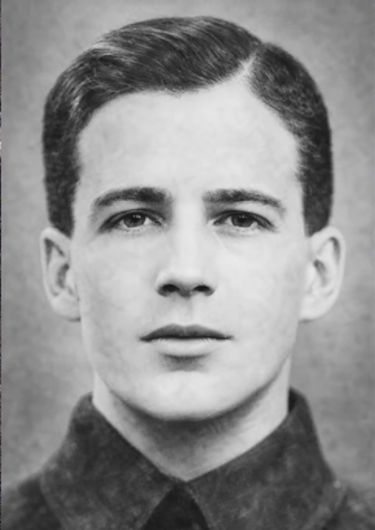 
Above photos kindly sent by Rory Kehoe with thanks to Prash Ganendran,
who says the following:- By way of a postscript to the 1943 story of the
murder of Caroline Ellen Trayler (nee Stapleton) here is a picture of
Mrs Trayler. Also, a photo of her murderer, Gunner Dennis Edmund Leckey
RA, who was convicted of Mrs Trayler's rape and murder and sentenced to
be hanged. However, on appeal, it was found that the Judge had made a
technical error in his summing up and guidance to the Jury. As a result,
the Court of Appeal had to quash the conviction. There then, being no
Double Jeopardy, which would have allowed Leckey to have been retried on
the charge of Mrs Trayler's murder, he had to be released, although he
was convicted on a lesser charge of being AWOL from his RA unit.
The landlady/co-licensee of the pub was Mrs Dorothy Goldsworthy.
|
|
Folkestone Herald 25 September 1943.
Local News.
Gunner Dennis Edmund Leckey, aged 24, was sentenced to death at the Old
Bailey on Wednesday for the murder of Mrs. Caroline Ellen Trayler, whose
body was found in an empty shop in Foord Road, Folkestone, on June 17th.
Mr. Justice Singleton, passing sentence, said to Leckey “You have been
convicted of a very cruel murder”.
Mrs. Trayler was aged 18 and was employed as an usherette at a
Folkestone cinema. A vivacious and cheerful girl she was popular among
her friends. After she had been reported missing on June 14th police
officers carried out extensive enquiries and also began a search of
unoccupied premises in the town. In the course of this search Mrs.
Trayler's body was found in the passageway of a shop at No. 94, Foord
Road. She had been strangled.
Detective Supt. F. H. Smeed, Kent County Constabulary, C.I.D., took
charge of the case and his investigations and those of other officers
covered a wide area. As a result an announcement was made that the
police wished to interview Gunner Dennis Edmund Leckey, of the
Royal Artillery, who was absent from his unit. The man was traced to
Manchester and towns in the Midlands, and on June 29th he was arrested
in London after he had been in contact with some members of the United
States Army. He was brought before the Folkestone Magistrates on July
1st. He was then remanded for 21 days and at the resumed hearing he was
committed for trial.
The trial of Leckey opened at the Old Bailey on Monday before Mr.
Justice Singleton. There were two women on the jury.
Mr. John Flowers, K.C., prosecuting, with Mr. H. Elam, said Leckey had
been stationed at a camp about five miles from Folkestone. The dead girl
lived with her parents, Mr. And Mrs. Stapleton, of Sussex Road,
Folkestone. On Whit-Sunday, June 13th, she was at her work and left just
before 9 o'clock. She was then wearing a wedding ring and engagement
ring. She did not return to her home that night, and next day, when she
did not report to the cinema, her mother reported her disappearance to
the police. Four days later when she was found there were no rings on
her hands. Mr. Flowers said that a soldier, called Knight, and Leckey
were in a public house on the night of June 13th when Mrs. Trayler
walked in. Leckey said “She's nice” and they got into conversation with
her. Some time later Knight left saying that he would see Leckey later
on at the truck that would take them back to camp. Mr. Flowers outlined
what he said was known of Leckey's movements after the public house
closed at 10 o'clock. There was a suggestion that about 12.15 he met a
W.A.A.F. officer and carried her bag for her. He did not return to the
camp until 1.30 a.m. and when asked why he was so late he said he had
met a young lady who would not let him take her home so he had returned
to the camp on his own. At the guardroom he was again asked why he was
so late and he said that he had seen a girl home. Next day he told
Knight that the girl they had met in the public house had said that she
had a date. There would also be evidence, continued Mr. Flowers, that
Leckey asked a man if he had heard of the girl “done in” at Folkestone.
He said he had seen it in a paper, but, said Mr. Flowers, there was no
paper in Folkestone that day containing such a notice. On June 18th
Leckey left the camp and went home to Manchester. There he told his
mother-in-law that he was on 48 hours’ embarkation leave and he asked
her to look after the children while he was abroad. Actually he was not
under orders for abroad. On the 20th he was in another town and there he
told a man that he had an engagement ring which he said he had got from
someone in Ireland. On June 22nd he was at Stafford where he met a woman
to whom he said he was a fighter pilot. They went to Birmingham and
spent the evening at a cinema and on the 23rd they both travelled to
London together. He did not keep an appointment to meet her on the 24th.
On June 28th he was with a corporal of the United States Army in
Leicester Square and then he said that he was a flight sergeant and that
his name was Allen. Next day he was seen in a public house near the
Marble Arch and when asked by the police what his name was, he said it
was Latham. He was told that he answered the description of Leckey, who
was wanted by the Folkestone police, and he was alleged to have said
“You have got nothing on me’’. At his hotel the police found a number of
Army pay books. One was in the name of Latham. Certain pages had been
extracted from it and others inserted, one bearing the photograph of
Leckey. Leckey's own book was also found. The page with his photograph
was missing from it. On June 30th, when he was seen at Marylebone police
station, he was alleged to have replied “I know about it”. When asked
about his movements on June 13th he said that he was with the girl but
before he made a statement he would like to get advice. Leckey had left
his uniform in Manchester and it was recovered. Mr. Flowers said that
Dr. Keith Simpson, who conducted an examination of the dead girl, found
dark hairs which were identical in colour and texture with those of
Leckey. Under her fingernails he found scrapings of wool fibre which the
prosecution suggested were identical in colour and size with the
material of Leckey's shirt. Mr. Flowers said he supposed that the shirt
was an Army one so that there might be many soldiers wearing shirts of
similar material. When Leckey was charged June 30th he said "I have
nothing to say until I see a solicitor”. It was clear, said Mr. Flowers,
that the girl was murdered on the night of June 13th and the evidence
was overwhelming that Leckey did it. She had been strangled. Her voice
box was fractured and death was due to asphyxia.
Mrs. Ellen Jane Stapleton, the dead girl's mother, who is so crippled
that she could not climb into the witness box and was allowed to sit in
the well of the court, said that her daughter was always home by 10.30
p.m. unless she was going to a dance. She had her own key. Witness said
that she went to bed on the night of the 13th between 10.30 and 11 but
she woke about an hour later to find that her daughter had not returned.
“I walked about in the house that night going to the windows and looking
up and down the road, and in the morning I got Carol’s breakfast ready.
She did not return”, said Mrs, Stapleton. “I got lunch ready for her too
and when she did not come for it I went to the cinema. She was not one
of these runabout parties. Her being out all night had never happened
before”.
Replying to Mr. J.D. Casswell, K.C. (with Mr. Harold Brown for the
defence), Mrs. Stapleton said that she knew that her daughter did not
have a date that night. She had hung up her change of linen, and was
coming home to have a bath. She would not go out after having a bath.
“I've got a date” was just a saying that her daughter often used and it
did not mean anything.
Mrs. Dorothy H. Goldsworthy, Mechanics Arms public house, Folkestone,
said on the night of June 13th she saw Mrs. Trayler and Leckey together
in the public house. Mrs. Trayler said that she was going as she had a
date but witness said to her “You don’t want to go. Stop at the old
Mechanics”. Mrs. Trayler did remain and was one of the first to leave
when the public house closed at 10 o’clock
Evidence was given by a member of the staff of the Central Cinema,
Folkestone, that on the night of June 13th Mrs. Trayler was wearing two
rings.
Kenneth Knight, a bombardier in the Royal Artillery, said he went to
Folkestone on June 13th with Leckey and arrived about 6 o'clock. They
went to a cinema and various public houses and eventually arrived at the
Mechanics Arms public house about 9 o’clock. A photograph of a woman was
then shown to Knight, who who said that it was of the woman who came
into the public house and Leckey said “She looks nice”.
Knight said that Leckey got into conversation with this woman and
eventually about 9.45 he (Knight) decided to leave. Leckey said to him
“Don't go yet. There are girls here". The woman said “I don't want to
break you up”. Knight said that he went back to his camp in an Army
truck. He saw Leckey the next morning about 7.15, and Leckey told him
that when he came out of the public house he kissed the girl and left
her. He thought Leckey must have walked back, as he told him that he met
a W.A.A.F. officer on the way and carried her bag for her. On Friday,
June 18th, said Knight, Leckey borrowed 6/- from him. He said it was to
pay a debt to a gunner.
In cross examination, Knight denied having had a quarrel with Leckey at
a birthday party.
George Ellison, a gunner m the Royal Artillery, said he was in the
Mechanics Arms public house on Sunday. June 13th and saw a girl, whose
photograph he identified, leave the house with Leckey.
Police Constable John Lewis said on June 17th he was searching some
unoccupied property at Foord Road. Inside a shop he saw a blue suede
shoe and a large brown handbag. "In the passageway, leading from the
back door of the shop, I saw the body of a woman. I immediately reported
it to my superior officers at headquarters”, said the witness.
In answer to Mr. Casswell Lewis said that was a lot of dirt on the floor
but he did not examine the premises for footprints.
Margaret Agnes Cook, a flight officer in the W.A.A.F., said she arrived
in Folkestone 15 minutes after midnight on Sunday, June 13th and set out
to walk to her destination. She was overtaken by a soldier outside
Folkestone and he carried her bag part of the way. She would not
recognise the soldier again.
Fred Latham, a gunner in the R.A., said on Thursday, June 17th, Leckey
said to him “Have you heard about the girl being done in in Folkestone?”
Leckey told him that he had seen it in the paper.
Mrs. Beatrice Shaw, Leckey's mother-in-law, said she saw him in
Manchester on June 19th with his wife. Leckey told her he was on 48
hours embarkation leave.
Mrs. Winifred Wooley, West Twyford, said she met Leckey at Stafford
railway station, and he told her he was a sergeant pilot in the R.A.F.
He was in civilian clothes and told her his name was Alan Leckey. He
said he had lost a case and was going to Birmingham to collect it. She
was travelling on the same train and he went with her. The next day she
went to London with Leckey. She gave him a small case and some shaving
kit. The following day Leckey rang her up and made an appointment. He
did not keep it and she did not see him.
Stewart Wilson Bier, a United States soldier, said that he was in a West
End bar with another man and got Into conversation with a man. Pointing
to the dock, Bier said “That’s the man right there”. Bier said that this
man told him his name was Allan and that he was a pilot in the R.A.F.
The three men spent the night at a West End hotel. When he woke up in
the morning the man had gone, “and so had the wallets”, added Bier.
P.C. Alfred Riggs said that he saw Leckey at a public house in the West
End. He asked him his name and Leckey said “Latham”. When told that he
was wanted by the Folkestone police he said “You have nothing on me”.
Dr. Keith Simpson, pathologist, said he examined the body of Mrs.
Trayler and found underneath a tom finger nail a short piece of wool
fibre freshly torn away. This fibre was identical with the fibre of a
shirt worn by Leckey. It was identical in weight, colour and wool
structure. He made a post mortem examination and found injuries
consistent with the woman being strangled manually by hand both from the
front and behind. He found bruises behind the voice box, which was
fractured. Death was due to asphyxia from manual strangulation. “I
formed the view that death had taken place about four days previously”,
Dr. Simpson added . “I made a microscopical examination of hairs taken
from the girl and a hair taken from Leckey. The hairs found on the girl
corresponded exactly in dimension, colour, and in character with the
hair submitted to me from Leckey”.
Dr. James Davison, director of the police laboratory at Hendon, said he
examined battle-dress trousers which Leckey had been wearing. He found
human hair on the right leg. He compared that hair with hair taken from
the deceased girl, and the hair found on the rousers was similar in all
respects to the hair taken from the girl.
This closed the case for the prosecution.
Leckey then went into the witness box and described his movements on the
night of Sunday, June 13th. He said he went to Folkestone with Gunner
Knight and after visiting several public houses they were directed to
the Mechanics Arms where they were told there was music. A girl came
into the bar and after a time she came over and stood beside him. They
started talking to one another and shortly before 9.30 Knight left them.
The girl, whom he got to know as Caroline Trayler, told him she had a
date but he persuaded her, with the aid of the landlady, to stay until
closing time. By that time they were very friendly. He had quite a bit
of beer but was not drunk. He got a bit merry”, as he started to drink
whisky. “We left the public house together”, said Leckey, “and walked
along the road for some way. We then walked along until we came to a
quiet street, and after a few minutes I suggested that we should go into
one of the entries. We did so”. Leckey said that intimacy then took
place. The girl did not object. When they left there he told her that he
would have to get back, and she said that she did not wish him to see
her home. Leckey denied that he was anywhere near an empty shop. "I
never saw her again after I left her”. he declared. The first I knew
about the murder was when I went into a bar at Folkestone with four
other men. The barmaid mentioned to us that a girl had been found dead
in an empty shop in Folkestone, and the police were looking for a blonde
sailor. The barmaid told us the girl was an usherette at a cinema and
was a good looking girl with ginger hair. She said she was called
Caroline. I put two and two together and surmised it was the girl I had
been with that night. On the same night I heard two women in a bar
discussing the finding of a girl’s body in a shop. I knew the police
would want to know who she was with that evening. I decided to go home
to Manchester at the weekend, and tried to see my Major to obtain leave.
I failed to see him but I went to Manchester after taking two pay books
and some money belonging to other soldiers. When coming back from a
public house in Manchester with my wife I saw a police car standing at
my door. I made some excuse to my wife and went to Manchester Station,
where I spent the night. I went to Stoke on Trent and Birmingham, and
finally to London. In the papers I saw that a man answering my
description was wanted in connection with the murder at Folkestone.
While in a public house in the West End a policeman entered with some
American police in plain clothes. The policeman arrested me for larceny
but when we got outside one of the Americans pointed me out und said “I
believe this guy is wanted for murder too down in Folkestone””.
Asked by his counsel if he killed the girl, Leckey answered “No, sir”.
Mr. Flowers, in his final speech for the prosecution, stressed the point
that if Leckey’s story, which he told in the witness box, were true,
then it would mean that there must have been another man with the girl
after Leckey had left her.”And this man”, said Mr. Flowers, “has hairs
which are exactly the same as those of Leckey. One witness says that she
looked out of her window and saw the girl in company with a soldier at
10.15 p.m. Another witness saw the girl and a soldier at 10.30 p.m., and
still another witness saw the girl and a soldier at 10.40 p.m. in Foord
Road where the girl's body was eventually found. All those witnesses
knew the girl, and Leckey has said that he left the girl at about 10.20
p.m. In my submission it is quite clear that it was the prisoner who was
seen with the girl at 10.40 p.m in Foord Road. His story is false.”
Mr. Casswell, in his speech for the defence, said “This case bristles
with doubt. It is a case of uncertainty. This young man has thrown
suspicion on himself by his own actions, but we are not here to consider
whether he is an immoral young man or even petty thief. There was
nothing on Leckey’s clothes to connect him with being in the shop where
the murder took place. If Leckey had been in the shop that night and did
what is suggested, surely there would be some marks on his clothes There
was none”. Speaking about the fabric which was found under the dead
girl’s fingernail, Mr. Casswell said “You might find a orange thread of
similar fabric on some five million shirts today. Is the prosecution so
bankrupt of evidence that they must rely on that?”
In the course of his summing up Mr. Justice Singleton said “If, as
Leckey says, he left the girl about 10.20 p.m., why couldn’t he get to
the place where the truck was waiting to pick up soldiers returning to
camp by 11 o’clock? It was broad daylight at that time. He had ample
time to get there even if he was ill through having mixed his drinks”.
Referring to the fact that Leckey made no statement to the police when
charged with murder, but said that he wanted to consult a solicitor, Mr.
Justice Singleton said “This man is always cool and collected. If a man
is charged with murder and is not responsible and has not committed
murder, what do you expect him to say? Would you expect him to deny it?”
“Ask yourself this”, said the Judge, “If this man be innocent, and if
his sole purpose in going away was to make a confession of
unfaithfulness to his wife, can you see him acting as he did?”
When the jury returned to court after deliberating for lust over half an
hour, Leckey looked at them without any trace of feeling. The foreman
said the word “Guilty” and Leckey looked at him for a fleeting few
seconds and then turned to face the Judge. When asked if he had anything
to say Leckey looked straight ahead of him and did not utter a word.
Mr. Justice Singleton, passing sentence of death, said “Yoiu have been
convicted of a very cruel murder”.
A warder touched Leckey on the arm, and the condemned man immediately
turned about and walked steadily down the stairs to the cells below.
|
|
Folkestone Herald 2 October 1943.
Local News.
Notice of appeal has been given by Gnr. Dennis Edmund Leckey, who was
sentenced to death at the Old Bailey on Wednesday last week for the
murder of Mrs. Caroline Ellen Trayler at Folkestone on June 17th.
|
|
Folkestone Herald 30 October 1943.
Local News.
An appeal on behalf of Dennis Edmund Leckey, a gunner in the Royal
Artillery, found guilty at the Central Criminal Court on September 22nd
of the murder of Mrs. Caroline Ellen Trayler, a cinema usherette, who
was found strangled in an empty shop at Folkestone, will come before the
Court of Criminal Appeal on Monday. Leckey was sentenced to death after
a trial lasting three days. He is asking for leave to appeal against
conviction.
|
|
Folkestone Herald 6 November 1943.
Local News.
The appeal of Gnr. Dennis Edmund Leckey, 24, Royal Artillery, against
his conviction for the murder at Folkestone of Mrs. Caroline Ellen
Trayler, a cinema usherette, was allowed by the Court of Criminal Appeal
on Monday. Leckey, who showed no signs of emotion, was set free.
Dressed in a smartly-cut grey civilian suit, Leckey, tall, dark and
good-looking, followed the lengthy legal arguments with the keenest
attention, but remained unmoved throughout. He is a married man with two
children.
Mrs. Trayler was found strangled in an empty shop in Foord Road,
Folkestone, on June 18th.
Leckey's appeal was made on the ground that there had been a
misdirection of the jury at his trial at the Old Bailey.
Mr. J.D. Casswell, K.C., for Leckey, pointed out that the judge
commented in his summing-up on the fact that when cautioned by the
police Leckey did not deny the charge, but said he would take advice.
What the judge had said, he continued, was tantamount to saying “If a
man says “I reserve my defence”, then you may rely on that evidence
against him showing that he is the man responsible for the crime
charged”.
Mr. J.D. Flowers, K.C., for the Crown, said that both he and Mr.
Casswell at the trial told the jury that the fact that Leckey preferred
to keep silent when cautioned by the police should not be held against
him. The case was simply overwhelming against Leckey without the
comments made by the judge, and it was impossible that the jury would
have come to any other conclusion if the comments had not been made.
The Lord Chief Justice, giving the judgement of the Court, said there
was a great deal of evidence upon which it was open to the jury,
properly directed, to find that Leckey murdered Mrs. Trayler, but the
judge's comments on Leckey's silence amounted to a misdirection and the
Court could not say that, if the jury had been properly directed, they
(the jury) would inevitably have come to the same conclusion. His
Lordship said that three times the judge seemed to put to the jury the
consideration that they might infer Leckey's guilt by considering the
fact of his silence after being cautioned. But a man was entitled to
remain silent. If that was not so it must be obvious that a caution
might be a trap instead of being the means of finding out the truth in
the interests of innocent persons as in the interests of justice against
guilty persons. An innocent person might well decline to say anything
from excessive caution or for some other reason and, if it were to be
held out to a jury that that was a ground upon which he might be found
guilty, innocent persons might be in great peril. The Court of Appeal
had power, however, to disallow an appeal in such circumstances if they
considered that no substantial miscarriage of justice had occurred. To
do so the Court had to find that, if the jury had been properly
directed, they would inevitably have come to the same conclusion. In the
present case there was evidence in plenty which would have justified a
verdict of guilty, but the Court was unable to say that the jury, on a
proper direction, would inevitably have come to the same conclusion as
they did. It was not the opinion of the Court that mattered: it was the
minds of the jury, and nobody but the jury. Having regard to the
importance which the passages must have had in the scheme of the
summing-up, and the effect they seemed very likely to have had on the
minds of the jury when considering their verdict, the Court could not
say that the jury must inevitably have come to the same conclusion on a
proper direction. The appeal was accordingly allowed and the conviction
quashed.
During the long judgement Leckey stood in the dock like a soldier
standing at ease and appeared to follow the points taken both for and
against him clearly.
Five points of misdirection had been brought to the attention of the
Court. The first four were decided against him. The fifth point taken by
his counsel and the fifth dealt with by the Lord Chief Justice was that
on which he succeeded.
|
|
Folkestone Herald 13 November 1943.
Local News.
After returning from North Africa, Sgt. Edgar Trayler, 22 years old
husband of Mrs. Caroline Edward Trayler, a Folkestone cinema usherette,
who was murdered last June, visited the dead girl's parents in
Folkestone during the weekend. While staying with Mr. And Mrs.
Stapleton, his wife's mother and father, Sergt. Trayler was joined by
his mother and elder brother, who had not seen him for just over a year.
Sergt. Trayler was in North Africa at the time of his wife's death, and
it was not until July 20th that he read, in a London newspaper, of the
discovery of her body in an empty Folkestone shop. At the time he was in
hospital. No official news was received by Sergt. Trayler, and the first
message giving some details of his wife's tragic death was an airgraph,
written by a friend of Mr. And Mrs. Stapleton, which reached him on
September 3rd. Other messages had been sent but these apparently did not
reach him. Sergt. Trayler had already made an application for
compassionate leave in order that he might return to Folkestone and
settle his wife’s affairs, but the request was not granted. After a
journey of 3,000 miles, which took 44 days, Sergt. Trayler arrived in
this country from North Africa towards the end of October. He was placed
under a nurse, but arrangements were made for him to visit his wife's
parents last weekend. The journey is understood to have been made by air
except for a hitch-hike of nearly 200 miles. Sergt. Trayler is 22. He
was in the Territorials at the outbreak of war, and he served in France,
being evacuated from Dunkirk and landing at Folkestone. He married Miss
Stapleton in October, 1942, and they spent their honeymoon at Crook, Co.
Durham, his home. Sergt. Trayler went overseas in April last.
|
|
Folkestone Herald 15 November 1952.
Local News.
Folkestone Magistrates on Wednesday approved the transfer of licence as
follows: Mechanics’ Arms from Mr. J. Dennis to Mr. J.A. Clarke.
|
|
Folkestone Herald 14 November 1953.
Local News.
Transfer of the licence of the Mechanics Arms to Mr. Arthur George Darby
was confirmed at Folkestone transfer sessions on Wednesday.
|
|
Folkestone Gazette 29 November 1967.
Local News.
There will be no new public house in the Clarence Street, Folkestone,
area when it is redeveloped by the town council. When the council made a
compulsory purchase order so that it could clear and redevelop the
street it promised brewers that it would provide a site for an inn to
replace the Mechanics Arms. Now the brewers have informed the council
that they do not want another site. They do not think a new public house
in the area would be a paying proposition. The council expects soon to
start demolition work in the street The council is being recommended to
authorise the Town Clerk to take proceedings to evict tenants who do not
comply with notices to quit.
|
LICENSEE LIST
HOBBS
John 1855-56
WILLIAMSON Alexander 1856-58
 
CONSTABLE Richard 1858-59
DRISCOLL James 1859-Oct/61

HODGSON Thomas Oct/1861-66
 (age 35 in 1861
 ) )

WAITE Henry 1866-68
 WALLIS John 1868-69
WHYBOURNE Edward 1869-71
KEYTON George 1871-72
NUNN Caleb 1872-73
THOMSETT Mr 1872-73
KEYTON
George 1873
ROBINS Edward 1873-77
SHEERAN John (Joseph) 1877-83
FISHER James 1883-91
GRANT Richard 1891-92
PARKES Stanley F 1892-99
RIBBENS John 1899-1900
LAURENCE George John 1900-20  
DRYSDALE George Vickery 1920-26
GRANT Walter 1926-34
STEWART William 1934-35
MOXHAM Joseph 1935-39

ROBERTS James 1939-40
CLINCH Ernest 1940-42
GOLDSWORTHY Robert 1942-46
WOOLFORD Elsie 1946-48
CARR Howard 1948-50
DENNIS John 1950-52
CLARKE John 1952-53
DARBY Arthur 1953-61
DOLTON Robert 1961-67
From Melville's Directory 1858
From the Post Office Directory 1862
From the Post Office Directory 1874
From the Post Office Directory 1882
From the Post Office Directory 1891
From the Kelly's Directory 1899
From the Post Office Directory 1903
From the Kelly's Directory 1903
From the Post Office Directory 1913
From the Post Office Directory 1922
From the Kelly's Directory 1934
From the Post Office Directory 1938
From the Folkestone Observer
From More Bastions of the Bar by Easdown and Rooney
|

