|
The Leas
Folkestone
Video link.
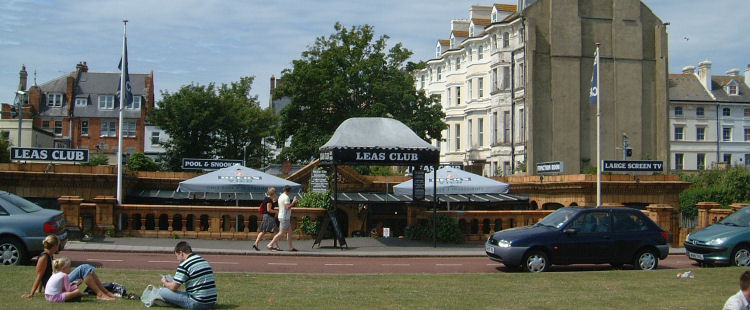
Above photo showing the entrance to the sunken Lees Club, taken by Paul
Skelton, 6th July, 2009. |
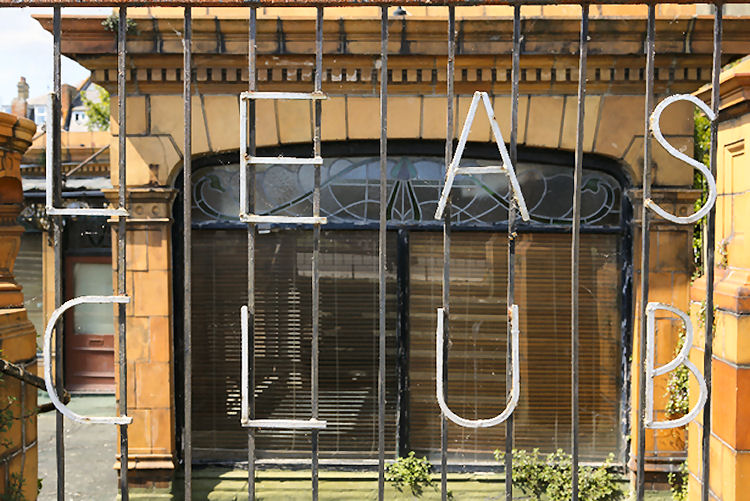
Above sign, date unknown. |
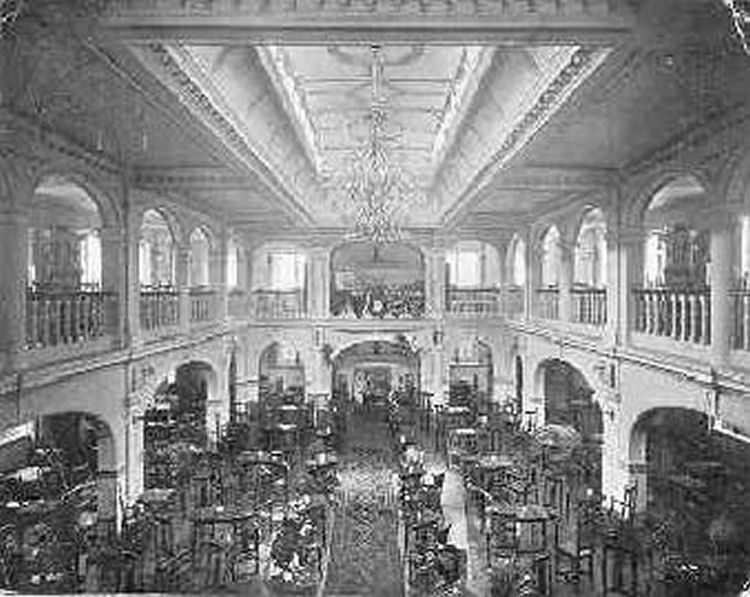
Above picture showing the inside circa 1910.
Below article from gofolkestone.org.uk
The Leas Club was first opened as a teahouse called the Leas Pavilion
in 1902. The idea for a tearoom came from Mr Frederick Ralph, and it was
designed by a local architect, Mr Reginald Pope. It was planned to be
built on ground lying between two hotels on the east of the Leas. Both
these hotels had long leases from Lord Radnor, which included an
‘ancient lights' clause which meant that no building could be
constructed which would prevent light reaching their windows. As a
result the building was constructed with only one storey visible above
the ground with a flat roof, but it had a full height basement which was
excavated on three sides.
The teahouse was fully licensed and charged high prices. A covenant
in the lease required that the lessees would ‘use the room for the
highest class tea and refreshment trade with the view to securing the
best class of visitors only'. Concert parties subsequently proved very
popular with an orchestra and vocalists. When war broke out it was at
the Leas Pavilion that farewell concerts were held for the troops, who
would march straight down the Road of Remembrance onto the ships waiting
to take them to France.
In 1928 a stage was built at the far end of the hall and the theatre
opened for plays and tea matinees. It flourished as a repertory theatre
called the Leas Pavilion Theatre for 57 years until September 1985. It
reopened as the Leas Club in March 1986, and has subsequently been run
as a venue for live music and as a public house and café.
Members of the Go Folkestone Buildings and Environment Group hoped
that with such a fascinating history and as such an important part of
Folkestone's heritage, it was of sufficient architectural and historic
interest to justify applying for listing. The Secretary of State, after
consulting with English Heritage, has decided it merited statutory
listing at Grade II, and gave the following reasons: It is a rare
example of a purpose built Edwardian high class tearoom, a poignant
evocation of troops departing for France in World War 1 and an early
20th century popular entertainment venue.
The front entrance is of special architectural merit for its high
quality moulded terracotta work, ironwork grilles and attached veranda,
and for its Art Nouveau style stained glass.
The plan form survives intact. The interior with its imperial
staircase, galleried interior and ceiling survives substantially intact
apart from a few alterations to convert it into a theatre in 1928. It is
an important Edwardian seaside building, comparing in interest with the
Leas Cliff Hall and the Pulhamite Caves which are both listed Grade I.
Few examples of tearooms survive from this period because as a
building type they were liable to be regularly refurbished. So next time
you are passing, go and have a look. A little bit of history – intact.
Judith Deane
Member Go Folkestone Building and Environment Group
|
Kelly's directory of 1934 gave the name as the "Leas Pavilion."
The passage below was posted on "Folkestone Forums" 3 August 2008.
"I see in the Herald that Viscount Folkestone has sold the freehold to
the Leas Club to Churchgate, along with the two car parks which they plan to
build flats on. The flats will be at least six stories high and form a horse
shoe around the Leas Pavilion.
Churchgate have stated that they will not allow the premises to
continue to operate as a nightspot. What should it be used for?
Personally, I've always thought that it was rather wasted as a bar. It
would have made a decent casino, but that's not going to happen any time
soon. It could make a good restaurant - dare I say it, even a Pizza Express.
Thankfully, it's probably too big to be a Subway!"
|
Folkestone Herald 2 August 1985.
Local News.
The Edwardian Leas Pavilion Theatre is to become a Wild West saloon if
developers' plans are realised. A theme pub-restaurant catering for
heavy spending 18-30 year olds will be created in Folkestone's historic
tea rooms in a £250,000 project backed by brewery giants Whitbread.
“It will be a carnival atmosphere”, said Barry Motion, managing director
of Tempocrown developers, now holding exclusive talks with the Radnor
Estate – owners of the building. In an exclusive interview with the
Herald last week he outlined his plans for turning the ailing theatre
venue into a swinging nightspot and eating-out centre. Dining tables for
60 with waiter service to replace the theatre seats, plus new bars to
the left and right of the entrance stairs. Retention of the basic
features of the proscenium arch, galleries and period toilets, but with
Western saloon atmosphere. Permanent staff of 10 – 12 on the bars,
saloon catering and front porch Italian and Mexican self-service food
areas. Dance floor on several levels around present stage, with
facilities for laser light shows and live acts. “We will offer a full
meal for £3.50 to £5 inside, and self-service meals in the food court
out the front at £1.50”, said Mr. Motion. “In direct competition with
nightspots in Ashford and Canterbury, we will be offering an evening out
for young people to suit their tastes and pockets”, he added.
Mr. Motion, whose Epsom-based company has converted country houses to
management centres and Victorian churches to craft and shopping centres,
believes the project can make a profit, guarantee the structure of the
building and bring night life to Folkestone. He says top priority will
be given to quietness on the part of late-night leavers so as not to
antagonise residents. While inside first-class staff will ensure
cleanliness, service and value for money. “We are an investment company
here for a long time – the buck stops with us and the place will be
impeccably run”, he said.
|
|
Folkestone Herald 9 May 1986.
Local News.
Plans to turn the Leas Pavilion Theatre into a leisure club are likely
to go ahead after an application for planning permission was granted
this week. The plans include a dance floor, a bar, snooker and billiards
room and a cafe or restaurant in the former theatre.
Folkestone hotelier Mr. Bob Warburton, who made the application, has
said the cost of changing the theatre into a club will be about
£250,000.
Mr. Warburton is expected to sell his share in the Devonshire Hotel in
Marine Parade, Folkestone, which he has run for 20 years. The club is to
be for private members only and to be open from 10 a.m. until 11 p.m.
every day except Saturday when it will stay open until midnight. Live
shows and cabarets will be shown at weekends and the club will be aimed
at the teenage market.
Objections from 48 residents of Folkestone and Hythe and 37 from other
nearby towns have been sent to Shepway’s Planning Department. The
residents are complaining at the loss of the theatre and say there are
already enough eating and drinking houses in Folkestone.
|
|
Folkestone Herald 15 May 1987.
Advertising Feature.
The Leas Pavilion was a restaurant for the gentry in 1902, a silent
movie venue in 1911, and a theatre and concert hall from 1929. Today the
Pavilion has been transformed into a 1980s snooker, pool, tenpin bowling
and cabaret club for a new generation of Folkestonians.
The Pavilion has been brought back to life thanks to the determination
of the Warburton family, who have transformed it from a derelict
vandalised building into an elegant select private club - The Leas Club.
Bob and John Warburton, their mother Norma, and their wives Carol and
Bobby took over the Leas and after months of elbow grease, blood, sweat
and tears have restored it to its former glory. The husband and wife
teams have had 20 years of the hotel trade tucked under their belts,
plus an enthusiasm and love of Folkestone, strong enough for them to
take the plunge and invest in the club. They first set eyes on the
Pavilion in January, 1986, and knew it suited them down to the ground.
Bobby said: “It was an absolute tip, scenery, props, rubbish everywhere,
but we saw the potential”. Now, 16 months later the Leas Club boasts a
snooker room with oak panelled walls, pool tables, darts, two American
style tenpin bowling lanes and facilities to provide entertainments,
bands and a cabaret to private members at a cost of £35 per year.
Carol explained their choice of decor “We tried to stick to the
Victorian style of the place, in keeping with the original insides.
Wherever we could we tried to save the original fittings and fixtures,
like the windows and ornamentation”, she said. Of course, there has been
a great deal of modernisation, but it has been done with a great amount
of skill, blending in unobtrusively with the surroundings. There are
marbled pillars, wood grained trimmings, lush carpeting throughout,
discreet lighting, arches, and a tasteful green and gold colour scheme -
not to mention one modernised very welcome addition, a 52 foot long bar!
In all there is a comfortable relaxed feel to the whole place, whether
you fancy dabbling in some friendly rivalry over a snooker table or just
want to sit and have a quiet drink with friends.
The Warburtons have spent more than £¼ million restoring the club, a
massive sum well spent – especially when you realise that the original
cost to build the Pavilion was only £10,000! Carol said “It has taken an
awful lot of hard work to get it up to scratch, but we would all like to
thank our friends and everyone who helped to get this off the ground”.
Bobby agreed, adding “We are giving Folkestone something back that they
have had for years, but sadly has been left unused”.
Not only can Folkestonians look forward to the opening of the club on
Thursday, May 11, at 10.30 a.m., but they will soon have an ice cream
parlour and tea rooms at the Leas once the Warburtons settle into the
club. The good news is that a whole new generation of Folkestonians will
be able to have the best of both worlds – the grace and elegance of
yesteryears at the Leas Club, while not missing out on all the
conveniences and luxuries modern times have brought us.
|
|
Folkestone Herald 31 March 1994.
Local News.
Burglars stole three gallon bottles filled with coins for charity from
The Leas Club, The Leas, Folkestone. The money totalled more than £250.
A police spokesman said “The bottles are quite heavy and would have been
difficult to carry. The money collected was in small denomination coins
and if any businesses or shops in the area have been asked to change a
large amount of coins into notes they should call us”.
|
|
Folkestone Herald 25 January 1996.
Local News.
A woman had her purse stolen when she left it for a few minutes in the
Leas Club. Owner, Rachael Jackson, of Swan Lane, Sellindge, lost her
driving licence, keys, cash card and £5 cash.
|
|
From the
http://www.folkestoneherald.co.uk 1 May 2014. By Joe Casper
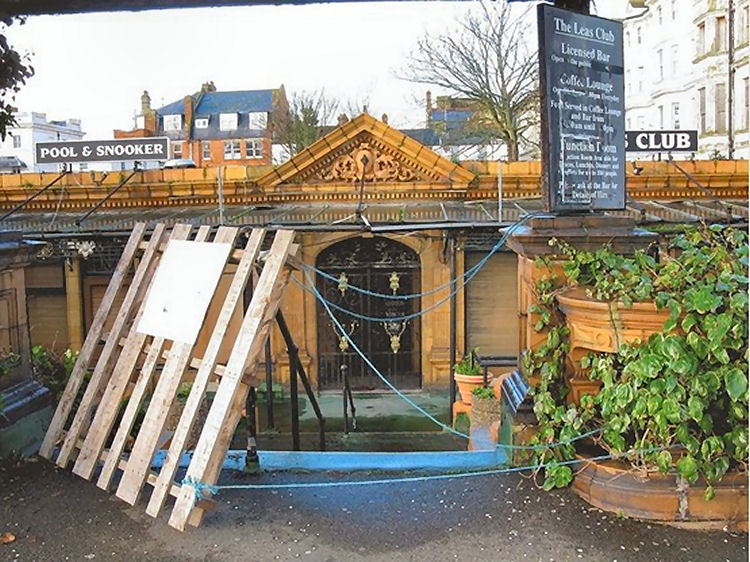
PERMISSION to build a gym and 68 apartments in the former Leas Club will
only be allowed if the site is spruced up before the First World War
centenary. Shepway District Council's development control committee last Tuesday
backed Churchgate Property's plans for the site on The Leas, if
substantial repairs are carried out by July 1. The development was granted outline permission in 2009 and Churchgate
told the Herald in January it hoped to submit a detailed application
this year, with land and acquisitions director Sam Stevens adding he
wanted the site to be as "clean as possible" for the centenary
commemorative events. Councillor Alan North said: "I can't emphasise enough that the whole
world is going to be watching Folkestone. We want it complete by then
and sanctions should be imposed with a daily or weekly penalty if
they're not." When planning permission was granted in 2009, a condition was set that
30 per cent of the dwellings had to be affordable housing. The developer then met the requirements, with 25 units at a Cheriton
development, but now intends to build five units in Longford Terrace,
claiming 30 per cent at the Leas Club would not be financially viable. Councillor Brian Copping said: "This is a dump of a property. "These developers ought to get a proper job because they don't seem to
be able to persuade people like myself that this is happening, you would
think they would have come up with something by now. "I would say that this town needs a theatre and a good quality pub,
bearing in mind the amount of good pubs that have closed recently,
rather than a blinking gymnasium. "A gymnasium is rather elitist and specialist and not for the people
that I represent. I really dislike this application." The central part of the structure will be seven stories high. Dwellings will range from one-bedroom studios to three-bedroom
apartments. Two commercial units and basement and ground floor parking areas are
also to be built. |
|
From the Dover Express, By Victoria Chessum, Thursday, 10 October, 2019.
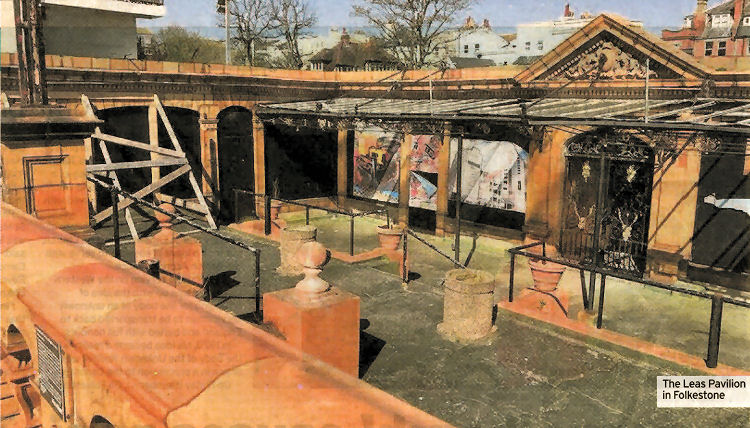
Fresh Plans To Revive Historic Former Theatre.
DEVELOPERS have revealed plans to dismantle the front of the
dilapidated Grade II Leas Pavilion and rebuild it.
The former theatre-turned-night-club, which has been forward fronting
on The Leas in Folkestone since 1902,
is the subject of a legal repairs notice.
Folkestone & Hythe District
Council stepped in seven months ago, ordering the building's owners,
Churchgate, to complete six pages of necessary works.
This means the premises would be owned by the council - and that a
reserve £20,000 would be spent from the public purse to bring it back
into an acceptable state.
Failure to do so within a certain time constraint would trigger the
council stepping in and compulsory purchasing it.
It's visible wilting state was noticed by The Victorian Society in 2017,
when it was dubbed "at risk of being lost forever."
Under a new name, Leas View Developments, a new planning application has
been lodged this week, detailing proposals to take down the front wings
of the former tea rooms.
In a heritage statement, Designs Architecture Ltd which has put together
the plans, says: "Unfortunately the
building is standing empty and has thus suffered neglect over the years,
now considered to be at risk.
"The application seeks consent to carefully dismantle the two structures
where necessary and carry out investigations.
"Following this, it will carry out extensive rebuilding works,
structural repair, and reinforcement as required, together with
reinstatement of terracotta elevations.
"Together with our consulting engineer, we have carried out some limited
investigation so as to establish the exact structure and makeup of the
external walls.
"However, without dismantling some of the structure it is impossible to
be conclusive"
It says the structure has moved, and as a result some of the original
bricks have cracked or broken.
But in the event of a rebuild, the report has claimed a specialist
manufacturer has confirmed identical bricks can be sourced.
High spec plans were originally put forward to build on top of the
existing Grade II listed structure.
This included two units with commercial space, car parking and a modern
health centre.
But these plans expired as of April 2018, and no fresh proposals have
been submitted.
The council will need to approve these plans before the structural
investigation can take place.
|
LICENSEE LIST
MACKWAY E R J (Manager) 1934+

WARBURTON Robert 1987-2004

WARBURTON Robert and John 2004-07
From the Kelly's Directory 1934
From More Bastions of the Bar by Easdown and Rooney
|

