|
From the Dover Mercury, 13 July 2022. By Andrew
Sergeant.
Parish council’s lost five year fight to stand on its own feet.
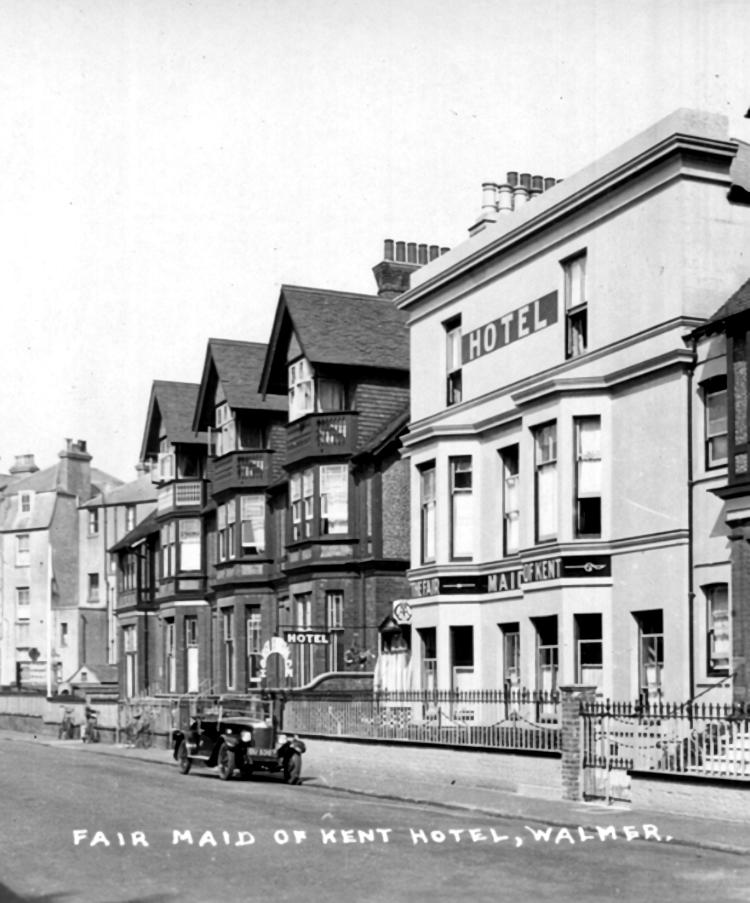
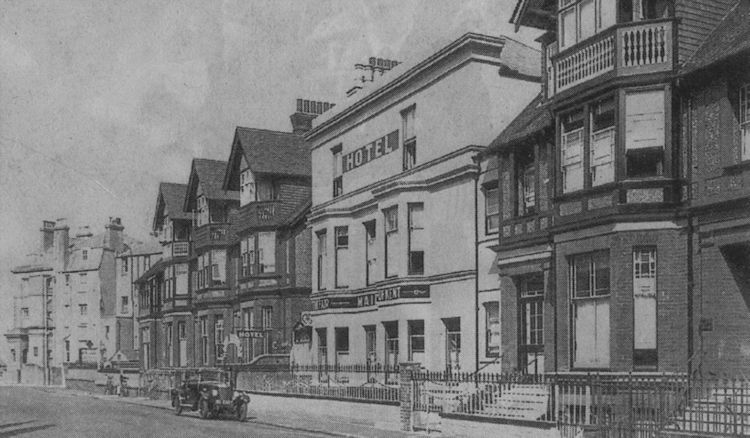
On March 12,1935, the Fair Maid of Kent, a hotel on Dover Road, hosted a
dinner for the members of Walmer Urban District Council.
It was, in fact, a wake.
The council was being abolished; Walmer was being taken over by Deal.
This was the culmination of five years of increasingly bad tempered
argument.
For Walmer, a disaster apparently averted had finally come to pass.
Legislation in 1929 had required county councils to propose to the
Government changes in their areas “with a view to forming more effective
areas for administrative purposes”.
For some municipal boroughs this felt like a green light to think big.
Deal council’s ‘bid’ to Kent County Council was particularly
breath-taking.
Why not let them take over not only Walmer but also Sholden, Great
Mongeham and Ringwould?
This was deeply objectionable to all concerned.
For Walmer councillors Deal’s rudeness in failing to consult before
proposing the abolition of their council merely rubbed salt in the
wound.
They rolled up their sleeves for a fight.
At the heart of their campaign was a local referendum.
The council’s manifesto contrasted “efficient and economically managed
Walmer” with indebted, congested, poorly-served Deal.
The two districts had no real community of interests.
Walmer schools, then county-run, also pitched in.
Why on earth would they want to be entrusted to Deal’s parsimonious
care?
In December 1930, to nobody’s great surprise, Walmer residents rejected
Deal’s proposal almost unanimously: 2,015 (98%) voted against, and only
35 in favour.
In March next year the County Review Committee passed judgement:
although Walmer UDC was too small to constitute a “good government unit”
in the Government’s terms, it was not the right time to make any
significant extensions to Deal’s boundaries.
Walmer had won a battle, but could it win the war?
Not if Deal could possibly help it, and reverse the decision through
intensive lobbying.
Now the gloves really were off.
In December Walmer restated its position to the county councillors.
Whereas Walmer was a well-managed district with a contented population,
Deal “has no friends among its neighbours...local government lacks
efficiency...a disunited Council.. .deliberations conducted with
acrimony-unsatisfactory sanitary conditions.. .(etc etc)”.
Not to mention “the cheap and vulgar seafront entertainment” Deal depend
on for revenue, and “the lack of taste it displayed in its shelters,
pavilion and other works”.
The Mayor of Deal condemned the statement as “scandalous, scurrilous and
libellous”.
But the County Council continued to side with Walmer.
Fortunately for Deal the shadow of Central Government now fell across
the proceedings.
The next stage was for Deal’s proposal to be considered by a Ministry of
Health inspector at a public enquiry in Maidstone.
And all Deal had to do at this stage was to show that they had
established a “prima facie” case - that their proposal at least merited
investigation.
When the inquiry finally took
place in August 1932 Deal’s barrister made much of the argument that
“no-one walking down the front could tell when he left Deal and went
into Walmer, and vice-versa”.
Sure enough, after a further delay of almost a year, the Minister
decided that, a “prima facie case” had indeed been made.
At this point the County Council now effectively threw in the towel, but
objections to the Ministry of Health from
Walmer and its allies meant there had now to be a full blown local
inquiry.
This took place in October 1934 in the Winter Gardens Theatre - today’s
Astor Community Theatre.
For the Mercury it was in fact “the biggest event in the history of Deal
and Walmer”.
Barristers for Deal and Walmer battled it out for two days, calling
expert witnesses and locking horns on pretty much everything.
The public seats were largely
filled by sometimes noisy Walmer supporters.
For the chairman of the Walmer Council “the inquiry clearly demonstrated
two things: the amazing unpopularity of the scheme, and the marked
failure of Deal to prove any advantage to anyone but themselves”.
But he must have known the game was almost up.
Sure enough, in January 1935 came the Minister’s decision that Deal
would indeed take over Walmer (and also Sholden
and Great Mongeham).
As a result the population of the borough rose from 15,400 to 21,200.
The area within its boundaries more than doubled.
In the March local elections Walmer became simply ‘South Ward’, with six
of the 24 seats on Deal Council.
Deal had attempted to absorb Walmer in 1862 and again in 1888; they had
finally succeeded.
In turns secretive and patronising, smug in its
possession of a Charter, the Council had not covered itself in glory nor
made an obviously compelling case.
The Clerk to the Walmer Board, writing angrily to the Mercury in July
1934, had spoken for many at the time (and many before and since): “The
time has come to speak plainly about this act of odious tyranny.
“It is not that Deal has any merits or Walmer any deficiencies.
“It is merely that small
units are being sacrificed throughout the country to a centralising
policy from Whitehall.”
What goes round comes around.
In 1974 Deal Borough Council was in turn abolished, and the area was
subsumed within Dover District Council.
In 2021, Walmer Parish Council took advantage of recent legislation to
re-brand itself as Walmer Town Council, reflecting its growing
population. |